

A laptop on my desk once took an entire weekend to finish a calculation I needed for a Monday meeting. I remember staring at the progress bar, wondering whether the problem was my code or the machine itself. Years later I watched a quantum processor, chilled to a temperature colder than deep space, attack a similar kind of problem from a completely different direction. It did not simply run the same steps faster. It explored many possibilities at once, let the wrong answers cancel each other out, and kept the right one. That shift in approach is the heart of how quantum computers work, and it is stranger and more practical than most headlines suggest.
This article explains how quantum computers work from the ground up. You will meet the qubit, the strange unit that replaces the bit, and see how superposition, entanglement, and interference turn quantum physics into computation. You will walk through quantum gates and circuits, peer inside the golden chandelier of a real quantum machine, and learn why these machines must be kept colder than outer space. You will also meet the famous algorithms, Shor's and Grover's, see how error correction tries to tame fragile quantum states, and finish with an honest picture of what quantum computers can and cannot do. No physics degree is needed. If you can follow a coin toss, a wave in a pond, and a light switch, you can follow this story.
1. A Different Kind of Computer
1.1 The machine that counts differently
Every computer you have ever used, from a pocket calculator to a supercomputer, works in the same basic way. It stores information as bits, tiny switches that are either 0 or 1, and it flips those switches one step at a time according to a program. A classical computer is a superb bookkeeper. It is fast, reliable, and predictable, and it has carried us from room-sized machines to phones that fit in a palm.
A quantum computer is not a faster version of that bookkeeper. It is a different kind of machine altogether, built on the rules of quantum mechanics, the physics that governs atoms and particles at the smallest scales. Instead of bits, it uses qubits. Instead of flipping switches one at a time, it choreographs waves of probability. The result is a machine that is useless for most everyday jobs and astonishing at a small set of specific ones.
I first grasped this difference not in a lecture hall but while trying to explain a quantum experiment to a friend who writes software. He kept asking how many operations per second the machine could do, as if speed were the whole story. I told him to imagine two ways of finding a needle in a haystack. The classical way is to pick up each straw, one by one, and check it. The quantum way is to arrange things so the haystack itself helps point at the needle. That is not a perfect picture, and I will sharpen it as we go, but it captures the shift: quantum computing changes the search, not just the speed.
1.2 Why the question matters now
Quantum computers have moved from blackboard theory to working hardware in laboratories and cloud services. Companies and universities now run real quantum processors with dozens and hundreds of qubits, and researchers publish new results every month. Governments fund quantum programs, banks test quantum algorithms for risk, and chemists use quantum simulations to study molecules that classical computers struggle to model.
At the same time, the hype has outrun the reality. Headlines promise that quantum computers will cure every disease and break every code tomorrow. They will not. Understanding how quantum computers work means holding two truths at once: the science is real and remarkable, and the machines are still young, fragile, and narrow in what they do well. This article keeps both truths in view.
For the physics behind the ideas here, the companion article on Understanding Quantum Mechanics covers the principles, paradoxes, and history in depth. This article stays focused on computing: how those principles become a working machine.
2. Bits vs Qubits: The Basic Unit
2.1 What a bit really is
A bit is the smallest unit of classical information. It has two possible values, 0 or 1, and nothing in between. In a real computer, a bit is a physical thing: a voltage high or low, a magnetic patch pointing one way or the other, a transistor switched on or off. Eight bits make a byte. A string of bits can represent a letter, a number, a colour, or a sound, because every piece of digital information is built from these two-valued choices.
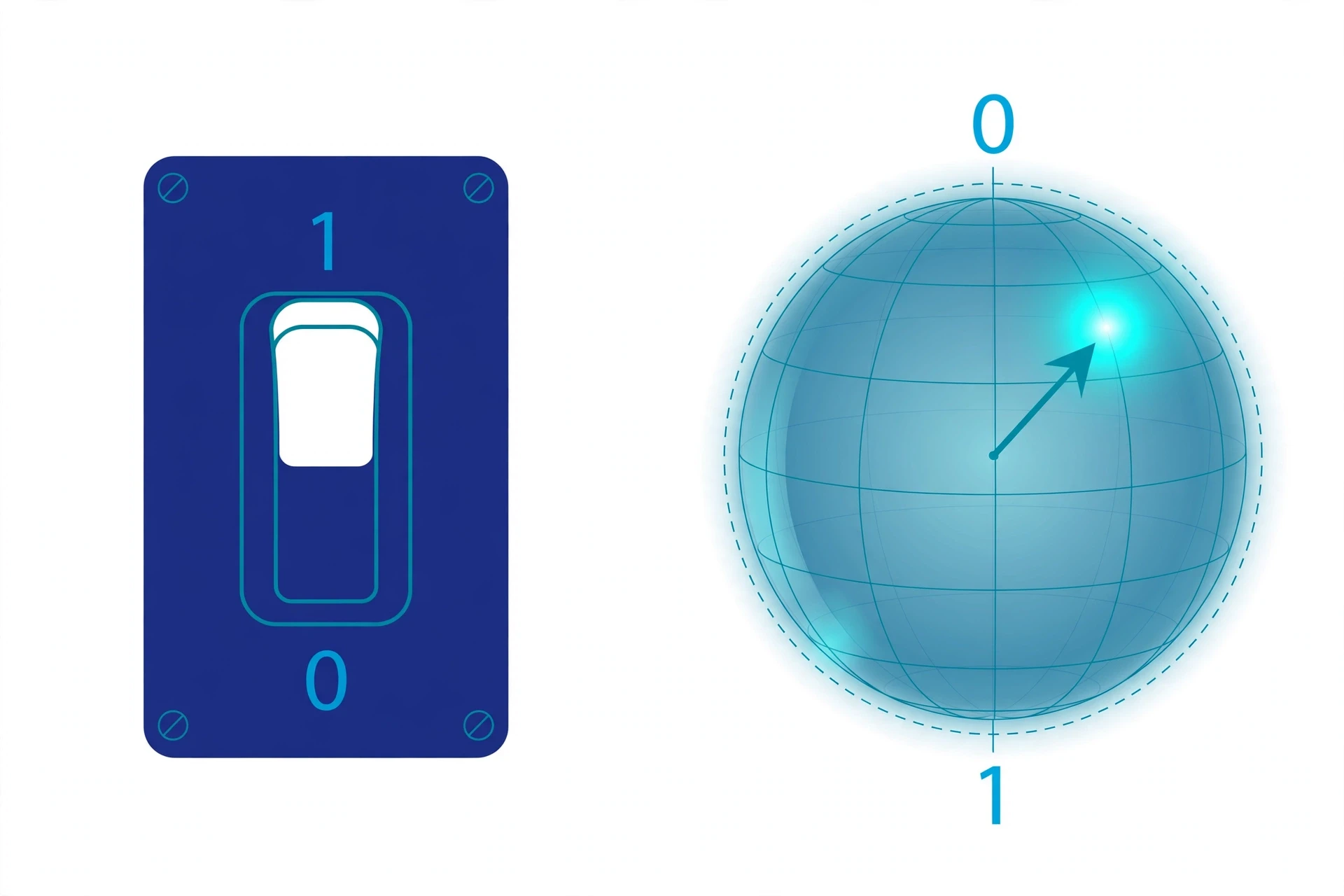
Think of a bit as a light switch. It is up or down. You can read it at a glance, copy it, and leave it alone for years without it changing. That stability is the classical computer's greatest strength. A bit does not waver, drift, or forget. When a program flips a bit, the result stays flipped until something flips it back.
The classical world runs on this certainty. A spreadsheet adds numbers by flipping bits through logic gates, tiny circuits that combine 0s and 1s according to rules like AND, OR, and NOT. A video file is a long string of bits read in order. Everything digital you touch is, at bottom, switches in two positions.
2.2 What a qubit is
A qubit, short for quantum bit, is the quantum counterpart of the bit. It is also a physical system with two states, usually written as |0⟩ and |1⟩, but it can exist in a combination of both at once. That combination is called a superposition, and it is the first great departure from classical computing.
A qubit can be made from many physical things: the spin of an electron, the energy level of an atom, the direction of current flowing around a superconducting loop, or the polarisation of a photon. Different companies and laboratories choose different qubits, and each choice brings trade-offs in speed, stability, and the difficulty of building the machine. The qubit itself, though, is an idea that sits above any one technology: a two-level quantum system that can hold a blend of 0 and 1.
Here is the point that trips up almost everyone, including me the first time I worked through the mathematics. A qubit in superposition is not secretly 0 or secretly 1, waiting for us to look. It is genuinely in a blend of both, with weights that say how much of each state is present. Those weights are numbers called amplitudes, and they behave like waves: they can add up or cancel out. When you finally measure the qubit, the blend collapses and you get a single definite answer, 0 or 1, with odds set by the amplitudes. The measurement does not reveal a hidden value. It ends the superposition.
2.3 The Bloch sphere: a map of one qubit
Physicists draw a single qubit as a point on a sphere called the Bloch sphere. The north pole is 0, the south pole is 1, and every other point on the surface is a different superposition. The position of the point tells you the blend: near the north pole, the qubit is mostly 0; near the equator, it is an even mix; near the south pole, mostly 1. The longitude around the sphere captures a subtler property called phase, which matters enormously for interference, as you will see in section 4.
I like the Bloch sphere because it turns an abstract idea into something you can picture. A classical bit can only sit at the two poles. A qubit can sit anywhere on the surface. A quantum computation is, in this picture, a journey: the machine starts each qubit at the north pole, then rotates points around the sphere in a carefully planned dance, and finally measures where each point has landed.
2.4 Why more qubits matter more than more bits
One qubit holds a blend of two states. Two qubits can hold a blend of four combinations: 00, 01, 10, and 11. Three qubits blend eight combinations. Each qubit you add doubles the number of combinations the system can hold at once. Ten qubits blend 1,024 combinations. Twenty qubits blend about a million. Fifty qubits blend more than a quadrillion combinations.
That doubling is the source of the excitement, and also of a common misunderstanding. A quantum computer with 50 qubits does not store a quadrillion answers the way a hard drive stores files. The combinations exist as amplitudes in a shared quantum state, and reading the machine gives you only 50 bits of definite answer. The art of quantum computing is arranging the dance so that, when you finally measure, the answer you want is the one most likely to appear. The rest of this article is about how that arrangement works.
3. Superposition: Being in Two States at Once
3.1 The spinning coin
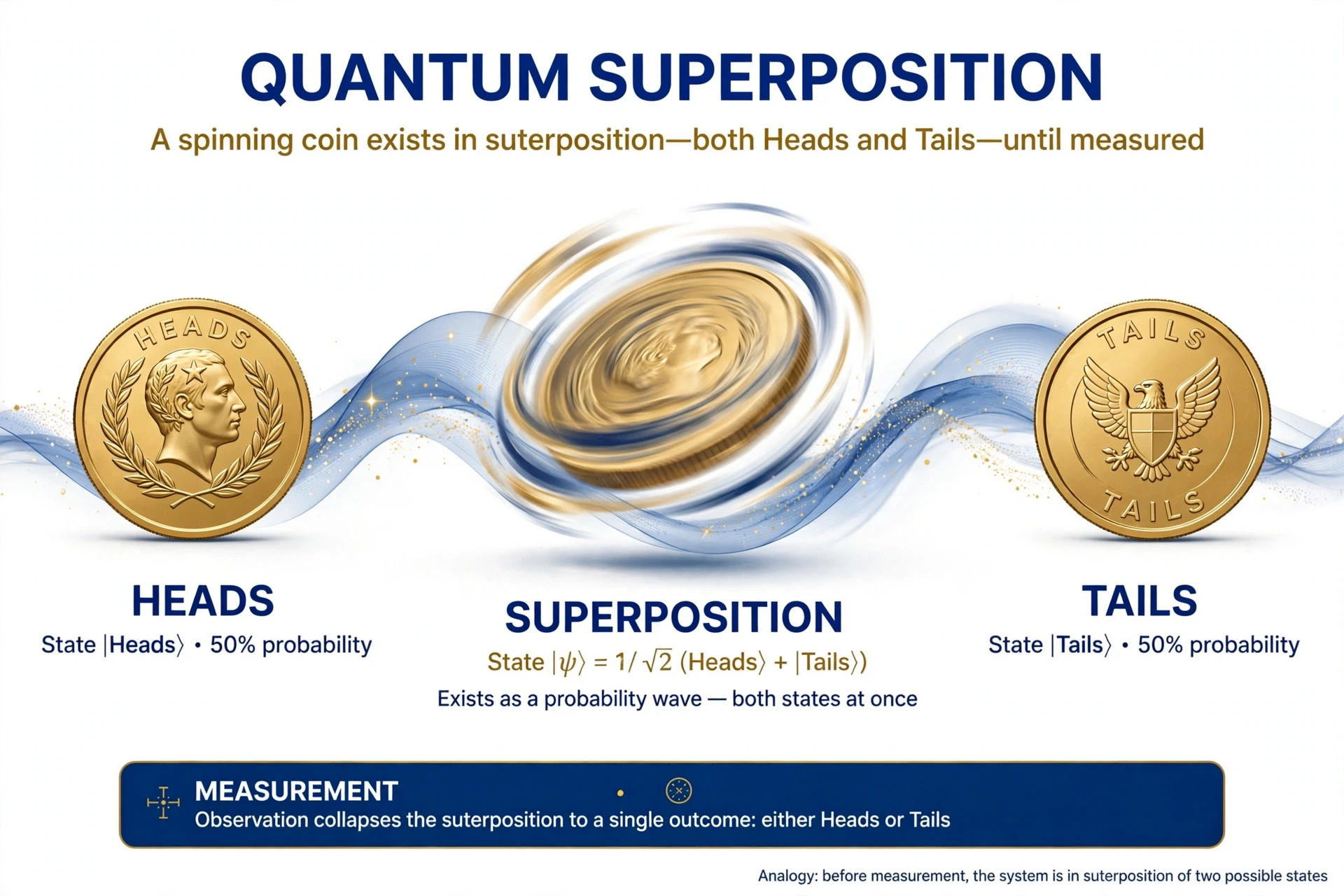
The best everyday picture of superposition I know is a spinning coin. While the coin spins on a table, it is neither heads nor tails. It is a blur of both, turning too fast to call. Slap your hand down, and the spin stops: heads or tails, one definite result. The coin was not hiding a secret face while it spun. It was genuinely in motion between the two.
A qubit in superposition is like that spinning coin, with one crucial difference. A coin's blur is a matter of our ignorance and the speed of our eyes; in principle a high-speed camera could track it. A qubit's superposition is a matter of physics. Until measurement, there is no fact of the matter about whether it is 0 or 1. The blend is the reality.
I once watched a student struggle with this for a full afternoon, and I remember the moment it clicked for her. She stopped asking what the qubit "really" was and started asking what the qubit could do. That is the right question. Superposition is not a parlour trick. It is a resource, like fuel, that a quantum program spends to explore many possibilities in parallel.
3.2 How superposition is created
A quantum computer starts its qubits in a definite state, usually 0, and then applies a quantum gate called the Hadamard gate to put each qubit into an even superposition of 0 and 1. Apply a Hadamard gate to one qubit and you get a fifty-fifty blend. Apply it to ten qubits and you get an even blend of all 1,024 combinations. The machine has not done 1,024 separate calculations. It has prepared one quantum state that holds all 1,024 possibilities as amplitudes.
This is sometimes described as quantum parallelism, and the phrase is both helpful and misleading. The machine does hold many possibilities at once, but it cannot simply read them all out. Measurement gives one result, and the other possibilities vanish. Superposition alone is not enough. A quantum computer needs two more ingredients, entanglement and interference, to turn a cloud of possibilities into a useful answer.
3.3 The double-slit lesson
The classic demonstration of superposition comes from the double-slit experiment, a staple of the companion article on Understanding Quantum Mechanics. Fire particles one at a time at a barrier with two slits, and each particle seems to pass through both slits at once, interfering with itself on the far side like a wave. Block one slit and the pattern changes. The particle's path is not a hidden fact waiting to be found. It is a superposition of paths until something measures it.
Quantum computing borrows this wave behaviour and puts it to work. The amplitudes in a quantum state behave like waves in a pond: they can reinforce each other where they line up, and cancel where they oppose. A quantum algorithm is a carefully timed set of ripples, designed so the ripples carrying the right answer grow tall while the ripples carrying wrong answers flatten out.
4. Entanglement: The Link That Makes Qubits Powerful
4.1 What entanglement means
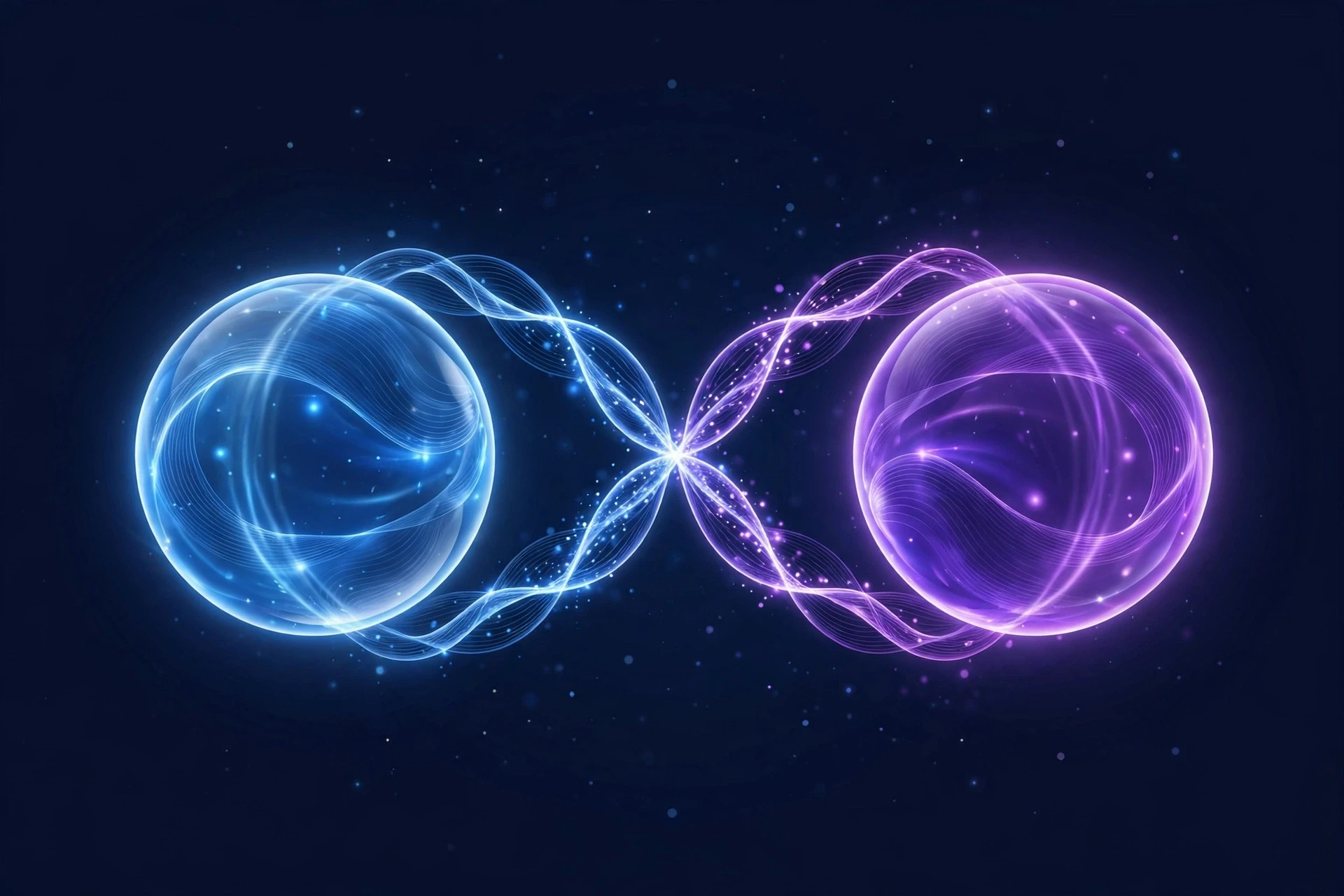
Entanglement is the strangest and most powerful feature of quantum mechanics. Two qubits can be entangled so that their states are linked: measure one, and you instantly learn something about the other, no matter how far apart they are. The link is not a hidden signal passing between them. It is a shared quantum state that cannot be described by describing each qubit separately.
Einstein called this "spooky action at a distance," and he was uneasy about it. Decades of experiments have confirmed it again and again. Entangled particles behave as one system, and their correlations are stronger than anything classical physics allows. For computing, that strength is the point: entanglement lets qubits work together in ways that classical bits cannot imitate.
4.2 A pair of gloves, and why the analogy breaks
A common analogy compares entanglement to a pair of gloves split between two boxes. Open one box and find a left glove, and you instantly know the other box holds the right glove. That picture is useful for the instant knowledge, but it is wrong in an important way. The gloves were left and right all along. Entangled qubits are not. Before measurement, neither qubit has a definite state. The measurement of one does not reveal a pre-existing fact about the other; it helps create the outcome for both.
I learned to be careful with the glove analogy after using it in a talk and watching a sharp questioner in the audience pick it apart, correctly. The honest version is harder to picture and more honest for it: entanglement is a correlation without a prior cause in the ordinary sense, a link that lives in the shared mathematics of the two qubits. It is the feature that lets a quantum computer's qubits act as a single coordinated whole rather than a crowd of independent coins.
4.3 Why entanglement matters for computing
Superposition alone gives a quantum computer many possibilities. Entanglement gives those possibilities structure. Without entanglement, a collection of qubits is just a set of independent spinners, and a classical computer could simulate them without much trouble. With entanglement, the qubits' states become intertwined in a web that grows too complex for classical machines to track as the number of qubits rises. That web is where the quantum advantage lives.
Think of an orchestra. One violin playing alone is a superposition, a blend of notes. An orchestra playing together, each instrument's part written to fit the others, is entanglement: the whole is more than the sum of its parts, and you cannot understand the performance by listening to one instrument in isolation. A quantum algorithm writes a score for entangled qubits, and the music is the computation.
5. Interference: How Quantum Computers Find the Answer
5.1 Waves that add and cancel
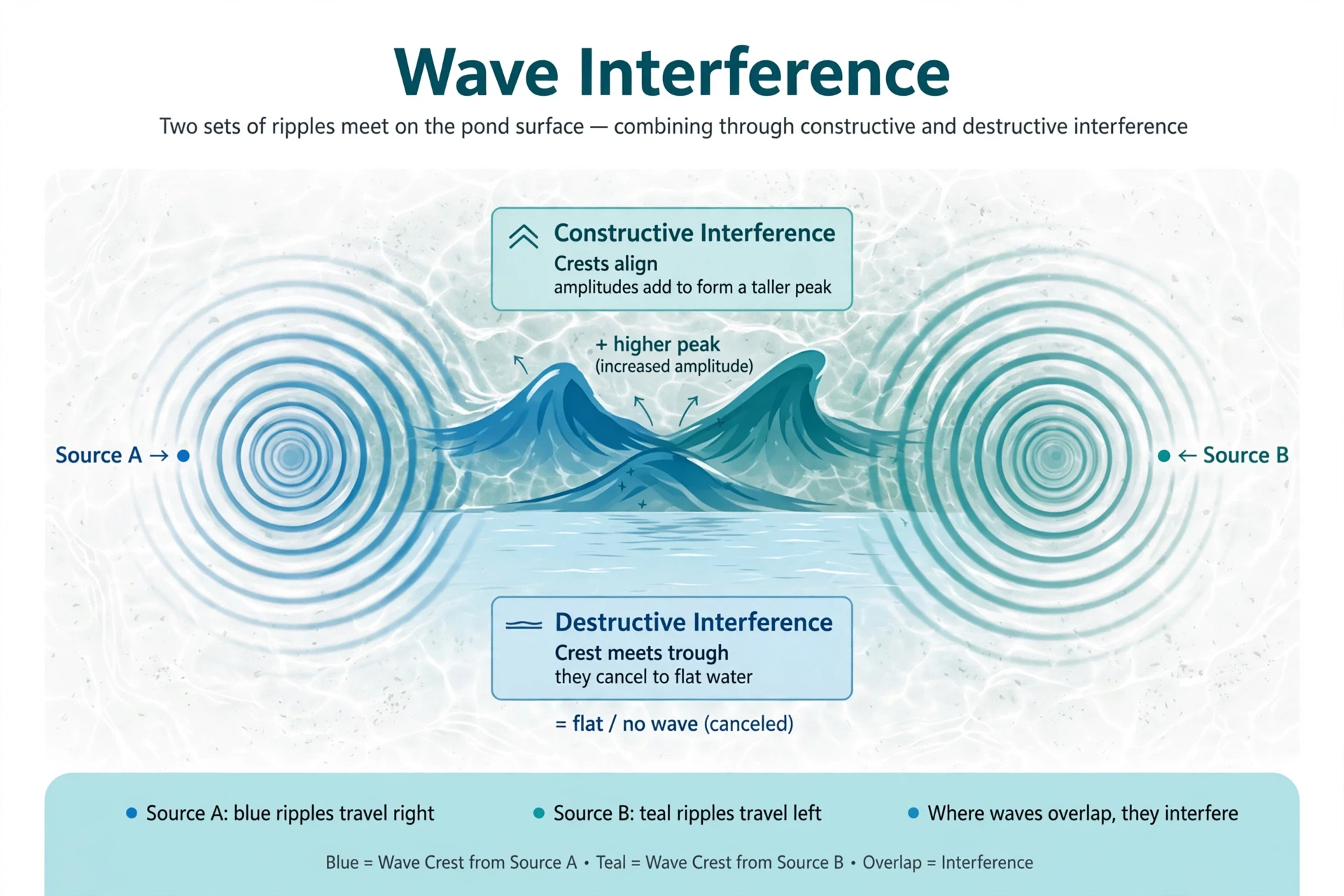
Interference is the third ingredient, and it is the one that turns possibility into an answer. Amplitudes behave like waves. When two waves meet crest to crest, they add up into a taller wave: constructive interference. When a crest meets a trough, they cancel into flat water: destructive interference. A quantum algorithm arranges the amplitudes of wrong answers so they cancel each other out, while the amplitudes of the right answer reinforce each other.
Imagine a pond with many stones dropped at once. The ripples cross and mix into a messy pattern. Now imagine you could choose exactly where and when to drop each stone so that, at one chosen spot, every ripple arrives crest to crest and piles up into a single tall peak, while everywhere else the ripples cancel to stillness. That chosen spot is the answer, and the stone drops are the quantum gates. That is, in essence, how a quantum computation works.
5.2 The maze analogy
Here is the picture I use most often when someone asks how quantum computers work in plain language. A classical computer solves a maze by walking it: try a path, hit a dead end, backtrack, try another. A quantum computer, in a loose sense, explores many paths at once as a wave, and interference makes the wave pile up along the correct path and fade along the dead ends. Measure the wave, and you are most likely to find it on the right path.
The analogy is loose because real quantum algorithms do not explore every maze, and most problems have no quantum shortcut at all. But it captures the role of interference: it is the mechanism that picks the winner out of the crowd of possibilities that superposition and entanglement created. Without interference, a quantum computer would be a machine that prepares a cloud of answers and then picks one at random. With it, the cloud leans toward the truth.
5.3 Measurement: the moment of truth
Measurement is the final step, and it is also the most misunderstood. Measuring a qubit does not gently peek at its value. It forces the qubit to choose: 0 or 1, with odds given by the amplitudes. After measurement, the superposition is gone. The qubit is an ordinary 0 or 1, and the information about the other possibilities is lost.
That is why quantum programs are usually run many times. Each run, called a shot, gives one sample from the probability distribution the algorithm built. Run the program a thousand times, and the most frequent result is the answer the interference was designed to favour. If the algorithm is well designed, the right answer appears far more often than any wrong one. If it is not, the results look like noise, and the programmer goes back to the drawing board.
6. Quantum Gates and Circuits: The Program
6.1 From logic gates to quantum gates
Classical computers compute with logic gates. An AND gate takes two bits and outputs 1 only if both inputs are 1. An OR gate outputs 1 if either input is 1. A NOT gate flips a bit. String these gates together into a circuit, and you have a program written in hardware.
Quantum computers compute with quantum gates, and the idea is similar but the rules are richer. A quantum gate is an operation that rotates one or more qubits on the Bloch sphere, changing their superpositions and entangling them with each other. Quantum gates are reversible: unlike a classical AND gate, which loses information about its inputs, a quantum gate can always be undone. That reversibility is a deep requirement of quantum mechanics, and it shapes how quantum programs are written.
The most important single-qubit gates have simple jobs. The Hadamard gate, which you met in section 3, creates an even superposition from a definite state. The Pauli-X gate flips a qubit like a classical NOT, swapping 0 and 1. The Pauli-Z gate leaves 0 alone but flips the phase of 1, a change with no classical counterpart that matters greatly for interference. Phase gates rotate a qubit by a chosen angle, fine-tuning the waves that will later interfere.
6.2 Two-qubit gates and entanglement on demand
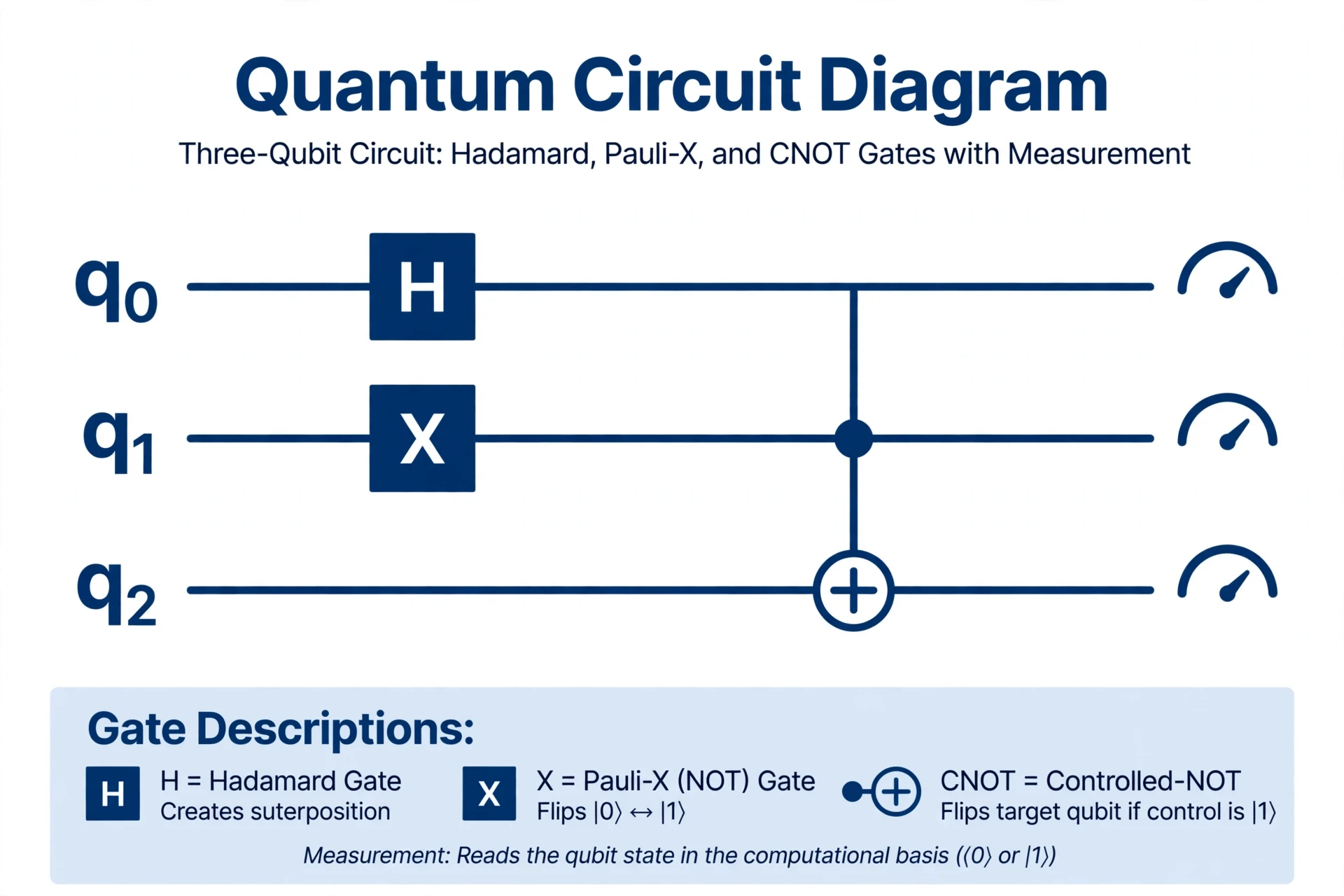
Single-qubit gates rotate individual qubits, but they cannot create entanglement. For that, a program needs gates that act on two qubits at once. The workhorse is the CNOT gate, short for controlled-NOT. It flips a target qubit, but only if a control qubit is in state 1. Combine a Hadamard gate with a CNOT gate, and you can create an entangled pair from two ordinary qubits. That two-gate recipe is the seed from which every larger entangled state grows.
I remember the first time I traced a CNOT circuit by hand on paper, following the amplitudes through each step. It felt like watching a card trick explained in slow motion: each step was simple, almost dull, and the result was a state that no single qubit could describe alone. That is the quiet power of quantum circuits. No single gate is mysterious. The mystery, if there is one, is in how simple steps combine into something a classical machine cannot easily follow.
6.3 Reading a quantum circuit
A quantum circuit diagram reads left to right, like a musical score. Each horizontal line is a qubit. Boxes on the lines are gates. Vertical lines joining two qubits mark a two-qubit gate such as CNOT. At the far right, a meter symbol marks measurement. Programmers write these circuits in software frameworks and send them to real hardware or to simulators that run on classical computers.
A typical quantum program has three stages. First, initialise the qubits, usually all to 0. Second, apply a sequence of gates that builds superposition, entangles the qubits, and shapes the interference so the right answer is favoured. Third, measure the qubits and read out the result. The whole circuit may run in a fraction of a second, and it is usually repeated many times to build up reliable statistics.
A quantum circuit is a score, not a photograph. The gates do not describe what the qubits are. They describe what the machine does to them, step by step, until measurement turns the performance into a single readable result.
6.4 How programmers actually write quantum code
Nobody programs a quantum computer by soldering gates. Programmers use software development kits such as Qiskit, Cirq, or PennyLane, writing code in Python that builds circuits, chooses which physical qubits to use, and sends the job to a quantum processor over the internet. The cloud model matters: most people who run quantum programs today never see the machine. They submit a circuit, wait in a queue, and receive measurement results back.
That distance can be misleading. It is easy to forget, staring at a laptop, that the circuit you just sent is being executed by a chip colder than deep space, shielded from the world in layers of metal and vacuum. The abstraction is the point of good software, but the physics is still there underneath, and it sets hard limits on what the code can do, as the next sections show.
7. Inside a Real Quantum Computer: Hardware
7.1 The golden chandelier
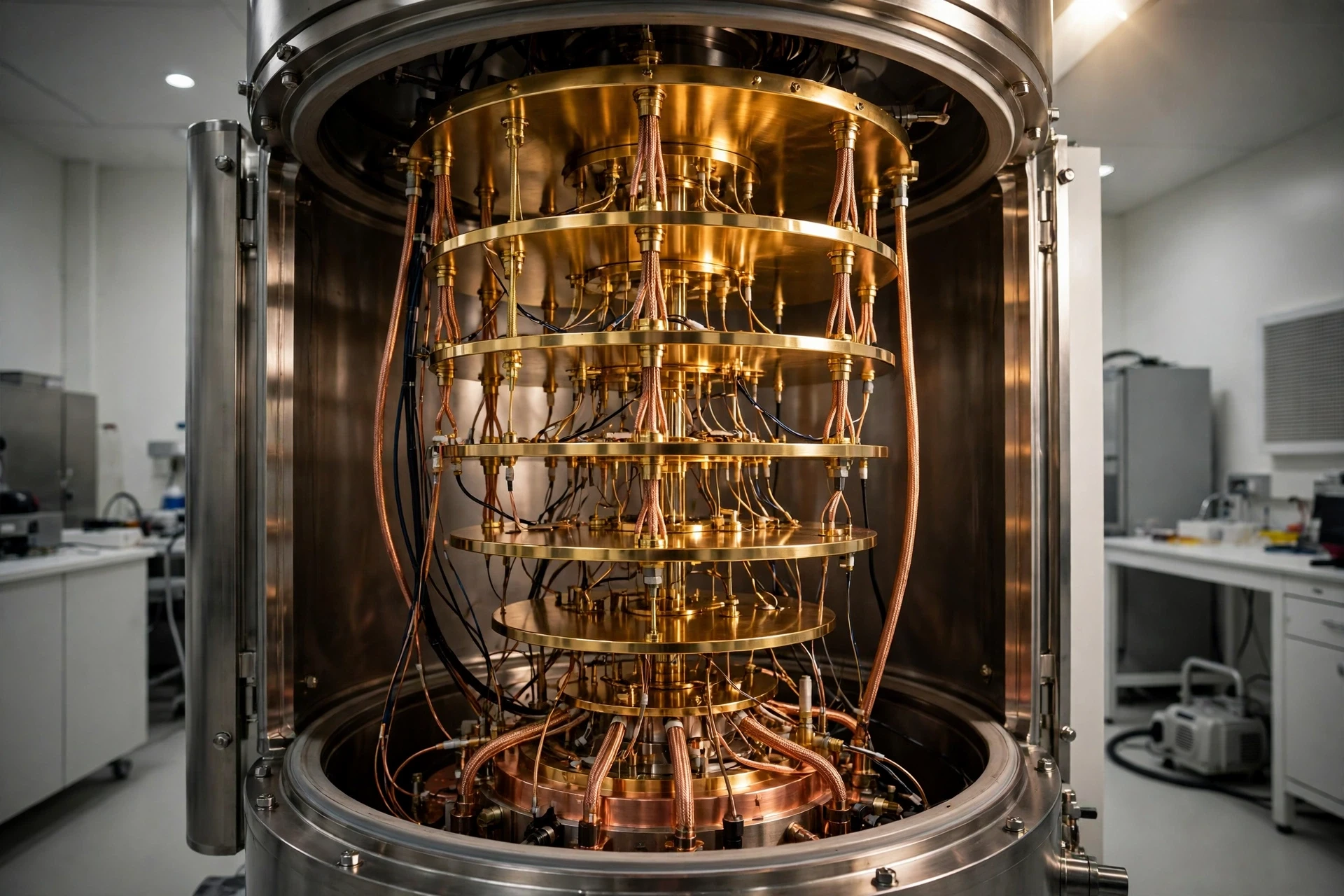
Photographs of quantum computers show a striking object: a golden, tiered chandelier hanging inside a cylindrical cryostat. That chandelier is a dilution refrigerator, and it is the most visible part of a superconducting quantum computer, the most widely used type today. Each golden plate is a temperature stage, stepping down from room temperature at the top to a fraction of a degree above absolute zero at the bottom, where the quantum chip sits.
The gold colour comes from gold plating on copper plates, chosen because copper conducts heat well and gold resists corrosion. Cables snake down through the stages, carrying microwave pulses that control the qubits and carrying faint signals back up to be read. The whole assembly hangs in a vacuum, isolated from vibration, shielded from magnetic fields, and kept as still and quiet as engineering allows.
The first time I saw one of these machines in person, I was struck by how unlike a computer it looked. There was no screen, no keyboard, no fan hum. There was a silent golden tower in a white room, and a rack of ordinary-looking electronics beside it doing the unglamorous work of generating pulses and digitising signals. The quantum chip itself was smaller than a postage stamp, hidden at the bottom of the tower.
7.2 Superconducting qubits
In a superconducting quantum computer, each qubit is a tiny circuit made from superconducting material, usually aluminium on silicon, cooled until electricity flows without resistance. The qubit's two states are different energy levels of that circuit, and microwave pulses nudge it between them. Control electronics send pulses shaped with exquisite precision: the wrong pulse length or frequency, and the qubit rotates to the wrong place on the Bloch sphere.
Superconducting qubits are fast, taking tens of nanoseconds per gate, and they are built with the same lithography techniques used for ordinary chips, which makes them relatively easy to scale up in number. Their weakness is fragility. They lose their quantum state quickly, in tens to hundreds of microseconds, and they need the extreme cold to work at all. Every extra qubit adds wiring, heat, and noise, and the engineering challenge grows with each generation.
7.3 Other ways to build a qubit
Superconducting circuits are not the only approach, and the field is far from settled. Trapped-ion machines hold individual charged atoms in electromagnetic traps and manipulate them with lasers. Their qubits stay coherent far longer than superconducting ones, and they can be entangled with high precision, but their gates are slower and scaling to thousands of ions is a formidable engineering problem. Photonic machines use particles of light, which travel well and work at room temperature, but making photons interact with each other is hard. Neutral-atom machines trap arrays of atoms with laser tweezers and excite them to states where they interact strongly. Silicon spin qubits try to borrow the semiconductor industry's manufacturing might.
Each approach is a bet on a different trade-off. There is no consensus yet on which will win, and it is possible that different types will end up suited to different jobs, the way aeroplanes and ships serve different kinds of travel. For a reader, the lesson is simple: a qubit is an idea, and the hardware is a contest to embody that idea reliably at scale.
7.4 The classical computer beside the quantum one
A quantum computer never works alone. Beside every quantum processor sits a rack of classical computers that do most of the practical work: compiling the programmer's circuit into the native gates the hardware supports, calibrating the qubits, shaping microwave pulses, reading the faint returning signals, and correcting for known errors. The quantum chip is the specialist at the centre of a classical support system, and the partnership is essential.
This hybrid picture is how quantum computing will reach users. A classical computer will handle the ordinary parts of a problem, call the quantum processor for the hard quantum step, and then process the results classically. The quantum machine is not a replacement for the laptop on your desk. It is an accelerator for a narrow class of problems, attached to a classical machine that does everything else.
8. Decoherence and the Cold: Why Quantum Is So Fragile
8.1 What decoherence is
A quantum state is a delicate arrangement, and the world is constantly trying to disturb it. Any stray interaction, a vibration, a tiny magnetic fluctuation, a photon of heat, can leak information about a qubit's state into the environment. When that happens, the superposition fades and the qubit behaves more like an ordinary classical bit. Physicists call this loss decoherence, and it is the central enemy of quantum computing.
Decoherence is why a quantum computation is a race against time. The machine must finish its gates before the qubits forget what they were doing. The time a qubit can hold its state is called its coherence time, and for superconducting qubits it is measured in microseconds: a millionth of a second. A quantum program must fit its whole dance inside that window, or the answer dissolves into noise.
I think of decoherence as trying to balance a pencil on its tip in a room with a draughty window. You can do it for a moment, with care and still air, but any disturbance topples it. Quantum engineers spend their careers making the room stiller: colder, quieter, better shielded, with pulses timed to cancel the noise they cannot remove.
8.2 Why near absolute zero
Temperature is motion. Warm objects jiggle, and that jiggling is noise to a qubit. Cooling a quantum chip to around 15 millikelvin, about a hundredth of a degree above absolute zero, colder than deep space, quiets that thermal jiggling almost to stillness. At that temperature, the superconducting circuits behave as designed and the microwave pulses can control the qubits without being drowned out by heat.
The cold is not a luxury. It is a requirement for superconducting qubits, and it is one reason quantum computers are large, expensive, and confined to laboratories and data centres. A trapped-ion machine can work at room temperature for its ions, though its vacuum and lasers bring their own demands. A photonic machine also avoids the deep freeze. The cold, then, is a property of one leading technology, not of quantum computing as a whole, but it is the image most people carry, and it is accurate for the machines they are most likely to see photographed.
8.3 Noise, and what engineers do about it
Even in the cold, quantum hardware is noisy. Gates are slightly imperfect. Qubits drift out of tune. Neighbouring qubits interfere with each other, an effect called crosstalk. Readout sometimes reports the wrong value. Engineers fight this noise on many fronts: better materials, cleaner fabrication, careful calibration before each run, and software techniques that reshape circuits to dodge the noisiest qubits and gates.
One elegant technique is error mitigation, which does not fix errors but estimates their effect and subtracts it from the results. Run a circuit, run a related circuit with known noise, compare the two, and infer what the clean answer would have been. Error mitigation has let researchers squeeze useful results from noisy machines today, while the deeper fix, full error correction, is still being built, as section 10 explains.
For the physics of heat, electricity, and the materials that make this cold engineering possible, the article on Fundamentals of Electricity explains circuits and electromagnetism from first principles.
9. The Famous Algorithms: Shor's and Grover's
9.1 Shor's algorithm: factoring, and why it matters
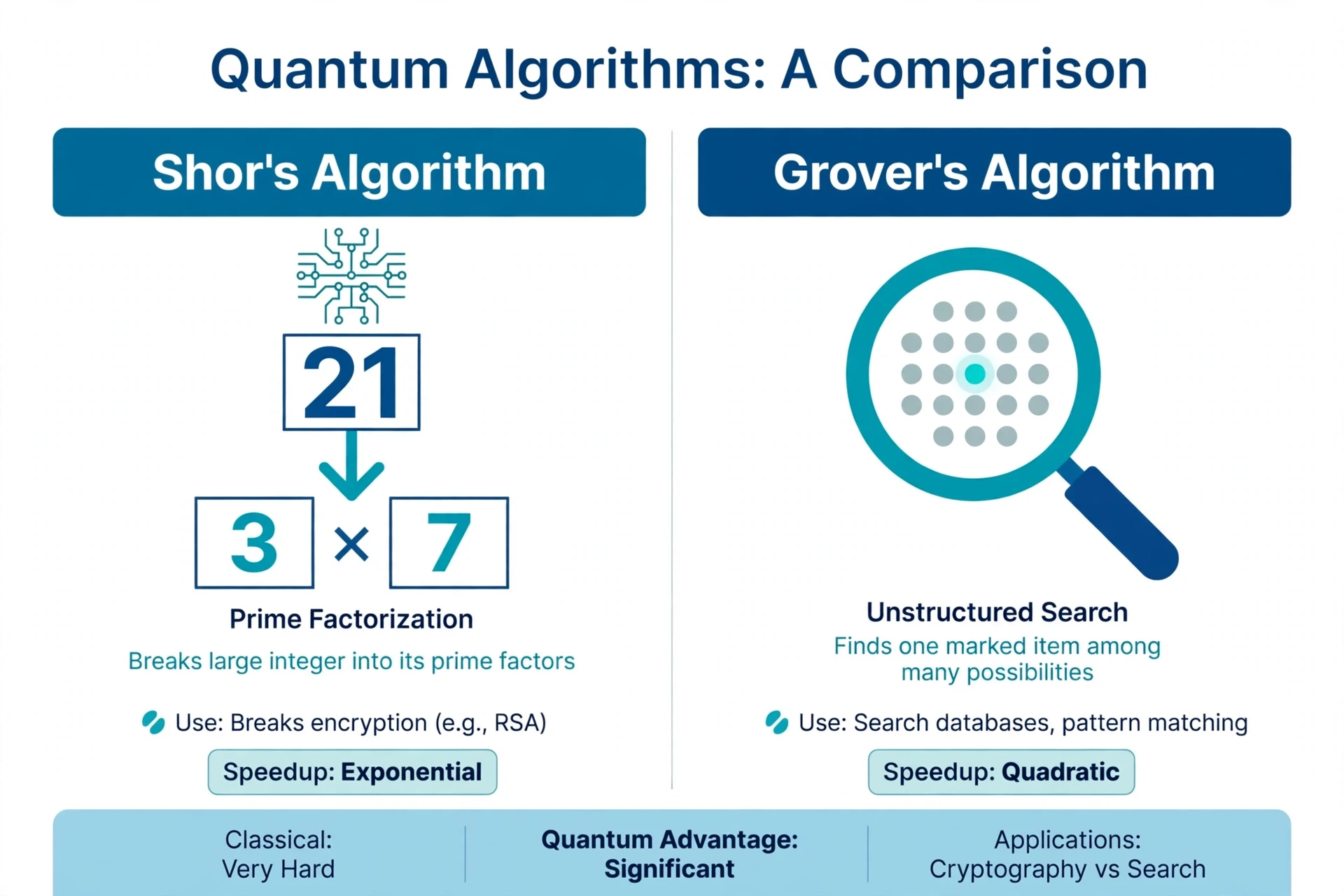
The most famous quantum algorithm is Shor's algorithm, published by mathematician Peter Shor in 1994. It factors large numbers, finding the two prime numbers that multiply to give a chosen number, far faster than any known classical method. Factoring a 2,048-bit number, the size used in much of today's internet encryption, would take a classical supercomputer an impractically long time. A large enough quantum computer running Shor's algorithm could, in principle, do it in hours.
That possibility is why Shor's algorithm made headlines far beyond physics. Much of the world's secure communication relies on the difficulty of factoring. If a powerful quantum computer could factor easily, it could break the encryption that protects banking, messaging, and state secrets. The threat is real enough that standards bodies have acted: the US National Institute of Standards and Technology has released post-quantum encryption standards designed to resist quantum attack, a milestone worth reading about directly from NIST.
Two cautions belong here. First, no quantum computer today is anywhere near large or reliable enough to run Shor's algorithm on a cryptographically relevant number. The machine needed would require millions of physical qubits, and today's largest machines have hundreds. Second, the world is not waiting passively. The shift to post-quantum cryptography is already under way, and the honest timeline is measured in years of careful migration, not in a sudden overnight break.
9.2 Grover's algorithm: searching faster
Grover's algorithm, published by Lov Grover in 1996, tackles a different job: searching an unstructured collection for a marked item. A classical computer searching a list of a million items must check them one by one, taking up to a million steps. Grover's algorithm can find the item in about a thousand steps, the square root of a million. The speedup is real but modest compared with Shor's: quadratic, not exponential.
The modesty matters. Grover's algorithm shows that quantum computers do not magically speed up every search. A square-root speedup is valuable for very large problems, and it has implications for password cracking and optimisation, but it does not turn an impossible problem into a trivial one. It is a reminder that quantum advantage is specific, not general, and that each algorithm must be judged on its own terms.
9.3 What makes a problem quantum-friendly
Shor's and Grover's algorithms share a pattern. They take a problem with hidden structure, build a quantum state that encodes that structure, and use interference to amplify the answer. Problems with that kind of structure, certain factoring and search tasks, quantum simulation of molecules, some optimisation problems, are where quantum computers shine. Problems without it, word processing, web browsing, streaming video, gain nothing from a quantum processor.
I once heard a researcher put it this way: a quantum computer is a scalpel, not a hammer. A hammer is useful for almost everything, and a scalpel is useless for most things but unmatched for the few jobs it fits. The field's progress is largely a search for more jobs that fit the scalpel.
10. Quantum Error Correction: Protecting Fragile Information
10.1 Why classical error correction does not work
Classical computers protect information by copying it. A file is stored in three places, and if one copy is corrupted, the other two outvote it. Quantum information cannot be copied. The no-cloning theorem, a fundamental result of quantum mechanics, says there is no way to make an exact copy of an unknown quantum state. A qubit's superposition cannot be backed up the way a file can.
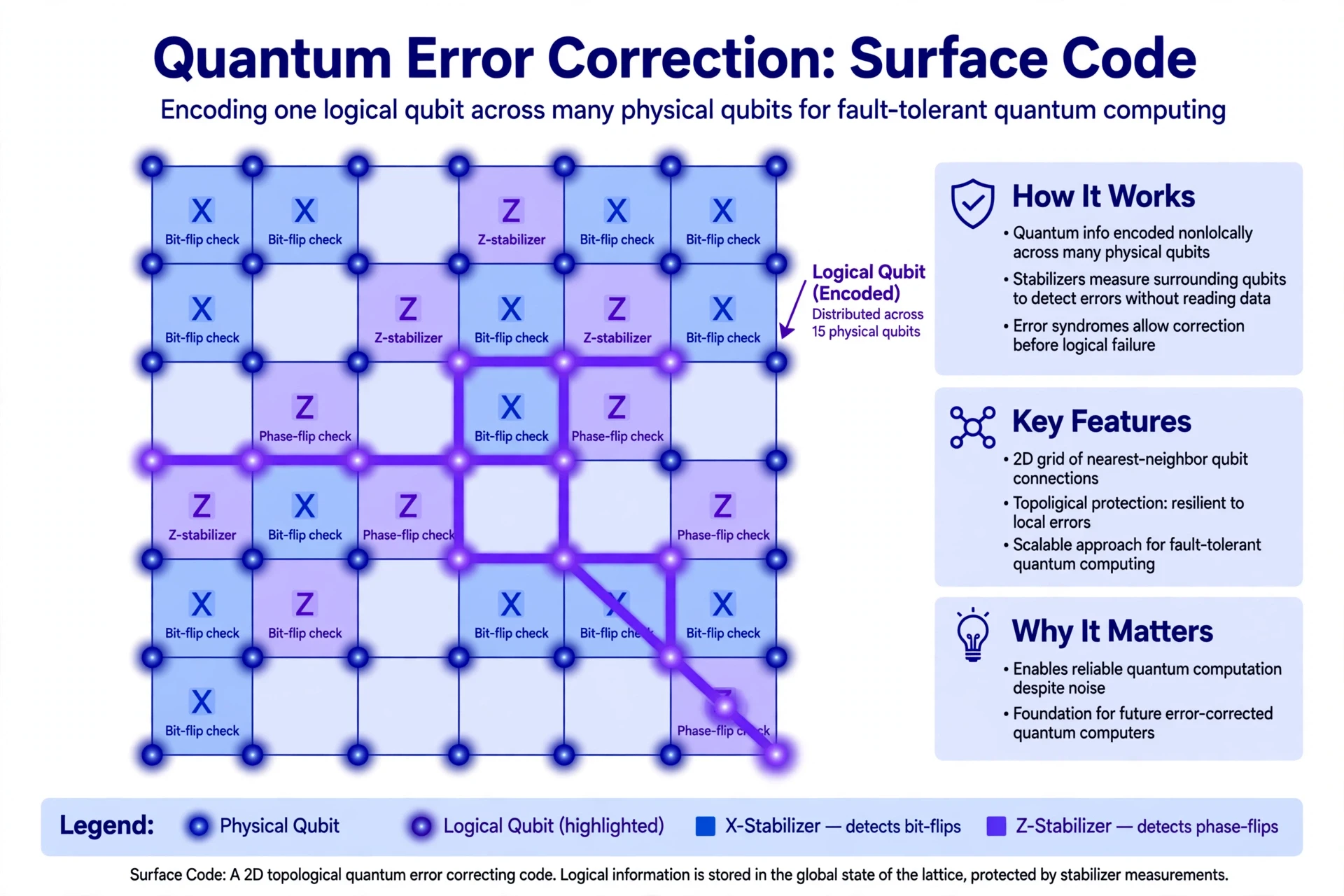
Quantum error correction works around this ban with a cleverer idea: spread one logical qubit, the qubit the program cares about, across many physical qubits, the real qubits on the chip. The information lives in the pattern of entanglement among the physical qubits, not in any single one. If one physical qubit is disturbed, the pattern as a whole still holds the information, and the machine can detect the disturbance and fix it without ever measuring, and destroying, the logical qubit itself.
10.2 The surface code
The leading error-correction scheme is called the surface code. It arranges physical qubits on a two-dimensional grid, like squares on a chessboard, and uses some of them to check the others. The checks, called stabiliser measurements, reveal whether an error happened and where, without revealing the logical qubit's value. The machine can then apply a correction, or simply keep track of the error and account for it in the final result.
The cost is steep. Depending on the quality of the hardware, one reliable logical qubit may require hundreds or thousands of physical qubits. A machine with a thousand physical qubits might yield only a handful of useful logical qubits. That overhead is the main reason the jump from today's noisy machines to fault-tolerant quantum computers, machines that can run long programs reliably, is measured in years and in engineering generations, not in a single breakthrough.
10.3 Milestones on the road to fault tolerance
Progress is real and worth reporting honestly. Research teams at Google Quantum AI and elsewhere have shown that a logical qubit protected by the surface code can outlive the physical qubits that make it up, the first sign that error correction can actually help rather than hurt. IBM has published a roadmap toward large-scale fault-tolerant machines, and its public quantum pages describe the staged plan from today's processors to error-corrected systems. You can read IBM's own account of its quantum program at IBM Quantum. Google's quantum team publishes its research and milestones at Google Quantum AI.
These are milestones, not finish lines. A demonstration with one logical qubit is a proof that the idea works. A useful fault-tolerant computer needs hundreds or thousands of logical qubits running together for hours. The gap between those two points is the work of the coming decade, and it will be closed by better qubits, better fabrication, and better error-correction codes, in that order.
Error correction is the difference between a quantum demonstration and a quantum computer. Until a machine can protect its own information faster than noise destroys it, every program is a race the noise usually wins.
11. What Quantum Computers Can and Cannot Do
11.1 Where they help today
The most promising near-term use of quantum computers is simulating quantum systems themselves: molecules, materials, and chemical reactions. A classical computer struggles to simulate a molecule because the quantum state of the molecule grows exponentially with its size, the same doubling problem that makes qubits powerful. A quantum computer speaks the molecule's own language, and it can model its behaviour directly. Chemists hope this will speed up the search for new drugs, better batteries, and catalysts that make fertiliser or capture carbon more efficiently.
Optimisation is a second area. Many real problems, delivery routes, flight schedules, portfolio choices, are optimisation problems with many possible answers and no obvious best one. Quantum algorithms, including approaches such as quantum annealing and variational algorithms that mix quantum and classical steps, are being tested on these problems. Results so far are mixed and contested, and classical algorithms keep improving too, which is a healthy sign: the competition makes both sides better.
A third area is machine learning, where quantum circuits are being tried as a new kind of model for recognising patterns in data. This is the least settled of the three. There are promising ideas and no clear, practical advantage yet, and honest researchers say so. The field's credibility depends on that honesty.
11.2 Where they will not help
A quantum computer will not make your laptop faster, your video stream smoother, or your spreadsheet quicker. It will not browse the web, write your emails, or run a video game better. Those jobs are classical through and through, and a classical processor does them far more cheaply and reliably. Anyone promising a quantum phone or a quantum laptop for everyday use is selling a misunderstanding.
Quantum computers will not solve every hard problem, either. Many problems are hard in a way that quantum mechanics does not help with, and computer scientists have mapped the boundary carefully. The class of problems a quantum computer can solve efficiently is larger than the classical class, but it is still a small island in a large sea of hard problems. Knowing the boundary is part of understanding how quantum computers work, not a footnote to it.
11.3 A comparison worth keeping
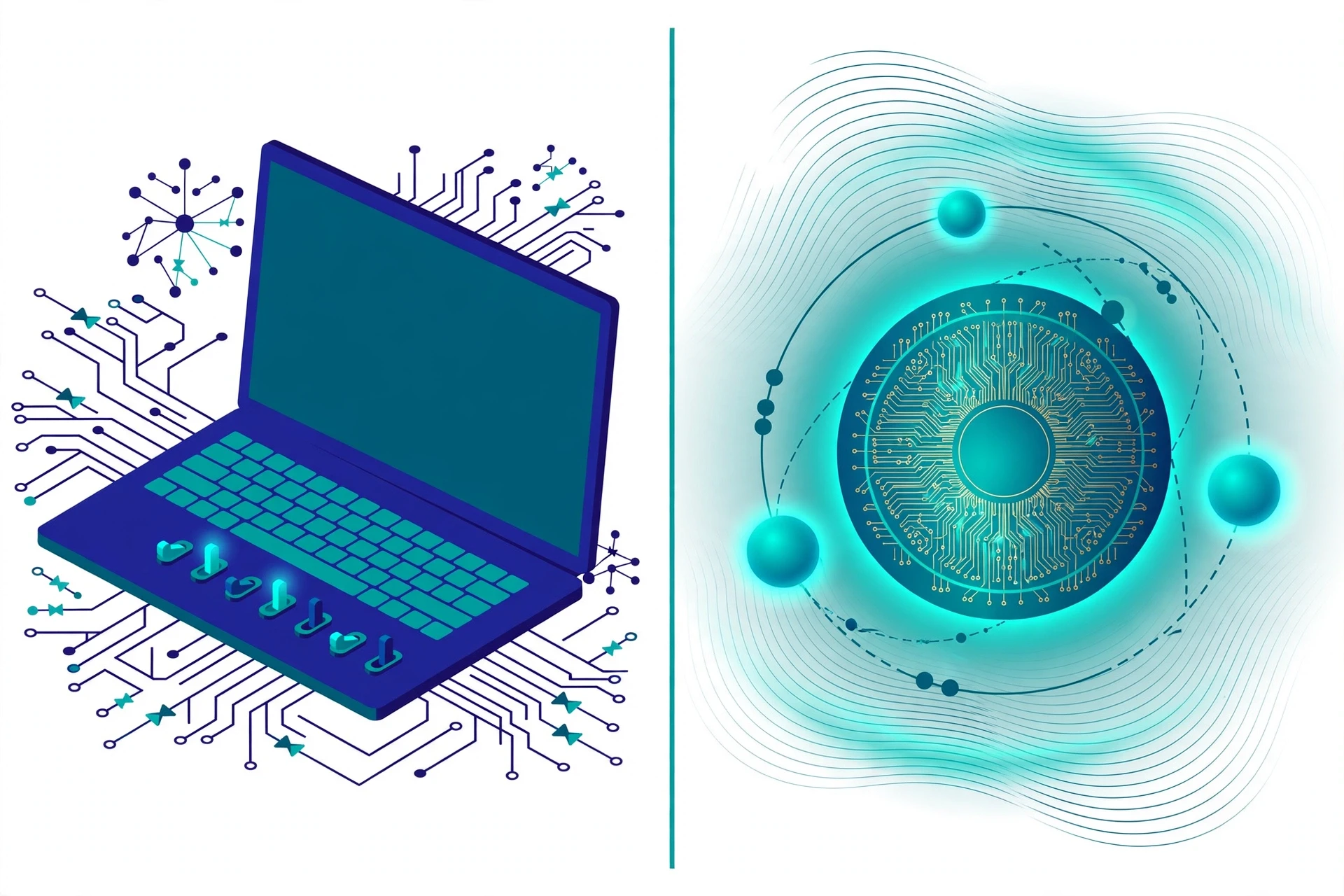
The table below puts the two kinds of machine side by side. It is the comparison I wish I had been given at the start, because it replaces the vague idea of a "super-fast computer" with concrete differences in how information is stored, processed, and read.
Feature | Classical computer | Quantum computer |
|---|---|---|
Basic unit | Bit: 0 or 1 | Qubit: a blend of 0 and 1 |
Information | Definite values, easy to copy | Superpositions, cannot be copied |
Processing | Logic gates, one step at a time | Quantum gates, interference shapes the result |
Strength | Reliable, general-purpose, cheap | Specific problems: factoring, simulation, search |
Weakness | Struggles with quantum simulation | Fragile, noisy, needs extreme cold or isolation |
Reading the answer | Read the bits directly | Measure, collapsing superposition to one result |
Best for | Everyday computing, most software | Molecules, materials, certain optimisation and search |
12. Common Misconceptions, Latest Research, and the Road Ahead
12.1 Five misconceptions worth clearing up
Most people assume a quantum computer tries every answer at once and then simply picks the right one. What actually happens is subtler: it holds many possibilities as amplitudes, shapes them with interference, and then measures once, getting a single sample. The shaping, not the holding, is the hard part, and it is why only certain problems benefit.
Most people assume quantum computers will replace classical computers. They will not. The future is hybrid: classical machines doing what they do best, calling on quantum processors for the specific steps where quantum mechanics helps, then taking the results back for classical processing.
Most people assume a quantum computer is just a very fast computer. Speed is the wrong word. A quantum computer can be slower than a laptop at most tasks and still be the only machine that can do a few tasks at all. The advantage is in the kind of computation, not the clock speed.
Most people assume quantum computers can break all encryption today. They cannot. The machines needed for that are years away, and the migration to post-quantum cryptography, led by standards from NIST, is already under way. The US National Institute of Standards and Technology maintains the central public resource on quantum information science at that link, including its work on quantum-resistant encryption.
Most people assume quantum computing is a single technology racing toward one finish line. It is a family of technologies, superconducting, trapped-ion, photonic, neutral-atom, and others, each with different strengths, and the winner may differ by application. The field's diversity is a strength, not a sign of confusion.
12.2 Latest research: where the field stands
The field's recent progress has been steady rather than sudden. Qubit counts have grown, gate errors have fallen, and error-correction demonstrations have crossed thresholds that were theoretical only a few years ago. Researchers have run quantum simulations of small molecules and materials that classical computers find hard, and they have tested variational algorithms, hybrid programs that loop between quantum and classical steps, on optimisation problems.
At the same time, the field has learned humility. Early claims of quantum advantage, demonstrations that a quantum machine did a contrived task faster than a classical supercomputer, have often been followed by improved classical algorithms that closed the gap. That back-and-forth is science working as it should. Each round sharpens the question of where a real, useful advantage lies, and the answer keeps moving toward practical problems rather than demonstrations.
For a current view of the research landscape, the news and research pages at MIT News on quantum computing and the subject collection at Nature on quantum computing track new results as they are published, and they are good places to check what has changed since this article was written.
12.3 The road ahead
The next decade of quantum computing will be decided less by a single dramatic announcement and more by steady engineering: quieter qubits, cleaner fabrication, smarter error correction, and better software that lets programmers use the machines without thinking about physics at every step. The machines will grow from hundreds of physical qubits to thousands, then to the millions needed for fault tolerance, if the engineering holds.
The stakes are real. A fault-tolerant quantum computer could transform drug discovery, materials science, and our understanding of chemistry itself, by letting us simulate the quantum world directly instead of approximating it. It could also force a careful, global change in how we protect information, a change that is already being planned. And it will almost certainly surprise us, because every new kind of computer in history has found uses its inventors did not predict.
The story of how quantum computers work began with a question about nature: what happens when information follows the rules of quantum mechanics instead of the rules of everyday logic? The answer, still being written, is a machine that is fragile, strange, and powerful in exactly the places where classical machines are blind. Learning to build it is one of the great engineering projects of our time, and learning to understand it is the first step toward using it well.
The scale of that project becomes clearer when you set it beside the history of the universe it studies. The article on The Big Bang Theory traces how the cosmos began and evolved, and the article on Einstein's Theory of Relativity explains the spacetime those quantum particles move through. Quantum computing sits at the meeting point of those stories: the smallest rules of nature, turned into a machine.
Frequently Asked Questions
What is a qubit in simple terms?
A qubit is the basic unit of quantum information, like a bit in an ordinary computer, except it can hold a blend of 0 and 1 at the same time, called a superposition. That blend is described by amplitudes that behave like waves, and measuring the qubit gives a single definite answer, 0 or 1, with odds set by those amplitudes.
How do quantum computers work in simple terms?
A quantum computer starts its qubits in a known state, uses quantum gates to put them into superposition and entangle them, then shapes the resulting waves with interference so wrong answers cancel out and the right answer is reinforced. Measuring the qubits then gives the favoured answer most often. Superposition creates the possibilities, entanglement links them, and interference picks the winner.
Are quantum computers faster than normal computers?
Not at most things. A quantum computer is slower and less reliable than an ordinary laptop for everyday tasks such as browsing, writing, and streaming. It is faster, in principle, at a small set of specific problems, including factoring large numbers, simulating molecules, and certain kinds of search and optimisation, where quantum mechanics offers a shortcut classical computers do not have.
Can a quantum computer break encryption?
In principle, a large fault-tolerant quantum computer running Shor's algorithm could break the RSA encryption that protects much of today's internet. In practice, no machine today is anywhere near large or reliable enough to do it. Standards bodies have already released post-quantum encryption designed to resist quantum attack, and organisations are migrating to it.
When will quantum computers be useful?
They are already useful for research, small-scale simulation, and testing algorithms, and cloud services let anyone run programs on real quantum hardware. Broadly useful, fault-tolerant machines that can run long programs reliably are likely years away, with progress depending on error correction and qubit quality rather than on qubit count alone.
Why do quantum computers need to be so cold?
Superconducting quantum computers need temperatures near absolute zero because heat is motion, and motion is noise to a qubit. At around 15 millikelvin, thermal jiggling is quiet enough for microwave pulses to control the qubits precisely. Other types of quantum computer, such as trapped-ion and photonic machines, have different requirements and do not all need the deep freeze.
Will quantum computers replace classical computers?
No. Quantum computers will work alongside classical computers, not replace them. A classical computer will handle the ordinary parts of a problem, call the quantum processor for the hard quantum step, and process the results. Most computing will remain classical, and quantum processors will serve as specialised accelerators for the problems they fit.