

1. A Rock That Should Not Exist
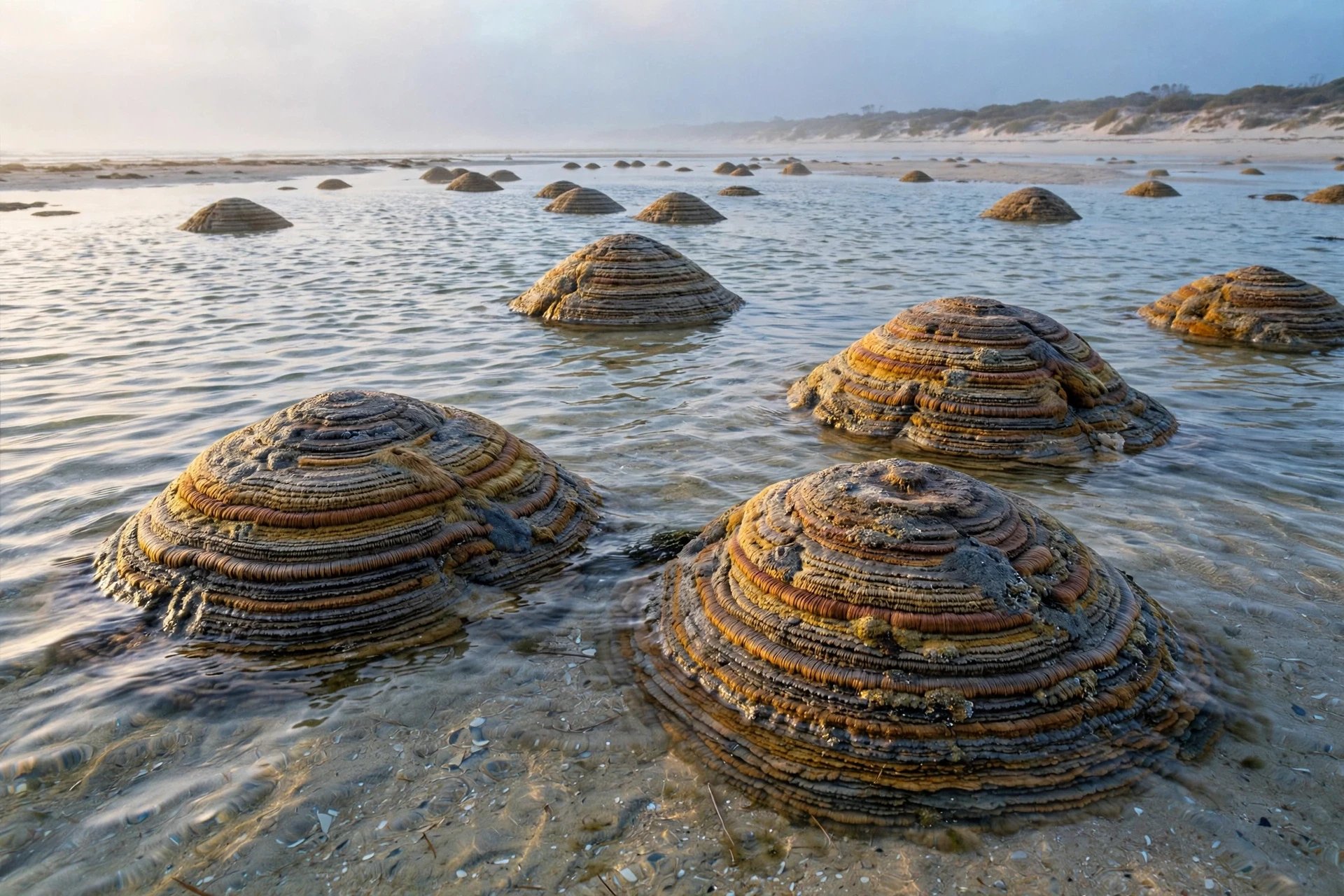
The origin of life is the question of how chemistry became biology — how a planet of rock, water and gas produced the first living thing. The oldest direct evidence we have is a rock from Western Australia, 3.48 billion years old, layered like a stack of pancakes. It was built by microbes.
I first saw a rock like that in a museum drawer, and the label stopped me cold. The stone was older than the oxygen in the air, older than the continents as we know them, older than almost everything except the planet itself — and it was made by living things. Not by a volcano, not by a river, but by layers of bacteria trapping sediment, grain by grain, year after year, until the layers became stone. The microbes that built it are gone, but their architecture survived for three and a half billion years. Holding it, I felt the same vertigo I get looking at the night sky: the thing in my hand was a fossil of a world that no longer exists, and yet everything alive today descends from the world it records.
That rock is called a stromatolite, and it is the closest thing we have to a birth certificate for life on Earth. It tells us that by 3.48 billion years ago, life was not just present — it was already organised, already building structures, already a going concern. Which means the origin of life happened earlier still, in a stretch of Earth's history for which almost no rocks survive at all. The first living thing left no fossil. It left descendants, and it left a chemical signature in the rocks, and it left a question that has occupied scientists for a century and a half: how does a lifeless planet make something alive?
This article follows that question from the beginning. You will learn what scientists mean by "life" and why the definition matters, what the young Earth was actually like, how a graduate student with a flask of gases changed the field in 1953, why RNA might have come before DNA, what the deep sea has to do with it, and who LUCA was — the ancestor of everything alive today, reconstructed from the genes we all still carry. The honest answer, up front, is that nobody knows exactly how life began. But the range of possible answers has narrowed dramatically, and the evidence is far richer than most people realise. The origin of life is no longer a philosophical riddle. It is a research programme, with experiments, fossils, and a timeline — and some of the most surprising results have arrived in just the last few years.
2. What Do We Mean by the Origin of Life?
The origin of life is the transition from chemistry to biology: the moment, or more likely the long series of moments, when non-living matter first organised itself into something that could copy itself, take in energy, and change over generations. It is a different question from evolution, and keeping the two apart matters.
Evolution explains how life changes once it exists. Natural selection needs something that already reproduces with variation — a population of replicators, some of which do better than others. The origin of life is the problem of getting the first replicator. Darwin knew the difference, and he said so plainly: his theory of evolution by natural selection described how species change, not how the first living thing appeared. That is why the origin of life has its own name in science — abiogenesis, from the Greek for "not from life" — and its own field, its own experiments, and its own arguments.
So what counts as alive? NASA's working definition, used by astrobiologists hunting for life on other worlds, calls life "a self-sustaining chemical system capable of Darwinian evolution." That is a useful yardstick, but it is not the whole story. Most scientists describing the origin of life look for a checklist of abilities, and the first living thing probably had to tick most of them:
Replication: it could make copies of itself, with occasional errors that could be inherited.
Metabolism: it could take in energy and raw materials from its surroundings and use them to build itself.
A boundary: it had some kind of compartment — a membrane, a mineral pore, a bubble — that kept its chemistry separate from the outside world.
Evolution: its copies could change over generations, so that better versions could win out.
Notice what is not on the list: a nucleus, DNA, proteins, or even cells as we know them. A modern bacterium has thousands of genes and a molecular machinery of staggering complexity. The first living thing was almost certainly far simpler — something closer to a chemical system that happened to copy itself, wrapped in a skin that happened to hold together. The gap between that and a bacterium is enormous, and bridging it is the real challenge of the origin of life. The field is not really about one magical moment. It is about a staircase of small steps, each one building on the last, from simple molecules to something that could be called alive.
There is a trap in this question that catches almost everyone, and I have fallen into it myself: the idea that the first living thing must have looked like something alive today. It probably did not. The first replicator may have been a molecule, not a cell. The first metabolism may have been a set of reactions on a mineral surface, not a network inside a membrane. The first "organism" may have been a community of cooperating chemicals rather than a single individual. Keeping that flexibility in mind is the key to the whole subject. Every time the evidence seems to say something is impossible, it is usually because we are imagining the wrong kind of beginning.
3. Earth Before Life: A Violent Beginning
Earth formed about 4.54 billion years ago, and the first half-billion years of its history were violent enough that the planet was, for long stretches, probably uninhabitable. Understanding that violence — and the brief window that followed it — is the first step in the origin of life.
The story begins with dust. Our solar system condensed from a cloud of gas and dust, and the young Earth grew by sweeping up rocks and planetesimals, each collision adding heat. The biggest collision of all came when a Mars-sized body struck the young Earth, flinging debris into orbit that coalesced into the Moon. The impact melted the planet's surface into an ocean of magma. For tens of millions of years, Earth was a glowing ball with no solid crust, no oceans, and no atmosphere worth the name. Nothing could have lived there, and nothing did.
Then the planet cooled. The crust solidified, volcanoes poured out gases, and — remarkably early — liquid water appeared. The oldest surviving minerals on Earth, tiny zircon crystals from the Jack Hills of Western Australia, are 4.4 billion years old, and their chemistry shows they formed in the presence of liquid water. That means oceans existed within about 150 million years of the planet's formation. The Earth had water almost from the start, which is the first piece of good news for the origin of life. Water is the solvent in which all known biochemistry happens, and Earth has had it for nearly its whole history.
The bad news came from above. Between about 4.1 and 3.8 billion years ago, the inner solar system was pelted by asteroids and comets in a period called the Late Heavy Bombardment. The impacts were large enough to boil off parts of the ocean and melt the crust in places. Some scientists have argued that any life that formed before the bombardment would have been wiped out, and that life could only take hold once the battering eased, around 3.8 billion years ago. Others point out that the bombardment may have been less catastrophic than once thought, with long quiet intervals between impacts — and that deep water and underground rock would have sheltered any early life anyway. The argument matters, because it sets the clock: if life had to wait until 3.8 billion years ago, and the first fossils are 3.48 billion years old, then chemistry became biology in roughly 300 million years. That is fast, geologically speaking. If life began earlier, during the bombardment, it had more time — but it had to survive hell to do it.
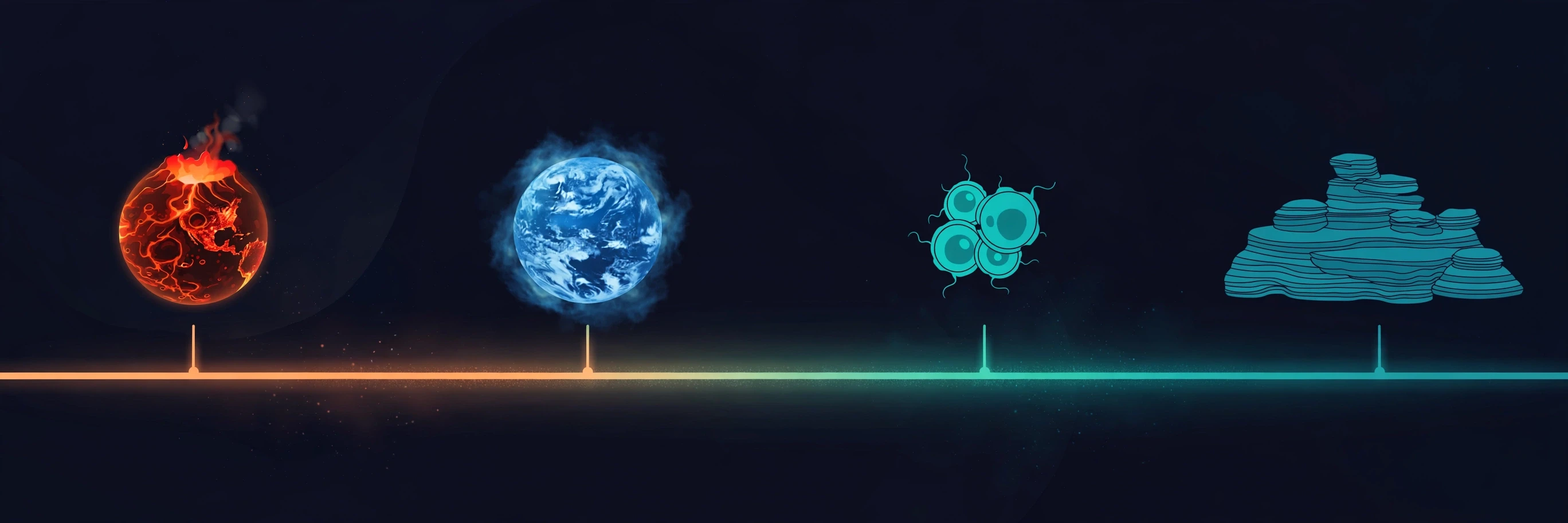
Here is the timeline in brief, and it is worth holding in mind for the rest of this article, because every theory of the origin of life has to fit inside it:
4.54 billion years ago: Earth forms from dust and rock.
About 4.5 billion years ago: the Moon-forming impact melts the planet.
4.4 billion years ago: liquid water is present, recorded in Jack Hills zircons.
4.2 billion years ago: LUCA, the last universal common ancestor of all life, is already alive — according to a 2024 genetic reconstruction.
About 3.8 billion years ago: the Late Heavy Bombardment eases; the oldest chemical hints of life appear in Greenland rocks.
3.48 billion years ago: stromatolites, the oldest widely accepted fossils, are built by microbial mats in Western Australia.
About 2.4 billion years ago: oxygen floods the atmosphere in the Great Oxidation Event, transforming the planet.
About 1.8 billion years ago: the first complex cells, with nuclei, appear (disputed 2.1-billion-year-old candidates exist).
About 600 million years ago: the first animals appear.
Look at the gap between the first two entries and the rest. Life went from chemistry to a shared ancestor — a cell complex enough to have roughly 2,600 proteins — in a few hundred million years. Then it spent the next three billion years as single cells, before anything with a body showed up. The origin of life was fast. Everything after it was slow. That asymmetry is one of the most striking facts in all of biology, and it shapes everything that follows.
4. Darwin's Warm Little Pond
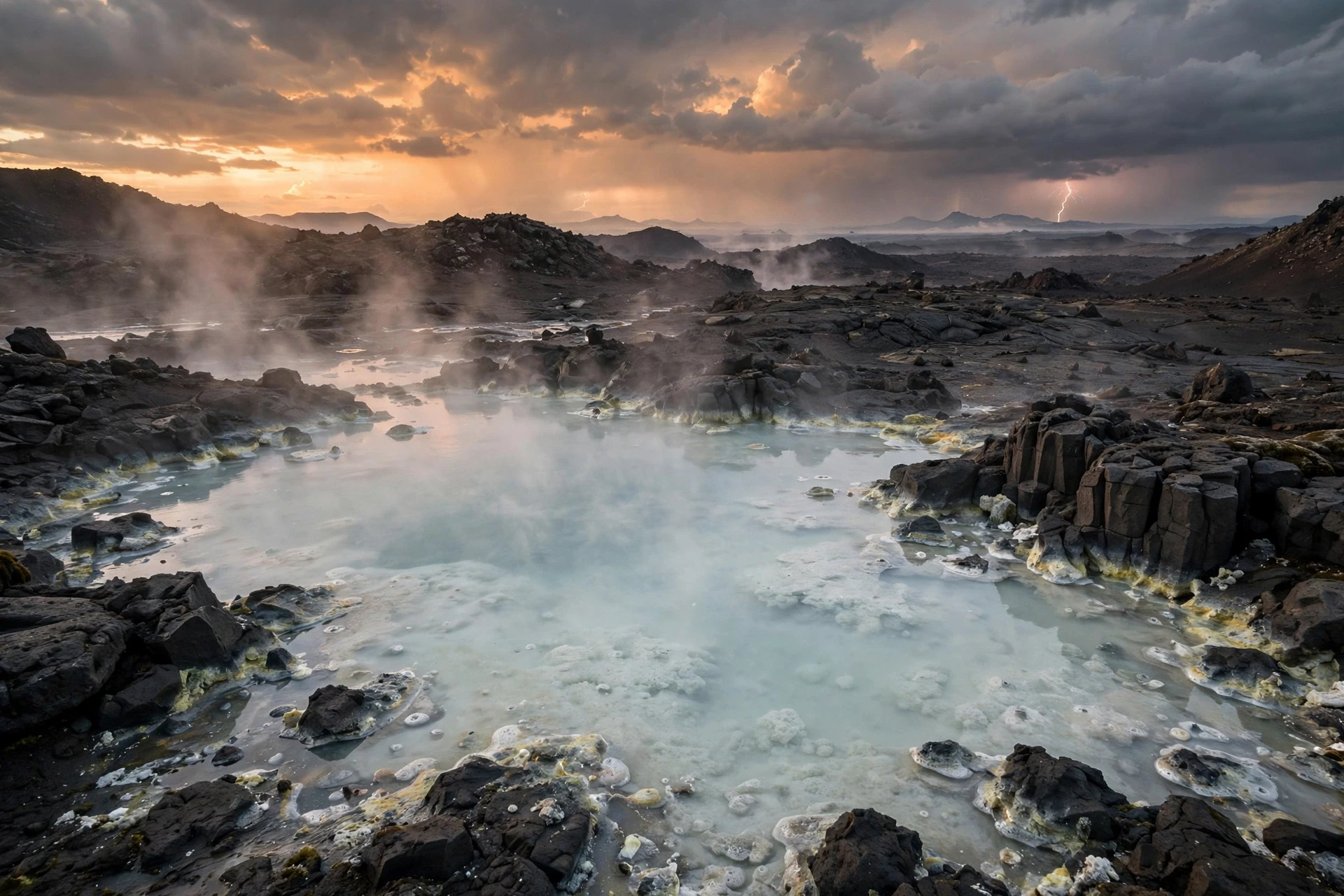
The scientific study of the origin of life began with a letter Charles Darwin never meant to publish. In February 1871, writing to his friend Joseph Dalton Hooker, Darwin wondered aloud about how the first living thing might have formed — and his guess has shaped the field ever since.
Darwin had spent his career explaining how life changes, and he deliberately avoided the question of how it started — the origin of life was the one subject he left for others. In On the Origin of Species (1859), he devoted only a single sentence to it — that all life probably descended from 'some one primordial form, into which life was first breathed' — and offered no account of how that first form arose. But in private, he could not leave it alone. The letter to Hooker contains one of the most famous passages in the history of biology (spelling and punctuation modernised from Darwin's manuscript):
"But if (and oh what a big if) we could conceive in some warm little pond with all sorts of ammonia and phosphoric salts, — light, heat, electricity &c. present, that a protein compound was chemically formed, ready to undergo still more complex changes, at the present day such matter would be instantly devoured, or absorbed, which would not have been the case before living creatures were formed."
Read that again, slowly. Darwin is doing something remarkable for 1871: he is proposing that life arose from ordinary chemistry, in an ordinary place, given energy and the right ingredients — and he is explaining why it cannot happen now. The moment life exists, it eats any new chemistry that tries to become life. The origin of life, in Darwin's picture, could only happen once, in a world with no competition. That insight — that the first life had a window, and the window closed behind it — is still central to the field.
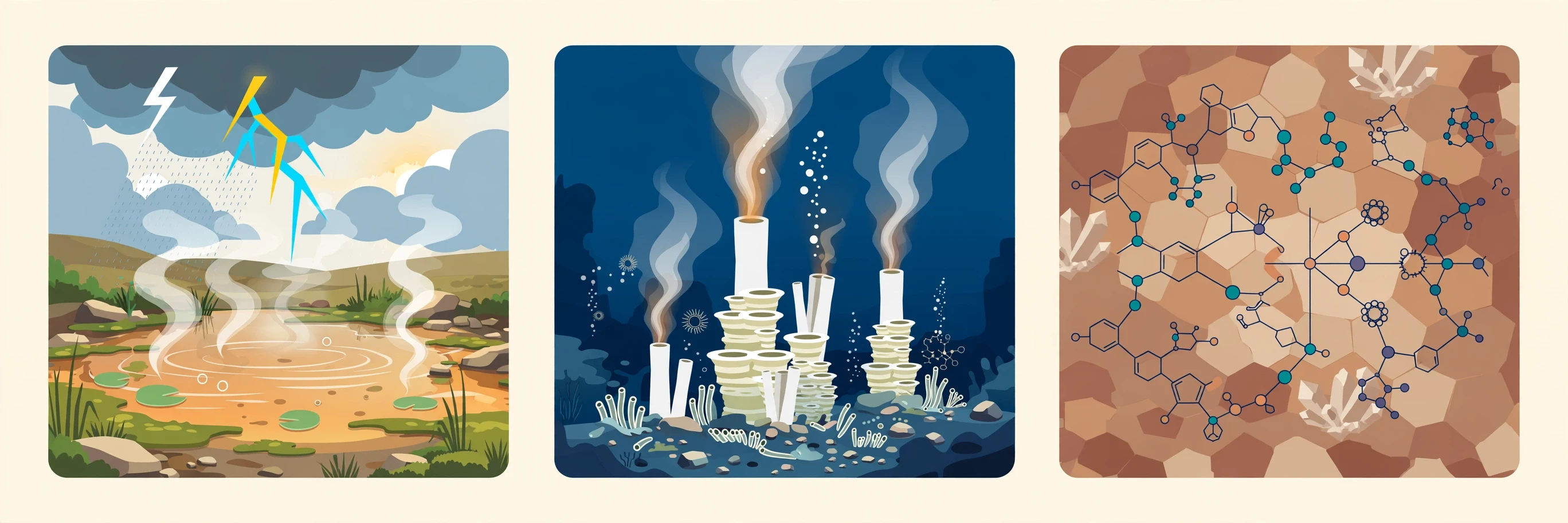
It took half a century for anyone to turn Darwin's sketch into a theory. In the 1920s, two scientists working independently — the Russian biochemist Alexander Oparin in 1924 and the British biologist J. B. S. Haldane in 1929 — proposed that the early Earth had a reducing atmosphere, rich in methane, ammonia and hydrogen, with no free oxygen. Under those conditions, they argued, energy from lightning and ultraviolet light could build organic molecules from simple gases. The molecules would accumulate in the oceans, forming a rich chemical soup — the "primordial soup" — in which the first steps toward life could happen. Oparin imagined the soup's molecules gathering into droplets called coacervates, tiny blobs that could concentrate chemicals and grow. Haldane imagined the ocean itself slowly filling with organic compounds until it reached "the consistency of hot dilute soup."
The idea was elegant, and for thirty years it was untestable. Then, in 1953, a graduate student decided to test it.
5. The Miller-Urey Experiment
The Miller-Urey experiment is the most famous experiment in the history of the origin of life — and the most misunderstood. In 1953, Stanley Miller, a graduate student at the University of Chicago, showed that the building blocks of proteins could form from simple gases and a spark. He did not create life. He showed that making life's ingredients was easy.
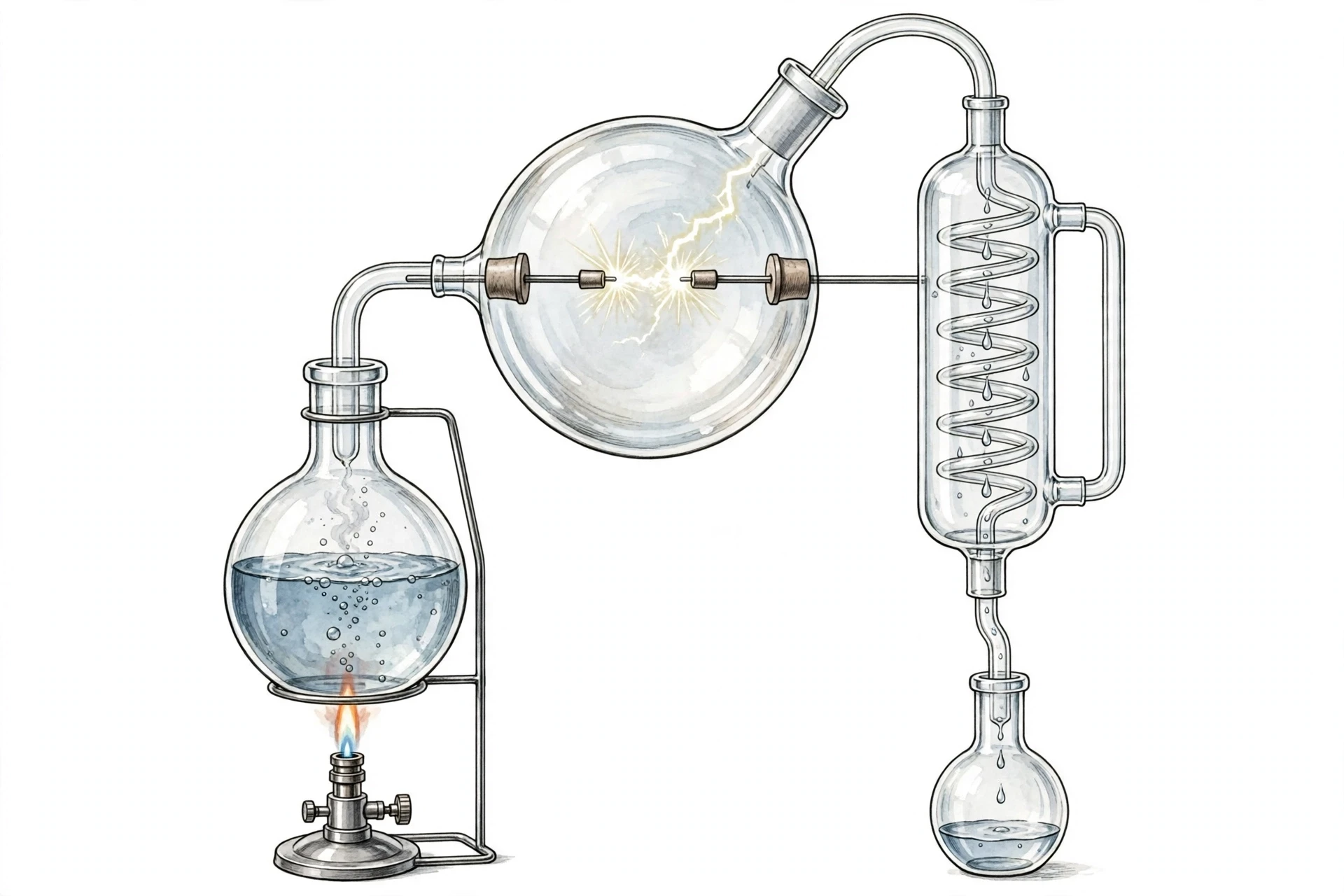
Miller was twenty-three, working in the laboratory of the Nobel laureate Harold Urey. Urey had suggested in a lecture that the early Earth's atmosphere was hydrogen-rich — a reducing atmosphere of methane, ammonia and hydrogen, with water vapour. Miller asked whether he could test that idea in a flask. Urey, to his credit, let him try. Miller built an apparatus of glass flasks and tubes: one flask of boiling water stood in for the ocean, a second flask held the gases, and two electrodes sparked across the gas mixture to stand in for lightning. The water vapour circulated, condensed, and rained back into the "ocean." He ran it for a week.
I have seen a reconstruction of that apparatus in a teaching laboratory, and the first thing that strikes you is how small it is — a benchtop tangle of glass that a careful undergraduate could build in an afternoon. The second thing is the colour. Within a day, the water in the flask turned pink. By the end of the week, it was a brownish broth. When Miller analysed it, he found amino acids — five of them, including glycine and alanine, the simplest building blocks of proteins. The paper, published in Science on 15 May 1953, was two pages long. It changed the field overnight, because it did something no one had done before: it made the origin of life a laboratory science. The primordial soup was no longer a guess. It was a result.
The experiment has been repeated many times since, with variations, and the results have only grown richer. In 2008, researchers reanalysed sealed vials Miller had stored away from his original experiments, using modern instruments he never had. The original experiment's vials held 14 amino acids and five amines — far more than Miller could detect in 1953. Vials from a related, unpublished version of the experiment, in which a jet of steam was blasted through the spark to mimic a volcanic eruption, held 22 amino acids. The chemistry was even more productive than the famous paper suggested.
But the Miller-Urey experiment also has limits, and honest accounts of the origin of life do not hide them. The biggest is the atmosphere. Most scientists now think the early Earth's atmosphere was not as strongly reducing as Miller and Urey assumed — it probably contained more carbon dioxide and nitrogen, and less methane and ammonia. When the experiment is repeated with that more realistic mixture, it produces far fewer amino acids. That does not make the experiment wrong. It makes it a proof of principle: given energy and simple gases, amino acids form readily. The question is where, exactly, the gases and the energy met on the real early Earth — in the atmosphere, at a volcano, in a deep-sea vent, or in a shallow pond. That question is still open, and it is the reason the field has spent seventy years arguing about the setting.
The second limit is scope. Amino acids are the building blocks of proteins, but proteins are only one of life's three great polymers. The other two — RNA and DNA — are made of nucleotides, and Miller's flask did not make those. Making nucleotides turned out to be much harder, and it took until 2009 for anyone to find a plausible route. That story belongs to the RNA world, and it is where the argument gets genuinely interesting.
There is one more thing the Miller-Urey experiment teaches, and it is the lesson I come back to whenever the subject feels impossibly hard. The experiment worked on the first serious try. A graduate student, a flask, a spark, a week — and the building blocks of proteins appeared. Whatever the origin of life was, it was not a miracle that required impossible luck. The chemistry wanted to happen. The hard part was everything that came after.
6. The Building Blocks Are Everywhere
If the Miller-Urey experiment showed that life's building blocks can form on Earth, the next discovery showed they can form almost anywhere. Amino acids fall from the sky.
On 28 September 1969, two months after Apollo 11 landed on the Moon, a meteorite fell near the town of Murchison in Victoria, Australia. More than 100 kilograms of it were recovered over an area of more than 13 square kilometres. It was a carbonaceous chondrite — a dark, carbon-rich rock, the kind of material the solar system was built from. When chemists analysed it, they found more than 70 amino acids inside it, many of which do not occur naturally on Earth at all. The Murchison meteorite was a delivery of organic chemistry from space, and it has been studied ever since as a frozen sample of the chemistry that was available when the planets formed.
For the origin of life, the Murchison result matters for a simple reason: it removes a worry. If amino acids could only form under one precise set of conditions on the early Earth, the origin of life would depend on a lucky accident. But the same amino acids turn up in meteorites, in laboratory flasks, and in simulations of interstellar clouds. The ingredients are not rare. They are the default product of carbon chemistry given energy and time. The amino acids identified in the early analyses of the Murchison meteorite had all been made in electric-discharge experiments — the same molecules, made two different ways, in space and in a flask.
The building blocks go beyond amino acids. In 1959, the Spanish-American biochemist Joan Oró showed that adenine — one of the four letters of DNA and RNA, and a component of the energy molecule ATP — could form from hydrogen cyanide, a simple molecule common in space, in a few straightforward steps. Sugar molecules, the backbones of RNA and DNA, form in similar reactions. Fatty acids, the molecules that make cell membranes, form in meteorites and in laboratory simulations. The inventory of prebiotic chemistry is now large, and it keeps growing: amino acids, sugars, nucleobases, lipids — all four classes of molecule that life is built from can form without life.
That leaves two possibilities, and both are live in the field. Either life's ingredients formed on Earth, in the atmosphere or the oceans or the vents, or they arrived from space on meteorites and comets during the Late Heavy Bombardment — or, most likely, both happened at once. The distinction between "made here" and "delivered from space" is less important than it looks. Either way, the early Earth had a supply of organic molecules. The hard problem was never the ingredients. It was the recipe: how do you get from a soup of ingredients to a system that copies itself?
7. The Chicken-and-Egg Problem
The origin of life has a puzzle at its centre, and it is the kind of puzzle that looks simple until you stare at it. Modern life runs on three great polymers — DNA, RNA and protein — and each one needs the others. DNA stores the instructions, but it cannot copy itself without protein enzymes. Proteins do the work, but they cannot be built without instructions from DNA, read out through RNA. So which came first?
This is the chicken-and-egg problem of the origin of life, and it is more than a riddle. It is a real constraint on any theory. A theory that starts with DNA has to explain where the proteins came from. A theory that starts with proteins has to explain where the instructions came from. A theory that starts with neither has to explain how both appeared. For decades, this loop looked like a dead end, and it was the strongest argument that life could not have arisen by chemistry alone.
There are three serious answers, and the field has spent the last forty years testing them against each other. Each one proposes a different starting point, a different setting, and a different order of events. They are not mutually exclusive — the real history may have combined them — but they make different predictions, and those predictions can be tested in the laboratory.
The RNA world: RNA came first, because RNA alone can do both jobs — store information like DNA and catalyse reactions like a protein. A self-copying RNA would break the loop in one move.
The metabolism-first view: a network of chemical reactions came first, running on mineral surfaces at deep-sea vents, and the genetic machinery evolved later to take over a metabolism that already worked.
The compartment-first view: a container came first — a bubble of fatty acids, a mineral pore, a droplet — and chemistry concentrated inside it until replication emerged.
The RNA world is the most developed of the three, and it has the most experimental support. It also has the most famous name in the field. The next section is its story.
8. The RNA World
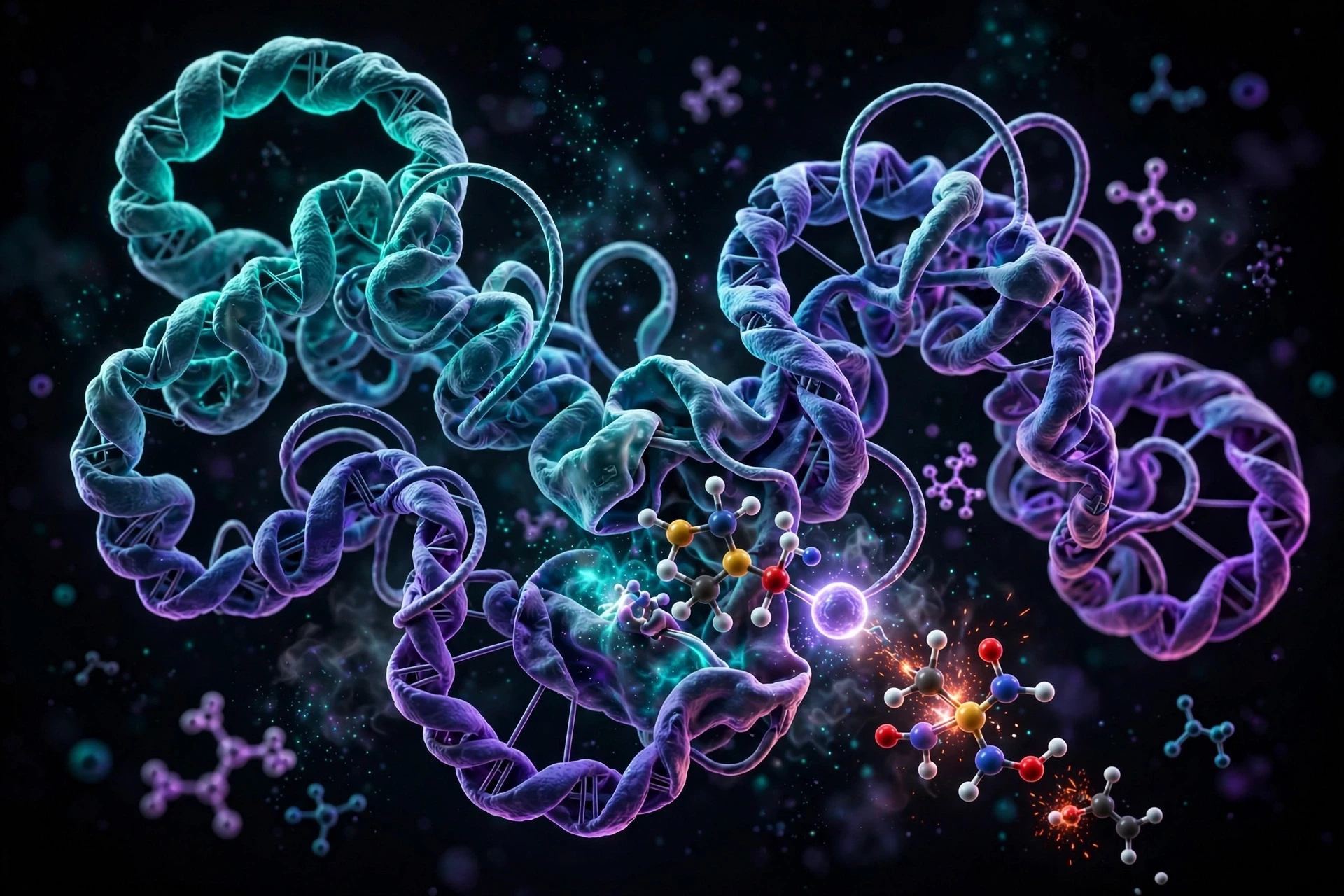
The RNA world is the leading answer to the chicken-and-egg problem, and it rests on a discovery that overturned a central dogma of biology: RNA can act as an enzyme. Before the 1980s, every known biological catalyst was a protein. Then two researchers, working independently, found RNA molecules that could catalyse chemical reactions on their own — and the origin of life suddenly had a way forward.
The idea had been whispered before. In 1967–68, Carl Woese (1967), Francis Crick (1968) and Leslie Orgel (1968) each suggested, separately, that RNA might have been the first genetic material, because it sits halfway between DNA and protein in the machinery of the cell. In 1962, the biophysicist Alexander Rich had proposed that RNA-like molecules came first. But a suggestion is not evidence, and for fifteen years the idea stayed on the shelf.
The evidence arrived in 1982. Thomas Cech, at the University of Colorado, was studying a single-celled organism called Tetrahymena thermophila when he found an RNA molecule that could cut itself out of a longer RNA strand and rejoin the ends — without any protein enzyme helping. Around the same time, Sidney Altman at Yale showed that the RNA component of an enzyme called RNase P could process other RNA molecules catalytically, on its own. These RNA enzymes were named ribozymes, and their discovery shattered the assumption that only proteins could be catalysts. Cech and Altman shared the 1989 Nobel Prize in Chemistry for the discovery.
The implication was immediate, and Walter Gilbert saw it first. If RNA can both store information (like DNA) and catalyse reactions (like protein), then a world run entirely on RNA would break the chicken-and-egg loop. A self-copying RNA molecule would be both the instructions and the worker. Gilbert gave the idea its name in a 1986 paper: "The RNA World." In his words, the first step of evolution proceeds then "by RNA molecules performing the catalytic activities necessary to assemble themselves from a nucleotide soup."
The evidence for the RNA world kept accumulating, and the strongest piece of it sits inside every cell alive today. The ribosome — the machine that builds proteins in every bacterium, every mushroom and every human — is a ribozyme. When its structure was solved in 2000, researchers could see that the spot where two amino acids are actually joined is ringed entirely by RNA, with no protein nearby. The most important chemical reaction in all of biology is catalysed by RNA. That is not a coincidence. It is a fossil, preserved in the machinery of the cell, of a time when RNA did the work.
The RNA world also made a prediction that could be tested: the building blocks of RNA should be formable under prebiotic conditions. For decades, that prediction looked shaky. Making a nucleotide the textbook way — joining a sugar, a base and a phosphate — requires conditions that seemed incompatible with each other. Then, in 2009, Matthew Powner, Béatrice Gerland and John Sutherland published a route that sidestepped the textbook entirely. Starting from simple molecules including glycolaldehyde, glyceraldehyde and cyanamide, they built activated pyrimidine ribonucleotides — two of RNA's four letters — in a sequence of reactions that all worked under plausible early-Earth conditions. The paper, published in Nature, did not prove that this was how RNA formed on Earth. It proved that it could have.
And in the same year, Tracey Lincoln and Gerald Joyce reported an RNA enzyme that could sustain its own replication indefinitely in the laboratory — two ribozymes that copied each other, generation after generation. It was not a self-copying molecule arising from scratch, and the system needed a supply of ready-made RNA fragments. But it showed that RNA replication, the central act of the RNA world, works in practice.
The RNA world has real problems, and the field does not hide them. Ribose, the sugar in RNA's backbone, is fragile — it falls apart quickly in warm water, and it is hard to make selectively. The nucleotides have a handedness problem: life uses only right-handed sugars and left-handed amino acids, but prebiotic chemistry makes both mirror images in equal amounts, and a mixed population does not copy well. And no one has yet built a ribozyme that can copy itself — a long RNA molecule, accurately, repeatedly, under realistic conditions. The best laboratory ribozymes copy short templates slowly and make mistakes. In 2016, researchers evolved a ribozyme that could copy RNA templates more effectively, but a fully self-replicating RNA remains out of reach. The RNA world is the best-supported theory of the origin of life, and it is incomplete. Both of those things are true at once.
9. The First Cells: Protocells
Life needs a boundary. A soup of molecules, however rich, is not alive — it has no inside and no outside, no way to keep its chemistry together, no way to stop its products from diffusing away into the ocean. The origin of life required a container, and the study of how containers form is the story of protocells.
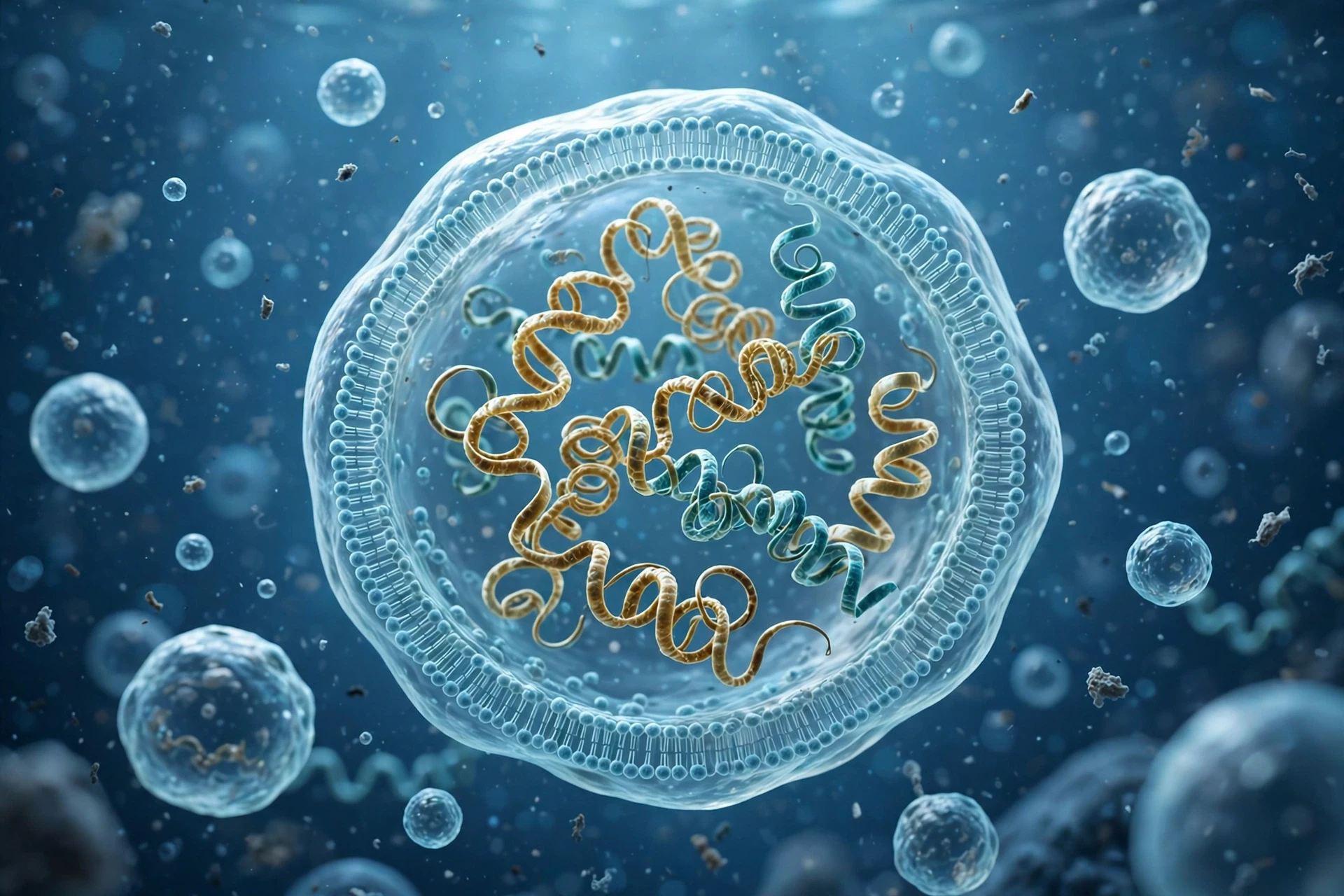
The most studied containers are fatty-acid vesicles — tiny bubbles made of the same kind of molecules that form soap films. Fatty acids form readily in prebiotic chemistry, in meteorites and in laboratory simulations, and when they are mixed with water they assemble themselves into hollow spheres, with a membrane one molecule thick. No one has to build them. They build themselves, the way oil forms droplets in water. Inside a vesicle, chemistry is concentrated. Outside, it is dilute. That difference — inside versus outside — is the beginning of a cell.
Jack Szostak's laboratory at Harvard spent years working out what these bubbles can do, and the results are quietly remarkable. Fatty-acid vesicles can grow: feed them more fatty acids, and they absorb them and get bigger. They can divide: push them through a narrow space, or let them grow until they become unstable, and they split into two daughter vesicles, each carrying some of the contents of the parent. They can take up nucleotides from outside and let RNA chemistry happen inside. They can even compete: vesicles that contain RNA grow faster than empty ones, because the RNA draws in more fatty acids — a primitive form of selection, acting on containers rather than genes.
I once watched a film of these vesicles under a microscope, and the effect was uncanny. The bubbles jostled, grew, stretched into long threads, and pinched off into daughters. Nothing in the film was alive. But it was impossible to watch without thinking that you were looking at the rehearsal for life — the physical behaviours that a cell would later inherit, already present in a bubble of fat.
The protocell story connects to the RNA world in a natural way, and it is one of the most hopeful chapters in the origin of life. An RNA molecule inside a vesicle is protected from dilution. A vesicle containing a self-copying RNA grows faster than its neighbours. The RNA and the container help each other, and the pair — a replicator inside a compartment — is recognisably the ancestor of a cell. This is why many researchers now think the origin of life was not one breakthrough but a partnership: a molecule that could copy itself, and a bubble that could hold it.
There is a competing view, and it deserves a fair hearing. The metabolism-first camp argues that the container came later, and that the first living system was a network of reactions running on a mineral surface, with no membrane at all. The German chemist Günter Wächtershäuser proposed in 1988 that the surface of iron-sulphur minerals at deep-sea vents could have hosted a self-sustaining cycle of reactions — a metabolism without genes, powered by the chemical energy of the vent. In this picture, the genetic machinery evolved later, as a way of recording and controlling a metabolism that already worked. The idea is elegant, and it explains something the RNA world struggles with: where the energy came from. A vent is a continuous source of chemical energy. A pond is not. The next section is the vent's story, and it is the strongest rival the RNA world has.
Cell Biology Explained: How Cells Work, Organelles, and Functions covers what a modern cell actually contains — and makes clear how much simpler the first compartments must have been. The gap between a fatty-acid bubble and a bacterium is the largest gap in this whole story, and it is still mostly unbridged.
10. The Deep-Sea Alternative: Life at the Vents
In 1977, a submersible called Alvin descended to the Galápagos Rift, two and a half kilometres beneath the Pacific, and found something that should not have been there: a thriving ecosystem in total darkness, around cracks in the seafloor where hot water poured out. The discovery rewrote biology — and it gave the origin of life a second home.
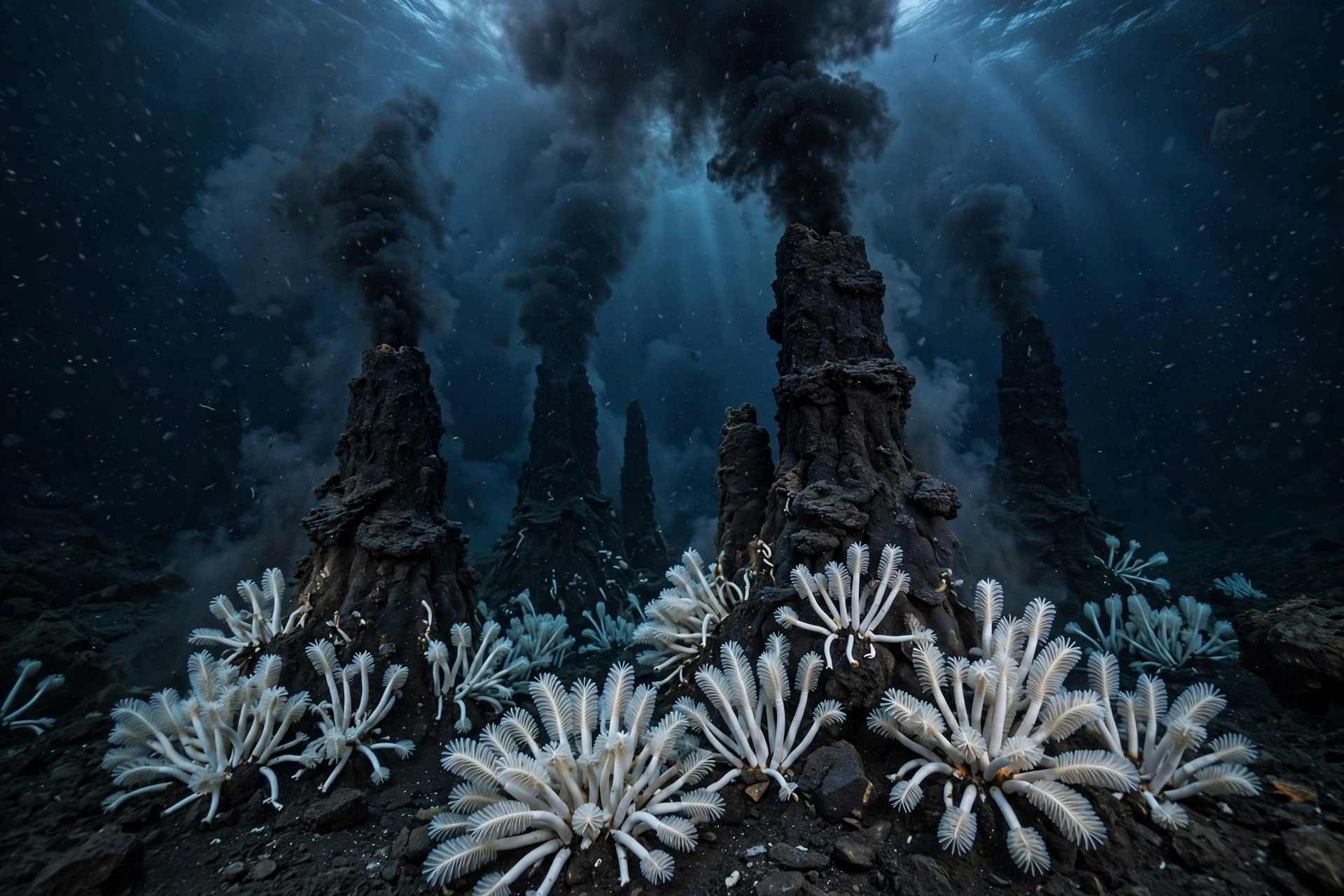
The vents were not supposed to exist. Geologists aboard Alvin had gone to study seafloor spreading, and instead they found giant tube worms, ghostly crabs, and clouds of bacteria clustered around fissures venting mineral-rich water. The animals were not living on sunlight. They were living on chemistry: bacteria converting hydrogen sulphide, methane and other compounds into organic matter, forming the base of a food web as complex as any coral reef. Sunlight, the energy source for almost all life on the surface, was irrelevant down there.
Two years later, on the East Pacific Rise, Alvin found the vents' most dramatic form: black smokers, chimneys of iron sulphide spewing water at up to 380 degrees Celsius — hot enough to melt lead — into water barely above freezing. The plumes did not boil, held down by the crushing pressure. Around them, life flourished. The discovery overturned a basic assumption of biology: that all complex life ultimately depends on photosynthesis. It does not. It depends on energy, and the deep sea has its own supply.
Within a few years, the vent discovery had become a theory of the origin of life. In 1981, the oceanographer Jack Corliss, together with microbiologists John Baross and Sarah Hoffman, suggested that submarine hot springs "provide all of the conditions necessary for the creation of life on Earth." The argument was straightforward: vents supply heat, chemical energy, mineral surfaces for catalysis, and steep gradients of temperature and acidity — everything a fledgling metabolism would need, continuously, for millions of years. A pond depends on the weather. A vent runs day and night.
But black smokers have a problem: they are too hot and too acidic for delicate chemistry. RNA falls apart quickly at 380 degrees, and the first fragile molecules would not survive there. The answer came from a different kind of vent, predicted before it was found. The geologist Michael Russell argued that the first vents would have been alkaline, not acidic — warm, not scorching — with mineral chimneys full of tiny pores that could act as natural compartments. On 4 December 2000, a team exploring the Atlantis Massif on the Mid-Atlantic Ridge found exactly that: the Lost City hydrothermal field, a forest of white carbonate spires up to 60 metres tall, venting clear, warm, alkaline fluid at 40 to 90 degrees Celsius into the surrounding seawater — the same kind of alkaline-into-acidic contrast Russell proposed for the early Earth's slightly acidic ocean. Russell's prediction had been right, and the discovery gave the vent theory a home that was gentle enough for chemistry to begin.
The vent hypothesis and the pond hypothesis are often presented as rivals, and in the public telling they are. In the laboratory, the picture is more nuanced: each setting solves some problems and creates others. Here is the honest comparison.
What life needs | Warm little pond (surface) | Alkaline hydrothermal vent (deep sea) |
|---|---|---|
Energy supply | Sunlight, lightning, ultraviolet — intermittent and weather-dependent | Continuous chemical energy from hydrogen and mineral reactions |
Building blocks | Rain from the atmosphere; molecules made by lightning and ultraviolet | Hydrogen, carbon dioxide and minerals in vent fluids; reactions on mineral surfaces |
Concentration | Evaporation in shallow pools concentrates molecules — but can also dry them out | Tiny pores in mineral chimneys concentrate molecules continuously |
Compartments | Fatty-acid vesicles form readily in fresh water | Mineral pores act as natural compartments before membranes exist |
Temperature | Warm and variable; wet-dry cycles help join molecules together | Stable and moderate at alkaline vents (40–90°C); black smokers far too hot |
Main problem | Seawater is salty and dilute; fragile molecules break down quickly | No wet-dry cycles; hard for molecules to link up without drying out |
The honest answer, for the origin of life, is that neither setting wins outright. The pond is better at making and joining molecules; the vent is better at supplying energy and protection. Some researchers now propose a hybrid: chemistry that began in the vents and moved to the surface, or molecules that formed in the atmosphere and were concentrated in ponds near hydrothermal fields. The terrestrial hot-spring hypothesis — life beginning in inland freshwater pools fed by volcanic heat, combining the pond's wet-dry cycles with the vent's mineral chemistry — is a serious contender that draws on both. What the argument has settled is the older assumption that life must have begun in the ocean's surface waters. The ocean is one candidate among several, and perhaps not the best one.
I have stood at the edge of a hot spring in Iceland, watching steam rise off milky blue water, and the smell of sulphur hanging in the air, and thought about how small the distance is between a geological feature and a biological one. The water was warm, the minerals were precipitating into terraces, the chemistry was visibly happening. It was easy to imagine the same scene four billion years ago, with no one watching, and the chemistry going one step further.
The deep-sea vents also connect to Sciory's own coverage: The Deep Sea Explained: Life in the Ocean's Darkest Depths describes the ecosystems that still live around vents today, running on chemistry instead of sunlight — a living reminder that life does not need the Sun.
11. Other Cradles: Clay, Ice, and the Deep Crust
The pond and the vent are the two best-known candidates for life's cradle, but they are not the only ones. The origin of life has attracted a shelf of alternative settings, and three of them deserve attention — not because any has won, but because each one solves a problem the leaders struggle with.
Clay. In 1985, the chemist Graham Cairns-Smith proposed that life began on clay — that the first genetic material was not RNA at all, but a crystal. Clay minerals grow by adding layers, and the pattern of imperfections in a layer can be copied into the next layer, like a mould. A crystal that grew with a useful pattern of defects would, in Cairns-Smith's picture, outgrow its neighbours — a form of replication and selection without any organic chemistry at all. Later, organic molecules could have taken over the information-carrying job from the crystal, like a new tenant moving into an old building. The idea has never been demonstrated in the laboratory, and most researchers now regard it as unlikely. But it made an important point: replication does not have to begin with a molecule we would recognise as genetic. Any system that can copy a pattern with occasional errors can, in principle, evolve.
Ice. In the 1950s, the biochemist Sidney Fox showed that amino acids, heated dry, link together into protein-like chains he called proteinoids — crude, but capable of forming tiny spheres. Later work found that freezing water concentrates organic molecules into the small pockets of liquid between ice crystals, where they can react at leisure, protected from the ultraviolet light that would destroy them in the open. Ice is a good preserver and a good concentrator, and the early Earth had plenty of it at the poles. The ice hypothesis has a quiet advantage: it explains how fragile molecules could accumulate without being destroyed. Its problem is the same as the vent's: without drying out, it is hard to join molecules into long chains.
The deep crust. The most radical alternative is that life began underground, in the cracks and pores of the deep crust, where water, minerals and heat meet far from the surface. The discovery of a deep biosphere — microbes living kilometres underground, in rock with no sunlight and almost no organic matter — showed that life can thrive in places no one expected. If life can live there now, the argument goes, it could have begun there. The deep crust is protected from impacts, from ultraviolet light, and from the drying and dilution that plague surface settings. Its weakness is evidence: the deep crust leaves almost no fossil record, so the hypothesis is hard to test.
None of these three has the experimental support of the RNA world or the vent hypothesis. They matter because they keep the field honest. The origin of life is an unsolved problem, and the correct answer may be a setting no one has yet taken seriously — or a combination of several. The history of this field is full of confident answers that turned out to be half right, and the researchers who have done best are the ones who kept more than one possibility open.
12. LUCA: The Ancestor of Everything Alive
Whatever the first living thing was, we know something remarkable about its descendant. Every living thing on Earth — every bacterium, every mushroom, every whale, every human — descends from a single population of cells that lived about 4.2 billion years ago. Its name is LUCA, the last universal common ancestor, and a landmark study in 2024 reconstructed it in more detail than ever before.
LUCA is not the first life form. That distinction matters, and it is the most common misunderstanding in this whole subject. LUCA is the last ancestor that all living things share — the point in the tree of life where every surviving lineage converges. Before LUCA, there were other lineages, other experiments in being alive, and they are all extinct. LUCA is the one that made it. It is the furthest point in evolutionary history we can reach by working backwards from what is alive today.
The 2024 study, led by Edmund Moody at the University of Bristol and published in Nature Ecology and Evolution, used a method called phylogenetic reconciliation: comparing the genes shared across all modern life and working out which ones must have been present in their common ancestor. The team identified 399 gene families with a high chance of having been in LUCA, and from those they estimated that LUCA lived about 4.2 billion years ago, with a range of 4.09 to 4.33 billion years. Its genome was at least 2.5 million letters long, encoding around 2,600 proteins — comparable to a modern bacterium. It lived without oxygen, making its living from hydrogen gas and carbon dioxide, in a process called acetogenesis. And it already had a rudimentary immune system — a defence against viruses, built from an early, effector-only version of the CRISPR system that modern bacteria use, and that scientists have now turned into a gene-editing tool. (Sciory's CRISPR Gene Editing Explained tells that story in full.)
That is a startling picture, and it is worth sitting with it for a moment. LUCA was not simple. It was not a bare replicator in a bubble. It was a fully functioning cell, with a genome the size of a modern bacterium's, a metabolism, and an immune system — and it lived 4.2 billion years ago, only about 340 million years after the Earth formed. The window between the planet cooling enough for oceans and LUCA's existence is narrow, and it is getting narrower: the study's authors note that LUCA's complexity suggests it was one of many lineages alive at the time, the rest now extinct. The origin of life, whatever it was, had already produced a sophisticated cell by 4.2 billion years ago. The first life must have been earlier still, and simpler — but how much earlier, and how much simpler, is the question the field is now chasing.
Moody himself is candid about the uncertainty. As he told Quanta Magazine when the study appeared:
"I fully expect and hope people prove us wrong in certain aspects."
That is the right attitude for this field, and it is worth quoting because it is the opposite of the certainty the subject invites. LUCA's reconstruction is a model, built from the genes that survived, and it will be revised. But its broad message is unlikely to change: life got complex fast, and the first cell was not the first life.
LUCA also tells us where to look. Its chemistry points to a hot, hydrogen-rich environment — the kind of place a hydrothermal vent provides. Its genome contains reverse gyrase, an enzyme found only in organisms that live at extremely high temperatures. That is circumstantial evidence for the vent hypothesis, and it is the strongest kind of circumstantial evidence there is: not a guess about what might have happened, but a signature written into the genes of every living thing. It is not proof — LUCA could have moved into the vents after originating elsewhere — but it is a clue, and the field is following it.
From LUCA, the story becomes the one told in Sciory's other Biology articles. LUCA's descendants split into bacteria and archaea, and much later, an archaeal cell swallowed a bacterium and became the first complex cell — the ancestor of everything with a nucleus, including us. Human Evolution Explained: From Ancient Ancestors to Modern Humans picks up the story billions of years later, when one branch of that tree became us. The origin of life is the root of that tree. LUCA is the oldest branch we can still see.
13. The First Fossils: Reading the Oldest Evidence
The origin of life leaves almost no fossils, because the first living things were too small and too soft to fossilise, and the rocks they lived in have mostly been destroyed. What survives is a handful of sites, each one contested, each one argued over for decades. Learning to read them is a lesson in how science handles evidence that is almost, but not quite, good enough.
The oldest claim comes from Greenland. In the Isua supracrustal belt, in rocks 3.7 to 3.8 billion years old, researchers found graphite — pure carbon — with an isotopic signature that looks biological. Living things prefer the lighter isotope of carbon, carbon-12, over the heavier carbon-13, so organic carbon is measurably lighter than carbon from rocks. The Isua graphite is light in exactly that way. The problem is that the Isua rocks have been cooked and squeezed by metamorphism for billions of years, and non-biological processes can also produce light carbon. Some researchers accept the Isua signature as evidence of life; others do not. The honest summary is that Isua is a hint, not a proof — the earliest disputed evidence, not the earliest certain evidence.
The earliest widely accepted evidence — the first entry in any catalogue of the earliest known life forms — is the stromatolites of the Dresser Formation, in the Pilbara region of Western Australia, 3.48 billion years old. Stromatolites are layered structures built by microbial mats: communities of microbes that trap sediment, grain by grain, building domes and columns layer by layer. The Dresser stromatolites are not just layered; they are found in rocks that were once a volcanic caldera with hot springs, and their shapes match the shapes built by living microbial mats today. They are the oldest direct evidence of life that most researchers accept.
Younger, but more detailed, are the microfossils of the Apex chert, also in the Pilbara, 3.46 billion years old — tiny filaments and spheres in the rock, the size and shape of bacteria. Their status has been argued over since they were described in the 1980s: are they really fossils, or mineral artefacts that happen to look like cells? The debate has swung back and forth, and it remains unresolved: some researchers defend at least some of the filaments as genuine, while others argue they are mineral artefacts formed by hot fluids. And in South Africa's Barberton greenstone belt, 3.42-billion-year-old hydrothermal vent deposits contain structures interpreted as some of the oldest evidence of life in a vent setting — a hint, if it holds, that the vent hypothesis has fossil support.
The most satisfying evidence is not a fossil at all, but a living one. In Shark Bay, Western Australia, stromatolites are still growing today, in shallow, salty water, built by the same kind of microbial mats that built the Dresser structures 3.48 billion years ago. You can walk out at low tide and see them: dark, lumpy domes in the shallows, layered like the ancient ones. The water is too salty for the snails and worms that would graze the mats away anywhere else, so the ancient way of life survives in a refuge. Shark Bay is a time machine with a gift shop — a place where you can look at a living community that works the way the oldest fossil communities worked.
Reading the oldest evidence takes patience, and the origin of life is a field that has learned to be careful. The standard is not "does it look like life?" but "can anything else explain it?" A layered rock can be made by water alone. A round blob can be a mineral. A light carbon signature can be made by heat. Each claim has to survive the alternatives, and the oldest claims are the ones that have survived the most attempts to explain them away. That is why the Dresser stromatolites matter so much: they have been attacked for forty years, and they are still standing.
14. From Chemistry to Biology: The Timeline
Put the evidence together, and the origin of life looks less like a single event and more like a staircase — a series of steps, each one building on the last, spread over a few hundred million years. No one knows the exact order of the steps, and different researchers would arrange them differently. But the broad shape is now clear enough to draw.
When | What happened | How we know |
|---|---|---|
4.54 billion years ago | Earth forms | Radiometric dating of meteorites and Moon rocks |
4.4 billion years ago | Liquid water on Earth | Jack Hills zircon crystals formed in water |
About 4.2 billion years ago | LUCA is alive | Genetic reconstruction (Moody et al., 2024) |
About 3.8 billion years ago | Earliest chemical hints of life | Light carbon in Isua graphite, Greenland (disputed) |
3.48 billion years ago | Stromatolites built by microbial mats | Dresser Formation fossils, Western Australia |
3.46 billion years ago | Microfossils of bacteria-like cells | Apex chert, Western Australia |
About 2.4 billion years ago | Oxygen floods the atmosphere | Banded iron formations; the Great Oxidation Event |
About 1.8 billion years ago | First complex cells with nuclei (disputed 2.1-billion-year-old candidates exist) | Fossil record of early eukaryotes |
About 1.05 billion years ago | First known complex multicellular organism | Bangiomorpha, fossil red algae |
About 600 million years ago | First animals | Ediacaran fossil record |
Two things stand out in that table. The first is how early life appears: within a few hundred million years of the oceans forming, something was already alive, and within a few hundred million years more it had become LUCA, a sophisticated cell. The second is how long nothing much happened afterwards. Life stayed single-celled for roughly three billion years — more than two-thirds of its history — before complex cells, multicellular organisms and animals appeared in relatively quick succession. The origin of life was the fast part. The diversification of life was the slow part. That is the opposite of what most people expect, and it is one of the reasons the origin of life is so interesting: whatever made it hard, it was not slowness. The chemistry, once it got going, moved quickly.
The table also shows what the field still cannot fill in. Between the first row of liquid water and the row for LUCA, there is a gap of 200 million years with no direct evidence at all — no fossils, no rocks, only the genetic echoes in LUCA's genome. That gap is where the origin of life happened, and it is the least documented stretch of time in Earth's history. Everything in this article about that gap is inference: from experiments, from chemistry, from the shapes of molecules. The inferences are good, and they are getting better, but they are not the same as a fossil. The field knows the difference, and it says so.
15. What We Still Don't Know
It is worth being plain about the state of play in the origin of life. After a century of work, no one has made life from non-life in a laboratory, and no one has shown a complete, step-by-step path from simple molecules to a self-replicating cell. That is not a failure. It is a measure of the problem's size. The origin of life is the hardest problem in biology that is still, in principle, soluble — and the field is closer than it has ever been, without being close.
The gaps are specific, and naming them is more useful than vague humility. Here are the four that matter most:
A self-copying RNA. No ribozyme yet discovered or built can copy itself — a long RNA molecule, accurately, repeatedly, from raw materials, without help. Laboratory ribozymes copy short templates, slowly, with errors. Until one copies itself, the RNA world has a missing centre.
The handedness problem. Life uses only left-handed amino acids and right-handed sugars, but prebiotic chemistry makes both mirror images equally. A mixed population copies badly. Something must have broken the symmetry — a mineral surface, circularly polarised light, a chance event amplified by autocatalysis — and no one knows what it was.
The first metabolism. The RNA world explains information; it does not explain energy. A self-copying molecule still needs a supply of activated building blocks and a way to power the copying. The vent hypothesis offers an energy source, but no one has yet run a full, self-sustaining metabolism on a mineral surface.
The first membrane. Fatty-acid vesicles work in the laboratory, but they are fragile: salt breaks them, heat breaks them, and the conditions that favour RNA chemistry are often the conditions that destroy membranes. Getting a replicator and a container to work in the same place, at the same time, remains unsolved.
There is also a deeper question that the field argues about in private: whether the origin of life was a single event or a process that happened many times, in many places, with only one lineage surviving. LUCA's complexity suggests it was one of many lineages alive 4.2 billion years ago. Were they all descended from a single origin, or did life begin several times, with the losers leaving no trace? The genetic evidence cannot answer that, because only one lineage survived to be sampled. It is possible that life began more than once, and we are the descendants of the only one that lasted.
Synthetic biology is now attacking the problem from the other end: instead of retracing history, build the simplest possible cell from scratch. In 2010, researchers at the J. Craig Venter Institute built a bacterium with a wholly synthetic genome — the first organism with a genome designed on a computer and assembled in a laboratory. In 2016, they pared a bacterial genome down to the smallest set of genes that can sustain life — 473 genes, the minimal genome. These are extraordinary achievements, but they are not the origin of life: they start with existing cells and existing biochemistry, and work backwards. Building life from chemistry, with no living starting material, has not been done. When it is done — and many in the field expect it within decades, not centuries — it will not prove that this is how life began on Earth. It will prove that it can be done. That distinction, between possible and actual, is the one this field lives by.
16. Why It Matters: Life Beyond Earth
The origin of life is not only a question about our past. It is the question that decides whether we are alone.
If life began on Earth quickly, easily, and soon after the planet became habitable — as the timeline suggests — then it may begin wherever the conditions are right. If it required a rare accident, a precise sequence of unlikely events, then Earth may be the only place it happened. The two possibilities point in opposite directions, and the evidence, so far, leans toward the first. Life appeared early, in a violent young solar system, on a planet that was being bombarded. That is not the profile of a rare accident. It is the profile of something chemistry does readily, given water, energy and time.
The search for life elsewhere is now guided by that logic. The most promising places in our solar system are the ones with liquid water and an energy source: Europa, the ice-covered moon of Jupiter, with a global ocean beneath its shell; Enceladus, the moon of Saturn, whose south pole sprays plumes of water, salts and organic molecules into space — sampled directly by the Cassini spacecraft; and Mars, where the Perseverance rover is exploring an ancient lakebed in Jezero crater, looking for the chemical signatures of past life. Each of these worlds is a test of the origin-of-life theories: if life began in hydrothermal vents, the oceans of Europa and Enceladus are the places to look; if it began in warm ponds, Mars's ancient lakes are the better bet.
Beyond the solar system, the question gets bigger. Astronomers have found thousands of planets around other stars, and many sit in the habitable zone — the band of distances where liquid water can exist on the surface. The next generation of telescopes will be able to sniff the atmospheres of some of those planets for oxygen, methane and other gases that, on Earth, are produced by life. A planet with oxygen and methane together would be a strong hint, because the two gases destroy each other unless something keeps replenishing them. Finding that hint would not prove the origin of life is common. But it would prove that life is not unique to Earth, and that would change the question from "how did life begin?" to "how often does it begin?" — a question with a very different answer.
There is a quieter implication, too, closer to home. The origin of life tells us that the boundary between chemistry and biology is not a wall but a slope. The molecules in our bodies are the same molecules that float in interstellar clouds and fall in meteorites. The chemistry that made us is not special to Earth. It is the chemistry of the universe, and we are one of the things it does. That is, in the end, what the origin of life is about: not a miracle, but a property of matter, given time.
17. Putting It All Together
The origin of life is the story of how a lifeless planet made something alive — and the story, as far as we can now tell it, goes like this.
Earth formed 4.54 billion years ago, molten and battered, and cooled fast enough that liquid water existed within 150 million years. In the atmosphere, the oceans, the vents or the ponds — or several of those places at once — simple gases and minerals, given energy from lightning, sunlight and hot rock, assembled themselves into organic molecules: amino acids, sugars, nucleobases, fatty acids. The ingredients were not rare. They form in flasks, in meteorites, and in interstellar clouds, and the early Earth had them in abundance.
From ingredients, chemistry built polymers. Somewhere, a molecule learned to copy itself — most likely RNA, the one molecule that can both store information and catalyse reactions. Around it, or before it, or after it, a container formed — a bubble of fatty acids, a pore in a mineral chimney — and the replicator and the container began to help each other. Metabolism, the business of taking in energy and building more of oneself, came into being alongside them, powered by the chemical gradients of a vent or the energy of the Sun.
By 4.2 billion years ago, that process had produced LUCA — a real cell, with a genome of about 2,600 proteins, living off hydrogen and carbon dioxide, defending itself against viruses. By 3.48 billion years ago, its descendants were building stromatolites in the shallows of Western Australia. By 2.4 billion years ago, their descendants had filled the atmosphere with oxygen. And three and a half billion years after that, one of their descendants is writing about it.
Nobody knows the exact path. The pond and the vent are both still in the running. The RNA world is the best-supported theory and it is incomplete. The first cell has never been built in a laboratory. But the shape of the answer is no longer a mystery wrapped in a miracle. It is a staircase of small, testable steps, from dust to water to molecules to a cell — and every step on that staircase is now an experiment, a fossil, or a gene. The origin of life is the oldest question in biology. It is also, at last, a question with a research programme, and the programme is working.
Frequently Asked Questions
How did life begin on Earth?
Life began on Earth through abiogenesis — the gradual organisation of non-living chemistry into self-replicating systems, probably between 4.4 and 3.8 billion years ago. Simple gases and minerals, given energy from lightning, sunlight and hot rock, formed organic molecules such as amino acids and nucleotides. Those molecules assembled into polymers, most likely RNA, which could both store information and catalyse reactions. Enclosed in fatty-acid bubbles or mineral pores, the first replicators became the first cells. The earliest widely accepted fossils, stromatolites 3.48 billion years old, show life was already well established by then.
What is abiogenesis?
Abiogenesis is the scientific term for the origin of life from non-living matter — the process by which chemistry became biology. It is distinct from evolution: evolution explains how life changes once it exists, while abiogenesis explains how the first self-replicating system arose. The word comes from the Greek for "not from life." Modern research into abiogenesis combines chemistry, geology, genetics and astronomy, and its leading theories include the RNA world hypothesis and the hydrothermal vent hypothesis.
What is the RNA world hypothesis?
The RNA world hypothesis proposes that before DNA and proteins existed, life ran entirely on RNA. RNA is the only known biological molecule that can both store genetic information, like DNA, and catalyse chemical reactions, like a protein. The idea was named by Walter Gilbert in 1986, after Thomas Cech and Sidney Altman discovered catalytic RNA molecules called ribozymes in 1982–1983 — work that won the 1989 Nobel Prize in Chemistry. A self-copying RNA would break the chicken-and-egg loop between DNA and proteins. The ribosome, the machine that builds proteins in every living cell, is itself a ribozyme — a fossil of the RNA world preserved in modern biochemistry.
What was the Miller-Urey experiment?
The Miller-Urey experiment, carried out in 1953 by Stanley Miller and Harold Urey at the University of Chicago, tested whether life's building blocks could form from simple gases. Miller filled a flask with methane, ammonia, hydrogen and water vapour, boiled water below to simulate the ocean, and sparked the gases with electrodes to simulate lightning. After a week, the water contained five amino acids, the building blocks of proteins. A 2008 reanalysis of Miller's sealed samples found even more — 22 amino acids in one version of the experiment. The experiment did not create life, but it proved that making life's ingredients from simple chemistry is easy.
How old is life on Earth?
Life on Earth is at least 3.5 billion years old, and probably older. The earliest widely accepted evidence is stromatolite fossils from the Dresser Formation in Western Australia, 3.48 billion years old. Chemical hints — isotopically light carbon in Greenland rocks — suggest life may go back to 3.8 billion years ago, though that evidence is disputed. Genetic reconstructions place LUCA, the last universal common ancestor of all living things, at about 4.2 billion years ago. Since LUCA was already a complex cell, the origin of life itself must be older still, probably between 4.4 and 3.8 billion years ago.
Did life come from space?
Probably not in the sense of living organisms arriving from space — that idea, called panspermia, has no evidence. But life's ingredients almost certainly did arrive from space in part. The Murchison meteorite, which fell in Australia in 1969, contained more than 70 amino acids, and amino acids and other organic molecules have been found in comets and interstellar clouds. The most likely picture is that organic molecules formed both on Earth and in space, and were delivered to the young Earth by meteorites and comets during the Late Heavy Bombardment. The ingredients came from everywhere. The living thing itself almost certainly formed here.
Could life begin again on Earth today?
Almost certainly not, and Darwin saw why in 1871: any new chemistry trying to become life would be instantly devoured by existing life. The early Earth was a world with no competition, no predators, and no microbes to eat the ingredients. Today's Earth is full of organisms that consume organic molecules within hours. The window for the origin of life closed the moment life existed. That is also why the origin of life could only happen once — at least on this planet.
Sources
UC Berkeley, Understanding Evolution — How did life originate?
Nobel Prize — The RNA World, by Sidney Altman (1989 Nobel laureate)
Quanta Magazine — All Life on Earth Today Descended From a Single Cell. Meet LUCA.
CUNY Pressbooks, Astrobiology — From Biochemistry to Biology
Nautilus — The Fly in the Primordial Soup (hydrothermal vents and the origin of life)
PMC — Pioneers of Origin of Life Studies: Darwin, Oparin, Haldane, Miller, Oró (2024)
American Museum of Natural History — Harold C. Urey: Multi-Disciplinary Chemist
Darwin Correspondence Project — Letter 7471, Charles Darwin to J. D. Hooker, 1 February 1871
Human Evolution Explained: From Ancient Ancestors to Modern Humans
CRISPR Gene Editing Explained: How It Works and What It Can Do
Genetics Explained: How Inheritance, Mutations, and Gene Expression Work
Microbiology Explained: Bacteria, Viruses, and How Microbes Shape Life