

1. The Woman Who Had Her DNA Edited
CRISPR gene editing is a way to rewrite DNA with molecular scissors borrowed from bacteria. In 2019 it treated its first sickle-cell patient — a woman with sickle cell disease — and in 2023 it produced the first approved CRISPR medicine. This article explains how it works, what it can cure, and where the line is drawn.
Her name was Victoria Gray, and she lived in Mississippi with sickle cell disease. The disease had shaped her whole adult life: sudden attacks of pain so severe they sent her to the emergency room, blood transfusions, damaged joints, the constant fear of the next crisis. By her early thirties she had tried the available treatments, and they were not enough. Then, in the summer of 2019, she became the first person in the United States to receive a CRISPR-based treatment for sickle cell disease. Doctors collected her own blood stem cells, edited them in a laboratory, and gave them back to her. The edit did not fix the mutation that caused her disease. It did something cleverer: it switched on a backup system her body already owned, and her red blood cells started making the healthy haemoglobin she had stopped producing as a baby.
I remember reading about her treatment the way most people first meet CRISPR gene editing — as a news story that sounded too neat to be real. A woman's DNA edited outside her body, then put back, and the pain crises stopped. It read like science fiction with a hospital address attached. Four years later, in December 2023, the treatment she received became Casgevy, the first CRISPR gene editing medicine ever approved by the US Food and Drug Administration. The fiction had become a pharmacy shelf item, with a price tag and a patient leaflet and a fifteen-year follow-up study.
That is the story of this article: a bacterial defence system, discovered by accident, turned into the sharpest tool biology has ever had — and the argument about what we should be allowed to do with it. You will learn what CRISPR is, where it came from, exactly how the molecular scissors find their target and cut it, what the treatment can already cure, what it cannot do, and why one experiment in China in 2018 still shapes every rule written about it today. Along the way, the numbers come from the regulators and the trial papers themselves, not from press-release summaries, and the places where scientists genuinely disagree are marked as disagreements, not settled facts.
2. What Is CRISPR Gene Editing?
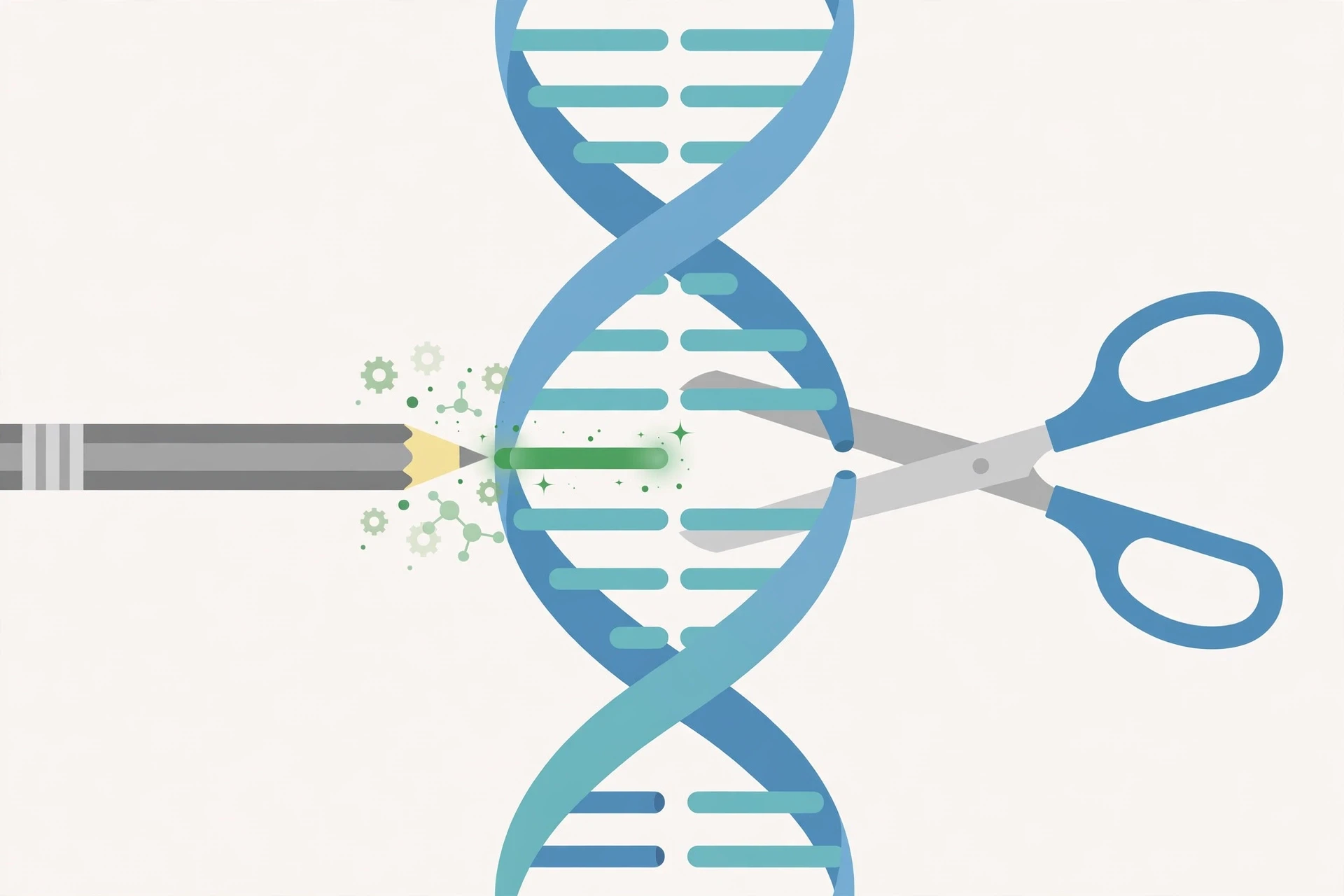
CRISPR gene editing is a technique for changing DNA at a chosen spot, using a protein called Cas9 as molecular scissors and a short piece of RNA as the address label. The scissors cut the DNA where the label tells them to, and the cell's own repair machinery then fixes the break.
The repair either switches a gene off or, with a template supplied, rewrites it. The name is an acronym, and it is worth spelling out once: Clustered Regularly Interspaced Short Palindromic Repeats. Say it slowly and it describes exactly what scientists saw under the microscope in the 1980s: short pieces of DNA, repeated at regular intervals, with odd stretches of unrelated DNA sandwiched between them. For years nobody knew what the repeats were for. The answer turned out to be stranger than anyone guessed. Bacteria were keeping a library of their enemies.
Think of DNA as the instruction manual for a living thing, written in four letters — A, T, C and G — three billion letters long in a human being. Every cell carries a copy. A gene is a chapter of that manual: the instructions for making one protein, or for controlling when a protein gets made. Most diseases with a genetic cause come down to a mistake in one chapter — a single wrong letter, a missing paragraph, a chapter copied twice. CRISPR gene editing is the first tool that lets scientists open the manual to a chosen page, find a chosen sentence, and change it. Earlier tools could do this too, in principle, but they were slow, expensive, and hard to aim. CRISPR gene editing is fast, cheap, and precise enough that a graduate student can learn it in weeks. That combination — power plus ease — is why it spread through biology in less than a decade, and why the arguments about it are so intense.
The comparison everyone reaches for is find-and-replace in a word processor, and it is a good starting point, with one warning attached. In a word processor, find-and-replace changes every matching word in the document, and you can undo it. In a cell, the edit happens once, in one place, and there is no undo button. The cell repairs the cut, and the repair becomes part of the genome, copied into every daughter cell from then on. That permanence is the source of both the promise and the fear. Fix a faulty gene in a patient's blood stem cells, and the fix lasts for life. Make a mistake in an embryo, and the mistake lasts for generations.
CRISPR gene editing is not one single tool. It is a family of tools built on the same idea. The original is CRISPR-Cas9, the scissors. Then came base editors, which change a single DNA letter without cutting the strand at all, and prime editors, which can rewrite short stretches of DNA like a word processor with a pencil instead of scissors. This article covers all three, because the differences matter for safety: a tool that never cuts the DNA cannot cause the same accidents as one that does. The rest of the article also keeps two distinctions in view at all times. The first is between editing the cells of one person's body and editing an embryo or sperm or egg — somatic editing versus germline editing. The second is between what the technology can do in a laboratory and what it has actually been proven to do in patients. The gap between those two things is where most of the hype lives.
If you want the background first, Sciory's Genetics Explained: How Inheritance, Mutations, and Gene Expression Work covers genes, mutations and inheritance in detail, and DNA: Structure, Replication, and Role in Heredity explains the double helix itself. This article assumes you know that DNA is the instruction manual and genes are its chapters, and builds from there.
3. Where CRISPR Came From: A Bacterial Immune System
CRISPR began as a bacterial immune system, not a human invention. Bacteria use it to remember viruses that attacked them, storing a piece of each virus's DNA and using it to recognise and shred that virus if it returns. Scientists spent twenty years working out how that memory works, then borrowed it to build CRISPR gene editing.
That origin matters, because it explains both the power of CRISPR gene editing and its limits. The system evolved to cut foreign DNA inside a single bacterial cell. It was never designed to edit a human genome safely. Every medical use of it is a repurposing — a brilliant one, but a repurposing all the same, and the safety questions in this article all trace back to that fact.
3.1 The strange repeats, 1987
In 1987, a Japanese team led by Yoshizumi Ishino was studying a gene in the gut bacterium Escherichia coli when they noticed something odd beside it: five short DNA sequences, each 29 letters long, repeated at regular intervals, with unrelated stretches of DNA between them. The pattern looked deliberate, but nobody could say what it was for. Ishino published the observation and moved on. Over the next decade, other researchers found the same pattern in other bacteria and in archaea, the single-celled organisms that live in hot springs and salt lakes. The repeats were everywhere, and they were always accompanied by a set of nearby genes that nobody had identified either. The genes were named cas, short for CRISPR-associated.
The repeats had a peculiar property. The stretches of DNA between them — the spacers — were all different from one another, and they were all about the same length. A library has that shape: many different items, all filed the same way. But what was the library for? That question sat unanswered for almost twenty years, while the repeats accumulated in genome databases and the scientists who noticed them filed them away as a curiosity.
3.2 Mojica connects the dots, 2005
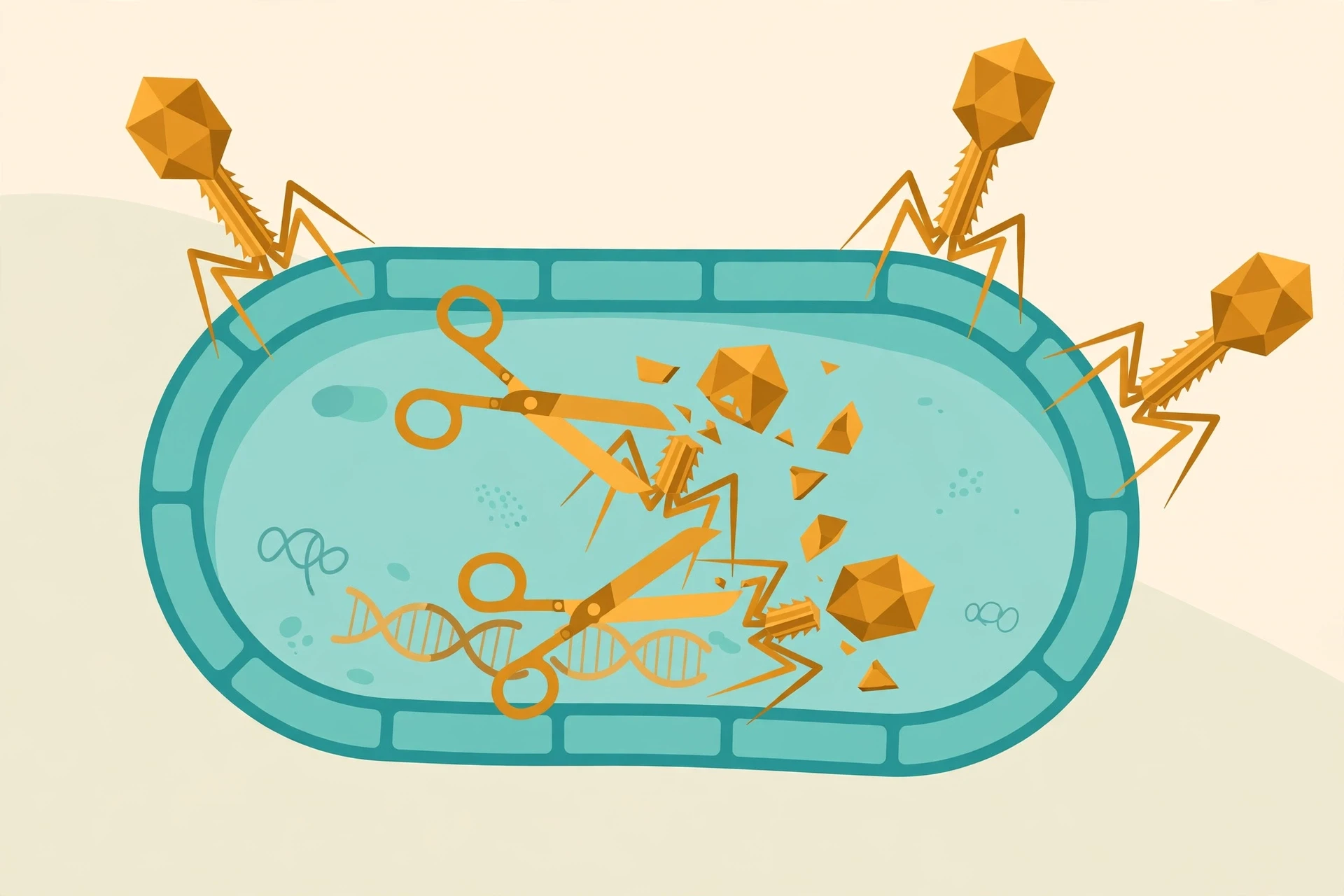
The breakthrough came from a microbiologist in Spain, Francisco Mojica, who spent years comparing spacer sequences against every DNA database he could reach. In 2005 he published the answer: the spacers matched the DNA of bacteriophages — the viruses that infect bacteria. Each spacer was a fragment of a virus that had attacked the bacterium's ancestors. The bacterium was keeping a record of past infections, written into its own genome, and passing that record to its descendants.
Mojica's finding turned the repeats from a curiosity into a memory system. The logic was plain once you saw it. A bacterium survives a virus attack. It cuts out a piece of the virus's DNA and files it between two repeats. The next time that virus attacks, the bacterium reads the filed fragment, recognises the invader, and destroys it. It is the same logic as a vaccine card, or a most-wanted poster: a stored description that lets the immune system recognise an old enemy at a glance. The difference is that the bacterium stores the description in its DNA, and the description is inherited. A bacterial cell's grandchildren remember the viruses its grandparents fought.
Two other teams reached the same conclusion in the same year, and the three papers together settled it: CRISPR was an adaptive immune system, the bacterial equivalent of the antibodies in your blood. What nobody knew yet was the machinery — which protein did the cutting, and how did it find its target?
3.3 Barrangou proves it, 2007
In 2007, a team at the food company Danisco, led by Rodolphe Barrangou, ran the decisive experiment. They worked with Streptococcus thermophilus, a bacterium used to make yoghurt, and the viruses that attack it — a serious problem for a yoghurt factory, which is why a food company was funding the work. They infected the bacteria with a virus, waited for the survivors, and read their genomes. The survivors had gained new spacers matching the attacking virus. Then the team did the reverse: they removed a spacer, and the bacterium lost its resistance to that virus. Add a spacer, gain resistance. Remove it, lose resistance. That is the gold standard of proof in biology — a change that works in both directions — and it confirmed that CRISPR was a working immune system, not just a filing cabinet.
By 2011, the cutting machinery was coming into focus. Emmanuelle Charpentier, then at Umeå University in Sweden, discovered a small RNA molecule called tracrRNA that turned out to be the missing half of the guidance system. The picture was almost complete: a protein that cuts DNA, a guide made of RNA that tells it where to cut, and a memory of past infections stored in the repeats. What remained was for someone to take the system out of bacteria and turn it into a CRISPR gene editing tool that could be aimed at any DNA sequence a scientist chose. That step took one more year, and it changed biology.
4. How CRISPR-Cas9 Works: The Molecular Scissors
CRISPR-Cas9 works in three steps: a guide RNA leads the Cas9 protein to one chosen DNA sequence, Cas9 checks a short checkpoint sequence called PAM, and then it cuts both strands of the DNA at that spot. The cell repairs the cut, and that repair is the edit.
The whole system has just two parts — the scissors and the address label. The elegance of CRISPR gene editing is that the targeting and the cutting are separate jobs. The Cas9 protein does the cutting, and it is the same protein every time. The guide RNA does the targeting, and it is different every time — a short string of about twenty RNA letters, designed to match the DNA sequence you want to change. Want to cut a different gene? You do not need a new protein. You order a new guide RNA, a job that takes days and costs a few dollars. That is why CRISPR gene editing spread so fast. Older gene-editing tools needed a newly engineered protein for every new target, a project that took months. CRISPR gene editing needs a new piece of RNA, and RNA is cheap.
The first time I tried to explain this to a friend, I used the word-processor analogy, and she stopped me with the obvious question: what if the scissors cut the wrong place? It was the right question, and it is the question this article keeps coming back to. The answer, in short, is that the guide RNA usually finds the right place, that the PAM checkpoint adds a second test, and that mistakes do happen — rarely, and mostly at sequences that closely resemble the target. The safety section near the end of this article explains how often that happens and how scientists check for it. For now, here is the machine itself.
4.1 The guide RNA: the address label
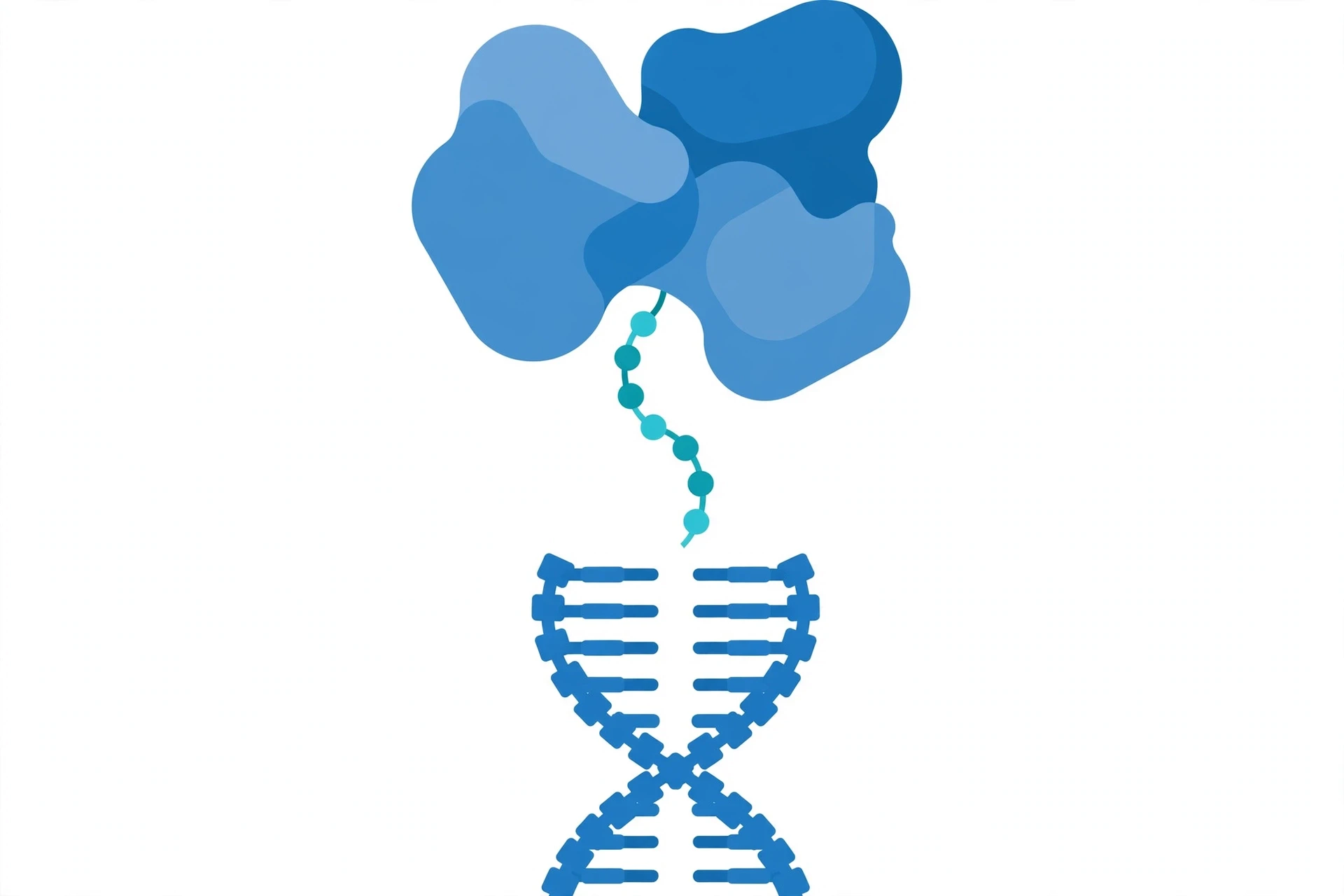
The guide RNA is the part of the system that knows where to go. It is a short molecule, about twenty letters long, and its sequence is chosen to match — letter for letter — the DNA sequence the scientist wants to edit. RNA pairs with DNA the way the two strands of the double helix pair with each other: A with T, C with G. So a guide RNA built to match a gene will stick to that gene and to nothing else, at least in theory. The Cas9 protein carries the guide RNA like a bloodhound carries a scent, scanning the genome until the guide finds its match.
In nature, bacteria build their guide RNAs from the spacers in their CRISPR memory — each spacer becomes a guide that recognises one virus. In the laboratory, scientists build synthetic guide RNAs to order. The process is so routine now that a researcher can design a guide on a laptop, order it from a company, and have it in the post within days. That ease is part of what makes CRISPR gene editing revolutionary, and part of what makes it hard to control. The same mail-order simplicity that lets a hospital lab design a treatment for sickle cell disease also lets a less scrupulous lab design an edit nobody has approved.
The guide RNA is twenty letters long, but the human genome is three billion letters long. A twenty-letter sequence is specific enough that it usually occurs only once in the whole genome — the mathematics works out to roughly one match in a trillion random letters, far more specific than the genome requires. The problem is not exact matches elsewhere. It is near matches: sequences that differ from the target by one or two letters, which the guide RNA can sometimes still bind to. Those near matches are where off-target cuts happen, and they are the reason every serious CRISPR gene editing project now includes a search of the genome for lookalike sequences before any cutting begins.
4.2 The PAM checkpoint: a second test
Cas9 does not cut every sequence the guide RNA matches. It demands a second credential first: a short sequence called PAM, short for protospacer adjacent motif, sitting immediately beside the target. For the Cas9 borrowed from the bacterium Streptococcus pyogenes — the workhorse of CRISPR gene editing — the PAM is three letters, N-G-G, where N can be any letter. If the PAM is not there, Cas9 does not cut, even if the guide matches perfectly.
The PAM is a safety feature that bacteria evolved for a good reason. The bacterium stores virus fragments in its own genome, in the CRISPR repeats. Without a way to tell its own stored fragments from a real invading virus, Cas9 would cut the bacterium's own DNA. The PAM is the difference: the stored fragments in the repeats are not flanked by a PAM, but the virus DNA is. So Cas9 attacks the virus and spares the library. Scientists inherited that checkpoint along with the rest of the system, and it does useful work in the laboratory too: it adds a second condition that must be met before cutting, which reduces the number of places in the genome where an off-target cut can happen.
The PAM also sets a limit. Because the target must sit beside an NGG sequence, not every letter of the genome can be reached by this particular Cas9. In practice the limit is a small one — NGG occurs roughly once every eight letters of DNA, so a target is almost always nearby — and other Cas proteins with different PAM requirements have been found for the awkward cases. The checkpoint is a constraint, not a wall.
4.3 Cutting and repair: NHEJ versus HDR
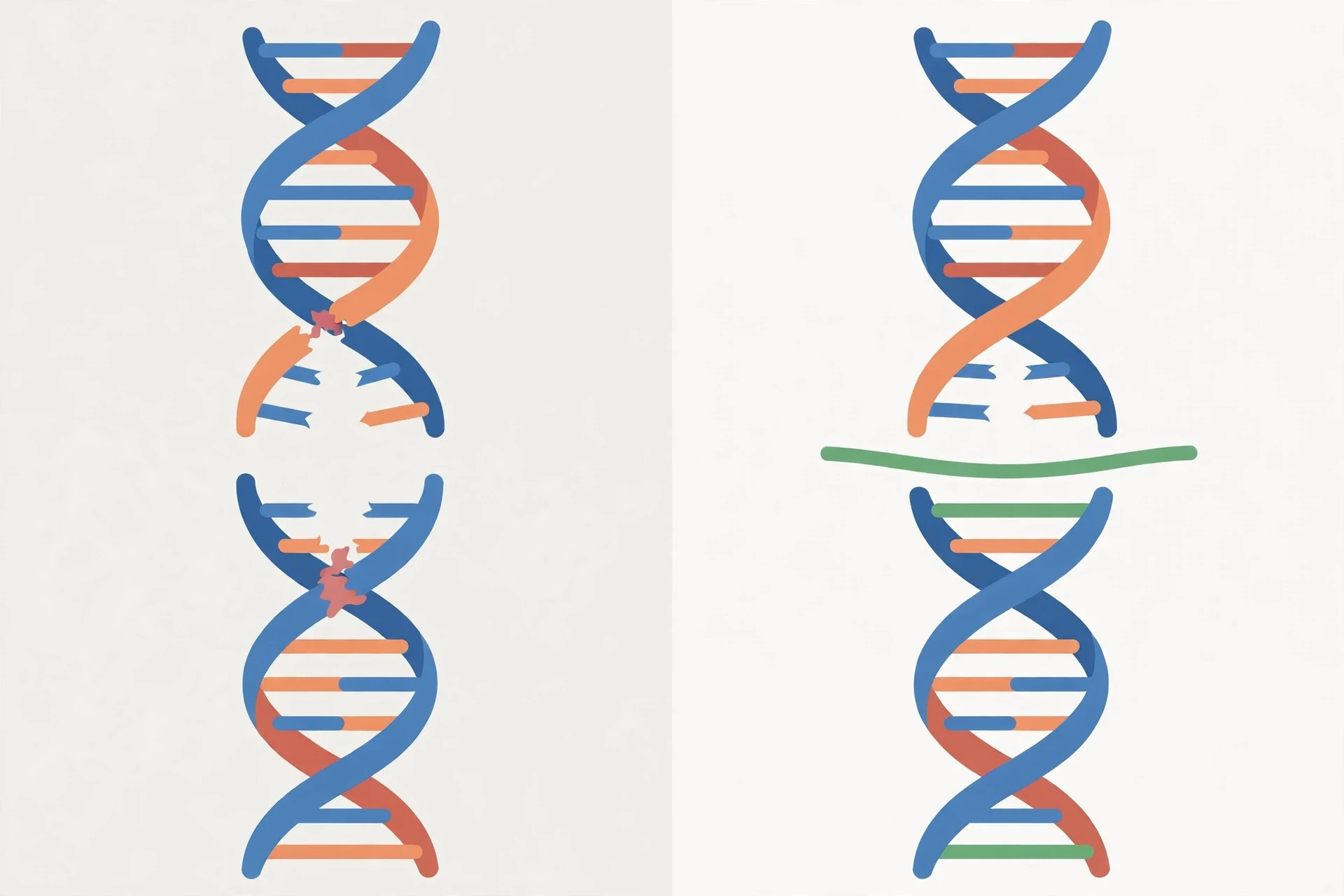
When Cas9 cuts, it severs both strands of the double helix, three letters upstream of the PAM. The cell notices a broken chromosome immediately — a double-strand break is the most dangerous kind of DNA damage — and rushes to repair it. The repair is the edit, and there are two main ways the cell does it.
The first way is called non-homologous end joining, NHEJ for short. The cell simply glues the two broken ends back together, quickly and crudely. The glue job often adds or loses a few letters at the join, and that small scar is usually enough to disable the gene: the instructions are garbled, and the protein never gets made properly. NHEJ is the cell's emergency repair, and it is what scientists use when the goal is to switch a gene off. Casgevy, the first approved CRISPR medicine, works this way — it uses NHEJ to disable a control switch, not to fix a mutation. The cell's sloppy repair is the treatment.
The second way is homology-directed repair, HDR. If a matching DNA template is supplied along with the scissors, the cell can use the template to repair the break precisely, copying the template's sequence into the genome. HDR is the way to correct a mutation letter by letter, or to insert a whole new piece of DNA. It is the more powerful option and the harder one, because HDR only runs in cells that are dividing, and most cells in an adult body are not dividing. Blood stem cells divide, which is one reason the first CRISPR treatments targeted blood diseases. Editing a gene in a liver cell or a muscle cell, where HDR barely runs at all, is a much harder problem, and much of the current research is about solving it.
Jennifer Doudna, who co-invented the reprogrammed system, has described it in plain terms:
"Scientists can program it to find and cut a specific place in any organism's DNA and then provide a new template to repair the DNA."
That sentence is the whole technology in twenty-five words. The guide finds the place. The scissors cut it. The cell's repair does the rest — and the scientist, by choosing which repair path the cell takes, decides what the edit means.
5. The 2012 Paper That Changed Everything — and the Nobel Prize
The 2012 paper by Doudna and Charpentier showed that CRISPR-Cas9 could be reprogrammed to cut any DNA sequence a scientist chose, turning a bacterial immune system into a universal gene-editing tool. Eight years later, in 2020, the work won the Nobel Prize in Chemistry — one of the fastest journeys from laboratory paper to Nobel.
The paper was published in Science in June 2012, with Martin Jinek as first author and Emmanuelle Charpentier and Jennifer Doudna as the senior scientists. Its key move was simplification. In bacteria, the CRISPR system needs two separate RNA molecules to guide Cas9. Jinek and his colleagues fused those two RNAs into one, a single guide RNA, and showed that the simplified system could cut any DNA sequence they chose, in a test tube, at a predetermined site. The experiment was done on purified DNA, not in living cells — but the message was clear. The scissors could be aimed. Within months, other laboratories showed the same system working inside human cells, and the race was on.
The speed of what followed is hard to overstate. In 2013, the first papers showed CRISPR gene editing working in human and mouse cells. By 2015, it was the standard tool in genetics laboratories around the world. By 2019, it was being tested in patients. By 2023, a CRISPR medicine was approved. A tool that had been a bacterial curiosity in 2005 was treating people with sickle cell disease eighteen years later. For comparison, most medicines take longer than that to go from laboratory idea to pharmacy shelf, and most never make it at all.
On 7 October 2020, the Royal Swedish Academy of Sciences awarded the Nobel Prize in Chemistry to Emmanuelle Charpentier and Jennifer Doudna "for the development of a method for genome editing" — the official citation, nine words that now sit in the history books. The prize was ten million Swedish kronor, shared equally, and it was the first Nobel Prize in the sciences ever shared by two women alone. The Academy called CRISPR-Cas9 "genetic scissors: a tool for rewriting the code of life", and its announcement put the achievement in plain language:
"Emmanuelle Charpentier and Jennifer A. Doudna have discovered one of gene technology's sharpest tools: the CRISPR/Cas9 genetic scissors."
One name is often raised in connection with the prize, and it belongs in this story: Feng Zhang, of the Broad Institute, who led one of the 2013 papers showing CRISPR gene editing working in human cells, and whose institution has been in a long patent dispute with Charpentier and Doudna's institutions over who owns the rights to the tool. The Nobel Committee chose to honour the two scientists who showed the system could be reprogrammed. The patent argument, which is about money and legal rights rather than science, is still running, and it has not slowed the research by a day.
What the 2012 paper did not do is also worth saying. It did not prove CRISPR gene editing was safe in people. It did not solve delivery — getting the scissors into the right cells inside a living body. And it did not answer the question of who should be allowed to edit a human genome, and for what purpose. Those questions were left to the decade that followed, and they are the subject of the rest of this article.
6. What Is CRISPR Used For? Medicine Today
CRISPR gene editing is used today in approved medicine for two blood diseases, in clinical trials for a dozen more conditions, and in laboratories for thousands of research projects. The approved uses are narrow, but the trials now running reach into the liver, the eye, the muscles and the immune system.
The gap between the laboratory and the clinic is delivery. Editing cells in a dish is straightforward. Editing cells inside a living person means getting the molecular scissors to the right tissue, in the right cells, without being destroyed by the immune system on the way. Blood stem cells are the easiest case, because they can be taken out, edited in a dish, and put back. That is why the first approved CRISPR medicine treats a blood disease. Everything else is harder, and the history of CRISPR gene editing in medicine so far is largely the history of solving delivery one tissue at a time.
6.1 Inside the body: the first in vivo trial
The first time CRISPR gene editing was used inside a living person's body, rather than on cells taken out and put back, was in 2021. The treatment was NTLA-2001, developed by Intellia Therapeutics, for a rare disease called transthyretin amyloidosis, in which a faulty protein made by the liver misfolds and builds up in nerves and the heart. The scissors were delivered in tiny fat droplets called lipid nanoparticles, injected into a vein, which carried them to the liver. There, they cut the gene that makes the faulty protein, switching it off.
The results, published in the New England Journal of Medicine in June 2021, covered the first six patients. At the lower dose, the faulty protein in their blood fell by 52 percent. At the higher dose, it fell by 87 percent, with one patient reaching a 96 percent reduction. No serious side effects were reported in those first six patients. The numbers were small and early, but the principle was proven: CRISPR gene editing could be delivered through the bloodstream to an organ inside the body and do its job there. The liver is the easiest organ to reach this way, because lipid nanoparticles naturally end up there. Reaching the brain, the lungs or the muscles needs different delivery vehicles, and those are still being built.
6.2 Cancer, cholesterol and swelling
Beyond the liver, the trials now running show how wide the net is being cast. In cancer, doctors are testing immune cells edited with CRISPR gene editing to attack tumours — removing the brakes that stop immune cells from fighting, or giving them new receptors that recognise cancer. The first American trial of CRISPR-edited immune cells against cancer began in 2019. These are early, small trials, and none has yet produced an approved cancer treatment, but the approach is being tested in dozens of studies.
For high cholesterol, researchers are targeting a gene called PCSK9 in the liver. People born with a broken PCSK9 gene have naturally low cholesterol and a very low risk of heart disease, so switching the gene off in adults is an attractive idea. A base-editing treatment aimed at PCSK9, called VERVE-101, entered human trials in 2022, and the same programme was paused in 2024 after a patient developed a grade 3 liver-enzyme elevation and low platelets; Verve halted enrolment and moved to a successor treatment, VERVE-102 — a reminder that the road from a good idea to a medicine runs through real setbacks, and that a pause is the system working as it should.
For hereditary angioedema, a condition that causes sudden, painful swelling attacks, a CRISPR gene editing treatment called NTLA-2002 uses the same liver-delivery approach as NTLA-2001, aiming at a different gene. Early trial results showed a large drop in attack rates. None of these treatments is approved yet. They are the second wave, and whether they reach patients will depend on the same long, careful testing that Casgevy went through.
6.3 Beyond medicine: research, diagnostics and farming
Most uses of CRISPR gene editing are not treatments at all. In research laboratories, it is now the standard way to switch genes off one by one to find out what each gene does — a job that used to take months per gene and now takes weeks. In diagnostics, a cousin of Cas9 called Cas13, which cuts RNA instead of DNA, powers a test called SHERLOCK that can detect a virus from a tiny sample, a technique that was adapted for COVID-19 testing during the pandemic. In agriculture, which has its own section later in this article, CRISPR gene editing is being used to breed crops that survive drought and resist disease. The medicine gets the headlines, but the research tool is the bigger story: CRISPR gene editing changed how biology is done, in every laboratory, for every organism.
7. Casgevy: The First CRISPR Drug, Step by Step
Casgevy is the first approved CRISPR medicine, and it treats sickle cell disease and transfusion-dependent beta thalassemia by editing the patient's own blood stem cells outside the body. The edit switches a faulty control region off, which reactivates the fetal haemoglobin the patient made before birth.
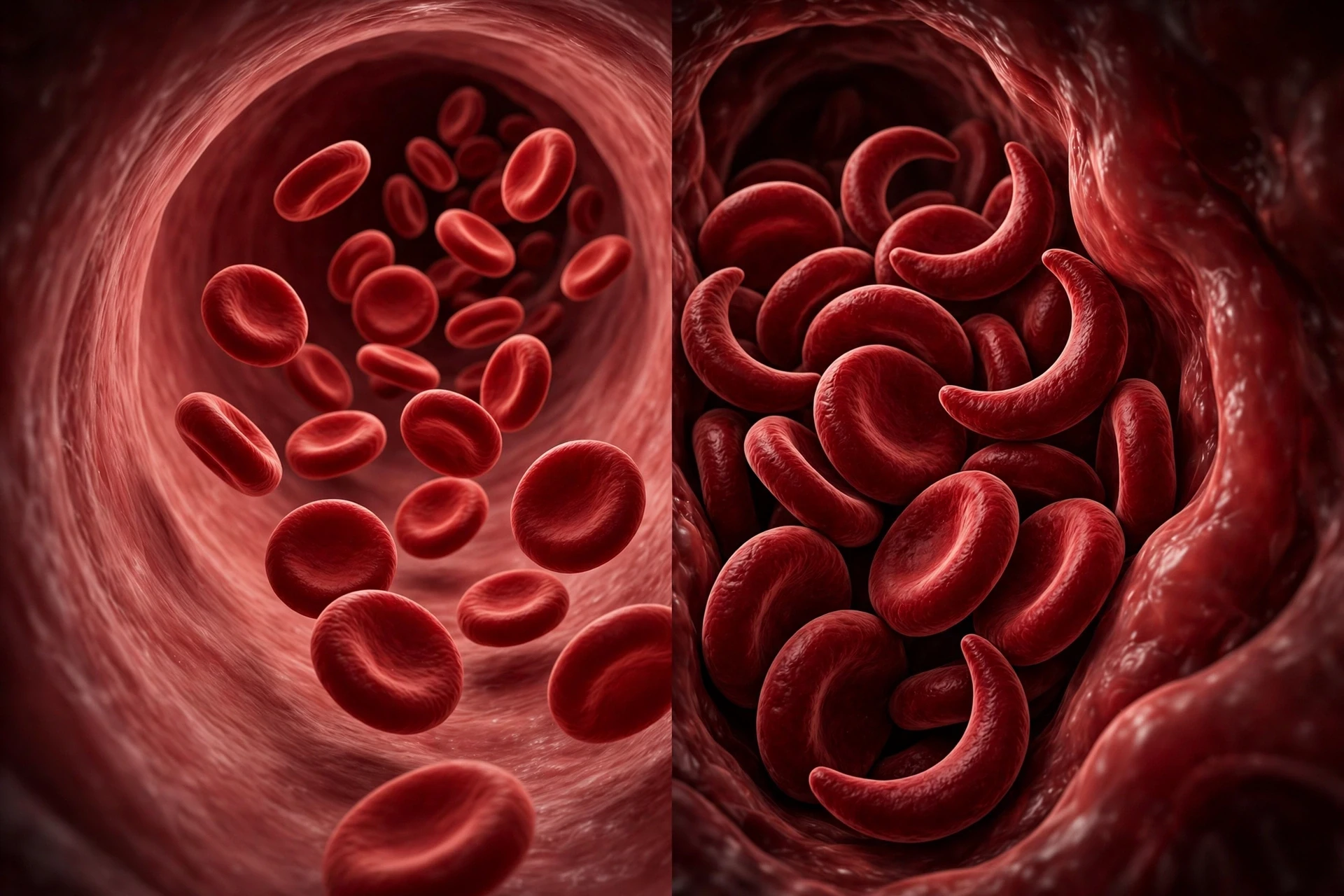
It was approved first in the UK in November 2023, then in the US in December 2023, then in the EU in February 2024. Sickle cell disease is the condition Casgevy was first approved for, and it is worth understanding before the treatment makes sense. It is caused by a single wrong letter in the gene for beta-globin, one of the two proteins that make up haemoglobin, the molecule that carries oxygen in red blood cells. That one wrong letter makes haemoglobin clump into stiff fibres when oxygen is low, and the red blood cells bend into crescent, or sickle, shapes. Sickled cells jam in small blood vessels, blocking blood flow and causing sudden attacks of severe pain called vaso-occlusive crises, along with anaemia, strokes and organ damage over time. About 100,000 people in the United States live with the disease, and about 300,000 babies are born with it each year around the world, most of them in sub-Saharan Africa. In the United States, average life expectancy with the disease is roughly twenty years shorter than in the general population. A bone marrow transplant from a matched donor can cure it, but most patients have no matched donor. That gap is what Casgevy was built to fill.
7.1 The BCL11A trick: switching on a backup
Casgevy does not fix the sickle mutation. That is the first surprise, and the cleverest part of the story. Instead, it switches off a control region that normally silences fetal haemoglobin after birth.
Before birth, a baby's red blood cells make fetal haemoglobin, HbF, which uses a different protein, gamma-globin, instead of beta-globin. After birth, a protein called BCL11A switches the gamma-globin gene off, and adult haemoglobin takes over. In a person with sickle cell disease, that switch is a disaster: adult haemoglobin is the one carrying the mutation. But the gamma-globin gene is still there, intact, waiting. If BCL11A could be silenced, fetal haemoglobin would come back, and red blood cells full of fetal haemoglobin do not sickle — the sickle mutation is in the beta-globin gene, and fetal haemoglobin does not use beta-globin at all.
That is what Casgevy does. The CRISPR gene editing system is aimed at the enhancer region of the BCL11A gene — the control switch that turns BCL11A on in red blood cells — and NHEJ repair disables it. BCL11A falls silent in the red blood cell line, gamma-globin switches back on, and the patient's red blood cells start making fetal haemoglobin again. The sickle mutation is still in the genome, but it no longer matters, because the haemoglobin being made does not carry it. It is a workaround, not a repair — and it is a workaround that only works because evolution left a backup system in place.
The same trick treats transfusion-dependent beta thalassemia, the second disease Casgevy is approved for. In beta thalassemia, the beta-globin gene is broken and patients need regular blood transfusions to survive. Switching fetal haemoglobin back on gives their red blood cells a working haemoglobin again, and many patients no longer need transfusions at all.
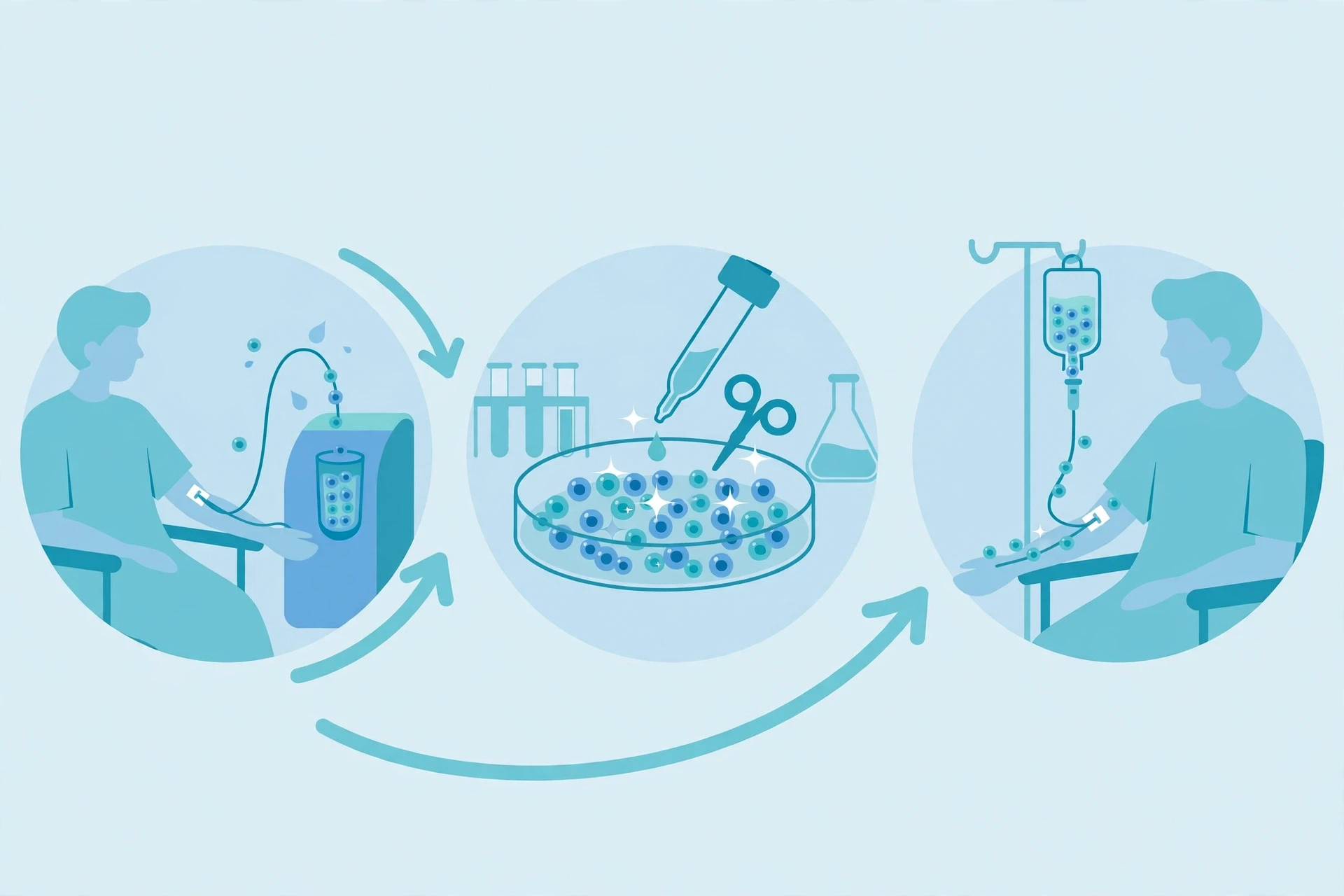
7.2 The patient journey: six months, one infusion
Casgevy is not a pill or an injection you pick up at a pharmacy. It is a months-long procedure built around the patient's own cells, and it is gruelling. First, the patient's blood stem cells are collected from their blood over several days. The cells are shipped to a laboratory, where they are edited with CRISPR gene editing — a process that takes months, with quality checks at every step. Meanwhile the patient receives high-dose chemotherapy to clear space in their bone marrow. Then the edited cells are infused back, a single dose, and the patient waits weeks in hospital while the new stem cells settle in and start making blood. The chemotherapy is the hardest part: it wipes out the immune system temporarily, brings mouth sores, nausea, hair loss and a high risk of infection, and it can cause infertility. The most common side effects in the trials were the expected effects of the chemotherapy, not of the gene editing itself — low white blood cells, low platelets, mouth sores and fever.
The journey, in short, has five stages:
Stem cells are collected from the patient's blood over several days.
The cells are edited in a laboratory, a process that takes months.
The patient receives high-dose chemotherapy to clear the bone marrow.
The edited cells are infused back in a single dose.
The patient waits in hospital while the new stem cells engraft and start making blood.
The US Food and Drug Administration's announcement of the approval put the milestone in plain terms:
"Casgevy is the first FDA-approved therapy utilizing CRISPR/Cas9, a type of genome editing technology."
The price is the part that stops conversations. In the United States, Casgevy's list price is $2.2 million per patient, for a one-time treatment. The second gene therapy approved the same day, Lyfgenia, which uses a different technology, lists at $3.1 million. In the United Kingdom, the list price is £1.65 million per patient, although the National Health Service negotiated a confidential discount before offering it, first for beta thalassemia in 2024 and then for sickle cell disease in early 2025. The price is defended as the cost of a one-time treatment against a lifetime of transfusions, hospital stays and crises. The counter-argument is the obvious one: a treatment that costs more than two million dollars can only ever reach a small fraction of the people who need it, and most of them live in sub-Saharan Africa, where the disease is most common. That argument is taken up in the ethics section of this article. The access question is not a footnote to Casgevy. It is the central fact about it.
7.3 The results: what the trials actually showed
Casgevy's approval was based on two trials, CLIMB-121 for sickle cell disease and CLIMB-111 for beta thalassemia. The figures below come from the FDA's own summary of the trial data and from the peer-reviewed publication of the sickle cell results, not from company press releases. Both trials were small, single-arm and open-label — there was no comparison group, because the diseases are severe and the treatment is a one-time procedure that cannot be blinded. That design is normal for a first-of-its-kind treatment, and it is also a reason to read the numbers with care: without a control group, the comparison is against each patient's own history before treatment.
Trial | Disease | Patients treated | Main result |
|---|---|---|---|
CLIMB-121 | Sickle cell disease | 44 | 29 of 31 evaluable patients (93.5%) free of severe pain crises for at least 12 consecutive months |
CLIMB-121 | Sickle cell disease | 44 | 30 of 30 evaluable patients (100%) free of hospitalisation for pain crises for at least 12 consecutive months |
CLIMB-111 | Transfusion-dependent beta thalassemia | 52 | 32 of 35 evaluable patients (91.4%) transfusion-independent for at least 12 consecutive months |
CLIMB-121, longer follow-up | Sickle cell disease | 44 | In the peer-reviewed report, 29 of 30 patients (96.7%) free of pain crises for at least 12 months, median follow-up 19.3 months |
A few points about those numbers. First, the difference between 93.5 percent and 96.7 percent is not a contradiction: the journal paper counted the 30 patients with at least 16 months of follow-up, while the FDA figure adds one further patient with shorter follow-up who was counted as a non-responder, making 31. Both describe the same 29 responders. Second, "free of crises" does not mean cured in the sense of the mutation being gone — the mutation is still there, and the edited cells are the ones doing the work. The treatment is described as a functional cure: the disease stops causing crises, for as long as the edited stem cells keep working. How long that is, nobody yet knows. The longest follow-up in the trials is a few years, and every treated patient is enrolled in a fifteen-year follow-up study, CLIMB-131, that watches for late problems, including cancer. Third, the trials only enrolled patients with severe disease who had already suffered repeated crises, and only patients well enough to survive high-dose chemotherapy. Casgevy is not for every person with sickle cell disease. It is for the most severely affected, and the decision to undergo it is a heavy one.
Since the first approvals, the age range has widened. The FDA expanded the US approval to children as young as two in July 2026, and the UK regulator extended its authorisation to children aged five and over in October 2026. Each expansion rests on new trial data in younger patients, and each one restarts the same argument about who should get a two-million-dollar treatment first.
8. Beyond Cutting: Base Editing and Prime Editing
Base editing and prime editing are newer CRISPR gene editing tools that rewrite DNA without cutting both strands, which makes them more precise and safer than the original scissors. Base editors change one DNA letter into another; prime editors can rewrite short stretches of DNA, insert letters and delete them, all without a double-strand break.
Both were invented to fix the problems of cutting. The original Cas9 scissors work by breaking the DNA and letting the cell repair it, and that repair is the weakness. NHEJ repair is messy: it adds or loses letters at random, and the outcome varies from cell to cell. For switching a gene off, messiness is fine. For correcting a single wrong letter — the cause of most inherited diseases — messiness is the problem. A treatment that needs to change an A to a G cannot rely on a repair process that might delete five letters instead. Base editing and prime editing were built to solve exactly that.
Base editing arrived first, in 2016, from the laboratory of David Liu at Harvard and the Broad Institute. A base editor is a Cas9 that has been disabled so it can no longer cut, fused to an enzyme that chemically changes one DNA letter into another. The first version changed C into T. A second version, in 2017, changed A into G. Between them, the two versions can make the four transition changes — the most common kind of single-letter change — and those four changes cover a large share of known disease-causing mutations. The editor finds its target the same way Cas9 does — with a guide RNA — but instead of cutting, it rewrites one letter in place. No break, no messy repair, no random insertions or deletions. The first base-editing treatment in humans targeted high cholesterol, and a base-editing therapy for sickle cell disease, developed by Beam Therapeutics and called risto-cel, reported positive trial results in November 2026, with a regulatory filing planned. That therapy is a more precise version of Casgevy's workaround, not a direct repair: it base-edits the control regions of the fetal haemoglobin genes so that the repressor BCL11A can no longer bind there, switching fetal haemoglobin back on — the sickle mutation itself is left untouched.
Prime editing, published by Liu's group in Nature in 2019, goes further. It uses a Cas9 that nicks one strand only, fused to a reverse transcriptase — an enzyme that writes DNA from an RNA template. The guide RNA, called a pegRNA, carries both the address and the new text: it tells the editor where to go and what to write. The editor nicks the DNA, copies the new sequence in, and the cell finishes the job. In the original paper, the team performed more than 175 edits in human cells, including all twelve possible single-letter changes, plus small insertions and deletions, without cutting both strands and without needing a donor template. The authors called it search-and-replace, and the name stuck.
The differences between the three tools matter, and they are easiest to see side by side:
Tool | How it works | Double-strand break? | Best for | Status in 2026 |
|---|---|---|---|---|
CRISPR-Cas9 | Guide RNA aims Cas9, which cuts both DNA strands; cell repair does the edit | Yes | Switching genes off | Approved medicine (Casgevy, 2023) |
Base editing | Disabled Cas9 fused to an enzyme that changes one DNA letter into another | No | Correcting single-letter mutations | Human trials; first filing expected |
Prime editing | Nicking Cas9 fused to reverse transcriptase; guide RNA carries the new text | No | Rewriting short stretches, insertions, deletions | Human trials begun |
Neither newer tool replaces the original. Cas9 is simpler, and for switching a gene off it is the right instrument — which is why the first approved medicine uses it. Base and prime editors are more precise instruments for more delicate jobs, and they are newer, which means less is known about their long-term behaviour in patients. The pattern of this field is steady: each generation of tool fixes a problem of the last one, and each generation brings a new set of questions.
9. CRISPR in Agriculture: Crops and Livestock
CRISPR gene editing is being used in agriculture to breed crops that resist disease and survive drought, and livestock that resist infections. The first CRISPR-edited food reached the market in Japan in 2021, a tomato bred to contain more of a calming compound called GABA.
Often the edit changes a plant's or animal's own DNA, without adding genes from another species. The agricultural argument for CRISPR gene editing is speed. Traditional breeding changes a crop by crossing plants and selecting the offspring, a process that takes years and drags unwanted traits along with the wanted ones. Genetic modification inserts a gene from another organism, which triggers heavy regulation in most countries. CRISPR gene editing can do something in between: change a few letters in a plant's own DNA, in a single generation, to switch off a gene that makes it vulnerable to disease, or to switch on a trait it already carries. The result is a plant that could, in principle, have been produced by decades of breeding — produced in months instead.
The examples are already on shelves and in fields. In 2016, a mushroom edited with CRISPR gene editing to stop it browning became the first CRISPR organism to be cleared by US regulators, who decided it was not a genetically modified organism in the legal sense, because no foreign DNA had been added. In Japan in 2021, a tomato edited with CRISPR gene editing to produce more gamma-aminobutyric acid, GABA, went on sale — the first CRISPR-edited food sold directly to consumers. Rice, wheat and maize varieties edited with CRISPR gene editing for disease resistance and drought tolerance are in field trials in several countries. In livestock, pigs edited with CRISPR gene editing to resist a virus called PRRS, which costs the pork industry billions, are being developed, and cattle edited for heat tolerance received a low-risk determination from the US Food and Drug Administration in 2022.
The regulatory picture is a patchwork, and it matters more than the science for what reaches your plate. The United States regulates the product, not the method: if the edited plant contains no foreign DNA and could have been bred conventionally, it is treated like a conventional crop. The USDA's SECURE rule, which formalised that approach in 2020, was vacated by a US federal court in December 2024, and oversight now operates under the earlier regulations while the department revises them. The European Union spent years treating all gene-edited crops as genetically modified organisms, then moved in 2023 towards a lighter regime for edits that could have occurred naturally, and adopted it as Regulation (EU) 2026/1388 in June 2026, applicable from mid-2028. Japan, Argentina, Brazil and several other countries have taken the lighter path. The result is that the same tomato can be an ordinary vegetable in one country and a regulated genetically modified organism in another, with the science identical in both places. Anyone who tells you the argument about CRISPR gene editing in crops is about safety alone is leaving out the trade, the patents and the politics.
One caution belongs here. Editing a crop is not the same as editing a person, and the safety questions are different. A crop's edit affects the plant and its seeds, not a patient. But a crop edit can still spread: pollen carries genes to neighbouring fields, and an edited trait that helps a crop can, in a wild relative, become a weed problem. The same permanence that makes CRISPR gene editing powerful in medicine makes it a technology that needs watching in the field, for different reasons.
10. Gene Drives: Editing a Whole Population
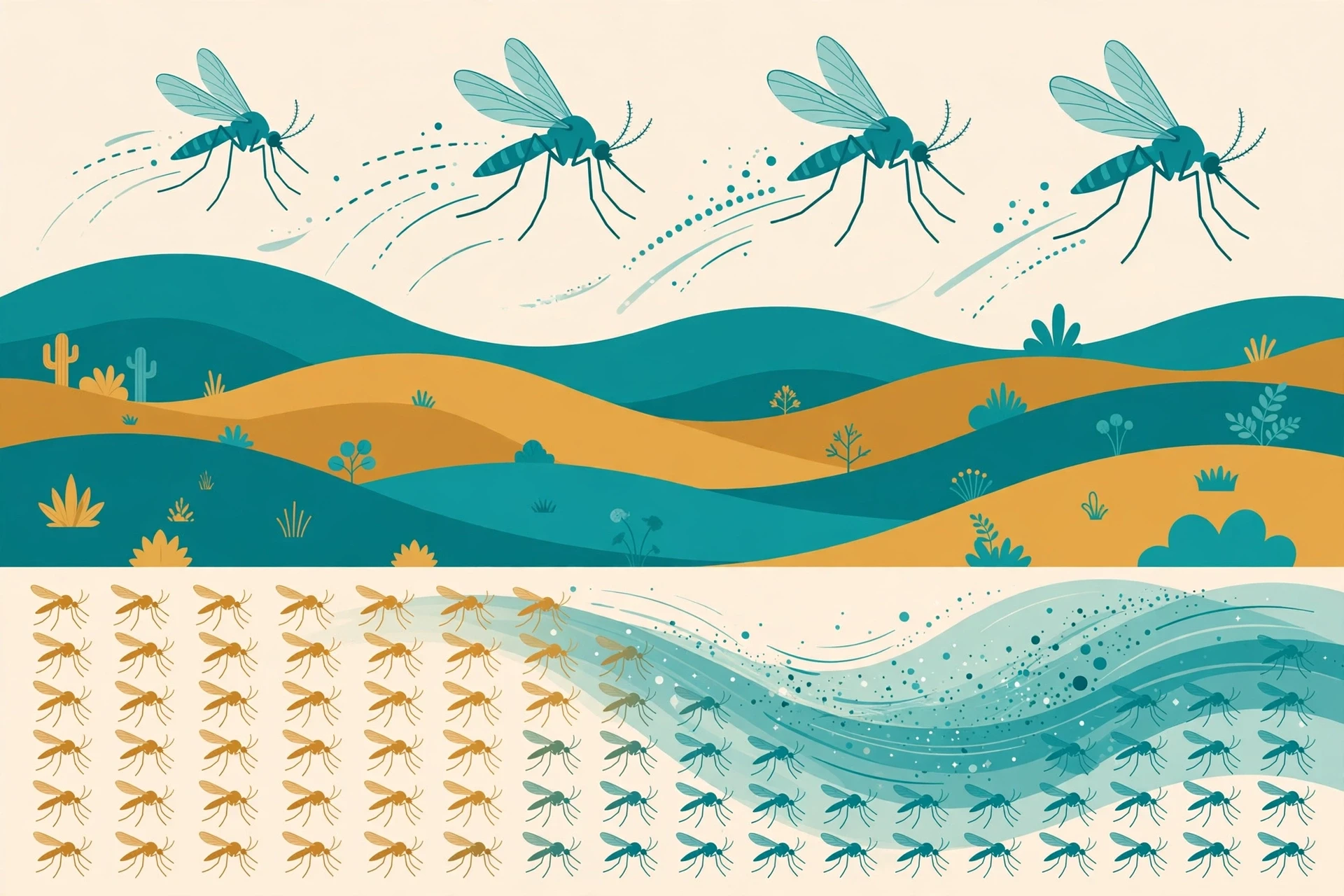
A gene drive is a CRISPR edit designed to spread through a wild population on its own, by cheating the normal rules of inheritance. Instead of a gene being passed to half the offspring, a gene drive copies itself into nearly all of them.
So an edit introduced in a few individuals can reach an entire population in a dozen generations. The main target is the mosquito that carries malaria. Normal inheritance is a coin toss: a child gets each gene from one parent or the other, with a fifty-fifty chance. A gene drive breaks the coin toss. It carries the CRISPR gene editing machinery with it, so that in the offspring, the drive cuts the matching chromosome and copies itself across. The result is that almost every offspring inherits the drive, and the drive spreads through the population far faster than natural selection would ever allow — the process whose evidence is laid out in Sciory's Darwin's Theory of Evolution: Evidence Explained. In a dozen generations — a few years for a mosquito — an edit that started in a laboratory cage can be present in nearly every mosquito in a region.
The most advanced project is Target Malaria, a research consortium working in sub-Saharan Africa, which is building gene drives in Anopheles gambiae, the mosquito that carries most malaria. There are two designs. One makes female mosquitoes sterile, so the population collapses. The other makes mosquitoes unable to carry the malaria parasite, so the population survives but the disease does not spread. In laboratory cages, both designs have worked: the drive spread through the whole cage population within a few generations. Neither has been released into the wild. Field trials of the sterile-male design, without a drive, began in Burkina Faso in 2019, and a second release took place in August 2025 — but within days the government of Burkina Faso sealed the programme's facilities, ordered samples destroyed, and suspended its activities in the country. A full gene-drive release is still years away, and it will need the agreement of the countries and communities involved.
The argument about gene drives is the sharpest in all of CRISPR gene editing, and both sides have a point. On one side, malaria kills hundreds of thousands of people a year, most of them children under five in sub-Saharan Africa, and the tools against it — bed nets, insecticides, drugs — are losing ground to resistance. A gene drive that removes the mosquito or the parasite could save more lives than almost any other single intervention in medicine. On the other side, a gene drive is the one CRISPR application that cannot be recalled. Once released, it spreads by itself, across borders, into ecosystems where its effects cannot be fully predicted. A drive aimed at one mosquito species could, in theory, cross into a related species. A drive that collapses a mosquito population removes a food source for bats, birds and fish. And a technology that can reshape a wild population can also be aimed at other targets — an agricultural pest, a disease-carrying tick, or, in the worst case, a species someone simply wants gone.
There are proposed safeguards: drives that stop working after a few generations, drives that can be reversed by a second drive, drives that only work in one local population. All of them are still laboratory ideas. The governance question is being argued in international meetings, in the countries where releases would happen, and in the villages that would live with the consequences. No gene drive has ever been released, and the decision to release the first one will be one of the most consequential choices in the history of biotechnology.
11. Somatic vs Germline: The Line That Matters
Somatic editing changes the DNA of one person's body cells, and the change dies with that person. Germline editing changes an embryo, egg or sperm, and the change is inherited by every cell of the resulting child — and by that child's children.
The first is medicine. The second is a decision about future generations, and it is effectively banned in most countries. This is the most important distinction in the whole subject, and it is the one that confuses people most often, so it is worth stating slowly. Your body has two kinds of cells. Somatic cells are the ordinary ones: skin, blood, liver, brain. An edit to a somatic cell affects that cell and its descendants within your body, and nobody else. A germline cell is an egg, a sperm, or the cells of an early embryo that will become eggs or sperm. An edit to a germline cell is copied into every cell of the person who grows from that embryo, including their own eggs or sperm — so the edit is passed to the next generation, and the next, without anyone's consent. Our own species reached its present form through the slow accumulation of exactly such inherited changes, as told in Sciory's Human Evolution Explained: From Ancient Ancestors to Modern Humans.
Casgevy is somatic editing. The blood stem cells are edited outside the body and returned to the patient. The patient's children inherit the sickle mutation, not the edit. A germline edit using CRISPR gene editing for sickle cell disease would be a different act entirely: an embryo edited so that the child is born without the mutation, and the child's children are born without it too. The medical benefit is real — the child would never develop the disease, and neither would their descendants. The problem is consent. The child cannot consent to the edit, and neither can their children, who will carry a change made before they existed, on the basis of a decision made by someone else, with a technology whose long-term effects are not fully known.
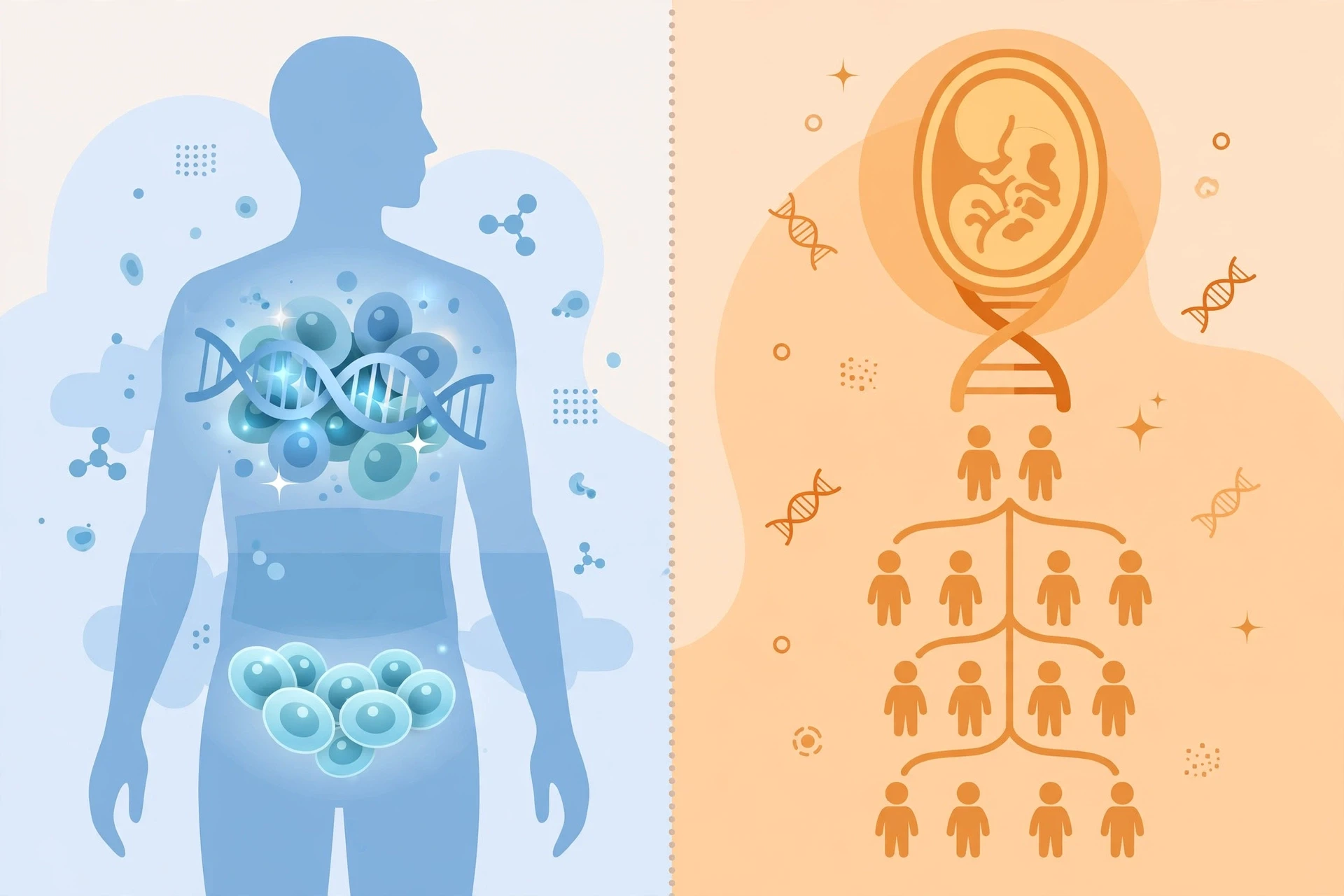
That is why the line is drawn where it is. Somatic editing is regulated like any other medicine: clinical trials, safety data, approval by a regulator. Germline editing for reproduction is banned or effectively banned in most countries, including the United States, the United Kingdom, the European Union, China and Japan. The bans are not all written the same way — some are laws, some are regulations, some are funding rules — but the effect is the same: no clinic in those countries can legally edit an embryo and use it to start a pregnancy. Research on edited embryos in the laboratory, without any pregnancy, is allowed in some countries under strict licences, including the UK, so that scientists can learn how early human development works. But the step from the laboratory dish to a pregnancy is the line, and it is guarded by law.
The line is not a law of nature. It is a human decision, made after argument, and it can be revisited. Some scientists argue that it should be, in narrow cases: a couple who both carry a fatal genetic disease, with no other way to have a healthy child, might one day have a case for germline editing. The counter-argument is that the line, once crossed for the most sympathetic case, will not stay where it was drawn. The argument is not settled. What is settled, for now, is that no responsible scientist, regulator or government supports crossing it today — and the reason is a case study in what happens when someone does it anyway.
12. The He Jiankui Case: When the Line Was Crossed
In November 2018, a Chinese scientist named He Jiankui announced that he had used CRISPR gene editing on human embryos and that twin girls had been born with edited genomes — the first genetically edited babies in history. The case is the reason germline editing is now treated as a red line, not a grey area.
The global reaction was condemnation, and within a year he was in prison. I heard the news the way most scientists did: a video posted on YouTube on a Sunday, ahead of a scientific meeting in Hong Kong, with no peer-reviewed paper, no published data, and no independent verification. The claim was enormous and the evidence was a press release. For a day, nobody knew whether to believe it. By the end of the week, the details had emerged, and they were worse than the announcement. He had edited the embryos of seven couples, in secret, using CRISPR gene editing to disable a gene called CCR5, which the HIV virus uses to enter cells. The father in each couple was HIV-positive, the mother HIV-negative, and the aim was to give the children resistance to HIV. Twin girls, known by the pseudonyms Lulu and Nana, were born in October 2018. A third child, known as Amy, was born in 2019.
The problems with the experiment were not subtle. There was no medical need: HIV can already be prevented in the children of HIV-positive fathers by standard means, including sperm washing, and the mothers were not infected. The edit itself was a poor choice for the goal: disabling CCR5 mimics a natural variant found in some people, but CCR5 also plays a role in the immune system's response to other infections, and people without it may be more vulnerable to some viruses. The editing was mosaic: one twin appears to have had both copies of the gene edited, the other only one, and in both cases some cells may have been left unedited, so the children may not even have the protection the experiment was supposed to give them. The consent forms were misleading, the ethics approval was forged, and the experiment was hidden from He's university and from the hospital where the babies were born. He announced the result to the world before any other scientist had seen the data.
The response was swift and almost unanimous. Scientists around the world called the work irresponsible, premature and unethical. The organising committee of the Hong Kong summit called it deeply disturbing. The Chinese government, which had not known about the experiment in advance, investigated, and on 30 December 2019 a court in Shenzhen sentenced He to three years in prison and a fine of three million yuan, about $430,000, for illegal medical practice. Zhang Renli received two years in prison and a ¥1 million fine; Qin Jinzhou received 18 months suspended for two years and a ¥500,000 fine; and all three men were banned from reproductive technology for life. His university dismissed him in January 2019. He was released from prison in April 2022. China has since written germline editing into its Civil Code and its Criminal Law, with prison sentences of up to seven years for serious cases.
The case also changed the governance of the field. In December 2018 the World Health Organization formed an expert advisory committee on human genome editing, and in July 2021 it published the first global recommendations on governing the technology, including strengthening the registry for human genome editing trials it had launched in 2019 and a mechanism for reporting illegal or unsafe work. The committee's message was plain: somatic editing should proceed under the normal rules of medicine, and heritable editing should not proceed at all until its implications have been properly considered. The He case is the reason that second sentence exists. It is also the reason the line between somatic and germline editing, described in the previous section, is now treated as a matter of law in most of the world rather than a matter of professional etiquette.
13. Is CRISPR Gene Editing Safe?
CRISPR gene editing is safe enough to have produced an approved medicine, and new enough that the honest answer about its long-term safety is that nobody knows yet. The risks are specific and measurable — off-target cuts, mosaic editing, immune reactions, and the effects of breaking DNA.
Each risk is being watched in trials with follow-up periods of up to fifteen years. The question behind that question is usually "is it safe for me, or for my child?" and the answer depends on which kind of CRISPR gene editing you mean. An approved treatment, given in a hospital, after years of trials, under a regulator's supervision, is a different proposition from an experimental treatment in a trial, which is different again from an unregulated clinic offering edits nobody has tested. This section covers the risks as they stand in the approved and trial settings, because those are the ones with data behind them. The four risks, in brief, are:
Off-target cuts: Cas9 cutting a DNA sequence that resembles the target but is not the target.
Mosaicism: the edit happening in some cells and not in others.
Immune reactions: the body recognising the Cas9 protein as foreign and attacking it.
Large DNA rearrangements: long deletions or joined chromosomes caused by the double-strand break.
13.1 Off-target effects: cutting the wrong place
The best-known risk is the off-target cut: Cas9 cutting a DNA sequence that resembles the target but is not the target. The guide RNA is twenty letters long, and the genome contains sequences that differ from any given target by one or two letters. At some of those lookalike sites, Cas9 can still cut. An off-target cut in the wrong gene could, in the worst case, disable a gene that protects against cancer, or switch on a gene that promotes it. That is the nightmare scenario, and it is why off-target checking is now a standard part of every CRISPR gene editing project.
How often does it happen? In CRISPR gene editing, it depends on the guide RNA: a well-chosen guide, screened against the genome for lookalikes, can be extremely specific, while a careless one is not. In the Casgevy trials, the evidence so far is reassuring but thin. A 2025 study that sequenced the genomes of 91 trial participants found off-target edits in two patients, each affecting one percent or fewer of the edited cells, at two sites in genes that are not active in blood cells. No cancers, no bone marrow disorders and no blood abnormalities appeared in those patients. The FDA's label for Casgevy is candid about the limit of that knowledge: off-target editing in the edited stem cells cannot be ruled out, and its clinical significance is unknown. That is not a reassurance. It is a statement of what is known and what is not, and it is the reason every treated patient is followed for fifteen years.
There is a second layer to the risk. The studies so far have looked for off-target cuts at sites predicted from the guide RNA's sequence. Unpredicted sites — places the guide was never expected to bind — are harder to find, and the methods for finding them are still improving. Base editors and prime editors, which do not cut both strands, carry a lower version of this risk, and that is one reason the field is moving towards them for the most delicate jobs.
13.2 Mosaicism and broken chromosomes
A second risk is mosaicism: the edit happens in some cells and not in others. In an embryo, that means the child could be born with a mixture of edited and unedited cells, including in the brain or the reproductive organs, with unpredictable results. In a blood stem cell treatment, mosaicism is less of a problem, because the edited cells are checked in the laboratory before they are given back, and only cells carrying the edit are used. But the checking is never perfect, and the dose that is infused is a mixture of cells, some edited and some not. The treatment works because enough cells carry the edit, not because every cell does.
A third risk comes from the cut itself. A double-strand break is the most serious kind of DNA damage, and the cell's repair machinery sometimes makes larger mistakes than a few added or lost letters: it can delete a long stretch of DNA, flip a segment around, or join two broken chromosomes together. These large rearrangements have been seen in laboratory experiments with CRISPR gene editing, and they are one more reason that tools which avoid the double-strand break are attractive. They are also a reason the safety monitoring in the Casgevy trials includes watching for blood cancers over fifteen years: a large rearrangement in a blood stem cell is, in principle, a first step towards leukaemia, even though none has been seen so far.
13.3 The immune system and the editor
A fourth risk is one that has nothing to do with DNA. The Cas9 protein comes from Streptococcus pyogenes, the bacterium that causes strep throat, and most people have been infected with it at some point. That means many people already carry immune defences — antibodies and immune cells — that recognise Cas9 as foreign. If the editor is delivered into the body, the immune system may attack it, reducing the treatment's effect or causing inflammation. This matters most for in vivo treatments, where the editor is injected into the bloodstream. For Casgevy, it matters less, because the CRISPR gene editing happens in a dish, outside the body, and the Cas9 protein is gone by the time the cells are returned. It is a problem the field is working around in several ways: using Cas proteins from bacteria humans rarely meet, disguising the editor, or suppressing the immune response briefly during treatment. It is also a reminder that the editor is a foreign protein, not a human one, and the body treats it that way.
Taken together, the safety record so far is this: one approved treatment, with a few dozen patients treated and no off-target harm seen in several years of follow-up; a handful of in vivo trials, with encouraging early results and no serious safety failures; and a set of known risks that are being measured, not guessed at. That is a good record for a technology this young. It is not a guarantee. The fifteen-year follow-up studies are the mechanism by which the guarantee, if it ever comes, will be earned.
14. The Ethics: Designer Babies, Access, and Consent
The ethics of CRISPR gene editing turn on three questions: who decides what counts as a disease worth editing, who can afford the treatments, and who speaks for the people who will live with the edits. The technology forces those questions because it works — and because it is expensive, permanent, and unevenly distributed.
Start with the price, because it is the fact that shapes everything else. Casgevy costs $2.2 million per patient in the United States. The first time I saw that number, I did the arithmetic without thinking: at that price, treating the roughly 100,000 Americans with sickle cell disease would cost more than two hundred billion dollars, and the 300,000 babies born with the disease each year around the world are mostly born in countries where the entire annual health budget per person is measured in tens of dollars, not millions. The numbers do not add up, and they are not meant to. Casgevy was never going to treat everyone with sickle cell disease. It treats a few thousand of the most severely affected patients in rich countries, and the rest of the world waits. That is the reality of a treatment built on a months-long, labour-intensive, personalised manufacturing process. The price may fall as the process is automated, and in vivo treatments that can be given as a single injection would be far cheaper to make — but nothing in the current numbers suggests a two-million-dollar treatment becomes a hundred-dollar treatment soon.
The access question has a second face. Sickle cell disease mainly affects people of African descent, and it has a long history of being underfunded and undertreated relative to diseases that mainly affect white populations — cystic fibrosis, for example, has received roughly three times more US research funding per patient. The first CRISPR gene editing medicine treats a disease of a historically neglected population, which is a genuine achievement — and it treats it at a price that population, on average, cannot pay. The irony is not lost on the patient community, and it is a live argument in the sickle cell world: a cure that exists but is out of reach is a different kind of failure from a cure that does not exist at all.
Then there is the question everyone asks first: designer babies. The phrase conjures parents choosing a child's eye colour, height or intelligence, and the technology, in principle, could one day reach towards that. In practice, the barrier is not the editing. It is the biology. The traits people imagine choosing are not controlled by single genes. Height involves more than 12,000 genetic variants, most contributing a fraction of a millimetre each, plus nutrition and health. Intelligence, as far as genetics can say anything about it at all, involves thousands of variants, each tiny, interacting with schooling, family and chance. There is no single "intelligence gene" to edit, and there never will be, because intelligence is not that kind of thing. The realistic near-term risk is not parents designing superchildren. It is parents, and clinics, editing embryos for traits that are poorly understood, on the basis of genetic associations that are weak and contested, with consequences that cannot be predicted. That is a real risk, and it is one more reason germline editing is banned.
Consent is the thread that runs through all of it. A patient who chooses Casgevy consents to a treatment on their own body, after counselling, with the right to refuse. An embryo cannot consent, and neither can the generations that follow. A population that receives a gene drive cannot easily consent either, which is why the Target Malaria project spends as much effort on community engagement in Burkina Faso and Mali as it does on mosquito genetics. The World Health Organization's 2021 governance framework puts consent and engagement at the centre for exactly this reason: the technology is powerful enough that the people affected by it must have a say in whether it is used, and the say must come before the decision, not after.
None of this means CRISPR gene editing should be stopped. The same technology that raises these questions has already freed people from pain crises that dominated their lives, and the patients who have received it describe the change in terms that no statistic captures. The ethics are not an argument against the technology. They are the argument about how it should be used, by whom, for whom, and at whose expense — and they are arguments that need to happen in public, not only in laboratories.
15. What CRISPR Cannot Do
CRISPR gene editing cannot fix most diseases, cannot design a smarter or taller child, and cannot undo damage that has already happened. The limits are set by biology, not by the tool, and they are the reason the technology's real future is narrower — and more honest — than the headlines suggest.
The first limit is that most diseases are not single-gene diseases. Sickle cell disease and beta thalassemia are caused by one wrong letter in one gene, and they are the exception, not the rule. Heart disease, diabetes, most cancers, Alzheimer's disease, schizophrenia and depression are all influenced by dozens or hundreds of genes, plus diet, environment, infection and chance. Editing one gene in a person at risk of heart disease would be like fixing one spelling mistake in a book whose plot is the problem. CRISPR gene editing can treat the thousands of rare single-gene disorders — and there are thousands of them, collectively affecting millions of people — but the common diseases of ageing and lifestyle are, for the most part, beyond its reach.
The second limit is delivery. The scissors can only edit the cells they can reach, and most cells in the body are hard to reach. Blood stem cells can be taken out and edited. Liver cells can be reached by lipid nanoparticles. Brain cells, protected by the blood-brain barrier, cannot yet be reached at all in any practical way. Muscle cells, lung cells and the cells of the retina are all works in progress. A cure that exists in a laboratory dish is not a cure until the delivery problem is solved for the tissue where the disease lives, and for many diseases that problem is still unsolved.
The third limit is that editing changes DNA, not history. A child born with a genetic disease may already have organ damage by the time treatment is possible, and editing the gene does not repair a damaged heart, a scarred lung or a brain that developed differently. Casgevy works best in younger patients, before years of crises have done their damage, which is one reason the approvals have been extended to children. The earlier the edit, the more it can prevent; the later, the more it can only stop things getting worse.
The fourth limit is the one people most often miss: CRISPR gene editing cannot tell you what to edit. The tool is only as good as the understanding behind it. For most genes, scientists still do not know exactly what they do, or what happens when they are switched off, or how they interact with the thousands of other genes in the cell. The genome is not a parts list with a manual. It is a system, and editing one part of a system has effects elsewhere. The careful, slow, unglamorous work of figuring out what each gene does — the work CRISPR gene editing itself has made faster — is what will decide what the tool can eventually treat. The scissors are ready. The map is still being drawn.
In short, CRISPR gene editing cannot:
Fix diseases caused by many genes plus environment, such as heart disease or diabetes.
Design a smarter or taller child — those traits involve thousands of genetic variants, more than 12,000 for height alone, most contributing a fraction of a millimetre each.
Reach most tissues in the body yet, including the brain.
Undo organ damage that has already happened.
16. The Future: Inside the Body and Beyond
The future of CRISPR gene editing is in vivo: treatments delivered directly into the body, aimed at the liver, the eye, the muscles and the brain, with editors that never cut both strands of DNA. The first in vivo trial worked in 2021, and the pipeline behind it now holds dozens of treatments.
The CRISPR gene editing treatments are at every stage from laboratory to late-stage trial, and the next decade will show whether the promise survives contact with the human body at scale. The most immediate next steps are visible in the trial pipeline. The transthyretin treatment that proved in vivo editing works is moving through later-stage trials, and a similar treatment for hereditary angioedema is close behind it. A base-editing treatment for sickle cell disease, which reactivates fetal haemoglobin more precisely than Casgevy does rather than repairing the sickle mutation, reported positive results in November 2026 and is heading for a regulatory filing — potentially the first base-editing medicine. Prime editing, the newest tool, has entered its first human trials. Each of these is a test of a different idea: that the liver can be edited safely, that a single letter can be changed in a patient, that a short stretch of DNA can be rewritten inside a living body.
Delivery is where the most inventive work is happening. Lipid nanoparticles, the fat droplets that carry the editor to the liver, are being redesigned to reach other organs: the lungs, the spleen, the bone marrow. Viruses that have been defanged are being used as delivery vehicles for the eye and the muscles. Tiny virus-like particles, built from the shells of viruses without the viral genes inside, are being tested as a way to deliver the editor without triggering the immune system. And a newer idea in CRISPR gene editing, epigenome editing, avoids changing the DNA sequence at all: it uses a disabled Cas9 to switch genes on or off by changing the chemical marks around them, a change that is reversible and does not touch the genetic code. If it works in patients, it would be the gentlest form of gene editing yet — a dimmer switch rather than scissors.
The longer-term future depends on two things that have nothing to do with laboratory technique. The first is price. A treatment that costs $2.2 million per patient cannot become a global medicine, and the CRISPR gene editing field knows it. In vivo treatments, made in a factory and given as an injection, should be far cheaper to produce than a personalised cell therapy that takes six months per patient — but "should be" is not "will be", and the pricing of new medicines is a matter of policy and negotiation, not chemistry. The second is trust. The He Jiankui case showed how quickly one reckless experiment can damage public confidence in a whole field, and the fifteen-year follow-up studies now running are, in part, an attempt to earn that confidence back with data. If the follow-up shows the treated patients staying healthy, with no cancers and no late surprises, the field will have the evidence it needs. If it does not, the field will have to reckon with that too. Either way, the next decade of CRISPR gene editing will be decided as much by what happens to the first patients as by what happens in the laboratory.
17. Putting It All Together
CRISPR gene editing began as a bacterium's way of remembering its enemies, became the sharpest tool in biology within a decade, and is now a medicine — one approved treatment, a pipeline of trials, and arguments about where the line should be drawn.
The tool itself is simple: a protein that cuts DNA, and a piece of RNA that tells it where. Everything else — the medicine, the ethics, the arguments — follows from what that simplicity makes possible. The facts to carry away are few, and they are the ones this article has checked against the regulators and the trial papers. CRISPR is a bacterial immune system, worked out between 1987 and 2012, and turned into a programmable tool by Doudna and Charpentier, who won the Nobel Prize in 2020. It works by cutting DNA at a chosen spot and letting the cell repair the break. It has produced one approved medicine, Casgevy, which treats sickle cell disease and beta thalassemia by switching fetal haemoglobin back on — and in its trials, more than nine in ten patients were free of their disease's worst effects for at least a year. Newer tools, base editing and prime editing, rewrite DNA without cutting it, and they are now in human trials. Gene drives could reshape wild populations, and germline editing could reshape future generations, which is why both are governed by rules that are still being written.
The questions to carry away are the ones without settled answers. Who should get a treatment that costs more than two million dollars? Who decides whether an embryo may be edited? Who speaks for a population that would live with a gene drive, or for the children of a child whose genome was changed before birth? Those questions will not be answered by a better pair of scissors. They will be answered by the same slow, public, argumentative process that governs every powerful technology — by regulators, by patients, by scientists, and by the rest of us, deciding together what kind of future we want to build with a tool that can rewrite the code of life.
The story is not finished. The first patients are still being followed, the next treatments are still in trials, and the rules are still being written. What is certain is that the tool will not go away, and that the choices about it will keep arriving, one approval and one argument at a time. Understanding how it works is the first step to having a say in those choices — and that is what this article was for.
Frequently Asked Questions
What is CRISPR gene editing in simple terms?
CRISPR gene editing is a way to change DNA at a chosen spot, using a protein called Cas9 as molecular scissors and a short piece of RNA as the address label. The scissors cut the DNA where the label tells them to, and the cell repairs the cut — switching a gene off, or rewriting it with a supplied template. It was borrowed from a bacterial immune system that uses the same machinery to destroy invading viruses.
How does CRISPR work?
CRISPR gene editing works in three steps. First, a guide RNA, about twenty letters long, is designed to match the DNA sequence to be changed. Second, the Cas9 protein carries that guide to the target, checks a short checkpoint sequence called PAM, and cuts both strands of the DNA. Third, the cell repairs the break — either by roughly rejoining the ends, which usually disables the gene, or by copying from a supplied template, which can rewrite it precisely.
What is CRISPR used for?
CRISPR gene editing is used in research laboratories to switch genes off and find out what they do, in diagnostics to detect viruses, in agriculture to breed disease-resistant crops, and in medicine. The only approved CRISPR medicine so far is Casgevy, for sickle cell disease and transfusion-dependent beta thalassemia. Clinical trials are testing it for liver disease, hereditary angioedema, high cholesterol, cancer and more.
Is CRISPR gene editing safe?
In the approved setting, the evidence so far is reassuring but limited. The main risks are off-target cuts at DNA sequences resembling the target, mosaic editing in some cells but not others, immune reactions to the Cas9 protein, and large rearrangements from the DNA break. In the Casgevy trials, a 2025 study found off-target edits in two of 91 patients, each affecting one percent or fewer of the edited cells, with no cancers seen. Every treated patient is followed for fifteen years, because the long-term answer is not yet known.
What is Casgevy and who can get it?
Casgevy is the first approved CRISPR gene editing medicine. It edits the patient's own blood stem cells outside the body to switch fetal haemoglobin back on, which stops red blood cells from sickling. It is approved for sickle cell disease and transfusion-dependent beta thalassemia in patients aged 12 and over — extended to age two in the United States in July 2026 — who have severe disease and are well enough for high-dose chemotherapy. In its sickle cell trial, 29 of 31 evaluable patients (93.5%) were free of severe pain crises for at least 12 months. Its US list price is $2.2 million per patient.
Can CRISPR edit a baby's genes?
Technically yes, and that is why it is effectively banned. Editing an embryo, egg or sperm — germline editing — changes every cell of the resulting child and is inherited by their children, who cannot consent. It is banned or effectively banned in most countries, including the United States, the United Kingdom, the European Union, China and Japan. The only known case, He Jiankui's 2018 editing of twin girls in China, led to his imprisonment and to global rules against the practice.
What can't CRISPR do?
It cannot fix most common diseases, because heart disease, diabetes, most cancers and mental illnesses are influenced by dozens or hundreds of genes plus environment, not by a single mutation. It cannot design a smarter or taller child, because traits like intelligence and height involve hundreds or thousands of genetic variants, each tiny. It cannot reach most tissues in the body yet, and it cannot undo organ damage that has already happened. And it cannot tell scientists what to edit — that depends on understanding what each gene does, which is still incomplete.
Sources
Nobel Prize — The Nobel Prize in Chemistry 2020, press release
World Health Organization — WHO issues new recommendations on human genome editing (12 July 2021)
ClinicalTrials.gov — CLIMB-121, a study of CTX001 in sickle cell disease (NCT03745287)
Roland Berger — Jennifer Doudna on the revolutionary tool CRISPR (interview, 6 December 2021)
NHS Genomics Education Programme — Gene therapy Casgevy approved for NHS use
Human Evolution Explained: From Ancient Ancestors to Modern Humans
Genetics Explained: How Inheritance, Mutations, and Gene Expression Work
Microbiology Explained: Bacteria, Viruses, and How Microbes Shape Life