

1. The Skull in the Moroccan Mine
Human evolution is the seven-million-year story of how ape-like ancestors in Africa became modern humans — through upright walking, toolmaking, bigger brains, and interbreeding with close cousins like Neanderthals and Denisovans.
In 1961, miners blasting for barite at Jebel Irhoud, Morocco, broke into a cave and found something that did not belong in a mine: a human skull. It was not a modern skull. The face looked familiar — high forehead, small brow — but the braincase behind it was long and low, shaped like a football where ours is shaped like a globe. For decades the skull sat in a museum drawer, filed away as a Neanderthal and dated to about 40,000 years ago — and nobody guessed what it would do to the story of human evolution.
Then, in 2017, a team led by Jean-Jacques Hublin of the Max Planck Institute for Evolutionary Anthropology went back to Jebel Irhoud with new dating techniques and dug deeper. What they found changed the textbooks. The skull was not 40,000 years old. It was about 315,000 years old — and it belonged to one of the earliest known members of our own species, Homo sapiens. At least five individuals lay in that cave, and their bones carried a message nobody had expected: our species is more than 100,000 years older than scientists had thought, and it did not arise in one small corner of Africa. It arose across the continent, in a wide network of populations that were already recognisably us.
I first heard the Jebel Irhoud story the way most people do — as a headline that quietly rewrote a chapter of human evolution I thought was settled. I had grown up with the neat version: modern humans appeared in East Africa about 200,000 years ago, then spread out and replaced everyone else. It was a clean story, easy to draw on a map with a single arrow. Jebel Irhoud broke the map. The skull in the Moroccan mine was 300,000 years old, a thousand kilometres from East Africa, and it looked like us. The clean story had been wrong in its details, and the real story was bigger, messier, and far more interesting.
That is what human evolution is: the long, branching history of how we became human, written in stone and bone and, more recently, in DNA. It spans roughly seven million years, from ape-like ancestors who still climbed trees to a species that walks on two legs, speaks in full sentences, and writes articles about its own origins. The evidence for human evolution comes in three forms that constantly check one another: fossils dug from the ground, genes read from living people and from ancient bones, and the stone tools and hearths our ancestors left behind. When all three agree, we can be confident. When they disagree, that is usually where the next discovery is hiding.
2. What Is Human Evolution?
Human evolution is the history of how our species, Homo sapiens, arose from ape-like ancestors over roughly seven million years, through the same process of natural selection that shapes every other species — small inherited changes, kept or discarded generation by generation, until a walking, talking, tool-making ape stood on two legs.
It is not a separate kind of evolution. It is evolution, with us as the example.
The mechanism is the one Charles Darwin described in 1859, and it is worth stating plainly before the fossils begin, because every section that follows is the same mechanism at work in human evolution. In every generation, individuals differ from one another. Some of those differences are inherited. And the differences affect how many offspring individuals leave. Where all three facts hold, the population changes. Sciory's Natural Selection Explained: How Evolution Really Works takes that mechanism apart in detail — the peppered moth, Darwin's finches, antibiotic resistance — and this article is its companion: the human story that the mechanism produced. If you want the evidence that species change at all, Sciory's Darwin's Theory of Evolution: Evidence Explained lays it out.
Darwin himself waited twelve years after On the Origin of Species before he applied the idea to us directly, in The Descent of Man (1871). He knew what he was doing. In the closing pages of that book he wrote the sentence that still frames the whole subject:
"Man still bears in his bodily frame the indelible stamp of his lowly origin."
He meant it literally. Our bodies carry the evidence: the appendix that once digested leaves, the tailbone where a tail used to be, the goosebumps that once raised fur against the cold, the wisdom teeth that no longer fit in a jaw that shrank when cooking softened our food. Human evolution is not an abstract idea. It is written into the body you are sitting in right now.
Three lines of evidence carry the story of human evolution, and each one corrects the others. Fossils give us dates and shapes: skulls, teeth, limb bones, and footprints preserved in stone, each one a snapshot of a species at a moment in time. DNA gives us relationships and timing: by comparing the genomes of living humans, chimpanzees, and extinct relatives, geneticists can work out who is related to whom and roughly when their lines separated. Archaeology gives us behaviour: stone tools, cut-marked bones, hearths, burials, and art show what our ancestors actually did, not just what they looked like. A skull can tell you the brain was large; a stone tool can tell you what that brain was used for.
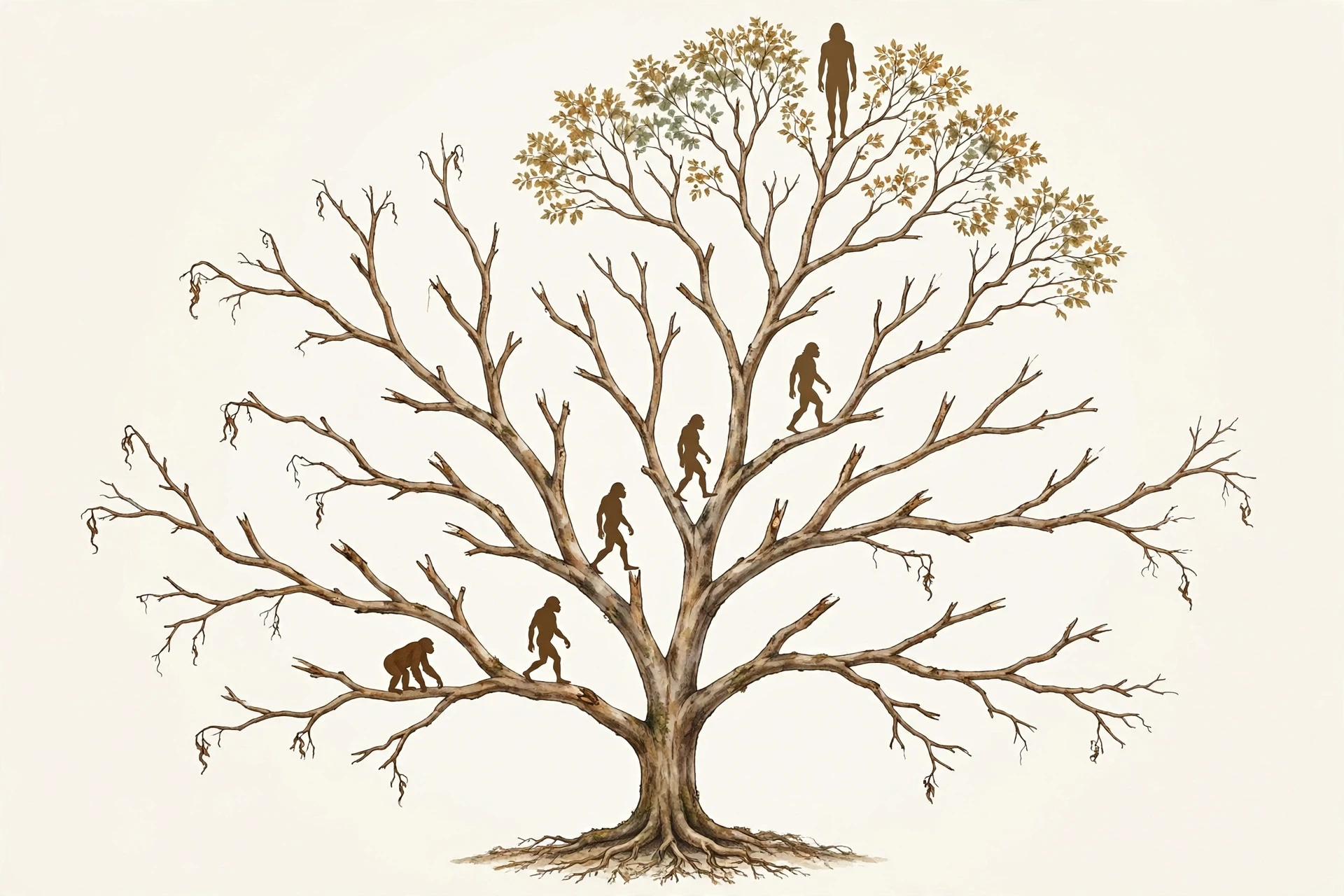
One more thing needs saying at the start, because it is the single most common misunderstanding about human evolution. Human evolution is not a ladder. It is not a straight climb from ape to human, with each species a rung and ourselves at the top. It is a bush: many branches growing at once, most of them ending in extinction, with our species as one surviving twig. We did not evolve from chimpanzees, and we did not evolve from gorillas. We share a common ancestor with them — a creature that lived about six or seven million years ago and was neither human nor chimpanzee — and then our line and theirs went separate ways. The chimpanzees kept evolving too. They are not frozen ancestors. They are our cousins, and the family resemblance is real, but the family tree has many more branches than the ladder picture allows.
3. The Family Tree: A Bush, Not a Ladder
Our family tree is not a ladder with humans at the top. It is a bush: many branches, most of them dead ends, with our species as one surviving twig among dozens of extinct relatives — and new branches keep being discovered, which is why the tree is redrawn every few years.
Start with the branch point that matters most in human evolution. Humans and chimpanzees share about 98.8 percent of their DNA, and the genetic evidence puts the split between our lines at roughly six to seven million years ago. That number comes from the molecular clock: DNA accumulates small changes at a roughly steady rate, so the number of differences between two genomes works like a clock running since they last shared an ancestor. The fossil record and the molecular clock now agree on the rough date, which is why scientists trust it — two independent kinds of evidence pointing at the same answer.
The creature at that branch point is sometimes called the last common ancestor, and it is worth picturing it correctly. It was not a chimpanzee, and it was not a human. It was an ape, probably about the size of a chimpanzee, living in the forests of Africa, walking on all fours along branches and knuckle-walking on the ground, eating fruit and leaves. One population of its descendants stayed in the forests and became modern chimpanzees and bonobos. Another population moved into more open country, began walking upright, and became us. Both lines have been evolving for exactly the same length of time — about seven million years — and both have changed enormously. The idea that chimpanzees are "less evolved" than we are is a misunderstanding of what evolution is. There is no such thing as more or less evolved. There is only better or worse fitted to a particular way of life.
The textbooks describe this branching honestly, and the wording is worth quoting, because it captures how different the real tree is from the ladder:
"Several species evolved from the evolutionary branch that includes humans, although our species is the only surviving member."
That sentence comes from the OpenStax biology text, and it carries the whole picture in twenty words. Several species. One branch. One survivor. Every other member of our branch is extinct. The Natural History Museum puts the count plainly: "We now know of more than 20 hominin species that are part of our family tree." We are not the goal of the process. We are the remainder.
3.1 The split from chimpanzees
The split itself was probably not a single clean event. Populations separated, came back into contact, exchanged genes, and separated again — a pattern geneticists can now see in the DNA, where different parts of the genome give slightly different split dates. The best current estimate is a separation somewhere between six and seven million years ago, with some gene flow continuing for a while afterwards. That untidiness is normal. Speciation in the real world is usually a slow parting, not a sudden break.
What drove the parting was the changing landscape of Africa. Around seven million years ago, the climate was cooling and drying. Forests shrank. Grasslands and open woodland spread. An ape that could move efficiently across open ground, stand up to see over tall grass, and carry food back to its young had an advantage that a forest ape did not need. The first steps toward humanity were probably taken for exactly these practical reasons — not because walking upright was somehow nobler, but because it worked better in the new landscape. The next two sections follow those first steps.
3.2 Why the tree keeps changing
If you learned human evolution from a textbook printed twenty years ago, some of what you learned is now out of date, and that is a feature of the science, not a failure. The tree keeps changing because the evidence keeps growing. In 2010, a single finger bone from a Siberian cave revealed an entire species — the Denisovans — that nobody had known existed. In 2013, cavers in South Africa found a chamber containing more than 1,500 bones of a species nobody had ever seen, Homo naledi, which mixed a small ape-sized brain with a body built for walking and hands that could have made tools. In 2017, Jebel Irhoud pushed our own species back by 100,000 years. Each discovery adds a branch, moves a date, or overturns a tidy story about human evolution — and each one makes the picture more accurate.
This is also why dates in this article come with words like "about" and "roughly" attached. Fossil dating has error bars. A skull dated to 315,000 years ago might really be 300,000 or 330,000. A species that "appeared" 1.9 million years ago might have appeared 2.1 million years ago, and we simply have not found the older fossils yet. The dates that follow are the current scientific consensus, checked against the Smithsonian Institution's Human Origins Program, the Natural History Museum in London, and the peer-reviewed literature — but a reader coming back in five years should expect some of them to have shifted. That is how science is supposed to work.
The rest of this article walks the tree of human evolution branch by branch, in the order the branches appeared: the first upright walkers, the australopiths, the first toolmakers, the first travellers out of Africa, the cousins who shared our world and our genes, and finally ourselves.
4. The First Steps: Sahelanthropus and the Early Hominins
The earliest members of our branch lived about seven to six million years ago in Africa, and they are known from only a handful of fossils. They were small, tree-climbing apes — but their teeth, skulls, and leg bones already show the first steps of human evolution.
The oldest is Sahelanthropus tchadensis, found in Chad in 2001 and nicknamed "Toumaï", meaning "hope of life" in the local Goran language. It lived about seven to six million years ago, close to the split from chimpanzees, and it is a mosaic: a small braincase of only about 350 cubic centimetres — chimpanzee-sized — combined with a face that is flatter than a chimpanzee's, small canine teeth, and a foramen magnum, the hole where the spinal cord leaves the skull, positioned underneath the skull in a way that suggests it may already have been walking upright, at least some of the time.
Whether Sahelanthropus was truly bipedal is still debated, and honest scientists say so. The skull is the only reasonably complete specimen, and a single skull can only tell you so much. What is not debated is that it sits very close to the base of our branch, and that it shows the pattern that would repeat for millions of years: human evolution did not proceed in a tidy order, with one trait changing and then the next. It proceeded in a mosaic, with different parts of the body changing at different rates. The teeth shrank before the brain grew. The legs changed before the hands did. Upright walking came millions of years before big brains.
Two other early species fill in the picture of human evolution. Orrorin tugenensis, found in Kenya in 2000 and dated to about six million years ago, left behind a thigh bone whose shape suggests upright walking — the earliest such evidence we have. Ardipithecus ramidus, nicknamed "Ardi", lived about 4.4 million years ago in what is now Ethiopia, and is known from a remarkably complete skeleton found in 1994 and described in 2009. Ardi had a brain the size of a chimpanzee's, long arms for climbing, and a pelvis built for walking on two legs — but also a big toe that stuck out sideways, like a thumb, for gripping branches. Ardi was an animal in transition: part climber, part walker, at home in neither world fully and capable in both.
These early hominins lived in an Africa that was changing under their feet. The forests were thinning into woodland and savanna. A creature that could walk between patches of trees, stand to reach fruit, and carry food in its hands had an edge. But nothing about these animals would have looked human to a casual observer. They were small — about a metre tall — covered in hair, with brains the size of a grapefruit. If you had met one, you would have called it an ape. The story of human evolution had barely begun, and the most human thing about these animals was the direction they were heading, not where they had arrived.
5. Walking Upright: Why Bipedalism Came First
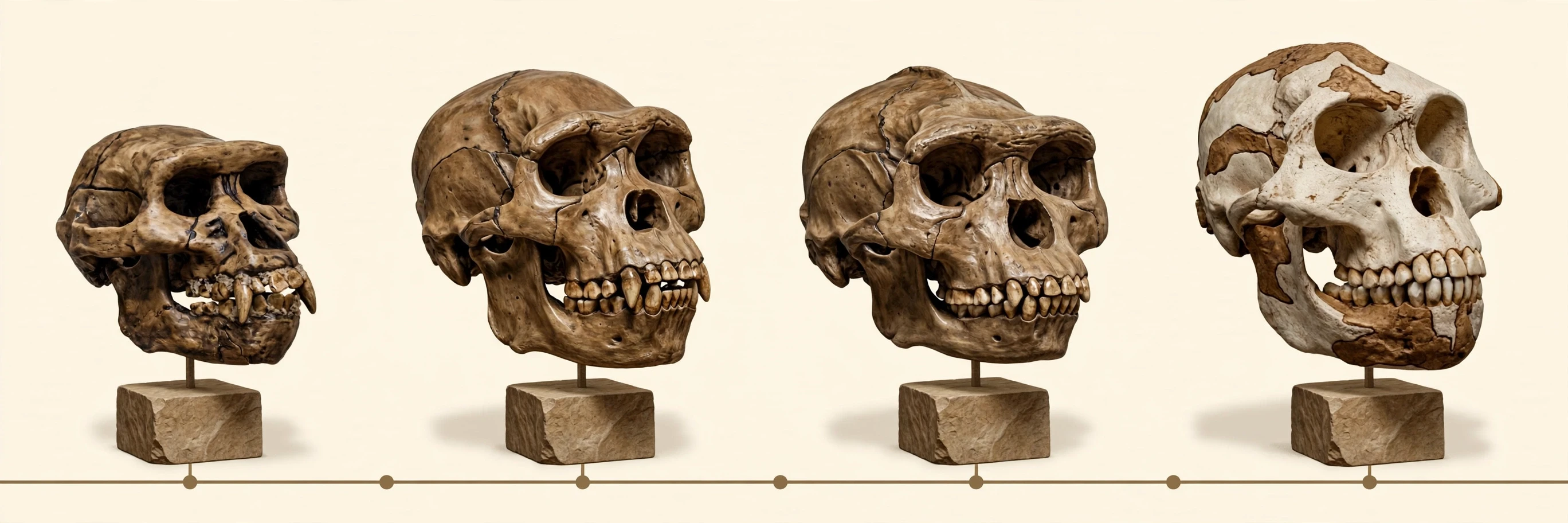
Bipedalism — walking habitually on two legs — is the oldest distinctly human trait in human evolution, and it came first by a wide margin. Our ancestors were walking upright at least four million years ago, and probably earlier. Big brains did not arrive for another two million years. Stone tools came later still. Language came later again.
If you had to pick one thing that made us human, the honest answer is not the brain. It is the walk.
The evidence is written in bone and in stone. The pelvis of an upright walker is short and bowl-shaped, to support the weight of the organs above it. The thigh bone angles inward, so the knees sit under the body's centre of gravity. The foot has an arch and a big toe lined up with the others, built for pushing off the ground instead of gripping branches. The spine curves in an S-shape to balance the head over the hips. Every one of these changes is visible in fossils from four million years ago onward, and together they form a package that only makes sense for an animal that walks on two legs.
But why walk on two legs at all? It is, on the face of it, a terrible idea. Walking upright is slow, unstable, and expensive: human babies take a year to learn it, and even adults fall over. It exposes the soft belly, narrows the birth canal, and puts enormous strain on the lower back — which is why back pain is one of the most common complaints in modern medicine. Evolution does not adopt a bad design lightly. Bipedalism must have paid, and paid handsomely, to overcome those costs.
I think about this every time I watch a toddler learn to walk. My own children spent months pulling themselves up, falling down, and trying again, and I remember thinking how absurd it was that our species had bet everything on a way of moving that takes a year to learn and a lifetime to master. Then I watched one of them, barely steady on her feet, pick up a toy in one hand and a biscuit in the other and carry both across the room to show me — and the answer was right there. Free hands. That is what two legs buy you. A quadruped's hands are feet. A biped's hands are free to carry, to make, to hold, to gesture. Everything that came later — tools, fire, language, art — starts with hands that were no longer needed for walking.
Scientists have proposed several reasons bipedalism paid off in human evolution, and the honest answer is probably that several of them were true at once. Standing upright lets an animal see over tall grass and spot predators — and food — from further away. It exposes less of the body to the midday sun, which matters in the African heat, and raises the head into cooler air. It frees the hands to carry food, infants, and eventually tools back to a home base, which lets a group share food instead of each individual eating where it finds it. And it is efficient over long distances: once you are built for it, walking on two legs uses less energy per kilometre than walking on four. None of these alone explains the change. Together, they made upright walking worth its considerable costs.
5.1 Footprints in ash: Laetoli
The most vivid proof that our ancestors walked upright comes not from a bone but from a footprint — or rather, from a trail of them. In 1978, Mary Leakey's team working at Laetoli in Tanzania found footprints preserved in volcanic ash, dated to about 3.66 million years ago. The ash had fallen from a nearby volcano, been dampened by rain, and then walked across by animals — including two or three hominins, walking side by side, one stepping in the footprints of another. The prints show a heel strike, an arch, and a big toe in line with the others: the unmistakable signature of a biped. They are among the oldest evidence of upright walking in human evolution, and they are strangely moving to look at — two individuals, walking together, leaving the earliest footprints of a journey our species is still on.
The Laetoli prints were made by australopiths, the group that dominates the next section. But the prints also settle a question that had divided scientists for a century: which came first, the big brain or the upright walk? The footprints are 3.66 million years old. The brains of the animals that made them were the size of a chimpanzee's. The walk came first in human evolution, by millions of years. The brain was a late arrival, and it arrived in a body that had already been walking upright for a very long time.
6. Lucy and the Australopiths
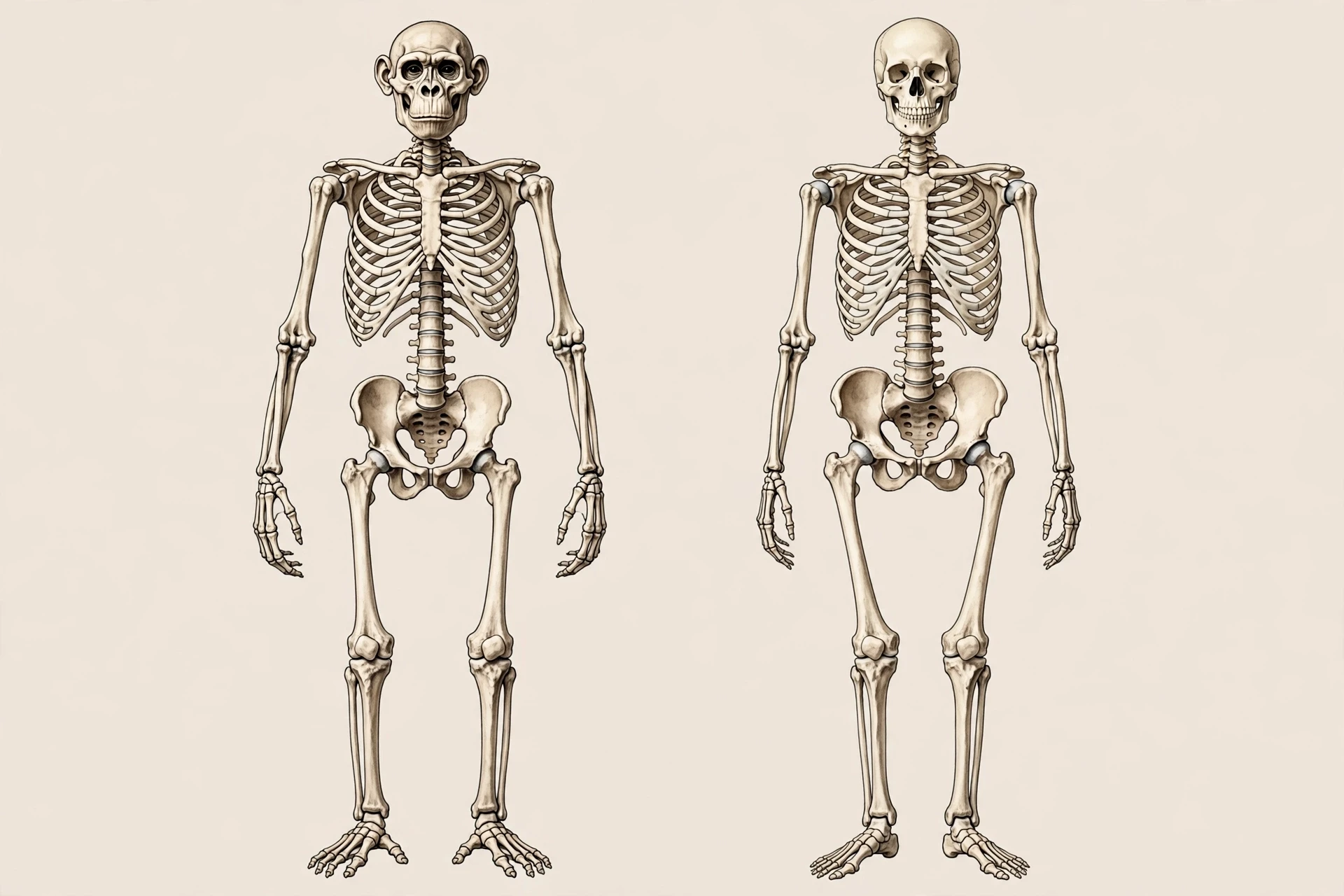
Lucy is the most famous fossil in human evolution: a 3.2-million-year-old skeleton of Australopithecus afarensis, found in Ethiopia in 1974, that was about 40 percent complete — an extraordinary haul that showed, in a single skeleton, an ape's brain above a walker's legs.
If one fossil had to stand for the whole of human evolution, it would be Lucy. On a November morning in 1974, in the Afar region of Ethiopia, paleoanthropologist Donald Johanson and his team were walking back to camp across a dry gully when Johanson spotted a small piece of arm bone on the ground. Looking around, he found more: a thigh bone, a pelvis, ribs, a jaw, part of a skull. By the end of the season they had recovered about 40 percent of a single skeleton — an extraordinary haul, since most fossils are found one bone at a time. The skeleton belonged to an adult female Australopithecus afarensis who had lived about 3.2 million years ago. That evening, the team celebrated by playing the Beatles song "Lucy in the Sky with Diamonds" on a tape recorder, and the name stuck.
Lucy — specimen AL 288-1, to give her formal name — was about 1.1 metres tall and weighed about 29 kilograms, roughly the size of a modern eight-year-old child. Her brain was small, about 380 to 450 cubic centimetres, the size of a modern chimpanzee's. Her arms were long, her fingers curved for climbing, and her jaw jutted forward with larger teeth than ours. But her pelvis was short and bowl-shaped, her thigh bone angled inward, and her knee was built for walking upright. She was, in every sense, a mosaic: ape above the waist, human below it. She walked on two legs, and she still climbed trees.
I have stood in front of the Lucy reconstruction in a museum, and the thing that struck me was not how strange she looked but how familiar. The skull is small and the brow is heavy, but the posture is ours. The skeleton stands upright, weight balanced over two feet, hands hanging free at its sides. You can imagine her walking across the savanna, carrying something in those free hands. Three million years later, we still walk the same way, and we still carry things in our hands. Lucy is not our direct ancestor — Australopithecus afarensis may be a close cousin rather than a grandparent — but she is the clearest window human evolution has given us into the world our ancestors lived in.
Lucy's species, Australopithecus afarensis, lived in East Africa between about 3.9 and 2.9 million years ago, and it is one of the best-known of all early hominins, with hundreds of fossils recovered. The species shows a clear trend that would continue for millions of years: teeth and jaws getting smaller as diet changed, and the body becoming more fully committed to walking upright. The Laetoli footprints, made 3.66 million years ago, were almost certainly made by members of Lucy's species — the same kind of animal, walking the same way, hundreds of kilometres from where Lucy herself was found.
The australopiths were a successful and diverse group, and a long chapter in human evolution. Australopithecus africanus, found in South Africa and dated to about two to three million years ago, had a slightly larger brain — about 500 cubic centimetres — and a more slender build. Australopithecus anamensis, the oldest of the group at about 4.2 million years ago, is a likely ancestor of Lucy's species. And then there were the robust australopiths, grouped in the genus Paranthropus, which appeared about 2.5 million years ago with massive jaws and enormous grinding teeth for a diet of tough, fibrous plants. Paranthropus went extinct a little over a million years ago, leaving no descendants — a reminder that evolution has no favourites, and that being well adapted to one way of life is no protection when the world changes.
By about two million years ago, the australopiths were fading, and something new was appearing in East Africa: a creature with a bigger brain, smaller teeth, and a habit of striking stones together to make sharp edges. The genus Homo had arrived, and with it, the first tools.
7. The First Humans: Homo habilis and the Toolmakers
About 2.5 to 3 million years ago, a new kind of hominin appeared in East Africa with a larger brain, smaller teeth, and a new habit: striking stones together to make sharp edges. Homo habilis — "handy man" — is the earliest species in our own genus, and the first known toolmaker in human evolution.
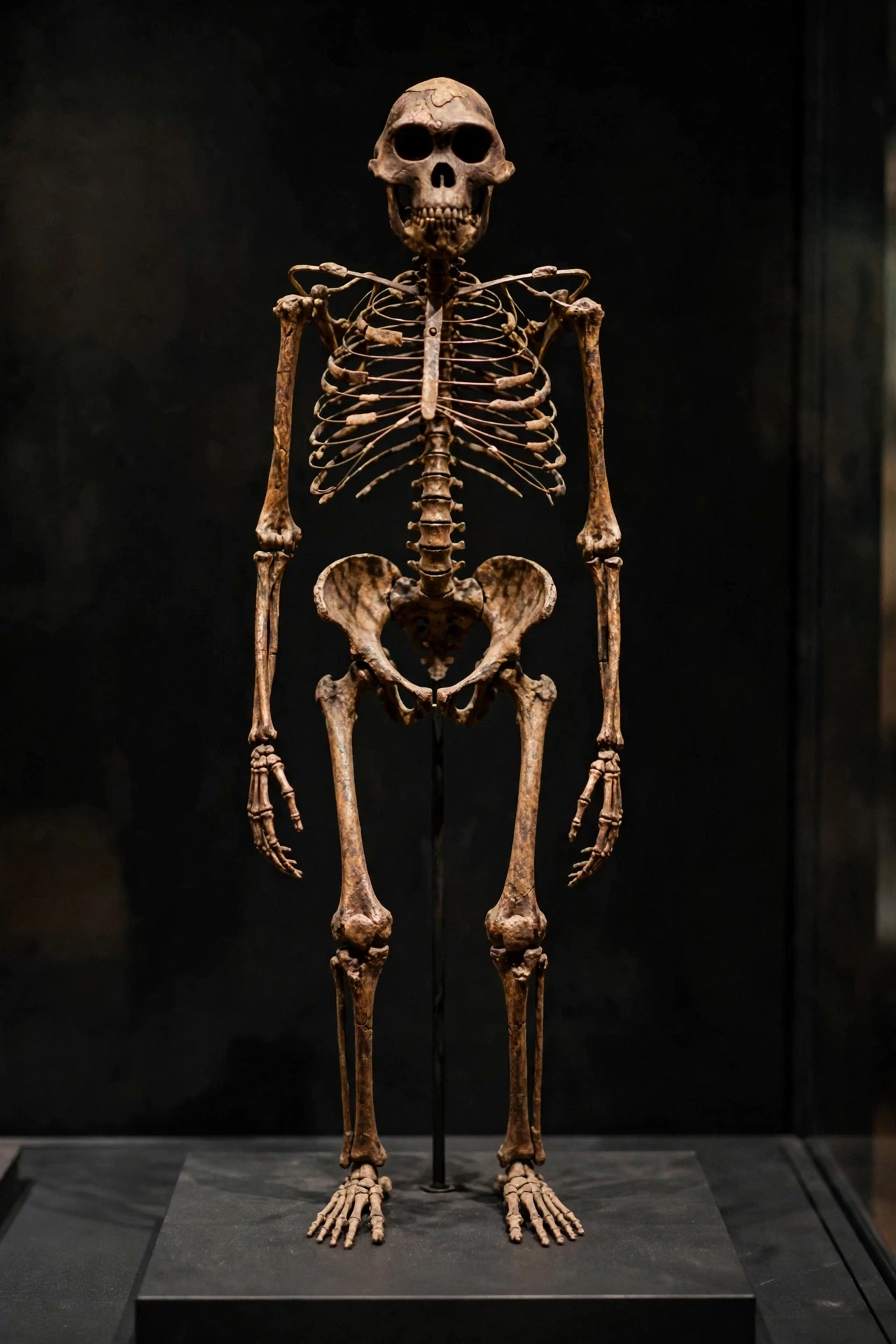
It had a larger brain than the australopiths — about 600 to 750 cubic centimetres — a less protruding jaw, smaller teeth, and longer legs with shorter arms. In 1960, Louis and Mary Leakey found its fossils at Olduvai Gorge in Tanzania, alongside simple stone tools, and in 1964 they named it Homo habilis: "handy man". The name was a guess about what the creature did, and the guess turned out to be right. Homo habilis is the earliest species we place in our own genus, and the tools found with it are the oldest clear evidence that a hominin was deliberately making something.
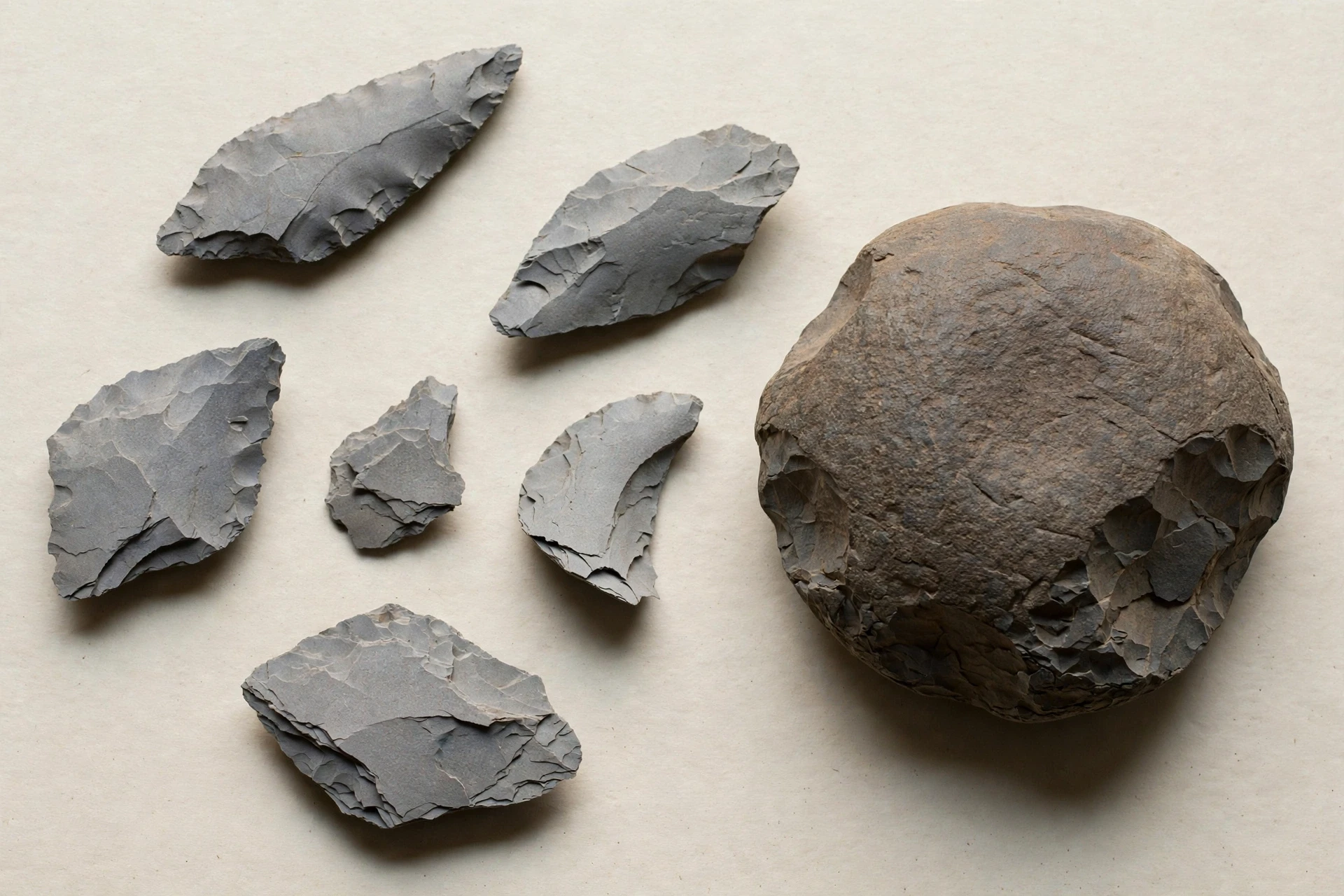
The tools were simple, but they were a revolution. The technique is called Oldowan, after Olduvai Gorge, and it works like this: take a rounded stone, strike it with another stone, and knock off sharp flakes. The flakes are knives. The core that remains is a chopper. With those two implements, a hominin could cut meat from a carcass, crack bones for marrow, and shape wood. The oldest Oldowan tools, from Gona in Ethiopia, are about 2.6 million years old. Even older stone tools — about 3.3 million years old, from a site called Lomekwi in Kenya — have been claimed, but they are debated: the stones may have been shaped by natural forces rather than by hands, and most researchers treat 2.6 million years as the secure date for deliberate toolmaking. Either way, the story is the same: our ancestors began making tools around the time the genus Homo appeared, and the two developments are almost certainly connected.
Tools changed what our ancestors could eat, and what they could eat changed their bodies — one of the great feedback loops in human evolution. A stone flake can cut meat from a carcass that teeth alone could not open. Marrow, hidden inside bones, is rich in fat and calories, and a stone hammer can crack it open. Meat and marrow are energy-dense foods, and energy-dense food is exactly what a growing brain needs. The link is not proven in every detail — scientists still argue about how much meat early Homo actually ate, and whether they hunted or scavenged — but the broad pattern is clear: tools, meat, and bigger brains arrived together, and each one made the others more valuable.
7.1 What the tools tell us
A stone tool is more than a sharp edge. It is evidence of a mind that could imagine a future need, plan a sequence of actions, and remember a technique. To make an Oldowan flake, you must choose the right stone, hold it at the right angle, and strike it with the right force — and if you get it wrong, you start again. That is not instinct. That is learned skill, passed from one individual to another, which means it is also evidence of social learning: watching, copying, and teaching. The tools are the first evidence we have that our ancestors were not just using their environment but reshaping it — a turning point in human evolution — and that they were passing knowledge between generations in a way no other animal does.
The tools also tell us something about how Homo habilis lived. The species was small — about 1.3 metres tall — and it lived in a world full of predators: lions, leopards, hyenas, crocodiles. A creature that size, with no claws and no great speed, survives by being clever and by being social. The tools suggest both. Cut marks on animal bones show that habilis was getting meat, probably by scavenging carcasses left by larger predators and cutting away what it could before the hyenas arrived. And the tools themselves, found in clusters at particular sites, suggest a home base: a place to bring food back to, to share, and to make tools together. Sharing food is a deeply human behaviour, and it may be older than our species itself.
Homo habilis lived from about 2.4 to 1.6 million years ago, overlapping with the last australopiths and with the species that would replace it. It was not a spectacular creature. It had a small brain by our standards, a face that still jutted forward, and long arms that remembered the trees. But it did something no australopith had done: it made tools, and it made them well enough that the tradition lasted for a million years. The Oldowan toolkit barely changed for a million years — which tells you both how good it was and how slowly early human culture moved. The next species would change that, and change the map too.
8. Homo erectus: The First Traveller
Homo erectus — "upright man" — was the first hominin to leave Africa, the first to live on three continents, and the first whose body looked recognisably like ours from the neck down. It appeared about 1.9 million years ago and lasted nearly two million years — one of the longest-lived species in human evolution.
About 1.9 million years ago, a new species appeared in East Africa that looked, for the first time, recognisably like us from the neck down. Homo erectus — "upright man" — was tall, with long legs, a narrow pelvis, and a body built for walking and running long distances. Some individuals stood up to 1.85 metres tall and weighed about 65 kilograms, essentially modern human proportions. Its brain was larger than habilis: about 775 to 1,100 cubic centimetres, roughly two-thirds the size of ours. Its face was still heavy-browed, with a low forehead and no chin, and its skull was long and low. But its body was ours. If you dressed a Homo erectus in modern clothes and saw it from behind, you might not look twice.
What made Homo erectus truly different in the story of human evolution was not its body but its behaviour. It was the first hominin to leave Africa. By about 1.8 million years ago — almost as soon as it appeared — its fossils turn up in Dmanisi, in the Republic of Georgia, at the gateway between Africa and Eurasia. From there it spread east to China, where it is known as "Peking Man", and south-east to Java, where it was first discovered in 1891 by the Dutch physician Eugène Dubois, who called it "Java Man". It reached India, and eventually the islands of South-East Asia. No hominin before it had travelled so far, and no hominin before it had lived in so many different climates, from the African savanna to the cold winters of northern China.
The Dmanisi fossils are especially revealing, because they show how much variation existed within a single population. Five skulls found at the site range from a small-brained individual of about 550 cubic centimetres to a large one of about 780 — a spread that, in earlier decades, would have been split into several different species. They also include an old individual who had lost all but one of his teeth, yet had survived for years afterwards — which means someone was feeding him soft food. Care for the old and the toothless is a profoundly human behaviour, and it appears here, nearly two million years ago, in a species with a brain two-thirds the size of ours.
Homo erectus also made better tools. About 1.76 million years ago, the Acheulean handaxe appeared: a teardrop-shaped stone, flaked on both sides to a sharp edge all round, symmetrical in a way the Oldowan tools never were. A handaxe takes planning and skill to make, and it can do many jobs — butchering, woodworking, digging. The handaxe is the longest-lived tool in human history: it was made, with little change, for more than a million years, across three continents. It is also the first tool that shows a sense of shape — an aesthetic, even — and some researchers have argued that a well-made handaxe was also a signal, a way of showing off skill to a potential mate. Whether or not that is true, the handaxe marks a step change in what our ancestors' minds could do.
Homo erectus also seems to have been the first to control fire, though the evidence is still debated — and fire is one of the great open questions in human evolution. The strongest case comes from Wonderwerk Cave in South Africa, where burned bones and ash have been dated to about one million years ago, and from Gesher Benot Ya'aqov in Israel, where burned wood and seeds date to about 780,000 years ago. Fire is a technology with enormous consequences: it cooks food, which makes more calories available and softens tough meat and roots; it provides warmth and light; it keeps predators away; and it creates a social centre — the hearth — around which a group gathers in the evening. If Homo erectus controlled fire, it would help explain the next great change in our story: the brain began to grow faster than ever before, and cooked food is one of the leading explanations for how that growth was fuelled.
Homo erectus lived for an extraordinarily long time — from about 1.9 million years ago until at least 110,000 years ago, and possibly later on the Indonesian island of Flores, where a dwarfed descendant may have survived until 50,000 years ago. That is a run of nearly two million years, far longer than our own species has existed so far. It was, by any measure, one of the most successful species our branch has ever produced. And it was not our direct ancestor in a simple sense: modern humans did not descend from the Asian erectus populations, but from African populations that were evolving in parallel. The family tree was branching again, and one of those African branches would lead to us.
9. Bigger Brains: What Drove the Great Expansion
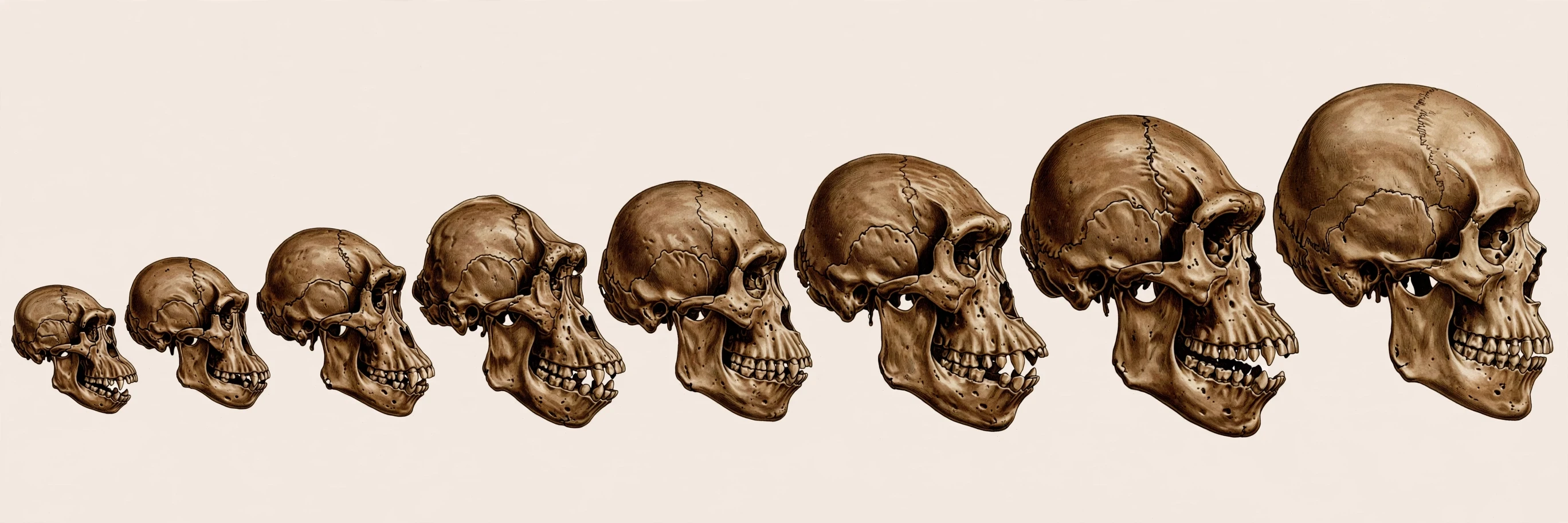
The most dramatic trend in human evolution is the growth of the brain. From about 350 cubic centimetres in Sahelanthropus to about 1,350 cubic centimetres in modern humans, the brain roughly quadrupled in size over seven million years — and most of that growth happened in the last two million years.
The table below shows the scale of the change, and it is worth pausing over, because few numbers in this article are as striking.
Species | Lived (years ago) | Brain size (cm³) |
|---|---|---|
Sahelanthropus tchadensis | 7–6 million | About 350 |
Australopithecus afarensis (Lucy) | 3.9–2.9 million | 380–450 |
Australopithecus africanus | 3–2 million | About 500 |
Homo habilis | 2.4–1.6 million | 600–750 |
Homo erectus | 1.9 million–110,000 | 775–1,100 |
Homo heidelbergensis | 700,000–200,000 | 1,100–1,400 |
Neanderthals | 400,000–40,000 | 1,200–1,700 |
Homo sapiens (modern) | 315,000–present | About 1,350 |
The brain is expensive. In a modern human at rest, the brain consumes about 20 percent of the body's energy, despite being only about 2 percent of its weight. A bigger brain is a bigger fuel bill, and evolution does not pay that bill without a return. So what was the return? What did a bigger brain buy that was worth a fifth of everything we eat?
The leading explanations are not mutually exclusive, and the honest answer is that several of them were probably true at once. The first is diet. A bigger brain needs more energy, and the richest sources of energy in the African landscape were meat, marrow, and fat — foods that require tools and cooperation to obtain, and cooking to digest efficiently. The cooking hypothesis, proposed by the primatologist Richard Wrangham, argues that fire transformed our diet: cooked food is softer, safer, and more calorie-rich, and it freed energy that had previously gone into maintaining a large gut. As the gut shrank, the brain could grow. The evidence is circumstantial — small teeth, small guts, and large brains all appearing together — but the pattern fits.
The second explanation is social. Living in a group is complicated. You need to remember who is allied with whom, who owes you a favour, who is lying, and who can be trusted with your children. The social brain hypothesis argues that the pressure to navigate complex social relationships was the main force driving brain growth in human evolution — that we got smart not to outwit the landscape but to outwit each other, and then to cooperate with each other. Human groups are unusually large for primates, and our social lives are unusually complicated. The brain that can track a hundred relationships, remember a hundred faces, and predict what a hundred people will do next is a large brain.
The third explanation is childhood. Human babies are born helpless, with brains only about a quarter of their adult size, and they stay dependent for far longer than any other primate. That long childhood is itself a product of the big brain: a brain that large cannot fit through a birth canal that was narrowed by upright walking, so babies are born early, with most of their brain growth happening outside the womb. A long childhood means a long period of learning — and learning is what a big brain is for. We are the only species that spends a fifth of its life as a child, and that long apprenticeship is the price and the payoff of the big brain at once.
It is also worth saying what a bigger brain did not buy in human evolution. Neanderthals had brains that were, on average, slightly larger than ours — about 1,450 cubic centimetres against our 1,350 — and they were not more successful than we were. Brain size alone does not determine intelligence. What matters is how the brain is organised: the relative size of different regions, the density of connections, and the way the brain develops during that long childhood. Our brains are not the largest in the animal kingdom — elephants and whales have larger ones — but they are the most densely connected relative to body size, and they are wired for language, for planning, and for imagining things that do not exist yet. The expansion was not just about size. In human evolution, it was about what the size was used for.
10. Neanderthals: Our Closest Cousins
Neanderthals were our closest cousins in human evolution: stocky, strong, and large-brained, they lived in Europe and western Asia for hundreds of thousands of years, made sophisticated tools, buried their dead — and interbred with our ancestors, so that most people alive today carry some of their DNA.
No extinct relative is better known, or more misunderstood, than the Neanderthals. They were discovered in 1856, when quarry workers in the Neander Valley in Germany found a skull and limb bones in a cave. The bones were thick, the brow ridge was heavy, and the skull was long and low. Early reconstructions portrayed them as brutish, stooped, and dim — the "caveman" of cartoons. That picture was wrong in almost every detail. Neanderthals were not a failed version of us. As Prof Chris Stringer of the Natural History Museum puts it, "Neanderthals were humans like us, but they were a distinct species called Homo neanderthalensis." They were a successful, intelligent species that lived in Europe and western Asia for hundreds of thousands of years, and they are, in a real sense, part of us: most people alive today carry some of their DNA.
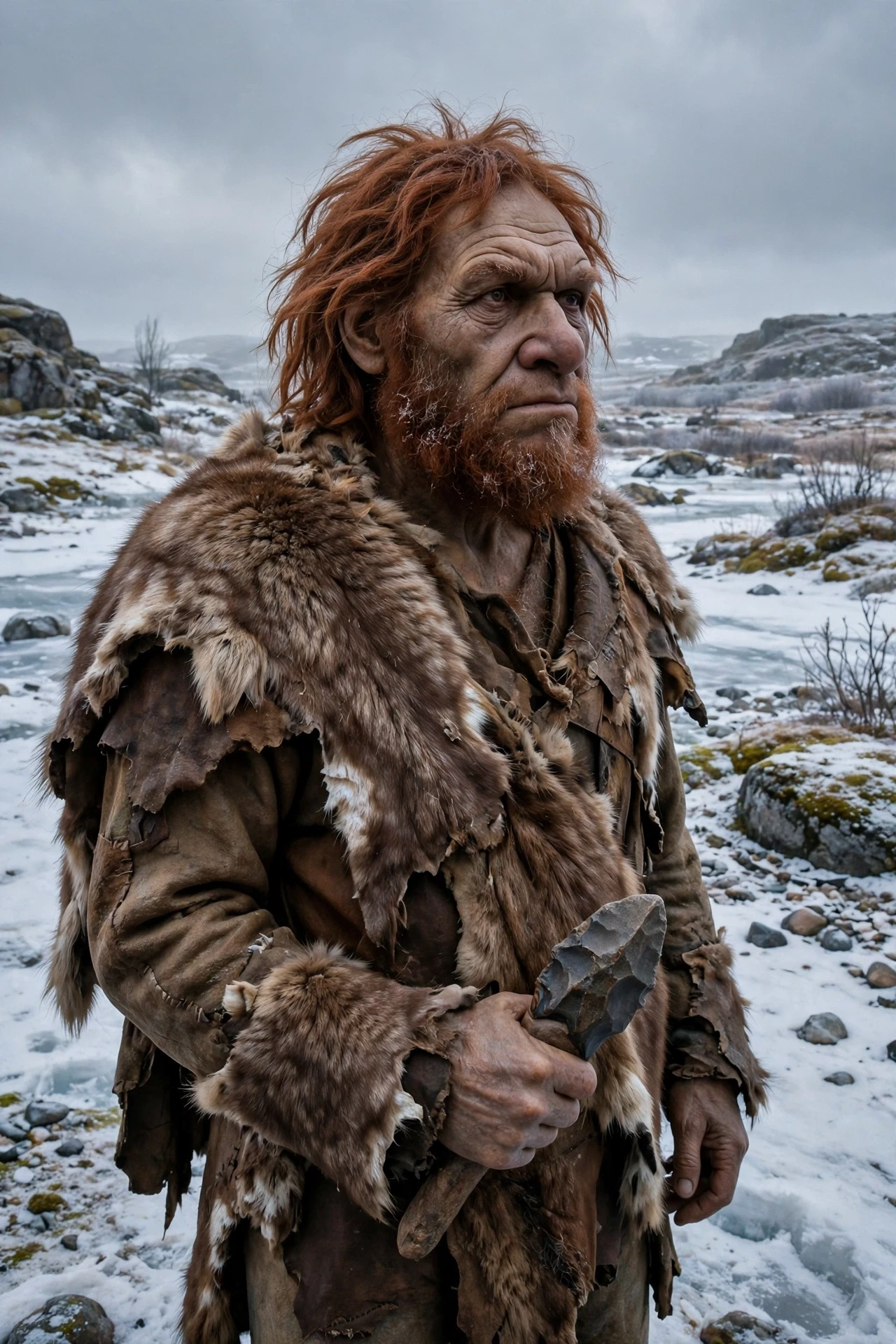
Neanderthals lived from about 400,000 years ago until about 40,000 years ago. They were stocky and powerfully built, with short limbs and broad chests — a body shape that conserves heat in cold climates, which is what Ice Age Europe demanded. Their brains were large, averaging about 1,450 cubic centimetres, slightly larger than the modern human average, though their skulls were shaped differently, with a long low braincase and a bulge at the back. They made sophisticated stone tools, known as Mousterian, which required planning and skill. They hunted large animals — mammoth, woolly rhinoceros, bison — at close quarters, with thrusting spears, which took courage and coordination. They buried their dead, at sites like Shanidar in Iraq and La Ferrassie in France, sometimes with flowers and grave goods, though how much ceremony those burials involved is still debated. They cared for their injured: the Shanidar 1 skeleton belonged to a man who had survived a crushed eye socket, a withered arm, and a healed leg fracture — injuries that would have killed him without years of care from his group. And they made things that look like art: the oldest known cave paintings in Europe, in Spanish caves, may be Neanderthal work, dated to more than 64,000 years ago, before modern humans arrived in the region.
The most important Neanderthal discovery in human evolution, however, came not from a cave but from a laboratory. In 2010, a team led by Svante Pääbo at the Max Planck Institute for Evolutionary Anthropology in Leipzig published the first draft of the Neanderthal genome, sequenced from bones found in Croatia. The result was a surprise: Neanderthals had interbred with the ancestors of modern humans. People whose ancestry lies outside Africa carry about 1 to 2 percent Neanderthal DNA in their genomes — a figure that has been refined since the first estimate of 1 to 4 percent, but whose meaning is unchanged. If your family comes from Europe or Asia, a small part of your genome is Neanderthal. Pääbo won the Nobel Prize in Physiology or Medicine in 2022 for this work, and the prize citation recognised what it had done: it turned the Neanderthals from a cartoon into a part of our own ancestry — and changed human evolution from a story told in fossils into a story told in DNA as well.
The interbreeding happened when modern humans first spread out of Africa and met Neanderthals in the Middle East and Europe, about 47,000 years ago, with gene flow continuing over roughly 7,000 years. It was not a single event but a long period of contact between two groups that were close enough to have children together and different enough that those children carried genes neither group had on its own. Some of those genes were useful. Neanderthal DNA contributed variants that helped early modern humans adapt to new environments — including genes involved in skin and hair, and genes that affect the immune system's response to new diseases. Some of it was harmful, and natural selection has been slowly removing the worst of it ever since. But the overall picture is clear: our species did not simply replace the Neanderthals. We absorbed them, in part, and they live on in us.
When I first read a report about direct-to-consumer DNA testing, I remember the surprise on a colleague's face when her results came back saying she carried more Neanderthal DNA than most other customers. She laughed, and then she asked the question everyone asks: "Does that mean I'm part Neanderthal?" The answer is yes — in the same way that every person of non-African ancestry is, to the tune of about one or two percent. It is a small number, and it is also a profound one. It means the boundary between "us" and "them" was never as sharp as the textbooks once drew it. We were not a separate species marching past a dying one. We were two groups of the same wider family, meeting, mixing, and carrying each other forward.
Why did the Neanderthals disappear, then, if they were so capable? They did not vanish in a single catastrophe. Their numbers were always small — probably never more than a few tens of thousands across all of Europe — and small populations are vulnerable. When modern humans arrived in larger numbers, with more efficient social networks and perhaps slightly better tools, the Neanderthals were absorbed, outcompeted, or simply dwindled in a changing climate. Their last known refuge was Gibraltar, about 40,000 years ago. They were not stupid, and they were not brutish. They were unlucky, and they were few. And a part of them never left at all.
11. Denisovans: The Ghosts in Our Genes
The Denisovans are the ghosts of human evolution: a sister group to the Neanderthals, discovered in 2010 from a single finger bone in a Siberian cave, whose DNA still lives on in millions of people across Asia and the Pacific.
If the Neanderthals were discovered by quarrymen in 1856, the Denisovans were discovered by a DNA sequencer in 2010 — and that difference tells you how much human evolution has changed as a science. In 2008, archaeologists working in Denisova Cave in the Altai Mountains of Siberia found a single small bone: the tip of a finger, from a juvenile, about 50,000 years old. The bone was too fragmentary to identify by shape. But when Pääbo's team extracted its DNA, the result was astonishing. The finger belonged to a population that was neither Neanderthal nor modern human, but a sister group to the Neanderthals, which had split from them about 400,000 years ago. A new species had been discovered from a single finger bone — the first human group in history defined by its DNA rather than by its bones.
The Denisovans are still mostly ghosts. We have only a handful of fossils: the finger bone, a few teeth, a toe bone, and — most dramatically — a jawbone from Baishiya Karst Cave on the Tibetan Plateau, dated to about 160,000 years ago, which proved the Denisovans lived at high altitude. From the DNA, we know they ranged widely across Asia. From the genes they left in living people, we know they interbred with the ancestors of modern humans, just as the Neanderthals did — and in some populations, they left a bigger mark.
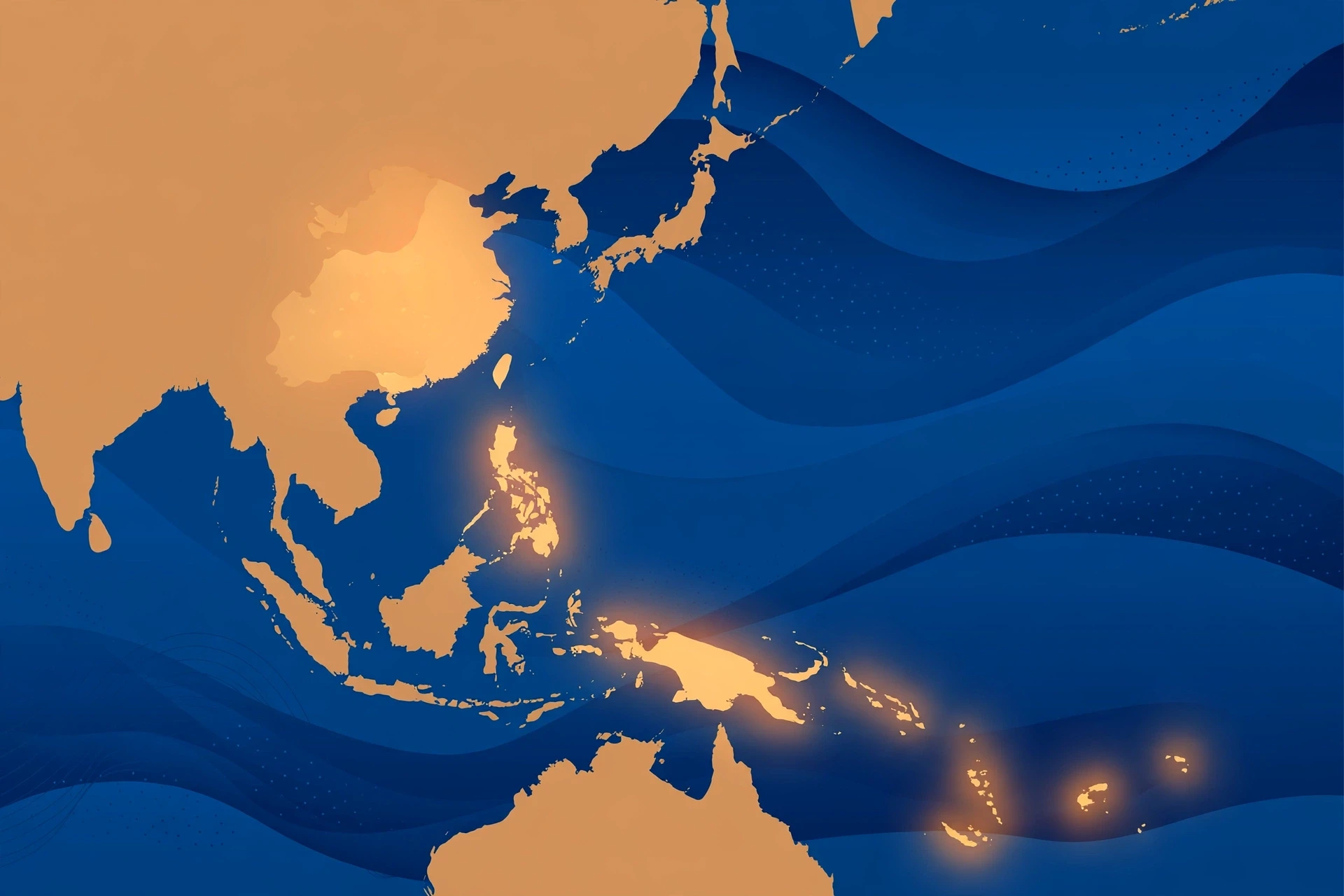
People in Melanesia, including Papua New Guinea, carry about 4 to 6 percent Denisovan DNA — the highest proportion anywhere. Aboriginal Australians carry about 3 to 5 percent. The Ayta Magbukon people of the Philippines carry about 5 percent, the highest known. By contrast, mainland Asians and Native Americans carry only about 0.2 percent, and Europeans almost none. The pattern tells a story: Denisovans lived across Asia, met modern humans as they spread east, and left their genes in the populations that stayed in the region — while the ancestors of Europeans, who took a more westerly route, barely met them at all.
The most famous Denisovan gift to human evolution is a gene called EPAS1. Tibetans carry a version of EPAS1 that helps them live at altitudes above 4,000 metres, where the air holds only about 60 percent as much oxygen as at sea level. That version did not evolve in Tibetans. It came from Denisovans, who had already adapted to the high Tibetan Plateau, and it was passed to the ancestors of modern Tibetans when the two groups interbred. It is one of the clearest examples in human biology of a gene moving between species and then being favoured by natural selection — a piece of another species' adaptation, borrowed and put to work. The Genetics article explains how a single gene variant like this can spread through a population when it helps people survive and have children.
The Denisovans also remind us how much of human evolution we do not know. We have never found a complete Denisovan skull. We do not know what they looked like, how tall they were, or what tools they made. Genetic evidence suggests there may have been more than one Denisovan population, separated by time and geography, and that some of them mixed with an even older, unknown group — a "super-archaic" population that split from our line more than a million years ago. Every new ancient genome seems to add a new branch to the tree, and the Denisovans are the proof that the fossil record alone would never have found them. If a single finger bone can reveal an entire species, how many other branches are still waiting in caves we have not yet dug, or in genomes we have not yet read?
12. Homo sapiens Appears — and Leaves Africa
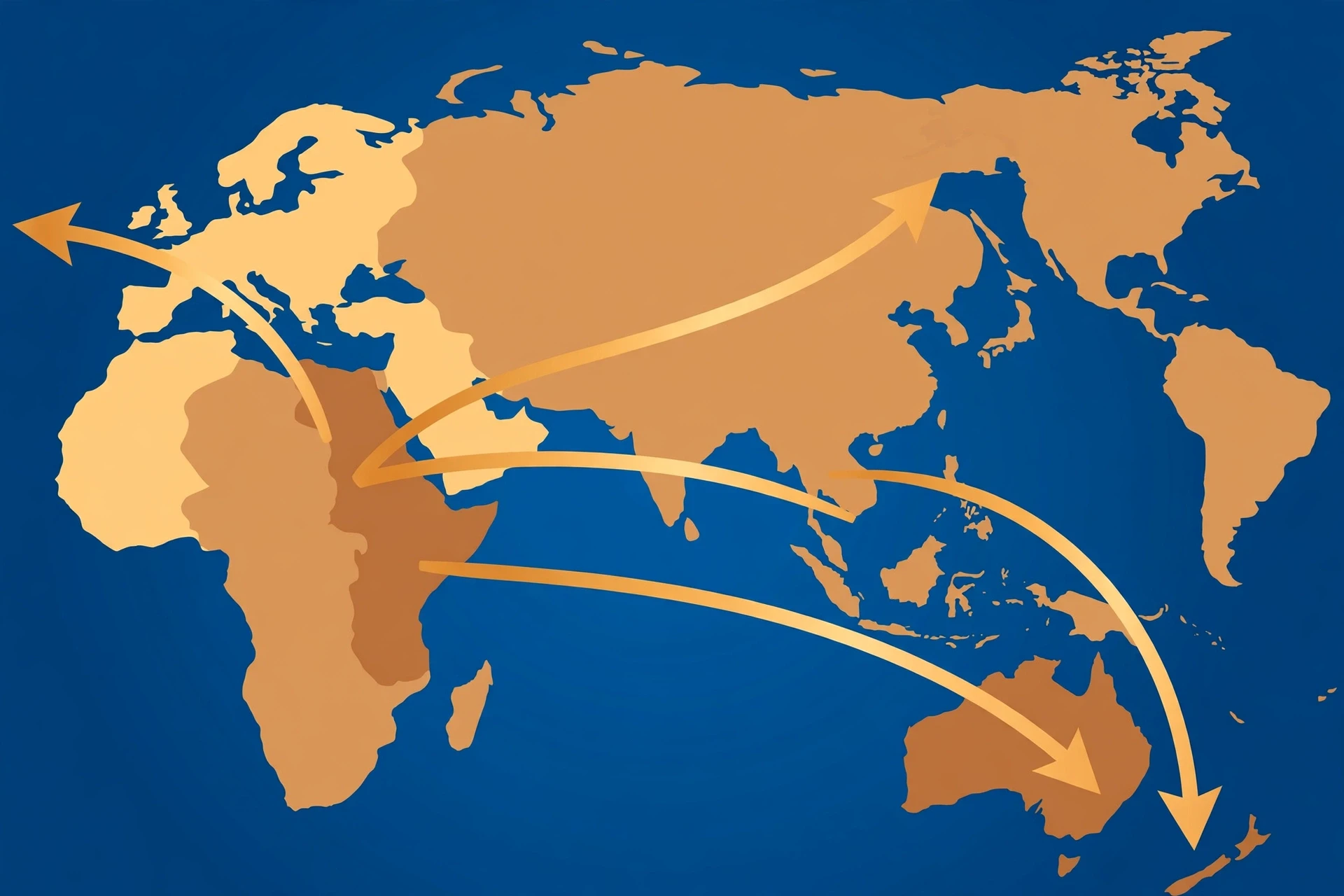
Our own species appeared in Africa about 315,000 years ago, and for most of the first 200,000 years it stayed there. Then, about 60,000 to 70,000 years ago, a small group left on the greatest journey in human evolution — and in about 50,000 years their descendants had reached every continent except Antarctica.
Our own species, Homo sapiens, appeared in Africa about 315,000 years ago — that is the date from Jebel Irhoud, and it is the oldest widely accepted date for anatomically modern humans. Older candidates exist: the Omo Kibish fossils from Ethiopia, once dated to about 195,000 years ago, were re-dated in 2022 to about 233,000 years ago. The Herto fossils, also from Ethiopia, date to about 160,000 years ago. But Jebel Irhoud remains the benchmark, and it carries an important lesson: our species did not appear in one place and then spread. It appeared across Africa, in a network of populations that were connected by movement and gene flow, gradually becoming more modern in shape over tens of thousands of years. The face became modern first — high forehead, small brow, chin — while the braincase stayed long and low for longer, only becoming globe-shaped later. We became human in stages, not all at once.
For most of the first 200,000 years of our existence, we stayed in Africa. Then, in a series of movements that are still being pieced together, we left. There were early excursions: fossils from Misliya Cave in Israel date to about 180,000 years ago, and a skull from Apidima Cave in Greece has been dated to about 210,000 years ago, though that date is contested. These early groups may have died out, or been absorbed, without leaving descendants. The dispersal that mattered — the one that led to every person alive outside Africa today — began about 60,000 to 70,000 years ago, when a relatively small group crossed from Africa into Arabia and then spread east and west along the coasts and river valleys of Asia.
The genetic evidence for this dispersal is striking, and it is one of the strongest findings in human evolution. All non-African populations descend from a single ancestral group that left Africa in that window — a group that may have numbered only a few thousand people. That is why genetic diversity is highest in Africa and lower everywhere else: every population outside Africa is descended from a subset of the African gene pool, and each migration out took only a fraction of the diversity with it. It is also why the deepest genetic differences in the world are not between continents but within Africa itself. Two people from different parts of Africa can be more genetically different from each other than either is from a person in Europe or Asia. The idea of "race" as a deep biological division does not survive contact with this data. We are one species, recently spread, with most of our variation still sitting in the continent where we were born.
From Arabia, our ancestors spread fast — the fastest expansion in human evolution. They reached South-East Asia and Australia by about 65,000 years ago — crossing open sea to reach Australia, which means they had boats, or at least rafts, tens of thousands of years before anyone had thought possible. They reached Europe by about 45,000 years ago, where they met the Neanderthals. They reached Siberia and crossed into the Americas by about 15,000 to 20,000 years ago, following the herds across the Bering land bridge — and footprints found at White Sands in New Mexico, dated to about 21,000 to 23,000 years ago, suggest they may have arrived even earlier, though that date is still debated. By 15,000 years ago, humans lived on every continent except Antarctica. In about 50,000 years, a single African species had become a global one.
Event | When (years ago) | Evidence |
|---|---|---|
Earliest Homo sapiens (Jebel Irhoud) | About 315,000 | Skulls and bones, Morocco |
Omo Kibish fossils, Ethiopia | About 233,000 | Re-dated in 2022 |
Early excursion (Misliya Cave) | About 180,000 | Jawbone, Israel |
Main dispersal out of Africa | 60,000–70,000 | Genetics and archaeology |
Australia reached | About 65,000 | Madjedbebe rock shelter |
Europe reached; Neanderthals met | About 45,000 | Fossils and DNA |
Americas reached | 15,000–23,000 | Beringia; White Sands footprints (21,000–23,000, debated) |
What made the difference in human evolution? Why did our species spread so far and so fast, when Homo erectus had taken hundreds of thousands of years to do the same? The answer is probably behaviour, not anatomy. By 60,000 years ago, our ancestors had a toolkit that was far more flexible than anything before it: better stone tools, bone and antler tools, sewn clothing, boats, and — most importantly — language complex enough to share detailed knowledge. A group that can tell its children where the water is, how to make a boat, and what to do when the weather turns can survive in places a group without language cannot. The likeliest explanation is connection, not muscle: modern humans lived in larger, more connected groups, with wider social networks that let knowledge and resources move further. Connection, not muscle, was the advantage.
13. The "Missing Link" and Other Misconceptions
If there is one phrase that has done more damage to public understanding of human evolution than any other, it is "the missing link". The phrase suggests a single creature, half ape and half human, that would prove evolution true if only someone would find it.
Until it is found, the whole theory is supposedly in doubt. That is not how evolution works, and the phrase has been misleading people for more than a century.
The first problem is the idea of a single link. Human evolution is a branching tree with dozens of species, not a chain with one gap. Every fossil we find is a link of sorts, and every fossil also creates two new gaps on either side of it — that is the nature of a fossil record that preserves only a tiny fraction of the animals that ever lived. Scientists have found hundreds of hominin fossils, and the gaps keep shrinking. There is no single missing piece. There is a record that gets fuller every year.
The second problem is the idea that a "link" would be half ape and half human. Every hominin is a mosaic — part ape-like, part human-like — and which parts are which depends on the species. Lucy had an ape's brain and a human's walk. Homo naledi had a human's hands and feet and an ape-sized brain. Neanderthals had a larger brain than ours and a body built for the cold. The "half and half" creature is not missing. It is everywhere, in every fossil, because mosaic evolution is the rule, not the exception.
Here are the other misconceptions about human evolution that come up most often, and what the evidence actually says:
"Humans evolved from monkeys." No. Humans and monkeys share a common ancestor that lived about 25 to 30 million years ago. Monkeys are our distant cousins, not our ancestors — and like chimpanzees, they have been evolving for just as long as we have. The same applies to modern apes: we did not evolve from chimpanzees, gorillas, or orangutans. We share ancestors with them.
"Evolution is just a theory." In everyday language, "theory" means a guess. In science, a theory is an explanation that has survived every test thrown at it — like the theory of gravity, or germ theory. The theory of evolution is supported by the fossil record, by genetics, by comparative anatomy, by biogeography, and by direct observation of evolution happening in real time, from antibiotic resistance to the peppered moth. Scientists argue about the details. They do not argue about whether evolution happened.
"If humans evolved from apes, why are there still apes?" For the same reason that if you descended from your grandparents, your cousins still exist. Evolution branches. One population of the common ancestor became chimpanzees. Another became us. Both lines survived because both were well adapted to their own way of life. Asking why apes still exist is like asking why your cousins still exist when you were born.
"Evolution means progress toward humans." No. Evolution has no goal and no direction. Natural selection favours whatever works in a particular environment at a particular time, and environments change. Bacteria are, by the measure of numbers and longevity, the most successful organisms on Earth, and they have no brains at all. We are not the goal of evolution. We are one outcome among millions, and the tree would look very different if the asteroid that killed the dinosaurs had missed.
"The fossil record has no transitional forms." It is full of them. Ardipithecus is transitional between tree-climbing apes and upright walkers. Australopithecus is transitional between early hominins and the genus Homo. Homo erectus is transitional between early Homo and later humans. The transitions are not smooth, because evolution is not smooth — it happens in fits and starts, with long periods of little change broken by rapid shifts — but the fossils that bridge the gaps are exactly what the theory predicts, and they keep turning up.
One more misconception deserves a mention, because it is the one that causes the most confusion in everyday conversation. People sometimes say that human evolution is "random". Only half of it is. The variation that selection works on — mutations — arises randomly, without regard to what the organism needs. But selection itself is not random: in a given environment, the same traits are favoured consistently, generation after generation, which is why similar environments produce similar adaptations again and again. Random variation plus non-random selection is the combination that built every adaptation in this article, including the one reading it.
14. Are We Still Evolving? Human Variation Today
Human evolution did not stop when we left Africa, and it has not stopped now. It is still happening, in living people — not as a division into separate kinds of human, but as the ordinary work of natural selection in a species that now lives in every climate on Earth.
Skin colour is the clearest example. Dark skin is rich in melanin, which protects the skin from ultraviolet radiation — and, crucially, protects the body's stores of folate, a vitamin essential for healthy pregnancies, from being destroyed by sunlight. Near the equator, where UV is intense all year, dark skin is strongly favoured. Further from the equator, where UV is weaker, the balance shifts: lighter skin lets more UV through, which the body needs to make vitamin D, and in northern latitudes, where sunlight is scarce for much of the year, lighter skin is favoured instead. The result is a smooth gradient of skin colour across the world, tracking UV intensity almost exactly — one of the most elegant examples of natural selection in our own species. The Smithsonian Institution's Human Origins Program has a clear explanation of this pattern, and it is worth reading, because it shows how a trait that people have used to divide humanity is in fact a simple adaptation to sunlight, evolved independently several times.
Lactose tolerance is a more recent example of human evolution in action, and a more surprising one. Most mammals, including most humans, stop producing the enzyme lactase after weaning, which means they cannot digest milk as adults. But in populations with a long history of dairy farming, a genetic variant that keeps lactase switched on into adulthood has spread rapidly. The variant is a single change in the DNA near the lactase gene, and it underwent strong selection among dairying farmers about 7,500 years ago, between the central Balkans and central Europe. Today, about 89 to 96 percent of people in north-west Europe carry it, while in south-east Europe the figure is 15 to 54 percent — and different populations in Africa and the Middle East evolved their own, independent versions of the same adaptation. Milk drinking, in other words, changed our genes within the last few thousand years. Evolution is not ancient history. It is recent history too.
High-altitude adaptation is a third example, and it brings this article full circle: the Tibetans who carry the Denisovan EPAS1 gene are not just carrying an ancient inheritance. They are carrying a gene that is still under strong selection today, because it lets them live and have children where the air is thin. The same is true of the Andean peoples of South America, who adapted to altitude independently, with different genes — a reminder that evolution often finds more than one solution to the same problem.
And there are smaller changes in human evolution, still in progress. Wisdom teeth are disappearing: as our jaws shrank with cooking and softer food, the third molars ran out of room, and in some populations they no longer form at all. The appendix, once part of a larger gut for digesting leaves, is shrinking. Our brains may even be getting slightly smaller than they were 20,000 years ago — though whether that means anything about intelligence is unclear, and smaller does not mean simpler. The point is not the direction. The point is that the process has not stopped.
This is the modern synthesis in action: Darwin's natural selection, joined to Mendel's genetics and to the molecular biology that lets us read the genome directly. The same mechanism that shaped the peppered moth and Darwin's finches is shaping us, right now, in traits you can see in a mirror. The DNA article explains how the information is carried, and the Nature vs Nurture article explains how genes and environment work together to make each person who they are. Human evolution is not something that happened to our ancestors. It is something that is happening to us.
The story of human evolution is not a ladder we climbed and finished. It is a bush we are still growing on — and the newest branches are us.
15. Putting It All Together
Seven million years ago, our ancestors were apes in the forests of Africa. They began to walk on two legs, and that single change freed their hands. They began to make tools, and tools let them eat food that fuelled bigger brains.
Their brains grew, and bigger brains let them plan, cooperate, speak, and imagine. They left Africa, met cousins they had not seen for hundreds of thousands of years, and mixed with them. They spread to every continent, adapted to every climate, and kept evolving as they went. That is the whole story of human evolution in one paragraph — and it is, as far as we can tell, true.
The story of human evolution is also incomplete, and it always will be. New fossils are found every year. New genomes are read every month. Dates shift, branches move, and tidy stories break. That is not a weakness of the science. It is the science working as it should: every claim tested against the evidence, every error corrected by the next discovery. The Jebel Irhoud skull sat in a drawer for fifty years, filed under the wrong name and the wrong date, until someone looked again with better tools and found that it rewrote our origin. The Denisovans were unknown until a single finger bone proved they had existed. Homo naledi was unknown until cavers squeezed through a crack in a South African cave and found a chamber full of bones. The next discovery could come from anywhere — a construction site, a museum drawer, a genome sequenced from a tooth nobody had thought to test.
What we know now about human evolution is enough to answer the questions people actually ask. Where did humans come from? From Africa, from ape-like ancestors, over about seven million years, through the ordinary process of natural selection. What is the missing link? There is not one — there are hundreds, and the record gets fuller every year. When did Homo sapiens appear? About 315,000 years ago, across Africa, not in a single place. How are humans related to apes? We share a common ancestor with chimpanzees from about six to seven million years ago, and we share about 98.8 percent of our DNA with them. Are we still evolving? Yes — in our skin, our digestion, our blood, and our genes, right now.
Darwin closed The Descent of Man with the observation that we still bear the stamp of our lowly origin. He was right, and the stamp is not something to be embarrassed about. It is the evidence of a history that is longer, stranger, and more wonderful than any story we could have invented: a history in which a small ape learned to walk, then to make, then to speak, and then — improbably, wonderfully — to look back across seven million years and work out how it all happened. That is what human evolution is. And the story is not over.
Frequently Asked Questions
Where did humans come from?
Humans come from Africa. Our species, Homo sapiens, appeared there about 315,000 years ago, and our deeper ancestors — the hominins — lived in Africa for about seven million years before that. We share a common ancestor with chimpanzees from about six to seven million years ago, and we are related to every other living thing through the same process of evolution by natural selection.
Did humans evolve from monkeys?
No. Humans and monkeys share a common ancestor that lived about 25 to 30 million years ago, but neither is descended from the other. The same applies to modern apes: we did not evolve from chimpanzees or gorillas. We share a common ancestor with them, and both lines have been evolving separately for about seven million years.
What is the "missing link"?
There is no single missing link. Human evolution is a branching tree with dozens of species, and scientists have found hundreds of hominin fossils that fill in the gaps — Ardipithecus, Australopithecus, Homo habilis, Homo erectus, Neanderthals, Denisovans, and many more. Every new fossil adds detail, and the record gets more complete every year.
When did Homo sapiens appear?
The earliest widely accepted fossils of our species come from Jebel Irhoud in Morocco, dated to about 315,000 years ago — the current benchmark date in human evolution. Our species did not appear in one place: it emerged across Africa, in a network of connected populations, and only gradually took on the fully modern form — modern face first, globe-shaped braincase later.
How much Neanderthal DNA do modern humans have?
People whose ancestry lies outside Africa carry about 1 to 2 percent Neanderthal DNA. People of entirely African ancestry carry very little or none, because the interbreeding happened after modern humans left Africa, about 47,000 years ago. Some Neanderthal genes were useful — including variants affecting skin, hair, and the immune system — and they were kept by natural selection.
How are humans related to apes?
Humans are apes, in the biological sense: we belong to the same superfamily, Hominoidea, as chimpanzees, bonobos, gorillas, and orangutans. Our closest living relatives are chimpanzees and bonobos, with whom we share about 98.8 percent of our DNA and a common ancestor from about six to seven million years ago.
Are humans still evolving?
Yes. Natural selection is still acting on our species, and human evolution is still in progress. Skin colour tracks ultraviolet radiation across the world; lactose tolerance spread among dairying populations within the last 7,500 years; Tibetans carry a Denisovan gene that helps them live at high altitude; and wisdom teeth are disappearing as our jaws shrink. Evolution is not ancient history — it is happening now.
Sources
Smithsonian Institution, Human Origins Program: Human Fossils — https://humanorigins.si.edu/evidence/human-fossils
Smithsonian Institution, Human Origins Program: Ancient DNA and Neanderthals — https://humanorigins.si.edu/evidence/genetics/ancient-dna-and-neanderthals
Natural History Museum, London: Human Evolution — https://www.nhm.ac.uk/discover/human-evolution.html
Natural History Museum, London: Who Were the Neanderthals? — https://www.nhm.ac.uk/discover/who-were-the-neanderthals.html
Biology LibreTexts: Evolution of Humans — https://bio.libretexts.org/Courses/Lumen_Learning/Biology_for_Majors_II_(Lumen)/15:_Module_12-_Vertebrates/15.26:_Evolution_of_Humans
OpenStax Biology 2e: The Evolution of Primates (29.7) — https://openstax.org/books/biology-2e/pages/29-7-the-evolution-of-primates
UC Berkeley, Understanding Evolution: Natural Selection — https://evolution.berkeley.edu/evolibrary/article/evo_25
Natural Selection Explained: How Evolution Really Works — Sciory — https://www.sciory.com/blog/natural-selection-explained
Darwin's Theory of Evolution: Evidence Explained — Sciory — https://www.sciory.com/blog/darwin-theory-evolution-evidence
Genetics Explained: How Inheritance, Mutations, and Gene Expression Work — Sciory — https://www.sciory.com/blog/genetics-inheritance-mutations-gene-expression
DNA: Structure, Replication, and Role in Heredity — Sciory — https://www.sciory.com/blog/dna-structure-replication-heredity
Nature vs Nurture Explained: What Shapes Who We Are? — Sciory — https://www.sciory.com/blog/nature-vs-nurture-explained
Mitosis vs Meiosis: Complete Comparison with Easy Diagrams and Explanation — Sciory — https://www.sciory.com/blog/mitosis-vs-meiosis