

Introduction: The Two Jims
In 1979, a psychologist in Minnesota received a letter that sounded like the opening of a prank. Two men, both named Jim, had been separated as babies, adopted by different families, and reunited at the age of thirty-nine. Both Jims had married a woman named Linda, divorced her, and then married a woman named Betty. Both had named a son James Alan. Both bit their nails, drove the same make of car, and spent holidays on the same stretch of Florida beach. One had even built a circular white bench around a tree in his garden. So had the other.
The story of the two Jims — Jim Springer and Jim Lewis — became the most famous anecdote in the nature vs nurture debate. It seemed, at first glance, to settle the argument in favour of nature. If two men who had never met could end up living such eerily parallel lives, surely our genes write our story in advance, and experience is just decoration.
But the story is more interesting than that first impression. The Jims were not identical in everything. One was heavier than the other. Their tastes in some things differed. Their lives rhymed; they did not repeat. And the details that matched so neatly — the names Linda and Betty, the beach in Florida — were partly coincidence, partly the fact that both men grew up in the same time and place, in the same culture, choosing from the same small menu of popular names and ordinary habits. The Jim twins tell us something real about the nature vs nurture debate, but what they tell us is subtler than "genes decide everything." They tell us that genes matter more than most people expected — and that the environment matters in ways the headline version of the story leaves out.
I first heard the Jim twins story as a student, and I remember the unease it left me with. If two strangers could live such similar lives without ever meeting, how much room was left for choice, for parenting, for everything I believed about how people become who they are? That unease is the right reaction. The nature vs nurture debate is unsettling because it touches the question underneath every other question in psychology: how much of who I am was given to me, and how much did I — or the world around me — make?
This article follows that question through four hundred years of argument, from philosophers who imagined the mind as a blank slate to twin studies, DNA sequencing, and the discovery that experience can leave chemical marks on genes. The answer that modern science has reached is not a compromise for politeness. It is a genuinely different picture: nature and nurture are not two rival causes fighting over a fixed share of you. They work together, each shaping how the other shows up. By the end, you will know what heritability numbers actually mean, why identical twins are never truly identical, and why the most famous result in the field — whole populations getting smarter in a single lifetime — proves that the environment can move mountains genes cannot move in a century.

1. What Do We Mean by Nature and Nurture?
1.1 Two words, many meanings
Before the nature vs nurture debate can be answered, it has to be defined — and the words themselves are part of the problem. "Nature" usually means the genetic inheritance you receive from your parents: the DNA in every cell, the biological tendencies it builds, and the brain and body it helps to construct. "Nurture" usually means everything else: the womb you developed in, the family that raised you, the food you ate, the school you attended, the friends you chose, the culture you grew up in, and the accidents — good and bad — that happened along the way.
That tidy split is useful as a starting point, and misleading if you take it too literally. Your genes do not sit in one corner of your life while your environment sits in another. A gene that influences how sensitive you are to stress changes how you experience a stressful home. A home full of books changes which of your tendencies ever get a chance to grow. The two forces are tangled from the very first cell division, and much of the nature vs nurture debate is really a long argument about how to untangle something that was never separate in the first place.
1.2 Genotype and phenotype: the plan and the building
Geneticists draw a line that helps. Your genotype is the genetic code you carry — the full set of DNA variants you inherited. Your phenotype is the observable result: your height, your temperament, your risk of a particular illness, the way you laugh. The phenotype is what the genotype becomes after a lifetime of interaction with the world.
Think of the genotype as a recipe book and the phenotype as the meal that actually gets cooked. The same recipe turns out differently in a kitchen with fresh ingredients and a good oven than in a kitchen with stale flour and a broken stove. Nobody would say the meal is "50% recipe and 50% kitchen" in any exact sense — the recipe shapes what is possible, and the kitchen shapes what actually happens. That is roughly how the nature vs nurture debate works for most human traits. Genes set a range of possibilities. Life decides where inside that range you land.
A concrete example makes this real. Height is one of the most heritable traits we know — in well-fed populations, genetic differences explain most of the differences in height between people. Yet average height has risen by several centimetres in many countries over the last century, because nutrition improved. The genes did not change in a hundred years. The kitchens did. If you only looked at heritability numbers, you would miss the whole story.
1.3 Why the question matters beyond the classroom
The nature vs nurture debate is not an academic parlour game. It shapes how we think about parenting, schooling, crime, mental illness, and fairness. If you believe intelligence is fixed by genes, you will build a different school system than if you believe it responds to teaching. If you believe addiction or depression is "all in the genes," you will treat it differently than if you believe environment plays a large part. The history of the debate is full of moments when a wrong answer did real damage — and moments when a better answer opened doors that had seemed shut.
2. A Short History of the Nature vs Nurture Debate
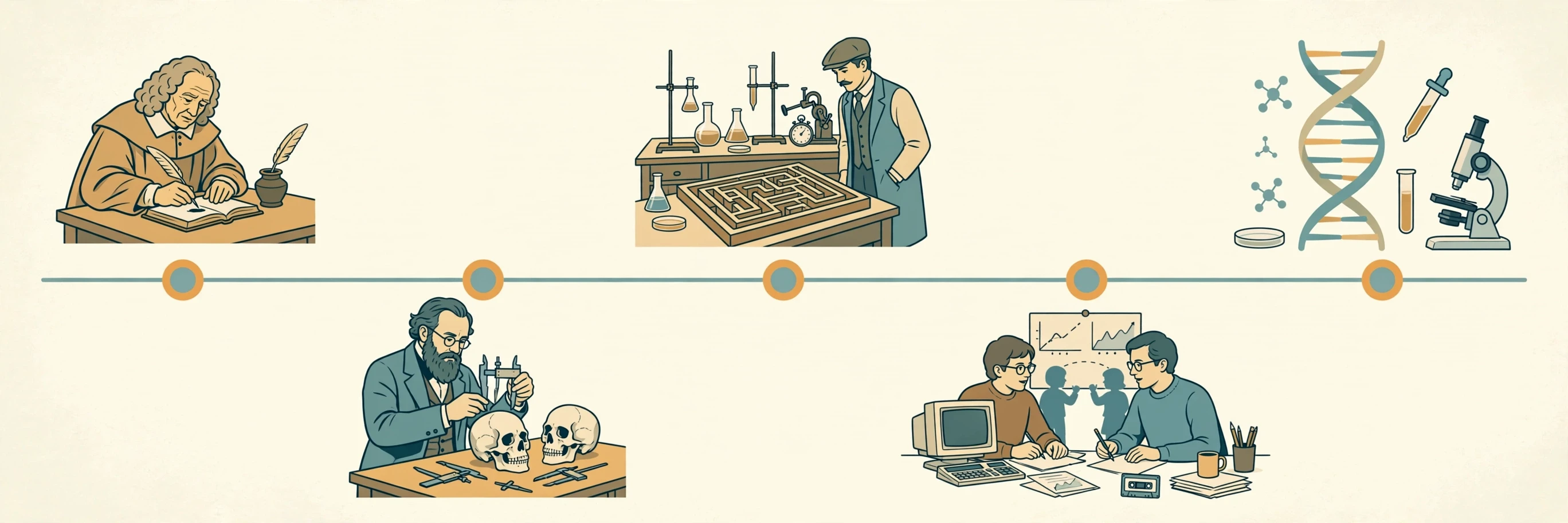
2.1 Locke and the blank slate
The modern nature vs nurture debate begins, in a sense, with the English philosopher John Locke. In 1689, Locke argued that the human mind at birth is a tabula rasa — a blank slate — and that everything we know and become is written on it by experience. It was a powerful idea, and a hopeful one. If the mind starts blank, then education and good upbringing can shape anyone into anything. Locke's slate gave the nurture side its founding image, and it still echoes in every argument that children are shaped mainly by how they are raised.
Locke was wrong in the strong form of his claim — babies are not blank slates; they arrive with reflexes, temperaments, and predispositions — but he was right about something important. Experience writes a great deal on the slate. The argument since Locke has been about how much was already written there before experience began.
2.2 Galton coins the phrase — and goes too far
The phrase "nature and nurture" itself comes from Francis Galton, Charles Darwin's cousin, who popularised it in his 1874 book English Men of Science: Their Nature and Nurture. Galton was fascinated by the way talent seemed to run in families, and he became the founder of the scientific study of inherited ability. He also became one of the founders of eugenics — the idea that society should encourage "good" stock to breed and discourage "bad" stock. That idea led, in the twentieth century, to forced sterilisations and to the racial pseudoscience of the Nazis. It is the darkest chapter in the history of the nature vs nurture debate, and it is worth remembering whenever someone claims that genes determine human worth. Galton asked a genuine scientific question and then drew a moral conclusion the science never supported.
2.3 Watson and the behaviourist swing
In the early twentieth century, the pendulum swung hard toward nurture. The American psychologist John B. Watson, the founder of behaviourism, made one of the most famous claims in psychology's history: give him a dozen healthy infants and he could train any one of them to become a doctor, lawyer, artist, or thief, regardless of their talents and tendencies. Watson believed that conditioning — reward and punishment, repeated over time — could build any person from any raw material.
Watson was wrong too, and in the opposite direction. You cannot condition a child into any shape you like, any more than you can train a fish to climb a tree. But Watson's challenge forced the nature side to prove its case with evidence rather than assertion, and that demand for evidence is what eventually produced the twin and adoption studies that transformed the nature vs nurture debate.
2.4 The mid-century stalemate — and the evidence that broke it
For much of the twentieth century, the nature vs nurture debate was a stalemate of competing certainties. Psychoanalysts blamed mothers for nearly everything. Behaviourists blamed conditioning. Geneticists pointed at family resemblance and were accused of fatalism. Each side had stories; none had a method that could separate the two influences cleanly in humans. You cannot run controlled breeding experiments on people, and families share both genes and environments at the same time, which makes it hard to tell which one is doing the work.
The breakthrough came from a natural experiment that already existed: twins and adoptions. If identical twins share all their genes and fraternal twins share only about half, then comparing the two kinds of twins can reveal how much genes contribute. If children adopted at birth resemble their biological parents more than their adoptive parents, genes are pulling the strings; if they resemble their adoptive parents, the home is. These designs did not settle the nature vs nurture debate overnight, but they turned it from a philosophical argument into a measurable question — and the measurements surprised almost everyone.
"Give me a dozen healthy infants, well-formed, and my own specified world to bring them up in and I'll guarantee to take any one at random and train him to become any type of specialist I might select — doctor, lawyer, artist, merchant-chief and, yes, even beggar-man and thief." — John B. Watson, 1930
Watson's claim sounds absurd now, and it should. But notice what it reveals: in 1930, a serious scientist could still believe that nature contributed almost nothing. The nature vs nurture debate has travelled a very long way since then — mostly in the direction of showing that both sides were underestimating the other.
3. How Scientists Actually Measure Nature and Nurture
3.1 The twin method
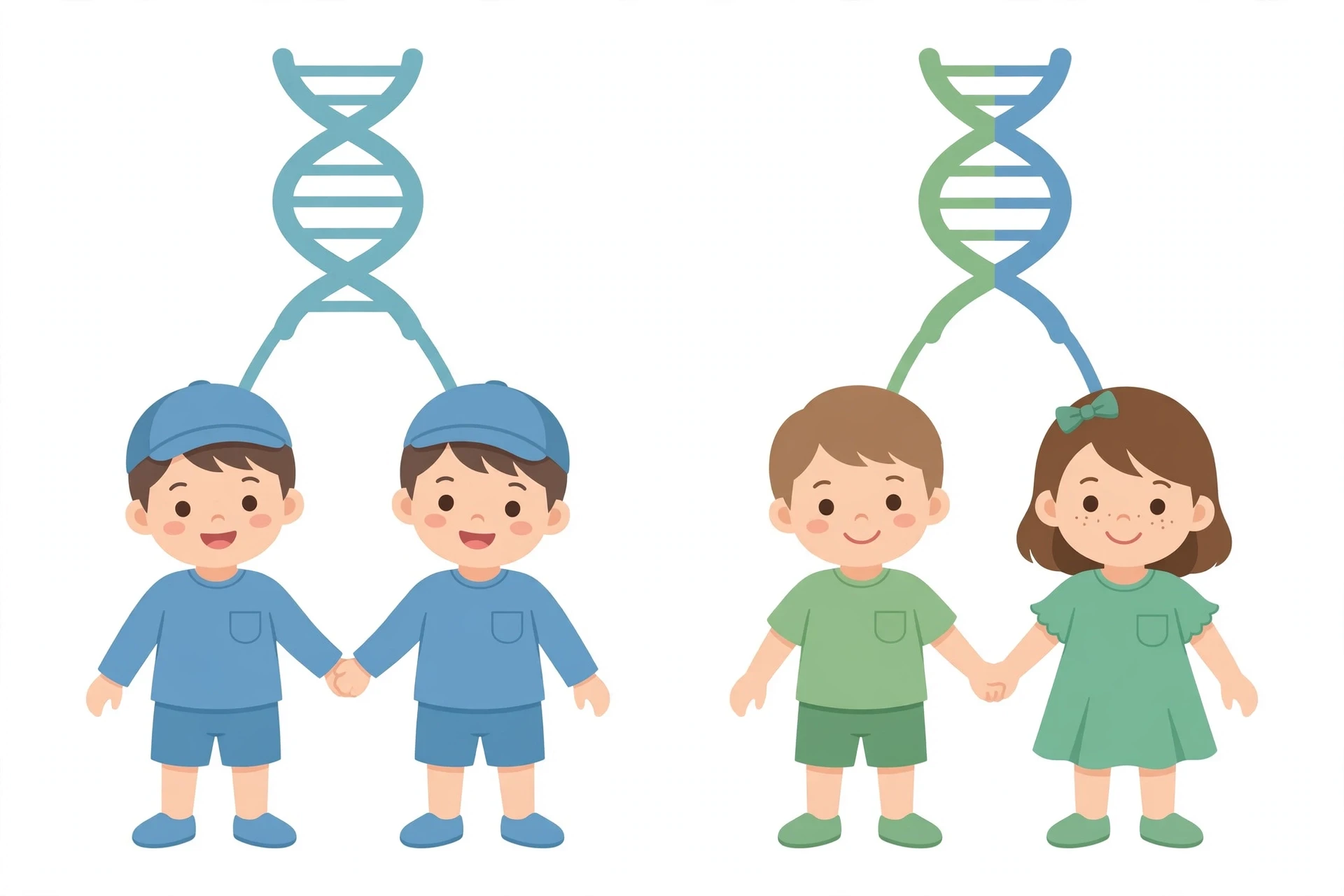
The twin study is the workhorse of the nature vs nurture debate, and its logic is elegant. Identical, or monozygotic, twins come from a single fertilised egg and share essentially 100% of their DNA. Fraternal, or dizygotic, twins come from two separate eggs and share about 50% of their DNA — no more than ordinary siblings. Both kinds of twins usually grow up in the same home, at the same time, with the same parents. So if identical twins are more similar to each other on some trait than fraternal twins are, that extra similarity points to genes.
Researchers turn the comparison into a number: roughly double the difference in similarity between identical and fraternal twins, and you get an estimate of heritability. The method has limits — identical twins may also be treated more alike than fraternal twins, and they share a womb — but it has been repeated in hundreds of studies, in many countries, with consistent results. When the same pattern shows up again and again, it stops being a quirk of one study and starts being a fact about human beings.
3.2 Adoption studies: separating genes from the home
Adoption studies attack the same problem from the other side. A child adopted at birth gets genes from one set of parents and a home from another. If the child grows up resembling the biological parents on some trait, genes are at work. If the child resembles the adoptive parents, the home is at work. Adoption studies are rarer than twin studies, because adoptions are less common and adoptive families are not a random sample of all families — but where they exist, they agree with the twin studies far more often than they disagree.
I remember a friend telling me about her adopted daughter, who had never met her biological mother and yet laughed the same way, tilted her head the same way, and loved the same kind of music. My friend found it moving and a little unnerving. The science behind that feeling is real: adopted children often resemble their biological parents on temperament and interests, even when they have never met them. At the same time, adopted children also resemble their adoptive families on language, values, and beliefs — the things a home actually teaches. Both resemblances are genuine. That is the nature vs nurture debate in miniature: two kinds of similarity, in the same child, at the same time.
3.3 Family studies and the modern molecular turn
Family studies compare relatives of different degrees — parents and children share about 50% of their genes, siblings share about 50%, cousins share about 12.5% — and look at how similarity fades as genetic relatedness fades. The newest tool is molecular genetics: reading people's DNA directly and adding up thousands of tiny genetic variants, each contributing a small nudge, into a single score. These "polygenic scores" can now predict part of the variation in traits like height and educational attainment — but only a part. For most psychological traits, the DNA variants found so far explain far less than the twin studies suggest they should. That gap, sometimes called the "missing heritability" problem, is a reminder that the nature vs nurture debate still has open questions, and that genes work in complicated, interactive ways we are only beginning to map. The basics of how inheritance works are covered in Sciory's guide to genetics, and the molecule at the centre of it all in our article on DNA.
Method | How it separates nature and nurture | Main strength | Main weakness |
|---|---|---|---|
Twin studies | Compare identical twins (100% shared DNA) with fraternal twins (~50%) raised together | Large samples; repeated in many countries | Identical twins may be treated more alike; shared womb |
Twins reared apart | Identical twins separated at birth and raised in different homes | Separates genes from shared home almost completely | Rare; adoptive homes are not random |
Adoption studies | Compare adopted children with biological vs adoptive parents | Genes and home come from different people | Adoptive families are a selected group |
Family studies | Track how similarity fades as genetic relatedness falls | Uses ordinary families; large samples | Relatives share environments as well as genes |
Molecular genetics | Reads DNA directly; adds up thousands of small variants | Points to specific biology, not just statistics | Explains only part of twin-study heritability so far |
Table 1: Five ways scientists separate nature from nurture. No single method is perfect. The strength of the field is that different methods, with different weaknesses, keep giving the same broad answer.
3.4 What the methods agree on
Here is the finding that ended the old version of the nature vs nurture debate. Across hundreds of studies, using all five methods, the same pattern appears: almost every human trait — personality, intelligence, mental health, interests, even political attitudes and television habits — shows some genetic influence and some environmental influence. Nothing psychological comes back at zero heritability. Nothing comes back at 100%. The behaviour geneticist Eric Turkheimer summed this up in his three laws of behaviour genetics: all human behavioural traits are heritable; the effect of being raised in the same family is smaller than the effect of genes; and a substantial portion of the variation is accounted for by neither genes nor shared family life. Those three sentences, taken together, are the modern consensus of the nature vs nurture debate in miniature.
4. The Minnesota Twins and What They Really Found
4.1 Twins reared apart: the strongest test
The most dramatic evidence in the nature vs nurture debate comes from the rarest cases: identical twins separated at birth and raised in different families. If two people share all their genes but none of their upbringing, then whatever they still have in common must come from nature — or from coincidence. The Minnesota Study of Twins Reared Apart, led by Thomas Bouchard from 1979 onwards, tracked more than a hundred pairs of such twins, each given about fifty hours of testing. Its conclusion startled even the researchers: on many measures of personality and temperament, identical twins raised apart were about as similar as identical twins raised together.
The Jim twins were the study's most famous pair, but they were not the only striking case. Other reared-apart twins showed similar tastes in food, similar fears, similar habits of speech. One pair both flushed the toilet before and after using it. Another pair both laughed at the same jokes and finished each other's sentences. The stories are irresistible — and that is exactly why they need careful handling. Human beings are pattern-seeking animals. When two strangers share a dozen coincidences, we remember the matches and forget the far larger number of things that did not match. The researchers knew this, which is why they relied on standardised tests, not anecdotes. And the tests told the same story as the anecdotes, only more soberly: substantial genetic influence, substantial environmental influence, and no trait decided by either alone.
4.2 What the numbers actually say
When twin and adoption studies are pooled, the headline figures for the nature vs nurture debate look roughly like this. For the broad personality traits — openness, conscientiousness, extraversion, agreeableness, and neuroticism — genetic differences account for around 40–50% of the variation between people, with the remaining 50–60% coming from the environment. For intelligence, measured in adulthood, heritability estimates are higher, often around 50–80% in affluent populations. For height, they are higher still, around 80%. For mental health conditions such as schizophrenia and bipolar disorder, heritability is substantial but the environment still matters a great deal — identical twins of a person with schizophrenia share the diagnosis in roughly half of cases, not all of them.
Notice what these numbers do not say. They do not say that 40% of your personality came from your genes and 60% from your life. They say something about differences between people in a particular population at a particular time. That distinction is the single most important idea in the nature vs nurture debate, and it deserves its own section.
4.3 The Jim twins, revisited
So what should we make of the two Jims? The honest reading is that their story is real evidence, not proof. It is evidence that genes influence temperament, interests, and habits far more than the blank-slate view allowed. It is also evidence that coincidence and shared culture do a lot of quiet work in making two lives look alike. Both Jims grew up in the same country, in the same decade, in similar small-town American families. The name Linda was one of the most popular girls' names of their generation. Florida was the default holiday destination. The matching details are less like a genetic fingerprint and more like two people ordering from the same menu and happening to pick the same dishes. The nature vs nurture debate is full of stories like this: true, vivid, and easy to overread. The numbers keep us honest.
5. Heritability: The Most Misunderstood Number in Psychology
5.1 What heritability actually means
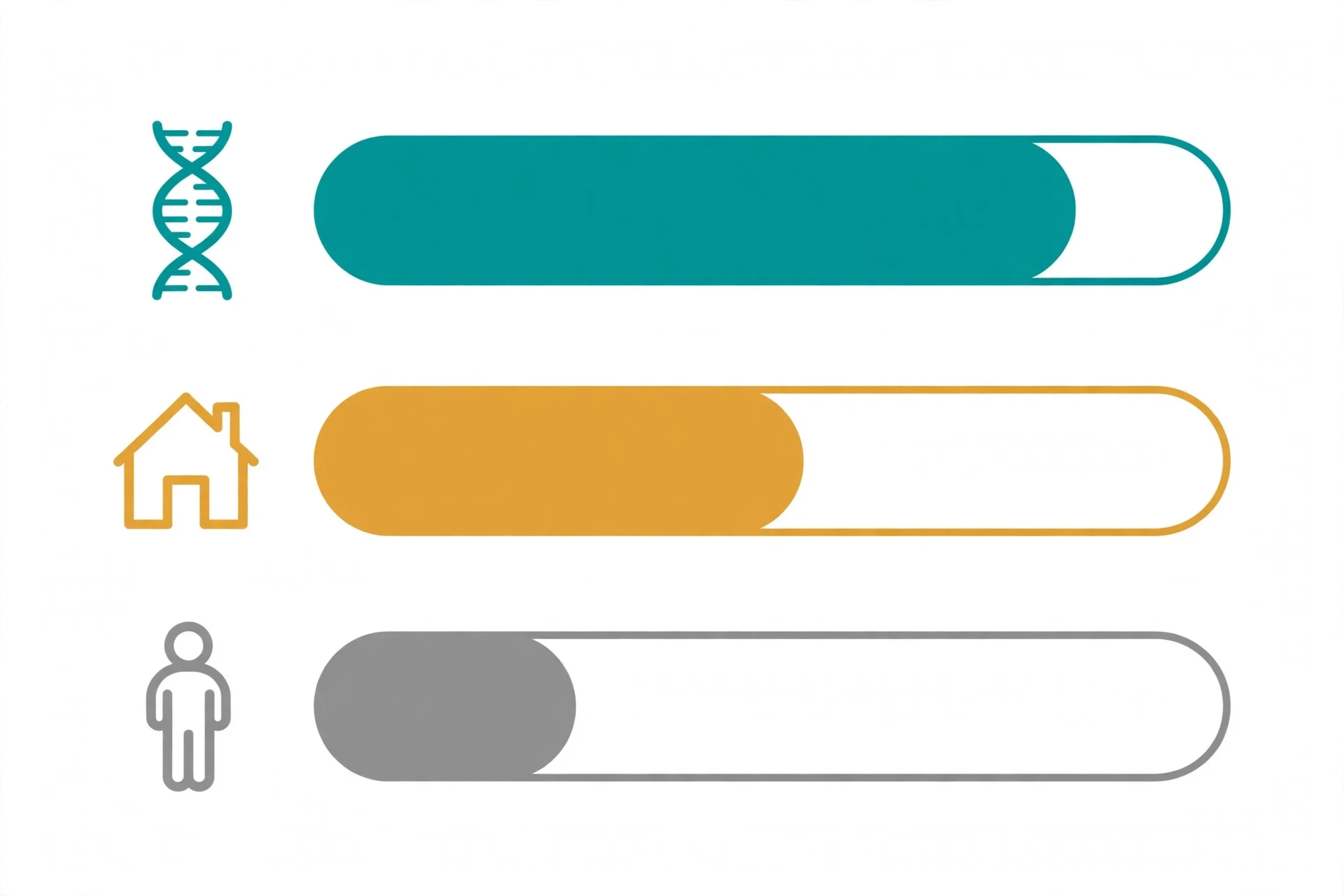
Heritability is the most quoted and most misunderstood number in the nature vs nurture debate. Formally, it is the proportion of variation in a trait, within a particular population at a particular time, that is associated with genetic variation in that population. A heritability of 50% for extraversion does not mean that half of any one person's extraversion is genetic. It means that, in the population studied, about half of the differences between people on extraversion line up with differences in their genes. The other half lines up with differences in their environments.
Three misunderstandings follow from forgetting that definition, and each one is worth naming plainly.
5.2 Misunderstanding one: "50% heritable means 50% of me"
This is the most common error in the nature vs nurture debate, and it is worth killing with a simple example. Imagine a field of corn in which every plant gets exactly the same water, soil, and sunlight. The plants will still differ in height, and nearly all of that difference will be genetic — heritability close to 100%. Now imagine the same corn planted across a drought-stricken field and a well-watered one. Now the differences in height will be mostly environmental, and heritability will fall sharply. The corn's genes did not change. The population and its environments did. Heritability is a fact about a population in a place and time, not a recipe for a person. To say "extraversion is 50% heritable" is not to say "50% of your extraversion came from your genes." That sentence has no meaning. What it means is that, among the people studied, genetic differences accounted for about half of the variation.
5.3 Misunderstanding two: "Heritable means unchangeable"
A trait can be highly heritable and still change a great deal. Height is about 80% heritable, yet average height has risen sharply in a century because of better nutrition. Short-sightedness is strongly heritable, yet its prevalence has soared in East Asia within a generation as schooling and indoor life changed. A high heritability tells you that genes matter for who differs from whom right now. It tells you nothing about whether the trait can change if the environment changes. This is why the nature vs nurture debate is not a contest between "fixed" and "flexible." Highly heritable traits can be highly changeable, because heritability describes variation in the current environment, not the limits of what a different environment could do.
5.4 Misunderstanding three: "Heritability is one gene doing one job"
There is no single gene for extraversion, for intelligence, or for shyness. Complex human traits are polygenic: they are shaped by thousands of genetic variants, each contributing a tiny nudge. That is why the molecular-genetics search for "the gene for" any personality trait has repeatedly come up short. The nature side of the nature vs nurture debate is not a handful of powerful genes. It is a vast, distributed network of small influences, each one interacting with the others and with the environment. If you are looking for a simple genetic explanation of who you are, you will not find one — and that is, in a way, good news. It means there is no single switch that decides you.
5.5 The shared-environment surprise
The twin studies delivered one more surprise that reshaped the nature vs nurture debate. When researchers split the environment into two parts — the shared environment (everything siblings growing up together have in common: the same parents, the same house, the same neighbourhood) and the non-shared environment (everything unique to each person: different friends, different teachers, different accidents, different interpretations of the same events) — they found that for adult personality, the shared environment contributes surprisingly little. Adopted siblings raised in the same home resemble each other little more than strangers do on personality measures.
This does not mean families do not matter. It means that what matters about family life is often not the things siblings share. Two children in the same house live in different worlds: the older child gets stricter parents, the younger gets more relaxed ones; one is praised for being quiet, the other teased for the same trait; the same divorce lands differently on a seven-year-old than on a fifteen-year-old. The non-shared environment — the part of life that is yours alone — turns out to carry most of the environmental influence on personality. I find this both humbling and freeing. It means parents shape their children less by the household they build in general than by the thousand small, specific interactions each child experiences. And it means that the parts of life that feel most personal — your friendships, your accidents, your choices — are not footnotes to the nature vs nurture debate. They are where much of the nurture actually happens.
6. When Genes and Environment Collide: Interaction and Correlation
6.1 Gene-environment interaction: the same genes, different outcomes
The simplest version of the nature vs nurture debate imagines genes and environment adding up like two piles of sand. The real picture is interactive: the effect of a gene can depend on the environment, and the effect of an environment can depend on the genes. Psychologists call this gene-environment interaction.
A classic example comes from a gene involved in breaking down serotonin, a brain chemical linked to mood. In one well-known study, people carrying a particular version of this gene were more likely to develop depression — but only if they had also experienced stressful life events. Carriers who lived calm, supported lives showed no extra risk at all. The gene was not a sentence; it was a sensitivity. It made bad environments worse and left good environments alone. Later research has complicated the details of that particular finding, and some attempts to replicate it have failed, but the general principle — that genetic risk often needs an environmental trigger — is now supported across many traits. It is formalised in the diathesis-stress model: a vulnerability (diathesis) plus stress produces a problem that neither alone would cause. The same logic applies to mental health more broadly, as explained in Sciory's article on anxiety and depression.
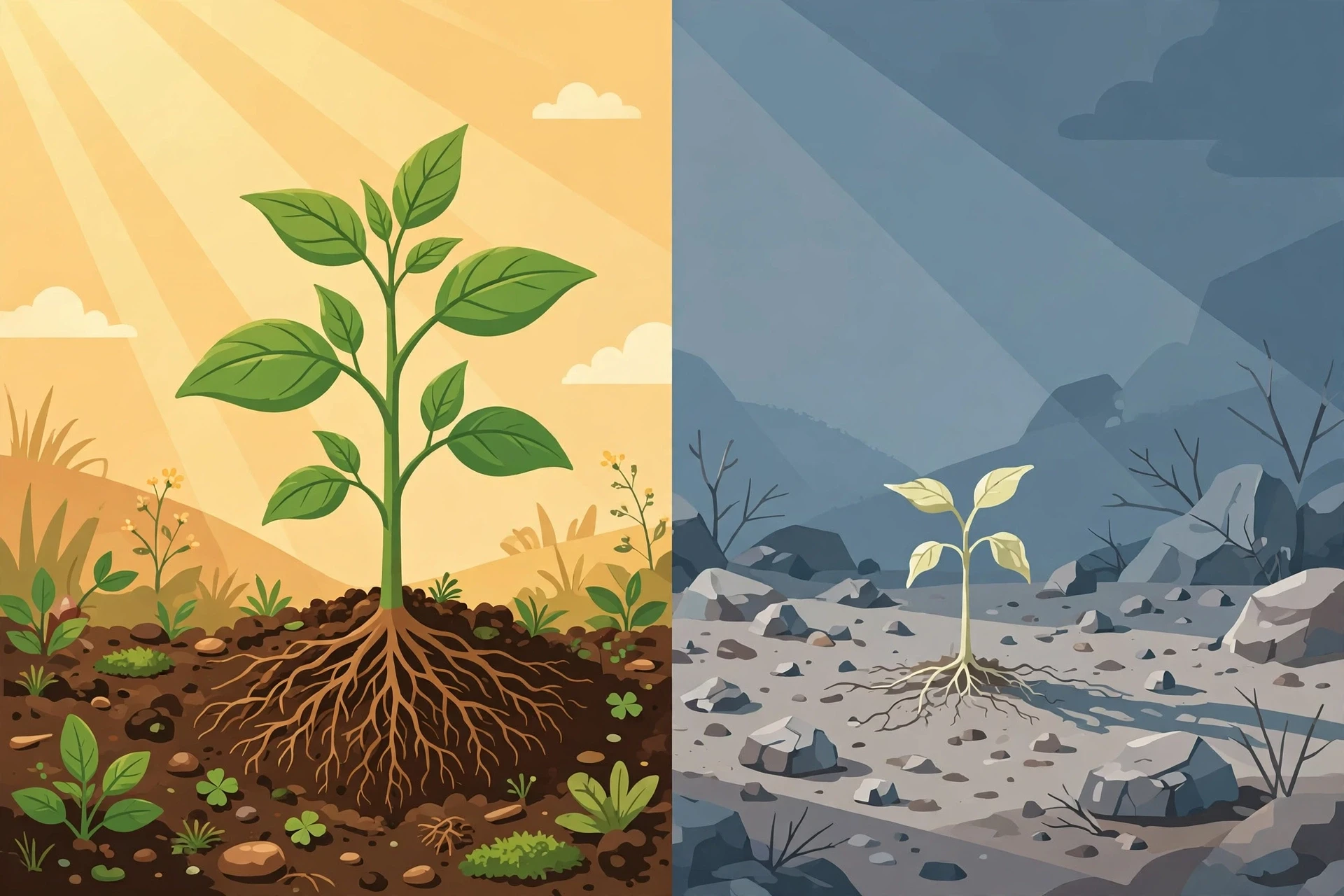
The seed-and-soil image captures this well. The same seed grows into a different plant in rich soil than in poor soil — and two different seeds in the same soil grow differently too. Neither the seed nor the soil alone determines the plant. The nature vs nurture debate, at its best, is the study of that interaction.
6.2 Orchids and dandelions
Some children seem resilient to almost anything, like dandelions that grow through cracks in the pavement. Others are exquisitely sensitive to their surroundings, like orchids that flourish in a greenhouse and wilt in a draught. Research on differential susceptibility suggests that the same genetic sensitivity that makes some children more vulnerable to bad environments also makes them more responsive to good ones. The "orchid" children who struggle most in harsh homes often benefit most from supportive ones — more than the dandelions do. This turns the old idea of vulnerability upside down. Sensitivity is not simply a weakness. It is a heightened responsiveness to the world, for better and for worse.
I think about this whenever I hear someone describe a child as "difficult." The word usually means the child reacts strongly to things other children shrug off. But a child who reacts strongly to a harsh word may also react strongly to a kind one, to a good teacher, to a book that opens a door. The nature vs nurture debate is not only about how much each side contributes. It is about how the two sides change each other's meaning.
6.3 Gene-environment correlation: genes shape the worlds we choose
There is a second twist, and it is even stranger. Genes do not only respond to environments — they help to create them. Psychologists call this gene-environment correlation, and it comes in three flavours.
Passive correlation happens in childhood: parents give their children both genes and a home, and the two tend to match. Musical parents pass on both musical talent and a house full of instruments. The child looks "nurtured" into music, but genes and environment arrived together.
Evocative correlation happens when a child's inherited tendencies draw particular reactions from the world. A naturally cheerful baby gets more smiles and cuddles; a fussy baby gets more frustrated responses. The environment is reacting to the child, and the child is reacting to the environment, in a loop.
Active correlation — sometimes called niche-picking — happens as we grow older and start choosing our own worlds. A child with a talent for numbers seeks out maths clubs; a sociable teenager joins teams and societies; a restless adult moves to a big city. We do not passively receive our environments. We select them, shape them, and are shaped by them in return. This is one reason the nature vs nurture debate resists a clean split: by adulthood, a large part of your "environment" is something your own tendencies helped you choose.
6.4 The Dickens-Flynn model: small pushes, large effects
The psychologist James Flynn and the economist William Dickens proposed a model that ties all of this together. Small genetic advantages, they argued, get amplified by the environments they lead us into. A child who is slightly better at reading enjoys reading more, reads more, gets better still, is put in advanced classes, and ends up far ahead — not because the initial advantage was large, but because it compounded. The same logic works in reverse for disadvantages. Tiny initial differences, multiplied through years of feedback loops, can grow into large gaps between people. This is why the nature vs nurture debate cannot be settled by asking which side is "bigger" at the starting line. The race is long, and the two sides keep handing the baton back and forth.
7. Epigenetics: How Experience Leaves Marks on Genes
7.1 The switches on the genome
If the nature vs nurture debate once seemed like a contest between a fixed code and a flexible world, epigenetics blurred the boundary. Your DNA sequence — the letters of your genome — stays the same in almost every cell of your body. But whether a particular gene is switched on or off, and how strongly it is read, can change. Small chemical tags, such as methyl groups attached to the DNA, and changes to the proteins that DNA wraps around, control which genes are accessible. This is epigenetics: changes in gene activity that do not change the DNA code itself.
Think of the genome as a piano. The keys are the genes — fixed in number and order. Epigenetics is the pianist: it decides which keys are played, how loudly, and in what order. The same piano can produce a lullaby or a storm. The same genome can produce different patterns of gene activity in a brain cell and a skin cell, in a child and an adult, in a person under stress and the same person at rest. The National Human Genome Research Institute's epigenomics fact sheet explains these mechanisms in detail, and it is the clearest official starting point for readers who want the biology.
7.2 The Dutch Hunger Winter
The most famous human evidence comes from a tragedy. In the winter of 1944–45, the Nazi occupation cut food supplies to the western Netherlands, and tens of thousands of people starved. Children who were in the womb during the famine grew up with higher rates of obesity, diabetes, and mental-health problems than their siblings born before or after it. Decades later, researchers found differences in the epigenetic marks on genes involved in growth and metabolism in those people — marks that were absent in their unexposed siblings.
The Dutch Hunger Winter is often told as proof that a mother's starvation rewrites her child's genes. The truth is more careful. The study shows that the prenatal environment can leave lasting marks on gene regulation, and that those marks are associated with later health. It does not show that the marks were the cause of the health problems, or that they were passed to the next generation in the way headlines sometimes claim. Most epigenetic marks are wiped clean when a new embryo forms. The famine story matters because it shows that nurture can reach into the machinery of nature — not because it proves that trauma is inherited like eye colour.
7.3 The NASA twins: one year in space
A cleaner modern example is NASA's Twins Study. In 2015, astronaut Scott Kelly spent a year aboard the International Space Station while his identical twin brother Mark stayed on Earth. Researchers compared the two men before, during, and after the flight. Scott's gene activity shifted during spaceflight — genes linked to immunity, DNA repair, and bone formation changed their expression — and most of those changes reversed after he returned to Earth. His telomeres, the protective caps on chromosomes, lengthened in space and then shortened again. His DNA sequence never changed. What changed was which parts of it were being used, and how.
The NASA twins are the nature vs nurture debate in a single pair of brothers: same genes, different environments — one on Earth, one in orbit — and measurably different biology as a result. They also show the limits of epigenetic change. Most of Scott's changes faded after his return. Epigenetics is not a permanent rewrite. It is a conversation between the genome and the world, and the conversation keeps going.
7.4 What epigenetics does not prove
Epigenetics is exciting, and excitement breeds overclaiming. Three cautions matter. First, most epigenetic changes are short-lived and confined to one person's lifetime; solid evidence for epigenetic inheritance across multiple generations in humans is thin. Second, an epigenetic mark associated with a trait is not proof that the mark caused the trait — it may be a consequence, not a cause. Third, epigenetics does not rescue the blank-slate view. The genome still sets the piano; experience plays it, but it cannot add keys that are not there. The honest summary of epigenetics for the nature vs nurture debate is this: nurture has a way of reaching inside nature and adjusting the volume. It does not rewrite the score.

8. The Flynn Effect: A Whole Population Got Smarter
8.1 The discovery that should not have been possible
In 1984, the political scientist James Flynn published a finding that puzzled everyone who read it. Comparing IQ test results across decades, he found that average scores had risen massively — by roughly three points per decade, or about thirteen points between 1932 and 1978 in the United States alone. The same pattern appeared in country after country, on test after test. Over a century, the gains added up to roughly a full standard deviation: the average person today would score well above average on a test normed for their grandparents' generation.
This is the Flynn effect, and it is one of the most important results in the nature vs nurture debate. Genes cannot change that fast. Human evolution works on timescales of thousands of years, not decades. A population-wide rise in test scores over a single lifetime can only be environmental. Whatever genes contribute to intelligence — and they contribute a great deal — the Flynn effect proves that the environment can move measured intelligence by an amount comparable to the entire genetic variation between people. The APA Dictionary of Psychology defines the effect plainly as the long-running rise in raw performance on general intelligence measures, and it is worth reading alongside the original research.
8.2 What actually rose — and what did not
The gains were not even across all kinds of thinking. The largest rises came on tests of abstract reasoning — spotting patterns, solving unfamiliar puzzles, thinking about hypothetical situations — rather than on tests of vocabulary and stored knowledge. That pattern is a clue. The twentieth century did not make people better at remembering facts. It made them better at a particular kind of thinking: the abstract, decontextualised reasoning that schools, office work, and complex visual environments demand. Flynn himself argued that the modern world increasingly asks people to think in terms of categories and hypotheticals — to treat the world as something to be analysed, not just experienced — and that practice shows up on tests.
The causes are still debated, and there is no single answer. Better nutrition in childhood, including iodine and iron in the diet, supported healthier brain development. More years of schooling, and schooling of a more abstract kind, trained the relevant skills. Smaller families meant more adult attention per child. Healthier childhoods, with fewer infections, freed up energy for brain development. And increasingly complex work and leisure — from video games to bureaucracy — gave people daily practice in abstract thought. A meta-analysis of 42 datasets covering more than 600,000 people found that each additional year of schooling was associated with roughly one to five extra IQ points. Education is not a footnote to the nature vs nurture debate. For intelligence, it is one of the main engines of change.
8.3 The plateau — and the reversal
The Flynn effect has a second act. In several developed countries, including Norway, Denmark, and the Netherlands, the gains slowed in the 1990s and then stopped — or even reversed slightly. Researchers are still arguing about why. Possibilities include changes in schooling, shifts in who has children, the saturation of the nutritional and educational gains that drove the rise, and the possibility that the tests themselves are measuring something narrower than "intelligence." The reversal does not undo the original finding. It strengthens the environmental story: if scores can rise with improving environments and fall when environments change, then the environment is doing real work in both directions.
The lesson for the nature vs nurture debate is sharp. Intelligence is highly heritable within a population at any given moment — and yet the average of the whole population moved by a full standard deviation in a century. Both facts are true at the same time. Heritability and changeability are different things, and the Flynn effect is the proof. The memory systems that schooling builds on are explained in Sciory's guide to how the human brain forms memories.

9. What the Debate Says About Personality, Intelligence, and Mental Health
9.1 Personality: half inherited, half lived
For personality, the nature vs nurture debate has reached a stable answer. Twin and adoption studies consistently put the heritability of the broad personality traits — openness, conscientiousness, extraversion, agreeableness, and neuroticism — at around 40–50%. The rest is environment, and overwhelmingly the non-shared kind: your particular friends, teachers, accidents, and interpretations. Personality is also remarkably stable across adulthood — people do change, but slowly, and usually in the direction of becoming slightly more conscientious and agreeable and slightly less neurotic with age. That stability is itself partly genetic: the same genes that shape your temperament at twenty are still shaping it at sixty. But stability is not destiny. Major life events, relationships, and deliberate effort can move personality, and therapy can move it more than most people expect. The American Psychological Association's personality topic page describes personality as a complex integration shaped by hereditary tendencies, early training, culture, and critical experiences — a definition that is itself a miniature summary of the nature vs nurture debate.
9.2 Intelligence: genes set the range, life fills it
Intelligence shows the same pattern with a twist: heritability rises with age. In childhood, genes account for a smaller share of the differences in IQ, and the shared family environment matters more. By adulthood, heritability is higher and the shared environment has largely faded. One explanation is niche-picking: as children grow older, they increasingly choose environments that match their tendencies, which amplifies genetic differences over time. The Flynn effect adds the other half of the story: the whole population's average can shift dramatically even while genes explain most of the differences within it. If you want a single sentence that captures the nature vs nurture debate on intelligence, it is this: genes explain much of why people differ from each other, and environments explain much of why whole generations differ from each other.
9.3 Mental health: vulnerability, not fate
Mental-health conditions show the diathesis-stress pattern most clearly. Schizophrenia, bipolar disorder, and major depression all have substantial heritability, yet none is determined by genes alone. An identical twin of a person with schizophrenia has roughly a 40–50% chance of developing the condition — far higher than the general population's 1%, and far short of 100%. The gap between 50% and 100% is the environment: prenatal factors, childhood adversity, substance use, stress, and chance. The same is true for anxiety and depression, where genetic vulnerability interacts with life events in ways that are still being mapped. This matters for how we talk about mental illness. "It runs in the family" is true and incomplete. A family history raises the odds; it does not write the outcome. And because the environment matters, prevention and treatment have real room to work — room that a purely genetic story would close off. Readers who want the fuller picture of anxiety and depression, and what helps, will find it in Sciory's anxiety and depression guide.
9.4 The body keeps the score too
The nature vs nurture debate is not only about the mind. Height, weight, sleep patterns, and disease risk all show the same blend. Sleep, for example, is influenced by genes that set your chronotype — whether you are naturally a morning person or a night owl — and by light, work schedules, and habits that push against it. The interplay is covered in Sciory's guide to the science of sleep and dreams. Even the brain's structure reflects the blend: the regions involved in emotion and memory are shaped by genes, and then reshaped by experience throughout life, as described in our human brain anatomy guide. Wherever you look in human biology, the same pattern appears. Nature and nurture are not two teams. They are two descriptions of one process.
10. Common Misconceptions About Nature vs Nurture
10.1 "It is 50% nature and 50% nurture"
This is the most repeated summary of the nature vs nurture debate, and it is wrong in an interesting way. There is no single percentage that applies to every trait, every person, or every population. Height is about 80% heritable. Personality traits are about 40–50% heritable. Some traits are barely heritable at all. And heritability itself changes when the environment changes. The "50/50" split is a slogan, not a measurement. The honest answer is always: it depends on the trait, the population, and the time.
10.2 "Genes are destiny"
If genes were destiny, identical twins would live identical lives. They do not. They differ in health, in careers, in relationships, in happiness. Even the Jim twins, the most famous case in the nature vs nurture debate, differed in weight, in some tastes, and in the details of their daily lives. Genes influence probabilities, not outcomes. A genetic tendency toward anxiety makes anxiety more likely, not inevitable. A genetic talent for music makes practice more rewarding, not unnecessary. Destiny is a story we tell about genes. The data tell a story about odds.
10.3 "If it is heritable, it cannot be changed"
Height is highly heritable and has risen by centimetres in a century. Short-sightedness is strongly heritable and has surged within a generation. Intelligence is highly heritable and rose by a full standard deviation in the twentieth century. Heritability describes variation in the current environment. Change the environment and the trait can change, however heritable it is. This is the single most practical misunderstanding in the nature vs nurture debate, because it is the one that makes people give up. A heritable problem is not an unfixable problem.
10.4 "Identical twins are identical people"
They share nearly all their DNA, but they do not share a womb in the same way — one twin may get more nutrients than the other. They do not share the same experiences, the same friends, or the same accidents. Their epigenetic marks diverge with age. By old age, identical twins can differ measurably in gene activity, in health, and in personality. The nature vs nurture debate starts with twins precisely because they are the closest thing to a controlled experiment nature gives us — and even they are not identical.
10.5 "Nurture means parenting"
Parenting matters, but nurture is far wider than parenting. It includes the prenatal environment, nutrition, schooling, peers, culture, chance events, and the environments you choose for yourself as an adult. The twin-study finding that the shared family environment contributes little to adult personality does not mean that "nurture does not matter." It means that the parts of nurture that matter most are often the parts that are not shared between siblings — the teacher who believed in one child, the friend group that shaped another, the accident that changed a third. Blaming or crediting parents for everything misses most of the nurture that actually happens.
10.6 "Science will one day give us a final score"
The nature vs nurture debate will not end with a number. It will end — if it ends — with a better understanding of mechanisms: which genes, in which environments, through which pathways, for which traits. That understanding is already arriving, and it points away from scores and toward stories: this gene matters in this setting; that environment matters for people with this sensitivity; this intervention works best for that group. The question "nature or nurture?" is slowly being replaced by better questions: how do they interact, for whom, and what can we do about it?
"The question is not how much of you is nature and how much is nurture. The question is how the two work together, in your life, to make you who you are — and what that means for what you can change."
11. So What Shapes Who We Are?
11.1 The answer, in one paragraph
You are the product of a genome you did not choose and a life you partly chose and partly received. Your genes set tendencies — toward sociability or caution, toward quick pattern-spotting or deep focus, toward resilience or sensitivity. Your environments — womb, family, school, friends, culture, chance — decided which of those tendencies got exercised, which got suppressed, and which got amplified through feedback loops that compounded over decades. Neither side alone explains you. The nature vs nurture debate, after four hundred years, has arrived at an answer that is less dramatic than either extreme and far more useful: both, always, interacting.
11.2 What this means for parents
If you are a parent, the science is both reassuring and demanding. It is reassuring because there is no single mistake that decides your child's life. Children are resilient, and the shared home matters less for adult personality than the parenting books imply. It is demanding because the small, specific interactions matter more than the general atmosphere: the repair after a fight, the attention paid to this child on this day, the book left where a curious child can find it. You cannot programme a child. You can give them a world worth responding to — and respond well when they do.
I watched this once with a neighbour's child, a boy who was, by every measure, "difficult": loud, restless, quick to tears. His parents did not try to remake him. They found him a football team, a teacher who liked energetic children, and a corner of the garden that was his to dig in. The boy did not become a different child. He became a version of himself that worked. That is what good nurture looks like: not overwriting nature, but giving it somewhere good to go.
11.3 What this means for the rest of us
If you are not a parent, the nature vs nurture debate still has something practical to say. Your genes are not an excuse and not a verdict. If you are prone to anxiety, that tells you where to put your effort — sleep, exercise, therapy, the environments you choose — not that effort is pointless. If you are quick to anger, that tells you to build in pauses, not that you are doomed to be angry. And your environment is not fixed either. The people you spend time with, the books you read, the skills you practise, the places you live: these are choices, and choices are nurture you give yourself. The feedback loops that amplified small differences in childhood are still running. They run in adulthood too, and you can still steer them.
A few years ago, I started learning a language I had always assumed I was "bad at." I had told myself that story since school: languages were not my thing. The first months were slow and humiliating. Then something shifted — not my genes, but my habits. An hour a day, a tutor who was patient, a podcast I actually enjoyed. A year later I was holding conversations. Nothing about my DNA had changed. What changed was the environment I had built around a tendency I had misread as a limit. That is the nature vs nurture debate in one small life: the tendency was real, and so was the change.
11.4 The twins, the Jims, and the rest of us
The two Jims never set out to teach the world anything. They were two men who found each other late in life and discovered, to their delight and bewilderment, how much they shared. Their story endures because it captures the wonder at the heart of the nature vs nurture debate: that two people who never met could laugh the same way, love the same names, build the same bench around the same tree. The science says the wonder is real, and that the explanation is richer than the headline. Genes wrote a first draft. Life edited it — and is still editing it, in all of us, every day.

Frequently Asked Questions
What is the nature vs nurture debate?
The nature vs nurture debate is the question of how much of who we are comes from our genes (nature) and how much comes from our environment and experiences (nurture). Nature means inherited DNA and the biology it builds; nurture means everything from the womb and family to schooling, friends, culture, and chance events. Modern science has moved past the either-or framing: almost every human trait is influenced by both, and the two interact constantly.
Is personality nature or nurture?
Personality is both. Twin and adoption studies consistently find that genetic differences account for roughly 40–50% of the variation in broad personality traits such as extraversion and neuroticism, with the rest coming from the environment — mostly the non-shared environment, meaning experiences unique to each person. Personality is also fairly stable in adulthood, but it can and does change, especially after major life events, relationships, and therapy.
What does heritability mean?
Heritability is the proportion of variation in a trait, within a particular population at a particular time, that is associated with genetic variation. A heritability of 50% does not mean half of any one person's trait is genetic — it is a fact about differences between people in a group, not a recipe for an individual. Heritability can change when environments change, and a highly heritable trait can still be changed by changing the environment.
What is the Flynn effect?
The Flynn effect is the sustained rise in average IQ test scores across generations during most of the twentieth century — roughly three points per decade, adding up to about a full standard deviation over a century. Because genes cannot change that fast, the rise must be environmental, driven by better nutrition, more schooling, smaller families, and more cognitively demanding lives. In several developed countries the gains have now levelled off or slightly reversed.
What is epigenetics?
Epigenetics is the study of changes in gene activity that do not change the DNA sequence itself — chemical tags that switch genes up or down, like a pianist deciding which keys to play. Experience, diet, stress, and the prenatal environment can leave epigenetic marks, as shown by the Dutch Hunger Winter and NASA's Twins Study. Most marks are short-lived and are wiped clean in the next generation, so epigenetics is not proof that trauma is inherited like eye colour.
Can you change traits that are inherited?
Often, yes — at least in part. Heritability describes variation in the current environment, not the limits of change. Height is highly heritable yet rose sharply with better nutrition; intelligence is highly heritable yet rose by a full standard deviation during the Flynn effect. Genes influence probabilities and tendencies, not fixed outcomes, and environments — including the ones you choose for yourself — can move those probabilities a long way.
Sources
American Psychological Association — Personality. https://www.apa.org/topics/personality
American Psychological Association — Flynn Effect (APA Dictionary of Psychology). https://dictionary.apa.org/flynn-effect
National Human Genome Research Institute — Epigenomics Fact Sheet. https://www.genome.gov/about-genomics/fact-sheets/Epigenomics-Fact-Sheet
American Psychological Association — Attachment: what it is and why it matters. https://www.apa.org/topics/parenting/attachment
Concordia University — The Nature-Nurture Debate (Introduction to Psychology, open textbook). https://opentextbooks.concordia.ca/psyc205/chapter/the-nature-nurture-debate/
LabXchange (Harvard) — Nature vs. Nurture. https://www.labxchange.org/library/items/lb:LabXchange:396d5e5d:html:1