

Two flatmates get the same news on the same morning: their landlord is selling the flat, and they have eight weeks to move. One of them is already on the phone before breakfast, sketching a spreadsheet of neighbourhoods, viewing times, and moving costs. The other sits with a cup of tea, staring out of the window, turning the news over in her mind — annoyed, a little anxious, and quietly curious about what a new street might feel like.
Same event. Same flat. Two completely different reactions — and both of them are honest. Neither person is faking it, and neither one is wrong. That gap, between the same situation and two different responses, is where personality lives.
The big five personality traits are psychology's best answer to a question humans have asked for as long as we have lived together: why do people, faced with the same world, behave so differently — and why do they keep behaving that way, year after year? The model gives us five broad dimensions, remembered by the word OCEAN: openness to experience, conscientiousness, extraversion, agreeableness, and neuroticism. Each one is a spectrum. Each one is a tendency, not a verdict. And together, they describe more of what makes us different from one another than any other model psychology has produced.
I first met the big five personality traits the way most students do — as a questionnaire handed out in a lecture hall, with statements like "I see myself as someone who is talkative" and a little row of boxes from "strongly disagree" to "strongly agree." I filled it in quickly, confident I knew myself. Then the results came back, and one score stopped me cold. I had rated myself as far more organised than the test suggested, and far less anxious than a close friend's ratings of me suggested. That small shock taught me the first real lesson of this model: personality is not how we see ourselves on a good day. It is the pattern other people can see in us, repeated across weeks, months, and years, whether we notice it or not.
This article walks through that model the way a scientist would: where it came from, what each trait really means, how much of it is inherited, what it can predict about work, health, and relationships — and, just as honestly, what it cannot explain. No type labels. No boxes. Just five dials, each turned to a different setting in each of us.
1. What Personality Actually Is
Before the five traits make sense, the word underneath them needs pinning down. Personality is not a mood, and it is not a single act. A shy person can give a brilliant speech. A usually calm person can lose their temper in traffic. One act tells you almost nothing. A pattern tells you a great deal.
The American Psychological Association defines personality as the enduring configuration of characteristics and behaviour that makes up a person's unique adjustment to life — including major traits, interests, drives, values, self-concept, abilities, and emotional patterns. That definition matters because of one word in it: enduring. Personality is about the tendencies that show up again and again, across different situations and across time. The American Psychological Association's personality topic page puts it plainly — and the brain structures that carry those patterns are mapped in our guide to human brain anatomy and functions: personality is shaped by many forces, including hereditary tendencies, physical maturation, early training, culture, and critical experiences and relationships.
Think of it like a climate rather than weather. Weather is what happens today — rain, sunshine, a sudden storm. Climate is the long-run pattern: this place tends to be wet in winter and dry in summer. A person having a bad day is weather. A person who, across ten years and a dozen stressful situations, usually worries first and relaxes later — that is climate. The Big Five is a map of that climate, drawn in five dimensions.
Psychologists draw three lines that help here:
Traits are relatively stable tendencies — for example, being generally organised, or generally anxious.
States are temporary conditions — feeling organised today because you slept well, or feeling anxious right now because an exam starts in an hour.
Behaviours are single acts — sending the email, skipping the party, snapping at a stranger.
The big five personality traits measure traits. They do not claim to predict any single behaviour with certainty. It claims something quieter and more useful: that if you know where someone sits on five spectrums, you can make better-than-chance predictions about how they will usually behave, what environments will suit them, and where they may struggle. That is a modest claim. It is also, as we will see, a claim that has survived decades of testing in a way few ideas in psychology have.
2. How Five Traits Were Found
The big five personality traits were not invented by one person sitting at a desk and deciding that five was a nice number. They were found — slowly, by several groups of researchers working independently, using different methods, and arriving at the same answer. That convergence is a large part of why psychologists trust the model.
The story starts with language. In the 1930s, psychologists Gordon Allport and Henry Odbert combed through an English dictionary and pulled out nearly 18,000 words that describe people: kind, cruel, curious, cautious, cheerful, gloomy, tidy, slapdash. Their hunch, called the lexical hypothesis, was simple and clever: if a difference between people matters in daily life, a language will probably have a word for it. Important differences get named; trivial ones do not.
Later researchers took those thousands of words and asked a statistical question: which of them tend to travel together? If people described as "talkative" are also often described as "sociable" and "assertive," those words may be pointing at one underlying dimension rather than three separate ones. Using a technique called factor analysis — a way of finding hidden clusters in large sets of ratings — researchers kept finding the same thing. However they sliced the data, five broad clusters emerged.
The path was not straight. Raymond Cattell, working in the mid-twentieth century, proposed sixteen factors. Ernest Tupes and Raymond Christal, analysing ratings of Air Force personnel in the 1960s, found five. Lewis Goldberg, at the Oregon Research Institute, spent decades refining the five and gave them their modern names. Then Paul Costa and Robert McCrae, working at the National Institutes of Health, built the measurement tool that carried the model into clinics, workplaces, and research labs around the world: the NEO Personality Inventory, first published in 1985, which measured neuroticism, extraversion, and openness, and was later expanded to cover all five traits.
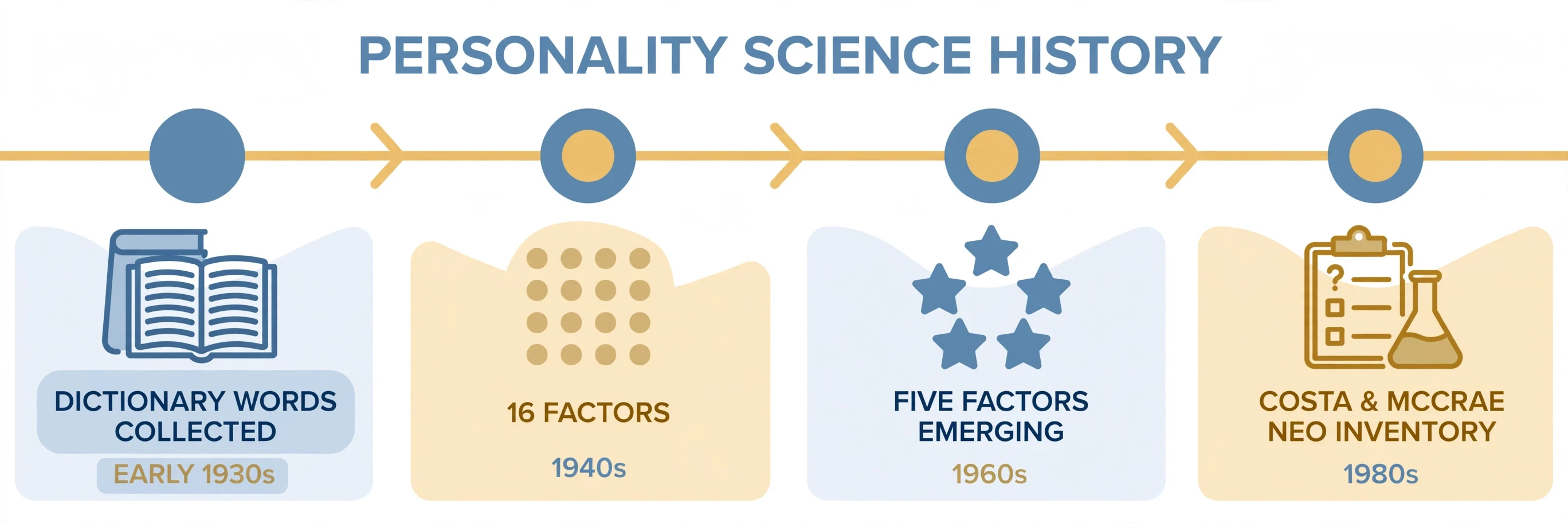
OpenStax's Psychology 2e textbook summarises the result in the way I would want a student to meet it: the Five Factor Model "is the most popular theory in personality psychology today and the most accurate approximation of the basic personality dimensions," and each person has each factor, "but they occur along a spectrum." That sentence — each person has each factor, along a spectrum — is the whole model in miniature. You can read the full treatment in OpenStax Psychology 2e, section 11.7 on trait theorists.
3. OCEAN at a Glance: Five Spectrums, Not Five Boxes
The APA Dictionary of Psychology entry for the Big Five defines the model in the same terms. Here is the idea that most online quizzes get wrong, so it deserves saying twice: the big five personality traits are dimensions, not types. Nobody is an "Openness person" or a "Neuroticism person." Every one of us has a position on all five spectrums at once. You can be high in openness and low in conscientiousness. You can be high in agreeableness and high in neuroticism. The combinations are what make individual people, not the single scores.
Picture five sliders on a mixing desk, the kind a sound engineer uses. Each slider runs from low to high. Most people sit somewhere in the middle of most sliders, with one or two pushed further toward an end. The music that comes out — the person you meet — is the combination of all five settings, plus the room they are playing in.
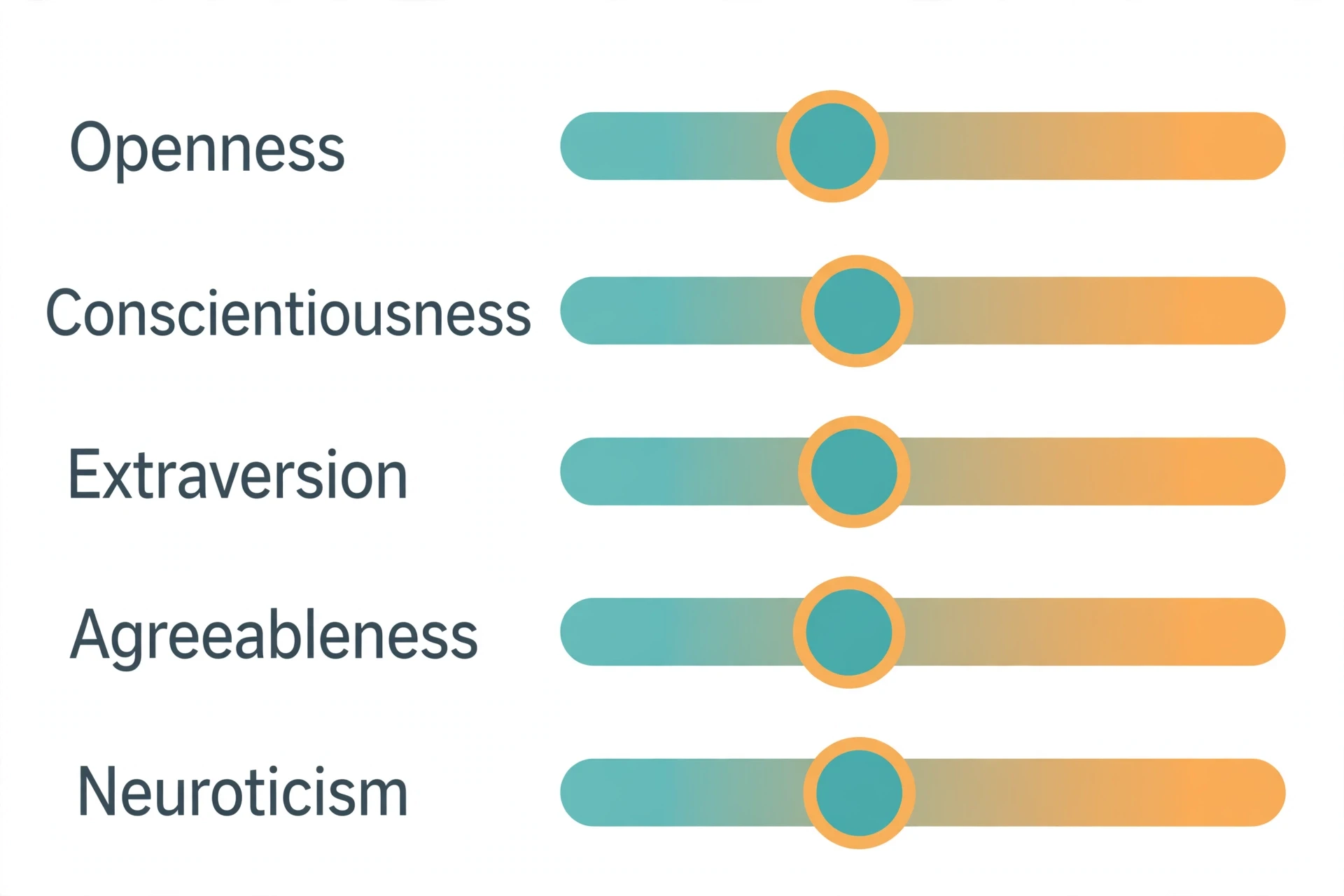
Trait | High scorers tend to be… | Low scorers tend to be… | Everyday example |
|---|---|---|---|
Openness to Experience | Curious, imaginative, open to new ideas and art | Practical, conventional, preferring the familiar | Tries the strange restaurant; reads widely |
Conscientiousness | Organised, disciplined, goal-directed | Spontaneous, flexible, relaxed about plans | Meets deadlines early; keeps a tidy desk |
Extraversion | Sociable, energetic, assertive, excitement-seeking | Reserved, quiet, energised by solitude | Enjoys parties; speaks up in meetings |
Agreeableness | Kind, cooperative, trusting, compassionate | Direct, sceptical, competitive, blunt | Helps a neighbour; avoids conflict |
Neuroticism | Emotionally reactive, prone to worry and low mood | Calm, steady, resilient under stress | Worries before exams; recovers slowly from setbacks |
Third — and this trips up even careful readers — the traits are largely independent of one another. Knowing someone is highly extraverted tells you almost nothing about whether they are conscientious. The sliders move on their own. That independence is one reason five numbers can describe so much: each one adds information the others do not carry.
With that map in hand, we can walk through each trait in turn, with the everyday detail that makes each one recognisable in real life.
4. Openness to Experience: Curiosity About the World
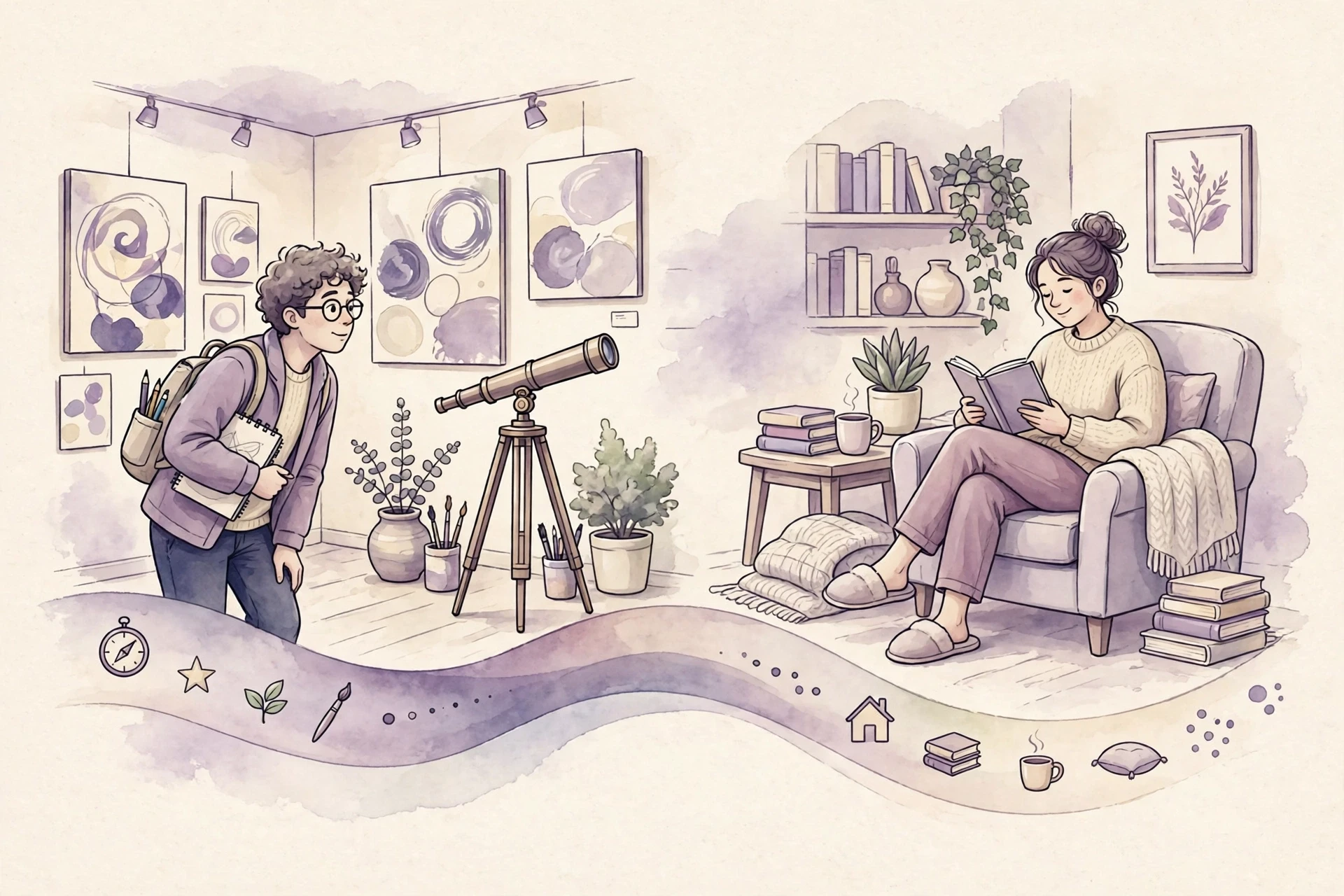
Openness is the trait most people misunderstand first, because its name sounds like a moral judgement. It is not about being "open-minded" in the sense of being a good person. It is about how much a person is drawn to novelty — new ideas, new sensations, new art, new ways of doing things.
People high in openness tend to have vivid imaginations, wide interests, and a taste for the unusual. They are the ones who will try the restaurant with no sign outside, read a novel set in a country they have never visited, or spend an evening happily arguing about a strange idea just because it is strange. People low in openness tend to prefer the familiar: known foods, known routines, known answers. They are often practical, grounded, and comfortable with tradition — and they can find the high-openness person's love of novelty exhausting, even a little frivolous.
4.1 What high and low openness look like day to day
High openness: enjoys abstract ideas, art, music, and unusual experiences; curious about other cultures and viewpoints; comfortable with ambiguity and open-ended questions.
Low openness: prefers concrete facts and practical solutions; loyal to familiar routines and tastes; values tradition and proven methods; may find abstract theory tiring.
In the middle (where most people are): curious about some things, settled about others — adventurous with food, cautious with finances, for example.
4.2 Openness, learning, and the brain
Openness is the big five personality trait most closely tied to learning and to how we form and keep memories. Curious people seek out new information, and new information is the raw material memory works with. That link is worth holding onto: if you want to understand how a curious mind builds knowledge over a lifetime, our guide to how the human brain forms memories traces the encoding and consolidation steps that turn a new experience into something you can recall years later.
5. Conscientiousness: The Organiser
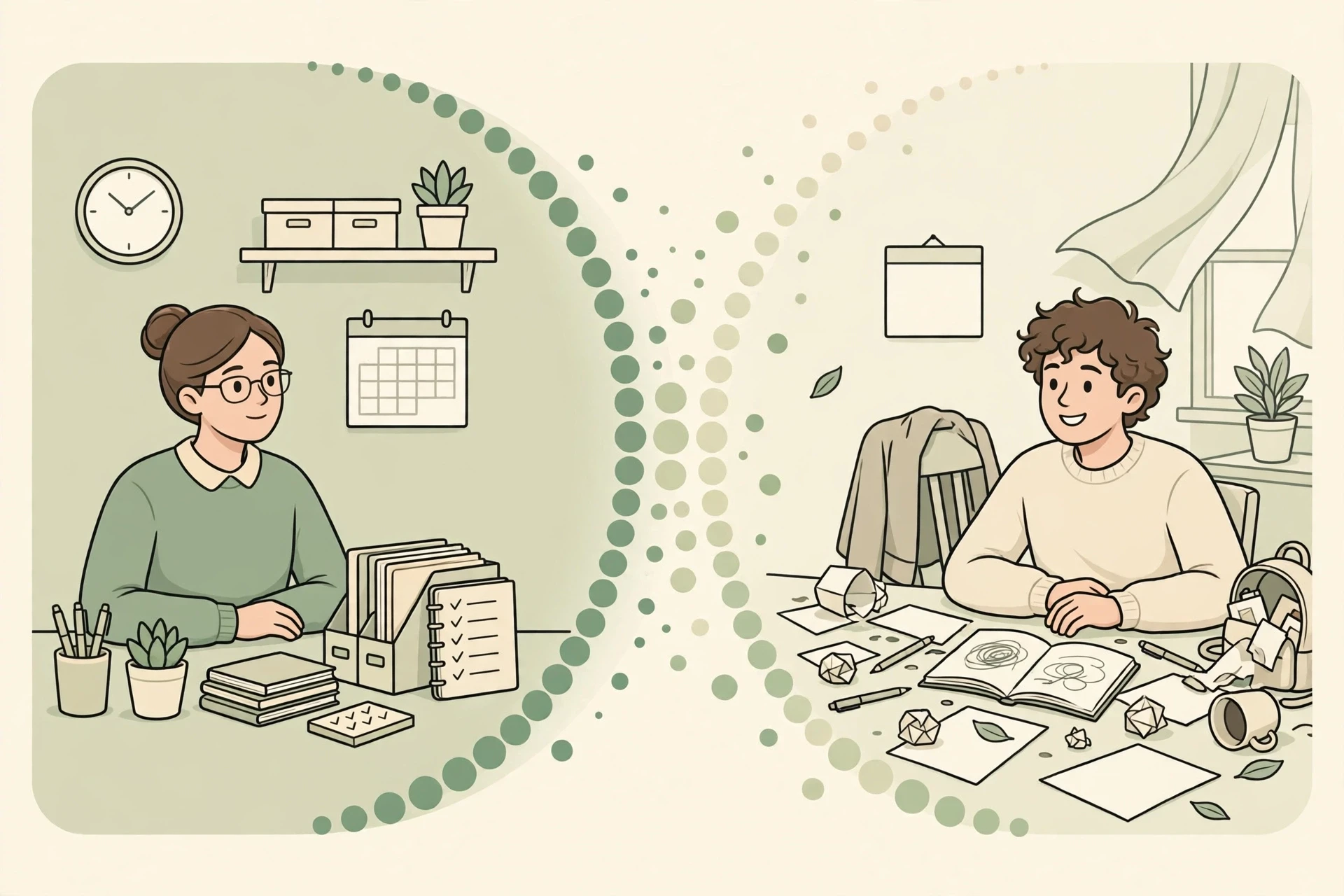
If openness is appetite for the new, conscientiousness is the capacity to follow through. It is the trait of the person who makes the plan, keeps the plan, and finishes what they started. High scorers are organised, disciplined, dutiful, and driven by goals. Low scorers are spontaneous, flexible, and relaxed about schedules — sometimes gloriously so, sometimes at a cost.
Conscientiousness is the big five personality trait with the strongest record of predicting real-world outcomes, and we will return to that record in Section 10. For now, notice how ordinary its ingredients are: showing up on time, keeping promises, thinking before acting, tidying up after yourself. None of these is glamorous. Together, they compound across a lifetime the way interest compounds in a bank account — small daily deposits, large long-term difference.
My own conscientiousness score surprised me in that lecture-hall questionnaire, and the surprise was instructive. I thought of myself as organised because my desk looked tidy and my calendar was full. The questionnaire asked different questions: do you finish tasks before deadlines, or at the last minute? Do you follow through on plans when nobody is checking? Do you keep working when a task gets boring? My honest answers were less flattering than my self-image. That gap — between the person we think we are and the pattern our behaviour actually shows — is exactly what a good personality measure is designed to catch. It caught me.
5.1 The six facets of conscientiousness
Costa and McCrae break conscientiousness into six facets, and each one is recognisable:
Competence: feeling capable and effective.
Order: liking things tidy and organised.
Dutifulness: taking obligations seriously.
Achievement striving: working hard toward goals.
Self-discipline: starting tasks and seeing them through, even when they are dull.
Deliberation: thinking carefully before acting.
A person can be high on some facets and low on others. Someone might be fiercely achievement-driven at work yet hopeless at keeping a tidy home. Another might be dutiful and orderly but not especially ambitious. The single score is a summary; the facets are the story underneath it.
5.2 The cost of too much of a good thing
High conscientiousness is usually an advantage, but it has a shadow. Turned up very high, it can become perfectionism: re-checking, over-planning, and an inability to delegate or to accept "good enough." I have watched a talented colleague spend three days perfecting a report that needed three hours, missing the meeting it was meant for. The trait that made her excellent also, in that moment, made her late. The same dial, the same setting — helpful in one context, costly in another.
6. Extraversion: One Trait Among Five
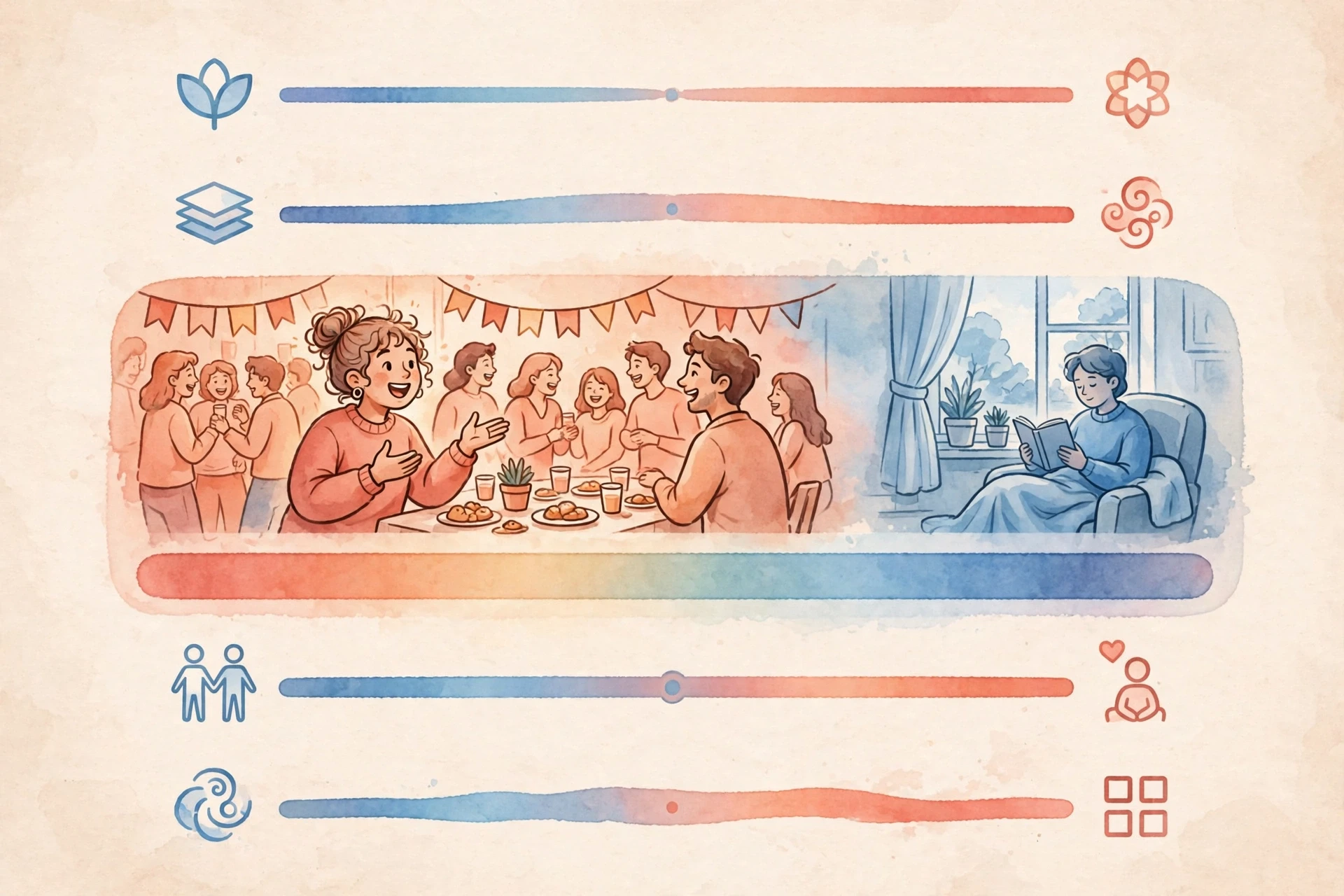
Extraversion is the trait everyone thinks they understand, and the one most often distorted by pop psychology. In the big five personality traits, extraversion is about reward sensitivity and social energy: how much a person seeks out company, stimulation, and excitement, and how energised they feel after getting them. High scorers are sociable, talkative, assertive, and drawn to lively environments. Low scorers are quieter, more reserved, and more easily overstimulated — they recharge alone, and they often prefer depth in a few relationships to breadth across many.
That is the whole of it, for this article — deliberately. Extraversion is one of five traits here, not the subject of the article. The deep dive into the introvert–extrovert dimension — its history in Jung, its biology, the myths that confuse introversion with shyness, and the reality of ambiversion — belongs to a companion article in this series, and it deserves its own space rather than swallowing this one. What matters here is extraversion's place in the five: it is a single dial, and it moves independently of the other four. A person can be highly extraverted and highly conscientious, or highly extraverted and deeply anxious, or introverted and warmly agreeable. The combinations are the point.
A useful everyday test: after a long, crowded social event, do you feel buzzed and ready for more, or pleasantly tired and ready for quiet? Neither answer is better. The first suggests higher extraversion; the second suggests lower. Both are normal, both are common, and both describe millions of healthy, successful people.
6.1 What extraversion is not
It is not friendliness. That is mostly agreeableness. A quiet person can be deeply warm; a loud person can be cold.
It is not confidence. Confident introverts are everywhere — they simply express confidence in smaller rooms.
It is not happiness. Extraverts report slightly higher average happiness in many studies, but the gap is small, and it says nothing about any one person's life.
It is not a skill. Social skills can be learned at any point on the spectrum. Extraversion is about preference and energy, not ability.
6.2 Extraversion at work and at home
7. Agreeableness: The Social Glue
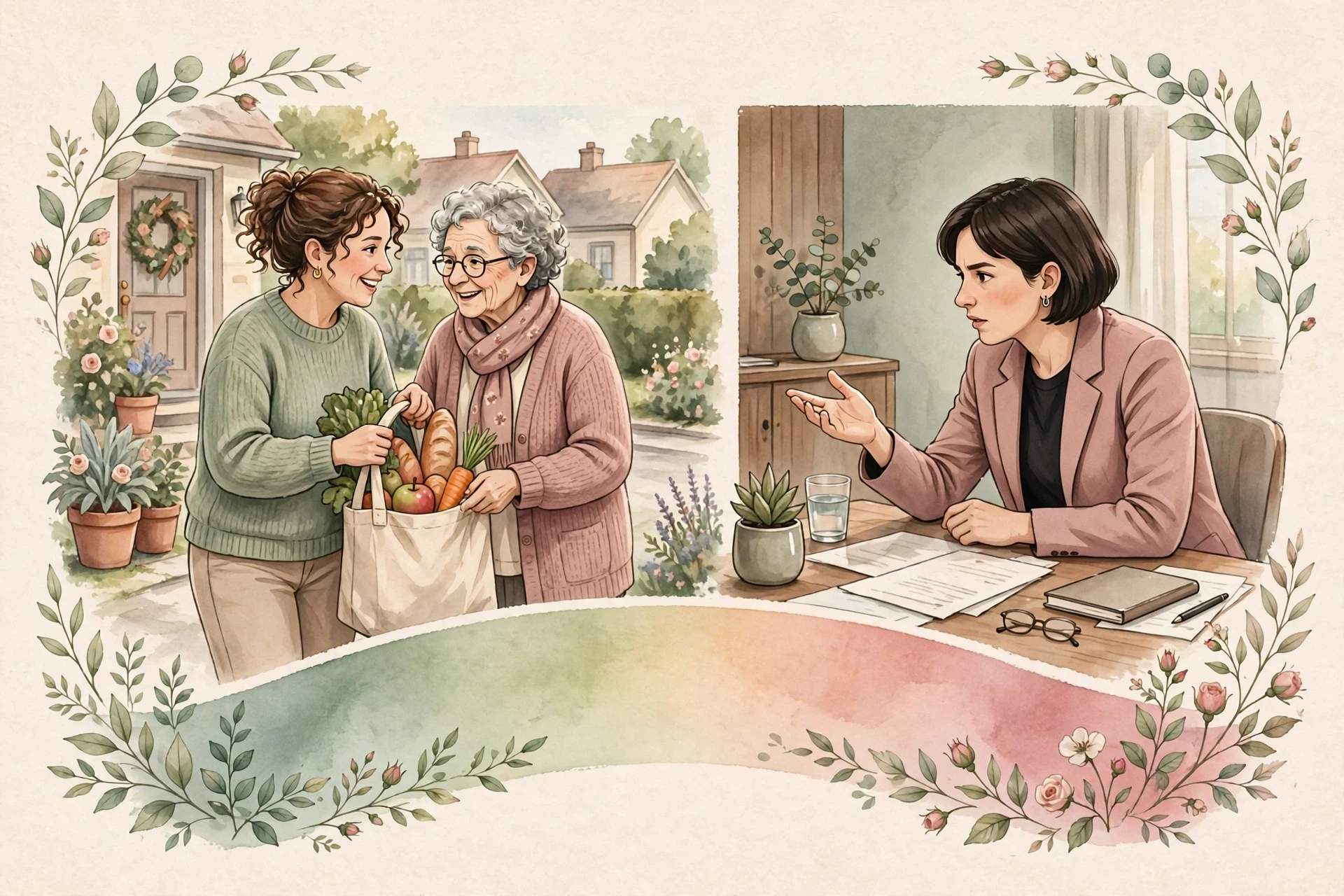
Agreeableness is the trait of getting along: kindness, cooperation, trust, and compassion on one end; scepticism, competitiveness, and bluntness on the other. High scorers are warm, generous, and quick to help. They smooth conflicts, forgive easily, and assume the best of people until proven otherwise. Low scorers are more guarded and direct. They ask hard questions, negotiate firmly, and are less troubled by disagreement.
If conscientiousness is the trait that predicts performance, agreeableness is the trait that predicts harmony. High-agreeableness people are the ones colleagues want on their team and neighbours want on their street. They remember birthdays, they mediate arguments, and they give the benefit of the doubt. In long-term studies, agreeableness predicts relationship satisfaction and stable friendships — not because agreeable people never argue, but because they repair arguments faster and hold fewer grudges.
But agreeableness, like every trait, is a trade-off. Very high agreeableness can make it hard to say no, to negotiate a fair salary, or to deliver unwelcome news. I once watched a kind, highly agreeable manager agree to every request from every department until her own team was drowning in other people's work. Her warmth was real, and so was the cost of it. The people who loved working for her also needed her to learn one hard sentence: "I can't do that this week."
7.1 Agreeableness, trust, and conflict
High agreeableness: trusts easily, cooperates readily, avoids conflict, forgives quickly, puts others' needs first.
Low agreeableness: questions motives, competes openly, tolerates conflict, holds people to account, puts their own goals first.
The middle: cooperative with people who have earned trust, firm with people who have not — the most common position, and often the most flexible one.
8. Neuroticism: The Alarm System
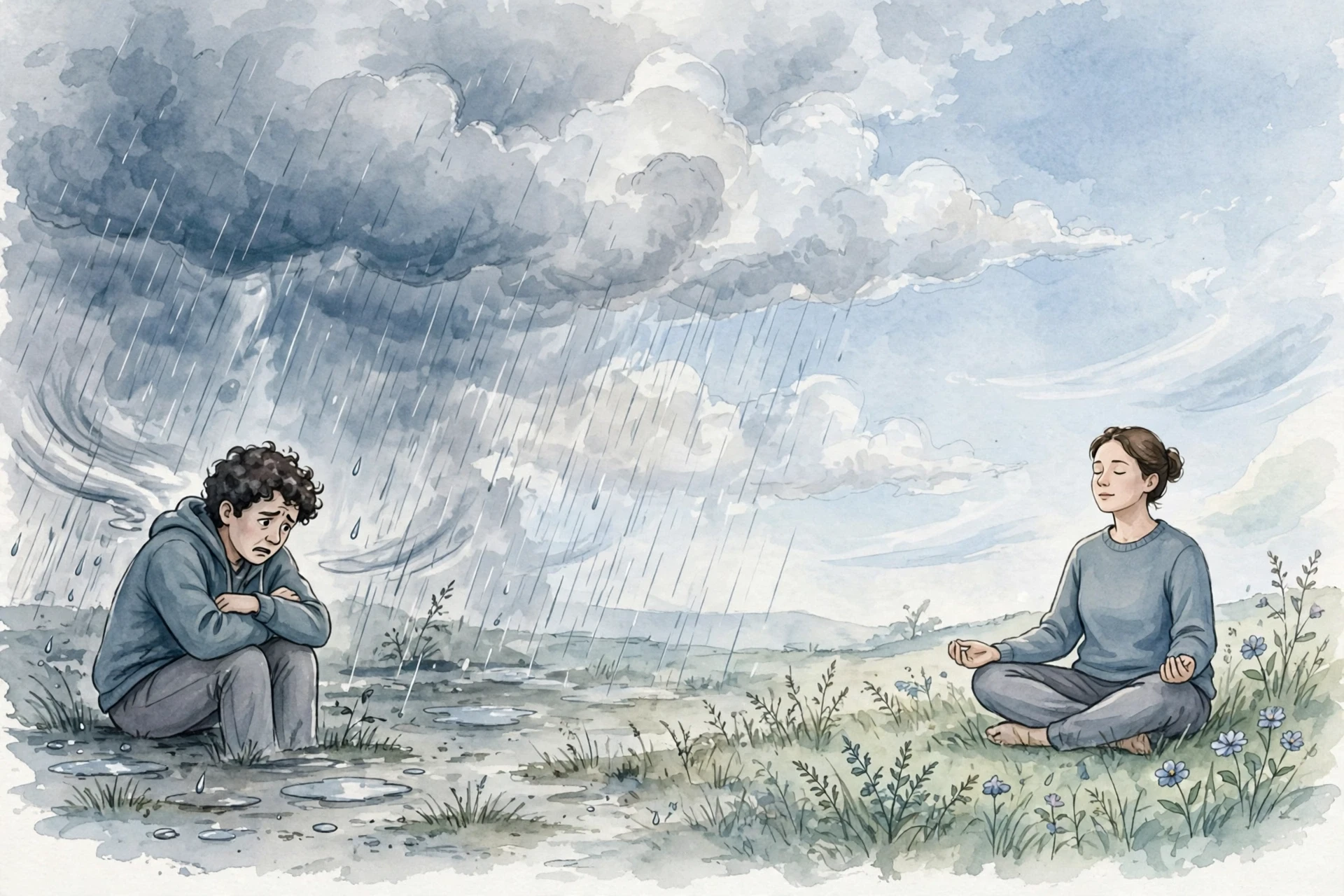
Neuroticism is the trait with the worst name and the most important job. It describes how reactive a person's emotional system is: how easily they feel anxiety, sadness, anger, and self-consciousness, and how long those feelings last once triggered. High scorers feel negative emotions more often and more intensely. Low scorers — sometimes described as high in emotional stability — stay calmer under pressure and recover faster from setbacks.
The word itself is a problem. "Neurotic" sounds like an insult, a label for someone broken. It is not. Neuroticism is a normal dimension of human variation, present in every population ever studied, and it exists for a reason. Think of it as an alarm system. A sensitive alarm goes off early and loudly: it catches real dangers sooner, but it also sounds for burnt toast. A less sensitive alarm stays quiet longer: peaceful days, but a slower response when something genuinely goes wrong. Neither alarm is "correct" in the abstract. The right sensitivity depends on the environment.
High neuroticism is the big five personality trait most closely linked to mental-health risk. People high in neuroticism are more likely to experience anxiety and depression, and that link is one of the most replicated findings in personality research. That is not a judgement; it is a fact that matters, because it points toward help. If you recognise yourself in the high end of this spectrum, the science of what anxiety and depression are — and what actually helps — is covered in our companion guide to anxiety and depression, which explains the brain science and the treatments with evidence behind them.
8.1 The facets of neuroticism
Anxiety: worrying, feeling tense, anticipating problems.
Angry hostility: frustration, irritability, quickness to anger.
Depression: sadness, hopelessness, low energy (as a trait tendency, not a diagnosis).
Self-consciousness: embarrassment, sensitivity to judgement.
Impulsiveness: difficulty resisting urges under stress.
Vulnerability: feeling overwhelmed when things go wrong.
8.2 The upside nobody mentions
High neuroticism has genuine advantages, and they are rarely mentioned in popular writing. Sensitive alarms notice things. Highly neurotic people are often the first to spot a risk others missed, the first to prepare for a problem, and the most careful about details that matter. In professions where vigilance saves lives — medicine, aviation, engineering — a degree of worry is not a weakness. It is a professional asset.
I learned this from a friend who scores high on neuroticism and who, for years, apologised for it — for double-checking the locks, for worrying about the children, for rehearsing difficult conversations in advance. Then her family was caught in a travel disruption abroad, and while the rest of us were still processing what had happened, she had already rebooked the flights, found a hotel, and calmed the children. Her alarm had gone off early, as always. That time, it was exactly what the situation needed.
"Personality is not a verdict on your worth. It is a description of your settings — and settings can be understood, worked with, and, slowly, adjusted."
9. Nature and Nurture: How Much Is Inherited?
The question everyone asks about personality is the oldest one in psychology: are we born this way, or made this way? The honest answer, the one the evidence supports, is both — and the big five personality traits let us put numbers on the split.
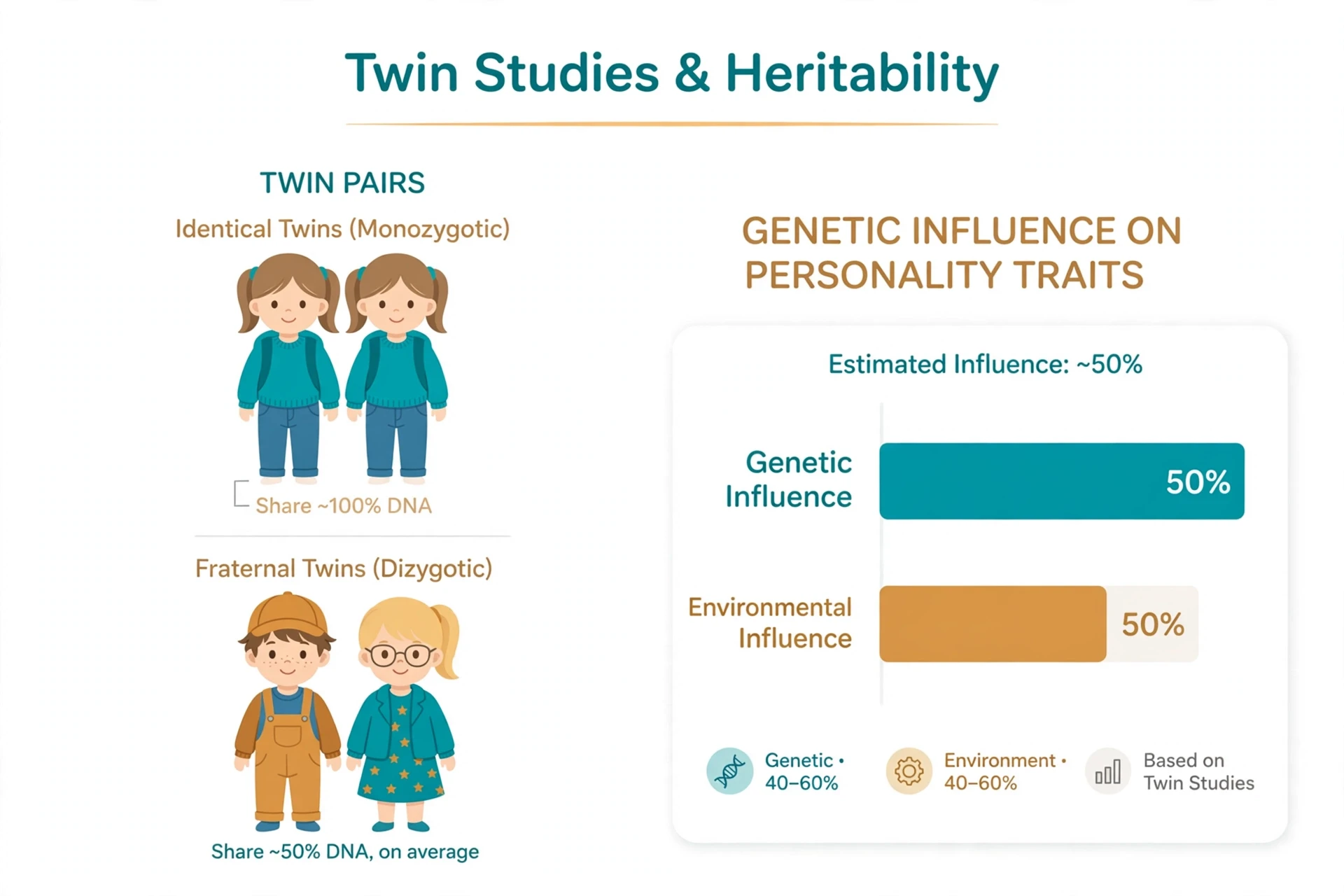
Twin studies are the classic tool. Identical twins share essentially all their genes; fraternal twins share about half, like ordinary siblings. If identical twins are more similar in personality than fraternal twins, genes are doing some of the work. If identical twins raised apart are still similar, the case for genes gets stronger. And that is what researchers find, again and again: identical twins resemble each other in big five personality traits more than fraternal twins do, even when they grow up in different homes.
A landmark 1996 twin study by Jang, Livesley, and Vernon, studying 123 pairs of identical twins and 127 pairs of fraternal twins, estimated the broad heritability of each trait — the share of the differences between people in that sample explained by genetic differences — at 41% for neuroticism, 53% for extraversion, 61% for openness, 41% for agreeableness, and 44% for conscientiousness. Other studies, using different samples and methods, land in the same neighbourhood: roughly 40–60% for each trait. That range is the figure to remember, and it is the one the brief for this article asked us to report.
9.1 What heritability does — and does not — mean
Heritability is the most misunderstood number in all of psychology, so let me be careful with it, because getting it wrong leads to bad conclusions.
Heritability describes a population, not a person. Saying openness is about 60% heritable does not mean that 60% of your openness comes from your genes and 40% from your life. It means that, in the group studied, about 60% of the variation between people was associated with genetic differences. Your own openness is the product of your genes and your life interacting — and no study can split one person's traits into neat percentages.
Heritability also depends on the environment. In a society where everyone gets the same schooling, genetic differences explain more of the remaining variation in learning. In a society with wildly unequal schooling, environment explains more. The number is not a fixed property of the trait; it is a property of the trait in a particular population at a particular time.
The genetic story also has a second half that is easy to miss: the environment that matters most for personality is not the shared family environment — the home, the parenting style, the neighbourhood that siblings share. Twin and adoption studies consistently find that shared environment contributes little to differences in the big five personality traits in adults. What matters more is the non-shared environment: the experiences that are unique to each person — a particular teacher, a particular friendship, a particular illness, a particular job. Two siblings can grow up in the same house and still have quite different lives, and those different lives shape their personalities in different directions. A Duke University publication reporting on the National Merit Twin Study put it plainly: the big five personality traits dimensions were "substantially and about equally heritable, with little or no contribution of shared family environment." You can read that study record at Duke Scholars.
For the genetics behind that picture — how genes, inheritance, and gene expression work in general — our guide to genetics explains the mechanisms, from DNA to traits, without assuming any background in biology.
Trait | Heritability estimate (Jang et al., 1996) | What it means in plain language |
|---|---|---|
Openness | 61% | The most heritable of the five in this study |
Extraversion | 53% | Just over half of population variation linked to genes |
Conscientiousness | 44% | Genes and life experience share the influence almost evenly |
Neuroticism | 41% | Substantial genetic influence, with large room for life experience |
Agreeableness | 41% | Same pattern as neuroticism in this sample |
Big life events can accelerate change: a demanding job can raise conscientiousness; a serious illness can raise neuroticism for a time; a supportive relationship can soften it. Therapy, too, can move traits — particularly neuroticism — more than was once believed. The old idea that personality is "set like plaster" by age thirty has not survived the evidence. Plaster sets, but slowly, and it can still be reshaped with sustained effort.
10. What the Traits Predict
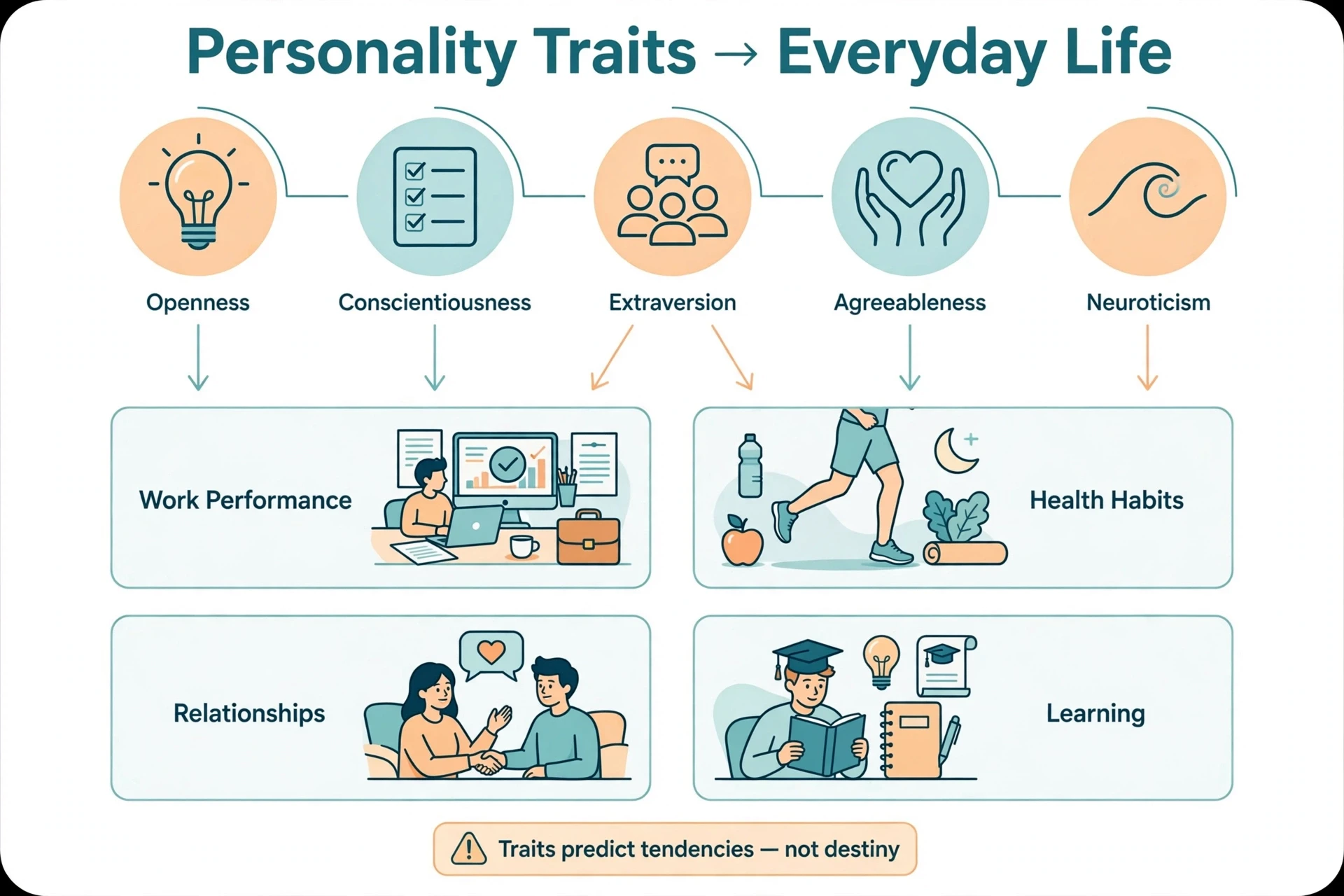
If the big five personality traits were only a neat way to describe people, psychologists would have moved on long ago. What keeps the model at the centre of the field is that the five scores predict things that matter — not perfectly, and never for a single person with certainty, but reliably enough, across large groups, that ignoring them would be foolish.
Conscientiousness leads the list. Across dozens of occupations and hundreds of studies, it is the strongest predictor in the big five personality traits for job performance. The effect is not huge for any one person — personality is one ingredient among many, alongside skill, knowledge, and opportunity — but across a whole workforce it is consistent: organised, disciplined, goal-directed people tend to perform better, earn more, and stay in education longer. The link is strongest where the work is structured and self-directed, and weakest where the work is highly creative or unpredictable — a reminder that context always moderates the trait.
The other traits predict other things:
Openness predicts creative achievement, interest in the arts, and success in roles that reward new ideas — and it predicts political and cultural attitudes more than any other trait.
Extraversion predicts leadership emergence (who gets noticed as a leader), sales performance, and social network size.
Agreeableness predicts relationship quality, teamwork, and volunteering — and, at the cost end, lower earnings in competitive negotiations.
Neuroticism predicts mental-health risk, stress reactivity, and relationship conflict — and, as Section 8 noted, vigilance and careful preparation.
Conscientiousness predicts health behaviours too: conscientious people exercise more, smoke less, take medication as prescribed, and live longer on average. The pathway is mundane and powerful: they keep appointments, follow advice, and avoid the small daily risks that accumulate over decades.
Sleep is one of those pathways. Conscientious people tend to keep more regular sleep schedules, and regular sleep supports memory, mood, and next-day performance — a chain our guide to the science of sleep and dreams traces in detail, from circadian rhythms to what dreams may be doing for the brain.
But small effects, repeated across a lifetime and across millions of people, add up. A trait that shifts your odds by a few percentage points on every decision — whether to study tonight, whether to exercise, whether to speak up — will shape a life the way a small tilt shapes a river. The big five personality traits do not tell you your fate. They tell you which way your river is tilted.
That is also why the model is used, cautiously, in hiring, in clinical work, and in research. Used well, it adds information. Used badly — as a screen to reject people, or as a label to explain away a person's choices — it does harm. The difference between those two uses is not in the test. It is in the hands holding it.
11. How the Traits Are Measured
Most Big Five measurement is disarmingly simple: a questionnaire. You read statements — "I am someone who is talkative," "I am someone who does a thorough job," "I am someone who worries a lot" — and rate how well each describes you, usually on a five-point scale. Your answers are scored against the five traits and their facets, producing a profile: five numbers, each with a comparison to the average for your age and culture.
The field is organised through the Society for Personality and Social Psychology, APA's Division 8 for personality and social psychology. The two best-known instruments are the NEO Personality Inventory (NEO-PI-R, and its shorter form, the NEO-FFI), built by Costa and McCrae, and the Big Five Inventory (BFI), a shorter questionnaire developed by Oliver John and colleagues. The BFI takes about five minutes; the full NEO can take forty. Shorter is not worse — the BFI is widely used in research precisely because it is brief and reliable — but longer measures give finer detail on the facets underneath each trait.
Measurement matters, and it is worth pausing on how scientists know a questionnaire is any good. The answer is the same set of checks that applies to any scientific instrument: does it give similar results when taken twice (reliability)? Do different ways of measuring the same trait agree (validity)? Do other people's ratings of you line up with your own (inter-rater agreement)? For the big five personality traits, the answers are unusually strong: self-ratings and ratings by spouses, friends, and colleagues agree substantially, and scores are stable over years. Our guide to the scientific method explains the logic behind those checks — replication, falsification, and peer review — for readers who want the foundations.
A practical warning follows from that: be sceptical of free online "Big Five tests" that give you a type label, a colourful badge, and a sales pitch. A serious measure gives you five numbers on five spectrums, explains what each one means, and tells you the limits of what it can say. Anything that sorts you into a box and sells you the key is selling something else.
12. What the Model Does NOT Explain
A model that survives fifty years of testing earns respect. It does not earn worship. The big five personality traits have real limits, and a good explainer should name them plainly — because the limits are where the interesting science lives.
First, the big five personality traits describe; they do not explain. The model tells you that a person is high in neuroticism. It does not tell you why — which genes, which brain circuits, which childhood experiences produced that setting. Costa and McCrae's Five-Factor Theory offers a biological account, proposing that traits are rooted in biology and that life experience shapes the surface expressions rather than the traits themselves. Other psychologists disagree, arguing that experience shapes traits more deeply. The debate is live, and it is a sign of a healthy science, not a failing one.
Second, five is a useful number, not a magic one. Some researchers argue for six traits — the HEXACO model adds honesty-humility, and it predicts some behaviours, like workplace dishonesty, slightly better than the big five personality traits do. Others argue for more facets, or for narrower traits that matter in specific contexts. The big five personality traits are the best compromise between breadth and simplicity that the field has found. They are not the last word.
Third, the model is better at describing differences between people than changes within a person. It can tell you that Amira is more conscientious than Ben. It is less good at explaining why Amira is highly organised at work and chaotic at home, or why Ben becomes a different person when he is with his oldest friends. Situations matter, roles matter, and the person you are with your grandmother is not quite the person you are with your colleagues. Personality is stable, but it is not a single note played at the same volume in every room.
"The Big Five is the best map psychology has drawn of personality. A map is not the territory — and the most interesting parts of the territory are the places the map leaves blank."
None of these limits makes the model useless. A map that covers the main roads is still worth carrying, even if it leaves out the footpaths. For the inner-life questions the model leaves aside — why we want what we want, and how brain activity becomes experience — our article on what consciousness is explores that frontier directly. The honest position is the middle one: the big five personality traits are the most useful, best-tested description of personality we have, and they are incomplete — as every scientific model is, until a better one replaces it.
13. Misconceptions About the Big Five Personality Traits
Most of what people "know" about personality comes from quizzes, horoscopes, and office folklore. The big five personality traits suffer from that company. Here are the misunderstandings I meet most often, and what the evidence actually says.
"Your Big Five type tells you who you are." There are no Big Five types. There are five spectrums, and your position on each one is a number, not a label. Two people with the same label — if you insisted on inventing one — could have completely different profiles. The model describes combinations, and combinations are where individuality lives.
"High scores are good and low scores are bad." Each trait is a trade-off, and the "best" setting depends on the job, the relationship, and the moment. High openness helps an artist and hinders an air-traffic controller. High agreeableness helps a nurse and hinders a negotiator. There is no ideal profile, and anyone selling one is selling a fantasy.
"Personality is fixed by thirty." Rank order is stable, but average levels change across adulthood, and life events, relationships, and therapy can move scores meaningfully. The old "set like plaster" idea has not survived the data.
"A personality test can tell an employer who to hire." A Big Five score is one piece of information among many, and using it as a sole hiring screen is both scientifically shaky and, in many places, legally risky. The scores predict performance modestly, in groups, alongside skills and experience. They do not identify the "right" person for a job on their own.
"The Big Five and Myers-Briggs are the same thing." They are not. The Myers-Briggs sorts people into sixteen types based on four either/or preferences. The big five personality traits measure five spectrums. The two systems overlap — the Myers-Briggs dimensions map roughly onto four of the Big Five — but the big five personality traits have far stronger support in peer-reviewed research, and it does not force people into boxes. If you have a Myers-Briggs result you love, keep it as a conversation starter. Do not treat it as a measurement.
14. Putting the Big Five Personality Traits to Work
So what do you actually do with five numbers? The model earns its keep when it helps you make better decisions — about your own life, not about labelling other people. Here are uses that respect what the science can and cannot say.
Choose environments that fit your settings. If you are high in openness, a role with variety and new problems will feed you; a role that repeats the same task daily will starve you, however well it pays. If you are low in extraversion, an open-plan office with constant interruption will drain you; a quieter setup, or protected focus time, is not a luxury — it is a working condition. Fit is not about finding a perfect job. It is about knowing which frictions are yours to manage and which are the environment's to fix.
One more use, and the one I value most: self-compassion. I have seen students read their Big Five profiles and exhale — not because the numbers flattered them, but because they explained them. The student who thought she was lazy learned she was low in conscientiousness and high in openness, and that her scattered interests were a feature of her mind, not a failure of her will. The man who thought he was cold learned he was low in extraversion and high in agreeableness, and that his quiet warmth counted. A good model does not put you in a box. It gives you language for the person you already are — and language is the first step toward working with yourself instead of against yourself.
15. Five Dials, Not Five Boxes
We started with two flatmates and one piece of news. The big five personality traits do not tell you which flatmate is right, or which one will be happier, or which one you should be. They tell you something quieter: that their different reactions are not random, not a matter of willpower, and not a sign that one of them is broken. They are the visible surface of five dials, each set differently, each shaped by genes and by a lifetime of experience, each carrying its own strengths and costs.
The model is not complete. It does not explain why we want what we want, or how consciousness arises, or why the same person can be brave at work and timid at home. It does not predict any single act with certainty. It does something more modest and more useful: it gives psychology a common language for describing people, a language that has survived fifty years of testing across cultures, ages, and methods.
Learn the five traits. Learn where you sit on each spectrum — roughly, honestly, and without judgement. Then use that knowledge the way you would use any good map: not to decide where you must go, but to travel more deliberately through the territory you already inhabit. The dials are yours. The life you build with them is still, entirely, your own.
Frequently Asked Questions
What are the Big Five personality traits?
The Big Five personality traits are openness to experience, conscientiousness, extraversion, agreeableness, and neuroticism — remembered by the acronym OCEAN. They are the five broad dimensions psychologists use to describe personality. Each trait is a spectrum, and every person has a position on all five at once.
Can your big five personality traits change?
Yes, slowly. Rank order is fairly stable — the most conscientious teenager tends to become a relatively conscientious adult — but average levels shift across adulthood: most people become slightly more conscientious and agreeable and slightly less neurotic. Life events, relationships, and therapy can move scores, particularly neuroticism.
Which big five personality trait best predicts job performance?
Conscientiousness is the strongest Big Five predictor of job performance across many occupations and hundreds of studies. Organised, disciplined, goal-directed people tend to perform better and stay in education longer. The effect is modest for any one person — skill, training, and opportunity matter at least as much — but it is consistent across large groups.
Are the big five personality traits inherited?
Partly. Twin studies suggest genetic differences explain roughly 40–60% of the variation in each trait within a population — for example, a 1996 twin study estimated heritability at 61% for openness, 53% for extraversion, 44% for conscientiousness, and 41% each for neuroticism and agreeableness. Heritability describes a population, not a person, and it is not destiny: environment and life experience shape where in the genetic range a person lands.
Are the big five personality traits better than Myers-Briggs?
For scientific purposes, yes. The big five personality traits measure five spectrums and have strong support in peer-reviewed research, including agreement between self-ratings and ratings by others. The Myers-Briggs sorts people into sixteen types based on either/or preferences and has much weaker evidence. Myers-Briggs can be a fun conversation starter, but it is not a reliable measurement of personality.
What does a high score in neuroticism mean?
A high neuroticism score means your emotional alarm system is sensitive: you feel anxiety, sadness, and frustration more easily and for longer than most people. It is a normal trait, not a diagnosis, and it has upsides — vigilance, careful preparation, early warning of risks. It also raises the risk of anxiety and depression, so if worry interferes with daily life, professional support is worth seeking.
Sources
American Psychological Association. Personality. https://www.apa.org/topics/personality
OpenStax. Psychology 2e, 11.7 Trait Theorists. https://openstax.org/books/psychology-2e/pages/11-7-trait-theorists
Loehlin, J. C., McCrae, R. R., Costa, P. T., & John, O. P. (1998). Heritabilities of Common and Measure-Specific Components of the Big Five Personality Factors. Journal of Research in Personality, 32(4), 431–453. Record: https://scholars.duke.edu/publication/1458450
APA Dictionary of Psychology. Big Five. https://dictionary.apa.org/big-five
Society for Personality and Social Psychology. https://spsp.org/
Jang, K. L., Livesley, W. J., & Vernon, P. A. (1996). Heritability of the Big Five personality dimensions and their facets: a twin study. Journal of Personality, 64(3), 577–592.
Costa, P. T., & McCrae, R. R. (1992). Revised NEO Personality Inventory (NEO-PI-R) and NEO Five-Factor Inventory (NEO-FFI) professional manual. Psychological Assessment Resources.
McCrae, R. R., & Costa, P. T. (2003). Personality in Adulthood: A Five-Factor Theory Perspective (2nd ed.). Guilford Press.