

I was standing in a conference hallway in my second year of research, coffee in one hand, poster tube in the other, when a colleague I had worked beside for three months walked up and smiled. I smiled back. I asked about her experiment. And for five full seconds, her name was simply gone. Not blurred, not half-there — gone, as if someone had wiped a single word off a whiteboard while leaving the rest of the sentence intact. Then it came back, unannounced, halfway through my next sentence. I have thought about that hallway moment for years, because it holds the whole puzzle of this article in miniature: the memory was not destroyed. It was unreachable. And that distinction — between a memory that is lost and a memory that cannot be found — is where the science of forgetting begins.
Why do we forget? The question sounds simple, almost childlike. Yet it has occupied psychologists for a century and a half, and the answer turns out to be stranger and more hopeful than most people expect. Forgetting is not a single process. It is several different processes wearing the same disguise. Some memories fade like footprints in rain. Some are crowded out by newer memories. Some sit intact in storage while the key that opens them goes missing. And some are actively pushed aside by a brain that is trying to protect us. Most surprising of all, forgetting is not a design flaw. A brain that remembered everything would be a brain that could barely think.
This article is the companion to our guide on how memories are built. That guide explains how a memory comes into being. This one explains what happens next — why it fades, why it hides, and why that fading is often the brain doing exactly what it should. We will meet a German psychologist who spent seven months memorising nonsense syllables about himself, unpack the famous forgetting curve he discovered, correct the most repeated myth about it, and walk through the five main reasons memories slip away. We will look at what forgetting looks like inside the brain, when it stops being normal, and what actually slows it down. The practical payoff is real: once you know why you forget, you can work with the curve instead of against it.
1. The Forgetting Curve That Started It All
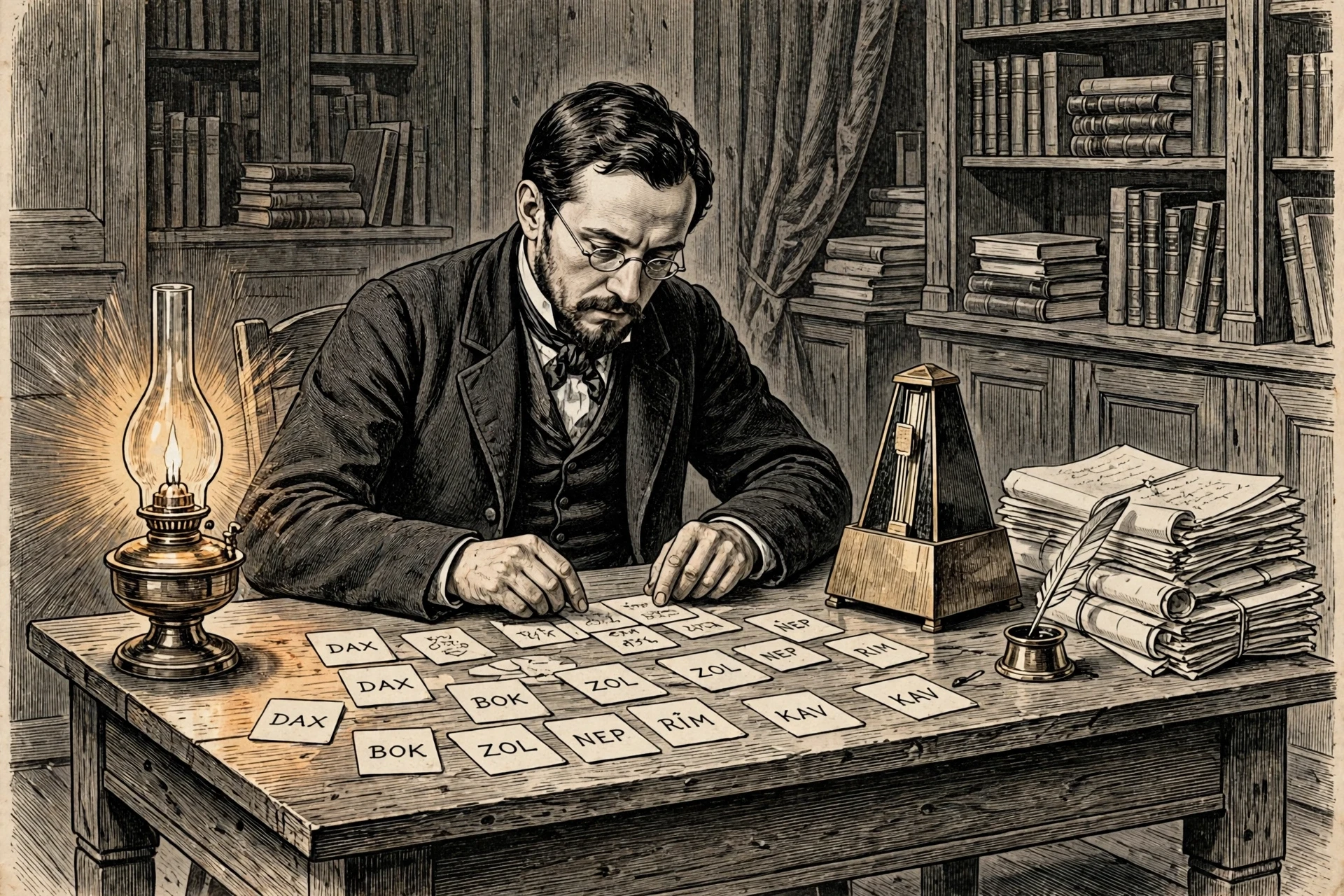
1.1 A man, a metronome, and 2,300 nonsense syllables
In 1885, a German psychologist named Hermann Ebbinghaus published a book called Über das Gedächtnis — On Memory — that changed psychology forever. Before Ebbinghaus, memory was mostly a topic for philosophers. He turned it into something you could measure, with numbers and a stopwatch.
His method was ruthless in its simplicity. He invented lists of nonsense syllables — three-letter combinations like WID, ZOF, and BOK — chosen precisely because they meant nothing. A real word drags in associations: "house" brings up your childhood kitchen, a smell, a street. A nonsense syllable brings up nothing. That was the point. Ebbinghaus wanted to study memory in its purest form, stripped of meaning, so that nothing but time itself could explain what happened to it.
He had no laboratory and no volunteers, so he used the only subject available: himself. For seven months, often in three sessions a day, he learned lists of thirteen syllables until he could recite each list twice without error, then left them alone and came back after a set interval — twenty minutes, an hour, nine hours, a day, two days, six days, thirty-one days — and measured how much work it took to relearn them. His measure was not how many syllables he could recall. It was savings: how much less effort relearning took compared with the first learning. If a list first took twenty repetitions and relearning took fifteen, that was a saving of 25 percent. Something of the original learning was still there, even when he could not recite a single syllable from memory.
I tried a version of this myself once, early in my career, when I was curious about how much of a dense methods paper I actually retained. I read a protocol carefully, closed it, and tested myself a day later. I could reconstruct the broad logic but not the concentrations, not the timings, not the order of two key steps. A week later, relearning it took about half the time the first pass had taken. The knowledge was not gone. It was cheaper to rebuild than to build from scratch. That is exactly what Ebbinghaus was measuring, and it is a kinder way to think about forgetting than the usual verdict of "it's gone."
1.2 What the forgetting curve really shows
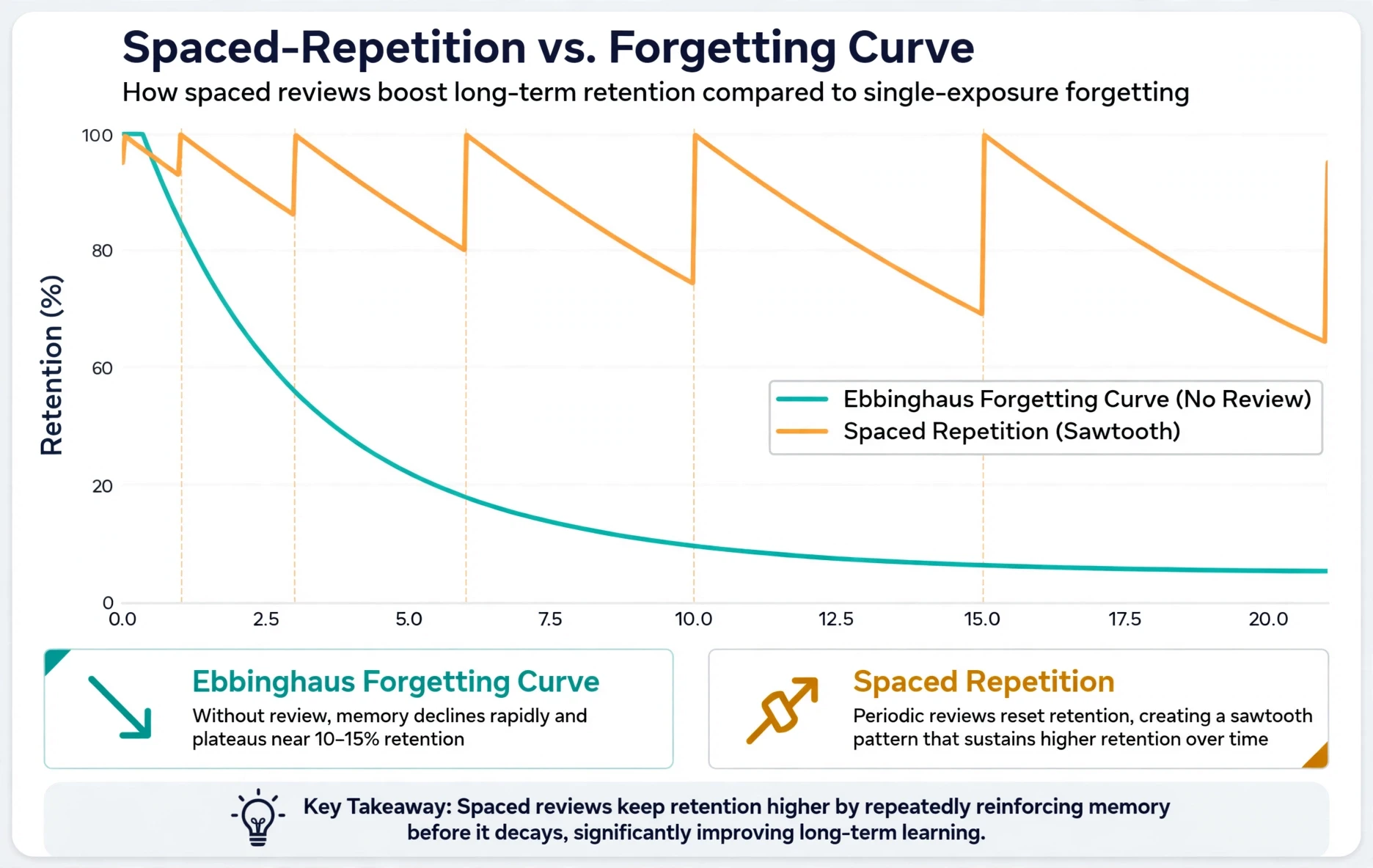
Plot Ebbinghaus's savings against time and you get the most famous graph in psychology: the forgetting curve. Ask why do we forget so much of what we learn, and this curve is the first piece of the answer. It falls like a cliff and then levels into a long, flat tail. The steepest loss happens fast — within the first hour, roughly half the savings had already vanished for his meaningless syllables. By one day, savings had fallen to about a third. By a month, about a fifth remained. The shape is the message: forgetting is not a slow, even leak. It is a flood in the first hours, then a trickle.
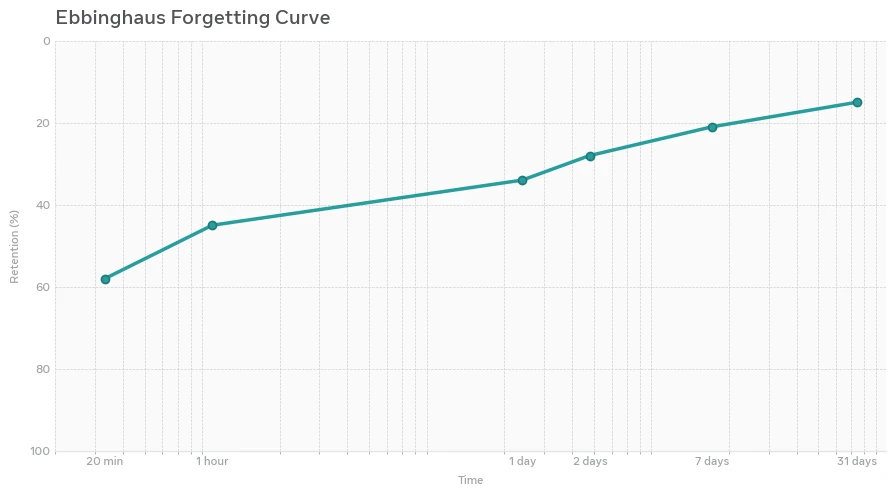
The forgetting curve has survived for 140 years, and it has been checked. In 2015, researchers at the University of Amsterdam repeated Ebbinghaus's experiment faithfully — one subject, seventy hours of learning and relearning, the same intervals from twenty minutes to thirty-one days — and the curve came back, recognisably the same shape, more than a century later. Their replication, published in the open-access journal PLOS ONE, even found a small upward bump around the twenty-four-hour mark, which the authors suggested might reflect sleep doing some quiet repair work overnight. You can read the full replication in PLOS ONE.
1.3 The 70-percent myth — what the numbers do not say
Here is where I have to correct something, because it is repeated everywhere, including in some otherwise good articles: the claim that "you forget 70 percent of what you learn within 24 hours." It sounds precise. It is not what Ebbinghaus found.
Ebbinghaus's one-day figure was a savings score of about 34 percent. That means relearning after a day took about a third less effort than the first learning. It does not mean he could recall only 34 percent of the syllables, and it certainly does not mean 66 or 70 percent of the memory had vanished. Savings and recall are different measures. A memory can be unrecallable and still make relearning easier — the trace is weakened, not erased. The popular percentage is a misreading that hardened into a slogan as the curve was copied from textbook to textbook to training slide.
There is a second problem with the slogan: Ebbinghaus was memorising meaningless syllables, on purpose. Meaningful material behaves very differently. He himself found that poetry took about a tenth of the effort of nonsense syllables to learn. A phone number you understand, a story that moves you, a fact tied to something you already know — these are not nonsense syllables, and they do not fall off the same cliff. Real forgetting rates depend on the material, how deeply you learned it, whether you slept, and who you are. Treat the percentages as a picture of a pattern, not a prediction about your brain.
"The forgetting curve is one of the most replicated findings in cognitive science — and one of the most misquoted. The shape is real. The slogan is not."
That correction matters, because the myth makes forgetting sound like a catastrophe. The real forgetting curve is more interesting: fast early loss, then a stubborn remainder that can last for weeks, and a hidden residue — the savings — that survives even when recall fails. Everything else in this article hangs on that distinction between losing a memory and losing access to it.
2. Why Do We Forget? Five Ways a Memory Slips Away
Ask why do we forget, and you will get five different answers depending on which memory you mean. Modern research, summarised in a review by the American Psychological Association, describes forgetting as the product of several distinct mechanisms — failures of encoding, interference before a trace is fully settled, competition at retrieval, active suppression, and cues that simply fail to reinstate the memory. The APA's teaching unit on memory lays out the classic framework: interference is treated as a primary source of forgetting, and the role of retrieval cues is central to whether a stored memory can be reached at all. Keep that framework in mind as we walk through the five mechanisms below. They overlap, they interact, and a single forgotten name can involve three of them at once.
2.1 Decay: the trace fades with time
The oldest explanation is also the most intuitive. Decay theory says that a memory trace weakens simply with the passing of time, like a path through grass that grows over when nobody walks it. A neural connection that is not reactivated gradually loses strength. Use it or lose it, at the level of synapses.
Decay is real, but it is not the whole story — and psychologists have argued about it for decades, because time alone is hard to separate from everything else that happens during that time. While a memory sits unused, other memories are being formed, attention is elsewhere, and the brain is busy. Is the trace fading because time passed, or because new experiences overwrote it? The honest answer is that both happen, and decay is best understood as the background tide against which the other mechanisms work. A trace that is reactivated — rehearsed, recalled, used — is refreshed. A trace left alone is left to the tide, and that tide is what the forgetting curve measures.
An everyday version: I once learned a colleague's extension number by heart during a project, dialled it daily for six weeks, and then the project ended. Two years later I could not have produced that number for money. Nothing pushed it out. Nobody taught me a competing number. It simply went unvisited until the path closed over. That is decay in its purest form, and it is the mechanism the forgetting curve captures most directly.
2.2 Interference: new memories crowd out old ones, and old ones crowd out new ones
If decay is the tide, interference is the crowd. Interference theory says we forget because similar memories compete with each other. The more similar two memories are, the harder it is to pull the right one out. This is the mechanism with the clearest everyday fingerprints.
There are two directions, and they have names worth learning because they explain so much daily frustration:
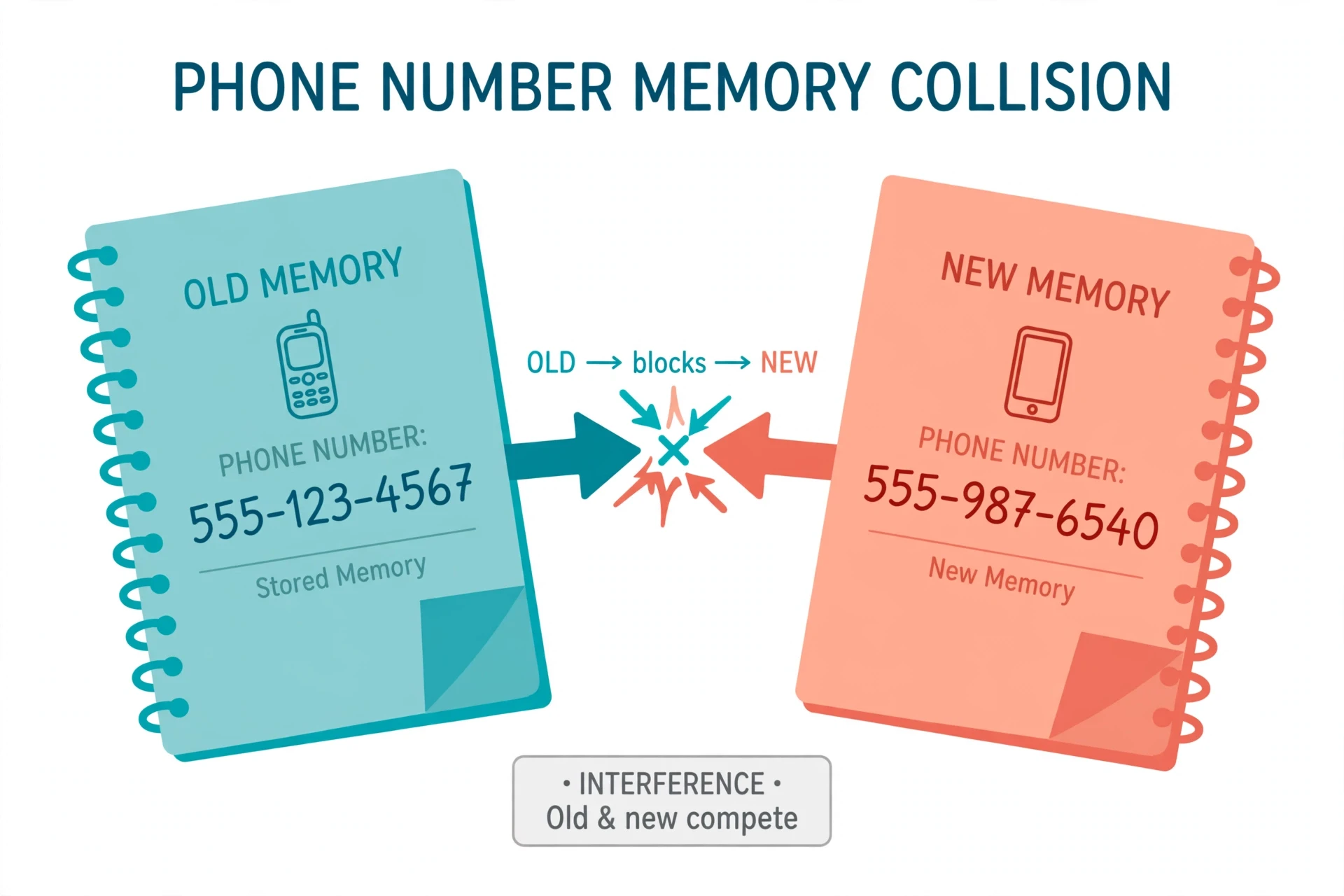
Proactive interference — old learning blocks new learning. Your old phone number keeps surfacing when you try to recall the new one. Your old password auto-fills in your mind when the site asks for the new one. The past is too strong, and it shoves the present aside.
Retroactive interference — new learning blocks old learning. You learn a new colleague's name and suddenly cannot recall the previous temp's name, even though you knew it last week. The present is too loud, and it drowns out the past.
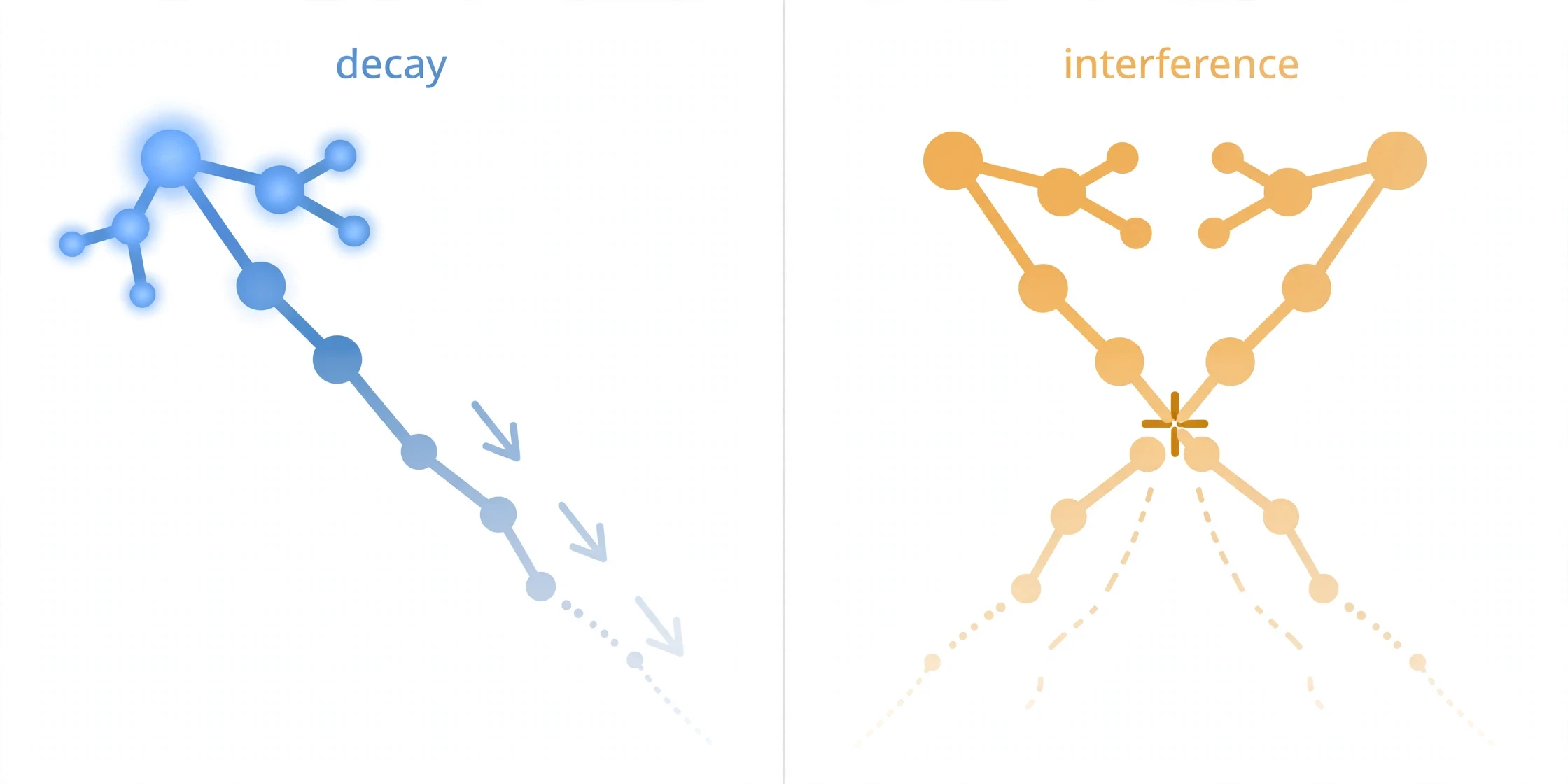
Interference is strongest when memories are learned close together in time and when they resemble each other. That is why a day spent cramming two similar subjects — say, two languages, or two sets of drug names — produces more forgetting than a day spent on one. It is also why the moments just after learning are so fragile: the trace has not yet settled, and the next thing you learn can still knock it sideways. It is also why the forgetting curve falls fastest in exactly that window. Research on sleep and memory shows the same point from the opposite side — sleep protects memories from interference, and in one study only naps containing REM sleep could rescue learning that had already been damaged by retroactive interference. The PubMed record of that study is worth a look if you want the experimental detail.
2.3 Retrieval failure: the memory is there, the key is not
This is the mechanism behind my conference-hallway moment, and it is the most hopeful of the five, because retrieval failure means the memory still exists. The information was stored. It simply cannot be accessed right now, because the cues available do not match the cues present when the memory was formed.
Memory is cue-dependent. We do not retrieve a memory the way a computer retrieves a file, by address. We reconstruct it from fragments — a place, a smell, a first letter, a feeling — and if the fragments do not add up, the reconstruction stalls. Walk back into the room where you first had the thought, and it often returns whole. That is not superstition. It is context-dependent memory: the room was part of the cue, and returning to it restores the missing piece.
The purest form of retrieval failure is the tip-of-the-tongue state. You know you know the word. You can feel its shape — how many syllables it has, what letter it starts with, what it is not. The feeling of knowing is strong and the word is absent. That combination is so distinctive that psychologists have studied it for decades, and it tells us something important: the sense that a memory exists is itself a signal from the memory system. The trace is active enough to generate a feeling of knowing, but not active enough to deliver the word. Given time, or the right cue, it usually arrives — often in the shower, hours later, when you have stopped trying. Stopping trying is not a coincidence. Effortful searching can keep the wrong candidates active, blocking the right one; letting go lets the competition settle.

Retrieval failure also explains why recognition is so much easier than recall. A multiple-choice question gives you the answer among the options, and the correct one feels familiar. An open question gives you nothing, and you must generate the answer from scratch. Same memory, different cues, wildly different results. That is why forgetting often feels worse than it is: the test you are giving yourself — unaided recall, under pressure, in a new context — is the hardest test there is. For a fuller picture of how memories are built in the first place, and why the cues present at learning matter so much, see our companion article How the Human Brain Forms Memories.
2.4 Encoding failure: the memory was never really made
Sometimes the honest answer to "why did I forget that?" is "I never learned it." Encoding failure is the quiet member of the five: information that was never properly attended to, never processed deeply enough to enter lasting storage, so there is nothing to retrieve later. You were introduced to someone while your mind was on the talk you were about to give. You drove a familiar route while rehearsing a difficult conversation. You read a page while tired and your eyes moved but nothing stuck.
This is not a failure of memory so much as a failure of attention at the moment of learning — and it is closely tied to the everyday experience of brain fog, where poor focus makes encoding shallow across the board. The boundary matters here: our companion article on memory formation explains how encoding works in detail, so I will not repeat that machinery. The point for this article is diagnostic. Before blaming your memory for forgetting something, ask whether you were actually present when it happened. If the answer is no, the fix is not a memory technique. It is attention — one thing at a time, phone down, eyes up.
2.5 Motivated forgetting: the brain that pushes things away
The fifth mechanism is the most human. Sometimes we forget because, at some level, remembering hurts. Motivated forgetting covers the deliberate and not-so-deliberate ways the mind reduces access to unwanted memories — suppressing a painful recollection, avoiding the cues that trigger it, rehearsing a different version of events until the original fades.
The science here is careful, and it should be. The old Freudian idea of repression — traumatic memories sealed away intact in the unconscious, retrievable whole years later — is not supported by modern evidence in that form. What is supported is subtler and better documented: people can intentionally suppress retrieval of a memory, and doing so repeatedly makes that memory harder to retrieve later. Brain-imaging studies show this suppression involves prefrontal control regions actively dampening activity in the hippocampus, the structure that helps retrieve memories. Forgetting, in this case, is not a passive accident. It is an active, effortful process — the brain spending energy to not remember.

This mechanism deserves a note of caution. Suppressing an upsetting memory can help you get through a day, and in the short term that is a genuine coping tool. But chronic suppression is not the same as processing, and memories that are never faced have a way of returning in other forms — as anxiety, as avoidance, as a startle at a cue you did not expect. If a memory keeps intruding despite your efforts to push it away, that is a sign to talk to a professional, not to push harder. Our article on anxiety and depression explains what the science says about when ordinary distress becomes something that deserves support.
Mechanism | What happens | The memory itself | Everyday example | Best fix |
|---|---|---|---|---|
Decay | Trace weakens over time | Fades | A phone number unused for two years | Revisit it before it fades |
Proactive interference | Old memory blocks new | Intact, crowded out | Old password keeps surfacing | Space similar learning apart |
Retroactive interference | New memory blocks old | Intact, crowded out | New colleague's name erases the last one | Learn similar things on different days |
Retrieval failure | Cues do not match | Intact, unreachable | A name lost in a hallway, found later | Return to the context, wait, try a cue |
Encoding failure | Never stored properly | Never formed | A name heard while distracted | Pay full attention at the moment |
Motivated forgetting | Retrieval actively suppressed | Dampened by control | A painful memory pushed aside | Process it, or seek support |
Table 1: The five ways we forget, compared. Only decay and encoding failure involve a memory that is weakened or absent; the others leave the memory intact but unreachable — which is why so much of what feels "lost" can still be recovered.
3. What Happens in the Brain When We Forget
For a long time, forgetting was studied as if it were simply the absence of remembering — a passive fading, a failure to do something. The neuroscience of the last two decades has overturned that picture. Forgetting, it turns out, has its own machinery. The brain does not just fail to remember. In several well-documented cases, it actively forgets.
One of the clearest demonstrations comes from fruit flies, of all creatures. In Drosophila, researchers found that the ongoing activity of specific dopamine neurons regulates the forgetting of odour memories — and that this activity is itself regulated by the animal's state. When the fly is active and aroused, dopamine-driven forgetting speeds up. When it rests or sleeps, the dopamine signal quiets and memory retention improves. The study, published in Cell and indexed on PubMed, concluded that sleep facilitates memory by blocking dopamine-neuron-mediated forgetting. In other words, part of what sleep does for memory is not just strengthening the memories you keep. It is switching off the machinery that erases them.
That finding fits a broader pattern. The brain appears to treat forgetting as a regulated process, with molecular pathways of its own — distinct from the pathways that build memories. Rac1, a protein involved in remodelling the actin skeleton inside synapses, has been linked to active forgetting in flies and mice: boost it, and memories fade faster; block it, and they linger. The hippocampus, the structure that helps retrieve memories, can be deliberately dampened by prefrontal regions during suppression, as we saw in the last section. None of this looks like a system that forgot to remember. It looks like a system that forgets on purpose, under control.
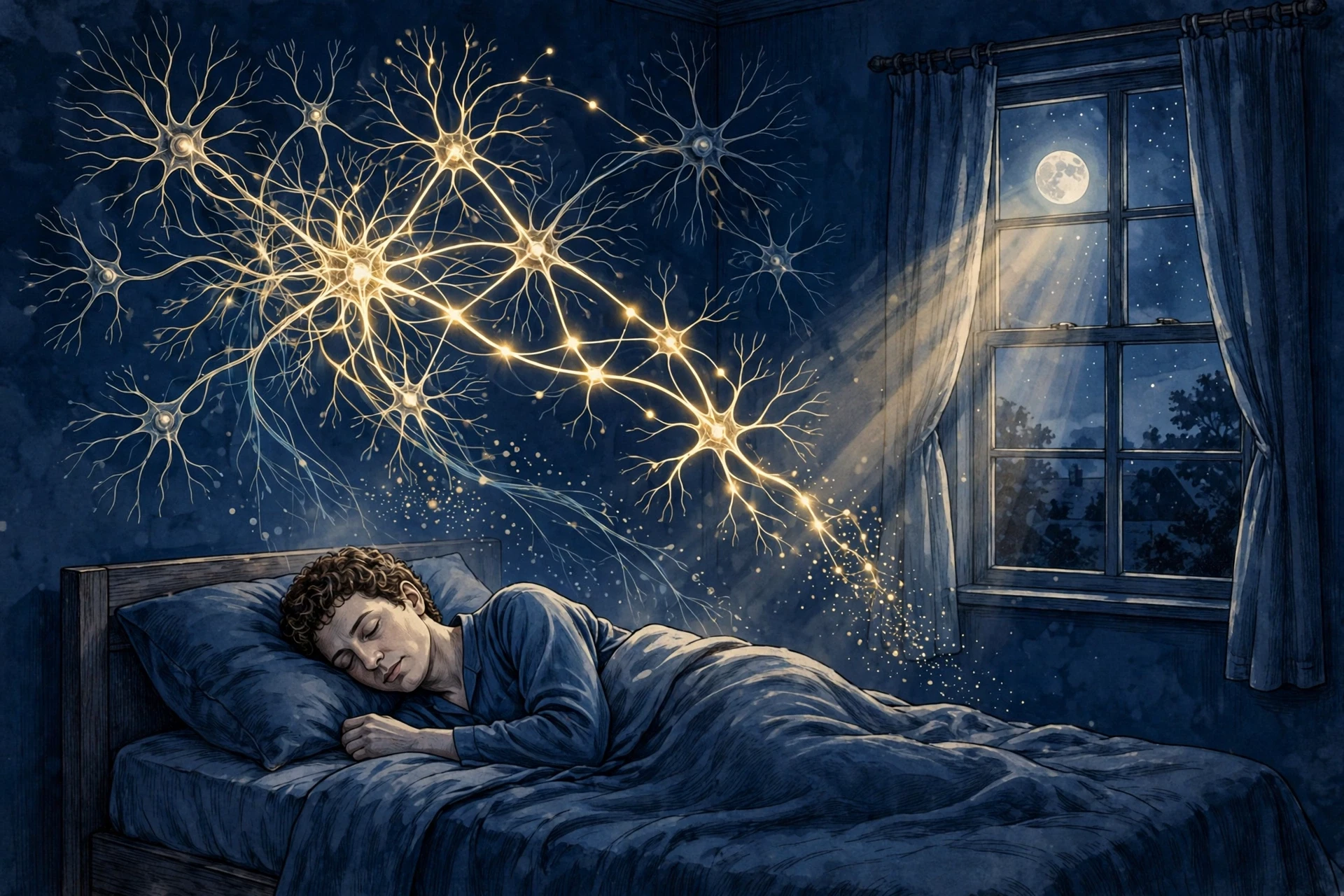
There is a useful analogy I return to in lectures. Think of memory not as a library where books gather dust, but as a garden where a gardener works every night. Some plants are watered. Some are pruned. The pruning is not neglect. It is the work that keeps the garden from becoming a thicket. The brain's nightly work — during sleep, when the day's traces are replayed, sorted, strengthened, or allowed to fade — is that gardening. And sleep is the shift when most of it happens, which is why the same night of short sleep that leaves you foggy also leaves you forgetful. Our guide to the science of sleep and dreams explains the stages of that nightly sorting in detail; the key point here is that sleep is not just rest for the body. It is the brain deciding what to keep.

Context matters during sleep, too. A 2023 study found that when sounds linked to specific memories were played during sleep, recall changed not only for the cued memories but for memories linked to them by context — evidence that sleep reactivation reinstates whole contexts, not just isolated items. The full paper is available free through PubMed Central. The picture that emerges is of a system that is always editing: strengthening what is useful, linking what belongs together, and letting the rest go.
4. Forgetting Is a Feature, Not a Bug
Most people assume a perfect memory would be a gift. The evidence points the other way. People with highly superior autobiographical memory — the rare ability to recall nearly every day of their lives in detail — often describe it as a burden. They cannot let go of embarrassments from decades ago. They struggle to summarise, to see the gist, to move on. Their memories crowd the present. That is the clearest human proof of a point the science keeps making: forgetting is what makes remembering useful.
Consider what would happen if nothing ever faded. You remember every parking spot you have ever used, and the right one for today is buried under thousands of wrong ones. You remember every version of a phone number, every draft of a document, every face in every crowd — and each new retrieval has to fight through all of them. Interference, the mechanism we met in Section 2, would become unbearable. Forgetting clears the obsolete so the current can be found. That is the forgetting curve doing its quiet work: the steep early drop is the brain clearing what it does not need. The APA's memory unit puts it plainly: failing to forget information that has become obsolete disrupts and impairs memory for current information.
Forgetting also makes generalisation possible. To learn what a dog is, a child must forget the particulars of each dog she has seen — the colour, the size, the bark — and keep only the pattern. A memory system that kept every detail would never form a concept. It would have a catalogue, not knowledge. Every abstraction you own — justice, humour, Tuesday — is built on details that were allowed to fade.
And forgetting lets us update. The world changes: prices, passwords, routes, rules, people. A memory that never faded would leave you navigating last year's map. Forgetting is the mechanism that lets an old, wrong memory yield to a new, right one. When I moved house years ago, I drove to the old address twice in the first month, out of pure habit. By the third month, the old route had faded and the new one was automatic. That fading was not a failure. It was the update installing itself.
"A brain that remembered everything would be a brain that could barely think. Forgetting is the editing that makes the remaining memories usable."
There is also a quieter, kinder side to this. Forgetting softens grief. The sharpest edges of a loss dull with time, not because the love fades but because the constant, intrusive recall fades — the brain letting the memory settle from a wound into a story. That softening is motivated forgetting and decay working together, and it is one of the reasons time genuinely does help. Not by erasing, but by loosening the grip.
5. When Forgetting Stops Being Normal
All of this raises the question everyone secretly asks while reading an article like this one: is my forgetting normal? For most adults, most of the time, the answer is yes. Forgetting a name and remembering it later, misplacing keys, walking into a room and losing the reason you went in — these are ordinary failures of attention and retrieval, not signs of disease. They happen more often when you are tired, stressed, or multitasking, and they happen to everyone.
The line that matters is function. The U.S. National Institute on Aging draws it clearly in its guide to memory problems, forgetfulness, and aging: it is normal to forget things once in a while at any age, but serious memory problems make it hard to do everyday things — driving, using the phone, finding the way home. Signs that deserve a conversation with a doctor include asking the same questions over and over, getting lost in places you used to know well, having trouble following recipes or directions, becoming more confused about time, people, and places, and neglecting self-care.
Age changes the picture, but not in the way people fear. Some slowing of recall is a normal part of aging — it takes longer to learn something new, and retrieval is a little slower. Dementia is not a normal part of aging. Mild cognitive impairment sits between the two: more memory trouble than other people your age, but still able to manage daily life. It can be an early sign of Alzheimer's disease, but not everyone with it develops dementia. The distinction matters because some causes of memory problems are treatable — depression, thyroid problems, vitamin B12 deficiency, medication side effects, sleep problems — and those problems usually improve once the cause is treated. Stress is on that list too: major life events and chronic stress can leave people confused and forgetful, and those problems are usually temporary, improving as the stress fades. That overlap with stress is one reason our articles on high cortisol symptoms and chronic insomnia sit alongside this one — the same tired, stressed brain that forgets names is often the brain that is sleeping badly and running on stress hormones.
A practical rule I give friends who worry: watch the pattern, not the single event. A forgotten name that returns later is retrieval failure, and it is normal. A forgotten name that never returns, plus a forgotten appointment, plus getting lost on a familiar route, plus a family member noticing the change — that pattern is worth a check-up. And a sudden change is always worth a check-up sooner rather than later, because sudden memory problems can have medical causes that need attention now, not next year. The NIA's advice is simple and right: if memory problems persist after a few weeks, talk with a doctor. A check-up is not an admission of decline. It is the fastest way to find out whether the cause is something fixable.
6. How to Slow the Forgetting Curve — Working With Forgetting Instead of Against It
If forgetting is fast at first and slow later, the fix writes itself: review before the forgetting curve drops too far, and review again a little later, and again later still. That is spaced repetition, and it is the single best-supported practical answer to the forgetting curve. Each review lifts retention back up and makes the next decline gentler, so the curve flattens into a sawtooth that stays high. The reason it works is the same reason cramming fails: cramming piles all the reviews into the window where the trace is already strong, so each extra pass adds little, and then the curve falls off a cliff with no review scheduled to catch it. Spacing puts each review where it is needed most — just as the memory is starting to slip, when retrieving it takes real effort, and that effort is exactly what strengthens the trace.
I learned this the hard way as a student. I once crammed an entire neuroanatomy module into two nights before an exam, scored well, and a month later could not name half the structures. A classmate who had reviewed the same material for twenty minutes a week, spread over the term, could still draw the pathways. We had spent roughly the same total hours. The difference was timing, not effort. That is the forgetting curve's practical lesson in one story — and the heart of the answer to why do we forget what we cram: when you study matters at least as much as how long you study.
Beyond spacing, a handful of habits help — and each one maps directly onto one of the five mechanisms from Section 2:
Test yourself instead of re-reading. Trying to recall an answer strengthens the trace far more than looking at it again. Re-reading feels productive because the material looks familiar; testing feels hard because retrieval is effortful. Trust the effort, not the feeling. This is the testing effect, and it is one of the most robust findings in learning science.
Sleep on it — literally. A night of sleep after learning protects the memory from interference and lets the brain's nightly sorting do its work. An all-nighter does the opposite: it keeps the forgetting machinery running and denies the brain its editing shift.
Learn similar things apart. If two subjects or two languages keep interfering, study them on different days or in different places. Distinct contexts give each memory its own cues, and distinct cues mean less competition at retrieval.
Make it meaningful. Ebbinghaus's syllables faded fast precisely because they meant nothing. Tie a fact to something you already know, a story, an image, a use — and it stops being a nonsense syllable and starts being a memory with hooks.
Return to the context. If a memory will not come, go back to where you learned it, or reconstruct the scene in your mind: what were you doing, who was there, what came just before? Cues are the keys, and context is often the missing one.
Write it down, then put the note away. An external note is not cheating. It is a cue you can return to — and the act of writing the note is itself a small act of encoding. The goal is not to remember everything. It is to remember what matters, and to have a reliable way back to the rest.
One thing spacing is not: a complete system for learning. The full picture — how deep processing, retrieval practice, interleaving, and sleep fit together into a way of learning that actually sticks — belongs to its own article, and we will link to it here when it is published. The point of this section is narrower and, I think, more useful on its own: you do not need a new system to beat the forgetting curve. The question of why do we forget has a practical answer, and it is timing. You need to meet it on its own schedule, with a review timed to the moment the memory starts to slip.
7. Common Misconceptions About Forgetting
Every myth below is a misunderstanding of the forgetting curve or of one of the five mechanisms in Section 2. Clearing them up is worth doing, because each one makes forgetting sound worse — or simpler — than it is.
"Forgetting means the memory is gone." Usually, no. Most everyday forgetting is retrieval failure or interference, which leaves the trace intact. The savings Ebbinghaus measured are the proof: even when you cannot recall a thing, relearning it is faster, because something survived. "Gone" is the last conclusion to reach, not the first.
"A good memory means never forgetting." The opposite is closer to true. A good memory is a well-edited one: it keeps what matters, drops what is obsolete, and can find what it kept. People with near-total recall struggle precisely because they cannot forget. Forgetting is not the enemy of memory. It is part of how memory works.
"You forget 70 percent of everything within 24 hours." As Section 1 showed, this is a misreading of a savings score from nonsense syllables. Real forgetting depends on the material, the depth of learning, sleep, and the person. The curve's shape is real; the slogan is not.
"Forgetting gets dramatically worse with every birthday." Recall does slow with age, and that is normal. But the cliff-edge picture — that older adults forget everything — is wrong. What changes most with age is the speed of retrieval, not the ability to store. And many memory complaints in midlife turn out to be stress, poor sleep, or divided attention, not aging at all.
"Brain-training games stop forgetting." The evidence is thin. Games make you better at the games. The transfer to everyday memory is small and unreliable. The things with real evidence behind them are less exciting and more effective: sleep, exercise, spacing, testing yourself, and staying socially and mentally engaged.
"If you can't remember it, you never knew it." Encoding failure is real, and sometimes this is true. But the tip-of-the-tongue state is the direct refutation: you can know something, feel that you know it, and still not retrieve it in the moment. Absence of recall is not evidence of absence of knowledge.
Conclusion
Why do we forget? Because forgetting is not one thing, and the forgetting curve is only the beginning of the answer. It is decay and interference, retrieval failure and encoding failure, and a brain that sometimes pushes memories away on purpose. It is a curve that falls fast and then levels, a savings that survives even when recall does not, and a nightly editing shift in which sleep sorts what to keep. It is, above all, not a defect. A memory system that never forgot would drown in obsolete information, fail to generalise, and never update. Forgetting is the price of a memory that works — and, more than that, it is part of how it works.
The practical lesson is modest and, I think, liberating. You do not need a perfect memory. You need a memory you can work with: learn things when you are paying attention, test yourself instead of re-reading, space your reviews to catch the curve before it falls too far, sleep, and give similar memories room to breathe. And when a name escapes you in a hallway, remember what that moment really means. The memory is probably not gone. It is waiting for the right key — and now you know where the keys are kept.
Frequently Asked Questions
Why do we forget things so quickly after learning them?
Because forgetting is fastest in the first hours after learning. The forgetting curve shows the steepest loss within the first hour, then a slower decline. New traces are fragile before they settle, and they face competition from everything else you learn. A well-timed review in that first day flattens the curve more than any amount of later cramming.
Is the forgetting curve real?
Yes — the forgetting curve's shape is one of the most replicated findings in psychology. Ebbinghaus found it in 1885 with nonsense syllables, and a faithful replication in 2015, published in PLOS ONE, found the same shape more than a century later. What is not real is the popular slogan attached to it: the "70 percent gone in 24 hours" figure misreads a savings score as a recall score, and it comes from meaningless syllables, not the meaningful material we learn in real life.
Why do I forget names but remember faces?
Faces and names are stored and retrieved differently. A face is recognised — the person is in front of you, providing rich cues — while a name must be recalled from scratch with almost no cues, and names are arbitrary labels with no meaning to hook onto. That combination makes names the hardest everyday retrieval task there is, and the most common one to fail.
What is the tip-of-the-tongue phenomenon?
It is a retrieval failure in which you feel certain you know a word — you can often report its first letter, its number of syllables, and words that sound like it — but you cannot produce it. The memory trace is active enough to generate the feeling of knowing, but not active enough to deliver the word. It usually resolves on its own, often minutes or hours later when you have stopped actively searching.
Can forgetting be a sign of dementia?
Ordinary forgetting — a name that returns later, misplaced keys, a forgotten errand — is normal at any age. Forgetting becomes a concern when it interferes with everyday life: getting lost in familiar places, asking the same questions repeatedly, struggling with familiar tasks, or becoming confused about time and people. If that pattern persists for weeks, or changes suddenly, talk with a doctor. Some causes of memory problems are treatable.
How can I remember things for longer?
Space your reviews: revisit material after a day, then after a few days, then after a week, rather than cramming it all at once. Test yourself instead of re-reading, sleep properly after learning, and give similar topics separate study sessions so they interfere less. Meaning helps too — connect new facts to things you already know instead of memorising them in isolation.
Sources
Murre, J. M. J., & Dros, J. (2015). Replication and Analysis of Ebbinghaus' Forgetting Curve. PLOS ONE, 10(7), e0120644. https://journals.plos.org/plosone/article?id=10.1371/journal.pone.0120644
American Psychological Association, Teachers of Psychology in Secondary Schools. (2013). Memory: A Teaching Unit for High School Psychology. https://www.apa.org/ed/precollege/topss/lessons/memory.pdf
National Institute on Aging. Memory Problems, Forgetfulness, and Aging. https://www.nia.nih.gov/health/memory-forgetfulness-and-aging-whats-normal-and-whats-not
Berry, J. A., Cervantes-Sandoval, I., Chakraborty, M., & Davis, R. L. (2015). Sleep Facilitates Memory by Blocking Dopamine Neuron-Mediated Forgetting. Cell, 161(7), 1656–1667. https://pubmed.ncbi.nlm.nih.gov/26073942/
McDevitt, E. A., et al. (2015). REM sleep rescues learning from interference. Neurobiology of Learning and Memory, 122, 51–62. https://pubmed.ncbi.nlm.nih.gov/25498222/
Schechtman, E., et al. (2023). Memory consolidation during sleep involves context reinstatement in humans. Cell Reports, 42(4), 112331. https://pmc.ncbi.nlm.nih.gov/articles/PMC10545811/