

I was twelve when a textbook first tricked me. Two lines sat side by side on the page, one with arrowheads pointing in, the other with arrowheads pointing out. The second line looked obviously longer. I measured both with a ruler, twice, because I was sure the ruler was wrong. It was not. The lines were identical. That small shock stayed with me for years, and it shaped the way I think about seeing. Learning how optical illusions work is not really about lines on a page. It is about discovering that your brain is an editor, a guesser, and sometimes a confident liar — and that the lies follow rules you can learn.
You have felt the same shock, even if you did not name it. A dress that looked white and gold to you and blue and black to your friend. A grey square that seemed darker until you covered the shadow around it. A still image that seemed to ripple when you moved your eyes across it. In each case your eyes were working fine. The trick happened further back, in the brain, where raw signals get turned into the world you experience. This article explains how optical illusions work, step by step, from the light hitting your retina to the predictions your visual cortex makes without asking your permission.
1. What an Optical Illusion Actually Is
1.1 A mismatch between the world and what you see
An optical illusion is a mismatch between the physical pattern in front of you and the way you perceive it. The lines are the same length, yet you see different lengths. The squares are the same shade of grey, yet you see different shades. The image is perfectly still, yet you see motion. The mismatch is the point. It shows that seeing is not a passive recording, and understanding how optical illusions work starts here: seeing is an active construction.
That definition matters because it separates illusions from ordinary mistakes. If you misread a sign in bad light, your eyes simply lacked information. In an illusion, the information is all there, and your visual system still gets it wrong — or, more fairly, gets it right for the wrong situation. Your brain applies rules that work beautifully in the real world, and the illusion is a drawing that breaks the deal those rules were built on.
1.2 Three kinds of illusion
Researchers usually sort illusions into three families, and the split helps explain how optical illusions work at different levels of the visual system.
Physiological illusions come from the hardware itself. Stare at a bright light, look away, and you see a glowing afterimage. Your photoreceptors are tired, and the tired cells report a false signal.
Geometrical illusions come from context. The Müller-Lyer lines, the Ponzo railway tracks, and the Ebbinghaus circles all belong here. The surrounding shapes change how your brain judges size, length, or position.
Cognitive illusions come from what you know and expect. Your brain fills in missing edges, assumes light comes from above, or reads a flat drawing as a three-dimensional scene. The Kanizsa triangle and Adelson's checker shadow live in this family.
Most famous illusions mix the families. That is part of their charm, and part of why a single simple answer to how optical illusions work never quite fits. Different illusions expose different shortcuts.
2. Seeing Is Not Recording: From Light to Brain
2.1 The eye is a sensor, not a camera
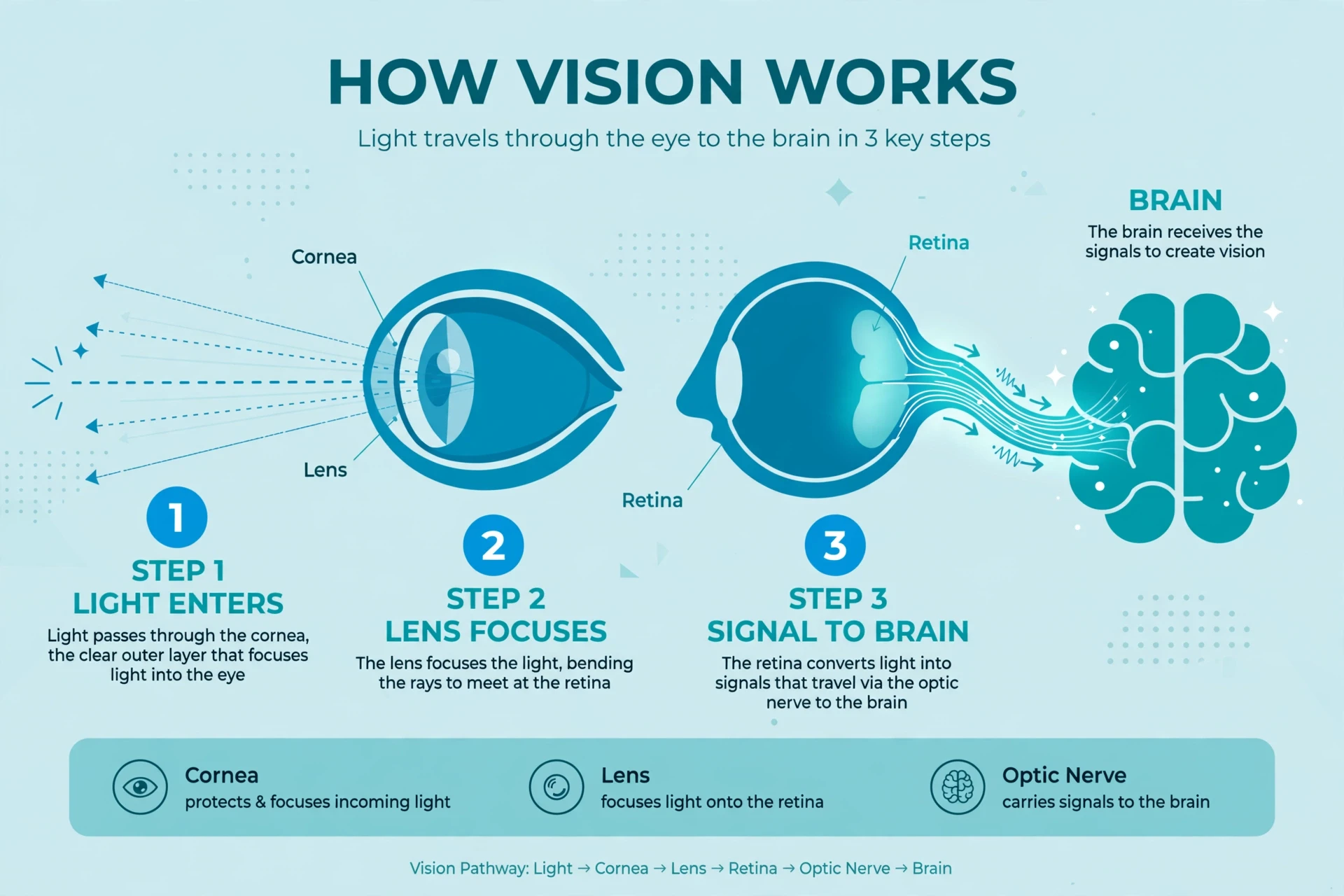
People often describe the eye as a camera, and the comparison is useful only up to a point. A camera records what is in front of it. Your eye does something stranger. Light passes through the cornea and the lens, lands on the retina, and photoreceptors turn that light into electrical signals. Those signals travel along the optic nerve to the brain, which turns them into the images you see. The National Eye Institute describes this chain plainly: the cornea and lens focus light on the retina, photoreceptors convert it into signals, and the brain builds the picture from them (National Eye Institute, "How the Eyes Work").
Here is the catch that makes illusions possible. The image on your retina is flat, upside down, full of gaps, and constantly jumping as your eyes move. There is a blind spot in each eye where the optic nerve leaves, with no photoreceptors at all. You never notice any of this. Your brain patches the blind spot, steadies the jumping image, and hands you a smooth, stable, three-dimensional world. That patching is a feature. It is also the opening through which illusions walk in.
I learned this the hard way in a teaching lab years ago, when I asked students to find their own blind spot with a simple dot-and-cross card. One student stared at the card, moved it closer, and laughed out loud when the dot vanished — and then, a moment later, frowned, because the white paper where the dot had been looked perfectly blank and ordinary. Nothing in her experience marked the hole. Her brain had filled it in with plain white, without telling her it was guessing. That is how optical illusions work at the most basic level: the filling-in is silent, and the result feels like direct seeing.
2.2 The visual cortex does the real work
The retina sends its signals to the back of the brain, to the visual cortex, where different regions handle edges, colour, motion, and depth. No single region sees the whole picture. Instead, dozens of areas work in parallel, each answering a narrow question: Is there an edge here? Which way is it moving? Is that patch brighter than its neighbours? The answers get combined into the scene you experience.
This division of labour explains a lot about how optical illusions work. An illusion that targets one area — say, the motion detectors — can fool that area while the rest of the system reports normally. You can know an image is still and still see it move, because the knowing and the seeing happen in different places. Your conscious mind gets the finished product, not the factory floor.
For the anatomy behind this chain, Sciory's guide to Human Brain Anatomy and Functions walks through the brain regions involved, and the companion article on How the Nervous System Works explains how signals travel from sense organs to the brain.
3. Your Brain Is a Prediction Machine: How Optical Illusions Work
3.1 Guessing first, checking second
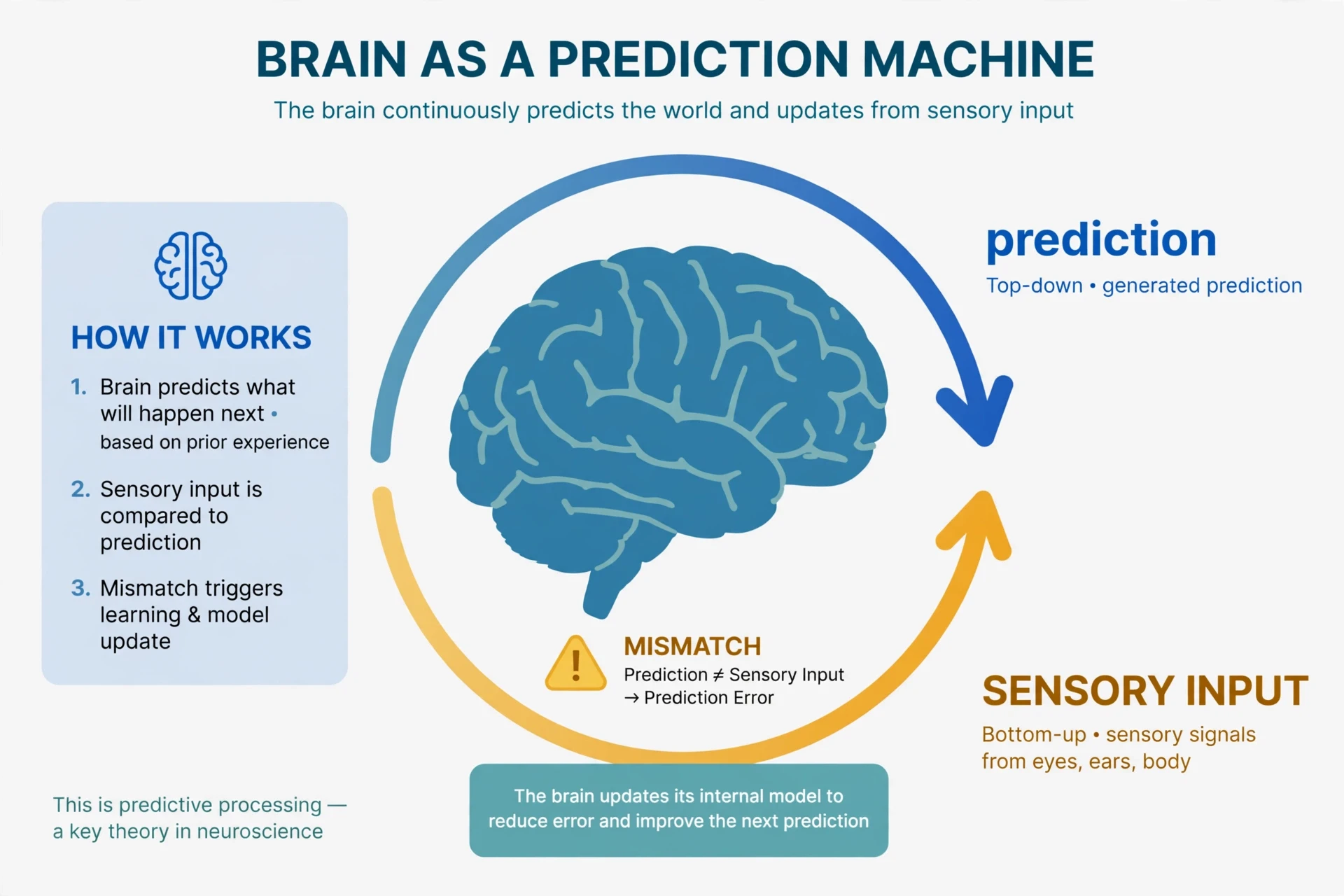
If there is one idea that explains how optical illusions work better than any other, it is this: your brain does not wait for the world to tell it what is there. It predicts what should be there, then checks the prediction against the incoming signals. When the prediction is good, you see quickly and smoothly. When the prediction is wrong, you see an illusion.
Think of it like reading a sentence with a smudged word. You do not sound out every letter. You guess the word from context, and most of the time you are right. Vision works the same way, only faster and with far more at stake. A brain that waited for complete, certain information before acting would be too slow to catch a ball, dodge a car, or spot a predator. So evolution built a brain that bets. Illusions are what the bets look like when they lose.
"Perception is not a window onto the world. It is a best guess about the world, built from incomplete signals and a lifetime of experience."
3.2 Predictive coding, in plain language
Neuroscientists call this framework predictive coding. Higher areas of the brain send predictions downward about what the lower areas should be seeing. Lower areas send back only the difference — the prediction error — the part of the signal the prediction did not explain. The brain updates its guess, and the cycle repeats, many times a second.
Research on this idea has gone further than theory. In one study, a computer model trained only to predict the next frame of a video began to "see" illusory motion in still images, much as people do — a sign that prediction itself can generate the illusion — a direct clue to how optical illusions work — not just explain it after the fact (Watanabe et al., Frontiers in Psychology, 2018). When the model learned the statistics of the natural world, it inherited the same shortcuts our brains use, and the same blind spots.
That finding reframes the question. How optical illusions work is not a story about broken vision. It is a story about vision working exactly as designed, on input it was never designed for. Flat drawings, printed shadows, and arrow fins are not part of the world your ancestors evolved in. Your brain treats them as if they were, and the mismatch shows.
3.3 Why the guess usually wins
You might wonder why the brain trusts its guesses so much. The answer is speed and survival. A prediction that is right 99 times out of 100 is worth keeping, even if it fails on a printed page. In the real world, light usually comes from above, objects usually keep their size as they move, and a straight line is usually a straight line. Your brain leans on those regularities because they are almost always true.
Illusion artists, quite deliberately, build pictures where those regularities are false. The Ponzo drawing makes a flat page look like a road receding into the distance. The checker shadow makes two identical greys sit in different lighting. In both cases, the brain applies a rule that is correct for the real world and wrong for the drawing. That is how optical illusions work in practice: the illusion is the price of a shortcut that normally pays off.
4. Top-Down vs Bottom-Up Processing
4.1 Two directions of information
Vision runs in two directions at once. Bottom-up processing starts with the raw data: edges, contrasts, colours, and motion as they hit the retina. Top-down processing starts with what you already know: what objects look like, how light behaves, what usually happens next. The two streams meet in the middle, and what you perceive is their negotiation.
A simple way to feel the difference is to look at a blurry photograph. At first, the bottom-up signal is weak — just smudges of light and dark. Then someone tells you it is a dog, and suddenly you see the dog. Nothing changed on the page. Your top-down knowledge reorganised the same smudges into a shape. The same negotiation runs, silently, every time you open your eyes.
4.2 When top-down wins too much
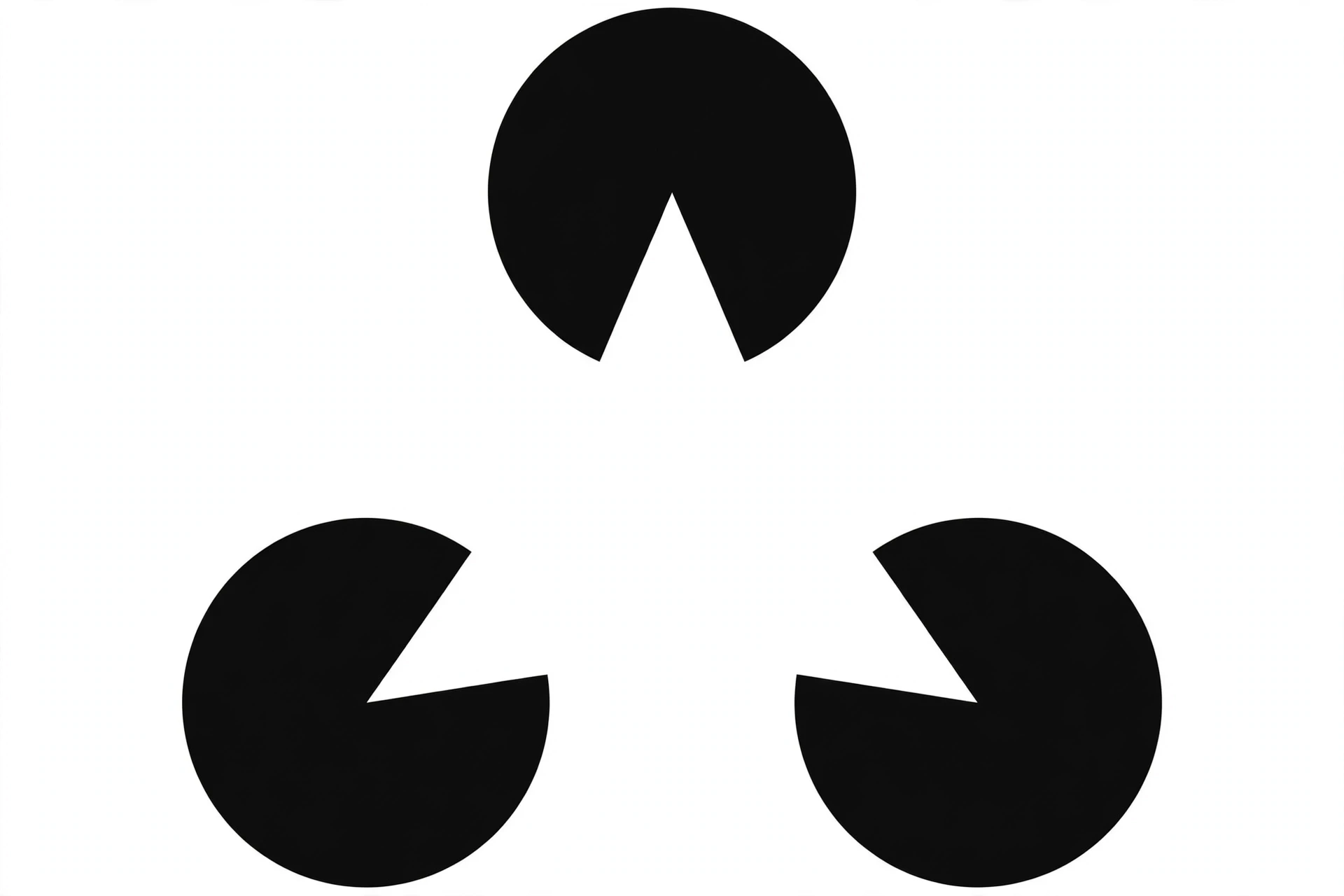
Illusions often show top-down processing winning an argument it should have lost. In the Kanizsa triangle, you see a bright white triangle sitting on top of three black circles — even though no triangle has been drawn. Your brain infers the triangle because it is the simplest explanation for the notches cut out of the circles. The edges you "see" are not in the image at all. They are drawn by your brain, in the service of a tidy explanation.
I still remember showing that triangle to a room of first-year students and watching half of them trace the edges in the air with a finger, convinced the lines were printed. One student asked me to print the slide again, larger, because she was sure the projector was hiding the lines. The lines were never there. Her brain had drawn them so convincingly that disbelief felt like the reasonable response. That is top-down processing doing its job too well.
4.3 When bottom-up wins too much
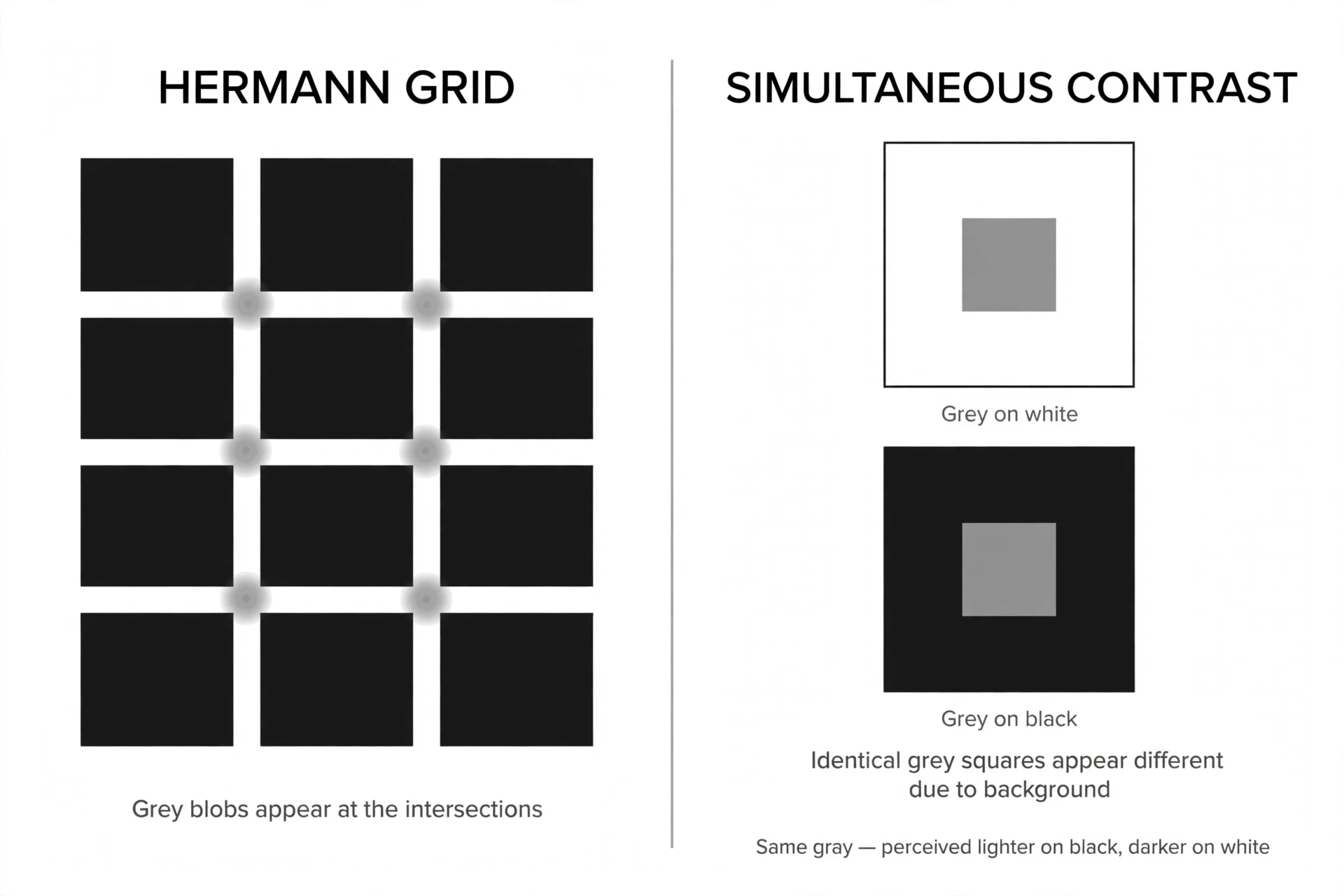
The reverse also happens. Some illusions are driven from the bottom up, by the wiring of the retina itself. The Hermann grid — a grid of black squares separated by white corridors — makes ghostly grey blobs appear at the intersections, even though the white is uniform. The blobs come from lateral inhibition, a retinal mechanism described in Section 6. No amount of knowing about the illusion makes the blobs vanish, because the effect starts before knowledge gets a vote. You can stare at the grid, know the blobs are false, and still see them. That split between knowing and seeing is one of the clearest clues to how optical illusions work: perception and belief are separate systems, and they do not always agree.
5. Gestalt Principles: The Brain's Rules for Grouping
5.1 The whole is different from the sum of its parts
In the early 1900s, a group of German psychologists — Max Wertheimer, Kurt Koffka, and Wolfgang Köhler — argued that the brain organises visual input according to a set of grouping rules. They called their school Gestalt psychology, from the German word for shape or form. Their core claim was that we perceive whole patterns first, and parts second. The rules they described still explain a large share of how optical illusions work.
5.2 The main principles, with everyday examples
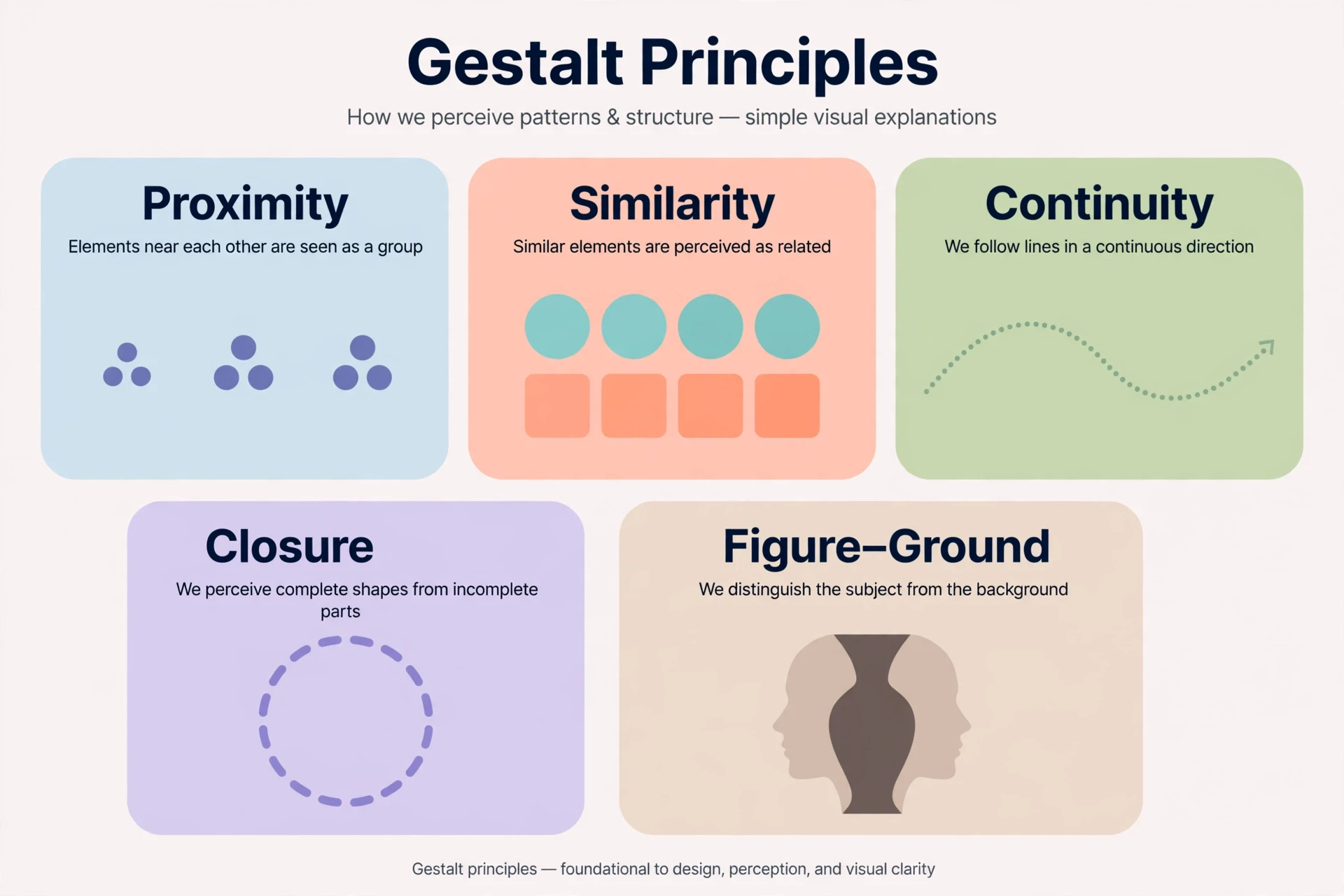
Proximity: things close together look like a group. Dots in rows read as lines, even when nothing connects them.
Similarity: things that look alike get grouped. In a crowd, you spot the people in matching uniforms instantly.
Continuity: the eye follows smooth lines and curves. A road disappearing behind a hill still feels like one road.
Closure: the brain completes unfinished shapes. The Kanizsa triangle is closure at its most dramatic.
Figure–ground: the brain separates an object from its background. The famous vase-faces image flips between a vase and two faces, because the same lines can organise either way.
Common fate: things moving together look like one object. A flock of birds reads as a single shifting shape.
Each principle is a bet about the world. Things close together usually belong together. Smooth lines usually continue. Unfinished shapes usually have a simple completion. In everyday life, these bets are right so often that you never notice them. In an illusion, the artist arranges the parts so that the bet produces a whole that is not really there.
5.3 Why grouping matters beyond illusions
Gestalt principles are not parlour tricks. They are the reason you can read handwriting, recognise a friend in a crowd, or spot a camouflaged animal that suddenly moves. Designers use them deliberately: a well-designed road sign groups related information so a driver reads it in a glance, and a confusing one groups the wrong things together. Understanding how optical illusions work, in this sense, is also understanding how ordinary seeing works. The illusion is simply the rule, caught in the act.
6. Lateral Inhibition and Contrast: The Retina's Own Tricks
6.1 Neighbours that quiet each other
Before the brain ever gets involved, the retina does its own editing. When one photoreceptor fires strongly, it damps down the response of its neighbours. This is called lateral inhibition, and it sharpens edges. A bright patch next to a dark patch looks brighter at the border than it really is, because the dark side is being actively suppressed. The effect makes edges pop out of a scene, which helps you find the outline of an object fast.
The cost is that brightness becomes relative, not absolute. Your visual system reports how bright something is compared with its surroundings, not how bright it is in itself. That is a sensible trade in the real world, where lighting changes constantly and what matters is the object, not the light falling on it. It is also a key part of how optical illusions work, and the mechanism behind several classic illusions.
6.2 Simultaneous contrast and the Hermann grid
Put a medium-grey square on a white background and the same grey on a black background, and the first looks darker. The grey has not changed. Its neighbours have. This is simultaneous contrast, and it is lateral inhibition doing its job on a larger scale.
The Hermann grid uses the same wiring. At the white intersections of a black grid, each bright patch is surrounded by more darkness in the corners of your peripheral vision, so inhibition is stronger there, and a grey blob appears. Look directly at an intersection and the blob fades, because the centre of your vision has smaller, sharper receptive fields. Move your eyes, and the blobs dance around the grid. I have watched students chase those blobs across the page, certain they were printed in light grey, and the chase itself is the lesson: the retina is not a passive sensor. It edits before the brain even sees the picture.
7. The Classic Illusions, Explained One by One
7.1 The Müller-Lyer illusion: depth cues in a flat drawing
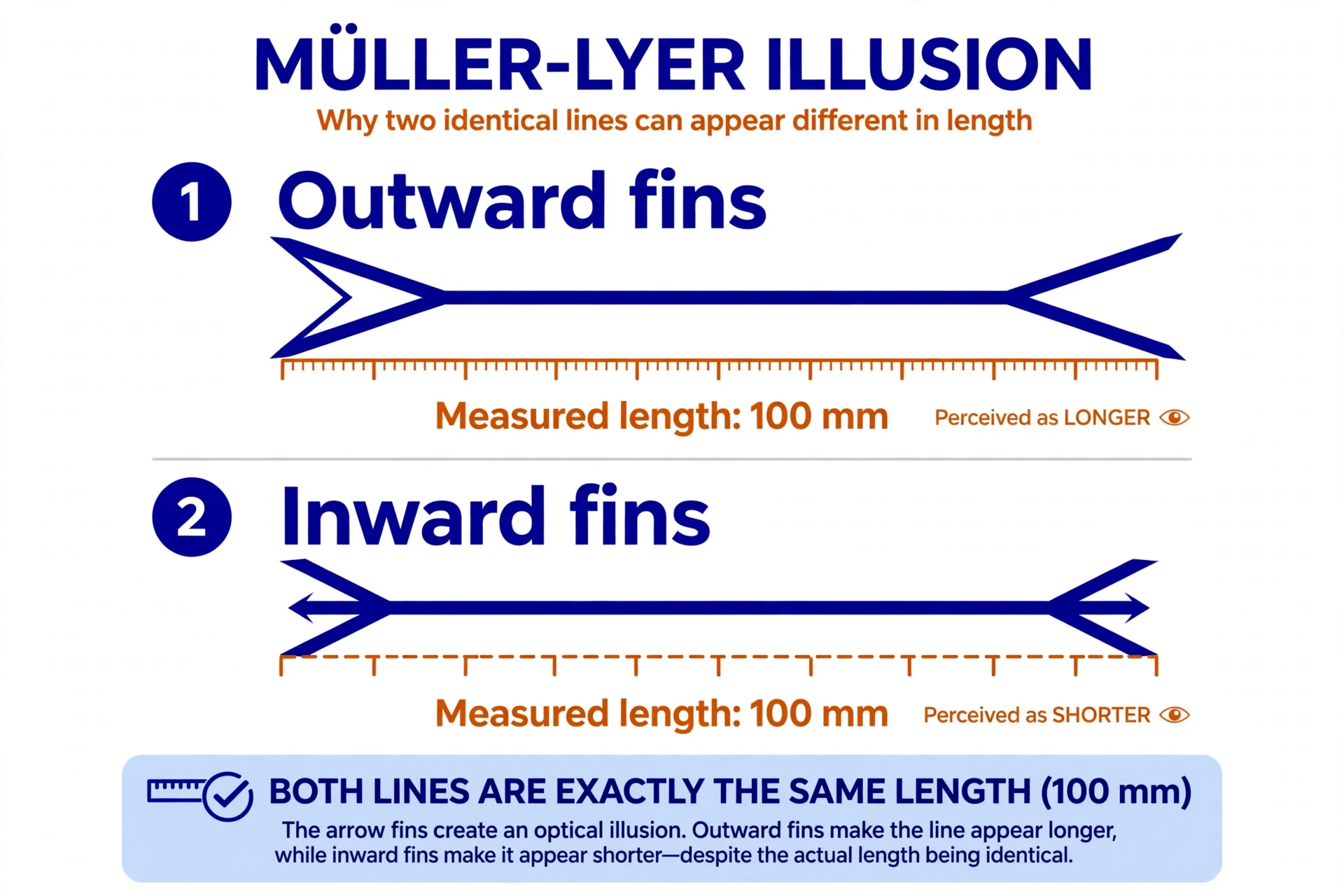
Two lines, the same length. One has fins pointing outward, like an arrowhead; the other has fins pointing inward, like a tail. The line with outward fins looks longer. Why?
The leading explanation is misapplied size constancy. Your brain reads the fins as depth cues. The outward-finned line looks like the far inside corner of a room, and the inward-finned line looks like the near outside corner of a building. If two things cast the same-sized image on your retina but one is farther away, the farther one must be bigger in the real world — so your brain scales it up. On a flat page, there is no real depth, but the cue fires anyway, and the line grows in your perception.
There is a second, simpler factor at work too. Your brain may judge the whole figure — line plus fins — rather than the line alone, and the outward-finned figure spans a wider area. Both explanations point the same way: length is not measured by a ruler in your head. It is inferred from context, and context can be rigged.
Culture matters here, in a way that surprised researchers. People raised in environments full of rectangular buildings and right angles — the "carpentered world" — tend to fall for the Müller-Lyer illusion more strongly than people raised in open landscapes with few straight corners. That is how optical illusions work in real people, not just in textbooks: the effect is not purely hard-wired. Experience tunes the depth cues your brain trusts. The Illusions Index, maintained by researchers at the University of Glasgow, catalogues this illusion and its variants with the history and the evidence (The Illusions Index).
7.2 The Ponzo illusion: the railway that stretches bars
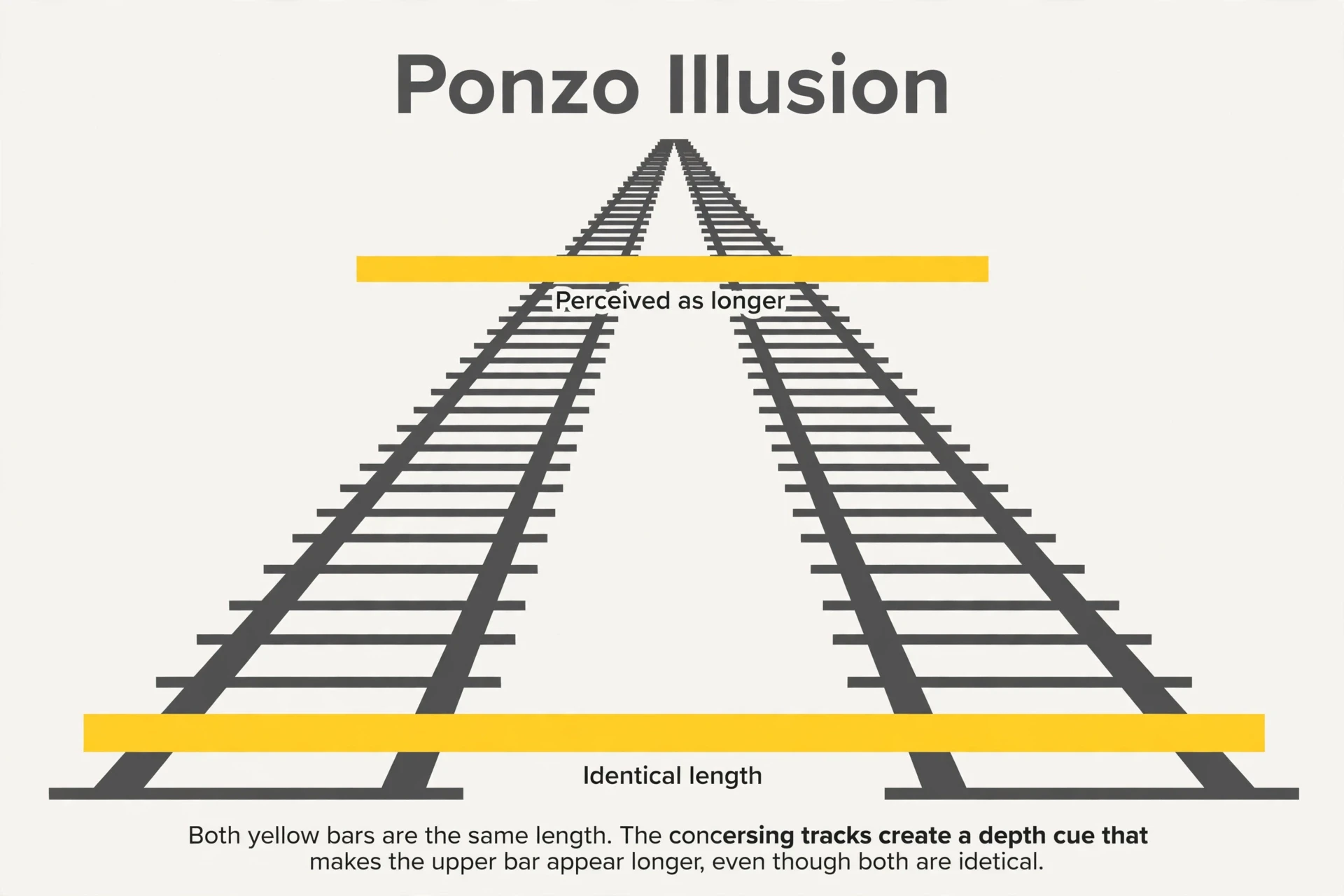
Two identical horizontal bars sit across a pair of converging lines, like railway tracks running to the horizon. The upper bar, near the narrow end of the tracks, looks longer than the lower bar. The explanation is the same family as Müller-Lyer: your brain reads the converging lines as depth, assumes the upper bar is farther away, and scales it up to compensate. Since both bars cast the same-sized image on your retina, the "farther" one must be larger in the world — so you see it as larger.
The Ponzo illusion is a useful reminder of how optical illusions work: size perception is a calculation, not a measurement. Your brain combines the retinal image size with an estimate of distance, and if the distance estimate is wrong, the size is wrong too. The moon looks enormous near the horizon for a related reason: the sky near the horizon feels farther away, so the same-sized moon gets scaled up. The calculation is usually right. The drawing is a case where it is not.
7.3 The Kanizsa triangle: edges that do not exist
Three black circles with wedge-shaped bites taken out of them, arranged in a triangle, plus three angled lines. You see a bright white triangle lying on top of the circles, its edges sharp and clear. No triangle is drawn. The edges are illusory contours, created by your brain to explain the bites in the circles.
The Kanizsa triangle is the cleanest demonstration that perception is construction. Your visual system would rather invent an object — a white triangle in front of three black discs — than accept three damaged circles and three stray angles. The invented object is simpler, tidier, and more likely in the real world. So your brain draws it, and you see it, edges and all. Brain imaging shows that the visual cortex responds to those illusory edges almost as if they were real lines. The construction is not a metaphor. It is visible in the brain's activity.
7.4 Adelson's checker shadow: the grey that refuses to look grey
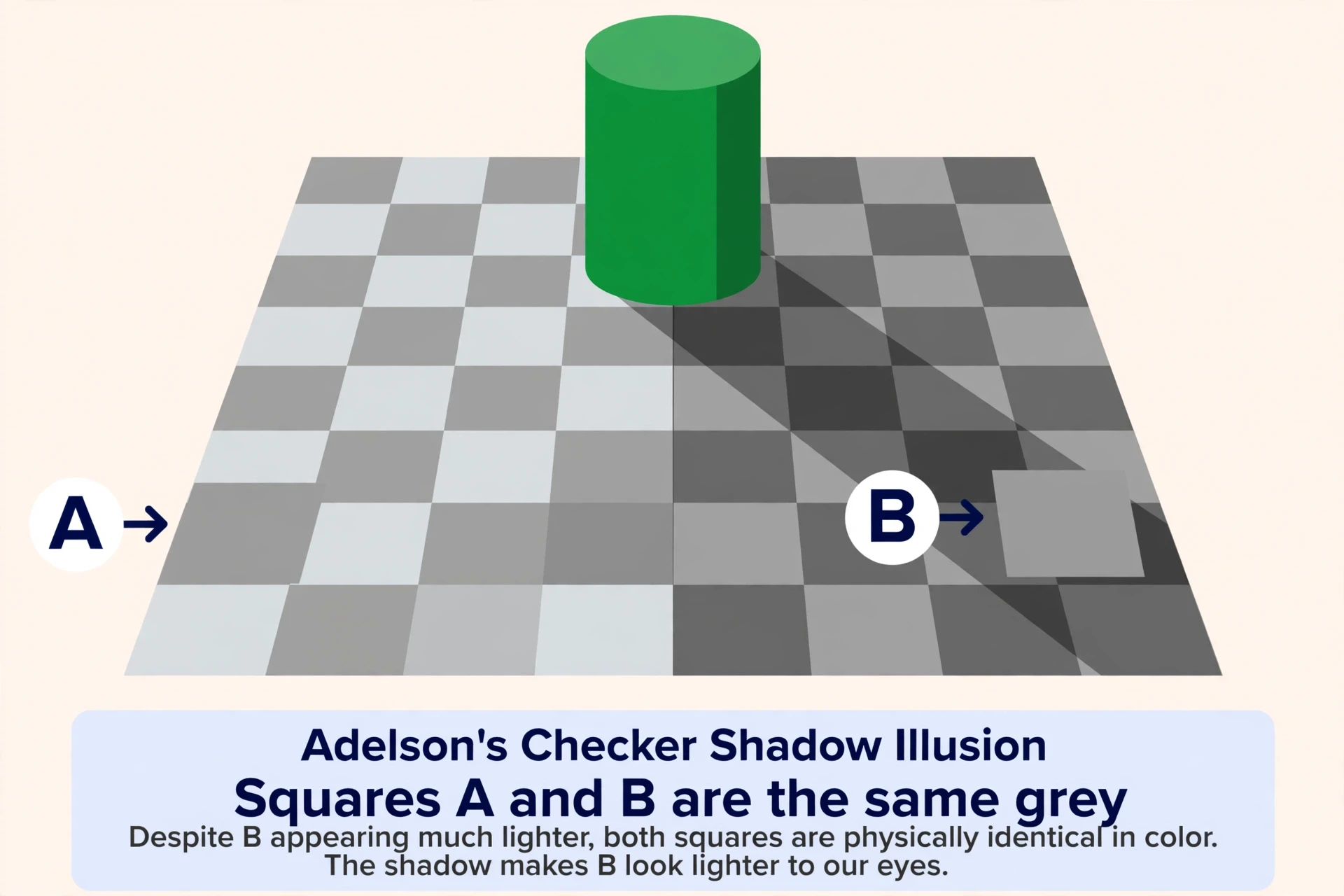
A checkerboard sits partly in the shadow of a green cylinder. Square A, outside the shadow, looks dark. Square B, inside the shadow, looks light. They are the same shade of grey. Cover the rest of the board with your hands, or cut the two squares out and place them side by side, and the sameness becomes obvious. Uncover the board, and the difference returns.
How optical illusions work in the checker shadow is a combination of two mechanisms. First, simultaneous contrast: square B is surrounded by dark squares, square A by light ones, so contrast pushes them apart. Second, and more powerfully, your brain discounts the shadow. It knows, from a lifetime of experience, that a surface in shadow receives less light, so a grey square in shadow must be lighter in itself than the same retinal signal from a square in full light. Your brain corrects for the lighting — and the correction is so good, and so automatic, that it overrides the raw fact that the two squares are identical.
The checker shadow is my favourite illusion to show people, because it feels personal. It is not a trick of lines or angles. It is your brain doing something clever — separating an object's real colour from the light falling on it — and being too clever for its own good. Colour constancy, the ability behind this, is what lets you recognise a red apple in shade and in sunlight as the same red apple. The same system that makes ordinary life stable makes the checker shadow impossible to unsee. For a related story about colour and light, Sciory's explainer on Why Is the Sky Blue? shows how the brain and the atmosphere together decide what colour you see.
7.5 Ebbinghaus circles and motion illusions
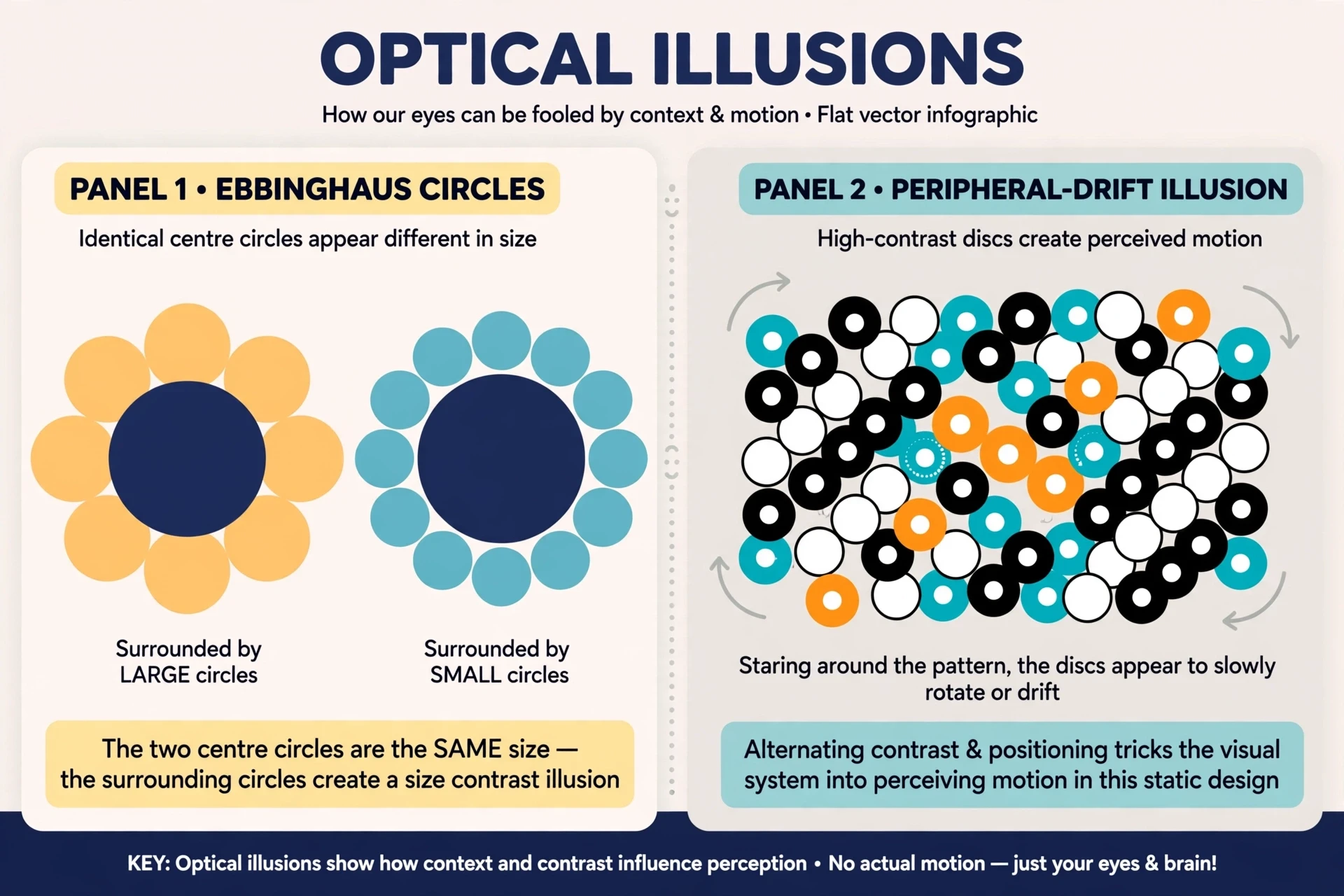
Two more classics round out the picture of how optical illusions work. In the Ebbinghaus illusion, a central circle surrounded by large circles looks smaller than an identical circle surrounded by small ones. Size, again, is judged relative to context. In peripheral drift illusions, such as the rotating snakes pattern, a perfectly still image seems to move in your peripheral vision. The motion detectors in your visual system are sensitive to contrast and timing, and the pattern's arrangement triggers them in sequence, producing a sense of movement where none exists. Look directly at any one snake and it stops. Look away, and it starts again.
Together, these illusions show how optical illusions work across the whole visual system: size is relative, brightness is relative, edges can be invented, and motion can be faked. No single mechanism explains them all, and that is the point. Vision is a committee, and each member can be fooled in its own way.
Illusion | What you see | What is really there | Main mechanism |
|---|---|---|---|
Müller-Lyer | One line looks longer | Lines are identical | Misapplied depth cues, size constancy |
Ponzo | Upper bar looks longer | Bars are identical | Depth scaling from converging lines |
Kanizsa triangle | A bright triangle with edges | No triangle is drawn | Illusory contours, Gestalt closure |
Adelson checker shadow | Square B looks lighter than A | Both squares are the same grey | Shadow discounting, simultaneous contrast |
Ebbinghaus circles | Centre circle looks smaller or larger | Centre circles are identical | Relative size judgement |
Hermann grid | Grey blobs at intersections | White corridors are uniform | Lateral inhibition in the retina |
Peripheral drift | A still image seems to move | Nothing is moving | Motion detectors triggered by contrast |
Table 1: The classic illusions at a glance. Each one targets a different shortcut. Read down the last column and you have a short map of how optical illusions work.
8. Why Illusions Fool Some People More Than Others
8.1 Age, culture, and experience
Not everyone sees every illusion the same way, and the differences are informative about how optical illusions work. Children are often less fooled by some geometrical illusions than adults, because their depth-cue habits are still forming. People who grew up in environments with many rectangular corners show a stronger Müller-Lyer effect. Artists and architects, who spend their lives judging lengths and angles, are sometimes less fooled — and sometimes more, because they are also more sensitive to the depth cues the illusion uses.
These differences confirm that how optical illusions work depends on learning as well as wiring. The retina's lateral inhibition is much the same in everyone. The depth cues your brain trusts, and how strongly it trusts them, are tuned by the world you grew up in. An illusion is a meeting point between biology and biography.
8.2 Attention, tiredness, and expectation
Your state matters too. When you are tired, rushed, or distracted, top-down shortcuts take over more of the work, and illusions tend to bite harder. When you slow down, measure, cover parts of the image, or change your viewing angle, the illusion often weakens — not because your eyes changed, but because slowing down changes how optical illusions work on you: you gave the bottom-up signal a chance to argue back. That is why the classic advice for checking an illusion — cover the surroundings, use a ruler, look at one part at a time — actually works. You are not fixing your eyes. You are changing the negotiation between prediction and data.
Expectation can also prime an illusion. If someone tells you "this dress is blue and black" before you see it, you are more likely to see it that way, at least at first. The effect is not magic. It is top-down processing doing what it always does: using prior information to resolve an ambiguous signal. The famous dress photograph was ambiguous because its lighting gave the brain too little information about whether the dress was in shadow or in bright light, and different brains resolved the ambiguity differently.
8.3 Do illusions mean something is wrong with you?
No. Falling for an optical illusion is a sign that your visual system is working normally. In fact, the people who are hardest to fool are often those with unusual visual processing — and the trade is rarely a good one. The shortcuts that illusions expose are the same shortcuts that let you recognise a face in a crowd, catch a ball, and read a road sign at speed. A brain that never guessed would be accurate and useless. A brain that guesses well is fast, useful, and occasionally fooled by a drawing.
That point is worth carrying into the rest of psychology. How the brain forms memories, how it builds a sense of self, and how it decides what is real all run on the same principle: prediction first, checking second. Sciory's guide to How the Human Brain Forms Memories shows the same construction at work in memory, and the article on What Is Consciousness? explores what happens when the brain's model of the world becomes the world you experience.
9. What Illusions Are Good For: Real Uses in the Real World
9.1 Medicine and diagnosis
Illusions are not just curiosities, and studying how optical illusions work has practical uses. Clinicians use them as probes. Because different illusions target different parts of the visual system, a person's pattern of responses can hint at where processing differs. Researchers have studied illusion susceptibility in conditions such as schizophrenia and autism, where the balance between top-down prediction and bottom-up signal appears to shift. The findings are early and mixed, and no illusion is a diagnostic test — but the research shows why scientists take illusions seriously. They are a non-invasive way to watch the visual system think.
9.2 Design, safety, and art
Designers use the same principles deliberately, and usually for good. Road markings that look three-dimensional slow drivers down. Architects use forced perspective to make a building look taller. Artists from the Op Art movement to modern graphic designers use contrast and motion illusions to make flat surfaces vibrate with energy. The other side of the coin is that designers must also avoid accidental illusions: a floor pattern that looks like a step, a staircase edge that blends into the tread, or a sign whose colours reverse in shadow can all cause real harm. Understanding how optical illusions work is, in those cases, a safety issue, not a party trick.
9.3 Machines that see
Engineers building computer vision systems have learned the same lesson the hard way. A self-driving car, a medical imaging system, or a face-recognition tool must not be fooled by shadows, contrast, or context the way people are — and yet the most successful vision models, trained on natural images, often develop the same shortcuts, and the same blind spots, as human vision. The predictive-coding study in Section 3 is one example: a model trained to predict video frames began to see illusory motion. That is both a warning and a tool. If we want machines that see reliably, we need to understand the shortcuts they inherit. If we want to understand human vision, machines that reproduce how optical illusions work are a new kind of evidence.
10. Common Misconceptions About Optical Illusions
10.1 "Illusions mean your eyes are broken"
Most people assume an illusion reveals a defect, and that mistake comes from not knowing how optical illusions work. What the evidence actually shows is the opposite: illusions reveal a system working as designed, on input it was not designed for. Your eyes collect the light correctly. Your brain interprets it with rules that are right for the three-dimensional world and wrong for a flat trick drawing. The defect, if there is one, is in the drawing, not in you.
10.2 "If you know the trick, you stop seeing it"
Knowing rarely helps. You can measure the Müller-Lyer lines, confirm they are equal, and still see one as longer. You can know the checker shadow squares are identical and still see them as different shades. That persistence is the most important clue to how optical illusions work: the visual system is largely sealed off from conscious belief. Knowing is a different system from seeing, and the two do not share a control panel. The best you can do is change the input — cover the fins, block the shadow, look at one square at a time — and let the bottom-up signal win the argument on its own terms.
10.3 "Illusions are only visual"
The word "optical" narrows the idea unfairly, because how optical illusions work is not limited to sight. The same prediction-first logic produces illusions in hearing, touch, and even time. A sound that seems to come from a ventriloquist's dummy, a tap on the skin that seems to hop between two points, a silence that seems to stretch — all of them are the brain's best guess, wrong in an interesting way. Vision gets the attention because it is our dominant sense and the easiest to draw, but the principle is general. Your brain builds every sense the same way: predict, compare, update.
10.4 "There is one explanation for all illusions"
There is not, and anyone offering a single neat cause is selling simplicity, not science. Lateral inhibition explains the Hermann grid and does nothing for the Kanizsa triangle. Misapplied depth cues explain Ponzo and do nothing for peripheral drift. Predictive coding is the closest thing to a unifying frame, because it describes the architecture in which all the smaller mechanisms run — but it is a frame, not a single cause. A good explanation of how optical illusions work names the mechanism for each illusion, and admits where the mechanisms differ.
11. Latest Research: What Scientists Are Learning Now
11.1 Prediction in the brain, measured directly
The predictive-coding idea has moved from theory to measurement. Brain-imaging studies now track prediction errors as they travel through the visual cortex, and they show that the brain responds more strongly to surprising input than to expected input — exactly as the theory predicts. When an image matches the brain's guess, the response is quiet. When it violates the guess, the response spikes. Illusions sit in the middle of that story: they are cases where the guess is strong, the input is ambiguous, and the guess wins.
11.2 Illusions as a test bed for artificial vision
As noted in Section 9, computer models trained to predict natural video are now reproducing how optical illusions work without being taught to. That is a striking result, because it suggests the illusions are not quirks of biology but consequences of the task itself: any system that must predict a fast-changing world from limited signals will develop the same shortcuts. Researchers are now using illusions as a benchmark — a model that sees the world the way people do, illusions included, is a model that has learned something real about vision. The American Psychological Association's coverage of illusion research and its perception topic pages are good starting points for following this work (APA, "Perception"; APA Monitor on illusions).
11.3 Open questions
Researchers still disagree on important details. The exact cause of the Müller-Lyer illusion is debated after more than a century. The moon illusion — why the moon looks larger near the horizon — still has competing explanations. And the biggest question of all remains open: how does the brain's private construction become the conscious experience of seeing? Illusions do not answer that question, but they keep it honest. Any theory of consciousness that cannot explain why a white triangle appears where nothing is drawn has missed something essential. Sciory's article on What Is Consciousness? takes that question further, and the research on sleep and dreams in Science of Sleep and Dreams Explained shows what the prediction machine does when the eyes are closed and it dreams its own pictures.
"An illusion is not a failure of seeing. It is seeing, caught in the act of guessing — and the guess is usually right."
12. How to See Through an Illusion (and When Not To)
You cannot switch your visual system off, but once you know how optical illusions work, you can work around it. Cover the context that drives the illusion. Measure instead of eyeballing. Change your distance from the image, or turn it upside down, which breaks many depth cues at once. Look at one element at a time instead of the whole pattern. Each of these moves does the same thing: it gives the bottom-up signal a cleaner vote, with less top-down interference.
There is also a case for not trying. The same shortcuts that fool you in an illusion let you read a face, catch a ball, and drive a car. You would not want to trade them for a brain that measured everything and guessed nothing. The right response to an illusion is not embarrassment. It is curiosity. Your brain just showed you one of its working rules, in plain sight, and that is a gift. Most of the time, those rules run invisibly. An illusion is one of the few moments when you get to watch them work.
Conclusion: The Liar You Should Trust
How optical illusions work, in the end, is a story about a bargain. Your brain trades perfect accuracy for speed, stability, and usefulness. It predicts what should be there, fills in what is missing, discounts shadows, scales sizes by distance, and groups fragments into wholes — all without asking you, and all in a fraction of a second. The result is a world that feels direct and solid, even though it is built from guesses.
That bargain is worth keeping. The same brain that sees a longer line where two lines are equal also lets you recognise a friend across a crowded room, read these words without sounding out each letter, and know, without thinking, that the floor will still be there when you take your next step. Illusions do not prove that you cannot trust your eyes. They prove that trust has a mechanism — and now you know what it is. Next time a drawing lies to you, measure it, smile at it, and remember: the lie is the receipt for a system that, almost all of the time, gets the world right.
Frequently Asked Questions
Why do optical illusions work?
Optical illusions work because your brain predicts what it expects to see and fills in missing information, rather than recording the world like a camera. It uses shortcuts — depth cues, contrast comparisons, grouping rules, and past experience — that are right in everyday life but wrong for a trick drawing, so the prediction wins over the raw signal and you see something that is not really there.
Why do two lines look different lengths in the Müller-Lyer illusion?
The Müller-Lyer illusion works because your brain reads the arrow fins as depth cues. The line with outward-pointing fins looks like a far inside corner, and the line with inward-pointing fins looks like a near outside corner. Since the farther object must be bigger to cast the same-sized image on your retina, your brain scales the "farther" line up — even though both lines are printed the same length on a flat page.
Are the two squares in the checker shadow illusion really the same colour?
Yes. In Adelson's checker shadow illusion, squares A and B are exactly the same shade of grey. Square B looks lighter because it sits in shadow and is surrounded by dark squares. Your brain discounts the shadow, reasoning that a surface in shadow must be lighter in itself, and that correction overrides the fact that the two squares are identical.
Can you train yourself to stop seeing optical illusions?
Mostly no. Knowing how optical illusions work rarely makes an illusion disappear, because the visual system operates largely independently of conscious belief. You can weaken an illusion by covering the surrounding context, measuring the elements, or viewing one part at a time, but the effect usually returns as soon as the full pattern is visible again. That persistence is itself evidence that perception and belief run on separate tracks.
Do optical illusions mean something is wrong with my eyes or brain?
No. Falling for an optical illusion is normal and expected — it shows your visual system is using the same shortcuts that let you recognise faces, judge distance, and move through the world quickly. If you suddenly start seeing things that are not there in everyday life, or your vision changes sharply, that is different from an illusion on a page, and it is worth speaking to a doctor. An illusion in a book is a demonstration; a change in your everyday vision is a health question.
Sources
National Eye Institute. "How the Eyes Work." https://www.nei.nih.gov/eye-health-information/healthy-vision/how-eyes-work
American Psychological Association. "Perception." https://www.apa.org/topics/perception
American Psychological Association. "Illusions" (APA Monitor). https://www.apa.org/monitor/2019/07-08/illusions
Watanabe, E., Kitaoka, A., Sakamoto, K., Yasugi, M., & Tanaka, K. (2018). "Illusory motion reproduced by deep neural networks trained for prediction." Frontiers in Psychology, 9, 345. https://www.frontiersin.org/journals/psychology/articles/10.3389/fpsyg.2018.00345/full
The Illusions Index (University of Glasgow). "Müller-Lyer Illusion." https://www.illusionsindex.org/i/mueller-lyer-illusion — and the main index at https://www.illusionsindex.org/