

1. The Moth That Changed Colour
Natural selection is the process by which heritable traits that help organisms survive and reproduce become more common in a population, generation after generation. It has no plan and no goal — yet it built every adaptation on Earth, from the peppered moth's camouflage to the human eye.
I still remember the page in my school biology textbook that first made evolution feel real to me. It showed two photographs of the same species of moth resting on tree trunks. On the left, a pale, speckled moth sat on a lichen-covered trunk, almost invisible. On the right, a black moth sat on a soot-darkened trunk, equally invisible. The caption said the two moths were the same species, the peppered moth, and that within a single human lifetime the dark form had gone from rare to common across industrial England — and then, as the air cleaned up, had faded back again. I stared at that page for a long time. Here was evolution not as a story about dinosaurs millions of years ago, but as something you could watch happening in a factory town, in decades, in the colour of a moth's wings.
That moth is where this article begins, because it contains the whole idea in miniature. Nothing about the moth's story requires a miracle, a plan, or a designer. It requires only three ordinary facts about living things: individuals differ from one another, some of those differences are inherited, and not every individual gets to reproduce. When those three facts hold, the population changes. That change is natural selection, and it is the engine that Charles Darwin identified in 1859 as the mechanism behind the diversity of life.
Darwin did not invent the idea that species change. Naturalists before him had suspected it. What Darwin supplied — together with Alfred Russel Wallace, whose paper was read alongside Darwin's before the Linnean Society of London in 1858 — was a mechanism simple enough to state in a sentence and powerful enough to explain the living world. The following year, Darwin published On the Origin of Species, and biology has never been the same since. Sciory's Darwin's Theory of Evolution: Evidence Explained traces the evidence that convinced scientists species really do change over time. This article is about the mechanism itself: how natural selection works, step by step, and why it explains so much with so little.
The stakes are larger than a moth. Natural selection is the reason bacteria defeat our antibiotics, the reason a finch's beak can change size within a few years, and the reason a structure as intricate as the eye could arise without anyone designing it. It is also one of the most misunderstood ideas in science. People hear "survival of the fittest" and picture the strongest animal winning a fight. They hear "evolution" and picture a ladder climbing toward humans. Both pictures are wrong, and both have done real damage to public understanding. This article will take the idea apart, test it against the best evidence, and put it back together — including the parts where the simple story needs a correction.
2. What Is Natural Selection?
Natural selection is evolution's sorting mechanism: in every generation, individuals with traits that suit their environment tend to leave more offspring, so those traits spread through the population over time. It does not create new traits — mutation and recombination do that — but it decides, generation after generation, which of the traits already present get passed on.
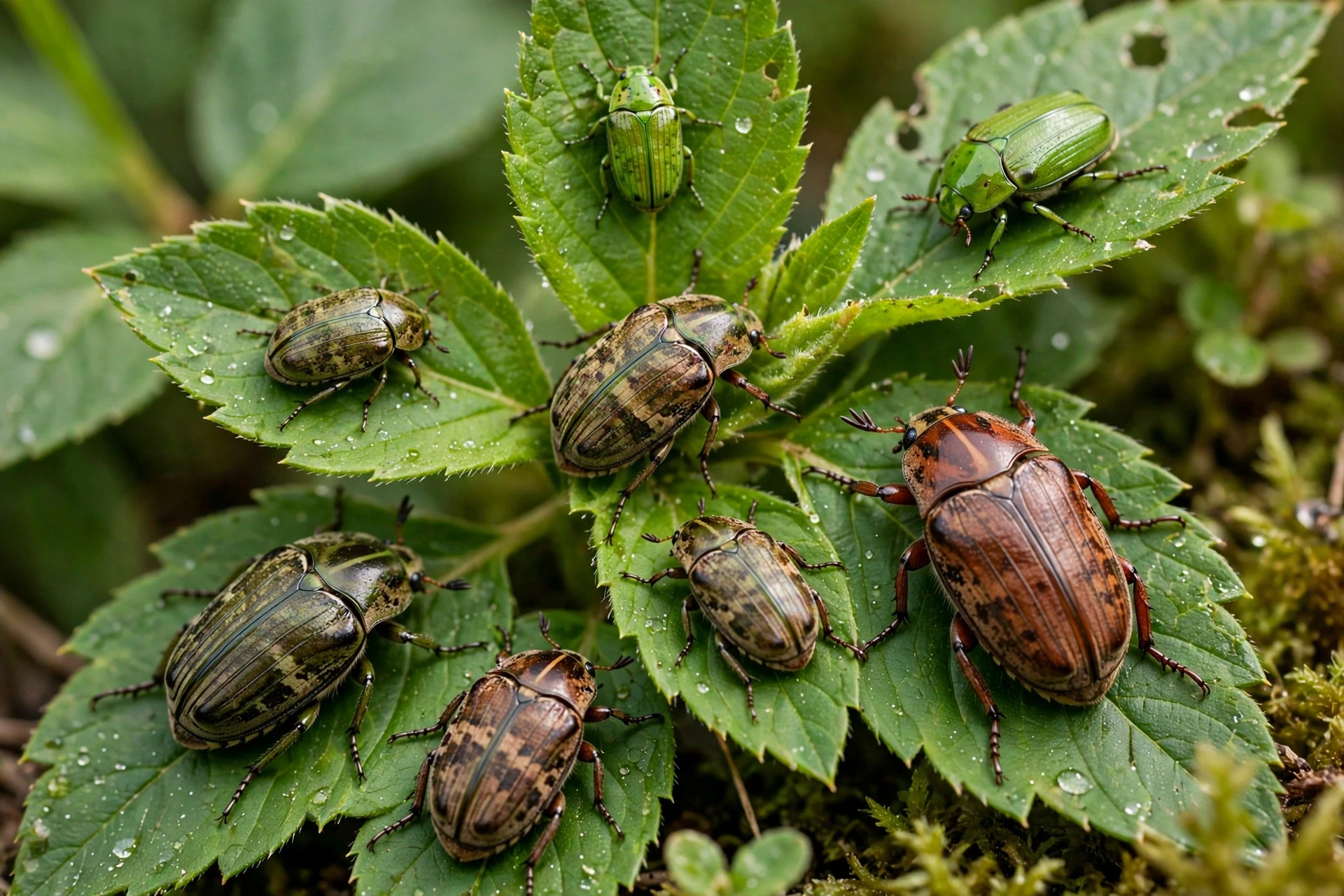
Start with the simplest possible picture. Imagine a population of beetles living on green leaves. Most of the beetles are green, but a few are brown, because of a difference in their genes. Birds hunt these beetles by sight. A brown beetle on a green leaf stands out; a green beetle blends in. The brown beetles get eaten more often. The green beetles survive longer and lay more eggs. The next generation has more green beetles in it — not because any beetle changed colour during its life, and not because the beetles "tried" to become green, but because green beetles, on average, left more descendants. Repeat that for a hundred generations, and the population is almost entirely green. That is natural selection, and nothing in the story requires anything more mysterious than hungry birds and heritable colour.
Darwin himself defined the process with characteristic precision. In Chapter 4 of On the Origin of Species, he wrote:
"This preservation of favourable variations and the rejection of injurious variations, I call Natural Selection."
The word "preservation" matters. Natural selection does not sculpt new traits out of nothing. It preserves — by the blunt arithmetic of who survives and reproduces — the variations that already exist. The raw material comes from elsewhere: from mutations that change DNA, from the shuffling of genes during sexual reproduction, and from the movement of genes between populations. Selection is the filter; variation is the supply. Confuse the two and the whole idea goes wrong.
OpenStax Biology describes natural selection as "the more prolific reproduction of individuals with favorable traits that survive environmental change because of those traits," and notes that Darwin saw it as the inevitable outcome of three principles operating in nature: most characteristics are inherited, more offspring are produced than can survive, and individuals with favourable traits are more likely to survive and reproduce. The OpenStax Biology 2e chapter on understanding evolution lays out those principles clearly, and they are worth keeping in mind as we go, because every example in this article is the same three principles wearing different clothes.
It is also worth saying plainly what natural selection is not. It is not a force with intentions. It has no foresight, no preferences, and no memory. When we say selection "favours" a trait, we mean only that individuals carrying the trait left more offspring, on average, in that environment, at that time. Change the environment and the same trait can become a liability overnight — as the peppered moth will show. And natural selection is not the only way populations change. Chance plays a role too: in small populations, a trait can spread or vanish by pure luck, a process called genetic drift. Migration moves genes between populations. Mutation creates new variation. Natural selection is the only one of these mechanisms that consistently builds adaptation — the fit between an organism and its way of life — but it is not the only force in evolution.
One more distinction belongs here, because it prevents most of the confusion that follows. Natural selection acts on individuals, but evolution happens to populations. A single beetle does not evolve during its lifetime. It either survives and reproduces, or it does not. What changes is the population: the proportion of green beetles rises, the proportion of brown beetles falls, and the average colour of the population shifts. When we say "the beetles evolved," we mean the population changed across generations. Keep that distinction in mind and half the misconceptions about evolution dissolve on their own.
3. The Three Conditions of Natural Selection
Natural selection operates whenever three conditions are met at once: individuals in a population vary, at least some of that variation is heritable, and the variation affects how many offspring individuals leave. Where all three hold, the population evolves; where any one is missing, it does not.
The biologists at UC Berkeley's Understanding Evolution project put it as plainly as anyone has:
"If you have variation, differential reproduction, and heredity, you will have evolution by natural selection as an outcome."
That sentence is the whole theory in miniature. The rest of this section takes each condition in turn, because each one hides a subtlety that matters.
Variation: individuals in a population differ from one another.
Heritability: at least some of those differences can be passed to offspring.
Differential reproduction: the differences affect how many offspring individuals leave.
3.1 Variation: individuals must differ
No two individuals in a population are exactly alike. Siblings differ. Seeds from the same plant differ. Even bacteria grown from a single cell accumulate differences within hours. Some of this variation is genetic — differences in DNA — and some of it is environmental: a plant that grew in shade is smaller than its genetically identical sibling in full sun. Only the genetic part can be inherited, which is why the distinction matters, but the raw fact is unavoidable: variation is everywhere, in every population, all the time.
Where does the variation come from? The ultimate source is mutation: copying errors and chemical damage that change the DNA sequence. Most mutations are neutral or harmful, but a rare few improve a trait in a particular environment, and those are the ones selection can preserve. A second source, at least as important in sexually reproducing species, is recombination: the shuffling of genes that happens when eggs and sperm are made. Meiosis deals each offspring a new hand from the same deck of parental genes, which is why children resemble their parents without being copies of them. Sciory's Mitosis vs Meiosis explains how that shuffling works, and the Genetics article explains how genes carry the information in the first place.
There is a catch that trips up many beginners. Natural selection cannot act on variation that does not exist yet. A population facing a new threat — a new predator, a new disease, a hotter summer — can only adapt if the useful variation is already present, or arises by mutation in time. Selection does not summon the right trait on demand. It works with whatever the population already has. This is why genetic diversity matters so much for a species' survival: a population with little variation has little for selection to work with when conditions change, and it is the first to vanish when they do.
3.2 Heritability: differences must be passed on
Variation alone is not enough. If the differences between individuals cannot be inherited, selection has nothing to accumulate. A bodybuilder's muscles are not passed to his children. A tree pruned into a strange shape does not produce strangely shaped seedlings. Acquired changes — the things an organism gains or loses during its own lifetime — die with the individual. What matters for evolution is the variation carried in the genes, passed through eggs and sperm to the next generation.
How strongly a trait is inherited can be measured, and biologists do measure it. The standard measure, called heritability, runs from zero to one: a heritability near one means offspring closely resemble their parents in that trait, and selection on the trait will produce a fast response; a heritability near zero means the trait is mostly a product of environment, and selection will barely move it. Height in humans, for example, has a high heritability — tall parents tend to have tall children — which is why selective breeding for size works so quickly in farm animals. The Grants' finch study, which we will meet in section 8, measured the heritability of beak depth at 0.74: nearly three-quarters of the variation in beak depth was genetic, which is why a single drought could shift the average beak of the whole population.
There is a nuance here that the old textbooks sometimes missed. A small amount of information can pass between generations without changing the DNA sequence at all, through chemical marks on DNA and the proteins around it — the field called epigenetics. A mother mouse fed a particular diet can produce pups with different coat colours and disease risks, and some of those effects persist for a generation or two. This does not overturn the rule that acquired characteristics are not inherited in the Lamarckian sense — the marks are usually reset, and they do not rewrite the genetic code — but it does mean the boundary between "inherited" and "acquired" is softer than the textbooks of a century ago suggested. Sciory's Nature vs Nurture explores the epigenetics angle in depth.
3.3 Differential reproduction: some individuals must leave more offspring
The third condition is the engine itself. Individuals differ, the differences are inherited — and some individuals, because of those differences, leave more offspring than others. The differences in reproductive success can come from survival (living long enough to breed), from mating success (attracting more partners), or from fertility (producing more offspring per mating). Biologists bundle all of this into a single word, fitness, which means nothing more glamorous than expected reproductive output: how many copies of your genes make it into the next generation, relative to others in the population.
Notice what fitness does not mean. It does not mean strength, speed, intelligence, or health in any general sense. A small, slow, sickly-looking plant that produces ten thousand seeds is fitter, in the evolutionary sense, than a magnificent tree that produces none. A male peacock's enormous tail makes him slower and easier for predators to spot — terrible for survival, wonderful for attracting mates, and the net result is more offspring. Fitness is always relative to a particular environment at a particular time. The same trait can be a blessing in one place and a curse in another, which is why the "fittest" organism is never a fixed type. Darwin put the underlying pressure in a single sentence: "As more individuals are produced than can possibly survive, there must in every case be a struggle for existence."
The three conditions are individually ordinary and jointly unstoppable. Variation exists in every population. Much of it is heritable. And in a world of limited food, limited space, and hungry predators, not everyone reproduces equally. Put the three together and the population must change: the traits that help reproduction spread, the traits that hinder it fade, and the population becomes, generation by generation, better fitted to its circumstances. That is the whole mechanism. Everything else in this article is a case study.
4. What Is an Adaptation?
An adaptation is a heritable trait that improves an organism's survival or reproduction in its environment and that spread because natural selection preserved it. A trait counts as an adaptation only if it was shaped by selection — not every useful feature qualifies.
The distinction matters, because organisms are full of useful features that are not adaptations in the strict sense. A bird's bones are hollow, which makes flight easier — but the hollowness evolved in dinosaurs long before flight, for reasons that had nothing to do with flying. Biologists call such repurposed features exaptations: traits that were shaped by selection for one job and later co-opted for another. Feathers are the classic example. They almost certainly first evolved for insulation or display in dinosaurs that never flew, and only later became the airfoils that make flight possible. The feathers of a modern bird are an adaptation for flight, but the origin of feathers was not.
How do you tell an adaptation from a coincidence? The test is the fit between the trait and the problem it solves, combined with evidence that the trait spread because it solved that problem. The Arctic fox's white winter coat is an adaptation for camouflage in snow: foxes with whiter coats survived better and left more offspring, and the coat changes with the seasons because selection shaped a timing mechanism too. The polar bear's thick fur and layer of blubber are adaptations for cold. The cactus's spines are modified leaves, an adaptation that cuts water loss and discourages animals from eating the plant's water-storing stem. In each case, the trait is heritable, it solves a specific environmental problem, and closely related species living in different environments lack it — the pattern selection leaves behind.
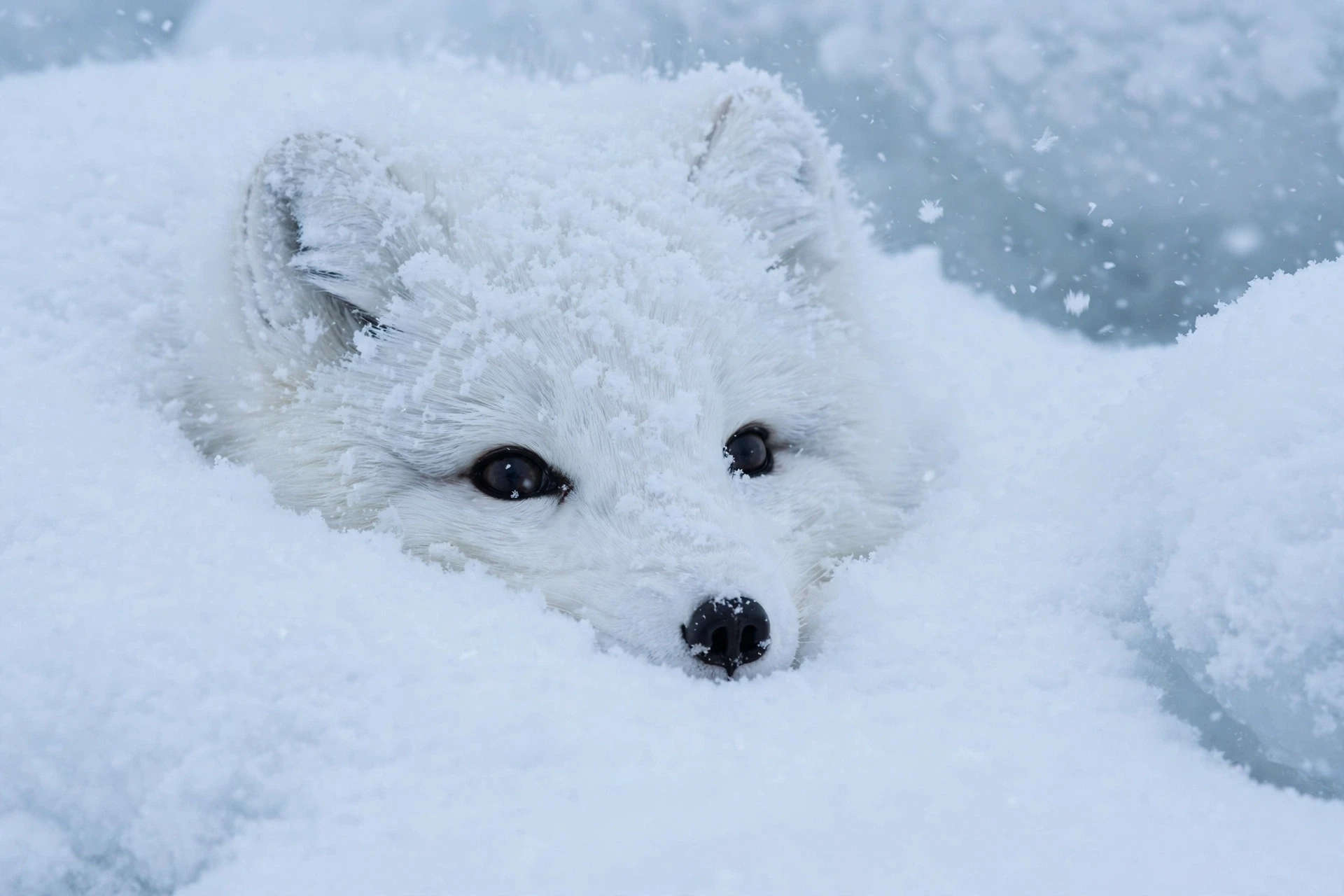
I once watched a common frog disappear in front of my eyes — not by hopping away, but by sitting still on a patch of muddy leaves whose browns and greens matched its skin almost exactly. I knew where it was, I was looking straight at it, and for several seconds I could not see it. That is camouflage doing its job, and it is easy to imagine what happens to the frogs that do not match their background quite so well.
Adaptations come in three broad kinds, and recognising them helps you see selection at work everywhere. Structural adaptations are features of the body: the shape of a finch's beak, the thickness of a polar bear's fur, the length of a giraffe's neck. Behavioural adaptations are things organisms do: the Arctic fox hunts by listening for voles under the snow and pouncing with precision; meerkats take turns standing guard while others feed. Physiological adaptations are invisible workings of the body: desert kangaroo rats produce extremely concentrated urine and never need to drink water; some fish make antifreeze proteins that keep their blood liquid below freezing. One animal can carry all three kinds at once, and usually does.
But adaptation has limits, and the limits are as instructive as the successes. Selection can only work with the variation available, so it often produces good-enough solutions rather than perfect ones. The human eye has a blind spot where the optic nerve passes through the retina — an octopus's eye, which evolved independently, has no such flaw, because its nerve fibres run behind the retina instead of in front. The human back, shaped for walking on four legs and then jury-rigged for walking on two, causes pain in a large fraction of adults. These are not the marks of a designer. They are the marks of a process that tinkers with whatever history handed it, improving things a little at a time, unable to start over from scratch. A good adaptation is not a perfect one. It is one that worked better than the alternatives available at the time.
There is one more caution. Not every trait is an adaptation, and not every difference between species was shaped by selection. Some traits spread by chance, especially in small populations. Some are byproducts: the human chin, for example, may be nothing more than a side effect of the way the jaw grows, with no function of its own. Biologists call these non-adaptive traits spandrels, after the triangular spaces left between arches in a building — features that exist because of how the structure is built, not because anyone designed them. The discipline of spotting the difference between an adaptation, a spandrel, and an accident is much of what evolutionary biology actually does.
5. "Survival of the Fittest": What the Phrase Really Means
"Survival of the fittest" means that individuals whose heritable traits suit their environment tend to leave more offspring — not that the strongest, fastest, or most aggressive individuals win. The phrase was coined by Herbert Spencer, not Darwin, and it has caused more confusion than almost any other slogan in science.
Spencer, a Victorian philosopher, published the phrase in his Principles of Biology in 1864: "This survival of the fittest, which I have here sought to express in mechanical terms, is that which Mr. Darwin has called 'natural selection'." Darwin liked the phrase enough to adopt it. At the suggestion of Alfred Russel Wallace, he added it to the fifth edition of On the Origin of Species in 1869, retitling a chapter "Natural Selection; or the Survival of the Fittest," and called it "more accurate, and sometimes equally convenient." Darwin's own meaning was precise: "fittest" meant best fitted to the immediate, local environment — the organism whose traits happened to match the conditions it actually faced.
The trouble is that "fittest" in everyday language means something else entirely: the most athletic, the most powerful, the toughest. That reading turns natural selection into a gladiatorial contest, and it is wrong in two directions. First, the traits that matter are often the opposite of strength. The peppered moth that survived was not the strongest moth; it was the one whose colour matched the bark. The finch that survived the drought was not the fiercest finch; it was the one whose beak could crack the seeds that remained. A bacterium that survives an antibiotic is not the "strongest" bacterium in any sense you could measure in a gym; it is the one carrying a gene that happens to neutralise the drug. Fitness is a match between trait and environment, and the environment decides what counts.
Second, the slogan hides the fact that reproduction, not survival, is the currency. An animal can survive to a grand old age and still have a fitness of zero if it never reproduces. Conversely, a salmon that dies after spawning has done exactly what selection rewards. In many species, males fight for mates, and the winners leave more offspring — but the fighting is only one route to reproductive success. A male bowerbird that builds an elaborate decorated bower and sings well may never fight at all, and still father far more chicks than the most aggressive bird in the forest. A plant that produces a million tiny seeds scattered on the wind has a different strategy from an oak that invests in a few hundred large acorns, and both can be highly fit in their own environments.
The phrase has also been misused far beyond biology. In the late nineteenth and early twentieth centuries, "social Darwinists" borrowed "survival of the fittest" to justify inequality, colonialism, and eugenics — the claim that the rich were biologically superior and the poor deserved their fate. Darwin himself did not hold those views, and the science does not support them. Natural selection says nothing about what ought to happen in human society; it describes how populations of organisms change. Human societies make choices about fairness, welfare, and rights, and those choices belong to ethics and politics, not to biology. A phrase that can be stretched to justify cruelty is a phrase worth handling with care, and many biologists now prefer to avoid it altogether and say simply "differential reproductive success" instead. The jargon is clunkier. It is also much harder to misuse.
6. Lamarck vs Darwin: The Giraffe's Neck
Lamarck proposed that organisms change during their lifetimes by use and disuse, and pass those acquired changes to their offspring; Darwin proposed instead that variation arises first and selection preserves the variants that reproduce best. The giraffe's neck shows the difference: Lamarck's stretching giraffe is wrong, Darwin's better-fed giraffe is right.
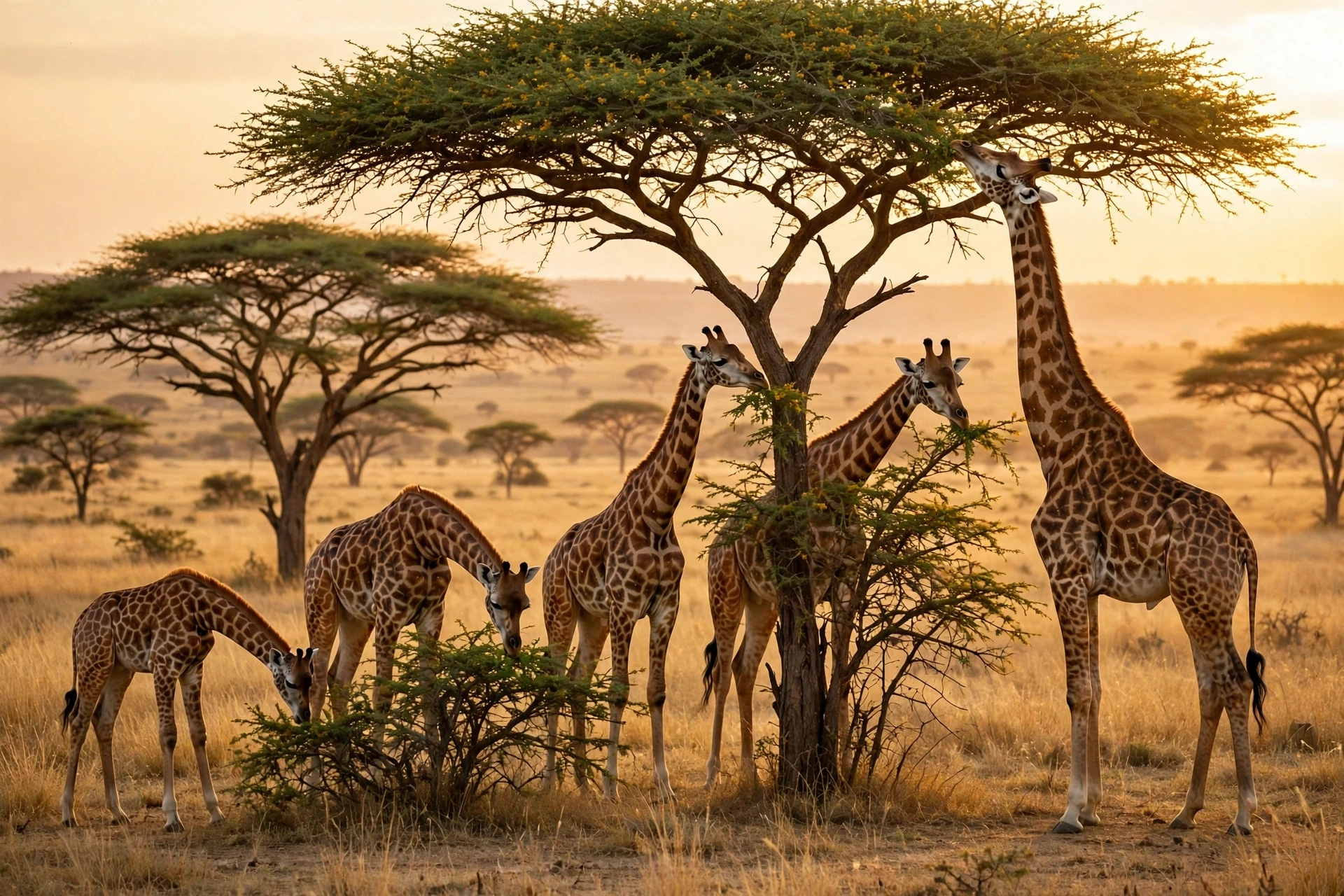
Jean-Baptiste Lamarck published his theory in 1809, fifty years before Darwin, in a book called Philosophie Zoologique. His mechanism had two laws. First, use and disuse: an organ that is used grows stronger and larger, while one that is neglected shrinks away. Second, the inheritance of acquired characteristics: the changes an organism gains during its life are passed to its offspring. His famous example was the giraffe. Ancestral giraffes, he said, stretched their necks to reach leaves high in the trees; the stretching lengthened their necks a little; their offspring inherited the slightly longer necks, stretched further, and over many generations the long neck of the modern giraffe emerged.
It is an appealing story, and Lamarck deserves more credit than he usually gets. He was one of the first scientists to argue that species change over time at all, and he understood that the environment drives that change. But the mechanism was wrong, and the giraffe shows why. A giraffe that stretches its neck does not change its genes. Its neck muscles may strengthen slightly, but its offspring inherit its genes, not its exercise routine. If Lamarck were right, the children of weightlifters would be born muscular, the children of people who lost a limb would be born without it, and a blacksmith's son would inherit his father's arm. None of this happens, and every parent knows it does not.
The decisive experiment was done by the German biologist August Weismann in the 1880s. He cut the tails off 68 white mice and bred them, then cut the tails off their offspring, and so on through five generations — 901 young mice in total. Not a single one was born with a short tail, let alone without one. The result was exactly what Darwin's theory predicts: cutting off a body part does not touch the hereditary material, so the change is not inherited. Weismann's theory of the germ plasm put it in general form: the cells that make eggs and sperm are set apart early in development and are unaffected by what happens to the body's other cells. The information that flows to the next generation passes through the germ line, and the body's experiences do not rewrite it.
There is a fair objection to the mouse-tail experiment, and honesty requires stating it. Cutting off a tail is mutilation, not the kind of use and disuse Lamarck actually proposed. Lamarck imagined an organ changing because the animal used it, not because a scientist removed it. Weismann's experiment does not, by itself, disprove every version of Lamarck's idea. What disproved Lamarck was the larger picture: the discovery of DNA, the separation of germ cells from body cells, and a century of breeding experiments in which acquired traits — training, injuries, diets, amputations — consistently failed to appear in offspring. The mouse tails were a vivid demonstration, not the whole case. The Biology LibreTexts page on understanding evolution explains Lamarck's mechanism and why it was replaced, and it is a good place to see the two theories side by side.
6.1 So how did the giraffe get its long neck?
Darwin's answer starts from the other end. In any population of ancestral giraffes, necks varied: some individuals were born with slightly longer necks than others, because of differences in their genes. When food was scarce, the longer-necked animals could reach leaves that shorter-necked animals could not, and in a drought that extra food could mean the difference between surviving to breed and starving. The longer-necked animals left more offspring, and those offspring inherited the genes for longer necks. Generation by generation, the average neck lengthened — not because any giraffe stretched, but because the population was sieved.
Modern research adds a twist that makes the story richer rather than simpler. Long necks in giraffes are not only about food. Male giraffes fight by swinging their necks like clubs, and longer, heavier necks win more fights — and more mates. Heat regulation matters too: a long neck and long legs give the giraffe a large surface area for shedding heat on the savanna. The neck probably lengthened under several pressures at once, which is typical of real adaptations. Nature rarely selects for one reason only.
6.2 The epigenetic footnote
There is one modern finding that gives Lamarck a small, limited comeback — and it is worth stating precisely, because it is often exaggerated. In some organisms, chemical marks on DNA can change how genes are expressed, and a few of those marks can be passed to offspring for a generation or two. A famous experiment found that the diet of a pregnant mouse could change the coat colour and disease risk of her pups through such marks. This is real, and it is called transgenerational epigenetic inheritance. But it is not Lamarckism as Lamarck meant it. The marks do not rewrite the genetic code, they are usually erased within a few generations, and they do not let a giraffe pass on a stretched neck. The gene remains the unit of inheritance; epigenetics is a footnote to that rule, not a replacement for it. Sciory's Nature vs Nurture covers the epigenetics evidence in full, including where the claims outrun the data.
7. The Peppered Moth: Natural Selection Caught in the Act
The peppered moth is the clearest case of natural selection observed in real time: as soot blackened England's trees during the Industrial Revolution, the dark form of the moth rose from rare to nearly universal in polluted areas, then fell again as the air cleaned up — exactly as the camouflage explanation predicts.
The story begins in Manchester in 1848, when a collector named R. S. Edleston caught the first known black peppered moth near the city. The normal form of the moth, Biston betularia, is pale grey speckled with black — "peppered" — and it rests on lichen-covered tree trunks during the day, where its pattern breaks up its outline and birds struggle to see it. The black form, called carbonaria, would have stood out on those pale trunks like a thumbprint. Yet within fifty years, the black form had taken over. By 1895, 98 percent of the peppered moths around Manchester were dark. The same shift happened independently around every industrial city in Britain, and the dark form appeared in industrial regions of Europe and North America too. Something was driving the change, and it was driving it fast.
The explanation was proposed by the naturalist J. W. Tutt in 1896: soot from coal smoke had killed the pale lichens and blackened the tree bark, so the pale moths became conspicuous and the dark moths became camouflaged. Birds, hunting by sight, ate the pale moths and left the dark ones. The dark form was controlled by a single dominant gene, so once selection started favouring it, it spread quickly. In 2016, researchers traced that gene to cortex: a "jumping gene" — a transposable element — had inserted itself into the gene's first intron, an event dated to around 1819, decades before the dark moth was first collected. When the air cleaned up again, the prediction ran in reverse: the lichens would return, the bark would pale, and the pale moths would come back. All of it happened, on schedule. After Britain's Clean Air Acts, the dark form fell from 93 percent on the Wirral Peninsula in 1959 to 23 percent by 1993, and it has kept falling since.
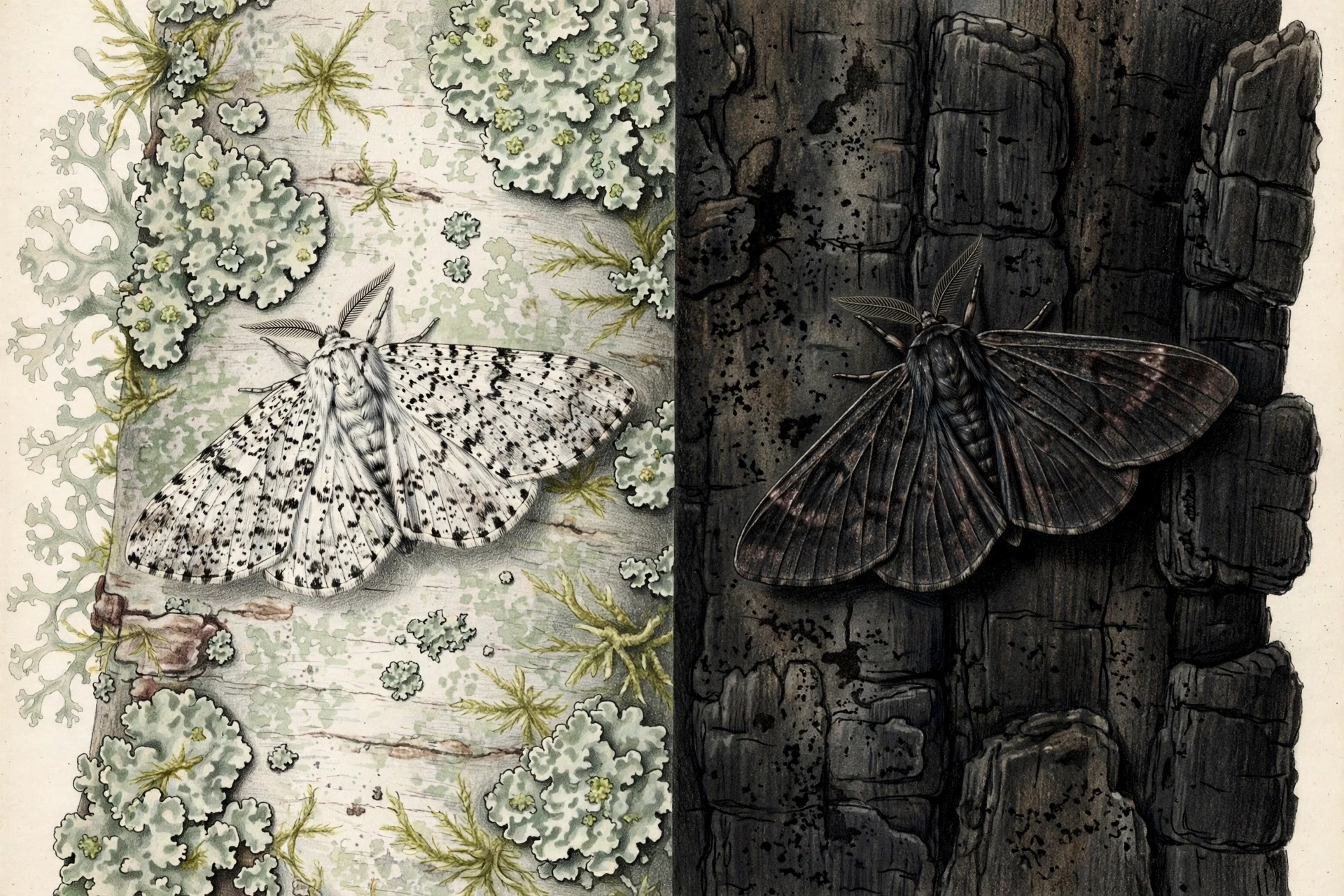
The mechanism was tested directly by the geneticist Bernard Kettlewell in the 1950s. Working at Oxford under E. B. Ford, Kettlewell released marked light and dark moths in two woodlands: a polluted wood near Birmingham and a clean wood in Dorset. He then recaptured them to see which had survived. In Birmingham, 27.5 percent of the dark moths were recaptured but only 13 percent of the light ones — the dark moths were surviving at more than twice the rate. In Dorset, in the reciprocal experiments of 1955, the result reversed: 12.5 percent of the light moths were recaptured against 6.3 percent of the dark ones. The same gene was an advantage in one wood and a liability in the other, and the only difference was the colour of the background. Kettlewell also watched birds hunting the moths and confirmed that they took the conspicuous ones first. It was the first time anyone had measured natural selection working on a wild population, and it remains one of the most elegant experiments in biology.
The peppered moth story has been challenged, and the challenges are worth knowing about, because they show how science corrects itself. Critics pointed out that Kettlewell released moths onto tree trunks in daylight, while wild moths often rest higher up, under branches, where the camouflage story is less clear-cut. Others questioned whether birds really were the main predators. The definitive answer came from Michael Majerus at Cambridge, who ran a six-year experiment (2001–2006) with 4,864 moths released in their natural resting places. His results, published in 2012 — three years after his death in 2009 — vindicated Kettlewell: differential bird predation was real, and it was strong enough to explain the rise and fall of the dark form. Majerus himself called the moth an ideal example of evolution in action, because, as he wrote, "The phenotypic changes involved have visual impact and are due to a single gene mutation that obeys Mendelian laws of inheritance." The National Center for Science Education's account of the peppered moth summarises the evidence and the criticisms fairly, and Majerus's own review, published in 2009, remains the best single summary of the case: Industrial Melanism in the Peppered Moth, Biston betularia.
Year and place | Dark (carbonaria) moths | What was happening |
|---|---|---|
1848, Manchester | First dark moth collected | Industrial soot beginning to blacken trees |
1895, Manchester | About 98% of moths dark | Heavy pollution; pale moths exposed to birds |
1959, Wirral Peninsula | 93% dark | Pollution still high |
1993, Wirral Peninsula | 23% dark | Clean Air Acts; lichens returning, bark paling |
Today, rural Britain | Dark form rare again | The population has returned almost to its pre-industrial state |
The table tells the whole story in five rows. Notice what it proves and what it does not. It proves that a population can change dramatically within decades when selection is strong, and that the change reverses when the environment reverses — the signature of natural selection rather than chance. It does not prove that the moths "tried" to change, or that pollution created the dark gene. The gene was already there, rare, before the factories came. Pollution did not invent it; it revealed its value. That is the pattern of natural selection everywhere: the variation comes first, and the environment decides what it is worth.
8. Darwin's Finches: Evolution Measured in Real Time
On the Galápagos island of Daphne Major, Peter and Rosemary Grant watched natural selection change the beak size of a finch population within a single generation — after a drought in 1977 killed 85 percent of the birds and left the deep-beaked survivors to breed.
Darwin's finches are the birds that helped convince Darwin that species change. He collected them on the Galápagos in 1835 and noticed that finches on different islands had different beaks: thick, crushing beaks for seeds, long, probing beaks for insects, sharp beaks for cactus flowers. He did not fully grasp their significance at the time — he mislabelled some of his specimens, and it was the ornithologist John Gould back in London who recognised that they were all finches, descended from a common ancestor, their beaks shaped by the food on each island. The finches became the textbook example of adaptive radiation: one ancestral species splitting into many, each fitted to a different way of life.
What makes the finches extraordinary as science is not the old story but the new one. In 1973, the Princeton biologists Peter and Rosemary Grant began studying the medium ground finch, Geospiza fortis, on Daphne Major, a tiny volcanic island of about eighty acres. They banded nearly every bird on the island, measured their beaks, recorded who mated with whom, and tracked which chicks survived. They returned every year for four decades. No study of evolution in the wild has ever been more detailed, and it caught natural selection in the act more clearly than any other.
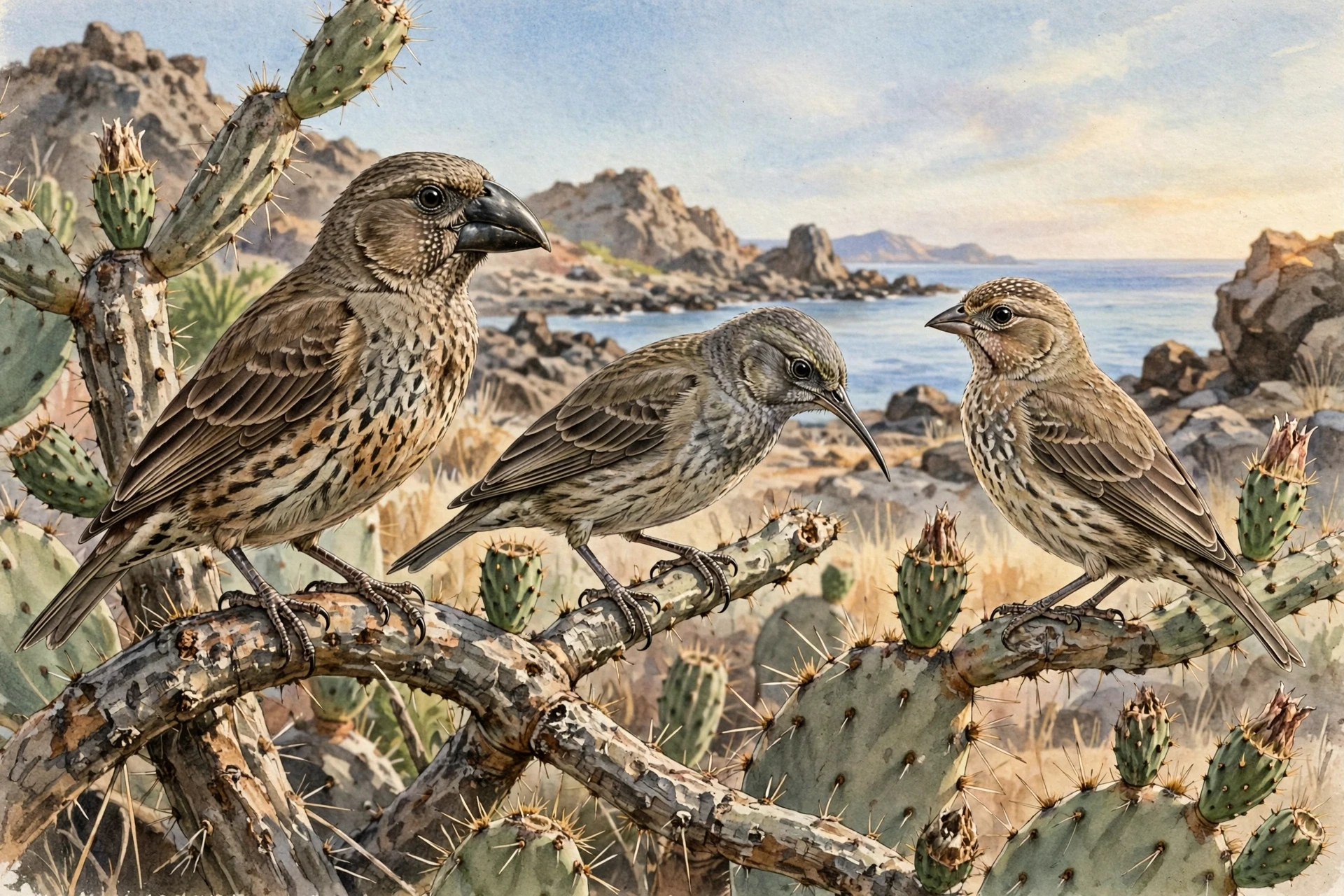
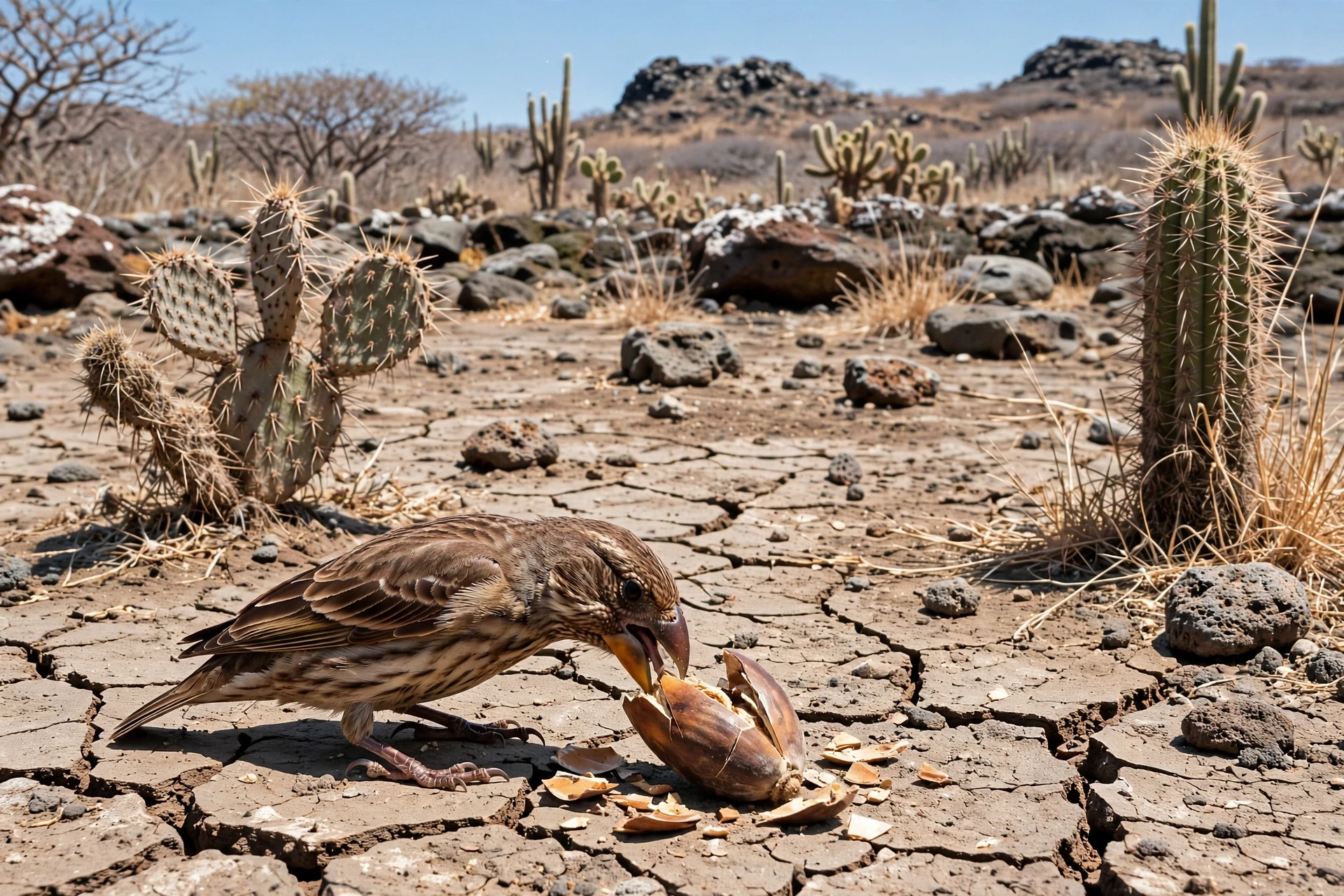
The first great demonstration came with the drought of 1977. The rains failed, the plants withered, and the small, soft seeds the finches preferred were eaten within weeks. What remained were large, hard seeds that only birds with deep, strong beaks could crack. Eighty-five percent of the medium ground finches died. When the Grants measured the survivors, they found that the birds with deeper beaks had lived and the birds with shallower beaks had died — and when the survivors bred, their chicks inherited deeper beaks. Within a few years, the average beak depth of the population had increased by about 4 percent. The Grants had watched evolution happen: the population before the drought and the population after it were measurably different, and the difference was caused by the survival of birds with a heritable trait.
The work was so precise that the Grants could put numbers on each of the three conditions. Beak depth was heritable: their measurements put its heritability at 0.74, meaning nearly three-quarters of the variation was genetic. Beak depth affected survival: during the drought, birds with deeper beaks lived. And the trait was passed on: the offspring of survivors had deeper beaks than the offspring of the birds that died. Variation, heritability, differential reproduction — the three conditions, measured in a wild population, over a single event.
Then the weather reversed, and selection reversed with it. At the end of 1982, heavy rains flooded the island with small, soft seeds, and now the small-beaked birds had the advantage: they could handle the tiny seeds quickly and efficiently, while the big-beaked birds were clumsy with them. The average beak size fell by 2.5 percent. When another drought came in 2004, the story took yet another turn: a larger finch species had colonised the island and was competing for the large seeds, so selection pushed the medium ground finches toward smaller beaks instead of larger ones. The beak did not march in one direction toward some ideal. It tracked the environment, back and forth, exactly as the theory predicts.
The finch work has since gone down to the level of genes. Researchers found that a gene called Bmp4 is switched on earlier and more strongly in the developing beaks of finches that grow up to have deep, broad beaks, and that another gene, ALX1, helps shape the pointed beaks of other species. The beak is not built by one gene, but small changes in the timing and strength of a few developmental genes produce large differences in the finished structure — which is how a single ancestral finch could give rise to more than a dozen species with beaks for seeds, insects, cactus, and even blood. The Grants' four decades of fieldwork were recognised with the Kyoto Prize in 2009, and their story is told in Jonathan Weiner's Pulitzer Prize-winning book The Beak of the Finch.
The lesson of Daphne Major is that evolution is not always slow. Given a strong selective pressure and heritable variation, a population can change measurably within a single generation — fast enough for scientists to watch. The finches did not need a million years. They needed one drought.
9. Antibiotic Resistance: Natural Selection in Your Lifetime
Antibiotic resistance is natural selection happening inside hospitals and inside our own bodies: each course of antibiotics kills the susceptible bacteria and leaves the resistant ones to multiply, and the resistant strains spread because we keep applying the same pressure.
I learned this lesson the hard way, as a patient. Years ago, a doctor prescribed me an antibiotic for an infection and gave me a firm instruction I have never forgotten: finish the whole course, even when you feel better. At the time it sounded like fussiness. It is not. Stopping early kills the weakest bacteria and leaves the toughest ones alive — the ones that can tolerate the drug — and those survivors are the ones that multiply and pass on their resistance. A half-finished course is a training exercise for the bacteria you are trying to kill. Every doctor who says "finish the course" is giving a lesson in natural selection.
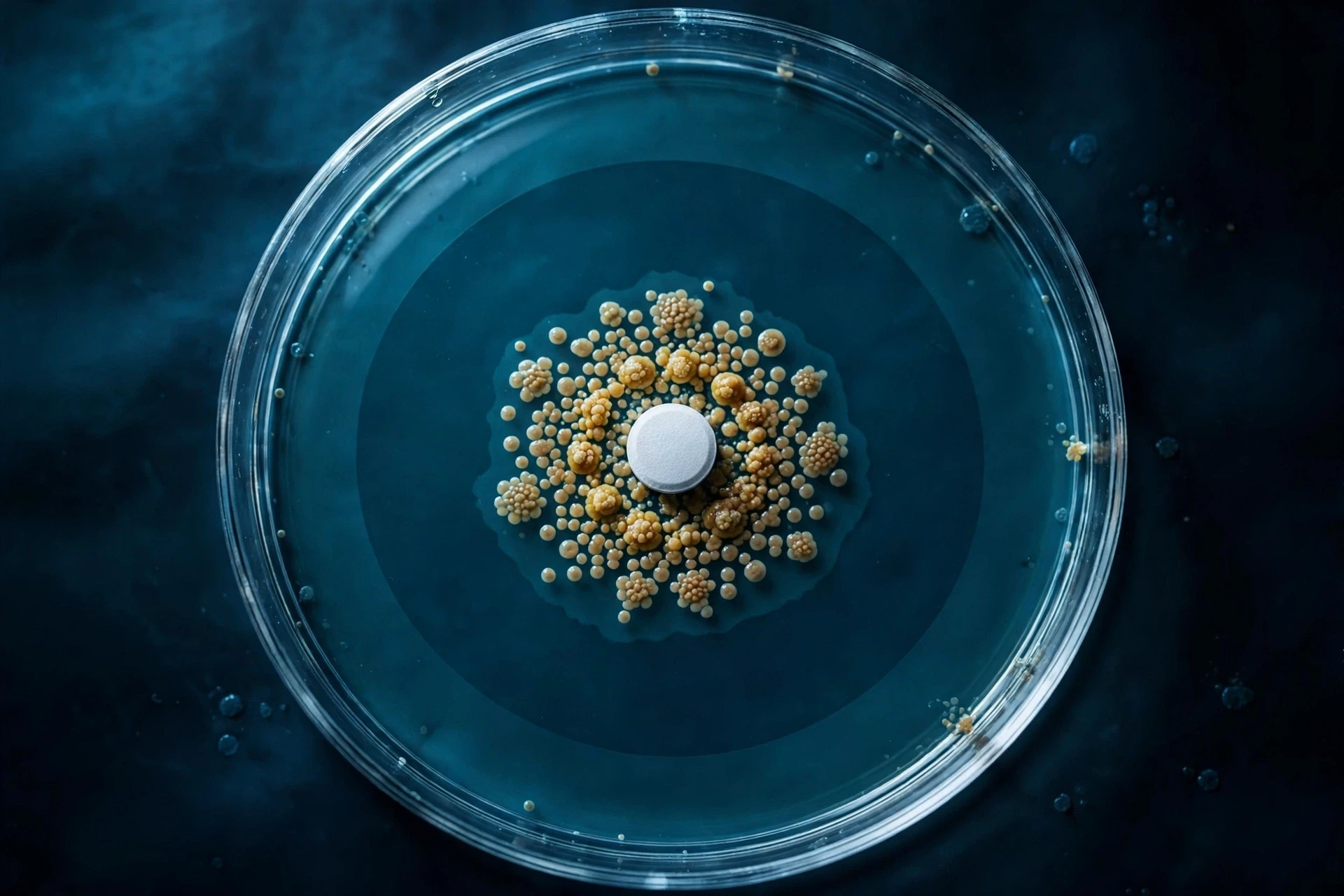
The mechanism is brutally simple. A bacterial infection contains billions of cells, and they are not identical. A few of them, by chance mutation, carry a gene that lets them survive the antibiotic: an enzyme that breaks the drug down, a pump that flushes it out of the cell, or a slightly altered target that the drug can no longer grip. When the antibiotic arrives, the susceptible majority dies. The resistant minority survives, divides, and within days the infection is made of resistant cells. The antibiotic has not created the resistance. It has selected for it — exactly as the soot selected for dark moths and the drought selected for deep beaks. The variation came first; the drug revealed its value.
The scale of the problem is now enormous. The US Centers for Disease Control and Prevention's Antimicrobial Resistance Threats Report, updated in October 2026 with data from 2023, estimates that drug-resistant bacteria and fungi cause about 9.7 million infections and 50,800 deaths in the United States every year, across 19 tracked pathogens (the total includes Clostridioides difficile, which the CDC counts among the threats). Four of those pathogens are classed as urgent threats: the fungus Candida auris, carbapenem-resistant Acinetobacter, carbapenem-resistant Enterobacterales, and drug-resistant Neisseria gonorrhoeae, which causes gonorrhoea. The previous CDC report, from 2019, had estimated 2.8 million infections and 35,000 deaths a year; the agency cautions that the two reports used different methods and should not be compared directly, but nobody who works in the field doubts the direction of travel. The CDC Antimicrobial Resistance Threats Report is the authoritative source for the current figures, and Sciory's Microbiology article explains the bacteria themselves — how they live, spread, and cause disease.
Resistance spreads between bacteria as well as between generations. Bacteria can swap genes with each other directly, through small circles of DNA called plasmids, so a resistance gene that arises in one species can jump to another in a hospital ward. They can also carry several resistance genes at once, producing strains that no available antibiotic can kill. Hospitals, where antibiotics are used most intensively and vulnerable patients are crowded together, are the places where selection is strongest — and where the most dangerous resistant strains evolve.
The same process explains why resistance is so hard to reverse. Once a resistance gene spreads through a bacterial population, it tends to stay, because the cost of carrying it is often small and the gene can persist even when the antibiotic is withdrawn. The answer is not to abandon antibiotics but to use them with the discipline the theory demands:
Prescribe antibiotics only when a bacterial infection is actually present — not for colds and other viral illnesses, which antibiotics cannot touch.
Use the narrowest effective drug, at the right dose, for the shortest effective course.
Finish every prescribed course, even after symptoms improve, so that no partially resistant survivors remain.
Invest in new drugs, faster diagnostics, and infection prevention, so that selection has fewer opportunities to work.
Every unnecessary prescription is a fresh round of selection, applied to billions of bacteria at once. The moths and the finches show that selection works on any population, given variation and time. The bacteria in a hospital are no exception — and the time scale is days, not decades.
10. The Eye: How Complex Organs Evolve Step by Step
The eye looks too complex to have evolved by small steps, but it did: a light-sensitive patch, deepening into a cup, narrowing to a pinhole, then gaining a lens, can be built by natural selection in under 400,000 generations, because every intermediate stage works better than the one before it.
Darwin himself felt the force of this objection, and he stated it with his usual honesty. In Chapter 6 of On the Origin of Species, in the section headed "Organs of extreme perfection and complication," he wrote:
"To suppose that the eye with all its inimitable contrivances for adjusting the focus to different distances, for admitting different amounts of light, and for the correction of spherical and chromatic aberration, could have been formed by natural selection, seems, I freely confess, absurd in the highest possible degree."
The sentence is routinely quoted without what follows it, and what follows it is the answer. Darwin continued: if numerous gradations from a simple and imperfect eye to a complex and perfect one can be shown to exist, each grade being useful to its possessor, and if the eye ever varies and the variations are inherited, then "the difficulty of believing that a perfect and complex eye could be formed by natural selection, though insuperable by our imagination, can hardly be considered real." The quote is not a confession that evolution fails. It is Darwin setting out the test his own theory had to pass — and then showing that it passes.
The living world provides the gradations Darwin asked for. The simplest eyes in nature are flat patches of light-sensitive cells, found in some flatworms, which can tell light from dark and nothing more. That alone is useful: an animal that can tell whether it is in shadow can hide, and an animal that can tell where the light is can find the surface. In other animals the patch is sunk into a shallow cup, which gives a crude sense of direction — light coming from the left strikes the right side of the cup. Deepen the cup and the direction sense sharpens. Narrow the opening and the cup becomes a pinhole camera, forming a dim but real image. Fill the opening with a transparent covering and the image brightens. Thicken that covering into a lens and the image sharpens. Every step in this sequence exists in a living animal today, and every step works better than the one before it. There is no step that requires a useless intermediate. The nautilus has a pinhole eye with no lens. The octopus has a full camera eye with a lens, an iris, and a retina — built on a slightly different plan from ours, which is why it has no blind spot. The eye has evolved independently more than forty times in different animal groups, because the physics of light leaves only a few good solutions, and selection finds them again and again.
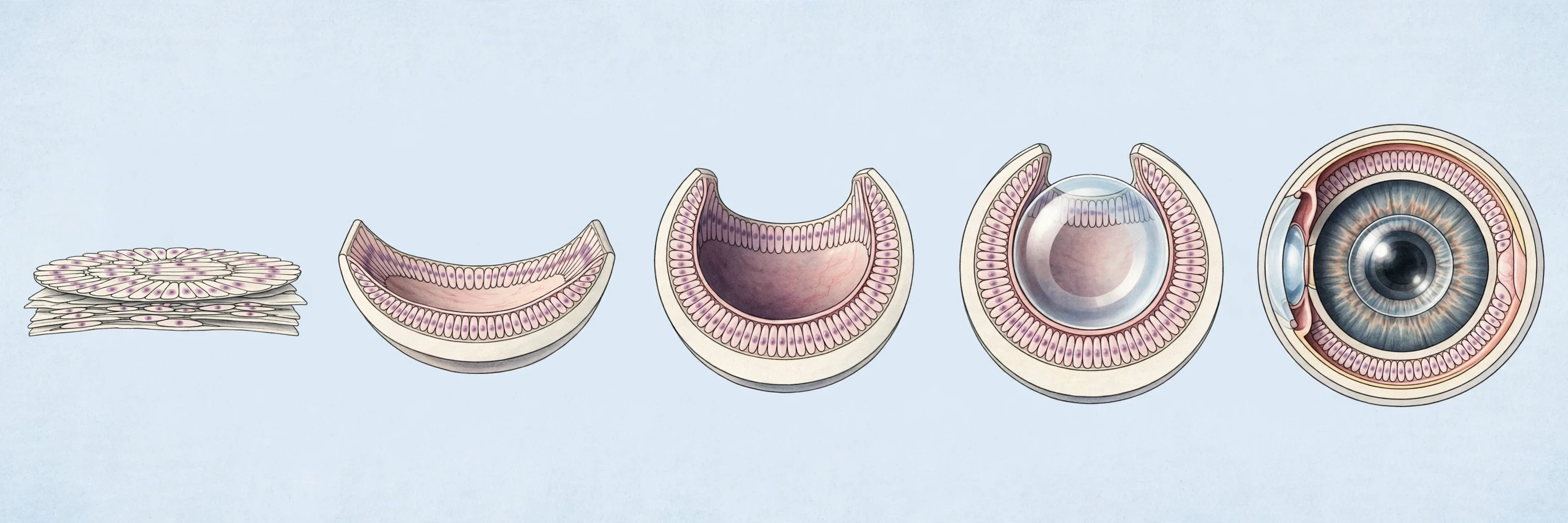
How long would such a sequence take? The Swedish zoologists Dan-Eric Nilsson and Susanne Pelger answered that question with a mathematical model published in 1994. They started with a flat patch of light-sensitive cells and let it change by tiny steps — each step changing the shape by no more than one percent — with selection favouring each small improvement in vision. They deliberately made pessimistic assumptions at every turn, choosing the slowest plausible rates. Even so, the model reached a full camera eye in 1,829 steps, requiring roughly 364,000 generations. For a small animal breeding once a year, that is less than 400,000 years — a blink in geological time. Nilsson and Pelger's paper, "A Pessimistic Estimate of the Time Required for an Eye to Evolve" (Proceedings of the Royal Society B, 1994), is a model, not a measurement: it shows that the eye could evolve quickly, not that it did so on that exact schedule. But it destroys the argument that there was not enough time.
The eye's history is also written in our genes. The same master gene, called Pax6, controls eye development in animals as different as flies, mice, and humans — so similar that the mouse version of the gene can trigger eye development in a fruit fly. That shared gene is evidence that all animal eyes descend from a common light-sensing ancestor, and that selection then elaborated the same basic toolkit into the many different eyes we see today. The eye is not a single invention. It is a toolkit, reused and refined, over and over, by the same patient process.
11. Artificial Selection: When Humans Do the Choosing
Artificial selection is natural selection with a human being as the selective pressure: instead of the environment deciding which individuals reproduce, people do — and the results, from maize to the modern dog, show how fast selection can reshape a species.
Darwin understood this before he understood natural selection itself. He spent years studying pigeon fanciers, who had produced fantails, tumblers, and pouters — birds so different that a stranger would take them for separate species — all from the wild rock dove, simply by choosing which birds to breed. He studied farmers, gardeners, and dog breeders, and he saw the same pattern everywhere: pick the individuals with the trait you want, breed them, and the trait spreads. If humans could do this in a few generations, he reasoned, nature could do it over millions of years — with the difference that nature selects for survival and reproduction, while humans select for whatever they happen to want.
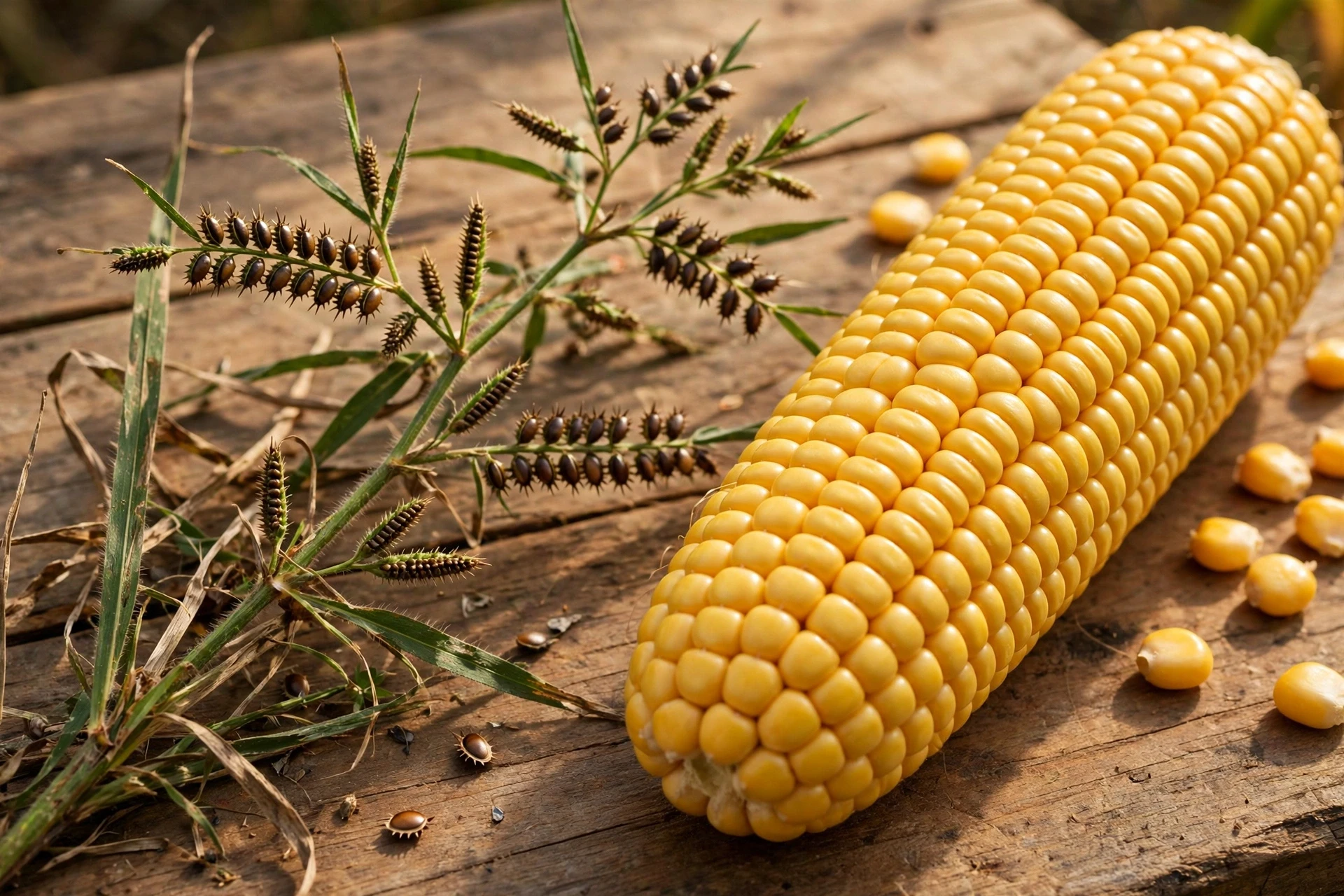
The most dramatic example is the food on our plates. Modern maize, the corn that feeds billions, does not exist in nature. Its wild ancestor is a Mexican grass called teosinte, a scraggly plant whose seed heads hold five to twelve hard kernels, each locked inside a shell so tough it can crack a tooth, designed to scatter and grow on their own. About 9,000 years ago, farmers in the Balsas River Valley of southern Mexico began selecting the plants with the most seeds, the seeds that stayed attached longest, and the cobs that were easiest to harvest. Over hundreds of generations, the changes compounded: the kernel rows multiplied from two to more than twenty, the hard shell softened, the cob grew fat, and the seeds stopped scattering. By 6,500 years ago, excavated cobs were already recognisably maize. The finished plant is so thoroughly domesticated that it cannot reproduce without humans: its kernels are wrapped in husks and stuck to the cob, and a fallen ear simply rots where it lands. Genetic studies have traced the transformation to a handful of genes, including tb1, which controls branching, and tga1, which softened the hard casing. Nine thousand years of patient selection turned a weed into a staple crop — and no single generation of farmers knew what they were building.
Dogs tell the same story with a different beginning. Dogs were the first animals humans domesticated, and the only large carnivore ever domesticated. Genetic evidence shows that dogs diverged from a now-extinct population of wolves between 27,000 and 40,000 years ago, and the earliest widely accepted dog remains — a dog buried beside humans at Bonn-Oberkassel in Germany — date to about 14,200 years ago. The first phase of domestication may have been less a human decision than a wolf one: the boldest wolves that hung around human camps got scraps, and the tamest of them got more scraps, and over generations the wolves that tolerated humans best left the most pups. Only later did humans start deliberately selecting for traits — size, coat, herding instinct, hunting style — and the result is the most diverse mammal on Earth: a Chihuahua and a Great Dane are the same species, separated by a factor of fifty or more in weight, shaped entirely by selection in a few thousand years.
I see artificial selection every time I walk through my neighbourhood. Within a few streets there are dachshunds bred short to hunt in burrows, border collies bred to herd sheep, and greyhounds bred to run — all of them dogs, all of them shaped by people choosing which dogs got to have puppies. It is selection you can watch on a pavement, and it makes Darwin's leap from the farmyard to the whole of nature feel much less like a leap.
Feature | Natural selection | Artificial selection |
|---|---|---|
Who chooses | The environment: predators, climate, food, disease | Humans, choosing for traits they want |
What is favoured | Traits that increase survival and reproduction | Traits people value: yield, size, colour, temperament |
Speed | Usually slow; fast only under strong pressure | Often very fast — centuries or decades |
Goal | None — no direction, no plan | Whatever the breeder wants, including traits harmful to the animal |
Examples | Peppered moth, finch beaks, antibiotic resistance | Maize from teosinte, dog breeds, dairy cattle |
Artificial selection also reveals a danger that natural selection rarely produces. Because humans select for one trait at a time, they can push a species into a shape that harms it. Dairy cows bred for maximum milk production suffer more disease. Some dog breeds, selected for flat faces or short legs, struggle to breathe or walk. A bulldog's skull is a triumph of selection for appearance and a disaster for the dog. Natural selection, by contrast, selects for the whole animal's ability to survive and reproduce, so harmful exaggerations tend to be pruned away. The comparison is a reminder that selection is a mechanism, not a moral force: it produces whatever the selecting pressure rewards, for good or ill.
There is one more lesson in artificial selection, and it is the one Darwin drew from it. If human breeders can produce a Great Dane and a Chihuahua from the same wolf ancestor in a few thousand years, then natural selection, working over millions of years with the whole living world as its raw material, can produce everything else. The pigeon fanciers and the maize farmers were Darwin's proof of concept — the demonstration, visible in any farmyard, that selection works.
12. What Natural Selection Is Not: Five Common Misconceptions
Natural selection is one of the most misunderstood ideas in science, and the misunderstandings matter: they fuel bad arguments in classrooms, in courtrooms, and online. These five misconceptions cause the most confusion — and each of them has a clear, evidence-based answer.
The first misconception is that evolution means progress. It does not. Natural selection has no direction, no goal, and no ladder. It does not make species "better" in any general sense; it makes them better fitted to their current environment, which may mean smaller, simpler, or slower. Parasites routinely lose complex structures their free-living ancestors had — eyes, legs, digestive systems — because in the sheltered world inside a host, those structures cost energy and provide nothing. Cave fish lose their eyes because eyes are useless in the dark and expensive to grow. Bacteria are, by most measures, the most successful organisms on Earth, and they have stayed microscopic for billions of years. If evolution were a ladder climbing toward complexity, bacteria would be failures. They are not. They are the most abundant and adaptable life on the planet. The history of life is a branching bush, not a ladder, and humans sit on one small twig of it, not at its top.
The second misconception is that individuals evolve. They do not. A single animal's traits are fixed by its genes and its development; it cannot change them during its life in any way that matters to evolution. What changes is the population: the proportions of traits shift as some individuals reproduce more than others. A giraffe does not grow a longer neck by stretching, and a moth does not darken its wings by wishing. The population changes; the individual does not. This is the single most important distinction in the whole subject, and it is the one that Lamarck got wrong.
The third misconception is that natural selection is random. It is not — or rather, it is half random and half the opposite. The variation selection works on arises randomly: mutations happen by chance, with no regard for what the organism needs. But selection itself is the opposite of random. It is a consistent, directional filter: in a given environment, the same traits are favoured again and again, generation after generation. That is why the peppered moth changed in the same direction around every industrial city, and why the finches' beaks tracked the rainfall year after year. Chance supplies the raw material; selection supplies the direction. Saying evolution is "just random" mistakes the supply for the filter.
The fourth misconception is that natural selection explains the origin of life. It does not, and it was never meant to. Natural selection explains how life changes once it exists — how populations adapt, diversify, and split into species. It says nothing about how the first self-replicating molecules arose, which is a separate question, studied by chemists and geologists, and still without a settled answer. Confusing the two is like blaming a recipe for not explaining where flour comes from. The recipe starts with flour; the theory starts with life.
The fifth misconception is that "theory" means a guess. In everyday language, a theory is a hunch. In science, a theory is the opposite: a well-tested framework that explains a large body of evidence and has survived repeated attempts to break it. The theory of evolution by natural selection has been tested by field studies like the Grants' finches, by laboratory experiments on bacteria, by the fossil record, by the DNA of every species sequenced so far, and by the peppered moth's rise and fall. It is a theory in the same sense that the theory of gravity is a theory: not a guess waiting to be confirmed, but the best explanation we have, supported by evidence from every corner of biology. Scientists argue constantly about the details — how fast evolution runs, how much of it is driven by selection versus chance, how genes and development interact — but the core mechanism is not in doubt. It is one of the most thoroughly supported ideas in all of science.
13. The Modern Synthesis: Darwin Meets DNA
The modern synthesis is the merger of Darwin's natural selection with Mendelian genetics: genes supply the variation, mutation and recombination create it, and selection sorts it — a framework built in the 1930s and 1940s that remains the core of evolutionary biology today.
Darwin had a problem he knew he could not solve. He could see that offspring resembled their parents, but he did not know how inheritance worked, and the theory of inheritance available in his time — the idea that parental traits blend like paint — would have made selection impossible: a useful new trait would be diluted by half in every generation until it vanished. The solution arrived after Darwin's death, from a source he never read. Gregor Mendel, an Augustinian monk working with pea plants in the 1860s, discovered that inheritance comes in discrete units — what we now call genes — that are passed on intact, not blended. Mendel's work was ignored for thirty-five years, then rediscovered in 1900, and by the 1930s and 1940s biologists including Ronald Fisher, J. B. S. Haldane, Sewall Wright, and Ernst Mayr had fused Mendel's genetics with Darwin's selection into a single framework: the modern synthesis.
The synthesis answered Darwin's problem and added a precise new language. Evolution became, in the technical definition, a change in the frequencies of genes in a population over time. Natural selection became the process that changes those frequencies in a consistent direction: genes that help their carriers reproduce become more common, and genes that hinder reproduction become rarer. Mutation creates new genes. Recombination shuffles them into new combinations. Migration moves them between populations. Genetic drift changes their frequencies by chance, especially in small populations. Each mechanism has its role, and selection is the one that builds adaptation.
DNA completed the picture. When Watson and Crick described the double helix in 1953, they revealed the physical basis of everything Darwin and Mendel had described: the gene is a sequence of DNA, mutation is a change in that sequence, and inheritance is the copying of DNA from parent to offspring. Today, scientists can watch selection change gene frequencies in real time — in bacteria evolving resistance in a hospital, in fish evolving smaller bodies under heavy fishing, in weeds evolving resistance to herbicides. They can also read the history of selection in genomes: genes that were strongly favoured in the past carry a distinctive signature, a region of reduced variation around them, like a footprint in the DNA. Sciory's DNA article explains how the molecule stores and copies information, and the Genetics article explains how genes build traits.
The synthesis has been extended since the 1940s, and the extensions matter. Developmental biology showed that small changes in the timing of gene activity can produce large changes in bodies — which is how the finches' beaks diversified so quickly. Epigenetics showed that the environment can leave chemical marks on DNA that persist for a generation or two. Ecology showed that organisms shape their own selective pressures: beavers build dams that change the environment their descendants live in, a process called niche construction. None of these discoveries overturns the core of the synthesis. They enrich it. The engine remains the same three conditions Darwin identified: variation, heritability, and differential reproduction.
14. Putting It All Together
Natural selection is the simplest and most powerful idea in biology: where individuals vary, the variation is inherited, and some individuals leave more offspring than others, the population changes — and given enough time, that change produces every adaptation we see.
Look back at the evidence this article has gathered. A moth changed colour across industrial England and changed back when the air cleared. A finch's beak grew deeper in a single drought and shrank again in the rains that followed. Bacteria defeated our strongest drugs within years of their invention. A wild grass became maize, a wolf became a dog, and a patch of light-sensitive cells became an eye — all by the same mechanism, working on the same three conditions, with no plan and no designer. The examples span days and millennia, moths and microbes, beaks and eyes, and they all fit the same pattern. That is what a good scientific theory looks like: one mechanism, many predictions, and the predictions keep coming true.
The idea matters beyond biology, because it changes how we see ourselves. Humans are not separate from this process; we are a product of it. Our hands, our brains, our immune systems, and our tendency to see patterns were all shaped by the same sieve that shaped the finch's beak. And we are not outside it now. The antibiotics we misuse, the climate we change, and the species we move around the planet are all new selective pressures, and evolution is responding to them in real time — in resistant bacteria, in fish that mature smaller, in birds that lay their eggs earlier in a warming spring. Understanding natural selection is not only about understanding the past. It is about understanding the world we are building, and the responses it is already producing.
Darwin closed On the Origin of Species with a sentence that has lost none of its power: "There is grandeur in this view of life, with its several powers, having been originally breathed into a few forms or into one; and that, whilst this planet has gone cycling on according to the fixed law of gravity, from so simple a beginning endless forms most beautiful and most wonderful have been, and are being, evolved." The grandeur is real. It does not come from a plan. It comes from the fact that no plan was needed — that variation, inheritance, and the struggle to reproduce are enough, given time, to fill the world with forms most beautiful and most wonderful.
Frequently Asked Questions
How does natural selection work?
Natural selection works when three conditions hold: individuals in a population vary, some of that variation is inherited, and the variation affects how many offspring individuals leave. Individuals with traits that suit their environment tend to survive and reproduce more, so their traits become more common in the next generation. Repeated over many generations, the population changes — it adapts to its environment. The variation comes from mutation and genetic recombination; selection itself only sorts what already exists.
What is an adaptation?
An adaptation is a heritable trait that improves an organism's survival or reproduction in its environment and that spread through the population because natural selection preserved it. Examples include the Arctic fox's white winter coat, the finch's seed-cracking beak, and the cactus's spines. A trait counts as an adaptation only if it was shaped by selection for its current role; features that are useful by accident, or that were shaped for a different job and later repurposed, are called exaptations.
What does "survival of the fittest" mean?
It means that individuals whose heritable traits best fit their environment tend to leave more offspring — not that the strongest or most aggressive animals win. The phrase was coined by the philosopher Herbert Spencer in 1864, and Darwin adopted it in 1869. "Fittest" means best fitted to the local environment: a camouflaged moth, a deep-beaked finch, or a drug-resistant bacterium can all be the "fittest" in their circumstances. Fitness is measured by reproductive success, not by strength, speed, or size.
What is Lamarckism?
Lamarckism is the theory proposed by Jean-Baptiste Lamarck in 1809 that organisms pass on characteristics they acquire during their lifetimes — for example, that giraffes gained long necks by stretching for leaves and passed the longer necks to their calves. It was replaced by Darwin's theory because acquired changes do not alter the genes passed to offspring: August Weismann showed that mice with their tails cut off for five generations still produced normal-tailed pups. A limited form of transgenerational epigenetic inheritance exists, but it does not rewrite the genetic code and does not rescue Lamarck's mechanism.
How did the peppered moth change colour?
The peppered moth has a pale form and a dark form controlled by a single gene. During the Industrial Revolution, soot killed the pale lichens and blackened tree bark in England, so pale moths became conspicuous to birds and dark moths became camouflaged. By 1895, about 98 percent of the moths near Manchester were dark. After Clean Air Acts reduced pollution, the lichens returned, the bark paled, and the dark form fell to 23 percent on the Wirral Peninsula by 1993. The change was measured directly in mark-release experiments by Kettlewell in the 1950s and confirmed by Majerus in a six-year study (2001–2006).
Do individuals evolve, or do populations evolve?
Populations evolve; individuals do not. An individual's genes are fixed at conception and do not change during its life in any way that matters to evolution. What changes is the population: the proportions of different traits shift from one generation to the next as some individuals reproduce more than others. When we say "the finches evolved deeper beaks," we mean the average beak of the population changed because deep-beaked birds left more offspring — not that any single finch's beak grew during its lifetime.
Is natural selection random?
Only half of it is. The variation that selection works on arises randomly — mutations happen by chance, without regard to what the organism needs. But selection itself is not random: in a given environment, the same traits are favoured consistently, generation after generation, which is why the peppered moth changed in the same direction around every industrial city. Chance supplies the raw material; natural selection supplies the direction. That combination — random variation plus non-random selection — is what builds adaptation.
Sources
OpenStax Biology 2e: Understanding Evolution — https://openstax.org/books/biology-2e/pages/18-1-understanding-evolution
UC Berkeley, Understanding Evolution: Natural Selection — https://evolution.berkeley.edu/evolibrary/article/evo_25
Biology LibreTexts: Understanding Evolution — https://bio.libretexts.org/Bookshelves/Introductory_and_General_Biology/General_Biology_1e_(OpenStax)/4:_Evolutionary_Processes/18:_Evolution_and_the_Origin_of_Species/18.1:_Understanding_Evolution
US Centers for Disease Control and Prevention: Antimicrobial Resistance Threats Report — https://arpsp.cdc.gov/artr
National Center for Science Education: Peppered Moths — https://ncse.ngo/icon-6-peppered-moths
Michael E. N. Majerus: Industrial Melanism in the Peppered Moth, Biston betularia — https://doi.org/10.1007/s12052-008-0107-y
Arjen E. van't Hof et al.: The industrial melanism mutation in British peppered moths is a transposable element (Nature, 2016) — https://doi.org/10.1038/nature17951
Darwin's Theory of Evolution: Evidence Explained — Sciory — https://www.sciory.com/blog/darwin-theory-evolution-evidence
Genetics — Sciory — https://www.sciory.com/blog/genetics-inheritance-mutations-gene-expression
Nature vs Nurture — Sciory — https://www.sciory.com/blog/nature-vs-nurture-explained
DNA — Sciory — https://www.sciory.com/blog/dna-structure-replication-heredity
Microbiology — Sciory — https://www.sciory.com/blog/microbiology-bacteria-viruses-explained
Mitosis vs Meiosis — Sciory — https://www.sciory.com/blog/mitosis-vs-meiosis