

The first rainforest I ever walked into did not feel like a place. It felt like weather that had learned to stand still. The air was warm and heavy, thick enough to drink, and every surface was green — not one green, but dozens of them, layered on top of each other until the light itself turned green. Somewhere above me, out of sight, birds were arguing in bright, sharp voices. Somewhere below, under the leaf litter, something small was moving, rustling, getting on with a life I would never see. I had read about rainforests for years before that walk. I had memorised the numbers and the diagrams. None of it had prepared me for the sheer density of being alive in one place, all at once.
That density is the whole story of rainforests. These forests cover only a small fraction of Earth's land, yet they hold about half of the land species on the planet. They make their own rain. They store carbon in quantities that shape the climate of the entire world. They hide medicines we have not yet found, in plants nobody has yet named. And they are disappearing, fast, mostly because of choices people make far away from them — choices about beef, timber, palm oil, and land.
This guide explains rainforests from the ground up. We will start with what the word actually means, because it covers two very different kinds of forest. We will climb through the four layers of a rainforest, from the dark forest floor to the emergent trees that poke above the canopy like ships' masts. We will look at why so many species live here, how rainforests steer the water cycle and the climate, what they have given medicine, and what is happening in the two great forests of the world — the Amazon and the Congo Basin. We will finish with the hard part: what is being lost, and what can honestly be done about it.
1. What Counts as a Rainforest
A rainforest is not simply a forest where it rains a lot. Plenty of places are wet without being rainforests. A rainforest is a forest that receives a great deal of rain — usually at least 175 centimetres a year, and often far more — and stays warm and humid enough, year-round, that the forest itself becomes part of the weather. The trees do not just live in the climate. They help create it.
The classic definition has three parts. First, heavy rainfall, spread across the year rather than squeezed into one short season. Second, a closed canopy: the treetops knit together into a near-continuous roof, so little direct sunlight reaches the ground. Third, extraordinary variety: many tree species growing side by side, rather than one or two species dominating the way they do in a pine forest or a birch wood. Where those three things come together, you have a rainforest.
That definition matters because it draws a line that surprises people. A forest in a rainy place with a short dry season can still be a rainforest, if the rain is heavy enough and the canopy stays closed. A forest that gets the same total rainfall but loses its leaves in a long dry season is something else — a seasonal forest, or a monsoon forest. The difference is not the rain gauge. It is what the rain allows the forest to become: a place where growth almost never stops.
1.1 Why rainforests grow where they grow
Rainforests grow where warm air rises and drops its moisture. Near the equator, the Sun heats the ground strongly all year, warm air rises, cools, and releases rain — the same rising air that drives the trade winds. That is why the great tropical rainforests sit in a belt around the equator: the Amazon in South America, the Congo Basin in Africa, and the forests of Southeast Asia and New Guinea. Temperate rainforests grow in a different setting, where moist ocean air is forced up over coastal mountains and wrung out as rain, in places like the Pacific Northwest of North America, southern Chile, Tasmania, and New Zealand.
I learned this the slow way, standing under a dripping canopy in Costa Rica while a guide pointed at the clouds forming over the forest itself. "The forest is making that cloud," he said, and I thought he was joking. He was not. We will come back to that in section 6, because it is one of the strangest and most important things rainforests do. For now, the point is simple: rainforests sit where the atmosphere delivers water reliably, and then they take over part of the job themselves.
1.2 How much of Earth do rainforests cover?
Tropical rainforests cover roughly six percent of Earth's land surface. That small number is worth pausing on, because everything else in this article is a consequence of it. Six percent of the land holds about half of the land species. Six percent of the land stores a share of carbon far out of proportion to its area. Six percent of the land makes rain that falls on farms and cities hundreds of kilometres away. When a place that small does that much work, losing any of it matters more than the area alone would suggest.
Temperate rainforests are rarer still. They cover well under one percent of Earth's land, in scattered strips along cool, wet coasts. Their rarity is part of their value, and part of their danger: a forest type that exists only in a few places has nowhere else to go when those places are logged or cleared.
2. Tropical Rainforests: Hot, Wet, and Crowded with Life
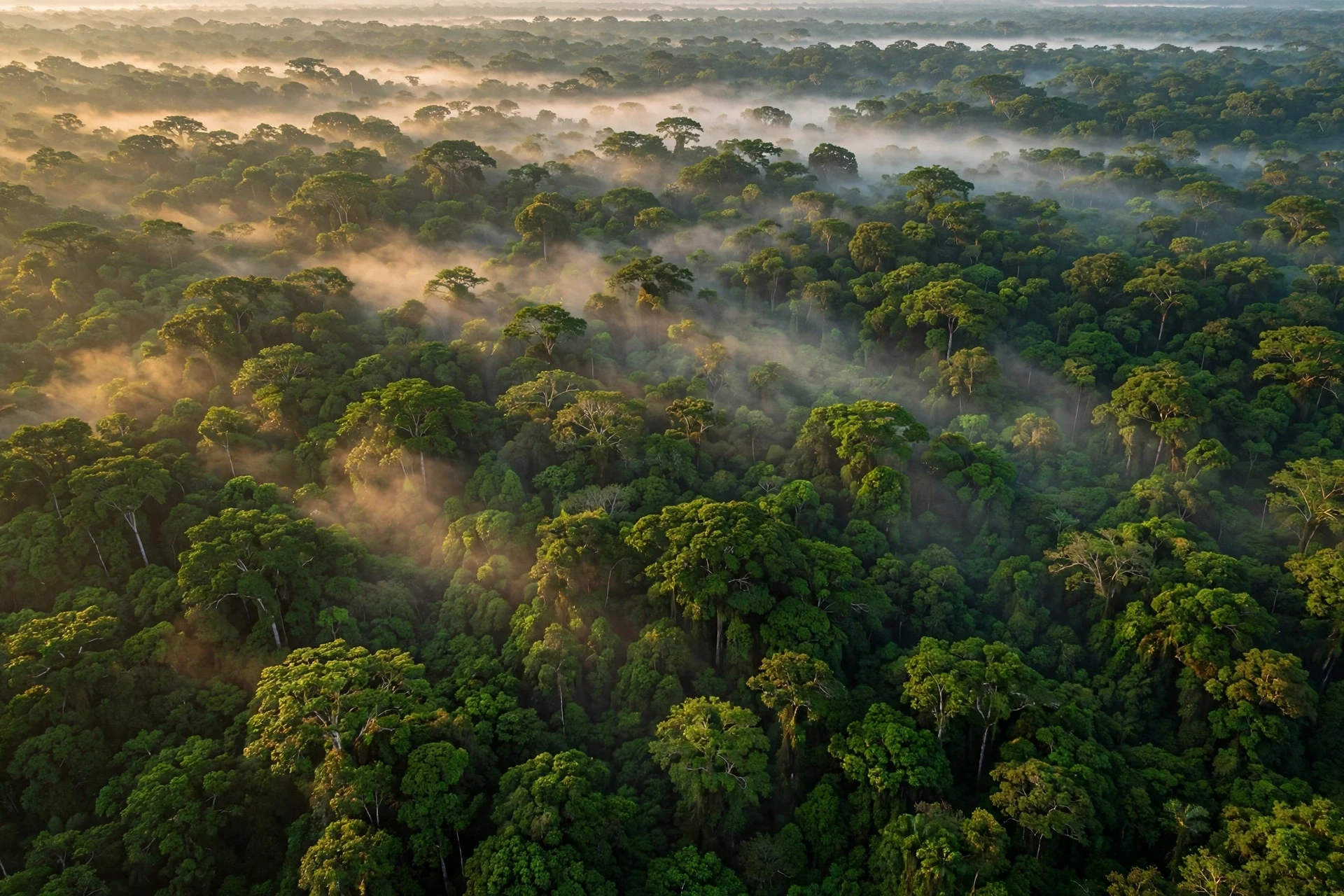
Step into a tropical rainforest near the equator and the first thing you notice is that nothing is ever finished. There is no winter pause, no season when growth stops and the forest waits. Temperatures stay warm all year, rain falls in most months, and plants grow, flower, fruit, and die on their own schedules, all at once. A single hectare — an area about the size of a sports field — can hold more tree species than grow in the whole of a temperate country. That is not an exaggeration for effect. It is the ordinary, measured reality of these forests, and it still stops me in my tracks every time I think about it.
The heat and the rain set the pace. Warmth speeds up every chemical reaction in a plant, and water is almost never the limiting factor, so photosynthesis runs at full tilt for most of the year. If you want the mechanics of that process — how leaves turn sunlight, water, and carbon dioxide into sugar and oxygen — our guide to photosynthesis walks through it step by step. Here, the consequence is what matters: a tropical rainforest produces an enormous amount of living matter each year, and almost all of it is eaten, broken down, and recycled almost as fast as it is made. The forest is not a warehouse of stored growth. It is a fast-moving river of growth, and the river never freezes.
2.1 The daily rhythm of a tropical rainforest
A tropical rainforest has a daily rhythm more reliable than its seasons. Mornings are often clear and bright. By late morning, the heat has lifted moisture off millions of leaves, and clouds build over the forest. Afternoon rain follows — sometimes a brief, hard shower, sometimes a long, soaking downpour — and then the evening clears again. People who live near these forests plan their days around that rhythm the way people elsewhere plan around the tide.
I once spent an afternoon in a forest in Borneo waiting out a storm under a tarpaulin with a field team, watching the rain come down in sheets so heavy that conversation became shouting, then whispering, then shouting again. When it stopped, twenty minutes later, the forest was already steaming. Water was rising off the leaves in visible wisps, the light had gone golden, and frogs had started calling as if the storm had been a starting gun. The forest had not been interrupted by the rain. The rain was part of its working day.
2.2 What lives in the heat
The warmth and the constant growth support animals that could not survive anywhere else. Tropical rainforests hold more species of birds, mammals, amphibians, reptiles, insects, and plants than any other land habitat. Many of those species live nowhere else on Earth. A frog the size of a thumbnail may spend its whole life on a single species of plant. A bird may eat the fruit of one tree and no other. That specialisation is possible only because the forest is stable: when the climate barely changes from month to month, a species can afford to become exquisitely good at one narrow way of living.
The price of that specialisation is fragility. A creature that depends on one tree, one pool of water, or one narrow band of temperature has nowhere to go when the forest changes. This is the trade that runs through the whole story of rainforests: the same stability that creates so much life also makes that life easy to lose.
3. Temperate Rainforests: The Cool, Mossy Cousins
Most people assume that rainforests are tropical, full stop — hot, steamy, and somewhere near the equator. What the data actually shows is different: some of the most extraordinary rainforests on Earth grow in cool places, where the rain is cold and the trees wear coats of moss. Temperate rainforests are rainforests too, by the same definition — heavy rain, a closed canopy, and remarkable variety — but they feel like a different world.
Walk into a temperate rainforest in the Pacific Northwest, in southern Chile, or in Tasmania, and the first thing you notice is the quiet. The air is cool and damp, the light is soft and green, and everything is covered in moss: the trunks, the branches, the fallen logs, the rocks. The trees are enormous — some of the tallest and oldest living things on the planet — but they grow slowly, adding a little girth each year for centuries. A single Douglas fir or mountain ash can live longer than any human civilisation has lasted, and it can hold more living matter in one trunk than an entire tropical hectare holds in its canopy.
The animals are different too. There are fewer species than in the tropics, but the ones that live here are often found nowhere else: the northern spotted owl in the Pacific Northwest, the pudu — a deer the size of a dog — in Chile, the Tasmanian devil in Tasmania. And the forest floor is a world of fungi, ferns, and mosses, a damp green carpet that stays wet for months at a time.
3.1 How temperate rainforests get their rain
Temperate rainforests do not rely on the equatorial rising air that waters the tropics. They rely on the ocean. Moist air blows in from the sea, hits coastal mountains, and is forced upward. As it rises it cools, and the water it carries falls as rain — often 200 to 350 centimetres a year, in places where it can rain on most days of the year. The mountains do the work of squeezing the sky, and the forest grows in the strip where the squeeze is hardest.
That geography makes temperate rainforests narrow. They hug the coast, often in a band only a few dozen kilometres wide, between the sea and the mountains. Cut a road through that band, log one valley, and you have not just damaged a patch of forest. You have cut a corridor through a habitat that exists nowhere else in that form.
3.2 Tropical versus temperate: the comparison
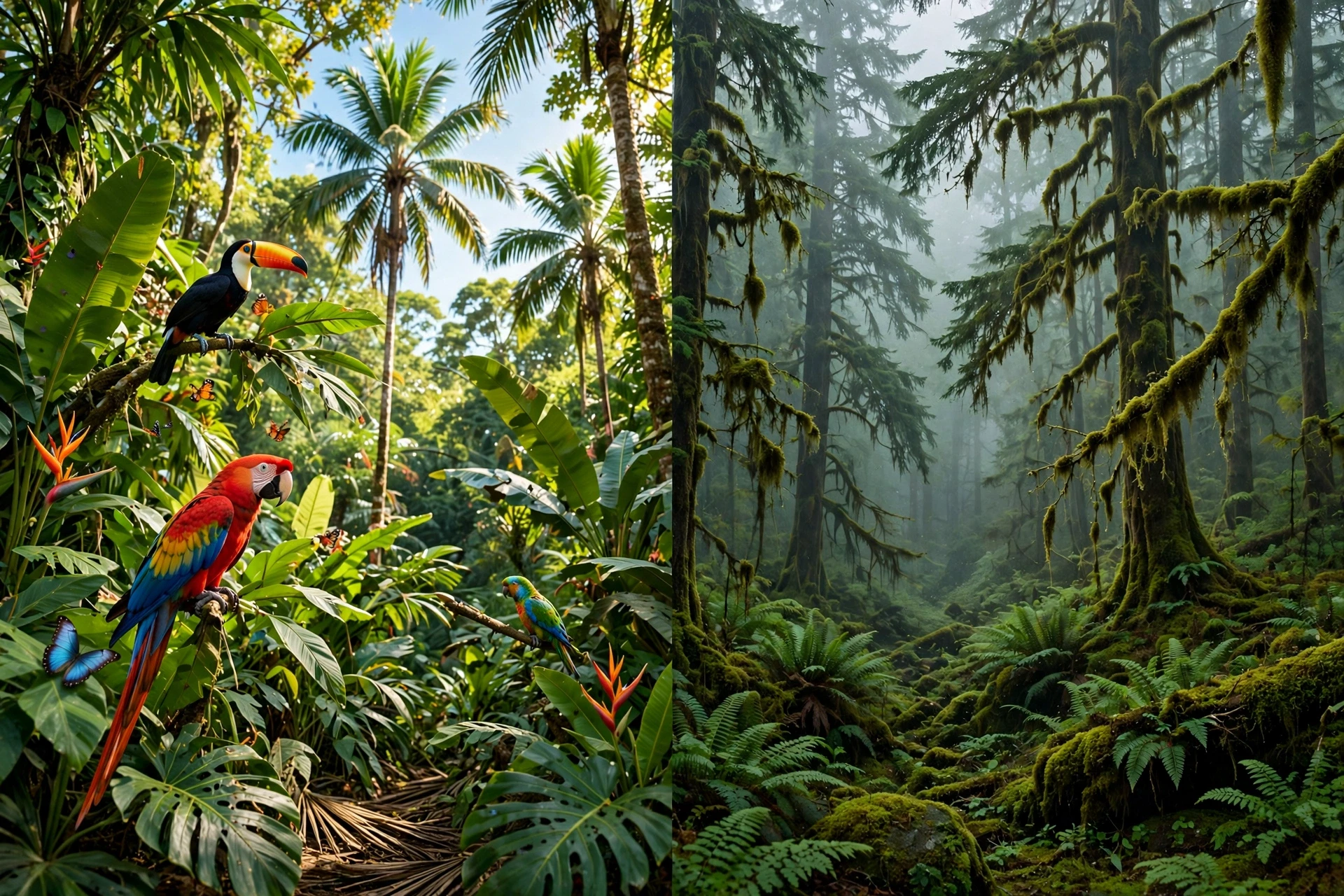
The table below sets the two kinds side by side. The numbers are approximate — rainforests vary enormously from place to place — but the pattern is clear: the tropics win on warmth and species count, while temperate forests win on size, age, and sheer mass of wood.
Feature | Tropical rainforest | Temperate rainforest |
|---|---|---|
Where it grows | Near the equator, in South America, Africa, Southeast Asia, and New Guinea | Cool, wet coasts, such as the Pacific Northwest, Chile, Tasmania, and New Zealand |
Temperature | Warm all year, typically 20–30°C, with little seasonal change | Cool, typically 5–20°C, with mild winters and cool summers |
Rainfall | Often 175–450 cm a year, falling in most months | Often 200–350 cm a year, falling on many days of the year |
Trees | Many species per hectare, mostly broad-leaved evergreens | Fewer species, but giants — conifers and broad-leaved trees that live for centuries |
Species richness | The highest of any land habitat on Earth | Lower than the tropics, but rich in species found nowhere else |
Forest floor | Dark, with rapid decay and thin soils | Thick with moss, ferns, fungi, and deep, damp leaf litter |
3.3 Why the distinction matters
The distinction matters because the two kinds face different threats and need different protection. A tropical rainforest cleared for farming loses its species fast, because so many of them live nowhere else and depend on the forest staying intact. A temperate rainforest logged for timber loses something else: trees that took five hundred years to grow, and a forest structure — standing dead trees, fallen logs, deep moss — that cannot be replanted in a human lifetime. Planting seedlings after clear-felling a temperate rainforest does not restore a temperate rainforest. It starts a plantation. The difference between those two things is measured in centuries.
If you want to see how forests fit into the wider web of living things and their surroundings, our guide to ecosystems explains how energy flows through a system like this one, from sunlight to leaves to the animals that eat them, and back to the soil.
4. The Four Layers of a Rainforest
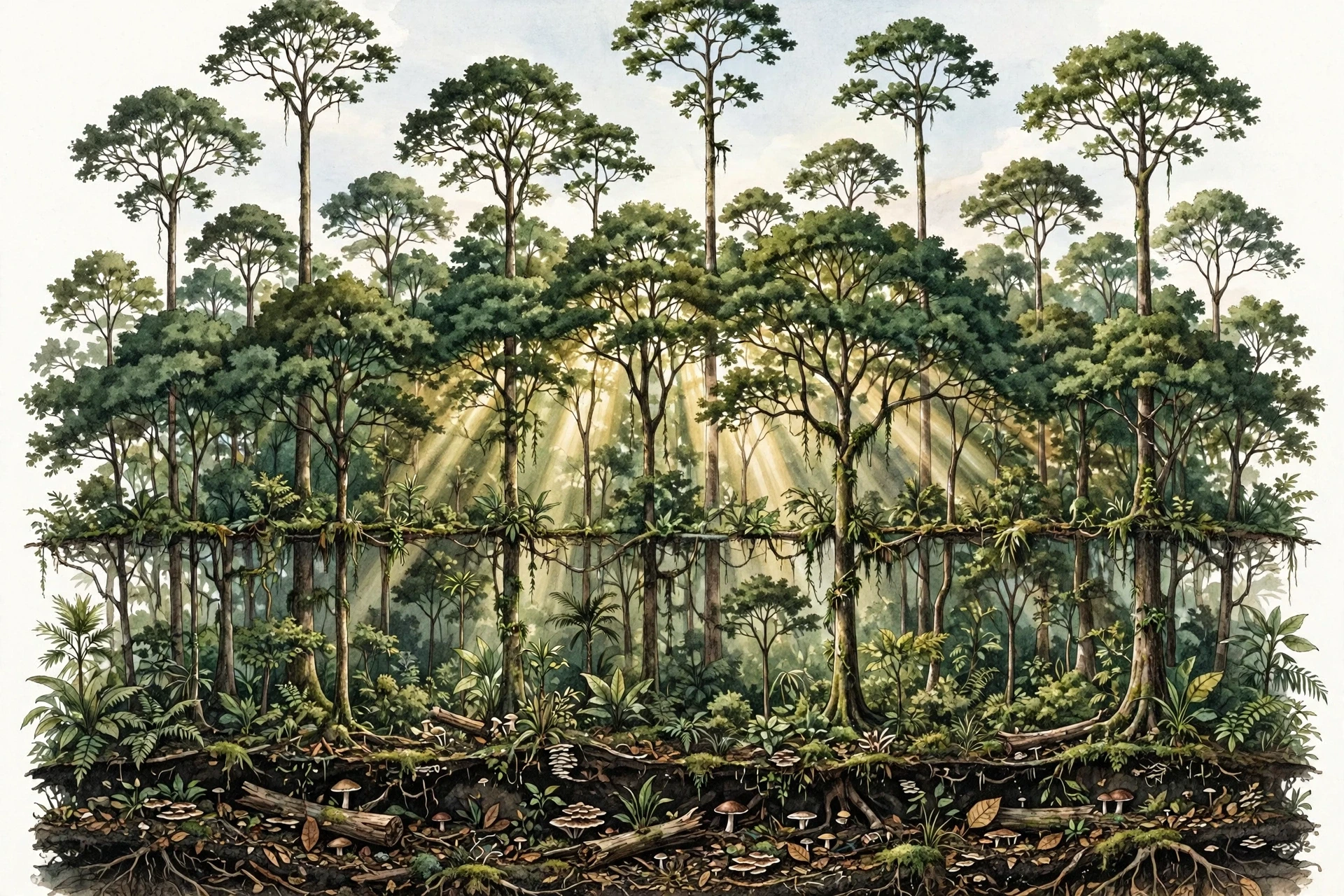
A rainforest is not one forest. It is four forests stacked on top of each other, each with its own climate, its own light, and its own community of plants and animals. Once you learn to see the layers, you can never unsee them. Standing on the forest floor and looking up, you are looking through three different worlds to reach the sky.
The layers are usually named the emergent layer, the canopy, the understory, and the forest floor. Each one is shaped by the same simple fact: light is a resource, and the trees at the top get it first. Everything below lives on what is left.
4.1 The emergent layer: trees above the roof
A few trees in every rainforest grow taller than all the rest, pushing their crowns up through the canopy into full, unfiltered sunlight. These are the emergents, and they can reach 50 to 70 metres in the tropics — as tall as a twenty-storey building. Their trunks are straight and branchless for most of their height, because there is no point growing branches in the shade. Only at the very top do they spread into a broad, umbrella-like crown.
Life up here is exposed. The wind is stronger, the temperature swings wider between day and night, and the sun is fierce. The animals that live here — eagles, toucans, fruit bats, howler monkeys — are built for open air and long views. A harpy eagle hunting over the canopy can see for kilometres. A macaw can fly from one fruiting tree to another without ever dropping below the roof of the forest.
I once watched a group of scarlet macaws leave their roost at dawn, one by one, dropping off a cliff of green into the golden light above the canopy. They did not fly through the forest. They flew over it, the way seabirds fly over the sea, because above the canopy the forest is an ocean of leaves, and they were its ships.
4.2 The canopy: the roof of the world
The canopy is the dense, interlocking roof of treetops that sits roughly 30 to 45 metres above the ground in a tropical rainforest. It is where most of the forest's life happens. Most of the leaves are here, so most of the photosynthesis happens here. Most of the fruit and flowers are here, so most of the animals that eat them live here. Scientists who study rainforests now believe the canopy holds more species than any other part of the forest — and, by extension, more species than any other habitat on land.
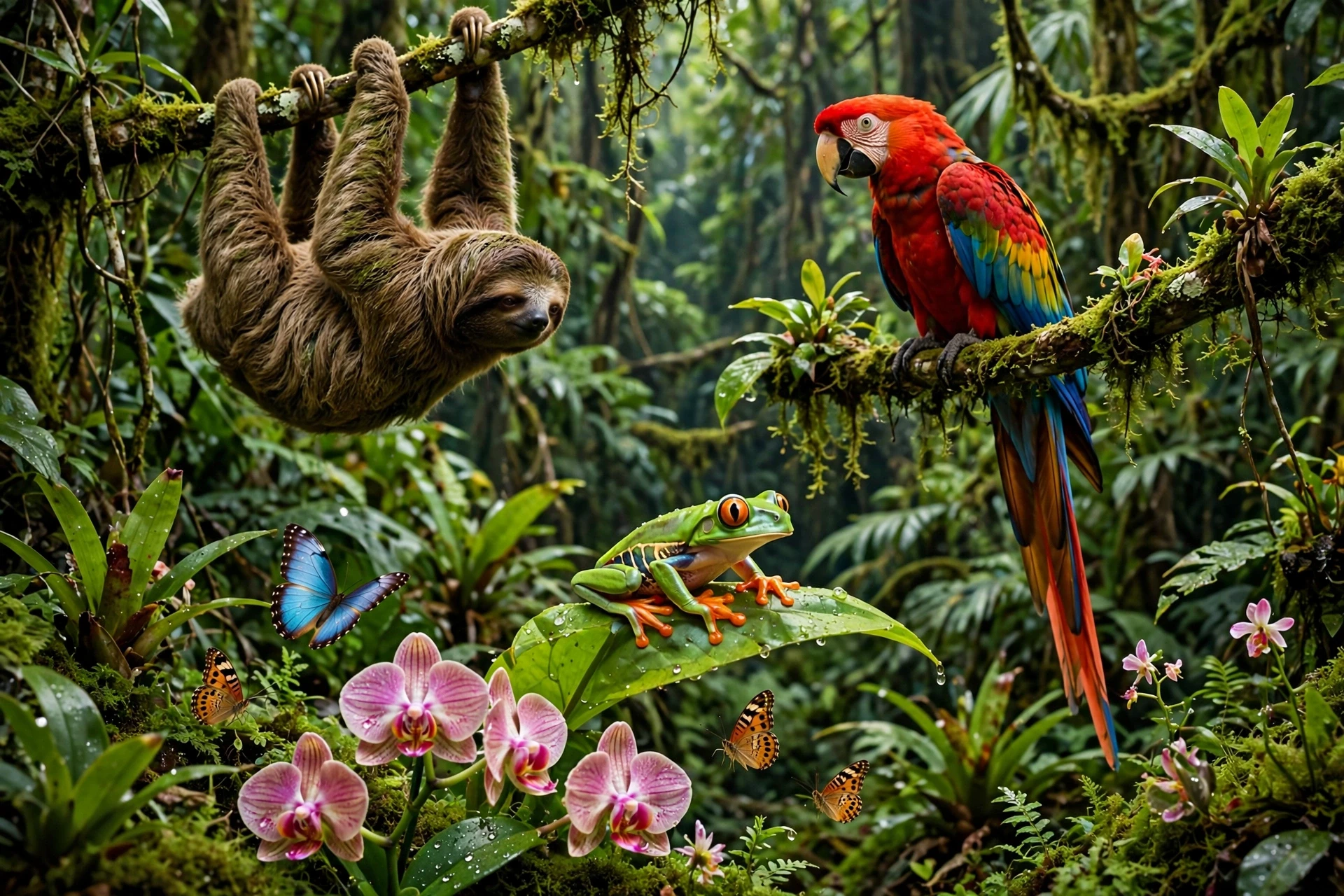
The canopy is also a world of connections. Trees are linked by vines and lianas, so a monkey or a sloth can travel for kilometres without ever touching the ground. Epiphytes — plants that grow on other plants — cling to branches in their thousands: orchids, ferns, bromeliads, mosses. A single large canopy tree can carry tonnes of epiphytes, each one a small garden in the sky. A bromeliad, with its rosette of leaves holding a cup of rainwater, is a pond in miniature. Frogs breed in it. Insects drink from it. It is a habitat, held up in the branches.
The canopy is the most crowded neighbourhood on Earth. It holds most of the forest's leaves, most of its fruit, and most of its animals — all of it hanging in the air, thirty metres above the ground.
4.3 The understory: shade and patience
Below the canopy, the light falls away sharply. Only a small fraction of the sunlight that hits the roof reaches the understory — the layer of young trees, shrubs, and small palms that grows between the canopy and the ground. Plants here live in permanent shade, and they have adapted to it in clever ways. Their leaves are often large and dark green, built to catch every scrap of light. Some track the fleeting sunbeams — sunflecks — that move across the forest as the sun passes and the canopy sways.
Animals of the understory are often secretive and quiet: small birds that flit through the gloom, snakes that hang motionless from branches, frogs that call at night from leaves a metre off the ground. The pace here is slower. Growth is patient. A young tree in the understory may wait decades for a gap to open above it — for an old tree to fall and let the light in — and then race upward to fill it. That waiting game is one of the oldest strategies in the forest.
4.4 The forest floor: dark, damp, and busy
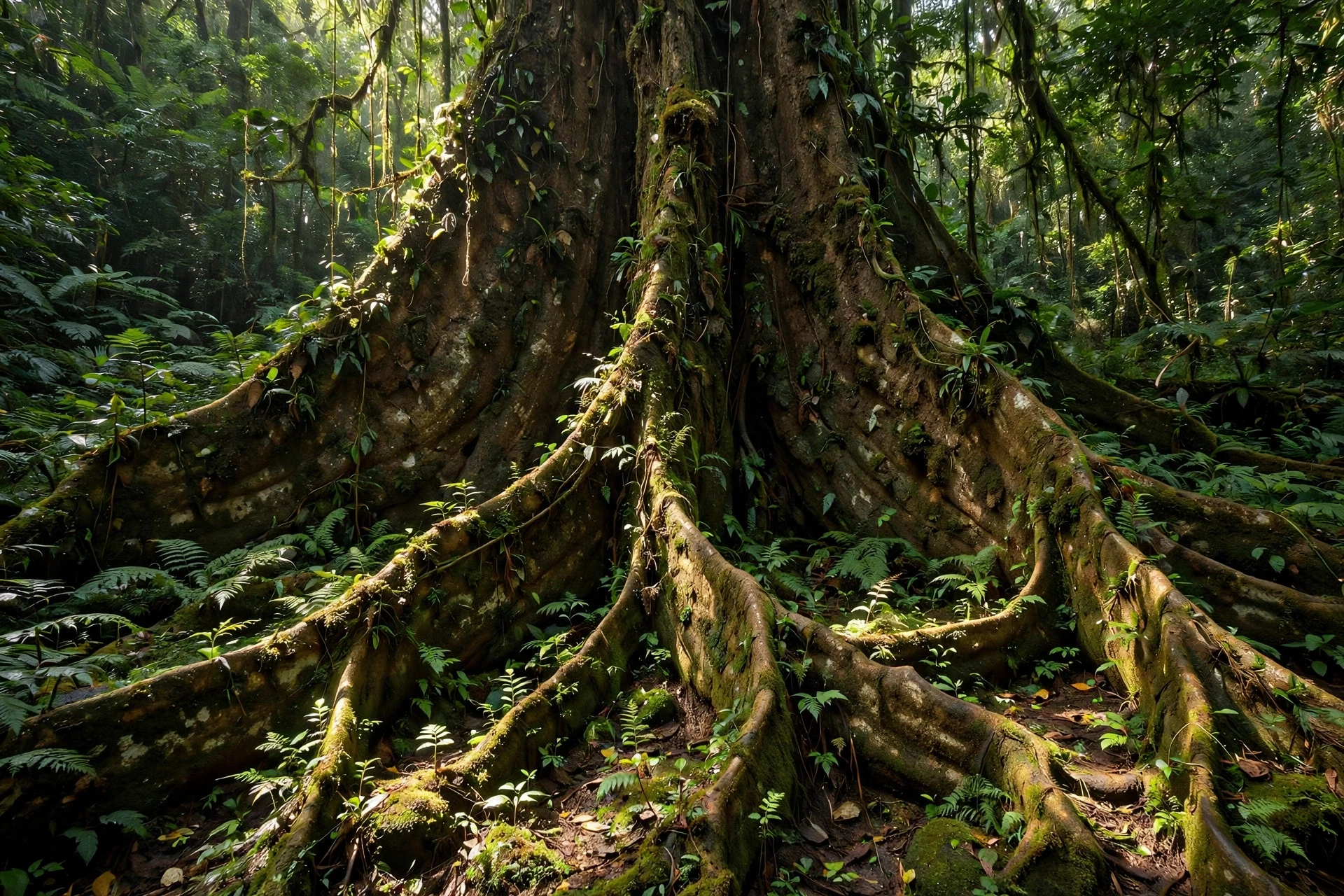
Almost no direct sunlight reaches the forest floor — often less than two percent of what falls on the canopy. It is dark, warm, humid, and covered in a thin layer of fallen leaves. To a visitor, it can look empty. It is the opposite. The forest floor is the recycling centre of the rainforest, where fungi, bacteria, termites, ants, and millipedes break down dead leaves and fallen trees with astonishing speed. In the heat and humidity, a leaf can vanish in weeks. Its nutrients go straight back into the roots of living trees, because the soil itself holds very little. That is one of the great surprises of rainforests: the soil is poor, and the forest is rich, because the wealth is stored in the living trees, not in the ground.
The animals here are the quiet workers of the forest: leaf-cutter ants carrying green fragments many times their own weight, dung beetles rolling their prizes away, tapirs and forest elephants moving through the gloom like shadows. And there are predators too — jaguars in the Amazon, leopards in the Congo — that hunt along the game trails where the undergrowth is thin.
Layer | Height | Light | Who lives there |
|---|---|---|---|
Emergent | 50–70 m | Full sun | Eagles, macaws, fruit bats, howler monkeys |
Canopy | 30–45 m | Strong, filtered light | Most birds, monkeys, sloths, orchids, bromeliads |
Understory | 5–15 m | Deep shade, fleeting sunflecks | Small birds, frogs, snakes, young trees waiting for light |
Forest floor | Ground level | Less than 2% of sunlight | Ants, termites, fungi, tapirs, jaguars |
5. Why Rainforests Hold So Much Life
The central puzzle of rainforests is not that they hold many species. It is that they hold so many species in so little space, all living side by side without one of them taking over. A temperate wood might hold a dozen tree species. A tropical rainforest hectare can hold several hundred. A single tree can host hundreds of insect species. Why?
Part of the answer is time. Tropical rainforests have existed, in one form or another, for tens of millions of years, with a climate that stayed warm and wet through ice ages that froze much of the rest of the planet. Species had time to evolve, to split, to specialise, and to settle into narrow niches without being wiped out by a sudden freeze or a long drought. Stability is the great gift of the tropics, and rainforests are its clearest expression.
Part of the answer is energy. Warmth and rain mean growth all year, and growth all year means food all year — leaves, flowers, fruit, nectar, insects — so animals do not need to migrate or hibernate to survive a lean season. When food is always available, a species can afford to eat only one thing, live in only one layer, or breed in only one kind of pool. That is how a forest fills up: not with generalists that do everything, but with specialists that each do one thing brilliantly.
5.1 The variety of life, layer by layer
The variety is not spread evenly. It is stacked. In the canopy, there are birds and mammals that never come down, insects that live their whole lives on a single tree, and plants that grow on other plants. In the understory, there are frogs that breed in tiny pools held in leaves, and birds that follow army-ant swarms to catch the insects the ants flush out. On the forest floor, there are ants whose colonies run like small cities, fungi that glow in the dark, and mammals that shape the forest by eating fruit and dropping seeds far from the parent tree.
Our guide to biodiversity explains what this variety means in general — how many species there are, why they matter, and what happens when they are lost. In rainforests, the stakes are at their highest, because so much of that variety exists nowhere else. Lose a rainforest, and you do not just lose trees. You lose species that science has not yet described, whose names do not exist yet, and whose roles in the forest nobody has had time to study.
5.2 The insects that run the forest
If you count species, rainforests belong to the insects. Beetles alone may number in the tens of thousands of species in a single large rainforest. Ants move more soil than earthworms in some forests. Bees and other pollinators decide which trees get to reproduce. And the insects are food for almost everything else: frogs, birds, lizards, and small mammals all depend on them.
I remember the first time a field researcher showed me a light trap in the forest at night — a white sheet and a bright lamp, left running for an hour after dark. When we came back, the sheet was covered in moths, beetles, and creatures I could not have named if I had tried: insects with transparent wings, insects that looked like leaves, insects that looked like thorns. "This is one hour, one lamp, one clearing," she said. "Now imagine the whole forest." I have never forgotten that sheet. It was the closest I have ever come to seeing biodiversity itself, all at once, in one place.
5.3 Why so many species live nowhere else
Isolation is the other half of the story. A mountain range, a wide river, or a stretch of dry savanna can split a rainforest population in two, and the two halves will slowly become different species. Rivers in the Amazon are wide enough that a monkey on one bank may never meet a monkey on the other. Over time, that separation produces species that live only on one side of one river — and nowhere else on Earth.
This is why the loss of a rainforest is not like the loss of a field or a wood. A field can be replanted. A rainforest species that lived only in one valley cannot be replanted, because it exists nowhere else to replant it from. When it goes, it goes entirely. That irreversibility is what makes the conservation of rainforests different from most other conservation work. There is no second copy.
5.4 The plants that make it all possible
None of this variety would exist without the plants. Rainforest trees, shrubs, vines, and epiphytes create the structure — the layers, the shade, the fruit, the flowers — that every animal depends on. The plants are also the chemists of the forest. To survive being eaten, they produce an extraordinary range of chemicals: poisons, bitter tastes, sticky saps, and compounds that interfere with an insect's digestion. Those same chemicals, in different doses, are the raw material of medicine — which is where section 8 comes in.
The variety of plants is itself staggering. A rainforest hectare can hold more tree species than grow wild in all of Europe. Some of those trees are giants that live for centuries. Some are small palms that flower once and die. Some are lianas that climb from the forest floor to the canopy and flower only when they reach the light. Together, they form a living architecture that has no equivalent anywhere else on land.
If you want to understand how a single plant works — how it grows, feeds, and defends itself — our guide to plant biology covers the machinery inside the leaf, the stem, and the root. In a rainforest, that machinery runs at full power, all year, in millions of plants at once.
6. Rainforests and the Water Cycle
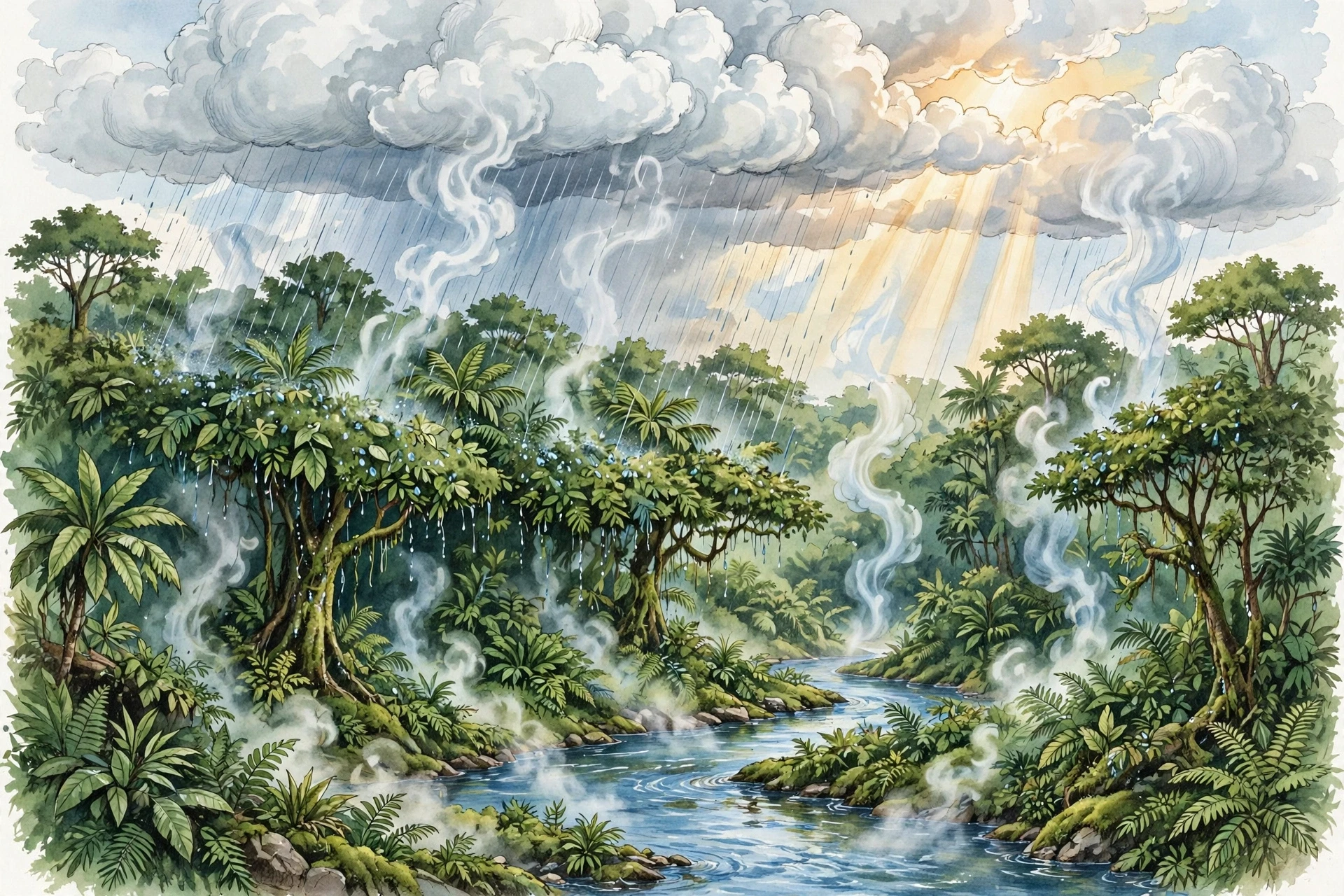
Rainforests do not just receive rain. They make it. This is one of the most remarkable things about them, and one of the least widely understood. A large rainforest recycles its own water: trees draw water from the soil, release it into the air through their leaves, and that water becomes cloud, and then rain, which falls on the forest again. The forest is not a passive recipient of weather. It is a participant in it.
The process has a name — transpiration — and its scale is hard to grasp. A single large rainforest tree can release hundreds of litres of water into the air on a hot day. Multiply that by millions of trees, and a forest like the Amazon is pumping an amount of water vapour into the atmosphere that rivals a great river. NASA's Earth Observatory describes how the Amazon's forests generate rainfall and influence weather far beyond the forest itself, and its pages on the Amazon are a good place to see the satellite evidence for that claim (NASA Earth Observatory).
6.1 Flying rivers
Scientists sometimes describe the moisture that flows over the Amazon as a "flying river" — a stream of water vapour in the atmosphere, carried by the wind, that delivers rain to places far downwind. The idea is not poetic licence. The volume of water involved is comparable to the flow of the Amazon River itself, and the rain it produces falls on farms and cities in central and southern Brazil, far from the forest. Cut the forest, and that flying river weakens. The rain downwind falls less reliably, and the farms that depended on it begin to fail.
I first heard the term "flying river" from a Brazilian researcher who had spent years flying through the clouds above the Amazon, measuring how much water the forest was releasing. "People think the river is in the ground," she said. "Half of it is in the sky." That sentence changed the way I think about rainforests. A forest is not just a place with trees. It is a water system that happens to be made of trees.
6.2 What happens when the cycle breaks
The water cycle of a rainforest depends on the forest staying intact. When trees are cleared, the land loses its ability to hold and release water. Rain that once fell on leaves and soaked gently into the soil now hits bare ground, runs off quickly, and carries the topsoil with it. Streams that once ran clear all year become muddy in the wet season and dry in the dry season. The air becomes drier, the remaining forest becomes more vulnerable to fire, and the cycle that made the rain begins to unwind.
This is not a distant, theoretical risk. In parts of the Amazon, researchers have documented longer dry seasons and less rainfall in areas where large amounts of forest have been cleared. The forest is not just a victim of a changing climate. In these places, it is part of the climate, and losing it changes the climate locally — which makes it harder for the remaining forest to survive, which changes the climate further. It is a feedback loop, and it runs in the wrong direction.
A rainforest is a water system that happens to be made of trees. Cut the trees, and the rain itself begins to change.
6.3 Rainforests and the rivers beneath them
The water cycle does not end in the sky. Rainforest soils and roots filter water as it moves toward rivers, keeping those rivers clean and steady. The Amazon River carries about a fifth of all the river water that flows into the world's oceans, and its water runs brown with sediment only where the forest has been stripped from its banks. Where the forest stands, the roots hold the soil, the leaves break the force of the rain, and the river runs clear.
That filtering service matters to people who never see the forest. Millions of people drink water that has passed through rainforest catchments, fish in rivers that depend on the forest for their flow, and farm on floodplains that are fed by forest rain. When the forest goes, the water changes — and the people downstream feel it first.
7. Carbon Storage and the Climate
Trees are made of carbon. They pull carbon dioxide out of the air, split it apart with sunlight, keep the carbon, and release the oxygen. A rainforest is therefore a store of carbon — in its trunks, its branches, its roots, and its soil. The amount is enormous. Tropical rainforests together hold hundreds of billions of tonnes of carbon, and the Amazon alone holds a share that, if released, would change the climate of the whole planet.
That storage is not permanent. It lasts as long as the forest lasts. A living rainforest is roughly in balance: it absorbs carbon as it grows, and releases carbon as trees die and decay. The balance is delicate, and it is shifting. When a rainforest is cut and burned, the carbon stored over centuries is released in days. When it is cleared for farming, the soil itself begins to lose carbon too. What took a forest centuries to gather can be undone in a single dry season.
7.1 How rainforests cool the planet
Rainforests cool the planet in two ways. The first is the carbon they store: every tonne of carbon held in a tree is a tonne that is not in the atmosphere, trapping heat. The second is the water they release. Transpiration cools the air above the forest, and the clouds the forest helps to form reflect sunlight back into space. A rainforest is, in effect, a giant air conditioner — one that runs on sunlight and rainwater, and covers an area the size of a continent.
NASA's reporting on rainforests and climate change sets out how the loss of these forests adds to the warming of the planet, and why protecting them is one of the most direct ways to slow that warming (NASA Climate). The point is not that rainforests alone can solve climate change. They cannot. The point is that losing them makes the problem measurably worse, and keeping them makes it measurably better. That is a rare thing in climate policy: a lever that works in both directions, and works fast.
7.2 When a rainforest stops absorbing carbon
For a long time, scientists assumed that rainforests would keep absorbing carbon indefinitely, growing faster as carbon dioxide levels rose and temperatures warmed. The evidence now points the other way. In parts of the Amazon, the forest's ability to absorb carbon has weakened, as droughts, higher temperatures, and the fragmentation of the forest by roads and clearings have taken their toll. Some areas that once absorbed more carbon than they released now release more than they absorb, at least in dry years.
That shift is a warning, not a verdict. A rainforest that is intact — unlogged, unfragmented, and connected to other forest — is far more resilient than a forest that has been cut into patches. The patches dry out at their edges, catch fire more easily, and lose their largest trees first — and the largest trees hold the most carbon. Protecting the forest in large, connected blocks is therefore not just a matter of saving species. It is a matter of keeping the carbon store locked up.
7.3 The carbon in the soil
It is easy to focus on the trees and forget the soil, but the soil matters too. Rainforest soils are thin and poor in nutrients, yet they still hold carbon — in roots, in fungi, and in the dark organic matter built up over centuries. When forest is cleared and the soil is exposed to sun and rain, that carbon is lost as well, and the soil itself degrades. In many cleared areas, the soil becomes so poor within a few years that farming fails, and the land is abandoned — leaving behind a degraded landscape that is neither forest nor farm.
This is the hidden cost of deforestation that rarely appears in the headlines. The forest is not just cut. Its ability to be a forest again is damaged, because the soil, the seed bank, and the web of fungi and animals that made the forest work have all been stripped away at once.
8. Medicines from the Forest
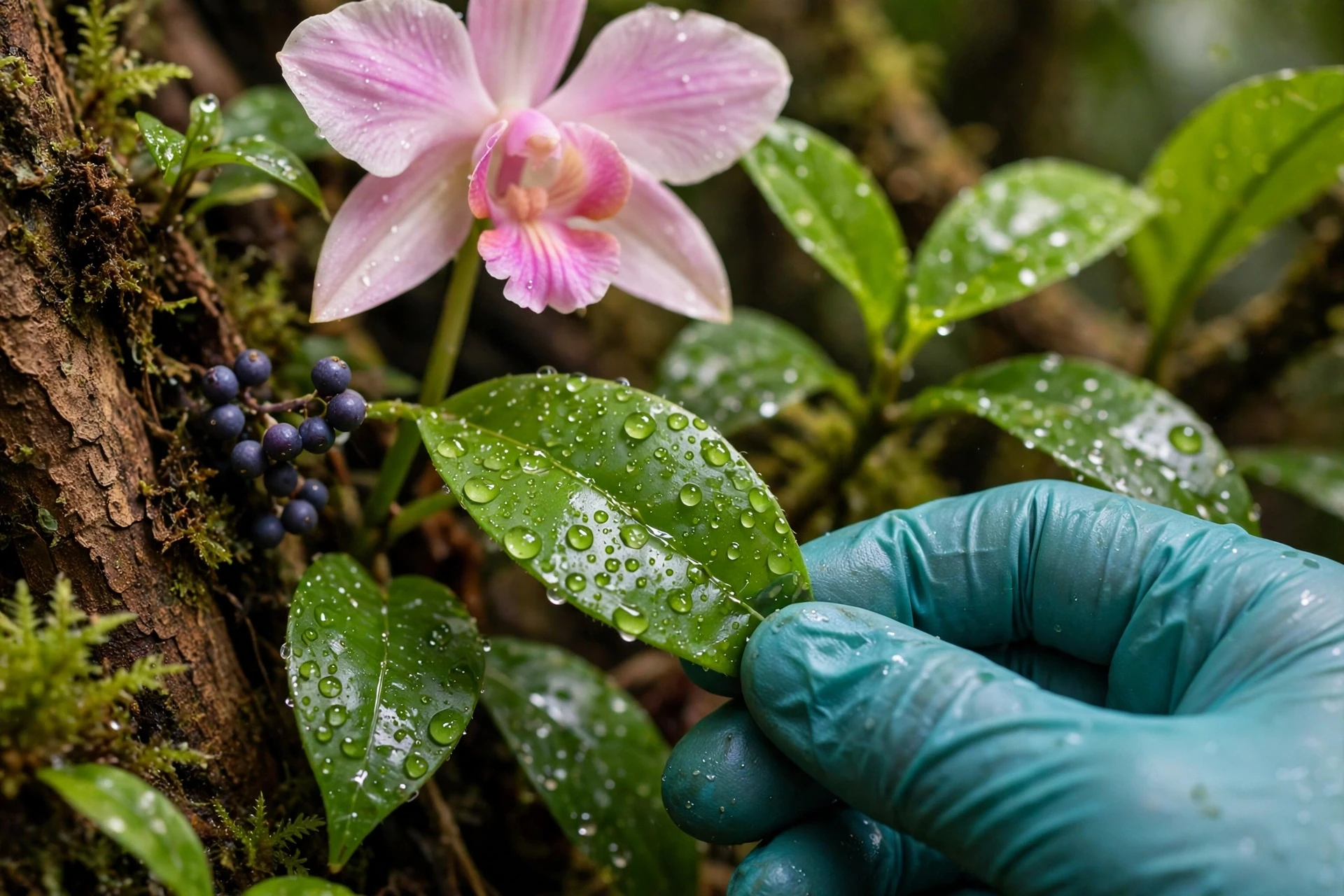
Some of the most important medicines in the world come from rainforests. The rosy periwinkle, a small pink flower from the rainforests of Madagascar, gave us two drugs that transformed the treatment of childhood leukaemia and Hodgkin's disease. The bark of the cinchona tree, from the forests of the Andes, gave us quinine, the first effective treatment for malaria. Curare, from rainforest vines, gave surgeons a muscle relaxant that made modern surgery possible. These are not folk remedies. They are the foundations of modern medicine, and they came from plants that evolved their chemistry to survive in a rainforest.
The reason rainforests are so rich in medicines is the same reason they are so rich in species: competition. A plant that cannot run away from the insects that eat it must defend itself with chemistry, and over millions of years, rainforest plants have produced an extraordinary library of chemical compounds — poisons, bitterants, antibiotics, and growth regulators. A fraction of those compounds have been studied. The rest are unknown.
8.1 How much medicine is still undiscovered
Scientists estimate that only a small fraction of rainforest plant species have been screened for medicinal compounds, and an even smaller fraction have been studied in depth. Every time a rainforest is cleared, compounds that took millions of years to evolve are lost before anyone has had the chance to test them. That is not a sentimental argument. It is a practical one. The next treatment for a disease that currently has no cure may already exist, in the leaves of a tree that grows only in one valley, and that valley may be scheduled for clearing.
The Rainforest Alliance explains how rainforests support human life in ways that go far beyond timber and land, including the medicines and foods that come from them, and why protecting the forest protects those resources too. The argument is worth reading in full, because it makes the case that rainforests are not a luxury for nature lovers. They are infrastructure for human health.
8.2 Traditional knowledge and the forest
The medicines of the rainforest were not discovered by accident. Indigenous peoples and local communities have used rainforest plants as medicine for thousands of years, and their knowledge — which plants treat fever, which bark stops bleeding, which leaf soothes a sting — is the map that modern researchers follow. Much of what science now knows about rainforest medicines began as knowledge held by people who live in the forest.
That knowledge is itself at risk. When communities are displaced by logging or farming, or when their forests are cleared, the knowledge that was tied to those forests is lost with them. Protecting rainforests, then, is not only about protecting plants and animals. It is about protecting the people who know the forest best, and whose knowledge may hold the key to medicines we have not yet found.
The next medicine we need may already exist in a rainforest leaf — in a tree that grows only in one valley, and that nobody has yet studied.
8.3 Food, materials, and everyday life
Medicine is the most dramatic gift of the rainforest, but it is not the only one. Rainforests give us foods that the world now depends on: chocolate from the cacao tree, coffee from forest shrubs, bananas, Brazil nuts, vanilla, and many fruits that never leave their home regions. They give us rubber, rattan, resins, and oils. They give us the genetic diversity that plant breeders use to protect crops against disease — wild relatives of bananas, cocoa, and coffee that carry resistance to pests and fungi that threaten the farmed varieties.
All of these gifts depend on the forest remaining a forest. A cacao tree grown in a plantation is a crop. A cacao tree growing wild in a rainforest, surrounded by its pollinators, its seed dispersers, and its wild relatives, is a resource that can keep giving for generations. The difference is the forest around it.
9. The Amazon: The Largest Rainforest on Earth
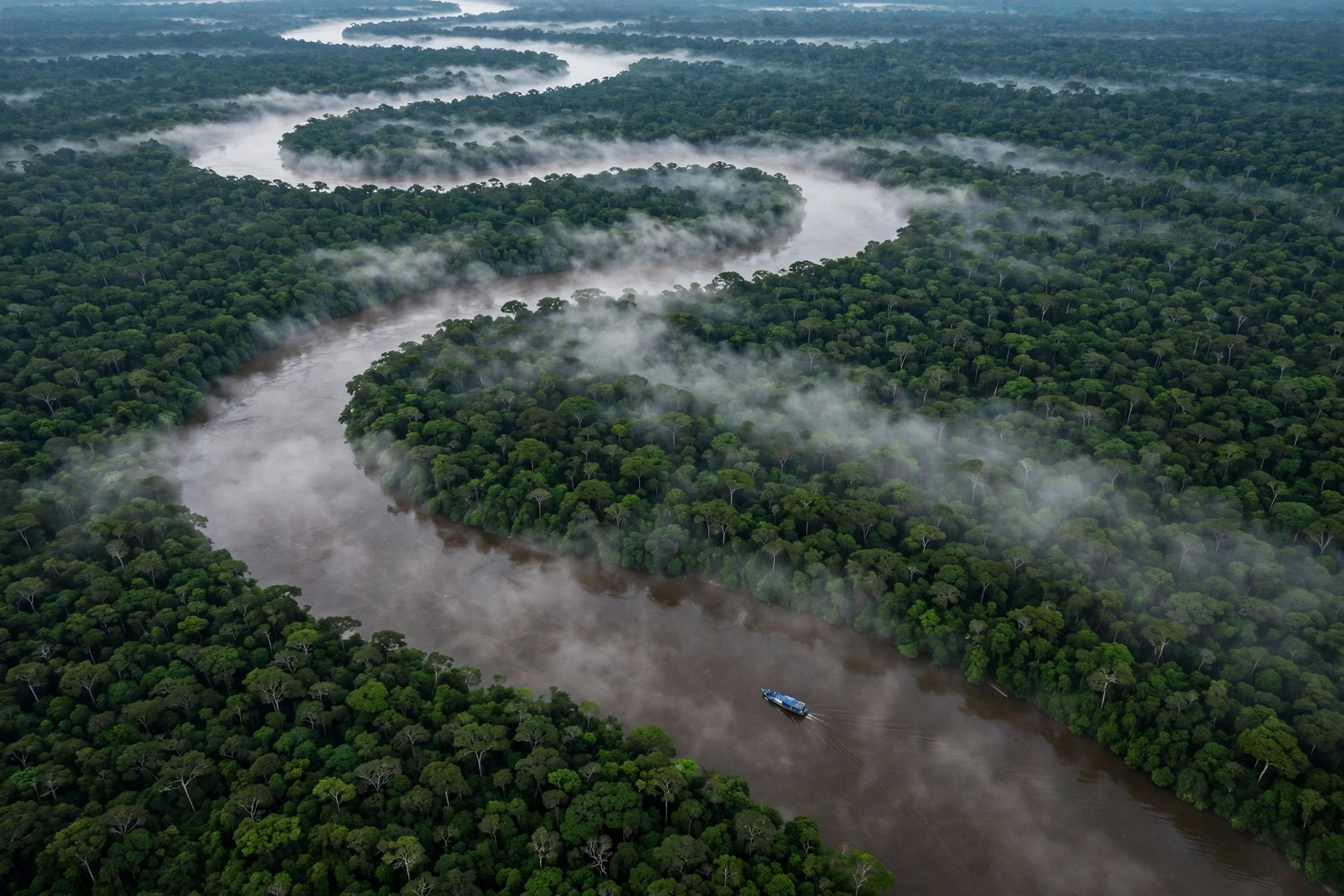
The Amazon is the largest rainforest in the world, covering much of South America across nine countries, with the largest share in Brazil. It is so large that it is hard to hold in the mind at once: an area roughly the size of the continental United States, covered in forest, cut through by a river system that carries more water than the next several largest rivers combined. The Amazon River itself is the largest river on Earth by volume, and its tributaries reach into every corner of the basin.
The Amazon holds about a tenth of the world's known species, and many more that are still undescribed. It is home to jaguars, pink river dolphins, giant otters, harpy eagles, and more species of fish than live in the entire Atlantic Ocean. It is also home to millions of people, including Indigenous peoples whose cultures are woven into the forest in ways that go back thousands of years.
9.1 A river that is also a forest
The Amazon is not a forest with a river in it. It is a forest and a river that make each other. Each year, the river floods vast areas of forest — the flooded forests, called varzea and igapo — and fish swim among the trees, eating fruit that falls from the canopy and spreading seeds as they go. The forest feeds the river, and the river feeds the forest, and the fish are the messengers between them.
I once stood on a small boat in a flooded forest in the Amazon, in water so still that the trees were reflected perfectly, and watched a fish the size of my arm rise to take a fruit that had just fallen from a branch above. It was a quiet, ordinary moment, and it told me more about the Amazon than any number could. This is a forest where the river comes into the trees, and the trees feed the river, and nothing is separate from anything else.
9.2 Why the Amazon matters to the whole world
The Amazon matters to the whole world for three reasons, and they are the same three reasons this article keeps returning to. First, it stores an enormous amount of carbon. Second, it makes its own rain, and that rain falls on farms and cities across South America. Third, it holds a share of the world's species that is found nowhere else. Lose the Amazon, and the world loses all three at once.
NASA's Earth Observatory has documented how the Amazon's forests shape rainfall and weather across the continent, and its satellite images show the scale of the forest — and the scale of the clearing — in a way that words cannot (NASA Earth Observatory). The images are worth looking at, because they make the abstract concrete: a green expanse the size of a continent, with the marks of roads and clearings spreading through it like cracks in glass.
9.3 What is happening in the Amazon
The Amazon is being cleared, mainly for cattle ranching and soy farming, and also for logging, mining, and roads. The clearing is not evenly spread. It advances along roads, in a fishbone pattern that is visible from space: a main road, then side roads, then clearings branching off each side. Each clearing is a small loss on its own. Together, they add up to an area of forest lost each year that is larger than many countries.
The damage is not only the clearing itself. Fragmentation — cutting the forest into patches separated by farms and roads — dries the remaining forest at its edges, makes it more vulnerable to fire, and cuts off the animals that need large, connected territories. A jaguar cannot live in a patch of forest the size of a farm. A harpy eagle cannot hunt in a fragment. The forest that remains, even where it is not cleared, becomes a poorer version of itself.
10. The Congo Basin: Africa's Green Heart
The Congo Basin, in Central Africa, holds the second-largest rainforest in the world, and the largest in Africa. It spans six countries — Cameroon, the Central African Republic, the Democratic Republic of Congo, the Republic of Congo, Equatorial Guinea, and Gabon — and it is in many ways the quiet twin of the Amazon: less famous, less studied, and in some ways more intact.
The Congo Basin is home to forest elephants, western lowland gorillas, bonobos, okapi, and leopards. Its forests store a vast amount of carbon, including in the peatlands that lie beneath them — deep, waterlogged deposits of partly decayed plant matter that hold carbon in quantities that surprised even the scientists who found them. The Congo's peatlands are among the largest tropical peat stores on Earth, and they are vulnerable in a way that is easy to miss: drain them, and they begin to release their carbon; dry them, and they can burn.
10.1 A forest that feeds millions
The Congo Basin is not a wilderness without people. Tens of millions of people depend on its forests for food, fuel, medicine, and income. They hunt, fish, gather, and farm in the forest, in systems that have sustained communities for generations. The forest is their home, their market, and their pharmacy, all at once.
That dependence is both a strength and a vulnerability. A forest that feeds millions of people has millions of defenders, if those people have secure rights to it. But when those rights are weak — when logging concessions are granted over community land, or when mining and farming expand without consent — the people who depend on the forest most are the ones who lose first.
10.2 The threats, and the differences from the Amazon
The Congo Basin faces many of the same threats as the Amazon — logging, mining, farming, and roads — but the pattern is different. Industrial logging is a larger share of the pressure, and small-scale farming is widespread. The forest is also less fragmented than the Amazon in many areas, which is good news: large, connected blocks of forest remain, and they are worth protecting before they are cut.
The Congo's peatlands add a risk that the Amazon does not have in the same form. Peat holds carbon in waterlogged soil, and once it is drained, the carbon escapes as the peat decays or burns. Protecting the peatlands is therefore a separate task from protecting the trees above them, and it requires keeping the water where it is. That is a reminder that a rainforest is not just the trees you can see. It is the soil, the water, and the hidden stores beneath them too.
10.3 Why the Congo is less famous — and why that matters
The Congo Basin receives far less attention than the Amazon, and far less research funding. That is a problem, because what is not studied is harder to protect. Scientists still do not know how many species live in the Congo Basin, how much carbon its peatlands hold, or how its forests are responding to a warming climate. The gaps in knowledge are not an excuse for inaction. They are a reason to act with caution, and to protect large areas while the science catches up.
11. Deforestation: What Is Being Lost and Why
Deforestation is the clearing of forest for another use — farming, ranching, logging, mining, or building. It is not the same as a tree falling in a storm, or a forest being thinned by people who live in it. It is the removal of the forest itself, and its replacement with something else. Rainforests are being deforested at a rate that is hard to comprehend: an area of tropical forest roughly the size of a small country is lost every year, and the pace has not slowed as much as the promises made about it would suggest.
The drivers are not mysterious. They are the ordinary demands of a growing world: beef, soy, palm oil, timber, and land. And they are connected in ways that are easy to miss. A road built for logging opens a forest to farmers. A farm that fails on poor soil is abandoned, and the farmer clears new forest. A mine needs a road, and the road brings settlers, and the settlers clear land. Each step is rational on its own. Together, they add up to the loss of a forest.
11.1 The main drivers, one by one
Cattle ranching is the largest driver of deforestation in the Amazon, where forest is cleared to create pasture. Soy farming, often grown to feed livestock elsewhere, is another major driver, in the Amazon and in the forests and savannas that border it. Palm oil drives deforestation in Southeast Asia, where rainforest is cleared to plant oil palm. Logging — both legal and illegal — removes the largest, most valuable trees, and the roads built to reach them open the forest to further clearing. Mining for gold, minerals, and other resources clears forest directly and pollutes the rivers that run through it.
None of these drivers acts alone, and none of them is driven only by the people who live near the forest. The beef, soy, and palm oil that drive deforestation are mostly consumed far away — in cities and countries that may never see a rainforest. That distance is part of the problem: it is easy to buy a product without knowing what was cleared to make it, and easy for the people who profit from clearing to hide the cost.
11.2 What is lost when a rainforest is cleared
When a rainforest is cleared, the losses are not only the trees. The species that lived only in that forest are lost. The carbon stored in the trees and the soil is released. The rain the forest helped to make falls less reliably. The rivers run muddier and less steadily. The medicines that might have been found in its plants are lost before they are discovered. And the people who depended on the forest — for food, for income, for their culture — lose their home and their livelihood.
The loss is also, in a real sense, irreversible on any timescale that matters to us. A rainforest that took millions of years to evolve cannot be regrown in a human lifetime. A plantation of fast-growing trees is not a rainforest, however green it looks from the air. It holds a fraction of the species, stores a fraction of the carbon, and makes a fraction of the rain. Calling it a replacement is like calling a photograph of a meal a replacement for dinner.
11.3 The fires that follow
Fire is the shadow that follows deforestation. Rainforests are naturally too wet to burn — a healthy rainforest almost never catches fire on its own. But a forest that has been logged, fragmented, and dried at its edges will burn, and once it burns, it becomes more vulnerable to burning again. The fires that have made headlines in the Amazon in recent years are not natural wildfires. They are fires set to clear land, that escape into the forest, and that burn in a place that was never meant to burn.
A burned rainforest does not recover the way a burned temperate forest does. The trees are not adapted to fire. Their seeds do not need it, their bark does not resist it, and the animals that would recolonise a burned area cannot reach it if the forest around it is gone. Fire in a rainforest is not a reset. It is a wound that takes far longer to heal than the fire took to make.
12. What Can Be Done
The story of rainforests can sound like a story of inevitable loss. It is not. Rainforests are being protected, restored, and defended every day, by people who live in them, by governments, by scientists, and by ordinary people far away who have decided that the forest matters more than the product that would replace it. What follows is not a list of easy answers. There are none. It is a list of things that are known to work, where they are done properly and for long enough.
12.1 Protect the forest that is still standing
The single most effective thing that can be done for rainforests is to keep the forest that is still standing from being cleared. That sounds obvious, and it is — but it is also the hardest thing to do, because it means saying no to the money that clearing would bring, and finding another way for people to make a living. The places where this has worked best share a pattern: the forest is protected by law, the law is enforced, and the people who live in and around the forest have secure rights to it and a real say in how it is managed.
Indigenous territories are among the most effective forms of rainforest protection in the world. Where Indigenous peoples have secure rights to their land, deforestation rates are far lower than in surrounding areas. That is not a coincidence. People who have lived in a forest for generations know how to use it without destroying it, and they have the strongest reason to defend it. Supporting their rights — legally, financially, and politically — is one of the most direct ways to protect rainforests.
12.2 Restore what has been lost
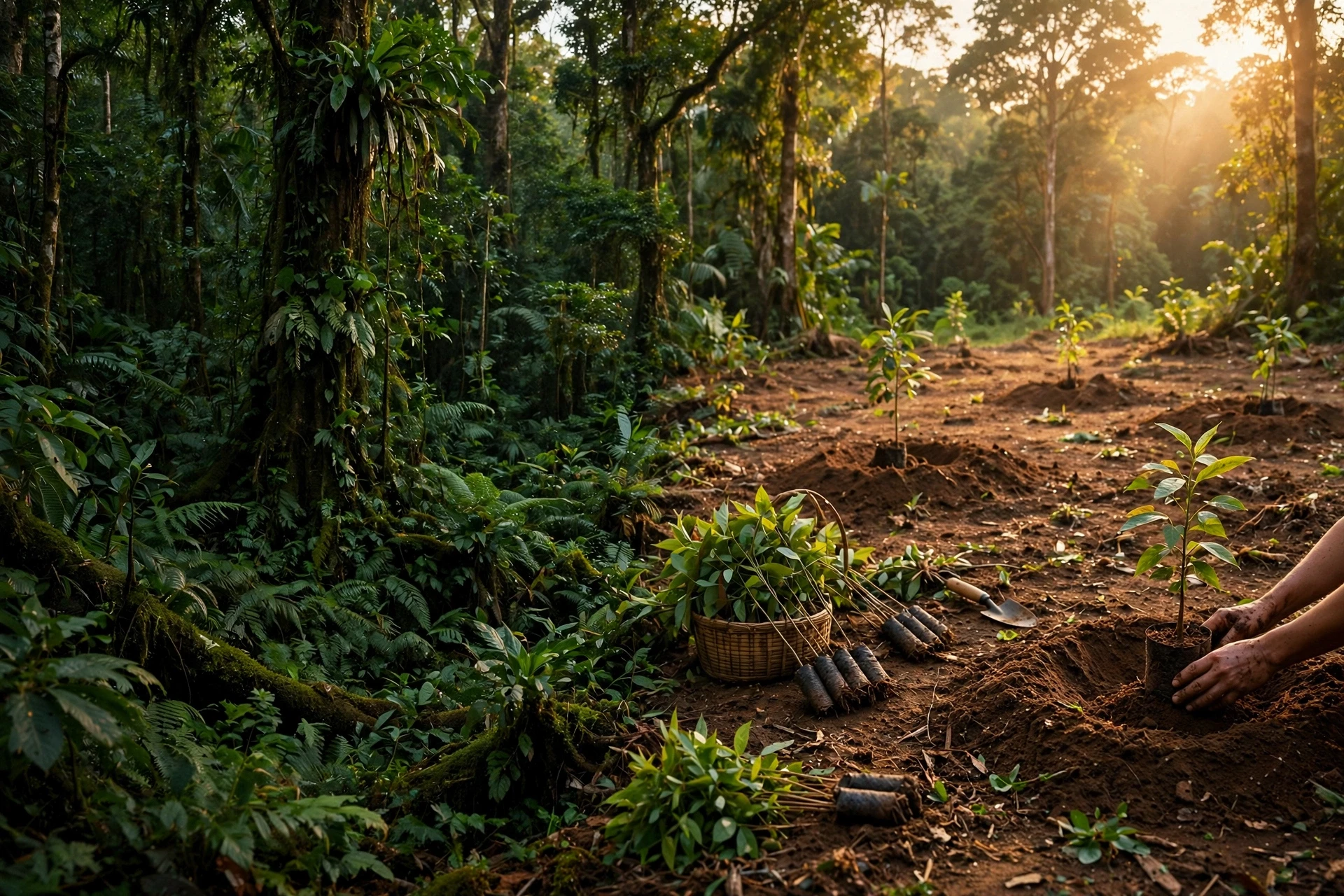
Restoration is slower and harder than protection, but it matters too. In places where forest has been cleared and the land abandoned, planting native trees — many species, not one — can begin to rebuild a forest. The first trees to grow are the fast pioneers, which shade the ground and improve the soil. Then the slower, longer-lived species follow, carried in by birds and bats from nearby forest. Restoration works best where there is still forest nearby to supply seeds and animals, which is another reason to protect what remains: a standing forest is the seed bank for the forest that could grow back.
Restoration is not a substitute for protection. A restored forest takes decades to resemble the forest it replaced, and centuries to match it. But it is far better than a degraded field, and in a world that has already lost so much forest, it is worth doing well.
12.3 Change what we buy, and how it is made
Much of the demand that drives deforestation comes from products sold far from the forest: beef, soy, palm oil, timber, and paper. That gives people far from the forest a real lever. Buying less beef, choosing products that are certified as deforestation-free, and supporting companies that can trace their supply chains back to the farm are all actions that add up, when millions of people do them.
Governments have a lever too. Laws that require companies to prove their products did not cause deforestation, and that ban the import of products linked to illegal clearing, are beginning to appear in several countries. They are not perfect, and they are hard to enforce, but they change the calculation for the people who clear forest: if the product cannot be sold, the clearing does not pay.
12.4 Pay for the forest to stand
A rainforest that stands provides services — carbon storage, rainfall, clean water, species — that benefit the whole world, but the people who live next to it are rarely paid for those services. That mismatch is at the heart of the problem. If the only way to earn money from a forest is to cut it down, the forest will be cut down. Programmes that pay for the forest to stand — for carbon, for water, for the protection of species — try to fix that mismatch by making a living forest worth more than a cleared one.
These programmes are not simple, and they have had mixed results. They work best when the money reaches the people who actually protect the forest, when the rules are clear and enforced, and when the forest is monitored honestly. When those conditions are met, they can be powerful. When they are not, they can be little more than a promise on paper.
13. Common Misconceptions About Rainforests
Rainforests are widely loved and widely misunderstood. The misunderstandings matter, because they shape what people think is worth protecting, and what they think will save the forest. Here are the ones I hear most often, and what the evidence actually shows.
"Rainforests are the lungs of the Earth." This is the most famous description of rainforests, and it is misleading. Lungs take in oxygen and release carbon dioxide. Rainforests do the opposite: they take in carbon dioxide and release oxygen. But the deeper problem with the metaphor is that it suggests rainforests produce most of the oxygen we breathe. They do not. Most of the oxygen in the atmosphere comes from the oceans, from the tiny plankton that live there. A mature rainforest, taken as a whole, produces roughly as much oxygen as it consumes, because the oxygen released by photosynthesis is used up again by the animals, fungi, and bacteria that break down dead matter. Rainforests matter enormously for the climate — but not because they are the planet's lungs. They matter because of the carbon they store, the rain they make, and the species they hold.
"Rainforests are untouched wilderness." Rainforests are not empty, and they are not untouched. People have lived in and shaped rainforests for thousands of years — hunting, farming, managing, and caring for them. Some of the forests that look most "natural" today are the product of centuries of human management. The idea of a rainforest as a place without people is not only wrong. It is dangerous, because it has been used to justify removing the very people who have protected these forests longest.
"Planting trees will replace a rainforest." Planting trees is good. It is not the same as restoring a rainforest. A plantation of a single fast-growing species holds a fraction of the species, stores a fraction of the carbon, and makes a fraction of the rain that a real rainforest does. A restored forest of many native species is far better than a plantation, and it still takes decades to approach what was lost. The honest order of priorities is: protect first, restore second, plant third — and never pretend that the third replaces the first.
"Rainforests will recover on their own if we leave them alone." Sometimes they will, given time and a nearby seed source. Often they will not, because the soil is damaged, the seed bank is gone, and the animals that carry seeds cannot reach the cleared land. Leaving a cleared area alone is sometimes the right choice. Sometimes it needs help — planting, weeding, and protecting the young trees until they can stand on their own. The forest does not care about our slogans. It cares about soil, seeds, water, and time.
Rainforests are not simple, and they are not saved by simple stories. They are complicated, living systems, shaped by people and by weather, by rivers and by chemistry, by millions of years of evolution and by the choices we make this year. That complication is not a reason to give up. It is a reason to pay attention, to learn how they actually work, and to protect them for what they actually are: the most crowded, most inventive, most generous places on land.
Frequently Asked Questions
What is a rainforest?
A rainforest is a forest that receives heavy rainfall — usually at least 175 centimetres a year — and has a closed canopy of trees that traps humidity and shades the forest floor. Rainforests grow in warm, wet places near the equator, and in cool, wet coastal regions, and they hold more species than any other land habitat.
Where are the world's rainforests?
The largest tropical rainforests are the Amazon in South America, the Congo Basin in Central Africa, and the forests of Southeast Asia and New Guinea. Temperate rainforests grow in cooler places, including the Pacific Northwest of North America, southern Chile, Tasmania, and New Zealand.
How many layers does a rainforest have?
A rainforest has four layers: the emergent layer of tall trees that rise above the canopy, the canopy itself, the understory of shade-tolerant plants below it, and the dark forest floor. Each layer has its own light, climate, and community of plants and animals.
Why are rainforests important for the climate?
Rainforests store enormous amounts of carbon in their trees and soil, and they help make rain by releasing water vapour into the air. When they are cleared and burned, that carbon is released and the rainfall they helped to create becomes less reliable, which makes climate change worse.
What animals live in rainforests?
Rainforests hold about half of the world's land species, including jaguars, gorillas, sloths, toucans, poison dart frogs, and tens of thousands of insect species. Many of them live nowhere else on Earth, and many have not yet been described by science.
Why are rainforests being cut down?
Rainforests are cleared mainly for cattle ranching, soy farming, palm oil plantations, logging, and mining. The products are mostly consumed far from the forest, in cities and countries that may never see a rainforest.
What can I do to help protect rainforests?
You can buy less beef and choose products certified as deforestation-free, support organisations that work with Indigenous peoples and local communities to protect forests, and support laws that require companies to prove their products did not cause deforestation. Protecting the forest that still stands matters more than planting trees after it is gone.