

The night I stopped thinking of deserts as empty was the night I nearly froze in one. I was camped on a gravel plain far from any town, helping a small field team map soil moisture, and the day had been punishing — the air so dry that my lips cracked before noon and the water in my bottle felt warm within an hour of sunrise. Then the sun dropped, and the same ground that had burned my boots turned brutally cold. I pulled my sleeping bag tight and watched my breath fog in air that had been 40 degrees Celsius a few hours earlier. Somewhere in the dark, a small fox trotted past our camp without a sound, and I remember thinking: nothing here is empty. It is just running on rules I had not learned yet.
That is the real story of deserts. They are not wastelands, and they are not accidents. They are places where the planet's water budget runs a permanent deficit — where more water leaves the ground than the sky ever returns — and where life has answered that deficit with some of the cleverest engineering on Earth. Deserts cover roughly a fifth of the land surface, they shape the climate of entire continents, and they hold records of Earth's past that wetter places washed away long ago. This guide explains what deserts really are, how they form, why the biggest desert on the planet is made of ice, and how plants, animals and people make a living where rain is a rumour.
If you have ever looked at a map and wondered why a band of dry land wraps the globe at the same latitudes, or why one side of a mountain can be a rainforest and the other a dust bowl, the answers are connected. Deserts are the visible fingerprints of how air moves, how oceans breathe, and how mountains bend the weather. Once you learn to read those fingerprints, you start seeing deserts everywhere — not just in the Sahara, but in the rain shadow of your own nearest mountain range.
1. What Makes a Desert a Desert
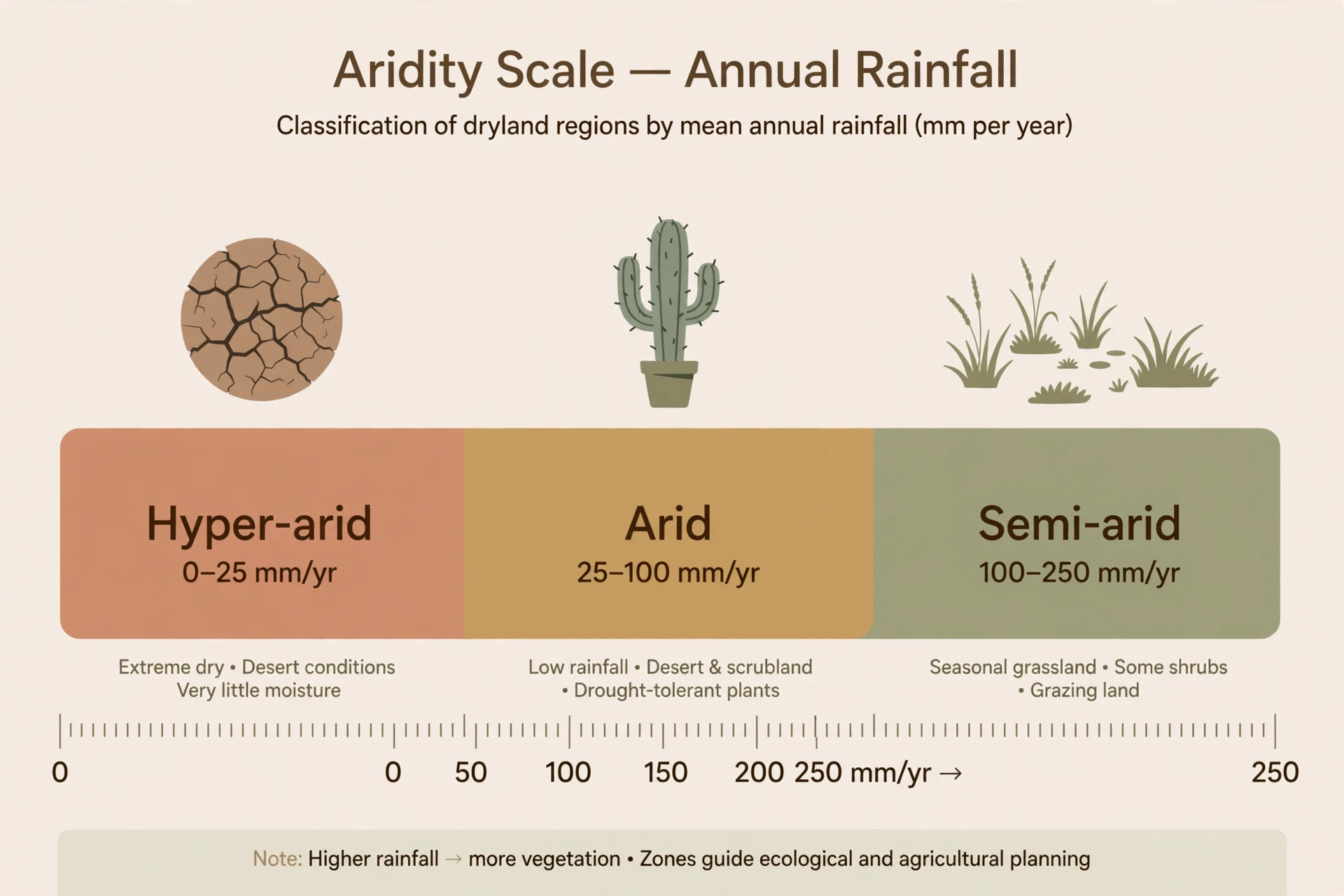
Ask ten people what a desert is and nine will say the same thing: a hot place full of sand. Both halves of that answer are wrong often enough to matter. Deserts are defined by dryness, not by heat, and most of them are not covered in sand at all. The scientific definition is refreshingly simple. A desert is a region that receives less than 250 millimetres of rain a year — about ten inches, or roughly the amount of water in a tall drinking glass spread across every square metre of ground over twelve months. That single number is the line scientists use, and it is the line this article uses throughout.
Two hundred and fifty millimetres sounds like a small amount, and it is. London gets more than twice that in an average year. But the number on its own hides a second, subtler truth: what matters is not only how much rain falls, but how much water the air steals back. In a hot desert, the sun and wind can evaporate far more water than the sky ever delivers, so even a rare heavy shower can vanish from the soil within days. Scientists capture this balance with the aridity index, the ratio of rainfall to potential evaporation. When that ratio falls below a certain threshold, the land is arid, and the landscape reorganises itself around scarcity.
1.1 The 250-Millimetre Line
The 250-millimetre threshold is a convention, not a law of nature, and like all conventions it has fuzzy edges. Some regions receive 260 millimetres in a wet year and 180 in a dry one, drifting in and out of desert status with the decade. Semi-arid lands, sometimes called steppes, sit just above the line, receiving 250 to 500 millimetres a year — dry, but wet enough for grasses and grazing. Below 250 millimetres, the ground changes character. Rivers stop flowing year-round, soils thin out, and plants must either store water, avoid the dry season entirely, or die back to seed and wait.
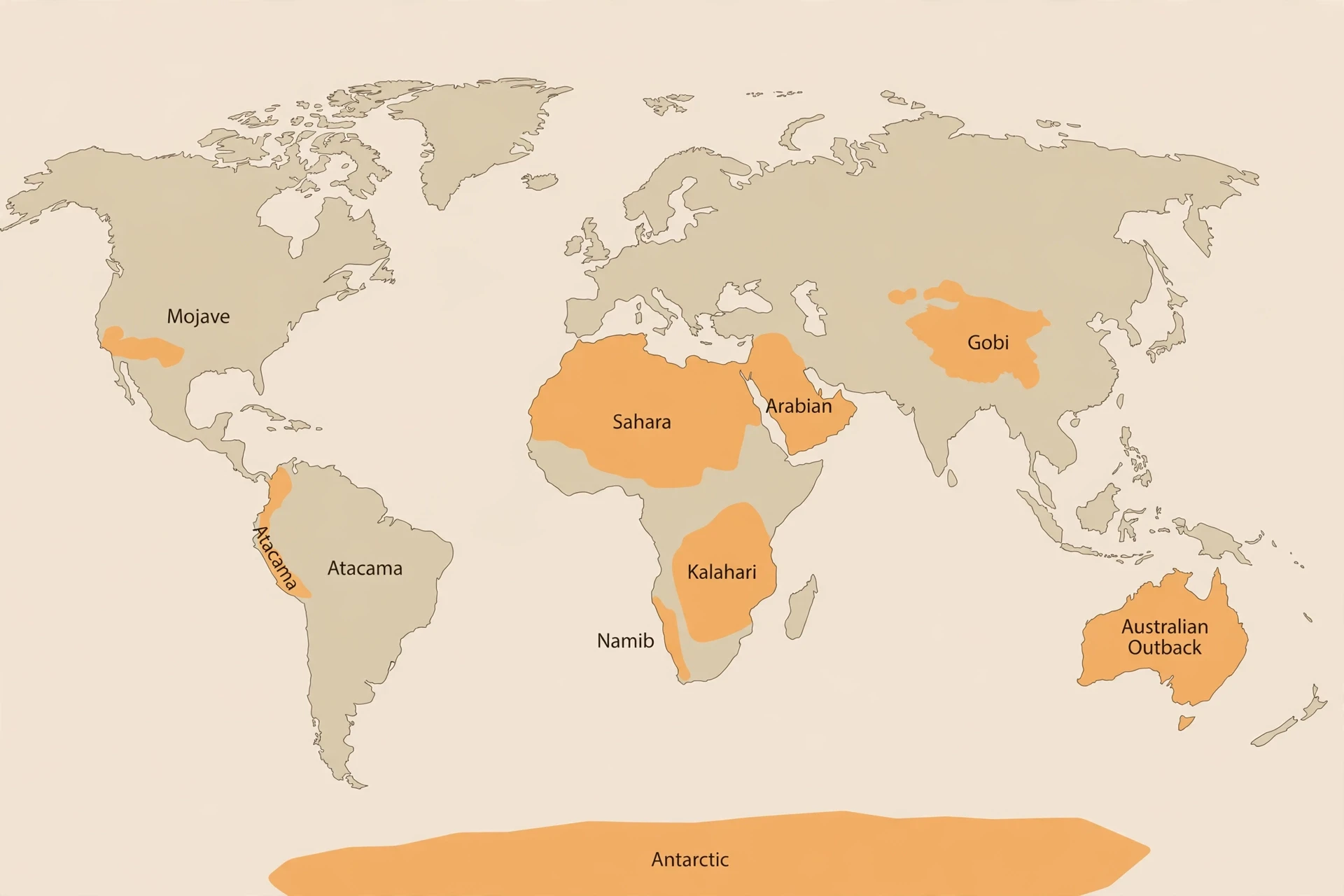
The line also explains why deserts appear where they do. Plot the world's great dry lands on a map and a pattern jumps out: most of them sit in two belts, roughly 20 to 30 degrees north and south of the equator. The Sahara, the Arabian, the Kalahari, the Australian outback — all of them sit in those bands. That is no coincidence, and Section 3 explains the machinery behind it. The exceptions — the Atacama on the Pacific coast, the Gobi deep inside Asia, the ice deserts of Antarctica — each have their own story, and each reveals a different way a place can be starved of water.
1.2 Dry Is About Balance, Not Just Rain
Rainfall alone can mislead. A place that receives 200 millimetres of rain in cool, cloudy weather may support shrubs and seasonal grasses, because little of that water evaporates. The same 200 millimetres falling on sun-baked ground under a dry wind can disappear before a seed can use it. That is why desert scientists talk about the water budget the way an accountant talks about a household budget: income on one side, spending on the other, and survival depending on the difference.
Evaporation is the spending side, and in deserts it is relentless. Bare soil heats up fast under a clear sky, dry air pulls moisture from every surface, and wind carries it away before it can condense back. In the Sahara, annual evaporation can exceed rainfall by a factor of twenty or more. The result is a landscape where water is not merely scarce; it is actively hunted by the atmosphere. Plants and animals that live there are not just surviving low rainfall — they are surviving an atmosphere that behaves like a sponge.
This balance also explains a surprise that catches many first-time visitors: deserts flood. When rain does come, it often arrives as a violent thunderstorm that dumps weeks' worth of water in an hour onto ground too hard and dry to absorb it. The water runs off in flash floods, carving channels called wadis or arroyos, and vanishes into the sand within a day. I once watched a dry riverbed in a desert basin fill with brown, foaming water in under twenty minutes, the roar arriving before the water did. By the next morning the bed was dry again, but the damp sand beneath the surface would keep seeds alive for months. Deserts do not lack drama; they compress it into brief, violent episodes separated by long silences.
1.3 How Much of Earth Is Desert?
Deserts cover about one fifth of Earth's land surface — roughly 33 million square kilometres, an area larger than Africa. About a quarter of that is true hyper-arid desert, land so dry that it receives less than 25 millimetres of rain a year. The rest grades through arid and semi-arid country that supports sparse grasses, shrubs and the herding cultures that have lived on them for thousands of years.
Those numbers carry a warning as well as a fact. Drylands — deserts plus semi-arid lands — are home to more than two billion people, and they are expanding at the margins. Whether that expansion is driven mostly by climate change or by how people use the land is a live scientific debate, and Section 9 takes it up in detail. What is not in doubt is that deserts are not marginal places. They are a fifth of the ground we stand on, and understanding them means understanding how the planet moves water around.
2. The Four Kinds of Desert
Not all deserts are alike, and lumping them together hides the most interesting science. Desert researchers usually sort them into four types, based on what makes them dry and how hot or cold they are. A hot desert and a polar desert share a rainfall number, but almost nothing else: one bakes under a fierce sun, the other freezes under months of darkness, and the life in each has solved completely different problems.
Desert type | What makes it dry | Typical temperatures | Classic examples |
|---|---|---|---|
Hot desert | Sinking dry air under subtropical high pressure | Very hot days, often above 40°C; warm nights | Sahara, Arabian, Kalahari, Australian outback |
Cold desert | Distance from the sea and high elevation; cold air holds little moisture | Hot summers, freezing winters, often below -20°C | Gobi, Patagonian, Great Basin |
Coastal desert | Cold ocean current chills the air above it, so clouds rarely form | Mild and cool, often 15–25°C, with frequent fog | Atacama, Namib |
Polar desert | Cold air holds almost no water vapour; precipitation falls as tiny amounts of snow | Below freezing almost all year | Antarctica, Arctic deserts of Greenland |
The table hides a useful insight: three of the four types are dry for reasons that have little to do with sunshine. Cold deserts are dry because cold air cannot carry much water vapour. Coastal deserts are dry because the ocean beside them is too cold to feed clouds. Polar deserts are dry because the air is so cold that it is nearly wrung out already. Only the hot deserts owe their dryness mainly to the great circulation of the atmosphere, and that circulation is where the story of desert formation begins.
2.1 Hot Deserts: The Sun-Baked Majority
Hot deserts are the ones most people picture: dunes, heat shimmer, and a sun that feels personal. They dominate the subtropical belts, and they are the largest desert type by area. Daytime temperatures regularly pass 45 degrees Celsius, and the ground itself can reach 70 degrees or more — hot enough to be dangerous to bare feet and to cook an egg on a rock, a stunt I have seen attempted more than once and never with a result anyone wanted to eat. Nights cool sharply, sometimes by 30 degrees or more, because dry air and clear skies let the day's heat escape straight back to space.
Sand covers far less of these deserts than the postcards suggest. In the Sahara, only about a fifth of the surface is sand dunes; the rest is gravel plains, rocky plateaus and dry mountains. The sand seas, called ergs, are spectacular, but the hamada — the black, rock-strewn plains — are the everyday reality. Wind does the sculpting in both cases, carrying sand grains that sandblast rock into strange shapes and piling dunes into waves hundreds of metres high.
2.2 Cold Deserts: Freezing, Dry and Far From the Sea
Cold deserts sit in the deep interiors of continents or at high latitude, where winters are brutal and summers are short and hot. The Gobi, the largest cold desert in Asia, can swing from 40 degrees in summer to minus 40 in winter, a range of eighty degrees that would destroy most machinery, let alone most living things. Rain is rare, but snow is common, and it often sublimates — turns straight from ice to vapour — before it can melt into the soil.
The ground in cold deserts is often gravel and rock rather than sand, because there has been less time and less wind-blown sand to bury it, and because freeze-thaw cycles shatter rock into sharp fragments. Life here is built for temperature shock as much as for thirst: shrubs with tiny waxy leaves, rodents that stay underground through the worst of winter, and herders whose entire culture is organised around moving animals to wherever the sparse grass has grown.
2.3 Coastal Deserts: Fog Instead of Rain
Coastal deserts are the strangest of the four, because they sit beside an ocean and still go thirsty. The Atacama in Chile and the Namib in southern Africa are the classic examples. Cold ocean currents flow along their coasts, chilling the air above the water. Cold air cannot rise easily and cannot hold much moisture, so clouds rarely form and rain almost never falls — even though the sea is right there.
What these deserts get instead is fog. Moist air drifting in from the ocean condenses into a thick coastal fog called camanchaca in Chile, and plants and animals have evolved to drink it. In the Namib, fog-basking beetles climb dunes at dawn and tilt their bodies so that fog condenses on their backs and runs down into their mouths. In the Atacama, cacti and lichens survive on fog alone for years between rains. It is a reminder that water comes in more than one form, and that life finds the form available.
2.4 Polar Deserts: Ice That Counts as Desert
Antarctica is the largest desert on Earth, and the Arctic holds desert landscapes of its own across northern Greenland and the Canadian high Arctic. These places receive less than 250 millimetres of precipitation a year — often less than 50 — and the water they do receive falls as snow that may never melt. By the rainfall definition, they are deserts just as surely as the Sahara is, and in some ways they are drier: the air over the Antarctic plateau is the driest on the planet, and parts of the McMurdo Dry Valleys have not seen rain in recorded history.
The surprise is not that polar deserts exist but that they hide so much water in plain sight. Antarctica holds about 70 percent of the world's fresh water as ice, yet its interior is a desert because that water is locked away and almost no new water arrives. Life clings to the edges: mosses and lichens in sheltered valleys, penguin colonies on the coast, and microbes living inside rocks, where a few degrees of warmth and a trace of meltwater are enough. Section 7 looks at Antarctica in full.
3. How Deserts Form: Four Engines of Dryness
Deserts are not random. They form where the planet's machinery for moving water breaks down or never arrives, and that machinery has four main failure modes. Most deserts are made by one of these four engines, and some — the Atacama, for example — are made by two or three working together. Learn these four engines and you can look at any dry place on Earth and work out why it is dry.
3.1 Subtropical Highs: The Hadley Cells
The biggest engine is the atmosphere itself. At the equator, the sun heats the air, which rises, cools, and dumps its moisture as the torrential rains of the tropical rainforests. That air then flows away from the equator at high altitude, toward the north and south, and around 20 to 30 degrees latitude it sinks back toward the ground. Sinking air warms as it compresses, and warm air holds moisture rather than releasing it — so instead of rain, you get clear skies, steady sunshine and a permanent lid on the atmosphere. These sinking zones are called subtropical highs, and the circulation loop is called a Hadley cell, after the scientist who first described it.
This single mechanism explains the great belt of deserts that wraps the planet: the Sahara and Arabian deserts in the north, the Kalahari and Australian deserts in the south. It also explains why the rainforests and the deserts are neighbours. The same air that waters the Congo basin dries out the Sahara a few hundred kilometres to the north. The planet's water is not missing; it has simply been delivered somewhere else. NASA's Earth Observatory describes this circulation as the primary control on where the world's great deserts sit, and satellite maps of rainfall line up with the Hadley cells almost exactly. For readers who want the visual version, the NASA Earth Observatory feature on deserts lays out the global pattern with satellite imagery.
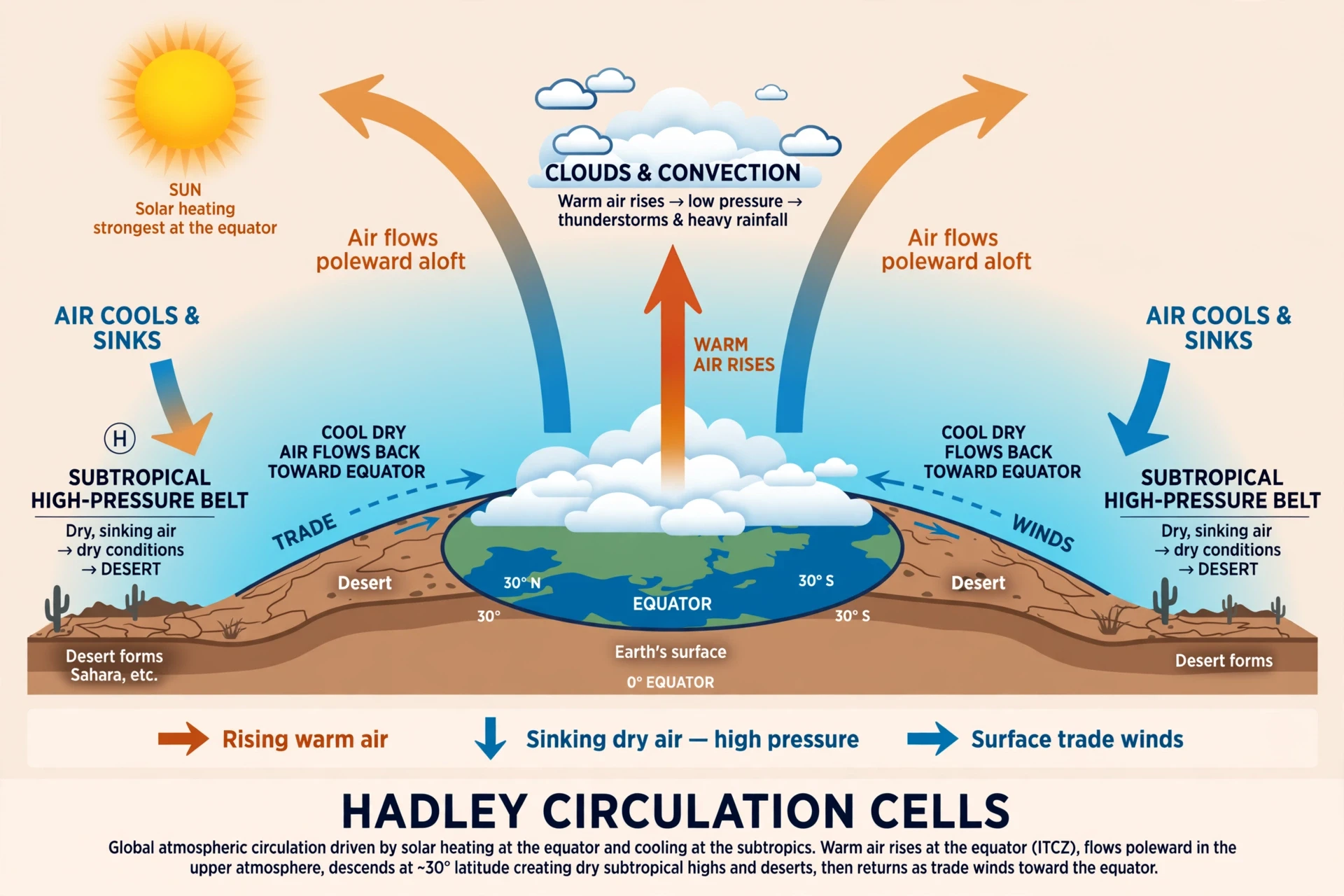
The Hadley cells also shift with the seasons, moving a few degrees toward the summer hemisphere. That seasonal wobble is why the edges of deserts breathe in and out across the year, and why monsoon rains reach places that are dry for the other nine months. It is also why climate change matters so much for deserts: as the planet warms, the Hadley cells are widening, pushing the dry belts a little further toward the poles. That shift is small in degrees but enormous in consequences for the farms and cities at the desert's edge — a connection explored in our guide to climate change.
3.2 Rain Shadows: Mountains That Steal the Rain
The second engine is topography. When moist air is forced to rise over a mountain range, it cools, and cool air cannot hold its water vapour — so it rains, or snows, on the windward side. By the time the air crosses the summit and descends the far side, it has lost its moisture and warms as it sinks, becoming even drier. The land on the far side sits in the mountain's rain shadow, and it can be a desert even while the other side is green.
I learned this one with my own eyes on a field trip that crossed a coastal range in a single day. On the western slope, the morning was wet, the ferns were dripping, and the road cut through forest so dense it felt like a tunnel. We crossed the pass at midday, and within an hour the forest had thinned to scrub, then to scattered shrubs, then to bare, cracked ground with a few hardy cacti. The distance was less than eighty kilometres. The mountain had not moved, the ocean had not moved, but the rain had been wrung out of the air on the climb, and the far side was left with the dry remainder. The Andes do this to the Atacama, the Sierra Nevada does it to the Great Basin desert of North America, and the Himalayas help keep the Gobi and the Tibetan plateau dry.
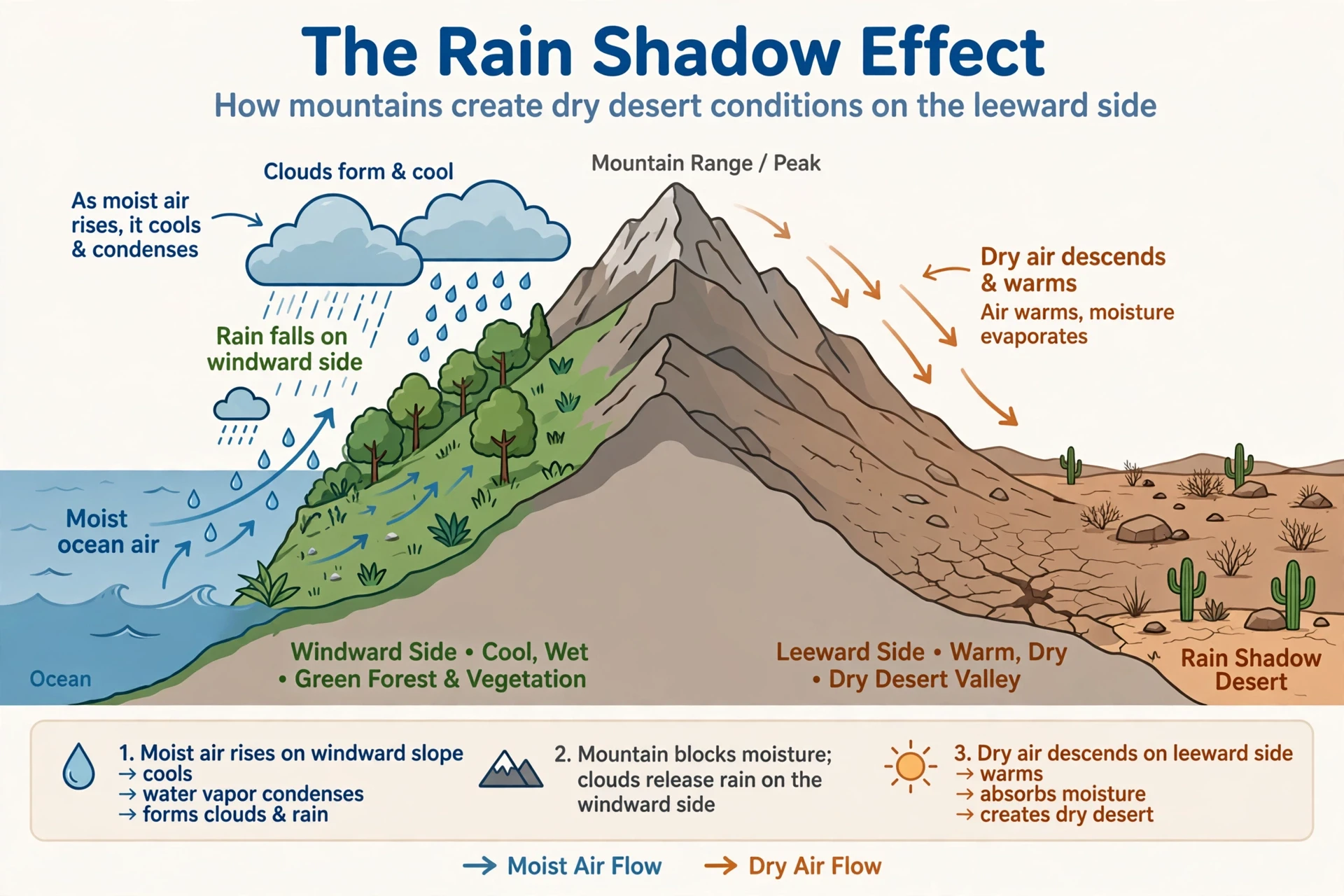
Rain shadows are also the reason deserts can sit surprisingly close to wet places. The Atacama's eastern edge is walled off from the Amazon's moisture by the Andes, a wall so high that almost no rain crosses it. The same logic works at smaller scales: a single ridge can turn one valley green and the next one brown. For a deeper look at how air moves and how forecasts read these patterns, see our explainer on meteorology.
3.3 Cold Ocean Currents: Deserts Beside the Sea
The third engine is the ocean. Cold currents flowing along a coast chill the air above them. Cold air is dense and stable, so it does not rise, and without rising air there are no clouds and no rain. The coast stays cool and foggy, and the land beside it stays dry. This is the mechanism behind the Atacama, chilled by the Humboldt Current off Peru and Chile, and the Namib, chilled by the Benguela Current off southwestern Africa. Both deserts sit beside some of the richest fishing waters on Earth, because the same cold currents that starve the land of rain bring nutrients up from the deep ocean and feed enormous fisheries. The sea is generous and the land is thirsty, side by side.
The fog these currents produce is not a consolation prize; for many desert organisms it is the main water supply. The Namib's famous fog arrives most mornings, and the desert's plants and animals are tuned to it the way other ecosystems are tuned to rain. Climate researchers watch these fog patterns carefully, because a small change in ocean temperature can thin the fog and put whole communities of fog-dependent species at risk.
3.4 Continental Interiors: Too Far From the Sea
The fourth engine is simple distance. Air that travels thousands of kilometres over land loses its moisture along the way, raining itself out long before it reaches the interior. Central Asia is the classic case: the Gobi and the Taklamakan sit so far from any ocean that by the time air reaches them it is nearly wrung dry, and the mountains that ring them — the Himalayas, the Pamirs, the Tian Shan — wring out whatever is left. The same effect shapes the Australian outback, where air crossing the continent from any coast has a long, dry journey inland.
Continental interiors also have extreme temperatures, because land heats and cools far faster than water. Without the ocean's moderating influence, summers scorch and winters freeze, and the daily and seasonal swings are among the largest on Earth. That combination — dry air, huge temperature range, and long distance from moisture — makes interior deserts some of the hardest places on the planet to live in, and some of the most revealing places to study how life copes.
Deserts are not places where the water cycle stopped. They are places where the water cycle delivers its water somewhere else — to a rainforest across the mountains, to an ocean current offshore, or to the far side of a continent.
4. The Sahara: The Great Sand Sea That Was Once Green
The Sahara is the largest hot desert on Earth, covering about 9 million square kilometres — roughly the size of the United States — across North Africa. It is the desert most people picture when they hear the word, and it is also the desert that most thoroughly breaks that picture. Its dunes are real and spectacular, some rising more than 180 metres, but most of the Sahara is gravel plain and rock plateau, and its history is stranger than its present.
Ten thousand years ago, during the African humid period, the Sahara was green. Lakes covered basins that are now salt flats, rivers ran where sand now blows, and people fished, herded cattle and painted rock art showing giraffes, elephants and crocodiles in places where none of those animals could survive today. The paintings are still there, on rock walls deep in the desert, and they are among the most direct evidence we have that Earth's climate can remake a continent. The change was driven by slow shifts in Earth's orbit, which moved the monsoon rains north and then, thousands of years later, moved them away again. The Sahara dried out over centuries, not in a single catastrophe, and its people moved with the water, southward toward the Sahel and northward toward the Mediterranean.
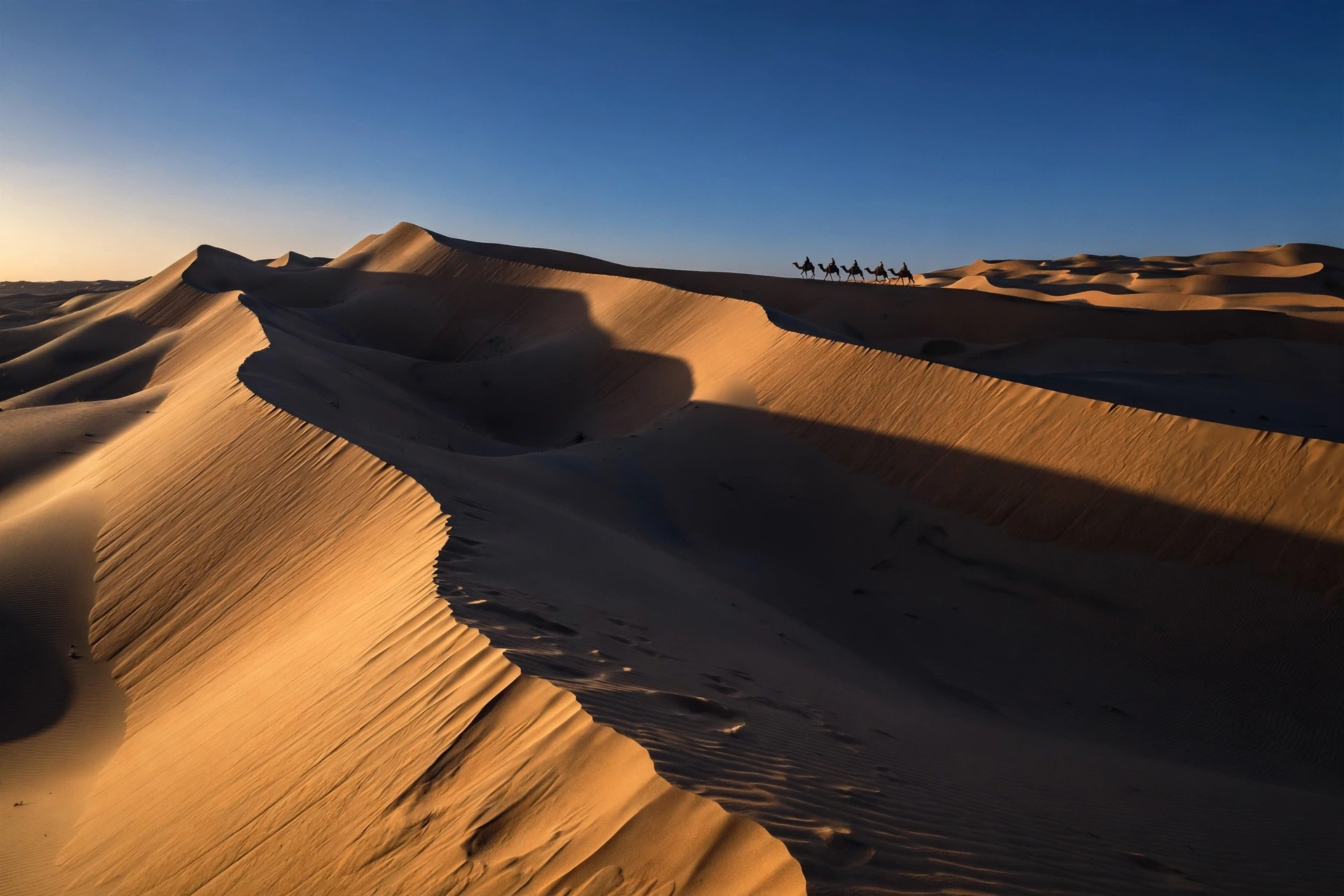
The modern Sahara is a place of extremes. Daytime temperatures above 50 degrees Celsius have been recorded, and the desert produces some of the largest dust storms on Earth. Saharan dust blows west across the Atlantic every year, and that dust is not just a curiosity: it carries minerals that fertilise the Amazon rainforest and the oceans, linking the world's largest desert to the world's largest rainforest in a single airborne conveyor belt. I once stood on a beach thousands of kilometres from Africa and watched the sky turn hazy orange with dust that had left the Sahara days earlier. It was the first time I really understood that deserts are not isolated places. They export their influence across oceans.
The Sahara is also growing and shrinking at its edges. Its southern boundary, where it meets the semi-arid Sahel, has shifted with rainfall patterns over decades, expanding in dry periods and retreating in wet ones. That movement is a preview of the desertification debate in Section 9: the line between desert and farmland is not fixed, and millions of people live right on it.
5. The Atacama: The Driest Place on Earth
If the Sahara is the most famous desert, the Atacama is the most extreme. Stretching about 1,000 kilometres along the Pacific coast of Chile, squeezed between the Andes and the cold Humboldt Current, the Atacama is the driest non-polar desert on Earth — and in some of its core regions, the driest place on the planet. Some weather stations there have never recorded rain. The average rainfall in parts of the Atacama is less than 1 millimetre a year, and there are stretches where rain has not fallen for centuries, as far as records and soil chemistry can tell.
The Atacama is dry because three of the four engines from Section 3 work on it at once. The subtropical high parks over it. The Andes block moisture from the Amazon to the east. The Humboldt Current chills the air from the west. Any one of those would make a dry place; together they make a place so dry that NASA uses it as a stand-in for Mars. Rover teams test their instruments there, and astrobiologists study the microbes that survive in its soils, because the Atacama is the closest thing on Earth to the Martian surface.
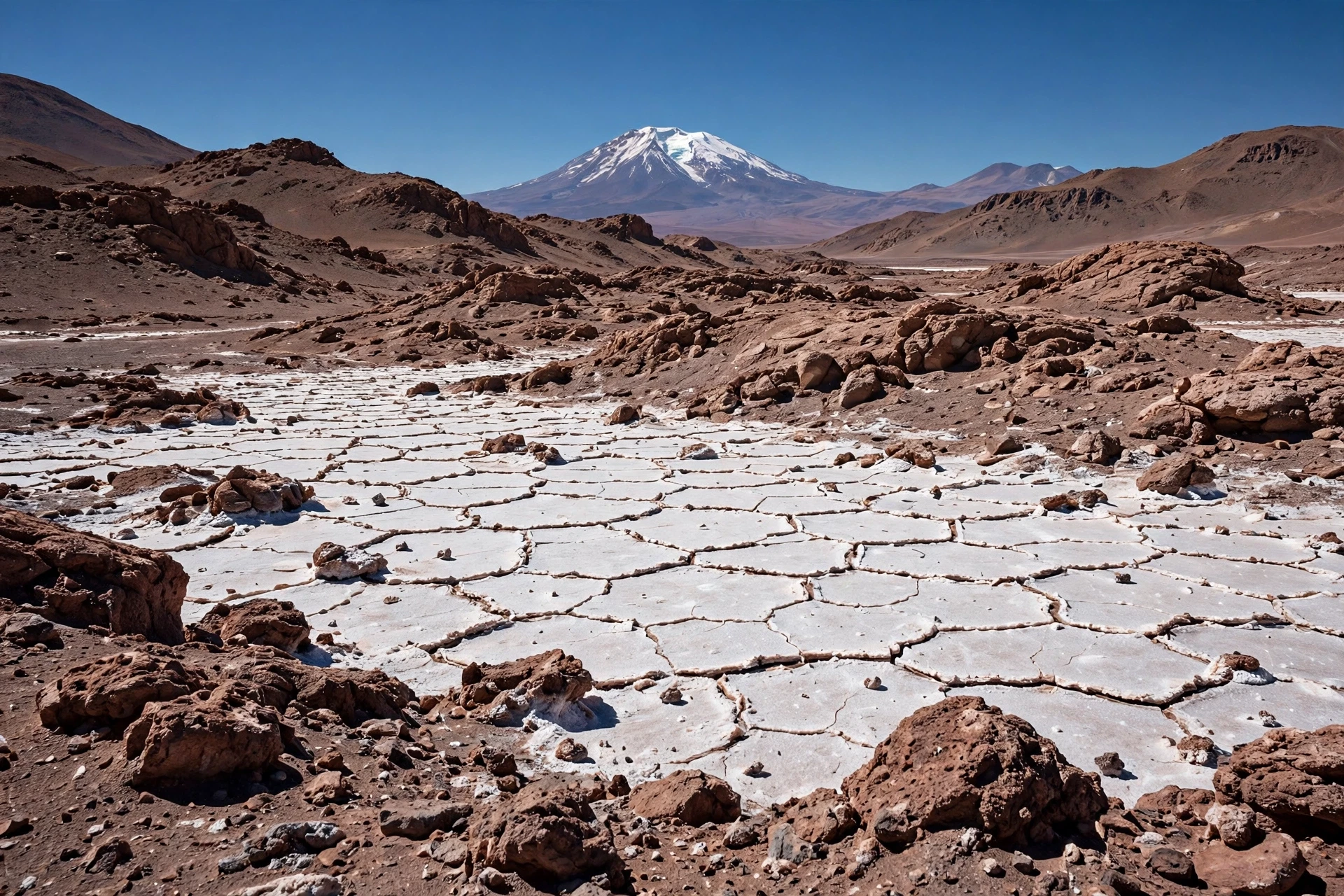
Life in the Atacama is sparse but stubborn. The ground looks lifeless in the core, but after a rare rain — sometimes years apart — dormant seeds burst into a brief, spectacular bloom called the flowering desert, painting the sand purple and yellow for a few weeks before the plants set seed and die. Microbes live in the salt crusts, feeding on the tiny amounts of moisture that fog brings. And in the coastal fog oases, called lomas, whole communities of plants survive on fog alone, green islands in a brown sea.
The Atacama also holds a human lesson. Its nitrate and copper deposits built industries, its clear skies host some of the world's greatest telescopes, and its ancient Chinchorro mummies — the oldest deliberately mummified bodies known — show that people have lived on its edges for thousands of years, fishing the rich cold current and gathering fog water. The driest place on Earth is not empty of people. It never was.
6. The Gobi and the Cold Deserts of Asia
The Gobi stretches across southern Mongolia and northern China, covering about 1.3 million square kilometres of gravel plain, rocky outcrop and scattered dunes. It is a cold desert, and its character is defined as much by temperature as by thirst. Winters plunge to minus 40 degrees, summers push past 40, and the wind rarely stops. The Gobi is the desert that made the Silk Road famous and feared: caravans crossed it carrying silk, spices and ideas, and the journey was measured in weeks of waterless travel between wells.
The Gobi's dryness comes from distance and mountains. It sits deep in the interior of Asia, far from any ocean, and it is walled in by the Himalayas to the south, the Pamirs to the west and the Tian Shan and Altai ranges to the north. Air arriving from any direction has already lost its moisture. What rain does fall — typically less than 200 millimetres a year, and often far less — arrives in brief summer storms that green the gravel for a few weeks and then vanish.
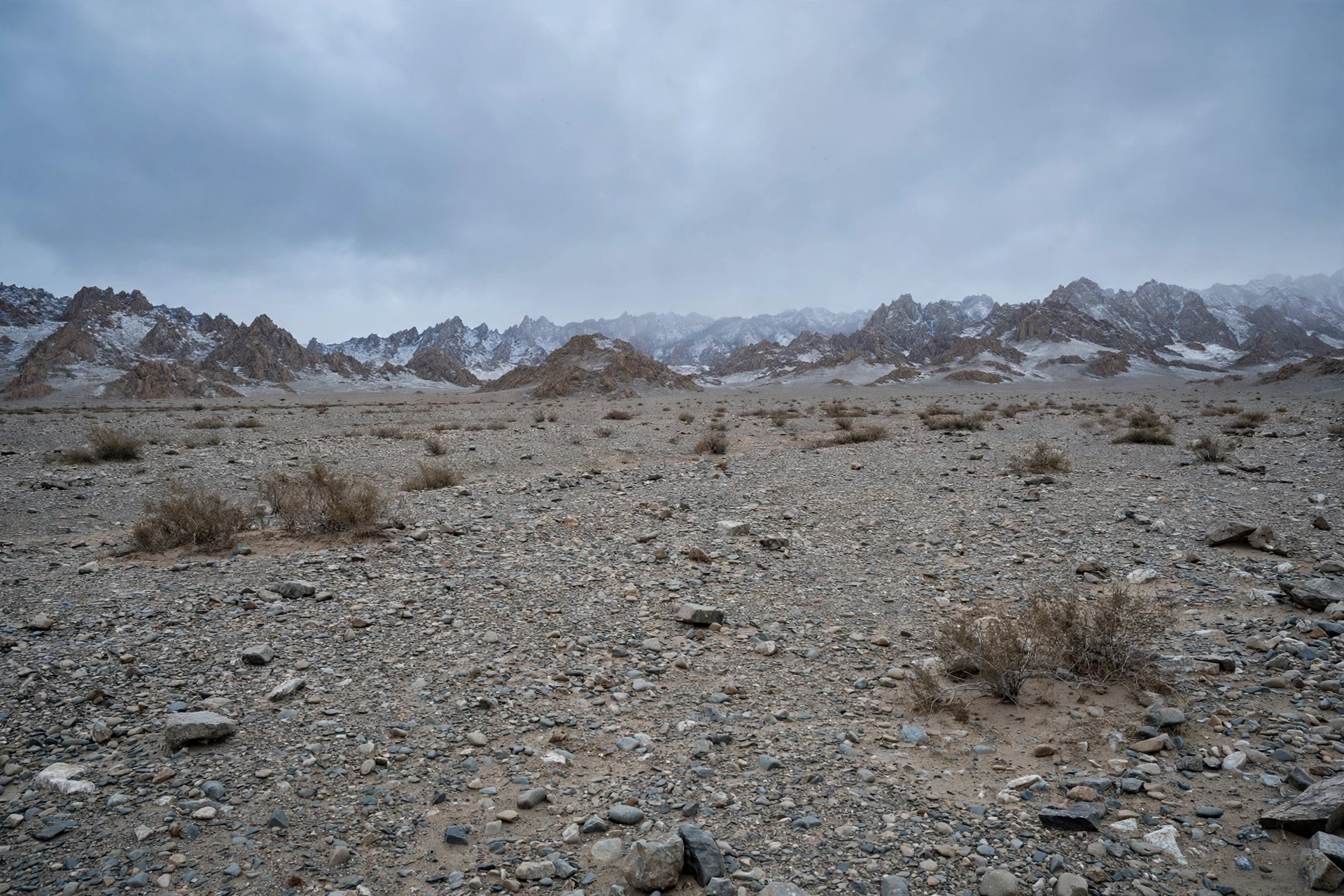
The Gobi is also a fossil treasure chest. Its red sandstone badlands preserved some of the most important dinosaur discoveries ever made, including the first dinosaur eggs and the famous fighting dinosaurs — a Velociraptor and a Protoceratops locked in combat and buried by a collapsing dune. The dry climate that makes the Gobi hard to live in is the same climate that preserved those fossils for 70 million years. Wet places rot their history; deserts keep it.
East of the Gobi, the Taklamakan — whose name is often translated as "the place of no return" — is a true sand sea surrounded by mountains, and its dunes shift constantly in the wind. Westward, the deserts of Central Asia grade into the steppes, and the boundary between them has moved with empires, trade routes and climate for millennia. Cold deserts remind us that dryness is not a temperature, it is a water budget, and the budget can fail in the cold just as surely as in the heat.
7. Antarctica: The Largest Desert on Earth
Antarctica covers about 14 million square kilometres, and almost all of it is desert. It receives less than 50 millimetres of precipitation a year across most of its interior, and its average annual temperature is around minus 50 degrees Celsius at the South Pole. The air is so cold and so dry that it holds almost no water vapour, and the continent's vast ice sheet is built from snow that accumulated grain by grain over hundreds of thousands of years.
The McMurdo Dry Valleys are the most extreme corner of this extreme place. They are the largest ice-free area in Antarctica, and they are kept ice-free by fierce katabatic winds that blow down from the polar plateau at hurricane speed, evaporating snow before it can accumulate. Some parts of the valleys have not seen liquid water in recorded history, and their soils are among the driest on Earth — drier, in places, than the Atacama. Yet even there, life persists: microbes live inside sandstone rocks, where a few degrees of solar heating create a film of meltwater, and mosses grow in sheltered hollows that catch the summer sun.
Desert | Location | Approximate area | What makes it remarkable |
|---|---|---|---|
Antarctic desert | Antarctica | 14 million km² | Largest desert on Earth; driest air on the planet |
Sahara | North Africa | 9 million km² | Largest hot desert; once green, with lakes and rivers |
Arabian desert | Arabian Peninsula | 2.3 million km² | Vast sand seas and gravel plains; extreme summer heat |
Gobi | Mongolia and China | 1.3 million km² | Cold desert; 80-degree seasonal temperature range |
Kalahari | Southern Africa | 900,000 km² | Semi-arid savanna desert; red sands and seasonal pans |
Atacama | Chile | 105,000 km² | Driest non-polar desert; some areas with no recorded rain |
Antarctica matters for deserts in a way that goes beyond size. It is the place where scientists study the ice-core records of past climates, reading bubbles of ancient air trapped in the ice to reconstruct how deserts and rainforests have shifted over hundreds of thousands of years. Those records show that deserts have grown and shrunk with the ice ages, and that the Sahara has flipped between green and dry many times. Deserts are not permanent features. They are the climate's mood, written in sand and ice.
The largest desert on Earth is made of ice, and the driest air on the planet sits above it. If that does not change how you picture a desert, nothing will.
8. Life in the Driest Places
The question that draws most people to deserts is not how they form but how anything lives in them. The answer is a catalogue of engineering tricks so elegant that engineers copy them. Desert life does not fight the dryness; it is built around it, and the solutions fall into three groups: avoid the dry times, store water when it comes, or lose water so slowly that scarcity barely matters.
8.1 Plants: Store It, Dodge It, or Drink the Air
Desert plants use all three strategies. Succulents like cacti and agaves store water in fleshy tissue, swelling after rain and drawing on the reserve for months. Their spines are modified leaves, cutting water loss to almost nothing while discouraging anything thirsty enough to try eating them. The saguaro cactus of the Sonoran desert can hold hundreds of litres of water and expand like an accordion as it fills, then slowly contract as it drinks itself dry.
Other plants dodge the drought entirely. Annual wildflowers keep most of their lives as seeds, waiting in the soil for years until a rain arrives, then germinating, flowering and setting seed in a few frantic weeks. This is the strategy behind the Atacama's flowering desert and the superblooms of California's Mojave. The plant is not surviving the desert; it is skipping it, living its whole active life in the brief window when water exists.
A third group drinks the air. In the fog deserts, plants collect condensation on their leaves or stems, and some, like the lichens of the Namib, can absorb water vapour directly from humid air. In the driest places, even a few millilitres a day is the difference between life and death. The root systems tell the same story of thrift: mesquite trees in North American deserts send roots tens of metres down to reach groundwater, while shallow-rooted succulents spread wide, thin root nets that catch the first millimetres of a light rain before it evaporates.
8.2 Animals: Night Shifts, Water Factories, and Waxy Skin
Desert animals are mostly nocturnal, and that single choice solves half their problems. The fennec fox of the Sahara hunts at night, when the temperature has fallen by thirty degrees, and its enormous ears radiate heat away from its body like radiators. Kangaroo rats of North American deserts may never drink liquid water at all; they manufacture it inside their bodies by metabolising dry seeds, and their kidneys concentrate urine to an extraordinary degree, losing almost no water as waste. Their burrows stay cool and humid during the day, and they seal the entrances with sand to keep the moisture in.
Other animals carry their water with them. Camels are the famous case, and the truth is more interesting than the myth. A camel does not store water in its hump — the hump is fat, and metabolising that fat produces water as a byproduct, which is a cleverer trick than a simple tank. Camels can lose a quarter of their body weight in water and recover it by drinking more than a hundred litres in minutes, a feat that would kill most mammals. Their blood cells are oval rather than round, so they keep flowing even when the blood thickens with dehydration.
I once watched a kangaroo rat at dusk in a desert basin, moving in long, spring-loaded bounds between shrubs, stopping to stuff seeds into its cheek pouches with an urgency that looked like greed and was actually arithmetic. Every seed was a drink as well as a meal, and the animal was budgeting both at once. That is the desert in miniature: every decision is a water decision.
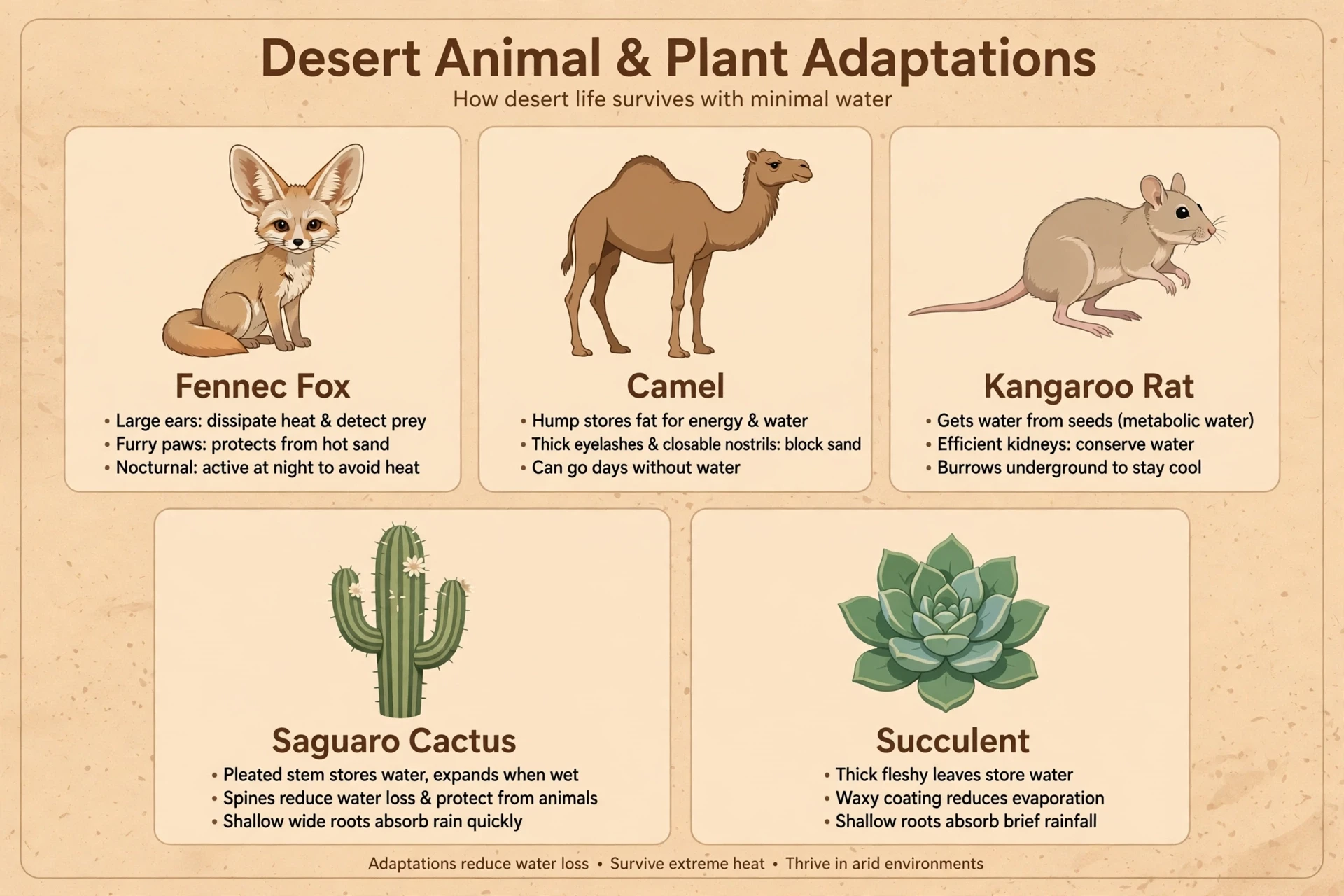
Reptiles and insects add their own solutions: waxy, waterproof skin, scales that reflect heat, and behaviour that treats shade as a resource. The sidewinder rattlesnake moves across hot sand with only two points of its body touching the ground at any moment, minimising contact with a surface that can be hot enough to burn. The Namib's fog-basking beetle, mentioned earlier, turns its own body into a water-collection device. None of these are accidents. Each is the product of millions of years of selection in a place where water is the currency of survival.
8.3 People: The Oldest Desert Technology Is Movement
People have lived in deserts for as long as there have been people, and their strategies mirror the plants and animals. The oldest is movement: nomadic herding, moving with the seasons and the rains, never asking one patch of ground to support a family year-round. The Bedouin of Arabia, the Tuareg of the Sahara, the Mongol herders of the Gobi — all of them built cultures around mobility, reading the sky and the ground the way a sailor reads the sea.
Settled desert peoples built different technologies: qanats, the underground water channels of Persia that carry water for kilometres without losing it to evaporation; fog nets in Chile that harvest camanchaca on mesh panels; and the ancient Nabataean cisterns of Petra, which captured every drop of rain that fell on the city's roofs and streets. Modern desert cities add desalination, drip irrigation and solar power — the desert's fierce sun becoming an asset rather than an enemy — but the logic is unchanged. In a desert, water is not a utility. It is the central fact around which everything else is organised.
Desert ecosystems are also more connected to the rest of the planet than they look. The ecosystems of dry lands support unique species found nowhere else, and their soils store carbon in ways that matter for the global climate. When a desert ecosystem is damaged, the damage is slow to heal, because growth is slow where water is scarce. A track left by a vehicle in a desert pavement can remain visible for decades, and a trampled patch of cryptobiotic soil crust — the living skin of bacteria, lichens and mosses that holds desert soil together — can take many decades to recover.
9. Desertification: When Dry Lands Spread
Desertification is not the Sahara marching across the map like an invading army. It is the degradation of dry land — the loss of vegetation, soil fertility and water-holding capacity in places that are already dry — until the land can no longer support the people and ecosystems that depended on it. The word is widely misunderstood, and the misunderstanding matters, because it shapes how governments respond. Deserts themselves are natural and ancient. Desertification is a process, and it happens at the edges, in the semi-arid lands where the margin between enough rain and not enough is thinnest.
The causes are a mix of climate and human pressure, and scientists argue about the balance in each region. Prolonged drought reduces vegetation, bare soil loses moisture faster, and the cycle reinforces itself. Overgrazing strips the plant cover that holds soil together. Clearing land for farming, pumping groundwater faster than it refills, and cutting trees for fuel all push the same way. Climate change adds a background pressure: as temperatures rise, evaporation increases, and the dry belts widen. The United Nations Convention to Combat Desertification, the international body that tracks this process, describes desertification as one of the greatest environmental challenges of our time, affecting the livelihoods of hundreds of millions of people. Its overview of the problem is a useful starting point for readers who want the policy picture alongside the science: the UNCCD overview of desertification.
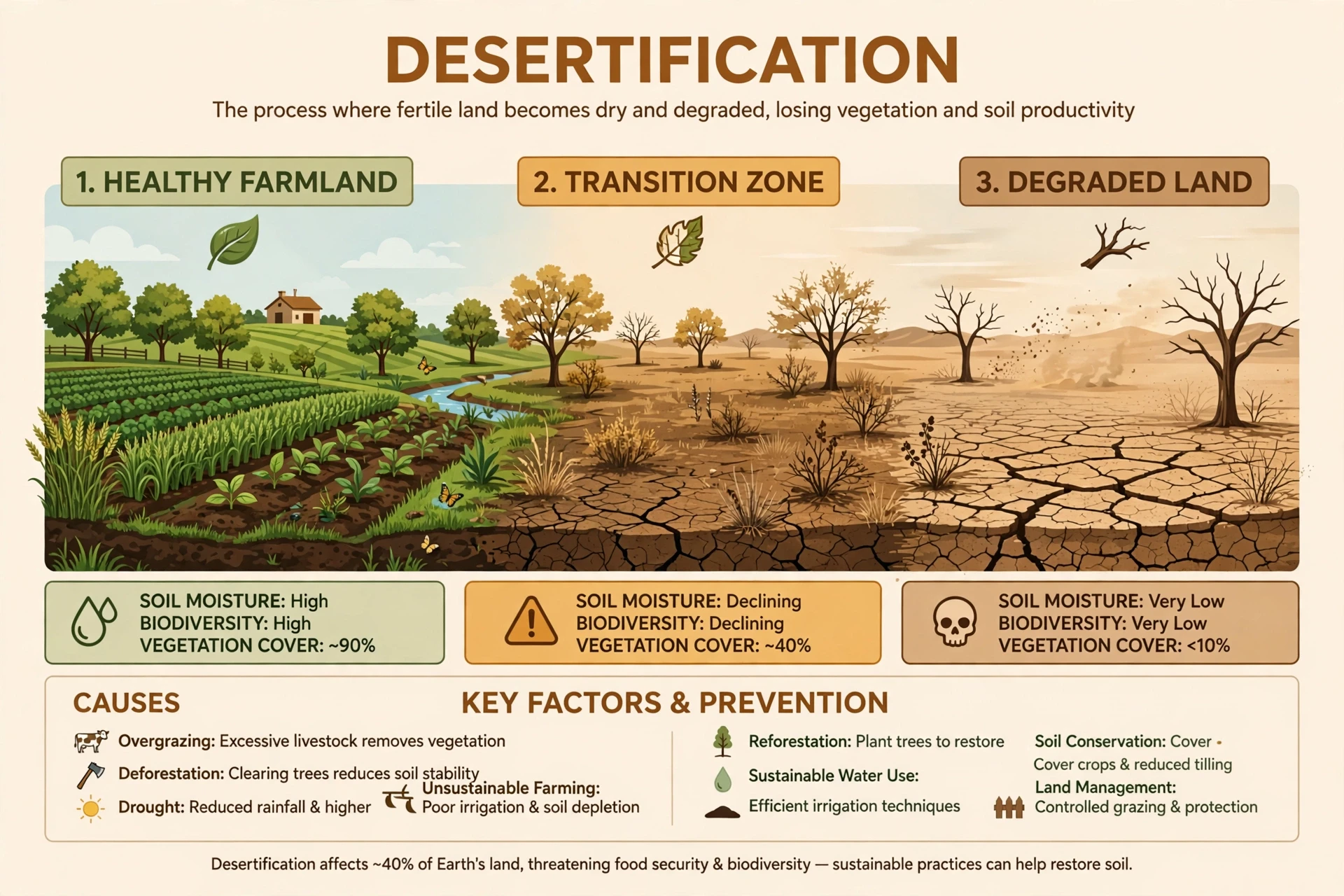
The most honest way to think about desertification is as a loss of resilience. A healthy dryland can absorb a drought year and recover; a degraded one cannot, and each dry year leaves it poorer than before. The solutions follow from that framing, and many of them are old. Restoring vegetation, especially native shrubs and grasses, holds soil and water. Managed grazing, moving herds before they strip a pasture bare, mimics the nomadic patterns that sustained drylands for centuries. In parts of Africa, farmers are reviving traditional techniques — planting pits that catch rainwater, stone lines that slow runoff — and turning degraded land productive again. NASA's Earth Observatory tracks these changes from space, and its feature on desertification shows how satellite images can reveal the spread and, in some places, the reversal of land degradation.
There is also good news that rarely makes headlines. Satellite data shows that some dry regions are greening, partly because higher carbon dioxide levels help plants use water more efficiently, and partly because of large-scale restoration efforts. The picture is mixed, not uniformly bleak, and that matters: desertification is a process humans influence, which means it is a process humans can slow and, in places, reverse.
Desertification is not a desert moving. It is a dry land losing its ability to recover — and recovery, where it happens, starts with a single shrub holding a patch of soil together.
10. What Most People Get Wrong About Deserts
Deserts attract myths, and the myths are stubborn because they feel true. Here are the ones I hear most often, and what the evidence actually shows.
"Deserts are always hot." Antarctica is the largest desert on Earth, and the Gobi freezes every winter. Temperature is not the definition; rainfall is. A desert is a place that gets less than 250 millimetres of rain a year, whatever the thermometer says.
"Deserts are all sand." Only about a fifth of the Sahara is sand dunes. Most deserts are rock, gravel and hard-packed earth. The sand seas are real, but they are the exception, not the rule, and the most common desert surface on Earth is stone.
"Nothing lives in a desert." Deserts hold some of the most specialised life on the planet, from microbes inside Antarctic rocks to fish in desert springs that have been isolated for thousands of years. The life is sparse and often invisible, but it is there, and much of it exists nowhere else.
"Deserts are empty wastelands with no value." Deserts hold solar energy, minerals, unique biodiversity, groundwater reserves, and the clearest skies on Earth for astronomy. They also hold the climate records of the past in their lake beds and ice cores. Calling them wasteland says more about what we have not learned to see than about the land itself.
"Desertification means the desert is expanding." This is the one I most want to correct, because it shapes policy. Desertification is the degradation of dry land where people live and farm — a loss of soil and vegetation — not a sand dune rolling over a village. The distinction matters because the fixes are different: you do not fight desertification by building a wall against the sand, you fight it by restoring the land that is losing its resilience.
Most people assume deserts are simple places — hot, sandy, empty — but what the data actually shows is the opposite: deserts are among the most varied, most dynamic and most consequential landscapes on Earth, and the simple picture is the one that gets everything important wrong.
11. Why Deserts Matter
Deserts matter for reasons that have little to do with romance and everything to do with how the planet works. They are the exhaust system of the atmosphere, the place where the great circulation cells complete their loop. They are the source of the dust that fertilises oceans and rainforests. They are the vaults where Earth's climate history is stored, in lake sediments, in cave formations, and in ice cores. And they are home to more than two billion people, whose farms, cities and cultures sit on the dry edge of habitability.
They matter for the future, too. As the planet warms, the dry belts are widening, and the line between desert and farmland is moving. The choices made at that line — how water is used, how land is grazed, how cities grow — will decide whether millions of people face a slow decline or a managed adaptation. The science of deserts is not an academic curiosity. It is the science of the water budget, and the water budget is the science of who gets to live where.
The night I spent shivering in my sleeping bag on that gravel plain taught me the first lesson deserts teach everyone who spends time in them: they are not empty, they are not simple, and they are not forgiving of carelessness. The second lesson took longer, and it is the one this guide has tried to carry: deserts run on rules, and once you know the rules — the sinking air, the stolen rain, the cold currents, the long distance from the sea — the driest places on Earth start to make sense. They are not the exception to how the planet works. They are the proof of it.
Frequently Asked Questions
What is a desert?
A desert is a region that receives less than 250 millimetres (about 10 inches) of rainfall per year. The definition is based on dryness, not temperature, which is why Antarctica — cold and covered in ice — is the largest desert on Earth. What matters is the water budget: in deserts, evaporation and water loss exceed rainfall over the long term.
How do deserts form?
Deserts form in four main ways: sinking dry air under subtropical high-pressure belts (the Hadley cells), rain shadows cast by mountain ranges, cold ocean currents that prevent clouds from forming along coasts, and extreme distance from the sea in continental interiors. Many deserts, like the Atacama, are shaped by more than one of these mechanisms working together.
What is the largest desert in the world?
Antarctica is the largest desert in the world, covering about 14 million square kilometres. It is a polar desert, receiving very little precipitation because its air is so cold it holds almost no water vapour. The largest hot desert is the Sahara, covering about 9 million square kilometres across North Africa.
What is the driest desert on Earth?
The Atacama desert in Chile is the driest non-polar desert on Earth, with some areas receiving less than 1 millimetre of rain a year and some weather stations never having recorded rain at all. In the polar regions, parts of Antarctica's McMurdo Dry Valleys are even drier, with almost no precipitation in recorded history.
Why are deserts cold at night?
Deserts cool rapidly at night because dry air and clear skies let heat escape straight back to space. Moist air and cloud cover act like a blanket, trapping warmth; deserts have neither, so the ground that reached 40 degrees Celsius or more during the day can drop close to freezing overnight. The daily temperature swing in a desert can exceed 30 degrees.
How do animals survive in the desert without water?
Desert animals use a combination of strategies: hunting at night to avoid the heat, storing water or manufacturing it from food (kangaroo rats produce water by metabolising dry seeds), concentrating urine to lose almost no water, and sheltering in cool, humid burrows during the day. Camels can lose a quarter of their body weight in water and replace it by drinking over a hundred litres in minutes.
What is desertification, and can it be reversed?
Desertification is the degradation of already-dry land — the loss of vegetation, soil fertility and water-holding capacity — driven by drought, overgrazing, deforestation and unsustainable farming, with climate change adding pressure. It is not a desert physically marching across the map. It can be slowed and in places reversed through restoring vegetation, managing grazing, harvesting rainwater, and protecting soil, as shown by restoration projects in Africa and satellite observations of regreening drylands.