

The first time I stood on a glacier, I expected silence. I expected glaciers to be frozen worlds, holding still. What I got instead was noise: a low groaning from deep inside the ice, the sharp crack of a crevasse opening somewhere out of sight, and the constant trickle of meltwater running in blue channels across the surface. The ground under my boots was not ground at all. It was a river, moving so slowly that no human eye could watch it flow, yet moving all the same, carrying whole mountains downhill one grain at a time.
That is the strange truth about glaciers. They look like the most permanent things on Earth, great white masses that seem to have always been there and always will be. In reality they are restless. They grow and shrink, surge forward and pull back, grind rock into flour and lift boulders the size of houses. Over thousands of years they have redrawn coastlines, dug out the deepest lakes on the planet, and pushed the ground itself down under their weight. Some of the most beautiful landscapes in the world — the fjords of Norway, the lakes of the Alps, the wide valleys of Yosemite — are not the work of rivers or volcanoes. They are the work of ice.
Glaciers matter far beyond their beauty. They hold roughly three-quarters of all the fresh water on Earth, locked away as ice. They feed rivers that water farms and cities across Asia, South America and Europe. When they melt, the water does not vanish. It flows into the oceans, and sea level rises, centimetre by centimetre, along every coastline on the planet. Understanding glaciers, then, is not only about understanding the past. It is about understanding the water we drink, the land we live on, and the climate we are shaping now.
This article follows that story from the beginning: how a single snowflake becomes part of a river of ice, how that ice moves, what it carves as it goes, and what happens when it melts away.
1. What Is a Glacier, Really?
A glacier is a large body of ice that forms on land and moves under its own weight. That short definition hides three ideas worth pausing over. First, a glacier forms on land. Sea ice, the frozen surface of the ocean around the poles, is not a glacier, even though it looks similar from a distance. Icebergs floating in the sea are pieces of glaciers that broke off, but the floating berg itself is no longer a glacier. Second, a glacier moves. A snowfield that sits still year after year is not a glacier. The movement may be only a few centimetres a day, slower than a snail, but it is real and it never stops. Third, a glacier moves under its own weight. Gravity pulls the ice downhill, and the sheer mass of the ice makes it deform and slide, the way a thick syrup spreads across a tilted plate.
Most of them are enormous by human standards. The smallest named glaciers are no bigger than a football field, but the great ice sheets of Antarctica and Greenland are continent-sized. Antarctica alone holds more ice than the rest of the world combined, a slab so thick in places that it buries entire mountain ranges. Together, the world's glaciers cover about a tenth of Earth's land surface. That sounds modest until you realise how much water it represents: if every glacier on Earth melted, sea level would rise by roughly 70 metres, enough to redraw the map of every coastal nation.
They are part of the cryosphere, the frozen part of the Earth system, which also includes snow cover, sea ice, frozen ground and ice in the atmosphere. The National Snow and Ice Data Center describes glaciers as one of the cryosphere's most powerful pieces, because they connect the atmosphere, the oceans and the solid Earth. Snow falls from the atmosphere, ice stores it for centuries, meltwater feeds rivers and oceans, and the weight of the ice bends the crust beneath it. Few things on Earth tie so many systems together.
People sometimes picture them as pure, clean ice, but a real glacier is full of rock. It carries boulders, gravel, sand and fine dust, frozen into its base and scattered across its surface. That debris is the glacier's toolkit. As the ice moves, the rock frozen into its underside scrapes and plucks at the bedrock, the way sandpaper smooths wood. Without that grit, a glacier would slide over rock and leave it almost untouched. With it, a glacier becomes a carving machine.
One more thing surprises most people who meet a glacier up close: its colour. Fresh snow is white because it scatters light in every direction. Old glacial ice is blue. As snow is compressed over years and decades, the air bubbles trapped between snowflakes are squeezed out, and the ice becomes dense and clear. Dense ice absorbs the red end of sunlight and lets blue light escape, which is why crevasses and meltwater pools glow with that deep, almost unreal blue. I have stood at the edge of a crevasse and looked down into blue so pure it seemed lit from within. It is one of the most beautiful sights in nature, and it is also a simple physics lesson written in ice.
2. How Glaciers Are Born: From Snowflake to Blue Ice
Every glacier begins the same way, with snow that does not melt. In most places snow falls in winter and melts in summer, and the ground keeps its balance. But in cold, high places — mountain summits, polar regions, the high Arctic — more snow falls each winter than melts each summer. Year after year the leftover snow piles up. That surplus is the seed of a glacier.
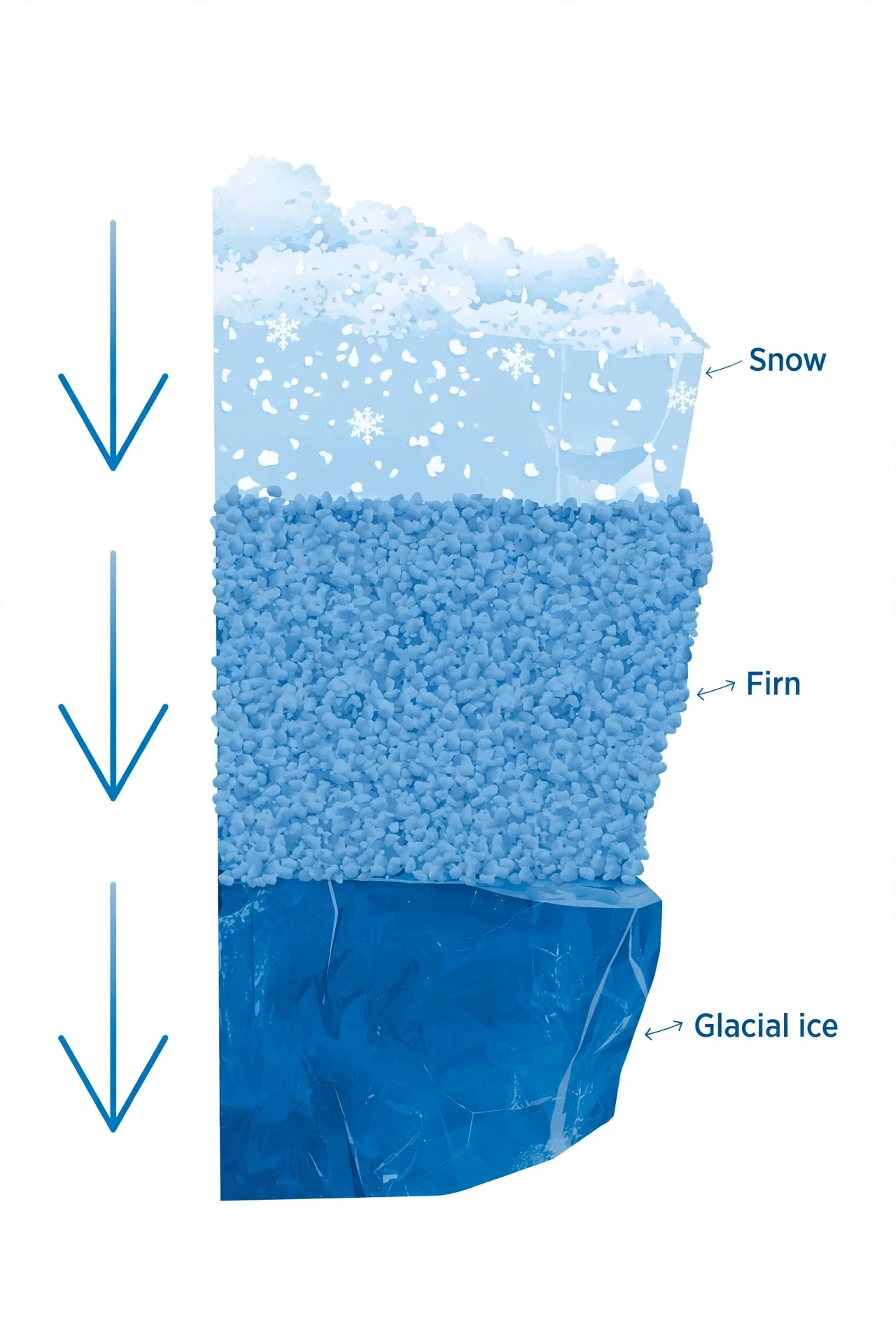
The transformation from snow to glacier ice happens in stages, and each stage has its own name and character. Fresh snow is mostly air: delicate crystals with so much space between them that a cubic metre of new snow may weigh only a tenth as much as the same volume of water. Over a summer, the snow partially melts and refreezes. The crystals round off, stick together and pack down. This granular, coarse snow is called firn, from an old German word for "last year's snow." Firn looks like rough sugar and feels firm underfoot. It still holds air, but much less than fresh snow.
2.1 The slow squeeze
With each passing year, more snow falls on top of the firn, and the weight grows. The pressure squeezes the remaining air out of the firn, bubble by bubble. After decades of burial, the firn becomes solid ice, dense and blue, with only tiny bubbles left. At this point the pile of ice is tens of metres thick. It is heavy enough that gravity starts to pull it downhill, and it begins to flow. That is the moment a snowfield becomes a glacier: not when it looks icy, but when it starts to move.
The whole process takes time. In a wet, snowy coastal mountain range, snow can turn into glacial ice in a few decades. In the dry, bitter cold of the Antarctic interior, where snowfall is measured in centimetres a year, the same change can take centuries. Ice at the bottom of the Antarctic ice sheet fell as snow tens of thousands of years ago, when mammoths still walked the Earth. A glacier is, among other things, a library of old weather, with each layer recording the snowfall, dust and air of the year it fell.
2.2 The balance of gain and loss
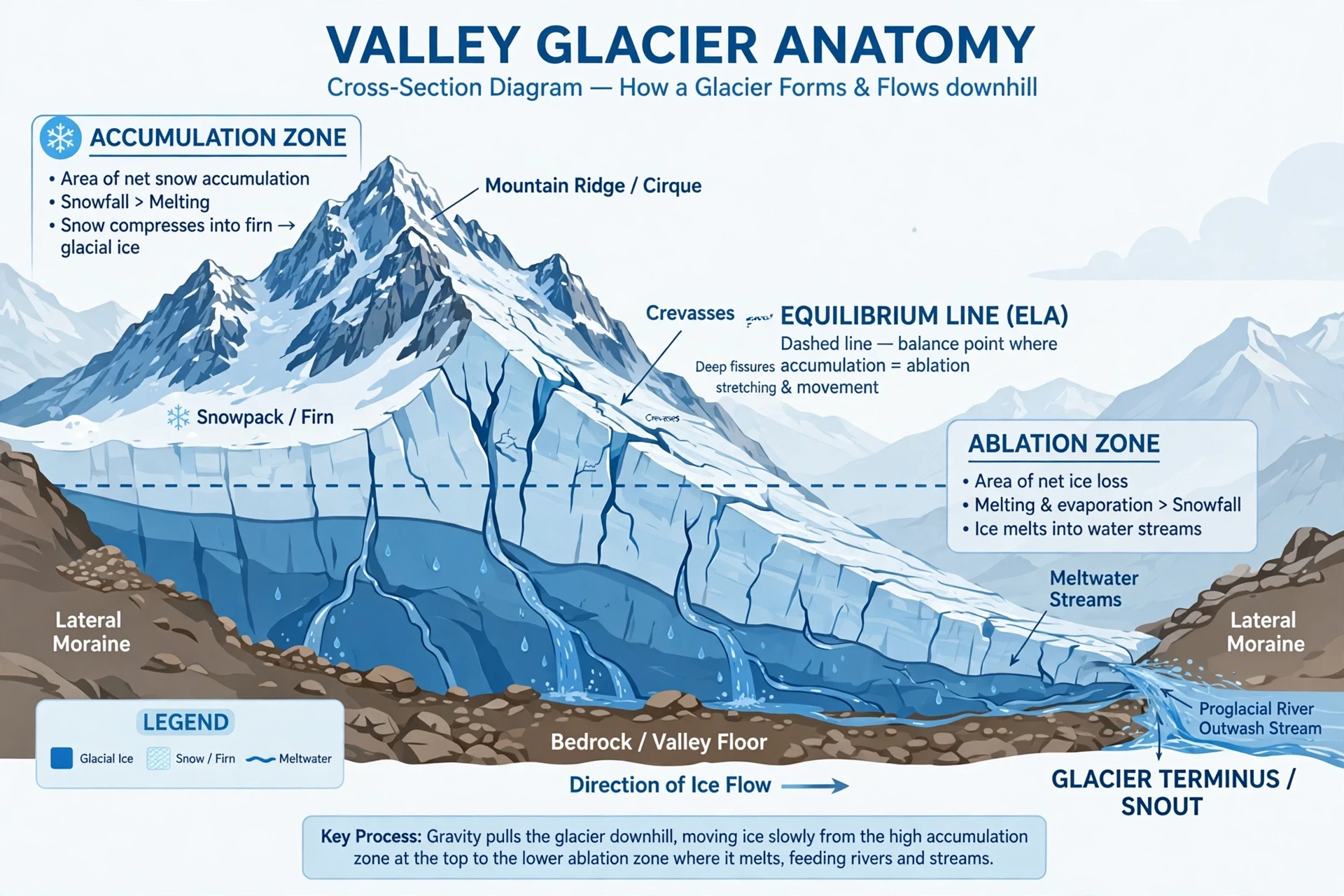
A glacier survives only while its budget stays in balance. Glaciologists call the upper part of a glacier, where snow accumulates, the accumulation zone. The lower part, where ice melts, evaporates or breaks off faster than new snow arrives, is the ablation zone. The boundary between the two is the equilibrium line, and it moves up and down the glacier with the seasons and the climate.
Think of a glacier like a bank account. Snowfall is income. Melting, evaporation and calving — the breaking off of icebergs — are spending. When income exceeds spending, the glacier grows and its front edge advances. When spending wins, the glacier shrinks and retreats, even though the ice itself is still flowing forward. A retreating glacier is not sliding backwards. Its ice keeps moving downhill, but the front melts faster than new ice arrives, so the edge pulls back, the way a candle shrinks even though the wax is still there. This distinction matters, and we will come back to it, because it explains why glaciers can be flowing forward and retreating at the same time.
The water cycle ties all of this together. Water evaporates from the oceans, falls as snow on cold high ground, is stored as glacier ice for centuries, and eventually returns to the sea as meltwater. Glaciers are the slow lane of the water cycle, the part where water pauses, sometimes for thousands of years, before continuing its journey. That pause is what makes glaciers so valuable as water stores — and so worrying when the pause ends too quickly.
2.3 Why some places grow glaciers and others do not
These rivers of ice need two things: cold and snow. Cold alone is not enough. The high Antarctic plateau is one of the driest places on Earth, a frozen desert, and its ice sheet grows almost imperceptibly slowly because so little snow falls there. Snow alone is not enough either. Warm, wet mountains may get metres of snow each winter, but if summer melts it all, no glacier forms.
That is why glaciers cluster where cold and snowfall overlap: high mountain ranges near moist air, and polar regions. The Himalayas, the Andes, the Alps, the Rockies, Alaska and Patagonia all hold great glacier systems because moist air is forced upward over the mountains, cools, and drops its water as snow. The same pattern explains why some surprisingly low-latitude mountains have glaciers — Mount Kilimanjaro in Tanzania, almost on the equator, holds small glaciers on its summit because the peak is high enough to stay cold — and why some cold places have almost none.
3. The Anatomy of a Glacier
Walk up a valley glacier from its snout — the front edge, also called the terminus — and you travel through distinct zones, each with its own look and behaviour. Learning to read those zones is like learning to read a map of the glacier's health.
The snout is usually the dirtiest part. Meltwater pours out from beneath it in milky streams, grey with rock flour, the fine powder ground off the bedrock by the moving ice. The ice here is often dark, stained with debris that melted out of the glacier, and the surface is broken and uneven. Standing there, you can sometimes hear the river under the ice before you see it.
Above the snout lies the ablation zone, the lower half of the glacier, where more ice is lost each year than gained. Here the surface is bare ice in summer, often covered with dust and rocks. Meltwater pools form on the surface, some of them a startling turquoise. The ice here is old ice, ice that fell as snow decades or centuries ago far up the glacier and has flowed all the way down.
3.1 The equilibrium line
Higher up, you cross the equilibrium line into the accumulation zone, and the world turns white again. Here snow survives the summer, and each year adds a fresh layer. The equilibrium line is not a painted stripe; it is the altitude where, over a full year, snowfall exactly balances melting. In a warming climate it climbs higher up the mountain, shrinking the accumulation zone and starving the glacier of new ice. Glaciologists watch the equilibrium line the way doctors watch a fever chart. When it climbs year after year, the glacier is in trouble.
3.2 Crevasses, seracs and moulins
A glacier is not a smooth slab. Where the ice flows over a bump in the bedrock, or where the valley narrows and the ice is squeezed, the brittle upper layer cracks. Those cracks are crevasses, and they can be tens of metres deep. From the surface a crevasse may look like a thin dark line in the snow, easy to step over — until you realise it may be metres wide underneath a snow bridge, with a drop that swallows light. On my first roped walk across a glacier, our guide made us probe every suspicious dip in the snow with a long pole before stepping forward. I thought he was being cautious for show. Then the pole sank through a snow bridge into nothing, and I understood. The glacier was not a floor. It was a roof over empty blue space.
Where crevasses cross each other, the ice breaks into towering blocks called seracs, which can topple without warning. And where meltwater finds a crack, it drills downward, carving a vertical shaft called a moulin, sometimes tens of metres deep, through which surface water pours into the glacier's interior and out beneath it. A glacier is full of hidden plumbing. Meltwater runs through tunnels and channels inside the ice, and that water matters enormously, because it reaches the glacier's base and changes how the ice moves.
4. The Many Kinds of Glaciers
Not all of them look alike. Glaciologists sort them by size, shape and setting, and the differences matter, because a small mountain glacier and a continental ice sheet behave in very different ways and threaten different things when they melt.
4.1 Alpine glaciers
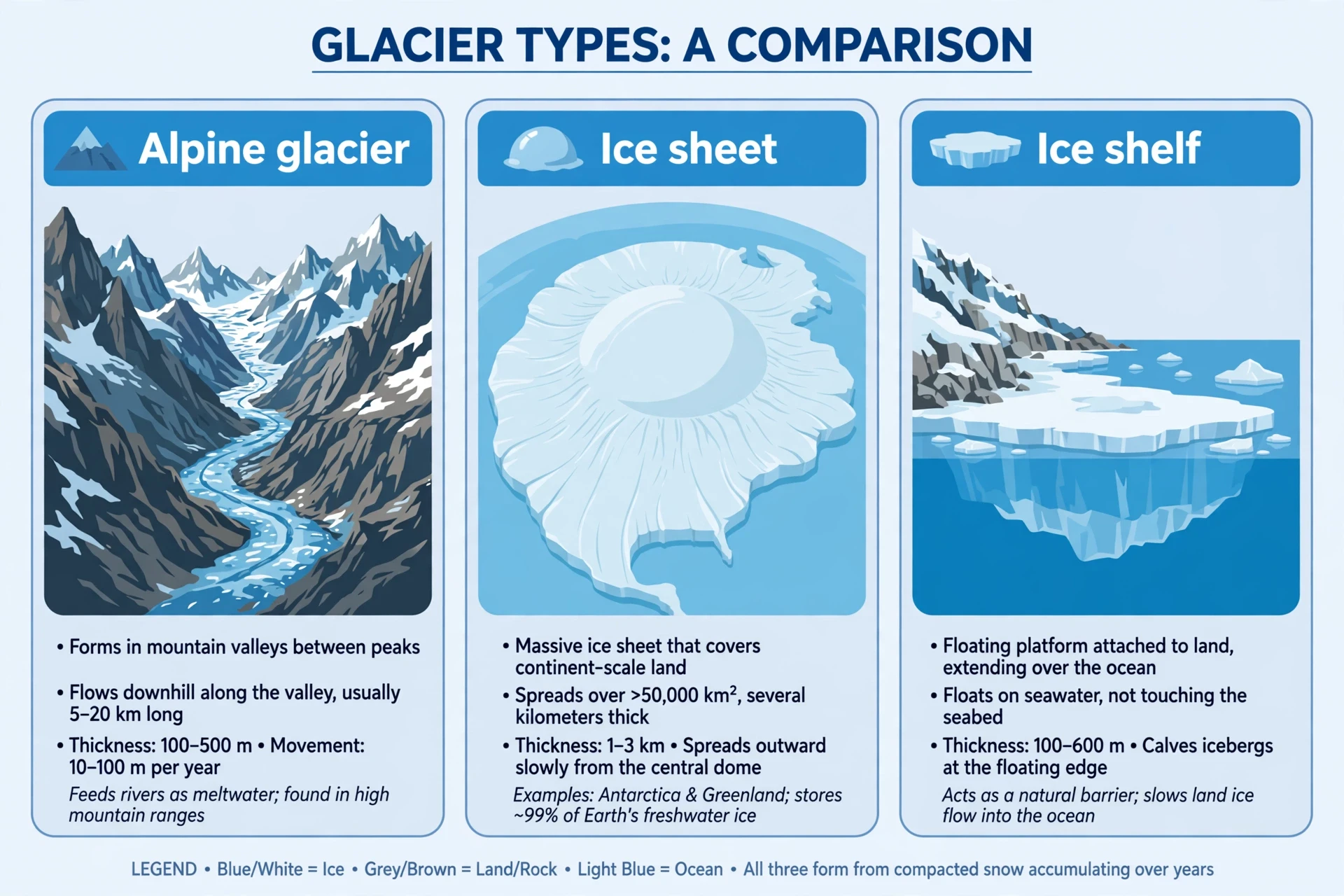
Alpine glaciers, also called mountain glaciers or valley glaciers, are the classic image most people carry in their heads: a river of ice winding down a mountain valley between steep rock walls. They form in high bowls called cirques, where snow collects, and flow downhill along valleys carved by earlier ice. Most of the world's glaciers are alpine ones, and they number in the hundreds of thousands. They are small compared with ice sheets, but they are the glaciers most people will ever see, and they are the ones that supply water to mountain communities across the world.
4.2 Ice sheets
Ice sheets are glaciers on a continental scale. Only two exist today: Antarctica and Greenland. An ice sheet is so large that it buries the landscape beneath it entirely, flowing outward in all directions from a high central dome. The Antarctic ice sheet covers an area larger than the United States and Mexico combined, and in places the ice is more than four kilometres thick. Greenland's ice sheet is smaller but still covers most of the island. Together the two ice sheets hold the overwhelming majority of the world's glacier ice, and their fate decides the future of sea level. The National Snow and Ice Data Center and NASA's ice-sheet observations both track these two giants closely, because a small percentage change in either one translates into metres of sea-level change worldwide.
4.3 Ice shelves, tidewater glaciers and ice caps
Where a glacier or ice sheet flows into the sea, it may float. That floating extension is an ice shelf, a vast flat platform of ice that is still attached to the land behind it but floats on the ocean. Ice shelves act like buttresses, holding back the ice behind them. When an ice shelf thins or breaks apart, the land ice behind it can flow faster into the sea. Ice shelves themselves do not raise sea level much when they melt, since they already float, but their loss can unlock far larger amounts of grounded ice.
Tidewater glaciers end in the sea, where their fronts calve icebergs directly into the water. Watching a tidewater glacier calve is unforgettable: a crack runs across the ice face, a tower of ice the size of a building tips forward, and the whole fjord shudders as the berg hits the water. Ice caps are smaller cousins of ice sheets, dome-shaped ice masses that cover a mountain top or an island and flow outward in all directions, but are too small to count as ice sheets.
Type | Where it forms | Typical size | What makes it distinctive |
|---|---|---|---|
Alpine (valley) glacier | Mountain valleys | A few km long | Flows downhill in a valley; feeds mountain rivers |
Ice cap | Mountain tops, Arctic islands | Tens of km across | Dome-shaped; flows outward in all directions |
Ice sheet | Antarctica, Greenland | Continent-sized | Buries whole landscapes; holds most of Earth's ice |
Ice shelf | Floating on the sea at the coast | Hundreds of km across | Floating extension; buttresses the ice behind it |
Tidewater glacier | Valleys reaching the sea | A few km to tens of km long | Ends in the ocean; calves icebergs directly |
Piedmont glacier | Where a valley glacier spills onto flat land | Tens of km across | Spreads out like a fan at the mountain foot |
4.4 How the types connect
These types are not separate species. They are stages of one system. Snow gathers in a mountain cirque, flows down as an alpine glacier, joins other glaciers, and in the polar regions merges into an ice sheet that reaches the sea as an ice shelf or a tidewater front. A single flake of snow might fall on a Greenland mountain, become part of a small glacier, join the ice sheet, and centuries later calve into the Atlantic as an iceberg. Following that journey is the best way to understand how the whole frozen world fits together.
5. How Glaciers Move
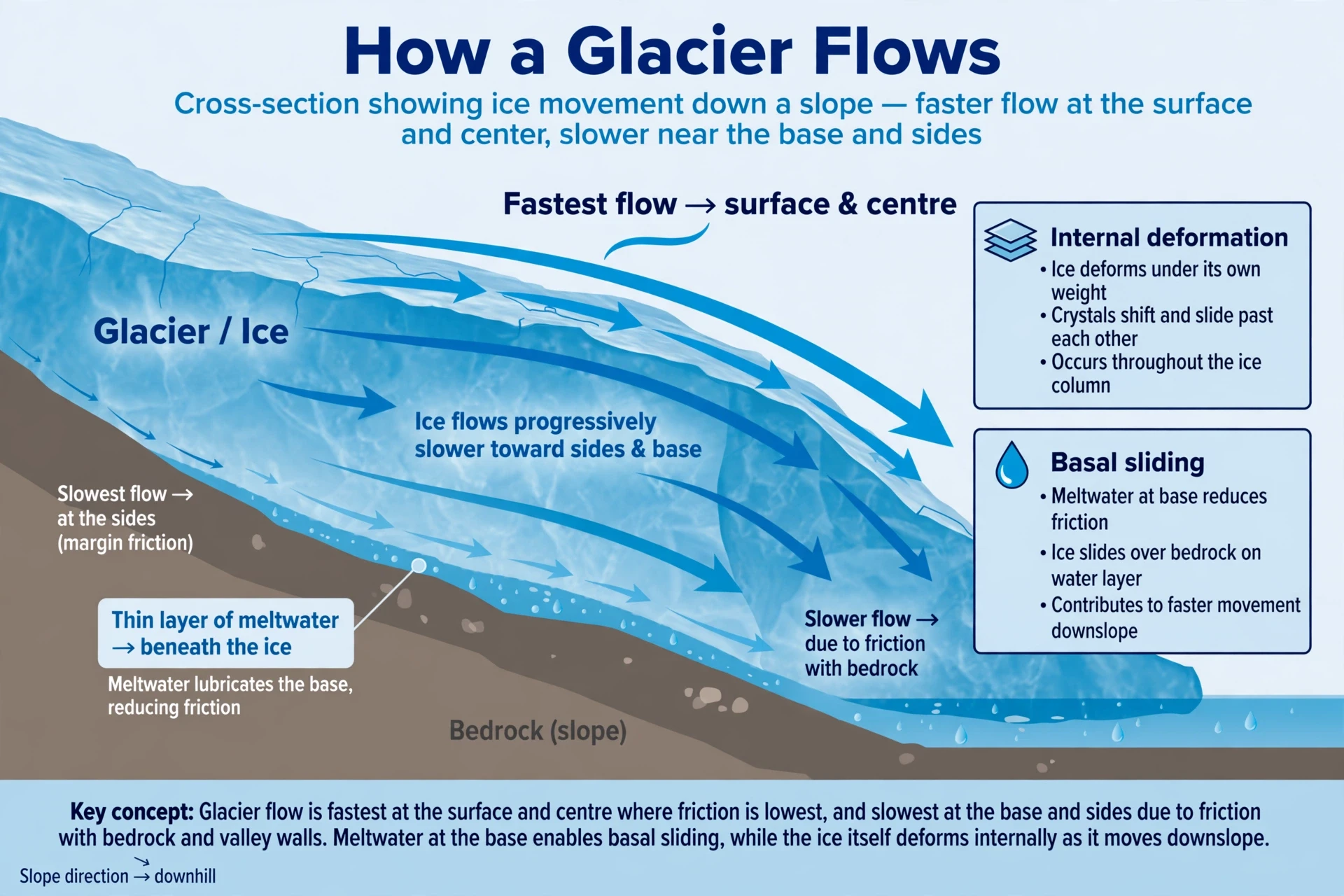
A glacier moves the way a very slow, very thick liquid moves. That sounds contradictory — ice is solid — but under enough pressure and over enough time, ice deforms. Its crystals slide past one another, and the whole mass creeps forward. This is called internal deformation, and it happens throughout the glacier, fastest near the surface and centre, slowest near the base and the valley walls, where friction holds the ice back. The result is a curved flow pattern, like a river, where the middle of the surface moves fastest.
5.1 Sliding on meltwater
A glacier also moves by sliding along its bed. Meltwater that reaches the base acts as a lubricant, letting the ice slip over the rock beneath. In summer, when meltwater is plentiful, some glaciers speed up noticeably. In winter, when the water supply dries up, they slow down. A few glaciers surge, suddenly speeding up to many times their normal pace for months or years, then slowing again. Scientists still debate exactly what triggers surges, but meltwater trapped under the ice is part of the story.
Typical speeds are humble. Most valley glaciers creep forward a few tens of metres a year — about the length of a football field. Some fast Greenland outlet glaciers move several kilometres a year, which is startlingly quick for ice. Either way, the movement is too slow to see, and that slowness tricks people into thinking glaciers are static. They are not. Put a row of stakes across a glacier and come back a year later, and the stakes have moved. The glacier has carried them downhill, patiently, without any sign of effort.
5.2 The weight that moves mountains
The force behind all this movement is simple gravity acting on an enormous mass. A glacier a hundred metres thick presses down on its bed with the weight of a hundred-metre column of ice, and on a slope, part of that weight pushes the ice downhill. The thicker the ice and the steeper the slope, the stronger the push. That is why the fastest glaciers are often thick ones on steep ground, and why the flat centre of an ice sheet barely moves at all while its edges race toward the sea through narrow outlet glaciers.
I once watched a guide demonstrate this with a block of ice and a tilted board in a mountain hut, a small experiment that stayed with me longer than any lecture. He put the block on the board, and nothing happened. Then he stacked a second block on top, and the pair began to creep. "Weight is the engine," he said. "The ice is heavy enough to push itself." It was a simple point, but it changed how I saw every glacier afterwards. The ice is not being pushed by something else. It pushes itself, by being heavy.
5.3 Why the speed matters
Flow speed decides almost everything about a glacier's behaviour. A fast glacier delivers ice to its snout quickly, so it can hold its ground even in a warm climate. A slow glacier is more vulnerable, because melting at the front can outrun the supply of new ice from above. Flow speed also decides how much erosion a glacier does: faster ice, carrying more rock debris, grinds harder. And speed decides how quickly a glacier responds to climate change. Some small alpine glaciers react within years. The great ice sheets take centuries or millennia to respond fully, which is both reassuring and alarming: reassuring because their response is slow, alarming because once it starts, it is very hard to stop.
6. Glaciers as Sculptors: Carving Valleys and Fjords
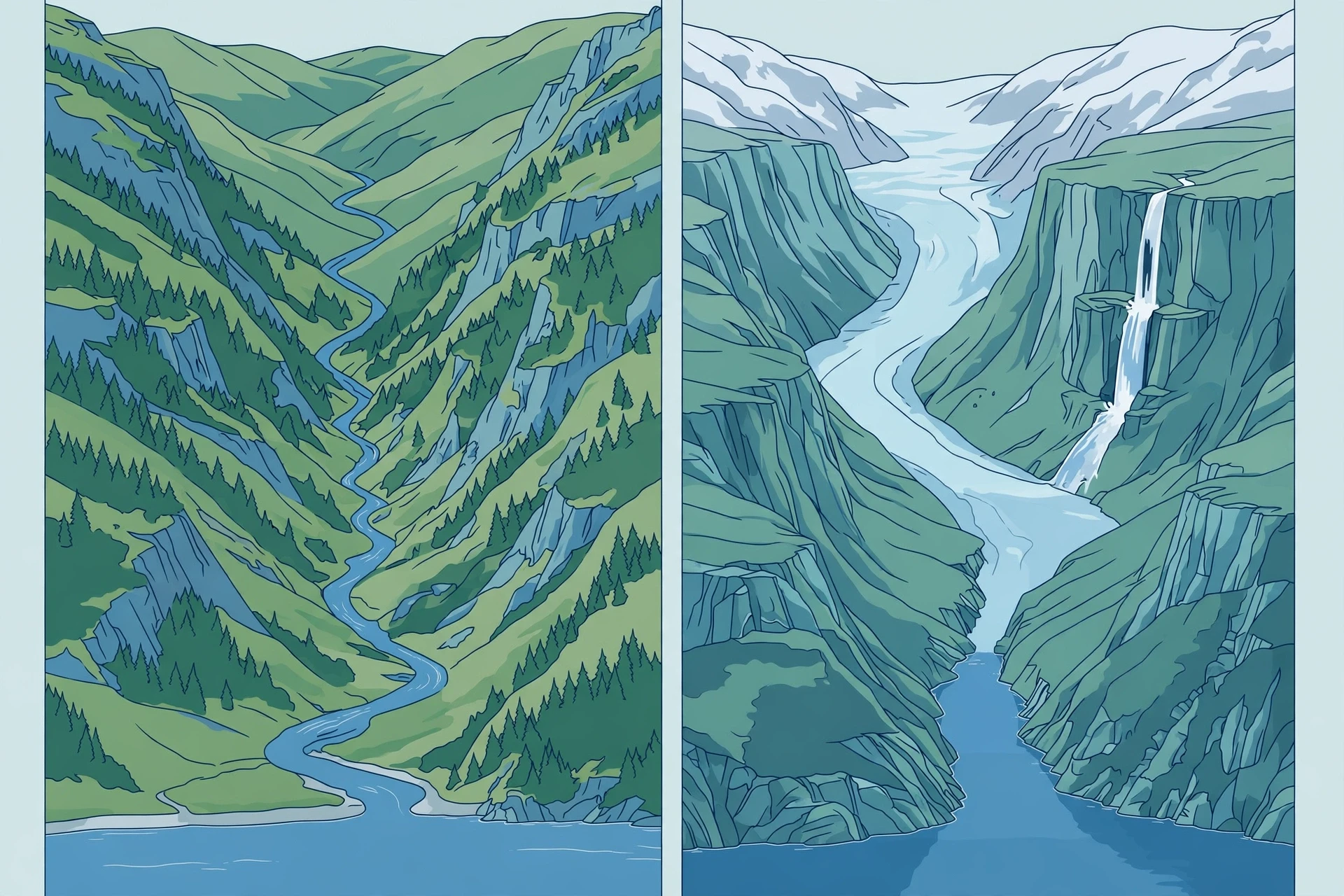
A river cuts a V-shaped valley. A glacier cuts a U-shaped one. That single contrast, visible from any mountain viewpoint, is the most direct evidence of how differently ice and water work. A river cuts down, carving a narrow channel. A glacier fills the whole valley, scraping its floor and its walls at the same time, widening and deepening everything it touches. Over thousands of years, a narrow V becomes a broad, flat-floored U with steep sides, the classic shape of a glaciated valley.
They erode in two main ways. The first is abrasion: rock fragments frozen into the base of the ice scrape across the bedrock like sandpaper, polishing it smooth and carving long scratches called striations. Look at a rock surface in a glaciated valley and you can often see those parallel grooves, all pointing in the direction the ice flowed. The second is plucking: meltwater seeps into cracks in the bedrock, freezes, expands, and pries blocks loose. The glacier then carries those blocks away, frozen into its base, where they become new tools for abrasion. Abrasion and plucking work together, each making the other more effective, and the result is erosion on a scale no river can match.
6.1 Cirques, arêtes and horns
At the head of a valley glacier, erosion carves a bowl-shaped hollow called a cirque, where snow first collects. As neighbouring cirques grow, the ridges between them sharpen into knife-edge crests called arêtes. Where three or more cirques eat into a mountain from different sides, the peak is left as a sharp pyramid called a horn. The Matterhorn in the Alps is the famous example, a mountain shaped into a horn by glaciers attacking it from every side. These landforms are so distinctive that a glaciologist can read a mountain range like a history book, picking out which slopes were attacked by ice and which were left alone.
6.2 Fjords: valleys drowned by the sea
When a glacier carves a valley below sea level and then retreats, the sea floods in. The result is a fjord, a deep, narrow inlet with steep walls and water far deeper than the surrounding coast. The fjords of Norway, New Zealand, Chile and Alaska are among the most dramatic landscapes on Earth, and every one of them is a drowned glacial valley. Some fjords are more than a kilometre deep, deeper than the sea outside them, because the glacier dug below sea level and left a rock sill at the mouth that partly blocks the entrance. Sailing into a fjord, with cliffs rising a thousand metres on either side and waterfalls dropping straight into the sea, is like sailing into the track a glacier left behind, a scar so large it became a seascape.
A fjord is a glacier's signature written in seawater — a valley the ice dug so deep that the ocean moved in when the ice left.
6.3 Hanging valleys and waterfalls
Not every valley in a glaciated landscape was carved equally. A main glacier, thick and powerful, cuts its valley deep. Smaller tributary glaciers, thinner and weaker, cut their valleys less deeply. When the ice melts, the tributary valley is left hanging high above the main valley floor, and its stream plunges over the edge as a waterfall. Yosemite Valley is full of these hanging valleys, and its waterfalls — Bridalveil, Yosemite Falls — exist because glaciers carved the main valley far deeper than its tributaries. The beauty of those waterfalls is, in a real sense, a byproduct of uneven erosion.
7. The Landforms Glaciers Leave Behind
Ice does not only erode. It also builds. As ice melts, it drops everything it was carrying — boulders, gravel, sand, clay — in heaps and ridges across the landscape. Those deposits, called till, are unsorted: a single pile can contain clay and boulders side by side, because ice, unlike a river, does not sort its load by size. Geologists can spot glacial till at a glance by exactly that messiness.
7.1 Moraines
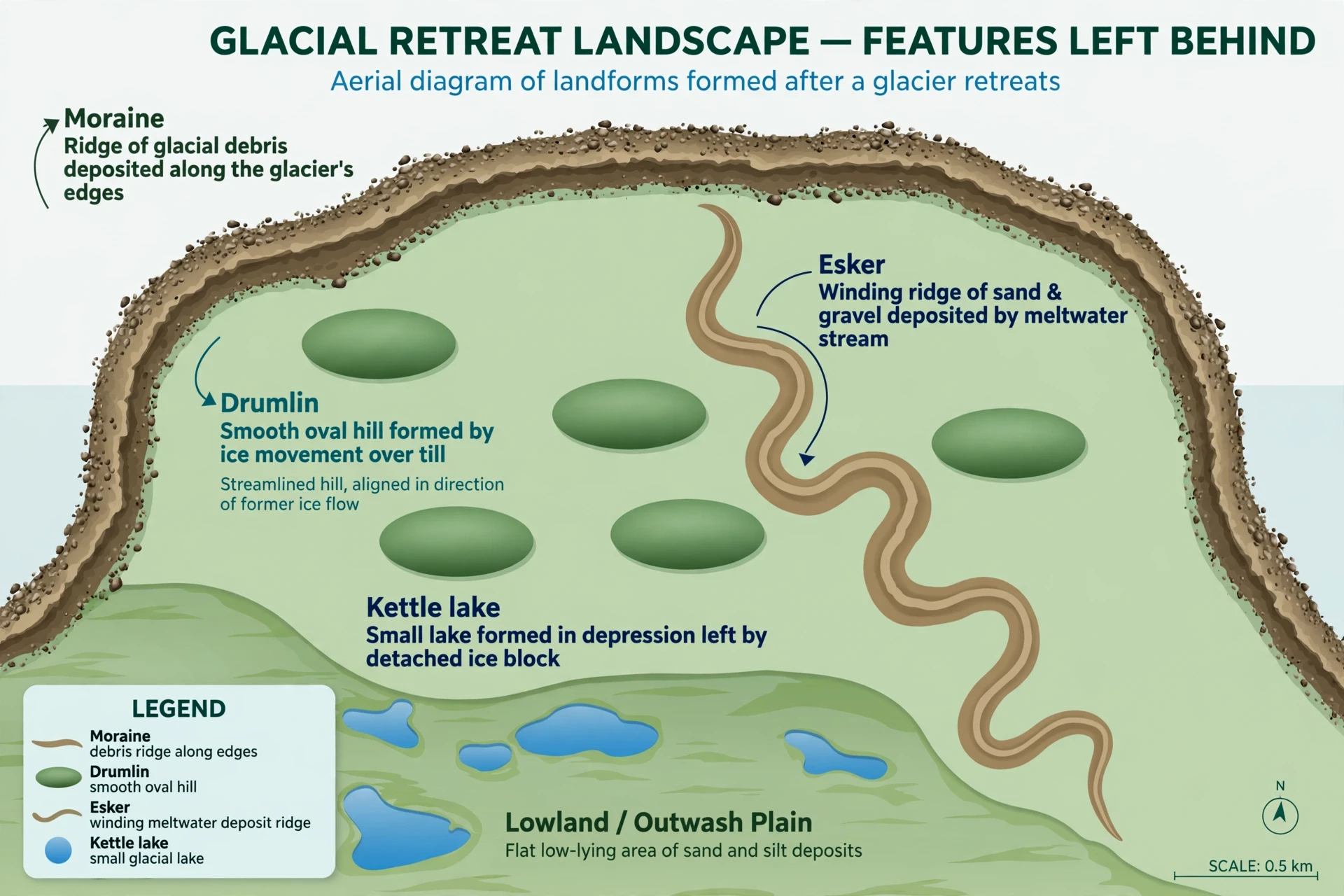
The most obvious deposits are moraines, ridges of debris left at the edges and front of a glacier. Lateral moraines run along the sides, where rock fell from the valley walls onto the ice and was carried along. Medial moraines form in the middle, where two glaciers join and their lateral moraines merge into a single dark stripe down the centre of the combined glacier. Terminal moraines mark the farthest point a glacier reached, a curved ridge of rubble bulldozed into place at the snout. When a glacier retreats, it leaves a series of smaller ridges behind it, each one marking a place where the front paused for a while. Reading a set of moraines is like reading the retreat in the landscape itself: here the ice stopped, here it stopped again, here it stopped for the last time.
7.2 Drumlins, eskers and kettle lakes
Some deposits are subtler but just as telling. Drumlins are smooth, elongated hills shaped like the back of a whale, formed under moving ice, with their long axes pointing in the direction the ice flowed. A field of drumlins is a map of ice movement, each hill a small arrow showing which way the glacier went. Eskers are winding ridges of sand and gravel, deposited by streams that flowed inside or beneath the glacier. When the ice melted, the stream's bed was left standing as a ridge, snaking across the lowland like a frozen river that outlived its ice. Kettle lakes form where a block of ice was buried in glacial debris and later melted, leaving a hollow that filled with water. In the lake country of the northern United States and Canada, thousands of small round lakes are kettles, each one the ghost of a buried ice block.
These landforms matter because they are evidence. A drumlin field in a place with no glacier today proves that a glacier once flowed there. A terminal moraine across a valley proves the ice once reached that far. By mapping moraines, drumlins and eskers, scientists have reconstructed the extent of ice sheets that vanished ten thousand years ago, tracing their edges across whole continents from the ridges they left behind.
7.3 Lakes, soils and farmland
Glacial deposits do more than record history. They shape the present. Glacial lakes — from the Great Lakes of North America, gouged by ice sheets, to the small kettle lakes of the northern plains — are some of the world's most important freshwater bodies. Glacial till, ground to fine powder, weathers into rich soils that support farming across the northern plains of Europe and North America. The flat, fertile farmland of the American Midwest sits on ground the ice sheets levelled and enriched. People eat food grown in soil that glaciers made, drink water from lakes that glaciers dug, and live on land that glaciers flattened, often without ever realising it.
8. Ice Ages: When Glaciers Ruled the Planet
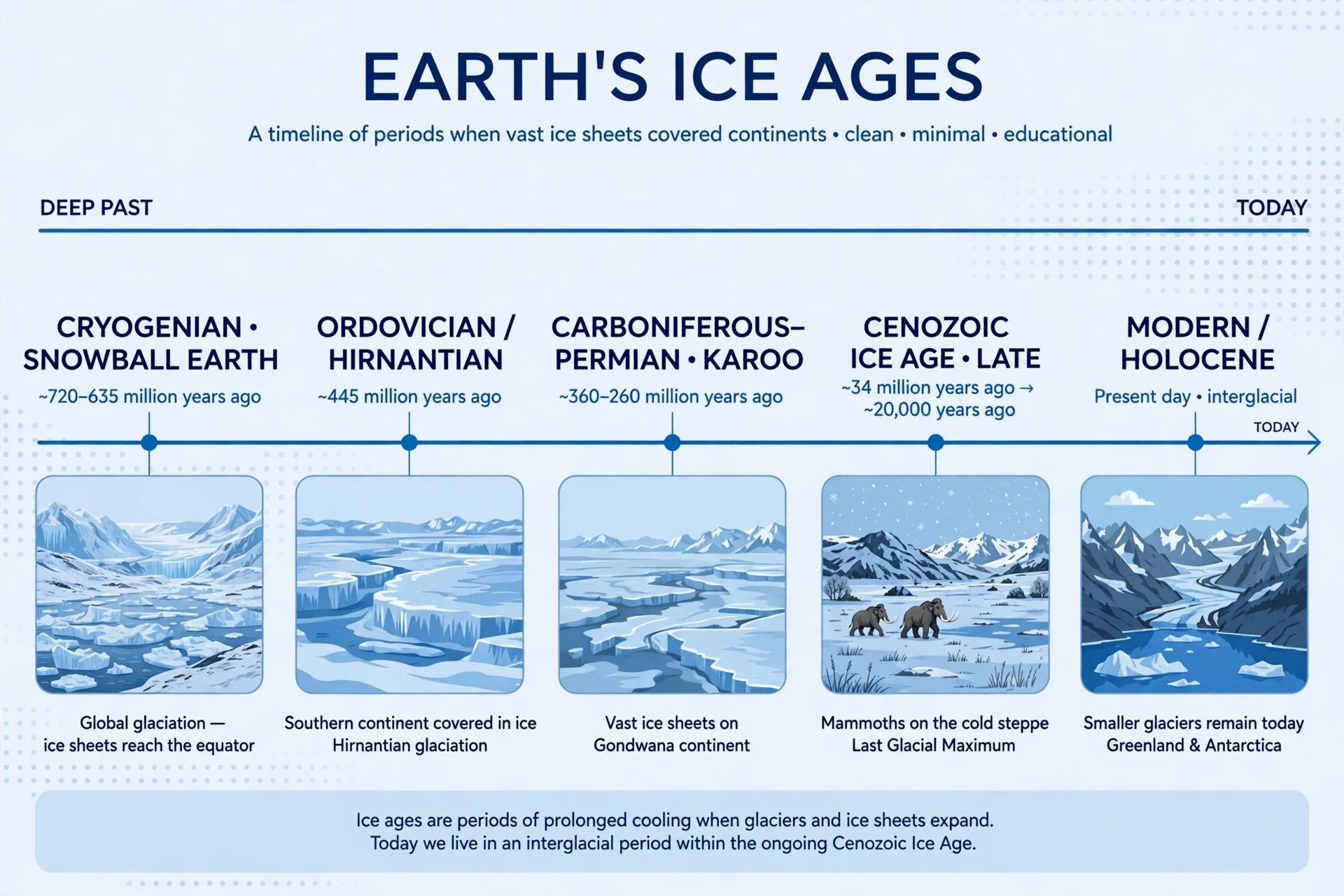
Earth has had many ice ages, long periods when glaciers and ice sheets covered far more of the planet than they do today. The most recent one, which geologists call the Pleistocene, began more than two million years ago and only really ended about eleven thousand years ago. During its coldest phases, ice sheets covered Canada, Scandinavia and northern Britain, and sea level was more than a hundred metres lower than today, because so much ocean water was locked up on land as ice. People could walk from Siberia to Alaska across dry land where the Bering Strait is now. Britain was joined to mainland Europe. The map of the world was different.
8.1 Why ice ages happen
Ice ages are driven by a combination of forces. Changes in Earth's orbit and tilt, over cycles of tens of thousands of years, alter how much sunlight reaches the northern hemisphere in summer. When northern summers grow cool, snow survives the summer, glaciers grow, and their bright white surfaces reflect more sunlight back into space, cooling the planet further. That feedback loop — more ice, more reflection, more cooling — can push the planet into a glaciation. Plate tectonics matters too: when continents drift into polar positions, or when mountain ranges rise and change ocean currents, the planet becomes more prone to ice ages. And carbon dioxide matters: when the atmosphere holds less of it, the planet cools.
The ice ages were not one long freeze. They were a series of cold glacial periods separated by warmer interglacials, like the one we live in now. Within the cold periods, the ice advanced and retreated many times. The last great ice sheet reached its maximum extent roughly twenty thousand years ago, then began to melt back, a retreat that was still going on when farming was invented. The landscapes of Canada, Scandinavia, the northern United States and Britain still show the marks of that ice: scratched bedrock, drumlin fields, moraines and the great lakes it left behind.
The ice ages did not end with a single thaw. They ended the way they began — slowly, unevenly, and with the planet's geography redrawn in the process.
8.2 What the ice ages left us
The world we live in is, in many ways, a world the ice ages built. The Great Lakes were dug by ice. The fjords of Norway were carved by ice. The fertile soils of the northern plains were ground by ice. The course of the Thames, the Mississippi and many other rivers was set by meltwater and debris left behind when the ice retreated. Even the distribution of animals and plants reflects the ice ages: species were pushed south by advancing ice, then spread north again as it melted, and isolated populations in mountain valleys evolved into new species.
There is also a humbling lesson in the ice ages. The planet has swung between icehouse and greenhouse states many times, driven by forces far larger than human activity. That does not make today's warming natural — the current change is far faster than the orbital cycles that drove the ice ages, and it is driven by greenhouse gases, not by the tilt of the Earth. But it does remind us that climate is not fixed. It has always changed, and glaciers have always been both the cause and the record of that change. Ice cores drilled from Greenland and Antarctica contain air bubbles from the atmosphere of the past, letting scientists read ancient temperatures and carbon dioxide levels directly. A glacier is not only a sculptor of landscapes. It is an archive of the planet's climate history, written in ice.
9. Glaciers in Retreat: What Is Happening Now
Almost every glacier on Earth is retreating. The great ice sheets of Greenland and Antarctica are losing mass. Alpine ice in the Alps, the Himalayas, the Andes, the Rockies and Alaska is shrinking year after year. A few glaciers in a few places are holding steady or even advancing, usually because local snowfall has increased, but the overall picture is clear and has been for decades: the world's ice is getting smaller, and the loss is speeding up.
The cause is not mysterious. Glaciers respond to temperature, and the planet has warmed. A warmer summer melts more ice. A warmer winter brings rain instead of snow in the mountains, so less new ice forms. The equilibrium line climbs higher, the accumulation zone shrinks, and the glacier's budget goes into deficit. The same feedback that once helped ice ages grow now works in reverse: as bright ice and snow disappear, darker rock and water are exposed, absorbing more sunlight and warming the area further.
9.1 The evidence in photographs
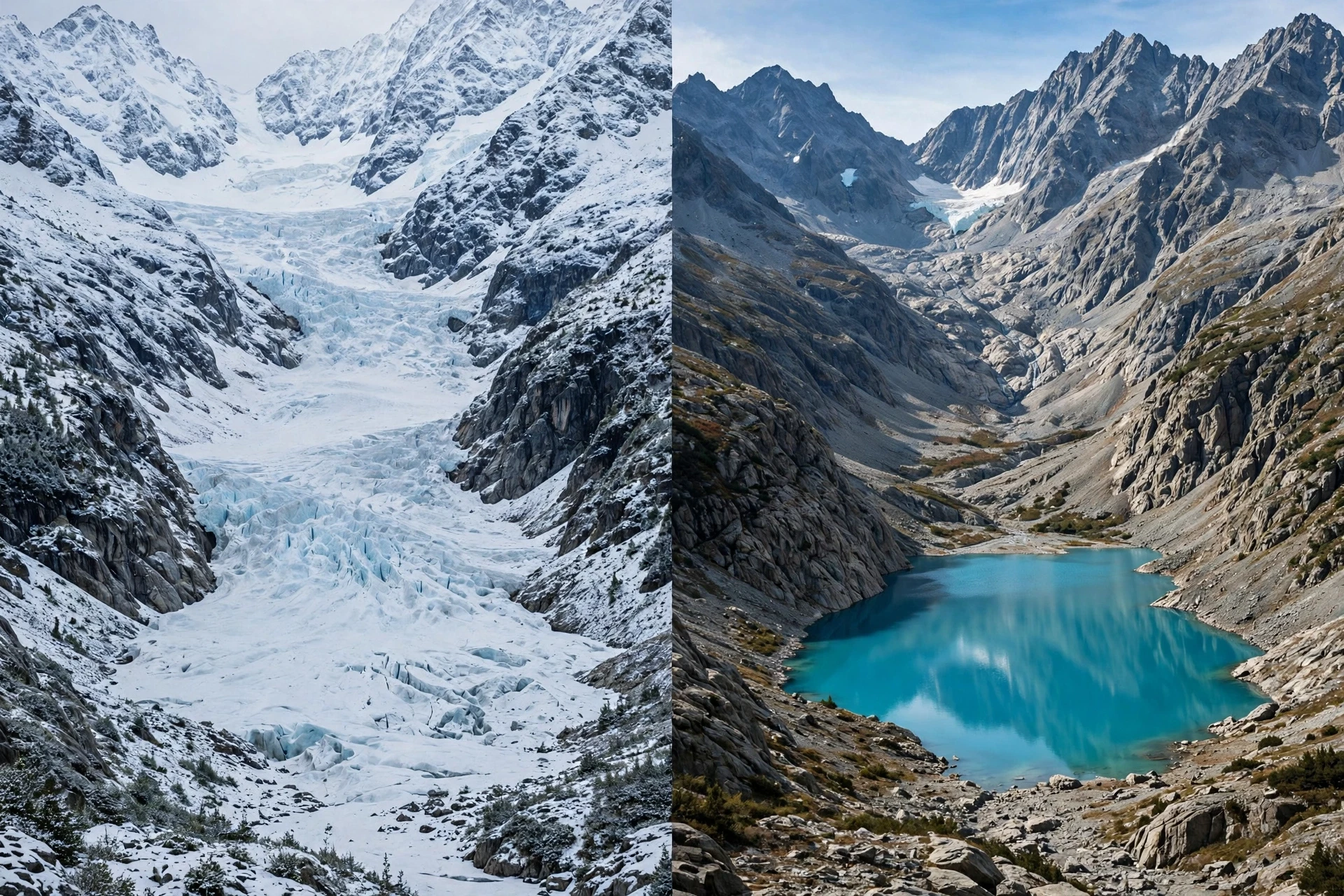
Some of the most powerful evidence for glacier retreat is also the simplest: photographs. In many mountain visitor centres, you can see pairs of photographs taken from the same spot decades apart — a glacier filling a valley in one, and the same valley nearly empty in the other, with a new lake where the ice used to be. I remember standing in front of one such pair, feeling oddly cheated. The glacier in the old photograph looked permanent, like a mountain. The glacier in the new photograph looked like something that had given up. The valley had not changed. The rock was the same. Only the ice had gone, and with it, the sense that some things on Earth are too big to change. That is the quiet shock of glacier retreat: it makes visible, in a single human lifetime, a change that once took thousands of years.
Satellites have made this evidence global. Instruments aboard NASA's Earth-observing satellites measure the height of ice sheets, the speed of outlet glaciers and the extent of ice cover, year after year, across the whole planet. The National Snow and Ice Data Center and NASA's Earth Observatory publish these records openly, and they tell a consistent story: the loss is widespread, it is ongoing, and it is fastest in the places that were already warmest. The U.S. National Park Service documents the same retreat in parks such as Glacier National Park, where the glaciers that gave the park its name are shrinking fast enough that visitors today see a different landscape from the one their grandparents saw.
9.2 What retreat means for sea level
When land ice melts, the water flows into the oceans, and sea level rises. That is the most direct consequence of glacier retreat, and the one with the largest reach. Even a rise of a few centimetres matters for low-lying coasts, because it makes storm surges reach further inland and lets salt water creep into freshwater supplies and farmland. Mountain glaciers hold a relatively small share of the world's ice, but they are melting fast, and their contribution to sea-level rise is already significant. Greenland and Antarctica hold far more, and their contribution is growing. If either ice sheet were to lose ice much faster, sea-level rise would accelerate with it.
There is a subtlety worth understanding here. When a floating ice shelf melts, sea level barely changes, because the ice was already displacing water. When grounded ice — ice resting on land — melts and flows into the sea, sea level rises. That is why scientists watch the grounding line, the place where an ice sheet leaves the bedrock and starts to float, so closely. If warm ocean water melts the ice from below near the grounding line, the line can retreat inland, letting more grounded ice flow into the sea. It is a slow process, but it is the mechanism that could turn gradual sea-level rise into something much faster.
9.3 Can glaciers grow back?
They can grow back, but only if the conditions that made them return. A glacier is not a creature that dies; it is a balance. If snowfall increases and summers cool, a retreating glacier will slow its retreat, stabilise, and eventually advance again. Small glaciers can respond within years or decades. The great ice sheets would need centuries or millennia to regrow what they have lost, because they are so large and their response is so slow. That is the real danger of ice-sheet loss: it is not easily undone on human timescales. What melts in a century may take ten thousand years to rebuild.
This is also why glacier retreat is worth taking seriously even though glaciers have advanced and retreated many times before. The difference now is speed. Natural glacier changes happen over centuries and millennia. The current retreat is happening over decades, and it is happening almost everywhere at once. The glaciers are telling us something about the climate, the way a thermometer tells us about a fever. The question is not whether they are changing. The question is what we do with what they are telling us.
10. Why Glaciers Matter to Everyone
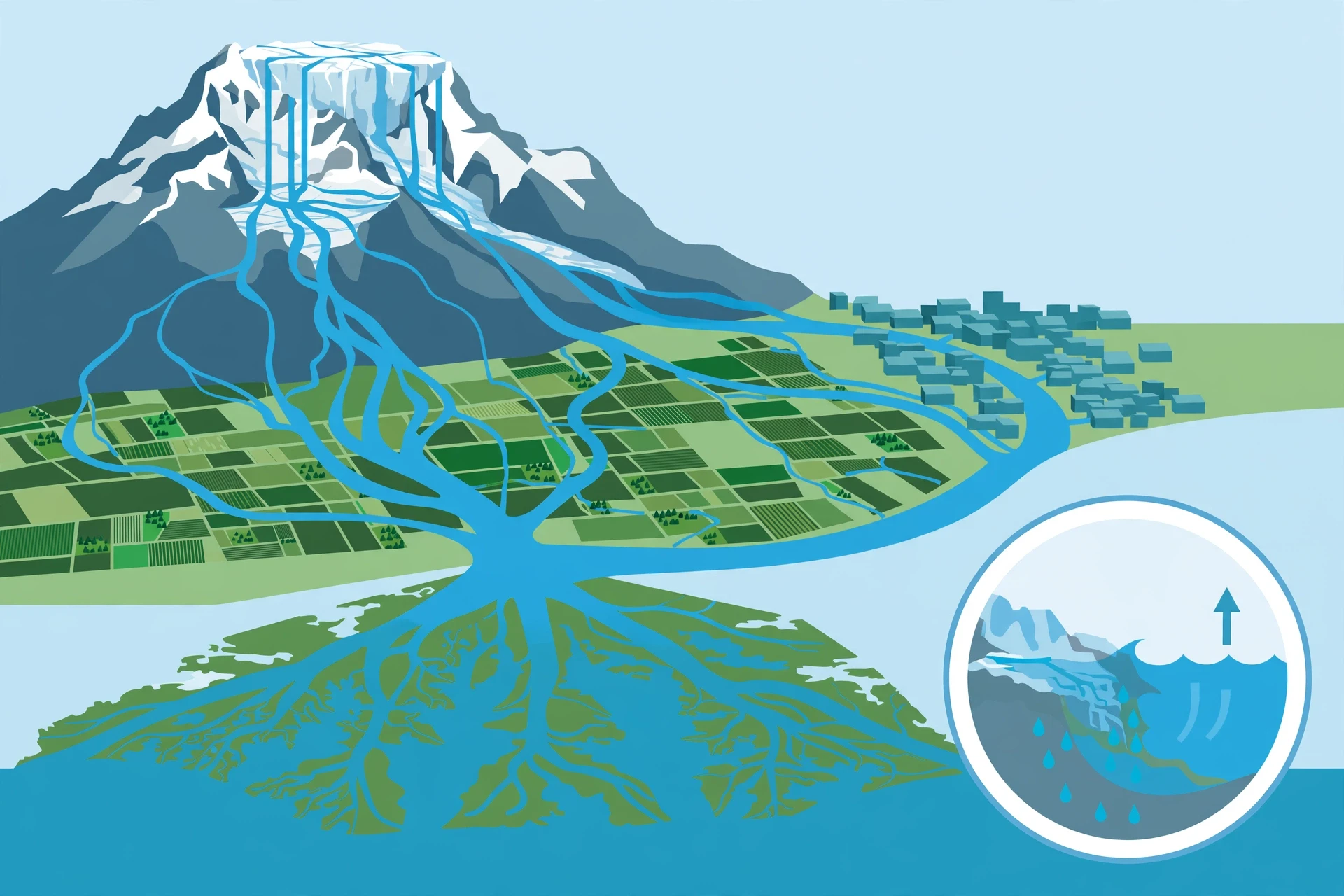
It is easy to think of them as remote, something that belongs to polar explorers and mountain climbers. In truth, glaciers touch the lives of hundreds of millions of people who will never see one. About two billion people live in river basins fed partly by glacier meltwater, and in many mountain regions, glaciers are the water supply that keeps rivers flowing through the dry season, when rain is scarce and snow has already melted.
10.1 Water towers of the world
High mountains are often called the water towers of the world, and glaciers are the tanks on top of those towers. In the Himalayas, glaciers feed rivers that water farms and cities across South and Southeast Asia. In the Andes, they supply cities such as La Paz and Quito, and the farms in the valleys below. In the Alps, they feed the Rhine, the Rhone and the Danube. In the dry season, when the monsoon rains have not yet come or the summer heat has dried the lowlands, glacier meltwater is often the only water flowing in the rivers. Lose the glaciers, and those rivers run low exactly when water is needed most.
The relationship between glaciers and water is not simple, and that matters for planning. At first, as a glacier melts faster, the rivers it feeds may carry more water, not less — a temporary flood of meltwater. But as the glacier shrinks, the meltwater supply peaks and then declines, leaving rivers with less water in the dry season. Communities that built their farms and cities around a reliable meltwater supply may find that supply fading within a generation. This is one of the most practical reasons to watch glaciers closely: they are not only a symbol of climate change, they are a water supply with a deadline.
10.2 Climate records and early warnings
They are also among the best early-warning systems we have. Because they respond to temperature and snowfall over years and decades, they smooth out the noise of individual weather events and reveal the trend underneath. A single hot summer does not prove the climate is changing. A glacier that retreats every year for thirty years does. That is why scientists monitor glaciers in so many places, and why the records matter even for people who live far from any ice.
The ice itself is a scientific treasure. Ice cores drilled from deep inside glaciers and ice sheets contain layers of snow laid down over hundreds of thousands of years, trapping tiny bubbles of ancient air. By analysing those bubbles, scientists can measure the composition of the atmosphere long before any human instrument existed. Our knowledge of how carbon dioxide and temperature have moved together through the ice ages comes largely from ice cores. When a glacier melts, that archive melts with it. The loss is not only water and ice. It is history.
10.3 Ecosystems, tourism and hazard
Glaciers shape the ecosystems around them. Meltwater streams carry nutrients to lakes and coastal waters. New land exposed by retreating ice is colonised by plants and animals in a sequence ecologists study as primary succession, the slow process by which life claims bare ground. In the sea, meltwater and icebergs influence ocean circulation and the food webs that depend on it.
They also bring people. Glacier tourism supports mountain communities from Alaska to New Zealand, and the loss of glaciers threatens livelihoods built around them. And retreating glaciers create hazards as well as opportunities: meltwater can collect behind loose moraines, forming lakes that may burst suddenly and flood valleys below. Glacial lake outburst floods have destroyed villages in the Himalayas and the Andes, and as more lakes form behind retreating glaciers, the risk grows. Watching glaciers is not only about the distant future. It is about floods, water and food in the present.
11. What Most People Get Wrong About Glaciers
Glaciers attract misunderstandings, partly because they are so unlike anything in everyday life. Clearing up the common ones makes the real science easier to grasp.
Glaciers are frozen solid and never move. Most people assume a glacier is a single frozen block, sitting still until it melts. What we actually see in the data is the opposite: a glacier is always moving, even in the depths of winter, even when its front is retreating. The ice flows forward continuously, carrying rock, bending around bends in the valley, and cracking open crevasses as it goes. A glacier that looks still is moving at a pace too slow for the eye, not standing still.
A retreating glacier is sliding backwards. A glacier's front can pull back up a valley while the ice itself keeps flowing forward. Retreat means melting at the front outruns the supply of new ice, not that the flow has reversed. It is the difference between a candle burning down and a candle being pulled away.
Glaciers are just big frozen lakes. A lake freezes from the top down and stays put. A glacier forms from snow compacted over decades, flows under its own weight, erodes the ground beneath it, and carries rock for kilometres. The two have almost nothing in common except that both contain ice. Some of the strangest things about glaciers — the blue colour of deep ice, the fact that ice floats instead of sinking — come from the water molecule itself. Our guide to why water is the weirdest molecule explains the chemistry behind those surprises.
All glaciers are in the far north or south. Alpine glaciers exist on every continent except Australia, including near the equator, wherever mountains are high enough to stay cold. Kilimanjaro's summit glaciers sit almost on the equator, and the Andes hold tropical glaciers that feed farms and cities in the highlands.
Melting glaciers only matter to polar bears. Glacier melt raises sea level along every coast, changes river flows for hundreds of millions of people, and removes a climate archive that cannot be replaced. The consequences reach far beyond the poles, and they reach into water supplies, farms, cities and coastlines. For the wider picture of the warming driving this retreat, see our guide to climate change.
Glaciers will simply regrow when the weather cools. Small glaciers can regrow in decades, but the great ice sheets take millennia to rebuild. Ice lost over a century is not recovered in a decade, and some losses, once they pass a threshold, become very difficult to reverse on any timescale that matters to the people living with the consequences.
Glaciers move constantly, even when they are retreating.
Retreat means melting outruns the flow of new ice, not that the ice slides backwards.
Ice sheets, ice shelves and alpine glaciers are different parts of one system.
Glacier meltwater feeds rivers, farms and cities for about two billion people.
The ice ages were driven by slow orbital cycles; today's retreat is far faster.
12. The Ice That Remembers
Stand on a glacier and you are standing on weather that fell from the sky before you were born, before your grandparents were born, sometimes before the first farms were planted. The ice under your boots is a record, a river, a reservoir and a sculptor, all at once. It carved the valleys we hike through, dug the lakes we swim in, and stores the water that millions of people will drink this summer.
The ice is changing faster now than it has in thousands of years, and the change is visible in a single lifetime: valleys emptied, lakes born where ice stood, rivers running thinner in the dry season, coastlines inching upward. The ice is not silent about it. It cracks, it groans, it melts, it retreats, and every one of those signals is a measurement of the world we live in.
The good news is that glaciers are honest. They do not exaggerate and they do not hide. Watch them, measure them, and they will tell you exactly where the planet stands. What we do with that knowledge is the part of the story that has not been written yet.
Frequently Asked Questions
How do glaciers form?
Glaciers form where more snow falls each winter than melts each summer. The leftover snow piles up year after year, compresses into granular firn, and eventually becomes dense blue glacial ice. When the ice grows thick enough, gravity pulls it downhill and it begins to flow. At that point the snowfield has become a glacier.
How fast do glaciers move?
Most valley glaciers move a few tens of metres per year, while fast outlet glaciers in Greenland can move several kilometres per year. The ice moves by internal deformation, with the surface and centre flowing fastest, and by sliding along its bed on a film of meltwater. The movement is too slow to see with the eye, but stakes placed on a glacier shift measurably within a year.
What is the difference between a glacier and an ice sheet?
An ice sheet is a type of glacier, but on a continental scale. A glacier is any large body of ice that forms on land and moves under its own weight. An ice sheet is a glacier so large that it buries the entire landscape beneath it and flows outward in all directions. Only two ice sheets exist today, in Antarctica and Greenland. An ice shelf is different again: it is a floating extension of a glacier or ice sheet, resting on the sea rather than on land.
Why are glaciers melting?
Glaciers are melting mainly because the planet has warmed. Warmer summers melt more ice, and warmer winters bring rain instead of snow in the mountains, so less new ice forms. The equilibrium line climbs higher, the accumulation zone shrinks, and the glacier's budget goes into deficit. Almost every glacier on Earth is now retreating, and the loss is speeding up.
What landforms do glaciers create?
Glaciers carve U-shaped valleys, cirques, arêtes, horns and fjords, and they leave behind moraines, drumlins, eskers, kettle lakes and vast deposits of till. They also dig out lake basins, including the Great Lakes of North America. Many of the world's most recognisable landscapes — fjords, hanging valleys with waterfalls, and smooth whale-backed drumlin hills — are glacial in origin.
How much of Earth's fresh water is stored in glaciers?
Glaciers hold roughly three-quarters of all the fresh water on Earth. Most of it is in the Antarctic and Greenland ice sheets, with the rest in mountain glaciers and ice caps around the world. This stored water feeds rivers that supply drinking water, irrigation and hydropower to hundreds of millions of people, especially in the dry season.
Can a glacier grow back after retreating?
Yes, if the conditions that formed it return. A glacier is a balance between snowfall and melting, so cooler summers and heavier snowfall can slow a retreat, stabilise the glacier and eventually make it advance again. Small alpine glaciers can respond within years or decades, but the great ice sheets would take centuries or millennia to regrow what they have lost.