

The first time I watched a tide go out properly, I had no idea how tides work. I was standing on a beach at dawn with wet sand under my shoes and a fishing boat sitting, slightly tilted, on the mud a hundred metres from the water. The evening before, that same boat had been floating at the end of a wooden pier. Nobody had moved it. Nobody had touched it. The sea had simply left, and a few hours later it would come back, lift the boat, and carry on as if nothing had happened. I remember standing there thinking that the whole thing felt impossible. How could an ocean — that much water — slide away and return on a schedule, twice a day, every day, without fail?
That question is the doorway into how tides work, and the answer turns out to be one of the most elegant stories in all of science. It involves the Moon pulling the oceans out of shape, the Earth spinning through bulges of water, the Sun lending a hand twice a month, and the shape of coastlines turning a gentle rise into a wall of water dozens of feet high. It also involves a slow, quiet drama playing out over billions of years: the Moon is drifting away from us, and every tide is part of the reason why.
Tides matter far beyond the beach. They decide when ships can enter a harbour, when fishermen can work, and when coastal wetlands flood and drain. They stir nutrients through the sea, shape estuaries, and carry the seeds of whole ecosystems. Engineers are learning to harvest them for electricity. And they are the most visible daily reminder that the Earth is not an isolated ball of rock — it is locked in a gravitational dance with the Moon and the Sun, and the oceans are where we can watch that dance with our own eyes.
So let us start at the water's edge and work outward, from the simple rise and fall you can see with your own eyes to the slow drift of the Moon itself.
1. What a Tide Actually Is
A tide is the regular rise and fall of the sea level, driven mostly by the gravitational pull of the Moon and, to a smaller degree, the Sun. The water creeps up the beach, covers the rocks, and fills the estuaries — that is high tide, or high water. Then it drains away, exposing mudflats, rock pools, and sandbars — that is low tide, or low water. The difference in height between high water and low water is called the tidal range, and it can be as small as a few centimetres in some places and more than fifteen metres in others.
Most coasts experience two high tides and two low tides each day, a pattern called semidiurnal. Each high tide arrives roughly twelve hours and twenty-five minutes after the one before it, so the whole cycle runs a little longer than a day. That extra fifty minutes is a clue, and we will come back to it, because it tells us the tides are following the Moon, not the Sun.
It helps to separate tides from waves, because people mix them up all the time. Waves are mostly wind blowing across the surface of the water. They come and go in seconds, they move energy rather than water itself, and they die down when the wind drops. Tides are something else entirely. They are a slow, vast, rhythmic movement of the whole ocean, driven by gravity from hundreds of thousands of kilometres away. A wave can be a metre high and last five seconds. A tide can be fifteen metres high and take six hours to arrive.
There are also other things that change sea level but are not tides. A storm surge happens when strong winds and low pressure push extra water toward a coast during a storm. A tsunami is a sudden displacement of water caused by an earthquake or landslide under the sea. Both are real and both can be dangerous, but neither follows the clockwork schedule of the tides. The National Oceanic and Atmospheric Administration, which runs the tide gauges around the United States, puts it plainly: tides are the periodic rise and fall of ocean waters caused by the gravitational forces of the Moon and the Sun. NOAA Ocean Service
The word itself gives us a hint about how old this knowledge is. In Old English, "tid" meant a time or a season — the same root gives us words like "tidings" and "Yuletide." People who lived by the sea did not need a physics textbook to know the tide had a rhythm. They knew when the water would be high enough to float a boat and when it would be low enough to gather shellfish. What they did not know, for a very long time, was why.
1.1 High water, low water, and everything in between
Between high and low water, the water is always moving. When the tide is coming in, it is called the flood tide. When it is going out, it is the ebb tide. The current that carries the water in and out is called the tidal current, and in narrow channels it can run fast enough to challenge a small boat. At the exact moment of high or low water, the current briefly stops and turns around. Sailors call that moment slack water, and it is the calmest part of the cycle — a short pause before the sea changes its mind.
The height of the tide is measured against a fixed reference level called chart datum, which is roughly the lowest water level the tide normally reaches. Tide tables list the predicted time and height of each high and low water, and harbour masters, fishermen, and ferry captains live by them. If you have ever looked at a tide table, you have seen the rhythm laid out in numbers: two highs, two lows, each one a little later than the day before.
1.2 Why the sea does not rise everywhere at once
Here is a question that trips up many first-time tide watchers. If the Moon raises a bulge of water on one side of the Earth, why does high tide not happen at the same time everywhere? The answer is that the oceans are not one smooth bathtub. They are broken up by continents, pinched into bays, and dragged across shallow shelves. The tidal bulge is a wave, and like any wave, it has to travel. It sweeps around ocean basins, bounces off coastlines, and gets squeezed through narrow straits. By the time it reaches a particular harbour, it may be hours behind the Moon's position overhead.
That delay is why every coast has its own tide timetable. High tide in one port can be low tide in another port a few hundred kilometres away. The Moon sets the rhythm, but the shape of the ocean floor and the coastline decides the local timing and height. Keep that idea in mind, because it is the key to almost every surprise in this story — including why one bay can have a fifteen-metre tide while a sea a short distance away barely moves at all.
2. How Tides Work: The Moon's Gravity and the Two Bulges
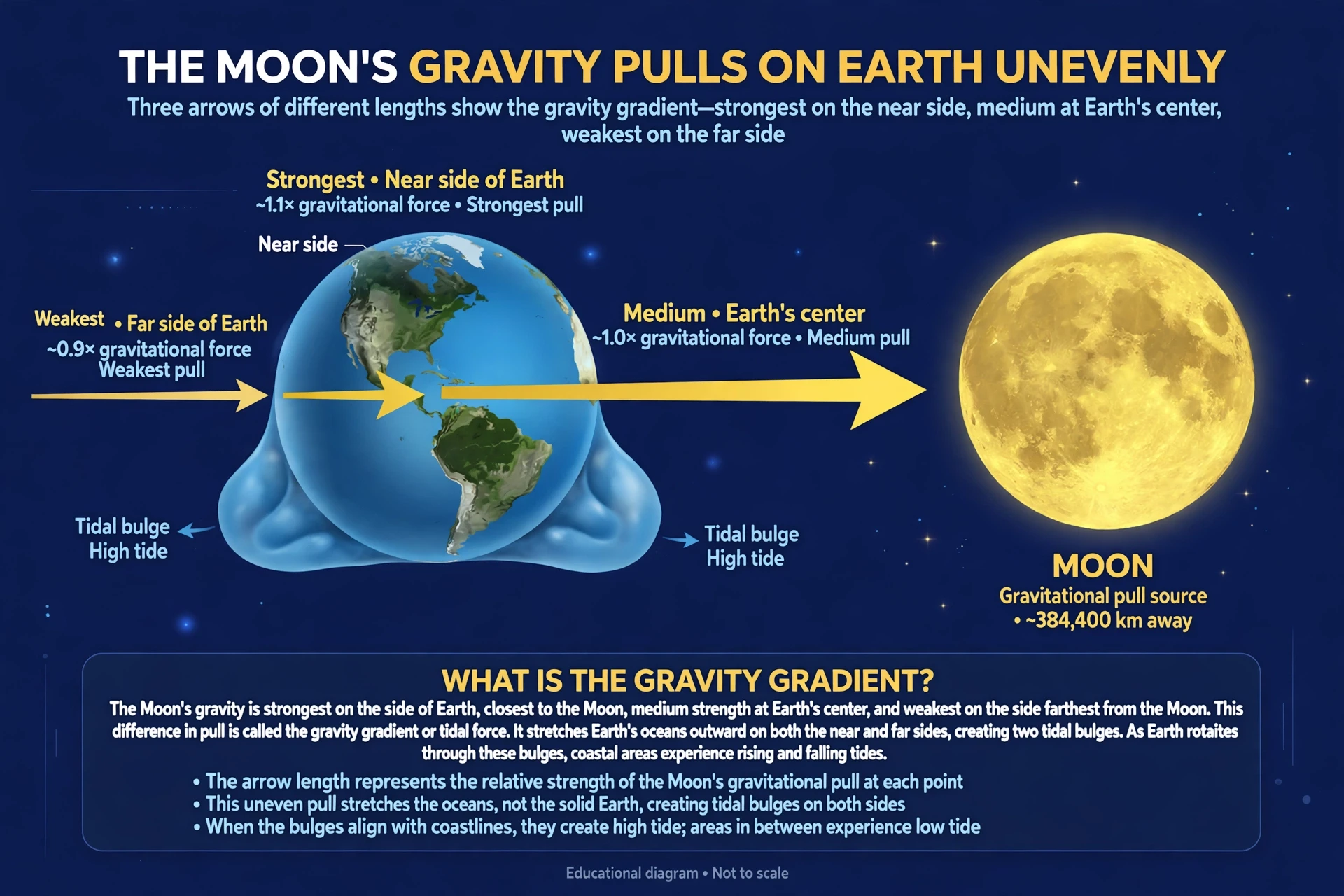
Everything about tides starts with gravity, and gravity is not a simple pull toward the centre of the Moon. It is a difference — a gradient — and that difference is what stretches the oceans. If you want a single sentence to carry away from this article, it is this: tides are caused not by the Moon's gravity itself, but by the way the Moon's gravity changes from one side of the Earth to the other.
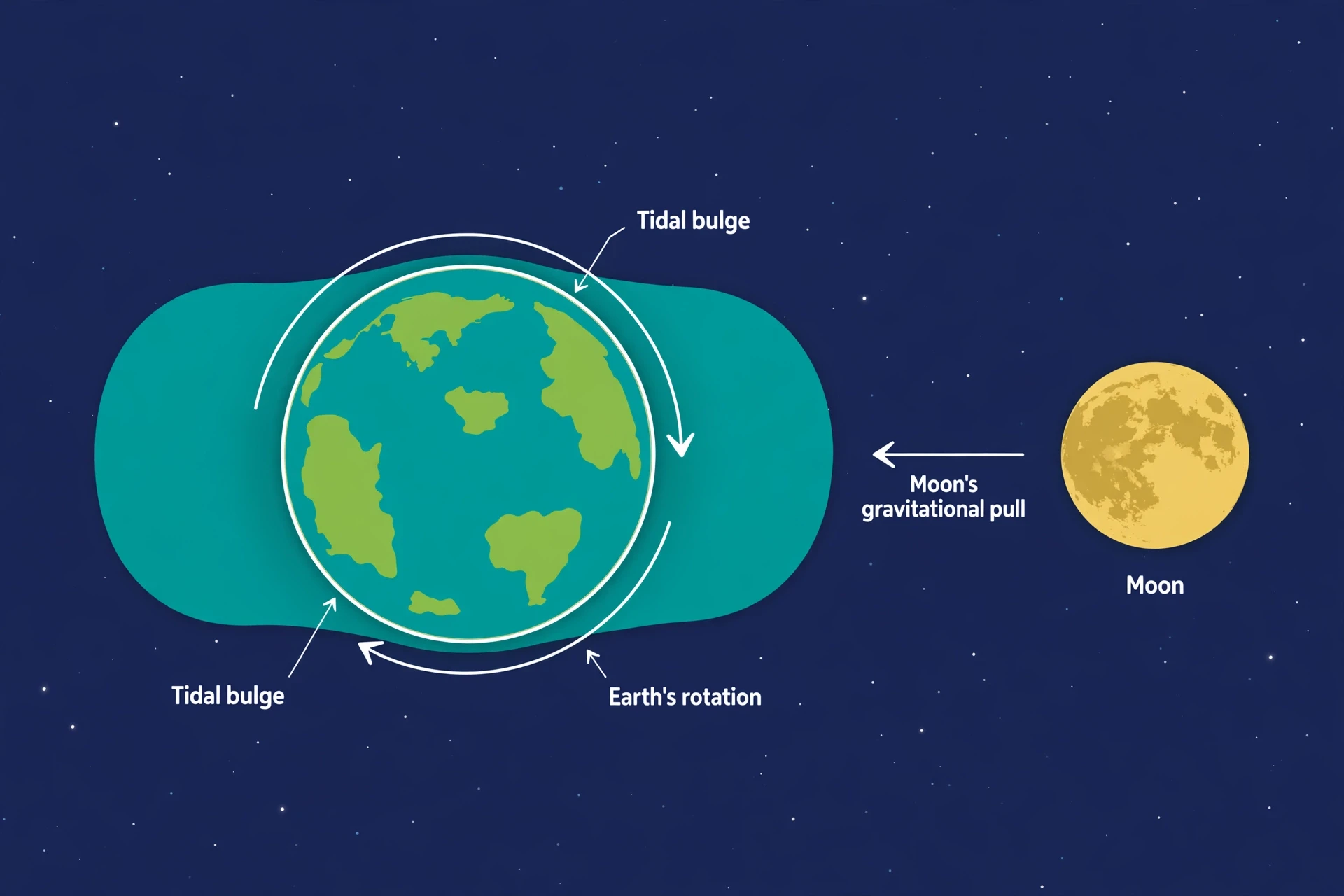
To see why, imagine the Earth as a ball of rock wrapped in a thin skin of water. The Moon's gravity pulls on every part of that ball, but it does not pull equally. The side of the Earth facing the Moon is closer, so the Moon pulls on it more strongly. The centre of the Earth is farther away, so it feels a medium pull. The far side is farthest away, so it feels the weakest pull. The water on the near side is pulled toward the Moon more strongly than the solid Earth beneath it, so it piles up into a bulge on the Moon-facing side. On the far side, the solid Earth is pulled toward the Moon more strongly than the water there, so the Earth is effectively pulled away from its own far-side water — and a second bulge forms on the opposite side.
That second bulge is the part most people find hard to believe, and I remember the moment it finally clicked for me. I was sketching arrows on a whiteboard, three arrows of different lengths all pointing at the Moon, and a colleague stopped me and said, "You have the far side backwards." I did not, as it turned out — but I had to work through it twice before I trusted the sketch. The far-side bulge is not caused by the Moon pushing water away. It is caused by the Moon pulling the Earth away from the water. The result is the same either way: the ocean stretches into an oval, with a bulge on each side of the planet.
There is another way to picture it, and it is just as accurate. The Earth and the Moon orbit around a common centre of mass, a point called the barycentre, which lies inside the Earth, about 4,700 kilometres from the planet's centre. As the Earth swings around that point, every part of the planet feels a small outward, centrifugal effect — the same feeling you get when a car takes a sharp turn and your body leans outward. On the Moon-facing side, the Moon's gravity overwhelms that outward effect and pulls water toward the Moon. On the far side, the Moon's gravity is weakest, so the outward effect wins and water piles up there. Both pictures describe the same physics, and both give you the same two bulges.
2.1 Why the Moon beats the Sun
Here is the first real surprise in the story. The Sun is vastly more massive than the Moon, and its total gravitational pull on the Earth is far stronger — about 180 times stronger. So why does the Moon rule the tides? The answer is that tides do not depend on the strength of gravity. They depend on how quickly gravity changes across the width of the Earth.
Gravity weakens with distance, and it weakens faster over short distances than over long ones. The Moon is close — about 384,400 kilometres away — so the difference between the pull on the near side and the pull on the far side of the Earth is relatively large. The Sun is about 390 times farther away, so even though its overall pull is enormous, it is almost the same on the near side and the far side. The difference across the Earth is tiny. When you do the arithmetic, the Moon's tide-raising force turns out to be a little more than twice as strong as the Sun's. The Sun matters, as we will see, but the Moon is in charge.
This is a useful rule to carry into other parts of science: when something is stretched, squeezed, or pulled apart, what matters is not the force itself but the difference in the force from one place to another. The same idea explains why the Moon raises tides on the Earth but the Earth's tides on the Moon are far stronger, and why a black hole can tear a star apart — not because its gravity is strong in absolute terms at that distance, but because the difference across the star is enormous.
2.2 The solid Earth tides too
One detail that rarely makes it into popular explanations is that the oceans are not the only thing being stretched. The solid Earth bulges as well, rising and falling by twenty or thirty centimetres twice a day. You do not feel it, and no building has ever cracked because of it, but sensitive instruments can measure it. The land beneath your feet is breathing in and out on the same schedule as the sea. The oceans respond more dramatically only because water flows so easily. Rock is stiff, so its tide is small. Water is fluid, so its tide can be metres high.
2.3 A misconception worth correcting early
Most people assume the Moon's gravity simply lifts the water on the side facing it, like a magnet lifting iron filings, and that the far side has nothing to do with it. What the data actually show is that there are two bulges, not one, and the far-side bulge is just as real as the near-side one. If there were only a single bulge, most coasts would see one high tide a day. They see two. That second high tide, arriving roughly twelve hours after the first, is the far-side bulge passing by — and it is the single most convincing piece of evidence that the stretching explanation is right. Whenever someone tells you tides are just "the Moon pulling the water up," you now know the fuller story: the Moon is pulling the whole Earth apart, very gently, and the oceans are where that stretch becomes visible.
3. Why There Are Two High Tides a Day
Now we can put the pieces together. The two bulges stay roughly lined up with the Moon as the Earth spins inside them. Picture a lighthouse standing on a coastline. As the Earth rotates, the lighthouse is carried around once a day, and it passes through one bulge, then through the shallow water between the bulges, then through the second bulge, then through the shallow water again. Each passage through a bulge is a high tide. Each passage through the shallow region is a low tide. Two bulges, two high tides.
But notice the timing. The Earth spins once in twenty-four hours, yet the tide cycle is twenty-four hours and fifty minutes long. Why the extra fifty minutes? Because the Moon is not standing still. While the Earth turns, the Moon is moving along its own orbit around the Earth, in the same direction as the Earth's rotation. By the time a coastline has spun all the way around and is back under the Moon, the Moon has moved a little farther along its orbit — about thirteen degrees, roughly the width of your fist held at arm's length against the sky. The Earth has to spin for another fifty minutes to catch up. That is why the tides arrive about fifty minutes later each day, and why a high tide that happens at noon today will happen at nearly one o'clock tomorrow.
This is also why the rhythm of the tides is tied to the lunar day rather than the solar day. A solar day is twenty-four hours. A lunar day — the time it takes for the Moon to return to the same position in the sky — is twenty-four hours and fifty minutes. The tides keep lunar time. Fishermen who work by the tide know this in their bones, and they plan their weeks around a clock that slips fifty minutes a day.
3.1 The daily rhythm, hour by hour
For a typical semidiurnal coast, the cycle runs like this. High water arrives, and the sea stands at its highest for a short while. Then the ebb begins, and the water falls steadily for about six hours and twelve minutes. Low water arrives, the sea pauses, and then the flood begins, rising steadily for another six hours and twelve minutes until the next high water. Two highs, two lows, twelve hours and twenty-five minutes between one high water and the next.
There is a useful rule of thumb, sometimes called the rule of twelfths, that describes how the water rises. In the first hour after low water, the level rises by about one-twelfth of the total range. In the second hour, by two-twelfths. In the third and fourth hours, by three-twelfths each — the fastest part of the rise. Then it slows again: two-twelfths in the fifth hour and one-twelfth in the sixth. The tide does not rise at a steady speed. It creeps, then rushes, then creeps again. Anyone who has ever been caught by a rising tide on a causeway or a sandbar has felt this: the water seems harmless for an hour, and then suddenly it is ankle-deep, then knee-deep, and the way back is gone. That middle part of the flood is the dangerous part, and it is worth respecting.
3.2 Why high tide does not happen when the Moon is overhead
If you stand on a beach and watch the Moon rise, you might expect high tide to arrive at the moment the Moon is directly overhead. Often it does not. The delay can be hours. The reason is friction and inertia. The oceans are enormous, and water takes time to move. The bulge lags behind the Moon, dragged by friction with the sea floor and held back by the shape of the basins. The result is that the tidal bulge is not lined up exactly with the Moon; it is pulled a little ahead of it by the Earth's rotation, like a dog straining at the end of a leash.
That lag is not a minor detail. It is the engine behind one of the most important long-term stories in this article — the slow drift of the Moon away from the Earth — and we will return to it in section 10. For now, just remember that the tides follow the Moon, but they follow it with a delay, and that delay is written into every tide table.
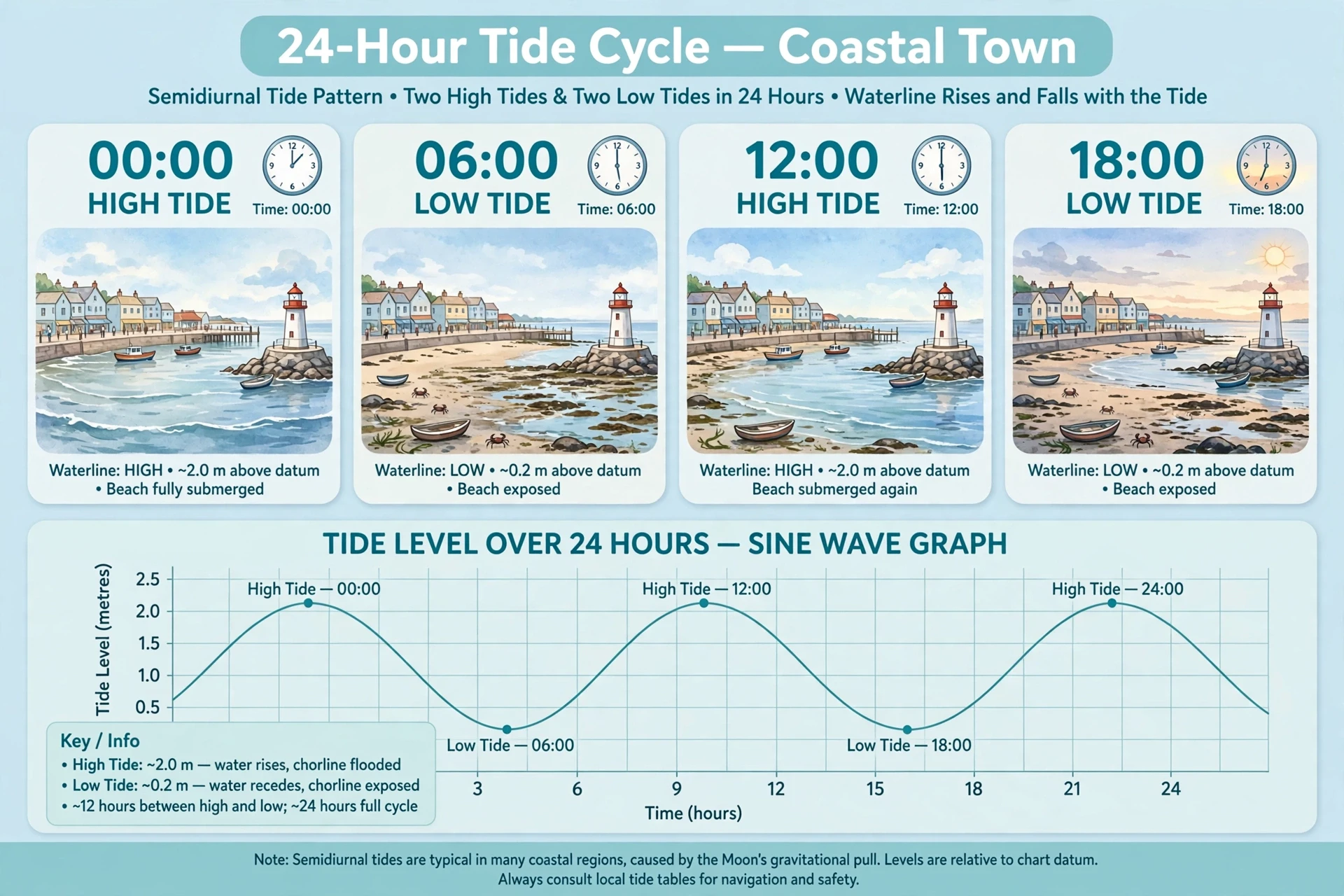
The tides keep lunar time, not solar time. A high tide that arrives at noon today will arrive at nearly one o'clock tomorrow — and the fishermen who work by the tide plan their lives around that slipping clock.
4. The Sun's Role: Spring Tides and Neap Tides
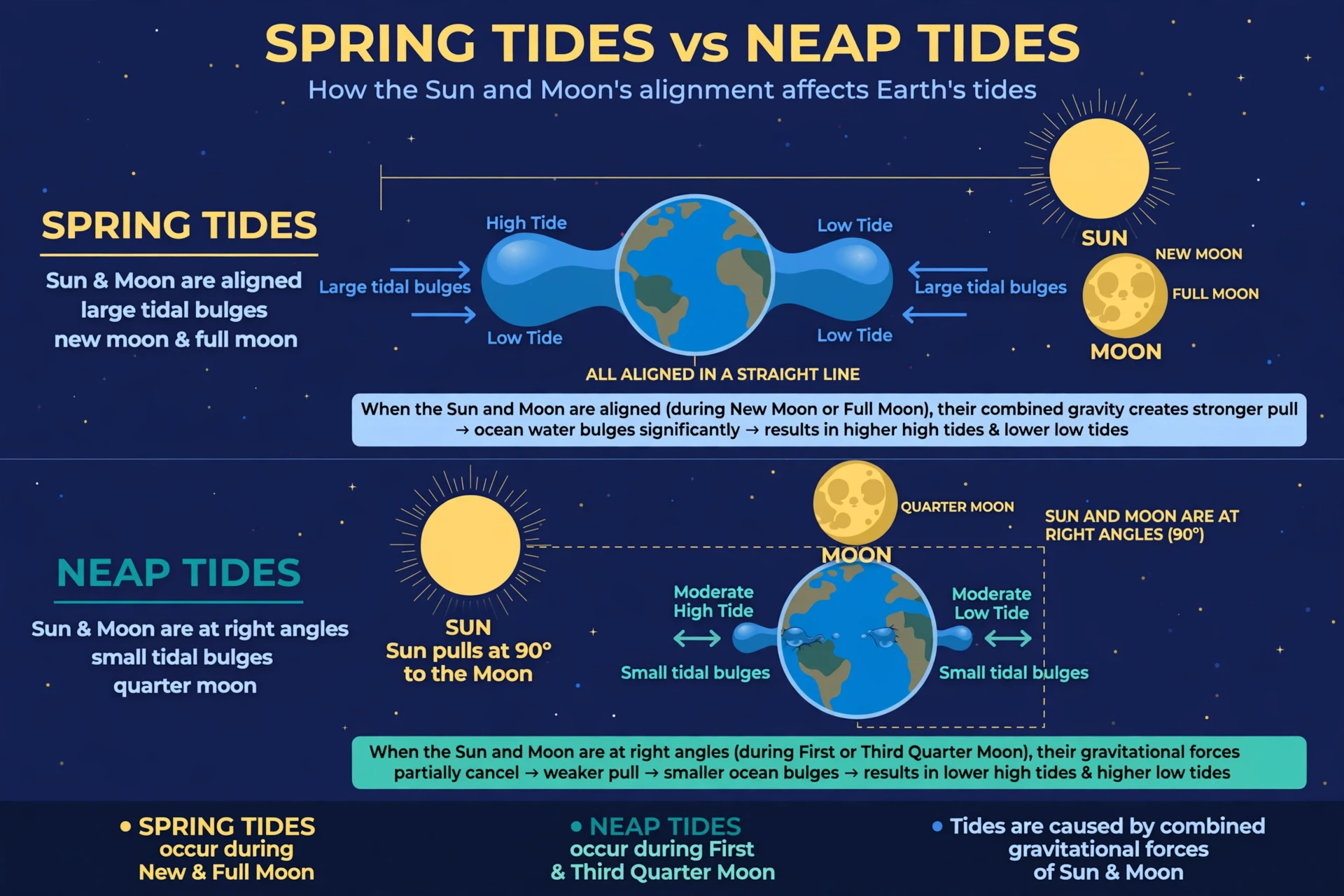
The Moon runs the tides, but the Sun is the junior partner, and twice a month it makes its presence felt. The Sun raises its own pair of tidal bulges, smaller than the Moon's, lined up with the Sun instead of the Moon. Most of the time, the Sun's bulges and the Moon's bulges are pulling in different directions, and their effects partly cancel out. But twice a month, they line up — and when they do, the tides get bigger. Twice a month they pull at right angles — and when they do, the tides get smaller. This monthly rhythm is one of the most satisfying patterns in nature, because you can watch it with your eyes: the biggest tides of the month happen at new moon and full moon, and the smallest happen at the quarter moons.
4.1 Spring tides: when Sun and Moon pull together
When the Sun, the Moon, and the Earth line up in a straight line — which happens at new moon, when the Moon sits between the Earth and the Sun, and at full moon, when the Earth sits between the Sun and the Moon — the Sun's tidal bulges add to the Moon's. High tides get higher, low tides get lower, and the tidal range, the difference between them, grows. These are called spring tides, and the name has nothing to do with the season. It comes from an old word meaning to leap or surge, as in a spring of water — because the tide springs higher.
Spring tides are the times when the sea reaches farthest up the beach and drains farthest down the mudflats. They are the best tides for exploring rock pools, because the low water exposes ground that is normally always underwater. They are also the tides that flood low-lying roads and car parks, and the ones that sailors and engineers watch most carefully. In places with a large tidal range, a spring tide can turn a quiet harbour into a torrent.
4.2 Neap tides: when Sun and Moon pull at right angles
About a week after a spring tide, the Moon reaches its first or third quarter, and the Sun and the Moon are at right angles to each other as seen from the Earth. Now the Sun's bulges partly cancel the Moon's. The Sun is pulling water toward the places where the Moon's bulges are thinnest, and the result is a smaller tidal range: high tides that are not very high, and low tides that are not very low. These are called neap tides, from an old word meaning scanty or lacking power. The sea still rises and falls, but the difference between high and low water shrinks, sometimes to less than half of the spring range.
The cycle repeats every fourteen or fifteen days: spring, neap, spring, neap, following the phases of the Moon. If you want to see the connection for yourself, watch the Moon for a month and note the tides. At full moon and new moon, the biggest tides. At half moon, the smallest. It is one of the few astronomical cycles you can confirm with nothing more than a beach, a notebook, and a little patience. If you are curious about the Moon's phases themselves, the full cycle is worth learning, because it is the calendar the tides keep — see our guide to Moon Phases.
4.3 Spring versus neap at a glance
The contrast between the two is easiest to see side by side.
Feature | Spring tides | Neap tides |
|---|---|---|
Moon phase | New moon and full moon | First quarter and third quarter |
Alignment | Sun, Moon and Earth in a straight line | Sun and Moon at right angles to Earth |
Tidal range | Largest of the month | Smallest of the month |
High water | Higher than average | Lower than average |
Low water | Lower than average | Higher than average |
How often | Twice a month, about every 14–15 days | Twice a month, between the spring tides |
4.4 King tides and perigean spring tides
Every now and then, the spring tides get an extra boost. The Moon's orbit around the Earth is not a perfect circle — it is slightly elliptical — so the Moon is sometimes closer to us and sometimes farther away. When a new or full moon happens to fall at the same time as the Moon is at its closest point to the Earth, a point called perigee, the Moon's pull is stronger than usual, and the spring tides become even higher. These are called perigean spring tides, and the very highest of them are sometimes called king tides.
King tides are not a separate kind of tide. They are simply the biggest spring tides of the year, and they are worth knowing about because they show us the future. A king tide floods the places that will flood regularly as sea levels rise, and coastal planners use them as a preview of what a higher sea will look like. If you see a king tide covering a road or a car park, you are looking at a small sample of a coastline's future.
4.5 The fortnightly beat of the sea
Step back and the whole picture has a rhythm like a heartbeat. Every day, two highs and two lows, slipping fifty minutes later each time. Every fortnight, the range swells to a spring peak and shrinks to a neap minimum. Every month, the Moon swings closer and farther, adding a smaller beat on top. And every year, the Sun's position adds a slow seasonal variation. The tides are not one cycle but many, layered on top of each other like notes in a chord. That is why predicting them takes real mathematics, and why the people who do it — the tide forecasters — need to track dozens of separate components, as we will see in section 8.
5. Why Tidal Range Varies So Much Around the World
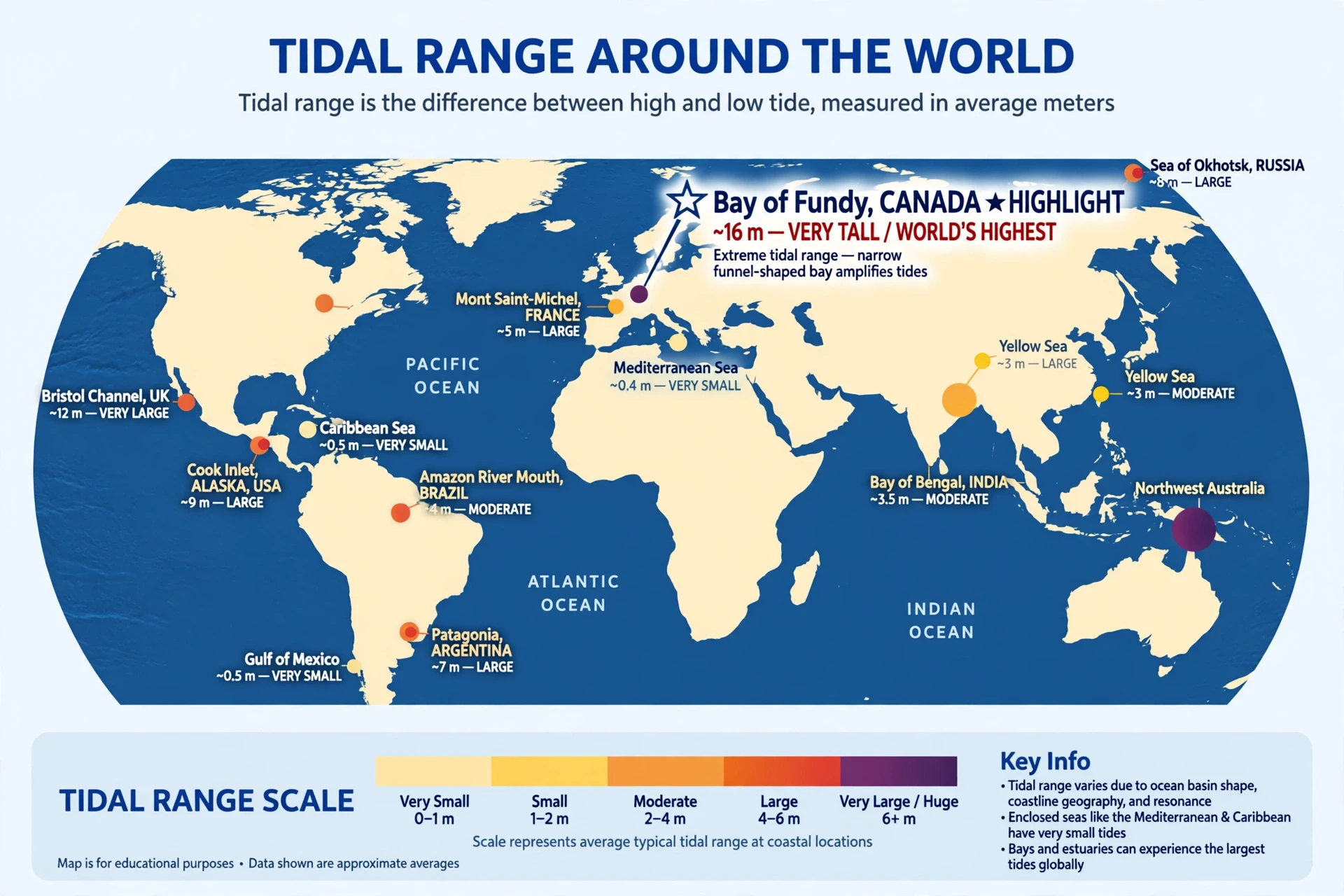
If the Moon and the Sun did all the work, every coast would have roughly the same tides. They do not, and the differences are enormous. The tidal range — the gap between high and low water — can be less than a metre in some seas and more than fifteen metres in a single bay. The reason is geography: the shape of the coastline, the depth of the water, and the size of the basin the tide has to move through. The Moon sets the rhythm, but the land decides the volume.
I once stood on a harbour wall at low tide and watched fishing boats sitting upright in the mud, propped on wooden legs, with gulls walking around their hulls. Six hours later those same boats were floating, and the water was lapping the top of the wall I had been standing on. In the same week, on a different coast, the sea barely seemed to move at all between morning and evening. The Moon was the same. The difference was the shape of the land.
5.1 Resonance: when a bay swings like a swing
The biggest tidal ranges happen in funnel-shaped bays and estuaries that happen to slosh back and forth at almost exactly the same rhythm as the tide itself. Physicists call this resonance, and the everyday version is a child on a swing: push at the right moment, once per swing, and each push adds to the last until the swing is flying high. Push at the wrong moment and the pushes cancel out.
The Bay of Fundy, between Nova Scotia and New Brunswick in Canada, is the classic example. The bay is long, deep, and funnel-shaped, and water takes about six hours to slosh from one end to the other and back — almost exactly the time between one high tide and the next. Each incoming tide arrives just as the water from the last tide is sloshing back, and the two add together. The result is a tidal range of up to about 16 metres (52 feet), the largest in the world. At low tide, the bay floor is a vast expanse of red mud, and the water can retreat for kilometres. At high tide, it comes back as a wall of water that can rise a metre in minutes.
The Severn Estuary in south-west England works the same way, with a range of up to about 15 metres. Cook Strait in New Zealand, the Bay of Saint-Malo in France, and the Gulf of California in Mexico all have large ranges for the same reason: a basin whose natural sloshing period matches the tide. Resonance is why a bay can have a tide ten times larger than the open ocean just outside it.
5.2 Why some seas barely have tides at all
At the other end of the scale are seas that are nearly closed off from the open ocean. The Mediterranean Sea, for example, is connected to the Atlantic only through the narrow Strait of Gibraltar. The tidal wave from the Atlantic has to squeeze through that gap, and by the time it spreads into the vast Mediterranean basin, its energy is spread thin. The result is a tidal range of a few tens of centimetres in most of the Mediterranean — so small that people who grow up on its shores are often surprised the first time they see a real tide.
The Caribbean Sea and much of the open Pacific have small ranges for a different reason: they sit near points where the tidal waves cancel out, or their basins are so large that the tide spreads itself thin. The Baltic Sea, nearly enclosed and shallow, has a range measured in centimetres. Geography can amplify a tide tenfold, and it can silence one almost completely.
5.3 Amphidromic points: where the tide does not move at all
There is an even stranger consequence of geography. In many seas, the tidal wave does not sweep straight across the basin. It rotates around a point, like water swirling around a drain, and at the very centre of that swirl the water does not rise or fall at all. That point is called an amphidromic point — from Greek words meaning "running around both ways" — and the wave rotates around it once per tidal cycle.
The North Sea has several amphidromic points, and the tides rotate around them in a great slow circle. That is why high tide in one part of the North Sea can happen while the water is falling in another part. It is also why tide tables for the North Sea look so complicated: the tide is not a simple wave rolling in from the ocean, but a rotating wave that has been shaped by the coasts of Britain, Norway, the Netherlands, and Denmark. The same rotating pattern appears in the Gulf of Mexico, the seas around Australia, and many other enclosed basins.
5.4 Tidal ranges around the world
A few famous places make the contrast concrete.
Place | Approximate tidal range | Why it is like that |
|---|---|---|
Bay of Fundy, Canada | Up to about 16 m (52 ft) | Funnel-shaped bay in resonance with the tide |
Severn Estuary, England and Wales | Up to about 15 m (49 ft) | Funnel-shaped estuary in resonance; famous tidal bore |
Bay of Saint-Malo, France | Up to about 13 m (43 ft) | Shallow bay with a large tidal basin |
Anchorage, Alaska, USA | Up to about 12 m (40 ft) | Cook Inlet narrows and amplifies the tide |
Open Atlantic coast, USA | About 1–2 m (3–7 ft) | Typical open-coast range |
Caribbean Sea | Less than 0.5 m (under 2 ft) | Near an amphidromic region; small range |
Mediterranean Sea | About 0.1–0.4 m (a few inches to a foot) | Nearly enclosed; tide enters only through Gibraltar |
The lesson is simple and worth remembering: when someone asks how big the tide is, the honest answer is always "where?" The Moon provides the force, but the coastline provides the answer. If you want to understand the tides of a particular place, you have to understand its basin, its depth, and its shape — which is why oceanographers study the tides of each coast as its own problem, and why the study of ocean currents, ecosystems, and depth zones is so closely tied to the tides. Our guide to Oceanography explains how those currents and zones fit together.
6. Not Every Coast Gets Two Tides a Day
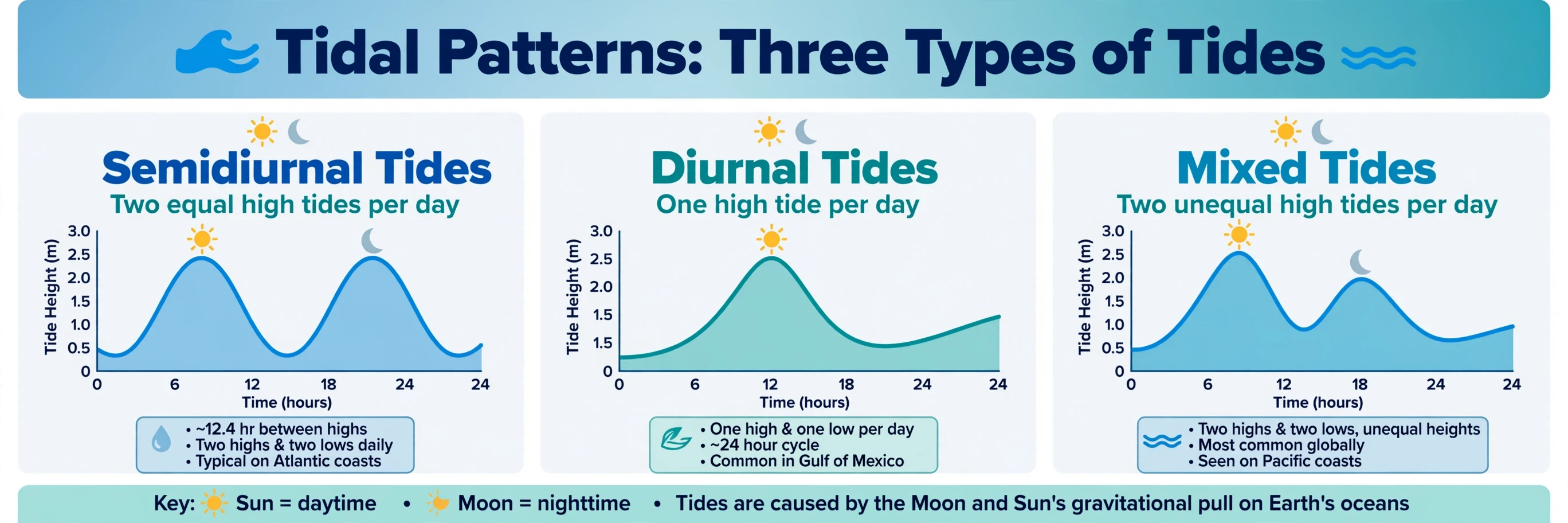
So far we have talked as if every coast gets two high tides and two low tides a day. Most do, but not all. There are three main patterns, and which one a coast gets depends on the shape of its ocean basin and the way the tidal waves interfere with each other there.
6.1 Semidiurnal tides: two highs, two lows
The semidiurnal pattern — two high tides and two low tides of roughly equal height each day — is the most common, and it is what you will find on most of the Atlantic coasts of Europe, Africa, and the Americas, and on much of the east coast of the United States. The name comes from Latin: semi, meaning half, and diurnal, meaning daily. Two tides per day, each about half a day apart.
6.2 Diurnal tides: one high, one low
Some coasts get only one high tide and one low tide each day. This diurnal pattern is found in parts of the Gulf of Mexico, in some places around south-east Asia, and in a few spots in the Caribbean. The reason is interference: the two daily tidal waves — one from each bulge — arrive at different times and in different strengths, and in some basins they cancel each other out almost completely, leaving a single daily rise and fall. The water still moves, but the second tide has been erased by the shape of the basin.
6.3 Mixed tides: two highs, but unequal
The third pattern is the most common on the Pacific coast of North America. Mixed tides give you two high tides and two low tides a day, but the two high tides are very different in height — one high, high tide and one low, high tide — and the two low tides are different too. On some days, the difference is so large that one of the low tides barely looks like a low tide at all. This is the pattern you will find from California to Alaska, and in many parts of Australia and south-east Asia.
There is a practical reason to know which pattern your coast follows. If you are planning a boat trip, a beach walk, or a fishing trip, the number and the heights of the tides matter as much as their times. A coast with mixed tides can have a very high high tide followed by a very low low tide — a range of several metres in a single day — and the second high tide may be too low to float a boat that the first one floated easily.
7. Tides in Motion: Currents, Bores, and the Life They Carry
Tides are not just a rising and falling water level. They are a movement of water, and moving water carries things: sediment, nutrients, larvae, and heat. The tidal currents that flow in and out of estuaries are among the strongest regular currents in the ocean, and they shape the coast in ways that are easy to see if you know what to look for.
7.1 Tidal currents and the stirring of the sea
When the tide floods into a narrow channel, the water has to squeeze through a small space, and it speeds up. In some straits, tidal currents run at several metres per second — fast enough to carry a swimmer away and strong enough to scour the sea floor clean of fine sediment. When the tide turns, the current slows, stops, and reverses. That constant back-and-forth stirs the water from top to bottom, mixing cold deep water with warm surface water and carrying nutrients up into the sunlight where plankton can use them.
This stirring is one of the reasons estuaries and tidal flats are so productive. Twice a day, the tide delivers a fresh supply of oxygen and nutrients, and twice a day it carries waste away. The mudflats that look empty at low tide are in fact crowded with worms, clams, and crabs, and the birds that crowd onto them at low tide are there to feed on that hidden abundance. Without the tides, the whole system would be quieter, poorer, and less alive.
7.2 Tidal bores: when the tide arrives as a wave
In a few rivers around the world, the incoming tide does not creep up the channel. It arrives as a single breaking wave, sometimes several metres high, that rolls upstream against the river's flow. This is a tidal bore, and it happens where a river is shallow, funnel-shaped, and has a large tidal range at its mouth.
The most famous bore is on the Qiantang River in China, where the wave can reach several metres in height and travel at the speed of a galloping horse. The Severn Bore in England is smaller — usually one to two metres — but it draws crowds of surfers who ride it for kilometres upstream. Bores also occur on the Amazon, on rivers in Alaska and Malaysia, and in a handful of other places. They are a reminder that a tide is a wave, and under the right conditions it behaves like one.
I have never surfed a bore, but I have stood on a riverbank and watched one arrive: a low rumble, a line of white water stretching from bank to bank, and then the whole river seeming to change direction at once. It was over in a minute, and the river went back to flowing the other way. The tide had come in, not as a slow rise but as a single, visible event.
7.3 The intertidal zone: life between two worlds
The strip of shore between the high-tide mark and the low-tide mark is called the intertidal zone, and it is one of the hardest places on Earth to live. Twice a day, everything there is underwater. Twice a day, it is exposed to the air, the sun, and the wind. Animals that live there — barnacles, mussels, limpets, crabs, and sea stars — have to survive being baked, dried out, battered by waves, and then drowned again, every single day. They do it with shells that seal shut, with bodies that cling to rock, and with the ability to slow their metabolism to almost nothing until the water returns.
The intertidal zone is also where the tide's schedule becomes a matter of life and death for people. Rock pools are only safe to explore at low water, and the window closes fast as the flood comes in. Tide pools at places like Acadia National Park in Maine, where the tidal range is large and the pools are rich with life, are a favourite of visitors — and the park's guidance is simple: watch the tide, know when it turns, and never turn your back on the sea. US National Park Service
8. How We Measure and Predict Tides
For all their power, tides are remarkably predictable. That is because they are driven by astronomy — by the positions of the Moon and the Sun, which we can calculate far into the future — and because the local shape of each coast, while complicated, does not change much from year to year. A tide table for next year is usually accurate to within a few centimetres, and that predictability is what makes tides so useful to sailors, engineers, and scientists.
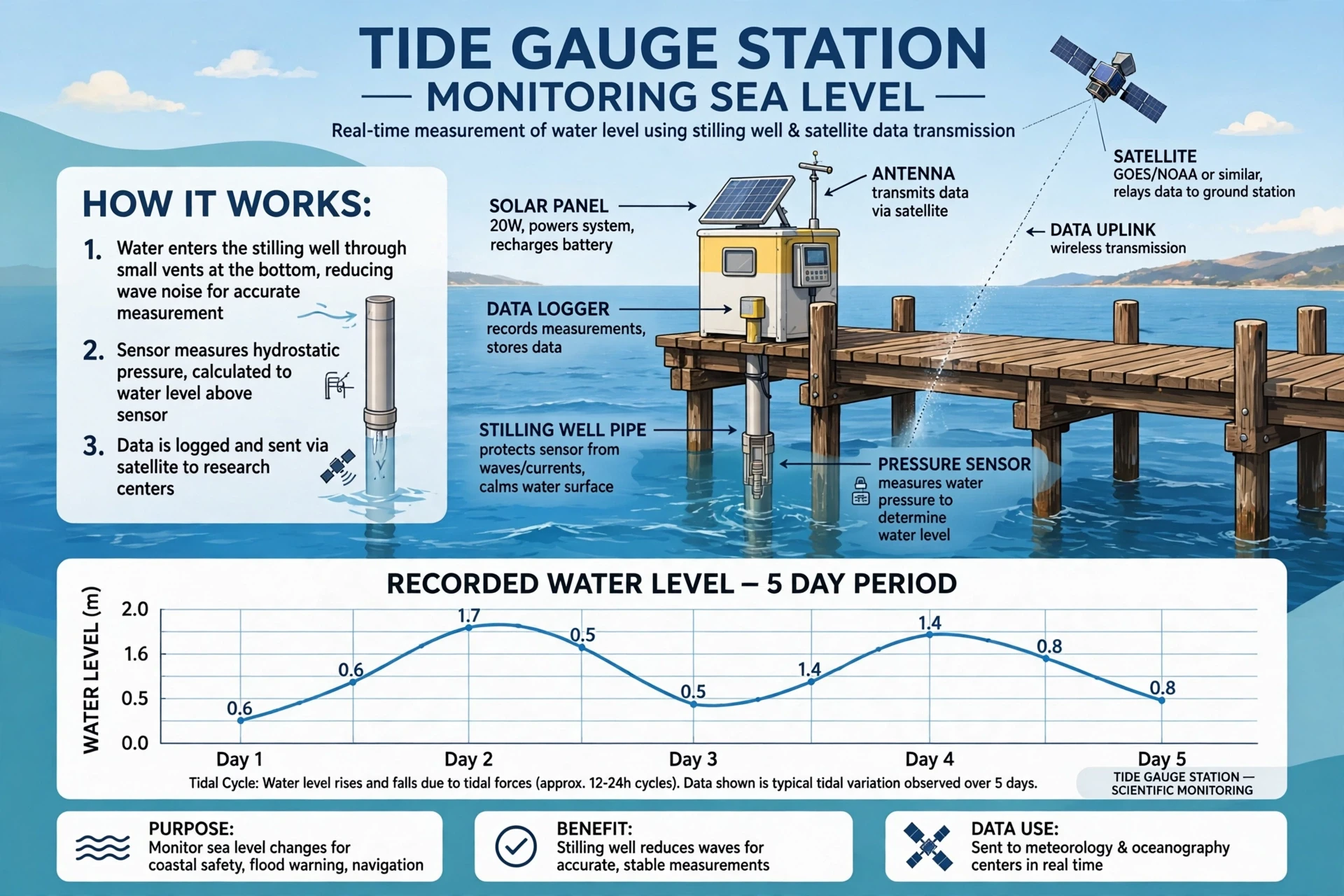
8.1 Tide gauges: listening to the sea
The workhorse of tide measurement is the tide gauge, a station that records the height of the water continuously, day and night, year after year. The oldest gauges were simple wells connected to the sea, with a float inside that rose and fell with the water and a pen that traced the movement on a rotating drum of paper. Modern gauges use pressure sensors, radar, and acoustic instruments, and they send their data by satellite in near real time. The United States network of tide gauges, run by NOAA's Center for Operational Oceanographic Products and Services, provides the data that ships, ports, and coastal communities rely on every day. NOAA Tides and Currents
Those long records are precious for another reason: they are one of the best measurements we have of sea-level change. A tide gauge that has been running for a hundred years can show, centimetre by centimetre, how the sea has risen over that time — and how the tides themselves are slowly changing as the water gets deeper. Some of the longest records in the world, going back to the nineteenth century, are still running today.
8.2 Harmonic analysis: breaking the tide into parts
Predicting a tide is not a matter of guessing. It is a matter of arithmetic, and the method is called harmonic analysis. The idea is that the tide at any place is the sum of many separate, regular cycles, each one caused by a different piece of the astronomy: the Moon's orbit, the Sun's pull, the tilt of the Earth's axis, the shape of the Moon's orbit, and dozens of smaller effects. Each cycle is called a tidal constituent, and each one has its own period and its own size at a given place.
Forecasters measure the tide at a place for a year or more, work out the size and timing of each constituent from that record, and then add them all back together to predict the future. The largest constituent is called M2, the principal lunar semidiurnal constituent, and it repeats every twelve hours and twenty-five minutes — the Moon's half-day. There are dozens of others, with names like S2, N2, and K1, each contributing a smaller piece. Add them all up, and you get the tide table. NOAA's tide tutorials explain the method step by step, and they are a good place to go deeper if the mathematics interests you. NOAA Ocean Service Tides Tutorial
8.3 Why predictions sometimes miss
Even the best prediction is not perfect. Weather can push the water around: a strong onshore wind can pile water up against a coast, and low air pressure can let the sea rise a little higher than predicted. A storm surge can add a metre or more on top of a high spring tide, and that combination is when coastal flooding happens. Tide tables predict the astronomical tide — the part caused by the Moon and the Sun. The weather adds its own layer on top, and forecasters watch both.
9. Tidal Power: Making Electricity from the Moon
If the tides move that much water, twice a day, on a schedule you can set your watch by, it is only natural to ask whether we can turn that movement into electricity. The answer is yes — and the idea is older than you might think. Tide mills, which used the rising and falling water to grind grain, were built in Europe as far back as the Middle Ages. Modern tidal power is the same idea, scaled up and electrified.
9.1 How a tidal barrage works
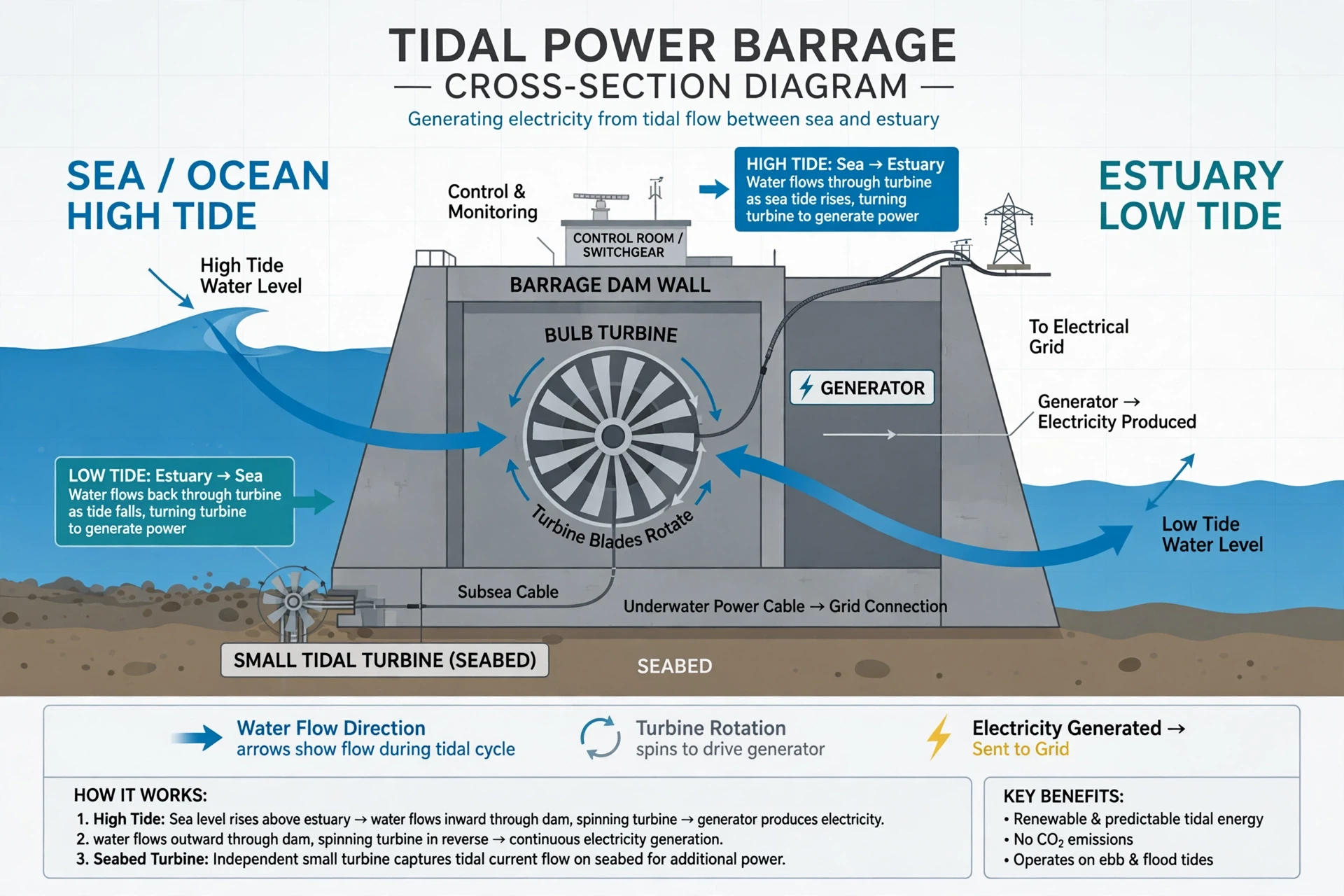
The simplest way to harvest tidal energy is a tidal barrage: a dam built across an estuary or bay, with turbines set into it. When the tide comes in, water flows through the turbines into the basin behind the barrage, spinning them and generating electricity. When the tide goes out, the water flows back through the turbines in the other direction, generating electricity again. The basin acts like a battery, storing the tide's energy for a few hours and releasing it through the turbines.
The largest tidal barrage in the world for many years was La Rance, in Brittany, France, which opened in 1966 and still generates electricity today. The Sihwa Lake station in South Korea, opened in 2011, is larger still. Both prove that the technology works and can run for decades. The challenge is not the engineering. It is the economics and the environment: barrages are expensive to build, and they change the estuary they sit in, altering the tides, the sediment, and the habitat of the fish and birds that live there.
9.2 Tidal stream turbines: the newer idea
A newer approach avoids the dam altogether. Tidal stream turbines sit on the sea floor in places where the tidal current is strong — in narrow channels and straits — and spin like underwater wind turbines as the water flows past, first one way and then the other. They are smaller than a barrage, they can be installed one at a time, and they leave the estuary largely unchanged. Projects in Scotland, Wales, France, and Canada have been testing them for years, and the results are promising, though the technology is still young and the machines have to survive in one of the harshest environments on the planet: salt water, strong currents, and storms.
9.3 Why tidal power is attractive — and why it is rare
Tidal power has one advantage that no other renewable energy source can match: it is perfectly predictable. The Sun does not always shine, and the wind does not always blow, but the tides will arrive on schedule for as long as the Moon orbits the Earth. A tidal power station's output can be calculated years in advance, to the minute. That predictability is enormously valuable to a power grid that has to balance supply and demand every second of the day.
The reason tidal power is still rare is geography. Only a few places in the world have a tidal range large enough and a site suitable enough to make a barrage or a turbine farm worthwhile. Building in the sea is expensive, and the environmental effects have to be weighed carefully. Tidal power will probably never supply as much electricity as wind or solar. But for the coastal communities that have the right geography, it is a reliable, clean, and endlessly renewable source — powered, quite literally, by the Moon.
The tides are the only renewable energy source you can set your watch by. The wind may fail and the clouds may come, but the Moon will keep the sea moving on schedule for as long as it orbits the Earth.
10. The Moon Is Drifting Away — and the Tides Are the Reason
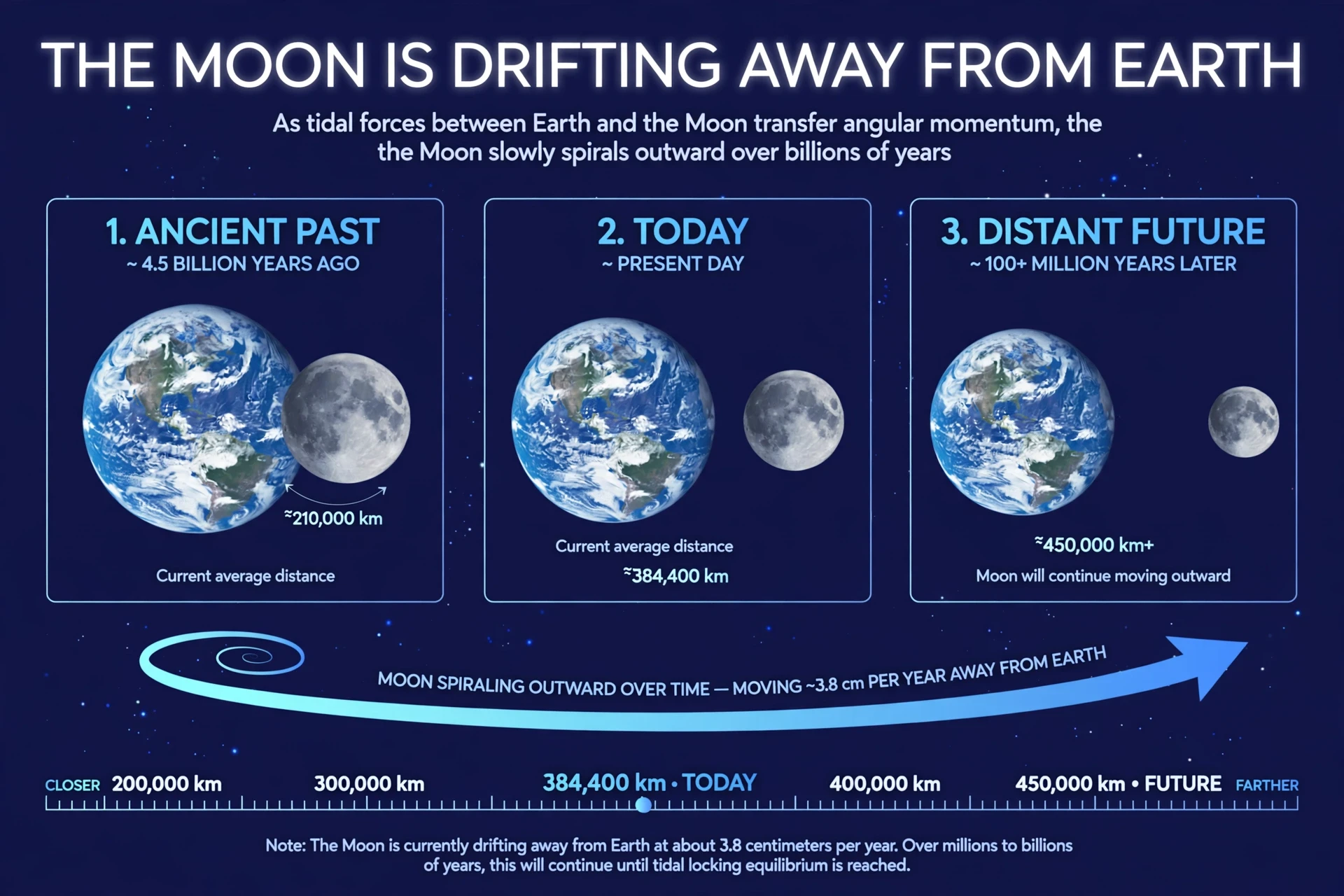
Here is the slowest drama in this story, and the strangest. The Moon is moving away from the Earth at a rate of about 3.8 centimetres per year — roughly the speed at which your fingernails grow. It does not sound like much, but over millions of years it adds up: a hundred million years ago, the Moon was thousands of kilometres closer than it is today, and the tides were stronger. And the tides themselves are the reason the Moon is leaving.
10.1 Friction, the bulge, and the slow push
Remember the lag we met in section 3: the tidal bulge does not line up exactly with the Moon, because friction drags it a little ahead. That offset bulge pulls on the Moon, and because it sits slightly ahead of the Moon in its orbit, its gravity tugs the Moon forward, speeding it up. A faster Moon moves into a higher orbit — just as a satellite speeds up to climb — and so the Moon drifts away, a few centimetres at a time.
The same friction is slowing the Earth down. The Moon's gravity pulls back on the bulge, and that pull acts like a brake on the Earth's rotation. The day is getting longer by about 1.7 milliseconds per century — a tiny amount, but it adds up over geological time. Hundreds of millions of years ago, the day was shorter, the Moon was closer, and the tides were far larger than anything we see today. The evidence is written in rocks: ancient tidal deposits, laid down in shallow seas long ago, preserve the rhythm of tides from hundreds of millions of years ago, and they show a faster-spinning Earth and a closer Moon. The physics behind all of this is the same gravity that holds the planets in their orbits, and the full story of that force is worth reading on its own — see our guide to How Gravity Works.
10.2 What happens to the tides as the Moon recedes
As the Moon drifts farther away, its tide-raising force weakens. The tides will slowly get smaller, the days will slowly get longer, and the whole Earth-Moon system will inch toward a distant state in which the Earth's rotation and the Moon's orbit are locked together — the same face of the Earth always turned toward the Moon, just as the Moon already always shows the same face to us. That state is tens of billions of years away, far longer than the Sun will live, so it will never actually happen. Long before that, the Sun will swell and change, and the Earth-Moon story will end for other reasons. But the direction of travel is clear, and it has been clear for billions of years: the Moon is leaving, the tides are pushing it away, and every tide you watch is a small part of that long goodbye.
There is something quietly moving about that. The same force that lifts the sea onto the beach twice a day is also, very slowly, taking the Moon away from us. The tides are not just a curiosity of the coast. They are the visible edge of a planetary-scale exchange of energy and angular momentum, one that has been running since the Moon formed and will keep running for as long as both bodies exist. NASA's Moon pages describe the Earth-Moon relationship and the forces between the two worlds in more detail, and they are a good next stop if this story has caught your imagination. NASA Moon
11. Common Misconceptions About Tides
Tides are familiar, and familiar things collect myths. Here are the ones I hear most often, and what the evidence actually says.
"The Moon's gravity pulls the water up on the near side, and that is the whole story." As we saw in section 2, there are two bulges, not one. The far-side bulge is caused by the Earth being pulled away from its own far-side water, and it is just as real as the near-side one. Without it, there would be only one high tide a day.
"High tide happens when the Moon is directly overhead." Usually it does not, because the tidal bulge lags behind the Moon. Friction with the sea floor and the shape of the ocean basins delay the tide, sometimes by hours. Tide tables, not the Moon's position in the sky, tell you when high water will arrive at your beach.
"The Sun has nothing to do with tides because it is too far away." The Sun's tide-raising force is about half the Moon's, and it is the reason spring tides are bigger than neap tides. Ignore the Sun and you cannot explain why the biggest tides of the month fall at new and full moon.
"Tides are just big waves." Waves are wind-driven surface movements that last seconds. Tides are gravity-driven movements of the whole ocean that last hours. They are different phenomena, and they can exist independently: you can have a flat calm sea with a ten-metre tide, and you can have huge waves on a coast with almost no tide.
"The tide comes in at the same time every day." It comes in about fifty minutes later each day, because the Moon moves along its orbit while the Earth spins. A tide table from last week will be wrong by hours this week.
"Tidal power could replace all other energy sources." Tidal power is clean and perfectly predictable, but only a few places have the geography to make it work at scale. It is a valuable part of the energy mix, not a replacement for everything else.
"The Moon will fly away and the tides will stop." The Moon is drifting away very slowly, and the tides are weakening very slowly, but the process takes billions of years. The tides will be with us for as long as the Earth and the Moon exist in anything like their present form.
Most people assume the tides are a simple story — the Moon pulls, the water rises. What the measurements show is richer: two bulges, a lagging wave, a Sun that helps twice a month, and coastlines that can turn a gentle rise into a fifteen-metre flood. The simple version is not wrong. It is just unfinished.
Frequently Asked Questions
How do tides work in simple terms?
The Moon's gravity pulls the oceans out of shape, stretching them into two bulges — one facing the Moon and one on the far side. As the Earth spins, each coastline passes through both bulges, so most coasts get two high tides and two low tides a day. The Sun adds a smaller pull that makes the tides bigger at new and full moon and smaller at the quarter moons.
Why are there two high tides a day instead of one?
Because there are two tidal bulges, one on each side of the Earth. The near-side bulge is caused by the Moon pulling the water toward it more strongly than it pulls the solid Earth. The far-side bulge is caused by the Moon pulling the solid Earth toward it more strongly than it pulls the far-side water. As the Earth rotates, a coastline passes through both bulges in one day.
What is the difference between spring tides and neap tides?
Spring tides happen at new moon and full moon, when the Sun, Moon, and Earth line up and their pulls add together, giving the largest tidal range of the month. Neap tides happen at the quarter moons, when the Sun and Moon pull at right angles and partly cancel each other, giving the smallest tidal range of the month.
Why does the Bay of Fundy have the biggest tides in the world?
The Bay of Fundy is long, deep, and funnel-shaped, and water takes about six hours to slosh from one end to the other and back — almost exactly the time between high tides. Each incoming tide arrives just as the previous water is sloshing back, and the two add together in resonance, producing a range of up to about 16 metres.
How far away is the Moon drifting, and will the tides disappear?
The Moon is drifting away from the Earth at about 3.8 centimetres per year, pushed outward by the friction of the tides. The tides are slowly weakening as a result, but the change is tiny on human timescales. The tides will continue for billions of years, far longer than any human concern.
Can tides be used to generate electricity?
Yes. Tidal barrages generate electricity as water flows through turbines on the flood and ebb tides, and tidal stream turbines spin on the sea floor in strong tidal currents. Tidal power is clean and perfectly predictable, but only a few places have the geography to make it practical at large scale.
Why do tides arrive about 50 minutes later each day?
Because the Moon moves along its orbit while the Earth spins. By the time a coastline has rotated all the way around, the Moon has moved about thirteen degrees farther along, and the Earth needs another fifty minutes of rotation to catch up. Tides keep lunar time, not solar time, so the whole cycle runs twenty-four hours and fifty minutes.