
1. The Variant That Wasn't There Yesterday
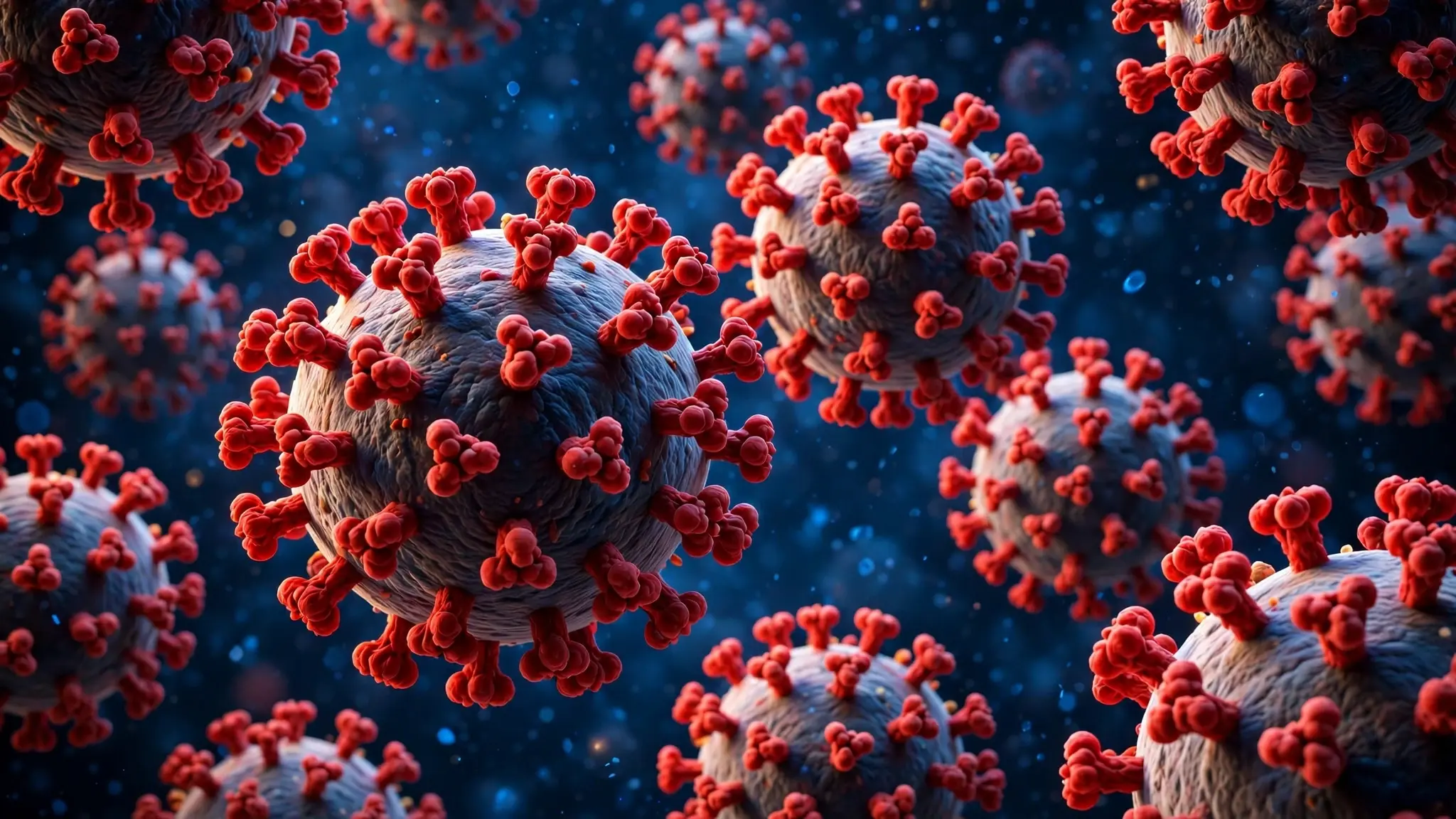
In late November 2021, scientists in South Africa uploaded a coronavirus genome to a public database — and the world noticed within hours. The new virus, soon named Omicron, carried roughly fifty mutations compared with the original virus from Wuhan, more than thirty of them in the spike protein alone.
It was, in genetic terms, a stranger. This section opens with that moment, because it is the clearest picture we have of virus evolution happening in real time, in front of everyone.
I still remember the evening the news broke. I was scrolling through a science news feed when a headline stopped me: a new variant, heavily mutated, spreading fast in Gauteng province. Within days, the same story was everywhere — border closures, emergency meetings, and a word that suddenly entered everyday conversation: variant. People asked the same question in a dozen different ways. Where did it come from? How could a virus change that much, that fast? And would the vaccines still work?
The short answer is that viruses are built to change. They copy themselves in enormous numbers, they copy sloppily, and the copies that work best spread. That is virus evolution, and it never pauses: not during a pandemic, not during flu season, not while you read this sentence. The longer answer — how the copying works, why some viruses change faster than others, and what the changes mean for vaccines, pandemics, and the future — is the subject of this article.
1.1 Fifty mutations overnight
Omicron did not appear out of nowhere, though it looked that way. Its genome, B.1.1.529, diverged from the other known lineages in mid-2020, then vanished from the surveillance record for more than a year before reappearing in November 2021 with a long list of accumulated changes. Researchers still debate where it spent that missing year — possibly circulating undetected in a region with little sequencing, possibly evolving inside a single person with a long-lasting infection. Either way, the lesson was the same: a virus can gather dozens of mutations out of sight and arrive, fully formed, as a new problem.
The number that shocked people was not fifty. It was thirty-two — the count of mutations in the spike protein, thirty of them changing the amino acids. The spike protein is the part of the virus that vaccines train the immune system to recognise. Spike is the virus's key to our cells and the immune system's favourite target, so changes there matter more than changes elsewhere. Omicron's spike was different enough that antibodies built against the original virus recognised it poorly, and infections surged even among the vaccinated. Yet the variant was, on average, less severe than Delta, the variant it replaced — a reminder that virus evolution does not move in one direction, toward deadlier or milder, but toward whatever spreads best.
What made Omicron possible was not a single dramatic event. It was the ordinary machinery of virus evolution: copying errors, selection, and time. The same machinery produced Alpha, Beta, Gamma and Delta before it, and it produces new flu strains every year. To understand it, you have to start with the copying itself.
1.2 Why this question keeps coming back
Most people first meet virus evolution as a practical annoyance. The flu shot changes every year. A COVID booster is reformulated. A drug that worked against HIV in one patient can stop working within a few years. Each of these is the same story told in a different setting: the virus changed, and medicine had to change with it.
The question also carries a deeper confusion. People hear that viruses "mutate to evade vaccines" and picture a scheming enemy, deliberately outwitting us. That picture is wrong in an important way. Viruses do not plan, and they do not want anything. They copy themselves, and copying is never perfect. Most of the copies are worse than the original. A few happen to work better in the environment they find themselves in — a population with partial immunity, a new host species, a drug in the bloodstream — and those few are the ones that spread. Virus evolution is the name we give to that winnowing, not to any intention behind it.
There is a third reason the question matters, and it is the one this article keeps returning to. Viruses are not a sideshow in the history of life. They are its oldest and most numerous players, and their evolution has shaped ours — literally. About eight percent of the human genome is made of the remains of ancient retroviruses, and one of those viral genes builds the placenta. To understand virus evolution is to understand a force that has been editing our own DNA for hundreds of millions of years.
1.3 What this article will do
The plan is simple. First, the mechanics: how viruses copy themselves, where the errors come from, and why RNA viruses mutate so much faster than DNA viruses. Then the big ideas: quasispecies, recombination, and the difference between drift and shift. Then the case studies that make the theory concrete — SARS-CoV-2, HIV, influenza — followed by the stranger stories: viruses that jump species, viruses that barely change at all, and viruses that became part of us. The article closes with the practical question: given that viruses will keep evolving, how do we keep up?
Along the way, the article follows the same ground rules as the rest of this series. Every number that matters is tied to a real source — the World Health Organization, the Centers for Disease Control and Prevention, peer-reviewed papers — and the sources are listed at the end, with clickable links. Where scientists disagree, the article says so. And where the science is genuinely uncertain, it says that too.
2. What Is Virus Evolution?
Virus evolution is the change in a virus's genetic material over time, driven by mutation and shaped by natural selection. A virus copies itself inside a host cell; the copying introduces errors; most errors do nothing or harm the virus, but a few improve its chances of spreading, and those few become more common.
This section defines the terms — mutation, variant, strain — and sets out the three ingredients every evolving virus needs.
Start with the simplest possible picture. A virus is a package of genetic instructions — DNA or RNA — wrapped in protein, sometimes with a fatty envelope stolen from a host cell. Outside a cell it does nothing: no eating, no growing, no energy. Inside a suitable cell, it takes over the machinery and turns the cell into a virus factory. A single infected cell can release thousands of new virus particles, and a single infected person can carry billions. Virus evolution needs three ingredients — replication, variation, and selection — and viruses have all three in abundance.
Replication is the copying. Variation comes from the errors made during copying, plus the shuffling of genetic material when two viruses meet in the same cell. Selection is the winnowing: the copies that infect more cells, spread to more people, or survive longer in the environment leave more descendants. Nothing about this requires the virus to be alive in the sense a bacterium is alive. It only requires a copying process that is imperfect and a world that rewards some copies over others. That is why the question "are viruses alive?" — argued over for a century — matters less than it seems. Whether or not you call them living things, they evolve, and they evolve faster than anything else on Earth.
The speed is the point. A human generation takes decades. A bacterium divides in minutes but proofreads its DNA carefully. An RNA virus can complete a replication cycle in hours, make a mistake roughly once in every ten thousand letters copied, and produce billions of copies per infection. The result is a pace of change that lets a virus explore, in weeks, genetic possibilities that would take a mammal millions of years to reach. That is the engine behind every story in this article.
2.1 Mutation, variant, strain — three words, three meanings
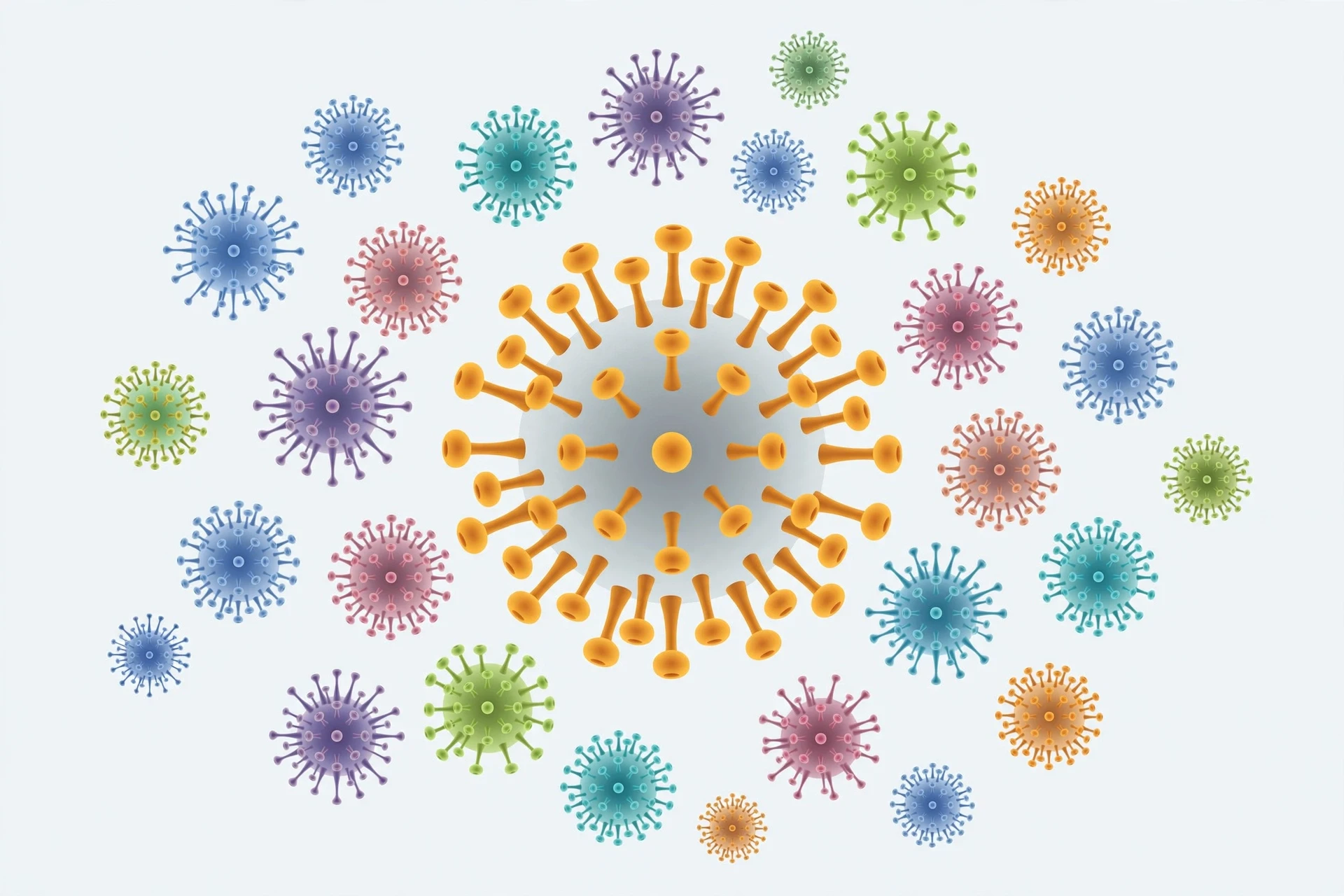
People use mutation, variant and strain as if they meant the same thing. They do not, and the distinction matters, because the news uses all three and the differences explain why some changes are trivial and others are not.
A mutation is a change in the genetic sequence: one letter swapped, added, or deleted. It is the smallest unit of virus evolution, and it happens constantly. A variant is a virus that carries one or more new mutations compared with the original — in other words, a version of the virus with a measurably different genome. A strain is a variant that has also shown different behaviour — it spreads differently, causes different disease, or escapes immunity — and has become established in a population.
"This process of changing and selection of successful variants is called 'virus evolution.'"
That definition comes from the World Health Organization, and it is worth pausing on, because it contains the whole argument in one sentence: change, then selection. Mutation supplies the change. Selection decides which changes survive. Neither half alone is virus evolution.
"In short, all strains are variants, but not all variants are strains."
That line, from the Wellcome Trust's explainer on variants, is the practical rule. Thousands of variants appear and vanish without ever mattering. A variant becomes a strain — and may earn a Greek letter, a news cycle, or a new vaccine — only when its mutations change something real about how the virus behaves. Most do not. The ones that do are the subject of most of this article.
2.2 The three ingredients
Every case of virus evolution in this article runs on the same three ingredients, and it helps to name them once, clearly.
First, replication at scale. A virus that makes a million copies has a million chances to change. HIV produces roughly ten billion new virus particles every day inside a single untreated person. SARS-CoV-2, at the peak of infection, can reach similar numbers. Even if only one copy in ten thousand carries a meaningful mutation, the daily output of a single infection contains around a million mutants. Across millions of infections, the numbers become astronomical. This is why the more a virus circulates, the more it changes — the WHO's own guidance puts it plainly: the more viruses circulate, the more they may change.
Second, variation. Errors during copying are the main source, but not the only one. Host enzymes can edit viral genomes — our own APOBEC proteins, for example, deliberately introduce mutations into invading viral DNA as a defence, and sometimes the virus survives the editing and carries the changes forward. Ultraviolet light and reactive chemicals damage viral genomes too. And when two related viruses infect the same cell, they can swap whole stretches of genetic material, producing combinations neither parent had. Variation is the raw material; without it, selection has nothing to select.
Third, selection. A mutation that helps a virus enter cells faster, escape an antibody, or survive longer in the air will, on average, produce more copies than a mutation that does not. The advantage does not need to be large. A variant that spreads even a few percent faster than its rivals will, over weeks of exponential growth, take over a population. This is how Delta replaced Alpha, and how Omicron replaced Delta — not by being dramatically different in any single respect, but by being slightly better at the things that matter, compounded over millions of infections. The same logic, running in the opposite direction, explains why most mutations vanish: they make the virus worse at its job, and selection removes them.
2.3 Where virus evolution fits in biology
Virus evolution is natural selection, the same process that shapes finches and flowers — and the same process described in our article on natural selection. The difference is the timescale and the substrate. Cellular life evolves by changing DNA that is copied with elaborate proofreading and repair. Many viruses use RNA instead, copy it with sloppy enzymes, and skip the repair entirely. The result is the same process running at a speed that makes its workings visible within a human lifetime — sometimes within a single flu season.
That visibility is what makes viruses the best teaching tool for virus evolution. You can watch a flu virus drift away from last year's vaccine in real time. You can sequence a patient's HIV over months and watch drug resistance evolve, mutation by mutation. You can track a pandemic variant from its first genome to global dominance in a matter of weeks. No other branch of biology offers that. It is also what makes virus evolution a practical problem rather than an abstract one: the same speed that makes viruses fascinating makes them hard to pin down with vaccines and drugs designed against yesterday's version.
There is one more thing to fix in the reader's mind before moving on. Virus evolution is not the same as a virus "becoming more dangerous". Virus evolution favours transmission, not severity. A virus that kills its host quickly has less time to spread than one that keeps its host walking around, coughing, and meeting people. That does not mean viruses always become milder — sometimes a mutation that improves transmission also happens to cause worse disease, and sometimes severity is simply irrelevant to spread — but the direction of selection is toward spreading, and severity follows only when it helps, or at least does not hinder, that goal. This distinction will return in the sections on SARS-CoV-2, HIV, and influenza, where it explains several things that look paradoxical at first glance.
3. The Copy Machine That Makes Mistakes
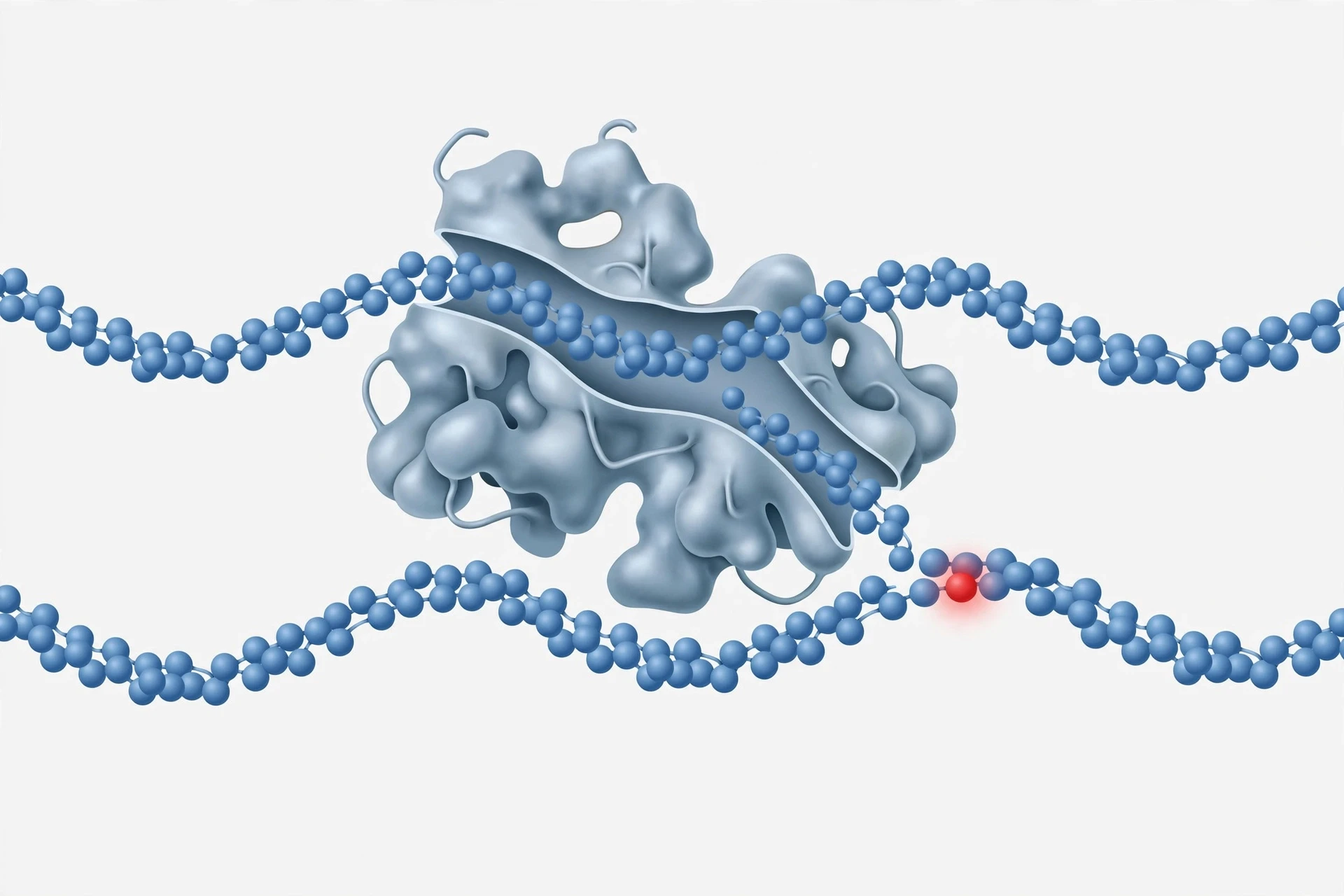
Every new virus begins as a copy, and every copy is a chance to change. Viral polymerases — the enzymes that duplicate the genome — make errors at rates that would horrify a cell: roughly one mistake per ten thousand letters for RNA viruses, against one in a hundred million or better for the DNA copying in our own cells.
This section explains why the copying is so sloppy, how much it varies between virus families, and why the errors are the raw material of virus evolution rather than a defect in it.
The comparison that makes the scale clear is with your own cells. When a human cell copies its DNA before dividing, it uses a polymerase with a built-in proofreader — a 3′-to-5′ exonuclease that checks each newly added letter, removes the wrong ones, and tries again — followed by a separate repair system that scans the finished copy. The combined error rate is around one mistake per billion letters. A virus that copied that accurately would barely evolve at all. Most viruses do the opposite: they copy fast, check little, and accept the errors as the price of speed.
That price is not an accident. It is a trade-off, and understanding the trade-off is the key to the whole subject. A polymerase that proofreads is slower. A virus that replicates slowly produces fewer copies, and fewer copies means fewer chances to infect the next cell or the next host. In the race between a careful virus and a sloppy one, the sloppy one usually wins — as long as it does not make so many errors that its genome falls apart. That upper limit exists, and it has a name: the error threshold. It is the subject of the next section. For now, the point is that the high mutation rate of viruses is not a flaw in their design. It is the design.
3.1 RNA viruses and the missing proofreader
The fastest-evolving viruses are RNA viruses, and the reason is structural. Their genomes are made of RNA, and they copy it with an enzyme called RNA-dependent RNA polymerase. In most RNA viruses, that enzyme has no proofreading function at all. It reads the template, adds the matching letter, and moves on — and when it adds the wrong letter, the mistake becomes part of the new genome. Reviews of viral mutation rates put the error rate for these enzymes at roughly one mistake per ten thousand to one hundred thousand nucleotides copied, and for a typical RNA virus genome of ten thousand to thirty thousand letters, that works out to roughly a tenth of a mutation to three mutations in every new genome — typically around one mutation per genome or fewer.
The list of RNA viruses reads like a catalogue of the diseases that change fastest: influenza, HIV, SARS-CoV-2, Ebola, measles, rabies, dengue. All of them copy their genomes with the same sloppy machinery, and all of them evolve quickly. But there is an important exception, and it explains a great deal about the COVID-19 pandemic. Coronaviruses are RNA viruses with unusually large genomes — SARS-CoV-2 has about 29,903 letters, roughly twice the size of a flu virus genome — and they carry a proofreading enzyme, called NSP14, that corrects some copying errors. That proofreader is probably what allows coronaviruses to maintain such large genomes at all: without it, the error load would be fatal. It also means SARS-CoV-2 evolves more slowly than flu or HIV — about one thousandth of a substitution per site per year, or roughly two to three mutations per genome per month — which is why the WHO could say, accurately, that SARS-CoV-2 changes more slowly than HIV or influenza. Slower, in this context, is relative: two mutations a month, across hundreds of millions of infections, is still an enormous amount of change.
DNA viruses sit at the other end of the spectrum. They copy DNA with polymerases that usually do proofread, and their error rates are closer to those of cells — around one mistake per two million to twenty million letters. Herpesviruses, poxviruses and adenoviruses evolve slowly, and their vaccines tend to keep working for decades. Smallpox, a DNA virus, was eradicated in 1980 in part because it changed so little that a single vaccine worked everywhere, for everyone, for two centuries. The contrast with flu — a new vaccine every year — is the contrast between a careful copier and a sloppy one.
There is also a middle ground. Retroviruses like HIV store their genomes as RNA but copy them into DNA with an enzyme called reverse transcriptase, which also lacks proofreading. Its error rate is roughly one mistake per ten thousand to one hundred thousand bases per cycle, and because the HIV genome is about ten thousand letters long, that works out to roughly half a mutation to one mutation per genome per replication. Combined with the ten billion new particles produced daily in an untreated person, the result is a virus that exists, inside a single patient, as a swarm of millions of slightly different genomes — the quasispecies of the next section.
3.2 How fast is fast? A table of mutation rates
Numbers make the differences concrete. The table below collects approximate per-site, per-replication error rates for the main virus types, from the reviews cited in the Sources. Treat the figures as orders of magnitude, not exact constants: rates vary between strains, between measurement methods, and between the laboratory and the inside of a host. But the pattern is robust, and it is the pattern that matters.
Virus type | Genome | Copying enzyme | Errors per letter copied | Proofreading? |
|---|---|---|---|---|
RNA viruses (e.g. influenza, Ebola) | RNA | RNA-dependent RNA polymerase | About 1 in 10,000 to 1 in 1,000,000 | No |
Coronaviruses (e.g. SARS-CoV-2) | RNA | RNA polymerase + NSP14 | About 1 in 100,000 to 1 in 1,000,000 | Yes, partial |
Retroviruses (e.g. HIV) | RNA → DNA | Reverse transcriptase | About 1 in 10,000 to 1 in 100,000 | No |
Single-stranded DNA viruses | DNA | DNA polymerase | About 1 in 1,000,000 to 1 in 10,000,000 | Usually |
Double-stranded DNA viruses (e.g. herpesvirus, smallpox) | DNA | DNA polymerase | About 1 in 2,000,000 to 1 in 20,000,000 | Yes |
Human cells (for comparison) | DNA | DNA polymerase + repair | About 1 in 1,000,000,000 | Yes, plus repair |
Read the table from top to bottom and the story is obvious: the copying machinery sets the speed limit on virus evolution. RNA viruses without proofreading sit at the top, changing thousands to millions of times faster than our own cells. Coronaviruses sit lower, thanks to their partial proofreader, which is one reason virus evolution in coronaviruses is slower than in flu. DNA viruses sit at the bottom, close to cellular rates — and their diseases, from chickenpox to smallpox, are the ones that change least.
The table also explains a puzzle that confuses many readers: why do some RNA viruses, like measles, stay stable enough for a single vaccine to work for a lifetime? Measles is an RNA virus with a sloppy polymerase, yet its surface proteins barely change. The answer is not in the table but in the next two sections: mutation is only the supply of variation, and what matters is which variations selection keeps. Measles is constrained — its surface proteins cannot change much without breaking the virus — so most mutations are removed by selection as fast as they appear. The copying is sloppy; the filtering is strict. Both halves are needed to understand the outcome.
3.3 Most mutations do nothing — or make things worse
It is tempting to imagine every mutation as an upgrade, a small improvement that makes the virus stronger. The reality is almost the opposite. Most mutations are neutral: they change a letter that does not change the protein, or they change a part of a protein that does not matter, and the virus carries on exactly as before. Of the mutations that do matter, most are harmful. A random change to a finely tuned protein is far more likely to break it than to improve it, and a virus with a broken spike protein, or a broken polymerase, simply does not replicate.
This is why the numbers in the previous section need their context. A flu virus may introduce one mutation per genome per replication, but the overwhelming majority of those mutated copies are dead ends — less fit than their parents, or unable to replicate at all. The population survives because the numbers are so large: even if ninety-nine percent of mutants fail, the one percent that succeed, or that are at least no worse, is still an enormous absolute number. And among that one percent, a tiny fraction are better — better at entering cells, better at escaping an antibody, better at spreading between people. Those are the ones selection amplifies.
There is a useful analogy here, and it is one virologists use often. Mutation is like throwing darts blindfolded at a board where almost every square is a penalty and only a few are prizes. The virus throws millions of darts. Most miss or hit penalties. But it only takes one prize — one mutation that opens a new cell type, or dodges an antibody — to change the course of an outbreak. The rest of this article is, in a sense, the story of those rare prize-winning darts: which ones they were, how they were found, and what they did.
One more consequence follows from this picture, and it matters for everything that comes later. Because most mutations are harmful, there is a limit to how sloppy a virus can afford to be. Push the error rate too high and the population collapses under the weight of its own mistakes, losing the information in its genome faster than selection can preserve it. That limit — the error threshold — is not a theoretical curiosity. It is the basis of an entire class of antiviral drugs, and the reason the next section exists.
4. Quasispecies: The Swarm, Not the Single Virus
Inside a single infected person, a virus does not exist as one identical genome copied a billion times. It exists as a cloud — a swarm of closely related but genetically distinct variants, clustered around a common "master" sequence, each differing by a handful of mutations.
This cloud has a name, quasispecies, and it changes how we should think about virus evolution — and about what a virus is. This section explains the idea, its inventor, and the strange limit it implies: a virus can mutate so fast that it destroys itself.
The word comes from Manfred Eigen, a German chemist and Nobel laureate, who introduced it in 1971 to describe how the first self-replicating molecules might have evolved before cells existed. Eigen's mathematics showed something surprising: when copying is error-prone, the thing that natural selection acts on is not a single sequence but the whole cloud of sequences around it. The cloud has properties that no individual member has. It can explore many genetic possibilities at once. It can keep, at low frequency, variants that are useless today but life-saving tomorrow — a mutation that resists a drug, for example, sitting quietly in the swarm until the drug arrives and kills everything else. And it can adapt to a changing environment far faster than any single genome could, because the adaptation is already present, somewhere in the cloud, waiting to be amplified.
That last point is the one that matters most for medicine. When a patient starts HIV treatment and the virus seems to develop resistance within weeks, it usually has not invented the resistance from scratch. The resistant variant was probably already there, at low frequency in the quasispecies cloud, produced by the ordinary error rate and kept alive at low numbers. The drug did not create the mutant; it removed the competition. The same logic applies to immune escape: the variant that dodges your antibodies was likely already circulating, unnoticed, before your immune system ever met the virus. Treatment and immunity do not so much drive virus evolution as reveal the diversity that was already there.
I first grasped this properly not from a textbook but from a lecture slide that showed, as a scatter of dots, the HIV genomes sampled from one patient over twelve years. The dots did not cluster neatly. They spread, drifted, and branched like a river delta, and the "virus" that had infected the patient in year one was, by year twelve, a distant ancestor of the swarm now present. The patient had not been infected twelve times. He had been infected once, and the virus had evolved inside him, continuously, for a decade. That is what a quasispecies looks like over time: not a thing, but a process.
4.1 The error threshold — how much sloppiness can a genome take?
Eigen's model also contained a warning. A cloud can only hold together if the error rate stays below a certain limit, the error threshold. Below the threshold, the master sequence and its cloud persist, generation after generation. Above it, the cloud dissolves: mutations accumulate faster than selection can remove them, the information in the genome is lost, and the population collapses into random noise. Eigen called this the error catastrophe.
The threshold depends on the length of the genome. A short genome can tolerate a high error rate, because each copy has few letters to get wrong. A long genome cannot: the same per-letter error rate produces far more errors per copy, and the information degrades faster. This is a deep constraint on virus evolution, and it explains two facts that otherwise look like coincidences. First, RNA viruses — the sloppiest copiers — have small genomes, typically ten to thirty thousand letters. They cannot afford to be larger, because a larger genome copied that sloppily would cross the error threshold and collapse. Second, the one group of RNA viruses with large genomes, the coronaviruses, is also the one group with a proofreader. The proofreader lowers the effective error rate, which raises the threshold, which permits a larger genome. Genome size, error rate and proofreading are three sides of one bargain.
The threshold is also, remarkably, a target for medicine. If a virus lives close to its error threshold — and RNA viruses do — then pushing its error rate just a little higher should drive it into error catastrophe. That is the idea behind lethal mutagenesis: drugs that deliberately increase the mutation rate until the virus mutates itself to death. The antiviral molnupiravir works this way against SARS-CoV-2, introducing errors into the viral genome during replication until the population can no longer produce viable copies. It is a strange and elegant strategy: instead of blocking the virus, you help it make mistakes, faster than it can survive them. That risk has in fact shown up in the data — a molnupiravir mutational signature has been found in global SARS-CoV-2 sequences, sometimes with onward transmission — though no variant of concern has been linked to it, and the clinical significance is still debated — but the principle is a direct gift from Eigen's mathematics to medicine.
4.2 Our own defences use the same trick
Long before drug designers thought of lethal mutagenesis, our own immune system got there first. Human cells carry a family of enzymes called APOBEC proteins, whose job is to attack invading viral genomes by changing their letters — specifically, by converting cytosine to uracil in single-stranded DNA. For a retrovirus like HIV, which passes through a DNA stage, an APOBEC attack can riddle the new genome with mutations. Most of the time, that kills the virus. Sometimes, though, the virus survives with a handful of extra mutations — and those mutations, introduced by our own defences, become part of the virus's variation, available for selection to act on.
This is one of the stranger ironies in virus evolution: a defence mechanism can, occasionally, supply the very diversity that lets a virus escape. It is not the main source of viral variation — copying errors dwarf it — but it is a reminder that the relationship between virus and host is not a simple war with two sides. The host's weapons, the virus's copying errors, and the selection pressures of drugs and immunity all feed the same pool of variation, and virus evolution draws on all of it.
The quasispecies idea also explains why sequencing a virus is never as simple as reading a single genome. When scientists sequence SARS-CoV-2 from a patient's swab, the result is a consensus — the most common letter at each position — but the sample itself contains thousands of minority variants, each present in a fraction of the particles. Most of those minority variants will never matter. But the history of this pandemic is, in part, the history of minority variants that did matter: a mutation present at low frequency in one person, transmitted to another, amplified by selection, and eventually named as a new variant of concern. The cloud is where the future of the virus lives, before anyone can see it.
4.3 What the swarm means for vaccines and drugs
If a virus is a cloud rather than a single genome, then a vaccine or a drug is not aiming at a fixed target. It is aiming at the centre of a moving, spreading cloud — and the cloud is always probing the edges. This has three practical consequences, and they shape the rest of this article.
First, a drug that attacks a single viral protein at a single site is vulnerable. The cloud almost certainly already contains a variant with a change at that site, and the drug will select for it. This is why HIV is treated with combinations of drugs that attack different targets at once: a virus would need several rare mutations simultaneously to escape all of them, and the probability of that, even in a cloud of billions, is low. Single-drug therapy for HIV failed in the 1990s for exactly this reason, and combination therapy — three drugs, aimed at two or three different points — is what turned HIV from a death sentence into a manageable condition.
Second, vaccines face the same geometry. A vaccine that trains the immune system against one version of a surface protein works best while the cloud stays close to that version. As the cloud drifts — the subject of the section on antigenic drift — the vaccine's aim gets worse, and eventually the formulation must be updated. The flu vaccine is updated every year for this reason, and COVID-19 vaccines have been updated repeatedly. The alternative is to aim at a part of the virus that cannot change without breaking it — a conserved region — and that is the goal of universal vaccine research.
Third, the cloud is why surveillance matters. If the next important variant is already present at low frequency somewhere in the world, then sequencing — reading viral genomes from patients around the globe and watching which mutations are rising in frequency — is the closest thing we have to an early-warning system. The global sequencing effort during the COVID-19 pandemic, coordinated through the GISAID database, was the largest such effort in history, and it is the reason Omicron was identified within days of its first detection rather than months. The cloud cannot be stopped. But it can be watched, and watching it is the subject of the final sections.
5. Recombination and Reassortment: Evolution's Shuffle
Mutation changes one letter at a time. But virus evolution has a faster trick: they can swap whole stretches of genetic material, combining the strengths of two different parents into a single new virus in one step. This section explains the two forms of that trick: recombination, where genomes splice together, and reassortment, where segmented viruses trade genes like cards.
Reassortment, more than any single mutation, is what creates pandemics.
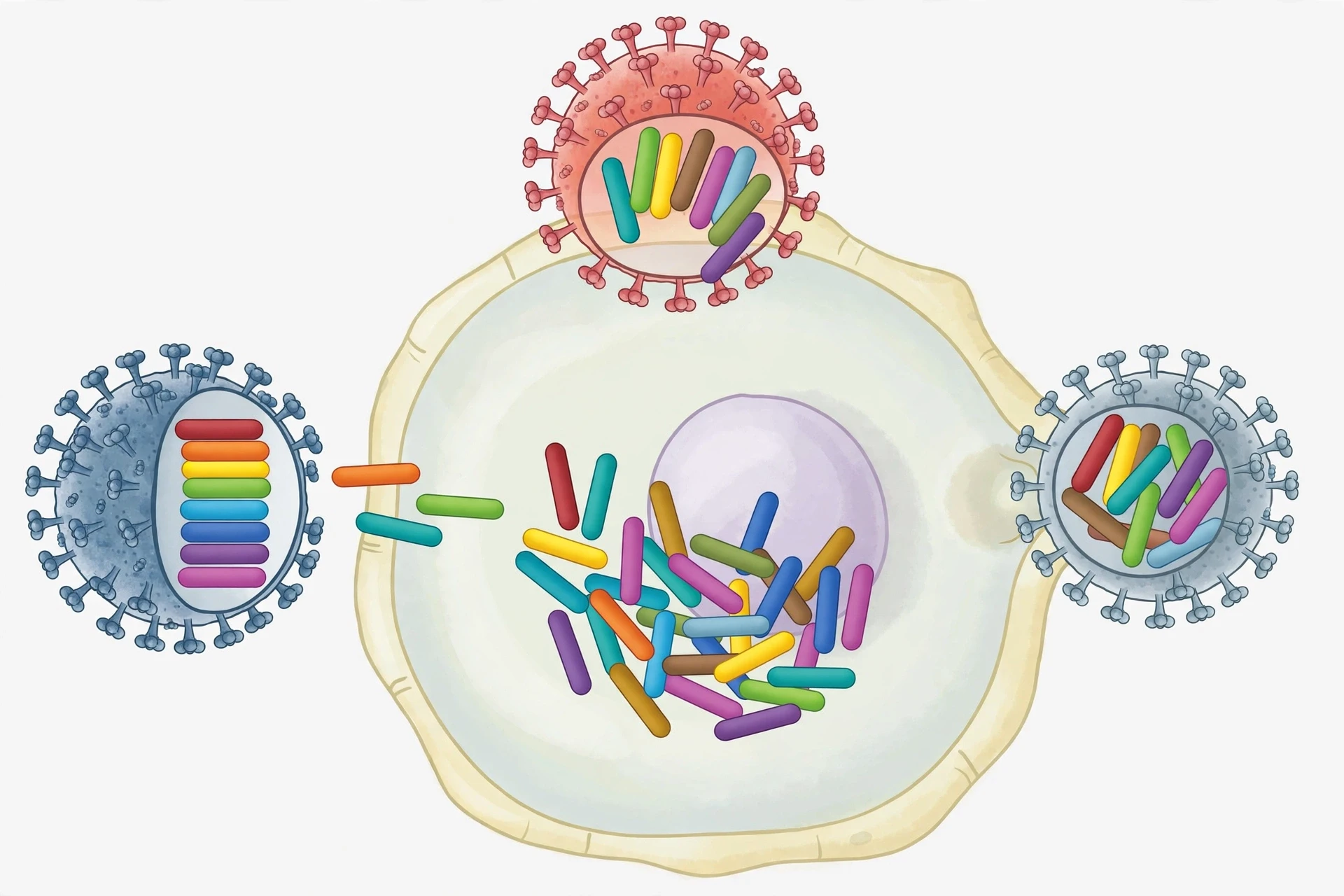
Imagine two flu viruses infecting the same cell. Each brings its own genome, and when the cell starts assembling new virus particles, the parts can get mixed. Influenza A carries its genome in eight separate RNA segments, like eight chapters of a book stored in separate files. A new particle might take five segments from one parent and three from the other, producing a virus neither parent was — a process called reassortment. If the parents are a human flu virus and a bird flu virus, the offspring might combine the bird virus's unfamiliar surface proteins with the human virus's ability to spread between people. That combination is exactly what an antigenic shift is, and it is the subject of section 8.
Recombination is the subtler cousin. It happens when two related viral genomes are copied in the same cell and the copying enzyme jumps from one template to the other mid-copy, stitching together a hybrid genome. Coronaviruses are enthusiastic recombinants: their polymerase is prone to template-switching, and co-infection of a cell by two coronavirus variants can produce a hybrid carrying mutations from both. The Omicron subvariant XBB, which dominated much of 2023, was born this way — a recombinant of two Omicron lineages, BJ.1 (a BA.2.10.1 descendant) and BM.1.1.1 (a BA.2.75 descendant), that combined their immune-evasion mutations into a single genome. Neither parent could have produced that combination by mutation alone, at least not quickly. Recombination did it in one step.
The difference between the two processes matters. Recombination shuffles within a genome; reassortment shuffles whole genes between genomes. Both let virus evolution take leaps instead of steps, and both explain events that mutation alone cannot: a virus that suddenly gains a new surface protein, a new host range, or a new combination of drug-resistance mutations. When virologists say a virus "evolved fast", they often mean it shuffled, not that it mutated quickly.
5.1 How recombination works
For recombination to happen, two conditions must be met: two different viruses must infect the same cell at the same time, and their genomes must be similar enough for the copying machinery to jump between them. Both conditions are common. Co-infection is routine wherever a virus is widespread — during a pandemic, a person can easily carry two variants at once — and related viruses share enough sequence similarity for template-switching to work.
The mechanics are simple to picture. A coronavirus polymerase copies along one genome, reaches a point where the two templates are similar, and slips across to the other one, continuing the copy there. The result is a genome that is parent A on one side of the jump and parent B on the other. If the jump happens in a useful place — say, bringing together a spike protein that binds human cells tightly and a set of mutations that dodge antibodies — the hybrid can be fitter than either parent. XBB was exactly such a hybrid, and its success showed how quickly recombination can assemble a winning combination from parts that already existed.
Recombination also has a darker side, from the virus's point of view. It can break up combinations that work well together, separating mutations that only help when paired. And it can produce genomes that are simply broken. But on balance, for viruses that co-infect frequently, recombination is a powerful accelerator: it lets a population share its best mutations, combining them far faster than any single lineage could accumulate them one by one. In evolutionary terms, it is sex — or at least, the viral equivalent of it — and it serves the same purpose: mixing variation so selection has better combinations to choose from.
5.2 Reassortment: eight segments, endless combinations
Influenza A takes the idea further, because its genome is not one strand but eight. Each segment codes for one or two proteins, and the segments are packaged into new virus particles independently. When two flu viruses co-infect a cell, the progeny can inherit any mix of the sixteen available segments — eight from each parent — producing 256 possible combinations (two choices for each of eight segments). Most of those combinations will be duds, but the number of rolls of the dice is enormous, and the occasional winner can be dramatic.
The segments that matter most are the ones coding for the surface proteins, haemagglutinin (HA) and neuraminidase (NA). These are the proteins the immune system recognises, and they are the ones that define a flu subtype: H1N1, H3N2, H5N1. A reassortment that gives a human-adapted flu virus a new HA from a bird virus produces a virus that spreads between people but looks, to the immune system, like something it has never seen. That is antigenic shift, and it is how every flu pandemic of the last century began.
Pigs play a special role here, and it is worth understanding why. A pig's airway cells carry receptors for both human flu viruses and bird flu viruses, so a pig can be co-infected by both at once — a mixing vessel, in the language of virology. The 2009 pandemic H1N1 virus was assembled in pigs from pieces of human, swine and avian flu viruses, plus segments from a Eurasian swine lineage. It then jumped to humans and spread worldwide within months. The mixing vessel is not a metaphor. It is a biological fact about receptor distribution, and it is why flu surveillance watches pigs and poultry as closely as it watches people.
5.3 Why shuffling matters more than spelling
Mutation and shuffling differ in one crucial respect: scale. A mutation changes one letter. A reassortment can change an entire gene — thousands of letters — in a single event. A recombination can combine dozens of mutations that took two separate lineages months to accumulate. When the environment changes suddenly — a new host species, a new drug, a vaccinated population — a virus that can shuffle has a far better chance of finding a working combination quickly than one that must wait for mutations to accumulate one by one.
This is why the most consequential events in virus evolution are so often shuffling events. The 1918 flu pandemic virus was most likely a bird virus that adapted directly to humans — the leading interpretation of its genome, though a minority of researchers have argued it may have been a reassortant. The 1957, 1968 and 2009 pandemics were all reassortments. The XBB recombinant reshaped the COVID-19 pandemic in 2023. And the reason flu vaccines must be reformulated every year is drift — slow mutation — while the reason flu pandemics happen at all is shift — sudden reassortment. The two processes work on different timescales, and the difference between them is the difference between a seasonal nuisance and a global emergency.
There is a lesson here for how we think about viral threats. A virus's mutation rate tells you how fast it changes day to day. Its ability to shuffle tells you how dramatically it can change in a single event. Both matter, and the most dangerous viruses are often the ones that do both: influenza mutates fast and reassorts; coronaviruses mutate moderately and recombine readily. A virus that did neither would be a sitting target for vaccines. No such virus causes a major human disease — and that, in itself, tells you something about what it takes to survive as a virus in a world full of immune systems.
6. Natural Selection in a Host
Mutation supplies the variation and shuffling combines it, but neither explains which changes spread and which vanish. That job belongs to natural selection, and in virus evolution it works at two levels at once: inside a single infected person, where billions of viral copies compete, and between people, where transmission decides which variants reach the next host.
This section explains what selection actually favours — and why the answer is not what most people expect.
The first thing to grasp is that selection in viruses is brutally simple. A variant that produces more copies of itself, in more cells, and reaches more new hosts, will become more common. A variant that does any of those things worse will fade. There is no committee, no plan, and no regard for the host's welfare. The host matters only as the environment in which the virus replicates: a warm, well-fed environment with plenty of susceptible cells is good for the virus; an environment full of antibodies, or a host that dies quickly, is bad.
That simplicity leads to a conclusion that surprises people: selection does not favour deadliness. A virus that kills its host in a day has one day to spread. A virus that keeps its host alive, mobile, and coughing for a week has seven days. All else being equal, the milder virus wins — and this is why, over time, many viruses do become milder. But all else is rarely equal. If the same mutation that increases transmission also happens to increase severity — for example, by producing more virus in the lungs, which both spreads more easily and damages more tissue — then selection will favour it despite the severity. The trade-off is real, and it runs in both directions: severity is sometimes the price of transmission, and sometimes an accidental by-product of it.
6.1 Within-host selection: the race inside one person
Inside a single infected person, the virus faces a changing landscape. Early in infection, there are few antibodies and plenty of uninfected cells, so the variants that replicate fastest dominate. Later, the immune system arrives: antibodies that bind the spike or surface proteins, T cells that kill infected cells, and interferon that shuts down viral replication. Now the variants that survive are the ones that dodge those defences — a spike mutation that changes an antibody target, for example — even if they replicate slightly more slowly. The population shifts, and the virus that emerges from the infection is not quite the virus that started it.
This within-host virus evolution is visible in the data. Sequencing a patient's virus over days or weeks shows the population changing in real time, with immune-escape mutations rising in frequency as the antibody response builds. In most people the infection ends before this matters much: the immune system clears the virus, and the within-host variants die with it. But in a person with a weakened immune system — someone on immunosuppressive drugs, for instance — the infection can last for months, and the virus has time to explore far more of its genetic possibilities. Several of the most heavily mutated SARS-CoV-2 variants, including Omicron, are thought to have evolved during such long infections, where the virus faced sustained immune pressure for months and accumulated dozens of changes. The long infection is, in effect, an accelerated virus evolution laboratory, and it is one reason immunocompromised patients receive such careful monitoring.
There is a second, quieter form of within-host selection that matters just as much: the transmission bottleneck. When a virus moves from one person to the next, only a tiny number of particles — sometimes a handful, sometimes just one — actually start the new infection. Everything else in the donor's quasispecies cloud is left behind. This bottleneck is a roll of the dice: a rare variant in the donor can become the founder of the entire population in the recipient, purely by chance. Bottlenecks make virus evolution chancy and unpredictable, because a variant's fate can depend less on its fitness than on whether it happened to be in the droplet that reached the next host. It is one reason the same pandemic can take different evolutionary paths in different places.
6.2 Between-host selection: what spreads, wins
Between hosts, the currency is transmission. A variant that produces more virus in the nose and throat, that survives longer in the air, or that needs a smaller dose to start an infection will, on average, infect more people. This is the level at which the variants that made the news were selected: Alpha spread faster than the original virus, Delta spread faster than Alpha, and Omicron spread faster than Delta — each time, the new variant's advantage was measured in transmission, and each time it took over the global population within weeks to a few months.
The numbers behind that takeover are worth feeling in your bones. A variant that is even ten percent more transmissible than its rivals will, over successive generations of infection, grow from a tiny minority to a majority in a matter of weeks, because each generation multiplies the advantage. This is exponential growth applied to virus evolution, and it is why variant replacement looks so sudden in the news: for weeks, the new variant is barely detectable, and then, seemingly overnight, it is everywhere. It was there all along, growing quietly, until the mathematics of compounding made it impossible to miss.
Between-host selection also explains a pattern that confuses many readers: why a variant can be more transmissible but less severe, or more severe but not more transmissible. Transmission and severity are separate traits, controlled by different mutations, and selection acts on them independently. Omicron's spike mutations made it better at entering upper-airway cells — improving transmission — and worse at infecting deep lung cells, which may have contributed to its lower severity. The two effects travelled together because they came from the same set of mutations, not because selection wanted a milder virus. Selection wanted a better-spreading virus, and mildness came along for the ride.
6.3 The virulence trade-off, and its limits
Textbooks often state a simple rule: parasites evolve toward lower virulence, because killing the host is bad for transmission. The rule has truth in it, but it is not a law, and the exceptions are instructive. A virus transmitted by mosquitoes, for example, does not need its host to be mobile — the mosquito does the moving — so there is little selection against severity. A virus transmitted through water can spread from a bedridden patient as easily as from a healthy one. And a virus that spreads mainly before symptoms appear, like SARS-CoV-2, faces almost no penalty for what it does to the host days later, because transmission has already happened.
The general principle is better stated this way: selection penalises severity only to the extent that severity reduces transmission. Where the link between the two is weak, severity can persist or even increase. HIV is the extreme case: it takes years to cause disease, and transmits throughout that period, so there is almost no selection pressure on it to become milder — and indeed, HIV has not become noticeably milder over forty years. Influenza, which transmits in the first days of illness, faces more pressure, but the pressure is blunted by the fact that most transmission happens before the patient feels ill enough to stay home. The trade-off is real, but it is a trade-off, not a destiny — and predicting which way it will go for any given virus requires knowing the details of how that virus spreads.
7. Antigenic Drift: The Slow Disguise
If you have ever wondered why the flu shot changes every year, the answer is antigenic drift: the slow, steady accumulation of small mutations in a virus's surface proteins, gradually changing its appearance to the immune system until last year's antibodies no longer recognise it.
This section explains how drift works, why it forces an annual vaccine update, and why it is the background hum of virus evolution — always happening, rarely dramatic, impossible to ignore.
The word "antigenic" refers to antigens — the parts of a virus that the immune system recognises, chiefly the surface proteins. For influenza, those are haemagglutinin (HA), the protein the virus uses to enter cells, and neuraminidase (NA), the protein it uses to leave them. Every year, as flu viruses replicate in millions of people, their HA and NA genes accumulate small mutations. Each mutation changes the protein's shape slightly. Individually, the changes are minor, and the immune system still recognises the virus. But they accumulate, year after year, and eventually the shape has changed enough that antibodies built against the old version bind poorly to the new one. At that point the virus has drifted — and last year's immunity, whether from infection or vaccination, no longer protects as well.
The US Centers for Disease Control and Prevention defines it plainly: drift consists of small changes in the genes of influenza viruses that can lead to changes in the surface proteins HA and NA, and when a flu virus has drifted enough, the body's existing antibodies have a harder time recognising and fighting it. There is no sharp line where drift becomes "enough". It is a gradual process, and the immune system's recognition fades gradually with it, which is why flu vaccine effectiveness varies from year to year — sometimes 60 percent, sometimes 40, sometimes less — depending on how well the vaccine strain matches the viruses actually circulating.
I think about drift every autumn, when the flu shot comes around and someone asks why they need another one when they had one last year. The honest answer is that the virus they were vaccinated against last year is not quite the virus circulating this year. It is a cousin, a few mutations removed, and the immune system's memory — precise as it is — is aimed at the old shape. The shot is not a repeat. It is a re-aiming.
7.1 Drift in action: H3N2's long walk
The clearest example of drift is influenza A H3N2, the subtype that has caused most seasonal flu since 1968. H3N2 drifts faster than any other flu virus, accumulating mutations in its HA protein at a rate that changes its antigenic character noticeably every few years. Since its emergence, it has drifted through a series of antigenic clusters — groups of viruses that look similar to the immune system — moving from one to the next every few years, each move eroding the population's immunity a little further.
The consequence is a virus that never stops moving. A person infected with H3N2 in 2015 has partial protection against the 2018 version and little against the 2024 version, because the surface has changed enough, step by step, to escape the antibodies built against the earlier shapes. This is why flu returns every winter despite widespread prior infection: the virus has moved on, and the immune system's memory is always a few steps behind. It is also why H3N2 seasons tend to be more severe than H1N1 seasons — H3N2 drifts faster, so population immunity to it is lower on average.
Drift is not unique to flu. SARS-CoV-2 drifts too, accumulating spike mutations that gradually erode antibody recognition — the reason COVID-19 vaccines have been updated. HIV drifts within a single patient, its envelope protein changing so fast that the immune system is always chasing a version that no longer exists. Drift is the default mode of virus evolution: slow, steady, relentless, and the reason immunity to RNA viruses is so often temporary.
7.2 Why the vaccine must be remade every year
The annual flu vaccine is, in effect, a prediction about drift. Each February, the World Health Organization's influenza surveillance network — more than 150 laboratories in more than 120 countries, feeding into seven collaborating centres — recommends which flu strains the next season's vaccine should contain, based on which viruses are circulating and how they have drifted. Manufacturers then grow the chosen strains, formulate the vaccine, and distribute it in time for autumn. The whole cycle takes about six months, and the virus keeps drifting during those six months, which is why the match is sometimes imperfect.
This is not a failure of the system. It is the system working as well as it can against a moving target. The prediction is usually good enough to cut illness substantially, and even in a mismatched year the vaccine typically reduces severity. But the cycle illustrates a basic truth about drift: you cannot vaccinate once against a drifting virus and be done. You can only keep aiming, year after year, and accept that some years the aim will be better than others.
There is one more consequence of drift worth naming, because it explains a great deal about the politics of flu vaccination. Drift means that the vaccine's effectiveness is genuinely uncertain until the season plays out, and that uncertainty is easily mistaken for uselessness. It is not. A vaccine that is 50 percent effective at preventing illness, and more effective still at preventing hospitalisation, is worth having — but it requires the public to accept a probabilistic benefit rather than a guarantee. That is a communication problem as much as a scientific one, and it is one reason flu vaccination rates stay stubbornly below what public health experts would like.
7.3 Drift is not the same as becoming "stronger"
A common misunderstanding is that drift makes a virus stronger or more dangerous. It does not, at least not directly. Drift makes a virus less recognisable. Whether the drifted virus causes worse disease depends on other mutations entirely — ones affecting how it enters cells, how fast it replicates, or how it interacts with the immune system. A heavily drifted virus can be milder than its ancestor, and a barely drifted one can be worse.
This matters because it corrects a tempting narrative: that each new flu season brings a "stronger" virus. What each season brings is a virus that looks different enough to reinfect people who were immune to last year's version. That is bad enough — it is why flu kills hundreds of thousands of people every year worldwide — but it is a different kind of bad from increasing deadliness. The virus is not getting stronger. It is getting stranger, and our immune systems are playing catch-up. The distinction is not pedantic. It determines what we should worry about, and what we should do: the answer to drift is updated vaccines, not panic about a super-virus.
8. Antigenic Shift: The Sudden Newcomer
In virus evolution, drift is gradual. Shift is sudden. Antigenic shift happens when a flu virus acquires an entirely new surface protein — usually through reassortment with an animal flu virus — producing a subtype that no human immune system has ever seen.
This section explains how shift works, walks through the four influenza pandemics of the last century, and shows why shift, not drift, is what turns a seasonal virus into a global emergency.
The CDC's definition is worth quoting in full, because its precision matters: shift is an abrupt, major change in a flu A virus, resulting in new HA and/or new HA and NA proteins in flu viruses that infect humans, and it can result in a new flu A subtype infecting people for the first time. The key word is "new". Drift modifies a protein the immune system already knows. Shift introduces one it has never met. The result is a population with essentially no immunity — not partial immunity, not faded immunity, but none — and a virus that can spread through that population with nothing to slow it down except the limits of transmission itself.
Shift happens only in influenza A, not influenza B, because only influenza A has an established animal reservoir — wild waterfowl — carrying a vast diversity of HA and NA subtypes. There are eighteen known HA subtypes and eleven NA subtypes in nature, but only three HA subtypes (H1, H2, H3) and two NA subtypes (N1, N2) have circulated widely in humans in the last century. The rest are waiting in birds, and a reassortment that brings one of them into a human-adapted virus is a pandemic waiting to happen. That is why flu surveillance watches birds and pigs as closely as it watches people: the next shift will announce itself there first.
8.1 Four pandemics, one mechanism
The last century's flu pandemics all followed the same script, with different casts. The table below summarises them. The details differ — the subtype, the origin, the death toll — but the mechanism is the same in each case: a reassortment that produced a new HA subtype in humans, against which the population had little or no immunity.
Pandemic | Subtype | How it arose | Estimated deaths |
|---|---|---|---|
1918 "Spanish flu" | H1N1 | Avian-origin virus adapting to humans | At least 50 million worldwide |
1957 "Asian flu" | H2N2 | Reassortment: human H1N1 + avian H2N2 segments | About 1.1 million worldwide (CDC estimate; range 0.7–1.5 million — other estimates run to 2 million or more) |
1968 "Hong Kong flu" | H3N2 | Reassortment: human H2N2 + avian H3 segments | About 1 million worldwide |
2009 "swine flu" | H1N1 | Triple reassortment: human, swine and avian viruses in pigs | About 284,000 worldwide |
The 1918 pandemic deserves a closer look, because it is the worst pandemic in recorded history and the ancestor of every flu virus that has circulated since. It killed at least 50 million people worldwide — estimates run as high as 100 million — and infected at least a third of the world's population. It was caused by an H1N1 virus that descended from a wild waterfowl virus, and it was unusual in a cruel way: unlike most flu, which kills the very young and the very old, the 1918 virus killed healthy young adults in large numbers, probably because their strong immune responses overreacted to the infection. Almost every influenza A virus that has circulated in humans since 1918 is, in evolutionary terms, a descendant of that virus — except for direct human infections with avian viruses such as H5N1 and H7N7 — its genes, reassorted and drifted over a century, still run in the flu viruses of today.
The 1957 and 1968 pandemics were cleaner examples of reassortment. In 1957, a human H1N1 virus acquired three gene segments — including the H2 haemagglutinin — from an avian virus, producing H2N2. In 1968, the circulating H2N2 acquired two segments, including H3, from an avian virus, producing H3N2, which still circulates today. Each time, the new HA subtype met a population with no immunity to it, and each time the virus spread worldwide within months.
The 2009 pandemic was the most complex. Its virus was assembled in pigs from pieces of human, swine and avian flu viruses — a triple reassortant that then combined with a Eurasian swine lineage — and it jumped to humans in Mexico in early 2009. It spread fast but proved less lethal than feared, causing an estimated 284,000 deaths worldwide, and it has since become an ordinary seasonal flu virus, included in the annual vaccine. The 2009 pandemic is a useful corrective to the idea that every shift is a catastrophe: a new subtype guarantees spread, but it does not guarantee severity.
8.2 Why shift is rare — and why it keeps happening
If reassortment is so common in flu, why don't pandemics happen every year? Because most reassortments produce viruses that cannot spread between people. A bird virus's HA may bind poorly to human airway cells. A reassortant may inherit segments that work badly together, producing a virus that replicates poorly. Or the reassortant may simply never meet a human — most reassortments happen in birds and pigs that never contact people. Shift requires a chain of unlikely events: the right segments, in the right combination, in a virus that can infect humans and spread between them, at a time when the population has no immunity. Most of the time, one link in the chain fails.
But the chain is tried so often that it eventually succeeds. Wild waterfowl carry an enormous diversity of flu viruses, pigs mix them, and humans live close to both. The wonder is not that pandemics happen but that they happen as rarely as they do — roughly three or four times a century. That rarity is no comfort, though, because the next shift is not a question of if but of when, and the surveillance systems described in section 11 exist precisely to catch it early.
There is a final point about shift that is easy to miss. Shift is not limited to influenza, in principle. Any segmented virus can reassort, and coronaviruses recombine. The next pandemic virus may not be a flu virus at all — SARS-CoV-2 was not. What matters is not the specific virus but the mechanism: a sudden, large genetic change that presents the human immune system with something new. That is the pattern to watch for, whatever virus it arrives in.
9. SARS-CoV-2: Virus Evolution Watched in Real Time
No virus in history has been watched as closely as SARS-CoV-2, and no chapter of virus evolution has ever been documented in such detail. Within months, scientists everywhere were sequencing its genome by the millions and tracking each new mutation.
This section follows that story — from the original virus through Alpha, Delta and Omicron — because it is the most complete record of virus evolution ever assembled, and it shows, in unprecedented detail, how the process actually works.
The scale of the watching is worth stating plainly. The WHO declared COVID-19 a pandemic on 11 March 2020, just weeks after the first cases were reported in Wuhan, China, in December 2019. By 2023, more than fifteen million SARS-CoV-2 genomes had been shared through GISAID, the global database that became the pandemic's central nervous system. No previous virus had been sequenced at anything like this scale. This flood of data let researchers do something new: watch virus evolution happen, week by week, mutation by mutation, across the entire planet at once. When Omicron appeared in November 2021, its genome was sequenced, uploaded, and analysed within days — and within weeks, laboratories on every continent had measured how well antibodies recognised it. The virus still moved fast. But for the first time, science could see it moving.
The virus itself is a coronavirus: a positive-sense, single-stranded RNA virus with a genome of about 29,903 letters, encoding 29 proteins. Its most famous protein is spike, the club-shaped structure on its surface that binds the ACE2 receptor on human cells and lets the virus in. Spike is also the main target of vaccines and of the antibodies they produce, which makes it the site of the most intense selection pressure — and, not coincidentally, the site of most of the mutations that matter. Understanding virus evolution in SARS-CoV-2 means, to a large extent, understanding spike evolution.
I followed the variant trackers the way other people follow sports scores in those years — refreshing dashboards, watching a new lineage's share of sequenced cases climb from one percent to ten to ninety in a matter of weeks. There was something mesmerising about it, and something sobering: you could see, in real time, natural selection doing its work on a global scale, with the numbers updating every day. It was the abstract machinery of virus evolution made visible, and it never stopped being strange to watch.
9.1 Alpha, Delta, Omicron: three takeovers
The pandemic's variant history can be told as three takeovers, each faster than the last. Alpha (B.1.1.7), first identified in the United Kingdom in late 2020, carried about twenty mutations, including several in spike, and spread roughly fifty percent faster than the original virus. It dominated the early months of 2021. Delta (B.1.617.2), first identified in India, carried a different set of spike mutations — including L452R and P681R, which improved cell entry and fusion — and spread roughly 50–60 percent faster than Alpha — about twice as fast as the original virus — taking over the world in the summer of 2021. Then came Omicron (B.1.1.529), with roughly fifty mutations, more than thirty in spike, spreading faster still and replacing Delta within weeks of its detection in November 2021.
Each takeover followed the same logic, and the logic is the logic of section 6: the new variant was better at transmission, and better transmission compounds. Alpha's advantage came partly from a spike mutation, N501Y, that improved binding to the ACE2 receptor. Delta's came from mutations that made cell entry faster and more efficient. Omicron's came from a wholesale remodelling of spike that let it infect the upper airways more readily — spreading more easily through coughs and breath — while also dodging antibodies built against earlier versions. Three different solutions to the same problem, each better than the last at the thing selection rewards.
Omicron's arrival also broke the pattern in one important way. Its genome was so different from Delta's that it could not have evolved from Delta by gradual mutation in the weeks between their appearances. Its lineage had diverged from the other variants in mid-2020 and evolved separately, out of sight, for over a year. Where? The leading explanations are a long infection in an immunocompromised person, where the virus faced sustained immune pressure for months, or undetected circulation in a region with little sequencing. Either way, Omicron was a reminder that the virus we can see — the genomes in the database — is only part of the story. The rest is evolving where we are not looking.
9.2 The proofreader that slows the virus down
SARS-CoV-2 evolves more slowly than flu or HIV, and the reason is the proofreader described in section 3. Its NSP14 enzyme corrects some copying errors, holding the evolutionary rate to roughly one thousandth of a substitution per site per year — about two to three mutations per genome per month. That sounds slow until you multiply it by the scale of the pandemic: hundreds of millions of infections, each producing billions of virus particles, each particle a chance for a mutation. Two mutations a month per lineage, across millions of lineages, is an enormous amount of variation — and the spike gene, under the strongest selection pressure, evolves faster still — in one review, about 8.1×10⁻⁴ versus 6.7×10⁻⁴ substitutions per site per year for the genome as a whole.
The proofreader also explains a puzzle that confused observers early in the pandemic: why did SARS-CoV-2 seem to change so slowly in 2020, then so fast in 2021? Part of the answer is surveillance: early sequencing was sparse, and changes were missed. Part is that the virus was still adapting to humans in 2020, and the big leaps — Alpha's N501Y, Delta's L452R — came when it found better solutions. And part is that the proofreader sets a speed limit, not a stop: two mutations a month is slow for a virus, but it is fast enough, given enough infections, to produce a new variant of concern every few months. The proofreader makes the virus more stable than flu. It does not make it stable.
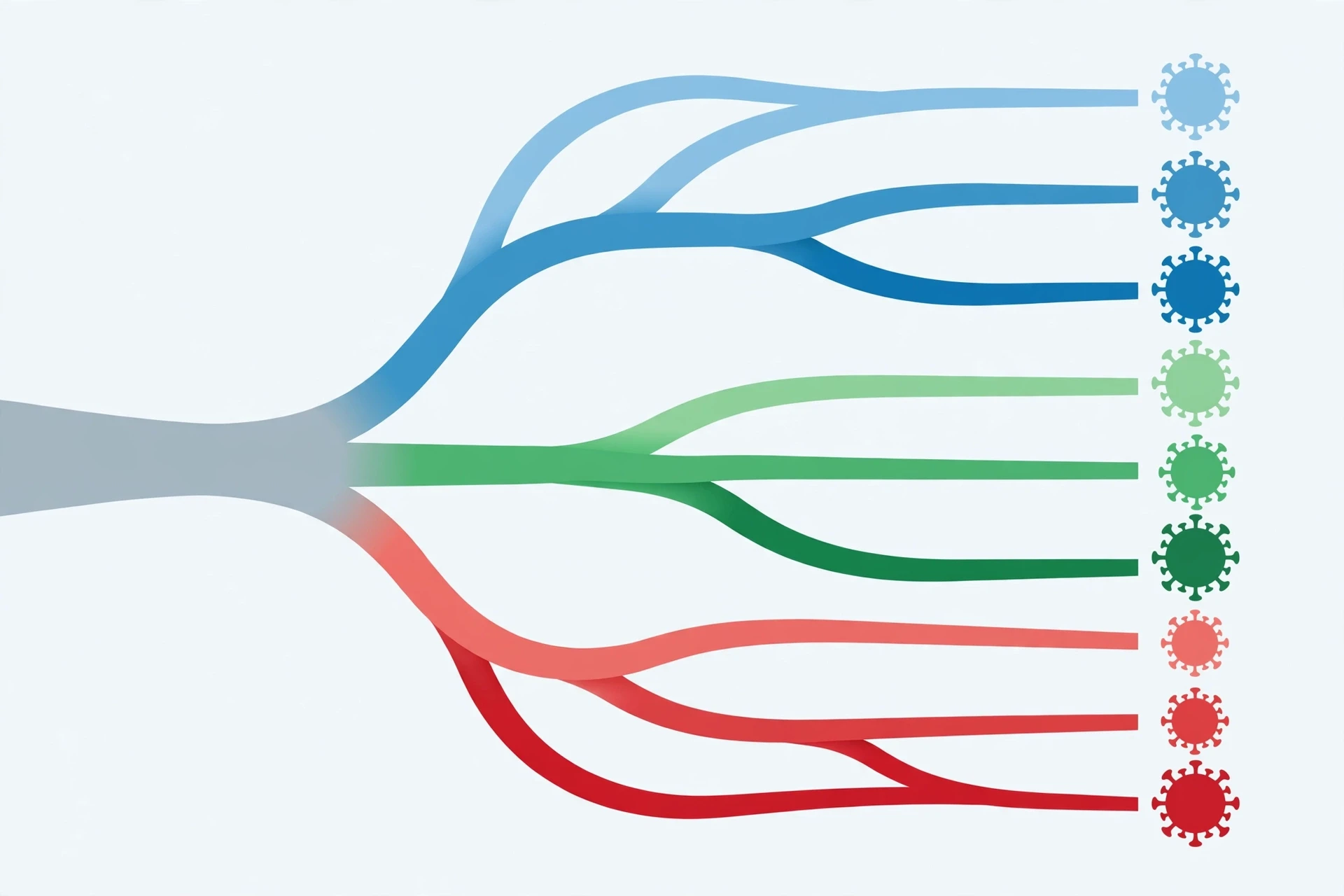
9.3 How variants are named and tracked
When a new variant appears, the question is not just what it is but what to call it — and the naming system matters more than it seems. Scientists use a lineage system called Pango, which assigns codes like B.1.1.7 and BA.2.75 based on the virus's family tree. The World Health Organization, worried that geographic names (the "UK variant", the "South Africa variant") would stigmatise countries, adopted Greek letters for variants of concern: Alpha, Beta, Gamma, Delta, Omicron. The WHO also classifies variants by risk: variants of concern (VOCs), which show increased transmission, severity, or immune escape; variants of interest (VOIs), which show changes worth watching; and variants under monitoring (VUMs), which are being tracked but have not yet shown a clear threat.
The system works because it is tied to surveillance. When a variant's share of sequenced cases starts rising, laboratories test it: does it bind ACE2 better? Do antibodies neutralise it less well? Does it cause worse disease in animal models? The answers, gathered within weeks, determine whether the variant is upgraded, downgraded, or forgotten. Most variants are forgotten. The ones that are not — the VOCs — are the ones whose mutations change something real, and they are the ones that earn Greek letters and headlines.
That machinery is the most important legacy of the pandemic for the future of virus evolution. Before 2020, global viral surveillance was a patchwork, concentrated in rich countries and slow to share data. The pandemic built, almost overnight, a system that sequences millions of genomes and shares them in days. That system is now being extended to flu, to RSV, to emerging viruses generally. It will not stop viruses from evolving. But it means the next Omicron is far more likely to be caught in days than in months — and that difference, measured in infections prevented, is enormous.
10. HIV: Evolution Inside One Person
If SARS-CoV-2 is virus evolution watched across the planet, HIV is virus evolution watched inside a single body. It is one of the fastest-evolving viruses that infects humans, and virus evolution happens not over years and continents but over days and tissues — in the blood, the lymph nodes, and the gut of one person.
This section follows that inner virus evolution, because it explains both why HIV has resisted a vaccine for forty years and why combination drug therapy works.
The numbers are the place to start, because they are almost hard to believe. In an untreated person, HIV produces roughly ten billion new virus particles every day. Its copying enzyme, reverse transcriptase, makes roughly half an error to one error per genome per replication, because it has no proofreading — and inside cells, host APOBEC3 enzymes add far more mutations still. Do the arithmetic: ten billion copies a day, each with a decent chance of carrying a new mutation, means that every possible single mutation in the HIV genome is produced, many times over, every single day, inside one person. The virus does not need to wait for a lucky mutation. It makes them all, constantly, and selection sorts them out.
The consequence is a quasispecies cloud of extraordinary diversity. Sequence the virus from a patient's blood today, and again in six months, and the two samples will differ measurably — not because the patient was reinfected, but because the virus has been evolving inside them all along. Over years, the divergence grows. Over a decade, the virus in a single patient can diversify as much as flu viruses diversify across the whole world in a year. This is why HIV is so hard to vaccinate against: the target is not one virus but a cloud, and the cloud is always moving.
10.1 Drug resistance, in weeks
The speed of virus evolution in HIV was first demonstrated, painfully, by the failure of single-drug therapy. In the late 1980s, the drug AZT was given alone to HIV patients, and it worked — for a while. Viral levels fell, patients improved, and hope rose. Then, within months — usually after six months or more of treatment — the virus came back, and the returning virus was resistant to AZT. Sequencing showed why: a handful of mutations in the reverse transcriptase gene — thymidine-analogue mutations — that let the enzyme cut the AZT molecule back out of the growing DNA chain after it has been incorporated, unblocking replication. Some resistance mutations were already present at low frequency in the cloud; others accumulated step by step under the drug's selection pressure. The drug killed the susceptible majority and left the resistant minority to take over — selection, in its purest form, operating over weeks.
The solution, discovered in the mid-1990s, was combination therapy: three drugs, attacking the virus at two or three different points at once — typically two drugs aimed at reverse transcriptase plus a third aimed at the protease or integrase. A virus that is resistant to one drug is common in the cloud. A virus resistant to two is rarer. A virus resistant to all three at once — requiring several specific mutations in the same genome — is so rare that it may not exist in the cloud at all, and the probability of it arising by chance during treatment is vanishingly small. Combination therapy does not stop virus evolution. It raises the bar so high that virus evolution cannot clear it. It is the single most successful application of evolutionary thinking in medicine, and it is the reason HIV, once a death sentence, is now a manageable chronic condition for those with access to treatment.
I remember a lecture slide that made this concrete in a way no textbook could. It showed the genetic diversity of HIV sampled from one patient over twelve years, plotted as a branching tree — and the tree was enormous, with branches splitting and splitting again, covering more genetic ground than the entire global diversity of some other viruses. The lecturer's point was simple: this is what happens when you combine the highest mutation rate in virology with ten billion copies a day and forty years of continuous replication. The virus is not one thing. It is a population, evolving in real time, inside a person.
10.2 Escaping the immune system
Drugs are not the only selection pressure HIV faces. The immune system is the other, and HIV escapes it with the same mechanism: pre-existing diversity, revealed by selection. The immune system produces antibodies against the virus's envelope protein, gp120 — and gp120 is one of the most variable proteins in all of virology, changing so fast that the antibodies built against one version often fail against the next. The virus's envelope is also heavily coated in sugar molecules, a "glycan shield" that hides the vulnerable parts from antibodies while leaving the parts needed for cell entry exposed. Mutations that add or move a sugar can hide a new patch of the protein, and the immune system must start over.
The result is a stalemate that the virus usually wins. The immune system produces a new antibody response, the virus evolves around it, the immune system responds again, and the virus evolves again — a chase that continues for years, with the virus always a step ahead. This is why no HIV vaccine has yet succeeded: a vaccine must aim at a target that the virus cannot change, and HIV's surface is almost entirely changeable. The rare broadly neutralising antibodies — antibodies that recognise parts of the envelope so essential that the virus cannot change them without breaking — are the focus of current vaccine research, because they point to the few places where the virus cannot run.
There is one more feature of virus evolution in HIV that makes it uniquely difficult: the latent reservoir. HIV inserts its genome into the DNA of infected cells, and some of those cells — resting memory T cells — can carry the integrated virus silently for years, invisible to the immune system and untouched by drugs. When treatment stops, the reservoir wakes up, and the virus returns — often as a version from years earlier, preserved like a fossil. The reservoir means that virus evolution in HIV is not only fast but also reversible: old variants can re-emerge, and the virus's history is stored, intact, in the patient's own cells. Curing HIV means emptying that reservoir, and no one has yet found a safe way to do it.
10.3 What HIV teaches about all viruses
HIV is an extreme case, but its lessons apply broadly. First, that virus evolution's speed is set by numbers: mutation rate times population size times generation time, and HIV maximises all three. Second, that the diversity that matters is usually already present before selection acts — the drug or the antibody reveals it rather than creating it. Third, that combination therapy works because it attacks the mathematics of virus evolution itself, demanding simultaneous rare events rather than single ones.
The same lessons shape the treatment of other fast-evolving viruses. Hepatitis C, another RNA virus, is now cured with combination antivirals that apply the same logic. Influenza is treated with drugs such as baloxavir, which targets the conserved PA endonuclease — though even there, escape mutations (e.g. PA I38T) can appear. And the reason single-drug treatments so often fail against RNA viruses is always the same: the quasispecies cloud already contains the answer, and a single selection pressure is enough to find it. HIV taught medicine that lesson the hard way. The rest of virology has been learning it ever since.
11. Influenza: The Annual Arms Race
Influenza is the virus that has been evolving against human immunity the longest, and it shows. Every winter it returns, slightly changed, and every year the vaccine's composition is reviewed, and usually updated, to match — a cycle that has run, without interruption, for more than seventy years.
This section explains how the cycle works, who watches the virus, and why a bird flu called H5N1 has virologists watching the horizon.
The cycle begins with drift, described in section 7: small mutations in the HA and NA surface proteins, accumulating year by year, gradually eroding immunity. By the time a flu season ends, the circulating viruses have drifted measurably from the ones the vaccine targeted, and the population's immunity has faded correspondingly. The next season's vaccine must be reformulated to match the new versions — and the reformulation is a prediction, made months in advance, about which way the virus will drift.
That prediction is made by the World Health Organization's Global Influenza Surveillance and Response System, or GISRS: more than 150 laboratories in more than 120 countries, which collect flu samples from patients, sequence them, test them against antibodies, and send the results to seven collaborating centres — five for human influenza, in London, Atlanta, Melbourne, Tokyo and Beijing, plus two for animal influenza, in Memphis and Novosibirsk. Twice a year — in February for the northern hemisphere, in September for the southern — the WHO reviews the data and recommends the strains for the next vaccine. It is one of the oldest and most elaborate viral surveillance systems in the world, and it is the reason flu vaccines work as well as they do.
The system is not perfect, and its imperfections are instructive. The recommendation is made six months before the vaccine is used, and the virus keeps drifting in the meantime. Sometimes the prediction is excellent and the vaccine is 60 percent effective or better. Sometimes a drifted variant emerges after the recommendation, and effectiveness drops. The 2014–15 season was a famous miss: an H3N2 variant drifted significantly after the vaccine strain was chosen, and effectiveness fell to about 19 percent. The system was not broken. It was aiming at a moving target, six months ahead, with incomplete information — and that is the best anyone can do against a drifting virus.
11.1 H5N1: the virus on the watch list
If drift is the annual problem, H5N1 is the standing worry. It is a bird flu virus, subtype H5N1, that has circulated in wild birds and poultry for decades, occasionally infecting people who handle sick birds. Human infections are rare but historically severe — across all confirmed cases since 2003 roughly half have died — though the recent clade 2.3.4.4b infections in US farm workers have mostly been mild — and the virus has, so far, been unable to spread efficiently between people. That last fact is the only thing standing between H5N1 and a pandemic.
The virus has been changing. The current lineage, clade 2.3.4.4b, emerged around 2020 and has spread through wild birds across the world, spilling over into mammals — foxes, seals, sea lions, mink — with increasing frequency. In 2024 it reached dairy cattle in the United States, spreading between cows and infecting farm workers who handled them. Each mammalian infection is a roll of the dice: a chance for the virus to acquire the mutations that would let it bind human airway cells and spread between people. So far, those mutations have not appeared together in a single virus. But the virus is trying, in the sense that virus evolution always tries — by making billions of copies, in millions of birds and mammals, and letting selection sort them out.
H5N1 is the reason flu surveillance watches animals as closely as people. The next pandemic flu virus will almost certainly announce itself first in birds or pigs, and the surveillance network's job is to catch it there — to sequence it, to test whether it binds human receptors, to measure whether it spreads between mammals — before it reaches humans at scale. That is a race against virus evolution, and it is one we are currently winning, but only just.
11.2 Why flu will never be eradicated
Smallpox was eradicated because it had no animal reservoir, changed slowly, and produced obvious symptoms that made cases easy to find and isolate. Influenza has none of those advantages. Its reservoir is wild waterfowl, which cannot be vaccinated or isolated. It changes constantly, so immunity fades. And it spreads before symptoms appear, so isolation comes too late. Eradication is not a realistic goal for flu, and no serious public health plan proposes it.
What is realistic is control: better vaccines, faster surveillance, and, eventually, a universal flu vaccine that targets the parts of the virus that cannot change. The most promising candidates aim at the stalk of the HA protein — the stem that anchors it to the virus — which is far more conserved than the head, because mutations there tend to break the protein. A vaccine that trains the immune system against the stalk could, in principle, protect against all flu subtypes, drift-proof and shift-proof. Several such vaccines are in clinical trials. None has yet succeeded. But the logic is sound, and it follows directly from understanding virus evolution: aim at what the virus cannot change, because everything else will change.
12. Jumping Species: Spillover and Host Switching
Every pandemic begins with a jump: a virus that lived in one species finds itself in another. Most jumps fail. A few succeed, and those few change history. This section explains what a jump requires, why most fail, and what the successes — SARS-CoV-2, HIV, the 1918 flu — have in common, and what they teach us about virus evolution.
A virus is, in a sense, a key looking for a lock. To infect a cell, it must bind a receptor on the cell's surface — a protein the cell uses for its own purposes, which the virus has learned to exploit. SARS-CoV-2 uses ACE2, a protein that regulates blood pressure. Influenza uses sialic acid, a sugar on the cell surface. HIV uses CD4, a protein on immune cells. The receptor is the first barrier: a virus whose key does not fit the new host's lock cannot enter its cells at all, and no infection happens.
But entry is only the first barrier. Inside the cell, the virus must find the machinery it needs to copy itself, evade the new host's innate defences — interferon, restriction factors, cellular sensors that detect foreign RNA — and then exit the cell and spread to the next one. Each barrier is a selection pressure, and a virus that jumps species must clear them all, usually by accumulating mutations that adapt it to the new host. That is why most jumps fail: the virus that arrives in a new species is adapted to the old one, and the gap is usually too wide to cross in a single infection.
The jumps that succeed are usually the ones that get help. An intermediate host — an animal whose receptors are similar to both the original host and the new one — can serve as a stepping stone, letting the virus adapt gradually. Civet cats played that role for the original SARS virus in 2002. Camels did it for MERS. Pigs do it for flu, as described in section 5. And sometimes the help comes from sheer numbers: a virus that spills over into humans thousands of times, in different people, has thousands of chances to hit the right combination of mutations. Most spillovers die out after one or two infections. The ones that keep going are the ones that find, by luck or by numbers, the mutations that let them spread.
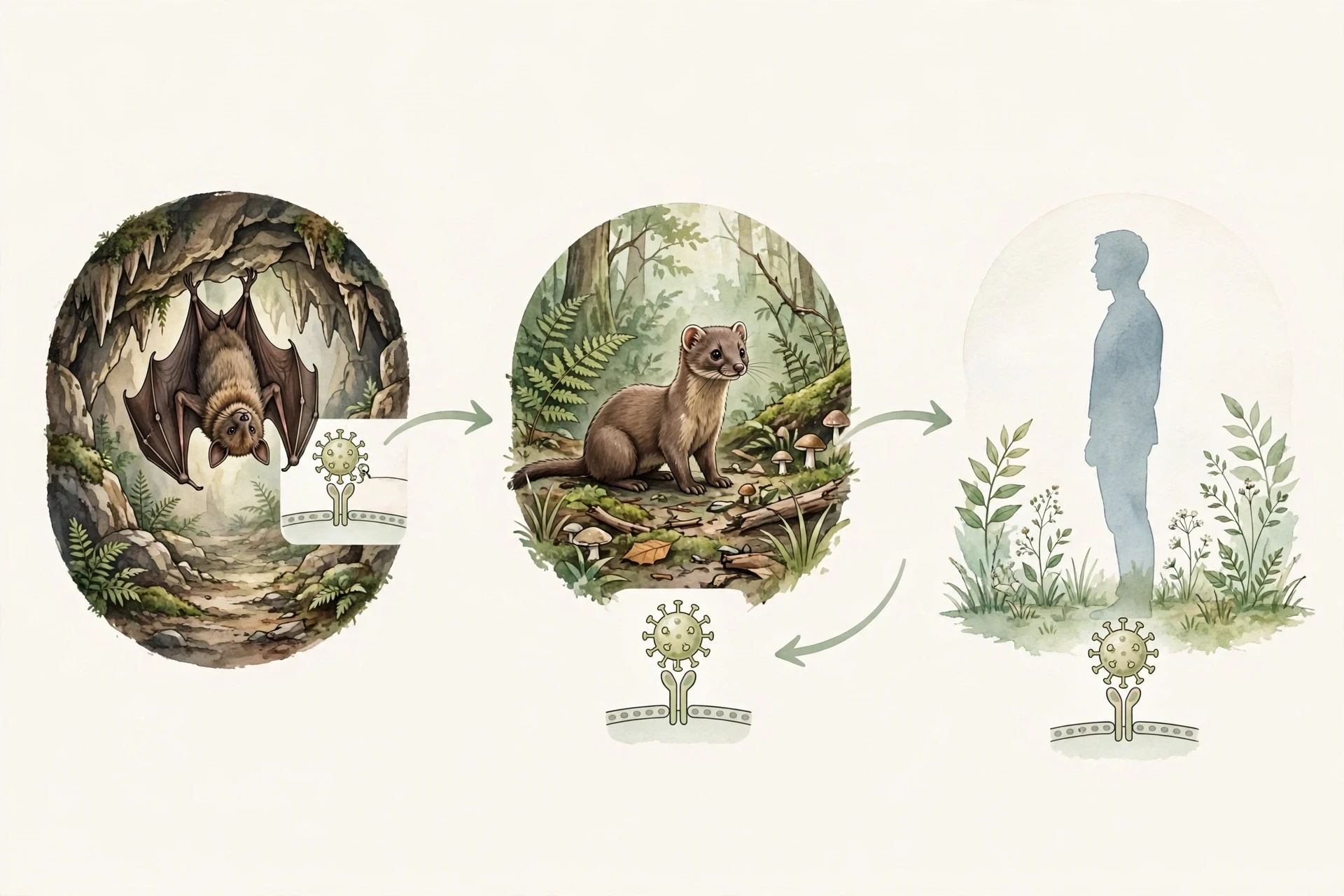
12.1 The anatomy of a successful jump
SARS-CoV-2 is the best-documented jump in history, and its anatomy is instructive. Its closest known relatives are coronaviruses of horseshoe bats, and its spike protein binds the human ACE2 receptor efficiently — a fact that suggests either a long period of adaptation in an intermediate host or a lucky combination of mutations. Its genome carries a furin cleavage site — a short sequence in the spike protein that lets human enzymes cut it, activating it for cell entry — which its closest bat relatives lack. How and where it acquired that site is still debated, and the question of the virus's exact origin remains unresolved. What is not debated is the general pattern: a bat virus, adapted over time — in bats, in an intermediate host, or both — acquired the ability to bind human cells efficiently and spread between people, and then did so, worldwide, within months.
HIV's jump was slower and, in a sense, more revealing. It crossed from chimpanzees to humans — probably through hunting and butchering, where blood contact gave the virus its chance — not once but at least four times, producing the different HIV groups. The successful jump, HIV-1 group M, then spent decades spreading quietly in Central Africa, adapting to humans, before the global epidemic began. Virus evolution during those decades — its adaptation to human immune responses, its optimisation for human-to-human transmission — is written in its genome, and researchers have reconstructed it, mutation by mutation, from stored samples. The jump was not an event. It was a process, spread over decades, invisible until it was too late to stop.
The 1918 flu virus followed a similar pattern: a bird-derived virus that adapted to mammals shortly before the pandemic — the leading interpretation, though a minority of researchers have argued it may have been a reassortant — before emerging as a human pandemic. In each case, the jump was the beginning, not the end, of the story. The virus that arrives in humans is rarely well adapted to them. It becomes adapted — by evolving, in humans, under human selection pressures — and that adaptation is the pandemic's first chapter.
12.2 Why most jumps fail
For every successful jump, there are thousands of failures, and the failures are as informative as the successes. A virus that spills over into a human but cannot spread to the next person is an evolutionary dead end, no matter how severe the disease it causes in that one person. H5N1 has infected hundreds of people over two decades, but it has never sustained human-to-human transmission, because its HA protein binds receptors deep in the lungs rather than in the nose and throat, where transmission happens. The virus can kill the person it infects. It cannot reach the next one.
This is the logic that should guide how we think about spillover risk. The question is not whether a virus can infect a human — many can, given enough exposure — but whether it can spread between humans, and that requires a specific set of adaptations: binding the right receptors in the right part of the airway, replicating efficiently at human body temperature, surviving in droplets, and doing all of it while the immune system attacks. Most animal viruses lack most of these adaptations, and acquiring them all at once is unlikely. The risk comes from viruses that already have most of them — a bird flu that binds human receptors moderately well, a coronavirus that already uses ACE2 — and from the sheer number of exposures, as humans push deeper into wildlife habitats and farm more animals in closer contact with wild ones.
That is also why the response to spillover risk is surveillance, not panic. The viruses most likely to jump are the ones already spilling over: the ones infecting farm workers, hunters, and people who live near wildlife. Watching those infections — sequencing the viruses, measuring their ability to bind human receptors, tracking whether they spread — is the early-warning system. It is imperfect, and it will miss things. But it is the only system that can catch a jump before it becomes a pandemic, and the COVID-19 pandemic showed, brutally, what happens when the catching comes too late.
13. Why Some Viruses Barely Change
After twelve sections about virus evolution in fast-forward, it is time for the opposite question: why do some viruses barely change at all? Measles has used vaccines from the same Edmonston lineage since the 1960s — the strain has been refined (Edmonston B → Schwarz → Moraten), but the vaccine has never needed reformulating against a new variant. Smallpox used the same vaccine for two centuries before it was eradicated. Measles and rubella — stable enough that the two-dose MMR vaccine protects for life. (Rabies is the exception: its inactivated vaccine needs a multi-dose course and boosters, not one lifetime shot.)
This section explains what holds these viruses still, because the constraints that limit virus evolution are as revealing as the forces that accelerate it.
The first constraint is the copying machinery. Measles is an RNA virus, and its polymerase is as sloppy as any other RNA virus's — but measles is an exception in one important respect: its surface proteins cannot change much without breaking the virus. The measles haemagglutinin protein must bind specific receptors — SLAM on immune cells and nectin-4 on airway epithelial cells — with a precise shape. Most mutations that change its surface also change its function, and the resulting virus cannot enter cells. Selection removes those mutants as fast as mutation creates them. The virus copies sloppily, but the filter is strict — and the outcome is stability. The same logic applies to other stable RNA viruses: the mutation supply is high, but the fraction of mutations that are tolerated is tiny.
DNA viruses add a second constraint: proofreading. Herpesviruses, adenoviruses and poxviruses copy their DNA with proofreading polymerases, and their error rates are hundreds to thousands of times lower than those of RNA viruses. Smallpox, a poxvirus, accumulated mutations so slowly that the vaccine lineage begun by Edward Jenner in 1796 with cowpox — later replaced by the related vaccinia virus, which became the modern smallpox vaccine — still protected people in the 1970s, and vaccinia was the vaccine used to eradicate the disease in 1980. The World Health Organization declared smallpox eradicated on 8 May 1980, the first and still the only human disease wiped out globally. It could not have happened against a virus that drifted like flu.
A third constraint is genome architecture. Some viruses have overlapping genes — the same stretch of genetic code read in two different frames to produce two different proteins. A mutation in an overlapping region changes both proteins at once, and the chance that both changes are harmless is small. Overlapping genes act as an evolutionary brake, because most mutations in those regions are punished twice. Coronaviruses, influenza viruses and HIV all have overlapping genes in places, and those places evolve more slowly than the rest of their genomes — a pattern visible in every large sequencing dataset.
13.1 Stability is not safety
It is tempting to conclude that stable viruses are less dangerous than fast-evolving ones. That is not true, and the examples prove it. Measles is antigenically stable — the immune system's memory of it lasts for life — and it is also one of the most contagious viruses known — a single case can infect twelve to eighteen unvaccinated people, and before vaccination it killed millions of children every year. Rabies is stable, and it is almost invariably fatal once symptoms appear. Smallpox was stable, and it killed hundreds of millions of people over the centuries. Stability does not mean harmless. It means predictable — and predictability is precisely what makes these viruses controllable. A vaccine that works once works forever, and a disease that cannot change cannot escape.
That predictability is also why stable viruses are the ones we have beaten. Smallpox is gone. Polio, a relatively stable RNA virus, is nearly gone. Measles would be gone too, if vaccination coverage were high enough everywhere — its stability means the vaccine never stops working, and the only thing standing between measles and eradication is the failure to reach every child. The contrast with flu is the point: we cannot eradicate a virus that reinvents itself every year, but we can eradicate one that stays the same. Virus evolution's speed is, in the end, the difference between a disease we manage forever and a disease we can end.
13.2 The middle ground: viruses that change slowly but surely
Between the sprinters and the statues lies a middle ground: viruses that evolve slowly enough for vaccines to work for years, but fast enough that vigilance is needed. Hepatitis B, a DNA virus that copies through an RNA intermediate, mutates faster than most DNA viruses but far slower than flu, and its vaccine has worked for decades. Human papillomavirus, another DNA virus, is stable enough that its vaccine protects for years. Even SARS-CoV-2, with its proofreader, sits in this middle ground — slower than flu, faster than smallpox — and its vaccine updates have come roughly once a year, not every few months.
The lesson is that "fast" and "slow" are relative, and what matters is the match between the virus's pace and our response. A virus that changes every year needs an annual vaccine. A virus that changes every decade needs a vaccine updated every decade. A virus that never changes needs one vaccine, once. The art of fighting viruses is, to a large extent, the art of matching our interventions to the tempo of virus evolution — and that tempo is set by the copying machinery, the constraints, and the selection pressures described in the preceding sections.
14. Viruses That Became Us: Endogenous Retroviruses
The strangest chapter in virus evolution is not about viruses that infect us. It is about viruses that became us. Roughly eight percent of the human genome is made of the remains of ancient retroviruses — sequences that infected our ancestors, inserted themselves into their DNA, and were inherited by every descendant since, including you.
This section tells that story, because it shows that virus evolution and human evolution are not separate histories. They are the same history, written in the same DNA.
The mechanism is straightforward. A retrovirus — HIV is one — copies its RNA genome into DNA and inserts that DNA into the host cell's chromosomes. Usually, the infected cell is a body cell, and the insertion dies with the individual. But if the virus infects a germ cell — an egg or a sperm — the insertion is inherited. The offspring carries the viral DNA in every cell, and so do its offspring, and so on, for millions of years. The viral genes accumulate mutations, lose their ability to make new viruses, and become genomic fossils: endogenous retroviruses, or HERVs.
The scale is remarkable. About eight percent of the human genome consists of HERV sequences — more than four times the share that codes for proteins, which is only about one and a half percent. There are more than sixty thousand HERV fragments in our DNA, remnants of infections that struck our ancestors over tens of millions of years. Most are broken and silent. A few are still active, and a very few have been repurposed — domesticated, in the language of evolutionary biology — into genes that we now need.
14.1 Syncytin: the viral gene that builds the placenta
The most extraordinary example is syncytin. The placenta — the organ that feeds a foetus and shields it from the mother's immune system — depends on a layer of fused cells called the syncytiotrophoblast, a continuous sheet with no cell walls, through which nutrients pass freely. The fusion of those cells is driven by a protein called syncytin-1, encoded by a gene called ERVW-1. The name gives the game away: ERVW-1 is an endogenous retrovirus, family W. The protein that fuses placental cells is a retroviral envelope protein, captured from an ancient virus about twenty-five million years ago and put to work building placentas.
There is a second one, syncytin-2, from a different retrovirus family, captured about forty million years ago. Both look indispensable — and the mouse equivalents prove the principle: mice lacking syncytin-A, the rodent counterpart, die in the womb when their placentas fail to form (syncytin-B knockouts survive, but with placental defects). And the pattern is not unique to primates. Different mammal lineages captured different retroviral envelope genes, independently, for the same job — a striking case of convergent evolution, in which evolution found the same solution, from the same viral toolkit, again and again.
I find this the most moving fact in all of virus evolution. Every person reading this article exists because an ancient retrovirus infected a distant ancestor, left its envelope gene in the germline, and that gene was repurposed to build the organ that nourished every one of our ancestors in the womb. The virus that gave us the placenta is long extinct. Its gene is not. It is working, right now, in every pregnancy on Earth. Our article on human evolution tells the story of our species from the outside; the HERVs tell it from the inside, written in viral code.
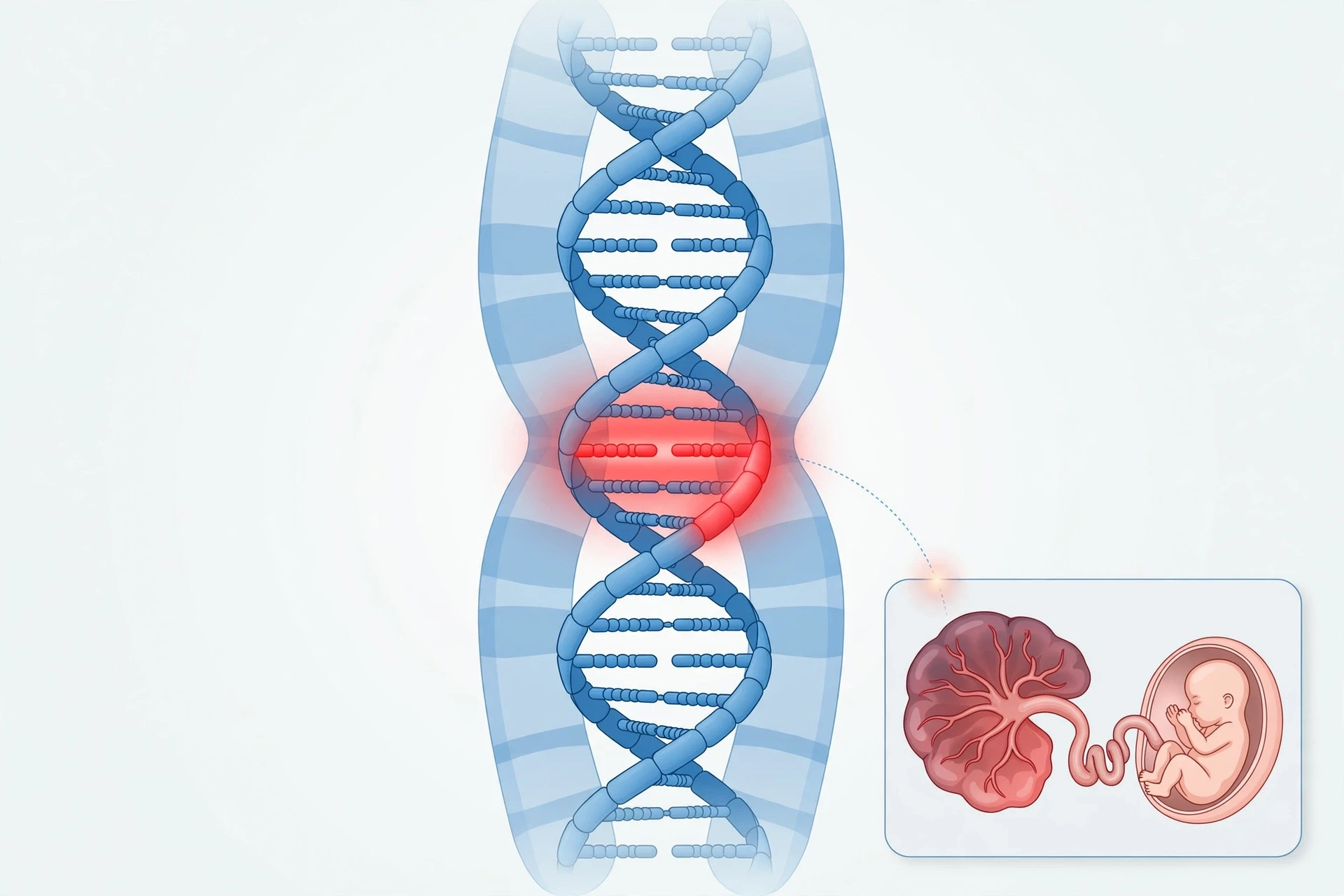
14.2 Viral fossils as evolutionary evidence
Endogenous retroviruses are more than curiosities. They are fossils with a property no bone can match: they record the exact sequence of the virus that infected an ancestor, frozen in the genome at the moment of insertion. And because the same insertion, at the same place in the genome, is vanishingly unlikely to happen twice independently, a shared HERV insertion is powerful evidence of shared ancestry. Humans and chimpanzees share many HERV insertions at identical locations — proof, written in viral DNA, that the insertions happened in a common ancestor before the two lineages split.
HERVs also reveal the deep history of virus evolution itself. By comparing the sequences of HERV families across species, researchers can reconstruct the family tree of retroviruses stretching back tens of millions of years — a fossil record for viruses, which leave no bones. Some HERV families are old, dating to before the primate radiation. Some are young: the HML-2 family, the most recent, went extinct less than five million years ago, and some of its proviruses are still active in human tissues today. The human genome is, in this sense, a museum of ancient pandemics, each one recorded in the DNA of its survivors.
There is a practical side to this story too. HERV sequences are not always silent. Some are switched on in early embryonic development, where they appear to help maintain the pluripotency of stem cells. Some act as switches, controlling the activity of nearby genes — including, remarkably, a family of HERV-derived sequences that regulates AIM2, a sensor that detects foreign DNA in the cell. And some have been implicated in disease, including multiple sclerosis, where a HERV-W envelope protein is a target of experimental treatments. The viruses that became us are not just history. They are still part of how our bodies work, for better and for worse.
15. The Deep Past: Where Viruses Came From
Viruses are ancient — possibly older than cells themselves, if the virus-first hypothesis is right — but their origin, and the origin of virus evolution itself, is one of the great unsolved questions in biology. There are three main hypotheses, and the truth may involve all three.
This section lays them out, introduces the giant viruses that blurred the line between virus and cell, and explains why the most abundant biological entities on Earth are viruses that infect bacteria.
The first hypothesis is called the escape hypothesis, or the progressive hypothesis: viruses began as pieces of cellular genetic material — plasmids, transposons, fragments of DNA or RNA — that escaped from cells and learned to replicate independently, picking up the ability to move between cells as they went. The evidence is suggestive: many viruses carry genes that look like stolen cellular genes, and retroviruses resemble transposons — jumping genes — that learned to leave the cell. If this hypothesis is right, viruses are runaway pieces of cellular genomes, and virus evolution is a continuation of cellular evolution by other means.
The second is the reduction hypothesis, or the regressive hypothesis: viruses began as small cells — perhaps parasitic bacteria — that gradually lost everything they did not need, shedding genes for metabolism, for energy production, for building cell walls, until nothing was left but the genetic instructions and the means to get them into a new host. The giant viruses lend this hypothesis its strongest support. Mimivirus, isolated from a water-cooling tower in Bradford, England, in 1992 and recognised as a virus only in 2003, has a genome of over a million letters and carries genes for protein synthesis — machinery almost unheard of in a virus when it was found, and now known to be shared, in even more complete form, by other giant viruses — and that looks suspiciously like the remnants of a cellular past. Its discovery forced a rethinking of what a virus can be: not necessarily small and simple, but sometimes large and complex, carrying the genetic echoes of something that was once more cell-like.
The third is the virus-first hypothesis: viruses, or virus-like replicators, existed before cells, in the RNA world that preceded cellular life — and cells evolved later, in part as a defence against them. This is the oldest idea in the field, going back to the earliest days of virology, and it is also the hardest to test, because it concerns events nearly four billion years ago, for which no direct evidence survives. What keeps it alive is the deep logic of the quasispecies theory described in section 4: Eigen developed his mathematics to explain how genetic information could evolve before cells existed, and RNA viruses are the closest living analogues of those first replicators.
15.1 The most abundant life on Earth is viral
Whichever hypothesis is right, one fact is not in dispute: viruses are the most abundant biological entities on the planet. Bacteriophages — viruses that infect bacteria — dominate that count, with an estimated ten thousand billion billion billion (10³¹) virus particles in existence on Earth, a large share of them in the oceans, where they kill roughly a fifth of marine bacteria every day. That killing matters: it releases nutrients back into the water, drives the ocean's carbon cycle, and shapes the evolution of every bacterial lineage on Earth. Bacteria evolve, in large part, in response to phages — developing defences like CRISPR, the bacterial immune system that humans have repurposed into a gene-editing tool, as described in our article on CRISPR.
The phages also illustrate a point about virus evolution that is easy to miss when the focus is on human disease: most viral evolution has nothing to do with us. The vast majority of viruses infect bacteria, algae, fungi, and other microbes, and they have been evolving alongside those hosts for billions of years, in an arms race far older and far larger than the human one. Human viruses are a tiny, recent branch of a tree whose roots reach to the origin of life itself. When we study virus evolution, we are studying the oldest and most widespread evolutionary process on the planet — and our own diseases are only its most visible edge.
15.2 What we still do not know
The origin of viruses remains unsolved, and honest science says so plainly. We do not know whether viruses predate cells or descend from them. We do not know how many times viruses originated — once, or many times independently. We do not know why some viral lineages have DNA genomes and others RNA, or whether the RNA viruses are relics of an RNA world or later inventions. The giant viruses complicated the picture rather than resolving it: they showed that the boundary between virus and cell is porous, but they did not show which side came first.
What we do know is that viruses have been evolving for billions of years, that virus evolution follows the same principles as all evolution — replication, variation, selection — and that those principles, running at viral speed, have shaped the history of life in ways we are only beginning to appreciate. The HERVs in our genome are proof of that. So is the CRISPR system in bacteria, the placenta in mammals, and the very structure of the oceans' ecosystems. Virus evolution is not a footnote to the history of life. In many ways, it is the history of life.
16. Fighting Back: Vaccines, Drugs, and the Evolutionary Countermove
Virus evolution never stops. Medicine evolves too — and the contest between the two is, in the end, a contest of evolutionary speeds. This section explains the strategies that work against fast-evolving viruses, why some fail, and what the next generation of countermeasures looks like.
The theme is simple: the winning strategies are the ones that respect how virus evolution works, rather than fighting it on its own terms.
The first strategy is to aim at what cannot change. A virus's surface proteins mutate freely, but its core machinery — the polymerase that copies its genome, the protease that cuts its proteins into shape — is constrained: mutations there usually break the machine. Drugs that target these conserved proteins work against many variants at once, and resistance to them is costly for the virus. The HIV drug class called protease inhibitors works this way, and so do the polymerase inhibitors used against hepatitis C. The same logic drives universal vaccine research: aim at the conserved stalk of the flu HA protein, or at a conserved region of the coronavirus spike, and the vaccine should work against variants that have not yet evolved — because changing those regions usually cripples the virus — mutations there carry a steep fitness cost.
The second strategy is combination: attack several targets at once, so that escape requires several rare mutations in the same genome. This is the logic of HIV combination therapy, described in section 10, and it has been applied to hepatitis C — where combination antivirals now cure more than ninety-five percent of patients — and to tuberculosis, where multi-drug regimens prevent resistance. The principle is mathematical: if the chance of escaping one drug is one in a million, the chance of escaping three simultaneously is one in a million trillion, and even a quasispecies cloud of ten billion particles a day will not produce it.
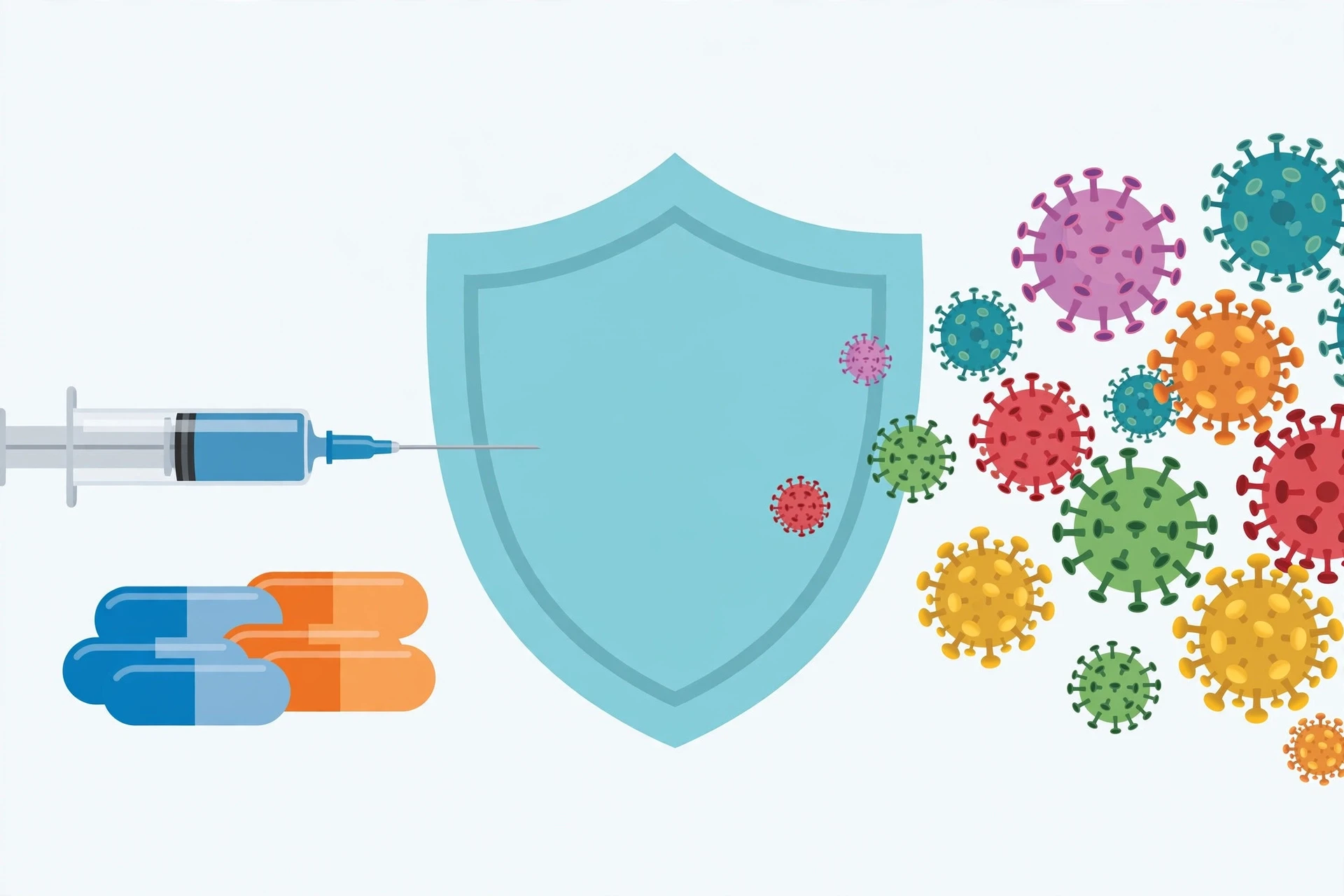
16.1 When drugs drive evolution
The third thing to understand is that our own interventions are selection pressures, and they drive virus evolution in directions we do not always foresee. Antiviral drugs select for resistant variants — that is their nature, and it is why combination therapy matters. But vaccines can also select, in subtler ways. A vaccine that protects against disease but does not fully block infection can, in theory, select for variants that transmit despite immunity — although the evidence that this has happened on a large scale is limited, and the alternative (no vaccination) is far worse. The honest statement is that every intervention changes the selection landscape, and the job of public health is to choose interventions whose benefits dwarf their evolutionary costs.
The clearest example of a drug driving virus evolution is also the most instructive. Molnupiravir, the antiviral described in section 4, works by lethal mutagenesis — pushing the virus's error rate above the error threshold until the population collapses. It is a strategy that uses virus evolution against itself. But it carries a risk that follows directly from its mechanism: if the mutagenesis is incomplete, the surviving viruses carry extra mutations, some of which could be useful. That risk has in fact shown up in the data — a molnupiravir mutational signature has been found in global SARS-CoV-2 sequences, sometimes with onward transmission — though no variant of concern has been linked to it, and the clinical significance is still debated, so the drug's use is carefully monitored. The lesson is general: any intervention that touches the virus's mutation rate, in either direction, must be watched for its evolutionary side effects.
There is a parallel lesson for vaccines. The fastest way to reduce a virus's opportunity to evolve is to reduce its opportunity to replicate — and vaccination, by preventing infections, does exactly that. Every infection prevented is billions of viral copies never made, and billions of mutations never tried. This is the strongest argument for widespread vaccination, and it is an evolutionary argument, not just a medical one: the less a virus circulates, the less it changes. The WHO's statement — the more viruses circulate, the more they may change — is the policy in a sentence.
16.2 The next generation: prediction and prevention
The newest strategy is prediction: using the flood of genomic data to forecast the next moves in virus evolution and get ahead of them. Researchers now track the frequencies of individual spike mutations in global sequencing data, test their effects in the laboratory, and model which combinations are likely to spread — a kind of weather forecasting for virus evolution. The forecasts are imperfect, and the virus still surprises us, but the direction is clear: from reacting to variants after they appear, toward anticipating them before they do.
Alongside prediction, there is prevention at the source: reducing the chances of spillover by monitoring wildlife, regulating wildlife trade, and improving conditions on farms where animals and humans mix. Most pandemics begin with a jump, and every jump prevented is a pandemic that never happens. This is slower, less glamorous work than developing a new vaccine, and it requires international cooperation that is often hard to sustain between crises. But it is, in evolutionary terms, the most efficient intervention of all: it stops the process before selection ever gets its chance.
17. What Virus Evolution Means for Us
Virus evolution is not an abstract process happening somewhere else. It is the reason your flu shot changes every year, the reason new COVID variants keep appearing, the reason HIV needs three drugs at once, and the reason eight percent of your DNA is viral in origin.
It is one of the fastest evolutionary processes on Earth, running continuously, in every infected person, on every continent — and it will keep running whether we understand it or not.
The good news is that we understand it better than ever before. We know the machinery of virus evolution: sloppy polymerases, quasispecies clouds, recombination and reassortment, drift and shift. We know the numbers: mutation rates, error thresholds, billions of copies a day. We can watch it happen in real time, genome by genome, through global sequencing networks that have grown enormously since 2020. And we have strategies that work — conserved targets, combination therapy, updated vaccines, surveillance — because they are built on the evolutionary logic itself rather than on wishful thinking.
The bad news is that the virus will keep finding new answers. It has more copies, more chances, and more time than we do. Every intervention we deploy becomes a new selection pressure, and the virus's response is only a matter of time and numbers. That is not a reason for despair. It is a reason for humility, and for the steady, unglamorous work of watching, sequencing, updating, and preparing — the work that caught Omicron in days rather than months, and that will catch the next variant too, if we keep funding it.
Much is still unknown, and the gaps are worth naming honestly. We still do not know how to predict, reliably, which variant will emerge next, or whether a given spillover will fizzle or explode. We still do not have a universal flu vaccine, or an HIV vaccine, or a way to empty the latent HIV reservoir. We still do not know where viruses came from, or how many times they originated. And we still do not know how much of our own evolution — our immune system, our placenta, our genome itself — was shaped by viruses we have not yet identified.
These are open questions, not excuses: every measure we have points the same way. Viruses will keep evolving, and our job is not to stop them — we cannot — but to stay close enough behind that virus evolution never outruns our ability to respond. The fossil record of past pandemics tells us what happens when it does. The surveillance networks of the present tell us it does not have to. The choice, as with so much in this story, is ours — and it is made, or unmade, by whether we keep watching.
Frequently Asked Questions
How do viruses evolve?
Virus evolution works through mutation and natural selection. When a virus copies itself inside a host cell, its copying enzyme makes errors — mutations — and most new copies carry at least one change. Most changes are harmful or neutral, but a few help the virus spread, escape immunity, or resist drugs, and those few become more common over time. Viruses can also swap genetic material through recombination and reassortment, which combine existing mutations into new variants in a single step. Because viruses produce billions of copies per infection, virus evolution runs far faster than evolution in animals or plants.
What is the difference between a mutation, a variant and a strain?
A mutation is a single change in the viral genetic sequence — one letter swapped, added or deleted. A variant is a virus carrying one or more new mutations compared with the original, making its genome measurably different. A strain is a variant that has also shown different behaviour — it spreads differently, causes different disease, or escapes immunity — and has become established in a population. In short, all strains are variants, but not all variants are strains. Most variants appear and vanish without ever mattering.
What is antigenic drift vs antigenic shift?
Antigenic drift is the slow, gradual accumulation of small mutations in a virus's surface proteins, which gradually changes its appearance to the immune system. It happens constantly in influenza and is why the flu vaccine is reformulated every year. Antigenic shift is an abrupt, major change — usually when a flu virus acquires an entirely new surface protein through reassortment with an animal flu virus — producing a subtype no human immune system has seen before. Drift causes seasonal epidemics; shift causes pandemics. Drift happens in both influenza A and B; shift happens only in influenza A.
Why do RNA viruses mutate faster than DNA viruses?
RNA viruses copy their genomes with an enzyme called RNA-dependent RNA polymerase, which in most cases has no proofreading function — it cannot check its work or correct mistakes. Their error rate is roughly one mistake per ten thousand letters copied. DNA viruses copy their DNA with polymerases that do proofread, and their error rates are hundreds to thousands of times lower. Coronaviruses are the exception among RNA viruses: they carry a proofreading enzyme called NSP14, which is why SARS-CoV-2 evolves more slowly than flu or HIV. The copying machinery sets the speed limit on virus evolution.
Can viruses evolve to become more deadly?
Yes, but deadliness is not what virus evolution selects for — transmission is. A virus that kills its host quickly has less time to spread, so selection usually penalises severity. But if the same mutation that improves transmission also causes worse disease, selection will favour it anyway, and severity can rise as a side effect. Whether a virus becomes milder or more severe depends on the details of how it spreads: viruses that transmit before symptoms appear, or through mosquitoes or water, face little penalty for severity. There is no general law that viruses always become milder.
Do vaccines cause viruses to evolve?
Vaccines create a selection pressure, like any intervention, and they can favour variants that escape immunity — but the effect is small compared with the alternative. The strongest driver of virus evolution is the number of infections: every infection produces billions of viral copies and billions of chances to mutate. By preventing infections, vaccines reduce the total amount of viral replication and therefore reduce the opportunities for virus evolution. Escape variants arise wherever the virus replicates freely and for a long time — most often where circulation is high and infections go unchecked — which is why reducing total infections matters more than who is vaccinated. Refusing vaccination to "avoid driving evolution" has it backwards: it gives the virus more chances to change.
Can we predict how a virus will evolve?
Partly, and increasingly well — but not reliably. Scientists can track which mutations are rising in frequency through global genomic surveillance, test their effects in the laboratory, and model which combinations are likely to spread. That forecasting caught Omicron within days and guides annual flu vaccine strain selection. But virus evolution is partly a matter of chance: transmission bottlenecks, rare reassortments, and mutations in unmonitored populations can produce surprises no model predicts. Prediction is improving every year; certainty is not on offer, and any claim of it should be treated with suspicion.
Sources
Centers for Disease Control and Prevention — How Flu Viruses Can Change: "Drift" and "Shift"
Learn How To Science — How Viruses Evolve: Mutation, Recombination, and Natural Selection
Yeo et al. (2020) — The Determination of HIV-1 RT Mutation Rate, Viruses
Multi-Parameter Genomic Evolution of SARS-CoV-2 Across Ten US States, 2020–2025 (2026)
Nature Microbiology (2019) — Error catastrophe in a proofreading-impaired herpesvirus (MDV study)
Towards Next-Generation Sequencing for HIV-1 Drug Resistance Testing, Viruses (2022)
Influenza: dealing with a continually emerging disease (Communicable Diseases Intelligence, 1996)