
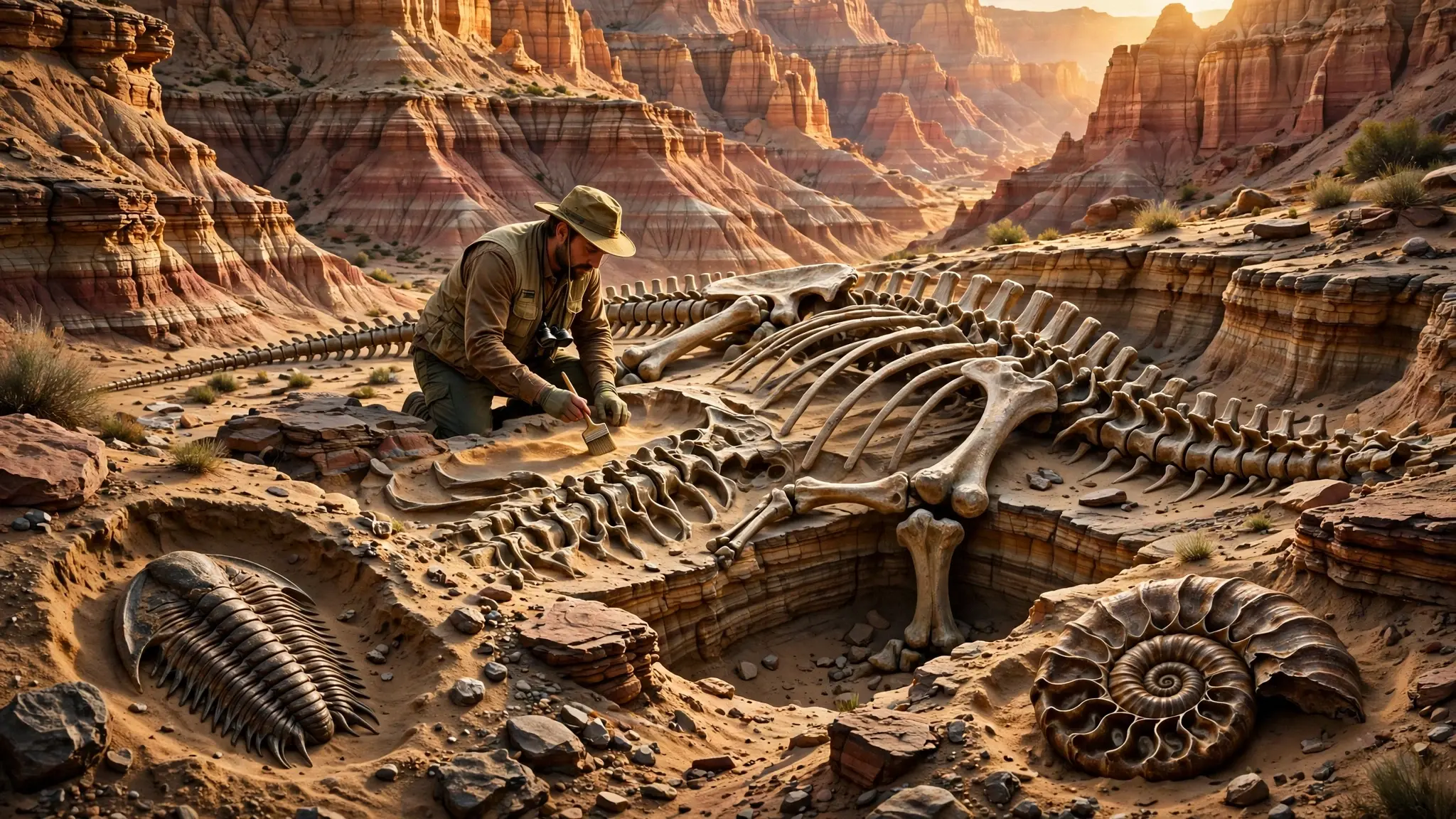
1. The Twelve-Year-Old Who Found a Sea Dragon
In the autumn of 1811, on a cold beach in Lyme Regis, a twelve-year-old girl named Mary Anning and her brother Joseph were picking through the fallen rocks at the foot of a cliff when Joseph found a strange skull, four feet long, with a crocodile's snout and an eye the size of a dinner plate ringed in bone. About a year later, in November 1812, Mary dug out the rest of the skeleton — more than five metres of spine and ribs, the first ichthyosaur skeleton to be scientifically studied and described. Nothing alive in England looked anything like it. Nothing in the Bible described it. And yet there it lay in the stone, as solid and undeniable as the cliff itself.
That skeleton was an ichthyosaur — a "fish lizard" — and it was the first ichthyosaur skeleton to be scientifically studied and described. Mary Anning had no university degree, no money, and no standing in the scientific world of her day. What she had was a hammer, a sharp eye, and a stretch of Jurassic coastline that kept giving up its dead after every storm. Over the next three decades she would pull plesiosaurs and pterosaurs from the same cliffs, and each one would force the scientists of Europe to stretch their picture of Earth's history a little further back.
I think about Mary Anning every time I walk into a natural history museum and see a child pressed against the glass of a fossil hall, staring up at a skeleton that dwarfs them. The fossil record does that to people. It takes something abstract — deep time, extinction, evolution — and makes it physical, something you can stand beside and measure yourself against. A bone in a rock is not a theory. It is a fact you can touch.
That is what this article is about: the fossil record, the archive of ancient life written in stone. How it forms, how scientists read it, what it tells us about evolution and extinction, and why — despite being the greatest history book ever written — it is also one of the most incomplete. The story runs from 3.5-billion-year-old microbial mats in Australia to a 3.2-million-year-old ancestor of ours in Ethiopia, from fish with wrists to whales with legs, from the first footprints on land to the last days of the dinosaurs. And it begins, as so much of paleontology does, with a child on a beach who refused to believe the rocks were empty.
2. What Is the Fossil Record?
The fossil record is the preserved remains and traces of ancient life, written into Earth's rocks over more than 3.5 billion years. It is the only direct evidence we have of most of the species that ever lived, and it is how scientists reconstruct evolution, date the history of life, and read the climates of vanished worlds.
Start with the word itself. "Fossil" comes from the Latin fossilis, meaning "dug up" — and that is exactly what fossils are: things dug up from the ground that were once alive. A fossil can be a bone turned to stone, a shell pressed into mud, a leaf's dark imprint on shale, or a footprint left in wet sand that hardened into rock. It can be a whole skeleton, a single tooth, or nothing more than the burrow a worm left behind. What all fossils share is that they are evidence of past life, preserved in the rock record.
The fossil record is the sum of all of those fossils — every specimen in every museum drawer, every bone still buried in every cliff, every trackway, shell bed, and amber-trapped insect on the planet. Taken together, it is the most complete history of life we will ever have, and also the most fragmentary. Paleontologists have named roughly a quarter of a million fossil species, yet that is a tiny fraction of all the species that have ever lived. More than 99 percent of all species that ever existed are extinct, and most of them left no trace at all.
That tension — a record both vast and full of holes — is the thread running through this article. The fossil record is good enough to show us, step by step, how fish became tetrapods, how dinosaurs became birds, and how a small African ape became us. It is also gappy enough that whole chapters are missing, whole groups of animals are barely represented, and some of the most important transitions in the history of life are documented by a handful of specimens. Understanding both halves — what the record shows and what it cannot — is the key to reading it honestly.
One more thing to fix in the reader's mind before going further. The fossil record is not a museum display that someone arranged for our convenience. It is an accident of geology: the by-product of sediment piling up, organisms dying in the wrong place at the right time, and rocks surviving long enough for someone to split them open. Nobody designed it. Nobody curated it. It is a history written by erosion, burial, and luck — and the fact that we can read it at all is one of the great good fortunes of science.
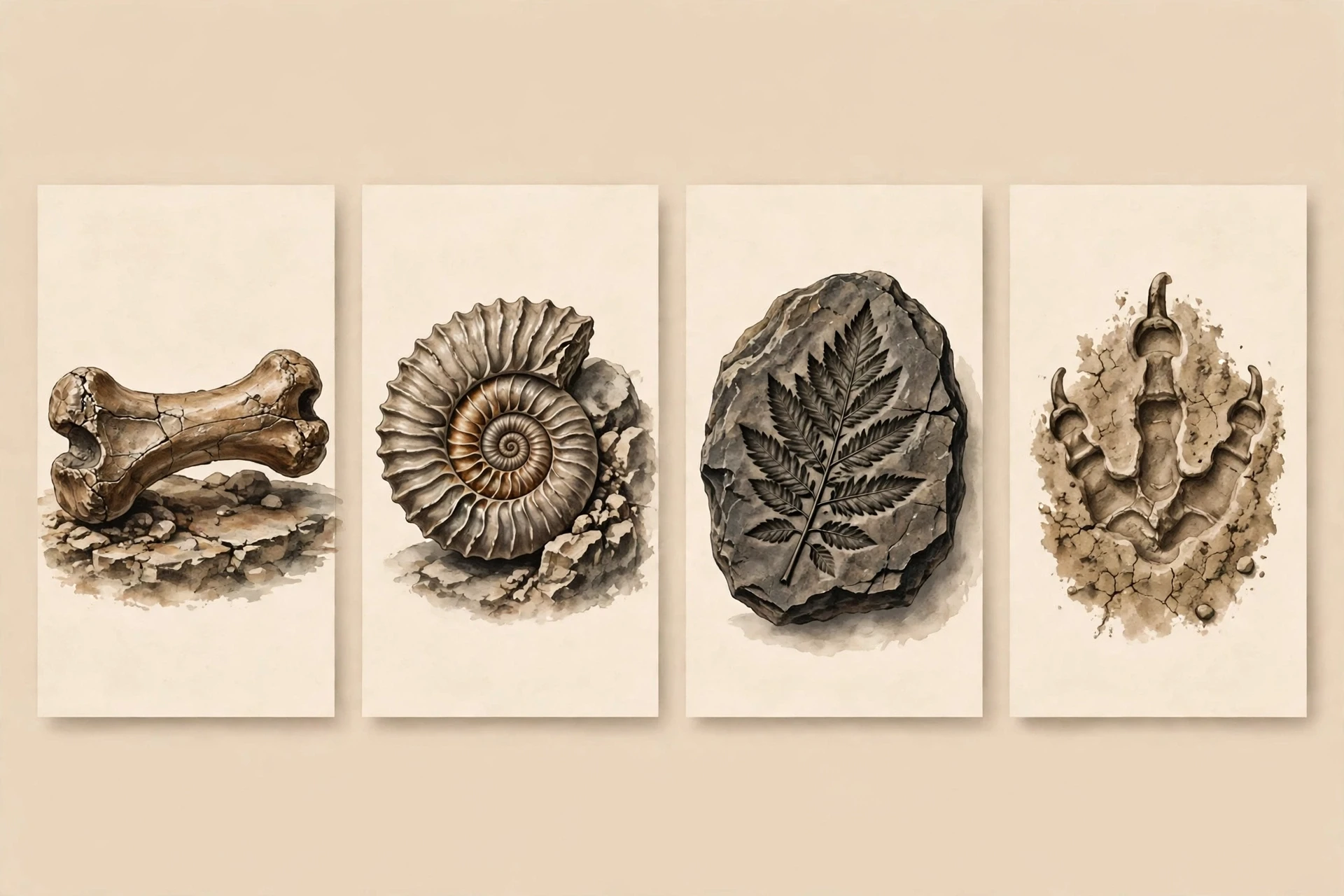
2.1 Body fossils and trace fossils
The first distinction to learn is between body fossils and trace fossils. A body fossil is the remains of the organism itself: bone, tooth, shell, wood, or leaf. A trace fossil — an ichnofossil, from the Greek word for "track" — is evidence of what an organism did, not what it was: a footprint, a burrow, a nest, a bite mark, or fossilised dung, known as a coprolite. The distinction matters, because the two kinds of fossil tell us different things.
Body fossils tell us about anatomy. From a skull you can read the size of the brain; from teeth, the diet; from limb bones, the way an animal moved. Trace fossils tell us about behaviour, which body fossils almost never can. A trackway shows how fast an animal walked and whether it travelled alone or in a herd. A burrow shows where it sheltered. A nest with eggs shows that it cared for its young. Some of the most vivid moments in the fossil record — a predator's footprints closing on its prey's, a dinosaur sitting on its nest — come from trace fossils, not bones.
There is also a third category that blurs the line: chemical fossils. These are not shapes at all but molecular traces — distinctive carbon compounds, or isotopic signatures in ancient rocks, that betray the presence of life even when no body survives. Some of the earliest convincing evidence for life on Earth, the 3.5-billion-year-old stromatolites of Western Australia, sits on this boundary: layered mounds built by microbial mats, whose biological origin received direct support when researchers found organic matter preserved inside them in 2019. Sometimes the fossil record speaks in chemistry rather than in bone.
2.2 How deep does the record go?
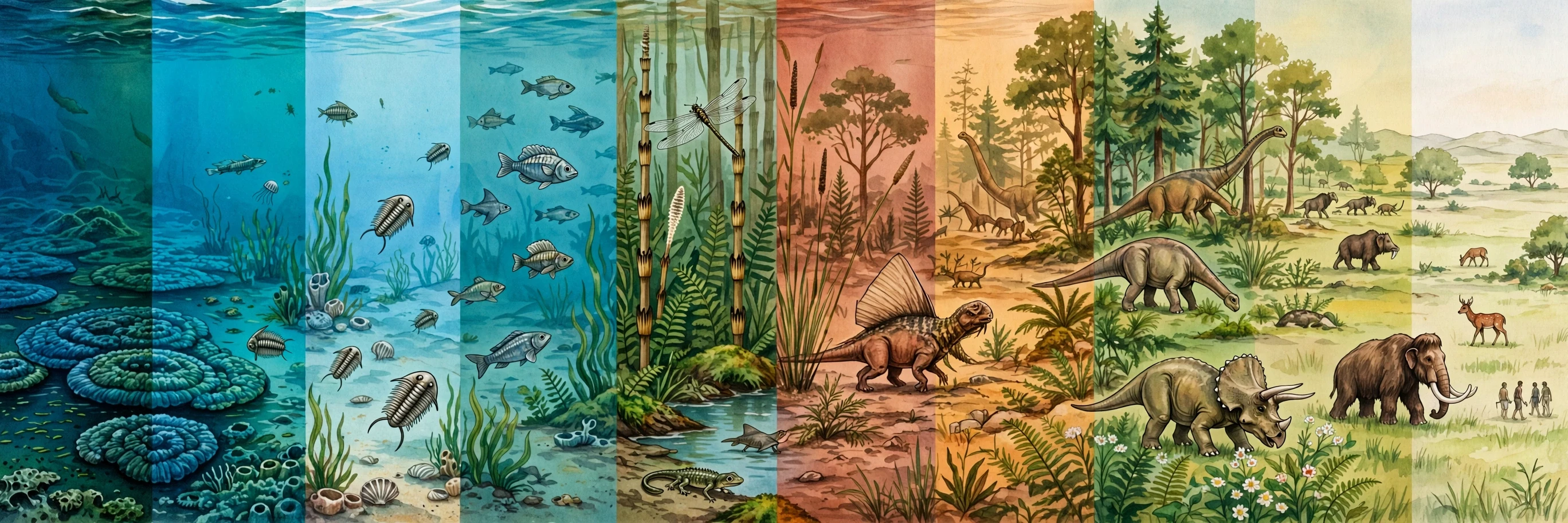
The fossil record stretches back more than 3.5 billion years — nearly four-fifths of Earth's 4.54-billion-year history. But it is not evenly spread across that time. The first three billion years are recorded almost entirely by microscopic life: bacteria, algae, and the layered stromatolites they built. Animals with hard parts — shells, skeletons, teeth — appear only in the last 539 million years, with the Cambrian explosion, and the record grows dramatically richer from that point on.
This unevenness has a simple cause: fossilization favours hard parts, and hard parts are a recent invention. For most of life's history, organisms were soft-bodied microbes that left almost nothing behind. The record we have is therefore heavily weighted toward the recent past, and toward animals with shells and bones. A trilobite, armoured in calcite, had a far better chance of entering the fossil record than a jellyfish, which had almost none. That bias shapes everything paleontologists can say — and everything they must be careful not to say.
It also means the fossil record is a record of the minority. The shelled invertebrates — snails, clams, corals, trilobites — dominate museum collections because they fossilize well, not because they dominated ancient life. The soft-bodied majority is mostly invisible, glimpsed only in the rare deposits where exceptional preservation froze them in place. When you look at the fossil record, you are looking at the survivors of a brutal filter, and the filter itself is part of the story.
2.3 Why the fossil record matters
The fossil record matters for three reasons, and each one anchors a part of this article. First, it is the evidence for evolution. The progressive changes visible in rock layers — fish giving way to amphibians, reptiles to mammals, dinosaurs to birds — are the direct, physical documentation of descent with modification, the same process described in our article on natural selection. No other evidence for evolution is as tangible: you can hold a transitional fossil in your hands.
Second, the fossil record is the clock of Earth's history. Before radiometric dating, fossils were the only way to tell the relative ages of rocks, and they still are the fastest way to date a layer in the field. Certain fossils — index fossils — are so widespread and so short-lived that finding one pins a rock to a narrow slice of time. Geologists still use them daily, from oil exploration to mapping the seafloor.
Third, the fossil record is the archive of Earth's climates and catastrophes. Fossil corals mark warm shallow seas; fossil leaves record ancient rainfall; fossil pollen tracks forests advancing and retreating with the ice ages. And the record's great breaks — the mass extinctions — show how life responds when the planet changes suddenly. That last lesson is the one that reaches furthest into our own future, and it is where this article ends.
3. How Fossils Form: The Long Odds
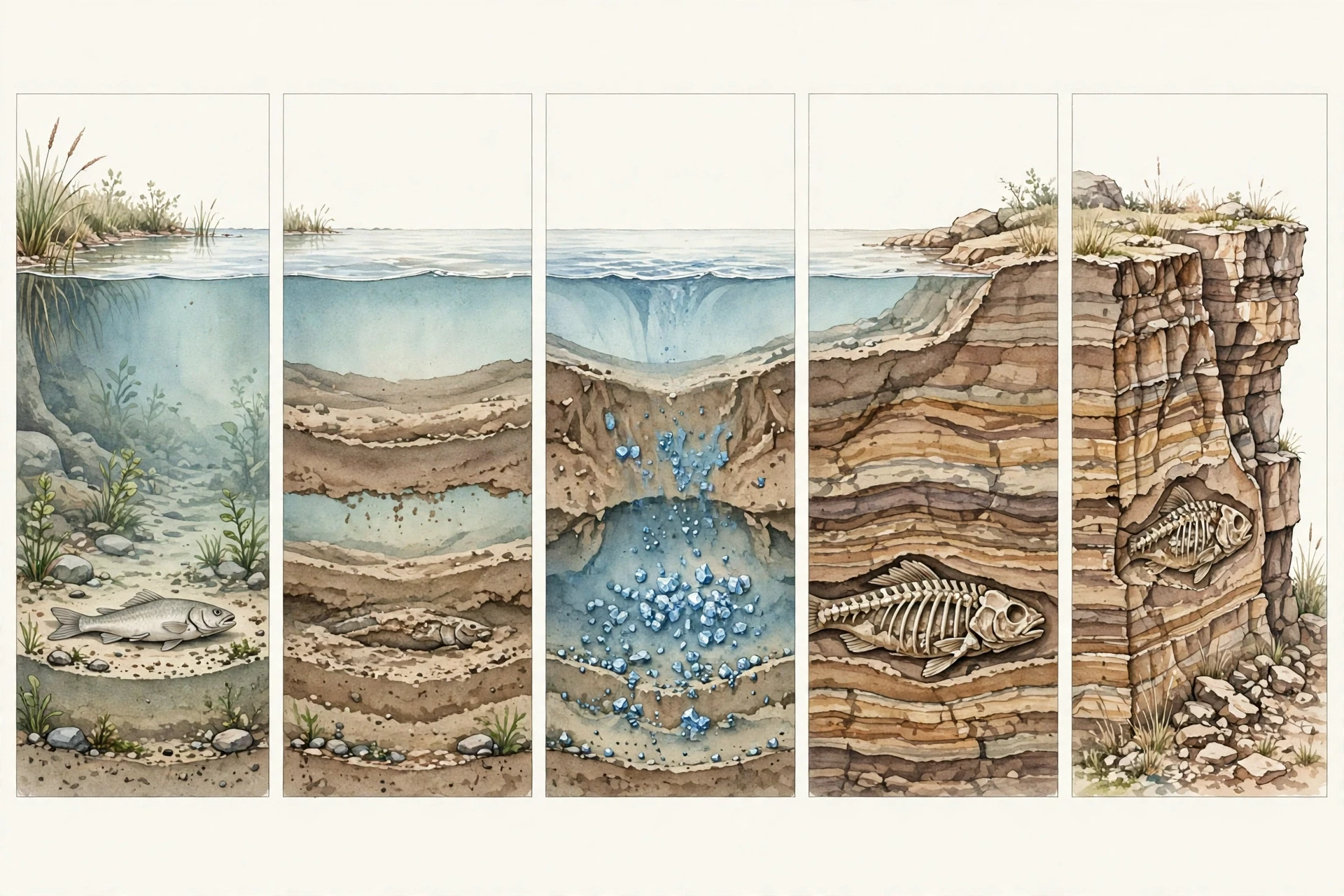
Fossils form when a dead organism is buried quickly in sediment before scavengers and decay can destroy it, and minerals then turn its remains to stone. Fossilization is rare: most organisms rot completely, and only a tiny fraction of the life that ever existed leaves any trace in the fossil record.
The first thing to understand about fossilization is that it is a race against decay. When an organism dies, bacteria, fungi, and scavengers get to work within hours. Soft tissues — muscle, skin, organs — are usually gone within weeks. Bones and shells last longer, but on the surface they weather, crack, and scatter. For a fossil to form, something must interrupt that process fast: burial under mud, sand, or volcanic ash, cutting off oxygen and keeping scavengers away. The Australian Museum puts it plainly: most fossils form when a living thing dies and is quickly buried by sediment.
The odds are steep. An animal that dies on dry land, in the open, has almost no chance of fossilizing. An animal that dies in a river delta, a lake bed, or a shallow sea — where sediment is constantly settling — has a small chance. A marine animal with a hard shell, dying in quiet water where mud accumulates, has the best chance of all. That is why the fossil record is dominated by sea creatures, and why land animals, birds, and insects are comparatively rare. The record is not a fair sample of ancient life. It is a sample of the life that died in the right places.
Once buried, the chemistry begins. Groundwater carrying dissolved minerals — silica, calcite, iron oxides — seeps through the sediment and into the pores of bone, shell, and wood. Over thousands of years, those minerals crystallise, filling the empty spaces and sometimes replacing the original material atom by atom. The surrounding sediment compacts into rock. Millions of years later, tectonic forces lift the rock toward the surface, erosion strips away the layers above, and — if nothing has destroyed it in the meantime — the fossil is exposed for someone to find. Every step in that chain can fail, and most of the time it does.
3.1 The five ways to become a fossil
Most fossils are preserved in one of five ways, and the differences between them explain why some fossils keep exquisite detail while others are only shadows. The table below summarises them.
| Process | What happens | What it preserves best | Classic example |
|---|---|---|---|
| Permineralization | Mineral-rich groundwater fills the pores of bone, shell, or wood without replacing the original material | Bone, wood, shells — often with internal structure intact | Petrified wood; dinosaur bone |
| Molds and casts | The organism dissolves away, leaving a cavity (mold); sediment later fills it, forming a replica (cast) | Outer shape; sometimes fine surface detail | Shell molds in sandstone |
| Replacement | The original material dissolves molecule by molecule and is replaced by a different mineral | Shape and sometimes microscopic detail | Pyritized ammonites; silicified shells |
| Compression | Pressure squeezes out volatile compounds, leaving a thin dark carbon film | Flat outlines; fine detail of leaves and soft bodies | Fern and leaf fossils; Burgess Shale animals |
| Preserved remains | The original material survives almost unchanged, sealed away from decay | Soft tissue, skin, fur; DNA fragments in permafrost specimens only | Insects in amber; mammoths in permafrost |
Permineralization is the most common way a vertebrate becomes a fossil, and it is the process behind most dinosaur bones. The bone keeps its shape and much of its internal structure, but it is no longer bone: its pores are filled with stone, and it is heavier, harder, and far more durable than the living tissue was. A fossil bone is, quite literally, a bone turned to rock.
Replacement goes further. Here the original material is not just filled in but swapped out, molecule by molecule, for a different mineral — silica for calcite, pyrite for shell. When permineralization and replacement happen together, the result is petrification: the organism has become stone through and through. Some replaced fossils preserve detail at the microscopic level, down to individual cells. Others lose detail as the replacement mineral grows in coarse crystals, blurring the fine structure. Whether a fossil is beautiful or crude depends on the chemistry of the groundwater that made it.
Compression is the fossilization of flat things. A leaf, a fern, or a soft-bodied animal buried under heavy sediment is squeezed until only a thin film of carbon remains — a dark silhouette that records the outline and sometimes the veins, the segments, the fine hairs. The Burgess Shale animals, some of the most important fossils ever found, are compressions: soft bodies flattened into carbon films on black shale, preserving creatures that by all rights should have vanished without a trace.
3.2 The exceptional cases: amber, ice, and tar
Most fossils are stone. A few are not — and those few are precious, because they preserve what stone cannot: soft tissue, colour, even behaviour frozen mid-act. Insects trapped in amber are the most famous. Tree resin, sticky and airtight, entombs a fly or an ant, hardens over millions of years, and preserves the animal almost perfectly — legs, wings, antennae, sometimes even the contents of its gut. Amber fossils have given us spiders with prey in their webs, ants carrying their young, and feathers that still show their microscopic structure.
Ice and permafrost do the same for larger animals. Woolly mammoths frozen in Siberian permafrost have been found with skin, hair and stomach contents — and in one famous case, a mammoth found in 2013, liquid blood oozed from the carcass when scientists cut into it — animals dead for tens of thousands of years, preserved as if they had died last winter. Tar pits work differently: the asphalt is a trap, not a preservative, but it seals bones away from oxygen and scavengers, so that even delicate bird bones survive. The La Brea Tar Pits in Los Angeles have yielded more than 3.5 million specimens this way, a whole Ice Age ecosystem in asphalt.
These exceptional preservations are rare, but they punch far above their weight in what they teach us. A single amber-trapped feather can tell us more about the evolution of flight than a hundred crushed skeletons. A single frozen mammoth can tell us more about Ice Age diet than a thousand isolated teeth. The fossil record's best evidence often comes from its strangest corners.
3.3 Why most things never fossilize
Here is the number that frames the whole subject: of all the organisms that have ever lived on Earth, only a tiny percentage ever became fossils. The fossil record is not a census. It is a lottery, and almost every ticket loses.
The losers are predictable. Soft-bodied animals — jellyfish, worms, slugs — rot before they can be buried. Small animals are eaten whole. Animals that live in forests, on mountains, or in deserts die where sediment rarely accumulates. Animals that live in acidic soils dissolve. And even when a fossil does form, it must survive: rocks are uplifted, eroded, metamorphosed, and subducted, and most fossils are destroyed long before anyone can find them. The fossil record is the residue of a residue — the small fraction of life that fossilized, of which only a small fraction survived, of which only a small fraction has been found.
I keep a small trilobite on my desk — a palm-sized creature, armoured in calcite, that lived in a shallow sea some 450 million years ago. I picked it up in a museum shop years ago, and I still turn it over in my hands when I am thinking about this subject. It is absurdly ordinary as a fossil: trilobites are among the commonest fossils on Earth, with tens of thousands of species described. And yet this one animal beat odds so long that they are hard to comprehend. It died in the right place, was buried quickly, mineralised, survived mountain-building and erosion, and ended up in a shop where I could buy it. Every fossil in every museum is a survivor of the same improbable chain. The wonder is not that the record is incomplete. The wonder is that it exists at all.
4. Reading the Rocks: How Fossils Are Dated
Fossils are dated by combining two methods: relative dating, which reads the order of rock layers to say which fossils are older, and radiometric dating, which measures the decay of radioactive isotopes in volcanic ash layers to give absolute ages in millions of years.
The first method is the older one, and it is beautifully simple. In undisturbed sedimentary rock, the layers stack like pages: the oldest at the bottom, the youngest at the top. This is the principle of superposition, worked out by the Danish anatomist Nicolas Steno in the 1660s, and it means that a fossil found in a lower layer is older than one found in a higher layer. Walk up a cliff face and you are walking forward through time; walk down and you are walking back. Geologists call this reading the strata, and it is still the first thing a paleontologist does at a new site.
But superposition only gives relative ages — older or younger, not how old. To pin a fossil to a number, geologists use index fossils: species that were widespread, easily recognisable, and short-lived. Find a particular species of ammonite in a rock, and you know the rock's age within a few million years, because that ammonite lived only during a narrow slice of time. Trilobites, graptolites, and ammonites are the classic index fossils, and they let geologists correlate rock layers across continents: the same ammonite in England and in Madagascar means the two rocks are the same age, even though they are an ocean apart.
The second method, radiometric dating, gives absolute numbers, and it works on a different principle entirely. Certain atoms are unstable: they decay into other atoms at a fixed rate, measured by their half-life — the time it takes for half of a sample to decay. Measure the ratio of parent atoms to daughter atoms in a rock, and you can calculate how long the clock has been running. The method does not date the fossil itself — fossils are usually too altered for that — but the volcanic ash layers above and below it, which bracket the fossil's age between two numbers.
4.1 The clocks: carbon, potassium, uranium
Different clocks cover different parts of deep time, and the table below shows the three that matter most for fossils.
| Method | Parent → daughter | Half-life | Useful range | What it dates |
|---|---|---|---|---|
| Carbon-14 | Carbon-14 → nitrogen-14 | 5,730 years | Up to ~50,000 years | Organic material: bone, wood, charcoal |
| Potassium-argon | Potassium-40 → argon-40 | 1.25 billion years | 100,000 years to billions of years | Volcanic rock and ash |
| Uranium-lead | Uranium-238 → lead-206 | 4.5 billion years | Millions to billions of years | Zircon crystals in igneous rock |
Carbon-14 is the famous one, and also the most limited. Living things absorb carbon from the atmosphere, including a small amount of radioactive carbon-14. When they die, the intake stops and the carbon-14 decays, halving every 5,730 years. Measure what is left and you can calculate the time since death — but only back to about 50,000 years, after which too little carbon-14 remains to measure. Carbon dating is useless for dinosaurs, which died 66 million years ago, but it is the workhorse for Ice Age fossils, archaeology, and the recent past. The mammoths of La Brea and the permafrost are dated this way.
For the deep past, geologists use slower clocks. Potassium-40 decays to argon-40 with a half-life of 1.25 billion years, and it dates the volcanic ash that brackets many famous fossils — including Lucy, whose age of 3.2 million years was fixed by argon–argon dating of the ash layers at Hadar. Uranium-238, with a half-life of 4.5 billion years, dates the oldest rocks on Earth, including the 3.5-billion-year-old stromatolites of the Pilbara. Each clock has its range, and together they cover the whole history of the fossil record.
There is a common misunderstanding to clear up here. Radiometric dating is sometimes presented as if scientists date the fossil directly, and critics sometimes ask how anyone can know a rock's age when no one was there to watch it form. The answer is that the clocks are not assumptions: they are measured in laboratories, they agree with each other when different methods are applied to the same rock, and they agree with the independent evidence of the rock layers themselves. When potassium-argon, uranium-lead, and the fossil sequence all point to the same age, the date is not a guess. It is a measurement confirmed three ways.
4.2 Correlating the record across the world
Dating a single fossil is only half the job. The other half is fitting it into the global picture: the same species, in the same kind of rock, on different continents, must be the same age. This is correlation, and it is what turns scattered local fossil beds into a single world history.
The classic tool is the index fossil, but modern paleontology adds more: magnetic reversals recorded in the rock, chemical signatures in the sediment, and the slow drift of the continents themselves. A fossil bed in Morocco can be matched to one in Canada not because they look alike but because they contain the same index species, the same magnetic signature, and the same volcanic ash chemistry. The fossil record is a jigsaw puzzle, and correlation is how the pieces are joined.
This is also how paleontologists know that the great events in the record were truly global. The iridium layer that marks the end of the dinosaurs is found in rocks on every continent, at the same stratigraphic level, dated to the same 66 million years. The Cambrian explosion is visible in China, Canada, and Greenland in rocks of the same period. When the fossil record speaks of a worldwide event, it is because the evidence is worldwide, correlated layer by layer, fossil by fossil.
5. What Fossils Can Tell Us
Fossils reveal an animal's anatomy, diet, movement, and behaviour, and the rocks around them reveal the climate and environment it lived in. Together, a fossil and its setting let scientists reconstruct vanished worlds in surprising detail, from what an animal ate to how fast it ran.
Start with the bones themselves, because they are the most direct evidence. A skull tells you the size of the brain and the placement of the eyes — forward-facing eyes mean a predator that judged distance; eyes on the sides mean prey that watched for danger. Teeth are even more informative: sharp, serrated teeth cut meat; flat, ridged teeth grind plants; and the microscopic wear patterns on a tooth's surface record the last meals an animal ate. From a single jaw, a paleontologist can often tell whether its owner was a hunter, a grazer, or a scavenger.
Limb bones tell the story of movement. Long, slender leg bones with powerful muscle attachments belong to runners; short, stout ones to diggers and swimmers. The shape of a hip joint shows whether an animal walked upright or on all fours. The inner ear, preserved in the skull, records the sense of balance — and in dinosaurs, the shape of the inner ear has been used to argue about how agile they were. Even the hollow bones of birds, light enough for flight, leave their signature in the fossil record.
But the most remarkable inferences come from combining the fossil with its context. A fossil found in sandstone laid down by a river tells a different story from the same fossil found in deep-sea mud. The sediment records the environment: ripple marks mean shallow water; mud cracks mean a dried-up lake bed; coal seams mean a swampy forest. Fossil pollen, preserved in enormous numbers, tracks the advance and retreat of forests across whole continents. Fossil corals, which need warm, clear, shallow water, mark ancient tropical seas — including in places that are now cold and landlocked, like the coral reefs fossilised in the rocks of England.
5.1 Reading behaviour from stone
Behaviour is the hardest thing to fossilize, and the most rewarding to recover. A lone skeleton can tell you what an animal was; only a trackway, a nest, or a stomach's contents can tell you what it did.
Some of the best behavioural evidence comes from fossils preserved in the act. A dinosaur skeleton found curled over a nest of eggs — as in the famous oviraptor specimens from Mongolia — shows brooding behaviour, a parent sitting on its clutch like a modern bird. A fish fossil with a smaller fish inside its ribcage shows what it ate for its last meal. A trilobite with bite marks on its shell shows that something tried to eat it and failed. These are not reconstructions. They are snapshots: moments of ancient behaviour, caught by the same burial that preserved the bones.
Isotopes add another layer. The ratio of oxygen isotopes in a fossil shell records the temperature of the water it grew in. Carbon isotopes in tooth enamel record whether an animal ate grasses or leaves, and whether it lived in a forest or on open ground. Nitrogen isotopes record its position in the food chain. A single tooth, analysed in a laboratory, can tell you what an animal ate, where it lived, and how hot its world was — information the animal itself never knew it was carrying.
Even colour is no longer out of reach. Microscopic structures called melanosomes, preserved in fossil feathers, record the shape of pigment granules, and their shape correlates with colour in living birds. By comparing fossil melanosomes with those of modern birds, scientists have reconstructed the colours of dinosaurs: the rusty-red crest of Anchiornis, the striped tail of Sinosauropteryx, the iridescent sheen of Microraptor. The fossil record is not black and white. In the right conditions, it keeps its colours.
5.2 What fossils cannot tell us
Honesty requires the other side of the ledger. There are things the fossil record cannot tell us, and paleontologists are the first to admit it. Fossils almost never preserve soft tissue, so the internal organs, the colour of the skin, and the sound of an animal's voice are usually lost. Behaviour must be inferred, not observed, and two experts can read the same trackway differently. And the record is silent about the vast majority of species that left no fossils at all.
This is why the fossil record is always read alongside other evidence: living animals, genetics, and geology. The fossil record shows that birds evolved from dinosaurs; genetics confirms it, and shows the relationship in molecular detail. The fossil record shows that whales came from land mammals; living whales still carry the evidence in their bodies — tiny vestigial hip bones, and, in some species, the occasional hind limb. The strongest conclusions in paleontology are the ones where the fossils and the living world agree.
6. Transitional Fossils: Evolution Caught in the Act
Transitional fossils are species that combine features of an older group with features of a newer one, showing evolution in progress. Tiktaalik has the scales and fins of a fish with the neck, ribs, and limb-like fins of a land animal; Archaeopteryx has the teeth and tail of a dinosaur with the feathers of a bird.
The phrase "transitional fossil" is widely misunderstood, and the misunderstanding is worth clearing up first. A transitional fossil is not a "missing link" — a single creature that is half one thing and half another, filling a gap in a chain. Evolution does not work in chains. It works in branching trees, and a transitional fossil is a branch point: a species that sits near the fork where one group split from another, carrying a mixture of ancestral and new features. It is not the direct ancestor of the later group — it is usually a close cousin of the ancestor — but it shows what the ancestor must have looked like, because it preserves the intermediate anatomy.
That is why transitional fossils are the fossil record's most powerful evidence for evolution. Darwin predicted them: if species change gradually, then intermediate forms must have existed, and the rocks should contain them. In his day, few had been found, and he devoted a whole chapter of On the Origin of Species to explaining why. Today, the record is full of them — so full that the problem has reversed. The question is no longer whether transitional fossils exist, but which of the many candidates best illustrates each transition.
Three of them stand out, because each one captures a moment that changed the history of life: the move from water to land, the origin of birds, and the return of mammals to the sea. Together they show how the fossil record documents evolution not in general terms but in anatomical detail, bone by bone.
6.1 Tiktaalik: the fish with a neck
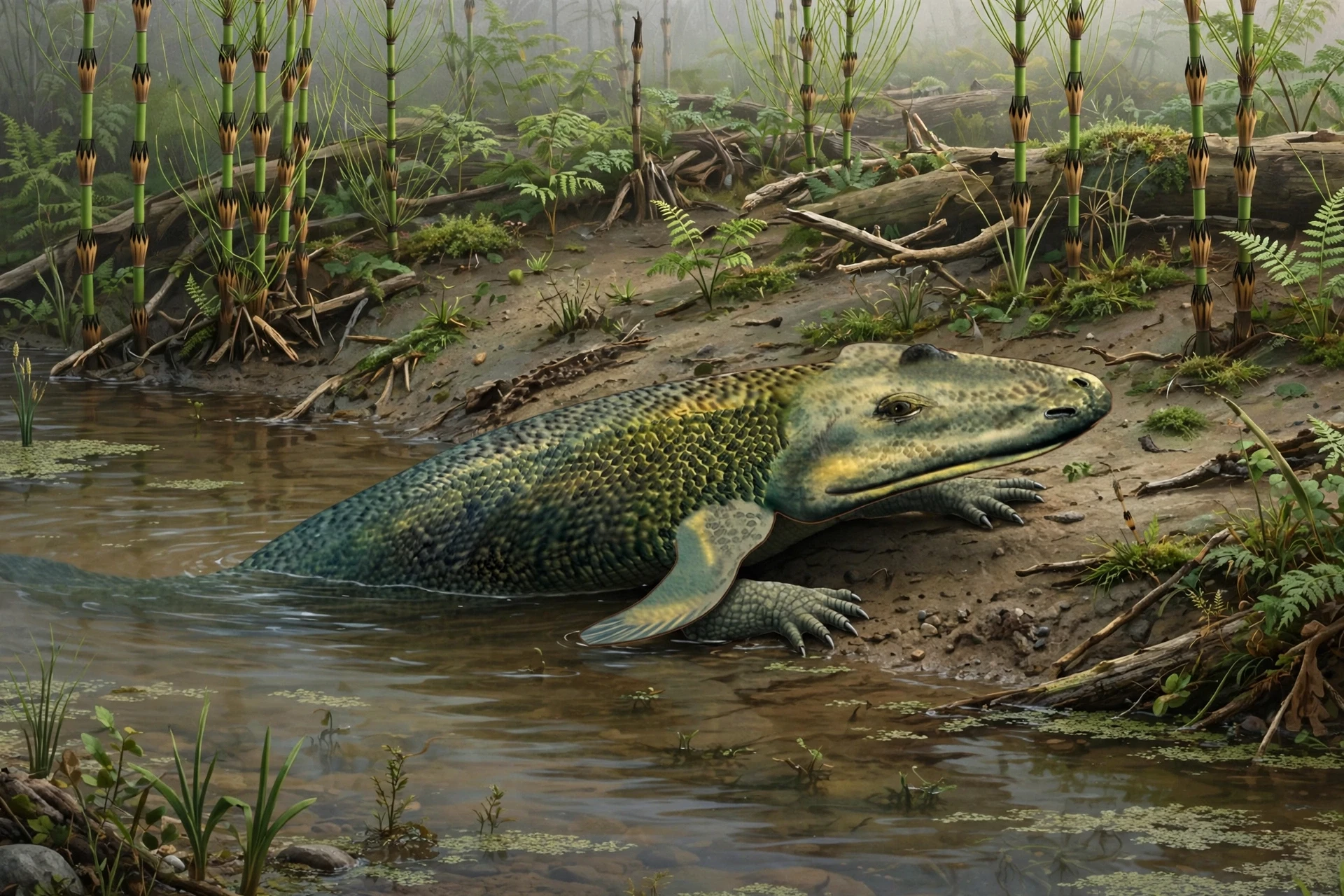
In 1999, three paleontologists made a bet with the rocks. Neil Shubin of the University of Chicago, Edward Daeschler of the Academy of Natural Sciences in Philadelphia, and Farish Jenkins of Harvard reasoned that if fish were evolving into land animals around 375 million years ago, then rocks of exactly that age, laid down in the shallow streams where the transition was happening, should contain the intermediate animals. They searched geological maps for the right rocks, settled on Ellesmere Island in the Canadian Arctic — 375-million-year-old river deposits, now frozen tundra — and spent four summers digging there. In 2004, on their fourth expedition, they found it.
Tiktaalik roseae was a predator up to 2.75 metres long, with a flat, crocodile-like head, sharp teeth, scales, and gills — unmistakably a fish. But it also had features no fish should have: a neck, so its head could move independently of its body; ribs strong enough to support its weight out of water; and pectoral fins built like limbs, with a shoulder, an elbow, and a wrist inside them. Its discoverers described it in the journal Nature in April 2006, and Shubin summed it up in a line that has become famous:
"This animal is both fish and tetrapod; we jokingly call it a fishapod."
I first read about Tiktaalik in Shubin's book Your Inner Fish, and the detail that stayed with me was not the anatomy but the method. The team did not stumble on the fossil by luck. They predicted where it should be — the right rocks, the right age, the right ancient environment — and then went there and found it. That is the fossil record at its most scientific: a prediction made from evolutionary theory, tested against the rocks, and confirmed. The fossil record is not just a collection of curiosities. It is a record that makes predictions, and keeps them.
There is an honest complication to add. In 2010, researchers reported tetrapod trackways from the Zachełmie Quarry in Poland dated to about 395 million years ago — some 20 million years older than Tiktaalik. If those tracks were made by four-legged animals, then tetrapods were already walking on land before Tiktaalik swam. That does not make Tiktaalik unimportant — it remains the best-preserved window into the anatomy of the transition — but it shows how the fossil record corrects itself. New evidence refines the story; it does not erase it. The transition from water to land was a long, bushy process, not a single step, and Tiktaalik captures one branch of it in extraordinary detail.
6.2 Archaeopteryx: the feathered dinosaur
If Tiktaalik is the fossil record's answer to the question of how life came onto land, Archaeopteryx is its answer to the question of how dinosaurs became birds. The first specimen — a single feather — was found in 1861 in the Solnhofen limestone of Bavaria, just two years after Darwin published On the Origin of Species. The first skeleton followed the same year. The timing was extraordinary: Darwin had predicted that intermediate forms must exist, and here, almost immediately, was one.
Archaeopteryx, about the size of a raven, lived around 150 million years ago in a tropical archipelago where southern Germany now stands. It had flight feathers indistinguishable from a modern bird's, a wishbone, and wings. It also had teeth, a long bony tail, and three fingers with claws on each wing — features no modern bird has, and every small theropod dinosaur did. Fourteen specimens have been found, all from the same limestone, and all of them show the same mixture: a dinosaur's body wearing a bird's feathers.
The Solnhofen limestone is itself part of the story. It formed in a still, oxygen-poor lagoon, where fine lime mud settled slowly and buried dead animals before scavengers could scatter them. The mud split into paper-thin sheets, preserving even the barbs of individual feathers. Without that exceptional preservation, Archaeopteryx would be known only from bones, and its feathers — the feature that makes it a bird — would have been lost. The fossil record's greatest discoveries often depend on the rarest preservations.
Archaeopteryx is no longer considered the first bird — later discoveries in China, including feathered dinosaurs like Sinosauropteryx and Microraptor, have shown that feathers evolved in dinosaurs long before flight, probably for insulation or display. But Archaeopteryx remains the icon of the transition, the fossil that made the dinosaur-bird connection undeniable. It is also a reminder that "transitional" does not mean "half-formed". Archaeopteryx was a complete, functioning animal, well adapted to its own world. It was transitional only in hindsight — a branch on the tree that happened to lead, eventually, to birds.
6.3 Ambulocetus: the walking whale
The third great transition runs in the opposite direction: from land back to the sea. Whales are mammals, and their ancestors walked on land. The fossil record of that return is one of the most complete transition sequences in paleontology, and its star is Ambulocetus natans — the "walking whale".
Ambulocetus was found in Pakistan and described in 1994 by Hans Thewissen and colleagues. It lived 48 to 47 million years ago, was about three metres long, and looked like a mammalian crocodile: a long snout, eyes on top of its head, powerful hind legs with large webbed feet, and a spine that flexed up and down as it swam — the same undulating motion modern whales use, but powered by legs rather than a tail fluke. Its pelvis was still attached to its spine, like a land mammal's, and unlike any modern whale's. It could walk on land and swim in water, and it probably hunted like a crocodile, ambushing prey at the water's edge.
Ambulocetus is one step in a sequence that the fossil record now documents almost completely: Pakicetus, a land mammal the size of a wolf that waded in rivers; Ambulocetus, the amphibious hunter; Rodhocetus, with a reduced pelvis and a tail beginning to take over propulsion; Basilosaurus, a fully marine whale, 18 metres long, with tiny hind legs still visible as vestiges. Step by step, the legs shrink, the nostrils migrate to the top of the head, and the tail fluke appears. It is evolution in the fossil record at its clearest — not a single missing link but a whole series of them, each one a little more aquatic than the last.
And the evidence does not stop with the fossils. Living whales still carry the history in their bodies: vestigial hip bones, buried in muscle, that serve no purpose in swimming; and, in rare individuals, small external hind limbs. Genetics confirms the relationship too — whales are most closely related to hippos, their nearest living land relatives. The fossil record, the anatomy, and the DNA all tell the same story, and they tell it independently. That convergence is what makes the conclusion solid.
7. The Cambrian Explosion and the Burgess Shale
The Cambrian explosion was a burst of animal diversification about 539 million years ago, when most major animal body plans first appeared in the fossil record within roughly 20 million years. The Burgess Shale, a 508-million-year-old deposit in the Canadian Rockies, preserves that moment in extraordinary detail, including soft-bodied animals that almost never fossilize.
For the first three billion years of life, the fossil record is a story of microbes. Then, quite suddenly by geological standards, animals appear — not one or two kinds, but dozens of body plans, most of which have descendants alive today, and some of which have none. Trilobites with compound eyes. Brachiopods with hinged shells. Worms, sponges, molluscs, and the first arthropods. The Cambrian explosion is the moment the animal kingdom, as we know it, comes into being — and the fossil record captures it because hard body parts, which fossilize well, evolved at the same time.
Why it happened is still debated. Rising oxygen levels may have allowed larger, more active animals. The evolution of predation may have driven an arms race of armour and speed. New ecological niches — burrowing, swimming, hunting — may have opened as animals learned to exploit the seafloor in new ways. Most likely all of these played a part, and the debate is one of the liveliest in paleontology. What is not debated is the scale: within about 20 million years, a span that is a blink in geological time, the basic architecture of animal life was established, and it has been elaborated ever since rather than reinvented.
The best window into that moment is a slab of black shale on a mountainside in British Columbia. On 30 August 1909, Charles Doolittle Walcott, the Secretary of the Smithsonian Institution, was prospecting near Burgess Pass in the Canadian Rockies when he split open a rock and found it full of strange, soft-bodied animals — worms, arthropods, and creatures with no living relatives, preserved in astonishing detail. He returned to the quarry almost every year until 1924, eventually collecting more than 65,000 specimens from what became the Walcott Quarry, and the Burgess Shale became the most famous fossil deposit in the world.
7.1 A world of strange animals
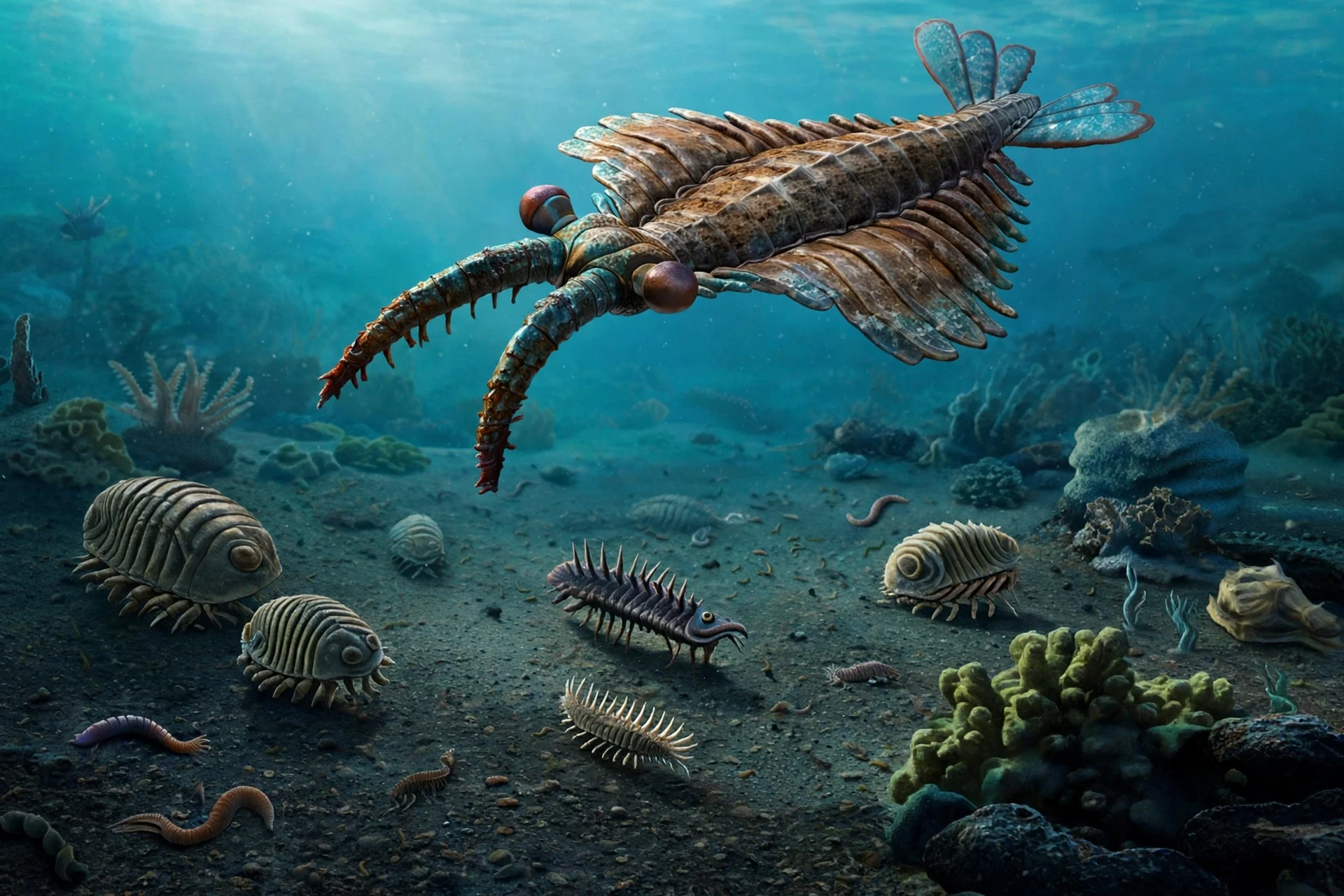
The Burgess Shale animals are strange enough that early researchers repeatedly got them wrong. Hallucigenia, a small worm-like creature with seven pairs of spines on its back and seven pairs of legs beneath, was first reconstructed upside-down, with its spines mistaken for legs. Anomalocaris — "strange shrimp" — was first assembled from three separate animals: its grasping appendages were thought to be a shrimp's body, its mouth a jellyfish, and its body a sea cucumber. Only when a complete specimen was found did the animal come together: a predator up to half a metre long, the largest animal of its time, with two spiked arms for grabbing prey and a circular, tooth-ringed mouth.
Not all Burgess animals are extinct oddities. Pikaia, a small swimming worm with a stiff rod running down its back, is now recognised as an early chordate — a member of the group that includes all vertebrates, including us. Marrella, a small trilobite-like arthropod, is the most abundant fossil in the deposit. And the trilobites themselves, armoured and eyed, were already the dominant animals of the seafloor. The Burgess Shale shows the Cambrian explosion as it really was: not a tidy parade of ancestors but a riot of experimentation, in which many body plans were tried and only some survived.
Stephen Jay Gould made the Burgess Shale famous with his 1989 book Wonderful Life, arguing that the Cambrian fauna was far more diverse in body plans than anything alive today, and that survival was largely a matter of luck — rewind the tape of life, he argued, and a different set of animals would win. Later research has softened that claim: many Burgess animals turn out to be stem members of living groups rather than wholly alien designs. But Gould's central point stands: the Cambrian was a time of radical experimentation, and the fossil record preserves the experiments, winners and losers alike.
7.2 Why the Burgess Shale preserved so much
The Burgess Shale is a Lagerstätte — a deposit of exceptional preservation, from the German word for "storage place" — and its secret was a mudflow. Animals living on a muddy seafloor at the base of a steep reef were swept off the edge by underwater mudslides and buried almost instantly in fine sediment, in water too low in oxygen for decay or scavenging. The mud sealed them in, and the fine grains preserved details down to gills, guts, and eyes. It is the same principle as ordinary fossilization — rapid burial — taken to an extreme, and it is why the Burgess Shale preserves animals that are invisible everywhere else.
Lagerstätten like the Burgess Shale are the fossil record's corrective lenses. They show us what the ordinary record misses: the soft-bodied majority. Every time a new Lagerstätte is found — the Chengjiang deposits in China, older than the Burgess Shale; the Solnhofen limestone of Archaeopteryx; the Jehol beds of feathered dinosaurs — our picture of ancient life gets richer and stranger. The ordinary fossil record shows us the armoured minority. The Lagerstätten show us the rest.
The Burgess Shale was recognised as a UNESCO World Heritage Site in its own right in 1980, and in 1984 it was folded into the larger Canadian Rocky Mountain Parks World Heritage Site, and its fossils are now held mainly by the Smithsonian Institution and the Royal Ontario Museum. The quarry itself can only be visited on guided hikes. That protection matters: the site is small, the fossils are irreplaceable, and every slab removed is a page torn from a book of which only one copy exists.
8. Why the Fossil Record Is Incomplete
The fossil record is incomplete because fossilization is rare, preservation favours hard parts and marine animals, and most fossil-bearing rocks have been destroyed by erosion or buried beyond reach. Darwin compared it to a history book of which only a few chapters and a few lines on each page survive.
The incompleteness of the fossil record is not a footnote. It is the central fact about it, and Darwin knew it before anyone. In 1859, critics of his theory pointed to the gaps — where were the intermediate forms? — and Darwin answered with an entire chapter of On the Origin of Species, "On the Imperfection of the Geological Record". His metaphor for the problem has never been bettered:
"I look at the natural geological record, as a history of the world imperfectly kept, and written in a changing dialect; of this history we possess the last volume alone, relating only to two or three countries. Of this volume, only here and there a short chapter has been preserved; and of each page, only here and there a few lines."
Darwin was right, and his metaphor is still accurate. The fossil record is a book with most of its pages missing. But it is worth asking, a century and a half later, how much of the book we have recovered since he wrote — and the answer is: a great deal. The gaps are still there, but they are narrower, and the chapters we do have are far more detailed than Darwin could have imagined.
8.1 The biases, one by one
The incompleteness has causes, and they can be listed. First, the preservation bias: animals with hard parts — shells, bones, teeth — fossilize far more readily than soft-bodied ones. A clam has a far greater fossilization potential than a jellyfish. The result is that the fossil record over-represents shelled invertebrates and under-represents the soft-bodied animals that may have dominated ancient ecosystems.
Second, the environmental bias: marine animals fossilize far more readily than land animals, because sediment accumulates in seas, lakes, and river deltas, and rarely on dry land. The fossil record is, overwhelmingly, a record of the sea. Land animals appear in it mainly when they die near water or are buried by ash or floods. Birds, which are light-boned and live in trees, are among the rarest fossils of all — which is why the origin of birds was mysterious for so long.
Third, the geographic bias: fossils are found where the right rocks are exposed at the surface, and where people look. North America and Europe have been searched intensively for two centuries; much of Africa, Asia, and South America far less so. New discoveries keep coming from the less-searched places — and each one reminds us that the map of the fossil record is also a map of where paleontologists have been.
Fourth, the time bias: older rocks are rarer than younger ones, because the longer a rock exists, the more chances it has to be eroded, buried, metamorphosed, or subducted into the Earth's interior. The record of the last 100 million years is far richer than the record of 500 million years ago, and the record of the Precambrian — three billion years of microbial life — is the thinnest of all. The deeper you go, the fewer pages survive.
8.2 How incomplete is it, really?
It is natural to ask for a number, and paleontologists have tried to provide one. Roughly a quarter of a million fossil species have been named, against estimates of tens of millions of living species today and vastly more across Earth's history. But that headline number is misleading, because completeness varies enormously by group. A 1998 assessment of the record found that, for animals with easily fossilized remains — mammals and molluscs, for example — more than 60 percent of species, 80 percent of genera, and 90 percent of families had been discovered. For those groups, the fossil record is remarkably good. For soft-bodied animals, birds, and insects, it is poor.
There is also a subtler point. The fossil record does not need to be complete to be informative. A few well-preserved specimens can establish a transition; a handful of index fossils can date a whole formation; a single trackway can prove that an animal walked on land. Paleontology works the way a detective works: from fragments, carefully assembled, toward a conclusion that the fragments support. The gaps do not make the conclusions unreliable. They make them provisional — open to revision when new evidence arrives, as the Zachełmie trackways revised the Tiktaalik story.
And the record keeps improving. New species are described every year — around 50 new dinosaur species a year in recent decades — and new techniques keep extracting information from fossils that were once thought exhausted. CT scanning reveals the inside of skulls without breaking them. Synchrotron imaging reads chemical signatures in feathers. Ancient DNA, recovered from bones tens of thousands of years old, has rewritten the human family tree. The book Darwin called imperfect is being re-read with better light, and new pages keep turning up.
9. Dinosaurs: What the Record Really Shows
Dinosaurs ruled the land for more than 160 million years, and the fossil record preserves them in extraordinary detail — from the largest land animal that ever lived to the feathered dinosaurs that became birds. More than 1,200 dinosaur species have been named, and the most complete Tyrannosaurus rex skeleton ever found, SUE, is about 90 percent complete.
No group in the fossil record captures the public imagination like the dinosaurs, and no group is more misunderstood. The popular picture — lumbering, dim-witted giants, wiped out in a single catastrophe — misses almost everything interesting about them. The fossil record shows dinosaurs as the most successful land animals in Earth's history: they dominated every continent for more than 160 million years, evolved into an astonishing range of sizes and shapes, and never actually went extinct — because birds are dinosaurs, and there are more than 10,000 species of them alive today.
The scale of that success is written in the bones. The largest dinosaurs, the titanosaurs, reached more than 30 metres long and weighed as much as a dozen elephants. The smallest were the size of chickens. Some ate plants, some ate meat, some ate both. Some ran on two legs, some on four. Some had armour, horns, sails, and clubs. And for all that variety, the fossil record preserves them through the same processes as everything else: rapid burial, mineralization, and luck.
What the record cannot show is equally important. Dinosaur skin colour, social behaviour, and sounds are mostly lost — inferred from bone structure, trackways, and living relatives, but rarely observed directly. A skeleton is a scaffold, not a portrait. The art of paleontology is knowing where the scaffold ends and the inference begins, and saying so clearly.
9.1 SUE: the dinosaur that changed the science
On 12 August 1990, Sue Hendrickson was walking a cliff face in South Dakota, scouting on her own while the rest of her crew packed up for the season, when she spotted a few large vertebrae jutting from an eroded bluff. She followed her hunch, and beneath the surface lay the largest and most complete Tyrannosaurus rex known at the time — a skeleton that would be named for her, and that would change what scientists knew about the species.
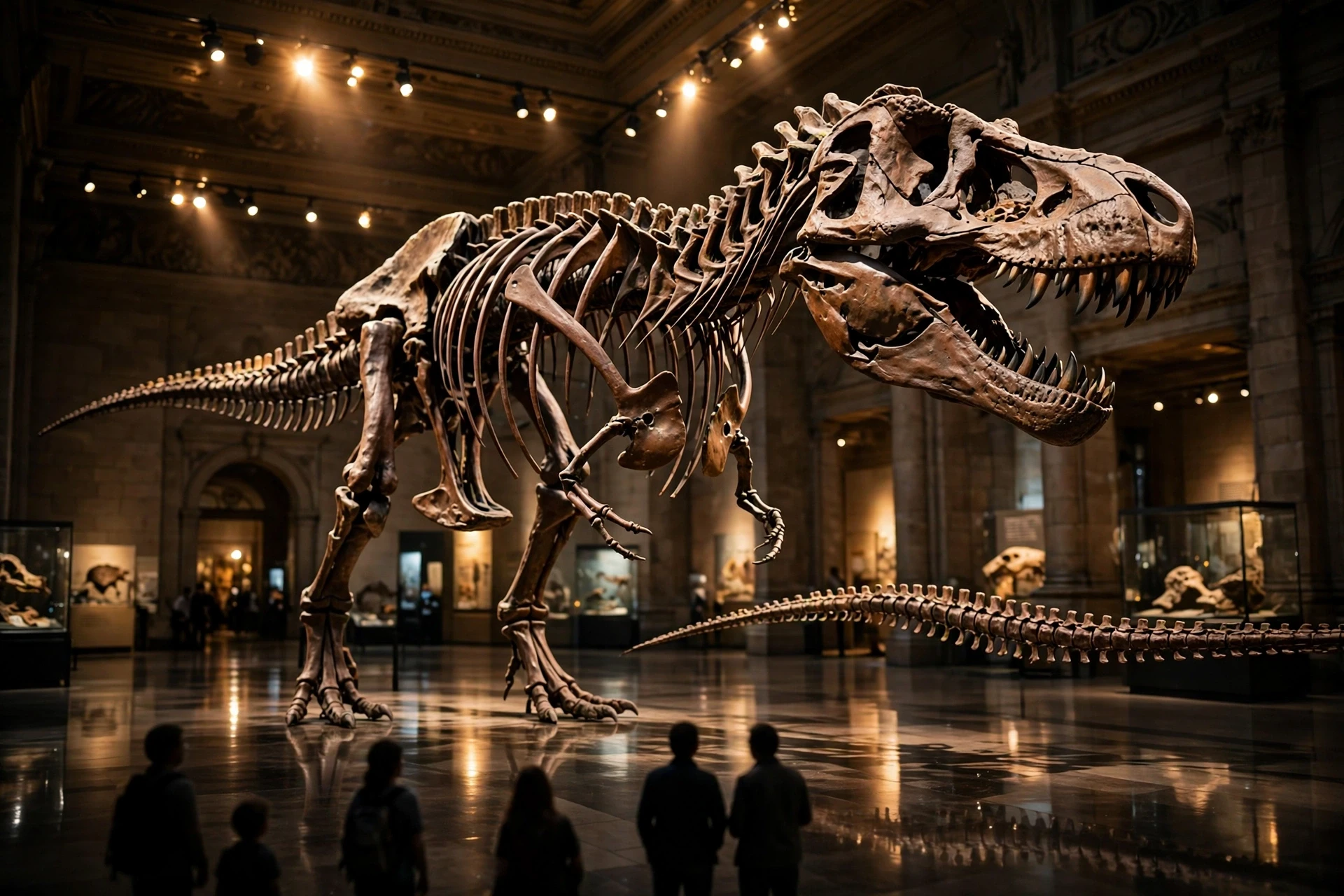
SUE — catalogued as FMNH PR 2081 — lived about 67 million years ago, measured more than 40 feet long and 13 feet tall at the hip, and lived to about 33 years old. The skeleton is about 90 percent complete by bulk, with some 250 of the approximately 380 bones in a T. rex skeleton recovered, including the wishbone and the delicate gastralia, the rib-like bones across the belly. Before SUE, most T. rex skeletons were less than half complete. SUE gave scientists, for the first time, a nearly whole animal to study.
I stood in front of SUE at the Field Museum once, and the thing that struck me was not the size — though the skull alone is longer than I am tall — but the injuries. SUE's bones record a hard life: osteomyelitis — a chronic bone infection — in the left fibula and the fused tail vertebrae, holes in the lower jaw whose cause is still disputed, and chronic bone infections that may have contributed to the animal's death. This was not a museum ideal. This was an individual, with a medical history written in bone. The fossil record, at its best, does not just show us species. It shows us lives.
SUE's journey to Chicago was itself a story: after ownership disputes, the skeleton was auctioned in October 1997 for more than eight million dollars, the highest price ever paid for a fossil at the time, and the Field Museum's purchase was funded by McDonald's, Disney, and private donors. SUE went on display on 17 May 2000, and has been one of the most visited fossils in the world ever since. The price is a reminder of a real problem in paleontology: commercially valuable fossils can be sold to private collectors and lost to science. SUE was saved for the public. Many others are not.
9.2 How many dinosaurs were there?
More than 1,200 dinosaur species have now been named, in over 1,000 genera, and many more genera remain to be discovered. A statistical estimate by Wang and Dodson in 2006 put the total number of non-avian dinosaur genera that ever existed at around 1,850 — of which about 527 genera, under a third, were known at the time. New species are named at a rate of dozens per year, and the pace is accelerating as paleontologists explore new ground in China, Argentina, and Africa.
That incompleteness matters for the big questions. When a new dinosaur is found, it can rearrange the family tree: a feathered dinosaur from China rewrote the origin of birds; a long-necked sauropod from Argentina reset the record for size; a horned dinosaur from Morocco showed that the group ranged further than anyone thought. The fossil record of dinosaurs is a work in progress, and every field season adds a chapter.
The most important fact about dinosaurs, though, is the one the fossil record makes unavoidable: they did not all die. The birds around you — the sparrow on the windowsill, the pigeon in the park — are theropod dinosaurs, direct descendants of animals like Velociraptor, with the same hollow bones, the same wishbone, and the same three-toed feet. The end-Cretaceous extinction killed the non-avian dinosaurs. The avian ones survived, and they now number more than 10,000 species — more than all mammals combined. The dinosaurs are not gone. They are singing outside your window.
10. The Fossils in Our Own Family Tree
The fossil record of human evolution spans more than six million years, from early upright walkers to our own species. Its most famous specimen is Lucy, a 3.2-million-year-old Australopithecus found in Ethiopia in 1974, and its oldest member of our own species comes from Jebel Irhoud in Morocco, dated to about 315,000 years ago.
No part of the fossil record is more personal than the human one, because it is the record of us. Every fossil hominin is a relative — not a direct ancestor in most cases, but a cousin on the family tree, a branch that split from ours at some point in the last six million years. Reading that record is reading our own origin story, written in bone.
The story begins with a problem: the human family tree is a bush, not a ladder. For most of the twentieth century, human evolution was drawn as a straight line — ape to ape-man to human — with each fossil slotting neatly into place. The fossil record has demolished that picture. At most times in the last four million years, several hominin species lived at the same time, in the same parts of Africa, doing similar things. Our lineage is the one branch that survived. The rest are extinct cousins, and the fossil record is the only way we know they existed.
The record is also thin. Hominin fossils are rare — a few thousand specimens in total, most of them teeth and fragments — because our ancestors lived in environments that rarely fossilize, and because there were never very many of them. Every new find matters disproportionately. A single jaw can name a new species. A single skull can move the origin of our species back by a hundred thousand years. Human paleontology is a science built on fragments, and it is honest about that.
10.1 Lucy: the skeleton that rewrote the story
On 24 November 1974, Donald Johanson and his graduate student Tom Gray were surveying a gully at Hadar, in the Afar region of Ethiopia, when Johanson spotted a fragment of an elbow bone sticking out of the dirt. It was the first of 47 bones from a single individual — about 40 percent of a skeleton — of a small, upright-walking hominin that lived 3.2 million years ago. That night, the Beatles song "Lucy in the Sky with Diamonds" was playing in camp, and the fossil got her name: Lucy.
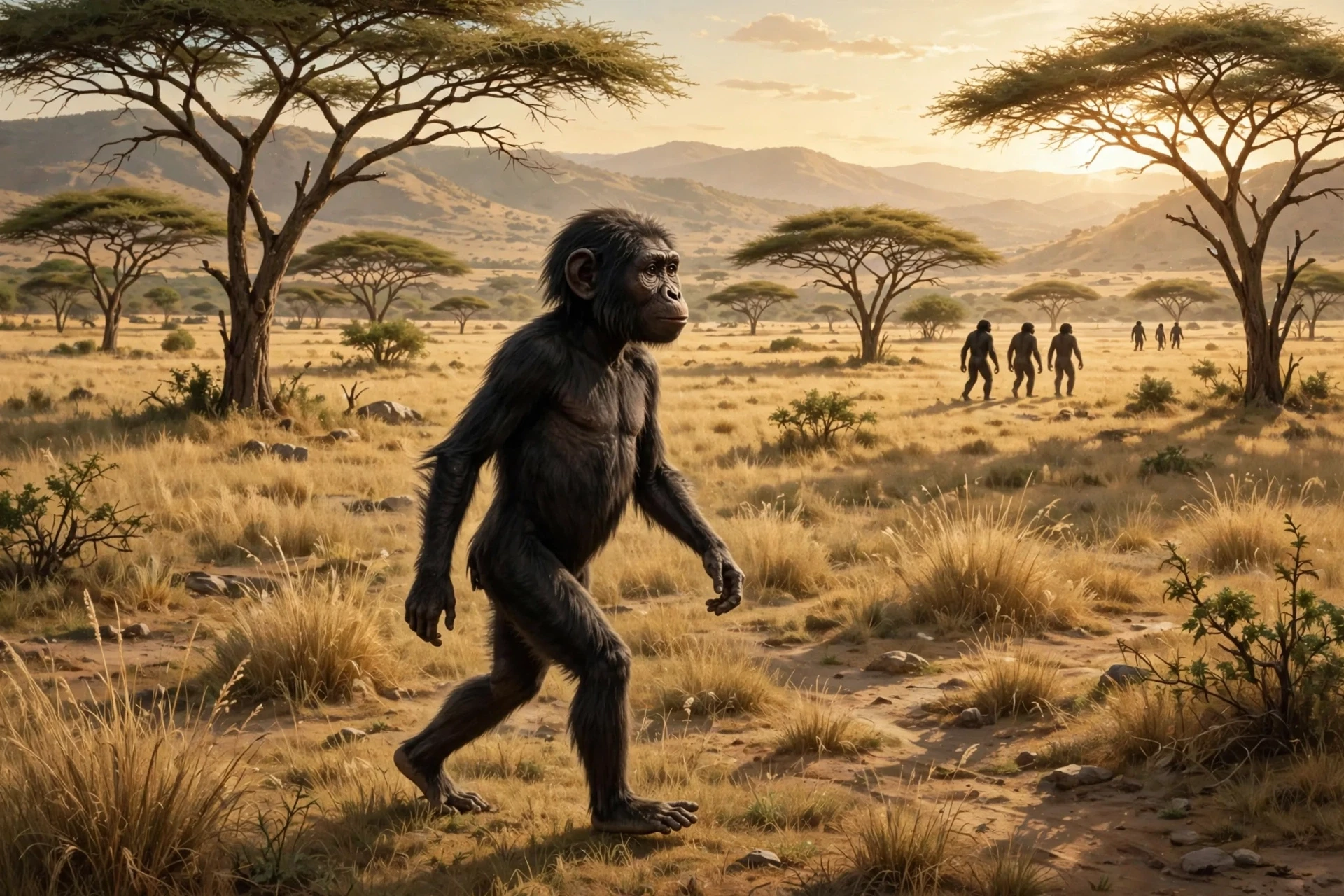
Lucy — catalogued as AL 288-1, a female of the species Australopithecus afarensis — stood about three and a half feet tall, walked on two legs, and had a brain not much larger than a chimpanzee's. That combination was the revelation. Before Lucy, many scientists assumed that large brains came first and upright walking followed. Lucy showed the opposite: our ancestors stood up and walked on two legs millions of years before their brains grew large. Bipedalism, not brain size, is the defining human trait — and the fossil record proved it.
The species was formally named in 1978, and nearly 400 specimens of Australopithecus afarensis have since been found at Hadar, making it one of the best-documented early hominins. Lucy herself remains the most complete adult skeleton of her species ever found, and she is kept in a safe at the National Museum of Ethiopia. She was, at the time of her discovery, the oldest and most complete human ancestor ever found — and fifty years later, she still anchors the story of how we became human. Our article on human evolution tells that story in full; Lucy is where its fossil evidence begins.
10.2 Jebel Irhoud: our species is older than we thought
For decades, the oldest fossils of our own species, Homo sapiens, came from East Africa and were dated to about 200,000 years ago — recently re-dated to about 233,000 years ago. That picture changed in June 2017, when Jean-Jacques Hublin and colleagues published the results of new excavations at Jebel Irhoud in Morocco: fossil bones of Homo sapiens, with modern-looking faces but more primitive braincases, dated to about 315,000 years ago — roughly eighty thousand years older than the previous record.
The Jebel Irhoud fossils — skulls, teeth, and long bones from at least five individuals — were dated by thermoluminescence, which measures the radiation accumulated in burnt flint tools found alongside the bones. The dating, published in two papers in Nature (Hublin et al., DOI 10.1038/nature22336; Richter et al., DOI 10.1038/nature22335), showed that our species did not arise in one place at one time, but emerged across the African continent, with different populations developing modern features at different rates. As Hublin put it when the findings were published: "It looks like our species was already present probably all over Africa by 300,000 years ago."
The Jebel Irhoud discovery is a perfect example of how the fossil record works. The site had been known since the 1960s, and its fossils had been classified as Neanderthals. It took new excavations, new dating methods, and a willingness to re-examine old bones to see what they really were. The fossil record does not just grow by finding new fossils. It grows by re-reading old ones.
10.3 Ancient DNA: the record's newest chapter
In the last two decades, a new kind of fossil evidence has joined the bones: ancient DNA. Genetic material recovered from fossil teeth and bones — some tens of thousands of years old — has revealed species the bones alone never hinted at. The Denisovans, known at first from a single finger bone found in a Siberian cave, turned out to be a whole population that interbred with both Neanderthals and modern humans, and whose genes still live on in people across Asia and Oceania today.
Ancient DNA has also shown that our family tree is messier than the fossils alone suggested. Modern humans carry Neanderthal DNA — one to four percent in most non-African populations — proof of interbreeding that the fossil record could never have shown directly. The story of human evolution is now told by two records at once: the bones in the ground and the genes in our cells. Our article on the human genome explores the genetic half of that story; the fossil half is here, in the rocks of Africa and Asia, still being dug up one fragment at a time.
11. Living Fossils and Lazarus Species
Some organisms in the fossil record appear unchanged for hundreds of millions of years, and a few species thought extinct for tens of millions of years have turned up alive. The most famous is the coelacanth, a lobe-finned fish known only from fossils until a living one was caught off South Africa in 1938.
The phrase "living fossil" is one of the most misleading in paleontology, and also one of the most evocative. It describes an organism that looks much like its ancient fossil relatives — a horseshoe crab, a ginkgo tree, a coelacanth — and it invites the wrong conclusion: that these animals stopped evolving. They did not. Every living species has been evolving continuously since its lineage began. What "living fossils" really show is that some body plans work so well, in such stable environments, that natural selection has kept them roughly the same shape for an extraordinarily long time. Stasis is itself an evolutionary outcome, not the absence of evolution.
That correction matters, because the alternative — the idea that some animals are "primitive" or "unchanged" — feeds a misunderstanding of how evolution works. Evolution has no direction and no ladder. A horseshoe crab is not a failed attempt at becoming something else. It is a spectacularly successful animal that has survived five mass extinctions with essentially the same design. The fossil record's "living fossils" are not relics. They are winners.
11.1 The fish that came back from the dead
On 22 December 1938, Marjorie Courtenay-Latimer, the curator of a small museum in East London, South Africa, was visiting the docks to look through a fishing trawler's catch when she noticed a bright blue fin under a pile of ordinary fish. The fish it belonged to was about one and a half metres long, with four limb-like fins and a three-lobed tail unlike anything she had ever seen. She had it preserved and sent a sketch to J.L.B. Smith, a fish expert at Rhodes University. Smith recognised it at once: a coelacanth, a lobe-finned fish known only from fossils, believed extinct for about 66 million years.
Smith named the fish Latimeria chalumnae — Latimeria for Courtenay-Latimer, chalumnae for the Chalumna River near which it was caught — and announced it in the journal Nature in 1939. The discovery electrified the world: a lineage thought dead since the age of dinosaurs was alive, swimming in deep water off the African coast. A second specimen was not found until 1952, off the Comoros Islands, and a second living species was first spotted in an Indonesian fish market in 1997, with a live specimen caught in 1998 and formally described in 1999. Today the coelacanth is known to live to perhaps 80 years or more, to give birth to live young, and to be critically endangered.
The coelacanth's story also carries a quieter lesson. The Comoro Islanders had known the fish for generations — they called it gombessa — and it was only Western science that thought it extinct. The fossil record told scientists the coelacanth was gone because no fossils younger than 66 million years had been found. The fish had simply moved to deep water, where fossilization almost never happens. The fossil record's silence is not evidence of absence. It is evidence of where the record is blind — and the deep sea is one of its blindest spots. Our article on the deep sea explores that hidden world, where the coelacanth still swims.
11.2 Stasis, and what it really means
Why do some lineages change so little? The answer is usually a stable environment and a design that already works. Horseshoe crabs have lived in shallow coastal waters for more than 400 million years, and their body plan — a hard domed shell, a spiked tail, book gills for breathing — is well suited to a habitat that has not changed much. Ginkgo trees, the sole survivors of a group that flourished in the Jurassic, survive because their leaves, their chemistry, and their reproductive strategy still work. When the environment stays the same, selection favours staying the same.
But stasis is never total. Look closely at any "living fossil" and the changes appear. Modern coelacanths are not identical to their Devonian ancestors: they are larger, their fins are arranged differently, and their genomes have been evolving all along. The fossil record shows the broad shape staying constant; the fine detail — the genetics, the physiology, the behaviour — has been changing the whole time. The coelacanth is not a photograph of the Devonian. It is a descendant of the Devonian, as changed by 400 million years as we are.
That is the deeper lesson of the living fossils. The fossil record does not show evolution as a march from simple to complex, or from primitive to advanced. It shows a branching tree in which some branches change fast, some change slowly, and some stay recognisably the same for hundreds of millions of years — and all of them are still growing. The tree has no top and no bottom. It has only branches, and the coelacanth's branch is as alive as ours.
12. Trace Fossils: Footprints, Burrows, and Dung
Trace fossils record what ancient organisms did rather than what they were: footprints, burrows, nests, bite marks, and fossilised dung. They are the fossil record's only direct evidence of behaviour, showing how fast animals moved, whether they travelled in groups, and what they ate.
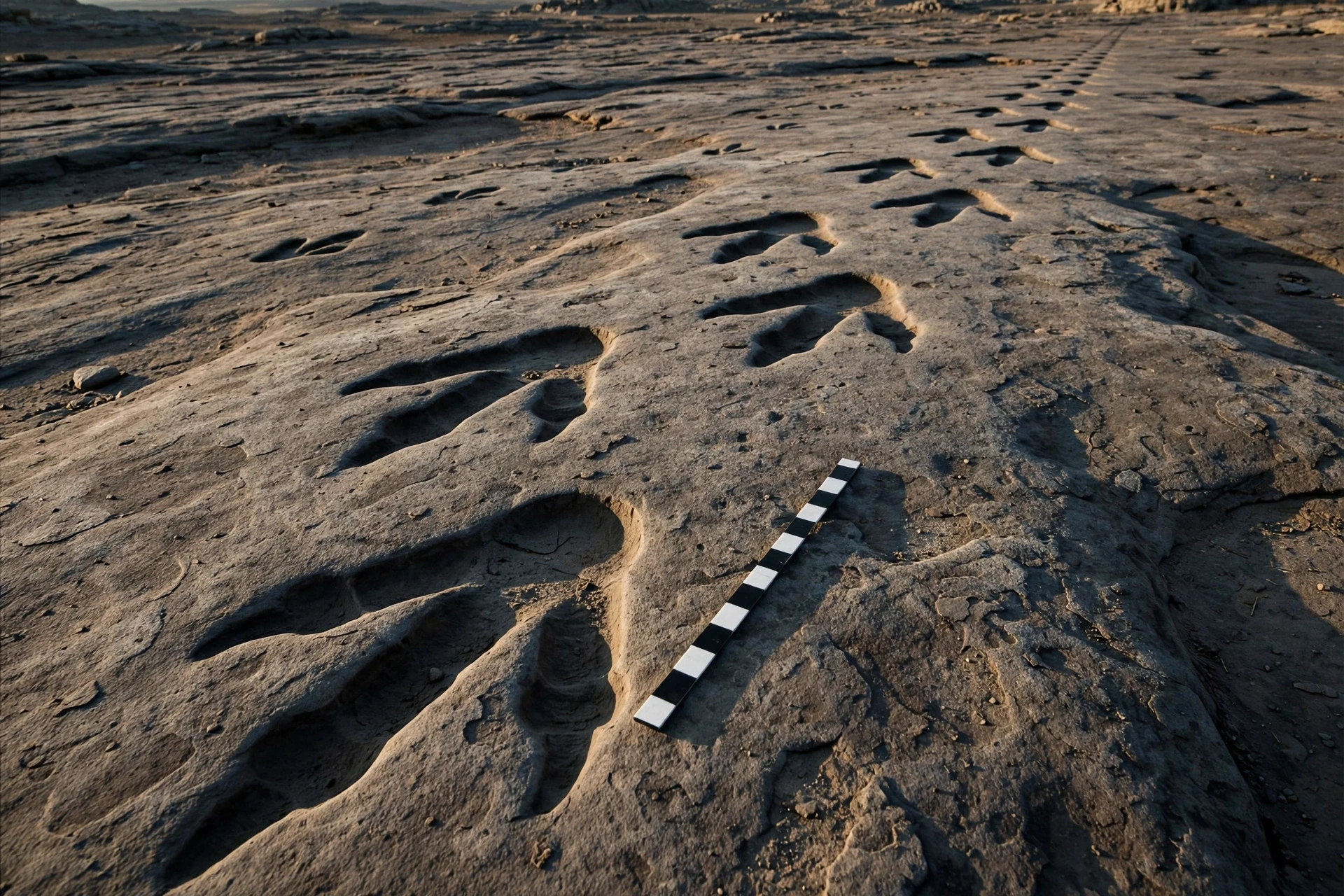
A skeleton tells you what an animal looked like. A footprint tells you what it did. That is the difference that makes trace fossils — ichnofossils — so valuable, and it is why paleontologists get as excited about a trackway as about a skull. Behaviour leaves almost no other trace in the fossil record, and the moments it preserves are often the most vivid.
Consider a trackway: a line of footprints in stone, each print the same distance from the last, the stride length telling you the animal's speed, the depth telling you its weight, the spacing telling you its gait. From a single trackway, scientists can estimate how fast a dinosaur ran — and the fastest dinosaur trackways suggest speeds that would embarrass an Olympic sprinter. From overlapping trackways, they can tell whether animals travelled in herds, whether juveniles stayed close to adults, and whether predators stalked their prey. A skeleton is a portrait. A trackway is a film.
Burrows tell a different story: shelter, safety, and the underground life that bones never show. Fossil burrows reveal animals that dug for protection, for food, or for raising young — including burrows with chambers, tunnels, and even fossilised occupants caught inside. Nests, some with eggs arranged in circles and a parent's skeleton curled over them, show parental care in animals that died 75 million years ago. And coprolites — fossilised dung — contain the undigested remains of meals: fish scales, bone fragments, seeds, and pollen, a direct record of diet that no skeleton can match.
12.1 The footprints at Laetoli
The most famous footprints in the fossil record are not a dinosaur's. They are ours — or rather, our ancestors'. At Laetoli in Tanzania, in volcanic ash laid down about 3.66 million years ago, a trail of footprints preserves two or three early hominins walking across a wet ashfall, their feet pressing into the soft surface, the ash then hardening in the sun and being buried by the next eruption. The prints are unmistakably human-like: a heel strike, an arch, a big toe in line with the others — the anatomy of upright walking, preserved in a moment.
The Laetoli footprints were discovered in 1978 by Mary Leakey's team, and they settled a debate that bones alone could not. The footprints proved that early hominins walked upright 3.66 million years ago — half a million years before Lucy, and long before large brains evolved. They also showed something bones never could: that these ancestors walked together, side by side, one slightly smaller than the other, their strides matching. Were they a parent and a child? A pair? We will never know. But the footprints make the question feel immediate in a way no skeleton does. They are not remains. They are a walk, preserved.
The ash that preserved them was itself a stroke of luck. A nearby volcano erupted, laying down a layer of fine ash; rain fell, wetting it into a soft cement; the hominins walked across it; the sun dried it; and another eruption buried it. Without that exact sequence, the footprints would have washed away within days. The fossil record's most human moment survived because of a volcano's timing.
12.2 Reading a trackway
Reading a trackway is a skill, and it works by measurement. The distance between successive prints of the same foot gives the stride length; the stride length, combined with the animal's hip height (estimated from the print size), gives the speed, through equations worked out from living animals. The depth of the print gives the weight. The angle of the toes gives the direction of travel. And the pattern — whether the prints are evenly spaced, whether they speed up, whether they swerve — gives the behaviour.
One of the most dramatic trackways ever found is in Texas, in the Paluxy River bed, where a large theropod's footprints run parallel to a sauropod's — and at one point the theropod's prints close in, suggesting a pursuit. Whether it was a hunt or a coincidence is debated, but the trackway itself is not: two animals, walking the same mudflat one after the other, 113 million years ago. No skeleton could tell that story. Only footprints can.
Trace fossils also have a practical advantage: they are far more common than body fossils. An animal leaves one skeleton but thousands of footprints over its lifetime, and it digs many burrows. That is why the trace fossil record sometimes fills gaps the body fossil record leaves empty — including the earliest evidence of animals moving on land, which comes from trackways millions of years older than the earliest land-animal skeletons. The feet, it turns out, got there before the bones did.
13. The Fossil Record and Mass Extinctions
Mass extinctions are written in the fossil record as abrupt disappearances: whole groups of organisms vanishing from the rocks within a thin layer, followed by a slow recovery of new forms. The record preserves five great extinctions, and the evidence suggests we may now be living through a sixth.
There are moments in the fossil record where the story changes suddenly — not gradually, over millions of years, but within a single layer of rock. Below the layer, a rich fauna: ammonites, dinosaurs, reef-building corals. Above it, almost nothing, and then, slowly, new forms that had been rare or absent before. Those layers are mass extinctions, and the fossil record is the only evidence we have that they happened, how fast they happened, and what came after.
Five such events dominate the record. The end-Ordovician, 444 million years ago, when a glaciation and falling sea levels killed some 85 percent of marine species. The Late Devonian, 372 million years ago, when reef systems collapsed. The end-Permian, 252 million years ago — the Great Dying — when perhaps 96 percent of marine species and 70 percent of land vertebrates vanished, the worst extinction in Earth's history, driven by massive volcanic eruptions in Siberia. The end-Triassic, 201 million years ago, when volcanic activity again cleared the way for the dinosaurs to dominate. And the end-Cretaceous, 66 million years ago, when an asteroid strike ended the reign of the non-avian dinosaurs.
Each extinction has a different cause, but the pattern they leave in the rocks is the same: a sharp boundary, a collapse in diversity, and then a long, slow recovery as surviving lineages diversify into the empty niches. The recovery after the end-Permian took 8 to 9 million years — an eternity by human standards, a moment by geological ones. And the recovery is never a return to what was lost. The animals that fill the empty world are different from the ones that died. Extinction does not just remove species. It reshapes the tree of life.
13.1 The iridium layer: an extinction caught in the act
The end-Cretaceous extinction is the best understood, because its cause is written in the rock itself. In 1980, Luis Alvarez, his son Walter, and their colleagues reported that the thin clay layer marking the boundary between the Cretaceous and the Paleogene — the K-Pg boundary — is enriched in iridium, an element rare on Earth's surface but common in asteroids. Their conclusion: an asteroid about 10 kilometres across struck the Earth 66 million years ago, throwing up a cloud of dust and debris that blocked the sunlight, collapsed food chains, and killed the non-avian dinosaurs along with some 75 percent of all species.
The evidence accumulated fast. In 1991, the impact crater was found: the Chicxulub structure, buried under the Yucatán Peninsula in Mexico, about 180 kilometres across, dated to exactly 66 million years ago. Around the world, the K-Pg boundary layer contains shocked quartz, glass spherules, and soot — the signature of a high-energy impact and the wildfires it ignited. The fossil record above the boundary shows a world without dinosaurs and with few large animals at all; below it, the last dinosaurs. The boundary is thin — a few centimetres of clay — and it marks the end of a 160-million-year reign.
What followed is as important as what ended. In the emptiness after the extinction, the survivors — small mammals, birds, crocodiles, turtles — diversified explosively. Within ten million years, mammals had grown from shrew-sized creatures to the size of hippopotamuses, and the modern orders of mammals had appeared. The fossil record shows that extinctions are not just endings. They are beginnings, too — the moments when the losers leave and the survivors inherit the Earth. Our article on mass extinctions tells this story in full; here, the point is that the whole story is written in the fossil record, layer by layer, and nowhere else.
13.2 Are we living through a sixth?
That brings the story to the present, and to an uncomfortable question. The current rate of species loss, driven by habitat destruction, climate change, and direct exploitation, is far above the background extinction rate of the fossil record — by some estimates, a hundred times above it or more. The fossil record gives us the baseline: the normal rate at which species appear and vanish over millions of years. Against that baseline, the modern rate looks like the beginning of a mass extinction, and some scientists have called it the sixth.
The comparison is not exact. A mass extinction in the fossil record is defined by its outcome — a large fraction of species lost over a geologically short time — and the outcome of the current crisis is not yet known. But the fossil record gives us something the present cannot: the consequences. It shows that after each great extinction, recovery took millions of years, and the world that recovered was different from the one that was lost. The species we lose now will not come back in any time frame that matters to us. The fossil record is the only evidence of what that loss means — and it is not reassuring.
14. Frozen in Time: Amber, Ice, and Tar
A few fossils preserve soft tissue, colour, and behaviour that stone almost never keeps: insects sealed in amber, mammoths frozen in permafrost, and whole Ice Age ecosystems trapped in tar. These exceptional preservations are rare, but they teach us more, specimen for specimen, than almost any other part of the fossil record.
Most fossils are stone, and stone is a blunt instrument. It keeps shape and loses almost everything else. But in a handful of settings — amber, ice, and tar — the record keeps what stone cannot, and those settings have given us some of the most vivid glimpses of ancient life ever recovered.
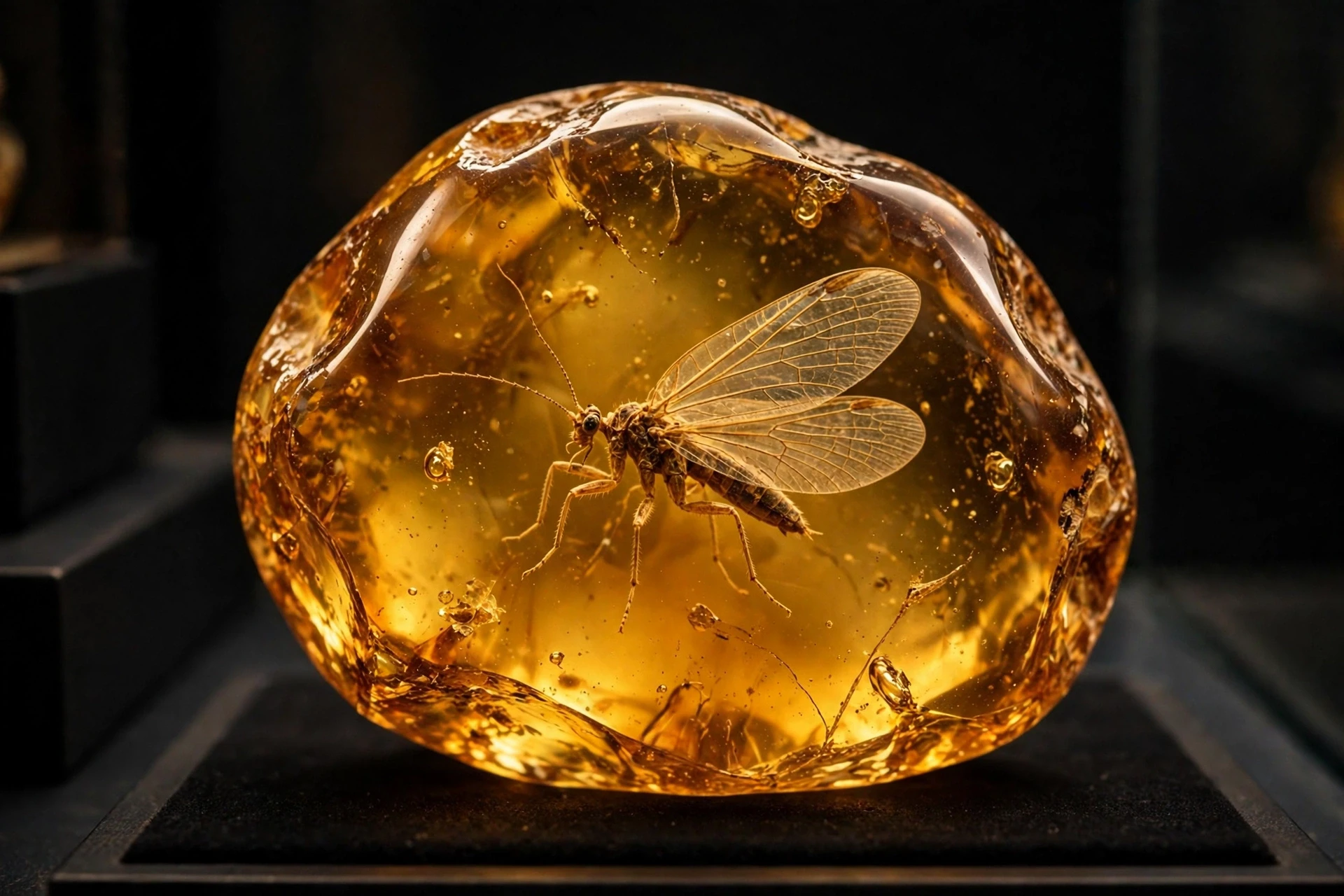
Amber is the most famous. Tree resin, exuded to seal a wound or trap an insect, is sticky, airtight, and chemically hostile to decay. An insect caught in it is entombed in a substance that hardens over millions of years into a golden, glass-like solid — and the insect inside is preserved almost perfectly. More than that: amber preserves behaviour. Spiders with prey in their webs. Ants carrying larvae. A tick attached to a feather. A lizard's tail, complete with skin and scales, in 99-million-year-old Burmese amber. These are not skeletons. They are moments, sealed in resin.
Amber has also preserved the smallest details of ancient life. The feathers found in Burmese amber, some 99 million years old, still show the microscopic barbules that give feathers their structure — and their colour, because the pigments are preserved too. One small dinosaur, Caihong juji, had feathers that were probably iridescent — though that evidence comes from a 161-million-year-old rock fossil in China, not from amber. Another showed that the earliest feathers were not for flight at all but for insulation, or display, or both. Amber, which is itself fossilised tree resin, is a fossil that contains fossils — a record within a record.
14.1 The mammoths in the ice
Permafrost preserves what amber cannot: large animals, whole. Woolly mammoths frozen in Siberian permafrost have been found with their skin, hair and stomach contents preserved — and in one famous case, a mammoth found in 2013, liquid blood oozed from the carcass when scientists cut into it — animals dead for 30,000 years or more, in a state that a fresh carcass might envy. The most famous, Lyuba, a baby mammoth found in 2007, was so well preserved that scientists could see the milk in her stomach and the mud in her mouth from the moment she died.
These frozen animals are more than curiosities. Their stomach contents record the plants of the Ice Age steppe, in detail no pollen record can match. Their hair records the climate they lived in. Their DNA — recovered from frozen tissue — has let scientists sequence the mammoth genome and compare it with the elephant's, base by base. The frozen mammoths are a library of Ice Age biology, and they exist only because the Arctic cold did what stone never could: it stopped decay entirely.
There is a caution here, too. Frozen mammoths have inspired talk of bringing the species back — of de-extinction — and the idea is seductive. But the fossil record is clear about what it can and cannot give us. A mammoth genome, recovered from frozen tissue, is a sequence of letters. Rebuilding a living mammoth from it is a different problem, and the ecological one — where would it live, in a world whose Ice Age steppe is gone? — is harder still. The fossil record preserves the past. It does not bring it back.
14.2 The tar pits of Los Angeles
The La Brea Tar Pits are the strangest fossil site on Earth, because they sit in the middle of a city. In the Miracle Mile district of Los Angeles, pools of asphalt bubble up from an oil deposit, and for tens of thousands of years animals have wandered in, become stuck, and died — their cries attracting predators, which also became stuck, and scavengers, which also became stuck. The result is a death trap that has been collecting animals for 40,000 years, and a fossil deposit unlike any other.
More than 3.5 million specimens have been recovered from La Brea, representing over 600 species: dire wolves (the most common large mammal, with more than 4,000 individuals), sabre-toothed cats, mammoths, ground sloths, camels, bison, and more than 135 species of birds. The asphalt seals bones away from oxygen and scavengers, so even delicate bird bones survive. And because the traps kept working, the record is continuous: La Brea shows the Ice Age ecosystem changing over thousands of years, as the climate warmed and the megafauna vanished.
I once saw an amber insect in a museum case — a small fly, wings spread, suspended in golden resin — and I stood there longer than I meant to, because it looked less like a fossil than like an animal that had died a moment ago. That is the power of exceptional preservation. It collapses the distance between us and deep time. A stone dinosaur is impressive. A fly in amber is intimate. It reminds you that the creatures of the fossil record were alive — that they flew, hunted, ate, and died — and that the record, at its best, can make you feel that as well as know it.
La Brea is still being excavated. Pit 91 was first dug in 1915, abandoned after cave-ins and flooding, and reopened in 1969, and Project 23 — sixteen new fossil deposits found during construction in 2006 — is still yielding specimens. The tar pits are a reminder that the fossil record is not finished. It is still being written, in the middle of a city, one trapped animal at a time.
15. How Paleontologists Work Today
Modern paleontology combines field excavation with CT scanning, chemical analysis, and ancient DNA, turning fossils into three-dimensional data. A fossil is now dug up, scanned, modelled, and shared digitally, so that a bone in Mongolia can be studied in a laboratory in London without ever leaving its drawer.
The popular image of paleontology — a scientist with a hammer and a brush, alone in a desert — is real, but it is only the first step. Fieldwork is still where fossils are found, and it is still hard, slow, and dependent on luck: walking badlands in the heat, reading the geology, and recognising a fragment of bone among a hillside of rock. But what happens after the fossil is found has changed beyond recognition in the last thirty years.
The first change is imaging. CT scanning lets scientists see inside a fossil without cutting it open: the inner ear of a dinosaur, the brain cavity of an early hominin, the unhatched embryo inside an egg. Synchrotron imaging, which uses a particle accelerator's X-ray beam, can read chemical signatures at the level of individual elements, revealing pigments in feathers and the composition of fossilised soft tissue. A fossil that once yielded only its shape now yields its chemistry, its internal anatomy, and sometimes its colour.
The second change is computation. Fossils are scanned into three-dimensional models that can be measured, compared, and shared. A researcher in London can download a scan of a fossil in Ulaanbaatar and study it as if it were on her desk. Phylogenetic software builds family trees from hundreds of anatomical characters, testing which relationships the evidence supports. And biomechanical modelling — finite element analysis, borrowed from engineering — lets scientists test how a dinosaur's skull handled the forces of biting, or how a pterosaur's wing handled the forces of flight.
The third change is the most recent: ancient DNA and protein analysis. Collagen, the protein in bone, survives far longer than DNA, and mass spectrometry can read its sequence from fossils millions of years old — old enough to place animals on the family tree that DNA alone could never reach. The combination of fossils, molecules, and models is turning paleontology from a science of description into a science of measurement and prediction.
15.1 From the field to the lab
The journey of a fossil from the ground to the literature follows a well-worn path, and each step adds information. In the field, the fossil is mapped, photographed, and jacketed in plaster for transport, with its exact position and the rock layer recorded — because the context is as important as the fossil itself. A bone without its stratigraphic position is a curiosity. A bone with it is evidence.
In the preparation lab, the rock is removed — slowly, with dental tools and air abrasives, sometimes over months or years for a single specimen. The prepared fossil is catalogued, photographed, and scanned. Then the analysis begins: measuring, comparing with other specimens, and building the case for what the animal was, how it lived, and where it sits on the tree of life. Finally, the results are published, peer-reviewed, and the specimen is deposited in a museum collection, where it remains available for future researchers — including researchers who will re-examine it with techniques that do not yet exist.
That last point matters. Many of the most important discoveries in paleontology have come not from new fossils but from old ones, re-examined with new eyes. The Jebel Irhoud skulls were found in the 1960s and reclassified fifty years later. The feathered dinosaurs of China were recognised as birds' relatives only when someone looked at them with the right question. The fossil record is a resource that keeps giving, because every specimen is a permanent record, and every new technique is a new way to read it.
15.2 Citizen science and the new fossil hunters
Fossil hunting is no longer the exclusive preserve of professionals. Collectors outside the universities have always been part of paleontology — Mary Anning earned her living finding and selling fossils, and Sue Hendrickson was a professional field collector when she found SUE — and today the community is larger and better connected than ever. Fossil clubs, online forums, and museum outreach programmes bring new collectors into the field, and many important finds are still made by amateurs who know their local ground.
That openness comes with rules. In most countries, collecting on private land requires the owner's permission, and collecting in national parks is forbidden. The most important rule is the one Mary Anning's life illustrates: a fossil's scientific value depends on its context, and a fossil removed without recording where it came from loses most of that value. Responsible collectors record, photograph, and report their finds — and, when the find is significant, they work with a museum. The fossil record belongs to everyone, and it is best served when everyone who touches it treats it as a shared resource.
16. What Fossils Tell Us About the Future
Fossils record how life responded to past climate change, sea-level rise, and mass extinction, the best evidence we have for what may happen next. The fossil record is not just a history of the past: it is the only long-term experiment in how life handles a changing planet, and we are running a new version of that experiment now.
The connection between fossils and the future is not poetic. It is practical. Every question we ask about the future of life on a warming planet — how fast can species adapt, which ecosystems collapse first, how long does recovery take — has been answered before, in the fossil record, by natural experiments on a planetary scale. The record is the only dataset we have that spans the timescales on which evolution and extinction actually operate.
Take climate. The fossil record shows that when the climate warmed rapidly in the past — as it did at the end of the Permian, when volcanic eruptions raised global temperatures by several degrees — the consequences were catastrophic: the Great Dying, the worst extinction in Earth's history. When the climate cooled, as it did at the end of the Ordovician, the consequences were also catastrophic. The lesson is not that warming is always fatal, but that rapid change is: ecosystems can adapt to slow change, but they cannot adapt to change that outpaces evolution. The current rate of warming is, by the standards of the fossil record, rapid.
Take sea level. The fossil record shows that when sea levels rose, coastal ecosystems drowned and shallow-sea faunas were reshaped; when they fell, land bridges formed and species migrated. The corals that mark ancient tropical seas in England are a reminder that the geography of life is not fixed. The coastlines of the future will be different from those of the present, and the fossil record shows what that means for the animals that live on them.
16.1 The pace of change, and what it means for us
The most important number in this argument is the rate of change. Evolution works on timescales of thousands to millions of years. The fossil record shows that when the environment changes slowly, species track it: they migrate, they adapt, they evolve. When it changes fast — in thousands of years rather than millions — they do not have time, and they die. The end-Permian extinction unfolded over tens of thousands of years. The current warming is unfolding over decades.
That is why paleontologists, of all people, are among the most concerned about the present. They have seen what rapid change does, in the rocks, five times over. They know that the recovery from a mass extinction takes millions of years, and that the world that recovers is different from the one that was lost. They know, too, that the fossil record's lesson is not that life is fragile — life has survived every catastrophe so far — but that particular species, particular ecosystems, and particular ways of life are fragile, and that once they are gone they do not come back.
The fossil record's message about the future is, in the end, a hopeful one, but it is a hope with a condition. Life endures. It has endured the worst the planet could throw at it, and it will endure what we throw at it. The question is not whether life will survive. It is whether the world that survives will still contain the species, the ecosystems, and the landscapes we care about. The fossil record shows us the stakes. It is up to us to decide what to do with them.
17. What the Fossil Record Means for Us
The fossil record is the only evidence we have for the history of life on Earth, and it changes how we see ourselves: not as the purpose of evolution, but as one branch of a tree that has been growing for 3.5 billion years, in which almost every species that ever lived is now extinct.
There is a way of looking at the fossil record that makes it feel remote — a catalogue of dead things, interesting to specialists, irrelevant to daily life. That is the wrong way to look at it. The fossil record is the history of life, and we are part of that history. Every bone in our bodies, every gene in our cells, is a product of the same 3.5 billion years the fossil record documents. Our hands are modified fins. Our middle-ear bones are modified jaw bones. Our brains are the latest elaboration of a nervous system whose basic plan dates back more than 600 million years, to the worm-like ancestor shared by all bilaterians — and the very first nerve nets appeared earlier still, in jellyfish-like animals. The fossil record is not about other animals. It is about us.
That changes the moral of the story. Evolution is not a ladder with humans at the top. It is a tree, and we are one twig among millions — a twig that happens to have grown a large brain and learned to read the record of its own origins. The fossil record humbles us in the best way: it shows that we are recent, that we are contingent, and that the vast majority of life's experiments ended in extinction. We are not the goal of evolution. We are one of its outcomes, and a lucky one.
And yet the record also dignifies us, because we are the first species that can read it. No other animal knows its own history. No other animal can hold a trilobite and understand that it lived 450 million years ago, or stand before a dinosaur and know that birds are its living descendants, or look at a fossil skull and recognise a relative. The fossil record is a gift that only we can open, and opening it has changed our understanding of who we are more profoundly than any other discovery in science.
Go to a museum. Stand in front of a fossil — any fossil — and look at it properly. It was alive once. It ate, it moved, it reproduced, and it died, and then, against odds so long they are hard to comprehend, it survived for millions of years, was buried and turned to stone, was lifted and eroded and exposed, and was found by someone who recognised it for what it was. That chain of improbable events is the fossil record. It is the history of life on Earth, written in stone, and it is still being written — in quarries and deserts, in museum drawers and laboratory scanners, and in the ground beneath your feet.
Frequently Asked Questions
How are fossils formed?
Fossils form when a dead organism is buried quickly in sediment, cutting off oxygen and protecting it from scavengers and decay. Over time, mineral-rich groundwater fills the pores of bone, shell, or wood, turning it to stone, while the surrounding sediment hardens into rock. The process is rare: most organisms rot completely, and only a tiny fraction of the life that ever existed leaves a fossil behind. Fossils can also form as molds and casts, by replacement with a different mineral, as carbon-film compressions, or — in rare cases — as preserved remains in amber, ice, or tar.
What can fossils tell us?
Fossils tell us what ancient animals looked like, what they ate, how they moved, and how they behaved — and, together with the rocks around them, what their world was like. Teeth record diet. Limb bones record movement. Trackways record speed and social behaviour. Isotopes in fossil shells record ocean temperatures. Fossils also record the history of life itself: the origin of new groups, the pattern of extinctions, and the pace of evolution over hundreds of millions of years.
Why is the fossil record incomplete?
The fossil record is incomplete because fossilization is rare and biased. Soft-bodied animals rarely fossilize. Land animals fossilize far less readily than marine ones, because sediment accumulates in water. Older rocks are rarer than younger ones, because they have had more time to be destroyed. And fossils are found only where the right rocks are exposed and where people look. Darwin compared the record to a history book of which only a few chapters survive — but the chapters we do have are far more detailed than he could have imagined.
What are transitional fossils?
Transitional fossils are species that combine features of an older group with features of a newer one, showing evolution in progress. Tiktaalik has the scales and fins of a fish with the neck and limb-like fins of a land animal. Archaeopteryx has the teeth and tail of a dinosaur with the feathers of a bird. Ambulocetus has the legs of a land mammal with the swimming body of a whale. They are not "half-formed" animals, and they are not usually the direct ancestors of the later group — they are close cousins of the ancestor, preserving the intermediate anatomy that evolution predicts.
How do scientists know how old a fossil is?
Scientists date fossils by combining relative dating and radiometric dating. Relative dating reads the order of rock layers — in undisturbed sedimentary rock, lower layers are older than higher ones — and uses index fossils, species that lived for a short time and were widespread, to correlate rocks across continents. Radiometric dating measures the decay of radioactive isotopes in volcanic ash layers above and below the fossil: carbon-14 for fossils up to about 50,000 years old, potassium-argon for fossils up to billions of years old, and uranium-lead for the oldest rocks on Earth.
Are dinosaurs really extinct?
The non-avian dinosaurs are extinct: they vanished 66 million years ago in the end-Cretaceous mass extinction. But birds are dinosaurs — direct descendants of small theropods like Velociraptor, with the same hollow bones, wishbones, and three-toed feet. There are more than 10,000 species of birds alive today, more than all mammals combined. The dinosaurs are not gone. They are the sparrows, pigeons, and eagles around us.
Can we bring back extinct animals from fossils?
Not from fossils in the usual sense. DNA degrades within about two million years, so the dinosaurs — dead for 66 million years — left no recoverable genetic material. For recently extinct animals preserved in permafrost, such as the woolly mammoth, DNA has been recovered and sequenced, but rebuilding a living animal from a genome is a different problem, and the ecosystem it lived in no longer exists. The fossil record preserves the past. It does not bring it back.
Sources
- Encyclopædia Britannica — Fossil record
- Australian Museum — How do fossils form?
- California Geological Survey — Note 51: Fossils
- Royal Ontario Museum — The Burgess Shale
- Natural History Museum, London — Mary Anning
- Smithsonian Human Origins — Our species arose at least 300,000 years ago
- The Leakey Foundation — Lucy, discovered 50 years ago in Ethiopia
- Field Museum — SUE the T. rex
- USGS — How many dinosaur species were there?
- Encyclopædia Britannica — Archaeopteryx
- Natural History Museum, London — Coelacanth
- La Brea Tar Pits — Natural History Museums of Los Angeles County
- University of California Museum of Paleontology — Rancho La Brea
- National Park Service — Fossils and Paleontology
- Daeschler, Shubin & Jenkins (2006) — A Devonian tetrapod-like fish and the evolution of the tetrapod body plan, Nature 440:757–763
- Shubin, Daeschler & Jenkins (2006) — The pectoral fin of Tiktaalik roseae and the origin of the tetrapod limb, Nature 440:764–771
- Hublin et al. (2017) — New fossils from Jebel Irhoud, Morocco and the pan-African origin of Homo sapiens, Nature 546:289–292
- Richter et al. (2017) — The age of the hominin fossils from Jebel Irhoud, Morocco, and the origins of the Middle Stone Age, Nature 546:293–296
- Niedźwiedzki et al. (2010) — Tetrapod trackways from the early Middle Devonian period of Poland, Nature 463:43–48
- Shubin, N. (2009) — This old body, Scientific American 300:64–67
- UNSW — Earliest signs of life: scientists find microbial remains in ancient rocks
- Sciory — Natural Selection Explained
- Sciory — Human Evolution Explained
- Sciory — The Origin of Life Explained
- Sciory — Mass Extinctions Explained
- Sciory — How New Species Form
- Sciory — The Human Genome Explained
- Sciory — The Deep Sea Explained
- Sciory — Inside the Earth: Layers Explained
- Sciory — Ecosystems Explained: Structure and Energy Flow
- Sciory — Microbiology: Bacteria and Viruses Explained
- Sciory — Plant Biology Explained
- Sciory — Animal Classification: Kingdoms and Phyla Explained