
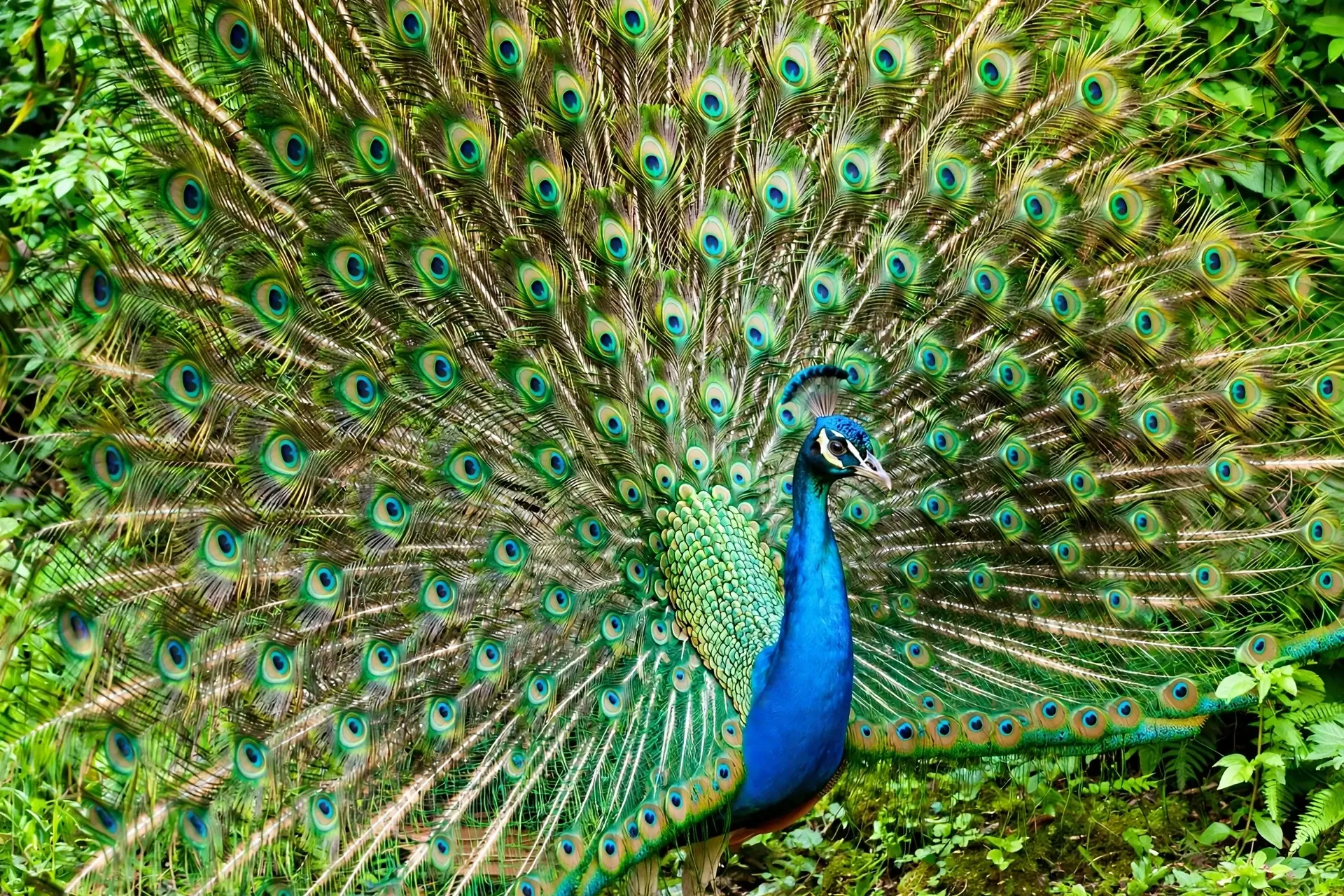
1. Darwin and the Peacock Feather
A peacock's tail should not exist if evolution rewards only survival, yet there it is, huge, heavy, and impossible to miss. Darwin saw the problem at once, and it troubled him for years. This section follows that worry from a single feather to the theory that finally explained it.
Picture a quiet room in Kent in the spring of 1860. Charles Darwin is at his desk, surrounded by pigeon skins, barnacle shells, and notebooks from the voyage of the Beagle. He has spent more than twenty years gathering evidence for a single idea: that species change over time through natural selection, the slow favoring of traits that help an organism survive and reproduce. On the Origin of Species had appeared the previous November, and the arguments were still raging across Britain.
Then, in the middle of that storm, Darwin stops to look at a peacock feather.
He does not write about it as a scientist admiring a specimen. He writes about it as a man who feels physically unwell. On 3 April 1860, in a letter to the American botanist Asa Gray, he confesses the trouble in plain, startled language:
"The sight of a feather in a peacock's tail, whenever I gaze at it, makes me sick!"
It is a strange sentence to come from the author of a theory built on patient observation. Why would a feather make him sick? Because the peacock's tail is beautiful, and beauty, in the form Darwin is staring at, makes no survival sense at all.
Think about what that tail actually is. A male Indian peafowl drags behind him a train of feathers that can stretch well over a meter long, patterned with shimmering eyespots of blue, green, and gold. It is heavy, it catches on branches, and it makes flying harder and running slower — a bright, rustling advertisement to predators. If natural selection rewards only the traits that keep an animal alive, then a male peacock should have a short, drab, practical tail, like the female peafowl beside him. Instead, he has a walking fan of color that seems designed to get him killed.
That contradiction troubled Darwin for more than a decade. He could explain the camouflage of a moth or the speed of a hare with survival alone, but the peacock's train does the opposite: it costs energy to grow and carry, and it raises the risk of being eaten. And yet generation after generation of peacocks kept growing it, longer and more elaborate.
Darwin's answer, when it finally came, was not to abandon natural selection but to widen it. An animal that lives a long life but never mates leaves no descendants. An animal that lives a shorter, riskier life but mates often can leave many. If a trait helps its owner win mates, even at a cost to survival, it can still spread. That insight became sexual selection, and Darwin devoted over half of his 1871 book The Descent of Man to working it out in detail.
I once spent a long afternoon watching peacocks in a public park, expecting constant showing off. What I saw was quieter and more instructive. Most males stood around with their trains folded, looking almost ordinary. Then one male raised his train, rattled it, and turned slowly in the sun. The females nearby did not rush over; they walked past, paused, looked, and moved on to the next male. The display was not a command. It was an offer, and the females were doing the choosing.
This article follows that engine from Darwin's desk to the modern evidence: the definition of sexual selection, the different costs of eggs and sperm, males fighting for breeding rights, and then, in the second half, the choosier sex and the extravagant ornaments — the peacock's tail included — that female choice has built.
2. What Is Sexual Selection?
Sexual selection is the part of evolution driven by mating success rather than survival. Some individuals leave more offspring because they win mates, not because they live longer. It works through two routes, rivalry between members of the same sex and choice by the other sex.
That short definition deserves a slower look, because it changes how we read almost every striking difference between males and females. Natural selection, the process Darwin described in 1859, favors traits that help an organism survive: better camouflage, sharper senses, stronger legs, a digestive system matched to the local food. Sexual selection favors traits that help an organism secure mates: a louder song, a brighter display, a larger weapon, a more persistent courtship. The two forces often pull in the same direction, but they often pull in opposite directions too, and the peacock's tail is the classic case of a trait that wins the mating contest while losing the survival contest.
Here is a misconception I want to push back on directly, because it distorts the whole subject. "Survival of the fittest" does not mean survival of the strongest. Fitness in evolution is not muscle, speed, or aggression; it is the number of copies of your genes that make it into the next generation. A shy male who mates once has higher fitness than a powerful male who fights brilliantly and mates never. Once you measure fitness that way, the peacock's tail stops looking like a paradox: it is a liability for survival and an asset for mating, and in peacocks the mating advantage has outweighed the survival cost for a very long time.
Darwin's own definition, from The Descent of Man, captures that balance in careful Victorian language. He wrote that sexual selection "depends on the advantage which certain individuals have over other individuals of the same sex and species, in exclusive relation to reproduction." Notice what he leaves out: survival. A trait can be useless for staying alive, or even harmful, and still be favored if it helps its owner reproduce more successfully than rivals of the same sex.
Sexual selection works through two processes, and keeping them apart makes everything that follows easier to follow.
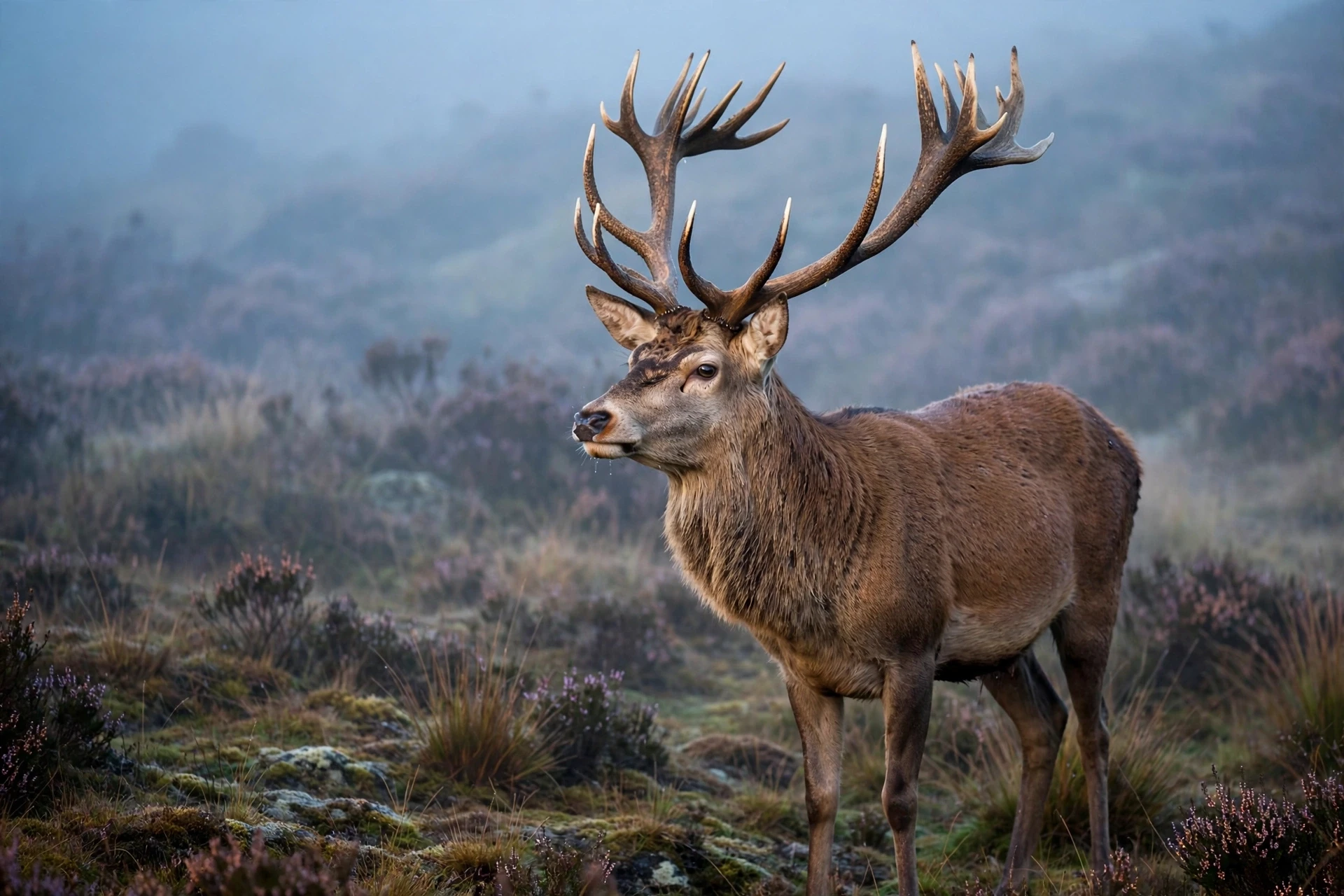
The first process is mate competition, sometimes called intrasexual selection. Members of the same sex — usually males — compete with each other for access to mates, directly, as when two elephant seal bulls clash on a beach, or indirectly, as when male birds sing from rival territories and the loudest, most persistent singer holds the best patch of ground. Weapons grow out of this process: antlers, horns, tusks, spurs, and sheer body size. So do many displays of dominance, from the roaring of a red deer stag to the chest-beating of a gorilla. The prize is not food or shelter. It is the chance to mate.
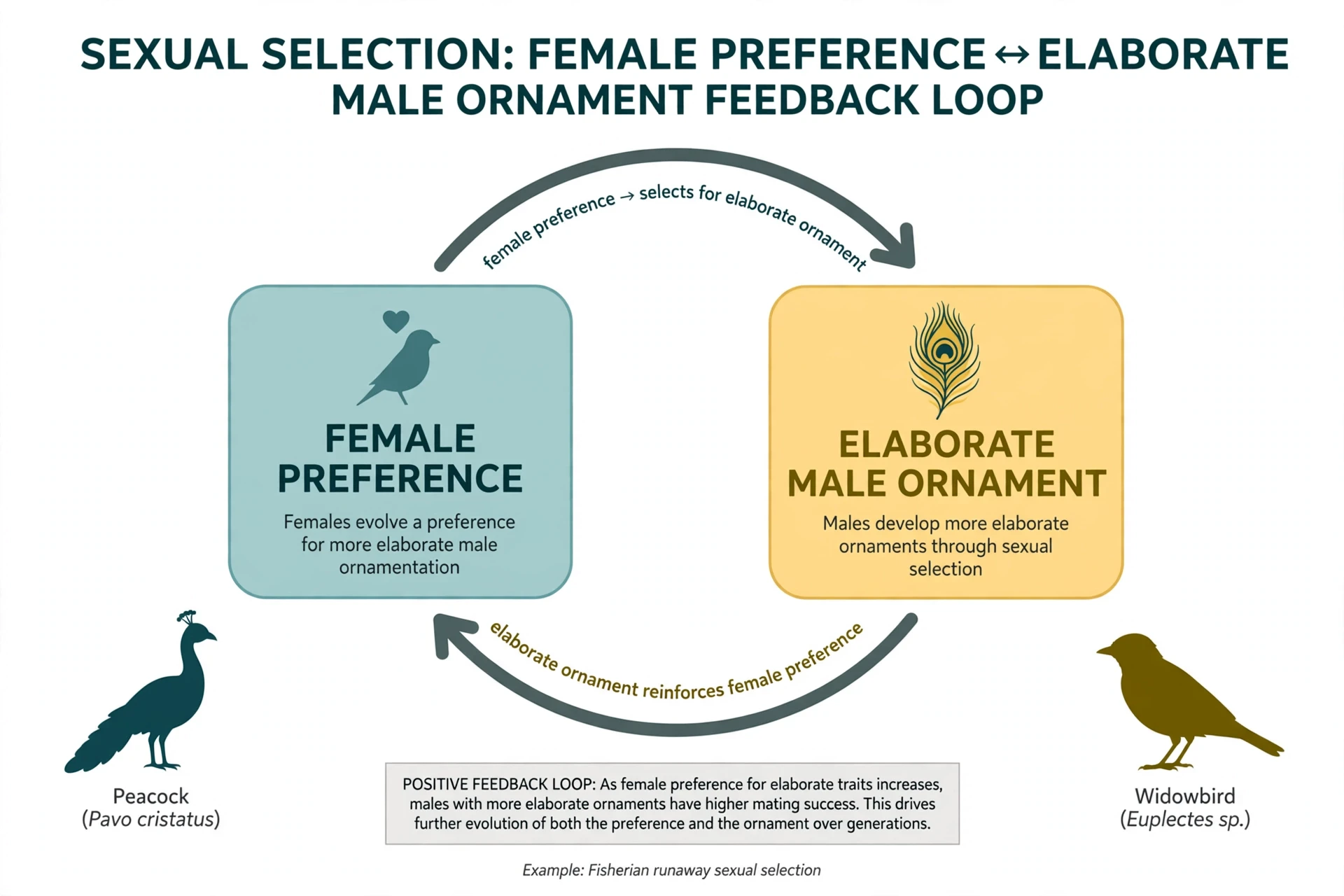
The second process is mate choice, sometimes called intersexual selection. Members of one sex — usually females — choose among members of the other sex, judging signals rather than survival ability in the abstract: the brightness of a feather, the complexity of a song, the vigor of a dance, the size of a gift, or the quality of a nest. The chosen traits can become wildly elaborate over generations, because each round of choice favors males slightly more striking than their rivals, and their sons inherit both the striking trait and, often, the preference for it. This feedback loop is why mate choice can build ornaments as extreme as the peacock's train, the lyrebird's tail, or the bowerbird's decorated bower.
Both processes shape the same population at the same time. A male red deer must first beat rival stags to hold a harem, and then the females in that harem still exercise choice about when to mate. A male peacock must first survive long enough to grow his train, and then persuade a female it is worth her attention. Competition decides who gets to the starting line; choice often decides who crosses it.
The table below sets out the contrast between the two kinds of selection side by side. It is worth studying for a moment, because the rest of this article keeps returning to the same distinction: traits that keep you alive, and traits that get you chosen.
| Feature | Natural selection | Sexual selection |
|---|---|---|
| What is favored | Traits that improve survival in the environment | Traits that improve mating success |
| Typical examples | Camouflage, speed, keen senses, efficient digestion | Bright plumage, long tails, loud songs, large antlers |
| Who is compared | Individuals against the environment and its hazards | Individuals against rivals of the same sex |
| Role of the other sex | None in particular | Often central, through mate choice |
| Typical cost | Usually low; the trait itself aids survival | Often high; the trait can hinder survival |
| Effect on males and females | Usually similar in both sexes | Often very different, producing strong sex differences |
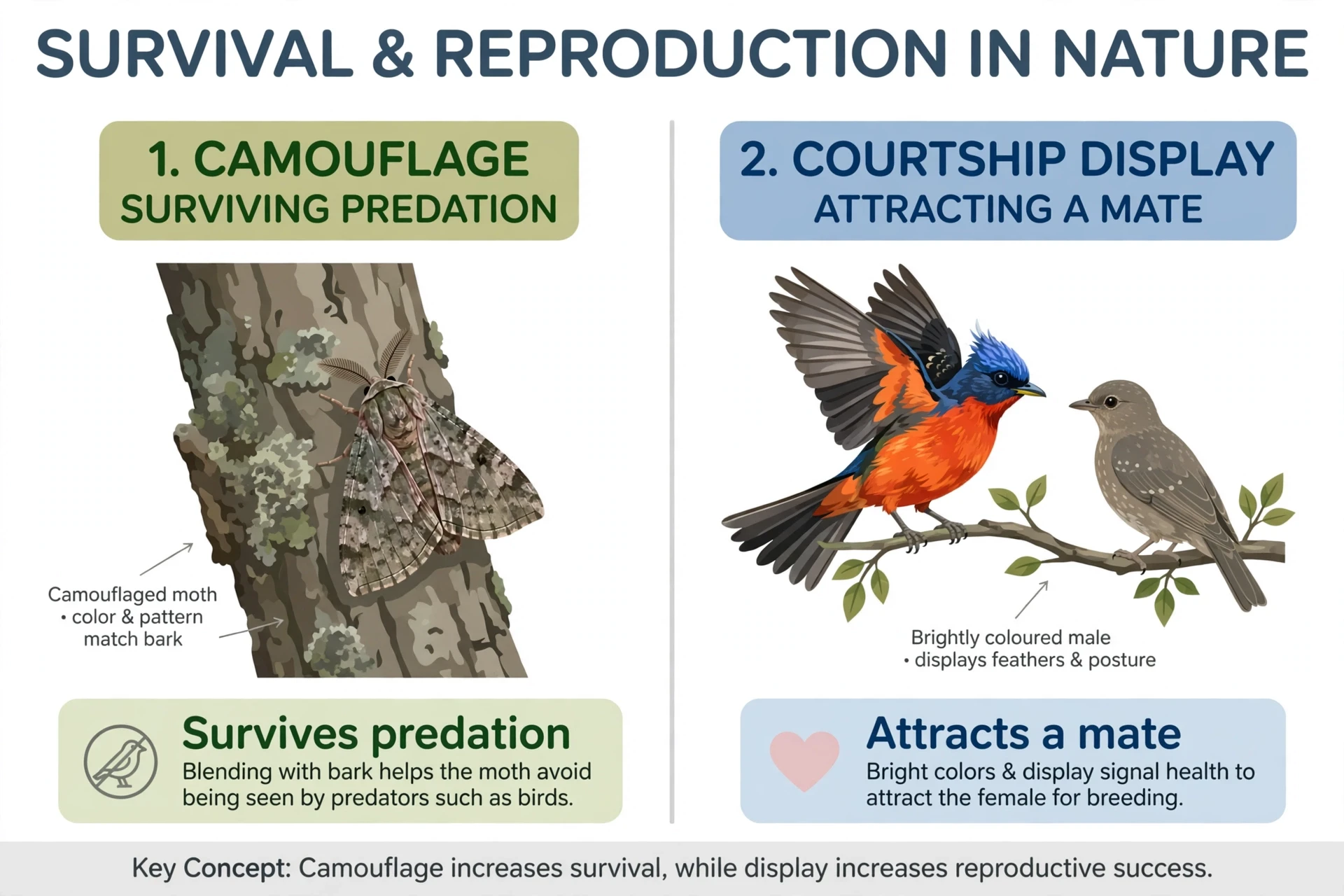
Sexual selection is not a separate force floating free of natural selection; it is a component of it. Every trait it shapes still has to pass a survival test of sorts: a male whose ornament is so costly that he dies before breeding gains nothing. What sexual selection does is change the balance of the test. Instead of asking only "does this trait help you live?", evolution also asks "does this trait help you breed?" When the second answer is a strong yes, the trait can spread even when the first answer is a qualified no.
That is why the study of sexual selection matters beyond the curiosity of bright birds and fighting seals. It explains why males and females of the same species can look like different animals, why some traits seem to defy common sense, and why beauty in nature is so often a signal rather than an accident. To understand the bargain, though, we have to ask a deeper question: why do the sexes so often want different things from mating in the first place? The answer begins not with behavior, but with the sex cells themselves.
3. Why the Sexes Differ
Males and females often want different things from mating because their sex cells cost different amounts to make. Eggs are large and costly, sperm are small and cheap, and that gap shapes who competes and who chooses. The evidence for this idea comes from fruit flies, parental investment, and animals that reverse the usual roles.
3.1 Anisogamy: the unequal starting point
Most animals reproduce through two kinds of sex cells, or gametes, and those gametes are not equal. Females produce eggs: large cells packed with nutrients, cytoplasm, and the machinery a new life needs to begin. Males produce sperm: tiny cells built for one job, swimming to an egg, carrying little more than a package of DNA. Biologists call this difference anisogamy, and it is the root asymmetry from which much of sexual selection grows.
Think of it as an investment problem. A female mammal who produces a single egg has already committed far more resources to it than a male has to a single sperm, and in mammals the gap widens after fertilization: pregnancy, birth, and nursing all fall on the female. In birds the gap is narrower, since both parents may feed the chicks, and in fish that scatter eggs into the water it is smaller still. Wherever the gap is large, the sex that invests more has more to lose from a bad mating decision, and so it tends to be choosier. Wherever the gap is small, or reversed, choosiness can reverse too.
This is not a claim that females are naturally coy and males naturally eager. It is a claim about economics. When one sex cell is cheap and abundant, the best way to increase reproductive success is often to mate with as many partners as possible. When one sex cell is costly and limited, the best way is often to choose carefully and invest heavily in the offspring that result. Anisogamy sets the starting prices, and everything else in sexual selection — competition, choice, ornaments, weapons — is a negotiation built on those prices.
3.2 Bateman's fruit flies
The clearest early evidence for that negotiation came from a small, unglamorous animal in a laboratory in Edinburgh. In 1948, the geneticist Angus Bateman published a study of fruit flies, Drosophila melanogaster, under the title "Intra-sexual selection in Drosophila", in the journal Heredity (volume 2, pages 349–368, Bateman 1948). The experiment was simple in design and striking in result, and it has shaped the study of sexual selection ever since.
Bateman set up populations of fruit flies with equal numbers of males and females — 215 males and 215 females in the study as a whole — and used genetic markers to trace which flies parented which offspring. He could then ask, for each sex, how many individuals failed to reproduce at all, and how reproductive success changed as the number of mates increased?
The answers were sharply different. About 21% of the males failed to reproduce, compared with only 4% of the females, and among the males who did mate, reproductive success rose steadily with the number of mates. Among females, success did not rise in the same way — a female with several mates left little more offspring than a female with one, because her output was limited not by access to sperm but by the number of eggs she could produce.
That pattern — male success limited by mates, female success limited by eggs — became known as Bateman's principle. If a male's reproductive success rises with each extra mate, then males gain from competing for mates and from mating often. If a female's success levels off after the first mating, then she gains little from mating often, and much more from choosing a good mate and investing in the offspring she already has. Competition on one side, choice on the other: the two processes of sexual selection fall out of the asymmetry of the gametes themselves.
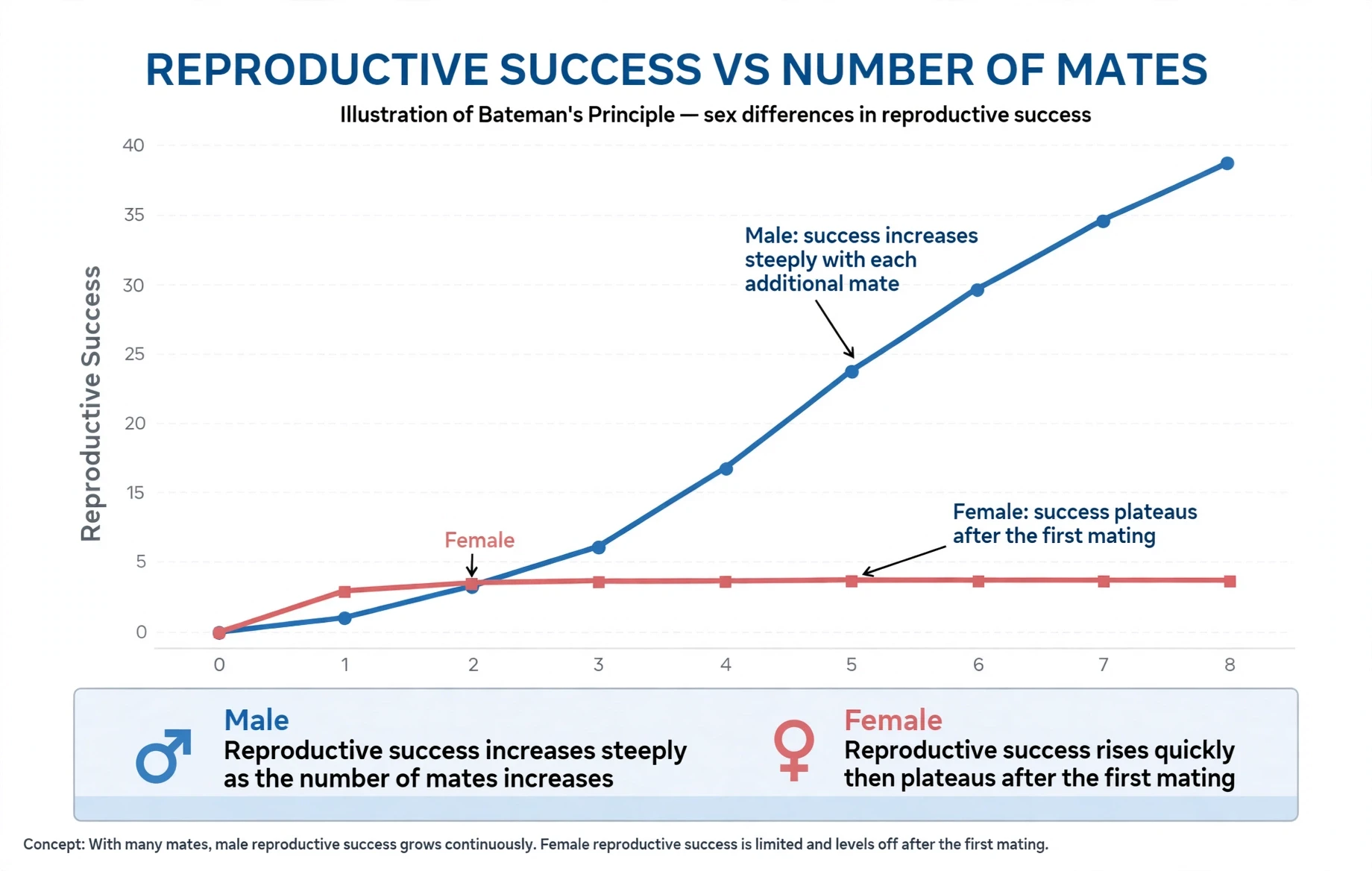
Bateman's study is not the last word — a reappraisal found sampling biases, mathematical errors and selective presentation of data, and a replication using his methods found no evidence for sexual selection in the flies, because the genetic markers made many double-mutant offspring inviable — but the broader pattern, that male reproductive success varies more and rises more steeply with mate number, has been found in many other species. The fruit flies gave Darwin's idea a measurable footing, turning an argument about peacock feathers into a testable claim about who benefits from mating, and by how much.
3.3 Trivers and parental investment
If Bateman showed that the sexes differ in how mating pays off, the evolutionary biologist Robert Trivers explained why, in a paper that extended the argument from gametes to the whole of parental care. His 1972 chapter, "Parental Investment and Sexual Selection", appeared in the edited volume Sexual Selection and the Descent of Man, 1871–1971 (Campbell, ed., Aldine, pages 136–179), published to mark the centenary of Darwin's book. Trivers' starting point was simple: the cost of an egg is only the first installment. What matters for sexual selection is the total investment a parent makes in an offspring, from gamete to independence.
Trivers defined parental investment with a precision that has made the definition a standard reference ever since:
"Any investment by the parent in an individual offspring that increases the offspring's chance of surviving (and hence reproductive success) at the cost of the parent's ability to invest in other offspring."
Read that definition slowly, because the second half is as important as the first. Investment is not just care. It is care that costs the parent something: time, energy, or resources that cannot then be spent on another offspring, or on finding another mate. A female mammal who nurses one pup for weeks cannot nurse another litter at the same time. A male bird who feeds chicks in one nest cannot easily defend a second territory. Every act of parental care is a trade-off, and the sex that pays more of that cost becomes the limiting resource for the other sex.
Trivers' argument runs like this. The sex that invests more — usually the female, because of eggs, pregnancy, and nursing — becomes a scarce resource, and members of the less-investing sex must compete for access to it. The more-investing sex can afford to be choosy, because each reproductive decision carries a high cost and a high stake. The result is the familiar pattern of sexual selection: competing males, choosing females, and the ornaments and weapons that evolve to serve those roles.
The power of Trivers' idea is that it predicts when the familiar pattern should break down. If the investing roles reverse, the pattern of sexual selection should reverse with them. And in nature, it does.
3.4 The operational sex ratio
Emlen and Oring gave that prediction a precise form in 1977, with the concept of the operational sex ratio. This is not the ratio of all males to all females in a population. It is the ratio of males to females who are actually ready to mate at a given moment. A population can have equal numbers of males and females overall, and still have a strongly skewed operational sex ratio, because one sex spends much more time out of the mating pool — pregnant, nursing, guarding a nest, or recovering from the costs of reproduction.
When the ratio is skewed toward males — many males ready to mate, few females available — competition intensifies: a few males win big, many win nothing. When it is closer to even, competition eases. When it skews the other way, the roles can flip entirely: females compete, and males become the choosy sex. The ratio is a dial, and turning it changes the intensity and direction of sexual selection.
3.5 When the roles reverse
The most vivid test of the whole framework comes from animals in which males do most of the parental care. In seahorses and many pipefish, the male carries the developing young in a brood pouch, supplying them with oxygen and, in some species, nutrients — though in a few pipefish the eggs are simply glued to the male's belly. The female produces the eggs and passes them to the male, and her investment ends there. His investment has only just begun. The result is exactly what Trivers' theory predicts in the polygamous pipefish: the females compete for access to males, and the males choose among females. Female pipefish are often the brighter, more ornamented sex, and they court and display to males who inspect them and decide.
Phalaropes, a group of wading birds, show the same reversal on land. The female is larger and more brightly colored than the male; she courts him, defends the territory, and competes with other females. Once she has laid her eggs, she leaves, and the male incubates the eggs and raises the chicks alone. He is the choosy sex, and she is the competing one — a mirror image of the pattern in most birds, produced by a mirror image of the investment pattern.
These reversals rule out a simpler explanation. If males competed and females chose simply because of some fixed feature of being male or female, sex-role reversal should never happen. It does happen, and it happens where the investment pattern reverses — strong evidence that sexual selection follows investment, not the other way around. The gametes set the starting prices, parental care raises the stakes, and the operational sex ratio sets the intensity.
4. Mate Competition: Battles for Breeding Rights
When mates are scarce, members of the same sex fight, display, or scheme for access to them. Elephant seals settle the question with bulk and biting, red deer with antlers, and many smaller animals with quieter tricks. The contest does not end at mating, because sperm from rival males can still compete inside the female.
4.1 Elephant seals: size as a weapon
No animal illustrates mate competition more dramatically than the northern elephant seal. On the breeding beaches of the Pacific coast, males gather and sort themselves into a strict hierarchy through contests that are loud, bloody, and often decided by sheer mass. The size difference between the sexes is one of the largest among land-breeding mammals, and it is a direct product of sexual selection.
A typical adult male northern elephant seal weighs roughly 1,500 to 2,300 kilograms. A typical adult female weighs roughly 400 to 900 kilograms — around a third of the bulk of a male. That gap did not evolve because bigger males are better at finding fish or escaping sharks; it evolved because bigger males win fights on the beach, and winning fights means holding a harem.
The social structure is stark. A dominant bull, known as a beachmaster, defends a harem that can number 30 to 100 females against all challengers. He does not feed during the breeding season; he patrols, postures, roars through his inflatable nose, and fights any male who comes close. The fights are brutal affairs of biting and body-slamming. The reward for winning is enormous: a successful male can impregnate up to 50 females in a single season, while most males never mate at all. A small number of males father most of the next generation, and the rest father nothing.
That is Bateman's principle written in tonnes of blubber. Male reproductive success varies enormously with the ability to win contests, while female success varies far less: nearly every female mates and produces a pup. The pressure on males to be large, aggressive, and persistent is therefore intense, and over generations it has driven the sexes apart until a male can weigh several times as much as a female. The female's size is tuned mainly by natural selection — large enough to carry and nurse a pup, small enough to feed efficiently at sea. Sexual selection has acted far more strongly on the males, and the difference is visible from a long way off.
There is a cost, of course: growing to two tonnes takes years and much food, fighting risks injury and exhaustion, and a beachmaster may lose a large share of his body weight in a season. But the arithmetic of sexual selection is unforgiving: a male who avoids the fight lives longer and leaves no offspring, while a male who fights and wins can leave dozens. The winners, costly as victory is, are the fathers of the next generation.
4.2 Red deer and the economics of antlers
Red deer stags offer a different version of the same story, in which the weapon is grown, shed, and regrown every year. Each autumn, as the rut begins, stags gather on the hills and moors, roar to advertise their presence, and challenge rivals. The contests begin with display: parallel walking, roaring matches in which each stag assesses the other's size and stamina from the depth and rate of his calls. Many contests end there, with one stag withdrawing after judging himself outmatched. Others escalate to a clash of antlers — pushing, twisting, and wrestling, sometimes for many minutes, until one animal gives way.
Antlers are expensive. A large stag grows a new set each year, a structure of bone that demands calcium, protein, and energy that could otherwise go to body condition or survival through the winter. A stag who grows large antlers and loses a fight has paid a high price for nothing; one who grows them and wins gains a harem and the chance to father many calves. Antler size and symmetry are also signals of health, age, and condition — a stag in poor condition simply cannot afford a large rack, which is part of what makes the signal honest.
The red deer example also shows that mate competition is not always a fight to the finish. Roaring contests let stags settle many disputes without contact, saving both animals the risk of injury. Sexual selection favors winning, but it favors winning efficiently, and the rituals of the rut — the roaring, the parallel walk, the measured escalation — are the product of both pressures acting together. For a fuller account of how these traits fit into the wider story of evolution, see Natural Selection and Darwin's Theory of Evolution.
4.3 Sperm competition and alternative tactics
The contest for mates does not always end when mating begins. In many species, a female mates with more than one male, and the sperm of rival males then compete inside her reproductive tract to fertilize her eggs. This is sperm competition, a form of mate competition that takes place after copulation, and it was brought into the center of evolutionary biology by Geoffrey Parker in a landmark 1970 paper in Biological Reviews (volume 45, pages 525–567).
Parker's insight was that males do not only compete to mate. They also compete to fertilize. Later work showed that this second contest has shaped larger testes relative to body size in species where females mate multiply, more numerous and faster-swimming sperm, and behaviors such as mate guarding, in which a male stays close to a female after mating to keep rivals away. In some insects, males produce a mating plug that blocks the female's reproductive tract; in others, males remove a previous mate's sperm before depositing their own. Each trait is a weapon in a contest the eye never sees, fought in the dark inside another animal's body.
Alongside open competition, many species have evolved alternative tactics — quieter strategies that let smaller or younger males reproduce without winning the main contest. Sneaker males wait at the edge of a territory and dart in to mate quickly when the dominant male is distracted or absent. Satellite males hang around a displaying male, intercept females attracted by his display, and mate with them without ever displaying themselves. These tactics look like cheating, but from the point of view of sexual selection they are simply different bets: a sneaker who never wins a fight can still father offspring, and if the tactic pays well enough, it persists alongside the dominant strategy.
What ties all of this together — elephant seal bulk, red deer antlers, sperm competition, and sneaker tactics — is the same logic that ran through the earlier sections: mating success varies, and it varies most for the sex that invests less and competes more. The traits that win mates spread, even when they cost their owners in other ways. Competition decides who gets the chance to breed. But competition is only half of sexual selection. The other half is choice, and it is choice that builds the most spectacular traits in nature, including the peacock's tail that so troubled Darwin. That is where the second half of this article begins.
5. Mate Choice: What Females (and Sometimes Males) Are Looking For
Mate choice is the quiet engine of sexual selection: the choosy sex picks partners whose genes, gifts, or territory promise the best return for its offspring, and that pickiness reshapes bodies over generations. Females usually choose because eggs cost more than sperm, but males choose too when their investment is high. The rest of this section explains what choosers weigh.
Picture a spring morning in a meadow. A female songbird moves from branch to branch, listening. One male sings a long, varied song without a stumble, while another sings a shorter tune, then stops to chase a rival. She lingers near the first singer, and a decision has been made.
Choosiness makes sense once you count the costs. An egg is a large package of nutrients, and a female often carries, feeds, or guards the young for weeks, so a mistake can waste a whole breeding season. Sperm is cheap to make, so males can afford to mate widely. That asymmetry explains why females are usually choosier, and why males so often compete for their attention. The logic is the same one behind natural selection: traits spread when they help their bearers leave more copies of their genes.
When males do become choosy, the reason is usually the same: their investment has risen. In seahorses, males carry the young in a brood pouch. In phalaropes, females compete while duller males incubate the eggs. Wherever one sex invests heavily, that sex can afford to be picky.
5.1 Good genes: choosing a partner whose offspring will thrive
The simplest reason to be choosy is genetic quality, and it is one of the main drivers of sexual selection. A mate with strong genes can pass on disease resistance or efficient metabolism. The chooser cannot read a genome directly, so it reads the signals that track quality: a clear song, a symmetrical pattern, or bright colors. The human genome shows the same principle at a larger scale, as explained in our article on the human genome.
This is where sexual selection meets everyday health. A male that sings for hours without tiring is showing that his muscles, lungs, and energy reserves all work. A female that watches him is not admiring music for its own sake. She is gathering evidence about the body behind the song. If his offspring inherit his stamina, her young start life with an edge.
There is a catch. If every female prefers the same "best" males, genetic variety should shrink fast, yet wild populations stay varied. The environment keeps changing, so the best genes this year may not be the best genes next year, and trade-offs differ too.
5.2 Direct benefits: food, territory, and protection
Not every benefit is genetic. Sometimes the payoff is immediate and practical: food, a safe place to nest, or a partner who helps raise the young. A male bowerbird builds and decorates a bower, and the female inspects his construction before mating. A male tern brings a fish to a female, and she judges the gift before she accepts him. A male wren that holds a rich territory offers insects, shelter, and a safe nest site in one package. In each case, sexual selection favors males who can deliver something concrete, not just good genes.
5.3 Sensory bias: when taste starts before the trait
A third force shapes mate choice, and it is subtler than genes or gifts. Animals arrive at the mating season with senses already tuned by other parts of life. Female guppies, for example, are attracted to orange objects outside mating — wild guppies eat orange fruit that falls into streams — and they also prefer males with larger orange spots, a preference that tracks the foraging bias across populations. The preference exists before the male trait evolves to exploit it, and sexual selection then takes over from there.
Sensory bias helps explain why some ornaments look strange at first glance. The trait did not have to start as a signal of quality. It only had to catch the eye, or the ear, of a chooser whose senses were already tuned that way. Once females started preferring the trait, sexual selection could refine it, pushing it toward greater size, brightness, or complexity. The starting point was a quirk of perception. The endpoint was a peacock's train.
That sequence matters because mate choice is not a perfect calculator. It is a product of brains and bodies with their own history, and it can be fooled or biased. Sexual selection works with what choosers actually notice, not with what a perfect designer would choose.
6. The Peacock's Tail: The Most Famous Ornament in Biology
The peacock's train is the most famous product of sexual selection: a huge, shimmering fan that looks like a liability because it is heavy, conspicuous, and costly to grow. Yet peahens choose among males, and fieldwork shows train size and eyespot number influence who mates. This section examines the train, the key experiments, and where the story gets complicated.
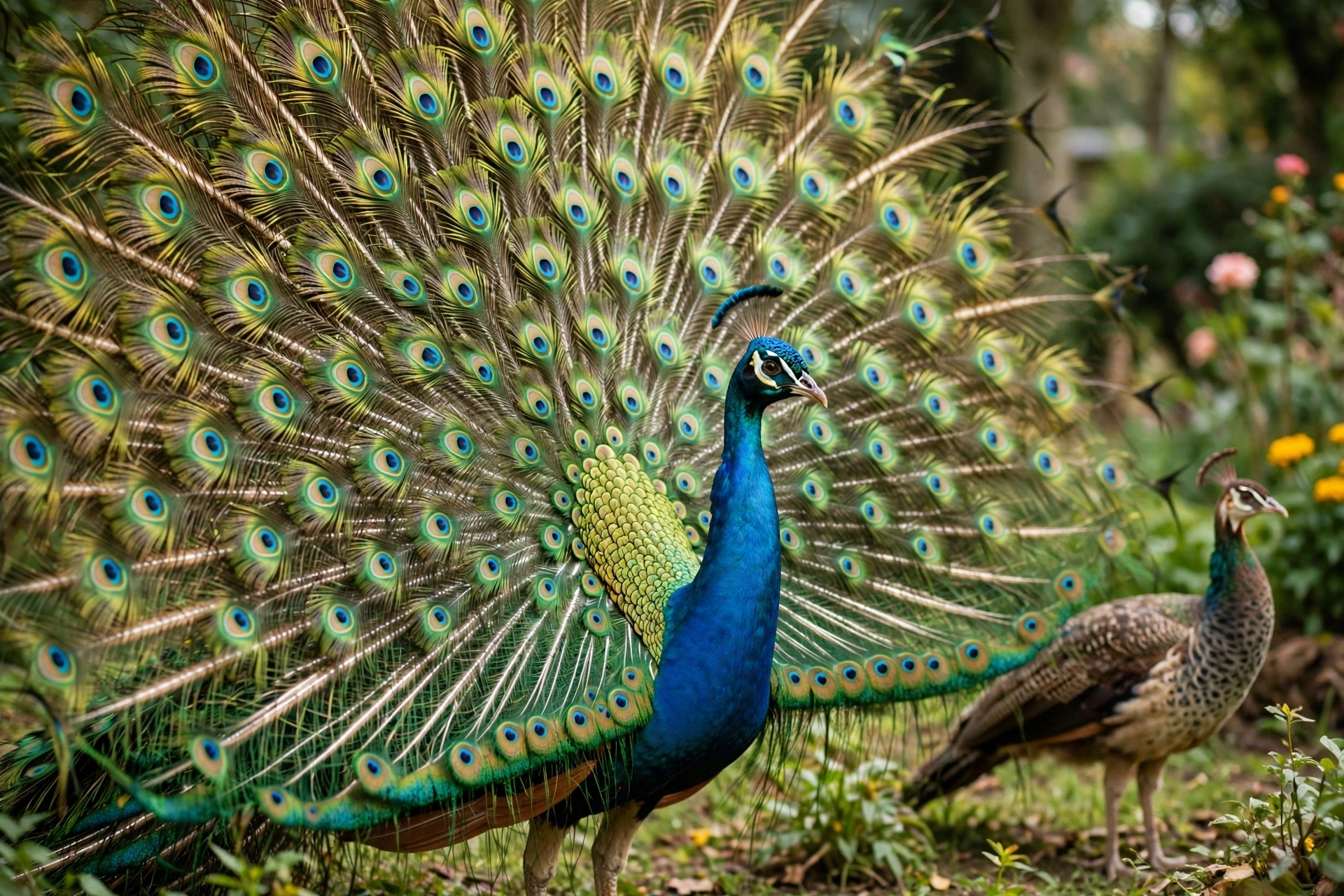
The Indian peafowl lives wild in India and Sri Lanka and now in parks and gardens around the world. During the breeding season, in a classic display of sexual selection, a male fans his train and shivers it so the feathers rustle and flash, while a peahen watches several males before crouching before one of them. The male shows; the female decides.
6.1 What the train really is
The first surprise is anatomical. The peacock's "tail" is not really a tail at all. The long, iridescent fan is made of elongated upper tail coverts, the feathers that normally cover the base of the tail, stretched to extraordinary length. The true tail feathers sit underneath, short and stiff, and they act as a prop that holds the fan upright during display. When you look at a displaying peacock, a product of sexual selection, you are looking at coverts, not tail feathers.
The train is also temporary. A male sheds it annually after the breeding season and regrows it before the next one. Growing a fresh train takes energy and nutrients, and carrying it takes effort too. Trains reach about 1.5 meters long, and the maximum eyespot count is about 165 to 170. Each eyespot, or ocellus, is a small masterpiece of structure and pigment: a dark purple-black center ringed by blue-green and bronze-gold, with a fan of fine barbs around it. The colors shift as the bird moves, because they come from the microscopic structure of the feather as much as from pigment.
That annual cycle is a clue, and a classic one in sexual selection. A trait rebuilt every year is a fresh test of condition every year: a sick male cannot grow a full, even train with bright eyespots, while a healthy male can.
6.2 The Petrie experiments: counting eyespots and matings
The clearest early evidence that peahens care about trains, and that sexual selection shapes them, came from Marion Petrie and her colleagues, working with a free-ranging population of Indian peafowl at Whipsnade Park in England. In their 1991 study, published in Animal Behavior, they followed one 10-male lek, a small display ground where males gathered and females came to choose. The results were striking, and they are still quoted today.
The most successful male in that lek copulated 12 times, while the least successful males managed zero. Mating success was far from evenly shared. Over 50 percent of the variance in mating success was explained by train morphology, the size and shape of the train and its eyespots. Females visited about 3 males on average before choosing, and they never mated with the first male that courted them. In 10 of 11 sequences ending in copulation, the chosen male had the highest eyespot number among the males the female had visited. The pattern pointed in one direction: in sexual selection, peahens were comparing trains, and eyespot number mattered. The full study is Petrie, Halliday and Sanders 1991, Animal Behavior 41:323–331, Petrie et al. 1991.
Correlation is not proof, though, and Petrie knew it. A male with many eyespots might also be older, healthier, or more experienced, and peahens might be choosing those qualities rather than the eyespots themselves. To test the eyespots directly, Petrie and Tim Halliday ran an experiment. In their 1994 study, published in Behavioral Ecology and Sociobiology, they experimentally removed about 20 eyespots from the trains of some males and left others untouched. Males that lost eyespots saw their mating success fall. The manipulation changed the train without changing the male's age, health, or experience, so the result strengthened the case that eyespots themselves influence female choice in sexual selection. The paper is Petrie and Halliday 1994, Behavioral Ecology and Sociobiology 35:213–217, Petrie & Halliday 1994.
6.3 The disagreement: what later studies found
Science moves forward by retesting, and the peacock has been retested more than almost any other ornament. Takahashi and colleagues reported in 2008 that they found no evidence females preferred more ornamented males, a direct challenge to the Petrie results and to the standard sexual selection account of the train. Their population, methods, and measures differed from the earlier work, and the contrast raised a fair question: was the eyespot effect real but limited to certain conditions, or had the earlier result been overstated?
A later experiment helped narrow the gap. Dakin and Montgomerie, in 2011 in Animal Behavior, found that natural variation in eyespot number did not predict mating success: peahens showed no preference among males with typical trains. Only males with substantially reduced eyespot numbers — well below the normal range — were less successful at mating. Eyespot number therefore looks like a threshold, not a graded preference. The 2011 paper is Dakin and Montgomerie 2011, Animal Behavior 82:21–28, Dakin & Montgomerie 2011. Their work suggests the honest summary is neither "eyespots decide everything" nor "eyespots decide nothing." Eyespots matter sometimes, in some contexts, and by a modest amount.
Then came a sharper challenge. Rama Shankar Singh, Professor Emeritus of Biology at McMaster University, wrote in The Conversation on 2025-08-18 that after 30 years of studies there is "no uncontroversial support for eyespot-based female choice." Singh points out that peahens react to the green-blue color of eyespots, and that train size and eyespot number are developmentally correlated through a zigzag, or alternate, follicle arrangement, so a big train tends to carry many eyespots whether or not females count them. On that reading, eyespot number may be a byproduct of how a large train grows, not the trait females are selecting. Singh goes further, arguing there is no need for a separate sexual selection theory at all — a minority position, not the consensus.
What should a reader take from this disagreement? First, the peacock is still a live research question, not a closed case. Second, the size of an effect matters: a small, context-dependent preference can still shape evolution over many generations. Third, a peahen may weigh train size, eyespot color, display vigor, and the male's call all at once.
7. Fisherian Runaway: When Taste Itself Evolves
Runaway sexual selection can spiral: once females prefer a trait, the genes for the preference and the trait become linked, so each generation makes both more common. The result is an ornament that keeps growing long after it stops helping survival. This section traces Fisher's idea, the models that tested it, and the widowbird experiment that tested it.
Ronald Fisher was a statistician and geneticist who helped build modern evolutionary theory, and he had a gift for seeing a feedback loop where others saw a single cause. In 1915, in "The evolution of sexual preference" in the Eugenics Review, and again in his 1930 book The Genetical Theory of Natural Selection, Fisher offered a strange and elegant idea about sexual selection. Female preference itself could evolve, and once it started, it could drive a male trait to extremes that no survival benefit could explain.
Think of it this way. Suppose some females prefer males with slightly longer tails, for any reason at all. Those females mate with long-tailed males. Their sons inherit the long tail, and their daughters inherit the preference for long tails. Because trait and preference travel together, their genes become linked, a genetic correlation, and each generation makes both more common.
Fisher also described the logic later called the "sexy son" effect, although he never used that phrase — it was coined by Weatherhead and Robertson in 1979. A female who mates with an attractive male gains sons who are themselves attractive and will win many mates. Her preference spreads through her sons' mating success, not through her daughters' survival.
7.1 The feedback loop, step by step
The loop of sexual selection has four steps. First, variation exists: some males have longer tails than others, and some females prefer those traits more strongly. Second, choosy females mate with the males they prefer, so trait genes and preference genes end up in the same offspring. Third, those offspring carry both, creating a genetic correlation. Fourth, the correlation amplifies the process, because the sons are attractive and the daughters are choosy.
That is why Fisherian runaway differs from simple good-genes choice. In good-genes choice, the trait signals health, and the preference pays off through healthier offspring. In runaway, the trait can be arbitrary at the start: it spreads because females prefer it, and females prefer it because their mothers did.
The counterweight is survival cost. A tail that keeps growing eventually makes flight harder, attracts predators, and costs energy to grow. At some point the mating benefit balances the survival cost, and the trait settles at an equilibrium, until a change in the environment restarts the spiral of sexual selection.
Fisher also gave biology another lasting idea in the same body of work: Fisher's principle, the argument that the sex ratio tends toward 1:1. When one sex is rarer, parents who produce more of the rarer sex leave more grandchildren, because each rare individual has more mating opportunities. That pressure pushes the ratio back toward equality.
7.2 The models that made runaway respectable
Fisher sketched the idea in words, and for decades it stayed a clever verbal argument. The mathematics came later, and it was not easy, because recombination should break the link between preference and trait genes each generation unless the preference keeps rebuilding it.
Russell Lande answered that question in 1981, in the Proceedings of the National Academy of Sciences, with a quantitative genetic model showing that runaway can happen and can produce a range of outcomes, depending on the strength of preference and the costs involved. Mark Kirkpatrick followed in 1982 in Evolution, treating female preference as a trait in its own right. Pomiankowski, Iwasa, and Nee added further models in 1991 in Evolution, showing that Fisher's runaway process cannot produce stable exaggeration of a costly female preference on its own, and exploring how biased mutation could sustain it. Together, those models turned Fisher's sketch into a testable theory of sexual selection.
7.3 The widowbird test
In Kenya, between November 1981 and March 1982, Malte Andersson studied the long-tailed widowbird, a small black bird whose males grow spectacular tails during the breeding season. The natural mean tail length was 49.6 cm, long for a bird of that size, and males displayed from grass tops, fluttering slowly so females could see the tail streaming behind them. Andersson wanted to know whether the tail itself, apart from anything else about the male, decided who mated.
His design was simple and bold. He caught 36 males and divided them into 9 groups of 4. In each group, one male had his tail shortened to about 14 cm, one had his tail elongated by about 25 cm using glued-on feathers, and the others served as controls. The males were otherwise the same birds, on the same territories, with the same songs and behavior. Only the tails differed.
The results were clear. Males with elongated tails were about twice as successful at attracting mates as control males, while males with shortened tails were about half as successful. The shortened males held their territories as long as the other males did, which ruled out male-male competition as the explanation. They were not losing fights or losing ground. They were losing females. The tail itself, the ornament alone, was doing the work of sexual selection. Andersson published the study in 1982 in Nature, volume 299, pages 818–820, Andersson 1982.
The widowbird experiment is still cited as the classic experimental test of Fisherian runaway. It manipulated the trait directly, controlled for territory and competition, and measured real mating success in the wild. Later work has added nuance, but the core finding about sexual selection has held.
The runaway idea also connects to a broader theme: the split between survival and reproduction. A trait that helps an animal survive is favored by natural selection, but a trait that helps it mate is favored by sexual selection, even when it hurts survival. The same logic helps explain how new species form, because when two populations develop different preferences, their ornaments diverge too, a process explored in our article on speciation.
8. The Handicap Principle: Beauty That Hurts
The handicap principle says sexual selection favors ornaments precisely because they are costly: only a healthy, well-fed individual can afford a huge tail, bright colors, or heavy antlers, so the cost itself becomes the message. Cheaters cannot fake it for long. This section explains Zahavi's idea, the parasite evidence, and why biologists still argue about it.
Amotz Zahavi was an Israeli biologist who watched Arabian babblers in the desert and noticed acts that seemed wasteful, even dangerous: standing guard in exposed places and calling loudly where predators could hear. Zahavi wondered whether the waste itself was the point. In 1975, in the Journal of Theoretical Biology, he proposed the handicap principle, a central idea in sexual selection: mate selection favors traits that handicap their bearers, because only high-quality individuals can bear the handicap and survive. The paper is Zahavi 1975, "Mate selection — a selection for a handicap", Journal of Theoretical Biology 53:205–214, Zahavi 1975.
The logic is like a costly advertisement. A cheap signal can be faked by anyone, so choosers learn to ignore it. An expensive signal cannot be faked for long, because a weak individual that tries to pay the price will fail, fall sick, or get caught. The cost keeps the signal honest, and that honesty is what makes sexual selection favor costly ornaments.
8.1 Honest signals and cheating
Every signaling system faces the same problem: cheaters. If a signal brings mates, food, or status, there is always an incentive to fake it. For a signal to stay useful, cheating must be hard, costly, or punished.
The handicap principle solves the cheating problem with cost. Imagine two males, one strong and one weak, both trying to grow a bright, elaborate ornament. The strong male pays a modest price in energy and stays healthy. The weak male pays the same absolute price, but it pushes him over the edge: he loses weight, falls behind on foraging, or becomes easy prey. The weak male therefore cannot afford to fake the full signal, and females that attend to the signal are rarely fooled. Honesty is not maintained by goodwill. It is maintained by the price tag.
There is a second way honesty can be maintained. Some signals are honest because they are physically tied to the quality they advertise, not because they are costly. A deep voice in a frog is honest because only a large body can produce it. Biologists call these index signals: honest by construction, with no handicap needed.
8.2 Parasites, carotenoids, and stotting
The best-known test of the handicap idea came from parasites. In 1982, William Hamilton and Marlene Zuk proposed in Science that bright plumage signals low parasite load: a male that stays bright despite parasites must have strong resistance genes, so females choosing bright males gain offspring with better resistance. The paper is Hamilton and Zuk 1982, Science 218:384–387, Hamilton & Zuk 1982. Later studies found support in some species and little in others, but the idea gave sexual selection a concrete, testable mechanism.
Carotenoid colors offer a clearer example, and a direct one for sexual selection. Flamingos are pink and goldfinches yellow from carotenoid pigments that birds cannot make themselves; they must get them from food and divert them from immune defense to color their feathers. A sick or poorly fed bird cannot spare many carotenoids for display, while a healthy, well-fed bird can, so color becomes a visible record of diet and health.
Stotting shows the same logic in motion. When a gazelle spots a predator, it sometimes leaps high into the air with stiff legs, again and again, instead of running away at once. The display tells the predator that this gazelle is strong, alert, and hard to catch, so chasing it would waste energy, and the predator often moves on.
8.3 Grafen's formalization and the modern debate
Zahavi's original proposal was verbal, and many biologists were skeptical. Could a costly signal really be stable? The answer came from Alan Grafen, who in 1990 formalized the handicap principle mathematically; his model is widely read as showing that, under the right conditions, honest signaling through costly ornaments can be evolutionarily stable — though Penn and Számadó (2019) argue Grafen's models do not in fact support Zahavi's original handicap hypothesis.
The debate has not ended. Critics point out that honest signals need not always be costly: an index signal is honest without an extra price, and cheating can be punished by rivals or predators instead. Penn and Számádó argued in 2019 that the handicap principle, as commonly stated, should be abandoned, because its core claims can be explained by other mechanisms and the term has been used so loosely that it obscures more than it clarifies.
Defenders reply that the principle still captures something real. Many ornaments are costly, and their costs track condition: the peacock's train and the stag's antlers are harder to produce when the bearer is sick or hungry. Even if cost is not the only route to honesty, it is a common one.
Where does that leave the reader? With a debate that is still open, and with a useful rule of thumb. When you see a costly ornament, ask who the audience is, and what stops a low-quality individual from faking it. If the answer is the cost itself, the handicap principle is doing real work; if the answer is physics or punishment, another mechanism may be at play.
That is the deeper lesson of sexual selection. Beauty in nature is rarely free, and rarely pointless. It is a message, a test, and a gamble: a gamble that the cost of being noticed is worth the chance of being chosen. The peacock pays it in feathers, the stag in antlers, and the widowbird in tail length.
9. Sensory Bias: When the Senses Decide
Sensory bias means female preferences often existed before the male traits they now favor. A female's senses were already tuned for finding food or spotting danger, and males evolved to exploit that tuning. In sexual selection, the show can therefore start in the brain, not in the body it is meant to impress.
Think of a sense as a doorbell installed for one visitor that starts ringing for another. A female frog listens for prey, a fish watches for food, a bird notices ripe fruit. When a male's sound or color rings that same bell, she turns toward him, responding to wiring that already existed, and sexual selection builds on that response.
In the classic runaway story, a preference and a trait chase each other. In the sensory bias story, the preference gets there first, and sexual selection follows the bias. Once males discover the fit, the trait spreads, because males who match it mate more often.
9.1 A preference looking for a job
Every animal lives by its senses, and those senses have day jobs: eyes find food and watch for hawks, ears catch prey and warning calls. A bright color stands out whether it belongs to a berry or a feather, and a low sound carries whether it comes from a rival or a suitor.
Sexual selection can put that tuning to work in courtship. A male need not invent a new sense; he needs a signal her senses already treat as important, louder or brighter than anything in her normal life, and that exaggeration is the point.
That is why some male traits look strange. They hit a sensitive spot for reasons that have little to do with mating, and sexual selection spreads them once a male lands on that ready-made bias.
The sensory bias idea also makes a testable prediction, and that is part of its strength. If a preference is older than the trait, it should show up in relatives that never evolved the trait, just as it did in the swordless fish. Researchers can look at a family tree, test females in several related species, and ask which of them already favor a shape, a sound, or a color that only one lineage has turned into an ornament. When the preference appears across the group, the trait looks less like a new invention and more like a male answer to an old question. Sexual selection, in this view, often works with tastes that evolution already built for other purposes, and the male who matches one first gains an immediate advantage.
9.2 The túngara frog and the cost of a sexy call
In the ponds of Central America, male túngara frogs call at night. The basic call is a descending whine; some males add short low-frequency notes called chucks. Females prefer calls with chucks and move toward the more complex call.
The preference makes sense once you know how a frog hears. A female's ear is tuned to low frequencies for reasons that have nothing to do with romance. Low sounds travel well, and they can signal large animals, approaching danger, or other useful information. The chuck hits that tuned channel. It is, in effect, a sound her ear was already built to notice. Males who add chucks are not creating a new taste. They are playing to a taste that was already there, and sexual selection rewards them for it.
There is a catch, and it is a sharp one. The same chucks that attract females also attract frog-eating bats. The bats listen for the calls, home in on the males with the most elaborate songs, and snatch them from the water's edge. A male who sings the sexiest song is also the easiest to find. His chance of mating goes up, and so does his chance of being eaten.
That trade-off is the heart of the story. A trait that wins mates can also draw predators, and the balance decides how far it goes. Where bats are many, males call less or more simply; where bats are few, chucks pile up.
Ryan's work on these frogs has become a classic case of sensory bias: a preference with a history outside mating, a male trait that exploits it, and a predator that keeps the system in check.
9.3 Swordtails and the preference that came first
Male swordtails carry a long tail-fin extension, the sword. Females prefer longer swords, which looks like ordinary female choice, until you look at their close relatives.
One closely related fish has no sword at all. The platyfish, Xiphophorus maculatus, has plain, short-tailed males. Yet when Alexandra Basolo gave female platyfish a choice between a normal male and a male with an artificial sword attached, the females preferred the sworded male. They liked a trait their own species had never grown.
That result turns the usual story around. The preference came first. The females were already tuned to notice a long tail extension, perhaps because a longer shape is easier to see, or because it resembles something else they track in the water. The sword itself evolved later, in one lineage, to match a preference that was already waiting. Sexual selection did not create the taste. It found it.
Basolo's 1990 Science study is often cited as strong evidence for sensory bias, because it separates the two steps in time: first the preference, then the trait. A small change in a male can have a large effect when it lands on a ready-made bias, and sexual selection does the rest.
9.4 Bowerbirds and the display that is built, not grown
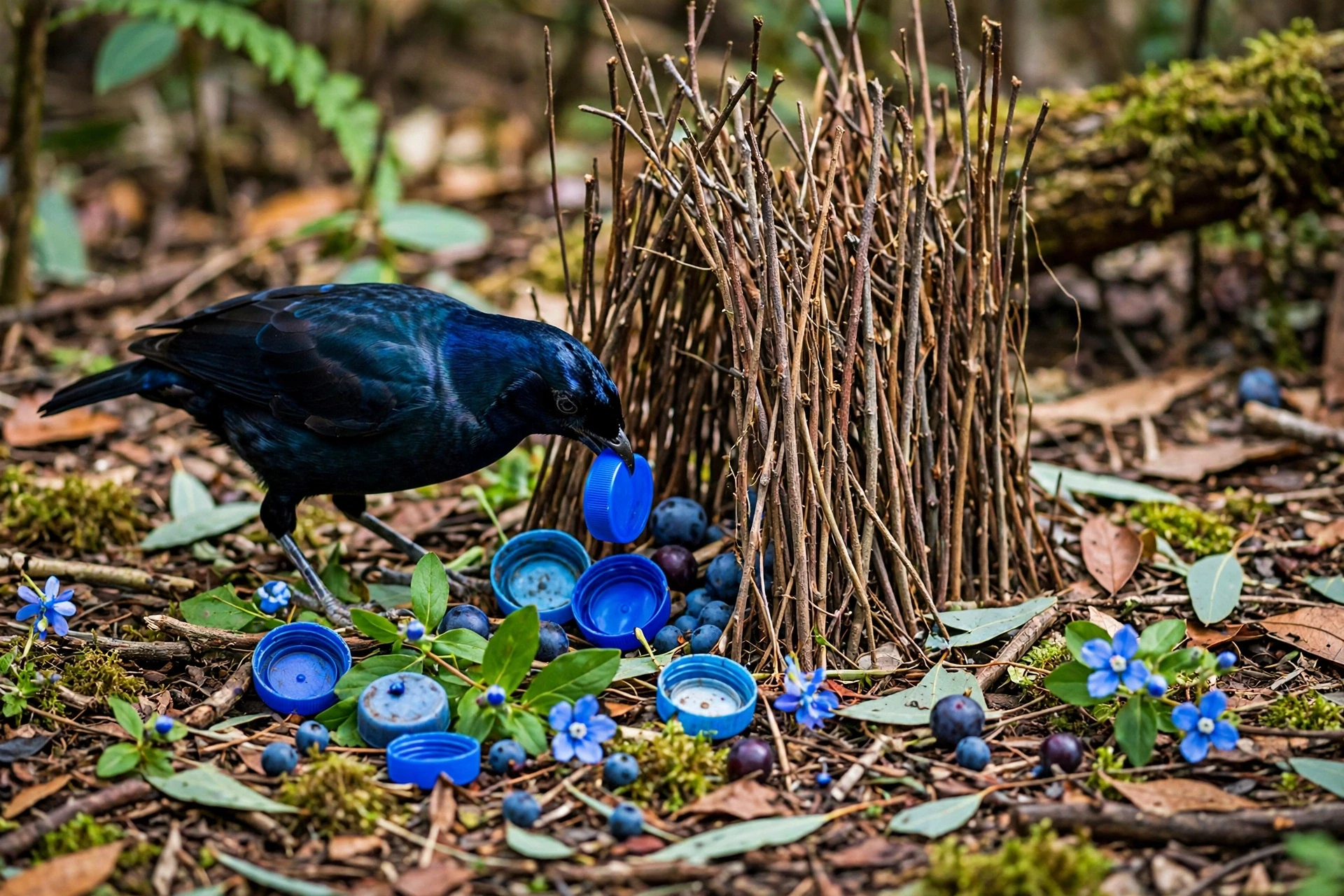
A male satin bowerbird clears ground, builds a small avenue of sticks, and decorates it with blue objects: feathers, berries, bottle caps, bits of plastic. He arranges them, steps back, and waits for a female to inspect his work.
The bower works because her senses already favor certain colors and arrangements. Blue is rare on the forest floor, so it stands out, and a neat bower is easy to compare with a messy one. A male who collects more blue catches the eye.
What makes bowerbirds telling is that the display can change fast. A male can add an object today and steal a prized feather from a rival tomorrow. Sexual selection here favors builders and collectors, not just bodies, and the bower records what a male has done.
Different bowerbird species favor different colors and materials, which fits the bias idea well. Satin bowerbirds are famous for blue, but other species collect white stones, green leaves, or pale shells, and each female seems tuned to the colors that stand out in her own forest. The bower is therefore not a single design repeated across the family. It is a local answer to a local eye, built from whatever the male can find and whatever the female already notices. A male who gathers the right color in the right place is not showing off a body part. He is showing that he knows what she sees.
10. Sexual Conflict: When Mates Become Adversaries
Sexual conflict arises because what helps a male reproduce can harm a female, and the reverse is also true. Mating is not always a shared project. When the two sexes want different things from the same encounter, sexual selection can favor coercion, defense, and counter-moves on both sides.
A male often gains from mating as often as possible, with as many females as possible. A female often gains from mating carefully, with the right male at the right time, and from keeping control over his sperm. Where those goals pull apart, conflict follows.
10.1 Sexual cannibalism: when dinner follows the dance
In some mantises and spiders, mating can end with the female eating the male. A male is a package of protein, and for a female who needs food to make eggs, that package can matter.
Not every mating ends this way. Males approach cautiously, offer a gift of food that keeps the female busy, or mate quickly and leave. In some spiders, the male brings a wrapped insect, and the female eats the gift while he mates.
The male's calculation is stark. If he is eaten after mating, he may still have passed on his genes, and his body may feed the female who now carries his offspring. From the point of view of his genes, that can be a fair trade. If he is eaten before mating, it is a total loss. So sexual selection favors males who can tell when a female is dangerous, who can approach with care, and who can mate fast enough to get their genes across before the meal begins.
For the female, eating a male turns protein into eggs. When food is scarce, cannibalism is more common; when males are rare, she may spare the one she has.
10.2 Coercion and the genital arms race
In some species conflict takes the form of coercion. Male water striders harass females on pond surfaces, chasing and mounting them while females struggle to shake them off. In some ducks, males pursue females in groups and attempt forced copulations, while females resist, flee, and bias fertilization afterward.
The pushback can become anatomical. In bed bugs, males mate by traumatic insemination, piercing the female's body wall to deliver sperm. Females have evolved a spermalege — a resilin-rich pocket where the male usually pierces her — that reduces the damage and the risk of infection, so male and female anatomy have co-evolved in conflict.
That co-evolution is often called a genital arms race. A male trait that gives him an edge spreads, a female trait that blunts it spreads, and sexual selection keeps both sides moving.
Female ducks show how far that defense can go. In some duck species, the female reproductive tract is long and winding, with pouches and spirals that a male must navigate. During a forced mating, that winding path may block or misdirect sperm. Researchers hypothesize that, during a mating with a chosen male, the female may be able to relax the tract and let sperm pass, but that muscular-control mechanism has not been directly demonstrated. The anatomy itself becomes a filter, giving the female a say even when she cannot escape the male. It is a striking example of the body as a battleground, where the shape of an organ decides whose genes move forward. The male's anatomy has changed in step, with longer, counter-clockwise-spiralling phalluses in some species, so neither side holds the advantage for long.
It is easy to read this as a story of harm, and harm is real. Coercion costs females time, energy, and sometimes injury. Harassment can keep a female from feeding, or expose her to predators while she struggles. But the female side is not passive. Resistance, choice after mating, and anatomical defenses are all active strategies, and sexual selection favors them just as strongly as it favors the male traits they oppose. The conflict is a two-way street, and both lanes are busy.
10.3 Infanticide, paternity, and the female counter-move
When a new male takes over a lion pride, he may kill cubs sired by the previous male. A female with nursing cubs is not ready to mate again; a female whose cubs have died returns to fertility sooner, so killing the cubs brings forward his chance to father the next litter.
Females counter this. They may mate with multiple males, so no single male can be sure which cubs are his, and a male is less likely to kill cubs that might be his own. They may also hide cubs or defend them together.
That logic, confusing paternity, runs through many species. When a female mates with several males, each male faces uncertainty about the offspring, and that uncertainty can reduce aggression toward the young.
Cryptic female choice is the name for what happens after mating, inside the female's body. A female may mate with more than one male, and her reproductive tract can then bias which sperm fertilizes her eggs. The bias can come from the shape of the tract, from fluids that favor some sperm over others, or from the timing of ovulation. The male sees a mating. The female, in effect, holds a second vote, after he has left. The idea was developed in detail by William Eberhard in 1996, and it has changed how biologists think about female choice, because it shows that choice does not end at the moment of mating. It can continue, unseen, inside the body.
Conflict also shapes how often mating happens at all. In many insects, a male benefits from mating repeatedly, while a female who has already mated gains little from another encounter and may lose feeding time or risk injury. Males may guard a female after mating, chase away rivals, or transfer substances that delay her next mating. Females may resist guarding, mate again on their own terms, or store sperm from several males and let their bodies sort the outcome. Each side gains from controlling the timing, and sexual selection favors the tactics that win that control. The result is a mating system that looks cooperative from a distance and contested up close.
Sexual conflict can also push populations apart. When one group evolves different tactics than another, mating between them can become harder, feeding into how new species form, as explored in the article on speciation.
11. Birds of Paradise and Other Extremes
Birds of paradise show sexual selection at its most theatrical, with males gathering on leks to dance, sing, and display feathers shaped by generations of female choice. A few males win most matings while most win none. The result is some of the strangest and most beautiful behavior in the bird world.
A lek is a stage with no nest, no food, and no territory worth defending except the stage itself. Males gather, each on his own patch, and display. Females visit, watch, compare, and choose, then leave to raise the young alone.
Think of a lek as a talent show where only one or two acts get the prize. The difference between first and last is the difference between fathering many chicks and none, and sexual selection pushes the display further each generation.
11.1 The birds of paradise of New Guinea
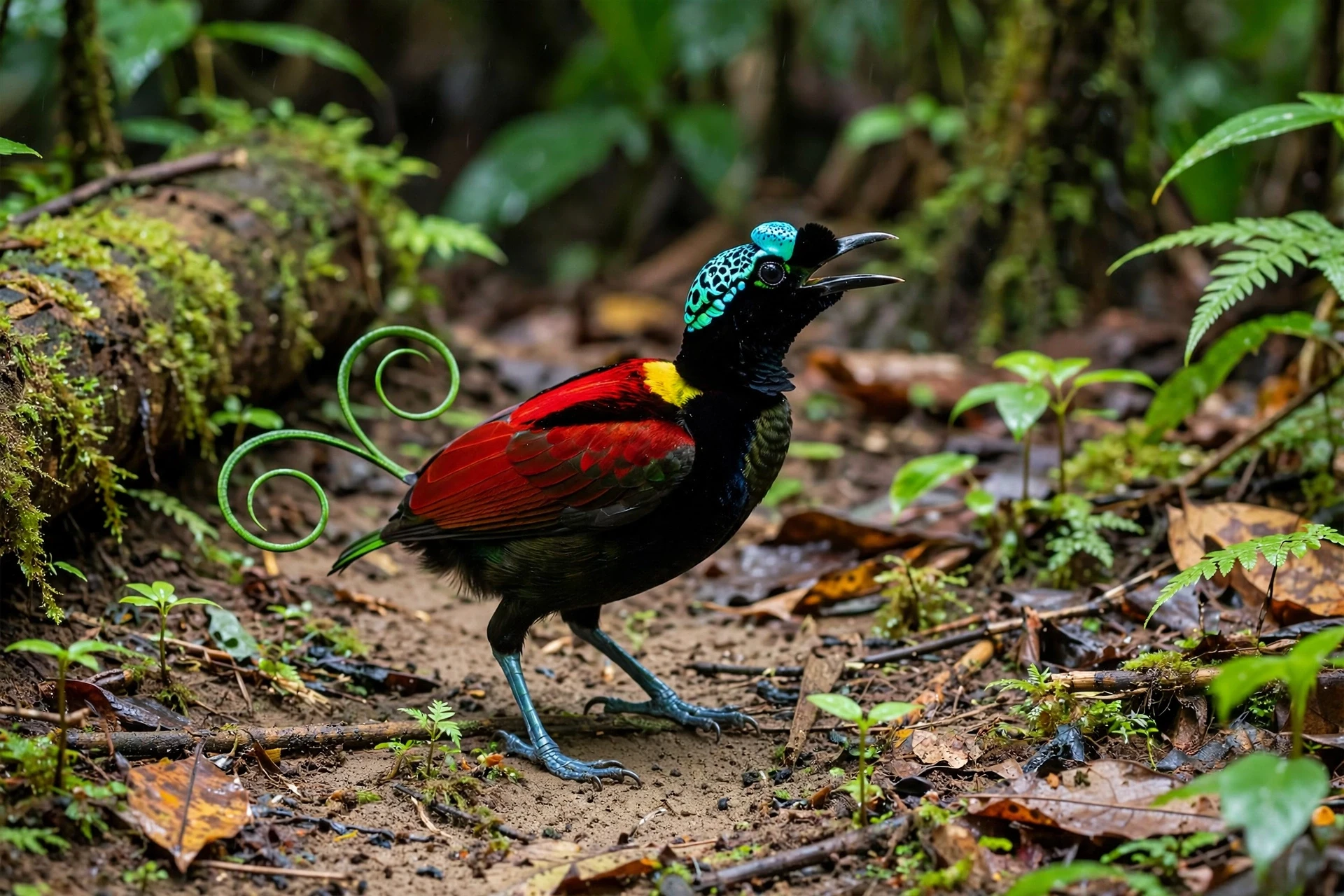
The family Paradisaeidae holds around 40 species, most in New Guinea, a hotspot of biodiversity. Males carry plumes, wires, capes, and breast shields in iridescent greens, deep blues, and flashes of yellow, while females are usually brown and camouflaged.
Wilson's bird-of-paradise clears a small court on the forest floor, removing leaves until the ground is bare. When a female arrives, he displays from a vertical sapling in his court, raising his green breast shield, fanning his tail wires, and turning his bright blue crown toward her.
Other species display on branches, hanging upside down or fanning plumes until the body disappears behind feathers and color. Each species has its own dance and costume, shaped by generations of female choice, and sexual selection has made each one distinct.
The family is wider than its most famous members. Riflebirds, with velvet-black plumage and a metallic green throat, display on branches, spreading their wings and turning their heads to flash color at a watching female. Sicklebills carry long, curved bills and plumes that trail behind them as they call from a perch. Each of these birds solves the same problem in a different way, and the variety itself is the point: when females choose, and different females favor different details, one family can split into dozens of forms, each more specialized than the last. That variety is why the family has fascinated naturalists since the first skins reached Europe, and why it remains a showcase for what female choice can build.
11.2 Lyrebirds and the art of mimicry
The superb lyrebird of Australia takes display in a different direction, through sound rather than feathers. The male has a lyre-shaped tail, which he fans over his back during display, but his real instrument is his voice. He mimics the songs of other birds, copying them with startling accuracy, and he strings those copies together into a long, complex performance. He can also copy mechanical sounds from the forest around him, including the sounds of human tools and machines, weaving them into the song.
Mimicry tests learning and memory. A male who copies many species well shows a female he has listened, learned, and survived long enough to build a large repertoire, and sexual selection favors that record of experience.
The display is visual too: the male clears a mound, fans his tail, and turns slowly as he sings, so the female can see and hear the performance at once.
11.3 Sage grouse, manakins, and the lek as a way of life
At dawn in spring, sage grouse males gather on traditional display grounds in North America. Each inflates two air sacs, struts with his tail fanned, and makes a low popping sound. Females walk among them, and only one or two dominant males do most of the mating.
Manakins add cooperation: in some species two males display together, leaping and snapping wings in tight coordination. One leads, the other helps and may later become an alpha himself — sometimes at the same display site, sometimes at a new one. A female watches the pair, and her choice depends on how well they move together.
Sage grouse leks also reward patience and memory. Males return to the same grounds year after year, and the most successful males hold territories around the central mating area, where females congregate. A young male usually starts at the edge and may work his way inward over seasons as older males leave. His success grows with his experience, and sexual selection favors not only the loudest strut but the male who can hold a good spot, season after season, until the females know where to find him. The lek is therefore a place with a history, not just a morning's performance.
Long-tailed widowbirds, covered in the Fisherian section, belong in the same world, males showing greatly elongated tails on open grassland. The stage changes and the costume changes, but the pressure stays the same.
12. Sexual Selection in the Sea and the Small
In water and among small animals, sexual selection works under the same rules but with different stakes. Bright colors can attract mates and predators at the same time, and tiny bodies can still stage elaborate courtship. From guppies to fireflies, the balance between showing off and staying alive shapes what evolves.
Water changes display: colors fade with depth, sounds travel far, and a bright fish is easy to spot. A tiny animal cannot grow a huge tail, but it can dance, flash, or sing with precision, and sexual selection works with whatever the body allows.
12.1 Guppies and the balance between bright and alive
Male guppies carry spots of orange, black, and iridescent blue. Females prefer males with more orange, and brighter males mate more often, but predators notice orange too.
Endler's classic 1980 work showed the tension in nature. Where predators are few, males are bright with large orange spots. Where predators are many, males are duller. The female preference does not disappear; males simply cannot afford to follow it as far, and sexual selection is held back by predation.
A trait can be favored by sexual selection and opposed by natural selection, and the outcome depends on the local stream. Move the fish to safer water and males become brighter over generations; move them to riskier water and they become duller.
That balance ripples outward through the whole ecosystem: bright males are easier for predators to find, which changes what predators eat and where they hunt, while dull males survive longer but mate less.
Endler also moved guppies between streams, and the results matched the pattern. Fish taken from a dangerous stream to a safer one produced brighter sons over generations. The experiment showed that the balance could shift in real time, not only across different rivers but within a single lineage. Female preference for bright males did not disappear under predation, but the price of honoring it changed with the water, and the males followed the price. It is one of the clearest demonstrations that sexual selection and predation are not abstract forces pulling in opposite directions. They are measurable pressures, visible in the color of a fish, and they change as fast as the stream changes. That is why guppies remain a favorite study animal: the whole argument fits in a small stream, and the evidence swims in front of you.
12.2 Cichlids and color that makes new species
Lake Victoria alone holds hundreds of cichlid species, many closely related and differing mainly in male color: blue in one species, red in a sister species, yellow in another. Females choose by color and strongly prefer males of their own type.
When females in one part of a lake favor blue males and females elsewhere favor red, the groups stop interbreeding. Over time they become separate species, and sexual selection becomes a motor of speciation.
The speed surprises people: hundreds of young species in one lake, from few ancestors. Female choice gave the fish a reason to split, and a small change in male color can start a new lineage.
Light shapes cichlid choice as well. In deeper or murkier water, some colors are harder to see, and females favor the males they can actually distinguish. A red male predominates in deeper water, where females are more sensitive to red, while a blue male predominates in shallower water. The lake's light, the water's clarity, and the female's eyes together decide which colors win, so the same preference can produce different winners in different parts of one lake.
12.3 Peacock spiders and the dance that decides dinner
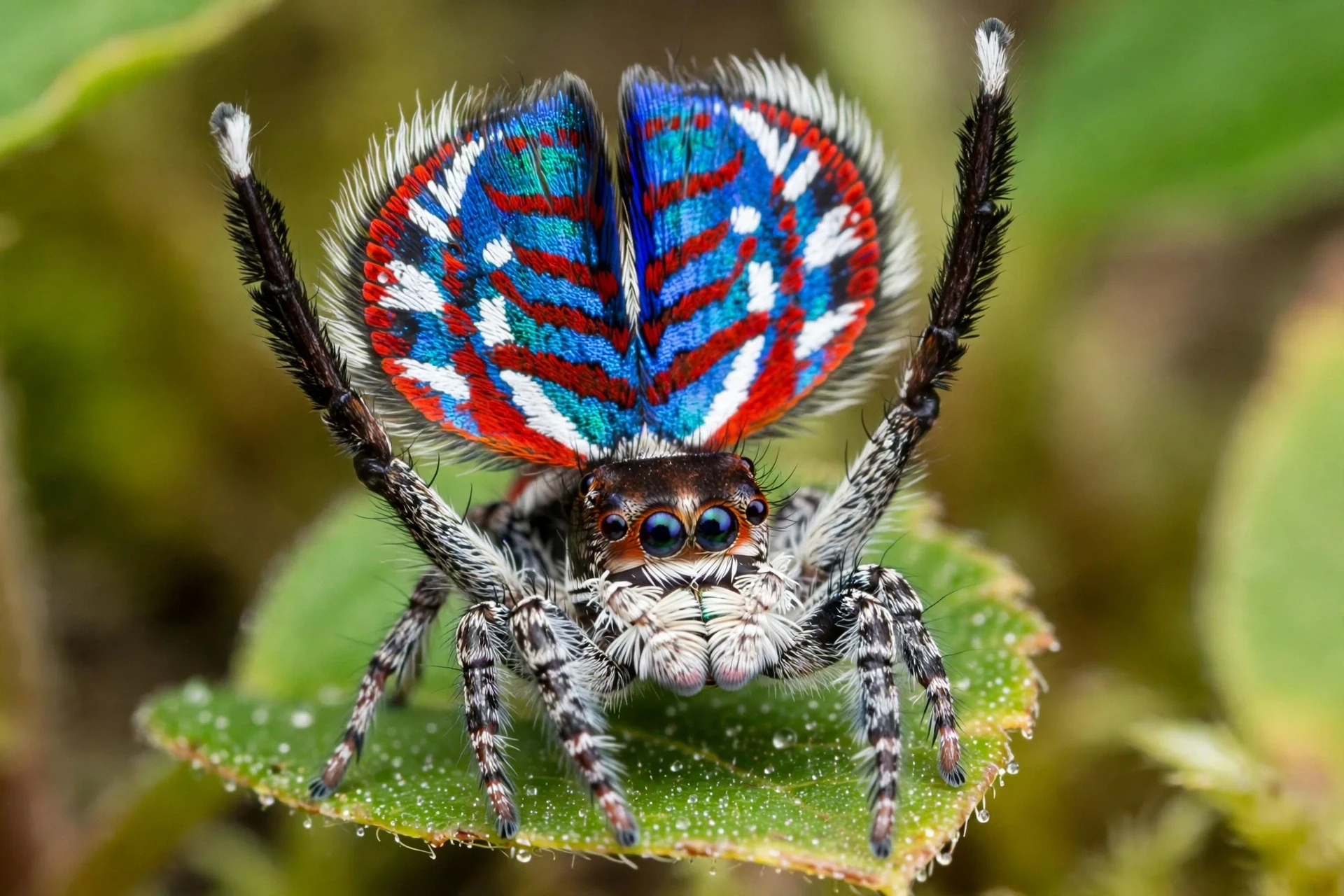
Peacock spiders, Maratus, are tiny Australian jumping spiders only a few millimeters long. Males raise a colorful abdominal flap like a fan, wave it, lift their legs, and dance side to side before the female.
If she likes the dance, she mates. If it disappoints her, she may attack and eat him. He approaches carefully and dances so clearly that she reads him as a mate, not a meal.
The peacock spider shows that sexual selection does not need size to produce spectacle. A spider smaller than a fingernail can stage a display as complex as a bird's, with color, movement, and rhythm all working together. The female watches, judges, and decides, and her decision shapes the next generation of dancers. Males who dance well leave sons who dance well. Males who dance poorly leave nothing.
12.4 Fireflies, flash patterns, and choice after mating
Fireflies light summer nights with species-specific flash patterns. A male flies, flashes a code, and waits. A female on the ground flashes back if she recognizes the code and likes the timing, and the male follows her answer closer.
Some fireflies turn the flash code into a hunting strategy. Females of the genus Photuris copy the flash answers of other firefly species, luring males in with a false reply and then eating them. The male faces a double risk: flash the right code and attract a mate, or flash the right code and attract a predator wearing a female's signal. His caution, his timing, and his willingness to approach all matter, and the females who answer honestly are the ones whose signals he must learn to trust. The firefly's flash is therefore a signal, a test, and a trap, all in the same blink of light.
I still remember a summer evening in a dark garden, watching those flashes and trying to follow one male from bush to bush. At first the lights looked random. Then I noticed the rhythm, the same pattern repeated, the same answer from below. It was a code, and once I saw it, I could not unsee it.
Fireflies also show choice after mating. A female may mate with more than one male and store their sperm, and — as in other insects — may favor one male's sperm through her storage organs, fluids, or timing of egg release. The best flasher can still lose the fertilization contest.
That hidden choice extends female control beyond visible courtship. Sexual selection is not one event but a series of filters: the flash, the approach, the mating, and the quiet sorting inside her body, each favoring some males over others.
From the peacock's tail to a spider's fan to a firefly's flash, the same thread runs through: males display, females choose, and sexual selection weighs senses, predators, and conflict at every step.
13. The Costs of Being Attractive
A peacock's train is beautiful, and it is also a burden. Growing those long feathers costs energy, carrying them costs effort, and displaying them makes the bird easier for a predator to spot. That tension sits at the heart of sexual selection: a trait spreads only while its advantage in winning mates outweighs the price it charges in survival.
Stand beside a displaying peacock and the cost becomes visible. The train can stretch well past a meter behind the bird, a fan of more than a hundred feathers that must be grown, maintained and carried everywhere. Every step costs a little more energy than it would without the train. Every molt means growing the whole display again from scratch. And when the bird needs to escape, all that decoration trails behind it like a flag announcing exactly where it is.
This is the bargain every ornament strikes. A trait that helps an animal win mates is worth having only if the animal survives long enough to use it. Biologists call this the trade-off between mating success and survival, and it explains why ornaments stop growing at a certain size. Past that point, each extra centimeter of feather or antler buys less mating advantage than it costs in food, effort and risk.
13.1 The energy bill
Growing an ornament is expensive in the most literal sense. Feathers are made of protein, and protein comes from food. A male peacock building a train is diverting nutrients away from his immune system, his muscles and his fat reserves. Deer pay a similar bill every year: antlers are bone, grown at remarkable speed in spring and summer, and a large stag can put a noticeable share of his yearly calcium and energy budget into a structure he will shed within months.
Malte Andersson's classic experiment with widowbirds showed how directly females weigh this cost. When he shortened some males' tails and lengthened others, the long-tailed males attracted far more females, despite the long tail's known flight cost. The females were not fooled by a cheap trick. They were reading a real signal: a male who can carry such a handicap and still thrive must have energy to spare. We tend to assume that the most beautiful animals are the ones with life easiest. Often it is the opposite: the ornament is impressive precisely because it is hard to carry.
13.2 Easier to catch
The second cost is more brutal. Ornaments make their owners conspicuous. A peacock's train catches the eye of a peahen, and it catches the eye of a leopard too. Bright colors, loud songs and long tails all advertise a male's location to anything hunting him. Some male birds sing from exposed perches at dawn, when predators are most active, because that is when females are listening. The song that wins a mate is the same song that gives the singer away.
Flight suffers as well. Long-tailed widowbirds pay a flight cost for their tails: aerodynamic drag rises with tail length, and widowbirds have evolved longer wings that partly compensate for it. In some species, males with the largest ornaments take longer to take off and turn more slowly in the air. Every display is a small gamble: stay visible a little longer, and hope the female notices before the hawk does.
There is a third cost that is easy to miss: time spent displaying is time not spent feeding or watching for danger. A male sage grouse can spend hours each morning dancing on a lek for weeks of the breeding season, and males lose about 23% of their body mass over the season — display is energetically costly, though the hardest displayers are often the birds in the best condition.
13.3 When the balance shifts
Because every ornament is a compromise, the compromise can change. If predators become more common in a population, the survival cost of a long tail rises, and males with slightly shorter tails start to leave more offspring. Over generations, the average ornament shrinks. If predators become rare, the balance tips the other way, and tails can grow longer again.
This is why the same species can look different in different places. Guppies in predator-rich streams tend to be drabber than guppies in safer streams, even though females in both places prefer bright males. The preference has not changed; the price has.
The same logic applies when food becomes scarce or the climate shifts. An ornament that was affordable in a rich year may be a luxury no male can pay for in a lean one. That is the deep lesson of sexual selection: no trait exists in isolation. A peacock's train is the visible outcome of a negotiation between two forces, one pulling toward bigger displays and one pulling toward staying alive, and the negotiation never really ends.
14. Sexual Selection in Humans
Humans are animals, and the same forces that shaped the peacock's tail left marks on us. Darwin devoted much of The Descent of Man (1871) to arguing that beards and voice pitch were shaped by mate choice. The evidence for any single human trait is contested, preferences vary across cultures and history, and every trait has more than one explanation.
Darwin knew this would be his most controversial argument. Natural selection could explain how humans survived. It could not easily explain why men and women differ in ways that have little to do with survival. Why should men grow beards, which keep no one warm enough to matter and can be grabbed in a fight? Why should men's voices drop so much deeper than women's at puberty? Darwin's answer was that these differences arose because, over countless generations, they influenced who got chosen as a mate.
He was writing before genetics existed, and modern researchers with far better tools have reached a more careful verdict: some of Darwin's guesses still look plausible, others have not held up, and human mating is shaped by biology and culture at the same time.
14.1 Beards and voices
Beards are the classic example, and they show how messy the evidence can get. Men grow facial hair at puberty, when testosterone rises, which makes beards a clear marker of male maturity. Some studies find that women rate bearded faces as more masculine and, in some samples, more attractive for long-term relationships. Other studies find clean-shaven faces rated higher, or find that the result flips depending on how common beards are in the local population. When beards are rare, they stand out. When everyone has one, they fade into the background.
Deeper voices follow a similar pattern. A low voice is linked to higher testosterone and a larger body, and listeners in many studies judge deeper-voiced men as more dominant and more masculine. Yet the preference is not universal, and it is not fixed. What counts as an appealing voice varies with culture, with context, and with whether the listener is judging a potential partner or a potential rival. A trait can signal something real about the body that produces it and still be judged differently by different people.
Height tells the same story on a larger scale. In many societies, taller men are rated as more attractive and tend to have more dating success, but the effect is modest and varies between cultures. Height is influenced by nutrition, health and genetics all at once, so a preference for taller partners may reflect mate choice, or simply the fact that height tracks childhood health. Both can be true at once.
14.2 Symmetry and proportions
Facial symmetry has attracted enormous attention, partly because it is easy to measure: a face that develops evenly on both sides may signal a healthy childhood. Several studies report a small preference for more symmetrical faces, but the effect is small, it is not found everywhere, and symmetrical faces are also simply easier for the brain to process.
Body proportions raise the same caution. The most discussed example is waist-to-hip ratio. In 1993, the psychologist Devendra Singh reported that men in his studies preferred female figures with a low waist-to-hip ratio, and he argued the preference tracked health and fertility. That finding has been widely repeated, sometimes as if it were settled fact. It is not. Later research has found the preferred ratio varies across cultures, across time periods and with body size, and critics have argued that overall body shape and weight matter more than any single ratio. The Singh study is worth knowing about, but it is a starting point for debate, not a final answer.
I learned how slippery this kind of claim can be while talking with a friend who had grown up in a different country from mine. We were comparing what people around us considered attractive, and almost nothing matched: the hairstyles, the build, the voices people admired. It was a small conversation, but it stuck with me, because it made an abstract point concrete. Preferences that feel universal from inside one culture often look local from outside it. Any theory of human mating that ignores that variation is missing half the story.
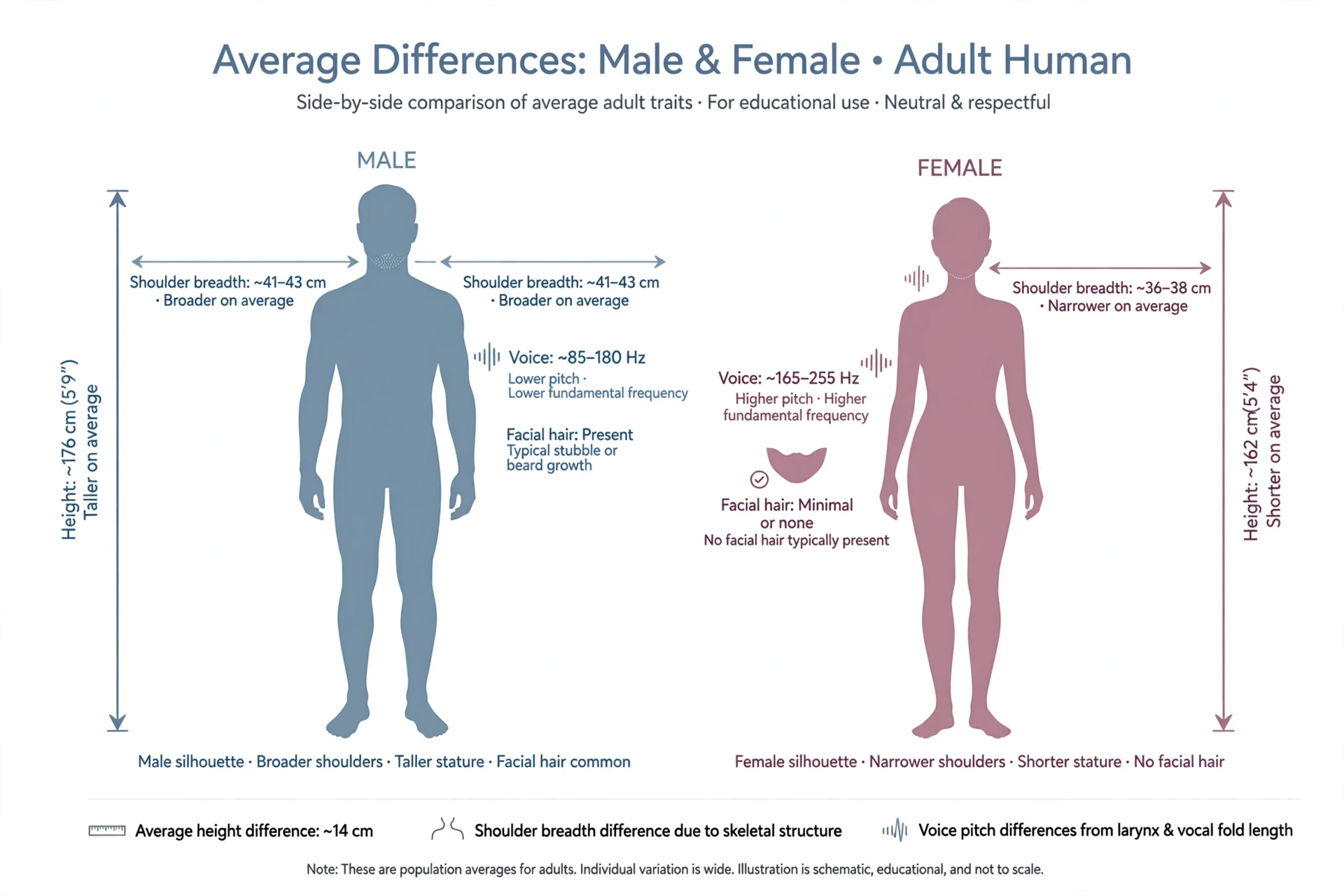
14.3 Why caution matters
The caution is not just academic. Claims about what humans "naturally" prefer have a long history of being used to justify prejudice, from ranking bodies to excusing bad behavior as biology. That history is a reason to be careful, not a reason to stop asking questions. The science is real and worth doing. But a preference found in one group of students in one country in one decade is not a law of nature.
A good rule for reading this research is to ask three questions. First, has the result been repeated in different cultures? Second, is the effect large enough to matter in real life, or only visible in a laboratory? Third, is there another explanation that fits the same data, such as health, wealth or fashion? If a claim fails those tests, it may still be interesting, but it should not be presented as fact.
None of this makes humans exempt from sexual selection. Our species has sexual dimorphism, we have courtship, and we have preferences that influence who has children with whom. Culture shapes how those preferences are expressed, sometimes powerfully. But culture does not switch off the underlying biology. The right conclusion is modest: human mating is a blend of evolved tendencies and learned culture, and researchers are still working out where one ends and the other begins. For readers who want the deeper history of our species, the site's article on human evolution sets this story in its full context.
15. Sexual Selection and Speciation
When female preferences drift apart in different populations, sexual selection can split one species into two. A population that starts out uniform can divide into groups that no longer recognize each other as mates, because the signals and the tastes have changed on each side. Given enough time, the split becomes permanent, and two species stand where one stood before.
The mechanism is straightforward once you see it. Imagine a lake with one species of fish, spread across many rocky shores. In one bay, females happen to prefer red males; in another, they prefer blue males. Each preference rewards its own color, so the colors diverge, and then the preferences themselves diverge, because daughters inherit their mothers' tastes. Before long, a red female may not recognize a blue male as a mate at all, reproduction between the bays stops, and the two populations are on their way to becoming separate species.
This is not a rare curiosity. It may be one of the main engines of biodiversity in some groups, and the evidence from African lakes is among the strongest in all of evolutionary biology.
15.1 Cichlids: a natural experiment
Lake Victoria in East Africa holds hundreds of species of cichlid fish, many of them found nowhere else on Earth. They evolved with astonishing speed, in a lake that is geologically young. Male cichlids are often brilliantly colored, in reds, blues and yellows, while females are usually drabber. And the color of the male turns out to be a key barrier between species: females generally mate only with males of their own color pattern.
Researchers have tested this directly by offering females a choice between males of their own species and males of a closely related species with different colors. The females choose their own. Change the lighting so the colors are hard to see, and the barrier weakens. The color is not decoration for its own sake. It is a mating signal, and it is doing real work keeping species apart.
What makes the cichlid story so powerful is its scale. Hundreds of species, all closely related, all separated at least partly by mate choice rather than by mountains or oceans. A lake can hold many populations side by side, and preferences alone can keep them from merging back into one. For a fuller account of how species split, see the site's article on speciation.
15.2 Swordtails and Hawaiian Drosophila
Swordtail fish add another piece of the puzzle. In these small Central American fish, males carry a long extension of the tail fin, the "sword", and females prefer males with longer swords. Different species have evolved different sword lengths and different female preferences. The mismatch shows across species: females of the swordless Xiphophorus birchmanni prefer swordless males, while females of sworded species prefer sworded males. A trait that began as a way to win mates inside one population becomes a barrier between populations.
Hawaiian Drosophila, the fruit flies of Hawaii, show the same pattern in a different key. These flies gather at leks, small display grounds where males perform and females choose. Isolated valleys and volcano slopes have produced dozens of species, each with its own male display and its own female taste. Males of one species wave their wings in a pattern that females of another species simply do not answer. The displays are elaborate and the differences are often tiny, yet they are enough. A female that will not mate with a foreign male is a reproductive barrier as solid as any river.
Together, these cases make a strong point. Natural selection splits species when populations adapt to different environments; sexual selection can split them even when the environment is the same, because the mating game itself has drifted in different directions.
16. What Sexual Selection Cannot Explain
Sexual selection is a powerful idea, and like every powerful idea, it gets stretched beyond what it can do. It explains a great deal about ornaments, courtship and mate choice, but it does not explain everything, and some of the most common claims made in its name are simply wrong. A theory is most useful when its limits are clear.
The table below sets out five of the most persistent misunderstandings, each paired with what the evidence actually shows.
| Misconception | What the evidence shows |
|---|---|
| Sexual selection is only about males competing for females. | Females compete too, and in some species the roles reverse entirely: male pipefish and seahorses carry the young, and females compete for access to them. |
| The most ornamented male is always the healthiest. | Often, but not always. The peacock eyespot debate shows the link between train elaboration and mating success is real yet complicated, and it varies with conditions and with what is measured. |
| Female choice means females consciously judge beauty. | Choice is a behavioral tendency shaped by evolution, not a conscious aesthetic verdict. A peahen does not sit in judgement; she responds more strongly to some displays than to others. |
| Sexual selection always opposes natural selection. | The two usually balance rather than fight. Sometimes they align, as when females choose healthy males, so mating success and survival point in the same direction. |
| Humans are exempt because of culture. | Culture shapes how preferences are expressed, but the underlying biology is still studied, and human mating still shows patterns consistent with mate choice. |
The first misunderstanding is the most common. Textbooks often describe males as competitive and females as choosy, as if those were fixed roles. In many species they are. But sex roles depend on which sex invests more in offspring, and when that investment flips, so does the competition. Female jacanas defend territories and compete for males, who do the incubating. Female phalaropes are brighter than males and fight over them. The theory predicts these reversals, and fieldwork has confirmed them. That is a strength of the idea, not a weakness.
The second misunderstanding concerns health. The "good genes" idea says females choose ornamented males because ornaments reveal health, and there is real evidence for this in some species. But the peacock itself shows the limits. Marion Petrie's work found that peahens preferred males with elaborate trains, yet later studies by Roslyn Dakin and Robert Montgomerie found that eyespot number mattered less than expected. A single number, however eye-catching, rarely tells the whole story.
The third misunderstanding is about what "choice" means. When biologists say a female chooses, they do not mean she holds a debate in her head. They mean she mates more often with one kind of male than another, for whatever reason her nervous system produces that pattern. She may be drawn to a louder song because her hearing is tuned to it, or to a brighter color because her eyes detect it more easily. The preference can be a side effect of how senses work, not a verdict on beauty.
The fourth misunderstanding is the idea of permanent war between sexual selection and natural selection. In the long run, the two forces usually settle into a balance, as section 13 described. And sometimes they cooperate. When a female picks a male with bright plumage because bright plumage tracks low parasite load, her choice helps her offspring survive as well as mate. The Hamilton-Zuk hypothesis, proposed in 1982, made exactly this point about parasites and bright birds. Mating advantage and survival advantage can point the same way.
The last misunderstanding, about humans, was covered in section 14, but it is worth repeating here. Culture does not cancel biology. It filters it. A preference that is expressed through clothing in one century may be expressed through music in another. The medium changes; the underlying tendencies do not vanish.
17. Why It Matters
Sexual selection matters because it touches conservation, biodiversity and our understanding of ourselves, and because some of sexual selection's biggest questions are still open. It is not a finished chapter of biology. It is a living research programme, and the answers it produces change real decisions about real animals.
Start with conservation. Many endangered species are bred in captivity, and captive breeding often fails in ways that puzzled keepers for years. Animals that are simply paired off by managers may refuse to mate, or mate poorly, or produce few surviving young. Research on mate choice has shown why: in many species, females need to choose. When females are allowed to pick among males, breeding success often rises sharply. When they are not, it can fall sharply. The lesson is practical and cheap to apply. Letting animals choose their mates is not a luxury. It is part of how reproduction works, and ignoring it wastes the scarce breeding opportunities of species that cannot afford to waste any.
The same insight applies to reintroduction: animals raised in captivity need their mating behavior intact, or they may struggle when it matters most. Breeding programmes should preserve behavior as well as genes.
17.1 Biodiversity and ourselves
The second reason this subject matters is biodiversity itself. Much of nature's variety exists because of sexual selection. The colors of cichlids, the songs of birds, the dances of spiders and the displays of birds of paradise are not accidents. They are the products of millions of years of preferences compounding on themselves. To understand why nature looks the way it does, you have to understand the mating game. A world without sexual selection would be a quieter, drabber place, and a great deal poorer in species.
That variety is also a warning. Pollution, habitat loss and climate change can break the signals animals rely on: murky water hides a cichlid's colors, noise drowns out a bird's song, artificial light confuses fireflies. When signals fail, females may choose badly or not at all, and populations can decline for reasons that have nothing to do with food or predators.
The third reason is us. Human mating psychology is one of the most studied and most argued-over areas of science, and it matters for health research as well as for curiosity. Understanding how mate choice shapes human behavior can inform research on relationships, on fertility and on the ways culture and biology interact. The stakes are modest compared with conservation, but the questions are ones people genuinely care about, and they deserve careful answers rather than slogans.
17.2 The open frontier
Finally, the subject matters because it is unfinished. Researchers still argue about the handicap principle, about how much of the peacock's train is about health versus Fisherian runaway, and about how often female preferences drive speciation rather than follow it.
That uncertainty is not a failure. It is a sign that the questions are hard and worth asking. Darwin himself wrote in 1860 that the sight of a peacock's feather made him sick, because it seemed to defy his theory of natural selection. The feather turned out to be explainable, but only by extending the theory, not by ignoring the problem. The same spirit drives the field today. Every time a new experiment complicates the story, the story gets better. The peacock's tail is still teaching us, more than a century and a half after Darwin first stared at it and wondered how beauty could possibly evolve.
Frequently Asked Questions
Here are the questions readers ask most often, answered in plain language.
What is sexual selection?
Sexual selection is the part of evolution driven by competition for mates. It favors traits that help an animal win mating opportunities, such as a peacock's train or a stag's antlers, even when those traits are costly in other ways. Darwin proposed it to explain features that natural selection alone could not, and it remains a central idea in evolutionary biology today.
Why do peacocks have big tails?
Peacocks have big tails largely because peahens prefer them. Over countless generations, males with larger, more elaborate trains won more matings and left more offspring, so trains grew longer — though later studies show the details, such as how much eyespot number itself matters, are more complicated than first thought. The train is costly to grow and carry, and it makes males easier for predators to spot, which is why it stops growing at a certain size: the mating advantage is balanced against the survival cost.
What is mate choice?
Mate choice is the tendency of one sex, usually females, to mate more often with some males than with others. It is not a conscious decision in the human sense. It is a behavioral pattern shaped by evolution, in which females respond more strongly to certain songs, colors or displays, and that response shapes which male traits spread through a population.
What is Fisherian runaway?
Fisherian runaway is a self-reinforcing process in which a female preference and a male trait evolve together, each driving the other further. It begins when females prefer a slightly exaggerated trait, and the sons of those females inherit both the trait and, through their daughters, the preference for it. The cycle can push ornaments to extremes, until survival costs finally halt the growth.
What is the handicap principle?
The handicap principle, proposed by Amotz Zahavi in 1975, says that costly signals are honest precisely because they are costly. Only a genuinely healthy animal can afford a large ornament, so the ornament reliably advertises quality. A weak male cannot fake a long train, just as a tired runner cannot fake a fast sprint. The idea remains debated, but it has shaped decades of research on animal signals.
How is sexual selection different from natural selection?
Natural selection favors traits that help an animal survive and reproduce in its environment, such as camouflage or disease resistance. Sexual selection favors traits that help an animal win mates, such as bright colors or elaborate songs, even when those traits make survival harder. The two forces usually balance each other, and sometimes they align, as when females choose healthy males.
Does sexual selection apply to humans?
Yes, in a qualified sense. Humans show sexual dimorphism in traits such as height, voice pitch and facial hair, and Darwin argued in 1871 that mate choice helped shape them. But the evidence for any single human trait is contested, preferences vary across cultures and history, and culture shapes how preferences are expressed. Human mating is best understood as a blend of evolved tendencies and learned culture.
Sources
- Andersson, M. — Female choice selects for extreme tail length in a widowbird, Nature (1982)
- Zahavi, A. — Mate selection: a selection for a handicap, Journal of Theoretical Biology (1975)
- Bateman, A. J. — Intra-sexual selection in Drosophila, Heredity (1948)
- Petrie, M., Halliday, T. & Sanders, C. — Peahens prefer peacocks with elaborate trains, Animal Behavior (1991)
- Petrie, M. & Halliday, T. — Experimental and natural changes in the peacock's train can affect mating success, Behavioral Ecology and Sociobiology (1994)
- Dakin, R. & Montgomerie, R. — Peahens prefer peacocks displaying more eyespots, but rarely, Animal Behavior (2011)
- Hamilton, W. D. & Zuk, M. — Heritable true fitness and bright birds: a role for parasites?, Science (1982)
- Wikipedia — Sexual selection (overview and further references)
- Wikipedia — Handicap principle
- Wikipedia — Bateman's principle
- Wikipedia — Fisherian runaway
- Wikipedia — Northern elephant seal
- Nature Scitable — An Introduction to Sexual Selection
- Encyclopaedia Britannica — Sexual selection
- Darwin Correspondence Project — Letter from Charles Darwin to Asa Gray, 3 April 1860 (letter 2743)
- U.S. National Park Service — Northern Elephant Seal
- Fisher, R. A. — The evolution of sexual preference, Eugenics Review (1915), 7(3), 184–192
- Fisher, R. A. — The Genetical Theory of Natural Selection, Oxford University Press (1930)
- Parker, G. A. — Sperm competition and its evolutionary consequences in the insects, Biological Reviews (1970), 45, 525–567
- Trivers, R. L. — Parental investment and sexual selection, in Sexual Selection and the Descent of Man, 1871–1971, Campbell, B. (ed.), Aldine (1972), pp. 136–179
- Emlen, S. T. & Oring, L. W. — Ecology, sexual selection, and the evolution of mating systems, Science (1977), 197, 215–223
- Endler, J. A. — Natural selection on color patterns in Poecilia reticulata, Evolution (1980), 34, 76–91
- Lande, R. — Models of speciation by sexual selection on polygenic traits, Proceedings of the National Academy of Sciences (1981), 78, 3721–3725
- Kirkpatrick, M. — Sexual selection and the evolution of female choice, Evolution (1982), 36, 1–12
- Basolo, A. L. — Female preference predates the evolution of the sword in swordtail fish, Science (1990), 250, 808–810
- Grafen, A. — Biological signals as handicaps, Journal of Theoretical Biology (1990), 144(4), 517–546
- Pomiankowski, A., Iwasa, Y. & Nee, S. — The evolution of costly mate preferences I. Fisher and biased mutation, Evolution (1991), 45(6), 1422–1430
- Singh, D. — Adaptive significance of female physical attractiveness: role of waist-to-hip ratio, Journal of Personality and Social Psychology (1993), 65(2), 293–307
- Eberhard, W. G. — Female Control: Sexual Selection by Cryptic Female Choice, Princeton University Press (1996)
- Takahashi, M. et al. — Peahens do not prefer peacocks with more elaborate trains, Animal Behaviour (2008), 75(4), 1209–1219
- Penn, D. J. & Számadó, S. — The Handicap Principle: how an erroneous hypothesis became a scientific principle, Biological Reviews (2019), 95, 267–290
- Singh, R. S. — Beauty, vigour and sexual selection in peacocks, The Conversation (2025-08-18), republished by McMaster University