
1. The Twenty Seals That Became Two Hundred Thousand
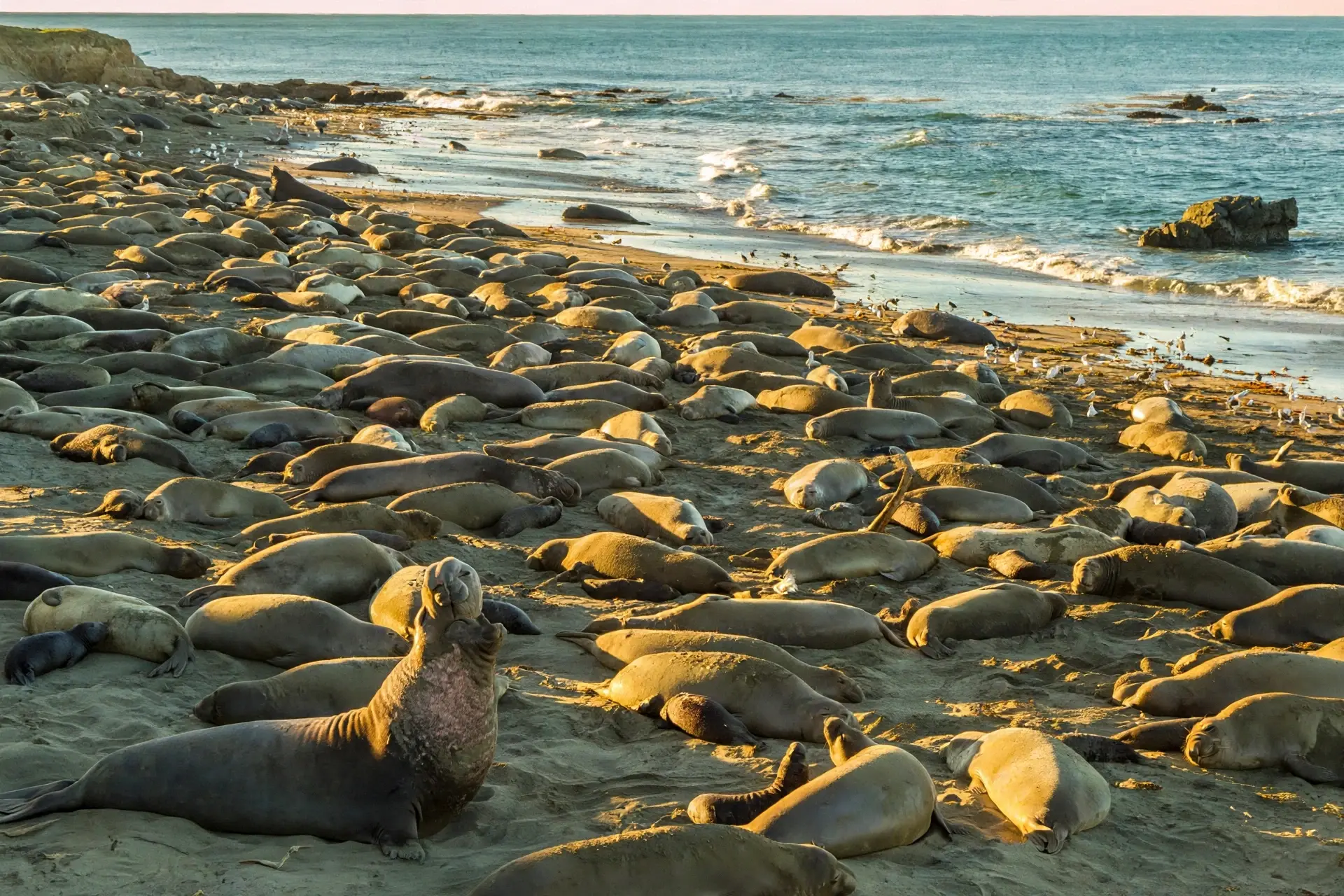
Picture a beach so crowded with seals that you cannot see the sand. Bulls the size of small cars rear up and bellow at each other, their great inflated noses wobbling with every roar. Females lie shoulder to shoulder, nursing pups that will double in weight within a month. This is an elephant seal colony in the breeding season, and it looks like the very picture of wild abundance — and it is also one of the clearest demonstrations of genetic drift ever recorded.
It is hard to believe, standing in front of that heaving mass of animals, that the whole spectacle nearly vanished. In the nineteenth century, hunters pursued northern elephant seals relentlessly, and by 1892 the population had collapsed to perhaps as few as twenty animals, clinging to survival on Guadalupe Island — the exact number is unknown, with estimates ranging from about 20 to under 100. Twenty. Not twenty thousand, not twenty hundred. Twenty seals, in the entire world, carrying between them the entire future of their species.
Then something remarkable happened. The hunting stopped, the seals were protected, and the survivors did what seals do best: they bred. Generation after generation, the numbers climbed. Today, more than 220,000 northern elephant seals haul out on beaches along the Pacific coast of North America. By any ordinary measure, this is one of the great conservation comebacks of all time — a species pulled back from the edge and restored to abundance.
But the seals are keeping a secret, and it is written in their genes. When scientists compared the genomes of modern seals with those of seals that lived before the crash, they found that the recovered population carries only about one-eighth of its ancestors' genetic diversity. Before the bottleneck, heterozygosity — a measure of how much genetic variation individuals carry — stood at 0.00142; in modern seals it is 0.000176, so roughly seven-eighths of the variation is gone. The seals also lost nearly all of their mitochondrial lineages: only two major mitochondrial lineages survive today.
Think about what that means. Two hundred thousand seals, and genetically they are far more alike than their ancestors were. The beach is full again, but the gene pool is not. Yet beneath that success sits a narrow genetic foundation laid by a handful of survivors more than a century ago. A single new disease, a shift in the ocean, a run of bad breeding seasons — any of these would meet a population with far fewer genetic options to draw on than its ancestors had.
That is the puzzle this article sets out to solve. The seals did not lose their diversity because they were unfit. Nobody selected against their genes; no predator picked off the most varied individuals. The diversity was lost by chance, in a population that had become so small that chance alone could rewrite its genetic makeup. How can luck, with no purpose and no preference, change a species as surely as any predator or plague? The answer is genetic drift, and it is one of the quietest, most powerful forces in evolution.
2. What Is Genetic Drift?
Genetic drift is the random change in allele frequencies from one generation to the next, caused by chance sampling in a finite population. Unlike natural selection, it does not favour useful genes or weed out harmful ones. It is strongest in small populations, where a few lucky or unlucky parents can reshape the whole gene pool.
To see what that means, start with the raw material. A gene is a stretch of DNA that helps build something in a body, and an allele is one version of that gene — one for brown eyes, say, and another for blue. The whole collection of alleles in a population is the gene pool, and evolution, at its most basic, is change in that pool over time: some alleles become more common, others rarer, and some vanish altogether.
Natural selection changes the gene pool because some alleles help their carriers survive and breed, so those alleles spread. Genetic drift changes it for a different reason entirely: reproduction is a lottery. Not every individual gets to breed, and among those that do, not every allele gets passed on. A seal carrying a rare allele might fail to find a mate, or its pup might be swept away in a storm, and that allele is gone — not because it was harmful, but because its carrier had bad luck. Run that lottery generation after generation, and allele frequencies wander with no direction at all.
Most people assume evolution is always about the fittest surviving, and I used to hear that assumption in almost every conversation about evolution I have ever had. It is a tidy story, and it is wrong — or at least, it is only half the story. Genetic drift does not care about fitness at all. It does not reward the strong, punish the weak, or notice the difference between them. A harmful allele can spread by drift, and a useful one can vanish by drift, and neither outcome says anything about how well the allele works. Selection is a filter; drift is a coin toss. Both change the gene pool, but only one of them has a preference.
The coin toss is a good way to picture it, and I learned how good when I once asked a room full of students to flip a coin ten times each and call out how many heads they got. A few got the expected five, but plenty got seven heads, or three, or — to the delight of the room — ten in a row. Nobody had a rigged coin; ten flips is simply too small a sample for the average to settle down. Flip the same coin a thousand times, and almost everyone lands close to five hundred heads, because in a large sample the ups and downs cancel out. Alleles behave the same way: in a large population the random gains and losses of each generation mostly cancel, while in a small one they accumulate, and the gene pool wanders.
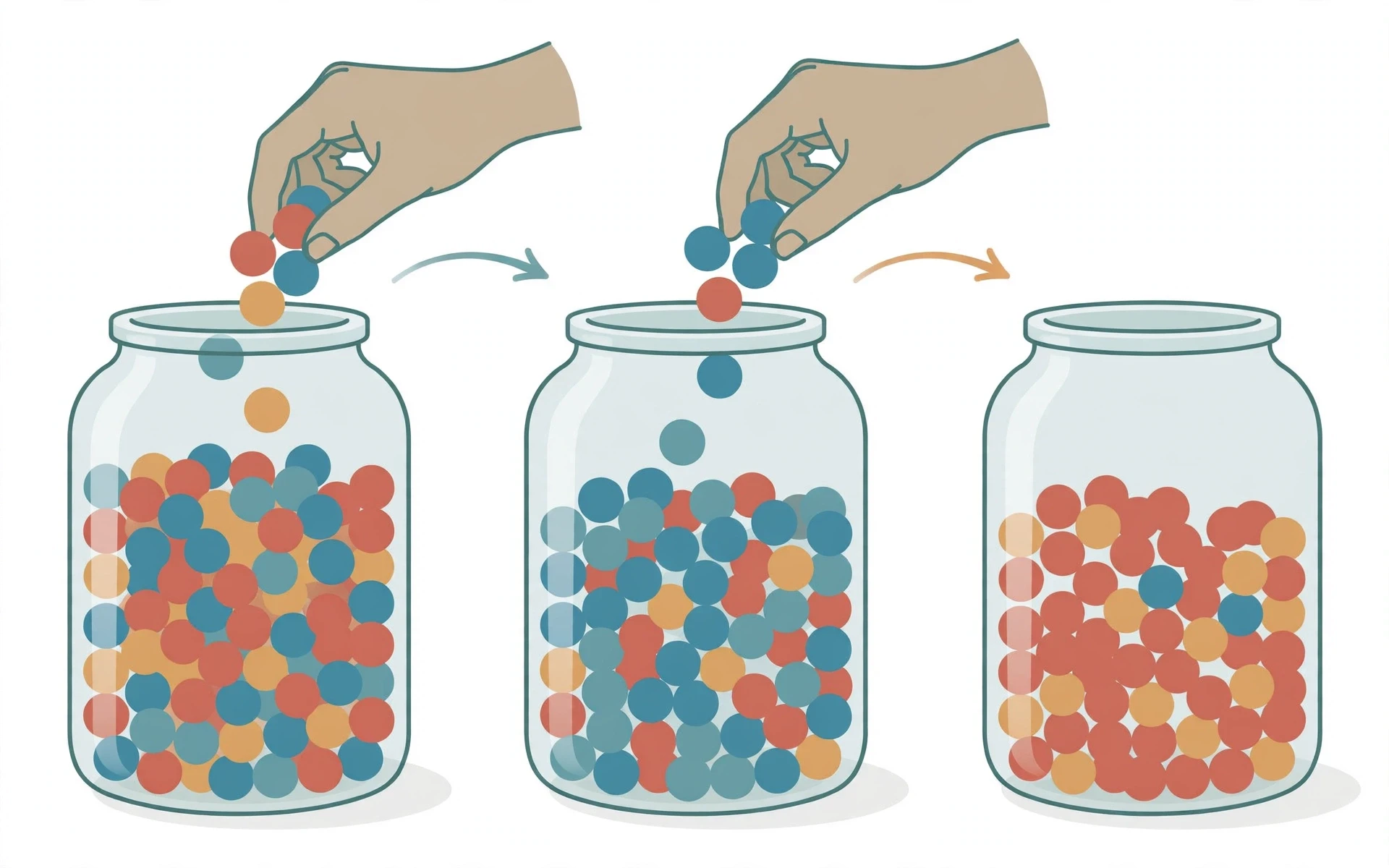
A jar of marbles makes the same point even more clearly. Imagine a jar with fifty red marbles and fifty blue ones, standing for two alleles at equal frequency. To make the next generation, you reach in blindfolded and draw a hundred marbles, replacing each one after you note its colour. By luck alone you might draw fifty-four red and forty-six blue — and the next generation's jar starts from there. After enough generations of drawing from a small jar, one colour can take over completely while the other disappears, fixed by chance rather than merit. That is genetic drift in miniature.
Two details matter from the start. First, genetic drift is always at work, because every population is finite — it is simply too weak to notice in a huge one, where the sampling wobble each generation is tiny. Second, it is strongest exactly where it matters most: in small, isolated, or crashing populations. That is where chance stops being background noise and becomes the main author of the story.
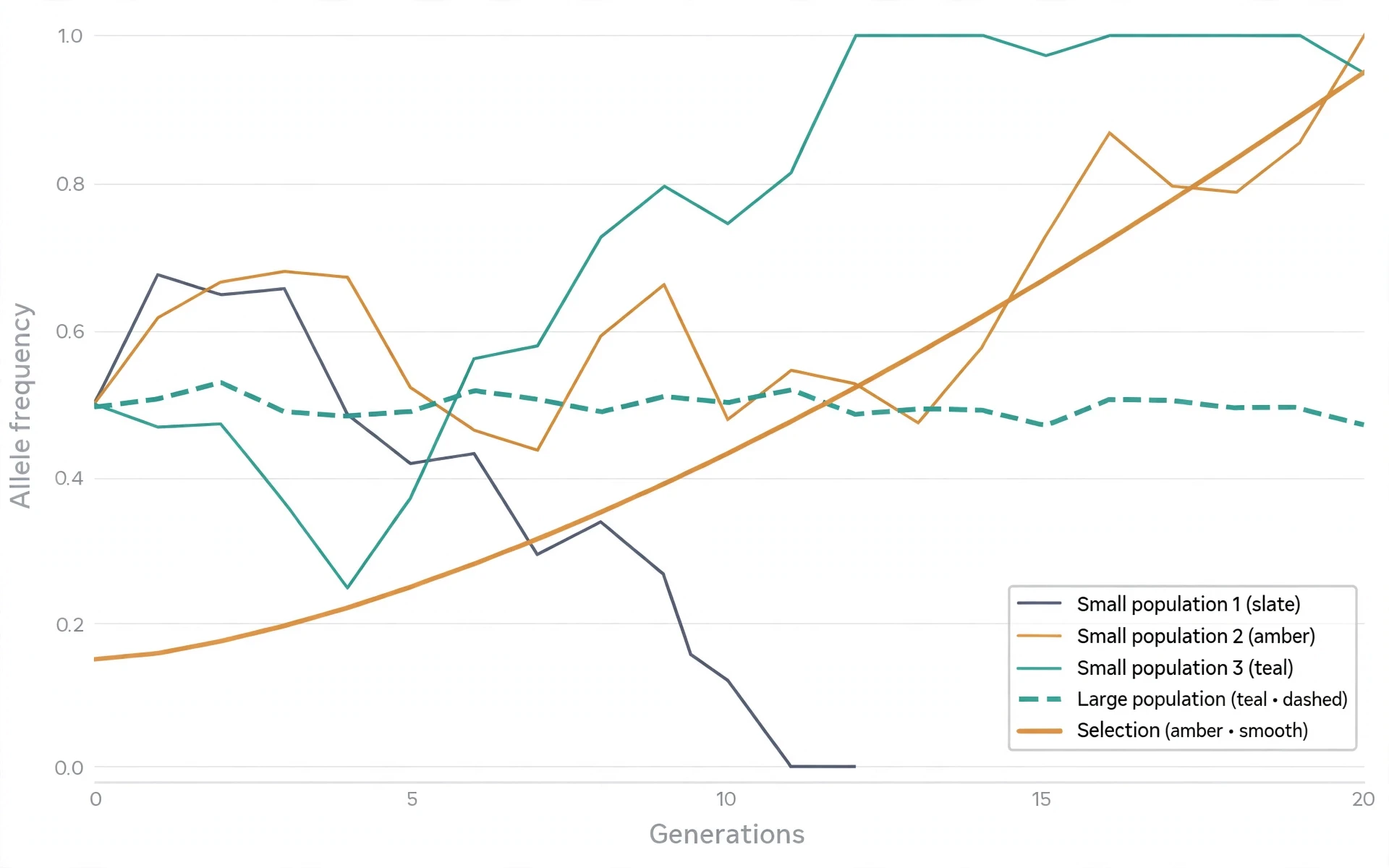
The National Human Genome Research Institute's glossary entry on genetic drift and the University of California, Berkeley's Understanding Evolution pages both make the same key point: genetic drift is a sampling effect. It needs no advantage, no disadvantage, and no outside pressure. Give it a finite population and a few generations, and chance alone will do the rest.
3. The Mathematics of Chance
The Wright-Fisher model treats each generation as a random draw of gene copies from the last, and its equations put hard numbers on chance. A new neutral allele fixes with probability one over twice the population size, heterozygosity falls by a small fraction each generation, and fixation takes about four times the effective size in generations.
The model comes from two founders of population genetics: Sewall Wright, in a 1931 paper, and Ronald Fisher, in his 1930 book The Genetical Theory of Natural Selection. Picture a population of N diploid individuals — creatures like us and like seals, carrying two copies of each gene, one from each parent — so the gene pool holds 2N copies of any given gene. To build the next generation, nature draws 2N copies at random from the current pool, each copy equally likely to be picked. Some copies get drawn twice, some not at all, and the frequencies in the new generation are whatever the draw produced. Then the process repeats: a jar, a blindfolded hand, and a fresh draw every generation.
Three numbers fall out of that model, and together they describe the fate of any allele that selection ignores — a neutral allele, one that neither helps nor harms its carrier. The first is the probability of fixation, the chance that an allele eventually takes over the whole population. For a brand-new neutral allele, which starts as a single copy among 2N, that probability is 1/(2N): every gene copy has an equal chance of being the ancestor of all future copies, and the new allele holds exactly one of the 2N tickets. In a population of ten, a new neutral allele has a 1 in 20 chance — 5 percent — of fixing. In a population of 10,000, it has a 1 in 20,000 chance, just 0.005 percent. The allele itself has not changed. Only the size of the lottery has.
The second number is the time fixation takes, on the occasions when it happens. On average, a neutral allele that is destined to fix needs about 4Ne generations to get there, where Ne is the effective population size — a quantity the next section takes apart in detail. For now, take Ne as roughly the population size in an ideal case. In a population with an effective size of ten, fixation takes around forty generations. In one with an effective size of 10,000, it takes around forty thousand. Genetic drift is slow in large populations and fast in small ones, and the difference is not subtle: it is a thousandfold.
The third number is the rate at which variation drains away. Heterozygosity — the share of individuals carrying two different alleles at a gene — declines by a factor of (1 − 1/(2Ne)) every generation. Take a population with an effective size of ten: each generation multiplies heterozygosity by 0.95, losing five percent of the variation, so after ten generations only about 60 percent remains, and after fifty only about 8 percent. Now take an effective size of 10,000: each generation multiplies heterozygosity by 0.99995, and after ten generations 99.95 percent of the variation is still there; after a thousand generations, about 95 percent remains. The same process, the same mathematics — and two wildly different fates, decided by a single number.
I find that comparison genuinely startling every time I work through it. Ten animals losing five percent of their variation every generation are bleeding diversity faster than mutation can ever replace it — new mutations arrive slowly, roughly one in a hundred thousand to one in a million gene copies per generation for a typical gene (about one in a hundred million per base pair). Ten thousand animals, meanwhile, barely notice genetic drift at all. The lesson is not that small populations are doomed, but that their recovery is built on a narrowing genetic base, and the mathematics says exactly how fast that narrowing happens.
One final point: the Wright-Fisher model assumes random draws, a constant population size, and random mating, and real populations break all three assumptions — which is why the next section replaces the census size with something more honest. But the model still sets the baseline, telling us what chance alone would do. When allele frequencies move faster than it predicts, something else — selection, migration, a changing environment — is pushing them. When they move at its pace, genetic drift alone is explanation enough.
The OpenStax Biology textbook chapter on population genetics lays out these relationships — fixation, heterozygosity loss, and the role of population size — in the form most students meet first, and it is worth reading alongside the account here. The equations are not decoration. They are the reason geneticists can look at a population like the elephant seals, measure the variation that remains, and work backwards to the size of the bottleneck that produced it.
4. Effective Population Size: Why Head Counts Lie
Effective population size, written Ne, is the size of an ideal population that would lose genetic diversity at the same rate as the real one. It is almost always smaller than the head count, because only breeding adults count, sexes are rarely balanced, and some individuals leave far more offspring than others.
The head count is the census size: how many animals you can count on the beach. The effective size is a different question: how many of those animals actually pass their genes to the next generation, and how evenly? Imagine a colony of a hundred seals. Fifty are pups, twenty are juveniles that will not breed for years, and of the thirty adults, only a handful of males hold territories and mate. The census says a hundred. The genes of the next generation might come from a dozen animals. Genetic drift acts on the dozen, not the hundred — so the dozen is the number that matters.
The most famous formula in this corner of genetics captures the effect of an unbalanced sex ratio. If Nm males and Nf females breed, the effective size is Ne = 4NmNf/(Nm+Nf). Work it through for a balanced case first: ten breeding males and ten breeding females give Ne = 4 × 10 × 10 / 20, which is 20 — exactly the number of breeders, as it should be. Now take an elephant seal harem: one dominant bull mating with fifty females. The formula gives Ne = 4 × 1 × 50 / 51, which is 200/51, or about 3.9 — effectively four. Fifty-one breeding animals, and genetically the population behaves as if it had four members. The females are not the problem; the bottleneck is the single male, because every pup in that harem carries half its genes from the same father. One male's luck — his genes, his survival, his success in holding the beach — becomes the luck of the whole next generation.
Variance in reproductive success does the same kind of damage even when the sexes are balanced. In real populations, some individuals leave dozens of descendants while others leave none, and that unevenness shrinks Ne further. A beachmaster who fathers a hundred pups while twenty males father none is, genetically speaking, a population of very few fathers. Whenever reproductive success is lopsided, the effective size falls, and genetic drift speeds up.
Fluctuating population size adds a third squeeze: the effective size over several generations is close to the harmonic mean of the sizes, and the harmonic mean is dragged down by the smallest value. Take a population that numbers 1,000, then crashes to 10, then recovers to 1,000. The ordinary average is about 670, which sounds comfortable; the harmonic mean is 3 divided by (1/1000 + 1/10 + 1/1000), or about 29. The single bad generation dominates the genetics of all three — exactly what happened to the elephant seals, where a century of abundance before and after the crash cannot undo the narrowing of the years when twenty animals stood between the species and extinction.
The laboratory has confirmed all of this in the cleanest possible way. In 1956, Peter Buri set up 107 identical populations of fruit flies, each with eight males and eight females, and followed two eye-colour alleles that started at equal frequency. By generation nineteen, thirty populations had lost one allele entirely and twenty-eight had fixed it. When Buri measured how fast heterozygosity was falling, the populations behaved as if their effective size were about nine, not sixteen. The census said sixteen flies; the genetics said nine. Head counts lie, and Buri's flies proved it.
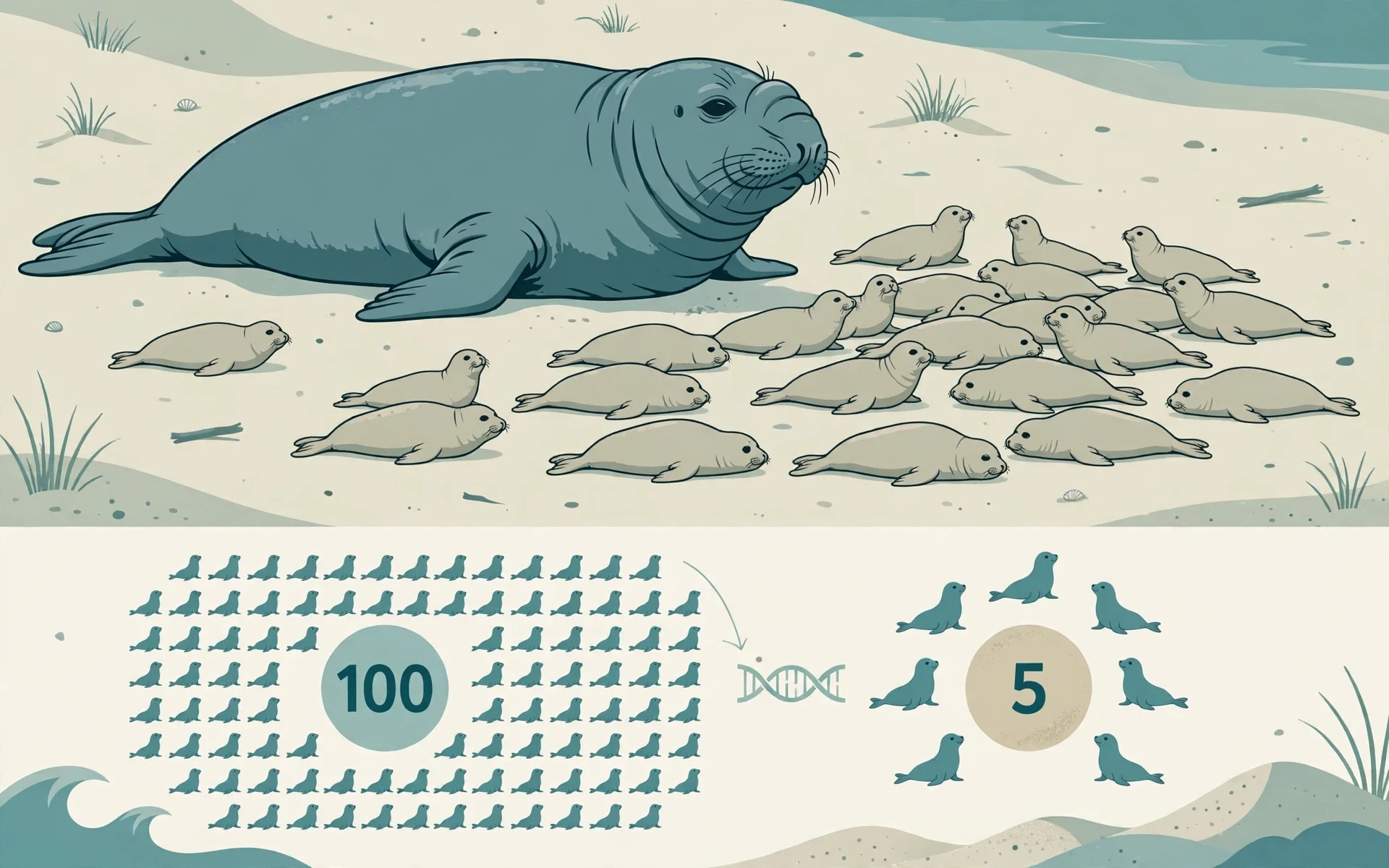
That gap is why conservationists worry about populations that look healthy on a count. A colony of ten thousand seals might have an effective size in the hundreds if only a few males breed. The Nature Scitable explainer on genetic drift and effective population size puts it plainly: what matters is not how many individuals exist, but how many contribute genes, and how evenly. Count the beach, by all means — but count the breeders too, because genetic drift only listens to them.
5. The Bottleneck Effect
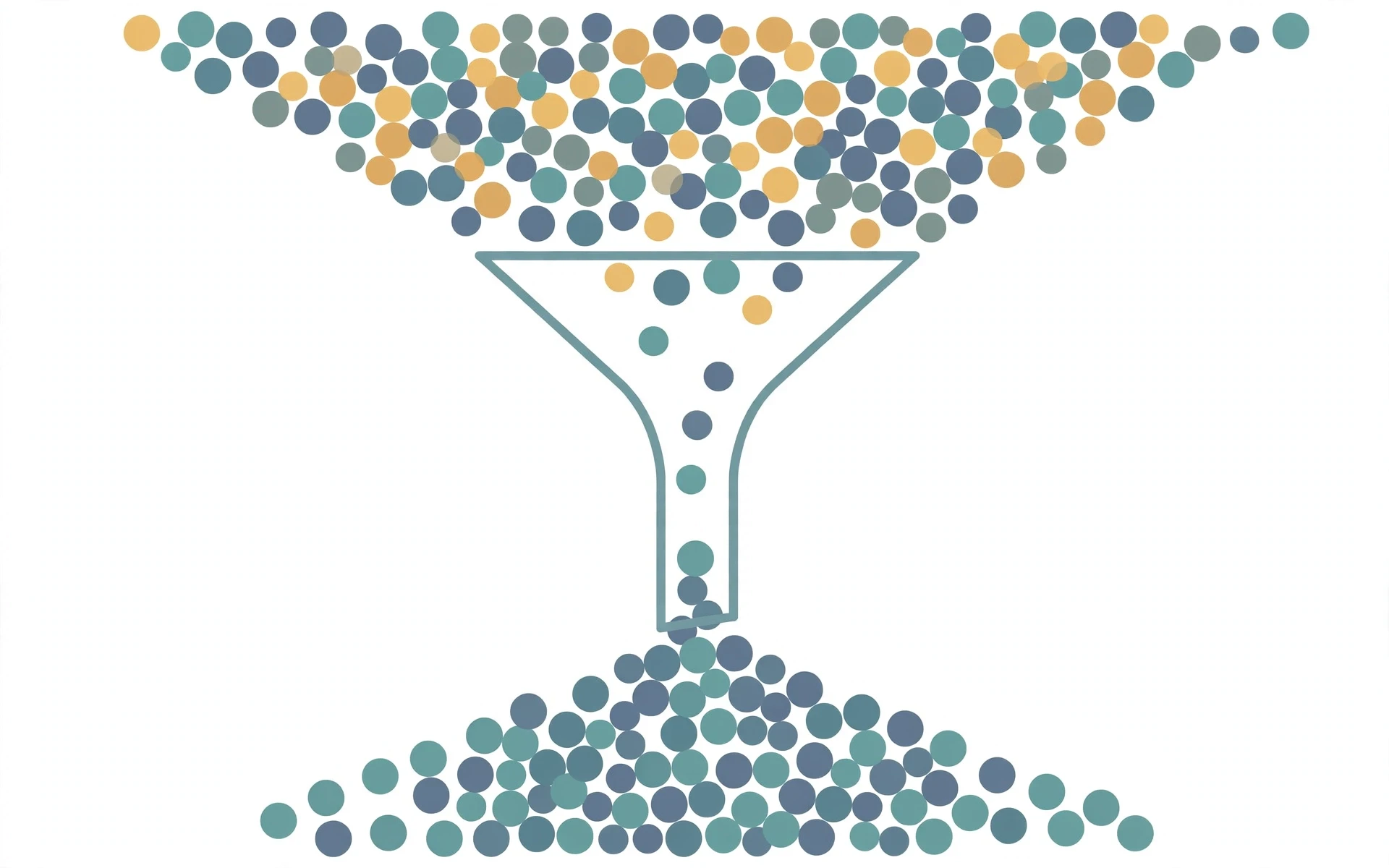
A bottleneck happens when a population crashes to a small number of survivors, and the genes that pass through are a random sample of what came before. Rare alleles can vanish in a single generation, common ones can become fixed, and the recovered population carries the scar for centuries, even after its numbers rebound.
The name is the picture. Imagine a wide bottle full of coloured beads, standing for the gene pool of a healthy population: reds, blues, greens, yellows, and a scatter of rare colours that appear only once or twice. Tip the bottle and force the beads through the narrow neck, and only a few make it through. The beads on the other side are a random sample of what was in the bottle — mostly the common colours, a couple of the less common ones, and almost none of the rarities. Now tip the bottle back and let the survivors multiply until it is full again. The bottle is full, but it holds only the colours that survived the squeeze. The rare colours are gone, and no amount of refilling brings them back. That is a bottleneck: a crash, a random sample, and a recovery that restores numbers without restoring diversity.
The northern elephant seal is the textbook case, and the details now come from genomes rather than guesswork. A 2024 study published in Nature Ecology and Evolution sequenced 260 modern elephant seal genomes and eight historical genomes — five from before the bottleneck and three from just after it (1906–1923) — allowing a direct before-and-after comparison. The results were stark: heterozygosity had fallen to about one-eighth of its pre-bottleneck level, only two major mitochondrial lineages survived the bottleneck, and the modern population carries the marks of inbreeding — long stretches of the genome where the two inherited copies are identical, plus an accumulation of loss-of-function alleles, gene variants that break the genes they sit in. The study also found signs of reduced fitness in breeding males and females, the very animals on whose success the recovery depends. An earlier study, by Hoelzel and colleagues in 1993, had already shown the same pattern in miniature, finding almost no variation in the seals' mitochondrial DNA where other seal species showed plenty.
None of this stopped the recovery: the seals bred, the numbers climbed past 220,000, and the species survived. But survival is not the same as restoration. A population that has passed through a bottleneck carries a permanent record of it in every cell, and the record matters when new challenges arrive. A disease that the ancestors could have met with a range of immune-system variants may meet a population where nearly everyone carries the same variant. The bottleneck does not decide the future, but it narrows the options, and narrow options are a risk that only shows up when it is tested.
The cheetah tells the same story on a far older timescale, and it deserves a brief mention here even though Part C takes it up in full. In 1985, Stephen O'Brien and his colleagues reported that skin grafts exchanged between unrelated cheetahs were accepted, something that should be impossible unless the animals were nearly genetically identical. Cheetahs carry ten to a hundred times less genetic diversity than other felids, the result of a bottleneck roughly 10,000 to 12,000 years ago, near the end of the last ice age. They recovered in numbers and spread across Africa and Asia — all on a genetic base narrowed thousands of years before any human ever saw one, proof that a bottleneck's signature can outlast the event itself by millennia.
A third case shows the same pattern in a bird that came even closer to the edge. The black robin of the Chatham Islands was down to five birds in 1980, among them only one breeding female — a bird known as Old Blue, who lived for about fourteen years and became the mother of the species' recovery. A rescue effort that included cross-fostering chicks with Chatham tomtits, so Old Blue could lay again sooner, pulled the population back to a few hundred birds today on Mangere and Rangatira islands. Five birds, one breeding female: the bottleneck could hardly have been narrower, and every black robin alive today descends from that tiny group.
These three stories share one ending. Bottlenecks are not a verdict on a species' worth: the seals, the cheetahs and the robins did nothing wrong, and nothing about them was unfit. They were squeezed by hunting, by climate, and by isolation, and genetic drift did the rest. Numbers can come back in a few generations. Diversity takes far longer, because the only force that creates new variation — mutation — works on a timescale of thousands of generations, not dozens. A bottleneck is a debt that a population repays slowly, if it ever fully repays it at all.
The cheetah work is catalogued in the PubMed record for O'Brien and colleagues' 1985 Science paper, and the black robin recovery is documented by the New Zealand Department of Conservation. The seal story connects directly to wider questions of how populations lose variation and what that loss costs — questions that run through natural selection, mass extinctions, and genetics elsewhere on this site, and that the rest of this article follows into founder effects, human history, and conservation.
6. The Founder Effect
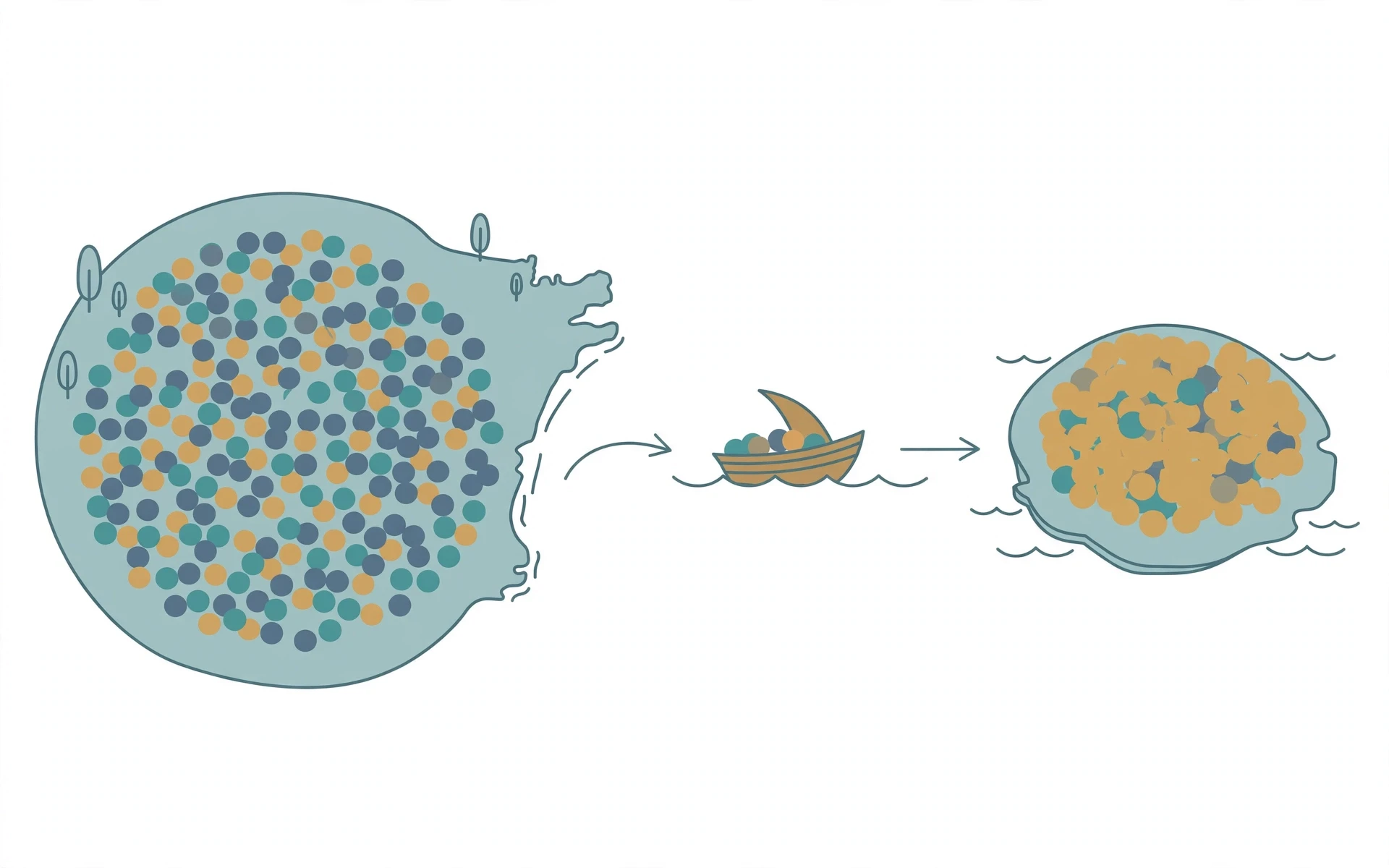
A founder effect happens when a small group breaks away from a larger population and starts a new one, carrying only a random sample of the parent population's genes. Rare alleles can become common in the new population by luck alone, and the new population ends up genetically different from the one it left behind.
Imagine a jar of marbles, most of them blue, a few red, one or two yellow. Scoop out a handful and tip it into a new jar, and let that handful become the starting stock for everything that follows. If your scoop happened to include both yellow marbles, yellow is suddenly common — not because yellow was better, but because the scoop said so. That is the founder effect, and it is one of the most powerful ways genetic drift reshapes real populations. A bottleneck shrinks a population in place: the same place, the same ground, fewer survivors. A founder effect starts a new population somewhere else, from a few colonists.
The classic case is Pingelap, a tiny atoll in the Pacific, part of the Federated States of Micronesia. Around 1775, Typhoon Lengkieki swept across the island and left about 20 survivors. Among the survivors was the ruler, who carried a recessive mutation in the CNGB3 gene. The mutation causes achromatopsia, total colour blindness: the world seen in shades of grey, with painful sensitivity to bright light. In most of the world, achromatopsia affects roughly 1 person in 30,000. On Pingelap, it reached 2.7 percent of the population by the fourth generation after the typhoon, and about 4.9 percent by the sixth. Today, between 5 and 10 percent of Pingelapese have total colour blindness, and around 30 percent carry the mutation without showing it. The survivors rebuilt their community from a gene pool that happened to include one copy of a rare recessive allele, and generations of intermarriage on a small, isolated island brought that allele together in homozygous pairs again and again. The typhoon did not select for colour blindness; it selected for nothing at all. It simply killed almost everyone, and the genes of the survivors became the genes of the island. That is genetic drift in its purest form: a random event, a small sample, and a frequency that rose a thousand-fold in a few generations.
I first met this story not in a genetics textbook but in Oliver Sacks' book The Island of the Colorblind, published in 1997, which I picked up expecting a travel story and finished with a completely different understanding of what chance can do to a community. Sacks visited Pingelap and the neighbouring island of Pohnpei, and he described people who had built a rich life around a condition the rest of the world calls a disability — navigating by the shapes of clouds, the patterns of waves, the movement of fish, seeing at dusk what the rest of us miss. The locus was first mapped by homozygosity mapping in the Pingelapese population, in work by Winick and colleagues in the American Journal of Human Genetics, and the condition was later traced to a mutation in the CNGB3 gene by Sundin and colleagues. The science confirmed what the island's history already suggested: this was genetic drift, written large across a whole community.
The Amish of Lancaster County, Pennsylvania, tell a similar story with a different beginning. Around 200 German and Swiss immigrants founded the community in the 18th century, and religious practice kept the population largely endogamous — marrying within the community — for generations. Among those founders, by chance, were carriers of the mutation that causes Ellis-van Creveld syndrome, a form of dwarfism accompanied by extra fingers, heart defects and dental problems. In the general population, Ellis-van Creveld syndrome occurs in about 1 birth in 60,000. Among the Lancaster Amish, McKusick's 1964 study found it in about 1 birth in 200 — a three-hundred-fold difference — and about 13 percent of the community carries the mutation, though later estimates put the Amish rate lower, around 1 in 5,000 births. The numbers come from the clinical genetics work of Victor McKusick and colleagues, who studied the Amish population in the 1960s. The same pattern shows up in other conditions, too. Among Ashkenazi Jews, whose ancestors passed through a population bottleneck and founder events in medieval Europe, the carrier frequency for Tay-Sachs disease is about 1 in 27. Carrier screening programmes, built on exactly this understanding of population history, have driven Tay-Sachs births in the Ashkenazi community down dramatically. Knowing the history of genetic drift in a population is not an academic exercise. It changes how medicine is practised.
Then there is Tristan da Cunha, the most remote inhabited island on Earth, a speck of volcanic rock in the South Atlantic, more than 2,000 kilometres from the nearest continent. The island's present population descends from just 15 outside ancestors who arrived between 1816 and 1908, and the full pedigree traces back to 28 founders. Today the island has about 230 people, all descended from that tiny starting group, and the consequences of the founder effect are written into their health. A 1996 study found that 57 percent of the islanders showed at least partial evidence of asthma, with 23 percent receiving a definitive diagnosis. Later work that examined essentially the whole island population — 269 people — diagnosed asthma in 36 percent of them, 96 people, and identified a variant, rs2786098, that regulates the DENND1B gene and is associated with asthma susceptibility in the islanders, though the association did not replicate in larger genome-wide studies outside the island. When a population begins with 28 people, every allele they carry is amplified, and there is nowhere else for new genes to come from.
These three stories share a shape: a small founding group, separated from the parent population; a random sample of genes — not a representative sample, just the genes those particular people happened to carry; isolation, so the new gene pool is not diluted by newcomers; and time, which lets the sampled frequencies harden into the new normal. Change any one ingredient and the story changes. Add steady immigration, and the founder effect washes out. Start with a thousand founders instead of twenty, and the sample is close enough to the parent population that little changes. Genetic drift does not care which alleles it amplifies. It amplifies whatever the founders happened to carry.
7. Genetic Drift vs Natural Selection
Genetic drift and natural selection are the two great engines of allele-frequency change, but they work in opposite ways: selection is directional and depends on fitness, while drift is random and blind to fitness. In large populations selection usually wins; in small ones, drift often overrules it, and even useful alleles can be lost by chance.
If you remember one distinction from this article, make it this one. Natural selection has a direction. It favours alleles that help their bearers survive and reproduce, and it pushes their frequencies up, generation after generation, in a steady climb. Genetic drift has no direction at all. It is the wobble, the noise, the sampling error that comes from the fact that each generation is a finite draw from the last. An allele can rise or fall under drift, and neither movement says anything about whether the allele is useful. Selection reads the organism. Drift does not even look.
The cleanest way to think about the boundary between them is the threshold rule that population geneticists use. Every allele under selection has a selection coefficient, s, a number that measures how much it helps or hurts its bearer. And every population has an effective size, Ne, the number that governs how strong genetic drift is. When s is much smaller than 1/(2Ne), drift dominates: the allele behaves as if it were neutral, and its fate is decided by chance. When s is much larger than 1/(2Ne), selection dominates. In a huge population, 1/(2Ne) is a tiny number, so even a whisper of an advantage — s of one in a thousand — is enough for selection to take charge. In a population of ten, 1/(2Ne) is one in twenty, so an allele needs a five percent advantage to be reliably favoured, and anything weaker is at the mercy of the draw. The same allele, the same advantage, can be selected in one population and drift in another, purely because of size.
I want to say plainly, in my own voice, that one of the most common ideas about evolution is simply wrong, and I believed a version of it myself for years. The idea is that every trait exists because it helped survival — that if you look at any feature of any organism, there must be a reason it was selected for, some advantage it conferred in the ancestral environment. It is a satisfying story, and it is false. Most of the differences between the genomes of two species are neutral, fixed by genetic drift rather than by selection. Many traits are accidents of history: a founder's quirk, a bottleneck's survivor, a coin toss that came up heads a hundred generations ago and never came back down. The peacock's tail and the cheetah's speed are selection's work, and they are spectacular. But the particular spelling of a stretch of DNA that codes for nothing, the exact frequency of a harmless blood-group allele in a village, the fact that one island's people are colour blind and another's are not — these are drift's work, and they are everywhere. Evolution is not a designer with a plan. Anyone who tells you that every trait has a purpose has mistaken half the story for the whole.
The table below puts the two forces side by side. Read it as a comparison of temperaments: one is a judge, the other is a coin.
| Genetic drift | Natural selection | |
|---|---|---|
| Direction | Random — allele frequencies wander up or down with no trend | Directional — favoured alleles rise steadily, harmful ones fall |
| Fitness dependence | Blind to fitness; helpful, harmful and neutral alleles are all equally subject to chance | Depends entirely on fitness; an allele spreads because it helps its bearer survive and reproduce |
| Effect in large populations | Weak; allele frequencies barely move from one generation to the next | Strong; even a small advantage is enough to steer an allele reliably |
| Effect in small populations | Strong; can fix harmful alleles and lose useful ones by chance | Weak; easily overruled by sampling error unless the advantage is large |
| Typical outcome | Loss of genetic diversity; one allele fixed, the others gone | Adaptation; the population becomes better fitted to its environment |
| Example | Achromatopsia reaching 5–10% on Pingelap after a typhoon left about 20 survivors | Antibiotic resistance spreading through a bacterial population exposed to the drug |
One more point deserves emphasis, because it catches out even careful readers. Drift and selection are not rivals that take turns; they act on the same alleles at the same time, in every population, in every generation. An allele with a modest advantage in a small population is being pushed up by selection and knocked around by genetic drift simultaneously, and which force wins is a matter of numbers, not of principle. And when drift fixes a slightly harmful allele, selection cannot easily undo it, because the allele is now present in every individual and there is no variation left for selection to act on. This is one reason small, isolated populations accumulate genetic problems over time, and one reason conservationists worry so much about keeping populations large and connected.
If you want to understand selection itself in depth, the companion article on Natural Selection covers that ground in full. What matters here is the partnership and the tension: selection writes the story of adaptation, genetic drift writes the story of accident, and the genome of every living thing is a mixture of the two.
8. The Neutral Theory: Drift at the Molecular Level
The neutral theory, proposed by Motoo Kimura in 1968, says that most evolutionary change at the molecular level is not adaptation at all, but the random fixation of neutral mutations by genetic drift. It remains one of the most important — and most argued about — ideas in modern biology.
In 1968, Motoo Kimura published a short paper in Nature that quietly detonated a bomb under evolutionary biology. The paper was called "Evolutionary rate at the molecular level", and its argument was disarmingly simple. By the late 1960s, scientists were beginning to measure how fast proteins change over evolutionary time, comparing the amino-acid sequences of the same protein in different species. The rates they found were far too high to be explained by natural selection alone. If every substitution had to be favoured by selection, Kimura calculated, the cost — the number of individuals that would have to die, generation after generation, to drive each favoured allele to fixation — would be impossibly large. So Kimura proposed a different explanation: most of the molecular changes that accumulate between species are selectively neutral. They do not help or hurt their bearers. They arise by mutation, and they spread or vanish by random sampling — by genetic drift — until one version is fixed in the whole population. Selection still matters enormously for the traits we can see, for anatomy and behaviour and physiology. But at the level of DNA sequences and protein spellings, Kimura argued, chance is the main author.
Kimura later restated the claim in its strongest form in his 1983 book The Neutral Theory of Molecular Evolution, and his words are still quoted because they are so uncompromising:
"the overwhelming majority of evolutionary changes at the molecular level are caused by random fixation (due to random sampling drift in finite populations) of selectively neutral (i.e., selectively equivalent) mutants under continued inputs of mutations"
A year later, Jack Lester King and Thomas Jukes published their own version of the argument in Science, under the deliberately provocative title "Non-Darwinian Evolution". They looked at the same protein data and reached the same conclusion: the rate of molecular change was too steady, too clock-like, to be driven by the shifting demands of environments. Selection is erratic; it speeds up when environments change and slows down when they are stable. But the molecular clock ticked at a roughly constant rate across lineages and across time, and that steadiness was exactly what you would expect if substitutions were neutral and accumulated at the mutation rate. King and Jukes summed up their view in one famous sentence:
"Natural selection is the editor, rather than the composer, of the genetic message."
Read that sentence slowly, because it captures the whole theory. The composer is mutation plus drift: new variants arise at random, and chance decides which ones become the standard text. The editor is selection: it cuts out the variants that are genuinely harmful, and occasionally promotes a useful one, but it does not write the bulk of the message.
The molecular clock deserves a closer look, because it is the neutral theory's most useful gift to science. If neutral substitutions accumulate at roughly the mutation rate, and the mutation rate is roughly constant, then the number of differences between two species is a measure of how long ago they shared a common ancestor. Count the differences, divide by the rate, and you have a date. This is how scientists have dated the split between humans and chimpanzees and the deep branches of the tree of life — dates that would be impossible to obtain from fossils alone, because most organisms leave no fossils at all. The clock is not perfect: mutation rates vary between lineages and genes, and modern methods calibrate the clock with fossil dates. But the underlying logic is Kimura's, and it works because genetic drift is steady in a way that selection is not.
Then, in 1973, Tomoko Ohta added a refinement that made the theory richer and more realistic. Ohta pointed out that the world is not divided neatly into neutral mutations and strongly selected ones. Many mutations are slightly deleterious — they hurt their bearer just a little. In a large population, selection notices that small disadvantage and weeds the mutation out. But in a small population, the threshold rule from the previous section applies: if the disadvantage is smaller than 1/(2Ne), genetic drift dominates, and the slightly harmful mutation behaves as if it were neutral. It can drift to fixation, leaving the whole population carrying a version of a gene that is marginally worse than the one it replaced. Ohta called this the nearly neutral theory, and it explains why small populations, like the islanders and the bottlenecked seals in this article, accumulate slightly harmful mutations over time, while large populations purge them.
None of this went unchallenged, and the debate continues today. The argument, at its core, is about a fraction: what proportion of the genome is truly neutral, and how much is under selection? On one side, supporters of the neutral view point to the vast stretches of non-coding DNA, the synonymous substitutions that change a codon's spelling without changing its amino acid, and the steady tick of the molecular clock, and they argue that the neutral fraction is large — most of the genome, most of the time. On the other side, critics point to evidence that selection acts far more widely than Kimura imagined: on regulatory sequences that control when genes switch on, and on the pattern of variation around selected sites, where linked selection distorts the picture. The modern consensus, if there is one, is a synthesis: genetic drift is real and powerful, especially in small populations and at the molecular level, and selection is real and powerful too, acting on more of the genome than the strict neutral theory allowed. The question is no longer whether drift or selection rules the genome. It is where each one rules, in which parts of the genome, in populations of which size, and under what conditions.
9. Genetic Drift in the Laboratory
Peter Buri's 1956 experiment with fruit flies is the cleanest demonstration of genetic drift ever performed: 107 identical populations, started the same way, drifted apart by chance alone until most had fixed or lost the eye-colour allele they began with. It turned a mathematical prediction into something you could count in bottles.
The theory of genetic drift was worked out on paper in the 1930s, by Sewall Wright and Ronald Fisher, using mathematics that few biologists of the time could follow and none could test directly. Then, in 1956, a young researcher named Peter Buri published a paper in the journal Evolution that settled the question. The paper was called "Gene frequency in small populations of mutant Drosophila", and its design was so clean that it is still taught in textbooks seventy years later.
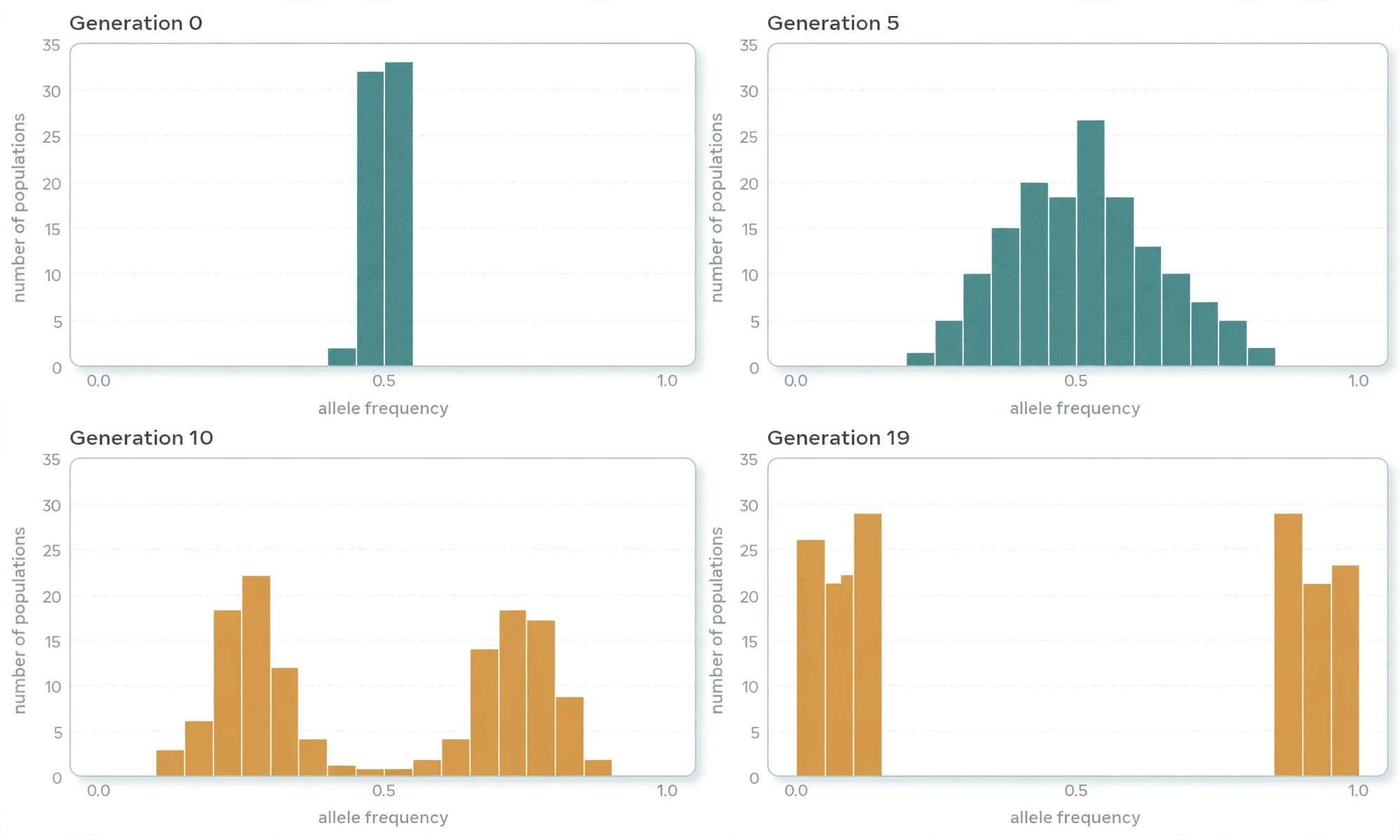
Buri worked with the fruit fly Drosophila melanogaster and with two alleles of the brown eye-colour gene: bw and bw75. Both alleles affect eye colour, but neither gives its bearer any meaningful advantage or disadvantage in a laboratory bottle — and that neutrality was the point. Buri set up 107 replicate populations, each containing exactly 8 males and 8 females, and each starting with the two alleles at exactly equal frequency, 0.5. The flies were kept under identical conditions and allowed to breed for 19 generations. If allele frequencies were governed by selection, all 107 populations should have behaved the same way, because they started the same and lived the same. If they were governed by chance, they should have diverged, each wandering its own path.
They diverged. By generation 19, 30 of the 107 populations had lost the bw75 allele entirely, and 28 had fixed it — the allele was present in every individual, and bw was gone. The remaining populations sat scattered in between, at every frequency from near zero to near one. The only explanation was random sampling: in each generation, the alleles passed on were a random draw from the parents, and the draws differed from bottle to bottle. Heterozygosity fell steadily across the experiment, and it fell as if the effective population size were about 9, not the census size of 16. The difference came from the unequal reproductive success of individual flies: some parents contributed many offspring, some contributed none, and that variance shrank the effective size below the headcount. Buri had taken an abstract prediction and made it visible, countable, and undeniable.
The experiment was decisive for three reasons. First, the replication: 107 populations is not a handful of anecdotes but a distribution, and a distribution is what a theory of chance predicts. Second, the identical starting conditions: every bottle began at 0.5, with the same number of males and females, the same alleles, the same environment. The differences between bottles at generation 19 could not be blamed on different starting points or different conditions, because there were none. Third, the neutrality of the alleles: bw and bw75 differ in eye colour and in nothing that matters for survival in a bottle, so selection had nothing to act on. Buri's flies showed that genetic drift is not a theoretical curiosity. It is a physical process, operating whenever a finite population reproduces.
Later experiments confirmed and extended Buri's result. In 1990, Bryant and Meffert ran a bottleneck experiment with houseflies, founding lines with one, four or sixteen pairs of flies and measuring how far they diverged in eight morphometric traits. All bottleneck lines diverged significantly from the ancestral population, and the smallest lines diverged most in shape. Where Buri had shown that drift operates in small populations held at a constant size, Bryant and Meffert showed that it operates with particular force at the moment of a crash — the bottleneck itself.
Buri's experiment also carries a quiet warning for anyone who works with small populations, whether they are breeding endangered animals in captivity or maintaining laboratory stocks. Genetic drift does not wait for permission. In a population of 16 flies, it reshaped the gene pool beyond recognition in 19 generations — a span of months for a fruit fly, but the same mathematics governs a population of 16 rhinos over 19 generations, and the clock there runs in decades. Every generation in a small population is a draw from a small jar, and every draw can lose something that will never come back. That is why the effective population size matters more than the headcount, and why a population that looks healthy on paper can be genetically fragile.
10. Genetic Drift in Human History
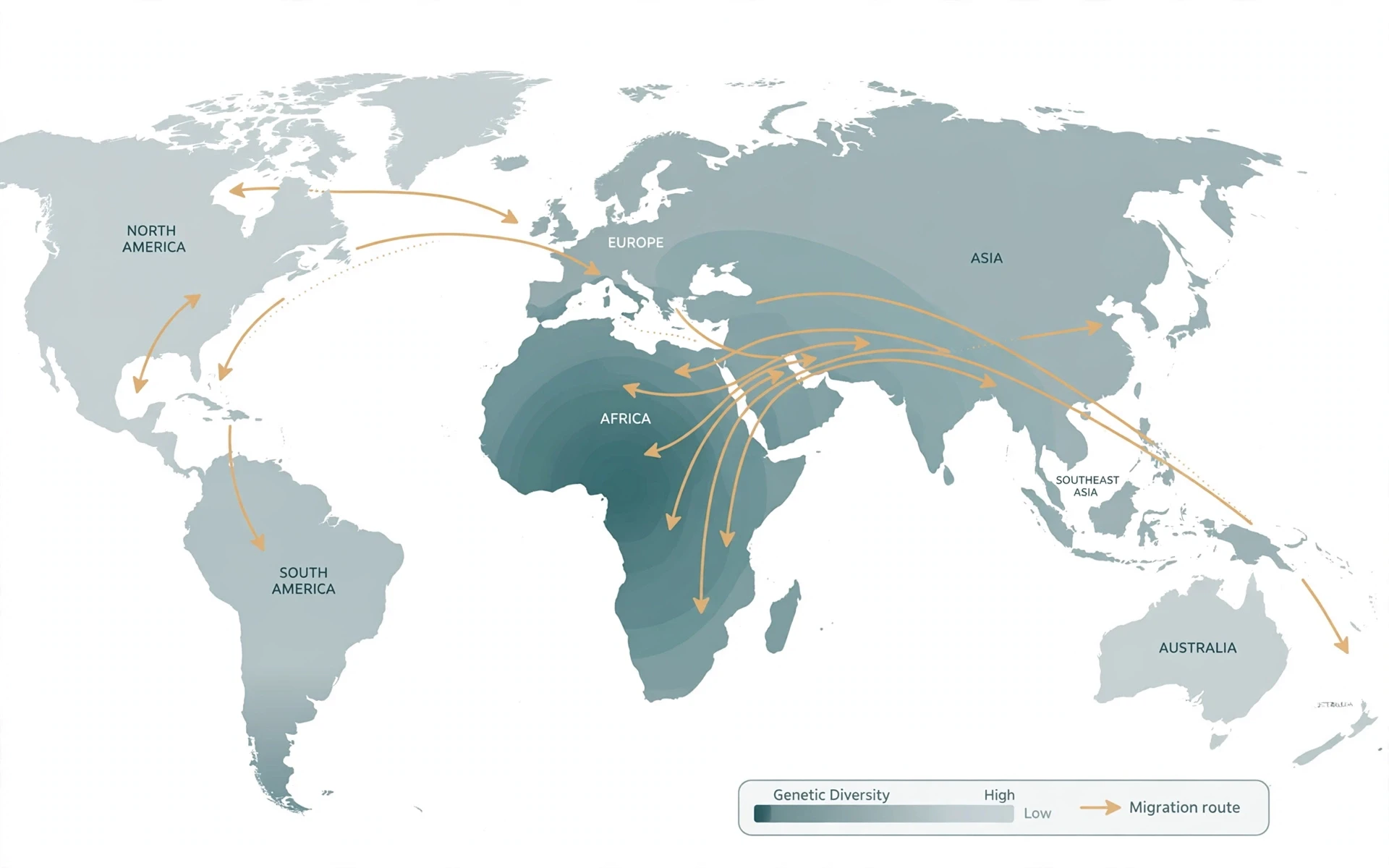
Human beings are not exempt from genetic drift. Our species carries its signature in every genome: diversity is richest in Africa and thins steadily with distance from it, because each group that moved on carried only a sample of the genes behind it.
That pattern is the story of our own past, written in chance. Modern humans arose in Africa, and when small bands began leaving the continent — tens of thousands of years ago, in waves rather than a single march — each departing group was a founder population. It carried a subset of the genetic variation of the group it left. Then the next group, pushing further afield, carried a subset of that subset. Step by step, like water poured from jug to jug and spilling a little at every pour, diversity fell. Today, a person whose ancestors stayed in Africa typically carries more genetic variation than a person whose ancestors travelled to the far ends of Asia or the Americas, and the decline tracks distance from Africa with remarkable neatness. You can read the same story in our close relatives: the Human Evolution article traces the fossil and archaeological journey, while the Human Genome article explains what our DNA actually contains. Genetic drift is the mechanism that ties the two together — the reason the genetic map of humanity looks like a series of ever-smaller samples.
I first felt the weight of that idea not in a laboratory but in a classroom, years ago, when a teacher asked us to imagine a village of twenty people packing up to found a new settlement across a river. Someone in the back joked that the new village would be full of left-handers if the two left-handed families happened to be the ones who left. We laughed, and then the teacher asked the quiet question: what if the trait they carried was not handedness but a gene variant nobody could see? The joke stopped being funny and started being true. That village is us. Every migration in human history was a small boat leaving a larger shore, and the genes that made the crossing were the ones that happened to be in the boat.
The numbers sharpen the picture. Population geneticists estimate that the long-term effective population size of humans is roughly 10,000. That figure surprises people, because the census size of humanity today is around eight billion, and even in the deep past there were surely far more than ten thousand people alive at any one time. The confusion comes from what the number means. Effective population size is a modelling quantity, not a headcount. It is the size of an idealised, randomly mating population that would lose genetic diversity through genetic drift at the same rate as the real one. And it is weighted toward the smallest values in a population's history, because a population that passes through a narrow stretch loses diversity at a rate set by that narrow stretch, and later growth cannot restore what was lost. Think of it as an average that remembers the worst times: a species that spent long stretches small, with local groups frequently splitting off and dying out, behaves genetically like a population of about ten thousand, even if the total number of people alive at any moment was much larger. The figure does not say that only ten thousand humans ever lived. It says that drift bit hard enough, often enough, that our genomes look as though they passed through a population that small.
That brings us to one of the most argued episodes in human prehistory: the Toba hypothesis. Around 74,000 years ago — the Youngest Toba Tuff is dated to about 73,700 years ago — a volcano on the island of Sumatra erupted with a force that dwarfs anything in recorded history. It threw so much ash and sulphur into the atmosphere that it may have dimmed the sun for years. In 1998, the anthropologist Stanley Ambrose proposed that the eruption triggered a volcanic winter so severe that it reduced the human population to a few thousand individuals — a bottleneck that would have left its mark on every genome alive today. The idea was dramatic, and it offered a neat explanation for why human genetic diversity looks so squeezed. For years it was repeated in textbooks and documentaries as though it were settled.
The modern evidence is less tidy, and honesty demands saying so. Whole-genome methods that reconstruct past population sizes from the DNA of living people — by reading the patterns of variation the way a forester reads tree rings — find no consistent crash at 74,000 years ago. If humanity had been reduced to a few thousand people at that moment, the signal should be there, sharp and unmistakable, and it is not. Instead, the reductions that do show up cluster around two other times: roughly 50,000 years ago, which matches the out-of-Africa founder effect, when small groups left the continent and lost diversity by sampling; and roughly 150,000 to 130,000 years ago, a much earlier squeeze whose cause is still debated. That does not prove the Toba eruption had no effect on human populations — a volcanic winter could have hit some regions hard and left others untouched, and local crashes would not necessarily show up in a global average. But it does mean the simple version of the story, a single global bottleneck at Toba that shaped all of us, is not supported by the genomes. Toba remains a debated hypothesis, not a settled fact, and the debate itself is instructive: it shows how genetic drift leaves fingerprints that can be tested, and how a beautiful explanation must survive contact with the data.
What the data do support is a quieter, longer story. Human history is a story of small groups: bands splitting off, valleys and deserts and seas cutting populations apart, some groups flourishing and others vanishing. In each small group, drift had room to work. Alleles rose and fell by luck. Some variants that were rare in Africa became common in a far-flung population purely because the founders happened to carry them. Others vanished from a migrating group entirely, even though they persisted back home. None of this required anyone to be better adapted. It required only small numbers and time — the two ingredients drift needs most.
There is a temptation to read this story as a diminishment, as though drift made us poorer. It is better read as a record. The thinning of diversity with distance is a map of journeys our ancestors actually took, preserved in our cells. And the same chance processes that shaped those journeys still shape us. Isolated communities today — islanders, mountain villages, religious groups that marry within — still experience drift more strongly than large, mixed cities do. Their gene pools carry the echoes of their founders, for good and ill, in the same way the whole species carries the echo of the groups that walked out of Africa. Understanding genetic drift in human history is not only about the deep past. It is about recognising that chance has always been one of the authors of who we are.
11. Genetic Drift in Other Animals
Genetic drift is not a human story. It has rewritten the genomes of animals across the planet, sometimes to the edge of extinction, and the clearest cases come from species that passed through bottlenecks so narrow that their survivors are nearly genetic copies of one another.
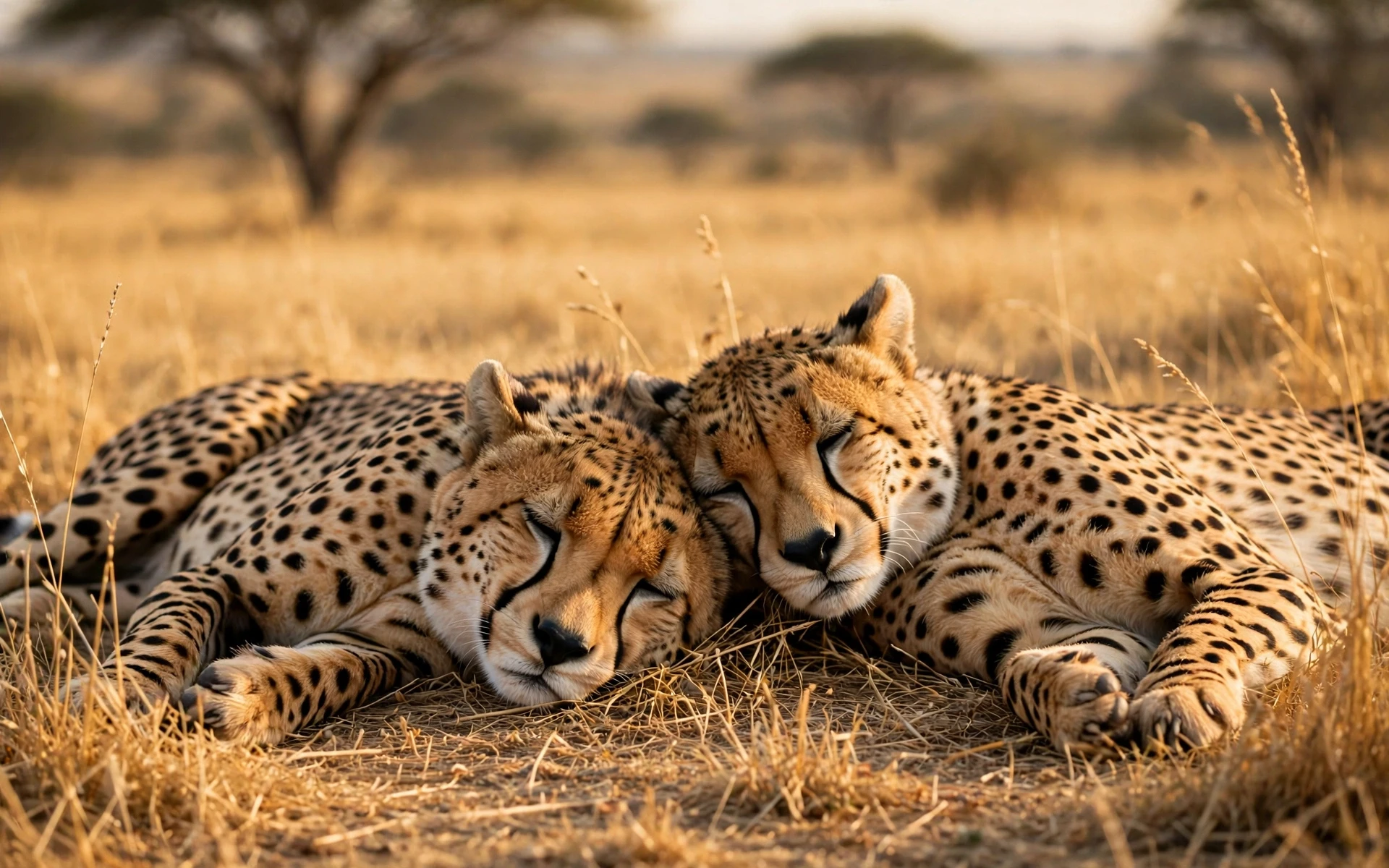
No animal illustrates this better than the cheetah. In 1985, Stephen O'Brien and colleagues published a study in Science that stunned biologists. They performed 14 reciprocal skin grafts between unrelated cheetahs — taking a patch of skin from one animal and grafting it onto another, and vice versa. In most mammals, skin grafts between unrelated individuals are rejected within days, because the immune system recognises the donor tissue as foreign. In cheetahs, all 14 grafts were accepted. The animals were so genetically similar that their immune systems could not tell self from non-self. Follow-up work showed that cheetahs carry ten to one hundred times less genetic diversity than other felids: at the level of the genes that govern immune recognition, unrelated cheetahs looked like identical twins.
The cause was a bottleneck. O'Brien's team dated it to roughly 10,000 to 12,000 years ago, near the end of the last ice age, when cheetah numbers collapsed — perhaps as their prey vanished, perhaps as the climate shifted — leaving a small remnant from which all modern cheetahs descend. A genome study published in 2015 by Dobrynin and colleagues confirmed and refined the picture: cheetah genomes are about 95 percent homozygous, meaning that at roughly 95 percent of positions, the two copies of a gene an animal carries are identical. For comparison, most outbred mammals are far more heterozygous. The genome paper also found evidence of two bottlenecks, not one: an older squeeze more than 100,000 years ago, and a more recent one dated to between 11,084 and 12,589 years ago, matching the earlier estimate.
The consequences are not abstract. Cheetahs in captivity are notoriously hard to breed. Infant mortality is high. Males often produce sperm with a large proportion of abnormal forms, and their sperm counts are low. The species is vulnerable to disease in ways that more diverse animals are not: an outbreak of feline infectious peritonitis swept through a captive colony in Oregon in the early 1980s and killed a large fraction of the animals, because so few of them carried immune variants that could resist it. None of this means cheetahs are doomed — wild populations persist across Africa, and conservation breeding programmes work carefully to pair animals whose genomes differ as much as possible. But the cheetah shows what genetic drift does when a bottleneck is severe enough: it strips a species of the raw material that evolution needs, and the bill keeps arriving thousands of generations later.
If the cheetah is a story of a bottleneck nobody witnessed, the black robin is a story of a bottleneck watched in real time, bird by bird. The black robin lives only on the Chatham Islands, east of New Zealand, and by 1980 it was one of the rarest birds on Earth: five individuals remained, and only one of them was a breeding female. Her name was Old Blue. She lived for about fourteen years — an extraordinary lifespan for a small songbird — and, with a male known as Old Yellow, she became the ancestor of every black robin alive today. Every living black robin descends from that single pair, which means the entire species passed through a bottleneck of two breeding birds.
The rescue was an act of extraordinary ingenuity. The conservationist Don Merton and his team used cross-fostering: they removed Old Blue's eggs and placed them in the nests of Chatham tomtits, a related species, which raised the chicks as their own. Freed from the work of incubating and feeding, Old Blue laid again — and again. The tomtit foster parents did the rearing; the robins did the breeding. Slowly, painfully, the numbers climbed. Today there are about 350 adult black robins, living on Mangere and Rangatira islands in the Chathams, and in 2026 the species was voted New Zealand Bird of the Year — a small, dark bird that had stood at the edge of nothing and came back.
The black robin's recovery is a triumph, but genetic drift has left its mark. A population founded by two birds carries only the genes those two birds carried, and every black robin today is far more closely related to every other than birds in a healthy population would be. That inbreeding carries costs — lower hatching success, reduced fertility, greater vulnerability to disease — and conservationists continue to manage the population carefully, monitoring nests and moving birds between islands to spread what little variation remains. The species survived. Its genome did not escape the bottleneck unscathed.
The Florida panther tells a different kind of story: what happens when people deliberately reverse drift. By the mid-1990s, the Florida panther — a population of cougars isolated in southern Florida — had fallen to an estimated 20 to 30 animals. The survivors showed the classic signs of inbreeding depression: kinked tails, a swirl of fur on the back known as a cowlick, undescended testicles in males, and heart defects. The population was small, isolated, and drifting fast toward extinction.
In 1995, wildlife managers took a bold step. They released eight female Texas cougars — animals from a closely related population — into Florida panther habitat. The idea, called genetic rescue, was to bring in new genes and break the inbreeding spiral. Five of the eight females bred, producing at least twenty kittens, and the hybrid offspring carried fresh variation into the population. It worked better than almost anyone dared hope. A 2024 study found that abundance had risen more than fivefold and effective population size more than twentyfold since the rescue, and today there are roughly 120 to 230 adult Florida panthers. The kinked tails and other defects have faded.
The genetic details matter, because a rescue like this carries a risk: flood a small population with outsiders and you can swamp the very genes that made it distinct. A 2025 study by Aguilar-Gómez and colleagues found that the rescue reduced homozygosity — the measure of how much of the genome carries identical copies — without swamping the ancestral Florida genotypes. The panthers kept their identity and gained diversity. It is one of the clearest demonstrations that drift is not destiny: when a population's numbers are allowed to grow and new genes are allowed in, the damage of a bottleneck can be partly undone. The panther's story belongs alongside the cheetah's and the black robin's because together they show the full range of what genetic drift does to animals — how it can strip a species bare, how a population can survive it by a thread, and how careful human intervention can turn it back.
12. Genetic Drift in Viruses and Bacteria
Genetic drift shapes the microbial world too, and it does so on a scale and speed that animals can never match. When a virus moves from one host to another, often only a handful of viral particles found the new infection — a bottleneck measured in single digits. Which variants make it through is largely a matter of luck.
That transmission bottleneck matters enormously. A person infected with a virus may carry billions of viral particles, spanning a cloud of slightly different variants — a quasispecies, in which no single genome dominates and the population exists as a swarm of related sequences. But when that person coughs near someone else, or a mosquito bites and then bites again, the new infection is typically founded by a tiny sample of that cloud. Most of the variation is left behind. The variants that happen to be in the founding particles become the ancestors of everything that follows in the new host, whether or not they were the fittest variants in the old one. The same logic applies at every scale of viral life: within a host, as the virus spreads from tissue to tissue; between hosts, as it jumps from person to person; and across epidemics, as a few lineages seed new outbreaks while others die out. The Virus Evolution article traces how viruses change over time; genetic drift is one of the engines of that change, working alongside selection rather than instead of it.
This is where a common misunderstanding needs correcting. Drift does not mean that selection stops working in viruses. Selection still acts fiercely — a variant that replicates faster or evades immunity better has a real advantage, and in the huge populations inside a host, selection can act on tiny differences. But drift sets the stage on which selection performs. When a population passes through a bottleneck, the variants available for selection to act on are the ones chance allowed through. A superbly adapted variant that never makes it into the founding particles is lost, and a mediocre variant that happens to be in the right droplet at the right moment can found a whole new lineage. Over many transmission events, that sampling noise accumulates, and the evolutionary path a virus takes depends on which accidents happened along the way. That is genetic drift at work on a timescale of days.
Bacteria tell a parallel story, with a twist that matters for medicine. In a large bacterial population — a gut, a wound, a flask in a laboratory — selection dominates: a mutation that confers resistance to an antibiotic spreads rapidly when the drug is present. But bacteria also live in small, fragmented populations: a few cells colonising a new surface, a handful surviving a dose of disinfectant, a small colony starting a biofilm. In those small populations, genetic drift is strong, and it can fix variants that selection would never favour. A resistance-neutral variant — one that changes nothing about how the bacterium responds to drugs — can drift to high frequency purely by chance. More strikingly, in a small enough population, drift can even fix a slightly costly variant, one that carries a small disadvantage, because chance overwhelms the weak selection against it. The variant then sits in the population, waiting. If the environment changes — if an antibiotic arrives, say — a variant that was once neutral or slightly costly may suddenly become useful, or may interact with a new mutation to produce resistance. Drift does not create antibiotic resistance by itself, and it would be wrong to say so. But it shuffles the deck: it decides which variants are present, in what proportions, when selection arrives to deal the next hand. Anyone who wants the fuller picture of how resistance itself evolves should read the site's article on antibiotic resistance alongside this one — the two stories belong together.
The microbial world also shows drift at its fastest. A bacterium can divide every twenty minutes; a virus can produce thousands of copies in a day. With generation times that short, drift can reshape a population in weeks, where the same process in an elephant or a human would take millennia. That speed is one reason viral and bacterial evolution feels so unpredictable — and why understanding drift, not just selection, is essential for anyone trying to forecast how a pathogen will change.
13. Genetic Drift and the Birth of Species
Can genetic drift create a new species? The short answer is yes — with help, and not always. A small population cut off from its parent stock and reshaped by chance can diverge fast enough, over enough generations, to become something new.
The classic version of this idea comes from Ernst Mayr, one of the architects of the modern synthesis, who called it peripatric speciation — speciation at the periphery. Picture a large population spread across a mainland. At its edge, a few individuals colonise a new patch of habitat: a valley over the ridge, an island off the coast, a pocket of forest cut off by a lava flow. That small founding group carries only a sample of the parent population's genes, and in its isolation, drift goes to work. Alleles that were rare in the parent population may become common by luck alone. Others vanish. Generation after generation, the small population wanders genetically away from its source, and because it is small, it wanders fast. If the separation lasts long enough, the two populations may accumulate enough differences — in mating signals, in the timing of breeding, in the compatibility of their genes — that when they meet again, they can no longer produce fertile offspring together. At that point, they are separate species. Genetic drift supplied the divergence; isolation supplied the time; reproductive barriers were the result.
The textbook case is the Hawaiian Drosophila, the fruit flies of Hawaii. Hawaii is the most isolated archipelago on Earth, and its islands rose from the sea one by one, each a fresh blank slate. Over millions of years, fruit flies arrived — probably blown in on storms, a few individuals at a time — and each arrival was a founder event. The descendants radiated into hundreds of species, many found on a single island or even a single volcano, each with its own elaborate courtship rituals. Male Hawaiian Drosophila perform leks — communal display grounds where males dance, wave their wings, and compete for the attention of females, who choose among them. The displays differ wildly between species that live a few kilometres apart, and much of that difference looks like the product of drift in tiny founding populations, amplified by sexual selection once the populations were established. The Speciation article covers the broader mechanisms by which species split; the Hawaiian flies are the showcase for what happens when drift, isolation, and time are given an archipelago to work with.
But the story needs a qualification, and it is an important one. The importance of founder-effect speciation is debated. Many speciation events are driven mainly by selection: populations adapting to different environments, different foods, different predators, until the adaptations themselves create reproductive barriers. A population that colonises a new island does not only drift — it also faces new conditions, and selection acts on whatever variation is present. Separating the contribution of drift from the contribution of selection in any particular case is hard, and biologists disagree about how often drift alone, without strong selection, has been the main driver. Some argue that founder events are common and powerful; others argue that most of the divergence we see bears the signature of selection, with drift playing a supporting role. Both sides agree that drift is real and that it can accelerate divergence in small populations. They disagree about how often it takes the lead.
I want to push back on a misconception I hear often, because it gets the logic of speciation backwards. People imagine that a new species arises because the new environment "demands" it — as though nature issued a specification and the population obligingly filled it. That is not how it works. Environments do not demand; they filter. A founding population arrives with whatever genes chance gave it, and drift has already begun shuffling them before selection has had a chance to act. Sometimes the genes that happen to be present fit the new home well. Sometimes they fit badly, and the population dies out. Sometimes they fit in a way nobody would have predicted, and the population goes off in a direction that looks strange in hindsight — a fly that dances instead of one that flies further, a bird that loses its ability to fly because there were no predators to fly from. The environment sets the conditions, but chance deals the hand. New species are not designed to order. They are the survivors of a long series of accidents, filtered by a world that never promised them anything.
That is, in the end, what genetic drift teaches us about speciation. Evolution is not a ladder, and it is not a blueprint. It is a process in which selection shapes what exists and chance decides what exists to be shaped. In small populations, genetic drift speaks loudest, and when a small population is cut off from the rest of its kind, the voice of chance can be loud enough to split one species into two. Not always, not inevitably — but often enough, and dramatically enough, that no account of how species are born is complete without it.
14. Conservation Genetics: Managing Drift
Conservation genetics is the practical art of keeping genetic drift from quietly erasing a species' future. When a population shrinks, chance takes the wheel, rare alleles vanish, and the gene pool narrows with every generation. The job is to slow that narrowing, and where possible reverse it, by managing who breeds and whether isolated groups can exchange genes.
The single most useful rule of thumb in this field is the 50/500 rule. It says that a population needs an effective population size of at least 50 to avoid inbreeding depression in the short term, and at least 500 to keep enough genetic variation for adaptation over the long term. The numbers come from the work of Ian Franklin in 1980 and Michael Soulé in 1980. Richard Frankham and colleagues (2014) later argued the thresholds should be doubled, to 100/1,000 — a revision Franklin and colleagues disputed, so 50/500 remains the classic rule of thumb rather than a settled standard. Notice that the rule talks about effective population size, not head count. A herd of 200 animals in which only a handful of males breed, or in which a few dominant females produce most of the young, can have an effective size far below 50 even though the census looks comfortable. That is why the first step in any recovery plan is usually a genetic census: who is actually contributing genes to the next generation, and how much variation is left?
I learned how easily that distinction gets missed the first time I tried to explain a wildlife recovery plan to a friend who loved animals but had never thought about genes. She pointed at a photograph of a thriving reserve, hundreds of animals grazing in the open, and said the species must be safe now. I had to tell her that the animals in that photograph were mostly the descendants of a dozen founders, that their pedigrees looped back on themselves like a family tree drawn in a circle, and that the population could still be in trouble even while it looked abundant. She asked the question that matters: what do you actually do about it? The answer is the rest of this section, and it is more hopeful than the photograph suggested.
The most dramatic tool in the kit is genetic rescue: bringing in new genes from a related population to break up inbreeding. The Florida panther is the textbook case, and its full story is told earlier in this article, so here is the short version. By the mid-1990s the panther population in Florida had fallen to 20 to 30 animals, and the signs of inbreeding were written on their bodies: kinked tails, a cowlick of fur on the back, undescended testicles, and heart defects. In 1995, managers released eight female Texas cougars — close relatives from a healthier population — into panther habitat. Five of them bred and produced at least twenty kittens, and the new genes spread fast. A 2024 study found that abundance had risen more than fivefold and effective population size more than twentyfold, with roughly 120 to 230 adults alive today. Genetic rescue worked here because the incoming animals were the same species, close enough to breed freely, and different enough to carry the variation the panthers had lost. It is not a magic trick, and it carries risks — outbreeding depression, the loss of local adaptations, disease — but when a population is spiralling into inbreeding depression, doing nothing is also a choice, and usually the worse one.
Captive breeding is the slower, steadier cousin of genetic rescue. Zoos and breeding centres keep pedigrees the way royal families once kept genealogies, and for the same reason: to know who is related to whom. The goal is to minimise kinship — to pair animals whose genes are as different as possible — so that each generation loses as little heterozygosity as the managers can arrange. Breeding recommendations are worked out with software that tracks the ancestry of every individual, and animals are sometimes moved between institutions on different continents because the best genetic match for a female in one zoo is a male in another.
The black robin of the Chatham Islands shows both how far captive-style management can go and how close to the edge a species can come. By 1980 only five black robins were left, and only one breeding female, a bird the team called Old Blue, who lived for about fourteen years. Conservationist Don Merton and his team used cross-fostering, moving black robin eggs into the nests of Chatham tomtits so the foster parents would raise the chicks while Old Blue laid again. From that single female's line, the population has grown to about 350 adult birds on Mangere and Rangatira islands, and the black robin even won New Zealand Bird of the Year in 2026. But the success carries a permanent scar: every living black robin descends from that tiny founding group, so the species carries very little genetic variation, and that fragility has to be managed forever after.
The third tool is the simplest to describe and the hardest to build: reconnecting fragmented habitat. Roads, farms, fences, and suburbs slice populations into islands, and each island then drifts on its own. A wildlife corridor — a strip of habitat linking two fragments — lets animals move, breed, and carry genes between groups. Even a trickle of migrants, one or two successful breeders per generation, can be enough to hold genetic drift in check in a small population, because each newcomer brings alleles the isolated group has lost. The challenge is political as much as biological: a corridor has to cross land that someone owns, farms, or wants to develop, and it has to be wide enough and safe enough that animals actually use it. Camera traps and genetic sampling of droppings now let managers check whether a corridor is working, by watching new alleles appear in the population on the far side.
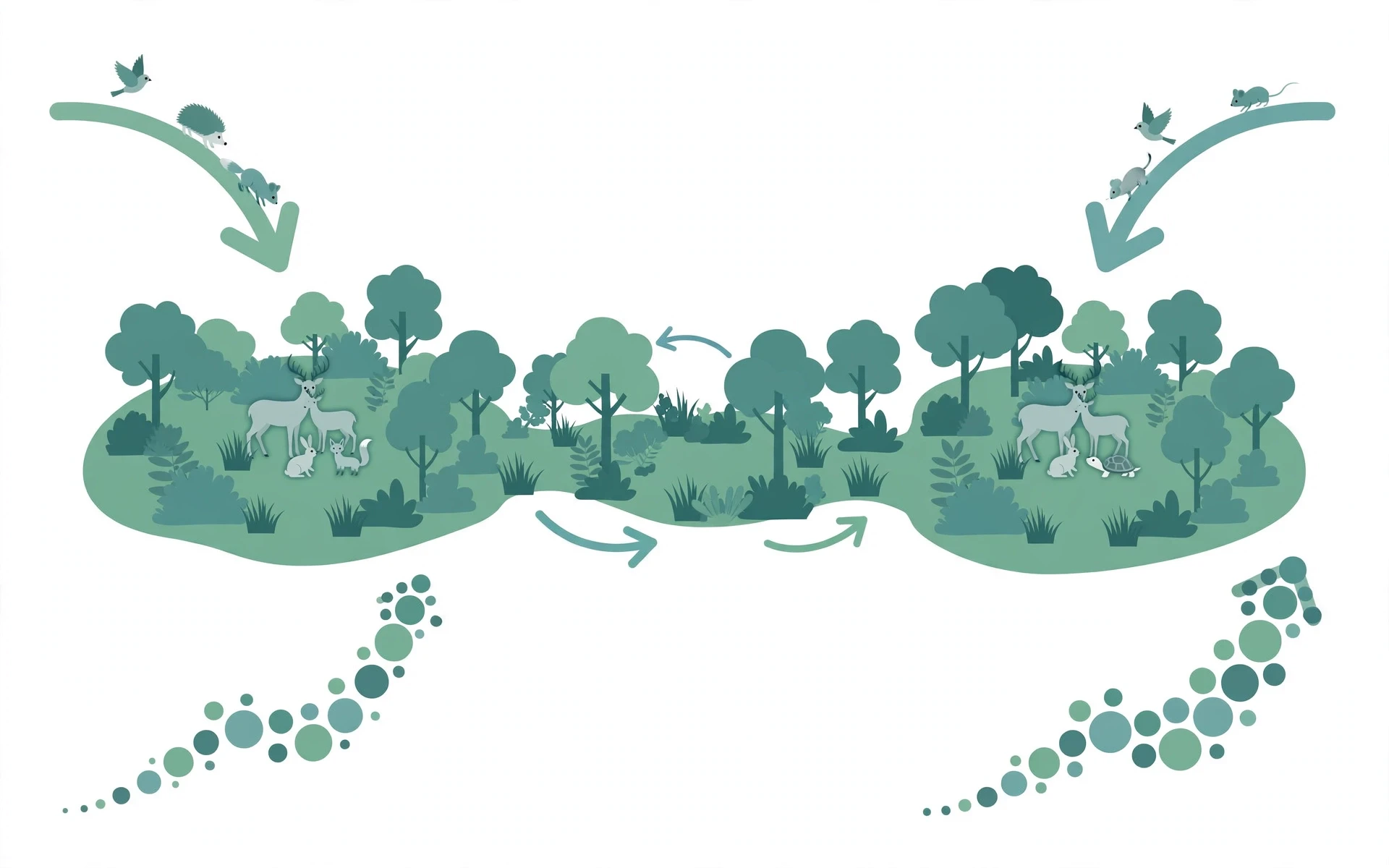
None of these tools erases genetic drift. What they do is change the numbers that drift obeys. Raise the effective population size, and the per-generation loss of heterozygosity shrinks. Reconnect fragments, and alleles that were lost in one patch can be reintroduced from another. Conservation genetics is, at its heart, applied population genetics: the same equations that predict how fast variation disappears also tell managers exactly which lever to pull to slow the loss down.
15. How Scientists Measure Drift
Scientists measure genetic drift by reading the fingerprints it leaves in DNA: the loss of variation within populations, the growth of differences between them, and the family tree of gene copies traced backward in time. Three tools do most of the work: heterozygosity, Fst, and coalescent theory.
Heterozygosity is the simplest measure, and the most direct. At any given gene, an individual can carry two copies of the same allele — homozygous — or two different alleles — heterozygous. A population with high heterozygosity carries many different alleles; a population that has been through a bottleneck shows fewer alleles, more homozygotes, and lower heterozygosity. Geneticists compare observed heterozygosity, the fraction of individuals actually heterozygous in a sample, with expected heterozygosity, the fraction predicted if mating were random given the allele frequencies present. When observed heterozygosity falls well below expected, inbreeding is likely at work. The northern elephant seals tell this story in numbers: before the hunting bottleneck, their heterozygosity was about 0.00142; in modern seals it is about 0.000176, roughly one-eighth of the original. That single comparison captures a century of genetic drift in two numbers, and it is why museum specimens matter so much: without the old bones and skins, there would be no baseline to compare against.
The second tool, Fst, measures how different populations have become from one another. It runs from 0 to 1. An Fst of 0 means the populations are genetically identical, with the same allele frequencies. An Fst of 1 means they are completely different, sharing no alleles at all. Most real populations sit somewhere between, and the value tells a story about their history. Two groups separated by a mountain range for thousands of years will show a higher Fst than two groups connected by a corridor. Human populations around the world, for all their visible differences, show a low Fst — most human genetic variation exists within any single population rather than between populations — which is itself evidence of our recent shared ancestry. Wildlife managers use Fst to decide whether two fragments are still one population or have drifted far enough apart to need separate management, and to check whether a corridor is working by watching Fst fall as migrants reconnect the groups.
The third tool is the most elegant. Coalescent theory looks at evolution backward. Take two copies of a gene from living individuals and trace their ancestry generation by generation into the past. At some point, the two copies converge — they coalesce — into a single ancestral copy carried by one individual. Trace many copies, and they coalesce into fewer and fewer ancestors, until all of them meet in one common ancestor. In a small population, copies meet their common ancestor quickly, because there are few ancestors to choose from; in a large population, the wait is longer. By studying the pattern of coalescence in real DNA, geneticists can estimate how large a population was at different times in the past, and when it shrank or grew. This is how researchers detected the out-of-Africa founder effect in human DNA, and how they estimate the timing of bottlenecks in cheetahs, seals, and other species.
The most famous result of coalescent thinking is also the most misunderstood. Mitochondrial Eve and Y-chromosome Adam are real concepts with confusing names. Mitochondrial DNA is passed down only through mothers, so if you trace everyone's mitochondrial DNA backward, all the lines converge on a single woman: the most recent common ancestor of all living mitochondrial lineages. She is Mitochondrial Eve. The Y chromosome is passed down only through fathers, so tracing Y chromosomes backward converges on a single man: Y-chromosome Adam. The names invite a misunderstanding, so here is the correction, stated plainly. They were not a couple. They lived at different times, tens of thousands of years apart. They were not the only people alive in their eras — they lived in populations of thousands, and many of their contemporaries also have living descendants today through other genetic lines. Eve is simply the one woman whose mitochondrial line happens to be the ancestor of everyone's mitochondrial DNA, and Adam is the one man whose Y chromosome happens to be the ancestor of every living man's Y chromosome. Every other line from their generations was eventually lost by genetic drift — daughters breaking the mitochondrial chain, families with no sons breaking the Y-chromosome chain — until one line remained.
To go deeper into how the human genome carries this history, read the site's article on the Human Genome, which explains how our DNA is organised and what it records about our past. The human genome is a library of drift's effects, from the low diversity of our species compared with other great apes to the founder effects that shaped populations on every continent. Learning to read that library — through heterozygosity, Fst, and the coalescent — is what turned genetic drift from a theoretical idea into a measurable, datable force in real populations.
16. What Genetic Drift Cannot Explain
Genetic drift is powerful, but it is not a universal explanation. Drift explains how allele frequencies change by chance, how variation is lost in small populations, and how isolated groups diverge. It does not explain everything that changes in evolution, and some of the most common claims made in its name are simply wrong.
| Misconception | What the evidence shows |
|---|---|
| Drift means evolution is totally random and selection does not matter | Drift and selection act together; selection dominates when populations are large or selection is strong, and drift dominates only when selection is weak relative to population size |
| Drift only matters in tiny populations | Drift acts in every finite population, including large ones, but its effects are strongest and fastest in small ones; even large populations lose variation slowly by drift |
| A bottleneck always dooms a species | Many species survive bottlenecks — northern elephant seals recovered to over 220,000 — though they carry reduced variation and higher vulnerability afterward |
| Founder effects only produce harmful traits | Founder effects amplify whatever alleles the founders happened to carry, harmful or harmless; some founder populations show distinctive neutral traits, and a few even show locally useful ones |
| Genetic drift explains complex adaptations like eyes | Complex adaptations are built by natural selection over long periods; drift cannot assemble coordinated structures, and no serious biologist claims it does |
The first misconception is the one I hear most often, and it is the one I disagree with most strongly. People who have just learned about genetic drift sometimes walk away thinking that evolution is a lottery and that natural selection was a nice story we have now outgrown. That is not what the science says, and it is not what any serious evolutionary biologist believes. Drift and selection are not rivals competing for the title of the one true mechanism of evolution. They are two forces acting on the same populations at the same time, and which one wins a given contest depends on the numbers. The rule of thumb is simple: selection wins when the strength of selection is much larger than one over twice the effective population size, and drift wins when it is much smaller. In a large population, even a small advantage is enough for selection to push an allele upward reliably. In a small population, chance can overwhelm a modest advantage and sweep a slightly harmful allele to fixation. The neutral theory itself, Kimura's great insight, never claimed that selection does not matter. It claimed that most changes at the molecular level — the silent substitutions in DNA that do not change proteins — are neutral and therefore governed by drift. The changes that build wings, eyes, and brains are a different story, and selection remains the explanation for them.
The second misconception is subtler: the idea that drift is something that happens only to tiny, doomed populations, and that large populations are immune. Drift acts in every finite population, because every population is finite. In a population of a million, the random sampling of alleles each generation still shifts frequencies, just by a tiny amount — the expected change scales with one over twice the effective population size, so it is small but never zero. Over thousands of generations, even that slow leak adds up. The practical difference is speed. A population of fifty can lose variation in a handful of generations; a population of fifty thousand loses it slowly enough that mutation can keep pace. Size does not switch drift off; it turns the volume down.
The remaining misconceptions fail for similar reasons: they take a true statement about drift and stretch it past its limits. Bottlenecks are dangerous, but the elephant seals prove they are not always fatal, and the cheetah proves a species can persist for ten thousand years after one — diminished, vulnerable, but alive. Founder effects do raise the frequency of harmful recessive conditions, as Pingelap and the Amish show, but they also raise the frequency of harmless quirks, and the founders' alleles were a random sample, not a selection of the worst. And complex adaptations remain selection's territory. An eye is not a lucky accident. It is the product of countless small improvements, each preserved because it helped its owner survive and reproduce, accumulated over hundreds of millions of years.
17. Why It Matters
Genetic drift matters because it shapes the living world in ways that touch conservation, medicine, and our own history — and because the questions it raises are still open. Every endangered species is a drift experiment running in real time, and every genome sequenced adds a page to the record of chance in evolution.
In conservation, drift is the clock ticking under every recovery plan. A species reduced to a few dozen individuals is not just rare; it is losing genetic variation with every generation, and that loss makes it less able to resist disease, adapt to a changing climate, or recover from the next disaster. The 50/500 rule, genetic rescue, captive breeding, and habitat corridors are all responses to this arithmetic, and they work — the Florida panther, the black robin, and the elephant seals prove it. But they work only if managers act while variation remains to be saved. The cheetah's genome is a warning written in DNA: a species can survive a bottleneck and still carry its consequences ten thousand years later.
In medicine, drift explains why some rare diseases cluster in particular populations. Founder effects in the Amish, in Pingelap, in Tristan da Cunha, and in Ashkenazi Jewish communities mean that certain recessive conditions appear far more often in those groups than in the general population. That knowledge saves lives: it guides genetic screening, it tells doctors which conditions to test for, and it helps families understand their risks. It also carries a responsibility. A founder population is not a curiosity or a case study; it is a community of real people, and genetic information about them must be handled with respect, consent, and care.
In our own history, drift is the reason human genetic diversity looks the way it does. The out-of-Africa founder effect, the small effective population size of our ancestors, and the bottlenecks our species passed through have all left their mark on our genomes. They explain why genetic diversity is highest in Africa and falls with distance from it, and why our species carries less variation than other great apes. Drift also frames the deepest question about ourselves. Stephen Jay Gould put it this way:
"Wind back the tape of life to the early days of the Burgess Shale; let it play again from an identical starting point, and the chance becomes vanishingly small that anything like human intelligence would grace the replay." (Stephen Jay Gould, Wonderful Life, 1989, Preface.)
Gould's point was not that evolution is meaningless. It was that contingency — the role of chance events, of which genetic drift is the purest genetic form — means our existence was never guaranteed. Rewind the tape, let drift shuffle the alleles differently, let a different lineage survive a bottleneck, and the replay could look nothing like the original. That is a humbling thought, and it is also a hopeful one: if chance played such a large part in bringing us here, then the diversity that chance created is worth protecting wherever it survives.
The open questions are as exciting as the settled ones. How much of the genome is truly neutral, and how much is shaped by weak selection that drift merely masks? How often does drift, combined with isolation, drive the birth of new species? Each new genome, each ancient DNA sample, each long-term experiment refines the answers, and the picture that emerges is richer than either the selectionists or the neutralists of the last century imagined. Drift and selection are not competing stories. They are two threads in the same rope, and the living world is what happens when they are pulled together. The work ahead is to keep measuring, keep questioning, and keep protecting the variation that makes evolution possible — in the wild, in the clinic, and in ourselves.
Frequently Asked Questions
Here are the questions readers ask most often, answered in plain language.
What is genetic drift?
Genetic drift is the change in allele frequencies in a population that happens by chance, rather than because one allele helps its carriers survive and reproduce. Each generation is a random sample of the previous one, so allele frequencies wander, and in small populations they can wander all the way to fixation or loss. It is one of the main mechanisms of evolution, alongside natural selection, mutation, and gene flow.
What is the difference between a bottleneck and a founder effect?
A bottleneck happens when an existing population crashes to a small size and then recovers, losing genetic variation in the crash — the northern elephant seals are the classic example. A founder effect happens when a small group leaves to start a new population elsewhere, carrying only a sample of the original gene pool — the settlers of Pingelap are the classic example. Both are forms of genetic drift, but one shrinks a population in place while the other starts a new one from a few founders.
How does genetic drift differ from natural selection?
Natural selection is non-random: alleles that improve survival and reproduction become more common because their carriers leave more offspring. Genetic drift is random: allele frequencies change because of sampling chance, regardless of whether the alleles help or harm. Selection dominates in large populations or when an allele's effect is strong, while drift dominates in small populations or when an allele's effect is weak.
What is effective population size?
Effective population size, written Ne, is the size of an idealised population that would lose genetic variation by drift at the same rate as the real population. It is usually much smaller than the census size, because not every individual breeds, sex ratios can be skewed, and some individuals produce far more offspring than others. Conservationists use Ne rather than head count to judge whether a population is genetically safe.
Can genetic drift cause new species to form?
Genetic drift can contribute to speciation, especially when a small population becomes isolated and drifts apart from its parent population — a process called peripatric or founder-effect speciation. Drift alone rarely completes the job, because new species also need reproductive isolation to persist. It works together with isolation and selection, and its role is still debated among evolutionary biologists.
Does genetic drift affect humans?
Yes. Human history is full of drift: the out-of-Africa founder effect reduced genetic diversity in populations outside Africa, and small isolated communities show founder effects in conditions such as achromatopsia on Pingelap and Ellis-van Creveld syndrome among the Lancaster Amish. Our species' long-term effective population size is only around 10,000, far smaller than our census size of billions. Drift shaped our genomes, and it still shapes the distribution of rare genetic variants today.
Why does genetic drift matter for conservation?
Genetic drift matters for conservation because small, isolated populations lose genetic variation quickly, which raises inbreeding, lowers fertility and disease resistance, and reduces the ability to adapt. Conservation genetics fights this with the 50/500 rule, genetic rescue, captive breeding that minimises kinship, and habitat corridors that reconnect fragments. Managing drift is often the difference between a population that recovers and one that spirals toward extinction.
Sources
- Fisher, R. A. — The Genetical Theory of Natural Selection, Oxford University Press (1930)
- Wright, S. — "Evolution in Mendelian populations", Genetics 16:97–159 (1931)
- Buri, P. — "Gene frequency in small populations of mutant Drosophila", Evolution 10:367–402 (1956)
- McKusick, V. A. et al. — "Dwarfism in the Amish. I. The Ellis-van Creveld syndrome", Bulletin of the Johns Hopkins Hospital 115:306–336 (1964)
- Kimura, M. — "Evolutionary rate at the molecular level", Nature 217:624–626 (1968)
- King, J. L. and Jukes, T. H. — "Non-Darwinian evolution", Science 164:788–798 (1969)
- Ohta, T. — "Slightly deleterious mutant substitutions in evolution", Nature 246:96–98 (1973)
- Franklin, I. R. — "Evolutionary change in small populations", in Soulé, M. E. and Wilcox, B. A. (eds.), Conservation Biology: An Evolutionary-Ecological Perspective, Sinauer Associates (1980)
- O'Brien, S. J. et al. — "Genetic basis for species vulnerability in the cheetah", Science 227:1428–1434 (1985)
- Gould, S. J. — Wonderful Life: The Burgess Shale and the Nature of History, W. W. Norton (1989)
- Bryant, E. H. and Meffert, L. M. — "Multivariate phenotypic differentiation among bottleneck lines of the housefly", Evolution 44:660–668 (1990)
- Hoelzel, A. R. et al. — "Elephant seal genetic variation and the use of simulation models to investigate historical population bottlenecks", Journal of Heredity 84:443–449 (1993)
- Zamel, N. et al. — "Asthma on Tristan da Cunha: looking for the genetic link", American Journal of Respiratory and Critical Care Medicine 153:1902–1906 (1996)
- Sacks, O. — The Island of the Colorblind, Knopf (1997)
- Ambrose, S. H. — "Late Pleistocene human population bottlenecks, volcanic winter, and differentiation of modern humans", Journal of Human Evolution 34:623–651 (1998)
- Winick, J. D. et al. — "Homozygosity mapping of the achromatopsia locus in the Pingelapese", American Journal of Human Genetics 64:1679–1685 (1999)
- Frankham, R. et al. — "Genetics in conservation management: revised recommendations for the 50/500 rules, Red List criteria and population viability analyses", Biological Conservation 170:56–63 (2014)
- Dobrynin, P. et al. — "Genomic legacy of the African cheetah, Acinonyx jubatus", Genome Biology 16:277 (2015)
- Duffy, D. L. et al. — "Variation at DENND1B and Asthma on the Island of Tristan da Cunha", Twin Research and Human Genetics 22:277–282 (2019)
- Hoelzel, A. R. et al. — "Genomics of post-bottleneck recovery in the northern elephant seal", Nature Ecology & Evolution 8:686–694 (2024)
- Onorato, D. P. et al. — "Multi-generational benefits of genetic rescue", Scientific Reports 14:17519 (2024)
- Aguilar-Gómez, D. et al. — "Genetic rescue of Florida panthers reduced homozygosity but did not swamp ancestral genotypes", Proceedings of the National Academy of Sciences 122(31):e2410945122 (2025)
- National Human Genome Research Institute — Genetic Drift (glossary)
- Nature Scitable — "Genetic Drift and Effective Population Size"
- Nature Scitable — "Neutral Theory: The Null Hypothesis of Molecular Evolution"
- University of California, Berkeley, Understanding Evolution — Genetic drift
- OpenStax Biology 2e — Population Genetics
- MedlinePlus Genetics — Ellis-van Creveld syndrome
- National Tay-Sachs & Allied Diseases Association (NTSAD) — Tay-Sachs disease carrier frequency (about 1 in 27 people of Ashkenazi Jewish descent)
- New Zealand Department of Conservation — "More habitat needed for black robins" (2025)
- Sciory — Antibiotic Resistance Explained: How Bacteria Fight Back
- Sciory — Genetics Explained: How Inheritance, Mutations, and Gene Expression Work
- Sciory — Human Evolution Explained: From Ancient Ancestors to Modern Humans
- Sciory — The Human Genome Explained: What 3 Billion Letters of DNA Do
- Sciory — Mass Extinctions Explained: The Big Five and the Sixth
- Sciory — Natural Selection Explained: How Evolution Really Works
- Sciory — Speciation Explained: How New Species Form
- Sciory — Virus Evolution Explained: How Viruses Mutate and Adapt
- Sundin, O. H. et al. — "Genetic basis of total colourblindness among the Pingelapese islanders", Nature Genetics 25:289–293 (2000)
- Kimura, M. — The Neutral Theory of Molecular Evolution, Cambridge University Press (1983)
- Soulé, M. E. — "Thresholds for survival: maintaining fitness and evolutionary potential", in Soulé, M. E. and Wilcox, B. A. (eds.), Conservation Biology: An Evolutionary-Ecological Perspective, Sinauer Associates (1980), pp. 151–169
- Mayr, E. — "Change of genetic environment and evolution", in Huxley, J., Hardy, A. C. and Ford, E. B. (eds.), Evolution as a Process, Allen & Unwin (1954), pp. 157–180
- Yost, C. L. et al. — "Subdecadal phytolith and charcoal records from Lake Malawi, East Africa imply minimal effects on human evolution from the ~74 ka Toba supereruption", Journal of Human Evolution 116:75–94 (2018)
- Forest & Bird — "Karure black robin wins 2026 Bird of the Year!" (2026)