
1. The Body That Is Two Organisms
Look closely at a bare rock on a hillside, and you will probably find a patch of colour that seems painted on: orange, grey-green, or pale yellow, spreading in a rough circle across the stone. Touch it, and it feels dry and crusty. It does not move, it does not flower, and it seems to do nothing at all. Yet that flat patch is one of the strangest and most successful living things on Earth, a living example of symbiosis, and it quietly breaks one of the simplest ideas most of us carry about life: the idea that one body belongs to one organism.
That patch is a lichen. A lichen is not a single organism. It is a partnership, a body built by two or sometimes three different kinds of life living so closely together that they function as one. A fungus provides the structure, a tough outer skin and a framework that holds water and clings to the rock. Inside that framework live tiny photosynthetic partners, green algae or cyanobacteria, which capture sunlight and make food. Neither partner could do what the lichen does alone. The fungus cannot photosynthesise. The alga, left on its own on that bare rock, would dry out and die. Together they colonise places where almost nothing else can live: bare rock, desert stone, the bark of trees in cold forests, and the roofs of old buildings.
I first paid real attention to a lichen on a walk in the hills on a grey afternoon when the rest of the landscape looked empty. The rocks along the path were covered in round patches of orange and grey. I had walked past them a hundred times and thought of them as stains on the stone, almost part of the rock itself. That day I crouched down and looked properly, and the "stain" turned into a landscape: tiny cups and ridges, darker spots and pale edges, a whole miniature terrain no bigger than my palm. When I learned later that what I was looking at was not one creature but a partnership, the walk changed in my memory. I had not been looking at a stain. I had been looking at a shared life, a body that belonged to more than one organism at once.
Lichens are a good place to begin because they make the central idea of this article visible. Life is often described as a contest, and that contest is real. But alongside it, running through every habitat on the planet, there is a second story: life living together. Organisms share bodies, share food, share shelter, and share work. Some partnerships are so close that the partners can no longer live apart. Some are so ancient that one partner now lives inside the cells of the other, and has done so for more than a billion years.
A lichen also teaches a useful caution. It is tempting to sort nature into neat boxes: this partnership is good for both sides, that one is good for one side only, that one is harmful. Lichens resist that sorting. Most textbooks describe the lichen partnership as mutualism, a deal in which both sides benefit. Yet researchers who study lichens closely have found that the balance is not always equal. In some lichens, the fungus controls its photosynthetic partner quite firmly, and the alga or cyanobacterium grows more slowly inside the lichen than it would on its own. Some scientists have even described the relationship as a form of controlled parasitism, in which the fungus gains more than its partner does. The truth sits somewhere along a sliding scale, and it can shift with conditions. That sliding scale is one of the main themes of this article. Living together is rarely simple, and the labels we use are maps, not the territory itself.
2. What Is Symbiosis?
Symbiosis is a close, long-term living arrangement between members of two different species, and it covers the full range from partnerships that help both sides to ones that help a single side while harming the other. The word describes how organisms live together, not whether the arrangement is kind, fair, or friendly.
The modern meaning of symbiosis goes back to a German botanist, Heinrich Anton de Bary, who gave a lecture on the subject in September 1878 and published it the following year as Die Erscheinung der Symbiose, The Phenomenon of Symbiosis. De Bary defined symbiosis, in German, as the living together of unlike organisms, a phrase usually translated into English as "the living together of unlike organisms." He was writing about lichens, among other things, and he wanted a word that could cover the whole range of close associations between different species, whether the outcome was helpful, harmful, or something in between. The definition stuck because it is broad enough to be honest. It does not assume that living together is good for everyone involved. It only says that the organisms live together, closely and for a long time.
That breadth matters, because the word symbiosis is often used loosely in everyday speech to mean a friendly partnership in which everyone wins. In biology, the word means something wider. As Britannica explains, symbiosis covers "any of several living arrangements between members of two different species, including mutualism, commensalism, and parasitism," and "both positive (beneficial) and negative (unfavourable to harmful) associations are therefore included." The members of such an arrangement are called symbionts. A tapeworm living in a human intestine is a symbiosis, in this broad sense, just as surely as a clownfish living among the tentacles of a sea anemone. The difference lies in who benefits and who pays the price, not in whether the relationship counts as symbiosis.
Two features separate a symbiosis from a casual encounter. The first is closeness: the organisms live in direct physical contact, or in a sustained association, over a long period — one lives on the other, inside the other, or beside the other in a shared structure. A bee visiting a flower for a few seconds counts only because the visits are repeated over a lifetime and across generations. A lion chasing a zebra is not symbiosis; the encounter is brief, and it ends with one animal dead. The second feature is that at least one partner benefits, or depends on the arrangement in some way.
Why the word matters
Words shape what we notice, and symbiosis is a word that changed what biologists noticed. Before de Bary gave the phenomenon a name, each partnership was studied on its own: lichens were a puzzle for botanists, the bacteria inside plant roots were a puzzle for agricultural scientists, and the microbes in animal guts were barely studied at all. Once there was a single word for “different organisms living together,” researchers could see that these were instances of one widespread pattern, and the same questions could be asked about all of them.
The word also challenges the popular picture of evolution as pure competition. Charles Darwin's theory of evolution by natural selection is often summed up as survival of the fittest, and competition is a real force in evolution. But symbiosis shows that cooperation is a force as well. When two species live together for long enough, natural selection can favour traits that make the partnership work better, and the partners can become so fitted to each other that neither can live without the other. That is evolution through partnership, and it shaped some of the biggest transitions in the history of life, including the origin of the complex cell itself.
Symbiosis and cooperation
It helps to keep two words apart: symbiosis and cooperation. Cooperation is a behaviour. It means working together, or at least acting in a way that helps another individual. Symbiosis is a relationship, a sustained way of living together. The two often go together, but they are not the same thing. A parasite and its host are in a symbiosis, but they are not cooperating in any ordinary sense of the word. The parasite takes, and the host loses. On the other side, two animals can cooperate briefly without being symbionts: a group of lions hunting together are cooperating, but they are members of the same species, and the cooperation ends when the hunt ends.
Even within partnerships that look cooperative, the partners are not friends. Each is still shaped by natural selection to pass on its own genes, and that creates a constant tension. A pollinator that takes nectar without carrying pollen is cheating, and plants have evolved ways to limit the damage, such as flowers that hide their nectar or release it only to visitors of the right size and shape. A cleaner fish that bites off a mouthful of healthy skin instead of parasites is cheating, and its clients have ways of responding, such as chasing the cleaner away or choosing a different cleaning station next time. Symbiosis is not a story of harmony. It is a story of bargains struck between organisms that need each other, each watching its own interests, and the bargain holding only as long as it pays for both sides.
The U.S. National Park Service describes lichens as partnerships "between two or more living things, usually a species of fungi benefitting from one or more plant-like organisms such as green algae or cyanobacteria," and notes that this partnership lets lichen survive challenging conditions across whole landscapes. Yet the same partnership can look different depending on how closely you measure who gains and who loses. That ambiguity is not a failure of the science. It is the science telling us something true about living together: it is a spectrum, not a set of boxes, and the next section maps that spectrum.
3. The Spectrum: Mutualism, Commensalism, Parasitism
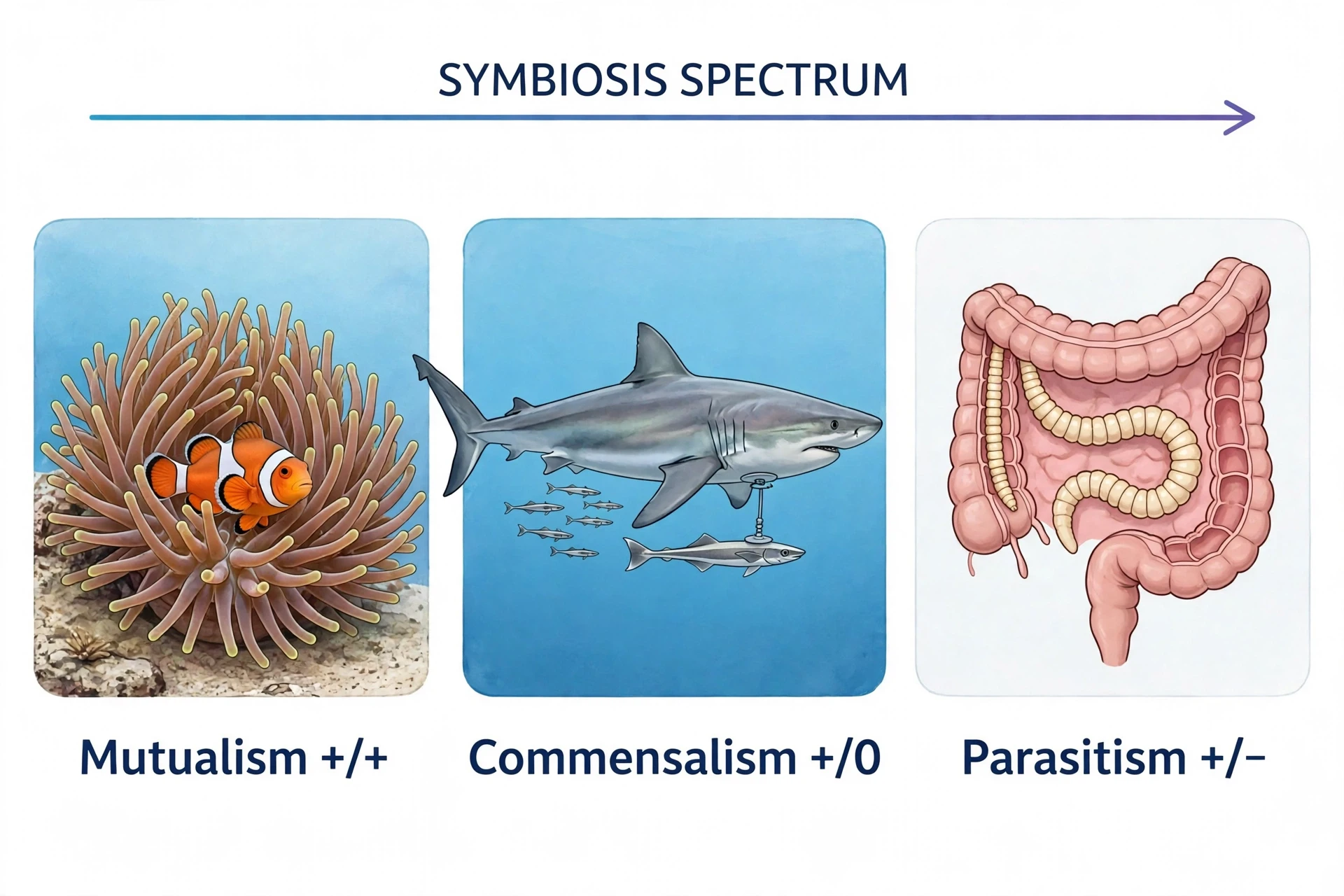
Mutualism, commensalism, and parasitism are three points on one sliding scale of symbiosis, sorted by who gains and who loses. Mutualism helps both partners, commensalism helps one and leaves the other untouched, and parasitism helps one at the other expense. Real relationships rarely sit neatly in a single box.
The three words are best understood as a shorthand for outcomes. In mutualism, both partners gain: each does better with the other than it would alone. In commensalism, one partner gains while the other is neither helped nor harmed in any measurable way. In parasitism, one partner gains while the other is harmed. Biologists often write these outcomes as plus and minus signs. Mutualism is plus-plus. Commensalism is plus-zero. Parasitism is plus-minus. The signs make the pattern easy to remember, but they hide as much as they reveal. A plus sign does not say how large the benefit is, or whether it changes with the seasons. A zero does not prove that there is truly no effect, only that no effect has been measured yet. A minus sign does not say whether the harm is a mild irritation or a threat to life. The signs are a starting point for thinking, not a final verdict.
Mutualism: both sides gain
Mutualism is the form of symbiosis that most people picture when they hear the word. Two different species help each other, and both come out ahead. The classic examples are everywhere once you start looking: flowers and their pollinators, the fungi that feed tree roots, the bacteria that help animals digest food. In each case, the partners exchange something the other needs. A plant cannot walk to another plant to deliver pollen, so it pays insects in nectar to carry the pollen for it. A fungus cannot photosynthesise, so it trades minerals and water from the soil for sugars made by a plant. The trade works because each partner has something the other lacks, and each can afford to give some of it away.
Commensalism: one gains, the other is untouched
Commensalism is the quietest form of symbiosis, and the hardest to prove. One organism benefits, and the other is not affected in any way that can be measured. The word comes from Latin words meaning "sharing a table," and the image is a guest who eats at the host's table without taking food from the host's plate. A bird nesting in a tree is a common textbook example: the bird gains shelter and a place to raise its young, while the tree is neither helped nor harmed by the nest. A remora fish that attaches itself to a shark gains transport and leftover scraps of food, while the shark, in the simplest telling, is unaffected by its passenger.
The difficulty is that “unaffected” is a strong claim, and it is easy to miss a small cost or a small benefit. A remora might remove parasites from the shark's skin, which would make the relationship mutualistic, or it might slow the shark down very slightly, which would make it mildly parasitic. Careful studies often find that relationships once labelled commensal turn out to involve small effects in one direction or the other. Commensalism is best treated as a working label: one side clearly gains, and the other shows no effect we can detect so far.
Parasitism: one gains, the other loses
Parasitism is the form of symbiosis that most people would rather not think about, but it is also one of the most common ways of life on Earth. A parasite lives in or on a host and takes resources from it, harming the host in the process. The harm can range from a mild drain on energy to severe disease and death. Fleas, ticks, lice, tapeworms, and the single-celled organisms that cause malaria are all parasites. Unlike a predator, which usually kills its prey quickly, a parasite generally keeps its host alive, at least for a while, because a dead host is no use to a parasite that needs a living body to feed on and reproduce in.
Parasitism is symbiosis in the broad sense, because the parasite and the host live in close association over a long period, and the parasite clearly benefits. This is why the broad definition of symbiosis matters. If symbiosis meant only mutual benefit, parasites would fall outside the word, and we would lose the ability to see that mutualism, commensalism, and parasitism are variations on one theme: different outcomes of living closely together. A parasite is not a failed mutualist or a broken partnership. It is a partnership in which the balance of costs and benefits has tipped entirely to one side, and natural selection has shaped the parasite to take as much as it can while keeping its host alive long enough to reproduce.
A continuum, not three boxes
The table below sets out the three types side by side. It is a useful summary, but it should be read with a warning: real relationships move along the spectrum. The same two species can sit at different points on the scale at different times, in different places, or at different stages of life.
| Type | Who benefits | Example |
|---|---|---|
| Mutualism | Both partners benefit | Clownfish and sea anemone: the fish gains shelter, the anemone gains food scraps and defence |
| Commensalism | One partner benefits, the other is unharmed | Remora fish and shark: the remora gains transport and scraps, the shark is not measurably affected |
| Parasitism | One partner benefits, the other is harmed | Tapeworm and its host: the worm gains food and shelter, the host loses nutrients |
The lichen is a good example of why the boxes leak. Some researchers describe lichens as mutualism, while others describe them as controlled parasitism by the fungus on its photosynthetic partner. Both descriptions capture part of the truth, and neither captures all of it. The balance can also shift within a single relationship over time. A cleaner fish that usually removes parasites may sometimes nip healthy tissue instead, sliding from mutualist toward parasite in a single visit. An oxpecker that usually removes ticks from a zebra may sometimes feed on blood from an open wound, sliding the other way.
Ecologists have a useful phrase for this: the mutualism-parasitism continuum. Every symbiotic relationship sits somewhere on a sliding scale between helping and harming, and its position can move. What decides the position is the balance of costs and benefits, and that balance depends on the environment. When food is scarce, a partner that takes a large share becomes more of a burden. When a new disease arrives, a partner that carries protection becomes more valuable. This is why biologists who study symbiosis spend so much time measuring costs and benefits in the field rather than simply assigning labels in a textbook. The label is a snapshot. The relationship is a moving picture.
4. Mutualism in Everyday Nature
Mutualism is not rare or exotic; it runs the everyday business of nature, from the flowers in a garden to the cleaning stations on a coral reef. Plants trade food for pollination, fish trade cleaning for meals, and birds trade pest control for a ride. These bargains keep whole communities fed, cleaned, and defended.
Pollinators and flowers
The partnership between flowers and pollinators is one of the most important mutualisms on land, because so much of the food that humans eat depends on it. Apples, almonds, coffee, squash, and many other crops need animal pollinators to set fruit. The details are finely tuned: a flower pollinated by bees often has a shape a bee can land on and a scent that guides it to the nectar, while a flower pollinated by moths at night is often pale and strongly scented, and one pollinated by hummingbirds is often red and tube-shaped. These are the result of long selection on both sides: plants that attract the right visitors get pollinated more reliably, and pollinators that learn which flowers repay a visit feed more efficiently.
The partnership is not free of cheating. Some insects take nectar without touching the pollen, biting a hole in the base of a flower to steal the reward. Some flowers produce little nectar but mimic the look or scent of a rewarding flower, tricking pollinators into visiting. These cheats do not destroy the system, because the honest trade still pays for most visitors most of the time. But the cheating is a reminder that mutualism is a bargain, not a friendship. Each side is still looking after its own interests, and the bargain holds because it pays, not because the partners are generous.
I learned how much work a single pollinator does on a morning when I sat beside a patch of lavender in a garden and tried to count the visits. I gave up after a few minutes, not because the bees stopped coming but because they came too fast to follow. A single bumblebee worked its way along the row, visiting flower after flower, pausing for a second or two at each one, its legs dusted yellow with pollen. It looked like a small, busy machine, but every visit was also a delivery: pollen from one plant to the next, carried on a body that was simply trying to feed itself. The lavender got its seeds. The bee got its meal.
Cleaner fish: the reef's health service
If flowers and bees are the classic mutualism on land, cleaner fish are the classic mutualism on a coral reef. Small fish, often brightly striped wrasses or gobies, set up "cleaning stations" at fixed spots on the reef. Larger fish, including predators that would normally eat a small fish without a second thought, swim to the station, slow down, and hold still, sometimes opening their mouths or spreading their gills, while the cleaners pick parasites, dead skin, and debris from their bodies. The cleaners get a meal. The clients get rid of parasites that would otherwise drain their energy and spread disease. The arrangement is so reliable that a single cleaner can inspect a remarkable number of clients in a day: National Geographic reports that one cleaner inspects more than two thousand clients daily, with some clients visiting a station more than a hundred times a day.
Oxpeckers: the birds on the backs of giants
On land, the counterpart to the cleaner fish is the oxpecker, a brown bird that rides on the backs of large mammals such as zebras, rhinoceroses, and buffalo across African grasslands. The birds pick ticks and other parasites from the animal's skin, and eat them. They also eat dead skin, and they raise the alarm with sharp calls when a predator approaches, warning their host as well as themselves. The mammal gains pest control and an early warning system. The bird gains food and a safe perch from which to watch for danger.
The oxpecker story carries a useful warning about neat labels. For many years, oxpeckers were presented in textbooks as a perfect example of mutualism. Later research found that the picture is more complicated: oxpeckers also feed on blood from open wounds, and they may keep wounds open by pecking at them, which slows healing. In some studies, animals with oxpeckers did not carry fewer ticks than animals without them. The relationship may still benefit both sides on balance, but it is not the simple win-win story it once seemed.
Clownfish and sea anemones
The most famous mutualism in the sea is the partnership between clownfish and sea anemones, a relationship that many readers will know from films and aquariums long before they meet it in a biology book. A sea anemone looks like a flower, but it is an animal, a relative of jellyfish, with tentacles armed with stinging cells called nematocysts. Most fish that touch those tentacles are stung, paralysed, and eaten. A clownfish, however, lives among the tentacles unharmed, sheltered from predators that will not risk the sting. In return, the clownfish defends the anemone from fish that would eat its tentacles, cleans away debris, and provides nutrients in the form of waste.
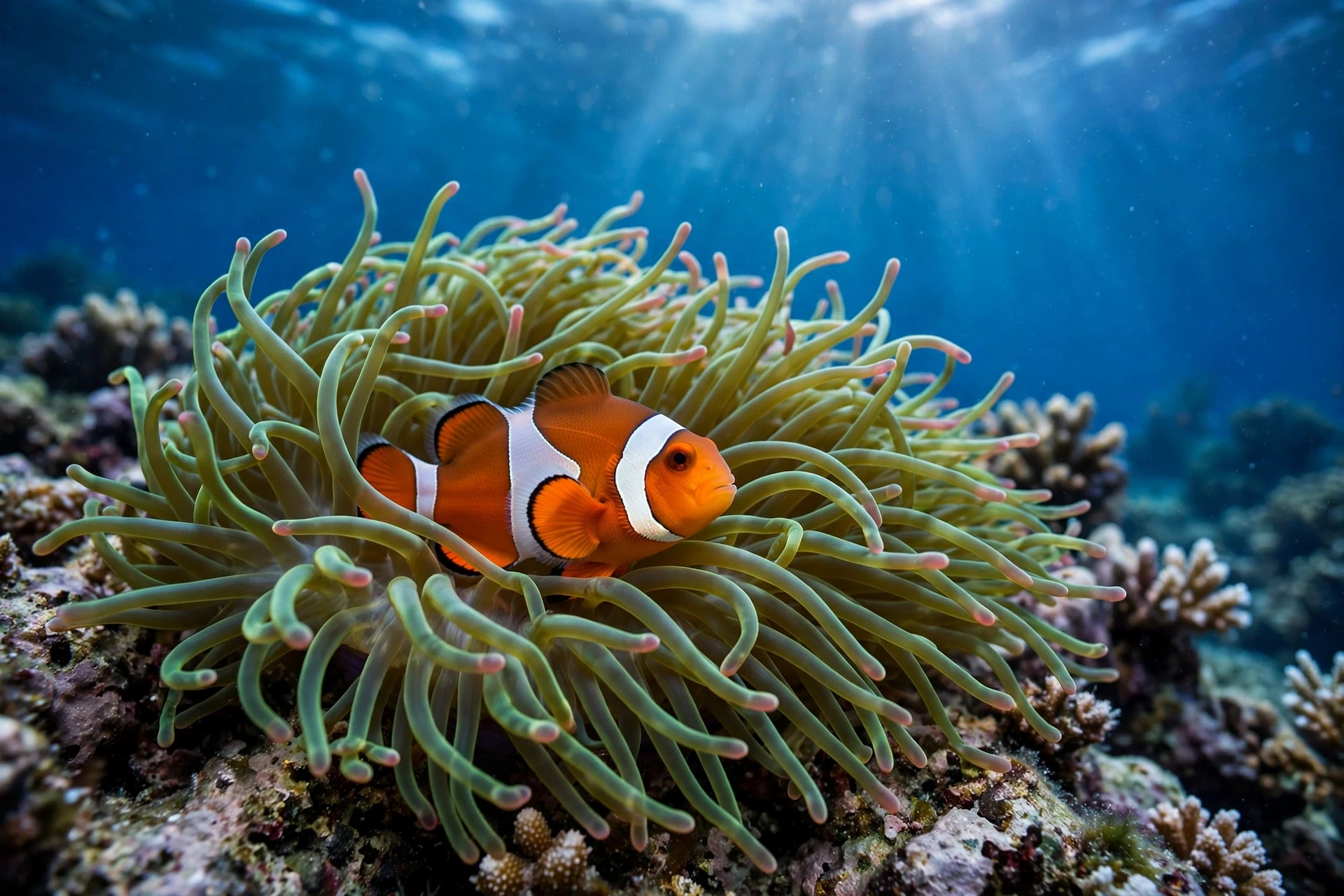
The clownfish's immunity is not magic. It is a coating of mucus, thicker than the mucus on most fish, that protects the fish from the stinging cells, and the coat grows thicker still as the fish lives among the tentacles. The fish also behaves carefully, never trying to eat the tentacles and touching them gently until the anemone stops firing its stingers. The relationship is strikingly exclusive: of the more than a thousand species of sea anemone in the ocean, only about ten species host clownfish, and only certain pairs are compatible. When they match, the bond is obligate: in the wild, clownfish rarely survive for long without an anemone.
The clownfish and the anemone are a useful pair to keep in mind as this article goes on. They are not the same species, they are not related, and they do not share a body in the way a lichen does. Yet they live together, depend on each other, and shape each other's lives. That story runs through ecosystems of every kind, from gardens to grasslands to coral reefs, and it is a central reason why biodiversity matters. When a partnership breaks, both sides suffer, and the community around them feels the loss.
5. The Endosymbiotic Theory: A Radical Idea
The endosymbiotic theory says that mitochondria and chloroplasts were once free-living bacteria, engulfed by another cell and kept instead of digested. First proposed in the early 1900s and revived by Lynn Margulis in 1967, it is now one of the best-supported ideas in biology.
It is hard to overstate how strange this claim sounded when it was first made. The textbook picture of evolution in the early twentieth century was a story of gradual change: small mutations, generation after generation, slowly reshaping a lineage. The endosymbiotic theory proposed something else entirely — that the most important step in the history of complex life was not a slow climb but a merger. Two separate organisms became one. A cell swallowed another cell, and instead of digesting it, kept it.
The first clear statement came from a Russian botanist named Konstantin Mereschkowski. His own research was on lichens — organisms that are themselves partnerships between a fungus and an alga or cyanobacterium — and lichens taught him to think of new organisms arising from unions rather than from slow divergence. In 1905 he published a paper on the nature and origin of chromatophores, the pigment-bearing bodies in plant cells, arguing that chloroplasts were descended from free-living cyanobacteria that had entered into symbiosis with another cell. In 1910 he expanded the argument into a full theory, The Theory of Two Plasms as the Basis of Symbiogenesis, proposing that complex cells had originated through episodes of symbiogenesis. He was building on an earlier observation by the German botanist Andreas Schimper, who had noted in 1883 that chloroplasts divide in a way that closely resembles the division of free-living cyanobacteria.
Mereschkowski got some things wrong. His claim that the nucleus itself arose by symbiogenesis is not supported by modern evidence. But his central insight — that chloroplasts were captured cyanobacteria — was right, and it was decades ahead of its time. A few years after his death, the Russian cytologist Ivan Wallin made the parallel case for mitochondria, proposing in 1927 that mitochondria were descended from ancient free-living bacteria. Wallin's book was mocked by many of his contemporaries, and for a long stretch the whole line of thinking fell quiet. The tools to test it did not yet exist.
That changed in the 1960s. In 1962, researchers first saw DNA inside chloroplasts, and in 1963 mitochondria were found to carry DNA of their own as well. Suddenly the old speculation had something testable behind it: if mitochondria and chloroplasts really were former bacteria, their DNA should look bacterial, and their way of making proteins should look bacterial too. Into this moment stepped a young biologist at Boston University named Lynn Margulis — publishing at the time under the name Lynn Sagan, from her first marriage to the astronomer Carl Sagan.
I first met Margulis's idea the way most students do, in a textbook diagram: a large cell with a smaller cell inside it, an arrow labelled "engulfment", and a caption that treated the whole thing as settled fact. The diagram made it look obvious, even a little dull. It was only years later, reading about how the paper behind it was received, that I understood what the diagram was hiding. The paper was not a tidy summary of agreed science. It was a provocation, written by a junior faculty member, arguing that the cell itself was a community built by merger.
Margulis's landmark paper, "On the origin of mitosing cells", appeared in the Journal of Theoretical Biology in March 1967. Drawing on microbiology, cytology, biochemistry and the fossil record, she argued that three structures of the eukaryotic cell — the mitochondria, the photosynthetic plastids, and the basal bodies of flagella — had all once been free-living prokaryotic cells that took up residence inside a host cell. She called the process endosymbiosis, and the larger pattern symbiogenesis: the origin of new organisms through lasting symbiosis.
Getting it published was a struggle. Margulis later recalled that the manuscript was rejected by about fifteen journals before the Journal of Theoretical Biology accepted it. That figure comes from her own account, and it is worth treating as her recollection rather than a counted tally — but the shape of the story is confirmed by the historical record. A 2017 retrospective in Molecular Biology of the Cell puts it plainly, noting that the paper was "reportedly having been rejected by more than a dozen journals before eventually finding a home".
Even after publication, acceptance was slow. For roughly another decade the theory was largely ignored, and when it was discussed it was often dismissed. What changed the picture was genetics. Through the 1970s and into the 1980s, DNA sequencing began to deliver the verdict that microscopy alone could not. In 1978, Robert Schwartz and Margaret Dayhoff showed by comparing protein and RNA sequences that the genes of mitochondria and chloroplasts were related to bacterial genes — mitochondria to the alphaproteobacteria, chloroplasts to the cyanobacteria. As sequencing improved, the case only strengthened. By the 1980s, what had been a fringe idea was textbook science.
It is worth being honest about the parts of Margulis's 1967 paper that did not survive. She argued that a third structure, the eukaryotic flagellum, had also begun as an endosymbiont — a spirochete-like bacterium swallowed by the host. That claim has not held up: there is no good evidence that flagella or the mitotic apparatus came from a bacterial symbiont, and the idea is not accepted today. But the failure of one part of the 1967 paper does not weaken the parts that were confirmed. Science does not work by accepting or rejecting a thinker whole. It keeps what the evidence supports and discards the rest.
What the theory claims, in its modern form, is specific. It does not say that every organelle came from a bacterium, or that symbiosis explains everything about the cell. It says that two particular organelles — mitochondria and plastids such as chloroplasts — descend from free-living bacteria that were engulfed by an ancestral host cell and retained rather than digested. The mitochondrion came first, in the ancestor of all living eukaryotes, from an alphaproteobacterium. The chloroplast came later, in the lineage that became algae and land plants, from a cyanobacterium. Each merger happened once, or at least once successfully, and every mitochondrion and chloroplast alive today descends from that single ancient partnership.
6. Mitochondria: The Bacterium Inside Every Cell
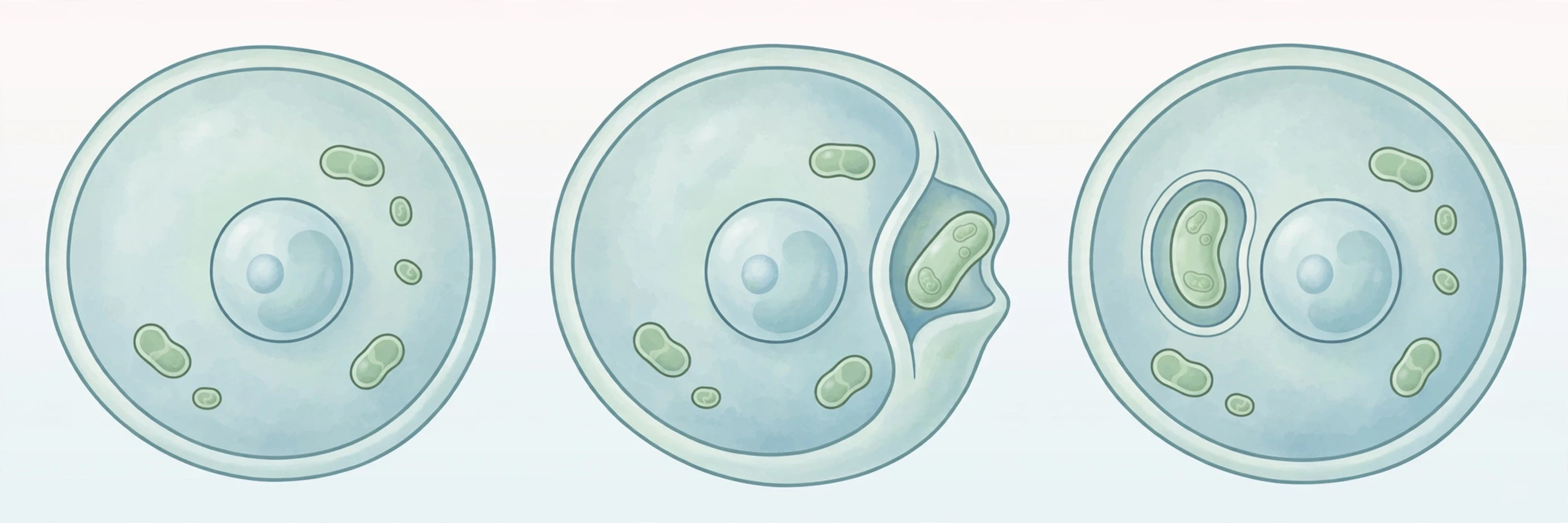
Mitochondria are the descendants of an alphaproteobacterium engulfed by an archaeal host cell roughly 1.5 to 2 billion years ago. The bacterium survived, specialised in making energy, and surrendered most of its genes to the host nucleus — leaving a small circular genome, a double membrane, and a partnership neither side can now live without.
Every cell in your body carries this history. With one rare exception — a gut protist called Monocercomonoides that has lost its mitochondria entirely — every known eukaryote either has mitochondria or carries reduced remnants of them, and every one of them carries mitochondrial genes in its nucleus. That universality is itself a clue. If mitochondria had been acquired many times by many lineages, the pattern would look patchy. Instead it looks like a single event that happened once, in the ancestor of all eukaryotes, and was then inherited by everything that followed: fungi, animals, plants, and every single-celled eukaryote in between.
To picture it, start with the two partners. The host was probably an archaeon — a single-celled organism from the same domain of life as the microbes that live in hot springs and oxygen-free mud. Modern evidence points to a group called the Asgard archaea as the closest known relatives of the host lineage. The guest was an alphaproteobacterium, a member of a large bacterial group whose modern relatives include both free-living marine bacteria and the Rickettsia bacteria that cause typhus. Phylogenetic studies place mitochondria closest to the Rickettsiales, a lineage of bacteria that live inside other cells — a suggestive detail, since a bacterium already comfortable inside a host would have had a head start on the transition from guest to organelle.
The setting was an ocean that was changing. About 2.4 billion years ago, cyanobacteria had begun releasing oxygen as a waste product of photosynthesis, and oxygen was slowly building up in the atmosphere and the shallow seas. Oxygen is dangerous — it damages organic molecules — but it is also an opportunity. A cell that can use oxygen to burn food completely extracts far more energy from each molecule than a cell that ferments without it. The alphaproteobacterium the host engulfed was an aerobic respirer: it could run that oxygen-burning chemistry. The deal, in outline, was straightforward. The host provided shelter and food molecules. The bacterium provided energy, in the form of ATP, the chemical currency every cell spends to do work. How the engulfment itself happened is still debated, and the fossil record cannot settle it — cells this small and soft leave almost no fossils. Molecular clocks, which estimate the age of a split from the genetic differences accumulated since, place the merger in the 1.5-to-2-billion-year range, with different methods giving different answers inside it. Treat any single number as an estimate, not a fact carved in stone.
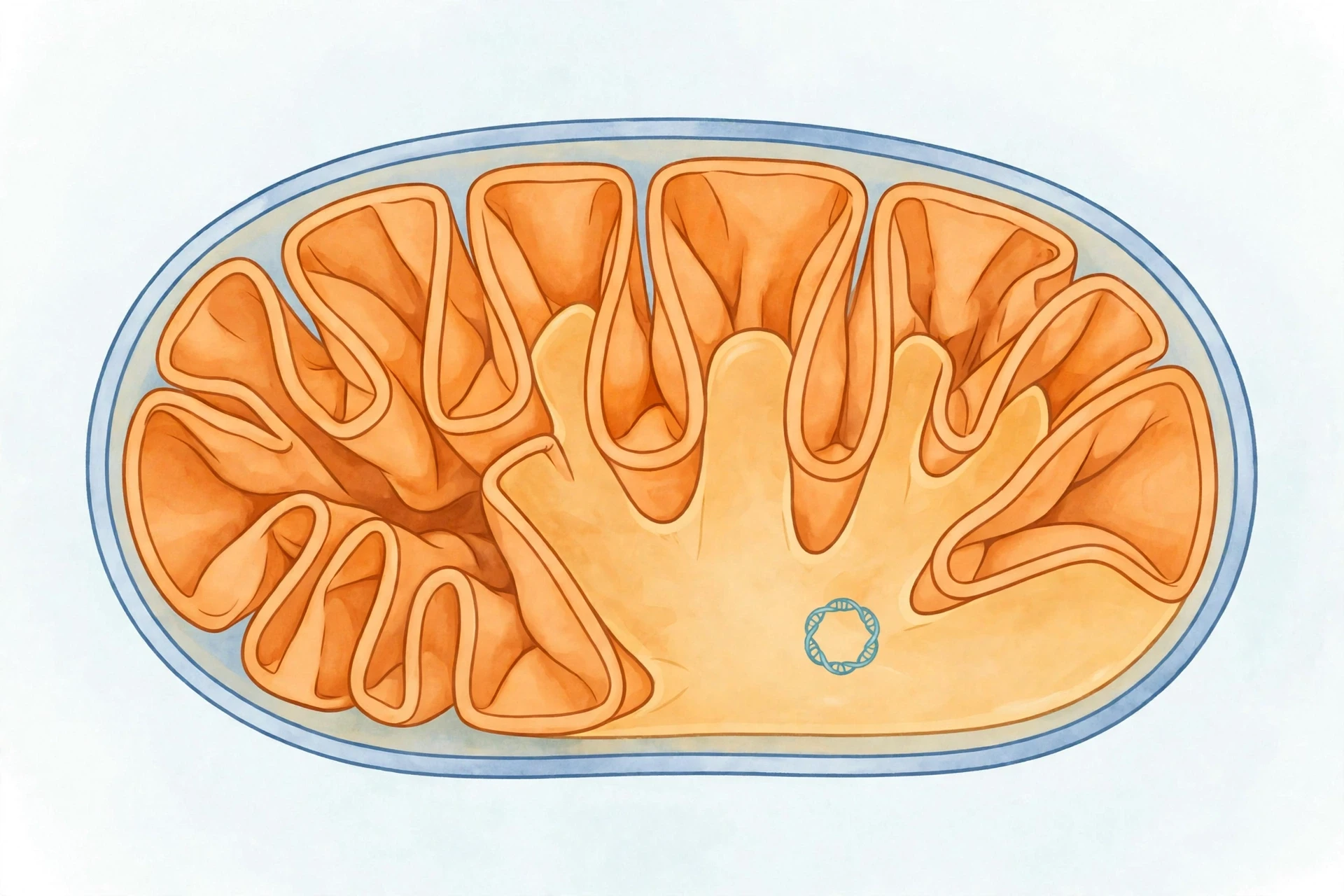
What the bacterium became is worth looking at closely, because a mitochondrion still wears its ancestry on its structure. It is wrapped in two membranes. The outer membrane is the scar of the engulfment itself — derived, in the standard account, from the vesicle that enclosed the bacterium when it was taken in. The inner membrane is the bacterium's own plasma membrane, and it is folded into deep ridges called cristae, which pack an enormous surface area into a tiny volume. Those folds are where the chemistry happens: the electron transport chain, a series of protein complexes that pass electrons from food molecules to oxygen, pumping protons across the membrane as they go, and then letting the protons flow back through ATP synthase, a rotary motor that stamps out ATP. A single human cell can contain hundreds or thousands of mitochondria. You can read a fuller description of these organelles in our Cell Biology article.
The most famous clue to the mitochondrion's past sits in its matrix, the space enclosed by the inner membrane: a small loop of DNA, circular like a bacterial chromosome, carrying its own genes. In humans that loop is 16,569 base pairs long — a speck beside the roughly 3.3 billion base pairs of the nuclear genome — and it carries 37 genes: 13 that code for proteins, 22 for transfer RNAs, and 2 for ribosomal RNAs. Those 13 proteins are all core subunits of the electron transport chain, the machinery of aerobic respiration. Everything else the mitochondrion needs — more than a thousand proteins in a human cell — is encoded in the nucleus, made in the cytosol, and imported across the membranes.
That tiny genome has consequences that reach into human life. Mitochondrial DNA is inherited almost entirely from the mother, because the egg supplies the mitochondria of the embryo while the sperm contributes essentially none. That maternal inheritance is what makes mtDNA a tool for tracing ancestry — including the famous "mitochondrial Eve", the woman whose mtDNA is ancestral to that of all living humans. It is also what makes mitochondrial disease so difficult: mutations in mtDNA are passed down the maternal line, and because each cell carries many copies of the genome, a person can carry a mixture of healthy and mutated copies, with symptoms depending on the balance. Nature's Scitable guide to mtDNA and mitochondrial diseases explains the 37 genes and what happens when they go wrong.
There is a second reason the mitochondrion matters beyond energy, and it is the reason some biologists think the merger was the key event in the history of life rather than merely an important one. A bacterium faces a hard limit: it must carry its genes in the same compartment where it makes its energy, and as it grows larger it cannot make enough energy per gene to support a bigger genome. A cell with mitochondria escapes that limit. It can hold hundreds of energy-making compartments while keeping its genes in one nucleus, so it can afford a genome hundreds of times larger than a bacterium's and the complexity that genome encodes. This is the argument made by Nick Lane and William Martin, among others: that the mitochondrion did not just power the complex cell, it made the complex cell possible.
That is why the mitochondrion is the right place to start any serious account of symbiosis. It is not a curiosity or an edge case. It is the partnership on which every complex organism is built, including the reader of this article. You are, in a literal sense, a walking symbiosis: an archaeal host carrying a bacterial power station in every cell, running on an arrangement negotiated about two billion years ago, and still running today.
7. Chloroplasts: The Green Capture
Chloroplasts are the descendants of a cyanobacterium engulfed by a eukaryotic cell roughly 1.6 billion years ago, in a second great merger that gave one lineage of eukaryotes the power of photosynthesis. Every green leaf, every blade of grass and every alga in the ocean runs on this captured bacterium.
The first merger, the one that made mitochondria, happened in the ancestor of all eukaryotes. The second happened later, and only once, in a single lineage. A eukaryote that already carried mitochondria engulfed a cyanobacterium — a photosynthetic bacterium, a member of the group that had oxygenated Earth's atmosphere in the first place — and kept it. The descendants of that cell are the Archaeplastida: the red algae, the green algae, the glaucophytes, and the land plants. Every plant you have ever seen is a descendant of that one captured cell. The event is called primary endosymbiosis, because the partner was a free-living bacterium taken directly into a host, and it is the reason photosynthesis in eukaryotes has a single origin.
The timing is an estimate, like the mitochondrial date, and it carries the same honest uncertainty. Molecular-clock studies cluster the event around 1.5 to 1.6 billion years ago, with fossil-based estimates reaching back to about 1.4 to 1.7 billion years. A useful anchor is the fossil Bangiomorpha pubescens, a red alga from rocks about 1.05 billion years old: if red algae already existed by then, the capture that created them must be older still.
Who exactly was captured is a question that has sharpened considerably in recent years. Phylogenomic studies place plastids among the cyanobacteria, closest to a group of early-branching freshwater cyanobacteria related to a recently discovered organism called Gloeomargarita lithophora. That finding, published by Ponce-Toledo and colleagues in 2017, was a surprise in one respect: it pointed to a freshwater setting for the origin of plastids, where a marine origin had often been assumed. The details are still being refined, but the broad identification is settled. The chloroplast is a cyanobacterium, domesticated.
What the cyanobacterium brought with it was photosynthesis, and photosynthesis changed the host's way of life completely. A cell that had survived by eating other organisms could now make its own food from sunlight, water and carbon dioxide. The host kept its mitochondria — it still needed to burn food for energy, and photosynthesis makes food rather than spending it — so the new cell carried two bacterial descendants at once, one that made food from light and one that burned food for energy. That combination is the plant cell, and it is why plants can stand still in the sun and grow.
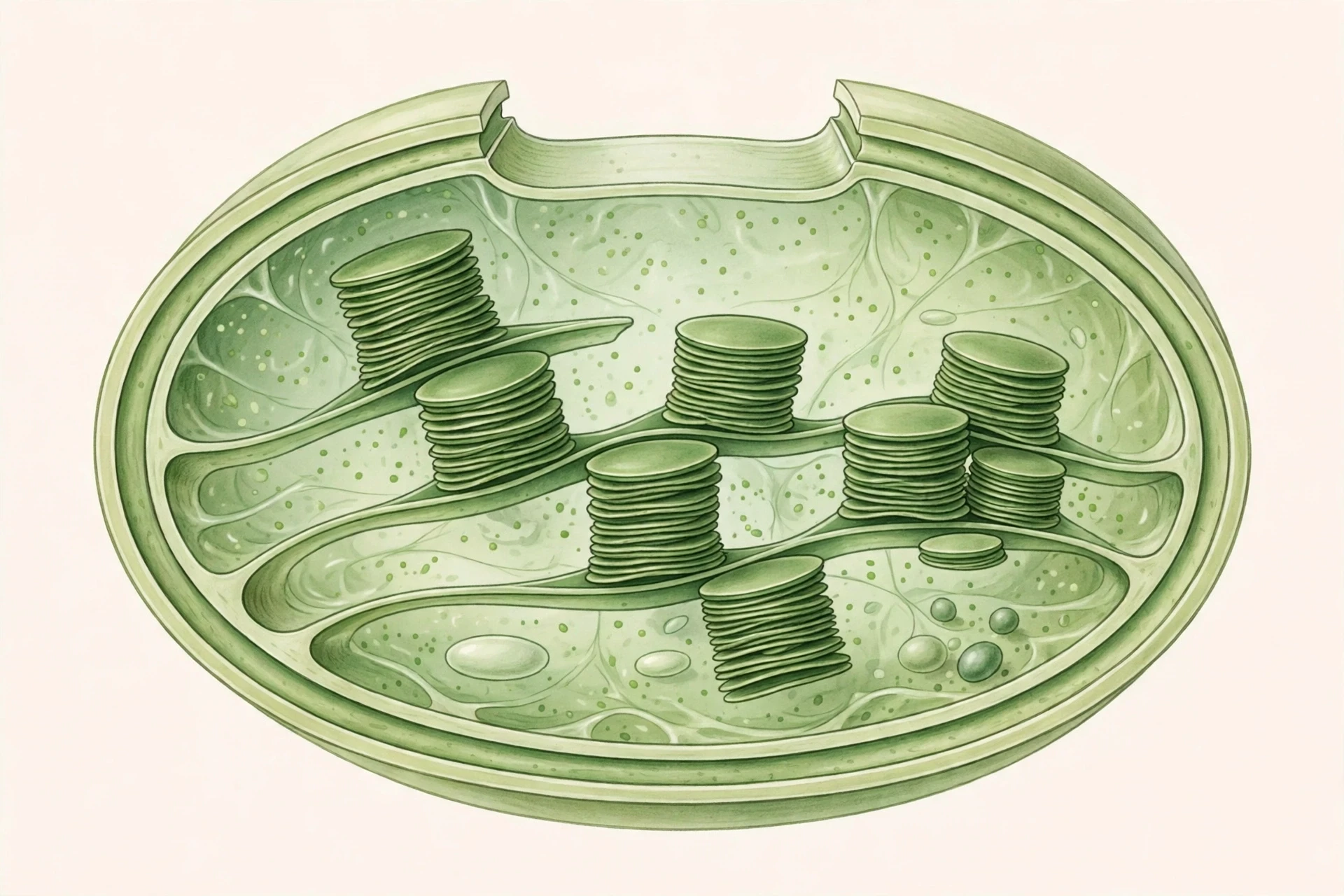
The chloroplast's structure tells the same story as the mitochondrion's, in a greener dialect. It has two membranes, an outer one from the engulfment and an inner one that was the bacterium's own. Inside, instead of cristae, it carries stacks of flattened sacs called thylakoids, piled into grana like stacks of coins. The thylakoid membranes hold the chlorophyll and the protein complexes that capture light, and the fluid around them, the stroma, holds the enzymes of the Calvin cycle, which take carbon dioxide and build it into sugars. The chloroplast keeps its own small circular genome, just as the mitochondrion does, and just as reduced: a typical land-plant chloroplast genome is about 150,000 base pairs carrying roughly 130 genes, a small fraction of the thousands a free-living cyanobacterium carries.
Which brings us to the question every child asks sooner or later: why are plants green? The answer is a side effect of the chemistry, and it is often told backwards. Chlorophyll, the pigment at the heart of photosynthesis, absorbs light most strongly in the blue and red parts of the spectrum, and absorbs green light poorly. The green light bounces off the leaf and reaches your eye, so the leaf looks green. Plants are not green because green light is useful to them; they are green because green light is the part of sunlight chlorophyll leaves alone. It is a quirk of the pigment the cyanobacterium happened to use, preserved for a billion and a half years, and it colours every forest and field on Earth.
The consequences of the green capture are hard to overstate. Before it, photosynthesis belonged to bacteria. After it, photosynthesis belonged to eukaryotes as well, and eukaryotes could build large, complex, multicellular bodies powered directly by sunlight. Algae spread through the oceans; much later, their descendants colonised the land, and land plants went on to build forests, soils and the food webs that feed nearly every animal alive, including us. The food on your plate, the wood in your house, the oxygen in the room you are sitting in — a large share of it traces back to a single cell that swallowed a cyanobacterium and did not digest it.
8. The Evidence That Convinced Biology
The endosymbiotic theory is accepted today not because of one decisive discovery but because many independent lines of evidence point the same way: mitochondria and chloroplasts carry their own circular DNA, use bacterial-style protein-making machinery, divide by splitting in two, are wrapped in double membranes with bacterial features, and have left thousands of their genes in the host nucleus.
That last point matters, because it is how science actually settles a question like this. A single resemblance can be a coincidence, or the result of two unrelated structures solving the same problem in the same way. But when a dozen resemblances all point to the same ancestor, and when the DNA sequences line up with the predicted bacterial relatives, the coincidence explanation collapses.
Their own DNA, in a bacterial shape
The strongest single line of evidence is the genomes themselves. Mitochondria and chloroplasts each carry their own DNA, separate from the DNA in the nucleus, and that DNA is circular — a single loop, like a bacterial chromosome, rather than the long linear chromosomes of the nucleus. The sequences of those genes match bacterial genes, not host genes. Mitochondrial genes group with the alphaproteobacteria in every phylogenetic analysis; chloroplast genes group with the cyanobacteria. When Robert Schwartz and Margaret Dayhoff demonstrated those relationships from sequence comparisons in 1978, it was the moment the theory moved from plausible speculation to supported science.
Ribosomes that speak bacterial
Both organelles make some of their own proteins, and the machinery they use to do it is bacterial in design. Chloroplast ribosomes are 70S ribosomes, the same size class as bacterial ribosomes, and distinct from the larger 80S ribosomes of the eukaryotic cytosol. Mitochondrial ribosomes are a little more complicated — in mammals they sediment at 55S, having shrunk and changed shape over a billion years of evolution — but their RNA and protein components are still recognisably bacterial in origin, and they share bacterial quirks such as starting protein synthesis with N-formylmethionine, the same starter molecule bacteria use.
Division by splitting, not by being built
New mitochondria and chloroplasts are never made from scratch. They arise only by the division of existing organelles, in a process that closely resembles bacterial binary fission: the organelle grows, copies its DNA, and pinches in two. A cell that divides distributes its mitochondria and chloroplasts to its daughters along with its cytoplasm; it does not manufacture fresh ones from raw materials. This is a simple observation with a sharp implication. If mitochondria were ordinary organelles built by the cell, the cell could build them whenever it needed them. Instead they behave like residents with their own reproductive cycle, one that the host coordinates and controls but does not replace.
Two membranes, and what is in them
Both organelles are wrapped in two membranes, and the membranes are not the same. In the standard account, the inner membrane is the captured bacterium's own plasma membrane, while the outer membrane came from the vesicle that enclosed it during engulfment. The chemistry supports that reading. The outer membranes of mitochondria and chloroplasts contain porins — channel proteins that are characteristic of bacterial outer membranes — and the inner mitochondrial membrane contains cardiolipin, a lipid found in bacterial membranes but not in other eukaryotic membranes. These are molecular fingerprints: not proof on their own, since membrane number alone cannot establish ancestry, but exactly the fingerprints you would expect if the inner membrane were bacterial and the outer membrane were host-derived. OpenStax's account of eukaryotic origins lays out the double-membrane argument and its limits clearly.
The genes that moved house
The final and in some ways most telling piece of evidence is written in the nucleus. Thousands of genes in the nuclear genome of every eukaryote are of bacterial origin, transferred from the endosymbiont to the host over evolutionary time in a process called endosymbiotic gene transfer. The proteins these genes encode are made in the cytosol and imported back into the organelle. This is why the mitochondrion can get by with 13 protein-coding genes of its own while needing more than a thousand proteins to function: the rest of its workforce is employed by the nucleus and commutes in each day. The same is true of the chloroplast, where more than 90 percent of the ancestral cyanobacterial genes have been lost or relocated to the nucleus.
Putting the evidence together
No one of these observations would be enough. Circular DNA could be a coincidence. A double membrane could arise in other ways. Binary fission could be convergent. But the observations do not stand alone — they interlock. The DNA is circular and bacterial in sequence. The ribosomes are bacterial in design. The division resembles bacterial fission. The membranes carry bacterial lipids and proteins. And the nucleus is full of transferred bacterial genes. That is why the theory convinced biology, and why it has survived four decades of sequencing that could have overturned it at any point. The table below summarises the comparison.
| Evidence trait | Mitochondria | Chloroplasts | Free-living bacteria |
|---|---|---|---|
| Own genome | Small circular DNA, 16,569 base pairs and 37 genes in humans | Small circular DNA, about 150,000 base pairs and around 130 genes in land plants | Circular chromosome with thousands of genes |
| Ribosomes | Bacterial-type ribosomes, 55S in mammals, using N-formylmethionine | 70S ribosomes, as in bacteria, using N-formylmethionine | 70S ribosomes using N-formylmethionine |
| Division | Divide by fission from existing mitochondria; never made from scratch | Divide by fission from existing chloroplasts; never made from scratch | Reproduce by binary fission |
| Membranes | Double membrane; inner membrane contains cardiolipin, a bacterial lipid | Double membrane; inner membrane is the cyanobacterium's own | Single plasma membrane, often with an outer membrane in Gram-negative species |
| Porins | Porin channels in the outer membrane | Porin channels in the outer membrane | Porins in the outer membrane of Gram-negative bacteria |
| Gene transfer | Most ancestral genes moved to the nucleus; over 1,000 mitochondrial proteins are nuclear-encoded in humans | More than 90 percent of ancestral genes lost or moved to the nucleus | Genes stay in the bacterial genome |
| Antibiotic sensitivity | Protein synthesis sensitive to some antibiotics that target bacterial ribosomes | Protein synthesis sensitive to some antibiotics that target bacterial ribosomes | Protein synthesis blocked by the same antibiotics |
Two cautions belong here, because a good account of evidence says what the evidence does not show as well as what it does. First, the theory as confirmed covers mitochondria and plastids, not every organelle. The nucleus, the endoplasmic reticulum and the Golgi apparatus have no comparable bacterial signature, and the peroxisome — sometimes proposed as a third endosymbiont — has no DNA of its own at all. Second, the details remain live research. The identity of the archaeal host, the order in which the nucleus and the mitochondrion appeared, and the exact timing of both mergers are all still being worked out.
9. Beyond Mitochondria and Chloroplasts
Endosymbiosis did not stop with mitochondria and chloroplasts. Once a cell had captured a photosynthetic partner, other cells captured the whole photosynthetic cell, plastid and all, in a second round called secondary endosymbiosis. And the process is still running: a freshwater amoeba and a marine alga show organelles being born in front of our eyes.
A plastid, second-hand
Primary endosymbiosis gave the world its first plastids when a heterotrophic eukaryote engulfed a cyanobacterium. The descendants of that event — red algae, green algae, glaucophytes and, eventually, land plants — are the Archaeplastida. But photosynthesis did not stay inside that one family. It spread, cell by cell, through a second round of engulfment.
In secondary endosymbiosis, the swallowed partner is not a bacterium but a whole eukaryotic alga that already carries a plastid. The engulfing cell keeps the plastid and digests or discards most of the rest. The result is a plastid wrapped in extra membranes — usually three or four, instead of the two that surround a primary plastid — because each layer is a relic of a cell that once lived free. You can still read that history in the membranes today: the inner two belonged to the original cyanobacterium, while the outer layers came from the engulfed alga and the vacuole that swallowed it.
This second-hand inheritance explains why photosynthesis turns up in such unrelated corners of the tree of life. Diatoms, the glass-walled algae that produce a large share of the ocean's oxygen, carry plastids from a red alga swallowed long ago. So do brown algae, including the kelps that build underwater forests, and the dinoflagellates behind glowing bays and toxic red tides. Their plastids contain chlorophyll a and c plus the brown pigment fucoxanthin, inherited from their red-algal ancestor.
Some lineages kept a receipt. The cryptomonad alga Guillardia theta still carries a nucleomorph, a shrunken remnant of the engulfed red alga's nucleus, parked between the plastid membranes with a tiny genome of its own. It is a fossil of the takeover, still legible after hundreds of millions of years. Other lineages went further: some dinoflagellates replaced their plastid with a new one stolen from a different alga, a step called tertiary endosymbiosis, and some sea slugs skip ownership altogether, stealing chloroplasts from the algae they eat and running them for weeks in their own tissues, a habit called kleptoplasty. Endosymbiosis, in other words, is not a single ancient accident. It is a strategy that evolution keeps rediscovering — and diatoms alone, the product of one such second-hand deal, fix an enormous share of the carbon in the sea.
Paulinella: watching an organelle being born
If secondary endosymbiosis shows how plastids spread, a small freshwater amoeba shows how they begin. Paulinella chromatophora is a shelled amoeba, a member of the Cercozoa, that carries two sausage-shaped photosynthetic bodies called chromatophores. They look like chloroplasts and work like chloroplasts, but they are not related to the plastids of plants and algae. They are a second, independent primary endosymbiosis — a separate experiment in turning a cyanobacterium into an organelle.
The chromatophore descends from a cyanobacterium close to modern Synechococcus, and the merger is young: it happened roughly 90 to 140 million years ago, often rounded to about 100 million years. That is recent beside the 1.5 billion years since the first plastid, and the youth shows. The chromatophore genome is still about a million base pairs long and holds roughly 900 genes, far more than a chloroplast keeps, and around 70 genes have moved to the host nucleus so far. The host compensates for what the chromatophore has lost by importing hundreds of nucleus-encoded proteins across its two membranes, and the two partners exchange metabolites continuously. Research on the chromatophore of Paulinella describes an organelle caught mid-transformation: integrated enough to depend on its host, but still carrying much of the genetic baggage of a free-living bacterium.
That is what makes Paulinella so valuable. The origin of chloroplasts is a story told from fossils and genomes, with the opening chapters lost. Here the same story is playing out in a creature alive today, in ordinary pond water. It confirms that the leap from guest to organelle is not a miracle that happened once. Given the right conditions, it can happen again — and apparently it has, at least twice.
The nitroplast: a fourth organelle, found in 2024
In April 2024, the list of known organelles grew by one. The newcomer does not photosynthesise or burn fuel. It fixes nitrogen, pulling inert nitrogen gas from the air and seawater and turning it into a form living things can use. Until that year, nitrogen fixation was thought to be a trick only bacteria and archaea could perform. A marine alga proved otherwise.
The story began in 1998, when ocean ecologist Jonathan Zehr and colleagues at the University of California, Santa Cruz found a mysterious nitrogen-fixing gene sequence in Pacific seawater. It belonged to an unknown cyanobacterium they called UCYN-A, short for unicellular cyanobacterial group A. Years later, UCYN-A was found living inside the single-celled marine alga Braarudosphaera bigelowii, a haptophyte. It had a stripped-down genome and no ability to photosynthesise or fix carbon, and it swapped fixed nitrogen for fixed carbon from its host. For years it was described as an endosymbiont. Then Tyler Coale, working in Zehr's laboratory, showed it was something more.
Using soft X-ray tomography to image dividing algal cells, Coale and colleagues showed that the UCYN-A body — specifically the UCYN-A2 sublineage — divides in step with its host and is split evenly between daughter cells, just as mitochondria and plastids are. It also imports proteins encoded by the algal nucleus, the hallmark of an organelle rather than a lodger. On that evidence they named it the nitroplast, the first known nitrogen-fixing organelle, in a paper published in Science in 2024. A report on the first known nitroplasts describes the moment Coale realised the structure was, in his words, behaving as an organelle.
The nitroplast matters for two reasons. Ecologically, B. bigelowii and its nitroplast are among the most widespread nitrogen fixers in the ocean, feeding usable nitrogen into waters where it limits growth. Evolutionarily, the nitroplast is a fourth independent case of a bacterium becoming an organelle, alongside mitochondria, plastids and the chromatophore of Paulinella — and it is the least finished of them. Whether the other UCYN-A sublineages have travelled as far is still an open question. What is settled is the pattern: endosymbiosis keeps writing new chapters, and the textbook list of organelles is not closed.
10. Symbiosis in the Human Body
Your body is a habitat. Trillions of microbes live in your gut, most of them bacteria, and they are not passengers: they digest fibre your own enzymes cannot touch, make vitamins, and train your immune system. You are, in a real biological sense, a walking symbiosis.
An ecosystem with a pulse
The human gut holds one of the densest microbial communities known to science. A careful recount published in 2016 put the number at roughly 38 trillion bacterial cells in a typical adult, against roughly 30 trillion human cells — a ratio of about 1.3 to 1, not the ten-to-one figure that older textbooks repeated. Most of those bacteria live in the colon, packed at densities of up to a trillion cells per gram of contents. They are not one species but thousands, dominated by two great phyla, the Firmicutes and the Bacteroidetes, with smaller numbers of Actinobacteria, Proteobacteria and others, plus archaea, fungi and viruses. No two people carry exactly the same mix: the United States National Institutes of Health Human Microbiome Project, which sampled hundreds of healthy adults, found a shared core of functions wrapped in a highly personal cast of species.
Calling this community a microbiome is accurate but bloodless. It behaves like an ecosystem, with food webs, competition, succession and collapse. Newborns are colonised at birth and through early feeding, and the community assembles over the first years of life, shaped by diet, illness, medicines and environment. It shifts when you travel, when you change what you eat, and when you take antibiotics. It is, in the language of this article, a symbiosis — thousands of partnerships, mutualistic and commensal and occasionally parasitic, running inside a single host that provides warmth, shelter and a steady delivery of food.
I felt that partnership before I understood it. Years ago, after a course of antibiotics for a dental infection, my digestion stayed unsettled for weeks: ordinary meals sat heavily, foods I had eaten all my life suddenly disagreed with me, and my appetite went strange. Nothing was seriously wrong, and it passed on its own, but the experience left a clear impression. Something inside me had been knocked sideways, and it was rebuilding itself on its own schedule, not mine. I had thought of my body as mine alone. It was the first time I understood, in my gut rather than in a textbook, that a large part of digestion is outsourced — and that the tenants can go on strike.
What the microbes do for us
The gut microbiome earns its keep in several ways, and the first is digestion. Human enzymes cannot break down most dietary fibre or resistant starch. Gut bacteria can. In the oxygen-poor colon they ferment these carbohydrates into short-chain fatty acids — mainly acetate, propionate and butyrate — along with gases. Butyrate is the main energy source for the cells lining the colon, and it helps maintain the gut barrier and calm inflammation. Without bacterial fermentation, a large part of the energy in plant food would pass straight through us.
The second job is manufacturing. Certain gut bacteria synthesise vitamins the human body cannot make, including vitamin K and several B vitamins such as folate and biotin. They also help process bile acids, which matters for digesting fats, and they break down compounds in food that our own enzymes cannot handle. Research on diet, the gut microbiome and disease risk describes a community that functions, in effect, as an extra metabolic organ — one we acquire after birth rather than inheriting in our genes.
The third job is defence, and it is the subtlest. The gut lining is the largest surface where the body meets the outside world, and the immune system learns there what to tolerate and what to attack. Gut microbes train that judgement from infancy: they stimulate mucus production, strengthen the tight junctions between gut cells, and interact constantly with the gut-associated immune tissue. They also defend their territory directly, crowding out invaders and producing antibacterial compounds that keep competitors in check. This is competitive exclusion doing immune work — the resident community making it hard for a pathogen to find a foothold. When the community is disrupted, that protection thins, which is one reason gut infections often follow a course of antibiotics.
None of this makes the microbiome a simple friend. It is a negotiated settlement, and the terms can change. Some resident species can turn harmful if they escape the gut or if the community loses diversity. Diet shapes the settlement daily: fibre feeds the fermenters that make butyrate, while a diet low in fibre starves them. The partnership is mutualistic in the aggregate, but it is built from thousands of individual bargains, each enforced by chemistry rather than goodwill.
Living with the settlement
Because the gut microbiome is an ecosystem, it responds to stewardship rather than commands. You cannot order it to be healthy, but you can feed it well: varied plant foods, fibre, fermented foods and a diverse diet support a diverse community, and diversity is the best single marker of a resilient microbiome. Antibiotics are sometimes necessary, and when they are, the community usually recovers — but recovery takes time, and repeated disruption leaves a mark, which is why antibiotics deserve respect rather than casual use. If you want to read more about that side of the story, our article on antibiotic resistance explains how overuse changes bacterial communities for the worse.
Medicine is learning to work with the microbiome rather than against it. The clearest success so far is faecal microbiota transplantation, in which a screened donor community is transferred to a patient with recurrent Clostridioides difficile infection, a gut infection that often follows antibiotics. Restoring the community restores the competition that keeps the pathogen down, and cure rates are high where antibiotics alone had failed. Probiotics are a far blunter tool, and the evidence for most products is still thin; a swallowed strain must survive the stomach, find a niche and persist, and most do not. The honest state of the science is that we understand the principles of this symbiosis far better than we can engineer it.
The same logic extends beyond the gut: skin, mouth and lungs each carry their own microbial communities, as our guide to microbiology describes. Each is a symbiosis in miniature, and each reminds us of the same point: a human being is not a single organism acting alone. We are a consortium, and much of what we call health is the sound of thousands of partnerships working at once.
11. Symbiosis in the Sea
The sea runs on partnerships that look impossible. Corals farm algae inside their own cells, giant worms at volcanic vents eat nothing at all and let bacteria feed them, and a thumb-sized squid lights itself with bacteria it flushes out every morning. In the ocean, symbiosis is not a curiosity; it is the operating system.
Coral: farming sunshine
A coral polyp is an animal, a relative of jellyfish and sea anemones, and it builds its limestone skeleton in water so poor in nutrients that it should be a desert. The trick is a tenant. Inside the cells of the polyp's inner tissue live millions of single-celled dinoflagellate algae called zooxanthellae, members of the family Symbiodiniaceae. They photosynthesise, and they pass as much as 90 percent of the organic material they produce — sugars, glycerol and amino acids — to the coral. That stolen sunshine covers most of the coral's energy needs and powers the growth of the reef itself.
The coral pays for the service with shelter inside its tissues, protection from grazers, and a steady supply of carbon dioxide and nitrogenous waste. The algae also give the coral its colour: a polyp is nearly transparent on its own, and the golds, greens and browns of a healthy reef are the pigments of its tenants. NOAA explains the coral-algae partnership in plain terms: the algae feed the coral, the coral houses the algae, and the reef is what they build together. To see how reefs fit into the wider ocean, read our article on coral reefs.
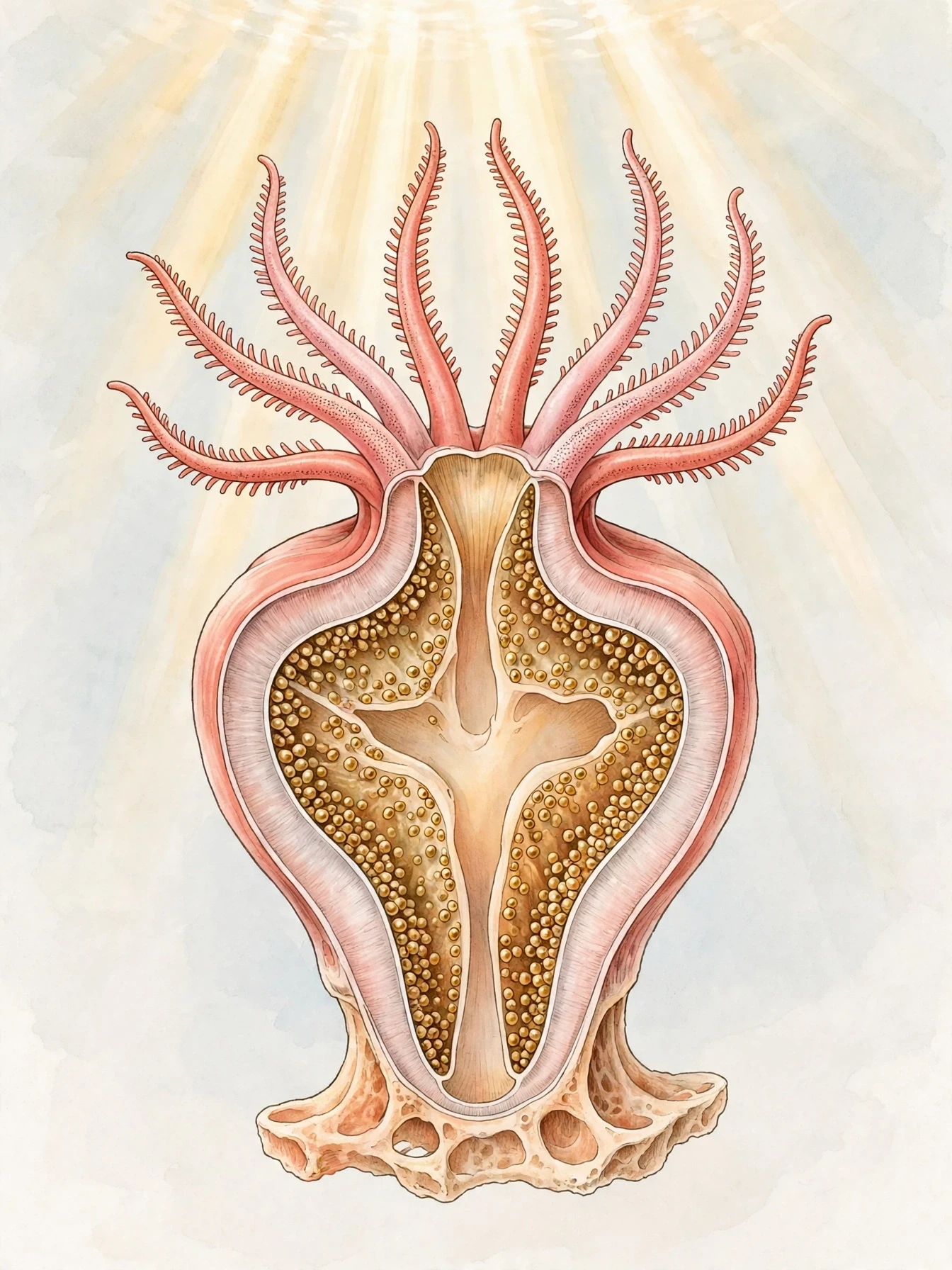
The partnership is powerful and fragile in equal measure. When water temperatures rise above the coral's comfort zone, the algae begin producing toxic oxygen compounds faster than the coral can handle, and the coral expels them. The white skeleton shows through the transparent tissue, and the reef is said to bleach. A bleached coral is not dead — if the water cools it can take up new algae and recover. But it has lost its main food supply, and if the heat lasts, it starves. That single broken partnership is the mechanism behind the mass bleaching events damaging reefs worldwide, a subject we return to later in this article.
The worm that gave up eating
Two and a half kilometres down, where sunlight never reaches, the logic of symbiosis runs in reverse. At hydrothermal vents on the ocean floor, superheated water rich in hydrogen sulfide pours from cracks in the crust. Around those vents live communities of animals that never see the sun — and the largest of them does not eat at all.
Riftia pachyptila, the giant tubeworm, was discovered in 1977 at the Galápagos Rift. Adults grow in white chitinous tubes up to two metres long, with a crimson plume at the top that looks like a flower. Inside, the anatomy is startling: adult worms have no mouth, no gut and no anus. The digestive system, present in the larva, degenerates during metamorphosis. In its place the worm carries a large spongy organ called the trophosome, filling much of the trunk, packed with specialised cells that house billions of sulfur-oxidising bacteria, Candidatus Endoriftia persephone. The giant tubeworm's symbiosis is described in detail in the reference literature, and the original discovery was published in Science in 1981.
The deal works like this. The red plume takes up oxygen and hydrogen sulfide from the vent water. Specialised haemoglobins in the worm's blood bind both gases at once and carry them to the trophosome without letting the sulfide poison the worm's own respiration — a chemical feat in itself. There, the bacteria oxidise the sulfide for energy and use it to fix carbon dioxide into organic compounds, running both the Calvin cycle used by plants and a second carbon-fixation pathway, the reverse tricarboxylic acid cycle. The worm absorbs the products directly and also digests some of its own symbiont cells. It is, in effect, a farmer whose crop lives inside its body.
Each new generation must find its own bacteria: Riftia larvae carry no symbionts and acquire Endoriftia from seawater after settling. The partnership is obligate for the adult, yet it is re-established from scratch in every generation. Around the vents the tubeworms grow in dense thickets, and an entire ecosystem built on chemistry instead of sunlight runs on this one bacterial partnership — see our guide to ecosystems.
The squid that rents moonlight
The Hawaiian bobtail squid, Euprymna scolopes, is a thumb-sized nocturnal hunter that buries itself in sand by day and comes out to feed at night. It has a problem that every small animal in shallow moonlit water shares: seen from below, its body makes a dark silhouette against the brighter surface, and predators notice. Its solution is to carry its own moonlight.
Inside the squid's mantle sits a specialised light organ, a pair of lobes lined with deep crypts. The crypts house the bioluminescent bacterium Vibrio fischeri. In exchange for shelter and nutrients — sugars and amino acids supplied by the host — the bacteria produce a soft blue-green glow. The squid directs that light downward with a lens and reflective tissue, and dims or brightens it with a shutter-like mechanism to match the moonlight overhead. The effect is counter-illumination: the glow cancels the shadow, and the squid all but disappears from below. A guide to the squid's light organ and counter-illumination explains how the squid aims its borrowed light.
The partnership runs on a daily rhythm that is almost comically strict. Newly hatched squid are born without bacteria and collect V. fischeri from seawater within hours, and the bacteria then trigger the light organ to mature around them. The bacteria sense their own density through quorum sensing — chemical signals that switch on the light-producing genes only when the population is large enough — so the glow comes on at night when it is needed. Each dawn, the squid expels 90 to 95 percent of its symbionts into the sea, and the remaining few percent multiply through the day to rebuild the population by nightfall. Every morning, the squid evicts almost its entire workforce and rehires by evening.
That daily flush does two things. It keeps the bacterial population from overgrowing the organ, and it seeds the surrounding water with symbionts that newly hatched squid can collect. Biologists value the squid and its bacterium as a model system because both partners can be raised separately and the colonisation can be watched from the first hours. Much of what we know about how animals choose their microbes was learned from this small squid and its glow.
12. Symbiosis on Land
Life on land was a joint venture from the start. Lichens are fungi farming algae on bare rock, most plants feed through fungi wrapped around their roots, and legumes run tiny nitrogen factories in nodules on theirs. Without these partnerships, forests and farms would look very different.
Lichens: a partnership that pretends to be one organism
A lichen looks like a single organism — a crust on a rock, a leafy patch on a tree trunk, a beard hanging from a branch — and for most of history it was treated as one. It is not. A lichen is a fungus, the mycobiont, usually an ascomycete, that builds the body and houses a photosynthetic partner, the photobiont, which is a green alga or a cyanobacterium. The fungus provides structure, shelter and water management; the photobiont provides food from sunlight, and in cyanobacterial lichens it also fixes nitrogen. Together they can live where neither could survive alone — on bare rock, in deserts and in the high Arctic — slowly breaking rock into soil and opening ground for other life.
In 2016, the textbook story gained a third character. Toby Spribille and colleagues at the University of Montana were studying two lichens from the mountains near Missoula, Bryoria fremontii and Bryoria tortuosa. The two looked different — one dark brown and edible, the other yellow and poisonous, producing the toxin vulpinic acid — yet their fungus and alga were genetically identical. The difference turned out to be a third partner: a basidiomycete yeast, a single-celled fungus from the genus Cyphobasidium, embedded in the lichen's outer cortex. The yellow, toxic lichen carried far more of it. Spribille's team went on to find related yeasts in 52 lichen genera across six continents. The discovery of the lichen's hidden third partner showed that many of the world's most common lichens are not two organisms living as one, but three.
The yeast's exact job is still being worked out — it likely helps build the cortex and contributes defensive chemistry — and later research has questioned whether it is present in every lichen group. What the discovery settled is the principle: even the most famous two-partner symbiosis in biology was hiding another member.
Mycorrhizae: the roots beneath the roots
If lichens are the partnership you can see, mycorrhizae are the one you walk on. The word means fungus-root, and it describes fungi that live in or around plant roots, trading soil nutrients for plant sugars. Most land plants form these associations, and they come in two main styles. Arbuscular mycorrhizae push fine hyphae directly into root cells, where they branch into tiny tree-shaped structures called arbuscules — the exchange points where phosphorus and other minerals flow one way and sugars flow the other. Ectomycorrhizae, common on trees such as pines, oaks and birches, wrap the root tips in a fungal sheath and grow between the root cells without entering them. Either way, the fungus extends the plant's reach: its thread-like hyphae explore far more soil than roots alone could, and they are far better at extracting phosphorus, the nutrient that most often limits plant growth.
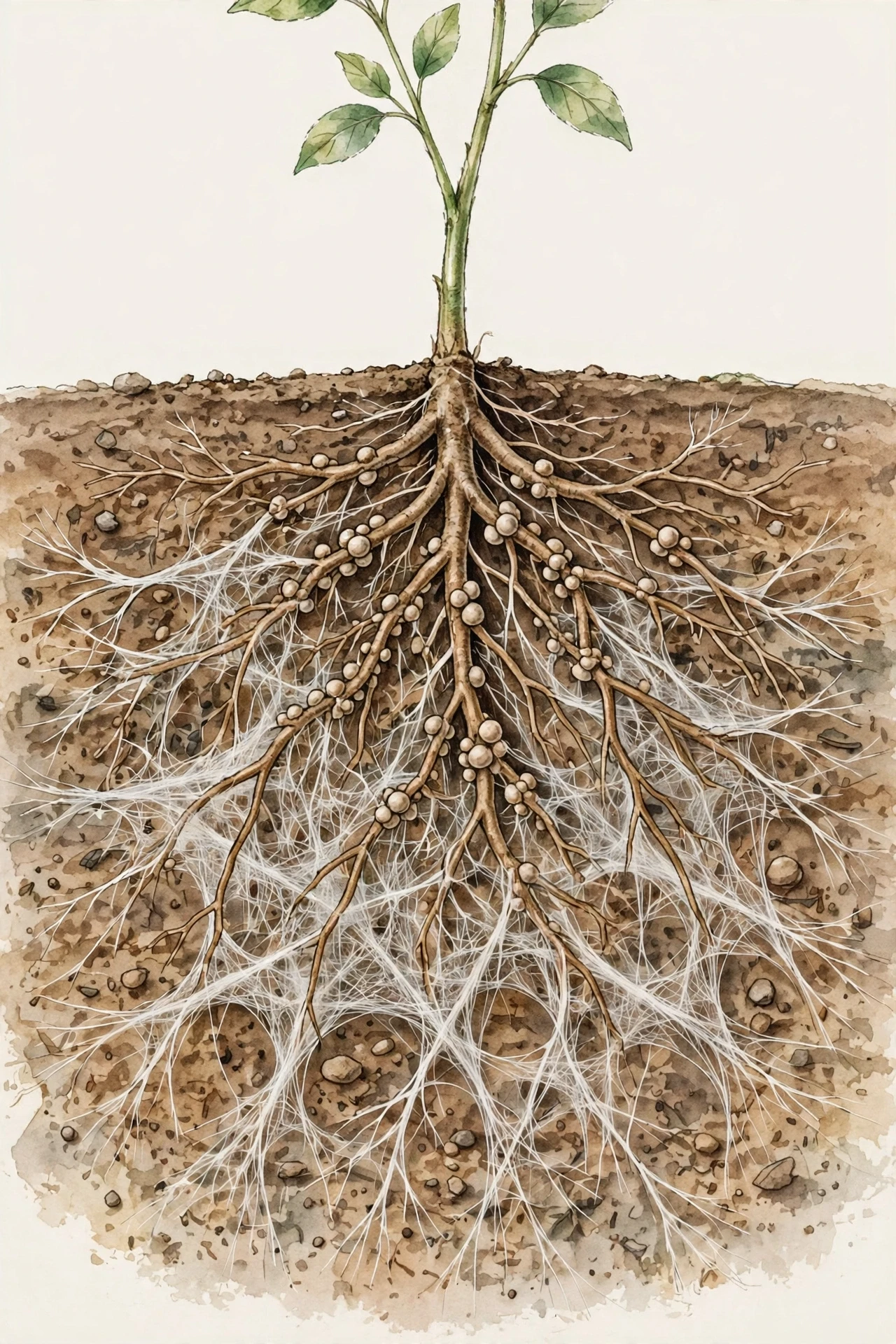
This partnership is older than roots themselves. In the Rhynie chert of Scotland, a 407-million-year-old deposit, fossil plants such as Aglaophyton contain arbuscules identical to those forming in living roots today — evidence published by Remy and colleagues in 1994. Older fossil spores suggest the fungi were present earlier still, perhaps 450 million years ago, around the time the first plants were colonising land. The first land plants had no true roots, and the fungi may have been what made the move possible, mining minerals from stone in exchange for sugars. The genetic toolkit modern plants use to admit a mycorrhizal fungus is shared with liverworts, among the most ancient plant lineages alive, which suggests the handshake has barely changed in hundreds of millions of years. Our guide to plant biology covers how roots and their partners work together.
The fungi also connect plants to each other. Hyphae from one fungus can link the roots of neighbouring plants, forming shared networks through which water, nutrients and chemical signals can move. In 1997, Suzanne Simard and colleagues showed that carbon moved between paper birch and Douglas fir trees through such a network, a finding that gave rise to the popular image of the wood wide web. Claims that trees deliberately feed their offspring through these networks go further than the evidence supports, and the idea remains debated — but even the cautious version is remarkable: beneath every forest floor lies a fungal network older than trees.
Legumes: nitrogen factories on roots
Plants need nitrogen to build proteins and DNA, and nitrogen gas makes up most of the air — yet plants cannot use it. The triple bond holding two nitrogen atoms together is one of the strongest in chemistry, and breaking it takes an enzyme, nitrogenase, that only bacteria and archaea possess. Legumes — peas, beans, clover, soybeans, alfalfa — solve the problem by hiring the bacteria and housing them in purpose-built organs on their roots.
The recruitment is a chemical conversation. A legume root releases flavonoids into the soil, which attract compatible rhizobia and switch on their nodulation genes. The bacteria answer with Nod factors, signalling molecules that the plant recognises with receptors on its root hairs. The root hair curls around the bacterium, an infection thread grows inward through the root cortex, and the plant builds a nodule around the invaders. Inside the nodule, the bacteria change shape into bacteroids, enclosed in plant-derived membranes called symbiosomes, and begin fixing nitrogen: converting nitrogen gas into ammonia, which the plant turns into amino acids.
Nitrogenase has a weakness: oxygen destroys it. The nodule is engineered around that flaw. The plant produces leghaemoglobin, a pink oxygen-binding protein related to animal haemoglobin, which keeps free oxygen vanishingly low while still delivering enough for the bacteria to respire. Fixing a single nitrogen molecule consumes about sixteen molecules of ATP, supplied as malate from the plant's photosynthesis. The exchange is policed: legumes limit how many nodules they form, and bacteroids switch off the enzyme that would let them use the ammonia themselves — the product goes to the plant.
The payoff extends beyond the legume. When the plant dies, its nitrogen-rich tissues rot into the soil, fertilising whatever grows next. Farmers have exploited this for thousands of years, rotating legumes with cereals and ploughing clover in as green manure, and modern agriculture still depends on it. Other plants have their own versions — alder and casuarina trees host Frankia, a filamentous nitrogen-fixing bacterium, in root nodules of a different design — but the legume and its rhizobia remain the classic case, a symbiosis you can dig up and see as a cluster of pink beads on a root.
Aphids: a bacterium that became an amino-acid factory
The most extreme land partnership may belong to an insect the size of a grain of rice. Aphids feed on plant phloem sap, a diet that is rich in sugar but poor in essential amino acids — the ten amino acids animals cannot make for themselves. An aphid cannot live on sap alone, so it carries a chemical factory inside its own cells: the bacterium Buchnera aphidicola, which lives in specialised aphid cells called bacteriocytes and manufactures the missing amino acids from raw materials the aphid supplies.
Buchnera has paid for its keep with its genome. The pea aphid's strain carries a chromosome of only about 0.64 million base pairs, encoding roughly 580 protein-coding genes — less than a seventh of what its free-living relative Escherichia coli carries. It has lost the genes for making non-essential amino acids, which the host provides, along with much of its regulatory machinery, its defences and its ability to live outside the aphid at all. What it kept is revealing: about a tenth of its tiny genome is devoted to synthesising essential amino acids. The partnership is ancient, with comparisons of Buchnera strains pointing to a history on the order of 150 million years, and it is inherited rather than acquired — the bacteria pass from mother to offspring through the ovaries, so an aphid is born already carrying its symbiont. A profile of Buchnera aphidicola describes an endosymbiont so integrated into its host's development that it functions almost as an organ.
Buchnera shows the end point of the road that mitochondria and chloroplasts travelled: a free-living bacterium, swallowed by partnership, shedding genes until it can no longer live alone. From the lichen on a rock to the fungus under a forest, from the legume's nodule to the aphid's bacteriocyte, life on land is built from the same bargain struck again and again: one organism supplies what the other cannot make, and both end up living where neither could live alone.
13. When Living Together Turns Harmful
Parasitism is symbiosis with the balance tipped against one partner: one organism lives in or on another and gains food, shelter, or transport while the host pays a price in health, growth, or reproduction. The same partnership can slide toward harm or back toward help as conditions change, so symbiosis is a spectrum, not a set of fixed labels.
The word symbiosis is often used as if it meant friendship. It does not. Anton de Bary, who coined the term in 1879, defined it simply as organisms living together, and living together covers the whole range from generous help to outright theft. A parasite is a symbiont that takes more than it gives, and parasites are not a rare exception to symbiosis. They are one of its most common outcomes, from tapeworms absorbing nutrients in a host gut to the malaria parasite Plasmodium living inside human red blood cells.
Wolbachia: a symbiont that rewrites reproduction
No organism illustrates the dark side of symbiosis better than Wolbachia, a bacterium that lives inside the cells of insects and other arthropods and passes from mother to offspring through the egg, so its future depends entirely on female hosts. Wolbachia has therefore evolved ways to tilt host reproduction in favour of infected females, and the tricks it uses are startling.
The most common trick is called cytoplasmic incompatibility. When an infected male mates with an uninfected female, most of the embryos die. When an infected female mates with any male, her offspring survive. The effect is that infected females leave more descendants, and the bacterium spreads through the population even though it gives the host nothing in return. Research reviewed in 2020 describes Wolbachia as present in nearly half of all arthropod species, with cytoplasmic incompatibility as its most common manipulation, alongside male killing, feminisation of genetic males, and parthenogenesis, in which unfertilised eggs develop into females.
The same bacterium can play a very different role in a different host. In most filarial nematodes, the worms that cause river blindness and lymphatic filariasis, Wolbachia is an obligate mutualist: the worms need the bacteria for normal development and reproduction, and clearing the bacteria with antibiotics sterilises and eventually kills the adult worms. A review of onchocerciasis describes this dependency as mutualistic, in sharp contrast to the reproductive parasitism seen in most arthropods.
That dual nature is also what makes Wolbachia useful to people. Scientists have deliberately spread Wolbachia-carrying mosquitoes in cities where dengue fever is endemic, because the bacterium makes it harder for the mosquitoes to transmit dengue virus. A symbiont is neither a friend nor an enemy in itself. Its role depends on the partnership, the host, and the setting.
The continuum: when help turns into harm
Mutualism and parasitism are ends of a single continuum, and a partnership can slide along it. The clearest evidence comes from mycorrhizae, the fungi that trade soil minerals for plant sugars. In poor soils, the trade is a bargain for the plant: the fungus reaches phosphorus the roots cannot, and the plant pays a modest share of its sugars. In rich, heavily fertilised soils, the plant already has all the phosphorus it needs, yet the fungus still takes its share of sugars. The benefit shrinks, the cost stays, and the net effect on the plant can turn negative. A model of this shift shows how rising soil fertility can push the same plant-fungus interaction from mutualism into parasitism, and how fertile conditions can also favour cheating fungal strains over cooperative ones.
Cleaner fish show the same slide in real time. The bluestreak cleaner wrasse eats parasites off the skin of larger reef fish, a service both sides value. But the cleaner prefers the taste of its client's mucus to the parasites it is supposed to remove, and it cheats whenever it can get away with it. Clients fight back by chasing a cheating cleaner or by taking their business to another cleaning station. A study of roaming cleaner fish found that cheated clients chase or avoid dishonest cleaners, and that this keeps the mutualism working despite the cleaner's constant temptation to cheat.
Coral partnerships slide too. The algae living inside a coral polyp feed it with sugars from photosynthesis, and in return receive shelter and nutrients. Under heat stress, the same algae begin producing harmful oxygen compounds, and the coral expels them, turning white in the process. The partnership does not fail because one side suddenly turned villainous. It fails because the conditions changed, and a deal that paid under normal temperatures stopped paying under extreme ones. The same logic applies to legumes, where plants can cut off resources to root nodules that fix little nitrogen, rewarding cooperative bacteria and starving lazy ones. Keeping a mutualism honest takes work, and that work is done by sanctions, partner choice, and punishment.
Why good and bad are the wrong labels
Calling a symbiont good or bad mistakes a relationship for a character trait. A fungus is not generous; it trades. A cleaner fish is not dishonest in any moral sense; it prefers a richer food. Wolbachia is not evil; it spreads the only way it can. Each partner acts on its own interests, shaped by natural selection, and the outcome for the other side follows from that.
This matters for how we intervene in nature. A mycorrhizal product sold as a universal soil booster may help a plant in poor soil and burden the same plant in a fertilised field. And a parasite we try to eliminate may be carrying a symbiont of its own, as the filarial worms carry Wolbachia, which opens a back door to treatment. Judging a symbiosis means asking who benefits, who pays, and under what conditions.
14. Symbiosis and the Birth of New Species
Symbiosis can do more than help individual organisms survive: it can create new kinds of organisms. When two species merge so completely that their descendants inherit both partners together, the merger itself becomes an evolutionary event, producing new species, new cell types, and new ways of life that mutation alone would take far longer to reach.
Most textbook accounts of evolution describe change as a slow accumulation of small mutations, filtered by natural selection over millions of years. That account is true, and it is incomplete. Sometimes evolution jumps. A bacterium takes up residence inside another cell and never leaves. A fungus and an alga fuse their lives into a lichen that can colonise bare rock where neither could live alone. A wasp acquires a bacterium that changes who it can mate with. These are mergers, and mergers can redraw the tree of life in a single generation.
The biologist Lynn Margulis called this process symbiogenesis: the origin of new species and new structures through long-term symbiosis. Her most famous case was the origin of the eukaryotic cell itself. Mitochondria were once free-living bacteria, and chloroplasts were once free-living cyanobacteria. Each was taken in by a host cell, and each stayed, until the host and the guest became a single organism with a shared fate. Every plant, animal, and fungus alive today descends from those mergers: complex cells began when two simple cells became one.
I first felt the weight of that idea not in a laboratory but on a rocky shore, turning over a piece of lichen-covered stone and realising I was holding two organisms pretending to be one. The lichen was not a compromise between a fungus and an alga. It was a third thing, with a body neither partner could build alone, living in a place neither could survive alone. Standing there with salt on my hands, I understood that evolution is not only a story of organisms competing for the same patch of ground. It is also a story of organisms joining forces and becoming something neither was before.
The hologenome: one organism, or a community?
If mergers can create new species, a natural question follows: should we think of a host and its microbes as a single evolutionary unit? The hologenome concept says yes, or at least asks us to consider it. A holobiont is a host plus all of its symbiotic microbes; the hologenome is the sum of their genomes. The idea, developed by Eugene Rosenberg and Ilana Zilber-Rosenberg and building on Margulis's earlier use of the term holobiont, is that selection can act on the combined unit, so that a change in the microbiome can be as evolutionarily meaningful as a change in the host's own genes.
Critics point out that most microbiomes are not inherited faithfully: gut microbes are picked up from the environment, from food, and from other individuals, and their composition varies between hosts and over a single lifetime. That fidelity holds for mitochondria and a few tightly inherited insect symbionts, but not for the whole shifting crowd of the gut. A critique in PLOS Biology argues that selection at the level of the symbiotic community occurs in some cases but should not be accepted as the default explanation for host-microbe associations, while a review in mBio argues that a host plus its microbiome is better viewed as an ecological community, with members whose interests sometimes conflict, than as a single superorganism.
The honest position sits between the two camps. Some partnerships really do behave as units: mitochondria, chloroplasts, and the Buchnera bacteria inside aphids are inherited with their hosts and have co-evolved for tens of millions of years. Others are looser, more like a neighbourhood than a marriage. And a few sit in between in revealing ways. In Nasonia jewel wasps, closely related species carry distinct gut microbiomes, and hybrids between species die in part because their microbiomes clash with their hybrid genomes, a finding that suggests microbes can contribute to reproductive isolation, one of the steps by which new species form. Speciation is rarely a single event, and symbiosis is one of the forces that can push a diverging population past the point of no return.
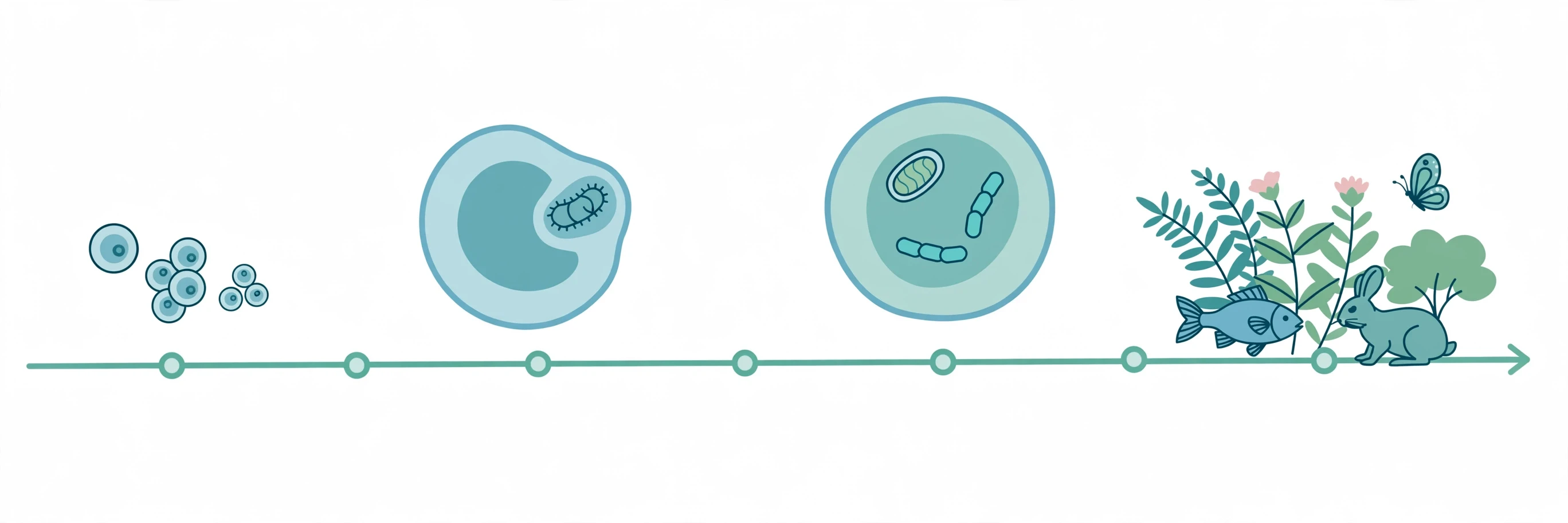
What endosymbiosis made possible is hard to overstate. A cell with mitochondria can extract far more energy from food than a cell without them, and that energy budget is what allows large genomes, large cells, and complex multicellular bodies. A cell with chloroplasts can make its own food from sunlight, and that capture underwrote nearly all the food chains on land and in the sea. Without those two mergers, there would be no forests, no reefs, and no readers.
15. Symbiosis and Us
Symbiosis is not only a story about the distant past. It shapes human health, the food we grow, and the ecosystems we are trying to save, and learning to work with partnerships rather than against them is already changing medicine, farming, and conservation in practical ways.
Start with the body. The human gut carries trillions of microbes that digest fibre, make vitamins, train the immune system, and crowd out invaders. The clearest medical success so far involves Clostridioides difficile, a bacterium that can overrun the gut after antibiotics clear out its competitors, causing severe and recurring diarrhoea. Restoring the gut community with faecal microbiota transplantation, transferring screened donor stool microbes into the patient's gut, has proved strikingly effective for recurrent infection. The United States Food and Drug Administration has approved two standardised microbiota-based products for preventing recurrence in adults after antibiotic treatment: Rebyota, approved in 2022, and Vowst, approved in 2023. A 2026 review describes both as standardised, evidence-based ways to restore colonisation resistance in appropriately selected adults.
That success is real, and its limits matter just as much. Outside recurrent C. difficile infection, most microbiome therapies remain experimental. Trials for inflammatory bowel disease, irritable bowel syndrome, and obesity have produced mixed or preliminary results, and no faecal transplant product is approved for those uses. Probiotic capsules sold in shops are not the same as a transplant: their strains are few, their survival through the gut is uncertain, and the evidence for most health claims is thin. Such therapies demand careful donor screening and honest communication about what is proven and what is still a hypothesis.
Farming with partnerships
Agriculture has used symbiosis for longer than it has understood it. Farmers have rotated legumes with cereals for centuries, and the reason is rhizobium bacteria in legume root nodules, which convert nitrogen from the air into a form plants can use. Modern practice makes this deliberate: seeds are coated with selected rhizobium strains, called inoculants, so that the right bacteria are present when the roots emerge. In soils where native rhizobia are scarce or ineffective, inoculation can raise nodulation, growth, and yield substantially. Co-inoculation with growth-promoting microorganisms has even let farmers cut back on NPK fertiliser while keeping yields up, as a field trial on common beans showed. In a Madagascar trial on low-fertility tropical soils, inoculation with native rhizobium strains increased bean nodulation up to 15-fold and bean yield by 126 percent when combined with phosphorus. Results vary with soil, strain, and climate, but the principle is sound: feed the partnership and the partnership feeds the crop.
Conservation: when the partnership breaks
Nowhere is the cost of a broken symbiosis clearer than on coral reefs. A coral polyp and its symbiotic algae, the zooxanthellae, feed each other: the algae photosynthesise and share sugars, and the coral provides shelter and nutrients. When the water gets too hot for too long, the algae produce harmful compounds, the coral expels them, and the white skeleton shows through the transparent tissue. That is bleaching, and a bleached coral is not yet dead. If the water cools quickly, the algae can return. If the heat persists, the coral starves.
A 2021 study in One Earth estimated that the world has lost about half of its live coral cover since the 1950s, and the Global Coral Reef Monitoring Network's 2020 global report found that about 14 percent of the world's coral was lost in the single decade from 2009 to 2018. The fourth global bleaching event, which ran from early 2023 to mid-2025, exposed about 84 percent of the world's reef area to bleaching-level heat stress, according to NOAA, with mass bleaching documented in at least 83 countries and territories. The Intergovernmental Panel on Climate Change has projected that coral reefs would decline by a further 70 to 90 percent at 1.5 degrees of warming, and by more than 99 percent at 2 degrees. These are projections, not certainties, and some reefs show surprising resilience.
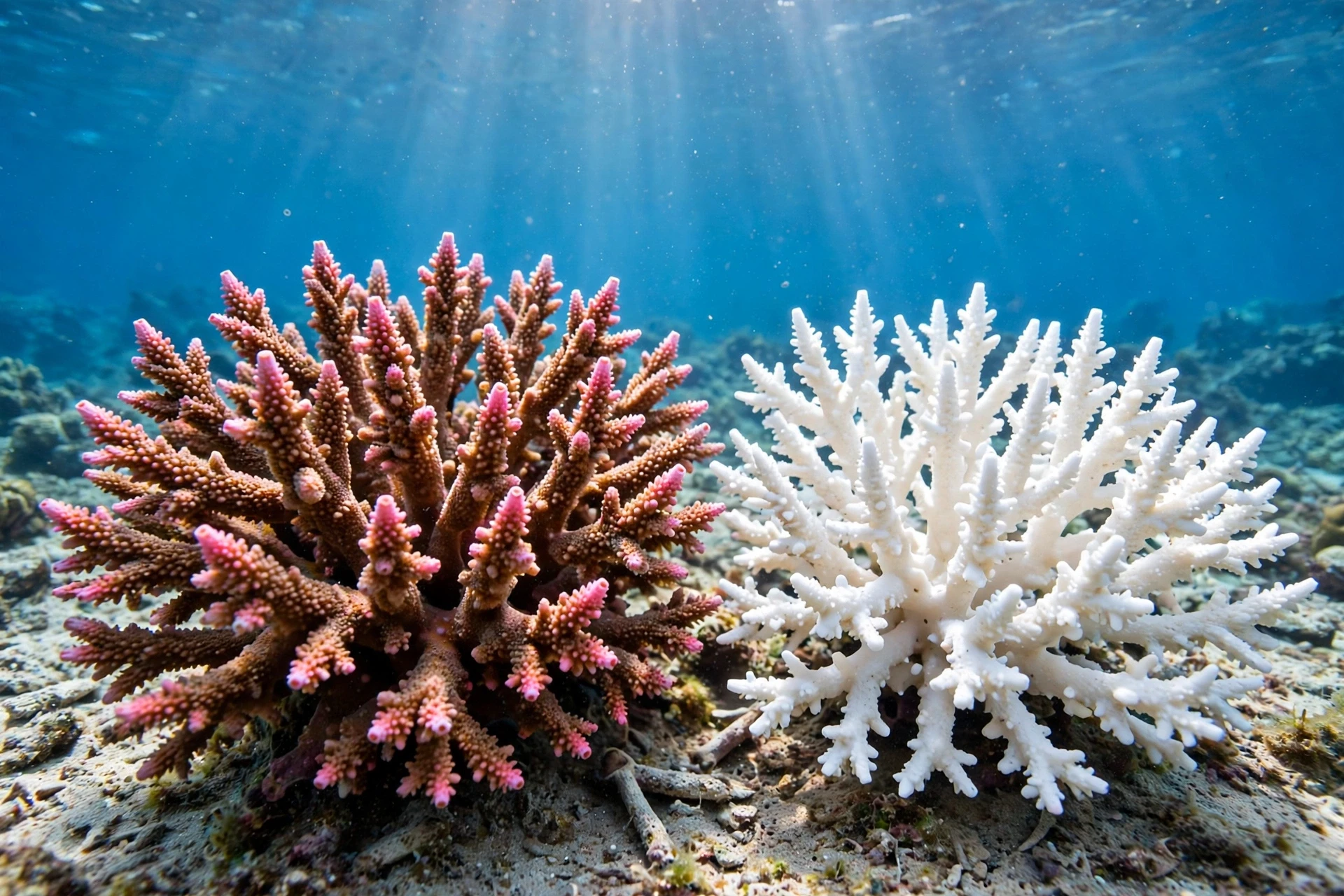
Conservationists are responding by working with the symbiosis itself. Researchers are breeding and seeding corals with heat-tolerant strains of algae, an approach sometimes called assisted evolution, and are growing coral fragments in nurseries for replanting on damaged reefs. None of this replaces cutting greenhouse gas emissions, which is the only measure that addresses the heat itself, but buying reefs time is not a small thing. Readers who want the wider picture of reef life can start with our guide to Coral Reefs.
16. What Symbiosis Cannot Explain
Symbiosis is powerful, but it is not a theory of everything. It explains how mergers and partnerships shaped life, yet it does not replace natural selection, does not make evolution purposeful, and does not turn every interaction in nature into cooperation. Keeping those limits in view is what separates a good idea from a slogan.
One common overreach is the claim that symbiosis disproves competition. It does nothing of the sort. Competition and cooperation operate side by side in every ecosystem, and the same two species can compete over one resource while cooperating over another. Evolution has room for both forces, and a theory that celebrates one while denying the other is incomplete by design.
A second overreach is the idea that symbiosis is always harmonious, or that partners never exploit each other. The previous section showed the opposite: cheating, punishment, sanctions, and outright parasitism are woven through symbiotic life. Harmony is a snapshot, not a law.
A third error is treating every close association as a merger that creates a new species. Most symbioses never go that far. A clownfish and an anemone remain two species that happen to live together, and their offspring do not inherit the partnership as a single package. Symbiogenesis is real but rare, and it needs specific conditions: long-term intimacy, vertical transmission to offspring, and integration deep enough that the partners can no longer live apart.
The table below gathers the misconceptions that appear most often, and the evidence that answers each one.
| Misconception | What the evidence shows |
|---|---|
| Symbiosis means mutual benefit | Symbiosis means living together. It covers mutualism, commensalism, and parasitism, and the same partnership can slide between them as conditions change. |
| Symbiosis disproves competition and natural selection | Competition and cooperation operate together. Symbiotic partners still compete, cheat, and impose sanctions, and natural selection shapes both sides of every partnership. |
| Partners in a symbiosis never harm each other | Cheating is common: cleaner fish bite mucus instead of parasites, and mycorrhizal fungi can become a net cost to plants in heavily fertilised soils. |
| Every symbiosis creates a new species | Only rare, deeply integrated mergers do. Most partnerships, such as clownfish and anemones, remain associations between two separate species. |
| The hologenome is settled science | It is a debated framework. Some inherited partnerships behave as units of selection, but most microbiomes are acquired afresh each generation and vary too much to form a single unit. |
| Probiotics and microbiome therapies can fix any gut problem | Only faecal microbiota products for recurrent C. difficile infection have regulatory approval in the United States. Other uses remain experimental, with mixed evidence. |
17. Why It Matters
Look at your own hand. The energy that moves it comes from mitochondria, bacteria that joined your cells nearly two billion years ago. The oxygen you breathe comes largely from photosynthesis by descendants of cyanobacteria captured and turned into chloroplasts. The reefs sheltering a quarter of marine life run on an animal-alga partnership. You are built from symbiosis.
That is the practical reason to understand it, and there is a larger one. For a long time, the story of evolution was told as a story of struggle alone: tooth against tooth, species against species. Struggle is real, but it is only half the story. The other half is merger, sharing, and the slow construction of new wholes from old parts. Complex cells, lichens, reefs, and perhaps even new species came into being because living things joined together and stayed together.
Margulis saw that before most of her colleagues did, and she said it plainly in the book she wrote with Dorion Sagan:
"Life did not take over the globe by combat, but by networking."
The sentence is not a denial of competition. It is a correction to a story that had left cooperation out. Life took over the globe by both means, and the networking half is the one we are still learning to see: in soil, in guts, in reefs, and in your own cells. Once you learn to see it, the living world looks less like a battlefield and more like a set of bargains, some fair, some rigged, all still being renegotiated. That is symbiosis, and it is still shaping life now.
Frequently Asked Questions
Symbiosis raises questions that go beyond any single section, so here are direct answers to the ones readers ask most often.
What is symbiosis?
Symbiosis is the living together of two different species in a close, long-term association. The term covers mutualism, where both partners benefit, commensalism, where one benefits and the other is largely unaffected, and parasitism, where one benefits at the other's expense. A lichen, a coral with its algae, and a tapeworm in a gut are all symbioses.
What is the endosymbiotic theory?
The endosymbiotic theory holds that mitochondria and chloroplasts were once free-living bacteria that were taken inside host cells and stayed, becoming permanent organelles. Mitochondria descend from alphaproteobacteria, and chloroplasts from cyanobacteria. The theory was proposed in the early twentieth century and developed by Lynn Margulis in the 1960s, and it is now supported by evidence such as the organelles' own DNA, their double membranes, and their division by splitting.
How did mitochondria evolve?
Mitochondria evolved when an ancient host cell engulfed an alphaproteobacterium, probably related to modern Rickettsiales, roughly 1.5 to 2 billion years ago. Instead of being digested, the bacterium survived inside the host and supplied energy, while the host supplied shelter and nutrients. Over time the bacterium lost many genes, transferring some to the host nucleus, and became an inseparable part of the cell.
What is mutualism?
Mutualism is a symbiotic interaction in which both partners benefit. A bee gains nectar while pollinating a flower, a cleaner fish gains food while removing a client's parasites, and a legume gains nitrogen while feeding rhizobium bacteria sugars. Mutualism is not charity: each side gains something it needs, and the partnership lasts only while the exchange keeps paying for both.
Are lichens one organism or two?
Lichens are not one organism. A lichen is a partnership, usually between a fungus and a photosynthetic partner such as an alga or a cyanobacterium, and many lichens also carry additional bacteria and yeasts. The fungus builds the body and the photosynthetic partner makes food, and together they form a structure neither could build alone. Biologists call the whole a symbiotic system rather than a single species.
What is the difference between symbiosis and parasitism?
Parasitism is one kind of symbiosis, not something separate from it. Symbiosis is the broad term for species living together, while parasitism is the form in which one partner benefits and the other is harmed. Mutualism and commensalism are the other two main forms. The boundary between them can shift: a mutualist can become parasitic when conditions change.
Can symbiosis create new species?
Yes, in rare cases, through a process called symbiogenesis. When two species merge so completely that their descendants inherit both partners together, the merger can produce a new kind of organism, as mitochondria and chloroplasts did for complex cells. Microbes can also help split populations apart, for example when hybrid wasps die in part because their microbiomes clash with their hybrid genomes — a finding that suggests microbes can contribute to reproductive isolation, though the interpretation is debated. Most symbioses never go this far, but the exceptions reshaped the history of life.
Sources
- Britannica Editors — "Symbiosis", Encyclopaedia Britannica (updated 2026)
- U.S. National Park Service — "Lichens", Acadia National Park (accessed 2026)
- OpenStax, Biology 2e, via Lumen Learning — "Symbiosis", Biology for Majors II (accessed 2026)
- LibreTexts, Human Biology — "24.4: Community Relationships" (accessed 2026)
- National Geographic — "The living toothbrushes that keep coral reefs healthy" (2011)
- Wikipedia contributors — "Symbiosis", Wikipedia (accessed 2026)
- LibreTexts, General Microbiology — "2.2.5: Lichens" (accessed 2026)
- AskNature — "How the Clownfish and Sea Anemone Help Each Other" (accessed 2026)
- Sagan, L. — "On the origin of mitosing cells", Journal of Theoretical Biology (1967)
- Gray, M. W. — "Lynn Margulis and the endosymbiont hypothesis: 50 years later", Molecular Biology of the Cell (2017)
- OpenStax — "Biology 2e, 23.1 Eukaryotic Origins"
- Nature Scitable — "mtDNA and Mitochondrial Diseases"
- National Human Genome Research Institute — "Mitochondrial DNA" (Genetics Glossary)
- Degli Esposti, M. — "Bioenergetic Evolution in Proteobacteria and Mitochondria", Genome Biology and Evolution (2014)
- de Vries, J. and Archibald, J. M. — "Endosymbiosis: Did Plastids Evolve from a Freshwater Cyanobacterium?", Current Biology (2017)
- Gray, M. W., Burger, G. and Lang, B. F. — "Mitochondrial Evolution", Science (1999)
- Coale et al. — "Nitrogen-fixing organelle in a marine alga", Science (2024)
- Massana — "The nitroplast: A nitrogen-fixing organelle", Science (2024)
- Oberleitner et al. — "The Puzzle of Metabolite Exchange and Identification of Putative Octotrico Peptide Repeat Expression Regulators in the Nascent Photosynthetic Organelles of Paulinella chromatophora", Frontiers in Microbiology (2020)
- Lhee et al. — "Evolutionary dynamics of the chromatophore genome in three photosynthetic Paulinella species", Scientific Reports (2019)
- LibreTexts Botany — "Photosynthetic Protists", Botany (Ha, Morrow and Algiers)
- Spribille et al. — "Basidiomycete yeasts in the cortex of ascomycete macrolichens", Science (2016)
- Remy et al. — "Four-hundred-million-year-old vesicular arbuscular mycorrhizae", Proceedings of the National Academy of Sciences (1994)
- Sender, Fuchs and Milo — "Revised Estimates for the Number of Human and Bacteria Cells in the Body", PLOS Biology (2016)
- Mansour et al. — "Impact of diet on human gut microbiome and disease risk", New Microbes and New Infections (2021)
- NOAA Ocean Today — "The Coral and the Algae"
- Cavanaugh et al. — "Prokaryotic Cells in the Hydrothermal Vent Tube Worm Riftia pachyptila Jones: Possible Chemoautotrophic Symbionts", Science (1981)
- Wikipedia — "Riftia" (for Riftia anatomy and trophosome details; cross-checked against Current Biology primer)
- LabXchange — "Lights. Camera. Action! How the Hawaiian Bobtail Squid Brings a Creative Vision to Its Maritime World"
- Rader and Nyholm — "Host/Microbe Interactions Revealed Through 'Omics' in the Symbiosis Between the Hawaiian Bobtail Squid Euprymna scolopes and the Bioluminescent Bacterium Vibrio fischeri", Biological Bulletin (2012)
- McCutcheon and Moran — "Extreme genome reduction in symbiotic bacteria", Nature Reviews Microbiology (2012)
- Moran — "Microbe Profile: Buchnera aphidicola: ancient aphid accomplice and endosymbiont exemplar", Microbiology (2021)
- Chen et al. — "The Biochemistry of Cytoplasmic Incompatibility Caused by Endosymbiotic Bacteria", Genes (2020)
- Tamarozzi et al. — "Onchocerciasis: The Role of Wolbachia Bacterial Endosymbionts in Parasite Biology, Disease Pathogenesis, and Treatment", Clinical Microbiology Reviews (2011)
- Neuhauser and Fargione — "A mutualism–parasitism continuum model and its application to plant–mycorrhizae interactions", Ecological Modelling (2004)
- Mills, S. C. and Côté, I. M. — "Crime and punishment in a roaming cleanerfish", Proceedings of the Royal Society B (2010)
- Moran and Sloan — "The Hologenome Concept: Helpful or Hollow?", PLOS Biology (2015)
- Douglas and Werren — "Holes in the Hologenome: Why Host-Microbe Symbioses Are Not Holobionts", mBio (2016)
- Berry et al. — "Food and Drug Administration-Approved Fecal Microbiota-Based Therapies for Recurrent Clostridioides difficile Infection", Gastroenterology Clinics of North America (2026)
- de Souza et al. — "Response of Phaseolus vulgaris to the Use of Growth-Promoting Microorganisms Associated with the Reduction of NPK Fertilization in Tropical Soils: Clayey Oxisol and Sandy Ultisol", Agriculture (2025)
- Souter et al. (eds) — "Status of Coral Reefs of the World: 2020", Global Coral Reef Monitoring Network (2021)
- NOAA National Ocean Service — "What is coral bleaching?" (accessed 2026)
- Margulis and Sagan — "Microcosmos: Four Billion Years of Evolution from Our Microbial Ancestors", Summit Books (1986)
- Razafintsalama et al. — "Effect of Rhizobium Inoculation on Growth of Common Bean in Low-Fertility Tropical Soil Amended with Phosphorus and Lime", Sustainability (2022)
- Weeks, P. — "Red-billed oxpeckers: vampires or tickbirds?", Behavioral Ecology (2000)
- IPCC — "Global Warming of 1.5°C: Summary for Policymakers" (2018)
- Brucker and Bordenstein — "The hologenomic basis of speciation: gut bacteria cause hybrid lethality in the genus Nasonia", Science (2013)
- Coral Reef Alliance — "Top Takeaways from the World's Fourth Mass Coral Bleaching Event" (2026), reporting NOAA's findings
- Eddy, T. D. et al. — "Global decline in capacity of coral reefs to provide ecosystem services", One Earth 4:1278–1285 (2021)
- Ponce-Toledo et al. — "An Early-Branching Freshwater Cyanobacterium at the Origin of Plastids", Current Biology 27:386–391 (2017)
- Chandler, J. A. and Turelli, M. — "Comment on 'The hologenome concept: helpful or hollow?'", Science 345:1011 (2014)
- Schwartz, R. M. and Dayhoff, M. O. — "Origins of prokaryotes, eukaryotes, mitochondria, and chloroplasts", Science 199:395–403 (1978)
- Simard, S. W. et al. — "Net transfer of carbon between ectomycorrhizal tree species in the field", Nature 388:579–582 (1997)