

1. A Drought, a Beak, and a Lineage That Almost Became a Species
On one small Galapagos island, in one drought, scientists watched natural selection change a bird population within a generation — and that change is the first step toward a new species. The story of the finches of Daphne Major is where the science of speciation stops being abstract and starts being something people measured, bird by bird, beak by beak.
In 1977, the rain failed on Daphne Major. The island is little more than a steep cone of volcanic rock rising out of the Pacific, with cactus and dry shrubs clinging to its slopes. For the medium ground finches living there, the drought turned an ordinary dry season into a test of survival.
The small, soft seeds the finches preferred vanished first. What remained were large, hard seeds that only the birds with the biggest, strongest beaks could crack open. Birds with smaller beaks starved. By the time the rains returned, about 85 percent of the medium ground finches were dead, and the population had fallen to about 15 percent of the previous year.
The survivors were not a random sample. On average, they carried larger beaks than the birds that died. And when they bred, their chicks inherited those larger beaks. Natural selection had changed the population in a single generation, and the people watching it happen had the measurements to prove it.
Those people were Peter and Rosemary Grant — now emeritus professors at Princeton, then at McGill — who began work on Daphne Major in 1973 and returned for several months every year until 2012, catching birds, measuring them, and releasing them again. They were not visitors passing through. They were residents of the island's story, season after season, and the drought of 1977 happened in front of them.
1.1 What the Grants actually measured
The Grants' work was built on patience and repetition. They tagged about 20,000 birds, measured beaks, and built pedigrees for the finch species across at least eight generations. Every bird had a record. Every beak had a number. When the drought struck, they could say exactly which birds lived, which died, and what their beaks looked like — not from memory, but from notebooks.
I first met this work through The Beak of the Finch, and what surprised me was how ordinary the fieldwork looked. There were no dramatic expeditions and no single moment of discovery. There were mist nets at dawn, calipers, leg bands, and page after page of numbers written down in the heat. The science came from showing up, year after year, and writing it all down. That ordinariness is what makes the result so hard to argue with.
The story did not end with the drought. The large ground finch, Geospiza magnirostris, first bred on Daphne Major in the wet El Niño season of 1982–83 — a separate event from the Big Bird story. A year earlier, in 1981, a single immigrant male — later shown by genome sequencing to be a large cactus finch, Geospiza conirostris, from Española, more than 100 km away — bred with a resident medium ground finch and founded the lineage the Grants call Big Bird. Lamichhaney et al. reported in Science in 2018 (published online November 2017) that reproductive isolation was established in only three generations. The authors call it an incipient hybrid species; the Grants have not declared it a separate species, and its long-term survival is unknown.
1.2 Why this story opens an article on speciation
The Grants watched selection and divergence, not a finished split. The beaks changed. The lineage formed. But the Big Bird birds are still, strictly speaking, a lineage whose future is unwritten. That gap — between divergence and a completed new species — is the subject of this whole article.
Darwin visited the Galapagos in 1835, and the finches he collected there later became the most famous example of one ancestor giving rise to many forms. The finches descended from a single ancestor that arrived from the South American mainland about 1 to 2 million years ago. Today the count depends on how the most closely related forms are split. Under the traditional classification there are 14 species — 13 on the Galapagos plus the Cocos finch on Cocos Island. Whole-genome sequencing of 120 birds covering all 15 recognised species at the time (Lamichhaney et al., Nature, 2015) proposed splitting several of them, giving 18 — 17 on the Galapagos plus one on Cocos — the count the Grants use in their 2024 review. The number is not settled, and that is worth saying plainly. What is settled is the pattern: one ancestor, many beaks, many ways of making a living. For Darwin's life and the wider evidence behind his theory, see Darwin's Theory of Evolution.
A drought, a beak, and a lineage that almost became a species. That is where speciation begins — not with a grand announcement, but with a population changing, and then changing again, until one day the two ends of the story can no longer meet.
2. What Is Speciation?
Speciation is the process by which one species splits into two or more species that can no longer interbreed and produce fertile offspring in nature. It starts when gene flow between two populations is reduced, and it ends when reproductive isolation is complete.
That short definition carries a lot of weight, so it helps to unpack it slowly. Speciation is the answer to a plain question: how do new species form? A population of one kind of organism becomes two populations. The two populations drift apart in what they look like, how they behave, and how their genes work. In time, they can no longer produce fertile offspring together, even if they meet again. At that point, one species has become two.
2.1 One species becomes two: the three steps
Speciation runs through three steps, and the order matters. First, populations separate. The separation can be a physical barrier, like a river or an ocean, or it can be a difference in habitat, timing, or behaviour that keeps two groups apart. Second, the separated populations diverge. Natural selection pulls them in different directions as each adapts to its own conditions, while genetic drift and new mutations add differences by chance. Third, reproductive isolation builds up — barriers that stop the two groups from interbreeding successfully. When those barriers hold even if the populations meet again, speciation is complete.
Gene flow is the thread running through all three steps. As long as genes move freely between two populations, the populations stay one species. Cut the flow, and the two groups start writing separate versions of the same story. For the engine that drives much of that divergence, see Natural Selection.
2.2 Speciation is a process, not a moment
There is no single day a new species is born. No bird wakes up one morning as a different species from its parents. Speciation is a slow parting, and the middle of the process is crowded with populations that are neither fully one species nor fully two.
Biologists call these in-between cases incipient species. A host race — a population that has shifted to a new food plant but still occasionally interbreeds with its parent population — is one example. The apple maggot fly, which shifted from hawthorn to apple and is still only partly isolated, is another. The Big Bird lineage on Daphne Major is a third. Each is a snapshot taken halfway through a split. The article keeps returning to these two running examples precisely because they are unfinished: they show what speciation looks like while it is still happening.
2.3 Cladogenesis and anagenesis
Two words help keep the picture straight. Cladogenesis is branching: one lineage splits into two. Anagenesis is change within a single lineage: a population changes over time without splitting. Speciation is cladogenesis. A lineage can change a great deal — its average beak can grow, its colour can shift, its size can double — and still be one lineage, one species, if it never splits. Only when a branch forms, and the branch stays separate, does a new species exist. The family tree grows by branching, not by stretching.
3. What Counts as a Species?
A species is most often defined as a group of actually or potentially interbreeding natural populations that are reproductively isolated from other such groups. That is Mayr's biological species concept, and it works well for sexually reproducing animals — and poorly for everything else.
Before going further, it is worth pausing on that sentence. It is the definition most biology textbooks use, and it is also the definition most biologists argue about. It is a practical test rather than a perfect truth, and its limits are as instructive as its strengths.
3.1 Mayr's biological species concept, 1942
Ernst Mayr published the definition in Systematics and the Origin of Species in 1942, and it became the standard for a generation of biologists. The test is reproductive isolation, not appearance. Two populations belong to different species if they do not interbreed in nature and produce fertile offspring — even if they look identical. Two populations belong to the same species if they do interbreed — even if they look nothing alike.
Dogs make the point clearly. A Great Dane and a Chihuahua look like different animals, but they can interbreed, so they are one species. Bald eagles and African fish eagles, by contrast, look alike to an untrained eye and do not interbreed, so they are two. Appearance misleads; breeding does not.
I first read Mayr's definition expecting something long and technical, and I remember being startled by how short it is. One sentence does the whole job. That brevity is its power: it gives field biologists a test they can actually use, instead of a paragraph they have to interpret. It is also its weakness, as the next section shows.
"Species are groups of actually or potentially interbreeding natural populations, which are reproductively isolated from other such groups."
— Ernst Mayr, Systematics and the Origin of Species (1942), Chapter 5, page 120.
3.2 Where the biological concept breaks down
The definition works for sexually reproducing animals. It struggles everywhere else. Asexual organisms, like many bacteria, do not interbreed at all, so a test based on interbreeding has nothing to measure. Fossils cannot be tested for interbreeding either — no one can watch a creature dead for millions of years choose a mate. And many plants hybridise freely, crossing species lines that the definition says should hold.
The mule is the classic example of what happens when the test is applied after the fact. A horse and a donkey can mate and produce a living offspring, but the mule is sterile. The two parents are different species, and the hybrid proves it: the cross works once, and then the line ends. The mule is a dead end that tells us exactly where the boundary lies.
3.3 Other concepts biologists use
Because no single definition covers every case, biologists keep several concepts in the toolbox and reach for the one that fits the organism in front of them.
The morphological species concept sorts organisms by shape and structure. It is the oldest approach, and it is still the best one for fossils and for field identification, where breeding tests are impossible. Its weakness is that it can split one variable species into many, or lump two look-alikes into one.
The ecological species concept sorts organisms by their niche — the way they make a living. Two populations that occupy different ecological roles, use different food, or live in different habitats can count as different species even when they look similar. It handles cases where ecology, not appearance, is the real dividing line.
The phylogenetic species concept sorts organisms by ancestry, defining a species as the smallest group that shares a common ancestor. In the age of DNA sequencing, it is the most precise of the three, because it reads the history written in the genome. Its weakness is that it can split populations very finely, naming species where other concepts would see one.
None of these replaces Mayr's definition. Each handles a case the biological concept cannot. A working biologist moves between them, and the article does the same.
4. Reproductive Isolation: The Walls Between Species
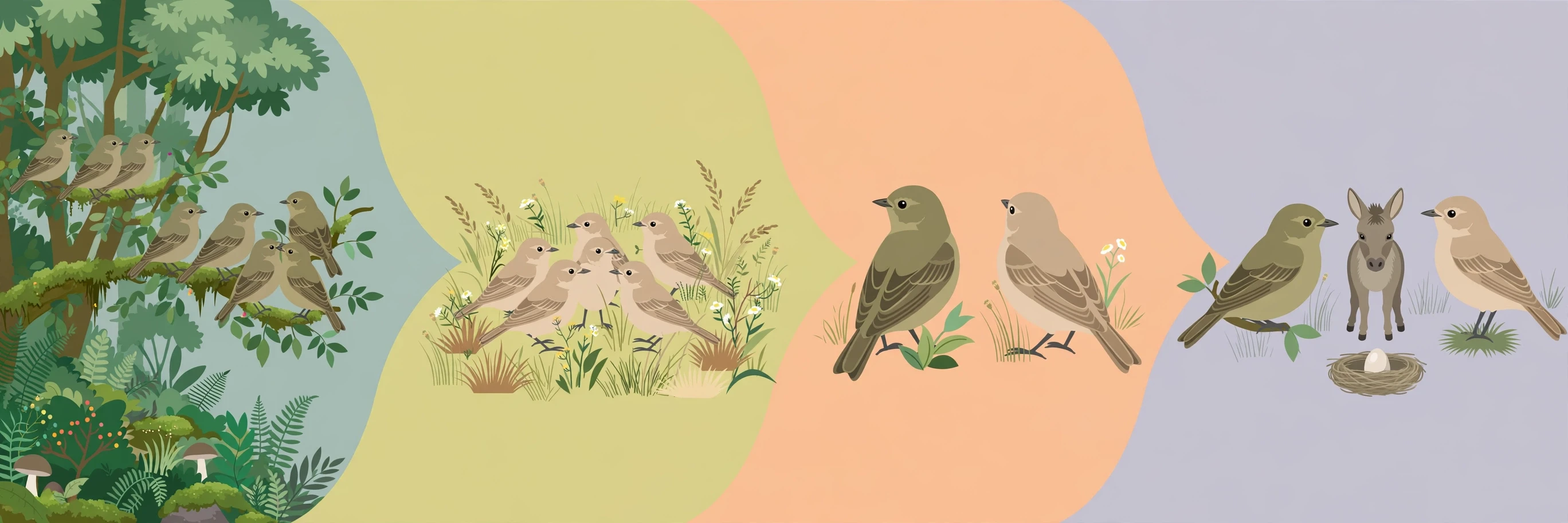
Reproductive isolation is any barrier that stops two populations from producing fertile offspring together. Barriers that act before fertilisation are prezygotic; barriers that act after fertilisation are postzygotic. Speciation is complete only when these barriers hold in nature, not just in a laboratory cross.
Think of two populations as neighbours in a house with many doors. A wall can stand at any door: the front gate, the hallway, or the bedroom. Where the wall stands changes what it costs. Speciation builds its walls one at a time, and the finished species is the house with every door closed.
4.1 Prezygotic barriers
Prezygotic barriers act before a sperm and an egg ever meet. There are five main kinds, and each has a clear example.
Habitat isolation keeps populations in different places, so they rarely meet. The benthic and limnetic sticklebacks of a single lake feed in different parts of the water — one on the lake bed, one in open water — and seldom encounter each other as mates.
Temporal isolation keeps populations on different schedules. The apple and hawthorn races of the apple maggot fly, Rhagoletis pomonella, emerge weeks apart, because apples ripen three to four weeks earlier than hawthorn fruit. Flies that emerge at different times do not meet to mate.
Behavioural isolation is a mismatch in courtship. Song, dance, scent, or display must match, or mating never starts. The greenish warbler's end forms differ in song, and a female that does not recognise a song does not answer it.
Mechanical isolation is a mismatch in body structure. In many plants, flower shape fits one pollinator and not another, so pollen never reaches the wrong flower.
Gametic isolation acts at fertilisation itself. Many marine animals release sperm and eggs into the water, and the gametes of different species simply do not fuse. The meeting happens, but nothing comes of it.
4.2 Postzygotic barriers
Postzygotic barriers act after fertilisation, when a hybrid already exists. There are three main kinds.
Hybrid inviability means the hybrid embryo or offspring does not survive. Many crosses between species fail during development, and the hybrid never reaches adulthood.
Hybrid sterility means the hybrid lives but cannot produce viable gametes. The mule, the offspring of a horse and a donkey, is the textbook case: healthy, strong, and a genetic dead end.
Hybrid breakdown is subtler. First-generation hybrids are fertile, but later generations fail — their offspring are weak, sterile, or inviable. The barrier shows up a generation late, in crosses of some plants and fishes where later generations lose fertility.
Barrier type | When it acts | What it does | Example |
|---|---|---|---|
Habitat isolation | Before mating | Populations live in different places and rarely meet | Benthic and limnetic sticklebacks feeding in different parts of one lake |
Temporal isolation | Before mating | Populations breed at different times | Apple and hawthorn races of Rhagoletis pomonella emerging weeks apart |
Behavioural isolation | Before mating | Courtship or mating rituals do not match | Greenish warbler song differences between end forms |
Mechanical isolation | During mating | Body structures do not fit | Flower shape and pollinator fit in many plants |
Gametic isolation | At fertilisation | Sperm and egg do not fuse | Many marine animals releasing gametes into water |
Hybrid inviability | After fertilisation | Hybrid embryo or offspring does not survive | Many interspecific crosses that fail in development |
Hybrid sterility | After fertilisation | Hybrid lives but cannot produce viable gametes | The mule, offspring of a horse and a donkey |
Hybrid breakdown | After fertilisation | First-generation hybrids are fertile, later generations fail | Crosses in some plants and fishes where later generations lose fertility |
4.3 Why the timing of a barrier matters
Early barriers are cheap. If two populations never meet, or never court, no gametes are wasted and no doomed offspring are raised. Late barriers are expensive. A hybrid that dies young, or a sterile adult raised to maturity, costs its parents time, food, and energy that could have gone to offspring of their own kind.
That cost is what drives reinforcement, the process in which natural selection sharpens early barriers because hybrids do badly. When mating with the wrong partner produces weak or sterile young, any trait that helps an individual avoid the wrong mate spreads. A small difference in song or timing becomes a large one, and the wall moves earlier in the sequence. The barriers themselves become the target of selection — for more on the selection at work here, see Natural Selection. OpenStax Biology 2e gives the standard textbook treatment of these barriers, including the point that Darwin's diagram was the only illustration in On the Origin of Species.
5. Allopatric Speciation: Divided by Geography
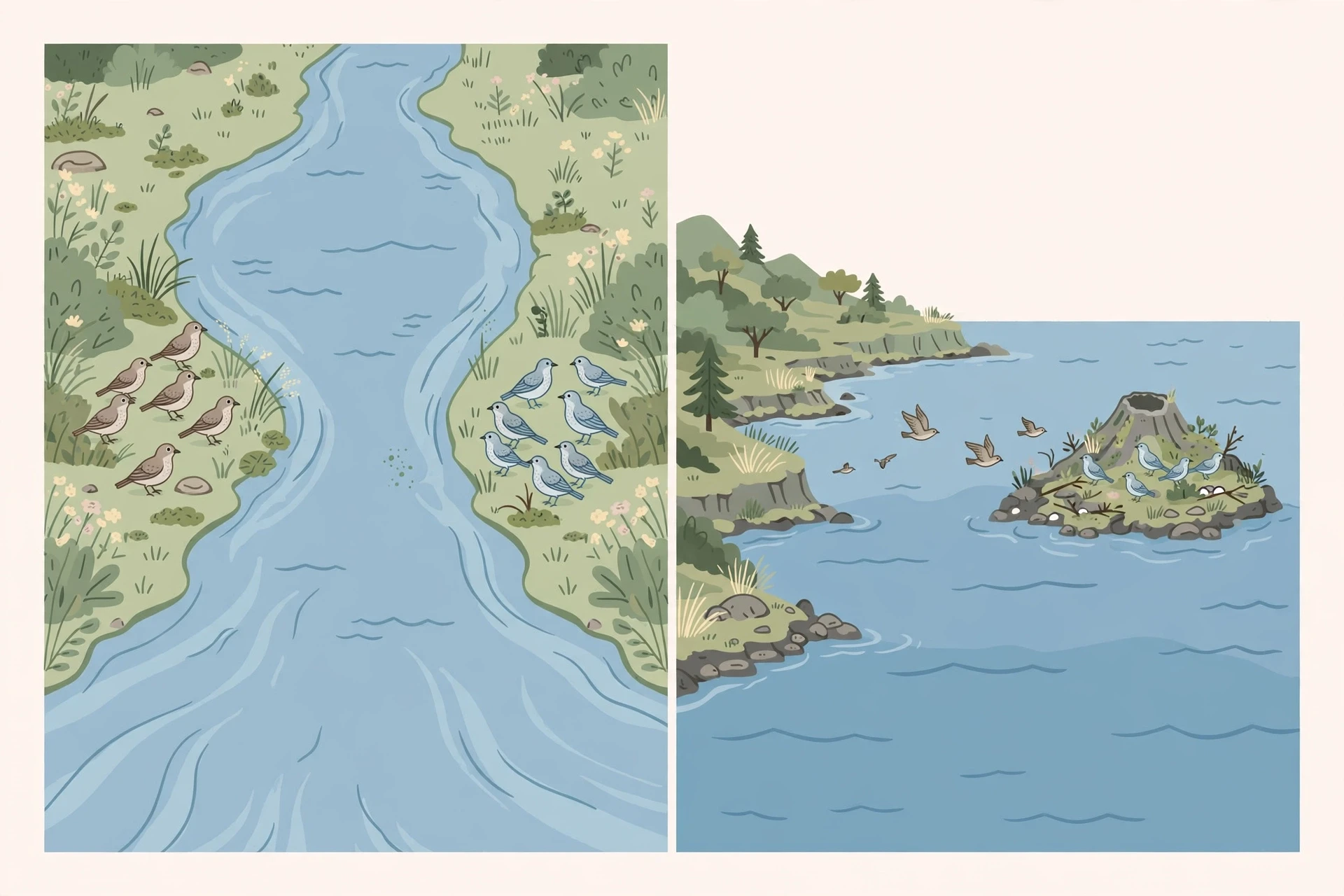
Allopatric speciation is speciation that happens when a geographic barrier divides one population into two, and the two groups evolve apart until they can no longer interbreed. It is the most common and best-documented mode of speciation. A river, a mountain range, or an ocean can do the dividing — and time does the rest.
The name describes the geography, not the mechanism. The mechanism is the same as in every other mode: gene flow stops, divergence accumulates, and reproductive isolation follows. Allopatric speciation is simply the case where the stop in gene flow has a physical cause that anyone can point to on a map. UC Berkeley's Understanding Evolution lays out the four modes of speciation, with reduced gene flow as the thread that runs through all of them.
5.1 Dispersal: a few cross over
In dispersal, a few individuals cross a barrier and found a new population on the far side. A storm blows birds to an island. Seeds wash ashore on a new coast. The founders carry only a sample of the parent population's genes, and they cannot return. From that moment, the two groups evolve separately.
The Galapagos finches are the classic dispersal story. A single ancestor arrived from the South American mainland about 1 to 2 million years ago, and its descendants spread across the islands, each population adapting to the food on its own island. The Hawaiian honeycreepers tell the same story on a different archipelago: a single founder species radiated into many species with different beaks for foods including seeds, nectar, and insects.
Dispersal is a gamble. Most founder populations die out. The ones that survive inherit a small, unrepresentative gene pool and a new environment at the same time, which is why island forms so often look strange beside their mainland relatives.
5.2 Vicariance: the land itself splits
In vicariance, nobody moves. The land itself splits, and one population becomes two without anyone travelling. A river changes course and cuts a range in half. A valley erodes deeper until it cannot be crossed. A continent drifts apart. The barrier appears, and the population on each side is left to evolve on its own.
The Isthmus of Panama is the textbook case. It emerged gradually over millions of years, with final closure separating Atlantic and Pacific marine populations around 2.8–3 million years ago — the date most textbooks still use, although some studies argue the deep seaway closed much earlier, 10–15 million years ago. Species that once swam in one ocean were divided into pairs, one on each side, and the pairs have been diverging ever since.
5.3 The spotted owls
The northern spotted owl and the Mexican spotted owl show allopatric speciation still in progress. OpenStax Biology 2e presents them as two subspecies — an example of allopatric speciation in progress, with speciation 'likely' to occur as their genetic and phenotypic differences accumulate. OpenStax does not give a cause for the original separation.
That is worth pausing on. Textbooks often present speciation as a solved story with a neat cause for every split. The spotted owls are a reminder that a split can be recognised as in progress before every detail of its history is known — and that saying what is not yet known is part of the science, not a failure of it. OpenStax Biology 2e uses the spotted owls as its example of incipient allopatric speciation.
Whether the barrier is a river, an ocean, or a rising isthmus, the logic is the same. Separation stops gene flow. Selection, drift, and mutation do the diverging. And given enough time apart, the two groups return as strangers — two species where one used to be.
6. Peripatric Speciation: Small Groups at the Edge
Peripatric speciation is a special case of allopatric speciation in which a small population at the edge of a species range becomes isolated and evolves into a new species. Small size makes genetic drift strong and founder effects large, so change can be fast.
Picture a bird species spread across a mainland coast. At the far edge, a few birds settle on a small offshore island, cut off by a sea almost nobody crosses back over. That small edge group is now on its own.
6.1 The founder effect
A founding group carries only a sample of the parent gene pool. If five birds colonise an island, they bring five birds' worth of genes, not the whole species' worth, so a rare mainland allele can be common in the founders by chance alone, and a common one may be missing entirely.
That sampling accident is the founder effect. In a large population, a rare allele stays rare unless selection favours it; in a tiny founding population, chance can push it to high frequency in a few generations, so the new population starts already genetically different.
I first felt the force of this idea while reading about island birds and realising how much of their difference came down to which few individuals happened to arrive first. I had always pictured evolution as selection patiently shaping a population. The founder effect showed me the other half: sometimes a population changes because a small, unrepresentative handful got stranded somewhere new, and chance sorted first.
6.2 Why small populations diverge fast — and often die out
Small size also makes genetic drift powerful. In a population of a few dozen, an allele can rise or fall in frequency through random differences in who happens to breed. Add a new environment — different food, different predators, a different climate — and selection starts pulling at the same time, on a gene pool already tilted by chance.
That combination can move a population quickly: a new beak shape, song, or breeding season can take hold in a small group far faster than in a large, well-mixed population. Island founder populations, such as the ancestors of the Hawaiian honeycreepers, are the classic examples.
Yet most of these experiments fail. A single storm, a disease outbreak, or a bad breeding season can wipe out a tiny population, and inbreeding can expose harmful recessive alleles. The survivors leave a clear signature: a new species genetically close to its parent, yet strikingly different in a few traits.
6.3 Peripatric or just allopatric?
The boundary between peripatric and allopatric speciation is a matter of size and position, not a different mechanism. Both involve geographic separation, both end with reproductive isolation, and both rely on the same forces: selection, drift, and mutation acting on separated gene pools.
What makes a case peripatric is the setup: one small population at the edge of the range, cut off from a much larger parent population that usually carries on much as before, while the small offshoot changes fast. Allopatric, peripatric, parapatric and sympatric speciation are four descriptions of how gene flow gets reduced, and peripatric speciation is the description that fits when the reduction happens to a small group at the edge.
7. Sympatric Speciation: New Species Without a Barrier
Sympatric speciation is speciation that happens inside one geographic area, with no physical barrier separating the two new species. It was once dismissed as impossible, because gene flow should erase any divergence — and it is now accepted as real, but rare, with polyploidy as its clearest case.
Two groups live in the same place, meet each other, and could interbreed. Yet they split anyway. For most of the twentieth century, many biologists thought that could not happen, because any difference would be washed away by mating with the other group. The last few decades have shown that it can happen, when something couples ecology to mating so tightly that gene flow cannot undo the split.
7.1 Why Mayr doubted it, and what changed his successors' minds
Ernst Mayr's objection was straightforward. Without a barrier, gene flow is a powerful mixer: a new trait that helps one group exploit a new food source will spread through the whole population by interbreeding, or be diluted out of existence. Divergence needs separation, and in one place there is no separation to be had.
The theoretical answer began in 1966, when John Maynard Smith, 'Sympatric speciation', American Naturalist 100:637–650, built the first genetic model showing sympatric speciation was in principle possible if disruptive selection first maintained a stable polymorphism and assortative mating (or habitat fidelity) then built up reproductive isolation — under restrictive conditions on selection strength, recombination and dispersal, not as a general proof. Assortative mating means mating with partners like oneself. If individuals that prefer different foods also mate with others that share their preference, the two groups can pull apart while living side by side.
The evidence arrived as molecular data. Genetic studies of host races and crater-lake fishes showed populations diverging in the same place, with reduced gene flow and allele-frequency differences at multiple loci. The pattern was not a clean split with zero interbreeding, but a partial split held in place by ecology — exactly what the theory predicted. OpenStax Biology 2e sets out both definitions side by side. See OpenStax Biology 2e, 18.2 Formation of New Species.
7.2 The apple maggot fly
The best-studied animal case is a small fly with a taste for fruit. Rhagoletis pomonella, the apple maggot fly, is native to North America, and its original host is hawthorn. In the 1850s some flies shifted onto introduced domesticated apple in the Hudson Valley, New York; a local newspaper reported larvae infesting apples in 1866, and Benjamin Walsh described the fly as Trypeta pomonella in 1867, citing it as an example of his 1864 idea that a host shift could produce a new race without geographic isolation.
The shift works because of timing. Apples ripen about three to four weeks earlier than hawthorn fruit, so the apple race ends pupal diapause and emerges about three to four weeks earlier — selection on diapause timing, not on faster post-diapause development. The flies mate on or near their host fruit, so a fly that prefers apples tends to mate with other apple flies, on apples, at apple time.
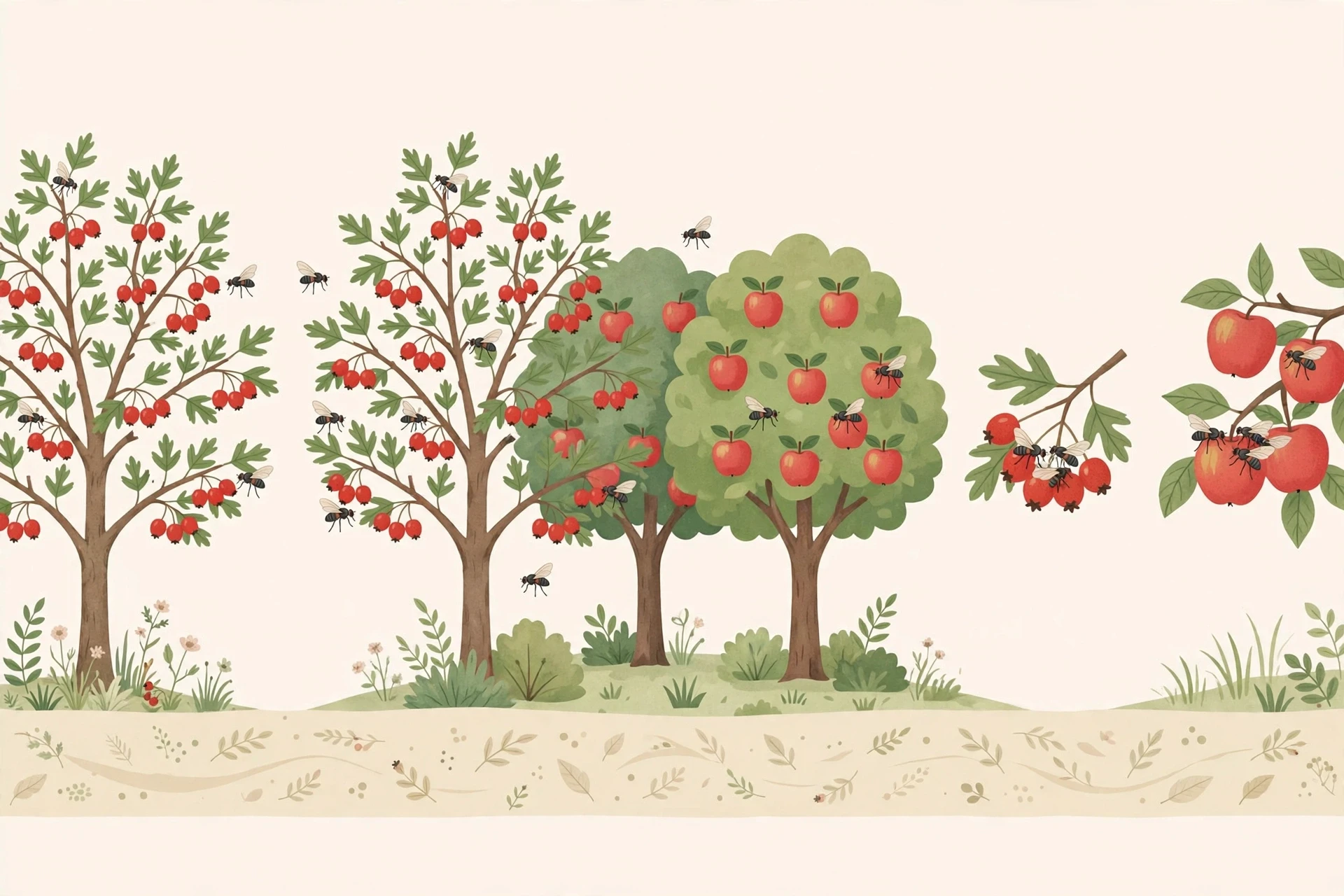
Guy Bush proposed the sympatric interpretation in 1969 (Evolution 23:237–251). Feder, Chilcote and Bush (1988; 1990) then documented consistent allele-frequency differences at six allozyme loci, work later extended with Berlocher; gene flow between the races at Grant, Michigan, is estimated at only about 4–6% per generation. That number is low but not zero: the two races are partially reproductively isolated host races at an early stage of ecological speciation, not finished species.
A late-1970s introduction to the Pacific Northwest — first found in Portland, Oregon, in 1979 — gave a second natural experiment in reverse: within about 40 years flies that arrived on apple had shifted onto black and ornamental hawthorn, with partial reproductive isolation evolving. That repeatability is what makes the apple maggot fly the central case for sympatric speciation in animals: dated, measured, and still in progress.
7.3 Crater-lake cichlids
A second animal case comes from crater lakes in Nicaragua, where sister species of Amphilophus cichlids have arisen inside single lakes such as Lake Apoyo, with no barrier between them.
The cichlids divide the lake by ecology: different feeding zones, breeding sites, and mate preferences. The details differ from lake to lake, but the broad pattern — closely related species coexisting in a small, enclosed lake with no physical division — is hard to explain by geographic separation alone. Together with the apple maggot fly, the crater-lake cichlids show that sympatric speciation in animals is real, rare, and usually incomplete when first caught happening.
8. Parapatric Speciation and Ring Species: The Continuum
Parapatric speciation happens across a continuous range, where neighbouring populations adapt to different conditions along a gradient and diverge despite some gene flow. Ring species are the extreme version of that idea — a chain of populations around a barrier whose ends can no longer interbreed.
Think of a species spread along a mountainside, from warm lowland forest to cold scrub at the top. Neighbours at any one height interbreed freely, yet selection pushes the lowland and highland forms toward different local fits. If selection is strong enough, that tension can harden into a break.
8.1 Speciation across a gradient
A gradient becomes a speciation event when divergence outruns gene flow. At each step along the range, neighbouring populations exchange genes, so no single step looks like a split. The change accumulates gradually — a cline — until the two ends are so different that they would not interbreed if they met.
That is a demanding condition. Gene flow is a constant pull back toward sameness, and selection must be strong and steady enough to hold the differences in place. When selection weakens, or the gradient flattens, the cline can collapse back into one interbreeding population. UC Berkeley's Understanding Evolution page sets out the four modes, noting that reduced gene flow plays a critical role in each. See UC Berkeley, Understanding Evolution, Modes of speciation.
8.2 Ensatina salamanders
The most famous candidate for a ring species is a salamander that wraps itself around a valley. Ensatina eschscholtzii, a lungless salamander, is distributed in a ring around California's Central Valley, which is too dry for it. Stebbins, in 1949, recognised seven subspecies: four unblotched — picta, oregonensis, xanthoptica, and eschscholtzii — and three blotched — platensis, croceater, and klauberi.
Around the ring, each population can interbreed with its neighbours, and the pattern changes gradually from unblotched in the north to blotched in the south. In southern California, the two ends meet: the unblotched eschscholtzii and the blotched klauberi are locally sympatric, with little or no interbreeding. That is the classic ring-species picture — a chain of interbreeding neighbours whose ends behave like separate species.
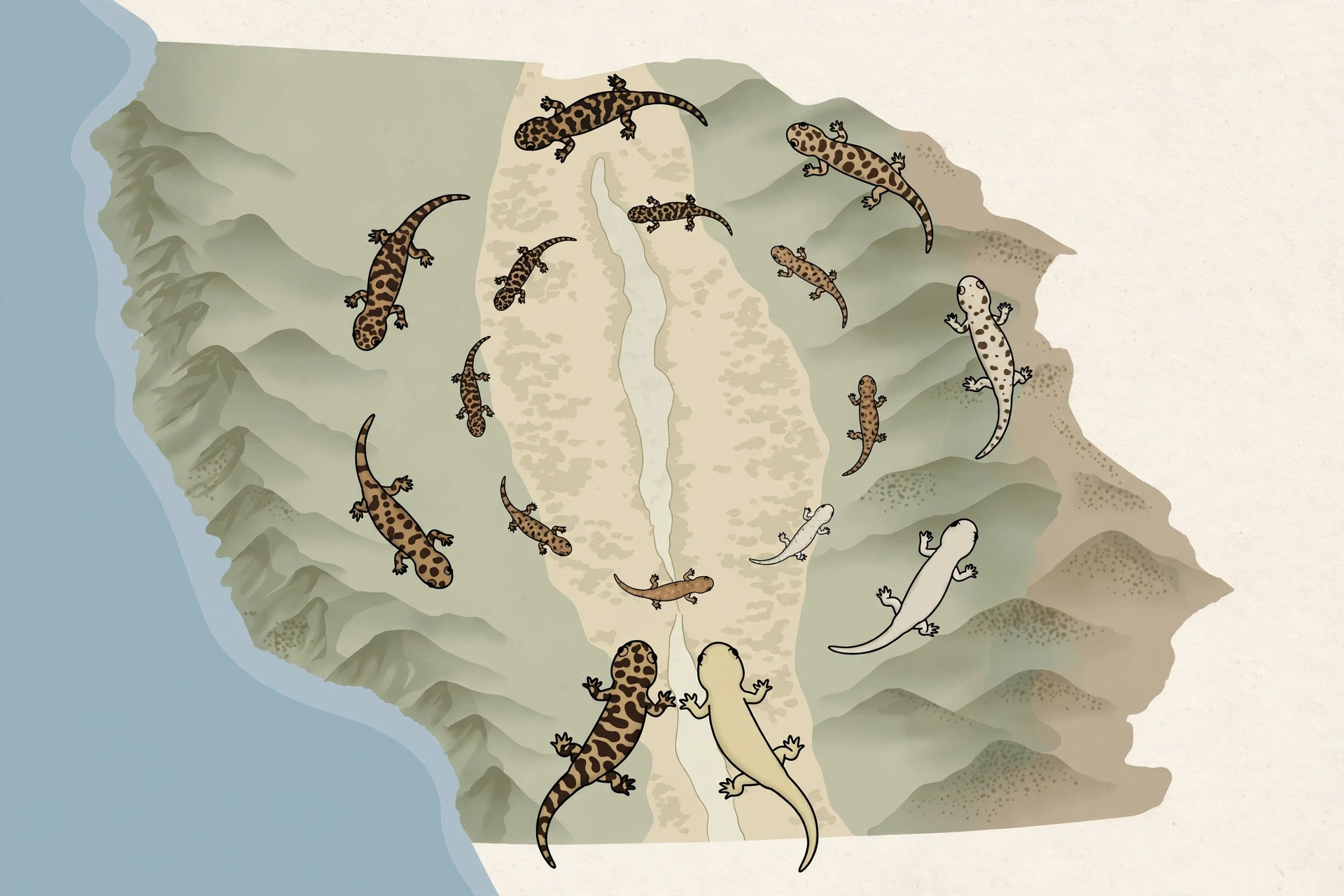
The classic picture has complications. Genetic work has found sharp breaks around the ring, so the smooth, continuous gene flow the textbook version assumes is disputed, and Kuchta and Wake (2016, Copeia 104:189–201) note dissatisfaction with the seven-subspecies arrangement. Ensatina remains the strongest remaining candidate, but with known problems, not a settled proof.
8.3 The greenish warbler — a textbook example under challenge
The greenish warbler, Phylloscopus trochiloides, was long presented as the other great ring species. Ticehurst proposed the ring around the Tibetan Plateau in 1938, and Irwin and colleagues documented it in Nature in 2001 (409:333–337). Populations ring the plateau, changing gradually in song and plumage, and the two Siberian end forms meet in the north and barely interbreed.
Genomic data challenged that story. Alcaide and colleagues, in Nature in 2014 (511:83–85, DOI 10.1038/nature13285), used genome-wide data and found historical breaks in gene flow at more than one location around the ring, plus occasional interbreeding between the Siberian end forms. Their paper states that the results cast doubt on the greenish warbler as a rare example of speciation by distance, while confirming a continuum from slightly divergent neighbours to almost fully isolated end forms.
Both sides deserve to be heard. The classic reading is right that divergence builds up gradually around the ring, and the genomic correction is right that the ring was not a smooth, unbroken chain: gene flow was interrupted at several points, and the end forms still exchange genes occasionally. The honest status is contested, not settled. The herring gull complex, once cited alongside it, has been formally rejected as a ring species.
Mode | Geography | Gene flow during divergence | Key example | Speed |
|---|---|---|---|---|
Allopatric | Populations divided by a barrier | Cut off | Galapagos finches; spotted owls | Slow to moderate, commonly 100,000 years to several million years in animals |
Peripatric | Small group isolated at the range edge | Cut off, small population | Island founder populations; Hawaiian honeycreepers | Can be fast, drift is strong |
Parapatric | Continuous range, gradient of conditions | Reduced but present | Ring populations; clines that become breaks | Moderate, depends on selection strength |
Sympatric | Same area, no barrier | Present, must be overcome | Apple maggot fly host races; polyploid plants | Fast to instant; polyploidy in one generation |
9. Ecological Speciation: New Species Made by a New Way of Life
Ecological speciation is speciation driven by adaptation to different environments or resources. When two populations use different food, different habitats, or different hosts, natural selection pulls them apart — and the same traits that adapt them to their niche also stop them interbreeding.
This mode cuts across the geographic categories: ecological divergence can happen in separated populations, along a gradient, or in the same place. What defines it is the driver — the environment, not the map. Two groups split because they make their living in different ways, and the split becomes a species boundary when that way of life also shapes who mates with whom.
9.1 The stickleback pairs
The clearest case swims in a handful of small lakes in British Columbia, colonised by threespine stickleback, Gasterosteus aculeatus, after the Pleistocene glaciers retreated 10,000 to 12,000 years ago. The lakes holding species pairs are at most about 13,000 years old.
In a few small lakes, two forms coexist. The benthic form is larger and deeper-bodied, feeding on invertebrates on the lake bed; the limnetic form is smaller and more fusiform, with longer and more numerous gill rakers, feeding on zooplankton in open water. Within each lake the two forms are biological species: they rarely interbreed, and body size strongly affects mating, so the ecological difference doubles as a mating barrier.
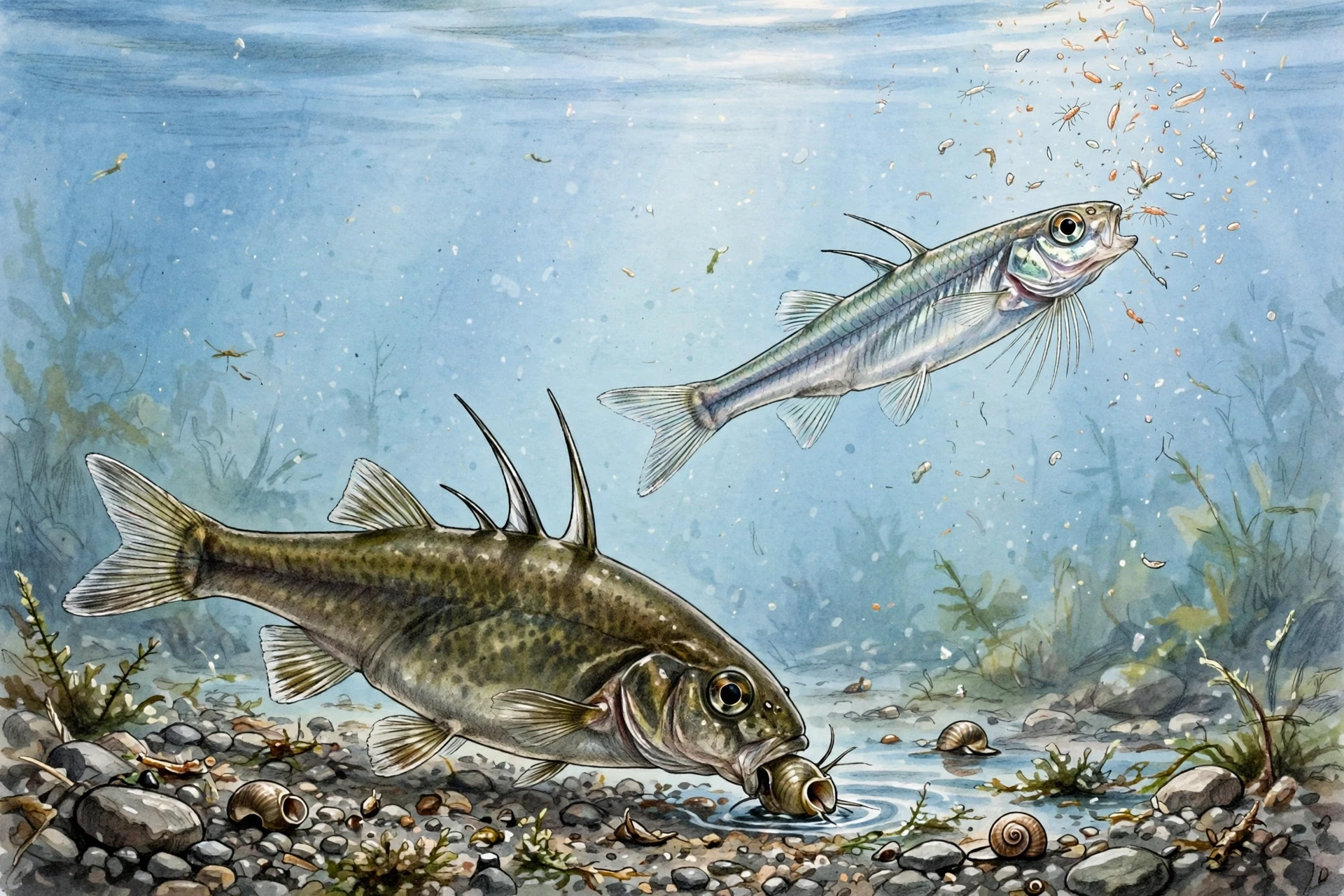
The pairs evolved independently in each lake — parallel evolution, not shared ancestry — strong evidence that the lake environment itself drives the divergence, on mitochondrial DNA evidence; a 2023 genomic study has challenged a simple independent-origin interpretation, suggesting some benthic/limnetic traits may be ancestrally retained.
Two of the pairs are already gone. The Hadley Lake pair on Lasqueti Island, discovered in the late 1980s, was exterminated between 1988 and 1992 after the unauthorised introduction of the brown bullhead catfish (Ameiurus nebulosus), and was designated Extinct in 1999. The Enos Lake pair on Vancouver Island collapsed into a hybrid swarm by the late 1990s and is no longer two distinct species. Three pairs survive: Paxton Lake and the Vananda Creek pair (Priest, Emily and Spectacle Lakes), both listed as Endangered under SARA since June 2003, and a third pair discovered in Little Quarry Lake, Nelson Island, in 2007, assessed as Threatened by COSEWIC.
One question is still debated: did the two forms diverge inside one lake, or did two separate invasions from the sea bring them in at different times, with an early allopatric stage? Some evidence fits each reading, so the sympatric reading is not settled.
9.2 Host shifts and magic traits
Ecological speciation often turns on a magic trait: one trait that does two jobs, adapting its bearer to a niche and guiding mate choice at the same time. Host preference in Rhagoletis is the textbook example — a fly that prefers apples mates on apples, with other apple flies — so the preference is both the adaptation and the barrier.
Beak size in finches works the same way: a beak that cracks hard seeds also shapes the song a bird can sing, and song shapes mate choice. Body size in sticklebacks works the same way too. In each case, natural selection pulls the two groups toward different ways of life, and the trait under selection carries reproductive isolation along with it, without any separate barrier having to evolve first.
When adaptation and isolation are the same trait, divergence does not have to wait for a second set of changes to build a mating barrier.
9.3 When ecology is not enough
Ecology does not always finish the job. Two populations can diverge in food or habitat and still interbreed freely when they meet, if the ecological traits do not affect mating, and hybrids can carry genes back and forth, blurring the difference faster than selection can rebuild it. A change in the environment can erase the niche difference altogether, as the Enos Lake sticklebacks show.
Ecological speciation completes only when selection stays strong, the ecological trait affects mating or hybrid fitness, and gene flow stays low enough for differences to accumulate. When any of those fails, divergence stalls or reverses. That fragility is why some ecological splits become species and others remain local varieties.
10. Polyploidy: Speciation in a Single Generation
Polyploidy is a change in chromosome number that can create a new species in a single generation. When a plant doubles its chromosome set, or when two species hybridise and the hybrid doubles its chromosomes, the result is instantly reproductively isolated from both parents.
Most speciation is slow, measured in thousands or millions of years, because reproductive isolation usually builds up gradually as genetic differences accumulate. In polyploidy, a single error in cell division creates the isolation all at once, because the new plant's chromosomes no longer pair properly with its parents'.
10.1 Autopolyploidy and allopolyploidy
There are two ways to double a chromosome set. In autopolyploidy, one species doubles its own set: a diploid plant with two sets produces offspring with four. In allopolyploidy, two species hybridise, and the hybrid doubles its chromosomes, ending up with complete sets from both parents.
The difference matters for fertility. A hybrid between two species is often sterile, because its mismatched chromosomes cannot pair up during meiosis. Doubling the set gives every chromosome a partner, restoring fertility in one step — and that fertile hybrid can no longer breed successfully with either parent, because a cross back to a parent produces offspring with an unbalanced chromosome number. OpenStax Biology 2e describes both processes with diagrams. See OpenStax Biology 2e, 18.2 Formation of New Species.
Polyploidy is common in plants and rare in animals, largely because doubled sets cause problems with sex determination and development in animals that most plants avoid. That is why the clearest single-generation cases are all plants.
10.2 Tragopogon: two new species in a human lifetime
The most carefully documented case involves a roadside weed. Tragopogon, commonly called goatsbeard, came to North America from Europe: three diploid species — T. dubius, T. pratensis, and T. porrifolius — were introduced to the Pacific Northwest in the early 1900s, hybridised side by side, and the hybrids doubled their chromosomes again and again.
Two new allotetraploid species resulted: T. miscellus and T. mirus, first described by Marion Ownbey in 1950, near the Idaho–Washington border. Each new tetraploid is self-fertile but reproductively isolated from its diploid parents. The two tetraploids have each formed repeatedly — T. miscellus at least ~21 times and T. mirus at least ~13 times — and they can still cross with each other, producing semifertile hybrids.
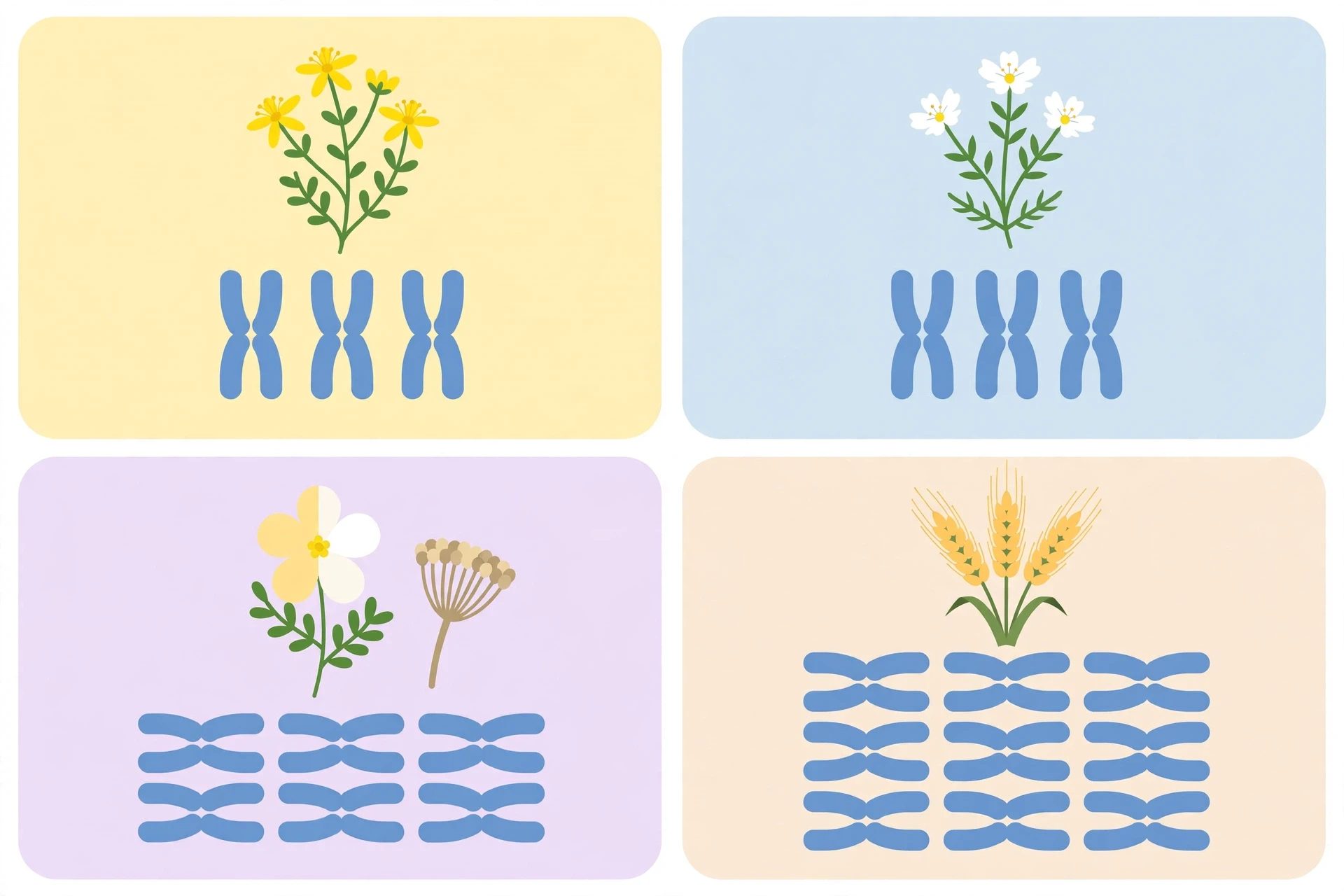
Campbell Biology states that scientists have documented at least five new plant species originating by polyploid speciation since 1850. Tragopogon supplies two of them — proof this is a process watched, dated, and named in plants growing along roadsides and field edges.
10.3 Spartina anglica and bread wheat
A second dated case began on the English coast. The sterile hybrid Spartina x townsendii, between native S. maritima (2n = 60) and introduced North American S. alterniflora (2n = 62), was first collected at Hythe, Hampshire, in 1870. Chromosome doubling produced the fertile allopolyploid S. anglica (2n = 120–124, usually 122), first recorded as a fertile specimen at Lymington, Hampshire, in 1892 — a new species from a hybrid that began as a sterile dead end.
Bread wheat shows the same process on a scale that feeds much of the world. Triticum aestivum is an allohexaploid (AABBDD, 2n = 42): six chromosome sets, two from each of three ancestral lineages. The first polyploidy event, which produced tetraploid emmer wheat, occurred roughly 500,000–800,000 years ago; the second, a cross between domesticated tetraploid wheat and the wild goatgrass Aegilops tauschii, produced hexaploid bread wheat only about 8,500–9,000 years ago in the Fertile Crescent, probably near the southern Caspian Sea. The crop that fills bread baskets on every continent is a hybrid of three species, stabilised by chromosome doubling thousands of years before anyone knew what a chromosome was.
Polyploidy is the fastest route to a new species biology knows, and the most cleanly dated: Tragopogon and Spartina carry dates, places, and names, and wheat carries the evidence in every field it grows in. Speciation is not always a slow drift across deep time — sometimes it happens in a single generation, in a single plant.
11. Hybrid Speciation: When Mixing Makes Something New
Hybrid speciation is speciation in which hybridisation itself creates the new species. It sounds backwards — mixing should blur species, not make them — and in most cases it does. In a few well-documented cases, the hybrid combination opens a niche neither parent can use.
When two populations meet and interbreed freely, their differences wash out and the boundary between them dissolves. Hybrid speciation is the rare exception, in which the hybrid line survives, breeds true, and stops exchanging genes with both of its parents.
11.1 The strict test
In 2014, Molly Schumer and colleagues set out three criteria that a case of homoploid hybrid speciation must meet. Homoploid means the chromosome number does not change, so the new species cannot lean on the instant isolation that polyploidy provides.
First, the hybrid lineage must be reproductively isolated from both parent species. Second, there must be genetic evidence that hybridisation actually happened — not just a resemblance, but DNA showing the mixed ancestry. Third, the isolation itself must be caused by the hybridisation, not by some later accident of geography or timing.
Under those criteria, only four cases passed confidently in Schumer and colleagues' 2014 assessment: one butterfly and three sunflowers. Yakimowski and Rieseberg (2014) listed 19 putative cases of homoploid hybrid speciation among seed plants — but under the strict criteria, the four are the ones that can be named without qualification.
11.2 Heliconius heurippa
The butterfly case comes from Colombia. Heliconius heurippa is a passion-vine butterfly whose wing pattern looks like a blend of two close relatives, Heliconius cydno and Heliconius melpomene. Genetic work has shown that the butterfly carries ancestry from both parents, and its wing pattern matches the pattern that appears when the two parent species are crossed in the laboratory.
The wing pattern does more than decorate the butterfly. In Heliconius, males choose mates partly by wing colour, so a new pattern is also a new mating signal. A female heurippa wearing the hybrid pattern is courted by heurippa males and largely ignored by males of either parent species. The hybridisation created the very trait that keeps the new lineage apart from its parents. That is the third criterion, satisfied in the most direct way possible: the mixture itself built the wall. Salazar and colleagues documented this in 2010, building on Mavarez and colleagues in 2006. Its genome is mostly cydno-like, with the melpomene contribution concentrated in the genes for the wing pattern. A 2021 author correction by Mavárez and colleagues, however, failed to find statistical support for hybridisation-derived pre-zygotic isolation in H. heurippa, so its status as the best-supported animal case is now contested.
11.3 The desert sunflowers
The three sunflower cases come from the deserts of the American West. Helianthus anomalus, Helianthus deserticola, and Helianthus paradoxus all descend from hybrids between the same two parents, the common sunflower Helianthus annuus and the prairie sunflower Helianthus petiolaris. Loren Rieseberg documented the pattern in 1991. A 2023 genomic revision (Owens et al.) suggests H. anomalus and H. deserticola may have arisen from a single hybridisation event with an unexpected donor, and that the events are more ancient than previously thought.
Each of the three hybrids lives where neither parent can. Helianthus anomalus grows in sand dunes, Helianthus deserticola in dry desert soils, and Helianthus paradoxus in salty marshes. The parents cannot survive in those places, so the hybrids are not competing with them — they have moved into empty ground.
The trick is recombination. When two species hybridise, their genes are shuffled into new combinations, and some of those combinations are extreme: plants more drought-tolerant, or more salt-tolerant, than either parent. Most such combinations are useless or harmful, and they vanish. A few land in a habitat where the extreme trait is exactly what survival demands, and the hybrid lineage settles there, isolated from its parents not by a mountain or a sea, but by the ground it stands on.
11.4 Hybridisation as a helper, not just a maker
Hybridisation also plays a quieter role in how new species form. Gene flow between closely related species can supply raw variation that later speciation puts to use. The Galapagos finches show this clearly: the Big Bird lineage itself began with a hybrid cross, an immigrant male breeding with a medium ground finch, and the lineage that followed stayed distinct for decades. Among cichlids, hybridisation between species has fed variation into radiations that then split along new lines.
Biologists no longer treat hybridisation as simple contamination. It can blur a boundary, and it can also hand a lineage the genetic material it needs to cross into a new niche.
12. The Genetics of Splitting: Incompatibilities, Reinforcement, and Genomes
Speciation is complete when genetic differences make hybrids fail or make mating fail. The Dobzhansky-Muller model explains how those differences can accumulate without any population ever suffering for them — and reinforcement explains how selection can then sharpen the barrier between them.
A split is easy to describe and hard to explain at the level of genes. Two populations diverge, and at some point their hybrids stop working. The puzzle is how two healthy genomes can combine into a broken one.
12.1 Dobzhansky-Muller incompatibilities
The model was proposed independently by three biologists: William Bateson in 1909, Theodosius Dobzhansky in his 1937 book Genetics and the Origin of Species, and Hermann J. Muller in 1942. It solved a problem that had troubled Darwin's successors for decades.
Picture an ancestral population with the genotype AABB at two genes. It splits into two isolated populations. In one, a new allele spreads until the population is aaBB. In the other, a different new allele spreads until the population is AAbb. Neither change harms its own population: aa works fine alongside BB, and AA works fine alongside bb.
Now bring them together. A hybrid inherits a from one parent and b from the other, giving the combination aabb at those two genes. That combination has never existed before, and it has never been tested by natural selection. If a and b interact badly — if the protein made by one cannot work with the protein made by the other — the hybrid is sterile or does not survive. The harmful combination was never tested because it never arose inside either population.
That is the key insight: no population has to cross a low-fitness valley. Reproductive isolation can build up as a side effect of ordinary divergence, with no suffering along the way. The details of the model, and the evidence behind it, are reviewed in the open-access literature on Dobzhansky-Muller incompatibilities. For the background on how mutations and gene flow work, see Genetics. One incompatibility is rarely enough: in real species, dozens or hundreds of small incompatibilities accumulate, each one shaving a little off hybrid fitness.
12.2 Reinforcement: selection against hybrids
Once hybrids start to fail, a new force enters the picture. A bird that mates with the wrong species wastes its breeding season on offspring that cannot reproduce. Individuals that choose mates from their own population leave more descendants than individuals that do not. This is reinforcement: selection that strengthens reproductive isolation because hybrids have low fitness.
Reinforcement works on the traits that guide mating — song, colour, scent, timing, and size — which tend to sharpen where the two populations meet.
The threespine sticklebacks of British Columbia show the mechanism in the flesh. In Paxton Lake and Priest Lake, the benthic and limnetic forms rarely interbreed, and body size plays a large part in mating decisions. A female chooses a male close to her own size, and size tracks the feeding niche: deep-bodied fish on the lake bed, slim fish in open water. The same trait that adapts a fish to its food also guides its choice of mate. When hybrids between the two forms are less fit, selection favours fish that mate within their own size class, and the barrier grows stronger with each generation.
Reinforcement has limits. It only works where hybrids actually suffer. If hybrids are healthy, there is nothing for selection to push against, and the two populations may merge instead. And if the populations never meet, reinforcement has nothing to act on at all. It is a finisher, not a starter: it sharpens a barrier that divergence has already begun to build.
12.3 Genomic islands and the modern picture
For most of the twentieth century, the picture of two diverging genomes was a smooth one: two populations drifting apart evenly, like two boats pulling away from each other. Genome sequencing has replaced that picture with something messier and more interesting.
Divergence is not uniform across the genome. When two populations are still exchanging some genes, most of the genome keeps mixing, while a few regions diverge sharply and resist gene flow. These regions are often called genomic islands of divergence. They tend to hold the genes that matter for adaptation and for reproductive isolation: genes for beak shape, for colour, for mating behaviour, for the proteins that make hybrids fail.
The genome is not one wall; it is a coastline, with some stretches sealed and others still open to the sea. Speciation at the genetic level is a slow, uneven process in which incompatibilities accumulate, reinforcement sharpens the mating barrier, and parts of the genome seal themselves off one region at a time.
13. Adaptive Radiation: One Ancestor, Many Species
Adaptive radiation is the rapid diversification of one ancestral species into many descendant species, each adapted to a different niche. It happens when a lineage reaches a place with empty niches — an island archipelago, a new lake, or a landscape cleared by extinction — and selection pulls its descendants in many directions at once.
Most speciation is a slow affair, one split at a time. Adaptive radiation is the exception: a single ancestor arriving in an empty world, and its descendants fanning out into every way of life the place allows.
13.1 Darwin's finches, again — this time as a radiation
The Galapagos finches are the most famous radiation in biology, and they are worth meeting a second time, now as a radiation rather than as a single case of selection. One ancestor arrived from the South American mainland about 1 to 2 million years ago. Today there are about 14 to 18 species, depending on how the most closely related forms are counted.
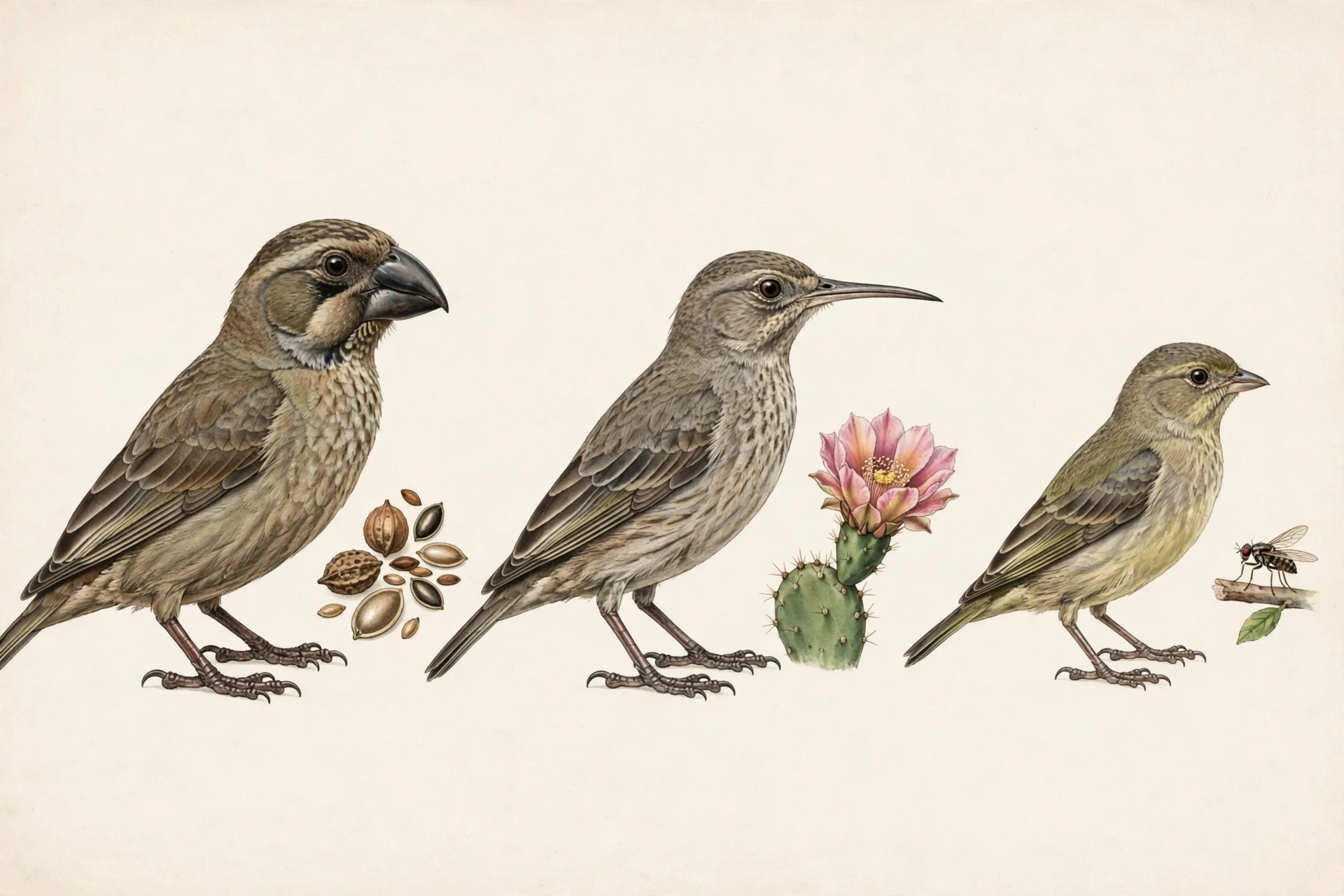
The beaks tell the story. Ground finches carry deep, crushing beaks for hard seeds. Cactus finches carry long, pointed beaks for reaching into cactus flowers. Warbler finches carry small, narrow beaks for picking insects from leaves. Each beak is a tool matched to a food, and each food is a niche that one lineage claimed while its cousins claimed the others. The Grants' work on Daphne Major caught one of those splits in the act, in a single drought.
13.2 Cichlids: the fastest radiation known
If the finches are the most famous radiation, the cichlids of Africa's Great Lakes are the fastest. In the words of Ole Seehausen of the University of Bern, they are the largest and fastest adaptive radiations known in the animal kingdom.
Lake Victoria holds more than 500 cichlid species found nowhere else. Most of them diverged in only the past 15,000–16,000 years, since the lake refilled after drying out almost completely about 14,700 years ago. That is not a clean restart, however: the lineages that seeded the radiation are much older — their hybrid ancestry dates back roughly 150,000 years — and some survived the dry period in swamps and refugia.
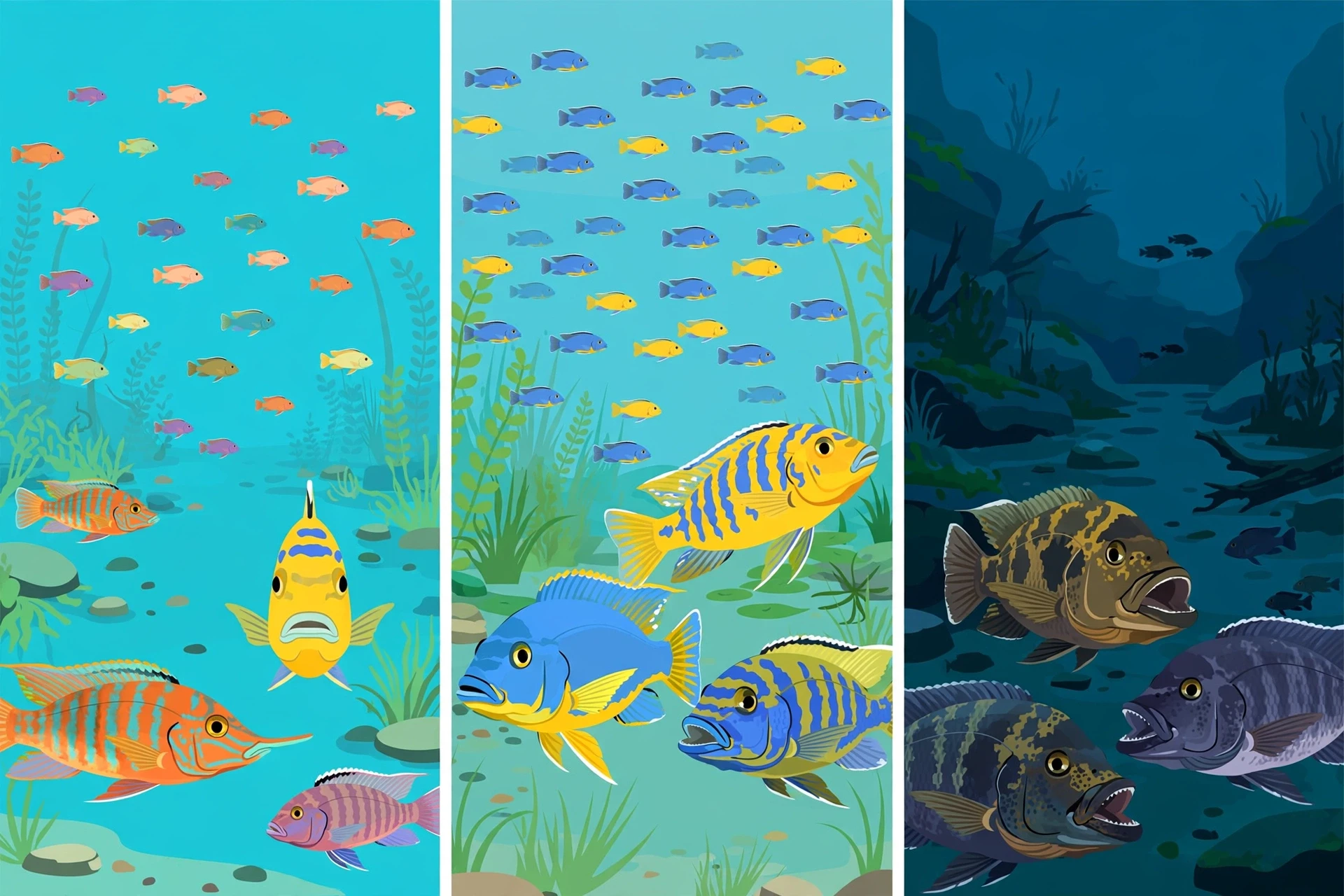
Lake Malawi holds about 850 cichlid species, with estimates ranging from roughly 800 to 1,000. Its radiation is far older than Victoria's, but still young: about 800,000 years, built from a generalist ancestor resembling today's Astatotilapia calliptera. Lake Tanganyika holds about 240 to 250 species, from older lineages that have been diverging for far longer. Worldwide, at least 1,760 cichlid species have been formally described, and the true total — including species not yet described — is estimated at 2,000–3,000. Some older estimates ran as high as 3,000–4,000.
The axes of divergence are colour, feeding, and depth. In Lake Victoria, males of different species flash different colours — blue, red, yellow — and females choose mates by colour, so a new colour can become a new species almost as soon as it appears. In Lake Malawi, species split by what they eat: algae scrapers, snail crushers, fish hunters, plankton sifters, each with a mouth shaped for its food. In Lake Tanganyika, depth adds another axis, with species stacked from the sunlit shallows to the dark depths.
A lake with hundreds of ways to make a living, and a fish that chooses its mate by sight, is a machine for making species.
13.3 Hawaiian honeycreepers
The same pattern plays out on a different archipelago, thousands of kilometres from the Galapagos. The Hawaiian honeycreepers descend, in the standard interpretation, from a single founder species that reached Hawaii and radiated into many species with different beaks for foods including seeds, nectar, and insects. OpenStax Biology names them alongside Darwin's finches as the classic example of adaptive radiation. The honeycreepers show that the finch story is not a one-off. You can read the textbook treatment of both radiations in OpenStax Biology 2e, section 18.2.
13.4 What makes a radiation fast
Four ingredients speed a radiation up. The first is empty niches: a new lake, a new archipelago, or a landscape cleared by extinction, where no competitor already holds the food and the habitat. The second is ecological opportunity, the match between what the place offers and what the lineage can do. The third is a key innovation — a trait that opens many niches at once, such as the cichlids' flexible jaws or the finches' adaptable beaks. The fourth is hybridisation, which can inject fresh variation into a radiation just when it needs new combinations to try.
In a crowded, stable landscape, divergence is slow, and most new forms are squeezed out before they can establish themselves. Speciation is not a clock that ticks at one speed. For why that diversity matters to the ecosystems it fills, see Biodiversity.
14. How Long Does Speciation Take?
There is no single answer. Polyploidy can do it in one generation, cichlids did it in about 15,000 years, and most bird and mammal splits are on the order of a million years old. The pace depends on generation time, the strength of selection, the size of the populations, and how completely gene flow is cut off.
14.1 The fast end
The fastest route is polyploidy. When a plant doubles its chromosome set, the result is instantly reproductively isolated from its parents. One generation, and the split is complete. Tragopogon miscellus and Tragopogon mirus arose this way within a human lifetime, after their European parents were introduced to the Pacific Northwest in the early 1900s and the new species were described in 1950.
The next fastest cases are the ones still unfinished. The apple maggot fly shifted from hawthorn to apple in the 1850s, in the Hudson Valley, and its host races have been diverging for about 160 years — still partially isolated, still exchanging a few percent of genes each generation. The Big Bird lineage of Galapagos finches became reproductively isolated within three generations of its founding cross, according to a study published in Science in 2018, and the Grants have been careful not to call it a finished species, because it is not yet clear the lineage will survive. But the fast cases are the exceptions, and most of them are plants, or lineages under ferocious selection, or both.
14.2 The slow end
For most animals, the slow end is the normal end. Allopatric speciation in animals commonly takes 100,000 years to several million years. Two populations are separated, they accumulate differences, incompatibilities build up one by one, and somewhere in that long stretch the barrier becomes complete.
Bird and mammal splits sit at the slow end of that range. Most are on the order of a million years old, and some are far older. Our own lineage is a slow case: the splits that produced the great apes and then the hominins played out over millions of years, not thousands. For that slow, vertebrate story, see Human Evolution.
14.3 Gradual change and punctuated change
Darwin's picture was gradual: small changes accumulating, generation after generation, until a lineage had become something new. In 1972, Niles Eldredge and Stephen Jay Gould offered a different picture, called punctuated equilibrium. They argued that the fossil record shows long stretches in which species change very little, broken by brief bursts of rapid change concentrated around speciation events.
The two pictures are not as opposed as they first look. A lineage can change gradually for a long time and still show a burst when a small population is isolated and selection is strong. The honest position is that both patterns occur, and that the fossil record and the genomic record answer different parts of the question.
14.4 Generation time is the speed limit
Underneath every other factor sits a simple one: generation time. Evolution works in generations, not in years. A lineage that produces a new generation every twenty minutes can run through in a week the number of generations that an elephant needs centuries to complete.
Bacteria divide in minutes and can diverge in days or years under strong selection. That is why antibiotic resistance can appear in a hospital ward within months of a new drug's arrival: the bacteria are running the experiment thousands of times faster than a mammal could.
I once tried to hold a million years in my head and failed completely. A century I could picture, but ten thousand of them stacked together was just a number again. What finally made it click was generation time. A million years is not a span of time to a finch; it is a million breeding seasons, a million chances for a beak to shift a fraction of a millimetre. Counted that way, a million years stops being an abstraction and becomes a very large number of very small steps. That is how speciation works: not in one leap, but in steps too small to see, repeated until the distance between two populations is too far to cross.
15. Speciation Seen in Real Time — and One Famous Story That Was Wrong
Yes, speciation has been watched as it happens — in plants within a human lifetime, in flies within about 160 years, and in a finch lineage within three generations. But the most famous rapid-speciation story, the London Underground mosquito, turned out to be wrong about where and when it happened.
15.1 What counts as watching speciation
Claiming to have watched speciation is a strong claim, so it needs a strong standard. Three things must all be shown: a dated origin, measured divergence, and measured reproductive isolation. A date without a measurement is a story. A measurement without a date is a snapshot. Only when all three are in hand can anyone say the split was actually observed.
Four cases in this article meet part of that standard. Tragopogon miscellus and Tragopogon mirus are the cleanest: three European goatsbeard species were introduced to the Pacific Northwest in the early 1900s, and two new allotetraploid species were described by Marion Ownbey in 1950, each self-fertile and reproductively isolated from its diploid parents (the two tetraploids can still cross with each other, producing semifertile hybrids). Spartina anglica is nearly as clean: the sterile hybrid between native and introduced cord-grass was first collected at Hythe, Hampshire, in 1870, and the first fertile specimen was recorded at Lymington in 1892. The apple maggot fly has a dated origin, in the 1850s in the Hudson Valley, and measured divergence, yet its host races are still only partly isolated, with gene flow of roughly 4 to 6 percent per generation. The Big Bird finch lineage is the fastest animal case of all, reproductively isolated within three generations, yet it is not a named species, and the Grants themselves have been hesitant to declare it one, because it is not yet clear the lineage will survive.
That is the honest score. None of these is a finished, named, universally accepted new animal species; only the plant cases — Tragopogon and Spartina anglica — are named species. The rest are splits caught in progress, which is exactly what makes them valuable. They show the middle of the process, not just its beginning and its end.
15.2 The London Underground mosquito, corrected
The story, as it is usually told, goes like this. When the London Underground opened, a few mosquitoes moved down into the tunnels, and in under a hundred years they evolved into a new species that bites humans, breeds all year round, and can no longer mate with the mosquitoes above ground. It is a neat story, it fits on a slide, and it is wrong.
The mosquito in question is Culex pipiens form molestus. Formally it is classified as a form of Culex pipiens, not a separate species — although genomic studies debate whether the two forms are in the early stages of speciation. It was first described in the 18th century from Egyptian specimens by Peter Forsskål in 1775 — published posthumously, since Forsskål died in 1763 — long before any underground railway existed. A 2004 microsatellite study suggested it might be distinct, but Harbach (2012) concluded it was 'nothing more than a phenotypic and physiological variant of Cx. pipiens'. The behavioural differences are real: the molestus form breeds all year, cannot enter winter diapause — so in cold northern climates it survives only in warm below-ground habitats — bites mammals preferentially, including humans, and mates in confined spaces, while the above-ground pipiens form bites birds primarily and needs a blood meal before laying its first eggs. The forms are partly reproductively isolated in northern Europe — mainly by mating behaviour and habitat, not by sterile crosses: where they meet, they do hybridise and produce viable offspring. Incompatible Wolbachia strains can additionally kill embryos in some pairings, but this has not been shown to separate the two forms. Haba et al. (2025) found introgression was more frequent around denser human populations — a modest association that needs further testing.
Then came the study that settled where and when it happened. Haba and colleagues, writing in Science on 23 October 2025, sequenced about 350 contemporary and historical mosquitoes from 77 populations. Their result was that molestus first adapted to human environments above ground in the Mediterranean or Middle East more than 1,000 years ago, most likely in ancient Egypt or another early agricultural society, and only later colonised below-ground habitats such as subways and basements. The Pirbright Institute summary gives the range as 1,000 to 10,000 years ago. The mosquito did not evolve for the Tube. It arrived in the Tube already carrying the traits that let it live there — breeding through the year, mating in tight spaces, biting mammals — because those traits had evolved above ground, beside people, centuries earlier. Biologists call that exaptation: an old trait becoming useful in a new place. Read the full account in the Pirbright Institute summary of the Haba study.
15.3 Why the correction matters
A wrong story told well can outlive the evidence for decades. The Underground mosquito was repeated in textbooks, lectures, and popular articles because it seemed to prove something exciting: that humans could watch a new species appear in a single lifetime, in a place everyone knew. Retiring it does not make speciation slower or less remarkable. It makes the real cases stand out more clearly, because they carry dates and measurements instead of a good punchline.
I first met the Underground mosquito in a textbook sidebar, and I repeated the story myself for years — the subway, the hundred years, the brand-new species — before I learned that the evidence had moved on. That is the part worth remembering. A correction is not an embarrassment for science; it is science doing its job. The dated plant and fly cases that actually hold up — Tragopogon in a few decades, Spartina anglica in a single century, the apple maggot fly still splitting after about 160 years — are less dramatic than a mosquito born in a tunnel. They are also true, and that is worth more.
16. Misconceptions About Speciation
Most confusion about speciation comes from five ideas that sound reasonable and are wrong: that a new species appears in a single birth, that evolution has a goal, that humans are the endpoint, that one fossil or one experiment proves a mode, and that a species is a fixed box rather than a population that changes.
16.1 Misconception 1 — "One animal gave birth to a new species"
Populations split, not individuals. A single mutant cannot found a species alone, because a species is a population, and one animal is not a population. A new trait can appear in one individual — a beak a fraction deeper, a wing pattern a shade different — but for that trait to mark a new species, it needs a population that shares its isolation and passes the trait on together.
Think of a language splitting. One speaker does not invent a new language by coining a word. A community drifts apart, its words and sounds shifting together, until the two groups can no longer understand each other. Speciation works the same way. Even the founder effect, where a handful of birds colonise a new island, is a story about a small group carrying a sample of the parent gene pool, not about a single heroic bird.
16.2 Misconception 2 — "Speciation means something better evolved"
New means reproductively isolated, not superior. A new species can be smaller, simpler, or worse at most things than its parent, and still be a new species, because isolation is the test, not improvement. Natural selection has no goal and no finish line; it favours whatever works in a particular place at a particular time, and what works in a cave, a desert, or a cold lake is often less of everything, not more. Read how selection actually works, without a ladder to climb, in Natural Selection Explained.
The word "better" smuggles in a ranking that biology does not support. A deep-beaked finch is not better than a slender-beaked finch. It is better at cracking hard seeds and worse at probing cactus flowers. Each form wins in its own niche and loses in the other's, and that trade-off is the point. When a new species forms, it has not climbed a step. It has stepped sideways into a different way of living.
16.3 Misconception 3 — "If they can interbreed, they are the same species"
The biological species concept is a rule with known exceptions, not a law of nature. Ring species, hybrid zones, and collapsing pairs all show that interbreeding and species status overlap. The greenish warbler end forms around the Tibetan Plateau occasionally interbreed, even though they are nearly fully isolated in most other respects. The Ensatina salamanders around California's Central Valley form a ring in which neighbours interbreed while the end forms barely do.
The clearest evidence comes from the threespine sticklebacks of British Columbia. The Enos Lake pair on Vancouver Island was two distinct species, benthic and limnetic, until the two forms started to interbreed and the pair collapsed into one. They had been species, and then they were not. Interbreeding is the best single test biologists have, and it is still a test with grey areas at both edges.
16.4 Misconception 4 — "Humans caused the London Underground mosquito to speciate in 100 years"
This is the story corrected in section 15, and it deserves a plain restatement here. The London Underground mosquito, Culex pipiens form molestus, is not a distinct species, it did not evolve in the Underground, and it did not appear in under 100 years. Haba and colleagues showed in Science in October 2025 that it adapted to human environments above ground in the Mediterranean or Middle East more than 1,000 years ago, and only later moved into subways and basements. Humans did shape its world, over centuries of farming and city-building, but the subway was a new address for an old mosquito, not the birthplace of a new species.
16.5 Misconception 5 — "Speciation is finished once a barrier appears"
Barriers can collapse, and when they do, speciation can run backwards. The Enos Lake sticklebacks are the evidence: two forms that had diverged into separate species began interbreeding again, and the split dissolved. Gene flow resumed, the differences that kept them apart faded, and what had been two species became one population again.
That reversibility is easy to forget, because textbooks usually tell the story in one direction. In nature, a barrier is a condition, not a wall built of stone. A lake warms, a forest regrows, a river changes course, and two populations that had been apart meet again. If their isolation was incomplete, they merge. Speciation is finished only when the barriers hold after contact — and even then, only for as long as conditions stay the same.
17. Why Speciation Matters, and What We Still Do Not Know
Speciation is how biodiversity is made, and biodiversity is what keeps ecosystems working. Every species alive today is the result of a past split, and every split now under way is a future species that conservation, agriculture, and medicine will have to live with.
17.1 Why new species matter
Ecosystems, food, and medicine all depend on diversity. A lake with five hundred cichlid species holds five hundred different ways of eating, breeding, and surviving, and losing them means losing the services they provide — from the food webs that feed people to the genetic variation that future breeding and medicine may need. Lake Victoria has already lost as many as 200 cichlid species: after Nile perch boomed in the 1980s, about 200 haplochromine species vanished and were thought extinct. Some have since reappeared as Nile perch declined, but the lake's cichlid diversity has never fully recovered — a warning that speciation is slow and extinction is fast. The cichlids took about 15,000 years to build their radiation; the losses took decades.
The same warning comes from smaller lakes. The Hadley Lake stickleback pair on Lasqueti Island was exterminated between 1988 and 1992 after the unauthorised introduction of the brown bullhead catfish, and the Enos Lake pair collapsed through interbreeding. Two pairs gone, in different ways, in a single human lifetime. New species take thousands or millions of years to form, and they can vanish in a season. That asymmetry is the practical reason speciation matters: what evolution builds slowly, we can destroy quickly, and we cannot rebuild it on any timescale that helps us.
Darwin saw this web of life more clearly than anyone before him, and he described it in the opening sentence of the closing paragraph of On the Origin of Species:
"It is interesting to contemplate an entangled bank, clothed with many plants of many kinds, with birds singing on the bushes, with various insects flitting about, and with worms crawling through the damp earth, and to reflect that these elaborately constructed forms, so different from each other, and dependent on each other in so complex a manner, have all been produced by laws acting around us."
— Charles Darwin, On the Origin of Species, first edition (1859), closing paragraph
17.2 Open questions
For all that is known, the open questions are large. How common is sympatric speciation really? The apple maggot fly and the crater-lake cichlids show it happens, but nobody yet knows how often it happens compared with the geographic modes, and the answer may differ from group to group. How much of divergence is selection versus drift? The Grants' finches show selection acting fast and hard, while the founder effect shows drift doing the same work by chance, and most real splits involve both in proportions that are still being measured.
Which genes matter most? Genomics has replaced the old picture of two genomes drifting apart evenly with a patchier one: some regions diverge early and resist gene flow, while others keep mixing long after the split begins. The genomic era is answering these questions one case at a time, and the answers differ by group — which is itself an answer of sorts. There is no single recipe for making a species, only a set of ingredients that combine differently each time. Human evolution is the slow end of that range: hominin splits played out over hundreds of thousands of years, a useful contrast with the cichlids and the polyploid plants, and you can follow that story in Human Evolution Explained. And the question of how species begin is not the same as the question of how life began — for that separate story, see Origin of Life Explained.
17.3 Darwin's diagram, once more
Return to Chapter 4 of On the Origin of Species, published on 24 November 1859. The book contains exactly one illustration: a fold-out diagram on the divergence of character. Letters A to L stand for species of one large genus. Horizontal levels I to XIV each stand for a thousand generations — Darwin himself noted ten thousand would have been better — running to fourteen thousand generations in total. Dotted lines fan upward and branch; most end, showing extinction; a few keep going and spread apart. It was a development of the tree sketch Darwin had drawn in his Notebook B in 1837, twenty-two years earlier.
The diagram was the only illustration in the book because it was the whole argument in one picture. One ancestor, lines branching upward, most ending, a few spreading apart into new species. Every case in this article — the finches, the cichlids, the flies, the plants, the sticklebacks — is one of those lines, drawn out in real data.
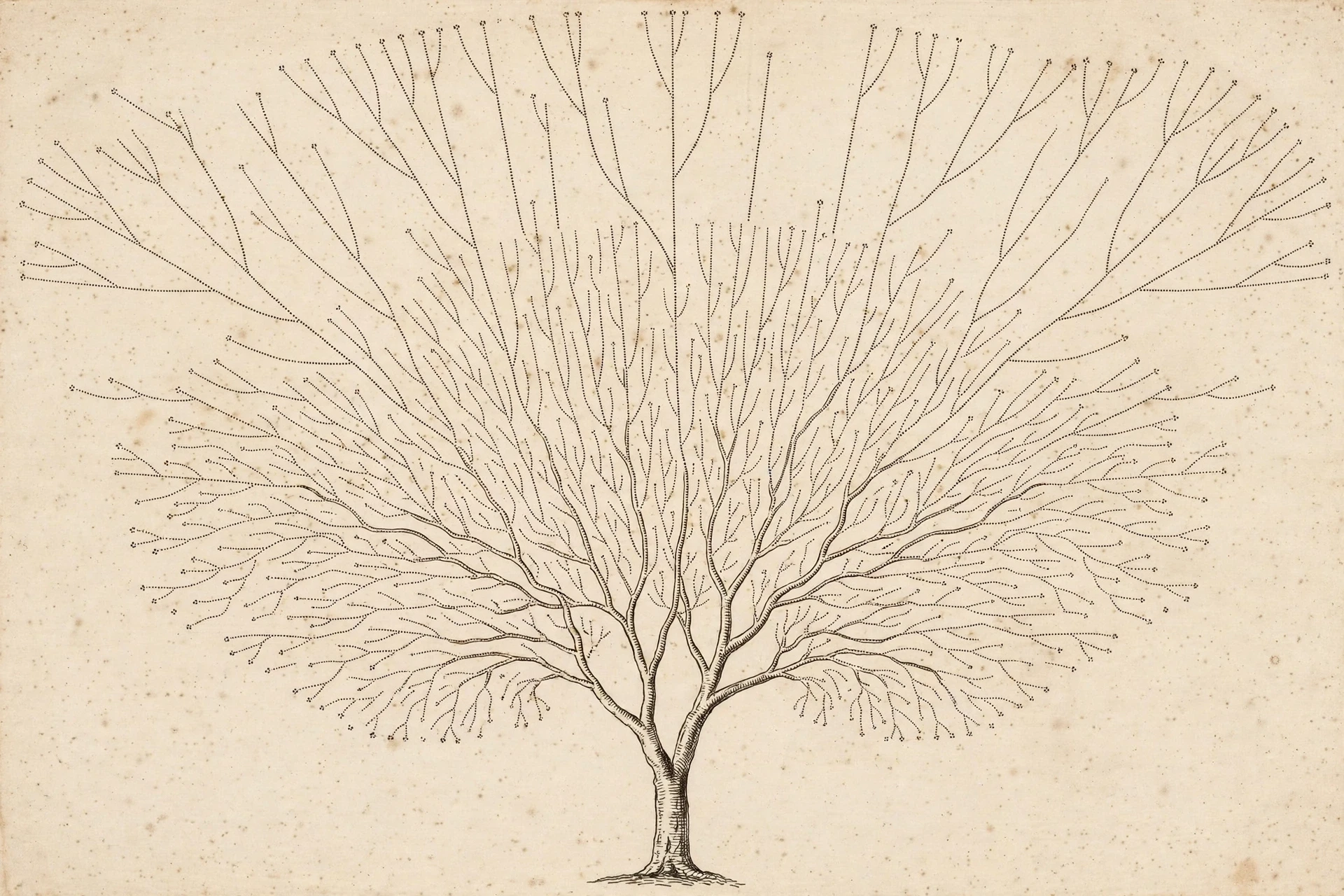
Darwin closed the book with a sentence that still stands as the best summary of what speciation means. Note the first-edition wording: it says "cycling", and it does not include the words "by the Creator", which were added in the second edition of 1860.
"There is grandeur in this view of life, with its several powers, having been originally breathed into a few forms or into one; and that, whilst this planet has gone cycling on according to the fixed law of gravity, from so simple a beginning endless forms most beautiful and most wonderful have been, and are being, evolved."
— Charles Darwin, On the Origin of Species, first edition (1859), closing sentence
Frequently Asked Questions
What is speciation?
Speciation is the process by which one species splits into two or more species that can no longer interbreed and produce fertile offspring in nature. It begins when gene flow between two populations is reduced, and it ends when reproductive isolation is complete. The split is a process, not a single event, and populations can sit partway along it for a long time.
What is the difference between allopatric and sympatric speciation?
Allopatric speciation happens when a geographic barrier divides a population and the two groups evolve apart. Sympatric speciation happens inside one area, with no barrier, through mechanisms such as polyploidy or a host shift. Allopatric speciation is the more common mode, and the better documented one, while sympatric speciation is real but rare.
How do new species form?
New species form when a population splits, the two parts diverge by natural selection, genetic drift, and mutation, and reproductive barriers build up between them. When the barriers hold even if the populations meet again, the split is complete and two species exist where one did before. The three steps are separation, divergence, and isolation that holds on contact.
What is adaptive radiation?
Adaptive radiation is the rapid diversification of one ancestral species into many species, each adapted to a different niche. Darwin's finches, with 14 to 18 species from one ancestor, and Lake Victoria's cichlids, with more than 500 species in about 15,000 years, are the classic examples. It happens when a lineage reaches a place with empty niches and selection pulls its descendants in many directions at once.
How long does speciation take?
It varies widely. Polyploidy can create a new plant species in a single generation. Cichlids in Lake Victoria produced hundreds of species in about 15,000 years. Most bird and mammal splits take on the order of a million years, and some take far longer. There is no single average time, because the pace depends on generation time, the strength of selection, and how completely gene flow is cut off.
Can speciation happen in a single generation?
Yes, in plants, through polyploidy. When a plant doubles its chromosome set, or when two species hybridise and the hybrid doubles its chromosomes, the result is instantly reproductively isolated from its parents. Tragopogon miscellus and Tragopogon mirus arose this way in the 20th century, and bread wheat is an allohexaploid with six chromosome sets from three ancestors.
Can speciation be observed in real time?
Yes. Tragopogon and Spartina anglica formed within recorded history, the apple maggot fly has diverged into host races since about 1860, and a Galapagos finch lineage became reproductively isolated within three generations. Each case is dated and measured, and none is presented here as more complete than the evidence allows.
Sources
Mayr, E. (1942). Systematics and the Origin of Species. Columbia University Press. PNAS introduction to the 2005 speciation colloquium
Darwin, C. (1859). On the Origin of Species. John Murray. Project Gutenberg eBook 1228, first edition. Read the first edition on Project Gutenberg
OpenStax Biology 2e, 18.2 Formation of New Species. OpenStax Biology 2e, 18.2
Biology LibreTexts, 8.4 Speciation. Biology LibreTexts, 8.4 Speciation
UC Berkeley, Understanding Evolution, Modes of speciation. Modes of speciation — UC Berkeley
Grant, P. R. and Grant, B. R. — finch work reviewed by the Linnean Society, 2024. Icons of evolution: why are there so many Darwin's finches?
Alcaide, M., Scordato, E. S. C., Price, T. D. and Irwin, D. E. (2014). Genomic divergence in a ring species complex. Nature 511:83–85. DOI 10.1038/nature13285. Alcaide et al. 2014, Nature 511:83–85
Bush, G. L. (1993). Host race formation and sympatric speciation in Rhagoletis fruit flies. Psyche 99:335–357. Bush 1993, Psyche 99:335–357
Mallet, J. (2007). Hybrid speciation. Nature 446:279–283. Mallet 2007, Nature 446:279–283
Schumer, M. and colleagues (2014). How common is homoploid hybrid speciation? Evolution. Schumer et al. 2014, Evolution
Haba, Y. and colleagues (2025). Ancient origin of an urban underground mosquito. Science. DOI 10.1126/science.ady4515. Pirbright Institute summary of the Haba study
Kuchta, S. R. and Wake, D. B. (2016). Wherefore and whither the ring species? Copeia 104:189–201. Kuchta and Wake 2016, Copeia 104:189–201
Svardal, H., Salzburger, W. and Malinsky, M. (2021). Genetic variation and hybridization in evolutionary radiations of cichlid fishes. Annual Review of Animal Biosciences 9:55–79. Cichlid radiations — Annual Review of Animal Biosciences
Sciory — Natural Selection Explained. Natural Selection Explained
Sciory — Human Evolution Explained. Human Evolution Explained
Sciory — Origin of Life Explained. Origin of Life Explained
Sciory — CRISPR Gene Editing Explained. CRISPR Gene Editing Explained
Sciory — Antibiotic Resistance Explained. Antibiotic Resistance Explained
Sciory — Epigenetics Explained. Epigenetics Explained