

1. The Letter That Changed Everything
A pregnant woman queued for bread in Amsterdam in the winter of 1944, and sixty years later scientists found chemical marks on her child's genes that still told the story of that hunger. That discovery showed that life experience can leave a physical trace on the genome without rewriting its code, and this article asks how that trace is made.
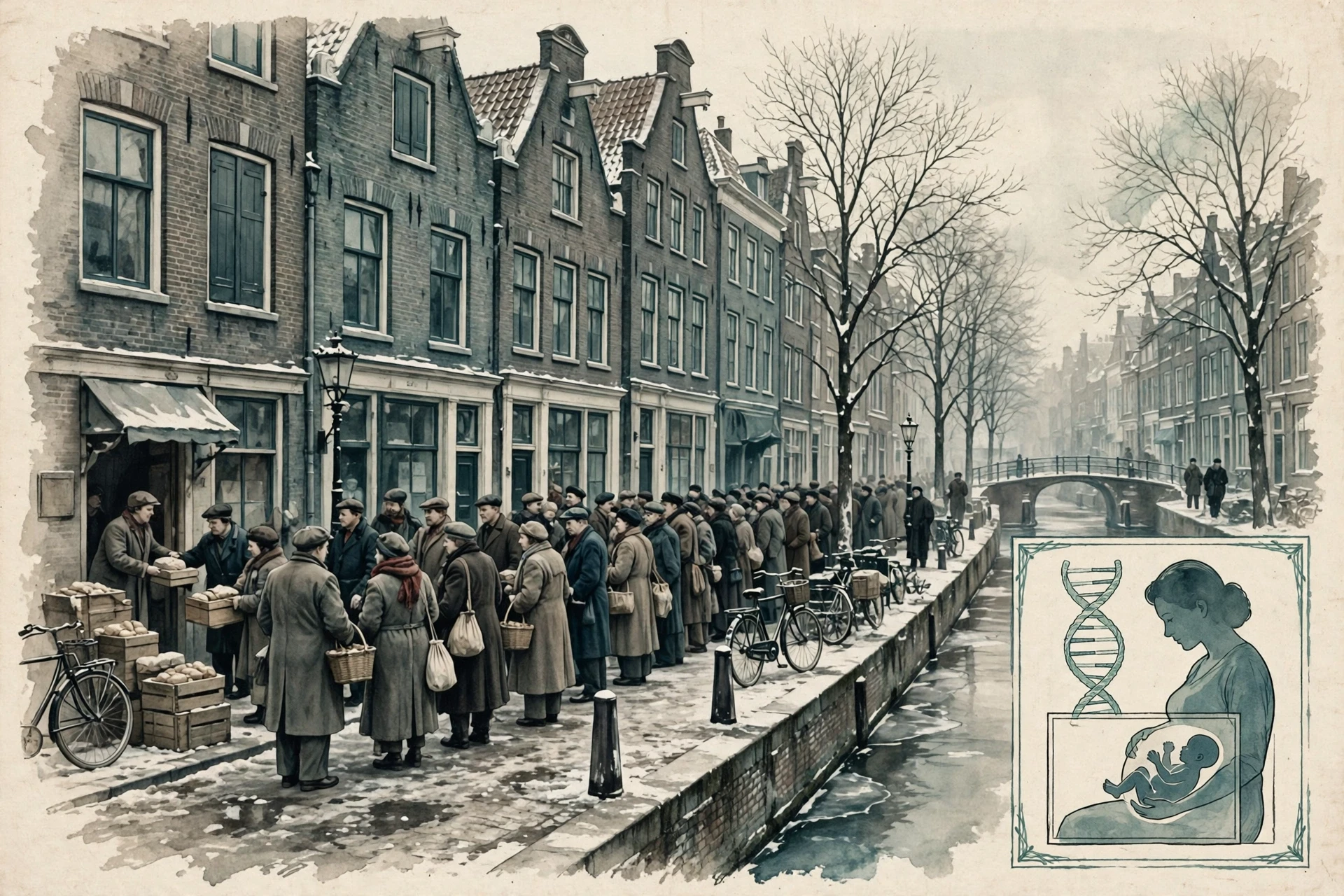
It was cold enough to freeze the canals. In Amsterdam, in the last winter of the Second World War, food had almost run out. German forces had cut off supplies to the western Netherlands, and by November 1944 the official ration had fallen to a few hundred calories a day. People ate tulip bulbs, sugar beet, and whatever they could find. Bread, when it arrived at all, came in thin, grey slices.
Imagine standing in that queue. You are pregnant, wrapped in every coat you own, and your feet ache on the frozen cobbles. You have waited for hours for a scrap of bread that will not fill you, let alone feed the child growing inside you. You do not know whether the war will end before spring. You only know that you must keep going, one day at a time, because there is no other choice.
That winter became known as the Dutch Hunger Winter, or Hongerwinter. It lasted from late 1944 into the spring of 1945, and it left a deep scar on the Netherlands. About twenty thousand people died from hunger and cold. Yet the story did not end when the food came back. Six decades later, researchers tracked down people who had been in the womb during that famine, and they found something startling in their cells.
The children of the Hunger Winter carried chemical marks on their genes that other people did not. Those marks were still there in middle age, long after the famine had ended. The children also faced higher rates of obesity, diabetes, and heart disease than people born just before or just after the famine. Hunger in the womb had left a lasting record.
I still remember the first time I saw a methylation diagram and realised the genome had a second layer. I was sitting at a desk with a printout that showed a stretch of DNA, and little red tags hung from it like labels on a coat rack. The letters of the code had not changed. The tags were the message. In that moment, the genome stopped looking like a fixed instruction manual and started looking like a living document, marked up by life itself.
That image stayed with me because it changed the question I thought biology was asking. We are used to thinking of genes as destiny, as a script written at conception and read out for the rest of our lives. The Hunger Winter children showed that the script can be annotated. The notes in the margin do not rewrite the words, but they can change how loudly a passage is read, or whether it is read at all.
This is the heart of epigenetics. It is the science of those annotations, the chemical marks that sit on top of DNA and shape how genes behave. It does not replace genetics. It sits beside it, explaining why the same genetic code can produce different results in different bodies, at different times, and in different circumstances.
That promise is what drew many researchers to epigenetics in the first place. If the marks can change, then the story of a gene is not fixed at birth, and the study of epigenetics becomes a study of how life keeps editing its own instructions.
The story also raises a question that is easy to get wrong. If a mother's hunger can mark her child's genes, does that mean our lives are written by our parents' hardships? Does it mean that trauma, diet, or stress can be passed down like eye colour? The short answer is that the picture is far more careful, and far more hopeful, than the headlines suggest. Some marks last for a lifetime. Many can change. Very few, if any, are passed on in the simple way that a gene is passed on.
In this article, we will follow that question step by step. We will start with what the marks are and how they work, then look at the main kinds of marks, the evidence from famines and twins, and the ways in which diet, stress, smoking, and ageing shape them. We will also look at what epigenetics can and cannot do in medicine, and where the science is still uncertain.
Before we go further, it helps to hold on to one image from Amsterdam. A woman in a queue, cold and hungry, could not have known that her body was writing a note to her child's future. She was simply trying to survive. Science took sixty years to learn how to read that note. Now that we can read it, we can start to ask what it means for all of us.
2. What Is Epigenetics, Really?
Epigenetics is the study of how behaviour and environment change the way genes work without changing the DNA sequence itself. Chemical marks switch genes on or off, and those marks can be added, read, and sometimes removed during life. The code stays the same; the instructions about how to use it change.
The word itself gives the game away. It comes from the Greek prefix epi, meaning above or over, joined to genetics. Epigenetics is, quite literally, above genetics. It describes a layer of control that sits on top of the DNA code and decides how that code is used. The letters stay the same, but the layer above them decides which letters get read, when, and how often.
The term was coined in 1942 by Conrad Waddington, a British biologist who wanted a word for the way genes and their products work together to build a living thing. Waddington himself later recalled introducing the word around 1947, though its first printed use dates to 1942. He later defined the field as:
"the branch of biology which studies the causal interactions between genes and their products which bring the phenotype into being" — Conrad Waddington, Towards a Theoretical Biology (1968).
Waddington coined the word in 1942, before the structure of DNA had been solved and before anyone had mapped a methylation pattern. He could not have known about the chemical details that fill textbooks today. Yet his definition, given more than two decades later, still holds, because it points at the right question. Genes do not act alone. They act through a network of signals, marks, and switches, and the result of that network is the living body, or phenotype, that we see.
A simple way to picture the difference is to think of a piano. Your DNA is the set of keys. Every piano has the same keys in the same order. Epigenetics is the pianist. The pianist decides which keys to press, how hard, in what order, and for how long. The same piano can play a lullaby or a storm. The instrument has not changed, but the music has.
That distinction matters, because the most common misunderstanding about epigenetics is also the most important one to correct. Epigenetics does not change your genes. It does not rewrite the DNA code, swap one letter for another, or create a mutation. A mutation changes the sequence itself, and that change is copied into every new cell. An epigenetic change leaves the sequence alone and changes the way the sequence is read.
Think of a recipe book. A mutation is a change to the words in a recipe, so that sugar becomes salt. An epigenetic change is a note in the margin that says do not make this dish today, or make twice as much. The recipe is still there, word for word. The note changes what happens in the kitchen.
This is why epigenetics is often described as the study of gene regulation. Genes are switched on and off in patterns, and those patterns are what make a liver cell different from a brain cell, even though both cells carry the same DNA. The patterns also shift during life, in response to food, stress, infection, ageing, and many other signals. Some shifts are small and short-lived. Others last for years.
The Centers for Disease Control and Prevention puts it plainly: epigenetics is the study of how behaviours and environment can cause changes that affect the way genes work. The National Human Genome Research Institute offers a fuller guide in its Epigenomics Fact Sheet, which explains how the epigenome works alongside the genome. Both sources are useful starting points, because they keep the focus on what the science can actually show, rather than what the headlines claim.
That careful wording matters for anyone new to epigenetics, because the field is often sold as a shortcut to rewriting fate. In truth, epigenetics describes control, not a new code, and control can be subtle, local, and reversible.
It also helps to know what epigenetics is not. It is not a new kind of inheritance that replaces ordinary genetics. It is not proof that everything your grandparents ate or suffered is written into your genes. It is not a way to rewrite your DNA by eating a certain food or taking a supplement. Those claims appear often in popular writing, and they go far beyond the evidence.
What the evidence does show is more modest, and more interesting. The genome is not a fixed fate. It is a resource, used differently in different cells and at different times. The marks that guide that use are real, chemical, and measurable. They can be shaped by the world around us, and in some cases they can be changed again. That is the story we will unpack, mark by mark.
To follow it, you need a clear picture of the code itself. If you want a refresher on the double helix, replication, and the role of DNA in heredity, start with DNA: Structure, Replication, and Role in Heredity. With that picture in mind, the next section gives you the central analogy for the whole article: the genome as a book, and the epigenome as its bookmarks.
3. The Book and Its Bookmarks
Think of your DNA as a book that every cell owns, and the epigenome as the bookmarks, highlights, and sticky notes that decide which pages get read. The text never changes from cell to cell, yet a skin cell and a liver cell read completely different chapters. Those annotations explain how one genome can build a whole body.
Every cell in your body carries almost the same book. A skin cell, a nerve cell, and a blood cell all hold the same three billion letters of DNA. If the book were read from cover to cover in every cell, every cell would try to do everything at once. The result would be chaos. Instead, each cell reads only the chapters it needs, and it keeps the rest shut.
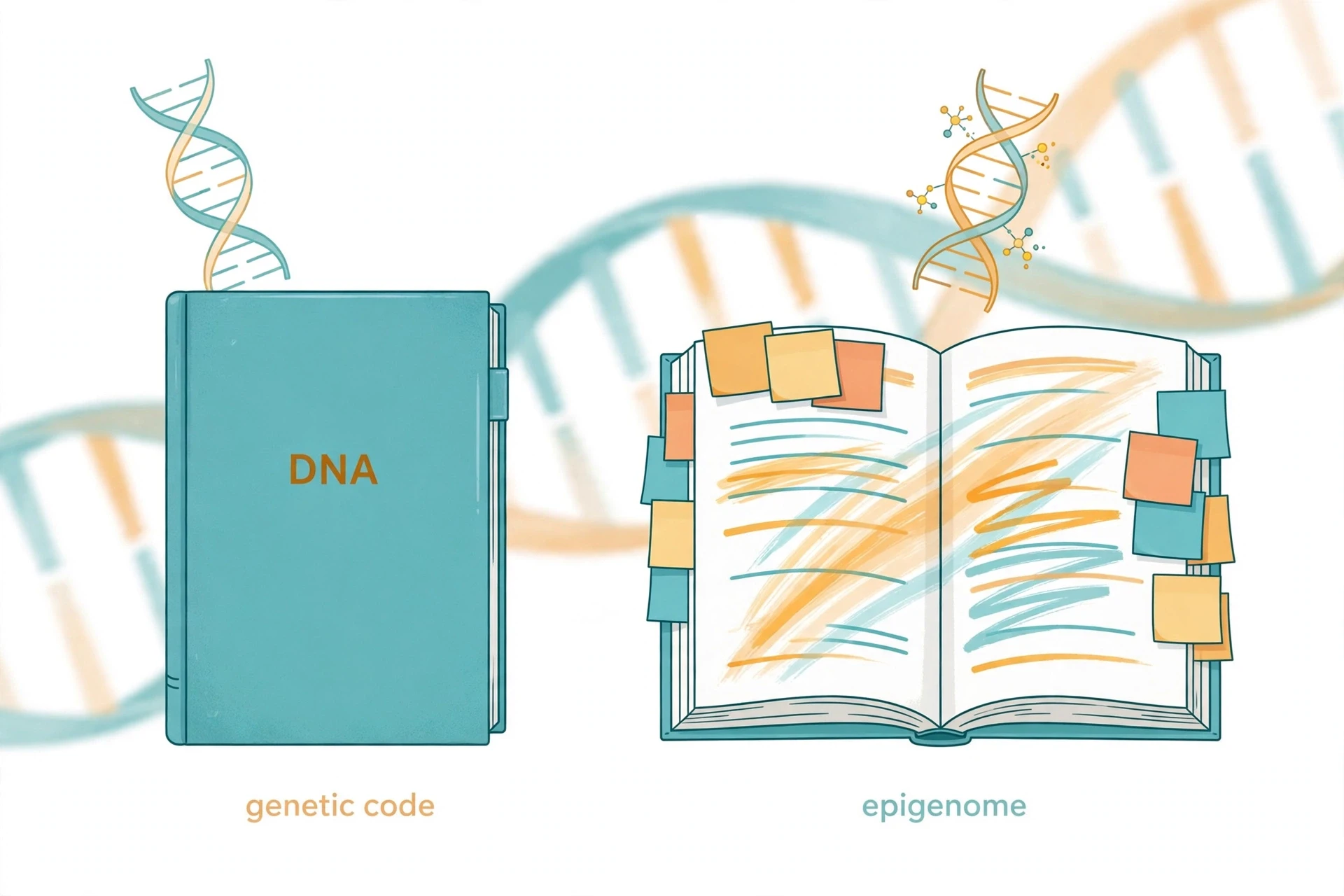
The marks work like a set of reading instructions. A bookmark says start here. A highlight says this passage matters today. A sticky note says skip this section for now. A paperclip holds two pages together so they can be read as one. None of these tools changes the printed words. Each one changes how the reader uses the book.
Gene expression is the act of reading. A gene is a recipe for a protein, and expression means copying that recipe into a working molecule and then building the protein. When a gene is expressed, its recipe is read. When it is silenced, the recipe stays on the shelf. The cell controls expression by opening some stretches of DNA and closing others, and by adding or removing chemical marks that help or hinder the reading machinery.
This is why the same DNA can build so many different cells. A red blood cell needs large amounts of haemoglobin, so it reads the haemoglobin genes often and keeps many other genes quiet. A nerve cell needs proteins that carry signals, so it reads a different set. The book is the same. The reading list is different. Development is, in large part, the process of setting those reading lists in place.
The analogy also explains why epigenetics matters in disease. If a bookmark falls out of the wrong chapter, a gene that should stay quiet may switch on. If a sticky note covers a chapter that should be read, a gene that should protect the cell may stay silent. Cancer, for example, often involves both kinds of error: growth genes switched on when they should be off, and protective genes switched off when they should be on. The text has not changed, but the reading has gone wrong.
It is worth pausing on the word epigenome itself. Your genome is the full set of DNA letters you inherit. Your epigenome is the full set of marks on that DNA in a given cell at a given time. Unlike the genome, which is largely the same in every cell, the epigenome differs from cell to cell, and it changes over time. You do not have one epigenome. You have many, one for each cell type, each shifting as you grow, age, and respond to the world.
That shifting quality is what makes epigenetics so useful, and so tricky to study. A blood sample can tell a researcher about the epigenome of blood cells, but it says little about the epigenome of brain cells. A mark measured at age forty may look different at age sixty. Researchers must be careful about which tissue they sample, when they sample it, and what they claim the result means.
The book analogy has limits, as all analogies do. Real DNA is not printed on flat pages. It is wound around proteins, folded into loops, and packed into the nucleus of each cell. The marks do not sit alone; they work with the folding, the proteins, and the signals that arrive from outside the cell. Yet the core idea holds: the genome provides the text, and the epigenome guides the reading.
If you keep that picture in mind, the details that follow will be easier to follow. The next section looks at the best understood mark of all, the small chemical tag called DNA methylation. It is the pencil mark in the margin, the simplest annotation in the book, and the one we know most about.
4. DNA Methylation: The Pencil Marks
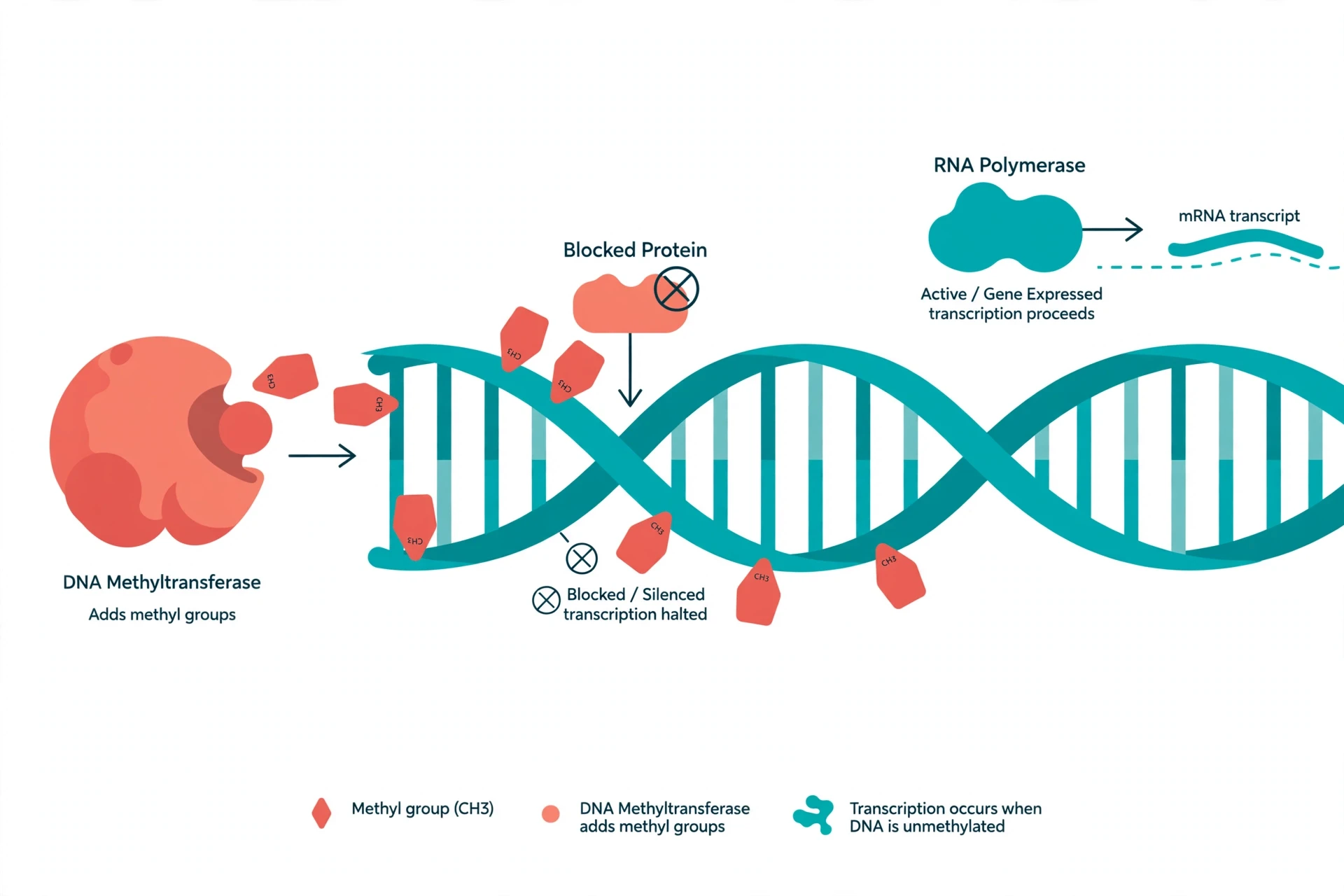
DNA methylation is the best understood epigenetic mark: a small chemical tag added to DNA that usually switches a gene off. The tag does not alter the letters of the genetic code, but it can block the proteins that read a gene. When the tag is removed, the gene can be read again.
Methylation works by adding a methyl group, written as CH3, to the C5 position of cytosine, one of the four letters of DNA. The result is a new form of the letter called 5-methylcytosine, often shortened to 5mC. The letter is still a cytosine in the sequence, but it now carries a small chemical tag. That tag changes how the DNA is read, without changing the code itself.
Most methylation in human cells happens at CpG dinucleotides, where a cytosine is followed directly by a guanine in the DNA sequence. The p in CpG stands for the phosphate link between the two letters. These sites are scattered through the genome, and they are the main places where methyl tags are added and read. When a CpG site is methylated, the gene nearby is often harder to read.
The general rule is simple to state, even if the details are complex. Methylation typically turns genes off, and demethylation, the removal of the tag, turns them on. A methylated gene is like a page with a pencil line through it. The words are still there, but the reader is told to skip them. An unmethylated gene is like a clean page, open and ready to be read.
Some stretches of DNA are rich in CpG sites. These are called CpG islands: GC-rich stretches of at least 200 base pairs, with GC content above 50% and an observed-to-expected CpG ratio above 0.6, often found in the promoter regions of genes. A promoter is the stretch of DNA just before a gene where the reading machinery gathers to start work. About 70 percent of gene promoters have a CpG island, and those islands are usually unmethylated. That makes sense: a gene that needs to be read should have a clean promoter, free of tags that would block the reader.
When a CpG island in a promoter does become methylated, the effect can be strong. The reading proteins cannot bind properly, other proteins are drawn in that pack the DNA more tightly, and the gene falls silent. This is a normal part of development. It is also a process that can go wrong in disease, when a protective gene is silenced by methylation that should not be there.
The cell needs enzymes to add, keep, and remove these tags. DNMT1 is the maintenance enzyme. After replication the DNA is hemimethylated — the old strand keeps its methyl tags and the new strand starts out unmethylated. DNMT1 recognises hemimethylated CpG sites and copies the pattern onto the new strand, so that both daughter cells inherit the same marks. Without this copying step, methylation patterns would be lost within a few divisions.
DNMT3A and DNMT3B play a different role. They are the enzymes that establish new patterns, adding methyl tags where none existed before. They are especially active during early development, when the embryo is setting up the reading lists that will guide each cell type. Together, the DNMT enzymes give the cell both a pen for new notes and a photocopier for old ones.
Removal is just as important as addition. For a long time, scientists thought demethylation was mostly passive, happening when a cell divided without copying the marks. Then, in 2009, researchers found an active route. TET enzymes can oxidise 5mC to 5hmC, or 5-hydroxymethylcytosine — a change proposed at the time as a step towards demethylation, with the full pathway, through further oxidation and excision by repair enzymes, established in later work. The discovery showed that the cell can erase a pencil mark on purpose, not only by failing to copy it.
I remember a lab moment that made this concrete for me. I was looking at a printout of methylation data from two samples, side by side, and the pattern was clear even before I read the numbers. One sample showed a clean stretch of unmethylated promoter, open and ready. The other showed the same stretch covered in tags, dark and silent. The DNA sequence in both samples was identical. The difference was only in the marks. It felt less like reading a code and more like reading a decision.
That decision is not made by the tag alone. Methylation works with other marks, with the proteins that wrap DNA, and with signals from inside and outside the cell. A methyl tag can attract proteins that tighten the packing of DNA, making it harder to read.
The pencil-mark image is useful because pencil can be erased. Many methylation marks are stable, lasting for years or for the life of a cell line. Others change in response to development, ageing, or the environment. That balance between stability and change is what makes methylation so powerful as a control system, and so interesting as a clue to how life experience leaves a trace.
For a wider view of how genes are passed on, changed by mutation, and switched on and off, see Genetics Explained: How Inheritance, Mutations, and Gene Expression Work. That guide covers the inheritance side of the story. Here, the focus stays on the marks themselves, and the next sections will look at the other main kinds of marks, and at what happens when the pencil marks are laid down in the wrong place, or at the wrong time.
5. Histones: The Spools That Hide and Reveal
Histones are the protein spools that DNA winds around, and how tightly it winds decides whether a gene can be read at all. When the spool loosens, the gene switches on; when it tightens, the gene falls silent. This winding and unwinding is one of the main ways cells control their genes without changing the DNA code itself.
Picture a fishing reel with line wound around it. If the line is wound tight and neat, you cannot reach the middle of it. If it is loose and slack, you can pull out any stretch you need.
DNA behaves in much the same way inside the nucleus. The cell stores nearly two metres of DNA in a nucleus only a few thousandths of a millimetre across, so packing matters. That is epigenetics in action: the same DNA, packed differently, gives a different result.
The basic unit of this packing is the nucleosome. A stretch of 147 base pairs of DNA wraps almost twice around a core of eight histone proteins, called an octamer.
The octamer holds two copies each of histones H2A, H2B, H3 and H4. Seen under an electron microscope, nucleosomes look like beads on a string, with short stretches of linker DNA joining one bead to the next. A fifth histone, H1, binds that linker DNA and helps to lock each nucleosome in place.
Histones are not passive packaging. They are working parts of epigenetics, and their tails stick out from the nucleosome like loose threads, and chemical tags can be added to or removed from those tails. Those tags change how tightly the DNA hugs the spool.
When the packing loosens, the cell's reading machinery can reach the gene. When it tightens, the gene is hidden away. In this way, histone marks are a central part of epigenetics, the system that controls gene activity without altering the genetic code.
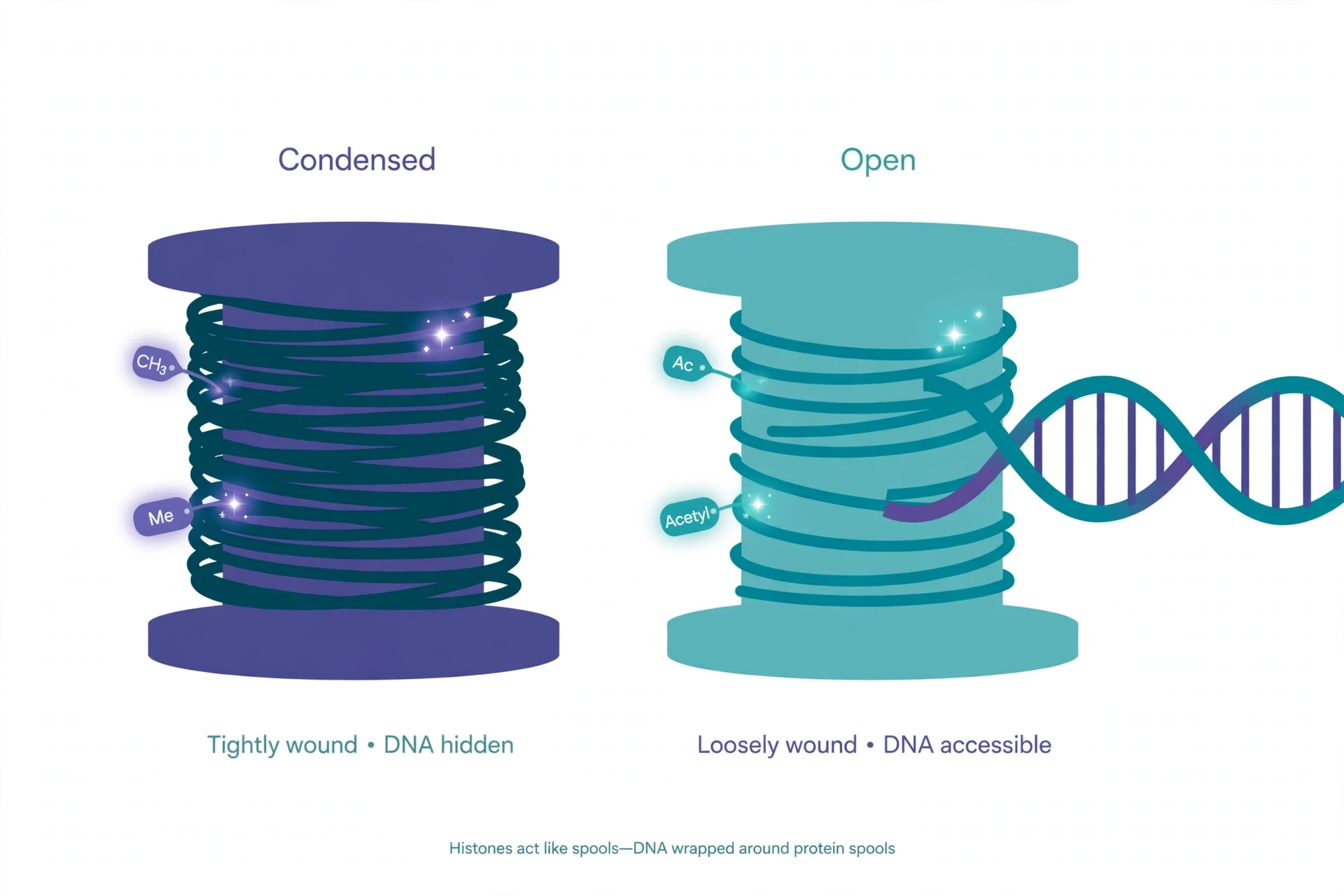
One of the best studied tags is acetylation. Enzymes called histone acetyltransferases, shortened to HATs, add small acetyl groups to histone tails.
The acetyl group neutralises part of the histone's positive charge, so the negatively charged DNA grips it less firmly. The chromatin relaxes, the gene opens up, and transcription can begin. It is a bit like loosening a knot so that a rope can slide freely through your hands.
The reverse process is deacetylation. Enzymes called histone deacetylases, or HDACs, strip those acetyl groups away.
The positive charge returns, the DNA clings tightly to the histone, and the gene falls silent. Cells use HATs and HDACs as a matched pair, adding and removing acetyl groups in response to signals from inside and outside the cell. A gene can therefore be switched on in the morning and off by the evening, without a single letter of its code changing.
Histone methylation works differently, and its effect depends on exactly where the tag lands. A methyl group added to histone H3 at lysine 4, written as H3K4me3, marks genes that are active or ready to be switched on.
It sits near the start of genes that the cell is reading, like a green light at the start of a road. By contrast, H3K27me3 and H3K9me3 mark genes that are repressed. H3K9me3 is linked in particular with heterochromatin, the most tightly packed and silent form of DNA.
Those two states have names that are worth learning. Euchromatin is open, loosely packed chromatin where genes are active and accessible. Heterochromatin is closed, densely packed chromatin where genes are silent and largely out of reach. A liver cell and a brain cell carry the same genes, yet much of their difference comes down to which stretches of DNA sit in euchromatin and which are locked away in heterochromatin.
The balance between open and closed chromatin is not fixed for life. Signals from hormones, nutrients and stress can shift it, nudging a gene from silent to active or back again. Some shifts last for hours, while others persist through many rounds of cell division. Epigenetics gives cells a way to remember a decision long after the signal that caused it has faded, which is why the same genome can support so many different cell behaviours.
That memory also explains why histone marks matter in disease. When HDACs become overactive, genes that should stay open can be clamped shut, including genes that restrain cell growth. Drugs that block HDACs, known as HDAC inhibitors, are already used to treat some cancers, and they work by reopening those silenced genes.
The spool, in other words, is not just packaging. It is a control dial, and learning to turn it has opened a new route to treatment. For a fuller picture of where this packing happens, see Cell Biology Explained: How Cells Work, Organelles & Functions.
6. Three Ways to Mark a Gene
Cells mark genes in three main ways: by tagging the DNA itself, by changing how tightly it is wound, and by sending RNA guides that silence it. Each method works differently, yet all three leave the DNA code untouched. Together they give the cell a flexible toolkit for switching genes on and off.
DNA methylation is the most direct of the three. A methyl group is added to a cytosine base, usually where a cytosine sits next to a guanine, in a pattern called a CpG site. The tag does not change the letter that is read, but it changes how the DNA is treated.
Methylated regions attract proteins that pack the DNA more tightly, and they can block the machinery that starts transcription. In most cases, methylation silences a gene. These three routes together make up much of epigenetics, yet each one has its own character and its own job.
Methylation is often stable and long lasting. When a cell divides, enzymes copy the methylation pattern onto the new DNA strand, so daughter cells inherit the same marks.
This copying is why methylation is so useful for locking in a cell's identity. Once a skin cell has methylated the genes it will never need, its descendants keep them switched off. The pattern is copied faithfully, generation after generation of cells.
Histone modification is the second route, and it is more changeable. As the last section showed, acetyl groups loosen chromatin and methyl groups can either open or close it, depending on their position. Unlike DNA methylation, which tags the DNA itself, histone modification tags the spools around which the DNA is wound. The effect is the same in outline — a gene becomes easier or harder to read — but the mechanism is different, and the marks can be added and removed more quickly.
That speed matters. A cell that needs to respond to a hormone or a sudden change in its surroundings can acetylate histones within minutes and open the genes it needs.
When the signal passes, HDAC enzymes can remove the tags and close the genes again. Histone marks are therefore well suited to short-term control, while DNA methylation is better suited to long-term memory. The cell uses both, shifting between them as the situation demands.
The third route uses RNA itself as a guide. Non-coding RNA is RNA that is never translated into protein, yet it plays a central role in controlling genes. One striking example is XIST, a long non-coding RNA about 17 kilobases long.
In female mammals, XIST coats one of the two X chromosomes and silences it almost completely. This process, called X-inactivation, was discovered by Mary Lyon in 1961. The silenced X chromosome shrinks into a dense structure known as a Barr body, visible under the microscope in the nucleus.
XIST works by recruiting the other silencing machinery to its target. It attracts proteins that add repressive histone marks and DNA methylation, so the whole chromosome is packed away. Only one X chromosome is coated in each cell, and which one is chosen is random. The result is that female mammals carry one active X and one silent X in every cell, a neat solution to the problem of having two copies of the X chromosome while males have only one.
Genomic imprinting shows another side of RNA-guided control. Some genes are expressed only from the copy inherited from the mother, while others are expressed only from the copy inherited from the father.
The gene IGF2, which promotes growth, is expressed only from the father's copy. The gene H19, which sits close to IGF2, is expressed only from the mother's copy. The silent copy is marked by methylation, laid down in the egg or the sperm, so the embryo knows which parent each copy came from.
MicroRNAs are smaller guides, only about 22 nucleotides long. They silence genes after transcription, by binding to messenger RNA and either degrading it or blocking its translation into protein.
The first microRNA, lin-4, was found in 1993 in the roundworm C. elegans, where it controls the timing of development. Since then, more than 1,900 microRNAs have been annotated in humans, each able to regulate many different genes. Epigenetics also works through RNA in this way, using tiny guides to fine-tune how much protein each gene produces.
The three mechanisms do not work in isolation. A non-coding RNA can recruit enzymes that methylate DNA or modify histones, and a methylated region can attract proteins that add repressive histone marks. The result is a layered system of epigenetics, with each layer reinforcing the others. When one layer fails, the others often hold the gene silent, which gives the cell a useful safety net.
Mechanism | What it marks | Effect on the gene | Example |
|---|---|---|---|
DNA methylation | Cytosine bases in the DNA itself, usually at CpG sites | Usually silences the gene and locks the mark in through cell division | Silencing of the imprinted gene IGF2 on the maternal copy |
Histone modification | Histone tails in the nucleosome, through acetylation or methylation | Opens or closes the chromatin, switching the gene on or off | H3K4me3 marks active genes; H3K27me3 marks repressed genes |
Non-coding RNA | Target genes or whole chromosomes, guided by RNA molecules | Silences genes by recruiting repressive marks or blocking messenger RNA | XIST coats one X chromosome; microRNAs block messenger RNA |
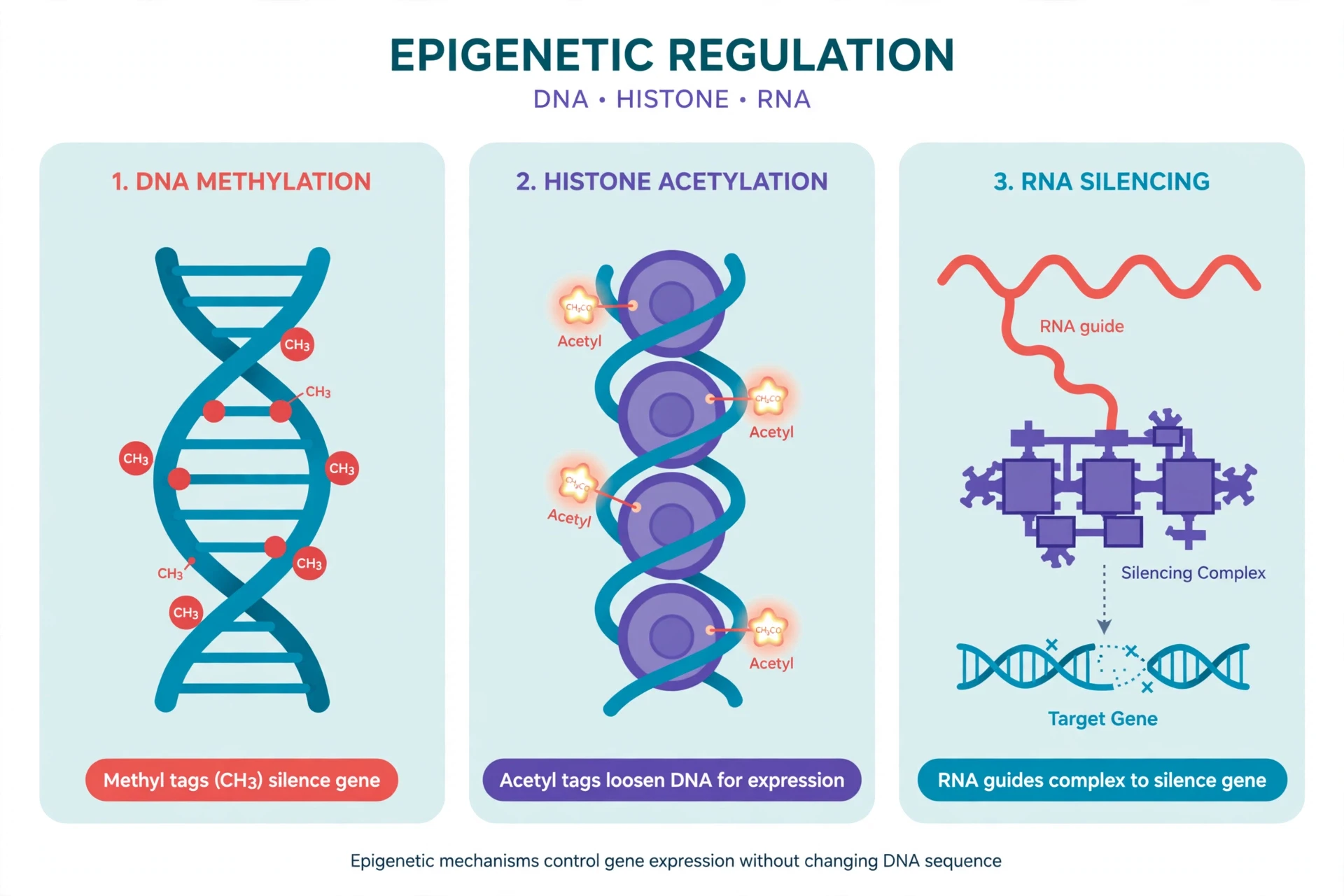
Seen together, the three routes explain how a cell can be both stable and flexible. Methylation provides lasting memory, histone marks provide quick adjustment, and non-coding RNA provides precise targeting. Epigenetics is not one switch but a control panel, with different levers for different jobs. When the levers work together, genes are switched on in the right cell, at the right time, and in the right amount.
7. How One Genome Makes 200 Cell Types
A single fertilised egg gives rise to more than 200 cell types, from brain cells to bone cells, all carrying essentially the same DNA. The difference lies not in the genes themselves but in which ones are switched on. Epigenetic marks act as the switches that guide each cell towards its final identity.
I first grasped this when I watched a time-lapse film of a fertilised egg dividing in a laboratory dish. One cell became two, then four, then a hollow ball, and then the ball folded and stretched into something with a head end and a tail end. Nothing had been added from outside except warmth and nutrients, yet order was appearing from a single starting cell. It looked less like building with new parts and more like a group of identical workers gradually taking on different jobs.
That is differentiation, and epigenetics drives it. As the embryo develops, each cell switches on some genes and switches off others, until its role is fixed. A muscle cell turns on the genes for contractile proteins and silences the genes for making insulin.
A pancreatic beta cell does the reverse. At any one time, roughly one-third to one-half of a cell's genes are active, while the rest are held silent. This is epigenetics at work, using marks laid down during development to lock each cell into its chosen path.
The marks are laid down in stages. Early in development, the embryo wipes away many of the epigenetic marks it inherited from the egg and sperm, then lays down fresh ones as cells specialise.
Each division copies the new pattern forward, so daughter cells remember what their parent was. A skin stem cell produces more skin cells, not liver cells, because its epigenetic pattern says skin. The DNA is the same in both, but the pattern of marks is different.
One of the clearest examples of this mosaic pattern is X-inactivation. In each cell of a female mammal, one of the two X chromosomes is randomly silenced early in development.
Once the choice is made, it is copied faithfully through every later division. The result is that women are mosaics: in about 50 per cent of their cells the paternal X is active, and in about 50 per cent the maternal X is active. That 50–50 split is the population average; individual women vary, and skewed X-inactivation, where one X is active in far more than half of cells, is common. A patch of skin, a patch of retina, or a patch of blood cells may each trace back to a different founding cell and its own random choice.
Not every gene on the silenced X stays silent. Between 15 and 25 per cent of genes escape inactivation, and they remain active on both copies. Some of those escaping genes help to explain differences between the sexes in health and disease, since women carry two active copies of them while men carry one. Epigenetics makes every woman a mosaic in this precise sense, with two populations of cells living side by side in the same body.
Genomic imprinting adds a further layer. Because some genes are expressed only from one parent's copy, losing that copy has a direct effect, even though the other copy is intact. Prader-Willi syndrome arises from loss of the paternal contribution at chromosome 15q11–q13.
Children with the condition have a constant sense of hunger, low muscle tone in infancy, and learning difficulties. Angelman syndrome arises from loss of the maternal contribution in the same region, specifically the UBE3A gene. Children with Angelman syndrome have severe speech difficulties, movement problems and a characteristic happy manner.
The contrast is striking: the same stretch of chromosome, lost from different parents, produces two very different conditions. In about 70 per cent of Angelman cases, the cause is a deletion of the maternal region. Epigenetics also explains these imprinting disorders, because the silent copy cannot step in to replace the lost active one. The mark that silenced it is doing its normal job, yet the result is disease when the active copy is missing.
The embryologist Conrad Waddington gave this process its most famous image in 1957. He pictured development as a ball rolling down a hillside, with valleys branching across the slope.
The ball starts at the top, where the cell is unspecialised, and rolls down into one valley after another. Each fork is a decision point, and once the ball has rolled into a valley, the ridges between valleys make it hard to climb back out. He called this picture the epigenetic landscape, and it remains a useful way to picture how a cell's fate is channelled during development.
The landscape is not made of rock. It is made of epigenetic marks: methylation, histone modifications and RNA guides that raise some ridges and lower others. A signal from a neighbouring cell can tip the ball one way rather than another, and once the choice is made, the marks hold it in place. Epigenetics is the landscape itself, the set of slopes and valleys that guides each cell from a single starting point to its final form.
Cell division is the courier that carries these marks to the next generation of cells. For how that division works, see Mitosis vs Meiosis: Complete Comparison with Easy Diagrams and Explanation.
8. The Famine That Wrote on Genes
In the winter of 1944–45, famine struck the occupied Netherlands, and the children conceived during those months carried a molecular record of hunger into old age. Their DNA was unchanged, yet the marks on one growth gene were measurably different six decades later. This is the clearest human evidence that early life can leave lasting epigenetic marks.
The famine is known as the Dutch Hunger Winter. It struck the German-occupied western Netherlands from November 1944 to April/May 1945, ending with liberation on 5 May 1945. A German blockade, a failed Allied advance and a harsh winter cut food supplies to the cities of the west.
Official rations fell below 1,000 calories a day by 26 November 1944 and dropped to as low as 500 calories a day by April 1945. The average during the famine was about 667 calories a day, roughly a third of what an adult needs. About 20,000 people died.
Food queues formed before dawn, and people ate tulip bulbs, sugar beet and anything else they could find. Hospitals filled with starving patients, and the death rate rose week by week. For the people who lived through it, the winter was a memory of cold, hunger and waiting. For epigenetics, it became a natural experiment that no researcher could ever have designed on purpose, because the famine had a clear start, a clear end, and detailed records of who was exposed and when.
The most famous epigenetics study of the famine was published by Heijmans and colleagues in 2008 in the Proceedings of the National Academy of Sciences (PNAS 105:17046–17049). They studied 60 people who had been conceived during the famine and compared each of them with an unexposed same-sex sibling, which controlled for family background and much of the genetic variation. Blood samples were taken six decades later, when the participants were at a mean age of about 58. The team measured methylation at the IGF2 gene, a growth gene known to be imprinted.
The result was precise and striking. Methylation at IGF2 was 5.2 per cent lower in the exposed group than in their unexposed siblings (0.488 versus 0.515, P = 5.9 × 10⁻⁵).
The difference was small in absolute terms, yet it had survived for six decades, through countless rounds of cell division and a lifetime of meals. The researchers had found a molecular trace of a famine that had ended before most of the participants were born. The full paper is available here: Heijmans et al. 2008, PNAS.
Timing turned out to matter more than the famine itself. People who had been exposed to famine late in gestation showed no significant difference in IGF2 methylation (-0.9 per cent, P = 0.64). The effect appeared only in those exposed around the time of conception and in early gestation, when the embryo was laying down its epigenetic marks for the first time. Epigenetics is sensitive to timing in this way: the same shortage of food left a lasting mark in one window of development and none in another.
"Early gestation appeared to be the most vulnerable period."
That sentence, from the review by Roseboom and colleagues in 2011, sums up the lesson. The first weeks of life are a time of rapid epigenetic programming, when marks are being set that will be copied for decades.
A shortage of nutrients in that window can shift the pattern, while the same shortage later, when the pattern is already set, leaves far less trace. The womb is not a shelter from the outside world. It is a place where the outside world writes its first draft.
The health consequences followed the same pattern. People conceived during the famine had a doubled rate of coronary heart disease in later life, more type 2 diabetes, and a twofold increase in schizophrenia (RR 2.0) among those conceived at the height of the famine.
The effects were not limited to one organ or one disease. They touched the heart, the metabolism and the brain, as if the early shortage had reset the body's expectations for the life ahead. One leading idea is that the fetus adapted to scarcity, and that adaptation became a liability when food later became plentiful.
The evidence for that idea is strongest in the largest study of all. In a study of 371,100 men examined for military service at age 19, those exposed to famine in early gestation were 30 per cent more likely to be overweight than men who had not been exposed — an effect seen only in sons of manual workers born in the large famine cities of the western Netherlands. The famine had ended years before, yet the bodies of those young men still carried its signature. A shortage in the womb had been followed, two decades later, by a tendency to store extra weight.
None of this means that genes were rewritten. The DNA code of the famine children was the same as that of their siblings.
What differed was the pattern of marks laid on top of it, and those marks changed how the code was read. Epigenetics does not rewrite the book of life. It adds notes in the margins, and those notes can shape how the story is read for decades afterwards.
The Dutch Hunger Winter therefore stands as a warning and a lesson. It shows that the environment in the earliest weeks of life can leave a measurable mark on the genome, and that the mark can persist into old age.
It also shows that timing is everything, and that the same exposure can matter greatly in one month and hardly at all in another. Epigenetics reminds us that our biology is not fixed at conception. It is shaped, from the very start, by the world around us.
9. The Yellow Mice
Two mice can share exactly the same DNA and still look like different animals. One is yellow, overweight and prone to illness; the other is brown, lean and healthy. The difference lies not in their genes, but in the chemical marks laid on top of them. The agouti mouse experiments made that invisible difference visible for the first time.
Picture a litter of baby mice in a laboratory cage, all born to the same mother on the same day. Some are golden yellow from nose to tail. Others are a dusty brown, the colour of a field mouse. They eat the same food and live in the same cage, yet their bodies take different paths. The yellow ones grow heavy, develop high blood sugar and face a higher risk of tumours. The brown ones stay slim and healthy. Nothing in their DNA explains the split, because their DNA is the same.
The cause sits just outside the gene itself. These mice carry a variant called agouti viable yellow, shortened to Avy. A jumping piece of DNA, a retrotransposon known as IAP, has landed near the agouti gene. That gene normally controls coat colour through a promoter that switches on and off with the hair cycle. The inserted element acts like a loudspeaker left on, pushing the gene into constant activity when it is unmethylated — and that ectopic expression is what drives the appetite and weight effects. When the element is heavily methylated, the loudspeaker falls silent and the gene behaves normally.
That single difference in methylation decides the coat. An unmethylated Avy element leaves a mouse yellow, obese and prone to type 2 diabetes and tumours. A methylated element leaves the same mouse brown, a form scientists call pseudoagouti, and healthy. The animals are genetically identical mice with different epigenetics. Their story is a living picture of how a mark, rather than a mutation, can shape a whole life. This is epigenetics at its clearest: the same code, read differently.
The next question was obvious, and it was also the most hopeful one. If methylation decides the outcome, could a mother's diet change the methylation her pups receive? Robert Waterland and Randy Jirtle tested that idea in a study published in 2003 in Molecular and Cellular Biology (23:5293–5300). They fed one group of pregnant a/a mice, mothers carrying Avy/a pups, extra methyl donors — folic acid, vitamin B12, choline and betaine — for two weeks before mating and through pregnancy and lactation. A second group ate a normal diet.
The supplemented mothers had more brown, healthy pups. The methyl-donor diet had increased methylation at the Avy locus, turning the loudspeaker down in more of their offspring. The numbers were clear: 39 pups from 10 supplemented mothers, compared with 30 pups from 9 unsupplemented mothers, with a P value of 0.008. Food had not rewritten the gene. It had changed the marks around it, and those marks changed the pups. That link between diet and marks is central to epigenetics.
A few years later, Dana Dolinoy and colleagues asked whether a single food chemical could do the same thing. They looked at genistein, a compound found in soy. In their 2006 study, mothers fed genistein had far more pseudoagouti or heavily mottled pups than mothers on an unsupplemented diet — 50 per cent, compared with 23 per cent. The effect came from increased methylation at six CpG sites near the Avy gene. It persisted into adulthood, and the brown pups were protected against obesity. A plant compound, eaten by the mother, had shifted the odds for her young — a clear case of epigenetics linking a mother's diet to her pups' health.
The same research group then tested the opposite direction. In 2007, Dolinoy and colleagues exposed pregnant mice to bisphenol A, usually called BPA, a chemical used in some plastics. BPA shifted the pups toward yellow by reducing methylation at the Avy locus. The effect was not fixed, though. A methyl-donor diet or genistein cancelled it, pushing methylation back up and restoring more brown pups. The chemical could push the marks one way, and diet could push them back.
Think of the Avy gene as a light with a dimmer switch. The wiring stays the same in every mouse. Methylation is the hand on the dimmer, turning the light up or down. Diet, in these experiments, was one of the hands. That is why the yellow mice matter far beyond a laboratory cage. They show, in a form anyone can see, that inheritance is not only about the letters of DNA. It is also about the marks that decide how those letters are read.
The lesson is simple to state and easy to overstate, so it deserves care. What a mother eats can change her pups' epigenetic marks — without changing any DNA. That does not mean every meal rewrites a child, or that a single vitamin guarantees health. It means the womb is not a sealed room. Food, chemicals and the wider environment can reach the marks that shape development, and in mice those marks are visible in coat colour, weight and disease risk. Epigenetics, in this story, is not an abstract idea. It is a yellow mouse beside a brown mouse, born to the same mother, living a different life because of a mark.
10. Can Your Grandchildren Inherit Your Life?
Can epigenetic changes be inherited? In plants, worms and some rodents, the answer is yes, at least sometimes. In humans, the honest answer is that it remains unproven. Marks can pass from parent to child in worms, plants and mice, yet human evidence is thinner, messier and often explained by direct exposure rather than true inheritance across generations.
The confusion starts with a simple picture. Imagine a pregnant woman. She is one generation. The fetus inside her is a second. Inside that fetus, the tiny germ cells that will one day become her grandchildren are already forming. They are a third generation, present before birth. If the pregnant woman is exposed to famine, smoke or stress, all three generations are exposed at once. A change seen in the grandchild may look like inheritance, but it may simply be shared exposure. Sorting out that difference is one of the hardest jobs in epigenetics.
Scientists draw a firm line here. An effect in a grandchild after exposure during pregnancy is intergenerational, because the grandchild's early cells were there at the time. True transgenerational inheritance means a mark survives past a generation that was never exposed at all. That is a much harder test to pass, and in humans it is very hard to run cleanly. People do not live in cages. They move, marry, change diets and carry different genes.
The Dutch Hunger Winter gives the clearest human test so far, and its results are sobering for anyone hoping for a simple story. Painter and colleagues followed the grandchildren of women who had been exposed to famine in the womb. In their 2008 study, famine exposure in utero did not affect the grandchildren's birth weight. The grandchildren of exposed women were slightly shorter at birth, by 0.6 centimetres, and showed higher neonatal adiposity, a measure of body fat in newborns. The authors found no transgenerational effects on birth weight or on rates of cardiovascular and metabolic disease. They did, however, find increased neonatal adiposity (ponderal index +1.2 kg/m³) and poor health 1.8 times more frequently in later life among the offspring of famine-exposed women. For researchers studying epigenetics, that null result mattered as much as any positive one.
A later Dutch study added a twist that still puzzles researchers. Veenendaal and colleagues, writing in 2013, looked at adult grandchildren. Those whose fathers had been exposed to famine in the womb were heavier as adults, by 4.9 kilograms, with a body mass index higher by 1.6. There was no such effect through exposed mothers, and no differences in adult health between the groups. The pattern ran through the father's line, not the mother's, and it touched weight without touching health in a broader sense. It is a real finding, but it is narrow, and it does not settle the larger question.
Sweden offers a second famous case, from the parish of Överkalix. Researchers traced food supply during the slow-growth period, the years just before puberty, in grandfathers, and linked it to mortality in their grandchildren. When a paternal grandfather had experienced a food surfeit, a time of plenty, his grandchildren showed a diabetes mortality odds ratio of 4.1. The result was striking, and it travelled widely in books and lectures. Yet a much larger replication in Uppsala, about 40 times larger, could not reproduce the diabetes and cardiovascular results — although it did reproduce the elevated all-cause mortality in grandsons of well-fed paternal grandfathers, driven by cancer mortality. A small, striking finding did not survive a bigger, cleaner test.
Barbados tells a similar story at the level of the marks themselves. Researchers studied people who had suffered early-childhood malnutrition, then looked for the same methylation changes in the next generation. Malnutrition was associated with 134 differentially methylated regions in total across both generations; 102 of them were autosomal regions in the first generation. Only 3 of 102 regions tested showed the same change in the next generation. The authors concluded that there was "limited potential for intergenerational transmission". Most marks did not carry over. A few did, but not enough to build a general rule.
That pattern — strong in animals, weak and patchy in humans — is why reviews of epigenetics urge caution. In mice, a mark can pass through the germ line and change the next generation. In plants and worms, the evidence is stronger still. Humans have longer lives, mixed diets, varied genes and no controlled breeding, so a clean signal is far harder to find. The womb also resets most methylation marks during early development, wiping the slate in a way that makes long-term transmission unlikely for most sites.
"While epigenetic inheritance is evident in many species, from plants to rodents, it remains unproven in humans because of biological barriers, methodological complexity, and the difficulty of disentangling environmental from social and genetic factors."
That sentence, from Løkhammer, Cecil and Mansuy's 2026 opinion article in Trends in Genetics, "Rethinking evidence for epigenetic inheritance in human research", is the fairest summary available. It does not say inheritance is impossible. It says the proof is not there yet. A grandchild can certainly inherit genes, habits, food culture and a home environment from a grandparent. Those are powerful forms of inheritance in their own right. They shape health, weight and risk without any need for a methyl mark to survive the great reset of early development.
The question also touches a deeper debate about what shapes a person. Genes set a starting point, and life adds its own layers, from diet and stress to schooling and friendship. For a fuller look at that balance, see Nature vs Nurture Explained: What Shapes Who We Are?. The story of epigenetics sits inside that debate, not above it. It adds a layer between gene and life, yet it does not replace either one.
So can your grandchildren inherit your life? In the sense that your choices shape your children, and their choices shape theirs, yes, without doubt. In the strict sense of a chemical mark on DNA passing unchanged through the germ line and into a grandchild who was never exposed, the human evidence says not proven. That may change as larger studies follow families for longer, with better measures of methylation and exposure. Until then, the honest answer is to hold both truths: animals show it can happen, and humans have not yet shown that it does.
11. Identical Twins, Different Lives
Identical twins begin life as a natural experiment in sameness. They share the same DNA, the same womb and often the same childhood home. Yet by old age, twin after twin tells a different story: different health, different habits, different fates. Their genes stayed the same, but the marks upon them did not.
Think of identical twins as two copies of the same book, printed on the same press. At birth, the pages match. As the years pass, one copy is read in sunlight and carried in a coat pocket, while the other sits on a damp shelf. Notes appear in the margins. Pages fade in different places. The text is still the same, but the copies no longer look or feel alike. Epigenetics works in a similar way, adding notes and fading marks over a lifetime.
That image is more than a metaphor. In 2005, Mario Fraga and colleagues published a study in the Proceedings of the National Academy of Sciences (102:10604–10609) that measured it directly. They studied 40 pairs of identical twins, aged from 3 to 74 years. They looked at DNA methylation and histone marks across the genome, comparing each twin with their co-twin. Young twins had almost identical epigenetic profiles. Older twins did not.
The gap grew with age. Overall, 35 per cent of twin pairs differed significantly in their epigenetic marks. The difference was much greater in twins older than 28 than in younger twins. The differences were greater in twins who had spent less of their lives together and had more different medical histories. Smoking, diet and physical activity are among the lifestyle factors proposed to influence such marks, but Fraga and colleagues did not report a significant correlation for those specific factors. Time alone did not explain the split. A shared life kept the marks closer, while separate lives pulled them apart.
Gene activity told the same story. In the single 3-year-old pair tested by microarray, patterns of gene expression were virtually identical. In the single 50-year-old pair tested, they varied widely — with four times as many differentially expressed genes. The same genes were present in both twins at both ages, yet the older twins were using them in different ways. One twin might switch on a gene more strongly, while the other left it quiet. The result was not a new genome. It was a different reading of the old one, shaped by years of separate choices and separate exposures. That shifting pattern is epigenetics in action over decades.
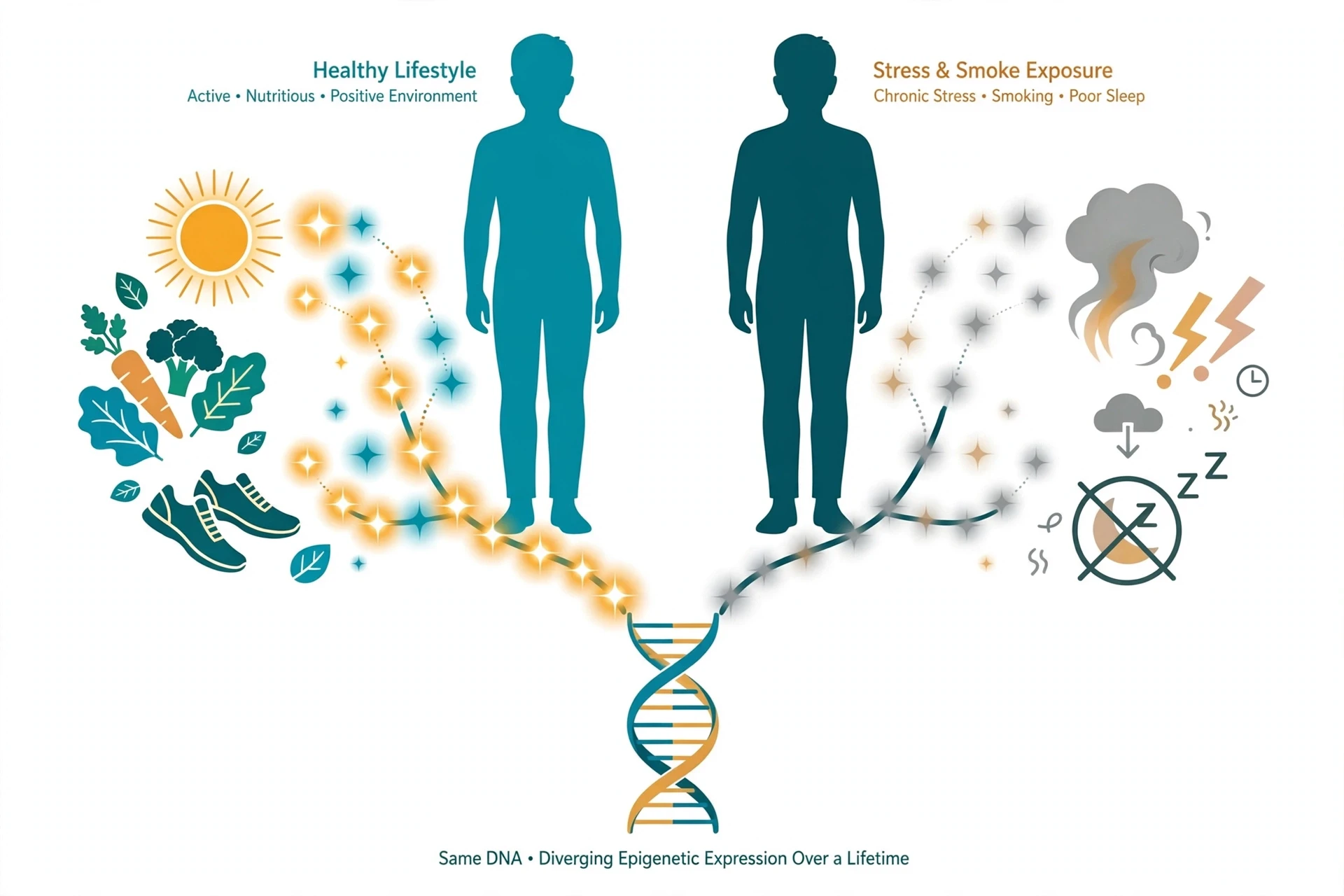
I once met a pair of identical twin sisters at a community health fair, both in their late sixties, and I could not tell them apart until they started talking. One had smoked for thirty years and worked nights in a bakery, breathing flour dust and sleeping in daylight. The other had never smoked, walked to work each day and cooked most meals at home. Their faces still matched, yet their breathing, their energy and their medical histories did not. One used an inhaler and tired quickly on stairs. The other climbed them without pausing. Their DNA had not changed, but their lives had written different notes in the margins.
That meeting stayed with me because it made the science feel human. Twins are not a laboratory trick. They are people who start with the same genetic script and then live it out in different kitchens, workplaces and streets. A twin who smokes adds marks linked to smoke exposure. A twin who eats well, moves often and sleeps regularly adds a different set. Over decades, those small daily differences accumulate into a visible gap, even when the starting point was identical.
The twin studies also answer a question many people ask quietly: if genes are fixed, is health fixed too? The answer from epigenetics is no, or at least not fully. Genes set the range of what is possible, like the keys on a piano. Epigenetics decides which keys are played, and how loudly, over a lifetime. Two pianists with the same instrument can still play very different tunes. That is why one twin can develop a disease while the other stays well, and why lifestyle still matters even when family history feels like a sentence.
It also explains why twins are so useful to the study of epigenetics. When researchers compare identical twins, they can hold DNA constant and watch the environment do its work. Diet, smoking, stress, exercise and illness leave traces in the marks, and those traces can be measured. The same logic helps researchers study how early life, work and place shape health in the rest of us, where genes differ as well and the picture is harder to read.
The lesson of the twins reaches beyond twinship. Every person carries a genome that changes little after birth, and an epigenome that keeps changing. Childhood, work, food, air and habit all leave small marks, and those marks add up. The twins simply make the process easy to see, because they start from the same place. For a longer view of how humans themselves have changed over time, and how variation arises in a species, see Human Evolution Explained: From Ancient Ancestors to Modern Humans. Our species has always been shaped by both inheritance and experience, and the twin story shows that shaping continues within a single lifetime.
12. The Epigenetic Clock
An epigenetic clock is a way of estimating biological age from chemical marks on DNA. It reads methylation patterns at selected sites — 353 in Horvath's clock, 173 in DunedinPACE — and turns them into a number, usually in years. That number often matches calendar age closely, yet it can run fast or slow, revealing how quickly a body is ageing.
Imagine two people who both turned sixty last week. One runs, gardens and sleeps well. The other has smoked for decades, sleeps badly and rarely moves. Their birth certificates agree, but their bodies may not. One may carry the biology of a fifty-five-year-old, the other that of a sixty-eight-year-old. An epigenetic clock tries to measure that gap, using methylation as its ruler.
The first widely used clock came from Steve Horvath at the University of California, Los Angeles, in 2013. Published in Genome Biology (14:R115), it was built from about 8,000 samples across 51 tissues, from blood and brain to liver and skin. Horvath chose 353 CpG sites whose methylation levels tracked age most closely. The result was striking: the clock's estimate, called DNAm age, correlated with chronological age at 0.96, with a median error of only 3.6 years. In embryonic stem cells, DNAm age sat near zero, as if the clock had not yet started. In cancers, it ran fast, showing age acceleration averaging 36 years.
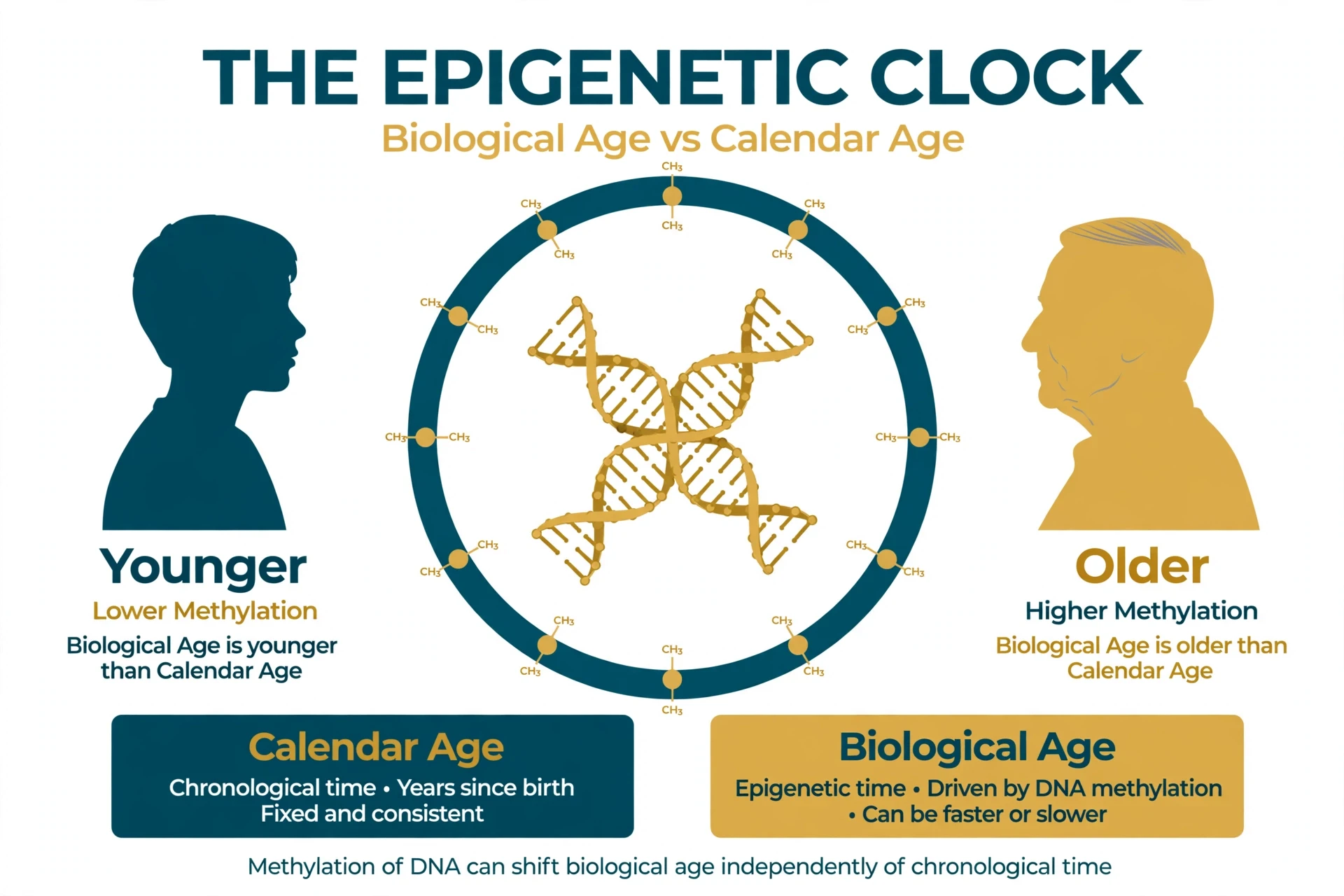
The power of the Horvath clock was its breadth. Most earlier measures of ageing worked in one tissue, usually blood. Horvath's clock worked across the body, suggesting that methylation tracks a shared ageing process rather than a local one. It did not say why a person was ageing fast. It simply showed that the marks on their DNA carried that information, written in a pattern too regular to be chance. Epigenetics, in this form, became a measuring tool as well as a biological story.
Later clocks asked a sharper question. GrimAge, published in 2019, was built not to guess age, but to predict time to death. It used DNA methylation surrogates of plasma proteins, combined with smoking pack-years, to estimate mortality risk. At the time, it was the strongest mortality predictor among the clocks. A person whose GrimAge ran ahead of their calendar age faced a higher risk of dying sooner, even if they felt well. The clock had moved from describing age to forecasting health. That shift shows how epigenetics can turn a biological signal into a forecast.
DunedinPACE, published in 2022, asked a different question again. Instead of asking how old a body is, it asks how fast it is ageing. It was built from the Dunedin study, which has followed 1,037 people born in 1972–73 from birth into middle age. A DunedinPACE score of 1.0 means one biological year per calendar year, a steady pace. A score above 1.0 means faster ageing, below 1.0 means slower. It is a speedometer, not an odometer, and that difference matters for trials that try to slow ageing down. In that sense, epigenetics offers a speed reading, not just a birth date.
Lifestyle can move these clocks, but the size of the effect matters, and the numbers are now clear enough to quote. A 2025 cross-sectional study of 2,532 adults aged 50 and over (NHANES 1999–2002) found full adherence to healthy behaviours was associated with 5.55 years lower GrimAge2 acceleration. The largest single difference was for smoking: people who had never smoked averaged 10.17 years lower GrimAge2 acceleration than regular smokers. In a separate 2025 study of 922 Hispanic/Latino adults, people with high cumulative psychosocial stress averaged 1.27 years higher GrimAge than people with low psychosocial stress. The message is not that a salad erases a decade, but that sustained habits, especially not smoking, leave a measurable mark on the clock.
Calorie restriction tells a more modest story. The CALERIE trial followed 220 adults assigned to cut calories by 25 per cent for two years (in practice they achieved about a 12 per cent reduction). Their DunedinPACE slowed by only 2 to 3 per cent, a small effect. Two years of real effort, carefully measured, moved the pace by a fraction. That does not make the trial a failure. It shows that ageing is slow to shift, and that a single change, however disciplined, is unlikely to turn the clock back by years on its own.
Clocks also have limits, and those limits deserve plain words. Early clocks could differ by up to 9 years on repeat testing of the same blood sample, according to a 2022 study in Nature Aging. The same person, the same blood, a different answer nine years apart. Improved (principal-component) versions brought agreement between most replicates to within about 1.5 years, a large gain, yet the lesson remains. A clock is a research tool and a risk marker, not a medical diagnosis. No epigenetic clock is cleared by the United States Food and Drug Administration (FDA) as a diagnostic test, and no single number should decide how a person is treated.
That caution does not erase the value of the work. Epigenetics has given researchers a way to watch ageing in real time, to test whether an intervention works, and to ask why two people of the same age age so differently. A clock cannot tell you how long you will live, and it should never be sold as a fortune teller. It can show whether the pace is quickening or easing, and whether a change in habit is leaving a trace. Used with care, it turns an abstract idea — that life leaves marks on DNA — into a number that can be studied, repeated and, slowly, improved.
13. When the Marks Go Wrong: Epigenetics and Disease
When epigenetics goes wrong, protective genes can fall silent while the rest of the genome loses its marks, and that double fault helps drive cancer. The same control system that keeps healthy cells in line can switch off the brakes and loosen the structure at the same time.
Think of a healthy cell as a library where every book sits on the right shelf and the librarian knows which volumes may be opened. In many cancers, that order breaks down in two opposite ways at once. Some protective genes are glued shut by extra methyl tags at their promoters, while large stretches of the genome lose marks at repetitive sequences, leaving the shelves unstable.
This is the point where epigenetic control meets the clinic most directly, because a silenced tumour-suppressor gene can behave like a deleted one even though its DNA letters remain intact. When the promoter of BRCA1 gains dense methylation, the gene falls quiet in sporadic breast and ovarian tumours. Reported rates vary widely with tumour type and method — one early study found methylation in 13 per cent of unselected breast cancers, while a population-based study of ovarian cancer found it in about 15 per cent of sporadic cases, and more recent estimates reach 20–27 per cent in triple-negative breast and ovarian cancers — so there is no single figure. A similar story plays out with MLH1, whose promoter methylation is the main cause of MLH1 loss in sporadic colorectal cancer, leaving cells unable to repair mismatched DNA.
When MLH1 is lost, errors accumulate during DNA copying and produce microsatellite instability, a pattern known as MSI-H that occurs in about 12–15 per cent of sporadic colorectal cancers. The opposite fault matters too, because genome-wide hypomethylation can wake dormant repetitive sequences and disturb chromosome structure. The result is a cell that has lost both its brakes and its balance, which helps explain why faulty marks are linked to chromosomal instability.
The paradox is the key point to hold in mind. Cancer is not simply a case of too much methylation or too little methylation. Focal hypermethylation silences selected tumour-suppressor genes at their promoters, while widespread hypomethylation loosens the rest of the genome. One fault switches off protection, the other lets the structure drift, and together they give a tumour room to grow and change.
Doctors already use these patterns in practice, because a methylated promoter can be detected in tumour tissue and sometimes in blood samples. A test that spots an abnormal mark does not prove cancer on its own, yet it can guide further checks and help classify a tumour. That practical value is one reason researchers study faulty marks so closely, and the Centers for Disease Control and Prevention page gives a clear public overview of how marks relate to health and disease.
Cancer is the best studied example, but it is not the only one where marks go astray. Faulty imprinting can disturb growth and development, while altered methylation has been linked to brain disorders and metabolic disease. The details differ from one condition to another, yet the theme stays the same. A control system that normally keeps genes in balance can, when its marks drift, push a cell or a tissue towards disease.
Early detection offers another angle. A blood sample can carry tiny fragments of DNA from a tumour, and the methylation pattern on those fragments can hint at where the tumour started. Researchers are testing whether such patterns could flag disease earlier than a scan, when treatment is often simpler. The tests are promising, yet they still need large trials to prove that earlier detection truly saves lives.
14. Can Epigenetics Be Reversed?
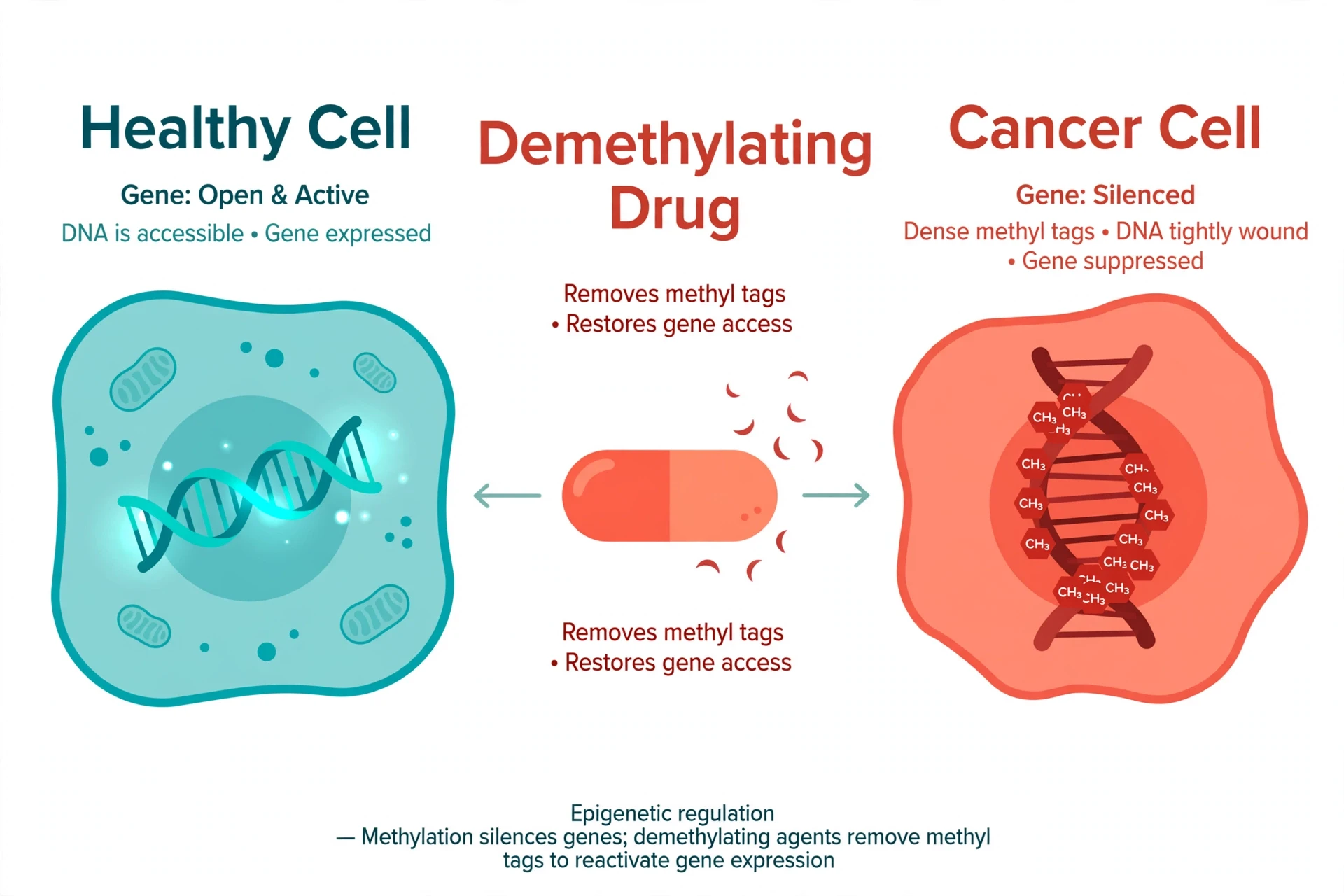
The hopeful news about epigenetics is that its marks can be added and removed, unlike a mutation that changes the DNA letters themselves. That reversibility is why doctors can already use drugs that strip away faulty marks, and why lifestyle changes can nudge the pattern in a healthier direction.
A mutation is like a misprint in a book, fixed only by rewriting the page. A methyl tag is more like a sticky note on the page, placed there to say read this or skip this. Peel the note away and the original text is still there, ready to be read again. That simple difference explains why the field attracts so much medical interest, and why a faulty pattern is not always a life sentence.
At least seven drugs that act on epigenetic marks have already been approved by regulators in the United States. The table below lists them with the condition each was first approved for and the year of approval.
Drug | Class | Approved for | FDA approval year |
|---|---|---|---|
azacitidine (Vidaza) | DNMT inhibitor | myelodysplastic syndromes | 2004 |
decitabine (Dacogen) | DNMT inhibitor | myelodysplastic syndromes | 2006 |
vorinostat (Zolinza) | HDAC inhibitor | cutaneous T-cell lymphoma | 2006 |
romidepsin (Istodax) | HDAC inhibitor | cutaneous T-cell lymphoma | 2009 |
belinostat (Beleodaq) | HDAC inhibitor | peripheral T-cell lymphoma | 2014 |
panobinostat (Farydak) | HDAC inhibitor | multiple myeloma | 2015 |
tazemetostat (Tazverik) | EZH2 inhibitor | epithelioid sarcoma and follicular lymphoma | 2020 |
Azacitidine and decitabine are cytidine analogues that trap and inactivate DNA methyltransferases, the enzymes that add methyl tags to DNA. Most azacitidine is incorporated into RNA rather than DNA, while decitabine acts directly on DNA. When those enzymes are blocked, dividing cells gradually lose abnormal methylation and silenced genes can switch back on. Vorinostat and romidepsin work on a different layer of control by inhibiting histone deacetylases, enzymes that remove acetyl groups from histones and help keep chromatin tightly packed.
Honesty matters as much as hope here. These drugs work mainly in blood cancers such as myelodysplastic syndromes and cutaneous T-cell lymphoma, and solid tumours have proved much harder to treat this way. Side effects can be serious, including low blood counts, fatigue, nausea and a higher risk of infection, so treatment needs close medical supervision. The drugs can improve blood counts and delay progression, but they are not cures, and the search for safer and more precise versions continues.
Lifestyle also shifts methylation patterns, though in a quieter and more specific way than headlines sometimes suggest. A balanced diet, regular exercise, not smoking and steady sleep are all linked to healthier methylation patterns in large studies. Smoking leaves a clear methylation signature that partly fades after quitting, while exercise and diet are linked to modest changes at genes involved in metabolism and inflammation.
No single meal, workout or supplement rewrites the whole pattern at once. The effects are modest and specific, spread across many genes rather than concentrated in one dramatic reset. That does not make them unimportant, because small shifts across the genome can add up over years. It does mean that lifestyle should be seen as steady maintenance, not as a quick eraser for years of faulty marks.
Combination treatment is another active area. Doctors sometimes pair a drug that removes methyl tags with one that opens chromatin, hoping the two actions together will wake a silenced gene more fully than either alone. Early trials suggest the pairing can help in some blood cancers, though side effects can also add up. The goal is a gentler dose that still shifts the pattern, rather than a stronger dose that the body cannot tolerate.
The contrast with gene editing is worth keeping in mind. Editing with CRISPR changes the DNA letters themselves, while epigenetic drugs change the marks that sit on top of them. Readers who want the gene-editing side of the story can start with CRISPR Gene Editing Explained: How It Works and What It Can Do, which explains how cutting and rewriting DNA differs from adding or removing a mark.
15. The New Frontier: Editing the Epigenome
Epigenetics is now moving from observation to intervention, as scientists learn to add or remove marks at chosen genes without cutting DNA. The tools are still experimental, the first human trials have only just begun, and no treatment of this kind has yet been approved for patients.
One core tool is a deactivated Cas9, known as dCas9, fused to an epigenetic effector domain. Not every programme uses dCas9: OTX-2002 is an mRNA-encoded epigenomic controller, and EPI-321 uses a nuclease-dead mini CRISPR protein, but the principle — steer to a chosen gene, then add or remove a mark — is the same. Ordinary Cas9 acts like scissors that cut DNA, while dCas9 has lost its cutting ability and works more like a delivery van with a precise address. Guide RNA steers it to a chosen gene, and the attached effector then adds or removes a mark at that spot. The DNA letters stay unchanged, yet the gene can be switched on or off by the new mark.
I still remember the evening I first read a clear description of this idea and sat with the strangeness of it for a long time. A gene could be quieted without a single letter being altered, as if a librarian had placed a do-not-open sign on a book and left the pages untouched. The elegance felt almost too neat, and the questions that followed felt just as sharp. How long would the sign stay in place, and who would check that no other shelf had been marked by mistake.
The first human test of the approach came from Omega Therapeutics with OTX-2002, a therapy designed to silence MYC, a gene that drives growth in liver cancer. The United States Food and Drug Administration cleared the trial in July 2022, and the first patient received a dose in November 2022. The programme was deprioritised in November 2024, and the company filed for bankruptcy in February 2025. That short history shows both the excitement around the idea and the commercial risk that follows an early trial.
A second programme has moved further. TUNE-401 from Tune Therapeutics aims to silence hepatitis B virus DNA that hides inside liver cells, rather than editing a human gene. Its Phase 1b/2a trial started on 29 November 2024, and data presented at the EASL Congress on 30 May 2026 showed durable repression of hepatitis B markers. The result matters because the virus persists in a form that standard drugs struggle to clear, and a lasting epigenetic silence could offer a new path towards control.
A third programme targets a different kind of problem. EPI-321 from Epicrispr, now known as Epicrispr Biotechnologies, aims to silence DUX4, a gene whose faulty activation damages muscle in facioscapulohumeral muscular dystrophy. The first patient received a dose on 6 August 2025. The trial is still at an early stage, yet it tests whether a single epigenetic edit can calm a gene that should have stayed quiet after early development.
Delivery remains the practical bottleneck. A tool that works in a dish still needs a safe way to reach liver, muscle or brain tissue in a person, and to act only in the cells that need it. Lipid particles, viral carriers and direct injection each offer a route, yet each brings trade-offs in reach, dose and immune response. Solving delivery may matter as much as refining the editor itself.
A 2026 review described 2024 and 2025 as a critical inflection point for the field. In laboratory studies, targeted silencing lasted through 450 cell divisions, while animal studies showed silencing that held for 12 months. Those numbers suggest that a mark placed with care can persist through growth and renewal, which is exactly what a lasting therapy would need.
Long-term human validation remains the outstanding question. A mark that holds in a dish or in an animal may behave differently in a person over years, and off-target marks remain a safety concern. Dose, delivery to the right tissue and durability all need proof in people, not just in models. Until that proof exists, no epigenetic-editing therapy has been approved as of November 2026, and every programme described here should be read as a trial, not as a treatment.
16. What We Still Don't Know
For all its promise, epigenetics still leaves large questions unanswered, and honest science means naming them plainly. How much of the pattern causes disease, how far marks travel between generations, and whether shifting a biological clock can truly slow ageing itself all remain open.
The first gap is cause against consequence. A tumour carries abnormal methylation, yet that pattern may be a result of the disease rather than its trigger. The same doubt applies to many conditions where marks differ between healthy and ill tissue. Sorting cause from effect needs careful experiments in epigenetics that change a mark and watch what follows, not just snapshots that compare two groups.
The second gap is inheritance between generations in people. Animal studies show marks passing from parent to offspring in some cases, and the Dutch famine studies show effects in children exposed before birth. Human transgenerational inheritance, where a mark acquired in one generation passes through the germline to grandchildren who were never exposed, remains unproven. The distinction matters, because exposure in the womb is not the same as inheritance through sperm or egg.
The third gap concerns ageing clocks. Epigenetic clocks can estimate biological age from methylation patterns with striking accuracy, and they shift after lifestyle changes or medical treatment. A 2026 harmonised analysis in Nature Medicine, covering 51 intervention studies, put it carefully: it is still unclear whether short-term biomarker changes correspond to long-term improvements in disease, healthspan or lifespan. A clock that ticks more slowly is a promising signal, not proof of extra years.
The fourth gap is a simple count that refuses to settle. Imprinted genes, where only the copy from one parent is active, number about 100 to 150 in humans depending on the criteria used to count them. New candidates appear as methods improve, while some older candidates fail stricter tests. The uncertainty is a reminder that the catalogue of the epigenome is still being written.
The fifth gap is the hardest for medicine. Most epigenetic drugs work in blood cancers, where the drug reaches the diseased cells easily and the cells divide in ways that expose their marks. Solid tumours remain hard, because delivery is tougher, the tumour environment is more complex, and the same drug can affect healthy tissue. Cracking solid tumours will need better delivery, better combinations and better ways to pick the patients most likely to respond.
These gaps do not weaken the field, they define its next decade. Each one points to an experiment that can be run, a trial that can be designed or a method that can be sharpened. Readers who want the evolutionary side of the same story, including how selection acts on variation over generations, can start with Natural Selection Explained: How Evolution Really Works.
17. Putting It All Together
The genome is the text of life, and the marks upon it are the reading instructions that decide which passages speak and which stay quiet. Environment, behaviour and chance all write in the margins, yet the pencil marks can be erased, and the story is still being written.
That image captures the whole arc of the article. The DNA sequence provides the letters, while methylation and histone marks decide which genes are read, when they are read and how loudly. Diet, stress, smoke, sleep and exercise can all leave traces on that pattern, just as early life can set marks that echo into adulthood. None of that changes the letters, yet it changes the meaning that cells take from them.
Reversibility is the most hopeful part of the picture. Marks can be added and removed, drugs can strip away faulty methylation, and new tools can place a mark at a chosen gene without cutting DNA. The science is young, the first editing trials are only just under way, and no editing therapy has been approved yet. Epigenetics has moved from metaphor to medicine in a single lifetime, and that pace is itself a sign of how much remains to be learned.
Inheritance beyond one generation in humans remains unproven, and that limit should stay in view whenever a headline claims that a grandparent's diet rewrote a grandchild's fate. What passes clearly from parent to child is exposure in the womb, shared habits, shared homes and shared genes. Marks that travel further, through sperm or egg to a generation never exposed, still await solid proof in people.
The lesson to carry away is practical rather than mystical. Genes set the range of what is possible, while marks, habits and surroundings help decide where inside that range a life unfolds. Small choices repeated over years can nudge the pattern, medical science can now read and sometimes reset it, and the next decade is likely to bring sharper tools with clearer rules. The central insight of epigenetics is simple enough to hold: the text matters, and so does the way it is read.
Readers who want to step back to the very beginning, to the first cells and the chemistry that made life possible, can continue with The Origin of Life Explained: How Life Began on Earth. The story of marks on genes belongs inside that longer story, as one more layer of control that evolution built on top of DNA.
Frequently Asked Questions
What is epigenetics?
It is the study of chemical marks on DNA and histones that control how genes are read without changing the DNA letters themselves. Methylation and histone changes act like annotations in the margin, telling a cell which genes to switch on, which to keep quiet and how strongly to express each one. Those marks respond to development, environment and behaviour, which is why identical DNA can produce different patterns in different cells.
How does the environment affect your genes?
The environment affects gene activity by shifting the marks that sit on DNA and histones, rather than by rewriting the DNA sequence. Food, smoke, stress, exercise and sleep can all add, remove or reshape methylation at specific genes, changing how actively those genes are read. The changes are usually modest and local, yet they help explain how daily life leaves a molecular trace.
Can epigenetic changes be inherited?
Some epigenetic marks are inherited when cells divide, so a daughter cell keeps the pattern of its parent cell, and that is how tissues keep their identity. Marks acquired during life can sometimes pass to a child exposed in the womb, as seen after prenatal famine. Inheritance beyond one generation through sperm or egg in humans remains unproven, and claims of grandchild effects should be treated with care.
What is DNA methylation?
DNA methylation is the addition of a small methyl group to a cytosine base, usually where cytosine sits next to guanine in the DNA sequence. Dense methylation at a gene promoter often silences that gene, while loss of methylation can switch it back on or disturb nearby control. The pattern is copied when cells divide, which lets a cell remember which genes should stay quiet.
Can epigenetic changes be reversed?
Yes, epigenetic marks can be added and removed, which sets them apart from mutations that alter the DNA letters. Approved drugs can strip away abnormal methylation in blood cancers, and lifestyle changes such as quitting smoking can partly reverse smoking-linked methylation. The reversal is partial and specific, not a wholesale reset, and no diet or supplement erases the whole pattern at once.
What is an epigenetic clock?
An epigenetic clock is a mathematical model that estimates biological age from methylation levels at selected sites across the genome. Clocks trained on large datasets can predict age with striking accuracy and can also reflect faster or slower ageing linked to health and lifestyle. Whether shifting a clock reading extends lifespan is still unclear, so a younger clock age should be read as a signal, not as extra years.
Is epigenetics the same as genetics?
No, genetics is the study of the DNA sequence itself, including genes, mutations and inheritance of the letters. Epigenetics studies the marks layered on top of that sequence, which control how the letters are read without changing them. Both shape health and traits, and the two work together, yet they answer different questions about how biology unfolds.
Sources
Centers for Disease Control and Prevention — Epigenetics, Health, and Disease
National Human Genome Research Institute — Epigenomics Fact Sheet
OpenStax Biology for AP Courses — Eukaryotic Epigenetic Gene Regulation
ClinicalTrials.gov — TUNE-401 Phase 1b/2a trial in chronic hepatitis B
Genetics Explained: How Inheritance, Mutations, and Gene Expression Work
CRISPR Gene Editing Explained: How It Works and What It Can Do