

The first time the scale of it really hit me, I was standing in a pine forest on a damp morning, watching mist rise off the needle-covered ground. A forester I was walking with kicked at the dark soil and said, almost offhand, that most of the carbon in the trees around us had come out of thin air. I knew the textbook version of that sentence. I had taught it. But standing there, breathing air that was only a fraction of a percent carbon dioxide, looking up at tonnes of wood built from almost nothing, the idea stopped being a diagram and became something stranger. The trees were made of sky.
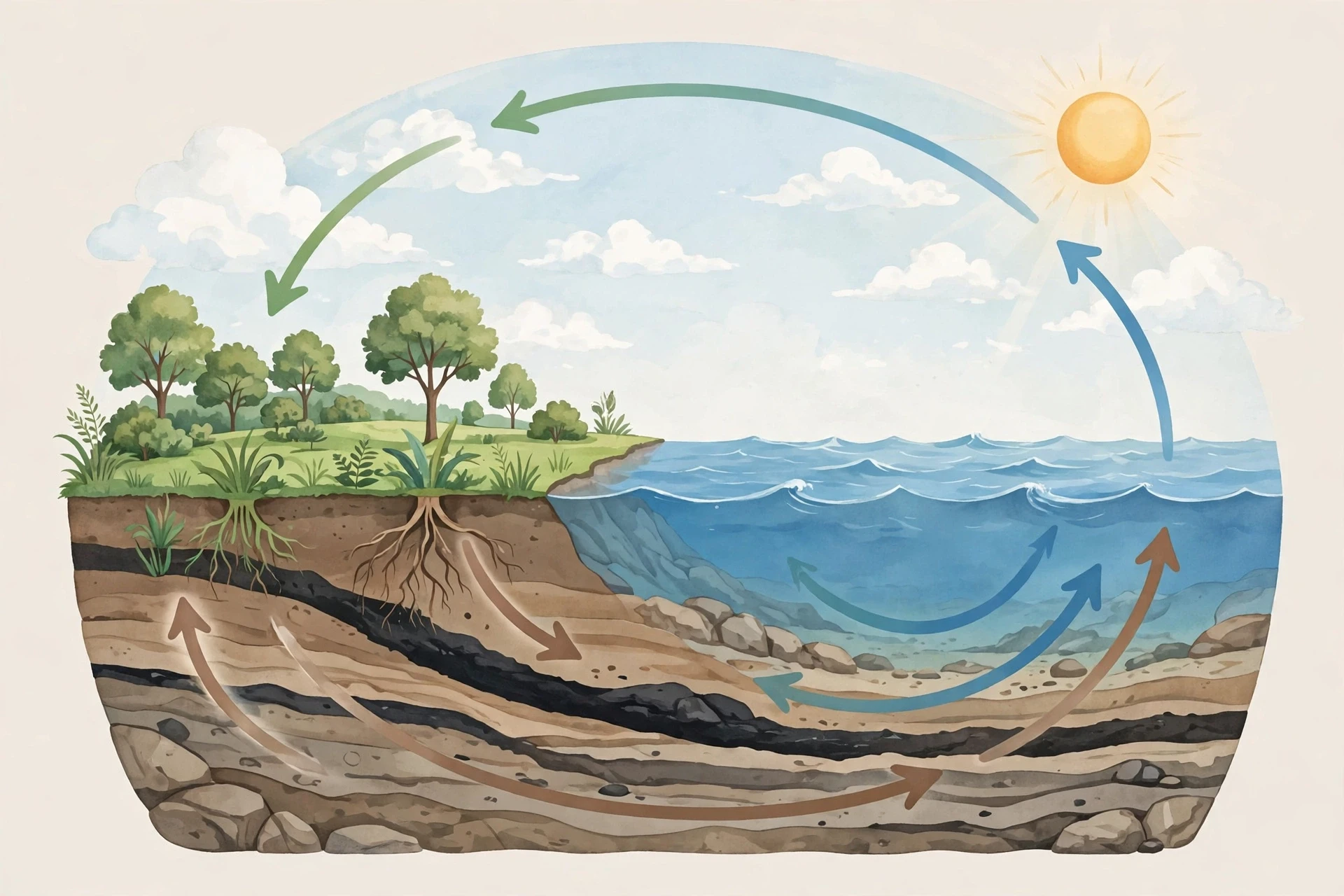
That is the carbon cycle in one image: the same atoms, borrowed and returned, built into living things, dissolved into seas, buried in stone, and released again. A carbon atom in your body right now may once have been part of a fern in a swamp forest hundreds of millions of years ago, or dissolved in a cold ocean current, or locked inside a limestone cliff. Carbon never really disappears. It changes address.
The carbon cycle is the set of processes that move carbon between the atmosphere, the oceans, the land, and the rocks. It is the reason Earth has breathable air, fertile soil, and a climate stable enough for forests, farms, and cities. It is also the reason a gas that makes up less than half a percent of the air can reshape the climate of an entire planet. To understand climate change, the oceans, the soil under your feet, and even your own body, you have to follow carbon on its rounds.
This article follows that journey. We will look at the four great reservoirs where carbon is stored, the living exchange of photosynthesis and respiration, the slow work of decomposition, the ocean's great pump, the deep geological cycle that runs on a timescale of millions of years, and the way humans have rewired the fast cycle in barely two centuries. Along the way, we will clear up some stubborn misconceptions — including one I believed myself for years — and end with what the cycle means for the climate we are building now.
1. What Is the Carbon Cycle?
The carbon cycle is Earth's great recycling system. Carbon atoms move continuously between four main reservoirs — the atmosphere, the oceans, the land (including all living things and soils), and the rocks — through physical, chemical and biological processes. Nothing in the cycle is wasted. A carbon atom released by a rotting leaf may be taken up by a blade of grass the next spring, dissolved into a raindrop, carried to the sea, and eventually locked into a shell on the ocean floor.
What makes carbon so restless is its chemistry. A carbon atom can form four strong bonds, which means it can link to itself and to other elements in a huge variety of ways. It is the backbone of every living thing: proteins, fats, DNA, wood, muscle, leaf. It also dissolves easily in water, reacts with oxygen to form carbon dioxide, and binds with calcium to form limestone. Few elements are so comfortable in so many different homes. That versatility is why carbon cycles at all — and why life is built from it rather than from anything else.
The cycle runs at two very different speeds, and keeping them apart is the key to understanding almost everything that follows. The fast cycle works on timescales of days to centuries: plants take up carbon dioxide, animals eat plants, microbes decompose dead matter, and the surface ocean exchanges gases with the air. The slow cycle works over millions of years: carbon is buried as sediment, baked into rock, and returned to the air by volcanoes. The fast cycle is the one we live inside. The slow cycle is the one that set the stage for us. Humans have pushed hard on the fast cycle, and that is where the trouble starts — a point we will return to in detail later.
It helps to think of the cycle as a set of bank accounts with flows between them. Each reservoir holds a certain amount of carbon, and each process moves carbon from one account to another at a certain rate. When the flows in and out balance, the amount in each reservoir stays steady. When one flow changes — say, when we burn coal and add a large new flow from the rock reservoir to the atmosphere — the balances shift. The atmosphere's account grows, and because carbon dioxide traps heat, the whole climate system feels it. The numbers matter here, so this article gives them wherever they are well established, and says so plainly where they are estimates.
1.1 Why carbon, and not something else?
Life could, in theory, have been built on silicon, carbon's chemical cousin. Silicon also forms four bonds. But silicon compounds are mostly solids — sand, quartz, glass — while carbon compounds can be gases, liquids and solids, and can dissolve in water. Carbon dioxide is a gas that drifts through the air and dissolves in the sea. Silicon dioxide is a rock. That single difference made carbon the element that could travel, and travel is what a cycle needs.
Carbon is also surprisingly rare in the universe compared with hydrogen, helium and oxygen, yet it is the fourth most abundant element in the human body, making up close to a fifth of our mass. The rest of us is mostly oxygen, hydrogen and nitrogen, with smaller amounts of calcium, phosphorus and other elements. Every carbon atom in your body was once somewhere else — in the air, in a plant, in the soil, in the sea. You are, quite literally, assembled from borrowed atoms that have been circulating for billions of years.
1.2 Carbon's many forms
The same element wears many disguises as it travels. In the air it is mostly carbon dioxide, a gas made of one carbon atom and two oxygen atoms. Dissolved in seawater it becomes bicarbonate, carbonate, and dissolved carbon dioxide. In living things it is locked into sugars, starches, cellulose, proteins and fats. Underground it sits in coal, oil, natural gas and limestone. Each form behaves differently: gases drift and mix, dissolved forms flow with currents, living forms are eaten and passed along food chains, and mineral forms sit still for millions of years.
The transitions between forms are where the action is. Photosynthesis turns a gas into a solid — a leaf takes carbon dioxide from the air and builds it into sugar. Respiration does the reverse, turning sugar back into gas. Dissolving turns gas into liquid chemistry. Burial turns living matter into rock. Weathering turns rock back into dissolved ions that rivers carry to the sea. Each transition is a doorway in the carbon cycle between reservoirs, and each doorway is guarded by a process — a microbe, a chemical reaction, a current, a volcano — that sets its speed.
1.3 A cycle with no beginning and no end
It is tempting to ask where the carbon cycle starts. It does not start anywhere. It is a loop, and loops have no starting point. A leaf falls, rots, and releases carbon dioxide; a new leaf takes that carbon dioxide up; the new leaf falls. The carbon in the coal that powered the industrial revolution was once carbon dioxide in the air of a swamp forest, taken up by plants that died and were buried before dinosaurs existed. The carbon dioxide you breathe out at this moment will, within years, be part of another living thing or dissolved in the sea.
This is also why the word "cycle" matters more than it seems. When we talk about carbon "emissions," it sounds as if carbon is being created. It is not. Every tonne of carbon dioxide from a car exhaust or a power station is carbon that was already on Earth, stored underground for millions of years, moved into the atmosphere in a geological instant. The problem is not that carbon exists. The problem is where it is, how fast it moves, and how much of it sits in the atmosphere at once.
The carbon cycle is not a machine we built or a system we can switch off. It is the background machinery of the living planet, older than forests, older than animals, and it will keep running long after we are gone. The question is only what shape we leave it in.
2. The Four Great Carbon Reservoirs
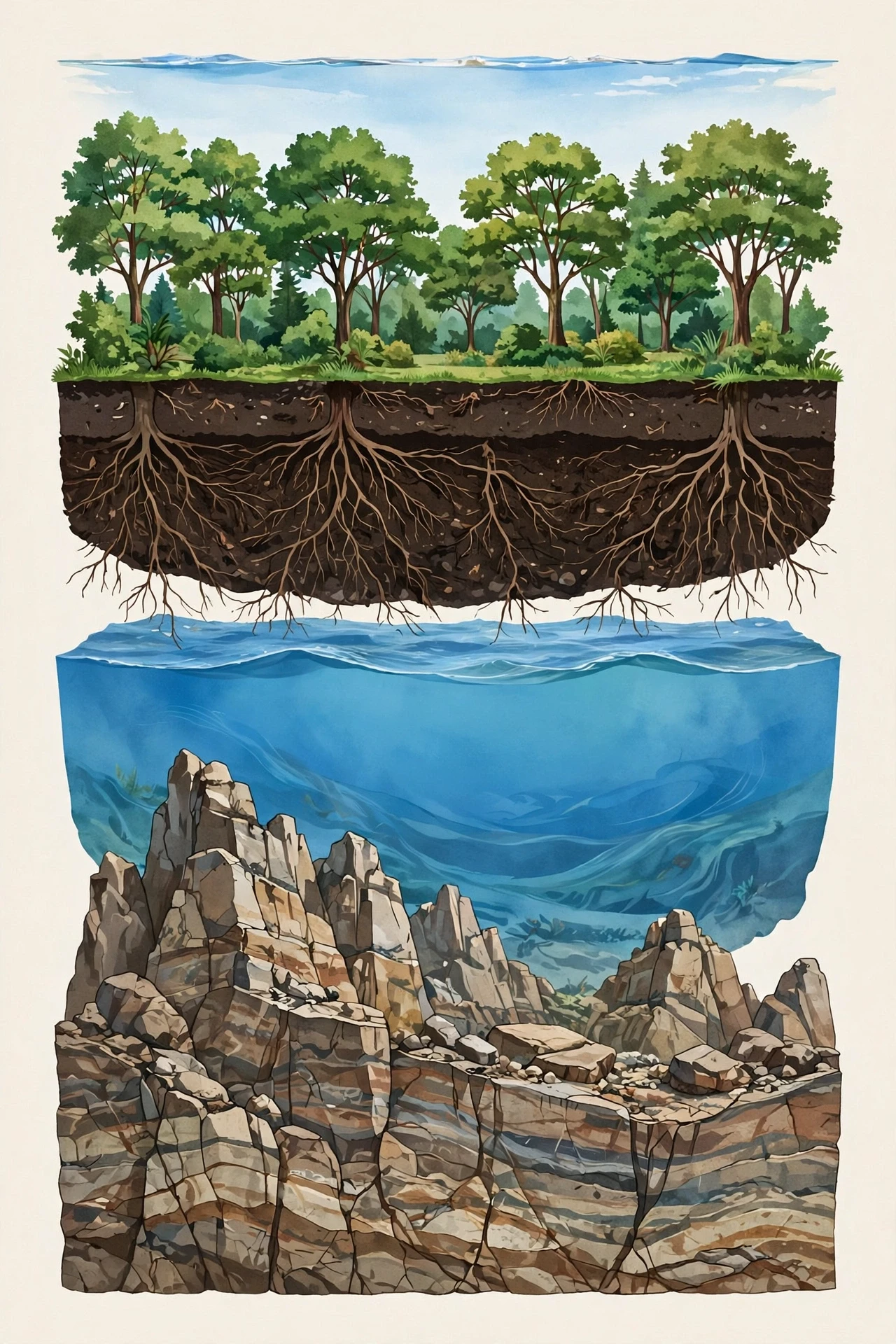
If the carbon cycle is a banking system, the reservoirs are the accounts. Four of them hold nearly all the carbon on Earth, and they could hardly be more different from one another. The atmosphere is thin and fast-moving. The oceans are vast and slow. The land is alive. The rocks are enormous and nearly still. Understanding how much carbon each one holds — and how fast it moves — explains why some changes to the cycle are easy to reverse and others take millions of years.
The figures below are the best current estimates, rounded to keep them readable. NASA's Earth Observatory overview of the carbon cycle sets out the same picture in detail. Scientists measure these stores in gigatonnes of carbon — a gigatonne is a billion tonnes — and the numbers come with real uncertainty, especially for soils and deep sediments. The pattern, though, is solid: the rocks hold vastly more carbon than everything else combined, the oceans hold far more than the air, and the living world, for all its richness, holds the least. That pattern is the whole story in miniature.
2.1 The atmosphere: small, fast, and powerful
The atmosphere holds roughly 870 gigatonnes of carbon, almost all of it as carbon dioxide. That sounds like a lot until you compare it with the other reservoirs. It is the smallest of the four by a wide margin. It is also the most restless: the average carbon atom spends only a few years in the air before being taken up by a plant or dissolved into the sea. The atmosphere is a busy corridor, not a warehouse.
Its small size is exactly what makes it so sensitive. Because the store is small, a modest change in the flows in or out changes its contents quickly. Add a few gigatonnes a year from burning fossil fuels, subtract a little less through plants and oceans, and the atmospheric total climbs year after year. Measurements from monitoring networks run by the US National Oceanic and Atmospheric Administration put atmospheric carbon dioxide above 420 parts per million, up from about 280 parts per million before the industrial era — a rise of roughly half in less than two centuries. That rise is the clearest single signal that the carbon cycle has been thrown out of balance.
Carbon dioxide is a trace gas — less than half a percent of the air — yet it punches far above its weight. It absorbs infrared radiation that Earth would otherwise radiate away into space, and re-emits some of it back toward the surface. This is the greenhouse effect, the natural process that keeps Earth warm enough for liquid water. Without any greenhouse gases, Earth would be a frozen ball. The trouble is not the effect itself but its strength: more carbon dioxide means more trapped heat. The greenhouse effect is worth understanding on its own, because it is the mechanism that turns a change in the carbon cycle into a change in climate.
The atmosphere also holds small amounts of methane, another carbon gas. Methane is far less abundant than carbon dioxide but traps heat much more strongly per molecule over the short term. Most atmospheric methane comes from wetlands, livestock, rice paddies, and leaks from fossil fuel operations. It breaks down in the air within about a decade, turning into carbon dioxide and water, so cutting methane emissions cools the climate faster than cutting carbon dioxide — though both matter.
2.2 The oceans: the great storehouse
The oceans hold about 38,000 gigatonnes of carbon — roughly 45 times as much as the atmosphere. Most of it is dissolved inorganic carbon: bicarbonate and carbonate ions, plus a little dissolved carbon dioxide. The surface ocean exchanges gases with the air constantly, and the deep ocean stores carbon for centuries or longer. If you want to know where most of the carbon that leaves the atmosphere ends up, the answer is usually the sea.
Ocean carbon comes in two forms that matter. Dissolved inorganic carbon is the chemical store — carbon dioxide from the air dissolves in seawater and reacts to form bicarbonate, a stable ion that can stay dissolved for a very long time. Dissolved organic carbon is the biological store — carbon in the bodies of plankton, fish, and the dissolved remains of dead organisms. The two forms feed into each other: living things take up dissolved inorganic carbon and turn it into organic carbon, and when they die and decay, some of it returns to the dissolved pool.
The oceans are not one uniform reservoir. The sunlit surface layer, the top hundred metres or so, is warm, mixed by wind and waves, and in constant contact with the air. Below it lies the deep ocean — cold, dark, and cut off from the atmosphere for hundreds or thousands of years. Carbon that reaches the deep ocean is effectively out of circulation for a very long time. Getting carbon down there is the ocean's great trick, and the mechanism that does it is called the biological pump, which we will look at closely in Section 5.
The ocean's appetite for carbon dioxide has a limit, and it is shrinking. Cold water absorbs more carbon dioxide than warm water, so as the oceans warm they take up less. Carbon dioxide also makes seawater more acidic when it dissolves, forming carbonic acid, and more acidic water holds less carbonate — the ingredient shell-building creatures need. Ocean acidification is already making life harder for corals, oysters and plankton that build shells. The ocean is still absorbing roughly a quarter of the carbon dioxide humans release each year, but it is doing so at a cost to its own chemistry.
2.3 The land: living things and soils
The land reservoir is really two stores in one. Living things — plants, animals, fungi and microbes — hold roughly 450 to 650 gigatonnes of carbon, most of it in trees. Soils hold far more, somewhere around 1,500 to 2,400 gigatonnes, making soil the largest carbon store on land and the second largest active store on the planet after the oceans. If you have ever dug into dark, rich garden soil and smelled its earthiness, you were smelling carbon: the broken-down remains of countless dead leaves, roots and microbes, held in a form that can last for decades or centuries.
Forests deserve special attention because they hold so much carbon in so little space. A mature tropical forest can store several hundred tonnes of carbon per hectare in its trunks, branches, roots and soil. When a forest is cut and burned, most of that carbon returns to the atmosphere within years. When a forest grows back, it pulls carbon out of the air again — but regrowth takes decades, and a plantation of fast-growing trees never quite matches the carbon store of the old forest it replaced, especially in the soil. This asymmetry is why deforestation is such a powerful lever on the carbon cycle, and why protecting existing forests matters more than planting new ones alone.
Grasslands and peatlands are quieter heroes. Peat bogs cover only a small fraction of Earth's land, yet they store an enormous amount of carbon in waterlogged, undecomposed plant matter — in some estimates, more carbon than all the world's forests combined. Drain a peat bog and that carbon begins to rot, releasing carbon dioxide for years. Leave it wet, and it keeps storing carbon indefinitely. The same logic applies to permafrost soils in the far north, which hold roughly 1,500 gigatonnes of carbon in frozen ground. As the Arctic warms, some of that ground is thawing, and the microbes that wake up in it release carbon dioxide and methane.
2.4 The rocks: the sleeping giant
The rock reservoir dwarfs all the others. Sedimentary rocks — limestone, chalk, shale and coal — hold tens of millions of gigatonnes of carbon, orders of magnitude more than the atmosphere, oceans and living things combined. Almost all of it is locked away as carbonate minerals or as fossil fuels, and almost all of it moves on geological timescales. A carbon atom in a limestone cliff may stay there for a hundred million years before weathering or volcanic activity releases it.
This is the slow cycle's home. Carbon enters the rocks when dead organisms are buried in sediment, when shells and skeletons settle on the sea floor, or when dissolved carbonate precipitates out of seawater. It leaves the rocks through weathering — rainwater, made slightly acidic by dissolved carbon dioxide, slowly dissolving limestone and carrying the carbon to the sea — and through volcanoes, which vent carbon dioxide from deep inside the Earth. Over millions of years, these slow flows balance each other and set the long-term level of carbon dioxide in the air. Over human timescales, they barely move at all.
The crucial point is that fossil fuels are part of this reservoir. Coal, oil and natural gas are ancient plant and plankton remains, buried and cooked by Earth's heat over millions of years. When we burn them, we are taking carbon out of the rock reservoir — where it had sat quietly for an age — and putting it into the atmosphere in a geological instant. The slow cycle has no mechanism that can put it back on anything like a human timescale. That mismatch, between the speed at which we release carbon and the speed at which the slow cycle can absorb it, is the heart of the climate problem.
Reservoir | Carbon stored (approx.) | How fast carbon moves | Main form of carbon |
|---|---|---|---|
Atmosphere | ~870 gigatonnes | Years | Carbon dioxide |
Oceans | ~38,000 gigatonnes | Years to centuries | Bicarbonate and carbonate ions |
Living things | ~450–650 gigatonnes | Days to decades | Sugars, cellulose, proteins |
Soils | ~1,500–2,400 gigatonnes | Decades to centuries | Humus and dead organic matter |
Rocks and sediments | Tens of millions of gigatonnes | Millions of years | Limestone, coal, oil, gas |
The table makes the pattern plain. The reservoirs that hold the most carbon move the slowest, and the reservoir that moves the fastest holds the least. The atmosphere is the small, fast-moving hub through which the whole system connects — which is why changes to it show up so quickly, and why the carbon cycle is so sensitive to what we do with fossil fuels.
If the atmosphere is a corridor and the rocks are a vault, then the oceans and soils are the warehouses in between. We have been emptying the vault into the corridor and hoping the warehouses can keep up. So far, they have absorbed about half of what we release. The other half stays in the air.
3. Photosynthesis and Respiration: The Living Exchange
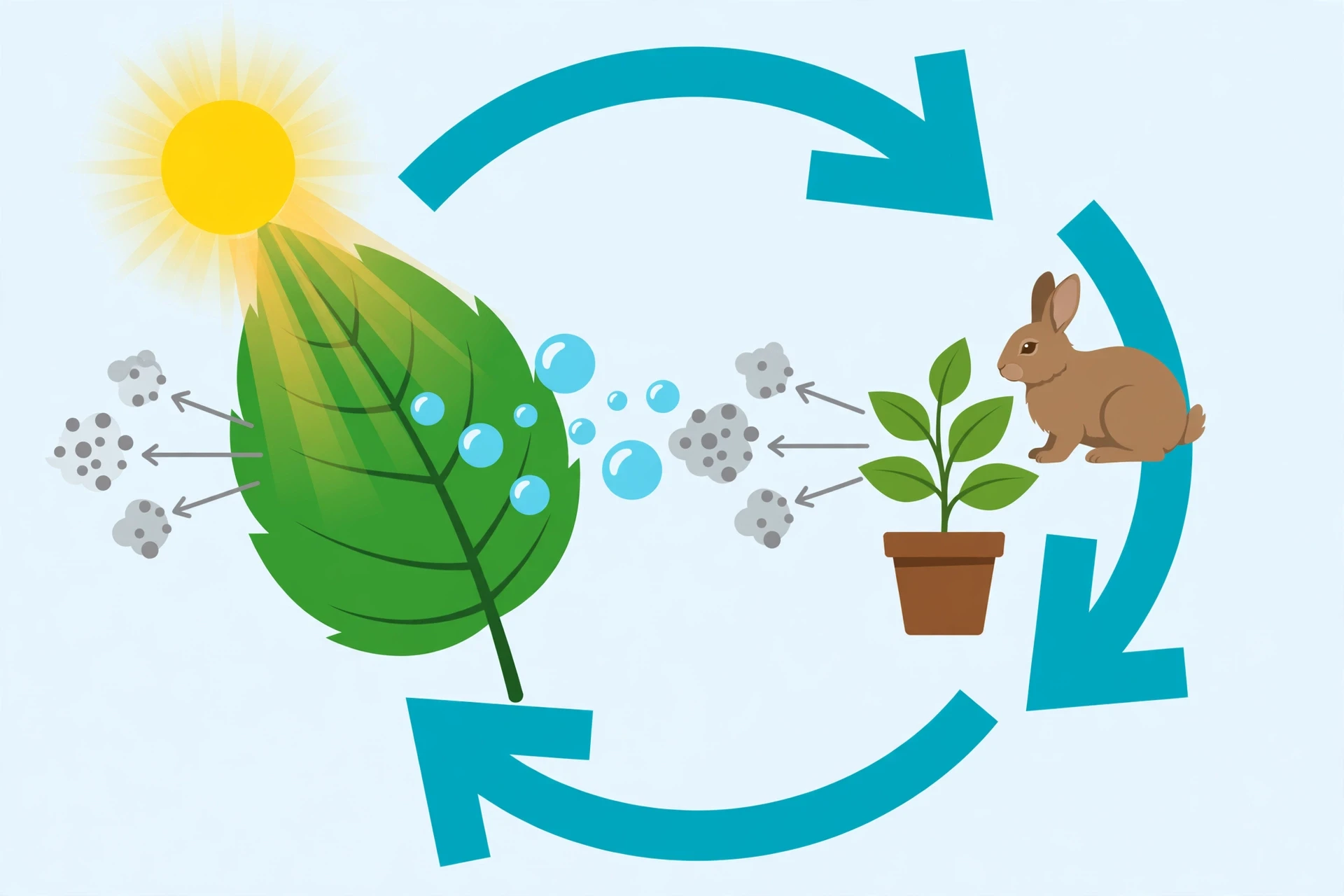
Every breath you take is part of the carbon cycle, and every green leaf you have ever seen is a small chemical factory running the most important reaction on Earth. Photosynthesis and respiration are mirror images: one pulls carbon out of the air and builds it into living tissue, the other burns that tissue for energy and returns the carbon to the air. Together they move more carbon each year than any other process in the fast cycle, and they do it with a precision that human engineering still cannot match.
The chemistry is elegant in its simplicity. In photosynthesis, a plant takes six molecules of carbon dioxide and six molecules of water, adds sunlight, and produces one molecule of glucose and six molecules of oxygen. In respiration, the reaction runs in reverse: glucose and oxygen become carbon dioxide, water, and energy the cell can use. The equations balance perfectly, which is no coincidence — respiration evolved to undo what photosynthesis does, releasing the sunlight's stored energy on demand.
3.1 Photosynthesis: building life from air and light
Photosynthesis happens in chloroplasts, tiny green structures inside plant cells that contain the pigment chlorophyll. Chlorophyll absorbs blue and red light and reflects green — which is why plants look green to us. The absorbed light energy drives a chain of reactions that splits water, releases oxygen, and fixes carbon dioxide into sugars. The sugars are then used to build everything else the plant needs: cellulose for cell walls, starch for storage, proteins, fats, and DNA.
The scale is staggering. Each year, land plants and ocean plankton together take up well over 100 gigatonnes of carbon from the atmosphere and the surface ocean. For comparison, humans release around 11 gigatonnes of carbon a year by burning fossil fuels. Nature's uptake is far larger than our emissions — but nature also releases nearly as much back through respiration and decay, so the net flow was close to zero before we started adding fossil carbon. The gross flows are enormous; the net balance is what matters, and we have tipped it.
Not all photosynthesis is equal. A fast-growing tropical forest fixes carbon quickly but stores it for a relatively short time, since trees die and rot. A slow-growing boreal forest fixes carbon more slowly but locks it into wood and cold soil for much longer. Ocean plankton fix carbon fast and die fast, but a small fraction of their carbon sinks to the deep ocean and stays there for centuries. The details of where carbon goes after photosynthesis matter as much as how much is fixed in the first place.
For a closer look at the chemistry and the step-by-step process inside the leaf, see our guide to photosynthesis.
3.2 Respiration: the other half of the bargain
Every living thing respires. Plants respire at night, when there is no light for photosynthesis, burning some of the sugars they made during the day. Animals respire constantly, breaking down food to power movement, warmth, and growth. Microbes respire as they decompose dead matter. Each act of respiration returns carbon dioxide to the air or water. Without it, the carbon fixed by photosynthesis would pile up in living tissue until the atmosphere ran out of carbon dioxide entirely — which is one reason the two processes must stay in balance.
I learned how delicate that balance is from a simple classroom tank of pondweed I kept as a student. In sunlight, the weed released streams of tiny bubbles — oxygen from photosynthesis. When I draped a cloth over the tank, the bubbles stopped within minutes, and a pH indicator in the water slowly shifted as carbon dioxide from the weed's own respiration built up. Nothing in the tank had changed except the light, yet the whole chemistry of the water had reversed. It was a small, quiet demonstration of a planetary truth: the carbon cycle runs on sunlight, and it runs in both directions.
Respiration is also the reason a forest is not a one-way carbon vacuum. A growing forest absorbs more carbon than it releases, but a mature forest — where growth and decay are roughly equal — absorbs almost nothing net. Its trees still photosynthesise furiously, but the carbon they fix is matched by the carbon released as old trees die, fall, and rot. This surprises people who imagine that planting trees alone can absorb all our emissions. Trees help enormously, but only while they are growing, and only if they are not cut down again. The carbon has to stay in the wood and soil, not return to the air.
3.3 The seasonal breath of the planet
The carbon cycle has a pulse, and it is visible from space. Each spring in the Northern Hemisphere, as forests leaf out and crops grow, atmospheric carbon dioxide falls. Each autumn, as leaves drop and decay, it rises again. The swing is several parts per million — a sawtooth pattern laid over the long upward trend. The Southern Hemisphere shows the same pattern in reverse, smaller because it has less land. This seasonal breath is the planet inhaling and exhaling, and it is driven almost entirely by photosynthesis and respiration on land.
The same pulse shows up in the oceans, though more quietly. In spring, plankton blooms in the sunlit surface waters consume dissolved carbon dioxide; in winter, storms mix the water and bring carbon-rich deep water back to the surface. The ocean's seasonal rhythm is slower and more muted than the land's, but it is there, and it is part of the same great exchange in the carbon cycle.
3.4 Gross flows and net flows
One of the most misunderstood ideas in the carbon cycle is the difference between gross and net flows. The gross flow of carbon through photosynthesis is enormous — over 100 gigatonnes a year. The gross flow back through respiration and decay is almost as large. The net flow — the difference between the two — was close to zero for thousands of years before the industrial era. That near-zero net is what kept atmospheric carbon dioxide steady at around 280 parts per million.
Humans added a new gross flow of about 11 gigatonnes of carbon a year from fossil fuels, plus a few more from deforestation and land use. The land and oceans absorb roughly half of that extra carbon, which is why atmospheric carbon dioxide rises by only about half of what we emit. The other half stays in the air. This is the arithmetic that matters: small imbalances in enormous flows produce large changes over time. The carbon cycle is a system of huge, nearly balanced flows, and we have been adding a persistent surplus to one side of the ledger for two centuries.
4. Decomposition and the Soil Carbon Store
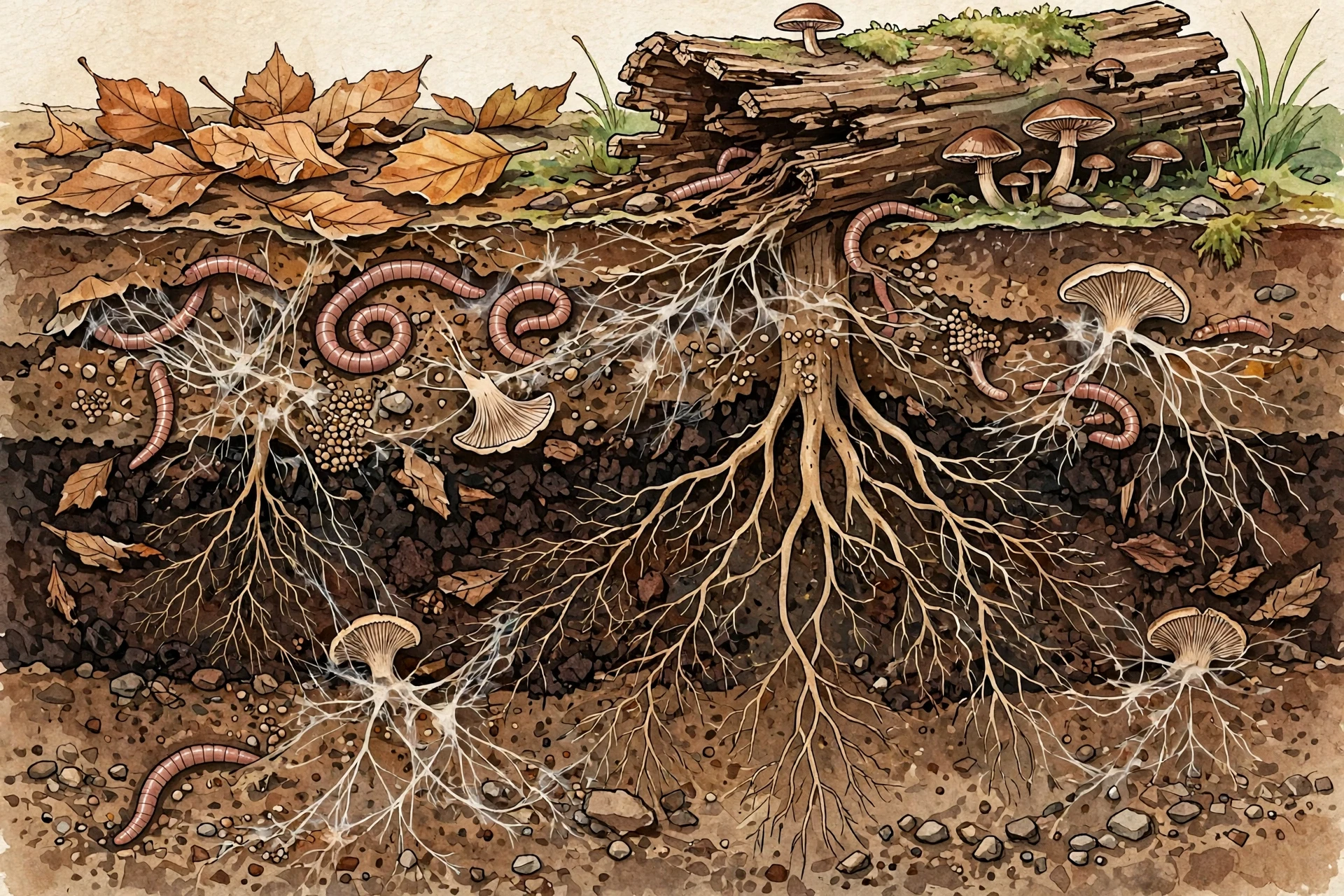
A fallen leaf does not simply vanish. It is eaten, shredded, dissolved and rebuilt by an entire underground economy of fungi, bacteria, worms and insects, and what is left behind becomes soil — one of the largest carbon stores on the planet. Decomposition is the quiet half of the carbon cycle, the process that returns carbon from dead things to the air and the soil. Without it, the world would be buried under the undecomposed remains of every plant and animal that ever lived, and the atmosphere would slowly run out of carbon dioxide.
The work is done by organisms most of us never see. Fungi send thread-like hyphae through dead wood, secreting enzymes that break down lignin — the tough polymer that gives wood its strength — into smaller molecules. Bacteria colonise every surface, turning sugars and proteins into carbon dioxide. Earthworms drag leaves underground, shredding them and mixing them into the soil. Springtails and mites graze on fungi. Each organism takes a share of the carbon for its own body and releases the rest as carbon dioxide. Step by step, a leaf becomes soil, and soil becomes air again — though not all of it, and not all at once.
4.1 What happens to a dead leaf
Decomposition happens in stages. First, the easy parts go: sugars and starches are consumed within days or weeks by fast-growing bacteria. Then the tougher materials — cellulose and hemicellulose — are broken down over months by fungi and specialised bacteria. Finally, the hardest materials — lignin and waxes — are attacked slowly, over years, by fungi alone. At each stage, some carbon is released as carbon dioxide, some is built into the bodies of the decomposers, and some is left behind as increasingly stable organic matter.
What remains after years of this processing is humus: dark, complex organic matter that resists further decay and can persist in soil for decades or centuries. Humus is the soil's long-term carbon store. It also gives soil its structure, holding water and nutrients and making the ground fertile. A soil rich in humus is dark, crumbly, and sweet-smelling. A soil stripped of it is pale, compacted, and poor. The carbon in humus is not just a climate number — it is the difference between land that can feed people and land that cannot.
Temperature and moisture set the pace. Warm, moist conditions speed decomposition up, which is why tropical soils often hold less carbon than you might expect: the microbes work so fast that dead matter rots before much of it can accumulate. Cold, wet conditions slow decomposition down, which is why peat bogs and permafrost soils accumulate enormous carbon stores — the dead plants simply do not rot. This is also why warming matters so much for soils: a few degrees of warming can wake up microbes in cold soils and turn a long-term carbon store into a source.
4.2 Soil: the carbon store we walk on
Soils hold more carbon than all the world's vegetation and the atmosphere combined. That single fact is strangely underappreciated. We talk constantly about forests as carbon stores and rarely about the ground beneath them, yet the ground holds two to three times as much. Most soil carbon sits in the top metre, mixed through by roots, worms and rain, and it got there slowly: a gram of stable soil carbon may represent decades of leaf fall, root growth, and microbial processing.
Farming has a complicated relationship with soil carbon. Ploughing exposes soil organic matter to oxygen and speeds up decomposition, releasing carbon dioxide. Intensive tillage over decades has stripped large amounts of carbon from farmland soils around the world. But the same soils can be rebuilt: cover crops, reduced tillage, compost and manure, and keeping the ground covered through winter all add organic matter back. The recovery is slow — a matter of decades — but it is real, and it improves fertility at the same time. Soil carbon is one of the few climate levers that also helps farmers directly.
Fire is decomposition's fast-forward button. A wildfire does in hours what microbes would take years to do, releasing the carbon stored in leaves, litter and wood as carbon dioxide. Most forests recover, and the regrowing trees reabsorb the carbon over decades, so a single fire in a healthy forest is roughly carbon-neutral over the long term. The problem comes when fires become more frequent or more severe than the forest can recover from — as they have in many regions as the climate warms — because then the forest never catches up, and each fire leaves the system a little poorer in carbon.
4.3 The microbes that run the cycle
It is worth pausing on the microbes, because they are the true workforce of the carbon cycle and they get almost none of the credit. A single gram of soil contains billions of bacteria and kilometres of fungal hyphae. They decide, molecule by molecule, whether carbon stays in the soil or returns to the air. Their activity depends on temperature, moisture, acidity and the chemistry of what they are eating, and their responses to warming are one of the largest uncertainties in climate science.
Here is the worry in plain terms: if warming speeds up microbial decomposition more than it speeds up plant growth, soils will release more carbon than they absorb, and that extra carbon dioxide will cause more warming, which will speed up the microbes further. This is a positive feedback loop — one of several we will meet in Section 8 — and it is already visible in measurements from warming experiments in Arctic and temperate soils. How strong it will become is still debated, and researchers disagree on the size of the effect. That disagreement is honest science, not confusion: the soil system is enormously complex, and the answer depends on details we are still measuring.
5. The Ocean Carbon Pump
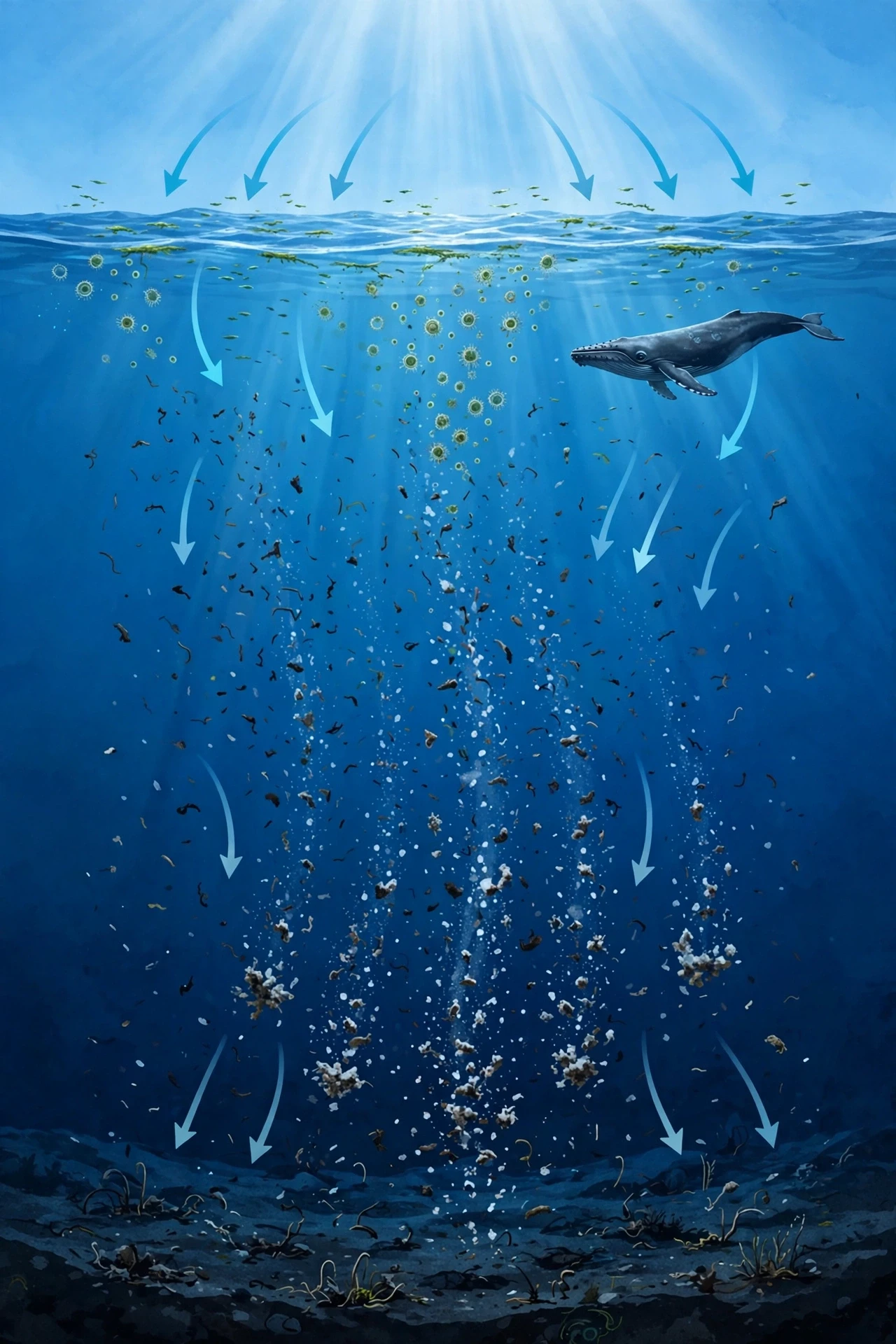
The ocean does not just store carbon. It actively pumps it downward, out of reach of the atmosphere, using two mechanisms that work together: one physical, one biological. The physical pump is driven by temperature and currents. The biological pump is driven by life — by plankton so small you need a microscope to see them, and by the great fall of dead matter that oceanographers call marine snow. Between them, the two pumps move enormous quantities of carbon from the surface ocean to the deep, and they are a major reason atmospheric carbon dioxide is as low as it is.
I first saw the biological pump at work, in a small way, on a research boat off a cold coast early one spring. The water had turned a milky green with a plankton bloom, and a simple net tow came up thick with tiny copepods and diatoms. A colleague held up a sample bottle and pointed out the faint rain of white flecks sinking through it — dead plankton and faecal pellets, already on their way down. It was hard to believe that something so small and so quiet could matter to the climate of a planet. But multiply that bottle by every ocean on Earth, every day of the year, and you have one of the largest carbon flows in the world.
5.1 The solubility pump: cold water holds more gas
The physical pump starts with a simple fact of chemistry: cold water dissolves more carbon dioxide than warm water. In the cold waters of the North Atlantic and the Southern Ocean, surface water absorbs carbon dioxide from the air, becomes dense as it cools, and sinks, carrying its dissolved carbon down into the deep ocean. There it can stay for hundreds of years before currents bring it back to the surface. Warm tropical waters do the reverse, releasing carbon dioxide back to the air as they warm.
This sinking of cold, carbon-rich water is part of the great ocean conveyor — the global circulation that moves water between the surface and the deep over centuries. The conveyor is slow, but it is vast, and it is one of the main reasons the deep ocean holds so much carbon. It is also vulnerable: if the surface ocean warms, the water becomes less dense and sinks less readily, and the pump weakens. If melting ice freshens the surface waters of the North Atlantic, the same thing happens — fresh water is less dense than salty water, so it resists sinking. Both effects are already being watched closely by oceanographers.
The solubility pump also explains why the oceans cannot simply absorb all our extra carbon dioxide. As the surface ocean takes up more carbon dioxide, its chemistry changes: the water becomes more acidic, and its capacity to absorb more gas falls. The ocean is still taking up roughly a quarter of human emissions each year, but the fraction it can absorb is expected to decline as it warms and acidifies. The pump is not broken, but it is losing strength at exactly the moment we need it most.
5.2 The biological pump: life carries carbon down
The biological pump starts with phytoplankton — microscopic algae that drift in the sunlit surface waters and photosynthesise, taking up dissolved carbon dioxide just as land plants take it from the air. When they die, or when they are eaten and excreted by zooplankton, their remains sink. Most of the sinking material is eaten or decomposed on the way down, and its carbon returns to the dissolved pool in the upper ocean. But a small fraction — a few percent — reaches the deep ocean or the sea floor, where it is buried in sediment and removed from circulation for centuries or longer.
A few percent sounds small, but the flow it feeds is enormous. The gross amount of carbon fixed by ocean photosynthesis each year is comparable to that fixed on land — tens of gigatonnes — so even a small sinking fraction moves a significant amount of carbon into long-term storage. The pump is also what keeps the surface ocean from becoming saturated with carbon: by constantly removing carbon from the surface and sending it down, plankton keep the surface waters hungry for more carbon dioxide from the air.
Some plankton help the pump in a second way. Coccolithophores, tiny algae that build chalky shells of calcium carbonate, carry carbon down in their shells when they die. Foraminifera, microscopic animals with carbonate shells, do the same. Over millions of years, these shells have built up the great limestone and chalk deposits of the sea floor — the white cliffs of Dover are the fossilised remains of countless trillions of plankton. The biological pump and the rock cycle meet on the ocean floor, where life becomes geology.
5.3 Why the ocean matters for climate
The oceans have absorbed about a quarter of the carbon dioxide humans have released since the industrial era, and about nine-tenths of the extra heat trapped by greenhouse gases. Without them, atmospheric carbon dioxide would be far higher and the climate far hotter. The ocean pump is one of the largest flows in the carbon cycle, and its service to the climate is enormous, even though it happens underwater, out of sight, in waters most people never see.
But the service has costs, and they are mounting. The extra carbon dioxide has made the surface ocean measurably more acidic — roughly 30 percent more acidic than before the industrial era, in the usual measure of acidity. That acidity dissolves the shells of young oysters, weakens coral skeletons, and disrupts the plankton at the base of the marine food web. Warmer water holds less oxygen, so oxygen-poor zones are expanding. The ocean is still our greatest ally in the carbon cycle, but it is paying for the role, and its ability to keep absorbing carbon at the same rate is not guaranteed. The US National Oceanic and Atmospheric Administration describes the ocean as the planet's largest active carbon store, and its pages on the subject are a good place to see the numbers laid out plainly.
6. The Slow Carbon Cycle: Rocks, Volcanoes and Fossil Fuels
The fast cycle is the one we live in, but the slow cycle is the one that built the world we live in. It runs on a timescale of millions of years, and it works through rocks: carbon is buried as sediment, transformed by heat and pressure, stored in limestone and coal, and eventually returned to the air by volcanoes and weathering. The slow cycle set the long-term level of carbon dioxide in the atmosphere, and with it the long-term climate of Earth. It is the reason Earth has not frozen solid or boiled away over billions of years, and it is the reason fossil fuels exist at all.
The slow cycle is also the reason the climate problem is so stubborn. The processes that remove carbon dioxide from the air on geological timescales — weathering of rocks, burial of organic matter — work far too slowly to clean up in decades what we have added in two centuries. When we burn fossil fuels, we are borrowing from the slow cycle at fast-cycle speed, and there is no fast way to put the carbon back.
6.1 How fossil fuels are made
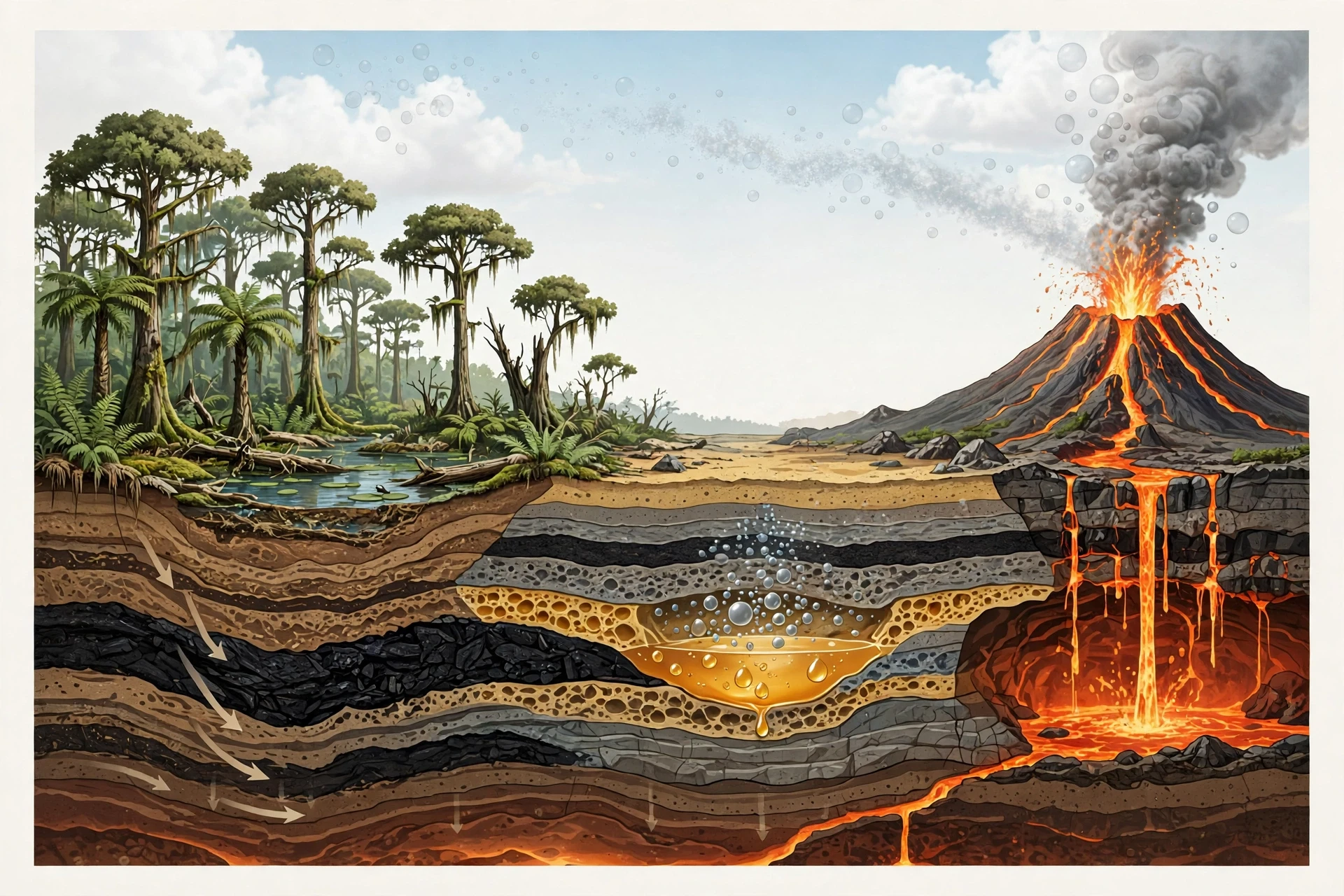
Fossil fuels are the remains of ancient life, transformed by time, pressure and heat. Coal formed from plants that grew in vast swamp forests hundreds of millions of years ago, died, fell into stagnant water where they could not fully rot, and were buried under layers of sediment. As more sediment piled on, the pressure and heat squeezed the water out and concentrated the carbon, turning peat into lignite, then bituminous coal, then anthracite. Oil and natural gas formed mostly from marine plankton, buried in ocean sediments and cooked by Earth's heat into hydrocarbons over millions of years.
The key point is the timescale. The coal in a single power station's monthly supply took millions of years to form. The oil in a car's fuel tank is the compressed remains of plankton that lived before the first dinosaurs. We are burning, in a few centuries, carbon that the slow cycle took hundreds of millions of years to store. No natural process can replace it on a human timescale, which is why fossil fuels are called non-renewable in the most literal sense: the Earth will make more, eventually, but not for us.
6.2 Weathering: the slow thermostat
Weathering is the slow cycle's thermostat, and it is one of the most elegant feedbacks in Earth science. Rainwater absorbs carbon dioxide from the air and becomes a weak acid — carbonic acid. When that rain falls on silicate rocks, the acid dissolves them, and the dissolved minerals wash into rivers and out to sea. There, marine organisms use the dissolved calcium and carbonate to build shells, which sink and become limestone, locking the carbon away in rock. The net effect is that carbon dioxide is pulled out of the air and buried in stone.
The thermostat works because weathering speeds up when the climate warms. Warmer air holds more water vapour, so it rains more, and chemical reactions run faster in warm conditions. More rain and faster reactions mean faster weathering, which pulls more carbon dioxide out of the air, which cools the climate. If the climate cools, weathering slows, carbon dioxide builds up again, and the planet warms. Over millions of years, this feedback has kept Earth's climate within bounds that allowed liquid water and life to persist — even as the Sun has grown brighter over billions of years.
The thermostat is powerful, but it is slow. It operates over hundreds of thousands to millions of years. It cannot respond to a change that happens in two centuries. That is the central mismatch of the climate problem: the slow cycle's thermostat works, but it works on a timescale that is irrelevant to the decisions we make this decade.
6.3 Volcanoes: carbon from the deep Earth
Volcanoes are the slow cycle's exhaust. When tectonic plates collide and one slides beneath the other, carbon-bearing rocks are carried down into the hot mantle, where the carbon is released as carbon dioxide and rises back to the surface in volcanic gases. Volcanoes also erupt from hotspots where plumes of deep mantle material rise. Together, volcanic outgassing returns carbon from the deep Earth to the atmosphere at a rate that, averaged over millions of years, roughly balances the carbon removed by weathering and burial.
Individual eruptions can be spectacular — a large eruption can inject millions of tonnes of carbon dioxide into the air — but the total volcanic output is small compared with human emissions. All the world's volcanoes together release on the order of a few hundred million tonnes of carbon dioxide a year. Humans release around 40 billion tonnes a year, roughly a hundred times more. Volcanoes are a real part of the carbon cycle, but they are not the cause of the current rise in atmospheric carbon dioxide. The rise is ours, and the fingerprint is clear: the carbon we add is depleted in a heavy isotope that fossil fuels lack, and the oxygen in the air is falling in step with the carbon dioxide rising, exactly as combustion predicts.
6.4 Plate tectonics and the long view
The slow cycle is ultimately driven by plate tectonics — the movement of Earth's crustal plates over the mantle. Subduction carries carbon down. Seafloor spreading creates new ocean crust. Mountain building exposes fresh rock to weathering. Over hundreds of millions of years, the arrangement of continents has changed the strength of weathering, the area of shallow seas, and the vigour of the carbon cycle. When the Himalayas rose, for example, the fresh rock they exposed to rain and weathering pulled large amounts of carbon dioxide out of the air, cooling the planet over tens of millions of years.
This deep history is humbling, and it is also reassuring in a strange way: the carbon cycle has handled enormous changes before, and Earth has always recovered — eventually. But "eventually" in geology means millions of years, and the recoveries have sometimes involved mass extinctions and radically different climates along the way. The slow cycle will, given enough time, remove the carbon dioxide we have added. The question is not whether the planet will recover, but what the world looks like in the meantime, and for whom.
7. How Humans Changed the Fast Carbon Cycle
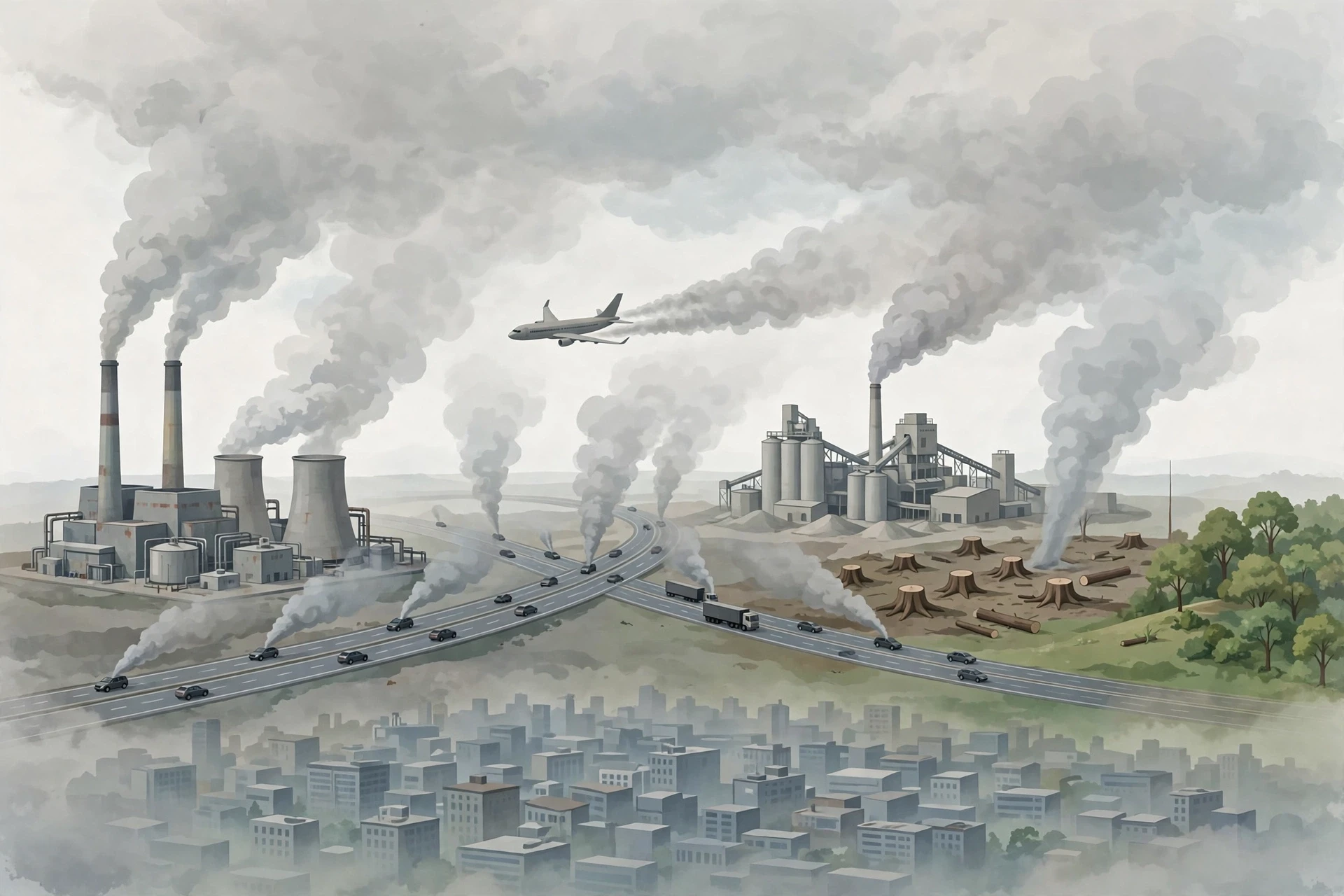
For most of human history, our effect on the carbon cycle was small. We burned wood, cleared patches of forest, and farmed the land, but the flows we touched were tiny compared with the natural flows of photosynthesis and respiration. Then, starting in the late 18th century, we began to dig up coal, and later oil and gas, and to burn them at a scale no natural process could match. Within two centuries we had added a new flow to the carbon cycle larger than any natural source, and the atmosphere began to change in ways that are visible in every measurement we have.
The numbers tell the story plainly. Human activities now release around 40 billion tonnes of carbon dioxide a year, mostly from burning fossil fuels, with a substantial share from deforestation and land use. The land and oceans absorb roughly half of it. The rest — about 20 billion tonnes a year — stays in the atmosphere, and atmospheric carbon dioxide rises by roughly 2 to 3 parts per million every year. The US Environmental Protection Agency's overview of greenhouse gas emissions lays out the sources in detail, and the pattern is consistent across every national inventory: energy production is the largest share, followed by transport, industry, buildings and agriculture.
7.1 Burning fossil fuels: the largest new flow
Burning fossil fuels is, chemically, just fast respiration on a geological scale. Coal, oil and gas are stored sunlight — the energy of ancient photosynthesis, locked away for millions of years. Burning them releases that energy and returns the carbon to the air as carbon dioxide, in the same way that burning wood does. The difference is the source: wood carbon was taken from the air a few decades ago, so burning it is roughly neutral over the life of the tree. Fossil carbon was taken from the air hundreds of millions of years ago, so burning it adds carbon to the fast cycle that has not been part of it for an age.
The scale is hard to grasp, so it helps to think in everyday terms. A single litre of petrol, when burned, produces about 2.3 kilograms of carbon dioxide — more than twice the weight of the fuel itself, because most of the mass of carbon dioxide is oxygen taken from the air. A coal-fired power station can burn a trainload of coal every day. Multiply by every power station, every car, every aeroplane and every factory on Earth, and you arrive at the 40-billion-tonne figure. It is the largest single change humans have made to any planetary cycle.
There is a common objection here, and it is worth answering directly: volcanoes and natural processes also release carbon dioxide, so how do we know the rise is ours? The answer comes from several independent lines of evidence. The carbon in fossil fuels has a distinctive isotopic signature, and the carbon dioxide accumulating in the air carries that signature. Oxygen levels in the air are falling in exact proportion to the carbon dioxide rising, as expected from combustion. And the rise began with the industrial revolution and accelerated with fossil fuel use, in step with economic and energy records. Natural sources cannot explain the timing, the size, or the chemistry of the rise. The evidence is not a single measurement but a convergence of many, and it points the same way.
7.2 Deforestation and land use: the second flow
The second large human flow comes from how we use land. When forests are cleared for farming, ranching or cities, the carbon stored in trees and soils is released — much of it quickly, as the wood is burned or rots, and the rest slowly, as the exposed soil loses organic matter. Tropical deforestation is the largest part of this flow, driven by demand for beef, soy, palm oil and timber, and by the expansion of farmland into forest.
Deforestation does double damage. It releases stored carbon, and it removes the trees that would have absorbed carbon in the future. A cleared forest is a source twice over: once when it burns, and again every year afterwards in the carbon its trees no longer take up. This is why protecting existing forests — especially tropical forests and peatlands — is one of the most effective climate actions available. A mature forest is not just a store of carbon; it is a working part of the cycle, and losing it weakens the system that absorbs our emissions.
Farming itself also affects the cycle. Ploughing releases soil carbon. Fertilisers, especially nitrogen fertilisers, boost crop growth — which absorbs carbon — but also increase emissions of nitrous oxide, a powerful greenhouse gas. Rice paddies and livestock release methane. The food system as a whole is a major part of the human carbon footprint, and it is one of the hardest parts to change, because it is tied to what billions of people eat every day.
7.3 The airborne fraction: where our carbon goes
Not all the carbon dioxide we release stays in the air. The oceans absorb roughly a quarter, and the land — through faster plant growth in a carbon-dioxide-rich atmosphere, and through regrowing forests — absorbs roughly another quarter to a third. The remainder, a little under half, stays in the atmosphere. This fraction, called the airborne fraction, has stayed remarkably steady for decades, which is both good news and bad: good, because the land and oceans are still absorbing a large share; bad, because their capacity is not infinite, and there are signs it may be weakening as the oceans warm and forests face drought, fire and disease.
This is where the carbon cycle's own dynamics turn against us. The same warming that our extra carbon dioxide causes makes the natural sinks less effective: warm water absorbs less gas, drought-stressed forests grow more slowly, and thawing permafrost releases stored carbon. The sinks that have been cleaning up roughly half our emissions could, if weakened, leave a larger fraction in the air — which would speed up warming further. This is not a distant hypothetical. It is a process already visible in measurements of ocean chemistry and forest growth, and it is one of the reasons the choices of the next decade matter more than the choices of the last one.
We did not set out to change the carbon cycle. We set out to heat homes, move goods, grow food and build cities, and the carbon cycle was the bill that arrived afterwards. The bill is now due every year, in the form of a warmer, more unsettled climate — and the size of the bill depends on how much more carbon we add.
8. Feedback Loops: When the Cycle Pushes Back
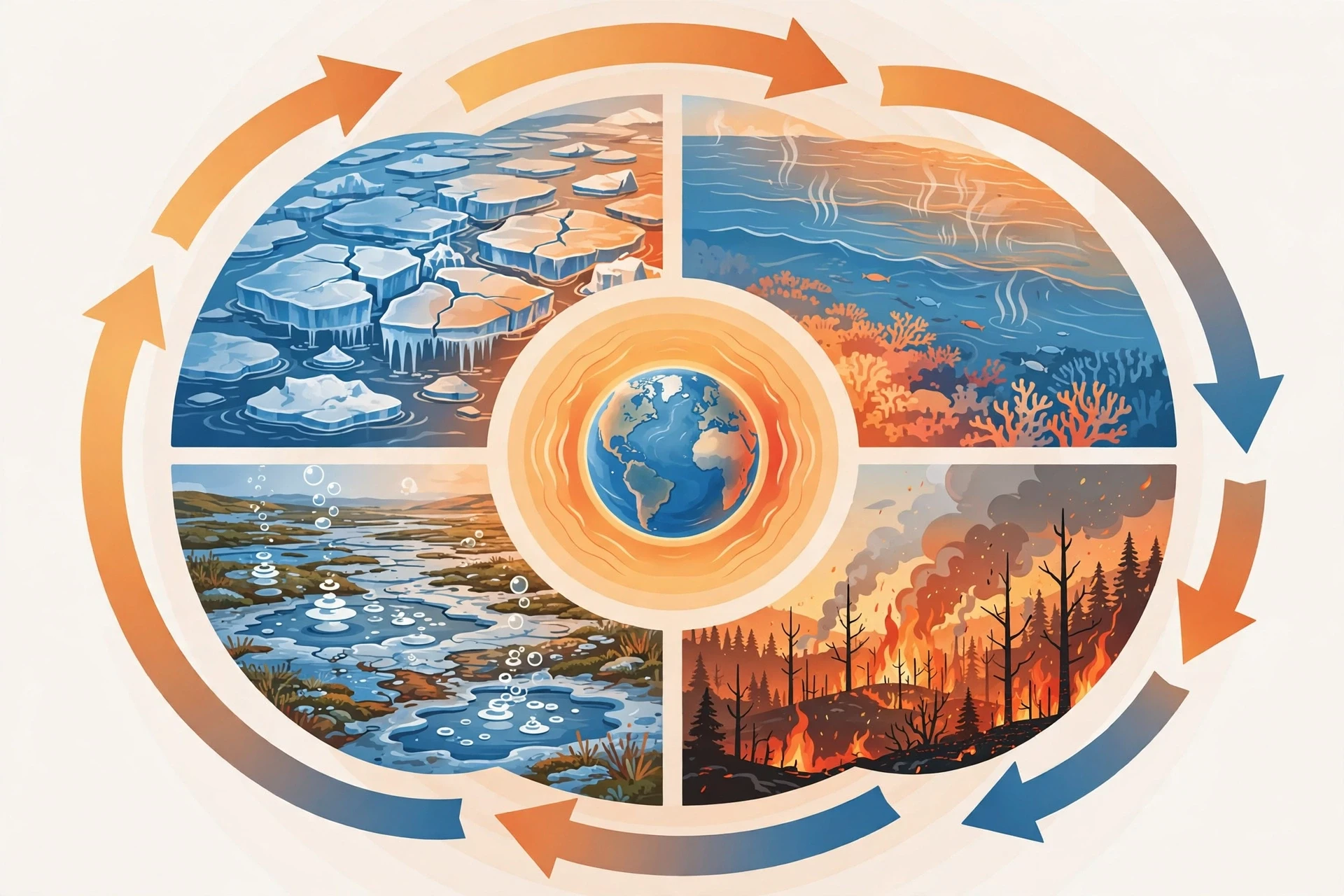
The carbon cycle is not a passive system that simply absorbs whatever we do to it. It responds, and some of its responses make the original change stronger. These are positive feedback loops — the cycle's way of amplifying a disturbance — and they are the most worrying part of the climate story, because they mean that warming can start to feed itself. The carbon cycle also has negative feedbacks that damp changes down, like the weathering thermostat of Section 6. The race between the two kinds of feedback, on timescales from years to millions of years, will shape the climate of the coming century.
A feedback loop is simple to picture. Warming thaws permafrost. Thawed permafrost releases carbon dioxide and methane. Those gases cause more warming. More warming thaws more permafrost. Each turn of the loop makes the next turn stronger. The same logic applies to forests, soils, and the oceans. The loops are not runaway processes — they do not lead to an infinite spiral — but they can add a substantial extra warming on top of what our direct emissions cause, and they are much harder to stop once they start than they are to prevent.
8.1 Permafrost: the frozen store wakes up
Permafrost is ground that stays frozen for at least two consecutive years, and in the far north it can be frozen for thousands of years. It underlies roughly a quarter of the Northern Hemisphere's land, and it holds about 1,500 gigatonnes of carbon — roughly twice as much as the atmosphere — in the frozen remains of plants and animals that died over millennia. As long as it stays frozen, that carbon is safe. As the Arctic warms, some of it is thawing.
When permafrost thaws, microbes wake up and begin to decompose the newly available organic matter, releasing carbon dioxide if the soil is dry and methane if it is waterlogged. The process is already underway: Arctic soils are warming, thermokarst lakes are expanding, and measurements show rising emissions from thawing ground. How much carbon will be released, and how fast, is one of the most actively researched questions in climate science. The plausible range is wide — from a modest addition to a substantial one — but the direction is not in doubt. Thawing permafrost is a one-way door: once the carbon is released, it cannot be refrozen back into the ground on any human timescale.
8.2 Forests under stress
Forests are both a carbon store and a carbon sink, and both roles are under strain. Warmer temperatures increase evaporation, drying soils and stressing trees. Drought-stressed trees grow more slowly, absorbing less carbon, and become more vulnerable to insects and disease. Bark beetles, which kill trees across vast areas of North American and European forests, thrive in warmer winters that no longer kill them off. Wildfires, made more frequent and severe by heat and drought, release stored carbon in days and leave landscapes that may take decades to regrow — if they regrow as forest at all.
The Amazon rainforest illustrates the stakes. The Amazon stores an enormous amount of carbon and generates much of its own rainfall by recycling water vapour from its trees. If enough of the forest is lost to deforestation and drought, the rainfall system could weaken, drying the remaining forest and making further loss more likely — a tipping point after which the forest degrades toward savanna. Researchers disagree on exactly where that threshold lies, and some argue it is further away than the most alarming estimates suggest. The disagreement is genuine, and it matters, because the Amazon's fate is one of the largest uncertainties in the carbon cycle's future.
8.3 The ocean's weakening grip
The oceans have absorbed roughly a quarter of human carbon dioxide emissions, but their appetite is not guaranteed. Warm water holds less dissolved gas, so as the surface ocean warms, it absorbs less carbon dioxide from the air. Warmer surface water is also less dense, which weakens the mixing that carries carbon-rich water down into the deep ocean. And as the ocean absorbs more carbon dioxide, its chemistry shifts: the water becomes more acidic, and the capacity of seawater to absorb additional carbon dioxide declines.
These are slow changes, measured in decades, but they point in the same direction: the ocean sink is likely to become less efficient as the climate warms. Some measurements already suggest the fraction of our emissions absorbed by the oceans may be flattening. The ocean will keep absorbing carbon — the chemistry guarantees that — but the rate matters enormously. A sink that absorbs a quarter of our emissions buys us time. A sink that absorbs a fifth buys us less.
8.4 The negative feedbacks that help
Not all feedbacks make things worse. The most important negative feedback is also the simplest: plants grow faster when there is more carbon dioxide in the air. This carbon dioxide fertilisation effect has measurably increased plant growth over the past decades, and it is a major reason the land absorbs roughly a quarter of our emissions. More carbon dioxide means more photosynthesis, which pulls more carbon out of the air — a self-correcting loop.
But the effect has limits, and they are becoming visible. Plant growth is often limited by water and nutrients, not by carbon dioxide, so adding more gas does not always add more growth. In dry regions, extra carbon dioxide cannot help a plant that has no water. In nutrient-poor soils, it cannot help a plant that has no nitrogen or phosphorus. And the extra growth is temporary if the plants die and rot, returning the carbon to the air. Fertilisation helps, and it is real, but it is not a rescue. It is a modest brake on a much larger force, and it weakens as the climate warms and dries.
9. Forests, Carbon Sinks and What Comes Next
A carbon sink is any reservoir that absorbs more carbon than it releases. The oceans are the largest sink. Forests, grasslands, soils and wetlands are the land sinks. Together, the natural sinks absorb roughly half of what humans emit each year — an enormous, unpaid service that has slowed the rise of atmospheric carbon dioxide and bought us decades of time. The question now is how long they can keep doing it, and what we can do to help them.
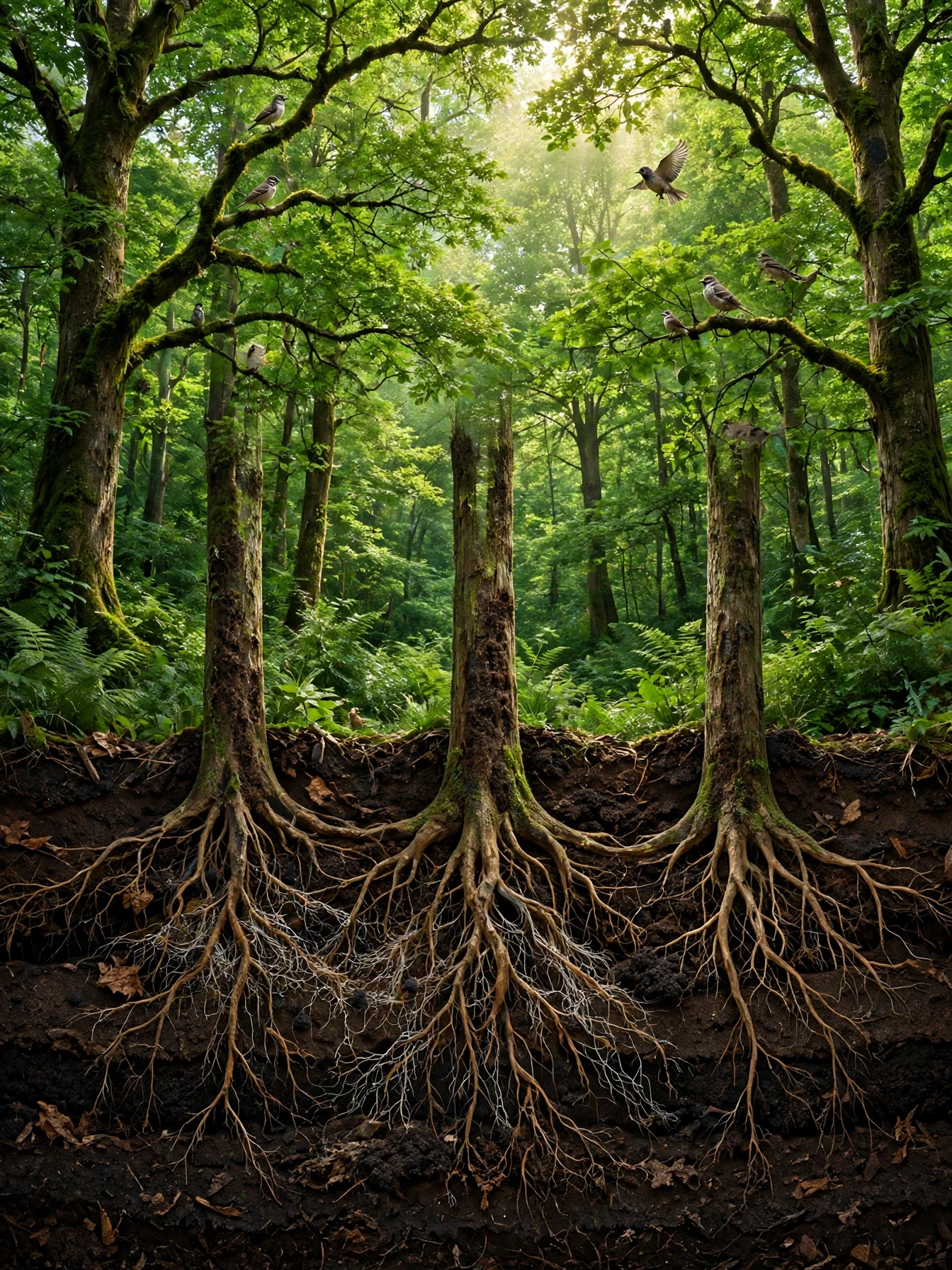
The answer is partly about protecting what exists and partly about restoring what has been lost. Protecting a mature forest keeps its carbon store intact and its sink working. Restoring a degraded forest adds a growing sink that will absorb carbon for decades. Restoring wetlands and peatlands protects some of the densest carbon stores on land. Improving soil management rebuilds the carbon that farming stripped away. None of these measures is a substitute for cutting fossil fuel emissions — the numbers simply do not add up that way — but all of them matter, and all of them bring benefits beyond carbon: cleaner water, richer wildlife, better soil, and more resilient landscapes.
9.1 How much can nature absorb?
It is tempting to imagine that planting enough trees could absorb all our emissions. The arithmetic says otherwise. Human emissions are around 40 billion tonnes of carbon dioxide a year. A hectare of fast-growing forest absorbs on the order of 10 to 20 tonnes of carbon dioxide a year while it is growing. To absorb all our emissions through trees alone would require planting forests on an area larger than the land available for it, and the absorption would stop once the forests matured. The carbon cycle cannot be balanced by trees alone. Trees are a vital part of the answer, but they cannot be the whole answer. The main task is to stop adding fossil carbon to the fast cycle.
The same arithmetic applies to other natural solutions. Restoring wetlands, rebuilding soils, and protecting peatlands all help, and all are worth doing. But each one absorbs carbon at a rate measured in billions of tonnes at best, against emissions of 40 billion tonnes a year. Nature's sinks are powerful, and we should strengthen them, but the decisive action is to cut the flow at its source: to stop moving carbon from the rock reservoir into the atmosphere.
9.2 What removing carbon would actually take
The slow cycle removes carbon dioxide from the air over millions of years, through weathering and burial. Can we speed that up? Several ideas are being tested. Enhanced weathering spreads crushed silicate rock on fields, where it reacts with carbon dioxide and washes to the sea. Direct air capture pulls carbon dioxide straight out of the air with chemical filters. Bioenergy with carbon capture grows plants, burns them for energy, and stores the carbon dioxide underground. Each idea works in principle, and each faces the same problem: scale. Removing billions of tonnes of carbon dioxide a year would require industrial infrastructure on the scale of the fossil fuel industry itself, and energy to run it.
These technologies may play a role, and they deserve serious research. But they are not a reason to delay cutting emissions. The cheapest, fastest and most certain way to reduce the carbon dioxide in the air is to stop putting it there. Everything else is a supplement, not a substitute.
9.3 A farmer, a forest, and a lesson in patience
Some years ago I spent a morning with a farmer who had spent two decades rebuilding the soil on his land — planting cover crops through the winter, cutting back on ploughing, and adding compost. He dug a spadeful of earth and held it out: dark, crumbly, full of worms. "This used to be pale dust," he said. "It took twenty years to get it back." Then he added something I have never forgotten: "The soil doesn't hurry. You can't rush it. You can only stop hurting it and give it time."
That is, in the end, the lesson of the carbon cycle. It is a system that works on timescales of years, centuries, and millions of years at once. We have been forcing it to run at our speed — the speed of furnaces and engines — and it is showing the strain. The way back is not to fight the cycle but to work with it: to stop adding fossil carbon faster than the system can absorb it, to protect the sinks that are doing the absorbing, and to give the slow, patient processes — forests growing, soils rebuilding, oceans mixing — the time they need to do their work.
10. Why the Carbon Cycle Matters for Climate
The carbon cycle matters for climate because carbon dioxide is the thermostat of the planet. The climate change we are experiencing is, at its root, a carbon cycle story: a change in where carbon sits has changed how much heat the atmosphere traps, and that change is now reshaping weather, oceans, ice and ecosystems. To understand the climate, you have to understand the cycle, and to change the climate's direction, you have to change the cycle's balance.
The link is direct and measurable. Atmospheric carbon dioxide has risen from about 280 parts per million before the industrial era to above 420 today. Over the same period, the planet has warmed by well over one degree Celsius. The warming is not evenly distributed — the Arctic has warmed several times faster than the global average — and it is not limited to temperature. Warmer air holds more water vapour, so rainfall patterns shift: some regions get heavier downpours, others longer droughts. Warmer oceans expand and melt ice, raising sea levels. The carbon cycle sits behind all of it, because carbon dioxide is the gas whose concentration we changed the most, and the fastest.
The cycle also explains why climate change will not reverse quickly even if emissions stop tomorrow. Carbon dioxide stays in the atmosphere for a long time — centuries, for a significant fraction of what we emit — because the processes that remove it are slow. The fast cycle exchanges carbon quickly, but it does not remove it: a carbon atom taken up by a plant is released again when the plant dies. Only the slow processes — burial in sediments, weathering of rocks, absorption into the deep ocean — remove carbon on timescales of centuries to millions of years. Stopping emissions stops the rise, but the elevated level, and the warming that goes with it, persists for a very long time. That persistence is why early action matters so much: every tonne we avoid emitting is a tonne that will not linger in the air for centuries.
It also explains why the climate responds to the total amount of carbon we have emitted, not just the current rate. The warming we experience is roughly proportional to the cumulative total of carbon dioxide ever released. That is a sobering thought, and a hopeful one. It means that every reduction counts, at any time: cutting emissions now avoids warming that would otherwise be locked in for centuries. It also means that the goal is not perfection but direction — each step toward lower emissions is a step toward a cooler, more stable climate, and each step is worth taking even if the journey is long.
11. Common Misconceptions About the Carbon Cycle
The carbon cycle is widely taught and widely misunderstood. Some of the confusion comes from the way it is drawn in textbooks — neat arrows in a circle that make it look simple and perfectly balanced. Some comes from the way we talk about carbon in public debate, where "carbon" is treated as a synonym for pollution. Clearing up the most persistent misunderstandings is worth doing carefully, because each one leads to a different mistake about what should be done.
11.1 "Carbon dioxide is a pollutant, like smoke"
This is the misconception I held myself for years, and it is the one I most want to correct. Carbon dioxide is not a poison in the way smoke or soot is. It is a natural part of the air, essential to life: without it, plants could not photosynthesise, and there would be no food, no forests, no us. The problem with carbon dioxide is not its nature but its amount and its location. A gas that is harmless — even vital — at 280 parts per million becomes a climate problem at 420, because it traps more heat. The same logic applies to water: essential to life, dangerous in a flood. Calling carbon dioxide a pollutant is a useful shorthand for policy, but it misleads when it makes people think the goal is to eliminate carbon from the world. The goal is to restore the balance of the cycle, not to banish its central element.
11.2 "Trees absorb all the carbon dioxide we produce"
Trees are extraordinary carbon absorbers, but they cannot keep up with fossil fuel emissions. The arithmetic is unforgiving: human emissions are around 40 billion tonnes of carbon dioxide a year, while all the world's forests together absorb a fraction of that, and only while they are growing. A mature forest absorbs almost nothing net, because growth is balanced by decay. Planting trees is one of the best things we can do — for carbon, for wildlife, for water, for soil — but it is a complement to cutting emissions, not a replacement for it. Anyone who tells you that tree planting alone can solve climate change has not done the sums.
11.3 "The oceans will absorb all the extra carbon dioxide"
The oceans have absorbed about a quarter of human emissions, and they will keep absorbing carbon dioxide — the chemistry leaves them no choice. But their capacity is limited and shrinking. Warm water absorbs less gas, acidified water holds less carbonate, and the mixing that carries carbon to the deep ocean is slowing. The ocean sink is a great help, but it is not infinite, and treating it as a bottomless dump is how we got ocean acidification, which is already harming shellfish, corals and plankton. The ocean is an ally with limits, and those limits are being tested.
11.4 "Volcanoes release more carbon dioxide than humans"
This claim circulates widely, and it is wrong by a large margin. All the world's volcanoes together release a few hundred million tonnes of carbon dioxide a year. Humans release around 40 billion tonnes — roughly a hundred times more. Volcanoes matter on geological timescales, and a single large eruption can cool the climate temporarily by injecting sulphur aerosols into the stratosphere, but they are not the cause of the current rise in atmospheric carbon dioxide. The rise began with the industrial revolution, it matches fossil fuel use, and it carries the chemical fingerprint of fossil carbon. Nature is not the culprit here.
11.5 "The carbon cycle is perfectly balanced, so our emissions don't matter"
The carbon cycle was close to balanced before the industrial era — but "close to balanced" is doing a lot of work in that sentence. The natural flows are enormous and nearly equal, which means that even a small imbalance produces a large change over time. Our emissions are not small: they are about 5 percent of the natural flows, added persistently, year after year, with no matching increase in the flows that remove carbon. A bathtub with the tap and the drain nearly matched stays at the same level; open the tap a little wider and the water rises steadily, even though the tap is still small compared with the water already in the bath. That is what we have done to the carbon cycle and the atmosphere.
11.6 "Carbon is bad, so we should get rid of it"
Carbon is not bad. Carbon is the element of life — the backbone of every protein, every strand of DNA, every leaf and every one of us. The carbon cycle is not an enemy to be defeated but a system to be kept in balance. The aim is not a world without carbon, which would be a world without life, but a world in which carbon moves at the pace the system evolved to handle: taken up by plants, stored in soils and oceans, and released slowly, rather than ripped from ancient rocks and dumped into the sky in a geological blink. Framing carbon as a villain makes for simple slogans and bad policy. Framing the cycle as a balance to be restored makes for better decisions.
Frequently Asked Questions
What is the carbon cycle in simple terms?
The carbon cycle is the natural process by which carbon moves between the atmosphere, oceans, land and rocks. Plants take carbon dioxide from the air through photosynthesis, animals eat plants, microbes decompose dead matter and release carbon back, the oceans absorb and store carbon, and over millions of years carbon is buried as coal, oil and limestone before volcanoes release it again. The same atoms are reused again and again.
How does the carbon cycle affect climate change?
The carbon cycle affects climate because carbon dioxide traps heat in the atmosphere. When humans burn fossil fuels, we move carbon from rocks into the air faster than plants and oceans can absorb it, so atmospheric carbon dioxide rises and the planet warms. About half of our emissions are absorbed by land and oceans; the rest stays in the air, where it will linger for centuries.
What are the main carbon reservoirs on Earth?
The four main carbon reservoirs are the atmosphere (about 870 gigatonnes of carbon), the oceans (about 38,000 gigatonnes), the land including living things and soils (about 2,000 to 3,000 gigatonnes combined), and the rocks (tens of millions of gigatonnes). The rocks hold by far the most carbon, but they exchange it the most slowly, while the atmosphere holds the least and exchanges it the fastest.
What is the difference between the fast and slow carbon cycles?
The fast carbon cycle works over days to centuries through photosynthesis, respiration, decomposition and gas exchange with the ocean surface. The slow carbon cycle works over millions of years through the burial of organic matter, the formation of limestone and fossil fuels, weathering of rocks, and volcanic outgassing. Humans have changed the fast cycle by burning fossil fuels, which takes carbon out of the slow cycle and injects it into the fast one.
How do the oceans absorb carbon dioxide?
The oceans absorb carbon dioxide in two ways. In the solubility pump, cold surface water dissolves carbon dioxide from the air and sinks, carrying it into the deep ocean. In the biological pump, plankton photosynthesise at the surface, and when they die their remains sink as marine snow, carrying carbon down with them. Together the oceans absorb roughly a quarter of the carbon dioxide humans release each year, though warming and acidification are weakening this uptake.
Can planting trees solve climate change?
Planting trees helps, but it cannot solve climate change alone. Trees absorb carbon dioxide while they grow, and protecting and restoring forests is one of the most effective climate actions available. But human emissions are around 40 billion tonnes of carbon dioxide a year, far more than new forests could absorb, and a mature forest absorbs almost nothing net because growth is balanced by decay. Tree planting must go alongside cutting fossil fuel emissions, not instead of it.
How long does carbon dioxide stay in the atmosphere?
A single carbon dioxide molecule may be exchanged with a plant or the ocean within a few years, but the extra carbon dioxide we have added as a whole persists for a very long time. A significant fraction remains in the atmosphere for centuries, and the full removal of the excess takes thousands of years through slow processes like ocean mixing and rock weathering. That is why stopping emissions stops the rise, but the warming already caused lingers long afterwards.