

The first time I really saw Earth's atmosphere, I was not standing on the ground at all. I was in an airplane at cruising altitude, somewhere over the Atlantic, watching the sun go down through a small oval window. Below me, the clouds looked like a rumpled white blanket. Above them, the sky turned a deep, hard blue. And right at the horizon, there was a line — a thin, glowing band of pale blue light, no thicker than a pencil stroke, separating the world I knew from the blackness beyond it. That line was Earth's atmosphere, seen from the side. Everything I had ever loved, every person I had ever met, every breath I had ever taken, had happened inside that thin band of light.
It is easy to forget that we live at the bottom of an ocean — not of water, but of air, a sea of gas hundreds of kilometres deep, pressing down on us with the weight of a column of air stretching all the way to space. We walk through it and breathe it in and out about twenty thousand times a day without ever seeing it. Earth's atmosphere is invisible, weightless-seeming, and utterly taken for granted. Earth's atmosphere is also the single most important reason this planet has weather, oceans, and life, while its neighbours do not.
This guide is a climb through that ocean of air, layer by layer, from the ground beneath your feet to the place where the sky simply runs out. Along the way, we will look at what the air is made of, why temperature falls and rises and falls again as you climb, where the ozone layer really sits, and how a blanket of gas only a few dozen kilometres thick in its densest part protects every living thing on the planet.
1. What Earth's Atmosphere Actually Is
Earth's atmosphere is the layer of gases held around the planet by gravity. It has no sharp outer edge and no lid. It simply gets thinner and thinner with height until, somewhere far above the clouds, the air is so sparse that individual gas molecules can drift away into space without ever hitting another molecule. Scientists draw lines on that fading gradient and call the slices layers, but the atmosphere itself is one continuous thing — a single blanket that thins as it rises.
How thin is it, really? Picture Earth as a basketball. The densest part of the atmosphere — where nearly all the air, all the clouds, and all the weather live — would be about as thick as the skin of an apple wrapped around that ball. Everything that keeps us alive — the oxygen we breathe, the pressure that keeps water liquid in our bodies, the shield that blocks burning ultraviolet light — depends on a layer of gas that is, by cosmic standards, barely there at all.
Earth's atmosphere did not arrive fully formed. Early Earth had a very different sky, built from gases released by volcanoes and reshaped over immense stretches of time by sunlight, chemistry, and life itself. The oxygen that fills a fifth of the air today is, in a real sense, a biological product: it was put there by photosynthetic life, tiny organisms that spent billions of years quietly exhaling oxygen into the sky. The air you are breathing right now is partly a waste product of ancient microbes — the sky is not just a backdrop for life, but something life itself helped to build.
Gravity holds the whole arrangement together. Every gas molecule is pulled toward Earth's centre, and the ones below are squeezed by the weight of the ones above. That squeezing is why the air is densest at sea level and thins so fast with height. Roughly half of all the air in Earth's atmosphere sits below about five and a half kilometres — below the cruising altitude of a jet. By the top of the troposphere, only about a quarter of the air is still above you, and by the edge of the stratosphere a breath would hold almost nothing at all.
Earth's atmosphere has no lid and no sharp edge. It is a single blanket of gas that simply thins with height until it fades into space.
This thinning has a practical consequence that anyone who has climbed a mountain already knows in their lungs: the higher you go, the harder it is to breathe, and it is not because the air has changed its recipe. The proportions of nitrogen and oxygen stay nearly the same for the first eighty kilometres or so. What changes is the amount. Each breath at altitude simply carries fewer molecules, so your body has to work harder for the same oxygen. Pilots, mountaineers, and astronomers at high observatories all learn this lesson in their own way, and it is the first hint that the atmosphere is organised by height — that where you are in the stack matters as much as what the air is made of.
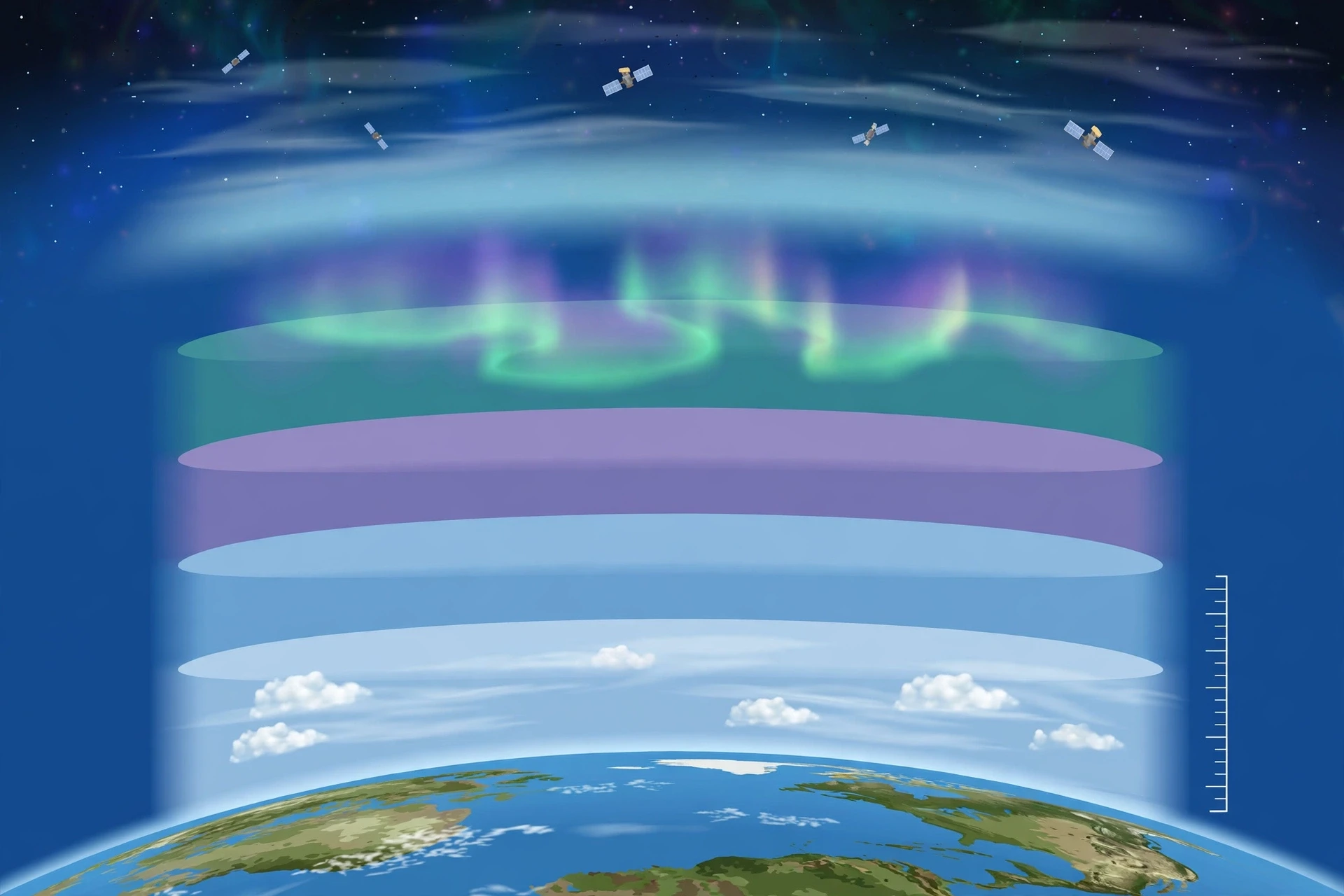
Scientists divide Earth's atmosphere into five major layers, defined mainly by how temperature changes with height: the troposphere, the stratosphere, the mesosphere, the thermosphere, and the exosphere. Between them sit four thin boundary zones — the tropopause, the stratopause, the mesopause, and the thermopause — where the temperature trend reverses. The ionosphere, which you will sometimes hear named as a layer, is not a separate slice of the same stack. It is a region of electrically charged particles that overlaps the mesosphere and the thermosphere, defined by chemistry rather than temperature. Think of the five layers as floors of a building and the ionosphere as the wiring that runs through the top two floors.
NASA describes these five layers as a kind of multi-layered cake, each with its own character, and that picture is a good one to hold in your head for the rest of this guide. We will climb the cake one layer at a time. But first, we need to know what the cake is made of.
2. What the Air Is Made Of
If you could scoop up a jar of clean, dry air at sea level and take it apart molecule by molecule, you would find a surprisingly simple recipe. About 78 out of every 100 molecules would be nitrogen. About 21 would be oxygen. Most of the rest — just under one molecule in a hundred — would be argon, a gas so unreactive that it mostly sits in the air doing nothing at all. Everything else — carbon dioxide, neon, helium, methane, krypton, hydrogen, and a handful of others — would fit into a fraction of a single molecule out of a hundred. The full breakdown is laid out in the table below.
Gas | Chemical symbol | Share of dry air | What it does |
|---|---|---|---|
Nitrogen | N₂ | 78.08% | Dilutes oxygen and keeps the air stable; cycled by bacteria and lightning |
Oxygen | O₂ | 20.95% | What animals breathe; produced by photosynthesis |
Argon | Ar | 0.93% | Inert filler gas; does almost nothing chemically |
Carbon dioxide | CO₂ | About 0.04% | Trace gas with an outsized effect on climate |
Neon, helium, methane, krypton, hydrogen | Ne, He, CH₄, Kr, H₂ | Trace amounts | Minor roles; methane is a potent greenhouse gas |
Water vapour | H₂O | 0–4%, varies | Drives clouds, rain, and storms; the most variable gas |
The numbers in that table come from measurements of dry air — air with the water removed. Real air is never quite dry. Water vapour is the great variable of the atmosphere: it can make up as much as four percent of the air over a warm ocean and almost nothing at all over a polar ice cap or high in the stratosphere. That variability matters enormously, because water vapour is the fuel of weather. It carries heat, it condenses into clouds, and it falls as rain and snow. A sky without water vapour would be a sky without weather.
2.1 Why so much nitrogen?
Nitrogen dominates the air for a simple reason: it is stubborn. A nitrogen molecule is two nitrogen atoms locked together by a triple bond, one of the strongest chemical bonds in nature, and almost nothing in ordinary air can break it, so nitrogen accumulates. Volcanoes released it, and living things and lightning cycle small amounts of it, but the great bulk simply stayed in the sky, unreactive and patient. Oxygen, by contrast, is constantly consumed by breathing, burning, and rusting — and constantly replenished by photosynthesis. If photosynthesis stopped tomorrow, the oxygen in the air would slowly be eaten away by chemistry and geology, and the sky would change.
2.2 The small gases that run the show
Here is one of the atmosphere's best tricks: the gases that matter most are the ones there is least of. Carbon dioxide makes up roughly four-hundredths of one percent of dry air — about 420 parts per million — yet it is the main control knob on Earth's climate. It absorbs infrared radiation that the warm ground tries to radiate away to space, and re-emits some of it back downward. Without that effect, Earth's average temperature would sit far below freezing. With too much of it, the planet warms. The difference between an ice age and a hothouse, in the long run, can hinge on a gas you would never notice in a single breath.
Ozone is even scarcer and even more specialised. At any given moment, only about three molecules in every ten million in the air are ozone, and almost all of them sit in a thin band in the stratosphere. Yet that whisper of a gas absorbs the most damaging part of the Sun's ultraviolet light. The rule in Earth's atmosphere seems to be that the gases that do the heavy lifting are the ones you have to look hardest to find. Nitrogen and oxygen are the bulk; the trace gases are the management.
The gases that matter most in Earth's atmosphere are the ones there is least of. Carbon dioxide is a fraction of a percent of the air, yet it sets the planet's temperature.
I learned how invisible this recipe is during a classroom demonstration years ago, when a teacher sealed a small marshmallow inside a glass bell jar and pumped the air out. The marshmallow swelled up like a balloon animal, then shrank back down when the air returned. Nothing had been added or removed except air pressure — but the marshmallow's behaviour made the invisible visible. The air around us is not nothing. It is a real substance with weight, pressure, and chemistry, and we only notice it when it changes.
2.3 Air is not the same everywhere
The recipe above holds remarkably steady from the ground up to about eighty kilometres, a region scientists call the homosphere, because the air there is well mixed by wind and turbulence. Above that, in the heterosphere, the gases begin to sort themselves by weight. Light gases such as hydrogen and helium drift to the top; heavier gases settle lower. That sorting is one reason the exosphere, the outermost layer, is dominated by hydrogen and helium — the lightest gases float to the top of the pile, like cream rising on milk.
The air also changes from place to place. City air carries more particles and pollutants than ocean air; desert air is drier; air over a rainforest is heavy with water vapour. And the air is not only gas: it carries dust, pollen, sea salt, smoke, and tiny droplets — aerosols — that seed clouds and scatter sunlight. Some of the most beautiful sunsets you have ever seen were painted by dust and smoke high in the air. The sky is a mixture, not a pure substance, and its impurities are part of its character.
For a clear, authoritative picture of the whole mixture, the OpenStax astronomy text lays out the structure and composition of Earth's atmosphere in plain language, and it is worth reading alongside this section if you want the textbook version of the numbers used here.

3. How Pressure and Temperature Change With Height
If there is one idea to carry through the rest of this guide, it is this: height changes everything in Earth's atmosphere. Go up, and the air gets thinner and the pressure drops. Go up, and the temperature does something stranger — it falls, then rises, then falls again, then rises again. That zigzag is the very reason Earth's atmosphere has layers at all.
3.1 Pressure: the weight of the sky
Air pressure is simply the weight of the air above you, pressing down. At sea level, that weight is about 1013 hectopascals — the same as about 14.7 pounds pressing on every square inch of your skin. You do not feel it because the air inside your body pushes back with equal force. But the pressure is real, and it falls quickly with height. Climb to about five and a half kilometres, and the pressure is roughly half what it was at sea level. Climb to the top of the troposphere, and it is down to about a tenth. By the top of the stratosphere, it is about a thousandth of sea-level pressure. The air does not thin in a straight line; it thins exponentially, dropping by roughly half with each five-and-a-half-kilometre step upward, because each layer of air is squeezed by the weight above it.
This is why your ears pop on an airplane and why a bag of crisps swells on a mountain road. The sealed bag was packed at low altitude, where the outside pressure was high. Carry it uphill, and the outside pressure falls while the pressure inside the bag stays the same — so the bag puffs out. Your ears do the same thing in reverse: the air trapped in your middle ear is at the old pressure, and it needs to equalise with the new, lower pressure outside. A yawn or a swallow opens the little tube that lets it catch up. Ears popping is the atmosphere announcing itself, in miniature.
Weather maps are drawn in pressure for a good reason. Air flows from high pressure to low pressure, and that flow is wind. Where air sinks, pressure is high and skies are usually clear. Where air rises, pressure is low, the air cools, water vapour condenses, and clouds form. The whole drama of weather is air moving to even out pressure differences, driven by the Sun heating some places more than others. If you want the full story of how forecasters read those maps, our guide to meteorology picks up where this section leaves off.
3.2 Temperature: the zigzag that defines the layers
Temperature is where Earth's atmosphere gets interesting. If you launched a thermometer on a balloon and watched it climb, you would see something like this: the temperature falls steadily as you rise through the troposphere, bottoms out at the tropopause, climbs through the stratosphere, peaks at the stratopause, falls again through the mesosphere to the coldest point in the whole atmosphere, and then climbs steeply through the thermosphere to temperatures that sound, on paper, like the inside of a furnace. Each reversal marks a boundary between layers. That is the whole logic of the five-layer system: a layer is a stretch of sky in which temperature moves in one consistent direction.
Why does it zigzag? Because different layers are heated in different ways. The troposphere is heated from below, by the ground, which absorbs sunlight and warms the air touching it. Warm air rises, cool air sinks, and the result is a layer that gets colder with height, like a room heated by a floor radiator. The stratosphere, by contrast, is heated from within, by the ozone layer absorbing ultraviolet light — so it gets warmer with height, like a room heated by a ceiling panel. The mesosphere has no strong internal heater, so it cools with height again. And the thermosphere is blasted directly by the Sun's most energetic radiation, which heats its thin gas to extraordinary temperatures.
Here is the catch, and it is a favourite trick question among atmospheric scientists: the thermosphere can be thousands of degrees hot, yet you would freeze there. Temperature in a gas measures how fast its molecules move, and the thermosphere's molecules do move ferociously fast — but there are so few of them that they carry almost no heat. Put your hand there and almost no molecules would hit it, so almost no heat would transfer. It would feel cold, not hot: a sparkler is hotter than a bath, but the bath holds far more heat. In the thermosphere, temperature and heat part company.
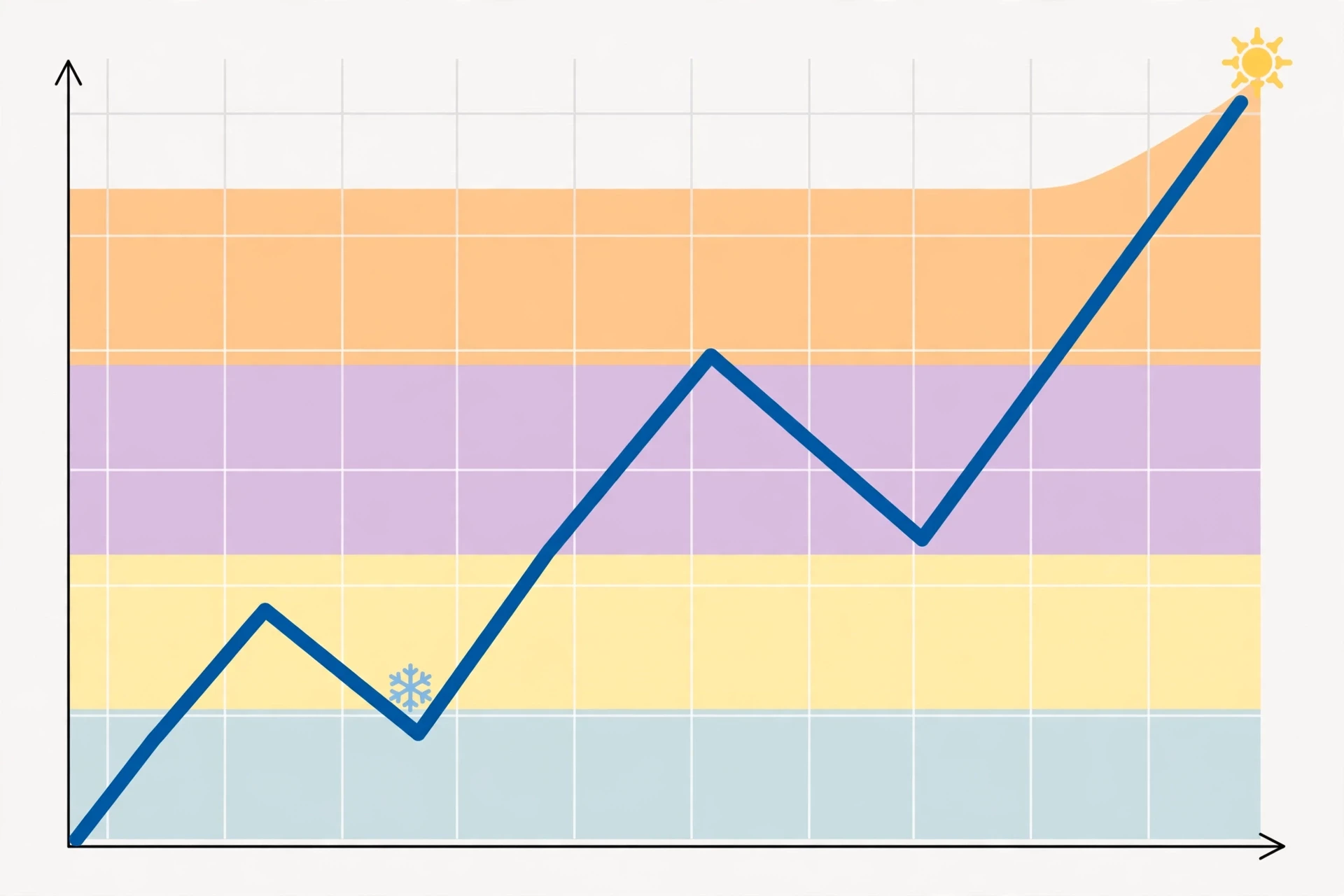
The table below gives the headline numbers for each layer — its height range, its temperature trend, and what happens there — following the layer guides published by NASA and UCAR. Treat the heights as averages. Every boundary moves with the seasons, with latitude, and with the weather, sometimes by kilometres. The atmosphere is not a fixed staircase; it breathes.
Layer | Height above surface | Temperature trend | What happens there |
|---|---|---|---|
Troposphere | Surface to 8–18 km | Falls with height | Nearly all weather; clouds, rain, storms |
Stratosphere | 12–50 km | Rises with height | Ozone layer; calm air, jet aircraft cruise |
Mesosphere | 50–85 km | Falls with height | Meteors burn up; coldest place in the atmosphere |
Thermosphere | 85–600 km | Rises with height | Auroras, satellites, the ionosphere |
Exosphere | 600–10,000 km | Hardly defined | Air fades into space; hydrogen and helium drift away |
3.3 Why the boundaries move
The tropopause — the top of the troposphere — is not at a fixed height. Over the equator, where the ground is warm and convection is vigorous, it sits at about 16 to 18 kilometres. Over the poles, where the air is cold and sluggish, it can be as low as 8 kilometres. In winter it sinks; in summer it rises. That movement matters, because the height of the tropopause sets a ceiling on weather. A thunderstorm can only grow as tall as the tropopause allows. Tropical thunderstorms, with a high ceiling, can tower to 18 kilometres. Polar weather stays low and flat. The atmosphere's architecture is not just a list of layers; it is a living structure that swells and shrinks with the seasons.
The same restlessness applies to the other boundaries. Every textbook picture of the layers is a snapshot of averages; the real atmosphere is a moving, breathing thing, and the numbers are best read as "about this high, in this season, at this latitude." NASA's layer-by-layer description makes the same point: the heights it gives are averages, and the real boundaries shift.
4. The Troposphere: Where We Live and Where Weather Happens
The troposphere is the lowest layer of Earth's atmosphere, and it is the only one most of us will ever visit. It stretches from the ground up to the tropopause, about 12 kilometres above sea level on average — higher over the equator, lower over the poles. It holds roughly three-quarters of the mass of Earth's atmosphere and almost all of its water vapour. It is where we live, where we breathe, where birds fly, and where nearly all weather happens.
The name comes from the Greek word tropos, meaning "turning" or "mixing," and the name is exactly right. The troposphere is a restless, churning layer. Sunlight warms the ground, the ground warms the air above it, the warm air rises, cool air rushes in to replace it, and the whole layer mixes like soup in a pot. That mixing is weather. A thunderstorm is a column of rising warm, moist air. A sea breeze is cool ocean air sliding inland to replace warm air rising over the land. A front is a boundary where two different air masses meet and one slides over the other. All of it — every cloud you have ever watched, every rainstorm, every snowflake — happens in this one thin layer, the bottom twelve kilometres of the sky.
4.1 Why it gets colder as you climb
The troposphere's defining feature is that temperature falls with height, by about 6.5 degrees Celsius for every kilometre you climb. That is why mountain summits are snowy even in the tropics, and why the air at cruising altitude is around minus 50 degrees. The reason is simple once you see it: the Sun does not heat the air directly. Sunlight passes through the clear air almost untouched and warms the ground. The ground then warms the air from below. Air near the ground is warm because it is close to the heater. Air higher up is colder because it is farther away. It is the same reason the floor of a room is warmest near a radiator and coldest near the ceiling — except here the radiator is the entire surface of the Earth.
There is a second effect at work, too. As air rises, it moves into lower pressure, and it expands. Expanding air cools, the way the air hissing out of a bicycle pump or a spray can feels cold. So a rising parcel of air cools for two reasons at once: it is moving away from the warm ground, and it is expanding into thinner air. A falling parcel does the opposite: it is compressed, it warms, and it dries out. That is why the air sinking down the far side of a mountain range arrives warm and dry, and why some of the world's driest places sit in the shadow of mountains.
I felt this in my lungs once on a high mountain trail, long before I had the equations for it. The air was thin and cold, and every step felt like breathing through a straw. At the summit, cloud tops lay below me like a second landscape, and the wind was bitter. The mountain had not taken me closer to the Sun in any way that mattered; it had taken me further from the warm ground, and that was what counted.
4.2 Clouds, rain, and the water cycle
The troposphere is the atmosphere's waterworks. Warm air near the surface picks up water vapour from oceans, lakes, and forests; when that air rises and cools, the vapour condenses onto tiny particles — dust, salt, pollen — and becomes cloud droplets. Enough droplets, and you get rain; cold enough, and you get snow. The whole water cycle is a troposphere process, and it moves staggering amounts of water and heat around the planet: a single large thunderstorm can lift millions of tonnes of water into the sky. Weather is not a gentle decoration on the atmosphere. It is a heat engine, and the troposphere is its workshop.
Clouds come in families, and learning to read them is one of the oldest human skills. Low, flat stratus clouds mean stable air and often drizzle. Puffy cumulus clouds mean rising air and fair weather — until they grow tall and dark, at which point a storm is coming. Thin, wispy cirrus clouds, high and feathery, are made of ice crystals and often arrive a day ahead of a weather change.
4.3 The jet streams and the tropopause ceiling
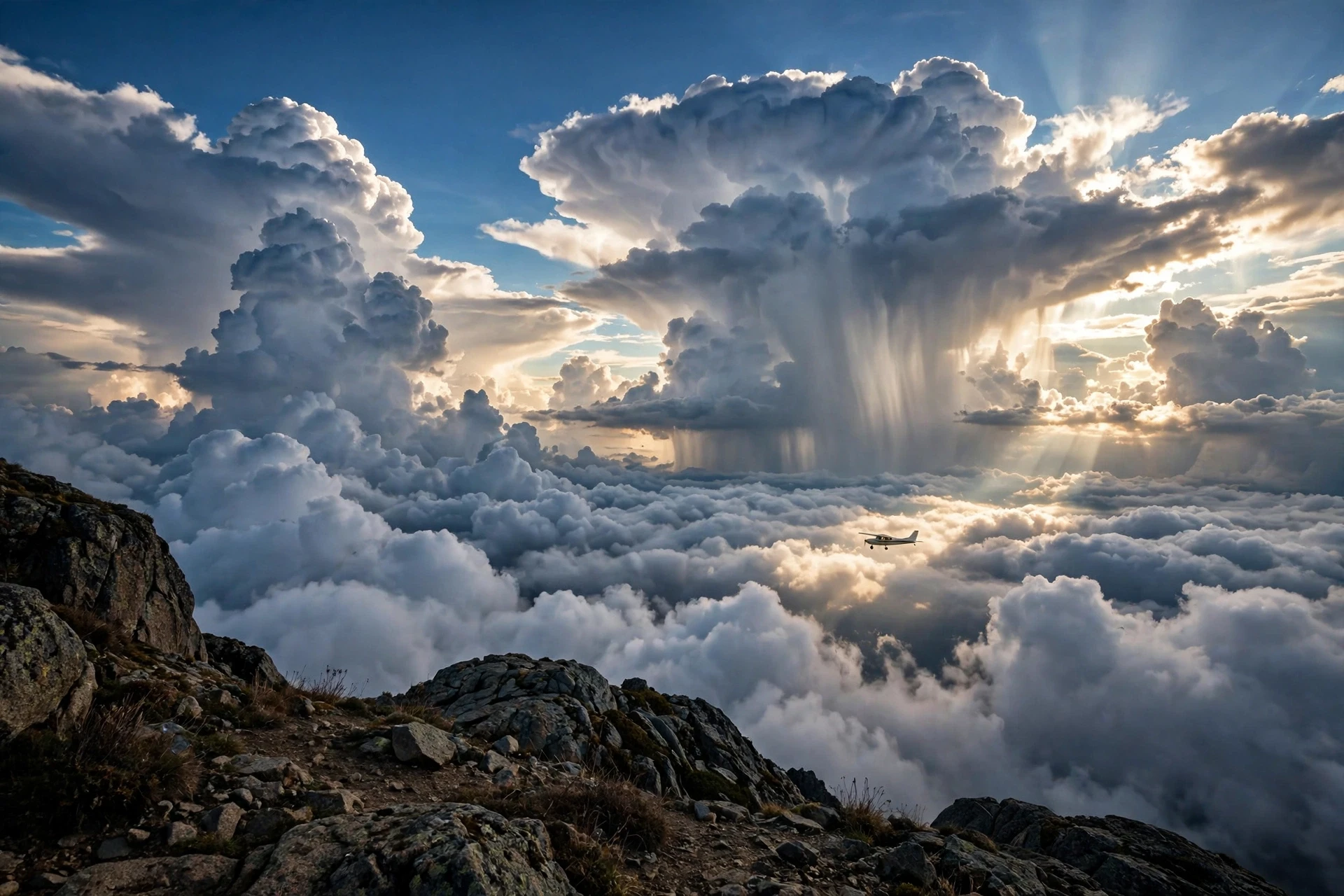
Near the top of the troposphere, fast rivers of air called jet streams race around the planet at speeds that can top 300 kilometres per hour. They flow where cold polar air meets warm tropical air, along the sharp temperature boundary near the tropopause, and they steer storms the way a river current steers a boat. Airline pilots know them well: a flight riding a jet stream eastward can arrive far ahead of schedule, while one fighting it westward burns extra fuel and time.
The tropopause itself is a lid. It is the place where the temperature stops falling and starts rising, and that reversal acts as a barrier. Rising air that hits the tropopause finds itself suddenly colder than its surroundings, loses its buoyancy, and spreads out sideways instead of climbing further. That is why the tops of the biggest thunderstorms flatten out into anvil shapes — the storm has hit the ceiling and spread. The tropopause is invisible, but you can see its signature in the sky every time a thunderhead's top goes flat.
5. The Stratosphere and the Ozone Layer
Above the tropopause, Earth's atmosphere changes character completely. The stratosphere runs from about 12 kilometres up to about 50 kilometres, and it is a calm, dry, stratified place — the name comes from the Latin stratum, meaning "layer." Unlike the churning troposphere below, the stratosphere barely mixes at all. Its air is layered like the pages of a book, and it can stay undisturbed for months at a time. It is so dry that clouds almost never form there. Commercial jets cruise in its lower reaches precisely because it is so smooth: above the weather, in still air, a plane can fly fast and steady.
The stratosphere's most famous resident is the ozone layer, and it deserves a careful look, because it is both the reason the stratosphere exists as a separate layer and one of the most important shields life has.
5.1 A layer heated from above
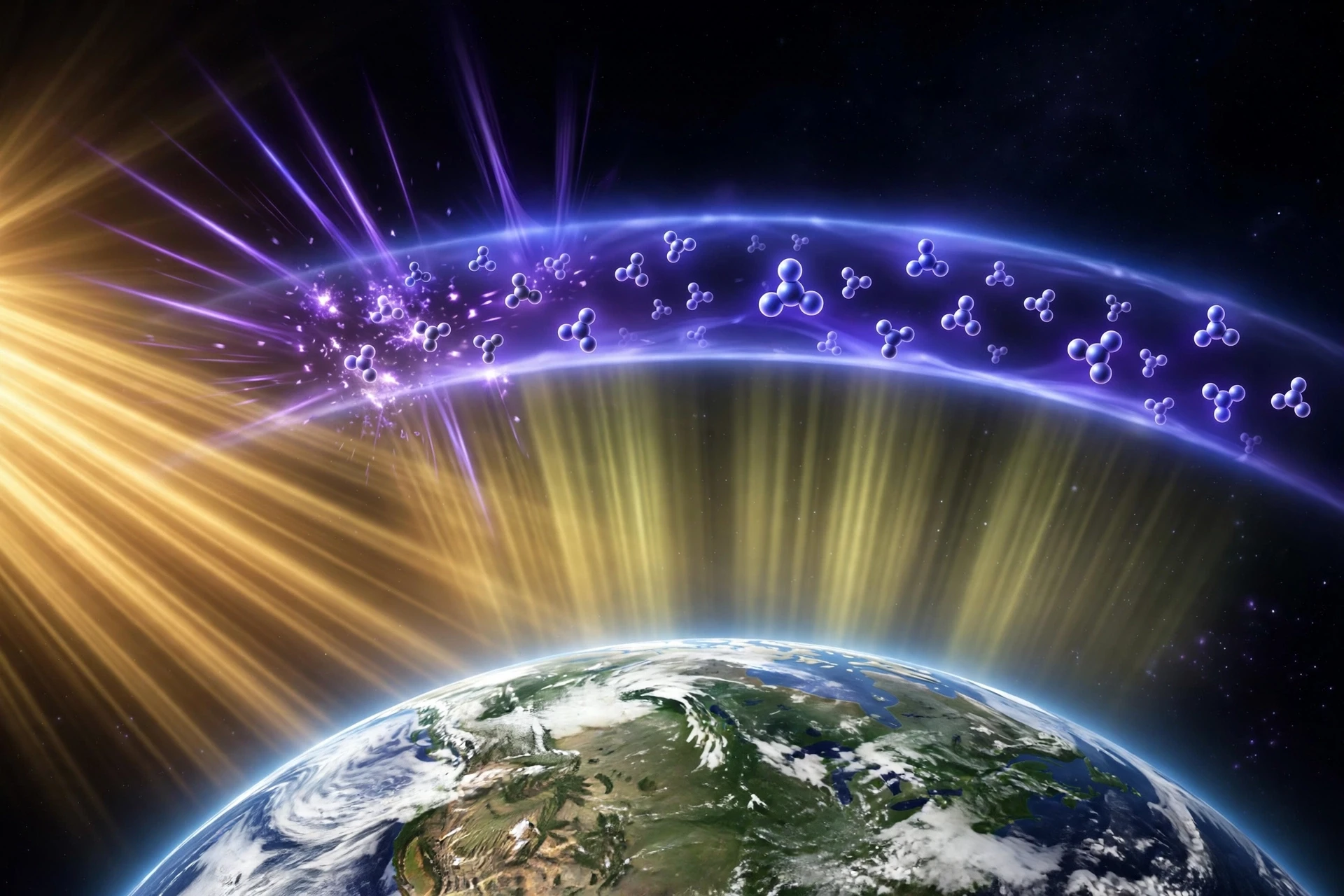
In the troposphere, temperature falls with height. In the stratosphere, it rises, and the reason is ozone. When ultraviolet light strikes an ozone molecule, the molecule absorbs the energy and splits apart; the fragments quickly reform, and the cycle repeats — absorbing ultraviolet, releasing heat, reforming. That constant absorption warms the upper stratosphere, so the air gets warmer the higher you go, reaching about minus 15 degrees Celsius at the stratopause, far warmer than the minus 60 degrees at the tropopause below it.
This temperature reversal is what makes the stratosphere stable. Warm air sitting on top of cold air is like oil sitting on water: it does not want to mix. In the troposphere, warm air sits below cold air, which is unstable — the warm air wants to rise. In the stratosphere, the arrangement is flipped, and the air sits still. That stillness is why volcanic ash and pollutants that reach the stratosphere can linger there for years, drifting slowly around the planet, while the same material in the troposphere would be rained out in days.
5.2 What ozone actually is
Ozone is a molecule made of three oxygen atoms, written O₃, where the oxygen we breathe is O₂, two atoms. That third atom makes all the difference. Ozone is reactive and unstable, constantly forming and breaking apart in sunlight. Most of Earth's ozone — about 90 percent of it — sits in the stratosphere, concentrated in a band roughly 15 to 30 kilometres above the surface. If you gathered all the ozone in the atmosphere and compressed it to sea-level pressure, it would form a layer only about three millimetres thick. Three millimetres of gas, spread across the whole planet, stands between life on Earth and a flood of ultraviolet radiation. It is one of the most remarkable bargains in nature.
The ozone layer does not block all ultraviolet light. It is especially good at absorbing UV-B and UV-C, the most energetic and damaging kinds, while letting through much of the gentler UV-A and almost all visible light. Without it, the surface would be bathed in ultraviolet intense enough to damage DNA and kill the tiny plankton that form the base of the ocean food web. The ozone layer is not a roof. It is a filter — and a thin one.
5.3 The ozone hole and what it taught us
In the 1980s, scientists studying the Antarctic stratosphere found something alarming: each spring, the ozone above Antarctica thinned dramatically, forming a "hole" in the layer. The cause turned out to be chlorofluorocarbons — CFCs — chemicals used in refrigerators, air conditioners, and spray cans. CFCs drift up into the stratosphere, where ultraviolet light breaks them apart and releases chlorine atoms. A single chlorine atom can destroy many thousands of ozone molecules before it is removed, because it acts as a catalyst: it breaks ozone apart, is freed, and breaks another. The Antarctic is hit hardest because its winter stratosphere gets cold enough for special polar clouds to form, and the chemistry on those cloud surfaces supercharges the destruction.
The response is one of the great success stories of environmental science. Countries agreed, through the Montreal Protocol, to phase out CFCs, and the phase-out worked. CFC levels have fallen and the ozone layer is slowly recovering; it is not fully healed, and it will take decades more. The lesson is simple: Earth's atmosphere is not invulnerable, human activity can reach 25 kilometres up and change the sky, and coordinated action can repair what was damaged.
The ozone layer would be only about three millimetres thick if compressed to sea-level pressure — yet that thin veil of gas absorbs the most damaging ultraviolet light from the Sun.
If you want to understand why the sky looks the way it does from the ground, the ozone layer is part of the story, but the blue itself has a different cause. Sunlight scattered by air molecules paints the sky blue, and our guide to why the sky is blue explains that scattering in detail. The ozone layer's work is invisible — it filters light you cannot see — but its effect is written into the existence of every land animal, including us.
6. The Mesosphere: The Coldest, Quietest Layer
Above the stratopause, at about 50 kilometres, the temperature starts falling again, and it keeps falling all the way up through the mesosphere to about 85 kilometres. The mesosphere is the middle layer of Earth's atmosphere — its name means "middle sphere" — and it is the most mysterious of the five. It is too high for airplanes and weather balloons, which cannot reach it, and too low for satellites, which cannot orbit in it because the air, thin as it is, still drags on them. For a long time it was the least-studied part of the sky, a gap between the tools. Scientists call it the "ignorosphere," half jokingly and half in frustration.
6.1 The coldest place on Earth
The top of the mesosphere, the mesopause, is the coldest place in Earth's atmosphere. Temperatures there can fall to around minus 90 degrees Celsius, colder than the winter poles, colder than anywhere else in the sky. The reason is the same one that cools the troposphere: the air here is far from any heat source, and as it rises and expands it cools. The mesosphere has no ozone layer to warm it from within and no warm ground below it, so it just keeps getting colder with height. It is a strange thought that the coldest place in the atmosphere is not at the poles or at the edge of space, but in a quiet, dark layer eighty kilometres above your head.
The mesosphere is also remarkably dry — even drier than the stratosphere. And yet, on summer nights at high latitudes, strange electric-blue clouds appear there: noctilucent clouds, the highest clouds in the sky. They form from the tiny amount of water vapour that does reach the mesosphere, freezing onto specks of meteor dust, and they glow after sunset because they are so high that they still catch sunlight long after the ground below has gone dark.
6.2 Where meteors go to die
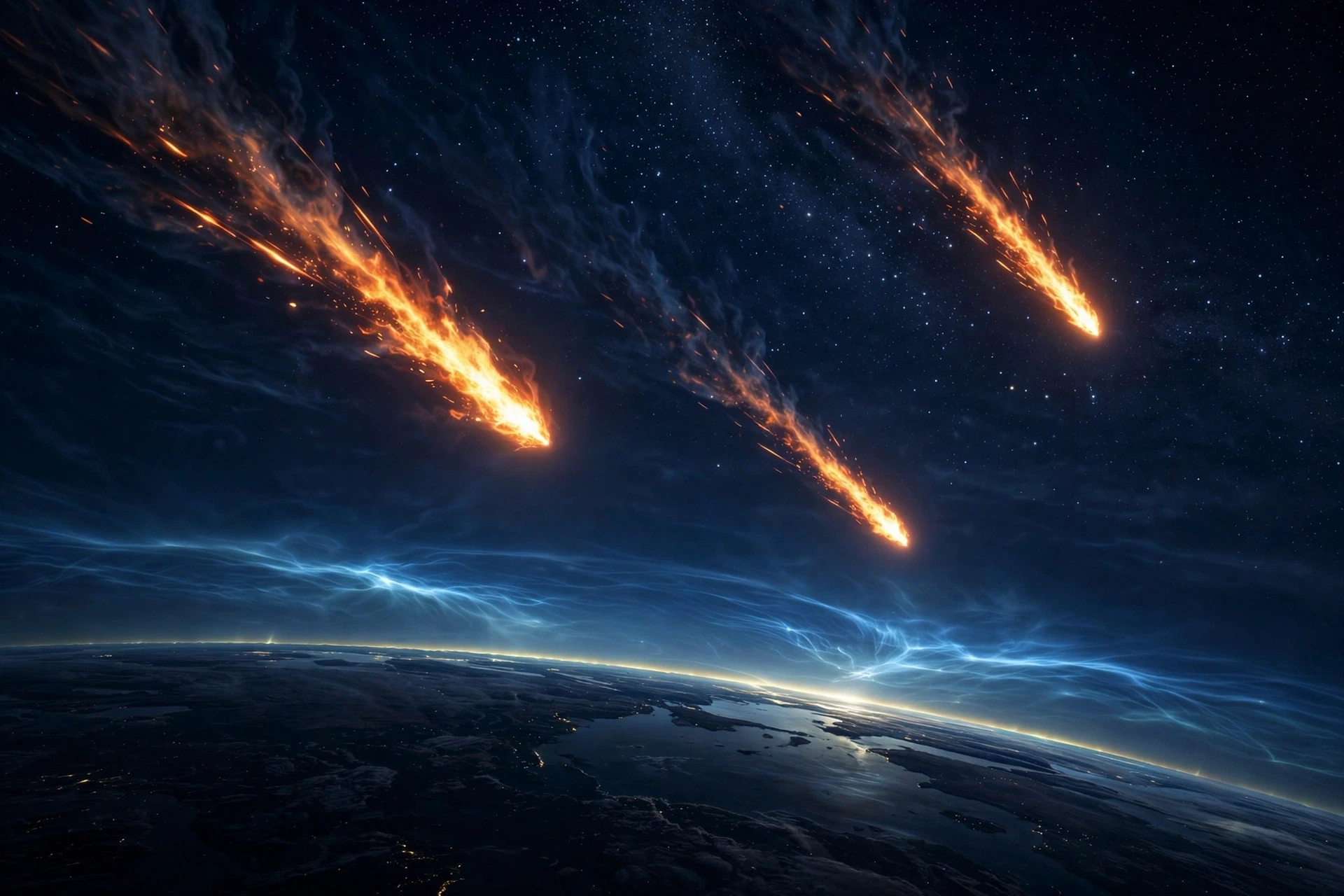
The mesosphere has one of the most important jobs in the atmosphere, and it does it violently. Every day, tonnes of dust and rock from space rain down on Earth — the debris of comets and asteroids, grains of sand and pebbles travelling at tens of kilometres per second. Almost all of it burns up in the mesosphere. The air there is just dense enough to slow the incoming particles, and the friction heats them until they glow and vaporise. What we see from the ground as a shooting star is a speck of cosmic dust dying in the mesosphere, 80 kilometres up, in a flash of light that lasts a second.
Without the mesosphere, that rain of debris would reach the ground. Most of it is small, and the damage would be limited, but the steady sandblasting would be real, and the occasional larger rock would be a genuine hazard. The atmosphere's layered defence works like this: the mesosphere burns the small stuff, the thicker air below slows what survives, and the ground takes what is left. It is a shield made of nothing but thin air and speed, and it works every night, unnoticed, while we sleep.
I have watched meteor showers from a dark field more than once, lying on my back with friends and counting streaks of light. It took me years to understand what I was actually watching: not stars falling, but dust burning up in a layer of air I could not see, at a height no airplane can reach.
6.3 Why the mesosphere is hard to study
The mesosphere's inaccessibility has shaped what we know about it. Weather balloons burst long before they reach it, aircraft cannot fly there, and satellites orbit above it. The main tools are rockets that pass through briefly, lasers bounced off its thin air, and radar tracking the ionised trails left by meteors. New instruments are filling in the picture, and the mesosphere is turning out to be more dynamic than expected — with waves rippling through it from storms below and a circulation carrying air from the summer pole to the winter pole.
7. The Thermosphere: Heat, Auroras, and the Edge of Space
Above the mesopause, the temperature turns around once more and climbs steeply through the thermosphere, from about 85 kilometres up to 600 kilometres or more. The thermosphere's name means "heat sphere," and the name is accurate in the narrow sense that its gas is extremely hot — but as we saw earlier, "hot" in the thermosphere does not mean what it means in a kitchen. The air here is so thin that a thermometer would read hundreds or even thousands of degrees, while a solid object would barely warm up at all. The thermosphere is hot the way a spark is hot: furious, but with almost nothing behind it.
7.1 Heated by the Sun's hardest light
The thermosphere is heated directly by the Sun's most energetic radiation — extreme ultraviolet light and X-rays absorbed high in the atmosphere. When the Sun is active, the thermosphere heats up and puffs outward, swelling like a heated balloon; when the Sun is quiet, it cools and contracts. Satellites in low orbit feel this directly: during solar storms, the puffed-up thermosphere drags on them, slowing them down and pulling their orbits lower.
This is also where the ionosphere lives. Ultraviolet and X-ray light strips electrons from atoms and molecules in the thermosphere, creating a sea of charged particles that overlaps the mesosphere and thermosphere, roughly from 60 kilometres up to about a thousand. Radio waves bounce off the ionosphere, which is how shortwave radio carries signals around the curve of the Earth. Before satellites, it was the world's long-distance telephone network. It still matters today — and as a nuisance, too: disturbances in the ionosphere can scramble GPS signals and radio communications, which is why space-weather forecasters watch it closely.
7.2 Auroras: light from the top of the world
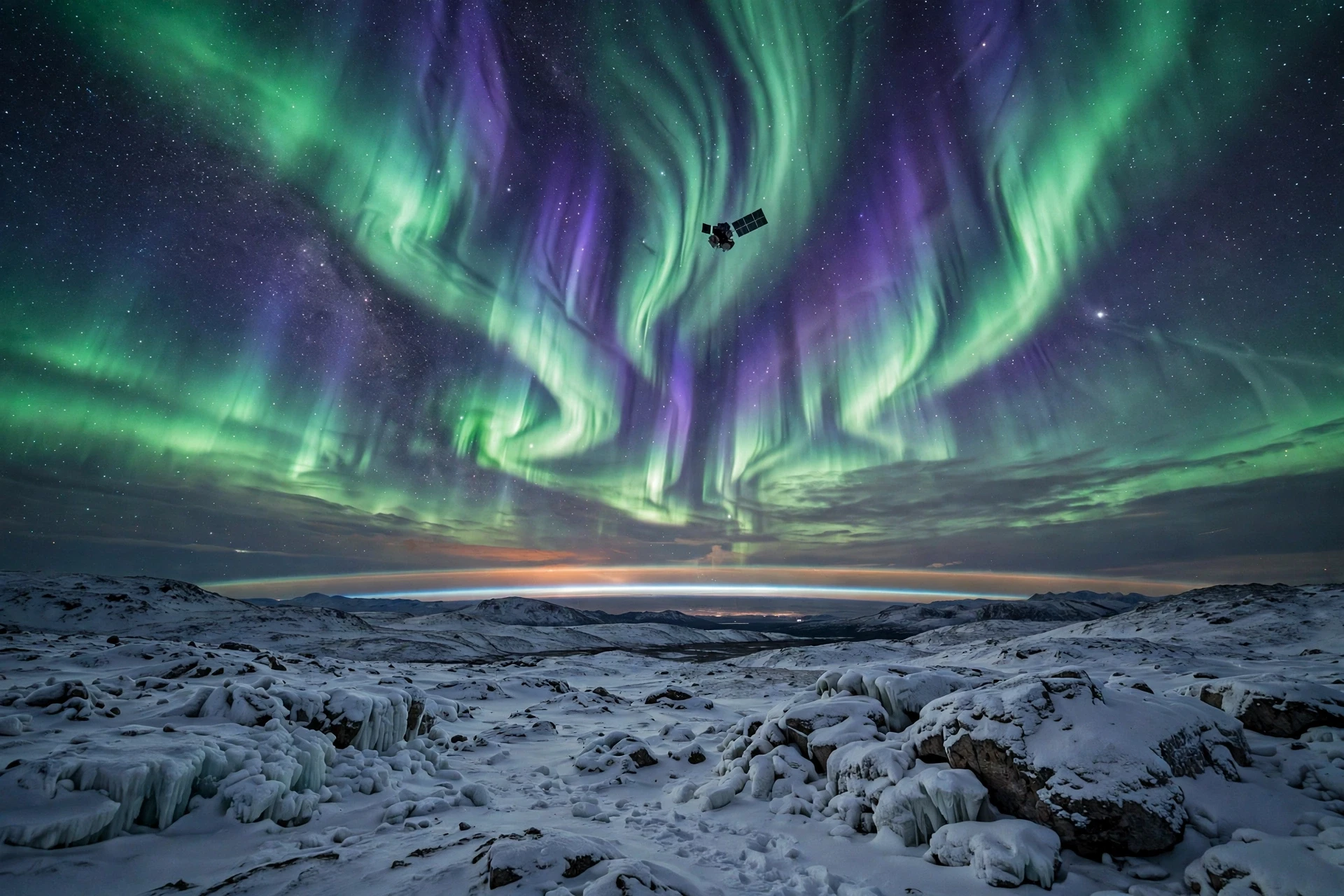
The most beautiful thing the thermosphere does is the aurora. When charged particles from the Sun — the solar wind — strike Earth's magnetic field, some are funnelled down toward the poles, where they collide with oxygen and nitrogen atoms in the thermosphere. The collisions excite the atoms, and when they settle back down, they release the extra energy as light. Oxygen glows green and red; nitrogen glows blue and purple. The result is curtains of light rippling across the polar sky, sometimes bright enough to read by, sometimes stretching across the whole heavens.
Auroras usually stay near the poles, in the auroral ovals around the magnetic poles. But during strong solar storms, they can spread much further toward the equator, and people at mid-latitudes sometimes see the sky turn red and green on a clear night. An aurora is space weather made visible — the Sun's breath touching the top of our sky and making it glow. It is also a reminder that the thermosphere is not really Earth's alone. It is a borderland, shared between our planet and the Sun.
The first time I saw an aurora, I was not expecting it. The sky simply began to move — slow green curtains, folding and unfolding, like fabric in a wind I could not feel. I stood there a long time, cold and unbothered by the cold, watching light that had travelled from the Sun and been caught by the air above my head. It was the most direct experience I have ever had of the thermosphere: a layer I cannot visit, making itself visible by glowing.
7.3 The Kármán line: where space begins
Somewhere inside the thermosphere, at 100 kilometres above sea level, sits an imaginary line with an outsized reputation: the Kármán line. It is the boundary most of the world uses to say where Earth's atmosphere ends and outer space begins. It is not a physical barrier — no fence, no change in the air you could feel — but a practical definition, named after the physicist Theodore von Kármán, who calculated the altitude at which the air becomes too thin for an aircraft's wings to generate lift, so a craft would have to travel at orbital speed just to stay up. Above the line, you are in space by convention. Below it, you are in the atmosphere.
The line is a human choice, not a fact of nature. The air does not stop at 100 kilometres, and the atmosphere's outermost wisps stretch far beyond it. But a boundary is useful, and the Kármán line is the one the world has settled on: when a rocket crosses it, its crew are called astronauts. That is a human ceremony laid over a continuous sky.
8. The Exosphere: Where the Atmosphere Fades Away
The exosphere is the outermost layer of Earth's atmosphere, and it is the strangest of the five, because it barely qualifies as air at all. It begins at the top of the thermosphere, around 600 kilometres up, and extends outward to about 10,000 kilometres — and beyond that, in the thinnest sense, much further. Its gas is so sparse that the molecules rarely collide with each other. A hydrogen atom in the exosphere can travel hundreds of kilometres in a straight line without meeting another particle. At that point, the idea of "air" as a fluid with pressure and wind has broken down. The exosphere is less like an ocean and more like a scattering of dust motes in a sunbeam.
The exosphere of Earth's atmosphere is dominated by the lightest gases: hydrogen and helium. Heavier gases cannot reach this high in any numbers, because gravity holds them down. The light ones drift up, and some of them drift away entirely. Hydrogen atoms at the top of the exosphere can reach escape velocity — about 11 kilometres per second at Earth's surface, less at altitude — and leave the planet for good. Earth loses a slow trickle of hydrogen to space this way, a leak that has gone on for billions of years. It is a small leak, but it is real, and it is one reason Earth keeps its water only by the grace of gravity and a magnetic field that shields the upper air from being stripped away faster by the solar wind.
There is no sharp top to the exosphere. It simply thins until the gas of Earth's atmosphere is indistinguishable from the gas of interplanetary space. Some measurements suggest its faintest reaches — a cloud of hydrogen called the geocorona — extend far beyond the Moon's orbit. The boundary between Earth and space is not a wall. It is a fade.
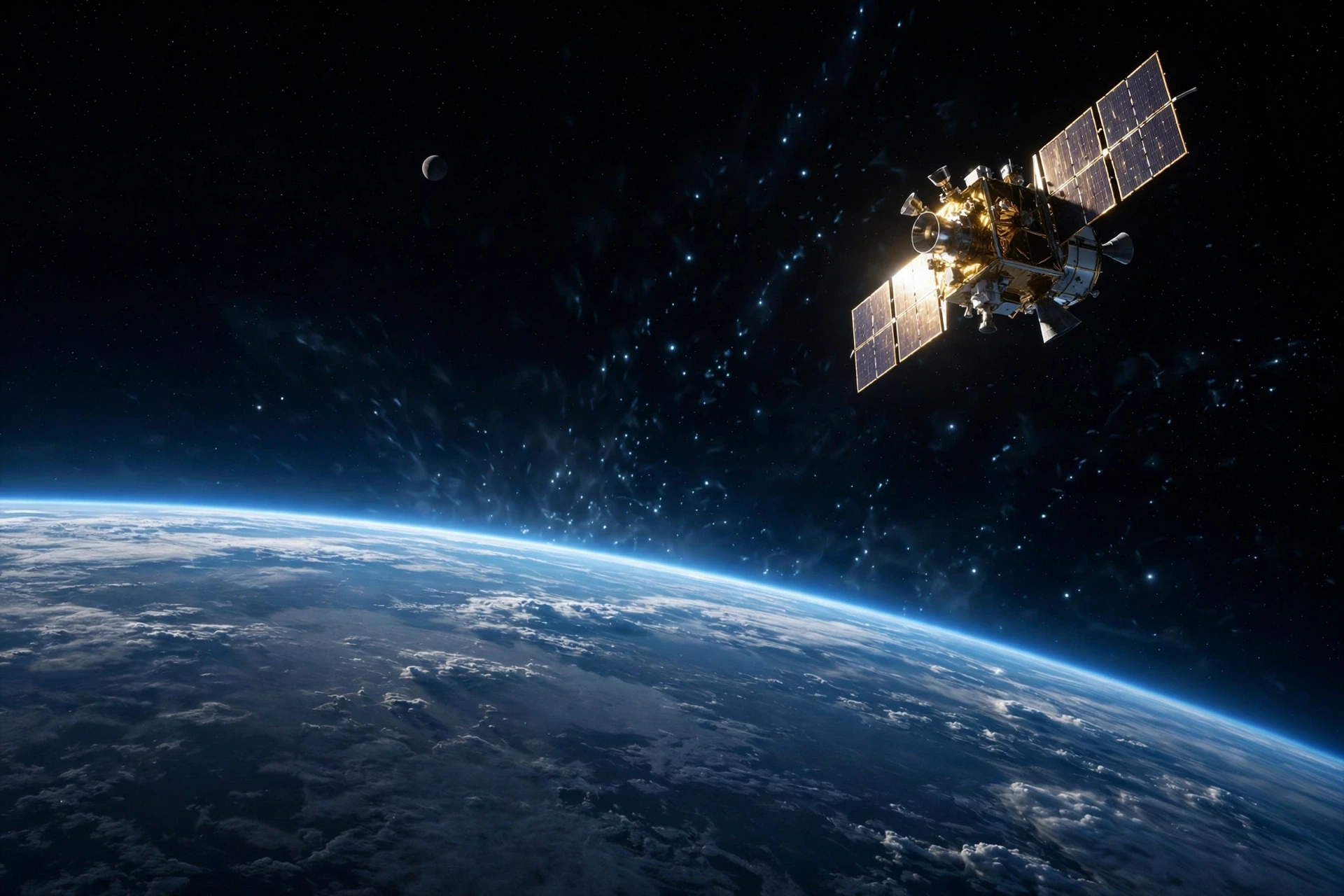
The exosphere is where most satellites live. The International Space Station orbits at about 400 kilometres, still inside the thermosphere, where the faint drag of air is enough that it needs regular boosts to stay up. Higher satellites, in the exosphere, feel almost no drag at all and can stay in orbit for decades without help.
9. The Pauses Between the Layers
Between each pair of layers in Earth's atmosphere sits a pause — a thin boundary zone where the temperature stops moving in one direction and starts moving in the other. There are four of them, and their names are worth learning, because they are the hinges of the whole structure.
The tropopause sits between the troposphere and the stratosphere, about 8 to 18 kilometres up. It is the ceiling of weather, the lid that flattens thunderstorm tops into anvils, and the boundary that commercial jets fly just under or just over.
The stratopause sits between the stratosphere and the mesosphere, about 50 kilometres up. It is the warmest point in the middle atmosphere, heated by the ozone layer below it.
The mesopause sits between the mesosphere and the thermosphere, about 85 kilometres up. It is the coldest place in Earth's atmosphere.
The thermopause sits between the thermosphere and the exosphere, hundreds of kilometres up. Above it, the air is so thin that temperature stops being a useful idea.
A pause is not a layer of stuff. It is a turning point, the place where a trend reverses. The tropopause is where falling temperature turns into rising temperature. The mesopause is where falling turns into rising again. If the layers are the floors of the building, the pauses are the landings between them — the places where the staircase changes direction.
The pauses matter because they act as barriers. The tropopause, in particular, is a strong barrier to mixing: air and pollutants from the troposphere mostly stay in the troposphere, and stratospheric air mostly stays put. That is why the ozone layer can maintain its chemistry undisturbed by surface weather, and why it takes a powerful volcanic eruption to punch material through the tropopause into the stratosphere, where it can linger for years and cool the planet.
10. Weather vs. Space Weather
It helps to keep two kinds of weather straight, because they happen in different layers, are driven by different forces, and affect our lives in different ways.
Weather is what happens in the troposphere. It is driven by the Sun heating the ground unevenly, by water evaporating and condensing, and by air moving to even out pressure differences. Its timescale is hours to days. Its tools are clouds, rain, snow, wind, and storms. It decides whether you need an umbrella, whether a flight is delayed, and whether a harvest succeeds. Humans have studied it for thousands of years, and we forecast it with satellites, radar, and supercomputers — with growing skill, but never with certainty.
Space weather is what happens in the thermosphere, the ionosphere, and beyond. It is driven by the Sun itself: solar flares, coronal mass ejections, and the solar wind — streams of charged particles blowing outward from the Sun. Its timescale is minutes to days. Its tools are geomagnetic storms, auroras, and disturbances in the ionosphere. It decides whether GPS signals stay accurate, whether radio communications work, whether power grids are stressed, and whether satellites stay in their orbits. Space weather is weather, too, in the sense that it is the state of a fluid medium changing over time — but the fluid is plasma and thin gas, hundreds of kilometres up, and the "storms" are magnetic.
The two are connected. The Sun drives both: it heats the ground that drives weather, and it fires the particles that drive space weather. Big solar storms can heat the thermosphere and make it swell, increasing drag on satellites. Changes in the upper atmosphere can ripple downward, and waves from storms in the troposphere can ripple upward into the mesosphere and beyond. Earth's atmosphere is one system, and the layers talk to each other — through waves, through chemistry, and through the slow circulation that carries air from one layer to the next.
There is a practical lesson here for anyone who follows forecasts. A weather forecast and a space-weather forecast are different products, made by different people, about different parts of the sky. If you fly airplanes, farm, or plan a picnic, you want the first. If you run a satellite, a power grid, or a radio network, you need the second. And if you want to understand the Sun's role in both — the star whose light heats the ground and whose storms light up the poles — our guide to how the Sun works explains the engine behind both kinds of weather.
Weather is the troposphere's business: clouds, rain, and wind, driven by sunlight on the ground. Space weather is the thermosphere's business: auroras and magnetic storms, driven by the Sun itself.
The ozone layer, the mesosphere's meteor shield, and the magnetic field all protect the lower atmosphere from what comes from above, while the troposphere's water and chemistry feed the layers above with the gases that shape them. Protection flows downward, and influence flows upward. The atmosphere is not five separate rooms. It is one house.
11. How the Atmosphere Protects Life
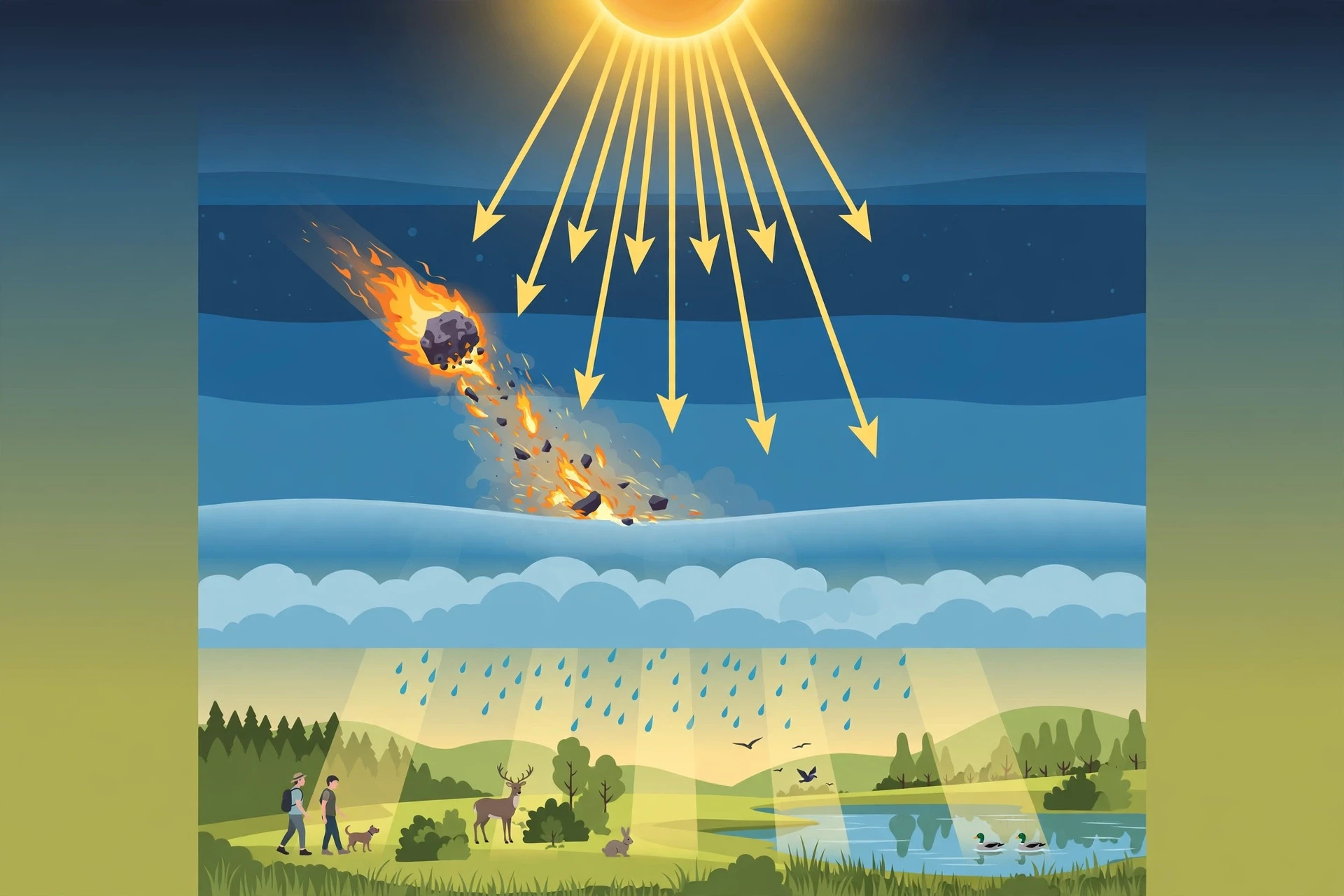
Step back from the layers and ask the big question: what does Earth's atmosphere actually do for life? The answer is not one thing. It is a whole stack of services, each performed by a different part of the sky, and together they are the reason Earth is habitable while Mars, with its thin air, and Venus, with its crushing air, are not. The atmosphere protects life in at least five distinct ways.
It gives us air to breathe. The obvious one, and the most immediate. Oxygen makes up a fifth of the air, and every animal on the planet depends on it. The atmosphere also delivers that oxygen at the right pressure: enough pressure to push oxygen into our blood, and enough total pressure to keep water liquid in our bodies. Without atmospheric pressure, the water in our tissues would boil at body temperature. The air is not just a supply of oxygen. It is a pressure suit that the whole planet wears.
It keeps the temperature liveable. The greenhouse effect — driven mainly by water vapour and carbon dioxide — keeps Earth's average temperature about 33 degrees Celsius warmer than it would be without an atmosphere: the difference between a planet with liquid oceans and a frozen rock. The atmosphere also smooths out temperature swings, carrying heat from the equator toward the poles, from day to night, and from summer to winter. The Moon, which has no atmosphere, swings between blazing heat in sunlight and deep cold in shadow. Earth, wrapped in air, does not.
It filters ultraviolet light. The ozone layer absorbs the most damaging ultraviolet radiation, as we saw in section 5. Without it, DNA damage would be routine, skin cancers would be common, and the plankton that support ocean food webs would struggle. The atmosphere is a sunscreen the whole planet wears, and it is maintained, free of charge, by sunlight and oxygen.
It burns up meteors. The mesosphere vaporises the daily rain of cosmic dust and small rocks before they can reach the ground, as we saw in section 6. Larger rocks still get through, and the atmosphere can only do so much — but the steady, daily protection against the small stuff is one of the atmosphere's quietest services.
It carries water and moves heat. The troposphere's water cycle delivers fresh water to land, in the form of rain and snow, and carries heat around the planet. Without it, the continents would be deserts and the oceans would be the only habitable places on Earth. The atmosphere is the planet's plumbing and its heating system at the same time.
11.1 Why other planets are different
Compare Earth with its neighbours and the value of the atmosphere becomes stark. Venus has an atmosphere about ninety times thicker than Earth's at the surface, made mostly of carbon dioxide, and its greenhouse effect has run away to furnace temperatures. Mars has an atmosphere less than one percent as thick as Earth's, too thin to keep water liquid or to shield the surface from radiation. Earth sits in between: thick enough to breathe and to stay warm, thin enough not to crush or cook — the result of Earth's size, its distance from the Sun, its magnetic field, and billions of years of geological and biological history.
11.2 The atmosphere is changing
That balance is not fixed. Human activity is changing the composition of Earth's atmosphere, most obviously by adding carbon dioxide and methane, which strengthen the greenhouse effect and warm the planet. The change is small in percentage terms — carbon dioxide has risen from about 280 parts per million before industry to about 420 today — but small gases run the show. A change of a few hundred parts per million in a trace gas is enough to shift the planet's energy balance and, with it, the climate. Understanding the layers is not just an academic exercise. It is the background knowledge for the most important environmental question of our time: what happens to a planet when you change its sky.
12. Common Misconceptions About Earth's Atmosphere
A topic as familiar as the air has attracted a full set of confident wrong ideas. Here are the ones I hear most often — and what the evidence actually shows.
12.1 "The atmosphere ends at a definite height"
Most people imagine the sky has a ceiling, a place where the air simply stops. What we actually see in the data is a fade, not a wall: the air gets thinner and thinner with height, and there is no altitude where you can point and say "air below, vacuum above." The Kármán line at 100 kilometres is a human convention, not a physical boundary, and the exosphere's thinnest wisps reach far beyond it.
12.2 "The thermosphere would feel hot because it is thousands of degrees"
This is the trickiest misconception in this guide, and it catches almost everyone. The thermosphere's temperature can reach thousands of degrees, but temperature is a measure of how fast molecules move, not of how much heat is available. The thermosphere's gas is so thin that almost no molecules would touch you, so almost no heat would transfer. You would feel cold, not hot. A sparkler is hotter than a bath, but the bath will warm you and the sparkler will not. The thermosphere is a sky full of sparklers.
12.3 "The ozone hole lets in heat and causes global warming"
The ozone hole and global warming are both real, but they are different problems with different causes. The ozone hole is caused by chlorine and bromine from CFCs destroying ozone in the stratosphere, letting in more ultraviolet light. Global warming is caused mainly by greenhouse gases trapping infrared radiation in the troposphere. Fixing one does not fix the other.
12.4 "Weather happens throughout the atmosphere"
Almost all weather in Earth's atmosphere happens in the troposphere, the lowest layer. The stratosphere is too dry and too stable for clouds and rain, and the layers above are far too thin. When people say "the weather up there," they usually mean the thermosphere or the exosphere, where there is no weather in any sense a person on the ground would recognise. There is space weather up there, which is real and important — but it is a different phenomenon, driven by the Sun rather than by water and heat.
12.5 "Air is mostly oxygen"
It feels as if it should be true, because oxygen is the gas we care about. But air is mostly nitrogen — about 78 percent — and oxygen is only about 21 percent. Nitrogen is the quiet majority shareholder of the sky: it does almost nothing chemically, and that is exactly why it is there in such quantities. We breathe an atmosphere that is mostly a gas we cannot use, with just enough oxygen mixed in to keep us alive.
12.6 "The sky is blue because it reflects the oceans"
This one is backwards. The sky is blue because air molecules scatter short blue wavelengths of sunlight more than long red ones — a process called Rayleigh scattering. The oceans look blue partly because they reflect the blue sky, not the other way around. If the sky's colour came from the sea, the sky over a desert would be brown. It is blue over deserts, ice caps, and the middle of the ocean alike, because the blue is made in the air itself. Our guide to why the sky is blue works through the scattering in full.
Frequently Asked Questions
How thick is Earth's atmosphere?
Earth's atmosphere has no sharp top, so "thickness" depends on where you draw the line. The dense, weather-bearing part — the troposphere — is only about 8 to 18 kilometres thick, while the five major layers together extend to roughly 10,000 kilometres, where the exosphere fades into interplanetary space. About half of all the air sits below about five and a half kilometres.
What are the five layers of Earth's atmosphere?
From lowest to highest, the five major layers of Earth's atmosphere are the troposphere, the stratosphere, the mesosphere, the thermosphere, and the exosphere. They are defined mainly by how temperature changes with height: temperature falls in the troposphere and mesosphere, and rises in the stratosphere and thermosphere. Between the layers sit four boundary zones — the tropopause, stratopause, mesopause, and thermopause — where the temperature trend reverses. The ionosphere is not a sixth layer in this scheme; it is a region of charged particles that overlaps the mesosphere and thermosphere.
Where is the ozone layer?
The ozone layer sits in the stratosphere, roughly 15 to 30 kilometres above Earth's surface, with the highest ozone concentrations in that band. It is a region of concentrated ozone, not a solid sheet, and it absorbs most of the Sun's harmful ultraviolet-B and ultraviolet-C radiation. About 90 percent of all the ozone in Earth's atmosphere is found in the stratosphere.
Why does temperature decrease with altitude in the troposphere?
Temperature falls with height in the troposphere because the Sun heats the ground, not the air directly. Sunlight passes through the clear air and warms Earth's surface, which then warms the air touching it. Air higher up is farther from that heat source, so it is colder — by about 6.5 degrees Celsius per kilometre on average — and rising air cools further as it expands into lower pressure. That is why mountain summits are cold even near the equator.
What is the Kármán line?
The Kármán line is the internationally used boundary between Earth's atmosphere and outer space, set at 100 kilometres above sea level. It is a practical convention, not a physical barrier: the air does not stop there. It marks the altitude where the air becomes too thin for aircraft wings to generate lift, so a craft would need orbital speed to stay aloft — and crossing it is what makes someone an astronaut by convention.
Does Earth's atmosphere protect us from meteors?
Yes. Most meteors burn up in the mesosphere, about 50 to 85 kilometres above the surface, where the air is just dense enough to slow and heat incoming dust and rock until it vaporises. What we see as a shooting star is usually a speck of cosmic debris dying in the mesosphere. Larger objects can survive to lower altitudes or reach the ground, so the protection is not absolute — but the daily rain of small debris is almost entirely stopped high above our heads.
How does Earth's atmosphere protect life?
Earth's atmosphere protects life in several ways at once: it supplies oxygen at a pressure our bodies can use, it keeps the planet warm through the greenhouse effect, the ozone layer filters out damaging ultraviolet radiation, the mesosphere burns up incoming meteors, and the water cycle delivers fresh water to land. No other known planet has this combination, which is why Earth's atmosphere is often described as the thin, fragile blanket that makes our planet habitable.