

I still remember the worst sunburn of my life. I was a teenager on a school field trip to the coast, and the day had been overcast for hours — grey sky, cool wind, no sun in sight. Nobody bothered with sunscreen, and nobody thought about the ozone layer overhead. By evening, my shoulders were the colour of boiled lobster, and I spent the night lying face-down on a borrowed mattress, wondering how I had managed to burn on a day when I had barely seen the Sun. That burn taught me something that took years to fully understand: the danger in sunlight is invisible, and so is most of the protection we rely on.
The ozone layer is that protection. It is a thin band of gas high above the clouds, and it soaks up the most damaging part of the Sun's ultraviolet light before it can reach us. Without it, a sunny afternoon would be a medical emergency. Crops would wither, plankton in the oceans would die back, and skin cancer rates would climb far beyond anything we know today. The layer is invisible, it has no smell, and you will never see it from the ground — yet it stands between every living thing on Earth and a Sun that is, frankly, trying to sterilise us.
What makes the ozone layer remarkable is not just what it does, but what happened to it. In the space of a few decades, chemicals we invented for fridges and spray cans chewed a hole in it the size of a continent. Scientists spotted the damage, governments argued, and then — in one of the rare moments when the whole world actually agreed on something — nearly every country on Earth signed a treaty to fix it. That treaty worked. The ozone layer is healing, slowly, and it may be the best evidence we have that humanity can solve a planetary problem when it decides to.
This article explains the ozone layer from the ground up: what ozone is, where the layer sits, how it forms and breaks down, how it shields life, how chlorofluorocarbons tore a hole in it, how the Montreal Protocol turned the damage around, and what the future looks like. Along the way, we will clear up the confusion between the ozone hole and climate change, answer the questions people ask most, and look at what you can actually do to help.
1. What Ozone Actually Is
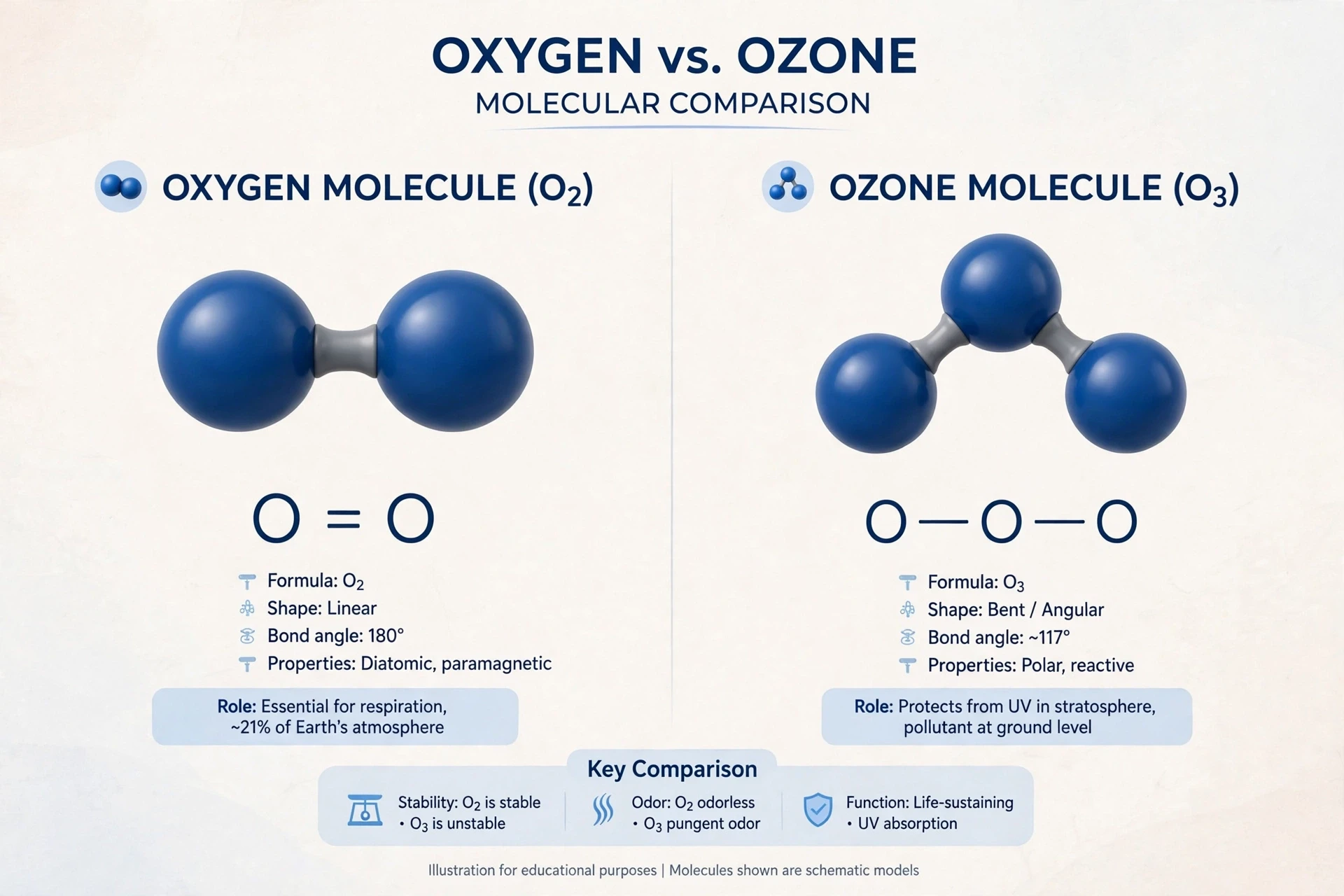
Ozone is oxygen with an extra atom. That is the whole secret, and it explains almost everything else about it. The air you are breathing right now is mostly nitrogen and oxygen, and the oxygen comes as pairs of atoms stuck together — O2. Ozone is three oxygen atoms stuck together instead — O3. One extra atom changes the molecule's shape, its chemistry, and its behaviour completely.
Think of it like this. Two oxygen atoms together are stable and content, like a couple who have settled into a quiet routine. Add a third atom, and the arrangement becomes restless and reactive, always looking for something to react with. That restlessness is what makes ozone both useful and dangerous, depending on where it is. High in the stratosphere, its reactivity lets it absorb ultraviolet light. Down at street level, the same reactivity irritates lungs and damages leaves. Same molecule, same restlessness — different address, different outcome.
The name comes from the Greek word ozein, meaning "to smell." Ozone has a sharp, clean smell, a little like chlorine or the air after a lightning strike. That is not a coincidence: lightning splits oxygen molecules apart, and some of the freed atoms join ordinary oxygen to make ozone. If you have ever stood outside after a thunderstorm and noticed that strange metallic freshness in the air, you were smelling ozone, made fresh a few hundred metres above your head.
Ozone is rare. Even in the ozone layer itself, where it is most concentrated, there are only a few ozone molecules for every million air molecules. If you gathered all the ozone in the atmosphere and squeezed it down to the pressure at sea level, it would form a layer only about 3 millimetres thick — roughly the thickness of two coins stacked together. That is the entire shield: two coins' worth of gas, spread across the whole sky, standing between us and the Sun. The thinness of it still surprises me every time I think about it. We talk about the ozone layer as though it were a roof, but it is more like a coat of varnish — and it works.
1.1 Good ozone and bad ozone
Scientists sometimes talk about "good ozone" and "bad ozone," and the distinction matters because it stops a lot of confusion before it starts. Good ozone is the ozone in the stratosphere, 15 to 30 kilometres above the ground. It absorbs ultraviolet radiation and protects life. Bad ozone is the ozone at ground level, in the air we breathe. It forms when sunlight cooks car exhaust and industrial fumes, and it is a pollutant that triggers asthma, damages crops, and stings the eyes on a hot smoggy day.
Here is the point that trips people up: they are the same molecule. There is no chemical difference between good ozone and bad ozone. The difference is entirely about location. Ozone high up is a sunscreen. Ozone down low is an irritant. That is why you will sometimes hear two statements that sound contradictory — "ozone is disappearing, and that is a disaster" and "ozone levels are rising, and that is a health problem" — and both can be true at the same time. The first is about the stratosphere. The second is about the air at street level. They are two different problems, in two different layers of the sky, and they need two different solutions.
I once watched a student struggle with this for a full lesson, and the moment it clicked for her was when I asked her to think of water. Water in a glass keeps you alive. Water flooding your house ruins it. Same substance, different place, different result. She nodded, and I have used that comparison ever since. Ozone works the same way: location decides whether it helps or harms.
1.2 How much ozone is there?
Because ozone is so thinly spread, scientists measure it in Dobson units, named after the British physicist G. M. B. Dobson, who built the first instrument for measuring it in the 1920s. One Dobson unit is the thickness of the ozone layer, squeezed down to sea-level pressure, measured in hundredths of a millimetre. A typical healthy reading is around 300 Dobson units — that 3-millimetre layer again. Over Antarctica in spring, when the ozone hole opens, readings can drop below 100 Dobson units. The number is small, but the change is enormous: two-thirds of the shield gone.
Dobson units also explain why the ozone layer is so fragile. A layer measured in millimetres does not have much to spare. It was built up over millions of years by sunlight acting on oxygen, and it exists in a balance between creation and destruction. Tip that balance even slightly, as we did with chlorofluorocarbons, and the layer thins fast. The good news is that the same thinness makes it quick to respond when the pressure is removed. Stop adding the chemicals that destroy it, and the balance starts to restore itself. That is the whole story of the last forty years, in one sentence.
2. Where the Ozone Layer Lives
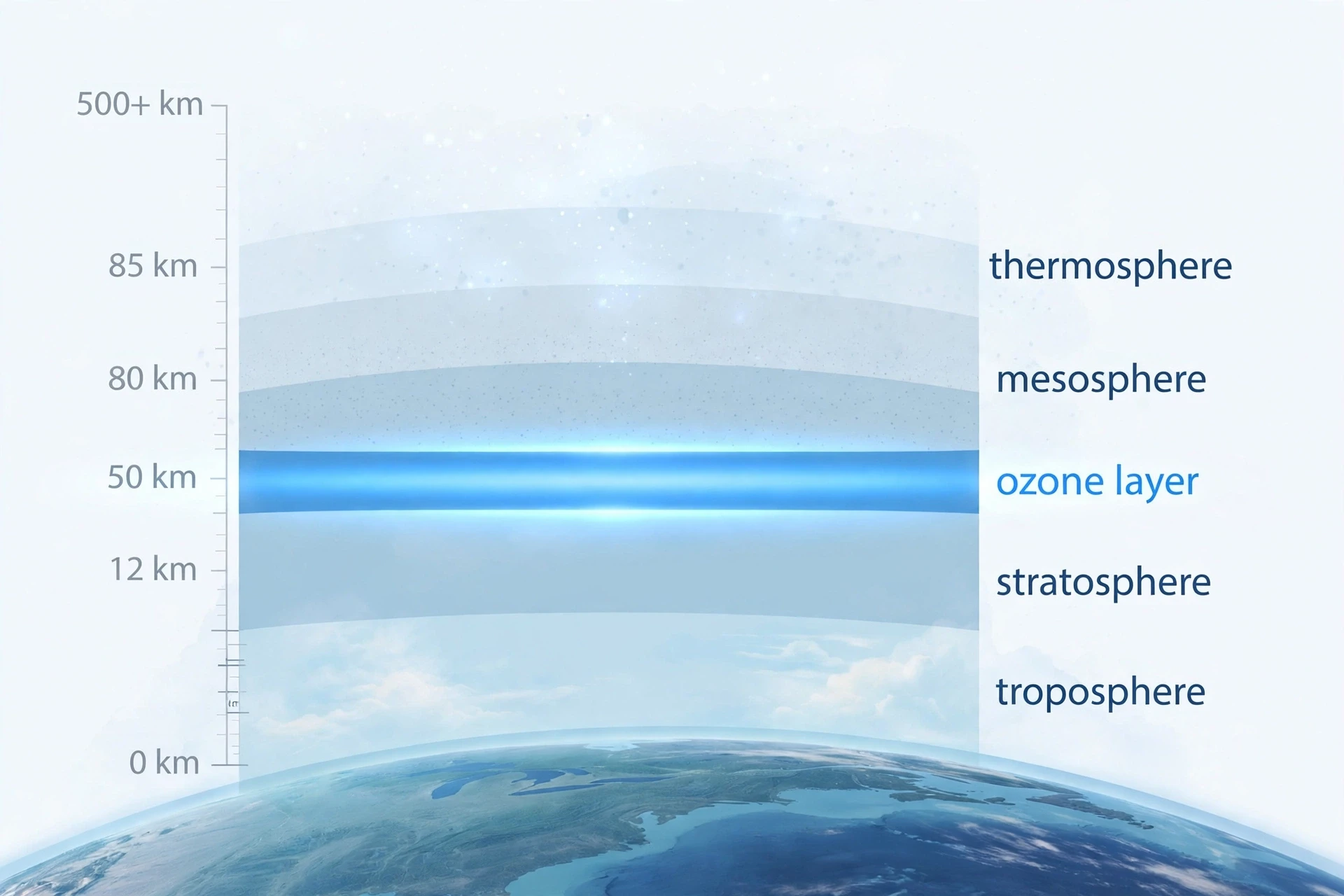
The ozone layer sits in the stratosphere, the second layer of Earth's atmosphere. If you could ride a balloon straight up, you would pass through the troposphere first — the layer where our weather happens, roughly the bottom 10 to 15 kilometres, where the clouds live and the temperature falls as you climb. Then, at about 15 kilometres up, you would cross into the stratosphere, and the temperature would start rising again. That warming is the ozone layer's doing: ozone absorbs ultraviolet light and turns it into heat, which warms the air around it.
The layer is not a sharp-edged shell. It is a broad, fuzzy band, most concentrated between about 15 and 25 kilometres above the surface, and thinning out gradually above and below. There is no line you could point to and say "the ozone layer starts here." It is more like the way the blue of the sky deepens overhead and fades near the horizon — a gradient, not a wall. Most of the ozone sits above the cruising altitude of passenger jets, which fly at around 10 to 12 kilometres. On a long-haul flight, you are travelling just underneath the shield, looking up at it through the window without knowing it is there.
2.1 Why the stratosphere, and nowhere else?
Ozone forms where sunlight is strong enough to split oxygen molecules, and where there is enough oxygen to work with. That sweet spot is the stratosphere. Lower down, in the troposphere, most of the Sun's most energetic ultraviolet light has already been absorbed by the ozone above, so there is not enough energy left to make much ozone. Higher up, above the stratosphere, there is plenty of energy but very little oxygen — the air is too thin. The stratosphere is the one place where both ingredients are present in the right amounts, so that is where ozone piles up.
The result is a layer that is held in place by physics, not by any container. Ozone is constantly being made and destroyed, and the concentration at any height is simply where those two processes balance out. Change the sunlight, change the temperature, or add a chemical that destroys ozone faster, and the balance shifts — and the layer moves, thins, or thickens in response. This is why scientists describe the ozone layer as a dynamic equilibrium rather than a fixed object. It is less like a roof and more like a river: the water is always moving, but the river stays in the same place because the flow in matches the flow out.
The sky itself gives you a clue that the stratosphere matters. The blue of the daytime sky comes from sunlight scattering off air molecules, and the colour you see depends on how the light is scattered as it passes through the atmosphere. The layers above you — including the stratosphere — shape that light before it reaches your eyes. If you want the full story of why the sky looks the way it does, the scattering that makes it blue is explained in Why Is the Sky Blue, and it pairs naturally with what the ozone layer is doing to the light you cannot see.
2.2 A layer measured in millimetres, guarding a whole planet
The thinness of the ozone layer is worth sitting with for a moment, because it is the key to everything that follows. We are protected by a gas that, gathered together, would barely cover the bottom of a glass. It works because ozone is extraordinarily good at absorbing ultraviolet light — a single ozone molecule can absorb far more ultraviolet energy than a molecule of oxygen or nitrogen. It does not need to be thick. It needs to be in the right place, and it needs to keep being remade as fast as it is destroyed.
That remaking is constant. Every second, sunlight is splitting oxygen molecules and building new ozone, while other ozone molecules are absorbing ultraviolet light and breaking apart. The layer you are protected by right now is not the same set of molecules that protected you yesterday. It is a standing pattern, rebuilt continuously by sunlight, like a wave that keeps its shape while the water flows through it. This matters because it means the ozone layer can recover. It is not a resource that gets used up and stays gone. It is a process, and processes can restart.
3. How the Ozone Layer Forms and Breaks Down
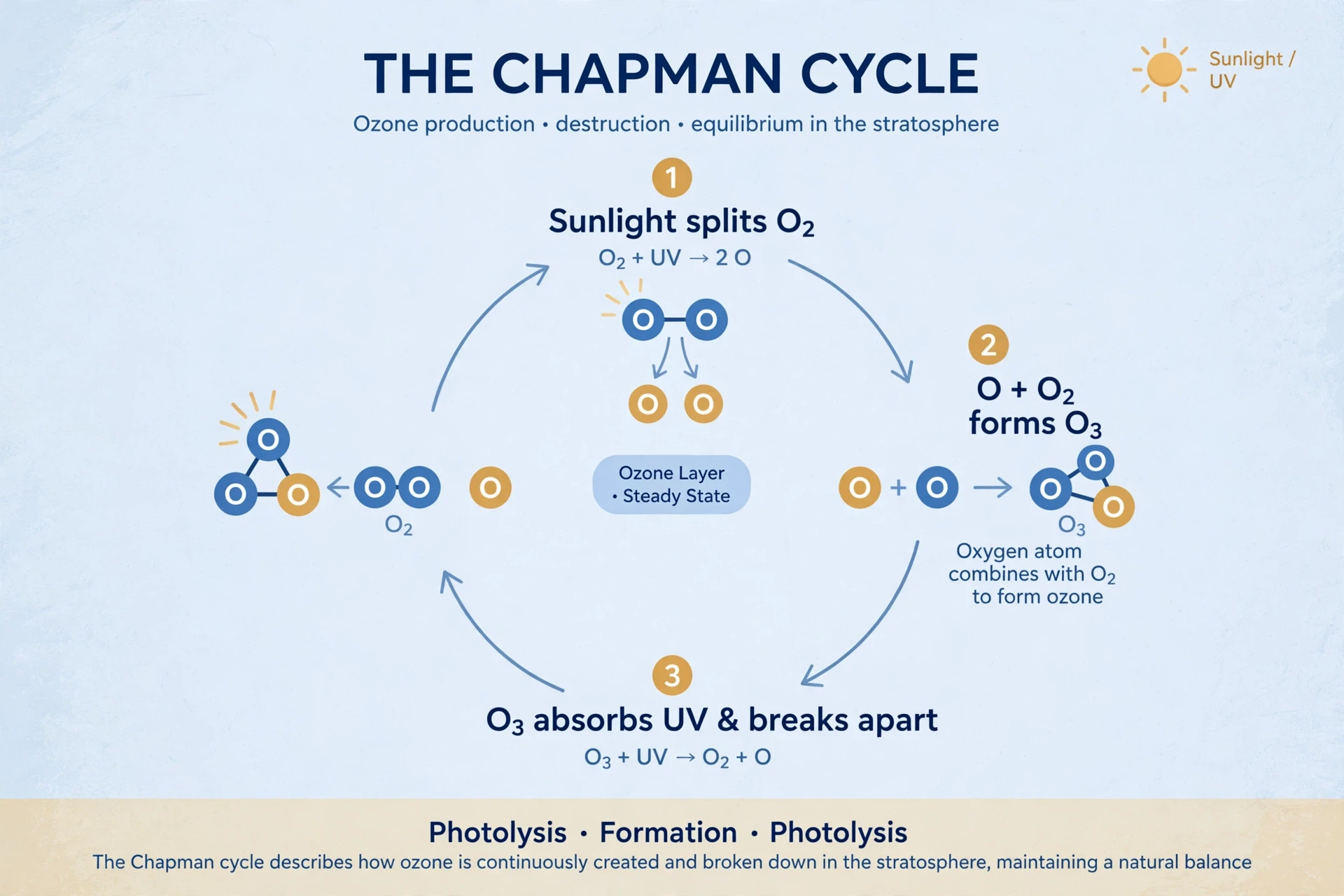
The chemistry of the ozone layer was worked out in 1930 by the British mathematician Sydney Chapman, and the cycle that carries his name is still the foundation of everything we know about it. The Chapman cycle is a loop of four reactions, driven by sunlight, and it is elegant enough that I have seen it silence a room full of students who expected atmospheric chemistry to be dull. It is a story of sunlight breaking things apart and the pieces finding each other again.
3.1 The Chapman cycle, step by step
It starts with ordinary oxygen, O2, floating in the stratosphere. A photon of ultraviolet light — carrying enough energy to break a chemical bond — strikes an oxygen molecule and splits it into two single oxygen atoms. Each of those atoms is now desperate for company. It quickly collides with another ordinary oxygen molecule, and the two join up to form ozone, O3. That is the creation half of the cycle: sunlight splits oxygen, and the fragments reassemble as ozone.
The destruction half is the mirror image. An ozone molecule absorbs a photon of ultraviolet light. The energy breaks it apart into an oxygen molecule and a single oxygen atom. That atom can then join another oxygen molecule to make a new ozone molecule, or it can collide with an ozone molecule and turn both of them back into ordinary oxygen. Either way, the cycle continues. Ozone is made, ozone is broken, ozone is made again — a loop that has run for hundreds of millions of years, powered by nothing but sunlight and oxygen.
The Sun is the engine of the whole process, and the kind of light it sends matters enormously. Only ultraviolet light carries enough energy to split an oxygen molecule, so the cycle depends on the Sun's ultraviolet output. How the Sun Works explains where that light comes from and why the Sun pours out so much energy in the first place. The short version is that the Sun is a nuclear furnace whose light spans the whole spectrum, and the ozone layer lives on the ultraviolet slice of it.
3.2 A natural balance — and how easily it tips
Left alone, the Chapman cycle settles into a balance. Ozone is created at roughly the same rate it is destroyed, so the amount in the stratosphere stays steady. But the balance is not exact, and it never sits still. It shifts with the seasons, with latitude, and with the Sun's own cycles. Ozone is naturally thinner over the tropics and thicker over the poles in some seasons, thinner in autumn and thicker in spring. Satellites have watched these patterns for decades, and the natural variation is large — which is one reason it took scientists a while to be sure that the thinning they saw over Antarctica was not just a natural swing.
The balance also has natural disruptors. Volcanic eruptions can throw particles into the stratosphere that speed up ozone destruction for a year or two. Solar storms can do the same. But nature's disruptions are temporary, and the cycle recovers. What humans added was different: chemicals that do not break down quickly, that drift up into the stratosphere and stay there for decades, destroying ozone thousands of times more efficiently than anything in the natural cycle. The Chapman cycle can handle a lot. It could not handle that.
There is a useful way to think about it. The ozone layer is like a bank account where sunlight makes the deposits and ultraviolet light makes the withdrawals, and the balance has been roughly steady for a very long time. Chlorofluorocarbons were a thief with a copy of the key, quietly emptying the account while the deposits kept coming in. The account did not empty overnight. It drained slowly, year after year, until someone looked at the balance and realised how much was gone.
4. How the Ozone Layer Shields Life from UV Radiation
Sunlight is not one thing. It is a spectrum, and the part that worries biologists is ultraviolet radiation — light with wavelengths shorter than visible light, carrying more energy per photon than the light our eyes can see. The ozone layer's job is to filter that radiation, and it is very good at it. It absorbs almost all of the most dangerous ultraviolet light and a large share of the rest, letting through only the milder portion. Life on land evolved under that filter. Without it, the rules of life on the surface would be different, and harsher.
4.1 UVA, UVB, and UVC — three kinds of ultraviolet light
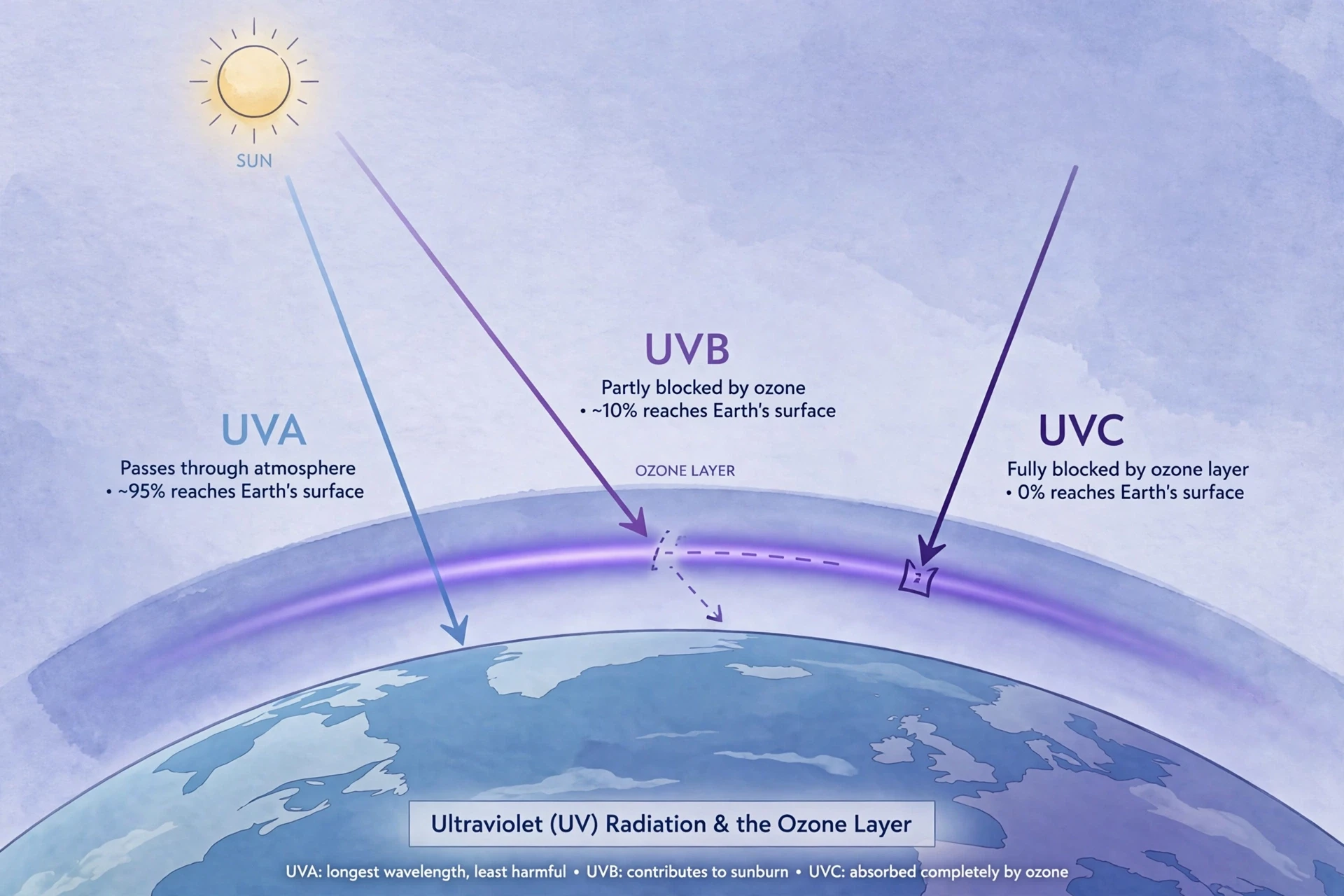
Ultraviolet light comes in three bands, and the ozone layer treats each one differently. UVC is the shortest wavelength and the most energetic — the most dangerous of the three. The ozone layer absorbs essentially all of it. None reaches the ground in meaningful amounts, and that is a mercy, because UVC is the kind of light used to sterilise hospital equipment. It damages DNA directly and efficiently. UVB is the middle band. It is the one that causes sunburn, damages the eyes, and drives most skin cancers. The ozone layer absorbs most of it — roughly 90 percent or more — but some gets through, which is why you can still burn on a sunny day. UVA is the longest wavelength and the least energetic. It passes through the ozone layer almost untouched, and it is the main cause of skin ageing and tanning.
The table below summarises the three bands and what the ozone layer does with each of them.
UV band | Wavelength (nanometres) | What the ozone layer does | Main effect on us |
|---|---|---|---|
UVC | 100–280 | Absorbs essentially all of it | Would damage DNA severely if it reached the ground |
UVB | 280–315 | Absorbs most of it, some gets through | Sunburn, eye damage, most skin cancers |
UVA | 315–400 | Passes through almost untouched | Skin ageing, tanning, some eye damage |
Read that table again and the design of the shield becomes clear. The ozone layer is tuned, by the physics of the ozone molecule, to absorb exactly the wavelengths that do the most damage. It is not a general sunscreen. It is a filter with a sharp edge, and the edge falls in exactly the right place. That is not design — it is chemistry — but it is the reason complex life could move onto land in the first place. Before the ozone layer built up, hundreds of millions of years ago, life stayed in the oceans, where water provided the shielding. The ozone layer let life come ashore.
4.2 What ultraviolet light does to living things
Ultraviolet light damages living tissue because its photons carry enough energy to break chemical bonds — including the bonds in DNA. A UVB photon striking a skin cell can fuse two neighbouring DNA bases together, creating a lesion that the cell must repair. Most of the time, repair works. Sometimes it does not, and the error is copied when the cell divides. Do that often enough, over enough years, and the risk of skin cancer climbs. This is not a theoretical risk. Skin cancer is the most common cancer in many countries, and ultraviolet exposure is its main driver. The ozone layer does not eliminate that risk — UVB still gets through — but it keeps the dose far lower than it would otherwise be.
Eyes are vulnerable too. The cornea and lens absorb UVB, and over time the damage accumulates into cataracts, the clouding of the lens that is a leading cause of blindness worldwide. A thinner ozone layer would mean more cataracts, more quickly, in more people. And the damage is not limited to humans. Ultraviolet light harms the plankton that form the base of the ocean food web, damages the leaves of crops, and suppresses the immune systems of animals. Phytoplankton — the microscopic plants that produce much of the oxygen we breathe — live near the ocean surface, exactly where ultraviolet light penetrates. Raise the UV dose, and their growth slows. That is not a small side effect. It is a threat to the food web and to the oxygen supply at the same time.
I learned how seriously biologists take this during a long conversation with a marine researcher who studied plankton under different ultraviolet levels. She described holding a sample of seawater up to the light and watching the tiny organisms inside it, knowing that a small change in the sky above them could decide whether they thrived or died. It stayed with me because it made the ozone layer concrete: it is not an abstract shield. It is the reason the ocean surface is habitable, and the reason the food on your plate exists.
The ozone layer is the only sunscreen the whole planet shares. We did not build it, we cannot replace it, and for a while we were quietly destroying it without noticing.
4.3 Why a little thinning matters a lot
A small percentage drop in ozone produces a larger percentage rise in UVB at the ground, because the relationship is not one-to-one. Roughly speaking, a 1 percent decrease in ozone leads to about a 2 percent increase in the UVB that causes sunburn. That multiplier is why scientists were alarmed by changes that sounded small. A 5 percent thinning of the ozone layer is not a 5 percent problem. It is a 10 percent rise in burning ultraviolet light, spread across the whole planet, every day, for as long as the thinning lasts.
That is also why the ozone hole over Antarctica mattered even though few people live there. The hole was not just a local event. It was proof that human chemicals could destroy ozone on a massive scale, and a warning that the same chemistry could spread. The Antarctic hole was the canary. The question was whether the rest of the sky would follow.
5. How CFCs Tore a Hole in the Sky
The chemicals that damaged the ozone layer were not invented by villains. They were invented by a clever chemist trying to solve a real problem, and they were celebrated as a triumph. That is part of what makes this story worth telling carefully. The damage was done by a product that worked beautifully, was cheap, and seemed safe — and the harm it caused was invisible, slow, and far away from the people using it.
5.1 The wonder chemical
In the late 1920s, refrigeration was dangerous. The chemicals used as refrigerants — ammonia, methyl chloride, sulphur dioxide — were toxic or flammable, and leaking fridges killed people. The chemist Thomas Midgley Jr. was asked to find something safer, and he came up with chlorofluorocarbons, or CFCs: compounds of carbon, chlorine, and fluorine that were non-toxic, non-flammable, and chemically unreactive. They seemed perfect. Within a few decades, CFCs were everywhere — in fridges and air conditioners, in aerosol spray cans, in foam insulation, in solvents for cleaning electronics. By the 1970s, the world was producing hundreds of thousands of tonnes of them every year.
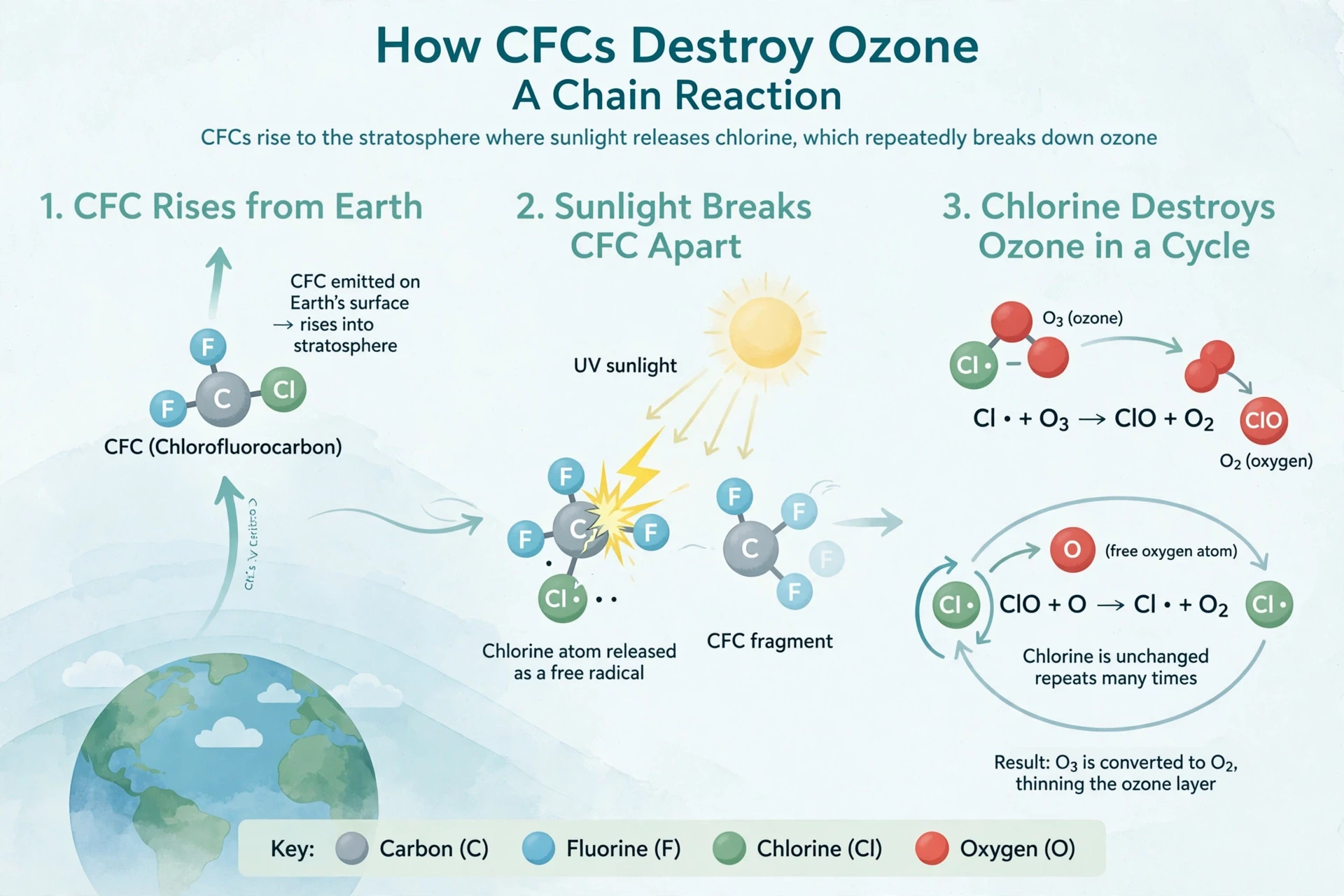
Their very safety was the problem. Because CFCs do not react with anything at ground level, they do not break down in the lower atmosphere. Rain does not wash them out. They simply drift, slowly, upward, over years and decades, until they reach the stratosphere. And there, high above the ozone layer, they meet the one thing that can break them apart: intense ultraviolet light. A UV photon splits a CFC molecule and frees a chlorine atom. That chlorine atom is the thief in the story.
A single chlorine atom can destroy an enormous number of ozone molecules — on the order of a hundred thousand — because it works as a catalyst. It reacts with an ozone molecule, steals one of its oxygen atoms to form chlorine monoxide, and leaves behind an ordinary oxygen molecule. Then the chlorine monoxide meets a free oxygen atom, hands the oxygen back, and the chlorine atom is freed again, ready to destroy another ozone molecule. The chlorine is not used up. It goes around and around, destroying ozone thousands of times before it is finally removed from the stratosphere. That is why a relatively small amount of CFCs could do so much damage. It was never about the quantity of the chemical. It was about the multiplier.
5.2 The discovery of the ozone hole
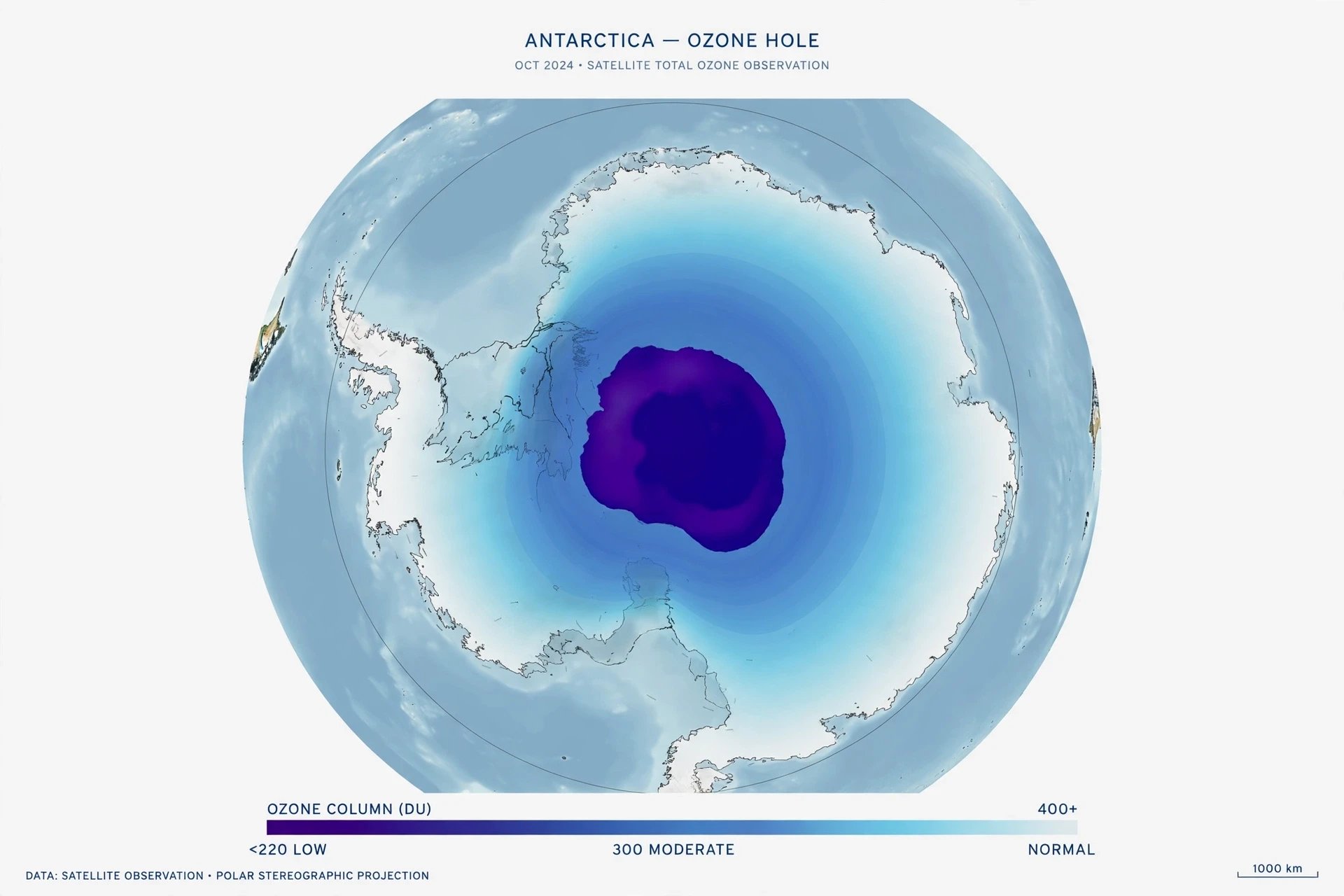
In 1985, scientists at the British Antarctic Survey published a result that stunned the world: each spring, the ozone above Antarctica was collapsing. Measurements taken at the Halley Bay research station showed that October ozone levels had fallen by roughly a third since the 1970s, and the drop was getting worse every year. The finding was so dramatic that the researchers first suspected their instruments were broken. They were not. Satellites, rechecked after the announcement, showed the same thing: a vast region of depleted ozone spreading over Antarctica each spring, an area that would grow to cover tens of millions of square kilometres — larger than the continent itself.
The discovery was shocking partly because it was unexpected. Scientists had warned since the 1970s that CFCs could thin the ozone layer, and the chemists Mario Molina and Sherwood Rowland had laid out the mechanism in 1974. But the models predicted a slow, gradual thinning spread around the globe. Nobody predicted a hole — a sudden, deep, seasonal collapse over one pole. The models had missed something, and the missing piece was the special chemistry of the Antarctic winter.
It turned out that the extreme cold of the Antarctic stratosphere creates clouds — polar stratospheric clouds — that do not exist anywhere else. On the surfaces of the tiny ice particles in those clouds, harmless chlorine compounds are converted into reactive forms. All winter, while Antarctica sits in darkness, these reactive chlorine compounds build up, trapped inside a swirling vortex of winds that circles the pole. Then spring arrives, sunlight returns, and the trapped chlorine is released in a burst. In a matter of weeks, it destroys a huge fraction of the ozone above the continent. By summer, the vortex breaks up, the chlorine disperses, and ozone flows back in from lower latitudes. The hole closes — until the next spring, when it opens again.
That seasonal rhythm is why the hole is worst in October, the Antarctic spring, and why it is centred on the South Pole rather than spread evenly around the world. The Arctic has a weaker vortex and a warmer stratosphere, so it gets less of this chemistry, though it has seen serious ozone losses in some cold winters too. The Antarctic hole was the extreme case, and it was extreme enough to be unmistakable.
5.3 Why the hole scared the world
The ozone hole scared people for a reason that went beyond Antarctica. If human chemicals could carve a hole that size in the ozone layer over one pole, what was stopping them from thinning the layer everywhere? The answer, it turned out, was nothing. Measurements soon showed that ozone was also declining over populated latitudes, more slowly but steadily. The Antarctic hole was the loudest alarm, but the quieter global thinning was the larger threat, because it affected the places where people actually live.
The other frightening thing was the timescale. CFCs linger in the atmosphere for decades — some types for a century or more. Even if the world stopped making them immediately, the CFCs already released would keep drifting upward and destroying ozone for years to come. The damage was already locked in, and it would get worse before it got better. That is a hard message to deliver to politicians and the public: we have stopped the harm, and things will still get worse for a while. But it was the truth, and it is part of why the response that followed matters so much. People were asked to act on a problem whose worst effects were still in the future, and they did.
There is a detail from this period that I think about often. When the ozone hole was announced, the satellite data showing it had actually been sitting in NASA's computers for years. The software that processed the satellite measurements had been programmed to discard very low ozone readings as errors — because, before the hole, such low readings were thought to be impossible. The data was there. The instruments had seen it. The system had thrown it away because it did not fit what anyone expected. It is a humbling reminder: instruments only show us what we ask them to show, and sometimes the most important discoveries are hiding in the readings we dismiss.
When the ozone hole was found, the evidence had been sitting in NASA's computers for years — the software had been discarding very low ozone readings as errors, because no one believed they were possible.
6. The Montreal Protocol: The Treaty That Worked
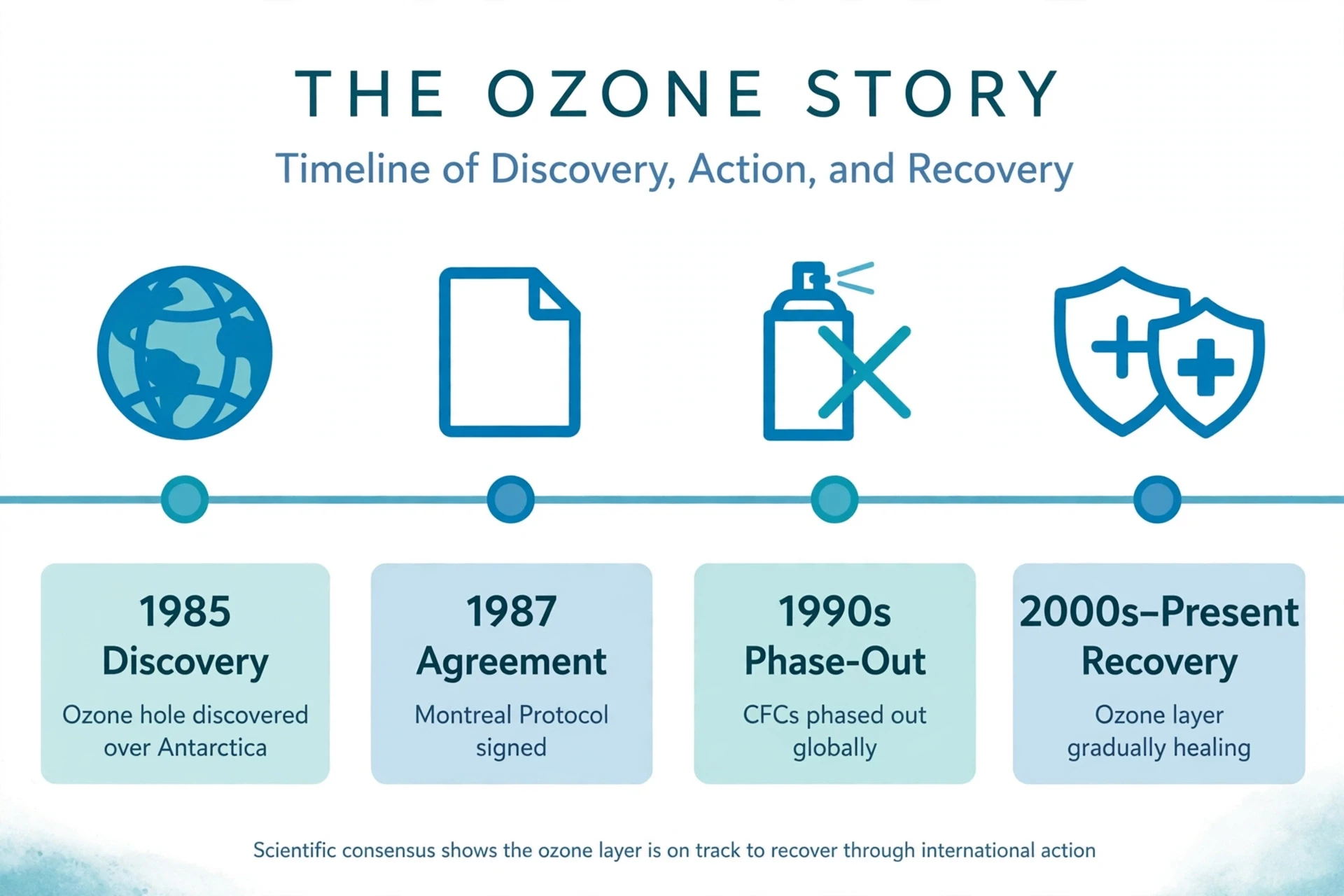
The response to the ozone hole is the closest thing environmental policy has to a fairy-tale ending — except that it actually happened. In 1987, two years after the hole was discovered, 24 countries signed the Montreal Protocol, an international treaty to phase out the production of ozone-depleting chemicals. Today, the treaty has been ratified by every country in the world. It is the only United Nations treaty with universal membership. And it worked.
6.1 From alarm to agreement
The path from discovery to treaty was fast by the standards of international diplomacy, and it was not smooth. Chemical companies argued that the science was uncertain and that alternatives would be expensive. Some governments worried about the cost to their industries. But three things pushed the agreement through. First, the science was unusually clear: the mechanism was understood, the measurements were dramatic, and the researchers who had warned about CFCs had been proven right in the most visible way possible. Second, the damage was easy to picture. A hole in the sky is a powerful image, and it needed no translation. Third, alternatives existed. Chemists had already developed replacement chemicals that did the same jobs without destroying ozone, and the industry could see a way forward.
The treaty was designed cleverly. It did not ban CFCs overnight. It set a schedule: production would be frozen, then cut in stages, then eliminated, with different timetables for rich and poor countries, and a fund to help developing nations switch to alternatives. The schedule was tightened several times as the science got worse — and then, as the evidence of recovery grew, the treaty was extended to cover new chemicals, including some replacements that turned out to harm the climate. That flexibility is a large part of why it worked. The treaty was written to be updated as the science changed, and it was.
6.2 What the treaty actually did
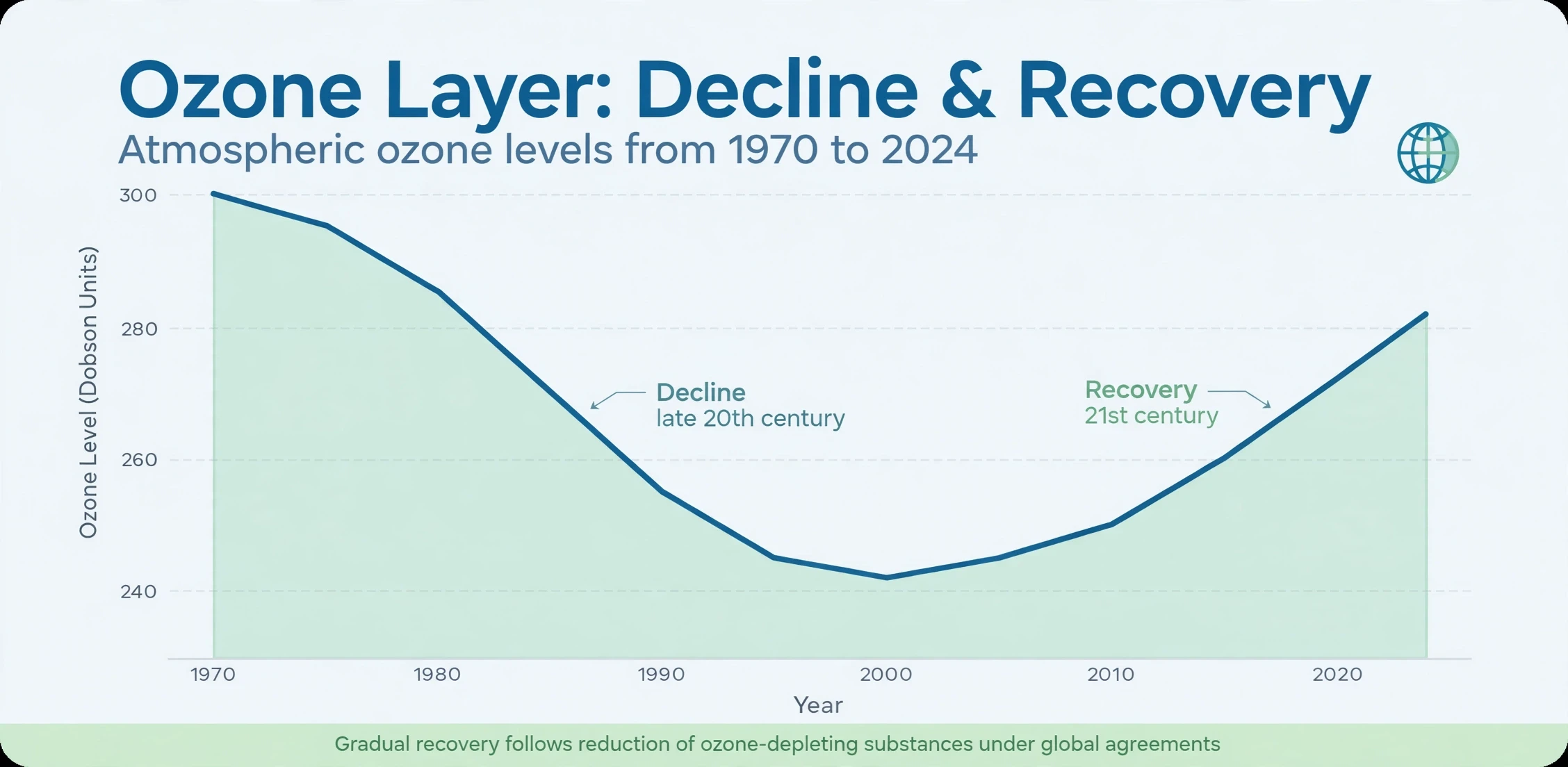
The numbers tell the story plainly. Global production of CFCs, which had been running at more than a million tonnes a year, fell to almost nothing within a couple of decades. Atmospheric concentrations of the main ozone-depleting chemicals peaked in the 1990s and have been falling ever since. The chlorine loading in the stratosphere — the total amount of ozone-destroying chlorine up there — has dropped substantially from its peak. And the ozone layer has begun to recover.
The table below gives the milestones that carried the world from discovery to recovery.
Year | Milestone | What it meant |
|---|---|---|
1974 | Molina and Rowland warn that CFCs can destroy stratospheric ozone | The mechanism is published; the threat is named |
1985 | British Antarctic Survey reports the ozone hole | The damage is measured and impossible to ignore |
1987 | Montreal Protocol signed | Countries agree to phase out ozone-depleting chemicals |
1996 | CFC production ends in developed countries | The main source of new chlorine is switched off |
2010s | Stratospheric chlorine begins falling steadily | The chemical pressure on the ozone layer eases |
2016 | Kigali Amendment targets HFC replacements | The treaty extends to chemicals that warm the climate |
2020s | First signs of ozone recovery confirmed | The layer begins to heal, decades after the damage |
It is worth pausing on one fact: the treaty was signed before the full scale of the damage was understood, and it was strengthened repeatedly as new evidence arrived. That is the opposite of how most environmental policy works, where action waits for certainty and certainty arrives too late. The Montreal Protocol acted on a warning, and the warning turned out to be right. The United Nations Environment Programme's Ozone Secretariat, which administers the treaty, publishes the ongoing record of that work at ozone.unep.org, and the story it tells is one of steady, unspectacular, effective cooperation — the kind that rarely makes headlines precisely because it works.
6.3 Why it worked when so much else has not
People often ask why the Montreal Protocol succeeded while other environmental agreements have struggled, and the honest answer is that it had several advantages. The number of companies making CFCs was small, so the industry was easy to regulate. The alternatives were available and affordable. The science was clear and the damage was visible. The costs of action were modest and the costs of inaction were terrifying. And the treaty was designed with flexibility and fairness built in — richer countries moved first and helped pay for poorer countries to follow.
But there is a simpler answer too, and it is the one I give when students ask. The ozone hole was a problem with a single cause, a single culprit, and a single fix. There was no debate about whether the problem was real, because anyone could look at the satellite maps. There was no argument about who was responsible, because the chemistry pointed at one family of chemicals. And there was no mystery about the solution, because the solution was to stop making those chemicals. Climate change is harder on every one of those counts — many causes, many culprits, no single fix. The Montreal Protocol is proof that the world can act. It is not proof that the world will act on every problem. That distinction matters, and it is the subject of section 8.
7. Recovery: What the Future Holds
The ozone layer is healing. That sentence would have sounded like wishful thinking in the 1990s, when the hole was still growing and the chlorine in the stratosphere was still climbing. Today it is a measured fact. Satellite and ground-based observations, compiled by NASA's Ozone Watch programme and other monitoring networks, show that ozone levels over most of the planet have stopped falling and have started to rise again. The recovery is slow — a fraction of a percent per year — but it is real, and it is heading in the right direction. You can follow the latest measurements yourself at NASA Ozone Watch, which publishes current ozone maps and hole statistics through every Antarctic spring.
7.1 The signs of healing
The clearest evidence comes from the upper stratosphere, where ozone has been increasing steadily since the late 1990s. The Antarctic ozone hole itself is shrinking more slowly, because the hole is driven by the extreme cold and the trapped chlorine that lingers longest over the pole. But even there, the trend is improving: the hole's size and depth have stabilised, and in years when the stratosphere is warmer than usual, the hole is noticeably smaller. Scientists estimate that if the world stays on course, the ozone layer over most of the planet will return to its 1980 levels around the middle of this century, and the Antarctic hole will close in the decades after that. The World Meteorological Organization tracks these projections in its regular assessments, and its ozone pages at wmo.int are a good place to see how the outlook is updated as new data arrives.
It is important to be honest about what "recovery" means. The ozone layer will not return to some pristine state it had before humans existed, because the atmosphere has changed in other ways since then. Greenhouse gases are cooling the stratosphere, which changes ozone chemistry in complex ways — cooling the upper stratosphere actually helps ozone recover there, while cooling the polar stratosphere can make ozone loss worse in cold winters. The layer of the future will be a little different from the layer of the past. But the direction of travel is clear, and the gap between where we are and where we were is closing year by year.
The ozone layer is healing — slowly, measurably, and because the world chose to act. It is the rarest kind of environmental news: a problem found, a cause identified, a fix agreed, and a recovery under way.
7.2 What could still go wrong
Recovery is not guaranteed, and there are real risks. One is illegal production. In 2018, atmospheric monitoring detected unexpected emissions of a banned CFC, CFC-11, coming from unreported production. The emissions were traced, the source was addressed, and the emissions fell again — but the episode showed that the treaty needs constant policing. A second risk is new chemicals. As industries replace old substances, some of the replacements turn out to have their own ozone-depleting or climate-warming effects, and each one has to be assessed and, if necessary, regulated. The Kigali Amendment of 2016 did exactly that for HFCs, the main CFC replacements, which do not harm ozone but are powerful greenhouse gases.
A third risk is the climate itself. As greenhouse gases warm the lower atmosphere, they cool the stratosphere, and a colder polar stratosphere can mean more polar stratospheric clouds, more chlorine activation, and deeper ozone loss in cold winters. The interaction runs both ways: ozone recovery itself affects climate, because ozone is also a greenhouse gas, and changes in ozone change how heat moves through the atmosphere. The two problems are tangled together, which is why the next section matters.
And then there is the risk that people forget. The ozone hole no longer dominates the news, and that is a success — but it is also a danger, because the treaty only works if countries keep complying, keep monitoring, and keep funding the science that watches the sky. The ozone layer is healing because the world paid attention. It will keep healing only if the world keeps paying attention.
8. Ozone and Climate Change: Two Problems, One Sky
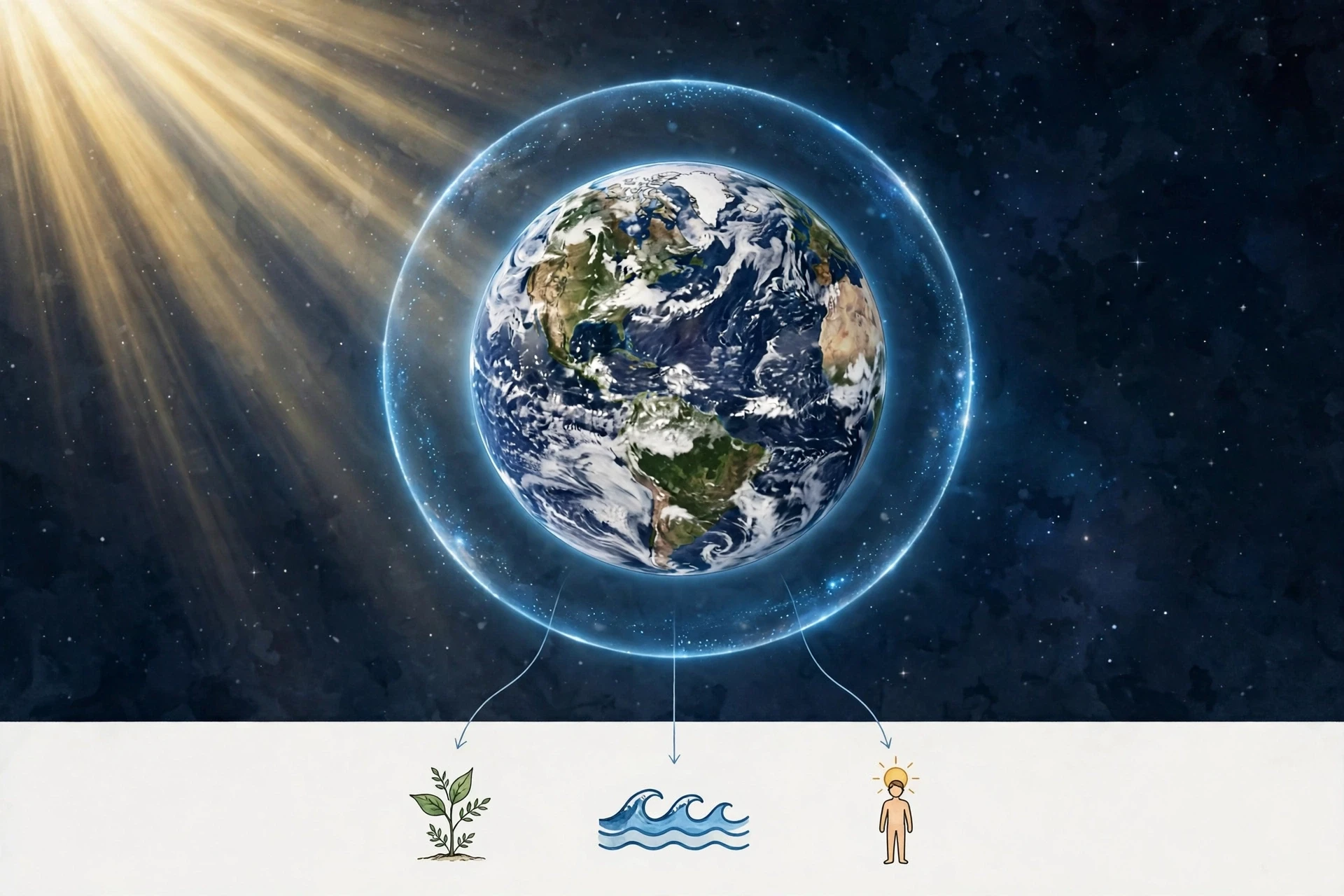
The ozone hole and climate change are often confused with each other, and the confusion is understandable — both involve the atmosphere, both involve human chemicals, and both were discovered in the same era. But they are different problems, with different causes and different solutions, and mixing them up leads to bad decisions. Understanding how they relate, and how they do not, is one of the most useful things this article can do.
The first difference is the cause. Climate change is driven mainly by carbon dioxide and other greenhouse gases, which trap heat in the lower atmosphere. Ozone depletion was driven mainly by CFCs, which destroy ozone in the stratosphere. The second difference is the mechanism. Greenhouse gases warm the planet by absorbing infrared radiation. Ozone depletion harms life by letting more ultraviolet radiation through. The third difference is the timescale of the fix. The Montreal Protocol cut CFC production within a decade. Cutting carbon dioxide means transforming the world's energy systems, which takes far longer.
But the two problems are connected in ways that matter. Many ozone-depleting chemicals are also powerful greenhouse gases — a single CFC molecule can warm the planet thousands of times more effectively than a molecule of carbon dioxide. So the Montreal Protocol, by phasing out CFCs, also prevented a large amount of warming. Researchers estimate that without the treaty, the world would be noticeably hotter today. The Kigali Amendment extended that benefit by phasing down HFCs, the replacements that warm the climate without harming ozone. In that sense, the ozone treaty has been a climate treaty too, and one of the most effective ones ever signed.
The connection runs the other way as well. Climate change alters the stratosphere, and the stratosphere affects ozone. A warming lower atmosphere cools the upper atmosphere, and that cooling changes ozone chemistry. In the upper stratosphere, cooling speeds up ozone recovery. In the polar stratosphere, cooling can deepen ozone loss during cold winters. The net effect is complicated and still being studied, and it is one more reason why monitoring matters. For a clear account of how greenhouse gases are warming the planet, see Climate Change Explained, which covers the causes, the evidence, and the outlook in the same style as this article.
9. Common Misconceptions About the Ozone Layer
Few topics in science carry as many half-remembered ideas as the ozone layer. Most people learned about it once, years ago, and the details have blurred since. Here are the misunderstandings I hear most often, and what the evidence actually says.
Misconception 1: The ozone hole causes global warming. Most people assume the ozone hole and global warming are the same problem, or that the hole lets in extra heat. What we actually see in the data is two separate problems. The ozone hole lets in extra ultraviolet light, not extra heat. Global warming is caused by greenhouse gases trapping infrared radiation. The two are linked — CFCs are also greenhouse gases, and the Montreal Protocol helped the climate — but the hole itself is not the cause of warming. Fixing the ozone layer did not fix climate change, and fixing climate change will not, by itself, heal the ozone layer.
Misconception 2: The ozone hole is a hole in the sky you could fall through. There is no actual hole, and no empty space. The "hole" is a region where ozone levels drop sharply — from about 300 Dobson units to below 100 — but the air is still there, and ozone is still present. It is a thinning, not a gap. The word "hole" is a metaphor that stuck because satellite maps colour the depleted region dark purple, and it looks like a hole. A better image is a worn patch in a fabric: the cloth is still there, but it is thin, and more light gets through.
Misconception 3: The ozone layer is fixed now, so the problem is over. Recovery is under way, but it is not complete. The Antarctic hole still opens every spring, and full recovery will take decades. The treaty needs to be enforced, new chemicals need to be watched, and the monitoring networks need to keep running. The problem is on its way to being solved, which is not the same as solved.
Misconception 4: Ozone depletion is caused by air pollution in general. Ordinary air pollution — car exhaust, smoke, smog — does not destroy the ozone layer. Ground-level pollution creates ozone rather than destroying it, and it stays in the lower atmosphere. The chemicals that damaged the stratosphere were a specific family of long-lived compounds, mainly CFCs and related halons, that could survive the journey upward. Cleaning up smog is important for health, but it is a different job from protecting the ozone layer.
Misconception 5: Sunscreen replaces the ozone layer. Sunscreen protects your skin. It does nothing for the plankton in the ocean, the crops in the fields, or the forests that absorb carbon dioxide. The ozone layer protects whole ecosystems at once, in a way no personal product can. Individual protection and planetary protection are both useful, but they are not substitutes for each other.
Misconception 6: The ozone layer is thickest where the Sun is strongest. It is a reasonable guess, and it is wrong. Ozone is thinnest over the tropics, where the Sun is strongest, and thicker toward the poles. That is because ozone is made in the tropics, where sunlight is most intense, and then carried toward the poles by winds in the stratosphere. The layer is thickest where the air piles up, not where it is made. It is a reminder that the atmosphere is a moving system, and that where a gas ends up depends on the winds as much as on the chemistry.
10. What You Can Do
The ozone story is unusual because the main fix was already made — by governments, through a treaty, before most people reading this were born. That does not mean there is nothing left for individuals to do. It means the actions that matter now are about keeping the fix in place and not creating new problems.
Keep old appliances out of the scrap heap. Old fridges, freezers, and air conditioners may still contain CFCs or related chemicals. If they are dumped or broken open, those chemicals escape. Use proper disposal and recycling services, and ask what happens to the refrigerant when an old unit is collected.
Check what you buy. Some products in some countries still use ozone-depleting substances, particularly in foam insulation and older equipment. Look for labels and standards, and prefer products that state they are free of CFCs and halons.
Support the monitoring. The science that watches the ozone layer is publicly funded, and it is cheap compared with the damage it prevents. The agencies that run it — NASA, NOAA, and their counterparts around the world — publish their data openly. NOAA and NASA's Earth science pages both carry current ozone information, and the more people who read it, the harder it is to ignore.
Protect yourself from the UV that still gets through. The ozone layer blocks most UVB, but not all of it. Sunscreen, hats, sunglasses, and shade are still sensible on bright days, especially near midday and at high altitude. The US Environmental Protection Agency's basic guide to ozone science explains the connection between the layer and the UV index in plain language at epa.gov.
Tell the story. The Montreal Protocol worked because the public understood the problem and demanded action. The next planetary problem will need the same thing. The most useful thing you can do with the ozone story is to remember it the next time someone says that international cooperation never works, or that a global environmental problem cannot be solved. It can. It was. The proof is above your head right now.
Frequently Asked Questions
What is the ozone layer in simple terms?
The ozone layer is a band of ozone gas in the stratosphere, roughly 15 to 30 kilometres above the ground, that absorbs most of the Sun's harmful ultraviolet radiation before it reaches the surface. It is not a solid shell. It is a region where ozone is more concentrated than elsewhere, held in place by a constant cycle of creation and destruction driven by sunlight.
Where is the ozone layer located?
The ozone layer sits in the stratosphere, the second layer of Earth's atmosphere, above the weather and above the cruising altitude of passenger jets. It is most concentrated between about 15 and 25 kilometres up, and it thins out gradually above and below that band. There is no sharp edge to it — it fades in and out like the colour of the sky.
What causes the ozone hole?
The ozone hole is caused by chlorine and bromine released from human-made chemicals, mainly chlorofluorocarbons (CFCs) and halons. These chemicals drift up to the stratosphere, where sunlight breaks them apart and frees chlorine atoms. Each chlorine atom can destroy tens of thousands of ozone molecules. Over Antarctica, the extreme cold creates special clouds that supercharge this chemistry each spring, producing the deep seasonal depletion we call the ozone hole.
Is the ozone layer recovering?
Yes. Ozone levels over most of the planet have stopped falling and have begun to rise, and the chlorine in the stratosphere is declining. Scientists expect the ozone layer to return to its 1980 levels around the middle of this century in most regions, with the Antarctic hole closing later. The recovery is slow, because CFCs linger in the atmosphere for decades, but the direction is clear and the measurements confirm it year after year.
What is the difference between the ozone hole and global warming?
They are different problems with different causes. The ozone hole is a loss of ozone in the stratosphere caused by CFCs, and it lets more ultraviolet light reach the ground. Global warming is a rise in the temperature of the lower atmosphere caused mainly by carbon dioxide and other greenhouse gases trapping heat. The two are linked — CFCs are also greenhouse gases, so phasing them out helped the climate — but fixing one does not fix the other.
Can the ozone layer be repaired by humans?
Not directly. Nobody can spray ozone into the stratosphere and rebuild the layer by hand. The repair works by removing the cause: stop producing the chemicals that destroy ozone, and the natural cycle of creation and destruction restores the balance on its own. That is what the Montreal Protocol did, and it is why the recovery is happening. The layer heals itself, once we stop harming it.
How does the ozone layer protect us from UV radiation?
Ozone molecules absorb ultraviolet light and turn its energy into heat. The layer absorbs almost all UVC, the most dangerous band, and most UVB, the band that causes sunburn and skin cancer. Without it, far more UVB would reach the ground, and rates of skin cancer, cataracts, and damage to crops and ocean plankton would rise sharply. A small thinning of the layer produces a larger rise in UVB at the surface, which is why even modest ozone loss matters.