

The stone I tripped over on a beach when I was nine looked like nothing at all. Grey, speckled, cold, a little heavier than I expected. I put it in my pocket anyway, and by the time I got home I had decided it was the most interesting thing I owned. I did not know it then, but that pebble was the start of a lifelong question: how rocks form. Years later I learned that unremarkable pebble was granite, and that it had begun its life as molten rock kilometres underground, cooling so slowly that its crystals had time to grow large enough to see. That pebble had travelled further, and waited longer, than anything else I had ever held. Learning how rocks form changed the way I walk through the world. A kerb stone, a cliff face, a kitchen worktop — each one is a record of heat, water, pressure and time, and once you know how to read that record, ordinary ground starts telling stories.
The question sounds simple — how rocks form — and the answer turns out to be one of the most satisfying stories in science, because it connects volcanoes and rivers, deserts and deep burial, and stretches across millions of years. Rocks are not born in one way but in three, and those three ways are linked in a loop called the rock cycle. Molten rock cools into igneous rock. Igneous rock breaks down into sediment, and sediment hardens into sedimentary rock. Buried deep, either kind can be baked and squeezed into metamorphic rock, and if it gets hot enough it melts and the whole story starts again. Nothing in that loop is quick. The granite in a mountain may have cooled over millions of years. The sandstone in a canyon wall may be made of sand that was once part of a mountain range that no longer exists. The marble in a statue may have started life as the shells of sea creatures on an ancient ocean floor.
This guide follows that loop from start to finish. You will see how magma becomes granite and basalt, how rivers and seas build sandstone and limestone grain by grain, how heat and pressure remake old rocks into marble and slate, and how geologists tell one rock from another with a handful of simple tests. You will also meet some of the most famous rocks on Earth, from the striped walls of the Grand Canyon to the hexagonal columns of the Giant's Causeway. No background in geology is needed — only curiosity, and perhaps a pocket, in case you find a pebble worth keeping.
1. What Is a Rock, Really?
Before asking how rocks form, it helps to be clear about what a rock actually is. A rock is a naturally occurring solid made of one or more minerals, or sometimes of mineral-like material such as volcanic glass or coal. A mineral is a naturally occurring solid with a definite chemical composition and an ordered internal structure — quartz, feldspar and mica are minerals. A rock is an aggregate of minerals, the way a brick wall is an aggregate of bricks. Granite, for example, is a rock made mostly of the minerals quartz, feldspar and mica. Limestone is a rock made mostly of the mineral calcite. Some rocks, like obsidian, contain no crystals at all, and some, like coal, are made of the remains of plants rather than minerals. The definition is loose on purpose, because nature is messier than textbooks.
That messiness is part of the appeal. Rocks come in every colour and texture because they form in wildly different places: in the throat of a volcano, on the floor of a shallow sea, or ten kilometres underground where the pressure is crushing and the temperature is high enough to bake stone. The same chemical ingredients can produce completely different rocks depending on where they form. Melted rock that cools slowly underground becomes granite, with crystals you can see. The same melted rock erupted as lava becomes basalt, so fine-grained that its crystals are invisible to the naked eye. Place matters as much as ingredients.
Rocks also matter in ways that have nothing to do with geology exams. They build our cities — granite, sandstone and limestone have been used as building stone for thousands of years. They hold our history — fossils preserved in sedimentary rock are the main record of ancient life. They shape our landscapes and our hazards: the type of rock under a hillside decides whether it stands firm or slides, and the rocks beneath a city decide how strongly it shakes in an earthquake. Understanding how rocks form is not only about naming stones. It is about reading the ground we live on.
One more distinction is worth making early, because it causes endless confusion: rocks and minerals are not the same thing, and neither is a stone in the everyday sense. "Stone" is a word people use for any hard lump of rock, from a pebble to a boulder. Geologists rarely use it as a technical term. When you hear someone say a ring contains a "rock," they usually mean a mineral — a diamond. When a builder talks about stone, they mean rock cut for construction. Keep the two ideas apart — minerals are the ingredients, rocks are the finished dish — and the rest of this guide will be much easier to follow.
2. How Rocks Form: The Rock Cycle in Motion
If there is one idea to carry away from this article, it is the rock cycle. It is the framework that ties everything else together, and once you see it, the three rock types stop being three separate facts and become three chapters of a single story about how rocks form. The rock cycle describes how the three main types of rock — igneous, sedimentary and metamorphic — change into one another over geological time, driven by two great engines: Earth's internal heat, which moves material in the mantle and drives plate tectonics, and the surface cycle of water, ice and air, powered by the Sun. The Physical Geology textbook from the University of Saskatchewan describes it as a slow, constant transformation of the crust's rocks from one form to another, and stresses that it is driven by exactly those two forces.
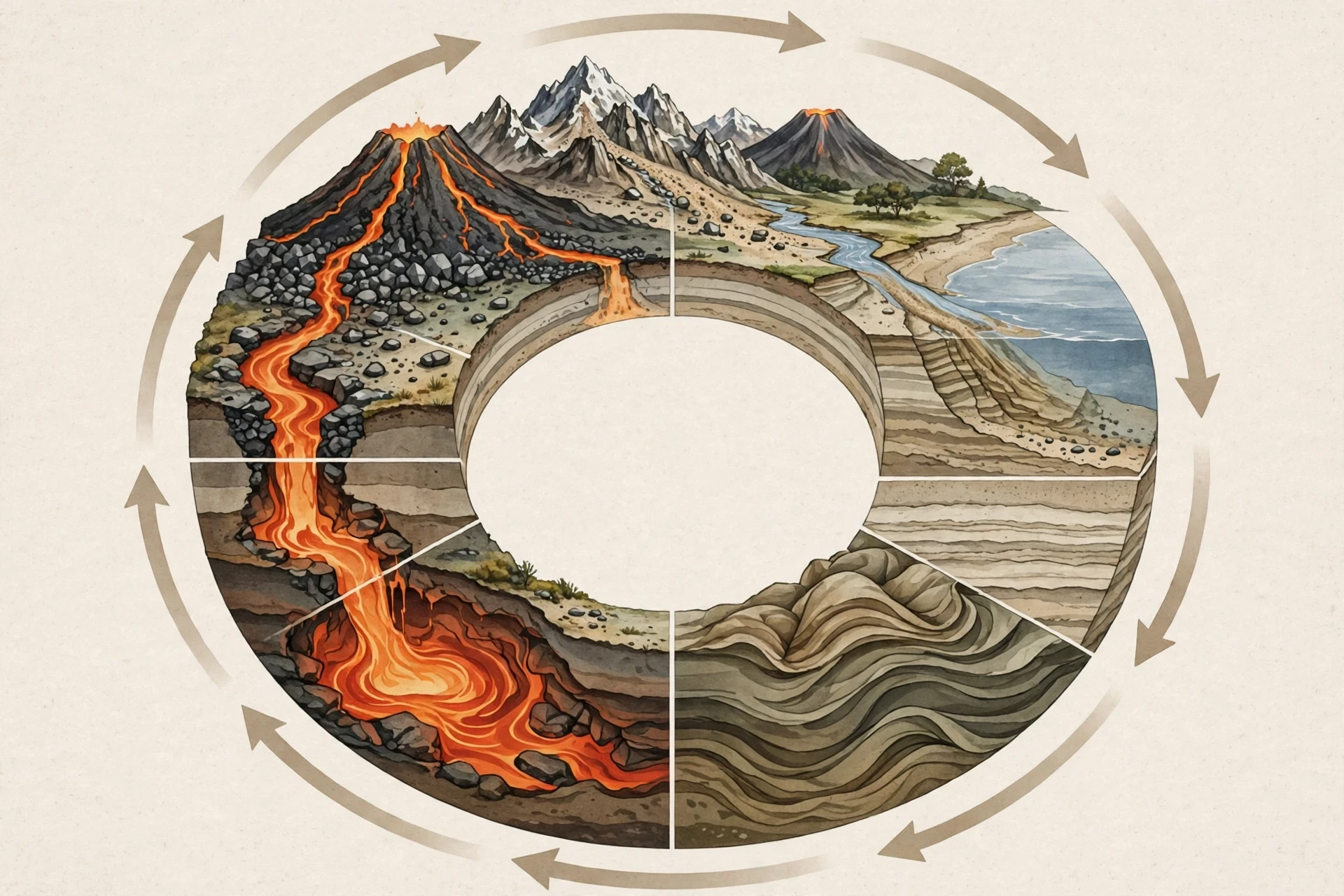
The most useful way to picture the cycle is to start with magma, the melted rock beneath Earth's surface. Rock melts at temperatures roughly between 800 °C and 1,300 °C, depending on its minerals and the pressure it is under. When magma cools slowly deep underground, over centuries to millions of years, it forms intrusive igneous rock. When magma erupts onto the surface it is called lava, and it cools quickly — within seconds to years — to form extrusive igneous rock. Either way, new rock has been born from melt.
2.1 From solid rock to sediment
Once igneous rock (or any rock) reaches the surface, the second engine takes over. Weathering — the breakdown of rock by water, ice, wind, temperature changes and living things — attacks it. Rainwater, slightly acidic from dissolved carbon dioxide, eats away at minerals. Water seeps into cracks, freezes, expands and wedges the rock apart. Tree roots do the same work more slowly. The broken fragments are eroded, carried away by rivers, glaciers and wind, and eventually deposited as sediment in stream channels, lakes, deserts and the ocean. The U.S. National Park Service puts it plainly: sedimentary rocks are made when sand, mud and pebbles are laid down in layers, and the rock cycle is a long, slow journey in which rocks move through the cycle in different ways.
2.2 From sediment to stone, and stone to something new
Buried under more and more sediment, the loose grains are squeezed together. At depths of hundreds of metres or more, they are compressed, and mineral crystals grow between the particles, cementing them into solid sedimentary rock. But the story does not stop there. Rocks buried very deeply reach pressures and temperatures far higher than those at which sedimentary rocks form, and under those conditions they are transformed — stretched, folded, recrystallized — into metamorphic rocks. And if burial and heating go far enough, metamorphic rock melts, becoming magma once more. The loop closes.
2.3 A cycle, not a conveyor belt
Here is the part most people get wrong, and I did too, for years. The rock cycle is not a conveyor belt that every rock rides in order — igneous to sedimentary to metamorphic to magma, one step after another. Real rocks skip steps, go backwards, and sometimes sit still for hundreds of millions of years. An igneous rock can be metamorphosed directly, without ever becoming sediment. A sedimentary rock can be weathered back into sediment without ever being buried deeply. A metamorphic rock can be uplifted, eroded and turned into sediment. Think of it less like a circle and more like a network of roads: there are many possible routes, and a rock's journey depends on where plate tectonics and erosion happen to take it. That untidiness is exactly what makes reading rocks so interesting — the rock in your hand took one particular path, and its texture and minerals are the clues to which one. There is no single road through the cycle, which is why the question of how rocks form has no single short answer.
The cycle also explains why Earth never runs out of rock. The planet recycles its crust the way a forest recycles fallen leaves. New crust is born at mid-ocean ridges and in volcanoes, old crust is weathered, buried, transformed and melted, and the material is used again. On some other worlds this recycling has stopped — Mercury's core has cooled too much to drive the process, and without liquid water or an atmosphere its surface rocks sit unchanged. Earth is alive with the cycle, and that is one of the reasons our planet looks the way it does.
3. Igneous Rocks: Born of Fire
Igneous rocks are the starting point of the cycle and the most dramatic of the three families. The word comes from the Latin ignis, meaning fire, and the name fits: these are rocks born from molten material. Every igneous rock began as a liquid — magma below the surface, lava above it — that cooled and solidified. The U.S. Geological Survey's description is simple and exact: igneous rocks form by the crystallization and solidification of a rock melt. What makes one igneous rock different from another is mostly two things: what the melt was made of, and how fast it cooled.
The first time I watched lava footage from Hawaii and understood what I was seeing, I felt a small shock of recognition. The glowing river was not just hot liquid — it was rock in the process of being born, and the black crust forming on its surface was the first solid moment of a stone that might outlast every building on Earth. Igneous rocks carry that drama in their texture. Look closely at a piece of granite and you can see the individual crystals, like grains of sugar and salt. Look at basalt and you see a smooth, dark surface where the crystals are too small to pick out. Both are frozen melt. The difference is time.
3.1 How magma becomes rock
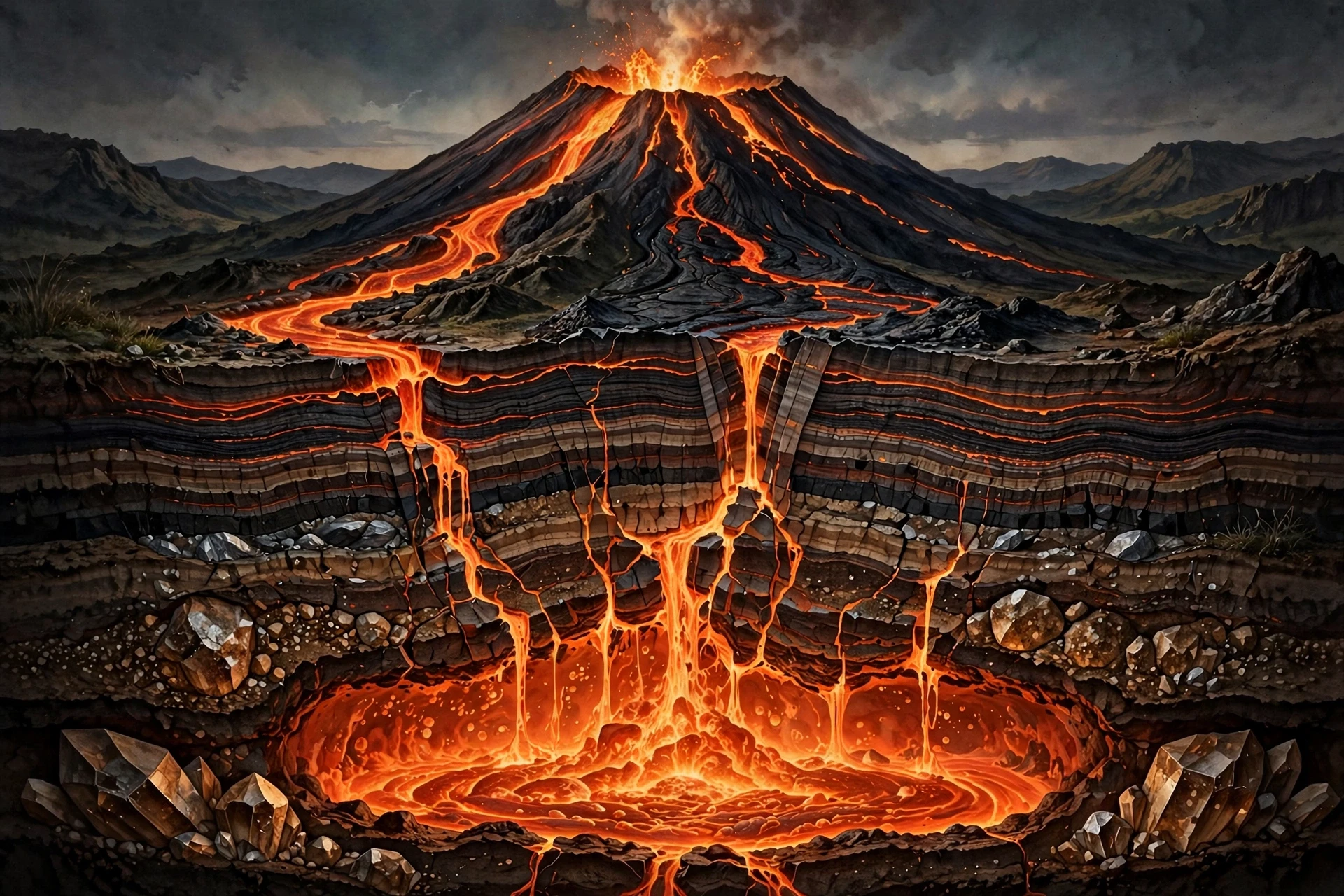
Magma forms when rock in the crust or upper mantle gets hot enough to melt, or when pressure drops enough that solid rock begins to melt without extra heat. This is the first answer to how rocks form: solid rock melts, and the melt cools into new stone. One way this happens is when a deep part of the mantle melts as it rises beneath a mid-ocean ridge. Magma is less dense than the solid rock around it, so it rises, buoyantly, through cracks and weaknesses in the crust. Sometimes it reaches the surface and erupts. More often it stalls underground, pooling in a magma chamber, where it cools slowly over thousands or millions of years. Either way, as the melt cools, minerals begin to crystallize out of it, one after another, in a sequence governed by their melting points. Minerals with high melting points crystallize first; the remaining liquid grows richer in the ingredients of low-melting-point minerals, which crystallize last. That orderly sequence is why a single body of magma can produce several different rocks.
The composition of the magma matters as much as the cooling. Magmas rich in silica are light-coloured and sticky, and they tend to produce rocks like granite and rhyolite. Magmas poor in silica are dark, runny, and rich in iron and magnesium, and they produce rocks like basalt and gabbro. Geologists describe this with the words felsic (feldspar plus silica, light) and mafic (magnesium plus iron, dark). A felsic lava is thick and erupts explosively; a mafic lava flows easily and can travel for kilometres. The same chemistry that decides a rock's colour also decides how dangerous its volcano is — a connection worth remembering when you read about how volcanoes form and erupt.
3.2 Intrusive versus extrusive: the cooling race
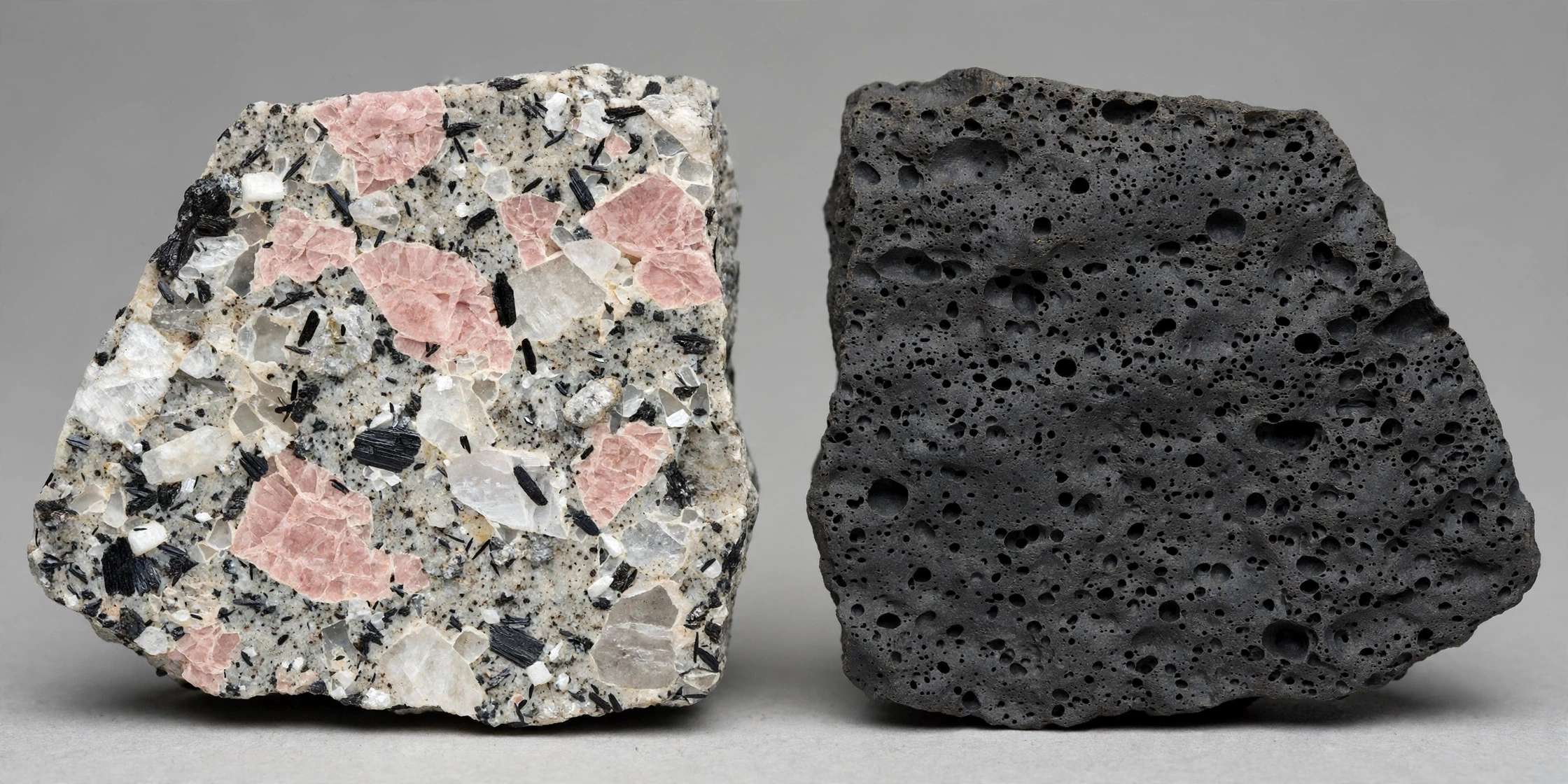
The single most important question to ask about an igneous rock is where it cooled — and that is where the story of how rocks form splits in two. If magma solidifies below the surface, the rock is intrusive, also called plutonic. Surrounded by insulating rock, it cools slowly, and its crystals have time to grow large — big enough to see with the naked eye, sometimes as large as a thumbnail or even a hand. Granite is the classic intrusive rock. If magma erupts as lava and solidifies at the surface, the rock is extrusive, also called volcanic. Exposed to air or water, it cools fast, and its crystals stay tiny, sometimes microscopic. Basalt is the classic extrusive rock. The National Park Service draws the same line: igneous rocks are classified into extrusive and intrusive depending on where the molten rock solidifies.
There are in-between cases, and they are some of the most beautiful rocks on Earth. If lava cools so fast that crystals have no time to form at all, the result is volcanic glass — obsidian, black and shiny as a mirror, which fractures with edges sharp enough to cut. If gas bubbles are trapped in cooling lava, the rock is full of holes, like a sponge made of stone — pumice, so light it can float on water, and scoria, its darker, heavier cousin. If a rock starts cooling slowly underground, grows large crystals, and is then erupted, the result is porphyry: large crystals floating in a fine-grained background, like fruit in a cake. Texture, in other words, is a record of cooling history, and a geologist reads it the way a detective reads a timeline.
3.3 Granite: the backbone of continents
Granite is the rock most people picture when they hear the word "rock." Light-coloured, speckled with black and pink, hard enough to shrug off a hammer, it forms the cores of mountain ranges and the foundations of continents. It is an intrusive igneous rock, felsic in composition, made mostly of quartz, feldspar and mica. Its crystals are large because it cooled slowly, deep underground, over millions of years. The granite we see at the surface today was once buried kilometres down; it is exposed only because erosion stripped away the rock above it, or because mountain-building pushed it upward.
I keep a small piece of granite on my desk, and I pick it up more often than I would admit. The pink crystals are feldspar, the glassy grey ones are quartz, and the black flakes are mica — you can peel a flake off with a fingernail. Running a thumb across it, I am touching a rock that finished crystallizing before the first dinosaurs, and probably before the mountain range it belonged to even existed. Granite's toughness is why humans have used it for so long: for building stone, for monuments, for kitchen worktops, for the kerbs of city streets. The same properties that make it hard to carve make it hard to wear away, which is why granite mountains — like Half Dome in Yosemite — stand as great bare domes while softer rocks around them have crumbled.
3.4 Basalt: the floor of the oceans
If granite is the backbone of the continents, basalt is the floor of the oceans. It is the most common volcanic rock on Earth, dark grey to black, fine-grained, and made mostly of the minerals pyroxene, olivine and feldspar. Basalt forms when mafic lava erupts and cools quickly — on the flanks of volcanoes, along mid-ocean ridges, and in enormous floods of lava that can cover areas the size of countries. The ocean floor is almost entirely basalt, newly made at mid-ocean ridges and slowly carried away as tectonic plates spread. The plate tectonics that move continents are, at their heart, a story about basalt being born and destroyed.
Basalt has a trick that granite never manages: when a thick lava flow cools, it often cracks into tall hexagonal columns, like a bundle of pencils standing on end. The Giant's Causeway in Northern Ireland is the most famous example — tens of thousands of interlocking basalt columns stepping down into the sea. I stood there once, in wind and drizzle, and the geometry felt impossible, as if someone had tiled the shore on purpose. It is pure physics: as the lava cools and shrinks, it cracks in the most efficient pattern, and hexagons are nature's favourite way to pack shrinking columns. Basalt is also the rock of the Moon's dark plains, the lunar maria, and of the great volcanoes of Hawaii, where runny basalt lava builds gentle shield volcanoes rather than explosive cones.
3.5 Other igneous rocks worth knowing
Granite and basalt are the headline acts, but the igneous family is large. Diorite sits between granite and gabbro in composition, speckled black and white. Gabbro is the intrusive twin of basalt — same chemistry, but cooled slowly underground, so its dark crystals are large and visible. Rhyolite is the extrusive twin of granite — light-coloured, fine-grained, and often associated with explosive eruptions. Andesite, named after the Andes mountains, is the middle ground, the grey rock of many of the world's most dangerous volcanoes. Pumice and obsidian, already mentioned, are the oddballs: one full of frozen gas bubbles, the other a natural glass. Together these rocks map the full range of what molten Earth can do, from the gentlest lava flow to the most violent eruption.
Rock | Where it cools | Texture | Colour | Common use or setting |
|---|---|---|---|---|
Granite | Deep underground (intrusive) | Coarse crystals, visible | Light, speckled pink, white and black | Building stone, worktops, mountain cores |
Basalt | At the surface (extrusive) | Fine-grained, smooth | Dark grey to black | Ocean floor, lava flows, road stone |
Gabbro | Deep underground (intrusive) | Coarse crystals, visible | Dark, speckled | Intrusive twin of basalt |
Rhyolite | At the surface (extrusive) | Fine-grained, sometimes glassy | Light pink, grey or tan | Extrusive twin of granite |
Obsidian | At the surface, very fast cooling | Glassy, no crystals | Black, shiny | Natural glass, once used for blades |
Pumice | At the surface, gas-rich lava | Full of holes, very light | Pale grey or white | Floats on water; used as an abrasive |
The crystals in a rock are a clock. Large crystals mean slow cooling, deep underground, over thousands or millions of years. Tiny crystals mean a fast freeze at the surface. Texture is time, written in stone.
4. Sedimentary Rocks: Built Layer by Layer
If igneous rocks are born of fire, sedimentary rocks are built by patience. This second answer to how rocks form is slower and quieter, and it happens at the surface rather than in the deep Earth. They form at or near Earth's surface, not from melt but from the fragments of older rocks, from minerals that settle out of water, and from the remains of living things. They are the most common rocks exposed on the continents — roughly three-quarters of the land surface is covered by them — and they are the rocks that hold most of our fossils, our coal, our oil and much of our groundwater. They are also the easiest rocks to read, because they are built in layers, and layers tell stories in order: the bottom layer is the oldest, the top layer is the youngest, and each one records the conditions of the place and time where it was laid down.
The process has four steps, and each step is slow. First, weathering breaks existing rock into fragments. Then erosion and transport carry those fragments away. Then deposition lays them down, usually in water. Then lithification — compaction and cementation — turns the loose sediment into solid rock. A single grain of sand in a sandstone cliff may have started as part of a granite mountain, been freed by frost, carried hundreds of kilometres by a river, dropped on a beach, buried under a kilometre of younger sediment, and cemented into stone over millions of years. Sedimentary rocks are the great recyclers of the rock cycle, and their layers are Earth's diary.
4.1 Weathering: how solid rock falls apart
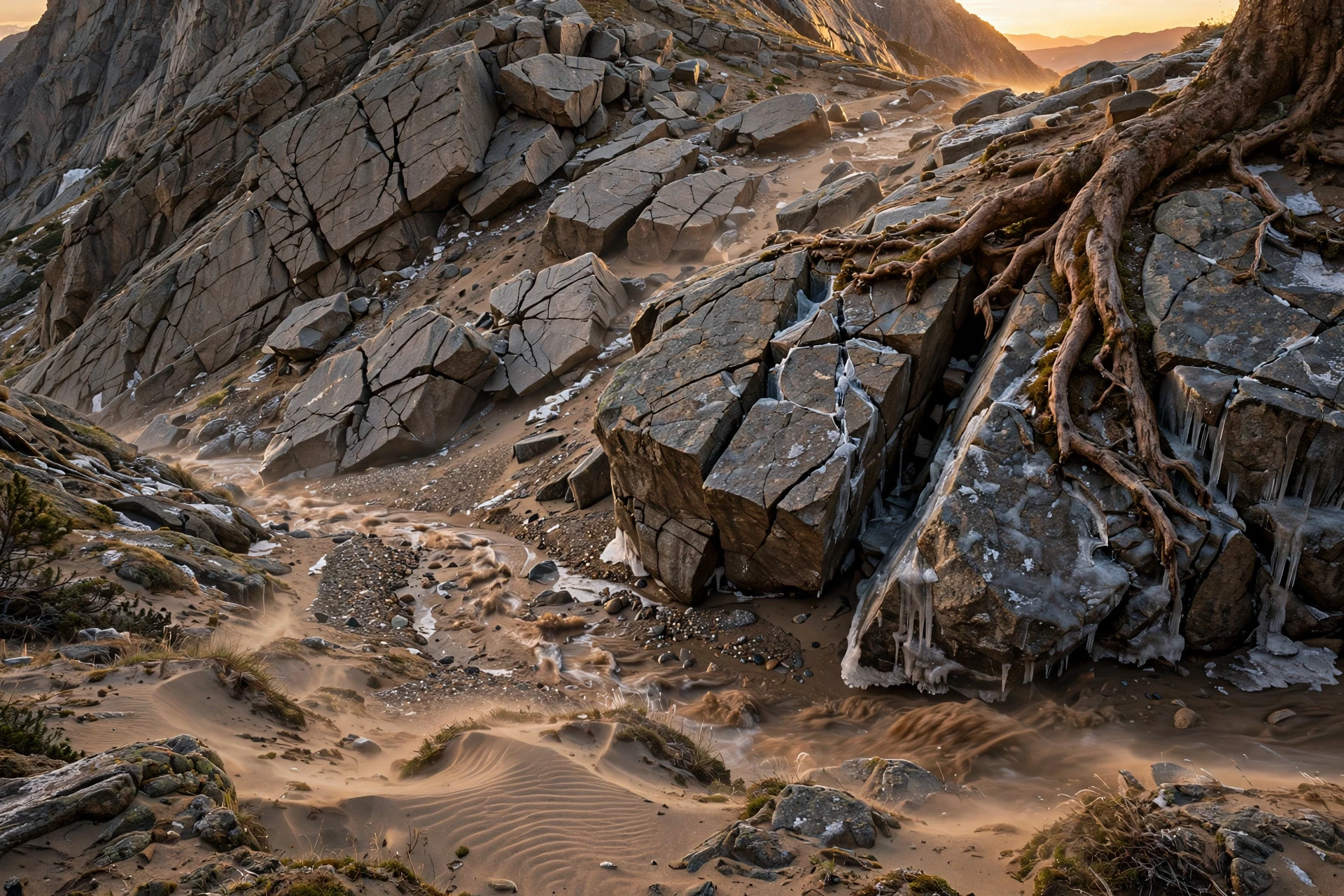
Weathering is the breakdown of rock where it stands, without the rock moving. It comes in three overlapping kinds. Physical weathering breaks rock apart without changing what it is made of. The classic example is freeze-thaw: water seeps into a crack, freezes at night, expands by about a tenth of its volume, and pries the crack wider. Repeat that over hundreds of winters and a solid cliff sheds boulders. Heat does similar work in deserts, where the outer skin of a rock expands in the day's heat and contracts at night until it peels away like an onion. Tree roots wedge cracks open, and burrowing animals turn solid ground into rubble.
Chemical weathering changes the minerals themselves. Rainwater absorbs carbon dioxide from the air and becomes a weak acid, and that acid dissolves limestone and eats feldspar, turning hard granite into soft clay. Oxygen rusts iron-bearing minerals, which is why weathered rocks often wear a rusty brown skin. Living things help too: lichens secrete acids that etch the rock they grow on, and microbes speed up chemical reactions on mineral surfaces. Biological weathering is the third kind, though it overlaps with the other two — roots, animals and microbes are physical and chemical agents at once. Together, the three kinds of weathering turn mountains into the raw material of sedimentary rock: sand, silt, clay and dissolved minerals. This slow dismantling is the first step in how rocks form from sediment.
4.2 Erosion and transport: the great sorting
Weathering makes the fragments; erosion moves them. Rivers are the great movers, carrying sand and pebbles downstream and silt and clay all the way to the sea. Wind carries fine dust across continents — the thick loess soils of central China are wind-blown dust laid down over hundreds of thousands of years. Glaciers bulldoze everything in their path, from house-sized boulders to flour-fine rock dust, and dump it in jumbled piles when they melt. Waves sort beach sand with every tide.
Transport does more than move material. It sorts it. Fast water carries big grains and drops them quickly; slow water carries only fine grains far. That is why river sand is coarser near mountains and finer near the sea, and why a beach sorts its sand by grain size with every wave. It also rounds the grains: a sharp, angular fragment fresh from a cliff becomes smooth and round after tumbling in a river for a few kilometres. A geologist holding a sandstone can tell how far its sand travelled by how round its grains are — angular grains mean a short trip, well-rounded grains mean a long one. Transport also mixes: the sand on a beach may contain quartz from granite, feldspar from volcanic rock, and shell fragments from the sea itself, all travelling together.
4.3 Deposition: layers laid down in order
When moving water, wind or ice slows down, it drops its load. That is deposition, and it almost always happens in layers. A river in flood lays down a sheet of sand; when the flood passes, a thin layer of mud settles on top. Next year the pattern repeats. Over centuries the layers stack up, each one a record of one event. In lakes and shallow seas the same stacking happens more quietly, grain by grain, year by year. In deserts, wind lays down sweeping dunes that can be hundreds of metres thick, and in the deep ocean, the microscopic shells of plankton rain down so slowly that a single centimetre of sediment may represent a thousand years.
Two principles make these layers readable. The first is that layers are laid down horizontally, more or less — so when you see sedimentary layers tilted or folded, you know something pushed them after they formed. The second is that in an undisturbed stack, the lowest layer is the oldest. Geologists used these ideas for centuries before radiometric dating existed, and they still use them every day. A cliff face is a timeline you can walk along, and the fossils in each layer are the dates written in the margins.
4.4 Lithification: how loose sediment becomes stone
Loose sand on a beach is not a rock. To become one, sediment must be lithified — turned to stone. That happens in two ways, usually together. Compaction squeezes the sediment as more layers pile on top, forcing grains closer together and squeezing out water. Cementation glues the grains together: groundwater carrying dissolved minerals — silica, calcite or iron oxide — deposits those minerals in the spaces between grains, and the crystals grow until they bind everything into a solid mass. The result is sedimentary rock: sand becomes sandstone, mud becomes shale, and gravel becomes conglomerate. That transformation — loose grains becoming solid stone — is the heart of how rocks form in the sedimentary family.
Lithification takes time and burial. A few hundred metres of burial is usually enough to start the process, and a kilometre or two will finish it. The cement matters: sandstone cemented by silica is hard and durable; sandstone cemented by calcite is softer and fizzes with a drop of acid; sandstone cemented by iron oxide wears a rusty red coat. In a sense, every sedimentary rock is a compromise between the grains it started with and the cement that glued them — and a geologist can learn about both just by looking closely.
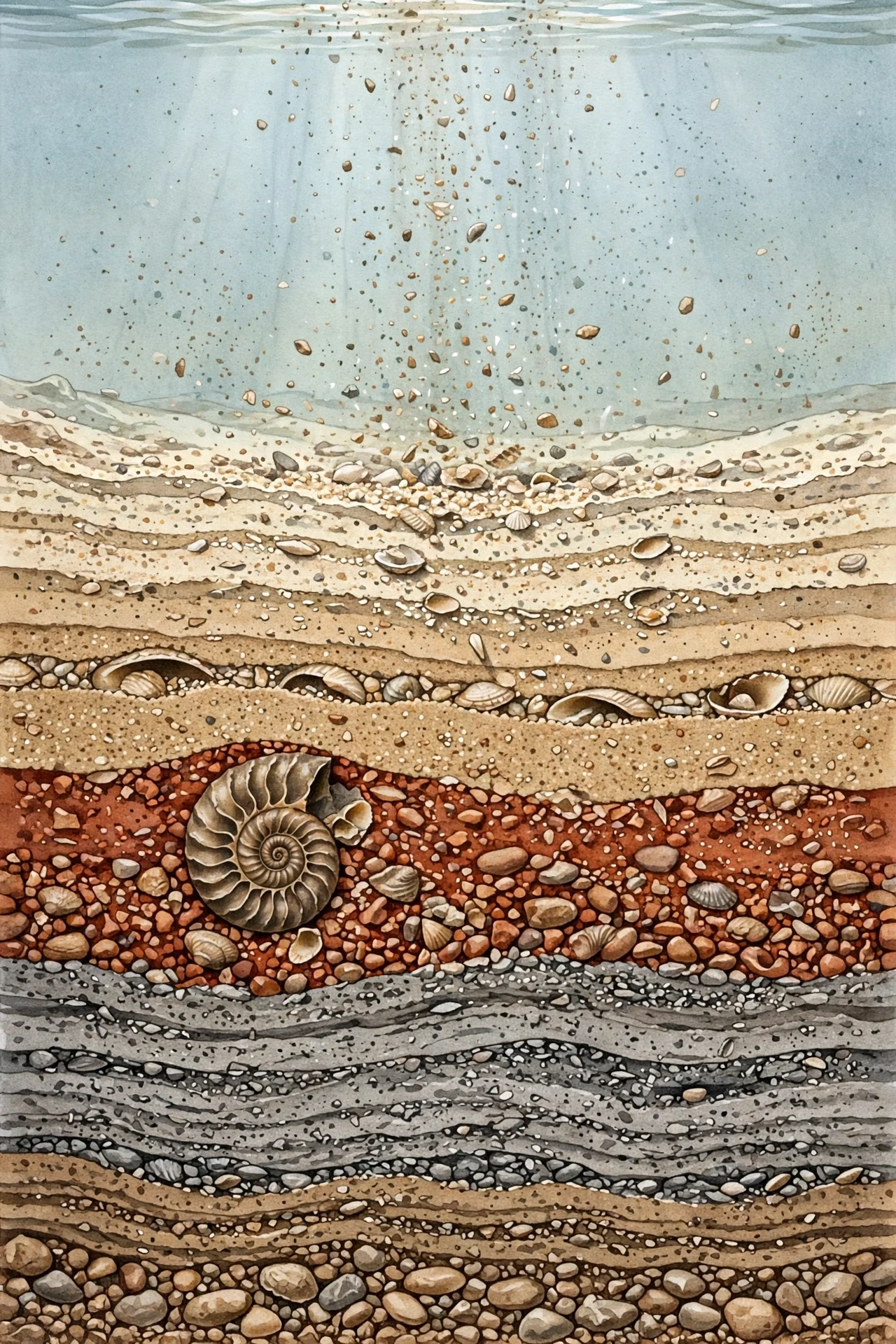
4.5 Sandstone: the rock of deserts and beaches
Sandstone is the most familiar sedimentary rock, and one of the most useful. It forms when sand — grains mostly of quartz, between a sixteenth of a millimetre and two millimetres across — is buried and cemented. Its colour depends on its ingredients: pure quartz sandstone is pale, almost white; iron-rich sandstone is red, like the cliffs of the American Southwest; sandstone with dark minerals can be grey or green. Its texture is gritty to the touch, and you can often see the individual sand grains with a hand lens.
Sandstone is easy to recognise and hard to forget once you have seen it in a canyon wall, where its layers run in stripes of red, orange and cream for hundreds of metres. It is also a practical rock: it has been used as building stone for centuries, from the red sandstone of old railway stations to the pale stone of desert cities. Because its grains leave pore spaces between them, sandstone can hold water and oil — many of the world's most important aquifers and oil reservoirs are sandstones, the pore spaces acting like a giant underground sponge. The same porosity makes sandstone vulnerable: it weathers faster than granite, which is why sandstone landscapes are full of arches, alcoves and hoodoos — pillars of rock left standing when the softer stone around them washed away.
4.6 Limestone: a rock built by living things
Limestone is different from sandstone in a wonderful way: much of it is made by living things. It is composed mostly of calcite, the mineral calcium carbonate, and it forms in warm, shallow seas where corals, shellfish and microscopic plankton build their shells and skeletons from calcium carbonate dissolved in seawater. When those creatures die, their shells rain down and accumulate on the seafloor, and over time the pile is buried and cemented into limestone. The White Cliffs of Dover are the remains of countless trillions of microscopic plankton, laid down when a warm sea covered southern England — a cliff made of dead plankton, standing a hundred metres high.
Limestone also forms chemically, without organisms, when calcium carbonate precipitates directly from water — in caves, where dripping water builds stalactites and stalagmites, and in hot springs, where it builds terraces of travertine. A simple test identifies it: a drop of dilute acid on limestone fizzes, releasing carbon dioxide. I still remember the first time I did that test in a school laboratory, watching a dull grey rock suddenly bubble and hiss, and understanding in one small moment that a rock could be a chemical reaction waiting to happen. Limestone's uses are everywhere: it is burned to make cement and lime, cut as building stone, and its caves — dissolved out by slightly acidic groundwater — are among the most spectacular underground landscapes on Earth.
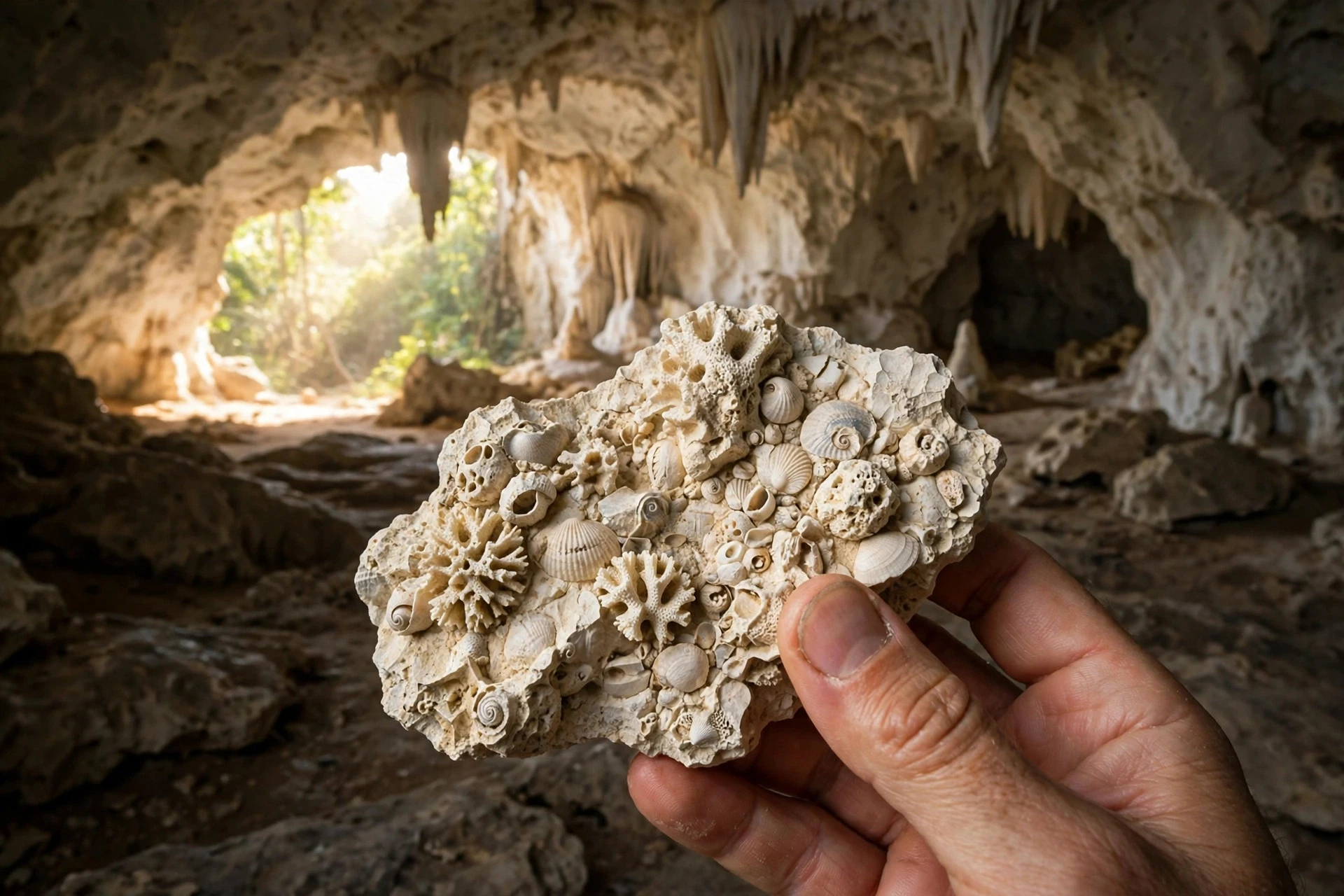
4.7 Other sedimentary rocks worth knowing
Beyond sandstone and limestone, the sedimentary family includes shale, the most common sedimentary rock of all, formed from compacted mud and clay, splitting into thin, papery sheets; conglomerate, made of rounded pebbles cemented together, like concrete made by nature; breccia, its angular cousin, made of sharp fragments that never travelled far; coal, formed from plant remains buried in swamps and compressed over millions of years; and chalk, a soft white limestone made almost entirely of microscopic plankton shells. Evaporites — rock salt and gypsum — form when shallow seas or salty lakes dry up and leave their dissolved minerals behind. Each one records a different environment: a river, a beach, a deep sea, a swamp, a drying lake. Read the rock, and you read the place it came from.
A sedimentary cliff is a library with the books stacked in order. The bottom shelf is the oldest story, the top shelf is the newest, and every layer is a page written by a river, a sea or a desert that no longer exists.
5. Metamorphic Rocks: Transformed by Heat and Pressure
Metamorphic rocks are the third family, and in some ways the most dramatic, because they are rocks that have been remade without ever melting. This third answer to how rocks form needs neither fire nor water alone, but heat and pressure acting over millions of years. The word comes from Greek — meta, change, and morph, form — and it describes exactly what happens: an existing rock, igneous or sedimentary, is buried deep or squeezed by mountain-building, heated and pressed until its minerals recrystallize into new minerals and new textures, while the rock stays solid throughout. If it melted, it would be magma, and the story would start over as igneous rock. Metamorphism is transformation without melting, and it happens on a scale that is hard to imagine: entire mountain ranges are built of metamorphic rock, baked and folded kilometres underground, then lifted to the surface by the same tectonic forces that buried them.
The conditions are extreme. Temperatures of several hundred degrees Celsius, pressures thousands of times greater than at the surface, acting over millions of years. Under those conditions, minerals that were stable at the surface become unstable and rearrange themselves. Clay minerals in shale grow into mica. Calcite in limestone recrystallizes into larger, interlocking crystals of marble. Quartz grains in sandstone fuse into quartzite, so hard that a hammer breaks across the grains rather than around them. The rock keeps its overall chemical ingredients, more or less, but its minerals and texture are new. It is the same material, transformed — the geological version of baking clay into pottery.
5.1 How metamorphism works
Three things drive metamorphism: heat, pressure and chemically active fluids. Heat comes from burial — temperature rises with depth, roughly 25 to 30 °C per kilometre in most places — and from nearby magma, which bakes the rock around it like an oven. Pressure comes from the weight of the rock above and from the sideways squeeze of colliding tectonic plates. Fluids — mostly hot water carrying dissolved minerals — move through the rock, speeding up chemical reactions and carrying ingredients in and out. The Geological Society of London explains the cycle's logic simply: rocks deep in the Earth move and change over time, eventually making their way to the surface, then back deep into the ground to start the cycle again.
The changes happen in two ways. In one, existing minerals recrystallize — the same mineral, but in larger crystals, like the calcite in limestone growing into the sugary crystals of marble. In the other, new minerals form — clay minerals turning into mica and garnet as temperature and pressure rise, each new mineral stable only in a narrow range of conditions. That is why metamorphic rocks are so useful to geologists: the minerals in a metamorphic rock are a thermometer and a pressure gauge, recording the deepest, hottest conditions the rock ever experienced. A rock containing garnet was buried deeper and heated more than a rock containing only chlorite, and a geologist can read that history from a hand specimen.
There are two main settings. Regional metamorphism affects huge areas, where colliding plates bury and squeeze rock over hundreds of kilometres — this is how mountain ranges are built, and why the cores of old mountain ranges are metamorphic. Contact metamorphism is local: a body of hot magma intrudes into cooler rock, and the rock touching the magma is baked into a hard, fine-grained hornfels, while rock a few hundred metres away is untouched. The boundary between baked and unbaked rock can be as sharp as a line drawn on a map.
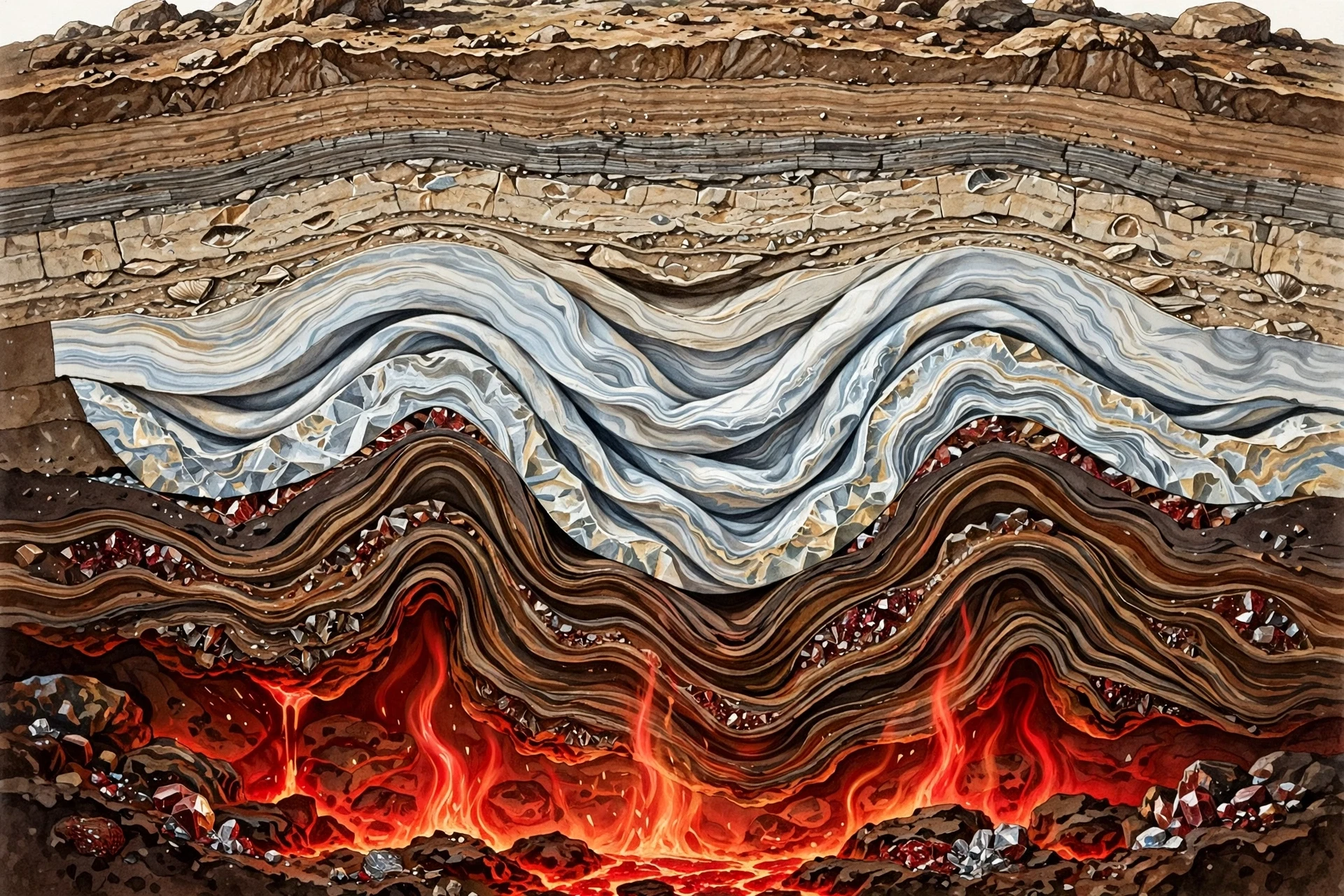
5.2 Foliated and non-foliated: two kinds of transformation
Metamorphic rocks fall into two groups, and the difference is visible at a glance. Foliated rocks have a layered or banded appearance, because pressure squeezed their minerals into alignment, like pages in a book. Slate, schist and gneiss are foliated: slate splits into flat sheets, schist glitters with aligned mica flakes, and gneiss wears bold bands of light and dark minerals. Non-foliated rocks show no such alignment, because their minerals are roughly equal in all directions or because they were heated without much squeezing. Marble and quartzite are non-foliated: marble is a sugary mass of interlocking calcite crystals, and quartzite is a hard, glassy mass of fused quartz. If you can see layers or bands, the rock was squeezed. If you cannot, it was mostly baked.
The degree of metamorphism matters too. Low-grade metamorphism makes small changes — shale becomes slate, with its minerals barely changed but its texture transformed. Medium-grade metamorphism grows visible mica, and shale becomes schist. High-grade metamorphism grows large crystals and bold banding, and shale becomes gneiss. The sequence shale → slate → schist → gneiss is one of the most useful progressions in geology: it is a single rock, mudstone, being transformed step by step as it is buried deeper and heated more. Hold a piece of each in your hands and you are holding the same story at four different chapters.
5.3 Marble: limestone, remade
Marble is metamorphosed limestone, and it is the rock most people have seen without knowing it. When limestone is buried and heated, its calcite crystals recrystallize into larger, interlocking crystals, and any fossils it contained are usually erased — the heat and pressure destroy the delicate structures. The result is a rock that is harder than limestone, takes a polish, and comes in white, pink, grey, green and black, coloured by small amounts of other minerals. The Taj Mahal is built of white marble; Michelangelo carved his David from Carrara marble; the great public buildings of the ancient world were faced in it. Marble is also a rock that tells a story about trade and empire, because the quarries that produced the finest marble — in Italy, Greece and Turkey — supplied sculptors and builders across whole continents.
Marble is softer than granite, which is both its charm and its weakness: it carves beautifully, but it weathers, and acid rain — rain made more acidic by pollution — eats its surface. Conservators who look after marble statues outdoors are fighting the same chemical weathering that dissolves limestone caves, only faster. A marble statue is a race between art and chemistry, and chemistry usually wins in the end.
5.4 Slate: mudstone that learned to split
Slate is metamorphosed shale or mudstone, and it is one of the most useful rocks humans have ever found. Under low-grade metamorphism, the clay minerals in shale align under pressure, and the rock develops a property called slaty cleavage: it splits into thin, flat sheets along planes that have nothing to do with the original sedimentary layers. Those sheets are strong, waterproof and fireproof, which is why slate has roofed houses for centuries, from the grey roofs of Welsh villages to the dark roofs of old New England towns. A good slate roof can last a hundred years.
I once held a roofing slate and tried to snap it the wrong way, across the cleavage, and it resisted like a piece of steel. Turned the other way, it split cleanly with a tap. That anisotropy — strong in one direction, weak in another — is the signature of pressure, frozen into the rock. Slate also makes excellent blackboards and billiard-table beds, and its fine grain lets it be carved into thin, precise shapes. It is a humble rock with an extraordinary property, and that property exists only because mud was once buried and squeezed.
5.5 Gneiss, schist and quartzite
Gneiss is the high-grade end of the shale-to-gneiss sequence: bold bands of light feldspar and quartz alternating with dark bands of mica and hornblende, often folded and swirled like marble cake. It forms the ancient cores of continents — much of the rock in Scotland, Canada and Scandinavia is gneiss billions of years old, the roots of mountain ranges long since worn away. Schist is its medium-grade cousin, glittering with mica flakes that catch the light as you turn the specimen, and it splits easily along its mica layers. Quartzite is metamorphosed sandstone, so thoroughly fused that it breaks through its quartz grains instead of around them, making it one of the hardest common rocks. Together, these rocks record the deep, hot, high-pressure heart of the rock cycle, the part of the story that happens far below our feet, and they complete the picture of how rocks form in Earth's deep crust.
Metamorphic rock | Starts as | Texture | What changed |
|---|---|---|---|
Marble | Limestone | Non-foliated, sugary crystals | Calcite recrystallized into larger crystals; fossils erased |
Slate | Shale or mudstone | Foliated, splits into flat sheets | Clay minerals aligned under pressure |
Schist | Shale or mudstone | Foliated, glittering mica flakes | Mica grew large enough to see |
Gneiss | Shale, granite or other rocks | Foliated, bold light and dark bands | High heat and pressure separated minerals into bands |
Quartzite | Sandstone | Non-foliated, hard and glassy | Quartz grains fused together |
Metamorphic rock is the same material with a new identity. The ingredients barely change; the minerals, the texture and the story are transformed. It is proof that a rock can be remade without being destroyed.
6. How Geologists Identify Rocks
So how do you actually tell one rock from another? Once you know how rocks form, the next question is a practical one, and geologists answer it with a short list of observations — with practice most rocks can be narrowed down in a few minutes with nothing more than eyes, hands and a few cheap tools. The skill is less about memorising names and more about asking the right questions in the right order. I learned this the slow way, on a field trip where I confidently labelled a specimen "sandstone" in front of a group, only for the trip leader to point out the grains were fused, not cemented, and the rock was quartzite. I had looked at the colour and stopped. The lesson stuck: identify by process, not by first impression.
6.1 The first questions: texture and composition
The first question is always about texture: how big are the crystals or grains, and are they visible? Coarse crystals you can see mean slow cooling underground (intrusive igneous) or high-grade metamorphism. Fine grains you cannot see mean fast cooling at the surface (extrusive igneous) or fine sediment. Visible layers mean sedimentary rock or foliated metamorphic rock. Glassy texture with no crystals means volcanic glass. A rock that splits into thin sheets is slate or shale. A rock full of holes was once full of gas bubbles.
The second question is about composition: what minerals are in it? Light-coloured minerals — quartz, feldspar — point to felsic rocks like granite and rhyolite. Dark minerals — pyroxene, olivine, hornblende — point to mafic rocks like basalt and gabbro. A rock that fizzes with acid contains calcite and is probably limestone or marble. A rock with visible fossils is sedimentary. A rock with glittering mica flakes is probably schist or a mica-rich granite. Colour helps, but it can mislead: a red rock might be red sandstone, red granite, or jasper, and only the texture and minerals will tell you which.
6.2 Simple tests anyone can do
You do not need a laboratory to identify most common rocks. A few simple tests, used by geologists for generations, will take you a long way:
The scratch test. Hardness is measured on the Mohs scale, from talc at 1 to diamond at 10. A steel nail (about 5.5) scratches some minerals and not others. Quartz (7) scratches glass; calcite (3) is scratched by a copper coin. Testing which objects scratch the rock, and which the rock scratches, narrows the minerals down quickly.
The acid test. A drop of dilute hydrochloric acid — or in a pinch, strong vinegar — fizzes on calcite. Limestone and marble fizz; sandstone cemented with calcite fizzes weakly; granite and basalt do not fizz at all.
The streak test. Rubbing a mineral across an unglazed porcelain plate leaves a coloured streak, which is often more reliable than the mineral's outward colour. Hematite, for example, can look silver, black or red, but its streak is always rusty red.
The heft test. Pick the rock up. A rock that feels unusually heavy for its size may be rich in iron or lead minerals; a rock that feels light may be pumice, full of air.
The magnet test. A strong magnet will stick to rocks rich in magnetite, a common iron mineral in some basalts and metamorphic rocks.
None of these tests is decisive on its own. Identification is about combining them: texture plus composition plus a test or two, and the answer usually falls out. The British Geological Survey offers clear guidance on identifying rocks and minerals by these properties, and its pages are a good place to practise the method on specimens you find yourself.
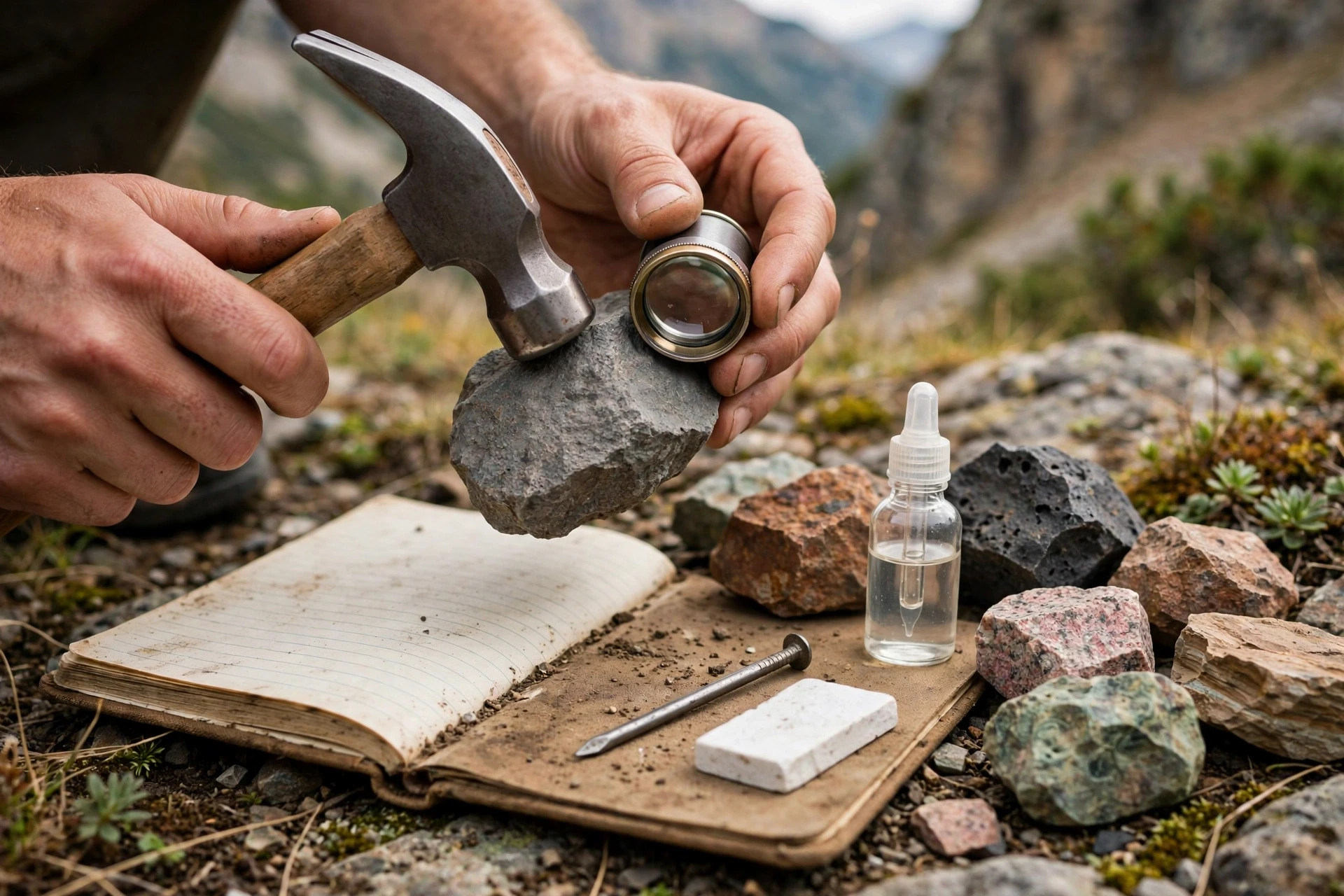
6.3 From specimen to story
The real point of identification is not the name. The name is a doorway, and knowing how rocks form is what turns identification into history. Once you know a rock is basalt, you know it came from lava. Once you know a rock is sandstone, you know it came from a beach or a desert. Once you know a rock is gneiss, you know it was buried deep and squeezed in a mountain range that may no longer exist. A collection of identified rocks from one place is a history of that place — what was once a sea, what was once a volcano, what was once buried ten kilometres down. That is why geologists carry hand lenses and hammers rather than just cameras: the rock itself is the document, and identification is the act of reading it.
7. Famous Rock Formations Around the World
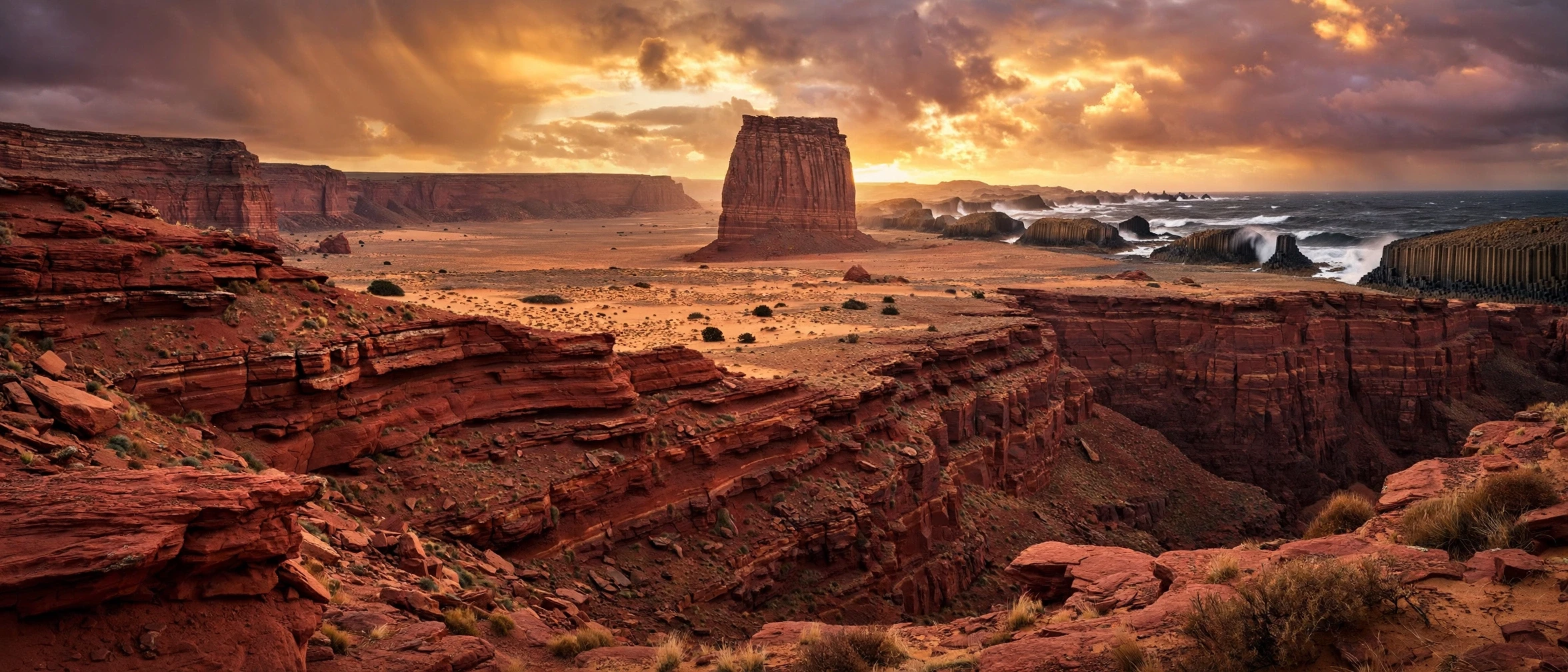
Rocks are not only specimens in a collection. On a large scale they are landscapes, and some of the most visited places on Earth are famous precisely because of the rocks that build them. Each of these places shows how rocks form on a landscape scale, and each is a chapter of the rock cycle written large enough to walk through.
7.1 The Grand Canyon: a library of sedimentary rock
The Grand Canyon in Arizona is the world's most famous cross-section of sedimentary rock. Its walls expose layer upon layer of sandstone, shale and limestone, stacked nearly two kilometres deep, recording hundreds of millions of years of ancient seas, deserts and rivers. The bottom layers are the oldest — some of the rocks at the river level are nearly two billion years old — and the top layers are the youngest. The Colorado River carved the canyon itself over the last few million years, cutting down through the layers faster than weathering could wear them away, and exposing the whole stack like the pages of a book. Stand on the rim at sunrise and the layers glow red, orange, cream and grey, each colour a different rock, each rock a different ancient environment. It is the rock cycle's sedimentary chapter, written in stone a mile deep.
7.2 Uluru: a sandstone giant
Uluru, in the red centre of Australia, is a single enormous block of sandstone, rising more than 300 metres above the surrounding plain. It formed from sand deposited in a shallow sea hundreds of millions of years ago, then buried, cemented into arkose sandstone, tilted almost vertically by mountain-building, and exposed by erosion wearing away the softer rock around it. The sandstone is rich in feldspar, which is why it glows red — the iron in the rock rusts in the desert air. At sunset Uluru seems to catch fire, shifting from ochre to deep crimson as the light changes. It is sacred to the Anangu people, its traditional owners, and it is a reminder that a rock formation can be a cultural treasure as well as a geological one. The rock you see is only the tip: most of Uluru extends underground, a buried mountain of sandstone whose visible part is a small fraction of the whole.
7.3 The Giant's Causeway: basalt in perfect columns
The Giant's Causeway on the coast of Northern Ireland is the most striking display of basalt on Earth. Roughly 60 million years ago, floods of runny basalt lava spread across the land, and as the thick lava cooled and shrank it cracked into tens of thousands of mostly hexagonal columns, some of them 12 metres tall, stepping down into the sea like a giant's staircase. Local legend says the giant Finn McCool built the causeway as a road to Scotland. The real explanation — cooling and contraction — is, in its own way, just as wonderful, because it shows how simple physics can produce perfect geometry on a huge scale. The same columnar jointing appears in basalt around the world, from the Devil's Postpile in California to the basalt cliffs of Iceland, and every example is a frozen record of a lava flow cooling.
7.4 Half Dome and the White Cliffs: granite and chalk
Half Dome in Yosemite National Park is a granite monolith, the remnant of a vast body of magma that cooled slowly underground and was exposed when glaciers stripped away the rock around it. Its smooth, bare face is granite at its most dramatic — a single rock, hundreds of metres high, with barely a crack in it. The White Cliffs of Dover are the opposite kind of drama: soft white chalk, a limestone made of microscopic plankton shells, laid down in a warm Cretaceous sea and lifted above the waves. One is the hardest of rocks, the other one of the softest, and both are icons of their countries. Together they show the range of the rock cycle: from magma cooling kilometres underground to plankton raining onto a seafloor, both can end as a landmark.
7.5 Why these places matter
These formations are more than tourist attractions. They are natural laboratories where geologists test ideas about how rocks form, and they are archives of Earth's history that no laboratory could reproduce. They also face real threats: erosion, quarrying, pollution and climate change all wear them down, and some — like the chalk cliffs, which crumble a little more each winter — are visibly changing within a human lifetime. Visiting them with an understanding of how rocks form turns a scenic view into a story, and that story is the best reason to protect them.
8. Common Misconceptions About Rocks
Rocks seem simple, which is why so many confident statements about them are wrong. Each of these mistakes comes from picturing rocks as finished objects rather than asking how rocks form in the first place. Here are the ones I hear most often, and what the evidence actually shows.
"Rocks are permanent and never change." Most people assume this, but what we actually see in the data is the opposite: rocks are constantly changing, just very slowly. A granite mountain is being weathered grain by grain, a limestone cliff is being dissolved by rain, and deep underground, rocks are being heated, squeezed and melted right now. The rock cycle never stops. A rock that looks eternal is simply changing on a timescale longer than a human life. The permanence is an illusion of our short perspective.
"All rocks are millions of years old." Many are, but not all. Fresh lava from an erupting volcano is a new rock, days old. The black sand on a Hawaiian beach is basalt that cooled weeks ago. And some rocks are young in geological terms but old in human ones — a sandstone laid down a few thousand years ago is a baby by geological standards. Age is a property of a particular rock, not of rocks in general.
"Diamonds are rocks." Diamonds are minerals — single crystals of carbon — not rocks. A rock is an aggregate of minerals, and a diamond is one mineral. The same confusion applies to gold nuggets, quartz crystals and other single minerals people call rocks. It is a small distinction, but it matters, because it is the difference between an ingredient and a dish.
"Sedimentary rocks are soft and weak." Some are — chalk crumbles in your hand — but quartzite, a metamorphosed sandstone, is harder than steel in practical terms, and well-cemented sandstone has built castles that have stood for a thousand years. Strength depends on the cement and the minerals, not on the family.
"Metamorphic rocks were once melted." This is the most persistent misunderstanding of the three families, and it matters because it erases the very thing that makes metamorphic rocks special. Metamorphic rocks were heated and squeezed, but they never melted. If a rock melts, it becomes magma, and when that magma cools it becomes igneous rock. Metamorphism is transformation in the solid state, and that is why a metamorphic rock can keep the ghost of its original layers — folded, stretched and recrystallized, but never erased by melting.
"You can tell a rock's age by looking at it." You cannot, not directly. Colour, texture and hardness say nothing reliable about age. A fresh basalt and a billion-year-old basalt can look identical. Age comes from radiometric dating of the minerals inside the rock, or from the fossils in the layers around it — not from appearance. The rock's story is written in its texture and composition; its birthday needs a laboratory.
The next time you pick up a stone, hold it a moment longer and ask how rocks form. The answer will be in your hand: crystals, layers or folds, each one a record of fire, water or pressure, and of time enough to make mountains.
Frequently Asked Questions
How do rocks form?
Rocks form in three ways, linked by the rock cycle — and those three ways are the full answer to how rocks form. Igneous rocks form when molten rock — magma underground or lava at the surface — cools and solidifies. Sedimentary rocks form when weathering breaks older rocks into sediment, which is transported, deposited in layers, and then compacted and cemented into stone. Metamorphic rocks form when existing rocks are buried deep and transformed by heat and pressure without melting. Each type can change into the others over geological time.
What are the three types of rocks?
The three main types are igneous, sedimentary and metamorphic. Igneous rocks, such as granite and basalt, form from cooled molten rock. Sedimentary rocks, such as sandstone and limestone, form from sediment laid down in layers and cemented into stone. Metamorphic rocks, such as marble and slate, form when existing rocks are transformed by heat and pressure deep underground. The Geological Society of London and the U.S. Geological Survey both describe these three types and the processes that connect them.
How long does it take for a rock to form?
It depends on the rock. Lava can cool into basalt in hours or days. Sedimentary rock takes much longer: sediment must be buried under hundreds of metres of younger material and cemented, a process that usually takes thousands to millions of years. Granite cooling deep underground can take millions of years to fully crystallize. Metamorphic rocks form over millions of years of burial and heating. In general, the deeper and slower the process, the longer it takes.
What is the difference between intrusive and extrusive igneous rocks?
Intrusive igneous rocks cool slowly below Earth's surface, so their crystals grow large enough to see — granite is the classic example. Extrusive igneous rocks cool quickly at the surface after a volcanic eruption, so their crystals stay tiny or invisible — basalt is the classic example. The difference is cooling speed and location, not chemistry: gabbro and basalt have the same composition but different textures because one cooled underground and the other at the surface.
How are sedimentary rocks formed step by step?
Sedimentary rocks form in four steps. First, weathering breaks existing rock into fragments. Second, erosion and transport carry the fragments away by river, wind, glacier or waves. Third, deposition lays the fragments down in layers, usually in water. Fourth, lithification — compaction under the weight of overlying sediment plus cementation by minerals deposited from groundwater — turns the loose sediment into solid rock. Sand becomes sandstone, mud becomes shale, and gravel becomes conglomerate.
How can I tell what kind of rock I have found?
Start with texture: are the crystals or grains visible, and are there layers? Then look at the minerals: light or dark, glittering mica, visible fossils? Then try simple tests — a steel nail for hardness, a drop of vinegar or dilute acid to test for fizz (limestone and marble fizz), and a streak plate for the colour of the powdered mineral. Combining texture, minerals and one or two tests will usually identify a common rock. The British Geological Survey has clear guides for identifying rocks and minerals by these properties.
Why is the rock cycle important?
The rock cycle explains how Earth's crust is constantly recycled: new rock is born from magma, broken down by weathering, rebuilt as sedimentary rock, transformed by heat and pressure, and melted again. It connects volcanoes, rivers, mountain-building and plate tectonics into one system, and it explains why the same material can appear as a granite mountain, a sandstone canyon and a marble statue over the course of its history. It also matters practically: sedimentary rocks hold our water, oil and coal, igneous rocks build our cities, and metamorphic rocks record the deep history of mountain ranges.