

The first time I held a real mineral specimen in my hand, I was eight years old and standing in a museum gift shop, turning a chunk of amethyst — one of the prettiest minerals in the shop — over and over while my pocket money burned a hole in my pocket. The purple points caught the light and threw it back in a way that felt almost alive. I did not know the words for it then, but I knew I was holding something that had grown — slowly, patiently, atom by atom — in a dark pocket of rock long before any human walked past. That feeling never quite left me. Years later, in a university mineralogy lab, I found myself doing the same thing with a tray of grey, unremarkable-looking specimens, except now I had a streak plate, a hand lens, and a steel nail, and the grey lumps were telling me stories: this one cooled from magma, that one precipitated from an ancient sea, this one was squeezed into existence kilometres underground.
Minerals are the quiet infrastructure of the planet. They are the building blocks of every rock on Earth, from the granite of a kitchen counter to the basalt of an ocean floor. They are inside the phone in your pocket, the glass in your windows, the toothpaste in your bathroom, and the concrete under your feet. Yet most people, if asked what a mineral actually is, will hesitate — and the hesitation is fair, because the answer is more precise and more interesting than most of us were taught. A mineral is not just any pretty stone. It is not a rock. It is not a gem, though some minerals become gems. It is a specific kind of natural material that passes five strict tests, and those five tests are what this article is about.
What follows is a full tour of the mineral world. We will start with the five rules that decide whether something counts as a mineral, and the surprising edge cases that break those rules — ice, for instance, and the strange case of coal. We will follow minerals to the places they are born: cooling magma chambers, drying seas, scalding underground waters, and rocks being crushed and baked deep in the crust. We will look inside their hidden architecture, the orderly crystal lattices that give each mineral its shape and its properties. Then we will learn the detective work of identification — the hardness test you can do with a fingernail, the streak test that unmasks fool's gold, the clean split of cleavage that tells a geologist more than colour ever could. Along the way we will meet the great mineral families — the silicates that build continents, the carbonates that build reefs and cliffs, the oxides and sulfides that carry our metals — and we will finish where minerals touch your life every single day, in technology, medicine, and the food on your plate.
You do not need a geology degree to follow this. You need curiosity, and perhaps a pebble from your garden to hold while you read. By the end, you will look at an ordinary stone and see what I saw in that museum gift shop: not a lump of rock, but a record of deep time, written in crystal.
1. What Is a Mineral? The Five Rules That Decide
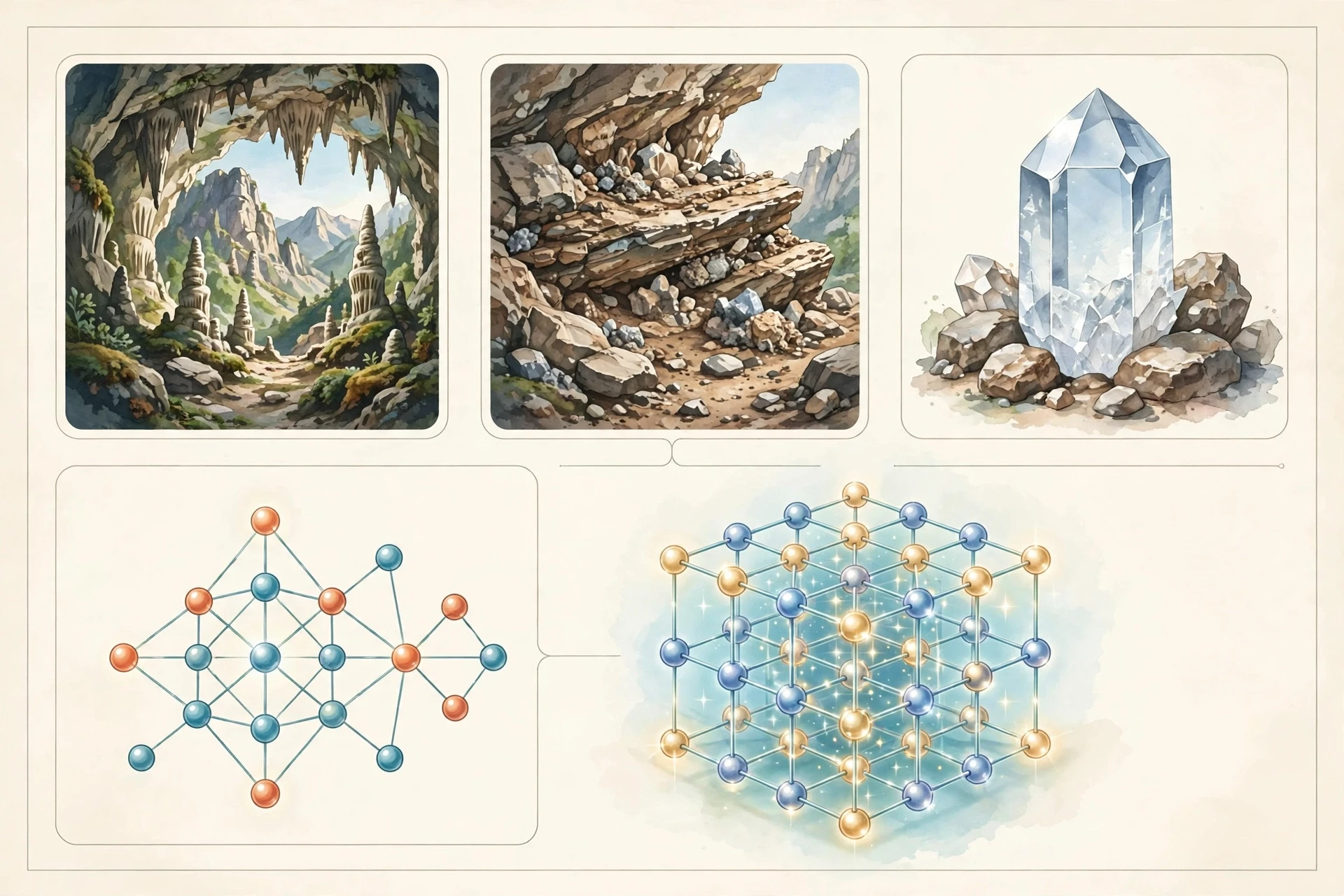
Ask a roomful of people to define a mineral and you will get a roomful of different answers. A vitamin pill. A shiny stone. Something you dig out of the ground. Something healthy. The scientific definition is narrower than all of those, and the narrowness is the point: geologists need a word that means exactly one thing, so that a researcher in Tokyo and a researcher in Toronto mean the same thing when they say it. The U.S. Geological Survey puts it plainly: a mineral is a naturally occurring inorganic element or compound having an orderly internal structure and characteristic chemical composition, crystal form, and physical properties. That single sentence carries five separate tests, and a material must pass all five to earn the name.
1.1 Naturally occurring
First, a mineral must form by natural processes, without human help. A diamond grown in a laboratory is chemically identical to a diamond dug from a kimberlite pipe, and it is just as hard, just as brilliant, just as much carbon arranged in a crystal lattice — but strictly speaking, it is not a mineral. It is a synthetic diamond. The distinction sounds like pedantry until you realise what it protects: the word "mineral" is a statement about origin, not just about chemistry. When a geologist calls something a mineral, they are saying it grew in the Earth, by Earth's own processes, over geological time. A steel nail is not a mineral. A brick is not a mineral. A laboratory diamond is a marvellous piece of materials science, but it was born in a press, not in the mantle.
I learned this the hard way in my first mineralogy exam, when I confidently listed "synthetic ruby" as a mineral and lost the mark. My professor's comment in the margin was short: "Made, not born." I have never forgotten it, because it captures the whole idea in four words.
1.2 Inorganic
Second, a mineral must be inorganic — it cannot be made by living things, and it cannot be built from carbon-hydrogen chains the way living tissue is. This is the rule that excludes some of the most famous "minerals" in everyday speech. Coal is not a mineral, even though it is dug from the ground like one, because coal is the compressed remains of ancient plants — organic matter, transformed by heat and pressure, but organic all the same. Amber is not a mineral either; it is fossilised tree resin. Pearl is not a mineral, though it is mostly the mineral aragonite, because the aragonite was laid down by a living mollusc, layer by careful layer, as part of a living shell. A shell is a biological product that happens to use mineral ingredients, the way a house is not a brick.
This rule has a grey zone, and honest science admits it. Some mineralogists argue about materials like guano-derived minerals, which form when bird droppings react with rock — organic in origin, mineral in structure. The debate itself is useful: it shows that the definition is a tool for clear thinking, not a fence built to keep curiosity out.
1.3 Solid
Third, a mineral must be solid at ordinary temperatures. Water is not a mineral, though it is naturally occurring and inorganic — it is a liquid. Mercury is the famous exception that proves the rule: it is a naturally occurring element, but it is liquid at room temperature, so it does not qualify. Ice, on the other hand, does qualify. Glacier ice is a mineral — water frozen into a crystalline solid, naturally occurring, inorganic, with a definite composition. I still remember the ripple of surprise that ran through my undergraduate class when our lecturer announced that the ice in a glacier is, by the strict definition, a mineral, and that a glacier is therefore a slow-moving river of a single mineral. It felt like a trick. It was not a trick; it was the definition doing its job, following the logic wherever it led.
1.4 Crystalline: an orderly internal structure
Fourth, and most important of all, a mineral must have an orderly internal structure — a crystal lattice, in which atoms are arranged in a repeating, three-dimensional pattern. This is the feature that separates minerals from lookalikes such as glass. Window glass is mostly silicon dioxide, the same chemistry as quartz, but in glass the atoms are frozen in a random jumble, like a crowd that stopped moving mid-scramble. In quartz, the silicon and oxygen atoms sit in a precise, repeating pattern that extends in every direction. That pattern is the reason quartz grows in six-sided prisms with pointed ends, why it splits the way it does, why it vibrates at a steady frequency when electrified — the property that once ran every wristwatch.
The pattern does not have to be visible to the eye. Many minerals grow as massive, shapeless lumps because they had no open space to grow into, yet inside, at the atomic scale, the pattern is still there, and X-ray diffraction can reveal it. The crystal lattice is the mineral's fingerprint and its skeleton at once. Change the pattern and you change the mineral: diamond and graphite are both pure carbon, yet one is the hardest natural substance known and the other is soft enough to write with, because in diamond every carbon atom is locked to four neighbours in a rigid three-dimensional web, while in graphite the atoms sit in sheets that slide over each other like pages in a book. Same atoms, different architecture, utterly different material. If you remember one idea from this whole article, let it be that one: in the mineral world, structure is destiny.
1.5 Definite chemical composition
Fifth, a mineral must have a definite chemical composition — a formula, or a narrow range of formulas, that can be written down. Quartz is silicon dioxide, SiO₂, always. Halite is sodium chloride, NaCl, always. Some minerals allow a little flexibility: olivine, for example, is a solid solution between magnesium-rich and iron-rich end members, so its formula is written as (Mg,Fe)₂SiO₄, with magnesium and iron swapping places in the lattice. But the range is bounded and predictable. A mineral is not a random mixture. Granite fails this test — it is a rock made of several minerals mixed together — which is exactly why granite is a rock and not a mineral.
Put the five tests together and the definition snaps into focus. A mineral is a naturally occurring, inorganic, solid substance with an orderly internal (crystalline) structure and a definite chemical composition. Everything else in this article — how minerals form, how they are identified, how they are grouped — follows from those five words: natural, inorganic, solid, crystalline, definite.
2. Minerals and Rocks: Why the Difference Matters
Most people use "rock" and "mineral" as if they were synonyms, and in everyday speech that is harmless. In geology it is a category error, like confusing a brick with a house. A rock is an aggregate of one or more minerals — or, in some cases, a body of mineral matter that never crystallised at all. Granite is a rock made of quartz, feldspar, and mica. Limestone is a rock made mostly of the mineral calcite. Basalt is a rock made of pyroxene and plagioclase feldspar. The minerals are the ingredients; the rock is the finished dish.
The distinction matters because minerals and rocks tell different stories. A mineral's story is about chemistry and crystal growth — the temperature, pressure, and fluids present when it formed. A rock's story is about the bigger event: a volcano erupting, a sea drying up, a mountain range colliding. You read the rock to learn what happened; you read its minerals to learn how it happened. The U.S. Geological Survey draws the line the same way: common minerals include quartz, feldspar, mica, amphibole, olivine, and calcite, while common rocks include granite, basalt, limestone, and sandstone — and a rock, in their words, is an aggregate of one or more minerals, or a body of undifferentiated mineral matter.
There is a useful kitchen analogy here. Think of minerals as ingredients — flour, sugar, salt — each with a fixed identity and a recipe you can write down. Think of rocks as the dishes made from them: bread, cake, soup. You can taste the salt in the soup, but the soup is not salt. And just as a cook can learn a great deal from knowing which ingredients went into a dish, a geologist learns a great deal from knowing which minerals went into a rock.
One more confusion deserves clearing up, because it costs people money: the difference between a mineral and a gem. A gem is not a scientific category at all. It is a commercial and aesthetic one. A gem is a mineral — or sometimes an organic material like amber or pearl — that is rare, beautiful, and durable enough to be cut, polished, and worn. Diamond is a mineral that is also a gem. Quartz is a mineral that is usually not a gem, except when it appears as amethyst or citrine, and then the same mineral suddenly is one. The mineral does not change; the human judgement does. When a jeweller says "gemstone," they are talking about beauty and value. When a geologist says "mineral," they are talking about chemistry and crystal structure. Both are right, about different things.
3. How Minerals Form: Four Births in the Earth
Every mineral you have ever touched was born in one of a handful of ways. There is no mystery to it once you know the pattern: minerals form when atoms that were free to move — dissolved in hot liquid, dissolved in water, or jostling in hot solid rock — slow down, lock into a crystal lattice, and stay there. The differences between the birth stories are differences of setting: what was hot, what was wet, what was being squeezed, and how much time the atoms had to arrange themselves. A crystal that grows slowly in a cooling magma chamber can reach the size of a person; a crystal that grows fast in a drying puddle may be no bigger than a grain of sugar. Time and space are the sculptors; chemistry is the clay.
3.1 Cooling magma: crystals from molten rock
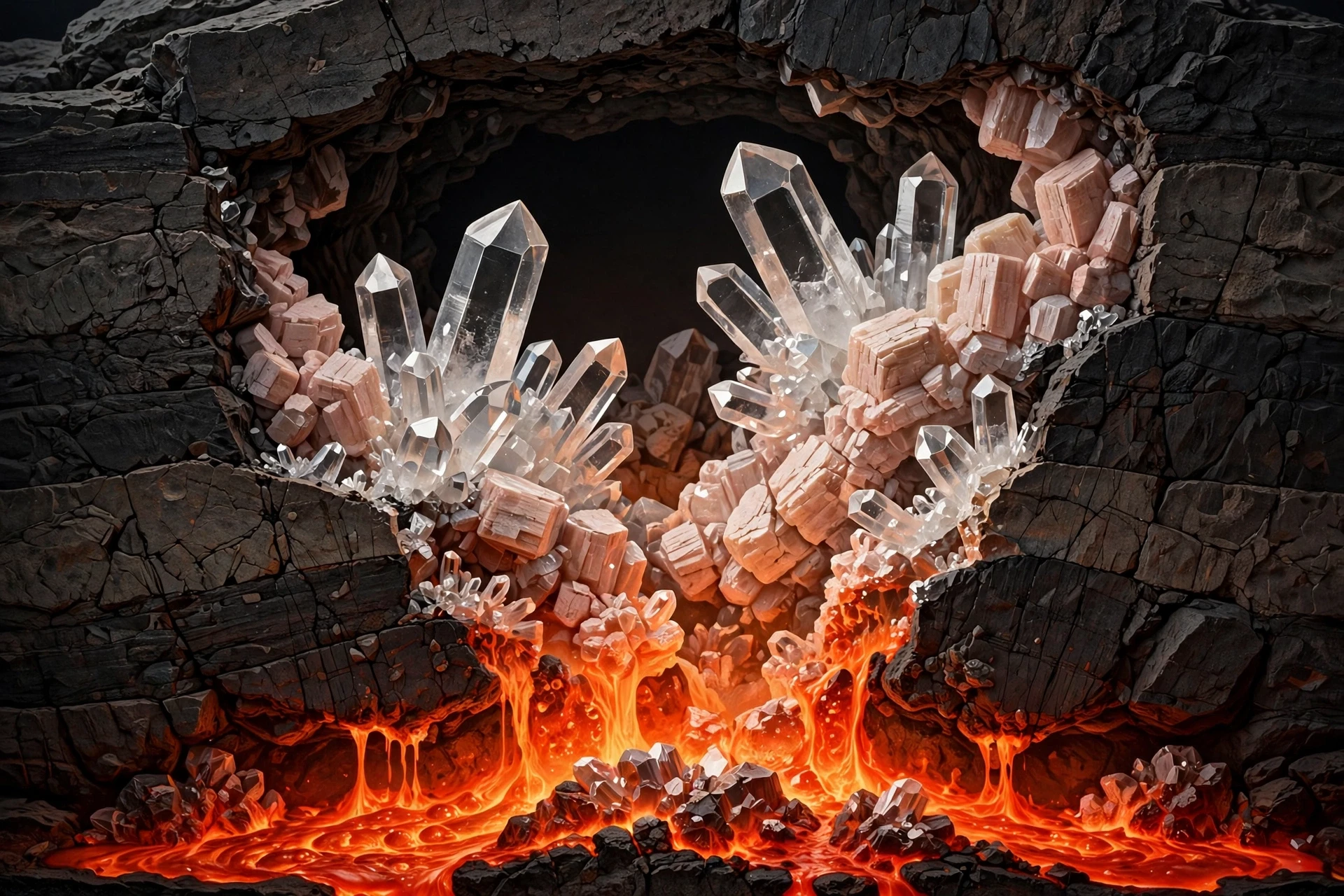
The most spectacular mineral births happen underground, in magma — rock so hot that it has melted into a thick, glowing liquid. As magma cools, it does not freeze all at once like water in a tray. It crystallises in sequence, mineral by mineral, each one forming at its own temperature. Olivine crystallises first, at the highest temperatures, followed by pyroxene and calcium-rich feldspar; quartz, which needs cooler conditions, comes last. This orderly sequence, worked out by the petrologist Norman Bowen in the early twentieth century, is called Bowen's reaction series, and it is one of the great organising ideas of geology: it explains why some minerals are never found together in the same rock, and why the same magma can produce very different rocks depending on how far cooling had progressed when it solidified.
Speed matters enormously. Magma that cools slowly, buried kilometres deep and insulated by the rock around it, gives its atoms time to migrate and join growing crystals. The result is granite, with crystals big enough to see — glittering mica flakes, glassy quartz, pink feldspar blocks. Magma that cools quickly, erupting onto the surface as lava, freezes before large crystals can grow, and the result is basalt, fine-grained and dark, its crystals visible only under a microscope. And magma that cools in a water-rich pocket, late in the process, can grow pegmatite crystals of astonishing size — beryl crystals longer than a bus have been found in pegmatite veins, and a single spodumene crystal in South Dakota measured longer than a city block is wide. I once stood in a pegmatite quarry in New Hampshire and stared at a feldspar crystal as broad as a kitchen table, and the scale of it made me laugh out loud. A crystal that big is not a curiosity; it is a record of weeks, months, or years of slow, undisturbed growth in a hot, wet pocket deep underground.
The link between volcanoes and minerals is direct: every volcanic eruption is a mineral-forming event, freezing a snapshot of crystallisation in progress. Readers who want the volcanic half of the story can follow it in our companion piece on how volcanoes form, their types, and their eruptions.
3.2 Evaporation: minerals from drying water
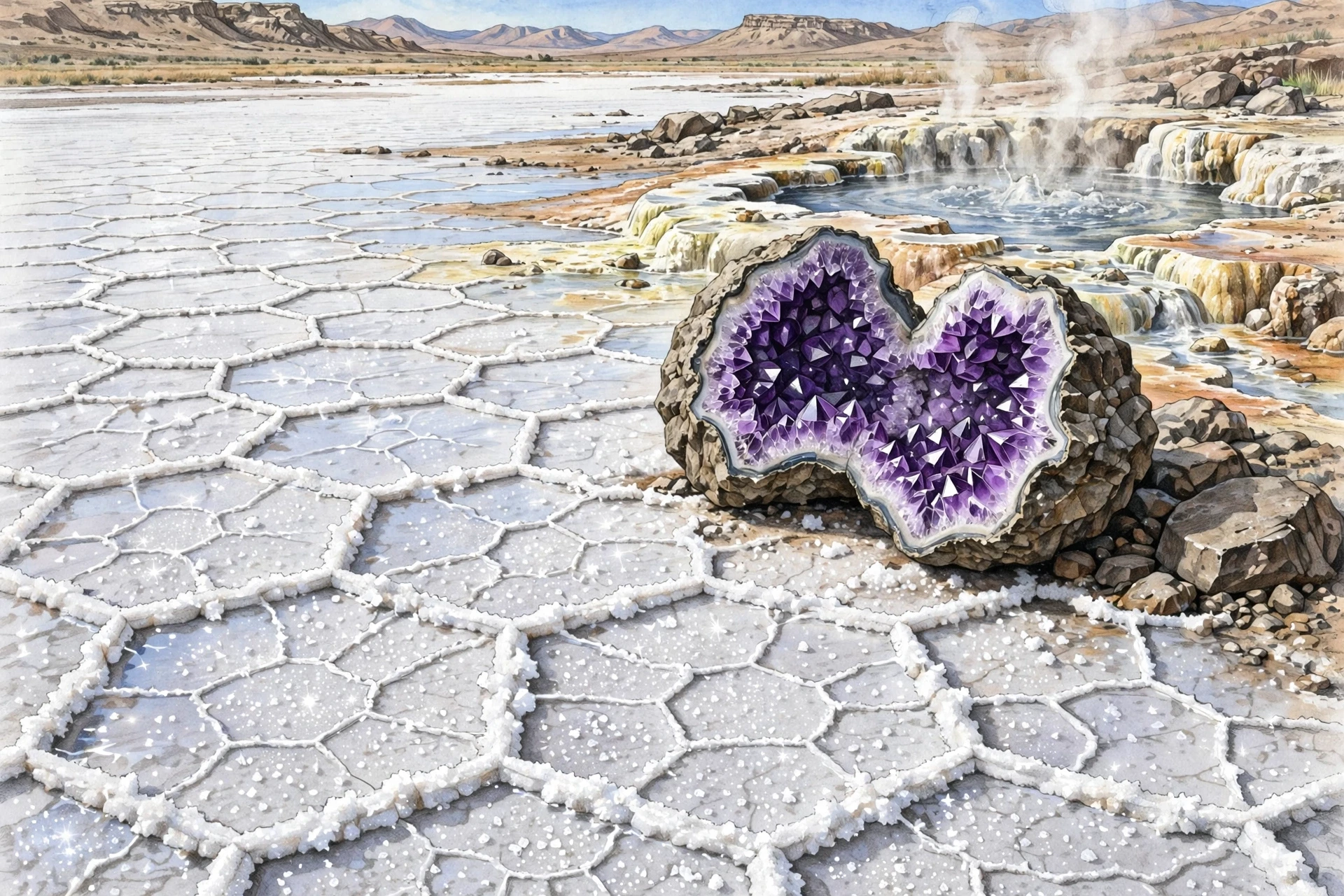
The second birthplace is the opposite of a magma chamber: a shallow sea, a salt lake, a desert puddle, drying in the sun. Seawater carries dissolved ions — sodium, chloride, calcium, sulfate, magnesium — and as the water evaporates, the solution grows more concentrated until it can hold no more. At that point, minerals begin to precipitate, dropping out of the water as crystals in a predictable order: calcite first, then gypsum, then halite — common table salt — and finally the bitter potassium and magnesium salts. These are called evaporite minerals, and the great salt deposits of the world, from the salt mines of Poland to the salt flats of Bolivia, are the dried-up remains of ancient seas.
I have a small jar of halite crystals on my desk that I grew the lazy way, by leaving a dish of salty water on a windowsill. Within a week the water was gone and the dish was lined with perfect little cubes, each one a tiny crystal of sodium chloride. It is the same process, at the same scale of chemistry, as the one that built salt deposits hundreds of metres thick under the Mediterranean. The only difference is time and volume: given a sea, a hot climate, and a few million years, evaporation can lay down salt beds thick enough to mine for centuries.
Evaporite minerals are also time capsules. Because they form in the order of their solubility, a layered salt deposit is a record of a sea's slow death, readable layer by layer like the pages of a book. And because some evaporite minerals, like gypsum, form only within a narrow range of temperatures, they are thermometers for ancient climates, telling us how hot the world was when that sea dried up.
3.3 Hot water: hydrothermal veins and geodes
The third birthplace is hot water moving through cracks in the crust. Rainwater sinks deep underground, heats up near magma or hot rock, and becomes a powerful solvent, dissolving metals and silica from the rocks it passes through. Then it rises, cools, and deposits its load as minerals in fractures and cavities. These hydrothermal deposits are the source of many of the world's most valuable minerals: gold, silver, copper, lead, and zinc all travel in hot water before settling into veins of quartz. The quartz veins that stripe hillsides in gold country are the frozen plumbing of ancient hot-water systems, and the gold sits in them like sediment in a pipe.
Geodes are the prettiest product of this process. A geode begins as a hollow bubble in volcanic rock — a gas pocket frozen into the lava as it cooled. Later, mineral-rich water seeps into the bubble and lays down layer after layer of crystals on its inner walls, usually quartz or amethyst, growing inward until the cavity is lined with glittering points. From the outside a geode looks like a dull, lumpy rock; inside, it is a crystal cave the size of a fist. The first geode I ever cracked open — a grey lump I had carried home from a road cut, convinced it was nothing — split under the hammer to reveal a lining of pale purple amethyst, and I understood in that moment why people hunt for them. The plain outside and the jewelled inside is the whole story of geology in miniature: the surface hides the structure, and the structure is where the beauty lives.
Hydrothermal minerals also include some of the most spectacular specimens in museums: the giant gypsum crystals of the Cave of the Crystals in Mexico, some longer than a bus, grew over hundreds of thousands of years in water barely warmer than a hot bath, fed by a steady trickle of dissolved minerals. Slow, warm, and undisturbed — the recipe for giants.
3.4 Metamorphism: new minerals from old rock
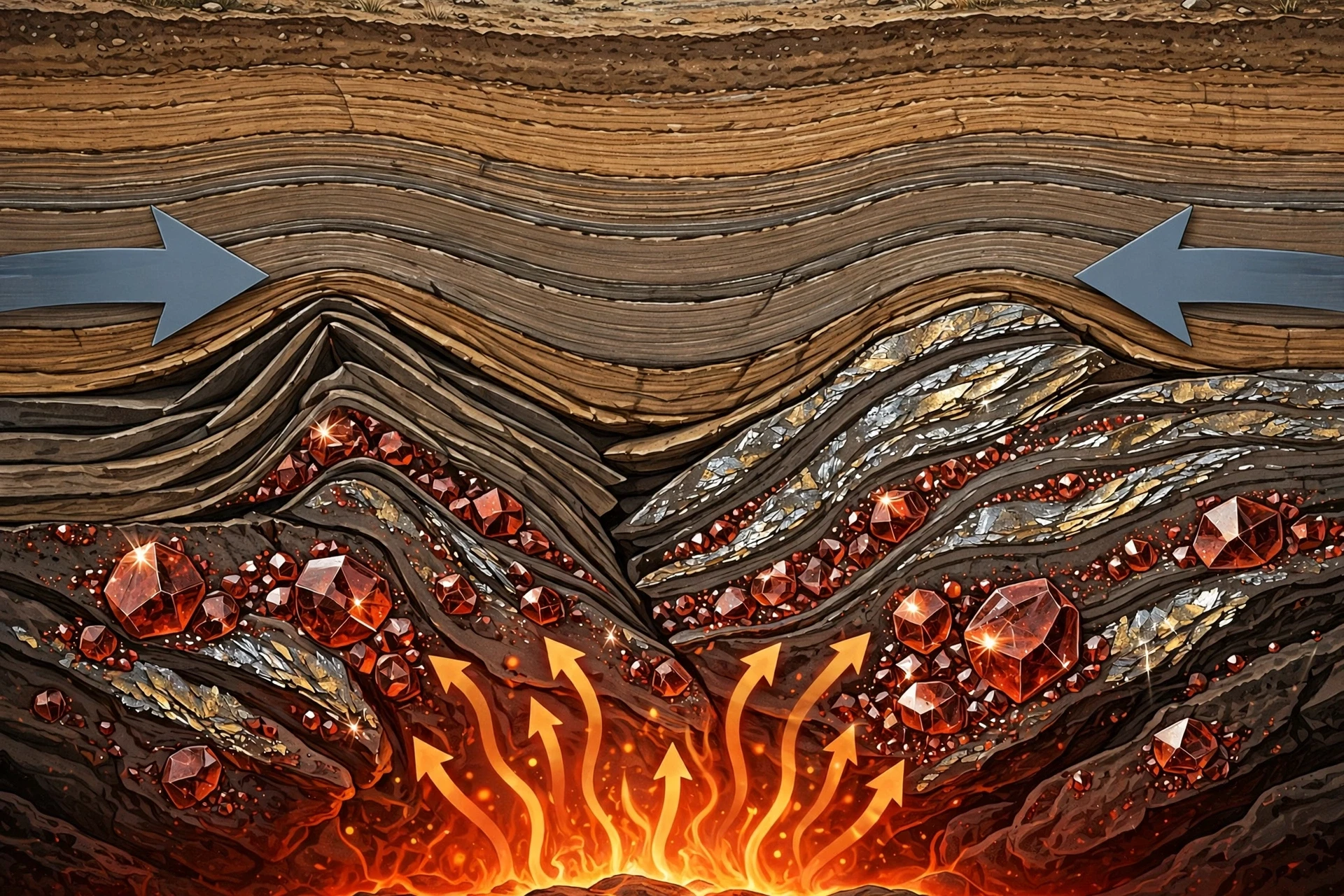
The fourth birthplace is the most violent: metamorphism, the transformation of existing rock under heat and pressure deep in the crust, without melting. When tectonic plates collide and mountains rise, rocks buried kilometres down are squeezed and baked. Their atoms, given energy and time, rearrange themselves into new minerals that are stable under the new conditions. Clay minerals in a shale become mica and then garnet as the temperature climbs; limestone recrystallises into marble, its calcite grains growing larger and interlocking; sandstone becomes quartzite. The rock does not melt — it recrystallises, solid to solid, like a crowd rearranging itself into a new formation without anyone leaving the room.
Metamorphic minerals are the geologist's pressure gauges and thermometers. Garnet, for instance, only grows under high pressure and temperature, so finding garnet in a rock tells you that rock was once buried deep. Kyanite, staurolite, and sillimanite form a famous sequence: the same aluminium-rich rock will grow kyanite at high pressure, staurolite at moderate conditions, and sillimanite at high temperature, so the mineral present reveals the conditions of burial. Reading a metamorphic rock is like reading a flight recorder — it tells you where the rock has been, how deep it went, and how hot it got.
I once spent a long afternoon in the field in the Scottish Highlands, hammering at a schist outcrop and watching garnet crystals the colour of dark red wine pop out of the grey mica like berries from a bush. The rock had been buried twenty kilometres down and then lifted back to the surface over hundreds of millions of years, and the garnets were the proof of the journey, grown in the dark under pressures I can barely imagine. Holding one, I felt the same vertigo I had felt with the amethyst as a child — the sense of deep time made tangible, small enough to fit in a palm.
3.5 The quieter births: weathering and life
Not every mineral is born in drama. Some form quietly at the surface, as rocks weather and their atoms are rearranged by rain, oxygen, and time. Iron minerals rust out of iron-bearing rock to form hematite and goethite, the red and yellow pigments of soils and cliffs. Clay minerals form as feldspar weathers, which is why the soil of a granite landscape is rich in clay. And some minerals are made with the help of life: the calcite of a coral reef, the aragonite of a shell, the silica of a diatom's glassy skeleton. Strictly, the products of living things are not minerals themselves — remember the inorganic rule — but organisms can create the conditions for mineral formation, concentrating elements that later crystallise as true minerals in sediments. The line between biology and mineralogy is thinner than the textbook definitions suggest, and some of the most interesting science in the field today lives exactly on that border.
4. The Hidden Architecture: Crystals and the Seven Crystal Systems
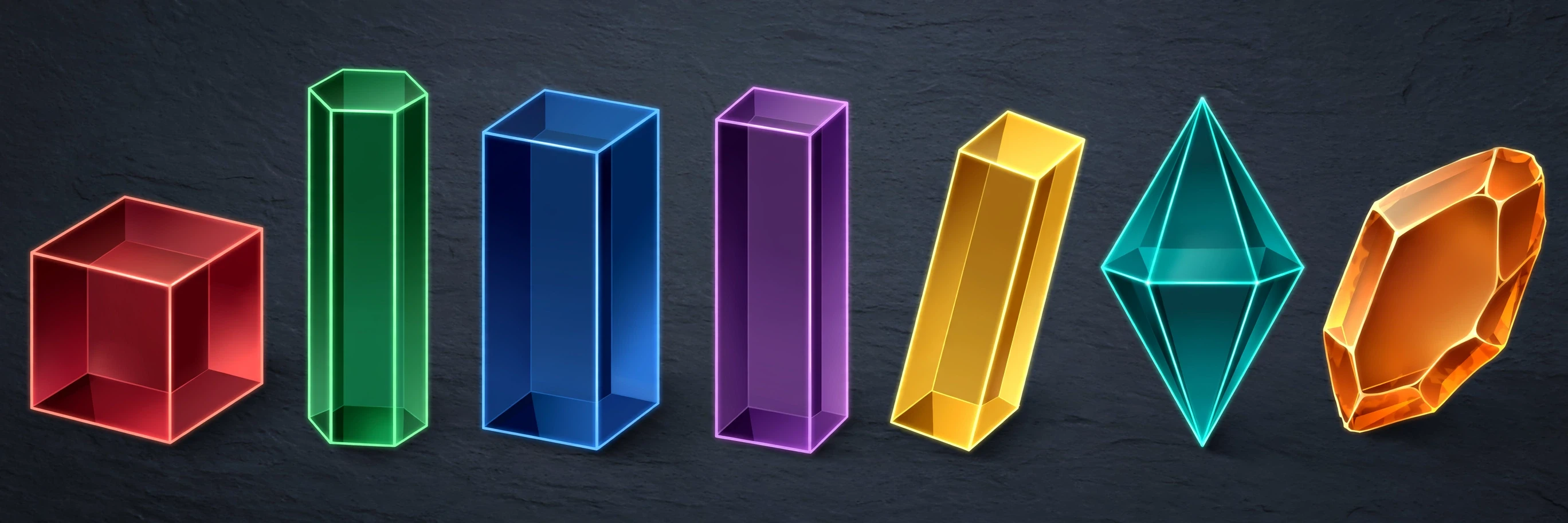
If the five rules of Section 1 are the definition of a mineral, then the crystal lattice is the reason the definition works. Inside every mineral, atoms are arranged in a repeating three-dimensional pattern, and that pattern belongs to one of just seven crystal systems. Seven. That is all. Every mineral known to science — more than 5,000 species, from common quartz to rare minerals known from a single hillside — fits into one of seven geometric families. The variety of the mineral world is not a variety of architectures; it is a variety of decorations hung on seven frames.
The seven systems are defined by the symmetry of the lattice: the lengths of its three axes and the angles between them. The cubic system, also called isometric, has three axes of equal length meeting at right angles — the most symmetrical of all — and it is the home of diamond, halite, pyrite, and garnet. The tetragonal system has two equal axes and one different one, all at right angles; zircon and rutile live here. The hexagonal system has three equal axes at 120 degrees in a plane plus a fourth vertical axis; quartz and beryl belong to it. The trigonal system is closely related to hexagonal and holds calcite, tourmaline, and hematite. The orthorhombic system has three unequal axes, all at right angles, and hosts olivine and topaz. The monoclinic system has three unequal axes with one tilted angle, home to gypsum, mica, and orthoclase feldspar. And the triclinic system, the least symmetrical of all, has three unequal axes and three unequal angles; plagioclase feldspar and turquoise grow here.
Why does this matter to anyone who is not a crystallographer? Because the crystal system controls the mineral's outward shape, its cleavage, and even its optical behaviour. A cubic mineral grows as cubes or octahedrons because its lattice is cubic. A hexagonal mineral grows as six-sided prisms because its lattice is hexagonal. The outward shape is the lattice made visible, the way the shape of a building reveals the geometry of its frame. When a mineral grows freely, with space around it, it shows its system plainly — the flat faces you see on a quartz point are the direct expression of the hexagonal lattice inside. When it grows crowded, hemmed in by neighbours, the outward shape is lost, but the lattice remains, and with it the properties the lattice creates.
A crystal is not a shape. A crystal is a pattern, repeated. The shape you see is only the pattern's shadow on the outside of the stone.
There is a beautiful consequence of this. Because the lattice repeats perfectly, a mineral's properties are the same in every direction governed by its symmetry — and different in directions the symmetry does not cover. This directional dependence, called anisotropy, is why mica splits into sheets but not into blocks, why tourmaline is a different colour when you look at it from different angles, and why a calcite crystal splits a beam of light into two. The lattice is not decoration. It is the mechanism behind everything a mineral does.
4.1 Why crystals grow the shapes they do
A crystal grows by adding atoms to its faces, layer by layer, and the faces that grow slowest survive, while the faces that grow fastest grow themselves out of existence. That is why a quartz crystal ends in a point: the faces meeting at the tip grew slowly and stayed, while the fast-growing faces vanished early. Impurities, temperature, and the chemistry of the surrounding fluid all influence which faces survive, which is why the same mineral can look different from different localities — smoky quartz from one mine is dark with irradiation damage, while milky quartz from another is white with microscopic fluid inclusions. The chemistry is the same; the history is different. Reading a crystal's shape and colour is reading its biography.
5. How to Identify a Mineral: The Detective's Toolkit
Here is a scene I have replayed dozens of times. A student walks into the lab, sets a grey lump on the bench, and asks, "What is this?" The lump could be one of a hundred minerals. Colour alone will not tell us — quartz alone comes in clear, white, pink, purple, smoky brown, and yellow. So we run the tests, in order, the way mineralogists have run them for two centuries: hardness, cleavage and fracture, lustre, streak, colour, density, and a handful of special properties. No single test identifies a mineral. The identification is the combination, the way a detective identifies a suspect not from one clue but from the pattern of all of them.
The National Park Service, which trains rangers to help visitors identify the minerals they find in parks, lists the same core properties — colour, streak, lustre, hardness, crystal habit, cleavage and fracture, and density — and notes that a mineral's physical properties follow directly from its chemical composition and bonding. That is the deep point: identification works because properties are not arbitrary. They are the lattice and the chemistry, expressed in a form your hands can test.
5.1 Hardness and the Mohs scale
Hardness is a mineral's resistance to being scratched, and it is the single most useful identification test because it is quick, it needs no equipment, and it is diagnostic: quartz is always harder than glass, and calcite is always softer than a steel nail. The test is comparative — you scratch the unknown mineral with a material of known hardness, and see which one is marked. The mineral that scratches is the harder one.
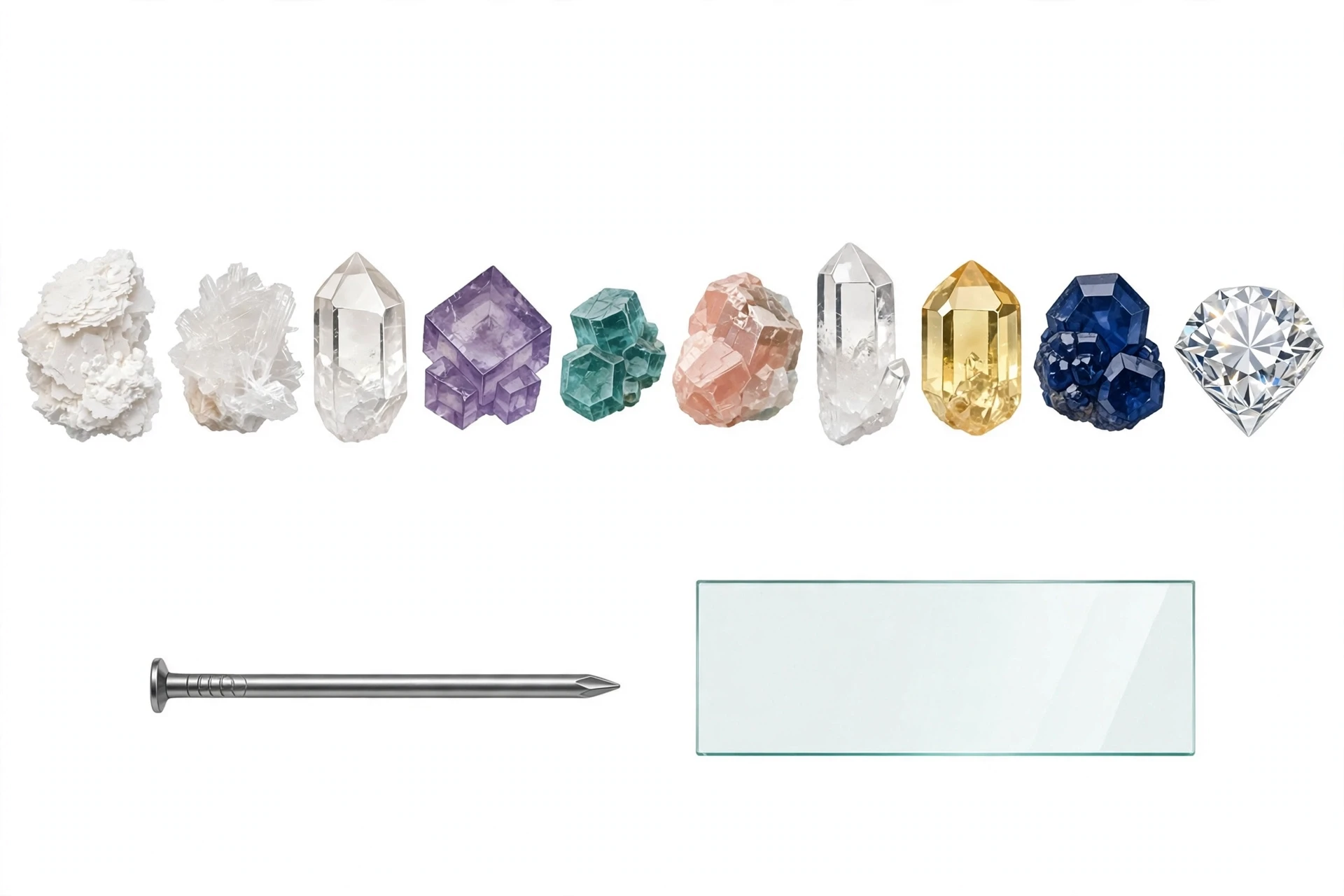
In 1812, the German mineralogist Friedrich Mohs turned this everyday observation into a scale. He chose ten common minerals, arranged from softest to hardest, and numbered them 1 to 10. Talc is 1, the softest; gypsum is 2; calcite is 3; fluorite is 4; apatite is 5; orthoclase feldspar is 6; quartz is 7; topaz is 8; corundum is 9; diamond is 10, the hardest. Each mineral on the scale scratches every mineral below it and is scratched by every mineral above it. The scale is still in use two centuries later, not because it is precise — it is not; it is a ranking, not a measurement — but because it is practical. A field geologist carries no instruments, but they carry a fingernail (hardness about 2.5), a copper coin (about 3.5), a steel nail or knife blade (about 5.5), and a piece of glass (about 5.5), and with those four everyday objects they can bracket almost any mineral's hardness.
Two warnings belong here, because beginners get them wrong. First, the Mohs scale is not linear. Diamond, at 10, is not ten times harder than talc at 1; in absolute terms it is roughly a thousand times harder, and about four times harder than corundum at 9. The numbers are ranks, not measurements. Second, hardness is not toughness. Diamond is the hardest natural material known, but it is brittle — hit it hard enough and it will shatter along its cleavage planes. A steel hammer is far softer than diamond but far tougher. Hardness is about scratching; toughness is about breaking. Confusing the two is how people damage gemstones.
Mohs hardness | Reference mineral | Everyday test object | Example minerals at this hardness |
|---|---|---|---|
1 | Talc | — | Talc, graphite |
2 | Gypsum | Fingernail (2.5) | Gypsum, chlorite |
3 | Calcite | Copper coin (3.5) | Calcite, cerussite |
4 | Fluorite | — | Fluorite, dolomite |
5 | Apatite | Steel nail (5.5) | Apatite, turquoise |
6 | Orthoclase feldspar | Steel file (6.5) | Orthoclase, hematite |
7 | Quartz | Streak plate (7) | Quartz, garnet |
8 | Topaz | — | Topaz, beryl |
9 | Corundum | — | Corundum (ruby, sapphire) |
10 | Diamond | — | Diamond |
5.2 Cleavage and fracture: how minerals break
If hardness is about scratching, cleavage is about breaking — and it is the most elegant of all mineral properties, because it reveals the lattice directly. Some minerals break along flat, smooth planes, because their atomic bonds are weaker in certain directions. Mica splits into paper-thin sheets. Calcite breaks into perfect rhombs. Feldspar breaks along two flat planes at nearly right angles. This is cleavage: breakage along planes of weak bonding, and it is always parallel to possible crystal faces, because it follows the lattice.
Other minerals have no planes of weakness, so they break irregularly, in rough or curved surfaces. Quartz breaks with a curved, shell-like fracture called conchoidal fracture — the same kind of break you see in broken glass, and for the same reason: there is no weak plane for the break to follow, so it curves. Flint and obsidian break the same way, which is why early humans could knap them into sharp tools. A mineral's fracture is a confession: it tells you whether the lattice has weak directions, and where they are.
I still use cleavage as my favourite teaching test, because it surprises people. Hand a beginner a chunk of mica and a chunk of quartz and ask them to break both. The mica peels apart in glittering sheets, almost politely. The quartz resists, then snaps with a curved, glassy scar. Two minerals, two kinds of breakage, and the difference is written in their atoms. The number of cleavage directions and the angles between them are diagnostic enough that a mineralogist can often name a mineral from its breakage alone.
5.3 Lustre: how light leaves the surface
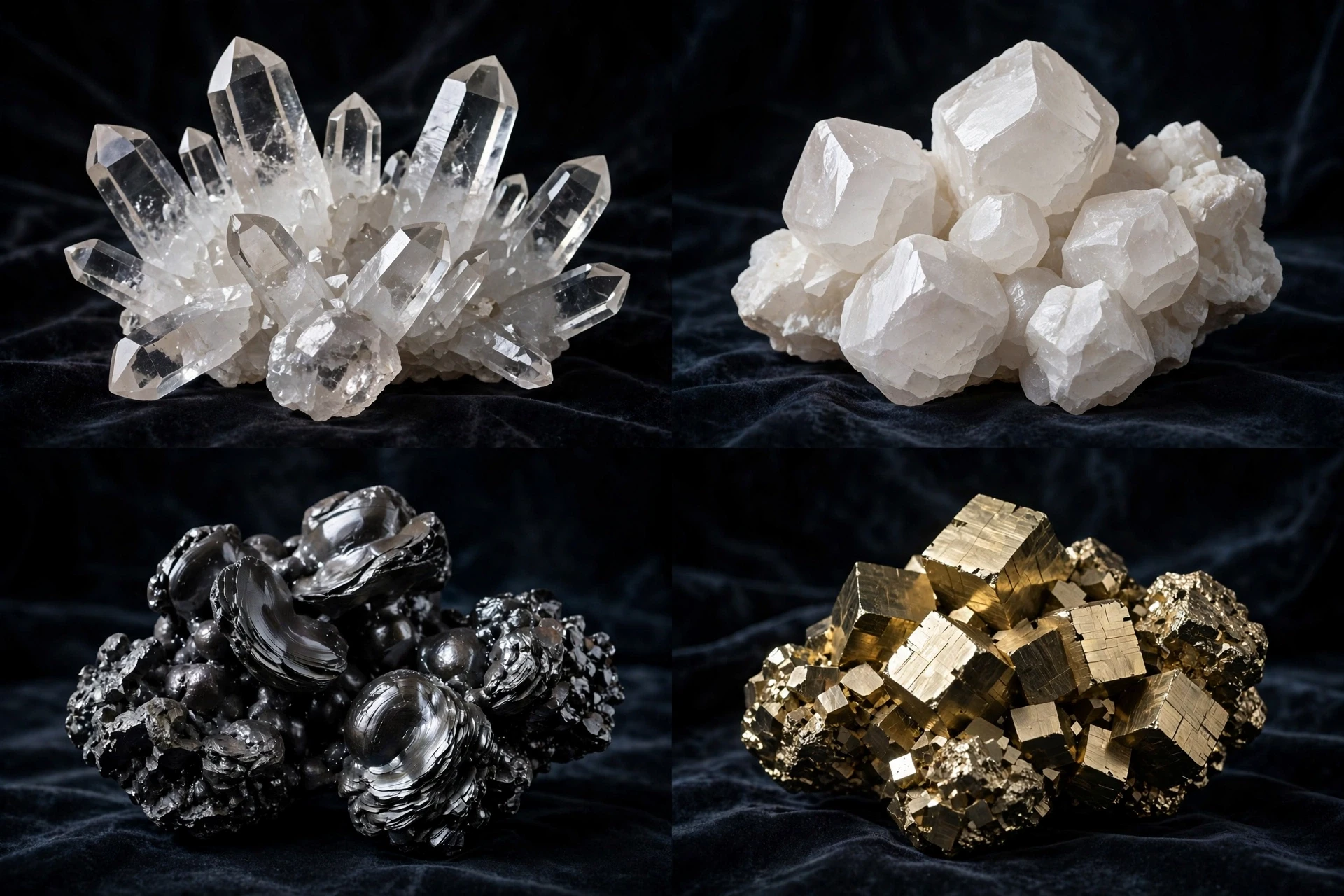
Lustre is the way light reflects off a mineral's surface, and it is one of the first things you notice about a specimen. Metallic lustre is the look of polished metal — pyrite, galena, and hematite shine like iron or brass. Non-metallic lustre comes in several flavours: vitreous (glassy, like quartz), pearly (like the inside of a shell, like mica), silky (like satin, like fibrous gypsum), resinous (like amber, like sphalerite), and adamantine (brilliant, like diamond). Lustre depends on how the mineral's atoms interact with light, and it is remarkably consistent within a species: quartz is always vitreous, never metallic, and that consistency makes lustre a reliable test.
The classic mistake is to confuse lustre with colour. Pyrite has a metallic lustre and a brassy yellow colour, and beginners call it gold — "fool's gold" — but the lustre is only half the story. The streak test, which comes next, is what unmasks it.
5.4 Streak: the colour of the powder
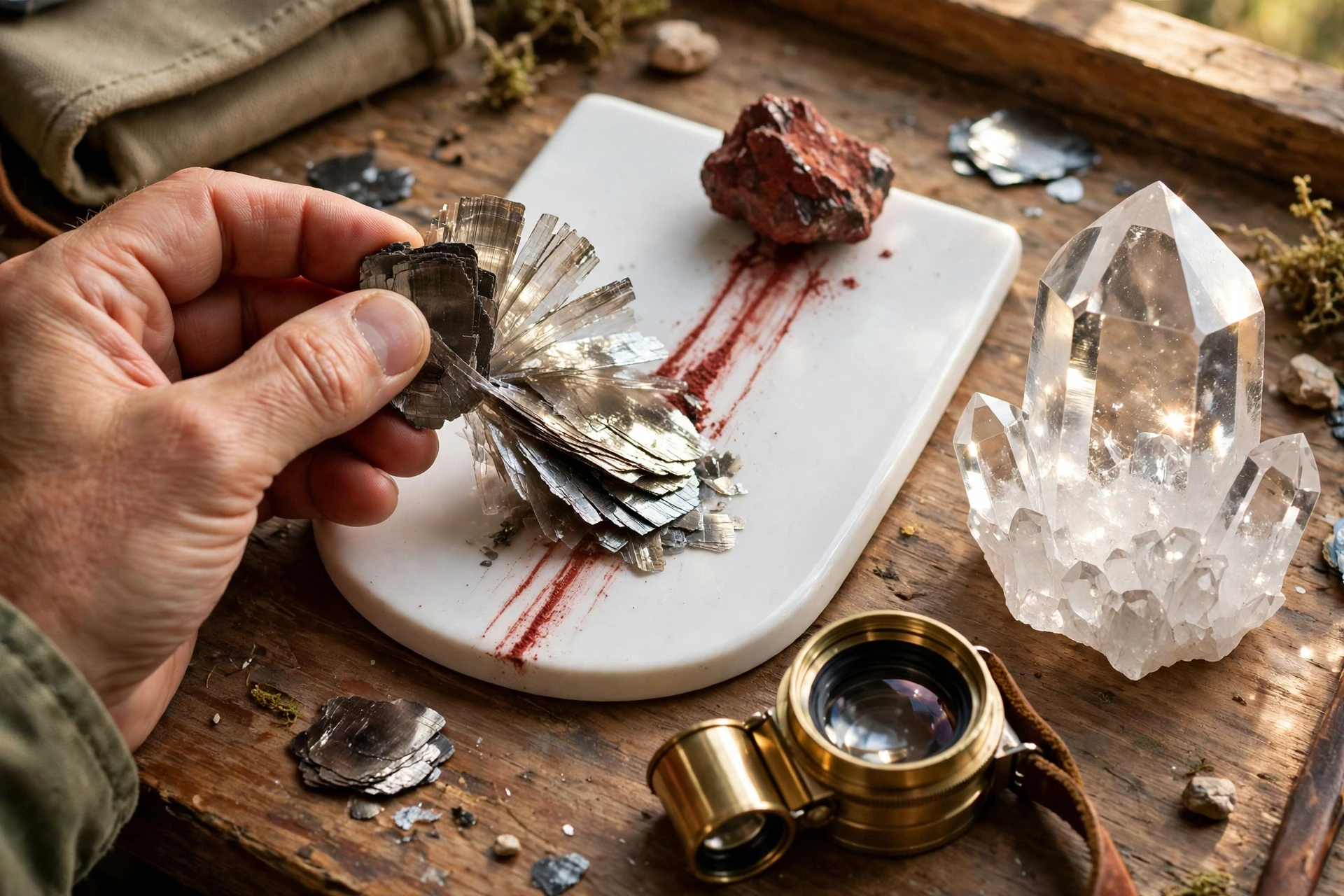
Streak is the colour of a mineral's powder, tested by dragging the specimen across an unglazed porcelain plate. It is far more reliable than the colour of the solid mineral, because the solid colour is easily changed by trace impurities, while the powder colour reflects the mineral's true chemistry. Hematite is the textbook example: the solid mineral can be steel-grey, black, or brick red, but its streak is always a rusty red-brown. Pyrite's streak is greenish-black, while gold's streak is golden yellow — the streak plate settles the fool's-gold question in two seconds.
Not every mineral leaves a streak. Minerals harder than the porcelain plate (about 7 on the Mohs scale) will scratch the plate instead of leaving powder, so the test is limited to softer minerals. But within that range it is one of the most dependable tests in the kit, and it is the reason every field geologist carries a small white tile in their pocket.
5.5 Colour, density, and the special tests
Colour is the most obvious property and the least reliable. A mineral's colour can be changed by tiny amounts of impurity — a fraction of a percent of iron turns quartz purple (amethyst) or yellow (citrine); chromium turns corundum red (ruby) or green (emerald, which is beryl, not corundum, but the principle is the same). Some minerals are always the same colour — malachite is always green, azurite always blue, sulfur always yellow — and those are called idiochromatic. But most minerals are allochromatic, taking their colour from guests in the lattice, and for those, colour is a hint, never a verdict.
Density, or specific gravity, is more trustworthy. It is the mineral's weight compared with the weight of an equal volume of water, and it reflects the mass of the atoms in the lattice and how tightly they are packed. Gold is dense — about 19 times heavier than water — which is why panning for gold works: the heavy gold stays in the pan while the lighter sand washes away. Galena, the lead ore, is strikingly heavy for its size, and the first time you pick up a piece, the unexpected weight is a clue in itself.
Then there are the special tests, the ones that feel like party tricks but are solid science. Magnetite is magnetic. Calcite fizzes in dilute acid, releasing carbon dioxide. Halite tastes salty (and yes, mineralogists do taste halite — carefully, and only halite). Some fluorite fluoresces under ultraviolet light, glowing an eerie violet. Some minerals are radioactive enough to register on a Geiger counter. None of these tests identifies a mineral on its own, but each one narrows the field, and together they form a net that very few minerals can slip through.
6. The Major Mineral Groups: A Family Portrait
Mineralogists group minerals by their chemistry, and the grouping is not arbitrary — it reflects the anions, the negatively charged parts of the compound, which control much of a mineral's behaviour. There are more than 5,000 known mineral species, but the vast majority of the Earth's crust is built from just a few groups, and most of the minerals you will ever meet belong to one of four: silicates, carbonates, oxides, and sulfides. Learning these four families is like learning the four main branches of a family tree — once you know them, almost every mineral you meet is a recognisable cousin.
6.1 Silicates: the builders of continents
Silicates are the largest and most important mineral group by far, making up more than 90 percent of the Earth's crust. Their building block is the silicate tetrahedron: one silicon atom surrounded by four oxygen atoms, arranged at the corners of a tiny pyramid. These tetrahedra link together in different ways — alone, in pairs, in chains, in sheets, in three-dimensional frameworks — and the way they link determines the mineral's structure and properties. Chain silicates, like pyroxene and amphibole, grow as long crystals and split along the chain direction. Sheet silicates, like mica and clay, split into flakes, because the sheets are held together only by weak bonds. Framework silicates, like quartz and feldspar, link in all directions into a rigid three-dimensional web, and they are the hard, durable minerals that survive weathering to become sand.
The most abundant minerals on Earth are silicates. Quartz (silicon dioxide) is the second most abundant mineral in the crust. Feldspar — actually a family of closely related minerals — is the most abundant of all, making up more than half of the crust by volume. Olivine, the green mineral of the mantle, is a silicate. So is garnet, so is topaz, so is beryl, the mineral that gives us emerald and aquamarine. If you pick up a random rock, the odds are overwhelming that most of its minerals are silicates. The reason is simple arithmetic: oxygen and silicon are the two most abundant elements in the crust, and they love to bond with each other. The planet is, quite literally, built of silicon and oxygen, arranged in tetrahedra.
The chemistry of minerals sits on the same foundation as all chemistry: elements combine in fixed proportions to make compounds with new properties. Readers who want the chemical background will find it in our guide to the periodic table, element structure, and trends, and the reactions that build and break minerals are covered in our explainer on chemical reactions, their types, kinetics, and examples.
6.2 Carbonates: the minerals of seas and shells
Carbonates are built around the carbonate ion, CO₃²⁻ — one carbon atom bonded to three oxygen atoms in a flat triangle. The most famous carbonate is calcite, calcium carbonate, CaCO₃, the mineral of limestone, marble, chalk, and the shells of countless marine organisms. Its close cousin aragonite has the same formula but a different crystal structure, and it is the mineral of pearls and coral skeletons. Dolomite, calcium magnesium carbonate, builds the Dolomite mountains of Italy and vast oil-bearing rock formations. Malachite and azurite, the green and blue copper carbonates, have been prized as pigments and ornaments for thousands of years.
Carbonates have a signature test: they fizz in dilute acid. Drop a little weak hydrochloric acid on calcite and it bubbles as carbon dioxide is released — a reaction that has identified limestone for generations of geology students. Carbonates are also the minerals most involved in the carbon cycle: the shells of marine organisms fall to the seafloor, are buried, and become limestone, locking carbon away for millions of years; later, weathering and volcanism return it to the atmosphere. The white cliffs of Dover are not just a landmark. They are a carbon store, written in chalk.
6.3 Oxides: metals and magnets
Oxides are minerals in which oxygen bonds directly to a metal, without silicon or carbon in between. Hematite, iron oxide (Fe₂O₃), is the most important iron ore in the world and the red pigment of rust, cave paintings, and the surface of Mars. Magnetite, iron oxide (Fe₃O₄), is magnetic — the lodestone that ancient navigators used as a compass — and it is also an iron ore. Corundum, aluminium oxide (Al₂O₃), is the second hardest natural mineral after diamond; its gem varieties are ruby (red, coloured by chromium) and sapphire (blue, coloured by iron and titanium). Cassiterite, tin oxide, is the main ore of tin. Uraninite, uranium oxide, is the main ore of uranium.
Oxides tend to be hard, dense, and chemically resistant, which is why they survive as heavy grains in river sands and beach sands — the black sand on some beaches is largely magnetite and ilmenite, concentrated by the waves. They are also the minerals that carry our technology's metals: without hematite and magnetite there is no steel, and without steel there is no modern world.
6.4 Sulfides: the ores that built civilisation
Sulfides are minerals in which sulfur bonds to a metal, and they are the great ore minerals — the source of most of the world's copper, lead, zinc, silver, and nickel. Galena, lead sulfide, is the main ore of lead, and it is also one of the easiest minerals to recognise: heavy, metallic grey, breaking into perfect cubes. Sphalerite, zinc sulfide, is the main ore of zinc. Chalcopyrite, copper iron sulfide, is the main ore of copper, and it is brassy yellow — another mineral often mistaken for gold, though its streak and its softness give it away. Pyrite, iron sulfide, is the famous fool's gold, and cinnabar, mercury sulfide, is the brilliant red ore of mercury.
Sulfides usually form in hydrothermal veins and in magmatic deposits, and they are often found together, because the same hot fluids carry many metals at once. A single ore deposit may contain galena, sphalerite, and chalcopyrite in the same vein, and mining it yields three metals from one hole in the ground. Sulfides are also the minerals most associated with acid mine drainage: when they are exposed to air and water by mining, they oxidise and produce sulfuric acid, which can leach metals into streams. The wealth they bring and the damage they can do are two sides of the same chemistry.
6.5 The smaller families
Beyond the big four, several smaller groups deserve a mention. Halides are salts, built around halogen ions — halite (sodium chloride) and fluorite (calcium fluoride) are the best known. Sulfates, built around the sulfate ion, include gypsum (calcium sulfate), the mineral of plaster and drywall, and barite, used as a weighting agent in drilling mud. Phosphates include apatite, the mineral of teeth and bones, and the source of phosphate fertiliser. And the native elements are minerals that occur as pure elements: gold, silver, copper, platinum, sulfur, and diamond and graphite — pure carbon, in two different crystal structures. Native elements are rare, because most elements prefer to bond with something, but when they do occur pure, they are often the minerals humans valued first — gold needs no smelting, no chemistry, no furnace. You can pick it up, and it is already gold.
Mineral group | Defining anion | Key examples | Everyday importance |
|---|---|---|---|
Silicates | SiO₄ tetrahedron | Quartz, feldspar, mica, olivine | Glass, ceramics, sand, gemstones |
Carbonates | CO₃²⁻ | Calcite, dolomite, aragonite | Cement, limestone, chalk, antacids |
Oxides | O²⁻ | Hematite, magnetite, corundum | Iron and steel, abrasives, rubies |
Sulfides | S²⁻ | Galena, pyrite, chalcopyrite | Copper, lead, zinc ores |
Halides | Cl⁻, F⁻ | Halite, fluorite | Table salt, optics, flux |
Sulfates | SO₄²⁻ | Gypsum, barite | Plaster, drywall, drilling mud |
Phosphates | PO₄³⁻ | Apatite | Fertiliser, teeth and bones |
Native elements | None (pure element) | Gold, diamond, graphite, sulfur | Jewellery, pencils, electronics |
7. Minerals in Everyday Life and Technology
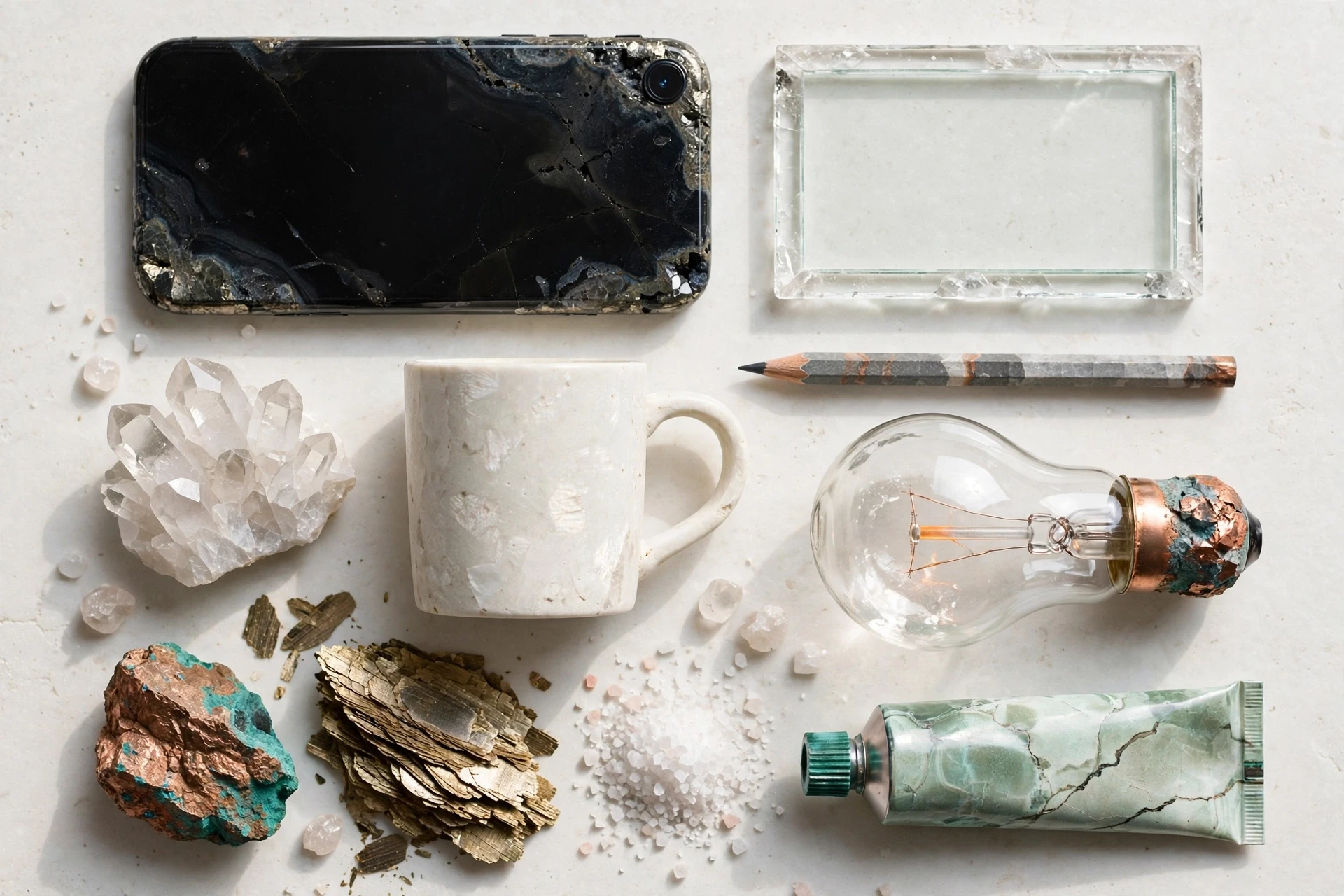
Here is a small experiment. Stand up, look around the room you are in, and try to find one thing that contains no minerals. The walls are plaster (gypsum) and paint (titanium dioxide, from the mineral rutile). The windows are glass (quartz sand). The floor is concrete (limestone and sand) or tile (clay minerals, fired). The light bulb's filament once ran on tungsten (from wolframite); the bulb's glass is quartz sand again. Your phone contains more than thirty minerals: quartz in the screen, lithium minerals in the battery, rare-earth minerals in the speakers and vibration motor, copper and gold in the circuits, tantalum in the capacitors. The toothpaste in your bathroom contains fluoride from fluorite and a mild abrasive made of silica. The salt on your table is halite. The pencil on your desk writes with graphite. The medicines in your cabinet may contain minerals too — antacids are often calcite or magnesite, and the lithium in some psychiatric medicines comes from the mineral spodumene.
We do not live on top of the mineral world. We live inside it, and we carry it in our pockets.
The numbers behind this are startling. The U.S. Geological Survey tracks dozens of mineral commodities that feed modern industry, and the list of minerals classed as critical — essential to the economy and national security, with vulnerable supply chains — keeps growing as technology advances. A single electric car battery depends on lithium, cobalt, nickel, and graphite, each of which comes from a mineral mined in only a handful of countries. A wind turbine needs rare-earth magnets, steel, copper, and concrete. A solar panel needs quartz, silver, and tellurium. The green energy transition, for all its talk of sun and wind, is at its foundation a mineral transition: we are replacing the fuels we burn with the minerals we build with.
That dependence brings responsibilities. Mining changes landscapes, uses water, and can pollute rivers if it is done badly. The history of mining is full of places that were enriched and then abandoned, their wealth gone and their damage remaining. But the answer is not to stop using minerals — there is no version of modern life that does without them — it is to use them better: to recycle, to design products that use less, to mine with care, and to remember that every mineral in a phone was once a crystal growing quietly in the dark, over geological time, and that it cannot be regrown on a human schedule. Minerals are non-renewable on any timescale that matters to us. Once a deposit is mined, it is gone. That fact should sit at the centre of every conversation about technology, because technology is, in the end, applied mineralogy.
8. Common Misconceptions About Minerals
Most people assume that a mineral's colour is the best way to identify it. It feels like common sense — red things are rubies, green things are emeralds, yellow things are gold — but what we actually see in the data is the opposite: colour is the least reliable property a mineral has, and trusting it is the fastest way to misidentify a specimen. Quartz alone appears in every colour of the rainbow, all of them caused by trace impurities measured in parts per million. The same mineral, the same chemistry, the same lattice — and the colour changes with a pinch of iron or a dose of radiation. A mineralogist who identifies by colour alone is like a doctor who diagnoses by the colour of a patient's shirt. The reliable properties are the ones tied to structure: hardness, cleavage, streak, density. Colour is a hint. Structure is the answer.
A second misconception is that all crystals are minerals and all minerals are crystals. Neither is true. Sugar forms crystals, but sugar is organic and made by plants or factories, so it is not a mineral. And some minerals rarely show crystal faces at all — massive quartz, for example, is still quartz, still crystalline inside, even when it grows as a shapeless lump. The crystal is the internal pattern, not the external shape.
A third misconception is that diamonds are indestructible. Diamonds are the hardest natural substance known, and they are also brittle. They cleave perfectly along four planes, and a sharp blow in the wrong direction will split a diamond cleanly. Jewellers know this; they cut diamonds by exploiting exactly that cleavage. Hardness and toughness are different properties, and the diamond is the proof: hardest of all, and still breakable.
A fourth is that minerals are only useful as gems or ores — pretty things and metal sources. In reality, the most economically important minerals are the unglamorous ones: the limestone that becomes cement, the gypsum that becomes drywall, the sand that becomes glass and concrete, the clay that becomes brick and tile. The mineral industry's bulk is not gold and diamonds. It is the rock under your feet, dug up, crushed, and built into the world.
And a fifth, quieter misconception: that mineralogy is a finished science, a catalogue of known things. It is not. New mineral species are described every year — dozens of them — often from a single mine or a single meteorite, sometimes from the strange chemistry of a slag heap or a mine fire. The mineral world still has corners no one has looked into, and the list of known minerals, now past 5,000, is still growing.
The mineral world rewards patience. The more slowly you look — at a crystal's faces, at the way a mineral breaks, at the powder it leaves on a white tile — the more it tells you. A stone that looked grey and dull in the morning can turn out, by the afternoon, to be a record of a magma chamber, a dried sea, or a mountain that rose and fell before the first human drew breath. That is the quiet thrill of mineralogy: it turns the most ordinary objects in the world into archives of deep time, and it puts those archives within reach of anyone willing to pick up a rock and ask what it is.
Frequently Asked Questions
What is a mineral in simple terms?
A mineral is a naturally occurring, inorganic, solid substance with an orderly internal crystal structure and a definite chemical composition. Quartz is a mineral; granite is not, because granite is a rock made of several minerals mixed together. Coal is not a mineral either, because it is made of ancient plant matter and is therefore organic.
What is the difference between a mineral and a rock?
A mineral is a single substance with a fixed chemical formula and a crystal structure — quartz, calcite, and feldspar are minerals. A rock is an aggregate of one or more minerals: granite is a rock made of quartz, feldspar, and mica, and limestone is a rock made mostly of the mineral calcite. Minerals are the ingredients; rocks are the dishes made from them.
How do minerals form?
Minerals form in four main ways: by crystallising from cooling magma, by precipitating from evaporating water, by depositing from hot mineral-rich water moving through cracks in the crust, and by recrystallising under heat and pressure during metamorphism. In every case, atoms that were free to move slow down and lock into a repeating crystal lattice.
What is the Mohs hardness scale?
The Mohs hardness scale ranks minerals from 1 (talc, the softest) to 10 (diamond, the hardest) by their resistance to being scratched. Each mineral scratches those below it and is scratched by those above it. Everyday test objects include a fingernail (about 2.5), a copper coin (about 3.5), and a steel nail (about 5.5). The scale is a ranking, not a linear measurement — diamond is far more than ten times harder than talc.
How can I identify an unknown mineral?
Test its properties in combination: hardness (what scratches it), cleavage and fracture (how it breaks), lustre (how light reflects off it), streak (the colour of its powder on a porcelain plate), colour, and density. No single test is enough — quartz comes in many colours, for example — but the pattern of all the tests together usually narrows the identification to one mineral.
Are diamonds and graphite really the same material?
Yes — both are pure carbon. The difference is entirely in the crystal structure: in diamond, every carbon atom is bonded to four neighbours in a rigid three-dimensional web, making it the hardest natural substance known; in graphite, carbon atoms sit in sheets that slide over each other, making it soft enough to write with. In the mineral world, structure is destiny.
Why are minerals important in technology?
Modern technology is built from minerals. A smartphone contains quartz, lithium minerals, rare-earth minerals, copper, and gold; electric car batteries depend on lithium, cobalt, nickel, and graphite; wind turbines and solar panels need steel, copper, quartz, and rare-earth magnets. Minerals are non-renewable on human timescales, which is why recycling and careful mining matter so much.