

The first time I dug a proper soil pit, I was twenty-two, armed with a spade, a hand lens, and far too much confidence. The plan was simple: dig down a metre and see how soil forms, layer by layer, then write it up. An hour later I was standing waist-deep in a hole that smelled of rain and mushrooms, staring at a wall of earth that changed colour four times on the way down — dark brown at the top, pale grey in the middle, rusty orange below that, then broken rock that rang when I tapped it with the spade. Nothing about it looked like the uniform brown "dirt" I had walked over my whole life. That hole rewired how I see the ground. Every step I take now, I am walking on a slow-motion chemical factory, a construction site, and a city of living things, all stacked into a layer that is usually less than a metre thick.
Learning how soil forms means learning to think in deep time. The ground beneath a garden, a wheat field, or a forest floor did not arrive ready-made. It was built, grain by grain, by rain and frost, by roots prying cracks wider, by fungi dissolving stone, by worms hauling leaves underground, and by centuries — often thousands of years — of quiet chemistry. A centimetre of topsoil can take hundreds of years to form, and a single careless season can wash it away. That mismatch, between the patience of formation and the speed of loss, is the quiet drama at the heart of this story.
Soil is also the most underrated object in science. We celebrate forests and oceans, and rightly so, but soil holds more carbon than the atmosphere and all the world's vegetation combined, it filters the water we drink, and it grows nearly everything we eat. Understanding how soil forms is not a niche interest for geologists. It is the backstory of every meal, every river, and every breath of air that passes through a landscape.
This article follows that backstory from start to finish. We will begin with solid rock and watch it break apart, meet the five factors that decide what kind of soil any place gets, learn to read the layered horizons of a soil profile like the pages of a book, meet the living community that does much of the real work, and finish with the two questions that matter most: why soil matters, and how we keep it alive.
1. What Soil Actually Is
Ask ten people what soil is and nine will say "dirt." Soil scientists will gently correct them, because dirt is what you sweep off a floor. Soil is something else entirely: a natural body made of mineral particles, organic matter, water, air, and living organisms, arranged in layers, sitting on top of rock, and changing over time. That definition matters because every word in it does work. Mineral particles give soil its skeleton. Organic matter — the remains of plants, animals, and microbes — gives it its dark colour and much of its fertility. Water and air fill the spaces between particles, and those spaces matter as much as the particles themselves. A soil that is half solid and half pore space is a healthy soil; roots breathe in those pores, and water moves through them.
Here is a useful way to picture it. Pick up a handful of good garden soil and squeeze it. It holds together, then crumbles. That crumb structure is not an accident. It is built by roots, fungal threads, earthworm casts, and sticky substances made by bacteria, all gluing tiny mineral grains into crumbs with air gaps between them. Those gaps are the soil's lungs and its plumbing at once. Compact that soil — drive a tractor over it when wet, or pave over it — and the crumbs collapse, the air is squeezed out, and the soil stops working even though every grain is still there.
Most people assume soil is mostly dead mineral matter with a little life sprinkled in. What we actually see when we measure it is the opposite of that picture in the ways that count: a teaspoon of rich topsoil can hold billions of microorganisms, more living cells than there are people on Earth, and the organic matter they build and eat drives nearly every chemical reaction that makes soil fertile. The mineral part is the stage. The living part runs the show.
Soil also has a personality that changes with place. The red soils of a tropical hillside, the black prairie soils of a grassland, the thin grey soils of a mountain slope, and the pale sandy soils of a pine forest are not random. Each one records the rock it came from, the climate it grew under, the organisms that lived in it, the slope it sits on, and the time it has had. Learning to read those records is the whole subject of this article — the story of how soil forms.
2. How Soil Forms: From Solid Rock to Living Ground
Every soil begins the same way: with rock that has to be broken down. Fresh rock is solid, hard, and almost entirely useless to a plant. A seed landing on bare granite finds no water held in pores, no nutrients it can absorb, and nothing to grip. Before soil can exist, the rock must be weathered — cracked, crumbled, and chemically changed into smaller pieces. Weathering is the first chapter of how soil forms, and it works through three partners that never really stop working, even in soil that is thousands of years old.
2.1 Physical Weathering: Breaking Rock Without Changing It
Physical weathering breaks rock into smaller pieces without changing what the rock is made of. A boulder becomes pebbles, pebbles become sand, sand becomes silt — same minerals, smaller sizes. The most powerful tool in this work is water. Rain seeps into a tiny crack, winter comes, the water freezes and expands by about nine percent, and the crack is forced a fraction wider. Do that a few hundred times and a crack becomes a split, and a split becomes two rocks. I once watched a field wall in an upland valley shed flakes of stone every spring, each winter's freeze quietly doing the work of a hammer, and the farmer there told me he had given up repairing one stretch because the wall was losing the argument with February.
Heat does similar work in hot, dry places. A rock surface in a desert can swing tens of degrees between noon and midnight, and the outer skin expands and contracts until thin sheets peel away like the layers of an onion. Wind adds its own abrasion, sandblasting exposed rock over centuries. And then there are the living wedges: a seed lands in a crack, a root grows, and the root thickens year by year, prying the rock apart with slow, unstoppable pressure. I have pulled a sapling out of a stone wall and found the root had split a block clean through, a feat no hammer of mine could have managed as neatly.
Physical weathering matters because it multiplies surface area. A single boulder has a small surface for its volume. Shatter it into sand and the total surface becomes enormous — and surface is where all the chemistry happens. Without this first breaking, the chemical work that follows would have almost nothing to grip.
2.2 Chemical Weathering: Rock, Rewritten
Chemical weathering changes the minerals themselves. Water is the main actor again, but now it is not a wedge — it is a solvent, and a slightly acidic one. Rainwater picks up carbon dioxide from the air and becomes a weak carbonic acid, the same gentle fizz that makes sparkling water tangy. That weak acid drips through cracks and slowly dissolves minerals. Feldspar, one of the most common minerals in the Earth's crust, reacts with that acidic water and transforms into clay minerals, releasing potassium and other nutrients in the process. This is one of the great quiet miracles of soil science: solid rock turning into soft clay that can hold water and nutrients, grain by grain, without anyone watching.
Oxidation does its own work. Iron-bearing minerals react with oxygen and water and rust, which is why so many subsoils are red, orange, or yellow. That rust colour is not decoration; it is a record of chemistry, a sign that iron has been freed from rock and re-deposited as iron oxide coatings on soil grains. In warm, wet climates this chemical work runs fast, and soils can become deeply weathered, with most of their original minerals transformed. In cold or dry climates it runs slowly, and soils stay closer to their parent rock for longer.
2.3 Biological Weathering: Life as a Rock-Breaker
Living things are not polite guests in the weathering process. They are some of its most effective agents. Lichens — those crusty orange and grey patches on boulders — are pioneers. A lichen is a partnership between a fungus and an alga, and it can live on bare rock, secreting organic acids that etch the surface and pry mineral nutrients loose. I remember crouching beside a boulder covered in lichens and realising I was looking at the first page of soil formation: where the lichen had grown, the rock beneath was pitted and softened, and a thin smear of organic debris had gathered in the pits, a foothold for moss, and then for a seedling.
Roots push the work further, both physically and chemically, releasing acids and other compounds that dissolve minerals. Microbes do the same at a microscopic scale, and burrowing animals mix and move the broken material, bringing fresh rock surfaces into contact with water and air. Biology and weathering feed each other: weathering makes a little soil, the soil lets a little life grow, and the life speeds up the weathering. That feedback loop is the engine of soil formation, and it never really switches off.
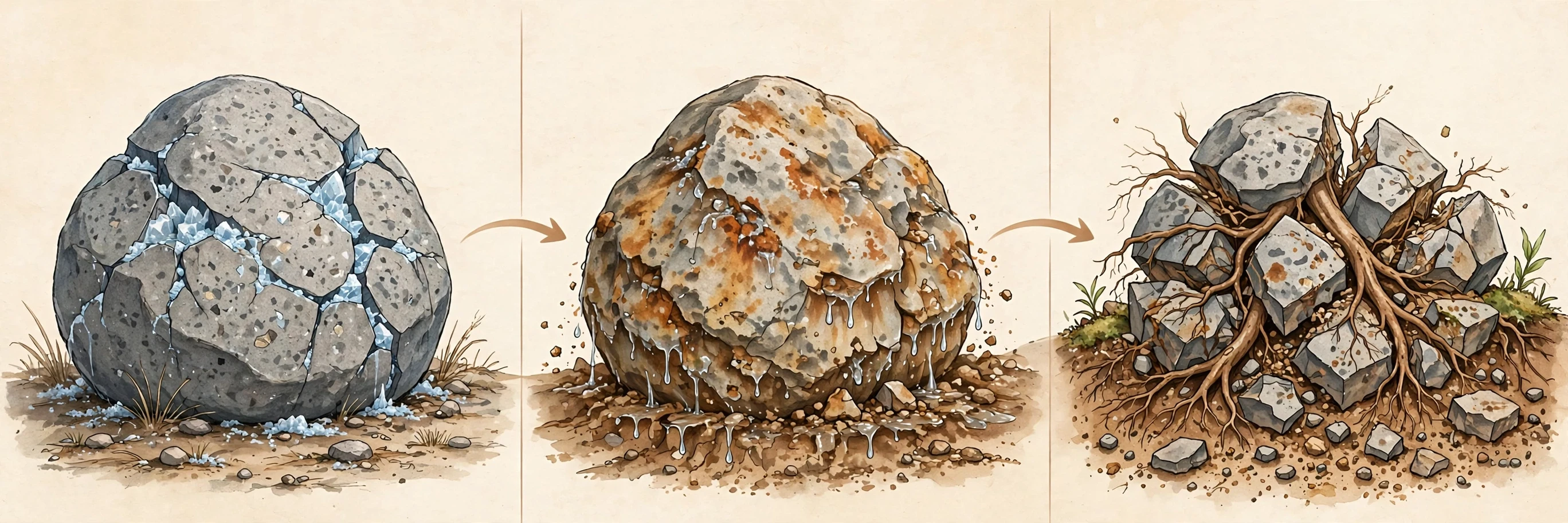
The result of all three kinds of weathering is a loose layer of broken mineral material called regolith. It is not soil yet. It has no real structure, little organic matter, and almost no organised life. It is raw material, waiting for the five soil-forming factors to shape it into something a plant can live in.
3. The Five Soil-Forming Factors
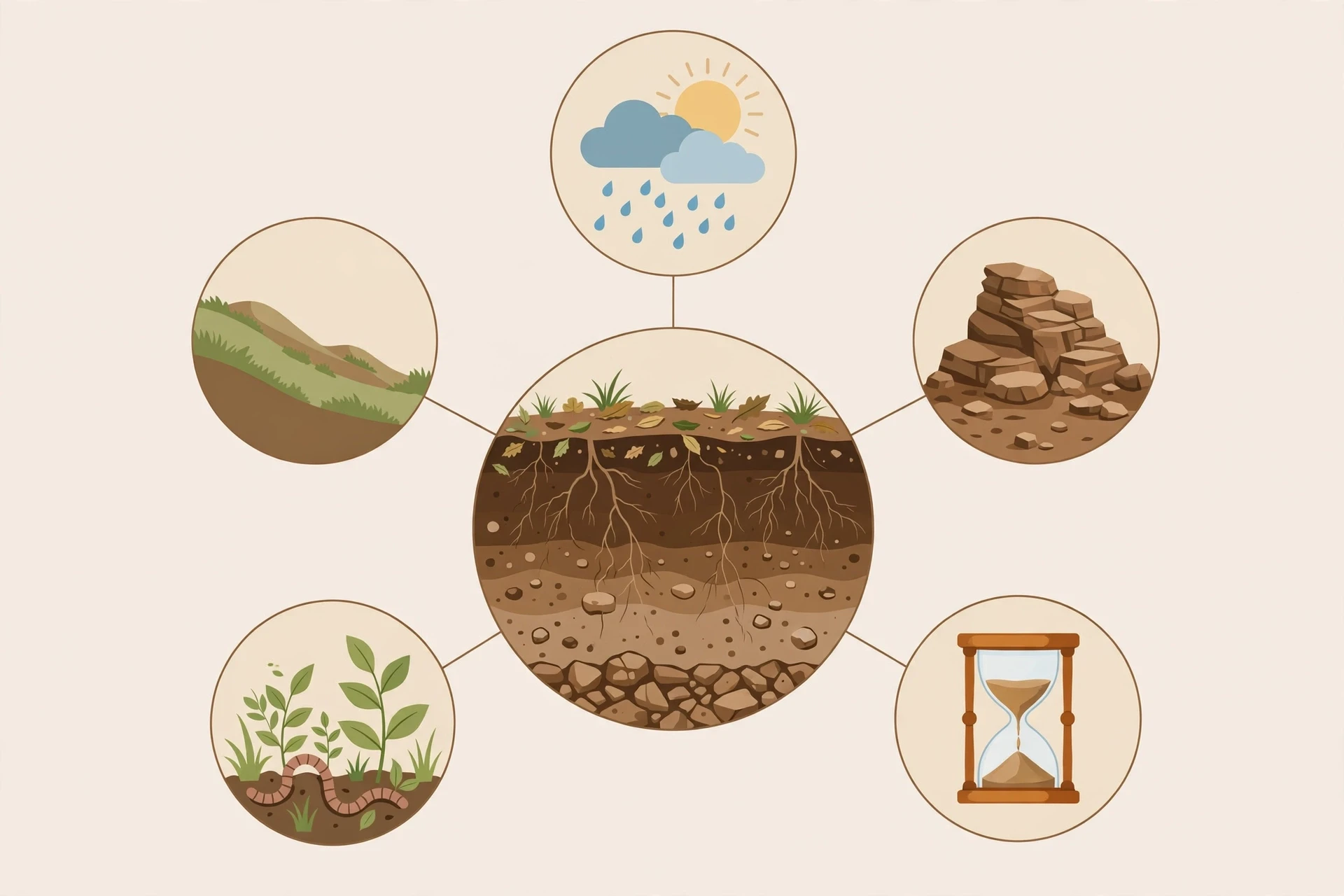
In the early twentieth century, soil scientist Hans Jenny proposed a simple idea that still organises the whole field: soil is the result of five factors working together — parent material, climate, organisms, topography, and time. Change any one of them and the soil changes. Hold four steady and vary the fifth, and you can watch the difference unfold across a landscape. This is why a soil scientist can look at a hillside and a valley floor, both sitting on the same rock, and find two completely different soils. The factors are the same everywhere, but their balance is never the same twice.
3.1 Parent Material: The Rock You Start With
Parent material is the rock, or the loose sediment, from which a soil develops. It sets the starting chemistry and texture. A soil forming on limestone inherits calcium and a tendency toward higher pH; one forming on granite inherits quartz sand and feldspar that will weather into clay; one forming on volcanic ash inherits a head start, because ash is already fine-grained and rich in minerals, and ash-derived soils are famously fertile. A soil forming on sandstone starts sandy and drains fast; one forming on shale starts fine-textured and holds water.
Parent material also arrives in more forms than bedrock alone. Glaciers ground rock into flour-fine sediment and left it in thick deposits. Rivers dropped silt on floodplains. Wind carried fine dust across continents — the deep, fertile loess soils of many great farming regions are wind-deposited dust, sometimes tens of metres thick. Ocean and lake sediments, landslides, and human activity all supply parent material too. The starting point matters for centuries, because some minerals weather fast and some resist for millennia. Quartz, for example, is stubborn; it survives almost unchanged while its neighbours turn to clay. That stubbornness is why some very old soils are mostly quartz sand, the tough leftovers of everything else having dissolved away.
3.2 Climate: The Great Accelerator
Climate is the most powerful of the five factors, because temperature and rainfall set the speed of nearly every soil-forming process. Warmth speeds up chemical reactions. Water carries the reactions, moves dissolved minerals down through the profile, and supports the plants and microbes that add organic matter. A soil in a warm, wet climate weathers fast, leaches hard, and develops deep, strongly coloured horizons in a few thousand years. A soil in a cold, dry climate may barely change in the same span.
Rainfall decides how much leaching happens — the downward washing of dissolved minerals. In wet climates, calcium, magnesium, and other soluble nutrients are washed down and sometimes out of the soil entirely, leaving acidic, nutrient-poor soils behind. That is why the deeply weathered soils of the wet tropics, for all their lush forests, are often surprisingly infertile for farming once the forest is cleared: the nutrients are in the trees, not in the soil. In dry climates, by contrast, there is not enough water to wash minerals away, so salts and calcium carbonate accumulate, sometimes forming hard layers that roots cannot cross.
Temperature shapes the organic side as well. Cold slows decomposition, so organic matter piles up — think of the deep, dark, peaty soils of northern bogs. Warmth speeds decomposition, so organic matter is eaten almost as fast as it falls, and tropical soils can look pale and thin despite the jungle above them. Climate, in short, writes the pace and the direction of the whole story.
3.3 Organisms: The Living Factor
Organisms include everything from towering trees to invisible bacteria, and they shape soil in ways that rock and rain alone never could. Plants add organic matter: leaves fall, roots die and regrow, and root exudates — sugars and acids that roots leak into the soil — feed microbes in a zone around each root called the rhizosphere. Different vegetation makes different soils. Grasslands, with their dense, deep, constantly renewing root systems, build thick, dark, organic-rich topsoils that are among the most fertile on Earth. Forests, with their leaf litter and acidic needle fall, often build thinner, more acidic topsoils with a pale leached layer beneath.
Animals mix and move the soil. Earthworms are the famous example, and they deserve the fame: a single worm can process many times its own weight in soil each year, dragging leaves underground, grinding them in its gut, and depositing nutrient-rich casts. Ants, termites, moles, and gophers all turn the profile over. In some landscapes, termites build mounds that concentrate nutrients so strongly that trees grow greener on old mounds for decades after the colony has gone.
Microbes are the smallest workers and the most important. Bacteria and fungi decompose dead matter, releasing nutrients in forms plants can absorb. Some bacteria fix nitrogen from the air, turning an inert gas into plant food — a trick no plant can do alone, and one that the whole green world depends on. Without microbes, dead leaves would pile up forever and nutrients would stay locked in forms plants cannot use. To understand how soil forms, you have to accept that much of the work is done by organisms you will never see.
3.4 Topography: The Slope Decides
Topography — the shape of the land — decides where water goes, and water decides almost everything else. On a steep slope, rain runs off instead of soaking in, so weathering is slower, soils stay thin, and erosion constantly strips away what forms. I have stood on a steep hillside and dug down ten centimetres to hit rock, then walked fifty metres to the flat valley floor and dug through a metre of deep, dark soil before my spade met anything solid. Same rock, same rain, same forest — different slope, different soil. The hillside loses material; the valley gains it.
Slope direction matters too. In the northern hemisphere, a south-facing slope gets more sun, warms earlier in spring, dries faster, and supports different vegetation than a shaded north-facing slope a stone's throw away. The soils differ accordingly. Even small differences in elevation change drainage: a low spot that stays wet grows waterlogged soils with grey, oxygen-starved layers, while a slight rise a few metres away grows a well-drained brown soil. Farmers have known this for centuries, planting their wettest ground differently from their driest, long before anyone wrote down why.
3.5 Time: The Factor You Cannot Rush
Time is the quiet factor, the one that makes soil formation humbling. A young soil on a fresh floodplain or a recent volcanic flow may be little more than weathered rock with a thin skin of organic matter. Give it a thousand years and horizons begin to separate. Give it ten thousand and the profile deepens, clay accumulates in the subsoil, and the soil starts to look like a finished product. Give it a hundred thousand years in a warm, wet climate and the soil may become deeply weathered, with most of its original minerals gone, replaced by iron and aluminium oxides that hold few nutrients.
This is why soil is effectively non-renewable on human timescales. The soil that grows our food formed over centuries and millennia, and it can be lost in a single storm. The five factors together explain why: time is the one factor we cannot speed up, and when erosion removes in years what time built in thousands, there is no quick replacement. Understanding how soil forms should leave you with respect for that slowness — and a certain urgency about not wasting it.
4. Reading the Ground: Soil Horizons
If the five factors are the authors of a soil, the soil horizons are the chapters they wrote. Dig a pit in a mature soil and the wall does not look uniform. It is banded — distinct layers, each with its own colour, texture, and structure, stacked in a sequence that soil scientists read the way a reader reads a book. These layers are called horizons, and they are labelled with letters: O, A, E, B, C, and R. Learning the horizons is learning the alphabet of soil, and once you know it, no patch of ground ever looks plain again.
The O horizon is the organic layer at the very top: fallen leaves, dead stems, moss, and half-rotted litter, still recognisable as what it was. In a forest it can be several centimetres thick, a soft carpet that smells of mushrooms after rain. In a ploughed field it may be missing entirely, mixed into the layer below. The O horizon is where decomposition begins, and it is also where a surprising number of small animals live — springtails, mites, beetle larvae — shredding leaves into smaller pieces so that fungi and bacteria can finish the job.
Below it sits the A horizon, the topsoil. This is the dark, living layer most of us picture when we say "soil." It is rich in organic matter, mixed with mineral particles, full of roots and worms, and usually the most fertile part of the profile. The dark colour comes from humus, the stable, dark residue of decomposed organic matter. A deep, dark A horizon is the signature of a productive soil; a thin, pale one is a warning that something — erosion, overuse, or a harsh climate — has been stripping the soil's wealth away.
The E horizon, where it exists, is the pale, leached layer. The letter stands for eluviation, the washing out of materials. Rainwater percolating down carries clay, iron, and organic matter out of this layer, leaving behind mostly pale quartz sand and silt. In a pine forest on sandy soil, the E horizon can look almost white, like ash, against the dark topsoil above and the rusty subsoil below. Not every soil has an E horizon — grassland soils, for instance, usually do not — but where one exists, it is a record of strong leaching over a long time.
The B horizon is the subsoil, and it is where the washed-out materials end up. Clay, iron oxides, and organic matter accumulate here, often giving the B horizon a redder, browner, or more yellow colour and a heavier, blockier structure than the topsoil. In many soils the B horizon is the thickest layer, and it is the soil's savings account: nutrients and clay stored below the surface, out of reach of a quick rain but available to deep roots. I once watched a drought-stricken field where shallow-rooted crops had failed while a neighbouring field of deep-rooted alfalfa was still green, drawing water and nutrients from a B horizon a metre down. The farmer shrugged and said the alfalfa "knew where the bank was."
The C horizon is weathered parent material — rock that has been broken and partly changed, but not yet organised into true soil. You can usually still recognise the rock it came from: fragments of granite, flakes of shale, chunks of limestone. There is little organic matter here and almost no biological activity compared with the layers above, but roots can still reach into it, and it is the reservoir from which the soil above continues to grow, slowly, as weathering works its way down.
At the bottom lies the R horizon: solid, unweathered bedrock. It is the starting point of the whole profile, the rock that weathering has not yet reached. In a young soil the R horizon may sit just centimetres below the surface; in an old, deep soil it may be metres down, beyond the reach of a spade.
Horizon | Common name | What it looks like | What is happening there |
|---|---|---|---|
O | Organic layer | Loose leaves, litter, and partly rotted organic matter | Decomposition begins; fungi, bacteria, and small animals shred dead material |
A | Topsoil | Dark, crumbly, rich in organic matter and roots | Most biological activity; nutrients cycle fastest; plants feed here |
E | Leached layer | Pale, often grey or almost white, mostly sand and silt | Rain washes clay, iron, and organic matter downward |
B | Subsoil | Redder or browner, heavier, often clay-rich and blocky | Materials washed from above accumulate; deep roots draw water and nutrients |
C | Weathered parent material | Broken rock fragments, still recognisable as the original rock | Weathering continues; the raw material for future soil |
R | Bedrock | Solid, unweathered rock | The starting point; weathering has not yet reached it |
Soil scientists use these horizons to classify soils into types called soil orders — twelve of them in the system used in the United States, each with its own story. Mollisols, the deep dark soils of grasslands, have thick A horizons built by generations of grass roots. Alfisols, common under temperate forests, show a clear clay-rich B horizon. Oxisols, the deeply weathered soils of the wet tropics, have lost most of their original minerals and hold little fertility. Aridisols, the soils of deserts, accumulate salts and carbonates because there is too little rain to wash them away. The classification is detailed, but the principle is simple: read the horizons, and you can tell what the soil has been through.
A soil profile is a history book written in colour and texture. The dark topsoil records centuries of plants. The pale leached layer records the rain. The rusty subsoil records the chemistry. Every horizon is a chapter, and the bedrock is the first page.
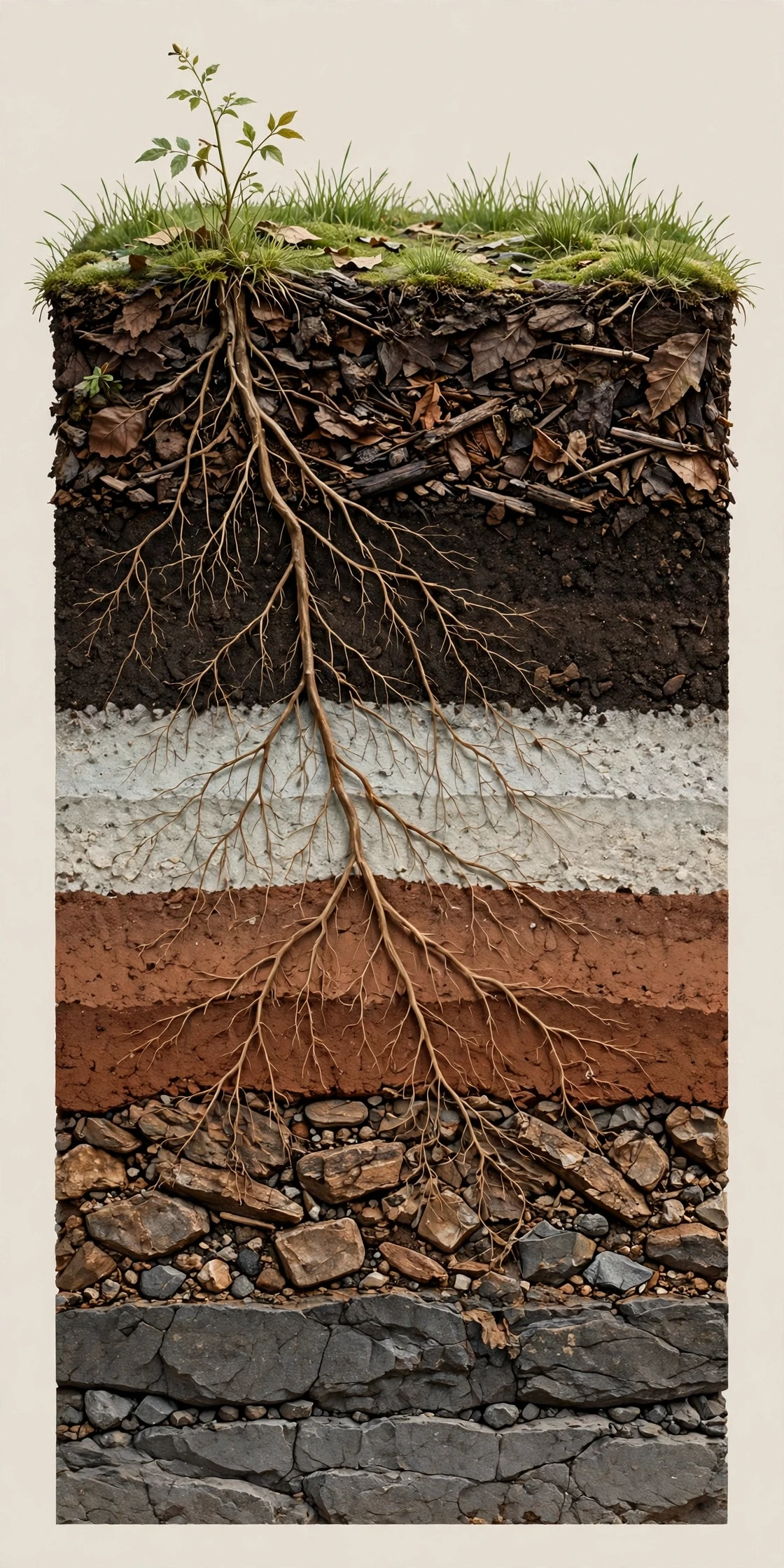
One more thing the horizons teach us is patience. A profile like the one above does not form in a season or a decade. The separation of an E from a B, the accumulation of clay in the subsoil, the deepening of the topsoil — these are the work of centuries. When you see a well-developed profile, you are looking at the result of more time than any human lifetime. That is worth remembering the next time someone treats topsoil as something cheap and replaceable.
5. Soil Types: Sand, Silt, Clay, and the Texture Triangle
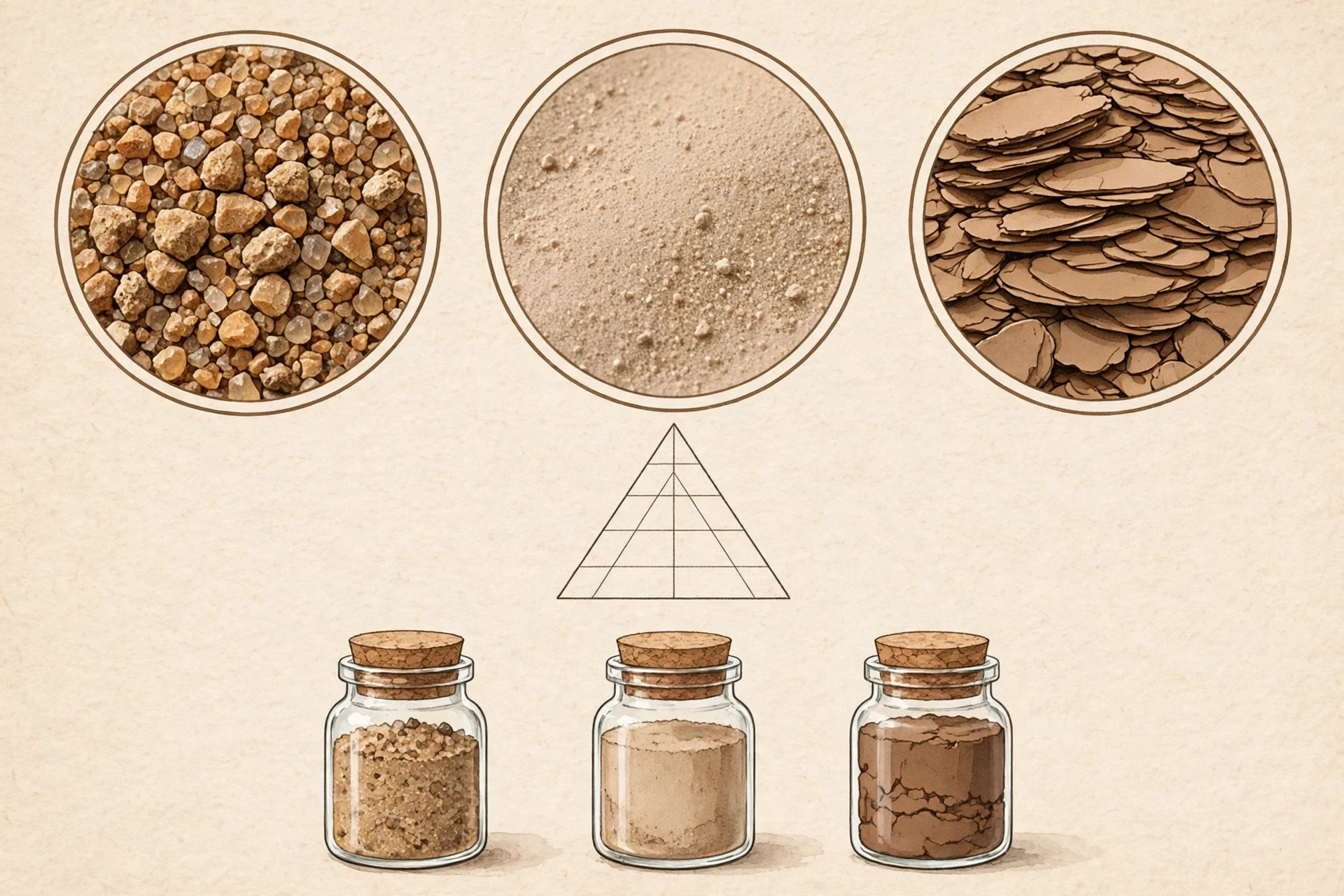
If horizons are the chapters of a soil, texture is its vocabulary. Soil texture is the proportion of sand, silt, and clay in the mineral part of the soil, and it controls almost everything a soil does: how fast water drains, how much water it holds, how easily roots can push through, how much air it contains, and how well it holds nutrients. Farmers and gardeners learn texture by hand — the ribbon test, where you wet a lump of soil and try to roll it into a ribbon between your fingers, is older than any laboratory — but the science behind it is precise.
Sand particles are the largest, from 0.05 to 2 millimetres across. You can see individual grains and feel their grit. Sandy soils drain fast, warm up quickly in spring, and are easy to dig, but they hold little water and few nutrients, because their grains have a small total surface area and almost no electrical charge to grip nutrient ions. Water runs through a sandy soil the way it runs through a sieve.
Silt particles are smaller, from 0.002 to 0.05 millimetres, and feel smooth and silky, almost like flour. Silty soils hold water well and are often very fertile — the wind-deposited loess soils that feed much of the world's wheat are mostly silt. Their weakness is structure: silt particles do not bind together strongly, so silty soils can crust over after rain and erode easily when left bare.
Clay particles are the smallest of all, less than 0.002 millimetres, so fine that you would need an electron microscope to see a single one properly. They are not just small mineral grains; they are flat plates with a large surface area and a negative electrical charge, which lets them hold positively charged nutrient ions — potassium, calcium, magnesium — like a magnet holds iron filings. This is why clay soils can be so fertile and hold water so well. It is also why they can be so difficult: wet clay is sticky and heavy, dry clay sets like brick, and water moves through it slowly. A clay soil that is worked when wet can be damaged for a season, its structure compacted into a dense mass that roots struggle to enter.
Most real soils are mixtures, and soil scientists name them by their proportions. A loam — roughly equal parts sand, silt, and clay, with a little more sand than the rest — is the gardener's ideal, because it balances drainage, water holding, and nutrient supply. A sandy loam drains a little faster; a clay loam holds a little more water. The full range of mixtures is mapped on a diagram called the soil texture triangle, a tool that has been in use for generations: measure the three percentages, find the point on the triangle, and read off the name. The United States Department of Agriculture publishes the standard version of that triangle, and it remains one of the most practical tools in soil science.
Soil type | Feels like | Drainage | Water and nutrient holding | Best suited to |
|---|---|---|---|---|
Sand | Gritty, loose, falls apart | Very fast | Low — water and nutrients wash through | Early spring crops, root vegetables, with added organic matter |
Silt | Smooth, silky, like flour | Moderate | Good — holds water and nutrients well | Most crops, but needs protection from crusting and erosion |
Clay | Sticky when wet, hard when dry | Slow | High — holds water and nutrients strongly | Productive when structure is good, but hard to work when wet |
Loam | Soft, crumbly, holds its shape then breaks | Balanced | Balanced — the best all-rounder | Most gardening and farming; the texture growers aim for |
Peat | Spongy, fibrous, dark | Slow, often waterlogged | Very high in organic matter, acidic | Acid-loving plants; needs care because peatlands store huge carbon stocks |
Texture is not the whole story. Structure — how the particles are arranged into crumbs and blocks — matters just as much. Two soils can have identical texture and behave completely differently if one has good crumb structure, built by roots and worms and fungal threads, while the other has been compacted into a solid mass. Structure is the part of soil that a farmer can build or destroy in a few seasons, and it is where much of modern soil care is focused. Add compost, keep roots in the ground, avoid working wet soil, and the structure improves. Do the opposite, and even a naturally good loam can turn into something roots cannot penetrate.
There is a practical lesson here for anyone who gardens. Before you buy fertiliser, find out your texture. Squeeze a moist handful: if it feels gritty and falls apart, you have sand, and you need organic matter to hold water. If it rolls into a long, smooth ribbon that holds its shape, you have clay, and you need organic matter to open it up and drainage to keep it workable. If it feels soft, crumbly, and holds together briefly before breaking, you may already have a loam, and your job is mostly to keep it that way. Soil texture is something you inherit from the parent material and the centuries; soil structure is something you can improve in your own lifetime.
6. The Living Soil: Microbes, Fungi, and Earthworms
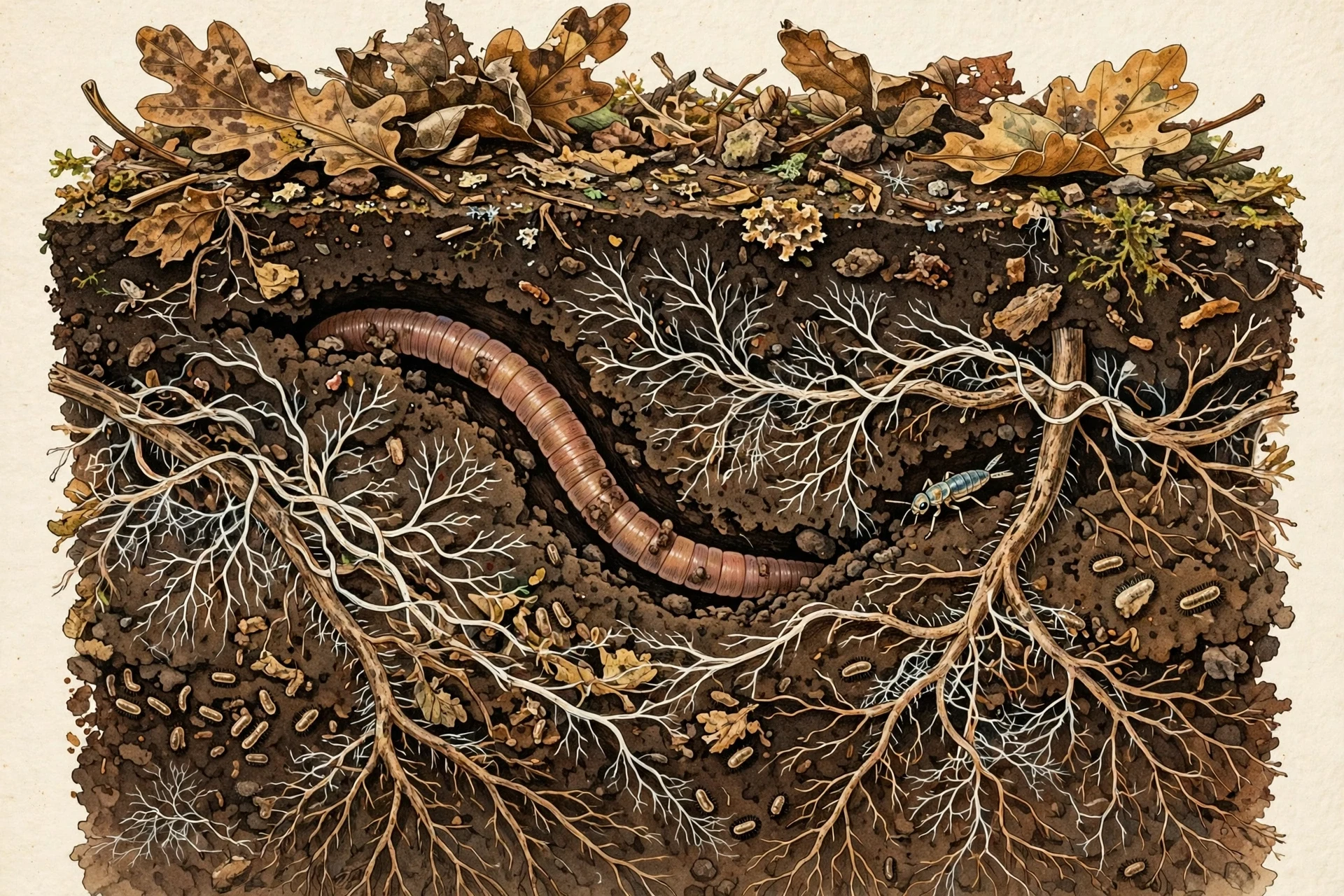
For most of human history, soil was treated as a dead medium — a place to put seeds, to be fed with fertiliser when it got tired. The microscope ended that idea. The first scientists to look closely at soil found a world so crowded that the numbers are still hard to absorb: in a single gram of healthy topsoil there can be a billion bacteria, tens of thousands of protozoa, hundreds of metres of fungal threads, and a scattering of nematodes, mites, and springtails. Soil is not a place where life happens to live. Soil is, in large part, life itself, plus the mineral framework it inhabits and rebuilds.
The work of this community falls into three great jobs: decomposition, nutrient cycling, and construction. Decomposition is the breaking down of dead leaves, roots, and animals into simpler compounds. Fungi are the first responders for tough material — their thread-like hyphae can push into wood and leaf litter, secreting enzymes that dismantle lignin and cellulose, the structural polymers that give plants their strength. Bacteria follow, feeding on the simpler compounds the fungi release. The chemistry of this process is the chemistry of decay and renewal, the same kinds of reactions that govern chemical reactions everywhere in nature: bonds broken, energy released, new compounds formed. What makes soil special is that the whole cycle happens in place, millimetre by millimetre, and the products stay in the soil where plants can use them.
Nutrient cycling is where the living soil earns its keep. Plants need nitrogen, phosphorus, potassium, and a dozen other elements, but they can only absorb them in particular chemical forms. Dead leaves contain nitrogen locked inside proteins; bacteria and fungi release it as ammonium, and other bacteria convert that ammonium into nitrate, the form most plants prefer. This is not a single step but a relay race run by different species in sequence, and if any runner is missing, the race stalls. Phosphorus is released by microbes that secrete acids to dissolve phosphate minerals, and by mycorrhizal fungi — fungi that partner directly with plant roots, trading phosphorus and water for sugars from the plant. A plant with mycorrhizal partners can reach nutrients far beyond its own roots, because the fungal network extends the root system by metres. Some estimates suggest the great majority of land plants form these partnerships; the "wood wide web" is not a metaphor so much as a description of a real underground economy.
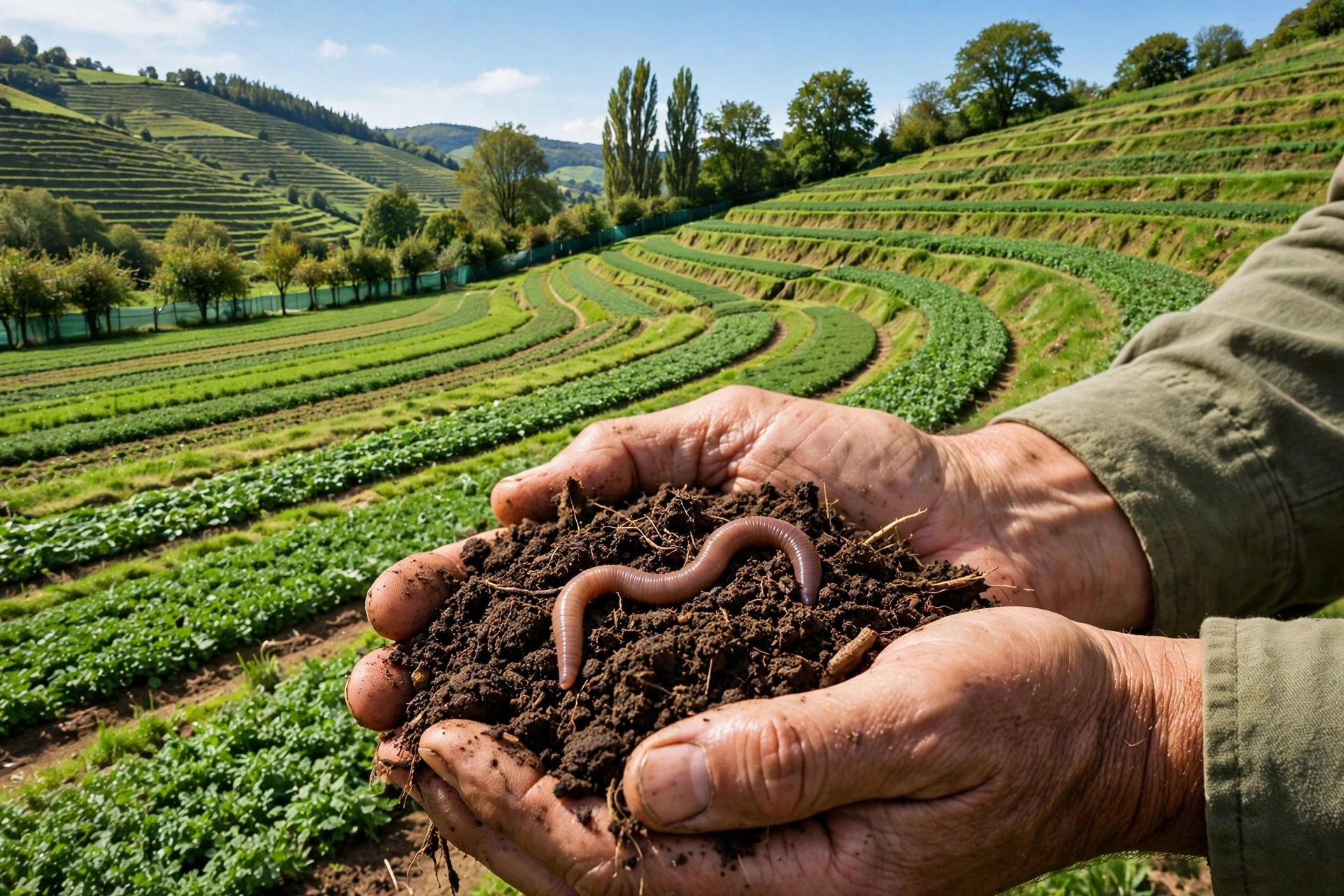
The third job is construction. The soil's crumb structure, which we praised in section 1, is largely a biological product. Earthworms are the most visible builders: they eat soil and leaf litter, grind it in their guts, and excrete casts that are richer in nutrients and more stable in structure than the surrounding soil. A healthy field can contain hundreds of earthworms per square metre, and their burrows act as drains and air channels that no plough can replicate. Fungi contribute glomalin, a sticky protein that glues soil particles together into stable aggregates. Bacteria produce their own sticky polysaccharides. Without these biological glues, soil particles would stay loose and structureless, and rain would wash them away.
The food web of the soil runs through these layers. Bacteria and fungi are eaten by protozoa and nematodes, which are eaten by mites and springtails, which are eaten by beetles and spiders, which are eaten by birds and shrews. At each step, nutrients are released in forms plants can absorb. It is a complete ecosystem in miniature, with producers, consumers, and decomposers, and like any ecosystem it is vulnerable to disturbance. Heavy tillage shreds fungal networks. Pesticides can knock out whole groups of organisms. Compaction squeezes out the air that aerobic microbes need. And when the biology is damaged, the chemistry follows: nutrients stop cycling, structure collapses, and the soil needs ever more fertiliser to produce the same crop.
I learned this the hard way on a small garden plot I managed years ago. For two seasons I dug it over thoroughly every spring, proud of how clean and fine the soil looked. The third season, the soil set like concrete after every rain, seedlings struggled, and the worms had vanished. A neighbouring gardener, who never dug at all and simply mulched, had dark, crumbly soil full of worms and crops that outgrew mine. I stopped digging, started mulching, and within two years the worms were back and the soil had changed character entirely. The lesson was simple and humbling: I had been treating soil like a machine to be serviced, when it is a community to be fed.
The United States Department of Agriculture's Natural Resources Conservation Service puts soil biology at the centre of its soil health work, describing soil as a living system whose organisms drive the nutrient cycling and structure that farming depends on. That framing — soil as alive, not inert — is now the consensus of soil science, and it changes every practical question, from how we farm to how we restore damaged land.
7. Why Soil Matters: Food, Water, and Climate
It is easy to forget soil until something goes wrong with it. A drought, a failed harvest, a flooded river carrying brown water to the sea — each of these is, at least in part, a soil story. Soil matters because it does three jobs that nothing else can do at the same scale: it grows our food, it cleans and stores our water, and it holds carbon that would otherwise warm the climate.
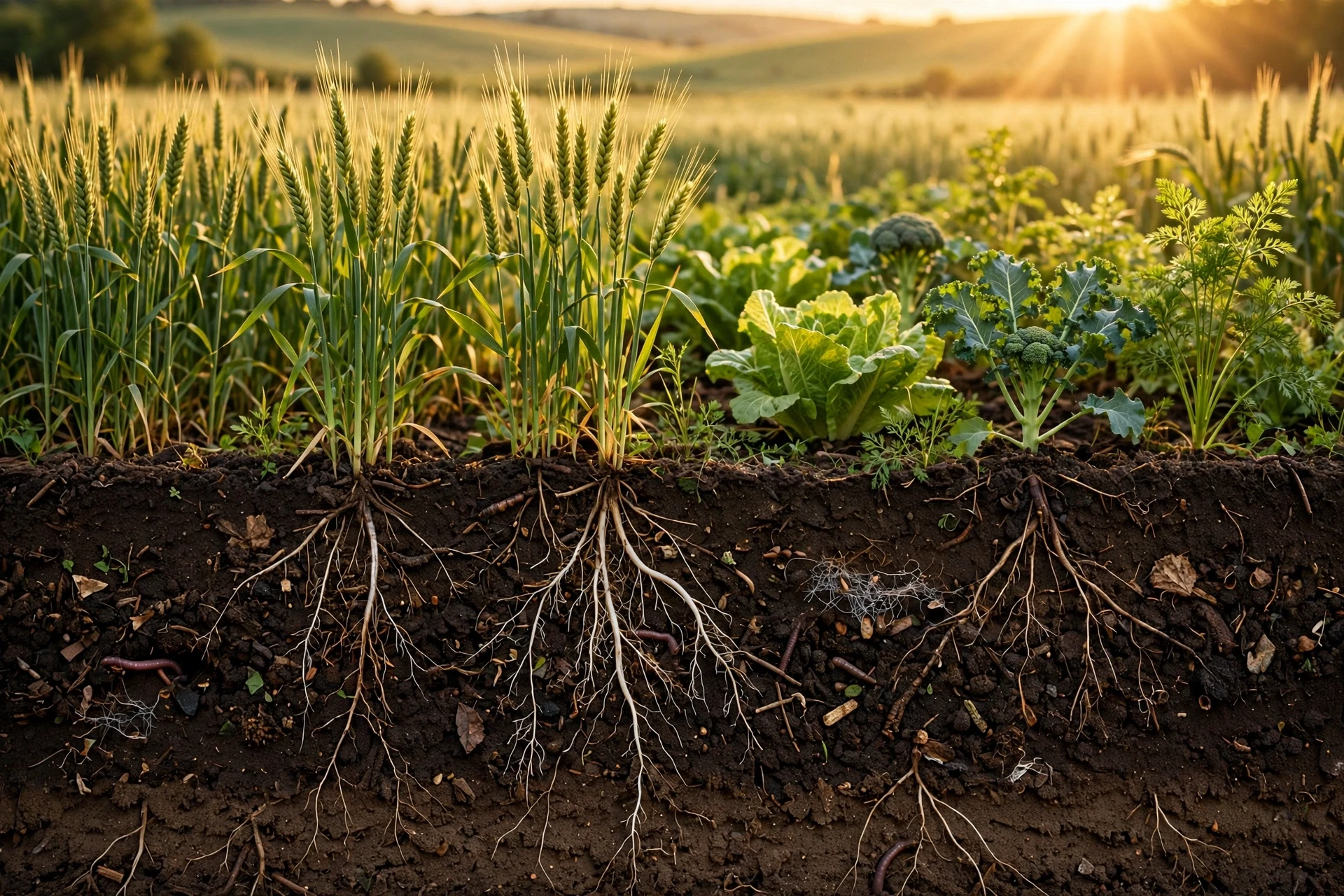
The food connection is the most direct. Nearly all the calories humanity eats come from plants grown in soil, or from animals that eat those plants. Soil supplies the nutrients, the water, and the physical support that plant biology depends on: roots anchor in it, draw water from its pores, and absorb dissolved nutrients from its surfaces. A fertile soil is not just dirt with fertiliser added; it is a system that releases nutrients slowly, holds water through dry spells, and lets roots breathe. When soil degrades — when its organic matter is lost, its structure collapses, or its topsoil washes away — yields fall, and farmers must spend more on inputs to get less out. The Food and Agriculture Organization of the United Nations has warned repeatedly that soil degradation is already cutting into the productivity of farmland in many regions, and that the loss is not a distant threat but a present one.
The water connection is less visible but just as important. Healthy soil acts like a sponge. Rain that falls on well-structured soil soaks in, is filtered as it moves through pores and past microbial communities that break down pollutants, and recharges groundwater. The same rain falling on compacted or bare soil runs off the surface, carrying topsoil and nutrients with it, swelling rivers and flooding towns downstream. A landscape with healthy soil absorbs storms; a landscape with damaged soil turns storms into disasters. Wetland soils and floodplain soils do this work at a landscape scale, and their loss is one of the quiet reasons floods have become more destructive in many places.
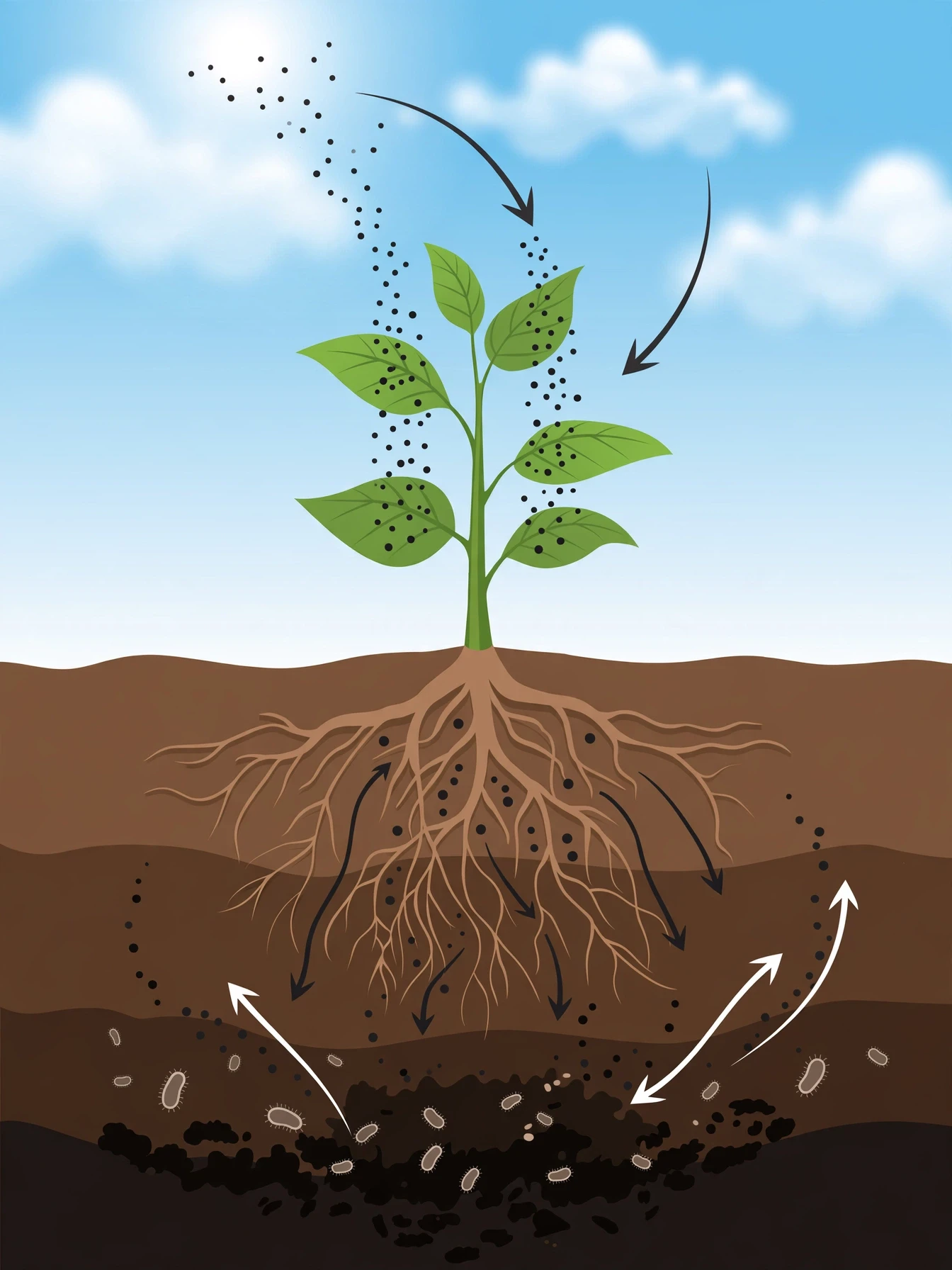
The climate connection is the one that surprises people most. Soil holds an enormous stock of carbon — more than the atmosphere and all the world's plants combined, according to widely cited estimates. Most of that carbon is in soil organic matter, built up over centuries from dead roots and leaves. When soil is healthy, it stores carbon. When it is ploughed, drained, or eroded, microbes oxidise that organic matter and release carbon dioxide back into the air. Peatlands are the extreme case: they cover a small fraction of the land but hold a disproportionate share of soil carbon, and draining them releases that carbon rapidly. Protecting soil, in other words, is climate action — slower and less glamorous than building a solar farm, but working on a scale that no other single intervention can match.
Soil is the largest store of carbon on land. Every handful of healthy topsoil is a small vault of carbon kept out of the atmosphere by roots, fungi, and worms. Losing soil is losing that vault.
There is a fourth job, less often mentioned: soil is a library. Archaeologists read soil layers to date settlements. Forensic scientists use soil traces to place people at scenes. And soil holds a genetic library of microbial diversity that scientists are only beginning to explore, including organisms that may yield new medicines and new ways to grow food with fewer inputs. When a soil is destroyed, that library burns with it, and we do not even know what was in it.
None of this means soil is fragile in the sense of being weak. Soil is resilient — it has survived ice ages, droughts, and volcanic eruptions. But its resilience works on the timescale of centuries, and the pressures we put on it now work on the timescale of years. The gap between those two timescales is the central problem of soil, and it is the reason the next two sections matter as much as the science that came before them.
8. When Soil Disappears: Erosion
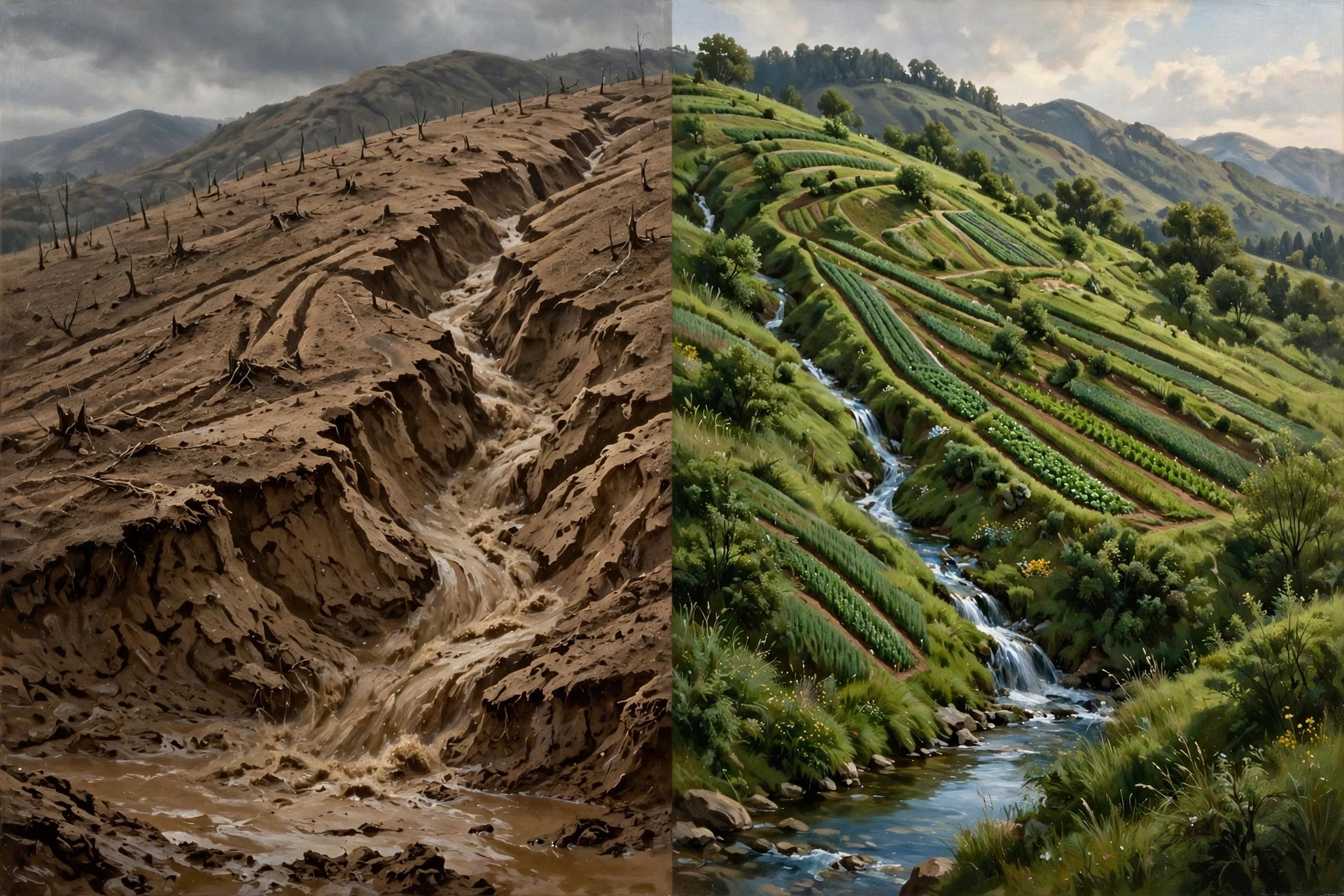
If soil formation is a slow building, erosion is a fast demolition. Erosion is the movement of soil by water, wind, or gravity, and a little of it is natural — rivers have always carried sediment to the sea, and wind has always moved dust. The problem begins when the rate of loss exceeds the rate of formation, which is exactly what happens on bare, overworked, or steep land. A single heavy storm can strip away the topsoil that took centuries to build, and the soil that is left is thinner, paler, and less productive.
Water erosion starts small. Raindrops hit bare soil like tiny hammers, detaching particles and sealing the surface into a crust. Water that cannot soak in starts to flow, first as a thin sheet, then as small channels called rills, then as gullies that can grow metres deep and swallow fields, roads, and fences. I once walked a gully in farmland that had started as a tractor track a decade earlier; by the time I saw it, it was three metres deep and twenty metres long, and the farmer told me he had lost the corner of that field for good. The topsoil was not in the field any more. It was in the river at the bottom of the valley, and then in the sea.
Wind erosion works where soil is dry and bare. The great dust storms of the 1930s in the American plains — the Dust Bowl — remain the most famous example: years of drought and ploughing left the soil exposed, and the wind lifted millions of tonnes of topsoil into the air, darkening skies hundreds of kilometres away and forcing families to leave their farms. The same process continues today in dry regions around the world, wherever vegetation is stripped and the soil is left unprotected.
The costs of erosion go far beyond the farm. Sediment chokes rivers, smothers fish spawning grounds, and fills reservoirs, shortening their useful life. Nutrients carried off fields feed algal blooms in lakes and coastal waters, creating dead zones where oxygen runs out. And the carbon in eroded topsoil is often oxidised, adding to the atmosphere's burden. The Food and Agriculture Organization tracks soil degradation globally and counts erosion among its most widespread forms, affecting farmland on every continent.
Erosion is not inevitable, though. It is the result of specific conditions — bare soil, steep slopes, heavy rain, strong wind — and each of those conditions can be changed. That is the hopeful part of this story, and it brings us to the final practical section.
9. Keeping Soil Alive: Conservation
Soil conservation is not a single technique. It is a set of habits, each aimed at the same two goals: keep the soil covered, and keep it undisturbed as much as possible. Every successful method follows from those two principles, because bare, beaten soil erodes, and living, covered soil does not.
Cover crops are one of the simplest and most powerful tools. Instead of leaving a field bare between harvests, a farmer plants rye, clover, vetch, or another fast-growing crop whose job is not to be sold but to protect the ground. Cover crops shield the surface from raindrop impact, their roots hold the soil together and feed microbes through the winter, and when they are cut or rolled, they become a mulch that adds organic matter. A field that was green all winter loses far less soil in spring storms than a field that sat bare.
No-till and reduced tillage farming leave the soil's structure intact. Instead of ploughing the whole field, the farmer plants seed directly into the residue of the previous crop, disturbing only a narrow slot. Fungal networks stay connected, earthworm burrows stay open, and the soil surface stays armoured with residue. The transition is not always easy — weeds and pests must be managed differently, and the first years can be bumpy — but long-term no-till fields typically show higher organic matter, better water infiltration, and lower erosion than ploughed neighbours.
On slopes, the old arts still work. Terracing turns a steep hillside into a staircase of flat steps, each one holding water instead of shedding it. Contour ploughing follows the curve of the land rather than running up and down it, so that each furrow acts as a tiny dam. Grass strips and buffer zones along streams catch sediment before it reaches the water. Windbreaks — lines of trees planted across the wind — slow the air and drop the dust it carries. None of these ideas is new. Terraces have been built for thousands of years, and they still work, because the physics of water running downhill has not changed.
Compost and manure return organic matter to the soil, feeding the microbes and earthworms that build structure. Crop rotation breaks pest cycles and varies the demands placed on the soil: a nitrogen-fixing legume one year can feed the cereal that follows, and deep-rooted crops can open channels that shallow-rooted ones use later. Agroforestry — mixing trees with crops or pasture — adds deep roots, leaf litter, and shelter, and gives the farmer a second income from fruit, timber, or nuts.
For a home gardener, the same principles shrink to a manageable scale. Mulch every bare patch. Compost kitchen and garden waste. Grow something in every bed through winter, even if it is just a green manure. Avoid walking on wet beds. Plant a hedge or a row of shrubs as a windbreak. These are small acts, but they are the same acts, and they work for the same reasons. The United States Department of Agriculture's conservation programmes support farmers in adopting exactly these practices, and the agency's soil health guidance is a practical starting point for anyone who wants to learn more.
The best time to protect soil was a thousand years ago, when it began to form. The second-best time is the next time you plant something. Cover it, feed it, and leave it alone as much as you can.
10. Common Misconceptions About Soil
Soil attracts confident misunderstandings, and most of them come from never having looked closely at how soil forms.
"Soil is just dirt." Dirt is displaced soil — the stuff on your shoes. Soil in place is a structured, layered, living system with horizons, pore networks, and a food web. Calling it dirt is like calling a forest "wood." It misses everything that makes it work.
"You can make soil quickly with fertiliser." Fertiliser adds nutrients, not soil. It does not build crumb structure, it does not add organic matter, it does not restore horizons, and it does not bring back the microbial community. A field can be heavily fertilised and still be degraded soil — productive for a season, but fragile, leaky, and dependent on ever more inputs. Building soil takes organic matter, roots, time, and living things. There is no shortcut in a bag.
"Sandy soil is bad soil and clay soil is good soil." Neither is true on its own. Sandy soil drains well and warms early but holds little water; clay holds water and nutrients but can suffocate roots when compacted. What matters is the combination of texture, structure, organic matter, and management. A sandy soil rich in organic matter can outperform a compacted clay, and a well-structured clay can outperform a starved sand. Judge a soil by how it behaves, not by a single property.
"Erosion is a natural process, so it is not a problem." Some erosion is natural, but the rates on farmed and deforested land are far above natural background rates — often tens or hundreds of times faster than soil formation. That imbalance is the problem. A process can be natural and still be a crisis when humans accelerate it beyond what the system can replace.
"Soil is everywhere, so we will never run out." Fertile topsoil is not everywhere. It is a thin layer, concentrated in particular regions, and it is being lost faster than it forms in many of them. Deserts, mountains, cities, and oceans cover much of the planet's surface, and the soil that remains must feed a growing population. Treating topsoil as infinite is the most dangerous misconception of all, because it excuses the losses that are already happening.
That is how soil forms: rock broken by weather and life, shaped by five patient factors, layered into horizons, and kept alive by organisms too small to see. It took thousands of years to build the ground we stand on. Keeping it is the work of our own lifetime, and it starts with the simple habits in the sections above — cover it, feed it, and give it time.
Frequently Asked Questions
How long does it take for soil to form?
A centimetre of topsoil can take hundreds of years to form under natural conditions, and a full, well-developed profile with distinct horizons typically takes thousands of years. The exact time depends on climate, parent material, and vegetation: warm, wet conditions with abundant plant life form soil faster than cold, dry, or steep conditions. This slow pace is why soil is treated as effectively non-renewable on human timescales — what takes centuries to build can be lost in a single storm.
What are the five factors of soil formation?
The five factors are parent material, climate, organisms, topography, and time. Parent material is the rock or sediment the soil starts from. Climate sets the speed of weathering and leaching through temperature and rainfall. Organisms — plants, animals, and microbes — add organic matter and drive nutrient cycling. Topography decides where water goes and where soil accumulates or erodes. Time is how long all the other factors have had to work. Soil scientist Hans Jenny formalised this framework, and it still organises the field today.
What is the difference between soil and dirt?
Soil is a natural, layered, living system in place, with mineral particles, organic matter, water, air, and organisms arranged in horizons. Dirt is soil that has been displaced — the loose material on your shoes, on a floor, or in a pile. The distinction matters because it captures what makes soil work: its structure, its biology, and its position in the landscape. Once soil is dug up and piled, much of that structure and biology is lost.
Why is topsoil so important?
Topsoil, the A horizon, holds most of the soil's organic matter, nutrients, and biological activity. It is where most plant roots feed, where microbes cycle nutrients fastest, and where water is stored and filtered. Losing topsoil to erosion removes the most fertile part of the soil, and the subsoil left behind is usually poorer in nutrients and organic matter. Crops grown on eroded soil yield less and need more fertiliser, which is why protecting topsoil is the first rule of soil conservation.
Can degraded soil be restored?
Yes, in many cases, but slowly. Adding organic matter through compost, manure, and cover crops, reducing tillage, keeping the ground covered, and restoring vegetation can rebuild structure and organic matter over years to decades. Severely eroded soil, where the topsoil is gone entirely, is much harder to restore, because the material that took centuries to form cannot be replaced quickly. Prevention is far cheaper and faster than restoration, which is why conservation is emphasised over repair.
How does soil help fight climate change?
Soil stores more carbon than the atmosphere and all the world's vegetation combined, mostly as soil organic matter built from dead roots and leaves over centuries. Healthy soils keep that carbon locked away. Practices that build soil organic matter — cover crops, reduced tillage, compost, agroforestry, and protecting peatlands — keep carbon in the ground instead of releasing it as carbon dioxide. Conversely, ploughing, draining, and eroding soil releases stored carbon. Protecting and rebuilding soil is one of the largest available opportunities to store carbon on land.
What can I do to improve the soil in my garden?
Start by feeding the biology: mulch bare soil with leaves, straw, or compost, and keep living roots in the ground as much of the year as possible. Add compost regularly rather than relying on fertiliser alone. Avoid digging or walking on wet soil, which destroys structure. Grow a mix of plants, including nitrogen-fixing legumes such as peas and beans. Get a soil test before adding lime or fertiliser, so you amend what is actually missing. Small, steady habits like these can transform garden soil within a few seasons.
Sources
USDA Natural Resources Conservation Service — Soil Survey Manual
USDA Natural Resources Conservation Service — Soil Conservation Basics
Food and Agriculture Organization of the United Nations — Soils Portal
Food and Agriculture Organization of the United Nations — Soil Degradation and Restoration
Food and Agriculture Organization of the United Nations — Global Soil Partnership