

The summer I turned twelve, my grandmother handed me two bean plants in small clay pots — my first lesson in the nitrogen cycle, though I did not know it yet — and a challenge I did not understand at the time. One pot held ordinary garden soil. The other held the same soil, but she had mixed in a handful of pale, crumbly nodules she had dug up from the roots of an old bean plant. "Watch which one grows," she said, and walked away. I watered them both the same way, set them on the same windowsill, and waited. Within three weeks the difference was impossible to miss. The plant in the plain soil was thin and yellowish at the edges. The other was deep green, sturdy, almost smug. I had no idea then that I was watching the nitrogen cycle at work in miniature — a hidden partnership between a plant and a microbe, trading sugar for the most precious nutrient on Earth.
That is the strange heart of the nitrogen cycle. Nitrogen is everywhere. It makes up about 78 percent of the air around you right now, far more than oxygen. Every breath you take is mostly nitrogen. And yet, for almost every living thing on the planet, that vast ocean of nitrogen in the sky might as well not exist. Plants cannot absorb nitrogen gas. Animals cannot eat it. Your own body, built from proteins that depend on nitrogen atoms, cannot take a single molecule of it directly from the air. Life has to wait for nitrogen to be transformed — broken apart, rebuilt, passed from microbe to root to leaf to animal and back again — before it can be used at all. The nitrogen cycle is the name for that long chain of transformations, and it is one of the great engines that keeps the living world running.
Once you start noticing it, you see the nitrogen cycle everywhere. It is in the green of a wheat field after rain, in the smell of a compost heap on a warm day, in the flash of lightning over farmland, and in the green scum that sometimes chokes a lake in late summer. It decides how much food a farm can grow, how clear a river runs, and how much of a potent greenhouse gas escapes into the atmosphere. Humans have learned to hijack the cycle on an enormous scale, and that power has fed billions of people — while also pushing rivers, coastal seas and the climate out of balance. This article follows nitrogen on its full journey, step by step, from the air above your head to the soil under your feet and back again.
1. Why Nitrogen Matters: The Element Life Cannot Do Without
Ask a chemist what life is made of and you will get a short list: carbon, hydrogen, oxygen, nitrogen, phosphorus and sulphur, with a supporting cast of other elements. Carbon gets most of the attention. It forms the backbone of every organic molecule, and whole fields of chemistry are named after it. But nitrogen is the quiet partner that makes carbon's structures work. Without nitrogen, there would be no proteins, no DNA, and no way for a cell to store instructions or build the machines that carry them out. A world without usable nitrogen would be a world without life as we know it.
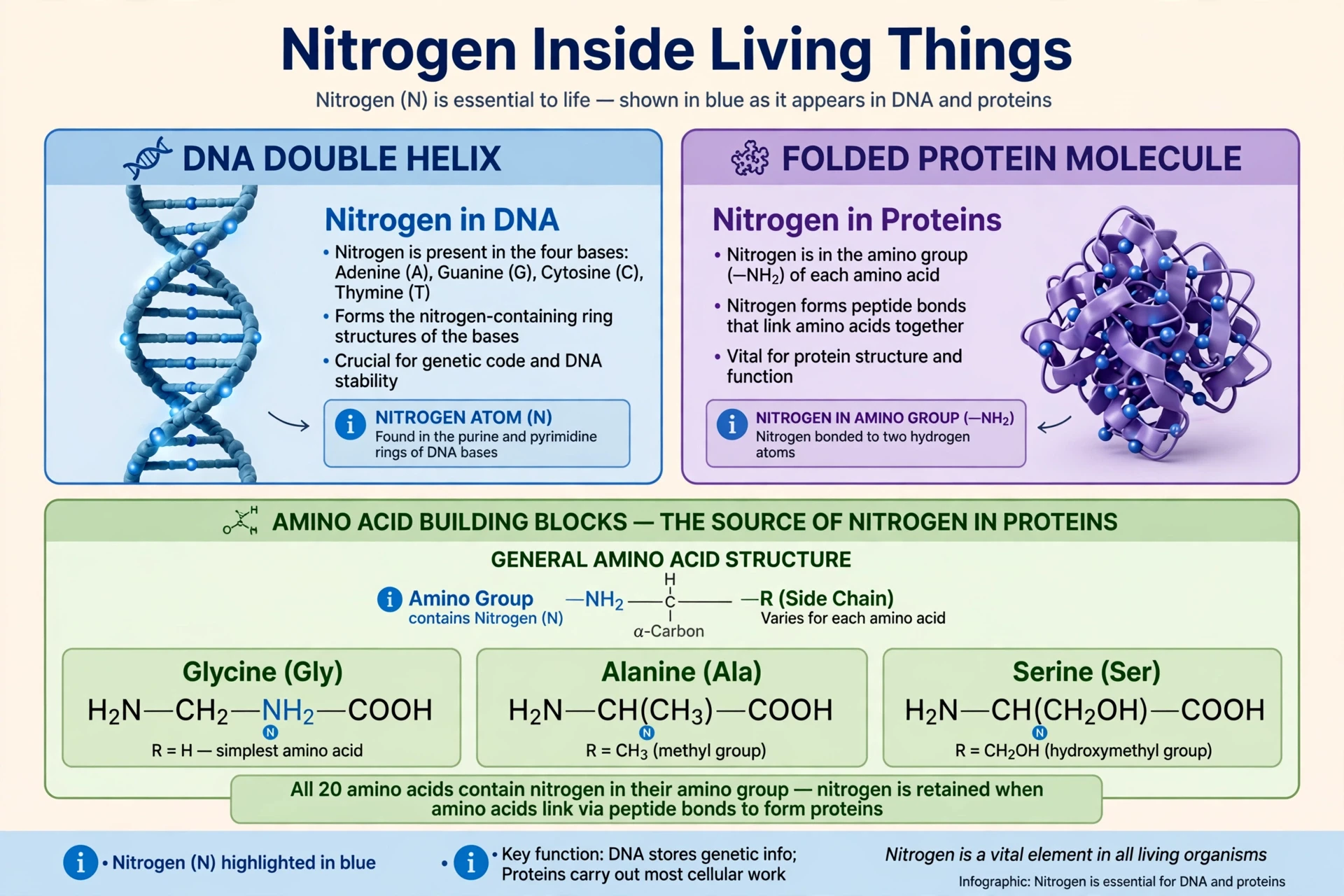
Think of a protein as a long chain of beads, where each bead is an amino acid. Every single amino acid contains nitrogen. The nitrogen atom sits at the heart of the chemical bond that links one bead to the next, and it also shapes how the finished chain folds into its working shape. Your muscles, your enzymes, your antibodies, the haemoglobin that carries oxygen in your blood — all of them are proteins, and all of them depend on nitrogen. When you eat food, much of what your body is really after is nitrogen in a usable form, packaged inside amino acids. A meal with plenty of calories but almost no protein will keep you alive for a while, but your body will slowly start breaking down its own tissues to find the nitrogen it needs. That is why protein deficiency is so much more damaging than a simple shortage of energy.
DNA tells the same story. The four letters of the genetic code — adenine, thymine, guanine and cytosine — are all nitrogen-rich molecules. The rungs of the DNA ladder are built from nitrogen-containing bases, and without them there is no way to store genetic information at all. Every time a cell divides, it needs a fresh supply of nitrogen to copy its DNA. Every time a plant grows a new leaf, it needs nitrogen to build the chlorophyll that captures sunlight. Chlorophyll itself has a nitrogen atom at the centre of its structure, holding a magnesium atom in place like a jewel in a setting. Take the nitrogen away and the green fades, photosynthesis slows, and growth stops. Gardeners know this pattern by sight: a plant starved of nitrogen turns pale yellow from the older leaves first, because the plant pulls nitrogen out of its old tissue to feed the new growth. It is a visible distress signal, written in colour.
I learned that yellowing pattern the hard way, years after the bean-pot experiment. I had started a small vegetable patch and, proud of my neat rows, I planted the same crop in the same bed season after season without ever adding compost or rotating in beans. By the second year the leaves were yellowing from the bottom up, the plants were stunted, and I blamed the weather, the seeds, the watering — everything except the soil. An older neighbour walked past, glanced at the bed, and said, "You've starved it. That soil has nothing left to give." He was right. I had been mining nitrogen out of the ground with every harvest and putting nothing back. The plants were not sick. They were hungry, in the most literal chemical sense.
That hunger is the central problem the nitrogen cycle solves. The atmosphere holds an almost unimaginable quantity of nitrogen — roughly four thousand million million tonnes of nitrogen gas, by most estimates — yet nearly all of it is locked away in a form life cannot touch. Nitrogen gas, written as N₂, consists of two nitrogen atoms held together by a triple bond, one of the strongest chemical bonds in nature. Breaking that bond takes a large amount of energy. It is a bit like a vault full of food with a lock that almost nothing can open. The whole nitrogen cycle exists because a few remarkable processes — lightning, specialised bacteria, and, in the last century, human industry — can pick that lock. Everything else in the cycle is about moving the unlocked nitrogen around, changing it from one usable form to another, and eventually returning it to the air.
1.1 How much nitrogen does life actually need?
The answer depends on the organism, but the scale is easy to feel. A fast-growing plant may need nitrogen to make up a few percent of its dry weight. A human body is about 3 percent nitrogen by weight. That sounds small until you multiply it out: an adult carries several kilograms of nitrogen inside them, almost all of it in protein and DNA. And unlike carbon, which a plant can pull from the air as carbon dioxide through photosynthesis, nitrogen has to arrive through the roots, already converted into a chemical form the plant can absorb. The plant cannot help itself. It depends entirely on the soil community to deliver nitrogen in the right form, at the right time, in the right amount.
That dependence shapes whole ecosystems. In many forests, grasslands and oceans, nitrogen is the limiting nutrient — the ingredient that runs out first and sets the speed limit on growth. Add nitrogen and life explodes. Take it away and growth stalls, no matter how much sunlight, water and carbon dioxide are available. This is why a bag of fertiliser can transform a field, and why a leak of nitrogen-rich waste can turn a clear lake green almost overnight. The same element that limits life can also overwhelm it. Keeping that balance is the story of the rest of this article.
1.2 Nitrogen is not one thing — it wears many forms
One of the first things that confused me when I started studying the nitrogen cycle seriously was the vocabulary. The cycle is not one substance moving around unchanged. It is a series of chemical costume changes, and the name changes with each one. Nitrogen gas (N₂) is the starting point. Ammonia (NH₃) and ammonium (NH₄⁺) are the forms that smell sharp and sting the nose — the smell of a stable, a compost heap, or a bottle of cleaning fluid. Nitrite (NO₂⁻) and nitrate (NO₃⁻) are the soluble forms that dissolve in water and travel easily through soil, and nitrate is the form most plants prefer to absorb. Organic nitrogen is the form locked inside living tissue — proteins, DNA, dead leaves, animal waste. Each step of the cycle converts one form into another, and each conversion is carried out by a different set of organisms or conditions. If you can keep those forms straight, the whole cycle becomes much easier to follow, and every section below is organised around one of those transformations.
2. The Big Picture: How the Nitrogen Cycle Works
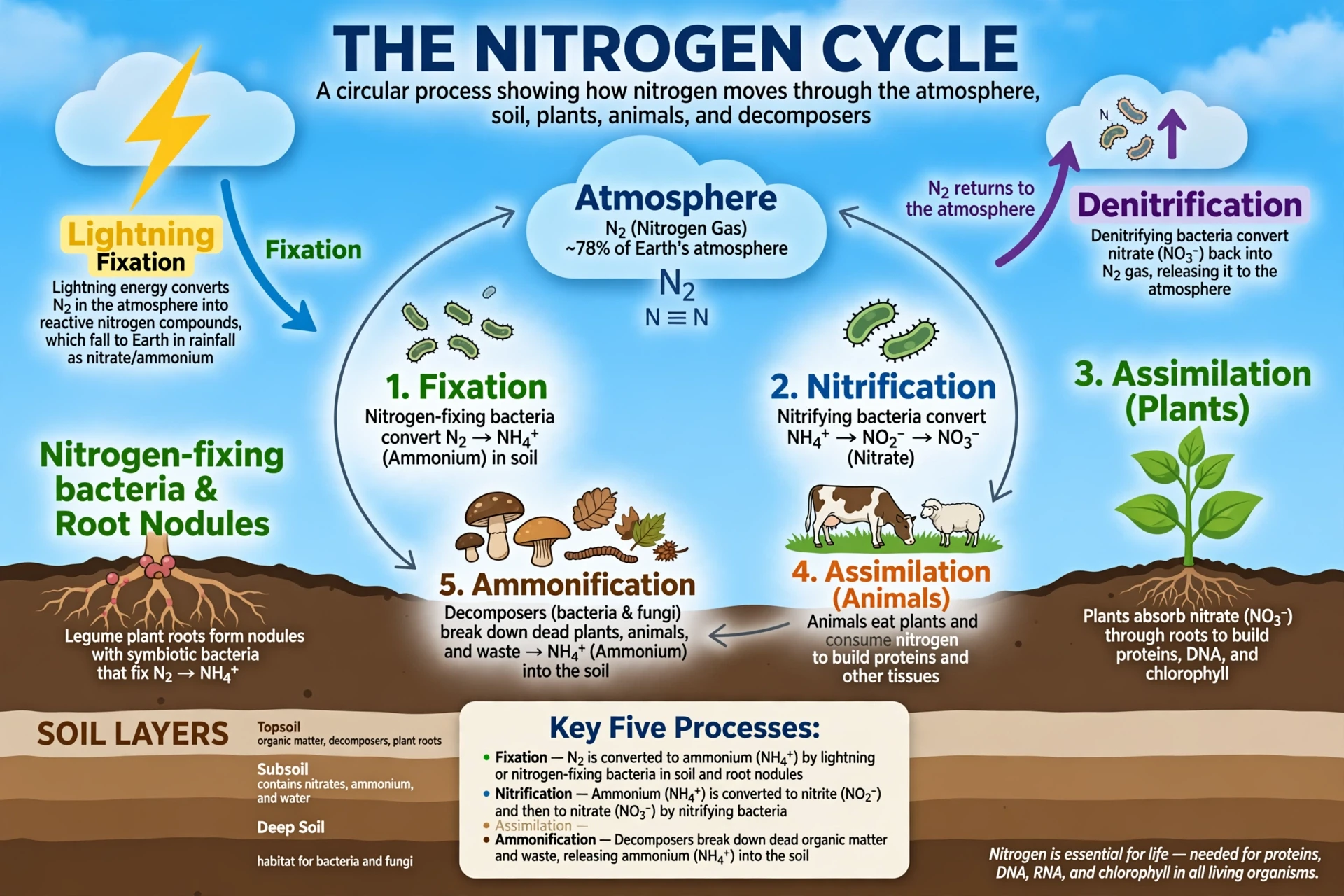
Before we look at each step in detail, it helps to see the whole loop at once. The nitrogen cycle is a circle with five main stages, and nitrogen atoms travel around it again and again, sometimes quickly, sometimes after resting in the soil or the deep ocean for centuries.
It begins in the atmosphere, where nitrogen gas waits. Nitrogen fixation breaks the triple bond and converts N₂ into ammonia or related compounds — the work of lightning, certain bacteria, and human fertiliser factories. Next comes nitrification, where soil bacteria convert ammonia into nitrite and then nitrate. Then assimilation: plants absorb nitrate or ammonium through their roots and build it into proteins and DNA, and animals get their nitrogen by eating plants or other animals. When organisms die or produce waste, ammonification returns their organic nitrogen to the soil as ammonia, carried out by decomposers. Finally, denitrification closes the loop: another group of bacteria converts nitrate back into nitrogen gas, which returns to the atmosphere, ready for the cycle to begin again.
There is a useful analogy here. Imagine a town where the only bank vault is locked and almost nobody has the key. A few specialists can open it — that is fixation. Once the money is out, it circulates: people spend it, earn it, save it, lend it — that is assimilation and the movement through the food web. Some of it ends up in the gutters and drains — that is waste and decomposition. And eventually, some of it is collected up and deposited back in the vault — that is denitrification. The money is never created or destroyed in the town, only moved and changed. Nitrogen works the same way. The total amount on Earth barely changes. What matters is where it is, what form it is in, and how fast it is moving. A healthy nitrogen cycle keeps nitrogen moving at a pace that ecosystems can handle. A disrupted one piles it up in the wrong place — too much in a river, too little in a field, too much in the air as a greenhouse gas.
The cycle also connects to other great cycles of the planet. Nitrogen moves with water, so rain, rivers and ocean currents carry nitrate far from where it was fixed. It connects to the carbon cycle, because plants need nitrogen to build the tissues that store carbon, and microbes need carbon for energy to process nitrogen. It even connects to the oxygen cycle, because the bacteria that convert ammonia to nitrate need oxygen to do their work, and the bacteria that reverse the process thrive where oxygen is absent. Nothing in the nitrogen cycle happens in isolation, and that is exactly why it is so powerful — and why disturbing one part of it ripples into others. Ecosystems are webs, and nitrogen is one of the threads that holds the web together.
A quick note on scale will help keep the rest of the article in proportion. Natural fixation by bacteria and lightning adds a large amount of reactive nitrogen to land and sea each year, and human activity now adds roughly a similar amount again on top of that — mostly through synthetic fertilisers and the burning of fossil fuels. In other words, people have roughly doubled the amount of reactive nitrogen moving through the planet's living systems. That doubling is one of the largest changes humans have ever made to a planetary cycle, and it sits behind both the modern abundance of food and many of the environmental problems discussed later in this article. The cycle itself has not broken. It has been overloaded, and the overload shows up in very specific places.
Fixation — N₂ gas becomes ammonia or related compounds.
Nitrification — ammonia becomes nitrite, then nitrate.
Assimilation — plants and animals build nitrogen into proteins and DNA.
Ammonification — decomposers return organic nitrogen to ammonia.
Denitrification — nitrate becomes N₂ gas again, closing the loop.
3. Nitrogen Fixation: Breaking the Strongest Bond in the Air
If the nitrogen cycle has a hero, it is fixation. Everything else in the cycle depends on it, and it is also the hardest step. Splitting a nitrogen molecule apart means breaking a triple bond, and that takes real energy — the kind of energy that comes from a lightning bolt, from a bacterium running a specialised enzyme, or from an industrial plant burning fuel at high temperature and pressure. Without fixation, the nitrogen in the air would stay locked away forever, and life on land would grind to a halt as soon as the existing soil nitrogen ran out.
Most people assume that plants do this job themselves. That is one of the most common misconceptions about the nitrogen cycle, and it is worth correcting plainly: plants cannot fix nitrogen gas. What we actually see in nature is that plants depend on partners — bacteria living in the soil or inside their roots — to do the fixing for them. The plant supplies the energy, in the form of sugars made by photosynthesis, and the bacteria supply the enzyme and the chemistry. It is a trade, not a solo act, and understanding that trade explains a surprising amount of farming, gardening and ecology.
The enzyme at the centre of biological fixation is called nitrogenase. It is a remarkable piece of molecular machinery, and also a fragile one. Nitrogenase is destroyed by oxygen, which is awkward, because the bacteria that carry it live in an oxygen-rich world. Different nitrogen fixers solve this problem in different ways. Some live in low-oxygen pockets of soil. Some fix nitrogen only at night. Some, like the cyanobacteria that live in rice paddies, have specialised thick-walled cells called heterocysts that keep oxygen out while fixation happens inside. The legume bacteria we will meet in the next section solve it by living inside root nodules, where the plant carefully controls the oxygen level. Each solution is an elegant workaround to the same problem: how to run an oxygen-sensitive reaction in an oxygen-filled world.
3.1 Lightning: fixation from the sky
Long before there were bacteria, there was lightning. A lightning bolt heats the air around it to temperatures hotter than the surface of the Sun, if only for a fraction of a second. In that flash of heat, nitrogen and oxygen molecules are torn apart and recombine into nitrogen oxides. Those oxides dissolve in rainwater to form nitrates, which wash into the soil. A thunderstorm is, in a very real sense, a fertiliser delivery.
Lightning fixation is dramatic but modest in scale compared with biological fixation. It contributes only a small share of the nitrogen that reaches land each year. Yet in some places — remote forests far from farms, or the open ocean — lightning-delivered nitrate can be a meaningful input. And there is a lovely historical point here: for most of Earth's history, lightning was one of the only sources of fixed nitrogen available to life. The first ecosystems had to make do with whatever the sky provided, and that scarcity shaped how life evolved. The bacteria that learned to fix nitrogen themselves were among the most successful organisms in Earth's history, because they freed themselves from waiting on the weather.
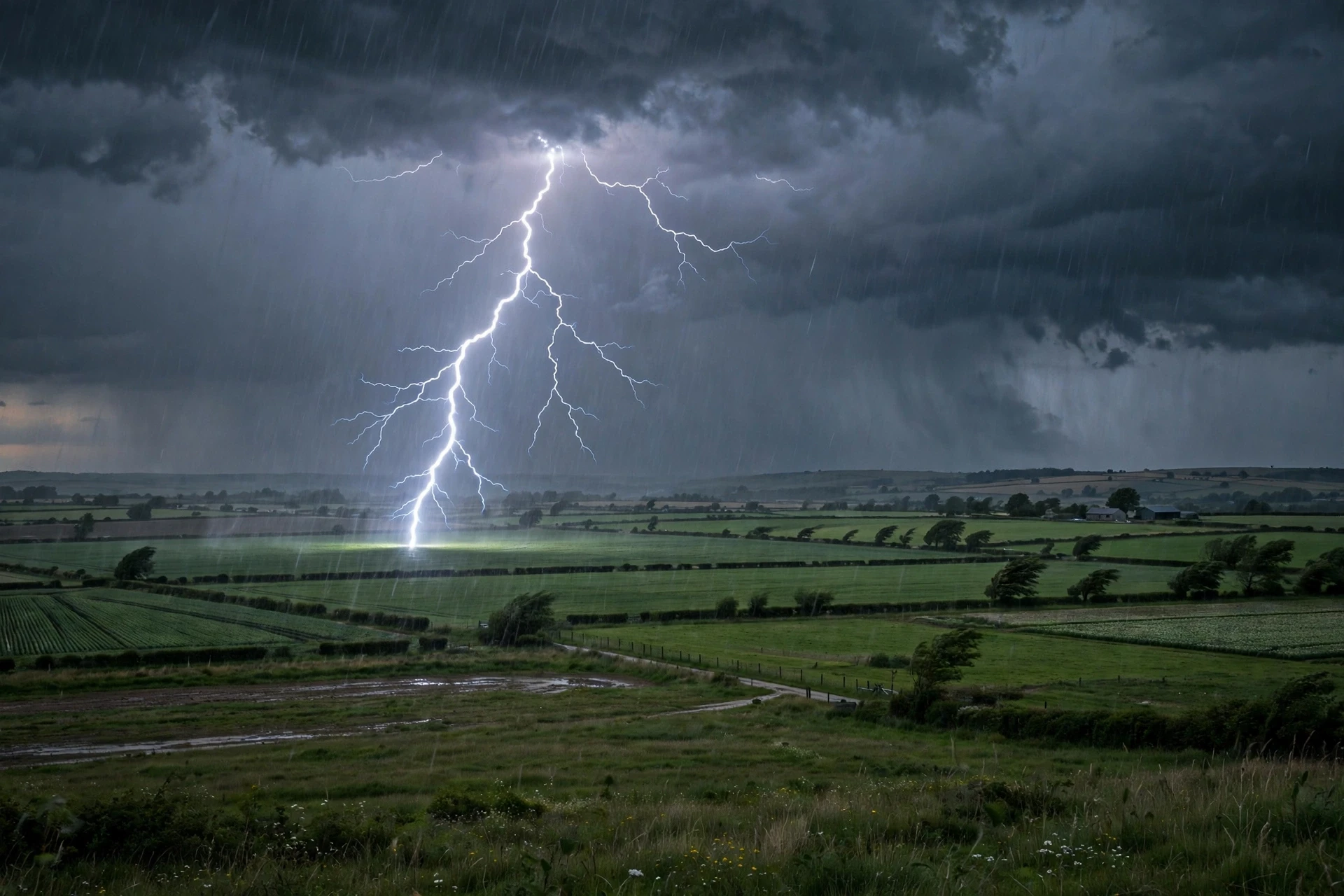
I still remember the first time someone explained this to me during a summer storm. I was standing at a window watching lightning split the sky over the fields, and a teacher said, almost offhand, "That storm is feeding the grass." I laughed at the time. It sounded like a joke. Years later, standing in a lab looking at nitrate measurements from rainwater samples, I thought back to that window. The numbers were small, but they were real. Every thunderstorm leaves a faint chemical signature in the soil, and over a whole summer, over a whole landscape, those signatures add up. Nature has a habit of hiding its most important work inside its most ordinary spectacles.
3.2 Bacteria: the quiet workforce that feeds the world
The heavy lifting of natural fixation is done by bacteria and their relatives. Free-living nitrogen fixers, such as Azotobacter in soils and cyanobacteria in water and on land, fix nitrogen without a plant partner. They are widespread, tough, and easy to overlook, because they are microscopic and they work in the dark, in the soil, or in thin films of water on rocks and leaves. In a single handful of healthy soil there can be billions of bacteria, and a portion of them are quietly fixing nitrogen every day, using energy from decaying organic matter.
Symbiotic fixers — the ones that partner with plants — are far more productive per unit of land, because the plant feeds them a steady supply of sugar. That partnership is so important that it gets its own section next. But it is worth pausing here to appreciate the free-living fixers, because they are the reason wild ecosystems can sustain themselves without fertiliser. A forest that has never seen a bag of fertiliser still grows, year after year, because bacteria in its soil and on its trees are steadily topping up the nitrogen supply. The system is slow, but it is steady, and it has worked for hundreds of millions of years.
There is a catch, and it matters for understanding fertiliser use. Nitrogenase is expensive to run. A bacterium spends a lot of energy breaking that triple bond, so it only bothers when nitrogen is scarce. Flood the soil with synthetic fertiliser, and the bacteria switch off — why pay the energy cost when free nitrate is lying around? That is one reason heavy fertiliser use can weaken the soil's own nitrogen-fixing community over time. The cycle adapts to what you give it, and it can forget how to do the job itself.
4. Life's Partnership: Legumes, Root Nodules and Rhizobia
If you dig up a bean plant, a pea plant, a clover plant or a lentil plant and look carefully at its roots, you will see something odd: small round lumps, like tiny beads, clinging to the root hairs. Those lumps are nodules, and inside each one lives a colony of bacteria called rhizobia. This is the most famous partnership in the nitrogen cycle, and it is also one of the most successful alliances in the history of life. The plant builds the nodule, feeds the bacteria sugar, and controls the oxygen inside. The bacteria fix nitrogen gas into ammonia and hand it to the plant. Both sides win, and the soil wins too, because some of that fixed nitrogen leaks out or stays behind when the plant dies, enriching the ground for whatever grows next.
That is why farmers have rotated legumes with other crops for thousands of years, long before anyone knew what a bacterium was. Plant beans one year, wheat the next, and the wheat grows better — not because of magic, but because the beans left nitrogen behind. Roman and Chinese farmers practised crop rotation with legumes. So did farmers across Africa, Asia and the Americas, each discovering the pattern independently. They could see the result, even though the mechanism was invisible to them. The nodules were there all along, waiting for microscopes to reveal them.
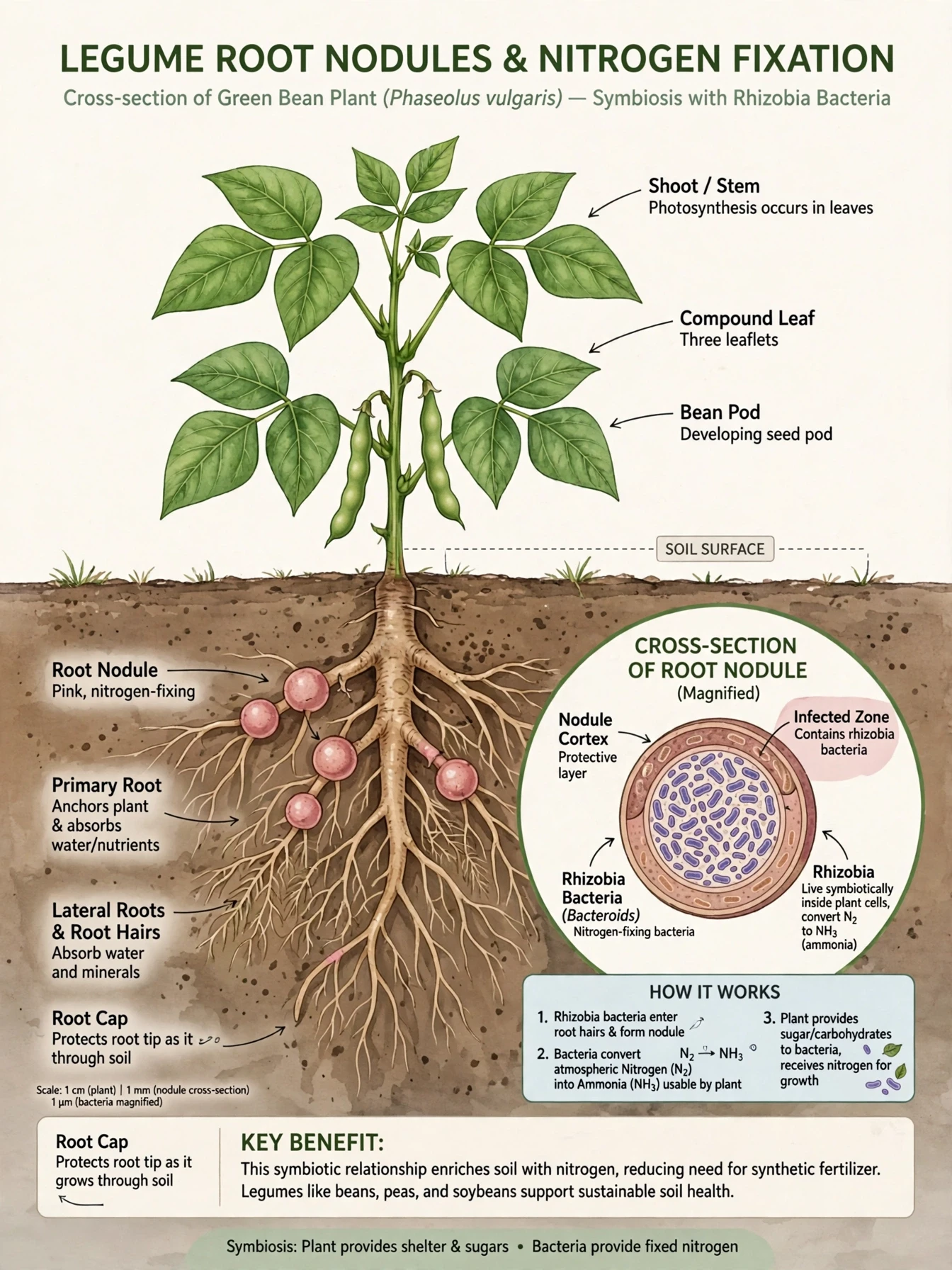
The details of the partnership are worth a closer look, because they show how precise the nitrogen cycle can be. The relationship starts with a chemical conversation. A legume root releases signalling molecules into the soil, and compatible rhizobia respond with their own signals. The root hair curls around the bacteria, the plant builds an infection thread — a tiny tunnel — and the bacteria travel down it into the root. There, the plant wraps them in a membrane and the bacteria change form, becoming swollen, branched structures called bacteroids that are dedicated to fixation. The plant supplies a protein called leghaemoglobin, which gives healthy nodules their pink colour inside and binds oxygen tightly, keeping the free oxygen level low enough for nitrogenase to work while still delivering enough oxygen for the bacteria to breathe. Cut open a fresh nodule and it should be pink inside. A white or green nodule is one that is not fixing, or not fixing any more. Gardeners who know this check their bean roots the way a mechanic checks oil: the colour tells you whether the system is working.
4.1 Why legumes matter beyond the farm
Legumes are not just a farming trick. In wild ecosystems, leguminous trees and shrubs are often the pioneers that colonise poor soils — the first plants to move into a cleared patch, a landslip, or a volcanic slope. They bring their own nitrogen supply with them, grow fast, drop nitrogen-rich leaves, and gradually build a soil that other species can use. Whole forests have been founded on the work of a few nitrogen-fixing pioneers. Acacia trees in dry landscapes, alder trees along rivers, and clover in meadows all play this role. When conservationists restore damaged land, they often plant legumes first, for exactly this reason: the plants do the soil-building work for free.
There is also a lesson here for gardeners. If you grow peas or beans, leave the roots in the ground when the season ends. Cut the stems off at soil level and let the roots rot where they are. The nodules break down and release their nitrogen into the soil, and the next crop inherits it. Pulling the whole plant up and throwing it on the compost heap still helps, but it moves the nitrogen away from the bed that needs it. I made that mistake for years, yanking bean plants out by the roots at the end of summer and wondering why the following year's brassicas were so pale. The fix cost me nothing. It just required leaving something alone.
4.2 Other partnerships: alder, sea buckthorn and cyanobacteria
Legumes get the fame, but they are not the only nitrogen-fixing partnership. Alder trees partner with a different bacterium, Frankia, which forms nodules on their roots and lets alders thrive in wet, poor soils along rivers. Sea buckthorn does the same on dry, sandy ground. In rice paddies, a tiny floating fern called Azolla hosts cyanobacteria that fix nitrogen, and farmers in parts of Asia have used it as a living fertiliser for centuries, letting it grow on the water surface and then ploughing it in. Lichens — the crusty partnerships of fungi and algae or cyanobacteria — fix nitrogen on bare rock, slowly building the first thin soils. Each of these partnerships is a different answer to the same problem, and together they show how many ways life has found to open the nitrogen vault. Plant biology is full of such bargains, but few are as consequential as this one.
5. From Ammonia to Nitrate: Nitrification and the Soil's Quiet Workforce
Once nitrogen has been fixed into ammonia, it still is not in the form most plants prefer. The next stage, nitrification, is a two-step handover between two different groups of soil bacteria, and it is one of the most orderly processes in the whole cycle.
In the first step, bacteria such as Nitrosomonas convert ammonia (NH₃) into nitrite (NO₂⁻). In the second step, bacteria such as Nitrobacter convert nitrite into nitrate (NO₃⁻). Nitrate is the key product: it dissolves easily in soil water, it moves freely to plant roots, and most crop plants absorb it eagerly. When a farmer or gardener talks about "available nitrogen" in the soil, nitrate is usually what they mean.
This matters because ammonia itself is a tricky substance to keep around. In soil, ammonia quickly picks up a hydrogen ion and becomes ammonium (NH₄⁺), which clings to clay particles and organic matter. That clinging is useful — it stops the nitrogen washing away — but ammonium is less mobile than nitrate, and some plants absorb it less readily. Nitrification converts a sticky, local form of nitrogen into a mobile, widely available one. The trade-off is that mobile nitrogen can also be lost: nitrate that is not absorbed quickly can leach down through the soil with rainwater, out of reach of roots, and eventually into streams and groundwater. The same mobility that feeds plants also makes nitrate pollution possible. The cycle gives, and the cycle takes away.
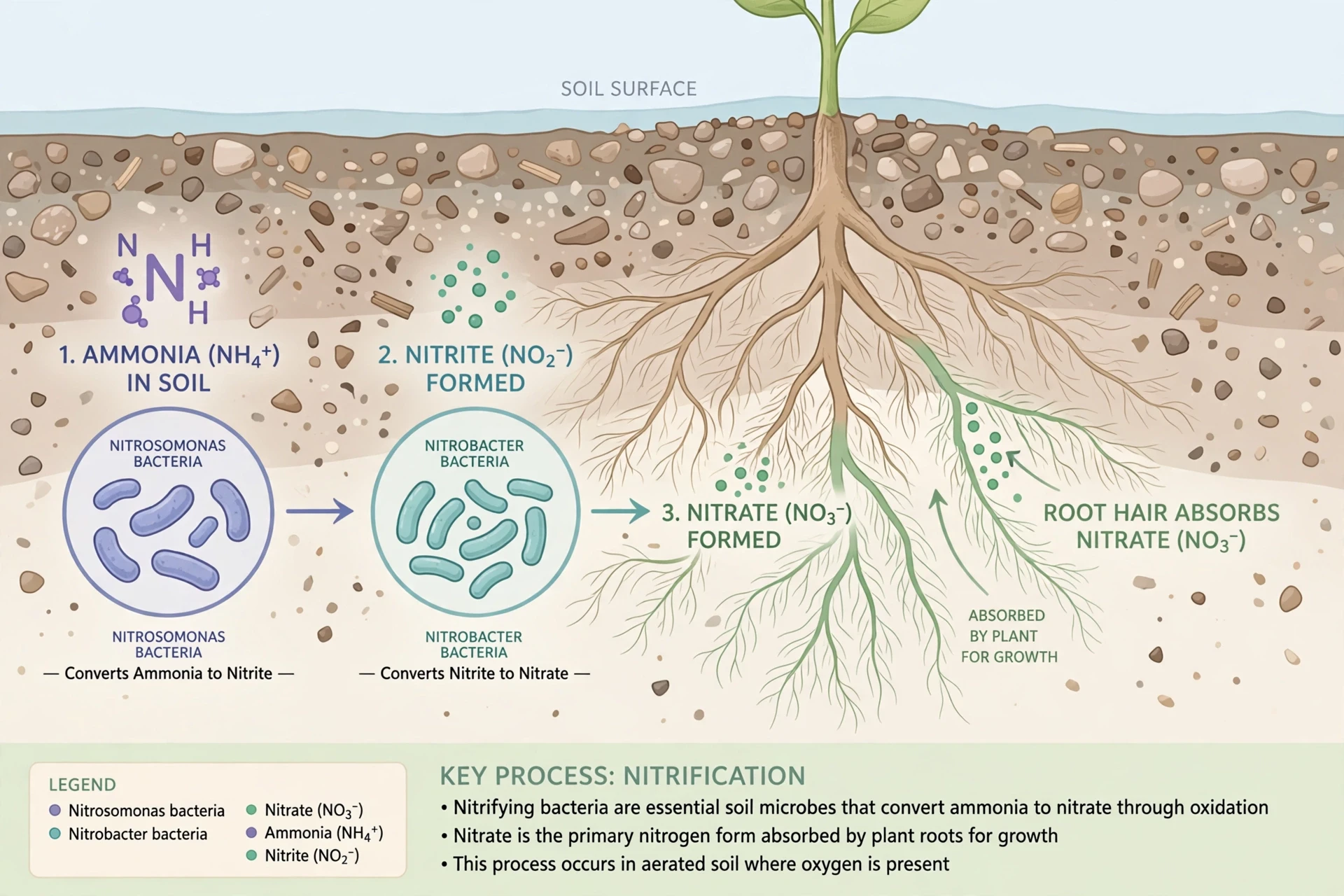
Nitrification needs oxygen. The bacteria that carry it out are aerobic, and they work best in well-drained, warm, moist soil with a near-neutral pH. Waterlogged soil slows them down. Very acidic soil slows them down. Cold soil slows them down — which is why spring growth can be nitrogen-limited even in rich soil, until the ground warms up and the bacteria wake up. I noticed this pattern one cold spring when a bed of lettuce I had fed with compost still looked hungry. The nitrogen was there, in the compost, but the bacteria that convert it into nitrate were barely active in the cold. A few weeks later, with no extra feeding at all, the same plants greened up and took off. Nothing had been added. The workforce had simply clocked in.
5.1 Ammonification: the decomposers' return
Before nitrification can happen, much of the nitrogen in the soil arrives through a different route: ammonification. When plants and animals die, and when animals produce waste, decomposers — bacteria and fungi — break down the proteins and other nitrogen-containing molecules in the dead tissue. The nitrogen is released as ammonia. This is the great recycling step of the cycle, and it runs constantly, in every ecosystem, without anyone noticing.
A compost heap is ammonification made visible. Kitchen scraps and garden waste go in, microbes get to work, and the pile warms up as decomposition accelerates. The sharp smell that sometimes rises from a fresh heap is ammonia escaping — nitrogen that the microbes have released faster than anything nearby can absorb it. Good composting manages that smell by balancing green, nitrogen-rich material with brown, carbon-rich material, so the microbes have enough energy to hold on to the nitrogen instead of letting it escape as gas. The principle is the same one that governs the whole cycle: nitrogen follows energy, and microbes make the decisions.
The soil is not dirt. It is a living workforce, and every handful holds more organisms than there are people on Earth — most of them working, in one way or another, on nitrogen.
That workforce also explains why soil health and nitrogen supply are the same conversation. A soil rich in organic matter feeds a large, diverse community of decomposers and nitrifiers, which releases nitrogen steadily, in step with plant demand. A soil stripped of organic matter has a small, stressed community that releases nitrogen in bursts — or not at all. Fertilisers can mask the problem for a season, but they cannot replace the workforce. The long-term fix for nitrogen supply is almost always the same: feed the soil, and the soil will feed the plants.
5.2 What slows nitrification down — and why it matters
Farmers and scientists have learned to manage nitrification deliberately. Some fertilisers are sold with nitrification inhibitors — compounds that slow the bacteria down — so that nitrogen stays in the ammonium form longer, clinging to the soil instead of leaching away as nitrate. The idea is simple: match the nitrogen supply to the plant's appetite, and less of it escapes. The practice is still spreading, and it is one of the quieter success stories of modern agronomy.
There is a flip side. Nitrite, the intermediate product of nitrification, is toxic to plants and animals in high concentrations. In a healthy soil it never accumulates, because the second group of bacteria converts it to nitrate almost as fast as it is made. But in waterlogged or disturbed soils, or in fish tanks and aquaculture ponds where the bacterial community is still establishing itself, nitrite can build up and cause harm. Aquarium keepers know this as "new tank syndrome": the fish suffer until the nitrifying bacteria colonise the filter and start converting nitrite to nitrate. The same two-step handover, the same bottleneck, in a glass box on a living-room shelf. The nitrogen cycle is fractal. It looks the same at every scale, from a fish tank to an ocean.
6. The Return Journey: Denitrification and Ammonification in Reverse
Every cycle needs a way back. Denitrification is the step that returns nitrogen to the atmosphere as N₂ gas, closing the loop that fixation opened. It is carried out by a diverse group of bacteria that live in places where oxygen is scarce — waterlogged soils, wetlands, lake sediments, and the oxygen-poor depths of the ocean. When oxygen is unavailable, these bacteria use nitrate instead of oxygen to breathe, stripping the oxygen atoms away and releasing the nitrogen as gas. The process runs in reverse order to nitrification: nitrate becomes nitrite, then nitric oxide, then nitrous oxide, and finally nitrogen gas.
That intermediate, nitrous oxide (N₂O), deserves attention, because it is a greenhouse gas far more potent, molecule for molecule, than carbon dioxide, and it also damages the ozone layer. Most denitrification goes all the way to harmless N₂. But when the process is incomplete — when soils are wet, then dry, then wet again, or when nitrate is abundant and oxygen levels fluctuate — a larger share escapes as nitrous oxide. This is one of the hidden climate costs of heavy fertiliser use: not just the energy spent making the fertiliser, but the nitrous oxide that leaks out of the soil afterwards. It is invisible, odourless, and long-lived in the atmosphere, and it is one of the reasons scientists pay such close attention to how much nitrogen farmers apply and when they apply it.
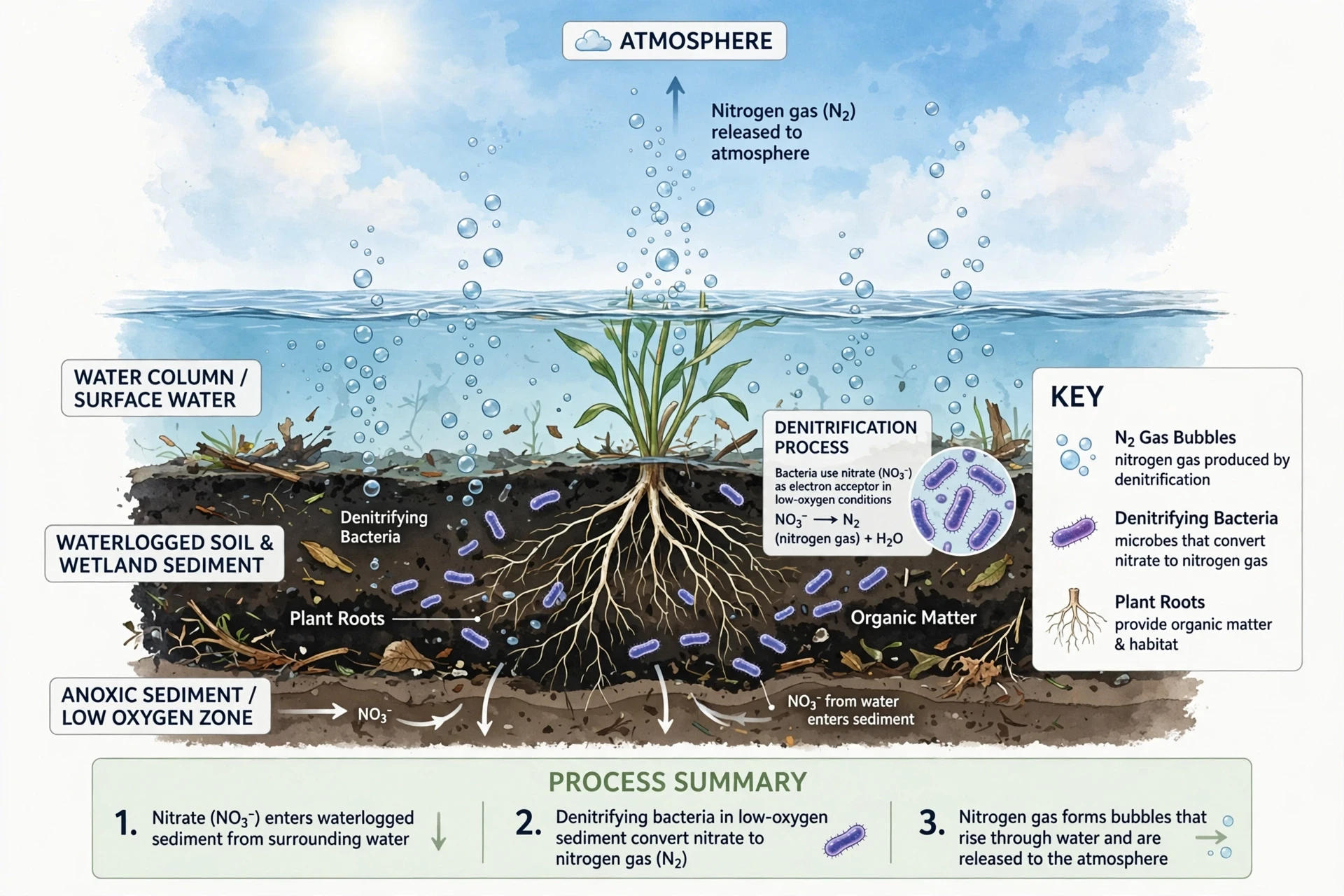
Wetlands are the great denitrification engines of the landscape. A marsh or a reed bed can strip a large share of the nitrate from water passing through it, converting it back to harmless nitrogen gas before it reaches a river or a lake. That is why the loss of wetlands matters so much for water quality: every drained marsh is a lost filter, and the nitrate that would have been returned to the air instead flows downstream. Restoration projects that rebuild wetlands are, in effect, rebuilding the nitrogen cycle's return journey. They do not just create habitat for birds. They repair a piece of planetary plumbing.
I once visited a constructed wetland built beside a farm — a series of shallow ponds planted with reeds, designed to catch runoff before it reached a stream. The water that entered was cloudy and green. The water that left was clear. The farmer who showed me around shrugged and said the reeds did the work, which was true in the way that a short answer can be true. The reeds provided the carbon and the low-oxygen sediment. The bacteria did the chemistry. The result was nitrogen going back to the sky instead of downstream to cause trouble. It was one of the most hopeful things I had seen in years of looking at environmental problems: a solution that worked by letting the cycle do what it already knows how to do.
6.1 The balance of the loop
In a natural ecosystem, fixation and denitrification roughly balance over time. Nitrogen enters, circulates, and leaves at a similar rate, and the amount stored in soil and living things stays fairly steady. That balance is not exact from year to year — a wet year may favour denitrification, a dry year may favour fixation — but over decades, the system holds its own. Human activity has broken that balance by adding far more fixed nitrogen than denitrification can remove. The excess accumulates in soils, leaks into water, and escapes into the air. The cycle has not stopped working. It is simply being asked to process more nitrogen than it evolved to handle, and the bottleneck shows up everywhere: in rivers, in coastal seas, in the atmosphere, and in the climate.
Understanding denitrification also clears up a common confusion. People sometimes ask why nitrogen does not simply build up in the soil forever, given how much fertiliser is applied. The answer is that it leaves — through denitrification, through leaching, through harvest, and through erosion. A field is not a bank account that accumulates nitrogen indefinitely. It is a sieve, and the nitrogen that is not used quickly finds a way out. That is why timing matters so much: nitrogen applied when no crop is growing to absorb it is nitrogen that will mostly be lost, one way or another.
7. Feeding the World: Fertilisers and the Haber-Bosch Process
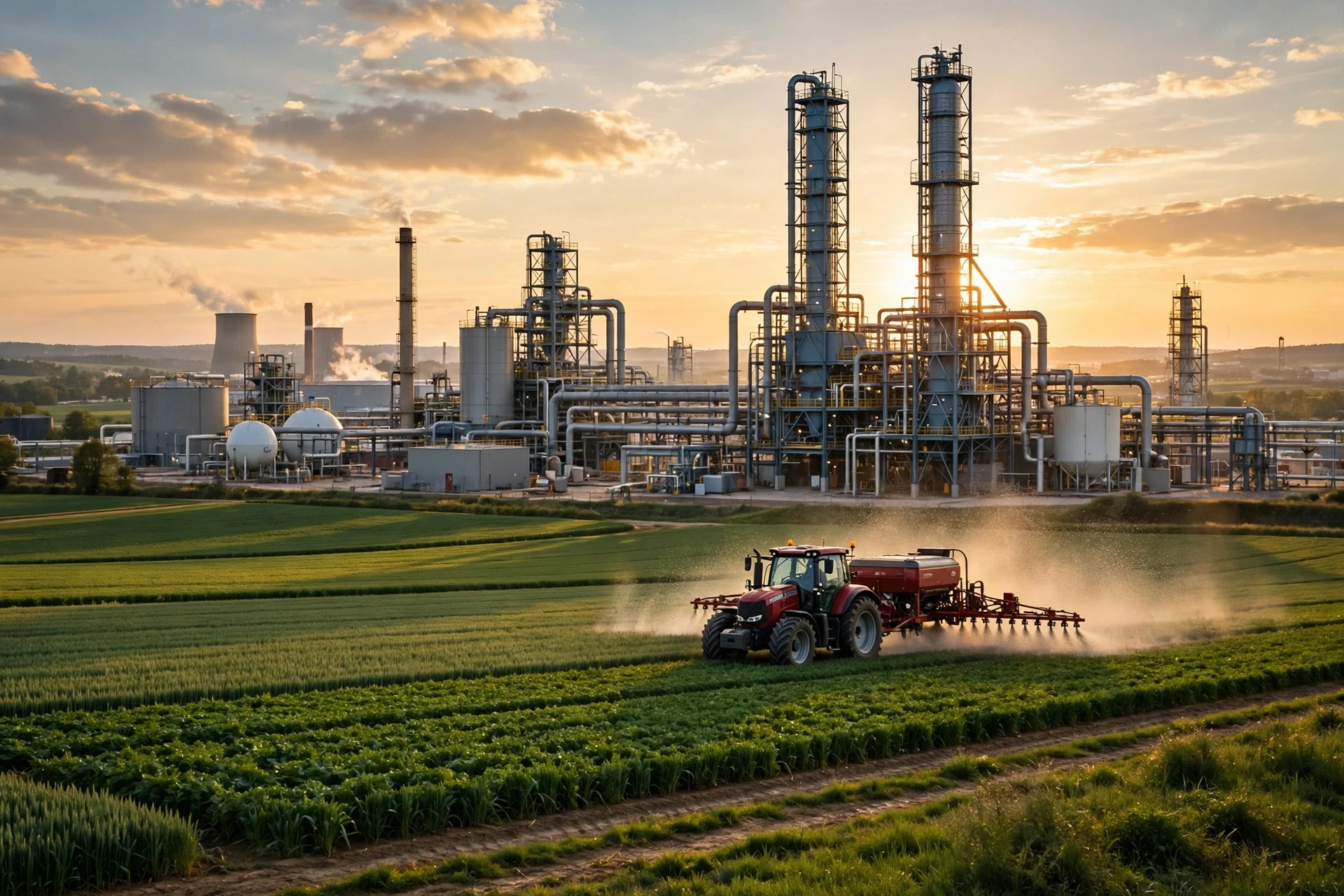
For most of human history, the amount of food the world could grow was limited by the amount of nitrogen that bacteria and lightning could fix. Farmers worked around that limit with manure, crop rotation, and legumes, and they fed themselves well enough — but the ceiling was real. Then, in the early twentieth century, two German chemists, Fritz Haber and Carl Bosch, found a way to pick the nitrogen lock industrially. The Haber-Bosch process combines nitrogen from the air with hydrogen, under high temperature and high pressure, over a catalyst, to produce ammonia. That ammonia can be turned into fertilisers that feed crops directly.
The impact is hard to overstate. Synthetic nitrogen fertiliser now supports food production for around half the people on Earth, by the most widely cited estimates — meaning that roughly one in two people alive today depends, in part, on nitrogen fixed in a factory rather than by a bacterium. The world population grew from under two billion to eight billion over the same century that fertiliser use expanded, and that growth would not have been possible without the extra nitrogen. The Haber-Bosch process is one of the most consequential inventions in history, and it is also one of the least celebrated, because it works invisibly, inside fertiliser granules and crop roots, far from the public eye.
It also carries a heavy cost. Making ammonia industrially takes a great deal of energy, and most of that energy still comes from natural gas, which also supplies the hydrogen. Fertiliser production is therefore a significant source of carbon dioxide emissions, as well as consuming a fossil fuel. And once the fertiliser is spread on a field, only part of it ends up in the crop. A large share is lost — leached into water, volatilised into the air as ammonia, or converted by soil bacteria into nitrous oxide. The global efficiency of nitrogen use in farming is low, often well below half of what is applied. That means for every bag of fertiliser spread, a large part is paying for pollution rather than food.
7.1 How fertilisers are used — and overused
There are good reasons fertiliser is over-applied. It is relatively cheap compared with the value of the crop it protects. A farmer who applies too little risks a poor harvest and a real loss of income. A farmer who applies too much loses a little money on wasted fertiliser, but the harvest is safe. The incentive, in other words, points towards excess. Add to that the difficulty of knowing exactly how much nitrogen a particular field needs in a particular season — it depends on the weather, the soil, the crop variety, and the history of the field — and the result is a system that routinely applies more than the crop can use.
I saw this logic up close on a farm visit some years ago. The farmer showed me his fertiliser store and said, almost apologetically, that he applied the same amount every year, "to be safe." He knew some of it was wasted. He also knew that a single bad year could cost him more than a decade of wasted fertiliser. I did not argue with him, because his reasoning was sound from his side of the fence. The problem is a system problem, not a personal one: when the cost of pollution is borne by everyone downstream, and the cost of a failed crop is borne by one family, the rational choice for the family is to over-apply. Fixing that requires changing the incentives — better soil testing, precision application, payments for careful management — not blaming the farmer.
7.2 Comparing nitrogen sources
Not all nitrogen is equal, and the differences matter for the soil, the climate, and the farmer's budget. The table below compares the main sources of nitrogen available to a farm or garden, from the most natural to the most industrial.
Source | How nitrogen is fixed | Speed of release | Main advantage | Main drawback |
|---|---|---|---|---|
Legume crops and green manures | Rhizobia bacteria in root nodules | Slow, as residues break down | Builds soil organic matter and structure | Takes land and time out of production |
Animal manure and compost | Already fixed by animals and microbes | Slow to medium | Recycles nutrients and adds organic matter | Variable nutrient content, bulky to move |
Lightning and rainfall | Lightning splits N₂ in the air | With each storm | Free and natural | Small and unpredictable amounts |
Synthetic fertiliser (Haber-Bosch) | Industrial ammonia synthesis | Fast, immediately available | Precise dose, feeds large yields | Energy-intensive, easily lost to water and air |
Free-living soil bacteria | Nitrogenase in soil microbes | Slow and steady | Works without any human input | Small amounts, switches off when fertiliser is added |
The pattern that emerges from the table is a trade-off between speed and side effects. Fast nitrogen feeds crops quickly but escapes easily. Slow nitrogen feeds the soil as well as the crop, but it cannot meet the demands of intensive farming on its own. The most successful farms, and the most successful gardens, use both: legumes and compost to build the soil's own capacity, and modest, well-timed doses of fertiliser to top it up where the soil alone falls short. That combination — biological nitrogen as the base, synthetic nitrogen as the supplement — is where most of the practical progress in sustainable farming now lies.
7.3 Precision farming and the future of fertiliser
The good news is that fertiliser use is getting smarter. Soil sensors, satellite imagery, and GPS-guided spreaders now let farmers apply nitrogen only where it is needed, and only in the amount the crop can use. Split applications — small doses timed to the crop's growth stages, rather than one large dose at planting — cut losses sharply. Cover crops planted after harvest catch leftover nitrogen and hold it over winter, releasing it when they are ploughed in. None of these ideas is new, but the technology for applying them precisely is. The gap between what is possible and what is practised is still large, and closing it is one of the most effective environmental actions available to agriculture.
8. Too Much of a Good Thing: Dead Zones, Algal Blooms and Nitrous Oxide
The nitrogen cycle's dark side appears when too much reactive nitrogen arrives in the wrong place at the wrong time. The same nutrient that makes a wheat field flourish can turn a lake or a coastal sea into a green, oxygen-starved soup. The mechanism is straightforward, and it is worth understanding in detail, because it explains some of the most visible environmental damage of the modern world.
It starts with runoff. Rain washes excess nitrate and ammonium from fields, lawns and streets into streams, and the streams carry it to rivers, lakes and the sea. In water, nitrogen is often the limiting nutrient, just as it is on land. Add a sudden supply, and algae and cyanobacteria multiply explosively — an algal bloom. The water turns green, sometimes thick and soupy, sometimes a bright, almost luminous green. At first the bloom looks like life flourishing. It is, briefly. Then the algae die, sink, and are decomposed by bacteria, which consume the oxygen dissolved in the water. In a severe bloom, the decomposition consumes so much oxygen that fish and other animals suffocate. The result is a dead zone: a stretch of water with so little oxygen that most marine life cannot survive in it.
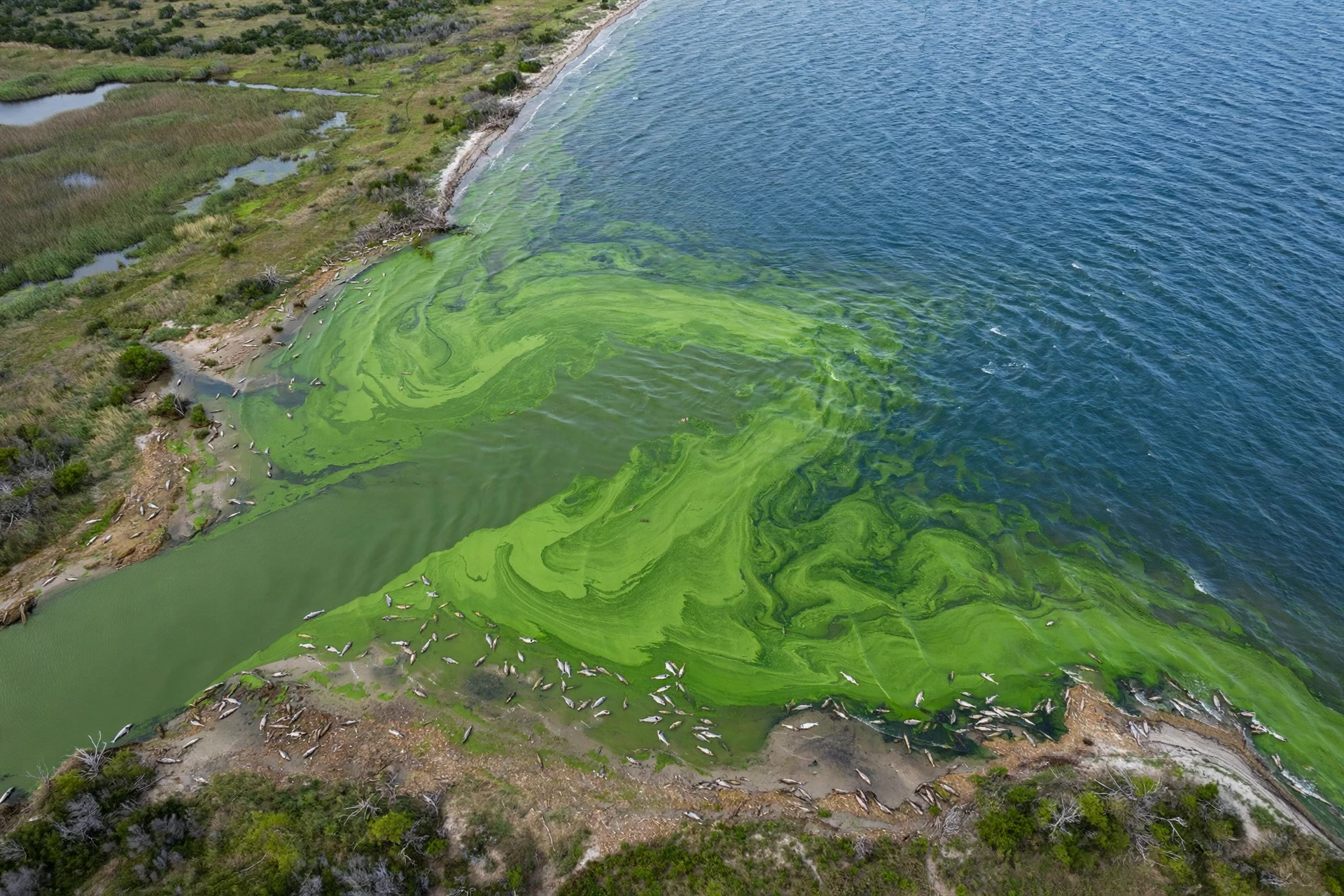
The best-known example is the dead zone in the Gulf of Mexico, which forms each summer where the Mississippi River meets the sea, carrying nitrogen from farms across the American Midwest. In bad years it can cover thousands of square kilometres — an area larger than some small countries — and it returns every year, growing and shrinking with the seasons and the rainfall. Similar dead zones appear in the Baltic Sea, the Chesapeake Bay, and in lakes and estuaries around the world. The US National Oceanic and Atmospheric Administration tracks these dead zones and explains how nutrient pollution drives them, and its pages are a clear starting point for anyone who wants to follow the science.
A dead zone is not a place where life was never present. It is a place where life was fed too much, too fast, and choked on the feast.
Algal blooms also threaten drinking water. Some bloom-forming cyanobacteria produce toxins that can make people and animals ill, and water treatment plants have to work harder — and spend more — to remove them. In 2014, a bloom in Lake Erie left hundreds of thousands of people in Toledo, Ohio, without safe tap water for days. That event made headlines, but smaller blooms affect water supplies every year, quietly, in towns that never make the news. The nitrogen that feeds the bloom is rarely visible at the source. It leaves a farm field as a clear, colourless solution in rainwater. It only becomes visible when it reaches the lake and turns it green.
8.1 Nitrous oxide: the invisible leak
While dead zones are visible, the climate cost of excess nitrogen is not. Nitrous oxide, released from fertilised soils and from manure, is a greenhouse gas with a warming effect far stronger per molecule than carbon dioxide, and it lingers in the atmosphere for more than a century. It also damages the ozone layer, the thin shield that protects life from ultraviolet radiation. Agriculture is the largest human source of nitrous oxide, and the link is direct: more nitrogen applied to soil means more nitrous oxide escaping, especially when soils are wet and warm. Reducing that leak does not require new technology so much as better practice — the right amount, at the right time, in the right place, with cover crops and wetlands to catch what escapes.
8.2 Nitrogen in the air: ammonia and acid rain
Not all lost nitrogen goes to water. Some escapes as ammonia gas, especially from manure and from urea fertiliser spread on warm, dry days. Ammonia in the air reacts to form fine particles that harm human lungs, and when it falls back to land as deposition, it fertilises natural ecosystems that never asked for extra nitrogen. The result is a slow change in plant communities: fast-growing, nitrogen-loving species take over, and the rare, slow-growing species that define a heath, a bog or an ancient meadow are pushed out. Nitrogen deposition is one of the quiet drivers of biodiversity loss, less visible than habitat destruction but just as real. A wildflower meadow that receives a steady drizzle of airborne nitrogen from nearby farms gradually becomes a coarse grassland, and the orchids and rare herbs that made it special disappear. The meadow has not been ploughed or built on. It has simply been overfed, from the sky.
8.3 The human health connection
Excess nitrate in drinking water is also a direct health concern. In the human gut, nitrate can be converted to nitrite, which interferes with the blood's ability to carry oxygen — a particular risk for infants, in a condition known as blue baby syndrome. For that reason, drinking-water standards set strict limits on nitrate levels, and water suppliers in farming regions spend significant effort monitoring and treating their supplies. The US Environmental Protection Agency describes the agricultural sources of nutrient pollution and the practical ways to reduce them, and the scale of the challenge is clear from its pages: this is not a problem of a few careless farms, but of a whole food system built around abundant nitrogen.
9. Fixing the Imbalance: What Can Be Done
The nitrogen story can sound discouraging: a cycle that feeds the world is also polluting its waters and warming its climate. But the encouraging part is that the solutions are known, practical, and already working where they have been tried. The nitrogen cycle does not need to be reinvented. It needs to be given room to work, and to be helped where it is overloaded.
The first and simplest step is to use less nitrogen, more carefully. Soil testing before planting tells a farmer what is already in the ground, so fertiliser tops up a measured deficit instead of guessing at it. Splitting applications across the growing season matches supply to demand. Precision equipment applies fertiliser only where the crop needs it, skipping the wet hollows and field edges where it would be lost. These practices can cut nitrogen losses sharply without cutting yields, and in many cases they save the farmer money. The barrier is rarely knowledge. It is habit, uncertainty, and the fear of a bad year.
The second step is to rebuild the biological base. Planting legumes in rotation, growing cover crops over winter, and adding compost all increase the soil's own nitrogen supply and its ability to hold on to nitrogen. A soil rich in organic matter acts like a sponge: it absorbs nitrogen when it is abundant and releases it slowly when plants need it. A depleted soil acts like a sieve: nitrogen passes straight through. The difference between the two is visible in the colour of the soil, the smell of it, and the crops it grows. I have seen the same field change over five years of cover cropping and compost, from pale and dusty to dark and crumbly, and the fertiliser bill fell by a third while the yields held steady. The soil was doing work that the fertiliser bag used to do.
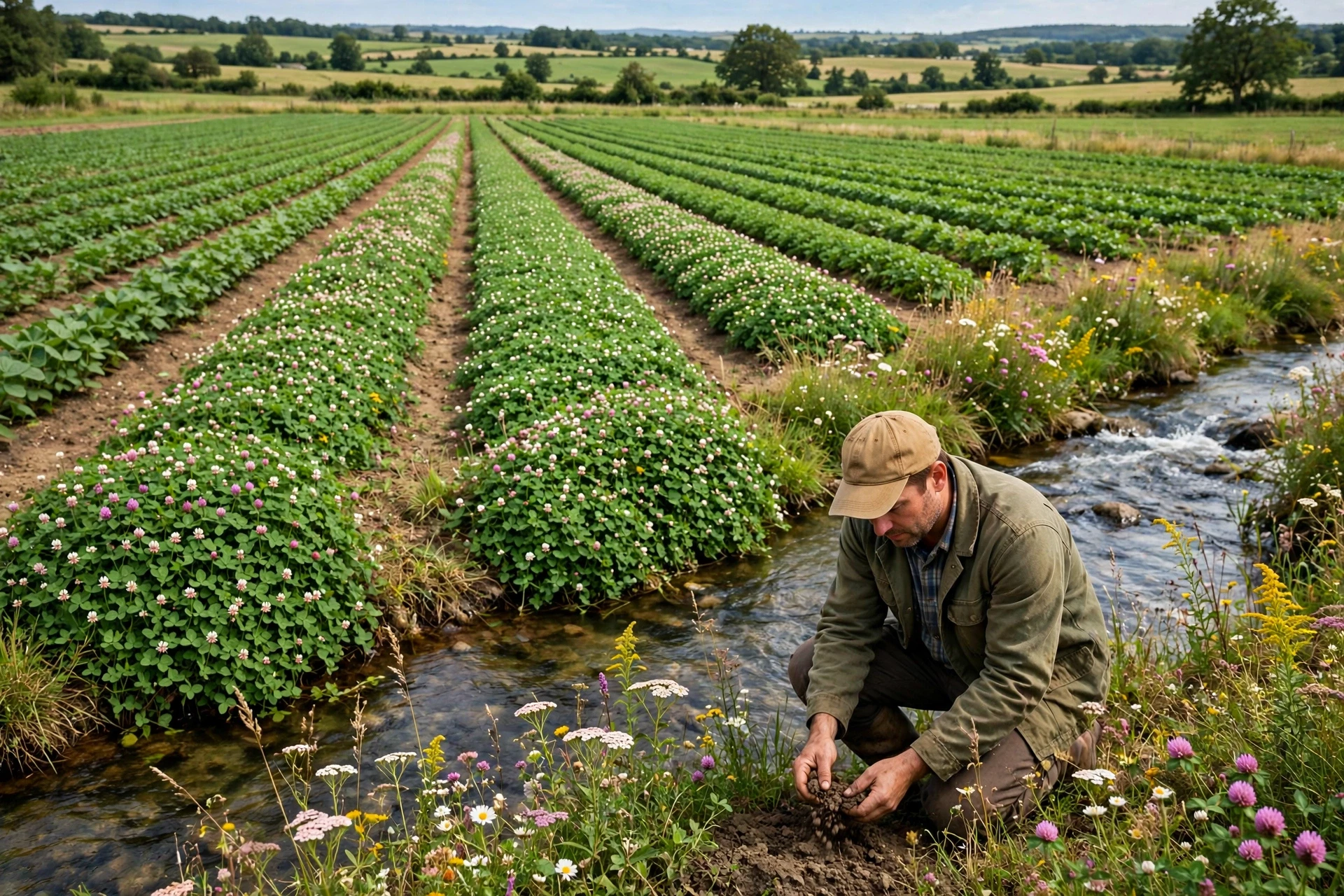
The third step is to catch what escapes. Buffer strips of grass, wildflowers or trees along streams trap runoff and absorb nitrate before it reaches the water. Restored wetlands do the same on a larger scale, letting denitrifying bacteria return nitrogen to the air. Treating manure properly — storing it under cover, applying it at the right time, and never spreading it before heavy rain — keeps its nitrogen in the field instead of in the river. Each of these measures is modest on its own. Together, they form a safety net that catches nitrogen at every point where it might leak.
The fourth step is dietary and systemic. A large share of the world's nitrogen fertiliser is used to grow feed for livestock, and livestock waste is a major nitrogen source in its own right. Eating patterns that rely less heavily on meat, and farming systems that integrate crops and animals so that manure fertilises the fields that grew the feed, both reduce the total nitrogen flowing through the system. This is the slowest change of all, because it involves culture, markets and policy, not just agronomy. But it is also the largest lever: small shifts in what billions of people eat add up to very large shifts in how much nitrogen the planet has to process.
Policy has a role too. Several countries and regions have set targets to cut nitrogen losses, and the results show that it can be done. The Netherlands, Denmark and parts of the United States have all reduced nitrogen pollution through combinations of regulation, incentives, and better advice to farmers. None of these programmes was painless, and none solved the problem completely. But they proved that the trend can be reversed, and that farms can remain productive while polluting less. The nitrogen cycle is forgiving, up to a point. Give it a chance, and it recovers.
For gardeners and homeowners, the same principles apply at a smaller scale. Test your soil before fertilising. Use compost and legumes first. Apply fertiliser sparingly, and never before heavy rain. Leave grass clippings on the lawn — they return nitrogen to the soil as they break down. Plant a buffer of shrubs or wildflowers along any stream or ditch at the edge of your land. And remember that a lawn does not need to be a vivid, uniform green to be healthy. The palest lawn in the neighbourhood may simply be the one that is not leaking nitrogen into the groundwater.
Test soil before adding fertiliser, and apply only the measured deficit.
Rotate legumes and grow cover crops to build the soil's own nitrogen supply.
Split fertiliser into small, well-timed doses matched to crop growth.
Plant buffer strips and restore wetlands to catch runoff and denitrify it.
Store and spread manure carefully, never before heavy rain.
Return grass clippings and compost to the soil instead of removing them.
10. Common Misconceptions About the Nitrogen Cycle
A cycle this important collects misunderstandings, and some of them shape real decisions — what people plant, how they fertilise, and what they worry about. Here are the ones I hear most often, and what the evidence actually shows.
10.1 "The air is mostly oxygen, so plants breathe nitrogen"
Most people assume the air is mostly oxygen, because oxygen is the gas we talk about. What we actually see in the measurements is the opposite: the air is about 78 percent nitrogen and only about 21 percent oxygen. Nitrogen is the majority gas, by a wide margin. The reason we rarely notice it is that nitrogen gas is chemically quiet — it does not react easily, it has no smell, and our bodies ignore it completely. It is the invisible majority, and its invisibility is exactly why the cycle that makes it usable is so important.
10.2 "Plants take nitrogen straight from the air"
This is the misconception I correct most often, and it is understandable, because plants do take carbon dioxide straight from the air. Nitrogen is different. Plants cannot use N₂ gas. They depend on bacteria to fix it first, and on the soil to deliver it as nitrate or ammonium. A plant in sterile soil, given only air and water, will starve for nitrogen no matter how much nitrogen surrounds it. The air is full of food the plant cannot eat. Only the microbial middlemen make it edible.
10.3 "Fertiliser is fertiliser — more is always better"
If a little nitrogen makes plants grow, more must make them grow more. That logic fails because plants can only absorb nitrogen at a certain rate, and the soil can only hold so much. Beyond that point, extra nitrogen does not feed the plant. It leaches into water, escapes into the air, or is converted to nitrous oxide. Over-fertilising can even damage plants directly, burning roots and leaves with excess salts. I learned this one personally, and embarrassingly, by feeding a pot of seedlings twice the recommended dose of liquid fertiliser in my eagerness to help them along. They wilted within days, the leaf edges scorched brown, and I had to flush the pots with clean water and start again. The seedlings did not need more food. They needed me to stop.
10.4 "Organic nitrogen is always safe and synthetic nitrogen is always harmful"
The nitrogen atom does not know where it came from. Nitrate from compost and nitrate from a fertiliser bag are the same molecule, and they behave the same way in soil and water. What differs is the package: compost brings organic matter, microbes and slow release, which reduce losses. Synthetic fertiliser brings a precise dose and fast availability, which can be lost quickly if it is over-applied. Manure, if spread at the wrong time, can pollute a river just as surely as synthetic fertiliser can. The question is not organic versus synthetic. It is how much, when, and how carefully it is managed.
10.5 "Dead zones are caused by factories dumping chemicals"
Industrial pollution has caused serious harm to rivers and seas, but the dead zones described in this article are mostly driven by something more ordinary: fertiliser and manure washing off farmland, and sewage from towns and cities. There is no single villain, no one pipe to plug. The nitrogen arrives from thousands of fields, lawns and drains, carried by rain. That is what makes dead zones hard to fix — and also what makes them fixable, because every field that loses less nitrogen helps, even if no single field solves the problem alone.
10.6 "The nitrogen cycle is a natural process, so humans cannot change it"
The nitrogen cycle is natural, and humans have changed it more than almost any other planetary process. By fixing nitrogen industrially and burning fossil fuels, people now add roughly as much reactive nitrogen to the planet as all natural processes combined. That is a profound change, and it is visible in the chemistry of rain, rivers, soils and the atmosphere. The good news hidden inside that fact is that if humans changed the cycle, humans can change it back — or at least bring it closer to balance. The cycle is not fragile. It is overloaded. Those are different problems, and overload is a problem with known solutions.
Frequently Asked Questions
What is the nitrogen cycle in simple terms?
The nitrogen cycle is the natural process that moves nitrogen between the air, the soil, water and living things. Nitrogen gas from the air is converted by lightning and bacteria into forms plants can absorb, plants build it into proteins and DNA, animals get it by eating plants, and decomposers and denitrifying bacteria eventually return it to the air as nitrogen gas. The cycle keeps nitrogen available to life without ever creating or destroying it.
Why can't plants use nitrogen straight from the air?
Plants cannot break the triple bond that holds the two nitrogen atoms in a nitrogen gas molecule together. That bond is one of the strongest in chemistry, and breaking it takes a lot of energy and a specialised enzyme called nitrogenase. Only certain bacteria, lightning, and industrial processes can do it. Plants depend on those fixers to convert nitrogen gas into ammonia, nitrate or ammonium first, and then they absorb those compounds through their roots.
What is nitrogen fixation?
Nitrogen fixation is the conversion of nitrogen gas (N₂) from the atmosphere into ammonia or related compounds that living things can use. It happens in three main ways: biologically, by bacteria such as rhizobia in legume root nodules and free-living soil bacteria; physically, by lightning, which splits nitrogen molecules in the air; and industrially, by the Haber-Bosch process, which makes ammonia for fertiliser. Biological fixation does most of the natural work.
What is the difference between nitrification and denitrification?
Nitrification and denitrification are opposite processes. Nitrification converts ammonia into nitrite and then nitrate, using oxygen, and it is carried out by aerobic soil bacteria — it makes nitrogen available to plants. Denitrification converts nitrate back into nitrogen gas, in low-oxygen conditions, and it is carried out by a different group of bacteria — it returns nitrogen to the atmosphere and closes the cycle. One loads the soil with usable nitrogen, and the other unloads it.
How does the Haber-Bosch process work?
The Haber-Bosch process combines nitrogen from the air with hydrogen, usually from natural gas, under high temperature and high pressure, over an iron-based catalyst, to produce ammonia. That ammonia is then used to make fertilisers such as urea and ammonium nitrate. The process feeds around half the world's population, by widely cited estimates, but it is energy-intensive and a significant source of carbon dioxide emissions.
What causes dead zones in the ocean?
Dead zones form when excess nitrogen and phosphorus wash from farms, lawns and sewage into rivers and coastal waters, triggering algal blooms. When the algae die and decompose, bacteria consume the dissolved oxygen in the water, leaving so little that fish and other marine animals suffocate or flee. The best-known example is the summer dead zone in the Gulf of Mexico, fed by nitrogen from the Mississippi River basin. Reducing fertiliser runoff is the main way to shrink dead zones.
How can farmers reduce nitrogen pollution without losing yields?
Farmers can test their soil and apply only the nitrogen the crop needs, split fertiliser into small doses timed to growth, use precision equipment to avoid over-applying, rotate legumes and grow cover crops to build soil nitrogen naturally, plant buffer strips and restore wetlands to catch runoff, and store manure carefully. Research and farm experience show these practices can cut nitrogen losses sharply while keeping yields steady, and they often save money on fertiliser as well.