
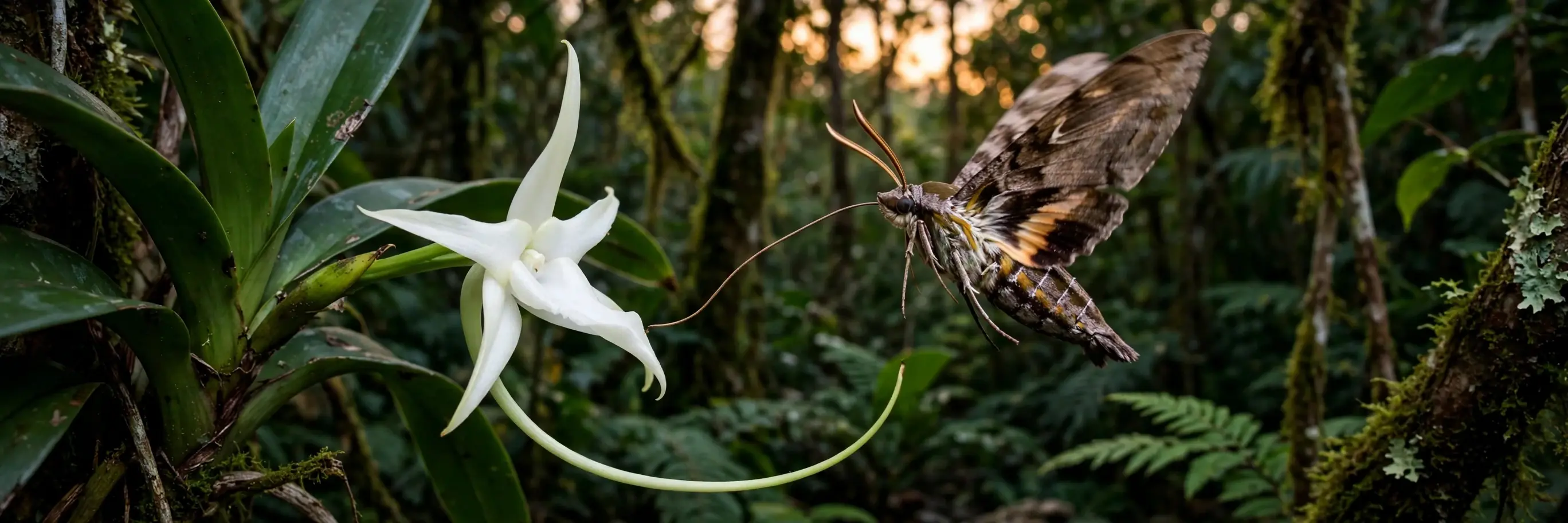
1. The Flower That Predicted a Moth
In England in 1862, Charles Darwin received a white star orchid sent from Madagascar, and he made a prediction that still illustrates coevolution today: one species changes, and its partner changes in reply. The prediction was about a moth no one had ever seen.
Darwin was not looking at a curiosity. He was looking at a question written in the shape of a flower. The Madagascan star orchid, Angraecum sesquipedale, keeps its nectar at the bottom of a spur about 30 centimetres long. No insect known in 1862 could reach that far down. A flower does not grow a tube of that length by accident. It grows it because, generation after generation, only the pollinators that could reach a little deeper left more descendants, and only the flowers that kept their nectar a little out of reach were reliably pollinated by them.
That logic led Darwin to a prediction that sounded almost reckless at the time. In On the Fertilisation of Orchids, published in 1862, he predicted that Madagascar must harbour a moth with a proboscis 10 to 11 inches long, about 25.4 to 27.9 centimetres, able to reach the orchid's nectar. He had never seen the moth. He had seen only the flower, and the flower was enough. The spur was a mould; the moth, if it existed, had to fit it. The prediction is recorded in the Carnegie Museum of Natural History account of the story and in the later study by Netz and Renner, which cites Darwin's 1862 pages 202 to 203. For the full account, see the Carnegie Museum of Natural History.
1.1 A spur no known insect could reach
A nectar spur is a narrow tube behind the flower, and its length sets a simple physical test. An insect with a short tongue drinks nothing. An insect with a tongue long enough drinks, picks up pollen, and carries it to the next flower. The star orchid's spur is not a fixed 30 centimetres in every plant. Measured spurs of A. sesquipedale range from roughly 27 to 43 centimetres (about 33 cm is typical); across the three longest-spurred species in the group the range is 20–43 cm. That variation is the raw material for selection: some flowers a little shorter, some a little longer, and pollinators sorting themselves by how far they could reach. A longer spur keeps nectar away from insects that take it without carrying pollen, and it forces the successful visitor to press its body against the flower's pollen-bearing parts. The plant gains reliable pollination. The moth gains a food source few rivals can reach. Each side gains, but neither side planned the bargain. The moth's side of the numbers belongs here too: its proboscis is about 20 centimetres long according to the Carnegie Museum account, and Wasserthal's measurements, reported by Netz and Renner, were 22.0 centimetres for males and 21.4 centimetres for females — noticeably shorter than the spur it must reach into (see §1.4).
1.2 Darwin's prediction — and Wallace's backing
Darwin's prediction rested on a plain argument: a structure as extreme as this spur must have a matching structure somewhere in nature, or it would be useless. Alfred Russel Wallace backed the prediction in 1867, pointing out that the African hawkmoth Xanthopan morganii already had a proboscis seven and a half inches long — only two or three inches short of what the orchid demanded. Readers who want the wider story can find it in Darwin's Theory of Evolution Explained, and the orchid's lineage in Plant Evolution Explained.
"in Madagascar there must be moths with probosces capable of extension to a length of between ten and eleven inches [25.4–27.9 cm]!" — Charles Darwin, On the Fertilisation of Orchids, 1862
1.3 1903: the moth arrives
The predicted moth was described from museum specimens in 1903 by Rothschild and Jordan as Xanthopan morganii praedicta, based on one male and one female collected on Madagascar by Jules Paul Mabille. The subspecies name praedicta means "predicted". Forty-one years after Darwin's book, the animal he had inferred from a flower had a scientific name that recorded the prediction itself — Rothschild and Jordan cited Wallace's 1891 restatement of Darwin's prediction when they coined it.
Yet a name is not proof of a visit. A moth in a museum drawer might never have fed from the flower at all. Direct proof came only in 1992. Between 9 and 31 August 1992, Wasserthal photographed and filmed X. morganii praedicta visiting A. sesquipedale flowers in a flight cage on the coast north of Fort Dauphin, today Tôlanaro, Madagascar, and a further film was made in 2004. One hundred and thirty years separated Darwin's prediction from the filmed proof that the moth really does drink from the flower it was predicted to serve.
1.4 Why this story is the whole article in miniature
Here the numbers refuse to line up neatly, and the mismatch is part of the story. The spur and proboscis figures are set out together in §1.1: the orchid's spur, at about 33 centimetres, is clearly longer than the moth's tongue. The two do not match like a key in a lock. They match like partners that push each other, imperfectly, over long stretches of time.
Molecular-clock models place the divergence of the Madagascan subspecies X. morganii praedicta from the African morganii at 7.4 plus or minus 2.8 million years ago, overlapping the divergence of A. sesquipedale from its sister Angraecum sororium, at 7.5 plus or minus 5.2 million years ago. The two lineages split at roughly the same time, which is consistent with a long shared history — though Netz and Renner stress the match is loose, the long spurs probably predate the splits, and the coevolution was most likely diffuse, involving a guild of long-tongued moths, not this pair alone. See Netz and Renner (2017).
That is the pattern this article follows. One species changes, the change alters the lives of the species it interacts with, and those species change in turn. A flower, a moth, a newt, a snake, a host, a parasite: different actors, same plot.
2. What Coevolution Actually Is
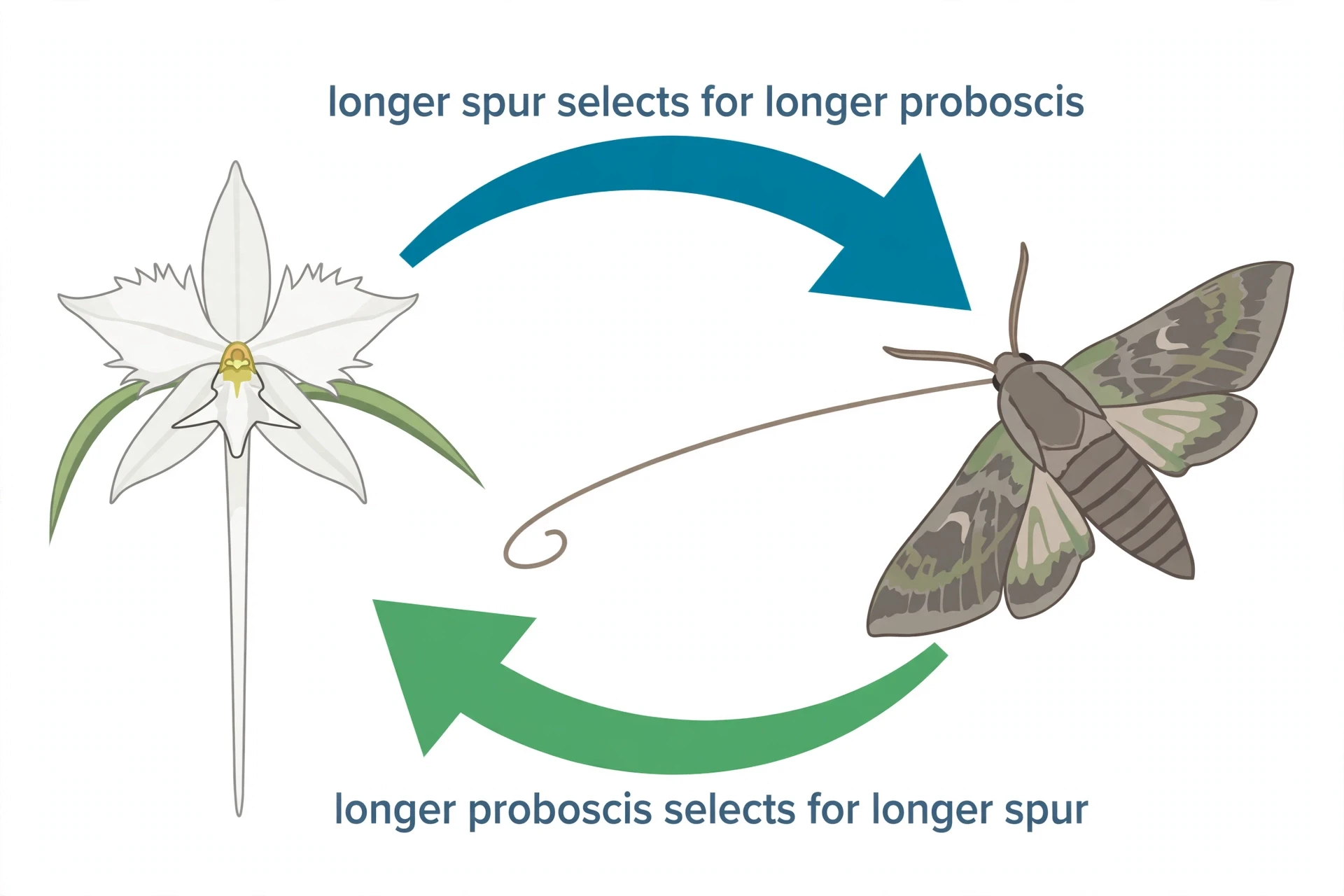
Coevolution is reciprocal evolutionary change between interacting species, driven by natural selection: when a trait in one species changes how a second species lives and reproduces, the second species evolves in response, and that response changes selection on the first.
That single sentence carries the whole subject, so it is worth unpacking slowly. The key word is reciprocal. Many species adapt to other species without any return. A plant may evolve a thicker bark because deer eat its seedlings, while the deer do not change at all. That is adaptation, not the process described here. The process described here needs a loop: change in A selects for change in B, and change in B selects back on A. Without the return journey, there is no loop, and without the loop, the word does not apply.
2.1 The definition, in plain language
Think of two species as neighbours who keep rebuilding their fences in response to each other. One builds higher, so the other buys a taller ladder. In biology, the fence is a trait — a spur, a toxin, a resistance gene, a behaviour — and the ladder is the counter-trait that answers it.
Three conditions have to hold for the label to fit. First, the two species must interact closely enough, over enough generations, for selection to act. Second, a trait in the first species must change the survival or reproduction of the second. Third, a trait in the second must change selection back on the first. A shared habitat is not enough. A one-way effect is not enough. Only the full loop counts.
That loop can run in either direction of feeling. It can be a partnership, as with orchid and moth, where both sides gain from the exchange. It can be a fight, as with a newt and the snake that eats it, where each gain comes at the other's expense. The mechanism is the same in both cases: reciprocal selection. The outcome — help or harm — depends on the ecology, not on the definition.
2.2 Ehrlich and Raven, 1964: butterflies and plants
The term came into wide use with a single paper. Ehrlich and Raven's 1964 paper, "Butterflies and Plants: A Study in Coevolution", published in Evolution, volume 18, pages 586 to 608, made coevolution a research programme. The paper is available via Ehrlich and Raven (1964).
Ehrlich and Raven argued that plant populations evolve novel chemical defences that let them escape herbivores and enter a new adaptive zone, and that herbivores then evolve counter-defences. The stepwise process was later called escape-and-radiate, a term coined by Thompson in 1989 according to the literature. Their core observation was a broad taxonomic correspondence between butterfly groups and their host plants, linked to plant secondary chemistry that sometimes cut across plant taxonomic relationships. A plant lineage would invent a new chemical defence, diversify into the space it opened, and then a butterfly lineage would crack the defence and diversify in turn.
Darwin had discussed reciprocal plant-insect evolution in On the Origin of Species in 1859, using the word coadaptation, but he did not use the word coevolution. Ehrlich and Raven gave the idea its research programme, and a testable shape. A good place to see the engine behind that programme is Natural Selection Explained, which sets out how selection builds traits step by step.
I first felt the force of this idea not in a textbook but in a garden — a personal illustration, not evidence — watching cabbage white butterflies lay eggs on the same few plants summer after summer while most other insects left those bitter leaves alone. Their chemistry was deciding which insects could eat them, and the butterflies that could handle it were inheriting a private food supply. It was a small, ordinary scene, and it made the 1964 paper feel less like history and more like a description of the world outside the back door.
2.3 The reciprocity test — one-sided change is not coevolution
Janzen gave the strictest version of the test in 1980. He defined the process as an evolutionary change in a trait of the individuals in one population in response to a trait of the individuals of a second population. The second population then responds in turn to the change in the first — in short, reciprocal genetic change. One widely used working definition, in Thompson's 2005 framing, is reciprocal evolutionary change between interacting species driven by natural selection — though biologists still debate how strictly to apply it.
Janzen also argued for restricting the term to cases where a close sequence of reciprocal counter-adaptation between one specific plant population and one specific herbivore population can be demonstrated. That is a demanding standard, and biologists still argue about how strictly to apply it. The strict version protects the word from becoming a vague synonym for "species interact". The looser version, which most working biologists use, accepts that the loop may involve groups of species and may run at different speeds on the two sides. Either way, the test is the same: show the return journey, or do not claim the loop.
This is where a common misconception needs correcting, and I will say it plainly because textbooks still get it wrong: coevolution does not mean both species benefit. An arms race between a poisonous newt and the snake that eats it is coevolution, and one side's gain is the other's loss. A parasite that drives its host to evolve stronger immunity, and then evolves past that immunity, is coevolution, and the host would be better off without the parasite entirely. Benefit is one possible outcome. Reciprocity is the requirement.
2.4 Coevolution vs convergent evolution (same result, different cause)
Two species can end up looking alike for two very different reasons, and confusing them is one of the easiest mistakes in this subject. In convergent evolution, unrelated species independently evolve similar traits because they face similar environments — wings in bats and birds, streamlined bodies in dolphins and sharks. No interaction is needed. Each lineage solves the same problem on its own. In the process described here, the similarity or the matching is caused by the interaction itself. The orchid's spur and the moth's proboscis match because each selected for the other, not because both faced the same weather.
The distinction matters because it changes what counts as evidence. Similar traits in similar habitats suggest convergence. Matching traits in interacting species, with a history of reciprocal change, suggest the loop described in this article, told in full in Convergent Evolution Explained. Matching traits prove nothing on their own. The history of interaction is what decides the label.
3. Pairwise Coevolution, Diffuse Coevolution — and Gene-for-Gene
Not every reciprocal relationship has the same shape. Some involve exactly two species locked together. Some involve whole guilds of species pulling on each other at once. Some are decided gene by gene, in a matching game played inside cells. Sorting these shapes out early makes every example that follows easier to place.
The distinction is not a filing exercise. It changes what a biologist should measure, what counts as proof, and what a conservationist should protect. A tight pair can be lost if either partner disappears. A guild can absorb the loss of one member and keep going, until the losses pile up. A gene-for-gene match can collapse with a single mutation. Same word, different risks.
3.1 Pairwise (specific) coevolution
Pairwise coevolution, also called specific coevolution, is reciprocal evolution between exactly two species, each evolving in direct response to the other's traits. The orchid and its moth come close to this shape. So do the fig and its wasp, and the yucca and its moth, which later sections of this article examine in detail. In a true pair, the trait in species A is a response to species B specifically, and the counter-trait in B is a response to A specifically. Remove B, and the selection pressure on A changes or vanishes.
That tightness is what makes pairs so compelling to study and so fragile in nature. When the orchid's spur lengthens, the moth that pollinates it must lengthen its proboscis or lose the nectar. When the moth's proboscis lengthens, flowers with slightly longer spurs gain an edge. The loop is clean and measurable. It is also rare in its pure form, because few species live in a world containing only one partner.
3.2 Diffuse (guild) coevolution
Diffuse coevolution, also called guild coevolution, is reciprocal evolution between groups of species. For example, a trait in several flowering-plant species evolves with a trait in one or several pollinator species, so the response cannot be attributed to a single partner species. The classic diffuse example is flowering plants and their pollinator guilds of bees, flies and beetles: long-tubed flowers and long-tongued insects evolved as groups, not as exclusive pairs.
The orchid and the moth illustrate the point, even though they look like a pair. The moth's proboscis is shorter than the orchid's spur, and the spur may have been shaped by a guild of long-tongued visitors over millions of years, not by one moth alone. That is why the numbers in section 1 do not match neatly. A guild spreads selection across many partners, so no single pair lines up perfectly. A plant is eaten by many herbivores and visited by many pollinators, and its evolution is the sum of those pulls. To understand a diffuse system, a biologist has to study the network, not just the pair, as explained in Ecosystems Explained.
3.3 Gene-for-gene coevolution (a mechanism at the gene level)
Gene-for-gene coevolution works at a smaller scale, inside the molecular machinery of attack and defence. In its classic form, a host carries a resistance gene that recognises a specific gene product from a parasite or pathogen, and the parasite carries a gene that can evade that recognition. A change in one gene selects for a change in the matching gene on the other side, and the contest proceeds mutation by mutation.
This is the most precise version of the loop, and it is also the fastest. A single mutation in a pathogen can defeat a resistance gene that took a plant breeder years to introduce, and a single new resistance gene can shut that pathogen out again. This gene-for-gene logic goes back to H. H. Flor's work on flax and its rust fungus, and the same logic runs in animal immune systems, where host genes that recognise parasites face parasite genes that hide from recognition. The genetic side of the story is set out in Genetics, Inheritance, Mutations and Gene Expression.
3.4 Why most real cases sit between the extremes
Most real interactions sit between the extremes: even the famous fig-wasp and yucca-moth pairs exist inside wider communities of co-pollinators, cheaters and parasites. A fig wasp is not the only insect inside a fig. A yucca moth is not the only insect on a yucca. Cheaters take the reward without paying for it, parasites exploit the partnership, and other pollinators visit the same flowers. The pair is real, but it lives inside a crowd.
Pairwise and diffuse are ends of a spectrum, and gene-for-gene is a mechanism that can operate inside either end. A biologist who knows where a case sits on that spectrum knows what to test. A pair calls for a test of reciprocal change between two named species. A guild calls for a test across many partners. A gene-for-gene system calls for a test at the level of matching genes. The table below summarises those tests.
Type | Definition | Example | How to test it | Where it appears in this article |
|---|---|---|---|---|
Pairwise coevolution | Reciprocal evolution between exactly two species, each responding directly to the other | Star orchid and hawk moth; fig and fig wasp | Show that a trait change in one species changes selection on the named partner, and that the partner's response changes selection back | Sections 1, 6 and 7 |
Diffuse coevolution | Reciprocal evolution between groups of species, so no single partner explains the response | Long-tubed flowers and long-tongued pollinator guilds of bees, flies and beetles | Show that traits respond to the guild as a whole, and that removing one partner does not end the selection | Sections 3, 6 and 16 |
Gene-for-gene (a mechanism at the gene level) | Matching genes in host and parasite: recognition on one side, evasion on the other | Plant resistance genes and pathogen virulence genes; host immunity and parasite evasion | Identify the matching genes and show that a change in one selects for a change in the other | Sections 5 and 17 |
The partnership between species that live closely together is also the subject of Symbiosis Explained. The difference is worth holding in mind: symbiosis describes living together, while the process in this article describes evolving together, in response to each other.
4. The Arms Race: Predators and Prey
When a predator gets better at catching prey, the prey that survive are the ones that got better at escaping, hiding, or fighting back. Their descendants are harder to catch, so the predators that survive are the ones that got better still. Step by step, both sides climb, and neither side gains a lasting lead.
That climbing contest is the evolutionary arms race, and it is the most dramatic form of antagonistic coevolution. It needs no cooperation, no shared goal, and no awareness. It needs only heritable variation, a predator that eats prey, and prey that survive by avoiding being eaten. Given those three ingredients, the race runs itself.
4.1 Rough-skinned newts and garter snakes: poison vs resistance
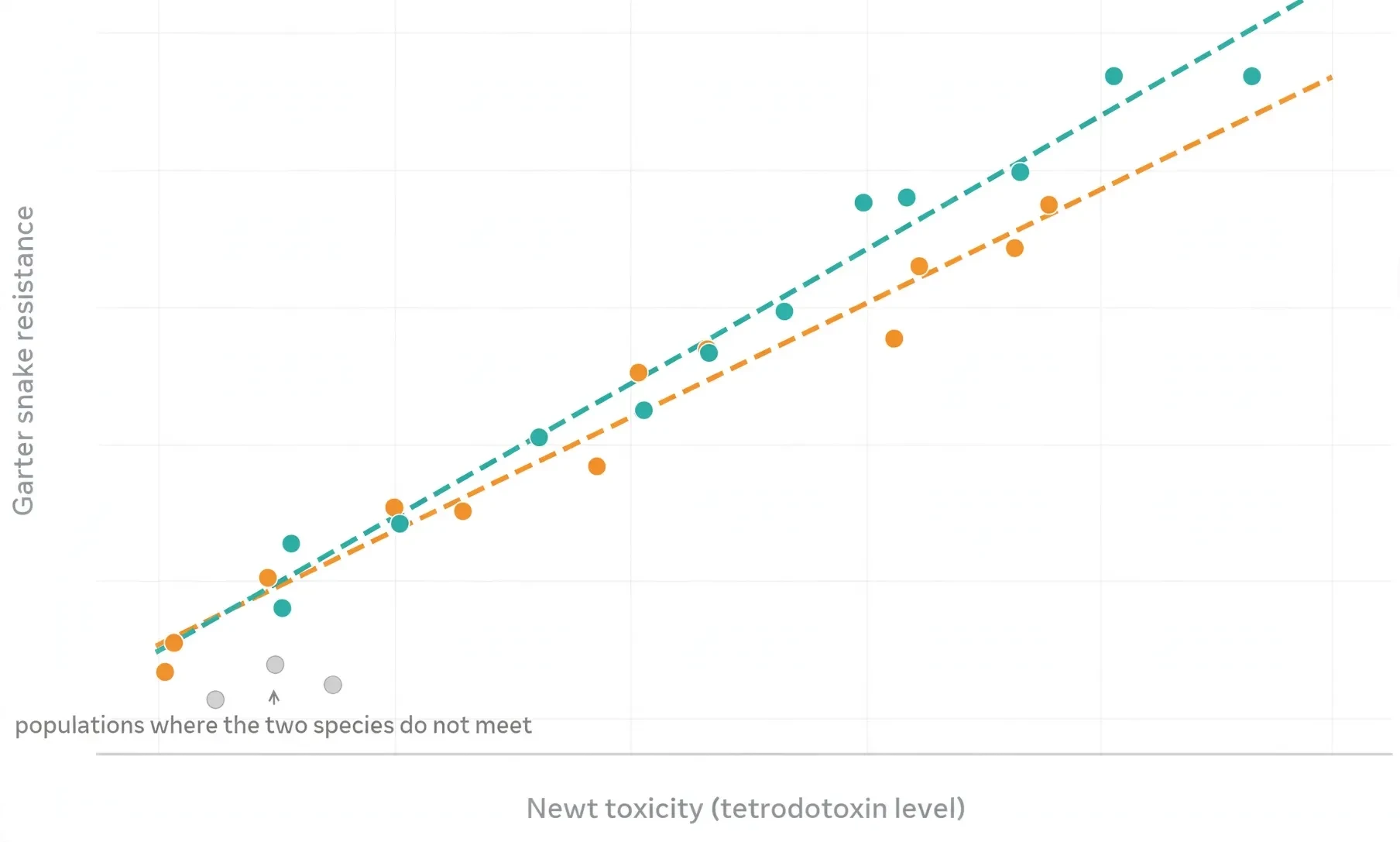
The clearest measured arms race in nature runs between the rough-skinned newt, Taricha granulosa, and the garter snakes that eat it along the west coast of North America. The newt carries tetrodotoxin, known as TTX, a neurotoxin that binds the outer pore of voltage-gated sodium channels, blocking sodium movement and halting action potentials, which causes paralysis. The snake, in turn, has evolved resistance to that same toxin, in the very channels the toxin attacks.
TTX is extraordinarily potent. Its oral LD50 in mice is 334 micrograms per kilogram (about 25 milligrams on a straight weight scaling to a 75-kilogram person — a scaling that does not equal the human lethal dose, which is estimated at roughly 1–2 mg by other routes/evidence, because humans are far more sensitive than the mouse oral figure implies). Individual rough-skinned newts in a single population ranged from zero to 28 milligrams of TTX in the skin, about 1,899 micrograms per gram estimated whole-body TTX, yet garter snakes in the same area eat these newts and survive. The figures come from the Current Biology primer on tetrodotoxin, available at Current Biology: tetrodotoxin primer.
The geography tells the story. Newts that live alongside garter snakes generally have higher TTX levels than newts where the snake is absent, and snakes are TTX-resistant where they live alongside newts but tolerate only very low TTX where newts are absent. Where the two meet, both sides are extreme. That pattern is exactly what a reciprocal arms race predicts, and it is the evidence that separates this case from a one-sided adaptation.
The mechanism is known down to the gene. Three garter snake species in the genus Thamnophis prey on newts in the same areas and have independently evolved high TTX tolerance. Resistance is conferred by derived mutations in the skeletal-muscle voltage-gated sodium-channel gene Nav1.4, known as SCN4A. In Thamnophis sirtalis, allelic variation in Nav1.4 correlates almost perfectly with TTX resistance, while neutral genetic variation measured by microsatellites shows no association, identifying Nav1.4 as a major-effect locus. In Thamnophis atratus, Nav1.4 variation explains 23 percent of the variation in TTX resistance. Resistance evolved repeatedly — at least twice in the populations Geffeney and colleagues studied, and at least five times for extreme Nav1.4 resistance in later estimates — via different amino-acid substitutions in the channel pore, including positions 1561, 1566 and 1568 to 1569 in different populations. See Geffeney and colleagues (2005) and Feldman and colleagues (2010).
Brodie and colleagues (2005) showed matched escalation of newt toxicity and snake resistance across populations. They described the interaction as a parallel arms race: the same race has run more than once, in more than one snake lineage, against the same poisonous prey. See Brodie and colleagues (2005).
4.2 Cheetahs and gazelles: the speed race
Speed is the most visible arms race of all, and the cheetah and the gazelle are its textbook example. A faster cheetah catches more gazelles. The gazelles that survive are the faster ones, or the ones that turn more sharply, or the ones that spot the predator a second earlier. Their offspring inherit those edges, and the next generation of cheetahs faces harder prey. No single study in the facts file measures this pair generation by generation, and this article does not claim a measured number for it. The logic is the same as the newt and the snake, played out in muscle and bone instead of poison and channels.
4.3 Bats and moths: sonar vs ears and jamming
A second arms race runs in the dark, between bats that hunt by echolocation and moths that listen for it. Bats that call more quietly are thought to catch more moths before they are heard. Moths that hear the calls earlier, or drop from the air when they hear them, survive more often. Some tiger moths produce ultrasonic clicks that jam a bat's sonar (a documented defence, though no quantitative study of this system is cited here). No verified quantitative study of this system is in the facts file for this article, so no numbers are claimed for it here. The loop is the same as the newt and the snake, fought on a sensory axis humans cannot even perceive.
4.4 When arms races stop — costs, trade-offs and stalemates
Arms races do not escalate forever. Every trait has a cost. Making TTX is thought to cost a newt energy and resources that could have gone to growth or eggs, though the cost of TTX production has so far only been hypothesised, not measured. Carrying a resistant sodium channel can impair muscle performance — but the measured trade-off appears only in the most extremely resistant snakes, those carrying four cumulative mutations; less resistant snakes show no detectable cost. At some point the next step up the ladder costs more than it returns, and selection stops pushing.
The race can also end in a stalemate. In some places, snakes are so resistant that newt toxicity is no defence at all — in every mismatch Hanifin and colleagues found, the snake was ahead, and no population had newts too toxic for its snakes. In other places the match is closer, and the race still runs. Those mismatches show that the race is local: it runs hot in some places and cold in others, and a population can escape it entirely for a time.
A predator evolves a better weapon, and prey that lack a defence are eaten.
Prey evolve a defence, and predators that lack a counter are hungry.
Predators evolve a counter-defence, and the prey's defence loses value.
Prey evolve a stronger defence or a new one, and the cycle turns again.
Costs, trade-offs, or a geographic escape can slow the cycle or stop it.
5. Hosts and Parasites: Running to Stay Still
A host that evolves a new defence against a parasite has not won. It has changed the rules, and the parasite will now evolve against the new rules. A parasite that defeats a defence has not won either. Both sides must keep changing simply to hold their ground, and that treadmill has a name: the Red Queen.
The name comes from Lewis Carroll's Through the Looking-Glass, where the Red Queen tells Alice that in her country you must run as fast as you can simply to stay in the same place. Leigh Van Valen borrowed the image in 1973 for a new evolutionary law. The image has stuck because it captures the experience of host and parasite exactly: constant effort, no lasting progress — and, in Van Valen's picture, a lineage that cannot keep changing is the one most likely to disappear.
5.1 The Red Queen: "running to stay in the same place"
Van Valen proposed the Red Queen hypothesis in 1973 in "A New Evolutionary Law", published in Evolutionary Theory, volume 1, pages 1 to 30. His claim was that a species' probability of extinction stays roughly constant over time because every evolutionary gain is cancelled by counter-evolution in the species it interacts with. A species improves, its enemies improve in response, and the net advantage fades. The 1973 paper has no DOI (its journal, Evolutionary Theory, never assigned one), and the 2022 revisiting paper is available at Biological Theory (2022).
That original claim was about extinction over geological time, not about sex or immunity. The microevolutionary, host-parasite version — that sex and recombination are favoured because parasites adapt to common host genotypes — was developed later, by Bell in 1982 and by Hamilton, not by Van Valen, whose 1973 paper addressed macroevolutionary extinction. The two versions are often blended in textbooks. Van Valen gave the name and the extinction argument. Later biologists gave the idea its host-parasite form, and that form is what the rest of this section tests.
"Now, here, you see, it takes all the running you can do, to keep in the same place." — The Red Queen, in Lewis Carroll's Through the Looking-Glass (1871)
5.2 Why parasites evolve faster (short generations, big populations)
Parasites usually win the speed contest, and the reasons are arithmetic. A parasite often has a shorter generation time than its host, so it can go through many more rounds of selection in the same calendar time. It often has a larger population, so it carries more genetic variation for selection to act on. And it often reproduces in huge numbers inside a single host, so a rare resistant mutant has many chances to appear.
Direct evidence for that rapid tracking comes from a pond. In the water flea Daphnia magna and its bacterial parasite Pasteuria ramosa, dormant eggs of both species preserved in pond sediment let researchers resurrect past, present and future combinations. Parasites were most infective against contemporary hosts, with average infectivity 0.65, than against past hosts, at 0.55 — direct evidence of rapid Red Queen tracking over a few years. Pasteuria ramosa adapts to its Daphnia host within about two to four years (Decaestecker and colleagues (2007)). Host resistance can also rise sharply during epidemics via selection on a two-locus system with strong epistasis (Ameline and colleagues (2021)).
The sediment holds eggs from years gone by, so researchers could pit today's parasite against yesterday's host and yesterday's parasite against today's host. The parasite was best against the host of its own time. That is the Red Queen in a single number: the parasite tracks the host, the host moves on, and the chase never ends.
5.3 Immune systems as a coevolutionary battlefield
An immune system is a host's standing army against parasites, and parasites evolve specifically to defeat it. A host that recognises a parasite's surface molecule selects for parasites whose surface molecule has changed. A parasite that hides inside host cells selects for hosts that can detect infected cells. Each defence creates the selection pressure that produces the next evasion, and each evasion creates the pressure that produces the next defence.
This is gene-for-gene coevolution at the scale of a body. The host's recognition genes and the parasite's evasion genes are the matching pair from section 3, played out inside tissues, not across a landscape. The contest never settles: a host that stops evolving immunity is eaten from within, and a parasite that stops evolving evasion is recognised and destroyed.
5.4 Did parasites help maintain sex?
Sex is expensive. An asexual female passes all her genes to every daughter, while a sexual female passes only half her genes to each child and must find a mate. For sex to survive despite that cost, it must buy something valuable. The Red Queen offers an answer: sex buys genetic variety, and variety buys resistance to parasites that have learned to attack the commonest host genotype.
The New Zealand mud snail, Potamopyrgus antipodarum, provides the cleanest field test. It has both diploid sexual and triploid asexual, parthenogenetic, females in the same lakes, and it is castrated, sterilised, by trematode parasites, chiefly Microphallus species. Sexual snails are significantly more common where parasite infection risk is higher — in the shallows where ducks, the trematode's final host, feed — and rarer in deep water where parasites are scarce, matching the Red Queen prediction. See King and colleagues (2009).
An experiment makes the case sharper still. In a controlled experiment, Caenorhabditis elegans worms that reproduced by outcrossing survived coevolution with the bacterium Serratia marcescens, while obligately self-fertilising populations went extinct within twenty generations — but only when the parasite was allowed to coevolve. That is experimental support for the Red Queen advantage of sex, under conditions where, within the coevolution treatment, the only difference was the mode of reproduction. The study is Morran and colleagues (2011).
None of this proves that parasites alone invented sex. Sex is old, and it has many possible benefits, including the shuffling of genes that lets populations adapt faster to any changing environment. The drift of genes through small populations, explained in Genetic Drift Explained, and the structure of DNA itself, explained in DNA Structure, Replication and Heredity, both shape how that shuffling works. What the snail and the worm show is narrower and stronger: where parasites are common and fast-evolving, sex pays, and where parasites are rare, asexual reproduction can win.
6. Flowers and Pollinators: A Match Made by Coevolution
A flower and its pollinator can fit each other like a key fits a lock, and that fit is no accident. In the orchid and the yucca, the shapes of flower and insect have been sculpted by each other's needs over millions of years. This section looks at two famous partnerships — and at what happens when one side cheats.
6.1 The star orchid, revisited — trait-matching in action
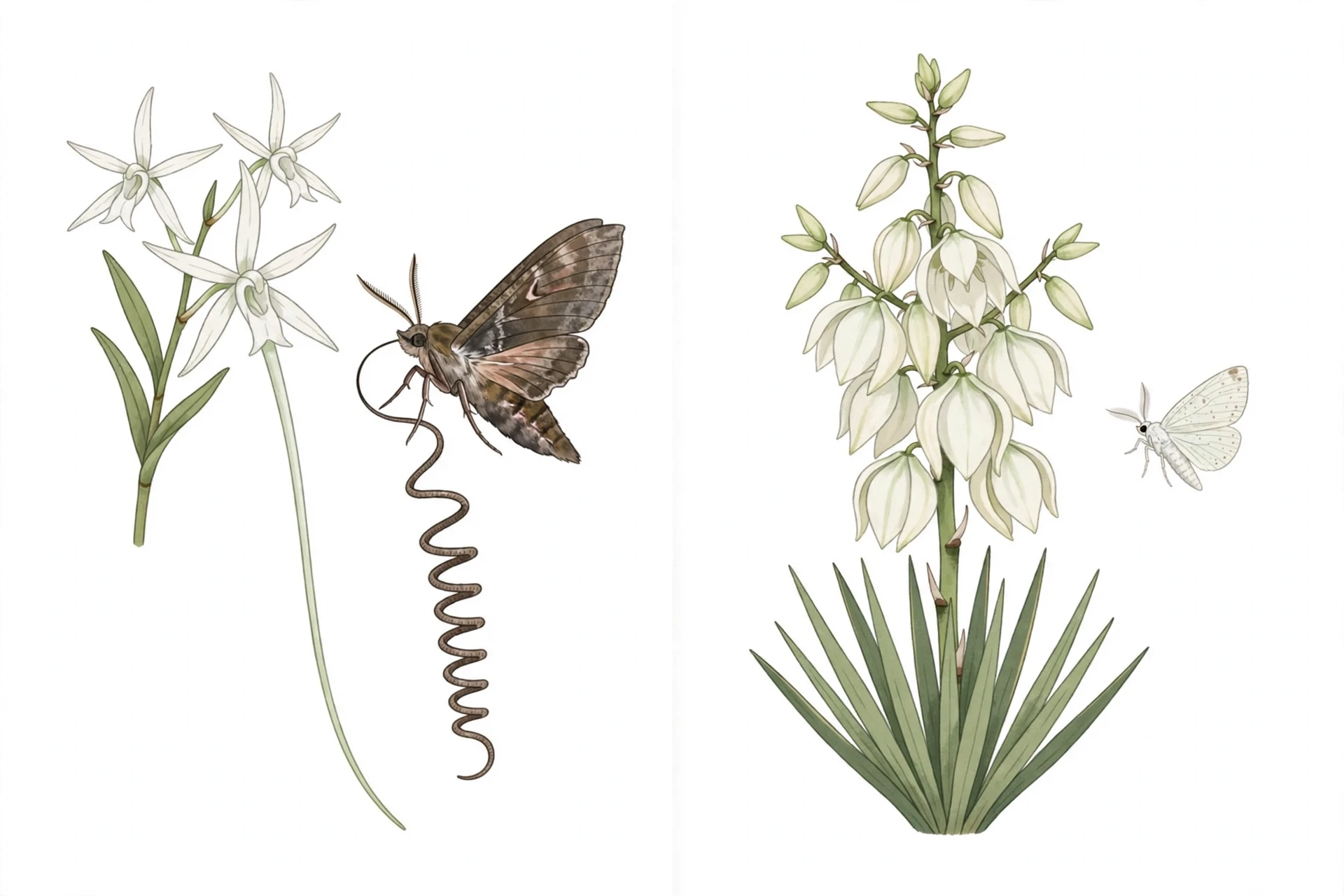
The star orchid of Madagascar, Angraecum sesquipedale, is the classic case of coevolution by trait-matching. It keeps its nectar at the bottom of a spur about 30 centimetres long, with spurs of around 33 centimetres reported for the species, and measured spurs in this orchid group ranging from roughly 27 to 43 centimetres. When Charles Darwin examined the flower in 1862, he saw the problem at once: no insect known at the time could reach that deep. He predicted that Madagascar must harbour a moth with a proboscis 10 to 11 inches long, able to drink from the bottom of the spur. That was a bold claim, since it said a flower's shape alone could prove the existence of an animal nobody had ever seen.
The moth was described from museum specimens in 1903 by Rothschild and Jordan as Xanthopan morganii praedicta, based on one male and one female collected on Madagascar. Its name gives the story away: praedicta means "predicted". Direct proof came much later, in 1992, when Wasserthal photographed and filmed the moth visiting A. sesquipedale flowers in a flight cage on the coast north of Fort Dauphin, Madagascar. The moth's proboscis is about 20 centimetres long according to the Carnegie Museum account; Wasserthal's measurements, reported by Netz and Renner (2017), were 22.0 centimetres for males and 21.4 centimetres for females. Notice the numbers do not line up neatly: the spur is longer than the tongue that drinks from it. That mismatch is part of the story, not a flaw in it — a flower served by several long-tongued visitors need not match any one of them perfectly. Molecular-clock models place the divergence of the Madagascan moth subspecies from its African relative at 7.4 million years ago, plus or minus 2.8 million, overlapping the orchid's split from its sister species at 7.5 million years ago, plus or minus 5.2 million: the two lineages split at roughly the same time, on the same island — a timing consistent with a long shared history, not proof of pairwise shaping (see §1.4). For how flowering plants came to depend on animal partners at all, see Plant Evolution Explained.
I once stood in a garden at dusk and watched a hawkmoth work a row of tubular flowers, hovering while its tongue unrolled to a length that seemed absurd for its body. It visited each flower for a second or two, never landing, and the flowers had clearly been built for exactly that visitor: deep tubes, pale petals glowing in the fading light, scent strengthening as the sun went down. Nothing in that scene looked designed in advance. It looked like coevolution in miniature: two lineages answering each other's small changes, one millimetre at a time.
Many people picture coevolution as a tidy partnership in which each side evolves for the other's benefit, like two dance partners who agreed on the steps. That gets it backwards. The orchid did not lengthen its spur to help the moth, and the moth did not lengthen its tongue to help the orchid. Each side evolved for its own fitness: the flower that hid its nectar deepest got the most faithful pollinators, and the moth that could reach deepest got the most food. The partnership is a side effect of two selfish interests that happen to line up, and when they stop lining up, the partnership frays — that fraying is just as much coevolution as the fit itself.
6.2 Yucca and yucca moth: an obligate bargain
If the orchid and its moth are a loose partnership, the yucca and the yucca moth are a marriage with no divorce clause. Yuccas and yucca moths, in the genera Tegeticula and Parategeticula, form an obligate pollination mutualism, one of the tightest cases of coevolution known. The plant relies on the moth for pollination, and the moth's larvae require developing yucca seeds to complete development. Neither partner can reproduce without the other. The moth does not pollinate by accident. The female deliberately collects pollen with specialised mouthparts, forms it into a ball, and presses it into the cup-shaped stigma of another flower — active pollination — then lays her eggs in the flower's ovary.
The bargain is generous on the plant's side: a yucca seed pod typically contains a hundred or more seeds, and although the larvae bore into many of them, enough seed survives — across the plant, not every pod is heavily attacked — for the plant to reproduce while the moth gets food and shelter. But the plant is not defenceless. Yuccas police the mutualism: they can detect flowers carrying too many moth eggs and abort those flowers, limiting seed loss, and female moths also avoid flowers where another moth has already laid eggs. The association arose at least 40 million years ago, according to molecular-clock estimates, and the obligate mutualism evolved very quickly after that, as Pellmyr (2003) documented. It has also been tested from within: at least two separate reversals to "cheater" moths that lay eggs in fruit pollinated by others have occurred — moths that take the nursery without doing the pollination work. The yucca–moth story shows what tight coevolution really costs to maintain: not goodwill, but policing. For the deeper history of how plants and their pollinators came to be bound together, see Plant Evolution Explained.
6.3 Long bills, long spurs: the Disa test — and hummingbirds
The orchid's story has a southern African echo. In South Africa's Disa draconis orchid complex, spur length varies enormously between populations (Johnson & Steiner 1997). Spurs measure 32 to 38 millimetres in the southern mountains, around 48 millimetres on the lowland sandplain, and 57 to 72 millimetres in the northern mountains. Each length matches the proboscis of the local pollinating fly. The sandplain Disa is pollinated by the tanglewing fly Moegistorhynchus longirostris, whose proboscis averages 57 millimetres on the sandplain — a fly that holds the record for the longest proboscis in the Diptera, and the longest relative to body size of any known insect (Barraclough & Slotow 2010) — while short-spurred plants are pollinated by the horsefly Philoliche rostrata, whose proboscis measures 22 to 35 millimetres. Same orchid, different mountains, different spur lengths, different flies: trait-matching with the variables isolated. And the match is maintained by selection, not coincidence: when researchers artificially shortened Disa spurs, pollen receipt and fruit set fell significantly. The long flower wins only where the long tongue exists to service it, and vice versa.
Hummingbirds show the same pattern of trait-matching on the other side of the world, bill length playing the part of proboscis length: in the purple-throated carib Eulampis jugularis, females have longer, more curved bills (~29 mm) than males (~24.8 mm), and each sex feeds most efficiently on the Heliconia flowers that match its bill (Temeles & Kress 2003). What the Disa system proves, with measurements rather than impressions, is that these matches are maintained by selection acting right now.
6.4 Cheating: when pollinators take without giving
Every mutualism invites cheating, and pollination is no exception. The yucca's cheater moths, which lay their eggs in fruit pollinated by others, are the clearest case in this section: they keep the nursery and skip the work. The orchid's world is messier, because its pollination is shared among a guild of long-tongued visitors, not a single partner. That looseness is a defence in itself: a plant served by several long-tongued insects can lose one and still set seed. The diffuse side of coevolution — whole groups of flowers and whole guilds of pollinators shaping each other, not one species shaping one other — is what keeps the orchid's partnership flexible. The cost of that flexibility is the mismatch in the numbers: a spur longer than any single visitor's tongue, because the spur answers to the whole guild at once. Cheating does not destroy mutualism. It sets the terms on which mutualism survives: policing, redundancy, and a fit that is good enough rather than perfect.
7. Figs and Fig Wasps: The Tightest Partnership on Earth
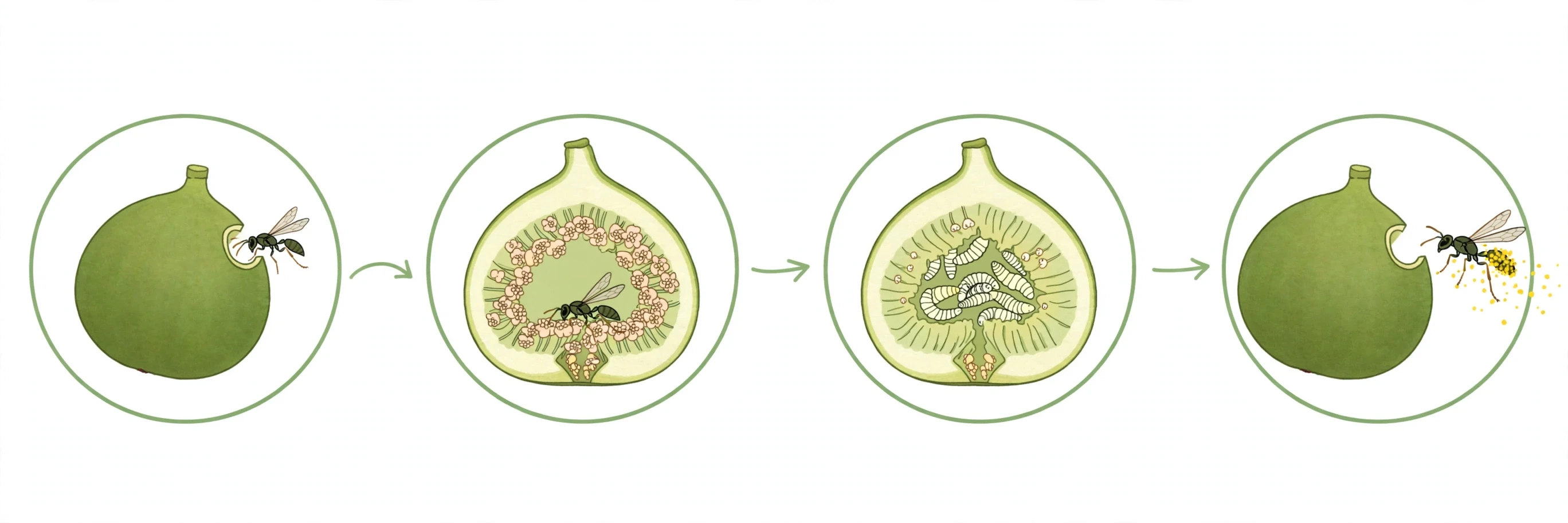
Figs and fig wasps have been locked together for roughly 60–90 million years, each unable to reproduce without the other. A fig is not a fruit at all, but a hidden garden of flowers — and a wasp's whole life plays out inside it. Few partnerships on Earth run this deep, or this strange.
7.1 Inside a fig: a flower turned inside out
A fig is not a fruit but a syconium — a closed inflorescence containing hundreds of tiny flowers inside, entered only through a narrow opening, the ostiole. There are about 750 Ficus species worldwide according to Cook and West (2005), mostly tropical, though more recent counts put the total nearer 850–900, so the honest figure is a range of roughly 750 to 900, not a single settled count. Each is typically pollinated by its own species-specific fig wasp, in the family Agaonidae — an obligate mutualism in which neither partner can reproduce without the other. The fig cannot set seed without a wasp carrying pollen in, and the wasp cannot raise young without a fig to lay in. Few pollination partnerships run this tight: a bee can visit many flowers, but a fig and its wasp are, in the usual case, each other's only option. That exclusivity makes the system both a marvel of coevolution and a hostage to fortune: if one partner vanishes, the other follows.
7.2 The wasp's one-way journey
A female fig wasp enters a receptive syconium, pollinates the female flowers with pollen carried from her birth fig, and lays eggs in some flowers. Her larvae induce galls and feed inside. She typically dies inside the fig. Her journey is one way, with no return, and it is coevolution that built it that way: she squeezes through the ostiole, often losing her wings and antennae in the passage, pollinates as she moves among the flowers, lays her eggs, and never leaves. Inside, the next generation grows up in the dark. Male wasps emerge first, mate with females still inside their galls, then chew exit holes through the fig wall. The wingless males die inside the fig, having never seen daylight, while the females leave carrying pollen to another fig, where the cycle begins again. The fig gets its flowers pollinated by an agent that cannot visit any other species, so every grain of pollen the wasp carries is exactly the right kind. The wasp's sacrifice is not generosity. It is the only way her genes reach the next generation, and the fig's enclosure is what guarantees her loyalty.
7.3 One fig, one wasp — and what happens when the match breaks
The one-to-one rule of fig–wasp coevolution is famous, and it is not absolute. Up to half of fig species have two or more pollinator species, so the total number of pollinating fig wasps is estimated at around 1,200, not 750. The partnership is looser than the textbook version, and that looseness matters: it means a fig species can survive the loss of one wasp partner if another can do the job, and it means wasps can sometimes switch hosts. The mutualism is also exploited from the outside: many non-pollinating fig-parasitic wasps lay eggs in figs without pollinating them, taking the nursery without paying for it. Including them, total fig-wasp diversity is roughly 8,700 species — about as many as there are bird species. A single fig, then, is not a private apartment for one wasp. It is a small ecosystem: pollinators, parasites of pollinators, and parasites of parasites, all living off the same enclosed garden. The fig system persists with this crowd because the pollinators still arrive, the seeds still get made, and the cheaters cost less than a fortress no wasp could enter. When the match does break — a wasp lineage goes extinct, or a fig population is cut off from its pollinators — the result is simple and brutal. Figs without wasps set no seed. Wasps without figs raise no young. The tightness that makes the partnership so efficient is the same tightness that makes it fragile, and that fragility is why fig conservation is wasp conservation too.
7.4 Speciating in sync
Figs and fig wasps have been coevolving for roughly 60–90 million years (see the section lead), according to Cook and West (2005), with broadly congruent phylogenies — parallel diversification of the two lineages. When a fig lineage split into two species, its wasp lineage tended to split alongside it, so the two family trees broadly mirror each other, branch for branch in many lineages though not all. That mirroring is strong evidence that the two lineages diversified together: as figs diverged into new species, their wasps diverged with them, each new fig carrying its own wasp into the new lineage. It is one of the clearest cases of cospeciation known, and it shows how a mutualism can become an engine of diversity. The mirroring is not perfect, and the imperfections are informative. Yucca–moth lineages, by contrast, show repeated host shifts, not strict co-speciation, which tells us that coevolution can drive diversification without one-to-one splitting. The fig system leans toward lockstep, the yucca system toward switching, and both are coevolution. The mechanism is the same one described in Speciation Explained — and the fig–wasp partnership is one of the clearest examples of it in nature. For the broader family of partnerships in which two species live and evolve together, see Symbiosis Explained.
8. Plants vs Herbivores: Chemical Warfare
Plants cannot run from the animals that eat them, so they fight back with chemistry — poisons, bitter compounds and traps that turn leaves into hostile meals. Herbivores answer with detoxification, and some even steal the poison for themselves. This is coevolution as chemical warfare, and it has built much of life's diversity.
8.1 Mustard oils, nicotine and cardenolides: the plant arsenal
Plants defend themselves with secondary metabolites in three broad classes: nitrogen compounds, including alkaloids, cyanogenic glycosides, glucosinolates and benzoxazinoids; terpenoids; and phenolics, including tannins. Many are toxic, repellent or antinutritive, and they are called "secondary" only because they are not part of the plant's basic growth machinery — in the war with herbivores, they are the primary weapons, as Mithöfer and Boland (2012) review. Nicotine in tobacco and caffeine in coffee and tea are alkaloids that interfere with herbivores' nervous systems, and more than 12,000 alkaloids are known. Glucosinolates, the mustard oils in cabbage and mustard, are stored harmlessly until tissue damage lets the enzyme myrosinase convert them into toxic isothiocyanates — a two-component "mustard-oil bomb" that detonates only when the leaf is bitten. Tannins are phenolic compounds that bind dietary proteins and make them hard to digest, reducing the nutritional value of the plant for the herbivore. The same defence can attract specialists and deter generalists: glucosinolates deter generalist insects but stimulate feeding and egg-laying in specialists such as the diamondback moth and the small white butterfly. A plant therefore faces an optimum defence level, not a simple rule that more is always better.
Nitrogen compounds: herbivores answer with detoxification enzymes.
Terpenoids: herbivores answer with tolerance, or by feeding on young tissue before defences build up.
Phenolics and tannins: herbivores answer with gut chemistry that neutralises them.
Sequestration (the herbivore's boldest reply): instead of detoxifying the poison, some specialists store it in their own bodies and use it as a weapon — the monarch's answer to milkweed, described next.
Each of these is a move in a reciprocal exchange of coevolution. A plant that invents a new toxin opens a new space, free of most herbivores, and the first herbivore that cracks that toxin inherits the whole space for itself. That is the engine Ehrlich and Raven described in 1964: a new defence opens a new adaptive zone, and the first herbivore to crack it inherits the space — the stepwise process later called escape-and-radiate coevolution. What they documented was a broad correspondence between butterfly groups and host plants that followed plant chemistry, not plant family trees: the chemistry decided who could eat whom.
8.2 Monarchs and milkweed: eating poison and wearing it
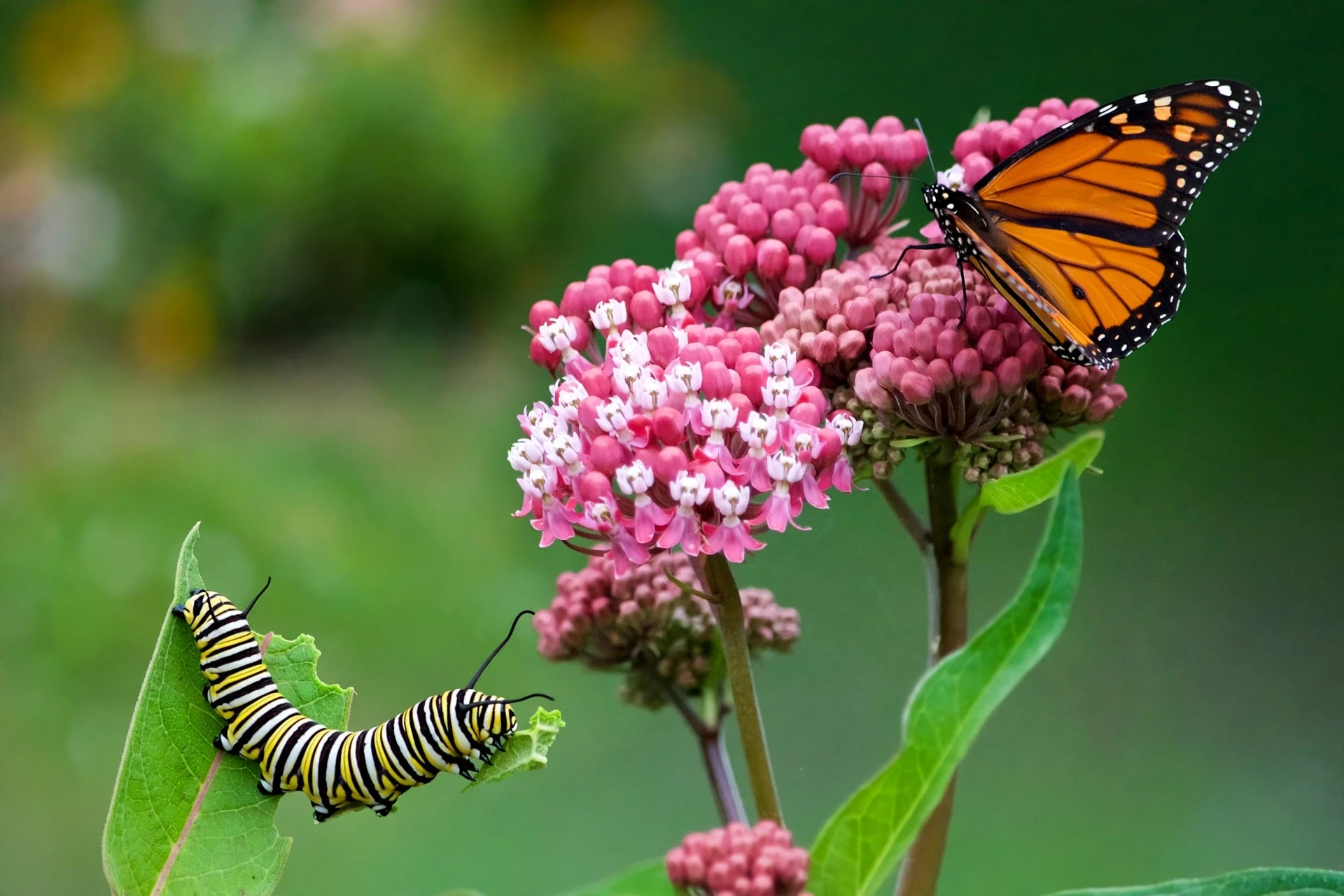
The monarch butterfly, Danaus plexippus, is the most famous thief in this war. Monarch caterpillars feed only on milkweeds, in the genus Asclepias, and sequester the plants' toxic cardenolides into their own bodies, using the stolen poison as defence against predators, as Agrawal and colleagues (2012) showed. A bird that eats a monarch learns to avoid orange-and-black butterflies, and the poison that taught it came from the milkweed. The monarch's resistance to cardenolides comes from amino-acid substitutions in its sodium-potassium pump, the enzyme cardenolides attack — including L111V and N122H identified in early work — and other milkweed specialists carry substitutions at the same two sites in the same enzyme — the large milkweed bug Oncopeltus fasciatus shares the monarch's N122H substitution, and Chrysochus leaf beetles show the same L111V + N122H progression — a case of convergent target-site resistance (Dobler et al. 2012).
Sequestration is costly, not free, and that cost keeps the arms race honest. Monarchs fed mixtures of five cardenolides grew more slowly and sequestered less toxin than those fed single compounds (Agrawal et al. 2026), and milkweeds have an answer: nitrogen- and sulfur-containing cardenolides, such as uscharin and voruscharin, which monarchs must detoxify before they can sequester them, reducing growth and sequestration. The plant is not a passive victim. It keeps changing the poison, and the monarch keeps paying a price to keep up. The monarch's warning colours are the visible end of this chemical coevolution: a signal that says "I am poisonous", backed by a poison the caterpillar stole from its food. How that signal works, and how harmless species copy it, is told in Camouflage and Mimicry Explained — this section is only about the chemistry underneath it. For the mechanism driving the exchange, see Natural Selection Explained, and for how the milkweed lineage came to make these compounds, see Plant Evolution Explained.
8.3 Escape and radiate: how a new defence founds a new lineage
Escape-and-radiate is the idea that a new defence does more than save one plant: it founds a lineage. When a plant evolves a chemical defence no herbivore can beat, it escapes into a new adaptive zone — a set of niches where it can grow unbothered — and diversifies into many new species to fill that zone. Then a herbivore cracks the defence, escapes into the same zone behind it, and diversifies in turn — coevolution as an engine of diversity. Across 15 butterfly groups, lineages that made a major historical host shift showed a significant acceleration in diversification rate after the shift (Fordyce 2010) — one influential test of the Ehrlich and Raven prediction, though later work on nymphalid butterflies found the pattern is not general, and the evidence for escape-and-radiate remains mixed (Kaczvinsky & Hardy 2020). The pattern is statistical: the shift comes first, the burst of new species follows. Much of the diversity of flowering plants, and of the insects that eat them, reflects this chemical arms race — defence, breakthrough, radiation, new defence — running for more than a hundred million years.
8.4 Lodgepole pines, squirrels and crossbills: a three-way race
The same logic runs with a third player added, and the lodgepole pine system is the textbook case of it. Rocky Mountain lodgepole pine (Pinus contorta ssp. latifolia) faces the red crossbill (Loxia curvirostra complex) and the red squirrel (Tamiasciurus hudsonicus), and the two predators select in opposite directions on cone traits — squirrels favour heavy cones with few seeds and thin scales, crossbills favour large cones with thick distal scales (Benkman et al. 2003). Where squirrels are absent, pine and crossbill are in a reciprocal arms race; where both are present, the tree is caught between conflicting demands. The result is a three-way coevolutionary tangle, not a duel: the tree and two seed predators, with the tree caught between two conflicting demands — though the demonstrated reciprocal pair is pine and crossbill; the squirrels shape the pine, but there is no evidence the pine has shaped the squirrels in return. The lesson is that coevolutionary arms races rarely have only two runners. Add a third species, and the finish line moves for everyone.
8.5 Passion flowers and Heliconius: egg mimics and changing leaves
Passion-flower vines (Passiflora) and Heliconius butterflies run the same chemical war in reverse. Heliconius butterflies lay eggs only on Passiflora vines; in defence, some Passiflora species grow yellow spots that mimic butterfly eggs, deterring females that avoid laying where eggs are already present, and some species' leaves change shape dramatically as they grow so they no longer match the butterfly's search image (Benson et al. 1975; Gilbert 1982). The plant answers the butterfly's search, not only its appetite — a visual defence in a chemical war.
9. Ants and Acacias: Protection for Food
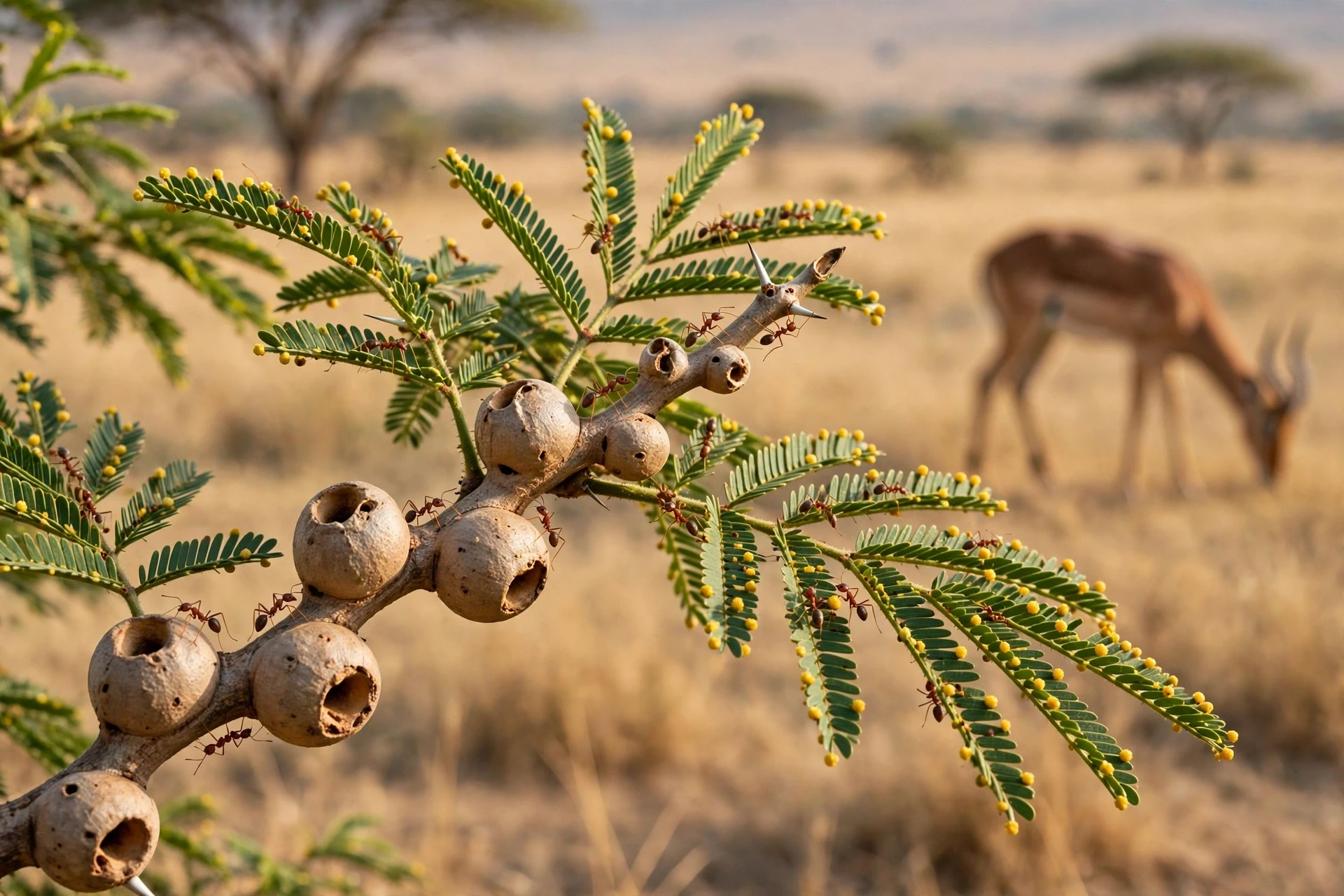
In Central America, certain acacia trees hire an army of ants as bodyguards, paying them in housing, sugar and protein-packed food. The ants repay the tree by attacking anything that dares to eat it. It is one of the clearest bargains in nature — and Janzen's 1966 study showed exactly how it works.
9.1 The acacia's offer: housing, sugar and protein
Janzen's 1966 paper described the coevolution of mutualism between swollen-thorn acacias and ants in Central America: the tree provides housing and food, and the ants defend the tree. The offer is generous and specific. The acacia houses ants in hollow, swollen thorns called domatia, feeds adults with sugar- and amino-acid-rich nectar from extrafloral nectaries, and feeds larvae with Beltian bodies — protein- and lipid-rich packets on leaflet tips. The ant partner in the classic Central American system is Pseudomyrmex ferruginea (also given as P. ferrugineus in current taxonomy), living on the bullhorn acacia, Vachellia cornigera, formerly known as Acacia cornigera. The tree's ant-attracting traits appear in a fixed developmental sequence — extrafloral nectaries first, swollen thorns next, Beltian bodies last — controlled by declining levels of microRNAs miR156 and miR157 as the plant ages. The seedling does not offer the full package at once; it builds the bargain gradually, as it grows into a tree worth defending. The tree is not being generous. It is investing in a bodyguard, and it pays in instalments.
9.2 The ants' service: defence against herbivores and competing plants
The ants earn their keep with a ferocity out of all proportion to their size. They defend the tree by attacking herbivores, pruning back encroaching vegetation, and clearing seedlings around the tree. A grazing animal that brushes against an acacia is met by ants swarming out of the thorns and stinging any soft skin they can find. An insect that lands to feed is bitten and driven off. A vine that tries to climb is cut back, and seedlings that sprout too close are cleared away, so the acacia keeps its light and its space. The ants act as gardeners as well as soldiers, keeping the tree's surroundings clear in a forest where competition for light is relentless. The partnership is coevolutionary mutualism in its most literal form — food and housing on one side, protection on the other — and each side's anatomy shows the deal. The tree's thorns are hollow houses as well as spikes, and the ant's sting is aimed at the tree's enemies. Neither trait makes sense without the other. For the broader family of partnerships in which species live and evolve together, see Symbiosis Explained, and for how this bodyguard service fits into a community's energy flow, see Ecosystems Explained: Structure and Energy Flow.
9.3 What happens when the ants leave (the removal experiment)
The test of any coevolutionary mutualism is what happens when you take one partner away, and Janzen's system passes decisively. Experimental removal of ants leaves trees heavily damaged. Without their bodyguards, acacias are eaten by herbivores, shaded by encroaching vegetation, and crowded by competing seedlings. The experiment matters because it separates a real partnership from a pleasant coincidence: if the ants were merely tenants who happened to live in the thorns, removing them would change little. Instead, removing them cripples the tree. The acacia has outsourced much of its defence to the ants: its thorns became houses for its bodyguards, not weapons in their own right. The bargain has a cost, and the cost is dependence. A tree that hires a bodyguard stops carrying its own weapon, and if the bodyguard leaves, it is defenceless. That is the honest price of mutualism, and it is why the partnership has lasted: each side has burned its bridges.
9.4 Ants and aphids: the same bargain, farmed
The acacia's bargain has a smaller, quieter cousin that most gardeners have seen without recognising it. Ants farm aphids the way the acacia employs ants: the aphids feed on plant sap and excrete sugary honeydew, which the ants collect, protecting the aphids from predators and sometimes moving them to better feeding spots. The roles are the same — food on one side, protection on the other — but the farmer is the ant and the livestock is the aphid. Like the acacia, the aphid pays for its bodyguard with sugar, and the farming ants defend their charges with real aggression, driving off ladybirds and other predators. The parallel shows how general the bargain is. Protection for food is a deal that coevolution keeps striking, wherever one species has sugar to offer and another has a sting to sell. (For the full account of this farming mutualism, see the Current Biology primer 'Aphid-farming ants' (Aphid-farming ants), which documents honeydew-for-protection, ants moving aphids to safety, and the relationship's ~35-million-year fossil history.)
10. Cleaner Fish and Their Clients: Trust, With Teeth
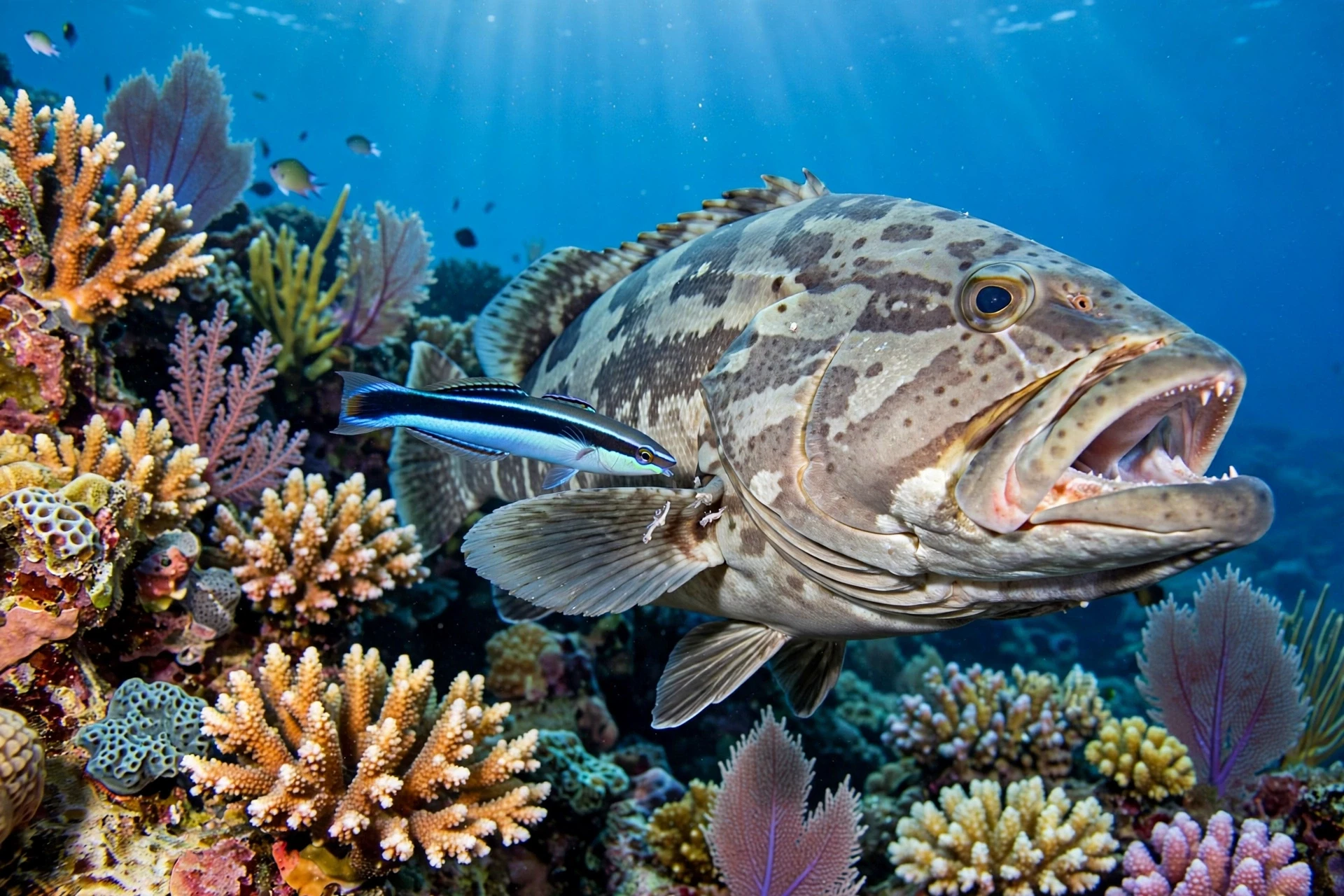
On a coral reef, a striped fish runs a cleaning station where much larger fish — even predators — queue up to be serviced, holding still while parasites are picked from their skin and gills. The truce looks impossible, yet it works, because the clients police the cleaners. This section explains how trust evolves when cheating pays in the moment.
10.1 The cleaning station: a truce on the reef
The bluestreak cleaner wrasse, Labroides dimidiatus, removes ectoparasites from client reef fish, and both partners benefit as long as the cleaner eats parasites, as Bshary and Grutter (2005) showed. The client gets rid of parasites it cannot reach itself, including ones on its gills and inside its mouth; the cleaner gets a meal. The station is a place, not just a meeting: a patch of reef that clients visit repeatedly, where the cleaner advertises with a distinctive striped pattern and a dance-like display. A predator at a cleaning station does something extraordinary — it holds still, opens its mouth, and lets a fish small enough to swallow pick around its teeth, because the service is worth more than the snack. The truce is not a peace treaty signed once and kept forever. It is renegotiated at every visit, by two animals that both have something to gain and something to lose: food for the cleaner, freedom from parasites for the client, and hard-won knowledge on both sides about whom to trust.
10.2 How clients recognise a cleaner (and how mimics exploit it)
A client that lets the wrong fish into its mouth would be eaten, not cleaned, so recognition matters more here than in almost any other case of coevolution. Clients identify the cleaner by its pattern — the bold black stripe running the length of its body — and by the distinctive dance that advertises cleaning, not hunting. The stripe and the dance are a signal, and like any signal, it can be copied. The false cleanerfish Aspidontus taeniatus, a blenny, copies both the bluestreak cleaner's black stripe and its dance so closely that clients pose for it — and it then sometimes tears a piece of fin from the deceived client instead of removing parasites (Fujisawa et al. 2020). The danger of a mimic is the danger of any false signal: a fish that looks like a cleaner but bites instead can exploit the trust the whole system runs on — though in practice the false cleanerfish bites only a minority of the clients it deceives, and its mimicry probably serves mainly to keep it safe from predators. Clients do not rely on a single cue. They watch the cleaner's behaviour, approach cautiously, and are ready to end the interaction at the first sign of trouble — as the next section shows, they punish cheating the moment they feel it. Recognition, in other words, is not a label the cleaner wears. It is a test the cleaner passes, visit after visit, enforced by the client's willingness to walk away.
10.3 Cheating cleaners and the punishment that keeps them honest
The cleaner's temptation is built into the job. Cleaners prefer to eat client mucus instead of parasites — mucus feeding is cheating, because mucus protects the client and is costly to regenerate. Parasites are the agreed payment; mucus is theft from the client's own defences. The client is not helpless against this theft. Clients control cheating by punishment, chasing the cleaner, or by partner switching, leaving the cleaning station. In experiments reported by Bshary and Grutter (2005), cleaners fed from model plates that chased them or fled when they ate their preferred food shifted to the less-preferred food after six learning trials — the laboratory analogue of being punished or abandoned by a client. Clients signal cheating with a "jolt" — a rapid movement away from the cleaner after mouth contact — and field data show clients often end the interaction immediately after a jolt, as Bshary and Grutter (2002) documented. The jolt is both a reflex and a useful signal: it marks a bite that hurt, and the visit is often over straight after it. Cheating opportunities are asymmetric: the cleaner can cheat, but the client has no equivalent way to cheat, so cooperation is maintained by client control, not by mutual restraint. The client holds all the enforcement power: it can leave, chase, or simply refuse to return, and a cleaner with no clients starves.
10.4 Why the truce holds — most of the time
The truce holds because the punishment works, and it works best when the cleaner can see that it is being watched. Cleaners adjust their behaviour to the audience: they cheat predatory clients rarely (Bshary & Noë 2003), because predators can retaliate by eating them, and they cheat less when a bystander client is watching — a form of reputation management (Pinto et al. 2011). A cleaner that cheats in front of an audience loses future customers, not just the one it just bit, so the cost of cheating rises with the number of witnesses. That is why this coevolutionary system is stable without either side being good or trustworthy in any moral sense. The cleaner is not honest and the client is not forgiving. The cleaner is careful, because carelessness costs meals, and the client is watchful, because inattention costs mucus. The truce holds most of the time, and that qualifier matters: sometimes a cleaner cheats and gets away with it, and sometimes a client misjudges and ends a good cleaning early. The partnership is not perfect, and it does not need to be. It needs to pay, on average, for both sides — and on a reef full of parasites, it does. For why such partnerships matter to the reef as a whole, see Biodiversity: Definition, Importance and Ecological Roles, and for how cleaning stations fit into the reef community's energy flow, see Ecosystems Explained: Structure and Energy Flow.
11. Mimicry as Coevolution
Mimicry looks like copying, yet the copy only works because three species are evolving around one another at once. A harmless insect borrows a warning, a predator learns the lesson — and in Batesian mimicry it is the dangerous model that pays the whole teaching cost.
That triangle, with selection running both ways, is what makes mimicry coevolution, not simple resemblance.
Not every mimicry is coevolution — it earns the name only where the reciprocity test in §11.1 is met.
Mimicry deserves its own article — and it has one: Camouflage and Mimicry Explained. This section covers only the reciprocal logic behind it; the full Batesian versus Müllerian story, with examples, lives there. The distinction matters because mimicry is often described as if one species simply decided to dress up as another. A mimic's pattern survives only while predators keep learning, models keep paying, and mimics keep testing the boundary of a convincing copy.
11.1 Why mimicry is coevolution, not just copying
Copying alone is one-sided adaptation. Reciprocal change needs a return journey: a trait in one species must select on a second, and the second's response must select back on the first. Mimicry passes that test, because the predator is a third party doing the selecting, and its behaviour changes as the other two change. When mimics grow common, predators meet the copy more often than the original, the warning loses force, and the model suffers for it. When mimics are rare, the warning holds. The balance shifts with every generation, and the pattern on the wing shifts with it.
That is also why a popular reading of mimicry is wrong. People often describe it as cooperation, as though model and mimic had struck a friendly deal. They have not. In Batesian mimicry the mimic is a freeloader, and the model would be better off without it. Selection has no committee and no plan. It rewards whatever pattern keeps its bearer alive long enough to breed, and it punishes the patterns that stop working once predators catch on.
11.2 Batesian mimicry: the harmless copycat and the predator's education
A Batesian mimic is harmless, or at least edible, and survives by wearing the colours of something a predator has learned to avoid. The protection is frequency-dependent: it is strongest while mimics are scarce, and weakens as mimics multiply and predators meet copies more often than originals. Predators select for better mimics; mimics select for warier predators; and warier predators select, in turn, for mimics that copy more exactly. The full Batesian story, with examples, lives in Camouflage and Mimicry Explained.
11.3 Müllerian mimicry: sharing the warning
In Müllerian mimicry, several unpalatable species converge on the same warning pattern, sharing the cost of teaching predators. In Heliconius butterflies, distantly related species in the same mimicry ring share wing patterns, and one switch for red, reused again and again, lets separate lineages arrive at the same visible answer — though other pattern elements are controlled by other genes (Reed et al. 2011). The full Müllerian story lives in Camouflage and Mimicry Explained.
The best genetic evidence consistent with genuine reciprocity, instead of two lineages coincidentally landing on the same pattern, comes from the co-mimics Heliconius erato and H. melpomene. Phylogenetic, divergence-time and phylogeographic evidence from five colour-pattern genes and five neutral markers is compatible with strict coevolution of their mimicry patterns: the two co-mimics diversified together, driven by Müllerian mimicry (Hoyal Cuthill & Charleston 2015). Two species, changing in step. That is the reciprocity test as far as it can be passed: the data are compatible with strict coevolution — the strongest support available, though compatibility is not proof.
11.4 The mirror orchid: sexual deception, not (yet) coevolution
Mimicry does not always target a predator. The mirror orchid, Ophrys speculum, mimics a female wasp so precisely — visually and chemically — that males of the scoliid wasp Dasyscolia ciliata try to mate with the flower and carry its pollen away instead (Ayasse et al. 2003). The deceived male gets nothing; the orchid gets a pollinator that works for free, driven by its own mating instinct. This is sexual deception, and it is one-sided: no reciprocal change in the wasp has been demonstrated, so by the reciprocity test in §2 it is mimicry without (demonstrated) coevolution. The plant succeeds because each new generation of males is naive — experienced males learn to avoid flowers they have already visited. For the full treatment, read the dedicated article — Camouflage and Mimicry Explained — alongside the story of convergent evolution, where similar traits arise for different reasons.
12. Brood Parasites: Cuckoos and Their Hosts
The common cuckoo never builds a nest. It slips a single egg into another bird's nest and leaves the unwitting host to raise a chick that will push the host's own young out. Hosts fight back with sharper eyes and stricter rejection, and cuckoos answer with better forgeries. Few rivalries show an evolutionary arms race so clearly, egg by egg.
The common cuckoo (Cuculus canorus) is an obligate brood parasite: it builds no nest and must lay its eggs in other birds' nests (Stoddard et al. 2010). That single fact sets the whole contest in motion. A parasite that never raises its own young puts all of its reproductive success in the hands — the beaks — of another species. Every cuckoo egg is a gamble on the host's eyesight, its memory of its own eggs, and its willingness to throw an intruder out.
12.1 The cuckoo's trick: one egg, in the wrong nest
A female cuckoo watches a host nest, waits for the moment the host is away, and lays a single egg, often removing one host egg in the process. Speed matters: hesitation means discovery, a mobbing, or a pecked egg. The chick that hatches then completes the trick in a way that still startles first-time observers: it evicts the host's eggs and young from the nest, leaving the foster parents with one enormous, hungry mouth to feed. The host works harder for a chick that is not its own, for weeks, while its own genes gain nothing from the effort. That is antagonistic coevolution at its starkest. One side's gain is measured directly in the other side's loss.
12.2 Egg mimicry and the hosts that learn to spot it
Female cuckoos specialise on a particular host species, forming host-races known as gentes, each laying eggs that mimic that host's eggs in colour and pattern (Stoddard et al. 2010). The specialisation is largely maternally inherited (female-line), so each gens is mostly a lineage of forgers perfecting one particular copy.
Hosts select for better mimicry by rejecting poorly matched eggs, and the evidence for that selection is quantitative. Cuckoos have evolved better pattern mimicry for host species that show stronger egg rejection, a finding based on 205 parasitised clutches across eight host species, analysed with avian-vision models that approximate what the birds themselves actually see (Stoddard et al. 2010). Where hosts are strict, only near-perfect forgeries survive. Where hosts are lax, sloppy copies still pass. The mimicry is therefore not a fixed property of the cuckoo. It is a moving target, set by the strictness of the host it faces, and it improves exactly where the host pushes hardest.
Mimicry is imperfect even in long-coevolved pairs. Great reed warblers (Acrocephalus arundinaceus) reject cuckoo eggs by puncture-ejection, and warbler eggs are significantly bluer and darker than cuckoo eggs at the population level (Villa et al. 2023). Warblers reject lighter, browner eggs but tend to accept darker, bluer ones — so the host's own bias, not just imperfect copying, shapes which forgeries survive. That imperfection is informative. It shows the race has no finish line: the host keeps raising the bar, the cuckoo keeps chasing it, and neither side ever quite wins.
12.3 Chick mimicry, begging calls and the hosts that fight back
Egg mimicry is only the first hurdle. A cuckoo chick must also survive the nestling stage, where hosts could, in principle, recognise an impostor by its size, its gape, or its call. Reed warblers (Acrocephalus scirpaceus) illustrate the puzzle sharply. They are good at discriminating against cuckoo eggs, yet they accept and raise the cuckoo chick — the same chick that evicted all their own eggs and young from the nest (Davies & Brooke 1988). Why accept the chick after rejecting the egg? Part of the answer is that recognising a chick is harder than recognising an egg. An egg sits still and can be compared with its neighbours. A chick moves and begs, and the cues a parent uses — a wide-open gape, a loud call — are the same cues its own young would give, only louder. One leading explanation, proposed by Davies & Brooke, is that the cuckoo chick is a supernormal stimulus: it presses the parent's feeding buttons harder than the parent's own young ever could. Rejecting a chick also carries a cost that rejecting an egg does not. A parent that throws out its own chick by mistake loses everything. When the cost of a false rejection is that high, selection favours tolerance, and tolerance is exactly what the parasite exploits.
Host defences are not limited to egg rejection. Across the brood-parasite world, hosts mob adult parasites, abandon parasitised nests, bury foreign eggs under fresh nest material, or desert and rebuild elsewhere. Each defence invites a counter-move. A cuckoo that is mobbed learns to approach quickly and quietly. A host that deserts leaves the cuckoo to find the replacement nest. The race runs on behaviour as much as on eggshell colour, and it runs in both directions at once.
12.4 Why hosts do not simply abandon parasitised nests
If raising a cuckoo is so costly, why do hosts not simply give up on every parasitised nest and start again? The answer is arithmetic. Abandoning a nest costs the host its whole clutch, the time spent building, and the shrinking remainder of the breeding season. Rejecting a single egg, by contrast, costs almost nothing — if the host gets the identification right. Selection therefore favours precise discrimination over wholesale desertion, and that is why the arms race concentrates on eggshell pattern, colour, and the bird's ability to see the difference. Desertion tends to survive as a defence where the chance of re-nesting successfully is high, or where the parasite's egg cannot be told apart from the host's own.
The brown-headed cowbird (Molothrus ater) shows how different the same game can look with different rules. Unlike the cuckoo, the cowbird has no host-specific egg-mimicking gentes. Secondary summaries report its eggs in the nests of at least 220 host species, with more than 140 species known to have raised cowbird young, and a female laying up to 40 eggs in a season — figures that rest on secondary summaries of older work, not on a single verified primary study, so they should be read as reported counts, not as settled measurements. What is reported is the variety of host responses: grey catbirds are reported to reject cowbird eggs over 95 percent of the time, yellow warblers are reported to bury the foreign egg under nest material, and blue-grey gnatcatchers are reported to abandon the nest. One parasite, many hosts, many defences — and no single forgery that fits them all. The cowbird's strategy is breadth where the cuckoo's is precision, and both are answers to the same problem: how to make another species raise your young. For the vision behind egg recognition, see The Evolution of the Eye Explained, and for the selection logic that drives the whole contest, Natural Selection Explained.
13. Sexual Conflict and Coevolution: When Mates Are Also Opponents
In sexual conflict, the opponent is not another species but the opposite sex of your own. A trait that helps a male spread his genes can harm the female carrying them, so females evolve defences and males evolve ways around them. The result is rapid, restless change in the very traits that decide who mates, and who pays the price.
Most of the coevolution in this article runs between species. Sexual conflict runs within one. That makes it the odd case out, and the reason it belongs here is that it follows the same logic with the same consequences: reciprocal selection, escalating traits, and no stable peace. The only difference is that the two sides share a genome, a nest, and a future. They cannot walk away from each other, which is precisely why the conflict never resolves.
13.1 Fisherian runaway: when preference and trait chase each other
Runaway selection begins with a preference. If females in a population tend to prefer males with a slightly longer tail, a brighter colour, or a louder call, then males carrying that trait leave more offspring. And so do the females carrying the preference, because their sons inherit the trait and their daughters inherit the preference. Trait and preference then chase each other upward together, each generation amplifying the last, until the trait becomes so exaggerated that its survival cost finally balances its mating advantage. Nothing in this process needs a second species. The feedback loop runs between a trait in one sex and a preference in the other, inside a single population. That loop explains why some of the most extravagant ornaments in nature — tails too long for easy flight, colours too bright for hiding — persist despite their obvious costs. They are not useful. They are attractive, and attractiveness, once it starts paying, pays more with every step. Runaway remains a theoretical model: the genetic correlation between trait and preference that it requires has proved hard to find in the wild — significant in fewer than 20% of species in one meta-analysis (Greenfield et al. 2014) — so it is best read as one possible route to extravagance, not the established explanation for it (Fry 2024). For the wider story of how mate choice shapes bodies and behaviour, see Sexual Selection Explained.
13.2 Sexually antagonistic coevolution: what's good for him harms her
Runaway selection is about attraction. Sexually antagonistic coevolution is about harm. A male trait that increases a male's mating success can directly reduce a female's survival or fertility. It can do so by forcing copulation, by damaging her reproductive tract, or by diverting her resources to his offspring at the expense of her future breeding. Females then evolve resistance, and males evolve ways to overcome it. Each side's gain is the other's loss, measured in offspring. The traits involved often evolve unusually fast — genital morphology is among the fastest-evolving anatomy known — because the selection on them is direct, constant, and personal: every mating is a contest, and every contest has a winner.
This is also where a common misunderstanding needs correcting. Sexual conflict is often described as males versus females, as though the sexes were teams with fixed interests. They are not. A male's interest in one mating is not the same as his interest in the female's lifetime fertility, because he may not father her later offspring. A female's interest is her own lifetime output, not any single mating. The conflict is between genes with different routes to the next generation, not between two kinds of animal with settled grudges. Once that is clear, the escalation makes sense: there is no referee, and no outcome that satisfies both sides at once.
13.3 Genital coevolution: lock, key — and arms race
Nowhere is the conflict written more plainly than in genitalia. Male waterfowl have a phallus 1.5 to over 40 cm long, varying between species in length and elaboration, and phallus length correlates across species with the frequency of forced extra-pair copulations (Brennan et al. 2007). Across species, phallus length correlates with the frequency of forced extra-pair copulations — a correlation consistent with sexual conflict, though correlation alone does not show which caused which (Brennan et al. 2007). Female waterfowl have evolved correspondingly elaborate vaginas with two novelties unknown in other birds — dead-end sacs and clockwise coils — that appear to block the counter-clockwise-spiralling male phallus during forced copulation without female cooperation (Brennan et al. 2007). Across 16 waterfowl species, the degree of vaginal elaboration is positively correlated with phallus length in a phylogenetically controlled analysis: male and female genitalia have coevolved through sexual conflict (Brennan et al. 2007).
The mechanics are as dramatic as the anatomy. The Muscovy duck penis everts explosively — a 20 cm phallus in an average of 0.36 seconds, reaching 1.6 metres per second — consistent with a male strategy to achieve intromission quickly during forced copulation (Brennan et al. 2010). Speed is the male counter-move to a female anatomy built to slow him down. The female's coils and dead ends are her counter-move to a male anatomy built to bypass her choice. Neither side is winning in any lasting sense. Both are running, and the running itself is the pattern.
Bed bugs tell the same story in a smaller, sharper form. In bed bugs (Cimex lectularius), males pierce the female's body wall and inseminate directly into the body cavity — traumatic insemination — bypassing the female genital tract entirely (Siva-Jothy 2006). The female's counter-adaptation is the spermalege, a modified region of the abdomen where the male usually pierces: In needle-simulation experiments, piercing inside the spermalege had no effect on females, while even a very low rate of piercing outside it cut lifetime egg production by 50 percent (Morrow & Arnqvist 2003) (Morrow & Arnqvist 2003). A wound that halves a female's lifetime output is not a minor inconvenience. It is selection pressure of the most direct kind, and the spermalege is the answer evolution built: a reinforced target zone that turns a stabbing into something survivable. The male still pierces. The female still pays. The anatomy of both sexes carries the record of the negotiation.
13.4 Why sexual conflict rarely ends in a draw
A draw would require both sides to stop at the same time, and neither side has a reason to stop first. A male that eases off leaves offspring to males that do not. A female that drops her defences pays the full cost of the next forced mating. So the traits keep escalating until some other cost — the energy of growing an elaborate phallus, the risk of injury, the sheer awkwardness of the anatomy — finally caps the race. Even then the cap is not peace, only a stalemate held by costs on both sides, shifting whenever mating opportunities change. That is why genital traits diverge so fast between closely related species, and why taxonomists often use them as clues to tell sister species apart. The conflict writes itself into the body, and the body keeps the receipt. The genetic machinery behind these traits — how they are inherited, expressed, and passed on — is covered in Genetics, Inheritance, Mutations and Gene Expression and DNA Structure, Replication and Heredity.
14. Coevolution and Speciation: When Partnerships Split Species
Coevolution does not only change traits. It can split lineages. When two interacting species change together, and different populations of each change in different directions, the partnerships themselves can become barriers to breeding. New species then arise not despite the interaction, but because of it.
The idea goes back to the paper that named the process. Ehrlich and Raven's escape-and-radiate model predicts that a plant's new chemical defence opens a new adaptive zone and triggers plant radiation. A herbivore breakthrough then triggers herbivore radiation — repeated bursts of diversification in both groups (Ehrlich & Raven 1964; Maron et al. 2019). A defence is not only a shield. It is a key to a new habitat, a new food source, a new way of life, and the lineage that holds the key can spread into space its relatives cannot reach. Then a herbivore cracks the defence, and its lineage spreads in turn. Each breakthrough founds a radiation, and the two radiations chase each other through evolutionary time.
14.1 Cospeciation: splitting in sync (figs and yuccas)
Cospeciation is the tidiest version of the story: two lineages split at the same time, in the same places, so their family trees mirror each other. Figs and fig wasps are the classic case. The two lineages diversified in parallel with broadly congruent phylogenies, each fig species matched, broadly, by its own wasp (Cook & West 2005). When a fig population split, its wasp population often split with it, because a wasp that can only breed inside one fig species has nowhere else to go. The trees line up because the wasp's world is the fig, and the fig's world includes the wasp.
Tidy does not mean universal. Yucca–moth lineages show repeated host shifts, not strict co-speciation — coevolution can drive diversification without one-to-one cospeciation (Pellmyr 2003). A moth lineage jumps to a new yucca species, adapts to it, and founds a new lineage there, without its old host splitting at all. The trees still show the influence of the partnership, but they do not match branch for branch. Cospeciation is one outcome of coevolution, not its definition, and the cases where the trees fail to match are as instructive as the cases where they do. They show that a partnership can drive divergence without keeping step.
14.2 Escape and radiate: a new defence, a new radiation
Does the escape-and-radiate model hold up against real data? Across 15 butterfly groups, lineages that made a major historical host shift showed a significant acceleration in diversification rate after the shift — general agreement with the Ehrlich and Raven prediction (Fordyce 2010). The pattern is not a single anecdote. It repeats across independent lineages: shift host, then diversify faster. The mechanism is straightforward to state and hard to overstate. A new host plant is a new adaptive zone, free of the competitors and enemies that crowded the old one. The lineage that colonises it can split into forms adapted to different parts of the new zone, different tissues, different seasons. Diversity follows the opening the way water follows a crack. A later re-analysis (Kaczvinsky & Hardy 2020) found the general pattern weaker than Fordyce 2010 suggested — most major host switches were linked to long-term decreases in richness — so the escape-and-radiate prediction remains contested.
14.3 Pollinator shifts as speciation engines
A change of pollinator can split a plant lineage as surely as a mountain range can. In the African orchid Satyrium longicauda, one form shifted from moth to oil-collecting-bee pollination, mediated by a switch in the chemistry of the floral reward — more diacetin, with spurs mostly devoid of nectar — while the long spurs were retained as vestiges (Castañeda-Zárate et al. 2021). The shift was chemical before it was morphological: reward chemistry, not spur shape, led the way. Long spurs were shown experimentally to be critical for pollination of the moth-pollinated form but unnecessary for the bee-pollinated form (Castañeda-Zárate et al. 2021). Once the reward changed, the pollinator changed. The reward switch changed the pollinator — a possible first step toward isolation, but reproductive isolation between the forms has not been demonstrated; they remain ecotypes of one species complex.
Mimicry can play a similar role. Mimetic-pattern diversity may have facilitated speciation in Heliconius (Elias et al. 2008; Jiggins 2008, as discussed in Kozak et al. 2015) — but Kozak et al.'s own analysis could not attribute the diversification-rate increase to any single driver. The logic is the same as in the orchid: a new warning pattern attracts a new set of mates and a new set of predators, and the population wearing it drifts apart from its relatives. Pattern becomes identity, and identity becomes a species boundary.
14.4 Coevolution is not the only road to speciation — keep it in proportion
None of this makes it the sole engine of speciation, and claiming otherwise would be a mistake. Species split for many reasons: geographic isolation, genetic drift in small populations, chromosomal change, and plain ecological divergence with no partner species involved. For the mechanics of splitting itself, see Speciation Explained, and for the role of chance in small populations, Genetic Drift Explained. Coevolution is one road among several, and it matters most where the interaction is tight, long-lasting, and hard to escape — figs and their wasps, yuccas and their moths, orchids and their pollinators. Where the interaction is loose, the splitting is usually driven by something else, and the coevolution follows; it does not lead. The honest claim is narrower and stronger than the sweeping one: where partnerships are obligate, they can split species in step, and where a defence or a pollinator shift opens a new zone, diversification often follows. That is enough. It makes the process a builder of biodiversity, not merely a decorator of it — and the plant side of that story is told in full in Plant Evolution Explained.
15. The Geographic Mosaic: Coevolution Is Different Everywhere
The newt and the snake do not fight the same war everywhere. In one valley the snake is so resistant that the newt's poison is no defence; in the next, the match is closer and the race still runs. In every mismatch, the snake is ahead — no population has newts too toxic for its snakes.
Coevolution is local, and its map is a patchwork of hot spots, cold spots, and quiet ground between them.
Thompson's geographic mosaic theory, set out in 1994 and developed in his 2005 book The Geographic Mosaic of Coevolution, holds that coevolution varies across the landscape. Selection mosaics (different selection in different places), hotspots (reciprocal selection in some communities) and coldspots (non-reciprocal selection elsewhere), plus trait remixing by mutation, gene flow, drift and local extinction (Thompson 2005). The theory has three moving parts, and each one matters. The mosaic is the geography of selection itself. The hotspots and coldspots are where reciprocal selection is strong or weak. Trait remixing is the shuffling — gene flow carrying traits between populations, drift changing them by chance, extinction wiping the board clean in one place while the game continues in another.
15.1 Hot spots, cold spots and the selection mosaic
A hotspot is a place where both partners exert strong selection on each other. A coldspot is a place where only one does, or neither does. In a coldspot, a newt population may be toxic for reasons that have nothing to do with local snakes — its toxin levels tracking its own population history — while the local snakes, facing no toxic prey, stay sensitive (Hague and colleagues (2020)). In a hotspot, the two push each other upward together, toxin against resistance, until one side hits a cost it cannot pay. The mosaic is not a metaphor. It is a measurable pattern on a map, and the newt–snake system provides the clearest measurement of it ever made.
15.2 Trait remixing: gene flow shuffles the deck
If hotspots and coldspots were sealed off from each other, each would evolve to its own local optimum and stay there. They are not sealed. Gene flow carries traits from one population to another, mutation invents new variants, drift changes frequencies by chance in small populations, and local extinction removes whole combinations from the board. Thompson called this bundle of processes trait remixing, and it is what keeps the mosaic from freezing into a set of separate, finished adaptations. A resistance allele from a hotspot can flow into a neighbouring coldspot, where it persists without the selection that built it — or vanishes. A toxin variant useless in one valley can arrive in another just as the snakes there push back, and suddenly it matters. Remixing is the reason the mosaic is dynamic rather than static, and the reason a snapshot of the map today will not match a snapshot taken in a hundred years.
15.3 The newt–snake map: the same pair, different wars
Brodie and colleagues assayed tetrodotoxin resistance in over 2,900 garter snakes from 333 families in 40 populations across western North America. Resistance varies by over three orders of magnitude between populations, even over short distances — with two areas of intense evolutionary response, hotspots, surrounded by clines of decreasing resistance (Brodie et al. 2002). Three orders of magnitude is a thousand-fold difference: two populations of the same snake, a short distance apart, can differ a thousand-fold in how much poison they tolerate. That is the mosaic made quantitative. Selection on this trait is intensely local, and it tracks the local newts.
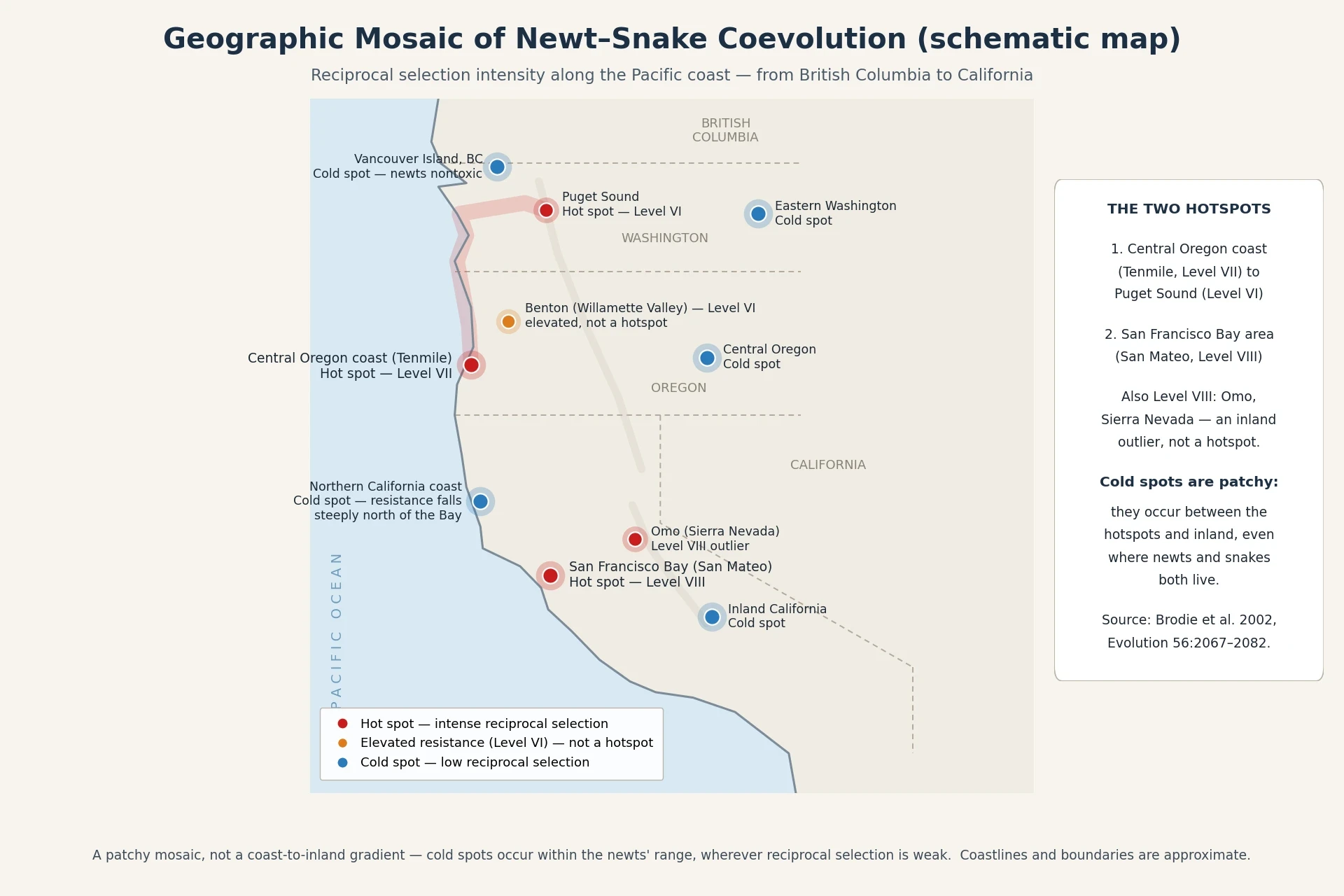
The mismatches are as revealing as the matches. In some places snakes are so resistant that newt toxicity is no defence — phenotypic mismatches that reveal escape from the arms race in parts of the mosaic (Hanifin et al. 2008). In every mismatch Hanifin and colleagues found, the snake was ahead: the least resistant snake could still eat the most toxic newt, and the converse — newts too toxic for local snakes — was never observed. Where snakes are ahead, selection on newt toxicity stalls. That stalemate is temporary. Gene flow, a new mutation, or a shift in the local community can restart the race, and the map will be redrawn.
The same mosaic pattern appears in snails: the geographic mosaic of sex in Potamopyrgus — sexual reproduction is commonest where trematode risk is highest — varies from lake to lake and even within a single lake (King et al. 2009). The trait is different, the organisms are different, and the pattern is the same. Where parasites are thickest, sex pays. Where they are scarce, asexual reproduction wins. The mosaic is not a quirk of one famous predator–prey pair. It is a general property of coevolution wherever selection varies across space.
15.4 Why the mosaic matters for conservation
If coevolution is local, then conservation cannot be generic. Saving a species in one place does not save its coevolutionary partnership in another, because the partnership itself differs from place to place. A newt population that has lost its toxic edge, or a snake population that has lost its resistance, is not interchangeable with a population elsewhere that still carries the trait. The hotspots, where reciprocal selection is strongest, are likely to hold much of the genetic variation that fuels the next round of the race; losing one can mean losing that raw material. Protecting a species therefore means protecting the geography of its interactions: the valleys where the race runs hottest, the corridors that let traits flow between populations, and the coldspots that hold alternative combinations in reserve. Evolution does not happen in a species. It happens in a place, between partners, and the map is part of the organism's story. For why chance matters in small, isolated populations, see Genetic Drift Explained, and for what is at stake when partnerships unravel, Biodiversity: Definition, Importance and Ecological Roles.
16. Diffuse Coevolution: Whole Networks, Not Just Pairs
Pairs are the exception, not the rule. In nature, most plants are visited by many pollinators, most pollinators visit many plants, and the selection each species feels comes from a whole crowd at once. This section zooms out from one-to-one partnerships to the webs they sit inside.
16.1 From pairs to webs: what a pollination network looks like
A single orchid and a single moth make a wonderful story, but they are not how most of nature works. Diffuse coevolution works at the level of groups, not pairs: traits in several flowering-plant species shift together with traits in one or several pollinator species, so the response cannot be pinned on any single partner. The classic case is flowering plants and their pollinator guilds of bees, flies and beetles, where long-tubed flowers and long-tongued insects evolved as groups, not as exclusive pairs. In one South African guild, twenty or more long-tubed flower species share the attentions of a single long-tongued fly species, each flower shaped by the same pollinator crowd (Manning & Goldblatt 1997).
I saw this crowd logic with my own eyes one summer afternoon in a garden, watching a patch of lavender. In an hour, the same flowers were worked by honeybees, bumblebees, a hoverfly and a small white butterfly, and each of those insects moved on to other flowers nearby — mint, sage, a neighbour's roses. No single pair was doing the selecting. The lavender's tube length, its scent, its nectar — all of it had been shaped by a committee of visitors, and every visitor had been shaped in turn by a committee of flowers. That is selection with many authors at once.
When researchers mapped these webs properly, a pattern appeared. Bascompte and colleagues analysed 52 plant–animal mutualistic networks, covering pollination and seed dispersal, and found that most are nested: specialists interact with subsets of the species that generalists interact with, organising the whole community around a core of generalists. The links in these networks are also weak and asymmetric: specialist species usually interact with the most generalised species, not with other specialists — the opposite of the neat reciprocal specialisation the orchid story might lead you to expect. Larger pollination networks are also modular, with groups of species interacting much more with each other than with the rest of the network, and only weak links between the modules.
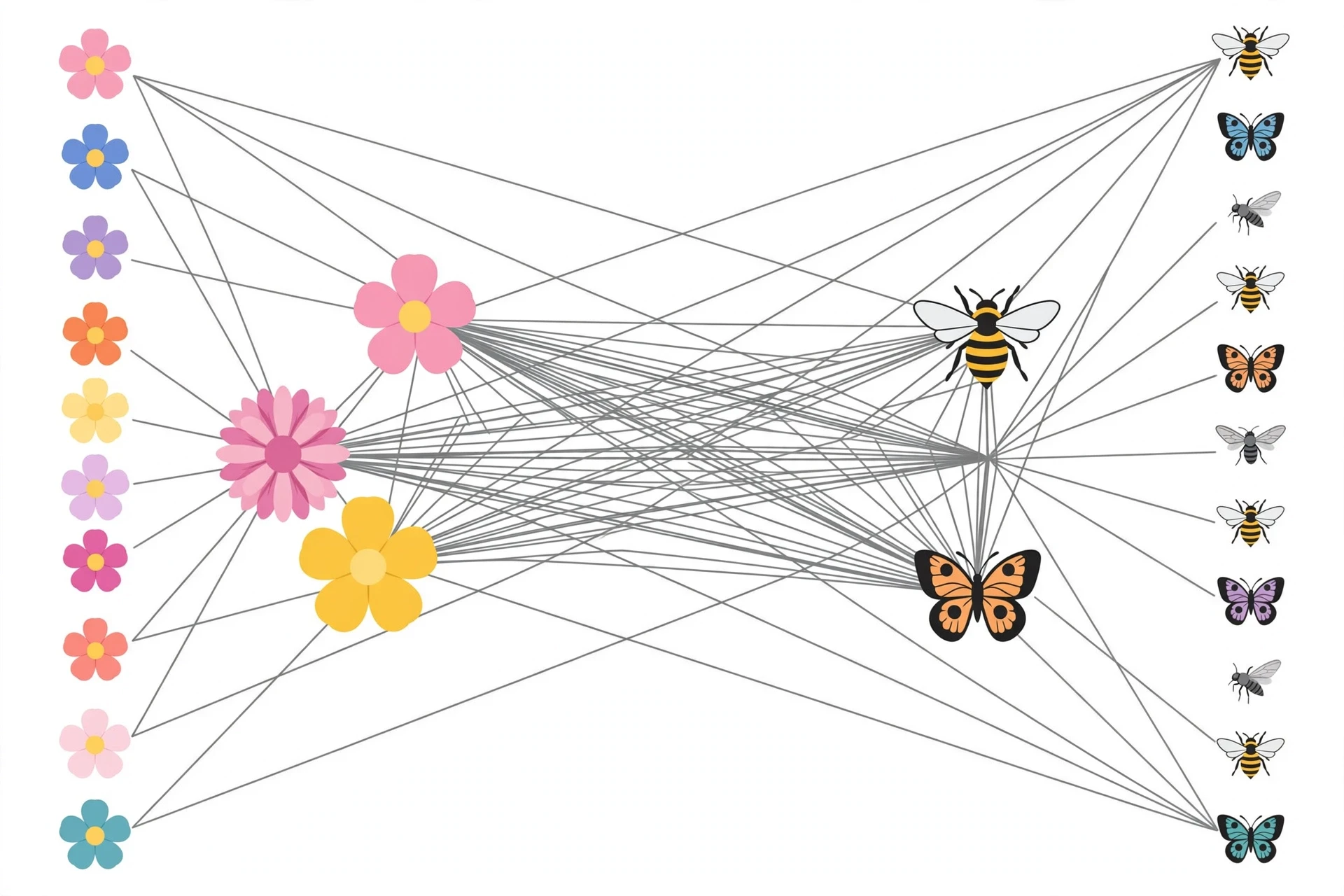
16.2 Seed dispersal: birds, mammals and the plants that bribe them
Pollination is only half the story. The same network logic governs seed dispersal, the other great plant–animal bargain. A plant that wants its seeds carried cannot walk, so it pays in fruit: sweet pulp, bright colour, a reward timed to ripeness. Birds and mammals take the meal and drop the seeds somewhere new, often far from the parent plant, and the plants whose fruits best match the local dispersers leave more descendants.
The networks analysed by Bascompte and colleagues included seed-dispersal webs as well as pollination webs, and the same nested shape turned up in both. That matters because dispersers are often travellers. A fruit-eating bird that migrates can carry a seed across a landscape a plant could never cross alone. The plants along a migration route form a moving feast that may shape where the birds stop and feed. The details differ from pollination — the reward is a fruit, not nectar; the service is transport, not fertilisation — but the evolutionary logic is the same. Each side is shaped by a whole guild of partners, and no single partner gets to dictate the terms. For more on how migration itself works, see Why Animals Make Epic Journeys.
16.3 Redundancy: why losing one pollinator rarely kills a plant — until it does
If a plant depends on one pollinator and that pollinator vanishes, the plant is finished. In a network, that disaster is rarer than you might think, because redundancy is built into the shape. Nestedness increases with network complexity: for a given number of species, communities with more interactions are significantly more nested, which means a plant with many visitors usually has several that can cover for each other. A lavender bush that loses its honeybees still has bumblebees, hoverflies and butterflies. The generalist core of the network acts as an insurance policy, and that insurance is one reason whole pollination webs can absorb shocks that would destroy a tight pair.
But redundancy has a limit, and it is a sharp one. The specialists in a network depend on the generalists, not the other way round, so the insurance only works while the core holds. Lose a specialist and the web barely notices. Lose a generalist and many specialists lose their main partner at once. That asymmetry is the key to understanding both resilience and fragility in these webs:
Resilient: many weak, overlapping links; several pollinators per plant; a strong generalist core; modules that are only weakly linked, so a failure in one need not drag the whole web down.
Fragile: dependence on one or two super-connected generalists; many specialists tied to the same core species; modules linked by a single bridge species; no spare partner when a key pollinator disappears.
This is why the fate of a network cannot be read off any single partnership. A plant can look safe — visited by a dozen species — while quietly depending on one generalist bee that does most of the actual pollinating. Count the visitors and you miss the point; weigh their contributions and the picture changes.
16.4 Cascades: when a network unravels
When a network does start to fail, it often fails in a cascade, not one species at a time. Simulations of pollination networks show that they tolerate species extinctions better than food webs do — declines were no worse than linear under random loss — but the loss of highly connected generalists is the most damaging event of all. Nested networks are robust to random loss and fragile to loss of the core, so the same web that shrugs off the disappearance of a rare specialist can collapse quickly when a common, well-connected pollinator goes.
That pattern has a practical sting. Conservation that protects only rare species while letting common generalists decline is protecting the ornaments and neglecting the foundations. A meadow can keep its rarest orchid for years while its bumblebee populations thin out, and then lose the orchid anyway when the last reliable pollinator stops coming. The web does not unravel evenly; it holds, holds, and then thins out from the centre. Understanding that shape — nested, modular, asymmetric — is what turns the idea from an abstraction into a tool for deciding what to protect first. The structure of ecosystems and the value of biodiversity both depend on these webs holding together.
17. Coevolution in the Human World: Farms, Clinics and Superbugs
Coevolution is not something that only happened in the distant past, on remote islands. It runs through wheat fields, hospital wards and living rooms right now, wherever humans push hard against another species and it pushes back. This section looks at those present-day races — and points you to the full story where it matters most.
The full story of how bacteria defeat antibiotics — plasmids, efflux pumps, the CDC numbers — is told in Antibiotic Resistance Explained. This section covers only the logic behind it.
17.1 Crops and pests: the pesticide treadmill
Nowhere is the human version of an arms race clearer than in a wheat field. Wheat rusts — leaf, stem and stripe rust, all caused by Puccinia fungi — keep evolving new virulent races that overcome resistance in wheat varieties, in a "boom and bust" cycle. A resistant variety works well until the pathogen adapts, and then it fails. Breeders answer with a new resistant variety, and the cycle turns again. Each side is selecting on the other, season after season, at a speed few wild arms races can match, because humans replant the whole battlefield every year.
The most feared name in this race is Ug99, a highly virulent wheat stem-rust strain that has loomed over global food security since the late 1990s and is tracked by international surveillance networks. But the newest evidence shows the story is more complicated than one villain. Genome sequencing showed that the strains behind the 2013 Ethiopian and 2016 Italian outbreaks were not descendants of Ug99, and were not closely related to each other — each emerged independently, as CSIRO reported in February 2026. The 2016 Italian outbreak strain carried a complete deletion of a single avirulence gene, letting it infect durum wheat varieties that relied on one resistance gene — one genetic change switching off the plant's alarm system (Spanner and colleagues (2026)). That is gene-for-gene matching with real harvests at stake: a resistance gene in the plant recognises a fungal protein, and the fungus escapes by deleting the gene that makes the protein.
The scale of what is at stake is hard to overstate. In Australia, genetic resistance to cereal rusts is estimated to save about 1.09 billion dollars a year. When resistance breaks down, the loss is not an abstract evolutionary event; it is failed harvests, empty fields and higher food prices. The lesson of the rust genome work is that surveillance has to watch the pathogen's genes, not just its name, because new threats can evolve independently, instead of descending from the last famous strain.
17.2 Pathogens and drugs: resistance as coevolution in real time
Antibiotics created one of the fastest arms races humans have ever run. The logic is simple and brutal: antibiotics kill susceptible bacteria and leave resistant survivors to multiply and share resistance genes — including with bacteria never exposed to the drug, through horizontal gene transfer. Every course of antibiotics is a selection event, and the bacteria that survive it are the ancestors of the next infection.
The numbers from the CDC's 2026 Antimicrobial Resistance Threats Report show how far the race has already gone. The report estimates more than 9.3 million drug-resistant infections a year in the United States and more than 39,000 deaths; including C. difficile, the toll reaches 9.7 million infections and 50,800 deaths. Globally, resistance is estimated to kill over one million people a year and was associated with nearly five million deaths in 2019. These are the current figures — the widely quoted older numbers from 2019, of 2.8 million infections and 35,000 deaths, have been superseded and should no longer be used. The rise is not a mystery. It is reciprocal selection doing exactly what the theory says it does, in hospitals and farms, in real time. The mechanisms, the drugs involved and what can still be done about it are covered in full in Antibiotic Resistance Explained.
17.3 Gene–culture coevolution: lactose, malaria and the genes culture changed
Humans are unusual in this story because we change our own selection pressures. When people farm, cook, store food, build cities and treat disease, they alter the environment in which their own genes are tested — and gene frequencies change in response. That feedback loop between what a culture does and which genes spread is called gene–culture coevolution, and it means human evolution did not stop when culture began; culture became one of its drivers.
The famous examples are specific, and they are well documented. Lactase persistence — the ability to digest milk in adulthood — spread in dairying populations through variants of the LCT gene, and the sickle-cell HBB allele protects against malaria, so farming and disease have each rewritten human gene frequencies (Richerson, Boyd & Henrich 2010). Amylase copy number rose with starch-rich diets — another case of gene–culture coevolution. That is gene–culture coevolution: culture changes selection, and gene frequencies change in response. What can be said generally is the same point: a cultural practice that changes who survives and reproduces changes the genetic future of a population, just as surely as a new predator or a new climate would. Farming changed diets, cities changed disease exposure, and medicine changed which infections kill — and each of those shifts rewrote the selection pressures on human genes. The human species is not outside this process looking in. We are inside it, shaping our partners and being shaped by our own inventions at the same time.
17.4 Domestication: the partnership we chose
Domestication is partnership with intent — or at least with direction. Humans chose the tamest wolves, the highest-yielding wheat, the calmest cattle, and bred from them, generation after generation. The animals and plants changed under our selection, and we changed under theirs: our diets, our settlements, our daily lives and even our emotions reorganised around the species we live with.
The dog is the oldest and most intimate case. Research reported in 2015 described an interspecies oxytocin loop between dogs and their owners: mutual gaze between dogs and owners raised urinary oxytocin in both species, and nasally administered oxytocin increased gazing in female dogs (the effect was much weaker in male dogs), which in turn raised their owners' oxytocin — while hand-raised wolves did not show the loop. That finding should be read carefully: later literature has questioned whether the wolf-and-dog contrast is as clean as first reported (Kekecs and colleagues (2016)), so it is presented here as reported in 2015, not as settled fact. Even with that caution, the pattern is suggestive. A behaviour — gazing into a human's eyes — became a lever that raised a bonding hormone in both partners, and the partner that pulled the lever more often was fed, sheltered and bred. That is reciprocal selection running through affection, not through teeth. Dogs did not merely adapt to us; by rewarding our attention and our care, they helped shape the humans who kept them, just as surely as wheat shaped the farmers who planted it.
Human action | Other species' response | Our counter-move | Where to read more |
|---|---|---|---|
Planting wheat varieties with a single resistance gene | Rust fungi evolve new virulent races; the 2016 Italian strain deleted one avirulence gene | Breed varieties with several resistance genes; genome surveillance of rust strains | CSIRO, February 2026 |
Prescribing antibiotics widely | Bacteria survive, multiply and share resistance genes, even with bacteria never exposed to the drug | New drugs, shorter and better-targeted courses, stewardship of existing antibiotics | |
Farming, cooking, cities and medicine | Selection pressures on human genes shift as diets, disease exposure and survival change | Ongoing medical and public-health research; the loop keeps turning | Section 17.3 above |
Domesticating dogs and living closely with them | Dogs' gazing raises oxytocin in both species, as reported in 2015 | No counter-move needed — the loop rewards both sides | Section 17.4 above |
18. Five Myths About Coevolution
Coevolution is one of those ideas that sounds simple until you try to use it, and the simplifications people carry away from it cause real confusion. Five of them turn up again and again — in classrooms, in textbooks, and in conversation. Here they are, each with the correction that sets the record straight.
Myth: both species benefit. Correction: antagonistic coevolution counts just as much as mutualism.
Myth: coevolution is always a tight one-to-one pair. Correction: most of it is diffuse, spread across whole guilds and networks.
Myth: coevolution is cooperation, planned in advance. Correction: there is no foresight — only reciprocal selection, each side evolving for its own fitness.
Myth: an arms race always escalates forever. Correction: costs, trade-offs and stalemates end races.
Myth: if two traits match, they must have coevolved. Correction: matching can come from one-sided adaptation or shared ancestry — only the reciprocity test decides.
18.1 Myth 1 — "Coevolution means both species benefit"
This is the most common misunderstanding, and it comes from the prettiest examples getting all the attention. Figs and fig wasps, orchids and moths, acacias and ants — all mutualisms, all win-win, all easy to love. But the process is not always mutualism. The same reciprocal selection drives predator–prey arms races, like the newt and the garter snake. It also drives host–parasite races, like the water flea Daphnia and its bacterial parasite Pasteuria, and sexual conflict, like the ducks and bed bugs whose males and females evolve weapons against each other. In those cases one side's gain is the other side's loss, and the reciprocal selection is fiercer, not weaker, for being hostile. Antagonism counts too — and it may be the more common form, since most textbook examples cherry-pick the friendly ones. If your definition only covers partnerships where everyone wins, you have described mutualism, not the wider process.
18.2 Myth 2 — "Coevolution is always a tight one-to-one pair"
The orchid and the moth, the fig and the wasp, the yucca and its moth: the textbook cases are all exclusive pairs, so it is easy to conclude that exclusivity is the rule. It is not. Most real interactions sit between the extremes, and even the famous pairs exist inside wider communities of co-pollinators, cheaters and parasites. The fig's wasp shares the fig with a crowd of non-pollinating wasps that lay eggs without pollinating; the yucca's moth shares its flowers with cheater moths that lay eggs in fruit pollinated by others. And beyond the pairs, whole guilds coevolve diffusely — long-tubed flowers with long-tongued insects, plants with their pollinator networks — where no single partner can claim the credit. The pairs are real, and they are spectacular, but they are the special case. The web is the norm.
18.3 Myth 3 — "Coevolution is cooperation, planned in advance"
I disagree with the way this story is sometimes told, as if the orchid and the moth sat down and agreed a deal, or as if evolution had a plan for them to fit together. Nobody planned anything. Partners do not evolve "for" each other, and they need not evolve at equal rates: each side evolves for its own fitness, and the fit between them is a by-product of two selfish processes pushing against each other. That is why mismatches are common — in some places snakes are so resistant that newt toxicity is no defence at all, and in every mismatch the snake is ahead. If the two species had been designed to match, those mismatches would not exist. They exist because each side is solving its own problem, in its own place, at its own speed, and sometimes one side gets a long way ahead. There is no foresight in the process, only hindsight: the fit we admire is what survives after the mismatches have been weeded out.
18.4 Myth 4 — "An arms race always escalates forever"
Arms races make good drama, so they are usually told as stories of endless escalation — more poison, more resistance, more poison, forever. Real races end, and they end for ordinary reasons. First, escalation costs: defences and counter-defences are expensive to build and carry, and sequestering stolen poison is not free — monarchs fed mixtures of cardenolides grew more slowly and sequestered less toxin than those fed single compounds (Agrawal et al. 2026), and milkweeds answer with new defences in reply. At some point the next step up costs more than it is worth. Second, races can be stabilised, not escalated: mutualisms such as fig–wasp and yucca–moth are held steady by policing and partner control — yuccas abort flowers carrying too many moth eggs, and cleaner-fish clients punish or abandon cleaners that cheat — instead of spiralling upward. Third, races can simply be escaped: in parts of the geographic mosaic, snakes are so resistant that newt toxicity is no defence, and the reciprocal selection goes quiet in that place. An arms race is a process with an off switch, not a law of perpetual motion.
18.5 Myth 5 — "If two traits match, they must have coevolved"
A long flower spur and a long moth tongue fit together beautifully. It is tempting to look at that fit and declare reciprocal evolution proved. But matching traits can arise in other ways. One side may have adapted to the other without any response coming back, which is one-sided adaptation, not the real thing. Or both traits may have been inherited from a shared ancestor that already had them. The difference is settled by the reciprocity test — the strict criterion that a trait in one population changed in response to a trait in a second population, followed by an evolutionary response from the second population back to the first. Without evidence of that return journey, a match is only a suggestion. This is also where the idea must be kept apart from convergent evolution: two species can arrive at similar traits independently, for similar reasons, without ever having shaped each other. Fit is a clue, not a verdict. The verdict comes from the history of reciprocal change, and that history has to be demonstrated, not assumed.
19. Why It Still Matters
So why should any of this matter outside a biology exam? Because coevolution explains why the living world is so richly interwoven, why saving a species often means saving its partners too, and why our medicines and our harvests keep meeting resistance. It ends, fittingly, where it began: with a flower and a moth.
19.1 Biodiversity is a web, not a list
It is easy to think of biodiversity as a catalogue: so many species, counted and listed. The web view says the catalogue is the wrong picture. Species are not entries on a list; they are knots in a web. Much of what makes them what they are — the length of a spur, the strength of a poison, the shape of a beak — was set by other species pulling on the threads. The pollination networks analysed across 52 plant–animal communities are nested around a core of generalists, and that structure is itself a product of millions of years of reciprocal shaping. Count the species and you have a number. Map the interactions and you have an explanation for why the number is so large: each new partnership can open room for another, and arms races can split lineages apart. Biodiversity is not a pile of separate things. It is a web of relationships, and reciprocal selection is the process that wove it. For the wider picture, see Biodiversity: Definition, Importance and Ecological Roles.
19.2 Conservation: saving one species means saving its partners
If species make each other, then losing one species can take others with it — an effect called co-extinction. In seven European pollination networks, models that included mutual dependencies predicted two to three times more local plant extinctions by 2080 in a Greek community than models treating species in isolation. The myrtle gives the human scale of that arithmetic: its predicted extinction risk was 38 percent in isolation, but rose to around 62 percent once its pollinator network was included. The plant itself had not changed; only the accounting had become honest.
That changes what conservation has to do. Protecting a rare plant while its pollinators decline is like protecting a lock while throwing away the key. And the network research adds a sharper warning. Because nested networks are robust to random loss but fragile to loss of the core, the most dangerous extinctions are often the least glamorous ones — the common, well-connected generalist pollinator whose disappearance quietly strands dozens of specialists. Saving one species, in practice, often means saving its partners, and saving its partners means saving the web they all hang from.
19.3 Medicine and farming: thinking in terms of arms races
Once you see reciprocal selection at work, you cannot unsee it in the places where humans fight other species — and the practical advice changes. In medicine, it means expecting resistance and planning for it: using antibiotics only when needed, finishing courses, and developing new drugs with the knowledge that bacteria will answer each one, because every treatment is a selection event. In farming, it means not betting a whole harvest on a single resistance gene. A single genetic change in the fungus — one deleted avirulence gene, as in the 2016 Italian stem-rust outbreak — can switch off a plant's alarm system. Durable defence means several resistance genes at once, rotated and combined, and surveillance that watches the pathogen's genome, not just its name. The same logic applies to the food on our plates. About 75 percent of the world's food crops rely to some degree on animal pollination, and nearly 90 percent of wild flowering plants depend at least to some extent on animal pollination, according to the IPBES 2016 assessment. Farming that protects pollinators is not a luxury added to food production; it is food production, because the crops themselves are products of coevolution with their pollinators. Thinking this way is not an academic exercise. It is the difference between a strategy that lasts and one that the other side defeats within a decade.
19.4 The moth, again — what Darwin saw in a flower
Return to Madagascar, to the flower that opened this article. Darwin never saw the moth. He saw only a white orchid, Angraecum sesquipedale, with a nectar spur about 33 centimetres long, and from that single measurement he inferred an insect no one had ever seen, with a tongue ten to eleven inches long. The moth arrived in the record in 1903, and direct proof of its visits came only in 1992, when it was photographed and filmed visiting the orchid's flowers on the coast north of Fort Dauphin. The moth's proboscis measured 22.0 centimetres in males and 21.4 centimetres in females — long, but noticeably shorter than the spur it must reach into.
That small mismatch is the honest ending, and the right one. The orchid and the moth did not evolve as a perfect pair; they evolved inside a wider guild of long-spurred orchids and long-tongued moths, each shaping the other loosely, with room for imperfection. Darwin's prediction was right in its essentials and wrong in its exactness, and both halves of that are worth keeping. He saw, in a flower, that species are not finished objects but ongoing negotiations — that one living thing can carry, in its shape, the signature of another. That is the signature of other lives, written into your own. Every flower, every poison, every parasite and every pollinator carries those signatures. Learning to read them is learning to see the living world as it actually is — not a ladder, and not a list, but a web of species shaping each other, still, right now.
Frequently Asked Questions
What is coevolution?
Coevolution is evolution in reply: when one species changes, a species it interacts with evolves in response, and that response selects back on the first species, all driven by natural selection. A trait in one species acts as a selection pressure on another species, which evolves in response — and that response then selects back on the first species. The strict definition requires that return journey: a trait change in one population, answered by a trait change in a second population, which then changes selection back on the first. One-sided adaptation, where only one species changes, is not reciprocal evolution. The term came into wide use with Ehrlich and Raven's 1964 paper on butterflies and plants, though Darwin had described the same reciprocal shaping, under the name coadaptation, a century earlier.
What are examples of coevolution?
The classic examples cover both friendship and war. The star orchid Angraecum sesquipedale and the hawk moth Xanthopan morganii praedicta — spur and tongue correspond loosely; the fig and its fig wasp cannot reproduce without each other — roughly 750–900 fig species, most with their own pollinating wasp — though up to half host two or more; yucca plants and yucca moths trade pollination for seeds; acacia trees feed ants that defend them. On the hostile side, rough-skinned newts and garter snakes escalate poison against resistance, cuckoos and their hosts duel over egg mimicry, and monarch caterpillars steal milkweed poison for their own defence. Mutualism and antagonism both count.
How do predators and prey coevolve?
Through an arms race of adaptation and counter-adaptation. Rough-skinned newts carry tetrodotoxin, a neurotoxin that blocks voltage-gated sodium channels and causes paralysis; garter snakes that eat them have evolved resistance through mutations in the same channel gene, Nav1.4. Where the two co-occur, newts are more toxic and snakes more resistant than where either lives alone, and the match between toxin level and resistance level varies from place to place. Each improvement on one side raises the selection pressure on the other, so the race escalates — until costs, trade-offs or a local mismatch bring it to a halt.
What is an evolutionary arms race?
An evolutionary arms race is a cycle of reciprocal escalation between interacting species: an adaptation in one species selects for a counter-adaptation in the other, which selects for a further adaptation in the first, and so on. The newt–snake system is a "parallel arms race", with matched escalation of newt toxicity and snake resistance across populations. Arms races also run between hosts and parasites, plants and herbivores, and even between males and females of the same species. But they do not escalate forever — costs, policing by partners, and local escapes all act as brakes.
What is the difference between pairwise and diffuse coevolution?
In pairwise coevolution, exactly two species evolve in direct answer to each other's traits — the fig and its wasp, the yucca and its moth. In diffuse coevolution, whole groups evolve together: traits in several flowering-plant species shift with traits in one or several pollinator species, so no single partner explains the response. Most real interactions fall between those poles — even the famous pairs live inside wider communities of co-pollinators, cheaters and parasites — and most of it in nature is diffuse, spread across networks instead of locked in pairs.
What is the Red Queen hypothesis?
The Red Queen hypothesis says that species must keep evolving simply to stay in the same place, because the species they interact with are evolving too. Leigh Van Valen proposed it in 1973 to explain his finding that a group's probability of extinction stays roughly constant over time: every evolutionary gain is cancelled by counter-evolution in the species it interacts with. The name comes from Lewis Carroll's Through the Looking-Glass, where the Red Queen tells Alice that it takes all the running you can do to keep in the same place.
The host–parasite version came later: parasites adapt to common host genotypes, favouring sex and recombination in hosts. In the water flea Daphnia magna and its bacterial parasite Pasteuria ramosa, parasites were most infective against contemporary hosts — direct evidence of rapid Red Queen tracking over just a few years.
Can coevolution happen between humans and other species?
Yes, and it is happening now. Antibiotic resistance is a human-driven arms race: antibiotics kill susceptible bacteria and leave resistant survivors to multiply and share resistance genes, and the CDC's 2026 report estimates more than 9.3 million drug-resistant infections a year in the United States. Wheat rust fungi keep evolving new races that defeat resistant wheat varieties. Domestication is a partnership we chose: dogs and humans shaped each other, and research reported in 2015 described a mutual oxytocin loop between dogs and their owners during eye contact. Humans also change their own selection pressures through culture — farming, cooking, cities and medicine all rewrite which genes spread. We are not outside this process; we are inside it.
Sources
- Netz, C. and Renner, S. S., 2017, Long-spurred Angraecum orchids and long-tongued sphingid moths on Madagascar: a time frame for Darwin's predicted Xanthopan/Angraecum coevolution, Biological Journal of the Linnean Society
- Arditti, J. et al., 2012, 'Good Heavens what insect can suck it' – Charles Darwin, Angraecum sesquipedale and Xanthopan morganii praedicta, Botanical Journal of the Linnean Society
- Ehrlich, P. R. and Raven, P. H., 1964, Butterflies and Plants: A Study in Coevolution, Evolution
- Janz, N., 2011, Ehrlich and Raven Revisited: Mechanisms Underlying Codiversification of Plants and Enemies, Annual Review of Ecology, Evolution, and Systematics
- Carmona, D. et al., 2015, Fifty years of co-evolution and beyond: integrating co-evolution from molecules to species, Molecular Ecology
- Janzen, D. H., 1980, When is it Coevolution?, Evolution
- Thompson, J. N., 2005, The Geographic Mosaic of Coevolution, University of Chicago Press
- Pellmyr, O., 2003, Yuccas, yucca moths, and coevolution: a review, Annals of the Missouri Botanical Garden
- Cook, J. M. and West, S. A., 2005, Figs and fig wasps, Current Biology
- Geffeney, S. et al., 2005, Evolutionary diversification of TTX-resistant sodium channels in a predator–prey interaction, Nature
- Feldman, C. R. et al., 2010, Genetic architecture of a feeding adaptation: garter snake (Thamnophis) resistance to tetrodotoxin bearing prey, Proceedings of the Royal Society B
- Brodie, E. D. III et al., 2005, Parallel arms races between garter snakes and newts involving tetrodotoxin as the phenotypic interface of coevolution, Journal of Chemical Ecology
- Brodie, E. D. Jr. et al., 2002, The evolutionary response of predators to dangerous prey: hotspots and coldspots in the geographic mosaic of coevolution between garter snakes and newts, Evolution
- Hanifin, C. T. et al., 2008, Phenotypic mismatches reveal escape from arms-race coevolution, PLoS Biology
- Lorentz, M. N., Stokes, A. N., Rößler, D. C. and Lötters, S., 2016, Tetrodotoxin, Current Biology
- Solé, R., 2022, Revisiting Leigh Van Valen's "A New Evolutionary Law" (1973), Biological Theory
- Van Valen, L., 1973, A New Evolutionary Law, Evolutionary Theory 1:1–30 (no DOI)
- Decaestecker, E. et al., 2007, Host–parasite 'Red Queen' dynamics archived in pond sediment, Nature
- King, K. C. et al., 2009, The geographic mosaic of sex and the Red Queen, Current Biology
- Morran, L. T. et al., 2011, Running with the Red Queen: host-parasite coevolution selects for biparental sex, Science
- Johnson, S. D. and Steiner, K. E., 1997, Long-tongued fly pollination and evolution of floral spur length in the Disa draconis complex (Orchidaceae), Evolution
- Mithöfer, A. and Boland, W., 2012, Plant defense against herbivores: chemical aspects, Annual Review of Plant Biology
- Agrawal, A. A. et al., 2012, Toxic cardenolides: chemical ecology and coevolution of specialized plant–herbivore interactions, New Phytologist
- Agrawal, A. A. et al., 2021, Cardenolides, toxicity, and the costs of sequestration in the coevolutionary interaction between monarchs and milkweeds, Proceedings of the National Academy of Sciences
- Agrawal, A. A. et al., 2026, Cardenolide toxin diversity impacts monarch butterfly growth and sequestration, eLife 14:RP109003
- Benson, W. W. et al., 1975, Coevolution of plants and herbivores: passion flower butterflies, Evolution
- Gilbert, L. E., 1982, The Coevolution of a Butterfly and a Vine, Scientific American
- Janzen, D. H., 1966, Coevolution of Mutualism Between Ants and Acacias in Central America, Evolution
- Leichty, A. R. and Poethig, R. S., 2019, Development and evolution of age-dependent defenses in ant-acacias, Proceedings of the National Academy of Sciences 116:15596–15601 (summary: ScienceDaily)
- Bshary, R. and Grutter, A. S., 2005, Punishment and partner switching cause cooperative behaviour in a cleaning mutualism, Biology Letters
- Bshary, R. and Grutter, A. S., 2002, Asymmetric cheating opportunities and partner control in a cleaner fish mutualism, Animal Behaviour
- Kozak, K. M. et al., 2015, Multilocus species trees show the recent adaptive radiation of the mimetic Heliconius butterflies, Systematic Biology
- Reed, R. D. et al., 2011, optix drives the repeated convergent evolution of butterfly wing pattern mimicry, Science
- Hoyal Cuthill, J. F. and Charleston, M., 2015, Wing patterning genes and coevolution of Müllerian mimicry in Heliconius butterflies: support from phylogeography, cophylogeny and divergence times, Evolution
- Stoddard, M. C. et al., 2010, Pattern mimicry of host eggs by the common cuckoo, as seen through a bird's eye, Proceedings of the Royal Society B
- Davies, N. B. and Brooke, M. de L., 1988, Cuckoos versus reed warblers: adaptations and counteradaptations, Animal Behaviour
- Villa, J. et al., 2023, Eggshell colour differences in a classic example of coevolved eggshell mimicry, Biology Letters
- Brennan, P. L. R. et al., 2007, Coevolution of male and female genital morphology in waterfowl, PLoS ONE
- Brennan, P. L. R. et al., 2010, Explosive eversion and functional morphology of the duck penis supports sexual conflict, Proceedings of the Royal Society B
- Siva-Jothy, M. T., 2006, Trauma, disease and collateral damage: conflict in cimicids, Philosophical Transactions of the Royal Society B
- Morrow, E. H. and Arnqvist, G., 2003, Costly traumatic insemination and a female counter-adaptation in bed bugs, Proceedings of the Royal Society B
- Maron, J. L. et al., 2019, Plant-herbivore coevolution and plant speciation, Ecology
- Fordyce, J. A., 2010, Host shifts and evolutionary radiations of butterflies, Proceedings of the Royal Society B
- Castañeda-Zárate, M. et al., 2021, Food reward chemistry explains a novel pollinator shift and vestigialization of long floral spurs in an orchid, Current Biology
- Bascompte, J. et al., 2003, The nested assembly of plant–animal mutualistic networks, Proceedings of the National Academy of Sciences
- Vázquez, D. P. and Aizen, M. A., 2004, Asymmetric specialization: a pervasive feature of plant–pollinator interactions, Ecology
- Olesen, J. M. et al., 2007, The modularity of pollination networks, Proceedings of the National Academy of Sciences
- Memmott, J. et al., 2004, Tolerance of pollination networks to species extinctions, Proceedings of the Royal Society B
- Rehman, S. u., Qiao, L., Shen, T., Hua, L., Li, H., Ahmad, Z. and Chen, S., 2024, Exploring the Frontier of Wheat Rust Resistance: Latest Approaches, Mechanisms, and Novel Insights, Plants 13(17):2502
- Daniel, S., 2026, Reading the enemy: how genome science is reshaping the fight against wheat stem rust, CSIRO
- Centers for Disease Control and Prevention, 2026, About Antimicrobial Resistance, CDC
- Nagasawa, M. et al., 2015, Oxytocin-gaze positive loop and the coevolution of human-dog bonds, Science
- IUCN, 2016, Biodiversity assessment reports on pollination and on scenarios and modelling launched (IPBES 2016 pollination assessment)
- Bascompte, J. et al., 2019, Mutualistic interactions reshuffle the effects of climate change on plants across the tree of life, Science Advances 5:eaav2539
- Carnegie Museum of Natural History, 2019, A Match Made by Coevolution
- Boulder County Open Space, 2020, Yucca and the Moth
- Natural History Museum, London, Coevolution explained with six examples
- Richerson, P. J., Boyd, R. and Henrich, J., 2010, Gene-culture coevolution in the age of genomics, Proceedings of the National Academy of Sciences 107(Suppl 2):8985–8992
- Spanner, R. E. et al., 2026, Allelic variation of Avr genes in highly virulent strains explains severe wheat stem rust epidemics, Nature Communications
- Kekecs, Z. et al., 2016, Commentary: Oxytocin-gaze positive loop and the coevolution of human–dog bonds, Frontiers in Neuroscience 10:155
- Manning, J. C. and Goldblatt, P., 1997, The Moegistorhynchus longirostris (Diptera: Nemestrinidae) pollination guild: long-tubed flowers and a specialized long-proboscid fly pollination system in southern Africa, Plant Systematics and Evolution 206:51–69
- Pinto, A. et al., 2011, Cleaner wrasses Labroides dimidiatus are more cooperative in the presence of an audience, Current Biology 21:1140–1144
- Bshary, R. and Noë, R., 2003, Biological markets: the ubiquitous influence of partner choice on the dynamics of cleaner fish–client reef fish interactions, in Genetic and Cultural Evolution of Cooperation, MIT Press, pp. 167–184
- Temeles, E. J. and Kress, W. J., 2003, Adaptation in a Plant-Hummingbird Association, Science 300:630–633
- Benkman, C. W. et al., 2003, Reciprocal selection causes a coevolutionary arms race between crossbills and lodgepole pine, The American Naturalist 162:182–194
- Ivens, A. B. F. and Kronauer, D. J. C., 2022, Aphid-farming ants, Current Biology 32:R813–R817
- Fujisawa, M. et al., 2020, The false cleanerfish relies on aggressive mimicry to bite fish fins when benthic foods are scarce in their local habitat, Scientific Reports 10:8652
- Ameline, C. et al., 2021, A two-locus system with strong epistasis underlies rapid parasite-mediated evolution of host resistance, Molecular Biology and Evolution 38:1512–1528
- Hague, M. T. J. et al., 2020, The geographic mosaic of arms race coevolution is closely matched to prey population structure, Evolution Letters 4:317–332
- Greenfield, M. D. et al., 2014, The dilemma of Fisherian sexual selection: mate choice for indirect benefits despite rarity and overall weakness of trait-preference genetic correlation, Evolution 68:3524–3536
- Fry, J. D., 2024, A reformulation of Fisher's runaway identifies the heritability of mate choices as a key parameter and highlights limitations of the hypothesis, Proceedings of the Royal Society B 291:20232366
- Kaczvinsky, C. and Hardy, N. B., 2020, Do major host shifts spark diversification in butterflies?, Ecology and Evolution 10:3636–3646
- Ayasse, M. et al., 2003, Pollinator attraction in a sexually deceptive orchid by means of unconventional chemicals, Proceedings of the Royal Society B 270:517–522
- Darwin, C., 1862, On the Various Contrivances by which British and Foreign Orchids are Fertilised by Insects, and On the Good Effects of Intercrossing, John Murray, London
- Dobler, S., Dalla, S., Wagschal, V. and Agrawal, A. A., 2012, Community-wide convergent evolution in insect adaptation to toxic cardenolides by substitutions in the Na,K-ATPase, Proceedings of the National Academy of Sciences 109(32):13040–13045