
1. The Wasp That Wasn't a Wasp
The first time I was fooled by camouflage and mimicry, I was about nine years old, and the deceiver was a fly. It was hovering over the lavender in my grandmother's garden, striped black and yellow, buzzing with the same thin, angry note as a wasp.
I backed away slowly, hands tucked in, the way children do when they have already decided that something can hurt them. My grandmother laughed. "That one can't sting you," she said. "It only dresses like it can."
She was right, and she was also, without knowing it, giving me my first lesson in evolutionary biology. The insect was a hoverfly, a harmless fly that wears the wasp's uniform. It cannot sting. It has no venom, no barbed weapon, nothing to back up the threat its stripes advertise. But the stripes work anyway, because the birds in that garden had learned, the hard way, that black and yellow means pain. The hoverfly did not need to evolve a sting. It only needed to evolve the look of one.
That is the trick this article is about — and it is not one trick, but two, working side by side. Camouflage and mimicry are the twin arts of deception in nature, and almost every animal you have ever failed to notice, or been afraid of for the wrong reason, was practising deception. Camouflage and mimicry differ in method but share a purpose: to change what another animal believes it is looking at. Camouflage makes the viewer miss the animal entirely. Mimicry makes the viewer misread it — as something dangerous, something poisonous, something not worth eating, or something worth approaching.
Camouflage and mimicry are everywhere once you start looking for them. A stick insect sways on a twig and becomes the twig. A stonefish sits on a reef and becomes the reef. A viceroy butterfly wears a monarch's colours and borrows a poison it does not own — or so textbooks said for more than a century, until the science caught up and the story turned out to be stranger than the textbook. An anglerfish dangles a glowing lure in the dark and fishes for fish. An orchid mantis sits still and lets bees come to it, drawn in as if to a flower. A cuckoo lays an egg that matches another bird's eggs so precisely that the host raises the intruder as its own.
These are not party tricks. They are camouflage and mimicry — survival strategies honed over hundreds of millions of years, and they have shaped the evolution of predators and prey alike. The Cambrian explosion — the great burst of animal diversity some 541 million years ago — set off an arms race between hunters and the hunted that has never stopped, and camouflage and mimicry are among its oldest weapons. Every improvement in a predator's eyes has been answered by an improvement in a prey animal's disguise, and every disguise has been answered by sharper eyes. The story of camouflage and mimicry is the story of that arms race, told in colour, pattern and behaviour.
In this article we will follow that story from a painter's studio in the nineteenth century to the skin of a cuttlefish, from the soot-blackened trees of industrial England to the reefs where a fish pretends to be a cleaner, and from a butterfly that fooled science for a hundred years to an octopus that can impersonate three different animals in seconds. Along the way we will untangle the difference between hiding and pretending, meet the naturalists who first decoded camouflage and mimicry, and find out why the most famous colour-changer in the animal kingdom — the chameleon — is not really changing colour to hide at all.
2. What Camouflage and Mimicry Actually Are
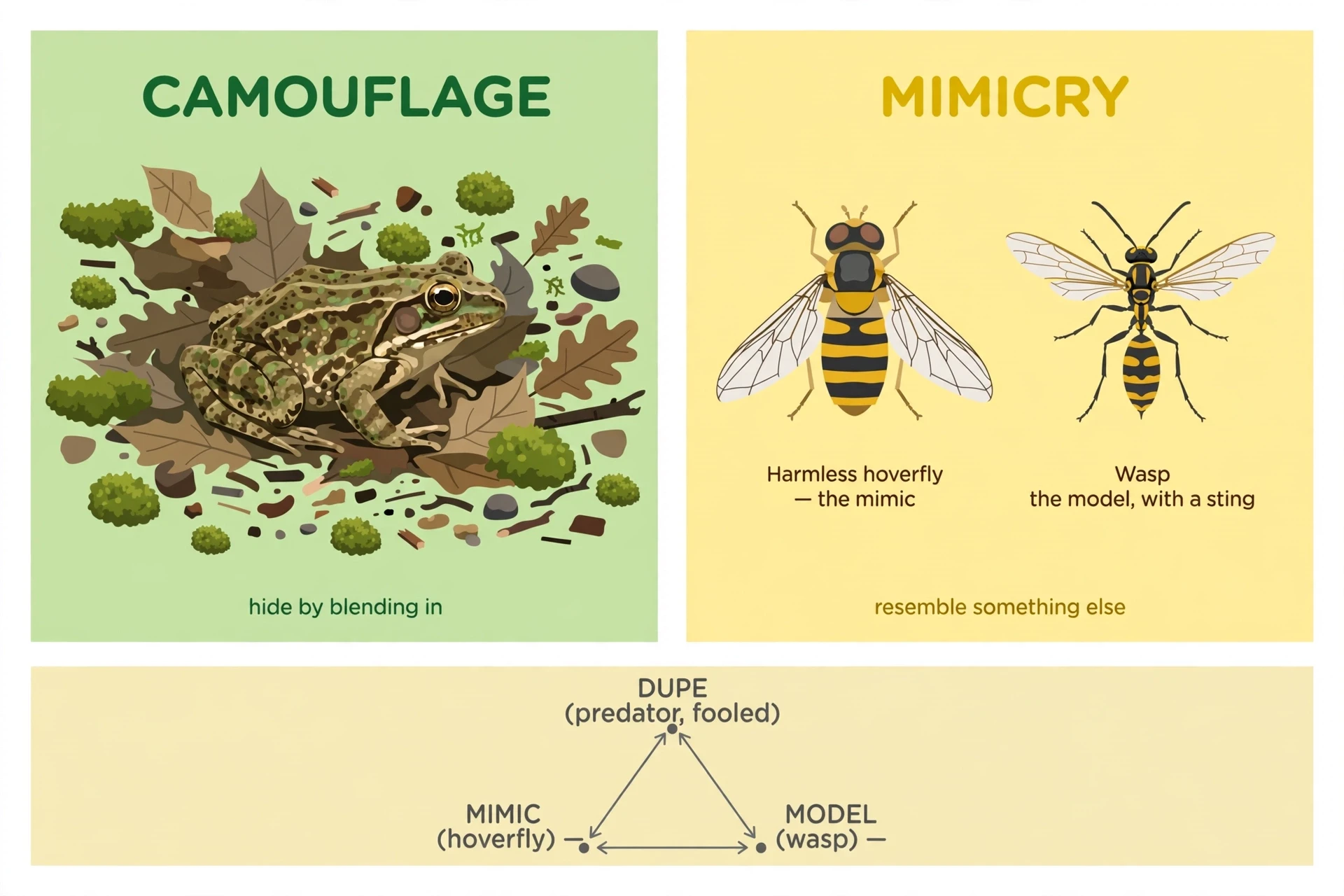
Camouflage and mimicry are two different kinds of deception: camouflage hides an animal by making it hard to detect against its background, while mimicry protects or helps an animal by making it resemble a different species — one that is dangerous, unpalatable or otherwise worth avoiding or approaching.
The difference is the target of the lie: camouflage deceives the viewer's eyes about where the animal is, and mimicry deceives the viewer's brain about what the animal is.
That distinction sounds neat, and in textbooks it usually is. In nature it is messier, which is part of what makes camouflage and mimicry so interesting. A leaf insect looks like a leaf — but it is not quite camouflage and not quite mimicry either. Biologists have a word for that in-between case, masquerade: resembling an inedible object, like a leaf, a stick or a stone, so that a predator does not even bother to investigate. The line between camouflage and mimicry is a gradient, not a fence, and the animals themselves do not care which side of it they fall on. What matters is whether the deception works.
It helps to think of every act of camouflage and mimicry as a triangle with three corners. There is the deceiver — the animal doing the hiding or pretending. There is the model — the thing being copied, whether that is a background, a dangerous species or an object. And there is the dupe — the animal being fooled, usually a predator, sometimes a prey animal, sometimes a host bird. Camouflage and mimicry only work if the dupe has something to learn from, or something to lose. A hoverfly's stripes only protect it because birds have been stung by real wasps. A coral snake's bands only protect a kingsnake because predators have learned that coral snakes are venomous. Without a dupe that can learn from experience — or that carries an innate aversion to the model's warning signals — there is no mimicry — only a pattern.
The language of camouflage and mimicry is worth learning early, because the same few words return again and again through this article:
Crypsis is the umbrella term for being hard to detect — the scientific name for hiding. Camouflage is crypsis by colour and pattern.
Aposematism is the opposite strategy: being loud and conspicuous about being dangerous. Poison dart frogs, monarch butterflies, skunks and coral snakes advertise their defences with bright, memorable colours, so that predators learn to leave them alone after one bad experience.
Batesian mimicry is when a harmless species copies the warning signals of a dangerous one, borrowing protection it has not earned.
Müllerian mimicry is when two or more dangerous species share the same warning signals, so that predators learn the lesson faster and all the mimics benefit.
Aggressive mimicry is when a predator or parasite copies something harmless — a lure, a flower, a helpful cleaner fish — to draw its victims close.
One more idea matters before we go further: camouflage and mimicry are not free. A camouflaged animal pays for its disguise in time, energy and opportunity. A moth that matches bark perfectly cannot also be bright enough to attract a mate. A cuttlefish that changes colour in a fraction of a second runs the machinery of its skin — work that is thought to carry an energy cost, though how large that cost is remains poorly measured. A viceroy butterfly that looks like a monarch cannot also look like something else. Evolution balances the costs of camouflage and mimicry against the benefit of not being eaten, and the balance shifts every time the environment changes — as the peppered moth discovered when the trees of England turned black with soot, and as the snowshoe hare is discovering now, as the snow has been arriving later.
Camouflage and mimicry also sit inside a much older story. The first animals with eyes appeared during the Cambrian explosion, and eyes changed everything: once animals could see, they could hunt by sight, and once they could hunt by sight, there was enormous value in not being seen — or in being seen as something else. The Cambrian seas filled with predators and prey in a burst of innovation, and the arms race that began there has been running ever since. You can read the early chapters of that arms race in our article on the Cambrian explosion, where the first eyes, the first claws and the first armour all appear within a few million years of each other. What follows here is the later chapters: the long refinement of camouflage and mimicry, the art of not being noticed, and of being noticed as the wrong thing.
3. The Camouflage Toolkit
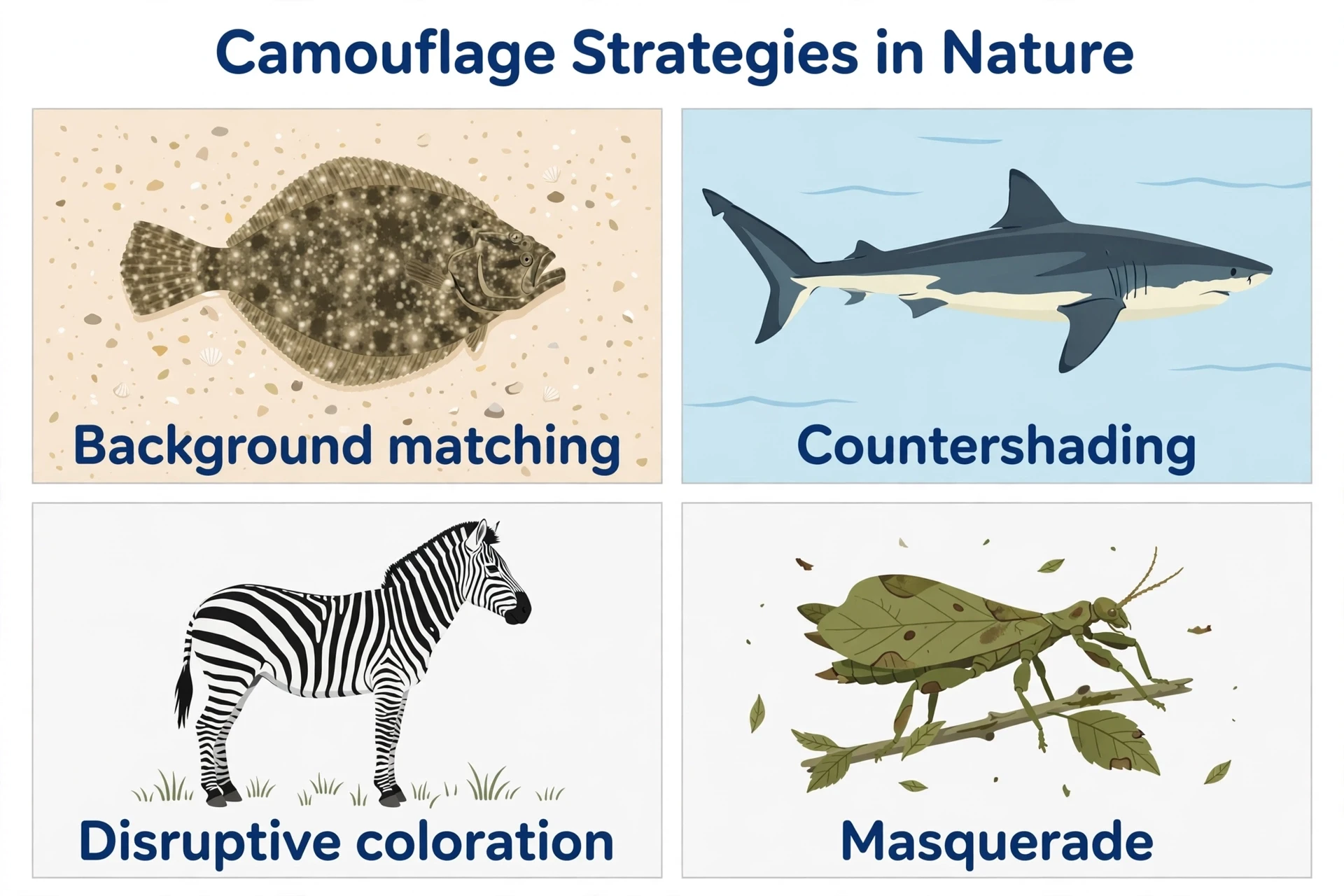
Camouflage works through three main mechanisms — background matching, countershading and disruptive coloration — plus masquerade, an in-between case in which the animal resembles a specific inedible object — and most camouflaged animals combine two or more of them, because a predator's eye uses several different cues at once.
These mechanisms are not rival theories; they are different tools in the same kit, and they can be mixed and matched.
Background Matching
Background matching is the simplest and the most familiar: be the same colour and pattern as the surface you rest on. A flounder on sand, a moth on bark, a green tree frog on a leaf. The animal becomes, to a scanning eye, a patch of the background itself. It works best when the animal can choose its resting place, and many camouflaged animals do exactly that, settling where their pattern fits and freezing when a predator is near. The trick fails the moment the background changes — which is why a brown moth on white bark is easy pickings, and why the peppered moth's story, in section 5, is so revealing.
Countershading
Countershading is subtler. Look at a shark, a penguin or a deer from the side: dark on top, pale underneath. This is not an accident of pigmentation. It is a solution to a problem of light. Sunlight comes from above, so the top of an animal is lit and the bottom is in shadow — and that contrast in brightness is one of the cues a predator's eye uses to recognise a solid, three-dimensional body. Countershading cancels the cue: the dark back absorbs the extra light from above, the pale belly reflects what little light reaches it from below, and the animal flattens, optically, into a two-dimensional shape that is much harder to pick out. It is one of the oldest camouflage tricks in the book — so old that it appears in fish, sharks, penguins, deer and even some caterpillars — and it works in water, on land and in the air.
Disruptive Coloration
Disruptive coloration attacks a different cue: the outline. A predator's eye is very good at finding edges, the boundary between an animal and its background. Bold, high-contrast patches of colour that cross the body's outline break that edge into pieces, so the eye sees fragments of pattern instead of a coherent animal shape. A zebra's stripes are the famous example — though their function is still argued about — and so are the bold black-and-white patches on a frog, or the dark band across a fish's eye, which hides the most recognisable part of the animal's face. The key insight is that disruptive patterns do not need to match the background at all. They need to break up the shape, and they can do that even in colours that stand out on their own.
Masquerade
Masquerade is the odd one out — a distinct in-between category, not purely camouflage. The animal does not try to match the background; it tries to look like a specific object in the background — a dead leaf, a twig, a stone, a bird dropping. The predator sees it perfectly well and dismisses it, because the object it resembles is not food. A leaf insect is not hiding; it is impersonating something inedible. The difference from background matching is the level of the lie: background matching says "there is nothing here", while masquerade says "there is something here, but it is not worth eating".
Combining the Tools
Animals rarely rely on a single mechanism. A stonefish matches the reef (background matching), breaks up its outline with warts and fringes (disruptive coloration), and resembles a lump of rock (masquerade, the in-between case) — all at once. A flounder matches the sand, flattens its body, and can change its pattern in seconds. The table below summarises the mechanisms of camouflage and the visual cue each one defeats.
Mechanism | What the animal does | Visual cue it defeats | Classic example |
|---|---|---|---|
Background matching | Matches the colour and pattern of the surface it rests on | Colour and brightness contrast | Flounder on sand; peppered moth on bark |
Countershading | Dark above, pale below, cancelling the shadow of its own body | Three-dimensional shading | Shark, penguin, deer |
Disruptive coloration | Bold patches that cross the body outline and break it up | Edges and outline shape | Zebra stripes (disruptive patterning is one proposed function; biting-fly deterrence is now the leading explanation); frog blotches; fish eye-bar |
Masquerade | Resembles a specific inedible object in the background | Recognition — the object is seen but dismissed | Leaf insect; stick insect; stonefish |
Transparency: The Fifth Mechanism
There is a fifth mechanism that deserves a mention, because it is the most radical of all: transparency. Some animals, especially in the open ocean, are almost entirely see-through. A glass eel, a comb jelly, a salp — these animals let light pass straight through them, so there is nothing for a predator's eye to catch at all. Transparency is camouflage taken to its logical extreme: instead of matching the background, the animal becomes the background. It is common in the deep sea and in the open ocean, where there is nowhere to hide, and it is one of the reasons the pelagic world is full of creatures that look like living glass.
Why the Tricks Work: Fooling the Visual System
Why do the mechanisms of camouflage work at all? The answer lies in how eyes and brains process a scene. A predator does not see a photograph; it sees a set of cues — edges, contrasts, movement, symmetry, shading — and its brain assembles those cues into a judgement: that is food, that is not food, that is dangerous. Camouflage and mimicry exploit the shortcuts in that assembly process. They are, in a real sense, hacks of another animal's visual system, and they work because the visual system is built to be fast, not perfect. Speed matters more than accuracy when you are hunting — and camouflage and mimicry take advantage of that trade-off every day. The evolution of the eye itself, and how it became such a powerful sense, is a story we tell in our article on the evolution of the eye.
4. The Painter Who Taught the Army to Hide
An American painter named Abbott Handerson Thayer gave camouflage its first general law — obliterative shading, what we now call countershading — and turned it into a system armies would later copy. He argued in 1896 that animals are coloured darkest where the sky lights them most, and his ideas later shaped military camouflage.
Thayer was not a biologist in the usual sense — he was an artist who painted portraits and landscapes — and that is exactly why he saw what the biologists had missed.
Thayer and Obliterative Shading
Thayer's insight began with a simple observation about light. He noticed that the animals he painted — ducks, deer, fish — were almost always darker on the parts of the body that faced the sky, and paler on the parts that faced the ground. A painter knows why: light comes from above, so the upper surfaces of any solid object are brighter than the lower ones, and the difference in brightness is what makes the object look three-dimensional. Thayer realised that animals had solved this problem in reverse. By being dark on top and pale underneath, they cancelled out the shading that would otherwise give their shape away. Thayer called it 'obliterative shading' — what we now call countershading — and in 1896 he published it in the journal The Auk under the title "The Law Which Underlies Protective Coloration". The paper's central sentence is worth quoting in full, because it is one of the clearest statements in the whole history of biology:
"Animals are painted by nature, darkest on those parts which tend to be most lighted by the sky's light, and vice versa."
That one sentence, Thayer argued, explained the colouring of most of the animal kingdom. In 1909, Gerald Thayer's book Concealing-Coloration in the Animal Kingdom, with an introductory essay by his father Abbott, expanded the idea. The book was lavishly illustrated with paintings — some of them, to modern eyes, absurdly over-enthusiastic, showing animals so perfectly hidden in their painted backgrounds that you could not find them at all. Thayer's enthusiasm ran ahead of his evidence in places: he claimed that even the bright colours of a peacock or a flamingo were camouflage, which they are not. But the core of his argument — countershading, disruptive coloration, and what he called "background picturing", the idea that an animal's pattern could imitate the details of its surroundings — was sound, and it has stood up to a century of testing.
Hugh Cott: Testing the Theory
The theory found its most rigorous champion in Hugh Cott, a British zoologist whose 1940 book Adaptive Coloration in Animals is still one of the great works on the subject. Cott was a field man who had spent years watching animals in Africa, and he tested Thayer's ideas with the patience of a naturalist and the rigour of an experimentalist. He showed that countershading really does make animals harder to see, that disruptive patterns really do break up outlines, and that the details of an animal's pattern often match the details of its habitat with astonishing precision. Cott also helped give the field its vocabulary: the Thayers' 1909 book introduced the term disruptive coloration, which Cott formalised, and he described what we now call masquerade as 'special resemblance to inedible objects'.
Dazzle Camouflage Goes to War
Thayer's ideas about camouflage did not stay in the library. When the First World War broke out, soldiers and sailors discovered, to their cost, that a ship painted in a single grey could stand out against sea and sky. Kerr proposed dazzle painting to Churchill in 1914 but was sidelined; Wilkinson developed his own system independently in 1917, and that system became dazzle camouflage: ships painted in bold, clashing geometric patterns, designed not to hide the vessel but to break up its outline and make its speed, direction and distance hard to judge. Thayer himself wrote to Churchill in February 1915, proposing countershaded submarines. The dazzle schemes looked absurd — sailors called them "razzle dazzle" — but later experiments tested the idea. A 2011 experiment found dazzle patterns can distort perceived speed by about 7% at high speed and short range — but the authors stress this is no evidence it disguised the speed of ships in the World Wars. The same visual trick that hides a frog from a heron can hide a ship from a submarine.
A Legacy in Uniform
The military took the lesson of camouflage and mimicry further. By the Second World War, disruptive patterning had influenced military camouflage, and by the end of the century, the digital pixel patterns on modern uniforms drew on the tradition Thayer had helped to start. The irony is neat: a theory of animal colour that began with an artist looking at ducks ended up shaping the look of armies around the world.
There is a lesson in Thayer's story that matters for the whole subject of camouflage and mimicry. The people who decoded these deceptions were not always the people you would expect. A painter saw the light. A zoologist in Africa saw the patterns. An artist at sea saw the geometry. The deceptions of nature are, at bottom, problems of vision — and vision is something that artists, soldiers and biologists all study, from different angles. The science of camouflage and mimicry is, and always has been, a meeting point between art and biology.
5. The Moth That Changed Colour With the City
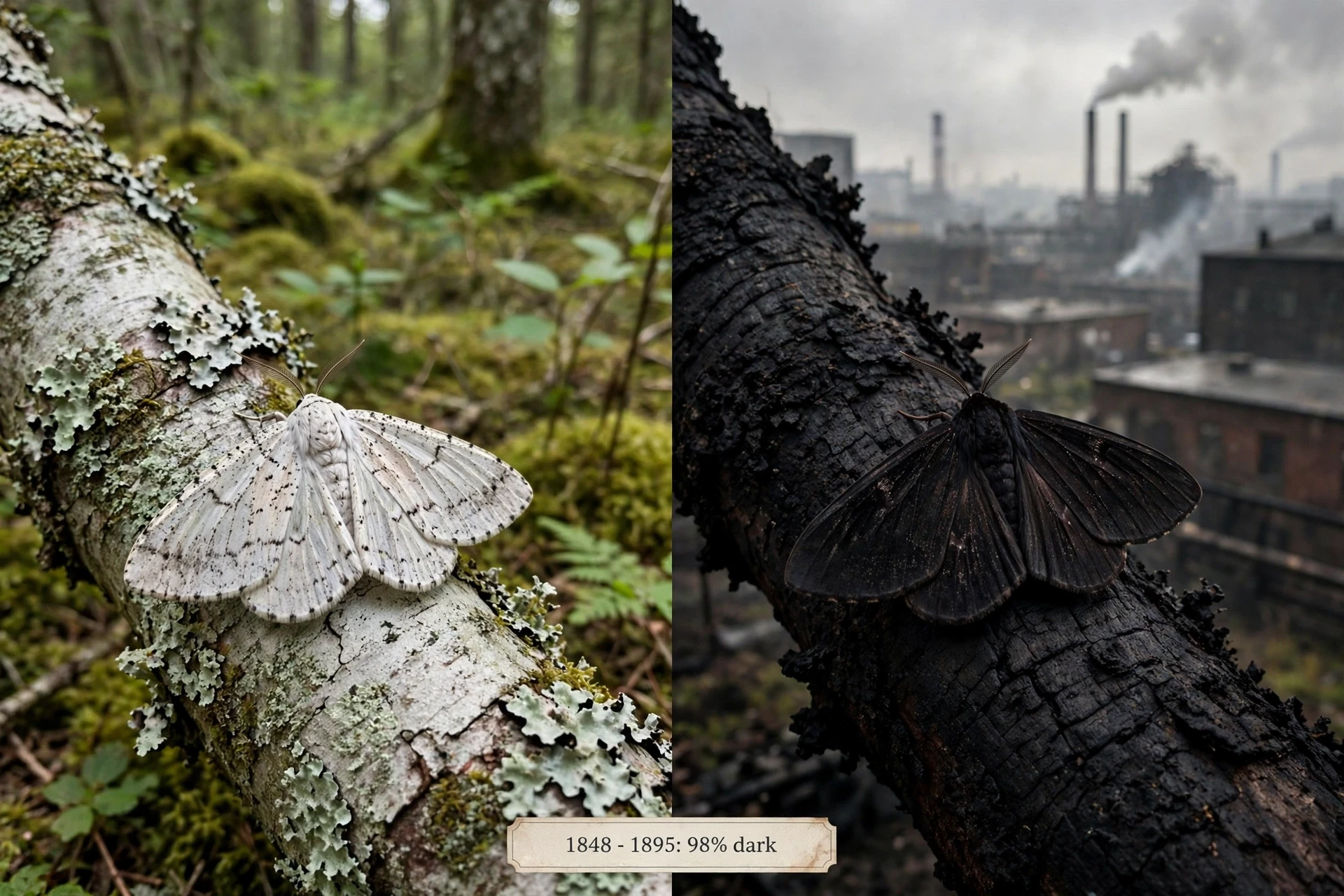
The peppered moth is the most famous example of camouflage and natural selection in action: a pale moth whose dark form — the allele present before 1848 — spread to 98% of the population in the most polluted areas around Manchester by 1895, as soot blackened the trees and birds ate the pale moths that no longer matched their bark.
It is the textbook case of evolution happening fast enough to watch — and of camouflage and mimicry in action — and it is also, as we will see, a story that has been told badly as often as it has been told well.
The peppered moth, Biston betularia, is a night-flying moth that spends its days resting on tree trunks and branches. In its normal, pale form, it is speckled white and black, like a scattering of pepper on a pale surface — hence the name. Against a lichen-covered tree trunk in a clean forest, it is almost invisible. The speckles break up its outline, and the pale background matches the lichen. It is a masterclass in background matching and disruptive coloration combined.
The Rise of the Dark Form
The first dark moth on record was collected by 1811; the first live Manchester specimen was caught by Edleston in 1848 and reported in 1864. It was almost entirely black — a form that came to be called carbonaria, from the Latin for charcoal. At the time, it was a curiosity, a single dark specimen in a drawer full of pale ones. But over the next fifty years, something extraordinary happened. In the industrial towns of northern England, where coal smoke blackened the trees and killed the pale lichens, the dark form spread with astonishing speed. By 1895, in the most polluted areas around Manchester, 98% of the peppered moths were dark. The pale form, which had been the norm for centuries, had become the rarity.
Tutt's Explanation: Birds Doing the Selecting
The explanation was proposed in 1896 by J. W. Tutt, a schoolteacher and amateur entomologist, who suggested that birds were eating the moths that did not match their resting places. In clean forests, pale moths matched pale lichen and survived, while dark moths stood out and were eaten. In soot-blackened forests, the tables turned: dark moths matched the blackened bark, and pale moths stood out like beacons. The moth's colour was a matter of life and death, decided every day by the eyes of hungry birds — and the population shifted, generation by generation, towards whichever form matched the trees.
Kettlewell's Experiments
Tutt's idea was tested in the 1950s by Bernard Kettlewell, a doctor turned lepidopterist who ran a series of elegant experiments between 1953 and 1956. Kettlewell released marked pale and dark moths in two places: a clean woodland in Dorset, and a polluted woodland near Birmingham. He then recaptured the survivors. In Dorset, the pale moths survived at about twice the rate of the dark ones. In Birmingham, the dark moths survived at more than twice the rate of the pale ones. The birds were doing the selecting, and the trees were setting the terms. Kettlewell's experiments were later criticised — his moths were released in daylight on tree trunks, while real peppered moths fly at night and rest by day, often higher up under branches — and later fieldwork found over a third of wild moths do rest on trunks — but the core result has been confirmed repeatedly by later studies.
The Genetics: A Single Change in cortex
The genetics of the change is now well understood. A single genetic change — a transposable element inserted into the first intron of the gene cortex around 1819 — is responsible for the dark form, and it spread through the population with extraordinary speed. The geneticist J. B. S. Haldane had already calculated, in 1924, that the dark form's fertility must have been about 50% greater than the pale form's — though his inputs (1% dark in 1848, 99% fifty generations later) differ from the figures in this article, and modern estimates put the advantage nearer 15–30%. That is selection with a sledgehammer.
Decline: The Dark Form Fades
I first saw a peppered moth the way most people do — in a museum drawer, a row of pinned specimens, pale and dark side by side. What struck me was not the difference between the two forms, which is obvious, but the fact that the drawer told a story about human history as much as about moths. The dark moths were a record of the Industrial Revolution, written in insect wings. Every dark moth in that drawer was a small, precise measurement of how much soot had been in the air in a particular year, in a particular town. When Britain cleaned up its air in the second half of the twentieth century — the Clean Air Acts, the decline of coal — the trees lightened, the lichens returned, and the dark form faded. By the early twenty-first century, pale moths were the majority again in most places. The moth's colour tracks the environment so faithfully that it is, in effect, a living instrument for measuring pollution — and a record of camouflage and mimicry in action. Few other animals wear their history so plainly.
What the Moth Teaches Us
The peppered moth matters for camouflage for a reason that goes beyond the textbook. It shows that camouflage is not a fixed property of an animal, but a relationship between an animal and its surroundings — and relationships can change. A moth whose camouflage is perfectly tuned to a lichen-covered tree is a sitting duck on a soot-blackened one. The same lesson is playing out today, in a different key, with the snowshoe hare of section 8, whose white winter coat is increasingly mismatched with a snowless ground. Camouflage is a bet on the environment staying the same, and when the environment changes faster than evolution can keep up, the bet is lost.
It also shows something about how natural selection actually works. The moth did not "decide" to turn dark, and no individual moth changed its own colour. What changed was the proportion of dark moths in the population, because dark moths survived and reproduced more often in the polluted woods. That is the mechanism Darwin described, and the peppered moth is one of the clearest demonstrations of camouflage and mimicry ever found. The moth's story connects directly to the foundations of evolutionary biology, which we explore in our article on natural selection.
6. The Quick-Change Artist
The cuttlefish changes colour in seconds using three layers of specialised skin cells — chromatophores that expand their pigment sacs to roughly five times their resting area, iridophores that reflect light, and leucophores that scatter white light — giving it one of the fastest and most versatile camouflage systems known in any animal.
If the peppered moth is camouflage on the timescale of generations, the cuttlefish is camouflage on the timescale of a blink.
Three layers of living screen
The common cuttlefish, Sepia officinalis, is a cephalopod — a relative of the octopus and squid — and it carries in its skin a piece of technology that human engineers are still trying to copy. Its skin is not one layer but three, stacked like the layers of a display screen, and each layer does a different job.
The top layer is made of chromatophores, tiny sacs of pigment — red, yellow and brown — each one ringed by muscles. When the muscles contract, the sac is pulled open like a tiny umbrella, and the pigment spreads out to cover roughly five times its resting area — a change of about 500% in surface area (Deravi et al. 2014). When the muscles relax, the sac snaps shut, and the colour vanishes. A cuttlefish can open and close thousands of these sacs independently, in milliseconds, painting and erasing patterns across its skin as fast as thought. It works a little like a television screen: small coloured units, switched on and off, combining into a picture.
Beneath the chromatophores sit the iridophores, cells containing stacked plates of the protein reflectin that reflect light, giving cuttlefish their metallic, iridescent sheen. And beneath those, at the bottom of the stack, are the leucophores, cells that scatter white light in all directions, providing a bright background that makes the colours above them pop — or, when the cuttlefish wants to be pale, a wash of white that matches a sandy seabed.
The three layers work together to produce a range of patterns that is, by the standards of the animal kingdom, almost absurd. A cuttlefish can match the texture of sand, the stripes of a rock, the speckles of coral, the dark blotches of seaweed. It can produce zebra stripes, leopard spots, checkerboards and ripples. It can show one pattern on one side of its body and a different one on the other — a trick that lets it match two different backgrounds at once, when it is sitting on the boundary between them. And it can do all of this in seconds. The chromatophore's inner workings were described in detail by Deravi and colleagues in 2014, in a paper in the Journal of the Royal Society Interface that has become the standard reference on cuttlefish skin.
One skin, two conversations
But the cuttlefish does not only use its skin to hide. It also uses it to communicate, and the two uses can conflict in fascinating ways. In the mourning cuttlefish, a male courting a female shows her his bold zebra display on one side of his body — while showing a female pattern to a rival male on the other side, so the rival does not see him as a competitor. He is, in effect, talking to two different animals at once, in two different visual languages. The same skin that hides him from a predator can also advertise him to a mate, and the cuttlefish's brain manages the trade-off in real time. This is the same tension between hiding and displaying that runs through the whole subject of camouflage and mimicry — and it is a close cousin of the trade-offs in sexual selection, where bright colours attract mates and attract predators at the same time, a story we tell in our article on sexual selection.
I have watched a cuttlefish change in an aquarium, and it is one of the few animal behaviours that genuinely looks like magic. The animal was sitting on a patch of gravel, mottled grey and brown, nearly invisible. A visitor's hand moved past the glass — not close, not threatening, just a movement — and a dark band rippled across the cuttlefish's back, from head to tail, like a wave passing through water. Then another. Then the whole animal went pale, then dark, then striped, then back to gravel-grey, all in the space of a few seconds. It was not frightened, as far as I could tell. It was thinking, in the way a cuttlefish thinks, about what it was looking at — and its skin was thinking along with it. The cuttlefish's skin is not a passive surface. It is an organ of perception, wired directly into the brain, and it changes as fast as the animal changes its mind.
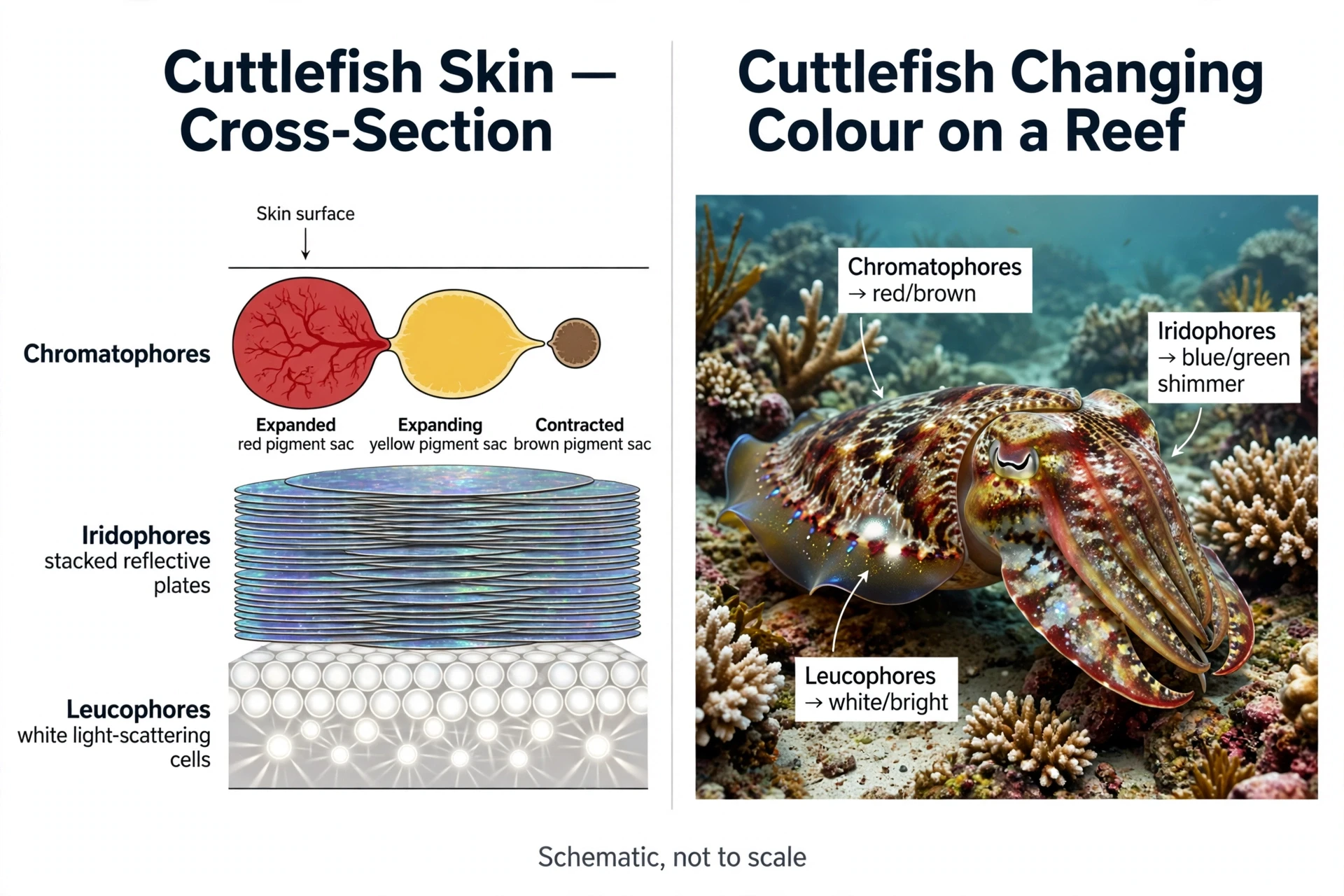
The cuttlefish's colour-change system is so good that engineers have spent years trying to copy it. In 2025, researchers at the University of Nebraska-Lincoln reported synthetic chromatophore skins — stretchable, colour-changing skins inspired by cephalopods — for soft robots and wearable devices (Watts et al. 2025, Advanced Materials, DOI 10.1002/adma.202505104). None of them yet matches the original. The cuttlefish does with muscle and pigment what our best technology does with electronics — and it does it faster, cheaper, and with no battery. There is a humility in that comparison that the whole field of biomimicry is built on: after hundreds of millions of years of refinement, the animals are usually ahead of us.
The colour-blind painter
One question the cuttlefish raises about camouflage and mimicry is worth pausing on, because it is a puzzle that has bothered researchers for years. Cuttlefish are colour-blind — or at least, they have only one type of light-sensitive pigment in their eyes, which means they cannot distinguish colours the way we do. And yet they match colours with extraordinary precision. How does an animal that cannot see colour produce a colour match? The answer, as far as anyone can tell, is that the cuttlefish does not need to see colour to match it. It matches brightness and pattern, and the colour comes along for the ride, because the pigments in its skin are tuned to the same wavelengths as the pigments in its environment. It is a reminder that camouflage and mimicry do not require the deceiver to understand the deception. The cuttlefish does not know what colour it is. It only knows what works.
7. The Chameleon Myth
Chameleons do not primarily change colour to hide — the most famous colour-changers in the animal kingdom change colour mainly to communicate with other chameleons and to control their body temperature, but camouflage is real too: they can match brightness and some hues to their background, even if it is not the main event.
This is the single most persistent myth in the whole subject of camouflage and mimicry, and it is worth taking apart carefully, because it shows how a good story can outrun the evidence for a century.
The myth is simple, and you have probably heard it since childhood: a chameleon sits on a green leaf and turns green; it moves to a brown branch and turns brown; it can match any background, like a living mood ring. The picture is vivid, and it is mostly wrong. Chameleons do change colour, and they do it dramatically and quickly — but the main reason they change is not the background. It is each other.
A social signal first
A chameleon's colour is, first and foremost, a social signal. When two male chameleons meet, they flare into bright, contrasting patterns — bands of green, yellow, orange and black — to size each other up. The brighter and more contrasting the display, the more dominant the animal is signalling itself to be. A subordinate male, by contrast, will go dark and dull, a visual white flag. In panther chameleons, a female ready to mate shows one set of colours; a female who is not interested shows another, often with bright spots that say, unmistakably, leave me alone. The chameleon is not hiding from the world. It is talking to it, in colour.
A thermostat second
The second reason chameleons change colour is temperature. A chameleon that is cold will darken its skin, absorbing more of the sun's heat; a chameleon that is too hot will lighten, reflecting the sun away. Dark colours absorb heat, light colours reflect it, and the chameleon uses that simple physics to regulate its body temperature — a trick that matters a great deal for a cold-blooded animal that cannot generate its own heat. The colour change is, in this case, a thermostat.
How the crystals work
The mechanism behind the colour change was only properly understood in 2015, when a team led by Michel Milinkovitch at the University of Geneva published a study in Nature Communications that finally explained how chameleons do it. The secret is in a layer of skin cells called iridophores, which contain tiny crystals of a substance called guanine, arranged in a regular lattice. When the chameleon is relaxed, the crystals sit close together and reflect blue and green light — the animal looks green. When the chameleon is excited, the spacing between the crystals increases, and the reflected light shifts towards yellow, orange and red. It is a tuneable mirror, built from nanocrystals, and it works on the same physics as the iridophores in a cuttlefish's skin — a remarkable case of convergent evolution, two unrelated animals arriving at the same optical trick. Panther chameleons also have a second, deeper layer of iridophores that reflects near-infrared light, which may give them passive protection from overheating. The fast colour-changing layer itself is fully developed only in adult males. The same skin that talks to other chameleons also manages their heat.
None of this means that chameleons do not camouflage at all. A chameleon at rest, undisturbed, is usually a mottled green or brown that blends well with leaves and branches, and it will shift its shade somewhat to match the light and the background. But the dramatic, rapid colour changes — the ones that made chameleons famous — are social and thermal, not cryptic.
What the 2025 study actually showed
A 2025 Biology Letters study on flap-necked chameleons found they can change colour for camouflage, within limits: they matched brightness on black backgrounds and hue on some colours, especially yellow, but did not match background patterns. Social signalling and temperature remain the main drivers of the dramatic, rapid shifts — but background matching is real, not a myth.
The chameleon is not a master of disguise. It is a master of display — and its display happens to be built from the same materials as camouflage.
Why does the myth about camouflage and mimicry persist? Partly because the true story is less intuitive. "An animal changes colour to hide" is a simple, satisfying explanation, and simple explanations are sticky. Partly because chameleons really are hard to spot in the wild — but that is mostly because they move slowly, sway gently like a leaf in the wind, and have eyes that swivel independently, scanning for danger while the body stays still. Their camouflage is behavioural as much as it is chromatic: they hide by being still, by being slow, by being shaped like a leaf. The colour is the least of it.
The chameleon myth is a useful warning for the whole subject of camouflage and mimicry. Camouflage and mimicry are easy to romanticise, and the romantic version is often wrong. The animals are not trying to be invisible, or to be perfect copies, or to fool us. They are trying to survive, and survival is a messy, practical business, full of trade-offs and compromises. The chameleon that turns bright red to warn off a rival is not hiding — it is shouting. And sometimes, shouting is the better survival strategy.
8. The Coat That Runs on Daylight
The snowshoe hare changes its coat from brown in summer to white in winter on a schedule set by day length, not by snow — and as the snow season shortens, the hare increasingly finds itself the wrong colour, a mismatch that cuts its weekly survival by up to 7% for every week it is out of step.
It is a story about camouflage and mimicry in which the deception is perfect, the timing is ancient, and the world has changed underneath it.
A clock set by daylight
The snowshoe hare, Lepus americanus, lives in the boreal forests of Canada, Alaska and the northern United States, and it performs one of the most dramatic wardrobe changes in the animal kingdom. Twice a year, it swaps its coat. In summer it is a rich brown, matching the forest floor, the leaf litter, the bark. In winter it is a brilliant white, matching the snow. The change is not a matter of the same hairs changing colour. The hare grows an entirely new coat, twice a year, and the new hairs are a different colour because the pigment-producing cells in the hair follicles have been switched off or on.
The trigger for the change is mainly day length, not temperature or snow. As autumn days grow shorter, photoreceptors in the hare's eyes detect the dwindling light and relay the signal to the pineal gland, a small structure deep in the brain. The pineal gland releases melatonin during the hours of darkness, and as the nights lengthen, more melatonin is released each night. That hormonal cascade eventually switches off pigment production in the growing hairs, and the new coat comes in white. The whole process takes about ten weeks, starting at the extremities — the ears and feet — and working inward across the body. By the time the first heavy snows arrive, the hare is fully white. In spring, lengthening days reverse the cascade, and the brown coat grows back.
When the snow stops keeping time
The seasonal moult worked well for thousands of years, because the snow arrived on schedule. But the snow no longer arrives on schedule. Across the hare's range, snow now arrives later and melts earlier, shortening the snow season (Mills et al. 2013, PNAS, DOI 10.1073/pnas.1222724110), while the hare's moult still runs on day length. Meanwhile, the fifteenth of November has exactly as many daylight hours as it did a century ago. The hare's clock has not changed. The weather has.
The result is camouflage mismatch: a white hare sitting on brown ground, or a brown hare against early snow, visible to every predator with functioning eyes. A study led by Marketa Zimova, published in Ecology Letters, followed radio-collared hares in Montana and measured the cost precisely. For every week a hare was mismatched, its weekly survival fell by up to 7% (3–7% depending on how mismatched it was). Spring and autumn are the transitional seasons when mismatch — and the survival cost — peaks. The hares were not doing anything wrong. They were following a cue that had been reliable for millennia, and the cue had stopped being reliable.
More than twenty species of birds and mammals in the far north turn white in winter — hares, foxes, weasels, ptarmigan, lemmings, grouse — and they all face the same problem. The mismatch is not a failure of camouflage and mimicry. It is a failure of timing, and timing is the one thing evolution cannot adjust quickly. A hare cannot decide to stay brown because the ground is bare. Its moulting is controlled by light, and the colour change follows. Only evolutionary change — a shift in the timing of the moult, or a change in the cue that triggers it — can fix the problem, and evolutionary change takes generations. The snow is changing in decades.
The brown-winter gene
There is a small twist in the story that shows how evolution might, eventually, find a way. Not all snowshoe hares turn white. In milder areas along the Pacific coast, in parts of Washington state, many hares keep their brown coats all winter. The difference comes from a single gene, called Agouti, and the brown-winter version of that gene did not originally come from snowshoe hares at all. It arrived long ago from black-tailed jackrabbits, through hybridisation, and spread among hares living where winters are short and snow is light. It is a reminder that evolution has more tools than slow mutation: genes can move between species, and when they do, they can spread fast. Whether the brown-winter gene will spread further as the snow season shortens is one of the open questions in the field — and one of the reasons researchers are watching these hares so closely.
The snowshoe hare's story is a warning about camouflage and mimicry: what happens when the environment changes faster than the animals in it can adapt. Camouflage and mimicry are exquisitely tuned to the world they evolved in, and that tuning is also a vulnerability. The peppered moth's trees changed colour in fifty years. The hare's snow is disappearing in decades. The deceptions that kept these animals alive for thousands of years are now, in some places, the things that get them killed. The arms race between predator and prey has always been a race against a changing world — but the world has never changed this fast before. The hare's habitat, and the boreal forest it depends on, is part of the wider web of living systems we describe in our article on ecosystems.
9. Batesian Mimicry: The Honest Bluff
Batesian mimicry is the trick at the heart of camouflage and mimicry: a harmless species copying the warning signals of a dangerous one, named after the English naturalist Henry Walter Bates, who first described it in 1862 after eleven years in the Amazon watching butterflies that looked dangerous but were not.
It is the best-known form of mimicry, and one of the easiest to understand — because it is, at heart, a bluff.
Eleven years in the Amazon
Bates was twenty-three years old when he sailed for the Amazon in 1848, with his friend Alfred Russel Wallace. He stayed for eleven years, collecting insects, birds and plants, and living for long stretches in the forest with almost no contact with the outside world. He returned to England in 1859 with a collection of more than fourteen thousand species, some eight thousand of them new to science. Among them were butterflies that puzzled him deeply. He kept finding butterflies that looked exactly like the brightly coloured, foul-tasting heliconiines — slow-flying, conspicuous butterflies in orange, red, black, white and yellow — but that belonged to entirely different families, and that were, when he examined them, palatable.
On 21 November 1861, Bates read a paper to the Linnean Society of London that explained the puzzle. The edible butterflies, he argued, were mimics. They had evolved to look like the toxic Heliconius because predators that had tasted a Heliconius once would avoid anything that looked like it. The mimic did not need to be poisonous. It only needed to look poisonous, and the predator's memory would do the rest. The paper was published in 1862 as "Contributions to an Insect Fauna of the Amazon Valley", and it is one of the founding documents of evolutionary biology — a paper that Darwin himself praised, and that explained, in a single stroke, why so many unrelated butterflies in the Amazon looked the same.
Bates described the experience of being fooled himself, and his description is worth quoting, because it captures the moment a naturalist realises that nature is lying to him:
"I was never able to distinguish the Leptalides from the species they imitated, although they belong to a family totally different in structure and metamorphosis from the Heliconidae, without examining them closely after capture."
The Leptalis butterflies he was describing are now classified in the genus Dismorphia, and they are still the classic textbook example of Batesian mimicry: white and yellow butterflies that copy the patterns of toxic species so closely that even an expert, in the field, cannot tell them apart on the wing. The mimicry extends beyond colour. The mimics copy the model's flight — slow, fluttering, unhurried, the flight of an animal that has nothing to fear — and some even copy the model's shape, its wing outline, its resting posture. The deception is good enough, because the predator's decision is made in a fraction of a second, on the wing, and the mimic only needs to be good enough to pass that test.
Why the bluff only works sometimes
The logic of this kind of mimicry is simple, but it has a catch. The bluff only works if the mimic is rarer than the model. If there are too many harmless mimics and too few genuinely dangerous models, predators will learn that the warning signal is unreliable — they will eat the mimics, find them tasty, and start eating the models too. The system depends on the model being common enough to teach the lesson, and the mimic being rare enough not to undermine it. This is why Batesian mimics are usually less abundant than their models, and why the mimicry is often imperfect: a mimic that is good enough to fool a predator at a glance does not need to be perfect, and perfection costs energy that could be spent elsewhere.
Why some mimics are sloppy
That imperfection is itself a puzzle that has kept researchers busy for decades. Why are some mimics superb copies and others sloppy ones? The hoverfly is the classic case. Hoverflies are harmless flies, members of the family Syrphidae, that mimic bees and wasps with black and yellow stripes. Some of them are beautiful mimics, almost indistinguishable from a wasp at a glance. Others are poor copies — the stripes are the wrong shade, or the wrong width, or in the wrong place. A study published in 2021 by Leavey and colleagues, in the journal Evolution, measured the abdominal patterns of 167 hoverfly species against the German wasp, Vespula germanica, and found that good wasp mimicry has evolved several times independently, and has also been lost — there are non-mimics sitting deep inside groups of good mimics. Body size mattered: smaller species were poorer mimics, perhaps because a small fly is not worth a predator's time anyway, or because the predator's eye cannot resolve the pattern at that size. And species that emerge only once a year were poorer mimics than species that emerge several times, perhaps because they have fewer generations for selection to work on. The variation is a reminder that mimicry is not a single solution but a spectrum, and where an animal sits on that spectrum depends on its size, its habits, its predators and its history.
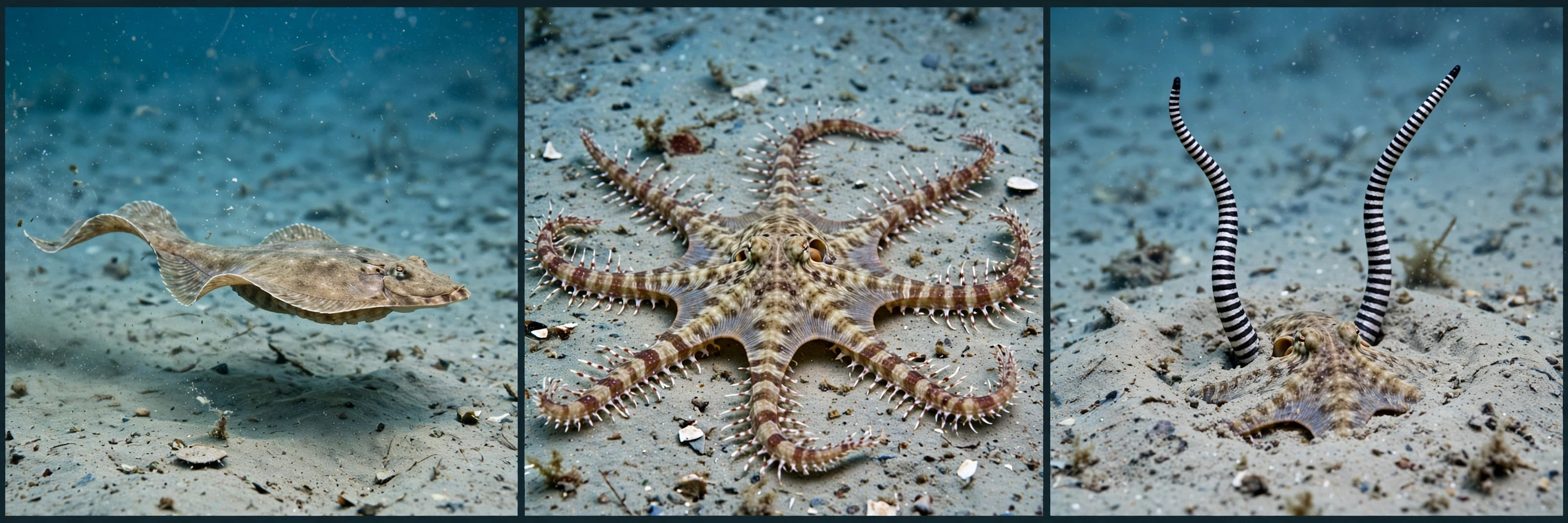
The hoverfly's story also returns us to the garden where this article on camouflage and mimicry began. There are about six thousand species of hoverflies in the world, and many of them mimic bees or wasps in one form or another. They are harmless — they cannot sting, they have only one pair of wings where wasps have two, and their antennae are short where a wasp's are long — but a bird does not count wings or measure antennae. It sees black and yellow, remembers a sting, and moves on. The hoverfly's stripes are a lie told in the language of pain, and they have been working for millions of years. The second pair in the figure above, the snakes, is explained in §10.
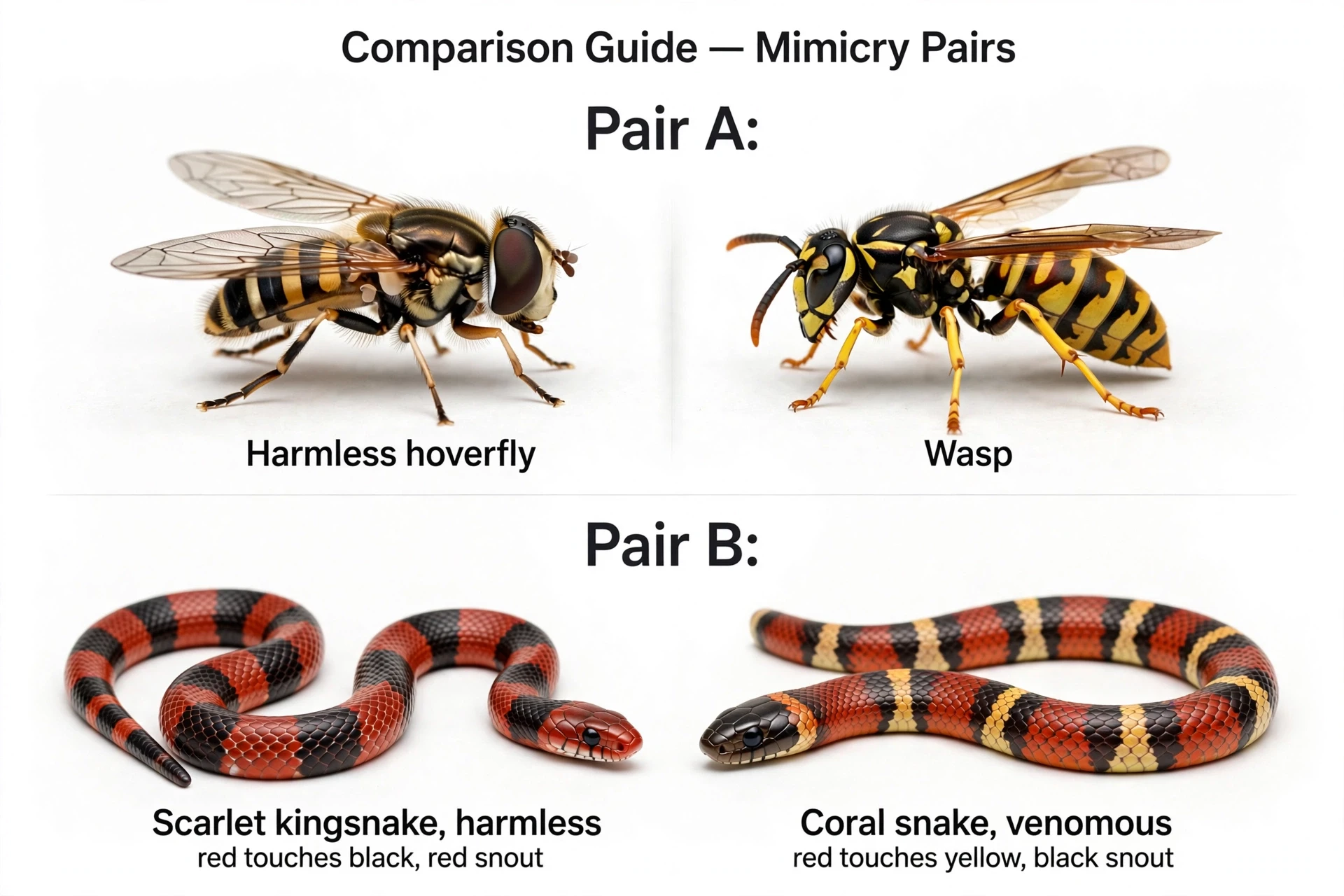
10. The Snake Rhyme
The scarlet kingsnake copies the venomous coral snake so closely that people use a rhyme to tell them apart — "red touches yellow, kill a fellow; red touches black, friend of Jack" — but the rhyme only works for the standard snakes of the United States, and it fails outside the US, where coral snakes come in many other patterns.
The snake rhyme is a useful field guide and a cautionary tale at the same time.
The rhyme and the field marks
The eastern coral snake, Micrurus fulvius, is a small, slender, brightly banded snake found in the south-eastern United States. Its bands run red, yellow and black, in that order, so that the red bands touch the yellow bands. It is venomous — its venom is a potent neurotoxin — but it is also shy, secretive and reluctant to bite, and it spends most of its life hidden under leaf litter and logs. The scarlet kingsnake, Lampropeltis elapsoides, is a harmless constrictor that lives in the same forests, eats the same lizards and small snakes, and wears almost the same bands — except that in the kingsnake, the red bands touch the black bands, not the yellow. The kingsnake also has a red snout, where the coral snake's snout is black. These are the field marks, and the rhyme encodes them in a memorable line.
The kingsnake's disguise is a classic case of Batesian mimicry — one of the best-known examples in snakes. The coral snake's bands are aposematic — a warning signal, bright and memorable, that teaches predators to stay away. The kingsnake copies the signal and gains the protection without paying the cost of making venom. The mimicry works because the coral snake is common enough, in the parts of its range where the mimicry is strongest, to teach predators the lesson.
Where the copy is sharpest
But the system has a revealing wrinkle. Research by David Pfennig and his colleagues has shown that the kingsnake's mimicry is most precise at the edge of the coral snake's range, where coral snakes are rare — there, only good mimics escape predators — while in the heart of the range, where coral snakes are common, even sloppy mimics are avoided. Beyond the model's range altogether, where no predator education maintains it, the mimicry drifts and fades. The pattern is a map of selection pressure: where the danger is real, the copy is sharp; where the danger is absent, the copy fades. It is a clear demonstration that predator behaviour helps maintain mimicry.
Do not trust the rhyme
The rhyme itself deserves a warning. It works for the standard coral snakes of the United States, but it fails in the tropics, where coral snakes come in many patterns — some with red touching black, some with no red at all — and it fails for unusual individuals, including melanistic and albino snakes that do not follow the usual banding. No rhyme is a substitute for leaving a small, brightly banded snake alone. The safest rule, and the one that every herpetologist will give you, is simple: if you cannot identify a snake with certainty, do not touch it.
The snake rhyme also illustrates something important about how camouflage and mimicry are learned. Many predators that avoid coral snakes are not born knowing the pattern. Some predators learn the pattern from encounters with harmless mimics or mildly venomous relatives — and some birds avoid coral-snake patterns innately, with no learning at all, which is just as well: a predator that bit a real coral snake would be unlikely to survive the lesson. The mimicry exploits a learned association, and learned associations can be unlearned. If a predator eats a kingsnake and finds it harmless, it may become bolder about banded snakes in general, and the mimicry weakens. The whole system is a dynamic balance between the model's danger, the mimic's abundance, and the predator's memory — a balance that shifts with every encounter.
The coral snake and the kingsnake are not the only snakes in this game. The harmless milk snakes of the Lampropeltis triangulum complex — now split by many authorities into several species — copy coral snakes across a huge range in the Americas, and the harmless hognose snake flattens its neck and hisses like a cobra when threatened — a piece of behavioural mimicry that has nothing to do with colour at all. Snakes, it turns out, are enthusiastic practitioners of camouflage and mimicry, and their mimicry is a reminder that the deception can be in the behaviour as much as in the pattern. A snake that acts dangerous is, for a predator making a split-second decision, as good as a snake that is dangerous.
11. The Butterfly That Fooled Science
The viceroy butterfly was the textbook example of Batesian mimicry for more than a century — a harmless butterfly copying the toxic monarch — until 1991 experiments showed that viceroys are unpalatable too, and that, in the Florida populations tested, the viceroy and the monarch are Müllerian co-mimics sharing the same warning signal — though the relationship varies by place.
It is one of the great reversals in the history of biology, and it is a warning about how long a good story can outlive the evidence.
The story of camouflage and mimicry, as it was told for most of the twentieth century, went like this. The monarch butterfly, Danaus plexippus, is toxic. Its caterpillars feed on milkweed and sequester the plant's bitter, heart-affecting chemicals — cardenolides — in their bodies, and the adult butterfly carries the poison with it. A bird that eats a monarch gets sick, vomits, and remembers the orange and black wings. The viceroy, Limenitis archippus, looks almost identical to the monarch — same orange wings, same black veins, same slow, confident flight — but it was supposed to be harmless. Its caterpillars feed on willows, poplars and cottonwoods, plants with no cardenolides, and the adult was assumed to be perfectly edible. The viceroy was the classic Batesian mimic: a fraud, borrowing the monarch's warning colours without paying for the poison.
The story was neat, it was memorable, and it appeared in every textbook. It was also wrong — or at least, it was wrong in the way that mattered most.
The reversal came in 1991, when David Ritland and Lincoln Brower published a short paper in Nature that upended the textbook. They offered viceroys, monarchs and queens — a third, related butterfly — to red-winged blackbirds, and watched what happened. The birds found the viceroys as unpalatable as the monarchs. In Ritland's 1991 feeding trials with red-winged blackbirds, only 40% of viceroy abdomens were eaten, against 98% of palatable control butterflies and 65% of queens; nearly a third of viceroys were rejected after a single peck, against 14% of queens. The viceroy was not a harmless fraud. It was a defended butterfly in its own right, and its defence came from a different source: its caterpillars sequester aspirin-like phenolic glycosides — salicin and related compounds — from the willows and poplars they feed on. The viceroy's poison is different from the monarch's, but in the tested populations it worked just as well.
Telling them apart
I remember the first time I held a viceroy and a monarch side by side in a museum drawer, turning them over in the light, looking for the difference I had been told was there. The difference is small and easy to miss if you do not know where to look: the viceroy carries an extra black band across its hindwing, a line that crosses the orange like a seam. The monarch has no such band. That one small mark is the most reliable field character, and it is the kind of detail that makes you appreciate how much of biology is learned by looking closely — and how easy it is to be fooled by a resemblance that is real but means something different from what you assumed.
The viceroy's story does not end with the 1991 paper. Brower himself suspected that the viceroy had become a Müllerian mimic only recently — perhaps as little as ten thousand years ago. Before that, the viceroy may well have been a genuine Batesian mimic, a harmless copy that later evolved its own defence and graduated, in evolutionary terms, from fraud to partner. The line between Batesian and Müllerian mimicry is not fixed. A species can cross it, in either direction, as its defences and its neighbours change. The viceroy is the proof.
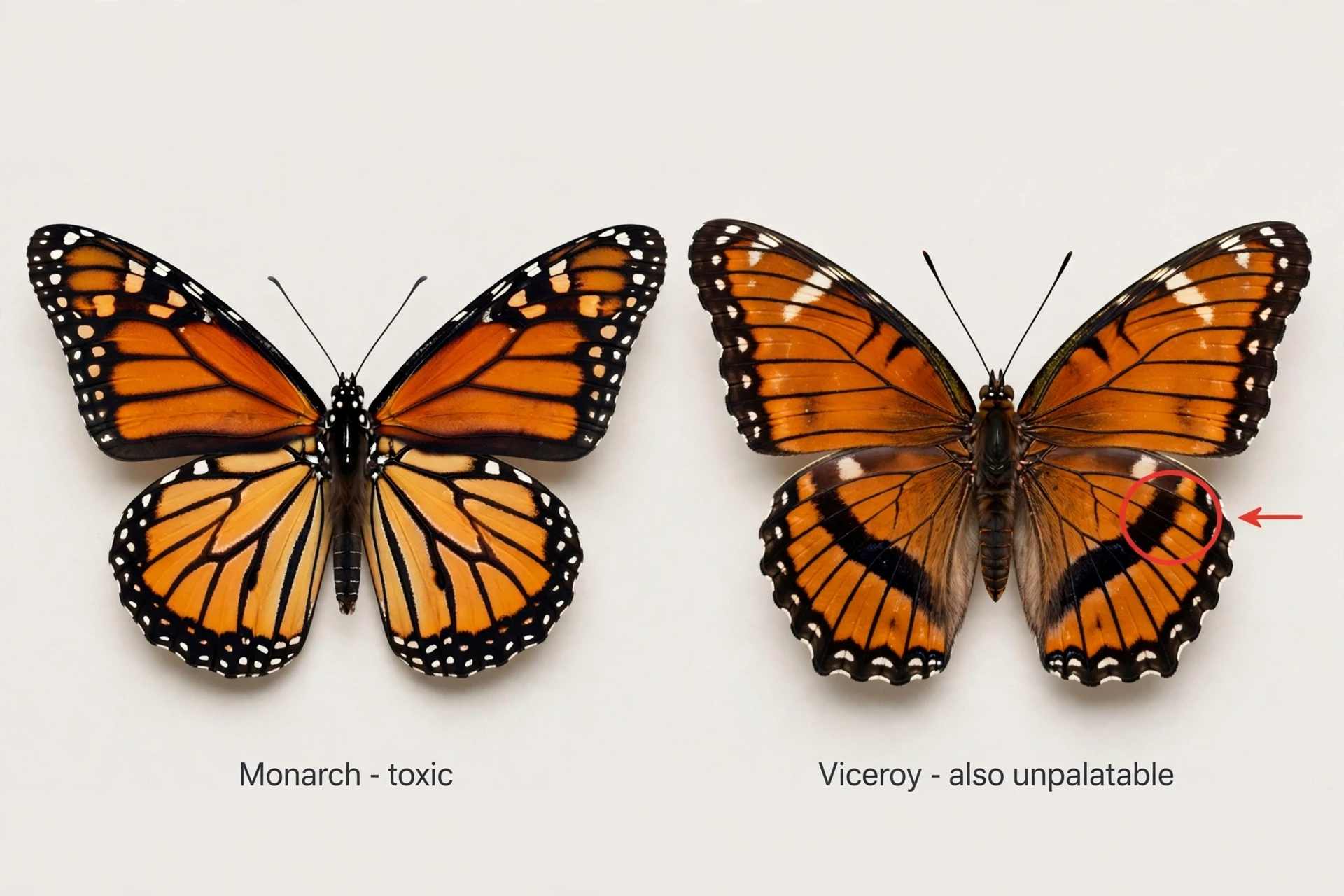
The lesson of the viceroy is not that the textbooks were foolish. They were working with the best evidence available, and the mimicry hypothesis was, on the evidence of the time, the most reasonable explanation. The lesson is that a good explanation can be wrong in a way that takes a century to notice, because nobody thinks to test the assumption at its heart. The assumption was that the viceroy was edible. Earlier feeding trials in the 1950s had found viceroys palatable — which is why the textbooks were so confident. Ritland and Brower re-tested the question with Florida butterflies, and the result flipped, and the whole edifice shifted. It is a reminder, for anyone studying camouflage and mimicry, that in science the most dangerous sentence is not "we don't know". It is "everybody knows".
12. Müllerian Mimicry: Safety in Numbers
Müllerian mimicry is the sharing of a warning signal between two or more defended species, first explained by the German-Brazilian naturalist Fritz Müller in 1878 and 1879, who showed with the first mathematical model of mimicry that when toxic species look alike, predators learn the warning faster and all the mimics benefit.
Where Batesian mimicry is a fraud, Müllerian mimicry is a partnership — and it is one of the most elegant ideas in evolutionary biology.
Fritz Müller (1821–1897) was a German naturalist who emigrated to Brazil, where he spent decades studying the insects of the Atlantic forest. Like Bates, he was struck by the butterflies: unrelated species, in different families, wearing the same bright patterns. But Müller noticed something Bates had not emphasised. The species that shared patterns were not harmless copies of toxic models. They were, many of them, toxic themselves. And that, Müller realised, changed the logic entirely.
His argument, published first as a short note in 1878 in the Zoologischer Anzeiger and then as a longer paper in 1879 in the journal Kosmos, was the first mathematical model in the history of mimicry — and one of the first mathematical models in evolutionary biology at all. It ran like this. Suppose two toxic butterfly species each have their own warning pattern. A young, naive predator must taste members of each species before it learns to avoid them — and every tasting is a dead butterfly. If the two species share a single pattern, the predator only needs to learn once, and the total number of butterflies sacrificed to teach the lesson is cut in half. Both species benefit, because the cost of educating predators is shared. The more species that join the ring, the cheaper the education becomes for each of them.
The logic is simple, and it is powerful. It predicts that toxic species in the same area should converge on shared warning patterns — that they should, over time, come to look like each other — and that is exactly what we see. The most famous example is the Heliconius butterflies of Central and South America. Dozens of species, in several genera, share a small number of warning patterns: red and black bands, yellow stripes, orange patches on a dark ground. The patterns form what biologists call mimicry rings — groups of species, often unrelated, that share a single warning signal in a single place. A predator that learns to avoid one member of the ring avoids them all, and the ring's members, by sharing the cost of the predator's education, all survive better than they would alone.
The rings are not static. They shift across geography, because different places have different combinations of species, and the patterns change at the boundaries where one ring meets another. A Heliconius butterfly in one valley may wear a different pattern from the same species in the next, because the local ring is different — the patterns change at hybrid zones where one ring meets another. The genetics of the patterns is now partly understood: a small number of major genes, including one called Optix, control the red wing patterns, and the same genetic toolkit has been reused, again and again, by different species — sometimes passed between species by rare hybridisation. It is convergent evolution at the level of the gene, and it is a close cousin of the broader story of unrelated species arriving at the same solutions, which we explore in our article on convergent evolution.
Müller's model was tested in the field in 2001, in an experiment that has become a classic. Durrell Kapan released Heliconius cydno butterflies in two forms — one matching the local mimicry ring, one not — and watched which ones the predators attacked. The butterflies that matched the local pattern survived far better than the ones that did not. The experiment, published in Nature, confirmed what Müller's mathematics had predicted more than a century earlier: sharing a warning signal saves lives, and the saving is measurable in the field.
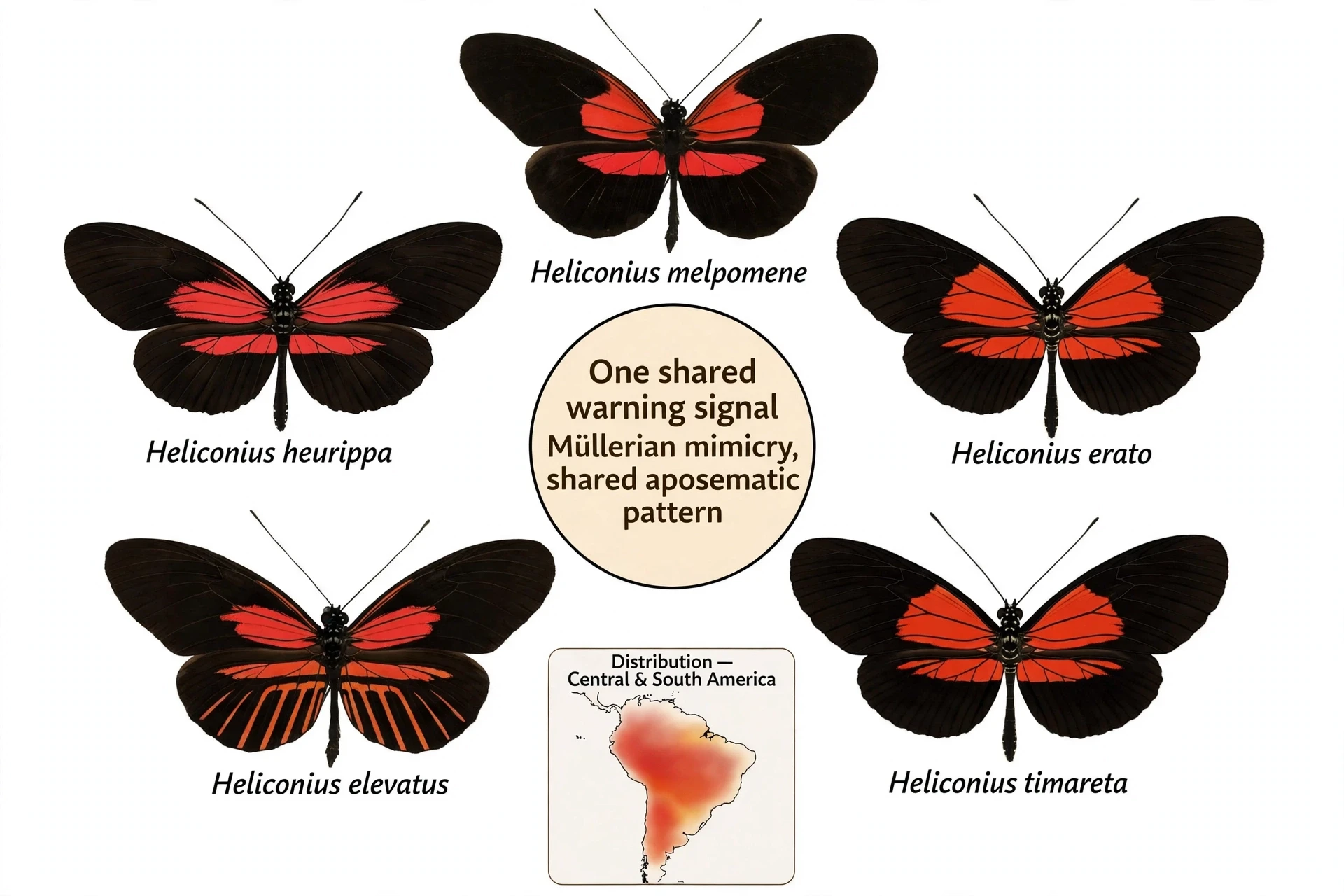
This form of mimicry is not confined to butterflies. It appears in bees and wasps, in poison dart frogs, in venomous snakes, in the bright warning colours of ladybirds and the black-and-yellow bands of bumblebees. Wherever several defended species live side by side, there is an advantage in sharing a signal, and evolution, given enough time, usually finds it. The result is a landscape of warning colours that is, in a sense, a shared language of warning signals — spoken by many species, understood by their predators, and maintained by the simple economics of education. It costs a predator one bad experience to learn a pattern. It costs a butterfly its life to teach it. Sharing the lesson is, quite literally, a matter of life and death.
13. Aggressive Mimicry I: The Lure
Aggressive mimicry turns the logic of mimicry upside down: instead of a harmless animal pretending to be dangerous, a predator pretends to be something harmless — a light, a flower, a piece of food — so that its prey comes to it.
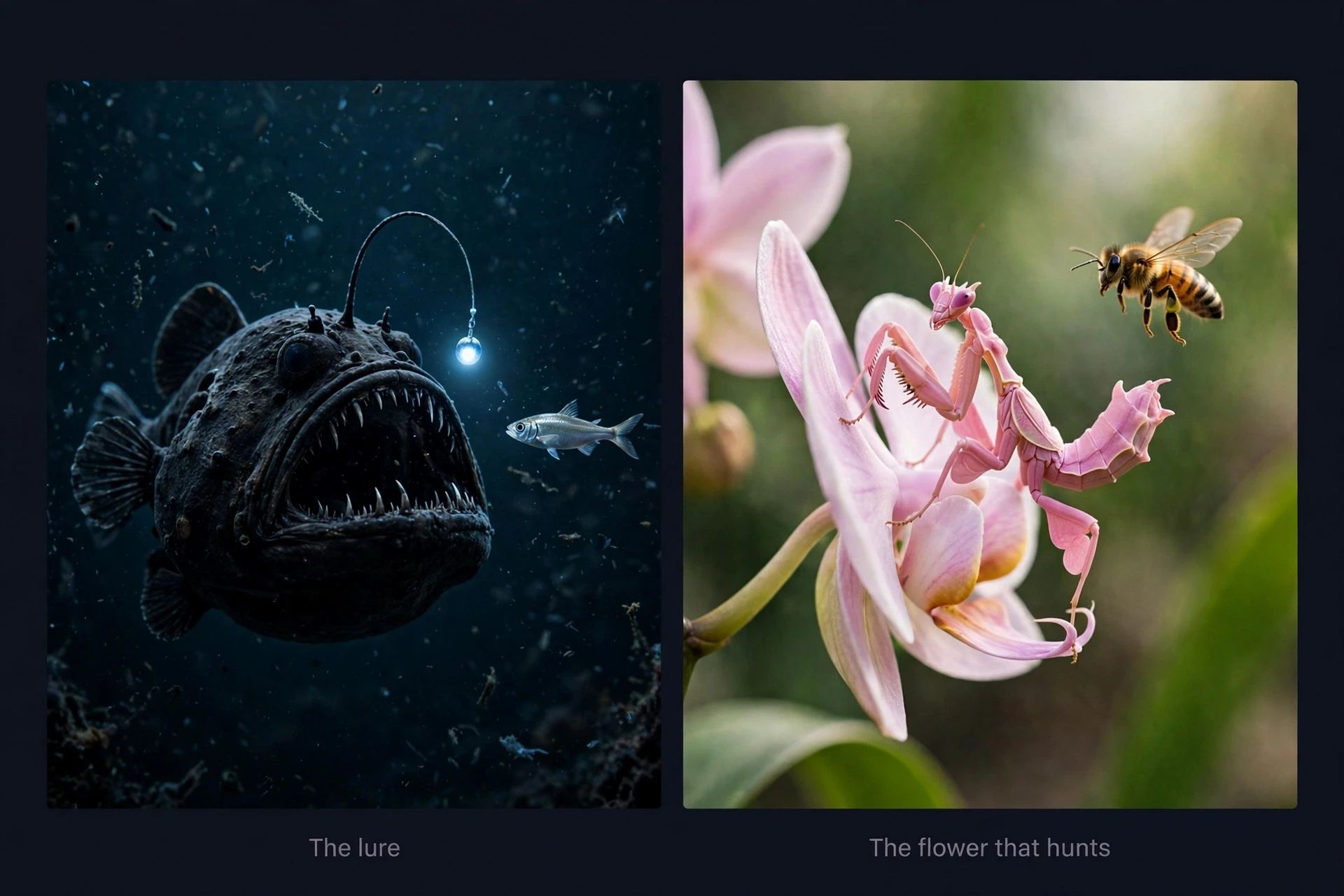
The anglerfish is the most famous example, and its lure is one of the strangest organs in the animal kingdom.
The lure
Below about two hundred metres the sunlight fades to a dim twilight, and below about a thousand metres it vanishes altogether. The deep-sea anglerfish lives in that midnight zone, a thousand metres down and more, where food is scarce and a meal can be a long time coming. In that darkness, the anglerfish fishes. It carries, on the end of a modified dorsal spine — the first ray of its dorsal fin, lengthened and turned into a fishing rod called the illicium — a small, fleshy bulb called the esca. The esca glows. It glows because it is packed with bioluminescent bacteria of the genus Enterovibrio, acquired from the surrounding seawater, which produce light through a chemical reaction in which the enzyme luciferase oxidises a light-emitting substrate. The fish and the bacteria live in symbiosis: the fish provides the bacteria with nutrients and a home, and the bacteria provide the fish with light. The partnership is so close that the fish cannot glow without its bacteria, which live sheltered and fed inside the lure — a story of cooperation between species that belongs to the wider world of symbiosis, which we explore in our article on symbiosis.
The anglerfish dangles its glowing lure in front of its jaws and waits. In the darkness, the light is the only thing a small fish can see, and small fish are thought to be drawn to light — to investigate it, to feed near it, to shelter beside it — though the attraction itself has only ever been inferred, never directly observed in the deep sea. When a curious fish swims close enough, the anglerfish opens its mouth, and the suction of that opening pulls the prey in before it can react. The anglerfish's jaws are hinged to open enormously, and its stomach can expand to take prey up to twice its own size. It is a sit-and-wait predator that has outsourced the work of finding food to the food itself.
The male's bargain
Only the females carry the lure. The males are tiny — in some species, a fraction of the female's size — and they do not hunt at all. In some deep-sea species, a male anglerfish's whole life is a search for a female, and when he finds one he bites her and fuses to her body, becoming a permanent, parasitic appendage that supplies sperm for the rest of her life. In other species the males attach only temporarily, or never attach at all. It is one of the most extreme cases of sexual dimorphism in the animal kingdom, and it is a reminder that the deep sea is a place where the ordinary rules of biology are stretched to their limits.
Other anglers
The anglerfish is not the only predator that fishes with a false promise — camouflage and mimicry offer the same trick to many hunters. The frogfish, a relative that lives on shallow reefs, dangles a lure shaped like a small worm or a shrimp, and twitches it to imitate the movements of prey. The alligator snapping turtle of North America has a worm-shaped lure on its tongue, which it wiggles with its mouth open, waiting for a fish to swim in and investigate. Its lure is so convincing that fish will peck at it. The trick is the same in every case: the predator offers the prey something it wants — light, food, a worm — and the prey's own instincts do the rest.
What makes this form of mimicry so effective is that it exploits the prey's desires rather than its fears. A Batesian mimic says, in effect, I am dangerous, stay away. An aggressive mimic says I am food, come closer — or I am a light, come and see. The deception works because the prey is not being careful. It is being curious, or hungry, or hopeful. And curiosity, in the dark, is a dangerous thing.
14. Aggressive Mimicry II: The Flower and the Cleaner
The orchid mantis poses as a flower to lure pollinators within reach, and experiments published in 2014 showed that it attracts pollinators at a higher rate than real flowers do — while the false cleanerfish copies a helpful cleaner wrasse so convincingly that other fish pose for it, and then bites them.
Two very different animals, one on land and one on the reef, have arrived at the same strategy: impersonate something useful, and let the victims come to you.
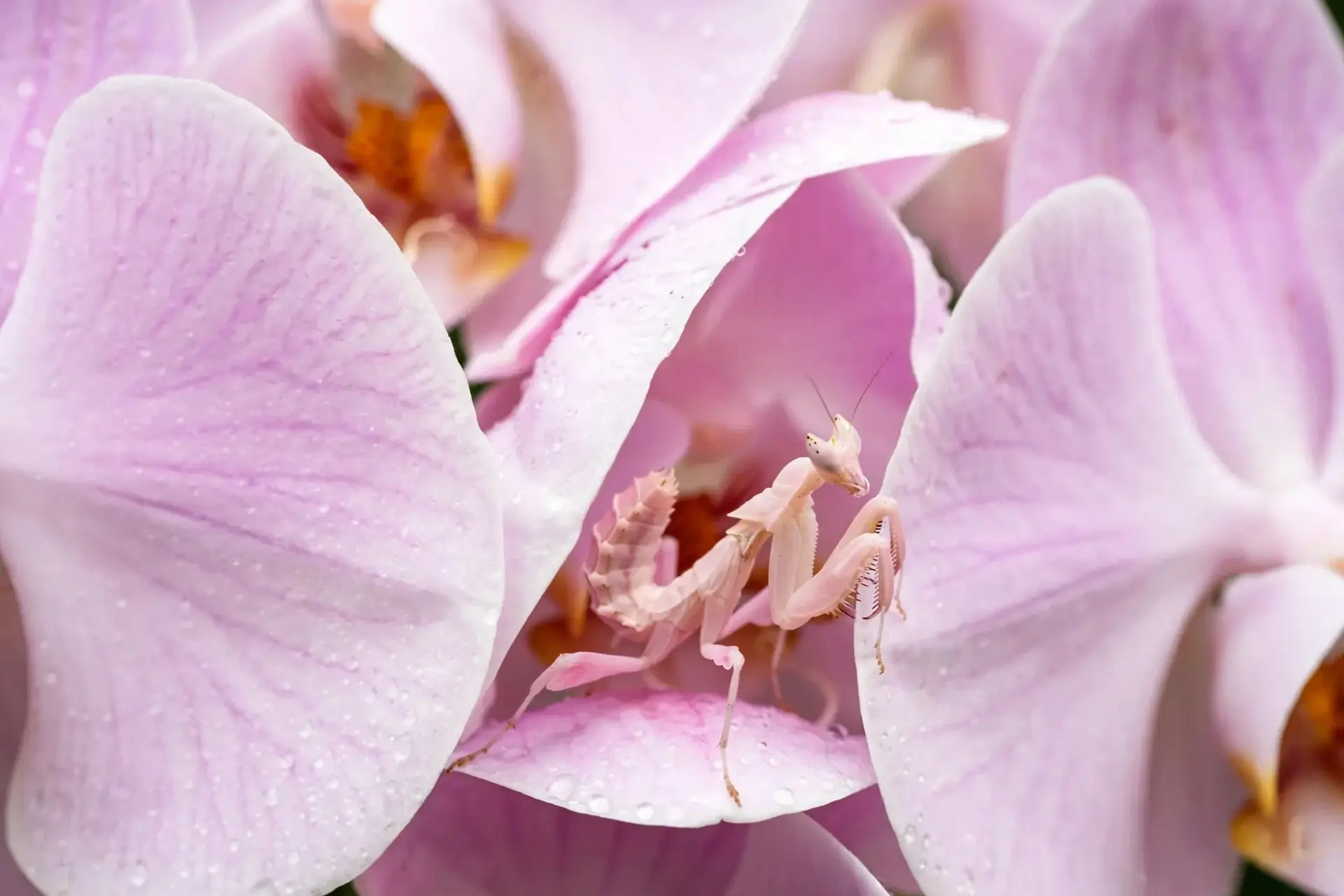
The orchid mantis, Hymenopus coronatus, lives in the rainforests of South-East Asia, and it is one of the most beautiful insects on earth. It is white and pink, with petal-like lobes on its legs and a body shaped like a flower, and for more than a century, naturalists assumed that it was camouflaged — that it looked like a flower to hide from predators. Alfred Russel Wallace raised the hunting idea as early as 1877, recounting a traveller's account of a mantis resembling a pink orchid flower — but no one had tested it until 2014. The truth is more interesting than the hiding story: the mantis does not look like a flower to hide. It looks like a flower to hunt.
The evidence came in 2014, when James O'Hanlon, Gregory Holwell and Marie Herberstein published a study in The American Naturalist that tested the idea experimentally. They placed orchid mantises and real flowers side by side in the forest and counted the pollinators that visited each. The mantises attracted pollinators at a significantly higher rate than the real flowers did — though the mantises in the experiment were slightly larger than the flowers, which the authors note may partly explain the difference. The pollinators visited the mantis more often than the real flowers — whether that is preference or simply a stronger stimulus is not settled. The mantis's colour, measured with instruments that model insect vision, was indistinguishable from the colour of the flowers growing nearby — and crucially, the mantis did not mimic any one specific orchid species. It presented a general, idealised flower signal, a sort of average flower that was more attractive than any real flower, because it combined the features that pollinators find most appealing. It was not a copy of any one flower. The authors suggest it may present an 'average flower' — a general signal pollinators respond to even more strongly.
The deception goes deeper than colour. Its newly hatched nymphs — black and red, nothing like the adults — mimic foul-tasting stink bugs, a piece of defensive mimicry that protects them while they are small and vulnerable. And juvenile females go further still: they carry two chemicals, 3HOA and 10HDA, that match the pheromones of the oriental honeybee, Apis cerana — 3HOA was detected in the air around them only while they were hunting — drawing the bees in by scent as well as by sight. Adults do not produce them. The orchid mantis is not one mimic. It is several, stacked on top of each other, changing with age, each one tuned to a different audience.
The false cleanerfish, Aspidontus taeniatus, plays the same game on a coral reef. The reef's genuine cleaner is the bluestreak cleaner wrasse, Labroides dimidiatus, a small, striped fish that runs a cleaning station: other fish come to it, pose — holding still, opening their mouths, spreading their fins — and the wrasse picks parasites off their skin. It is a service, and the reef's fish have learned to trust it. The false cleanerfish copies the wrasse in colour, in shape, in swimming style, and even in its behaviour, performing the same little "dance" — spreading its caudal fin and oscillating its rear body — that advertises the cleaner's services. A client fish, seeing the dance, poses for cleaning. And the false cleanerfish bites it, tearing off a piece of fin or a chunk of mucus, and darts away.
The bite is not the whole story. Studies of the false cleanerfish have found that fin-biting is only part of its diet — it also eats damselfish eggs, the tentacles of tube worms, and the mantles of boring clams — and that how often it bites depends on how much other food is available. When benthic food is abundant, it bites less.
And a careful study published in 1983 by Tetsuo Kuwamura concluded that the main function of the mimicry is probably not aggressive at all, but protective: by looking like a cleaner, the false cleanerfish is protected from predators that have learned not to eat cleaners, because cleaners are useful. The fin-biting, in this reading, is a bonus — an opportunistic extra that the mimicry makes possible, rather than the reason the mimicry evolved. Kuwamura's 1983 observations found the false cleanerfish attacks only about one in five posing clients — most encounters end without a bite — and Fujisawa et al. (2020) later showed how often it bites at all depends on how much benthic food is available. Client fish which had been bitten learned to avoid or attack the mimic afterwards. The reef's fish are not stupid. They learn. And the mimicry, like all mimicry, is a negotiation between the deceiver and the deceived, renegotiated with every encounter.
The orchid mantis and the false cleanerfish show the same lesson from opposite directions. The mantis impersonates something its victims want — a flower — and the cleanerfish impersonates something its victims trust — a helper. In both cases, the deception works because the victim has a reason to approach. The mantis's victims want nectar. The cleanerfish's victims want to be cleaned. Aggressive mimicry is, at its core, a lie told in the language of trust, and it is the most unsettling form of deception in nature, because it turns the victim's own good judgement against it.
15. The Actor: Dynamic Mimicry
The mimic octopus can impersonate a flatfish, a lionfish and a banded sea snake — and switch between disguises in seconds — making it the best-documented case of an animal switching between several impersonations in real time in response to what it sees.
It is one of the most versatile mimics known.
The mimic octopus, Thaumoctopus mimicus, was discovered in 1998, in the muddy waters off the Indonesian island of Sulawesi, near the mouth of a river in Lembeh Strait. The divers who found it were puzzled: they kept seeing animals that looked like flatfish, and then like lionfish, and then like sea snakes — and then realising, each time, that they were looking at the same octopus. The behaviour was described in 2001, when Mark Norman, Julian Finn and Tom Tregenza published a paper in the Proceedings of the Royal Society B describing nine individuals they had filmed, and the species was formally named in 2005 by Norman and Hochberg.
The octopus has an arm span of up to sixty centimetres, and it lives on sandy, muddy seabeds, where there is nowhere to hide. Its solution is not to hide but to impersonate. When it wants to look like a flatfish, it pulls its arms together, flattens its body, and swims along the bottom with a rippling motion, exactly the way a sole or a flounder swims. When it wants to look like a lionfish, it spreads its arms wide, splaying them like the venomous spines of the lionfish, and drifts through the water with its arms trailing. When it wants to look like a banded sea snake — one of the most venomous animals in the ocean — it hides six of its arms in a burrow and waves the other two above the sand, banded black and white, undulating like a snake. It has also been seen impersonating jellyfish, and anemones, and more.
Does it choose its disguise?
What makes the mimic octopus extraordinary is not just the range of its impersonations but the intelligence behind them. The octopus appears to choose its disguise based on the threat in front of it. When damselfish — small, territorial reef fish that harass octopuses — approach, the octopus switches to the sea snake impersonation. The authors suggest it is no coincidence — but the evidence is four encounters, not an experiment. Sea snakes are venomous predators of reef fish, and a damselfish that sees one will flee — the octopus's authors suggest it reads its audience. The octopus is, in effect, reading its audience and choosing the disguise that its audience fears most. No other animal is documented doing this as extensively. The only other animal that comes close is the wunderpus, a relative that shares some of the same tricks — but the mimic octopus remains the master.
How does it perform such mimicry? The same way a cuttlefish does — with chromatophores, iridophores and leucophores in its skin, and with a body that is almost entirely muscle, capable of changing shape in a fraction of a second. The octopus's skin can produce the banded pattern of a sea snake or the mottled pattern of a flatfish, and its arms can be arranged into any shape it needs. But the mimic octopus goes further than the cuttlefish, because it is not just matching a background. It is matching a behaviour — the swimming of a flatfish, the drifting of a lionfish, the undulation of a snake. It is a performance, not a picture, and it requires the octopus to know not only what its model looks like but how it moves.
The mimic octopus also raises a question about camouflage and mimicry that scientists are still working on: how much of this is learned, and how much is built in? Octopuses are famously intelligent — they solve puzzles, open jars, recognise individual humans — and the mimic octopus's ability to choose a disguise based on the predator in front of it suggests a level of decision-making that goes beyond instinct. Whether the octopus learns its impersonations by watching other animals, or whether the whole repertoire is hard-wired, is still unknown. Either way, it is a reminder that mimicry is not just a matter of colour and pattern. They are matters of behaviour, of timing, of reading the room — and the animals that do them best are the ones that pay the closest attention to the animals they are trying to fool.
16. The Egg Forger
The common cuckoo lays eggs that mimic the eggs of its host species so precisely that the host bird raises the cuckoo chick as its own, and each female cuckoo belongs to a host-specific race — a gens — that typically specialises in a single host, with the mimicry inherited through the mother's line.
It is mimicry at the level of the egg, and it is one of the most intensely studied coevolutionary arms races in nature.
The forged egg
The common cuckoo, Cuculus canorus, is an obligate brood parasite: it never builds a nest, and it never raises its own young. Instead, a female cuckoo watches a host bird — a reed warbler, a meadow pipit, a dunnock — and when the host leaves its nest, she slips in, lays a single egg, and removes one of the host's eggs to make room. The host returns, counts its eggs — or rather, fails to count them — and incubates the cuckoo's egg along with its own. When the cuckoo chick hatches, it is usually larger and stronger than its nestmates, and it pushes the host's eggs or chicks out of the nest, one by one, until it is alone. The host parents then spend weeks feeding a chick that is often larger than they are, a chick that is not theirs, and that will never thank them.
In this battle, the host's defence is recognition. A host bird that can spot a foreign egg and throw it out of the nest saves itself the cost of raising a parasite. And the cuckoo's counter-defence is mimicry: an egg that matches the host's eggs in colour and pattern so closely that the host cannot tell the difference. The match is remarkably precise. A cuckoo that parasitises reed warblers lays eggs that are speckled greenish, like a reed warbler's eggs. A cuckoo that parasitises meadow pipits lays eggs that are brownish and heavily spotted, like a pipit's eggs. The mimicry is so good that, to a human eye, the cuckoo's egg and the host's egg can be nearly indistinguishable — and a study published in 2010 by Mary Caswell Stoddard and colleagues, in the Proceedings of the Royal Society B, showed that the mimicry is even more precise than it looks to us. Using digital image analysis and models of avian vision — birds see ultraviolet light, which we cannot — Stoddard's team measured the pattern mimicry across eight host species and found that cuckoos had evolved better pattern mimicry for host species that were better at rejecting foreign eggs. The hosts that fought back hardest had driven the mimicry to its highest precision.
Gentes and the maternal line
The cuckoo's trick is organised by gentes — host-specific races, each one typically specialising in a single host species. A female cuckoo belongs to one gens, and she lays eggs that mimic that host's eggs, and she targets that host's nests. Her daughters will belong to the same gens, and will lay the same kind of egg. But her sons can mate with females of any gens, because the egg colour is inherited through the female line. The puzzle — how can a species maintain many different egg types without them blending together? — was solved by a genomic study published in 2025 by Merondun and colleagues, which showed that the genes for eggshell background colour are inherited maternally, through the W chromosome, the female-specific sex chromosome in birds. A mother passes her egg type to her daughters, intact, regardless of who the father is. The mimicry is a matrilineal inheritance, a trait passed from mother to daughter like a family heirloom.
Beyond the egg: chicks that mimic
The arms race does not stop at the egg. Some hosts have learned to reject cuckoo chicks, not just cuckoo eggs, and some cuckoos have evolved chicks that mimic the host's chicks — in skin colour, mouth colour and down. Begging-call mimicry is a separate finding, and in the little bronze-cuckoo it is imperfect and fades as the chick grows. The bronze-cuckoos of Australia, studied by Naomi Langmore and her colleagues, have chicks that mimic the host's nestlings — in skin colour, mouth colour and down — so precisely that host parents often cannot tell them apart; in the shining bronze-cuckoo the mimicry has driven the formation of host-specific lineages, each tied to a single host. The cuckoo's mimicry is not a single trick but a whole programme of deception, running from the egg to the fledgling, and it is still escalating.
The cuckoo's story is a reminder that deception is not confined to colour and pattern on an adult animal's body. They can operate at any stage of life, on any part of the organism, and they can be as precise as the difference between two shades of speckled green. The cuckoo's egg is a forgery, and like all forgeries, it is judged by the sharpness of the eye that examines it. The host's eye has been sharpening for millions of years. The cuckoo's forgery has been sharpening with it.
17. Camouflage vs Mimicry: The Scorecard
Camouflage and mimicry differ in who they deceive, what they copy and what they cost: camouflage copies a background to avoid detection, Batesian mimicry copies a dangerous species to borrow its warning, Müllerian mimicry shares a warning between defended species, and aggressive mimicry copies something harmless to lure victims in.
The four strategies side by side
The table below puts the four strategies side by side — camouflage, Batesian mimicry, Müllerian mimicry and aggressive mimicry — so the differences — and the trade-offs — are easy to see.
Table: The four strategies compared — what each copies, whom it deceives, who benefits, and a key example.
Strategy | What is copied | Who is deceived | Who benefits | Key example |
|---|---|---|---|---|
Camouflage (crypsis) | The background — colour, pattern, texture | Predator (or prey) | The hidden animal | Peppered moth on bark; flounder on sand |
Batesian mimicry | A dangerous or unpalatable species | Predator, which has learned the warning | The harmless mimic | Hoverfly as wasp; kingsnake as coral snake |
Müllerian mimicry | A shared warning signal, by several defended species | Predator, which learns one signal for all | All members of the ring | Heliconius butterflies; bees and wasps |
Aggressive mimicry | Something harmless or desirable — a light, a flower, a helper | Prey (or host), which approaches | The predator or parasite | Anglerfish lure; orchid mantis; false cleanerfish |
The table makes the categories look tidy, and tidy categories are useful. But the animals themselves keep blurring the lines, and the blurring is where the most interesting biology lives. The viceroy crossed from Batesian to Müllerian. The false cleanerfish has been suggested to be both an aggressive mimic and a protective mimic at the same time. The leaf insect is camouflaged and a masquerader. The cuttlefish is camouflaged, and also a communicator, and sometimes both at once, on different sides of its body. The categories of camouflage and mimicry are tools for thinking, not boxes for animals.
What each deception costs
There is another way to look at the scorecard, and it is the one that matters most for understanding why camouflage and mimicry evolve at all. Every deception is a bet, and every bet has a cost. Camouflage costs the animal its visibility — a camouflaged animal cannot also be bright and conspicuous, which means it cannot use bright colours to attract a mate or to warn off a rival. Batesian mimicry costs the mimic its freedom to be abundant: if there are too many mimics, the warning signal is diluted, and the protection fails. Müllerian mimicry costs each member of the ring the effort of maintaining the shared signal, and the risk that a cheater — a Batesian mimic — will join the ring and dilute it. Aggressive mimicry costs the predator the energy of maintaining the lure, and the risk that the prey will learn to recognise it.
The costs are real, and they are why no animal is perfectly camouflaged or perfectly mimetic. Perfection is expensive, and evolution is a bargain-hunter: it buys as much camouflage and mimicry as it needs, and no more. A hoverfly that is good enough to fool a bird at a glance does not need to be good enough to fool an entomologist with a microscope. A kingsnake that is good enough to fool a predator in the leaf litter does not need to be good enough to fool a herpetologist holding it in the hand. Camouflage and mimicry are tuned to the audience, and the audience is usually in a hurry.
Why deception is the default
The scorecard also shows why camouflage and mimicry are so common. They are often among the cheapest defences available. Growing armour takes calcium and protein. Making venom takes energy and specialised glands. Running fast takes muscle. But changing colour — or wearing a pattern that already exists in the population — can be cheap, and it can be very effective. That is why so many animals, in so many different groups, have arrived at the same solutions independently — a pattern that has been repeating since the Cambrian explosion gave animals eyes, armour and predators to hide from, and a classic case of convergent evolution. Camouflage and mimicry are widespread, not rare specialities — they are among the most common defensive strategies in the animal kingdom.
18. Five Myths About Camouflage and Mimicry
Five myths about camouflage and mimicry refuse to die: that chameleons change colour to hide, that the viceroy is a harmless fraud, that good mimicry must be perfect, that camouflage means invisibility, and that these deceptions never fail — and every one of them is wrong in a way that reveals something important about how evolution actually works.
It is worth taking them one at a time, because each myth about camouflage and mimicry, corrected, teaches a lesson.
Myth 1: Chameleons change colour to hide
As section 7 showed, chameleons change colour mainly to communicate with each other and to control their temperature. Their camouflage comes mostly from being slow, still and leaf-shaped — though chameleons can also shift brightness and hue to match a background, within limits: a 2025 experiment showed flap-necked chameleons matching dark backgrounds and yellow hues, but not background patterns. The myth persists because it is a good story, and because chameleons really are hard to spot — but the reason they are hard to spot is not the reason most people think.
Myth 2: The viceroy is a harmless butterfly copying the toxic monarch
As section 11 showed, the viceroy is often unpalatable in its own right, defended by aspirin-like phenolic glycosides from the willows its caterpillars eat — though how unpalatable it is varies by place, so the viceroy sits on a Batesian–Müllerian continuum rather than in one neat box. Ritland and Brower showed in 1991 that birds find viceroys as unpalatable as monarchs; the defensive chemistry was identified later, in 2007. The myth lasted for more than a century because the assumption at its heart — that the viceroy was edible — went largely untested until Ritland and Brower did so in 1991.
Myth 3: Mimicry has to be perfect to work
It does not. A hoverfly with the wrong shade of yellow still fools birds, because birds make their decisions in a fraction of a second, at a distance, on the wing. Deception only needs to be good enough to pass the test that matters, and the test is set by the dupe, not by a human observer with a magnifying glass. The sloppy mimics — the hoverflies with imperfect stripes, the kingsnakes with imprecise bands — are not failures. They are evidence that evolution buys as much deception as it needs, and no more.
Myth 4: Camouflage means being invisible
It does not. Camouflage means being hard to detect, hard to recognise, or hard to catch — and those are three different things. A zebra is not invisible. It is conspicuous, and yet its stripes may make it harder for a predator to pick out one animal from the herd, or to judge its speed and direction. A stonefish is not invisible either. It is visible, but it is recognised as a rock, not as a fish. The goal of camouflage is not invisibility. It is to break the chain of recognition that leads from I see something to that is food to I will eat it — and that chain can be broken at any link.
Myth 5: These deceptions never fail
Camouflage and mimicry fail all the time. Predators learn. The false cleanerfish's clients learn to avoid it after being bitten. When harmless mimics become common, predators learn the warning is unreliable and start sampling them again. Host birds learn to recognise cuckoo eggs and throw them out. And the environment changes: the peppered moth's trees turned black, and then turned pale again, and the moth's camouflage tracked the change, generation by generation. Camouflage and mimicry are not permanent solutions. They are temporary advantages in an arms race that never ends, and the arms race is the point. Every deception creates the selection pressure for a better detector, and every better detector creates the selection pressure for a better deception. The race has been running for hundreds of millions of years, since eyes first evolved, and it shows no sign of stopping.
19. Why It Still Matters
This final section looks ahead: first at what humans have borrowed from deception — from dazzle ships to soft robots — then at what failing camouflage tells us about a warming climate, and finally at how fast the science of deception itself is moving.
The science of camouflage and mimicry is not a curiosity. It is a lens on evolution itself.
From dazzle ships to soft robots
The practical applications are already around us. The dazzle camouflage of the First World War fed into the disruptive-pattern uniforms of the Second, and disruptive patterning in turn inspired the digital pixel patterns worn by soldiers today. The cuttlefish's skin has inspired a generation of research into colour-changing materials — soft robots that shift their pattern to match their surroundings. The study of deception is, increasingly, a study with engineering consequences.
A climate warning in white coats
The conservation consequences are more urgent. The snowshoe hare's mismatch is not an isolated case. Across the far north, more than twenty species that turn white in winter are facing the same problem, as the snow season shortens at both ends. The peppered moth's story, in reverse, is playing out in real time: animals whose camouflage is tuned to a world that no longer exists. Conservation biologists are watching these species closely, because they are among the most sensitive indicators of climate change. When a hare is the wrong colour, it is not just a hare in trouble. It is a signal that the seasons themselves are shifting. The stakes are the same ones raised by past mass extinctions: when the environment changes faster than animals can adapt, species disappear.
A fast-moving science
The science is also moving fast. In recent years, researchers have mapped key Heliconius wing-pattern genes, traced the maternal inheritance of the cuckoo's egg mimicry, measured the nanocrystals in a chameleon's skin, and shown that the viceroy's defence is real. The pace of discovery is accelerating, because the tools — genomics, high-speed imaging, computer models of animal vision — are getting better every year. We can now see the world as a bird sees it, or as a bee sees it, and that changes everything: a pattern that looks like a perfect match to a human eye may look like a poor match to a bird, and vice versa. Camouflage and mimicry are tuned to the eyes of their audience, and we are only now learning to look through those eyes.
There is a final reason why camouflage and mimicry matter, and it is the simplest one. They are beautiful. The orchid mantis on its flower, the cuttlefish rippling through its colours, the monarch and the viceroy side by side in a summer field — these are among the most exquisite things in the natural world, and they are exquisite because they are functional. The beauty is not decoration. It is survival, shaped by millions of years of selection, into forms that happen to delight the human eye as well. To study camouflage and mimicry is to study evolution at its most inventive, its most cunning, and its most beautiful — and to be reminded, again and again, that the natural world has been solving these problems far longer than we have.
The next time you walk through a garden, or along a beach, or through a forest, look twice. The wasp on the lavender may be a fly. The flower may be a mantis. The leaf may be an insect, the stone may be a fish, and the snake may be a harmless copy of a dangerous original. The world is full of deceptions, and camouflage and mimicry are full of stories. This article has told a few of them. The rest are out there, waiting to be noticed — if you know how to look.
Frequently Asked Questions
What is the difference between camouflage and mimicry?
Camouflage hides an animal by making it hard to detect against its background — a moth matching bark, a flounder matching sand — while mimicry protects or helps an animal by making it resemble a different species, such as a harmless hoverfly copying a wasp's stripes or a kingsnake copying a coral snake's bands. Camouflage deceives the viewer's eyes about where the animal is; mimicry deceives the viewer's brain about what the animal is. Camouflage and mimicry often overlap: a leaf insect both matches its background and mimics a leaf, a case biologists call masquerade.
What is Batesian mimicry?
Batesian mimicry is when a harmless species copies the warning signals of a dangerous or unpalatable species, borrowing protection it has not earned. It is named after Henry Walter Bates, who described it in 1862 after eleven years in the Amazon. Classic examples include hoverflies copying wasps, the scarlet kingsnake copying the venomous coral snake, and the milk snake copying coral snakes. The trick only works if the mimic is rarer than the model — if there are too many harmless copies, predators learn the warning is unreliable and the protection fails.
What is Müllerian mimicry?
Müllerian mimicry is when two or more defended species share the same warning signal, so that predators learn the lesson faster and all the mimics benefit. It was first explained by Fritz Müller in 1878 and 1879, with what may well have been the first formal mathematical model to support an evolutionary hypothesis. The classic example is the Heliconius butterflies of Central and South America, which share red, orange and black warning patterns in mimicry rings. The viceroy and monarch butterflies are Müllerian co-mimics — both are unpalatable — not a harmless mimic and a toxic model, as textbooks claimed for more than a century.
How does camouflage work?
Camouflage works by defeating the visual cues a predator's eye uses to find prey: background matching removes colour and brightness contrast, countershading cancels the three-dimensional shading of the body, disruptive coloration breaks up the animal's outline, and masquerade makes the animal look like an inedible object such as a leaf or a stone. In the most dramatic cases, animals such as cuttlefish can change their pattern in a second using specialised skin cells called chromatophores, iridophores and leucophores. Others, such as the snowshoe hare, change their coat with the seasons.
Do chameleons change colour to hide?
No — not mainly. Chameleons change colour primarily to communicate with other chameleons and to control their body temperature: bright patterns signal dominance or readiness to mate, dark colours absorb heat and light colours reflect it. The mechanism, discovered in 2015, uses guanine nanocrystals in skin cells called iridophores, whose spacing shifts the reflected colour. Chameleons are hard to spot mainly because they move slowly, sway like leaves and stay still — though they can also shift brightness and hue to match a background, within limits: a 2025 experiment showed flap-necked chameleons matching dark backgrounds and yellow hues, but not background patterns. Social signalling and temperature remain the main drivers of the dramatic, rapid shifts.
Why do viceroys look like monarchs?
Viceroys look like monarchs because both butterflies are unpalatable and share the same orange-and-black warning pattern — a case of Müllerian mimicry, in which defended species share a signal so predators learn it faster. Monarch caterpillars sequester cardenolides from milkweed; viceroy caterpillars sequester phenolic glycosides including salicin, a salicylic-acid precursor, from willows and poplars. Experiments published in 1991 showed that birds find viceroys as unpalatable as monarchs. Viceroy unpalatability varies geographically: where queen butterflies are scarce, viceroys are at their most defended; where queens are abundant, some viceroys are effectively palatable. The two can be told apart by the viceroy's extra black band across its hindwing, which the monarch lacks.
Can predators learn to see through mimicry?
Yes — and they do, constantly. Client fish bitten by a false cleanerfish learn to avoid or attack it. Birds that eat too many harmless hoverflies become bolder about black-and-yellow insects. Host birds that recognise cuckoo eggs throw them out of the nest, driving the cuckoo to evolve better forgeries. Camouflage and mimicry are a moving target: every deception creates selection pressure for a better detector, and every better detector creates pressure for a better deception. That arms race has been running for hundreds of millions of years, since eyes first evolved, and it is why camouflage and mimicry are never perfect and never finished.
Sources
Thayer, A. H. (1896). The Law Which Underlies Protective Coloration. The Auk, 13, 124–129.
Haldane, J. B. S. (1924). A mathematical theory of natural and artificial selection. I. Transactions of the Cambridge Philosophical Society, 23, 19–41.
Cott, H. B. (1940). Adaptive Coloration in Animals. Methuen, London.
Pfennig, D. W. et al. Frequency-dependent Batesian mimicry. Nature (2001). DOI: 10.1038/35066628
Norman, M. D. & Hochberg, F. G. (2005). The "mimic octopus" (Thaumoctopus mimicus n. gen. et sp.), a new octopus from the tropical Indo-West Pacific (Cephalopoda: Octopodidae). Molluscan Research, 25(2), 57–70.