
1. The Green Under Your Feet
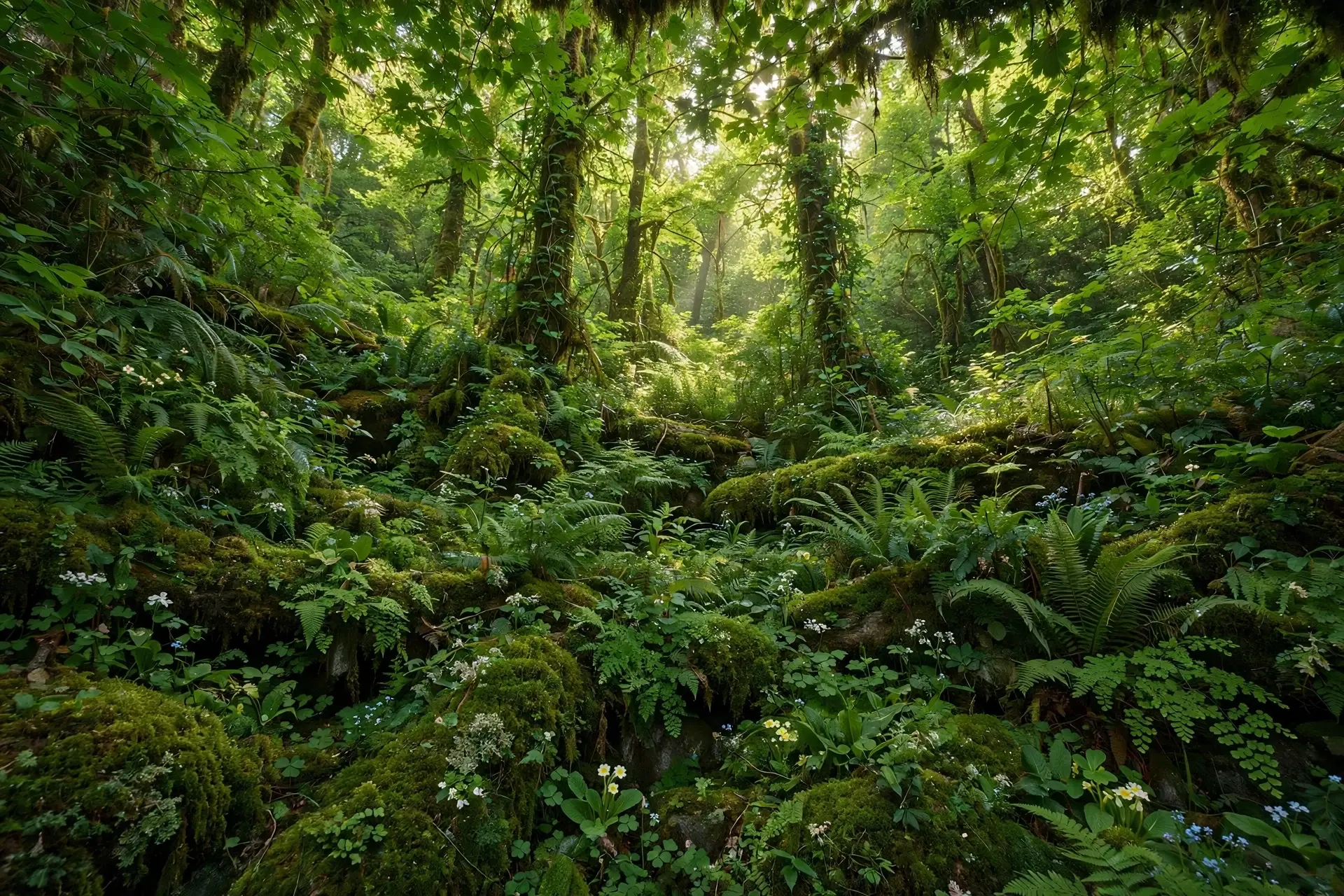
I walked into my garden one June morning with coffee in hand, meaning only to check the tomatoes, and stopped because the green was almost absurd — leaves layered on leaves, stems reaching, a whole quiet city of plants, the product of plant evolution, doing its work while I slept.
It was not a tidy city. Mint had escaped its pot and was marching across the path, moss had claimed the shady corner of the wall, and a sunflower leaned over the fence. I had planted some of this green on purpose. Most of it had arrived on its own terms.
That morning left me with a simple question. Where did all this green come from? Not the mint, or the sunflower, or the particular patch of lawn — those have ordinary answers, involving seed packets and wind and a neighbour's overenthusiastic mint. I mean the green itself. The whole habit of being a plant. Leaves, stems, roots, flowers, seeds: when did life first try that shape, and how did it end up covering so much of the world?
A half-billion-year story
The answer is a story half a billion years long. That is the first thing to hold onto in this account of plant evolution. Half a billion years is the rough span between the first small green pioneers creeping onto bare rock and the garden outside your window, and their ancestors in the water are far older still.
Think about what that span contains. Continents drifted. Seas rose and fell. Animals crawled ashore, learned to fly, and mostly died out several times over. Through all of it, plants kept their own long experiment going: standing upright, carrying water inside themselves, protecting their young in seeds, and wrapping those seeds in fruit and flowers that turned animals into couriers.
This is not a story about a single heroic species. It is a story about a whole way of life being invented, tested, broken, and reinvented. That is the way plant evolution worked: small changes, kept when they helped, discarded when they did not, accumulating over timescales that make human history look like a blink. A slightly waxier skin here, a slightly taller stem there, a spore that waited a little longer before opening. None of it looked like a plan at the time.
The green all around us
And yet the results are everywhere, so ordinary that we stop seeing them. The wood of your table was once a living trunk, the bread on it came from grass seeds, and the oxygen in the room was made by photosynthesis, a trick green cells have practised for billions of years. To understand plant evolution is to understand the background machinery of the living world.
In this first part, we stay near the beginning: the plant family tree, the algae that started it all, and the first green life out of the water and onto land. Later parts take the story onward, through forests, seeds, conifers and flowers. But the beginning matters, because everything later builds on it.
So start where I started that June morning: with the green under your feet, doing its quiet work. It looks still. It looks simple. It is neither. Behind every leaf is half a billion years of trial and error, and the mint escaping its pot is only the latest move. The story of plant evolution is still being written, one escaping mint at a time.
2. What Plant Evolution Actually Is
The story of plant evolution is easiest to picture as a family tree, not a ladder, with living groups branching off at different times and every branch still alive somewhere today, from pond scum to oak trees, each one a survivor with its own long history.
That tree image matters, because the ladder image misleads almost everyone at first. A ladder suggests that algae turned into moss, moss turned into ferns, ferns turned into pine trees, and pine trees turned into roses, each step replacing the last. That is not what happened. Mosses did not vanish when ferns appeared, and ferns did not vanish when seed plants appeared. The tree branched, and the older branches kept growing alongside the new ones.
A tree, not a ladder
Picture it this way instead. At the base sit the green algae, living in water. One branch gave rise to the land plants, the embryophytes. From them, branches split again and again: mosses and their relatives on one side, vascular plants on another, and from the vascular plants, ferns, then seed plants, then flowering plants. Every group you can name sits at the tip of its own branch. The rose is not "more evolved" than the moss. It is simply the tip of a different branch, one that took a different route through the same half-billion years.
To read that tree — the map of plant evolution — you need a handful of words. They are not hard, and they will carry you through the whole story.
Algae are the loose, water-living relatives at the base of the story. The word covers a wide range of photosynthetic life, from single cells to great sheets of seaweed. The green algae most closely related to land plants are called charophytes, and we will meet them properly in section 4.
Bryophytes are the mosses, liverworts and hornworts — the land plants without true vascular tissue. They stay small and close to damp ground, and they reproduce with spores rather than seeds.
Vascular plants are the plants with plumbing. They carry water and food through special tissues, which lets them grow tall and live away from constant damp. Ferns, conifers and flowering plants are all vascular plants, and they make up about 95% of living plant species.
Seed plants are the vascular plants that protect their young inside a seed, with stored food and a tough coat. Conifers and flowering plants are both seed plants.
Flowers are the reproductive structures of one group of seed plants, the angiosperms. A flower is a modified shoot carrying sepals, petals, stamens and carpels, built to trade with pollinators.
The plumbing inside
Two more words deserve a place here, because they explain how plants are put together: xylem and phloem. Together they are the vascular tissue, the plumbing just mentioned. Xylem carries water and minerals upward from the roots. Phloem carries sugars, made by photosynthesis in the leaves, down and around to wherever the plant needs them. That two-way transport is what makes a tall plant possible at all.
Two bodies, one plant
Now for the strangest idea in this section: plants have two bodies, not one. The technical name is alternation of generations, and it sounds harder than it is. Every land plant lives part of its life as a haploid gametophyte, with one set of chromosomes, and part as a diploid sporophyte, with two sets. The gametophyte makes eggs and sperm. The sporophyte grows from the fertilised egg and makes spores, and spores grow into new gametophytes.
What changed over plant evolution was which of those two bodies took centre stage. In mosses, the green, leafy plant you see is the gametophyte, and the sporophyte is a small stalked capsule that depends on it for its whole life. In ferns, the balance flips: the leafy plant is the sporophyte, and the gametophyte is a small, thin, heart-shaped prothallus, living free on damp ground. In seed plants, the gametophyte shrinks to a few cells hidden inside the sporophyte — the pollen grain on the male side, and a tiny female gametophyte inside the ovule. There are no free-living gametophytes at all.
That trend — gametophyte dominant, then sporophyte dominant, then sporophyte carrying everything — is one of the clearest patterns in plant evolution. A diploid sporophyte can grow large, make many spores, and, in seed plants, protect the embryo inside its own tissues. Each step made plants less dependent on a film of outside water and more able to live, grow and reproduce on dry land. If you want to learn how plants work today, cell by cell, our companion article on plant biology walks through the modern machinery in detail.
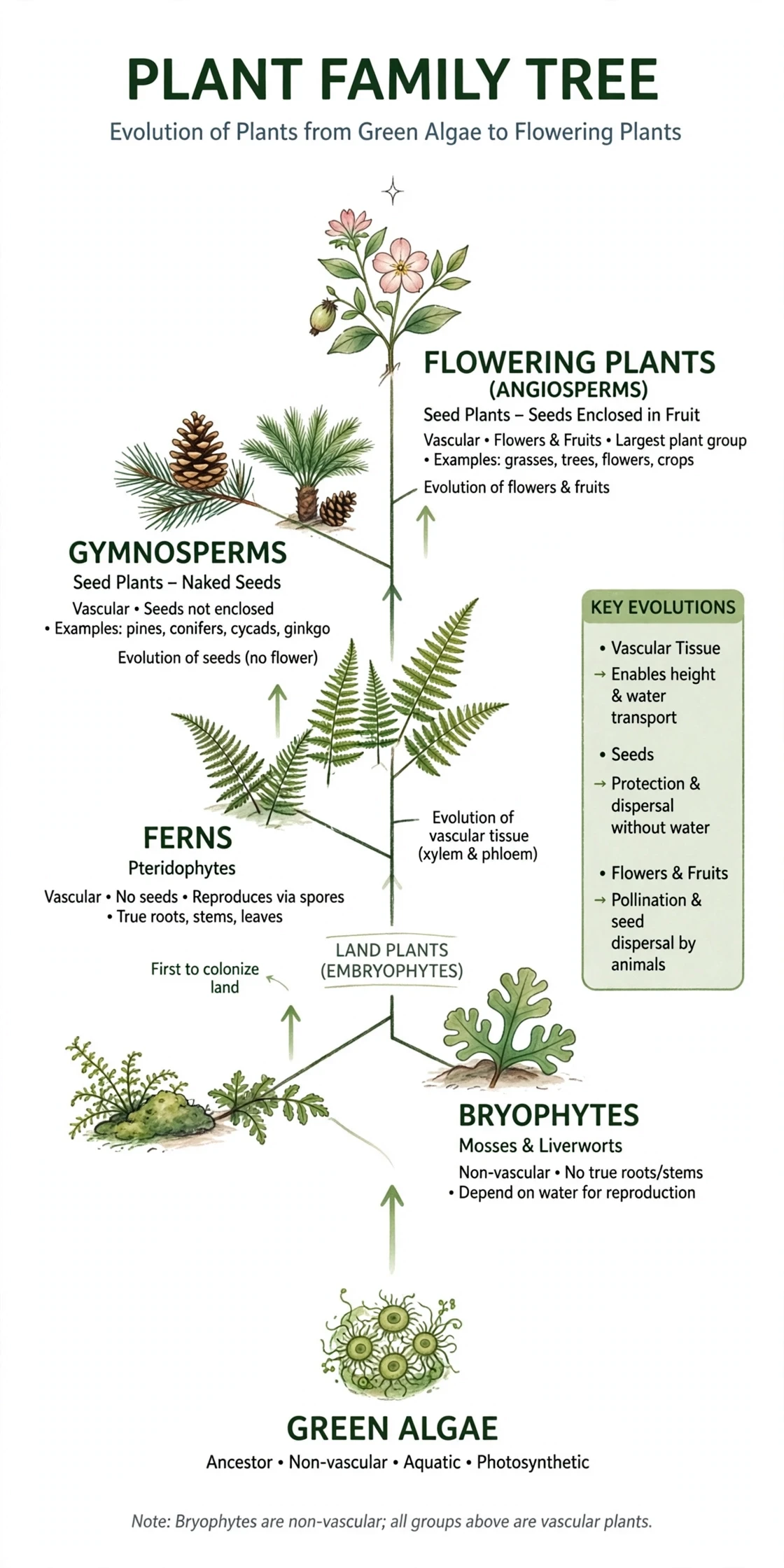
Hold that tree in mind as we go on: every story of plant evolution in this article is a branch on it, from the algae that invented photosynthesis to the flowering plants that hired animals to do the carrying. None of those steps replaced the one before.
3. The Green That Came First
Long before any plant stood on land, the green world began in water, when tiny cells learned to eat sunlight and, in doing so, slowly filled the air with oxygen and changed the planet for everything else that came after.
That sentence is the whole of this section in miniature, and it is worth unpacking slowly, because the history of plant evolution begins long before there were plants. It begins with a trick — photosynthesis — and the small blue-green cells that first mastered it.
Photosynthesis is the trick of building living matter from sunlight, water and carbon dioxide, releasing oxygen as a by-product. It sounds like a quiet piece of chemistry. In planetary terms, it was a revolution. Before it, the air held almost no free oxygen, and life ran on chemical energy from the Earth itself. After it, sunlight became food, oxygen became available, and the door opened to larger, more complicated life. Our article on photosynthesis explains the modern chemistry step by step; here we are concerned with where that chemistry came from, and how old it is.
The first oxygen makers
The first photosynthesizers were cyanobacteria, single cells that still colour ponds and rock pools green today. They invented oxygenic photosynthesis — the version that splits water and releases oxygen — and they did it very early. Photosynthesis itself probably evolved hundreds of millions of years before oxygen began to pile up in the air in any lasting way. The cells were making oxygen, and the planet was swallowing it almost as fast, in rusting iron and other chemical sinks, so the air stayed poor in oxygen for a long time.
Then, around 2.4 billion years ago, the balance tipped. Free oxygen began to accumulate permanently in the atmosphere in what scientists call the Great Oxidation Event. The onset is dated to roughly 2.46 to 2.43 billion years ago, with the literature range running from about 2.7 to 2.3 billion years ago. That spread is honest uncertainty: different rocks record different parts of a slow, uneven change. But the direction of the story is not in doubt. Life had begun to rewrite the air. Great Oxidation Event
The oldest direct evidence is younger than the event itself: fossil thylakoid membranes — the folded inner membranes where the light reactions happen — in Navifusa majensis microfossils from the McDermott Formation in Australia, dated to 1.78 to 1.73 billion years ago, give a minimum age of about 1.75 billion years for thylakoid-bearing cyanobacteria. Oldest thylakoids
A cell inside a cell
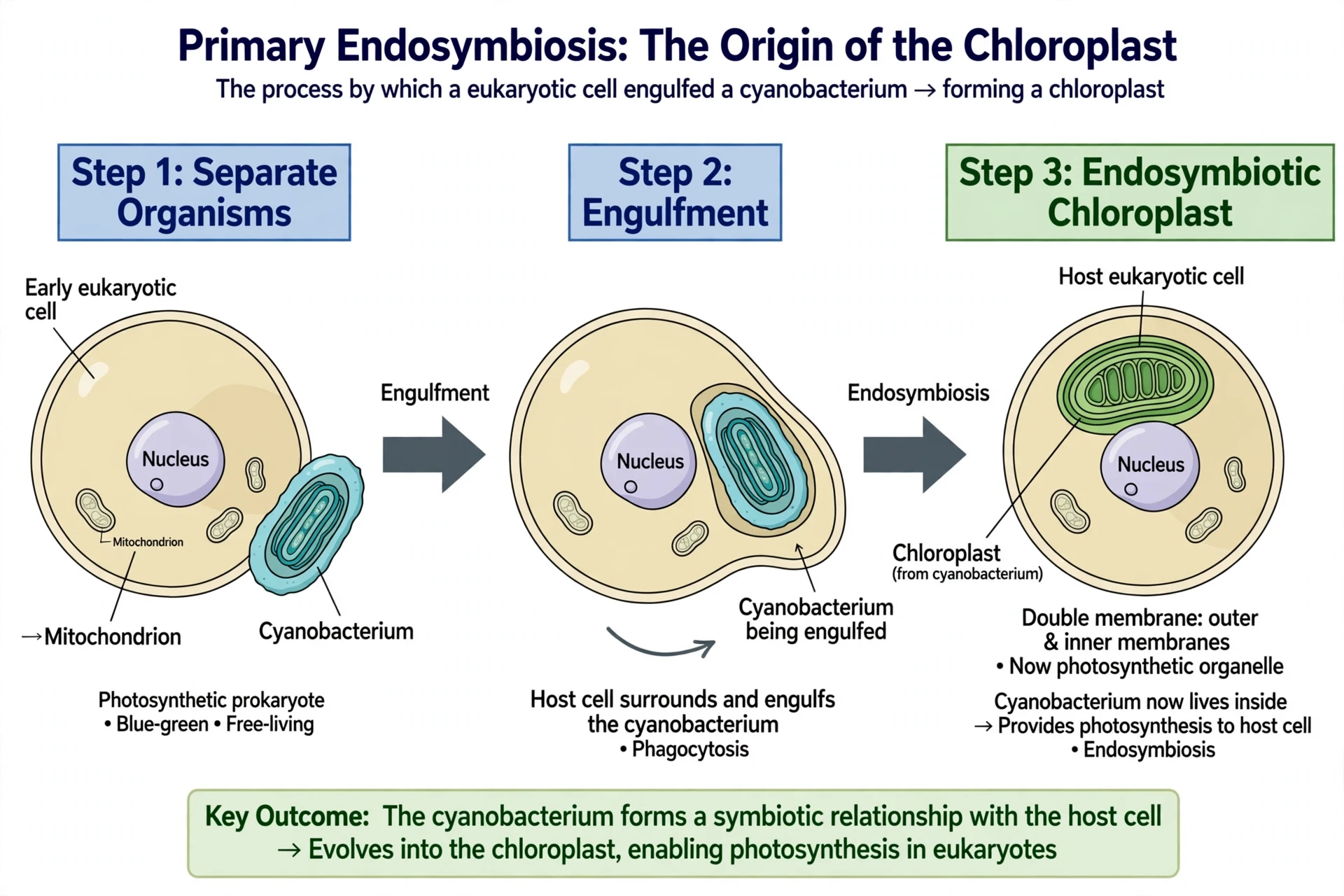
For well over a billion years, photosynthesis belonged to bacteria. Then came one of the strangest and most important events in the history of life: a cell swallowed another cell, and instead of digesting it, kept it. That is endosymbiosis, and the version that matters here is called primary endosymbiosis. A heterotrophic eukaryote — a cell with a nucleus, already larger and more complex than a bacterium — engulfed a cyanobacterium, which survived inside its host, lost its independence, kept its ability to photosynthesise, and became the chloroplast, the green organelle inside every plant cell today.
Within the Archaeplastida lineage, this happened only once, as far as anyone can tell: every green plant, every red alga, every glaucophyte descends from that single partnership. A second, independent primary endosymbiosis occurred much later in the amoeba Paulinella, about 90–140 million years ago. The chloroplast lineage diverged from its closest living cyanobacterial relative, Gloeomargarita, about 2.1 billion years ago, in a low-salinity, freshwater habitat, and the event took roughly 200 million years to become fully established. The crown group itself is dated to about 1.9 billion years ago, though other estimates place the event later, around 1.5 to 1.6 billion years ago. The dating is debated, and any honest account of plant evolution has to say so. What is not debated is the consequence: a single act of swallowing, kept instead of digested, put sunlight-eating machinery inside the eukaryotic cell, and every leaf, forest and flower descends from that arrangement. Chloroplast origin
The first recognisable algae
The descendants of that partnership took a long time to become recognisable as anything like a plant. The oldest widely accepted fossil of a photosynthetic eukaryote is Bangiomorpha pubescens, a multicellular red alga from the Hunting Formation on Somerset Island in Arctic Canada, dated to about 1.047 billion years ago, revised down from an earlier estimate of about 1.2 billion years by rhenium-osmium dating. Bangiomorpha is the oldest taxonomically resolved eukaryote known, and the oldest evidence of both sexual reproduction and complex multicellularity — already a creature with differentiated cells and a life cycle that included sex. Bangiomorpha
After Bangiomorpha, the algal groups radiated slowly. Crown red algae radiated in the Mesoproterozoic, between 1,600 and 1,000 million years ago, and crown green algae and streptophytes began radiating in the early Neoproterozoic, between 1,000 and 542 million years ago. The green world spent more than a billion years in the water before any of it tried land.
That long underwater apprenticeship matters for plant evolution: by the time the first plants crept ashore, their ancestors had already solved photosynthesis, multicellular bodies, sex and spores. It is the deep prologue to plant evolution, written in water before a single plant stood on land. What they had not solved was living without being surrounded by water. To see how life itself first got going, our article on the origin of life takes the tale back to its very beginning.
4. The Cousins That Stayed in the Water
The closest living relatives of land plants never left the water at all, and they still live in ponds and streams today, quietly carrying the genetic toolkit that their land-bound cousins would use to conquer dry ground and build forests.
That is a strange idea to sit with for a moment. If you want to understand the ancestors of every tree and flower, do not only look at fossils. Look at a pond. In the green film on a rock, or the tangled strands of pondweed in a ditch, live the charophyte algae — the closest living relatives of land plants, and the group from which land plants evolved. Together, charophytes and land plants form the Streptophyta, which split from the other green algae, the Chlorophyta, somewhere between about 725 and 1,200 million years ago, with some clocks running as far back as about 1,500 million years ago. Those dates frame the opening chapters of plant evolution, long before the first fossil leaf.
Shared traits, shared ancestry
The evidence is not a single fact but a bundle, and the bundle is convincing. Charophytes and land plants share a distinctive way of dividing their cells, called phragmoplast cell division, in which a new wall is built outward from the middle of the dividing cell. They share plasmodesmata, tiny channels that let neighbouring cells talk to each other and share materials. They share apical growth, growing from the tip, and oogamy — reproduction with a large, still egg and a small, swimming sperm — which land plants share with their charophyte relatives more broadly, though the closest living sister group, the Zygnematophyceae, has secondarily lost flagellated sperm and reproduces by conjugation. None of those traits on its own would prove the relationship. Together, they point the same way, and the DNA evidence points there too. Streptophyte origins
But which charophyte, exactly, is the closest cousin? Here scientists do not agree, and the disagreement is worth reporting rather than smoothing over. An influential study by Karol and colleagues in 2001, published in Science, argued that the stoneworts — the Charales, tall, branching algae that look a little like underwater horsetails — were the sister group to land plants. Later phylogenomic studies told a different story. Work by Wodniok and colleagues in 2011, and by Timme and colleagues in 2012, supported the Zygnematales, the conjugating algae, or the Zygnematales together with the Coleochaetales, as the sister group instead. The question of the sister group in plant evolution is contested, and it should be presented as contested, never as settled. A textbook that picks one answer and hides the other is not simplifying. It is misleading.
The Zygnematales case has grown stronger in recent years, and it carries a pleasing twist. The group now called Zygnematophyceae, with more than 4,000 described species, is regarded as the closest algal relative of land plants, and its members already possess adaptations to withstand the very stresses land would impose: desiccation, ultraviolet light, freezing and other harsh conditions. That changes the picture of the move ashore. The first land plants were not helpless water creatures flung onto dry rock. They came from a lineage already coping with drying out, strong sun and cold, in shallow water and damp mud at the water's edge. The toolkit for land was partly assembled before land was ever colonised. Zygnema genomes
Clocks against fossils
There is a second tension here: the molecular clocks and the fossils do not quite agree on dates. A molecular clock estimates when two groups split by counting genetic differences and dividing by a rate of change — powerful, but sensitive to the rate assumed and the fossils used to calibrate it.
One clock estimate puts the split between Charales and land plants at about 674 million years ago, give or take 100 million years, and the origin of modern land plants at about 498 million years ago, give or take 76 million years — in the Cambrian, long before the first land-plant fossils appear. A 2024 paper on Zygnema genomes puts the emergence of the first land plants, the Embryophyta, from within the Streptophyta at about 550 million years ago. Those molecular estimates are older than the fossil evidence, which first shows land plants at about 470 million years ago. Charales divergence clock
How should a reader hold that disagreement? Not by picking a winner, but by seeing what each kind of evidence can and cannot do. Fossils tell you when a group had definitely arrived, because a fossil is a physical object in a dated rock. They cannot tell you when a group first appeared, because the earliest members may have been small, soft and unlikely to fossilise. Clocks can reach further back, but they depend on assumptions about rates. The gap between about 498 to 550 million years on the clocks and about 470 million years in the fossils is the expected shape of the evidence: the clocks say the lineage is older than its first surviving fossil, and the fossils say, fairly, prove it. Morris and colleagues in 2018 put crown embryophytes at 515.1 to 470.0 million years ago — a range that reaches back into the Cambrian and touches the fossil date at its younger end. Land plant timescale
What matters is the shape of it. Land plants came from within freshwater green algae, probably from a lineage already toughened by life at the water's edge, and the move ashore was a slow crossing by a group already halfway there. The cousins that stayed in the water are still there, in ponds and ditches, carrying the old toolkit. That shared inheritance is one of the quiet facts that makes plant evolution so satisfying to trace: the most ordinary pond scum is, in a real sense, family.
5. The Great Move Ashore
Moving onto land was the boldest step in plant evolution, a move from a world where water was everywhere to one where water had to be found, kept, and carried, and the first pioneers were tiny, fragile, and astonishingly brave in their own quiet way.
I say brave, and I know that plants do not feel brave. But the word fits the scale of the gamble. In water, a plant is supported, fed and watered by its surroundings. On land, all of that support disappears at once. A plant that moves ashore has to solve all of those problems, or die. That is the challenge plant evolution faced at the water's edge.
Spores in ancient mud
The earliest evidence of that move comes not from a leaf or a stem, but from something far smaller: spores. Cryptospores — tough-walled spores, found as single cells and as clusters of four, some naked and some wrapped in an envelope — appear in rocks from the Dapingian stage of the early Middle Ordovician, about 473 to 471 million years ago, in the Río Capillas area of Argentina. The assemblage is diverse, with five genera represented, and that diversity is itself a clue: a diverse group does not appear overnight. It implies an even earlier origin, in the Early Ordovician or the Cambrian. These Argentine cryptospores predate the previous earliest known cryptospores, from Saudi Arabia and the Czech Republic at about 463 to 461 million years ago, by some 8 to 12 million years. They are currently the earliest evidence of plants on land, and they open the earliest chapter of plant evolution on land — not with a forest, but with dust-sized spores in ancient mud. Cryptospores dominated plant assemblages for about 60 million years, then declined abruptly around 410 million years ago, as larger vascular plants took over. Earliest cryptospores
A little later in the record come the trilete spores, about 455 million years ago — spores with a three-armed mark, of the kind made by vascular plants, a hint that plumbing was on its way. Then, in the Silurian, about 425 million years ago, comes Cooksonia, among the earliest vascular plants known. It was small, only a few centimetres tall — the largest known specimen, Cooksonia barrandei, reached about 6 cm — leafless, with stems that branched in two, over and over, each tip ending in a sporangium, a capsule that made spores. In well-preserved specimens the vasculature is clear: real water-carrying tissue, running up those thin stems. Some specimens are reported at about 432 million years ago — Cooksonia barrandei from the Czech Republic, the oldest known land-plant megafossil — and slightly younger Cooksonia material, about 427 million years old, comes from Ireland. The plant was named by W. H. Lang in 1937, after Isabel Cookson, an Australian botanist. It was a small step in plant evolution, and it changed what a plant could be. From that modest start, everything taller would follow. Cooksonia
Cooksonia had no leaves, no roots in the modern sense, no flowers, no seeds. What it had was a stem that could carry water upward, and that was enough to lift a plant a few centimetres into the air and keep it alive there. The later history of plant evolution is the story of that stem getting taller, branching more, and learning new tricks.
A hot-spring snapshot
The clearest window onto that early land world is a place in Scotland called Rhynie. The Rhynie chert, dated to 407.6 million years ago, give or take 2.2 million years, is the most ancient known land-plant ecosystem, preserved in extraordinary detail. Around Early Devonian hot springs, silica-rich water laid down a sinter that entombed whole plants, animals, fungi, algae, bacteria and arthropods in growth position, cell by cell. It was discovered in 1912 by William Mackie. The plants preserved there — Rhynia gwynne-vaughanii, Aglaophyton majus, Horneophyton lignieri, Asteroxylon mackiei — grew beside fungi, including confirmed mycorrhizae, and beside tiny arthropods crawling through a world only centimetres tall. The Rhynie chert gives the earliest evidence of fully functional vascular transpiration. One puzzle remains: no bryophytes have been found there, a noted enigma in a place that preserved almost everything else. Rhynie chert
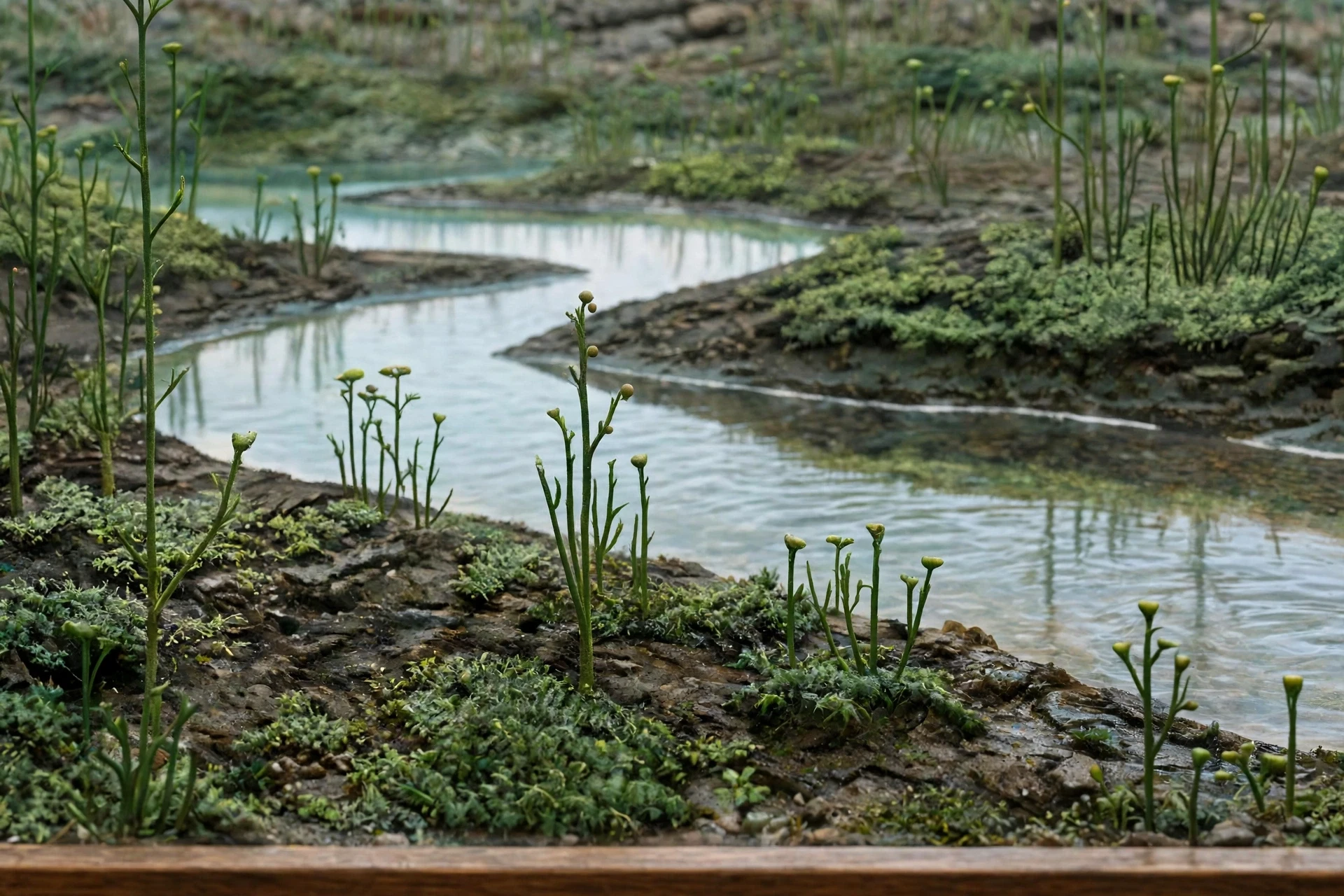
Rhynie is a snapshot, and the plants there were still small, still tied to wet ground around the springs. But they were already a community — plants, fungi, animals, all living together on land, all depending on each other. Land was not colonised by plants alone. Fungi came with them, or met them there, and animals followed. The move ashore was an ecological event, not a solo expedition, happening at roughly the same time as animals were making their own move onto land, in the world described in our article on the Cambrian Explosion, and the two stories belong together.
Four problems to solve
What exactly did those pioneers have to solve? Four problems, each one enough to kill an unprepared plant — the four problems that plant evolution had to solve before anything tall, dry-loving or seed-bearing could exist at all.
Drying out. In water, a cell is bathed. On land, the air pulls water out of every exposed surface. A land plant needs a way to seal water in, and to open up just enough, just when it needs to, to take in carbon dioxide for photosynthesis. The waxy cuticle and the stomatal pores that manage that trade came later. The problem itself arrived on day one.
Ultraviolet light. Water filters sunlight. Air does not, or not nearly as well. On land, a plant is exposed to harsh ultraviolet radiation that damages cells and DNA. Pigments and protective compounds helped, and so did living low, in damp shade. The Zygnematales cousins we met in the last section already carried some of that protection, which may be one reason their lineage was ready for the crossing.
Gravity. Water buoys a plant up. Air lets it fall. A plant on land needs stiffness and support, a way to hold its photosynthetic parts up toward the light without collapsing. At first the answer was small size and turgor pressure — water pressure inside cells, holding them firm like an inflated balloon. Taller growth would need something stronger, and that something was lignin, the stiffening material in wood.
Water and nutrients. In water, nutrients surround a plant. On land, they are locked in rock and soil, and water may be far below or far away. A land plant needs a way to reach down for water, to hold onto the ground, and to draw minerals out of it. The first answer was simple root-like rhizoids, anchoring the plant and absorbing what they could. The deeper answer was fungi. Arbuscular mycorrhizas evolved at the same time as the first colonisation of land, some 450 to 500 million years ago, and they persist in most living plant groups today. About 80% of land plant species form mycorrhizal associations, and the Rhynie chert preserves the direct fossil evidence, with fungi inside Aglaophyton and Horneophyton. The fungi reached further into the soil than any root could, and traded minerals for sugars from the plant. It was a bargain struck at the very beginning, and it has never really ended.
None of those problems had a single solution. The cuticle, the stomata, the lignified stem, the true root, the fungal partnership — each is a chapter in its own right, and the next section takes up the toolkit they form together.
Keep the image of those first pioneers in mind. A thin green film on damp Ordovician mud. A few centimetres of Cooksonia stem, branching in the Silurian air. A hot-spring community at Rhynie, in a world no taller than your ankle. They were the beginning of forests, of grasslands, of gardens, of every green thing you have ever seen. The great move ashore was slow, small and mostly invisible — and it remade the planet.
6. The Toolkit for Dry Land
Moving onto dry land demanded more than courage; it demanded equipment. The first land plants faced drying air, harsh sunlight, and gravity with no water to hold them up. Over millions of years they assembled a toolkit that still defines every plant you see today. Here is how each piece works, and why none of them came alone.
A waxy waterproof skin
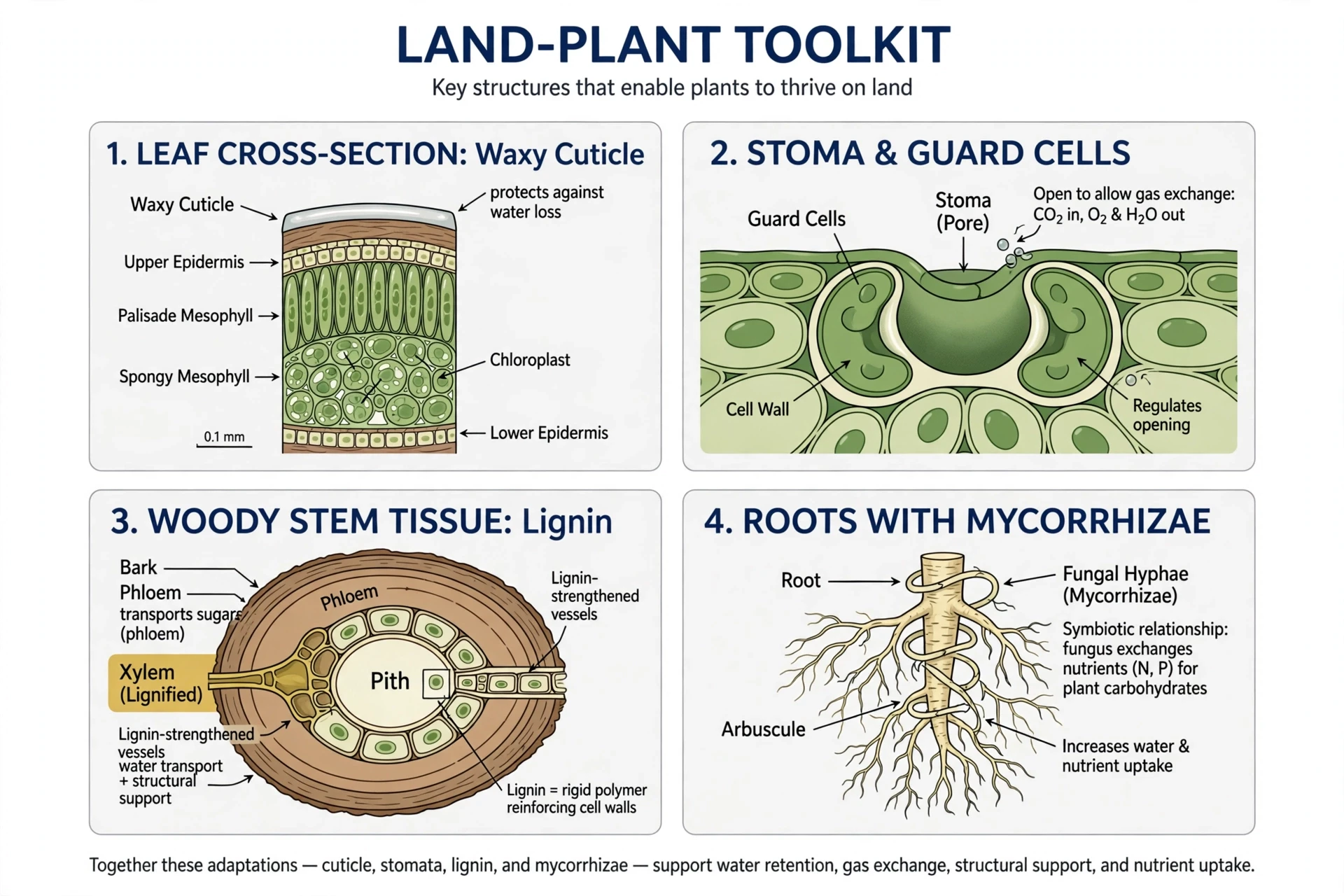
The cuticle came first in the story, though not necessarily first in time. It is a thin, waxy skin of cutin and waxes spread over the outer surface of a plant, and its job is simple: keep water in. Without it, a land plant dries out in hours. The cuticle also shields the plant from soil, microbes, and the outside water that would otherwise flood its tissues. Green algae have no cuticle at all, which is one reason they never left the water. Most land plants have one, and the difference is the difference between a swimmer and a settler. In the long story of plant evolution, waterproofing was the first problem that had to be solved, and the cuticle was the answer that stuck. (source)
A waterproof skin creates a new problem: a sealed plant cannot breathe. Photosynthesis needs carbon dioxide from the air, and the cuticle blocks it. Stomata solved the trade-off. These tiny pores, each flanked by a pair of guard cells, open to let carbon dioxide in and close to keep water from escaping. The plant adjusts them constantly, balancing thirst against hunger. But stomata did not arrive with the very first land plants. The earliest evidence places their first appearance around 450 million years ago, with unequivocal stomata in abundant land plants by the end of the Silurian, about 425 million years ago, and solid evidence for their diversification around 420 million years ago. Liverworts, which evolved around 475 million years ago, lack stomata entirely and breathe through simple air pores instead. Mosses and hornworts carry stomata only on the sporophyte, never on the leafy gametophyte. Nearly every vascular plant has them — the exceptions are plants that returned to living fully underwater, such as Ceratophyllum, which has lost its stomata entirely. One possibility is that stomata evolved only after liverworts diverged — though an alternative is that stomata were secondarily lost in liverworts, which still retain the genes that build them. Either way, the pattern tells us something important about plant evolution: the toolkit was assembled piece by piece, not delivered all at once. (source; source)
Standing up tall
Lignin is what let plants stand up. It is a tough polymer embedded in cell walls alongside cellulose, and it gives stems the rigidity to grow tall without collapsing under their own weight. It is also remarkably resistant to decay, which is why wood lasts. The water-conducting cells called tracheids, strengthened with lignin, had evolved by the late Silurian, around 425 million years ago. Today the tracheophytes — the plants with lignified conducting tissue — make up about 95 percent of all living plant species, while the bryophytes, which lack lignified water-conducting cells, account for the remaining 5 percent. When exactly lignin itself first evolved, nobody can say with confidence, and this article will not pretend otherwise. What we know is that once plants could build with it, height became possible, and height changed everything in plant evolution. (source)
Height needs anchorage, and anchorage needs roots. The earliest land plants had only rhizoids — simple hair-like filaments that gripped the surface and absorbed a little water. True roots, with branching tips that probe deep into the ground, came later and transformed what a plant could do. Roots mine water and minerals from soil, anchor a tall stem against wind, and store food for hard times. They also changed the ground itself, breaking rock apart and mixing dead plant matter into the first real soils. A root is not just a holdfast; it is a mining operation, and the deeper it goes, the taller the plant above it can grow. In the story of plant evolution, roots were the moment plants stopped living on the land and started living in it.
Between the roots and the leaves runs the plumbing that ties the whole plant together. Vascular tissue is two transport systems in one: xylem carries water and dissolved minerals upward from the roots, while phloem carries sugars made in the leaves downward and around to wherever growth or storage is happening. The same tissue also gives the plant structural support, so a stem can be both a pipe and a pillar. Without it, a plant stays small, because every cell must sit close to water. With it, a plant can be a tree. That is the quiet logic of the toolkit in plant evolution: each invention removes a limit that the previous one exposed, and each removal opens the door to the next invention.
A deal with fungi
The cleverest part of the toolkit was not built by plants at all. It was borrowed. Mycorrhizal fungi thread themselves into plant roots and extend far beyond them, pulling in minerals — especially phosphorus — that roots alone cannot reach. In return the plant pays the fungus in sugars and fats made by photosynthesis. The partnership is as old as land plants themselves: arbuscular mycorrhizas evolved at the same time as the first colonisation of land, some 450 to 500 million years ago, and they persist in most plant groups alive today. About 80 percent of land plant species form mycorrhizal associations, and direct fossil evidence comes from the 407-million-year-old Rhynie chert, where fungi are preserved inside the tissues of early plants such as Aglaophyton. In 2021, Rich and colleagues proved the deal in a living liverwort, Marchantia paleacea: the plant transfers lipids to its fungal partner, a transfer controlled by a gene called WRINKLED, and the researchers concluded that this mutualism was already present in the most recent common ancestor of land plants, 450 million years ago. A liverwort is a humble plant, but it carries a receipt for the oldest business deal in plant evolution — a partnership you can read more about in our guide to symbiosis. (source; source; source)
I learned how much this toolkit matters the unglamorous way: with a fern on my desk. I forgot to water it during a busy week, and by Friday its fronds had crisped at the edges. The fern was doing everything its ancestors had learned to do — closing its stomata, leaning on its waxy cuticle — but it had no fungal partners in its little pot and no deep soil to draw on. I watered it, trimmed the dead fronds, and it recovered. The toolkit is powerful, but it works best as a team, in real soil, with real partners. That is a lesson the first land plants learned half a billion years ago, and houseplants are still teaching it to us.
Innovation | What it does | Why it mattered |
|---|---|---|
Cuticle | Waxy layer of cutin and waxes over the plant surface | Stops water loss; shields against soil and microbes |
Stomata | Pores with guard cells that open and close | Trades carbon dioxide intake against water loss |
Lignin | Tough polymer reinforcing cell walls | Lets stems stand tall and resist decay |
Vascular tissue (xylem and phloem) | Xylem carries water and minerals up; phloem carries sugars around | Feeds a large body and supports it |
Roots | Branching organs that anchor and mine the soil | Reach water and minerals; build the first soils |
Mycorrhizal fungi | Fungal partners threaded into roots | Extend the root system; trade minerals for sugars and lipids |
None of these inventions worked alone. A cuticle without stomata would suffocate a plant; tall stems without roots would topple; roots without fungi would starve in poor soil. Together they made a body plan that could survive on dry land, and once that body plan existed, the green world could begin to grow upward. That is when plant evolution moved from surviving on land to conquering it. The next step was not a new organ at all. It was scale: the first forests.
7. The First Forests
For tens of millions of years, land plants stayed small — ankle-high pioneers hugging damp ground. Then, in the Devonian, something changed. Plants grew tall, grew woody, and grew together into the first forests. Within a few tens of millions of years, trees had remade the air, the soil, and the seas.
The earliest known tree
The earliest known tree was Wattieza, a Middle Devonian plant from Gilboa, New York, about 385 million years ago. It stood at least 8 metres tall, a trunk crowned with fronds, and it reproduced by spores like a fern — because in many ways it was one, a cladoxylopsid, a distant fern relative. The famous Gilboa stumps had been known since the 1870s, but they were headless trunks, called Eospermatopteris, with no one knowing what grew on top. The crown was found in June 2004, a matching trunk was dug out in 2005, and in 2007 researchers united crown and stump into a single plant. At the time, Wattieza pushed the origin of trees back by about 25 million years, displacing Archaeopteris as the oldest known tree. It was a tree with no wood, no seeds, and no leaves as we know them — a reminder that in plant evolution, the shape of a tree arrived before the modern tree itself. (source)
Archaeopteris, appearing around the same time, about 385 million years ago, was the first tree that would look at home in a modern forest. It was a progymnosperm with a woody trunk, bark, and flat, fern-like leaves, growing 25 to 30 metres tall. Its roots were the real revolution: deep, extensive systems spreading up to about 11 metres across — roughly 5–6 metres out from the trunk, the first truly modern root systems. At Cairo, New York, a fossil forest dated to 385 million years ago — the oldest forest on record — shows Archaeopteris growing alongside other early trees, its roots already transforming the ground beneath it. The Cairo forest pushed modern-type root systems back about 20 million years earlier than scientists had previously thought. In the last 15 million years of the Devonian, Archaeopteris made up about 90 percent of the forests. No tree before it had ever dominated a landscape so completely, and plant evolution would never be a small-scale story again. (source; source)
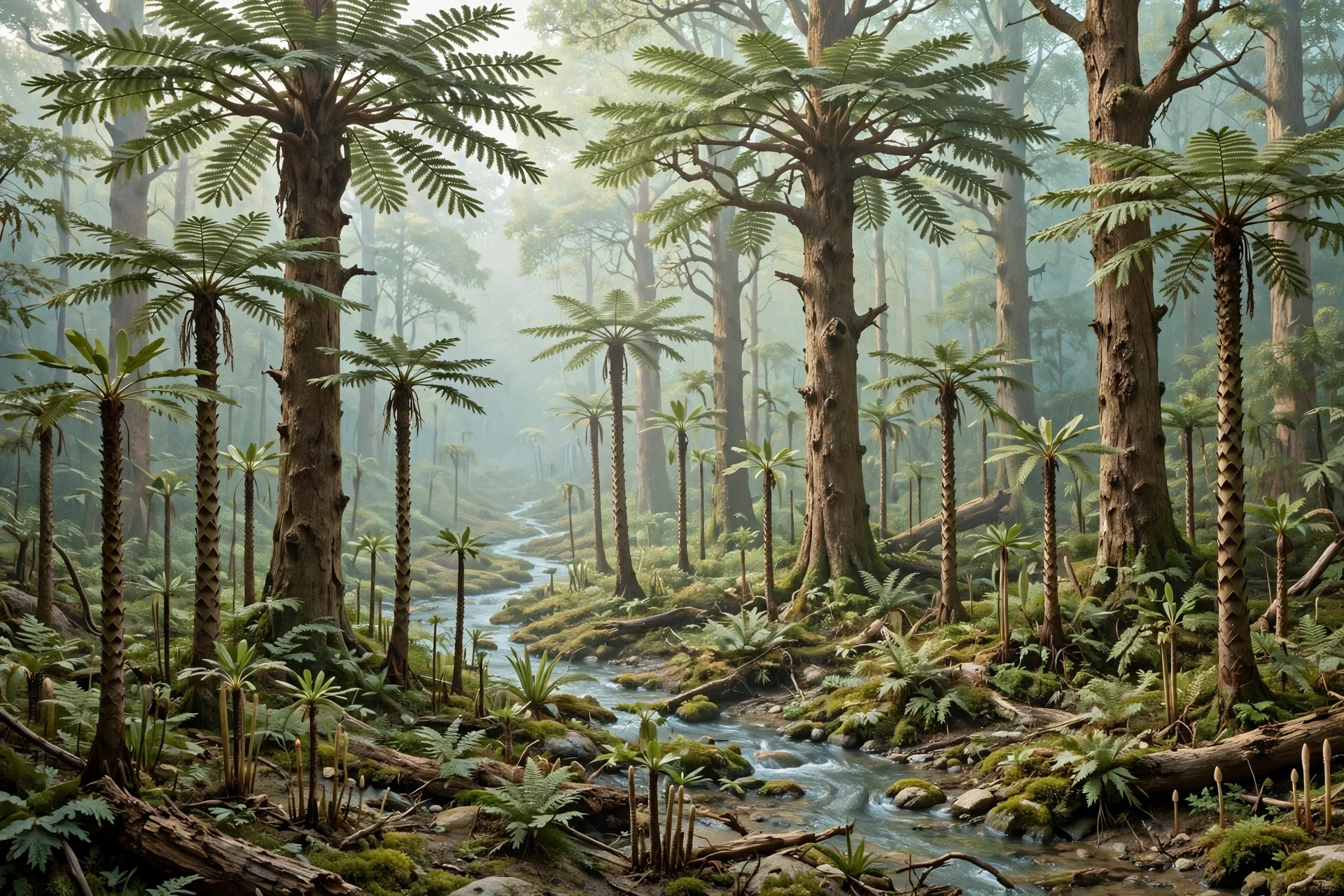
For the first time, the tallest things on land were alive. Before trees, the land had no shade to speak of, no canopy to break the wind, no leaf litter to rot into soil. A forest creates its own weather beneath the canopy: cooler, damper, darker, quieter. It gives small plants a place to grow in the shelter of large ones, and it gives the ground a steady rain of dead leaves that feeds the soil. The first forests were simple compared with a modern rainforest, but they introduced the same basic architecture — a tall layer reaching for the light, and a shaded world underneath it. Every forest since, from a pine plantation to a tropical jungle, is a variation on the pattern that Archaeopteris and its neighbours established in the Devonian.
Cooling a planet
Forests changed the planet itself. Deep roots broke rock apart and pulled minerals into the soil, speeding up the chemical weathering of silicate rocks. Weathering draws carbon dioxide out of the air and buries it, and the burial of huge amounts of plant carbon did the same. The result was a long, slow drawdown of atmospheric carbon dioxide, from model-based estimates of more than ten times the present level in the early to middle Palaeozoic to about 1 times by the Carboniferous and Permian, bringing global cooling and, eventually, the Late Palaeozoic Ice Age. One expert estimate puts the Late Devonian shift even more sharply, with carbon dioxide falling from around 10 percent of the atmosphere to around 1 percent and oxygen rising from around 5 percent to around 20 percent over about 50 million years — but that is one researcher's estimate, not a measured value, and the broad picture is what matters: trees cooled the world they lived in. (source)
The Devonian greening left fingerprints everywhere:
Soils grew deep for the first time, as trees with complex roots spread from moist lowlands into drier uplands and built mature soils across the land.
Rivers carried the nutrient flush from intensified weathering into the seas, a surge linked to Late Devonian marine anoxia and the Frasnian–Famennian extinctions.
Oxygen rose as carbon was buried, setting the stage for the oxygen-rich world of the coal forests that followed.
(source)
More than trees
A forest is more than a collection of trees. Once trees stood together, they created a world beneath themselves: shade where the sun had once beaten down unchecked, shelter from wind, and a floor of fallen leaves and rotting wood that fed a whole community of small life. The deep soils the trees built held water through dry spells and gave later plants a place to take root. Early Devonian plants had been small, tens of centimetres tall, shallowly rooted, and confined to moist lowlands; by the end of the Devonian, trees with deep, complex root systems and seeds had spread into drier uplands, greatly increasing both the depth and the geographic extent of mature soils. The forest, in short, made the land habitable for everything that came after it — including, eventually, us.
There is a strange humility in this chapter of plant evolution. The first trees did not set out to cool the planet or build soils or empty the seas of oxygen. They were simply growing taller to reach the light, and reaching deeper to find water. The planet changed as a side effect. It is a pattern that repeats through the whole history of plant evolution: plants solve a small local problem, and the world rearranges itself around the solution. To see how those forests are read from the rocks, see our guide to the fossil record.
8. Leaves: The Solar Panels
A tree is mostly a device for holding leaves up to the sun, so the leaf itself deserves its own chapter. Leaves look simple, but they are among the most sophisticated organs plants ever built. They also evolved more than once, and the big, flat leaf we picture today arrived surprisingly late.
Two different blueprints
There are two fundamentally different kinds of leaf. Microphylls are small leaves with a single, unbranched vein, built from spine-like outgrowths on the stem. They belong to the lycophytes, the club mosses and their giant extinct relatives, and the earliest examples come from the club moss Baragwanathia, of Late Silurian age (some argue Early Devonian). Megaphylls are the big, flat leaves with branching veins that most of us picture when we hear the word leaf. They evolved by flattening and webbing whole branch systems, and they belong to ferns, gymnosperms, and flowering plants. The oldest known megaphyll is Eophyllophyton bellum, from the Lower Devonian of China, about 410 million years ago. Two different blueprints, two different lineages, one job: catching sunlight. That is why botanists say leaves evolved at least twice, a classic case of convergence in plant evolution. (source)
But the big leaf was slow to arrive. Large leaves appeared only 40 to 50 million years after vascular plants themselves, becoming widespread at the close of the Devonian, about 360 million years ago, with Archaeopteris. The delay has a chemical explanation. The early Devonian air was thick with carbon dioxide, and in that air a plant could gather all the carbon it needed through a small surface — there was no pressure to build big, expensive leaves. Big leaves also need many stomata to feed them, and very high carbon dioxide suppresses the development of stomata. As carbon dioxide fell between 380 and 340 million years ago, leaf blades enlarged roughly 25-fold. The leaf, in other words, waited for the air to thin before it grew large. That feedback between air and leaf is one of the great themes of plant evolution, and it ties the history of leaves directly to the history of the atmosphere and to the carbon cycle that still governs our climate today. (source)
Veins, water and compromise
A big leaf is also an engineering problem. A flat blade needs a network of veins to deliver water to every corner and carry sugars away, and veins cost carbon to build. The solution was a branching hierarchy: a strong midrib, smaller veins, and a fine mesh that keeps every photosynthetic cell within a short distance of a water supply. The more veins a leaf packs in, the faster it can photosynthesise — but also the more it costs, and the more water it loses. Every leaf is a compromise between catching light, saving water, and paying for its own plumbing. The machinery inside the leaf — the chemistry that turns light, water, and carbon dioxide into sugar — is covered in our guide to photosynthesis. Once megaphylls solved that compromise, there was no going back: the solar panel became the standard equipment of the plant kingdom, and the rest of plant evolution would be built on top of it.
Look at the leaves around you and you can read plant evolution in miniature. A small, tough leaf with a single vein is an old design, refined over hundreds of millions of years and still perfectly good at its job — the club mosses in a damp wood are living proof. A broad leaf with a branching network of veins is the newer design, a bigger bet that pays off only when water is plentiful and carbon dioxide is scarce enough to reward the extra surface. Neither design is "better" in any absolute sense. Each is a wager on a particular climate, and plant evolution has kept both bets on the table for more than 400 million years. That is why a walk through any forest is also a walk through a museum: the old and the new grow side by side, and both are still winning.
9. From Spores to Seeds
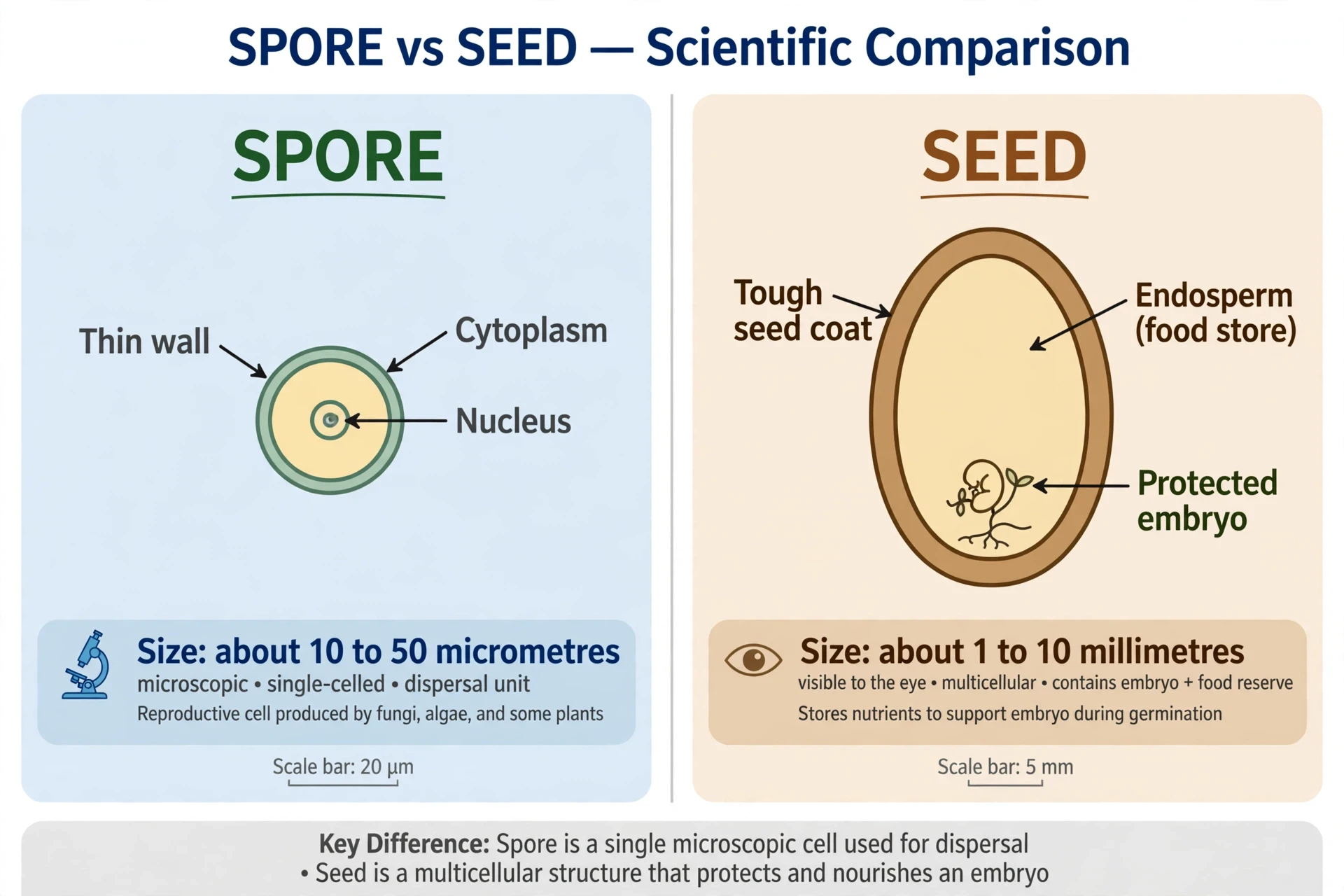
A spore is a brave little thing: a single cell, cast to the wind, that must land somewhere wet and grow from scratch. A seed is something else entirely — a baby plant, packed with lunch, wrapped in armour, able to wait. The invention of the seed changed what a plant could be, and where it could live.
Protection, provision and patience
A seed is a protected embryo with a food store and a coat. Several layers of hardened tissue keep it from drying out, and the stored food sustains the young plant until it can photosynthesise for itself. Seeds can wait in dormancy — months, years, sometimes far longer — until conditions are right, and they can travel, carried by wind, water, or animals, far from the parent that made them. That combination — protection, provision, patience, and travel — is why seeds were such a breakthrough. A spore must germinate where it lands or die. A seed can choose its moment. (source)
The first seed plants appear in the fossil record in the Late Devonian, in the Famennian stage, about 365 million years ago. The earliest known is Elkinsia polymorpha, a "seed fern" whose ovules sat inside protective cupules. Molecular clocks give a wider range, roughly 330 to 454 million years ago, so the fossil date and the genetic date do not yet agree — a disagreement worth stating plainly rather than smoothing over. Some accounts round the fossil figure to around 360 million years ago, which is a fair approximation, but about 365 million years is the figure the specialist literature supports. Whenever in that window the first seeds appeared, they arrived at the end of a Devonian already transformed by forests, and they were built for the drier world the forests had made. They mark the moment plant evolution solved its last great problem of dry land. (source)
Pollen sets sperm free
Pollen was the seed's partner in freedom. In mosses and ferns, the male sex cells are flagellated sperm that must swim through a film of water to reach the egg — reproduction chained to wet weather. In seed plants, the male gametophyte is packaged into a pollen grain: a few haploid cells inside a tough protective coat that resists drying and damage, carried by wind, water, or pollinator. Seeds and pollen were, together, the two great adaptations to drought and to reproduction without water. They freed plants from the puddle, and the dry uplands — the places the first forests had only begun to reach — opened up to them. That freedom is one of the decisive turns in plant evolution. (source)
The seed also completed the long shift in the plant life cycle described in §2: the diploid sporophyte grows larger, more dominant, and more independent, until it can protect the embryo inside its own tissues. The seed is that protection, perfected. For the full picture of how a modern plant's body works today, see our guide to plant biology. (source)
With seeds and pollen, plants could colonise dry land properly for the first time. They could wait out a drought, cross a desert, and grow in places no spore could survive. Seeds are also scattered by wind, water, or animals, which lets a plant's offspring escape competition with the parent and settle ground the parent could never reach. A seed that lands in a good spot can wait for the right season; a seed that lands in a bad one may still be carried onward by a passing animal or a flood. That combination of patience and travel is what turned the seed from a good idea into a world-changing one, and it is why seed plants, once they appeared, never looked back. The next chapter is what they did with that freedom: they built the greatest forests the Earth has ever seen, and then they buried them.
The seed plants that followed would take this invention and run with it, and the next chapters of plant evolution belong to them. Gymnosperms — the "naked seed" plants, including conifers, cycads, and ginkgo — first appear in the fossil record around 319 million years ago, in the late Carboniferous, and would go on to dominate the landscape of the Mesozoic until the flowering plants took over by the mid-Cretaceous. But before that long reign, the seed's first great triumph was the Carboniferous itself, where spore-bearing giants still ruled the swamps and the seed plants waited in the wings. (source)
10. The Coal Forests
Imagine a swamp the size of a continent, steaming under a hot sun, where trees as tall as a ten-storey building rise out of black water. That was the Carboniferous world, roughly 359 to 299 million years ago. Its forests became the coal that powered our own industrial age.
Giants of the swamps
The Carboniferous swamp forests were dominated by plants that would look strange to us now. Giant club mosses — Lepidodendron and Sigillaria, the "scale trees" — grew up to about 40 metres tall — Sigillaria somewhat less, around 30 metres — with trunks up to around 2 metres across, their bark patterned like scales. Giant horsetails rose to around 20 metres, and tree ferns filled the shade beneath them. These were not the seed plants that would later dominate the world; many of them still reproduced by spores. But they grew fast and grew enormous, in warm, wet, low-lying swamps where dead plant matter piled up faster than it could rot. In the Carboniferous, plant evolution was running an experiment in sheer size. (source)
That piling up is how coal formed. Dead plants sank into oxygen-poor water, where decay slowed to a crawl, and layer upon layer of plant debris accumulated as peat. Buried deeper, squeezed and heated over millions of years, the peat was transformed in stages: first into lignite, the soft brown coal, then into bituminous coal, and finally, under the greatest pressure and heat, into anthracite, the hard, glossy, carbon-rich coal. Coal is, quite literally, buried sunshine — ancient photosynthesis, packed into rock. And the Carboniferous chapter of plant evolution is the one we still burn today. The atmosphere above those forests was itself remarkable: Carboniferous oxygen is estimated at up to about 32 percent, compared with 21 percent today, though that figure is a model estimate, not a measurement, and it should be read as one. (source)
Why so much coal
Why did so much coal form then, and so little since? Two explanations compete, and the honest answer is that the question is still open. The first says the key was lignin. Lignin is tough, decay-resistant stuff, and when it first became abundant in woody plants, the fungi and bacteria that could break it down had not yet evolved — so dead trees simply piled up instead of rotting. The second says the mires themselves did the work: vast, waterlogged tropical swamps, combined with enormous plant productivity, buried carbon faster than anything could decompose it, and no missing decomposer is needed. Recent research, including a 2016 study by Nelsen and colleagues (PNAS), has argued the peak is better explained by a unique combination of wet tropical climate and tectonics during the assembly of Pangaea than by any missing decomposer. Both sides agree on the outcome — the Carboniferous buried carbon on a scale the Earth has never repeated — and they disagree on the mechanism. That disagreement is not a failure of the science. It is the science, working as it should, and plant evolution is full of such open questions. (source)
The scale of it is hard to grasp until you hold a piece of coal in your hand. A single lump is the compressed remains of plants that grew, died, and sank in a swamp some 300 million years ago — layer upon layer of peat, pressed by the weight of the sediments above it, transformed step by step into rock. The coal seams we mine today are those swamp floors, stacked one above another across whole basins. The Carboniferous is the chapter of plant evolution written in a rock we can still hold, and every tonne of coal burned in the last two centuries has been a small piece of that ancient forest, returning to the air as carbon dioxide.
The coal forests ended, as all worlds do. The swamps dried as the climate shifted, the giant club mosses faded, and the seed plants that had appeared in the Devonian began their long rise. But the carbon those forests buried stayed in the ground for 300 million years — until we dug it up and burned it, and the carbon dioxide the Devonian forests had drawn down came rushing back into the air. The story of plant evolution is not only a story about the past. The forests of the Carboniferous are still shaping our climate today, and understanding them is part of understanding the world we live in now — and the living ecosystems that still depend on the same green machinery.
11. The Conifer Age
For roughly 150–200 million years, the world's forests belonged to the seed plants without flowers. Conifers, cycads, and the ginkgo's ancestors held the canopy, the understory, and the dry uplands, shaping a green planet that no flowering plant had yet touched. Their reign is the middle act of plant evolution.
The gymnosperms — the "naked-seed" plants — first appear in the fossil record around 319 million years ago, in the late Carboniferous. Their seeds sat exposed on the scales of cones instead of tucked inside a fruit, and that was enough. Conifers appeared toward the end of the Carboniferous, cycads first appeared in the Permian, and ginkgophytes existed back to the Permian too. For a very long time, this was simply what a forest looked like.
I first met a ginkgo properly on a city street in autumn, when the ground was carpeted with fan-shaped leaves the colour of butter. The tree above me had survived the end-Permian extinction, the dinosaurs, and an ice age, and now it was shading a bus stop. That is the thing about plant evolution: its survivors do not always look dramatic. Sometimes they just look like a street tree, quietly outlasting everything that ever shaded that same pavement.
Cycads and conifers
The cycads deserve a closer look. The earliest clear cycads appear in the Permian, between about 299 and 252 million years ago — possibly earlier, in the Carboniferous, and they became so dominant in the Mesozoic that the era is sometimes called the "age of cycads." A cycad looks like a palm that never quite decided what it wanted to be: a stout trunk crowned with stiff, fern-like fronds. Dinosaurs browsed among them. Then the world changed, and the cycads shrank back to scattered pockets in the tropics and subtropics, where they still grow today.
Conifers were the great generalists of plant evolution. Their needle leaves lose little water, their resin seals wounds and poisons hungry insects, and their cones protect seeds through winter. A pine can grow in thin, acidic soil on a cold mountain slope where almost nothing else survives. That toughness is why conifers still dominate the boreal forest today — and why plant evolution kept them in the game long after the flowers arrived.
The ginkgo's story is stranger still. Ginkgophytes existed back to the Permian, and the sources disagree about exactly when the ginkgo line first appeared — some place it much later — so no precise first-appearance date is safe to give. What is certain is that only one species survives: Ginkgo biloba, a tree with fan-shaped leaves and a smell, when its fleshy seeds ripen in autumn, that no one forgets. It is the last living member of a lineage that once spread across the northern continents.
Leaves that joined continents
One of the most important plants of this age never survived it at all. Glossopteris was a seed fern with tongue-shaped leaves, the dominant tree of the mid- to high-latitude lowlands of Gondwana in the Permian, arising around 299 million years ago and vanishing in the end-Permian mass extinction around 252 million years ago. Its fossils turned up in South America, Africa, India, Australia, and Antarctica — identical leaves on continents now separated by thousands of kilometres of ocean. Its seeds were not equipped for long ocean crossings, so the leaves themselves became the argument: these continents must once have been joined. The fossils helped Eduard Suess name the supercontinent Gondwanaland, and they gave Alfred Wegener some of his strongest evidence for continental drift. You can read more about the catastrophe that ended Glossopteris in our article on mass extinctions.
The end-Permian extinction was the worst the planet has ever suffered, and the gymnosperms came through it. That is worth pausing on. Whole forests died; whole groups of plants vanished. Yet the conifers, the cycads, and the ginkgo line carried on, and in the Triassic and Jurassic they rebuilt the world's forests. By the Jurassic, gymnosperms dominated the Mesozoic landscape — vast conifer forests, cycad groves, and ginkgo trees shading the dinosaurs. It was a stable, successful world, and it lasted for well over a hundred million years.
The gymnosperms' survival through the worst extinction in Earth's history is one of the quiet triumphs of plant evolution. They had no flowers, no fruits, and no animal partners to carry their seeds, yet their cones, their tough leaves, and their ability to grow in poor soils carried them through a world that killed off most of the life in the sea and on land. When the Triassic dawned, the forests that regrew were theirs. It is a reminder that in plant evolution, endurance counts as much as innovation.
Then, in the Cretaceous, something new began to push in from the edges. Flowering plants — small, fast-growing, and strange — started to appear in the fossil record. The gymnosperms did not vanish. They still dominate the far north today, in the great boreal forests of pine, spruce, and fir. But by the mid-Cretaceous, the angiosperms had taken over the canopy in most of the world. The conifer age ended not with a catastrophe, but with a slow replacement. The old forest stepped aside, and a new one took its place.
12. The Flower Mystery
In 1879, Charles Darwin wrote a private letter calling the sudden rise of flowering plants an abominable mystery. He could not see how so much diversity had appeared so fast. The mystery has only deepened since then — and plant evolution has never quite resolved it.
Darwin was writing to his friend Joseph Hooker on 22 July 1879, and the sentence has become one of the most quoted lines in all of biology:
"The rapid development, as far as we can judge, of all the higher plants within recent geological times is an abominable mystery."
The puzzle was real. Flowering plants appear in the Cretaceous fossil record suddenly and in great diversity, with almost no pre-Cretaceous record behind them. For a theory built on slow, gradual change, that suddenness looked like a problem. Recent scholarship has added a nuance worth knowing: a 2017 letter in Nature Ecology & Evolution by Richard Buggs argues that Darwin meant the dicotyledons specifically — the great group that includes oaks, roses, and daisies — rather than all flowering plants — though that is one historian's interpretation, not consensus. The mystery survives either way, because the dicots are most of what a flower is.
Pollen tells the story first
The oldest definite evidence of flowering plants is pollen. Reticulated monosulcate pollen — pollen grains with a single groove and a net-like surface — appears around 140 to 133 million years ago, in the late Valanginian stage of the Early Cretaceous. Pollen is tough stuff. It survives in sediments long after leaves and stems have rotted, so it often tells the story first.
The earliest macrofossil confidently identified as an angiosperm is Archaefructus liaoningensis, from the Yixian Formation in Liaoning, China, around 125 million years ago. It was an aquatic herb, and it looked nothing like a rose. It had no sepals and no petals; its stamens and carpels sat along an elongated stem, like beads on a string. Whether it sits at the very base of the flowering-plant family tree, or closer to the water lilies, is still debated. Either way, it shows that the first flowers were modest things, growing in quiet water.
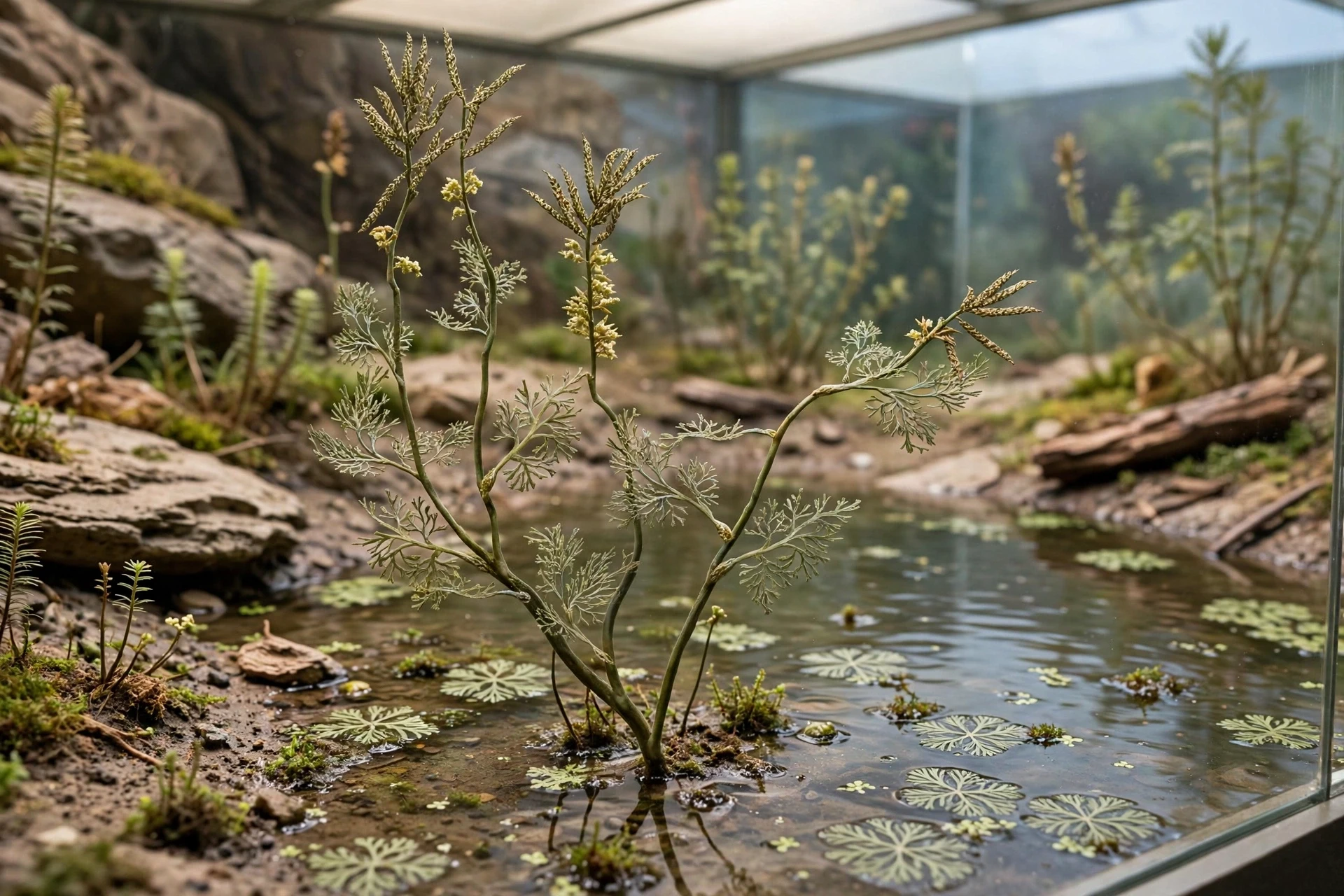
Montsechia vidalii may be older still. It comes from Barremian lake limestones in Spain, dated to about 125 to 130 million years ago, and a re-analysis of more than a thousand specimens showed it to be an angiosperm — contemporaneous with Archaefructus, if not older. It, too, was an aquatic freshwater plant, with no showy petals at all. Its discoverers were careful about what it meant. As David Dilcher put it, a "first flower" is technically a myth, like the "first human." There was no single moment when a flower switched on. There was a long, gradual assembly of parts, and the fossil record catches only fragments of it.
When did flowers begin
So when did flowers actually begin? The honest answer is that the origin debate is still active, and the dates on the table disagree by more than a hundred million years. The fossil evidence says the Early Cretaceous, roughly 130 to 140 million years ago. Ma and colleagues, writing in Nature Communications in 2025, argued for a largely Triassic crown age, between 255 and 202 million years ago. Wu and colleagues, in Nature Plants in 2026, argued for a latest Jurassic origin — directly disagreeing with Ma. An earlier study by Silvestro and colleagues in 2021, drawing on some 15,000 fossil occurrences, also supported a pre-Cretaceous origin, though that conclusion was itself contested. None of these dates can be treated as settled. The range itself is the finding: somewhere between the Triassic and the Early Cretaceous, a gymnosperm-like ancestor gave rise to the first flowering plant, and the fossil record has not yet pinned down exactly when.
What did that first flower look like? A reconstruction by Hervé Sauquet and colleagues, published in 2017 and built from 792 species and more than 13,000 trait data points, offers the best answer we have. The ancestral flower was most likely bisexual, radially symmetric, with more than ten undifferentiated tepals, more than ten stamens, and more than five carpels, its perianth and androecium arranged in whorls of three, all the organs free from each other. It had no separate sepals and petals — just tepals, the undifferentiated outer parts. It was a simple, open flower, probably pollinated by insects, and it looked nothing like the layered, specialised blooms we picture today.
The great explosion
Then came the explosion. The 2024 Kew phylogenomic tree — built by Alexandre Zuntini and colleagues from 353 nuclear genes across 7,923 genera, calibrated with 200 fossils — found that early angiosperm evolution was explosive, giving rise to more than 80 percent of the living orders, followed by steady diversification through the Mesozoic and a second surge in the Cenozoic as global temperatures fell. Today, flowering plants make up around 90 percent of all land plant species: somewhere between 300,000 and 375,000 species, in 64 orders and 416 families. That is the scale of the mystery Darwin was staring at. In geological terms, the flowers arrived late and then took everything.
Why did the flowers win? Part of the answer lies in their leaves. Over the course of the Cretaceous, flowering plants evolved denser networks of leaf veins, which let them move water faster and photosynthesise harder than the gymnosperms around them. They grew faster, reproduced younger, and colonised disturbed ground first. Add animal pollination and animal dispersal, and the advantage compounds. This is not a story of flowers being "better" in some abstract sense — it is a story of plant evolution favouring speed and flexibility in a world that kept changing. In the long view of plant evolution, the flowers won by being fast.
The debate over the date matters because it changes the story of plant evolution. If flowers began in the Triassic, they spent a hundred million years as minor players before their Cretaceous rise — a long, quiet apprenticeship. If they began in the Early Cretaceous, their rise was one of the fastest takeovers in the history of plant evolution. Either way, the fossil record keeps the argument honest: every new flower fossil narrows the window, and the window is still open.
The fossil record is still the court where this case is argued, and new fossils keep moving the dates. That is how science is supposed to work. The mystery is not a failure of the theory of evolution; it is a sign that the record is incomplete and the questions are good ones. Nearly a century and a half after Darwin's letter, the abominable mystery is still abominable — and still worth chasing.
13. Pollination Partnerships
Long before the first flower opened, insects were already doing the job that flowers would later make famous. They visited cones and seed ferns, carrying pollen for a meal, and in that exchange lies one of the oldest partnerships on Earth — and one of plant evolution's most fruitful bargains.
Fossil evidence shows insect–seed-plant pollination interactions in the Late Paleozoic, pre-dating the emergence of flowering plants by nearly 200 million years. The insects were there first, visiting the reproductive structures of gymnosperms and seed ferns, eating pollen and carrying it away on their bodies. When flowers appeared, they did not invent pollination. They inherited it, and then they refined it beyond anything the gymnosperms had managed. The earliest flowers were insect-pollinated — animal pollination is the ancestral state for flowering plants, not a later invention. Wind pollination evolved later, repeatedly, from insect-pollinated ancestors. By around 130 million years ago, insects were very likely the pollinators — direct fossil evidence reaches back to about 99 million years ago — diversifying alongside the flowering plants through the mid-Cretaceous. (source)
Bees join the bargain
Bees arrived later than the partnership itself. They originated from carnivorous wasp-like ancestors in the Early Cretaceous and switched to feeding on pollen and nectar. It was a dietary change with enormous consequences. A wasp hunts; a bee gathers, and in gathering it carries pollen from flower to flower with a thoroughness no wind can match. The bees and the flowers grew up together, each shaping the other: flowers that offered more nectar got more visits, and bees that visited more flowers left more descendants. That feedback loop is natural selection working through a partnership rather than a fight.
This kind of partnership is one of the recurring themes of plant evolution. Plants cannot walk to a mate, so they hire couriers — and they pay in sugar, scent, and colour. The payment looks wasteful until you count what it buys: a pollinator that visits ten flowers in an hour can do more for a plant's reproduction than a week of wind. The gymnosperms bet on the wind. The flowers bet on animals. The bet paid off so well that today, most flowering plants rely on animal pollinators.
A flower, in standard botanical terms, is a modified shoot with four parts:
Sepals — the outer parts that protect the bud before it opens.
Petals — the showy parts that attract pollinators with colour, scent, and shape.
Stamens — the male parts that make pollen.
Carpels — the female parts, also called the pistil, that contain the ovules.
Colour, scent and shape
Colour, scent, shape, and the nectar reward all work together to attract specific pollinators. A flower that opens at night and smells of rotting meat is not being careless; it is advertising to moths and flies. A flower that is red and tubular and full of thin nectar is speaking to hummingbirds. Each shape is a message, and each message has been edited by millions of years of visitors.
The most famous story in this whole partnership belongs to Darwin, and it is worth telling in full because it shows what a good prediction looks like. In Madagascar grows an orchid called Angraecum sesquipedale, Darwin's orchid, a white, star-shaped flower with a nectar spur up to about 43 centimetres long (typically around 30 cm) — a slender tube of nectar hidden at the very bottom. In 1862, Darwin looked at that spur and reasoned that some insect must exist with a tongue long enough to reach the nectar at the bottom of it. He predicted a moth with a proboscis ten to eleven inches long, roughly 25 to 28 centimetres. No such moth had ever been seen.
In 1903, twenty-one years after Darwin's death, Rothschild and Jordan discovered just such a hawkmoth in Madagascar and named it Xanthopan morganii praedicta — praedicta meaning "predicted." Darwin had been right, and he had been right about an animal no one had seen, from the shape of a flower alone. The moth was not actually witnessed feeding on the orchid until 1992, a hundred and thirty years after the prediction. That is the part of the story people forget: a prediction can be confirmed and still wait a century for someone to watch it happen.
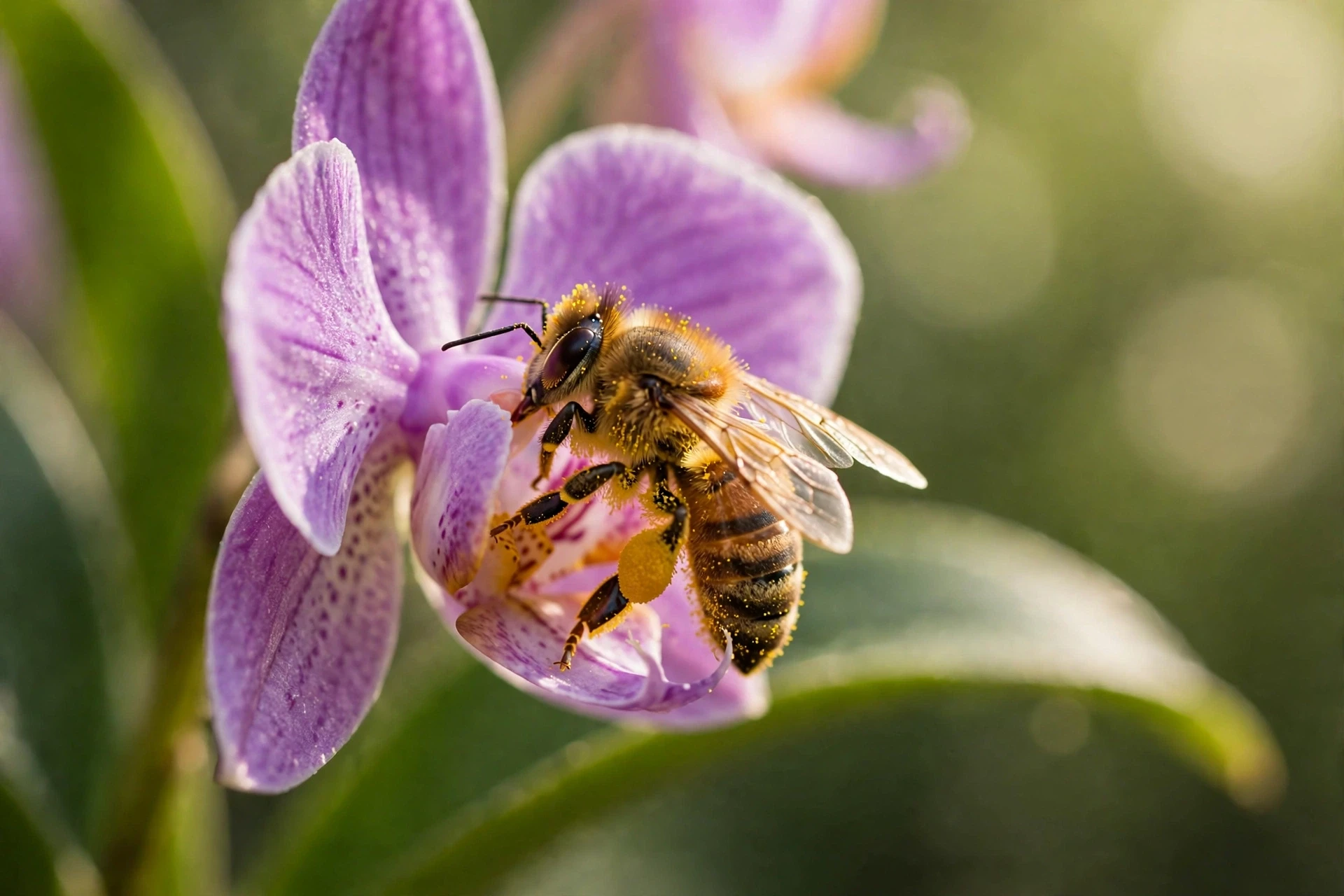
More than bees alone
Pollination is not only about bees. Butterflies, moths, beetles, flies, birds, and bats all carry pollen, and each group has shaped the flowers it visits. Beetles were among the earliest pollinators, and some of the oldest flowers still smell faintly of the fermented, fruity odours beetles love. Birds came later, and their flowers tend to be red — a colour bees see poorly — and rich in nectar. Bats pollinate at night, visiting large, pale, strongly scented flowers that open after dark. Every one of these relationships is a separate negotiation, struck independently, and each one changed both sides.
That specialisation runs through the whole partnership. Colour, scent, shape, and nectar reward all work to attract specific pollinators, and the flowers that do it best leave the most descendants. A flower is not a decoration. It is an advertisement, a landing pad, and a payment system, all built by plant evolution out of a modified shoot.
There is a cost to all of this, and it is worth naming. A flower that pays for pollination in nectar is spending energy it could have spent on seeds. A plant that depends on a single pollinator is gambling its whole future on one species. When a pollinator disappears, the flower can follow. That fragility is the price of specialisation, and it is one reason the loss of pollinators today is not a small problem. The partnership that built the flowering world is also the partnership that can break it.
14. Fruits and the Great Dispersal
A fruit is a bribe, wrapped in sugar. The plant spends its hard-won energy on sweet flesh, not because it loves the animal that eats it, but because the animal will carry its seeds somewhere new. It is one of plant evolution's cleverest deals — payment in exchange for a lift.
A seed that falls straight down lands in its parent's shadow, competing with its own siblings for the same light, water, and soil. A seed carried a kilometre away lands somewhere new. The plant that solves the transport problem wins, and the fleshy fruit is the solution flowering plants hit upon again and again. Fleshy fruits evolved many times independently, in many different families — the same good idea, discovered over and over.
Fruit came before its carriers
The diversification of fleshy fruits began around 80 million years ago, and the diversity of seed sizes, fruit sizes, and fruit types peaked in the Eocene, around 55 to 50 million years ago. That timing matters, because it tells us who the first customers were. The early frugivores were probably the extinct multituberculate mammals — small, rodent-like animals that are gone now, but that were among the most important fruit-eaters of the early phase. The flying frugivores, birds and bats, evolved mainly in the Oligocene and Miocene, later. The fruit came first; its most famous carriers arrived afterwards. Most fleshy-fruit families are substantially older than the families of the vertebrates that eat them today. That repetition is the signature of plant evolution finding a good answer and using it again.
Birds are now the most common vertebrate dispersers of seeds. Bird dispersal is more common than mammal dispersal in all angiosperm lineages, and fleshy fruits eaten by vertebrates are spread widely across the flowering-plant family tree. A bird eats a berry, flies to another tree, and deposits the seed — fertilised, in its droppings — far from where it started. A bat does the same thing at night, over even longer distances. Walk through a rainforest at dawn and you can hear the deal happening: fruiting trees full of birds, each one a courier the tree never had to hire.
Wings, floats and hitchhikers
Not every fruit is a bribe. Some fruits are built to fly, with wings or plumes that catch the wind — think of maple seeds spinning down like helicopters, or dandelion clocks drifting on a breeze. Some are built to float, riding rivers and ocean currents to new shores; the coconut is the most famous traveller of all. Some are built to hitchhike, covered in hooks and barbs that catch in fur and feathers. And some simply explode, flinging their seeds away from the parent with a mechanical snap. Each design is a different answer to the same question: how does a plant that cannot move get its children somewhere new?
The deeper point is that dispersal shapes the map of life. A plant family that can cross an ocean can colonise a new continent. A fruit that a bird loves can spread across an entire hemisphere in a few thousand years. The great dispersal that began around 80 million years ago is still running today, every time a bird eats a berry or a burr catches on a passing animal. The forests we see now are, in part, the result of millions of years of plant evolution, with animals doing the walking that plants cannot do.
There is a quieter version of the same deal that plant evolution struck long before fruits existed: the wind. Gymnosperms still rely on it, and many flowering plants never gave it up. But the animal deal has one advantage the wind can never match — direction. Wind scatters seeds at random. A bird carries a seed to a place where birds feed, which is usually a place where plants already grow well. That targeting is why fleshy fruits spread so widely, and why so many unrelated plant families arrived at the same solution.
15. Grasses Take Over
Grass looks humble. It is also the most successful plant the world has ever seen, the foundation of the food that feeds most of humanity and the stage on which the great grazers live. Its rise was late, slow, and utterly transformative — the final great shift in plant evolution.
Grasses first appeared in the Late Cretaceous, far earlier than anyone expected. The evidence comes from an unlikely place: fossilised dung. Grass phytoliths — tiny silica bodies that form inside grass cells — were found in titanosaur coprolites from the Lameta Formation in India, dated to 66 to 65 million years ago. At least five modern grass lineages already existed by then, including relatives of rice and bamboo and relatives of wheat and barley. Molecular dates push the origin back further still, to around 70 to 75 million years ago or earlier. Grasses were already a going concern while the last dinosaurs were still walking around.
Old, but not yet dominant
But being old is not the same as being dominant. For tens of millions of years, grasses were minor plants of the forest understory, living quietly in the shade of the trees. True grassland communities spread only around 30 million years ago, and expanded in North America around 26 million years ago. The great grasslands of the world — the savannas, the steppes, the prairies — are a recent invention, geologically speaking. Today, grass-dominated habitats cover more than 40 percent of Earth's land surface (before recent human impacts). That is the scale of the takeover: from understory weed to the ground cover of nearly half the planet's land.
A new kind of photosynthesis
The engine of that takeover was a new kind of photosynthesis. C4 photosynthesis is a carbon-concentrating pump: its first product is a four-carbon compound, and it boosts photosynthesis in hot, low-carbon-dioxide conditions, losing less carbon dioxide and water than the older C3 pathway. It first evolved in grasses between 25 and 32 million years ago, during the Oligocene, triggered by falling atmospheric carbon dioxide. But C4 plants did not become widespread until much more recently, between 10 and 6 million years ago. For roughly twenty million years, the innovation existed without conquering the world. Then the climate dried, the carbon dioxide fell further, and the grasses were ready.
C4 is also one of the great examples of convergent evolution in the history of plant evolution. It has evolved independently more than 60 times — 62 lineages in one widely cited count, with newer estimates running to 66 — in 19 angiosperm families, from the C3 pathway. Most C4 species are grasses, and the grass family holds more C4 species than all the other families combined. When the same solution appears sixty separate times, it is not a coincidence. It is a sign that the problem — hot, dry, low-carbon-dioxide air — had one very good answer, and evolution kept finding it.
C4 plants now account for roughly 20–30 percent of global terrestrial carbon fixation, and they include the crops that feed the world: maize, sugarcane, sorghum, and millet. The food on most dinner tables traces back, one way or another, to a grass. Wheat, rice, and barley are grasses too, and between them, the grasses feed humanity. That is not a small thing for a family of plants that spent its first forty million years in the shade.
The grasses also changed the animals. Vast herds of grazers — wildebeest, bison, antelope, horses — exist because grasslands exist, and the great migrations of the Serengeti are, at bottom, a story about plant evolution. The grass feeds the herd, the herd's grazing keeps the grassland open, and the grassland's fires clear the trees that would shade the grass out. It is a system that maintains itself, and it has been running for millions of years.
Teeth for tough grass
Then came the grazers. As grasslands spread through the Oligocene and Miocene, herbivores followed, and many of them evolved hypsodont teeth — high crowns that wear down slowly over a lifetime of eating silica-rich grass. It is tempting to tell this as a neat story of lockstep coevolution: grasses spread, grazers' teeth grew taller, each driving the other. The recent evidence says the timing is not that simple. Highly hypsodont ungulates post-date the spread of grasslands, and grit — the dust and soil mixed in with the grass — may have driven tooth evolution as much as the grass itself. Some fossil horses with high-crowned teeth turn out, from isotope evidence, to have been browsers rather than grazers. The teeth and the grasslands are related, but they did not march in step.
There is one more twist in the grass story. Grasses are not just food for grazers; they are also the plants humans chose to domesticate. Rice, wheat, maize, barley, sorghum, millet, sugarcane, oats, rye — the list of civilisation's staple crops is a list of grasses. Plant evolution made the grasses; then humans took them, bred them, and spread them across every continent. The takeover that began in the Oligocene finished in the field outside your window.
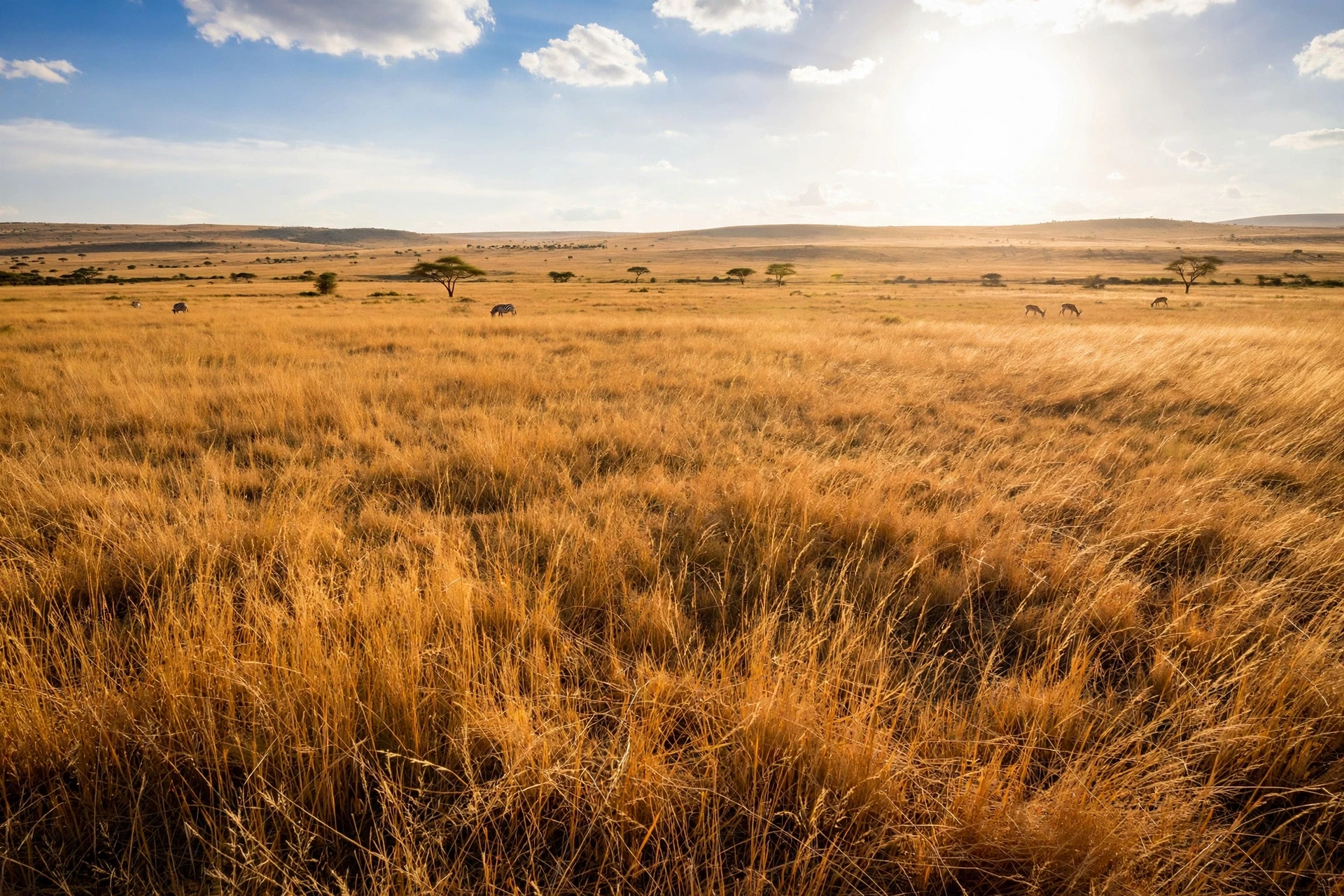
That untidiness is worth keeping. Plant evolution is not a tidy ladder, and its stories rarely run in straight lines. Grasses existed for tens of millions of years before they mattered. C4 photosynthesis existed for twenty million years before it spread. The grazers came, but not quite when the simple story says they should have. The pattern that survives is a humbler one: small advantages, accumulating over long stretches of time, until one day the world looks different and nobody can remember when it changed. The lawn under your feet is the end of that story of plant evolution — and it is still being written.
16. The Genome Trick
Somewhere in the deep past, a plant made a copying error — and instead of fixing it, kept the extra copy. That mistake, repeated across hundreds of millions of years, turns out to be one of the great engines of plant evolution. Doubling a whole genome is a gamble, but plants have played it again and again, and usually won.
The trick has a name: polyploidy. Most animals, ourselves included, carry two sets of chromosomes, one from each parent. A polyploid carries more — three, four, six, sometimes even more. In animals, that kind of doubling is usually fatal. In plants, it is routine. Around 30–35% of flowering plant species are polyploid, and among grasses the figure climbs to roughly 75%. That is not a rare accident in plant evolution. It is a way of life.
A spare parts drawer
Why does an extra genome help instead of hurt? Think of it as a spare parts drawer. When every gene exists in duplicate, one copy can keep doing its old job while the other is free to experiment. A duplicated gene can pick up a new function — biologists call it neofunctionalisation — or the two copies can split the original job between them, a process called subfunctionalisation. Either way, the plant gains raw material for change without risking what already works. Over time, duplicated genes have fuelled much of the diversity plant evolution has produced.
No plant tells this story better than bread wheat, one of the two crops that feed more people than any other (rice and wheat together supply roughly 40% of the world's food calories). Bread wheat, Triticum aestivum, is a hexaploid: it carries six sets of chromosomes, 42 in total, in a genome of about 15 billion base pairs, more than 85% of which is repetitive sequences. It was built by two hybridisations, each followed by a doubling of the genome. First, diploid Triticum urartu, carrying the AA genome, crossed with a relative of Aegilops speltoides, carrying the BB genome, producing tetraploid wild emmer wheat, AABB — the ancestor of durum wheat. Much later, that tetraploid crossed with Aegilops tauschii, carrying the DD genome, and the result was hexaploid bread wheat, AABBDD. Three wild grasses, two chance meetings, one doubled genome at each step — and the outcome is the staff of life for billions of people. It is plant evolution you can hold in your hand: chance meetings between wild grasses, preserved and multiplied by farmers over thousands of years.
An ancient doubling
Wheat is only the most recent example. The ancestor of all flowering plants went through a whole-genome duplication of its own, an event researchers call the epsilon event, roughly 190 million years ago, in the Early Jurassic, around the origin of the living flowering plants. That is roughly 60 million years before the first flower fossil, which is part of the point: the genetic toolkit for flowering was assembled deep in the past. The epsilon event's existence was recently contested, but recent synteny evidence supports it. The evidence comes from synteny — the preserved order of genes along chromosomes — in Amborella trichopoda, a small shrub from New Caledonia that is the earliest-diverging living flowering plant. Its genome still carries the fingerprints of that ancient doubling. Gymnosperms had their own version too: the zeta duplication, roughly 320 million years ago, in the late Carboniferous, around the time seed plants were diversifying — though its placement is still debated. (source; source)
Whole-genome duplication also helps explain a puzzle from earlier in this story: the explosive rise of the flowering plants. A doubled genome gives a lineage extra genes to tinker with, and flowering plants used them — for new flower shapes, new chemistry, new ways of working with pollinators. In plant evolution, polyploidy is also often followed by genome downsizing: after the doubling, lineages shed DNA again, keeping the useful new genes and trimming the rest. Smaller genomes can mean smaller cells, and smaller cells can mean denser leaf veins and faster growth — traits linked to the success of flowering plants.
There is a lesson here about how plant evolution works. Animals mostly evolve by small changes to a single, tightly controlled genome. Plants are looser with the rules. They hybridise, they double, they borrow and they keep the spares. That flexibility is part of why, in plant evolution, a single lineage could produce mosses and redwoods, duckweed and oak trees. If you want to understand why plants are so various, do not only look at their leaves and flowers. Look inside their cells, where the genome itself has been copied, pasted and rewritten more times than in almost any other group of living things. For the basics of how those cells work, the Plant Biology article is a useful companion.
17. Plant Evolution vs Animal Evolution: The Scorecard
Animals and plants both spent half a billion years evolving on the same planet, under the same sun, through the same extinctions — and they answered almost every challenge differently. Put them side by side and the contrast is startling: one lineage bet on movement, the other on staying put and remaking itself. Here is the scorecard.
Plants | Animals | |
|---|---|---|
Speed of change | Slow and steady, with sudden bursts. Land plants took roughly 85 million years to go from the first cryptospores, around 470 million years ago, to the first trees, around 385 million years ago. Then flowering plants exploded in the Cretaceous, giving rise to more than 80% of living orders early in their history. | Rapid bursts. Animals diversified explosively in the Cambrian, producing most major body plans in a geologically short window, then refined them. Bursts are followed by long periods of consolidation. |
Body-plan flexibility | Modular and open-ended. Plants grow by adding repeated units — leaves, branches, roots — throughout life, and many can regrow lost parts. The same basic toolkit produces a moss a centimetre tall and a redwood a hundred metres tall. | Mostly fixed. An animal's body plan is set early in development, and major changes are rare once established. Flexibility comes from behaviour and movement, not from rebuilding the body. |
What "success" means | Measured in species, range and staying power. Flowering plants alone number some 300,000–375,000 species, about 90% of all land-plant species. Grass-dominated habitats now cover more than 40% of Earth's land surface (before recent human impacts), and plant lineages have persisted through every mass extinction. | Measured in species, range and ecological dominance. Animals dominate in movement and behaviour, and in the sheer variety of ways to make a living — but no animal group matches the geographic spread of grasses or the species count of flowering plants. |
Key innovations | Vascular tissue, seeds, flowers, fruits, C4 photosynthesis, and polyploidy — the genome trick of the previous section. Each opened a new habitat or a new partnership. | Muscles, nerves, eyes, flight, warm blood, and complex behaviour. Each opened a new way to find food, escape danger, or reach new places. |
Extinction survival | Remarkably tough. Gymnosperms survived the end-Permian mass extinction that wiped out the dominant seed ferns such as Glossopteris, and went on to dominate the Mesozoic. Flowering plants survived the asteroid that ended the dinosaurs and then diversified further. | Mixed. Whole groups vanish in mass extinctions — trilobites, non-avian dinosaurs — while others, like mammals and birds, radiate into the empty space afterwards. Mobility helps individuals escape danger; it does not always save a lineage. |
A duet, not a contest
The table makes the two kingdoms look like rivals, but the real story is more tangled than that. Plants and animals did not evolve in isolation. They evolved together, each shaping the other. Insect pollination of seed plants predates flowers by nearly 200 million years, and when flowers arrived, insects diversified alongside them. Grasses spread, and grazers evolved high-crowned teeth to cope with silica-rich grass — though recent work shows the timing was not simple lockstep, and grit in the diet may have mattered as much as grass itself. The history of life on land — of plant evolution and animal evolution together — is a duet, not a contest.
Convergence and divergence
That duet also explains one of the most striking patterns in plant evolution: convergence. The same solution keeps appearing in unrelated lineages, because the same problem keeps arising. C4 photosynthesis — a carbon-concentrating pump that boosts photosynthesis in hot, dry, low-carbon-dioxide conditions — evolved independently more than 60 times in 19 flowering-plant families. Most C4 species are grasses, and the grass family alone holds more C4 species than all other families combined. Sixty separate inventions of the same biochemical trick is not a coincidence. It is what happens when natural selection meets the same physics again and again. Our article on Convergent Evolution explores this pattern across the whole tree of life.
Divergence is the other half of the pattern. From shared ancestors, plant lineages split and went their own ways: mosses keeping the gametophyte in charge, ferns betting on the sporophyte, gymnosperms inventing the seed, flowering plants inventing the flower. Each branch is a different answer to the same question — how to live on dry land and reproduce without standing water — and none of them is a stepping stone to the others. They are contemporaries, still alive, still evolving. That is worth remembering when we compare plant evolution with animal evolution, too. The animals' great burst came in the Cambrian Explosion, when most animal body plans appeared in a short span of time. Plants took a slower road to a similar destination: not a single explosion, but a long series of inventions, each building on the last, spread across nearly half a billion years.
18. Five Myths About Plant Evolution
Ask a roomful of people what they know about plant evolution and you will hear the same five claims again. They sound sensible. They are also wrong — or at least wrong in the interesting way that makes the real story better. Here are the five myths about plant evolution I meet most often, and what the evidence actually says.
Myth 1: Moss is primitive and simple
Moss looks humble next to an oak tree, and it is easy to read that humility as backwardness. It is not. Mosses are highly evolved survivors whose lineage traces back to the earliest land plants, around 470 million years ago — though the modern moss groups radiated around 420–364 million years ago — and they carry innovations of their own. Their way of life is gametophyte-dominant: the green, leafy plant you see is the haploid gametophyte, while the diploid sporophyte is a small stalked capsule that depends on it for its whole life. That is not a failure to evolve a "proper" plant body. It is a strategy, and it works — mosses grow on every continent, including Antarctica, in places where seed plants cannot get a foothold.
Look closer and the simplicity dissolves. Mosses have stomata, but only on the sporophyte, not on the leafy gametophyte. Their cousins the liverworts lack stomata entirely and breathe through air pores instead. Mosses form ancient partnerships with fungi and bacteria, survive drying out and freezing, and recolonise bare ground faster than almost anything else. A moss is not a rough draft of a tree. It is a finished product, tuned by half a billion years of selection for a life that trees never attempted.
Myth 2: Flowers are ancient
Flowers feel timeless. They appear in the oldest art, the oldest poetry, the oldest gardens. But in geological terms they are newcomers. Land plants have existed for around 470 million years; the oldest unequivocal flower fossils are roughly 130 million years old. Flowers have been here for barely more than a quarter of plant history on land.
The earliest evidence is pollen: reticulated monosulcate pollen grains from the late Valanginian, about 137–133 million years ago. The earliest confident macrofossil is Archaefructus liaoningensis from China, about 125 million years old — an aquatic herb with no sepals or petals, its reproductive parts arranged along an elongated stem. Another candidate, Montsechia vidalii from Spain, is 125–130 million years old and may be just as old or older. For the first 340 million years of life on land, there was no unequivocal fossil evidence of a flower on Earth. Everything that flowered — every rose, every wheat field, every apple orchard — is the product of the most recent quarter of plant evolution. Darwin himself was troubled by the speed of it all. In a letter to Joseph Hooker in 1879 he called the sudden appearance of flowering plants an abominable mystery:
"The rapid development, as far as we can judge, of all the higher plants within recent geological times is an abominable mystery."
Recent scholarship suggests he meant the dicotyledons in particular — but the puzzle he named is real, and researchers are still working on it.
Myth 3: Evolution is a ladder from algae to flowers
The ladder is the most stubborn picture in all of biology: algae at the bottom, then moss, then ferns, then conifers, then flowers at the top, as if each group were a rung climbed and left behind. Plant evolution does not work like that. It is a branching bush, and every branch that survives is still growing.
Mosses, ferns and gymnosperms are not rungs. They are living contemporaries of flowering plants, each with hundreds of millions of years of evolution since they split from their shared ancestors. The closest algal relatives of land plants, the Zygnematophyceae, are still thriving today with more than 4,000 described species. Ginkgo, a gymnosperm lineage stretching back to the Permian, still grows in city streets. Nobody is a stepping stone. Flowering plants are the youngest major branch and the most diverse, but youth and diversity are not the same as superiority — and the older branches are still here, still successful, still evolving.
Myth 4: Trees are the oldest plants
Trees feel ancient because they are big and slow and seem to belong to deep time. But the first land plants were tiny, and trees arrived late. The earliest evidence of plants on land, the cryptospores from Argentina, dates to about 470 million years ago. The earliest known tree, Wattieza from Gilboa, New York, dates to about 385 million years ago. That is a gap of roughly 85 million years — longer than the time since the dinosaurs went extinct.
For those 85 million years, land plants were small, low, and mostly confined to moist lowlands. Growing tall required inventions: lignin for rigidity, vascular tissue to lift water metres into the air, deep roots to anchor the trunk and find water. Wattieza itself was a fern relative at least 8 metres tall, crowned with fronds, reproducing by spores. Archaeopteris, its near-contemporary, grew 25–30 metres tall with a woody trunk, bark and roots spreading up to 11 metres. Trees were a revolution when they finally arrived — but they were a late revolution, built on 85 million years of small plants solving the problems of dry land first.
Myth 5: Plants don't evolve fast
Watching a tree grow, it is tempting to think plants live in slow motion. The fossil record says otherwise. Flowering plants went from their first appearance to dominating the world's vegetation in tens of millions of years — a blink in geological time — and their early evolution was explosive, giving rise to more than 80% of living orders in that first burst. C4 photosynthesis evolved independently more than 60 times. Whole-genome duplications repeatedly rewired plant genomes and sparked new diversity.
And the pace has not slowed. Grasses first appeared in the Late Cretaceous but only spread into vast grasslands in the last 30 million years, with C4 grasslands expanding mainly in the last 5–8 million years. Crops evolve fast too: bread wheat was assembled by two hybridisations in the recent past, and farmers and breeders have reshaped it ever since. New plant species are still being described at a rate of about 2,000 a year. Plants evolve at their own tempo — measured in seasons and centuries rather than heartbeats — but that tempo has produced some of the fastest takeovers in the history of plant evolution on land.
19. Why It Still Matters
This is not only a story about the distant past. The plants that feed us, the forests that steady our climate and the flowers in a window box are all still running the same evolutionary machinery. What happened over 470 million years decides what we eat, how warm the planet gets, and how much living diversity survives the century ahead.
Dinner depends on grasses
Start with food. The grasses feed humanity. Wheat, rice and maize — three grasses — provide the bulk of the calories eaten by most of the world. Wheat is the hexaploid we met in the previous section, a plant stitched together from three wild ancestors. Maize is a C4 grass, using the carbon-concentrating pump that evolved more than 60 times to thrive in hot, dry conditions. Rice feeds more than half of humanity from flooded fields. None of these plants was designed for us. Each is the product of millions of years of evolution, then a few thousand years of human selection layered on top. Understanding how they evolved — their polyploid genomes, their photosynthesis, their wild relatives — is what lets breeders make them hardier, more drought-tolerant and more productive as the climate shifts.
I felt that connection in a direct way a few summers ago, standing at the edge of a wheat field in late July with the heads heavy and gold in the heat. A farmer I was talking with tapped a stalk and said his grandfather had grown the same variety, and his father too, and that the wheat had never let them down. I thought about the three wild grasses behind that stalk, the two ancient hybridisations, the doubled genome — and about how a plant that began as a chance cross on a hillside thousands of years ago now feeds his family and millions of others. Plant evolution is not abstract. It is dinner.
Forests and the climate
Forests matter just as much, for a different reason. Trees store carbon on a planetary scale, and the Devonian taught us what happens when forests expand: deep roots intensified the weathering of rock, drawing carbon dioxide down from 12–16 times the present level to roughly today's level by the Carboniferous and Permian, cooling the planet and ultimately helping bring on the Late Paleozoic Ice Age. The Carbon Cycle still runs on that same machinery today. Every forest cleared is carbon released; every forest restored is carbon stored. The ecosystems that forests support — the soils, the fungi, the animals — are the same partnerships that began when the first plants crawled onto land. Our article on Ecosystems traces how those partnerships hold a landscape together.
How much is at stake? About 350,000 species of vascular plants are known to science, and as many as 100,000 more await formal naming, according to the Royal Botanic Gardens, Kew, in its 2023 State of the World's Plants and Fungi report. But Kew also estimates that 45% of known flowering plants could be under threat, and a 2023 Kew study found 77% of species described in 2020 met the criteria for threatened — if that rate holds for the estimated 100,000 species still undescribed, the implication is stark. We are losing plants we have not even named. This is where plant evolution meets the present day, and why conservation is not sentimentality. Every lost species is a lost genome — a unique set of solutions to drought, disease, salt and shade, worked out over millions of years, that we may need for crops, medicines and a liveable climate.
The science keeps moving
The science is still moving, and that is part of the excitement. The 2024 Kew phylogenomic tree — built from 353 nuclear genes across 7,923 genera and 9,506 species, calibrated with 200 fossils — redrew the family tree of flowering plants and confirmed their explosive early rise, with more than 80% of living orders appearing early, followed by steady diversification and a second surge in the Cenozoic as global temperatures fell. The debate over when flowering plants originated is still open: fossils say the Early Cretaceous, around 130–140 million years ago, while some recent studies argue for a Triassic origin, 255–202 million years ago, and others for the latest Jurassic. New fossils, new genomes and new methods will keep shifting the dates. That is not a weakness of the science. It is the science working as it should.
Half a billion years ago, a green alga washed onto bare rock and survived. Its descendants became forests, grasslands and gardens. They changed the air we breathe, the soil we stand on and the food we eat. They are still changing, still evolving, and their future is now tangled with ours in a way no earlier generation of humans had to face. The next chapter of plant evolution will be written partly by us — by what we plant, what we protect and what we let vanish. We should write it with the care that half a billion years deserves.
Frequently Asked Questions
How did plants evolve?
Plants evolved from green algae. A heterotrophic eukaryote engulfed a cyanobacterium about 2.1 billion years ago, and that captured bacterium became the chloroplast — the first step toward the green algae and, eventually, land plants. Land plants evolved from within the charophyte algae, a group of streptophyte green algae, and first colonised land around 470 million years ago. From there, plant evolution added vascular tissue, then seeds, then flowers: each invention opened new habitats, until flowering plants came to make up about 90% of all land-plant species.
How did plants colonize land?
They solved four problems: drying out, ultraviolet light, gravity and finding water and nutrients away from a pond. The solutions were a waxy cuticle to slow water loss, stomata to trade carbon dioxide against water, lignin to stiffen stems so plants could grow tall, and roots to anchor and absorb. Crucially, they did not do it alone: arbuscular mycorrhizal fungi partnered with the first land plants some 450–500 million years ago, trading minerals for plant sugars — a partnership confirmed in fossils from the 407-million-year-old Rhynie chert. The earliest evidence of the move ashore is cryptospores, microscopic spores from Ordovician rocks in Argentina dated to about 473–471 million years ago.
When did flowers first appear?
The oldest unequivocal evidence is fossil pollen, about 137–133 million years old, from the Early Cretaceous. The earliest confident macrofossil is Archaefructus liaoningensis from China, about 125 million years old, and a Spanish aquatic plant, Montsechia vidalii, is 125–130 million years old and may be just as old or older. That makes flowers recent: land plants are about 470 million years old, so flowers have existed for barely a quarter of plant history on land. Exactly when the flowering-plant lineage originated is still debated — fossils point to the Early Cretaceous, while some molecular studies argue for a Triassic or latest Jurassic origin.
What are vascular plants?
Vascular plants are plants with specialised conducting tissue: xylem, which carries water and minerals from the roots upward, and phloem, which carries sugars around the plant. That plumbing, stiffened with lignin, is what let plants grow tall and colonise dry land. The earliest known vascular plant is Cooksonia, a small leafless plant from the Silurian, about 425 million years ago. Vascular plants — the tracheophytes — now make up about 95% of all living plant species, from ferns and conifers to grasses and roses. The remaining 5% are the bryophytes: mosses, liverworts and hornworts, which lack lignified water-conducting cells.
What was the first plant on land?
There is no single named species we can point to as the first land plant. The earliest evidence comes from cryptospores — microscopic spores preserved in Ordovician rocks from Argentina, dated to about 473–471 million years ago. Their diversity suggests land plants had already been evolving for some time before that. The earliest recognisable land-plant fossils with stems and spore capsules are plants like Cooksonia, about 425 million years ago. The first land plants were probably small, low-growing organisms, perhaps something like a modern liverwort, living in damp places and partnering with fungi.
Why are flowering plants so successful?
Several advantages stack up. Flowers turned animals into pollinators, giving flowering plants precise, targeted reproduction instead of relying on the wind. Fruits turned animals into seed carriers, spreading seeds far from the parent. Seeds themselves protect the embryo and let it wait out bad times. At the cellular level, flowering plants benefited from a whole-genome duplication about 190 million years ago, which supplied extra genes for new functions, and many later became polyploid. They also evolved denser leaf veins and smaller genomes, letting them photosynthesise and grow faster than their rivals. The result: about 90% of all land-plant species, some 300,000–375,000 species, in every habitat from deserts to rainforests.
Do plants still evolve?
Yes — plant evolution has never stopped. C4 photosynthesis first appeared in grasses 25–32 million years ago but only spread worldwide 10–6 million years ago, and C4 grasslands expanded mainly in the last 5–8 million years. New plant species are described at a rate of about 2,000 a year, and as many as 100,000 vascular plant species may still await naming. Crops evolve fast under human selection: bread wheat was assembled by hybridisation in the recent past, and breeders reshape it constantly. Plants also keep evolving in the wild — adapting to new climates, new pollinators and new diseases — just on a timescale measured in seasons and centuries rather than heartbeats.
Sources
Timme et al., 2012, Broad Phylogenomic Sampling and the Sister Lineage of Land Plants, PLOS ONE
Karol et al., 2001, The closest living relatives of land plants, Science
Feng et al., 2024, Genomes of Zygnema and the closest algal sisters of land plants, Nature Genetics
Meyer-Berthaud et al., 1999, Archaeopteris is the earliest known modern tree, Nature
Beerling, 2005, Leaf Evolution: Gases, Genes and Geochemistry, Annals of Botany 96(3):345–352
Zuntini et al., 2024, Phylogenomics and the rise of the angiosperms, Nature
Ma et al., 2025, New insights on the angiosperm crown age, Nature Communications
Wu et al., 2026, Latest Jurassic origin of the angiosperms, Nature Plants
Eriksson, 2016, Evolution of angiosperm seed disperser mutualisms, Biological Reviews
Royal Botanic Gardens, Kew, 2023, State of the World's Plants and Fungi 2023
Digital Atlas of Ancient Life, The embryophyte life cycle and alternation of generations
Columbia Climate School, How did Africa's grasslands get started
Otto and Whitton, 2000, Polyploid incidence and evolution, Annual Review of Genetics 34:401–437
Cambridge University Botanic Garden, Angraecum sesquipedale — Darwin's orchid
Fleming and Kress, 2011, A brief history of fruits and frugivores, Acta Oecologica 37:521–530
Buggs, 2017, The deepening of Darwin's abominable mystery, Nature Ecology and Evolution 1:0169
Encyclopaedia Britannica, Gymnosperm — Appearance of gymnosperm divisions
Cairney, 2000, Evolution of mycorrhiza systems, Naturwissenschaften 87(11):467–475
Jiao et al., 2011, Ancestral polyploidy in seed plants and angiosperms, Nature 473:97–100