
1. The Great Journeys All Around Us
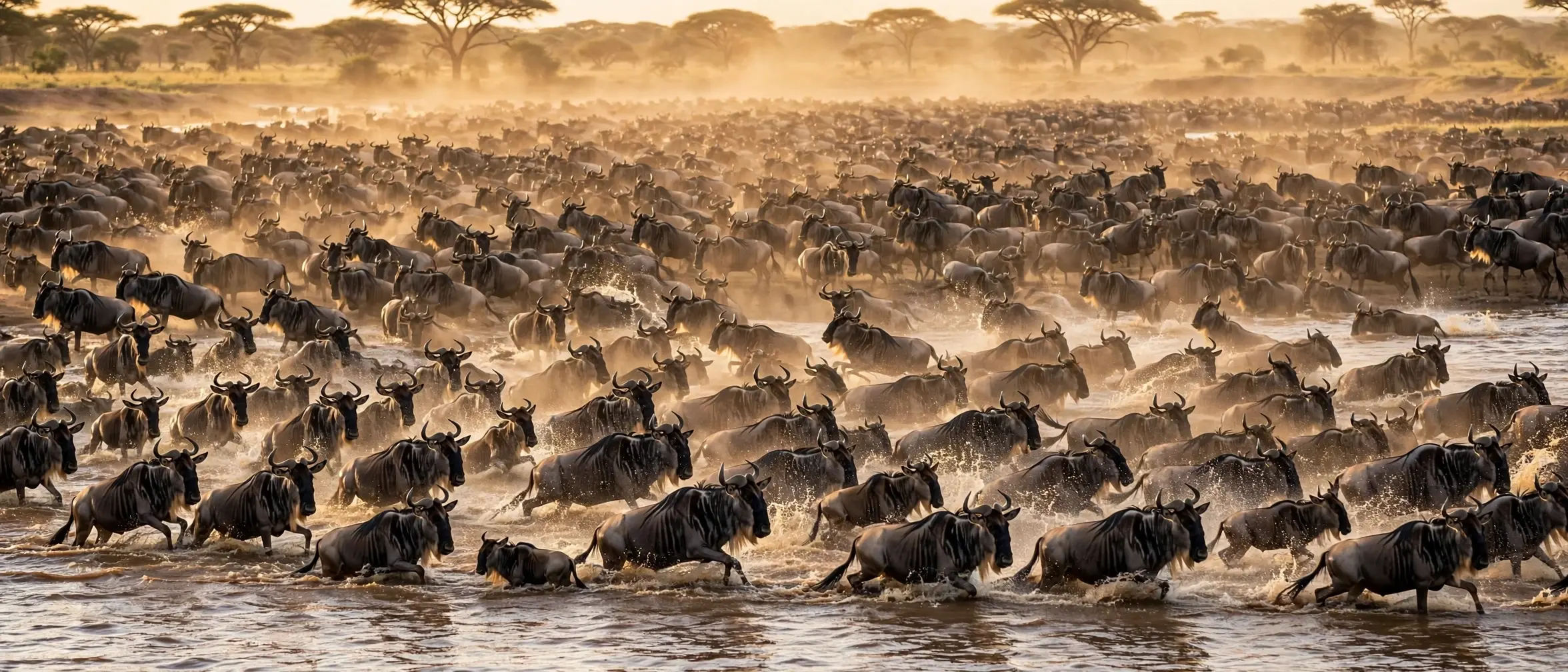
The river is brown with churned mud, the bank is a wall of horns and shoulders, and then the first wildebeest leaps — and ten thousand follow, plunging into water full of crocodiles. This is animal migration at its most dramatic, and it is happening, in quieter forms, almost everywhere on Earth.
Stand on that bank in the Maasai Mara between July and October, when a single crossing can involve thousands of animals — sometimes 10,000 or more in half an hour — and the scale of it is hard to take in. The herd does not cross in a neat line. It pours down the bank in a rush, animals stumbling over each other, calves swept along beside their mothers, the water boiling around them. Some turn back. Some do not make it. And behind this crossing there are more herds, and behind those, more still — a moving river of animals stretching back across the grasslands. It is one of the great spectacles of the living world, and it is only one journey among thousands.
I once stood at the edge of an autumn field at dusk and watched swallows gather on the telephone wires, hundreds of them, chattering and shifting along the line as if they were holding a meeting. I had seen the same wires empty all summer and full of starlings in winter, but that evening the birds were different — restless, alert, all facing the same way. By morning they were gone. Nothing in the field had changed. The air was still warm, the insects were still flying, and yet the birds had left on a schedule I could not see. That small departure, multiplied by millions of birds, billions of insects and whole herds of mammals, is animal migration at work, and it is what this article is about.
A planet that never sits still
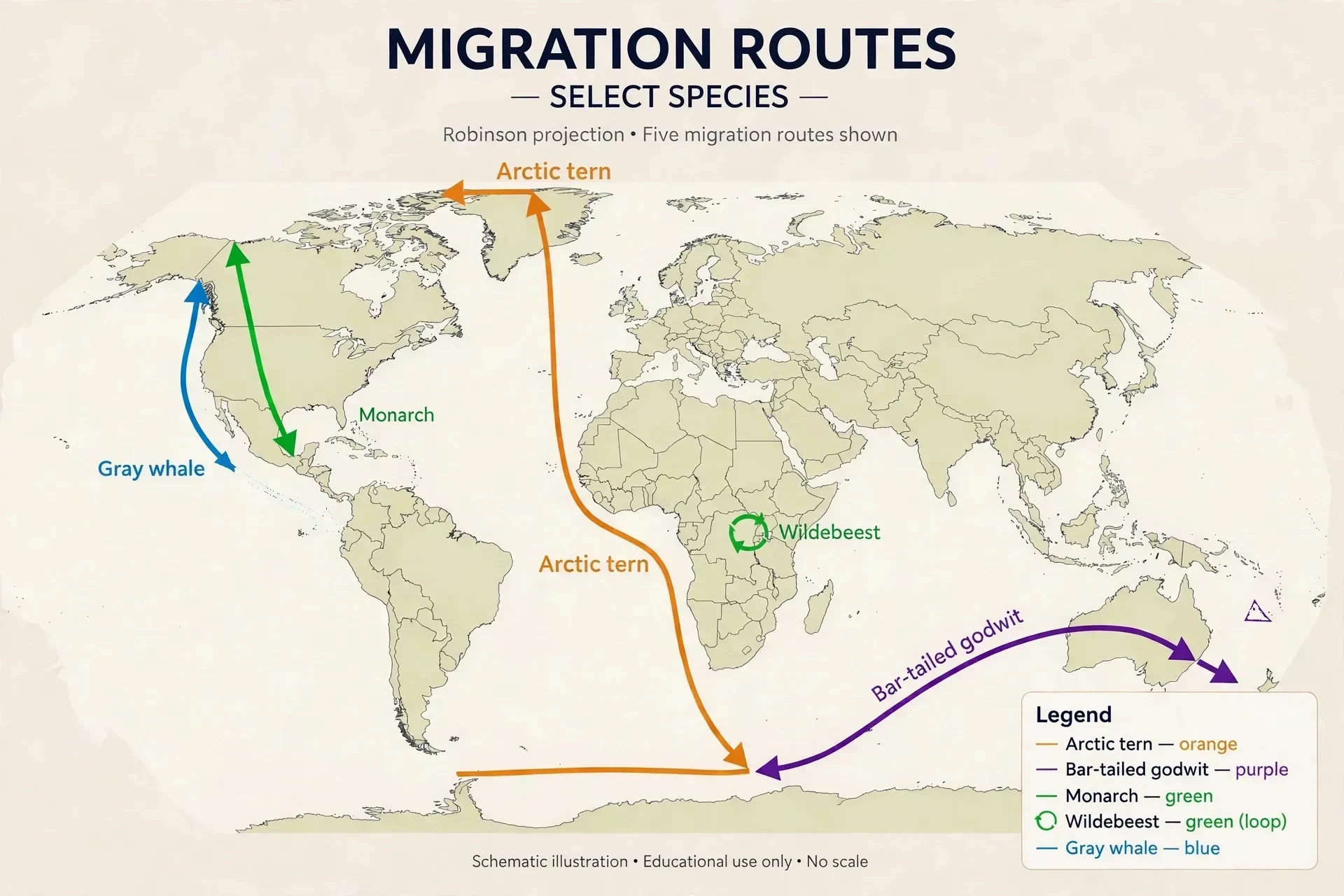
The journeys come in every size. Monarch butterflies travel up to 3,000 miles from summer breeding grounds in the eastern United States and southern Canada to the oyamel fir forests of central Mexico — nearly 5,000 km on wings thinner than paper. Arctic terns tracked with tiny geolocators flew a mean of 70,900 km in a single year, ranging from 59,500 to 81,600 km, the longest round-trip journey ever recorded electronically at the time the study was published. A gray whale named Varvara swam 22,511 km from Russia to Mexico and back in 172 days. And every single day, in every ocean, trillions of small animals rise toward the surface at night and sink again by day in the largest animal migration on the planet by biomass — a journey measured in metres rather than kilometres, but in numbers no land migration can match.
What ties these journeys together is not distance alone. A painted lady butterfly completes an annual round-trip circuit of 12,000–14,000 km, crossing the Sahara twice — once in each direction — yet no single butterfly flies the whole route — the journey is handed from one generation to the next. Caribou walk the longest verified land animal migration, a straight-line round trip of 1,350 km, which sounds modest beside a tern's year until you remember that caribou do it on foot, through snow, carrying their own calves. The record book is not a contest. It is a catalogue of different answers to the same problem: the seasons change, food moves, and staying put is not always an option. That variety is part of what makes animal migration a story about biodiversity itself — the same challenge, solved in wildly different ways by birds, butterflies, whales and herds.
The record book
Two figures deserve a second look. First, the tern's figure replaced an older estimate of about 40,000 km a year that had stood in textbooks for decades — the tracked birds flew nearly twice as far, which tells us how much we were guessing before lightweight tracking existed. Second, the godwit's flight and the tern's year are measured in completely different ways: one is a single nonstop sprint, the other a year of wandering between two summers. Both are real, and neither is the "winner" in any simple sense.
This article follows the journeys of animal migration in order. It starts with what animal migration actually is and where its boundaries lie, then asks why animals leave at all, and what tells them the moment has come. It follows the wildebeest around their year-long circuit, the monarchs across their relay of generations, the tern between the poles, salmon home against the current, whales across whole oceans, and the godwit across the Pacific without once landing. Then it turns to how migrants find their way — by sun, stars, magnetic fields, smell and memory — what the journey costs them, the daily animal migration in the ocean that dwarfs them all, and the migrants most people never expect. It closes with the part that matters most now: what is breaking these journeys, and what still protects them.
2. What Animal Migration Actually Is
Every autumn, swallows leave the barns of northern Europe and fly to Africa, and every spring they come back. That round trip, repeated on a seasonal rhythm, is the heart of animal migration — a regular, long-distance movement with a return, or a relay, built into it.
That sounds simple, and the simple version is mostly right. Animal migration is the relatively long-distance movement of individual animals, usually on a seasonal basis, and it is the most common form of migration in ecology. But scientists will also tell you there is no single simple accepted definition, and the arguments about the edges of the idea are worth understanding, because they decide which animals count as migrants and which do not. The working definition most researchers use comes from the zoologist J. S. Kennedy, quoted by Dingle and Drake in 2007: migratory behaviour is persistent and straightened-out movement, effected by the animal's own locomotory exertions or by its active embarkation on a vehicle. In plain language: the animal keeps going in one direction, on purpose, under its own power — or by deliberately catching a ride, as a butterfly rides a wind.
Three things animal migration is not
The boundaries matter more than the definition, because three common kinds of movement look like animal migration and are not.
First, animal migration is not dispersal. Dispersal is a one-way trip: a young animal leaves home to find its own territory and never comes back. A young wolf leaving its pack, or a young fox leaving its natal territory, is dispersing. Animal migration, by contrast, has a return built in — the same individual comes back, or, in the case of the monarch, its descendants complete the loop. One way out is dispersal; out and back is animal migration.
Second, animal migration is not nomadism. Nomads wander where the food is, with no fixed route and no fixed season. Many desert birds and grazing animals live this way, following patchy rain from one place to another. Migrants, on the other hand, travel between known places on a regular schedule, often along the same route year after year. The wildebeest are migrants, not nomads, because their circuit repeats — even though rain, not a calendar, decides the exact timing.
Third, animal migration is not daily foraging. A bee flying out from the hive each morning and returning each evening is commuting, not migrating. The movement is short, it repeats daily, and the animal sleeps at home. Animal migration is a seasonal shift of home ground, not a day trip.
Not every member of the species goes
Animal migration also varies within a single species, and the variations have names worth knowing. In complete migration, every individual migrates. In partial migration, some individuals migrate while others stay behind — a pattern so common in birds that it is the rule rather than the exception in many species. In differential migration, the difference between those that go and those that stay follows a visible characteristic, such as age or sex: in many bird species, for example, the young or the females may travel further than the adults or the males.
Two more distinctions complete the picture. Animal migration can be obligate, meaning individuals must migrate, or facultative, meaning individuals can choose to stay if conditions allow — a bird that would normally leave may stay put through a mild winter when food remains. And some journeys run in the opposite direction to the usual seasonal pattern: fish such as salmon are anadromous, born in fresh water, migrating to the ocean, and returning to fresh water to spawn, while eels are catadromous, living in fresh water and spawning in salt water. Irruptive migration is a sixth pattern: irregular, unpredictable movements driven by sudden food shortage or abundance, as when seed-eating northern birds move south in large numbers only in poor cone years.
Type | Definition | Example |
|---|---|---|
Complete migration | All individuals of the population migrate | Arctic terns, which all leave the Arctic for the southern summer |
Partial migration | Some individuals migrate while others stay behind | Many temperate birds, where part of the population winters at home |
Differential migration | Who migrates depends on age, sex or another visible trait | Bird species where juveniles or females travel further than adults or males |
Obligate migration | Individuals must migrate; staying is not an option | Long-distance migrants tied to a seasonal food supply |
Facultative migration | Individuals can stay if conditions allow | Birds that skip migration in a mild winter with food still available |
Irruptive migration | Irregular, unpredictable movements driven by sudden food shortage or abundance | Seed-eating northern birds that move south in large numbers only in poor cone years |
Every direction at once
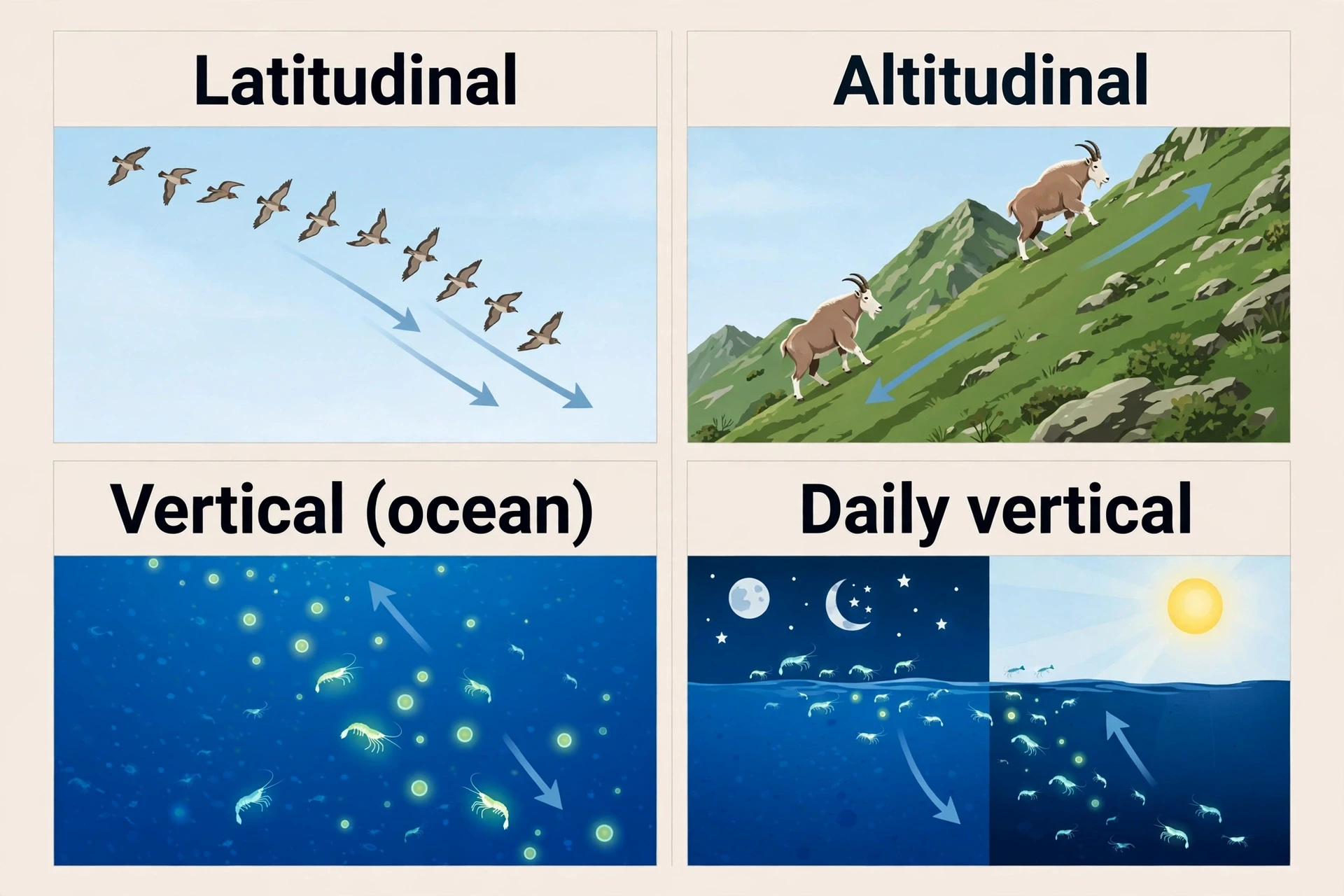
Animal migration also moves in more directions than the familiar north-south picture suggests. Latitudinal migration — between high and low latitudes — is the classic bird pattern, but altitudinal migration moves animals up and down mountains with the seasons, as herds climb to high summer pastures and descend before the snow. Vertical migration moves animals up and down through the water column: each night, trillions of ocean animals rise hundreds of metres to feed near the surface and sink again by day to hide from predators. And some journeys are measured sideways across whole oceans, like the godwit's Pacific crossing, or in a loop, like the wildebeest circuit. The direction is less important than the pattern: a regular, seasonal shift between places that serve different needs.
With a working definition of animal migration in place, the real question opens up. If animal migration is costly, dangerous and exhausting — and it is all three — why do so many animals do it? The answer is that three needs, tangled together, make the journey worth the price.
3. Why Animals Migrate: Food, Breeding, Climate
A bird does not cross an ocean for the view. It flies because the place it is leaving can no longer feed it, or cannot shelter its young, or is about to turn cold and empty — and because the place it is flying to can. Animal migration is, at heart, a calculation about survival.
Three reasons drive almost every animal migration, and they overlap in every real journey. Food, breeding and climate are not three separate trips. They are three pressures acting on the same animal at the same time, and the journey is the single answer that satisfies all three at once.
Food — follow the flush. The wildebeest follow the rains because the rains decide where fresh grass grows, and the herds move in a year-round circle chasing the greenest grazing. Humpback whales feed all summer in cold, food-rich high-latitude waters, building the blubber that will carry them through months of fasting on the breeding grounds. For most migrants, the map of the journey is really a map of dinner. That is the first law of animal migration: follow the food, and the rest follows.
Breeding — find a safe nursery. Humpbacks swim to warm, shallow waters off Hawaii, Mexico, the Caribbean, Tonga, Brazil, Madagascar and the Great Barrier Reef to mate and give birth — some populations swim up to 5,000 miles (about 8,000 km) each way between feeding and breeding grounds, a round trip of roughly 16,000 km. While in Hawaii's waters humpbacks rarely feed — the primary reason for the journey is to mate and for mothers to give birth and raise their young — though opportunistic feeding on the breeding grounds has been documented, and the Alaska to Hawaii voyage spans approximately 3,000 miles. Monarchs are drawn to the oyamel fir forests of central Mexico because the high-altitude groves give them the cool, stable microclimate they need to survive the winter in a semi-dormant state. The breeding ground is chosen for safety and warmth, not for food.
Climate — escape the season that would kill you. Winter in the Arctic means darkness and frozen ground; the southern summer means open water and food. The tern does not fly 70,900 km a year for fun. It flies because the alternative is a winter with nothing to eat. The same logic moves animals uphill in spring and downhill before the snow, and drives the ocean's daily migrants down into the dark by day and up to feed by night.
The cost-benefit calculation
None of this makes animal migration free. Every journey is a trade, and the trade only works when the gain beats the danger of the road. A godwit that flies nonstop across the Pacific burns its own body to do it. A wildebeest that crosses the Mara risks the crocodiles and the current. A young tern on its first flight south faces storms it has never seen. Natural selection has shaped these journeys over countless generations, keeping the ones that pay and discarding the ones that do not — which is why the same solutions appear again and again in animals that are not closely related.
That is also why the three reasons behind animal migration cannot be pulled apart. The humpback's breeding ground is warm and safe for calves, but it has almost no food, so the whale must feed first and fast later. The wildebeest's calving ground has rich grass for nursing mothers, but the same plains dry out within weeks, so the herd must move on. The monarch's winter forest is a perfect shelter, but it holds no milkweed for caterpillars, so the butterflies must leave in spring. Each journey is a compromise between needs that cannot all be met in one place. Animal migration is how animals live in two places at once — and the price of that double life is the journey itself.
The same calculation runs through whole ecosystems: migrants carry nutrients, seeds and energy between places that would otherwise never meet, so the journey feeds more than the traveller. But before any of that can happen, the animal has to know when to leave. That decision — if it can be called a decision at all — is the subject of the next section.
4. The Trigger: How Animals Know When to Leave
Nothing tells a migrating bird the date. No calendar hangs in the reeds, and no elder bird calls the flock to order — yet on roughly the same week each year, millions of birds grow restless, feed furiously, and leave. The trigger for animal migration is a programme written into their bodies, set by the changing length of the day.
The key is that day length is the one seasonal signal that never lies. Changing day length, or photoperiod, is the most reliable and widely used seasonal cue for animal migration timing, because day length changes predictably with the season regardless of whether a particular week is unusually warm or cold — a finding documented in research on circannual rhythms. A warm spell in October cannot fool a bird into thinking it is spring, because the days are still shortening. A cold snap in April cannot delay departure for long, because the days are lengthening on schedule. Weather is noisy; the sun is not.
The clock inside
Behind the cue sits a clock. Many organisms, including birds, express circannual cycles of approximately 365 days when placed experimentally in constant photoperiods — kept under unchanging day length, with no seasonal change at all, they still run through an annual rhythm of moulting, fattening and restlessness. The rhythm is internally generated, not simply a reaction to the weather. The bird carries the year inside it, and the changing day length keeps that inner year synchronised with the real one, the way a watch is set right each morning.
Hormones carry the signal from the clock to the body. As the days lengthen or shorten past a threshold, hormonal shifts switch the bird from its everyday mode into migratory mode: appetite changes, sleep patterns change, and the body begins to rebuild itself for the journey. The most visible result is hyperphagia — a feeding frenzy in which the bird eats far beyond its normal appetite and lays down fat as fuel. Before departure on a trans-Pacific flight, bar-tailed godwits carry fat loads that are among the highest ever recorded in birds, about 55 percent of fresh body mass. More than half the bird is fuel. The restructuring from fuelling to flight happens within about one month (≤1 month in the study), and in birds still fuelling, more than half of body mass — 58% — is water — the body is quite literally being rebuilt for the ocean crossing ahead.
Zugunruhe: restlessness you can watch
The outward sign that the programme has switched on has a German name: Zugunruhe, migratory restlessness. It is the increase in nocturnal activity shown by captive migratory birds during the seasons when their wild counterparts migrate, including orientation in the direction of migration even without environmental stimuli. Small songbirds fatten for their annual migrations and become increasingly agitated at dusk, sleeping little or not at all, as they migrate during the night. A caged bird that has never seen the sky will hop and flutter toward the south in autumn and toward the north in spring, on schedule, in a bare room.
I once spent an autumn evening beside a cage of small warblers at a ringing station, watching them grow agitated as the light faded. All day they had fed quietly, but at dusk they began hopping from perch to perch, fluttering against the side of the cage that faced south, then settling, then starting again. The birds had never flown further than the garden outside. They had no map, no flock to follow, no weather front to ride — only the shortening days and the clock inside them, telling them it was time to go. It was the strangest and most moving thing I had seen in fieldwork: the whole animal migration, running as a programme in a bird that had never migrated.
The trigger chain runs in order, and each step depends on the one before it:
Day length changes. Photoperiod shifts past the seasonal threshold and gives the reliable calendar signal.
The circannual clock responds. The internal annual rhythm, synchronised by day length, moves into its migratory phase.
Hormones switch the body over. Appetite, sleep and metabolism change; the bird enters migratory mode.
Zugunruhe appears. The bird grows restless at night and orients toward the direction of travel.
Hyperphagia builds the fuel. Intense feeding lays down fat — in godwits, about 55 percent of body mass — until the bird is ready to leave.
Weather and food still matter, but they fine-tune the date of animal migration rather than setting the season. A storm can hold a flock for a day, and a rich feeding ground can delay departure by a week while birds top up their fat. What weather cannot do is make a bird migrate in the wrong season, or hold it back once the programme has fully switched on. The season is set by light and the clock; the exact day is negotiated with the wind. That split — season set from within, day set by conditions — is one of the most consistent patterns in animal migration.
5. The Great Wildebeest Migration
On the southern plains of the Serengeti, in the short-grass country around Ndutu, the year begins with birth — hundreds of thousands of wildebeest calves arriving within a few weeks, on grass made green by the rains. From there the herds set out on the great loop of animal migration that will carry them north and back again.
The Serengeti wildebeest migration involves about 1.2 million wildebeest moving through the Serengeti–Mara ecosystem, with more than 200,000 zebra and 400,000 gazelles travelling with them. Other counts put the wildebeest higher — a commonly quoted figure is about 1.5 million — and the honest picture is that the number is genuinely uncertain. The 2023 aerial census counted 1,366,109 wildebeest, plus or minus 231,741, while a 2025 Oxford AI satellite survey published in PNAS Nexus estimated only around 503,000 to 533,000 for 2023, a difference scientists attribute partly to methodology. No single number should be presented as undisputed. What is certain is the scale: around a million large animals moving together through one ecosystem, probably the largest surviving land mammal migration.
The circuit as a year
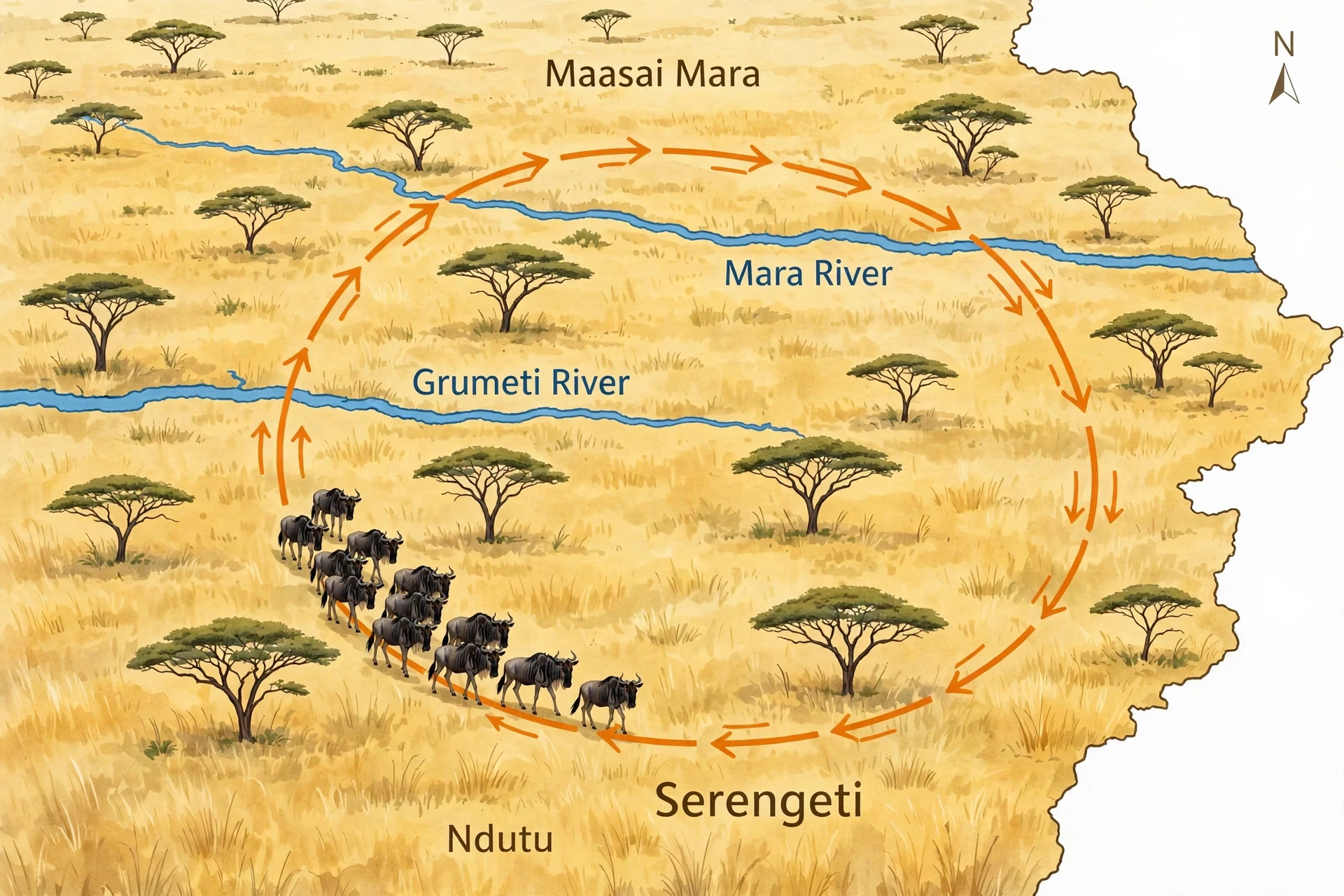
The herds travel an approximately 800 km circular loop through the Serengeti–Mara ecosystem every year (the animals themselves walk far further, wandering as they graze — some estimates of the total ground covered run to 3,000 km a year). The loop is driven entirely by rainfall and grass — the herds follow the rains, which determine where fresh grass grows — and that is why no fixed calendar can describe it. The herds move when the grass moves, and the grass moves when the rain falls.
The year starts in the south, where roughly 500,000 wildebeest calves are born on the southern Serengeti and Ndutu plains within a few weeks, peaking in February — around 8,000 a day at the peak (Discover Wildlife). The short-grass plains are rich in the minerals nursing mothers need, and the open ground lets a newborn calf stand and run within minutes — its best defence in a landscape full of predators. The grasses that make this possible are themselves the product of a long evolutionary history, the same deep story told in the rise of flowering plants — see plant evolution — and the herds are only the latest animals to build a life around them. From there the herds drift north and west as the plains dry, following the retreating green, through the central Serengeti and toward the Grumeti River. Then comes the long push north into the Maasai Mara, and with it the crossings that have made the migration famous: the Mara River crossings typically occur between July and October, when the herds must cross to reach the grasslands of the Maasai Mara, and a single crossing can involve thousands of animals — sometimes 10,000 or more in half an hour. After the rains return to the south, the herds turn and make the long journey back to the calving grounds, closing the loop.
The honest numbers
The migration's death toll is one of the most repeated figures in nature writing, and one of the least reliable. A figure of a quarter of a million wildebeest dying each year circulates widely on tourism sites, but no primary scientific source measures or states that total, and it should not be repeated as a measured fact. What has actually been measured is far more specific — and in its own way more striking.
Mass drownings of wildebeest occur nearly annually during the migration. In the Kenyan portion of the Mara they occurred on average 4 to 5 times per year from 2001 to 2015, with a mean annual total of 6,250 wildebeest carcasses. Drowning — not crocodile predation — is the main cause of death at the crossings, with single events killing thousands. The animals do not die because the river is full of predators, though crocodiles take their share. They die because tens of thousands of panicking animals pour down steep banks into a fast river, and those at the back crush those at the front, and those in the middle cannot climb out.
That is the measured toll, and it is worth stating plainly rather than inflating it. Popular estimates put the total annual death toll far higher — around a quarter of a million wildebeest a year, from drowning, exhaustion, disease and predation (Discover Wildlife) — but that total is an estimate, not a counted figure, and it is given here only as such. Six thousand drowned animals a year is already a large number. It is also only part of the story, because predation, disease, exhaustion and the long dry-season march take animals all along the circuit. The honest statement is that many wildebeest die on the migration, and that the only mortality figure measured with scientific care is the drowning count in the Mara. It is a reminder that animal migration is measured in real bodies, not in round numbers borrowed from travel brochures.
What the dead feed
Here is where the story turns. Those drowned carcasses contribute more than 1,000 tons of biomass into the Mara River each year — the equivalent of roughly 10 blue whales — comprising 107 tons of carbon, 25 tons of nitrogen and 13 tons of phosphorus. The river, which looks like a place of death during a crossing, is fed by the dead. Fish, crocodiles and vultures gorge on the carcasses, and the nutrients dissolve into the water and feed the river's food web for years — the bones alone go on releasing nutrients long after the flesh is gone. Animal migration moves nutrients across ecosystems in ways that no other process can match, and the wildebeest do it even in death. The herds feed the river that kills them, and the river, in turn, waters the grass that feeds the herds. The loop is closed twice over: once by the animals walking it, and once by the nutrients flowing through it.
That double loop is the key to the whole animal migration. The wildebeest do not travel because they love to travel. They travel because the grass, the rain, the calving ground and the river are never in the same place at the same time, and the only way to have all four is to keep moving. The same bargain, struck in different currencies — fat, warmth, safety, food — drives every animal migration in this article. The next one belongs to an animal that weighs less than a paperclip and crosses a continent without ever seeing its destination.
6. Monarch Butterflies: A Journey Across Generations
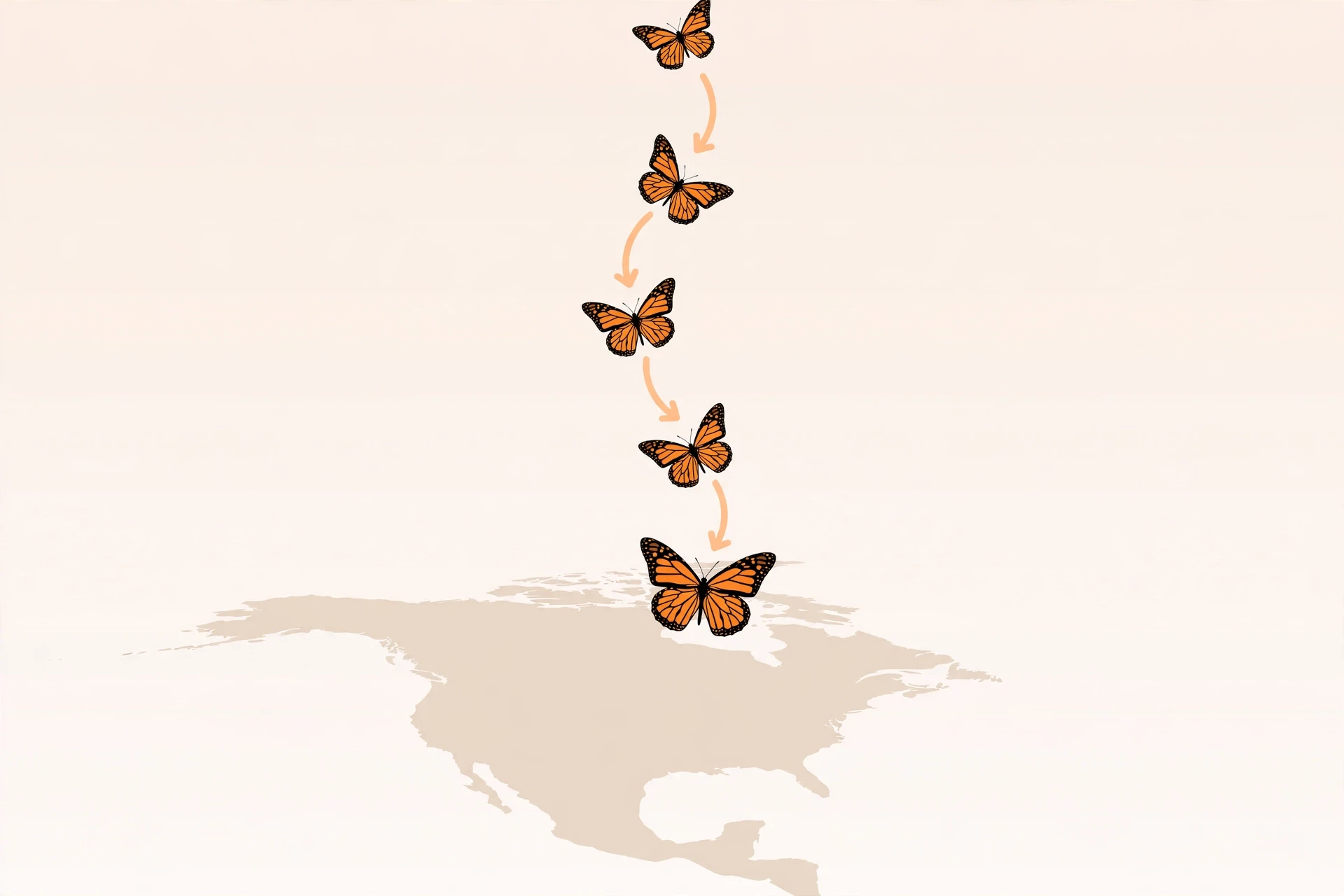
No single monarch butterfly ever completes the round trip between North America and Mexico. Instead, the journey is handed on from one short-lived generation to the next, like a baton in a relay race, until one extraordinary generation flies the whole way south and waits out the winter in the mountains.
Most adult monarchs live for about a month. That short life sets the whole pattern of animal migration, because a butterfly that hatches in spring in the eastern United States or southern Canada cannot possibly reach Mexico, survive the winter there, and fly back north again. What it can do is fly part of the way, lay eggs, and die, leaving its children to carry the journey onward. The monarchs that arrive in Mexico each fall are typically the great-great-grandchildren of the monarchs that left Mexico the previous spring. Four or even five generations are needed to complete the relay, and the relay runs in both directions: the spring generations move north in stages, breeding as they go, and the fall generation flies south in one long push (Monarch Joint Venture).
The Methuselah Generation
The exception to the short life is the late-summer generation, known as the Methuselah or super generation. These butterflies live for more than six months, do not reproduce until spring, when they finally lay the eggs of the next generation, and fly the entire journey to Mexico themselves. Born in late summer, they hold off breeding, store fat, and set out on a flight of up to 3,000 miles from summer breeding grounds in the eastern United States and southern Canada to the oyamel fir forests of central Mexico. Monarchs from Canada and the United States travel nearly 5,000 kilometres to gather in the forested volcanic peaks of central Mexico, and the Methuselah generation makes that whole southward leg alone (Canadian Geographic).
Why the oyamel firs? The monarchs are drawn to those high-altitude groves because they give the butterflies the cool, stable microclimate they need to survive the winter in a semi-dormant state. Packed together in dense clusters on the fir branches, they barely move for months, living off the fat reserves they built up before leaving. The Monarch Butterfly Biosphere Reserve protects 56,259 hectares of that forest, a measure of how much ground the wintering habitat covers, even though the butterflies themselves occupy only a small fraction of it in any given year.
The relay is one of the strangest facts in all of animal migration: the butterflies that fly north in spring have never seen the breeding grounds they are heading for, and the Methuselah generation that flies south has never seen the forest it is heading for. No individual learns the route from an older butterfly, because no older butterfly makes the same trip. The programme that guides them is inherited, not taught, and it works across generations that never meet.
The Discovery at Cerro Pelón
For most of the twentieth century, nobody knew where the eastern monarchs went. The wintering grounds were unknown to science until 1975, despite decades of tagging by Fred and Norah Urquhart, a Canadian husband-and-wife team who began marking monarchs in 1937 and built a volunteer tagging network in 1952, sticking tiny labels on monarch wings and asking the public to report any tagged butterfly they found. The tags told the Urquharts that the butterflies were heading southwest in the fall, but the trail went cold in Texas. Mexico's mountains kept the secret for another forty years.
Then, on the evening of 9 January 1975, Ken Brugger telephoned the Urquharts from Mexico to say the colony had been found. Brugger, an American living in Mexico, had been searching the mountains with his wife Catalina at the Urquharts' request, following tips from local people. The Urquharts reached the Cerro Pelón grove, about 2,700 metres above sea level, in January 1976, and found millions of monarchs clustered on the oyamel firs. The discovery was published in National Geographic in 1976 and made the cover of the magazine, one of the most famous nature stories of the century (Canadian Geographic).
"They swirled through the air like autumn leaves and carpeted the ground in their flaming myriads on this Mexican mountainside." — Fred Urquhart, National Geographic, August 1976
The find answered a question that had stood for decades, but it also created a new one: once the wintering place was known, it could be counted, and the counts would show how fragile the whole relay is.
The Measured Decline
Since the 1990s, researchers have measured the area of forest the butterflies occupy each winter, and the numbers tell a story of steep decline with a partial recovery in the most recent season. The overwintering area peaked at 18.19 hectares in 1996–1997 and fell to a record low of 0.67 hectares in 2013–2014. No season since 2004–2005 has reached even 7 hectares. The eastern monarch population overwintering in Mexico occupied 2.93 hectares during the 2025–2026 season, about a 64 percent increase on the previous year's 1.79 hectares, according to the survey by Mexico's National Commission of Protected Natural Areas (CONANP) and the World Wildlife Fund (WWF) (Monarch Joint Venture).
Those hectares matter because they translate into a population threshold. At least 6 hectares of occupied overwintering habitat are considered necessary to support a stable eastern migratory population, and one hectare holds an estimated 20–30 million monarchs, with a median estimate of 21.1 million. The 2025–2026 figure of 2.93 hectares, welcome as the increase is, still sits at less than half of the 6-hectare threshold. In July 2022 the IUCN listed the migratory monarch as Endangered; in 2023, after a petition challenging the population models, it was downlisted to Vulnerable, its current status — a formal recognition that a journey repeated for millennia by millions of insects now hangs on a few hectares of mountain forest.
7. The Arctic Tern: The Longest Journey on Earth
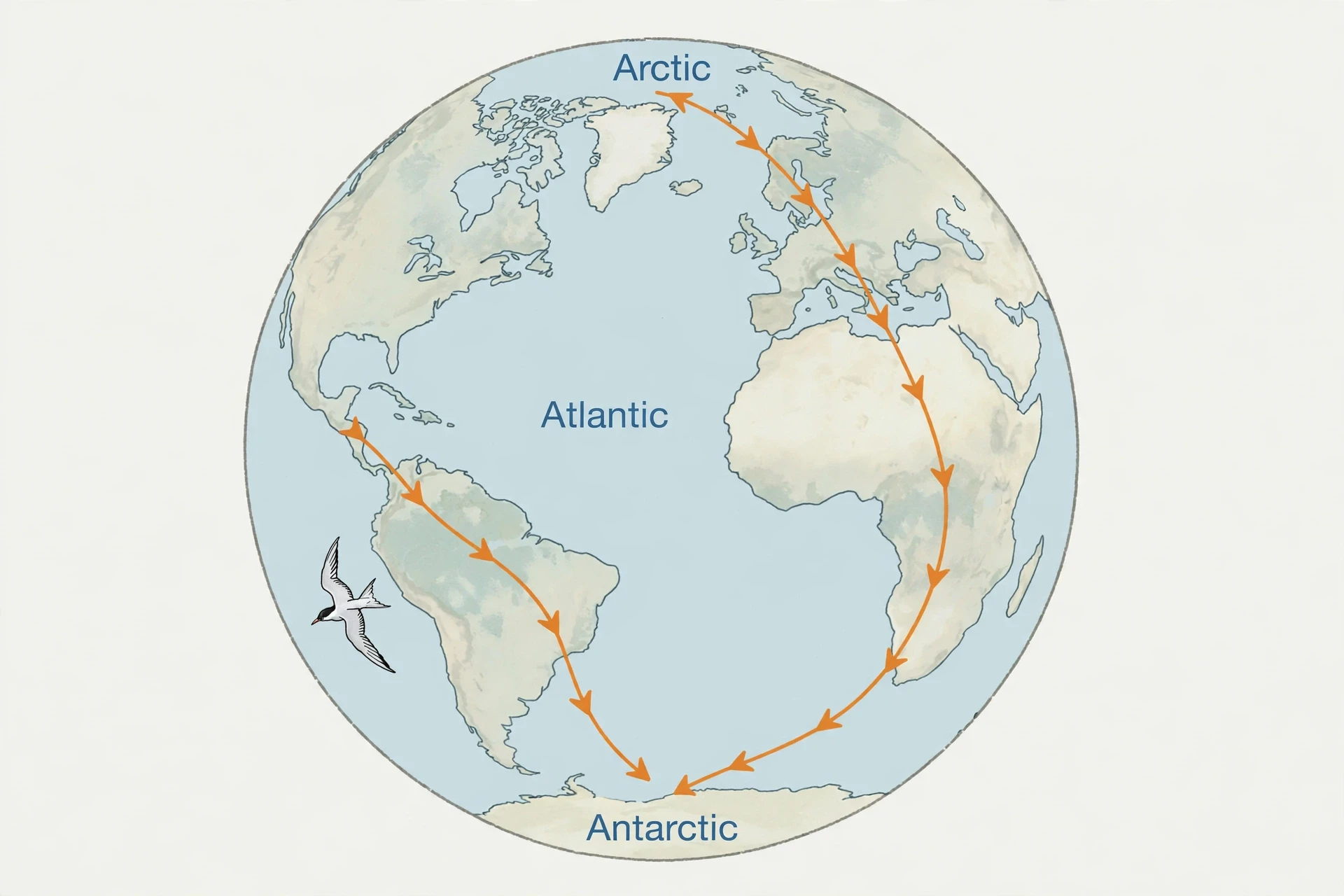
For decades, textbooks said the Arctic tern flew about 40,000 kilometres a year, a figure nobody had actually measured. Then researchers fitted 70 terns with tiny geolocators and watched the real number come in: a mean of about 70,900 kilometres a year, with some birds flying past 80,000.
The old number was not a lie; it was a guess made before anyone could follow a tern across an ocean. The Arctic tern breeds in the far north and spends the southern summer in Antarctic waters, so the round trip had to be enormous, but the only way to measure it was to put a tracking device on the bird and get it back. That was the problem. A tern weighs little, and a transmitter heavy enough to send a signal would have weighed it down. The answer was a geolocator: a device that simply records light levels, from which latitude and longitude can be worked out later, when the bird is caught again on its breeding ground a year later.
A 1.4-Gram Instrument
In the study that rewrote the record books, 70 Arctic terns were fitted with miniature 1.4-gram geolocators; when 11 returned the following year, the recovered devices gave the measurement. At 1.4 grams for the logger — 2.0 grams with its harness, under 2% of the bird's body mass — it was light enough to carry on migration, and it was the key that unlocked the measurement. The light records showed where each bird had been, day by day, across the Atlantic and around the Southern Ocean (Egevang et al., PNAS, 2010; DOI: 10.1073/pnas.0909493107).
The tracked birds travelled a mean of 70,900 kilometres per year, with a range of 59,500 to 81,600 kilometres. Some individuals travelled more than 80,000 kilometres annually. The same study measured a mean southbound migration distance of 34,600 kilometres and a mean northbound distance of 25,700 kilometres. The southbound leg took a mean of about 93 days, the northbound leg about 40 days — the birds hurry home in spring and take their time heading south, stopping to feed along the way. All tracked terns migrated south to spend the austral summer, December to March, south of 58 degrees south in the Atlantic sector of the Southern Ocean.
Why Studies Disagree
The Egevang figure is the headline, but it is not the only number in the literature, and the comparison is worth stating plainly. The birds in that study bred in Greenland and Iceland. A 2013 study of Dutch breeders found about 90,000 kilometres a year — even farther, because Dutch terns cross three oceans to winter off Wilkes Land in East Antarctica (Fijn et al., 2013). Distance varies by breeding population, so there is no single "tern distance", only distances measured for particular birds from particular colonies. What the studies agree on is the direction of the correction: the old 40,000-kilometre estimate was far too low, and the tracked birds travelled far beyond it. Later tracking went further still: a Farne Islands tern (tag G82) covered 96,000 km in ten months, from 25 July 2015 to 4 May 2016 — the longest flight ever recorded for a migratory bird (Newcastle University).
Arctic terns can live for more than 30 years — the longevity record is 34 — so at the tracked rate a lifetime total is about 2.1 million kilometres over 30 years, and may exceed 2.4 million for a bird reaching the record age. That number is derived arithmetic — annual distance multiplied by lifespan — not a measurement of any single bird over its life. No tern has ever been tracked for its whole life, and the figure should be read as a way of grasping the scale, not as a recorded fact. Even so, the arithmetic points to something real: a bird that lives three decades and flies the pole-to-pole route every year piles up a lifetime total no other animal is known to match, using wings and weather alone. The record the tern took had belonged to the sooty shearwater, and the handover shows how fast tracking was changing what ornithologists knew. Before the tern study, the shearwater held the electronically tracked distance record: 19 shearwaters tracked for an average of 262 days travelled 64,037 kilometres, plus or minus 9,779 kilometres, round trip in a figure-eight pattern across the Pacific — the longest animal migration ever recorded electronically at that time, in 2006 (Shaffer et al., PNAS, 2006; DOI: 10.1073/pnas.0603715103). The tern took the crown because it flies farther, and because it does it every year, from the top of the world to the bottom and back. Two different birds, two different oceans, and the same lesson: whenever researchers finally put a tracker on a long-distance migrant, the bird turns out to travel farther than the textbooks said.
8. Salmon: Swimming Home Against the Current
A salmon born in a mountain stream may spend years in the open Pacific, yet it usually returns to the very stream where it hatched, swimming upstream against the current to spawn and die. That homecoming depends on two different senses, used at two different scales, and it begins before the young fish ever leaves fresh water.
Salmon are anadromous: born in fresh water, they migrate to the ocean, and return to fresh water to spawn. The return is one of the most precise feats of navigation in animal migration, and it works as a two-stage system. In the open ocean, where the scent of a single stream is far too diluted to detect, in the species studied, the salmon uses the Earth's magnetic field as a compass and map. Close to home, where the magnetic sense is too coarse to pick one stream from the next, it switches to smell. Each stage hands over to the next, and each has its own experimental evidence.
The Magnetic Sense in the Open Ocean
Salmon may imprint on the Earth's magnetic field — a hypothesis supported by 56 years of sockeye data (Putman et al. 2013) — and laboratory work shows juvenile Chinook, with no prior migratory experience, already respond to magnetic fields matching the far ends of their ocean range, suggesting the map is at least partly inherited (Putman et al. 2014). The idea sounds improbable — a fish carrying a magnetic map of the field's intensity and inclination in its head — but it fits what the fish actually do. A salmon that has spent years feeding thousands of kilometres from its home river still turns toward the right coast at the right time. The magnetic cues get a fish to within roughly 50–100 km of its home river system; smell does the final approach. The magnetic sense gets the fish to the coast; it cannot do the rest, because the magnetic field varies too gradually to tell one river mouth from another a few kilometres away. For that, the salmon needs a sense with far finer resolution, and it has one: its nose.
The Smell of Home
Juvenile salmon imprint on the chemical nature of the water they are raised in before they go to the ocean, and that is how they come back to a particular stream and a particular part of the stream. The imprinting happens during the seaward migration. In one experiment, pink salmon exposed to an artificial scent (phenethyl alcohol) as alevins were attracted to that same scent as adults — showing imprinting can occur at that stage. The stream's scent is a chemical fingerprint, made of minerals, vegetation, and the biology of that one stretch of water, and the salmon carries a memory of it for years.
The classic test of the smell hypothesis was run in 1954 (Wisby & Hasler, J. Fish. Res. Board Can. 11:472–478, DOI 10.1139/f54-031). Salmon with plugged olfactory pits took the wrong fork in a stream about half the time — as expected by chance — while fish with unplugged nostrils returned to the correct fork nearly 100 percent of the time. The hypothesis itself had been formalised by Hasler and Wisby in 1951 (DOI: 10.1086/281672). Block one sense, and the homecoming fails at exactly the point where that sense takes over. The experiment is still cited today because it is so clean: same stream, same fish, one difference, and the difference decides the outcome.
One Spawning, Then Death
Pacific salmon spawn once and then die. They are born in fresh water, migrate to the Pacific Ocean, dwell there for up to five years, then usually make their way back to the precise place they were born, spawn, and die. The death is not an accident of exhaustion alone, though the upstream swim is brutal; it is the programmed end of the life cycle, called semelparity. The body of a spawning salmon is spent, its tissues breaking down as it gives everything to the eggs and the milt, and its carcass then feeds the stream — bears, eagles, and the forest floor all draw on the nutrients the fish carried back from the ocean.
The journey, in order, looks like this:
The young salmon leaves its natal stream, imprinting on its scent and on the magnetic field where it enters the sea.
It crosses the open ocean, guided by the magnetic sense, feeding and growing for up to five years.
It turns toward the coast, following the magnetic map back to the river mouth.
It swims up the river, switching to smell for the final miles, choosing its home stream and the right fork within it.
It spawns on the gravel bed where it was born, and dies.
Step four is where the human break in the journey falls hardest. Construction of four dams on the lower Snake River between 1961 and 1975 altered salmon spawning habitat, elevated smolt and adult migration mortality, and contributed to severe declines of Snake River salmon populations (Kareiva et al., Science, 2000; DOI: 10.1126/science.290.5493.977). Dams block animal migration in both directions: they make it harder for adults to reach upstream spawning grounds and slow juveniles heading to the ocean, while the reservoirs behind them warm the water and favour predators. They also increase exposure to lethal water temperatures and cause turbine, spillway and delayed mortality; even with passage improvements, Snake River spring/summer Chinook would probably continue declining toward extinction without broader mortality reductions. A salmon can cross an ocean by magnetic sense and find its home stream by smell, but it cannot climb a concrete wall. The ecosystems that depend on the salmon's return — the river, the forest, and the animals that feed on the carcasses — lose with it.
9. Whales on the Move
Whales cross whole oceans on animal migration, journeys measured in thousands of kilometres, and they do much of it without eating. Two whales hold the record books between them, and their records measure different things, so the honest way to tell the story is to keep them apart and let each one speak for itself.
The Humpback's Record
The humpback held the mammal migration record first. One mother humpback and her calf made an 8,300-kilometre trip from the Pacific coast of Costa Rica to Antarctic feeding grounds in 161 days — at the time, the longest mammal migration ever recorded for a documented individual (Rasmussen et al., Biology Letters, 2007; DOI: 10.1098/rsbl.2007.0067). A male humpback photographed off Colombia in 2017 was re-sighted off Zanzibar in 2022 — a great-circle separation of 13,046 km (8,106 miles), the longest documented great-circle distance between sightings for the species, and the first record of a humpback alternating breeding grounds between the Pacific and Indian Oceans. The route itself was never tracked, and the true distance travelled was certainly much greater. The 8,300-kilometre figure is a one-way distance, and it is history now, not the current record. It stood because no mammal had been documented travelling farther in one direction; it fell when a different whale, measured a different way, went farther still.
The humpback pattern is the classic whale migration: feed in cold water, fast and breed in warm water. Humpback whales feed in summer at high latitudes and then swim to warm, shallow breeding grounds off Hawaii, Mexico, the Caribbean, Tonga, Brazil, Madagascar and the Great Barrier Reef — some populations swim up to 5,000 miles (about 8,000 km) each way between feeding and breeding grounds, a round trip of roughly 16,000 km. While in Hawaii's waters humpbacks rarely feed — the primary reason for the journey is to mate and for mothers to give birth and raise their young — though opportunistic feeding on the breeding grounds has been documented, and the Alaska to Hawaii voyage spans approximately 3,000 miles. NOAA reports that some humpback whales migrate 5,000 miles, about 8,000 kilometres, and whales travelling from Alaska to Hawaii can cover the 3,000 miles, about 4,800 kilometres, in as little as 28 days.
The Gray Whale That Took the Record
The record now belongs to a female western gray whale named Varvara. She swam from Sakhalin Island, Russia, to Baja California, Mexico, and back — a 22,511-kilometre round trip in 172 days — the longest documented mammal migration (Mate et al., Biology Letters, 2015; DOI: 10.1098/rsbl.2015.0071). Her outward leg alone was 10,880 kilometres in 69 days, described in the paper as the longest recorded distance travelled during a mammal migration. Varvara's journey matters beyond the number: she visited all three major eastern gray whale reproductive areas, showing gene flow across a supposed population boundary and suggesting that some presumed western gray whales are actually eastern whales foraging off Russia. That finding rewrites a conservation map, not just a record book. Western gray whales were treated as a small, separate population with its own breeding grounds, and protecting them meant protecting a distinct group. If whales cross between the supposed populations, the animals counted as western may be eastern whales feeding in Russian waters, and the population boundaries that managers drew need redrawing. A single tracked whale, in other words, can change how an entire species is counted and protected. The eastern North Pacific gray whale population migrates about 10,000 miles round trip each year between Arctic feeding grounds and Baja California lagoons, and in some cases upwards of 14,000 miles — 16,000 to about 22,500 kilometres — but Varvara's 22,511 kilometres is a single-animal record, not the population norm, and the two should not be confused.
The two records, side by side:
Humpback whale: 8,300 kilometres, one way, Costa Rica to Antarctic feeding grounds, in 161 days; the record measures a single one-way leg and was the longest documented mammal migration at the time (2007).
Gray whale Varvara: 22,511 kilometres, round trip, Sakhalin Island to Baja California and back, in 172 days; the record measures the whole round trip and is the longest documented mammal migration now (2015).
Blubber: The Fuel Tank
How does a whale fast for months while swimming thousands of kilometres? The answer is blubber. Humpback whales fast while on their tropical breeding grounds, living off blubber built up during summer feeding, and pregnant females largely do not feed during the journey, relying almost entirely on fat reserves. The warm water is worth the fast: a calf born in cold, food-rich water would burn energy just staying warm, while a calf born in the tropics can put its energy into growing. The mother pays for that warmth with her own body, converting the fat she stored in summer into milk and movement. I remember standing on a headland once, watching humpbacks breach far offshore, and thinking how effortless it looked from a distance — a slow roll, a white splash, gone. The science underneath that easy surface is a body running on stored fuel, thousands of kilometres from its last meal, with a calf beside it that has never eaten anything but milk. The journey looks serene because the whale is built for it, not because it is easy.
10. The Bar-Tailed Godwit: The Nonstop Champion
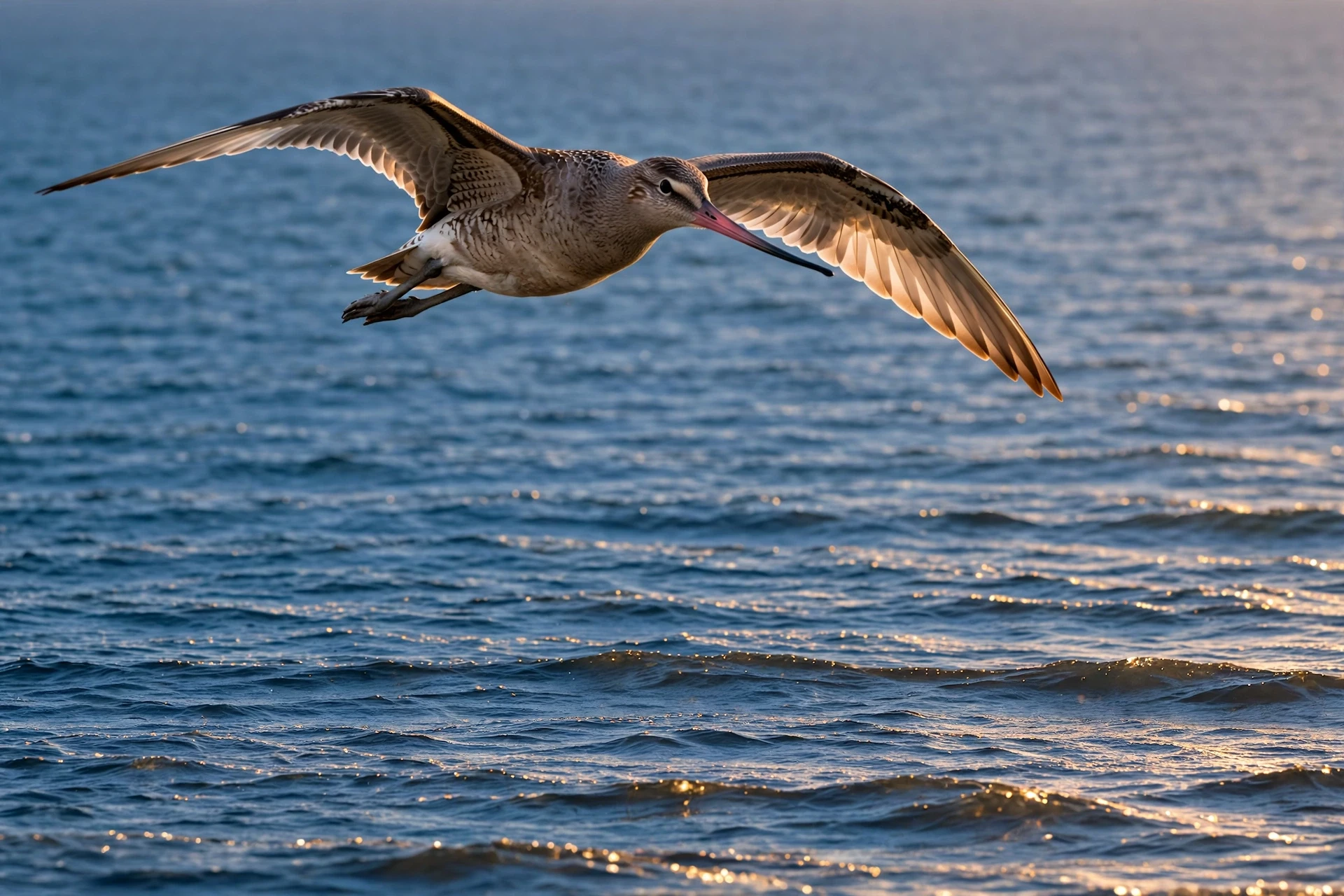
No bird flies farther on animal migration without stopping than the bar-tailed godwit, and the record keeps falling to the same species. From Alaska, these shorebirds launch their animal migration across the Pacific toward New Zealand and Australia, and the best of them now stay airborne for eleven days, crossing more than 13,000 kilometres of open ocean without landing.
The record is a sequence, and each entry broke the one before it. In 2007, female E7 flew nonstop 11,680 kilometres from western Alaska to the Piako River near Thames, New Zealand, in just over eight days — the record in Gill et al. 2009 (DOI: 10.1098/rspb.2008.1142). In that study, seven females fitted with implanted satellite transmitters flew nonstop 8,117 to 11,680 kilometres, an average of 10,153 kilometres, in 6.0 to 9.4 days, while two males with external transmitters flew 7,008 to 7,390 kilometres in 5.0 to 6.6 days. The record did not stand still. In 2020 a male godwit known as 4BBRW flew more than 12,000 kilometres from Alaska to New Zealand in 11 days, and in 2021 the same bird flew about 13,000 kilometres from Alaska to New South Wales, Australia. Then, in October 2022, a juvenile godwit known as B6, tag 234684, flew about 13,560 km (Guinness/USGS figure; a 2026 peer-reviewed re-estimate puts the same flight at 13,391 km) from Alaska to Tasmania in 11 days and 1 hour without stopping — the longest documented nonstop flight by a bird. B6 was about four to five months old and on its first migration, a young bird with no teacher and no previous crossing behind it.
The four record flights, in order:
2007 — E7: 11,680 kilometres, Alaska to New Zealand, just over 8 days.
2020 — 4BBRW: more than 12,000 kilometres, Alaska to New Zealand, 11 days.
2021 — 4BBRW: about 13,000 kilometres, Alaska to New South Wales, Australia.
2022 — B6: about 13,560 km (Guinness/USGS figure; a 2026 peer-reviewed re-estimate puts the same flight at 13,391 km), Alaska to Tasmania, 11 days and 1 hour.
How a Body Becomes an Aircraft
A nonstop flight of eleven days over open ocean should be impossible, and the godwit makes it possible by rebuilding its own body before departure. Before departure, godwits shrink digestive organs used during fuel deposition: fat loads reach about 55 percent of body mass, and the birds shrink the gizzard, liver, kidneys and gut substantially (by up to about a quarter of their tissue, according to secondary summaries of the work) and rebuild those organs on arrival. Fat at more than half of body mass is the fuel that makes an eleven-day fast possible, and the shrunken gut is the weight saving that makes room for it. The flight muscles and the heart are largely kept — relatively preserved while the digestive organs shrink — rather than strengthened; everything that is not needed in the air is pared back. The restructuring from fuelling to flight happens within about one month, and the bird that takes off is, in a real sense, a different machine from the bird that spent the summer feeding. Tracked birds have lost up to half their body weight on the Alaska–New Zealand flight (Gill et al. 2009; Battley et al. 2012). While the birds are still fuelling, more than half of body mass — 58% — is water; by departure, fat has taken water's place as the dominant store, and the gut has been pared back to make room for it.
One fully tracked godwit, E7, covered a round trip of 29,280 kilometres over 174 days, in three main flights: 10,270 kilometres in 7.0 days from New Zealand to the Yellow Sea, 6,510 kilometres in 4.9 days from the Yellow Sea to Alaska, and 11,680 kilometres in 8.1 days from Alaska to New Zealand. A later paper re-analysed the same track as 11,690 km; the 10 km difference is rounding in the track calculation. The 29,280 km round-trip total includes additional movements beyond the three main flights, which is why the legs do not sum to it. The Yellow Sea stopover in the middle of that round trip matters as much as the flights themselves, because it is where the bird rebuilds its gut and refuels before the next ocean leg. A journey is only as safe as its weakest stop, and for the godwit the Yellow Sea is the stop that makes the rest possible.
Two Numbers for the Same Flight
Readers who look up B6's flight will find two different distances, and both appear for an honest reason. Guinness World Records and the United States Geological Survey give 13,560 kilometres in 11 days and 1 hour. A 2026 peer-reviewed study in Wader Study re-estimated the same flight at 13,391 kilometres. Both describe the same bird and the same nonstop flight. The difference is a route-distance calculation: the two figures come from different ways of summing the same satellite track, not from two different flights. The 13,560-kilometre figure is the one to cite as the record, with the 13,391-kilometre re-estimate noted alongside it, because the record stands whichever calculation is used. The godwit flew farther without stopping than any bird ever recorded, and no recalculation changes that. The convergent evolution of long-distance flight has produced different answers in different birds — the tern flies the long way round over a year, the shearwater crosses the Pacific in a figure-eight, the godwit crosses it in one unbroken line — but no other bird has matched the godwit's single unbroken flight, and the record keeps being broken by the same small shorebird, flying on fat and a shrunken gut across an ocean it has never seen before.
11. How Birds Navigate: Sun, Stars, and Magnetic Fields
A bird crossing an ocean at night on animal migration carries no map, no compass in its beak, and no one to ask for directions. Yet it holds a course for thousands of kilometres and arrives where its ancestors arrived. The answer is not one sense but three, each solving a different problem.
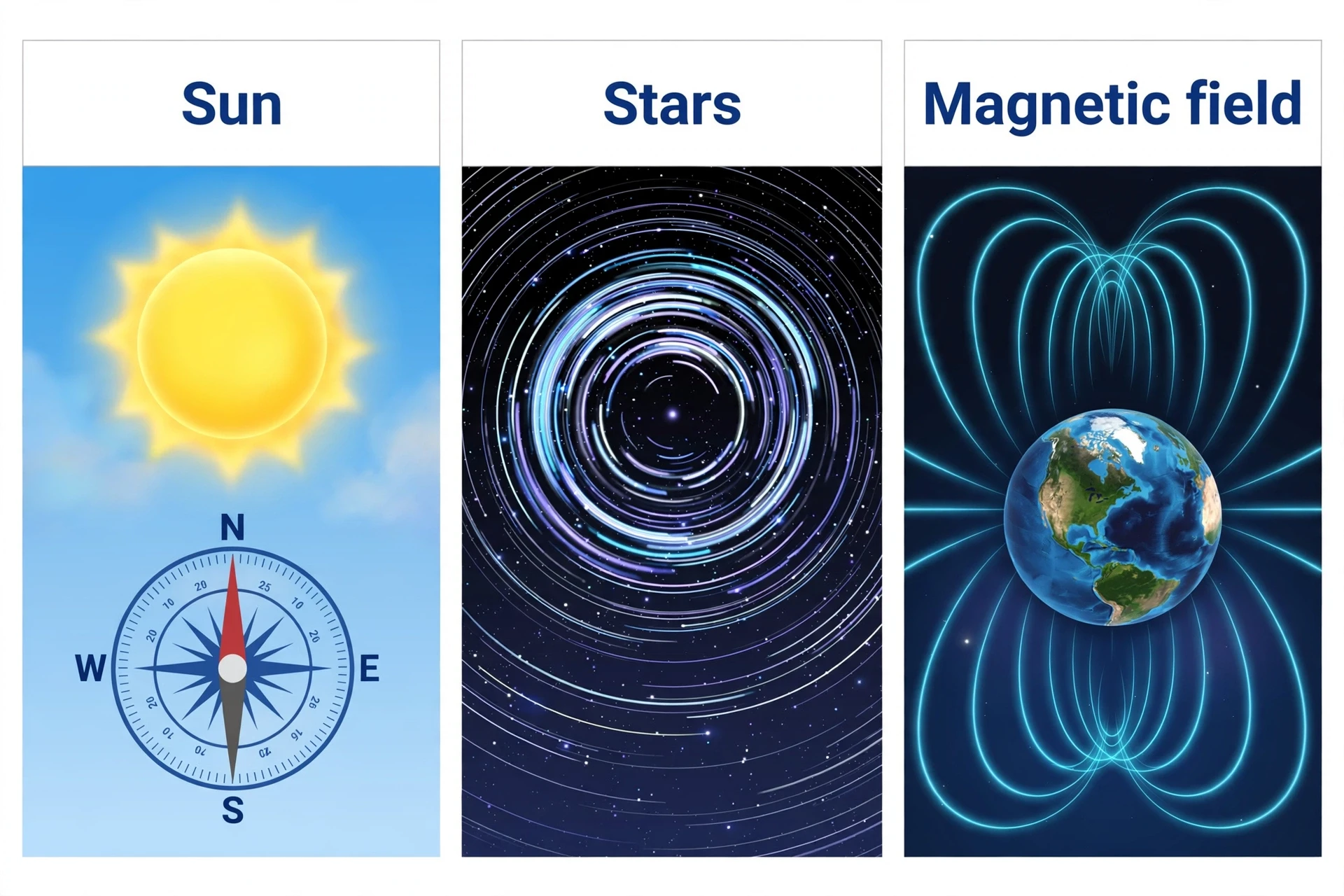
Birds draw directional information from five primary sources: topographic features, including wind direction, stars, the sun, the Earth's magnetic field, and odours. That list comes from a Stanford review of bird navigation. No single compass does the whole job: a bird may use one cue to set its heading, another to hold it when clouds hide the sky, and a third to correct itself when it has drifted off course. The three compasses below were each established by a different kind of experiment.
The Sun Compass: A Clock That Points
The sun moves across the sky, so a compass based on the sun needs a clock as well as eyes. A bird that knows the time of day can work out which direction the sun should be in, and therefore which way it is facing. That idea was described by Gustav Kramer in 1950, and it was tested in a neat way by Karl Schmidt-Koenig in 1958 and 1961. Schmidt-Koenig shifted the internal clock of homing pigeons, and the birds then made the directional error that the shifted clock predicted. If the sun were only a landmark, shifting the clock would change nothing. Because the error followed the clock, the sun had to be a compass, read against time.
The Star Compass: Learning the Sky by Watching It Turn
At night, when the sun is gone, many migrants turn to the stars. Stephen Emlen showed this in planetarium experiments with indigo buntings. The birds oriented in the proper migratory direction using stellar cues, and when he shifted the projected stars, their orientation shifted with them.
The more surprising finding was how the compass is acquired. Emlen's 1970 experiment raised buntings under a planetarium sky rotating around Betelgeuse, a star in Orion, instead of around the real pole star. Those birds later treated Betelgeuse as the North Star. They had learned the centre of rotation by watching the sky turn as they grew up, and they took that centre as north. The star compass is therefore not an inborn map of constellations. It is a skill learned from the rotation of the sky, and a bird raised under a false sky learns a false north.
The Magnetic Compass: A Sense We Can Measure but Not Yet Fully Explain
Birds can detect the Earth's magnetic field, and they use the angle at which the field lines meet the Earth — the inclination — as a compass cue. The field lines point steeply downward near the poles and run almost flat near the equator, so inclination gives a bird information about latitude as well as direction. The compass is not a needle pointing north in the familiar sense. It is a sense of the field's tilt, and it works on overcast nights, under cloud, and when neither sun nor stars are visible — as long as there is dim light for the light-dependent mechanism to work.
How the field is detected is the open question. The leading hypothesis is the radical-pair mechanism in a light-sensitive protein called cryptochrome, found in the retina. The idea is that light creates pairs of molecules with unpaired electrons in cryptochrome, and the Earth's magnetic field alters how those pairs react, producing a signal the bird's visual system can read. There is real evidence behind this idea. Cryptochromes exist in the retina of migratory garden warblers, and garden-warbler CRY1 is concentrated in ganglion cells that show high neuronal activity at night when the birds perform magnetic orientation. The authors of that work concluded that the protein is well placed to possibly be the primary magnetic-sensory molecule (Mouritsen et al., PNAS, 2004, DOI: 10.1073/pnas.0405968101).
Stronger evidence came later from the laboratory. Cryptochrome 4 from the night-migratory European robin is magnetically sensitive in vitro, while Cry4 from non-migratory chicken and pigeon is not, and the paper reports four successive flavin-tryptophan radical pairs generating the magnetic field effects (Xu et al., Nature, 2021, DOI: 10.1038/s41586-021-03618-9). That is a striking result: the molecule from a migrant responds to a magnetic field in a test tube, and the equivalent molecule from non-migrants does not. One caveat: the experiments used isolated protein in a test tube and magnetic fields stronger than the Earth's, so they show the molecule can respond to a magnetic field, not that it does so inside a bird's eye.
Yet the full chain from molecule to behaviour is not proven. A review of the field states the position plainly: the leading hypothesis is the radical-pair mechanism in retinal cryptochrome, but the primary sensory mechanism behind avian magnetoreception is still unclear after almost half a century of knowing that birds can detect the field (Hore and Mouritsen, Annual Review of Biophysics, 2016). A molecule responding in a test tube is not the same as a bird reading a compass in flight. The steps in between — how the signal travels from the retina to the brain, and how the brain turns it into a heading — remain to be worked out.
One more finding shows how fragile the magnetic compass can be. Anthropogenic electromagnetic noise disrupts magnetic compass orientation in migratory birds. European robins tested in captivity in the presence of weak broadband electromagnetic noise — ordinary urban background noise, well below human-exposure guidelines — lost their magnetic orientation (Engels et al., Nature, 2014, DOI: 10.1038/nature13290).
What is proven, and what is still hypothesis:
Proven: birds use a sun compass, read against an internal clock, as shown by clock-shift experiments.
Proven: birds use a star compass, learned from the rotation of the sky, as shown by Emlen's planetarium buntings.
Proven: birds can detect the Earth's magnetic field and use it for orientation. Shown in captive tests: weak electromagnetic noise can disrupt magnetic orientation in European robins.
Still hypothesis: that cryptochrome and the radical-pair mechanism are the molecules and mechanism behind magnetoreception in a living, flying bird. The in-vitro evidence is real, and robin Cry4 is magnetically sensitive, but the full chain from molecule to behaviour is not yet proven.
12. Navigation Beyond Birds: Smell, Sound, and Memory
Birds are not the only travellers in animal migration with a way of finding home. Salmon return to a single stream, turtles return to a beach they left decades earlier, and eels cross an ocean to spawn where no adult has ever been. Their tools are different, and so is the evidence behind each one.
The bird compasses of the last section are only part of the story. Under water, stars are useless. In a river, a magnetic field may guide a fish across an ocean, but it cannot pick out one stream from the next. Different environments demand different senses for animal migration: smell, magnetic maps, memory, and travelling beside a parent who already knows the way.
Smell: A River Written in Chemistry
Salmon solve the last part of their journey by smell. Juvenile salmon imprint on the chemical nature of the water they are raised in before they go to the ocean, and that imprint is how they come back to a particular stream, and to a particular part of that stream. The evidence is experimental and direct. In the classic 1954 test of the olfaction hypothesis, salmon with plugged olfactory pits took the wrong fork in a stream about half the time, as expected by chance, while fish with unplugged nostrils returned to the correct fork nearly 100 percent of the time. The hypothesis itself was formalised by Hasler and Wisby in 1951 (DOI: 10.1086/281672). Block the nose, and the fish loses its way home. Leave the nose open, and it finds the right fork almost every time.
That is only the final leg. Salmon also imprint on the Earth's magnetic field where they first enter the sea, and use it as an internal GPS in the open ocean, where stream scent is too diluted to detect. Pacific salmon imprint odorants from their natal streams during seaward migration and use olfaction to identify their natal streams during homeward migration, and in one experiment, pink salmon exposed to an artificial scent (phenethyl alcohol) as alevins were attracted to that same scent as adults — showing imprinting can occur at that stage (DOI: 10.1038/srep36393). The system is therefore two-stage: a magnetic sense for the open ocean, and smell for the final river miles.
Magnetic Maps: Two Numbers That Name a Place
Sea turtles take the magnetic sense a step further. A single magnetic reading is not enough to name a place, but two readings together can be. The inclination of the field and its intensity vary across the ocean in different patterns, so the pair of values at any spot forms a kind of signature, a two-coordinate address that a turtle could in principle learn and return to.
The experimental support is striking. Loggerhead hatchlings exposed to magnetic fields matching two sites at the same latitude on opposite sides of the Atlantic swam in opposite, appropriate directions — northeast for a Puerto Rico field, southwest for a Cape Verde field — showing they can distinguish longitude using inclination and intensity together (Putman et al., Current Biology, 2011).
The long-term evidence points the same way. Female sea turtles typically first return to nest in the region where they hatched after 20 to 30 years, when they reach maturity. In a Nature 2004 experiment, green turtles exposed to a magnetic field matching an area 340 km north of their position swam southwards to correct their route. Separately, 19 years of Florida loggerhead nesting data show nests drifting geographically in step with shifts in the magnetic field (Brothers and Lohmann, Current Biology, 2015).
Hard, but not settled. The exact mechanism of sea turtle geomagnetic imprinting is not settled: hatchlings imprint on the magnetic signature of their natal beach, but how that memory is stored for decades and which receptor cells detect the field remain open questions. The behaviour is well supported, and the magnetic explanation fits the experiments, but the storage of a magnetic memory for 20 to 30 years, and the identity of the receptor, are still unknown.
Journeys No Adult Has Seen, and Lessons With No Teacher
European eels present the hardest version of the navigation problem. They spawn in the Sargasso Sea, and their leptocephalus larvae are then transported by the Gulf Stream and North Atlantic Current towards European and North African coasts, a journey believed to take between one and three years. The adults then make the return journey: over 5,500 km to the Sargasso Sea, and from the Baltic Sea about 7,500 km to reach the spawning area. No adult eel has ever seen the spawning ground it swims towards, because no adult that spawns there survives to return, and no young eel has been guided there by a parent. The route must be carried in the animal itself, in a programme that unfolds without a teacher and without a map drawn from experience.
That contrast — learned against innate — runs through the whole subject. A star compass must be learned, as Emlen's buntings showed: raise a bird under a false sky, and it learns a false north. Yet a juvenile bar-tailed godwit flies its first ocean crossing with no teacher at all. The record bird B6 was about four to five months old and on its first migration when it flew about 13,560 km (Guinness/USGS figure; a 2026 peer-reviewed re-estimate puts the same flight at 13,391 km) from Alaska to Tasmania in 11 days and 1 hour without stopping. No older bird showed it the way across the Pacific. The direction, the timing, and the endurance were already in the bird when it left Alaska.
Whale calves sit at the other end of the same contrast. The mother humpback of §9 made her 8,300 km trip to the Antarctic feeding grounds with her calf beside her; the calf did not navigate that journey alone. It travelled with its mother, learning the route by following it. Sound also plays a role for some migrants: humpback mothers and calves stay in acoustic contact on the breeding grounds, though much of that story is still inference from behaviour and anatomy rather than controlled experiment, and it should be read with that caution in mind.
I remember standing under a planetarium dome on a school visit years ago, watching the projected stars wheel slowly overhead while the presenter explained that the sky turns around a single still point. I had come expecting a show, and I left thinking about a small brown bird in a cage, watching the same turning sky and learning north from it. The idea that a compass could be learned by watching, rather than inherited whole, stayed with me longer than any single fact from that evening.
One navigation sense per animal, with the evidence type for each:
Salmon, smell: experiment — fish with plugged nostrils chose the wrong fork about half the time, while unplugged fish chose correctly nearly 100 percent of the time.
Salmon, magnetic field: imprinting evidence — salmon imprint on the magnetic field where they first enter the sea and use it in the open ocean.
Loggerhead turtle, magnetic map: experiment — hatchlings swam in opposite, appropriate directions for magnetic fields matching sites on opposite sides of the Atlantic.
Green turtle (experiment) / Loggerhead turtle (nesting data), magnetic map: green turtles corrected course for a displaced magnetic field, and loggerhead nests drifted with shifts in the field over 19 years.
European eel, ocean navigation: larval drift and adult return journeys — larvae drift for one to three years, and adults swim over 5,500 km back to a spawning ground no adult has seen.
Bar-tailed godwit, innate direction: satellite tracking — juvenile B6 flew about 13,560 km (Guinness/USGS figure; a 2026 peer-reviewed re-estimate puts the same flight at 13,391 km) on its first migration with no teacher.
Humpback whale calf, learned route: tracking of a mother and calf — the pair travelled 8,300 km together over 161 days.
Indigo bunting, star compass: planetarium experiment — birds raised under a sky rotating around Betelgeuse treated Betelgeuse as north.
13. The Cost of the Journey
Every great journey of animal migration in this story has a price, and the price is paid in flesh, in fuel, and sometimes in lives. Animal migration looks effortless from a distance, a line drawn across a map. Up close, it is a gamble in which the body itself is the stake.
The price begins before departure. A godwit about to cross the Pacific is more than half fuel by weight — its fat stores reach roughly 55 percent of its body mass, a record among birds.. Fat constituted over half of total body mass in birds about to depart, while in birds still fuelling, more than half of body mass — 58% — was water, and the restructuring from fuelling to flight happens within about one month.
Paying With the Body Itself
The rebuilding goes further than fat. In godwits preparing for the trans-Pacific flight, the birds shrink digestive organs used during fuel deposition: fat loads reach about 55 percent of body mass, and the birds shrink the gizzard, liver, kidneys and gut substantially (by up to about a quarter of their tissue, according to secondary summaries of the work) and rebuild those organs on arrival. A gut that is not needed over an ocean is, in effect, eaten to make room for the fuel that is needed. The flight muscles and the heart are kept, because without them there is no flight at all. Everything else is negotiable, and the negotiation is written in tissue.
That trade makes sense only because the alternative is worse. A bird that tried to cross the Pacific with a full digestive system and a small fuel load would run out of energy over open water, where there is nowhere to land and nothing to eat. The godwit burns its own organs because the ocean offers no refuelling stop, and the cost of carrying a gut it cannot use is greater than the cost of rebuilding one on arrival.
Dying on the Road
Not every cost is paid in tissue. Some of it is paid in lives, and the Mara River crossings make that cost measurable, as described in §5: mass drownings there kill a mean of 6,250 wildebeest per year. The crocodiles are visible, dramatic, and easy to film, so they dominate the story most people hear. The measured cause of death is the river itself: animals pushed into deep water by the press of the herd behind them, unable to climb the far bank, drowning in large numbers in a single event.
Storms, exhaustion and predation take their toll on other journeys in the same way, though they are harder to count than a river full of carcasses. A godwit that meets a storm over the Pacific has no shelter and no second chance. A salmon that meets a dam meets a wall it cannot climb, and the delay alone exposes it to predators and warm water it would otherwise have passed.
The Weakest Stop Decides the Journey
The third cost is the one easiest to overlook, because it is paid at a place the animal only visits for a few weeks. Bar-tailed godwits stage in the Yellow Sea for an average of about 41 days on northward migration, rebuilding digestive organs and refuelling before the next ocean leg (Battley et al., 2012, DOI 10.1111/j.1600-048X.2011.05473.x). The staging grounds are therefore as vital as the breeding grounds. A godwit that arrives in the Yellow Sea with shrunken organs and spent fuel cannot fly on to Alaska without rebuilding and refuelling, and it cannot rebuild and refuel without the mudflats where it feeds. The 41 days are not a pause in the journey. They are part of the journey, and the journey is only as safe as its weakest stop.
That is the rule that ties the costs together. An animal migration is a chain of places — breeding ground, staging ground, crossing point, wintering ground — and the chain fails at its weakest link. Protect the breeding ground and lose the mudflat, and the birds still do not arrive. The price of animal migration is not paid once, at departure. It is paid at every stop, and the weakest stop sets the price for the whole journey.
14. The Ocean's Daily Migration
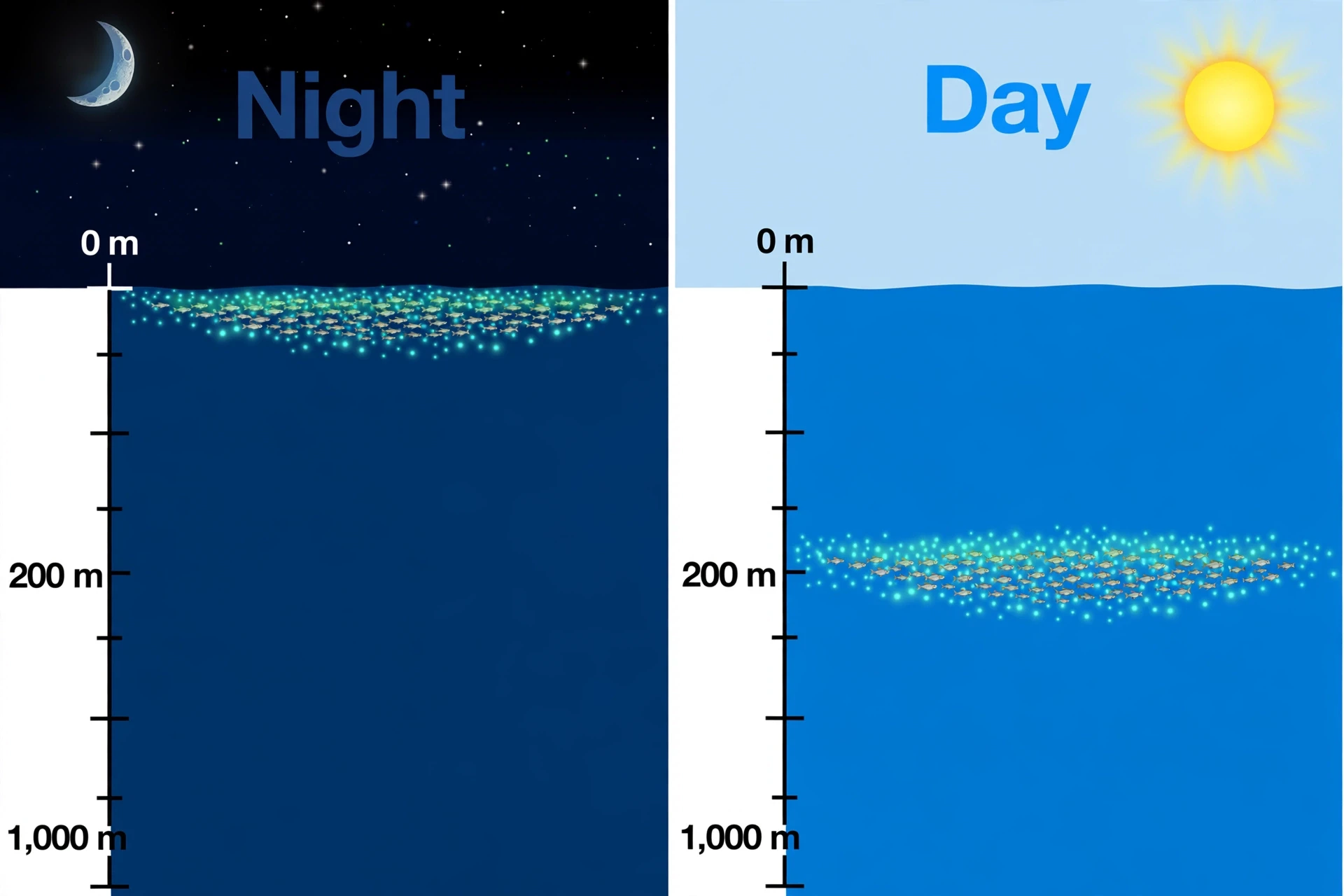
So far every journey of animal migration in this story has crossed a map, from one latitude to another. Now turn the map on its side. The largest animal migration on Earth by biomass moves up and down instead, every day, in every ocean, and most of us never see it happen.
Diel vertical migration is the daily, synchronised movement of marine animals between the surface layer and the deeper mesopelagic layer, covering a vertical distance of up to 1,000 m. It is the largest animal migration on the planet by biomass, undertaken every single day by trillions of animals in every ocean, and it is considered the greatest migration on Earth in terms of biomass, according to NOAA. The scale is hard to hold in mind, because the animals are small and the movement is vertical rather than horizontal. Yet by weight of animals moving, no wildebeest herd, no tern flight, and no whale journey comes close.
The False Bottom That Was Alive
The moving layer was first detected as a false bottom on sonar in the Second World War. Operators saw a layer that rose and fell like a seabed, but no seabed was there. Oceanographer Martin Johnson identified it as biological in a landmark 1948 paper. The layer was animals: a vast, dense band of zooplankton, krill, small fish and squid, rising and sinking together on a daily rhythm. The sonar had been built to find submarines and wrecks. It found, instead, the largest animal migration on Earth, hiding in plain sight below the surface.
The name for that layer, the deep scattering layer, comes from the way it scatters sound. It is not a single species, and it is not a fixed depth. It is a community, moving as one, and its daily movement is the clearest sign that animal migration is not only a seasonal journey across a map. It can also be a daily journey up and down a water column, repeated every night of an animal's life. For readers who want to go deeper into this world, the deep sea is where that daily rhythm plays out, far below the sunlit surface.
Rising by Night, Sinking by Day
The rhythm has a simple logic. Animals rise at night to feed — zooplankton on phytoplankton, and fish, krill and squid on the zooplankton — under cover of darkness and retreat to depth by day to avoid visual predators. Near the surface, at night, there is food: the tiny plants that grow in sunlight and the animals that eat them. By day, that same surface is dangerous, because visual hunters can see their prey in the light. The solution is to commute: feed in the dark, hide in the deep by day, and repeat the journey every 24 hours. Some animals rise from more than 3,000 feet below in the course of that nightly ascent, travelling hundreds of metres through cold, dark water to reach food that is only safe to eat after sunset.
The biomass figures for this daily movement need their scopes stated clearly, because two numbers that look contradictory are both correct. Just the small migrating mesopelagic fishes have an estimated global weight of about 10,000–15,000 million tons — roughly ten times the old trawling-based estimate of 1,000 million tons (Irigoien et al., 2014). That figure counts one group only: the small fishes of the midwater. Current estimates indicate some 10 billion tons of animals take part in diel vertical migration every day, ascending from more than 3,000 feet below in some cases. That larger figure is a daily moving biomass — zooplankton, krill, fish and squid together — while the fish figure is the standing stock of one group. The 10-billion-ton daily figure covers all participants, so the fishes alone account for most of it.
The Carbon Pump
The daily movement also drives the ocean's biological carbon pump, carrying carbon from the surface to depth. Animals that feed near the surface at night and sink by day carry the carbon in their bodies downward. Animal migration is therefore not only a feeding strategy. It is a mechanism that moves carbon from the surface into the deep ocean, where it can stay out of circulation for far longer.
That consequence gives the daily animal migration a weight beyond its own scale. A journey repeated every day by trillions of animals, moving about 10 billion tons of life up and down, is also a journey that shapes the chemistry of the ocean and, through it, the climate. The wildebeest move nutrients across a river basin. The daily migrants move carbon across a water column that covers most of the planet.
15. Insects, Bats, and Unexpected Migrants
If animal migration belonged only to birds and whales, it would still be remarkable. It does not. Butterflies cross deserts, dragonflies cross oceans, millions of bats gather in one Zambian forest, and caribou walk farther than any other land animal migrates. Each breaks a different assumption.
The journeys in this section break the frame that the earlier sections built. A butterfly is not supposed to cross the Sahara. A dragonfly is not supposed to cross an ocean. Millions of bats are not supposed to gather in a tiny patch of forest, and a land animal is not supposed to walk an animal migration that rivals a bird's flight for distance. Each of these four cases breaks a different assumption about who migrates, how far a small animal can go, and what a journey can be powered by.
Two Insects That Cross What Should Stop Them
The painted lady butterfly completes an annual round-trip circuit of 12,000–14,000 km, crossing the Sahara Desert twice — once in each direction — the longest migratory flight known in butterflies, and successive generations cover the distance, not one individual. The same circuit is measured at 12,000–14,000 km in a 2021 PNAS study of environmental drivers, which found the butterflies must fly 1–3 km above sea level to use favourable tailwinds, since their maximum self-powered speed is around 6 metres per second (Hu et al., PNAS, 2021, DOI: 10.1073/pnas.2102762118). A butterfly that can fly at only around 6 metres per second under its own power cannot cross a desert by muscle alone. It crosses by climbing to where the wind helps. The circuit is completed by successive generations, each flying part of the route.
The globe skimmer dragonfly goes further still. It has a multi-generational transoceanic circuit of 14,000–18,000 km from India to Africa and back, including an ocean crossing of about 3,500 km, and no individual completes the full circuit. The India-to-Africa leg alone is about 4,500 km, of which about 3,500 km is a single stretch over open ocean, and an energetics model shows the flight is only possible with gliding and wind selection (Hedlund et al., Frontiers in Ecology and Evolution, 2021, DOI: 10.3389/fevo.2021.698128). Isotope evidence shows globe skimmer dragonflies migrating through the Maldives come from the northern Indian subcontinent, confirming the transoceanic route experimentally rather than by sightings alone (Hobson et al., PLOS ONE, 2012, DOI: 10.1371/journal.pone.0052594).
Millions of Bats in One Forest
Between 8 and 10 million straw-coloured fruit bats converge on Kasanka National Park in Zambia each October to December, the largest mammal gathering on Earth by number of individuals. The Kasanka bats arrive from across Central Africa, including the Democratic Republic of Congo and Angola, travelling more than 2,000 km. The longest documented bat migration belongs to a Nathusius' pipistrelle that flew at least 2,486 km from Russia to the French Alps (Vasenkov et al. 2022, DOI 10.1515/mammalia-2021-0139). The Kasanka bats and pack into a tiny patch of mushitu swamp forest (estimates of the roost area vary widely, from a few hectares to about a square kilometre). The straw-coloured fruit bat is one of Africa's largest fruit bat species, second in size only to the hammer-headed bat, with a wingspan of roughly 80 cm to a metre, and each bat weighs around 250 g.
Animal | Distance | Generations | How the journey is powered |
|---|---|---|---|
Painted lady butterfly | 12,000–14,000 km annual circuit | Successive generations; no single butterfly completes the circuit | Wing-powered flight at around 6 metres per second, climbing 1–3 km to use favourable tailwinds |
Globe skimmer dragonfly | 14,000–18,000 km circuit; about 3,500 km over open ocean | Multi-generational; no individual completes the full circuit | Gliding and wind selection; powered flight alone cannot cover the ocean leg |
Straw-coloured fruit bat | More than 2,000 km to Kasanka | A single generation; the bats that arrive are the travellers | Powered flight |
Caribou | 1,350 km straight-line round trip | A single generation; the herd walks the route | Walking |
Caribou: The Longest Walk
Caribou likely exhibit the longest terrestrial animal migrations on the planet: the Bathurst herd in Canada and the Porcupine herd in Alaska each logged a maximum straight-line round-trip migration distance of 1,350 km, the longest of any terrestrial species by that measure — the only other species over 1,000 km is one migratory population of gray wolves (1,016 km) (Joly et al., Scientific Reports, 2019, DOI: 10.1038/s41598-019-51884-5). The measure matters, and it is worth stating carefully. A straight-line round trip of 1,350 km is the distance between the furthest points of the animal migration, out and back, measured as the crow flies. The total ground a caribou actually covers, with all its wandering, grazing and detours, is far more than that. The two measures describe different things, and confusing them is how an animal migration distance gets overstated.
The Porcupine herd has since fallen from its 2017 peak of 218,000: a July 2025 photocensus estimated 143,000 caribou (range 140,000–150,000), down about 34% (Alaska Department of Fish and Game, January 2026). The often-quoted caribou figure of 5,055 km is not an animal migration distance but the total cumulative distance travelled in a year, measured with outdated technology with high positional error, and it should not be presented as the length of the migration route. Over the course of a year, gray wolves move the most of any terrestrial mammal studied, even though caribou hold the longest animal migration distance — total annual movement and migration distance are different measures.
Caribou close this section because they are the bridge to land migration. Birds cross oceans, insects cross deserts, bats gather by the million, and then there is an animal that walks, season after season, across a landscape that changes with the snow and the thaw. The journey is powered by legs rather than wings, and its record is measured in a straight line rather than in a flight path, but the logic is the same. Natural selection favours the animals that time their movement to the season, and the caribou that walks 1,350 km to where the food is, and back again, is following the same trade-off that sent the godwit across the Pacific and the painted lady across the Sahara: the gain of moving, weighed against the cost of the road.
16. Migration and Evolution: How Journeys Shape Species
Animal migration looks like a habit, a route repeated each year because it worked before. Evolution sees it differently: every journey is a trait under selection, shaped by who survives, who breeds, and who passes genes along a flyway. Three patterns show how that shaping works in real animals.
Selection on timing and fuel
A journey pays only when the traveller arrives at the right place at the right moment, with enough fuel left to breed. That is why timing itself is under selection. In the Netherlands, pied flycatchers breed when caterpillars are most abundant, and the caterpillar peak has shifted earlier as springs have warmed. In Dutch areas where the food peak now falls early, flycatcher populations declined by about 90 percent over two decades, while in areas where the peak falls late they declined by only about 10 percent (Both et al., 2006). The birds did not change their arrival date to match, and the mismatch cost them young.
The mechanism is plain. Birds that breed at the time of maximal food abundance raise more young, and mistimed birds lose out. That difference, repeated year after year, is what selection on breeding time would look like in population counts: the Both et al. comparison is consistent with mistiming driving the declines, though it is a natural comparison of nine populations, not a controlled experiment.
Fuel is under the same pressure. Before a trans-Pacific flight, bar-tailed godwits carry fat loads of about 55 percent of fresh body mass, among the highest ever recorded in birds (Piersma and Gill, 1998). To make room, they shrink the gizzard, liver, kidneys and gut substantially (by up to about a quarter of their tissue, according to secondary summaries of the work) and rebuild those organs on arrival. A bird that cannot store that much fuel, or cannot rebuild fast enough at a stopover, does not pass on its timing. Over generations, birds whose bodies can store that much fuel and rebuild fast enough are more likely to survive and breed — one of the ways the route itself shapes the birds that fly it.
Gene flow along the route
Animal migration also moves genes. Animals that travel far meet animals from other populations, breed in shared grounds, and carry genes back to places those genes would never otherwise reach. A single tracked whale can challenge a population boundary.
Varvara, a female western gray whale, swam from Sakhalin Island in Russia to Baja California in Mexico and back, a 22,511 km round trip in 172 days (Mate et al., 2015). Along the way she visited all three major eastern gray whale reproductive areas, strongly suggesting that some presumed western gray whales are actually eastern whales foraging off Russia. If whales cross that supposed boundary and breed on the other side, the two groups are not as separate as the labels suggest. If whales that forage off Russia also breed in the eastern areas, the two groups may be less separate than the labels suggest — animal migration would then be the channel carrying genes between them. The route is the connection, and the connection keeps populations from drifting apart.
That link matters for how species change. When a route stays open, genes travel with the animals. When a route closes, populations are cut off, and each side begins to follow its own path under genetic drift. An animal migration corridor is therefore not only a road for individuals; it is a channel through which a species stays one species.
Three answers to one problem
Long-distance animal migration did not evolve once. It evolved independently in very different lineages, and each lineage solved the same seasonal problem in its own way. The Arctic tern flies a mean of about 70,900 km a year, with a range of 59,500 to 81,600 km, chasing summer from pole to pole (Egevang et al., 2010). The sooty shearwater takes a different shape of journey: 19 tracked birds travelled 64,037 km, plus or minus 9,779 km, in a figure-eight pattern across the Pacific over an average of 262 days (Shaffer et al., 2006). The bar-tailed godwit takes a third route to the same answer, crossing an ocean in one nonstop flight, with a juvenile in 2022 covering about 13,560 km (Guinness/USGS figure; a 2026 peer-reviewed re-estimate puts the same flight at 13,391 km) from Alaska to Tasmania in 11 days and 1 hour (BirdLife International).
Three birds, three strategies: steady pole-to-pole travel, a looping figure-eight that harvests two oceans, and a single enormous leap on stored fat. None of them is the "correct" way to migrate. Each one works because it fits the bird that flies it, the food it needs, and the ocean or sky it crosses. That is what convergent strategy looks like in animal migration: the same pressure, answered three different ways, each one refined by the generations that survived it.
17. When Migration Goes Wrong: Barriers and Climate Change
The wonder of animal migration makes the losses harder to face. A journey that spans oceans and continents can still be broken by a single dam, a drained mudflat, or a spring that arrives too early. The first global assessment of migratory species, published in 2024, measured how often that breaking is already happening.
A global decline, measured
The first State of the World's Migratory Species report, published by the Convention on the Conservation of Migratory Species of Wild Animals (CMS) in 2024, covered 1,189 listed species. Its headline numbers are stark: the 2024 report found 44% declining and 22% threatened; the March 2026 interim update — the latest release — puts the figures at 49% declining and 24% threatened (CMS, 2024). Monitored populations of migratory species overall (including species not listed under CMS) declined by an average of 15 percent between 1970 and 2017; the CMS-listed subset, by contrast, increased by an average of 1 percent over the same period (based on 9,801 populations of 615 species).
The pattern is worst where protection is weakest. Among CMS Appendix I species — those listed as in danger of extinction and needing strict protection — 82 percent are threatened with extinction and 76 percent are declining. Among Appendix II species, 18 percent are globally threatened and 42 percent are declining. Fish carry the heaviest losses of all: nearly all, 97 percent, of CMS-listed fish are threatened with extinction, and CMS-listed migratory fish populations declined by an average of 90 percent since the 1970s (176 populations of 37 species) (United Nations, 2024).
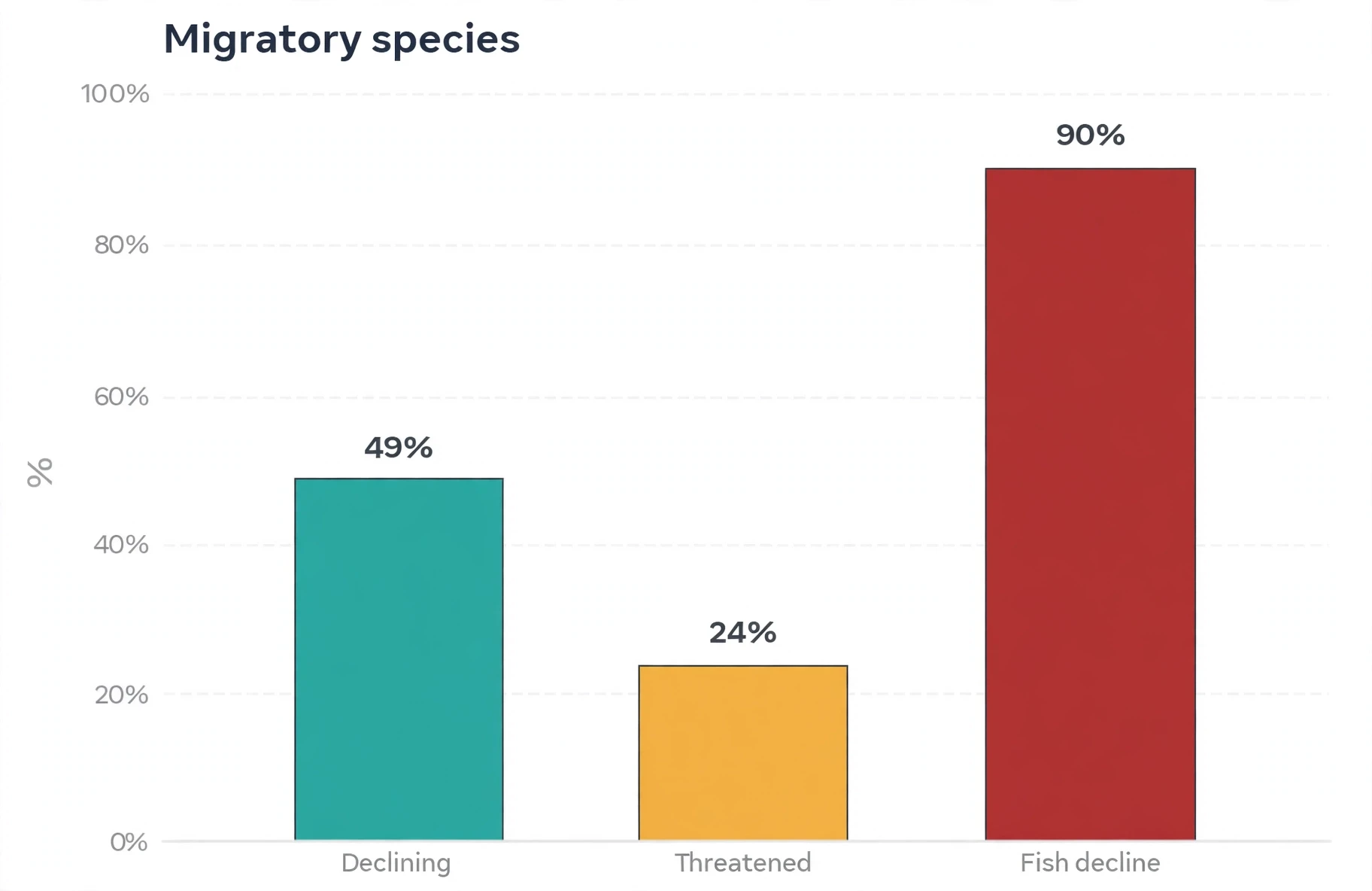
These are not projections. They are counts of animals that are already fewer than they were, on routes that are already harder to travel. A species that migrates depends on a chain of places, and the CMS numbers show how many links in those chains are failing at once.
The mismatch: when food and arrival part ways
Climate change breaks animal migration in a quieter way than a dam does. It changes the calendar. The pied flycatcher story from the previous section shows the mechanism: the caterpillar food peak advanced while the birds' arrival date did not, and the mismatch produced the population declines. In Dutch areas where the caterpillar peak falls early, flycatcher populations fell by about 90 percent over two decades; where the peak falls late, they fell by only about 10 percent (Both et al., 2006).
The point is not that flycatchers are stubborn. Their departure is set by day length, the most reliable seasonal cue, and by an internal circannual clock of about 365 days that keeps running even in constant conditions. That programme served them well for thousands of years, because spring arrived on a schedule day length could predict. Warming has pulled the two calendars apart: the food responds to temperature, which now rises earlier, while the bird's timing still leans mainly on day length, which has not changed. The bird arrives on time by the old calendar and late by the new one.
This mismatch is a general risk, not a flycatcher quirk. Any migrant whose food depends on temperature while its own timing depends on day length can be caught the same way. The journey itself may still work; the arrival may still happen. What fails is the meeting at the end of it, the brief window when food is abundant and young are hungry. Miss that window, and the whole ocean crossing was for nothing.
Barriers at every step
Think of a migration route as a chain: it fails at its weakest link. Dams are the clearest example: as the salmon story in §8 showed, a dam blocks movement in both directions, warms the water behind it, and favours predators (Congressional Research Service). A river that cannot be climbed is a route that no longer exists, however good the habitat at either end.
Lost stopovers break the chain in the middle. The Yellow Sea has lost up to about 65 percent of its tidal flat area since the mid-1950s — 28 percent of the flats present in the 1980s had disappeared by the late 2000s — through land reclamation, coastal development and agricultural expansion (Murray et al., 2014). Bar-tailed godwits stage there for an average of about 41 days on northward migration, rebuilding digestive organs and refuelling before the next ocean leg (Battley et al., 2012, DOI 10.1111/j.1600-048X.2011.05473.x). A mudflat that disappears is not a scenic loss; it is a fuel station removed from a route where no other station exists.
The newer barriers are harder to see. Artificial light disorients night migrants, drawing them off course and into lit structures. At one large Chicago building, cutting lighted window area to its historic minimum could cut fatal bird collisions by ~60% (Van Doren et al. 2021, PNAS, DOI 10.1073/pnas.2101666118). Electromagnetic noise is measured: birds tested in the presence of weak broadband electromagnetic noise lost their magnetic orientation, in the work behind Engels et al. (2014). A compass that fails near a city is a disorientation risk as real as a physical barrier, even though nothing physical blocks the sky.
Barrier or risk type | How it breaks animal migration | Example species | Suggested measures |
|---|---|---|---|
Dams | Block adults heading upstream and slow juveniles heading to the sea; reservoirs warm the water and favour predators | Salmon on the Snake River | Removing obsolete dams; fish passage where removal is not possible |
Lost stopovers | Removes the refuelling ground a migrant needs between long legs; birds arrive at the next leg without enough fuel | Bar-tailed godwit in the Yellow Sea | Protecting and restoring tidal flats and staging wetlands |
Fences and roads | Cut land routes and funnel herds into crossings, traffic and conflict | Caribou and wildebeest on land routes — fencing and roads are a widely reported pressure, though the scale varies by region | Wildlife corridors and crossings that keep historic routes open |
Artificial light | Disorients night migrants and draws them off course toward lit structures | Night-migrating songbirds | Turning off unneeded lights during peak animal migration nights |
Electromagnetic noise | Disrupts the magnetic compass, so birds lose their bearings even in open sky | European robin | Reducing broadband noise near stopovers and breeding grounds |
No single barrier explains the CMS numbers on its own. Dams hurt salmon, lost mudflats hurt godwits, noise hurts robins, and a warming spring hurts flycatchers, all at the same time, on different links of different chains. That is why animal migration fails the way it does: not in one dramatic collapse, but link by link, until a journey that once worked stops paying for the animals that attempt it.
18. Five Myths About Animal Migration
Animal migration attracts confident claims, and several of the most repeated ones are wrong in ways that matter. Each myth below sounds tidy, and each one collapses against tracking data, experiments, or simple counts. Correcting them leaves a stranger and more interesting picture of how animals actually travel.
Myth 1: Animal migration is always south in winter
The picture in most people's heads is a bird flying south to escape winter, and many birds do exactly that. It is not the rule. Sooty shearwaters cross the equator twice a year chasing summer in both hemispheres, travelling 64,037 km in a figure-eight across the Pacific. Other migrants move north for the season, climb uphill to cooler ground, or move up and down in the water column every day rather than across a map at all. Direction follows food and breeding ground, not a compass point, and for a shearwater the warm season is worth crossing the world twice to find. The tracked fact: 19 sooty shearwaters travelled 64,037 km, plus or minus 9,779 km, in a figure-eight across the Pacific over an average of 262 days (Shaffer et al., 2006).
Myth 2: All members of a species migrate
In many species, animal migration is partial: some individuals migrate while others stay behind, and the difference often tracks age or sex (Animal migration, Wikipedia). In many species the split tracks age or sex — in some, young birds migrate while older birds stay; in others, one sex travels further than the other. That split is not a failure of the system. It is a hedge. If the journey is dangerous in a given year, the residents survive; if the winter is harsh where they stayed, the migrants return to breed. A species that keeps both options alive is harder to wipe out than one that bets everything on a single journey. The tracked fact: complete migration, where all individuals migrate, is only one pattern; partial migration, where some migrate and some do not, is normal in many birds.
Myth 3: Migrants navigate by instinct alone with no learning
Some parts of animal migration are inherited: the direction to fly, the season to leave, the urge itself. The star compass is not one of them. Indigo buntings learn the sky map by watching the rotation of the stars as they grow up, and in a planetarium experiment buntings raised under a sky rotating around Betelgeuse, in Orion, treated Betelgeuse as the North Star (Emlen, 1970). A bird given a false sky learns a false north. That is learning, not instinct, and it sits alongside the inherited parts of the programme: a young bird inherits the urge to go and the season to go, then learns the sky that tells it which way is home. The experimental fact: buntings raised under a planetarium sky rotating around Betelgeuse treated that star as north, proving the star compass is learned from the centre of rotation, not an inborn map of constellations.
Myth 4: Animal migration is a single animal's decision
No individual bird sets the season by decision. Departure follows an internal circannual programme synchronised by day length: many birds express cycles of approximately 365 days when placed in constant photoperiods, showing the annual rhythm is internally generated and not simply a reaction to the weather (circannual cycles). Captive migratory birds show Zugunruhe, migratory restlessness, on schedule with no weather cue at all, growing agitated at dusk and orienting in the direction of migration even without environmental stimuli. An individual can fine-tune its departure by a few days in response to wind or food, but the season itself is set by the programme, not by a choice. The experimental fact: captive birds show Zugunruhe, an increase in nocturnal activity, during the seasons when their wild counterparts migrate, including orientation in the direction of migration even without environmental stimuli.
Myth 5: Only birds migrate, and only in winter
Birds are the most visible migrants, and winter is when most people notice them leaving. The rest of the living world travels too. Monarchs and painted ladies cross continents on paper wings; globe skimmer dragonflies cross an ocean on monsoon winds; straw-coloured fruit bats gather 8 to 10 million strong at Kasanka; salmon swim home against the current; eels cross an ocean to a spawning ground in the Sargasso Sea from which no adult returns; whales cross whole oceans to breed; caribou walk the longest land migration known by straight-line round-trip distance (1,350 km). And the largest animal migration of all happens every day, not in winter — counted as migration by biomass, though it is a daily commute rather than a seasonal journey: trillions of ocean animals rise hundreds of metres at night to feed and sink by day to hide. The measured fact: diel vertical migration is the largest animal migration on the planet by biomass, undertaken every single day by trillions of animals in every ocean (Freer and Hobbs, 2020).
19. Why It Still Matters
Animal migration does far more than move animals. Their bodies carry nutrients between ecosystems, their feeding spreads pollen and seeds, and their arrivals feed predators, scavengers, and whole food webs. Protecting them means protecting routes, not just single places, and the work starts with choices close to home.
What migrants carry between worlds
A migrating animal is a delivery system. Drowned wildebeest deliver more than 1,000 tons of biomass a year into the Mara River, comprising 107 tons of carbon, 25 tons of nitrogen and 13 tons of phosphorus, feeding fish, crocodiles, vultures and the river food web for years through their bones (Subalusky et al., 2017). Nutrients that grew as grass on a distant plain end up in a river, and then in the bodies of animals that never left the water. The same carrying happens at smaller scales everywhere migrants feed: fruit bats that eat fruit and drop seeds far from the parent tree, and insects that incidentally carry pollen as they feed on nectar along a route, and whales whose feeding in cold water and fasting in warm water link two oceans in a single body.
The food webs follow the travellers. Humpback whales feed in summer at high latitudes and then swim to warm, shallow breeding grounds, a round trip of roughly 8,000 to 10,000 km for the Alaska–Hawaii population, and much longer for others — one tracked mother and calf covered 8,300 km one way between Costa Rica and Antarctica — so the energy of a polar summer is spent, and the young are raised, in tropical water. In the ocean's daily animal migration, about 10 billion tons of animals (zooplankton, krill, fish and squid together) move up and down every day; the small migrating mesopelagic fishes alone account for about 10,000–15,000 million tons of that biomass (Irigoien et al., 2014), carrying carbon from the surface to depth as they feed at night and hide by day. Remove the migrants, and those links would weaken or go quiet: the river would lose its yearly pulse of nutrients, the far shore would lose its seeds, and the deep ocean would lose part of the pump that moves carbon downward.
Protection means protecting routes
Saving a breeding ground while losing the stopover is not saving the species. That is why conservation of migratory animals is organised around flyways, not single sites. The East Asian–Australasian Flyway supports more than 50 million migratory waterbirds of more than 210 waterbird species across 22 countries, from Alaska and Russia to Australia and New Zealand, and 523 bird species in total use the flyway (BirdLife International). The Americas Flyway is the most species-rich in the world, hosting over 960 migratory bird species across 56 countries and territories (35 countries, plus territories, on BirdLife's count), from the Arctic Circle to Tierra del Fuego. A bird that uses that flyway may need a dozen countries to keep their promises at once, and a failure in any one of them can break the chain.
The monarch shows what a concrete target looks like. At least 6 hectares of occupied overwintering habitat are considered necessary to support a stable eastern migratory population, and one hectare holds an estimated 20 to 30 million monarchs, with a median estimate of 21.1 million (Monarch Joint Venture). The eastern population occupied 2.93 hectares during the 2025–2026 season, about a 64 percent increase on the previous year's 1.79 hectares, yet still far below the 18.19 hectares recorded at the peak in 1996–1997, and above only the record low of 0.67 hectares in 2013–2014. The 6-hectare line is not a slogan. It is a measurable target, and the yearly count tells anyone who cares to look whether the population is moving toward it or away from it.
I once spent an autumn afternoon at a lakeshore watching flocks arrive in waves, rest for an hour on the water, and lift off again toward the south, and what stayed with me was not the spectacle but the ordinariness of it: tired animals doing a job they had no choice about, on a route they had never been taught, trusting that the next stop would still be there. That trust is the part we control. The birds will keep flying. Whether the stops are still there when they arrive is a decision made by people, one shoreline and one field at a time.
Support flyway and stopover protection, including the wetlands, mudflats and forests that migrants depend on between breeding and wintering grounds.
Plant milkweed and native flowers, so monarchs and other travelling insects find food and breeding habitat along their route.
Reduce light pollution, by turning off unneeded outdoor lights during peak animal migration nights and shielding the lights that must stay on.
Support the CMS framework, the agreement under which countries protect migratory species across borders rather than one country at a time.
Watch and count, by joining a local bird count or migration watch and recording what passes, because the counts are how declines are found in time to act.
If the routes stay open, the journeys will keep returning, year after year, to skies and seas that still know how to receive them.
Frequently Asked Questions
How far does the Arctic tern migrate each year?
About 70,900 km a year, on average. Seventy Arctic terns fitted with miniature 1.4-gram geolocators, with 11 devices recovered the following year, travelled a mean of 70,900 km per year, with a range of 59,500 to 81,600 km, and some individuals travelled more than 80,000 km annually (Egevang et al., 2010). The southbound leg averaged 34,600 km and took about 93 days, while the northbound leg averaged 25,700 km and took about 40 days. That is nearly twice the old pre-tracking estimate of about 40,000 km a year, which was a guess, not a measurement. Distance varies by breeding population, so the Egevang figure describes the Greenland and Iceland birds that were tracked.
What is the longest nonstop flight by a bird?
The longest documented nonstop flight by a bird is the bar-tailed godwit juvenile B6, which flew about 13,560 km (Guinness/USGS figure; a 2026 peer-reviewed re-estimate puts the same flight at 13,391 km) from Alaska to Tasmania in 11 days and 1 hour without stopping in October 2022 (BirdLife International). The bird was about four to five months old and on its first migration. The record had been broken several times before: female E7 flew 11,680 km from Alaska to New Zealand in just over 8 days in 2007, a male flew more than 12,000 km in 11 days in 2020, and the same bird flew about 13,000 km in 2021. The godwit manages it on fat that makes up about 55 percent of its body mass at departure.
Do monarch butterflies really migrate for 3,000 miles?
Yes, for the eastern population. The eastern monarch migration runs up to 3,000 miles from summer breeding grounds in the eastern United States and southern Canada to the oyamel fir forests of central Mexico, a distance of nearly 5,000 km (Canadian Geographic). No single butterfly makes the round trip. The journey takes four or even five generations, and only the long-lived Methuselah generation, which lives for more than 6 months and does not reproduce until spring, flies the whole way south. The butterflies reaching Mexico in autumn are usually four generations removed from the ones that left the previous spring.
How do birds navigate without a map?
Birds use several compasses at once: the sun, the stars, the Earth's magnetic field, landmarks, wind direction and odours. The sun compass was shown by shifting a bird's internal clock, which produced an expected directional error, and the star compass was shown in planetarium experiments in which indigo buntings oriented by stellar cues and shifted their orientation when the projected stars were shifted (Stanford Birds). The star compass is learned from the sky's rotation as a young bird grows up. The magnetic compass is real but its mechanism is still being worked out: cryptochrome 4 from the night-migratory European robin is magnetically sensitive in laboratory tests, and the radical-pair mechanism is the leading hypothesis, not yet proven as the full chain from molecule to behaviour.
Why do whales migrate?
Whales migrate to feed in one place and breed in another. Humpback whales feed in summer at high latitudes and then swim to warm, shallow breeding grounds off Hawaii, Mexico, the Caribbean, Tonga, Brazil, Madagascar and the Great Barrier Reef — some populations swim up to 5,000 miles (about 8,000 km) each way between feeding and breeding grounds, a round trip of roughly 16,000 km (roughly 8,000 to 10,000 km for the Alaska–Hawaii population, and much longer for others — one tracked mother and calf covered 8,300 km one way between Costa Rica and Antarctica). Off Hawaii, humpbacks live mostly off the blubber they built up in Alaska — they are there to mate and to calve, not to hunt, although a few have been seen feeding opportunistically, and the Alaska–Hawaii crossing is about 3,000 miles. Gray whales make a similar trade: the eastern North Pacific population migrates about 10,000 miles round trip each year between Arctic feeding grounds and Baja California lagoons. Warm water is safer for a newborn calf, and cold water is richer in food, so the journey buys both.
What is the largest animal migration on Earth?
By biomass, the largest animal migration on Earth happens every day in the ocean, not across a map. Diel vertical migration is the daily, synchronised movement of marine animals between the surface layer and the deeper mesopelagic layer, covering a vertical distance of up to 1,000 m (Freer and Hobbs, 2020). Trillions of zooplankton, krill and small fish rise at night to feed — zooplankton on phytoplankton, and fish, krill and squid on the zooplankton — under cover of darkness and retreat to depth by day to avoid visual predators. Just the small migrating mesopelagic fishes have an estimated global weight of about 10,000–15,000 million tons — roughly ten times the old trawling-based estimate of 1,000 million tons (Irigoien et al., 2014) — and current estimates indicate some 10 billion tons of animals (zooplankton, krill, fish and squid together) make the daily vertical migration every day; the fishes alone account for most of that total. The movement also drives the ocean's biological carbon pump, carrying carbon from the surface to depth.
Why are migratory animals in decline?
Because the routes they depend on are breaking in several places at once. The 2024 report found 44% declining and 22% threatened; the March 2026 interim update — the latest release — puts the figures at 49% declining and 24% threatened, while CMS-listed migratory fish populations declined by an average of 90 percent since the 1970s (176 populations of 37 species) (CMS, 2024). Dams block rivers, stopover habitats such as the Yellow Sea tidal flats have been lost, light and electromagnetic noise disrupt navigation, and climate change shifts the timing of food so that migrants arrive after the peak has passed. A migrant needs every link in its chain, breeding ground, stopover and wintering ground, so a failure at any one link can undo a journey that spans a continent.
Sources
Both et al., 2006, Climate change and population declines in a long-distance migratory bird, Nature
Joly et al., 2019, Longest terrestrial migrations and movements around the world, Scientific Reports
Xu et al., 2021, Magnetic sensitivity of cryptochrome 4 from a migratory songbird, Nature
Freer and Hobbs, 2020, DVM: The World's Biggest Game of Hide-and-Seek, Frontiers for Young Minds
Convention on Migratory Species, 2024, State of the World's Migratory Species, CMS
BirdLife International, Global Flyways, BirdLife International
Canadian Geographic, Chasing butterflies: the monarch migration, Canadian Geographic
Piersma and Gill, 1998, Guts Don't Fly: Small Digestive Organs in Obese Bar-Tailed Godwits, The Auk
Van Doren et al., 2021, Drivers of fatal bird collisions in an urban center, PNAS
Ehrlich, Dobkin and Wheye, 1988, Navigation and Orientation, Stanford Birds
Cassone, 2014, Avian Circadian Organization: A Chorus of Clocks, Frontiers in Neuroendocrinology