
1. The Dolphin That Wasn't a Fish
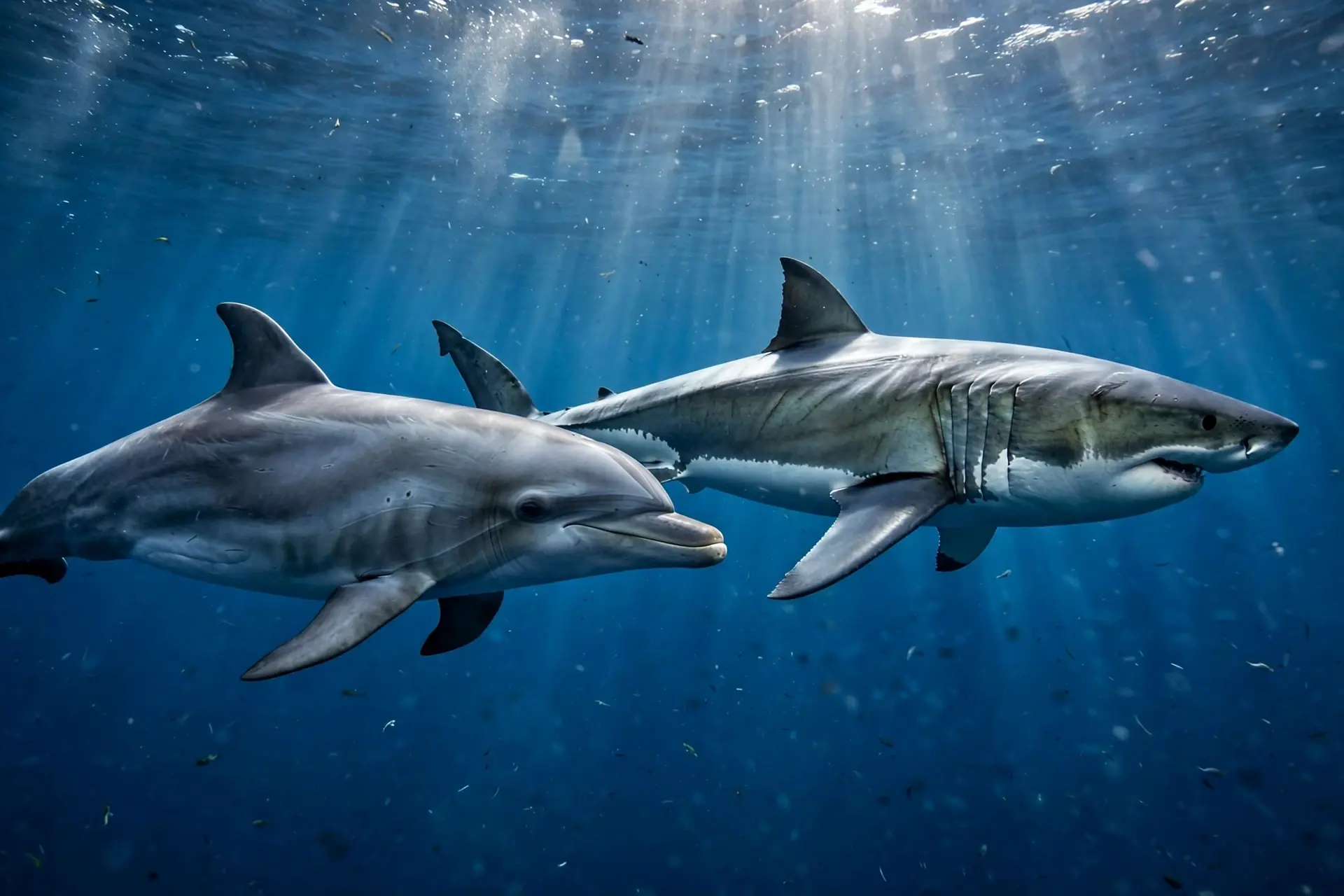
I first met an ichthyosaur in a London museum, staring at it an embarrassing amount of time before I read the label. The skeleton hanging above me had the sleek body of a dolphin, the pointed snout of a dolphin, the curved tail — and it was not a dolphin at all — my first encounter with convergent evolution.
It was a reptile — a diapsid that branched off before the living reptile groups (lizards, snakes, crocodiles, birds) split from each other, so it has no single closest living relative. Its group vanished about 90 million years ago. Convergent evolution is the reason that skeleton looks so familiar, and it is one of the strangest and most revealing patterns in all of biology.
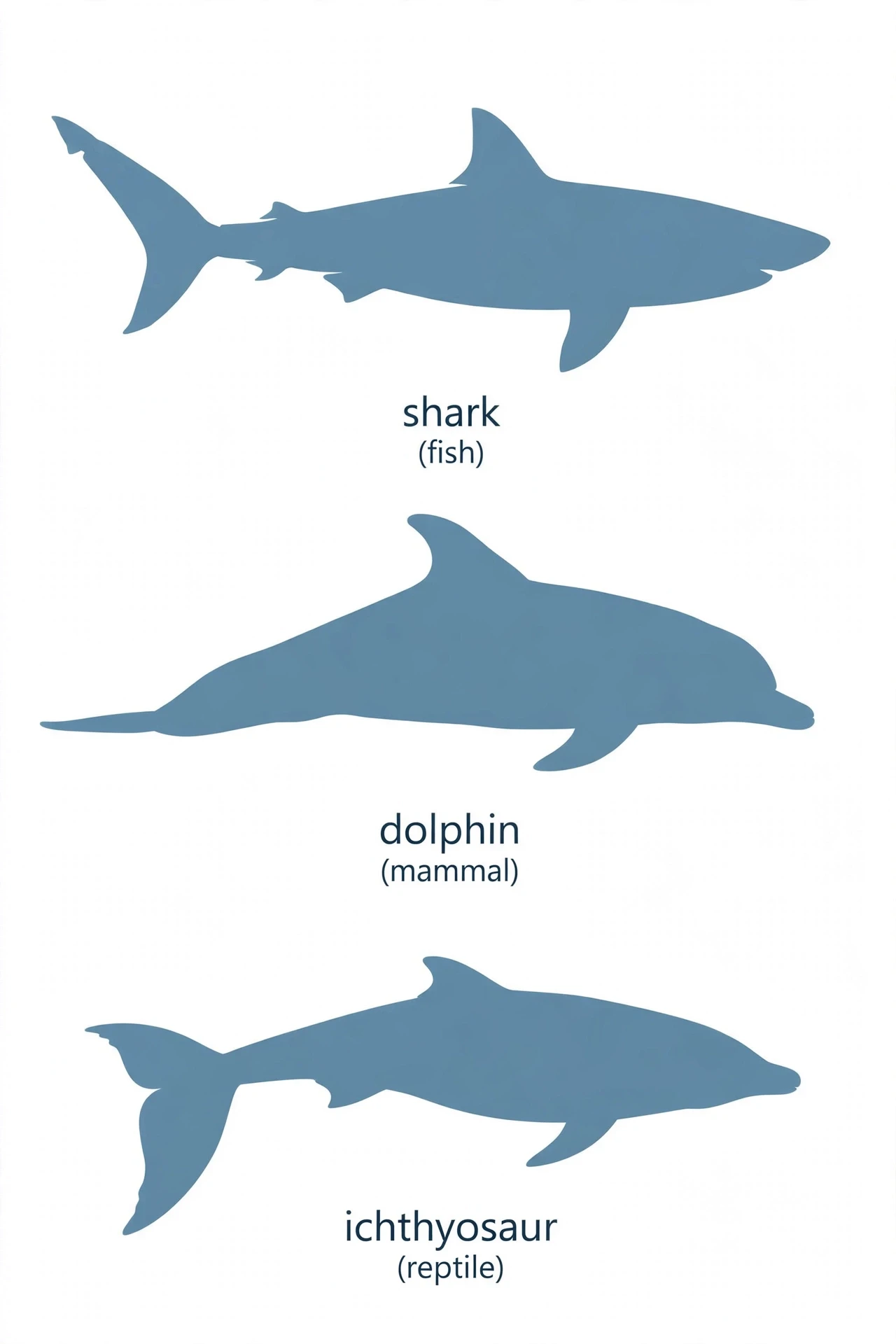
The puzzle is not that two animals look alike. The puzzle is that they look alike for the wrong reason — or rather, for no reason of kinship at all. A dolphin is a mammal. An ichthyosaur was a reptile. Their last common ancestor lived more than 300 million years ago, long before either animal existed, and it looked nothing like either of them. It was probably a small, lizard-like creature scrambling around on dry land. Yet give each lineage tens of millions of years in the open ocean, and they arrive at almost the same shape: torpedo body, pointed snout, crescent tail, a fin on the back. The shape was not inherited. It was invented three times — by sharks, ichthyosaurs and dolphins.
That is the heart of this article. Evolution is often described as a tree, with branches splitting apart and growing more different over time. That is true, and it is only half the story. Sometimes the branches bend back toward each other. Unrelated species, living in similar worlds and facing similar problems, independently evolve similar solutions — the same body shape, the same kind of eye, the same trick for hearing in the dark. Biologists call this convergent evolution, and once you learn to see it, you start seeing it everywhere: in the sky, in the deep sea, in deserts, in the genes themselves.
The late palaeontologist Stephen Jay Gould called the ichthyosaur his favourite example of convergent evolution, and it is easy to see why. The resemblance goes far beyond a vague similarity. Ichthyosaurs evolved a dorsal fin and a tail fin in just the right places, with just the right hydrodynamic design, even though their ancestors had neither. Their tail is a particularly neat piece of evidence: a land reptile's tail bends side to side, but the ichthyosaur's tail bent downward near the end to support the lower half of a crescent-shaped fluke, exactly the arrangement a fast swimmer needs. A dolphin's tail, by contrast, bends up and down, because mammals inherited a spine that flexes that way. Two animals, the same job, two different engineering routes to the same answer.
I remember standing under that skeleton and thinking about how it changed the way I read the rest of the museum. Every hall I walked through afterwards seemed full of the same joke played twice: animals that looked like cousins but were not, and animals that looked nothing alike but were close kin. A falcon and a hawk, for instance, look like variations on the same bird of prey — yet DNA has shown that falcons are more closely related to parrots than to hawks and eagles. Looks, in evolution, can be a very unreliable guide to family. That is the first lesson of convergent evolution: similarity is not always inheritance. Sometimes it is reinvention.
This article follows that reinvention across the tree of life. We will meet sharks, dolphins and ichthyosaurs; four separate inventions of flight; camera eyes that evolved independently at least seven times; bats and whales that hear with the same gene; marsupials that replayed much of the placental mammal cast in Australia; fish that invented the same antifreeze at opposite poles; and plants that learned to eat meat a dozen times over. Along the way we will ask the question that makes convergent evolution matter far beyond a list of curiosities: if evolution keeps finding the same answers, how much of life's story was predictable — and how much was luck?
2. What Convergent Evolution Actually Is
Convergent evolution is the independent evolution of similar features in species of different lineages. When two unrelated organisms face the same problem — moving fast through water, seeing clearly, surviving the cold — natural selection can shape them toward the same solution, even though their last common ancestor never had that feature.
The result is a pair of lookalikes that are not close relatives at all.
That definition has three parts, and each one matters. First, the species must be distantly related, or at least not related through the trait in question. A dolphin and a shark are both vertebrates, but their last common ancestor was a jawed fish that lived more than 400 million years ago, and it had no streamlined body, no dorsal fin and no tail fluke. The streamlined shape appeared separately in each lineage, long after they split. Second, the similarity must be a solution to a shared problem. The open ocean rewards a torpedo shape because water is dense and drag is expensive; a body shaped like a teardrop slips through it with far less effort than a boxy one. Third, the trait must have been built by natural selection acting independently in each lineage — not borrowed, not inherited, and not a coincidence of a shared ancestor.
Biologists have a special word for the products of convergent evolution: analogous structures. Two structures are analogous when they do the same job but were not present in the last common ancestor of the animals that carry them. The wings of a bird and the wings of a bat are analogous. So are the streamlined bodies of a shark and a dolphin, the camera eyes of a human and an octopus, and the electric organs of an electric eel and an electric catfish. The opposite kind of similarity is homology: structures that look alike, or even look quite different, because they were inherited from a common ancestor. The forelimbs of a human, a dog, a bird and a whale are homologous — all built on the same bone plan of upper arm, forearm, wrist and digits, even though one became a hand, one a paw, one a wing and one a flipper. Wings are analogous; forelimbs are homologous. Keeping those two ideas straight is the key to the whole subject, and the next section is devoted to exactly that.
It helps to think of convergent evolution as nature solving the same engineering problem twice. There are only so many ways to move quickly through water, to focus light into a sharp image, or to hear in total darkness. Physics sets the rules: water resists a blunt shape, light bends the same way through a lens whoever owns the eye, and sound travels further than light in a dark cave or a murky sea. When the problem is narrow and the physics is strict, evolution's answers start to look the same — not because the animals are copying each other, but because the problem itself only has a few good answers. The Natural History Museum in London puts it neatly: 'Convergent evolution occurs when organisms that aren't closely related evolve similar features or behaviours, often as solutions to the same problems.'
That is also why convergent evolution is such a useful test of natural selection itself. If similar traits evolved independently in different lineages, under similar pressures, and did so again and again, then selection, rather than chance alone, is the force doing the shaping. Each independent origin is a separate experiment, run by nature, with the same result. A single origin could be a fluke. Sixty-six origins of the same photosynthetic trick in plants, which we will meet in section 13, is a pattern. And patterns are what science is built on.
Convergence is not rare, and it is not confined to animals. It appears all over the tree of life, from mammals and invertebrates to plants and microorganisms. Some traits have evolved so many times that biologists have a name for the repetition itself: recurrent evolution. A streamlined swimming shape and the ability to fly are the classic examples, but the list runs far longer — spines, thumbs, stings, antifreeze, electric organs, meat-eating plants, and even the crab body plan, which at least five different groups of ten-legged crustaceans have evolved independently. That last one has its own name, carcinisation, and it has become something of a joke among biologists: give a crustacean enough time, and it will eventually become a crab.
3. Homologous or Analogous? How to Tell the Difference
The wings of a pterosaur, a bird and a bat are analogous structures, while their forelimbs are homologous. That single sentence — from Wikipedia's article on convergent evolution — contains the whole method for telling convergence apart from common ancestry: look past what a structure does, and ask where it came from.
Two traits can look identical and have different histories, and two traits can look completely different and share one history.
3.1 Same job, different construction: the wing test
Start with the wing. A bird's wing, a bat's wing and a pterosaur's wing all do the same job — they let their owner fly — and all three are built from the same raw material, the forelimb of a four-legged vertebrate ancestor. But the details give the game away. A bird's wing is a feathered arm: the flight feathers attach along the arm and hand, and the hand bones are fused into a stiff strut. A bat's wing is a membrane of skin stretched between greatly elongated finger bones, with the thumb left free as a small claw. A pterosaur's wing was a membrane supported mainly by a single enormously elongated fourth finger. Same job, three different constructions, three separate inventions. The wings are analogous. The forelimbs underneath them — upper arm, forearm, wrist, digits — are homologous, inherited from a shared ancestor that walked on four legs and never flew at all.
The classic test case for homology is the vertebrate forelimb itself. Lay the bones of a human arm, a dog's foreleg, a bird's wing and a whale's flipper side by side, and the same plan stares back at you: one upper-arm bone, two forearm bones, a cluster of wrist bones, then digits. The proportions change wildly — the whale's digits are long and flattened, the bat's are stretched to carry a membrane — but the layout never changes, because all four animals inherited it from the same ancestor. That is homology: same underlying structure, different functions, shared ancestry. Analogy is the mirror image: different underlying structure, same function, separate ancestry.
3.2 Teeth that lie: Smilodon vs Thylacosmilus
Teeth give an even sharper example. The sabre-toothed cat Smilodon and the South American sparassodont Thylacosmilus — a metatherian, a close cousin of true marsupials — both carried enormous dagger-like canine teeth. The elongated form is analogous: it evolved independently in each lineage. But the textbook story needs a caveat: a 2020 study found Thylacosmilus was probably not the ecological twin of placental sabre-tooths and likely did not use its canines to dispatch prey, so this famous example of convergent evolution 'requires reconsideration'. Same raw material, same exaggerated shape, two separate inventions. The distinction matters because it is exactly the kind of detail that lets scientists separate what evolution inherited from what it reinvented.
3.3 Three kinds of evidence: anatomy, embryology, DNA
So how do scientists actually decide, when a new similarity turns up? They use three kinds of evidence, and the strongest conclusions come when all three agree. First, anatomy: do the structures share the same underlying construction, the same bones, the same arrangement? A bat's wing and a bird's wing fail this test — the finger bones are arranged differently, and the membrane attaches in different places. Second, embryology: do the structures develop the same way in the embryo? The vertebrate eye and the octopus eye fail this test spectacularly, as section 7 will show: one develops from an outpocketing of the brain, the other from a fold of skin. Third, and most decisively in the modern era, DNA: do the family trees built from genes place the two animals as close relatives or distant ones? DNA has overturned a century of confident guesses based on looks alone.
The falcon is the textbook case of DNA humbling appearances. Falcons, hawks and eagles all look like variations on the same theme: hooked beaks, sharp talons, keen eyesight, a life spent hunting from the air. For generations, naturalists grouped them together as close relatives. Then DNA sequencing showed that falcons are more closely related to parrots than to hawks and eagles. The hooked beak and the hunting lifestyle evolved independently in falcons and in hawks — a case of convergent evolution hiding in plain sight, in one of the most familiar groups of birds on Earth. As the Natural History Museum's evolutionary biologist Natalie Cooper puts it, 'Until we understood DNA and how it evolves, there were a lot of things that we thought were very closely related because they look very similar, but they turned out to be very distantly related.'
That is why convergent evolution is a standing headache for taxonomists. For centuries, the only way to classify animals was by how they looked, and convergent evolution kept laying traps: animals that looked like cousins but were not, and animals that looked nothing alike but were siblings. DNA has sprung most of those traps, and in doing so it has revealed something remarkable: convergent evolution is far more common than anyone guessed before genetics arrived. Every time a DNA tree contradicts a lookalike grouping, that is convergent evolution caught in the act.
3.4 Convergent vs parallel evolution
There is one more distinction worth making now, because it confuses even biology students: convergent evolution and parallel evolution are not quite the same thing, though textbooks sometimes blur them. Parallel evolution happens when two related species, descended from a common ancestor, independently evolve in the same direction — they start from similar raw material and end up more similar than they were. Convergent evolution happens when two lineages, starting from very different places, arrive at the same solution independently. The marsupials and placentals of Australia, which we will meet in section 9, sit on the borderline between the two: they are related mammals, but they split more than 100 million years ago and radiated independently on separate continents. Some biologists call their story parallel evolution, others call it convergent evolution. The distinction is real but fuzzy, and the honest answer is that nature does not always respect the labels we invent for it. What matters is the pattern: separate lineages, similar pressures, similar answers.
4. Why Convergence Happens
If unrelated species keep arriving at the same answers, the question is not just what those answers are, but why there are so few of them. The short version is that evolution works inside limits, and the limits are set by physics, by history, and by the raw material available.
Convergent evolution happens because only certain solutions to a particular problem are evolutionarily accessible — and when a problem is hard enough, lineages that solve it often end up in a similar place.
4.1 Physics: the strictest limit
Physics is the strictest limit. Water is about 800 times denser than air, and dragging a blunt body through it costs far more energy than dragging a streamlined one. That is a fact of fluid dynamics, not of biology, and no animal can negotiate with it. A fast-swimming animal can be long and thin, or short and torpedo-shaped, but it cannot be boxy and fast; the water will not allow it. Light, too, obeys fixed rules: to form a sharp image, you need an opening to let light in, a lens to focus it, and a light-sensitive surface to catch it. That is why the camera eye has the same basic parts in a human and an octopus, even though the two eyes were built by entirely separate evolutionary routes. And sound travels well in darkness where light fails, which is why animals that hunt at night or in murky water keep independently inventing sonar. The problems are physical; the solutions are constrained; convergent evolution follows.
4.2 History: evolution can only tinker
History is the second limit, and it works in the opposite direction. Evolution cannot design from scratch. It can only tinker with what already exists, reshaping old structures for new jobs. That is why the three flying vertebrates all built wings from forelimbs — they had forelimbs to work with — and why the octopus eye and the human eye, for all their similarity, differ in exactly the places where their different histories show through. A lineage's past narrows its future: it can only reach the solutions that are a few small steps away from where it already stands. Biologists call this constraint, and it explains a paradox of convergent evolution. If physics alone decided everything, every fast swimmer would look identical. They do not. Sharks, dolphins and ichthyosaurs share the same outline, but their tails bend differently, their fins attach differently, and their skeletons are built on different plans — because each lineage arrived at the streamlined shape from a different starting point, carrying its own history with it.
4.3 Genes: the reused toolkit
The third limit is the genetic toolkit. The same genes keep turning up in traits shaped by convergent evolution, not because evolution planned it that way, but because those genes were already doing a related job in the ancestor, and they are the easiest levers for selection to pull. The Pax6 gene, which we will meet in the eye section, was already involved in building light-sensitive tissue long before camera eyes existed. The prestin gene, which changed in the same way in bats and whales, was already a hearing gene. The genes for C4 photosynthesis were ordinary metabolic genes before they were recruited into a new pathway. Evolution reuses what works. That reuse is why molecular convergent evolution — the same gene changing in the same way in unrelated species — has become one of the most exciting discoveries in modern biology. It suggests that the number of genetic routes to a given adaptation may be smaller than anyone expected.
Put those three limits together and a picture emerges that is sometimes called the adaptive landscape: a terrain of peaks and valleys, where each peak is a way of making a living, and natural selection pushes populations uphill toward the nearest peak. Some peaks are broad and easy to climb from many directions — the streamlined swimmer, the flying animal, the desert succulent. Different lineages, starting from different valleys, climb the same peak by different paths and arrive looking alike. Other peaks are narrow and hard to reach, and only one lineage ever finds them. And some peaks do not exist at all: no animal has ever evolved wheels, because the intermediate steps offer no advantage. (Jet propulsion does exist — squid, octopuses and jellyfish squirt water for thrust — but no animal has built a combustion engine.) Convergence is what happens when a peak is both worth climbing and reachable from more than one direction.
None of this means evolution is a machine that always produces the same answer. Chance still matters enormously. Which lineage happens to be in the right place, which mutation happens to appear first, which competitor happens to go extinct — all of these are accidents, and accidents change outcomes. The history of life is full of one-off inventions that never repeated: the elephant's trunk, the giraffe's neck, the human brain. Convergence and contingency live side by side, and the tension between them is one of the great open questions in evolutionary biology. Section 16 will take that question head on. For now, the point to carry forward is simpler: when the same solution appears again and again, in lineages that have nothing to do with each other, that is selection speaking, and it is worth listening to.
5. The Swimmers: Sharks, Dolphins and Ichthyosaurs
If the evolutionary theories tell us why similar traits appear, the swimmers show us what that looks like in the flesh. A shark, a dolphin and an ichthyosaur — a fish, a mammal and a reptile — converged on the same body plan so completely that a casual observer could mistake one for another.
Together they are the single most famous case of convergent evolution, and the details repay a close look.
5.1 The thunniform blueprint
The shared shape has a name: thunniform, after the tuna, the fish that embodies it most completely. A thunniform animal has a fusiform body — torpedo-shaped, widest near the front and tapering toward the tail — a narrow stalk at the base of the tail called the peduncle, often with small keels on either side, and a tall, crescent-shaped tail fin that sweeps side to side or up and down with almost no wasted motion. The body barely bends as the animal swims; almost all the thrust comes from the tail, while the stiff body holds its shape against the water. It is one of the most energy-efficient ways to cruise at speed through the open ocean, and it has been adopted by tunas, lamnid sharks such as the mako and the great white, modern whales, and the derived ichthyosaurs. No thunniform vertebrates are known from before the end-Permian mass extinction, about 252 million years ago; the shape is a product of the modern ocean, assembled after that catastrophe cleared the seas.
5.2 The ichthyosaur's journey
The ichthyosaur's journey to that shape is the most dramatic of the three, because it started furthest away. Ichthyosaurs were reptiles whose ancestors walked on land. More than 245 million years ago, in the Early Triassic, those ancestors returned to the sea — and over the next tens of millions of years, natural selection rebuilt them into fish-shaped animals. The transformation is recorded in the fossil record almost step by step: early ichthyosaurs were long and eel-like, with no dorsal fin and a simple tail; later ones were stockier, with a dorsal fin, a crescent tail and a body plan that a modern engineer would recognise as a tuna. A 2019 study using computational fluid dynamics — essentially a wind tunnel made of mathematics — ran water-flow simulations over three-dimensional digital models of nine ichthyosaurs and a bottlenose dolphin — and found something surprising: the fish-like shape itself did not cut the energy cost of swimming. The authors concluded that 'morphology did not have a major effect on the drag coefficient or the energy cost of steady swimming' and that deep torpedo-shaped bodies 'did not reduce the cost of locomotion'; what lowered the cost was larger body size combined with efficient swimming modes.
5.3 The dolphin's replay, 200 million years later
The dolphin's journey was the same story, replayed 200 million years later. The ancestors of whales and dolphins were land mammals, probably small hoofed animals that waded into shallow seas about 50 million years ago. Within roughly 15 million years — a blink in geological time — they had become fully marine, and within a few million more they had the streamlined body, the flippers, the tail flukes and the dorsal fin. Ichthyosaurs had been extinct for roughly 55 million years by the time the first dolphin-like toothed whales appeared, so the two never met. They simply solved the same problem, in the same ocean, with the same physics, and arrived at the same answer. The Natural History Museum makes the point plainly: dolphins and ichthyosaurs 'evolved a very similar body shape. Yet ichthyosaurs lived in our oceans hundreds of millions of years before dolphins appeared.'
5.4 The differences that give the game away
Look closer, though, and the differences are as revealing as the similarities. A shark's tail fin is vertical and sweeps side to side, because a fish's spine bends that way. A dolphin's tail flukes are horizontal and sweep up and down, because a mammal's spine bends that way. An ichthyosaur's tail, uniquely, bent downward at the end to support the lower half of its fluke — a reptile's spine, jury-rigged into a fish's tail. Their dorsal fins differ too: a shark's is supported by cartilage, a dolphin's is a fleshy ridge with no bone at all, and an ichthyosaur's was a lump of cartilage added to the back. And convergent evolution runs deeper than the outline. A 2023 study of vertebral bones found that tunas, lamnid sharks, modern whales and derived ichthyosaurs share three skeletal features — including a thick vertebral column for its length — that non-thunniform swimmers lack. The shape is not skin-deep. It runs to the bone.
Animal | Group | First appeared | Tail motion | What it shares |
|---|---|---|---|---|
Shark (lamniform) | Fish | Lamniform sharks ~135 million years ago (the modern lamnid family is much younger) | Side to side, vertical fin | Fusiform body, dorsal fin, crescent tail |
Dolphin | Mammal | First dolphin-like toothed whales ~34 million years ago (modern oceanic dolphins ~10–12 Ma) | Up and down, horizontal flukes | Fusiform body, dorsal fin, crescent tail |
Ichthyosaur | Reptile | About 250 million years ago | Side to side, tail bent downward | Fusiform body, dorsal fin, crescent tail |
Tuna | Fish | Early scombrids ~55–65 million years ago; earliest true Thunnus fossils ~38 Ma | Side to side, crescent fin | Fusiform body, narrow peduncle with keels |
5.5 Beyond shape: what skulls say about diet
The swimmers also teach a subtler lesson: convergent evolution is not only about shape, but about lifestyle. A 2015 study by Neil Kelley and Ryosuke Motani measured the skulls, jaws and teeth of 69 living marine tetrapods — whales, dolphins, seals, sea turtles, marine lizards — and compared them with what those animals actually eat. They found that animals with similar diets had converged on similar skull shapes, regardless of how closely related they were. Long, narrow snouts for snapping up fish; short, blunt snouts for crushing shellfish. Form follows feeding, and feeding follows the same rules in every ocean. That is why convergent evolution can help palaeontologists read the lives of extinct animals from their bones alone: if a fossil skull looks like the skull of a modern fish-eater, the fossil animal probably ate fish. The shape is a clue to the life, and the life is the same wherever the shape appears.
6. Flight, Four Times
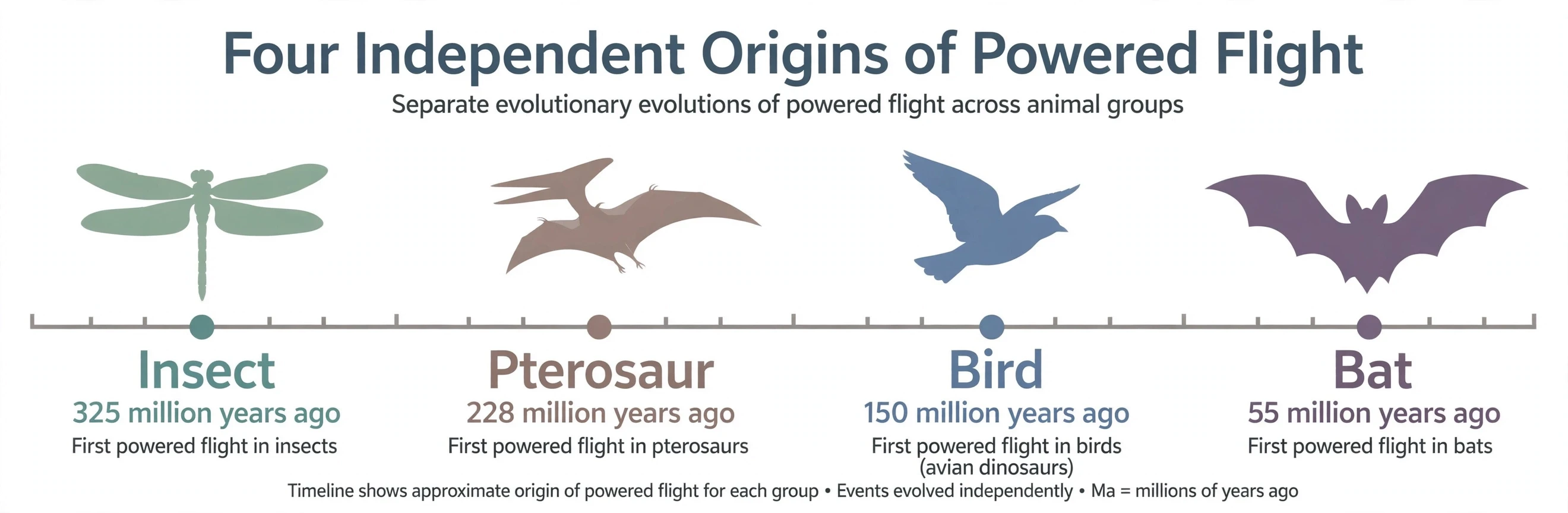
Powered flight has evolved unambiguously four times in the history of life — in insects, pterosaurs, birds and bats — and each time it was invented from scratch, by a lineage whose ancestors could not fly. No other animal group has managed it at that scale.
That makes flight among the rarest of the great evolutionary inventions, and one of the clearest examples of convergent evolution producing the same spectacular answer from entirely different starting points.
Insects first
Insects were first, and they had the sky to themselves for an extraordinarily long time. The first winged insects appear in the fossil record about 325 million years ago, in the Carboniferous period, by which time flight was already highly developed — which means the real origin lies further back, perhaps 400 million years ago, in a world of giant horsetails and tree ferns. Insect wings are not modified limbs at all. They are flaps of the body wall, stiffened with veins, hinged to the thorax — an invention with no counterpart in any vertebrate. That is why insect flight is the most alien of the four: the wing itself is built from different raw material, driven by different muscles, and controlled by a different nervous system. Yet the physics is identical. A wing, whatever it is made of, must be a flat surface that can push air downward and generate lift, and insects solved that problem hundreds of millions of years before anything else left the ground.
Pterosaurs: the first vertebrates in the air
The first vertebrates to fly were the pterosaurs, appearing about 228 million years ago in the Late Triassic. They were not dinosaurs, though they were close relatives, and they ruled the skies for more than 150 million years. A pterosaur's wing was a membrane of skin stretched from the body to an enormously elongated fourth finger — imagine a bat's wing supported by one giant finger instead of four, and you have the idea. Some pterosaurs were the size of sparrows; others, like Quetzalcoatlus, had wingspans of ten metres or more, making them the largest flying animals that ever lived. They shared the skies with birds for about 80 million years before vanishing in the mass extinction that ended the Cretaceous.
Birds: feathered dinosaurs
Birds came next, about 150 million years ago, and they are still with us — in fact, birds are living dinosaurs, the only dinosaur lineage to survive the extinction. Their wings are feathered forelimbs, and feathers are the key to their design: each flight feather is a lightweight, interlocking vane that can be adjusted individually, giving a bird a level of control over its wing surface that no membrane-winged animal can match. The earliest known bird, Archaeopteryx, still had teeth, claws on its wings and a long bony tail, and palaeontologists argued for decades about whether it could truly fly or merely glide. The consensus now is that it flew, if clumsily — and its descendants went on to master every kind of flight there is, from the hovering of a hummingbird to the effortless soaring of an albatross, whose young can spend years at sea without ever touching land — landing on the water to rest and feed, but not returning to shore.
Bats: the last to fly
Bats were last: the oldest complete bat skeletons are about 52 million years old, though isolated bat teeth reach 55–56 million years, and bats probably originated earlier, in the late Palaeocene. They are the only mammals ever to achieve true powered flight. A bat's wing is a membrane stretched between four elongated fingers, with the thumb left free as a hook for climbing. That membrane gives bats extraordinary manoeuvrability — they can turn, hover and snatch insects out of the air with a precision few birds can match — and it also makes them the only flying mammals that hunt mainly by sound, a story that belongs to section 8. Bats now number more than 1,500 species, over one in five of all mammal species on Earth, which makes flight one of the most successful inventions mammals ever stumbled into.
The four wings differ in almost every detail, and that is exactly the point. Insect wings are body-wall flaps. Pterosaur wings hang from one finger. Bird wings are feathered arms. Bat wings are skin stretched between four fingers. No engineer would call these the same design. Yet all four solve the same physical problem — generating lift and thrust in air — and all four arrived at the same broad solution: a large, flat, lightweight surface, driven by powerful muscles, attached to a body light enough to stay aloft. That is convergent evolution at its most dramatic: not a detail, not a colour pattern, but the conquest of an entire medium, achieved four times independently.
Gliding is the cheap version
It is worth adding that gliding — falling slowly with style — has evolved far more often than true flight, more than a dozen times among living vertebrates alone. Flying squirrels and sugar gliders, which we will meet again in section 9, each evolved flaps of skin between their limbs. So did flying frogs, gliding lizards, flying snakes, flying fish and even gliding squid. Gliding is a cheap trick: it needs only a flat surface and a willingness to jump. Powered flight is the expensive version, demanding hollow bones or a light body, enormous flight muscles, a high metabolism and a brain that can steer in three dimensions. That expense is why flight evolved only four times, and why each of those four times counts as one of the great events in the history of life.
Group | First flew | Wing built from | Still flying? |
|---|---|---|---|
Insects | About 350 million years ago | Flaps of the body wall | Yes — the most diverse fliers on Earth |
Pterosaurs | About 228 million years ago | Membrane on one elongated finger | No — extinct 66 million years ago |
Birds | About 150 million years ago | Feathered forelimbs | Yes — about 11,000 species |
Bats | About 52 million years ago | Membrane between four fingers | Yes — over 1,500 species |
7. The Camera Eye, Invented Again and Again
The camera eye is one of the most famous cases of convergent evolution in all of biology. Our eyes and an octopus's eyes share nearly every important feature — a cornea, an iris, a lens, a retina — yet the two lineages built them independently, starting from ancestors that had only the simplest light-sensitive patches.
Two complex organs, the same design, no shared blueprint. And they are not the only two: camera eyes have evolved independently at least seven times, including in box jellyfish.
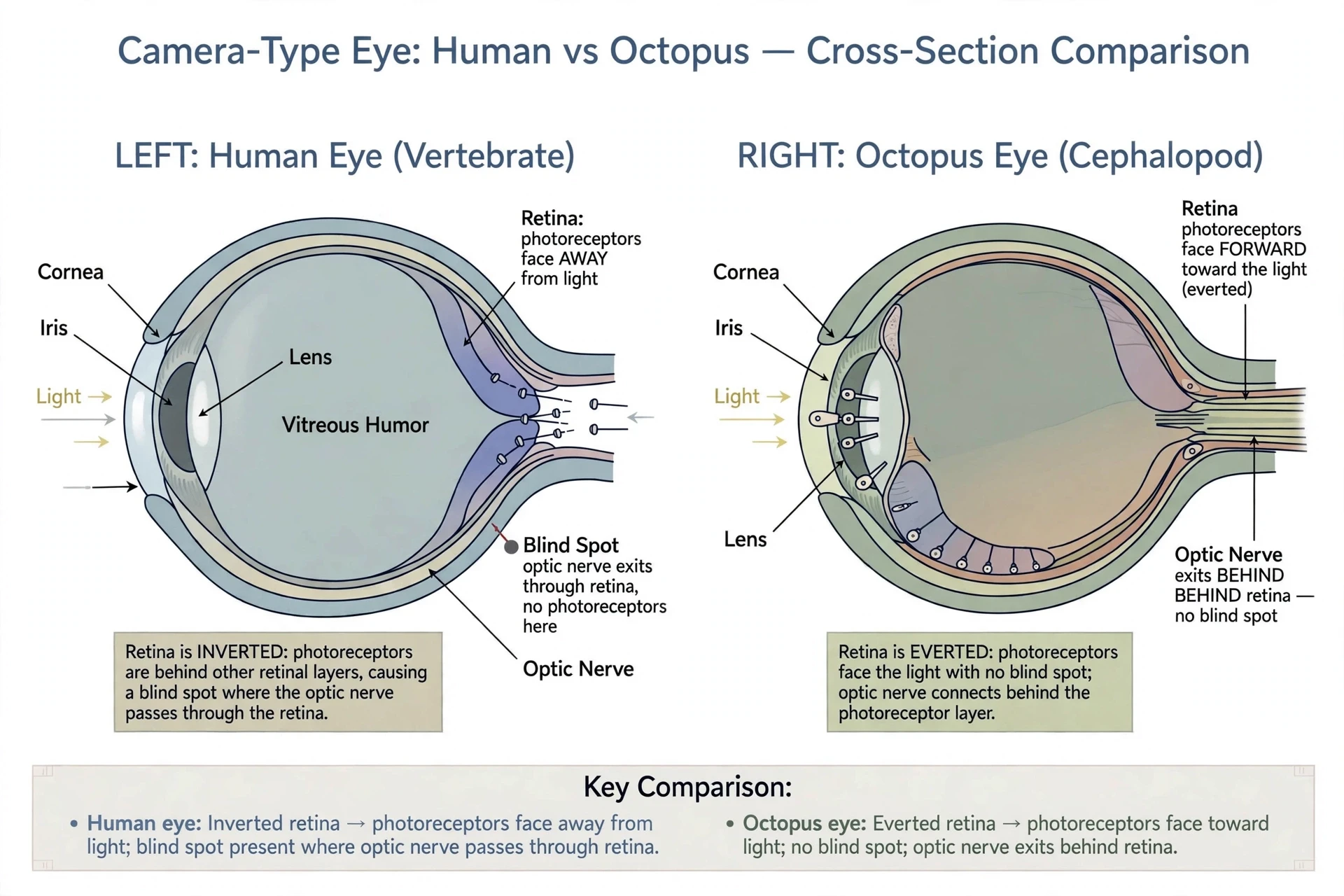
The story begins more than 500 million years ago, when the ancestors of vertebrates and the ancestors of cephalopods — the group that includes octopuses, squids and cuttlefish — parted ways. Their common ancestor was a small worm-like creature with, at most, a patch of light-sensitive cells. Over the following hundreds of millions of years, each lineage independently built a camera eye: an enclosed chamber with an opening to let light in, a lens to focus it, and a retina lined with photoreceptors to catch the image. The optical principle is identical, because the physics of forming a sharp image leaves little room for alternatives. A 2004 study that compared gene activity in octopus and human eyes found that 69 percent of the octopus eye genes examined were also active in the human eye — not because the eyes share an ancestor, but because building an eye calls on the same ancient toolkit of genes in both lineages.
The blind spot
But the two eyes differ in exactly the place where their separate histories show through, and the difference is one of the most telling details in evolutionary biology. In a vertebrate eye, the retina is wired backwards. The photoreceptors face away from the incoming light, with the nerve fibres and blood vessels lying in front of them, and the fibres must bundle together and punch through the retina to leave the eye — creating a spot with no photoreceptors at all. That is the blind spot, a small hole in every human's vision that the brain quietly papers over. In an octopus eye, the photoreceptors face toward the light, the wiring runs behind them, and the nerve fibres exit through the back of the eye without disturbing a single photoreceptor. The octopus eye has no blind spot. It is, in a very real sense, the tidier wiring diagram — built independently, from a different starting point.
I remember the first time I saw those two eye diagrams side by side, in a textbook, and feeling a small jolt of recognition: the octopus eye was the one I would have designed, if I had been asked, and the human eye was the one that looked as though it had been assembled in the dark. That is the wrong way round, and it is the point. Evolution does not design; it tinkers, and the same tinkering can produce a tidier result from one starting point than from another.
Why the difference? It comes down to how each eye develops in the embryo. The vertebrate retina grows as an outpocketing of the brain: the developing brain bulges outward and folds into a cup, and the photoreceptors end up on the far side of the cup, facing away from the light — so the wiring ends up in front. The cephalopod retina grows from a single fold of skin, which places the photoreceptors facing the light from the start. Neither arrangement was chosen. Each was the consequence of the developmental path its lineage happened to take, hundreds of millions of years before camera eyes existed. Evolution works with what it has, and what it had in each case was different.
One master gene, two separate eyes
That shared toolkit is worth a closer look, because it contains one of the great surprises of modern biology. A gene called Pax6 acts as a master switch for eye development: in fruit flies it is called eyeless, and when researchers switched it on in the wrong place, flies grew eye-like structures on their legs and wings. The same gene, or a close cousin, triggers eye development in mice, in squid, and in humans. When the Pax6 gene was discovered in the 1990s, some biologists argued that it proved all eyes evolved just once, from a single ancestor with a simple eye. Ernst Mayr, who had argued in 1977 with L. von Salvini-Plawen that photoreceptive organs evolved independently at least 40 times — and possibly as many as 65 — was having none of it. The eyes themselves, he insisted, developed independently at least 40 times; the fact that they reuse an old gene does not change that, any more than two houses sharing the same kind of bricks must have had the same architect. The modern view splits the difference: the gene toolkit is ancient and shared, a case of what biologists call deep homology, while the camera eyes themselves are products of convergent evolution, built independently on top of that toolkit.
How many times did eyes evolve?
The numbers behind that debate are striking. Photoreceptive organs — eyes in the broad sense, from simple light-sensitive patches to image-forming cameras — have evolved independently somewhere between 40 and 65 times across the animal kingdom. Complex, image-forming eyes have evolved independently several times. And physics constrains the whole enterprise: there are only eight known optical systems in animal eyes, from the simple pit eye to the camera eye to the compound eye of an insect. Every animal eye on Earth uses one of those eight designs, because those are the designs that work. The camera eye is among the best of them for forming a sharp image in water or air — which is why unrelated lineages, given half a billion years, kept finding it.
Our own evolution of the eye article tells the full story of how the vertebrate eye itself was assembled, step by step, from a patch of light-sensitive cells. The point to carry from this section is narrower and more surprising: the vertebrate eye was not the only time that assembly happened. Somewhere in the oceans, long after the two lineages parted, a lineage of molluscs was quietly building the same machine, part by part, from different materials — and it worked just as well. Perhaps better.
8. Hearing in the Dark: Echolocation
Bats and toothed whales hunt in worlds where eyes are nearly useless — a bat in a pitch-black cave, a dolphin in murky water a hundred metres down — and both solve the problem the same way: they shout, and they listen for the echo.
Echolocation is a biological sonar, and it is one of the most sophisticated senses on Earth. It is also a remarkable case of convergent evolution, because the similarity runs all the way down to the DNA.
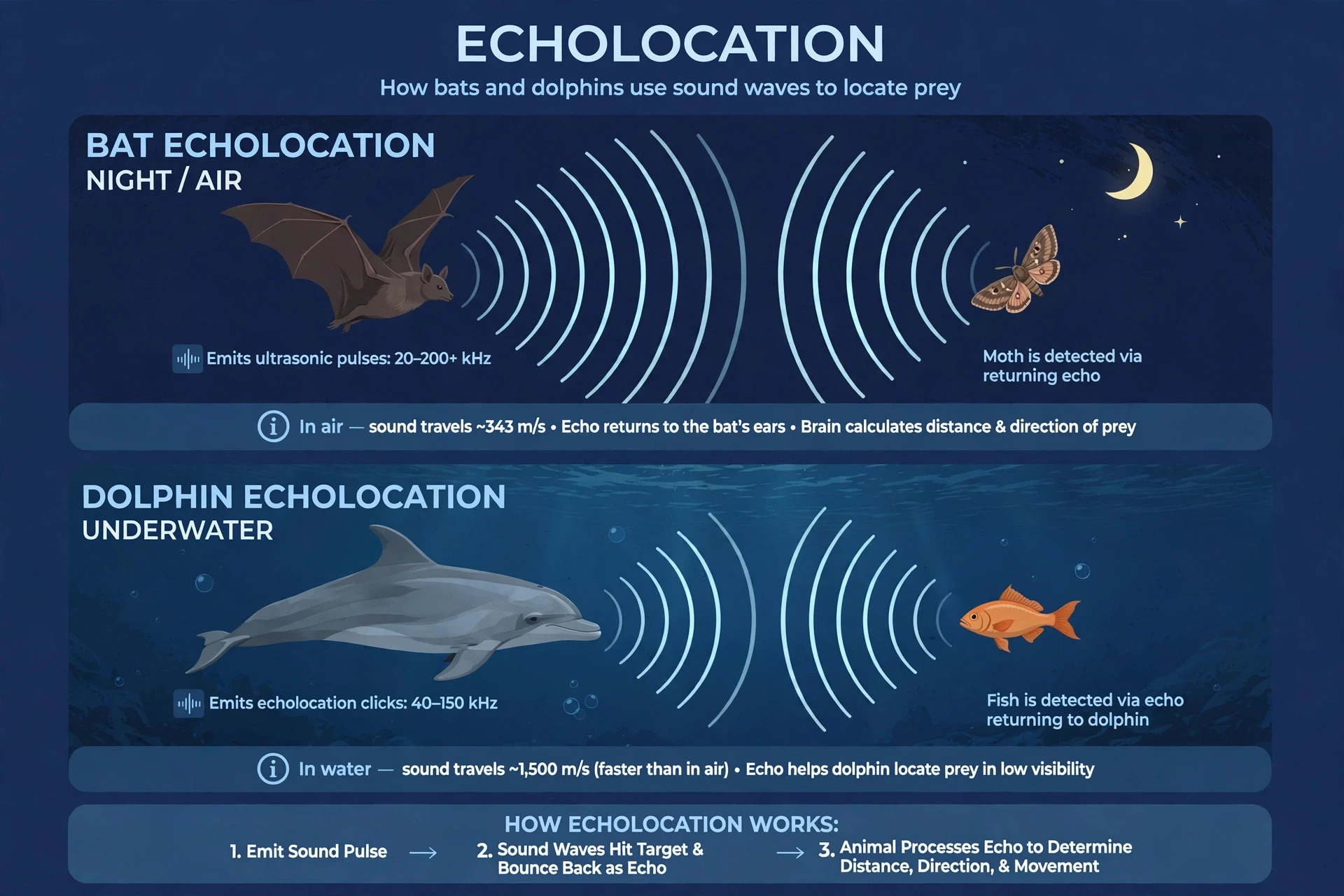
The two sonar systems look different in their details, because they have to. Most bats produce their calls with the voice box, the larynx — though horseshoe bats call through their nostrils, and a few fruit bats click their tongues — and hear the returning echoes with ears tuned to frequencies far above human hearing — some bats call at over 200 kilohertz, ten times higher than the highest note a human can hear. A toothed whale produces its clicks with phonic lips in its nasal passages, and a specialised fatty organ in its forehead called the melon focuses the sound into a beam, and receives the echoes through a fat-filled channel in its lower jaw that conducts sound to the inner ear. One shouts from its throat, the other from its forehead; one listens with its ears, the other with its jaw. But the underlying problem is identical — build a three-dimensional picture of the world from reflected sound — and the solution is identical too: emit a call, measure the time its echo takes to return, and turn that timing into distance, direction and texture.
The same gene, changed the same way
What makes echolocation a textbook case of convergent evolution is what happened inside the ear. In 2010, two research teams independently reported the same astonishing finding: the hearing gene prestin had changed in the same way in echolocating bats and in dolphins. Prestin is a motor protein in the outer hair cells of the inner ear, and it acts as an amplifier, letting mammals hear faint, high-frequency sounds. When the teams compared prestin sequences across mammals, they found that echolocating whales and echolocating bats collectively shared 14 derived amino-acid changes in prestin — ten of them with the constant-frequency bats — and if you drew a family tree based on prestin alone, echolocating dolphins would cluster with those bats, to the exclusion of their true cousins. A dolphin's prestin looks more like a horseshoe bat's than like a cow's, even though the cow is a fellow cetartiodactyl and the dolphin's closest living relative is the hippopotamus. The gene tree and the species tree disagree, and the disagreement is the fingerprint of convergent evolution: the same gene, changed in the same way, by the same selection pressure, in two lineages that have not shared an ancestor for tens of millions of years.
Beyond prestin
That was only the beginning. A 2012 study screened three more hearing genes — Cdh23, Pcdh15 and Otof, which build the delicate tip-links and signalling machinery of the inner ear's hair cells — and found parallel changes in all three, in both groups of echolocating bats and in dolphins. And a 2014 study went further still: it tested the prestin protein itself in the laboratory, and showed that two of the shared amino-acid changes actually alter how the protein works, tuning it toward the high-frequency hearing that echolocation demands. One change, called N7T, shifted a key measure of prestin's performance in every echolocating mammal tested; another, I384T, shifted a second measure in dolphins and in constant-frequency bats. These are not silent coincidences in the DNA. They are functional changes, selected because they make sonar work better.
The deep-diving ear
Convergence in echolocation does not stop at the genes. Deep-diving toothed whales, including sperm whales, have also converged on a particular cochlea shape — the spiral of the inner ear. Research at the Natural History Museum, London, found three convergent cochlear regimes, with sperm whales and beaked whales converging as they moved into deep, oceanic water, where the acoustic environment likely constrains the shape the cochlea can take. Lindberg and Pyenson proposed a related arms race: as toothed whales perfected sonar to follow squid into the deep, shelled nautiloids retreated from the open ocean toward reefs. Whether whale sonar caused that retreat is still debated — later work points to seals, not sonar, in the nautiloids' Cenozoic decline — but the timing fits the rise of deep-diving sonar hunters.
There is a quiet irony in the echolocation story. For decades, biologists argued about whether bats or whales invented sonar first, and which of the two had the more sophisticated system. The gene evidence answered a different question entirely: neither invented it alone, and both invented it the same way, down to the same fourteen letters in the same gene. When selection pushes hard enough, and the number of ways to solve a problem is small, even the molecular details converge. That is a strong claim, and it is worth stating carefully: prestin did not make echolocation happen by itself, and many other genes are involved. But the fact that the same gene changed in the same way, twice, is one of the cleanest demonstrations that convergent evolution can reach all the way into the genome.
9. Australia's Second Mammals
Australia is the world's great natural experiment in convergent evolution. When the continent broke away from the rest of Gondwana and drifted into isolation, it carried monotremes — and, arriving later from South America via Antarctica, marsupials, mammals that raise their young in a pouch, with almost no placentals alongside them.
Over the next 50 million years or so, those marsupials radiated into almost every ecological niche a mammal can occupy, and in doing so they replayed, almost role for role, the entire placental cast. The result is a set of lookalike pairs so striking that early European naturalists repeatedly mistook one for the other.
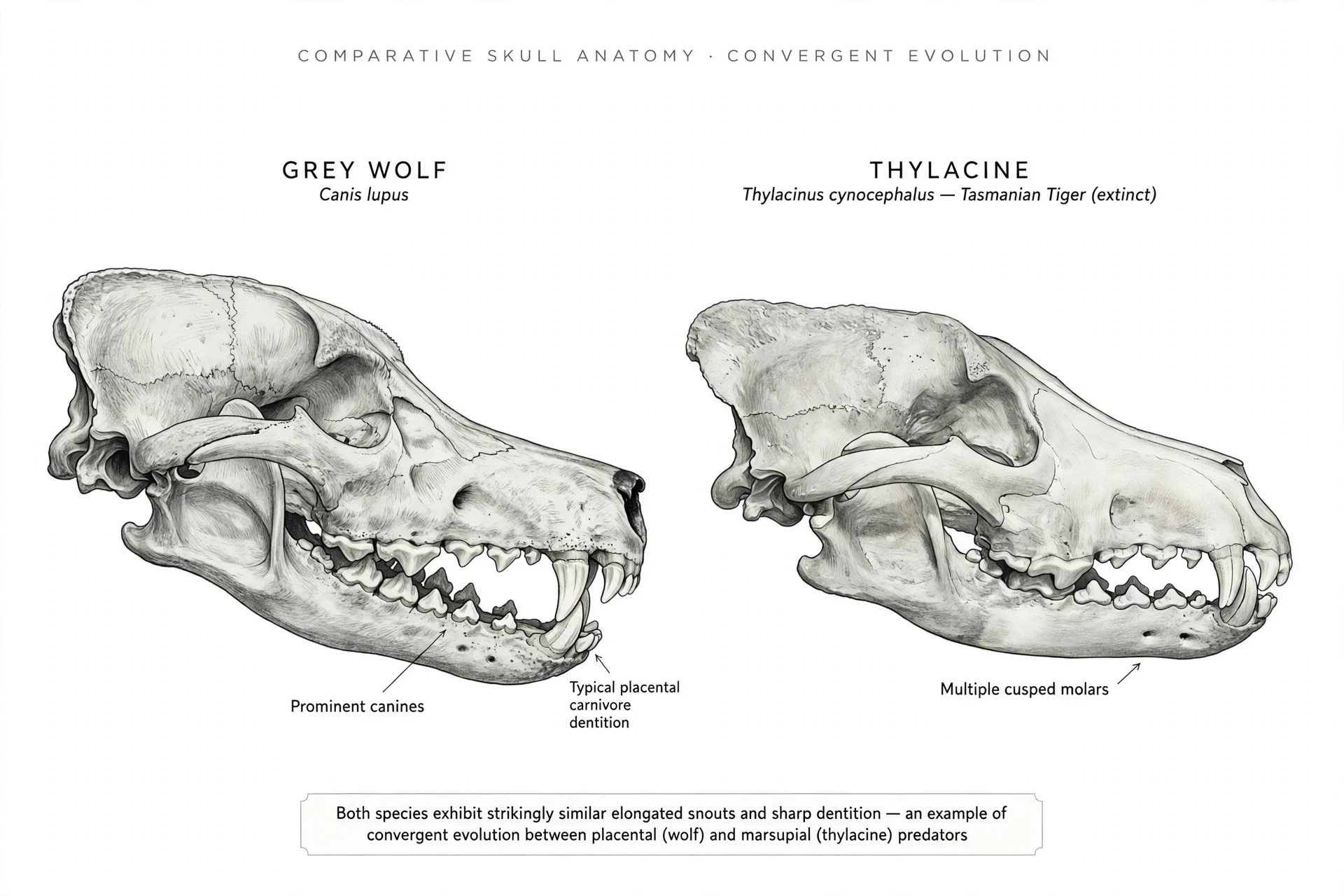
The most famous pair is the thylacine, the Tasmanian tiger, and the grey wolf. The thylacine was a marsupial — it raised its young in a pouch — yet it looked, moved and hunted like a wolf: long legs built for running, a narrow snout, powerful jaws, and a coat striped across the back like a tiger's. Its species name, cynocephalus, means "dog-headed", and the name was earned. When the last thylacine died in Hobart Zoo in 1936, it took with it the most striking example of convergent evolution in mammals: two predators, last sharing a common ancestor some 160 million years ago, that had independently evolved almost the same skull. A 2018 study that measured the skulls of 113 marsupial and placental species in three dimensions found that the thylacine's skull sat closer in shape-space to the red fox and the grey wolf than to its own closest marsupial relatives — and that about 40 percent of the ancestral gap between the thylacine and the wolf had been closed by convergence. The resemblance was not skin-deep. It ran to the bone.
The story does not end with the skull. In 2019, researchers compared the genomes of the thylacine and the wolf and found something even more remarkable: the convergence had reached into the DNA's control switches. The two animals showed matching changes in regions of DNA called cis-regulatory elements — stretches that switch genes on and off during development — especially near genes involved in TGF-beta and BMP signalling, the pathways that sculpt the face and skull in the embryo. The protein-coding genes themselves showed little convergence. The similarity was built not by changing the proteins, but by changing when and where those proteins were switched on. That is a subtle and important lesson about how convergence works: sometimes the same trait is built by different genetic routes, and sometimes, as here, by the same kind of route — tweaking the regulators rather than the parts.
The lookalike pairs
The thylacine and the wolf are only the headline act. The Australian radiation produced a marsupial counterpart for almost every placental niche, and the pairs make a table that biology teachers have used for generations.
Ecological role | Placental mammal | Marsupial counterpart | Shared solution |
|---|---|---|---|
Large running predator | Grey wolf | Thylacine (Tasmanian tiger) | Long legs, narrow snout, powerful jaws |
Gliding tree-dweller | Flying squirrel | Sugar glider | Membrane of skin between the limbs |
Burrowing insect-eater | Mole | Marsupial mole | Shovel-like forelimbs, no eyes to speak of |
Ant and termite eater | Giant anteater | Numbat | Long snout, sticky tongue |
Small tree-dwelling browser | Lemur | Spotted cuscus | Grasping hands, large eyes, slow climbing |
Medium forest predator | Bobcat | Tasmanian tiger cat (spotted-tailed quoll) | Spotted coat, sharp teeth, ambush hunting |
Each pair tells the same story from a different angle. The sugar glider and the flying squirrel both evolved a membrane of skin stretched between fore and hind limbs, letting them glide from tree to tree — the same trick, invented twice, by animals whose ancestors split apart long before either of them climbed a tree. The marsupial mole and the placental mole both evolved shovel-like forelimbs, tiny eyes and a body built for pushing through soil, because burrowing rewards exactly that shape and punishes everything else. The numbat and the giant anteater both evolved long snouts and sticky tongues for licking ants and termites out of their nests. None of these pairs inherited their shared traits from a common ancestor that had them. Each pair invented them separately, because each pair faced the same way of making a living.
There is a twist that makes the Australian story richer than a simple list of lookalikes. Marsupials and placentals are not as distantly related as, say, a shark and a dolphin: they are both mammals, and they split from a common ancestor that was already a small, shrew-like mammal. Some biologists therefore call their story parallel evolution rather than convergent evolution — related lineages evolving in the same direction from similar starting points. Others point out that 160 million years of separate evolution, on separate continents, is more than enough distance for the label of convergent evolution to fit. The argument is partly about words, and the honest answer is that the two categories blur into each other. What matters is the pattern, and the pattern is unmistakable: give two mammal lineages the same set of ecological jobs, and they will fill them with the same shapes, again and again.
Our animal classification guide lays out where marsupials and placentals sit in the mammal family tree, and why Australia became the stage for this grand replay. The deeper lesson is about opportunity. When placentals were mostly absent from Australia, marsupials faced an open field of unfilled niches — and they filled them, not by inventing new body plans from nothing, but by converging on the designs that already worked elsewhere. Evolution, it turns out, is not only a tree that branches apart. It is also a set of solutions waiting to be found, and any lineage that walks into the right empty niche is liable to find them.
10. The Same Protein at Both Poles
At the two ends of the Earth, in waters cold enough to freeze the blood of an ordinary fish, two unrelated groups of fish independently invented the same antifreeze — and the molecule they invented is so similar that it took DNA sequencing to prove they had invented it twice.
The story of antifreeze glycoproteins is one of the most elegant cases of molecular convergence ever found, and it begins with a problem that should have been impossible to solve.
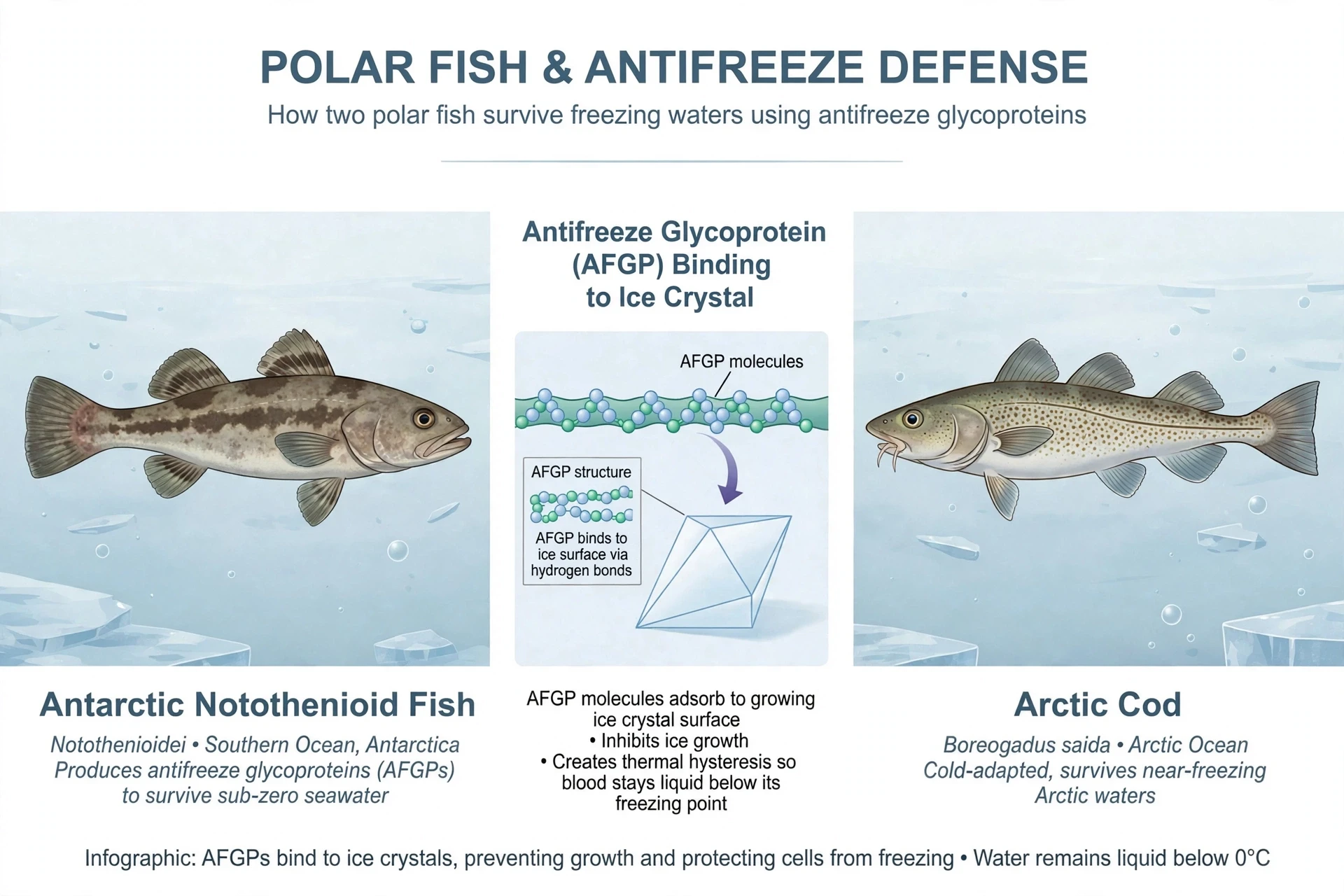
Seawater freezes at about minus 1.9 degrees Celsius, and a fish swimming in it is colder than the freezing point of its own blood. Left to physics, ice crystals would seed in its tissues and grow until they tore the animal apart from the inside. Antarctic notothenioid fishes and Arctic cod solve this with antifreeze glycoproteins — molecules built from a simple repeating unit of three amino acids — usually threonine-alanine-alanine, sometimes threonine-proline-alanine — with a sugar attached to each threonine. The molecules stick to the surface of tiny ice crystals and stop them growing, like throwing a handful of gravel into the gears of a machine. The result is blood that stays liquid below its own freezing point, in seas where an unprotected fish would freeze solid in minutes.
The two groups of fish are phylogenetically distant — they belong to different orders and superorders, separated by tens of millions of years — yet their antifreeze molecules are near-identical. For years, some biologists argued that the antifreeze must have been inherited from a common ancestor. Then, in 1997, Liangbiao Chen, Arthur DeVries and Chi-Hing Cheng at the University of Illinois sequenced the genes behind the molecules, and the inheritance theory collapsed. The two antifreeze genes have different origins, different structures, and different histories — and the evidence for independent invention is unusually complete.
The Antarctic version tells the more dramatic story. The notothenioid antifreeze gene evolved from a pancreatic trypsinogen gene — a gene for a digestive enzyme, of all things. A small piece of DNA spanning the boundary between the gene's first intron and second exon was copied and amplified, over and over, until it produced the repeating threonine-alanine-alanine unit that binds ice. It is one of the very few new genes whose birth can be traced step by step: a digestive enzyme, reworked by duplication and repetition into an antifreeze. Using the known rate at which DNA changes, the researchers dated the gene's origin to between 5 and 14 million years ago — close in time to a major expansion of Antarctic ice and sea ice about 14 million years ago, when the modern Antarctic Circumpolar Current took shape and sealed the continent in cold. The timing fits like a key in a lock: the sea froze, the fish that could not cope died, and the fish carrying the new gene survived to fill the empty ocean. Today, notothenioids dominate the Antarctic shelf: about 45% of its fish species overall — rising to 77% in the highest latitudes — and roughly 90–95% of the fish biomass there.
The Arctic version is a different story with the same ending. The Arctic cod, Boreogadus saida, produces antifreeze glycoproteins that are near-identical to the notothenioid ones — same repeating tripeptide, same sugar, same ice-binding behaviour. But its antifreeze gene shares no sequence with the trypsinogen gene, has a different intron-exon organisation, different spacer sequences between the repeated units, and a different way of processing the protein. The coding sequences for the repeating tripeptide are drastically different between the two groups, which means they arose from duplications of two distinct, short ancestral sequences that happened to spell out the same three amino acids. Two different starting points, two different genetic routes, the same molecule at the end. As the authors put it, the two polar fishes evolved their antifreeze separately and arrived at the same molecules through convergent evolution.
There is a second layer to the story. The Antarctic and Arctic oceans froze at different times — the Southern Ocean's great cooling step about 14 million years ago, the Arctic's sea-ice expansion only about 4 million years ago — which means the two antifreeze genes were invented at different times, in response to the same kind of crisis, at opposite ends of the planet. And antifreeze proteins are not a one-off invention: at least four unrelated types of fish antifreeze are known, all apparently unrelated to each other, and antifreeze proteins have also evolved independently in insects, plants and fungi. Cold is a universal problem, and the number of molecular solutions to it is small. When the seas froze, evolution reached for the same answer twice — and the answer was so good that it conquered an entire ocean.
11. Six Ways to Make Lightning
Electric fish are the case that puzzled Charles Darwin himself. In On the Origin of Species, Darwin singled out electric fishes as a problem for his theory: how could such a strange and complex organ — a battery built from living tissue — have evolved not once, but several times, in fishes that had nothing to do with each other?
It took a century and a half, and the sequencing of the electric eel's genome, to answer him. The answer is that the electric organ evolved independently six times, and that all six lineages used the same genetic toolkit to build it.
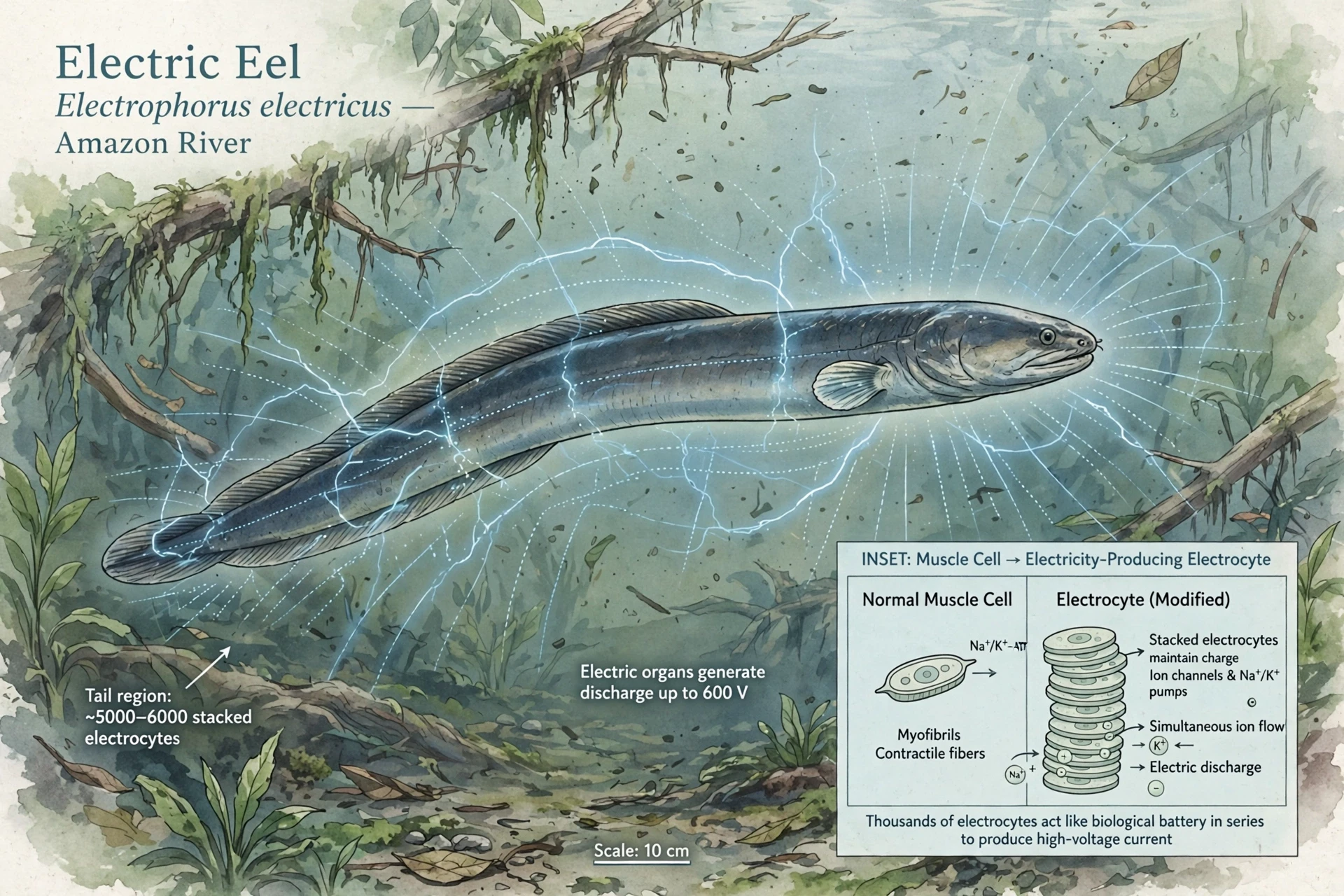
An electric organ is exactly what it sounds like: a stack of specialised cells called electrocytes, arranged in series like the cells of a battery, that generate an electric field in the water around the fish. The electrocytes are modified muscle cells. Ordinary muscle cells contract when they receive a nerve signal; electrocytes have lost the ability to contract, and instead discharge their voltage in synchrony, adding up to a field the fish can use. Weakly electric fish use that field like a radar, sensing distortions caused by nearby objects, and like a radio, communicating with each other in pulses. Strongly electric fish — the electric eel of the Amazon, the electric catfish of Africa, the electric rays of the sea — use it as a weapon, delivering shocks powerful enough to stun prey or deter a predator. The electric eel's discharge can reach hundreds of volts, several times the voltage of a household wall socket, generated by an animal with no wires and no metal anywhere in its body.
The six independent origins are spread across the fish family tree: the torpedo rays, the skates, the mormyrids of African rivers, the gymnotiforms of South America (including the electric eel), the electric catfish, and the stargazers. They live in environments ranging from the flooded forests of the Amazon to murky marine waters, and they last shared a common ancestor hundreds of millions of years ago. Yet all six converted the same tissue — skeletal muscle — into the same organ, by the same developmental trick: switching off the muscle's contractile machinery and switching on the electrical one.
The genomic evidence, published in Science in 2014 by a team led by Michael Sussman at the University of Wisconsin-Madison, is one of the most complete demonstrations of convergent evolution ever assembled. The researchers assembled a draft genome of the electric eel and compared the activity of genes in electric organs and skeletal muscle across three independently evolved lineages. Despite millions of years of separate evolution and large differences in the shape of their electric organ cells, the lineages had leveraged similar transcription factors — the master switches that control development — and similar developmental and cellular pathways to build the organ. One gene in particular, scn4aa, a voltage-gated sodium channel, showed convergent changes in the two weakly electric lineages — the South American gymnotiforms and the African mormyriforms, which diverged about 100 million years ago.
I find the electric fish story moving for a particular reason: it is the case where Darwin himself flagged his own doubt, and where modern genomics answered it. Darwin worried that a complex organ evolving six times seemed to strain his theory past breaking point. The genome showed the opposite. The organ evolved six times precisely because the raw material was already there — muscle cells already generate small voltages when they fire, and the step from a twitching muscle to a discharging electrocyte is a small one, genetically speaking. The barrier to evolving an electric organ was low, the payoff was high, and six lineages crossed it independently. Convergence, in this case, is not a mystery to be explained away. It is the prediction of the theory, confirmed.
That is a pattern worth remembering, because it recurs throughout this article. Traits that look impossibly complex from the outside often turn out to be built from ordinary parts, rearranged by small genetic changes. When the parts are already lying around, and the payoff is large, evolution finds the same arrangement again and again. The electric organ shows that a trait can be complex, useful, and a product of convergence all at once — and that Darwin's doubts, honestly stated, were the beginning of the answer rather than the end of it.
12. Plants That Eat Meat
If animals can converge on the same solutions, so can plants — and no case of convergent evolution in plants is stranger than carnivory. Flowering plants are supposed to make their food from sunlight, water and air. Yet at least twelve times, in different families, on different continents, plants independently gave up on that arrangement and started eating animals instead.
There are now some 800 known carnivorous species, and they all arrived at the same bargain for the same reason: their soils were too poor to live on, so they went hunting for the nutrients they could not find in the ground.
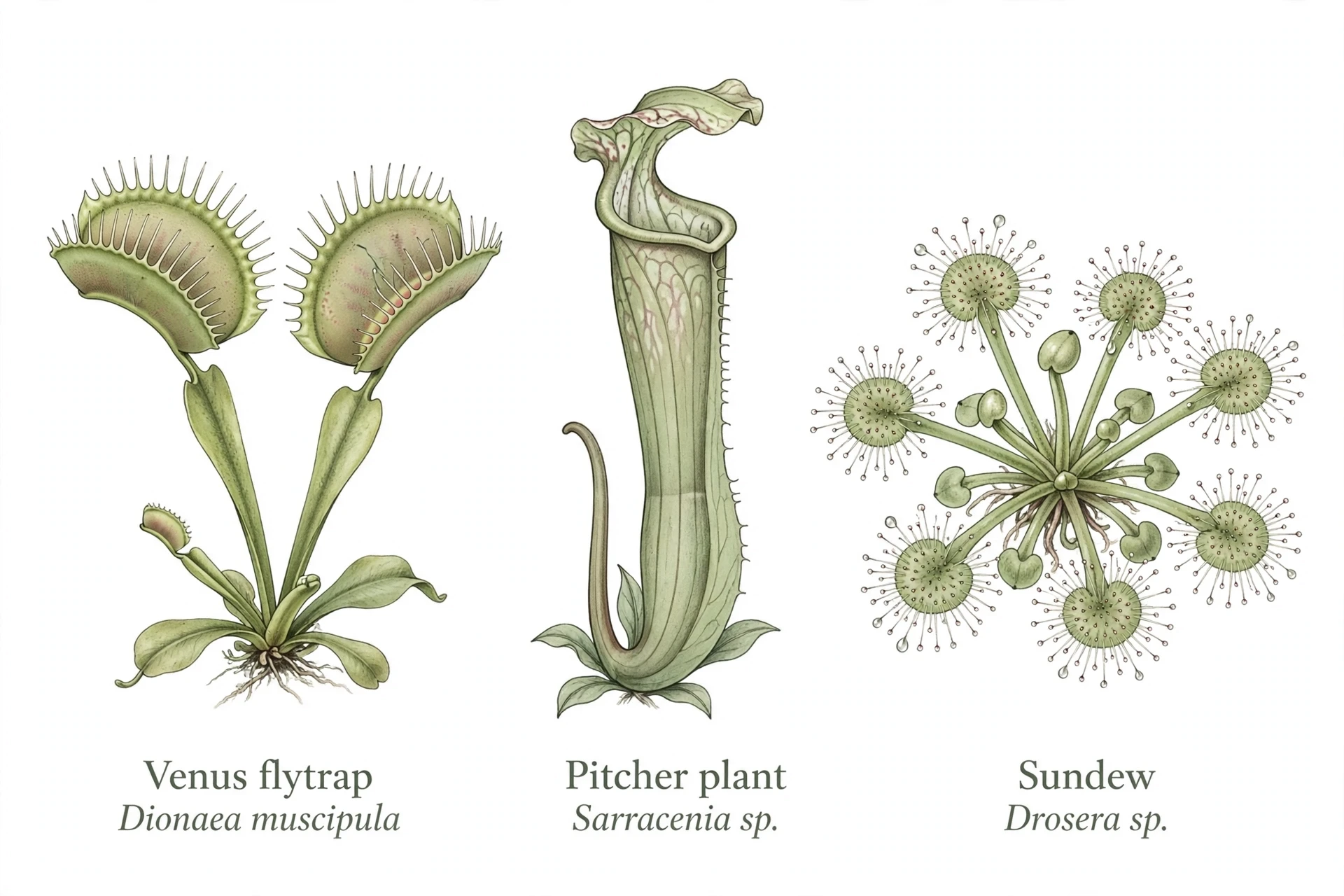
The driving force was always the same: nitrogen and phosphorus. Plants need both to build proteins and DNA, and in bogs, sandy soils and bare rock, there is almost none to be had. An insect, by contrast, is a small package of exactly those nutrients. A plant that can catch one, digest it and absorb it gains what its neighbours cannot — and in a nutrient-poor habitat, that advantage is decisive. Carnivory has evolved at least twelve times during the evolution of flowering plants, in thirteen families across six orders, according to a 2023 review (Fleck & Jobson 2023); a separate 2023 plastome study counts at least thirteen origins. Nearly 98 percent of all carnivorous species belong to just four families — the sundews and Venus flytraps, the bladderworts, the tropical pitcher plants and the American pitcher plants — but the remaining families each hold one or a few carnivorous representatives, scattered across the plant family tree like distant cousins who all took up the same trade.
Five trap designs
The traps themselves are a catalogue of convergent evolution in action. There are five general types, and most have evolved more than once. Adhesive flypaper traps — leaves covered in sticky tentacles, like a sundew's — are the simplest, and they appear in several unrelated families. Pitfall traps — tubes or pitchers that an insect slides into and cannot climb out of — have evolved at least six times, in the American pitcher plants, the tropical pitcher plants, the Australian pitcher plant Cephalotus, and twice over in the bromeliad family. Snap traps — jaws that shut in a fraction of a second — are the most dramatic, and they evolved from flypaper traps just once: the Venus flytrap and its aquatic cousin the waterwheel plant share a single snap-trap ancestor, at least 65 million years ago. Suction traps — the bladderwort's tiny underwater vacuum, which fires in less than a millisecond — and corkscrew traps round out the set. Different plants, different continents, different trap designs — and yet the digestive juices inside them are very similar, because digesting an insect is a chemical problem with a narrow set of answers.
The genes behind the traps
The genetic story is where carnivory becomes truly remarkable. When researchers sequenced the genome of the Australian pitcher plant Cephalotus follicularis in 2017 and compared digestive-fluid proteins from Cephalotus with three other carnivorous plants — a sundew (Drosera adelae), the Asian pitcher plant Nepenthes alata and the American pitcher Sarracenia purpurea — four species covering three independent origins of carnivory, they found that unrelated carnivorous plants had repurposed the same genes. The genes in question were not new. They were old defence genes, the ones ordinary plants use to fight off insects that try to eat them: genes for breaking down insect cuticle, for sensing attack, for producing digestive enzymes. Carnivorous plants took the plant's anti-insect defence system and turned it inside out — from "kill the insect that bites me" to "catch the insect and eat it". As the plant biologist Victor Albert put it, there were only limited pathways to becoming a carnivorous plant, and evolution kept finding the same ones.
Charles Darwin was fascinated by carnivorous plants, and he devoted an entire book to them — Insectivorous Plants, published in 1875 — after years of experiments in his greenhouse at Down House, feeding his sundews and Venus flytraps with bits of meat and watching them respond. He showed that the plants could sense, move and digest, and he argued that their traps were modified leaves, shaped by natural selection. He was right about the mechanism — and he was also right that carnivory was convergent: in Insectivorous Plants he concluded that Utricularia and Nepenthes were 'not at all related to the [carnivorous family] Droseraceae'. What he could not know was how many times it had happened: the molecular evidence now puts it at a dozen or more. It arose a dozen times, in plants whose last common ancestor was an ordinary, well-behaved photosynthesizer. Darwin's experiments were the beginning of the story, not the end — and the ending, written in genomes a century and a half later, is more surprising than anything he guessed.
I kept a Venus flytrap on a windowsill as a teenager, and I fed it the way Darwin did, with tiny bits of meat on the end of a toothpick, watching the trap close in a fraction of a second. It felt like a magic trick — a plant that behaved like an animal. Years later I learned the trap is not magic at all, but a leaf that learned to count: it only closes when two hairs are touched in quick succession, so a falling raindrop does not waste the effort. The same trick, invented independently, in plants that never met.
13. C4 Photosynthesis: The Same Trick Sixty-Six Times
If carnivory is the most dramatic case of convergent evolution in plants, C4 photosynthesis is the most numerous. It is a turbocharged version of photosynthesis that concentrates carbon dioxide inside the leaf — and it has evolved independently at least 66 times, in 19 different families of flowering plants (Sage et al. 2012).
Few complex traits in biology have been reinvented so often. The 2011 count was 62 lineages (Sage et al. 2011), and later estimates range from 61 to 66 depending on how lineages are counted. It is convergent evolution on an industrial scale.
To understand why C4 matters, start with the problem it solves. Ordinary photosynthesis — the C3 pathway used by most plants, including wheat, rice and trees — has a flaw. Its key enzyme, Rubisco, is supposed to grab carbon dioxide from the air, but it is easily confused: it will also grab oxygen, and when it does, the plant wastes energy in a process called photorespiration. In cool, moist conditions the waste is small. In hot, dry, bright conditions — a tropical grassland at midday — it becomes crippling, and a C3 plant can lose a large share of the carbon it fixed. C4 plants solve this with a carbon-concentrating pump: they first fix carbon dioxide into a four-carbon compound (hence the name) in one set of cells, then shuttle it to a second set of cells where Rubisco works in a carbon-dioxide-rich environment, with almost no oxygen to confuse it. The result is a plant that photosynthesises efficiently in exactly the conditions where C3 plants struggle.
The machinery is elaborate. A C4 leaf needs a special anatomy, called Kranz anatomy, in which the veins are wrapped in a ring of bundle-sheath cells where Rubisco is concentrated, surrounded by mesophyll cells where the first round of carbon fixation happens. It needs the right enzymes in the right cells, switched on at the right times. It needs transporters to shuttle compounds between the two cell types. A 2014 study of the genus Flaveria, which contains species at every stage from C3 to C4, showed that the transition involves reprogramming the expression of thousands of genes — and that a less efficient intermediate, called C2 photosynthesis, acts as a stepping stone, establishing a photorespiratory carbon pump before the full C4 system is in place. On the face of it, this looks like far too complicated a machine to have evolved 66 times. The fact that it did is one of the most startling findings in plant evolution.
The explanation is that the barrier to C4 was far lower than it looked. Every plant already possessed the enzymes C4 needs — they were doing other jobs in ordinary metabolism — and the transition mostly involved moving those enzymes into the right cells and turning them up or down. The key enzyme, PEP carboxylase, which performs the first round of carbon fixation, shows parallel amino-acid changes in different grass lineages: the same enzyme, tweaked in the same way, independently. And the ecological payoff was enormous. C4 grasses now dominate the world's tropical grasslands and savannas, and C4 species include maize, sugar cane, sorghum and millet — some of the most important food crops on Earth. About 8,100 plant species use C4 photosynthesis, including roughly 46 percent of all grasses. The first C4 plants arose in grasses during the Oligocene, roughly 24 to 35 million years ago, when falling carbon dioxide levels and a drying climate made photorespiration more costly; eudicot lineages arose over the same period, the earliest before 22 million years ago. Each origin was a separate response to the same drying, brightening world.
Feature | C3 photosynthesis | C4 photosynthesis |
|---|---|---|
First carbon product | Three-carbon compound | Four-carbon compound |
Leaf anatomy | No Kranz anatomy; Rubisco works in the mesophyll | Kranz anatomy; Rubisco concentrated in bundle-sheath cells |
Photorespiration | High in hot, dry, bright conditions | Nearly eliminated |
Water efficiency | Lower | Higher — stomata can stay partly closed |
Independent origins | Ancestral state | At least 66 times in 19 families |
Example species | Wheat, rice, oak trees | Maize, sugar cane, sorghum |
The C2 stepping stone
There is a second lesson hidden in the C4 story, and it concerns the C2 stepping stone. C3–C4 intermediates are known from 21 lineages — and nine of those have no C4 relative at all, so C2 does not always lead on to C4 (Sage et al. 2011). Evolution, it turns out, does not always leap straight to the finished design. It often passes through a halfway house that is useful in its own right, and from there the final step is short. That is why a trait that looks irreducibly complex from the outside can be assembled gradually, and why it can be assembled again and again. The C4 story is not an argument against gradual evolution. It is one of the strongest arguments for it — repeated 66 times over.
14. Spines, Thumbs and Stings
Not every case of convergent evolution is as grand as flight or as intricate as a camera eye. Some of the most charming cases are small: a spine, a thumb, a sting. They show that convergent evolution operates at every scale, from whole body plans down to a single modified hair.
They are worth a section of their own, because they include some of the most surprising lookalikes in nature.
Spines
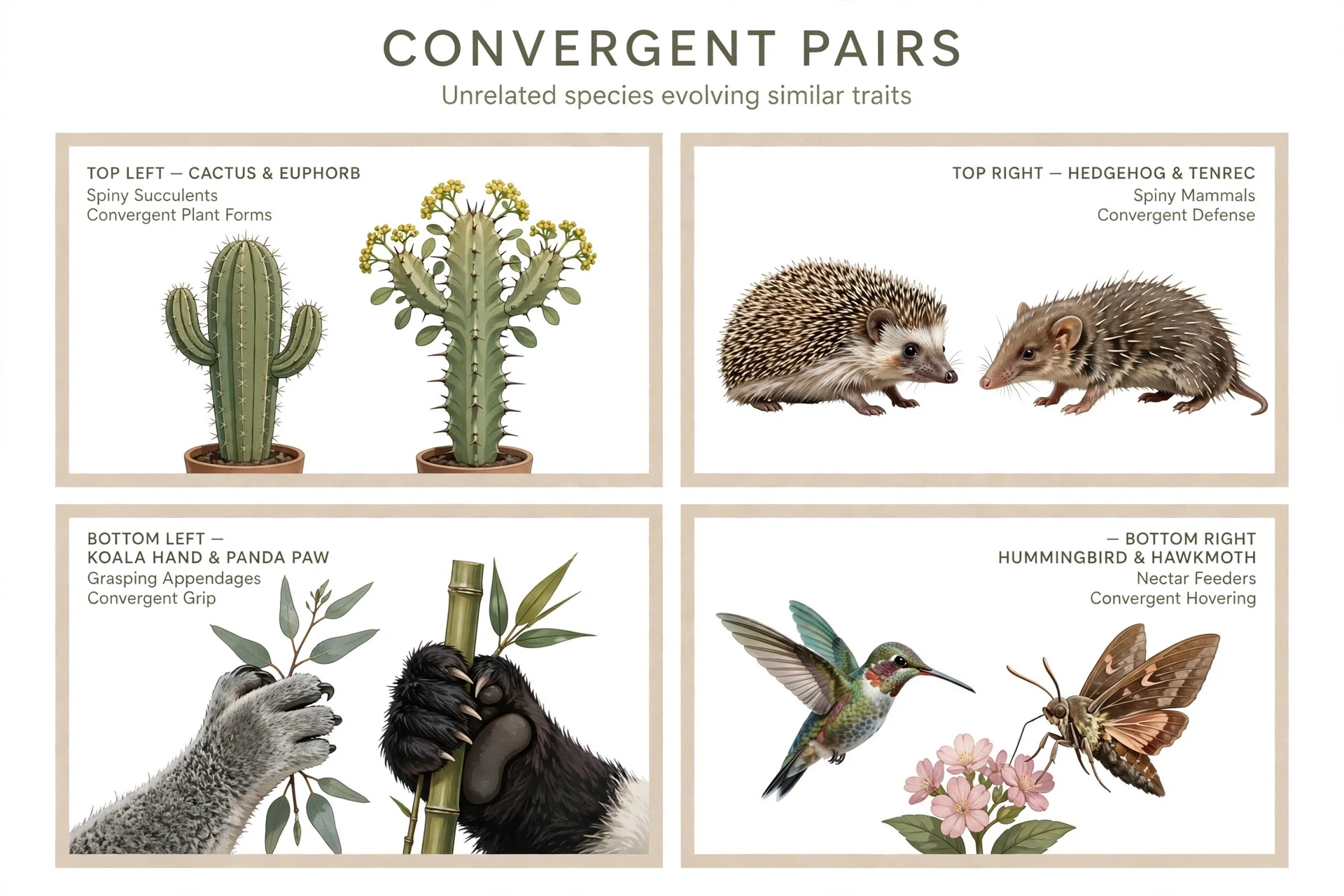
Start with spines. Hedgehogs, echidnas and tenrecs all bristle with sharp spines, and all use them the same way: roll up, present a wall of points, and wait for the predator to think better of it. Yet the three groups are only distantly related. Tenrecs last shared a common ancestor with hedgehogs around 100 million years ago, and DNA has shown that tenrecs are more closely related to elephants than to their spiny lookalikes. The spines themselves are built differently, too: a hedgehog's spines are modified hairs, an echidna's are modified hairs as well but on a monotreme — an egg-laying mammal — and a tenrec's spines sit on an animal that is, genetically, an elephant's cousin. Three lineages, three histories, one solution: when you are small, slow and tasty, the cheapest defence is to be painful to bite.
Thumbs
Thumbs tell a similar story at a smaller scale. Opposable thumbs — digits that can rotate to meet the other fingers — are useful for gripping, and a relatively small number of animals have them: primates, opossums, koalas, giant pandas and chameleons. Primates inherited theirs from a common ancestor, probably for grasping branches. But the others invented the trick independently, and the inventions are wonderfully different in their construction. Koalas have six opposable digits — one on each foot and two on each hand — for gripping eucalyptus branches. Chameleons arrange their toes in opposing groups of two and three for the same job. And the giant panda's "thumb" is not a thumb at all: it is a wrist bone, the radial sesamoid, enlarged and repurposed into a short, stumpy digit that, together with its five real fingers, lets the panda grip bamboo stems. A small wrist bone that in most mammals is just a minor sesamoid became, in the panda, a sixth finger. That is evolution tinkering at its finest — and a reminder that convergent evolution does not require the same starting material, only the same job.
Stings
Stings are the third act in this small-scale gallery, and they show how far convergent evolution can reach: the hypodermic needle — a thin, hollow, sharp-pointed tube for injecting or extracting fluid — was invented by biology long before humans built one, and it was invented in several completely different ways. Bees, wasps and other stinging insects built their sting from the egg-laying organ, the ovipositor, which is why only female bees and wasps can sting. The cone snail built its harpoon from a modified tooth, loaded with venom, and fires it like a dart. Stingrays built theirs from a modified dermal denticle — a tooth-like scale on the tail. And stinging nettles built theirs from hairs: tiny hollow trichomes that snap off on contact and inject irritating chemicals into the skin. Four different starting points — insect, mollusc, fish, plant — one piece of engineering. The Natural History Museum lists the hypodermic needle among its thirteen examples of convergent evolution which is easy to miss: we think of the needle as a human invention, and it is, but only in the sense that we were the last to invent it.
Deserts and flowers
Deserts demand the same bargain on two continents. Cacti in the Americas and euphorbs in Africa independently evolved fleshy, water-storing stems, deep roots and spines instead of leaves — different families, same solution to drought, heat and hungry herbivores.
Hovering is another shared solution. Hummingbirds in the Americas and hawkmoths, which visit many of the same flowers after dark, both hover in mid-air to drink nectar, beating their wings in a figure-of-eight that holds them perfectly still while they feed.
Blood and crabs
Two more small-scale cases of convergent evolution deserve a mention before this section closes, because they show the same pattern in yet other domains. The first is blood-sucking: fleas and mosquitoes both evolved mouthparts for piercing skin and drinking blood, and arthropods as a group have evolved blood-sucking mouthparts more than twenty times. The pressure is obvious — blood is rich in protein, and in mosquitoes only the females drink it, because they need the protein to produce healthy eggs. The second is the crab. At least five different groups of ten-legged crustaceans have independently evolved the crab body plan: a broad, flattened body, a tucked-under tail, and a pair of strong front claws. The phenomenon is called carcinisation, and it has become a running joke in evolutionary biology, because it suggests that, given enough time, a crustacean will eventually become a crab. The joke has a serious point: when a body plan is a good answer to a common way of life — in this case, scuttling sideways along the sea floor and hiding in crevices — evolution finds it again and again, from whatever starting point is available.
15. Convergence in the Genes
By now a pattern should be visible, running underneath every example in this article: convergent evolution does not stop at bodies and behaviours. It reaches into the genes. The prestin gene changed the same way in bats and whales — convergent evolution in a single protein.
The scn4aa channel was independently co-opted as the electric-organ sodium channel in the South American and African weakly electric fishes — and is highly expressed in the electric organs of every lineage examined.
The PEP carboxylase enzyme was tweaked the same way in different grasses. The thylacine and the wolf converged on the same regulatory switches. The question this section asks is why — why does evolution keep reaching for the same genes, when the genome contains tens of thousands of them?
Part of the answer is that the genome is not a shelf of equally useful parts. Some genes are already doing a job close to the one selection needs, and they are the easiest levers to pull. Prestin was already a hearing gene before bats and whales needed better high-frequency hearing; changing it was a short step, while inventing a new hearing mechanism from scratch would have been an enormous one. The genes for C4 photosynthesis were already present in every plant, doing ordinary metabolic work; moving them into the right cells was easier than inventing new enzymes. The defence genes that carnivorous plants repurposed were already breaking down insect tissue — they were, in a sense, already halfway to carnivory before carnivory existed. Evolution reuses what is to hand, and what is to hand is usually a gene that already does something similar.
A second part of the answer is that some genes sit at the crossroads of development, where a small change has a large effect. Pax6 is the classic case: a single master switch that can trigger the formation of an eye, and that sits at the top of a cascade of hundreds of other genes. Change the switch, and the whole cascade follows. Regulatory genes like Pax6, and the TGF-beta and BMP signalling pathways that the thylacine and the wolf converged on, are powerful levers precisely because they control so much downstream machinery. Selection favours them for the same reason a burglar favours the front door: it is the easiest way in.
The third part of the answer is the most interesting, and the least intuitive: sometimes the same gene changes in the same way because there are very few ways to change it that work. Prestin's fourteen shared amino-acid changes are the famous example. Functional assays showed that two of them mattered: the N7T substitution increased a key prestin parameter (1/α) in all echolocating mammals, and I384T shifted another (V1/2) in dolphins and constant-frequency bats — both parameters correlate with high-frequency hearing (Liu et al. 2014) — and, crucially, that the number of changes capable of producing that improvement appeared to be small. As one of the researchers put it, there are very limited ways for a mammal to hear high-frequency sounds, and prestin could only acquire that ability through a narrow set of changes. The same logic applies to the sodium channel scn4aa in electric fish and to PEP carboxylase in C4 grasses. When the protein's job is tightly constrained by physics and chemistry, the number of amino-acid changes that improve it is small, and two lineages under the same pressure are likely to find the same ones.
It is important to be careful about what this does and does not mean. Molecular convergence does not mean that evolution is deterministic, or that the same gene will always change in the same way. Often, convergent evolution at the level of the trait is built by different genes in different lineages: the thylacine and the wolf converged on regulatory elements, not on the same protein changes, and the antifreeze glycoproteins of the Arctic and Antarctic fish were built from entirely different genes. There are, broadly, three routes to a convergent trait. The first is the same gene changing in the same way — prestin, scn4aa. The second is the same pathway being recruited, with different genes doing the work — the electric fish lineages, which shared transcription factors and developmental pathways but not identical mutations. The third is different genes entirely, arriving at the same molecule or structure from different starting points — the antifreeze glycoproteins, the octopus and human eyes. All three routes are examples of convergence. The gene-level details differ; the pattern does not.
That pattern is what makes the molecular era of convergent evolution so exciting, and it is also what makes it humbling. A generation ago, biologists could only see convergence in bones and bodies. Now they can see it in DNA, and what they see is a mixture of deep constraint and open possibility: the same genes reused, the same changes repeated, and — just as often — entirely different genetic routes to the same destination. Evolution, it turns out, is both more predictable and more inventive than anyone guessed. It rhymes, but it never quite repeats itself.
16. What Convergence Tells Us About Evolution
Convergent evolution is the independent evolution of similar features in species of different lineages, and by now that definition should feel familiar. But the definition is only the beginning. The deeper question — the one that has divided some of the finest minds in evolutionary biology — is what all that repetition means.
If evolution keeps finding the same answers, was the history of life, in some sense, predictable? Or is the repetition itself a kind of accident, and would a different history have produced a different world?
"In convergent evolution, two organisms look or behave in a very similar way, even though they're only distantly related. This means they've independently evolved those similarities rather than inheriting them from a common ancestor." — Dr Natalie Cooper, Natural History Museum, London
The case for predictability
The case for predictability was made most forcefully by the Cambridge palaeontologist Simon Conway Morris. His argument, laid out in his book Life's Solution, runs like this: the number of workable solutions to any given biological problem is small, because physics and chemistry constrain what living things can do. Given those constraints, evolution will find the same solutions again and again, wherever life exists — on Earth, or anywhere else in the universe. Camera eyes, wings, sonar, antifreeze: these are not accidents. They are attractors, designs that any evolving biosphere will eventually stumble into. If you replayed the history of life, Conway Morris argues, you would get something recognisably similar — perhaps not humans, but something with eyes, limbs and a brain, because those are the solutions that work.
The case for contingency
The case for contingency was made most famously by Stephen Jay Gould, in his book Wonderful Life. Gould's image was the tape of life: rewind the history of life to the Cambrian period, some 540 million years ago, play it again, and you would get a completely different world. Small accidents — which lineage happened to survive a mass extinction, which mutation happened to appear first — cascade into enormous differences over hundreds of millions of years. In Gould's view, the dominance of vertebrates, the existence of mammals, and certainly the existence of humans were all contingent outcomes, not inevitable ones. Convergence, for Gould, was real but limited: it showed that some problems have few solutions, not that the whole history of life was written in advance.
Both men were looking at the same evidence, and both were partly right — which is why the debate has never been settled, and why it remains one of the liveliest arguments in evolutionary biology. The evidence for Conway Morris is the sheer number of cases of convergent evolution documented in this article: flight four times, electric organs six times, C4 photosynthesis sixty-six times, eyes dozens of times. A pattern that repeats that often cannot be pure accident. The evidence for Gould is everything that never repeated: the elephant's trunk, the narwhal's tusk, the platypus's bill, the human brain — inventions no other lineage has matched, however useful they might have been. If evolution were fully predictable, why did only one lineage invent a trunk?
The most honest answer, and the one most evolutionary biologists would give today, is that life's history is both constrained and contingent — predictable in its broad strokes, unpredictable in its details. The broad strokes are the peaks of the adaptive landscape: swimming fast, flying, seeing clearly, surviving the cold. Those peaks are real, they are set by physics, and different lineages climb them again and again. The details are the paths taken to reach them: which lineage climbs, which genetic route it uses, which historical quirks shape the final design. A dolphin and an ichthyosaur both climbed the fast-swimmer peak, but one arrived with a horizontal tail and the other with a downward-bent one, because their spines bent differently. The peak was predictable. The path was not.
There is also a limit to convergent evolution that is easy to overlook: convergent evolution only happens when the intermediate steps are useful. A half-formed wing is still useful for gliding, and a half-formed camera eye can still tell light from dark, so those traits can evolve gradually, step by step. But some designs have no useful halfway stage, and those designs never evolve — no animal has wheels, because a half-wheel is useless, and no animal has a combustion jet engine, because the intermediate steps offer no advantage. Convergent evolution maps the space of designs that are reachable by small, useful steps. It tells us what evolution can do. It also, by its silences, tells us what evolution cannot.
17. How Scientists Use Convergence
Convergent evolution is not only a curiosity to be admired. It is a tool — one of the most powerful tools evolutionary biology possesses — because every independent origin of a trait is a natural experiment, run without a laboratory, over millions of years. Scientists use those experiments in at least four ways.
17.1 Reading fossils and testing selection
Reading fossils. When a fossil animal's shape converges on a living animal's shape, its lifestyle was probably similar too. Kelley and Motani's 2015 study of marine tetrapod skulls showed that skull shape predicts diet across unrelated lineages — so when palaeontologists find a fossil skull shaped like a modern fish-eater's, they can infer that the extinct animal ate fish. Convergence turns anatomy into a biography.
Testing natural selection. If the same trait evolves independently under the same pressure, and fails to evolve when the pressure is absent, that is strong evidence that selection — not chance — built it. The antifreeze story is the cleanest case: the gene appeared when the Southern Ocean froze, and not before.
17.2 Predicting the future and searching for life
Predicting the future. Convergent evolution tells us which traits are likely to evolve again, and which are not. In a warming world, heat and drought favour C4 plants — but rising carbon dioxide favours C3 plants instead, and global C4 cover actually shrank between 2001 and 2019, so which group wins depends on the place. Conservation biologists use that kind of reasoning to predict which species will cope and which will not.
Searching for life elsewhere. If physics constrains the solutions available to life, then alien life — if it exists — may converge on similar designs: light-sensitive organs, streamlined swimmers, perhaps even something like flight. Some astrobiologists, following Simon Conway Morris, argue that convergent evolution is a guide to what to look for on other worlds — but that is a contested inference from a single example, Earth, not a settled method.
17.3 Bio-inspired design
There is a fifth use, closer to home: bio-inspired design. Engineers have long borrowed solutions that evolution converged on, because a solution that evolved independently several times is a solution that has been tested, hard, by reality. The teardrop hull of the experimental submarine USS Albacore (AGSS-569), launched in 1953, was developed from hydrodynamic and wind-tunnel testing into a whale-like 'body of revolution' — and at 27 knots submerged it was far faster than any earlier submarine. Bat echolocation and sonar grew up side by side: the sonar idea dates to 1912, and military sonar was already secret technology when Griffin and Galambos proved bats navigate by ultrasound in 1941 — the two fields then informed each other. Antifreeze proteins are now studied for preserving food, and as experimental cryoprotectants that might one day help protect donated organs during cold storage. None of these technologies copy a single animal. They copy a solution that many animals found independently — and a solution that evolution tested repeatedly is a solution worth borrowing.
17.4 A repeatable experiment
The deeper use of convergent evolution, though, is conceptual. It is the closest thing evolutionary biology has to a repeatable experiment. History cannot be rerun in a laboratory, and the history of life happened only once. But convergent evolution gives scientists something almost as good: the same experiment, run many times, in different lineages, under different conditions, with the same result. When the result repeats — flight four times, electric organs six times, C4 photosynthesis sixty-six times — that is strong evidence that natural selection, working within the limits of physics and history, can produce the same answer again and again.
18. Five Myths About Convergent Evolution
Five misunderstandings about convergent evolution survive because each one contains a grain of truth wrapped around a false conclusion. They are worth taking apart one by one, because each wrong idea about convergent evolution points to a wrong idea about evolution itself.
18.1 Myth 1: Similar animals must be related
The most persistent myth is that animals that look alike must be close relatives. The grain of truth is that related animals often do look alike, because they inherited their features from a common ancestor. The false conclusion is that similarity always means kinship. It does not. A dolphin and a shark look like variations on the same animal, and they are separated by more than 400 million years of evolution. A falcon and a hawk look like close cousins, and DNA has shown that falcons are closer to parrots. Similarity is evidence of kinship only when the similarity is homologous — built on the same underlying structure, inherited from a shared ancestor. When the similarity is analogous, it is evidence of the opposite: two lineages that solved the same problem separately.
18.2 Myth 2: Evolution has a plan
The second myth is that convergence proves evolution is heading somewhere — that there is a goal, a direction, or a designer behind the repetition. The grain of truth is that convergent evolution is not random: the same solutions recur because physics and selection constrain the options. The false conclusion is that someone or something chose those solutions in advance. No one did. Natural selection has no foresight and no goal; it simply preserves whatever works, generation by generation, and discards the rest. The fact that the same answers recur is a fact about the problems, not about a plan. Water is dense, light bends the same way for everyone, and cold kills the unprepared — those are properties of the world, not intentions in it.
18.3 Myth 3: Convergent traits are the best possible design
The third myth is that if a trait evolved several times, it must be optimal — the best design nature could produce. The grain of truth is that traits shaped by convergent evolution work well; that is why they were selected. The false conclusion is that they work perfectly. They do not. The human eye has a blind spot that the octopus eye lacks. The panda's thumb is a repurposed wrist bone, short and clumsy compared with a real thumb. The bat's wing is a thin membrane, easily damaged and costly to maintain. Traits shaped this way are good enough, built from whatever history provided, and they carry the scars of that history with them. Evolution is a tinkerer, not an engineer, and its solutions are compromises — often brilliant compromises, but compromises all the same.
18.4 Myth 4: Convergent traits are identical
The fourth myth is the mirror image of the third: that animals showing convergent evolution are identical in the trait they share. The grain of truth is that the resemblance can be striking — a thylacine skull and a wolf skull are hard to tell apart at a glance. The false conclusion is that the resemblance goes all the way down. It almost never does — the similarities are real, but the underlying construction usually differs. Sharks, dolphins and ichthyosaurs share an outline, but their tails bend differently, their fins are built differently, and their skeletons differ in detail. Bats and birds both fly, but a bat's wing is skin and a bird's wing is feathers. The similarities are real, and so are the differences — and the differences are often the most informative part, because they reveal the separate histories behind the shared solution.
18.5 Myth 5: Convergence only happens in animals
The final myth is that convergent evolution is an animal story. The grain of truth is that the most famous examples — dolphins, bats, eyes — are animals. The false conclusion is that plants, fungi and microbes are exempt. They are not. C4 photosynthesis evolved at least 66 times in plants. Carnivory evolved at least a dozen times. Cacti and euphorbs converged on the same desert survival strategy on different continents. Antifreeze proteins evolved independently in fish, insects, plants and fungi. Convergence is a property of evolution itself, not of any one branch of the tree of life — and wherever life faces the same problem, in whatever kingdom, the same answers tend to appear.
19. Why Convergence Matters
Convergent evolution matters because it changes how we read the history of life. Without it, the tree of life would be a simple story of branching apart: one ancestor, many descendants, each going its own way. With it, the story gains a second movement: branches that bend back toward each other.
Lineages that never met arrive at the same design through convergence, and the same problem is solved again and again by animals and plants that have nothing in common but the world they live in. The tree does not only diverge. It rhymes.
That rhyming is, in the end, the most hopeful thing about evolution. It means that the history of life is not only a catalogue of accidents, but also a record of solutions — solutions that work, that can be found again, and that can be understood. A shark, a dolphin and an ichthyosaur are not three accidents. They are three independent discoveries of the same truth about water. A bat and a whale are not two coincidences. They are two independent discoveries of the same truth about sound. A cactus and a euphorb are not a trick of the eye. They are two independent discoveries of the same truth about drought. The truths are physical, and they were there to be found, by any lineage that looked.
19.1 Seeing the living world differently
For the reader, the practical lesson is a new way of seeing the living world. The next time you see two animals that look alike, ask the question this article has been asking all along: did they inherit that likeness, or did they invent it? The answer will tell you something about their history, about the problem they both faced, and about the narrow set of solutions the world allows. And the next time you see two animals that look nothing alike — a falcon and a parrot, a tenrec and an elephant — remember that looks can hide kinship just as easily as they can fake it. Evolution's family tree is written in DNA, not in appearances, and it is full of surprises for anyone willing to look past the surface.
The deepest lesson is the one Darwin himself flagged in the electric fish, the case that troubled him most. A trait that looks too complex to have evolved once can evolve six times, if the raw material is already there and the payoff is large enough. Complexity is not a barrier to evolution. It is a product of it — assembled gradually, from ordinary parts, by a process with no plan and no foresight, yet capable of finding the same good answer again and again. That is what convergent evolution shows us, and it is why the dolphin that wasn't a fish, hanging in a museum hall, is worth staring at for a very long time.
I think about that skeleton in the London museum whenever I read about a new case of convergent evolution — and new cases are reported every year. The animal hanging above me was not a dolphin, and it was never trying to be one. It was a reptile that found the same answer to the same problem, in the same ocean, long before any dolphin existed. That is what I find most moving about this pattern: the answers are out there in the world, waiting, and life keeps finding them, again and again, from wherever it happens to be standing.
Frequently Asked Questions
Seven questions readers ask most often about convergent evolution, answered directly.
What is convergent evolution?
Convergent evolution is the independent evolution of similar features in species of different lineages. When unrelated organisms face the same problem — swimming fast, seeing clearly, surviving the cold — natural selection can shape them toward the same solution, even though their last common ancestor never had that feature. The classic examples are the streamlined bodies of sharks, dolphins and ichthyosaurs, and the camera eyes of humans and octopuses.
Why do sharks and dolphins look alike?
Sharks and dolphins look alike because both are fast swimmers in the open ocean, and water rewards one body shape above all others: the torpedo-shaped, thunniform form that minimises drag. Sharks are fish and dolphins are mammals, and their last common ancestor lived more than 400 million years ago without that shape. Each lineage evolved it independently, as did the extinct marine reptile the ichthyosaur and the tuna.
What is the difference between homologous and analogous structures?
Homologous structures share a common origin but can have different functions — the forelimbs of a human, a dog, a bird and a whale are all built on the same bone plan, inherited from a shared ancestor. Analogous structures have similar functions but different origins — the wings of a bird, a bat and a pterosaur all fly, but each evolved independently from a different construction. Convergent evolution produces analogous structures.
How many times did flight evolve?
Powered flight evolved four times: in insects, first appearing in the fossil record about 325 million years ago (the real origin may be older, perhaps 400 million years ago), in pterosaurs about 228 million years ago, in birds about 150 million years ago, and in bats about 52 million years ago. Each group built its wings differently — insect wings are body-wall flaps, pterosaur wings hung from one finger, bird wings are feathered arms, bat wings are membranes between four fingers. Gliding, by contrast, has evolved more than a dozen times.
What is the difference between convergent and parallel evolution?
Convergent evolution is when distantly related lineages independently evolve similar traits — a shark and a dolphin converging on the same body shape. Parallel evolution is when related species, descended from a common ancestor, independently evolve in the same direction from similar starting points. The distinction is real but fuzzy: the marsupials and placentals of Australia sit on the borderline, and biologists do not always agree which label fits them best.
Can convergent evolution happen in plants?
Yes, and some of the strongest examples are in plants. C4 photosynthesis — a more efficient way of fixing carbon in hot, dry conditions — has evolved independently at least 66 times in 19 families of flowering plants. Carnivory, or meat-eating, has evolved at least a dozen times. Cacti in the Americas and euphorbs in Africa independently evolved fleshy water-storing stems, deep roots and spines instead of leaves.
Does convergent evolution prove evolution is predictable?
Not fully — and this is still debated. The repetition of the same solutions (flight four times, electric organs six times, C4 photosynthesis sixty-six times) shows that physics and selection constrain the options, which makes broad outcomes somewhat predictable. But the details — which lineage evolves a trait, by which genetic route, and when — depend on chance, history and contingency. Most biologists would say evolution is predictable in its broad strokes and unpredictable in its details.
Sources
Natural History Museum, London. Convergent evolution explained with 13 examples
LibreTexts. Signs of evolution: homology and convergence (Biofundamentals)
University of California Museum of Paleontology. Vertebrate flight: introduction
National Geographic. Why an ichthyosaur looks like a dolphin
Current Biology. Cephalopod vision: how to build a better eye (2022)
Discover Magazine. Bat and whale echolocation genetic convergence
National Geographic. Echolocation in bats and whales based on same changes to same gene
EurekAlert. Evolution of fish antifreeze gene sheds light on climate history (1997)
Gallant JR et al. Genomic basis for the convergent evolution of electric organs. Science (2014)
Darwin C. On the Origin of Species. London: John Murray, 1859. (Book — no online link; listed as a text-only entry.)
Darwin C. Insectivorous Plants. London: John Murray, 1875. (Book — no online link; listed as a text-only entry.)
Gould SJ. Wonderful Life: The Burgess Shale and the Nature of History. New York: W. W. Norton, 1989. (Book — no online link; listed as a text-only entry.)
Conway Morris S. Life's Solution: Inevitable Humans in a Lonely Universe. Cambridge: Cambridge University Press, 2003. (Book — no online link; listed as a text-only entry.)