

1. The Birthday That Made Me Ask
The question that became this article first arrived as a whisper at a hundredth birthday party: why do we age, when a body that can heal a cut and fight off a cold cannot simply keep itself young? I watched a woman who had lived a full century blow out her candles, and I could not shake the puzzle.
She sat at the head of a long table, small and bright-eyed, surrounded by four generations of her family. Her great-grandchildren were climbing over chairs, her grandchildren were pouring tea, and her daughter — herself well into her seventies — was fussing over the cake. The birthday girl laughed at the fuss, told us she had stopped counting after ninety, and then leaned toward me with a conspiratorial grin. "The trick," she said, "is that I never expected to get this far, so every year since eighty has felt like a bonus." The room laughed. I laughed too, and then I found myself staring at the candles, wondering what had actually happened inside her body over those hundred years — and why it had happened at all.
A few weeks earlier I had been watching mayflies over a river at dusk, and the contrast refused to leave my mind. Mayflies spend most of their lives as nymphs underwater, then emerge as winged adults for a day or so — a few hours to a couple of days, depending on the species. They do not eat. They mate — the females lay eggs — and most die within a day or so. A day or so of adulthood, and then nothing. Our birthday girl had lived roughly thirty-six thousand five hundred days. The mayfly had lived about one. Both are animals. Both are built from cells, DNA, and the same basic chemistry. So why do we age on such wildly different schedules, and why do we age at all when the machinery of life seems so good at repairing itself?
That is the question this article tries to answer, and it turns out to be one of the deepest questions in biology. It is not really a question about wrinkles or grey hair. Those are the visible signs, the surface of something much stranger. The real question is about evolution itself: if natural selection is so powerful, if it can shape a bird's wing and a whale's heart and a human brain, why did it never shape a body that stays young forever? Why do we age when staying young would seem, on the face of it, to be the greatest advantage of all?
I remember the first time I asked a biologist that question in earnest, years ago, over coffee after a seminar. I expected a long technical answer about telomeres or free radicals. Instead she smiled and said, "Because evolution never promised you a long life. It only promised your genes a ride into the next generation." At the time, that sounded like a riddle. It took me years of reading to understand that it was actually the answer — or at least the beginning of one. To understand why do we age, we have to stop thinking of aging as a failure of the body and start thinking of it as a consequence of how evolution works. The body is not a machine that breaks down because nobody maintained it. It is a machine that was never designed to last, because the designer — natural selection — stops caring once reproduction is done.
That shift in perspective changes everything about why do we age. Once you see aging through evolution's eyes, the grey hair and the stiff knees and the slow healing stop looking like accidents. They start looking like the expected outcome of a system that invests everything in the young and almost nothing in the old. This part of the article lays out that foundation: what aging actually is, why the obvious explanations fail, and how two ideas from the middle of the twentieth century — the selection shadow and mutation accumulation — first cracked the puzzle open.
1.1 A century in one room
There is something disorienting about a hundredth birthday party. The room holds a whole century of history in a single afternoon: photographs of a young woman in clothes nobody wears any more, stories about a world before television, grandchildren who learned to use a smartphone before they could tie their shoes. The birthday girl herself is the bridge between those worlds, and her body carries the evidence. Her hands are spotted and thin-skinned. Her hearing has faded. She tires quickly. And yet her mind is sharp, her humour intact, her appetite for cake undiminished.
1.2 The mayfly
The mayfly is the extreme that makes the puzzle visible. An adult mayfly typically lives for only a day or so because it does not need to live longer. Its mouthparts do not even work. It cannot eat, so it cannot refuel, so it burns through its stored energy in a single frantic burst of mating and then dies. From the mayfly's point of view — if a mayfly had a point of view — this is not a tragedy. It is a strategy that works, and it sharpens the question of why do we age at such different speeds. Mayflies have been doing it for hundreds of millions of years.
That is why the question "why do we age" is so interesting, and so different from the question "how do we age." How we age is a story about cells and molecules: DNA damage, worn-out proteins, tired stem cells. Why we age is a story about evolution: about what natural selection can see, what it cannot see, and what it sacrifices. The rest of this article follows that second story, because it is the one that explains the first.
2. What Aging Actually Is
Aging, or senescence as biologists call it, is the gradual decline in survival and reproduction with advancing age — a rise in the risk of death and a fall in the body's ability to repair and reproduce. It is a process, not a single event, and it is distinct from disease, even though it makes disease more likely.
Before we can ask why do we age, we need to be precise about what aging is, because the word gets used loosely. In everyday speech, aging means getting older, which happens to everyone at the same rate: one year per year. In biology, aging — senescence — means something narrower and more specific. It means the progressive decline in how well an organism functions as time passes, and in particular the rise in its risk of dying and the fall in its ability to reproduce. A one-year-old and a ninety-year-old have both aged by the same calendar measure, but only the ninety-year-old has undergone much senescence. The calendar is not the biology.
2.1 The Gompertz law: death doubles every eight years
One of the most striking facts about why do we age is how regular it is. In 1825, the mathematician Benjamin Gompertz noticed that the risk of death in adult humans rises exponentially with age — it roughly doubles every eight years. That pattern, now called the Gompertz law, has held up remarkably well through most of adult life, though at the oldest ages the rise in death risk slows somewhat. A review of mortality laws confirms that human mortality rates double approximately every eight years of adult age, a pattern visible in modern data just as it was in Gompertz's time. Your chance of dying in a given year at forty is roughly twice what it was at thirty-two; at forty-eight it has doubled again; at fifty-six, again. The numbers climb quietly at first, then steeply, like compound interest running in reverse.
This regularity is a clue to why do we age on a schedule rather than at random. If aging were just random wear and tear — a collection of unrelated accidents — you would expect a messier pattern. Instead, the risk of death follows a smooth, predictable curve, which suggests that aging is a systematic process, not a pile of coincidences. It also explains why the birthday girl's description felt so familiar: "gradual, and then sudden." At twenty, the doubling of a tiny risk is still a tiny risk. At eighty, the doubling of a large risk is a large risk indeed. The same law, applied year after year, produces a life that feels stable for decades and then fragile all at once.
2.2 Aging is not a disease
Most people assume that aging is a disease, or at least a kind of slow illness, and I want to disagree with that idea directly, because it gets in the way of understanding. Aging is not a disease. It is the condition that makes diseases more likely. Cancer, heart disease, dementia, and diabetes all become far more common with age, but none of them is aging itself. You can have aging without any of those diseases — the healthy hundred-year-old at the birthday party is proof of that — and you can have those diseases, tragically, in a young person who has barely begun to age.
The distinction matters for why do we age, because diseases have specific causes that can, in principle, be cured one at a time. Aging does not work like that. There is no single broken part to fix, no one infection to clear, no one tumour to remove. Aging is a whole-body drift: many small changes, in many systems, moving in the same direction. That is why a drug that treats one age-related disease rarely makes a person young again. It fixes one leak in a roof that is leaking in a hundred places.
It also matters because calling aging a disease tempts us to look for a single villain. The history of aging research is full of single-villain theories: aging is caused by free radicals, by worn-out telomeres, by a lack of one hormone. Each of these captures a real piece of the story, and each of them fails as a complete explanation, because aging is not one thing going wrong. It is many things going slightly wrong at once, over decades, in a body that was never built to last forever. Later sections will look at the cellular mechanisms — the hallmarks — in detail. First, though, we need the evolutionary answer to why do we age in the first place, because without it the mechanisms are just a list of breakdowns with no explanation for why evolution let them happen.
3. Why Do We Age at All? The Puzzle Evolution Had to Solve
If natural selection can build a human brain and a whale's heart, why did it never build a body that stays young? The puzzle is that aging looks like a flaw evolution should have fixed, yet it appears in most animals — which suggests it is not a flaw at all, but a side effect of how selection works.
This is the question that makes aging a genuine scientific puzzle rather than a sad fact of life. Natural selection is an extraordinarily powerful editor. Over billions of years it has produced eyes that can respond to a single photon, noses that can detect vanishingly small traces of scent, and brains that can write poetry. It has tuned the timing of birth, the shape of wings, the chemistry of venom, and the migration routes of birds that fly thousands of miles without a map. Faced with that record, it is reasonable to ask: why could it not also tune the body to stay young?
The naive answer is that it simply has not got around to it yet, or that aging is too hard a problem even for evolution. Both answers are wrong, and they miss the point. Evolution is not an engineer with a blueprint and a quality-control department. It is a process that keeps whatever helps genes get copied into the next generation and discards whatever does not. That process has a blind spot, and aging lives inside that blind spot. The puzzle is not "why hasn't evolution solved aging?" The puzzle is "why would evolution ever bother?" Once you frame it that way, the answer starts to come into focus — and it is not the answer most people expect.
3.1 Weismann's programmed death
The first serious attempt to answer the question came from the German biologist August Weismann, in a lecture he gave in 1881 and published in English in 1889. Weismann proposed that aging and death were programmed into organisms on purpose — that death itself was an adaptation, designed by natural selection to clear away the old and make room for the young. Old individuals, in his view, were worn out and took up resources that their children and grandchildren needed. By dying on schedule, they did the species a favour. It was an elegant idea, and it felt intuitively right: death as a kind of generosity, built into the plan.
That is the first great lesson of the evolutionary theory of aging: any explanation that relies on death being good for the species is almost certainly wrong. Evolution is not kind, and it is not wise. It is a copying contest, and the copies that win are the ones that get made. A trait that kills its carrier early, for the benefit of others, loses the contest by definition. Weismann's programmed death, as a general explanation, does not survive that test.
3.2 Why the obvious answers fail
Weismann was not the only one to offer a tidy answer. Another common idea is that aging is simply wear and tear — the body as a machine that grinds down with use, like a car engine or a pair of shoes. This sounds like common sense, and it is the explanation most people reach for first. But it fails too, for a simple reason: the body is not a car. A car cannot repair itself. Your body can. It heals cuts, regrows skin, replaces blood cells, and rebuilds bone. If wear and tear were the whole story, a body that repairs itself as well as ours does should be able to keep repairing itself indefinitely. The fact that it stops — that repair gets worse with age rather than better — is itself something that needs explaining. Wear and tear describes what happens. It does not explain why repair fails.
So the puzzle stands, and it is the puzzle at the heart of Darwin's theory of evolution. Aging is widespread among animals, yet none of the purposeful explanations work. The body repairs itself, yet it declines. Selection is powerful, yet it never built an ageless body. The solution, when it came in the middle of the twentieth century, did not invoke purpose at all. It invoked neglect. Evolution did not design aging. It simply stopped paying attention — and in the shadow beyond its attention, aging accumulated like dust in an unvisited room. That shadow is the subject of the next section, and it is the key to the whole article.
4. The Selection Shadow
The force of natural selection is strongest before and during reproduction, then falls steeply with age — so late in life, evolution is effectively blind, and harmful changes that act only in old age face almost no opposition. That fading of selection's power is the selection shadow, and it explains why do we age at all.
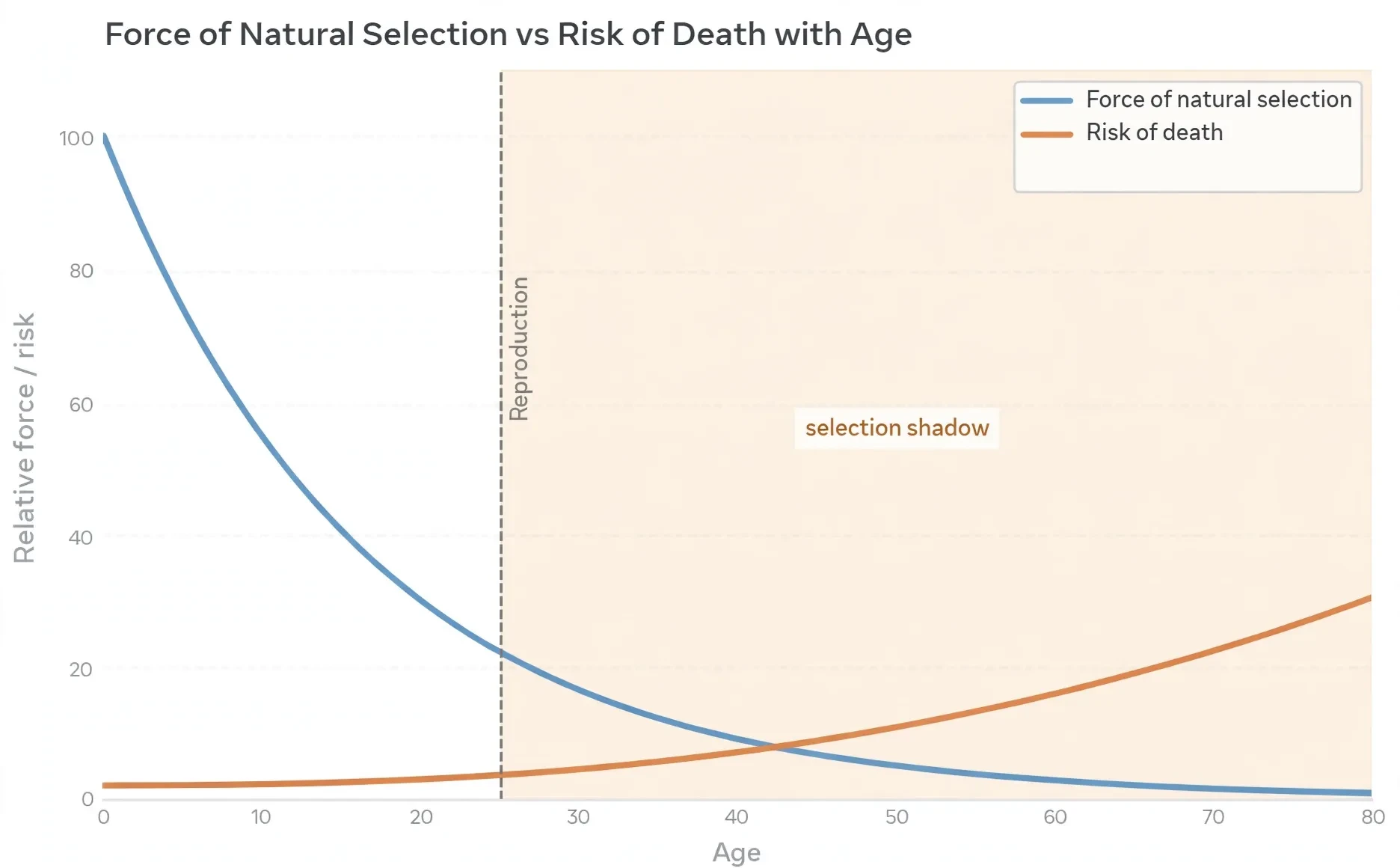
A review on the evolutionary genetics of ageing traces the idea, in its first form, to the British biologist Peter Medawar, working in the 1940s and publishing his theory in 1952. The geneticist J. B. S. Haldane had glimpsed the same logic earlier, in the 1940s. Their insight was disarmingly simple, and it is worth stating slowly, because everything else in this article builds on it. Natural selection can only act on differences that affect how many offspring an organism leaves. A trait that kills you at twenty, before you have children, will be strongly selected against, because you leave no copies of your genes behind. A trait that kills you at ninety, long after your children are grown, will barely be selected against at all, because by then your genes are already safely in the next generation. Selection's power depends on when a trait acts, not just on how harmful it is.
"The force of natural selection weakens with increasing age—even in a theoretically immortal population, provided only that it is exposed to real hazards of mortality." — Peter Medawar, An Unsolved Problem of Biology (1952)
Think of it as a spotlight that follows you through life and then, gradually, swings away. In childhood and early adulthood the light is bright: every harmful trait is visible to selection, and selection weeds it out ruthlessly. After reproduction, the light dims. Traits that only show their harm late in life fall outside the beam, and selection cannot see them well enough to remove them. They persist, not because they are useful, but because nobody is watching — and that neglect is a large part of why do we age. The region beyond the light is the selection shadow, and aging is what grows in it.
4.1 Hamilton's maths: selection fades with age
Medawar's insight was given rigorous mathematical form by the evolutionary biologist William Hamilton in 1966. Hamilton showed that the force of selection — the strength with which natural selection favours or opposes a trait, and a central part of why do we age — declines with age in a predictable way, falling toward zero in old age. His result was not a metaphor. It was a calculation, derived from the basic logic of reproduction: the older you are, the fewer future offspring you have left to lose, and therefore the less it matters, in evolutionary terms, whether you survive or stay healthy.
To see why, imagine two versions of a gene. One version keeps you healthy until ninety. The other lets you fall apart at seventy. If you have already had your children by forty, both versions have done their evolutionary job by the time the difference between them shows up. The gene that fails at seventy has already been copied into your children, and your children's children. Selection cannot reach back in time and uncopy it. It can only favour traits that change the number of offspring you leave, and by seventy, that number is already settled. Hamilton's maths made this intuition precise, and its core result — that the force of selection declines with age — has stood up, with later qualifications.
This is also why the question "why do we age" has a different shape from the question "why do we get sick." Sickness can strike at any age, and selection fights it hard when it strikes the young. Aging strikes late, when selection has already gone home. The decline of the force of selection is the single most important fact in the evolutionary answer to why do we age, and it is the foundation for both of the theories that follow: mutation accumulation, which we meet in the next section, and antagonistic pleiotropy, which comes in Part B.
4.2 What the shadow does and does not mean
It is worth being careful about what the selection shadow does and does not claim, because the idea is easily misunderstood. It does not claim that evolution wants us to die, or that death is programmed, or that old age is useless. It claims something narrower and more unsettling: that evolution is indifferent to what happens after reproduction, because indifference is the default when there is nothing left to select for. The shadow is not a punishment. It is an absence.
4.3 Living in the shadow
I think about the selection shadow whenever I visit older relatives, and I notice the small, unglamorous ways it shows up. A knee that aches in damp weather. Eyes that need brighter light to read. A cold that takes three weeks to shake instead of three days. None of these is dramatic. None of them, on its own, is a disease. Together, though, they are the shadow made visible: a body maintained just well enough to get its owner through the reproductive years, and then left increasingly to its own devices.
5. Mutation Accumulation: The Typos Selection Never Sees
Harmful mutations that act only late in life can pile up in a population, because natural selection is too weak in old age to weed them out. Aging is partly the slow accumulation of genetic typos that selection never gets a chance to correct, as Medawar proposed in 1952.
Medawar's theory of mutation accumulation follows directly from the selection shadow, and it is the most straightforward of the three classic evolutionary theories of why do we age. The logic runs like this. Mutations — random changes in DNA — happen all the time, in every generation. Most of them are harmless. Some of them are harmful. Natural selection removes the harmful ones, but only if they act early enough for selection to notice. A mutation that causes a fatal disease at age ten will be removed quickly, because its carriers die before reproducing. A mutation that causes the same disease at age eighty will not be removed, because its carriers have already reproduced. Over many generations, the late-acting harmful mutations pile up, generation after generation, like typos in a manuscript that nobody proofreads past the first chapter.
That is why do we age, on Medawar's account: not because aging was designed, and not because the body wears out, but because the genome slowly fills with late-acting defects that selection cannot see. Each defect on its own might be small — a slightly weaker heart, a slightly slower repair system, a slightly more fragile bone. Together, across many genes, they add up to the broad, system-wide decline we call senescence. Aging, in this view, is the sum of a thousand small genetic oversights.
5.1 How the typos pile up
To picture mutation accumulation, imagine a library that copies its books by hand, generation after generation. Each copy introduces a few new errors. The librarians proofread the first chapters carefully, because those are the chapters everyone reads first, and they fix the errors they find. But they rarely read the final chapters, so the errors there are never corrected. After many generations, the early chapters are nearly perfect and the late chapters are riddled with mistakes. The book still works — you can still follow the story — but the ending is a mess.
The human genome is that library. Every one of us carries new mutations that our parents did not have, and our children will carry new ones that we do not have. Selection proofreads the early chapters — the genes that matter in childhood and young adulthood — with great care. It proofreads the late chapters barely at all. The result is a genome that is well-tuned for youth and progressively less well-tuned for old age. This is not a metaphor for a mysterious process. It is a direct consequence of the selection shadow described in the previous section: where selection is weak, harmful mutations accumulate; where it is strong, they do not.
5.2 Huntington's disease: the textbook case
The clearest illustration of mutation accumulation is Huntington's disease, and it is the example every textbook reaches for, because it shows the logic with painful clarity. Huntington's is caused by a mutation in a single gene, and it is dominant, which means that a single copy is enough to cause the disease. It is also, in most cases, a late-acting disease: symptoms typically appear in mid-life, after the age at which most carriers have already had children. The mutation is devastating — it destroys the brain progressively, robbing its victims of movement, memory, and finally life itself — yet it persists in human populations, generation after generation.
Why has selection not removed it — and what does that tell us about why do we age? Because by the time Huntington's strikes, its work, from evolution's point of view, is already done. The carrier has already passed the mutation to roughly half of their children, who will pass it to half of theirs. Selection can see the disease clearly, once it appears, but it sees it too late. The gene has already escaped into the next generation. Huntington's is not a case of selection failing to notice harm. It is a case of selection noticing harm after the harm no longer matters for reproduction. That is the selection shadow in a single human story, and it is why the disease remains one of the most powerful demonstrations of Medawar's idea.
I have always found Huntington's both clarifying and sobering to teach, because it strips away the abstractions. It is easy to talk about "the force of selection declining with age" as a piece of maths. It is harder, and more honest, to look at a family living with Huntington's and see what that maths means in practice: a harmful gene, invisible to evolution until it is too late, carried faithfully from parent to child because nothing in the evolutionary process had a reason to stop it. If you want to understand why do we age, Huntington's is the case to remember. It shows that a trait can be terrible for the individual and still survive, as long as it acts late enough.
5.3 What mutation accumulation explains — and what it leaves open
But the theory, on its own, is incomplete, and the scientists who built on Medawar knew it. Mutation accumulation explains how harmful late-acting variants can persist, but it does not fully explain why aging is so consistent, or why some traits actively promote aging rather than merely failing to prevent it. If aging were only a pile of random typos, you might expect it to look more random than it does — more variable from person to person, less systematic across the body. Instead, aging follows recognisable patterns: the same systems decline, in roughly the same order, in most people. That regularity suggests that something more than random accumulation is at work — that some genes actively trade early benefits for late costs, and that the body actively invests in reproduction at the expense of maintenance. Those are the subjects of Part B: antagonistic pleiotropy, in which a single gene helps you young and hurts you old, and the disposable soma, in which the body spends its limited energy on breeding rather than repair. Mutation accumulation was the first crack in the puzzle of why do we age. The next two theories widen it into a doorway.
6. Antagonistic Pleiotropy: The Genes That Help You Young and Hurt You Old
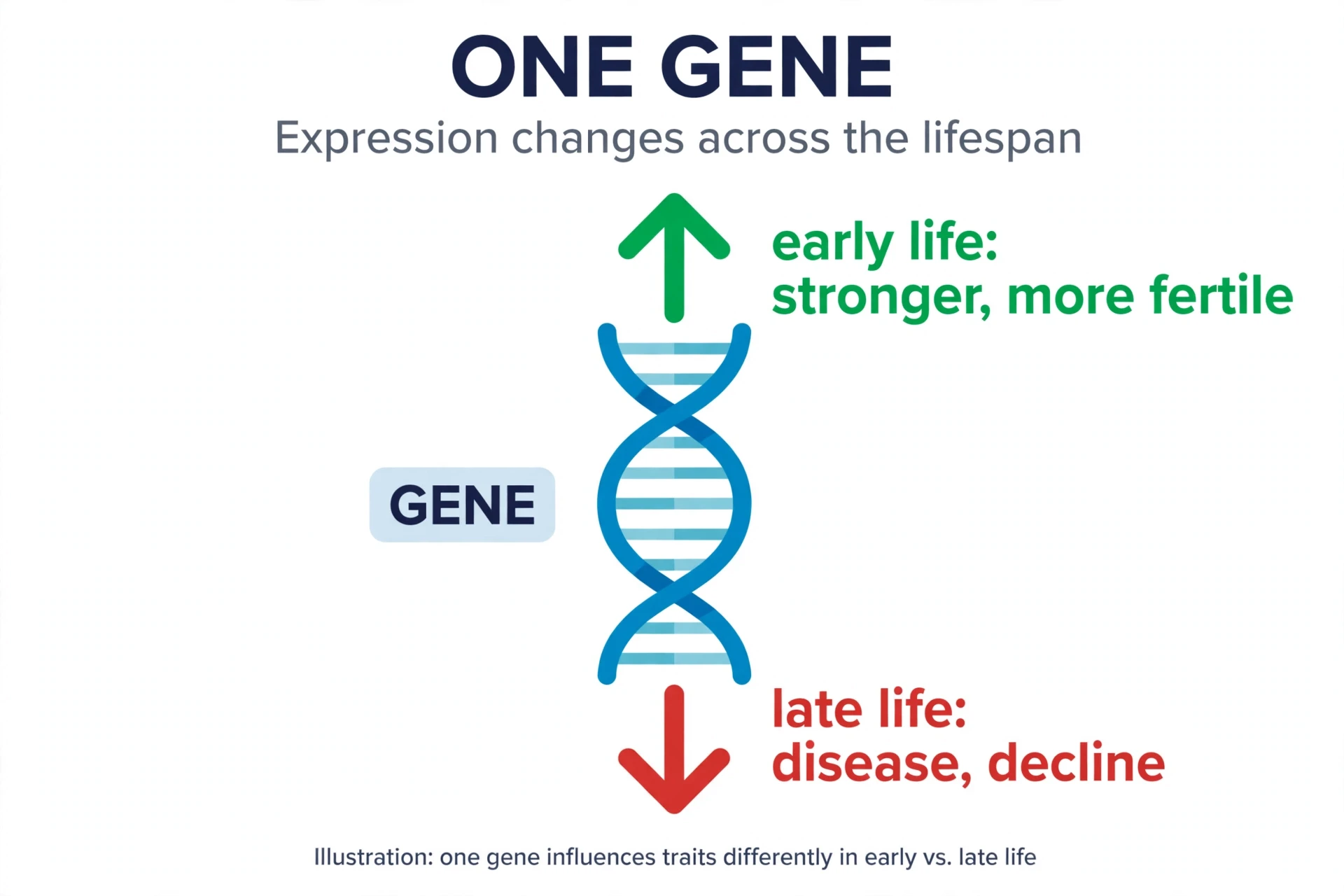
Some genes act like a bargain struck in youth and paid for in old age. They sharpen fertility, muscle, or immunity when reproduction matters most, then turn harmful once selection has stopped watching. That trade is antagonistic pleiotropy, and it may explain more of why do we age than any single disease gene ever will.
6.1 Williams and the bargain no one signed
In 1957, the evolutionary biologist George Williams proposed a simple idea that changed how scientists think about why do we age. A gene can have more than one effect, and those effects can point in opposite directions. If a gene boosts survival or reproduction early in life, natural selection will favour it, even if the same gene causes disease or decline late in life. The early benefit is seen by selection. The late cost is not, because it falls inside the selection shadow.
The word "pleiotropy" means one gene with many effects. "Antagonistic" means those effects work against each other across the lifespan. Selection does not ask whether a gene will make you healthy at eighty. It asks whether it helps you have children at twenty-five. If the answer is yes, the gene spreads, and the bill arrives decades later.
This is a different answer to why do we age from the one mutation accumulation gives. Mutation accumulation says harmful late-acting mutations pile up because selection cannot see them. Antagonistic pleiotropy says something sharper: some harmful late effects are not accidents that selection missed. They are the price of benefits that selection actively chose.
Think of it like a car engine tuned for a short race. Running it hotter wins the sprint and wears it out sooner. Nobody would call that tuning a defect. Evolution tunes bodies for the race that matters, which is reproduction, not for a long, gentle retirement.
6.2 APOE ε4: the textbook example that may not be one
The most famous candidate for antagonistic pleiotropy in humans is a version of the APOE gene, called APOE ε4. APOE helps carry fats and cholesterol around the body, and it plays a role in the brain. The ε4 version is linked to a higher risk of Alzheimer's disease and atherosclerosis in later life. That much is well established. For the wider story of how genes like APOE are organised and read, see our guide to the human genome.
The pleiotropy claim adds a second half: the same ε4 version gave advantages early in life — better fertility, sharper cognition in youth, or stronger resistance to infection. If those early benefits were real, selection would have kept the gene around despite its late cost. A review of the APOE evidence lays out the case for the early-life benefits alongside the late-life risks, and for years the story was repeated as settled.
It is not settled, and honesty demands saying so plainly. A pre-registered study from the Cam-CAN project tested one part of the early-benefit claim directly — cognition and brain measures in about 600 healthy adults aged 18 to 88 — and found no evidence to support it there. That result says nothing about the other claimed benefits: in high-pathogen, natural-fertility populations, ε4 has since been linked to higher fertility (Trumble et al., 2023) and to resistance to some infections. The Bayes factors in their analysis supported the null — the finding of no effect — rather than the pleiotropy claim. You can read the study record through the University of Oxford's publication page for the Cam-CAN APOE study.
That result does not prove APOE ε4 has no early benefits at all. A single study, even a careful pre-registered one, cannot close a question this big. But it does mean the textbook example should carry a warning label. When I first read the Cam-CAN result, I felt the small jolt that comes when a tidy story loosens in your hands. I had repeated the APOE example myself, confident that it illustrated Williams's idea. The study reminded me that a good story and a confirmed fact are different things.
The lesson reaches beyond one gene. Antagonistic pleiotropy is a strong idea, and it almost certainly shapes why do we age. But each candidate gene has to earn its place with evidence, not with plausibility. A gene that is harmful late in life is not automatically helpful early in life.
6.3 Testosterone: strength now, costs later
Testosterone offers a clearer picture of the trade in action, because its effects are visible across a whole lifetime. In youth, testosterone builds muscle, deepens the voice, drives competition for mates, and supports fertility. Those are real reproductive advantages, and in the world our ancestors lived in, that edge could decide who had children and who did not.
The same hormone carries costs that arrive later. Testosterone, via its more potent form DHT, drives prostate growth, so androgens are implicated in prostate enlargement in later life — but high circulating testosterone has not been shown to increase the risk of developing prostate cancer. Its effect on immunity is also less clear-cut than the old "immunosuppression" story suggests: in humans the evidence is mixed and inconclusive, and testosterone is better described as modulating immunity than simply suppressing it. The trade is not a flaw in the design. It is the design, shaped by a world where dying young was common, and where the reproductive payoff of strength and competition was immediate.
None of this means testosterone is "bad" or that men should fear their own hormones. It means the hormone sits on a balance struck for a different world from the one most of us live in now. We live long enough to collect the late costs that our ancestors rarely reached. That mismatch is a recurring theme in why do we age: traits tuned for a short, dangerous life keep running in bodies that now live for decades past reproduction.
6.4 p53: the guardian that can turn jailer
The gene p53 is often called the guardian of the genome, and the nickname is earned. When DNA is damaged, p53 steps in. It can halt cell division so repairs can happen, or it can order a badly damaged cell to destroy itself. That protection matters most early in life, when a single damaged cell dividing out of control could become a cancer that kills before reproduction.
The cost appears with age. The same p53 activity that stops damaged cells from dividing also pushes cells toward senescence, the state in which a cell stops dividing for good. Over a lifetime, that steady pressure can wear down the stem cells that renew tissues. Mice carrying a truncated, constitutively active form of p53 (Tyner et al., 2002) show the trade in stark form: they develop fewer tumours, and they age faster. But the effect depends on how p53 is switched on, not simply on having more of it: mice with extra copies of the normal, normally regulated p53 gene are also tumour-resistant yet age normally (García-Cao et al., 2002). The guardian does its job, and the job itself wears the body down.
This is why simple slogans about "boosting" a protective gene miss the point. A gene is not a switch with a good setting and a bad setting. It is a dial, and turning it up helps in one decade and hurts in another. The question is never just whether a gene protects you. It is when it protects you, at what price, and who pays it.
6.5 What antagonistic pleiotropy explains — and what it does not
Antagonistic pleiotropy explains a pattern that mutation accumulation alone cannot: why some aging looks active and organised rather than random. Many age-related changes follow the same pathways that built strength and fertility in youth, as if the body were running its early-life programmes for too long. They keep running, and their continued activity becomes part of why do we age.
The idea also explains why there is no single "aging gene" to switch off. Many genes influence lifespan when their activity is changed in the laboratory, and a growing number show early-benefit, late-cost patterns, but only a small number have been shown to be antagonistically pleiotropic in the strict sense. Each candidate is woven into reproduction, growth, immunity, or repair. Turning one off would mean giving up its early benefit too. Evolution chose the early benefit every time, because the early benefit is what selection can see.
What the idea does not explain is everything. Not every harmful late effect comes with an early benefit, and not every candidate survives testing, as APOE ε4 shows. Antagonistic pleiotropy is one engine of aging, not the whole machine. It works alongside mutation accumulation, inside the selection shadow: selection misses some harmful genes entirely, and it actively keeps others because they pay early.
7. The Disposable Soma: A Body Built to Be Thrown Away
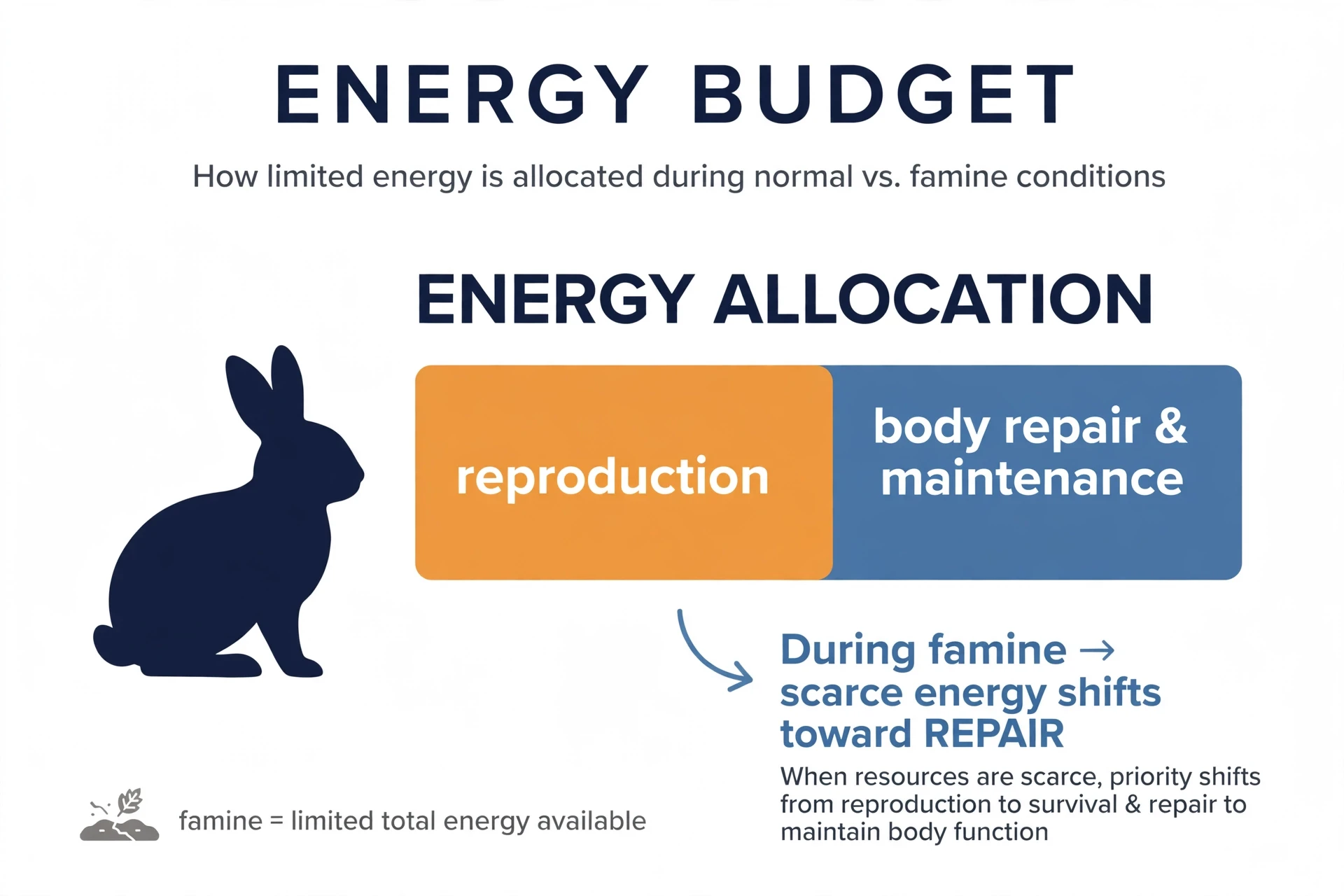
Imagine a body with a fixed energy budget and two competing bills: make babies now, or repair tissues for a future that may never come. Evolution pays the first bill in full and the second only in part. That is the disposable soma, and it frames why do we age as a question of spending, not of design.
7.1 The energy budget no animal can escape
In 1977, the biologist Thomas Kirkwood proposed the disposable soma theory, and it remains one of the clearest answers to why do we age. Every animal has a limited supply of energy, and that energy has to be divided between competing jobs: reproduction — making offspring — and maintenance — repairing DNA, replacing damaged proteins, and keeping tissues in working order. Energy spent on one cannot be spent on the other.
Kirkwood's point was that perfect maintenance is possible in principle, but it is expensive, and evolution does not pay for what it does not need. A body only needs to stay in good repair long enough to reproduce. After that, the return on extra repair falls away, because the animal is likely to die from predators, disease, or hunger anyway. So the body invests just enough in repair to reach breeding age, and pours the rest into reproduction. The soma — the body, as opposed to the germline that carries genes to the next generation — is disposable by design.
A review of the disposable soma and dietary restriction sets out this logic in detail, including how the energy trade plays out when food is scarce. The budget metaphor makes the theory testable: animals that face different dangers should invest differently. A mouse likely to be eaten within a year should spend almost everything on breeding fast and repairing little. A whale that faces few predators should spend more on maintenance. That is broadly what we see, and it is one of the reasons the theory has lasted.
7.2 Germline versus soma: one line is immortal, the other is not
The deepest split in the theory is between the germline and the soma. The germline is the line of cells that becomes eggs and sperm, and it is, in a real sense, the only part of an animal that continues. It is copied, repaired, and handed on, generation after generation. The soma is everything else: skin, muscle, brain, gut. It is built once, and it is never handed on. When the animal dies, the soma dies with it.
This split explains a puzzle that otherwise looks strange. If the body can build a new animal from a single fertilised egg, complete with flawless young tissues, why can it not repair the adult body just as well? The answer is that it can, in the germline. In the theory, germ cells get the best repair the body can offer, because their DNA is the future. Somatic cells get a cheaper service, because their DNA dies with the animal.
That distinction also explains why do we age unevenly. Some tissues renew themselves constantly — skin, gut lining, blood — because their stem cells keep dividing. Others, like the brain and the heart, renew very slowly or not at all. The tissues that matter most for keeping the animal alive through its breeding years get the most attention. Everything else is maintained on a shoestring.
For the cellular side of this story — how cells divide, renew, and wear out — see our guide to cell biology, which covers the organelles and repair systems the soma relies on.
7.3 Rose's fruit flies: selecting for a longer life
A theory is only as good as its tests, and the disposable soma has had a strong one. The evolutionary biologist Michael Rose and his colleagues selected fruit flies for late reproduction. Instead of letting the flies breed young, as they normally would, the researchers only allowed the oldest flies in each generation to have offspring. Generation after generation, the breeding age crept later.
The result was exactly what the disposable soma predicts. The late-breeding lines lived longer, and they aged more slowly. But they paid for it — at least at first: in Rose's original lines they were less fertile early in life, and they developed more slowly. That early-fertility cost was not found in every selection experiment — Partridge and Fowler (1992) found no early-fecundity difference, only higher late fecundity — and in one long-running experiment the trade-off disappeared entirely after a decade of selection (Leroi et al., 1994). The energy that had gone into early reproduction was now going into maintenance.
The fly experiments matter because they show aging is not fixed. It can be shifted by selection, quickly, within a few dozen generations. That tells us aging is not a law of physics that every animal must obey in the same way. It is a setting, tuned by how much an animal invests in its body versus its offspring. Change the setting, and the lifespan changes with it.
7.4 The trade is real, but it is not inevitable
Here is where the story needs care, because the simple version of the disposable soma can sound like a hard rule: more reproduction always means a shorter life, and a longer life always means fewer children. The evidence is messier than that, and the mess is informative.
In 2005, Linda Partridge and David Gems reviewed the evidence on lifespan and reproduction in their paper "Sex and Death", and they pointed to a finding that complicates the simple trade. Single-gene mutations in insulin and IGF-1 signalling — the hormonal pathways that sense food and growth — can extend lifespan in worms, flies, and mice without always reducing fertility. The animals live longer, and in some experiments they keep having offspring at normal rates.
That does not overturn the theory. It refines it. Energy is not the only currency. Hormonal signals like insulin and IGF-1 act as switches that tell tissues how to behave, and flipping a switch can change the balance of repair and reproduction without simply moving energy from one pile to another. The trade-off is real — it shows up in Rose's flies, in wild animals, and in many experiments — but it is not inevitable in every case.
This nuance matters for anyone asking why do we age and whether anything can be done about it. If the trade were absolute, then every attempt to slow aging would cost fertility or growth. The insulin and IGF-1 results suggest the picture is more hopeful, and also more complicated: some of the pathways that control aging can be adjusted without paying the full price. How far that goes in humans is a separate question, and one this article will not overstate.
7.5 What the disposable soma adds to the picture
The disposable soma gives the evolutionary answer to why do we age its economics. Mutation accumulation explains why harmful genes pile up unseen. Antagonistic pleiotropy explains why some harmful genes are actively kept. The disposable soma explains why the body itself is built to a limited specification: because repair is expensive, and the genes that build the body were selected to spend their budget on reproduction first.
It also explains why aging looks like a gradual loss of maintenance rather than a sudden breakdown. DNA damage accumulates because repair is good but not perfect. Proteins misfold because quality control is good but not perfect. In each case, "good but not perfect" is the affordable setting, not a mistake. The body could do better. Evolution decided the extra cost was not worth paying.
And that is the answer the disposable soma offers to why do we age: we age because our bodies were built to be good enough for the breeding years, and no better. The soma was never meant to last forever. It was meant to carry the germline to the next generation.
8. What the Three Theories Get Right — and What They Miss
Mutation accumulation, antagonistic pleiotropy, and the disposable soma each explain a piece of aging, yet none of them explains all of it. The three theories answer different questions, and they fail in different places. To see why do we age, we need to judge them together, honestly, including the parts where the evidence is thin or missing.
8.1 Why, not how
The first thing to get straight is what these theories are for. Evolutionary theories of aging explain why we age, not how it happens inside a cell — a distinction biologists draw between ultimate and proximate causes. They tell us why selection tolerates decline, why trade-offs favour youth, and why repair is limited. They do not tell us which molecule breaks first, or which pathway drives a wrinkle or a failing memory. That is the job of the molecular biology of aging, and confusing the two levels is the most common mistake in this whole subject.
Most people assume there must be one master cause of aging, a single clock or programme that runs the whole show. What the evidence actually shows is different: evolution gives us the reason aging is allowed to happen, and then many separate processes — DNA damage, worn-out proteins, tired mitochondria, senescent cells — carry it out. Asking an evolutionary theory to name the molecule is like asking an economist why a bridge collapsed and expecting the name of a rusted bolt. The economics explain why the bridge was under-maintained. The bolt explains how it fell.
That distinction also settles a confusion about why do we age that appears in popular writing. When a new study finds a gene or a drug that extends lifespan in mice, headlines often announce that scientists have found "the cause of aging". They have not. They have found one lever among many, operating inside a system that evolution left unguarded.
8.2 The programmed-aging debate
The sharpest disagreement in the field is over programmed aging: the idea that aging is not a side effect of neglect, but a deliberate programme, switched on by genes to kill the old and make room for the young. It is an old idea, going back to August Weismann's 1881 lecture "On the Duration of Life" (published in English in 1889), and it keeps returning in new forms. Its supporters argue that a built-in death programme could benefit the group, by clearing space and resources for the next generation.
Most evolutionary biologists reject that argument. A gene that kills its bearer after reproduction gives no advantage to the individual carrying it, and cheaters who lose the programme by mutation would outbreed the programmed ones. The selection shadow explains why do we age without needing a programme at all: decline happens because selection stops caring, not because it orders a death.
The debate is not fully closed, and a few researchers still defend programmed elements in aging, pointing to processes that look organised rather than random. But the burden of proof sits with the programme, and it has not been met. The three classical theories explain the same observations with fewer assumptions, and they make predictions that have been tested and confirmed, from Rose's flies to the insulin-signalling mutants.
8.3 Three theories, one story
Seen together, the three theories form a single account of why do we age, with each one covering ground the others miss. Mutation accumulation explains the slow pile-up of harmful late-acting variants, the genetic litter that selection never sweeps away. Antagonistic pleiotropy explains why some of those variants are not litter at all, but the cost of genes that selection actively favours for their early benefits. The disposable soma explains why the body itself is built to a limited specification, with repair funded only as far as reproduction requires. For how chance alone can push variants up or down in a population, see our guide to genetic drift.
None of the three is complete on its own. Mutation accumulation alone cannot explain why do we age along such organised pathways, or why lifespan can be shifted so quickly by selection. Antagonistic pleiotropy alone cannot explain harmful late effects that carry no early benefit, and some of its best candidates, like APOE ε4, have not survived direct testing. The disposable soma alone cannot explain cases where lifespan extends without a fertility cost. Together, they cover each other's gaps.
9. The Twelve Hallmarks of Aging
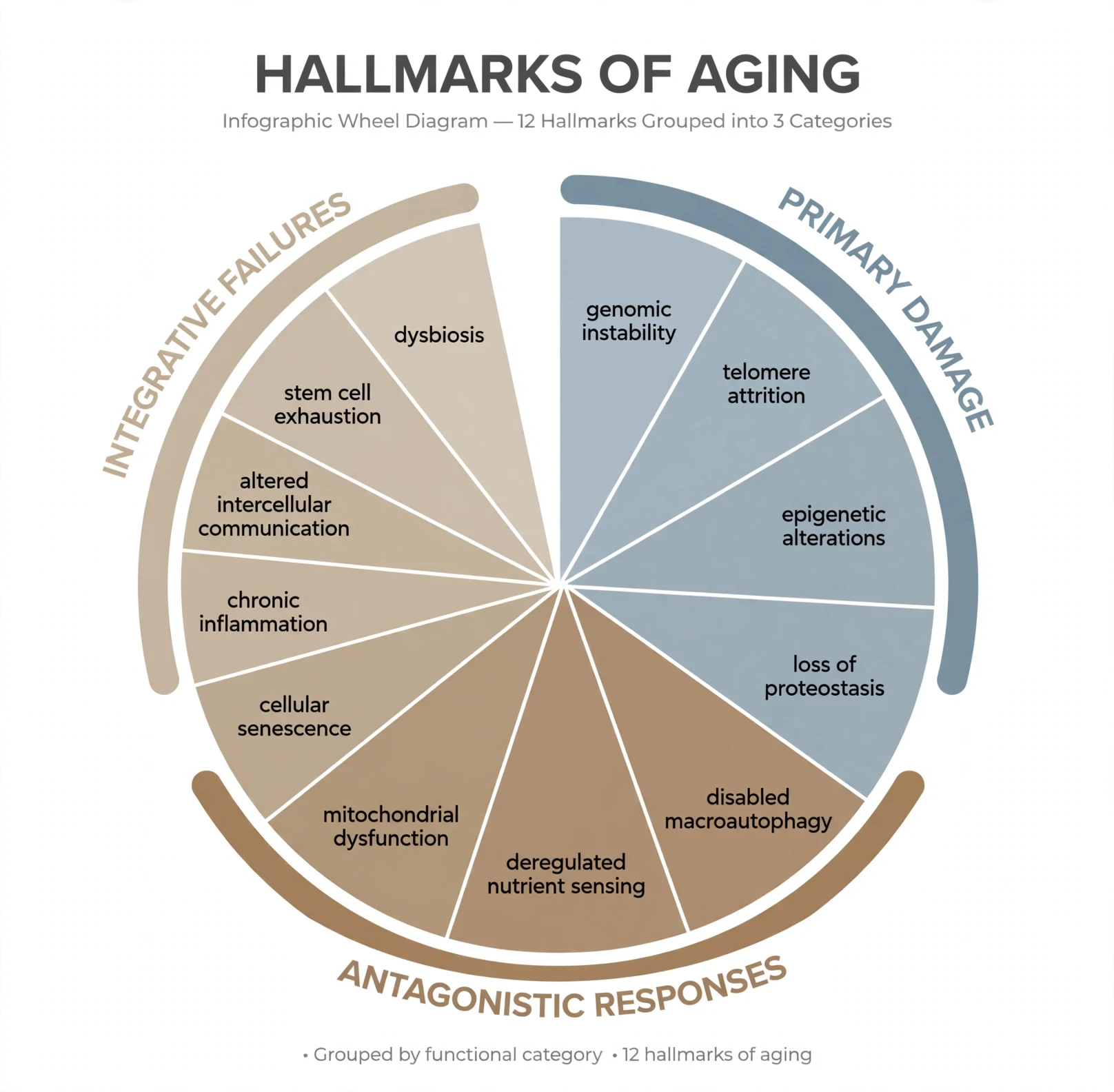
If the evolutionary theories tell us why aging exists, the hallmarks tell us what aging looks like inside a cell. In 2013, researchers listed nine processes that drive decline; a decade later, the list grew to twelve. Together they map why do we age onto concrete damage, responses, and failures that scientists can measure.
9.1 From nine hallmarks to twelve
In 2013, Carlos López-Otín and colleagues published a landmark paper in Cell that organised the biology of aging into nine hallmarks. The paper, "The Hallmarks of Aging", gave the field a shared map of why do we age: a list of processes that show up with age, that make aging worse when they are pushed, and that slow aging when they are eased. For a decade, that list shaped research, drug development, and textbooks. You can read the original paper through its Cell DOI record.
In 2023, the same group returned with an update, "Hallmarks of aging: An expanding universe", published in Cell, volume 186, pages 243 to 278. The list grew from nine hallmarks to twelve. The three new hallmarks were processes that had been folded inside the original nine, and that the evidence now justified splitting out as hallmarks in their own right: disabled macroautophagy, chronic inflammation, and dysbiosis. The expansion did not change the core idea. It refined the map as the evidence grew.
9.2 Primary hallmarks: the damage itself
The first group, the primary hallmarks, are the causes of damage. Genomic instability means DNA accumulates mutations and breaks faster than repair can fix them. Telomere attrition is the shortening of the chromosome caps with each division, which eventually forces cells to stop dividing. Epigenetic alterations are changes in the marks that switch genes on and off — see our guide to epigenetics. Loss of proteostasis is the failure to keep proteins folded and cleared correctly. Disabled macroautophagy, one of the three new hallmarks, is the breakdown of the cell's recycling system.
9.3 Antagonistic hallmarks: defences that turn harmful
The second group, the antagonistic hallmarks, are responses to damage that start out protective and end up harmful. That pattern should sound familiar. It is antagonistic pleiotropy written at the level of the cell, and the most direct bridge between the evolutionary theories and the hallmarks.
Deregulated nutrient sensing means the pathways that sense food and growth — including the insulin and IGF-1 signalling discussed in section 7 — stop responding correctly, pushing growth when the cell should be repairing. Mitochondrial dysfunction is the decline of the cell's energy factories, which produce less energy and more damaging by-products as they wear out. Cellular senescence is the state in which a damaged cell stops dividing for good: useful as a defence against cancer in youth, harmful when senescent cells pile up and poison the tissue around them. These three are the cell's own defences, running too long or too hard, and that is why do we age in miniature.
9.4 Integrative hallmarks: when the failures spread
The third group, the integrative hallmarks, are what happens when damage and faulty responses spread beyond single cells. Stem cell exhaustion is the depletion of the renewal pools that rebuild tissues, so wounds heal slowly. Altered intercellular communication is the breakdown of the signals between cells, so tissues stop coordinating. Chronic inflammation, the second new hallmark, is the low-grade, persistent immune activation that damages tissues over years. Dysbiosis, the third new hallmark, is the shift in the gut microbiome toward a less healthy balance.
These four are the hallmarks that a person actually feels: slower healing, weaker immunity, stiffer joints, a gut that no longer behaves. They are also the hallmarks that connect aging to disease, because the same failures drive the illnesses that cluster in old age. The evolutionary answer to why do we age and the cellular answer meet here: damage accumulates, defences turn harmful, and the failures spread from cell to tissue to whole body.
Group | Hallmark | What goes wrong |
|---|---|---|
Primary | Genomic instability | DNA damage and mutations accumulate faster than repair can fix them |
Primary | Telomere attrition | Chromosome end caps shorten with division until cells stop dividing |
Primary | Epigenetic alterations | Gene-switching marks drift, so genes are read at the wrong time or level |
Primary | Loss of proteostasis | Proteins misfold and pile up because quality control fails |
Primary | Disabled macroautophagy | The cell's recycling system breaks down and worn-out parts are not cleared |
Antagonistic | Deregulated nutrient sensing | Food and growth signals, including insulin and IGF-1, stop responding correctly |
Antagonistic | Mitochondrial dysfunction | Energy factories produce less energy and more damaging by-products |
Antagonistic | Cellular senescence | Damaged cells stop dividing but linger, harming the tissue around them |
Integrative | Stem cell exhaustion | Renewal pools run down, so tissues rebuild slowly or not at all |
Integrative | Altered intercellular communication | Signals between cells break down and tissues stop coordinating |
Integrative | Chronic inflammation | Low-grade immune activation persists and damages tissues over years |
Integrative | Dysbiosis | The gut microbiome shifts toward a less healthy balance |
9.5 A map, not a verdict
The hallmarks are a map, and like any map they have limits. They describe what goes wrong, and they give researchers targets to test, but they do not by themselves explain why do we age — why the damage is allowed to happen in the first place. That is the evolutionary question, and it still needs the selection shadow, antagonistic pleiotropy, and the disposable soma. A list of twelve failing processes is not a cause. It is a description of the failure.
The hallmarks also remind us that aging is not one thing. It is twelve processes, interacting, feeding back on each other, and progressing at different speeds in different tissues and different people. That is why there is no single pill for aging. The evolutionary view of why do we age and the cellular view agree on this point: aging was never a single programme to switch off. It is the sum of many small failures, each with its own history.
The story so far has answered why do we age. What it has not yet answered is how aging actually plays out inside the body, cell by cell, and why some animals escape it almost entirely. That is where the next part of this article goes: to telomeres, to zombie cells, and to the animals that live far longer than expected.
10. Telomeres and the Hayflick Limit
Why do we age at the level of a single cell? Part of the answer sits at the tips of our chromosomes, in tiny protective caps called telomeres. Every time a cell divides, those caps get a little shorter, and after roughly fifty divisions the cell stops. That built-in limit links the selection shadow to the machinery inside every cell.
10.1 The experiment that broke a dogma
Before 1961, most biologists believed normal cells, given the right food and conditions, could divide forever. Bacteria divide without an obvious end, and cancer cells in a dish appeared to do the same. Then Leonard Hayflick and Paul Moorhead, working with human fetal fibroblasts, watched something nobody had expected: their cells divided happily for a while, slowed, and stopped — after about fifty doublings. They did not die at once, but sat there, alive yet no longer dividing. The result became the Hayflick limit, and it forced a new question open: if cells carry their own expiry date, is that part of why do we age?
I still remember the first time I watched a culture like that in a teaching lab: the flask started as a thin scattering of cells, filled and divided over the weeks, then the growth curve flattened. The cells looked healthy, yet nothing I did — fresh medium, a new flask — coaxed them back into dividing. It felt less like a failure than a rule I had not known existed: not damage from outside, but a boundary written into the cell itself.
In follow-up work (Hayflick, 1965), they checked whether the stop was caused by a virus, a bad batch of medium, or a mistake in technique — mixing old male cells with young female cells and showing only the old cells stopped. It was none of those. Normal human cells simply had a finite number of divisions in them, around fifty, and the number was roughly the same each time. Something inside the cell was counting.
10.2 The caps on the shoelaces
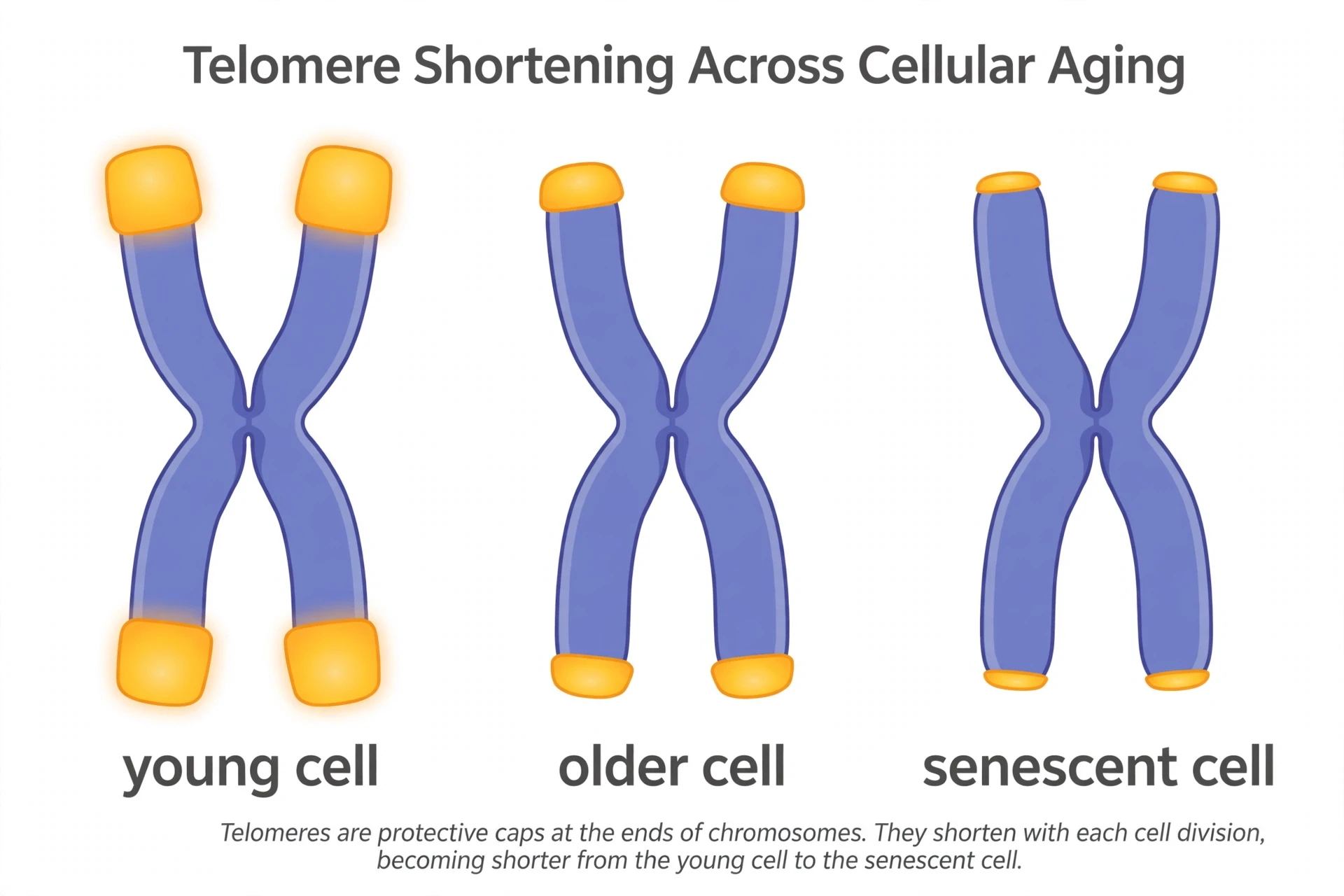
The counting mechanism turned out to be the telomere. Every chromosome ends in a stretch of repeated DNA that codes for nothing. Its job is purely protective: it keeps the chromosome end from being mistaken for a broken strand, and stops two chromosomes fusing together. Think of the plastic tip on a shoelace — it does nothing for walking, but without it the lace frays and falls apart.
Each time a cell copies its DNA, the machinery cannot quite reach the very end of the chromosome, and a small piece of telomere is lost. Young cells have long telomeres; older cells have short ones. When the caps shrink past a critical length, the cell receives a signal that looks exactly like DNA damage, and it stops dividing — one of the main routes into cellular senescence, the subject of the next section, and one of the twelve hallmarks of aging, listed there as telomere attrition.
Most people assume telomeres are a countdown clock that decides when a person dies, as if telomere length alone answered why do we age. What we actually see is messier. Telomere shortening is real, but it is one mechanism among many, acting differently in different tissues: skin, gut, and blood cells divide constantly and burn through their telomeres, while nerve and heart muscle cells barely divide at all, yet still age. A single clock cannot explain both. Telomeres set a limit on how many times a dividing cell can copy itself, and that limit protects us in one way while costing us in another.
10.3 Telomerase: the exception that proves the rule
If telomeres shorten with every division, how does any lineage survive for generations? The answer is telomerase, an enzyme that rebuilds the caps, active in the germline — the cells that become eggs and sperm — and in stem cells, which express telomerase — though often at levels too low to prevent telomere shortening altogether. Without it, each generation would inherit shorter telomeres than the last, and the species would run down like a clock nobody winds.
Most ordinary body cells switch telomerase off. That looks like a design flaw until you remember the selection shadow: a cell that can divide forever is a cell that can become a tumour. Switching telomerase off is a bargain — it limits how far a damaged cell can go, and the price is paid late in life, when selection barely notices. Most cancer cells switch telomerase back on; about 85–90% of human cancers reactivate the enzyme, which is one reason a tumour can keep growing long after normal cells would have stopped. The remaining 10–15% use a different route, Alternative Lengthening of Telomeres (ALT), instead. The same mechanism that guards against cancer also helps explain why do we age: the defence works beautifully while we are young and reproducing, and its cost arrives after the age when selection stops counting.
10.4 What the Hayflick limit does not explain
The Hayflick limit is powerful, but it does not stretch into a complete theory of why do we age. It applies to cells that divide, yet much of the aging we notice — weaker muscles, stiffer arteries, slower thinking — involves tissues whose cells rarely divide. And the limit is a property of cells in a dish; inside a living body, stem cells keep renewing tissues, so the link between one cell's division count and a whole person's aging is indirect.
What the limit does explain is why repair has a ceiling. A wound heals because cells divide to close it; a gut lining renews itself because stem cells divide to replace it. Every division spends a little telomere, and the budget is finite. So when we ask why do we age, part of the answer is that the tissues which keep us alive are rebuilt by cells that cannot rebuild themselves forever.
11. Zombie Cells: Senescence and the SASP
Why do we age when our cells stop dividing — do they simply retire quietly? Some do. Others turn into something stranger: senescent cells that refuse to die, refuse to divide, and spend their months pumping out inflammatory chemicals that damage the tissue around them. These "zombie cells" link one cellular process to the stiffness and frailty of old age.
11.1 What a senescent cell is
A senescent cell has permanently stopped dividing but has not died. It gets there by several routes — telomeres shrinking past the point of no return, DNA damage, or a cancer-causing mutation — which is why senescence is also a defence against tumours: a damaged cell locks itself down rather than risking uncontrolled growth. In youth, senescence is genuinely useful, stopping cancer before it starts and helping wounds heal, with senescent cells appearing briefly at an injury site before the immune system clears them away.
The trouble starts when clearance fails. With age, senescent cells accumulate in skin, fat, muscle, blood vessels, joints, lungs, and kidneys. They grow large and flattened, stay metabolically active, and are far from silent — and that failure of clean-up is one more piece of why do we age.
For a fuller picture of how a normal cell is built and divides, see our guide to cell biology and the comparison of mitosis vs meiosis, which explains the two kinds of division that renew tissues and make the next generation.
11.2 The SASP: a bad neighbourhood
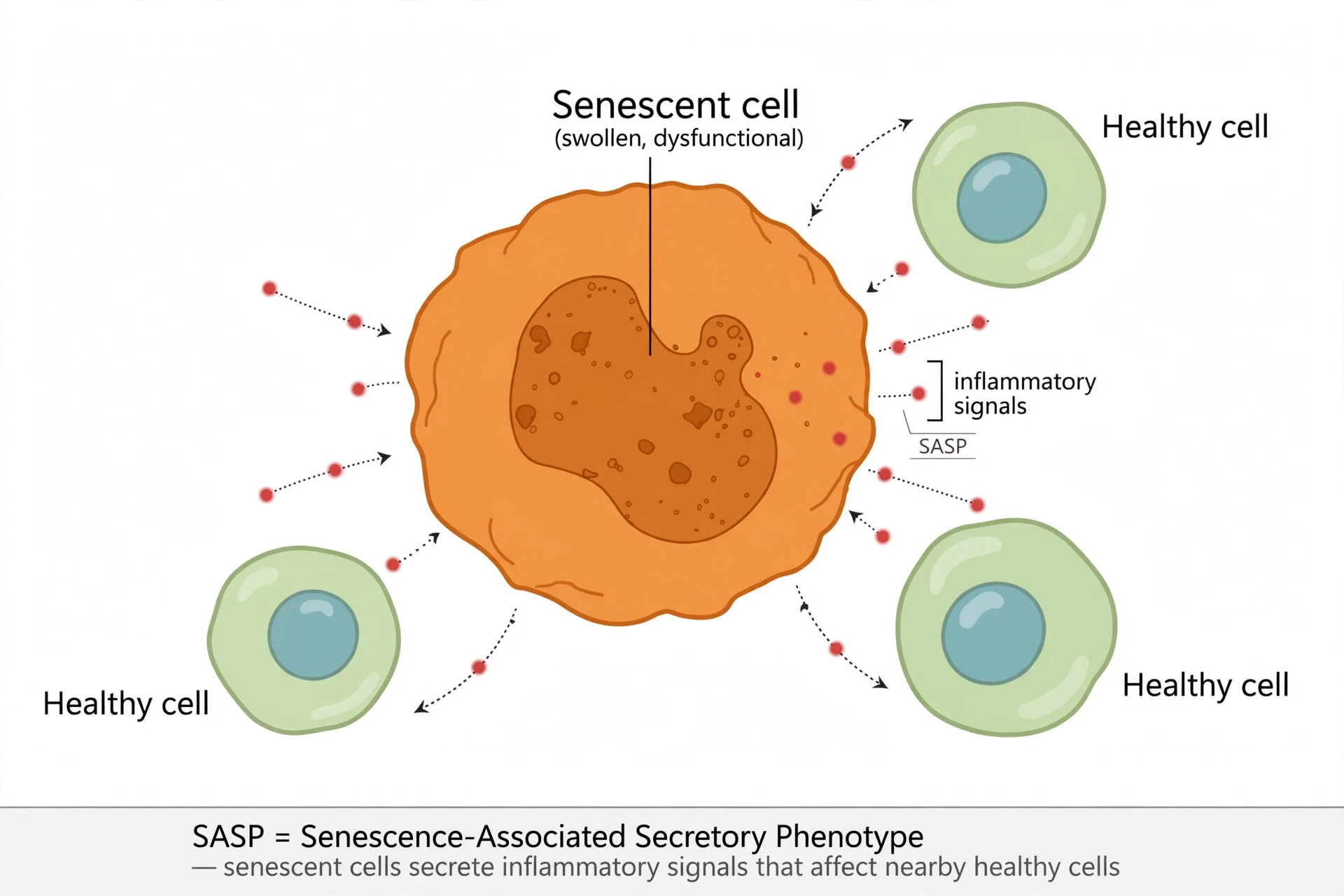
Senescent cells secrete a cocktail of molecules — inflammatory signals, enzymes that chew through the tissue matrix, and growth factors that can push neighbouring cells to misbehave. Scientists call this mixture the senescence-associated secretory phenotype, mercifully shortened to the SASP. A senescent cell behaves like a bad neighbour playing loud music all night: one loud house is annoying, but a whole street of them changes the character of the neighbourhood — and that spreading harm is a central part of why do we age.
The SASP explains why a few senescent cells can cause outsized harm. They need not take over a tissue; they only need to sit in it, leaking signals that inflame it, degrade its structure, and push healthy neighbours toward senescence themselves. That spreading effect also explains why do we age faster as we get older: a few zombie cells become many, and the tissue around them gets worse faster.
11.3 Senolytics: drugs that clear the zombies
In 2015, a team led by Yi Zhu published a paper in Aging Cell that gave the field a new word: senolytics. The paper, which you can read at doi.org/10.1111/acel.12344, showed that dasatinib, a cancer drug, plus quercetin, a plant compound, could selectively kill senescent cells while sparing healthy ones. The idea was simple and bold: if zombie cells cause harm, remove them.
The mouse results were striking. In 2018, Xu and colleagues reported in Nature Medicine that dasatinib plus quercetin improved physical function and extended the remaining lifespan of old mice. Earlier, Baker and colleagues used mice engineered so their senescent cells could be cleared on demand: removing those cells delayed age-related problems and extended healthspan in fast-aging mice (2011), and in naturally aged mice it also extended median lifespan (2016).
Human trials came next, small and cautious. Hickson and colleagues reported in 2019 that dasatinib plus quercetin reduced senescent-cell markers in nine patients with diabetic kidney disease (a 2020 corrigendum re-analysed the raw data and changed some of the paper's conclusions). In the same year, Justice and colleagues reported that the combination improved six-minute walk distance in a pilot study of fourteen people with idiopathic pulmonary fibrosis, a scarring disease of the lungs. A later controlled pilot (Nambiar et al., eBioMedicine 2023, 12 participants) did not reproduce the walk-distance gain. Both were open-label pilots — no placebo group, tiny numbers, short follow-ups. They showed the drugs could be given to people and some markers moved in the right direction, a long way from showing that senolytics make people live longer.
11.4 The honest limits
Here the story needs to slow down. No human lifespan evidence exists for senolytics. None. The mouse data are real and the human pilot data encouraging, but mice are not people, and a six-minute walk test is not a lifespan. The fourteen-person lung study and the nine-person kidney study tested safety and feasibility, not whether anyone ages more slowly. Anyone selling a senolytic supplement as an anti-aging treatment today is selling a promise the evidence does not support.
There are real risks too. Dasatinib is a powerful drug with serious side effects, and the dose, timing, and long-term safety of clearing senescent cells in people are still open questions — which is why the trials proceed carefully.
So where does this leave why do we age? Senescent cells connect the evolutionary story to the lived experience of growing old: the selection shadow explains why evolution never built a perfect clean-up system, and the SASP explains why the cells that pile up do so much damage. Senolytics offer a test — if removing zombie cells restores function, then part of aging is accumulated damage that can, in principle, be cleared. The mouse data say yes. The human data have not answered yet.
12. Why Lifespans Differ So Wildly
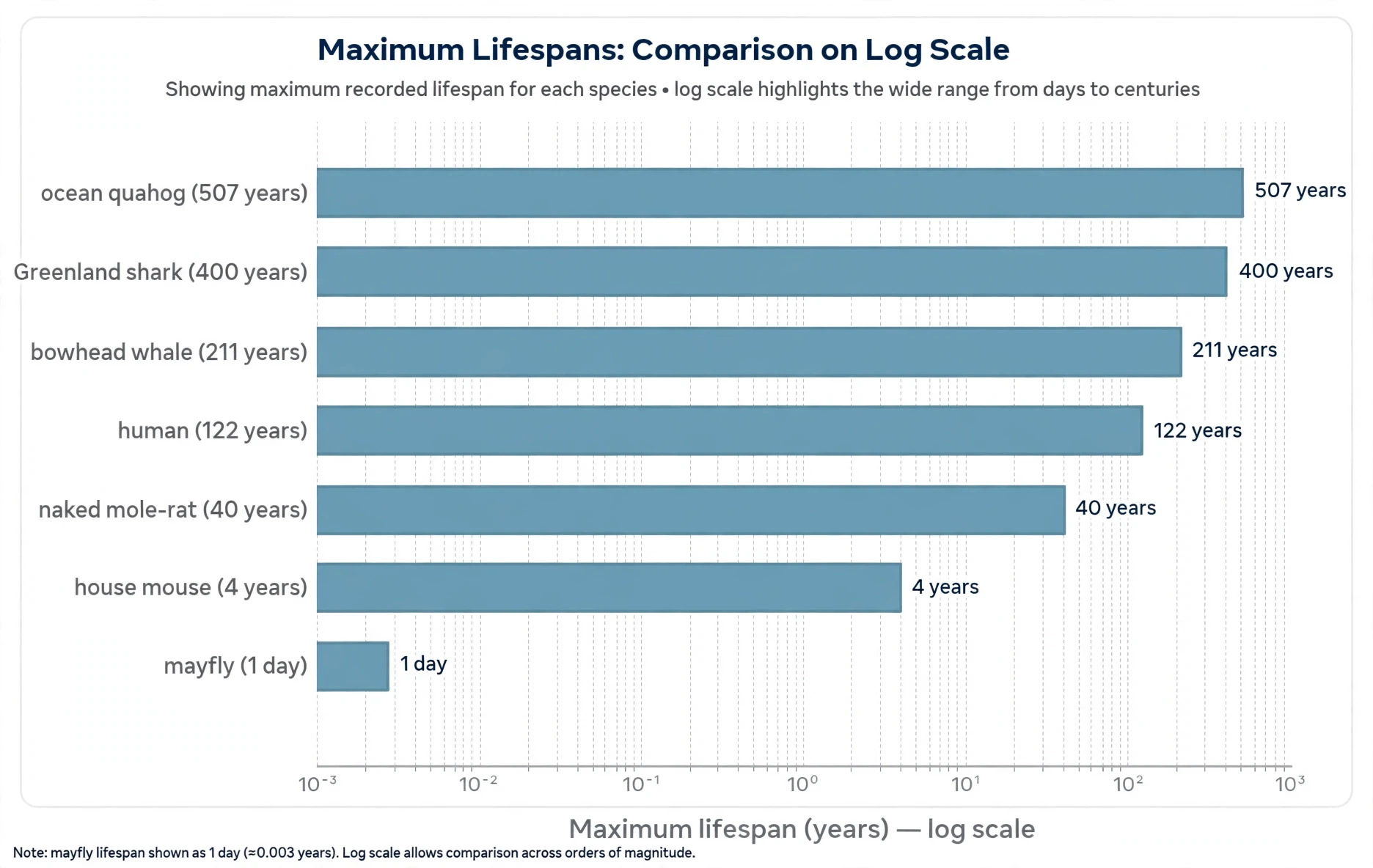
Why do we age on a schedule of decades when an adult mayfly gets roughly a single day and one clam lived 507 years? Lifespans span a wide range, and animals of similar size can live different lengths of time. The differences are not random. They follow from ecology, predation, and the evolutionary logic that shapes our aging.
12.1 A table that should not make sense
Look at the numbers side by side, and the pattern refuses to be simple — which is itself a clue to why do we age on the schedule we do.
Animal | Maximum lifespan | What stands out |
|---|---|---|
Mayfly | About 1 day (adult) | Adults do not even feed; they mate and die — after months or years as aquatic nymphs |
House mouse | 4 years | Small, heavily preyed upon, fast life |
Human | 122 years | Longest verified human lifespan, Jeanne Calment, who died in 1997 |
Naked mole-rat | 40 years | Mouse-sized, yet lives ten times longer than a mouse |
Brandt's bat | 40+ years | Weighs only 4–8 g and outlives a dog |
Bowhead whale | 211 years | Oldest estimated age; 19th-century harpoon tips found in carcasses |
Greenland shark | About 400 years | Slowest-growing, cold-water shark |
Ocean quahog | 507 years | One clam, found off Iceland in 2006 |
The naked mole-rat breaks every simple rule. Mouse-sized and living underground, it reaches 30 years or more in captivity — the longest-lived recorded individual reached 40 years — while a house mouse of the same size is old at two and dead by four. Its risk of dying does not rise with age, its mortality curve stays nearly flat, and it is strikingly resistant to cancer. If body size decided lifespan, the two would be twins, and the gap between them is one of the sharpest clues to why do we age at such different rates.
Brandt's bat is the other rule-breaker: at 4–8 grams it lives for 40 years or more. Small animals are supposed to live fast and die young, but this bat flies at night, sleeps in safe roosts by day, and dodges the predators that keep most small mammals on a short leash. Avoiding being eaten is one of the best ways to evolve a long life.
12.2 Size, predators, and the cost of being eaten
Body size matters, but only loosely. Big animals tend to live longer, usually explained by metabolism: a large body runs cooler and slower per gram, and its cells divide less often. But the exceptions are so large that size alone cannot explain them. The real driver is extrinsic mortality — the chance of being killed from outside, by predator, disease, or freeze. When it is high, evolution invests in breeding early and often, since there is no point building a body that lasts a century if a hawk eats it in its first year. When it is low, the payoff for a durable body rises, and selection favours repair and slow aging.
This is the selection shadow in ecological costume. A mouse lives among owls, cats, and foxes, its genes shaped by the near-certainty of an early death. A bowhead lives in cold Arctic water with almost no predators once fully grown, so a body that might survive two centuries is worth maintaining. The Greenland shark grows so slowly it may not breed for over a century, and the ocean quahog sits buried in cold sediment, barely moving, barely threatened.
12.3 Peto's paradox: why big animals do not all get cancer
A puzzle hides inside the whale row of the table. A bowhead has vastly more cells than a mouse, each dividing many times over a two-century life, so more cells and more divisions should mean more chances for a cancer-causing mutation. Yet whales die of cancer far less often than their cell count alone would predict. This is Peto's paradox, named after epidemiologist Richard Peto: large, long-lived animals must have evolved extra defences against cancer — though a large 2025 study of 263 species found cancer rates do rise with body size, just much less steeply than cell numbers alone would suggest.
The bowhead is a case in point. Research published in 2025 found its cells repair double-strand breaks in DNA unusually efficiently, helped by a protein called CIRBP. A double-strand break is among the most dangerous kinds of DNA damage, and repairing it well is a powerful anti-cancer defence. Evolving a long life is not just slowing down; it requires active investment in repair, solved differently by different species.
That insight loops back to our own story. When we ask why do we age, we are also asking why our species invested as much as it did in repair — and no more. Humans live far longer than other primates of our size, with unusually good DNA repair and long childhoods, but our investment has a ceiling: enough repair to raise children and grandchildren, not enough to last forever.
12.4 Negligible senescence and the animals that barely age
Some animals seem to have stepped outside the pattern altogether. The naked mole-rat's mortality risk barely rises with age, a pattern scientists call negligible senescence. It is not immortal, but the usual climb in death risk is nearly flat, and the ocean quahog and Greenland shark are often listed as showing something similar, though the flat-mortality evidence is strongest for the naked mole-rat.
These animals matter because they prove aging is not a law of nature, and they change how we think about why do we age. It is a trait, shaped by evolution, and it can be shaped differently: a mouse ages fast because its ancestors lived fast, a mole-rat slowly because its ancestors lived in safe burrows where a durable body paid off. If evolution can produce a mouse-sized mammal that lives for 40 years, the pace of aging is flexible in a way that should make us curious rather than resigned.
To place these animals in the wider tree of life, our guide to animal classification lays out the groups they belong to: the mole-rat is a rodent, the bat is not, and the quahog is a mollusc.
13. The Grandmother Hypothesis and Menopause
Why do we age past the point where we can have children — and why do women stop having children decades before they die? Other mammals keep reproducing until near the end of life. Human women stop in their forties or early fifties, then live for decades more. That post-reproductive life is rare, costly, and useful, because evolution kept it.
13.1 The puzzle of the long post-reproductive life
The numbers make the puzzle sharp. Among the Hadza of Tanzania and the !Kung of southern Africa, women spend close to half of their adult lives after their last birth — years that produce no direct offspring. Under a narrow view of natural selection, those years look wasted: a gene that kept a woman fertile longer should have spread. That it did not suggests those post-reproductive years were doing something valuable for the genes of the women who lived them.
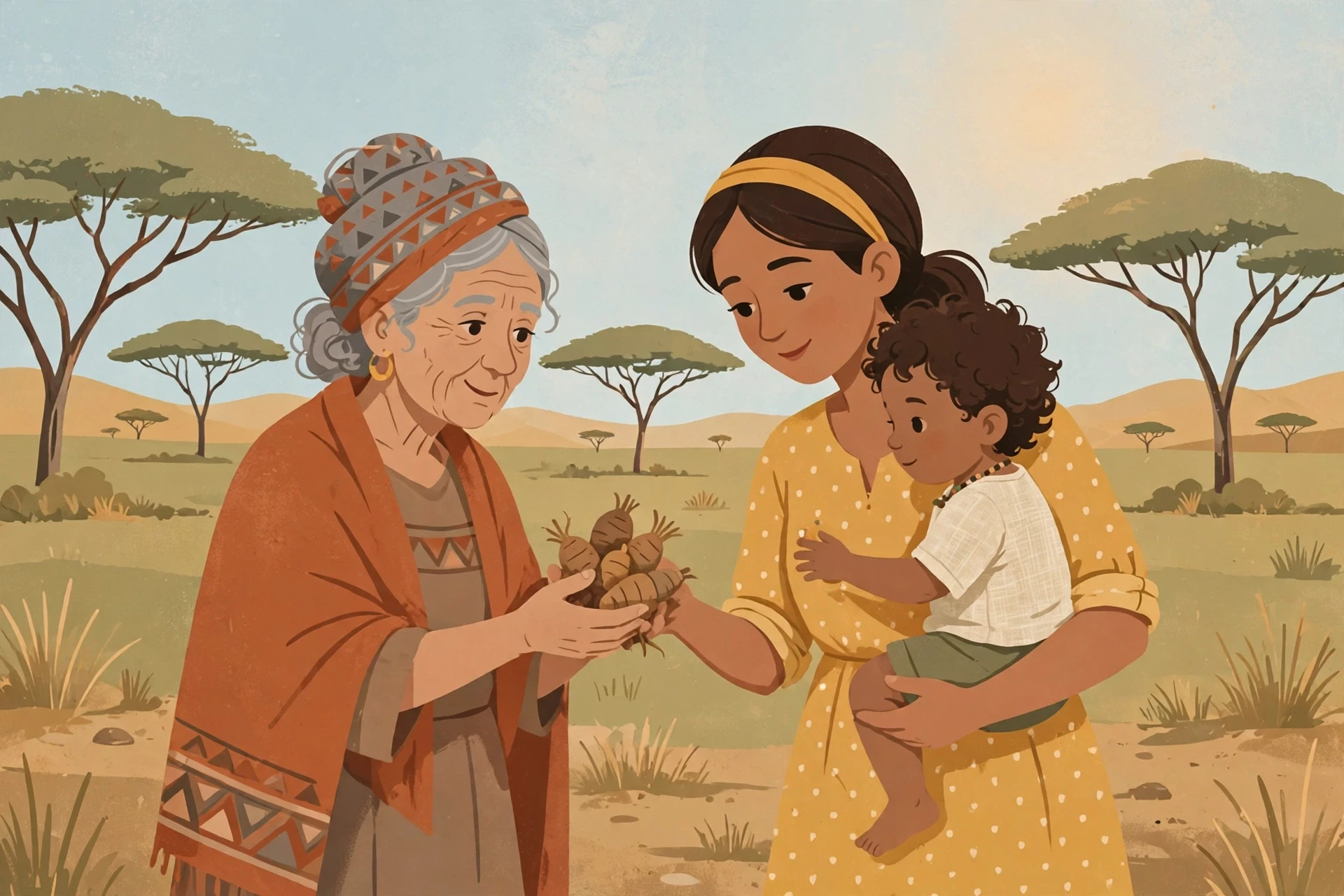
Kristen Hawkes and her colleagues put the leading explanation into print in 1998: grandmothers help. A woman who stops having children of her own can feed, carry, and care for her grandchildren, letting her daughter have the next baby sooner and raise it more successfully. Her genes reach the next generation through her grandchildren, and that help is worth more, in evolutionary terms, than another baby of her own — especially since childbirth grows riskier with age. That is the grandmother hypothesis, and it reframes why do we age the way we do: aging is not only about one body declining, but about the family it belongs to.
13.2 What the fieldwork and the records show
The hypothesis was built on observation before theory. Among the Hadza, older women are the most productive foragers of hard-to-get foods, digging tubers younger women and children cannot reach. A grandmother's digging feeds her daughter's children, and children in families with a living, helping grandmother survive better. The !Kung show a similar pattern: the post-reproductive years are working years, spent on the next generation. That help is a direct answer to why do we age past our fertile years.
Historical records point the same way. Lahdenperä and colleagues, studying Finnish and Canadian parish records in 2004, found that women who lived longer after menopause had more grandchildren, who survived better and in greater numbers. Later work added a limit: Chapman and colleagues, in 2019, found the benefit had a ceiling, with maternal grandmothers aged about 50 to 75 giving the biggest boost and the advantage fading beyond that. Help has a window: a grandmother in her sixties can dig tubers and carry a child, but one in her nineties usually cannot.
The pattern is not unique to humans, though it is rare. Killer whales also have menopause, and older females lead their pods to food in lean years. In 2023, researchers reported evidence of menopause in wild Ngogo chimpanzees too — complicating the old claim that humans are the only primates with a long post-reproductive life, though the Ngogo span looks shorter than ours.
13.3 The rivals: the mother hypothesis and reproductive conflict
The grandmother hypothesis leads, but its rivals deserve a fair hearing. The mother hypothesis argues that menopause evolved not to help grandchildren but to protect existing children. Childbirth is dangerous, and the risk rises steeply with age; a woman who keeps having babies into her fifties risks dying in childbirth and leaving younger children motherless. Stopping while she is still healthy enough to raise the children she has could be the safer strategy, favoured by selection even without any help to grandchildren.
A third idea, put forward by Cant and Johnstone in 2008, focuses on conflict rather than cooperation. Where generations overlap in one household, an older woman and a younger woman breeding at the same time compete for the same food and effort. Reproductive conflict theory suggests menopause resolves that competition: the older woman steps aside, and the younger woman breeds.
These ideas are not mutually exclusive: a grandmother can protect her existing children, avoid competing with her daughter, and help her grandchildren, all at once. The debate is about which force mattered most. What the rivals share is the same logic — menopause is not a breakdown but a trait selection shaped, and the post-reproductive decades it creates are part of why do we age on the schedule we do.
The grandmother hypothesis asks us to see aging differently: a long life after reproduction is not a spare part left over when evolution stopped caring. It is a feature, built by the help that older women gave to the children of their children.
13.4 What menopause tells us about why do we age
Menopause carries a broader lesson. Aging is usually discussed as if it happened to a solitary body, but human aging happens inside families: we evolved as cooperative breeders, with grandmothers, aunts, and older siblings all helping to raise children. A life history with decades of post-reproductive help only makes sense where help matters — and there, the aging body's later years have a job. That job has limits, as Chapman and colleagues showed: the grandmother effect fades after about 75, and the body keeps declining. Evolution invested in a long, useful old age, not an endless one.
14. Why Women Live Longer Than Men
Why do we age differently depending on whether we are born female or male? Women outlive men in almost every country on record. The gap is not a modern invention, and it is not small. It has persisted even as medicine and nutrition transformed the length of life for both sexes. Understanding the gap means untangling biology from behaviour.
14.1 The size and shape of the gap
The female advantage is one of the most consistent findings in human demography: women live longer than men in nearly every population studied, at almost every age from infancy to old age. Worldwide, the gap is about five years: women live to 76.4 years on average, men to 71.2 (UN World Population Prospects 2024). It is not a single cause but a pattern — men die more often from accidents, violence, and heart disease at younger ages, and women survive longer into old age even when disease strikes.
Part of the gap is behaviour, the easiest part to see. Men have historically smoked more, drunk more heavily, driven more dangerously, and worked in more hazardous jobs. Those differences explain a real share of the gap, and where women's smoking caught up with men's, the gap narrowed — a reminder that the difference is not fixed by biology alone.
But behaviour does not explain everything. The gap exists even in infancy, before behaviour can play a role, and it persists where men and women live similar lives. Something biological is going on as well, and it is part of why do we age differently.
14.2 The biology: hormones, hearts, and repair
One candidate is hormones. Estrogen appears to protect blood vessels and influence cholesterol handling, and women develop heart disease later than men. Testosterone, by contrast, has been linked to riskier physiology and a weaker immune response. But the female advantage survives menopause, long after estrogen falls, so hormones alone cannot carry the explanation.
Another candidate is the immune system. Women mount stronger immune responses than men on average, which helps them survive infections — but it has a cost, in higher rates of autoimmune disease. The difference is real, yet it cuts both ways, and how much of the gap it explains is unclear.
A third candidate is the rate of aging itself: some researchers argue that male bodies simply age faster. The evidence is suggestive rather than settled, and it is tangled with behaviour, since heavy drinking and smoking also accelerate aging, and men have done more of both.
For the evolutionary background — how sexual selection and the different reproductive costs of the two sexes shape bodies over deep time — see our account of human evolution, and natural selection explains why traits that help early in life can persist even when they cost years later.
14.3 Two hypotheses, clearly labelled
Two genetic hypotheses are often raised to explain the gap, and both must be labelled exactly as what they are: hypotheses, not facts. Neither has been proven, and both are active areas of research. Both try to answer part of why do we age differently as men and women.
The first is the unguarded-X hypothesis. Females carry two X chromosomes; males carry one X and one Y. If a harmful recessive mutation sits on the X, a female has a second copy to compensate, while a male has no backup — an asymmetry that could leave males more exposed over a lifetime. The idea fits a striking cross-species pattern: in birds, males carry two copies of their sex chromosome, and male birds tend to live longer. That pattern is consistent with the hypothesis, but it is still circumstantial — and quantitative models suggest the effect is only a few percent, too small on its own to explain the human gap.
The second is the mother's-curse hypothesis. Mitochondria — the cell's energy factories — are inherited only from the mother, so selection can only screen mitochondrial mutations through females. A mutation that harms males but leaves females untouched can slip through, because selection never sees it in a male body. Over generations, such mutations could accumulate, leaving males with mitochondria that work slightly worse for them. This too is a hypothesis: a logical consequence of how inheritance works, with some support from fruit flies, but not established as a cause of the human lifespan gap.
Both hypotheses share a lesson: the evolutionary theory of aging reaches into questions that look like simple matters of lifestyle. The gap is not only about who smokes or drives fast; it may also be about the deep structure of inheritance — chromosomes and mitochondria shaped long before anyone lit a cigarette.
14.4 What the gap does and does not mean
It is worth stating what the female advantage does not mean. It does not mean individual women will always outlive individual men; many men live long lives, and many women die young. It does not mean men are badly designed; male and female bodies are different solutions to the same reproductive problem. And it does not mean the gap is destiny — behaviour has narrowed it in some countries, showing that a meaningful part of it can change.
What the gap does mean is that aging is not one uniform process running the same way in every body. It runs differently in male and female bodies, for reasons mixing hormones, immunity, behaviour, chromosomes, and the deep history of how the two sexes evolved. When we ask why do we age, the full answer must include that variation: we age because evolution selected for reproduction, not long life, and we age at different speeds because the selection shadow falls differently on different bodies — on the small and the large, on the prey and the predator, on women and on men. The wonder is not that we age differently. It is that, given how little evolution cared about old age, so many of us get so many good years at all.
15. Can Aging Be Slowed?
Nothing yet proven slows human aging, and that is the honest starting point for asking why do we age and whether the process can be bent at all. Animal studies offer real leads — eating less, dialling down a growth pathway, moving more — yet every lead comes with trade-offs, and none has produced a longer human life.
Two claims must be kept apart: changing a biomarker or a mouse lifespan, and slowing aging in a person. The first has real evidence; the second does not — not for any diet, drug, or supplement. This article is the evolutionary theory of why do we age, not health advice; for practical guidance, see our companion piece on longevity and healthy aging.
15.1 Caloric restriction: the oldest lead in the field
The longest-running lead in aging research is also the simplest to describe and the hardest to live with: eat less, live longer. In 1935, Clive McCay and his colleagues at Cornell reported that rats kept on a restricted diet lived substantially longer than rats fed freely — the first clean demonstration that lifespan was not fixed. The finding has held up in mice, where restriction extended mean and maximum lifespan (Weindruch et al., 1986). Scarcity shifts investment from growth toward repair, as a review of the disposable soma and dietary restriction literature explains. The CALERIE trial randomized 218 healthy, non-obese adults aged 21 to 50 to either a 25% calorie reduction or normal eating for two years. Volunteers achieved only about 12% restriction on average, roughly half the target. Even at that dose, risk factors improved, and a later analysis found the pace of biological aging (DunedinPACE) slowed by 2 to 3%, while PhenoAge and GrimAge did not move. The study lasted two years and measured biomarkers, not lifespan — so anyone selling a fasting plan as a proven way to slow human aging is selling past the evidence.
15.2 Rapamycin and mTOR: turning down the growth signal
If caloric restriction works partly by quieting nutrient sensing, then a drug that quiets the same pathway directly should do something similar — and in mice, it does. Rapamycin blocks mTOR, a central switch that tells cells to grow and divide when nutrients are plentiful. In 2009, David Harrison and colleagues at three laboratories fed rapamycin to mice starting at 600 days of age — late in a mouse life. It extended median and maximum lifespan in both sexes — 14% longer survival in females and 9% in males at the age when 90% had died. And yet rapamycin is also the clearest example of why a mouse result is not a human prescription. In people, rapamycin is an immunosuppressant, used to stop transplanted organs from being rejected. In people it suppresses the immune system, and no evidence shows it extends human life or healthspan. The mTOR story tells us something genuine about why do we age — growth pathways tuned for youth keep running in old age, and turning them down helps mice — but it does not hand us a pill.
15.3 Insulin and IGF-1: the worm that doubled its life
The most startling single result in aging biology came from a worm barely a millimetre long. In the 1990s, Cynthia Kenyon and her laboratory found that mutating a single gene in the roundworm Caenorhabditis elegans — a gene called daf-2, part of the insulin and IGF-1 signalling pathway — doubled the worm's lifespan. One gene, one pathway, twice the life. The same pathway exists in flies, mice, and people, and dialling it down extends lifespan in flies and mice. In people, variants in the pathway are associated with exceptional longevity, but no intervention touching it has been shown to extend human lifespan. It also broke a piece of the old trade-off story: longer life did not always cost fertility, so the disposable soma trade-off is now described as real but not inevitable. But people are not worms with one switch, and no trial has shown that any drug touching this pathway slows human aging. What Kenyon's worms gave us is proof of principle: aging is regulated, and it can be changed — a different kind of answer to why do we age.
15.4 Exercise: the intervention with the best human evidence
If I had to pick one intervention with the strongest human evidence, it would not be a drug or a diet. It would be movement. I learned this the unglamorous way: after years of desk-bound writing, morning walks improved my sleep, mood, and stamina within weeks. Regular activity is associated with lower rates of heart disease, diabetes, several cancers, dementia, and depression, and with longer life. It improves muscle, bone, and blood vessels, and touches the hallmarks directly. Exercise does not stop aging, and it would be dishonest to pretend otherwise. If the evolutionary view of why do we age teaches anything practical, it is this: the body was built to move, and a body that moves keeps its repair systems switched on longer.
15.5 The honest limits: what nobody has proven
Nothing — no diet, no drug, no supplement, no clinic protocol — has been proven to slow aging in humans or extend human lifespan. Not one. The animal evidence is real, the human biomarker evidence is thin, and human lifespan evidence does not exist. When someone tells you they have solved why do we age and now sell the solution, ask for the human trial with a lifespan or disease outcome. If they cannot show it, they are selling a story, not a result.
15.6 The evidence at a glance
Intervention | What it did in animals | What is proven in humans |
|---|---|---|
Caloric restriction | Extended lifespan in rats (McCay, 1935) and in mice on substantial restriction | Two years in the CALERIE trial slowed the DunedinPACE clock by 2 to 3 percent; no proven lifespan effect |
Rapamycin | Extended survival by 14 percent in female and 9 percent in male mice at 90 percent mortality (Harrison, 2009) | No human lifespan data |
Senolytics (dasatinib plus quercetin) | Improved function and extended remaining lifespan in old mice (Xu, 2018) | Small pilots (9 and 14 patients) showed biomarker and walking-test changes only |
Insulin and IGF-1 signalling | A single daf-2 mutation doubled lifespan in the worm C. elegans (Kenyon) | No proven human intervention |
Exercise | Improves health and function across species | The best human evidence for healthspan, but no proven lifespan extension |
16. Epigenetic Clocks: Measuring Biological Age
Biological age can now be estimated from chemical marks on DNA, and the best clocks guess a person's age within a few years. These epigenetic clocks track aging more closely than the calendar does, yet they disagree with each other, wobble on repeat tests, and have never been shown to guide a treatment that adds healthy years.
The idea behind them is simple. As we age, small chemical tags called methyl groups attach to, or fall off, specific spots on our DNA — CpG sites, places where a cytosine sits next to a guanine. The pattern of those tags changes steadily with age. The marks do not change the DNA sequence itself; they change how genes are read, which is the subject of epigenetics. They record what life has done to the genome — which is why they promise a new way to measure why do we age in the body rather than on the calendar.
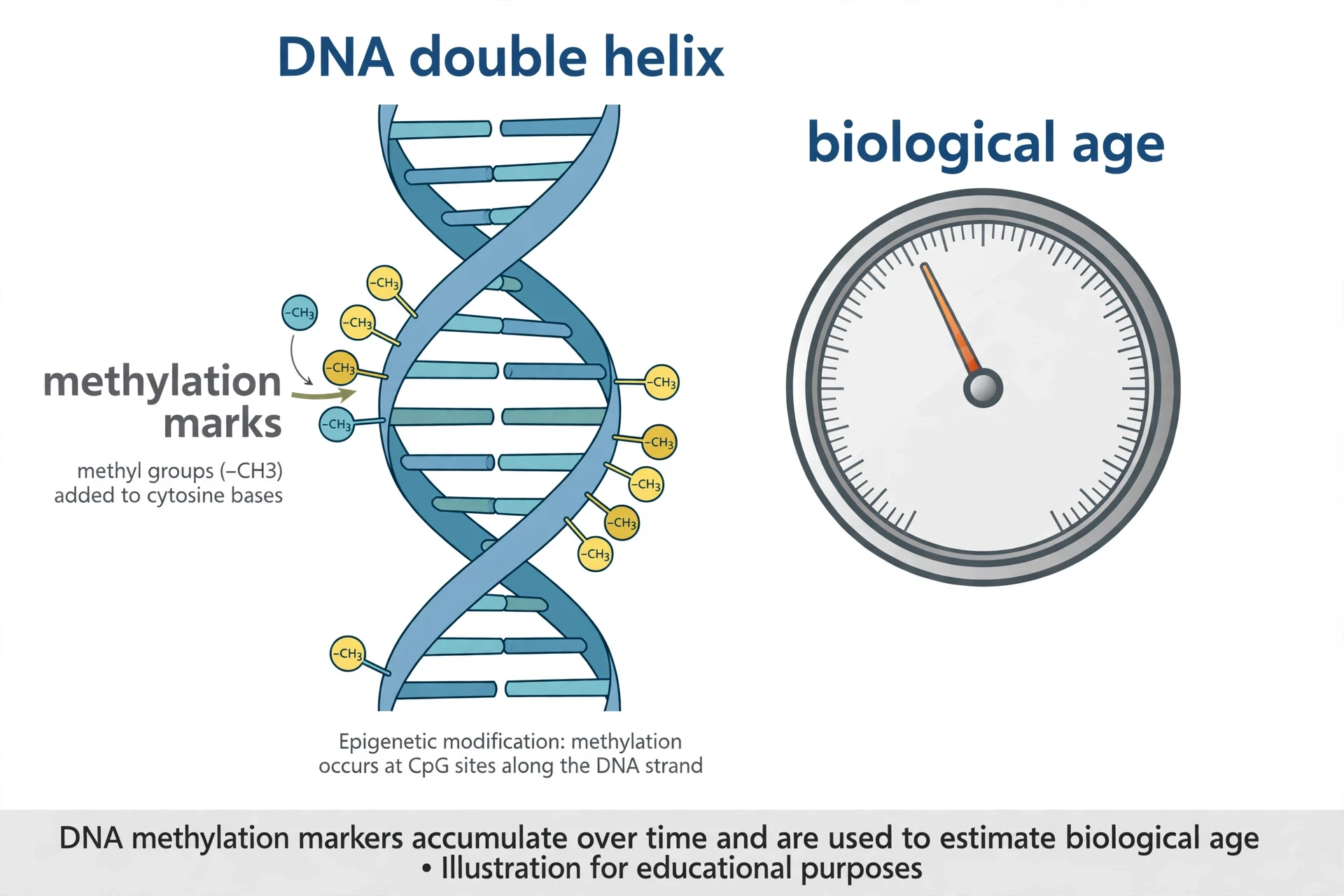
16.1 The Horvath clock: 353 sites, 51 tissues
The clock that started the field came from Steve Horvath, a biostatistician at the University of California, Los Angeles, who published it in 2013. Horvath trained his algorithm on about 8,000 samples from 51 tissues and cell types, and found just 353 CpG sites were enough. It was startlingly accurate: correlation 0.96 with chronological age, median error 3.6 years. More interesting was what the clock got wrong: cancer tissue looked decades older than its owner, and embryonic stem cells scored close to zero. Horvath suggested it measured an epigenetic maintenance system slowly losing its grip.
16.2 Second and third generations: PhenoAge, GrimAge, and DunedinPACE
Horvath's clock was trained to predict calendar age — a strange target, since being right about a birthday says nothing about health. The next generation changed the target to sickness and death, and the answers got much more useful. PhenoAge (Levine, 2018; 513 CpG sites) was trained on clinical measures; GrimAge (Lu, 2019) combined methylation estimates of seven plasma proteins and smoking history, and was trained directly on time to death. DunedinPACE (Belsky, 2022) changed the question again: not an age, but a rate — how fast is this person aging right now? The team built it from two decades of data on 19 biomarkers of organ health, tracked in the Dunedin birth cohort in New Zealand at ages 26, 32, 38, and 45, then distilled that pace into a single blood test. Think of it as a speedometer rather than an odometer.
16.3 The noise problem: the same sample, nine years apart
Here is the part the companies selling biological-age tests rarely put on the front page. The clocks are noisy. A 2022 study led by Albert Higgins-Chen and Morgan Levine at Yale found that early versions of the clocks could give results up to 9 years apart when the same blood sample was tested twice. Newer methods have cut that noise to about a year — most repeat measurements now agree within roughly a year and a half — but the lesson stands: a single reading is a rough estimate, not a verdict. The clocks also disagree with each other, because they measure different things — calendar age, disease risk, pace of change. For research they are genuinely valuable: they let scientists test an intervention in two years instead of waiting twenty for disease. For an individual buying a test online, the value is far thinner: a number that swings by years on a retest, differs between clocks, and that no doctor can act on is a curiosity, not a health plan. I disagree with how these tests are often sold — as a personal aging score to track and optimize — because the science does not support that use yet. The clocks are a research tool that learned to talk; they are not yet a medical one. They track the pace of why do we age, but they do not explain it.
17. The 2026 Update: Aging in the Selection Shadow
A major 2026 review in Nature Reviews Genetics has reframed the oldest question in this article for the modern world. The selection shadow still explains why do we age, the authors argue, but it now operates under conditions evolution never prepared us for: most of us survive into old age, and fewer of us have children.
The review is "Evolutionary genetics of ageing," by Handan Melike Dönertaş of the Leibniz Institute on Aging — Fritz Lipmann Institute (FLI) in Jena, Germany, and Linda Partridge of University College London, published in Nature Reviews Genetics on 11 May 2026. It brings together evolutionary theory, comparative genomics, and large-scale human genetics.
17.1 What the review adds: the shadow under modern conditions
Natural selection weakens progressively through adulthood, so late-acting harmful mutations are barely removed and can build up, while youth-tuned pathways keep running in old age and cause damage. That is the selection shadow at the heart of why do we age, and the review treats it as the foundation of the modern evolutionary theory of aging — a framing laid out in the review on the evolutionary genetics of ageing that this synthesis now extends. What is new is the emphasis on change: we now routinely survive to advanced ages, living with youth-optimized biology's late-life consequences on an unprecedented scale. The review also makes a careful point about what longer life does — and does not do — to selection itself. Longer survival extends selection's reach into later life, the authors note, but fewer births lower its overall strength. That means old age is not now under selection the way youth once was. The shadow has shifted its shape, but it has not lifted. That is why the question of why do we age still has the same answer in 2026, even though the world in which we ask it has changed completely.
17.2 Genes, genomes, and the human data
The second strand of the review is the evidence that was unavailable to Medawar, Williams, and Kirkwood: comparative genomics across species and large-scale human genetics. By comparing long-lived and short-lived species, researchers can now see which genes and pathways evolution tuned differently — the comparison that made the naked mole-rat and bowhead whale famous, now done systematically across genomes. In humans, large genetic studies can test whether the late-acting harmful variants the theory predicts are really in our DNA. This is where the review's framing genuinely advances the field. The old theories were built from logic and a handful of experiments; the new synthesis tests them against genomes. The pathways that matter are the ones this article has already met: nutrient sensing, DNA repair, inflammation, and the growth signals that help the young and harm the old. Tools like CRISPR gene editing let researchers switch individual genes on and off, turning a genomic clue into a causal claim about why do we age.
17.3 What is still open
For all its synthesis, the review leaves the biggest questions open, and it is honest about that. Nobody yet knows how much of human aging is driven by late-acting mutations, how much by youth-optimized pathways, and how much by environment. The relative weight of mutation accumulation against antagonistic pleiotropy is still an open contest. The review also points forward: large-scale human genetics and multi-omics biomarkers are changing the field, and evolutionary insight should guide strategies to improve healthspan. The 2026 update does not change the answer to why do we age. It changes the confidence with which we can give it, and sets the questions for the next decade.
The selection shadow is not a flaw in evolution. It is what evolution looks like when it stops watching — and in 2026, for the first time, we can watch it happening in our own genomes.
18. Five Myths About Aging
Five myths about aging survive because each one contains a grain of truth wrapped around a false conclusion. They are worth taking apart one by one, because each wrong idea about why do we age points to a wrong idea about what, if anything, we can do about it.
18.1 Myth 1: Aging is programmed
The most persistent myth is that aging is programmed — that evolution built a self-destruct timer into us, and that death is the plan. The grain of truth is that lifespan is heritable. The false conclusion is that a programme exists whose purpose is to kill us. What the evidence shows is the opposite. Evolution did not programme aging; it failed to prevent it. The selection shadow means there was never strong selection against late-acting damage, so damage accumulated by neglect, not by design. No death programme has been found in humans or other mammals so far.
18.2 Myth 2: Aging is a disease
The second myth is that aging is a disease — a single condition with a cause and, by implication, a cure. The grain of truth is that aging is the largest risk factor for nearly every disease of old age. The false conclusion is that aging itself is one disease, and that treating it would be like treating an infection. Aging is not one thing going wrong. It is twelve hallmarks going wrong at once, in different tissues, at different rates. Calling that a disease stretches the word past usefulness: it invites a search for a single drug, when the reality is a network of processes needing many interventions aimed at the shared drivers — nutrient sensing, inflammation, senescent cells. Aging raises the risk of disease. That does not make it a disease.
18.3 Myth 3: The body is a machine that wears out
The wear-and-tear myth pictures the body as a machine with a fixed number of miles in it: parts wear down, the machine breaks, and nothing can be done except gentle use. The grain of truth is that damage does accumulate — DNA breaks, proteins misfold, mitochondria falter. The false conclusion is that the body is passive, a clockwork toy running down. The disposable soma theory says the same: the body is a repair budget set to last through the reproductive years, not forever. Wear-and-tear thinking also fails the comparative test: birds burn energy at extraordinary rates yet live far longer than similar-sized mammals. The body wears because its repair was never funded for the long term — and that is a fact about why do we age, not a metaphor about machines.
18.4 Myth 4: Anti-aging supplements work
The supplement myth is the most expensive of the five. The grain of truth is that a few compounds show real effects in animals. The false conclusion is that the bottle on the shelf contains one of those effects. It does not. No supplement has yet been shown in a randomized human trial to slow aging, extend lifespan, or reduce aging-related disease. A supplement that changed your epigenetic clock score would be changing a biomarker, not your aging. The science is moving — senolytics cleared senescent cells in small human pilot studies — but the distance between a pilot study and a pill you can buy is the distance between a lead and a proof. Until a supplement clears a proper human trial, the only thing it reliably extends is the seller's revenue.
18.5 Myth 5: Living to 150 is around the corner
The final myth is the boldest: that science is about to extend human life to 150, or abolish aging altogether, and that the only question is whether you will be alive to benefit. The grain of truth is that lifespans have risen enormously and animal lifespans can be extended in the laboratory. The false conclusion is that the same leap is imminent for people. It is not. The longest verified human life, Jeanne Calment's 122 years, dates to 1997. The animal extensions come from short-lived species where one pathway change can double a two-year life; doubling a human life would mean rewriting dozens of pathways, in a body with a century of damage and a cancer risk that rises with every extra cell division. That does not make longer lives impossible — the 2026 review argues the field should aim at healthspan — but it makes 150 a fantasy, not a forecast. The serious version of the dream is smaller and better: more years lived well, not an escape from aging itself.
19. Why Aging Matters
The evolutionary view of aging changes nothing about the fact that we grow old — and it changes almost everything about what we do with that fact. Once you see why do we age as selection fading rather than a body failing, the questions shift from stopping aging to living well inside it.
That shift is practical before it is philosophical. It tells a doctor that an 80-year-old with heart disease suffers not from a single broken part but from a system whose repair budget ran out on schedule, and that prevention decades earlier matters more than rescue at the end. It tells a researcher that the best drug targets are the shared drivers — nutrient sensing, inflammation, senescent cells. And it tells the rest of us that the levers we control keep repair systems running a little longer.
19.1 What the evolutionary view changes about how we live
The first change is in expectations about why do we age. If aging were programmed, the rational response would be to wait for someone to switch the programme off. If aging is the shadow of selection, the rational response is different: protect the repair systems you have, avoid the damage you can avoid, and stop waiting for a breakthrough that rewrites the deal. The second change is in how we judge a life. A body that ages is not a body that failed. It is a body that did exactly what evolution asked of it: it grew, it reproduced, it raised the next generation, and then it kept going on maintenance that was never funded for the distance. We do not age because we are broken. We age because we were built for a job that ends, and we outlive the job.
19.2 What it changes about how we study and treat aging
The third change is in the science itself. The evolutionary theories explain why do we age, not how each mechanism works, and that division of labour is what makes the field productive: the theories tell researchers where to look, and the laboratory tells them what is there. The payoff, if it comes, will not look like the end of aging. It will look like smaller wins: a drug that clears senescent cells safely, a treatment that quiets chronic inflammation, a way to keep muscle and memory a few years longer. Each one repairs a system evolution left underfunded, not a reversal of the shadow itself. Asking why do we age forces us to see aging not as a curse or a mistake, but as the price of a reproductive strategy that worked — worked so well that we are here, living long enough to ask the question at all. The shadow is the cost of the light. Understanding it lets us walk through it with our eyes open.
Frequently Asked Questions
Seven questions readers ask most often about why do we age, answered directly first and then in a little more depth below. Each answer starts with the short version, so you can skim the question you care about and stop there.
How did aging evolve?
Aging evolved not because it helped anyone, but because natural selection grows weaker with age. Once an animal has reproduced, harmful mutations that act late in life face almost no selection against them, so they accumulate. At the same time, genes that help early in life are favoured even if they harm late in life. Aging is the side effect of a system tuned for youth and reproduction. That is the core of why do we age.
What is the selection shadow?
The selection shadow is the zone of late life where the force of natural selection has faded so far that it barely acts. Because most individuals in ancestral populations died young, few lived long enough for late-acting harmful mutations to matter, so selection never weeded them out.
What is antagonistic pleiotropy?
Antagonistic pleiotropy is when one gene has opposite effects at different ages: helpful early in life, harmful late in life. Because selection is strong in youth and weak in old age, the early benefit wins and the gene spreads, even though it causes disease later.
What is the disposable soma theory?
The disposable soma theory says the body is built to be thrown away. An organism has limited energy, and evolution spends it where it pays best: on reproduction and on keeping the germline — the cells that become the next generation — in good repair. The rest of the body, the soma, gets only enough maintenance to reach breeding age. Repair is expensive, so the body underinvests in it, damage accumulates, and aging follows.
Why do some animals live so much longer than us?
Animals live longer than us when evolution has given them a different bargain: lower extrinsic mortality, slower lives, or better repair. A naked mole-rat lives more than 30 years because it is safe underground and heavily cancer-resistant; a bowhead whale lives over 200 years, with the oldest estimated at 211; a Greenland shark lives about 400 years; one ocean quahog clam lived 507 years.
Can aging be slowed or reversed?
Aging can be slowed in animals, but it has not been slowed or reversed in humans in any proven way. Caloric restriction extended lifespan in rats and mice, rapamycin extended mouse lifespan by up to 14%, and a single-gene change doubled a worm's life — yet no diet, drug, or supplement has been shown to extend human lifespan. The CALERIE trial found that about 12% calorie restriction improved risk factors and slowed one epigenetic clock by 2 to 3%. Reversal has no human evidence at all, and that is the honest answer to why do we age and whether we can undo it.
Why do women live longer than men?
Women live longer than men in nearly every country, by several years on average, for a mix of biological and behavioural reasons. Biologically, women have two X chromosomes, which may buffer harmful recessive mutations, and oestrogen protects blood vessels before menopause; behaviourally, men have historically smoked more, drunk more, taken more risks, and sought medical care less often. The grandmother hypothesis adds a layer: grandmothers who helped feed grandchildren passed on more of their genes.
Sources
Every source below is a real publication or record, checked against the research outline or verified by a live web search before delivery. The 2023 hallmarks DOI was flagged for verification in the outline; it was confirmed to resolve via PubMed (PMID 36599349).
- Dönertaş HM, Partridge L. Evolutionary genetics of ageing. Nature Reviews Genetics (2026). DOI: 10.1038/s41576-026-00959-x - Dönertaş HM, Partridge L. Evolutionary genetics of ageing. Nature Reviews Genetics (2026) — article page - Leibniz Institute on Aging (FLI). Ageing in the selection shadow, 11 June 2026 - University College London. New review on the evolutionary genetics of ageing, 2026 - Phys.org. "Selection shadow" may explain why longer lives bring more age-related disease (2026) - Zwaan BJ. The evolutionary genetics of ageing and longevity. Heredity (1999). DOI: 10.1046/j.1365-2540.1999.00544.x - Nalam RL et al. Appetite for reproduction: dietary restriction, aging and the mammalian gonad. Journal of Biology (2008) - APOE antagonistic pleiotropy review (PMID 21423560) - Mortality laws and the Gompertz law. Biochemistry (Moscow) (2024) - Li S et al. Genetic insights from long-lived mammals: lessons for companion animal aging and health. Journal of Veterinary Science (2025) - López-Otín C et al. The hallmarks of aging. Cell (2013). DOI: 10.1016/j.cell.2013.05.039 - López-Otín C et al. Hallmarks of aging: An expanding universe. Cell (2023). DOI: 10.1016/j.cell.2022.11.001 — verified: resolves, PMID 36599349 - Zhu Y et al. The Achilles' heel of senescent cells. Aging Cell (2015). DOI: 10.1111/acel.12344 - Cam-CAN APOE antagonistic pleiotropy study. University of Oxford, Department of Psychiatry - Harrison DE et al. Rapamycin fed late in life extends lifespan in genetically heterogeneous mice. Nature (2009). DOI: 10.1038/nature08221 - Kraus WE et al. 2 years of calorie restriction and cardiometabolic risk (CALERIE). Lancet Diabetes Endocrinol (2019). DOI: 10.1016/S2213-8587(19)30151-2 - Waziry R et al. Effect of long-term caloric restriction on DNA methylation measures of biological aging (CALERIE). Nature Aging (2023), PMID 37118425 - Horvath S. DNA methylation age of human tissues and cell types. Genome Biology (2013), PMID 24138928 - Levine ME et al. An epigenetic biomarker of aging for lifespan and healthspan (PhenoAge). Aging (2018), PMID 29676998 - Lu AT et al. DNA methylation GrimAge strongly predicts lifespan and healthspan. Aging (2019). DOI: 10.18632/aging.101684 - Belsky DW et al. DunedinPACE, a DNA methylation biomarker of the pace of aging. eLife (2022). DOI: 10.7554/eLife.73420 - Medawar PB. An Unsolved Problem of Biology. London: H. K. Lewis, 1952. (Book — no online link; listed as a text-only entry.) - Tyner SD et al. p53 mutant mice that display early ageing-associated phenotypes. Nature 415:45–53 (2002). DOI: 10.1038/415045a - García-Cao I et al. "Super p53" mice exhibit enhanced DNA damage response, are tumor resistant and age normally. EMBO J 21(22):6225–6235 (2002). DOI: 10.1093/emboj/cdf595 - Trumble BC et al. Apolipoprotein-ε4 is associated with higher fecundity in a natural fertility population. Sci Adv 9(32):eade9797 (2023). DOI: 10.1126/sciadv.ade9797 - Partridge L, Fowler K. Direct and correlated responses to selection on age at reproduction in Drosophila melanogaster. Evolution 46(1):76–91 (1992). DOI: 10.1111/j.1558-5646.1992.tb01986.x - Leroi AM, Chippindale AK, Rose MR. Long-term laboratory evolution of a genetic life-history trade-off in Drosophila melanogaster. 1. The role of genotype-by-environment interaction. Evolution 48(4):1244–1257 (1994). DOI: 10.1111/j.1558-5646.1994.tb05309.x - Ruby JG, Smith M, Buffenstein R. Five years later, with double the demographic data, naked mole-rat mortality rates continue to defy Gompertzian laws by not increasing with age. GeroScience 46:5321–5341 (2024). DOI: 10.1007/s11357-024-01201-4 - Butler G et al. No evidence for Peto's paradox in terrestrial vertebrates. Proc Natl Acad Sci USA 122(9) (2025). DOI: 10.1073/pnas.2422861122 - Nambiar AM et al. Senolytics dasatinib and quercetin in idiopathic pulmonary fibrosis: results of a phase I, single-blind, single-center, randomized, placebo-controlled pilot trial on feasibility and tolerability. eBioMedicine 90:104481 (2023). DOI: 10.1016/j.ebiom.2023.104481 - Corrigendum to Hickson et al. (2019), senolytics dasatinib and quercetin in diabetic kidney disease. eBioMedicine (2020). DOI: 10.1016/j.ebiom.2019.12.004 United Nations, Department of Economic and Social Affairs, Population Division. World Population Prospects 2024. Life expectancy at birth: women 76.4 years, men 71.2 years.