
1. The Mountain That Held a Sea
In late August 1909, 59-year-old Charles Doolittle Walcott was prospecting on horseback with his family on the ridge between Mount Field and Mount Wapta when a loose block he split open revealed the first soft-bodied animals of the Cambrian explosion. (In one retelling, it was his wife Helena's horse stumbling that drew his eye to the shale.)
The slab was black shale, and it was crowded with animals — soft-bodied creatures with legs, eyes, antennae and spines, preserved in extraordinary detail, from a sea that had vanished more than 500 million years earlier. Walcott was standing on a mountain. The animals in the rock had lived at the bottom of an ocean.
That mountainside, Fossil Ridge in what is now Yoho National Park in British Columbia, became the Burgess Shale — and the Burgess Shale became one of the most famous fossil deposits on Earth. It is the place where the Cambrian world stops being an abstraction and becomes something you can hold in your hand: a slab of rock the size of a dinner plate, crowded with animals that look as if they were drawn by someone who had never seen an animal before.
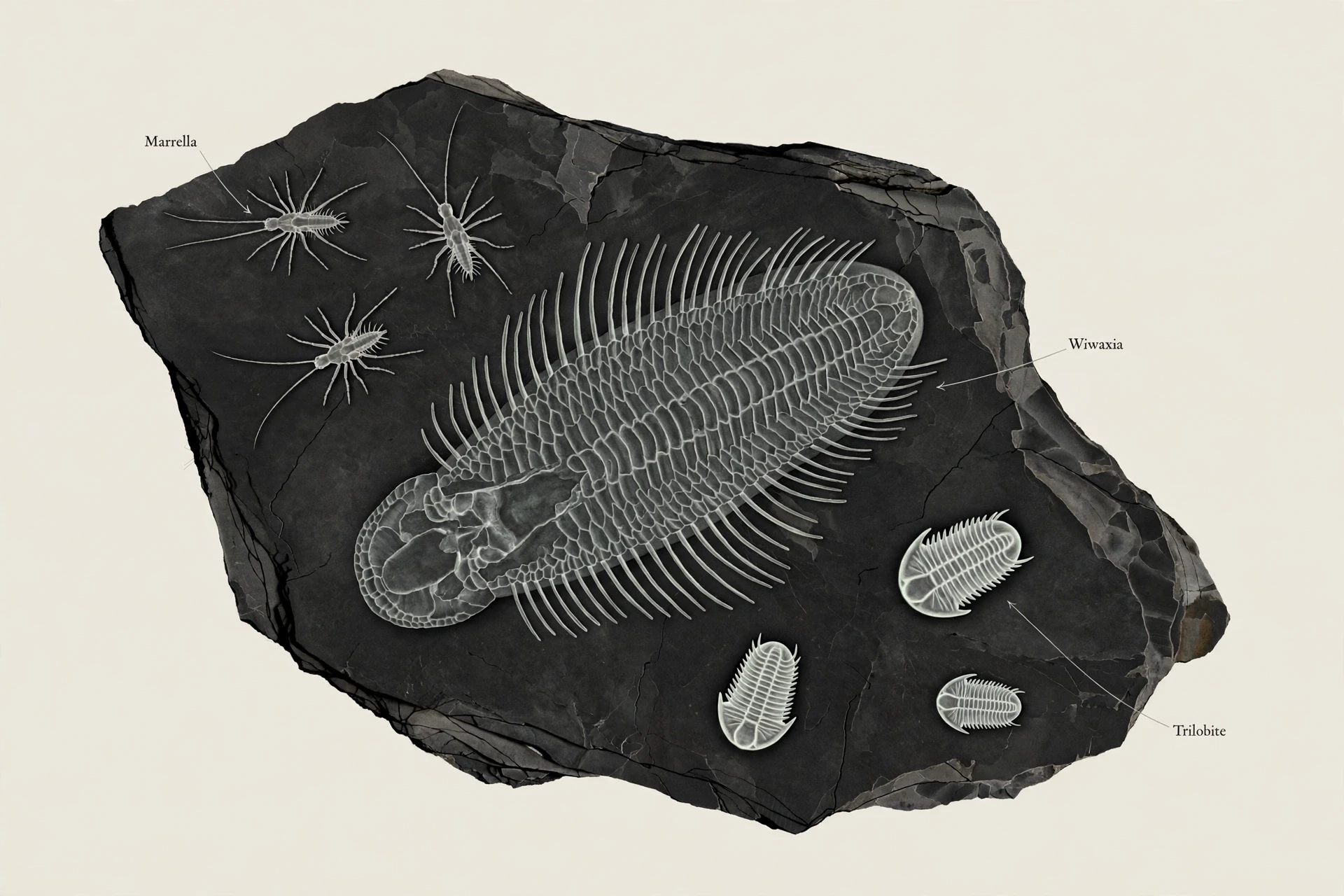
I first met the Burgess Shale the way most people do — not on a mountainside, but in a museum, staring at a slab under glass. The animal that stopped me was Marrella, a small arthropod with a spiny head shield and a body like a lace fan. There were dozens of them on that one slab, crowded together, and the rock had simply kept them. I remember thinking that this was not what fossils were supposed to look like. Fossils, in my schoolbooks, were shells and bones and teeth — the hard bits. These were whole animals, soft parts and all, from half a billion years ago. Something extraordinary — the Cambrian explosion — had happened in the Cambrian seas, and this slab was the evidence.
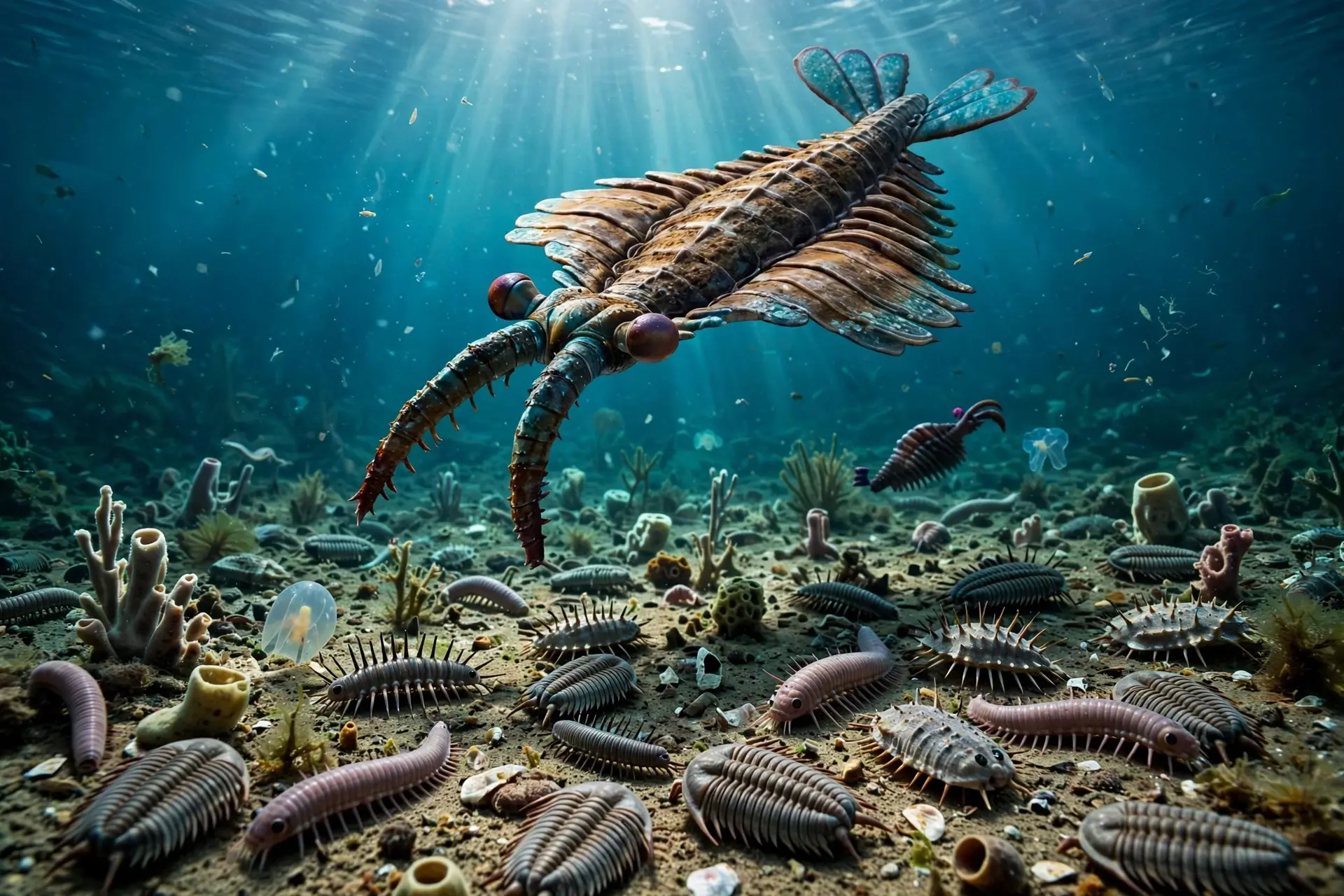
That something is the subject of this article. About 541 million years ago, at the start of the Cambrian period, animal life changed gear — the Cambrian explosion had begun. For hundreds of millions of years before, the oceans had been inhabited mainly by single cells, soft blobs and simple fronds. Then, in a geological blink — somewhere between 13 and 25 million years, a short interval by the standards of deep time — most of the great animal body plans appeared: arthropods, molluscs, worms, sponges, jellyfish relatives, and the chordates, the group that includes every vertebrate alive today, ourselves included. Shells, claws, legs, eyes and teeth all spread rapidly at roughly the same time, as if evolution had suddenly found a new gear.
The Cambrian explosion is one of the most argued-over events in the history of life, and for good reason. It troubled Charles Darwin himself, who called the sudden appearance of complex animals in the oldest fossil rocks one of the gravest difficulties for his theory. It still troubles scientists today — not because evolution is in doubt, but because the Cambrian explosion raises a sharp question: what changed? What turned a quiet world of soft-bodied drifters into a crowded sea full of hunters, grazers, burrowers and armoured crawlers, in such a short time?
This article follows that question from the mountainside in Canada to the fossil beds of China, from the first burrows in the mud to the first eyes, and from Darwin's worry to the newest discoveries — including fossils found in 2026 that are already rewriting the timeline, from the four-eyed fish of section 10 to the Jiangchuan biota of section 15, the Huayuan biota of section 16, and the new bryozoans of section 19. Along the way we will meet the weirdest animals that ever lived, the first predators, the first fish, and the small worm-like creature that is, very distantly, one of our own ancestors.
2. What the Cambrian Explosion Actually Was
The Cambrian explosion was the geologically rapid diversification of animal life near the beginning of the Cambrian period, about 541 million years ago, when most major animal body plans first appeared in the fossil record. It was not an explosion in the everyday sense — nothing blew up.
It was a burst of evolutionary innovation, compressed into a short interval of geological time.
How long did it last?
That definition needs unpacking, because almost every word in it is argued about. Start with the date. The Cambrian period began about 541 million years ago according to the figure most textbooks and popular sources still use — though the International Commission on Stratigraphy revised the formal boundary to 538.8 million years ago in 2022, so you will see both numbers. The difference is small on a scale of half a billion years, and it does not change the story. What matters is what happened next: over the following few tens of millions of years, the fossil record fills with animals that had never appeared before — animals with shells, jointed legs, compound eyes, claws and teeth.
The second word to unpack is "explosion". It is a metaphor, and like all metaphors it can mislead. Nothing in the Cambrian happened overnight. The main burst of diversification lasted somewhere between 13 and 25 million years, according to the most commonly cited estimates; Encyclopaedia Britannica places the event itself at about 541 to 530 million years ago. Thirteen million years is a long time by any human standard. It is only an "explosion" when you set it against the 3.5 billion years of life that came before it, most of which produced nothing more complicated than a bacterium.
How many body plans?
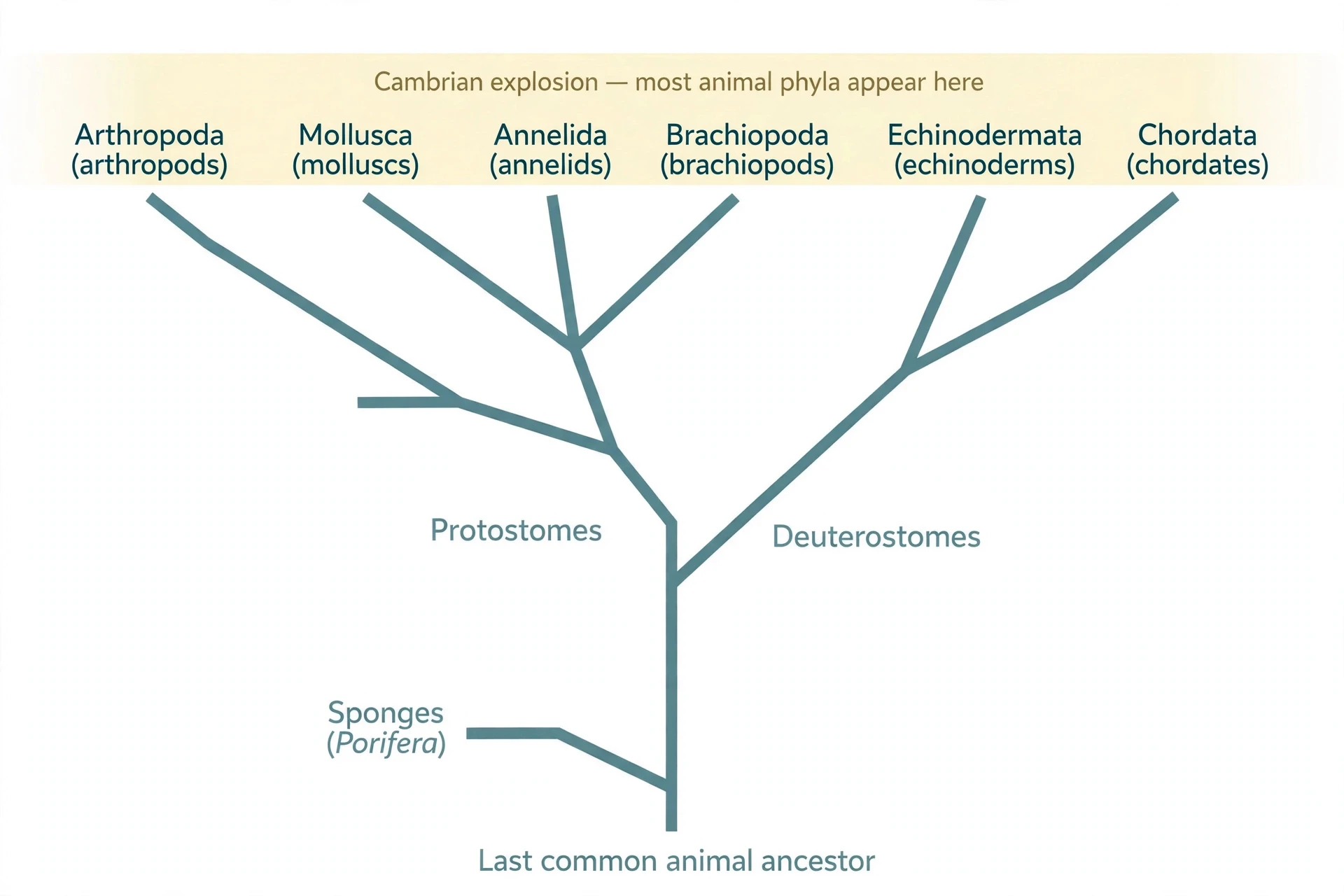
The third thing to unpack is what actually appeared. The headline number, given by Encyclopaedia Britannica, is that between 20 and 35 of the major animal phyla — the highest-level divisions of the animal kingdom, the body plans — appeared during the Cambrian explosion. There are roughly 35 to 40 animal phyla alive today, so that means most of the great designs of animal life made their debut in this one interval. Arthropods, the group that includes insects, spiders, crabs and trilobites. Molluscs — snails, clams, squid. Annelid worms. Echinoderms — starfish and sea urchins. Brachiopods, the lamp shells. And chordates, the group that includes fish, amphibians, reptiles, birds, mammals — and us.
But the headline number needs a caveat, and the caveat matters. Not every phylum appeared in the Cambrian. Sponges, for example, appeared earlier, in the Ediacaran and possibly before. Some early animal groups — sponges, cnidarians, the ancestors of flatworms — almost certainly existed before the Cambrian began, even though they left few fossils. And one phylum, the bryozoans — tiny colonial animals that build moss-like skeletons — was long thought to be entirely absent from the Cambrian — a Cambrian bryozoan claimed in 2021 was then reinterpreted as an alga in 2023 — until new fossils with preserved soft tissues, described in 2026, finally settled the question in the bryozoans' favour. The honest statement is this: by about 520 million years ago, representatives of most of the major animal phyla that fossilize at all were already present in the rocks — Chengjiang alone preserves at least 16 phyla. The explosion did not invent every animal body plan from nothing. It made them visible, abundant and diverse — and it did so fast.
There is one more thing the word "explosion" hides. The animals that appeared were not all familiar. Alongside the ancestors of modern groups, the Cambrian seas held animals that belonged to no living phylum at all — experiments in body design that flourished briefly and then vanished. Some of them are the strangest animals ever found, and we will meet them in section 7. The Cambrian explosion was not only the origin of the modern animal kingdom. It was also a laboratory of designs that were tried once and never tried again.
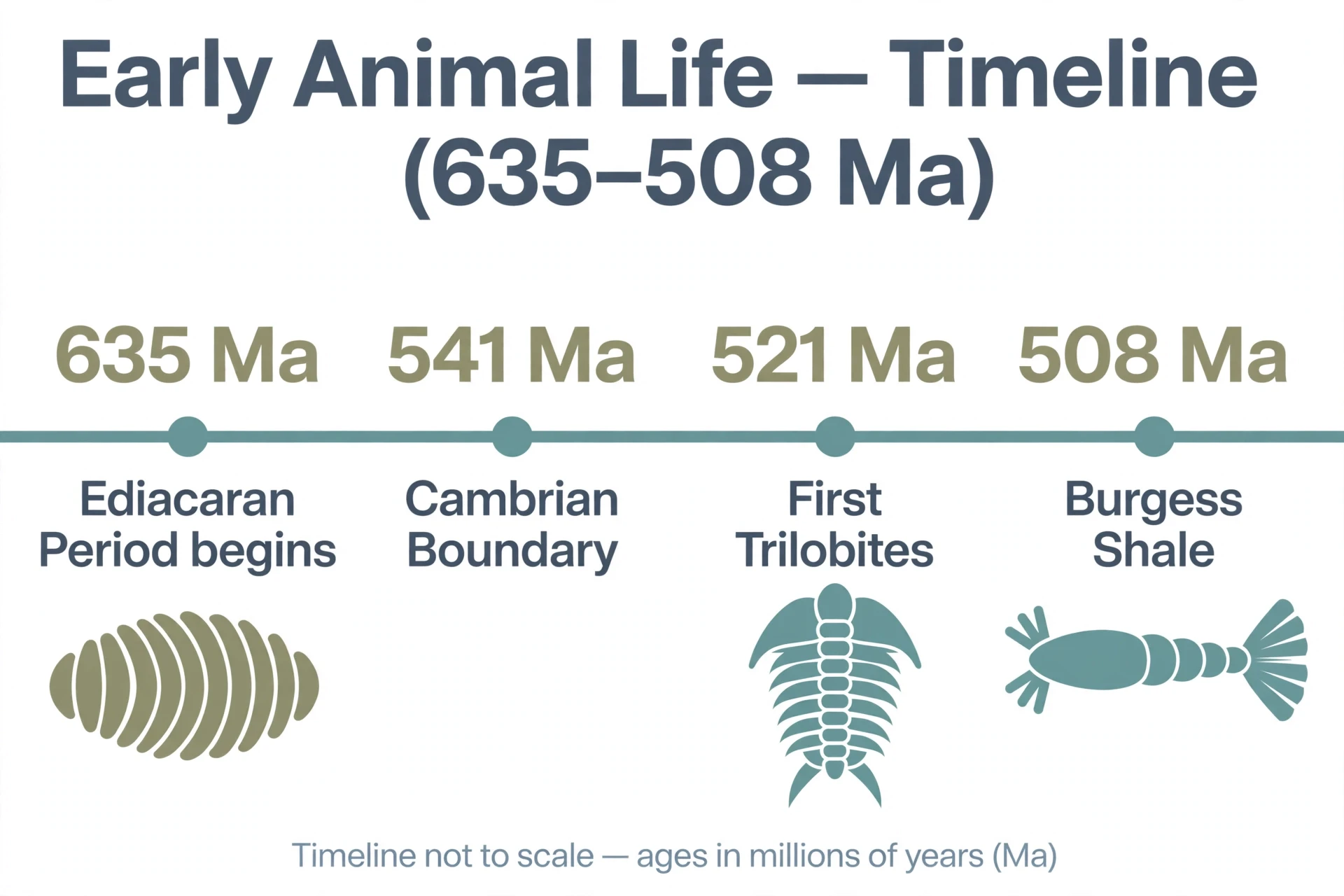
Interval | Dates (millions of years ago) | What happened |
|---|---|---|
Ediacaran period | 635–541 | First large soft-bodied animals on microbial mats; no shells, no predators |
Cambrian boundary | ~541 (538.8 on the current chart) | Treptichnus pedum burrows appear at Fortune Head, Newfoundland |
Small shelly fossils | 539–510 | First widespread hard parts: shells, spines, tubes and plates |
First trilobites | ~521 | Trilobites appear, already carrying elaborate compound eyes |
Chengjiang biota | ~518 | Earliest known fish; 16 animal phyla in a single deposit |
Burgess Shale | ~508 | Soft-bodied animals preserved in extraordinary detail |
Ordovician radiation | ~485–444 | Diversification within the body plans the Cambrian invented |
A year of Earth history
To keep the scale of all this in mind, it helps to picture Earth's history as a single year. Life appears in about March. For the next eight months, almost nothing happens that you could see with the naked eye — just cells, mats and films. The Ediacaran biota, the first large soft-bodied organisms, arrive in mid-November. The Cambrian explosion begins in the last days of November and is largely over by early December. Dinosaurs do not appear until the middle of December. Humans arrive in the final half hour of New Year's Eve. The Cambrian explosion was a December event — but it was the event that built the animal kingdom we still live in.
3. The Long Quiet Before: The Ediacaran World
Before the Cambrian explosion, the Earth had already been inhabited for roughly three and a half billion years — and for almost all of that time, life was small, soft and, to the naked eye, boring. The Ediacaran period, from about 635 to 541 million years ago, was the first chapter in which animals became big enough to see.
It is the essential prologue to the Cambrian explosion that followed.
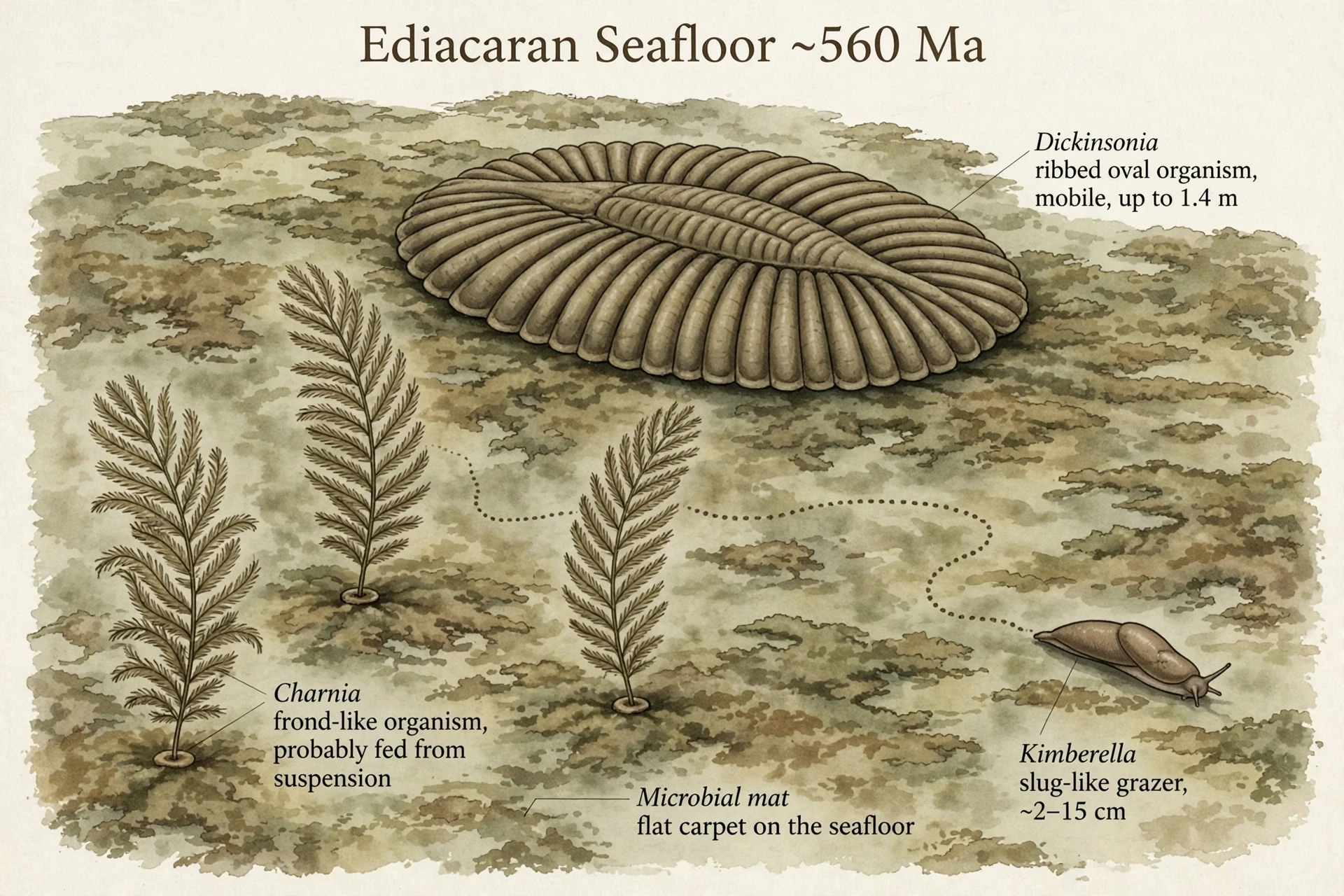
The Ediacaran world is hard to picture, because nothing quite like it exists today. The seafloor was covered in microbial mats — thick, leathery carpets of bacteria and algae — and on those mats lived the first large organisms. Some were fronds, like sea pens, anchored to the mat and swaying in the current. Some were flat, quilted discs the size of dinner plates. The most famous is Dickinsonia, a ribbed oval up to 1.4 metres long that looks like a bath mat with a zip down the middle. For decades, nobody could agree what Dickinsonia even was — animal, fungus, lichen, something else entirely — until chemical analysis of its preserved tissues in 2018 found cholesteroids — the fossil form of cholesterol, a molecule characteristic of animals and rare or absent in most other life. On that evidence, Dickinsonia was an animal. It was probably also one of the first animals to move: fossil trackways show it creeping across the mat, feeding from it as it went — probably digesting the mat through its underside, since it had no mouth or gut.
Another Ediacaran animal, Kimberella, was a small slug-like creature, a few centimetres long, that left scratch marks on the microbial mats as it scraped up food. Those scratch marks are among the earliest evidence of an animal actively feeding on other organisms — scraping algae and bacteria off the microbial mats, a behaviour that would later escalate into the Cambrian arms race. Kimberella probably had a mouth and a gut. It may have been an early mollusc, or close to one. Either way, it was doing something new: moving deliberately, feeding actively, and leaving a trace of its passage in the mud.
What the Ediacaran world did not have is just as important as what it did. For most of the Ediacaran there were no shells, no skeletons, no claws, no teeth and, as far as we can tell, no eyes — and no large predators that hunted, chased or bit. Only in its final millions of years did the first skeletons and the first shell-boring predators appear. There was almost no burrowing: the animals lived on top of the microbial mats, not inside the sediment. And there was almost nothing in the water column above the seafloor — no swimmers, no plankton-eating animals, no mid-water hunters. The Ediacaran sea was a two-dimensional world, a flat garden of mats and fronds, and it stayed that way for nearly 100 million years.
That long quiet is the first clue that the Cambrian explosion needs explaining. If animals had already existed for tens of millions of years before the Cambrian — and the Ediacaran fossils show that they had — why did they stay simple for so long, and then change so fast? Something must have shifted: in the environment, in the animals themselves, or in the way the two interacted. The rest of this article is, in large part, an attempt to find out what.
It is worth pausing on one more Ediacaran fact, because it changes the shape of the whole story. The Ediacaran period did not end gently. In its final millions of years, the Ediacaran biota largely vanished — the classic Ediacaran forms disappear from the rocks, replaced by the small shelly fossils and burrowers of the earliest Cambrian. Whether that was a mass extinction, an ecological replacement, or partly an artefact of preservation is still debated. But the pattern is real: the world that the Cambrian animals inherited was not the Ediacaran garden. It was a seafloor already being churned up by the first burrowers, with the classic Ediacaran forms largely gone. The explosion did not happen in a full world. It happened in a world that had just been cleared.
4. Drawing the Line: Fortune Head and the First Burrows
Every geological period needs a starting line, and the Cambrian has one of the most precisely defined — and most argued-over — starting lines in all of geology. It is a cliff on the coast of Newfoundland, at a place called Fortune Head, on the Burin Peninsula.
In 1992, the International Union of Geological Sciences ratified Fortune Head as the global reference point for the base of the Cambrian period: the place where, by international agreement, the Ediacaran ends and the Cambrian begins.
What marks the line at Fortune Head is not a skeleton, a shell or a bone. It is a burrow. About 2.4 metres above the base of Member 2 of the Chapel Island Formation at Fortune Head, the rocks contain the first appearance of a trace fossil called Treptichnus pedum — a complex, looping feeding burrow, probably made by a worm-like animal (most likely a priapulid-like worm) digging through the sediment. The rule is simple: if you look at the rocks and see Treptichnus pedum, you are in the Cambrian. It is the first sign of an animal behaving in a recognisably modern way — not just sitting on the seafloor, but moving through it, mining it for food, in three dimensions.
That burrow matters more than it might sound. Burrowing is an ecological revolution disguised as a small hole in the mud. An animal that burrows churns the sediment, lets oxygen into it, destroys the microbial mats that carpeted the Ediacaran seafloor, and creates new habitats for other animals. Once burrowers arrive, the flat Ediacaran garden cannot survive. The seafloor becomes a worked, oxygenated, three-dimensional world — and every animal that lives on it has to adapt to that new reality. Palaeontologists call this the Cambrian substrate revolution, and it is one of the great background forces of the whole explosion.
The boundary itself, though, is less sharp than the textbook version suggests. Treptichnus pedum has since been found about four metres below the official boundary at Fortune Head, which means the first three-dimensional burrowing began gradually, not in a single step. The boundary is a useful marker, not a moment when the world changed overnight. That is a pattern we will see again and again in this story: the Cambrian explosion looks sudden from a distance, and more gradual the closer you look.
The first hard parts
Just above the boundary, the rocks begin to yield the first hard parts: the small shelly fossils. These are tiny shells, spines, tubes and plates, mostly a millimetre or less across, belonging to molluscs, brachiopods, echinoderms and a host of animals whose affinities are still uncertain. They dominate fossil assemblages from about 539 to 510 million years ago, and they are used worldwide as tools for dating early Cambrian rocks — the same kinds of tiny shells turn up on different continents, which lets geologists match rocks of the same age across the globe.
The small shelly fossils are also a warning against a simple story. Their "sudden appearance" is partly an extinction and replacement signal: the late Ediacaran Nama biota collapsed, and the small shelly animals took over the newly emptied seafloor. Some of them were not new at all. The earliest biomineralized animals — Cloudina, which built stacked funnel-like tubes, and Namacalathus, a goblet-shaped skeleton with a hole on top — lived in the latest Ediacaran, between about 550 and 541 million years ago, before the Cambrian began. Chemical analysis has shown that both originally built their skeletons from aragonite, a form of calcium carbonate. And Cloudina shells carry small round drill holes — cited as some of the earliest evidence of a predator boring into its prey. Shells, in other words, may have evolved as armour, in response to animals that had already learned to eat each other.
A longer fuse
Even earlier, a 2024 study described diverse shelled and carbonaceous microfossils from Brazil, dated to about 571 million years ago, interpreted as candidate early animals — tens of millions of years before Cloudina. The fuse of the Cambrian explosion, it turns out, was longer than anyone thought. The animals were already experimenting with skeletons in the Ediacaran. What changed in the Cambrian was not the invention of hard parts, but their spread — suddenly, almost every lineage had them, and the fossil record, which had been nearly silent, began to shout.
5. The Burgess Shale: A Whole Sea in a Slab of Rock
If the Cambrian explosion has a single place that defines it, it is the Burgess Shale. The deposit sits in the Canadian Rockies, in Yoho National Park, British Columbia, in rocks of the Stephen Formation dated to about 508 to 505 million years ago — the middle Cambrian, some 30 million years after the Cambrian explosion began.
It is not the oldest Cambrian fossil site, and it is not the largest. It is the most revealing, because of how it preserves animals.
Most fossils are hard parts: shells, bones, teeth. Soft bodies — flesh, guts, eyes, antennae — almost never fossilize, because they rot before they can be buried. The Burgess Shale is one of the rare places on Earth where they did. The animals were buried rapidly, probably by underwater mudflows that swept them off a reef and down into deeper water, where they were sealed in fine mud before they could decay or be scavenged. (The deposit was long assumed to be anoxic; newer work finds oxygen was present in the sediment, so rapid burial, not anoxia alone, did the preserving.) In the Greater Phyllopod Bed, animals with hard parts account for only about 14% of the genera — and perhaps as little as 2% of the individuals alive at the time of burial. The rest were soft-bodied animals that would normally never appear in the fossil record at all. The Burgess Shale shows us the Cambrian sea as it actually was, not just the parts of it that had shells.
Walcott's quarry
Walcott understood what he had found at once. He returned in 1910 to open the quarry and collected there in a series of field seasons — mainly 1910–1917, with further talus collecting in 1919, 1921 and 1924 — and by the end he had collected more than 65,000 specimens. He described dozens of species himself, and tried to fit them all into living groups — a reasonable decision at the time, and mostly wrong. He described Hallucigenia as a polychaete worm and Pikaia as a worm of no particular importance, and the detached Anomalocaris appendage had already been mistaken for a shrimp's tail. (The famous upside-down, spine-walking Hallucigenia came later, from Conway Morris in 1977.) He was working before the modern understanding of animal relationships, and before anyone had re-examined his collection with fresh eyes.
The re-study
That re-examination came in the 1960s and 1970s, when a team led by Harry Whittington at Cambridge — with Derek Briggs and Simon Conway Morris — began to restudy Walcott's specimens. What they found was stranger than Walcott had imagined. Many of the Burgess animals did not fit into any known group. They had body plans that no living animal possesses. The re-study became famous through Stephen Jay Gould's 1989 book Wonderful Life, which called the Burgess Shale fossils "the world's most important animal fossils" and argued that the Cambrian was a time of wild experimentation, most of which was later pruned away by extinction.
Gould's argument has been debated ever since, and modern palaeontologists are more cautious than he was — many of the "weird wonders" have since been placed on the stems of modern groups, as early relatives rather than failed experiments. But the core of his point stands: the Burgess Shale preserves a diversity of body plans that the modern world does not contain, and, in Gould's reading, the Cambrian seas were, in that sense, more various than the seas of today.
By the numbers
The numbers tell the same story. The Burgess Shale as a whole has yielded well over 200,000 specimens representing close to 200 species — about 150 of them from the Walcott Quarry alone — and new species are still being found — the count grows with every field season. In 2013, a new Burgess Shale site in nearby Kootenay National Park produced 50 animal species in just 15 days of collecting. The Royal Ontario Museum, which now holds a large part of the collection, has more than 140,000 specimens. The Burgess Shale was inscribed as a World Heritage Site in its own right in 1980, and in 1984 it was absorbed into the Canadian Rocky Mountain Parks World Heritage Site. It is among the most intensively studied fossil deposits of its age — and it still has new things to say.
I keep a small trilobite on my desk — not a Burgess Shale specimen, just an ordinary one from a Moroccan quarry, the kind you can buy in a museum shop. It is a reminder of how strange the Burgess Shale really is. That trilobite is a shell, a hard part, the kind of fossil the Earth makes easily. The Burgess Shale animals are the ones the Earth almost never preserves: the soft, the small, the strange. Without that one mountainside in Canada, we would know the Cambrian explosion mainly from shells and burrows. With it, we know the animals themselves.
6. Chengjiang: An Even Earlier Window
The Burgess Shale is the most famous Cambrian fossil site, but it is not the oldest — and for understanding the Cambrian explosion itself, an older window matters more. That window is Chengjiang, in Yunnan Province, China, and it is about ten million years older than the Burgess Shale.
Chengjiang, China
Chengjiang was discovered on 1 July 1984, by a young researcher named Hou Xianguang, then a master's student at the Nanjing Institute of Geology and Palaeontology. He was collecting bradoriid arthropods — tiny, shelled crustacean relatives — on a hillside called Maotianshan, about five kilometres east of Chengjiang town, when he began finding soft-bodied fossils of a quality nobody had expected from rocks of that age. The deposit turned out to be one of the richest fossil sites ever found: at least 16 phyla and about 200 to 250 described species, a count that is still growing, preserved in rocks of the Yu'anshan Member dated to about 518 to 520 million years ago. It was inscribed as a UNESCO World Heritage Site in 2012.
What makes Chengjiang so important is its age. At roughly 518 million years ago, it captures the Cambrian world only about 20 million years after the period began — much closer to the Cambrian explosion itself than the Burgess Shale, which is about 508 million years old. And what it shows is that the Cambrian explosion had already happened. The Chengjiang seas were already full: arthropods, worms, sponges, jellyfish relatives, brachiopods, molluscs, echinoderms, and — crucially — chordates, including the earliest known fish. The animal kingdom was not still assembling itself. By 518 million years ago, it was already crowded, already complex, already recognisable.
Chengjiang is also the place where some of the most delicate Cambrian animals are preserved best. Its fossils include the nervous systems of arthropods, the guts of worms, and the eyes of predators, preserved in fine detail. One Chengjiang arthropod, Fuxianhuia, preserves a brain with distinct regions — evidence that complex nervous systems were already in place in the early Cambrian.
The Chengjiang story has a third character that is easy to miss: the site was found by a student, not by an established professor with a big expedition. Hou Xianguang was in his twenties, collecting on a hillside because his supervisor had sent him to look for small shelled fossils. He found something far bigger. It is a useful reminder that the history of palaeontology is full of accidents — a horse slipping on a mountainside in Canada, a student turning over the right rock in China — and that the biggest discoveries often come from people who were looking for something else entirely.
Sirius Passet, Greenland
Chengjiang is not alone. The same decade that produced it also produced Sirius Passet, in Peary Land, North Greenland, discovered in 1984 by A. Higgins of the Geological Survey of Greenland. Sirius Passet is about 518 to 515 million years old — broadly the same age as Chengjiang — and its fauna is dominated by arthropods, with more than 40 species described from about 10,000 specimens. Its most important animals are the problematic ones: Kerygmachela, a swimming lobopodian with strange frontal appendages; Pambdelurion, a large soft-bodied predator; and Halkieria, an armoured slug-like animal whose sclerites have been argued to link it to molluscs, to brachiopods, or to both — its exact affinity is still debated. These are animals that sit near the branching points of the animal family tree, and they help scientists work out how the modern phyla are related to each other. At Sirius Passet, the swimming arthropod Isoxys volucris turns up in the gut of the giant predator Timorebestia — direct evidence of who ate whom, half a billion years ago. In 2022, Sirius Passet was named one of the International Union of Geological Sciences' first 100 geological heritage sites, under the heading "Cambrian Explosion in Sirius Passet".
Emu Bay, Australia
A fourth window, the Emu Bay Shale on Kangaroo Island, South Australia, dated to about 514 to 512 million years ago, is Australia's only known Cambrian site of this quality. It is famous for one thing above all: the eyes of Anomalocaris. Two paired compound eyes from Emu Bay, each two to three centimetres long, contain at least 16,000 hexagonally packed lenses in a single eye — assigned to Anomalocaris, and the earliest evidence of acute vision yet found in the fossil record, and a subject we will return to in section 10.
Taken together, these four sites — Burgess Shale, Chengjiang, Sirius Passet and Emu Bay — give scientists something no single deposit could: a series of snapshots of the Cambrian seas at different times and in different places. Chengjiang shows the world soon after the Cambrian explosion. Sirius Passet and Emu Bay show its middle chapters. The Burgess Shale shows a mature Cambrian ecosystem, 30 million years in. The picture that emerges from all four is consistent: the Cambrian explosion was real, it was fast, and by the time the oldest of these deposits was laid down, the animal kingdom was already in full swing.
Site | Age | Discovered | Species described | Famous for |
|---|---|---|---|---|
Burgess Shale, Canada | ~508 million years ago | 1909, Charles Walcott | ~150–200 | Soft-bodied preservation; the weird wonders |
Chengjiang, China | ~518 million years ago | 1984, Hou Xianguang | 200–250+ | Earliest known fish; 16 phyla |
Sirius Passet, Greenland | ~518–515 million years ago | 1984, A. Higgins | 40+ | Stem-group animals near the origins of modern phyla |
Emu Bay, Australia | ~514–512 million years ago | — | 50+ | Anomalocaris eyes; Australia's only Cambrian Konservat-Lagerstätte |
Our fossil record article explains how deposits like these form, and why soft-bodied preservation is so rare — and so valuable when it happens.
7. The Weird Wonders
No account of the Cambrian seas is complete without their weirdest animals — and no account of them is complete without admitting how strange they really are. These are the animals that made the Burgess Shale famous: creatures with five eyes, with legs on their backs, with mouths that look like vacuum cleaners.
For a long time, they were presented as evolutionary dead ends — bizarre experiments that failed. The modern picture is more interesting, and more complicated.
Anomalocaris: the giant hunter
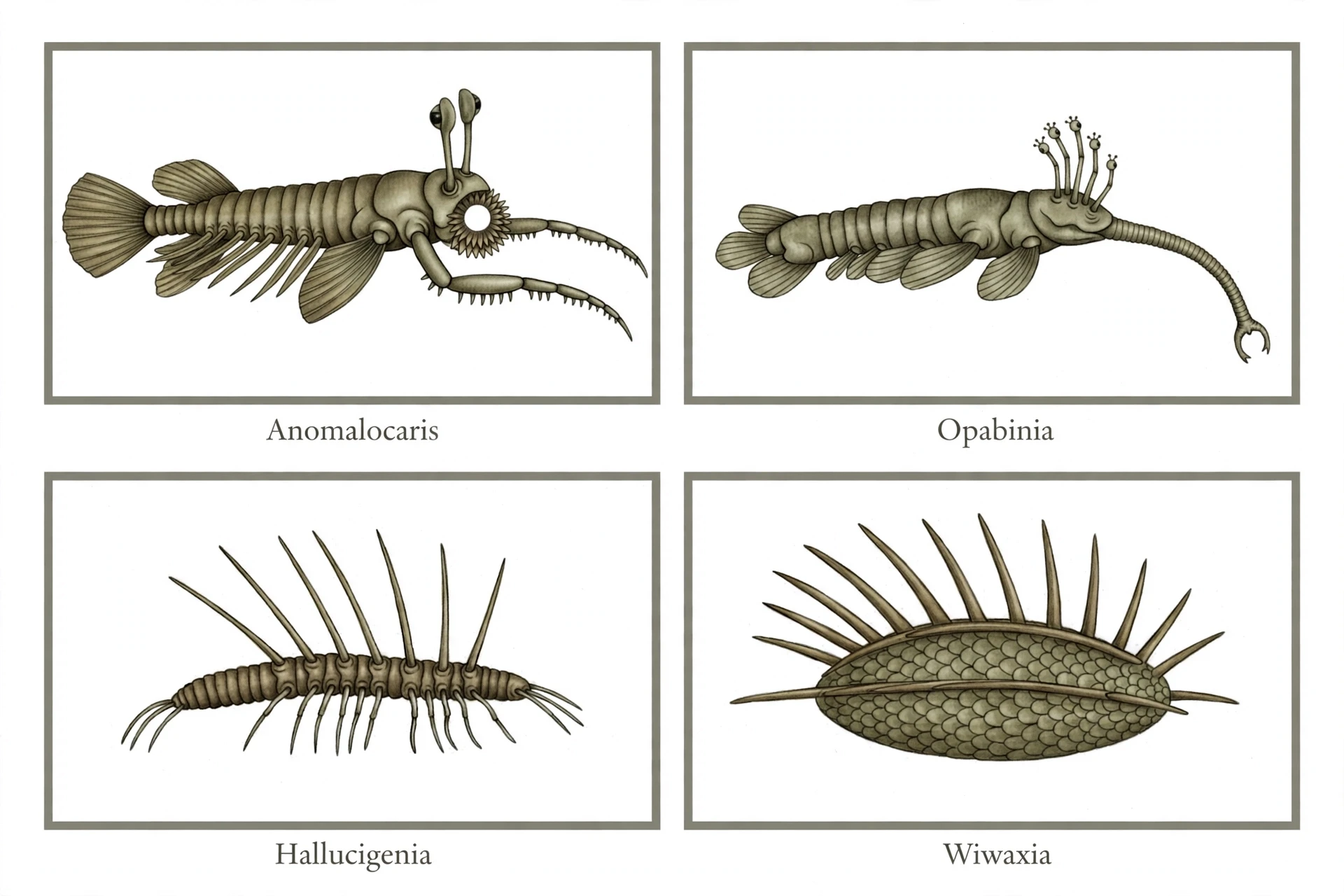
Start with the largest of them: Anomalocaris. Its name means "abnormal shrimp", and it was named from a single fossil — a spiny frontal appendage, described in 1892, that looked like the tail of a shrimp. For nearly a century, nobody knew what animal the appendage belonged to, because the rest of the body was never found attached to it. The mouth was described as a separate animal. The body was described as a separate animal. Only in the 1980s, when complete specimens were finally pieced together, did the real animal emerge: a swimming predator with a segmented body, a pair of large compound eyes on stalks, two spiny grasping appendages at the front, and a circular mouth ringed with teeth. The largest complete specimen is 20.5 centimetres long, and the biggest fragments scale up to an estimated 34 to 38 centimetres for the body alone, excluding the frontal appendages and tail fan. Older books say it reached a metre, but that figure is now considered unlikely — it was extrapolated from isolated parts, and the body proportions do not support it. Even at a third of a metre, though, Anomalocaris was one of the largest animals in the Cambrian seas, and almost certainly one of its top predators.
What did it hunt? A 2023 biomechanics study tested that question directly, modelling the forces its grasping appendages could withstand, and found they were built for soft prey and speed — an agile hunter of soft-bodied animals swimming in the water column, not a crusher of trilobite shells. Its eyes, with at least 16,000 lenses each, gave it vision rivalling that of the most acute-eyed modern arthropods. Anomalocaris was a fast, sharp-eyed hunter of soft-bodied prey.
Opabinia: the animal that made an audience laugh
Then there is Opabinia, the animal that made an audience laugh. Opabinia was about four to seven centimetres long, with five stalked eyes and a long flexible trunk ending in a pair of claws, which it used to pass food to a mouth that faced backwards. When Harry Whittington presented his re-study of Opabinia in 1972, the audience laughed out loud; the animal seemed too absurd to be real. But it was real, and it was rare — only about 42 specimens are known, less than a tenth of one percent of the animals in the main Burgess Shale bed. Opabinia is now understood as a stem-group arthropod, a close relative of the lineage that produced Anomalocaris and, eventually, the true arthropods. Its strangeness was not a joke. It was a clue to how arthropods evolved.
Hallucigenia: drawn upside down
Hallucigenia is the animal that was drawn upside down — twice, in a sense. Walcott described it in 1911 as Canadia sparsa, and in 1977 Simon Conway Morris renamed it Hallucigenia, for its "bizarre and dream-like quality", and reconstructed it walking on seven pairs of spines, with soft tentacles waving on its back. It stayed that way for fourteen years, until 1991, when Lars Ramsköld and Hou Xianguang showed that the reconstruction was upside down: the "tentacles" were claw-tipped legs, and the spines were dorsal armour. The head took even longer to find. In 2015, Martin Smith and Jean-Bernard Caron finally located it — small, with a pair of simple eyes, a mouth ringed with spines, and a throat lined with needle-like teeth — at the opposite end of the body from the blobby lump that had been mistaken for a head, which was probably just decay fluid. Hallucigenia was one to five centimetres long, with seven pairs of dorsal spines and ten pairs of limbs — three slender pairs at the front and seven pairs of clawed walking legs, and its closest living relatives are the velvet worms, soft-bodied forest animals that still walk on stubby legs today. The story of Hallucigenia is a small parable about science: the same fossil, looked at three times over a century, told three different stories — and the third one was right.
Wiwaxia: armour as a way of life
Wiwaxia is less famous but just as revealing. It was a slug-like animal up to five centimetres long, covered in eight transverse rows of overlapping scales (nine rows counting the anterior zone) and two rows of long, blade-like dorsal spines — the middle spines up to five centimetres, as long as the animal itself. It grazed on the seafloor with a toothed, tongue-like feeding organ, something like the radula of a modern snail. Its affinities were debated for a century — worm or mollusc? — and the current evidence leans toward it being a stem-group mollusc, an early relative of snails and clams. Wiwaxia matters because it shows that the Cambrian explosion was not only about predators and prey. It was also about grazers, about animals that made a living by scraping food off the seafloor, and about armour as a way of life.
Timorebestia: a newer surprise
There is a newer addition to this cast, and it is a reminder that the Cambrian still has surprises left. Timorebestia, described in 2024 from Sirius Passet, was a stem-group chaetognath — a relative of the modern arrow worms — up to 30 centimetres long including its antennae, with fins, long sensory antennae and a jaw apparatus. Its gut contained the remains of Isoxys, a swimming arthropod. Timorebestia shows that large pelagic predators were not only radiodonts: early chaetognaths were already occupying a high trophic position in the Cambrian water column.
What the weird wonders mean
What should we make of these animals? Stephen Jay Gould argued that they were a gallery of failed experiments — body plans that were tried once and then pruned away by extinction, proof that the history of life is ruled by contingency, by luck. Modern palaeontologists push back on part of that: many of the weird wonders have since been placed on the stems of modern groups. Opabinia is a stem arthropod. Hallucigenia is a stem velvet worm. Wiwaxia is probably a stem mollusc. They were not dead ends in the sense Gould meant. They were early branches — cousins of the groups that survived, rather than ancestors of them, but branches of the same tree.
Even so, something in Gould's argument survives the correction. The Cambrian seas contained body plans that have no exact modern match, and a wider variety of them than the modern seas hold — though how much wider is still debated — and many of those designs really did vanish. The animal kingdom that survived the Cambrian was narrower than the one the Cambrian produced. Whether that narrowing was luck, competition, or something else is still an open question — and it is one of the reasons the Cambrian explosion still matters, more than a century after Walcott's horse slipped on that mountainside.
8. Trilobites: The Animals That Owned the Cambrian
If the weird wonders are the celebrities of the Cambrian, the trilobites are its workhorses — and they were far more successful than any celebrity. Trilobites first appear in the fossil record about 521 million years ago, at the base of Cambrian Series 2.
They went on to dominate the seas for roughly 270 million years, surviving until the end-Permian mass extinction about 252 million years ago. More than 20,000 species have been described. No other Cambrian group comes close to that record.
Body plan and success
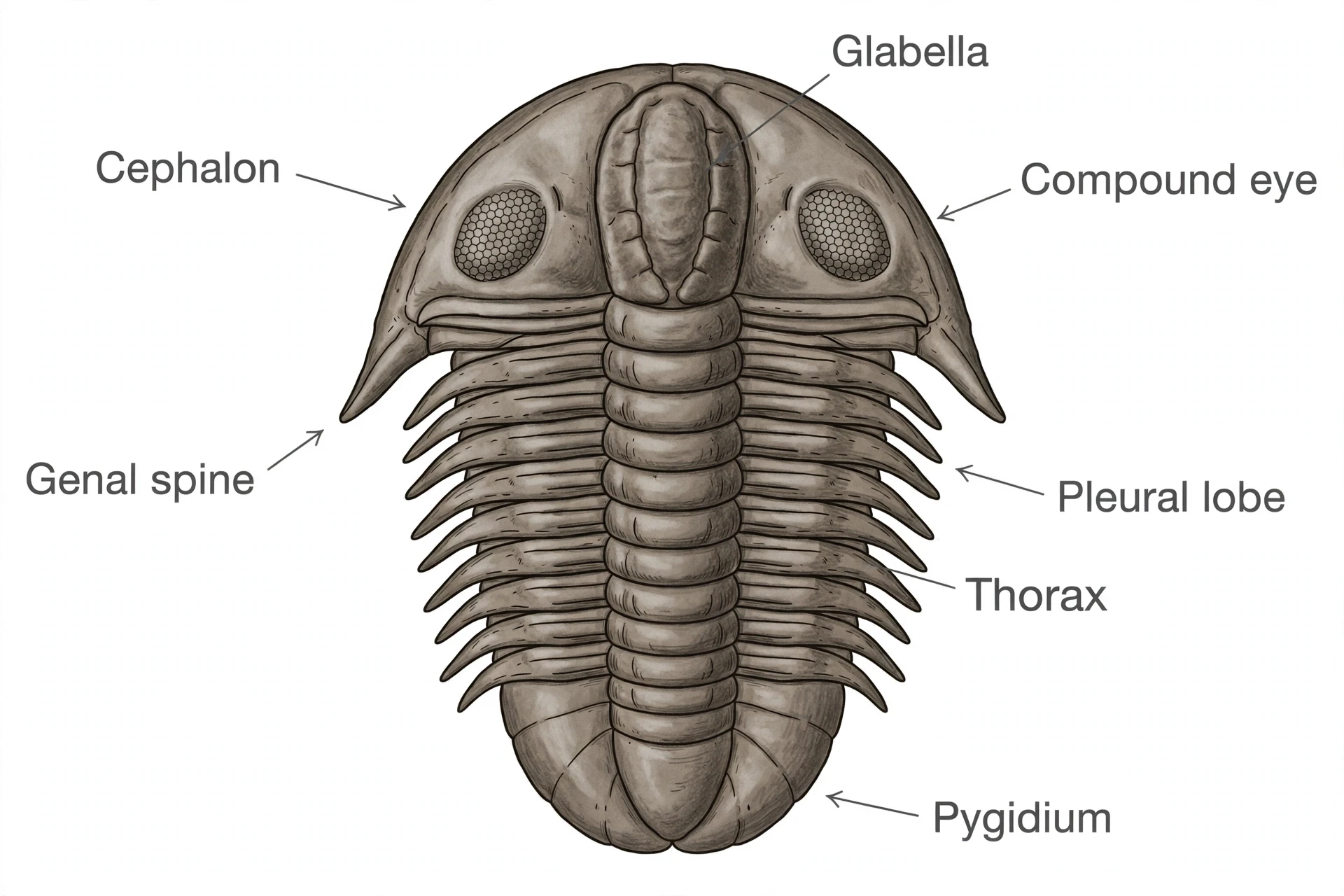
A trilobite's body plan is simple to describe and endlessly variable in detail. The body is divided lengthwise into three lobes — hence the name, "three-lobed" — and crosswise into three parts: a head shield (the cephalon), a segmented thorax, and a tail shield (the pygidium). Underneath, the animal had jointed legs and gills, one pair per body segment. Some trilobites were a few millimetres long; the largest, Isotelus rex, reached more than 70 centimetres. Some were smooth and streamlined; others were covered in spines, horns and bumps. Some could roll into a ball, like a woodlouse, when threatened. Some swam; most crawled on the seafloor; a few burrowed. They filled nearly every ecological role a small marine arthropod can fill, and they did it for longer than the dinosaurs lasted on land.
Trilobites owe their fossil fame to their shells. Their exoskeletons were mineralized with calcite, which fossilizes beautifully — which is why trilobites are the first animals most people meet in a fossil collection, and why they were among the first fossils ever described in print (by Edward Lhuyd, curator of the Oxford museum, in 1698 — although the trilobite he drew, now Ogygiocarella debuchii, was Ordovician, not Cambrian). But their shells are not the most interesting thing about them. Their eyes are.
Eyes
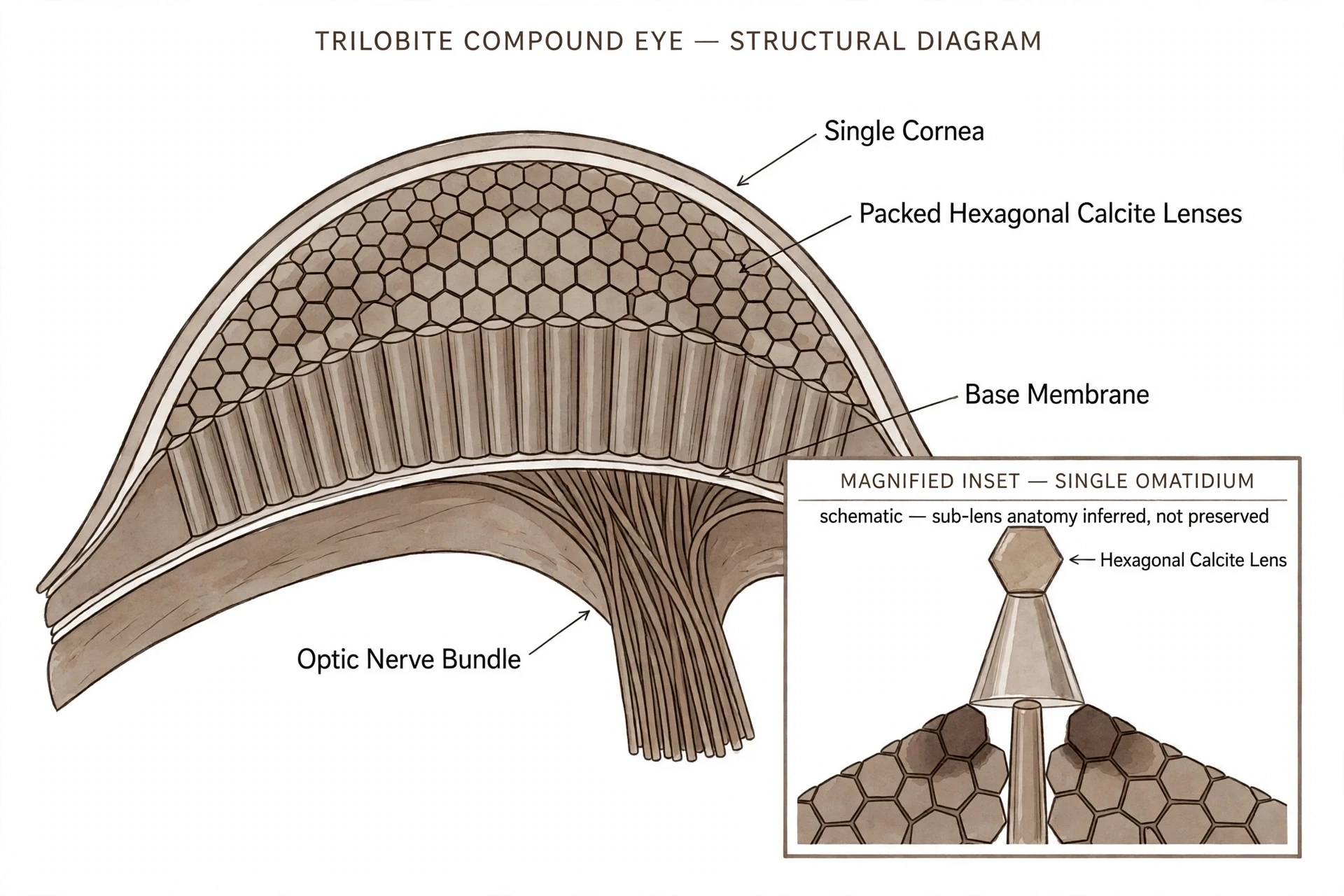
From the very beginning of their appearance in the fossil record, about 521 million years ago, trilobites were equipped with elaborate compound eyes. That is a remarkable fact, because it means the eye — one of the most complex organs in the animal kingdom — was already fully formed at the moment trilobites first appear. The earliest trilobite eyes were of the holochroal type, in which hundreds of small lenses are packed together under a single cornea. Later, one group of trilobites, the phacopids, evolved schizochroal eyes, in which each lens is large, separate and individually corrected — an optical design of remarkable sophistication, with doublet or triplet lenses that could focus light sharply, and only understood in detail when modern optics caught up with it.
Why did trilobites have such good eyes, so early? The answer is almost certainly predation. A trilobite that could see a predator coming — an Anomalocaris sweeping overhead — had a chance to curl up, to burrow, or to flee. A trilobite that could not see was food. Vision was not a luxury in the Cambrian seas. It was a survival tool, and the animals that had it passed it on. The trilobite eye is the first great example of a pattern that runs through the whole Cambrian explosion: once one animal gains a new sense or a new weapon, every other animal has to answer it.
There is a quieter lesson in the trilobites too. They were, by any measure, the most successful animals of the Cambrian — diverse, abundant, widespread, long-lived. And they are gone. Every last one of them vanished in the end-Permian mass extinction, the greatest dying in Earth's history, which wiped out as much as 96 percent of marine species. Success in one era is no guarantee of survival in the next. The trilobites owned the Cambrian, and then the world changed, and they did not. That is a thought worth carrying into the modern world, where the animals that dominate today are also, in geological terms, temporary tenants.
9. Pikaia and the First Chordates — Our Own Deep Roots
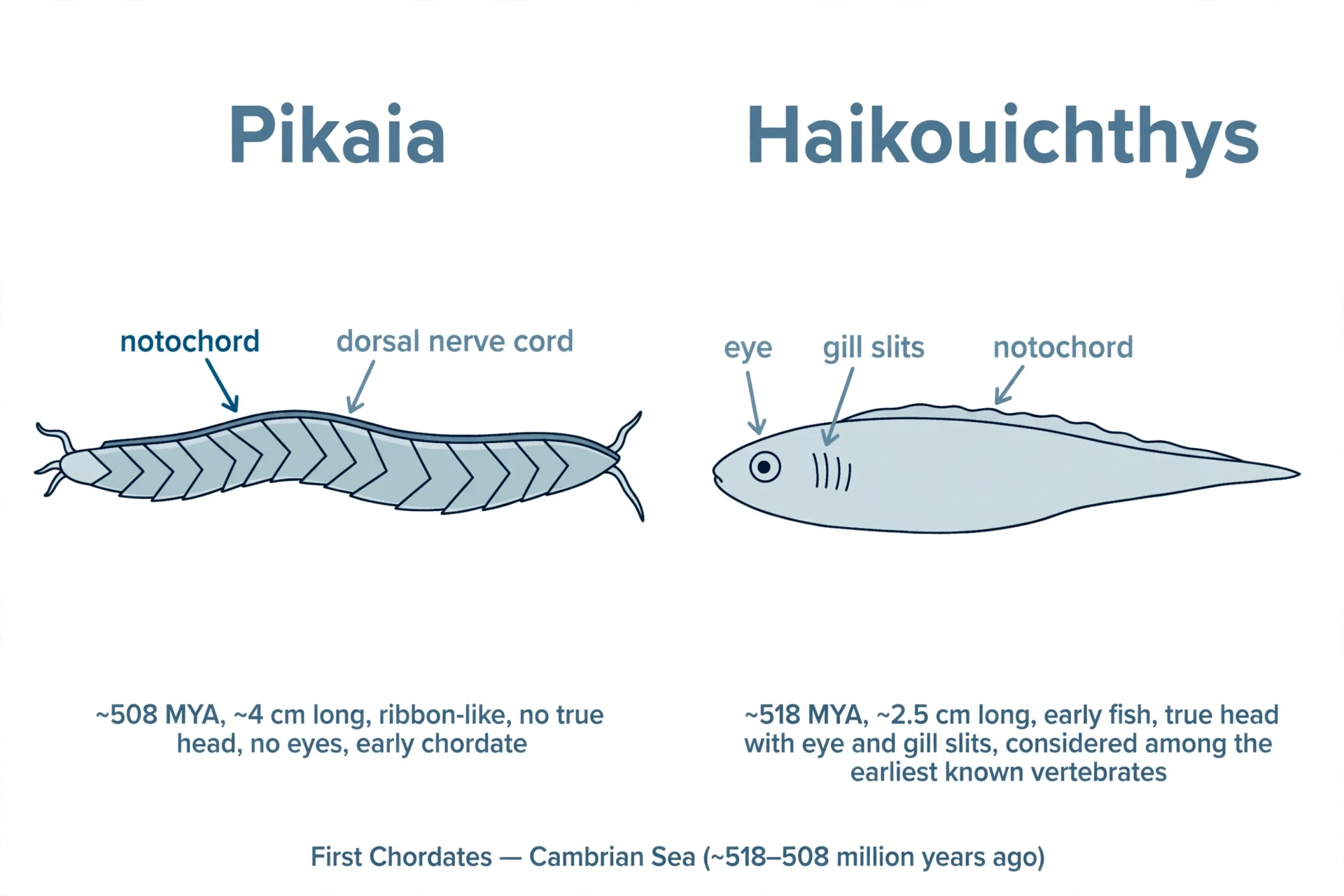
Of all the animals in the Burgess Shale, the most important for us is one of the smallest and least impressive-looking. Pikaia gracilens was a worm-like animal about 3.8 centimetres long, with a flattened, ribbon-shaped body, a series of V-shaped muscle blocks along its sides, and a stiff rod running down its back.
Walcott described it in 1911 and thought it was a worm. He was wrong, in the most interesting possible way.
Pikaia, re-examined
In 1979, Harry Whittington and Simon Conway Morris re-examined Pikaia and argued that the stiff rod was a notochord, the flexible supporting rod that defines the chordates — the animal phylum that includes fish, amphibians, reptiles, birds, mammals, and ourselves. Pikaia also had segmented muscle blocks (myomeres), the same arrangement that powers a fish's swimming, and a dorsal nerve cord. It was, in other words, a very early chordate: not a fish, not a vertebrate, but a member of the lineage from which vertebrates would eventually evolve. A 2012 study of 114 specimens confirmed the interpretation. And then, in 2024, a new study flipped it — literally. The researchers showed that Pikaia, like Hallucigenia before it, had been interpreted upside down: the structure long called a "dorsal organ" was actually a gut canal, and the nerve cord ran along the back, as it should in a chordate. A notochord has been inferred but was not conclusively identified in the 2024 re-study. Pikaia is now regarded as an unambiguous stem-group chordate, though its exact position is still debated.
The Chengjiang fish
Pikaia is not alone. At Chengjiang, about 518 million years ago — ten million years older than the Burgess Shale — there are even earlier chordates. Haikouichthys and Myllokunmingia, described in 1999, are considered the earliest known vertebrates in the fossil record: small fish-like animals, Myllokunmingia just 2.8 centimetres long, with a defined head, eyes and vertebral elements. What were once read as nasal sacs in Haikouichthys were reinterpreted in 2026 as a second pair of small, lens-bearing camera-type eyes. More than 500 specimens of Haikouichthys had been collected by 2003. Whether Haikouichthys and Myllokunmingia are two different animals or two preservations of the same one is still contested — some researchers treat them as taphonomic variants of a single animal, others argue they differ in their gill arrangement. Either way, the message is the same: by 518 million years ago, animals with the beginnings of a backbone — rudimentary vertebral elements — were already swimming in the Cambrian seas.
What makes a chordate
What makes a chordate a chordate is worth stating plainly, because it is the thread that connects a two-inch Cambrian worm to every human being alive today. Chordates are defined by four features, present at least at some stage of life: a notochord, a dorsal hollow nerve cord, pharyngeal slits (which in fish become gills, and in us become parts of the ear and throat), and a post-anal tail. Pikaia had a dorsal nerve cord and segmented muscle blocks, and probably the other features too — though a notochord was not conclusively identified in the 2024 re-study. We have all four, in modified form. The notochord persists in us only as the soft core — the nucleus pulposus — inside the discs between our vertebrae. The nerve cord became the brain and spinal cord. The pharyngeal pouches became, among other things, the Eustachian tubes. The tail — well, we still have a tailbone to show for it.
There is a temptation to treat Pikaia as our ancestor, and it is worth resisting, or at least qualifying. Pikaia was almost certainly not the direct ancestor of vertebrates. It was a side branch — a cousin, not a grandparent. The actual ancestors of vertebrates were animals like it, living at the same time, whose fossils we may never find. But Pikaia is the closest thing we have to a portrait of what those ancestors looked like: small, soft-bodied, swimming in the water column, with a stiff rod down its back and a nerve cord above it. Everything that followed — fish, amphibians, dinosaurs, mammals, us — was built on that design.
I sometimes think about that when I look at the trilobite on my desk. The trilobite is the Cambrian's success story: abundant, armoured, long-lived — and extinct. Pikaia is the opposite: rare, soft, unimpressive — and the chordate lineage it belongs to includes us. The Cambrian explosion did not reward the animals that looked most successful at the time. It rewarded the ones whose body plans turned out to be flexible enough to survive what came next. That is a strange kind of justice, and it is one of the reasons the Cambrian still repays attention.
Our human evolution article picks up this story hundreds of millions of years later, when our own lineage finally appears. The thread runs all the way back to Pikaia.
10. Eyes: The Invention That Changed Everything
If there is one invention that changed the Cambrian seas more than any other, it was the eye. Before eyes, animals lived in a world of touch and chemistry — they could feel the seafloor, taste the water, sense vibrations.
After eyes, they could see a predator coming from a distance, track prey across open water, and navigate by landmarks. Vision turned the ocean from a dark, tactile world into a visual one, and every animal in it had to adapt to being seen.
The evidence for that transformation is written in the eyes themselves. Trilobites, as we saw in section 8, arrived with elaborate compound eyes already in place, about 521 million years ago. Anomalocaris carried compound eyes with at least 16,000 lenses each, giving it vision comparable to a modern dragonfly's. And these were not the only eyes in the Cambrian seas. Simple eyes — light-sensitive patches, cup-shaped eyes, pinhole eyes — appear across many Cambrian groups, in different designs, built independently. Vision, it seems, was invented more than once, and then refined again and again.
The light-switch theory
The zoologist Andrew Parker proposed a bold explanation for this in his "light switch" theory: that the evolution of vision was itself the trigger of the Cambrian explosion. Once animals could see, Parker argued, predation became far more effective, and prey had to evolve armour, speed, burrowing and camouflage in response — an arms race that drove the whole burst of diversification. The eye, in this view, was not just one invention among many. It was the switch that turned the lights on, and everything else followed.
The objections
Parker's theory is elegant, and it has been influential — but it is contested, and the contest is instructive. The main objection is one of timing: the fossil record shows complex eyes appearing alongside the other Cambrian innovations, not clearly before them, and some of the earliest Cambrian animals already had eyes when they first appear. If eyes caused the Cambrian explosion, they should predate it; instead, they seem to arrive with it. A second objection is that vision alone cannot explain the full pattern — the diversification of sponges, worms and other eyeless groups, for example, or the appearance of hard parts in animals that never had eyes at all. Most researchers today treat vision as a powerful accelerator of the Cambrian explosion rather than its single cause: once eyes existed, they made predation more efficient and the arms race faster, but they were one driver among several, not the whole story.
That debate is worth pausing on, because it illustrates how science works on a question like this. A good theory — Parker's is a good theory — does not need to be entirely right to be useful. It focused attention on a real pattern (the sudden importance of vision), it made testable predictions (eyes should appear early and spread fast), and it forced other researchers to sharpen their own explanations. The light-switch theory may not be the answer to the Cambrian explosion. But the story of Cambrian eyes cannot be understood without it.
There is a deeper point here, and it connects to our own evolution of the eye article, which tells the full story of how the vertebrate eye was assembled step by step. The Cambrian eye story is the prequel to that one. The first eyes were not all camera eyes — many were simple light detectors, patches of cells that could tell light from dark. The compound eye, with its hundreds of lenses, was one great refinement. But camera-type eyes were already present in the Cambrian: a 2026 study of Haikouichthys found four image-forming, lens-bearing eyes in the earliest vertebrates, about 518 million years ago. The claim is new, and not every specialist is convinced — one palaeontologist described himself as 'half believing and half recoiling' — but if it holds, the camera eye is a Cambrian invention, not a later one. But the logic was already in place in the Cambrian: an eye is worth having only if it helps you eat or avoid being eaten, and once one animal has a good eye, every other animal is under pressure to get one too. That pressure has never let up.
11. Shells and Armour: The Biomineralization Revolution
There is a simple reason the Cambrian explosion is visible in the rocks when the Ediacaran is not: shells. Before the Cambrian, almost nothing had hard parts, so almost nothing left a body fossil. During the Cambrian, hard parts became the norm — shells, spines, plates, tubes and exoskeletons.
They were made of calcium carbonate or calcium phosphate, in lineage after lineage, all at about the same time. That change, called biomineralization, is one of the most striking patterns of the whole Cambrian explosion, and it is also one of the most misunderstood.
The misunderstanding is to think that hard parts were invented in the Cambrian. They were not. As we saw in section 4, the earliest biomineralized animals — Cloudina and Namacalathus — lived in the latest Ediacaran, between about 550 and 541 million years ago. And a 2024 study pushed the record earlier still, describing diverse shelled and carbonaceous microfossils from Brazil, interpreted as candidate early animals, dated to about 571 million years ago. Animals had been experimenting with skeletons for tens of millions of years before the Cambrian began. What changed at the boundary was not the invention, but the adoption: hard parts became widespread across many lineages, and the ones that lacked them were often at a disadvantage.
Why then? The most direct answer is defence. A shell is armour, and armour is useful only when something is trying to eat you. Cloudina shells carry small round holes that look very much like drill holes made by a predator — some of the earliest evidence of an animal boring into another animal to eat it. If predators were already drilling into Cloudina in the Ediacaran, then shells were already an arms race before the Cambrian began, and the Cambrian simply escalated it: thicker shells, spikier shells, shells that could close, shells that could roll away.
But defence is not the whole story. Hard parts do other jobs too. They provide support — a rigid frame for muscles to pull against, which lets an animal grow larger and move faster. They may also have provided display — spines and horns that could signal to rivals or mates. And they change the chemistry of the animal's relationship with the sea: building a shell from calcium carbonate is easier in some ocean chemistries than others, and the Cambrian oceans, with their particular mix of dissolved minerals, may have made it cheaper than before. Chemical analysis of Cloudina and Namacalathus has shown that both originally built their skeletons from aragonite, a form of calcium carbonate, which later altered to calcite during fossilization. The mineral matters, because it tells us about the seawater they lived in — and that seawater was, in the relevant ways, ready for shells.
There is a third explanation, and it is the one that should make a reader pause. Part of the "explosion" is a preservation explosion. When animals evolve hard parts, they become fossilizable — they enter the record. Before hard parts, the same animals, or their close relatives, may have existed as soft-bodied forms that left no trace. The sudden appearance of shells in the rocks therefore exaggerates the suddenness of the animals themselves. Some of the Cambrian explosion is real diversification. Some of it is the fossil record finally turning its lights on. Telling the two apart — working out how much of the burst is biology and how much is visibility — is one of the central problems of Cambrian research, and it is why sites like the Burgess Shale and Chengjiang matter so much: they show us the soft-bodied animals that the shell record misses, and they prove that the Cambrian explosion was not only a shell story.
12. Oxygen: Did the Sea Finally Catch Up?
Of all the proposed causes of the Cambrian explosion, oxygen is the oldest and the most intuitively appealing. The logic is simple: big, active animals need a lot of oxygen. They need it to power muscles, to build collagen (the protein that holds animal bodies together), to sustain the high metabolic rates that hunting and fleeing demand.
For most of Earth's history, the oceans held very little oxygen — too little, the argument goes, for large animals to exist. Then, in the late Neoproterozoic, oxygen levels rose, and the Cambrian explosion followed. The sea finally had enough air in it for animals to get big.
It is a good story. The question is how much of it is true.
The evidence for an oxygen rise is real, but it is weaker and more complicated than the textbook version suggests. A 2019 study of a Siberian shallow sea found five isotope cycles between 524 and 514 million years ago, interpreted through modelling as oxygen oscillations, each coinciding with a burst of animal diversification — a pattern the authors described as the Cambrian explosion happening in spurts, driven by pulses of oxygen, rather than as a single event. That is a striking result, and it fits the idea that oxygen was a limiting factor that, when it rose, let diversification proceed.
But a larger and more recent analysis points in a different direction. A 2024 study in Nature Geoscience looked at the oxygen record across the whole late Neoproterozoic and early Palaeozoic, and found no evidence for wholesale oxygenation of the oceans at all. What it found instead was a moderate, sustained increase in atmospheric oxygen and marine productivity — a small change, but one that may have been enough to cross ecological thresholds. The deep ocean, the study found, did not reach near-modern oxygen levels until the Silurian–Devonian, roughly 120 million years after the Cambrian began. The Cambrian seas, in other words, were not well-oxygenated by modern standards. They were just oxygenated enough.
The Royal Ontario Museum's Burgess Shale pages make the same point from the fossil side: there does not seem to have been much variation in oxygen levels across the Ediacaran–Cambrian boundary itself. Earlier increases might have triggered the evolution of large Ediacaran animals, the museum notes, and a later rise may have allowed more active lifestyles — but oxygen does not look like a switch that flipped at 541 million years ago.
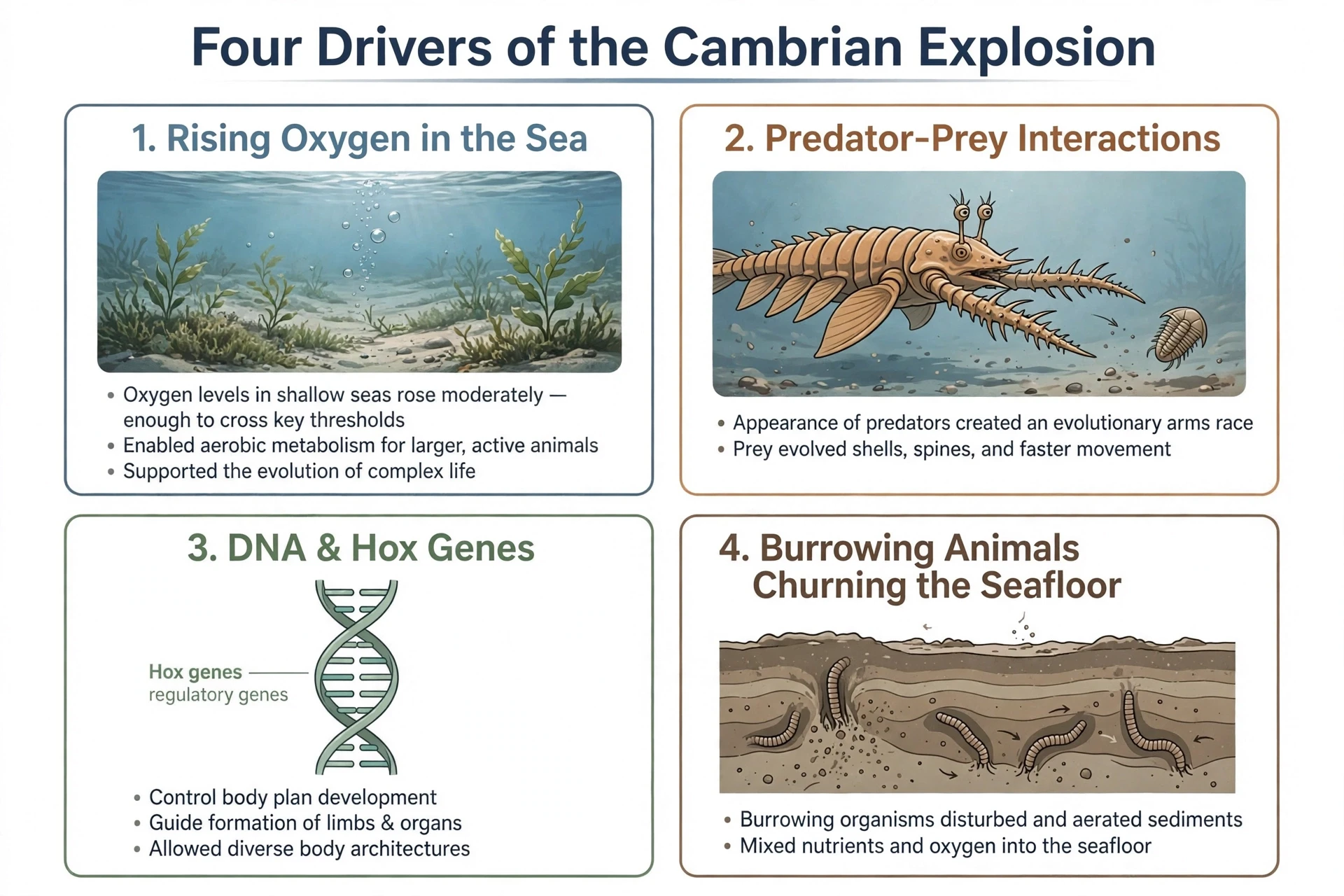
That leaves oxygen in an interesting position: necessary, but not sufficient, and probably not the trigger. A useful way to think about it comes from a 2013 paper by Erik Sperling and colleagues, which drew a distinction between two kinds of cause. Environmental triggers, like oxygen, can explain the timing of an event — why it happened when it did — but not its pattern. Ecological triggers, like predation, can explain the pattern — why the animals that appeared were the ones that did — but not the timing. The Cambrian explosion, Sperling argued, needs both: an environment that finally permitted large, active animals, and an ecology that then drove them to diversify. Oxygen opened the door. Something else pushed the animals through it.
That framing matters, because it stops us from looking for a single cause. The Cambrian explosion was not caused by oxygen, or by predation, or by genes, alone. It was caused by all of them together — and the job of the next three sections is to show how each one contributed, and where each one falls short on its own.
13. Predators and the Arms Race
If oxygen opened the door, predation was what made the animals run through it. The Cambrian seas were the first in which being eaten became a routine, everyday risk for most animals — and the fossil record shows animals responding to that risk in every way imaginable: with armour, with spines, with speed, with burrowing, with eyes, with size.
The evidence for Cambrian predation is direct, and it is getting stronger every year. Coprolites — fossilized droppings — once attributed to Anomalocaris contain fragments of trilobites, though current work suggests a large trilobite, not Anomalocaris, made them. Trilobite shells show healed injuries: bite marks and cracks that the animal survived, the edges regrown. Cloudina shells carry small round holes interpreted as drill holes from the Ediacaran — the earliest proposed evidence of a predator boring into its prey, though the interpretation is still debated. And in 2024, the gut of Timorebestia was found to contain the remains of Isoxys, a swimming arthropod — a predator's last meal, preserved for 518 million years. These are not inferences from anatomy. They are snapshots of feeding, frozen in stone.
The consequences of predation ripple outward. An animal that is hunted needs defences, and the Cambrian record is full of them: thicker shells, longer spines, the ability to roll into a ball, the ability to burrow out of reach. But defences create their own pressure. A predator that cannot crack a shell needs stronger claws or a better strategy. A prey animal that can burrow forces predators to dig. A prey animal that can see forces predators to be faster or stealthier. This is the evolutionary arms race: each improvement on one side selects for an improvement on the other, and the race never ends. It is one of the most powerful engines of diversification in evolution, and the Cambrian was the first time it ran at full speed.
Predation also changed the seafloor itself. Before the Cambrian, the seafloor was a flat mat of microbes, grazed from above. Cambrian animals burrowed into it — the Cambrian substrate revolution of section 4 — churning the sediment, breaking up the mats, and forcing every animal that lived on the bottom to adapt to a world that was now three-dimensional, oxygenated and constantly disturbed. Burrowing also created new habitats: the sediment itself became a place to live, to hide and to hunt. The animals that could burrow flourished; the animals that could not — the flat Ediacaran fronds anchored to the mats — vanished.
There is a pattern here that repeats across the history of life, and it is worth naming: ecology drives evolution, and evolution drives ecology, in a feedback loop. Predators select for defended prey. Defended prey select for better predators. Burrowers destroy the mats, which selects for animals that can live without them, which opens new niches, which selects for new body plans. The Cambrian explosion was not a single event with a single cause. It was a feedback loop that, once started, ran faster and faster — and the animals that emerged from it were the ones that could keep up.
That is why predation is widely accepted as a pattern-driver of the Cambrian explosion, and why it is contested as a timer. Predation explains why the animals that appeared were armoured, eyed, fast and burrowing. It does not, on its own, explain why it all started at 541 million years ago rather than 100 million years earlier. For the timing, we need the environment — oxygen, ocean chemistry, the clearing of the Ediacaran world — and for the pattern, we need the genes. Which brings us to the toolkit.
14. Genes: The Toolkit Was Already There
One of the most surprising discoveries of modern biology is that the genetic toolkit for building animal bodies is far older than the animal bodies themselves. The genes that control development were already in place long before the Cambrian explosion.
They include the Hox genes, which tell a growing embryo where its head goes and where its tail goes, the Pax6 gene, which switches on eye development, and the signalling pathways that sculpt limbs and shells. They had been evolving for at least tens of millions of years before the Cambrian began.
That fact changes the question. If the genes were already there, the Cambrian explosion was not caused by new genes. It was caused by new uses of old genes — by rewiring, by turning the same switches on in new places, at new times, in new combinations. A Hox gene that once told a worm where to put a segment could, with a small regulatory change, tell an arthropod where to put a leg. A Pax6 gene that once switched on a simple light-sensitive patch could, with a different downstream cascade, help build a compound eye. The raw material was ancient. The arrangements were new.
This is the idea biologists call deep homology: the same ancient genes, doing related jobs, in animals that diverged hundreds of millions of years ago. It is why the eye of a human and the eye of an octopus, for all their differences, use the same master gene — a story told in detail in our evolution of the eye article, and in our convergent evolution article, which shows the same pattern again and again. The Cambrian explosion is the largest-scale example of deep homology in action: a burst of new body plans built almost entirely from old genetic parts.
There is a second genetic point, and it is subtler. The Cambrian explosion did not only reuse old genes. It also reused old ecologies — or rather, it created new ones, and the new ecologies selected for new arrangements of the old genes. When burrowers destroyed the microbial mats, they created a new selective environment that favoured animals with legs, with shells, with eyes. When predators appeared, they created a selective environment that favoured armour and speed. Genes and ecology fed back into each other: the toolkit made new body plans possible, and the new body plans created new ecologies, which selected for new uses of the toolkit. This is niche construction — animals changing their own environment, and their changed environment changing them — and it is one of the reasons the Cambrian explosion, once started, was so hard to stop.
The picture that emerges is a three-step shift: first, a late-Ediacaran "worm world" of burrowing bilaterians; then, in the earliest Cambrian, a skeletal fauna of small shelly animals; then, in Cambrian Age 3 (about 521 to 514 million years ago), a marked expansion of diversity, disparity and ecological complexity. Each step made the next one possible. The genes were ready. The environment was ready. The ecology was ready. What the Cambrian explosion needed was all three at once — and for the first time in Earth's history, it had them.
15. Darwin's Dilemma — and the Molecular Clock Problem
No account of the Cambrian explosion can avoid Charles Darwin, because Darwin himself made it a problem. In On the Origin of Species (1859), he devoted a section to the sudden appearance of complex animals in the oldest fossil rocks, under the heading "On the sudden appearance of groups of Allied Species in the lowest known fossiliferous strata".
In the wording of the 1866 fourth edition, he wrote:
"There is another and allied difficulty, which is much graver. I allude to the manner in which species belonging to several of the main divisions of the animal kingdom suddenly appear in the lowest known fossiliferous rocks."
And he admitted, with a frankness that is still striking:
"To the question why we do not find rich fossiliferous deposits belonging to these assumed earliest periods prior to the Cambrian system, I can give no satisfactory answer."
Darwin's worry
Darwin's worry was simple and, in his own terms, fair. His theory predicted gradual change over long periods, with new forms appearing slowly, one small step at a time. The fossil record, as he knew it, showed the opposite: trilobites and other complex animals appearing in the lowest fossil-bearing rocks with no visible ancestors. He counted the difficulties together as "undoubtedly of the gravest nature" among the objections to his theory. His answer was to blame the imperfection of the fossil record: the ancestors must have existed, he argued, in seas whose deposits had been destroyed or never formed, over "long periods" as long as, or longer than, the whole interval from the Cambrian to the present day.
Darwin was right about the imperfection of the record, and wrong about how much it could explain. The Ediacaran fossils, unknown in his lifetime, show that animals did exist before the Cambrian — but they were soft-bodied, simple and few. The molecular evidence, also unknown to him, points the same way, and further: molecular clocks, which estimate when lineages split by counting genetic differences, in most recent estimates place the origin of animals between about 850 and 650 million years ago, in the Tonian or Cryogenian periods — hundreds of millions of years before the Cambrian. The fossil record, meanwhile, shows animals appearing abruptly around 541 million years ago, with virtually all fossilizable phyla present by about 520 million years ago. The clocks and the rocks disagree by hundreds of millions of years. That disagreement is the modern version of Darwin's dilemma.
The molecular clocks
The history of that disagreement is itself instructive. The earliest molecular clocks were far more extreme: a 1996 study put the split between protostomes and deuterostomes — the two great branches of bilaterian animals — at about 1,200 million years ago, and the chordate–echinoderm split at about 1,000 million years ago. Those dates were challenged almost immediately. A 1998 re-analysis showed that the early clocks had extrapolated the slow rates of vertebrate evolution to fast-evolving invertebrates, inflating the dates; with corrected rates, the splits fell to about 670 and 600 million years ago — still before the Cambrian, but far closer to the fossil record. The clocks were wrong, but they were wrong in a way that taught the field how to do better.
The modern reconciliation has three parts, and all three are worth understanding. First, a fossil date is always younger than the lineage split it records. A fossil tells us when a lineage became abundant, widespread and morphologically distinctive enough to leave a recognizable fossil. A molecular clock tells us when the lineage became genetically isolated. The second is necessarily earlier than the first — sometimes much earlier. Second, early animals may have been small, soft and unfossilizable — microscopic or larval forms that left no body fossils at all. The "cryptic Precambrian" is a real possibility, not a hand-wave: animals could have existed for tens of millions of years as tiny, soft creatures before any of them grew large enough, or hard enough, to fossilize. Third — and this is the honest limit — the precision of the clocks is not good enough to settle the question. A 2015 study concluded that, with current data, it is not possible to pinpoint the divergence events accurately enough to test for correlations between geological and biological events, and that attempts to build evolutionary narratives on molecular clock timescales "appear to be premature".
Closing the gap
The newest fossils are closing the gap from the other side. In 2026, a team described the Jiangchuan biota from Yunnan, China — more than 700 specimens dated to 554 to 539 million years ago, from the late Ediacaran, containing diverse bilaterian animals, the first Ediacaran deuterostomes (cambroernids, relatives of starfish and acorn worms), early cnidarians and possible comb jellies. The Jiangchuan animals push the origin of many complex groups back at least four million years before the Cambrian — and, more importantly, they show that the fossil record of the late Ediacaran is richer than anyone thought. The gap between clocks and rocks is narrowing, from both ends.
Darwin's dilemma, then, has not been solved so much as dissolved — or rather, reframed. The question is no longer "why do complex animals appear suddenly with no ancestors?" We now know they had ancestors, in the Ediacaran and before, and we are finding them. The question is now sharper and more interesting: why did animals that had existed for tens or hundreds of millions of years suddenly diversify, grow large, evolve shells and eyes and predators, all within a few tens of millions of years? That is the question the rest of this article has been answering — and the answer, as we have seen, is not one cause but many, acting together.
16. What Came Next: The Ordovician Radiation and the Survivors
The Cambrian explosion was not the end of the story. It was the opening chapter. What followed, in the Ordovician period (about 485 to 444 million years ago), was an event almost as remarkable, and far less famous: the Great Ordovician Biodiversification Event.
In that second great radiation, the animal groups that had appeared in the Cambrian diversified into the full range of marine ecosystems — reefs, deep water, plankton, predators and filter-feeders — at a scale the Cambrian never reached. If the Cambrian invented the body plans, the Ordovician filled them in.
Not everything survived the transition. Many of the Cambrian's strangest animals — Opabinia, Hallucigenia — vanished at the transition, while the radiodonts dwindled but survived: the giant Aegirocassis swam in the Early Ordovician seas, and the last radiodonts persisted into the Devonian. The trilobites, so dominant in the Cambrian, never regained their former diversity after the end-Cambrian extinctions, though they persisted for another 230 million years after the Cambrian ended. The animals that flourished in the Ordovician were different ones: articulate brachiopods, bryozoans (now known from the Cambrian, but diversifying in the Ordovician), corals, crinoids, nautiloids, and the first armoured jawless fish, the ostracoderms, in numbers. The Cambrian had been largely a time of invention. The Ordovician was largely a time of consolidation — fewer new body plans, far more species within the plans that already existed.
That pattern — invention first, diversification second — has repeated throughout the history of life, and it is one of the most important lessons of the Cambrian explosion. No new major, fossilizable animal phylum has clearly appeared in the fossil record since the Cambrian. Every animal alive today belongs to a body plan whose foundations were laid by about 520 million years ago — though the modern, crown-group versions of those body plans were assembled over a longer interval. What has happened since is diversification within those plans: new classes, new orders, new families, new species — an endless elaboration of designs that were fixed, in their broad outlines, half a billion years ago.
The Huayuan biota
The newest fossil discoveries keep adding detail to this picture, including its darker chapters. In 2026, a team described the Huayuan biota from Hunan, China — a soft-bodied fossil assemblage dated to about 512 million years ago, just after the Sinsk event, the first mass extinction of the Phanerozoic, which wiped out roughly 45% of marine genera — over 60% of species by some estimates — around 513 million years ago. The Huayuan quarry has yielded more than 50,000 specimens and 153 species across 16 major groups, 91 of them new to science — the first major soft-bodied assemblage from after that extinction. Its deep-water communities, the study found, were less affected than shallow ones, a pattern that echoes later mass extinctions. The Cambrian world was not a steady climb. It had crashes, and recoveries, and the recoveries were themselves engines of diversification.
The link to our own time is hard to miss, and it is worth stating plainly. The animals that dominate the modern world — including us — belong to body plans that survived the Cambrian, the Ordovician, and five mass extinctions after that. The story of those extinctions, and of the sixth that many scientists argue is now under way, is told in our mass extinctions article. The Cambrian explosion built the animal kingdom. The extinctions that followed decided which parts of it would survive. Both stories are needed to understand the world we live in.
17. Five Myths About the Cambrian Explosion
Five misunderstandings about the Cambrian explosion survive because each one contains a grain of truth wrapped around a false conclusion. They are worth taking apart one by one, because each wrong idea about the Cambrian explosion points to a wrong idea about evolution itself.
17.1 Myth 1: It happened overnight
The most persistent myth is that the Cambrian explosion happened suddenly — that animals appeared out of nowhere, in an instant. The grain of truth is that the diversification was fast by geological standards. The false conclusion is that it was instantaneous. It was not. The main burst lasted 13 to 25 million years, and its fuse stretched back tens of millions of years into the Ediacaran, through the first burrowers, the first shells and the first predators. Thirteen million years is not overnight. It is longer than the entire history of the human lineage. The explosion looks sudden only because the rocks before it are nearly silent — and that silence is partly a preservation problem, not a biological one.
17.2 Myth 2: All animals appeared from nothing
The second myth is that the Cambrian animals had no ancestors — that they appeared, fully formed, from nothing. The grain of truth is that their ancestors are hard to find in the fossil record. The false conclusion is that they did not exist. They did. The Ediacaran biota, the small shelly fossils, the Cloudina reefs, the microfossils from Brazil dated to 571 million years ago, the Jiangchuan biota of 2026 — all of these show animals, or their close relatives, living before the Cambrian. Molecular clocks say the same thing from a different direction: the lineages split long before they became visible as fossils. The Cambrian explosion was not the origin of animals. It was the moment animals became large, hard-bodied and abundant enough to leave a record.
17.3 Myth 3: The weird wonders were all failures
The third myth is that animals like Opabinia and Hallucigenia were evolutionary failures — bizarre experiments that went nowhere. The grain of truth is that many Cambrian body plans did vanish. The false conclusion is that the weird wonders were among them, or that vanishing means failing. Modern research has placed most of the weird wonders on the stems of living groups: Opabinia as a stem arthropod, Hallucigenia as a stem velvet worm, Wiwaxia probably as a stem mollusc. They were not dead ends. They were early branches — cousins of the groups that survived, carrying the same basic designs in earlier forms. And even the groups that truly vanished were not failures in any meaningful sense. They lived, fed, reproduced and persisted for millions of years. Extinction is not failure. It is the normal fate of most lineages, including, eventually, most living ones.
17.4 Myth 4: One single cause explains it
The fourth myth is that the Cambrian explosion has a single cause — oxygen, or predation, or genes, or the end of the ice ages. The grain of truth is that each of these played a real role. The false conclusion is that one of them, alone, is the answer. It is not. The current understanding, reflected in recent reviews, is that the Cambrian explosion was a product of multiple interacting causes: an environment that finally permitted large, active animals; an ecology in which predation drove an arms race; a genetic toolkit that was already in place and ready to be rewired; and a seafloor that had just been cleared and churned by the first burrowers. Remove any one of these, and the Cambrian explosion looks different. Remove all but one, and it does not happen at all. Complex events have complex causes, and the Cambrian explosion is a complex event.
17.5 Myth 5: Evolution stopped inventing after the Cambrian
The final myth is the mirror image of the others: that because no new phyla have appeared since the Cambrian, evolution somehow stopped inventing. The grain of truth is the fact itself — no new major, fossilizable animal phylum has clearly appeared in the fossil record for 520 million years. The false conclusion is that nothing new has happened since. Enormous things have happened since: the colonization of land, the evolution of flight (four times), the rise of flowering plants, the evolution of warm-blooded animals, the human brain. None of these required a new phylum. They required new classes, new orders, new families, new species — elaborations within body plans that were fixed long ago. Evolution did not stop inventing. It changed what it invented: not new architectures, but new variations on architectures that worked.
18. Why the Cambrian Explosion Still Matters
The Cambrian explosion matters because it is the closest thing evolution offers to a natural experiment in how new forms of life originate. It shows us what happens when ecological opportunity, environmental change and genetic possibility arrive at the same time.
What follows is a burst of innovation, a pruning of experiments, and a settlement into the designs that will dominate for hundreds of millions of years. That pattern — burst, pruning, consolidation — has repeated at smaller scales throughout the history of life, after every mass extinction and every colonization of a new habitat. The Cambrian is the largest and clearest example of it, and the one from which the rest can be understood.
It matters, too, because of the argument it still sustains: the argument between contingency and predictability. Stephen Jay Gould, writing about the Burgess Shale, argued that the history of life is ruled by contingency — by luck. Rewind the tape of life to the Cambrian, he said, play it again, and you would get a completely different world, because so much depended on which lineages happened to survive and which happened to vanish. Simon Conway Morris, arguing the opposite, pointed to convergent evolution — the repeated invention of the same solutions, eyes, wings, sonar, again and again — and argued that the broad outlines of life were predictable, set by physics and by the narrow range of designs that work. Our convergent evolution article tells that side of the argument in full.
Both men were looking at the same fossils, and both were partly right — which is why the argument has never been settled. The Cambrian explosion supports both readings at once. It supports Gould, because the survival of the chordates — the lineage that includes us — looks, in retrospect, like luck: Pikaia was uncommon in the Burgess Shale, soft-bodied and unimpressive, and the seas were full of animals that looked more successful. It supports Conway Morris, because the same solutions — eyes, shells, legs, predation — kept appearing independently, in lineage after lineage, as if the problems of Cambrian life admitted only a few good answers. The explosion is, in the end, a story about both: a world in which the broad strokes were constrained and the details were chance. That tension is one of the deepest questions in evolutionary biology, and the Cambrian is where it is sharpest.
There is a third reason the Cambrian explosion matters, and it is the most practical. It is a reminder of how quickly life can change when the conditions are right — and how quickly it can be pruned when they change. The Cambrian seas filled with new body plans in a few tens of millions of years. The end-Permian extinction, about 270 million years later, removed as much as 96 percent of marine species in a geological instant. The modern world is changing fast, and the animals in it are under pressure from warming, acidification, habitat loss and extinction. The Cambrian tells us that life is resilient — it has recovered from far worse — and that it is also fragile, in the sense that the particular animals alive at any moment are temporary. Both lessons are true at once. The explosion built the animal kingdom. What we do with it now is up to us.
19. How Scientists Read a 541-Million-Year-Old Crime Scene
The Cambrian explosion happened more than half a billion years ago, in seas that no longer exist, among animals that left almost no direct descendants. How, then, do scientists know anything about it at all — let alone enough to argue about oxygen spikes, Hox genes and arms races?
The answer is that they read the Cambrian explosion the way a detective reads a crime scene: from many kinds of evidence at once, none of which is conclusive alone, and all of which point, together, in the same direction.
Fossils
The first kind of evidence is the fossils themselves, and the methods for reading them keep improving. CT scanning lets researchers see inside a fossil without breaking it, revealing nervous systems, guts and eyes that were invisible to earlier generations. Chemical analysis of fossil tissues — the cholesterol that identified Dickinsonia as an animal, the calcium isotopes that showed Cloudina built aragonite skeletons — turns a rock into a chemical record of the animal that made it. And new fieldwork keeps finding new sites: the Huayuan biota of 2026, the Jiangchuan biota of 2026, the Kootenay Burgess Shale site (found in 2012, first excavated in 2013). The fossil record of the Cambrian is not a fixed archive. It grows every year.
Chemistry
The second kind of evidence is geochemical: the chemical signatures left in Cambrian rocks. Oxygen proxies — the ratios of isotopes in ancient sediments — tell us how much oxygen was in the air and the sea, and when it changed. Carbon isotopes track the burial of organic matter and the productivity of the oceans. These proxies are what let researchers test the oxygen hypothesis, and they are what revised it: the 2024 finding that the oceans were never fully oxygenated in the Cambrian came from this kind of evidence, not from fossils. The rocks remember chemistry that no fossil could preserve.
Genes
The third kind of evidence is genetic: the molecular clocks and the developmental genetics that tell us when lineages split and which genes they share. The clocks are imprecise, as section 15 showed, but they are improving — better models, more genes, better fossil calibrations — and the gap between clocks and rocks is narrowing from both ends. Developmental genetics, meanwhile, tells us which parts of the Cambrian toolkit were old and which were new, and how small regulatory changes can produce large anatomical differences.
New discoveries, still arriving
The newest results show how fast this picture is still moving. In 2024, Stockey and colleagues showed there was no stepwise jump to near-modern oxygen levels in the deep ocean until the Devonian — atmospheric oxygen rose in sustained steps, but the deep sea stayed largely oxygen-poor through the Cambrian. The same year, a new interpretation flipped Pikaia upside down and confirmed it as a stem chordate, and a new giant predator, Timorebestia, was described from Greenland. In 2026, three discoveries landed in quick succession: the Huayuan biota, with 91 new species from just after the first mass extinction; the Jiangchuan biota, pushing complex animals back into the Ediacaran; and new bryozoan fossils that closed the last major phylum gap in the Cambrian, proving that even the group long thought absent had been there all along. A fourth 2026 find, Yujingia, a tiny tentacled animal from Chengjiang, suggested that the ancestor of starfish and acorn worms was a suspension feeder, not a burrower — a small correction with large implications for how those groups evolved.
That pace of discovery is itself the point. The Cambrian explosion is not a closed case. It is an active investigation, and every year brings new evidence — new fossils, new chemistry, new genetics — that refines, and sometimes overturns, what we thought we knew. Walcott's slab, split open on a mountainside in 1909, was the first piece of evidence. It will not be the last.
Frequently Asked Questions
Seven questions readers ask most often about the Cambrian explosion, answered directly.
What was the Cambrian explosion?
The Cambrian explosion was the geologically rapid diversification of animal life near the beginning of the Cambrian period, about 541 million years ago, when most major animal body plans first appeared in the fossil record. It was not a literal explosion, but a burst of evolutionary innovation lasting roughly 13 to 25 million years, during which arthropods, molluscs, worms, echinoderms and chordates — the group that includes vertebrates — all appeared, along with shells, eyes, legs and predators.
When did the Cambrian explosion happen?
The Cambrian explosion began about 541 million years ago, at the start of the Cambrian period — though the International Commission on Stratigraphy now dates the formal boundary to 538.8 million years ago. The main burst of diversification lasted roughly 13 to 25 million years. By about 520 million years ago, representatives of most of the major animal phyla that fossilize at all were already present in the rocks.
What caused the Cambrian explosion?
No single cause explains it. The current understanding is that several factors interacted: a moderate rise in oxygen that permitted large, active animals; the rise of predation, which drove an evolutionary arms race in armour, eyes and speed; a genetic toolkit (including Hox genes) that was already in place and could be rewired into new body plans; and ecological feedback, as the first burrowers churned the seafloor and opened new habitats. Reviews describe it as a product of multiple interacting causes rather than one trigger event.
What is the Burgess Shale?
The Burgess Shale is a fossil deposit in Yoho National Park, British Columbia, discovered by Charles Doolittle Walcott in 1909 and dated to about 508 million years ago. It preserves soft-bodied Cambrian animals in extraordinary detail — animals that would normally never fossilize — including Anomalocaris, Opabinia, Hallucigenia, Wiwaxia and Pikaia. About 150 species have been described from the Walcott Quarry, and it is a UNESCO World Heritage Site.
How long did the Cambrian explosion last?
The most commonly cited range is 13 to 25 million years for the main burst of diversification. Either way, it was a geological blink: a small fraction of the 3.5-billion-year history of life.
Did all animal phyla appear in the Cambrian?
Not quite all. Between 20 and 35 of the roughly 35 to 40 living animal phyla appeared during the Cambrian, and by about 520 million years ago representatives of most of the major animal phyla that fossilize at all were already present in the rocks. But sponges appeared earlier, in the Ediacaran, and some groups almost certainly existed before the Cambrian as small, soft-bodied animals that left no fossils. The last apparent gap — the bryozoans — was closed by new fossils described in 2026, dated to about 520 million years ago.
What came before the Cambrian explosion?
The Ediacaran period (about 635 to 541 million years ago), inhabited by the first large, soft-bodied organisms: frond-like animals anchored to microbial mats, the ribbed oval Dickinsonia, and the slug-like Kimberella. There were no shells, no predators and almost no burrowing. Animals had already existed for tens of millions of years before the Cambrian — the Cambrian explosion was not the origin of animals, but the moment they became large, diverse, hard-bodied and abundant.
Sources
Martin A. Life Traces of the Georgia Coast. Treptichnus pedum
Smithsonian Magazine. How the Burgess Shale Changed Our View of Evolution
Royal Ontario Museum. Anomalocaris canadensis — Burgess Shale Fossils
Royal Ontario Museum. Opabinia regalis — Burgess Shale Fossils
Royal Ontario Museum. Hallucigenia sparsa — Burgess Shale Fossils
Royal Ontario Museum. Wiwaxia corrugata — Burgess Shale Fossils
Royal Ontario Museum. Triggers of the Cambrian Explosion — Burgess Shale
UNEP-WCMC. Chengjiang Fossil Site — World Heritage Datasheet
Springer Nature Communities. A Cambrian Can of Worms (Chengjiang biota)
Schoenemann B. Trilobite Eyes and Their Evolution. Arthropoda (2025). DOI: 10.3390/arthropoda3010003
Park T et al. A giant stem-group chaetognath. Science Advances (2024). DOI: 10.1126/sciadv.adi6678
Darwin C. On the Origin of Species. London: John Murray, 1859. (Book — no online link; listed as a text-only entry.)
Gould SJ. Wonderful Life: The Burgess Shale and the Nature of History. New York: W. W. Norton, 1989. (Book — no online link; listed as a text-only entry.)
Conway Morris S. Life's Solution: Inevitable Humans in a Lonely Universe. Cambridge: Cambridge University Press, 2003. (Book — no online link; listed as a text-only entry.)
Conway Morris S. The community structure of the Middle Cambrian Phyllopod Bed (Burgess Shale). Palaeontology 29:423–467 (1986). (Journal citation — no DOI; listed as a text-only entry.)
Parker A. In the Blink of an Eye: How Vision Sparked the Big Bang of Evolution. Perseus Books, 2003. (Book — no online link; listed as a text-only entry.)
Shu D et al. Lower Cambrian vertebrates from south China. Nature (1999). DOI: 10.1038/46965
University of California Museum of Paleontology. Trilobita: Fossil Record
Webby BD et al. (eds.). The Great Ordovician Biodiversification Event. Columbia University Press, 2004. (Book — no online link; listed as a text-only entry.)