

1. The Number That Never Ends
I first met pi with a tape measure and a jam jar. I was a child, and somebody — I no longer remember who — told me to wrap the tape around the jar, measure across the top, and divide one number by the other. The answer came out as 3.14-something. Then I tried a dinner plate. Same answer. Then a bicycle wheel, which took two of us to hold steady while the tape flopped around the tyre. Same answer again: 3.14-something, every time, no matter how big the circle or how small.
That is the moment this article is about. A jam jar and a bicycle wheel have nothing in common except that they are round — and yet the same number hides inside both of them, and inside every circle that has ever been drawn, from a wedding ring to the orbit of a planet. Divide the distance around any circle by the distance across it, and you get pi. And pi never ends. You can write down 3.141592653589793238462643383279, keep going for a thousand digits, a million, a trillion, and you will never reach the end, because there is no end to reach. The digits never settle into a repeating pattern, either. They just keep coming, apparently at random, for ever.
How can that be? How can the simplest ratio in geometry — one length divided by another — refuse to be written down? That question has kept mathematicians busy for more than four thousand years. It drove Archimedes to trap a circle between polygons with 96 sides. It drove a clerk in India to invent formulas so powerful that a single term of one of them gives you seven correct digits. It drove the builders of the fastest computers on Earth to spend 110 days calculating a number nobody will ever read in full. And it is still not finished: we do not know whether every digit occurs equally often in pi, and we do not know whether your phone number appears somewhere in its digits. The number that a child finds with a tape measure around a jam jar is still, in some ways, a mystery.
This article follows that question from the beginning. We will start with what pi is, in plain language, with the numbers worked out in front of you. Then we will follow the hunters: the Babylonians and Egyptians who guessed at it, Archimedes who trapped it between two fractions, the Chinese and Indian mathematicians who pushed it to seven correct places a thousand years before Europe caught up, and the men who gave it its symbol, proved it irrational, proved it transcendental, and finally taught computers to chase it to 314 trillion digits. Along the way we will meet pi in places it has no business being — in dropped needles, in thrown darts, in the odds that two random numbers share no common factor, in the swing of a pendulum, in the uncertainty of an electron, and in the equations of Einstein. We will end with the festivals, the failed laws, and the six nines that made a physicist famous for a joke he may never have told.
One promise before we begin. Every number in this article can be checked with a pocket calculator, and every number I quote was recomputed while this article was being researched. And wherever the popular version and the measured version disagree — the Bible, the rivers, the Feynman point — I will show you both, and let the numbers decide.
2. What Is Pi?
Pi is the ratio of a circle's circumference to its diameter. Take any circle — a coin, a plate, a planet — measure the distance around it, measure the distance straight across it through the centre, and divide the first number by the second. The answer is always the same: pi, written with the Greek letter π, equal to 3.14159265358979323846264338327950288419716939937510, and on, and on, without end.
A coin and a planet are different in every way that matters — size, weight, material, history — and yet the ratio is identical for both. It is identical because a circle is a shape defined by a single rule: every point on the edge is the same distance from the centre. Scale the circle up or down and every length in it scales by the same factor, so the ratio of two lengths in it cannot change. Pi is not a property of big circles or small circles. It is a property of roundness itself.
The two formulas that matter most follow directly from the definition. If d is the diameter and r is the radius — half the diameter — then the circumference C is pi times the diameter, C = π × d, which is the same as C = 2 × π × r. The area A inside the circle is pi times the radius squared, A = π × r². Put numbers on them and they stop being abstract. A circle with a diameter of 10 has a circumference of 10 × π, which is 31.4159. A circle with a radius of 3 measures 2 × π × 3, which is 18.85, around its edge, and π × 9, which is 28.27, inside it. A circle with a radius of 5 has an area of π × 25, which is 78.54. The Earth, with a diameter of 12,742 kilometres, has a circumference of π × 12,742, which is 40,030.17 kilometres — the distance you would walk if you could stroll around the equator. A sphere with a radius of 1 has a volume of four-thirds times π, which is 4.18879, and a surface area of 4 × π, which is 12.56637. The same number, in every case, doing the same job.
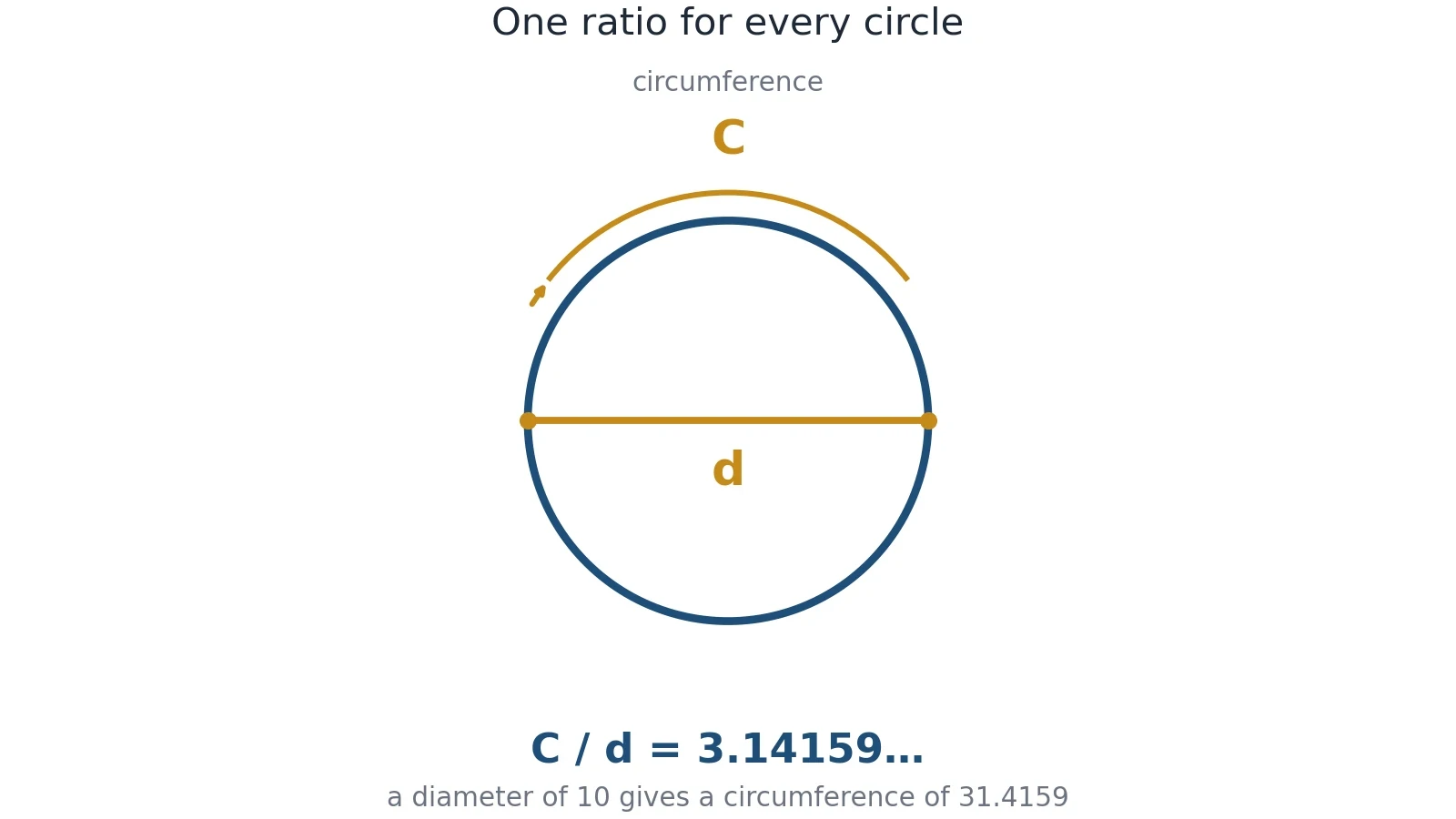
So why do we say pi is 3.14? Because 3.14 is close enough for most purposes, and because the true value cannot be written down in full. But 3.14 is not pi. It is low by 0.0507 percent — a small error, but a real one, and in precision work it matters. The fraction 22/7, which is 3.142857, is closer: it is high by only 0.0402 percent. The fraction 355/113, which is 3.1415929204, is astonishingly close: it is high by only 2.6676 × 10⁻⁷, a relative error of about 8.5 × 10⁻⁸, which means it agrees with pi to six decimal places. We will meet 355/113 again in section 5, where it has a story of its own. For now, the point is simple: every value you have ever been given for pi — 3.14, 22/7, 3.14159 — is an approximation. Pi itself is the thing all of those approximations are reaching for, and none of them ever quite touches.
The definition is confirmed in the clearest single reference I know, the Britannica entry on pi, which states the ratio, the value, and the history in one place.
There is one more thing to say about the definition, because it is the question everyone asks next. If pi is just one length divided by another, why does the answer never end? A length divided by a length ought to give a tidy number, the way 10 divided by 4 gives 2.5. The answer is that the two lengths in a circle are incommensurable — no common unit measures both of them exactly. The diameter is a straight line. The circumference is a curve. You can measure the diameter exactly, or you can measure the circumference exactly, but you cannot measure both exactly with the same ruler, because the curve and the straight line do not fit together in whole numbers. Pi is the price of that mismatch: a number that exists, that is perfectly definite, and that cannot be written as a fraction or as a terminating decimal. The proof of that claim took until 1761, and it is the subject of section 7. But the intuition is here, in the definition: pi never ends because a circle is not made of straight lines, and no finite collection of straight pieces will ever add up to a curve exactly.
That is also why pi shows up far beyond circles, as we will see. Whenever mathematics has to reconcile a straight line with a curve — a wave with a period, a sphere with a surface, a random process with a bell curve — pi turns up, because pi is the number that measures the relationship between the straight and the round. The infinite digits are not a defect. They are a symptom. Pi never ends because roundness itself cannot be captured by counting, and the endless digits are the trace of that fact, written out one digit at a time, for ever.
3. The First Hunters: Babylon, Egypt, and the Bible's Rounded Bowl
Nobody knows who first noticed that the ratio of circumference to diameter is always the same. It was probably noticed independently in several places, by people who had no word for it and no symbol for it, but who needed to know how much rope to buy to go around a circular field, or how much clay to build a round granary. The earliest written values we have come from Babylon and Egypt, and both of them are wrong in interesting ways — wrong in ways that tell you how their authors were thinking.
The Babylonians usually took pi to be 3. That is the value you get if you measure a circle roughly, with a rope, and round off: a circumference three times the diameter, near enough for building a wall. But one Old Babylonian tablet from near Susa, dating from the 19th to 17th centuries BCE, gives a better value: 25/8, which is 3.125, and which is 0.528 percent below the true value. Somebody on that tablet was doing real mathematics — not measuring with a rope, but calculating — and getting noticeably closer than 3. The tablet does not explain how the value was found. What matters is that nearly four thousand years ago, someone already knew that 3 was not quite right, and had a better number to offer.
The Egyptians did better than the rough value of 3. The Rhind Mathematical Papyrus, written around 1650 BCE by a scribe named Ahmes, copying an older Middle Kingdom text, gives a rule for the area of a circle: take the diameter, subtract one-ninth of it, and square what is left. Worked through, that rule implies pi is 256/81, which is 3.1604938272, an error of only 0.6016 percent on the high side. It is the same number as (16/9)², and it is a genuinely clever piece of mathematics: the Egyptians were not measuring circles, they were squaring them, turning a round area into a square one of nearly the same size. Their value stayed among the best in the world for more than a thousand years, and it was good enough to build with. A pyramid builder who used 3.1605 instead of 3.14159 would have been out by less than one percent — an error invisible in stone.
Then there is the famous passage in the Bible, and it needs to be handled with care, because it is the most misquoted piece of mathematics in any ancient text. The first book of Kings describes a great brass vessel in Solomon's Temple, called the molten sea: ten cubits from brim to brim, five cubits high, and a line of thirty cubits going around it. Ten cubits across, thirty cubits around. Thirty divided by ten is three. So, the argument goes, the Bible says pi equals 3 — and the Bible is wrong.
The argument is wrong, and the verse is not making the claim it is accused of making. Read it as it stands:
"And he made a molten sea, ten cubits from the one brim to the other: it was round all about, and his height was five cubits: and a line of thirty cubits did compass it round about." — 1 Kings 7:23 (KJV)
That is a building specification, not a mathematical theorem. It gives the rounded dimensions of a real brass vessel: about ten cubits across, about thirty cubits around. The true circumference of a ten-cubit circle is 31.4159 cubits, so the text rounds 31.4 down to 30 — a rounding of 4.5 percent on a dimension given in whole cubits. Nobody writing a building specification in whole numbers would write "thirty-one point four cubits". They would write thirty, and everyone reading it would understand that the number was rounded. The verse never states a value for pi. It never claims the ratio is three. It describes a bowl.
There is a second, older explanation, and it is worth knowing because it shows how seriously the passage was taken. Rabbi Nehemiah, in the second century, argued that the diameter was measured across the outside of the rim while the circumference was measured around the inside: a rim about a handbreadth thick, matching the description in the following verses, would make the inner diameter 30 divided by pi, which is 9.549 cubits — just under ten, with the difference taken up by the thickness of the brass. Whether or not that is what the writer intended, it fits the numbers, and it fits the text. Either way, the passage is a rounded description of a vessel, and anyone who quotes it as "the Bible says pi equals 3" is reading a mathematical claim into a sentence that does not contain one.
The early history of pi is a history of getting closer, slowly, by different routes: a Babylonian tablet here, an Egyptian papyrus there, a temple specification rounded to whole numbers. The Exploratorium's brief history of pi tells this story well, and it is the best place to start if you want the ancient sources in one place. What none of these early hunters had was a method — a way of getting closer on demand, as many digits as you wanted. That had to wait for Archimedes, and Archimedes changed the game entirely.
| Era | Who | Value | Error |
|---|---|---|---|
| 19th–17th c. BCE | Babylonian tablet from Susa | 25/8 = 3.125 | −0.53% |
| c. 1650 BCE | Rhind Papyrus (Ahmes, Egypt) | 256/81 ≈ 3.1605 | +0.60% |
| 1 Kings 7:23 | The molten sea (rounded dimensions) | 30/10 = 3 | −4.5% (rounding) |
| c. 250 BCE | Archimedes | 223/71 to 22/7 | 3.1408 to 3.1429 |
| 499 CE | Aryabhata | 62832/20000 = 3.1416 | +0.000234% |
| c. 480 CE | Zu Chongzhi | 355/113 = 3.14159292 | +0.0000085% |
4. Archimedes Traps the Circle
Archimedes of Syracuse, writing his short treatise Measurement of a Circle around 250 BCE, did something nobody before him had done: he stopped guessing at pi and trapped it. His idea was disarmingly simple. A circle is hard to measure, because it is curved. A polygon is easy to measure, because it is made of straight lines. So put a polygon inside the circle, and put a polygon outside the circle, and the circle's circumference must lie between the two perimeters. Make the polygons finer — more sides, each one shorter — and the two perimeters close in on the circumference from either side, squeezing pi between them. That is the method of exhaustion, and it is the seed from which calculus would grow two thousand years later — the same idea of approaching a curve by straight pieces, refined until the error vanishes, that sits at the heart of how calculus works.
Archimedes started with a hexagon — six sides — and doubled: 6, then 12, then 24, then 48, then 96. Each doubling meant computing new side lengths from old ones, and each computation meant estimating a square root, by hand, in Greek numerals, with no decimal point and no calculator. It was gruelling work, and Archimedes did it with a care that still commands respect. At 96 sides he stopped, and he announced his result: pi lies between 223/71 and 22/7. In decimals, that is 3.1408 < pi < 3.1429. The interval is 0.002012 wide, and its midpoint, 3.141851, is correct to three decimal places. For a man working with a stylus and a sand table, it was a triumph — and it stood as the best value in the Western world for nearly a thousand years.
Here is the curious part. If you compute the true perimeters of a 96-sided polygon around a circle of diameter 1, you get a tighter interval than the one Archimedes stated. The inscribed 96-gon has a perimeter of 96 × sin(π/96), which is 3.1410319509. The circumscribed 96-gon has a perimeter of 96 × tan(π/96), which is 3.1427145996. Archimedes' stated bounds, 3.1408 and 3.1429, are looser than both of these. Why? Because at every step of his calculation he rounded his square-root estimates conservatively — always rounding in the direction that kept his bounds honest. He could have claimed a tighter interval, and it would have been true, but he could not have proved it with the arithmetic he had, because his estimates were not exact. So he reported what he could prove, and left the tighter interval on the table. That is not a mistake. It is intellectual honesty of the highest order, and it is one of the reasons mathematicians still admire him.
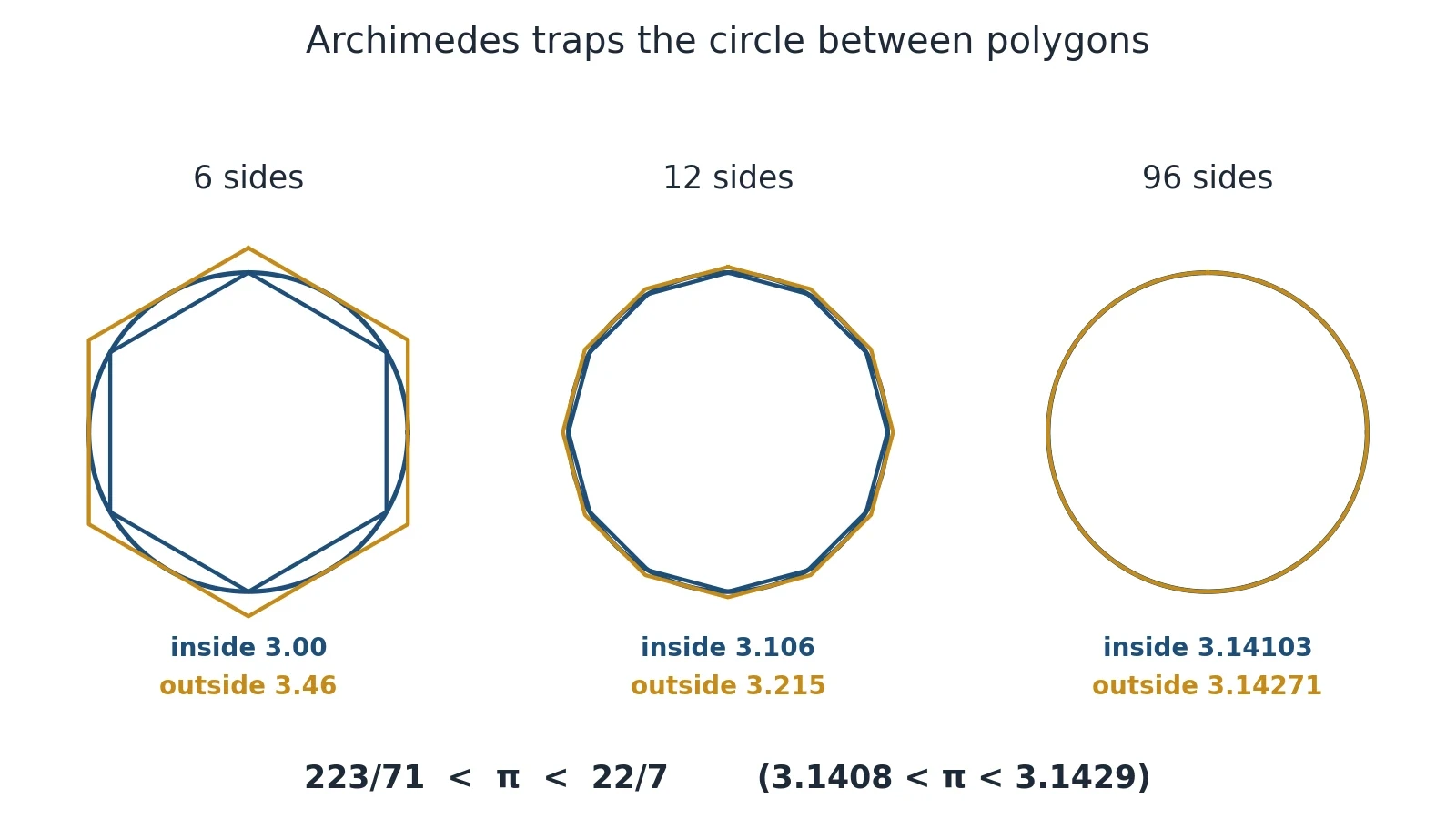
There is a lesson in Archimedes' method that goes beyond pi. Before him, people measured circles. After him, people could calculate them — and, more importantly, they could calculate how wrong they might be. The interval is the point. Archimedes did not just give a value for pi; he gave a guarantee: pi is in here, between these two numbers, and nowhere else. Every later computation of pi, from Machin's hundred digits to the 314-trillion-digit record of 2025, is Archimedes' idea carried further — a better method, a tighter trap, the same guarantee. The polygons got finer, the arithmetic got faster, but the logic never changed: squeeze the circle between two things you can measure, and watch the gap close.
It is also worth pausing on what Archimedes did not do. He did not try to compute pi exactly, because he understood that no polygon, however fine, is a circle. A 96-gon is not a circle. A million-gon is not a circle. The polygon approaches the circle, and the perimeters approach pi, but they never arrive. Archimedes knew that, and he built his method around it. Two thousand years before anyone proved pi irrational, Archimedes was already working as if he knew the exact value could not be written down. The circle always slips away from the polygon, by a little less each time, for ever. That slipping away is pi.
5. Seven Digits in China, Eleven in India
After Archimedes, the hunt for pi moved east, and for a thousand years the best values in the world came from China and India. The Western world was still quoting Archimedes' two fractions. In the East, mathematicians were pushing past them — and one of them found a fraction so good that it still startles people today.
Liu Hui, working in China in 263 CE, took up Archimedes' polygon method and carried it further: a 96-gon, then a 192-gon. His result was 3.141024 < pi < 3.142708, a tighter interval than Archimedes had managed, and he suggested that 3.14 was good enough for practical purposes — which, for almost everything anyone needed to build or measure, it was. He is also credited with the value 3927/1250, which is 3.1416. Pi was becoming a computation, not a guess.
Then came Aryabhata, in India, in 499 CE. In his Aryabhatiya he gave a verse that reads like a riddle: add 4 to 100, multiply by 8, and add the result to 62,000 — and that, he said, is the circumference of a circle whose diameter is 20,000. Work it out: 100 + 4 is 104, times 8 is 832, plus 62,000 is 62,832. Divide by the diameter, 20,000, and you get pi ≈ 62832/20000, which is 3.1416, correct to four decimal places, with an error of only +0.000234 percent. Aryabhata's verse is a piece of compressed mathematics — a whole calculation folded into a single sentence, designed to be memorised — and it is correct to a precision that Europe would not reach for another thousand years.
The greatest of the Chinese results came from Zu Chongzhi, around 480 CE. Zu proved that pi lies between 3.1415926 and 3.1415927 — seven correct decimal places — and he gave two fractions: 22/7, which he called the approximate rate, and 355/113, which he called the Milu, the close rate. The fraction 355/113 is 3.1415929204, and it is the best rational approximation to pi with a numerator and denominator under five digits. It agrees with pi to six decimal places, and no fraction with smaller numbers does better. Zu's book is lost, and we do not know exactly how he did it; the method is believed to have used a polygon with 24,576 sides, though some sources say 12,288. What we know is the result, and the result stood unimproved for close to a millennium. Nobody in the world beat seven correct decimal places until the fifteenth century.
I first met 355/113 as a schoolchild, and I believed, for a while, that pi was "just" that fraction — that the whole mystery was a trick, and that somebody had found the exact value and hidden it in a fraction with three-digit numbers. It is a tempting belief, because 355/113 is so good that it feels exact. Six decimal places of agreement will do that to you. The disappointment, when I learned the truth, was real: 355/113 is not pi, it is only close to pi, and the difference, tiny as it is, is the whole story. But the disappointment taught me something better. The reason 355/113 works so well is not luck. It comes from the continued fraction of pi — the way pi can be broken down into a sequence of whole numbers — and the fractions you get by stopping that sequence at the right places are the best approximations there are. We will come back to continued fractions in section 7, where they prove pi irrational. For now, the point is that 355/113 is a landmark: the best a fraction can do with small numbers, found fifteen hundred years ago, and still the fraction I reach for when I need pi in my head. If you want the story of the ancients and the medievals in one place, the Exploratorium's history of pi carries it from Babylon through Zu Chongzhi in a few pages, and it is the clearest short account I know.
The next leap came from Madhava of Sangamagrama, in Kerala, around 1400. Madhava discovered the infinite series pi/4 = 1 − 1/3 + 1/5 − 1/7 + …, the series that Europe would later name after Gregory and Leibniz, who rediscovered it in 1671 and 1674. Using a transformed, faster-converging version of that series, Madhava computed pi to eleven correct decimal places — 3.14159265359 — using only the first 21 terms, and with a remainder term he reached thirteen places. The chronology tables credit him with ten correct places in 1400, which understates him slightly; either way, he was seven centuries ahead of Europe on infinite series, and his value was the most accurate in the world for two hundred years. Madhava's series is also a conceptual leap: Archimedes had squeezed pi between polygons, but Madhava wrote pi as a sum — an infinite sum, of simple fractions, that adds up to the number itself. Pi was no longer just a ratio. It was a process, an endless addition that converges on the answer.
After Madhava, the record moved west again. Jamshid al-Kashi, working in Samarkand around 1424 to 1430, computed pi to sixteen decimal places — 3.14159265358979325 — a precision that would not be beaten in Europe for more than a century. Then came Ludolph van Ceulen, in the Netherlands, who spent years of his life on polygons, pushing to 35 decimal places by the early 1600s, using a polygon with 2⁶² sides. He was so proud of the result that the digits were carved on his tombstone in Leiden. The chronology is worth getting right, because the sources disagree: the tables credit him with 20 digits in 1596 and 32 in 1615, and his pupil Snell reached 35 in 1621. So the honest statement is that van Ceulen reached 35 decimal places by the early 1600s, not that he did it in any single year. His tombstone is the most literal monument in the history of mathematics: a man who spent his life chasing a number, and asked to be remembered by it.
Look at the arc of it. Babylon: 3. Egypt: 3.1605. Archimedes: two fractions and a guarantee. China: seven decimal places. India: eleven, from an infinite series. Persia: sixteen. The Netherlands: thirty-five, carved in stone. Each step needed a new idea — not just harder arithmetic, but a better way of thinking about what pi is. The polygons gave way to series, and the series would give way to formulas so powerful that a single term gives eight digits, then fourteen.
6. A Letter for a Number
For most of its history, pi had no name and no symbol. People wrote out the words — "the ratio of the circumference to the diameter" — or they wrote a number, 3.14159, and hoped the reader understood that it was an approximation. That is a clumsy way to talk about a number, and it is a worse way to do mathematics with one. You cannot write an equation about a number you cannot name. You cannot prove things about a ratio you have to describe in a sentence every time you mention it. Pi needed a symbol, and it got one in 1706, from a Welsh mathematician named William Jones.
Jones first used the Greek letter π for the ratio of circumference to diameter in his book Synopsis Palmariorum Matheseos, published in London in 1706. He probably chose it because it is the first letter of the Greek word perimetron, meaning perimeter — the distance around. The same book also printed John Machin's hundred-digit value of pi, which we will meet in section 8, so Jones's little book contains two landmarks at once: the symbol and the first hundred digits. Before Jones, William Oughtred had used π in 1631, but he used it to mean the circumference of a particular circle, not the constant — a different idea, and one that did not catch on. Jones was the first to use the letter for the number itself.
The symbol might have died with Jones's book. What saved it was Leonhard Euler. Euler adopted π in 1736, in his Mechanica, and again in 1737, and he popularised it in his Introductio in Analysin Infinitorum of 1748 — one of the most influential mathematics books ever written. Once Euler used a symbol, the rest of Europe followed, and within a generation π was the standard notation everywhere. There is a wrinkle worth knowing: Euler himself had used π to mean 6.28 — the circumference of a circle of radius 1 — in 1729, and as late as 1747. The modern meaning, pi as 3.14159, settled only gradually, even in Euler's own work. Symbols, like numbers, take time to find their final form.
Why did pi need a symbol at all? Because a number that cannot be written down needs to be referred to, and a letter is the only way to refer to it exactly. You cannot write pi as a decimal — the decimal never ends. You cannot write it as a fraction — no fraction equals it. But you can write π, and π means the number exactly, with all its infinite digits folded into a single character. The symbol is a kind of compression: two strokes of a pen that stand for an endless sequence. That is what made the proofs of the next century possible. Lambert could not have proved pi irrational in 1761 by writing out its digits — there are infinitely many of them. He proved it by writing π, and reasoning about what π is. The letter made pi into an object you could think with, instead of a measurement you could only approximate.
There is something quietly beautiful about the choice of letter. Pi is the sixteenth letter of the Greek alphabet, and it is the first letter of perimetron, the perimeter. The symbol says what the number is: the distance around. Every time you write π, you are writing a little diagram of the idea — a shape with two legs and a roof, like a gate, standing for the circle it measures. Jones just needed a shorthand. But the shorthand stuck, and three hundred years later it is one of the most recognised symbols in the world. A Welsh textbook writer's abbreviation became a global icon, because the number it stands for is everywhere.
7. Why Pi Is Irrational — and Worse
To say pi is irrational means it cannot be written as a fraction — as one whole number divided by another. Not 22/7. Not 355/113. Not any fraction, however large the numbers in it. Its decimal expansion never ends and never settles into a repeating pattern, because a decimal that repeats is always a fraction in disguise: 0.333… is 1/3, 0.142857142857… is 1/7, and so on. Pi's digits go on for ever without repeating, because pi is not a fraction of anything.
That was proved in 1761 by Johann Heinrich Lambert, a Swiss-German mathematician and physicist, and the proof was published in 1768 in a paper with a title almost as long as the proof: Mémoire sur quelques propriétés remarquables des quantités transcendantes circulaires et logarithmiques. Lambert's argument used continued fractions — the same idea that makes 355/113 so good — applied to the tangent function. In plain language, it goes like this. If x is a rational number, not zero, then tan(x) — the tangent of x — is irrational. That is a fact about continued fractions: the continued fraction for tan(x) goes on for ever when x is rational, and a number whose continued fraction never ends is irrational. Now, tan(π/4) is 1, because the tangent of 45 degrees is 1, and 1 is certainly rational. So π/4 cannot be rational — because if it were, tan(π/4) would be irrational, and it is not. Therefore π/4 is irrational, and therefore pi is irrational. The proof is a trap, like Archimedes' polygons: assume the opposite, and watch it contradict itself.
Lambert also conjectured something stronger: that pi was not just irrational but transcendental. A transcendental number is one that is not the root of any polynomial equation with rational coefficients — not the solution to any equation built from whole numbers by addition, subtraction, multiplication, and powers. The square root of 2 is irrational, but it is not transcendental: it is the solution to x² − 2 = 0. Pi, Lambert guessed, is not the solution to any such equation at all. It took more than a century to prove him right.
The proof came in 1882, from Ferdinand von Lindemann, in a paper called Ueber die Zahl π, published in Mathematische Annalen, volume 20, pages 213 to 225. Lindemann built on the work of Charles Hermite, who had proved in 1873 that e, the base of natural logarithms, is transcendental. Lindemann showed that if a number is algebraic — the opposite of transcendental — then e raised to that number cannot be algebraic either, except in trivial cases. Since e raised to the power iπ is −1, which is algebraic, iπ cannot be algebraic, and so pi cannot be algebraic. Pi is transcendental. The paper is short, the argument is dense, and the consequence is enormous.
The consequence is the one the Greeks would have cared about most. For more than two thousand years, mathematicians had tried to square the circle: given a circle, construct a square with exactly the same area, using only a straightedge and a compass. It was one of the great problems of antiquity, and generations of clever people had failed at it without knowing whether it was hard or impossible. Lindemann's proof settled it. A length that can be constructed with straightedge and compass must be algebraic — it must be reachable by the operations of adding, subtracting, multiplying, dividing, and taking square roots, all of which stay inside the algebraic numbers. Pi is transcendental, so it is not algebraic, so no straightedge-and-compass construction can ever produce a square with the same area as a given circle. The problem was not hard. It was impossible, and it had been impossible for 2,300 years, since the Greeks first posed it. Lindemann did not just prove something about pi. He closed a question that had been open since before Archimedes was born.
That is what "and worse" means in the title of this section. Irrational is bad enough: pi cannot be written as a fraction. Transcendental is worse: pi cannot be written as the solution to any algebraic equation. It is not just a number you cannot write down as a decimal. It is a number that stands outside the whole system of equations that algebra can solve. Most numbers are transcendental, as it happens, but pi was one of the first to be proved so.
There is one more distinction worth making, because it clears up a confusion. "Irrational" does not mean "unreasonable" or "random". Pi's digits look random — and in the first six billion digits, each digit from 0 to 9 occurs about 600 million times, just as you would expect if they were random — but looking random and being random are different things, and pi's digits are completely determined: the 762nd digit is 9, and it could not be anything else. Irrational means only that the number is not a ratio. Transcendental means only that it is not an algebraic root. Pi is perfectly definite, perfectly determined, and perfectly impossible to write down in full. That combination — definite and unwritable — is the heart of the number, and it is the reason pi has fascinated people for four thousand years.
8. How Do You Calculate Pi?
If pi cannot be written down, how do you calculate it? The answer, for most of history, has been: slowly, and then, suddenly, very fast. The story of calculating pi is the story of better ideas, each one replacing the last, and the jumps between them are some of the most dramatic in mathematics.
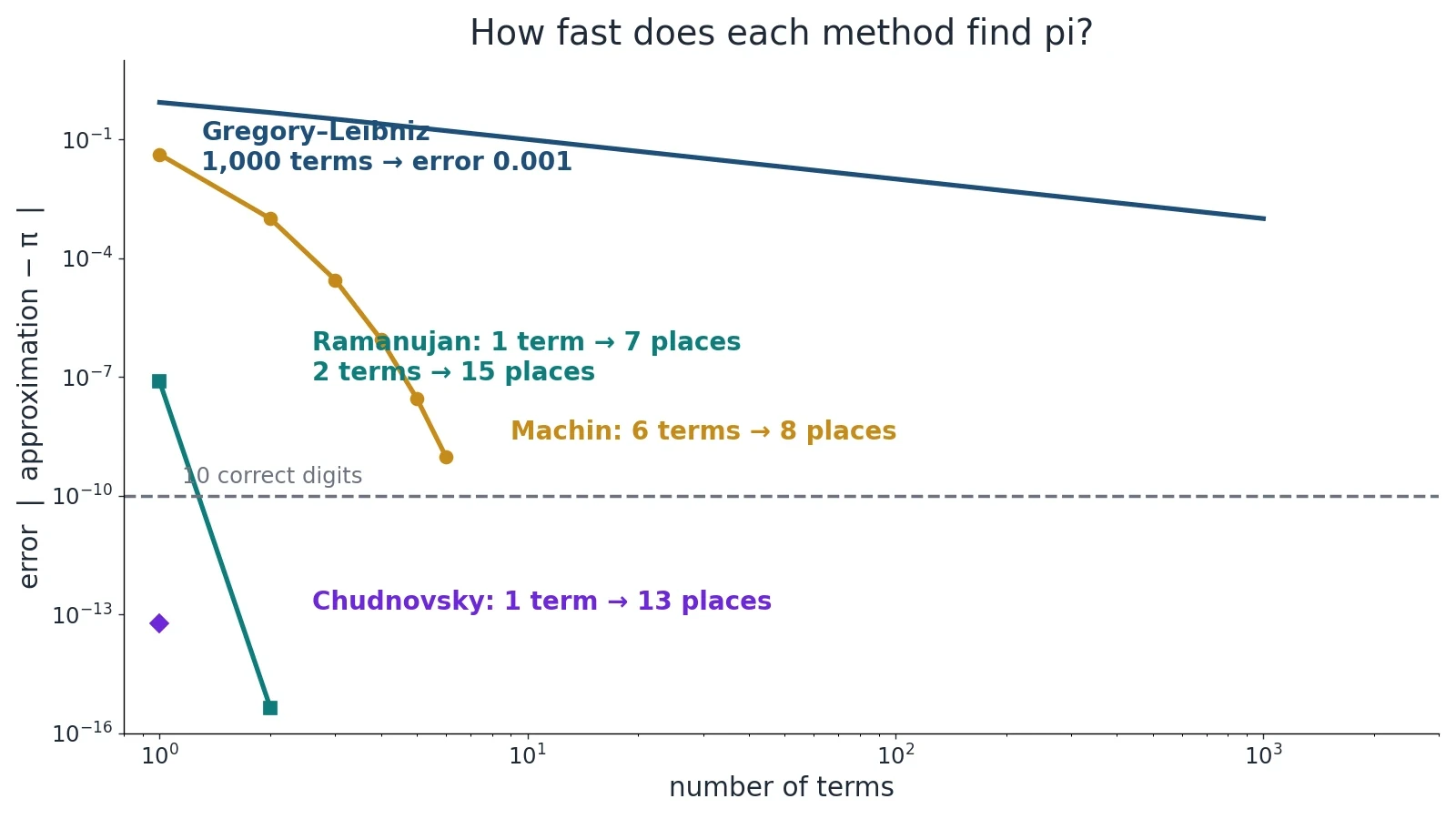
The first idea was Madhava's series, rediscovered in Europe by Gregory in 1671 and Leibniz in 1674: π/4 = 1 − 1/3 + 1/5 − 1/7 + …, adding and subtracting the reciprocals of the odd numbers. It is beautiful, and it is almost useless as a calculation. The partial sums crawl toward pi, swinging wildly above and below it. One term gives 4.0. Two terms give 2.6667. Three give 3.4667. Four give 2.8952. Five give 3.3397. Ten terms give 3.0418. A hundred terms give 3.1316. A thousand terms give 3.1406 — still wrong in the third decimal place, after a thousand additions. To get ten correct decimal digits you would need about five billion terms. The series is a proof that pi can be written as a sum, and a demonstration that some sums are not worth computing.
The breakthrough came in 1706, from John Machin, an English astronomer. Machin's formula is π/4 = 4 × arctan(1/5) − arctan(1/239), where arctan is the inverse tangent. The trick is that the arctangent of a small number converges fast — much faster than the arctangent of 1, which is what the Gregory–Leibniz series is computing. Machin's two arctangents, with their small arguments of 1/5 and 1/239, settle down in a handful of terms. Using the formula, Machin computed pi to one hundred decimal places in 1706 — the first hundred-digit value, published by William Jones in the same book that introduced the π symbol. With one term of each arctangent series, Machin gives 3.1833. With two terms, 3.1406. With three terms, 3.14162. With six terms, 3.1415926526 — correct to eight decimal places. Six terms for eight places, against five billion terms for ten places.
Machin's formula ruled for more than two centuries. Every record from 1706 to the computer era used it, or a formula like it. William Shanks used it to compute 707 digits by hand in 1873, and the first computers used it too. But the series era had one more leap in it, and it came from the most unlikely place: a letter from an unknown Indian clerk to a Cambridge mathematician.
Srinivasa Ramanujan published his formulas in 1914, in a paper called Modular Equations and Approximations to π. He gave seventeen formulas for 1/π, and the most famous of them is a monster: 1/π = (2√2/9801) × the sum over k of (4k)! × (1103 + 26390k) / ((k!)⁴ × 396⁴ᵏ). Do not try to read it. The point is what it does. Each term of Ramanujan's series adds about eight correct digits. The first term alone — k = 0, a single calculation — gives pi ≈ 3.1415927300133057, correct to seven decimal places. The first two terms together give pi ≈ 3.1415926535897939, correct to fifteen places. Two terms, fifteen digits. Machin needed six terms for eight. Gregory–Leibniz needed a thousand terms for three. Ramanujan's formulas are so powerful that they look like magic, and in a sense they were: Ramanujan had almost no formal training, he derived them by intuition and by methods he never fully explained, and mathematicians are still unpacking how he found them. The formulas are dated 1914, not 1913: his famous letter to Hardy was written in 1913, but the formulas themselves were published in 1914, and the distinction matters, because the letter contained claims and the paper contained proofs.
The last leap came in 1988, from the brothers David and Gregory Chudnovsky, who adapted Ramanujan's approach using the Heegner number 163. Their algorithm gives about 14.18 digits per term — nearly twice Ramanujan's rate — with a term ratio of roughly 1/151,931,373,056,000, which means each new term shrinks the error by a factor of a hundred and fifty trillion. The first term alone gives pi ≈ 3.1415926535897342, correct to thirteen decimal places. One term, thirteen digits. The brothers used their algorithm to pass a billion digits in 1989, and it has powered every world record since — including the 314-trillion-digit run of 2025, which needed about 22.1 trillion terms of it. The Chudnovsky algorithm is dated 1988, not 1987: the algorithm was published in 1988, and the billion-digit computation came in 1989.
There is one more formula, and it is the strangest of all. The Bailey–Borwein–Plouffe formula, discovered by Simon Plouffe in 1995 and published by Bailey, Borwein and Plouffe in 1997, lets you compute the n-th hexadecimal digit of pi — the n-th digit in base 16 — without computing any of the digits before it. That sounds impossible, and in a sense it is: for the ordinary decimal digits, nobody knows how to do it. But in base 16, the formula makes it possible, because the terms of the series separate in just the right way. It does not give the n-th decimal digit directly — only the hexadecimal one, and hence the binary one. It was found by a computer, using an integer-relation algorithm called PSLQ. And it is used to verify record computations, including the 314-trillion run: to check a distant digit, you use BBP to check that digit directly, instead of recomputing everything before it.
The convergence of these methods is the story of the whole section, and it is best seen in a chart. Gregory–Leibniz oscillates wildly and settles slowly. Machin settles in a few terms. Ramanujan and Chudnovsky are flat on the line almost immediately. The difference between them is not effort. It is insight.
| Method | Year | Digits per term | Terms for 10 digits |
|---|---|---|---|
| Gregory–Leibniz series | c. 1400 (Madhava); 1671/1674 in Europe | ~0.000000002 | ~5,000,000,000 |
| Machin's formula | 1706 | ~1.4 | ~8 |
| Ramanujan's series | 1914 | ~8 | 2 |
| Chudnovsky algorithm | 1988 | ~14.18 | 1 |
| BBP formula | 1995 | n/a — reads one hexadecimal digit directly | n/a |
If you want the calculus behind why some series converge fast and others crawl, the place to go is how calculus works, which explains convergence, limits, and infinite sums from the ground up. The short version is this: a series converges fast when its terms shrink fast, and Machin's terms shrink fast because 1/5 and 1/239 are small, while Gregory–Leibniz's terms shrink slowly because 1 is not small. Everything else — Ramanujan, Chudnovsky, BBP — is a cleverer way of making the terms shrink faster, or of skipping the terms you do not need.
9. The Digit Race: From ENIAC to 314 Trillion
Once the formulas existed, the race was on — not to find a better value of pi, but to find more of it. The digits became a benchmark, a way of testing a new machine, a new algorithm, a new idea. And the numbers grew so fast that the history of the digit race reads like the history of computing itself.
The last great hand calculation was William Shanks's. In 1873, Shanks published pi to 707 decimal places, computed by hand over years of work, using Machin's formula. It was the standard value for seventy years. It was also wrong. Only the first 527 digits were correct. The error entered at the 528th digit, where Shanks omitted two terms of the series, and it poisoned every digit after it. The mistake was found in 1944 by D. F. Ferguson, working with a mechanical desk calculator. Shanks's earlier value, from 1853 — 530 places, 527 correct — carried the same flaw. Seventy years of mathematics used a value of pi that was wrong after the 527th digit, and nobody knew. After 1944, every value was checked by an independent method.
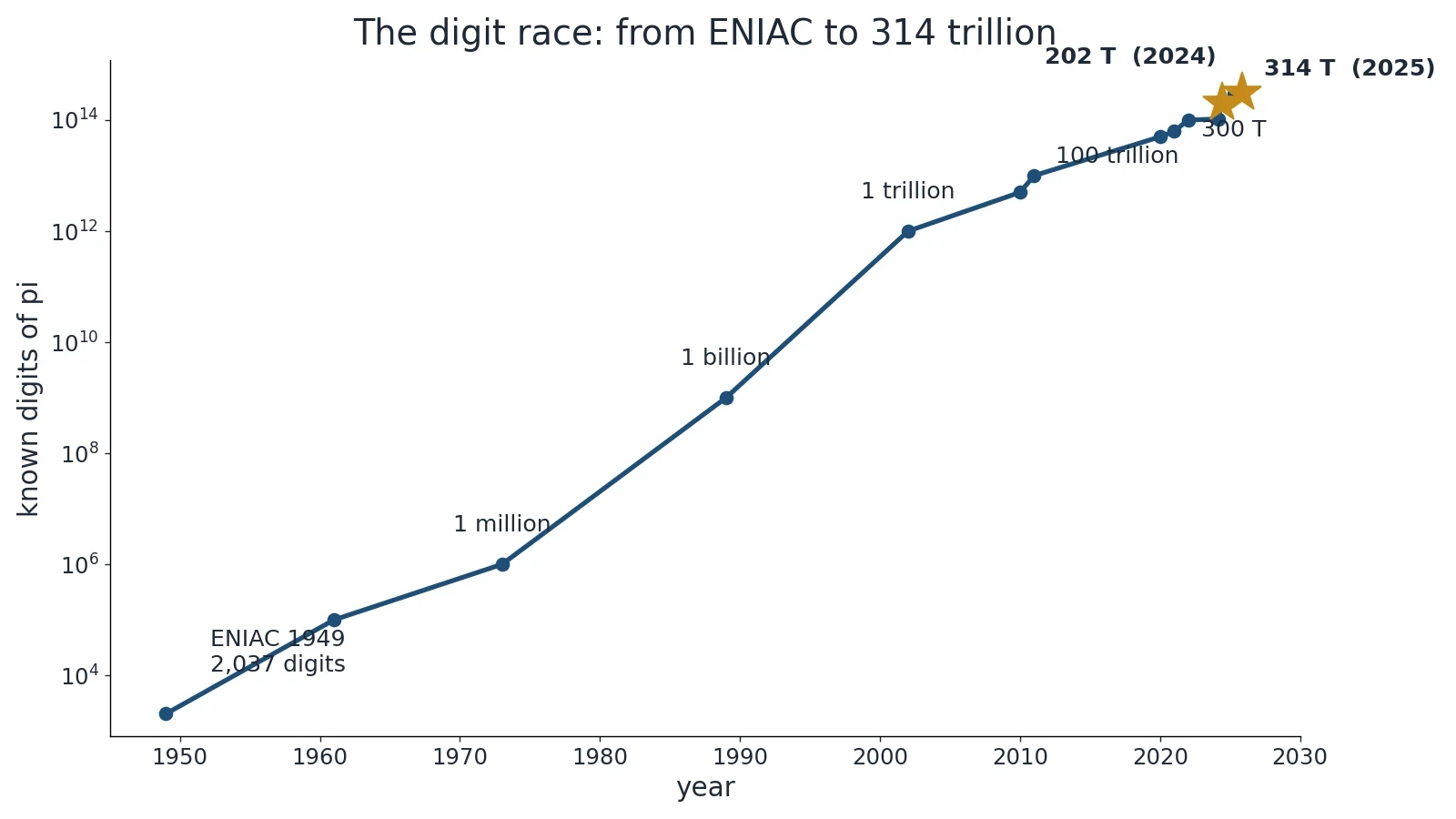
The computers arrived in 1949. In September of that year, G. W. Reitwiesner and his colleagues computed 2,037 digits of pi on ENIAC, the first electronic computer, in about 70 hours, using Machin's formula. Von Neumann, who organised the computation, had a second motive: he wanted to know whether the digits of pi looked random. If pi's digits were evenly distributed, that would be evidence — not proof, but evidence — that pi might be a normal number, the question we will come back to in section 14. ENIAC's 2,037 digits were not enough to answer it, but they were enough to start the race.
The milestones came faster and faster. In 1961, Daniel Shanks and John Wrench computed 100,000 digits on an IBM 7090 in 8.72 hours. In 1973, the millionth digit fell. In 1989, the Chudnovsky brothers passed a billion digits with their new algorithm. In 2002, Kanada passed a trillion. In 2010, Kondo and Yee reached five trillion digits in 90 days on a desktop computer. In 2011, Kondo reached ten trillion. In 2020, Timothy Mullican reached fifty trillion. In 2021, the University of Applied Sciences of the Grisons reached 62.8 trillion in 108 days and 9 hours. In 2022, Google Cloud, with Emma Haruka Iwao leading the computation, reached a hundred trillion. Then came the StorageReview years: 105 trillion in February 2024, 202 trillion in May 2024, 300 trillion in April 2025 — and then the record that stands today.
The current record is 314 trillion digits — exactly 314,000,000,000,000 of them — computed by Kevin O'Brien, Divyansh Jain and Brian Beeler of StorageReview, running from 31 July to 18 November 2025 and published in December 2025. The machine was not a supercomputer. It was a single 2U Dell PowerEdge R7725 server, with two 192-core AMD EPYC 9965 processors — 384 cores in total — 1.5 terabytes of DDR5 memory, and forty 61.44-terabyte Micron 6550 Ion solid-state drives, thirty-four of them allocated to the computation, giving about 2.1 petabytes of scratch space. The software was y-cruncher, version 0.8.6.9545, running the Chudnovsky algorithm. The computation itself took 101.773 days; the total wall time was about 110 days. The run used 4,304.662 kilowatt-hours of electricity, which is 13.71 kilowatt-hours per trillion digits. It ran with zero downtime — it was never resumed from a checkpoint, never stopped and restarted. The result was verified with the BBP formula, which took 4.37 hours. Guinness World Records certified the computation in June 2026, publishing its article on 1 June 2026 and crediting StorageReview and Micron — though its headline says "340 trillionth digit", which is wrong, and its own body text says 314 trillion. Quote 314 trillion. The headline is an error.
The shock of the record, for me, was not the number of digits. It was the machine. A single server, in a rack, did in 110 days what once needed the largest computers on Earth — and it did it with a power bill of 4,304.662 kilowatt-hours. The 300-trillion record that came before it, by Linus Media Group and KIOXIA, completed on 2 April 2025, had needed a large shared-storage cluster with about two petabytes of flash, about 225 days in total, 175 of them computing, and an estimated 33,600 kilowatt-hours. StorageReview beat it with one server and an eighth of the electricity. That is what a better algorithm and better storage can do. The digits are not the story. The efficiency is.
To put 314 trillion digits in perspective: written out as plain text, one byte per digit, they fill 314 terabytes. The released dataset is over 130 terabytes, distributed in 200-gigabyte chunks. If you read one digit per second, without stopping, it would take you about 9,950,000 years to read them all aloud. The 314-trillionth digit is 5 — the same as the 300-trillionth digit, which is a coincidence, and not a meaningful one. Nobody will ever read these digits. They exist to be checked, not read, and the checking is the point: a computation of this size tests hardware, tests software, and tests the algorithm itself, in ways that nothing else can.
And here is the question the record raises: why does anybody need 314 trillion digits? The answer is that nobody does — not for any real calculation. NASA's Jet Propulsion Laboratory uses 15 decimal places — 3.141592653589793 — for its highest-accuracy interplanetary navigation, and that is enough to steer a spacecraft across the solar system. With a circle 40 billion miles across, 15-decimal pi gives a circumference wrong by only about 0.60 inches. For the largest circle there is — a circle with a radius of 46 billion light-years, the size of the observable universe — 37 decimal places would give the circumference to within the diameter of a hydrogen atom, with an error of about 1.47 × 10⁻¹³ metres, or 0.0014 hydrogen-atom diameters. That is the current figure from NASA's Jet Propulsion Laboratory, updated in March 2026; older versions of the same article said 39 or 40, and those figures are out of date. Thirty-seven digits is enough for the whole universe. The rest — 314 trillion minus 37 — is sport, and engineering, and a very expensive way of proving that a computer works. The full record is reported in the StorageReview article on the 314-trillion-digit computation, and the question of how many digits anyone actually needs is answered in the NASA Jet Propulsion Laboratory article on the decimals of pi.
Pi also turns up in the machinery of the modern world in quieter ways. The GPS interface specification, IS-GPS-200, specifies pi as 3.1415926535898 — fourteen digits — for satellite-coordinate computation, and using more or fewer digits makes the coordinates less accurate against the specification, because the whole system is built around that value. If you want to know how the satellites use it, how GPS works explains trilateration and the atomic clocks from the ground up. Pi is also used as a benchmark for new computers — how encryption works touches on the same idea of using hard computations to test hardware — and the 37-digit universe is a story that belongs with the Big Bang, which sets the size of the circle that 37 digits can measure. The digits are a record. The uses are real, and they need almost none of them.
10. Pi in Probability: Needles, Darts, and Coprime Numbers
Here is the strangest thing about pi: it shows up in places where there is no circle in sight. Drop a needle on a floor, throw darts at a board, pick two random numbers — and pi appears, uninvited, in the answer. The reason is that pi is not really about circles. It is about the relationship between the straight and the round, and that relationship turns up anywhere that chance meets geometry.
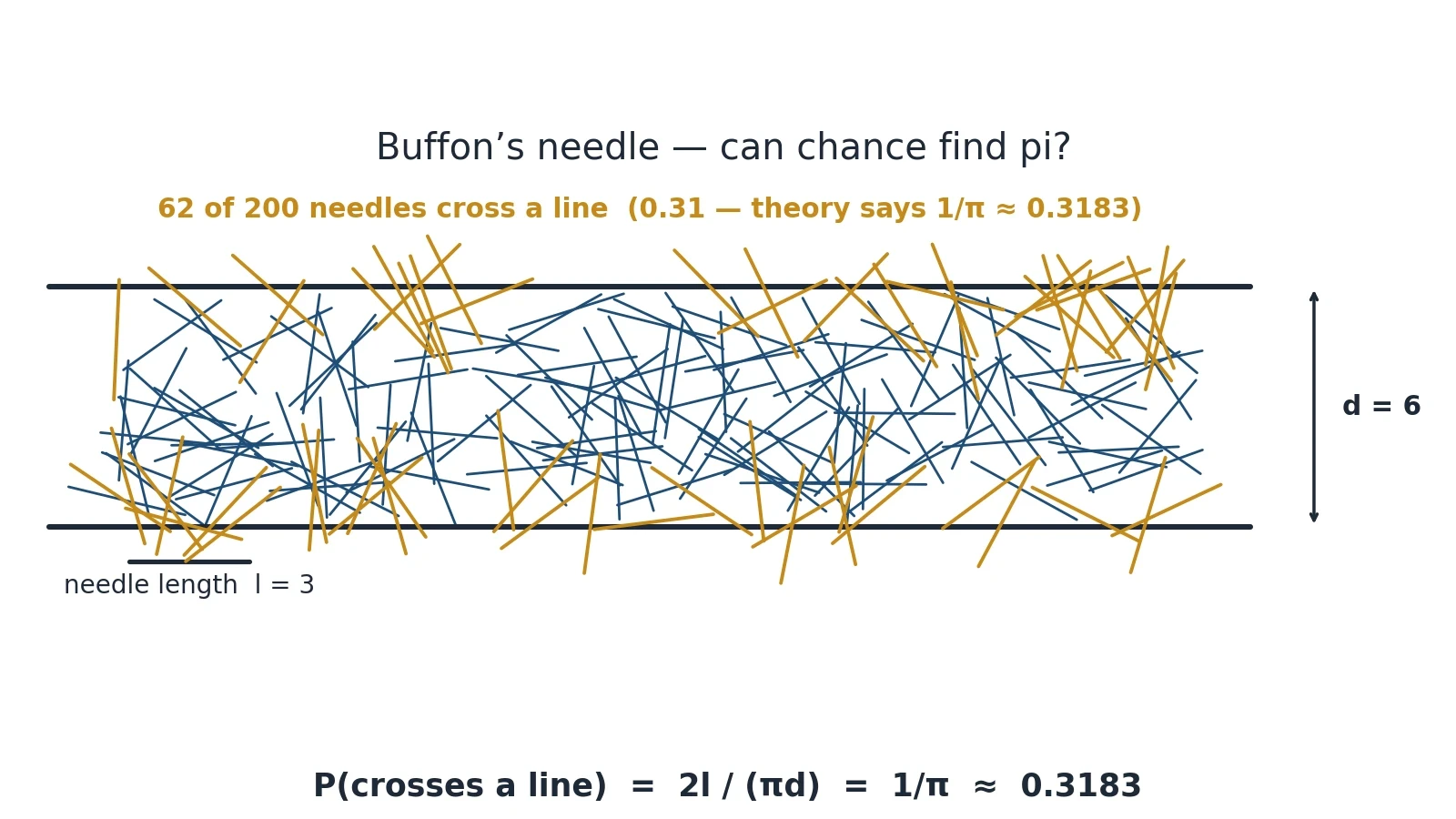
The oldest example is Buffon's needle, posed by the French naturalist Georges-Louis Leclerc, Comte de Buffon, in 1777, in his Essai d'arithmetique morale. Drop a needle of length l onto a floor ruled with parallel lines spaced d apart, with the needle no longer than the spacing, and the probability that the needle crosses a line is 2l/(π × d). The circle is nowhere in the setup — there are only straight needles and straight lines — but pi is in the answer, because the needle can land at any angle, and the angles trace out a circle. Work it through with real numbers. Take a needle 3 centimetres long, dropped on lines 6 centimetres apart. The probability of crossing a line is 2 × 3/(π × 6), which is 6/(6π), which is 1/π, which is 0.3183098862 — about a one-in-three chance. Drop the needle a thousand times, and if it crosses 318 times, your estimate of pi is 2 × l × N/(d × C), which is 6000/1908, which is 3.1447. If the needle is as long as the spacing, so l equals d, the probability is 2/π, which is 0.6366197724. The formula fails if the needle is longer than the spacing — a long needle needs an extra term, and the simple version breaks down — but for short needles it is exact, and it is one of the earliest Monte Carlo methods ever devised: estimating a fixed number by random sampling, and letting the law of large numbers do the work.
I tried it myself once, with matches on lined paper, because I did not believe it. A thousand drops is a lot of matches, and I did not do a thousand — I did a few hundred, and I got 3.1-something, and I was annoyed at how close it was. A handful of matches, dropped carelessly on a table, knows the value of pi to one decimal place. That is not a parlour trick. It is a fact about the world: randomness and geometry are connected, and pi is the connection. The error shrinks only as 1/√N, the square root of the number of trials, so doubling your accuracy means quadrupling your drops, and getting ten digits this way would take about eight and a half billion trillion drops. It is a terrible way to compute pi, and a wonderful way to understand it.
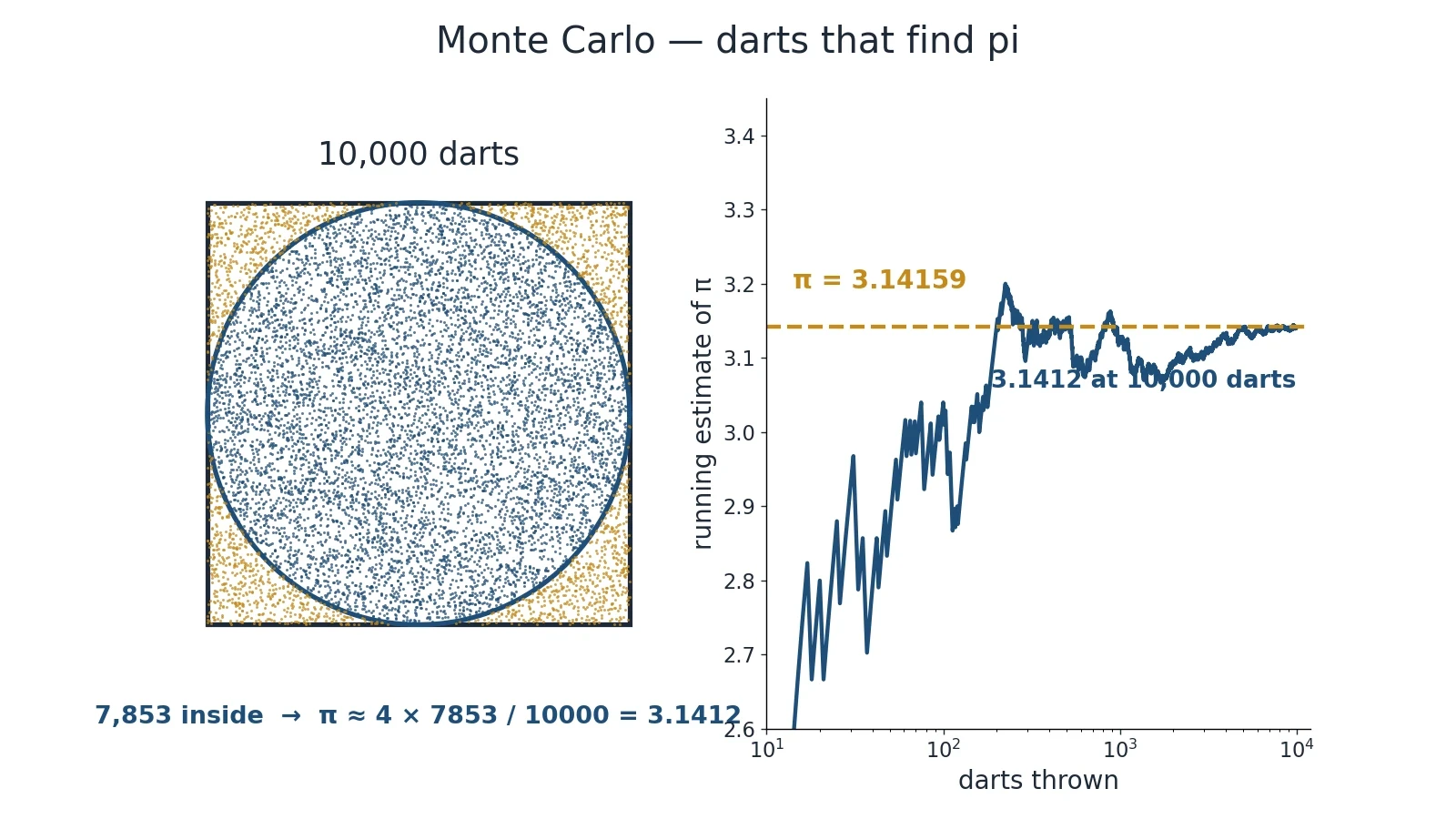
The same idea, in a cleaner form, is the Monte Carlo dartboard. Throw darts uniformly at a square of side 2, with a circle of radius 1 inscribed in it. The area of the square is 4. The area of the circle is π. So the fraction of darts that land inside the circle is π/4, and pi is approximately 4 times the number of darts inside divided by the total number of darts. With ten thousand darts you typically get pi to about two decimal places — the same 1/√N slowness as Buffon's needle, the same wandering estimate that settles slowly toward the true value. The dartboard is a circle, so pi's appearance here is less surprising than in Buffon's needle, but the method is the same: chance, geometry, and a ratio that converges on pi. If you want the probability behind it — why random sampling converges, and how fast — what is probability explains the law of large numbers and the Monte Carlo method from the ground up.
Then there is the result that has no geometry in it at all. Pick two random whole numbers. What is the probability that they are coprime — that they share no common factor other than 1? The answer is 6/π², which is 0.6079271019, or about 60.79 percent. There is no circle here, no needle, no dart. There are only numbers, and yet pi is in the answer. The reason is Euler's solution to the Basel problem. In 1734, Euler proved that 1 + 1/4 + 1/9 + 1/16 + … — the sum of the reciprocals of the squares — equals π²/6, which is 1.6449340668. The partial sums climb slowly toward it: ten terms give 1.5497677312, a hundred terms give 1.6349839002, ten thousand terms give 1.6448340718. Now, for any prime number p, the chance that both of two random numbers are divisible by p is 1/p². The chance that they share no prime factor at all is the product over all primes of (1 − 1/p²), and that product equals 1 divided by the sum of the reciprocals of the squares — which is 6/π². Dirichlet proved the coprime result in 1849. The same 6/π² is also the probability that a random integer is squarefree — not divisible by any perfect square. Pi is hiding in the primes, in the same way it hides in the needles: not because anyone put it there, but because the structure of the numbers forces it.
One more appearance, and it is the most important of all. The standard normal distribution — the bell curve that governs measurement error, test scores, heights, and a thousand other things — has pi in its formula. The density is f(x) = (1/√(2π)) × e^(−x²/2). Pi is there because the total area under the curve e^(−x²/2) is √(2π), the Gaussian integral, and the density has to be divided by that area to make the total probability equal to one. Every time a scientist fits a bell curve to data, pi is in the calculation, quietly, in the denominator.
11. Pi in Physics: From Pendulums to Einstein
Pi is in the laws of physics the way it is in probability: not because physicists put it there, but because the world is round, and waves are periodic, and spheres have surfaces. Wherever a sphere or a cycle appears in a physical law, pi appears with it.
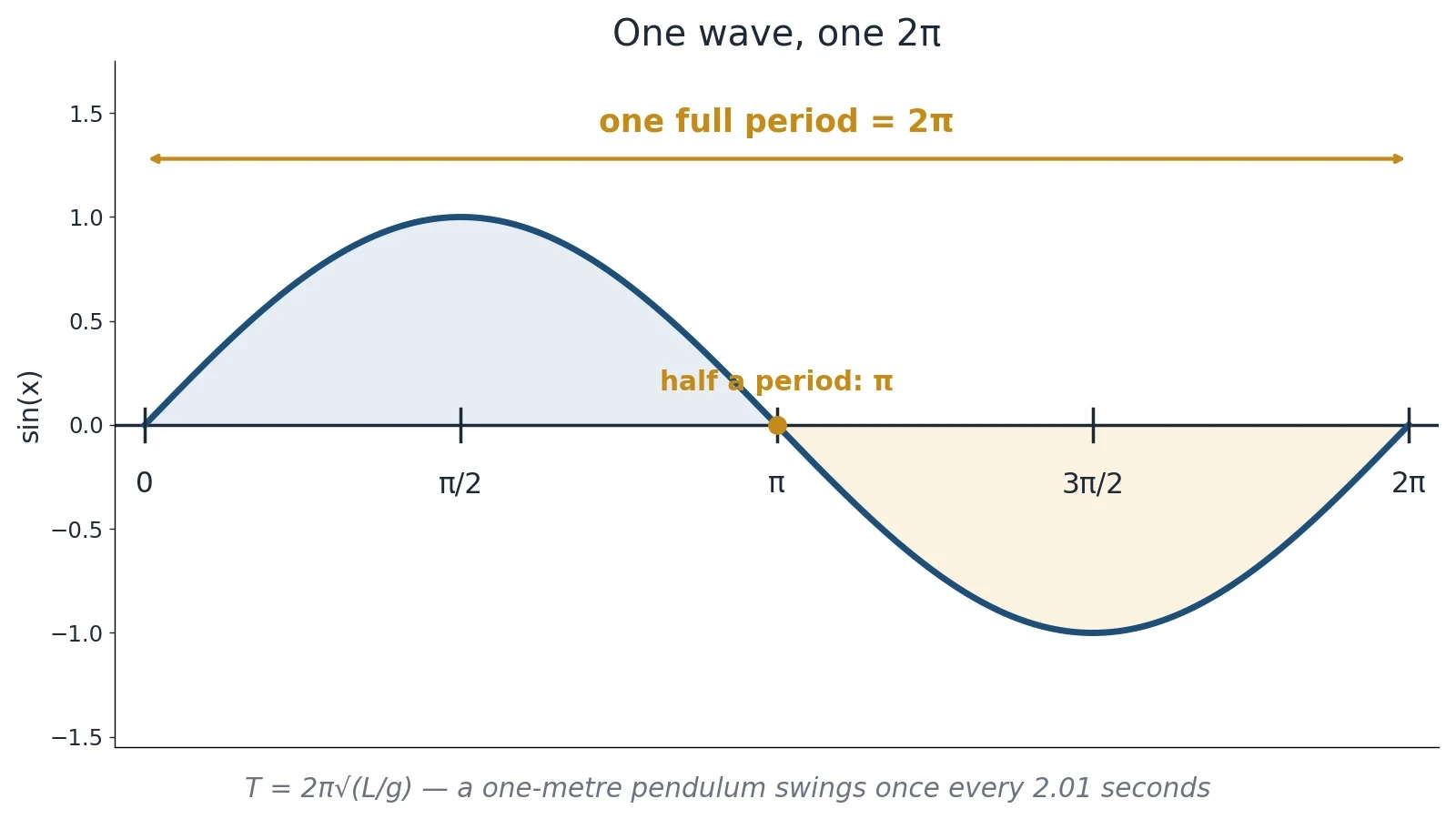
Start with the simplest: the pendulum. The period of a simple pendulum — the time for one full swing, there and back — is T = 2π × √(L/g), where L is the length and g is the acceleration due to gravity. Take a pendulum one metre long, with g equal to 9.81 metres per second squared, and the period is 2 × π × √(1/9.81), which is 2.0060666807 seconds — about 2.01 seconds per swing. The 2π is there because the pendulum's motion is a cycle, and a full cycle is 2π radians. The same 2π appears in every wave and every oscillation in physics, because every wave is a cycle, and the natural measure of a cycle is the radian, and a full cycle is 2π radians. A wave with frequency f has an angular frequency ω = 2π × f. That is why the Plus Maths article on pi is worth reading here: it explains, without heavy algebra, how pi gets into waves and vibrations, and why every sound and every light wave carries it.
Pi is also in the forces. Coulomb's law, the law of electric force between two charges, is F = q₁ × q₂/(4π × ε₀ × r²). The 4π comes from the surface area of a sphere — 4π × r² — because the electric field spreads out evenly over a sphere around the charge, and the force at any point depends on how the field is spread over that surface. The sphere is the reason, and pi is the measure of the sphere. How gravity works tells the same story for Newton's law, where the inverse square and the sphere do the same job.
It is in quantum mechanics, too. Heisenberg's uncertainty principle says that the uncertainty in a particle's position times the uncertainty in its momentum is at least ħ/2, where ħ — h-bar — is Planck's constant divided by 2π: ħ = h/(2π). The 2π is there because quantum mechanics is built on waves, and waves are cycles, and cycles are measured in radians. Understanding quantum mechanics explains the uncertainty principle and the waves behind it in full. Pi is also in the structure of stars: the same spherical geometry that gives the surface area of a sphere governs the layers of a star, and how the Sun works shows what happens inside a sphere of plasma held together by its own gravity.
And it is in Einstein. The field equations of general relativity, published in 1915, contain pi in the coupling constant 8π × G/c⁴, the number that sets how strongly matter curves spacetime. The 8π is there because Einstein's equations are about the geometry of a four-dimensional spacetime, and the geometry of spheres — in any number of dimensions — always brings pi with it. If you want the theory behind the equations, Einstein's theory of relativity explains special and general relativity from the ground up, including the field equations and the constant that carries pi.
Then there is the river story, and it needs to be told carefully, because it is the most repeated and the least settled claim about pi in nature. Einstein himself, in a paper published in 1926, explained why rivers meander: when water flows around a bend, the faster water on the outside erodes the outer bank, while the slower water on the inside deposits sediment on the inner bank — the same effect you see when tea leaves gather in the centre of a stirred cup. That part is solid, verified, and undisputed. Einstein explained meandering. What he did not do is mention pi.
The pi part came seventy years later. In 1996, Hans-Henrik Stolum published a paper in Science arguing that freely meandering rivers, simulated on a computer, self-organise to a mean sinuosity — the ratio of the channel's length to the straight-line distance — of 3.14, plus or minus 0.34. The number was pi, to two decimal places, and the story spread everywhere: rivers, on average, are pi times longer than the straight line. It is a wonderful story. It is also unconfirmed. A later crowdsourced measurement of 258 real rivers found an average sinuosity of only 1.94 — far below pi — and the sample was too small, and the data too corrupted by human straightening of rivers, to prove or disprove the model either way. So the honest statement is this: Einstein explained why rivers bend, in 1926, and that is verified. Stolum predicted in 1996 that rivers average a sinuosity of pi, and that is a model prediction that real-world data has not confirmed. It might be true. It might not. Do not present it as a fact. If you want the river dynamics themselves — how meanders form, how channels migrate, how deltas grow — how rivers work explains them without the pi claim, and it is the better place to start.
12. Euler's Identity: Five Numbers in One Line
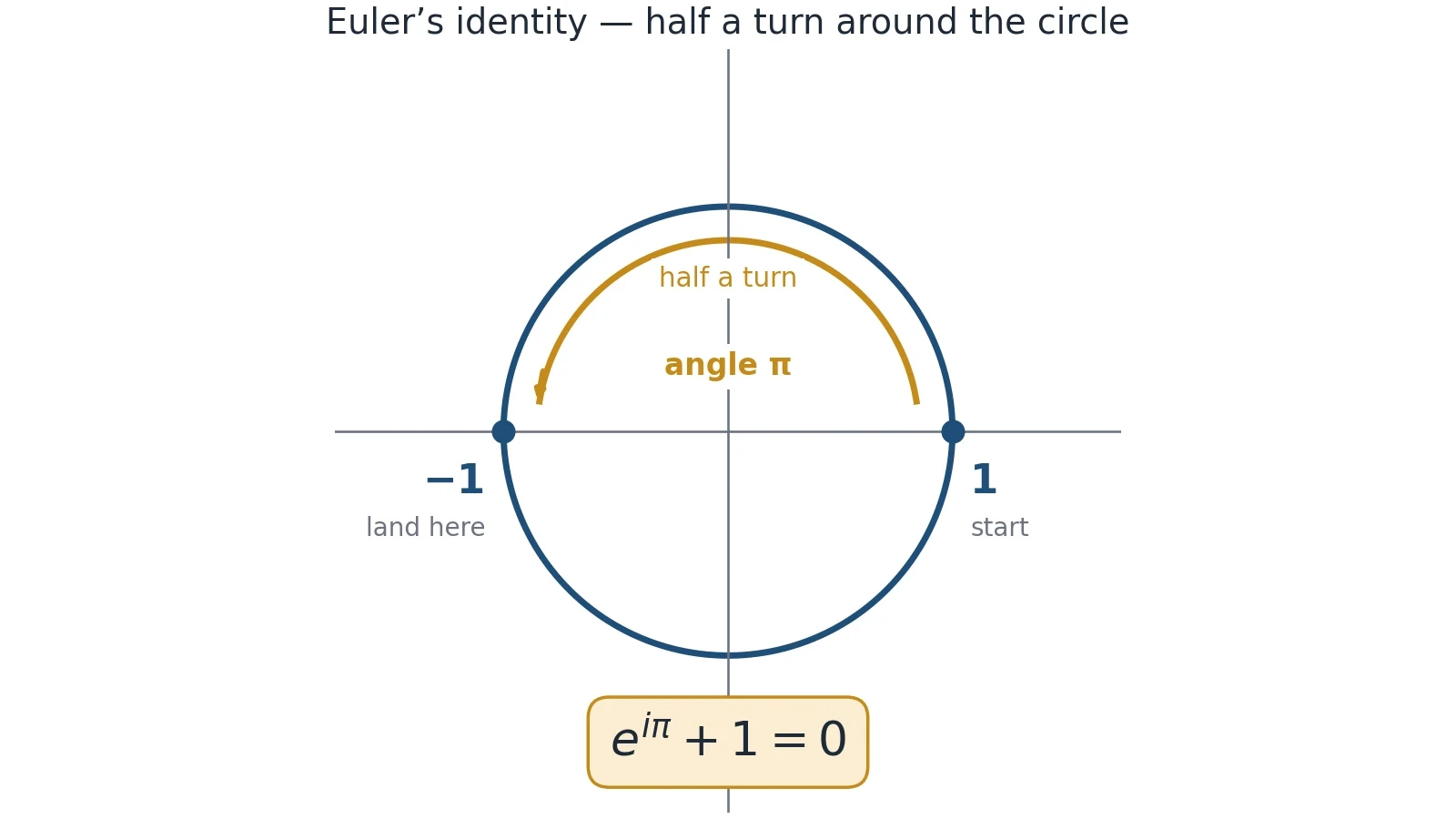
There is an equation that mathematicians vote the most beautiful in mathematics, and it is four symbols long: e^(iπ) + 1 = 0. It is called Euler's identity, and it is beautiful because it takes five fundamental constants — e, i, π, 1, and 0 — from five different branches of mathematics, and joins them in a single line with nothing left over. The number e comes from growth and compound interest. The number i, the square root of minus one, comes from algebra. Pi comes from geometry. One comes from counting. Zero comes from nothing. That they fit together at all is surprising. That they fit together so simply is astonishing.
The identity is a special case of Euler's formula, published in 1748: e^(ix) = cos x + i × sin x. Put x equal to π, and the right-hand side becomes cos π + i × sin π. The cosine of π is −1. The sine of π is 0. So the right-hand side is −1 + 0i, which is −1. Therefore e^(iπ) is −1, and e^(iπ) + 1 is 0. Worked numerically, e^(iπ) comes out as −1 plus a tiny imaginary part, 1.22 × 10⁻¹⁶ i, which is not a real part of the answer — it is floating-point rounding, the computer's approximation, and exactly the value is −1. The arithmetic is simple. The meaning is not.
The meaning is a rotation. Multiplying a number by e^(ix) rotates it through an angle of x radians in the complex plane — the plane where real numbers run along one axis and imaginary numbers along the other. Start at 1, on the real axis, and multiply by e^(iπ). You rotate through an angle of π radians — half a full turn, 180 degrees — and you land on −1, on the opposite side of the circle. That is what the identity says: a half-turn around the unit circle takes you from 1 to −1, and the number that measures the half-turn is π. The identity is not a coincidence. It is a picture of a circle, written as an equation.
Why do mathematicians call it the most beautiful equation? Partly because it is short, and partly because it is deep — but mostly because it is unexpected. Nobody looking at e, the base of natural logarithms, would guess that it has anything to do with circles. Nobody looking at i, the square root of minus one, would guess that it has anything to do with π. And yet there they are, in one line, and the line is true. The identity is the clearest demonstration of a fact this whole article has been circling: pi is not just about circles. It is about rotation, and growth, and oscillation, and the deep unity of mathematics — the fact that the number you find with a tape measure around a jam jar is the same number that appears in the formula for compound interest, and in the waves of quantum mechanics, and in the curve of a river. Euler's identity is the moment when all of that fits on one line, and you can see it all at once.
13. Pi Day, the Indiana Pi Bill, and the Feynman Point
Pi has something no other number has: a holiday. Pi Day is 14 March — 3/14 in the American month-first date format, the first three digits of pi — and it was founded in 1988 by Larry Shaw, a physicist at the San Francisco Exploratorium, whose staff marked the day by marching around a circular space and then eating fruit pies. The holiday grew. On 12 March 2009, the United States House of Representatives passed a non-binding resolution, H.Res. 224, recognising 14 March as National Pi Day. In November 2019, UNESCO designated 14 March the International Day of Mathematics, giving the celebration a global, official standing. And 14 March is also Albert Einstein's birthday — he was born on 14 March 1879 — which is a coincidence, and a fitting one: the man whose equations carry pi in their coupling constant was born on pi's day.
Pi also has something no other number has: a legislature tried to change it. In 1897, the Indiana General Assembly came within one Senate reading of passing a law that would have redefined pi — or rather, a law that implied a new value for it, among several inconsistent ones, including 3.2. The bill was House Bill 246, written by Edward J. Goodwin, a physician and amateur mathematician, who claimed to have found a method to square the circle and offered it to the state of Indiana free of charge, provided the legislature accepted it. The bill's preamble reads:
"A Bill for an act introducing a new mathematical truth and offered as a contribution to education to be used only by the State of Indiana free of cost by paying any royalties whatever on the same, provided it is accepted and adopted by the official action of the Legislature of 1897." — House Bill 246, Indiana General Assembly, 1897
The bill passed the Indiana House unanimously, 67 to 0, on 5 and 6 February 1897, after being bounced from the Committee on Swamp Lands to the Committee on Education — a detail that tells you everything about how seriously the legislature understood what it was voting on. It never became law. Clarence A. Waldo, a mathematics professor at Purdue University, happened to be in the statehouse lobbying for the Indiana Academy of Science's funding, and he coached the senators on what the bill actually said. On 12 February 1897, the Senate postponed it indefinitely, after one senator observed that the Assembly lacked the power to define mathematical truth. He was right, and the bill died. Two things about it are worth remembering. First, the bill's own text never mentions pi by name — the value of 3.2 is implied by Goodwin's method, not stated. Second, the story is not really about pi. It is about what happens when a legislature votes on a question it does not understand, and about the professor who happened to be in the right room at the right time to stop it.
Then there is the Feynman point. Somewhere in the digits of pi, at positions 762 to 767, there are six consecutive 9s: 999999. It is the first place in pi where any digit repeats four, five, or six times in a row, and it has a name because of a story: Richard Feynman, the physicist, supposedly wanted to memorise pi to that point, so that he could recite the digits and finish with "nine, nine, nine, nine, nine, nine, and so on" — as if pi ended there. It is a good joke, and it is almost certainly not Feynman's. The line has never been traced to his writings, his lectures, or his letters, and his biographer James Gleick does not know it. The earliest known printed mention is in Douglas Hofstadter's Metamagical Themas, published in 1985. Present it as folklore, which is what it is — a story about Feynman, not a quotation from him. The six 9s themselves are real, and they are surprising: a random-digit estimate says that six 9s should first appear around digit one million, and finding them by digit 767 has a probability of about 0.069 percent, or one chance in 1,458. Surprising, but not magic. Random digits produce surprises, and a one-in-1,458 event is the kind of surprise you should expect to find if you look at enough digits. And pi does not end at the Feynman point, or anywhere else. A paper published in 2026 claims that pi terminates there; it is wrong, and it cannot be right, because pi was proved irrational in 1761, and an irrational number cannot terminate. Do not cite the paper. It is not science.
I tried, once, to memorise pi to the Feynman point, because the joke is too good not to try. I gave up long before digit 762 — somewhere in the second hundred, where the digits stop feeling like a sequence and start feeling like weather. The people who succeed at this are made of different stuff. Rajveer Meena, from India, recited 70,000 decimal digits of pi from memory on 21 March 2015, at VIT University in Vellore, and holds the Guinness World Record for pi recitation. Seventy thousand digits, against my two hundred — the gap between a hobby and a life's work.
14. Common Mistakes and Misconceptions
Pi is the most misunderstood number in mathematics, because each misunderstanding contains a grain of truth. Here they are, with the correction.
Pi is not 3.14, and it is not 22/7. Both are approximations. 3.14 is low by 0.0507 percent. 22/7 is high by 0.0402 percent. They are useful, and they are not pi. The only exact ways to write pi are the symbol π, or a formula that generates it, or the infinite decimal that never ends.
Pi does not end at the Feynman point. The six 9s at digits 762 to 767 are a curiosity, not a terminus. Pi was proved irrational in 1761, and an irrational number cannot terminate. Anyone who tells you pi ends anywhere is selling you something.
Pi has not been proved to contain every string of digits. It is believed to be normal — a number in which every digit, and every block of digits, occurs equally often in the long run — and the evidence supports it: in the first six billion digits, each digit occurs about 600 million times. But belief is not proof, and normality has not been proved for pi, or for any naturally occurring constant. It is not even proved that every digit occurs infinitely often in pi. So it is not known whether pi contains your birthday, or your phone number, or the complete works of Shakespeare. It probably does. Probably is not known. I disagree, flatly, with the popular articles that state it as a fact: the claim is unproved, and saying so is not pedantry. It is the difference between mathematics and marketing. If you want the question in its full depth, what is infinity explains what it means for a set of digits to be infinite without containing everything, and why "infinite" and "contains all strings" are different claims.
"The Bible says pi equals 3" misreads a rounded measurement. 1 Kings 7:23 gives the dimensions of a vessel in whole cubits: ten across, thirty around. The true circumference is 31.4159 cubits, and the text rounds it to 30. It is a building specification, not a mathematical claim, and the verse never states a value for pi.
Rivers do not provably average pi. Stolum's 1996 model predicts a mean sinuosity of 3.14, but a measurement of 258 real rivers found 1.94, and the question is open. Einstein explained why rivers meander. Nobody has proved that they average pi.
314 trillion digits are not needed for any real calculation. NASA needs 15 digits to steer a spacecraft, and 37 digits would measure the whole observable universe to within a hydrogen atom. The record exists to test computers, not to calculate anything.
Pi is not just about circles. It lives in probability, in waves, in quantum mechanics, and in the primes. The circle is where you meet it. It is not where it ends. And the fraction 355/113, good as it is, is not pi either — it is the best small fraction there is, and it is still wrong in the seventh decimal place. That is the lesson of the whole article, and it is worth carrying away: pi is close to many things, and equal to none of them. That is what makes it pi. For the probability behind the needle and the dartboard, and the law that governs how random estimates converge, see what is probability; for the rational approximations that make 355/113 work, and the golden ratio's own story of near-misses and exact values, see the golden ratio and Fibonacci numbers.
15. Frequently Asked Questions
What is pi?
Pi is the ratio of a circle's circumference to its diameter — the distance around a circle divided by the distance across it. It is the same for every circle, and it equals 3.141592653589793…, continuing without end and without repeating. The circumference of a circle is pi times its diameter, and its area is pi times its radius squared. Pi is not 3.14 or 22/7; those are approximations, useful but not exact.
Why is pi irrational?
Pi is irrational because it cannot be written as a fraction of two whole numbers. Johann Heinrich Lambert proved this in 1761, using continued fractions for the tangent function: since tan(π/4) equals 1, which is rational, π/4 cannot be rational, and so pi cannot be rational either. An irrational number's decimal expansion never ends and never repeats, which is why pi's digits go on for ever. Pi is also transcendental, proved by Lindemann in 1882, which means it is not the root of any polynomial equation with rational coefficients — and that is why squaring the circle is impossible.
How do you calculate pi?
By a formula that generates its digits, not by measuring a circle. The oldest method is the Gregory–Leibniz series, pi/4 = 1 − 1/3 + 1/5 − 1/7 + …, but it converges so slowly that five billion terms are needed for ten digits. Machin's formula of 1706 needs only about eight terms for ten digits. Ramanujan's formulas of 1914 give about eight digits per term, and the Chudnovsky algorithm of 1988 gives about 14.18 digits per term — one term alone gives thirteen correct places. The BBP formula of 1995 can compute a single hexadecimal digit without the ones before it. Modern records use the Chudnovsky algorithm on powerful computers.
What is pi used for?
For anything involving circles, spheres, cycles, or waves — and for many things involving none of those. Engineers use it for wheels, pipes, and orbits. Physicists use it in the pendulum period, Coulomb's law, the uncertainty principle, and Einstein's field equations. Statisticians use it in the normal distribution. GPS satellites use a fourteen-digit pi to compute positions, and NASA uses fifteen digits to navigate spacecraft. It also appears in probability: in Buffon's needle, in the Monte Carlo method, and in the chance that two random numbers are coprime, which is 6/π².
How many digits of pi are there?
Infinitely many. Pi is irrational, so its decimal expansion never ends and never repeats. The most digits ever computed is 314 trillion — exactly 314,000,000,000,000 — by StorageReview in 2025, on a single server, in about 110 days. But no real calculation needs more than a few dozen: fifteen digits steer a spacecraft, and thirty-seven digits would measure the circumference of the observable universe to within a hydrogen atom.
Is pi infinite?
Pi itself is a finite number — it lies between 3.14 and 3.15, and it is smaller than 4. What is infinite is its decimal expansion: the digits after the point go on for ever, without ending and without repeating. That is the difference between a number being infinite and a number having infinitely many digits. Pi is the second kind. For the full story of infinity itself — what it means for something to go on for ever, and whether some infinities are bigger than others — see what is infinity.
Why is pi 3.14?
Pi is not 3.14; 3.14 is a rounded approximation, low by 0.0507 percent, used because the true value cannot be written down in full. The value is what it is because of geometry: the circumference of a circle is a little more than three times its diameter, for every circle, and the exact ratio is pi. The number 3.14 is just the first three digits, cut off for convenience. For everyday purposes it is close enough. For precision work, use more digits — or use the symbol π, which means the exact value.
Is pi a real number?
Yes. Pi is a real number: it lies on the number line between 3 and 4, and you can measure it, approximately, with a tape measure around a jar. It is irrational and transcendental, which means it cannot be written as a fraction or as the root of a polynomial equation, but it is still real — as real as the square root of 2, or any other number that cannot be written down in full. Imaginary numbers are a different thing entirely: they involve the square root of minus one, and pi does not.
16. Sources
- Britannica, Pi — https://www.britannica.com/science/pi-mathematics
- Exploratorium, A Brief History of Pi — https://www.exploratorium.edu/pi/history-of-pi
- Wikipedia, Approximations of pi — https://en.wikipedia.org/wiki/Approximations_of_pi
- Wikipedia, Molten Sea — https://en.wikipedia.org/wiki/Molten_Sea
- ProofWiki, Archimedes' Limits to Value of Pi — https://proofwiki.org/wiki/Archimedes%27_Limits_to_Value_of_Pi
- Wikipedia, Chronology of computation of pi — https://en.wikipedia.org/wiki/Chronology_of_computation_of_pi
- St Andrews, MacTutor History of Mathematics — Miller, Earliest Uses of Symbols for Constants — https://mathshistory.st-andrews.ac.uk/Miller/mathsym/constants/
- Wikipedia, Proof that pi is irrational — https://en.wikipedia.org/wiki/Proof_that_%CF%80_is_irrational
- Wikipedia, Machin-like formula — https://en.wikipedia.org/wiki/Machin-like_formula
- Wikipedia, Bailey–Borwein–Plouffe formula — https://en.wikipedia.org/wiki/Bailey%E2%80%93Borwein%E2%80%93Plouffe_formula
- Wikipedia, William Shanks — https://en.wikipedia.org/wiki/William_Shanks
- StorageReview, StorageReview Sets New Pi Record: 314 Trillion Digits on a Dell PowerEdge R7725 — https://www.storagereview.com/review/storagereview-sets-new-pi-record-314-trillion-digits-on-a-dell-poweredge-r7725
- NumberWorld, y-cruncher — https://www.numberworld.org/y-cruncher/
- NASA Jet Propulsion Laboratory, How Many Decimals of Pi Do We Really Need? — https://www.jpl.nasa.gov/edu/news/how-many-decimals-of-pi-do-we-really-need/
- GPS World, Happy Pi Day — https://www.gpsworld.com/happy-pi-day/
- Wikipedia, Pi Day — https://en.wikipedia.org/wiki/Pi_Day
- Wikipedia, Indiana Pi Bill — https://en.wikipedia.org/wiki/Indiana_Pi_Bill
- Wikipedia, Six nines in pi — https://en.wikipedia.org/wiki/Six_nines_in_pi
- Archimedes, Measurement of a Circle, c. 250 BCE (print citation)
- Jones, W., Synopsis Palmariorum Matheseos, London, 1706 (print citation)
- Lindemann, F. von, Ueber die Zahl pi, Mathematische Annalen, 20, 1882, pp. 213–225 (print citation)
- Ramanujan, S., Modular Equations and Approximations to pi, Quarterly Journal of Mathematics, 45, 1914, pp. 350–372 (print citation)
- Bailey, D. H., Borwein, P. B., and Plouffe, S., On the rapid computation of various polylogarithmic constants, Mathematics of Computation, 66, 1997, pp. 903–913 (print citation)
- Stolum, H.-H., River Meandering as a Self-Organization Process, Science, 271, 1996, pp. 1710–1713 (print citation)
- Einstein, A., Die Ursache der Maanderbildung der Flusslaufe und des sogenannten Baerschen Gesetzes, Die Naturwissenschaften, 14, 1926, pp. 223–224 (print citation)