
1. The Biggest Number You Can Think Of
I learned about infinity the way most children do: in a game I could never win. I was seven or eight, on a long car journey, and my older brother challenged me to name the biggest number. I said a thousand. He said a million. I said a billion. He said a trillion. I said a zillion — which, I later learned, is not a number at all, just a word children use when they have run out of real ones. He said infinity. And I said, triumphant, infinity plus one — then asked him: what is infinity?
That is the moment this article is about. "Infinity plus one" sounds like a winning move. It is not. It is the first hint that infinity does not behave like a number at all — and that the game has no winning move, because there is no biggest number, and infinity is not a number you can add one to. What is infinity, then? It is the question that kept mathematicians busy for two thousand years, frightened the ancient Greeks, broke the arithmetic of the nineteenth century, and ended with a discovery so strange that one of the greatest mathematicians of the age called it a paradise — and another tried to have it banned from mathematics altogether.
This article is the story of that question, told with the numbers worked out in front of you. We will start with the simplest version of the idea — counting, and why counting never ends — and then follow it through the Greeks who feared it, the Italian who noticed that infinity breaks the rules of "more" and "less", and the German who finally tamed it by proving that some infinities are bigger than others. Along the way we will check into a hotel that is never full, meet a horn you can fill but never paint, add up all the numbers in the world and get a negative fraction, and end by asking whether the universe itself is infinite — a question nobody alive can answer.
One promise before we begin. Every number in this article can be checked with a pocket calculator. Every claim about a measurement or a date names the person who made it and the year they made it. And wherever the story splits — wherever the popular version and the measured version disagree — I will show you both, and let the numbers decide.
Infinity is also the most borrowed idea in mathematics. It is in the toy commercials — "to infinity and beyond" — and in the hotel signs that promise "infinite rooms", and in the way we talk about an "infinite" amount of patience when we mean a lot. The borrowing is harmless, and it is also a measure of the idea's power: nothing else in mathematics has escaped into everyday language so completely. But the borrowed version is always the loose version — infinity as "a very large amount" — and the loose version is exactly the one that causes the mistakes. This article is about the strict version: the one with definitions, proofs, and a ladder of sizes. Keep the two apart, and everything that follows will make sense.
2. What Is Infinity?
Infinity is not a number. That is the first thing to understand, and it is the thing most people get wrong. A number is something you can count to, or add to, or subtract from, and get a definite answer. Infinity is none of those things. It is the idea of something without end — a process that goes on forever, or a collection that never runs out. When a mathematician writes ∞, the sideways figure eight, they are not writing down a number. They are writing down a shorthand for "without limit".
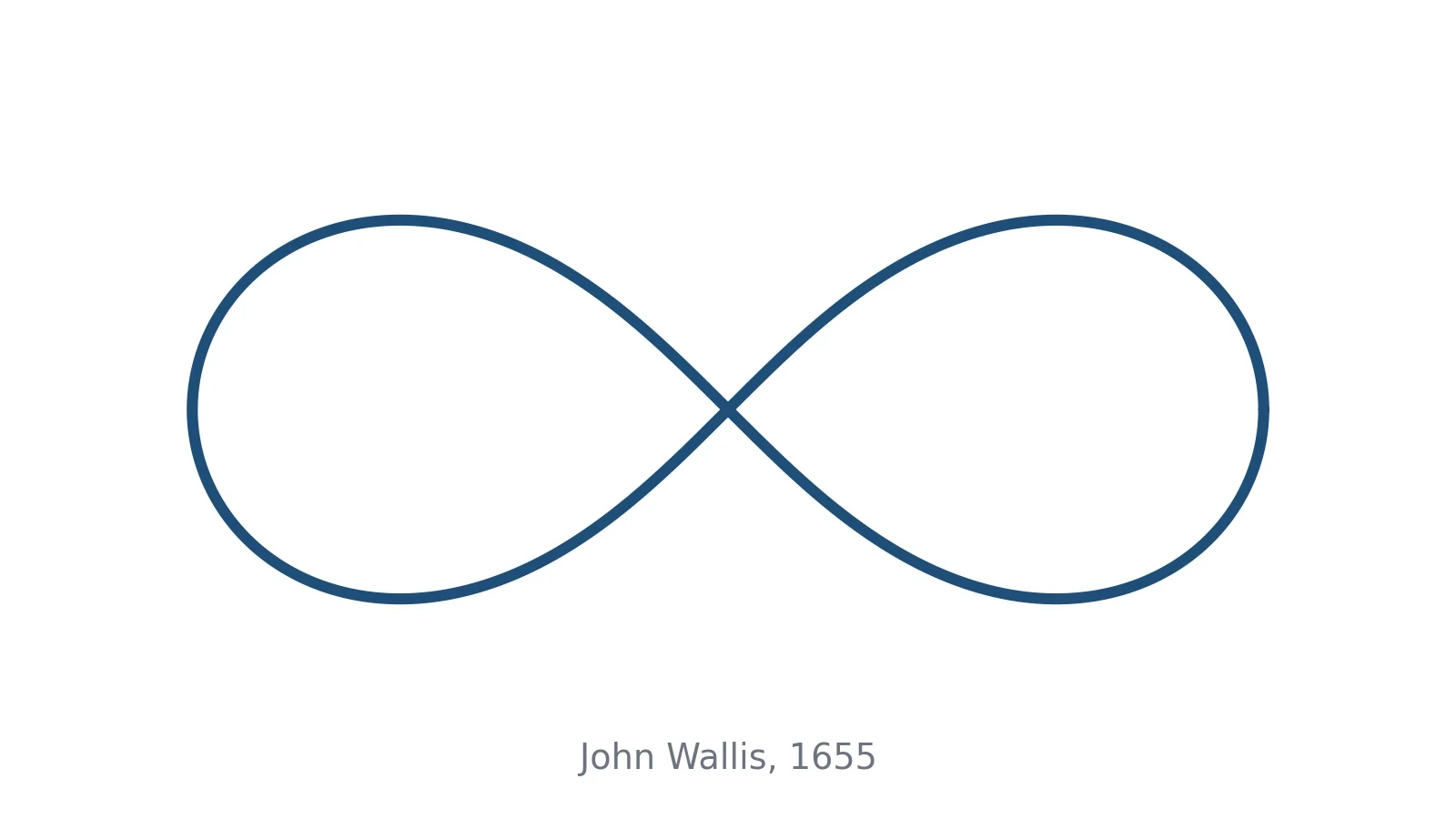
The symbol itself has a birthday. It was first used mathematically by the English mathematician John Wallis in 1655, in his treatise De sectionibus conicis, on conic sections. Wallis never explained why he chose the shape. Historians have guessed that it is a variant of the Roman numeral CIↃ, which was used for 1,000 and meant "a great many", or a nod to omega, the last letter of the Greek alphabet, standing for the greatest thing. Nobody knows. The curve the symbol resembles — the lemniscate, a figure-eight loop — was studied and named by the Swiss mathematician Jacob Bernoulli in 1694, from the Greek word lemniskos, a ribbon. The symbol is younger than the idea by more than two thousand years, and the idea is older than writing itself: every culture that counted also wondered what happens when the counting never stops.
The counting numbers — 1, 2, 3, 4, and so on — have no largest member. Whatever number you name, adding one gives you a bigger one. That is the simplest infinity there is, and it is worth pausing on, because it already contains the whole subject. You cannot reach the end of the counting numbers, because there is no end to reach. But you can still talk about all of them together, as one collection: the set of all natural numbers. That is the difference between two kinds of infinity, and the Greeks were the first to name them.
The first kind is called potential infinity. It is infinity as a process: keep adding one, keep dividing in half, keep going. The process never finishes, and no single step of it is infinite — every number you actually reach is finite. The second kind is called actual infinity. It is infinity as a completed thing: the whole set of natural numbers, all at once, as a single finished object. Potential infinity says "you can always go further". Actual infinity says "the whole endless collection exists, complete, right now". The difference between those two sentences is the hinge on which the next two thousand years of mathematics turns — and for most of that time, almost everyone who thought about it believed only the first one was real.
That is why infinity breaks arithmetic. Take the counting numbers and add one to the whole collection — every number shifts up by one, and you get the same collection back. Infinity plus one is infinity. Take away half the counting numbers — keep only the even ones — and you still have just as many as you started with, as we will see in section 5. Infinity minus infinity could be anything, or nothing, or everything, depending on how you do it, which is why mathematicians say it is undefined. These are not quirks or edge cases. They are the first signs that infinity follows different rules from the numbers we count with — and the rest of this article is about learning those rules.
A good place to start is the Stanford Encyclopedia of Philosophy entry on infinity, which traces the idea from the pre-Socratics to Cantor and is the clearest single survey of the subject I know. What follows here is the story it tells, told with the arithmetic shown.
There is a curiosity about the symbol worth one more sentence. The lemniscate is a figure-eight curve, and the symbol is sometimes read as a snake eating its own tail, or as a ribbon twisted once and joined — the endless loop, with no beginning and no end. The reading is poetic, not historical: Wallis gave no explanation, and the historians' guesses are all reconstructions. But the shape has stuck, and it has escaped mathematics entirely. It is on jewellery, on tattoos, on book covers, on the logos of companies that want to suggest boundlessness. The symbol is older than the rigorous definition it stands for — Wallis used it in 1655, and Cantor did not give infinity a rigorous definition until 1874 — and it is a reminder that the idea of infinity was in the air for centuries before the mathematics caught up with it.
One more distinction, because it will matter later. When we say "the numbers go on forever", we mean something different from when we say "the set of all natural numbers is infinite". The first is a process: keep counting, and you never stop. The second is a completed object: the set of all natural numbers, taken as a whole, as a single thing. Aristotle allowed the first and forbade the second. Cantor's whole achievement was to allow the second — to treat the completed infinite as a legitimate mathematical object, with a size, and with sizes that can be compared. Every section of this article after the Greeks is about what happens once you allow that.
3. The Greeks Who Were Afraid of It
The earliest recorded idea of infinity in Greece may be that of Anaximander of Miletus, who lived around 610 to 546 BCE. Anaximander said that the first principle of the universe — the stuff everything comes from and returns to — was the apeiron, the boundless. The Greek word means "without limit" or "indefinite", and it stood opposed to peras, a limit. For the Greeks, a limit was what made a thing intelligible: a thing with a boundary could be understood, measured, and named. A thing without a boundary was formless, and the formless was frightening. Anaximander's apeiron was the source of all things precisely because it had no shape of its own.
Two centuries later, Aristotle took the fear and turned it into a rule. In his Physics, Book III, chapter 6, he distinguished the two kinds of infinity we met in the last section and rejected one of them. Potential infinity, he said, is real: you can always add one more number, or divide a length one more time. Actual infinity — a completed, definite, infinitely large thing — is impossible, because if it existed, something would have attained infinite magnitude, and that, Aristotle argued, would be a contradiction. His summary is worth quoting in full: it is not "that which has nothing beyond itself" that is infinite, but "that which always has something beyond itself". Infinity, for Aristotle, was a horizon that recedes as you approach it, never a place you arrive at. The medieval philosophers kept his rule as a motto: Infinitum actu non datur — an actual infinity is not given.
Aristotle's rule held for two thousand years. It was common sense, and it was also, as far as anyone could tell, correct: nobody had ever seen an actual infinity, and the idea of one seemed to lead straight to contradictions. The contradictions had a name, and they were older than Aristotle himself. They were the paradoxes of Zeno.
Euclid, writing his Elements around 300 BCE, gave infinity its first real proof. Book IX, Proposition 20, proves that there are infinitely many prime numbers — and the proof is two thousand years old and still perfect. Suppose there are only finitely many primes, and list them all: p₁, p₂, …, pₙ. Multiply them together and add one. The resulting number is not divisible by any prime on the list — dividing it by any p leaves a remainder of one — so either it is itself prime, or it has a prime factor that is not on the list. Either way, the list was incomplete. There is no finite list of all the primes. The primes go on forever, and the proof fits in a paragraph. It is the cleanest infinity proof ever written, and it works because it never tries to exhibit the infinity — it shows that any finite claim about the primes contradicts itself.
Archimedes, half a century later, did the opposite: he showed that even the largest imaginable finite number can be counted. In The Sand Reckoner, he calculated how many grains of sand would fill the entire universe, as the Greeks understood it — and the answer was that no more than 10^63 grains would be needed — an upper bound, not a count — and a number so large that the Greeks had no name for it. Archimedes had to invent a new system of numeration to write it down. The point of the exercise was that the universe, however vast, was finite, and therefore countable. Infinity was not a very large number. It was something else entirely — and the Greeks, for all their genius, never quite said what. They left that to Cantor, two thousand years later.
4. Zeno's Paradoxes: The Race You Can Never Win
Zeno of Elea lived around 490 to 430 BCE, and he is the first person in recorded history to weaponise infinity. Zeno was a student of Parmenides, who taught that reality is one single, unchanging thing and that change and motion are illusions. Zeno set out to defend that doctrine by showing that the everyday ideas of motion and plurality lead to absurdities. His original writings are lost — we know his arguments through Aristotle and later commentators such as Simplicius — and about forty paradoxes are attributed to him. Three of them, the paradoxes of motion, are still argued about today.
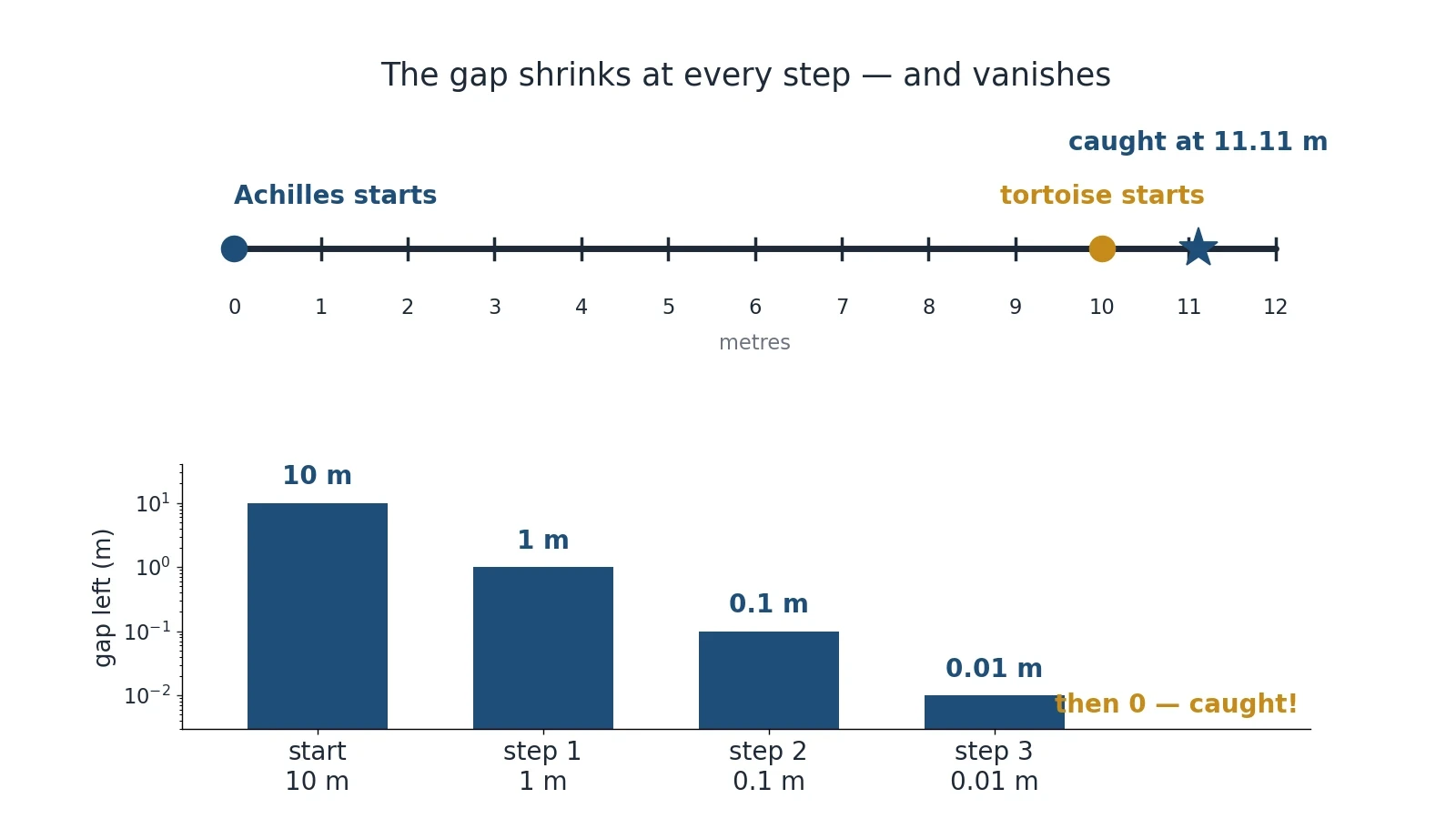
The most famous is Achilles and the tortoise. Achilles, the swiftest warrior of the Greek world, gives a tortoise a head start in a race. Zeno argues that Achilles can never overtake it. To catch the tortoise, Achilles must first reach the spot where the tortoise started. But by the time he gets there, the tortoise has crawled a little further ahead. Achilles must then reach that new spot, and by the time he does, the tortoise has moved again. The gap shrinks every time, but there is always another gap left to close, so Achilles supposedly never catches up.
Put numbers on it and the paradox sharpens. Suppose Achilles runs at 10 metres per second, the tortoise crawls at 1 metre per second, and the head start is 10 metres. Achilles reaches the tortoise's starting point after 1 second, having run 10 metres — but the tortoise has crawled 1 metre, to 11 metres. Achilles covers that metre in a tenth of a second, but the tortoise has moved a tenth of a metre, to 11.1 metres. Achilles covers that tenth of a metre in a hundredth of a second, and the tortoise has moved a hundredth of a metre, to 11.11 metres. The steps get smaller and smaller, and there are infinitely many of them. How can Achilles ever finish infinitely many steps?
| Step | Achilles runs to | Tortoise has reached | Gap left | Time taken |
|---|---|---|---|---|
| 1 | 10 m | 11 m | 1 m | 1 s |
| 2 | 11 m | 11.1 m | 0.1 m | 0.1 s |
| 3 | 11.1 m | 11.11 m | 0.01 m | 0.01 s |
| 4 | 11.11 m | 11.111 m | 0.001 m | 0.001 s |
| 5 | 11.111 m | 11.1111 m | 0.0001 m | 0.0001 s |
| … | … | … | … | … |
| Total | 11.11… m | 11.11… m | 0 m | 1.11… s |
The answer is in the last row of the table. The gaps shrink by a factor of ten at every step: 1, then 0.1, then 0.01, then 0.001, and so on. Add up the times — 1 + 0.1 + 0.01 + 0.001 + … — and the total is 1.111… seconds, a finite number. The infinitely many steps take a finite time, because the steps shrink fast enough. Achilles catches the tortoise after 1.11 seconds, at just over 11.11 metres, exactly as common sense says he should. The paradox dissolves the moment you add up the series — and the series is the whole point. An infinite sum can be finite. That is the idea Zeno never had, and it is the seed from which calculus would grow two thousand years later.
The second paradox, the Dichotomy, makes the same point with a single walker. To cross a room you must first cover half the distance, then half of what remains, then half of that, and so on without end. The distances are 1/2 + 1/4 + 1/8 + 1/16 + …, infinitely many of them. Add them up and you get exactly 1. Half plus a quarter plus an eighth, carried on forever, is one whole. The walker crosses the room. The third paradox, the Arrow, is stranger: at every instant of its flight, an arrow occupies a single place, and if it occupies a single place at every instant, when does it move? That one took longer to answer — it is really a question about what an instant is, and whether time is made of instants at all — but the first two are settled by the convergent series, and the series is enough to get us moving again.
I first met Zeno's paradoxes as a teenager, in a classroom where the teacher wrote the Achilles table on the board and asked us to find the flaw. Nobody could, at first. The argument feels airtight: every step leaves a gap, so there is always a gap, so Achilles never catches up. The flaw is in the word "always". It is true that after every step there is a gap. It is not true that there is a gap after all the steps — because "after all the steps" is a place the steps themselves reach, in a finite time, and the gap there is zero. Infinity is not a very large number of steps. It is the limit of the steps, and the limit is a place you can arrive at. That distinction — between "infinitely many" and "never finished" — is the first real lesson of this article, and it will come back in every section that follows.
A clear account of all three paradoxes, with the history of how they were read and misread, is given in John D. Norton's chapter on infinity paradoxes at the University of Pittsburgh, which is the best single introduction to the subject I know.
5. Galileo's Paradox: As Many Squares as Numbers
For two thousand years after Zeno, infinity stayed where Aristotle had put it: a process, never a completed thing. Then, in 1638, Galileo Galilei did something no one had done before. He compared two infinities with each other — and found that the comparison broke the rules.
Galileo's last book, Two New Sciences, is written as a dialogue between three characters, and one of its most famous passages is about perfect squares: 1, 4, 9, 16, 25, 36, and so on. Among the first 100 natural numbers, only 10 are perfect squares — one in ten. Among the first 10,000, only 100 are squares — one in a hundred. Among the first million, only 1,000 — one in a thousand. The squares thin out as you go further: they are a smaller and smaller fraction of the numbers, and the fraction tends to zero. By any sensible measure of density, there are far fewer squares than numbers.
And yet, Galileo pointed out, every natural number n has exactly one square, n², and every perfect square has exactly one square root. Pair them off — 1 with 1, 2 with 4, 3 with 9, 4 with 16, 5 with 25, and so on — and nothing is left over on either side. By the pairing, there are just as many squares as numbers. By the density, there are far fewer. Both arguments look airtight, and they contradict each other.
Galileo's conclusion was to give up:
"The attributes of 'equal', 'greater', and 'less' cannot be applied to infinite quantities." — Galileo Galilei, Two New Sciences, 1638
Comparing infinities was a mistake, he thought, and the only honest thing to do was not to try. He was half right. The paradox is real, and the density argument is real, and the pairing argument is real — but the conclusion does not follow. What follows is that "how many" and "how dense" are two different questions, and for infinite sets they can have different answers. The squares are rarer than the numbers and exactly as numerous as the numbers, both at once, and the contradiction is only in our habit of assuming that "fewer" and "rarer" mean the same thing. They do not — not for infinite sets.
There is a second lesson in Galileo's paradox, and it is the one that matters most for the rest of this article. The squares are a proper part of the natural numbers — every square is a natural number, but most natural numbers are not squares — and yet they are exactly as numerous as the whole. A part can equal the whole. That sounds like a contradiction, and for finite sets it is one: no part of a finite set can have as many members as the whole. For infinite sets it is the defining feature. The German mathematician Richard Dedekind saw this clearly in 1888 and turned it into a definition: a set is infinite if and only if it can be put in one-to-one correspondence with a proper part of itself. Galileo's paradox, which Galileo thought proved that infinities cannot be compared, turned out to be the definition of infinity itself.
6. Cantor's Revolution: Counting the Uncountable
Georg Cantor was born in 1845 in St Petersburg, the son of a Danish merchant, and he spent his career at the small university of Halle in Germany. He was not a famous man when he did his most important work, and the work was not welcomed. The most powerful mathematician in Germany, Leopold Kronecker in Berlin, opposed Cantor's ideas for years, and the opposition was personal as well as mathematical. Cantor persisted anyway, and in two papers — one in 1874 and one in 1891 — he did what Galileo had refused to do. He compared infinities, and he found that they are not all the same size.
His first question was the simplest one: can the real numbers be counted? The real numbers are all the numbers on the number line — the integers, the fractions, and the irrationals like pi and the square root of two, which go on forever without repeating. The counting numbers are 1, 2, 3, and so on. Can you list all the real numbers in a sequence, first, second, third, and so on, with every real number appearing somewhere on the list? Cantor's 1874 paper said no. His 1891 paper gave the reason in an argument so simple that it can be drawn as a picture — and the picture is the most famous diagram in all of set theory.
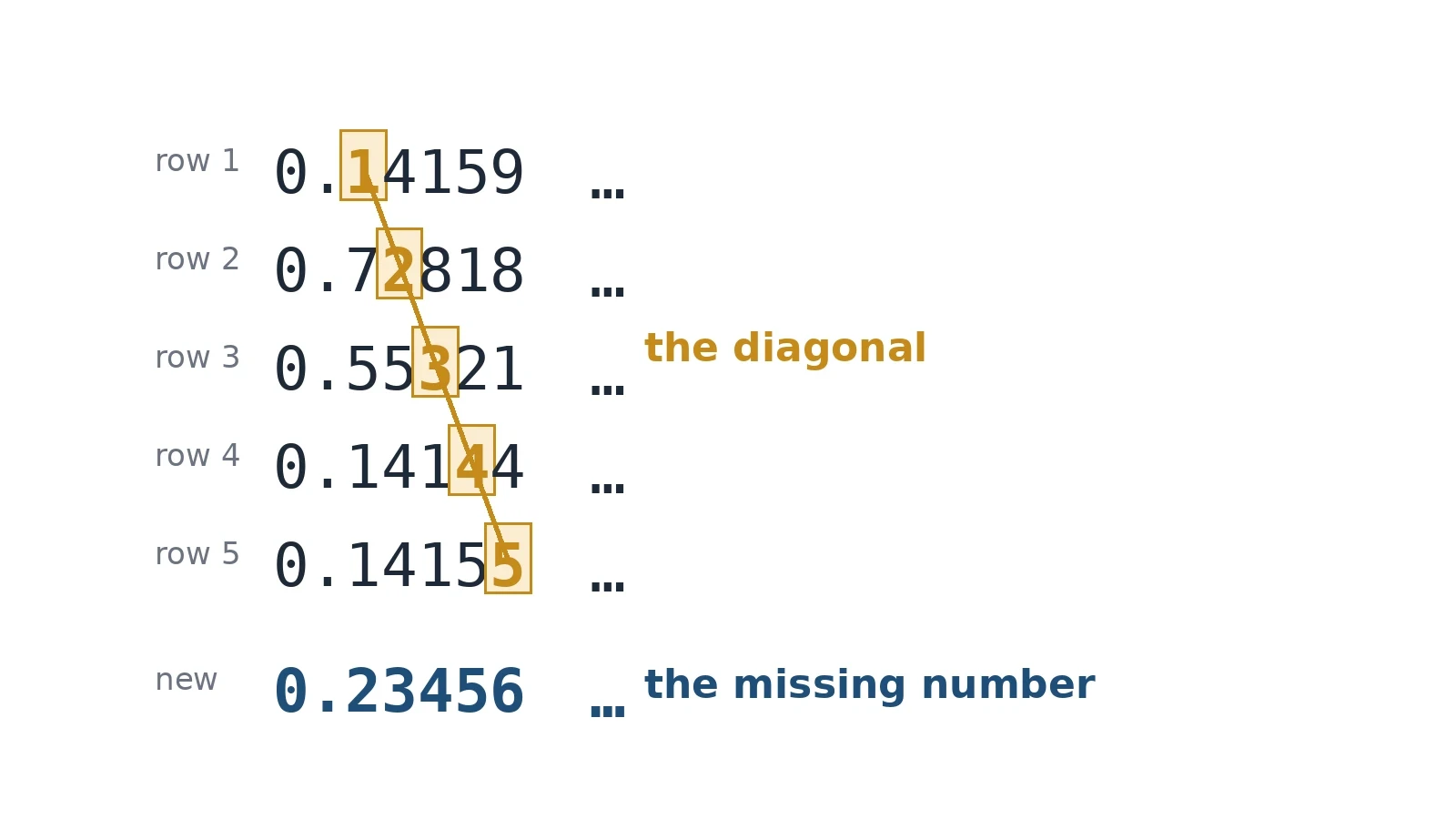
Suppose you have a list of all the real numbers between 0 and 1, written as infinite decimals. The first number on the list is 0.14159…, the second is 0.72818…, the third is 0.55321…, the fourth is 0.14144…, the fifth is 0.14155…, and so on, forever. Now build a new number. Take the first digit of the first number and change it: 1 becomes 2. Take the second digit of the second number and change it: 2 becomes 3. Take the third digit of the third number: 3 becomes 4. The fourth: 4 becomes 5. The fifth: 5 becomes 6. The new number is 0.23456… The rule has two exceptions, and they matter: an 8 becomes 2, and a 9 becomes 2 as well, so the construction never produces a 0 or a 9.
Now ask: is the new number on the list? It cannot be the first number, because it differs from the first number in its first digit. It cannot be the second, because it differs from the second in its second digit. It cannot be the third, the fourth, the fifth, or any number at all — because it differs from the nth number in its nth digit, for every n. The new number is a real number between 0 and 1, and it is not on the list. The list was supposed to be complete. It is not. And the argument works against ANY list you write down: whatever list you propose, the diagonal construction builds a number that is missing from it. No list of real numbers can ever be complete. The reals are uncountable.
There is a technical footnote worth one sentence. Some decimals have two representations: 0.999… and 1.000… are the same number, as section 10 will show. Cantor's construction avoids the problem by choosing its replacement digits carefully — never producing a 9 or a 0 where the ambiguity could bite — so the new number is genuinely new, not a second spelling of a number already on the list. The argument survives the footnote. It has survived for more than a century, and it is the foundation of the whole subject.
The shock of the diagonal argument is not just that the reals are uncountable. It is what else turns out to be countable. The even numbers are countable: pair n with 2n. The integers are countable: list them 0, 1, −1, 2, −2, 3, −3, and so on. And the rational numbers — all the fractions — are countable too, which is the most surprising of the three. There are infinitely many fractions between 0 and 1 alone, packed in so tightly that between any two of them there is another, and yet they can all be listed. The trick is to arrange them in a grid — numerators along one side, denominators along the other — and walk the grid diagonally, first the fractions whose numerator and denominator add to 2, then those that add to 3, then 4, and so on, skipping any fraction you have already seen. Every fraction appears somewhere on the walk. The rationals, dense as they are, fit in a single list. The reals do not.
| Set | What it contains | Countable? | Why |
|---|---|---|---|
| Natural numbers | 1, 2, 3, … | Yes — the list itself | Countable by definition |
| Even numbers | 2, 4, 6, … | Yes | Pair n with 2n |
| Integers | …, −2, −1, 0, 1, 2, … | Yes | List 0, 1, −1, 2, −2, … |
| Rational numbers | All fractions p/q | Yes | Walk the numerator–denominator grid diagonally |
| Algebraic numbers | Roots of polynomial equations | Yes | List the equations, then their roots |
| Real numbers | All decimals, including irrationals | No | The diagonal argument — every list misses one |
| Points on a line segment | Every point between 0 and 1 | No | Same size as the reals |
The table has a consequence that still startles people when they first meet it. The rationals are countable, and the reals are not — so the irrationals, the numbers that are not fractions, must be uncountable. There are more irrational numbers than rational ones, infinitely more, even though the rationals are packed densely everywhere and the irrationals are the ones you never meet in everyday arithmetic. Between any two fractions there are uncountably many irrationals. The number line is mostly irrational, and the fractions are the rare exceptions. Cantor's definition of size — pairing, not density — is what makes that sentence true, and it is the same definition that dissolved Galileo's paradox.
Cantor gave the smallest infinite size a name: aleph-null, written ℵ₀, the first letter of the Hebrew alphabet with a zero subscript. The natural numbers, the even numbers, the integers, the rationals, the algebraic numbers — all of them are ℵ₀. The reals are bigger. How much bigger is the subject of the next two sections, and the answer is one of the strangest in mathematics: the reals are bigger, and nobody knows by how much.
7. Hilbert's Hotel: The Hotel That Is Never Full
The best way to feel what countable infinity is like is to check into a hotel. The hotel has infinitely many rooms, numbered 1, 2, 3, 4, and so on without end, and every room is occupied. A new guest arrives. In an ordinary hotel, a full hotel has no room. In this hotel, the manager smiles and makes a simple announcement: everyone move one room along. The guest in room 1 moves to room 2, the guest in room 2 moves to room 3, the guest in room 3 moves to room 4, and so on, forever. Every guest still has a room, nobody has been thrown out, and room 1 is now free for the new arrival. The hotel was full, and now it has one more guest in it.
That is Hilbert's Hotel, and it is the clearest picture of countable infinity ever devised. It was introduced by the German mathematician David Hilbert in his Göttingen lectures on the infinite in the winter of 1924–1925, in a course called Über das Unendliche — On the Infinite — written up by his assistant, the physicist Lothar Nordheim. Hilbert never published the story himself, and his lecture notes appeared in print only in 2013. The hotel became famous through the physicist George Gamow's 1947 book One Two Three... Infinity, which is how generations of readers first met it. The history was untangled only recently, by the historian of science Helge Kragh, who showed in a 2014 paper that Hilbert really had told the story in his lectures — and retracted his own earlier conclusion that Gamow had invented it.
Now make the problem harder. An infinitely long bus pulls up, carrying infinitely many new guests, one for every natural number. The manager does not panic. He announces a different move: everyone in room n moves to room 2n. The guest in room 1 goes to room 2, room 2 to room 4, room 3 to room 6, room 4 to room 8 — every old guest lands in an even-numbered room. All the odd-numbered rooms — 1, 3, 5, 7, and so on, infinitely many of them — are now free, and the new guests take them in order: the first new guest to room 1, the second to room 3, the third to room 5. The hotel has absorbed an infinite crowd without displacing anyone. In the arithmetic of infinities, ℵ₀ + ℵ₀ = ℵ₀.
Now make it harder still. Infinitely many infinitely long buses pull up, one bus for every natural number, each carrying infinitely many passengers. The manager reaches for the prime numbers. First the old guests move: the guest in room n moves to room 2ⁿ — room 1 to room 2, room 2 to room 4, room 3 to room 8, and so on — so every old guest now sits in a power of 2. Then Bus 1's passengers take the powers of 3: 3, 9, 27, 81, … Bus 2's take the powers of 5: 5, 25, 125, … Bus 3's take the powers of 7, Bus 4's the powers of 11, and so on — Bus k takes the powers of the (k+1)-th prime. Every new passenger gets a room, because every room number that is a prime power belongs to exactly one bus and one seat: 3⁵ is Bus 1, seat 5; 5² is Bus 2, seat 2. Some rooms stay empty — 6, 10, 200, and every other number with more than one prime factor — but no passenger is left without one, and no two passengers share a room. Infinitely many infinities, absorbed. In cardinal arithmetic, ℵ₀ × ℵ₀ = ℵ₀.
I first met Hilbert's Hotel as a student, and I did not believe it. I kept looking for the catch — the guest who would be left standing in the corridor, the room that would run out. There is no catch, and that is the point. The hotel works because there is no last room. In a finite hotel, "full" means there is no room left, because the rooms run out. In an infinite hotel, "full" means every room has a guest, and there are still more rooms — because the rooms never run out. The word "full" means two different things, and the paradox is only in the word.
Hilbert himself knew what the hotel was for. He was defending Cantor's theory of the infinite against its critics, and in 1926 he wrote the sentence that became the theory's motto:
"No one shall expel us from the paradise that Cantor has created." — David Hilbert, 1926
The hotel is the paradise, made concrete: a place where the ordinary rules of arithmetic stop working and a stranger, richer set of rules takes over. But the hotel has a limit, and the limit is the most important thing about it. The hotel can absorb any countable crowd — one guest, a busload, infinitely many busloads — because a countable crowd can be listed, and a listed crowd can be assigned rooms. What the hotel cannot absorb is an uncountable crowd. If the real numbers checked in, one guest for every real number between 0 and 1, there would be no assignment of rooms that fits them all — because the reals cannot be listed, and the diagonal argument says so. The hotel is infinite, and it is still too small. That is the next section's subject, and it is where infinity stops being a curiosity and starts being a hierarchy.

8. Are Some Infinities Bigger Than Others?
Yes. That is the short answer, and it is the most shocking sentence in this article. The diagonal argument proved that the real numbers cannot be counted — so the infinity of the reals is strictly bigger than the infinity of the counting numbers. There are at least two sizes of infinity: ℵ₀, the countable infinity of the natural numbers, and a larger one, the continuum, the size of the real numbers, written c and equal to 2^ℵ₀. And once you know there are two, the ladder never stops.
Cantor's theorem, published in 1891 alongside the diagonal argument, says why. Take any set at all — finite or infinite — and consider the set of all its subsets, called its power set. The power set is always strictly bigger than the set you started with. For a set of three things, the power set has eight members: the empty set, the three singletons, the three pairs, and the whole set. For the natural numbers, the power set has the same size as the real numbers: 2^ℵ₀. For the real numbers, the power set has size 2^(2^ℵ₀), bigger again. And for that set, the power set is bigger still. Every infinity has a bigger one sitting above it, and the ladder has no top rung.
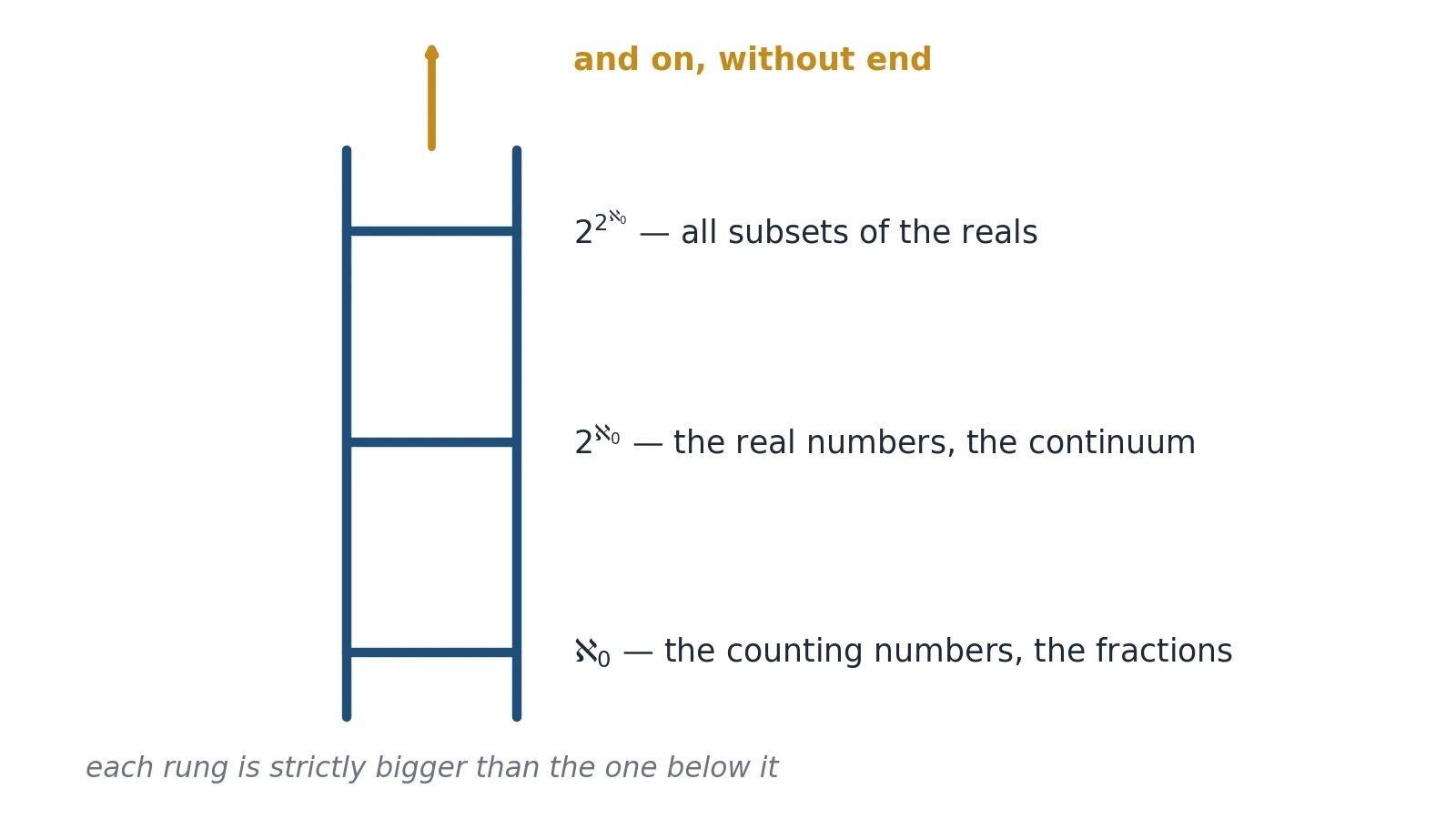
There is a second ladder, and it is worth a paragraph, because it is easy to confuse with the first. The cardinal numbers measure size: ℵ₀, ℵ₁, ℵ₂, and so on, each one the next size up. The ordinal numbers measure order: ω is the order type of the counting numbers in their natural order, 1, 2, 3, …; then comes ω + 1, the same list with one extra element tagged on at the end; then ω + 2, ω + 3, …, then 2ω, then ω², and on up through a hierarchy of orderings that makes the cardinals look simple. Two sets can have the same size but different order types: ω and ω + 1 both have cardinality ℵ₀, but they are different orderings — ω + 1 has a last element, and ω does not. Size and order are two different questions, just as density and size were two different questions in Galileo's paradox. Infinity keeps splitting into pairs of questions that look like one question until you learn to tell them apart.
The cardinals have their own order, and it is worth writing down, because it is the answer to the question "how many sizes of infinity are there?" The answer is: as many as you like. Start with ℵ₀, the countable infinity. The next cardinal, ℵ₁, is defined as the next size up — the smallest infinity bigger than ℵ₀. Then comes ℵ₂, the smallest infinity bigger than ℵ₁, and so on: ℵ₃, ℵ₄, and on without end, one for every natural number, and then beyond the natural numbers too, through ℵ_ω and further. The continuum hypothesis — that the continuum is exactly ℵ₁, the very next rung — is the subject of the next section. The generalised continuum hypothesis extends the same claim to every rung: 2^ℵ₀ = ℵ₁, 2^ℵ₁ = ℵ₂, and so on. Gödel's and Cohen's models settle it the same way: the generalised continuum hypothesis is independent too. The ladder is not a ladder with a top. It is a ladder with no top, and with gaps in it that no proof can fill.
The most natural question to ask about the ladder is the one Cantor asked first: how much bigger is the continuum than ℵ₀? Is the continuum the very next rung up — the size called ℵ₁ — or is there something in between? Cantor believed the continuum was the next rung: there is no infinity strictly between the countable and the continuum. That belief has a name, the continuum hypothesis, and its story is the strangest in this article, because it ends with the discovery that the question has no answer at all — at least, not from the axioms mathematicians normally use.
9. The Continuum Hypothesis: The Question Nobody Can Answer
Georg Cantor proposed the continuum hypothesis in 1878, four years after his first proof that the reals are uncountable. It says, in plain language: there is no set whose size lies strictly between the countable infinity ℵ₀ and the continuum 2^ℵ₀. In modern notation, ℵ₁ = 2^ℵ₀. Either the continuum is the very next size up, or it is not, and Cantor believed it was. He spent years trying to prove it, and he never did. Nobody else did either.
In 1900, David Hilbert put the continuum hypothesis first on his famous list of twenty-three problems for the new century — the problems he thought would define the mathematics of the hundred years to come. It stayed unsolved for forty years. Then, in 1940, Kurt Gödel proved something extraordinary: the continuum hypothesis cannot be disproved from the standard axioms of set theory. He built a model of set theory — the constructible universe, a carefully restricted world of sets — in which the axioms all hold and the continuum hypothesis is true. If the axioms could disprove it, no such model could exist. So the hypothesis is consistent with the axioms: you can add it to them without contradiction.
Twenty-three years later, Paul Cohen proved the other half. In 1963, Cohen invented a method called forcing, and used it to build a different model of set theory — one in which the axioms all hold and the continuum hypothesis is false. There, the continuum is not ℵ₁; there are sizes in between. If the axioms could prove the hypothesis, no such model could exist. So the hypothesis is also consistent with the axioms in the other direction: you can add its negation without contradiction either.
Put the two halves together and the conclusion is startling: the continuum hypothesis is independent of the standard axioms of set theory. The axioms — the rules of the game mathematicians agreed to play by — neither prove it nor disprove it. The question "is there an infinity between ℵ₀ and the continuum?" has no answer from those axioms, in the same way that the question "is this statement true?" has no answer if the statement is neither provable nor disprovable. Cohen won the Fields Medal in 1966 for the proof, the highest honour in mathematics, and the method he invented — forcing — became one of the standard tools of set theory.
What does independence mean, in practice? It means mathematicians are free to choose. You can work in a universe where the continuum hypothesis is true, and everything is consistent. You can work in a universe where it is false, and everything is consistent too. Most mathematicians carry on as if the question were settled — they use the axioms and avoid the hypothesis — but the fact remains: one of the simplest questions you can ask about infinity has no answer, not because we have not been clever enough to find it, but because the rules we are playing by do not determine it. It is the deepest sense in which infinity resists being tamed. Cantor built the ladder, and then discovered that the ladder itself has gaps that no proof can fill.
That is a good place to pause and take stock. We have a symbol, a definition of size, a hotel, a ladder, and a question with no answer. But infinity does not only live in set theory. It lives in calculus, in geometry, in the sums that broke the internet, and in the sky above us. The next four sections follow it there.
10. Infinity in Calculus: The Infinitely Small
Infinity has a twin, and the twin is the infinitely small. Where infinity is the idea of going on without end, the infinitely small is the idea of shrinking without end — and the two are the same idea seen from opposite sides. The connection is the limit: the value a quantity approaches as something else grows without bound, or shrinks towards zero. Calculus is the mathematics of limits, and limits are how infinity finally became a working tool instead of a philosophical problem.
The cleanest example is a piece of arithmetic that most people refuse to believe the first time they meet it: 0.999… is exactly equal to 1. Not approximately equal. Exactly equal. The dots mean the 9s go on forever, and the number they name is 1.
There are three ways to see it, and each one is worth doing by hand. First, the algebra. Let x = 0.999…. Then 10x = 9.999…. Subtract the first equation from the second: 10x − x = 9.999… − 0.999…, which is 9x = 9, so x = 1. Second, the thirds. One third is 0.333…, with the 3s going on forever. Multiply by three: 3 × 1/3 = 1, and 3 × 0.333… = 0.999…. So 0.999… = 1. Third, the limit. The sequence 0.9, 0.99, 0.999, 0.9999, … gets closer and closer to 1, and the gap — 0.1, 0.01, 0.001, 0.0001, … — shrinks to nothing. The limit of the sequence is 1, and 0.999… is the name we give to that limit.
Here is a derivative worked out by hand, so the limit is not a mystery. Take the function f(x) = x², and ask for its slope at x = 3. Pick a second point a little way along the curve, at 3 + h, where h is a small number. The slope between the two points is the rise over the run: ((3 + h)² − 9) / h, which simplifies to (6h + h²) / h, which is 6 + h. Now let h shrink to zero. The slope 6 + h approaches 6 — and the limit, the slope exactly at x = 3, is exactly 6. The infinitely small step h never actually reaches zero, because dividing by zero is forbidden; but the limit as h approaches zero is perfectly well defined, and it is 6. That is the whole of differential calculus in one paragraph: the slope is a limit, the limit is exact, and the infinitely small is handled by never quite touching zero.
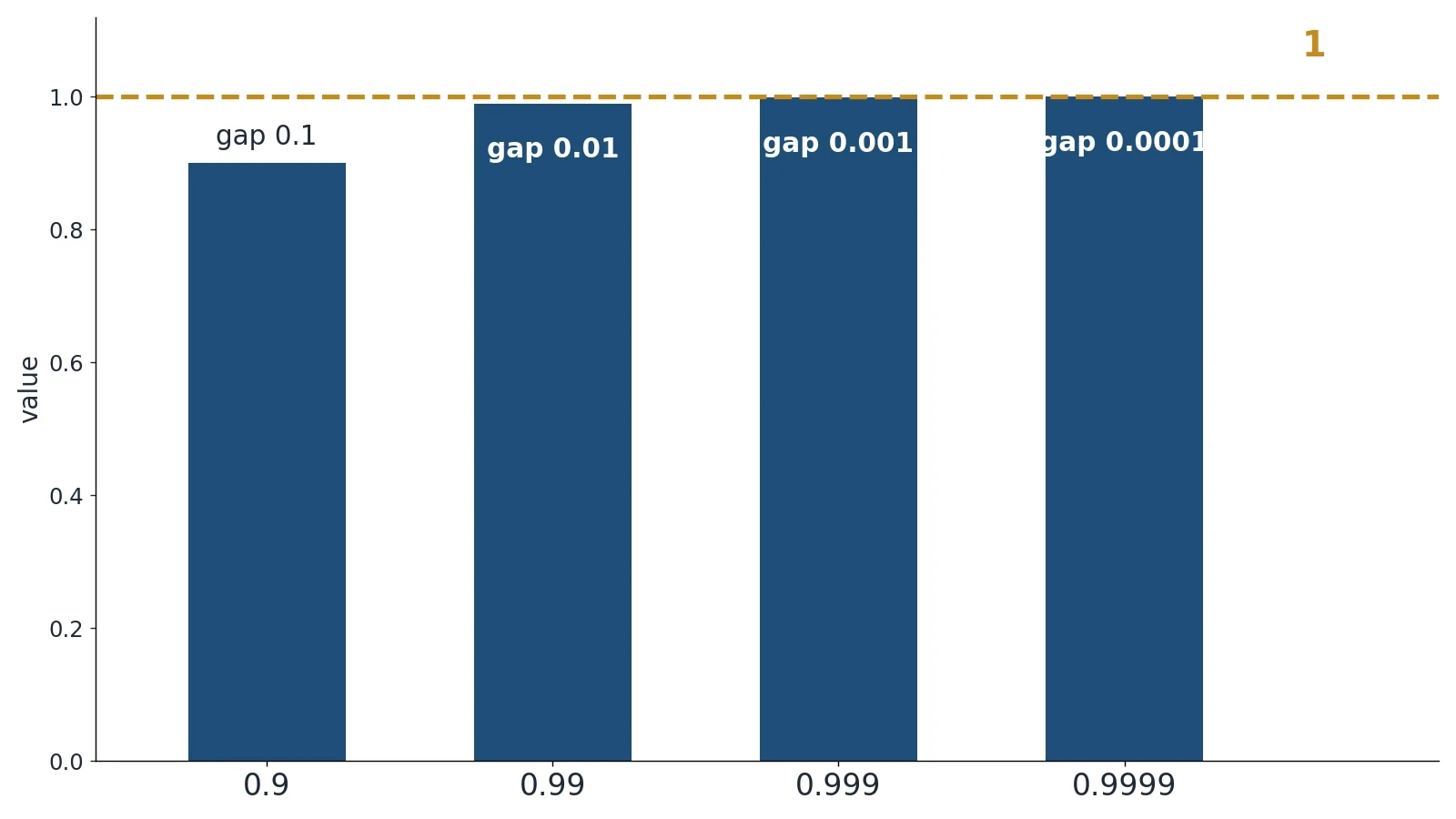
I have watched a classroom argue about 0.999… = 1 for a full hour, and the argument always follows the same path. Someone says there must be a tiny gap between 0.999… and 1. Someone else asks: what number would live in that gap? If the gap were real, there would be a number between 0.999… and 1 — but there is none. The gap is not small. It is zero. The resistance is not mathematical; it is the feeling that an infinite process can never finish, and the limit is the answer to that feeling. The process does not finish — the limit is what the process approaches, and the number 0.999… is the limit, not the process.
This is the same idea that resolved Zeno's paradoxes, and it is the idea that calculus is built on. A derivative is a limit: the slope of a curve at a point, found by taking the slope between two points and letting the distance between them shrink to zero. An integral is a limit too: the area under a curve, found by adding up infinitely many infinitely thin slices. The infinitely small and the infinitely large are two faces of one idea, and the limit is the tool that lets mathematicians handle both without ever having to hold an actual infinity in their hands. Our article on how calculus works takes up the full story of limits, derivatives, and integrals; here, the point is simpler. Zeno's infinitely many steps add up to a finite time because the steps shrink fast enough. The same shrinking is what makes calculus work, and it is what turns infinity from a paradox into a calculation.
11. Gabriel's Horn: The Shape You Can Fill but Never Paint
In 1643, the Italian mathematician Evangelista Torricelli — the man who invented the barometer — studied a shape that should not exist. Take the curve y = 1/x, for x from 1 onwards, and rotate it around the x-axis. You get a trumpet shape, fat at one end and tapering away to a thin point that never quite closes, stretching off to infinity. It is called Gabriel's Horn, or Torricelli's trumpet, after the archangel whose horn will one day announce the end of the world. The horn has two properties, and they contradict each other — or seem to.
First, its volume is finite. Slice the horn into thin discs, like slicing a loaf of bread. At position x, the disc has radius 1/x, so its area is π/x². Add up the discs from x = 1 to infinity, and the total volume is π times the integral of 1/x² from 1 to infinity, which is exactly π — about 3.14 cubic units, or about 3,140 litres if a unit is a metre. The horn stretches forever, but it holds a finite amount of paint. Second, its surface area is infinite. The surface is made of thin bands, and the area of a band depends on the slant of the curve as well as its height. Add up the bands, and the total runs away without limit. The horn has a finite volume and an infinite surface.
That is the paradox, and it has a name: the painter's paradox. Fill the horn with π units of paint, and you have filled it completely — the paint reaches everywhere the horn reaches. But painting the surface, inside or out, would take an infinite amount of paint, because the surface is infinite. How can a finite amount of paint fill a shape whose surface it cannot coat?
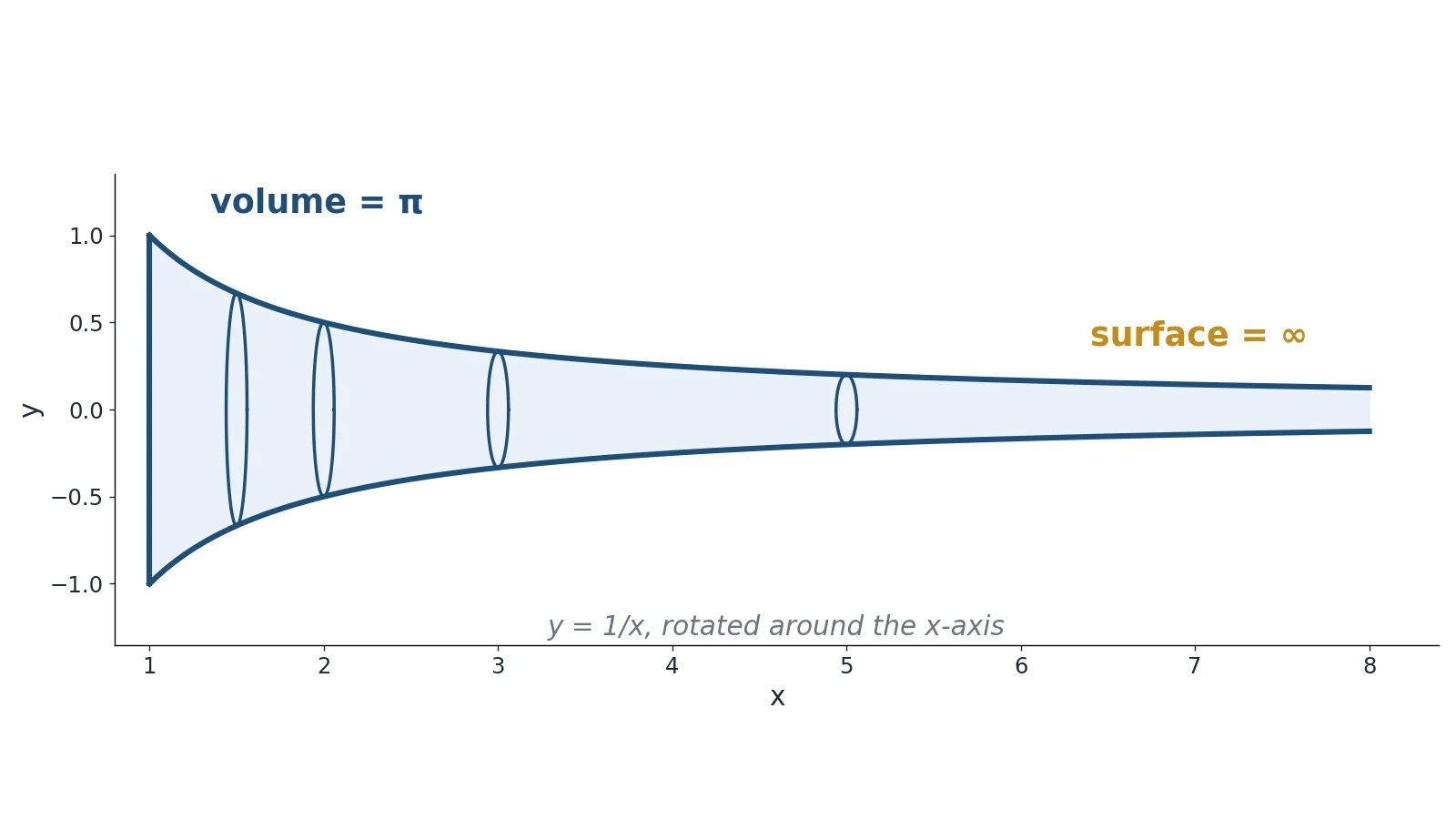
The answer is in the arithmetic, and it is a single factor of x. The volume adds up discs of area π/x², and the integral of 1/x² converges — the terms shrink fast enough. The surface adds up bands whose area is roughly 2π/x, and the integral of 1/x diverges — the terms shrink too slowly. Mathematicians call this the p-test: the integral of 1/x^p from 1 to infinity converges when p is greater than 1, and diverges when p is 1 or less. The volume uses p = 2, comfortably inside the convergent range. The surface uses p = 1, the one value that fails. The two answers differ by a single power of x, and that power lands exactly on the boundary.
And the painter's paradox dissolves once you look at what "painting" means. To paint a surface, you spread a coat of some thickness over it. If the coat has a fixed thickness, then an infinite surface needs an infinite volume of paint — that part is true. But filling the horn does not paint it with a fixed thickness. The paint inside the horn gets thinner and thinner as the horn narrows, exactly as fast as the surface demands, and the thinning is what lets a finite volume reach everywhere. The paradox assumed the paint had to keep a constant thickness. It does not. Fill and paint are different operations, and the horn is the shape that proves it.
Torricelli's result was considered a paradox in its own day, and it was disputed by some of the sharpest minds of the seventeenth century, including Thomas Hobbes and John Wallis. The dispute was really about the same question Aristotle had asked two thousand years earlier: can an infinite thing have a finite measure? Gabriel's Horn says yes — a shape can be infinitely long, finitely voluminous, and infinitely surfaced, all at once. The infinitely small and the infinitely large, again, are two faces of one idea, and the boundary between them is a single power of x. The full calculation, with the integrals worked step by step, is the same calculus our article on how calculus works teaches from the beginning.
12. The Sum That Broke the Internet: 1 + 2 + 3 + … = −1/12
In 2014, a video appeared online claiming that the sum of all the natural numbers — 1 + 2 + 3 + 4 + …, added up forever — is −1/12. It was watched by millions of people, argued about by thousands, and denounced by mathematicians in terms that were unusually blunt for a profession that prides itself on politeness. The claim is false, in the ordinary sense of the word "sum". It is also true, in a different and deeper sense. And the difference between the two senses is the most instructive thing about infinity in this whole article.
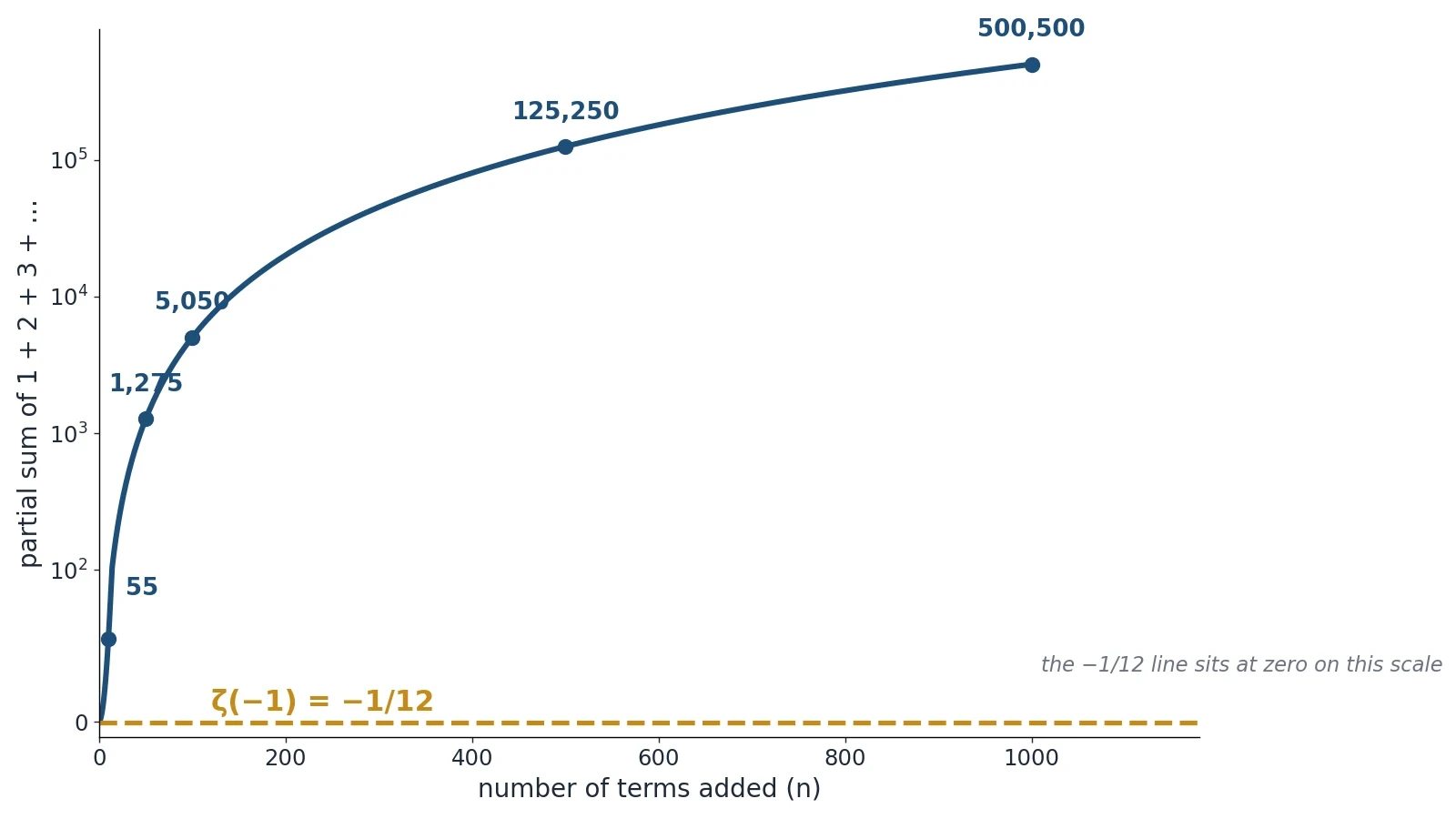
Start with the ordinary sense. Add up the natural numbers, one at a time: after 10 terms the sum is 55; after 100 terms it is 5,050; after 1,000 terms it is 500,500. The partial sums grow like n²/2, and they run away to infinity. The sum diverges. That is the end of the story, as far as ordinary addition is concerned. The sum of all the natural numbers is infinite, and −1/12 has nothing to do with it.
So where does −1/12 come from? It comes from the Riemann zeta function, and from a young Indian mathematician named Srinivasa Ramanujan, who wrote the identity to the English mathematician G. H. Hardy in a letter in 1913. The zeta function is defined, for numbers greater than 1, as the sum 1 + 1/2^s + 1/3^s + 1/4^s + …, and when s = 2 it gives the famous value π²/6. But the function can be extended — by a technique called analytic continuation — beyond the range where its defining series converges, to values of s where the series itself diverges. At s = −1, the extended function takes the value −1/12. The series 1 + 2 + 3 + … is what you get if you plug s = −1 into the defining sum, so mathematicians write 1 + 2 + 3 + … = −1/12 as a shorthand for "the zeta function, analytically continued to −1, equals −1/12". The shorthand is the problem. It looks like a sum. It is not a sum. It is the value of a function at a point where the series that defines the function does not converge.
The popular "proof" of the identity is worth seeing, because it shows exactly where the rules break. It starts with Grandi's series, 1 − 1 + 1 − 1 + …, whose partial sums alternate 1, 0, 1, 0, forever, and assigns it the value 1/2 — the average of the partial sums, a method called Cesàro summation. Then it manipulates the series 1 − 2 + 3 − 4 + … into the value 1/4, and combines the two to get −1/12. Every step of the manipulation treats infinite series as if they were finite sums — rearranging terms, subtracting one infinite series from another — and infinite series do not allow that. Rearranging the terms of a divergent series can change its value, or make it anything at all. The proof is a conjuring trick, and the trick works because it breaks a rule and hopes you will not notice.
And yet the value −1/12 is not a joke. It appears in real physics. The Casimir effect — the tiny attractive force between two uncharged metal plates in a vacuum, caused by the quantum fluctuations of empty space — is calculated by assigning the zeta-regularised value to a divergent sum, and the prediction matches experiment. Bosonic string theory, in its original form, needs 26 dimensions of spacetime, and the number 26 comes out of the same regularisation. The value is real, and it is useful, and it is not a sum. That is the honest framing, and it is the one the viral video left out: a divergent series can be assigned a value by a summation method, but the value is a property of the method, not of ordinary addition. Infinity does not make arithmetic wrong. It makes arithmetic conditional — the answer depends on which rules you are playing by, and you have to say which ones.
The physics deserves a little more detail, because it is the reason the value survives every attempt to dismiss it. The Casimir effect was predicted by the Dutch physicist Hendrik Casimir in 1948: two uncharged metal plates, placed very close together in a vacuum, attract each other with a tiny force. The force comes from the quantum vacuum — empty space is not empty, but seething with virtual particles, and the plates restrict which wavelengths can exist between them, creating a pressure difference. Calculating the force involves adding up the energies of all the allowed wavelengths, a sum that diverges — and the calculation is done by zeta regularisation, the same analytic continuation that assigns −1/12 to the sum of the natural numbers. The predicted pressure is about 0.013 dyne per square centimetre — roughly a thousandth of a pascal — for plates a micrometre apart, and it has been measured, in experiments from 1997 onwards, to within a few per cent of the prediction. The −1/12 is not a parlour trick. It is embedded in a prediction that a laboratory can test.
String theory uses it too. In the original bosonic string theory, the mathematics only works consistently if spacetime has 26 dimensions — 25 of space and one of time — and the number 26 emerges from the same regularisation, through the identity 1 + 2 + 3 + … = −1/12. The theory is not confirmed, and most physicists expect the real theory, if it exists, to look different. But the fact that a divergent sum, regularised, tells you the dimension of spacetime is a measure of how seriously the method is taken. The value −1/12 is a tool, not a sum — and like any tool, it is judged by what it builds, not by what it looks like.
A careful walk through the whole affair, with the rigorous and the non-rigorous routes both laid out, is David Wakeham's essay on summing the natural numbers, which shows both of Ramanujan's methods and explains exactly where each one breaks the rules. Our article on what is probability takes up a related lesson — the difference between a striking example and a representative one — and the −1/12 story is the same lesson in a different costume: a beautiful claim is not a true claim, and the only way to tell the difference is to check which rules were used.
13. Is the Universe Infinite?
Infinity is not only a mathematical idea. It is also a question about the world we live in — and the answer, after a century of measuring, is that nobody knows. The part of the universe we can see is finite. Whether the whole universe is infinite is an open question, and it is the biggest open question in this article.
The part we can see is called the observable universe, and it is about 93 billion light-years across — a sphere with a radius of about 46.5 billion light-years, centred on us. That number surprises people, because the universe is only about 13.8 billion years old, and nothing travels faster than light. How can the observable universe be 93 billion light-years wide if light has only had 13.8 billion years to travel? The answer is that space itself has been expanding while the light was on its way. The most distant light we see was emitted when the universe was young and the emitting galaxy was much closer to us; the expansion of space has carried that galaxy far away in the meantime, to a present distance of about 46.5 billion light-years. The 93 billion light-years is the present separation between the most distant regions we can see, not the distance any light has travelled.
The observable universe is not the whole universe. It is the part whose light has had time to reach us. Beyond it there is more universe — how much more is the question. Space looks flat on the largest scales we can measure, and a flat universe could extend forever, with no edge and no end. But a flat universe could also be finite and unbounded, like the surface of a torus (a 3-torus in three dimensions): finite in volume, with no edge to fall off. Current observations cannot tell the two apart. The whole universe could be infinite, or it could be finite and vastly larger than the part we can see, and no measurement we know how to make can distinguish them. The honest answer is "we do not know", and it is worth saying plainly, because popular writing so often says otherwise.
There is a classic argument that the universe cannot be infinite, and it is worth meeting, because it is wrong in an instructive way. It is called Olbers' paradox, after the German astronomer Heinrich Olbers, who stated it in 1823. If the universe were infinite, static, and filled with stars in every direction, then every line of sight from Earth would eventually end on the surface of a star, and the whole night sky would blaze as bright as the surface of the Sun. The night sky is dark. Therefore, the argument goes, the universe cannot be infinite.
The argument fails twice over. First, the universe has a finite age: it began about 13.8 billion years ago, so light from the most distant stars has not had time to reach us — there has not been enough time for every line of sight to end on a star. Second, the universe is expanding, and the expansion stretches starlight towards the red end of the spectrum, out of the range our eyes can see. The darkness of the night sky is not evidence that the universe is finite. It is evidence that the universe is young and expanding. An infinite universe with a finite age and an expanding space has a dark night sky, just as ours does.
Infinity also appears in physics as a warning light. General relativity predicts that matter collapsing into a black hole is crushed to a point of infinite density — a singularity, where the equations give up and return infinity as the answer. Physicists do not believe the infinite density is real. They believe it is a sign that general relativity breaks down at such extremes, and that a theory of quantum gravity — a theory nobody has yet finished building — will replace the infinite density with something finite. The same is true of the beginning of the universe itself: run the expansion backwards and the equations point to a singularity, a moment of infinite density and temperature, and again the infinity is most likely a sign that the theory has reached its limit, not a description of reality. In physics, infinity is usually a symptom, not a measurement — a flag that says "your theory stops working here". Our articles on black holes, the Big Bang, dark matter and dark energy, galaxies, relativity and gravity take up the physics in full; here, the point is the contrast. In mathematics, infinity is a finished, rigorous subject, with definitions, theorems, and a ladder of sizes. In physics, it is an open question and a warning sign. The universe may be infinite. It may not be. The mathematics can tell you what infinity would mean, if it were there. It cannot tell you whether it is.
I have stood under a dark sky, far from any city, and felt the question in my bones: does it go on forever? The stars thin out as you look further, but they never stop, and the darkness between them is not empty — it is full of galaxies too faint to see. The feeling is that it must go on forever. The feeling is not evidence. It is the same feeling Zeno's students had, and Galileo's, and Cantor's critics' — the feeling that infinity is either obviously real or obviously impossible. Both feelings are wrong. The universe is 93 billion light-years across as far as we can see, and beyond that, we do not know. That is not a failure. It is the most honest sentence in cosmology.
What does "flat" mean, when we say space looks flat? It means the geometry of space follows Euclid's rules on the largest scales: the angles of a huge triangle add up to 180 degrees, and parallel lines stay parallel. If space were positively curved, like the surface of a sphere, the angles would add up to more than 180 degrees, and parallel lines would eventually meet — and a positively curved universe would be finite, closing back on itself like the surface of a ball. If space were negatively curved, like a saddle, the angles would add up to less than 180 degrees, and parallel lines would diverge — and a negatively curved universe would be infinite. The measurements, from the Planck satellite and others, put the curvature so close to zero that it is indistinguishable from flat, within the margin of error. Flat is the knife's edge between the two, and it is the case where the measurements cannot decide: a flat universe could be infinite, or it could be finite and folded, like the surface of a torus, with no edge to fall off. The data does not choose. The question stays open, and it will stay open until someone finds a way to measure the curvature more precisely — or finds a completely different kind of evidence.
14. Common Mistakes and Misconceptions
Infinity attracts misconceptions the way a bright light attracts moths, and most of them come from treating infinity as if it were a very large number. It is not. It is a different kind of thing, and the rules that work for numbers do not work for it. Here are the mistakes, stated plainly, with the corrections beside them.
The first mistake is the one this article started with: infinity is not the biggest number. There is no biggest number, and infinity is not a number at all. Saying "infinity is the biggest number" is like saying "the horizon is the farthest place" — it mistakes a direction for a destination. The counting numbers go on without end, and infinity is the name we give to that endlessness, not a member of the list.
The second mistake is infinity minus infinity. If infinity were a number, you could subtract it from itself and get zero. You cannot, because infinity is not a number, and the expression ∞ − ∞ is undefined. Depending on how you set it up, the answer could be anything: the counting numbers minus the even numbers leaves infinitely many numbers (the odd ones); the counting numbers minus the counting numbers leaves nothing; the counting numbers minus the numbers greater than ten leaves ten. Same symbols, different answers. That is what "undefined" means.
The third mistake is dividing by infinity, or by zero, in the hope of getting a sensible answer. One divided by infinity is not zero — it is a limit: as the denominator grows without bound, the fraction approaches zero, and mathematicians write 1/∞ = 0 only as a shorthand for that limit. And one divided by zero is not infinity. It is undefined, because no number multiplied by zero gives one. Infinity over infinity is undefined too, for the same reason as infinity minus infinity: the answer depends entirely on which infinities you mean.
The fourth mistake is thinking that "infinitely many" means "everything". There are infinitely many even numbers, and there are infinitely many numbers that are not even. There are infinitely many fractions between 0 and 1, and there are infinitely many numbers between 0 and 1 that are not fractions. An infinite collection can leave out infinitely much. Hilbert's Hotel can absorb any countable crowd, but it cannot absorb the real numbers — the uncountable crowd overflows it, because no listing of the reals exists for the manager to work from. Infinity comes in sizes, and the sizes matter.
The fifth mistake is the one the −1/12 story taught us: treating a divergent series as if it were a finite sum. You cannot rearrange the terms of an infinite series, or subtract one infinite series from another, and expect the ordinary rules of arithmetic to hold. The rules change when the sums do not converge, and the value you get depends on the method you use. A beautiful identity is not a true identity until you know which rules produced it.
The sixth mistake is about computers, and it is the most practical of all: the belief that a sufficiently powerful computer could answer any question, given enough time. It cannot. In 1936, Alan Turing proved the halting problem: there is no program that can look at an arbitrary program and decide, in general, whether that program will eventually stop or run forever. The proof is a diagonal argument — the same shape as Cantor's, applied to programs instead of decimals. Assume such a decider exists, build a program that does the opposite of whatever the decider predicts, and the decider contradicts itself. The infinite, in the form of "run forever", is not something a computer can settle in advance. Infinity is not only a mathematical idea and a cosmological question. It is a hard limit on what machines can know.
The seventh mistake is subtler, and it is about the brain rather than the mathematics. We are pattern-finding machines, and we are very good at it — too good, sometimes. We notice the hits and forget the misses. We remember the one perfect example and forget the hundred that did not fit. Infinity is a perfect target for that habit, because the idea is grand, the claims are flattering, and the checking is work. Our articles on cognitive biases and how we make decisions take up the full catalogue of these habits; here, the point is that the feeling of certainty is not evidence. The evidence is the counting, the pairing, and the diagonal — and the counting says that infinity is real, it comes in sizes, and some of it is bigger than the rest.
There is one more mistake, and it is the most human of all: assuming that because infinity is strange, it must be mystical. It is not. It is mathematics — definitions, proofs, and a ladder of sizes that anyone can climb, one rung at a time, with a pocket calculator and a little patience. The strange part is not that infinity exists. The strange part is that it took us two thousand years to learn how to count it.
15. Frequently Asked Questions
Is infinity a number?
No. Infinity is not a number — it is the idea of something without end. Numbers can be added, subtracted, multiplied, and divided, and the answers are definite. Infinity breaks those operations: infinity plus one is still infinity, infinity minus infinity is undefined, and infinity divided by infinity is undefined. The symbol ∞ is a shorthand for "without limit", not a number you can count to.
Are some infinities bigger than others?
Yes. The infinity of the counting numbers — called aleph-null, ℵ₀ — is the smallest infinite size. The infinity of the real numbers is strictly bigger: Cantor's diagonal argument proves that no list of real numbers can ever be complete. And Cantor's theorem says that for any set, the set of all its subsets is strictly bigger still, so the ladder of infinities — ℵ₀, 2^ℵ₀, 2^(2^ℵ₀), and so on — has no top rung.
What is countable vs uncountable infinity?
A set is countable if its members can be listed in a sequence matched one-to-one with the natural numbers 1, 2, 3, … The natural numbers, the even numbers, the integers, and even all the fractions are countable. A set is uncountable if no such listing exists. The real numbers are uncountable — Cantor's diagonal argument builds a real number missing from any list you propose — and so are the points on any line segment.
What is Hilbert's Hotel?
Hilbert's Hotel is a thought experiment about a hotel with infinitely many rooms, all occupied, introduced by David Hilbert in his 1924–1925 lectures and popularised by George Gamow in 1947. One new guest is accommodated by moving everyone one room along, freeing room 1. An infinite busload is accommodated by moving everyone to even-numbered rooms, freeing all the odd rooms. Infinitely many infinite buses are accommodated with prime powers. The hotel shows that countable infinities absorb additions without growing — ℵ₀ + 1 = ℵ₀ — but it cannot hold an uncountable crowd.
What is the infinity symbol?
The infinity symbol ∞ is a sideways figure eight, also called a lemniscate. John Wallis introduced it into mathematics in 1655, in his treatise De sectionibus conicis, and never explained why he chose the shape; historians guess a variant of the Roman numeral CIↃ for 1,000, or a nod to the Greek letter omega. Jacob Bernoulli named the lemniscate curve it resembles in 1694.
Is the universe infinite?
Nobody knows. The observable universe — the part whose light has had time to reach us — is about 93 billion light-years across, and the universe is about 13.8 billion years old. Space looks flat on the largest scales, and a flat universe could extend forever, but it could also be finite and unbounded, like the surface of a torus (a 3-torus in three dimensions). Current observations cannot tell the difference, and the honest answer is that we do not know.
What is 1 + 2 + 3 + ... equal to?
In the ordinary sense, the sum diverges: its partial sums grow without bound — 5,050 after 100 terms, 500,500 after 1,000 — and the sum is infinite. The famous value −1/12 is not the sum in the ordinary sense. It is the value of the Riemann zeta function at −1, reached by analytic continuation, a method of extending the function beyond the range where its defining series converges. The value is real and useful in physics, but it is a property of the method, not of ordinary addition.
Can you divide by infinity?
Not in the ordinary sense. One divided by infinity is not a number — it is a shorthand for a limit: as the denominator grows without bound, the fraction approaches zero. One divided by zero is undefined, because no number multiplied by zero gives one. And infinity divided by infinity is undefined, because the answer depends entirely on which infinities you mean.
16. Sources
- Wikipedia, Infinity — https://en.wikipedia.org/wiki/Infinity
- Wikipedia, Cantor's diagonal argument — https://en.wikipedia.org/wiki/Cantor%27s_diagonal_argument
- Wikipedia, Hilbert's paradox of the Grand Hotel — https://en.wikipedia.org/wiki/Hilbert%27s_paradox_of_the_Grand_Hotel
- Wikipedia, Continuum hypothesis — https://en.wikipedia.org/wiki/Continuum_hypothesis
- Wikipedia, Gabriel's horn — https://en.wikipedia.org/wiki/Gabriel%27s_Horn
- Wikipedia, Zeno's paradoxes — https://en.wikipedia.org/wiki/Zeno%27s_paradoxes
- Wikipedia, Galileo's paradox — https://en.wikipedia.org/wiki/Galileo%27s_paradox
- Wikipedia, Infinity symbol — https://en.wikipedia.org/wiki/Infinity_symbol
- Stanford Encyclopedia of Philosophy, Infinity — https://plato.stanford.edu/entries/infinity/
- Wikipedia, Actual infinity — https://en.wikipedia.org/wiki/Actual_infinity
- Wikipedia, Observable universe — https://en.wikipedia.org/wiki/Observable_universe
- Wikipedia, Aleph number — https://en.wikipedia.org/wiki/Aleph_number
- Wikipedia, 0.999... — https://en.wikipedia.org/wiki/0.999...
- Kragh, H., The True (?) Story of Hilbert's Infinite Hotel, arXiv:1403.0059, 2014 — https://arxiv.org/pdf/1403.0059.pdf
- Norton, J. D., Infinity paradox (University of Pittsburgh) — https://sites.pitt.edu/~jdnorton/teaching/paradox/chapters/infinity_paradox/infinity_paradox.html
- Wakeham, D., Summing the natural numbers — https://hapax.github.io/mathematics/ramanujan/
- Astronomy.com, How large is the universe? — https://www.astronomy.com/science/how-large-is-the-universe-this-week-in-astronomy-with-dave-eicher/
- Wikipedia, 1 + 2 + 3 + 4 + ⋯ — https://en.wikipedia.org/wiki/1_%2B_2_%2B_3_%2B_4_%2B_%E2%8B%AF
- Cantor, G., Über eine Eigenschaft des Inbegriffes aller reellen algebraischen Zahlen, Journal für die reine und angewandte Mathematik, 77, 1874, pp. 258–262 (print citation)
- Cantor, G., Über eine elementare Frage der Mannigfaltigkeitslehre, Jahresbericht der Deutschen Mathematiker-Vereinigung, 1, 1891, pp. 75–78 (print citation)
- Hilbert, D., Über das Unendliche, Mathematische Annalen, 95, 1926, pp. 161–190 (print citation)
- Gödel, K., The Consistency of the Axiom of Choice and of the Generalized Continuum-Hypothesis with the Axioms of Set Theory, Annals of Mathematics Studies, 3, Princeton University Press, 1940 (print citation)
- Cohen, P. J., The independence of the Continuum Hypothesis, Proceedings of the National Academy of Sciences, 50(6), 1963, pp. 1143–1148 — https://doi.org/10.1073/pnas.50.6.1143
- Galileo Galilei, Discourses and Mathematical Demonstrations Relating to Two New Sciences, Leiden, 1638 (print citation)
- Aristotle, Physics, Book III, chapter 6 (print citation)