

Introduction: The Choice You Made Before Breakfast
You have already made dozens of decisions today, and you barely noticed most of them. You chose what to wear, which route to take, whether to answer that message now or later, and how much coffee was enough. None of those choices felt like work. That is how we make decisions most of the time — quickly, quietly, and without noticing. Then, somewhere in the same morning, a harder one arrived — a job offer, a medical test result, a house you could almost afford — and suddenly choosing felt heavy, slow, and strangely tiring. How can the same brain be so effortless and so exhausted by choosing?
That contrast is the key to understanding how we make decisions. The psychologist Daniel Kahneman, who won the Nobel Prize in Economics in 2002 for work he did with Amos Tversky, spent decades showing that the mind does not have one way of deciding. It has two. One is fast, automatic, and emotional. The other is slow, deliberate, and effortful. Kahneman called them System 1 and System 2, and almost everything strange about human choice — why we fear losses more than we love equal gains, why the ending of an experience colours the whole memory of it, why confident people can be confidently wrong — follows from how these two systems share the work.
I first felt the two systems argue with each other in a supermarket, of all places. I had gone in for milk and came out twenty minutes later with a basket full of things I had not planned to buy, including a brand of coffee I had never tried, chosen because the bag looked handsome and the price ended in a 9. On the walk home I caught myself inventing reasons for the purchase — the beans were probably fresher, the roast probably suited my taste — and I knew, even as I thought it, that the reasons came after the choice, not before it. My fast mind had chosen. My slow mind had written the press release.
This article is about the machinery underneath moments like that. It is not a catalogue of the errors our brains make — that is a different story, and a fascinating one — but an explanation of the machine that produces both our brilliance and our blunders. We will look at the two systems, the way the brain gathers evidence before it commits, the strange curve that governs how we value gains and losses, the frames that flip our choices without changing the facts, and the two different selves who live inside every decision: the one who experiences life as it happens, and the one who remembers it afterwards. By the end, you will have a practical toolkit for letting each system do the job it is good at — and for catching it when it is doing a job it is not.
1. Two Minds in One Head: System 1 and System 2
1.1 System 1: The Fast Mind
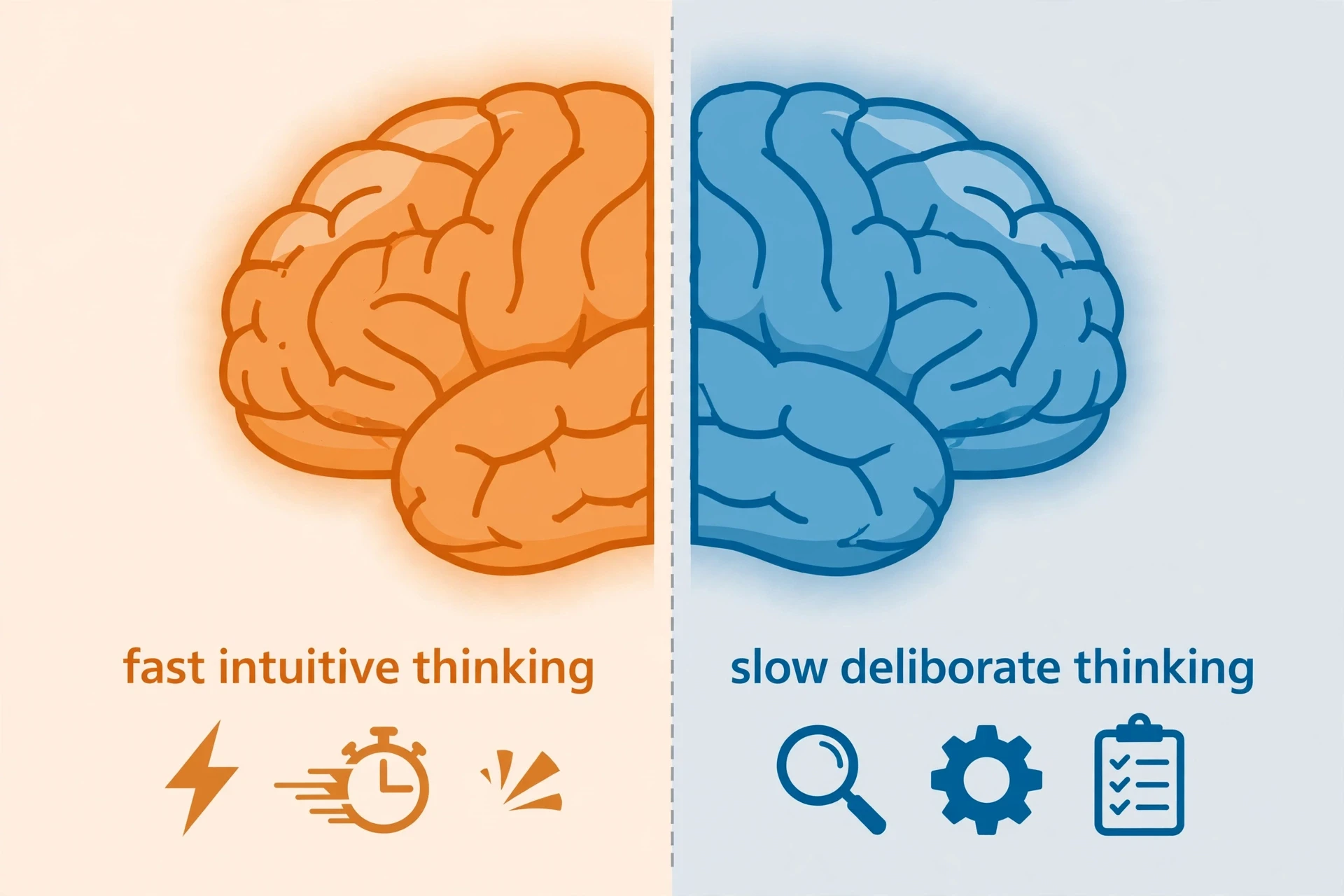
System 1 is the mind that answers "2 + 2" before you finish hearing the question, that recognises a friend's face in a crowd, that flinches from a snake-shaped stick on a path. It works automatically, without effort, and without any sense of voluntary control. It runs on association and pattern: it sees a little of the world and fills in the rest from memory, from habit, and from feeling. This is the first thing to grasp about how we make decisions: most of the work happens before we notice it.
System 1 is astonishingly capable, and that capability sits at the centre of how we make decisions every day. It reads faces, catches balls, senses tension in a room, and spots a familiar word in a noisy café. It is also the mind that produces a gut feeling — a sudden sense that a deal is wrong, a person is trustworthy, or a route is safe. That feeling is real information: it is the compressed output of years of experience, delivered in a fraction of a second. A firefighter who orders an evacuation seconds before a floor collapses, or a chess master who sees the right move at a glance, is not guessing. Their System 1 has learned patterns so deeply that recognition feels like instinct.
But System 1 has a flaw built into its design. It answers easy questions in place of hard ones. Ask it how likely a startup is to succeed and it may answer how much it likes the founder. Ask it whether a medical treatment is safe and it may answer how frightening the disease sounds. It substitutes, quietly, and never tells you it did. This substitution is the engine behind many of the errors psychologists study — but the error is not the point here. What matters for understanding how we make decisions is the machinery itself: a system built for speed will always prefer a quick, plausible answer to a slow, correct one.
1.2 System 2: The Slow Mind
System 2 is the mind that multiplies 17 by 24, that follows a recipe with unfamiliar ingredients, that weighs two job offers side by side. It is deliberate, effortful, and rule-based. It can follow logic, check arithmetic, compare options systematically, and — crucially — it can overrule System 1. When you pause before sending an angry email and rewrite it, that is System 2 doing its job.
System 2 has two weaknesses, and both matter for how we make decisions. The first is that it is lazy. It would rather agree with System 1 than do the work of checking it. Psychologists call this the path of least effort, and you can feel it in yourself: how often do you accept the first plausible answer to a hard question and move on? The second weakness is that System 2 has a limited budget. It tires. After a long day of hard choices, even simple decisions start to feel heavy — a state researchers call ego depletion in some traditions and decision fatigue in everyday language. A tired System 2 lets System 1 run the show, which is why the worst impulse purchases happen late in the day and why judges, in one famous study of parole decisions, were more generous early in the morning than just before lunch.
1.3 How the Two Systems Hand Off
The two systems are not rivals in a boxing ring. They are more like a pilot and an autopilot. System 1 flies the plane most of the time, handling the routine with ease. System 2 sits beside it, monitoring, mostly quiet, taking the controls when something unusual happens — a warning light, a strange noise, a choice with real stakes. The trouble starts when the autopilot meets a situation it was never trained for and the pilot is asleep at the wheel.
That handoff explains a puzzle: why do smart people make silly decisions — and it is the first clue to how we make decisions under real-world pressure? Intelligence, as measured by tests, is largely a System 2 capacity. But most daily choices never reach System 2 at all. A brilliant statistician can still buy an extended warranty she knows is bad value, because the purchase happened in System 1's territory — a friendly salesperson, a vivid story about a broken phone — and System 2 never got the call. Knowing how we make decisions means knowing which system is actually deciding, in the moment, and that is a skill you can train.
Feature | System 1 — Fast Thinking | System 2 — Slow Thinking |
|---|---|---|
Speed | Instant, automatic | Slow, deliberate |
Effort | Effortless | Effortful, tiring |
Control | Unconscious, hard to switch off | Conscious, voluntary |
Method | Association, pattern, feeling | Rules, logic, comparison |
Typical jobs | Recognising faces, catching a ball, gut feelings | Mental arithmetic, planning, weighing options |
Typical failures | Jumps to conclusions, swaps hard questions for easy ones | Lazy, tires easily, overthinks simple choices |
Example | Ducking when something flies at your head | Comparing two mortgage offers line by line |
Table 1: System 1 and System 2 side by side. Neither is "good" or "bad" — each is a tool, and the skill lies in using the right one for the job.
"System 1 is impulsive and intuitive; System 2 is capable of reasoning, and it is cautious, but at least for some people, it is also lazy." — Daniel Kahneman's central insight, in plain language: the slow mind can save us, but only if we wake it up.
2. The Machinery Underneath: How the Brain Gathers Evidence
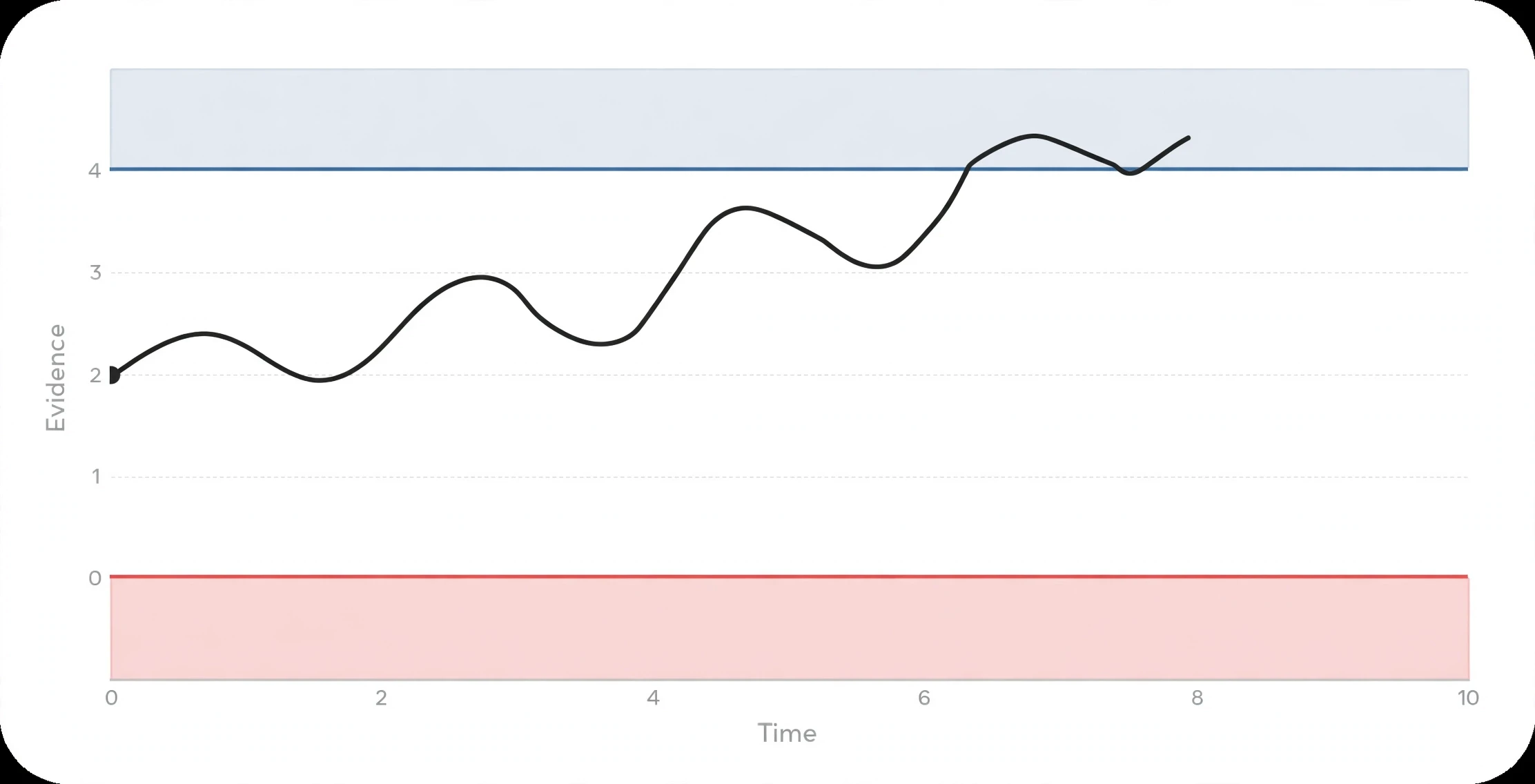
Before either system can declare a choice, the brain has to do something quieter and more mechanical: gather evidence until there is enough of it to act. This quiet gathering is the hidden half of how we make decisions. Imagine a glass slowly filling with water. Each piece of evidence — a glance, a memory, a number — adds a drop. When the water reaches a line near the top, you choose option A. When it falls to a line near the bottom, you choose option B. If the evidence is strong and clear, the glass fills fast and you decide quickly and accurately. If the evidence is weak or mixed, the level wobbles and the decision drags on.
This is the drift diffusion model, one of the most successful ideas in the science of decision-making. Neuroscientists have shown that neurons in the brain behave strikingly like that rising water level: they accumulate signals over time, and a choice happens when the accumulated signal crosses a threshold. Peer-reviewed research on the attentional drift diffusion model has shown that even where we look changes the accumulation — the option we spend more time looking at gathers evidence faster, which is why a product placed at eye level, or a candidate listed first, wins more often than the facts alone would predict. Attention is not just a spotlight; it is a thumb on the scale. Where attention goes, how we make decisions follows. You can read the original research in this peer-reviewed study of attention and decision-making.
I saw this machinery in action during a laboratory visit years ago, watching volunteers choose between two snack foods while an eye-tracker followed their gaze. The volunteers believed they were weighing taste and health. The data told a simpler story: the snack they looked at longest usually won. When the experimenters subtly held one snack on screen a fraction longer, choices tilted toward it — and the volunteers, asked afterwards, gave confident reasons about flavour that had nothing to do with the manipulation. The glass had filled. They just did not know what had poured the water.
2.1 Thresholds: The Speed–Accuracy Trade-Off
The height of the threshold is adjustable, and your brain adjusts it constantly. When you need to be fast — a goalkeeper facing a penalty kick — you lower the threshold and decide on thin evidence. You will be wrong more often, but you will be wrong quickly, which is the point. When accuracy matters more — a surgeon, a pilot, a judge — you raise the threshold and wait for more evidence. The same machinery, two different settings.
This is why time pressure changes how we make decisions so much. Under a deadline, the threshold drops, System 1 takes over, and choices get faster and noisier. It is also why "sleep on it" is genuinely good advice: sleep consolidates memories and restores the slow system, so the threshold can rise again in the morning. A tired brain does not just think slower — it decides on less evidence.
2.2 Noise: Why the Same Person Decides Differently Twice
Here is an unsettling fact about how we make decisions: give the same person the same choice on two different days and you may get two different answers, even when nothing has changed. The accumulation process is noisy. Random flickers — a mood, a stray memory, the weather — nudge the water level. Kahneman called this noise, and in his later work he argued that noise in human judgement is as big a problem as bias, and far less discussed. Two doctors can look at the same scan and disagree. Two interviewers can meet the same candidate and reach opposite verdicts. The machinery is not a calculator. It is a biological process, and biology wobbles.
The practical lesson about how we make decisions is humbling and useful at once. If your decisions wobble, do not only ask whether you are biased. Ask whether your process is noisy — and whether a checklist, a second opinion, or a rule written down in advance could steady it. Noise is reduced by structure, not by trying harder in the moment.
3. Prospect Theory: Value Is Relative, Not Absolute
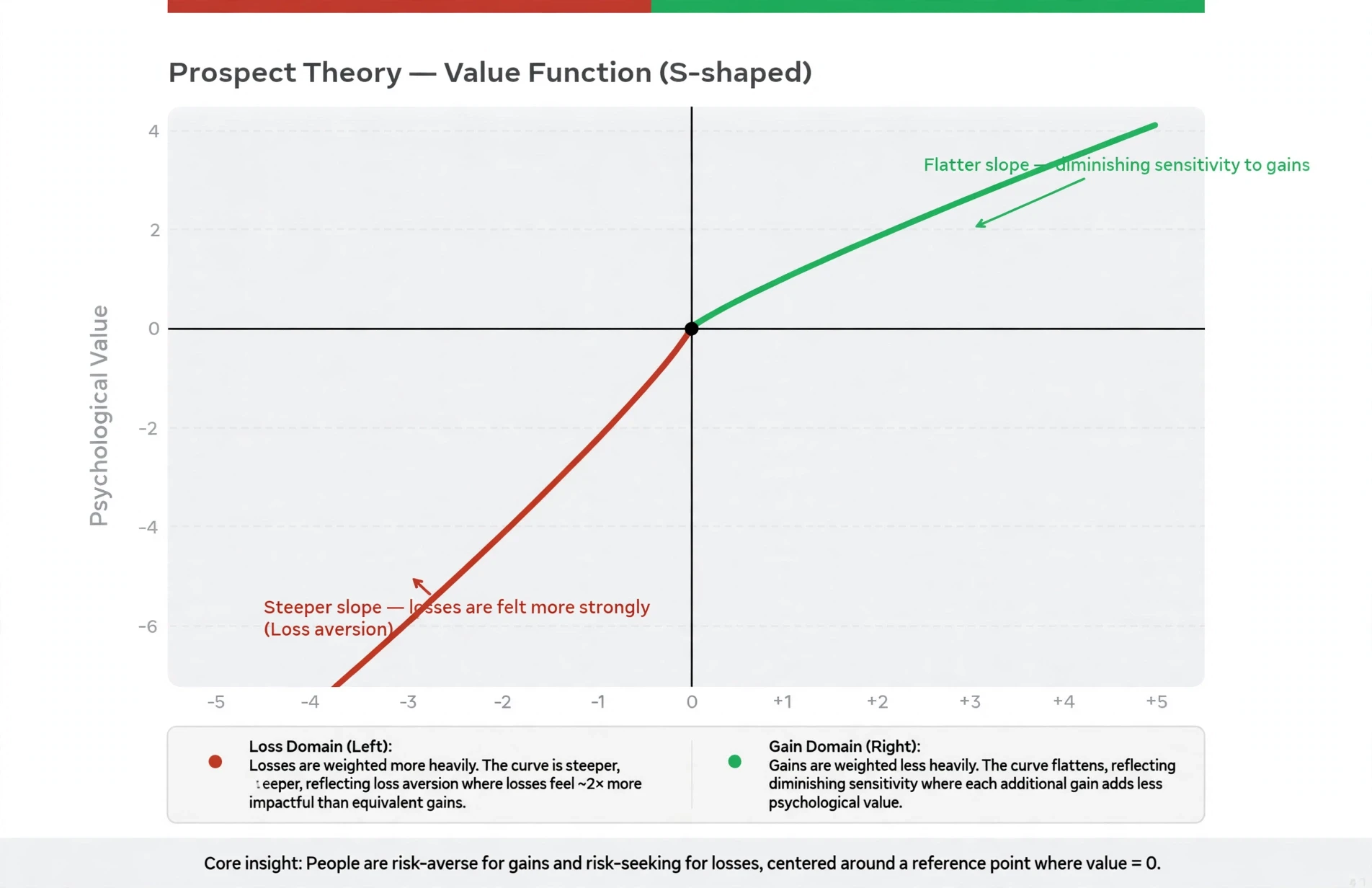
In the late 1970s, Kahneman and Tversky asked a question that classical economics had never really asked: how do people actually value gains and losses? The textbook answer was simple — people weigh outcomes by their final wealth, rationally and consistently. The experiments said otherwise. People did not evaluate outcomes in absolute terms at all. They evaluated them relative to a reference point, and they treated gains and losses by completely different rules — a discovery that rewrote our understanding of how we make decisions in economics and psychology alike. The theory that captured this, prospect theory, earned Kahneman the Nobel Prize, and the Nobel committee's press release on the 2002 prize explains why the work reshaped economics itself. You can also read the Nobel Prize's biographical page on Daniel Kahneman for the story of the research.
3.1 Reference Points: Where "Zero" Sits
A reference point is the "normal" against which you judge everything else. A salary of $60,000 feels generous if you expected $50,000 and insulting if you expected $70,000 — the money is identical; the reference point moved. A shop that raises a price to $120 and then offers a "sale" at $90 feels like a bargain, even if $90 was the ordinary price all along. The brain does not ask "how much is this worth?" It asks "how much is this worth compared with what I expected?"
Reference points shift constantly, and advertisers, negotiators, and politicians know it. The first number you hear in a negotiation — the anchor — becomes the reference point, and every offer after it is judged against that starting place. This is why the opening price in a haggle matters so much, and why a house listed high and reduced slowly can still sell above its value. The reference point is not chosen by logic, yet it steers how we make decisions in every negotiation. It is chosen by whatever System 1 noticed first.
3.2 Loss Aversion: Losses Hurt About Twice as Much as Gains Please
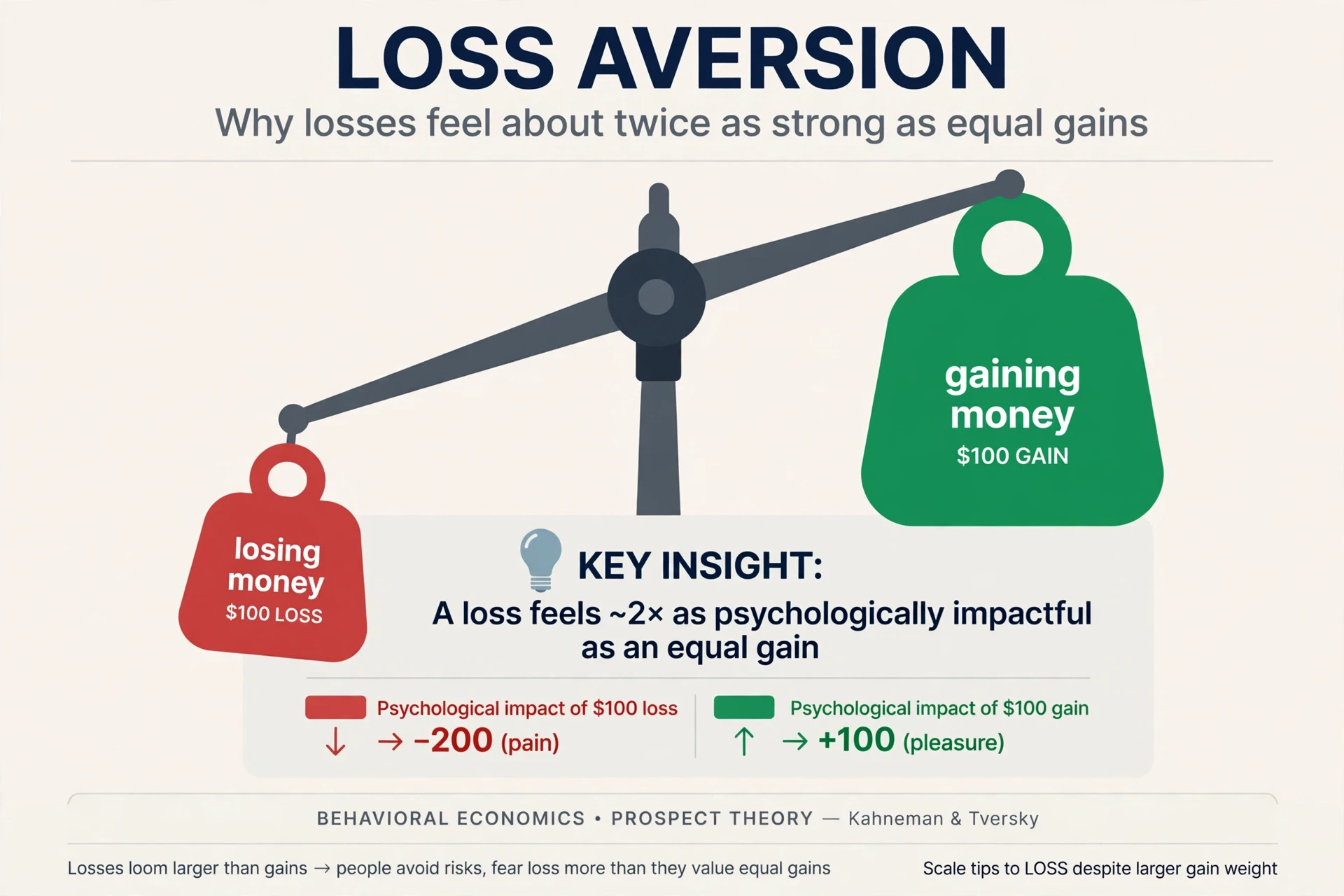
The most famous finding in prospect theory is loss aversion: losing $100 hurts roughly twice as much as gaining $100 pleases. The pain of a loss is not the mirror image of the joy of a gain. It is bigger, sharper, and longer-lasting. This asymmetry shows up everywhere once you start looking for it, and it is one of the most reliable facts about how we make decisions. People hold on to losing investments far too long, hoping to "get back to even," and sell winning investments far too early, eager to lock in the gain. Homeowners refuse to sell at a loss even when the market has clearly moved on. Employees fight harder against a small pay cut than they would fight for an equal-sized raise.
I learned loss aversion the expensive way, in my twenties, holding shares in a company I knew was struggling. Every rational signal said sell. But selling meant turning a paper loss into a real one, and that felt like admitting defeat. So I held, and held, until the shares were worth a fraction of what I had paid. The loss I was avoiding by not selling was exactly the loss I guaranteed by holding. My System 1 was not protecting my money. It was protecting my feelings about my money — and charging me for the service.
3.3 Diminishing Sensitivity and the Shape of Value
Prospect theory also describes the shape of the value curve. Near the reference point, small changes feel large: the difference between gaining $10 and gaining $20 matters a lot. Far from the reference point, the same $10 barely registers: the difference between gaining $1,000 and $1,010 feels like nothing. The curve flattens as you move away from zero, in both directions — which is why a billionaire and a student experience a $100 windfall so differently, and why a gambler who is already deep in debt can take risks that look insane from the outside. Once you are far into loss territory, the curve is flat, and one more loss barely stings. That flatness is what makes desperate gambles feel reasonable to the person taking them.
4. Framing: The Same Facts, a Different Decision
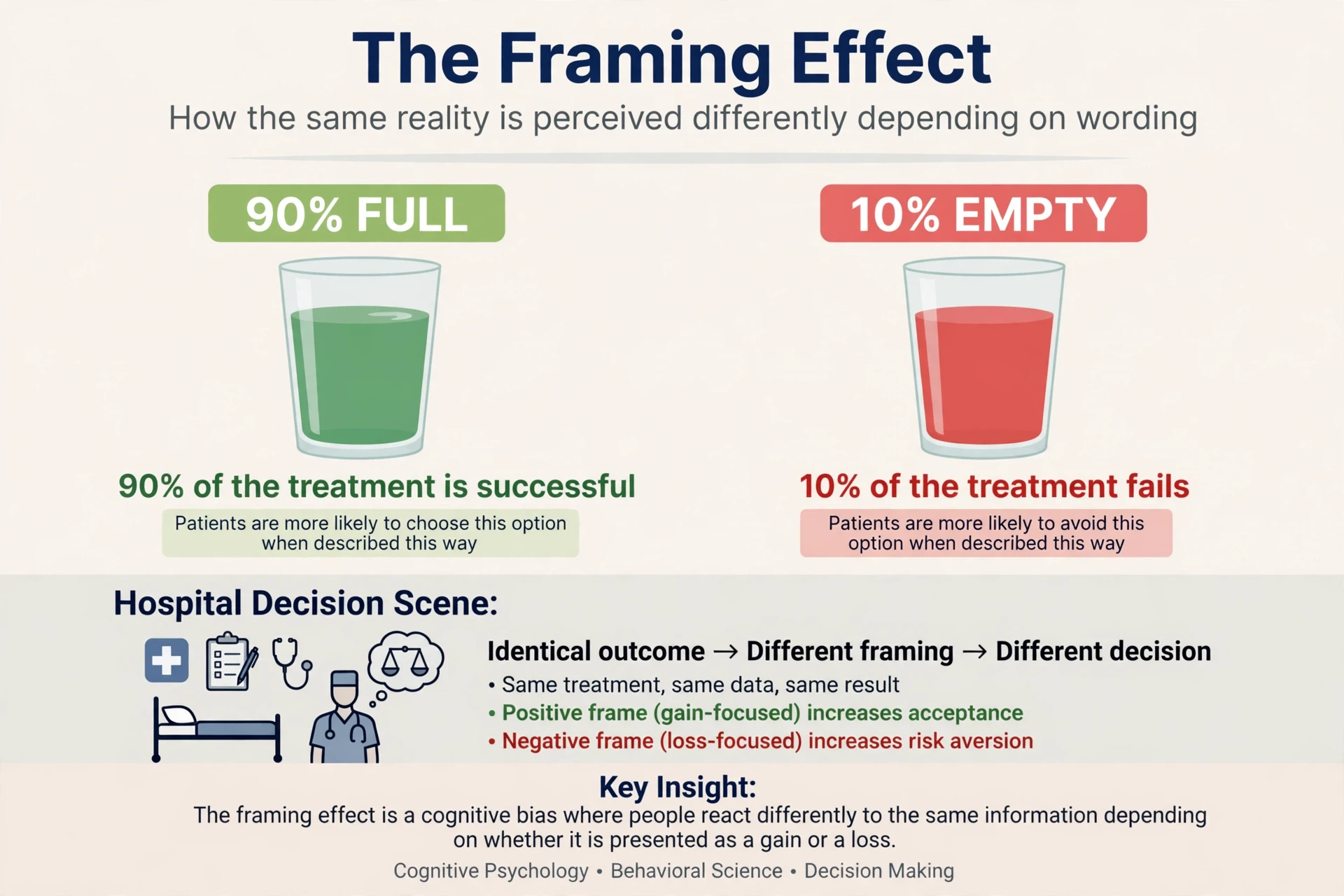
Imagine a doctor tells you a surgery has a 90 percent survival rate. You feel reassured. Now imagine the same doctor tells you it has a 10 percent mortality rate. You feel afraid. The facts are identical. The decision many people make is not. This is the framing effect, one of the most reliable findings in decision science, and it shows just how much the presentation of a choice matters — even when the underlying numbers have not changed at all.
Kahneman and Tversky demonstrated it with a classic experiment. People were asked to choose between two public-health programmes in an outbreak expected to kill 600 people. Programme A would save 200 people for certain. Programme B had a one-third chance of saving all 600 and a two-thirds chance of saving no one. Most people chose the certain option, A. Then a second group was given the same choice described in terms of deaths: Programme C would let 400 people die for certain; Programme D had a one-third chance that nobody would die and a two-thirds chance that all 600 would die. Now most people chose the gamble, D — even though A and C are the same programme, and B and D are the same programme. Described as lives saved, people became cautious. Described as deaths, the same people became risk-seeking. The frame flipped the choice.
Framing works because System 1 reacts to the emotional colour of the words before System 2 checks the arithmetic. That instant emotional reaction is a core part of how we make decisions. "Survival" feels warm; "mortality" feels cold. The brain treats the feeling as information about the option itself. This is why framing is everywhere in real life: a tax described as a "penalty" is hated, while the same money described as a "lost discount" is accepted; a food labelled "90% fat-free" sells better than the same food labelled "10% fat"; a medical treatment described in terms of survival is chosen more often than the same treatment described in terms of death. The American Psychological Association's topic page on decision-making gathers research on how these presentation effects shape real choices, and the APA's 2012 report on the psychology of decision-making describes how framing and other context effects operate in everyday judgement.
The defence against framing is simple to state and hard to practise: reframe the choice yourself before you decide — a habit that changes how we make decisions for the better. If someone presents an option as a gain, ask what it looks like as a loss. If a discount is described as money saved, ask what the price actually is. Translating a frame into its mirror image forces System 2 to engage, and once both frames are on the table, the choice usually becomes clearer. I now do this almost automatically when a salesperson offers me a "special price": I ask myself what the deal would look like if the discount had never existed. The answer is often that I would not have wanted the thing at all.
5. WYSIATI: What You See Is All There Is
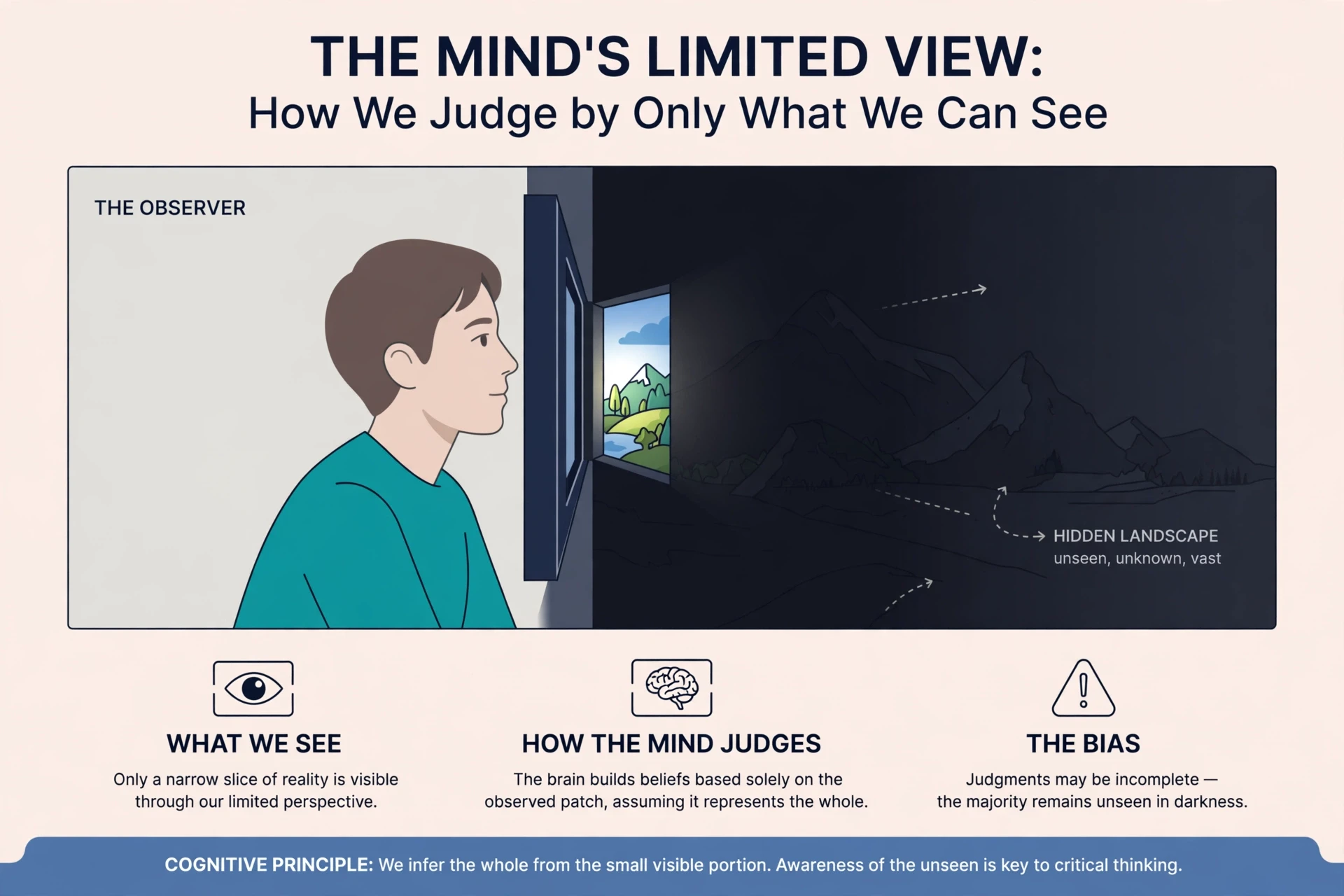
Kahneman gave one of his favourite principles an awkward name: WYSIATI — What You See Is All There Is. It describes System 1's habit of building a complete, confident story from whatever information happens to be in front of it, while ignoring — entirely — the information that is missing. The mind does not pause to ask what it does not know. It decides on the basis of what it does know, and it feels certain while doing it.
Consider a job interview. An interviewer meets a candidate who is warm, funny, and tells a great story about a past project. The interviewer forms a strong impression within minutes — and then spends the rest of the interview noticing everything that confirms it. The candidate's thin record on the actual skills the job needs, the references never checked, the awkward answer brushed aside: none of it enters the story, because it was never seen. What you see is all there is, and what you saw was charming.
WYSIATI explains why first impressions are so sticky and why a single vivid story can outweigh a mountain of statistics — and why understanding how we make decisions means understanding what we fail to notice. A friend tells you about a bad experience with an airline, and suddenly you distrust the airline — even though millions of flights land safely every year and your friend's one story is, statistically, almost no information at all. System 1 does not do base rates naturally. It does stories. A story with a face and a feeling beats a table of numbers every time, unless System 2 is deliberately called in to ask: what am I not seeing?
The antidote is a question, asked out loud, before any big decision: "What information am I missing, and where would I find it?" That question is System 2's job, and it is the single most valuable habit in this whole article. A hiring manager who asks it checks references. An investor who asks it reads the bear case. A doctor who asks it orders the test that would prove her first diagnosis wrong. The question costs ten seconds. The answer can save years, and asking it regularly improves how we make decisions more reliably than any amount of extra data.
6. Two Selves: The Experiencing Self and the Remembering Self
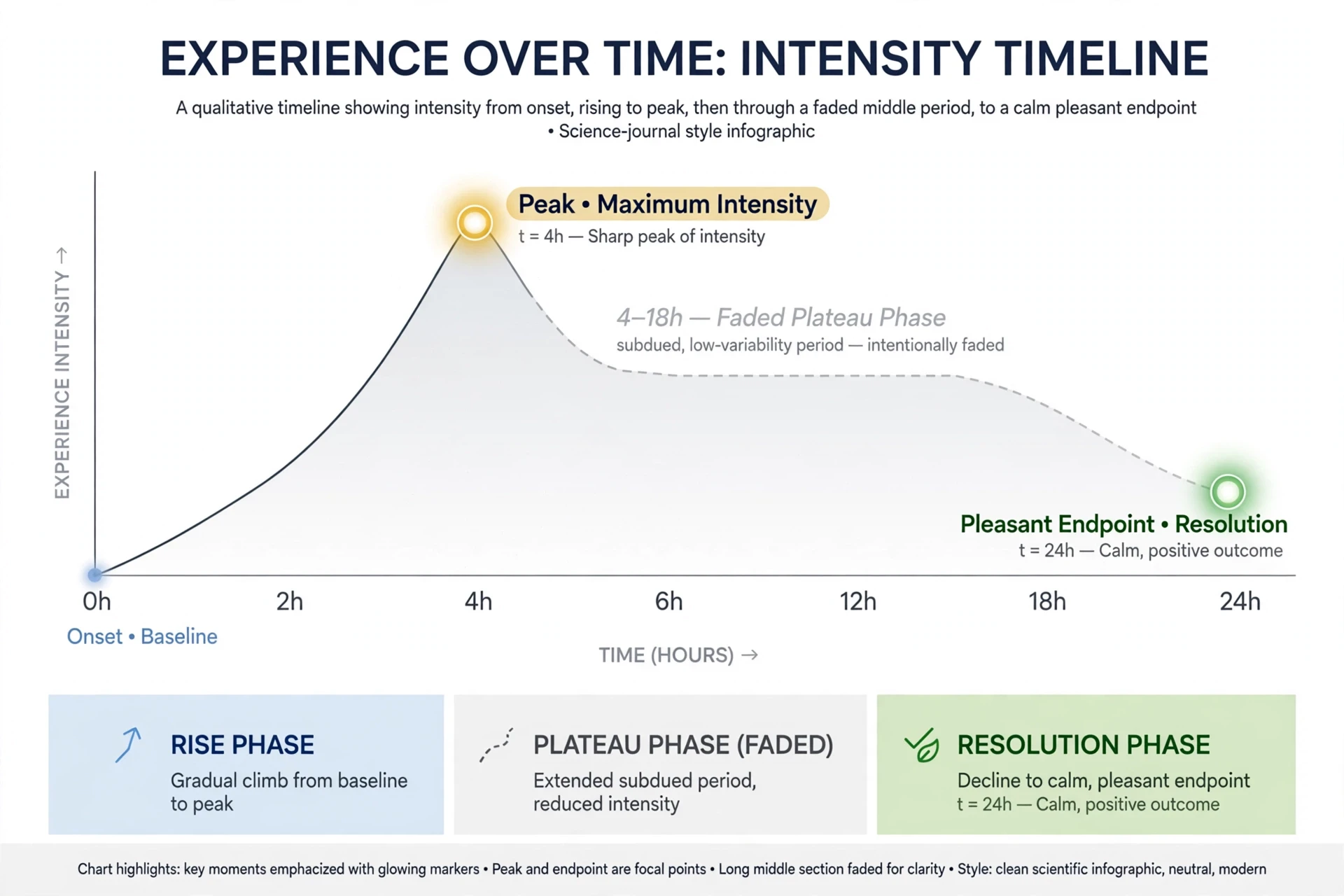
Perhaps the strangest discovery in Kahneman's work is that you are not one decision-maker but two — and the two disagree constantly. The experiencing self lives in the present moment. It feels the pain of a long meeting, the pleasure of a good meal, the boredom of a traffic jam, second by second. The remembering self lives in the past. It keeps the story of your life, decides whether a holiday was wonderful or terrible, and chooses whether you will do something again. The trouble is that the remembering self does not keep a faithful record. It keeps a summary — and the summary follows rules of its own, rules that quietly shape how we make decisions about what to repeat.
6.1 The Peak–End Rule
The remembering self judges an experience mostly by two moments: its most intense point (the peak) and how it ended. Everything else — including how long it lasted — barely counts. Kahneman demonstrated this with a famous and deliberately uncomfortable experiment: patients undergoing a colonoscopy, a painful procedure, rated their pain every minute. Some procedures were short and intensely painful at the end; others were longer but ended gently. The patients who endured the longer procedure remembered it as less bad — because the ending was kinder — even though they had experienced more total pain. Duration did not matter. The peak and the end did.
This is the peak–end rule, and it quietly governs more of life than we admit, because it governs how we make decisions about the future on the basis of the past. A holiday with one wonderful day and a miserable flight home is remembered as a bad holiday. A meal that ends with a perfect dessert is remembered as a great meal, even if the main course was mediocre. A relationship's final months colour the memory of years. The remembering self is the one who decides whether to go back, to recommend, to repeat — so the peak and the ending are not details. They are the decision.
6.2 Duration Neglect: Why Length Barely Counts
Closely tied to the peak–end rule is duration neglect: the remembering self largely ignores how long an experience lasted. A two-week holiday and a three-day weekend can leave equally strong memories if their peaks and endings are similar. A painful medical procedure that lasts twice as long is remembered as roughly equally bad, provided the peak and the ending match. This is deeply counterintuitive — the experiencing self suffers every extra minute — but the remembering self keeps no running total. It keeps a highlight reel.
The implications for how we make decisions ripple outward. It means we systematically mispredict how much we will enjoy or suffer future experiences, because we imagine the total and remember the highlights. It means that when we choose between options — a shorter, intense workout or a longer, gentler one; a quick, painful conversation or a long, careful one — we are choosing for the remembering self, not the experiencing self, and we rarely notice the difference. And it means that the way an experience ends deserves far more attention than we usually give it. A kind ending can redeem a rough middle. A careless ending can ruin a good beginning.
This is also where decision-making meets memory itself. The remembering self builds its stories from what memory keeps, and memory keeps what is vivid, recent, and emotional — not what is representative. If you want to understand why your past choices look so different in hindsight, start with how memory is actually formed, as explained in our guide to how the human brain forms memories. The two systems of decision and the systems of memory are not separate machines. They are the same brain, telling itself stories about itself.
7. When Fast Thinking Helps — and When It Hurts
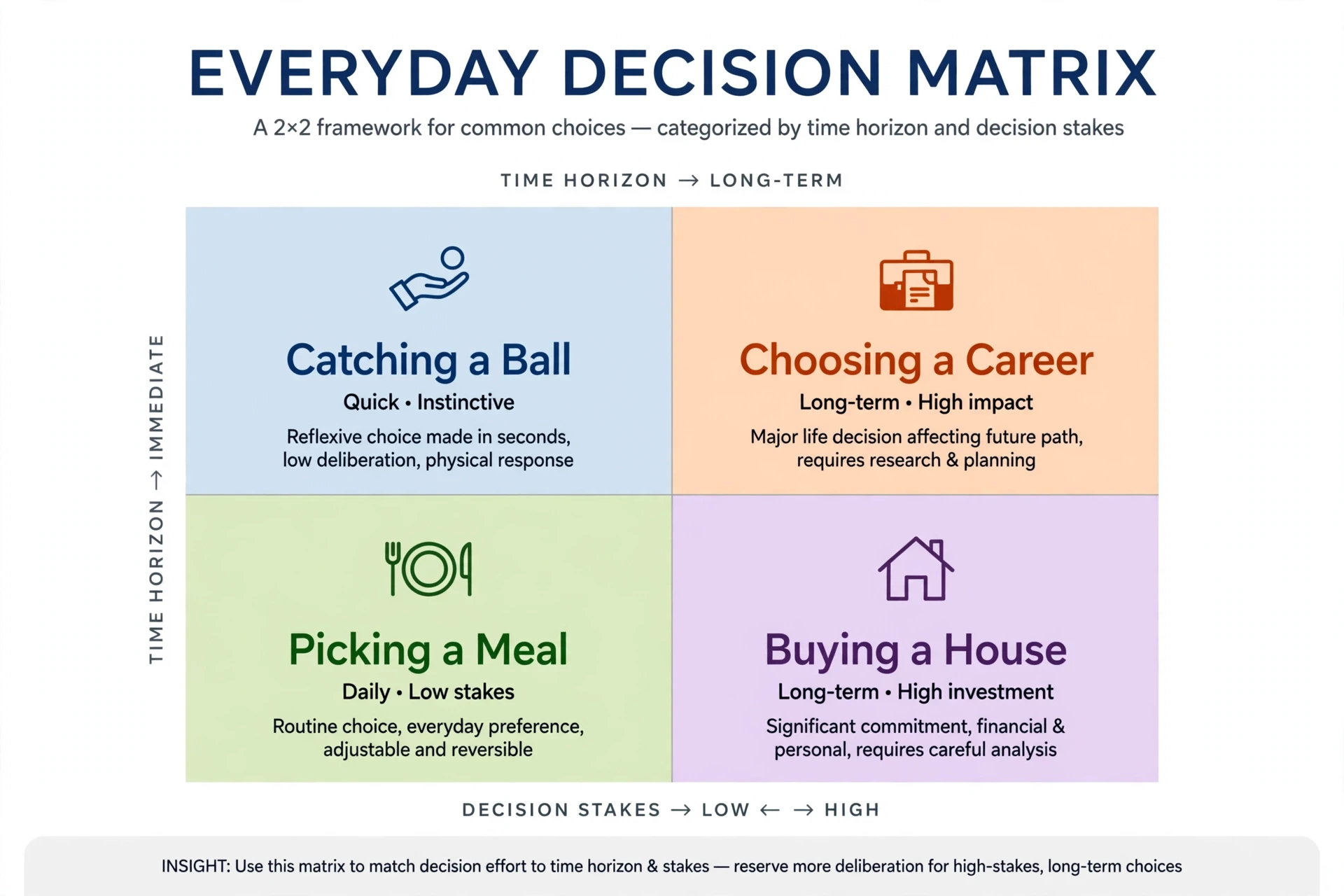
By now it might sound as if System 1 is the villain of the story and System 2 the hero. That would be the wrong lesson. System 1 is not a flaw. It is an adaptation — a fast, cheap, usually accurate way of navigating a world that demands thousands of choices a day. Without it, you would stand paralysed in the supermarket weighing every jar. With only System 2, life would be unlivable. The goal is not to replace fast thinking with slow thinking. It is to understand how we make decisions well enough to know which kind of decision each system is built for.
Fast thinking excels when the situation is familiar, the feedback is quick and clear, and the stakes are low or reversible — and recognising those conditions is a skill that improves how we make decisions. A chef tasting a sauce, a driver sensing a skid, a nurse spotting a patient who looks "off" — these are System 1 triumphs, built on thousands of hours of practice with immediate feedback. Slow thinking is essential when the situation is unfamiliar, the feedback is slow or absent, the stakes are high or irreversible, and the problem is abstract rather than physical. Choosing a career, buying a house, deciding on surgery, judging a stranger's character from a short meeting — these are System 2 jobs, and handing them to System 1 is how costly mistakes happen.
The hardest cases are the ones that look like System 1 jobs but are not — and spotting them is one of the hardest parts of learning how we make decisions. Stock-picking feels like pattern recognition, but the feedback is noisy and delayed, so the gut feeling is mostly noise. Interviewing feels like reading a person, but a short conversation is a terrible predictor of job performance, so the confident impression is mostly theatre. The test is always the same: is the environment regular enough to learn from, and did I get fast, honest feedback? If the answer to either is no, slow down.
7.1 The Body's Role: Stress, Sleep, and the Tired Brain
Decisions are not made by a disembodied mind. They are made by a brain inside a body, and the body's state changes the machinery — a simple fact that changes how we make decisions when we are tired or stressed. Under stress, the brain shifts toward fast, habitual responses — the prefrontal cortex, System 2's home base, goes quieter, and older, quicker circuits take over. Those circuits and regions are mapped in our guide to how the nervous system works, and chronic stress and anxiety shape our choices in similar ways, narrowing attention just when we need it widest. That is useful if the stress is a genuine emergency. It is unhelpful if the stress is a deadline, an argument, or a sleepless night, and the decision is a mortgage.
Sleep matters just as much. A sleep-deprived brain accumulates evidence more slowly and noisily, lowers its decision threshold, and leans harder on habit. If you have ever made a choice at 2 a.m. that embarrassed you in the morning, you have met this effect personally. Brain fog and poor focus are often the visible surface of the same problem: a slow system running on empty, leaving the fast system in charge. The practical rule is blunt: never make an irreversible decision tired, hungry, or rushed if you can avoid it. The machinery is not broken in those states — it is running on a different setting, and the setting favours speed over sense.
The brain's decision circuits also overlap with the circuits of consciousness itself — the awareness that lets System 2 notice what System 1 is doing. That noticing, the ability to observe your own thinking, is not a philosophical luxury. It is the practical skill this whole article is building toward: the moment you catch yourself deciding on a feeling, you have already woken the slow mind.
8. A Practical Toolkit for Better Decisions
Understanding the machinery is only useful if it changes how we make decisions on a Tuesday afternoon. The research points to a small set of practices that work — not because they make you smarter, but because they change which system decides, and what evidence it gets to use.
Pause before big choices. Even ten seconds of deliberate delay lets System 2 engage. Count to ten, take a breath, ask: "Is this a fast decision or a slow one?" The pause is the cheapest tool in the toolkit.
Write the decision down before you decide. A one-paragraph note — what am I choosing, what do I expect to happen, what would change my mind — forces System 2 to commit to reasons in advance. It also creates a record you can learn from later, instead of a memory your remembering self will rewrite.
Ask for the base rate. Before judging a single case, ask: how often does this happen in general? How many startups succeed, how often does this treatment work, how long do projects like this usually take? The base rate is System 2's favourite piece of evidence, and System 1 almost never volunteers it.
Consider the opposite. Deliberately argue the case against your first instinct. What would someone smart who disagrees with me say? This "consider the opposite" strategy is one of the few debiasing techniques with solid evidence behind it, and it works precisely because it feeds System 2 the evidence System 1 left out.
Run a pre-mortem. Imagine it is a year from now and the decision failed badly. Now explain why. A pre-mortem, a technique popularised by the psychologist Gary Klein, frees people to voice doubts they would otherwise suppress to stay agreeable. Teams that run pre-mortems catch risks that post-mortems only discover too late.
Reframe the choice in both directions. If it is presented as a gain, restate it as a loss, and vice versa. If the two framings point to different choices, you have learned something important: the frame was deciding, not you.
Decide when you are rested, and decide the small things in advance. Routines, defaults, and rules written on a calm day protect you on a tired one. Automatic savings, a standard weekly menu, a rule that big purchases wait 48 hours — these are System 2 decisions made once, so System 1 does not have to make them a hundred times.
Keep a decision journal. Once a month, write down a decision, your reasoning, and what you expected. Revisit it later. The gap between what you expected and what happened is where learning lives — and it is invisible without a written record, because the remembering self edits the past to flatter the present.
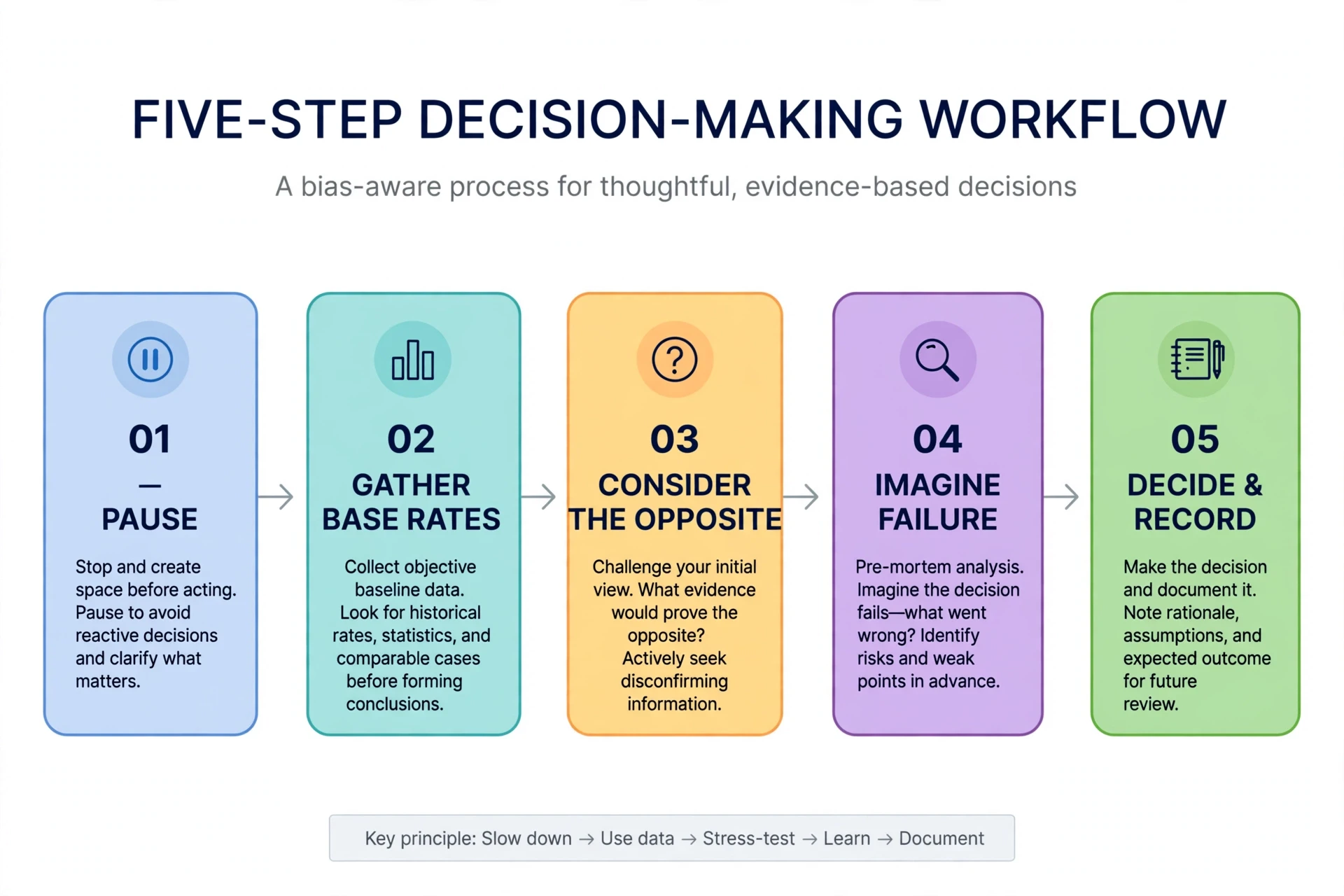
8.1 A Worked Example: The Job Offer
Put the toolkit together on a real choice, to see how the toolkit changes how we make decisions in practice. You have a job offer: more money, a longer commute, a manager you liked in the interview. System 1 says yes — the salary number glows, the manager was charming, the office was beautiful. System 2, woken by the pause, asks its questions. What is the base rate for people who take a longer commute and stay happy after a year? (Low.) What am I not seeing — the team I would actually work with, the hours nobody mentioned, the cost of the commute in time, not money? (WYSIATI.) What would the choice look like framed as a loss — what would I be giving up, not gaining? (The short commute, the colleagues I like, the flexibility I have now.) Run the pre-mortem: it is a year from now and I regret the move — why? (The manager left, the commute crushed my evenings, the raise was eaten by costs.)
None of this guarantees the right answer. It guarantees a better process — and across a lifetime of choices, a better process is the only advantage that compounds. The Stanford Encyclopedia's entry on decision theory lays out the formal side of this story: how philosophers and economists have tried, for centuries, to describe what a perfectly rational choice would look like, and why real human choosing keeps departing from it in such regular, predictable ways.
9. What the Latest Research Is Adding
The science of how we make decisions has not stood still since Kahneman and Tversky. Three newer threads are worth knowing about, because they change the picture in useful ways.
First, neuroscience has moved from describing the two systems to watching them work. Brain imaging and single-neuron recordings show evidence accumulation happening in real time, in specific circuits — parietal and prefrontal areas that ramp up their activity as evidence builds, and release it when a threshold is crossed. Those regions are part of the anatomy described in our guide to human brain anatomy and functions. The drift diffusion model is no longer just a mathematical metaphor. It is a description of something neurons actually do. The American Psychological Association's 2023 report on decision-making and the brain summarises how this work connects brain activity to the choices people make, and why the same circuits show up whether the choice is about dots on a screen or dollars in a gamble.
Second, researchers have taken loss aversion and framing out of the laboratory and into the field — hospitals, courts, financial markets, climate policy — and found that the effects hold, but with important wrinkles. Loss aversion appears weaker in some contexts and stronger in others, and its exact size is still debated. Some recent large-scale studies suggest the famous "losses loom twice as large as gains" ratio is a useful rule of thumb rather than a universal constant. That is science working as it should: a strong early finding, refined — not erased — by better data. The honest version of the story is that losses reliably hurt more than equal gains please; the precise ratio depends on the situation.
Third, the field has started to take noise seriously. Kahneman's later work argued that where two professionals look at the same case and disagree, the disagreement itself — the noise — can cost as much as any bias. Organisations are responding with decision hygiene: structured interviews instead of free-form chats, independent judgements before group discussion, algorithms as a check on human wobble. The lesson for individuals is the same one this article keeps returning to: structure your decisions, and you steady the machinery.
10. Common Misconceptions About How We Make Decisions
Misconception 1: "Fast thinking is bad thinking." Most people assume System 1 is the enemy. What the research actually shows is that fast thinking is superb in familiar situations with quick, honest feedback — and dangerous in unfamiliar ones without it. The skill is not suppressing intuition. It is knowing when intuition is trained and when it is guessing.
Misconception 2: "Smart people don't fall for these effects." Intelligence helps System 2, but most choices never reach System 2. Studies consistently find that highly intelligent, highly educated people show framing effects, loss aversion, and overconfidence at similar rates to everyone else. Knowing about a trap does not make you immune to it. Only a process — a checklist, a reframe, a pause — does that.
Misconception 3: "Good decisions always lead to good outcomes." A good decision can end badly, and a bad decision can end well, because outcomes depend on luck as well as judgement. The quality of a decision should be judged by the process and the information available at the time, not by the result alone. A poker player who makes the right call and loses the hand still made the right call. Judging decisions by outcomes — outcome bias — teaches exactly the wrong lesson.
Misconception 4: "If I feel confident, I must be right." Confidence is a feeling, produced largely by System 1, and it tracks how coherent a story feels — not how accurate it is. A fluent, simple, familiar story feels confident even when it is wrong. Calibration — the match between confidence and accuracy — improves only with honest feedback, and most of life gives us very little of it.
Misconception 5: "More information always leads to better decisions." Beyond a point, extra information adds confidence without adding accuracy. People given ten pieces of evidence feel far more certain than people given three — but their predictions are barely better. WYSIATI again: more of what you already see is not the same as seeing what is missing. The question is never "do I have enough information?" It is "do I have the right information, including the information that would prove me wrong?"
Misconception 6: "Emotions have no place in decisions." Emotions are not the opposite of reason. They are data — compressed signals about value, risk, and what matters to you. Patients with damage to the brain's emotion circuits do not become super-rational decision-makers. They become unable to decide at all, endlessly weighing options with no sense of which outcome they actually care about. The goal is not to remove feeling from choice. It is to notice which feelings are information and which are noise — the vividness of a story, the fear of a loss, the glow of a first impression — and to let System 2 check the ones that might be misleading.
11. Conclusion: Learning to Drive Both Systems
Here is the picture to carry away about how we make decisions. You do not have one mind that decides. You have a fast mind that decides by pattern and feeling, and a slow mind that decides by rules and reasons, and a piece of machinery underneath them both that gathers evidence until it has enough to act. Around that machinery sit the forces that bend every choice: reference points that move, losses that weigh double, frames that flip outcomes, a remembering self that keeps the highlights and forgets the rest.
None of this makes you irrational. It makes you human — a creature built by evolution to decide quickly in a dangerous world, now living in a world of mortgages, medical choices, and investment portfolios that the fast mind was never designed for. The answer is not to distrust yourself. It is to know yourself: to recognise the moment when the fast mind is deciding a slow mind's question, and to give the slow mind a chance to speak.
So the next time a choice arrives — the job, the house, the treatment, the argument you are about to have — try the smallest version of everything in this article. Pause. Ask what you are not seeing. Restate the choice in the opposite frame. Imagine it failed, and ask why. Then decide, and write down why. You will not always be right. Nobody is. But you will be deciding with the whole of your mind, fast and slow together, instead of letting one half of it choose for you in the dark.
That is what it means to understand how we make decisions. Not to become a perfect chooser, but to become a chooser who knows which mind is doing the choosing — and who, when it matters, chooses to think twice.
Frequently Asked Questions
What is System 1 and System 2 thinking?
System 1 is fast, automatic, intuitive thinking — recognising a face, catching a ball, sensing danger. System 2 is slow, deliberate, effortful thinking — doing mental arithmetic, comparing options, following a plan. Most daily choices run on System 1; System 2 steps in for hard, unfamiliar, or high-stakes decisions, and can overrule System 1 when it is awake and engaged. Together, the two systems explain how we make decisions in almost every area of life.
How do we make decisions in the brain?
The brain gathers evidence over time until it crosses a threshold, a process described by the drift diffusion model. Neurons accumulate signals in favour of each option, and a choice happens when the accumulated evidence for one option becomes strong enough. Attention, mood, fatigue, and stress all change how fast evidence accumulates and how high the threshold sits.
What is prospect theory in simple terms?
Prospect theory, developed by Daniel Kahneman and Amos Tversky, says people judge outcomes relative to a reference point rather than in absolute terms, feel losses about twice as strongly as equal gains, and become less sensitive to changes the further they are from that reference point. It explains why we hold losing investments too long, fear losses more than we value gains, and take bigger risks when we are already losing.
What is loss aversion?
Loss aversion is the tendency for a loss to hurt roughly twice as much as an equal-sized gain pleases. Losing $100 feels worse than gaining $100 feels good. Loss aversion is one of the strongest forces in how we make decisions about money, health, and risk. It drives behaviour like refusing to sell at a loss, fighting harder against a small pay cut than for an equal raise, and overvaluing things we already own simply because we own them.
What is the peak-end rule?
The peak–end rule says the remembering self judges an experience mainly by its most intense moment and by how it ended, largely ignoring how long it lasted. A longer painful procedure with a gentle ending can be remembered as less bad than a shorter one with a harsh ending. It explains why endings matter so much — in holidays, meals, relationships, and medical care.
Can you improve your decision-making?
Yes — by improving the process, not by trying to be smarter in the moment. That process-first approach is the most reliable way to improve how we make decisions. Proven practices include pausing before big choices, asking for base rates, considering the opposite view, running a pre-mortem, reframing the choice in both directions, deciding while rested, and keeping a written decision journal so you can learn from the gap between what you expected and what happened.
Why do smart people make bad decisions?
Because most decisions never reach the slow, analytical mind. Intelligence is largely a System 2 capacity, but System 1 makes most daily choices automatically, and System 2 is lazy and tires easily. Smart people show framing effects, loss aversion, and overconfidence at similar rates to everyone else. Only a deliberate process — a pause, a checklist, a reframe — reliably catches the fast mind's mistakes.
Sources
Nobel Prize — Daniel Kahneman: Facts (2002 Prize in Economic Sciences): https://www.nobelprize.org/prizes/economic-sciences/2002/kahneman/facts/
Nobel Prize — Press Release, The Prize in Economic Sciences 2002: https://www.nobelprize.org/prizes/economic-sciences/2002/press-release/
American Psychological Association — Decision-Making topic page: https://www.apa.org/topics/decision-making
American Psychological Association — The psychology of decision-making (Monitor, 2012): https://www.apa.org/monitor/2012/02/decision-making
American Psychological Association — Decision-making and the brain (2023): https://www.apa.org/science/about/psa/2023/06/decision-making-brain
Krajbich, I. et al. — The Attentional Drift Diffusion Model of Simple Perceptual Decision-Making, Frontiers in Neuroscience (PMC): https://www.ncbi.nlm.nih.gov/pmc/articles/PMC5573732/
Stanford Encyclopedia of Philosophy — Decision Theory: https://plato.stanford.edu/entries/decision-theory/
Kahneman, D. (2011). Thinking, Fast and Slow. Farrar, Straus and Giroux. (Book — the source of the System 1 / System 2 framework, prospect theory, WYSIATI, and the experiencing vs. remembering self.)
Kahneman, D., Sibony, O., & Sunstein, C. R. (2021). Noise: A Flaw in Human Judgment. Little, Brown. (Book — noise in judgement and decision hygiene.)
Tversky, A., & Kahneman, D. (1981). The framing of decisions and the psychology of choice. Science, 211(4481), 453–458. (Journal article — the framing experiment described in Section 4.)