

The music was still going when I slipped out of the party — a small, everyday introvert vs extrovert moment, though I did not have the words for it then. It was a good party — old friends, good food, a room full of people I genuinely liked — and after about two hours, my brain simply handed me a note that read: done. I walked home through quiet streets, and with every block the noise in my head faded, the way a radio clears as you drive away from a city. By the time I reached my front door, I felt like myself again.
A colleague of mine stayed until the last song. She told me the next morning that the party had charged her — she went home buzzing, full of ideas, and stayed up another hour just talking it over with her partner. Same party, same room, same two hours — the introvert vs extrovert difference in a single evening. For her it was fuel. For me it was a slow drain.
That difference — not who talks more, not who is friendlier, not who is happier — is the heart of the introvert vs extrovert question. It is one of the most searched personality questions on the internet, and also one of the most misunderstood. People use the two words to mean shy or outgoing, rude or warm, broken or normal. The science says something quieter and far more interesting: the introvert vs extrovert dimension is about where you sit on a spectrum of stimulation, how your nervous system handles input, and where you go to recharge. This article follows that evidence from Carl Jung's first use of the terms in 1921, through Hans Eysenck's arousal theory, to modern brain imaging — and clears away the myths that have stuck to both sides for a hundred years.
1. Introvert vs Extrovert: What the Words Actually Mean
1.1 Two directions of attention
Strip away a century of pop psychology and the definitions are simple. An introvert is someone whose attention and energy turn mainly inward — toward reflection, ideas, and their own inner life. An extrovert (also spelled extravert in the research literature) is someone whose attention and energy turn mainly outward — toward people, action, and the world around them. The American Psychological Association's dictionary defines extroversion as a tendency to direct attention outward, toward other people and the environment, and introversion as the opposite orientation, toward one's own thoughts and feelings. You can read both definitions in the APA Dictionary of Psychology — the entry for introversion sits right beside it.
Notice what those definitions do not say. They do not say introverts dislike people. They do not say extroverts are shallow. They say nothing about confidence, kindness, intelligence, or social skill. The introvert vs extrovert distinction is about orientation and energy, and keeping that narrow definition in mind makes everything that follows much clearer.
1.2 A spectrum, not a pair of boxes
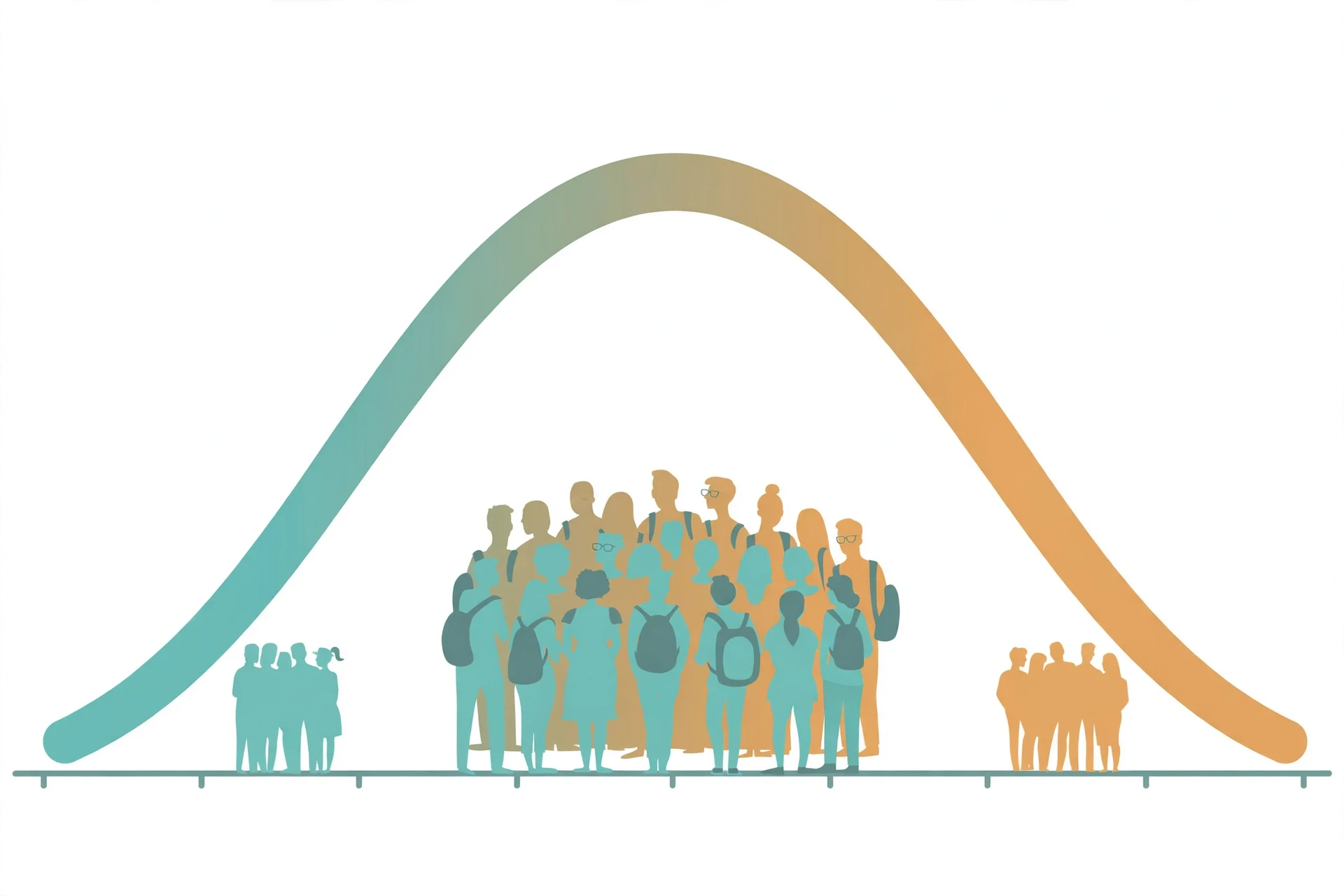
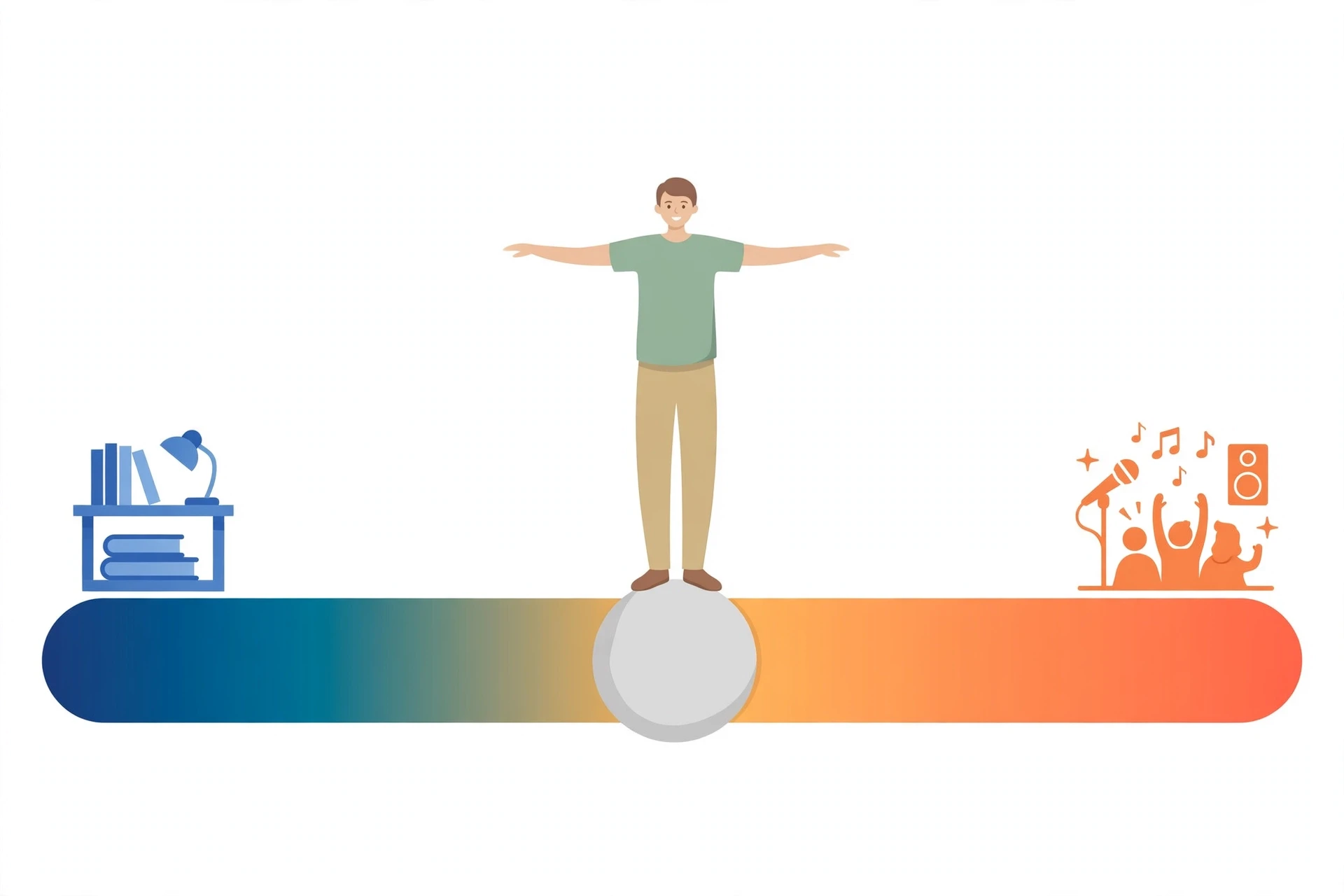
Here is the first thing the data insists on: on the introvert vs extrovert line, introversion and extroversion are not two boxes you get sorted into. They are the two ends of one continuous dimension. Picture a line from 0 to 100. A small number of people sit near 0, a small number near 100, and most of us cluster somewhere in the middle. Roughly two-thirds of people score in the middle band rather than at either extreme, according to research using the Big Five personality model, in which extraversion is one of five broad traits. (That model gets its own full treatment elsewhere on Sciory; here, all that matters is that extraversion is one dimension among several, not the whole of personality.)
That matters because the internet loves binaries. Quizzes ask "are you an introvert or an extrovert?" as if there were a blood test with two results. There is not. There is a dial, and your position on it is a tendency — a pattern of where you feel most comfortable, most alert, and most yourself — not a life sentence.
1.3 What the dimension predicts — and what it does not
Extraversion is one of the most studied dimensions in all of psychology, and it predicts some real things: how much social stimulation you seek, how you respond to rewards, how you behave in groups, and even, to a modest degree, career choices and leadership style. It does not predict how good you are at your job, how much you care about other people, or how happy you are. I have met introverts who command a room when the topic matters to them, and extroverts who go quiet for days after a hard week. The trait describes a default setting, not a destiny.
2. Where the Terms Came From: Jung's 1921 Idea
2.1 A Swiss psychiatrist notices two kinds of people
The words introvert and extrovert were not always in the language. Carl Jung introduced them in his 1921 book Psychological Types, after years of watching patients and colleagues in his Zurich practice. Jung noticed that some people seemed to draw their energy from the outer world — they lit up in company, thought out loud, and acted first. Others seemed to draw theirs from the inner world — they needed time alone with their thoughts, weighed things privately, and acted after long reflection.
Jung's key insight was that neither orientation was a defect. In his view, each had strengths and blind spots, and a healthy person could flex toward the other side when life demanded it. He also wrote, in a line that pop psychology promptly forgot, that most people fall somewhere between the two poles. The binary was never his idea; the spectrum was.

2.2 From philosophy to measurement
Jung's ideas were rich but hard to test. He wrote like a philosopher, and his categories resisted simple measurement. For decades, introversion and extroversion lived mostly in clinical writing and in the popular imagination, where they slowly picked up baggage Jung never intended: introvert as loner, extrovert as life of the party.
The turn toward real science came when psychologists began to measure the dimension with questionnaires — asking hundreds of people how they actually behaved — and to look for patterns in the numbers. That work belonged to a very different kind of psychologist, a London-based researcher named Hans Eysenck, and it changed the question entirely. Instead of asking "which type are you?", Eysenck asked "what is different, in the brain, between people at opposite ends of this line?"
2.3 Why the history matters
A hundred years of history explains why the introvert vs extrovert debate feels so personal, and why the same argument repeats in every office and classroom. Jung gave us the words. The culture gave them moral weight — the loud, social person as healthy and successful; the quiet, reflective person as something to fix. The science that followed quietly took that weight away. What it found instead was a difference in wiring, not worth. Keeping that history in view helps explain why the myths in Section 7 have survived so long, and why they are worth retiring.
3. Eysenck and the Arousal Theory: The Brain's Volume Dial
3.1 A theory you can picture
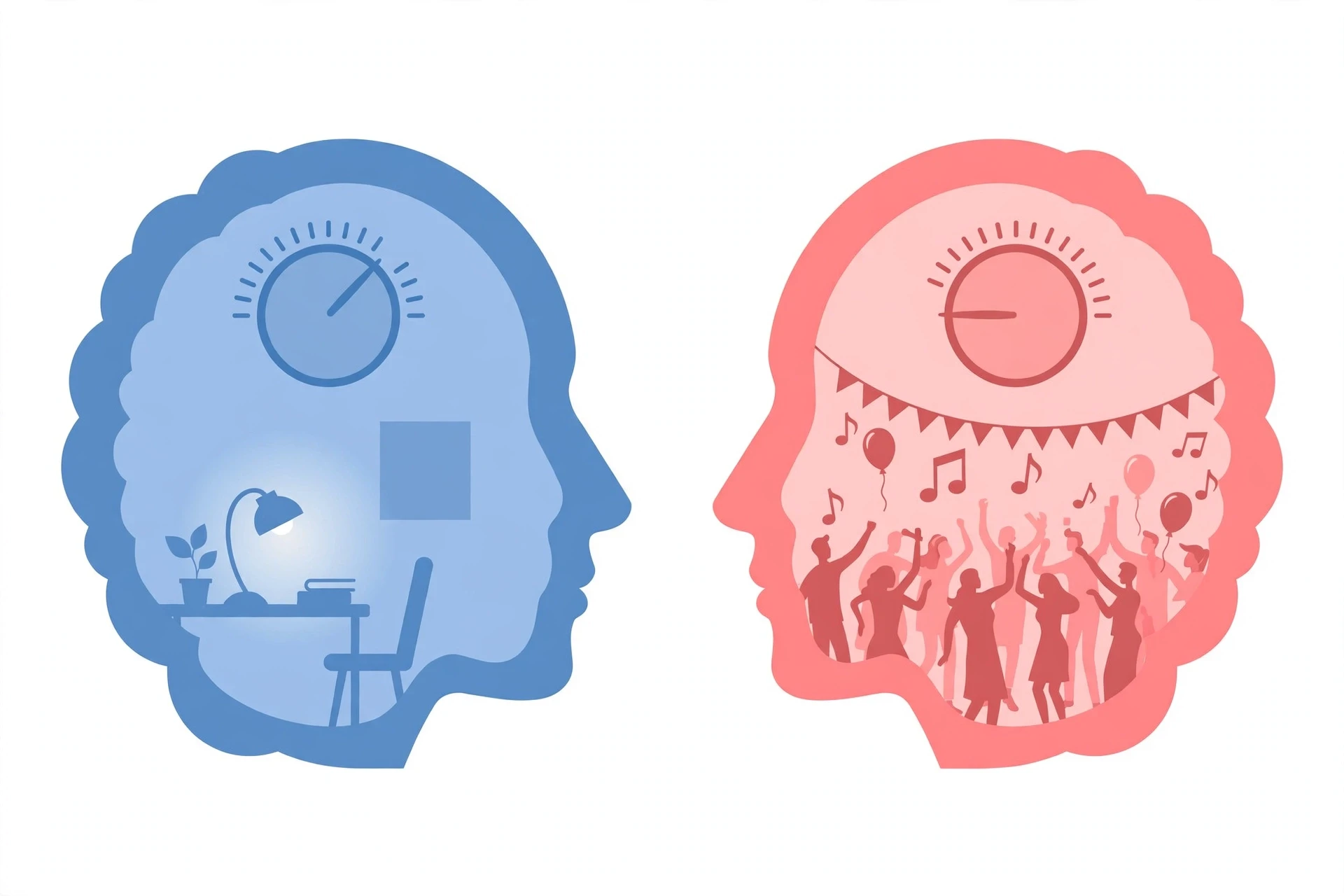
In 1967, Hans Eysenck proposed the most influential biological theory of the introvert vs extrovert dimension. His idea, in plain language, is a volume dial.
Deep in the brainstem sits a network called the ascending reticular activating system, or ARAS — a kind of master switch for alertness. Eysenck argued that introverts run with their dial turned up: their cortex is already highly active at rest, so a little outside stimulation is plenty. Extroverts, he argued, run with their dial turned down: their resting arousal is lower, so they need more outside stimulation — noise, people, novelty, movement — to reach the same comfortable level of alertness.
Think of two people walking into the same noisy café. The introvert's brain is already humming; the espresso machine, the chatter, the music stack on top of an already-busy system, and within an hour the dial is past comfortable. The extrovert's brain is idling low; the same café brings it up to its sweet spot, and the buzz feels like focus, not overload. Same room, same noise, opposite experiences — because the starting points differ.
3.2 The sweet spot, and what happens past it
Every brain has an optimal level of arousal — too little and you feel bored and foggy, too much and you feel frazzled and scattered. Psychologists call this the Yerkes–Dodson principle, after two researchers who mapped the curve more than a century ago: performance rises with arousal up to a point, then falls off a cliff. Eysenck's contribution was to say that where that sweet spot sits depends on your place on the introvert vs extrovert spectrum. The introvert's sweet spot sits at a lower level of outside stimulation; the extrovert's sits higher.
I learned this the practical way years ago, in a shared office with a colleague who did his best thinking with music playing and three conversations going at once. I did mine with the door shut and the radio off. For a while I assumed one of us was doing it wrong. The arousal theory says neither of us was — we were simply tuning the same dial from different starting points.
3.3 What the evidence actually says
Honesty requires a caveat here, and it is an important one. Eysenck's theory is elegant, and parts of it hold up — introverts do tend to perform worse than extroverts in noisy conditions, and they do tend to prefer quieter working environments. But a 2017 review in Frontiers in Psychology concluded that the evidence is mixed: there is about as much evidence for the arousal theory as against it, partly because arousal has usually been measured through a single, narrow channel, and the results depend heavily on the task and the kind of noise. The theory survives as a useful rule of thumb, not as a settled law. That is normal in science. A good theory can be partly right and still be worth knowing — as long as nobody pretends it is the whole story.
4. What Brain Science Has Found Since
4.1 The reward system: dopamine and the pull of the crowd
If arousal is one half of the modern story, reward is the other. In 1999, researchers Depue and Collins proposed that the core of extraversion is not low arousal but a dopamine system that reacts more strongly to rewards — especially social rewards. In this view, the extrovert's brain treats a lively room, a compliment, or a new face the way a hungry person's brain treats the smell of food: as a signal worth moving toward. The introvert's reward system is less reactive to those same signals, so the pull is weaker and solitude feels less like missing out.
This reframing explains something arousal theory handles awkwardly in the introvert vs extrovert story: why extroverts often enjoy stimulation rather than merely tolerating it. They are not just filling a deficit; they are chasing a payoff their brains register more strongly. It also explains why the introvert vs extrovert difference shows up in the lab even without any social pressure at all — give people a simple reward game on a computer, and extraverts tend to respond faster and more eagerly to the prospect of a win.
4.2 Imaging the difference: a small study with a long shadow
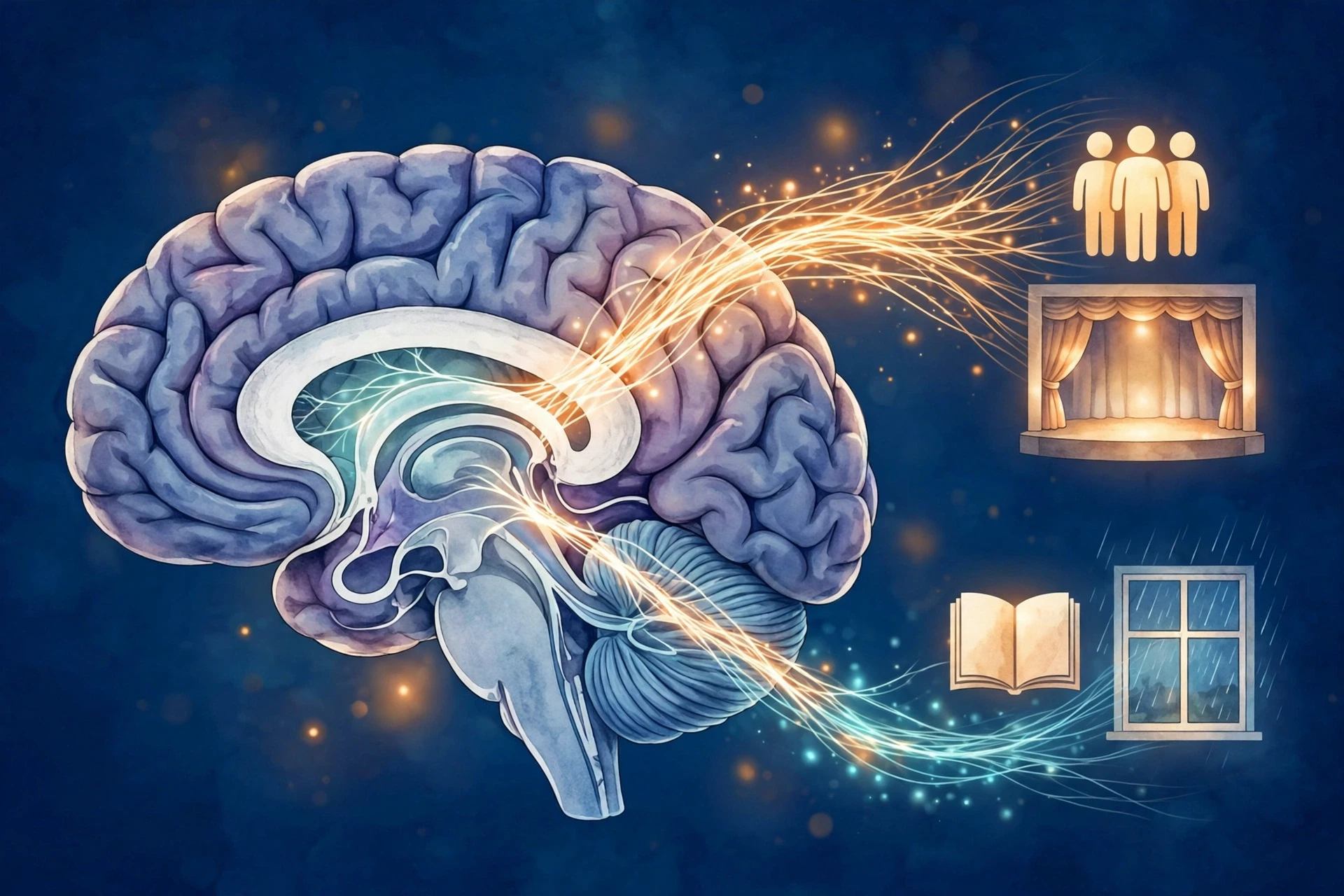
The most cited brain-imaging study of this dimension comes from Debra Johnson and colleagues at the University of Iowa, published in the American Journal of Psychiatry in 1999. Using positron emission tomography (PET), they measured blood flow in the brains of 18 healthy volunteers and compared it with introversion and extroversion scores. Introversion was linked to greater blood flow in the frontal lobes and the anterior thalamus — regions tied to planning, memory, and internal thought. Extraversion was linked to the anterior cingulate gyrus, the temporal lobes, and the posterior thalamus — regions more involved in processing sensory input and emotion.
It is a striking result, and it is also a small one: 18 people, one scanner, one moment in time. Later work has added nuance rather than overturning it. Larger studies have found extraversion linked to greater grey-matter volume in the medial orbitofrontal cortex, a region that evaluates the value of rewards. The picture that emerges is not a single "introvert brain" and "extrovert brain" but a set of tendencies — differences in how strongly reward circuits fire, how much sensory input the cortex welcomes, and where blood flows when the mind is at rest.
4.3 Genes, temperament, and the early signs
Twin studies consistently put the heritability of extraversion at roughly 40–60%, which means genes matter a lot, and experience matters too. The developmental psychologist Jerome Kagan followed infants for decades and found that about 15–20% of babies were "high-reactive" — they startled more, cried more, and reacted more strongly to new sights and sounds — and that many of those children grew into more introverted, cautious adolescents. The wiring, in other words, shows up early. It is not a habit you picked up in school, and it is not a flaw your parents caused. It is temperament, present from the start, shaped — never erased — by life.
That finding connects with what we know about how memories and learning work: the brain you bring to an experience changes the experience itself. A loud classroom is one event for a low-reactive child and a different event for a high-reactive one. For a fuller picture of how the brain stores those experiences, see our guide to How the Human Brain Forms Memories.
"The question is not which personality is better. The question is what your nervous system needs in order to do its best work — and whether your life gives it that."
5. Introvert vs Extrovert: The Comparison, Side by Side
Talking about the introvert vs extrovert dimension in the abstract only gets you so far. The differences show up in daily life, in patterns you can recognise in yourself and the people around you. The table below compares the two ends of the spectrum across the dimensions the research measures most often. Read it as a guide to tendencies, not as a checklist for sorting people — most of us will recognise ourselves on both sides, depending on the day.
Dimension | More introverted | More extroverted |
|---|---|---|
Energy source | Recharges alone or with one close person; solitude restores energy | Recharges with people; social contact restores energy |
Stimulation threshold | Lower — a little input goes a long way; crowds and noise tire quickly | Higher — seeks noise, novelty, and crowds; quiet can feel dull |
Social style | Few deep relationships; prefers one-to-one or small groups | Many broad relationships; comfortable in large groups |
Conversation | Thinks before speaking; listens first; dislikes small talk | Thinks out loud; speaks first; enjoys small talk |
Decision-making | Reflects privately before deciding; slower, more deliberate | Decides in discussion; faster, more comfortable with risk |
Work style | Deep focus on one task; prefers written communication | Variety and multitasking; prefers talking things through |
Response to reward | Less reactive to social rewards; motivated by inner goals | Strongly reactive to social rewards; motivated by recognition |
Stress response | Withdraws to recover; needs quiet after overload | Seeks people to recover; needs activity after a setback |
5.1 Energy: the battery, not the mood
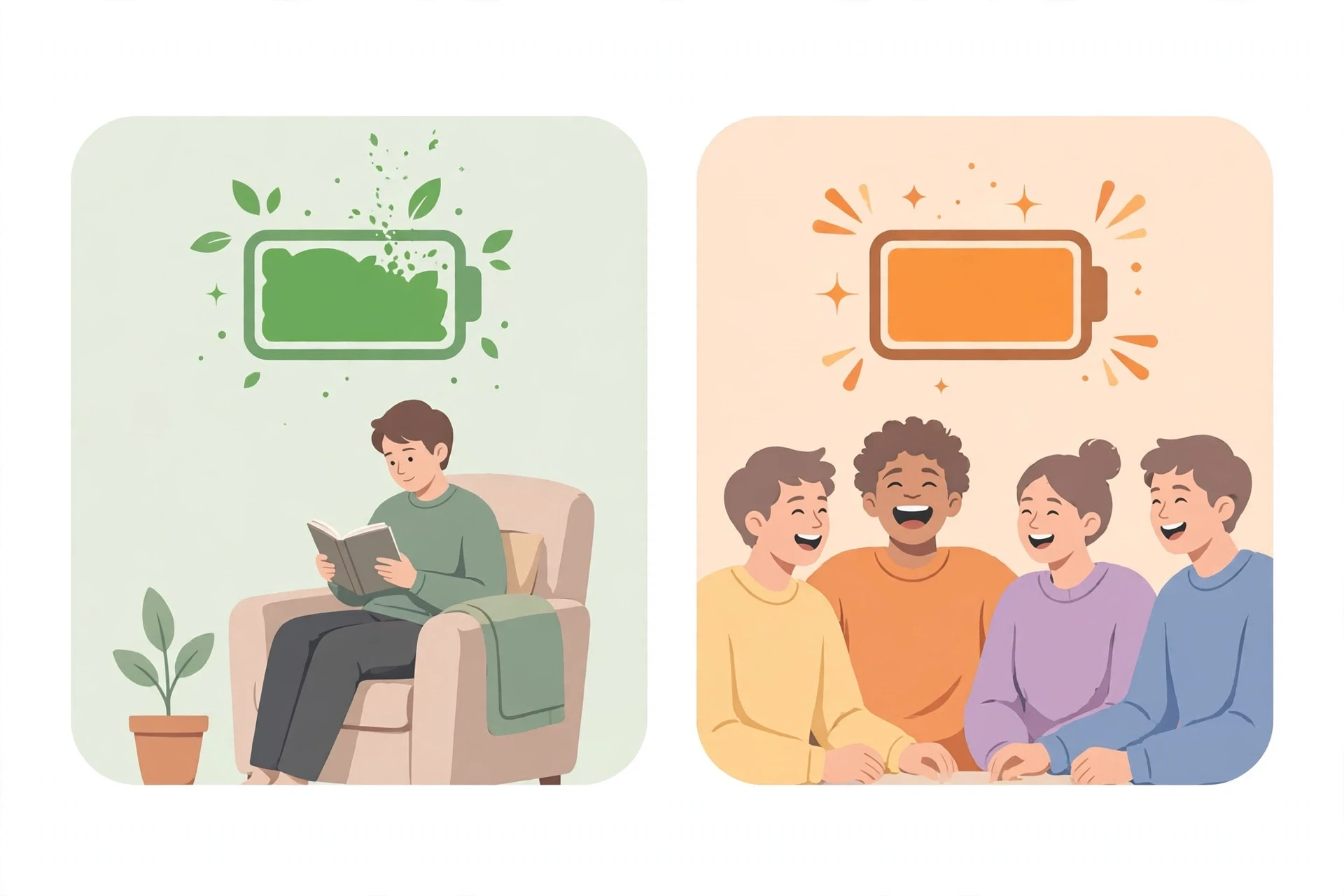
The most useful way to think about the introvert vs extrovert difference is a battery. An introvert's battery charges in quiet and drains in crowds; an extrovert's battery charges in crowds and drains in quiet. Notice that this says nothing about mood. An introvert can love a party and still leave it drained. An extrovert can hate a meeting and still leave it energised by the people in it. Energy and enjoyment are two different gauges, and confusing them is the source of half the arguments about this topic.
I once watched a friend — a famously sociable extrovert — spend a whole weekend alone in a cabin and come back miserable, not because anything was wrong but because his battery had simply run flat. He was not lonely in the emotional sense; he was under-stimulated. The distinction matters, because the fix for loneliness and the fix for under-stimulation are not the same thing. For the science of loneliness itself, which is a different question from introversion, see our companion reading on the topic in the anxiety and depression literature — and our guide to Anxiety and Depression Explained: What the Science Says.
5.2 Stimulation: how much input is "just right"
The stimulation threshold is where Eysenck's theory meets daily life in the introvert vs extrovert comparison. Introverts tend to reach their optimal level with less input: a quiet room, a single conversation, a walk. Extroverts tend to need more: background music, several conversations, a change of scene. This is why the same open-plan office can feel lively to one person and unbearable to the next, and why "just put on some music" is helpful advice for one student and sabotage for another.
5.3 Social style: depth against breadth
Introverts generally keep fewer, deeper relationships; extroverts generally keep more, broader ones. Both patterns work. Research on social networks finds that introverts are not, on average, lonelier — they simply invest their social energy in a smaller circle. The extrovert's wide net and the introvert's deep well are two strategies for the same goal: connection. The problems start only when a culture treats one strategy as the standard and the other as a failure to meet it.
6. Ambiversion: Most of Us Live in the Middle
6.1 The forgotten majority
If the bell curve in Figure 1 is right, the most common personality on Earth is neither introvert nor extrovert. It is the ambivert: someone who sits near the middle of the spectrum, drawing on both styles depending on the situation. Jung himself said the majority fall in between. The term ambiversion was coined later, but the idea was there from the start — and psychology spent most of a century ignoring it, because two neat boxes are easier to talk about than a crowded middle.
Ambiverts can enjoy a party and enjoy leaving it. They can lead a meeting in the morning and want silence in the afternoon. They are not "confused" or "inconsistent"; they are flexible, because their arousal level sits close enough to the middle that context, mood, and purpose can tip them either way. If you have ever read a description of introverts and thought "that is me on Mondays" and a description of extroverts and thought "that is me on Saturdays", you are probably an ambivert — and you are in the majority.
6.2 The ambivert advantage
The middle turns out to be a good place to be, at least at work. In a 2013 study published in Psychological Science, the organisational psychologist Adam Grant tracked 340 salespeople in an outbound call centre over three months. The ambiverts — the people in the middle of the extraversion range — earned 24% more revenue than the introverts and 32% more than the extreme extroverts. Grant's explanation was straightforward: ambiverts are assertive and enthusiastic enough to persuade, but inclined enough to listen that they do not come across as overconfident or pushy. They can read the room and match it.
Later, larger studies have suggested the effect is narrower than the first headline implied — sales is one job, and one study is one study. But the pattern fits a broader truth about the introvert vs extrovert spectrum: extremes have costs as well as gifts, and flexibility is its own strength.
6.3 How to tell where you sit
No quiz can place you precisely on the introvert vs extrovert spectrum, and the honest ones admit it. But a few questions, answered over weeks rather than minutes, are more revealing than any single test:
After a busy social day, do you crave solitude, company, or a bit of both?
In a group discussion, do you usually think first and speak second, or speak first and think as you go?
Does background noise help you concentrate, hurt it, or make no difference?
Do you have a small number of close friends or a large number of looser ones — and which pattern feels natural rather than forced?
When you are tired, do you reach for people or for quiet?
Notice that these questions ask about patterns over time, not single moments. Everyone has loud days and quiet days. Your place on the introvert vs extrovert spectrum is the pattern that keeps showing up when you stop performing and start noticing.
7. Four Myths That Won't Die
7.1 Myth 1: "Introverts are shy"
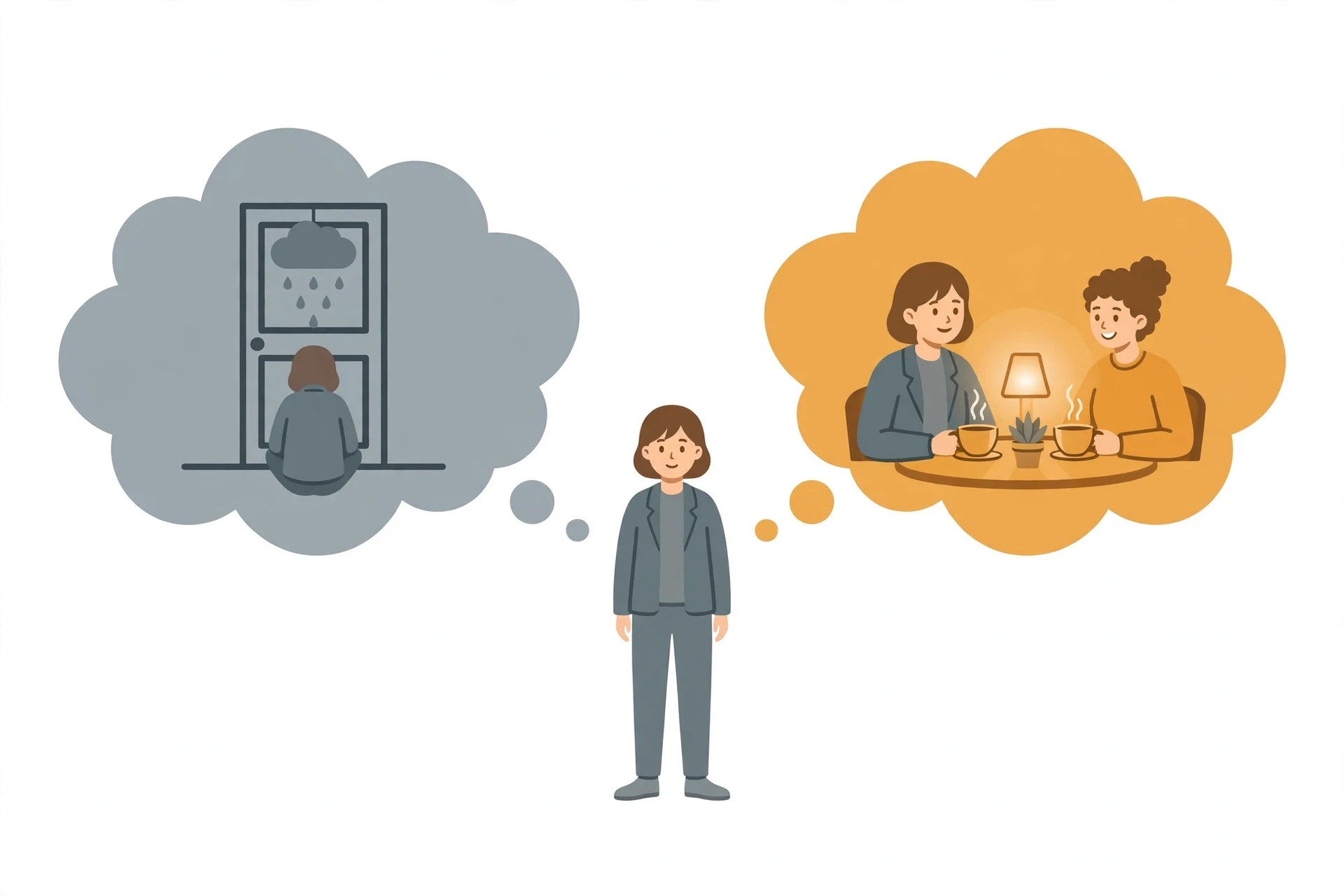
This is the most common confusion in the whole topic, and it is simply wrong. Shyness is fear of social judgement — the worry that people will think badly of you. Introversion is a preference for lower stimulation. A shy extrovert is a real and miserable combination: someone who craves company and fears it at the same time. A confident introvert is equally real: someone who is perfectly comfortable with people and simply prefers fewer of them, for shorter stretches. The American Psychological Association's topic page on shyness treats it as its own phenomenon, distinct from personality orientation — and the clinical picture backs that up. Social anxiety disorder, the clinical form of this fear, affects a substantial minority of people and is a treatable health condition, not a personality type; the U.S. National Institute of Mental Health publishes prevalence data on social anxiety disorder and describes the condition in its guide to anxiety disorders. If social situations frighten you, that is anxiety talking, not introversion — and it deserves support, not a label.
7.2 Myth 2: "Introverts are antisocial"
Antisocial, in psychology, means something specific and serious: a pattern of disregarding other people's rights and welfare. Introverts are not that. They are, on average, just as warm, loyal, and prosocial as extroverts — they simply express it in smaller settings. The introvert who listens carefully to one friend for an hour is doing social work of the highest order; it just does not look like the extrovert who works a room of fifty. Confusing a preference for depth with a hostility to people is one of the cruellest errors in this whole debate, and it has real consequences: quiet children get labelled as problems, quiet employees get passed over, quiet friends get mistaken for cold ones.
7.3 Myth 3: "Extroverts are shallow"
The mirror-image myth is just as unfair. Extroverts are often painted as people who cannot think deeply, who need constant noise because they cannot stand their own thoughts. The evidence says otherwise. Extroverts score no lower on measures of intelligence or depth of processing; they simply do more of their thinking out loud, in conversation, rather than in private. Some of the deepest thinking I have ever witnessed happened in a crowded seminar room, mid-argument, by people who would never sit still long enough to write a diary. Depth is a property of the mind, not of the volume of the room it happens in.
7.4 Myth 4: "You can (or should) change your type"
You cannot turn an introvert into an extrovert by force of will, any more than you can change your height by standing up straighter. Personality is relatively stable across adulthood — the research on this is consistent. But stability is not rigidity. The psychologist Brian Little calls the flexible part of personality "free traits": we can act out of character, for a good reason, for a limited time. The introverted teacher who performs brilliantly in front of a class is not faking it; she is acting out of character in service of something she cares about, and then she goes home and recovers. The extroverted manager who spends a weekend in silence to finish a report is doing the same in reverse. You can stretch. You cannot rewire. And the honest goal is not to change your type but to build a life that fits it.
"Introversion is not shyness, and extroversion is not arrogance. Most of what we argue about under these two words is not personality at all — it is fear, habit, and the stories a culture tells about who counts as normal."
8. Can Your Place on the Spectrum Change?
8.1 Stability across the lifespan
Long-term studies that follow the same people for decades find that extraversion is one of the more stable personality traits — but "stable" here means a correlation, not a freeze. People do drift, usually toward the middle: young adults are, on average, a little more extraverted than older adults, and life events — a career, a family, a loss — can nudge anyone's habits. The drift is slow, measured in years, and it rarely crosses the whole spectrum. If you were the quiet kid who read at lunch, you will probably still be the adult who needs an hour alone after a conference. You will just have better strategies for managing it.
8.2 Free traits: acting out of character on purpose
Brian Little's idea of free traits deserves a closer look, because it is the most useful idea in this article for daily life. A free trait is a stretch: behaving like an extrovert when you are an introvert (or the reverse) because a project you care about demands it. The catch is the cost. Acting out of character burns energy faster, and the bill comes due. Little's own research found that people who act out of character for long stretches without recovery time report more fatigue and lower mood — not because the behaviour was wrong, but because it was expensive.
The practical rule follows naturally: stretch when it matters, recover when you can, and never build a life that requires you to act out of character all day, every day. That is a recipe for exhaustion, whatever your place on the introvert vs extrovert spectrum.
8.3 What actually shifts the dial
Sleep, stress, and health move the dial more than willpower does. A tired introvert is even more easily overloaded; a stressed extrovert is even more desperate for company. This is one reason the introvert vs extrovert conversation belongs next to the science of sleep and the body's stress systems: the same nervous system runs all of it. Our guide to the Science of Sleep and Dreams explains how sleep consolidates learning and resets emotional reactivity, and the gut-brain research shows how much of mood is embodied — the Gut-Brain Connection is a good place to start if the idea that your stomach talks to your brain sounds strange. And when focus itself feels hard to hold, the culprit is often not personality at all; see Brain Fog: Causes and Ways to Improve Focus.
9. Living and Working With Your Wiring
9.1 At work: design the day, not the person
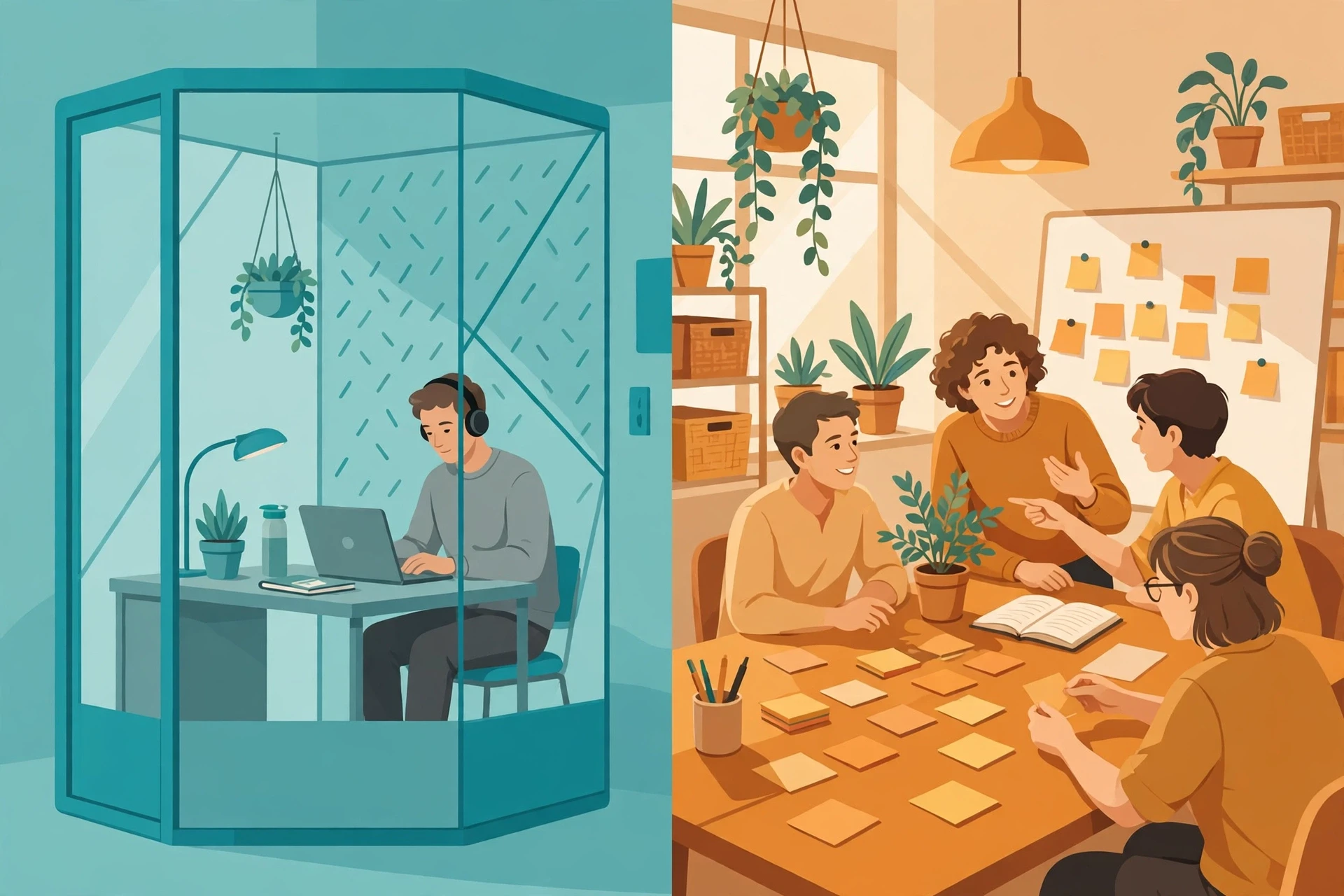
The most practical finding in this whole field is also the simplest: performance follows fit. Introverts tend to do their best work in quiet, with time to prepare before meetings and written channels for ideas. Extroverts tend to do theirs in conversation, with variety and quick feedback. The worst offices and classrooms are the ones built for one type only — the open plan with nowhere quiet, or the silent library with nowhere to talk.
What actually helps, for everyone on the introvert vs extrovert spectrum:
Protect one quiet hour a day. Even extroverts think better after a stretch of uninterrupted focus; even introverts need at least one real conversation.
Send the agenda before the meeting. Introverts contribute far more when they have time to think first; extroverts benefit too, because the discussion starts from ideas rather than reactions.
Offer written and spoken routes. A shared document where people can add thoughts before or after a discussion catches the ideas that never survive a fast-moving meeting.
Let people choose their recharge. A lunch break spent alone is not a problem to fix; a lunch break spent with colleagues is not a distraction to police.
9.2 In relationships: translate, don't accuse
Most introvert vs extrovert friction in relationships is a translation failure. "You never want to go out" usually means "I recharge with people and I miss you." "You never leave me alone" usually means "I recharge in quiet and I am running on empty." Neither sentence is about love; both are about batteries. Couples who learn to name the need — "I need an hour alone, then I am all yours" or "I need one evening out this week" — argue less, because they stop treating a difference in wiring as a difference in caring.
9.3 For parents and teachers: spot the quiet strengths
A quiet child is not necessarily a struggling child. The introverted student who never raises a hand may be doing the deepest thinking in the room — and may produce the best essay in the class. The extroverted student who cannot sit still may not be undisciplined; they may be under-stimulated, and a task with movement, discussion, or novelty may unlock them. The job of the adult is not to make the quiet child loud or the loud child quiet. It is to give each of them a setting where their wiring is an asset. That means group work and solo work, class discussion and written reflection, noisy play and a quiet corner — not one or the other, but both, by design.
9.4 The modern twist: screens, notifications, and the always-on world
The modern world is, by accident, an extrovert's world: open offices, group chats, notifications, back-to-back video calls. For introverts, the always-on environment can mean never fully recharging; for extroverts, it can mean stimulation without the depth that real company provides. The research on attention and multitasking is clear that constant switching has a cost for everyone, whatever their personality. The practical answer is the same for both ends of the spectrum: choose your stimulation on purpose. Turn off what you did not ask for, schedule the social time you actually want, and guard at least one part of the day that belongs to no one but you.

10. What the Research Still Doesn't Know
10.1 The arousal debate is not settled
A century after Jung and half a century after Eysenck, the mechanism behind the introvert vs extrovert difference is still partly open. Arousal theory, reward sensitivity, and brain-structure differences each explain part of the pattern, and none explains all of it. The honest summary is that several systems differ at once — arousal, reward, attention — and their relative importance probably varies from person to person. That is a less tidy story than a single volume dial, and it is closer to the truth.
10.2 Culture changes the expression, not the trait
Extraversion looks different in different cultures. In societies that prize assertiveness, extroverted behaviour is rewarded and visible; in societies that prize restraint, the same underlying trait may show up as warmth within a small circle rather than boldness in a crowd. The trait is relatively stable; its expression is not. That is worth remembering before judging another culture's "quiet" people or another generation's "loud" ones. The wiring is human; the volume at which it is played is local.
10.3 The newest questions
Current research is asking sharper questions about the introvert vs extrovert dimension than "which type is better?" — a question the data long ago stopped answering. Does extraversion predict well-being, or does the fit between a person and their environment? How does the trait interact with sleep, stress hormones, and the gut-brain axis? And can workplaces be designed — with quiet zones, flexible schedules, and mixed communication channels — so that both ends of the spectrum do their best work in the same building? The answers are still coming in. What is already clear is that the introvert vs extrovert dimension is not a contest with a winner. It is a description of human variety, and variety is the point.
The Takeaway: Neither Side Wins
I still leave parties early. My colleague still stays until the last song. Neither of us is doing it wrong, and neither of us needs fixing. The introvert vs extrovert dimension describes how different nervous systems handle the same world — how much input feels right, where energy comes from, and what recovery looks like. Jung gave us the words, Eysenck gave us a mechanism, and modern brain science gave us the humility to admit the mechanism is only part of the story.
The practical lesson is small enough to carry in one sentence: notice what charges you, notice what drains you, and build a life that gives you enough of the first and a way to recover from the second. Do that for yourself, and extend the same courtesy to everyone else — the quiet colleague, the loud friend, the child who reads at lunch, the partner who needs a crowd. The spectrum is wide, the middle is crowded, and there is room on it for all of us.
Frequently Asked Questions
Am I an introvert or an extrovert?
You are probably somewhere on the introvert vs extrovert spectrum, not in one of two boxes. If you recharge mainly in quiet and feel drained by long stretches of crowds and noise, you lean introverted; if you recharge mainly with people and feel flat or restless alone, you lean extroverted. Most people sit near the middle — ambiverts — and shift with the situation. A pattern over weeks tells you more than any single quiz.
Can an introvert become an extrovert?
Not in any lasting, fundamental sense — extraversion is a relatively stable trait, partly heritable, and visible from early childhood. What you can do is act out of character when it matters, a capacity psychologists call "free traits": the introvert can lead a meeting brilliantly and the extrovert can spend a weekend in focused silence. Stretching works, but it costs energy, so recovery time matters.
Is introversion the same as shyness?
No. Shyness is fear of social judgement; introversion is a preference for lower stimulation. A shy extrovert craves company and fears it at the same time, while a confident introvert is comfortable with people and simply prefers fewer of them for shorter periods. Social anxiety is a separate, treatable health condition — not a personality type.
Is introversion the same as being antisocial?
No. In psychology, antisocial means disregarding other people's rights and welfare, which has nothing to do with preferring quiet or small groups. Introverts are, on average, just as warm and loyal as extroverts; they tend to express it in deeper, smaller-scale relationships rather than in large social settings.
Do extroverts make better leaders?
Not as a rule. Extroverts often excel at energising a group and speaking with confidence, while introverts often excel at listening, deep preparation, and leading proactive teams. Adam Grant's 2013 research found that ambiverts — people in the middle of the spectrum — outperformed both extremes in sales, which suggests flexibility matters more than position. The best leader for a given team depends on what that team needs.
What is an ambivert?
An ambivert is someone who falls near the middle of the introvert vs extrovert spectrum, showing a balance of both styles. Ambiverts can enjoy a lively party and enjoy a quiet evening alone, and they adapt to the situation in front of them. Research suggests roughly two-thirds of people score in this middle band, making ambiversion the most common position of all.
Sources
American Psychological Association, APA Dictionary of Psychology — "Extroversion": https://dictionary.apa.org/extroversion
American Psychological Association, APA Dictionary of Psychology — "Introversion": https://dictionary.apa.org/introversion
American Psychological Association — Topics: Personality: https://www.apa.org/topics/personality
American Psychological Association — Topics: Shyness: https://www.apa.org/topics/shyness
American Psychological Association, APA Monitor (2022) — feature on introverts and extroverts: https://www.apa.org/monitor/2022/07/feature-introverts-extroverts
National Institute of Mental Health — Anxiety Disorders: https://www.nimh.nih.gov/health/topics/anxiety-disorders
National Institute of Mental Health — Social Anxiety Disorder statistics: https://www.nimh.nih.gov/health/statistics/social-anxiety-disorder
Further reading on Sciory: Anxiety and Depression Explained · How the Human Brain Forms Memories · Science of Sleep and Dreams · Gut-Brain Connection · How the Nervous System Works · Brain Fog: Causes and Ways to Improve Focus