
1. The Menstrual Cycle: A Monthly Rehearsal for a Pregnancy That Usually Does Not Happen
She was fourteen, sitting in the back row of a biology class, and she had a question she was too embarrassed to ask out loud, so she wrote it on a folded piece of paper and passed it to the front. "Is it normal that my period comes every 35 days and my friend's comes every 24?" The class laughed, not unkindly, and then went quiet, because half of them had the same question and none of them had ever heard an answer that was not a shrug. The teacher that day — a patient woman with a wall chart of the menstrual cycle behind her — gave the only honest answer there is: yes, both are normal, and the chart on the wall, with its neat 28-day grid and its ovulation marked on day 14, was a diagram of an average that almost nobody actually lives. That folded piece of paper has stayed with me for years, because it captures the central problem with how the menstrual cycle is usually taught. The cycle is presented as a clock. It is not a clock. It is a conversation — a loop of hormonal messages passed between the brain, the ovaries and the uterus — and like any conversation, it has a rhythm, but it does not run on rails.
The menstrual cycle is the roughly monthly sequence of hormonal and tissue changes that prepares the body for a possible pregnancy. It begins on the first day of menstrual bleeding and ends the day before the next period starts. Across that span, an egg matures in the ovary, the lining of the uterus thickens, the egg is released, and the lining is either kept, if a pregnancy begins, or shed, if it does not. Four hormones do most of the talking — follicle-stimulating hormone, luteinising hormone, estrogen and progesterone — and they take turns, rising and falling in a sequence that has been measured, mapped and argued over for more than a century. The cycle is so regular in most people, and so sensitive to stress, illness, weight change and age, that the American College of Obstetricians and Gynecologists has recommended since 2015 that clinicians treat it as an additional vital sign, alongside blood pressure, heart rate, breathing rate and temperature. A cycle that changes its pattern is often the first sign that something else in the body has changed.
1.1 The answer in short: how does the menstrual cycle work?
How does the menstrual cycle work? In short, the hypothalamus in the brain releases gonadotropin-releasing hormone in pulses, which tells the pituitary gland to release follicle-stimulating hormone (FSH) and luteinising hormone (LH). FSH grows a group of follicles in the ovary, and usually one becomes dominant and releases estrogen, which rebuilds the lining of the uterus. When estrogen peaks, it triggers a sharp surge of LH, and about 24 to 36 hours later the dominant follicle releases its egg — ovulation. The empty follicle becomes the corpus luteum and releases progesterone, which prepares the lining for a possible pregnancy. If no pregnancy begins, the corpus luteum fades after about 12 to 14 days, estrogen and progesterone fall, and the lining sheds as a period. Bleeding on day one opens the next cycle, and the loop begins again. That, in one paragraph, is how the menstrual cycle works. The rest of this article is the same story told slowly, with the anatomy, the hormones and the numbers that make it real.
1.2 The scale of the subject
Two findings set the scale before the detail begins, and both come from the largest studies available. First, the 28-day cycle is a myth in the strict sense: it is a real average, but only about 13 percent of cycles are actually 28 days long. A study published in 2019 in the journal npj Digital Medicine analysed 612,613 cycles from a menstrual tracking app and found a mean cycle length of 29.3 days, with normal cycles ranging from 21 to 35 days. A woman with a 24-day cycle and a woman with a 34-day cycle are both inside the normal range, and their ovulation days are a week apart. Second, the cycle is common enough to be invisible and variable enough to be misunderstood: menstruation begins at a median age of about 12 to 13 years and continues for roughly 30 to 45 years, which means hundreds of cycles across a lifetime, each one a fresh run of the same hormonal sequence, each one slightly different from the last. Keep those two facts in mind as you read. The menstrual cycle is one of the most regular processes in human biology, and it is also one of the most individual.
This article is an educational explainer. It describes mechanisms — how hormones rise and fall, how an egg is chosen and released, how the lining of the uterus is built and shed, and what counts as normal. It does not diagnose, it does not advise any individual reader, and it does not replace a clinician. Anything personal — a symptom, a test result, a decision about contraception or fertility — belongs in a conversation with the reader's own clinician, not with an article.
I first paid proper attention to the menstrual cycle not in a laboratory but in a classroom, years ago, watching a student stare at a wall chart that showed a perfect 28-day cycle and quietly conclude that her own body was broken. It was not broken. The chart was. The chart showed an average and called it a rule, and that small confusion — average mistaken for rule — is the reason this article exists. The cycle deserves a better chart, and a better story, than the one on that wall.
1.3 Why "28 days" is the wrong place to start
If you search for the menstrual cycle online, the first thing you meet is the number 28: 28-day cycles, ovulation on day 14, a fertile window on days 12 to 16. That framing gets the story backwards. The number 28 became the textbook standard in the early twentieth century, partly because it matched the lunar month and partly because early researchers studied small groups of women and averaged their cycles. It had never been measured in a very large general-population sample until tracking-app datasets made that possible, and the real average turned out to be closer to 29 days, with a wide spread around it. Understanding the menstrual cycle means starting with the hormones and the organs, not with a number on a calendar. The cycle is a loop with a variable first half and a comparatively fixed second half, and once you see that, the calendar stops being a source of anxiety and starts being a tool. Starting there, rather than with the number 28, is what makes the rest of the story make sense.
2. What the Menstrual Cycle Actually Is
The menstrual cycle is best understood as two cycles running at the same time, in two different organs, coordinated by the same hormones. The ovarian cycle takes place in the ovaries: a follicle matures, an egg is released, and the empty follicle becomes a temporary hormone factory. The uterine cycle — also called the endometrial cycle — takes place in the uterus: the lining is shed, rebuilt, transformed and, if no pregnancy begins, shed again. Doctors usually describe the menstrual cycle in four phases — menstrual, follicular, ovulation and luteal — and that is the language this article uses, because it is the language readers search for. But it helps to know that the four-phase description is a simplification. The menstrual phase is really the first few days of the follicular phase, and the uterus has its own two-phase language: the proliferative phase, when estrogen rebuilds the lining, and the secretory phase, when progesterone transforms it. The phases overlap because the organs overlap in time, not because the textbooks are confused.
2.1 Day one, and how to count
Day one of the menstrual cycle is the first day of menstrual bleeding — the first day of full flow, not a day of light spotting beforehand. The cycle is counted from that day to the day before the next period starts. A cycle of 28 days means 28 days pass between the first day of one period and the first day of the next. This matters because almost every mistake people make about the menstrual cycle starts with counting from the wrong day. Counting from the last day of bleeding, or from the middle of the cycle, shifts every later estimate by several days, and that is enough to miss ovulation entirely. The first day of bleeding is the cycle's true day one, and it is the anchor for everything else in this article.
2.2 The four phases at a glance
In a typical 28-day cycle, the four phases fall roughly like this: the menstrual phase, days 1 to 5, when the lining sheds; the follicular phase, days 1 to 13, when a follicle matures and estrogen rises; ovulation, around day 14, when the egg is released; and the luteal phase, days 15 to 28, when progesterone prepares the lining and then falls away. In a longer or shorter cycle, those day numbers shift, and they shift almost entirely in the follicular phase. The luteal phase stays close to 12 to 14 days in most cycles, which is why the reliable way to estimate ovulation is to count back 14 days from the next expected period, not forward 14 days from the last one. The table below is the map; the rest of the article is the territory.
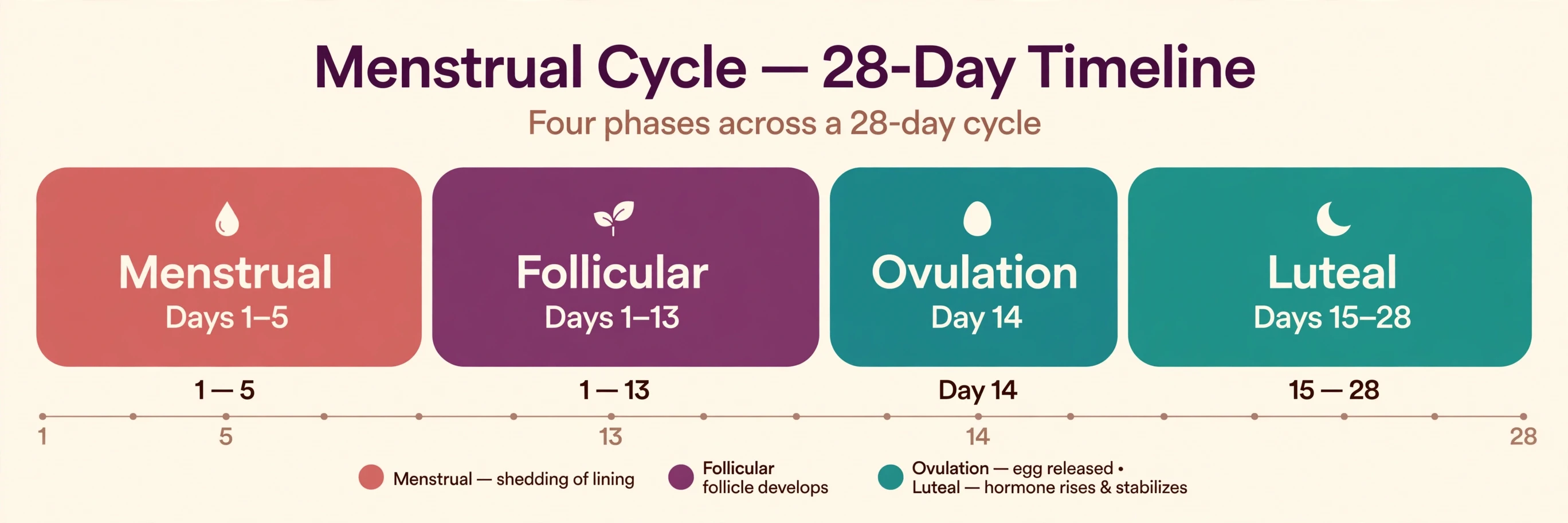
Phase | Days in a 28-day cycle | Main hormone | What is happening |
|---|---|---|---|
Menstrual | Days 1–5 | Estrogen and progesterone low | The uterine lining sheds as a period |
Follicular | Days 1–13 | FSH, then rising estrogen | A follicle matures; the lining rebuilds |
Ovulation | Around day 14 | LH surge | The egg is released from the ovary |
Luteal | Days 15–28 | Progesterone | The lining is prepared, then the hormones fall |
Table 1: The four phases of the menstrual cycle at a glance. The day numbers describe a 28-day cycle; in other cycles the first half stretches or shrinks while the second half stays close to 12 to 14 days.
2.3 Two cycles, one loop
It is worth pausing on the two-cycle idea, because it clears up a confusion that catches almost everyone. When people say "the menstrual cycle", they sometimes mean the bleeding, and sometimes mean the whole month. Both are right, and that is the problem. The bleeding is one phase of the uterine cycle. The whole month — the follicle growing, the egg releasing, the lining rebuilding — is the menstrual cycle. The ovarian cycle and the uterine cycle are coordinated by the same hormones, so they stay in step: when the ovary is in its follicular phase, the uterus is in its proliferative phase, rebuilding; when the ovary is in its luteal phase, the uterus is in its secretory phase, preparing. The two cycles are not two separate processes. They are one loop seen from two places, and the hormones are the messengers that keep them in step.
3. The Cast: Ovaries, Uterus, and the Brain
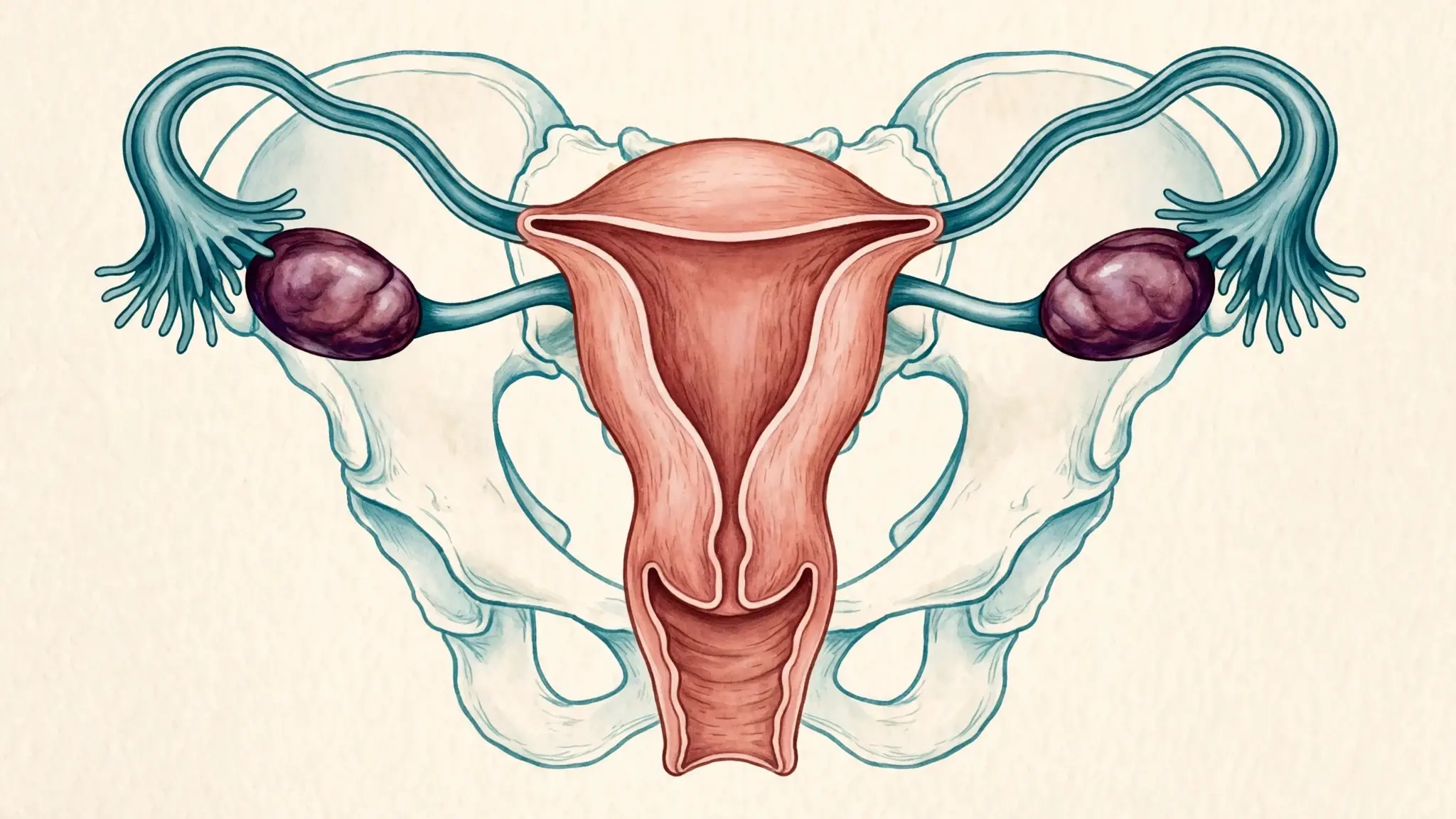
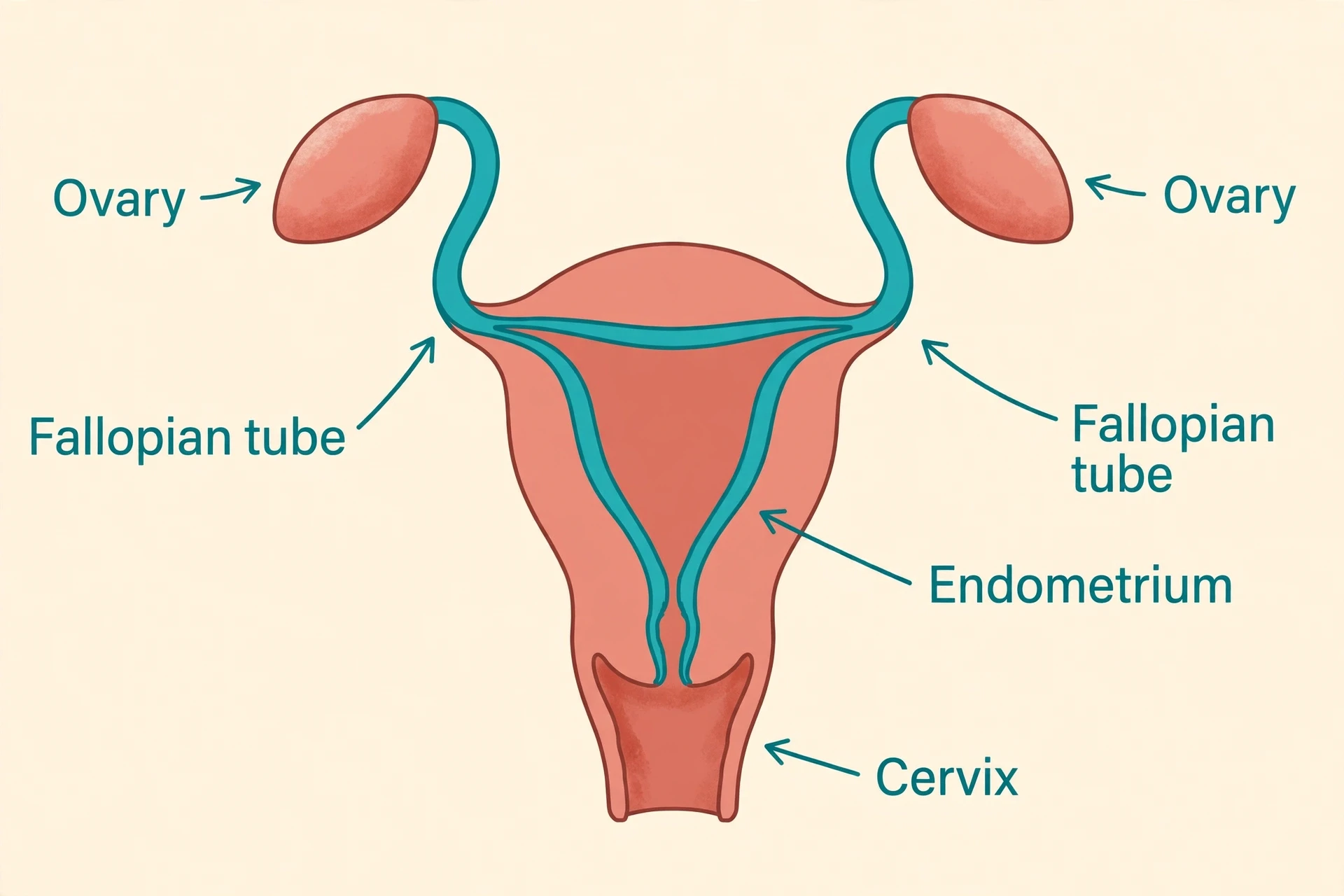
The menstrual cycle has three main settings: the brain, the ovaries and the uterus. Each one does a different job, and none of them can run the cycle alone. The brain sends the signals. The ovaries grow the egg and make the hormones. The uterus builds and sheds the lining. A fourth player, the fallopian tubes, does the quiet work of catching the egg and carrying it toward the uterus. The whole system is small — the ovaries are about the size of almonds, the uterus about the size of a pear — and yet it runs one of the most precisely timed processes in the body, month after month, for decades.
3.1 The ovaries: where the eggs have been waiting since before birth
Each ovary is an almond-sized organ, about 3 to 5 centimetres long, sitting on either side of the uterus. Inside each ovary, in its outer layer, are follicles — tiny fluid-filled sacs, each containing one immature egg. The remarkable fact about the ovaries is that they contain every egg a woman will ever have, and they have contained them since before birth. At about 20 weeks of fetal life, the ovaries hold roughly 6 to 7 million immature eggs. By birth, that number has fallen to about 1 to 2 million. By puberty, about 300,000 to 400,000 remain. The rest are lost through a natural process called atresia, in which follicles quietly degenerate without ever maturing. Across a whole reproductive life, only about 400 to 500 eggs are ever ovulated — one per cycle, in most cycles. The rest of the supply is spent, not used, and that is normal. The ovaries do not make new eggs. They work through a stock that was set before birth, and when the stock runs low, the cycle ends.
3.2 The uterus and the endometrium: the lining that is built and shed
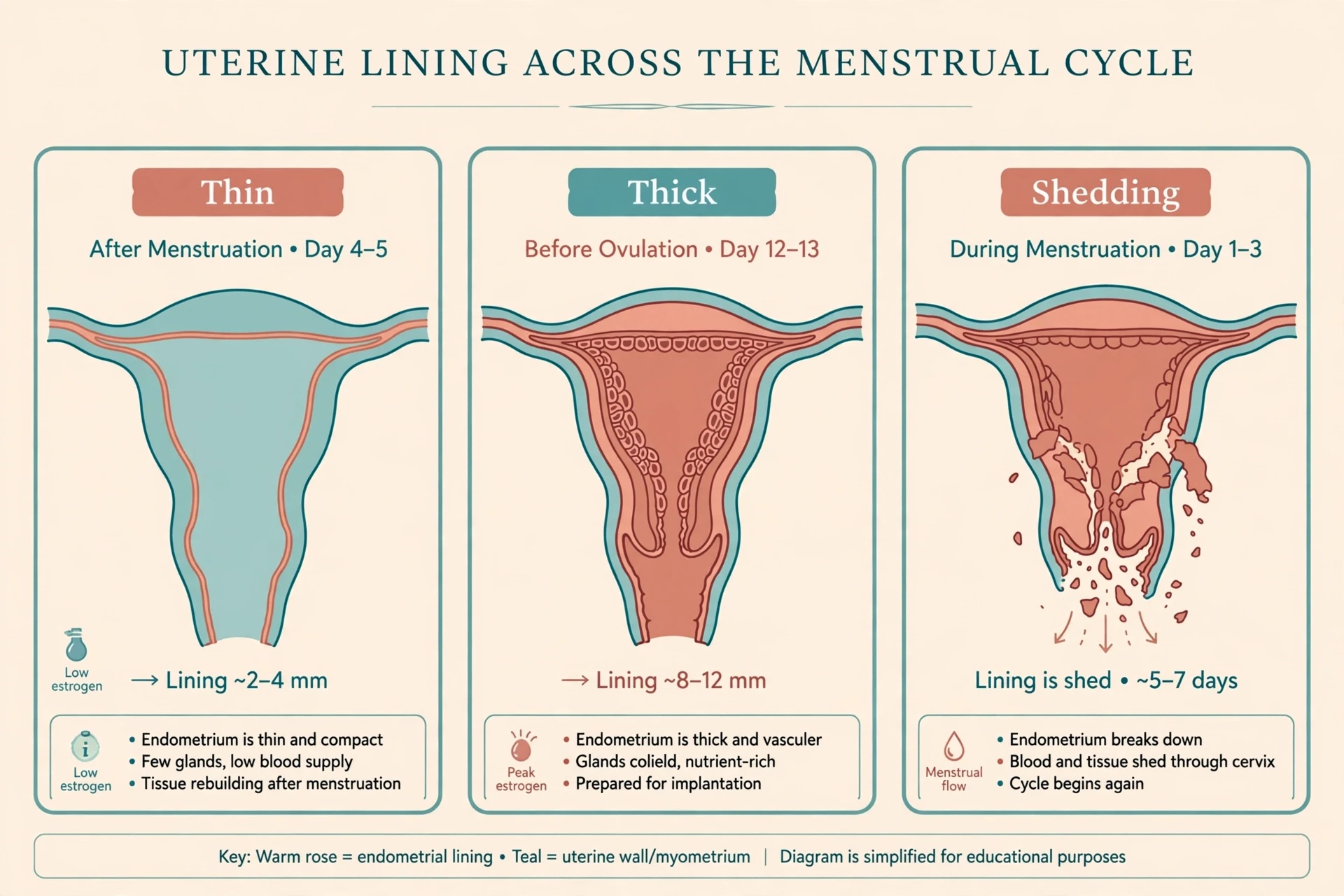
The uterus is a hollow, muscular organ about 7 to 8 centimetres long in a non-pregnant adult, roughly the size and shape of a pear turned upside down. Its inner lining is the endometrium, and it is the endometrium that does the monthly work. The endometrium has two layers: a deep basal layer that stays put, and a superficial functional layer that grows, transforms and sheds. Each cycle, estrogen rebuilds the functional layer from the basal layer, growing it from about 2 to 4 millimetres thick at the end of bleeding to roughly 8 to 12 millimetres by ovulation, and up to about 14 millimetres in the secretory phase. Progesterone then transforms it, filling its glands with glycogen and other secretions and growing a rich blood supply, so that it can support an embryo if one arrives. If no embryo arrives, the whole functional layer is shed. That shedding is the period.
3.3 The fallopian tubes and the cervix: the corridors
The fallopian tubes run from near each ovary to the top of the uterus. Each tube is about 10 centimetres long, and its end flares into finger-like projections called fimbriae that hover over the ovary. When an egg is released, the fimbriae sweep it into the tube, and tiny hair-like cilia and gentle muscular waves carry it toward the uterus over the next three to four days. Fertilisation, if it happens, usually happens in the outer third of the tube. The cervix is the narrow lower end of the uterus, opening into the vagina. It makes mucus that changes with the cycle — thin and slippery around ovulation, thick and sticky afterwards — and that mucus is one of the most useful signs of where the cycle is, as section 13 explains.
3.4 The brain: the conductor that never appears on stage
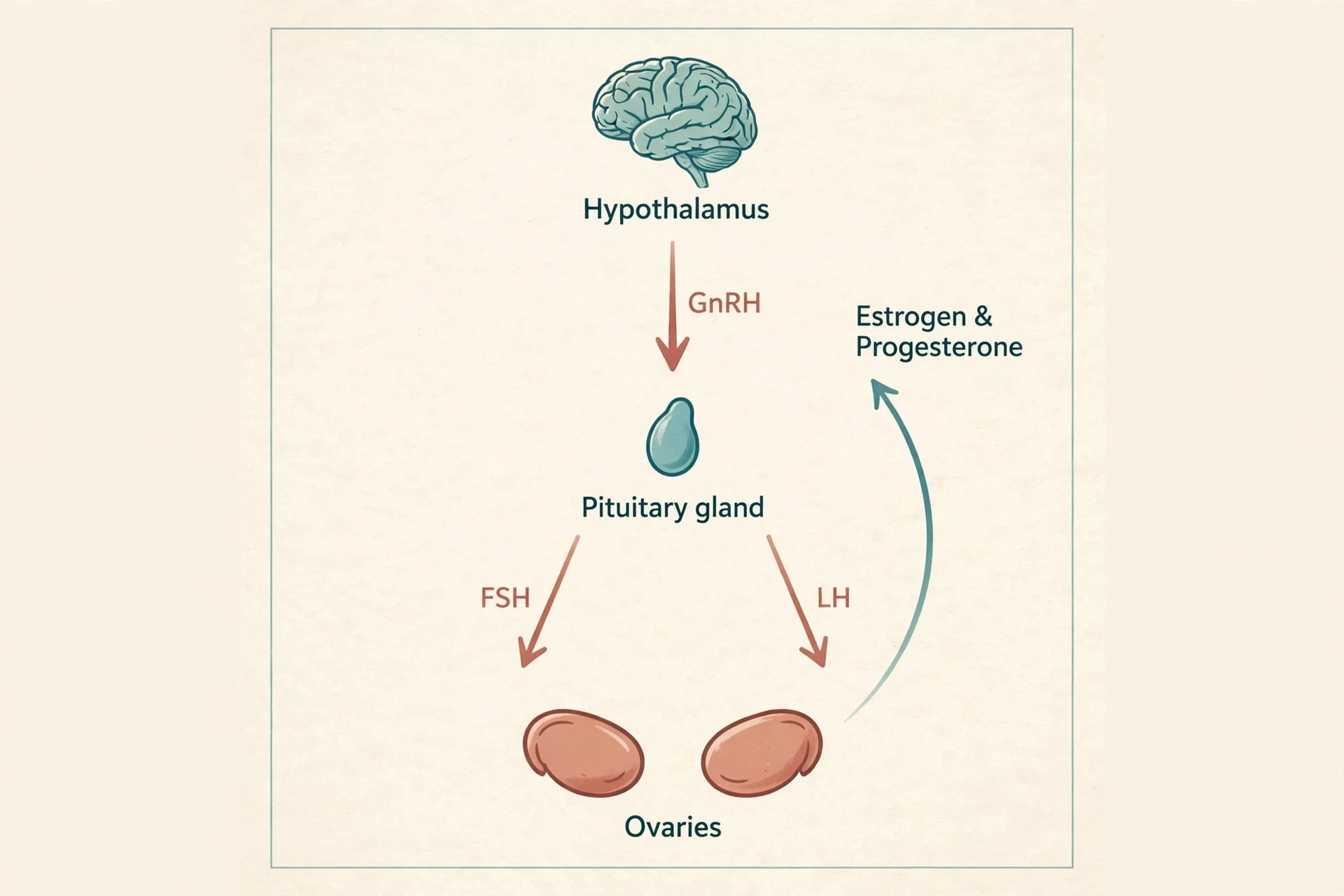
The conductor of the menstrual cycle sits in the brain, and it is easy to miss because it never appears in the diagrams of the reproductive organs. The hypothalamus, a small region at the base of the brain, releases gonadotropin-releasing hormone — GnRH — in pulses, about once every 60 to 90 minutes. Those pulses tell the pituitary gland, a pea-sized gland just below the hypothalamus, to release FSH and LH into the bloodstream. The ovaries read those signals and answer with estrogen and progesterone, which travel back to the brain and adjust the pulses. This loop — hypothalamus to pituitary to ovary and back again — is called the hypothalamic-pituitary-ovarian axis, and it is the reason the menstrual cycle is sensitive to so much more than the reproductive organs: stress, sleep, illness, weight change and intense exercise can all disturb the pulses, and when the pulses are disturbed, the cycle is disturbed. The brain is not a bystander in the menstrual cycle. It is the conductor.
4. The Hormones That Run the Show
If the organs are the cast, the hormones are the script. Five hormones do most of the work of the menstrual cycle, and each one has a distinct job and a distinct schedule. Two come from the brain: GnRH from the hypothalamus, and FSH and LH from the pituitary. Two come mainly from the ovaries: estrogen and progesterone. A sixth set of signals — inhibin, made by the follicles and the corpus luteum — fine-tunes the system by telling the pituitary to ease off FSH. Understanding the menstrual cycle means understanding these five hormones in order, because the cycle is, at its core, a sequence: one hormone rises, does its job, and hands over to the next.
4.1 GnRH: the pulse that starts everything
Gonadotropin-releasing hormone is a small peptide made by neurons in the hypothalamus, and it is released in pulses rather than in a steady stream. The pulsing matters. If GnRH were released continuously, the pituitary would stop responding to it — the receptors would desensitise, and FSH and LH would fall. The pulse, roughly every 60 to 90 minutes, keeps the pituitary responsive. The pulse rate also changes across the cycle: faster pulses favour LH release, slower pulses favour FSH. This is a detail that matters for medicine — drugs that mimic GnRH are used both to stimulate and to suppress the reproductive system, depending on whether they are given in pulses or continuously — but for the reader, the point is simpler. The menstrual cycle begins in the brain, with a rhythm, and the rhythm is the message.
4.2 FSH: the recruiter
Follicle-stimulating hormone does what its name says: it stimulates follicles to grow. At the start of each cycle, when estrogen and progesterone are low, FSH rises and recruits a cohort of follicles in the ovaries — roughly 15 to 20 of them in a typical cycle. Each follicle contains one immature egg surrounded by supporting cells. Under FSH, the follicles grow, their cells multiply, and they begin to make estrogen. The cohort does not all survive. As estrogen rises, FSH falls, and the smaller follicles, starved of FSH, stop growing and degenerate. Usually one follicle — the dominant follicle — keeps growing, because it has become the most sensitive to FSH and the best at making estrogen. The rest are lost to atresia. The menstrual cycle is, in this sense, a competition held every month, with one winner and a dozen quiet losers.
4.3 LH: the trigger
Luteinising hormone is the trigger for ovulation. For most of the cycle, LH stays low. Then, when estrogen from the dominant follicle reaches a high level and stays there for about a day and a half, something unusual happens: estrogen switches from suppressing LH to stimulating it. The pituitary releases a sharp surge of LH — a rise several times higher than its baseline — and that surge is the direct cause of ovulation. The surge also causes the dominant follicle to finish maturing its egg, loosening the egg from the follicle wall and preparing it for release. Ovulation follows about 24 to 36 hours after the surge begins, and about 10 to 12 hours after LH reaches its peak. This is the timing that ovulation predictor kits detect: they measure LH in urine, and a positive test means the surge has started and ovulation is roughly a day away.
4.4 Estrogen: the builder
Estrogen — mainly estradiol in the reproductive years — is the builder of the menstrual cycle. It is made by the growing follicle, first from androgens produced by the follicle's outer theca cells under LH, then converted to estrogen by the inner granulosa cells under FSH, using the enzyme aromatase. Estrogen rebuilds the endometrium after each period, growing it from a thin layer into a thick, gland-rich lining. It changes the cervical mucus, making it clear, stretchy and welcoming to sperm. It also acts on the brain, the breasts, the bones and the blood vessels, which is why the follicular phase can feel different from the luteal phase in energy and mood — though those effects vary widely between people, and the research on them is less settled than the textbooks sometimes suggest. Estrogen's most important job in the cycle, though, is the switch: at low and moderate levels it suppresses FSH and LH, and at high sustained levels it triggers the LH surge. One hormone, two opposite effects, depending on the dose and the timing. That switch is the hinge of the whole cycle.
4.5 Progesterone: the maintainer
Progesterone is made by the corpus luteum after ovulation, and its job is to maintain. It transforms the endometrium from a growing tissue into a secretory one, filling its glands with glycogen and nutrients and growing a dense network of spiral arteries, so that the lining can support an embryo. It thickens the cervical mucus into a barrier. It raises basal body temperature by roughly 0.3 to 0.5 degrees Celsius, which is why temperature tracking can confirm that ovulation has happened. And it suppresses new follicular growth, together with estrogen and inhibin A, so that no second egg is released in the same cycle. Progesterone is sometimes called the hormone of pregnancy, because if a pregnancy begins, it is progesterone that keeps the lining in place. Without a pregnancy, the corpus luteum fades, progesterone falls, and the lining it was maintaining falls with it.
4.6 Feedback: the thermostat that runs itself
The menstrual cycle is controlled by feedback, and the simplest way to understand feedback is a thermostat. A thermostat measures the temperature, compares it with the setting, and switches the heating on or off. The menstrual cycle works the same way, with the brain as the thermostat and the ovarian hormones as the temperature. When estrogen and progesterone are low, the brain releases more GnRH, FSH and LH. When estrogen and progesterone are high, the brain releases less. That is negative feedback, and it runs most of the cycle. The exception is the LH surge, which is positive feedback: high estrogen, sustained for long enough, makes the pituitary release more LH, not less. The cycle is a thermostat that, once a month, deliberately overheats — and that deliberate overheating is ovulation. The same feedback logic explains why the menstrual cycle is so sensitive to the rest of life: anything that disturbs the hypothalamus — severe stress, major weight loss, intense training, illness — can disturb the pulses, and a disturbed pulse can delay or skip ovulation. The system is robust, and it is also listening.
Hormones are often described as if they were simple, and the menstrual cycle is the best argument against that description. The same hormone can suppress and stimulate, build and dismantle, depending on when it rises and how long it stays high. If you want to understand how the endocrine system works in general — the same feedback logic, the same pulses, the same glands answering each other — the companion article on how the endocrine system works follows the same principles through the thyroid, the adrenals and the pancreas.
Hormone | Made by | Main job in the menstrual cycle | When it peaks |
|---|---|---|---|
GnRH | Hypothalamus | Signals the pituitary in pulses | Throughout, in pulses |
FSH | Anterior pituitary | Recruits and grows follicles | Early cycle and just before ovulation |
LH | Anterior pituitary | Triggers ovulation | Mid-cycle surge, just before ovulation |
Estrogen | Growing follicle | Rebuilds the lining; triggers the LH surge | Just before ovulation; smaller rise in the luteal phase |
Progesterone | Corpus luteum | Transforms and maintains the lining | Mid-luteal phase, about a week after ovulation |
Inhibin | Follicles and corpus luteum | Suppresses FSH | Throughout, rising with follicle growth |
Table 2: The hormones of the menstrual cycle and what each one does. The sequence matters more than any single hormone: FSH, then estrogen, then LH, then progesterone.
5. Phase 1: The Menstrual Phase — Shedding and Starting Over
The menstrual phase is the most visible phase of the menstrual cycle, and the most misunderstood. It lasts, in most adults, from 2 to 7 days, with 3 to 5 days the most common. It begins when the corpus luteum of the previous cycle fades and estrogen and progesterone fall. Without progesterone to maintain it, the functional layer of the endometrium loses its blood supply: the spiral arteries constrict, the tissue becomes starved of oxygen, and it begins to break down and detach. Prostaglandins, released by the breaking-down tissue, make the uterus contract, which helps expel the lining and also constricts the spiral arteries further. The result is menstrual flow: blood, endometrial tissue, mucus and vaginal secretions, leaving through the cervix and the vagina.
5.1 What a period is made of
Menstrual fluid is a mix of blood, endometrial tissue, cervical mucus and vaginal secretions. That is why its colour and texture change across the days of a period: bright red when flow is fast, darker red or brown when flow is slow and the blood has had time to oxidise, sometimes with small clots. Small clots are common, especially on heavy days. They form when the blood does not have time to be broken down by the anticoagulants the uterus releases, and they are usually no cause for concern on their own — though large clots, passed regularly, are one of the signs discussed in section 15. The average blood loss per period is about 30 millilitres — roughly two to three tablespoons — with a typical range of about 20 to 60 millilitres. It often feels like much more, because blood spreads thin and looks like a lot on a pad or in a cup. Loss above about 80 millilitres per cycle is considered heavy menstrual bleeding, and it is associated with a higher risk of iron deficiency.
5.2 Cramps: what they are and why they happen
Cramps — primary dysmenorrhoea, in medical language — are caused by the same prostaglandins that help shed the lining. Prostaglandins make the uterine muscle contract, and strong contractions briefly squeeze the blood vessels in the uterine wall, reducing oxygen to the muscle. That is what hurts. Higher prostaglandin levels are associated with more severe cramps, which is why cramps are usually worst on the first one or two days of a period, when prostaglandin release is highest, and why they often ease as flow lightens. Period pain is extremely common: studies suggest it affects up to 90 percent of adolescents and young women at some point. Common does not mean trivial — pain that regularly keeps someone home from school or work, or pain that does not respond to the usual over-the-counter measures, is worth a conversation with a clinician — but the mechanism itself is straightforward, and it is the same mechanism in almost everyone. The uterus is a muscle, and once a month it does a hard workout.
5.3 What the menstrual phase is not
The menstrual phase is often treated as a pause in the cycle — a few days when nothing happens. That is wrong. While the lining is shedding, the follicular phase has already begun. FSH is rising, a new cohort of follicles is being recruited, and the ovaries are already choosing the next egg. The menstrual cycle does not stop for the period. The period is the end of one cycle and the beginning of the next, happening at the same time. That overlap is why the four-phase description can be confusing: the menstrual phase and the follicular phase are not sequential blocks. They overlap for the first five days, and the cycle is already moving forward while the last one is being cleared away.
5.4 The immune system joins in
The shedding of the endometrium is not a passive event. Immune cells in the lining — natural killer cells, macrophages and others — help break down the tissue and then help repair it, and the lining heals remarkably fast: within a few days of the period ending, the surface is already regrowing from the basal layer. The immune system's role in the uterus is a reminder that immunity is not only about fighting infection. The same cells that defend the body also help rebuild tissue, and the uterus is one of the places where that rebuilding happens most visibly, every month. The companion article on how the human immune system works follows those cells through the rest of the body.
6. Phase 2: The Follicular Phase — Choosing the Egg
The follicular phase runs from day one of the cycle until ovulation, and it is the phase that varies. In a 28-day cycle it lasts about 13 days. In a 35-day cycle it lasts about 21 days. In a 21-day cycle it lasts about 7 days. Almost all the variation in cycle length between people, and between months in the same person, comes from this phase. The luteal phase, by contrast, stays close to 12 to 14 days. That single fact explains most of the confusion about the menstrual cycle: if the follicular phase is the variable part, then counting forward from the last period to predict ovulation will be wrong for anyone whose cycle is not 28 days, and counting back from the next period will be right.
6.1 The race for dominance
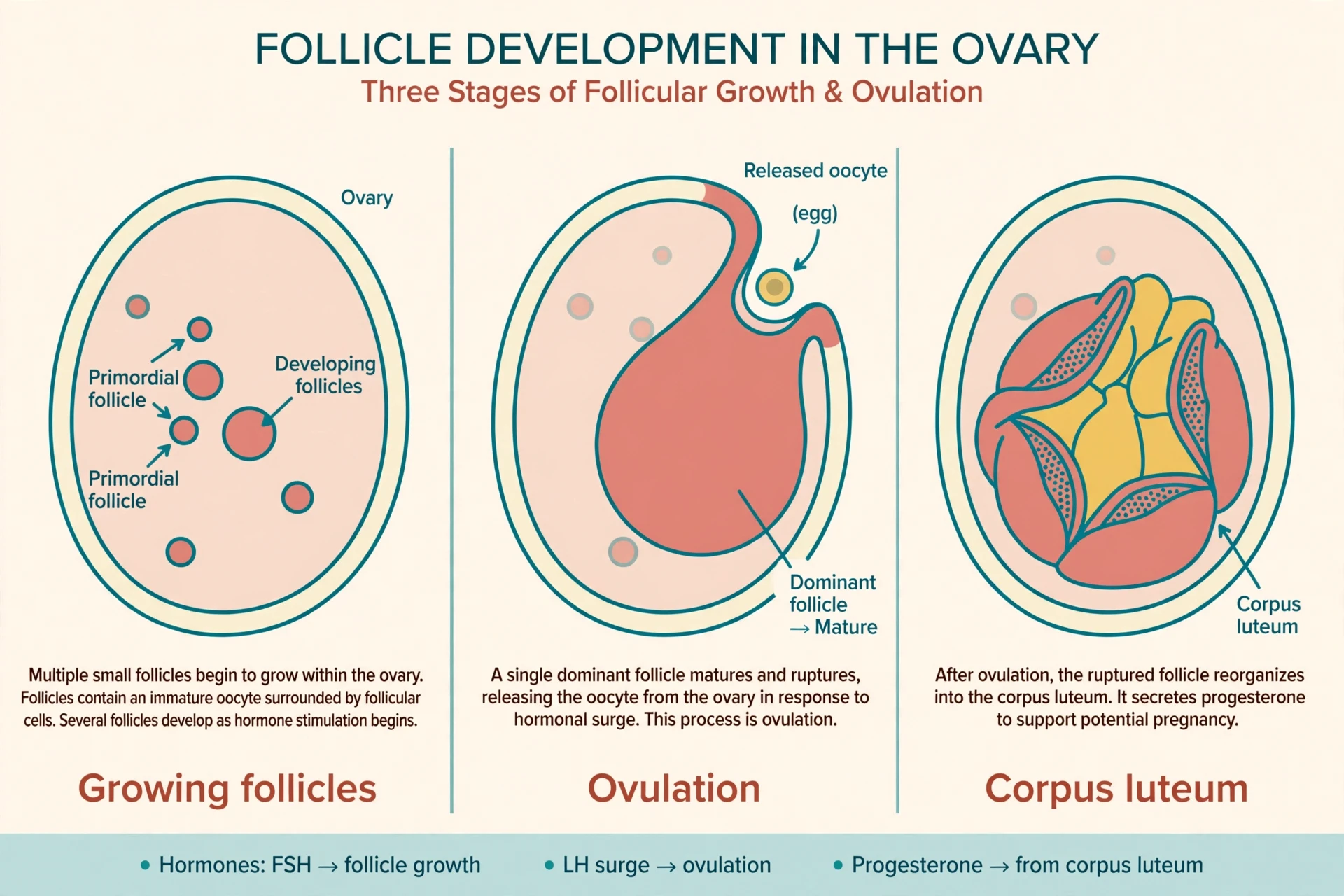
At the start of the cycle, FSH recruits a cohort of roughly 15 to 20 follicles. Each one begins to grow, its cells multiplying and its fluid-filled cavity expanding. The follicles compete, in effect, for FSH, and the competition is decided by sensitivity: the follicle with the most FSH receptors and the best blood supply responds most strongly, makes the most estrogen, and grows fastest. As its estrogen rises, FSH falls, and the other follicles — which need more FSH than is now available — stop growing and undergo atresia. By about a week into the cycle, one dominant follicle has usually emerged. It is about 2 centimetres across by the time of ovulation, a fluid-filled blister on the surface of the ovary, with a mature egg inside it. The others are gone, quietly, without any symptom. This is the monthly race the follicular phase is named for, and it happens in both ovaries, though usually only one dominant follicle emerges per cycle, from one ovary or the other.
6.2 Estrogen rebuilds the lining
While the follicle grows, estrogen rebuilds the uterus. The endometrium, thin and raw at the end of the period, grows new glands and blood vessels under estrogen's influence, thickening from about 2 to 4 millimetres to roughly 8 to 12 millimetres. This is the proliferative phase of the uterine cycle, and it runs in parallel with the follicular phase of the ovarian cycle. The same estrogen also changes the cervical mucus, from thick and sticky to thin, clear and stretchy, and it acts on the rest of the body in ways that are often felt but hard to measure precisely: many people report more energy and a better mood in the late follicular phase, as estrogen peaks. The research on mood and energy across the cycle is real but mixed — the effects are modest, they vary widely between people, and they are easily swamped by sleep, stress and circumstance. The honest statement is that estrogen rises, the lining rebuilds, and some people feel better as it does. The cycle is not a mood calendar, and it should not be read as one.
6.3 The egg inside the follicle
The egg inside the dominant follicle has been waiting a long time. It began its development before birth, when it entered the first division of meiosis and then stopped, arrested in prophase I, for a decade or more. During the follicular phase, under FSH and then LH, it resumes meiosis, completes the first division just before ovulation, and arrests again, in metaphase II, until fertilisation. This long pause is one reason egg quality declines with age: the egg's machinery, including the spindle that separates its chromosomes, has been sitting in the same state for decades, and errors in chromosome separation become more common with time. It is also why the follicular phase matters so much: the final two weeks of the egg's maturation, after years of waiting, are when it becomes ready — or does not.
6.4 When the follicular phase is long
A long follicular phase is the most common reason for a long cycle. Stress, illness, travel, major weight change and intense exercise can all delay the selection of a dominant follicle, because they disturb the GnRH pulses from the hypothalamus. The cycle is not broken when this happens. It is waiting. The follicular phase stretches, ovulation arrives late, and the period arrives 12 to 14 days after that. This is why a single late period, after a stressful month, is usually nothing to worry about, and why a pattern of very long or very irregular cycles is worth a conversation with a clinician. The follicular phase is the cycle's flexible part, and flexibility is a feature, not a fault — it is how the body postpones ovulation when conditions are not right.
7. Phase 3: Ovulation — The 24-Hour Window
Ovulation is the centrepiece of the menstrual cycle, and it is also the shortest phase: a single event, lasting minutes, in the middle of a month-long loop. The dominant follicle ruptures, the egg is released, and the fimbriae of the fallopian tube sweep it inside. The egg is viable for only about 12 to 24 hours after release. If it is not fertilised in that window, it disintegrates. Everything about the timing of fertility — the fertile window, the LH tests, the calendar calculations — follows from that short window and the much longer survival of sperm.
7.1 The LH surge: the trigger
Ovulation is triggered by the LH surge, and the surge is triggered by estrogen. When the dominant follicle's estrogen reaches a high level and stays there for roughly 36 to 48 hours, the pituitary switches from being suppressed by estrogen to being stimulated by it, and releases a surge of LH several times higher than baseline, with a smaller surge of FSH alongside it. The surge does three things: it completes the egg's maturation, it loosens the egg from the follicle wall, and it weakens the follicle wall itself, so that it can rupture. The egg is released about 24 to 36 hours after the surge begins — roughly 10 to 12 hours after LH peaks. The surge is the most precisely timed event in the cycle, and it is the event that ovulation predictor kits are built to detect.
7.2 What ovulation feels like
Most people do not feel ovulation at all. Some notice a brief, sharp pain on one side of the lower abdomen — mittelschmerz, German for "middle pain" — caused by the follicle rupturing and a small amount of fluid irritating the lining of the abdomen. Some notice a change in cervical mucus, which becomes clear, stretchy and slippery, like raw egg white, in the days around ovulation. Some notice a slight rise in sex drive, or a small amount of spotting. None of these signs is reliable on its own, and none of them is present in everyone. The most reliable signs of approaching ovulation are the ones that can be measured: the LH surge on a urine test, and the change in cervical mucus. The most reliable sign that ovulation has happened is the one that comes after it: a sustained rise in basal body temperature, driven by progesterone, which is covered in section 13.
7.3 The egg's journey
Once released, the egg is picked up by the fimbriae and carried into the fallopian tube. It travels slowly, moved by cilia and by gentle muscular waves, taking three to four days to reach the uterus. If sperm are waiting in the tube — and they can be, because sperm survive up to five days — fertilisation usually happens in the outer third of the tube, within the first day after ovulation. The fertilised egg, now an embryo, continues its journey, dividing as it goes, and enters the uterus about three to four days after ovulation as a morula, becoming a blastocyst by day five or six, ready to implant. If no sperm are present, the egg simply disintegrates in the tube. The fallopian tube is a corridor with a deadline, and the deadline is short.
7.4 When ovulation does not happen
Not every cycle ovulates. Anovulatory cycles — cycles in which no egg is released — are common in the first years after menarche, when the hormonal axis is still maturing, and in perimenopause, when the follicle supply is running low. They can also happen after stress, illness or major weight change. In an anovulatory cycle, the follicle may grow and then fade without releasing an egg, and bleeding may still occur, because estrogen alone can build a lining that eventually sheds. That is why bleeding alone does not prove ovulation happened, and why a regular-looking period can hide an anovulatory cycle. A cycle that bleeds is not necessarily a cycle that ovulated, and that distinction matters for anyone trying to understand their fertility — or their lack of it.
8. Phase 4: The Luteal Phase — Preparing, Then Letting Go
The luteal phase begins the moment ovulation ends. The ruptured follicle, which has just released its egg, does not disappear. It reorganises itself into a new structure called the corpus luteum — Latin for "yellow body", named for its colour — and becomes a temporary hormone factory. For the next 12 to 14 days, the corpus luteum makes progesterone, and progesterone runs the second half of the menstrual cycle. This is the phase in which the body prepares for a pregnancy that, in most cycles, does not come, and then dismantles the preparation. Bull and colleagues found the luteal phase averaged 12.4 days, but with a wide spread — 95 percent of cycles fell between 7 and 17 days, and about 18 percent were shorter than 11 days — so "12 to 14 days" is a useful rule of thumb, not a fixed length.
8.1 The corpus luteum: a temporary gland
The corpus luteum is one of the most remarkable structures in the body, partly because it is so temporary. It forms from the cells of the ruptured follicle — the granulosa cells become granulosa lutein cells, the theca cells become theca lutein cells — and under LH it produces progesterone in large amounts, along with some estrogen and inhibin A. It has a rich blood supply and a short life: if no pregnancy begins, it survives about 12 to 14 days, then regresses into a small white scar called the corpus albicans. If a pregnancy does begin, the embryo's hormone, human chorionic gonadotropin (hCG), rescues it, and it keeps making progesterone until the placenta takes over, around 8 to 12 weeks of pregnancy. The corpus luteum is a gland with a deadline, and its deadline sets the length of the luteal phase. The full story of what happens when hCG arrives — implantation, the placenta, the trimesters — is told in the companion article on how pregnancy works.
8.2 Progesterone transforms the lining
Under progesterone, the endometrium changes from a growing tissue into a secretory one. Its glands fill with glycogen and other secretions, its blood vessels coil and multiply, and its cells prepare to receive an embryo. This is the secretory phase of the uterine cycle, and it is the most hospitable the lining ever becomes: thick, rich and ready. Progesterone also raises basal body temperature, thickens the cervical mucus into a barrier, and suppresses new follicular growth, so that no second egg is released. The luteal phase is, in a sense, a waiting room. The body has done the work of preparing, and now it waits for an embryo that may or may not arrive. The waiting lasts about two weeks, and it ends the same way every time, unless a pregnancy begins.
8.3 The fall: how the cycle ends
Without a pregnancy, the corpus luteum regresses. Progesterone falls, estrogen falls, and the support is withdrawn from the endometrium. The spiral arteries constrict, the functional layer loses its blood supply, and it begins to break down. Prostaglandins are released, the uterus contracts, and the lining sheds. That is the period, and it is also day one of the next cycle. The fall of progesterone is the trigger for menstruation, and it is a sharp one: progesterone falls over a day or two, and bleeding follows. This is why the luteal phase is so consistent in length. The corpus luteum has a built-in lifespan, and when it ends, the cycle ends with it.
8.4 Premenstrual symptoms: the luteal phase and mood
The late luteal phase is when premenstrual symptoms appear, if they appear. Up to 70 to 90 percent of menstruating women report some premenstrual symptoms — bloating, breast tenderness, headache, fatigue, irritability, low mood, changes in appetite and sleep. About 20 to 40 percent meet the criteria for premenstrual syndrome (PMS), meaning the symptoms are bothersome enough to affect daily life. About 3 to 8 percent meet the criteria for premenstrual dysphoric disorder (PMDD), a severe form in which mood symptoms — marked irritability, depressed mood, anxiety, mood swings — dominate and interfere with work, school or relationships. The symptoms are tied to the luteal phase, not to any single hormone level: they appear after ovulation and ease within a few days of the period starting, and they do not appear in cycles that do not ovulate. The leading explanation is not that hormone levels are abnormal, but that the brain is unusually sensitive to the normal rise and fall of estrogen and progesterone — a sensitivity that involves serotonin and other brain chemicals, and that varies between people. That is why the same hormone changes can leave one person untroubled and another deeply affected, and why dismissing premenstrual symptoms as "just moodiness" misses the biology entirely.
9. The Hormone Curve: One Cycle, Four Lines
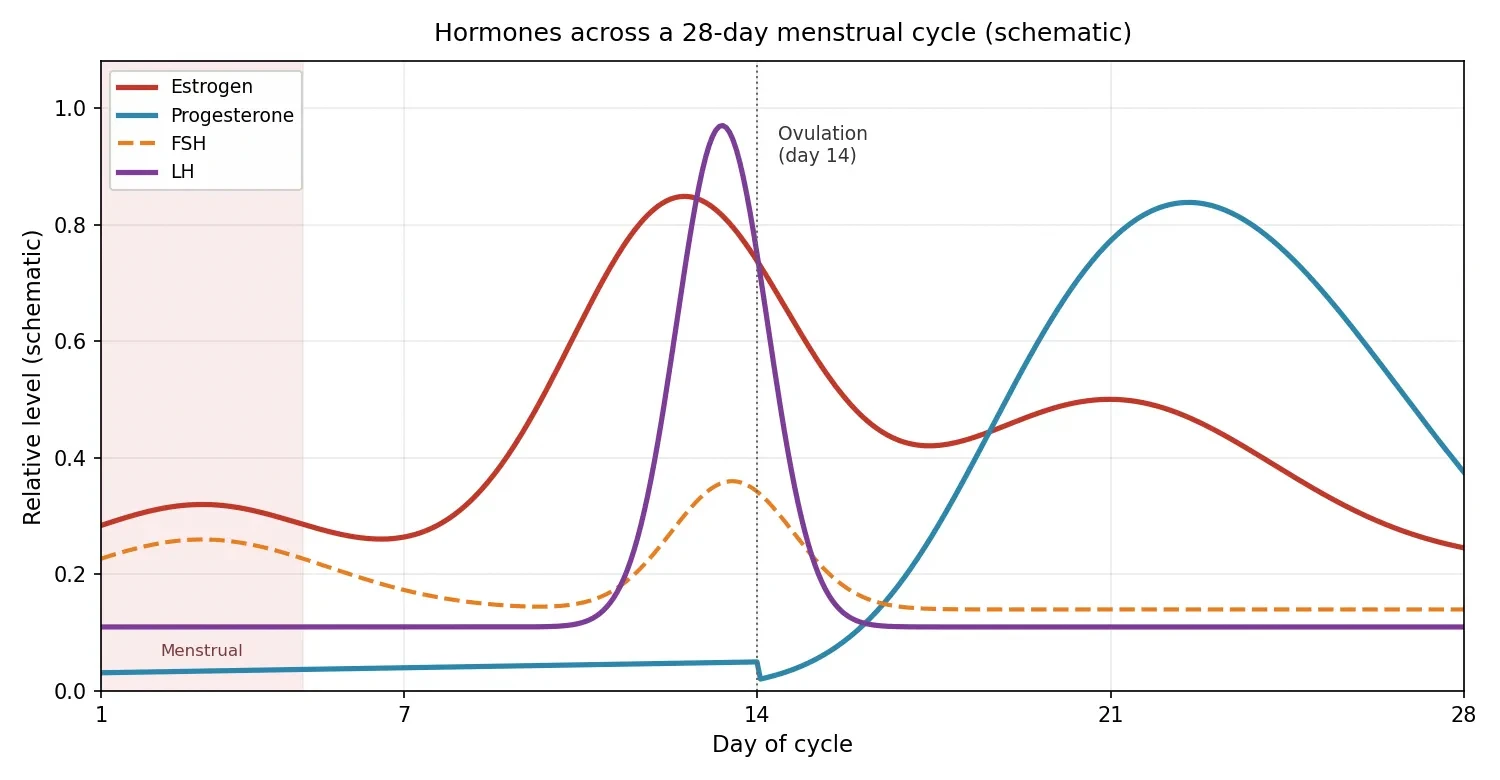
The menstrual cycle is easier to understand as a picture than as a list. The chart below shows the four main hormones across a 28-day cycle, and it is worth studying slowly, because almost everything in this article is visible in it. Estrogen rises through the follicular phase and peaks just before ovulation. LH is flat, then spikes sharply at mid-cycle. FSH rises early, dips, and has a small peak alongside LH. Progesterone is near zero for the first half of the cycle, rises after ovulation, peaks about a week later, and falls before the next period. The chart is schematic — it shows the shapes of the curves, not measured hormone levels, which vary between people and between laboratories — but the shapes are the story.
9.1 Reading the chart, week by week
In the first week, estrogen and progesterone are low, FSH is rising, and the follicles are being recruited. In the second week, estrogen climbs steeply as the dominant follicle grows, FSH falls, and the lining thickens. At the end of the second week, estrogen peaks, LH surges, and ovulation happens. In the third week, progesterone rises as the corpus luteum forms, estrogen dips and then rises again to a smaller second peak, and the lining transforms. In the fourth week, progesterone peaks and then falls, estrogen falls with it, and the cycle ends. The chart has a rhythm to it — a rise, a spike, a plateau, a fall — and that rhythm repeats every month. Once you can read the chart, you can predict the cycle: the LH spike means ovulation is a day away, the progesterone rise means ovulation has happened, and the progesterone fall means a period is coming.
9.2 What the chart does not show
The chart does not show the pulses. GnRH is released in pulses every 60 to 90 minutes, and FSH and LH are released in pulses too, but the chart smooths them into curves. It does not show inhibin, which quietly suppresses FSH through the follicular and luteal phases. It does not show the androgens made by the theca cells, which are the raw material for estrogen. And it does not show the variation: in a 35-day cycle, the whole first half stretches, the estrogen peak arrives a week later, and the LH spike moves with it, while the second half stays the same shape. The chart is a map of a typical cycle, not a photograph of any real one. Its value is in the pattern, not the numbers.
Time in cycle | Estrogen | Progesterone | FSH / LH | What is happening |
|---|---|---|---|---|
Days 1–5 | Low | Low | FSH rising | Bleeding; follicles recruited |
Days 6–12 | Rising steeply | Low | FSH falling | Dominant follicle grows; lining rebuilds |
Days 13–14 | Peak, then dips | Low | LH surge | Ovulation |
Days 15–21 | Rising again, smaller | Rising | Low | Corpus luteum forms; lining transforms |
Days 22–28 | Falling | Peak, then falling | Low | Preparation ends; period begins |
Table 3: What changes across the menstrual cycle, week by week, in a typical 28-day cycle.
9.3 Why the chart matters for real life
The chart matters because it is the basis for almost every practical question about the menstrual cycle. When is ovulation? When LH spikes. When is the fertile window? The five days before ovulation plus ovulation day, because sperm survive and the egg does not. Has ovulation happened? When progesterone rises and temperature follows. When will the next period come? About 12 to 14 days after ovulation. The chart turns a confusing monthly event into a sequence of causes and effects, and once the sequence is clear, the practical questions answer themselves.
10. The Fertile Window: Why Timing Beats the Calendar
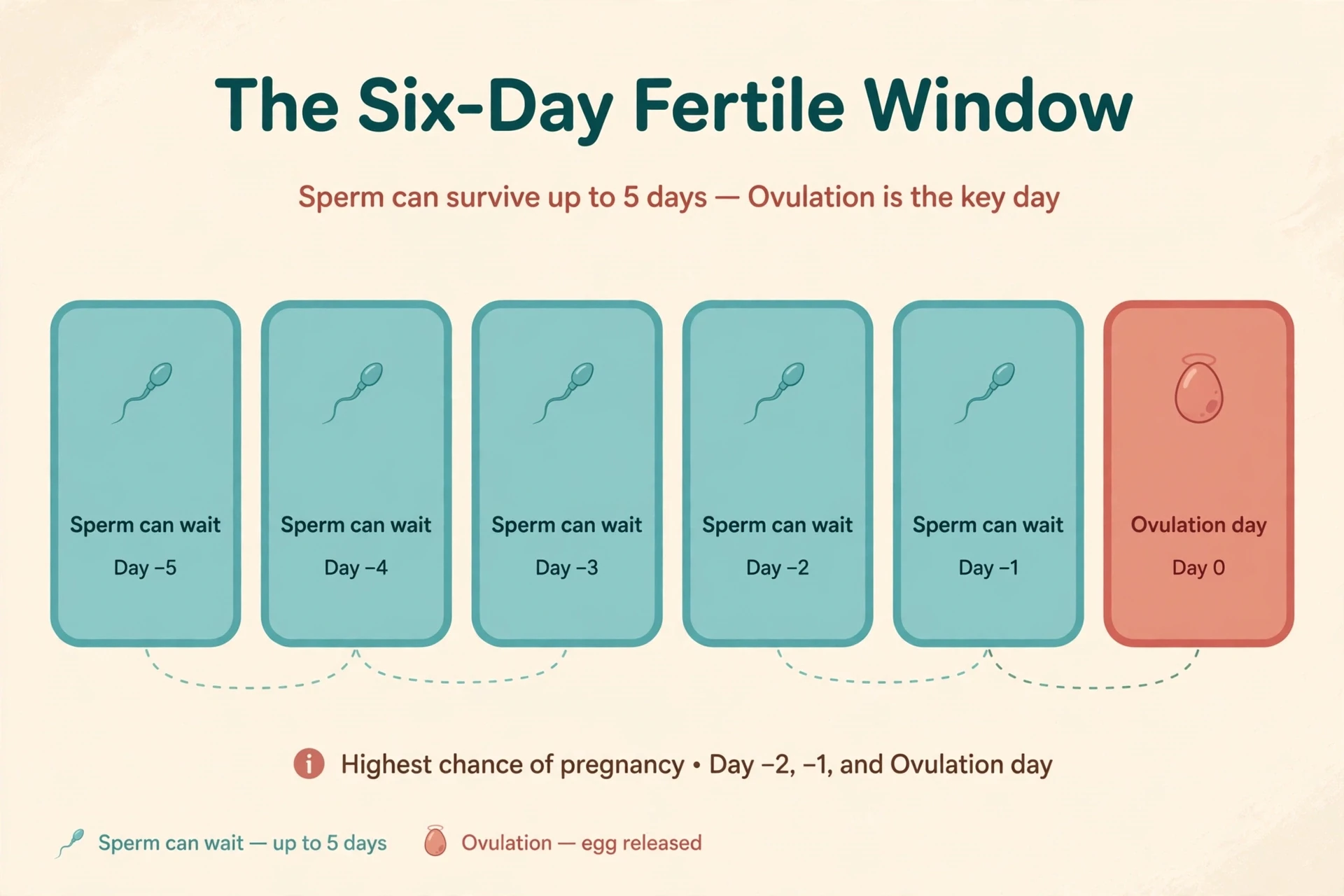
The fertile window is the part of the menstrual cycle that most people get wrong, and the reason is simple: the window is set by two very different lifespans. Sperm can survive in the female reproductive tract for up to five days, waiting in fertile cervical mucus. The egg, once released, is viable for only about 12 to 24 hours. That asymmetry means the fertile window is six days long — the five days before ovulation plus the day of ovulation itself — and that the days before ovulation matter more than the day of ovulation. Sperm that arrive early have the best chance, because they are already in place when the egg arrives.
10.1 The Wilcox study: how the window was measured
The fertile window was not guessed. It was measured. In a landmark study published in the New England Journal of Medicine in 1995, Allen Wilcox and colleagues followed 221 women who were trying to conceive, tracking intercourse timing against hormonally confirmed ovulation. In Wilcox and colleagues' 1995 study of 221 women, the estimated probability of conception rose from 0.10 when intercourse happened five days before ovulation to 0.33 on the day of ovulation itself — the highest estimate in that study. A later re-analysis by Dunson and colleagues (1999), which corrected for errors in dating ovulation, put the peak on the day before ovulation instead. Either way, the last two to three days before ovulation and ovulation day itself carry the highest chances, which is why the practical advice is the same: sperm should already be waiting when the egg is released. A later study by the same group, published in the BMJ in 2000, found that in only about 30 percent of women is the fertile window entirely within days 10 to 17 of the cycle — the range the textbooks quote. For the other 70 percent, the window falls earlier or later, because their cycles are shorter or longer than 28 days. The calendar method, which assumes a 28-day cycle and ovulation on day 14, fails most women most of the time.
10.2 Counting back, not forward
The reliable way to estimate ovulation is to count back, not forward. The luteal phase is comparatively fixed at about 12 to 14 days, so ovulation happens about 14 days before the next period, whatever the cycle's total length. In a 35-day cycle, ovulation falls near day 21, not day 14. In a 24-day cycle, it falls near day 10. In a 28-day cycle, and only in a 28-day cycle, it falls on day 14. This is the single most useful fact in this article for anyone trying to time conception — or to understand why a calendar app that assumes 28 days keeps getting it wrong. The app is not broken. Its assumption is.
10.3 Pregnancy begins here, not at the period
If fertilisation happens, the story continues in the fallopian tube and then the uterus, and it is told in full in the companion article on how pregnancy works. The brief version is this: the embryo reaches the uterus as a morula three to four days after ovulation and turns into a blastocyst by day five or six; implantation follows around six to seven days after ovulation, and the embryo begins to make hCG, which rescues the corpus luteum and keeps progesterone high. The period does not come, because the hormones that would trigger it never fall. That is why a missed period is the first sign of pregnancy for most people — not because the period is late, but because the cycle has been interrupted by a new one beginning.
11. A Period, Close Up: Blood, Tissue, and Numbers
A period is, in the end, a small event measured in tablespoons, and yet it is treated as if it were a flood. The numbers help. Average blood loss per period is about 30 millilitres. The typical range is about 20 to 60 millilitres. The total menstrual fluid — blood plus tissue plus mucus — averages about 35 millilitres, with a typical range of about 10 to 80 millilitres. The 30 millilitre figure is blood loss; the classic 35 millilitre figure is total menstrual fluid. The two come from different measurement traditions, which is why they look close together. To put that in context, the body holds about 5 litres of blood, so a normal period is less than one percent of total blood volume. It feels like more because blood is vivid, because it arrives over several days, and because it is measured in pads and tampons rather than in millilitres.
11.1 How much is too much
Heavy menstrual bleeding has a definition, and it is worth knowing. Bleeding is considered heavy when blood loss exceeds about 80 millilitres per cycle, or when it soaks through a pad or tampon every hour for several hours in a row, or when clots larger than a coin are passed regularly, or when bleeding lasts longer than seven days. Heavy bleeding is common — it affects a substantial minority of menstruating people — and it is the leading cause of iron deficiency in reproductive-age women. Iron is lost with the blood, and if the loss outpaces dietary intake month after month, iron stores fall, haemoglobin falls, and anaemia follows: fatigue, breathlessness, pale skin, hair shedding. Heavy bleeding is not something to simply endure. It is a symptom with causes, and the causes are treatable. The full list of patterns that deserve a clinician's attention is in section 15.
11.2 Colour, clots and texture: what changes and why
Menstrual blood changes colour across a period, and the changes are normal. Bright red blood is fresh and flowing fast. Dark red or brown blood has been in the uterus longer and has oxidised — it is common at the start and the end of a period, when flow is slow. Pink blood is blood diluted by cervical mucus. Small clots, up to about the size of a coin, are common on heavy days, when the uterus releases blood faster than its anticoagulants can break it down. What matters is not any single colour or clot, but the pattern: a period that is consistently very heavy, or that suddenly changes, or that comes with pain that does not respond to the usual measures, is worth a conversation. The period is a vital sign, and like any vital sign, it is the change that carries the information.
11.3 Products, briefly and without judgement
Pads, tampons, menstrual cups and period underwear all do the same job — they collect menstrual fluid — and the choice between them is personal. Cups hold more than tampons and can be worn longer; pads are the simplest option and the easiest to monitor flow with; tampons are discreet and familiar. The practical facts are few: change tampons and pads regularly, do not wear a tampon for longer than the recommended time, wash hands before and after changing any product, and know that a cup's capacity — typically 20 to 30 millilitres — makes it a useful way to estimate blood loss. None of these products affects the cycle itself. They collect what the cycle produces, and that is all.
12. Cramps and PMS: Why the Second Half Feels Different
The second half of the menstrual cycle feels different from the first, and the difference is not imagined. The first half is dominated by estrogen, which is rising and rebuilding. The second half is dominated by progesterone, which is maintaining and then withdrawing. The body notices the difference, and for many people the difference is uncomfortable: cramps at the start, bloating and breast tenderness and mood changes at the end. This section is about why, and about where the line sits between normal discomfort and something that deserves care.
12.1 Cramps, again: prostaglandins in detail
Cramps were introduced in section 5, and they deserve a closer look, because they are the most common menstrual symptom and the most misunderstood. Prostaglandins are hormone-like substances made by the endometrium as it breaks down. They cause the uterine muscle to contract, which helps expel the lining, and they also constrict blood vessels. Strong contractions briefly reduce blood flow to the uterine muscle, and the muscle, starved of oxygen, hurts — the same mechanism as a cramp in a calf muscle during exercise. Prostaglandin levels are highest in the first 48 hours of a period, which is why cramps are worst then and usually ease as flow lightens. The link between prostaglandins and cramps is also why anti-inflammatory medicines, which block prostaglandin production, are often effective for period pain, and why they work best when taken early, before prostaglandin levels peak. This is general information about a mechanism, not a recommendation for any individual reader.
12.2 PMS: common, real, and often minimised
Premenstrual syndrome is defined by the American College of Obstetricians and Gynecologists as the cyclical occurrence of physical and emotional symptoms in the luteal phase, severe enough to affect some aspects of life, in a predictable pattern related to the menstrual cycle. The symptoms are many — more than 200 have been described — but the common ones are few:
Irritability, anxiety, depressed mood and mood swings
Fatigue and changes in sleep
Bloating and breast tenderness
Headache
Changes in appetite About 20 to 40 percent of reproductive-age women experience symptoms that meet the criteria for PMS. The symptoms appear after ovulation, peak in the days before the period, and ease within a few days of bleeding starting. That timing is the diagnostic clue: symptoms that follow the cycle are premenstrual; symptoms that do not follow the cycle are something else. PMS is often minimised, in part because its symptoms are familiar and in part because they are invisible. Minimising them misses the point. A condition that affects a fifth to two-fifths of menstruating women, every month, for decades, is not a minor inconvenience. It is a major part of human health, and it deserves to be described plainly.
12.3 PMDD: when the luteal phase becomes disabling
Premenstrual dysphoric disorder is the severe form of PMS, and it is different in kind, not only in degree. It affects about 3 to 8 percent of reproductive-age women, and its defining feature is mood: marked irritability or anger, depressed mood or hopelessness, anxiety or tension, and mood swings that interfere with work, school, relationships or daily functioning. The physical symptoms of PMS are often present too, but the mood symptoms dominate. PMDD is listed in the Diagnostic and Statistical Manual of Mental Disorders as a depressive disorder, and that classification matters, because it means the condition is recognised as a medical one, not a character flaw. The cause is not abnormal hormone levels — hormone levels in PMDD are usually normal — but an abnormal sensitivity in the brain to the normal rise and fall of estrogen and progesterone, involving serotonin and other signalling systems. The distinction between PMS and PMDD is not about toughness. It is about biology, and the biology is different.
12.4 Sleep, mood and the cycle
Sleep and mood change across the menstrual cycle, and the changes are worth describing honestly, because the research is thinner than the claims. Sleep is often lighter and more fragmented in the late luteal phase, when progesterone is high and then falling, and in the first days of the period, when cramps and bleeding disturb the night. Mood is often lowest in the same window. But the effects are modest on average, they vary widely between people, and they are easily swamped by the rest of life — a bad week at work will affect mood more than the cycle will. The companion article on the science of sleep and dreams follows the sleep system in detail, and the article on anxiety and depression follows the mood system. The honest summary is this: the cycle affects sleep and mood, the effects are real, and they are smaller and more variable than the internet usually claims.
12.5 The gut joins the conversation
The gut also notices the menstrual cycle. Bloating, changes in appetite, and changes in bowel habits are among the most common premenstrual symptoms, and they have a mechanism: progesterone slows the movement of the gut, prostaglandins affect it too, and the gut's own microbes interact with estrogen in ways that researchers are only beginning to map. The gut microbiome contains bacteria that can modify estrogen — a collection sometimes called the estrobolome — and the balance of those bacteria may influence how much estrogen circulates. The research here is young and the claims should stay modest, but the direction is clear: the menstrual cycle is not confined to the reproductive organs. It touches the gut, the brain, the sleep system and the immune system, and that is why it is a vital sign. The companion article on the gut microbiome follows the microbes in detail.
13. Tracking Your Cycle: Calendars, Temperature, Mucus, and Tests
Tracking the menstrual cycle means recording what happens, month after month, and using the record to understand the pattern. It is one of the most useful things a person can do with their cycle, and one of the most misunderstood. Tracking does not change the cycle. It reveals it. And the four main methods — calendar, temperature, cervical mucus and LH tests — each measure something different, which is why they work best in combination and why no single one is enough on its own.
13.1 The calendar: the simplest method, and the weakest alone
The calendar method is the oldest form of tracking: record the first day of each period, count the days between periods, and use the pattern to predict the next one. It is simple, it is free, and it is the basis of most tracking apps. Its weakness is that it assumes the future will look like the past. A calendar can tell you that your cycles usually last 29 days, and it can predict the next period from that average. It cannot tell you when you ovulated in this cycle, because ovulation happens in the follicular phase, and the follicular phase is the variable part. A calendar that assumes a 28-day cycle will predict ovulation on day 14 for a woman whose follicular phase lasts 21 days, and it will be a week early. Calendars are good for spotting patterns over months — a cycle that is getting longer, or more irregular — and poor for pinpointing a single day.
13.2 Basal body temperature: the confirmation that comes after
Basal body temperature is the body's temperature at rest, measured first thing in the morning before getting out of bed. After ovulation, progesterone raises it by roughly 0.3 to 0.5 degrees Celsius, and it stays raised until the next period. A temperature chart therefore shows a clear pattern: lower temperatures before ovulation, higher temperatures after. The rise confirms that ovulation has happened, but it does not predict it — by the time the temperature rises, the fertile window has closed. Temperature tracking is useful for confirming ovulation after the fact, and for spotting anovulatory cycles, in which no sustained rise appears. Its weaknesses are practical: illness, alcohol, poor sleep and a late night can all disturb the reading, and it requires measuring at the same time every morning, which not everyone can do.
13.3 Cervical mucus: the sign that comes before
Cervical mucus is the sign that comes before ovulation, which makes it the most useful of the three observational methods for timing. Under estrogen, in the days before ovulation, mucus becomes clear, stretchy and slippery — often described as like raw egg white — and it can be stretched between two fingers. This fertile mucus helps sperm survive and travel. After ovulation, under progesterone, mucus becomes thick, sticky and opaque, forming a barrier. The change is visible and feelable, and it appears a few days before ovulation, which is when it matters most. Its weakness is that it requires learning to observe and record it, and that infections, arousal fluid and semen can confuse the reading. But for anyone willing to learn it, mucus is the most informative single sign the body gives.
13.4 LH tests: the surge, caught in urine
Ovulation predictor kits detect LH in urine. A positive test means the LH surge has started, and ovulation is likely in the next 24 to 36 hours. They are the most direct of the home methods, and they are the only one that measures a hormone. Their weaknesses are worth knowing: a surge does not guarantee ovulation — in some cycles the surge happens and the follicle does not release an egg — and conditions that raise LH, such as polycystic ovary syndrome, can cause repeated positive tests without ovulation. LH tests are also a single snapshot: they tell you the surge has started, not when it will peak. Used alongside mucus observation, they are powerful. Used alone, they can mislead.
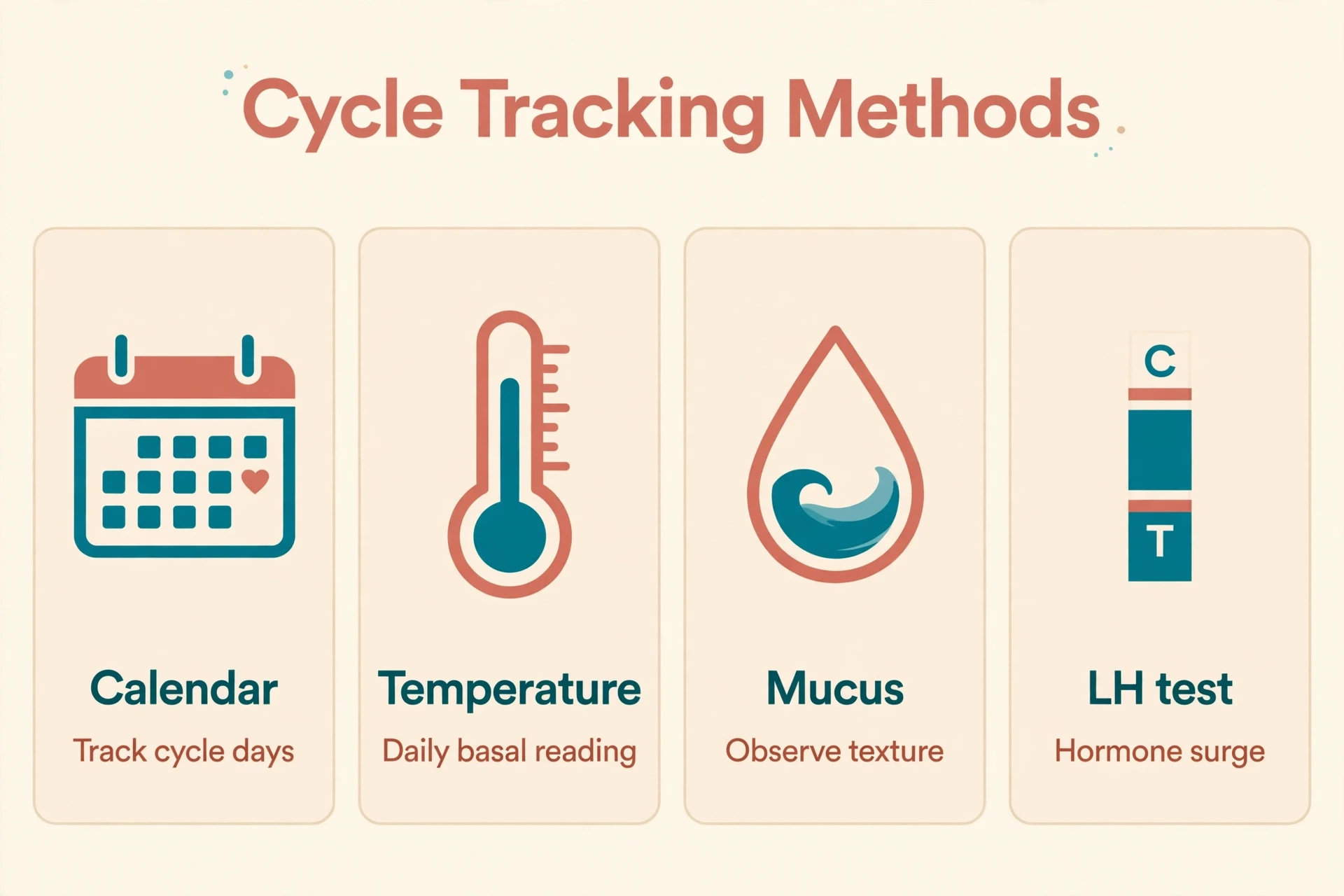
Method | What it measures | Timing | Main strength | Main limit |
|---|---|---|---|---|
Calendar | Past cycle lengths | Predicts the future | Simple; shows patterns over months | Assumes the future matches the past |
Basal temperature | Progesterone's effect on temperature | Confirms ovulation after it happens | Confirms ovulation happened | Cannot predict ovulation; disturbed by illness and sleep |
Cervical mucus | Estrogen's effect on mucus | Appears before ovulation | Most useful sign for timing | Needs practice; can be confused by other fluids |
LH test | LH surge in urine | 24–36 hours before ovulation | Direct hormone measurement | A surge does not guarantee ovulation |
Table 4: Tracking methods compared. No single method is enough on its own; the combination is stronger than any one part.
13.5 Apps, and a warning about contraception
Menstrual tracking apps combine the calendar method with, sometimes, temperature and mucus inputs, and they are useful for the same reason calendars are: they reveal patterns over months. Their weakness is the same too, with one addition: many apps present a predicted fertile window as if it were measured, when it is only calculated from past cycle lengths. An app that has never measured your LH or your temperature cannot know when you ovulated. It can only guess from your history. That matters most for contraception. Calendar-based methods, including app-based ones, are not reliable contraception on their own: their typical-use failure rates are substantially higher than those of hormonal or barrier methods, and they vary widely between people and between apps. Anyone relying on tracking to avoid pregnancy should discuss the method with a clinician rather than trusting an app's prediction. Tracking is a tool for understanding. It is not, by itself, a method of contraception.
14. When Cycles Change: Puberty, Pregnancy, Breastfeeding, and Perimenopause
The menstrual cycle is not the same at every age. It begins irregularly, settles into a pattern, is interrupted by pregnancy and breastfeeding, and ends irregularly. Each of those changes has a mechanism, and each is normal — which is not the same as saying each is comfortable. This section follows the cycle across a lifetime, from the first period to the last.
14.1 Menarche: the first period, and the years after it
Menarche — the first period — happens at a median age of about 12 to 13 years in countries with good nutrition, and the average has been falling slowly: a 2024 study of more than 71,000 participants in the Apple Women's Health Study found that people born between 2000 and 2005 had a first period at an average age of 11.9 years, compared with 12.5 years for those born between 1950 and 1969 (Wang et al., JAMA Network Open, 2024). The first cycles are often irregular, because the hypothalamic-pituitary-ovarian axis is still maturing and many early cycles do not ovulate. In the first year after menarche, about 90 percent of cycles fall between 21 and 45 days. By the third year, 60 to 80 percent of cycles are between 21 and 34 days, the adult pattern. It can take up to six years after menarche for cycles to fully stabilise. Irregular periods in the first years are normal, and they are also the reason the American College of Obstetricians and Gynecologists recommends treating the cycle as a vital sign in adolescents: a pattern that is abnormal for an adolescent — no period by 15, cycles more often than every 21 days or less often than every 45 days, a gap of 90 days, bleeding longer than 7 days — is worth a closer look, because it can be the first sign of a condition that will matter in adulthood.
14.2 Pregnancy: the cycle stops
Pregnancy stops the menstrual cycle, and the mechanism is the one described in section 8: the embryo makes hCG, hCG rescues the corpus luteum, progesterone stays high, and the lining is not shed. The cycle does not pause. It is replaced. The ovaries stop ovulating, the uterus stops cycling, and the whole system is redirected to supporting the pregnancy. The cycle returns after birth, but not immediately, and not on a schedule.
14.3 Breastfeeding: the cycle returns slowly
Breastfeeding delays the return of the menstrual cycle, because the hormone prolactin, which drives milk production, suppresses the GnRH pulses from the hypothalamus. The effect is strongest with frequent, exclusive breastfeeding, and it fades as breastfeeding becomes less frequent. The first cycles after breastfeeding returns are often irregular and may not ovulate. It is worth saying plainly that breastfeeding is not reliable contraception on its own, even though it delays the return of fertility: ovulation returns before the first period, so a pregnancy can begin before any bleeding warns that fertility has returned.
14.4 Perimenopause: the cycle becomes erratic again
Perimenopause — the transition to menopause — usually begins in the forties, sometimes in the late thirties, and lasts on average about four years, though it can be much longer. Its defining feature is not that hormones fall, but that they become erratic. Estrogen can swing high before it falls. Progesterone declines first, because ovulation becomes less regular, and progesterone is only made after ovulation. Cycles shorten, lengthen, skip, and become heavier or lighter, often in the same year. Hot flushes, night sweats, sleep disturbance and mood changes are common in this window. The transition ends with menopause, which is defined as a single point: the day that marks 12 consecutive months without a period. The average age of natural menopause is about 51, with most women reaching it between 45 and 55. After menopause, the ovaries have largely stopped releasing eggs and making estrogen and progesterone, and the menstrual cycle is over. The end of the cycle is not a failure. It is the end of a stock that was set before birth, spent over decades, one egg at a time.
15. When Something Is Off: Irregular, Heavy, Missing, or Painful Periods
Most cycles fall inside the normal range: 21 to 35 days apart, bleeding for 2 to 7 days, blood loss of about 30 millilitres. But "normal" is a range, not a single number, and the edges of the range are where the information lives. This section describes the patterns that clinicians consider worth a conversation, and the table at the end collects them in one place. Nothing here is a diagnosis. It is general information about patterns, written so that a reader can recognise them and decide to ask a clinician.
15.1 Irregular cycles
A cycle is considered irregular when its length varies a lot from month to month, or when it falls outside the 21 to 35 day range in adults. The American College of Obstetricians and Gynecologists treats a cycle length that varies by more than 7 to 9 days as irregular, and periods that come fewer than 21 days apart or more than 35 days apart count as irregular too — for example, cycles of 28 days, then 37, then 29. Normal ranges differ slightly by source: the Cleveland Clinic and NHS give 21–35 days with bleeding of 2–7 days, while the Mayo Clinic gives 24–38 days with bleeding of up to 8 days. Irregular cycles are common in the first years after menarche and in perimenopause, when ovulation itself is irregular. In the reproductive years between, persistent irregularity often means ovulation is not happening regularly, and the causes range from stress and weight change to thyroid disorders and polycystic ovary syndrome. A single irregular cycle is usually nothing to worry about. A pattern of them is worth a conversation.
15.2 Heavy bleeding
Heavy menstrual bleeding — menorrhagia, in medical language — is defined by blood loss above about 80 millilitres per cycle, or by its practical signs: soaking through a pad or tampon every hour for several hours, passing clots larger than a coin, bleeding for longer than seven days, or needing to change protection during the night. Heavy bleeding is one of the most common reasons people seek care for their periods, and it has many causes: fibroids, adenomyosis, polyps, bleeding disorders, thyroid disorders, and the hormonal changes of perimenopause, among others. It is also a frequent cause of iron deficiency in reproductive-age women. Heavy bleeding is not a normal variation to endure. It is a symptom, and it deserves to be investigated.
15.3 Missing periods
A missed period — amenorrhoea — has a definition too. In adolescents, a gap of 90 days between periods, even once, is a reason to seek care, as is no period by age 15. In adults, missing three periods in a row, with a negative pregnancy test, is the usual threshold. The causes are many: pregnancy, breastfeeding, stress, major weight loss or gain, intense exercise, thyroid disorders, polycystic ovary syndrome, and premature ovarian insufficiency, among others. The pattern matters: a period that stops suddenly after years of regular cycles is different from a period that never became regular, and a clinician will ask about both. A missed period is not, on its own, a diagnosis of anything. It is a signal that the hormonal loop has been interrupted, and the question is where.
15.4 Painful periods
Pain that regularly keeps someone home from school or work, pain that does not respond to the usual over-the-counter measures, or pain that gets worse over time rather than better, is worth a conversation. The most common cause of severe period pain is endometriosis, in which lining-like tissue grows outside the uterus, and the next section describes it in more detail. Other causes include fibroids and adenomyosis. The point is not to alarm. Most period pain is primary dysmenorrhoea — pain without an underlying condition — and it is common and manageable. The point is that pain that interferes with life is not something to accept as the price of having a cycle. It is a symptom, and symptoms are information.
Pattern | What it looks like | General information |
|---|---|---|
Irregular cycles | Cycles shorter than 21 days or longer than 35 days; length varies by more than 9 days | Often means ovulation is irregular; common after menarche and in perimenopause |
Heavy bleeding | Soaking protection hourly for hours; clots larger than a coin; bleeding over 7 days | Blood loss above about 80 mL per cycle; linked to iron deficiency |
Missing periods | No period for 90 days (adolescents) or three missed periods (adults) | The hormonal loop has been interrupted; many possible causes |
Severe pain | Pain that keeps someone home, or that worsens over time | Most often primary dysmenorrhoea; sometimes endometriosis or fibroids |
Bleeding between periods | Spotting or bleeding outside the period | Can have many causes; worth a conversation, especially after menopause |
Table 5: Patterns that deserve a conversation with a clinician. This is general information, not a diagnosis, and not a substitute for care.
16. Common Conditions Behind Irregular Cycles
When the menstrual cycle goes wrong, the cause is usually one of a small number of conditions, and each one has a mechanism that follows from the cycle itself. This section describes the common ones briefly — what they are, how common they are, and how they disturb the cycle. It is not a diagnostic guide. It is a map of the territory, so that a reader who hears one of these names from a clinician has a starting point.
16.1 Polycystic ovary syndrome (PCOS)
Polycystic ovary syndrome is a hormonal condition that disrupts ovulation. The World Health Organization estimates it affects 10 to 13 percent of reproductive-age women, and that up to 70 percent of them do not know they have it. The name is misleading: the "cysts" are not cysts in the usual sense but small follicles that have started to grow and then stopped, and the condition is not only about the ovaries. It involves insulin resistance, higher levels of androgens, and irregular or absent ovulation, which is why cycles become long and unpredictable. The WHO calls it the most common cause of anovulation worldwide and a leading cause of infertility. The link with insulin is the reason weight and metabolism matter here, and the companion article on obesity follows the hormones of appetite and weight in detail. A note on naming: in May 2026, a global consensus published in The Lancet formally renamed the condition polyendocrine metabolic ovarian syndrome, or PMOS, on the grounds that the old name misleads (Teede et al., 2026). The WHO's fact sheet, published in January 2026, predates the rename and still uses PCOS — as does this article, for now, since PCOS remains the term most readers will search for.
16.2 Endometriosis
Endometriosis is a condition in which tissue similar to the lining of the uterus grows outside the uterus — on the ovaries, the fallopian tubes, the bowel or elsewhere in the pelvis. The World Health Organization puts the figure at about 10 percent of reproductive-age women and girls worldwide, roughly 190 million people, and its fact sheet on the condition was updated in October 2025. The tissue responds to the menstrual cycle like the lining does: it thickens, breaks down and bleeds, but the blood has nowhere to go, which causes inflammation, scarring and pain. The symptoms are severe pain during periods, heavy bleeding, chronic pelvic pain, pain during intercourse, and infertility — as many as 25 to 50 percent of women with infertility have endometriosis. There is no cure, and diagnosis is often delayed by years, because the symptoms are frequently dismissed as normal period pain. They are not. Pain that regularly disrupts life is a symptom, not a rite of passage.
16.3 Fibroids and adenomyosis
Uterine fibroids are non-cancerous growths in the muscle of the uterus, and they are extremely common: by age 50, most women have had at least one, though many never cause symptoms. When they do, the main symptom is heavy or prolonged bleeding, and sometimes pain or pressure. Adenomyosis is a related condition in which endometrial tissue grows into the muscle of the uterus, causing heavy bleeding and pain. Both are conditions of the uterus itself, rather than of the hormonal loop, and both are reasons why heavy bleeding deserves investigation rather than endurance.
16.4 Thyroid disorders, stress and energy
The thyroid gland makes hormones that regulate metabolism, and thyroid disorders — both overactive and underactive — can disturb the menstrual cycle, making periods irregular, heavy, light or absent. Stress, severe weight loss, and intense exercise can disturb it too, by suppressing the GnRH pulses from the hypothalamus. When the body is under severe energy stress — too few calories for the energy being spent — the brain treats reproduction as a luxury it cannot afford, and ovulation is delayed or stopped. This is the same logic that links the cycle to exercise: training hard enough, for long enough, without enough fuel, can stop periods, and the companion article on how exercise changes the body follows the body's response to training in detail. The menstrual cycle is a vital sign because it listens to the whole body, and these are the ways the whole body talks back.
16.5 PMDD, again: a condition, not a mood
Premenstrual dysphoric disorder was described in section 12, and it belongs here too, because it is one of the conditions that can hide behind a normal-looking cycle. A woman with PMDD may have perfectly regular cycles, normal hormone levels, and a normal period — and still spend the last week of every cycle in severe distress. The regularity of the cycle is what makes PMDD easy to miss: there is nothing visibly wrong with the bleeding, and the suffering happens in the days before it. If the mood symptoms described in section 12 sound familiar, and if they follow the cycle month after month, that pattern is worth describing to a clinician, in those words, with a record of when the symptoms appear and when they ease.
17. A Lifetime of Cycles: From First Period to Last
A single menstrual cycle is a month. A lifetime of cycles is a different scale, and it is worth stepping back to see it. Menstruation begins at about 12 or 13, and ends at about 51. In between are roughly four decades, hundreds of cycles, and a slow, steady spending of the egg supply that was set before birth. The cycle is not a static system. It changes as the body changes, and the changes tell a story about ageing that is easy to miss when each cycle is looked at on its own.
17.1 The egg supply, spent one month at a time
The numbers are stark, and they are worth repeating in one place. At 20 weeks of fetal life, the ovaries hold about 6 to 7 million eggs. At birth, about 1 to 2 million. At puberty, about 300,000 to 400,000. Across a reproductive life, about 400 to 500 are ovulated. The rest are lost to atresia, about a thousand a month, whether or not ovulation happens. The supply is not replenished, and it is not saved by skipping cycles: hormonal contraception, pregnancy and breastfeeding pause ovulation, but they do not pause atresia, and they do not extend the supply. The egg supply is a clock that runs whether or not the cycle does, and menopause arrives when it runs low — not when a fixed number of cycles has passed, but when the follicles that remain can no longer respond to FSH. The cycle is, in this sense, a countdown, and it has been counting down since before birth.
17.2 The pill and the cycle
Combined hormonal contraception — the pill, the patch, the ring — works mainly by suppressing ovulation. The estrogen and progestin in the pill suppress FSH and LH, so no follicle is selected and no LH surge happens. The bleeding that follows the hormone-free interval is a withdrawal bleed, not a true period: it happens because the hormones are withdrawn, not because a cycle has run its course. That distinction matters, because it means the pill does not "regulate" the cycle in the sense of fixing it. It replaces the cycle with a controlled hormonal schedule. When the pill is stopped, the cycle usually returns within a few months, because the hormonal loop was suppressed, not damaged. The pill does not cause infertility, and it does not use up the egg supply faster or slower. It pauses ovulation, and ovulation resumes.
17.3 How the cycle ends
Menopause arrives when the ovaries can no longer respond to FSH, and the menstrual cycle ends. The average age is about 51, and the range is wide — 45 to 55 for most women, earlier for some, later for others. The end is not sudden. In perimenopause, cycles become erratic, ovulation becomes irregular, and the hormones swing. Then the periods stop, and after 12 months without one, menopause is declared. The ovaries do not disappear. They continue to make small amounts of hormones, mainly androgens, and the adrenal glands continue to make precursors that are converted to estrogen in fat tissue. But the cycle — the monthly loop of follicle, egg, lining and shedding — is over. It ran for about four decades, hundreds of times, and it ended the way it began: gradually, irregularly, and on its own schedule.
18. Common Mistakes and Misconceptions
The menstrual cycle is one of the most misunderstood processes in human biology, and the misunderstandings are not harmless. They lead people to mistrust their own bodies, to miss their fertile window, to endure pain they should not endure, and to trust apps that cannot know what they claim to know. This section collects the most common mistakes, and corrects each one plainly.
18.1 "Ovulation always happens on day 14"
This is the most common mistake, and the most consequential. Ovulation happens about 14 days before the next period, not 14 days after the last one. In a 28-day cycle, those are the same day. In any other cycle, they are not. With a 35-day cycle, ovulation falls near day 21. With a 24-day cycle, ovulation falls around day 10. The day-14 rule is true only for the minority of women whose cycles are 28 days long — about 13 percent of cycles, according to the largest dataset ever analysed. For everyone else, it is wrong, and it is wrong by days, which is enough to miss the fertile window entirely.
18.2 "The pill gives you a real period"
The bleeding on the pill is a withdrawal bleed, not a period. It happens because the hormones in the pill are withdrawn for a few days, not because an egg was released and a lining was shed. There is no cycle underneath it, no ovulation, no corpus luteum, and no luteal phase. The distinction matters because it changes what the bleeding means: a missed withdrawal bleed on the pill does not mean the same thing as a missed period off it, and the absence of bleeding on some pill regimens does not mean something is wrong.
18.3 "You cannot get pregnant on your period"
Pregnancy during a period is unlikely, but it is not impossible. Sperm survive up to five days, and in a short cycle — say, 21 days — ovulation can happen as early as day 7 or 8, which is only a few days after bleeding ends, or even while it is still happening. Sperm deposited in the last days of a period can still be alive when the egg is released. The fertile window is set by biology, not by the calendar, and the calendar does not protect anyone.
18.4 "PMS is just moodiness"
Premenstrual syndrome is a recognised medical condition with defined criteria, and premenstrual dysphoric disorder is listed as a depressive disorder. The symptoms are caused by the brain's sensitivity to the normal hormonal changes of the luteal phase, and they can be severe enough to interfere with work, school and relationships. Calling them moodiness is not a description. It is a dismissal, and it has kept a condition that affects a fifth to two-fifths of menstruating women from being taken seriously for decades.
18.5 "Heavy periods are normal"
Heavy periods are common, but common is not the same as normal. Soaking through protection every hour for hours, passing large clots, or bleeding for longer than seven days is heavy menstrual bleeding, and it is a symptom with causes — fibroids, adenomyosis, bleeding disorders, thyroid disorders — that can be investigated and treated. Heavy bleeding is also a common route to iron deficiency in reproductive-age women. Enduring it is not resilience. It is an untreated symptom.
18.6 "A tracking app knows when I ovulate"
A tracking app that has only ever recorded the dates of your periods cannot know when you ovulated. It can only estimate from your past cycle lengths, and that estimate assumes your follicular phase is the same length every month, which it is not. Apps are useful for spotting patterns over months. They are not a measurement of ovulation, and they are not reliable contraception. The methods that do measure ovulation — LH tests, temperature, mucus — are described in section 13, and they work because they measure something in the body, not something in the calendar.
18.7 "The cycle is 28 days"
The cycle is not 28 days. The average is about 29 days, the normal range is 21 to 35 days, and only about 13 percent of cycles are exactly 28 days long. A 28-day cycle is an average, not a rule, and treating it as a rule is the mistake from which most of the others follow. The menstrual cycle is a loop with a variable first half and a fixed second half, and once that is understood, the calendar stops being a source of anxiety and starts being what it should have been all along: a tool.
19. Frequently Asked Questions
19.1 How does the menstrual cycle work?
The menstrual cycle works as a hormone loop between the brain, the ovaries and the uterus. The hypothalamus releases GnRH in pulses, the pituitary releases FSH and LH, FSH grows a follicle, estrogen rebuilds the lining, an LH surge triggers ovulation, and the corpus luteum releases progesterone to prepare the lining. If pregnancy does not begin, the corpus luteum fades, the hormones fall, and the lining sheds as a period. Bleeding marks day one of the next cycle, and the loop begins again.
19.2 What are the four phases of the menstrual cycle?
The four phases of the menstrual cycle are the menstrual phase (days 1–5, the lining sheds), the follicular phase (days 1–13, a follicle matures and estrogen rises), ovulation (around day 14 in a 28-day cycle, the egg is released), and the luteal phase (days 15–28, progesterone prepares the lining). Those day numbers describe a 28-day cycle; in longer or shorter cycles, the follicular phase stretches or shrinks while the luteal phase stays close to 12 to 14 days.
19.3 When does ovulation happen?
Ovulation falls about 14 days before the next period, not necessarily on day 14 of the cycle. It follows the LH surge by about 24 to 36 hours. In a 28-day cycle, that is around day 14. With a 35-day cycle, it is around day 21. With a 24-day cycle, it is around day 10. The reliable way to estimate it is to count back 14 days from the next expected period, or to detect the LH surge with a urine test.
19.4 What hormones control the menstrual cycle?
Five hormones control the menstrual cycle: GnRH from the hypothalamus, FSH and LH from the pituitary, and estrogen and progesterone from the ovaries. GnRH signals the pituitary in pulses. FSH grows follicles. LH triggers ovulation. Estrogen rebuilds the lining and triggers the LH surge. Progesterone transforms and maintains the lining. Inhibin, from the follicles and the corpus luteum, holds FSH down.
19.5 How long is a normal menstrual cycle?
A normal menstrual cycle in adults is 21 to 35 days long, measured from the first day of one period to the first day of the next. The average is about 28 to 29 days, but only about 13 percent of cycles are exactly 28 days. Bleeding normally lasts 2 to 7 days. Cycles are often longer and more variable in the first years after menarche and in perimenopause.
19.6 What is a normal period?
A normal period lasts 2 to 7 days, comes every 21 to 35 days, and involves about 30 millilitres of blood loss — roughly two to three tablespoons. Small clots and colour changes across the days of the period are normal. Bleeding that soaks through protection every hour for hours, passes clots larger than a coin, or lasts longer than seven days is considered heavy, and is worth a conversation with a clinician.
19.7 Can you get pregnant during your period?
Pregnancy during a period is unlikely but possible. Sperm can survive for up to five days in the reproductive tract, and in a short cycle ovulation can happen only a few days after bleeding ends. Sperm left over from the last days of a period may still be alive at ovulation. The fertile window is the five days before ovulation plus ovulation day, and in short cycles that window can overlap with the end of the period.
20. Sources
Cleveland Clinic — Menstrual Cycle (Normal Menstruation). https://my.clevelandclinic.org/health/articles/10132-menstrual-cycle
American College of Obstetricians and Gynecologists — Committee Opinion 651: Menstruation in Girls and Adolescents: Using the Menstrual Cycle as a Vital Sign (2015). https://www.acog.org/clinical/guidance/committee-opinion/2015/12/menstruation-in-girls-and-adolescents-using-the-menstrual-cycle-as-a-vital-sign
NHS — Periods. https://www.nhs.uk/conditions/periods/
Office on Women's Health (US Department of Health and Human Services) — Your Menstrual Cycle. https://www.womenshealth.gov/menstrual-cycle
MedlinePlus (US National Library of Medicine) — Menstruation. https://medlineplus.gov/menstruation.html
LibreTexts Medicine — Hormonal Regulation of the Female Reproductive Cycles. https://med.libretexts.org/Courses/Las_Positas_College/BIO_50%3A_Anatomy_and_Physiology_(Zingg)/13%3A_Genitourinary_(a.k.a._Urogenital_)_System/13.14%3A_Hormonal_Regulation_of_the_Female_Reproductive_Cycles
OpenStax — Anatomy and Physiology 2e, Chapter 27: The Reproductive System (ovarian and uterine cycles). https://openstax.org/books/anatomy-and-physiology-2e/pages/27-2-anatomy-and-physiology-of-the-ovarian-reproductive-system
Bull, J. R. et al. — Real-world menstrual cycle characteristics of more than 600,000 menstrual cycles, npj Digital Medicine, 2019. https://doi.org/10.1038/s41746-019-0152-7
Wilcox, A. J. et al. — Timing of sexual intercourse in relation to ovulation, New England Journal of Medicine, 1995. https://doi.org/10.1056/NEJM199512073332301
Wilcox, A. J. et al. — The timing of the "fertile window" in the menstrual cycle, BMJ, 2000. https://doi.org/10.1136/bmj.321.7271.1259
Dunson, D. B. et al. — Day-specific probabilities of clinical pregnancy based on two studies with imperfect measures of ovulation, Human Reproduction, 1999. https://doi.org/10.1093/humrep/14.7.1835
World Health Organization — Endometriosis (fact sheet, updated 15 October 2025). https://www.who.int/news-room/fact-sheets/detail/endometriosis
World Health Organization — Polycystic ovary syndrome (fact sheet, 22 January 2026). https://www.who.int/news-room/fact-sheets/detail/polycystic-ovary-syndrome
Cleveland Clinic — Irregular Periods (Abnormal Menstruation). https://my.clevelandclinic.org/health/diseases/14633-abnormal-menstruation-periods
Mayo Clinic — Menstrual cycle: What's typical, what's not. https://www.mayoclinic.org/healthy-lifestyle/womens-health/in-depth/menstrual-cycle/art-20047186
NHS — Heavy periods. https://www.nhs.uk/conditions/heavy-periods/
NHS — Premenstrual syndrome (PMS). https://www.nhs.uk/conditions/pre-menstrual-syndrome/
NHS — Endometriosis. https://www.nhs.uk/conditions/endometriosis/
NHS — Polycystic ovary syndrome (PCOS). https://www.nhs.uk/conditions/polycystic-ovary-syndrome-pcos/
MedlinePlus — Polycystic ovary syndrome. https://medlineplus.gov/polycysticovarysyndrome.html
MedlinePlus — Endometriosis. https://medlineplus.gov/endometriosis.html
MedlinePlus — Premenstrual syndrome. https://medlineplus.gov/premenstrualsyndrome.html
American College of Obstetricians and Gynecologists — Management of Premenstrual Disorders: ACOG Clinical Practice Guideline No. 7 (Obstetrics and Gynecology, 2023). https://www.acog.org/clinical/guidance/clinical-practice-guideline/2023/12/management-of-premenstrual-disorders
Cleveland Clinic — Premenstrual Syndrome (PMS). https://my.clevelandclinic.org/health/diseases/24288-pms-premenstrual-syndrome
Cleveland Clinic — Premenstrual Dysphoric Disorder (PMDD). https://my.clevelandclinic.org/health/diseases/9132-premenstrual-dysphoric-disorder-pmdd
Cleveland Clinic — Ovulation. https://my.clevelandclinic.org/health/articles/23439-ovulation
Cleveland Clinic — Corpus Luteum. https://my.clevelandclinic.org/health/body/21849-corpus-luteum
Cleveland Clinic — Menopause. https://my.clevelandclinic.org/health/diseases/21841-menopause
Office on Women's Health — Polycystic ovary syndrome. https://www.womenshealth.gov/a-z-topics/polycystic-ovary-syndrome
Office on Women's Health — Endometriosis. https://www.womenshealth.gov/a-z-topics/endometriosis
National Institute of Child Health and Human Development — Menstruation and the Menstrual Cycle. https://www.nichd.nih.gov/health/topics/menstruation
American Society for Reproductive Medicine — The Menstrual Cycle. https://www.reproductivefacts.org/news-and-publications/patient-fact-sheets-and-booklets/documents/fact-sheets-and-info-booklets/the-menstrual-cycle/
Wang, Z. et al. — Menarche and Time to Cycle Regularity Among Individuals Born Between 1950 and 2005 (Apple Women's Health Study), JAMA Network Open, 2024. https://doi.org/10.1001/jamanetworkopen.2024.12854
Teede, H. et al. — Polyendocrine metabolic ovarian syndrome, the new name for polycystic ovary syndrome: a multistep global consensus process, The Lancet, 2026. https://doi.org/10.1016/S0140-6736(26)00717-8