
1. The Hand That Would Not Stay Still
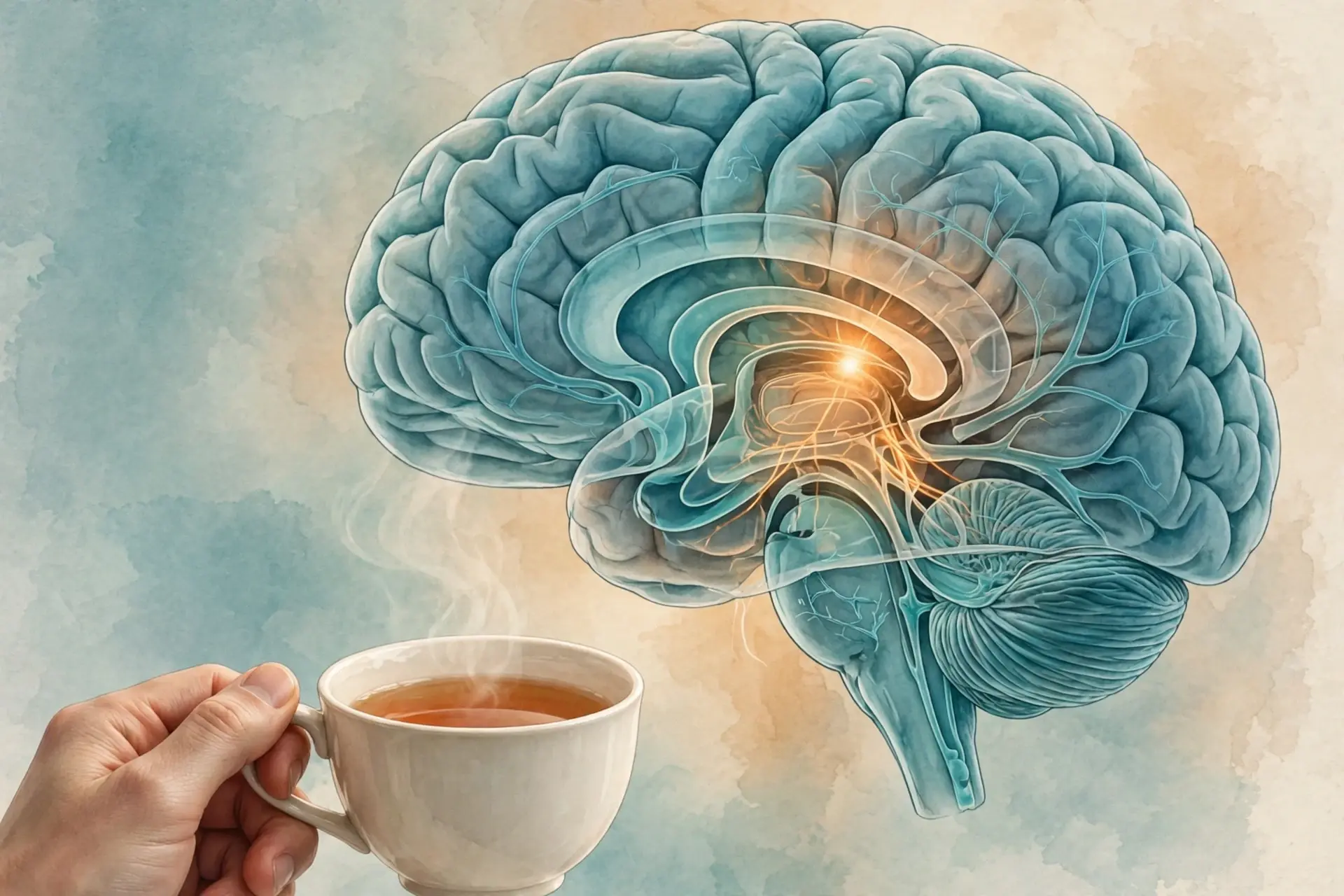
It started with a teacup. Not a fall, not a dramatic collapse, just a teacup that rattled faintly against its saucer on a quiet morning, held in a hand that was doing nothing at all. The hand was at rest, sitting in a lap, and still it moved — a small, steady shake, four to six times a second, as regular as a metronome. When the hand reached for the cup, the shaking stopped. When it rested again, the shaking came back. That detail matters, and it is the detail that separates Parkinson's disease from almost every other kind of tremor: in Parkinson's disease, the shaking shows up when the hand is doing nothing, and it goes quiet when the hand gets to work.
I have watched that moment land on people, and it is never the tremor itself that frightens them most. It is the question that follows it. What is happening inside my brain? Will it get worse? How fast? The honest answer is that Parkinson's disease is slow, uneven, and deeply individual — and that the science behind it is far richer than the single word "tremor" suggests. This article follows the whole story: the small cluster of neurons that dies first, the chemical messenger they make, the two competing circuits in the brain that fall out of balance when that messenger runs low, the protein that clumps where it should not, the symptoms that arrive years before any shaking, and the treatments that — while they cannot yet cure the disease — can give people years of better movement.
Parkinson's disease is the second most common neurodegenerative disorder in the world, after Alzheimer's disease. The Global Burden of Disease Study 2021 counted about 11.8 million people living with Parkinson's disease worldwide in 2021, up from about 3.2 million in 1990 — a rise of roughly 274 percent in three decades. A modelling study published in the BMJ in 2025 projected that number could reach 25.2 million by 2050, more than double the 2021 figure, driven mostly by the simple fact that the world's population is getting older. In the United States, about 1 million people live with Parkinson's disease, and close to 90,000 Americans receive the diagnosis each year — about one person every six minutes. Those numbers are large, and they are still growing. They are also the reason this disease deserves a careful, plain-language explanation rather than a list of symptoms.
1.1 The answer in short: what is Parkinson's disease?
Parkinson's disease is a progressive disorder of the nervous system in which nerve cells in a small region deep in the brain — the substantia nigra — gradually weaken, become damaged, and die. Those cells make dopamine, a chemical messenger the brain uses to produce smooth, purposeful movement. By the time the first movement symptoms appear, most people have already lost 60 to 80 percent or more of those dopamine-producing cells, according to the National Institute of Neurological Disorders and Stroke. The brain compensates for a long time, quietly, and then it cannot compensate any more — and that is when the tremor, the stiffness, and the slowness show up.
But Parkinson's disease is not only a movement disorder, and dopamine is not the whole story. The same disease process damages nerve cells in the gut, the nose, the sleep centres, and the parts of the brain that handle mood, blood pressure, and thinking. Many of those problems arrive years before the first tremor. That is why the modern picture of Parkinson's disease looks less like a single broken part and more like a slow, spreading process — one that begins quietly, in places nobody would think to look, and only later reaches the movement system where it becomes visible.
2. What Parkinson's Disease Actually Is
To understand Parkinson's disease, it helps to start with what it is not. It is not contagious. It is not a normal part of ageing, even though age is by far its strongest risk factor. It is not one disease with one speed: two people given the same diagnosis on the same day can be in very different places ten years later. And it is not, despite the name it carries, a disease that James Parkinson himself fully understood when he first described it in 1817. He called it the "shaking palsy" and described six cases in a 66-page essay. He noticed the tremor, the stooped posture, the shuffling walk. What he could not see — what nobody could see for another century and a half — was the chemistry underneath.
The definition used by clinicians today is straightforward. Parkinson's disease is a progressive neurodegenerative disorder defined by the loss of dopamine-producing neurons in the substantia nigra and by the presence, in the brain cells that remain, of clumps of a protein called alpha-synuclein, known as Lewy bodies. Diagnosis is clinical: there is no blood test that can confirm it. A neurologist makes the diagnosis from the history and the examination — bradykinesia, slowness of movement, plus at least one of rigidity, rest tremor, or postural instability — and by ruling out other conditions that can look similar. That clinical approach is good, but it is not perfect — the accuracy figures, and the conditions that mimic the disease, are covered in detail in section 14. What matters here is that the search for a reliable biological test matters so much — and why a newer test, the alpha-synuclein seed amplification assay, has drawn so much attention in the last few years.
Parkinson's disease affects about 1 percent of people over the age of 60, and 3 to 4 percent of people over 80. The average age at which symptoms begin is the early to mid-60s. Men are diagnosed about 1.5 times as often as women. And yet the disease is not only a disease of old age: 5 to 10 percent of cases begin before the age of 50, a form called young-onset Parkinson's disease, and the actor Michael J. Fox — diagnosed at 29 — is the most widely known example. Those numbers frame the disease, but they do not explain it. For that, you have to go inside the brain's movement system, and meet the small group of cells whose death sets everything else in motion.
3. A Tour of the Brain's Movement System
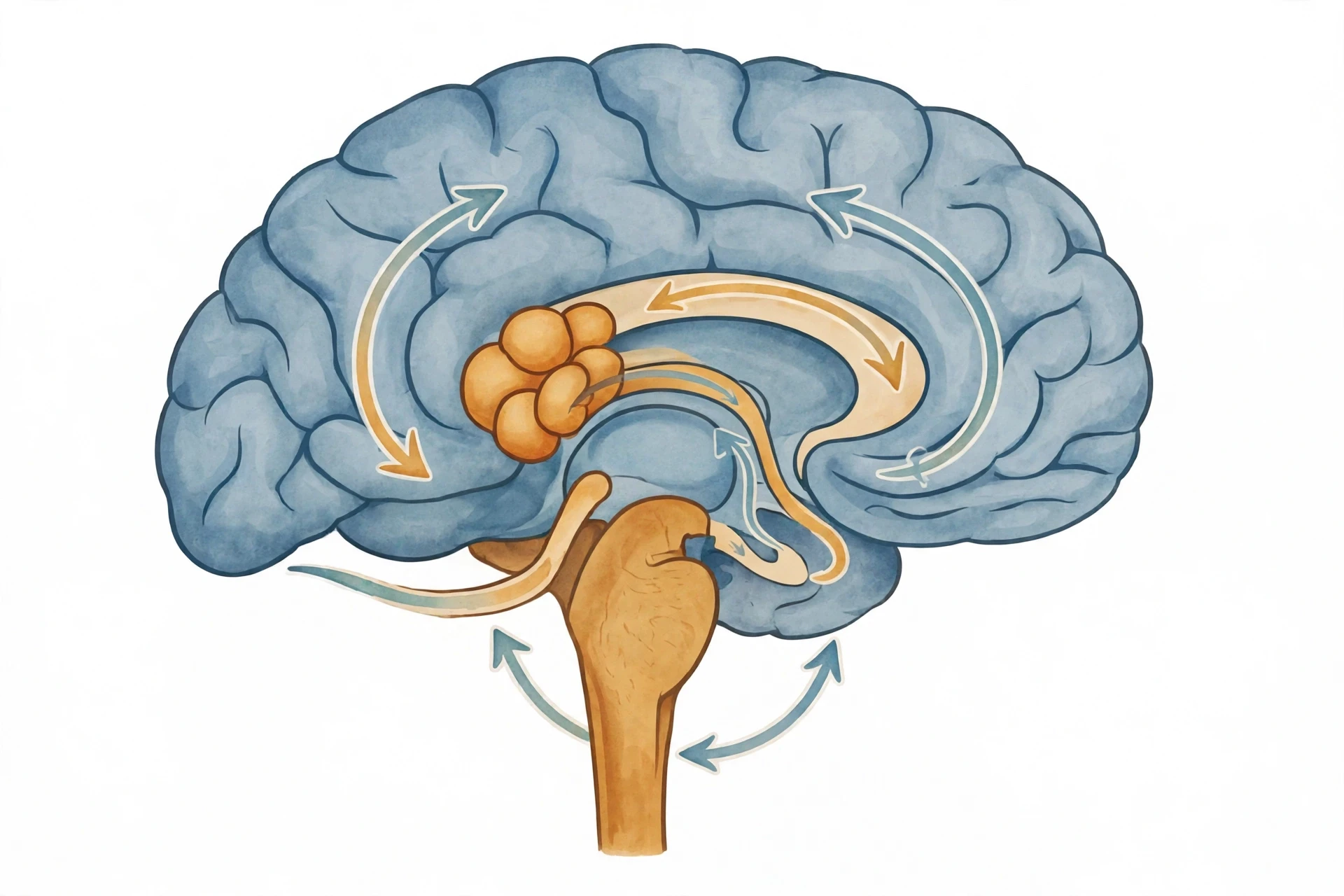
Every movement you make — lifting a cup, signing your name, taking a step — is the end product of a loop. The cortex, the folded outer layer of the brain, decides what to do. It sends that plan down to a cluster of structures buried deep in the middle of the brain called the basal ganglia. The basal ganglia do not start the movement. They shape it: they pick which movement to allow, suppress the movements that would compete with it, and set how big, how fast, and how smooth it should be. Their output goes to the thalamus, a relay station, which passes the refined signal back up to the cortex. The loop runs again and again, hundreds of times a second, and when it works well you never notice it at all. You just move.
The basal ganglia are made of several parts, and their names are worth learning, because each one plays a distinct role in Parkinson's disease:
The striatum — the caudate nucleus and the putamen — is the entrance hall. It receives the plan from the cortex and is the main target of the dopamine signal.
The globus pallidus — an inner segment and an outer segment — is part of the output machinery that talks to the thalamus.
The subthalamic nucleus is a small structure that acts as an amplifier in one of the two pathways through the system.
The substantia nigra sits in the midbrain, below the basal ganglia. Its dark, compact part — the substantia nigra pars compacta — is where the dopamine-making neurons live.
Think of the basal ganglia as a committee that votes on every movement. The cortex proposes: "lift the cup." Some committee members vote yes, others vote no, and the balance of those votes decides whether the movement goes ahead, how strongly, and how smoothly. Dopamine is not a vote itself. It is the chair of the committee. It makes the yes votes louder and the no votes quieter. When dopamine is plentiful, wanted movements flow and unwanted ones stay suppressed. When dopamine runs low, the committee deadlocks: wanted movements struggle to get approved, and the whole system becomes slow, stiff, and hesitant. That deadlock is Parkinson's disease, seen from the inside.
If you want the fuller tour of the nervous system — neurons, action potentials, the spinal cord, and the autonomic system that runs your heartbeat and digestion without asking permission — the companion article How the Nervous System Works walks through it step by step. What matters here is one loop inside that system, and one chemical messenger that keeps it balanced.
3.1 Why a small cluster of cells matters so much
There are only about 400,000 to 600,000 dopamine-producing neurons in the human substantia nigra on each side of the brain — a tiny number next to the brain's roughly 86 billion neurons. Each one, though, is a marathon runner: a single substantia nigra neuron can send out an axon that branches enormously, forming one to two and a half million synaptic connections in the striatum. That architecture is powerful, and it is also fragile. When one of these neurons dies, the striatum loses not one connection but an enormous fan of them. The system has redundancy — it can lose many of these cells before anything shows — but that redundancy is also the reason the disease is so far advanced by the time it is noticed. The brain hides its losses until it cannot.
That hiding is the first of several quiet tragedies in Parkinson's disease. The second is that these particular neurons seem unusually vulnerable. They are long, highly branched, and constantly active, firing in a steady pacemaker rhythm even at rest. They burn a great deal of energy, handle a great deal of calcium, and carry the dark pigment neuromelanin — the substance that gives the substantia nigra its name, "black substance." Why exactly they die first is still an open question, and the honest answer is that researchers disagree about the order of causes: faulty mitochondria, oxidative stress, protein-handling failures, inflammation, and genetic risk all appear in the story, and none of them alone explains every case. What is settled is the result. When enough of these cells are gone, the dopamine signal to the striatum collapses, and the movement loop loses its chair.
4. Dopamine: The Messenger That Makes Movement Smooth
Dopamine has a public relations problem. Ask most people what it does, and they will say it is the "pleasure chemical" — the molecule of reward, of addiction, of the little rush from a like on a phone screen. That is not wrong, exactly, but it is a small corner of a much larger job. In the brain, dopamine is a modulator: a chemical that tunes how strongly other signals get through. The same molecule does different work in different circuits. In the reward circuit, running from the ventral tegmental area to the nucleus accumbens, it helps mark things as worth pursuing. In the movement circuit, running from the substantia nigra to the striatum, it sets the gain on movement itself. Parkinson's disease is, at its core, a disease of that second circuit.
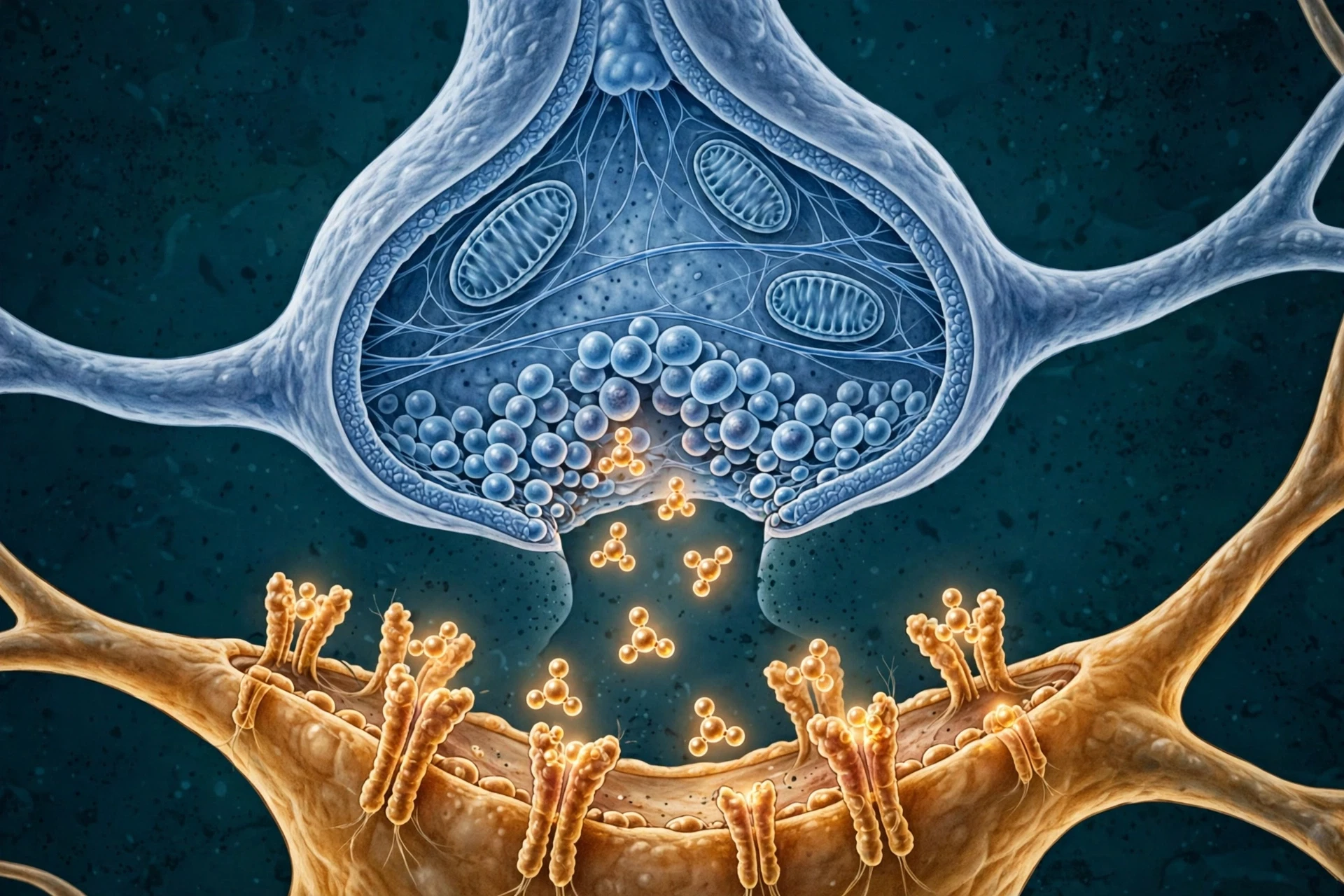
A dopamine molecule's life is short and busy. It is made inside the neuron from the amino acid tyrosine, first converted to levodopa and then to dopamine. It is packed into small vesicles, released into the synapse — the gap between one neuron and the next — when the neuron fires, and it binds to receptors on the receiving cell. Then it is cleared away, mostly by a transporter protein that pulls it back into the sending neuron for reuse, and partly broken down by enzymes, including monoamine oxidase B and catechol-O-methyltransferase. Those enzymes will matter later in this article, because several Parkinson's disease medicines work by blocking them. For now, the point is the timescale: dopamine acts in milliseconds, and it acts over and over, all day, every time you move.
4.1 What dopamine actually does in the movement circuit
Imagine a dimmer switch rather than a light switch. Dopamine does not turn movement on or off. It adjusts how easily the striatum passes the cortex's plans along. With plenty of dopamine, the striatum is responsive: intended movements are amplified and competing movements are damped down, so you can lift a cup without your other fingers wiggling, and walk without your arms flailing. With too little dopamine, the striatum becomes unresponsive in one direction and overactive in another — and the result is the strange combination that defines Parkinson's disease: movements that are hard to start and slow to execute, muscles that resist being moved, and a tremor that appears precisely when nothing is being attempted.
There is a useful comparison here, and it is one I return to whenever the "pleasure chemical" shorthand comes up. Calling dopamine the pleasure chemical is like calling electricity the light-bulb chemical: it mistakes one use for the whole substance. The brain reuses the same messenger in many circuits, and its meaning depends entirely on where it is released and which receptors are listening. In Parkinson's disease, the reward circuit is largely spared early on — which is why the disease's first and most disabling problems are about movement, not about pleasure. The confusion matters because it feeds a misconception: that Parkinson's disease is somehow about motivation or willpower. It is not. It is about a signal going missing in a circuit that has nothing to do with effort or character.
5. The Substantia Nigra and the Nigrostriatal Pathway
The substantia nigra is a small, dark band of tissue in the midbrain, at the top of the brainstem. Its name is literal: "substantia nigra" means "black substance," and the darkness comes from neuromelanin, a pigment that accumulates inside its dopamine-producing neurons over a lifetime. In a healthy brain, that dark band is easy to see. In the brain of a person who died with advanced Parkinson's disease, it has visibly paled — the pigment gone along with the cells that carried it. That pale substantia nigra, seen at autopsy, was one of the earliest clues that something specific was dying in this disease, and it remains one of its most striking features.
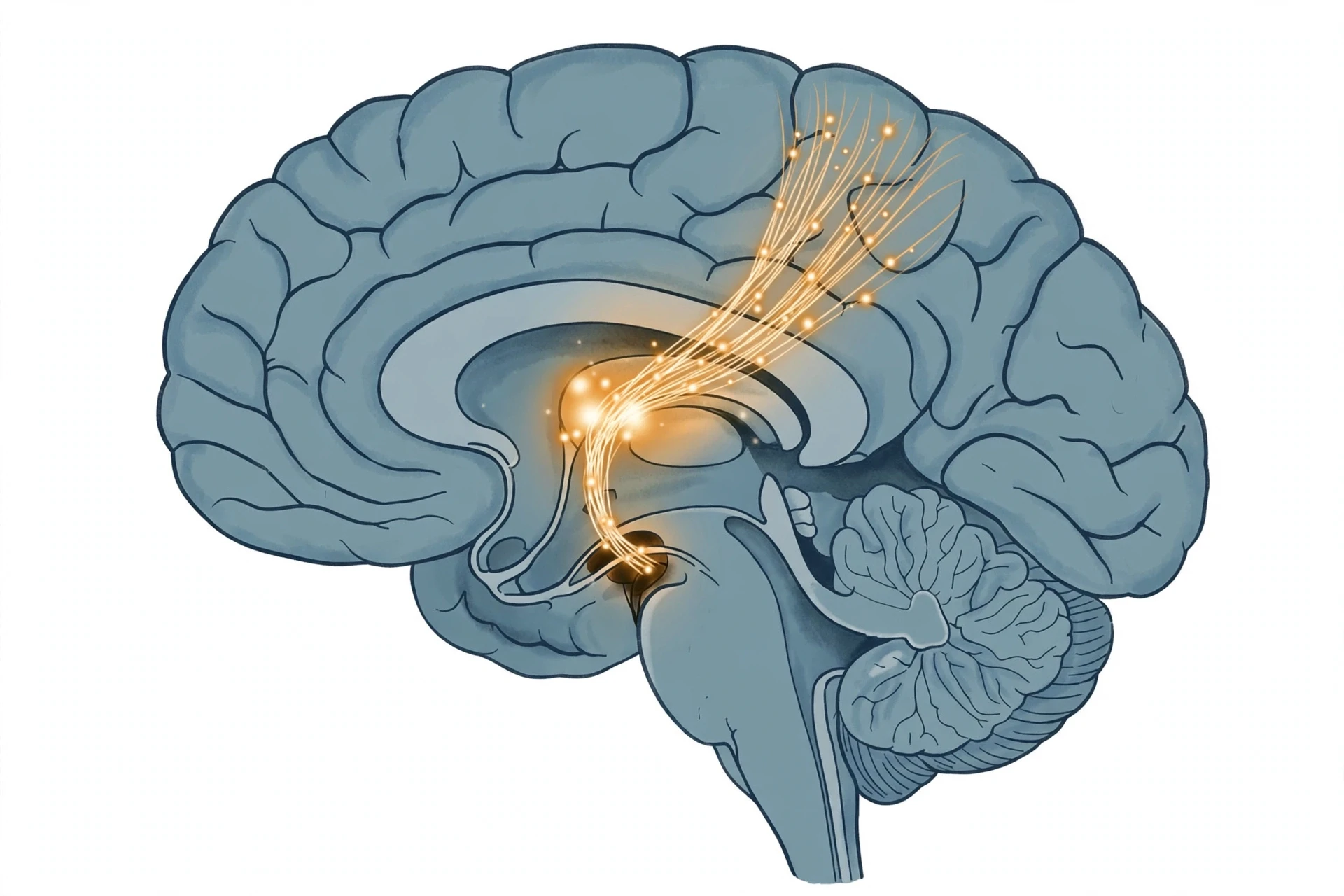
The neurons of the substantia nigra pars compacta send long fibres upward to the striatum. That bundle of fibres is the nigrostriatal pathway, and it is the single most important piece of anatomy in Parkinson's disease. Almost everything about the disease — its symptoms, its treatments, its tests — comes back to this pathway. The striatum, remember, is the entrance hall of the basal ganglia: the place where the cortex's movement plans arrive. Dopamine from the nigrostriatal pathway tunes how the striatum handles those plans. Cut the dopamine supply, and the entrance hall stops working properly, even though the cortex is still sending perfectly good plans and the muscles are still perfectly capable of carrying them out. That is a crucial point, and it surprises many people: in Parkinson's disease, the muscles themselves are fine. The cortex is fine. The problem is in the middle — in the gating system that connects intention to action.
5.1 The long silent phase: 60 to 80 percent gone before the first symptom
Here is the number that stops people in their tracks. According to the National Institute of Neurological Disorders and Stroke, most people with Parkinson's disease have already lost 60 to 80 percent or more of the dopamine-producing cells in the substantia nigra by the time their symptoms appear. Putamen dopamine — the dopamine in the part of the striatum most involved in movement — is depleted by about 80 percent at the onset of symptoms, in the classic autopsy-based estimate. The disease has been quietly advancing for years, perhaps a decade or more, before anyone notices a tremor.
How can the brain lose most of a system and still function? The answer is compensation, and it is remarkably thorough. The surviving dopamine neurons work harder: they make more dopamine per cell, release more of it, and sprout new branches to cover the territory of their dead neighbours. The receiving cells in the striatum become more sensitive, turning up their receptors to catch whatever dopamine remains. Other circuits step in to help. For years, this patchwork holds. Then it does not — and the threshold, once crossed, is crossed for good. Symptoms appear not when the damage starts, but when the compensation runs out.
A note of honesty belongs here, because the science has moved since the classic figure was established. A 2023 analysis of brain imaging data from the Parkinson's Progression Markers Initiative found that the loss of dopamine transporters in the striatum in early Parkinson's disease was closer to 35 to 45 percent, rather than the 50 to 80 percent estimated from autopsy studies. The autopsy estimates may have been too high, because they were back-calculated from brains examined late in the disease and from small numbers of early cases. The 60 to 80 percent figure for cell loss in the substantia nigra remains the standard teaching number, and it is the one the NINDS still uses — but the newer imaging work is a reminder that the brain's losses are large and yet not quite as absolute as the older numbers suggested, and that the compensation story is even more important than the loss story. Either way, the conclusion stands: by the time Parkinson's disease is diagnosed, it is already an advanced process, not a beginning.
6. Direct vs Indirect: The Two Pathways That Explain the Symptoms
This is the section that makes Parkinson's disease click into place. Everything else in this article — the symptoms, the drugs, the surgery — follows from what happens here, so it is worth taking slowly.
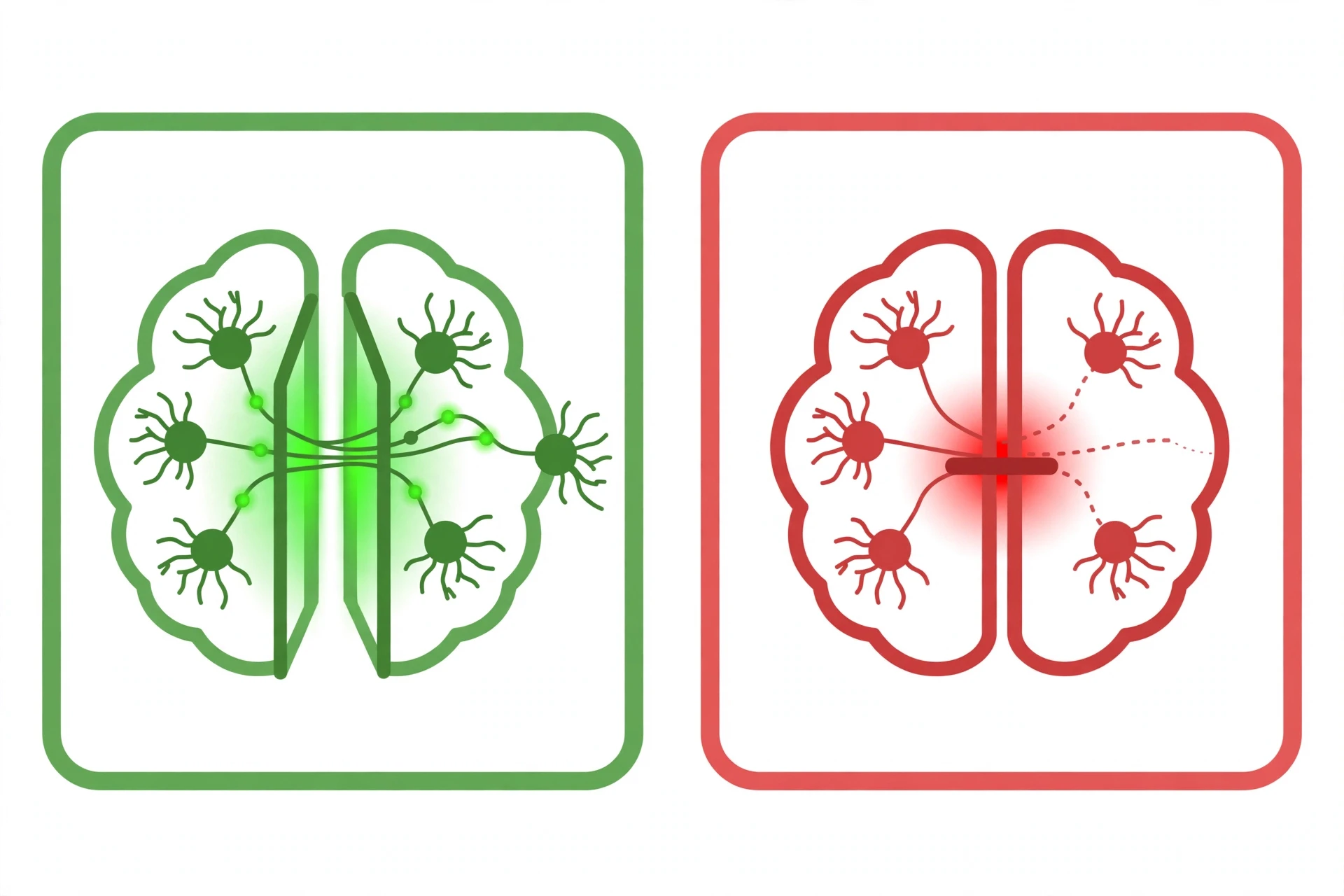
Inside the striatum, the cortex's movement plans split into two routes. The direct pathway is the "go" route: when it is active, it releases the thalamus from inhibition and lets the movement signal flow back to the cortex. The indirect pathway is the "brake" route: when it is active, it strengthens the inhibition on the thalamus and suppresses movement. Every movement you make is the result of a balance between these two routes — enough go to start and sustain the movement, enough brake to stop the movements you do not want.
Dopamine tunes both routes at once, and it does so in the same direction: toward movement. It excites the direct pathway through D1-type dopamine receptors, and it inhibits the indirect pathway through D2-type dopamine receptors. The two receptor types live on different sets of striatal neurons, so one chemical can push one route and pull the other. In a healthy brain, dopamine turns the go route up and the brake route down, and movement flows.
In Parkinson's disease, dopamine runs low, and both effects reverse. The direct pathway weakens — the go signal fades. The indirect pathway strengthens — the brake presses harder. The net result is that the thalamus, the relay station, ends up excessively inhibited: the globus pallidus internus and the subthalamic nucleus, the structures that carry the brake signal, become overactive, and the motor cortex is starved of drive. That is why movement becomes slow and hard to start, and why muscles feel stiff. The brake is on, and the accelerator is weak, at the same time.
Feature | Direct pathway ("go") | Indirect pathway ("brake") |
|---|---|---|
Job | Releases the thalamus so a chosen movement can proceed | Strengthens inhibition on the thalamus so unwanted movements are suppressed |
Dopamine receptor | D1 — dopamine excites these neurons | D2 — dopamine inhibits these neurons |
Effect of dopamine | Stronger go signal | Weaker brake signal |
What happens in Parkinson's disease | Weakened — movements are hard to start and small | Strengthened — muscles resist movement and the body slows |
Main symptom it explains | Bradykinesia (slowness) and reduced movement size | Rigidity (stiffness) and difficulty switching movements |
6.1 Why this model matters — and where it stops
The direct-indirect model, worked out in large part by the neuroscientist Mahlon DeLong and his colleagues, is one of the great achievements of modern neuroscience. It explains why a single chemical loss produces such a specific pattern of symptoms, and it predicted — correctly — that stimulating or lesioning the overactive parts of the indirect pathway should help. Deep brain stimulation, which this article covers later, is built directly on that prediction.
But the model has limits, and a good explanation says so. It explains bradykinesia and rigidity well. It explains tremor poorly: tremor does not track dopamine loss as closely as slowness does, and it involves rhythmic circuits that run through the thalamus and the cerebellum as well as the basal ganglia. It explains postural instability worst of all: balance problems in Parkinson's disease come largely from the degeneration of systems that do not use dopamine at all, which is why they respond weakly to dopamine-replacing drugs and tend to dominate the later stages of the disease. The model is a map, not the territory — a very good map of the middle of the disease, with blank spaces at the edges. Those blank spaces are where much of today's research lives.
7. Alpha-Synuclein and Lewy Bodies
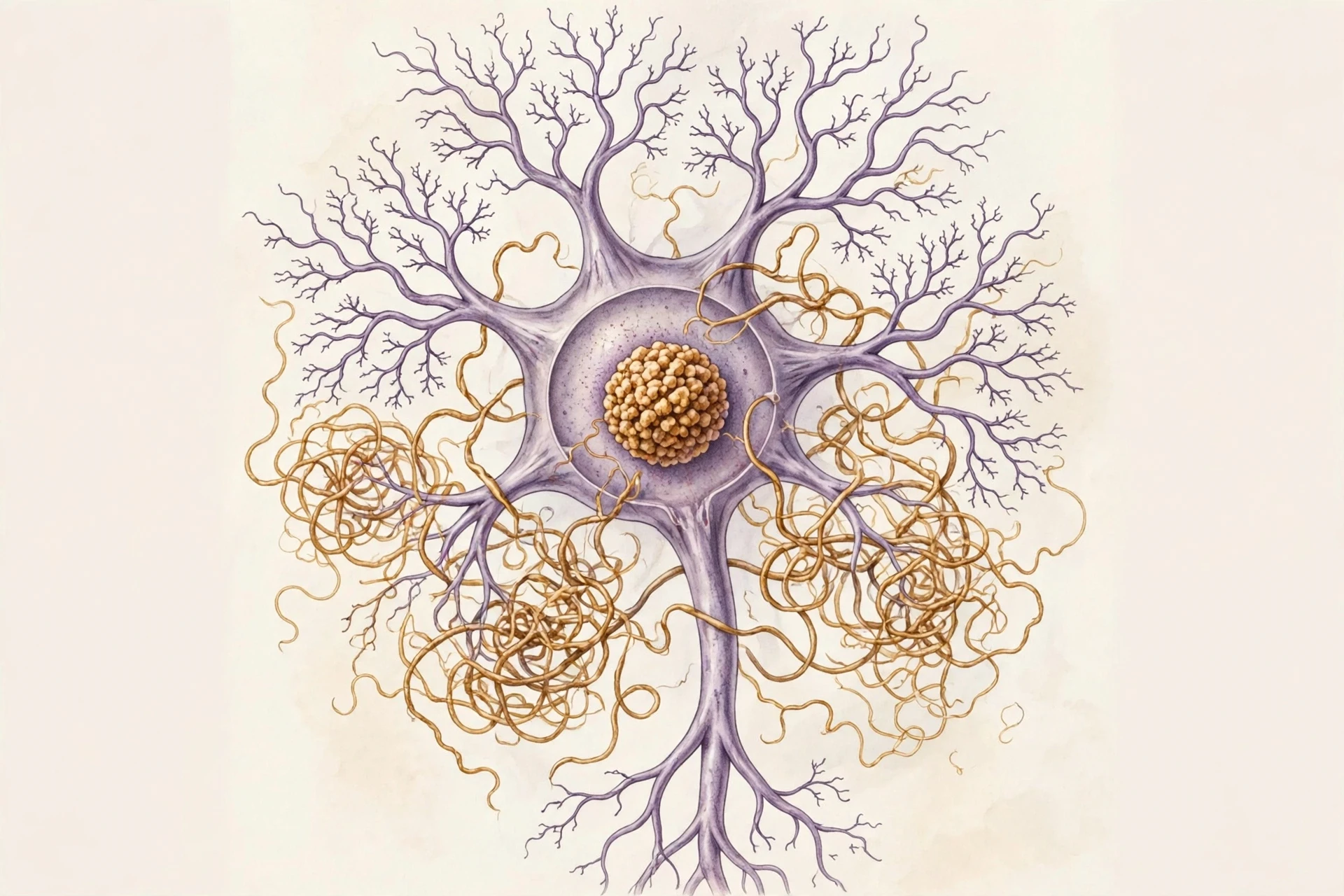
If dopamine loss is the mechanism of the symptoms, alpha-synuclein is the fingerprint of the disease. Inside the brain cells of people with Parkinson's disease, pathologists find round, dense deposits called Lewy bodies, named after Friedrich Lewy, who first described them in 1912. Their main protein component is alpha-synuclein, a small protein — 14 kilodaltons, found mostly at the tips of neurons, where signals are sent — whose normal job is still not fully settled. It seems to help manage the tiny vesicles that carry chemical messengers, but the honest truth is that a protein this abundant and this conserved should have an obvious job, and researchers are still arguing about what it is.
In Parkinson's disease, alpha-synuclein misfolds. Instead of staying in its normal shape, it folds into a form that sticks to other misfolded copies, building up first into small clusters called oligomers and then into long fibres. Those fibres accumulate inside neurons as Lewy bodies, and along axons and dendrites as Lewy neurites. The cell, choked with material it cannot clear, eventually dies. That is the textbook picture — and it is mostly right, but it needs two qualifications that matter.
The first qualification is that Lewy bodies are not the whole story of cell death. Some neurons die without ever forming a visible Lewy body, and some brain regions carry heavy Lewy pathology without obvious symptoms. A provocative line of research has even argued that the Lewy body itself may be partly protective — the cell's attempt to quarantine dangerous material into one tidy bundle, rather than letting it float free. The second qualification is that the amount of Lewy pathology does not track the severity of symptoms as tightly as you might expect. That does not make alpha-synuclein unimportant — the genetic evidence, covered in the next sections, ties it firmly to the disease — but it does mean that counting Lewy bodies is not the same as measuring the disease.
7.1 Does alpha-synuclein spread like a prion?
One of the most debated ideas in Parkinson's disease research is that misfolded alpha-synuclein can spread from cell to cell, templating its wrong shape onto healthy copies of the protein — behaving, in a limited way, like a prion. The evidence is real: Lewy bodies were found in fetal dopamine neurons that had been transplanted into the brains of people with Parkinson's disease, years after the transplant, suggesting the disease process had moved into the new cells. In animal studies, injecting misfolded alpha-synuclein into one brain region can seed aggregates in connected regions. But "prion-like" is a careful phrase, and the care is warranted: Parkinson's disease is not infectious, it does not spread between people, and the pattern of spread in the human brain is messier than the simplest version of the idea predicts. The spread hypothesis is best treated as a leading explanation for how the disease moves through the brain over years — not as a proven fact, and certainly not as a reason for fear.
8. Where Does It Start? Braak Staging, the Gut, and the Nose
In 2003, the German anatomist Heiko Braak published a staging system that changed how researchers think about Parkinson's disease. Braak examined the brains of people who had died at different stages of the disease and mapped where Lewy pathology appeared first, and where it went next. His proposal runs in six stages, moving from the bottom of the brain upward:
Stages 1–2: The medulla, at the base of the brainstem — including the dorsal motor nucleus of the vagus nerve, which controls the gut — and the olfactory bulb, which handles smell.
Stage 3: The substantia nigra. This is where the motor symptoms begin.
Stage 4: The temporal mesocortex, including the amygdala, which processes emotion.
Stages 5–6: The neocortex, the outer layer responsible for thinking and memory. Dementia appears here.
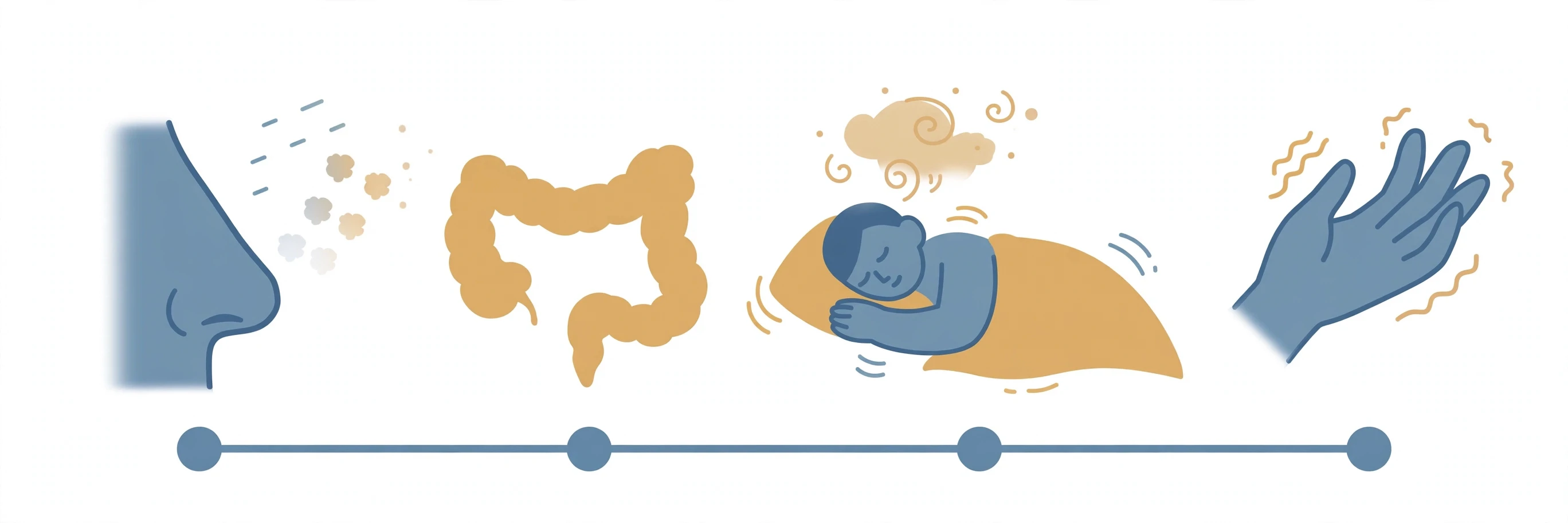
The power of the Braak hypothesis is that it explains the order of symptoms. Long before the tremor, people often lose their sense of smell, develop constipation, and begin acting out their dreams in sleep. Those are stage 1 and 2 problems — the gut and the nose, the sleep centres of the lower brainstem — arriving years before the substantia nigra is reached. In one long-running study of people with REM sleep behaviour disorder, smell loss was detectable more than 20 years before the disease was diagnosed; constipation and erectile problems appeared 10 to 16 years before; subtle motor changes 7 to 11 years before; bradykinesia about 5 to 6 years before; rigidity about 3 years; and tremor only about 2 years before diagnosis. The disease, in other words, has a prodrome — a long prelude — that can last a decade or two.
But Braak staging is a hypothesis, not a law. Not every case follows the bottom-up pattern. Some people show heavy pathology in the cortex with relatively little in the brainstem. Alternative staging systems exist, and some researchers argue that the disease may start in more than one place, or in different places in different people. The gut-first idea — that alpha-synuclein pathology begins in the nerves of the gut and travels up the vagus nerve to the brain — has supporting evidence: aggregated alpha-synuclein has been found in gut biopsies up to 20 years before diagnosis, and a Danish registry study found that people who had their vagus nerve cut (a truncal vagotomy, once done for ulcers) had a lower subsequent risk of Parkinson's disease, most visibly 20 years later — though the overall result did not reach statistical significance. Supportive, not closed. A later Swedish register study found no overall association between vagotomy and Parkinson's disease risk. That is the right way to hold it.
8.1 The gut microbiome: association, not yet causation
The gut has drawn a second wave of attention through the microbiome — the trillions of bacteria living in the intestines, covered in depth in the companion article The Gut Microbiome Explained. Studies have found that people with Parkinson's disease tend to have less of a bacterial family called Prevotellaceae in their stool, fewer bacteria that produce short-chain fatty acids, and more bacteria that produce inflammatory molecules. Gut bacteria can also change how levodopa, the main Parkinson's disease drug, is processed, because some bacteria carry an enzyme that breaks levodopa down before it can reach the brain. All of this is real, and all of it is — so far — association. No study has yet shown that changing the microbiome changes the course of Parkinson's disease. The gut is a promising lead, not a proven cause, and any article that tells you otherwise is ahead of the evidence.
9. What Causes Parkinson's Disease? Genes
"What causes Parkinson's disease?" is the first question most people ask, and the honest answer is that in most people, nobody knows — not exactly. Researchers describe the cause as a combination of genetic susceptibility and environmental exposure, with age as the amplifier. About 15 percent of people with Parkinson's disease have a family history of it, and only a fraction of those can be traced to a specific gene. Roughly 5 to 10 percent have a single-gene form. The other 85 to 90 percent have no single-gene cause at all.
That said, genetics has taught us more about Parkinson's disease than almost any other line of research, because the genes involved point straight at the mechanisms. The largest studies, testing people with Parkinson's disease without selecting for age or family history, find that about 15 percent carry a disease-causing variant in one of seven established genes — LRRK2, GBA1, PRKN, SNCA, PINK1, PARK7 (also called DJ-1), and VPS35. The Parkinson's Foundation's PD GENEration study, which offered genetic testing to thousands of people with the disease, found that 13 percent carried a mutation, with GBA1 accounting for 7.7 percent, LRRK2 for 2.4 percent, and PRKN for 2.1 percent.
The main genes, in plain language:
GBA1 makes an enzyme called glucocerebrosidase, which works in the cell's recycling centres, the lysosomes. Variants in GBA1 are the most common genetic risk factor for Parkinson's disease, found in 3 to 7 percent of cases overall and in about 20 percent of people with Ashkenazi Jewish ancestry. Carriers tend to develop the disease earlier, progress faster, and face a higher likelihood of cognitive impairment. Two faulty copies cause Gaucher disease, a different condition entirely. Having one faulty copy raises the risk, but most carriers never develop Parkinson's disease — the chance by age 80 is roughly 8 to 30 percent.
LRRK2 makes a large protein called dardarin, involved in cell signalling. Its most common disease-causing variant, G2019S, accounts for 1 to 2 percent of Parkinson's disease overall, 13 to 30 percent in people of Ashkenazi Jewish ancestry, and about 41 percent in North African Berber populations. The disease it causes looks much like ordinary Parkinson's disease, often with fewer non-motor problems. Its penetrance — the share of carriers who actually develop the disease — is incomplete and varies widely between studies, from about 25 to 80 percent by age 80, depending on how the families were found.
SNCA makes alpha-synuclein itself. It was the first Parkinson's disease gene identified, in 1997, in a large Italian-Greek family. SNCA mutations are very rare — well under 1 percent of cases — but their discovery was decisive: it proved that the protein in Lewy bodies was not a bystander but a cause.
PRKN (parkin), PINK1, and DJ-1 are recessive genes: both copies must be faulty. They are the most common causes of young-onset Parkinson's disease. PINK1, found in 2004, was the first direct genetic link between mitochondria — the cell's power plants — and Parkinson's disease. PRKN disease tends to progress slowly, with more dystonia (painful muscle twisting, often in the legs) and fewer non-motor problems.
Beyond these single genes, a 2024 study from the National Institute on Aging identified 78 independent regions of the genome associated with Parkinson's disease risk, including 12 regions never linked before. Most genetic risk is polygenic: many common variants, each shifting the odds by a small amount, adding up across a lifetime. That is why the genetics of Parkinson's disease is best described as a landscape of risk, not a verdict. Having a risky variant raises the odds; it does not decide the outcome. And for the majority of people with the disease, no gene on the current list explains why it happened to them.
10. What Causes Parkinson's Disease? Environment and Risk
If genes load the gun, the environment — in the old saying — may pull the trigger. The evidence for environmental risk is strongest for a handful of exposures, and it is worth setting out plainly, because it includes chemicals that millions of people have encountered at work or at home.
Pesticides. The strongest single environmental link is to pesticides. Exposure to paraquat, a widely used herbicide, more than doubled the risk of Parkinson's disease in a large case-control study — and in people who also carried a deletion in a detoxifying gene called GSTT1, a 2012 study found the risk rose eleven-fold. Rotenone, a pesticide once used in gardens and fisheries, more than doubled the risk in the same body of research. People exposed to both paraquat and another pesticide, maneb, near their homes had a 75 percent higher risk. These are observational findings, and they come with the usual caveats, but the pattern has held up across many studies, and it is one reason rural living and farm work show up as risk factors.
Trichloroethylene (TCE). TCE is an industrial solvent once used to degrease metal and to dry-clean clothes. A 2023 paper by Dorsey and colleagues called it "an invisible cause" of Parkinson's disease, gathering evidence from case reports dating back to 1969 and from a study of veterans exposed to TCE in drinking water at Camp Lejeune, who had a 70 percent higher risk of the disease decades later. TCE contamination of groundwater is widespread: the same authors estimate that more than 17 million Americans drink from private wells in areas where TCE may be present. The link is not yet as firmly established as the pesticide link, but it is no longer a fringe claim.
Head injury. A 2012 study from the University of California, Los Angeles, found that a traumatic brain injury with loss of consciousness lasting more than five minutes doubled the risk of Parkinson's disease — and that head injury plus paraquat exposure together tripled it, more than the two risks added separately. That interaction, gene plus environment plus injury, is probably how most cases actually happen: not one cause, but several small ones stacking up.
Age, sex, and the protective puzzles. Age is the biggest risk factor of all, and it is not close: the disease is rare before 50 and increasingly common with every decade after. Men are affected about 1.5 times as often as women, a gap that may reflect both biology — estrogen may protect dopamine neurons — and exposure, since men have historically had more occupational contact with pesticides and solvents.
Then there are the two famous paradoxes, which must be reported with care. Smokers have a lower risk of Parkinson's disease than non-smokers — about 50 to 60 percent lower in pooled data — and coffee drinkers have about a 30 percent lower risk, with a study of more than 8,000 Japanese-American men followed for 30 years finding that heavy coffee drinkers in midlife had about a five-fold lower risk at age 65 and beyond. These associations are real, and they are also among the most misunderstood findings in neurology. Nobody knows why they exist. It may be that nicotine or caffeine genuinely protects dopamine neurons; it may be that something else in smoke or coffee does; or it may be reverse causation — that people in the earliest, silent stages of the disease are simply less drawn to smoking or to coffee, because the same brain changes that will one day cause Parkinson's disease already dull the reward circuits. Clinical trials of nicotine have shown no benefit. And the harms of smoking outweigh any association with Parkinson's disease by orders of magnitude. These findings are clues for researchers, not advice for anyone. No doctor would ever suggest taking up smoking or drinking more coffee to avoid Parkinson's disease, and neither does this article.
11. The Four Cardinal Motor Symptoms
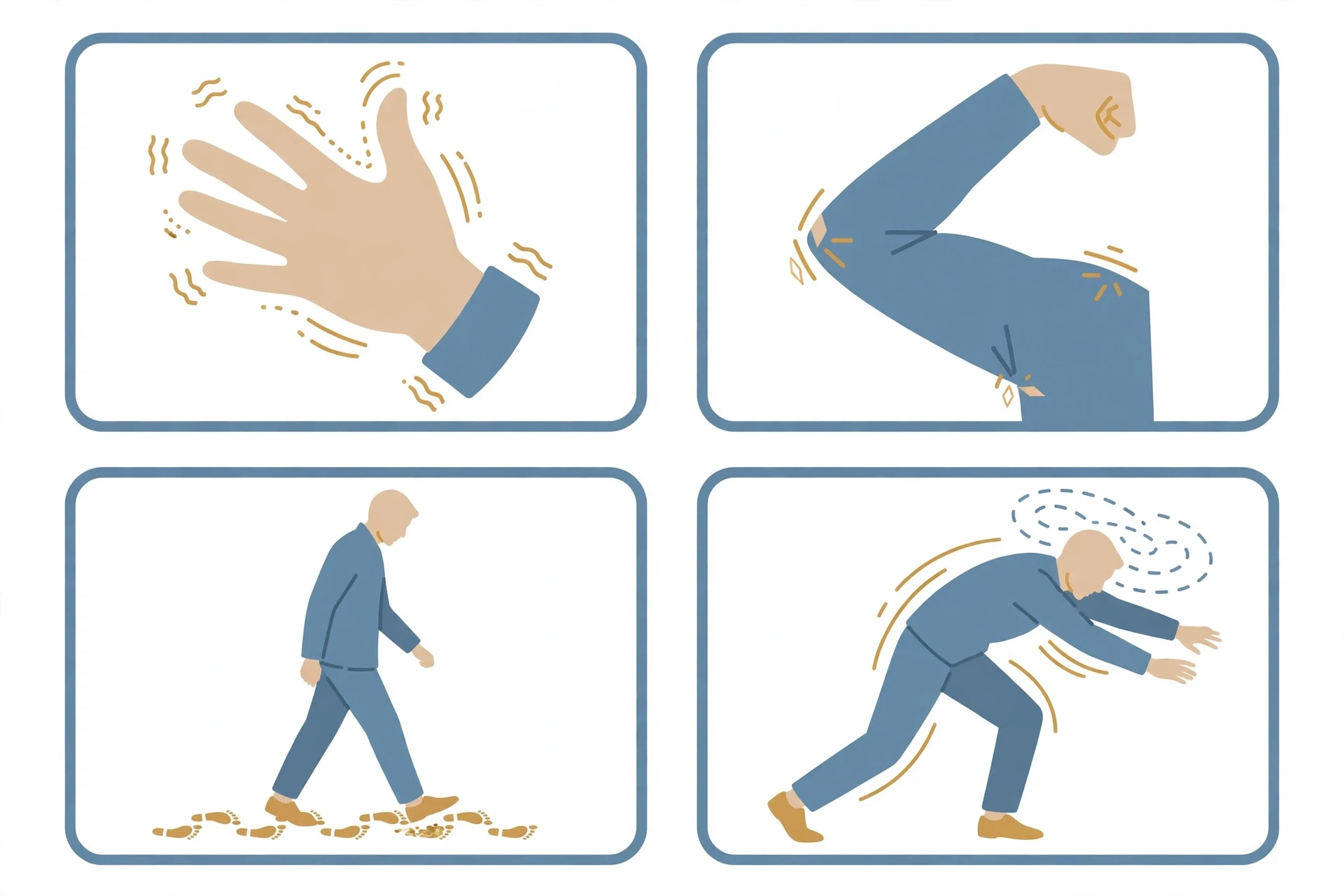
Neurologists remember the four cardinal motor symptoms of Parkinson's disease with the word TRAP: Tremor, Rigidity, Akinesia (or bradykinesia), and Postural instability. The acronym is useful, but it hides something important: these four symptoms do not arrive together, they do not progress at the same speed, and they do not all respond to the same treatment. A person can have a prominent tremor and almost no stiffness, or severe slowness with no tremor at all — 15 to 30 percent of people with Parkinson's disease never develop a tremor. Diagnosis requires bradykinesia plus at least one of the other three. Understanding each symptom on its own terms is the only way to understand what a person with the disease is actually living with.
11.1 Tremor
The Parkinson's disease tremor is a rest tremor: it appears when the affected limb is relaxed and supported, and it fades when the limb moves voluntarily. It is usually 4 to 6 cycles per second, it usually starts on one side of the body, and in the hand it often takes the classic "pill-rolling" form — the thumb and forefinger rubbing together as if rolling a small pill between them. It is present in about 70 to 80 percent of people with the disease. It disappears in sleep, it worsens with stress, fatigue, and strong emotion, and it often vanishes the moment the person reaches for something — which is why, in the early years, many people can still pour a cup of tea if they concentrate, and then watch the cup shake again the moment they set it down. Section 12 looks at why this happens in detail, because the tremor's mechanism is different from the mechanism of the other symptoms, and that difference matters for treatment.
11.2 Rigidity
Rigidity is stiffness that does not go away when you try to relax. A healthy muscle yields smoothly when someone else moves your arm; a rigid muscle resists all the way through the movement, as if the joint were moving through thick treacle. Neurologists describe two forms. In "lead-pipe" rigidity, the resistance is steady and uniform through the whole range of movement. In "cogwheel" rigidity, the resistance comes in small jerks, like a cogwheel turning — and those jerks are usually the tremor showing through the stiffness. About 90 percent of people with Parkinson's disease experience rigidity at some point. It is often the symptom that hurts most: a stiff shoulder is one of the commonest early complaints, and it is regularly misdiagnosed as a frozen shoulder or arthritis, sometimes for years, before anyone thinks to look at the brain. Rigidity in the trunk contributes to the stooped posture that James Parkinson himself described. Rigidity in the face contributes to the "masked face" — the reduced expression that makes people look flat or uninterested when they are anything but.
11.3 Bradykinesia
Bradykinesia — slowness of movement — is the one symptom that is required for diagnosis, and it is the one that tracks dopamine loss most closely. It is more than just moving slowly. It has three parts: movements take longer to start, they are executed more slowly, and they get smaller and weaker as they are repeated. Ask a person with Parkinson's disease to tap their thumb and forefinger together rapidly, and the taps will start at a reasonable size and then shrink, slow, and fade — a phenomenon called the sequence effect, and it is one of the most reliable signs a neurologist looks for. The same shrinking shows up in handwriting, which becomes progressively smaller across a line — micrographia — and in walking, where steps get shorter and shorter until the person is shuffling. Bradykinesia is also why everyday tasks take so long: buttoning a shirt, brushing teeth, getting out of a chair. Each movement costs more time and more conscious effort, because the automatic machinery that used to run it in the background has gone quiet.
I have seen the sequence effect demonstrated in a clinic room, and it is quietly devastating in a way that a tremor is not. A tremor is visible and dramatic. Bradykinesia is invisible to a bystander and exhausting to the person living with it. The person knows exactly what they want to do. The plan is intact. The body simply will not carry it out at the speed the mind expects — and the gap between intention and execution widens a little every year.
11.4 Postural instability
Postural instability — the loss of balance and of the automatic reflexes that keep you upright — is the fourth cardinal symptom, and it is the one that arrives last and causes the most harm. Healthy people correct a stumble without thinking: the body sways, the feet adjust, the arms swing out, and balance is restored before the conscious mind even registers the problem. In Parkinson's disease, those automatic corrections slow and then fail. A gentle push from behind can topple a person who cannot take the quick backward step that would have saved them. Falls follow: roughly half of people with Parkinson's disease fall at least once a year, and in advanced disease the figure is higher still. Freezing of gait — the sudden feeling that the feet are glued to the floor, often in doorways or when turning — affects about 7 percent of people early on and more than half in advanced disease, and it is a major cause of falls.
Postural instability is the symptom that levodopa helps least, because balance depends heavily on brain systems that do not use dopamine. That is one reason it tends to dominate the later stages of the disease, when the dopamine medicines are still working on tremor and stiffness but the falls keep coming. It is also the symptom that most changes a person's life in practical terms: the walking stick, the walker, the fear of going out alone, the bathroom grab rails. Falls are not a footnote to Parkinson's disease. For many people, they are the disease's most serious consequence.
Symptom | What it looks like | What causes it | How it responds to levodopa |
|---|---|---|---|
Tremor | Shaking at rest, 4–6 Hz, usually one-sided, pill-rolling in the hand; fades with movement, gone in sleep | Rhythmic circuits through basal ganglia, thalamus and cerebellum — not dopamine loss alone | Often improves, but less reliably than slowness |
Rigidity | Steady resistance to passive movement (lead-pipe) or jerky resistance (cogwheel); stiff shoulder, stooped posture, masked face | Overactive indirect pathway — the brake pressing too hard | Usually improves well |
Bradykinesia | Slow to start, slow to execute, movements shrink on repetition; small handwriting, shuffling steps | Weak direct pathway plus strong indirect pathway — thalamus over-inhibited | Improves best of all the symptoms |
Postural instability | Loss of automatic balance corrections, falls, freezing of gait in doorways and on turning | Largely non-dopaminergic degeneration of balance systems | Responds poorly — the hardest symptom to treat with drugs |
12. Why Does Parkinson's Cause Tremor?
Here is a puzzle that catches almost everyone. If Parkinson's disease is caused by dopamine loss, and dopamine loss explains slowness and stiffness so neatly, why does it cause a tremor — a rhythmic shaking that appears precisely when the body is doing nothing? The honest answer is that the tremor is not a direct product of dopamine loss in the way bradykinesia is. It is the product of a rhythm that emerges when the movement circuits lose their normal regulation, and it runs through a wider network than the basal ganglia alone.
The current picture is this. When dopamine falls, the basal ganglia become overactive in a patterned, oscillatory way — they start firing in rhythmic bursts instead of a steady stream. That rhythm is passed to the thalamus, the relay station, and from there to the motor cortex. The cerebellum — the brain's timing and coordination centre — is also drawn into the loop, and it seems to act as an amplifier, setting and stabilising the tremor's frequency at 4 to 6 cycles per second. Brain imaging during tremor shows activity pulsing through this basal ganglia–thalamus–cerebellum circuit in time with the shaking hand. The tremor is, in effect, a rhythm that the brain's movement system falls into when its normal damping is gone — like a guitar string that keeps vibrating because nobody is touching it to stop it.
That mechanism explains the tremor's most distinctive features. It appears at rest because the circuit is idle and free to oscillate; when the person moves voluntarily, the cortex takes over the circuit for a real task, and the oscillation is suppressed. It disappears in sleep because the circuits that generate it quiet down. It worsens with stress and strong emotion because the brain's arousal systems — noradrenaline, in particular — turn up the gain on the same circuits, amplifying the rhythm. And it correlates less well with the amount of dopamine lost than bradykinesia does, which is why some people have a severe tremor with relatively modest dopamine loss, and others have almost no tremor despite severe loss.
It also explains why the Parkinson's disease tremor is different from the commonest other tremor, essential tremor — a distinction that matters, because the two are frequently confused. Essential tremor appears during action — when reaching, writing, or holding a cup — not at rest, and it is usually bilateral, affecting both hands from the start, with a faster frequency of 4 to 12 cycles per second. It often runs in families, it often improves with a small amount of alcohol, and it is not caused by dopamine loss, so it does not respond to levodopa and does not come with the slowness and stiffness of Parkinson's disease. A tremor that shows up when the hand is resting and disappears when the hand works is the opposite pattern, and it should always prompt a proper neurological examination.
One more misconception is worth disagreeing with directly, because I hear it often: that a tremor means the disease is mild, or that a person without a tremor does not really have Parkinson's disease. Neither is true. Tremor-dominant Parkinson's disease tends, on average, to progress more slowly than the form dominated by slowness and balance problems — but "more slowly" is not "mildly," and a tremor can be profoundly disabling in its own right: it makes eating in public embarrassing, signing a cheque humiliating, and holding a grandchild frightening. And the 15 to 30 percent of people who never develop a tremor have Parkinson's disease just as surely as anyone else. The tremor is a symptom, not the disease, and judging the disease by the tremor alone misses most of what it does.
13. Beyond Movement: The Non-Motor Symptoms
If you only knew Parkinson's disease from its tremor, you would miss most of it. Up to 90 percent of people with the disease experience non-motor symptoms, and for many of them, these are the problems that damage quality of life most: the loss of smell, the constipation, the dreams acted out in sleep, the depression, the anxiety, the fading memory, the hallucinations, the blood pressure that drops when they stand up. Some of these symptoms arrive a decade or more before the first tremor — the prodrome described in section 8 — and others arrive late, as the disease spreads into the cortex. Together they are the reason the modern definition of Parkinson's disease is a disorder of the whole nervous system, not just the movement system.
13.1 Smell, gut, and sleep: the earliest warnings
Loss of smell — anosmia — affects about 80 percent of people with Parkinson's disease, often years before diagnosis. It is easy to miss: smell fades gradually, people blame a cold or age, and nobody thinks of it as a brain symptom. But the olfactory bulb is one of the first places Lewy pathology appears in Braak staging, and a reduced sense of smell is now one of the strongest early markers researchers have. It is not a diagnosis on its own — most people who lose their sense of smell do not develop Parkinson's disease — but in combination with other early signs, it changes the odds considerably.
Constipation is the second early warning, and it is nearly as common. It can precede motor symptoms by a decade or more. In the Honolulu Heart Program, men who had fewer than one bowel movement a day had about three times the risk of developing Parkinson's disease compared with men who had two or more. The mechanism is probably the same gut-first process described in section 8: Lewy pathology in the nerves of the gut, slowing the gut down years before it reaches the brain. Constipation remains a problem throughout the disease, and it matters for treatment as well as comfort, because a slow gut absorbs levodopa less predictably.
REM sleep behaviour disorder — RBD — is the third early warning, and the strongest single predictor of all. In REM sleep, the body is normally paralysed so that dreams cannot be acted out. In RBD, that paralysis fails, and people punch, kick, shout, and fall out of bed while dreaming — often vivid, violent dreams of being attacked. About 6.3 percent of people with isolated RBD develop a neurodegenerative disease each year, 60.2 percent have done so by 10 years, and 73.5 percent by 12 years, developing Parkinson's disease, dementia with Lewy bodies, or multiple system atrophy. Not everyone with RBD develops Parkinson's disease, and not everyone with Parkinson's disease has RBD, but a person with RBD and loss of smell is in a very different risk category from a person with either symptom alone. The companion article Science of Sleep and Dreams explains how REM sleep works and why its paralysis mechanism matters.
13.2 Mood, thinking, and the mind
Depression affects roughly 30 to 45 percent of people with Parkinson's disease, and anxiety about 40 percent. These are not simply understandable reactions to a difficult diagnosis, though that is part of it. Depression in Parkinson's disease is partly a direct result of the disease process itself: the same degeneration that damages dopamine neurons also damages the brain's serotonin and noradrenaline systems, which regulate mood. That is why depression can precede the motor symptoms by years, and why it can appear in people who are coping well in every other way. The companion article Anxiety and Depression Explained covers the science of those conditions in depth; in Parkinson's disease, they are part of the disease itself, not a reaction to it. Apathy — a loss of motivation and interest that is distinct from depression — is also common, and it is frequently mistaken for laziness or giving up. It is neither. It is a symptom, and it is one of the hardest for families to live with, because it looks like a choice.
Cognition follows a slower, more variable course. About 20 to 40 percent of people have dementia at any given time, and the risk rises steeply with time: by 20 years after diagnosis, about 80 percent have developed dementia. At 10 years, though, dementia is less common than older estimates suggested — in two large prospective cohorts, the chance of dementia by 10 years was 27 percent in one and 9 to 15 percent in the other — while milder cognitive impairment, short of dementia, is already widespread by then. The risk of dementia is about six times that of the general population. Early cognitive problems in Parkinson's disease are typically problems of attention, planning, and flexible thinking — executive function — rather than the memory loss that dominates Alzheimer's disease, though memory does worsen as the disease spreads into the cortex. That overlap with Alzheimer's disease is real and worth naming: the two diseases are different — different proteins, different brain regions first affected, different early symptoms — but in the later stages their territories overlap, and a person can have features of both. The companion article Alzheimer's Disease Explained covers the plaques, tangles, and memory loss of that disease in depth; Parkinson's disease dementia shares the word "dementia" but arrives by a different route.
Hallucinations — usually visual, usually of people or animals at the edge of vision, often in dim light — affect 20 to 40 percent of people, and psychotic symptoms of some kind affect up to 60 percent over the long term. They are more common in advanced disease and are often worsened by the dopamine medicines themselves, which is one of the cruellest trade-offs in treatment: the drugs that restore movement can distort perception. Most people, early on, know the hallucinations are not real — a state called retained insight — and that knowledge is protective. When insight is lost, the hallucinations become frightening, and they are one of the commonest reasons families seek help.
13.3 The automatic body: blood pressure, bladder, and voice
Dysautonomia — failure of the autonomic nervous system, the part that runs the body without conscious input — affects 70 to 80 percent of people with Parkinson's disease. Its most dangerous form is orthostatic hypotension: blood pressure falls when the person stands up, causing dizziness, blurred vision, and falls. It is worsened by levodopa and by dehydration, and it is often under-recognised because it is measured sitting down. Other autonomic problems include urinary urgency and frequency, constipation, erectile dysfunction, and changes in sweating — too much in some places, too little in others.
Speech and swallowing complete the picture. The voice becomes soft, flat, and monotonous — hypophonia — because the same bradykinesia that slows the limbs slows the muscles of the voice. Speech becomes less clear, and swallowing becomes less frequent and less coordinated, which is why drooling is common: not because the body makes too much saliva, but because it swallows too rarely. Swallowing difficulty is more than an embarrassment. In advanced disease, food or liquid going down the wrong way — aspiration — is a leading cause of pneumonia, and pneumonia is one of the commonest causes of death in people with Parkinson's disease. That is a hard fact to write, and a harder one to read, but it is the reason speech therapy and swallowing assessment are not optional extras in this disease. They are part of staying alive.
14. How Parkinson's Disease Is Diagnosed
There is no blood test for Parkinson's disease. There is no scan that can confirm it on its own. Diagnosis is clinical — made by a neurologist from the history and the examination — and that single fact shapes everything else about how the disease is found, how often it is misdiagnosed, and why the search for a biomarker matters so much.
The modern standard is the Movement Disorder Society Clinical Diagnostic Criteria, published in 2015. They begin with parkinsonism itself: bradykinesia plus at least one of rigidity, rest tremor, or postural instability. Then they add supportive features — a clear, sustained response to levodopa, the presence of levodopa-induced dyskinesia, a rest tremor, loss of smell, or a cardiac imaging finding called MIBG scintigraphy — and they count certain "red flags" against the diagnosis, such as severe autonomic failure in the first five years or repeated falls within the first three years. A diagnosis can still be made with up to two red flags if enough supportive features are present; only a complete lack of response to levodopa rules the disease out. The older UK Brain Bank criteria, from 1988, work the same way, and both systems agree on the essentials: the diagnosis is a pattern, not a test result.
That pattern is usually clear enough in the middle of the disease. Early on, it often is not. A pooled analysis found that clinical diagnosis is correct about 80.6 percent of the time, and in one autopsy series, only 76 of 100 people diagnosed by neurologists turned out to have Parkinson's disease when their brains were examined after death. Early misdiagnosis rates run as high as 30 percent. The commonest mistakes are the conditions that mimic Parkinson's disease — and there are several, each with its own story.
"Involuntary tremulous motion, with lessened muscular power, in parts not in action and even when supported; with a propensity to bend the trunk forwards, and to pass from a walking to a running pace: the senses and intellects being uninjured." — James Parkinson, An Essay on the Shaking Palsy, 1817
James Parkinson's own definition, written more than two hundred years ago, still captures the clinical picture remarkably well. What he could not have known is how many conditions can imitate that picture. Essential tremor, covered in section 12, is the commonest mimic — an action tremor, usually in both hands, without slowness or stiffness. Drug-induced parkinsonism is the next: antipsychotic drugs, some anti-nausea drugs, and calcium-channel blockers can all produce slowness, stiffness, and tremor that look exactly like Parkinson's disease, and in one American county study, drugs accounted for 20 percent of new cases of parkinsonism. The symptoms usually improve when the drug is stopped, but not always, and not quickly.
The atypical parkinsonisms are harder. Multiple system atrophy (MSA) brings early, severe autonomic failure — blood pressure that crashes on standing, bladder failure — and a poor response to levodopa. Progressive supranuclear palsy (PSP) brings early falls, especially backwards, and a failure of the eyes to move up and down. Dementia with Lewy bodies (DLB) brings dementia within a year of the motor symptoms, with vivid hallucinations and fluctuating alertness. These are different diseases, with different proteins and different prognoses, and telling them apart from Parkinson's disease in the first year or two is one of the hardest jobs in neurology. Time itself is often the diagnostic test: Parkinson's disease progresses slowly, and a disease that races ahead in its first years is probably not Parkinson's disease.
14.1 What the scans can and cannot do
The one scan that helps is the DaTscan, approved by the US Food and Drug Administration in 2011. It uses a radioactive tracer that binds to the dopamine transporter — the protein that pulls dopamine back into the sending neuron — and shows whether the dopamine terminals in the striatum are reduced. A normal DaTscan makes degenerative parkinsonism unlikely and points towards essential tremor or drug-induced parkinsonism. An abnormal DaTscan confirms that the dopamine system is damaged. What it cannot do is distinguish Parkinson's disease from MSA or PSP, because all three damage the same dopamine terminals. It is a test of whether the dopamine system is broken, not of why.
The newer test drawing the most attention is the alpha-synuclein seed amplification assay, which detects misfolded alpha-synuclein in spinal fluid by amplifying tiny amounts of it, much as a PCR test amplifies DNA. In the Parkinson's Progression Markers Initiative study, published in The Lancet Neurology in 2023, the assay had a sensitivity of 87.7 percent and a specificity of 96.3 percent, and 98.6 percent sensitivity in people with sporadic Parkinson's disease and typical loss of smell. It is a powerful research tool, and it is beginning to be used to support diagnosis and to select participants for trials. It is not yet a stand-alone diagnostic test, and it is not yet widely available outside specialist centres. But it is the closest the field has come to the biological test it has been seeking for two centuries, and it may change how the disease is diagnosed within the next few years.
Condition | Tremor | Slowness and stiffness | What sets it apart |
|---|---|---|---|
Parkinson's disease | Rest tremor, 4–6 Hz, one-sided at first | Yes — bradykinesia required | Responds to levodopa; slow progression; loss of smell common |
Essential tremor | Action tremor, 4–12 Hz, both hands | No | Often familial; may improve with alcohol; no dopamine loss on DaTscan |
Drug-induced parkinsonism | Rest tremor possible, often both sides | Yes | Follows antipsychotic or anti-nausea drugs; often improves when the drug stops |
Multiple system atrophy | Less prominent | Yes | Early severe autonomic failure; poor levodopa response; faster progression |
Progressive supranuclear palsy | Less prominent | Yes, with early falls backwards | Eye movements fail, especially looking up and down; poor levodopa response |
Dementia with Lewy bodies | Variable | Yes | Dementia within a year of motor symptoms; vivid hallucinations; fluctuating alertness |
15. How Parkinson's Progresses
"How fast will it get worse?" is the question every person asks at diagnosis, and it is the question with the least satisfying answer: nobody can say, for any individual, with confidence. Parkinson's disease progresses slowly on average and unevenly in practice. The same diagnosis can mean a very different decade for two different people. What clinicians can offer is a shape — a typical pattern, with known milestones and known variation — and an honest account of what the variation depends on.
The oldest map of progression is the Hoehn and Yahr scale, published in 1967 from a study of 802 people. It runs from stage 1 to stage 5: symptoms on one side of the body only; symptoms on both sides, without balance problems; balance problems, but independence maintained; severe disability, but still able to walk or stand without help; and finally, wheelchair-bound or bedridden without help. The scale is simple, and that is both its strength and its weakness: it captures the big picture and misses the detail. A later analysis of six European cohorts found that the median time from the first symptom to stage 3 — the stage where postural instability appears — was 7.4 years. That is a median, not a promise: half of people reach stage 3 faster, half slower.
The finer-grained tool is the Movement Disorder Society Unified Parkinson's Disease Rating Scale, or MDS-UPDRS, published in 2008. It has four parts: non-motor experiences of daily living; motor experiences of daily living; the motor examination itself; and motor complications, including dyskinesia and fluctuations. It is the standard measure in trials and in clinics that want to track change precisely, and it is the scale that the newer staging systems — including the biological staging proposals built around the seed amplification assay — are designed to complement rather than replace.
What drives the variation? Subtype matters. People whose disease is dominated by tremor tend, on average, to progress more slowly than people whose disease is dominated by postural instability and gait problems: one study found a mean survival of about 20 years for the tremor-dominant subtype, against about 13 years for the postural-instability and gait subtype. Age at onset matters: younger people progress more slowly but live with the disease longer, so they accumulate more complications over time. Genetics matters: carriers of GBA1 variants progress faster and develop cognitive problems earlier, while carriers of PRKN variants progress more slowly. And treatment matters, though in a narrower way than people hope: levodopa and the other medicines relieve symptoms, but none of them has yet been proven to slow the underlying disease.
Life expectancy is the part of this conversation that deserves the most care. Parkinson's disease itself is not usually listed as the cause of death; its complications are — pneumonia from swallowing difficulty, falls and fractures, infections in advanced disability. Older studies, such as the Sydney Multicentre Study, found that 74 percent of people were dead by 20 years after diagnosis — but that cohort was diagnosed in 1984, before modern treatment. More recent estimates put the reduction in life expectancy at about 2 to 7 years compared with the general population, and the British National Health Service notes that most people with Parkinson's disease have a normal or near-normal life expectancy with modern treatment. Both statements are true, and the gap between them is the measure of how much treatment has improved. The honest framing is this: Parkinson's disease shortens life, modestly, on average, mainly through its complications — and those complications are, to a real extent, preventable, treatable, and worth planning for.
Hoehn and Yahr stage | What it means | Typical timing (median) |
|---|---|---|
Stage 1 | Symptoms on one side of the body only; no balance problems | At diagnosis for many people |
Stage 2 | Symptoms on both sides; still no balance problems | Within a few years of diagnosis |
Stage 3 | Postural instability appears; independence maintained | Median 7.4 years from first symptom |
Stage 4 | Severe disability; can still walk or stand without help | Many years in; varies widely |
Stage 5 | Wheelchair-bound or bedridden without help | Late disease; many people never reach this stage |
16. Levodopa: The Drug That Changed Everything
Before levodopa, Parkinson's disease was a slow decline with almost nothing to offer. People were given belladonna extracts, anticholinergic drugs that dried the mouth and clouded the mind, and little else. Then, in the space of a decade, a chain of discoveries transformed it — and the chain is worth telling in full, because it is one of the cleanest examples in medicine of basic science becoming treatment.
It begins in 1957 and 1958, with the Swedish pharmacologist Arvid Carlsson. Carlsson showed that dopamine was not merely a stepping stone on the way to making noradrenaline, as everyone had assumed, but a neurotransmitter in its own right — and that when he depleted dopamine in animals with the drug reserpine, they became still and rigid, and when he gave them levodopa, the precursor of dopamine, they moved again. For that work, Carlsson shared the Nobel Prize in Physiology or Medicine in 2000. In 1960 and 1961, the Austrian pharmacologist Oleh Hornykiewicz and his colleague Herbert Ehringer examined the brains of people who had died with Parkinson's disease and found that dopamine was severely depleted in the striatum — the first direct evidence that the disease was a dopamine-deficiency disorder. Hornykiewicz and the neurologist Walther Birkmayer then gave intravenous levodopa to people with Parkinson's disease and saw dramatic, if brief, improvements. And in 1967, the American neurologist George Cotzias published a landmark study in the New England Journal of Medicine showing that high doses of oral levodopa, built up gradually over weeks, produced sustained, life-changing improvements in people who had been severely disabled. Levodopa was approved by the US Food and Drug Administration in 1970, and within a few years it had transformed wards full of frozen, rigid patients into places where people could walk, dress, and feed themselves again.
16.1 How it works — and why it needs a partner
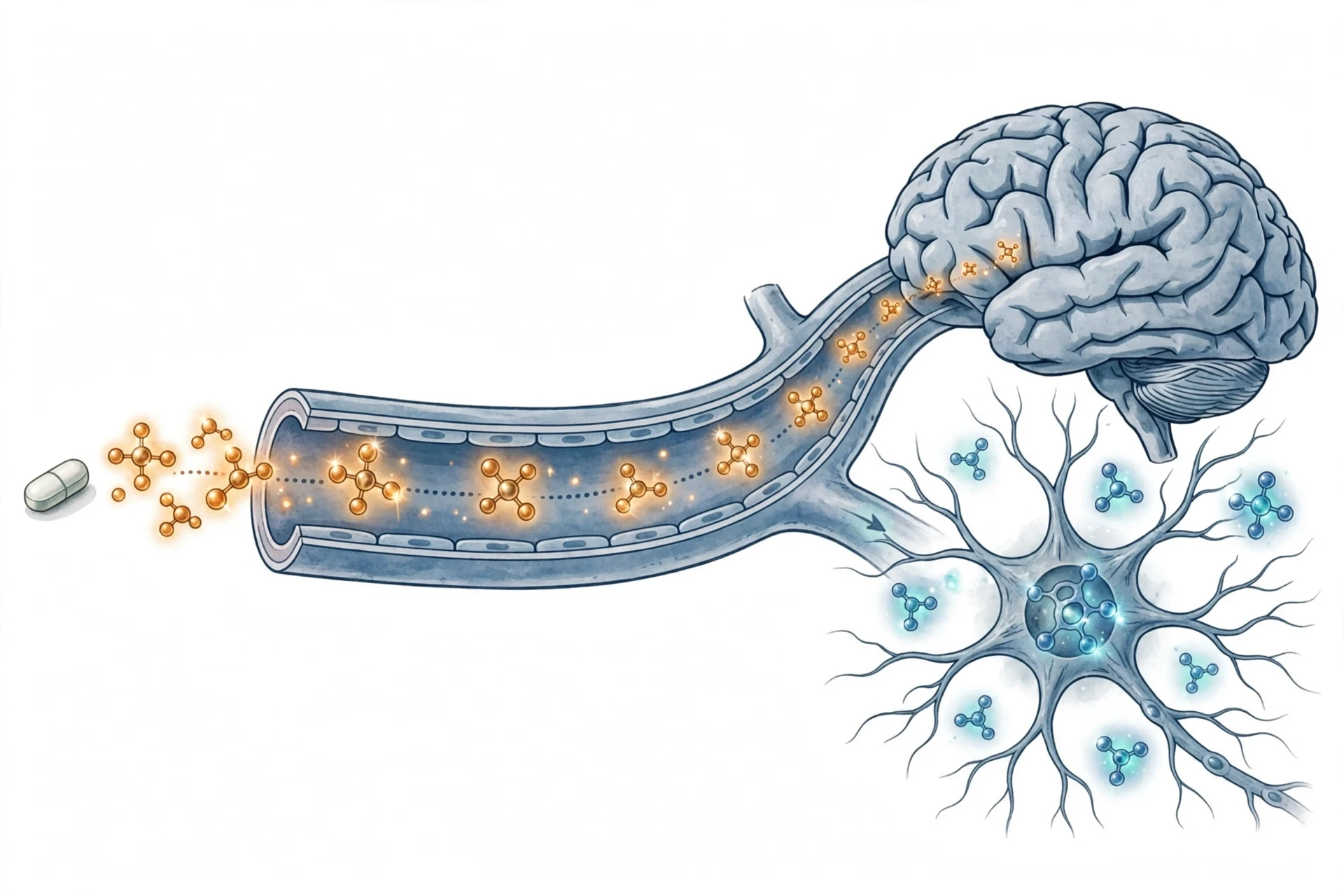
Levodopa works because of a quirk of the blood-brain barrier. Dopamine itself cannot cross from the blood into the brain, so giving dopamine as a drug is useless. Levodopa, its precursor, can cross — it is carried across by the same transporter that carries amino acids from food. Once inside the brain, the surviving dopamine neurons convert levodopa into dopamine using the enzyme dopa decarboxylase, and the dopamine is then released and used almost normally. The medicine is, in effect, a delivery system: it smuggles the raw material past the barrier and lets the remaining neurons do the chemistry.
There is a catch. The same enzyme, dopa decarboxylase, exists outside the brain, in the gut and the bloodstream. Without protection, most of a levodopa dose is converted to dopamine in the body before it ever reaches the brain — about 98 percent, in the classic estimate — where it causes nausea, vomiting, and low blood pressure, and only about 1 percent reaches its target. The solution, introduced in the 1970s, is to pair levodopa with carbidopa, a drug that blocks dopa decarboxylase outside the brain but cannot cross the blood-brain barrier itself, so it leaves the brain's enzyme alone. The combination — carbidopa-levodopa, sold as Sinemet and in generic form — is the standard treatment to this day, and it remains the most effective drug for the motor symptoms of Parkinson's disease. Protein in food competes with levodopa for the same transporter, which is why many people are advised to take their doses away from protein-rich meals.
16.2 Wearing off, dyskinesia, and the on-off problem
Levodopa's triumph has a shadow, and it appears with time. In the first years, a dose lasts for hours and the effect is smooth. As the disease advances and fewer dopamine neurons survive, the brain loses its ability to store dopamine and release it steadily. The medicine's effect starts to follow the blood level of each dose: the person switches on when the dose kicks in and switches off when it wears off, sometimes abruptly, sometimes within minutes. This is the "wearing-off" effect, and it is managed by taking smaller doses more often, by using slow-release formulations, and by adding drugs that prolong levodopa's action — the subject of the next section.
The second complication is dyskinesia: involuntary, writhing movements, often of the arms, trunk, or face, that appear when the levodopa level is at its peak. Dyskinesia is not the disease getting worse. It is the treatment overshooting — the dopamine signal arriving in pulses rather than as a steady stream, and the sensitised striatum over-responding. It is more common in younger people and in those who have taken levodopa for many years, and it is one of the main reasons doctors sometimes delay starting levodopa or keep doses as low as possible. Newer formulations aim to smooth the delivery: Crexont, an extended-release carbidopa-levodopa approved in August 2024; Vyalev, a 24-hour under-the-skin infusion of foslevodopa and foscarbidopa approved in October 2024; and Onapgo, an apomorphine infusion approved in February 2025. All three are attempts to solve the same problem: the brain wants dopamine continuously, and a pill taken three times a day is a crude way to deliver it.
One warning belongs in this section, because it is a safety matter. Levodopa must never be stopped suddenly. Abrupt withdrawal can trigger a dangerous condition resembling neuroleptic malignant syndrome — high fever, severe rigidity, confusion — and the National Institute of Neurological Disorders and Stroke warns explicitly against it. If a dose is missed, take the next one as scheduled and tell a doctor; if the medicine must be stopped, it should be tapered under medical supervision. That is not a detail to bury. It is the kind of fact that saves a hospital admission.
17. The Rest of the Medicine Cabinet
Levodopa is the most effective drug for Parkinson's disease, but it is not the only one, and for many people it is not the first one. The rest of the medicine cabinet exists for three reasons: to delay the complications of levodopa, to smooth out its fluctuations, and to help the symptoms that levodopa handles poorly. Each class of drug works on a different part of the system described in the earlier sections of this article, which makes the cabinet a useful revision of the science — and a reminder that all of these drugs treat symptoms. None of them has been proven to slow the disease itself. That distinction is the single most important thing to understand about Parkinson's disease treatment, and it is worth stating plainly before the details.
Dopamine agonists — pramipexole, ropinirole, rotigotine (a skin patch), and apomorphine — mimic dopamine itself, stimulating the D2 and D3 receptors directly, without needing surviving neurons to convert anything. They last longer than levodopa, so they are often used in younger people to delay the start of levodopa, and as add-on therapy later to smooth out wearing-off. Their price is a different side-effect profile: more sleepiness, including sudden sleep attacks, more hallucinations, more swelling of the legs, and — most distinctively — impulse-control disorders. A minority of people on dopamine agonists develop compulsive gambling, shopping, eating, or hypersexuality, sometimes with devastating consequences. The effect is dose-related and usually reverses when the drug is reduced or stopped, but it is often the family, not the person taking the drug, who notices it first. Anyone starting a dopamine agonist should be told about this risk in plain language, and asked about it directly at every visit.
MAO-B inhibitors — selegiline, rasagiline, and safinamide — block monoamine oxidase B, one of the enzymes that breaks dopamine down. By slowing that breakdown, they make the dopamine that is still being made last longer. They are mild drugs, with mild benefits, and they are often used early in the disease or as add-ons. Whether they slow progression has been debated for decades: early studies of selegiline suggested a benefit, but later analyses attributed most of it to the drug's symptomatic effect. The honest verdict is unproven.
COMT inhibitors — entacapone, tolcapone, and opicapone — block catechol-O-methyltransferase, the other enzyme that breaks levodopa down. They are used alongside levodopa to extend each dose, reducing wearing-off time by an hour or two a day. Tolcapone is the most powerful of the three, but it carries a rare risk of liver damage and is used only with monitoring. Opicapone, taken once daily, is the newest of the class.
Amantadine is an old antiviral drug that found a second life in Parkinson's disease. It has a modest effect on motor symptoms, but its main use today is for dyskinesia: it reduces the involuntary movements that levodopa causes, probably by blocking NMDA glutamate receptors. Its side effects include ankle swelling, livedo reticularis — a mottled discoloration of the skin — and confusion in older people.
Anticholinergics — trihexyphenidyl and benztropine — are the oldest drugs in the cabinet, dating back to the era before levodopa. They help tremor more than slowness, and they are now used mainly in younger people whose main problem is tremor, because in older people they cause confusion, memory problems, dry mouth, and urinary retention. They are a reminder of how far treatment has come — and of how blunt the old tools were.
Drug class | How it works | What it is used for | Main trade-offs |
|---|---|---|---|
Levodopa + carbidopa | Replaces dopamine's raw material; converted in surviving neurons | Best for slowness, stiffness, tremor | Wearing off, dyskinesia with long-term use |
Dopamine agonists | Stimulate D2/D3 receptors directly | Delay levodopa, smooth fluctuations | Sleepiness, hallucinations, impulse-control disorders |
MAO-B inhibitors | Slow dopamine breakdown | Early disease, add-on therapy | Mild benefit; progression-slowing unproven |
COMT inhibitors | Slow levodopa breakdown | Extend each levodopa dose | Diarrhoea; tolcapone needs liver monitoring |
Amantadine | Blocks NMDA receptors (among other actions) | Dyskinesia | Confusion and ankle swelling in older people |
Anticholinergics | Block acetylcholine signalling | Tremor in younger people | Confusion, memory problems in older people |
A word on how these drugs are chosen, because it is a decision readers will face or watch a family member face. There is no single best first drug. The choice depends on age, on which symptom dominates, on work and driving, on other medical conditions, and on what side effects a person is willing to risk. A younger person with a tremor may start on a dopamine agonist. An older person with slowness may start on levodopa directly. The regimen changes over years, and it changes again when fluctuations appear. Good Parkinson's disease care is not a prescription written once. It is a negotiation, revisited every few months, between a person, their family, and a neurologist — and the best outcomes come when the person understands the science well enough to take part in it. One newer drug to watch became a real option in September 2026, when the FDA approved tavapadon — brand name Juvmo — the first selective D1/D5 receptor agonist approved for Parkinson's disease. It is a once-daily tablet that can be taken with or without levodopa, and its approval was supported by the phase 3 TEMPO trial programme.
18. Deep Brain Stimulation and Focused Ultrasound
When medicines stop working smoothly — when the on-off swings become severe, or the dyskinesia becomes as disabling as the disease — there is a surgical option, and it is one of the most remarkable treatments in neurology. Deep brain stimulation, or DBS, places thin electrodes deep in the brain, connected by wires under the skin to a small stimulator implanted in the chest, like a pacemaker for the brain. The stimulator delivers continuous, adjustable electrical pulses to a chosen target, and the effect is immediate and often dramatic: the tremor stops, the stiffness eases, the dyskinesia fades.
The idea came from a simple observation. In the 1980s, the French neurosurgeon Alim-Louis Benabid noticed that high-frequency electrical stimulation of the thalamus during surgery suppressed tremor — the same effect that destroying the tissue would have, but reversible and adjustable. By the 1990s, stimulation had moved to the two targets used today: the subthalamic nucleus (STN) and the globus pallidus internus (GPi), the two structures that carry the overactive brake signal of the indirect pathway described in section 6. Stimulating them at high frequency appears to disrupt the pathological rhythm that the diseased circuits fall into — the same rhythm that drives tremor and rigidity. The US Food and Drug Administration first approved DBS for Parkinson's disease tremor in 1997, and it has been refined steadily since: smaller devices, rechargeable batteries, directional electrodes that steer the current more precisely, and, in 2025, the first adaptive systems, which sense the brain's own activity and adjust the stimulation automatically.
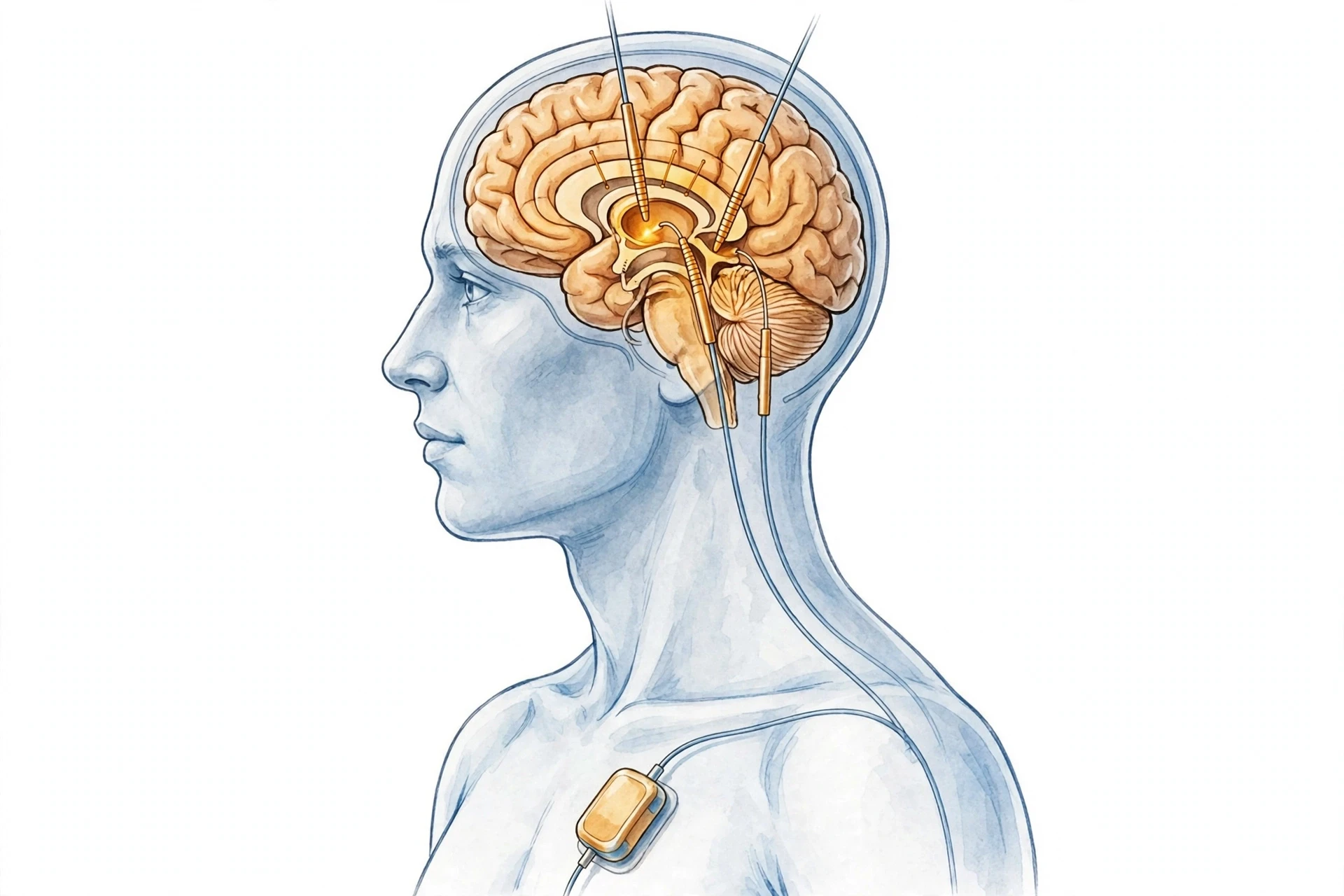
DBS helps a great deal with the right symptoms and the right people. In trials, it improves off-medication motor scores by about 40 to 60 percent, and it typically allows the levodopa dose to be cut by about half when the STN is the target. It is most effective for tremor, rigidity, and bradykinesia, and for the fluctuations and dyskinesia that come with long-term levodopa use. It is least effective for the symptoms that levodopa also fails to help: balance, freezing of gait, speech, and cognition. And it does not cure the disease or slow its progression — the underlying degeneration continues, and the non-motor symptoms advance on their own schedule. The best candidates are people who still respond well to levodopa but whose response has become erratic, who have no significant dementia, and whose expectations are realistic. The surgery carries risks — bleeding, infection, a small risk of stroke — and the device needs lifelong follow-up, programming visits, and battery replacements. It is a treatment for the middle of the disease, offered to a minority of people, and it is transformative for those it suits.
Focused ultrasound is the newer, less invasive alternative. In magnetic resonance-guided focused ultrasound, or MRgFUS, hundreds of ultrasound beams are focused through the skull onto a single target — usually the ventral intermediate nucleus of the thalamus — heating a small volume of tissue to the point where it is destroyed. There is no incision, no implanted hardware, and the effect on tremor is immediate. The FDA has approved it for tremor in Parkinson's disease, usually on one side of the body. Its limits are real: it is a lesion, so it cannot be adjusted or reversed, and treating both sides carries a higher risk of speech and balance problems. For a person with severe tremor on one side who cannot or does not want implanted hardware, it is a genuine option — and a striking example of how far the field has come from the era when the only surgical treatment was to destroy brain tissue blindly.
19. Movement, Speech, and Daily Life
There is one treatment for Parkinson's disease that has no prescription, no side effects, and some of the strongest evidence of any intervention in neurology: exercise. It sounds too simple to be true, and it is worth being precise about what the evidence actually says. A Cochrane review published in 2023, pooling 156 randomised trials with 7,939 participants, found that exercise improves motor function and quality of life in people with Parkinson's disease. High-intensity treadmill training, in the SPARX phase 2 trial — designed to test feasibility rather than efficacy — showed a smaller worsening of motor scores than usual care, a secondary and exploratory finding. Tai chi improves balance and reduces falls — a 2012 trial in the New England Journal of Medicine showed it outperformed both resistance training and stretching. The Parkinson's Foundation recommends at least 2.5 hours of exercise per week. None of this proves that exercise slows the underlying disease process, and the trials are not perfect — but the effect on function is real, consistent, and large enough that every major guideline now treats exercise as a core part of care, not an optional extra.
The mechanism is plausible even if it is not fully proven. Exercise increases brain-derived neurotrophic factor (BDNF), a protein that supports the survival and growth of neurons. It improves the function of mitochondria, the cell's power plants, whose failure is implicated in the disease. It improves blood flow, mood, and sleep. And, perhaps most importantly, it preserves the habit of movement itself: in a disease whose central problem is that movements become hard to start, the daily practice of starting them matters. For the science of what exercise does to the body — muscle, heart, brain, and mood — the companion article How Exercise Changes the Body covers it in depth.
Physiotherapy builds on the same principle with structure. LSVT BIG is a programme of large, exaggerated movements — big steps, big reaches, big gestures — practised intensively over four weeks, designed to counter the shrinking of movement that bradykinesia causes. It works, in part, by retraining the brain's sense of how big a movement should be: people with Parkinson's disease systematically underestimate the size of their own movements, so they need to be taught to overshoot deliberately. Speech therapy works the same way for the voice. LSVT LOUD, the speech counterpart, runs 16 one-hour sessions, four days a week for four weeks, and about 90 percent of people improve their vocal loudness — not by speaking louder in the ordinary sense, but by recalibrating what "loud enough" feels like. Both programmes share a lesson that applies to the whole disease: the brain's calibration is broken, and the fix is deliberate, practised, exaggerated effort.
Diet and sleep are worth a brief, honest word. There is no Parkinson's disease diet with proven benefit, and anyone selling one is ahead of the evidence. What is established is practical: take levodopa away from protein-rich meals so the drug is absorbed properly; stay hydrated, because dehydration worsens blood pressure drops; eat enough fibre, because constipation is both a symptom and a problem for drug absorption; and be cautious about supplements, which are unregulated and sometimes interact with medicines. Sleep matters because the disease disrupts it in several directions at once — RBD, insomnia, daytime sleepiness from the medicines — and poor sleep worsens every other symptom. The practical advice is the ordinary advice: regular hours, morning light, daytime activity, and a conversation with a doctor before trying any sleep aid. Living well with Parkinson's disease is, in the end, a matter of attending to the whole person — movement, voice, mood, sleep, and swallowing — rather than chasing a single magic intervention. That is not a consolation prize. It is the treatment that works.
20. The Research Frontier
As of early 2026, there is no proven disease-modifying treatment for Parkinson's disease — no drug that has been shown to slow, stop, or reverse the underlying degeneration. Every treatment in the previous three sections treats symptoms. That is the honest starting point for this section, and it is also the reason the research frontier matters so much: the field is working, urgently, on the first treatments that would change the course of the disease rather than its symptoms.
The most advanced idea is to target alpha-synuclein itself. If misfolded alpha-synuclein drives the disease, then removing it, or stopping it from spreading, should help. Antibodies designed to bind alpha-synuclein and clear it from the brain have been tested in large trials. Cinpanemab, one of the earliest, failed in its phase 2 trial. Prasinezumab, a related antibody, completed its phase 2b trial, called PADOVA, in 586 people, with results reported in December 2024. The trial missed its primary endpoint — time to confirmed motor progression — with a hazard ratio of 0.84 that did not reach statistical significance, although the effect looked stronger in the three-quarters of participants who were also taking levodopa. A phase 3 trial is now recruiting. That timeline tells its own story: even a successful antibody is years from the clinic, and the field does not yet know whether clearing alpha-synuclein will help people who already have symptoms.
A second idea is to use the alpha-synuclein seed amplification assay — the test described in section 14 — as a tool for finding people in the prodrome, before motor symptoms appear, and testing treatments in them. If the disease begins 10 to 20 years before diagnosis, then treating it after diagnosis may simply be too late, and the trials of the future will need to enrol people who have the biology of the disease but not yet its symptoms. That is a profound shift in how Parkinson's disease is studied, and it depends entirely on having a reliable biomarker — which is why the seed amplification assay has drawn so much attention.
A third idea comes from an unexpected direction: diabetes drugs. Glucagon-like peptide-1 (GLP-1) receptor agonists, such as exenatide, protect dopamine neurons in animal models, and early small trials suggested they might slow progression in people. The large phase 3 trial of exenatide, however, failed in February 2025, showing no benefit over placebo. The idea is not dead — other GLP-1 drugs are being tested, and the biology remains plausible — but the exenatide result is a reminder of how often promising ideas fail in phase 3, and of why no one should promise a cure from a single trial.
Stem cells and gene therapy are the fourth frontier. Bemdaneprocel, a therapy in which dopamine-producing neurons grown from stem cells are transplanted into the brain, began its phase 3 trial in 2025. The idea is old — fetal cell transplants were tried in the 1980s and 1990s, with mixed results — but the new versions use cells made in the laboratory, in defined numbers, from a single source. Gene therapy, in which a harmless virus delivers a gene to the brain to produce dopamine, a growth factor, or an enzyme, is being tested in several trials. No gene therapy for Parkinson's disease has been approved. Both approaches face the same fundamental question: can replacing or repairing the dopamine system help when the disease has already spread far beyond it?
A fifth strand of research is less visible but just as important: inflammation. The brain's immune cells, the microglia, become activated in Parkinson's disease, and genetic risk for the disease includes genes involved in immune function. Whether inflammation drives the disease or follows it is still debated, but trials of anti-inflammatory approaches are under way, and the immune system's role in neurodegeneration is one of the most active areas of research in the field. For the background on how the immune system works — innate and adaptive immunity, antibodies, and the cells that defend the body — the companion article How the Human Immune System Works covers it in depth.
What should a reader take from all of this? Two things. First, the frontier is real and it is moving: the seed amplification assay, the antibody trials, the stem-cell trials, and the adaptive deep brain stimulation systems approved in 2025 are genuine advances, not press-release hype. Second, none of them is a cure yet, and anyone promising one is selling something. The most useful thing a person can do today is to stay informed, to consider taking part in a trial — the Parkinson's Progression Markers Initiative and similar studies depend on volunteers, with and without the disease — and to keep doing the things that are already known to help: exercise, good sleep, and careful, well-managed treatment.
21. Common Mistakes and Misconceptions
A disease this common accumulates myths, and Parkinson's disease has more than its share. Some are harmless. Some change how people are treated, what care they receive, and whether they seek help at all. Here are the ones I hear most often, and what the evidence actually says.
"Parkinson's disease is only a tremor." It is not, and this article has shown why: the tremor is one symptom of four, and the non-motor symptoms — loss of smell, constipation, dream-enacting sleep, depression, dementia, blood pressure falls — are often the ones that matter most. A person whose tremor is well controlled can still be profoundly disabled by freezing of gait, by hallucinations, or by the apathy that makes it hard to get out of bed. Judging the disease by the tremor is like judging a fire by the smoke.
"It only affects old people." Age is the biggest risk factor, but between one in twenty and one in ten cases begin before the age of 50, and the disease can begin in a person's thirties or even twenties. Young-onset Parkinson's disease has its own challenges: it progresses more slowly, but it lasts longer, it is more often genetic, and it collides with working life, mortgages, and young children in ways that a diagnosis at 70 does not. The actor Michael J. Fox, diagnosed at 29, is the best-known example, and his public life with the disease has done more to correct this misconception than any textbook.
"Dopamine is the pleasure chemical, so Parkinson's disease is about motivation." I have already disagreed with this one, in section 4, and I will disagree with it again here, because it is the misconception that does the most quiet harm. Dopamine is a modulator used in many circuits, and in the movement circuit it has nothing to do with pleasure or motivation. A person with Parkinson's disease who cannot start walking is not unmotivated. They are not lazy, and they are not giving up. Their brain cannot produce the signal that starts the movement. Telling them to try harder is not encouragement. It is a misunderstanding of the disease, and it is one that people with Parkinson's disease hear far too often.
"Levodopa stops working because the disease is cured by it" — or the opposite, "levodopa stops working and then there is nothing left." Neither is true. Levodopa does not stop working: it keeps working for as long as it is taken, in the sense that each dose still relieves symptoms. What changes is the smoothness of the response — the wearing-off and dyskinesia described in section 16 — because the brain loses its ability to store and release dopamine steadily. And when levodopa becomes erratic, there is a great deal left: other drugs, deep brain stimulation, focused ultrasound, exercise, and speech therapy. Levodopa is the beginning of treatment, not the end of it.
"Parkinson's disease is hereditary" — or "it runs in families, so my children will get it." Most cases are not inherited in any simple sense. About 15 percent of people have a family history, and only 5 to 10 percent have a single-gene form. For the large majority, the risk to a child of a person with Parkinson's disease is only modestly higher than the risk in the general population — and even for carriers of the strongest risk genes, such as GBA1 or LRRK2, most carriers never develop the disease. Genetic testing is available, and the PD GENEration study has made it free for many people with the disease, but it is a decision to make with a genetic counsellor, not a test to take on a whim, because the results change the odds without deciding the outcome.
"It is contagious." It is not. Parkinson's disease cannot be caught from another person, and the prion-like spread of alpha-synuclein inside one brain has nothing to do with transmission between people. No one has ever caught Parkinson's disease from caring for someone who has it.
"There is nothing you can do." This is the most dangerous misconception of all, and the one this article exists to answer. There is no cure, and that fact should never be softened. But there is treatment that restores movement, surgery that transforms lives, exercise that measurably improves function, and therapy that restores voice and balance. Parkinson's disease is a serious, progressive, incurable disease — and it is also a disease in which the right care, started early and adjusted carefully, can give people years of good life. Both halves of that sentence are true, and holding both at once is the only honest way to live with it.
22. Frequently Asked Questions
What causes Parkinson's disease?
In most people, the cause is genes and environment acting together, with age as the biggest single risk factor. About 5 to 10 percent of cases have a single-gene cause, most commonly involving the genes GBA1, LRRK2, SNCA, PRKN, PINK1, and DJ-1. Environmental risks include pesticides such as paraquat and rotenone, the industrial solvent trichloroethylene, and head injury. In the large majority of people, no single cause can be identified. The underlying process is the progressive loss of dopamine-producing neurons in the substantia nigra, together with the accumulation of misfolded alpha-synuclein protein.
What is dopamine's role in Parkinson's disease?
Dopamine is a chemical messenger that tunes the brain's movement circuits. It is made by neurons in the substantia nigra and delivered to the striatum, where it strengthens the direct "go" pathway and weakens the indirect "brake" pathway, allowing smooth, purposeful movement. In Parkinson's disease, those neurons die, dopamine runs low, the go signal weakens and the brake strengthens, and movement becomes slow, stiff, and hard to start. Dopamine is also used in the brain's reward circuit, but the movement circuit is the one that fails in Parkinson's disease.
What are the first symptoms of Parkinson's disease?
The earliest symptoms are often non-motor and can appear 10 to 20 years before the first tremor: loss of smell, constipation, and acting out dreams in sleep (REM sleep behaviour disorder). The first motor symptoms are usually subtle: a slight tremor in one hand at rest, a stiff shoulder, smaller handwriting, a softer voice, or a reduced arm swing when walking. Because these changes are small and gradual, they are often blamed on age, stress, or arthritis, and diagnosis is frequently delayed.
Why does Parkinson's cause tremor?
The tremor arises from rhythmic, oscillatory activity in the circuit that runs through the basal ganglia, the thalamus, and the cerebellum. When dopamine falls, the basal ganglia start firing in rhythmic bursts, and the cerebellum amplifies that rhythm to 4 to 6 cycles per second. The tremor shows up at rest because the idle circuit is free to fall into its rhythm, and it fades during voluntary movement because the cortex takes over the circuit for a real task. It is a different mechanism from the slowness and stiffness, which is why it responds less predictably to dopamine medicines.
Is Parkinson's disease hereditary?
Usually not in a simple sense. Roughly one person in seven has a family history of the disease, and 5 to 10 percent have a single-gene form. The strongest genetic risk factors are variants in GBA1, LRRK2, and SNCA, but even for carriers of these variants, most never develop the disease — penetrance is incomplete. For most families, a child's risk is only slightly above that of the general population. Genetic testing and counselling are available, and the decision to be tested is best made with a professional.
Is there a cure for Parkinson's disease?
No. As of early 2026, there is no proven disease-modifying treatment — no drug, surgery, or therapy has yet been shown to slow, stop, or reverse the disease process itself. Current treatments relieve symptoms: levodopa and other medicines restore movement, deep brain stimulation and focused ultrasound help when medicines become erratic, and exercise measurably improves function. Research into alpha-synuclein antibodies, stem-cell therapy, and gene therapy is active, but none of these has yet been proven to change the course of the disease.
How fast does Parkinson's disease progress?
It varies widely. On average it progresses slowly: the median time from the first symptom to stage 3 of the Hoehn and Yahr scale, where balance problems appear, is about 7.4 years. People whose disease is dominated by tremor tend to progress more slowly than people whose disease is dominated by balance and gait problems. Younger people progress more slowly but live with the disease longer. Life expectancy is reduced by about 2 to 7 years on average compared with the general population, and the NHS notes that, with modern treatment, it is normal or close to normal for most people.
Can exercise help Parkinson's disease?
Yes. Pooling 156 randomised trials with 7,939 participants, a 2023 Cochrane review found that exercise improves motor function and quality of life. High-intensity treadmill training slowed the progression of motor symptoms in people with early disease, and tai chi improves balance and reduces falls. Guidance from the Parkinson's Foundation is at least two and a half hours of exercise each week. Exercise has not been proven to slow the underlying disease process, but its benefit for day-to-day function is solid, consistent, and large enough that every major guideline treats it as a core part of care.
23. Sources
World Health Organization. "Parkinson disease." Fact sheet, 9 August 2023. https://www.who.int/news-room/fact-sheets/detail/parkinson-disease
National Institute of Neurological Disorders and Stroke. "Parkinson's Disease." https://www.ninds.nih.gov/health-information/disorders/parkinsons-disease
Parkinson's Foundation. "Statistics." https://parkinsons.org/disease/statistics
Su, Q., et al. "Global burden of Parkinson's disease and its projections to 2050." BMJ, 2025. doi: 10.1136/bmj-2024-080952
Global Burden of Disease 2021 Nervous System Disorders Collaborators. "Global, regional, and national burden of disorders affecting the nervous system, 1990–2021." The Lancet Neurology, 2024. doi: 10.1016/S1474-4422(24)00038-3
Mayo Clinic. "Parkinson's disease — Symptoms and causes." https://www.mayoclinic.org/diseases-conditions/parkinsons-disease/symptoms-causes/syc-20376055
MedlinePlus. "Parkinson's Disease." US National Library of Medicine. https://medlineplus.gov/parkinsonsdisease.html
Parkinson's Foundation. "What Is Parkinson's?" https://parkinsons.org/disease/what-is-parkinsons
National Health Service. "Parkinson's disease." https://www.nhs.uk/conditions/parkinsons-disease/
Parkinson, J. "An Essay on the Shaking Palsy." London, 1817. https://www.gutenberg.org/files/23777/23777-h/23777-h.htm
Braak, H., et al. "Staging of brain pathology related to sporadic Parkinson's disease." Neurobiology of Aging, 2003. doi: 10.1016/S0197-4580(02)00065-9
Gerfen, C. R. "Segregation of D1 and D2 dopamine receptors in the striatal direct and indirect pathways: An historical perspective." Frontiers in Synaptic Neuroscience, 2023. doi: 10.3389/fnsyn.2022.1002960
Postuma, R. B., et al. "MDS clinical diagnostic criteria for Parkinson's disease." Movement Disorders, 2015. doi: 10.1002/mds.26424
Hoehn, M. M., and Yahr, M. D. "Parkinsonism: onset, progression and mortality." Neurology, 1967. doi: 10.1212/WNL.17.5.427
Goetz, C. G., et al. "Movement Disorder Society-sponsored revision of the Unified Parkinson's Disease Rating Scale (MDS-UPDRS)." Movement Disorders, 2008. doi: 10.1002/mds.22340
Siderowf, A., et al. "Assessment of heterogeneity among participants in the Parkinson's Progression Markers Initiative cohort using alpha-synuclein seed amplification." The Lancet Neurology, 2023. doi: 10.1016/S1474-4422(23)00109-6
Cotzias, G. C., et al. "Aromatic amino acids and modification of parkinsonism." New England Journal of Medicine, 1967. doi: 10.1056/NEJM196702162760703
Dorsey, E. R., et al. "Trichloroethylene: An Invisible Cause of Parkinson's Disease?" Journal of Parkinson's Disease, 2023. doi: 10.3233/JPD-225047
Lee, P. C., et al. "Traumatic brain injury, paraquat exposure, and their relationship to Parkinson disease." Neurology, 2012. doi: 10.1212/WNL.0b013e3182749f28
Tanner, C. M., et al. "Rotenone, paraquat, and Parkinson's disease." Environmental Health Perspectives, 2011. doi: 10.1289/ehp.1002839
Parkinson's Foundation. "Genetics." https://www.parkinson.org/understanding-parkinsons/causes/genetics
Parkinson's Foundation. "PD GENEration." https://www.parkinson.org/advancing-research/our-research/pdgeneration
Michael J. Fox Foundation. "Parkinson's Disease." https://www.michaeljfox.org/parkinsons-101
National Institute on Aging. "Parkinson's disease genetics." https://www.nia.nih.gov/health/parkinsons-disease
Parkinson's Foundation. "Treatment." https://www.parkinson.org/living-with-parkinsons/treatment
Ernst, M., et al. "Physical exercise for people with Parkinson's disease: a systematic review and network meta-analysis." Cochrane Database of Systematic Reviews, 2023. doi: 10.1002/14651858.CD013856.pub2
Li, F., et al. "Tai chi and postural stability in patients with Parkinson's disease." New England Journal of Medicine, 2012. doi: 10.1056/NEJMoa1107911
Parkinson's Foundation. "Surgical Treatment Options." https://www.parkinson.org/living-with-parkinsons/treatment/surgical-treatment-options
Martinez-Fernandez, R., et al. "Focused ultrasound subthalamotomy in patients with asymmetric Parkinson's disease: a pilot study." The Lancet Neurology, 2018. doi: 10.1016/S1474-4422(17)30403-9
Parkinson's UK. "Levodopa (co-beneldopa and co-careldopa)." https://www.parkinsons.org.uk/information-and-support/levodopa-co-beneldopa-and-co-careldopa
Parkinson's Foundation. "Non-Motor Symptoms." https://www.parkinson.org/understanding-parkinsons/non-movement-symptoms
Parkinson's Foundation. "Sleep Problems in Parkinson's Disease." https://parkinsons.org/symptoms/sleep-disorders
Benabid, A. L., et al. "Long-term suppression of tremor by chronic stimulation of the ventral intermediate thalamic nucleus." The Lancet, 1991. doi: 10.1016/0140-6736(91)91175-T
Stokholm, M. G., et al. "Pathological alpha-synuclein in gastrointestinal tissues from prodromal Parkinson disease patients." Annals of Neurology, 2016. doi: 10.1002/ana.24648
Parkinson's Progression Markers Initiative. "Dopamine transporter imaging in early Parkinson's disease." Movement Disorders Clinical Practice, 2023. doi: 10.1002/mdc3.13687
Postuma, R. B., et al. "Risk and predictors of dementia and parkinsonism in idiopathic REM sleep behaviour disorder: a multicentre study." Brain, 2019. doi: 10.1093/brain/awz030
National Institute for Health and Care Excellence. "Parkinson's disease in adults." NICE guideline NG71, 2017. https://www.nice.org.uk/guidance/ng71
Parkinson's UK. "Parkinson's symptoms." https://www.parkinsons.org.uk/information-and-support/parkinsons-symptoms
Parkinson's Foundation. "Hallucinations and Delusions." https://www.parkinson.org/understanding-parkinsons/non-movement-symptoms/hallucinations-delusions
American Parkinson Disease Association. "What is Parkinson's Disease?" https://www.apdaparkinson.org/what-is-parkinsons/
AbbVie. "U.S. FDA Approves AbbVie's JUVMO (tavapadon) for Parkinson's Disease." Press release, 28 September 2026. https://news.abbvie.com/2026-09-28-U-S-FDA-Approves-AbbVies-JUVMO-TM-tavapadon-for-Parkinsons-Disease
Goldman, S. M., et al. "Genetic modification of the association of paraquat and Parkinson's disease." Movement Disorders, 2012. doi: 10.1002/mds.25216