

1. The Number That Should Not Exist — Yet Runs Your Life
Try to solve a simple equation: x squared equals minus 1. Find the number that, multiplied by itself, gives minus 1. On the real number line there is no answer. Every real number squared is zero or positive. A positive number squared is positive. A negative number squared is positive too, because a minus times a minus is a plus. Zero squared is zero. Nothing on the line works, and that should be the end of the story.
It is not the end of the story. It is the beginning of one of the strangest and most useful chapters in mathematics. The device you are reading this on, the power grid outside your window, and the quantum computers in the news all run on the answer mathematicians invented anyway. They gave the impossible square root a name, the letter i, and a single rule: i squared equals minus 1. From that one rule they built a whole second dimension of numbers, a geometry in which multiplication is rotation, the most beautiful equation in mathematics, and the engineering of the modern world. This article is about imaginary numbers, and it follows that one invented number from a Renaissance card trick with cubic equations all the way to the photons in a quantum experiment.
The promise is simple. You will learn what i is, how to add, multiply and divide with it, why its powers cycle in fours, how it turns numbers into a plane, how it solves equations the real numbers cannot touch, and why engineers and physicists cannot do their jobs without it. Every number in the worked examples is shown step by step, so you can check the arithmetic yourself with pencil and paper. Nothing here asks you to take a result on trust.
Start with the shock of it. For centuries, the square root of a negative number was treated as a sign that you had made a mistake. If a calculation produced one, you threw the calculation away. Then, in the 1500s, mathematicians solving cubic equations found that the square root of a negative number kept appearing in the middle of the working — and that if you carried it through the calculation honestly, instead of throwing it away, it cancelled out at the end and left a perfectly ordinary answer. The impossible number was not a mistake. It was a bridge, and the bridge led somewhere real.
That is the first thing to understand about imaginary numbers: they were not invented to solve x squared equals minus 1. They were forced on mathematicians by cubic equations, and the quadratic equation is only a convenient classroom example. The history belongs in Section 7, after you know what i is, because the history makes far more sense once you can do the arithmetic yourself. First, the definition. Then the arithmetic. Then the geometry. Then the story of three centuries of resistance, and then the applications that settled the argument for good.
Pi is the most famous impossible-looking number, and our Pi article is the story of the first; imaginary numbers are the other one, a number that should not exist and yet refuses to go away. Pi never ends and never repeats, and still it measures every circle you have ever drawn. In the same way, i never sits on the number line, and still it measures the current in the wires in your walls. The parallel is worth keeping in mind as you read: mathematics has a habit of inventing things that look useless and then discovering that the world was using them all along.
Here is the question that will run through the whole article, and it is the question most readers arrive with: do imaginary numbers really exist? Hold that question. By Section 13 you will have the evidence to answer it for yourself, and the answer will be built from arithmetic you have checked, a circuit you can measure, and an experiment you can read about. The short version is that existence in mathematics is not about holding a number in your hand. Nobody has ever held a minus 3 either, and nobody doubts that negative numbers are real in the only sense that matters: they follow consistent rules, and they predict measurements. Imaginary numbers pass the same test, and they pass it in places where nothing else works.
One invented number, one rule, and from that rule a second dimension of numbers, a geometry of rotation, the most beautiful equation in mathematics, and the engineering of the modern world. That is the article in one sentence, and the rest of it is the working.
2. What Are Imaginary Numbers? The Definition in Plain English
Imaginary numbers start with a definition so short it fits on a sticky note. The imaginary unit, written i, is the number defined by the rule i squared equals minus 1. An imaginary number is a real multiple of i: 3i, minus 5i, 0.5i, minus 100i. A complex number is a plus bi, where a and b are both real numbers: a is the real part, b is the imaginary part. The number 3 plus 4i has real part 3 and imaginary part 4. The number 2i is a pure imaginary number, with real part zero. The number 7 is a complex number too, with imaginary part zero, which is why the complex numbers contain the real numbers rather than competing with them.
That is the whole definition, and everything else in this article follows from it. There is no second rule hiding behind the first one. If you accept that i squared equals minus 1, you have accepted imaginary numbers, and the rest is arithmetic, geometry and consequences.
The one rule
The rule deserves a moment of attention, because it looks like cheating. Mathematics does not usually let you define a problem away. You cannot define a largest prime number into existence, or a fraction equal to the square root of 2. Why is i different? Because the definition does not contradict anything. It extends the number system the way negative numbers extended the counting numbers: by adding something new that obeys consistent rules and leaves all the old arithmetic intact. Adding i to the real numbers is like adding a second direction to a road. The road still runs east and west, exactly as before. It now also runs north and south, and the traffic rules still work.
The test of an extension like this is whether it breaks anything, and i passes the test. Addition still commutes. Multiplication still distributes over addition. Every old calculation gives the same answer it always gave. The new number simply fills a gap that was always there: the equations that had no answer now have one, and the answers behave.
I remember the first time a teacher wrote i squared equals minus 1 on a board in front of me and then, without pausing, used it to finish a calculation. I expected the room to object. Nobody did, and the calculation worked, and the answer checked out against a completely different method. That quiet moment — no drama, just a working answer — is the correct way to meet imaginary numbers. They do not arrive with thunder. They arrive as a tool that works, and then they keep working everywhere you look.
Imaginary vs complex
The words matter here, because textbooks and casual conversation use them loosely. An imaginary number is a real multiple of i: it lives on the vertical axis of the complex plane, and its real part is zero. A complex number is the general case, a plus bi, which can sit anywhere on the plane. Every imaginary number is a complex number, with real part zero. Not every complex number is imaginary: 3 plus 4i is complex but not purely imaginary, because its real part is 3.
Picture the real number line as a horizontal road. Pure imaginary numbers sit on a vertical road crossing it at zero. Most complex numbers sit somewhere off both roads, out in the open country between them, with a real part and an imaginary part at once. That picture is the complex plane, and Section 4 builds it properly. For now, hold the image: one axis for the numbers you already know, a second axis for the numbers i makes possible, and every complex number as a point with two coordinates.
The distinction also answers a common confusion. When someone says "complex number" they usually mean the general case, a plus bi. When they say "imaginary number" they usually mean the pure case, bi. The word "imaginary" carries the insult of its history, which Section 7 tells in full. The word "complex" is the honest name, given by Gauss in 1831, and it describes what these numbers are: numbers with two parts, a real part and an imaginary part, working together.
The first worked examples
Worked examples are where a definition stops being words and starts being a skill, so here are the first ones, with every step shown.
The square root of minus 9 is 3i. Here is why: 3i squared equals 9 times i squared, which is 9 times minus 1, which is minus 9. So 3i is a square root of minus 9, exactly as 3 is a square root of 9. The square root of minus 16 is 4i, for the same reason: 4i squared equals 16 times i squared, which is minus 16. Every negative number has imaginary square roots. The square root of minus 1 is i itself, and the square root of minus 25 would be 5i. The pattern is plain: take the square root of the positive version, and put i after it.
Next, (1 plus i) squared. Expand it like ordinary algebra: (1 plus i) times (1 plus i) equals 1 plus i plus i plus i squared, which is 1 plus 2i plus i squared. Replace i squared with minus 1, and 1 plus 2i minus 1 leaves 2i. So (1 plus i) squared equals 2i. The real parts cancelled, and a purely imaginary number came out. That cancellation is a hint of something larger: squaring a complex number can rotate it, and Section 4 explains the geometry.
Now the example that surprises everyone the first time they meet it: (1 plus i) to the power 10 equals 32i. You can check this by repeated multiplication, and Section 6 shows a far quicker way using De Moivre's theorem, but the direct route is worth seeing once. (1 plus i) squared is 2i, as just shown. Raise both sides to the power 5: (1 plus i) to the power 10 equals (2i) to the power 5. Now (2i) to the power 5 equals 32 times i to the power 5, and i to the power 5 equals i, because the powers of i cycle in fours and 5 leaves remainder 1 on division by 4. So the answer is 32i. A tenth power, which sounds like a huge calculation, collapses to one multiplication because the cycle does the work. Keep this example in mind: Section 6 returns to it with the geometric method, and the two routes agree exactly.
The powers of i
The powers of i cycle with period 4, and the cycle is the single most useful fact in this article for anyone facing an exam. i to the power 0 is 1. i to the power 1 is i. i to the power 2 is minus 1, by definition. i to the power 3 is minus i, because i cubed equals i squared times i, which is minus 1 times i. i to the power 4 is 1, because i to the power 4 equals i squared times i squared, which is minus 1 times minus 1. Then the cycle repeats: i to the power 5 is i again, i to the power 6 is minus 1 again, and so on forever.
The rule that follows is plain: i to the power n depends only on n mod 4, the remainder when n is divided by 4. Remainder 0 gives 1. Remainder 1 gives i. Remainder 2 gives minus 1. Remainder 3 gives minus i. Any power of i, however large, reduces to one of four answers, and the reduction takes seconds.
Here is the worked example the rule was made for: i to the power 2026 equals minus 1. Divide 2026 by 4, and you get 506 with remainder 2, because 4 times 506 is 2024 and 2026 minus 2024 is 2. Remainder 2 means the answer is i squared, which is minus 1. A power that looks impossible to compute by hand takes one division. The same trick gives i to the power 2027 equals minus i, because 2027 leaves remainder 3, and Section 14 invites you to check that one yourself.
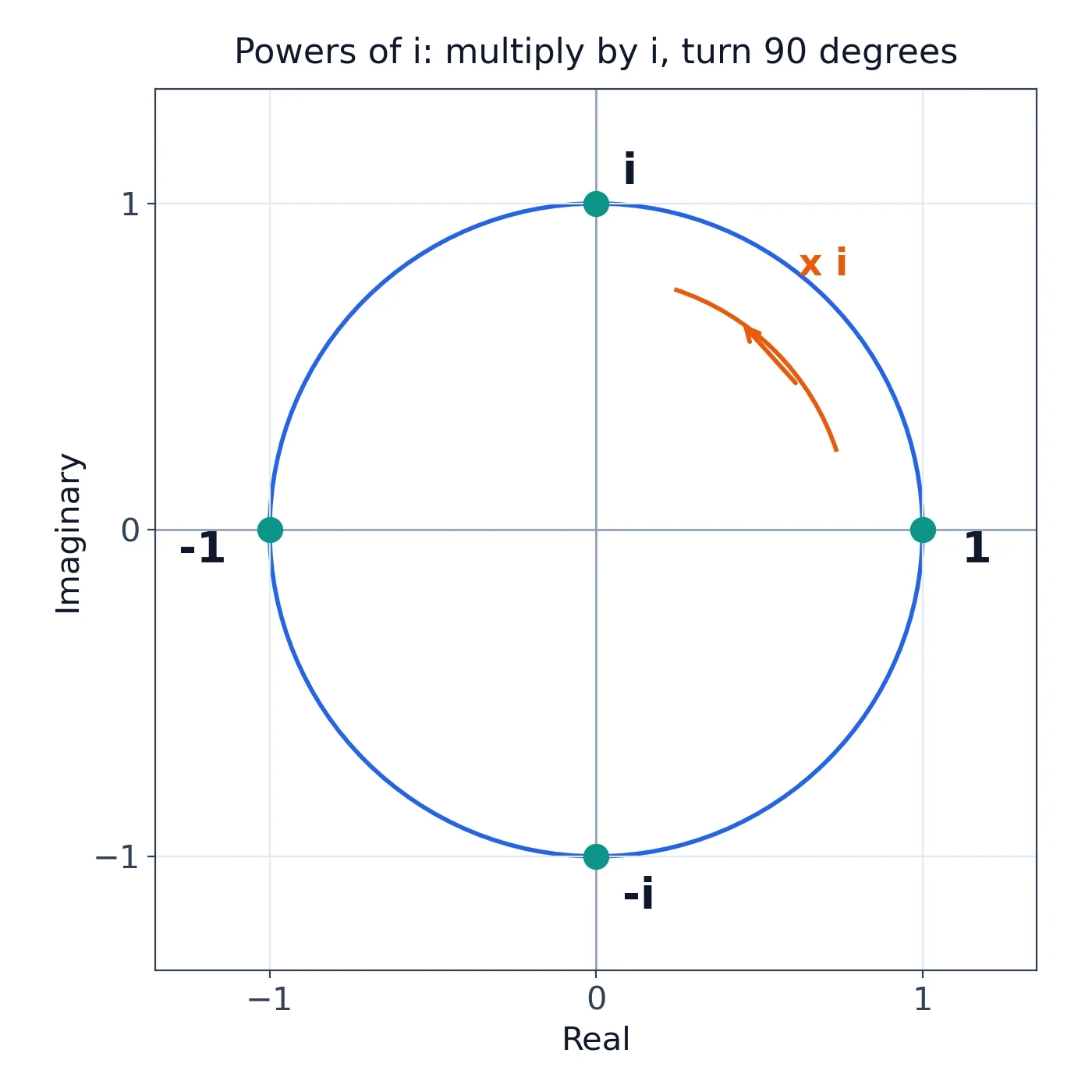
The cycle has a picture, and the picture is the first figure in this article. Imagine the unit circle, the circle of radius 1 centred at the origin. Multiplying by i moves a point a quarter turn anticlockwise around that circle: 1 goes to i, i goes to minus 1, minus 1 goes to minus i, minus i goes back to 1. Four quarter turns make a full turn, which is why the cycle has period 4. That picture is not a decoration. It is the geometry of multiplication, and Section 4 builds it into the full rule: multiplying complex numbers multiplies their distances from the origin and adds their angles.
3. How to Do Arithmetic with Imaginary Numbers
Imaginary numbers look strange on the page, and that strangeness makes many readers expect the arithmetic to be strange too. It is not. The arithmetic follows the same rules you already know from ordinary algebra, with exactly one extra step: whenever i squared appears, replace it with minus 1. A complex number has two parts, a real part and an imaginary part, and each part behaves like an ordinary number. Keep the two parts separate while you work, combine like with like, and let i squared do its one job at the end.
Addition and subtraction
To add two complex numbers, add the real parts together and add the imaginary parts together. Take (3 plus 2i) plus (1 minus 5i). Add the real parts: 3 plus 1 is 4. Add the imaginary parts: 2i plus minus 5i is minus 3i, because 2 minus 5 is minus 3. The answer is 4 minus 3i. That is the whole calculation, and the plainness is the point: imaginary numbers add exactly the way ordinary numbers add, once you keep the two parts apart.
Subtraction works the same way, with one care point. To subtract, subtract the real parts and subtract the imaginary parts, and remember that subtracting a negative imaginary part adds to it. Take (3 plus 2i) minus (1 minus 5i). Subtract the real parts: 3 minus 1 is 2. Subtract the imaginary parts: 2i minus minus 5i is 2i plus 5i, which is 7i, because subtracting minus 5 is the same as adding 5. The answer is 2 plus 7i. The sign change is the only place this calculation can go wrong, and it is the same sign change that appears in ordinary subtraction with negative numbers.
I remember sitting with a page of these sums as a student and feeling almost cheated by how easy they were. I had expected imaginary numbers to demand some new kind of arithmetic, and instead the first exercise was just adding two columns of numbers. The teacher answered that the difficulty of imaginary numbers was never in the addition. It was in accepting that the numbers were worth adding at all. That answer stayed with me, because it was honest about where the real obstacle lay. The arithmetic is easy. Believing the numbers mean something is the hard part, and the rest of this article is the evidence that they do.
Multiplication
Multiplication is where i earns its keep, because multiplication can produce i squared, and i squared is the one place where the new rule changes the answer. The method is the ordinary expansion you learned in school: multiply each term in the first bracket by each term in the second bracket, add the four products together, and then replace any i squared with minus 1.
Work through the main example in full. Multiply (3 plus 4i) by (2 minus i). First, 3 times 2 is 6. Second, 3 times minus i is minus 3i. Third, 4i times 2 is 8i. Fourth, 4i times minus i is minus 4i squared. Add those four products together and you get 6 minus 3i plus 8i minus 4i squared. Combine the imaginary terms: minus 3i plus 8i is 5i. Now deal with the i squared term: minus 4i squared is minus 4 times minus 1, which is plus 4. Add that to the 6, and the real part becomes 10. The answer is 10 plus 5i.
It helps to see the same method on a smaller example, because it shows the rotation idea that Section 4 develops. Multiply (1 plus i) by (1 plus i), which Section 2 already worked out to 2i. The real parts cancelled entirely. That cancellation is the first glimpse of the geometry: squaring (1 plus i) turned it through a right angle, and a right angle turn moved it from the diagonal onto the vertical axis.
The conjugate and division
Division is the one operation that needs a new idea, and the idea is the conjugate. The conjugate of a plus bi is a minus bi: the same number with the sign of the imaginary part flipped. The conjugate of 3 plus 4i is 3 minus 4i. Flipping one sign is all there is to it, and the reason it matters is what happens when you multiply a number by its own conjugate.
Multiply (3 plus 4i) by its conjugate (3 minus 4i). Expand: 3 times 3 is 9, 3 times minus 4i is minus 12i, 4i times 3 is 12i, and 4i times minus 4i is minus 16i squared. The two middle terms cancel, and minus 16i squared is minus 16 times minus 1, which is plus 16. The answer is 9 plus 16, which is 25, a plain real number. In general, (a plus bi) times (a minus bi) equals a squared plus b squared, always real. That is the fact that makes division possible.
Work through the example. Divide 1 by (3 plus 4i). Multiply the top and the bottom by the conjugate of the bottom, which is (3 minus 4i). The top becomes 3 minus 4i. The bottom becomes 25, as just shown. So the fraction is (3 minus 4i) divided by 25, and dividing each part by 25 gives 0.12 minus 0.16i, because 3 divided by 25 is 0.12 and 4 divided by 25 is 0.16. Check it by multiplying back: (0.12 minus 0.16i) times (3 plus 4i) gives 0.36 plus 0.48i minus 0.48i minus 0.64i squared, and minus 0.64i squared is plus 0.64, so 0.36 plus 0.64 is 1. The division checks out.
Modulus and argument
Two more words belong in your vocabulary before the geometry of Section 4. The modulus of a plus bi is the square root of (a squared plus b squared). It is the distance from the origin to the point, the length of the arrow that represents the number. The argument is the angle that arrow makes with the positive real axis, measured anticlockwise. Together they say how far a number is from zero and in which direction it lies.
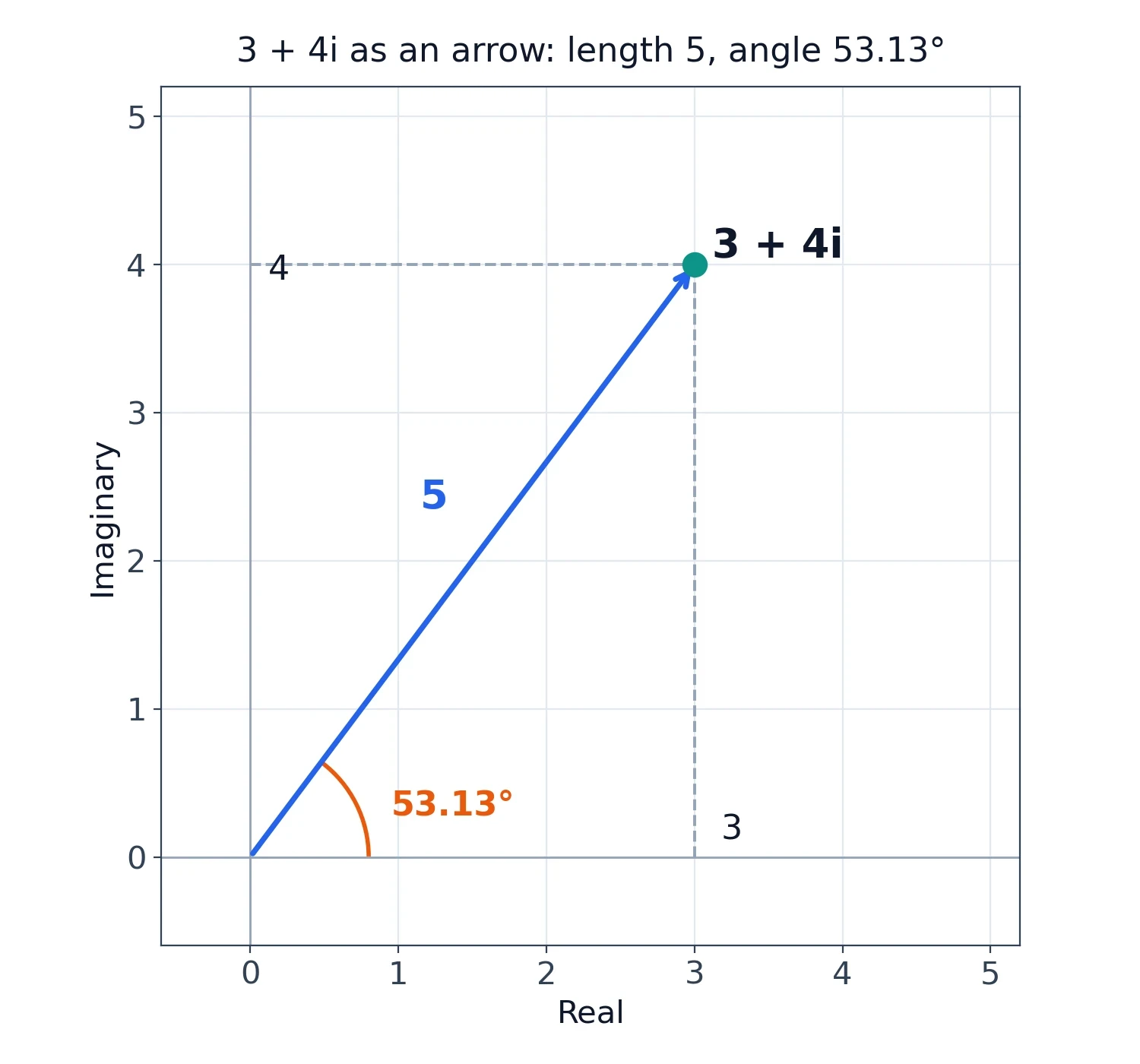
The worked example uses the same number as the multiplication above, 3 plus 4i. Its modulus is the square root of (9 plus 16), which is the square root of 25, which is 5. Its argument is the angle whose tangent is 4 divided by 3, which is 53.13 degrees, rounded to two decimal places. The full value is 53.13010235415598 degrees. A 3-4-5 triangle is hiding inside this number: the modulus is the hypotenuse of the right triangle with sides 3 and 4, and the argument is the angle at the origin of that triangle. Hold those two numbers, 5 and 53.13 degrees, because Section 4 draws them.
| Operation | Example | Working | Answer |
|---|---|---|---|
| Addition | (3 plus 2i) plus (1 minus 5i) | Add real parts: 3 plus 1 is 4. Add imaginary parts: 2 minus 5 is minus 3. | 4 minus 3i |
| Subtraction | (3 plus 2i) minus (1 minus 5i) | Subtract real parts: 3 minus 1 is 2. Subtract imaginary parts: 2 minus minus 5 is 7. | 2 plus 7i |
| Multiplication | (3 plus 4i) times (2 minus i) | Expand: 6 minus 3i plus 8i minus 4i squared, which is 6 plus 5i plus 4. | 10 plus 5i |
| Division | 1 divided by (3 plus 4i) | Multiply top and bottom by the conjugate 3 minus 4i: (3 minus 4i) divided by 25. | 0.12 minus 0.16i |
The table above is the whole of complex arithmetic in four rows. Each row takes the same two-part structure, applies the ordinary rules of algebra, and uses i squared equals minus 1 exactly once, at the point where it is needed. Addition and subtraction never need it. Multiplication needs it once. Division needs it through the conjugate.
4. The Complex Plane: Numbers Become Geometry
The arithmetic of Section 3 works without any picture at all. That is also its weakness. Without a picture, complex numbers feel like a trick with symbols, a game played with letters that happen to follow rules. The complex plane fixes that. It gives every complex number a place to live, and it turns every operation into something you can see. Once you have seen multiplication as a turn and a stretch, you will never again think of i as a piece of notation. You will think of it as a direction.
A second axis
The real number line is a horizontal road, with zero in the middle, positive numbers to the right and negative numbers to the left. The complex plane keeps that road and adds a second one, crossing it at zero at a right angle. The horizontal axis is the real axis. The vertical axis is the imaginary axis. Every complex number a plus bi is the point with horizontal coordinate a and vertical coordinate b. The number 3 plus 4i is the point 3 steps right and 4 steps up. The number 5i is the point on the vertical axis 5 steps up, with horizontal coordinate zero. The number 7 is the point on the horizontal axis 7 steps right, with vertical coordinate zero.
That last point matters, because it shows that the real numbers have not gone anywhere. They sit on the horizontal axis exactly where they always sat, and the complex plane contains the real line rather than replacing it. The imaginary numbers sit on the vertical axis. Most complex numbers sit out in the open country between the axes, with both coordinates nonzero. The plane is bigger than the line, and that extra room is the whole point: equations that had no answer on the line have answers in the plane, because the plane has somewhere for them to go.
Wessel presented this picture to the Royal Danish Academy of Sciences in 1797, and it was published in 1799. Argand published his version in 1806, and the plane is still often called the Argand diagram, though Wessel had the idea first. The history lives in Section 7. Here, only the picture matters: two axes, one point per number, and every number in its place.
Addition is sliding arrows
Draw a complex number as an arrow from the origin to its point. The number 3 plus 2i is an arrow ending 3 right and 2 up. The number 1 minus 5i is an arrow ending 1 right and 5 down. To add them, slide the second arrow so that its tail sits on the tip of the first arrow, keeping its direction and length unchanged. The tip of the moved arrow lands at the sum. Slide (1 minus 5i) onto the tip of (3 plus 2i) and you land at 4 minus 3i, which is the answer Section 3 found by adding the parts separately. The two methods agree, as they must, because they are the same addition seen two ways. Subtraction is the same picture run backwards: to subtract, slide the arrow in the opposite direction.
Multiplication is rotate and stretch
Multiplication is where the picture earns its keep. On the real line, multiplying by 2 stretches a number away from zero, and multiplying by minus 1 flips it to the other side. On the complex plane, multiplying does both of those things at once, and one more: it turns.
Start with the simplest case. Multiplying by i rotates a number 90 degrees anticlockwise around the origin. The number 1 rotates to i, i rotates to minus 1, minus 1 rotates to minus i, and minus i rotates back to 1. That is the powers-of-i cycle from Section 2, drawn as four quarter turns, and it explains why i squared equals minus 1: two quarter turns make a half turn, and a half turn sends 1 to minus 1. The definition you accepted on trust in Section 2 is now a picture you can see.
The general rule is just as clean. To multiply two complex numbers, multiply their moduli and add their arguments. The length of the answer is the product of the lengths. The angle of the answer is the sum of the angles. A number with modulus 2 and argument 30 degrees, multiplied by a number with modulus 3 and argument 40 degrees, gives a number with modulus 6 and argument 70 degrees. Stretch by the first length, stretch again by the second, turn by the first angle, turn again by the second, and you are there.
Here is a common idea I disagree with, and I want to say so plainly: many textbooks present the complex plane as a clever visual aid, a nice picture to help beginners, as if the real mathematics were the algebra and the geometry were decoration. That gets it backwards. The geometry is the mathematics. The algebra is the bookkeeping. Multiplication as rotate and stretch is not a way of remembering the rule. It is the rule, and the bracket expansion is the way of computing it.
Rotation is a geometric operation with rules of its own, and the full story of geometry's rules lives in our Euclidean Geometry article.
Polar form
The modulus and argument give a second way of writing any complex number, called polar form. Instead of writing z as a plus bi, with a horizontal distance and a vertical distance, write it as r times (cos theta plus i sin theta), where r is the modulus and theta is the argument. The number 3 plus 4i has r equal to 5 and theta equal to 53.13 degrees, so its polar form is 5 times (cos 53.13 degrees plus i sin 53.13 degrees). The rectangular form is best for adding. The polar form is best for multiplying, because multiplying in polar form is just multiplying the r values and adding the theta values. Polar form also leads directly to the shortest way of writing a complex number, r times e to the power i theta, which Section 8 explains through Euler's formula.
5. Solving Equations That Have No Real Answer
The complex plane is a fine picture, and the arithmetic is a fine skill, but a reader is entitled to ask what they are for. The answer is equations. There are equations that the real numbers cannot solve, and they are not rare or artificial. They appear in ordinary algebra, in the second week of any school course, and the real numbers simply have no answer to give. Complex numbers give the answer, and the answer is not a fudge. It satisfies the equation exactly, and it can be checked by substitution.
Quadratics with negative discriminants
Take the quadratic x squared minus 6x plus 13 equals 0. The quadratic formula gives x equal to (6 plus or minus the square root of (36 minus 52)) divided by 2. The number under the square root, the discriminant, is 36 minus 52, which is minus 16. On the real numbers, the story ends here: the square root of minus 16 does not exist, so the equation has no solution. With complex numbers, the story continues. The square root of minus 16 is 4i, because 4i squared is minus 16. So x equals (6 plus or minus 4i) divided by 2, which is 3 plus or minus 2i. The two roots are 3 plus 2i and 3 minus 2i.
Check the first root by substitution. Put x equal to 3 plus 2i into x squared minus 6x plus 13. First, (3 plus 2i) squared is 9 plus 12i plus 4i squared, which is 9 plus 12i minus 4, which is 5 plus 12i. Next, 6x is 18 plus 12i. So x squared minus 6x plus 13 is (5 plus 12i) minus (18 plus 12i) plus 13, which is 5 minus 18 plus 13, plus 12i minus 12i, which is 0. The root works. The imaginary parts cancelled, the real parts cancelled, and the equation is satisfied exactly.
A second example makes the pattern plain. Solve x squared plus 2x plus 5 equals 0. The quadratic formula gives x equal to (minus 2 plus or minus the square root of (4 minus 20)) divided by 2. The discriminant is 4 minus 20, which is minus 16 again. The square root of minus 16 is 4i, so x equals (minus 2 plus or minus 4i) divided by 2, which is minus 1 plus or minus 2i. The two roots are minus 1 plus 2i and minus 1 minus 2i. Substitute either one and the equation gives zero, with the same cancellation of imaginary parts.
Complex roots always come in pairs
Look at the two pairs of roots above: 3 plus 2i and 3 minus 2i, minus 1 plus 2i and minus 1 minus 2i. In each pair, one root is the conjugate of the other. They are mirror images across the real axis, the same real part, opposite imaginary parts. That is not a coincidence. It is a rule: a polynomial with real coefficients has complex roots in conjugate pairs. If a plus bi is a root, then a minus bi is a root too. The reason is one sentence long. The conjugate of a root is a root, because the coefficients are real, and taking the conjugate of the whole equation leaves the real coefficients unchanged while flipping the sign of the imaginary part of the root. Complex roots never appear alone. They arrive in pairs, and if you find one, you have found the other for free.
The fundamental theorem of algebra
The conjugate-pair rule answers a question about individual equations. The fundamental theorem of algebra answers a far larger question: is there any polynomial equation that complex numbers cannot solve? The answer is no. Every non-constant polynomial with complex coefficients has at least one complex root, and a degree-n polynomial has exactly n roots counting multiplicity. A quadratic has 2 roots. A cubic has 3. A degree-10 polynomial has 10. No equation is ever left unsolved again, once complex numbers are allowed.
Gauss gave the first proof of this theorem in his doctoral dissertation of 1799, and he knew the proof had gaps, so he later gave further proofs that repaired them. The caveat matters, because it is honest about how mathematics works: a first proof can be a real achievement and still need repair, and Gauss went back and did the repair himself. The theorem says the complex numbers are complete. The real numbers were incomplete: x squared plus 1 equals 0 had no answer. The complex numbers leave no such gap.
Roots of unity
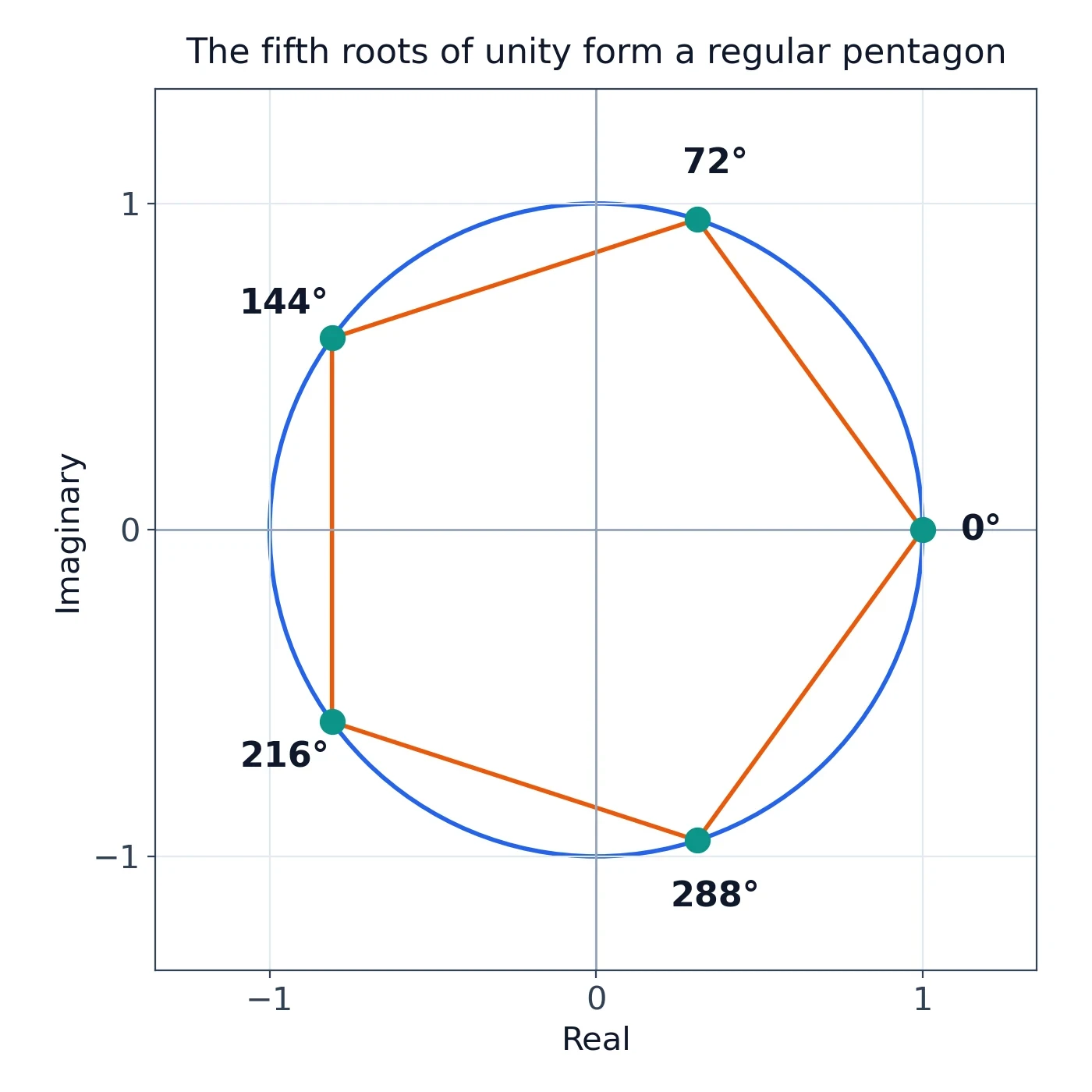
The prettiest consequence of the fundamental theorem is the roots of unity: the numbers whose nth power is 1. The equation x to the power n equals 1 has n roots, and they sit on the unit circle in a perfect regular polygon. The picture is the point, and it is one of the loveliest pictures in mathematics.
Start with the cube roots of 1, the solutions of x cubed equals 1. One root is 1 itself, on the real axis. The other two are minus 1/2 plus 0.8660i and minus 1/2 minus 0.8660i, where 0.8660 is the square root of 3 divided by 2, rounded to four decimal places. The three roots sit at 0 degrees, 120 degrees and 240 degrees on the unit circle, and they form an equilateral triangle.
The fifth roots of unity make the pattern even clearer. They sit at 0, 72, 144, 216 and 288 degrees on the unit circle, spaced one fifth of a turn apart, and joined together they form a regular pentagon. The root at 0 degrees is 1. The root at 72 degrees is 0.3090 plus 0.9511i. The root at 144 degrees is minus 0.8090 plus 0.5878i. The two remaining roots, at 216 and 288 degrees, are the conjugates of those two, with the same real parts and opposite imaginary parts. Every set of nth roots of unity forms a regular n-sided polygon, and the polygon is the theorem made visible.
6. De Moivre's Theorem: Powers Become Easy
Raising a complex number to a power by repeated multiplication is slow work. Raise (1 plus i) to the power 10 by multiplying it out ten times, and you will be at it for a while, with a sign error waiting at every step. De Moivre's theorem turns that labour into one multiplication of angles, and it is the reason the polar form of Section 4 matters in practice rather than only in theory.
The theorem
De Moivre's theorem says that (cos theta plus i sin theta) to the power n equals cos n theta plus i sin n theta. The angle multiplies by n. The modulus, which is 1 here, stays 1. In the general form, a number with modulus r and argument theta, raised to the power n, has modulus r to the power n and argument n times theta. Abraham de Moivre published the identity behind the theorem in Miscellanea Analytica in 1730; Euler later stated it in the modern form. The theorem is older than the geometric picture of Section 4 in its modern form, and it was used for a long time before anyone had a plane to draw it on. The geometry, when it arrived, showed why the rule had to be true. Raising to a power is repeated multiplication, and multiplication adds angles, so raising to the power n adds the angle to itself n times.
Worked example
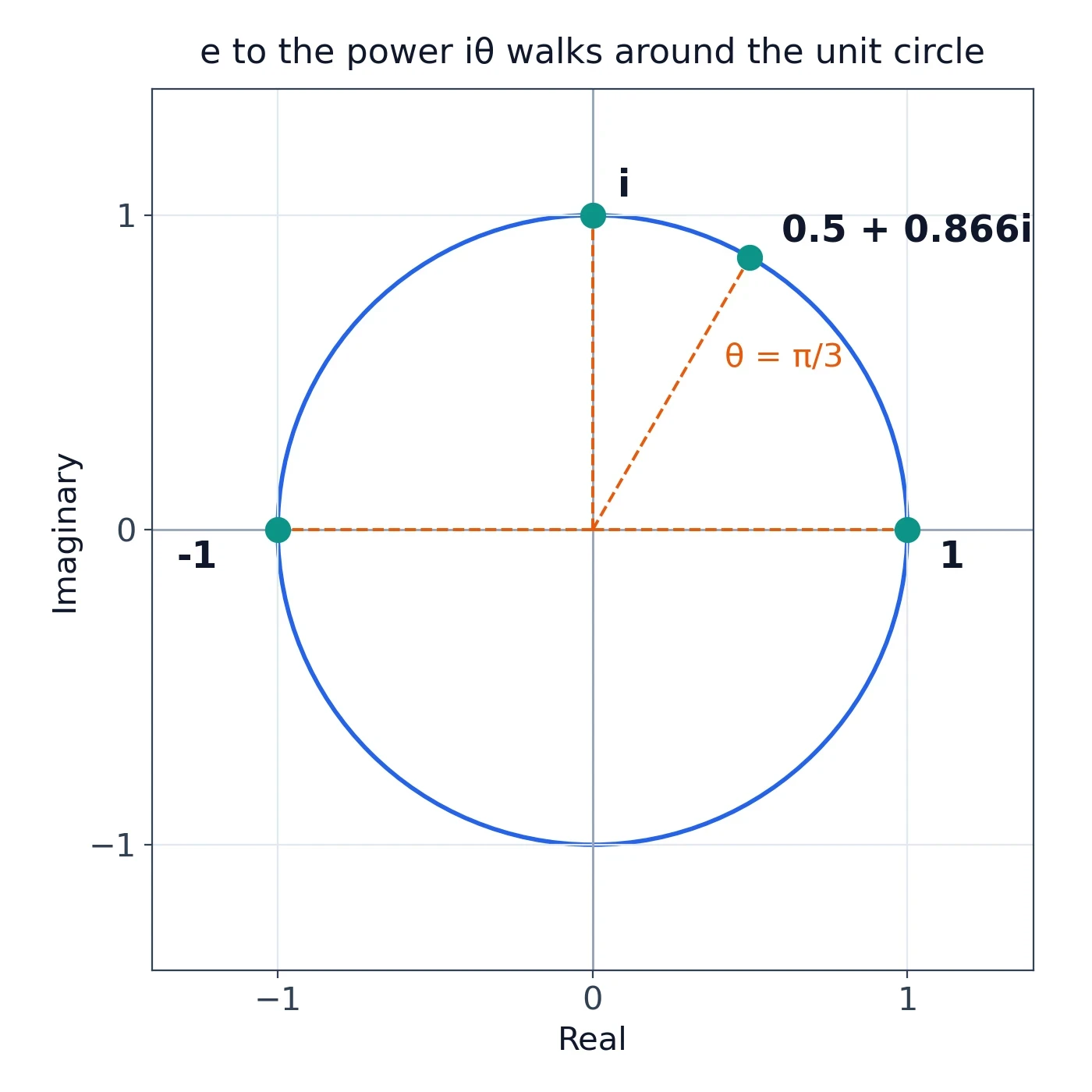
Take (cos 30 degrees plus i sin 30 degrees) squared. De Moivre's theorem says the answer is cos 60 degrees plus i sin 60 degrees, because the angle doubles and the modulus stays 1. Cos 60 degrees is 0.5. Sin 60 degrees is 0.8660, rounded to four decimal places. The answer is 0.5 plus 0.8660i. The same number appears in Section 5 as a cube root of unity and in Section 8 as a point on the unit circle, and it will keep appearing, because 30 degrees and 60 degrees are angles that turn up everywhere in this subject.
Check the result against the rectangular method. Cos 30 degrees is 0.8660 and sin 30 degrees is 0.5, so the number is 0.8660 plus 0.5i. Square it: the expansion gives 0.75 plus 0.8660i plus 0.25i squared, and 0.25i squared is minus 0.25, so the real part is 0.75 minus 0.25, which is 0.5, and the imaginary part is 0.8660i. The answer is 0.5 plus 0.8660i, exactly as De Moivre's theorem said. The angle doubled, from 30 degrees to 60 degrees, while the modulus stayed 1.
Why it matters
The theorem matters because it makes high powers easy. Return to the example from Section 2: (1 plus i) to the power 10 equals 32i. Section 2 proved it by repeated squaring, using the fact that (1 plus i) squared is 2i. De Moivre's theorem proves it in one line, and the one line shows the geometry at work.
The number 1 plus i has modulus the square root of 2 and argument 45 degrees. Raise it to the power 10, and the modulus becomes the square root of 2 raised to the power 10, which is 32, because the square root of 2 squared is 2, and 2 to the power 5 is 32. The argument becomes 10 times 45 degrees, which is 450 degrees. Subtract a full turn of 360 degrees, and 450 degrees is the same direction as 90 degrees. A number with modulus 32 and argument 90 degrees sits on the imaginary axis 32 steps up, and that number is 32i. The two routes agree exactly, and the De Moivre route shows why: the tenth power stretched the length by a factor of 32 and turned the angle ten times, landing on the vertical axis. Section 5 used the same idea without naming it when it placed the roots of unity around the circle: the nth roots of unity are the angles divided into n equal parts, and De Moivre's theorem is the rule that puts them there.
7. Three Centuries of Resistance: Cardano, Bombelli, Descartes, Euler, Gauss
Imaginary numbers came from cubic equations, not from x squared plus 1 equals 0. The quadratic equation is a convenient classroom example, and this article has used it that way, but it is not where imaginary numbers came from. They came from cubics, from a problem in 1545 that produced an answer no one could make sense of, and from a second mathematician in 1572 who refused to throw that answer away. The square root of minus 1 was not invented to solve a quadratic. It was forced on mathematicians by a cubic, and it took three centuries before anyone was comfortable with it.
Cardano, 1545
Girolamo Cardano published Ars Magna in 1545, a book on the solution of cubic and quartic equations, and in it he set a problem that looks like a puzzle: find two numbers with sum 10 and product 40. The two numbers are 5 plus the square root of minus 15 and 5 minus the square root of minus 15. Add them and the square roots cancel, leaving 10. Multiply them and you get 25 plus 15, which is 40, because the square root of minus 15 squared is minus 15, and the product works out to plus 15. The arithmetic checks out. The numbers do not look like numbers.
Cardano saw the problem clearly, and he did not like what he saw. He called them "as subtle as they are useless", and he moved on. What matters is the attitude: Cardano had found numbers that solved his problem and he did not trust them, because they were not on the number line and he could not say what they were. He published the answer and disowned it in the same breath, and that tension, a correct answer that no one could accept, is the whole history of imaginary numbers in miniature.
For the life of Cardano and the wider story of his mathematics, see the MacTutor biography at MacTutor: Gerolamo Cardano. The history of the subject as a whole is told in the LibreTexts brief history at LibreTexts: A Brief History of Complex Numbers.
Bombelli, 1572
Rafael Bombelli published L'Algebra in 1572, and in it he did the thing Cardano would not do: he took the square root of a negative number seriously and carried it through a calculation to the end. His example is the cubic x cubed equals 15x plus 4, and it is the central worked example of this article, so it deserves a full page, step by step, with nothing skipped.
The cubic x cubed equals 15x plus 4 has an obvious root, x equals 4. Put 4 in: 4 cubed is 64, and 15 times 4 plus 4 is 64, so the equation is satisfied. That is the answer, and any reader can check it in seconds. The trouble is that Cardano's formula for solving cubics does not give 4. It gives a sum of two cube roots, each containing the square root of a negative number: x equals the cube root of (2 plus the square root of minus 121) plus the cube root of (2 minus the square root of minus 121). The square root of minus 121 is 11i, so the formula says x equals the cube root of (2 plus 11i) plus the cube root of (2 minus 11i). That looks like nonsense. It contains imaginary numbers, it contains cube roots of imaginary numbers, and it is supposed to equal 4, a plain ordinary number. Cardano would have thrown it away. Bombelli did not.
Bombelli's idea was to guess what the cube roots might be, and then to check the guess by cubing it. Suppose the cube root of (2 plus 11i) is (2 plus i). Cube (2 plus i) and see what happens. First, (2 plus i) squared is 4 plus 4i plus i squared, which is 4 plus 4i minus 1, which is 3 plus 4i. Now multiply (3 plus 4i) by (2 plus i). The expansion gives 6 plus 3i plus 8i plus 4i squared. Combine the imaginary terms: 3i plus 8i is 11i. Deal with the i squared term: 4i squared is minus 4. So the real part is 6 minus 4, which is 2, and the imaginary part is 11i. The result is 2 plus 11i. The guess was right: (2 plus i) cubed equals 2 plus 11i, exactly the number under the first cube root.
Do the same for the second cube root. Suppose the cube root of (2 minus 11i) is (2 minus i). Cube (2 minus i). First, (2 minus i) squared is 4 minus 4i plus i squared, which is 4 minus 4i minus 1, which is 3 minus 4i. Multiply (3 minus 4i) by (2 minus i). The expansion gives 6 minus 3i minus 8i plus 4i squared. Combine the imaginary terms: minus 3i minus 8i is minus 11i. Deal with the i squared term: 4i squared is minus 4. The real part is 6 minus 4, which is 2, and the imaginary part is minus 11i. The result is 2 minus 11i. The guess was right again: (2 minus i) cubed equals 2 minus 11i.
Now add the two cube roots together. The cube root of (2 plus 11i) is (2 plus i). The cube root of (2 minus 11i) is (2 minus i). Their sum is (2 plus i) plus (2 minus i), which is 4, because the imaginary parts cancel. The impossible-looking formula gives 4, the obvious root, exactly as it should. The imaginary numbers were not a mistake in the middle of the working. They were a bridge, and the bridge led to the right answer. Bombelli had shown that the square root of a negative number could be carried through a calculation honestly and cancel out at the end, leaving a real answer behind.
That is why this example matters more than any other in the article. It is the first time anyone used imaginary numbers to get a real answer that could be checked independently, and the check is the point: x equals 4 satisfies the cubic, and the formula produces 4 only if you trust the imaginary numbers in the middle. Bombelli called the square root of minus 1 by a name in his own language, plus of minus, which captures the strangeness exactly: a plus sign in front of a minus sign, a number that is added and subtracted at once. He did not have the word imaginary, and he did not have the complex plane. He had a calculation that worked, and he followed it where it led.
I first worked through Bombelli's cubic on a quiet afternoon with a pencil and a blank page, expecting to find the catch, the step where the argument quietly cheated. There was no catch. The cube expanded, the imaginary parts cancelled, and the answer came out as 4, and I sat there for a while feeling the same surprise Bombelli must have felt: that a number no one believed in could do honest work and leave a real answer behind.
Descartes, 1637
Sixty-five years after Bombelli, Rene Descartes gave these numbers the name they still carry, and he meant it as an insult. In La Geometrie, published in 1637, Descartes called them imaginary, by contrast with the real roots of an equation, and the contrast was the point: real roots were genuine, imaginary roots were not. He had used the same kind of dismissive language for negative numbers, which he called false roots, and the parallel is worth noticing, because negative numbers went through exactly the same rejection and came out the other side as ordinary mathematics. The name imaginary is a historical accident, a piece of seventeenth-century name-calling that stuck, and it has misled readers ever since. Descartes wrote that "Neither the true nor the false [negative] roots are always real; but sometimes only imaginary."
Euler, 1748 and 1777
Leonhard Euler did more than anyone else to make imaginary numbers respectable, and he did it in two steps, twenty-nine years apart. In 1748, in his Introductio in analysin infinitorum, he published the formula that bears his name: e to the power i theta equals cos theta plus i sin theta. Section 8 explains that formula in full. In 1777, in a paper presented to the St Petersburg Academy, he introduced the letter i for the square root of minus 1. It appeared in print later. The letter i replaced a whole phrase, the square root of minus 1, and made the arithmetic writable.
Euler himself was not free of the old suspicion. In his Elements of Algebra he described expressions like the square root of minus 1 as impossible or imaginary numbers, writing that they "are neither nothing, nor greater than nothing, nor less than nothing, which necessarily constitutes them imaginary or impossible." He used imaginary numbers constantly, proved theorems with them, and still described them as impossible in the same book.
Wessel 1797 and 1799, Argand 1806, Gauss 1799 and 1831
The geometric picture arrived at the end of the eighteenth century, and it arrived twice. Caspar Wessel's geometric representation of complex numbers as directed line segments was read to the Royal Danish Academy of Sciences on 10 March 1797 — presented on his behalf by J. N. Tetens, since Wessel was not a member — and it was published in 1799. Jean-Robert Argand, a Paris bookkeeper, published his Essay on the Geometrical Interpretation of Imaginary Quantities in 1806, privately printed and without his name on the title page. Wessel had the idea first. Argand's version is the one that spread, and the complex plane is still often called the Argand diagram.
Carl Friedrich Gauss, whose 1799 doctoral dissertation gave the first proof of the fundamental theorem of algebra (see Section 5), introduced the term complex numbers in April 1831, replacing imaginary, and the replacement was deliberate. Gauss argued that if plus 1, minus 1 and the square root of minus 1 had been called direct, inverse and lateral unity instead of positive, negative and imaginary unity, there would hardly have been any scope for such obscurity. Gauss thought the name was the problem, and he fixed the name.
Hamilton, 1833 and 1843
William Rowan Hamilton gave complex numbers their most rigorous foundation and then went beyond them. In an 1833 paper read to the Royal Irish Academy he defined complex numbers as ordered pairs of real numbers, with addition defined as (a, b) plus (c, d) equals (a plus c, b plus d), and multiplication defined as (a, b) times (c, d) equals (ac minus bd, bc plus ad). That definition turns the complex plane from a picture into a piece of algebra: a complex number is a pair of real numbers, and the multiplication rule is the rule that makes the pair behave like a number.
Ten years later, on 16 October 1843, walking with his wife along the Royal Canal in Dublin, Hamilton had the idea that became the quaternions, a system of four-dimensional numbers for describing rotations in three dimensions. He carved the defining relation, i squared equals j squared equals k squared equals ijk equals minus 1, on a stone of Brougham Bridge, now Broome Bridge, and the carving has long since worn away, though a plaque now marks the spot. He wrote about the moment in a letter to his son Archibald on 5 August 1865, and the letter survives in the Trinity College Dublin archive. Three centuries after Cardano, imaginary numbers had gone from a puzzle no one trusted to a tool so trusted that a mathematician would carve its extension into stone.
8. Euler's Identity: The Most Beautiful Equation in Mathematics
Euler's identity is five constants and three operations in one short line: e to the power i pi plus 1 equals 0. The constants are e, i, pi, 1 and 0. The operations are exponentiation, addition and equality. Nothing else in mathematics packs so much into so little, and that density is why mathematicians call it beautiful. It is not beautiful because it is pretty. It is beautiful because it is true for a reason, and the reason is Euler's formula, which this section explains first.
Euler's formula
Euler's formula says that e to the power i theta equals cos theta plus i sin theta. The left side is an exponential. The right side is a point on the unit circle, with cos theta as the real part and sin theta as the imaginary part. The formula turns an angle into a point, and it turns multiplication of exponentials into addition of angles, which is exactly the rule of Section 4: multiply the moduli, add the arguments. Euler published the formula in 1748, in his Introductio in analysin infinitorum.
The reason the formula is true can be given in one paragraph, without a full derivation. The Taylor series of the exponential function is a sum of powers of its argument divided by factorials. Put i theta in place of the argument, and the series splits into two parts: the even powers, which are real, and the odd powers, which are imaginary. The even part is exactly the Taylor series of cos theta. The odd part, divided by i, is exactly the Taylor series of sin theta. So e to the power i theta is cos theta plus i sin theta, not by coincidence and not by definition, but because the three series are the same series seen three ways. The number e is the base of natural logarithms, and the full story of why e matters lives in our Logarithms article.
Setting theta equal to pi
Set theta equal to pi in Euler's formula, and the identity falls out. Cos pi is minus 1. Sin pi is 0. So e to the power i pi equals minus 1 plus 0i, which is minus 1. Add 1 to both sides and you get e to the power i pi plus 1 equals 0. That is Euler's identity, and the working is three lines long. The pi in the identity is the same pi that measures every circle, and the full story of pi lives in our Pi article. Five constants meet in that one line, and each of them comes from a different part of mathematics. The number e comes from growth and logarithms. The number i comes from algebra and the square root of minus 1. The number pi comes from geometry and circles. The numbers 1 and 0 come from arithmetic itself, the multiplicative and additive identities.
Why mathematicians call it beautiful
In a 1988 poll of readers of The Mathematical Intelligencer, Euler's identity was voted the most beautiful theorem in mathematics. In a 2004 Physics World poll of the greatest equations, it came second only to Maxwell's equations. Those polls are not proofs, and no poll could be, but they are evidence of something real: working mathematicians, asked to name the most beautiful result they know, keep naming the same short line. The beauty is in the economy. Five constants, three operations, one line, and a reason, the Taylor series, that explains why it had to be so.
The unit circle, revisited
Euler's formula has a picture, and the picture is the unit circle of Section 2, now with a moving point. As theta grows, e to the power i theta traces the unit circle anticlockwise, starting at 1 when theta equals 0. At theta equal to pi over 3, the point is 0.5 plus 0.8660i, the same number that appeared in Sections 5 and 6. At theta equal to pi over 2, the point is i, one quarter turn around the circle. At theta equal to pi, the point is minus 1, half a turn around the circle, and that half turn is Euler's identity: a half turn from 1 lands on minus 1. The identity is not an abstract fact about exponentials. It is a walk halfway around a circle, written as an equation.
9. Eight Mistakes to Never Make About Imaginary Numbers
The eight mistakes below are the ones that recur most often, in classrooms, in textbooks, and in online arguments about whether imaginary numbers are real. Each one has a correction and the one number that proves the correction. Read them as a checklist before an exam, and as a defence against the next person who tells you imaginary numbers are made up.
M1. Imaginary means made up
The name is Descartes' 1637 insult, not a verdict. Real numbers are equally abstract: nobody has ever held a minus 3, and nobody has ever held a square root of 2. Imaginary numbers follow consistent rules and predict real measurements, and that is the test that matters. The impedance calculation of Section 10 predicts a 24-amp current that a meter can confirm, and the quantum experiments of Section 11 pass only with complex numbers. A number that follows rules and predicts measurements is not made up, whatever it was called in 1637. Zero was once rejected as meaningless too, and the Zero article tells that story.
"as subtle as they are useless" — Girolamo Cardano, Ars Magna, 1545
M2. i is the only imaginary number
Every real multiple of i is an imaginary number: 2i, 0.5i, minus 100i. The letter i is only the unit, the way 1 is the unit of the real numbers. No one would say 1 is the only real number. Saying i is the only imaginary number is the same mistake, and the correction is the same: the unit is one member of a whole family, and the family is infinite.
M3. You cannot do arithmetic with imaginary numbers
Addition, subtraction, multiplication, division, powers and roots all work, and Section 3 worked them out in full. The one number that proves it is (3 plus 4i) times (2 minus i), which equals 10 plus 5i, checked step by step. If arithmetic did not work, that multiplication would not have an answer. It does, and the answer checks out by multiplying back.
M4. Imaginary numbers have no real uses
The power grid, quantum mechanics and signal processing all run on imaginary numbers, and Sections 10 to 12 give the evidence in full. The one number that proves it here is the 24-amp current in the impedance example: a 120-volt supply across an impedance of 3 plus 4j ohms gives a current of 14.4 minus 19.2j amps, with magnitude 24 amps. That current is real, measurable, and designed with complex arithmetic.
M5. The square root of minus 1 is the only strange root
Every negative number has imaginary square roots: the square root of minus 9 is 3i, and the square root of minus 16 is 4i. And i itself has a square root, (1 plus i) divided by the square root of 2, approximately 0.7071 plus 0.7071i. Square that number and you get i, which is the definition of a square root. Strange roots are not a single exception. They are a whole family.
M6. Complex numbers are just two real numbers glued together
The multiplication rule is what matters, and gluing two real numbers together does not give you that rule. Multiplying by i rotates by 90 degrees. Multiplying complex numbers multiplies moduli and adds arguments. That geometry is the whole subject, and it is not present in a pair of numbers until you define multiplication the complex way. Hamilton's ordered pairs of 1833 make the point exactly: the pair is only a complex number once the multiplication rule is given, and the rule is the rotation rule of Section 4.
M7. Euler's identity is a coincidence
It is the special case theta equals pi of Euler's formula, which follows from the Taylor series of the exponential, sine and cosine, as Section 8 showed. A coincidence has no reason behind it. Euler's identity has a reason, and the reason is one paragraph long: the exponential series splits into the cosine series and the sine series. The five constants meet in one line because the three series are the same series seen three ways, not because five numbers happened to collide.
M8. i to the power i must be imaginary
Its principal value is the real number e to the power minus pi over 2, about 0.2079. An imaginary number raised to an imaginary power gives a real answer, which is the opposite of what the name of the mistake expects. The word principal matters: other branches give other real values, e to the power minus pi over 2 minus 2 pi k for integer k. The principal value is 0.2079, and it is real, which is the point. Imaginary numbers do not stay imaginary. They cancel, combine and simplify into real answers, exactly as Bombelli found in 1572.
10. The Power Grid Runs on i: Phasors and Impedance
Switch on a light or charge a phone, and behind that ordinary act sits a calculation with imaginary numbers at its centre. The electricity in your walls is alternating current: voltage and current rise and fall in sine waves, sixty times a second in the United States, and the two waves can be out of step. For a long time, working out what a circuit did meant slow calculus for every new circuit. Then one engineer turned the whole problem into ordinary algebra with complex numbers, and the power grid has run on i ever since.
This section does that calculation from start to finish: the phasor, which turns a wave into a single complex number, and impedance, which describes a whole circuit in one symbol. You will work out a real current, in amps, that a meter on a real circuit would confirm. If Section 1 asked whether imaginary numbers really exist, this section is the first half of the answer: they predict the current in the wires.
The problem Steinmetz solved
Before 1893, alternating current was a headache for engineers. A direct current flows one way at a steady size: voltage equals current times resistance. An alternating current is different. The voltage rises to a peak, falls through zero, reverses, and repeats, sixty times a second in the United States mains supply, and the current does the same, but not always at the same moment. In a circuit with coils and capacitors, the current can lag behind the voltage or lead it, and the size of the lag decides how much power the circuit delivers. Engineers handled this with calculus, writing voltage and current as sine functions and differentiating and integrating their way to each answer. The method worked, but it was slow, and every new circuit meant starting again.
Charles Proteus Steinmetz changed that. In 1893 he presented a paper to the American Institute of Electrical Engineers, showing that alternating current problems could be done with complex-number algebra instead of calculus. He called the paper Complex Quantities and Their Use in Electrical Engineering, and it is still the way every electrical engineer learns the subject: a few lines of complex arithmetic in place of the slow calculus. Our Calculus article explains how that machinery works, and Steinmetz showed engineers how to leave most of it behind for this particular job.
I remember the first time a teacher drew a phasor diagram on a board and then, in three lines of algebra, produced a current that matched the meter on the bench beside us. I had expected a long struggle with sine waves. It turned out to be a short walk through the complex plane, and the meter agreed with the arithmetic. That is the moment this section is built around: a number that looks invented, giving an answer a meter can confirm.
Phasors
A phasor is a sine wave turned into a single complex number. Take a wave with a certain size and a certain phase, meaning how far along its cycle it is at a chosen starting moment. Write the size as the modulus of a complex number and the phase as its argument, and that complex number is the phasor. Adding two waves of the same frequency becomes adding two complex numbers, and multiplying a wave by a circuit element becomes multiplying by a complex number. The sine and cosine functions never appear in the working, because the phasor has already swallowed them. What is left is the arithmetic of Sections 2 and 3: add real parts to real parts, imaginary parts to imaginary parts, multiply by replacing i squared with minus 1, and divide with the conjugate.
Electrical engineers write the imaginary unit as j instead of i, because in their subject i already means electric current. The letter changes, and nothing else does: 3 plus 4j is the same number as 3 plus 4i, and every rule in this article applies to it exactly as written.
The point of the phasor is that a wave spread out over time becomes a point on the complex plane, and a circuit becomes a problem about points and arrows: the geometry of multiplication, rotate and stretch, is now the physics of a circuit.
Impedance, worked end to end
Impedance is the complex number that describes a whole circuit in one symbol. For a circuit with resistance R and reactance X, the impedance is Z equals R plus jX, which in this article is Z equals R plus iX. Resistance turns electrical energy into heat; reactance stores energy for half a cycle and gives it back, in coils and capacitors. Put them together as the real and imaginary parts of one number: the modulus gives the size of the current, and the argument gives the phase shift between voltage and current.
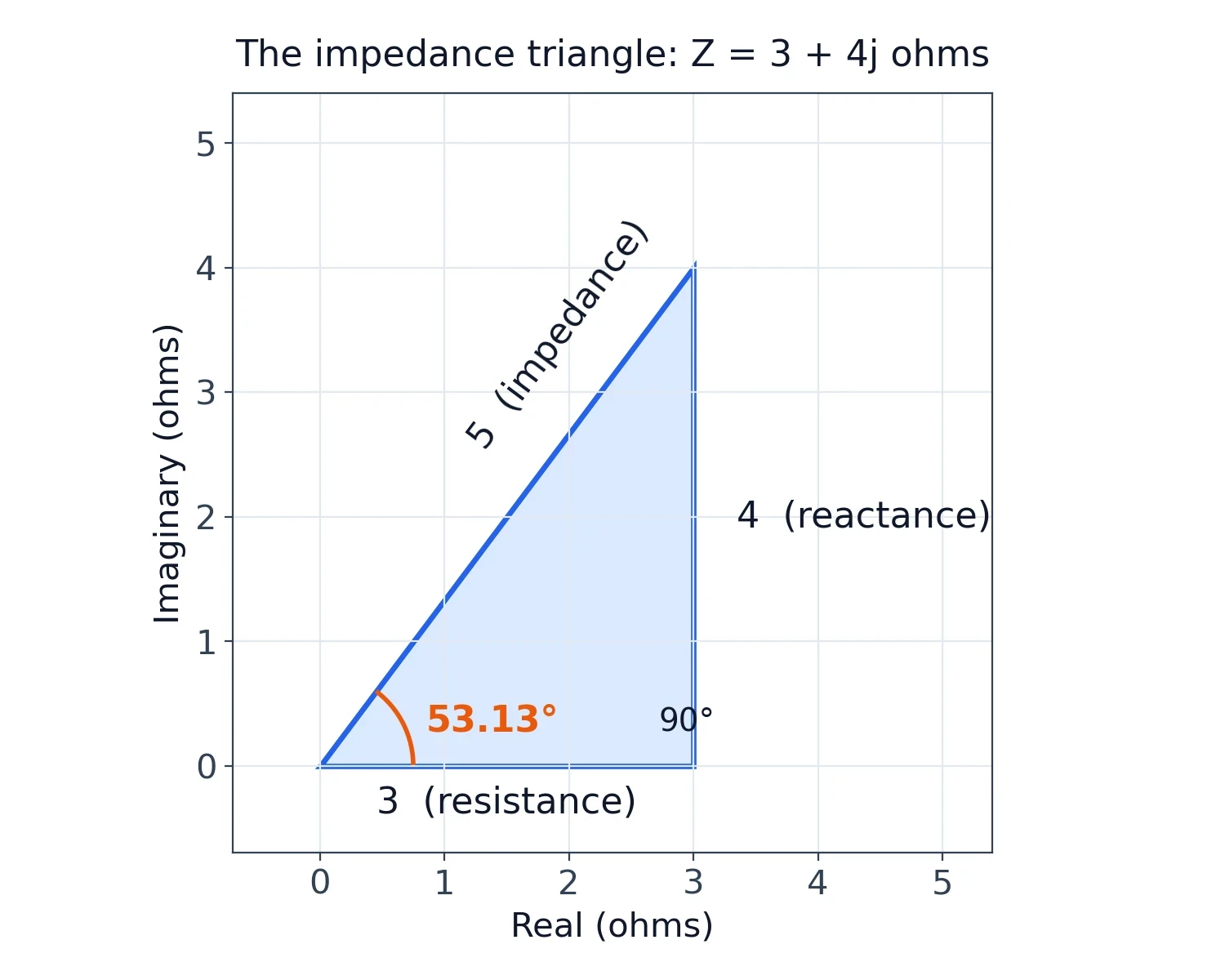
Worked end to end: take a circuit with resistance R equal to 3 ohms and reactance X equal to 4 ohms, so the impedance is Z equals 3 plus 4j ohms. Its magnitude is the square root of 3 squared plus 4 squared, which is the square root of 9 plus 16, which is the square root of 25, which is 5 ohms. Its phase angle is the angle whose tangent is 4 over 3, which is 53.13 degrees.
Now connect that circuit to a 120-volt supply, using the US mains teaching model with 120 volts and 60 hertz. The current is the voltage divided by the impedance, so I equals 120 divided by 3 plus 4j amps. Divide with the conjugate: multiply top and bottom by 3 minus 4j. The bottom becomes 3 squared plus 4 squared, which is 25. The top becomes 120 times 3 minus 4j, which is 360 minus 480j. Divide each part by 25, and the current is 14.4 minus 19.2j amps.
Check the size of that current. Its magnitude is the square root of 14.4 squared plus 19.2 squared, which is the square root of 207.36 plus 368.64, which is the square root of 576, which is 24 amps. Its phase angle is the angle whose tangent is minus 19.2 over 14.4, which is minus 53.13 degrees. The minus sign means the current lags the voltage by 53.13 degrees. A meter on this circuit would read 24 amps. The complex arithmetic predicted that, before any meter was connected.
The triangle behind this calculation is the same 3-4-5 triangle from school, now doing electrical work. Resistance 3 runs along the horizontal axis, reactance 4 runs up the vertical axis, and the hypotenuse, the impedance, runs at 53.13 degrees with length 5. Figure 5 shows it.
The table below gathers the numbers from this section. The resistance, impedance and current rows come from the worked example above. The reactance rows come from the inductor and capacitor example in the next subsection, at 60 hertz in the US mains teaching model.
| Quantity | Symbol | Value | Unit |
|---|---|---|---|
| Resistance | R | 3 | ohms |
| Inductive reactance | X_L | 37.70 | ohms |
| Capacitive reactance | X_C | 26.53 | ohms |
| Impedance | Z | 3 + 4j | ohms |
| Current | I | 14.4 - 19.2j | amps |
Read the table as a summary, not as a single circuit: the impedance row has magnitude 5 ohms and phase 53.13 degrees, and the current row has magnitude 24 amps, lagging the voltage by 53.13 degrees. The reactance rows describe the coil and capacitor in the next subsection, each measured at 60 hertz.
Inductors and capacitors
Resistance is only half the story of a circuit. Coils and capacitors add reactance, and reactance is where the imaginary part of the impedance comes from. A coil, called an inductor, resists changes in current, and its reactance grows with frequency. A capacitor resists changes in voltage, and its reactance shrinks as frequency grows.
Take an inductor of 0.1 henry, connected to a 60-hertz supply in the US mains teaching model. Its inductive reactance is X_L equals 2 times pi times f times L. Put the numbers in: 2 times pi times 60 times 0.1 equals 37.70 ohms. That is a large reactance next to the 3 ohms of resistance in the worked example: a coil like this would dominate that circuit.
Take a capacitor of 100 microfarads, connected to the same 60-hertz supply in the US mains teaching model. Its capacitive reactance is X_C equals 1 divided by 2 times pi times f times C. Put the numbers in: 1 divided by 2 times pi times 60 times 0.0001 equals 26.53 ohms. The capacitor contributes less reactance than the coil at this frequency, but the two are of the same order of size.
Put the coil and the capacitor together, and their reactances partly cancel, because they point in opposite directions on the imaginary axis. The net reactance is 37.70 minus 26.53, which is 11.17 ohms, inductive overall because the coil wins.
Now change the frequency. As it falls, the inductive reactance shrinks and the capacitive reactance grows. At one particular frequency the two are exactly equal, and they cancel completely, leaving the impedance purely resistive and the current at its largest for a given voltage. That is the resonant frequency, and for this coil and this capacitor it is 50.33 hertz. Radio tuners use resonance to pick one station out of the air, and power engineers watch for it because a resonant circuit can draw a surprisingly large current.
11. Quantum Mechanics: Where i Is Not Optional
If the power grid shows that imaginary numbers are useful, quantum mechanics shows that they are woven into the laws of nature. The equation that governs how atoms and photons behave over time has i written into it, in plain sight, since 1926. This is not a convenience, like the phasor, where an engineer chose a complex representation for a real problem. In quantum mechanics the complex numbers are part of the theory itself.
The Schrodinger equation
Erwin Schrodinger published the Schrodinger equation in 1926. It describes how the wavefunction of a quantum system changes over time, and the imaginary unit i appears explicitly in the time-evolution term. The wavefunction, written with the Greek letter psi, is a complex-valued function: at each point it has a real part and an imaginary part.
The measurable quantity is not the wavefunction itself. It is the squared modulus of the wavefunction, written as the absolute value of psi squared, and that quantity is a real number: the probability of finding the particle at a given place. A complex wavefunction evolves according to an equation containing i, and then the squared modulus turns it into a real probability that an experiment can measure.
The wavefunction is not a physical wave sloshing around in space, and its real and imaginary parts are not two separate things you could measure one at a time. They are the two parts of a single complex quantity, and the quantity only becomes a prediction when you take its squared modulus. Remove i from the equation, and the theory stops describing the world.
Why the wavefunction must be complex
Phase is the reason the wavefunction has to be complex. A wave is not just a size at each point. It is a size and a phase, the position in its cycle, and the phase is what makes waves interfere: two waves can add to make a bigger wave, or cancel each other out to make nothing, depending only on whether their phases line up or oppose each other. A theory that cannot describe phase cannot describe interference.
A complex number carries phase naturally, because its argument is a phase: the modulus of the wavefunction gives the size, and the argument gives the phase, and the two travel together as one number. As time passes, the real and imaginary parts trade places in a steady rhythm, and that rhythm carries the wave forward. A real-only wavefunction has no room for a phase: it has a size and a sign, and nothing else. It cannot produce the interference patterns that experiments actually show.
A real number line is a one-dimensional home, and a wave with a phase needs two dimensions: size and phase, real part and imaginary part. The complex plane is that home, and the Schrodinger equation uses i to move the wavefunction around in it as time passes: multiply by i, and a point rotates by 90 degrees, exactly as Section 4 showed. The time-evolution of a quantum system is that rotation, repeated moment by moment.
The 2021 experiments
For a long time, physicists asked whether the complex numbers in quantum mechanics were truly necessary, or whether a reformulation using only real numbers could give the same predictions. A real-number version exists on paper, and for simple experiments it predicts the same results as the usual complex version. The two part company only in more elaborate setups, where several distant parties share entangled states and compare their results. In 2021 and 2022, three papers took up that question from different angles, and the results went the way of the complex numbers.
The first was by Wu and colleagues, published in Physical Review Letters in 2021 as volume 126, article 090401. A team led by Alexander Streltsov, with colleagues at the University of Science and Technology of China in Hefei and the University of Calgary, showed entangled photon states that can only be distinguished using complex numbers, and confirmed the result experimentally with linear optics at Hefei. States that look identical to every real-number test can be told apart once the complex structure is used. The paper is at https://doi.org/10.1103/PhysRevLett.126.090401.
The second was by Renou and colleagues, published in Nature in 2021 as volume 600, pages 625 to 629. It showed that a quantum theory built only on real numbers makes different predictions from ordinary complex quantum theory in network scenarios, where several sources of entanglement are combined. The experiment that followed, by Li and colleagues in Physical Review Letters in 2022 as volume 128, article 040402, tested that prediction with entangled photons in an optical network. The observed result exceeded the bound that real-number quantum theory allows by over 4.5 standard deviations. The real-number version failed the test, and the complex version passed it.
The honest summary
These results deserve a careful summary, because it is easy to overclaim them. What the experiments rule out is real-valued formulations of quantum theory in the network scenarios that were tested. In those setups, a theory using only real numbers makes predictions that disagree with what the photons actually do, while the usual complex theory predicts the results correctly.
What the experiments do not do is prove that complex numbers are necessary in every conceivable sense, for every possible future theory. A future theory could describe the same results with different mathematics, and no single experiment can rule out every theory that has not been written yet. The honest statement is narrower, and it is still striking: the real-number versions that physicists actually built were tested, and they failed, while the complex theory passed. In the scenarios tested, i is not optional.
That is the second half of the answer to the question from Section 1. The power grid shows that imaginary numbers predict measurements in engineering. Quantum mechanics shows that they predict measurements in nature, in experiments designed precisely to test whether they could be left out. The next section shows how widely the same numbers turn up elsewhere.
12. Everywhere Else i Hides: Signals, Fractals, Rotations
By now i has appeared in a circuit and in an atom. The same complex arithmetic turns up in the sound in your headphones, the photograph on your phone, the scan in a hospital, the shape of a fractal, and the way a spacecraft points itself in space. Each stop uses the same ideas you have already met: complex exponentials, iteration, and rotation.
Signal processing and the Fourier transform
Every sound, image and radio signal can be taken apart into a sum of simple waves, and the tool that does it is the Fourier transform. It analyses a signal as a sum of complex exponentials, waves of the form e to the power i omega t, each with its own frequency, size and phase. The complex exponential is the natural language for waves: its real part is a cosine and its imaginary part is a sine, travelling together as one quantity.
That sorting is the mathematical engine behind much of modern life. MP3 audio takes a sound apart with the Fourier transform, throws away the parts the human ear will not notice, and keeps the rest in a small file. JPEG images do the same in two dimensions, splitting a picture into waves of different frequencies. MRI scanners collect their data in the Fourier domain and reconstruct the picture of the inside of a body from it. Mobile phones send and receive signals separated and decoded with the same mathematics. In each case the imaginary unit sits inside the exponent, sorting waves by frequency and phase.
I first understood how deep this goes when I compressed a music file and the smaller file still sounded the same. The transform had kept exactly the waves that matter and discarded the rest. A number that cannot sit on the number line turns out to be the filing system for every sound and image we store.
The Mandelbrot set
The most famous image in mathematics comes from one line of complex arithmetic, repeated over and over. Start with z equal to 0, pick a complex number c, and repeat the rule: the next z is the current z squared, plus c. If the values stay bounded, then c belongs to the Mandelbrot set. If they run away, it does not. That is the whole definition, and the picture it produces is endlessly detailed, with spirals and filaments that repeat at every scale.
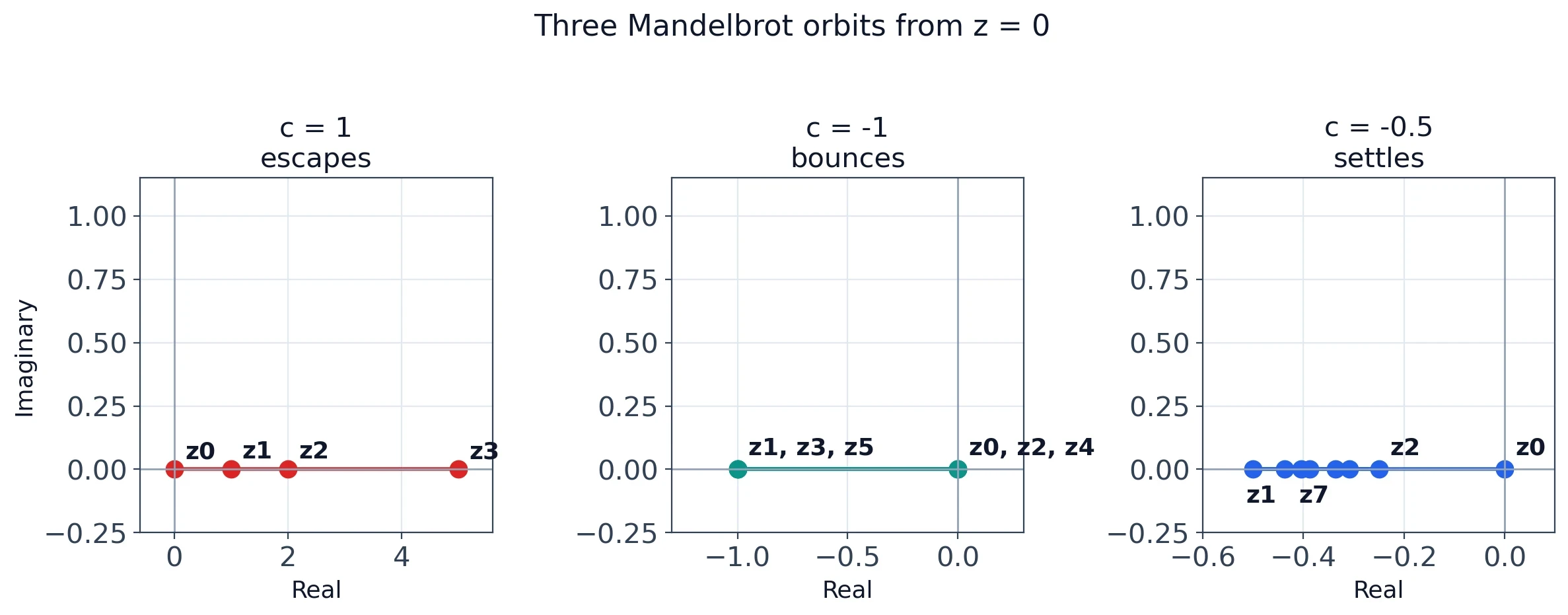
Three choices of c show how the rule behaves. Take c equal to 1. The orbit goes 1, then 2, then 5, then 26, then 677, and then 458330, running away fast: that c escapes, and it is not in the set. Take c equal to minus 1. The orbit goes minus 1, then 0, then minus 1, then 0, bouncing forever between the two values. It never escapes, so minus 1 belongs to the set. Take c equal to minus 0.5. The orbit goes minus 0.5, then minus 0.25, then minus 0.4375, then minus 0.3086, then minus 0.4048, then minus 0.3362, then minus 0.3870, then minus 0.3502, drifting gently and settling near minus 0.37, never running away. That c stays bounded, and it belongs to the set. Three numbers, one rule, three different fates, and the boundary between them is the Mandelbrot set.
The history of that picture needs telling with care. Robert W. Brooks and Peter Matelski first defined and drew the set in 1978, as part of a study of Kleinian groups. Benoit Mandelbrot first visualised it on 1 March 1980 at the Thomas J. Watson Research Center, and studied the parameter space in a paper published later that year. Adrien Douady and John H. Hubbard established many of its fundamental properties and gave the set its name in 1985, and the cover article of the August 1985 Scientific American introduced the algorithm to a wide audience. The same instinct for iteration that builds the set also drives chaos, and our Chaos Theory article is the full story of iteration and sensitivity, where a tiny change in the starting value can change everything that follows.
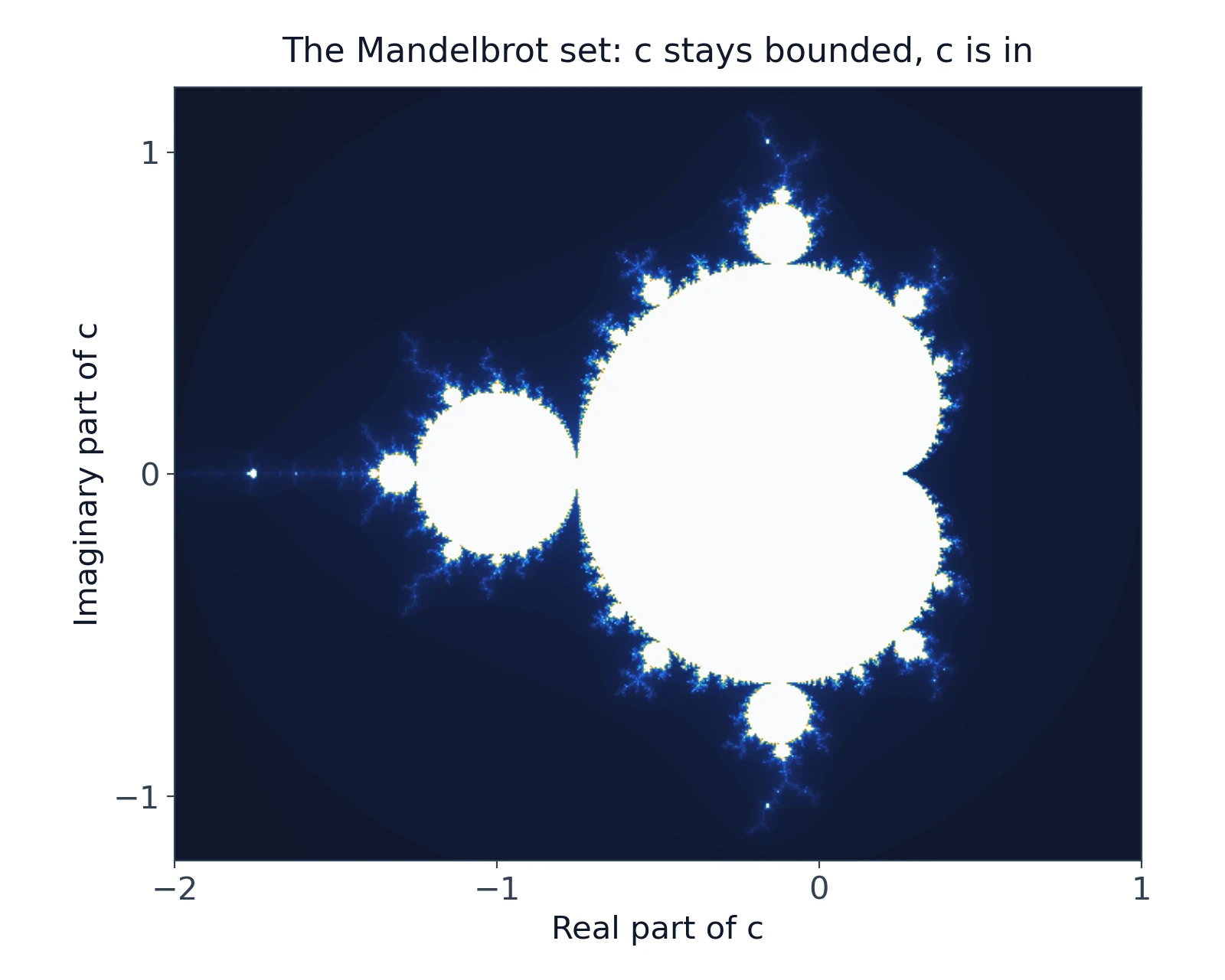
The Mandelbrot set is the subject of a later article in this cluster, on fractals, where it gets the full treatment it deserves. Here it serves a simpler purpose: complex arithmetic can generate infinite complexity from a single short rule, and the boundary between escaping and staying bounded is a shape no one could have drawn by hand.
Rotations in three dimensions
Quaternions are the next step beyond complex numbers, and they solve a practical problem in three dimensions. A complex number describes a rotation in a plane, with i as the quarter-turn operator. A quaternion extends that idea to rotations in space, with three imaginary units, i, j and k, instead of one. Hamilton invented them in 1843, carving the defining rule on Brougham Bridge in Dublin, and they are the standard way to represent three-dimensional rotations in video games, spacecraft and robotics.
The reason engineers prefer quaternions is a failure of the older method. Describing a rotation with three angles, one for each axis, works well most of the time, but at certain orientations two of the axes line up and a degree of freedom is lost. That failure is called gimbal lock, and it can freeze a control system at the worst moment. Quaternions avoid it, because they describe a rotation as a single turn about a single axis in space, with no separate angles to collapse into each other. A spacecraft pointing its antenna, a robot arm moving smoothly, and a video game character turning without jerking all use the same fix.
Control theory and fluids
Complex analysis is also the standard tool in two more fields. In control theory, engineers study the stability of a system, whether a small disturbance dies away or grows into an oscillation, by looking at complex-valued functions and their poles, the points where the function blows up. The position of those poles in the complex plane tells the engineer whether the system is stable, and the mathematics of residues gives the size of the response. In fluid dynamics, conformal maps, which are complex functions that preserve angles, model the flow of air around a wing and water through a pipe, turning a hard shape into an easy one, solving the flow there, and mapping the answer back.
That pattern is the thread of this section. A signal is a sum of complex waves. A fractal is a complex iteration. A rotation is a complex turn, extended to three dimensions. A stable system is a set of points in the complex plane. Different subjects, different tools, and the same numbers underneath. Our Algebra article tells the story of equations and how they are solved. Imaginary numbers began as the answer to an equation, so the circle closes neatly: the numbers that solved a cubic in 1545 now sort your music, draw the most famous picture in mathematics, steer spacecraft, and keep control systems stable.
13. Do Imaginary Numbers Really Exist? The Answer
Return to the question from Section 1, now with the evidence assembled. The same rules that let Bombelli rescue a cubic in 1572 also size the current in a circuit. The same i that rotates a point by 90 degrees also appears in the equation that governs atoms. The same arithmetic that draws the Mandelbrot set also sorts the sound in your headphones. The question is no longer whether imaginary numbers are a trick.
There is a two-sentence test for the reader. First, does the number follow consistent rules? Imaginary numbers do: add them, multiply them, divide them, raise them to powers, and every operation gives one definite answer. Second, does it predict measurements? Imaginary numbers do that too. The impedance calculation in Section 10 predicts a 24-amp current, and a meter on the circuit reads 24 amps. The quantum experiments in Section 11 pass only with complex numbers, and the real-number versions fail by over 4.5 standard deviations.
The name is the last obstacle, and it is a historical accident. Descartes coined the word imaginary in 1637 as an insult, and the insult stuck. Gauss saw the problem and gave the honest name in April 1831, calling them complex numbers, numbers with two parts working together. Negative numbers went through the same rejection, called false before they were accepted, and zero was once refused as meaningless too. A bad name is not a verdict on a number. It is a verdict on the century that named it.
Here is the thesis of this article, in one sentence: the square root of minus one is not a trick for passing exams, it is the second dimension of number, and the modern world is built on it. That is what the evidence adds up to. A number line was not enough, so mathematics added a second axis, and the world turned out to be using that axis all along, in wires and waves and atoms.
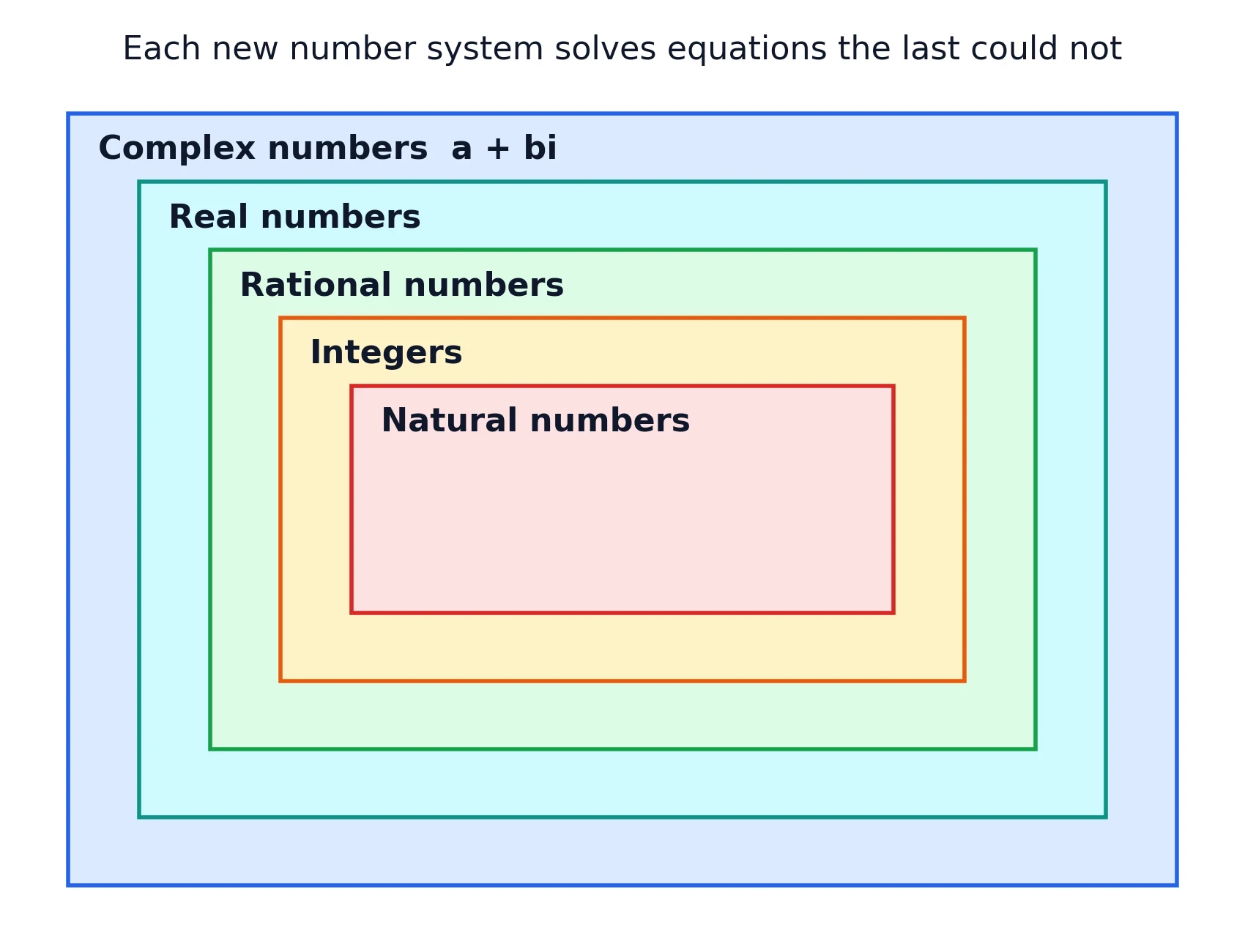
The picture in Figure 8 tells the same story as a family tree. Natural numbers sit inside integers, which sit inside rationals, which sit inside reals, which sit inside complex numbers. Each expansion solved equations the previous system could not. Nobody asks whether integers really exist, even though no one has ever held a minus 3. Complex numbers belong in that same family, the next expansion in a long line, each one once called impossible and each one now taken for granted.
14. The Square Root of Minus One — and What Comes Next
You now know what i is, how to work with it, why its powers cycle in fours, how it turns numbers into a plane, how it solved a cubic in 1572, and why it runs the power grid and sits inside quantum mechanics. The best way to keep it is to use it. Work out i to the power 2027 by hand, using the remainder rule from Section 2. Try the (1 plus i) to the power 10 example for yourself, first by repeated multiplication and then by the quicker route in Section 6, and check that both routes give 32i. Then look at the Mandelbrot set in Figure 6, pick a number near its edge, and run the iteration a few steps by hand to see whether it escapes or stays bounded.
Two later articles in this Mathematics cluster carry the story further, and each gets one sentence here. Fractals, the next-but-one article, tells the Mandelbrot set in full, with its infinite coastline and its endlessly repeating detail. The Riemann Hypothesis article takes up the deepest unsolved problem that lives in the complex plane, a question about the zeros of a complex function that has resisted every mathematician for more than a century. If the quantum side of this article caught your attention, the probabilities at its heart are worth a closer look too, and our Probability article explains how probabilities work and how to reason with them.
The square root of minus one began as a problem in a book about cubic equations, and it ends, for now, as the second dimension of number. The next time you switch on a light, play a song, or read about a quantum computer, remember that i is there, quietly doing the arithmetic.
15. Frequently Asked Questions (FAQ)
What are imaginary numbers?
Imaginary numbers are real multiples of i, where i is defined by the rule i squared equals minus 1. They form the vertical axis of the complex plane, while real numbers form the horizontal axis. A complex number a plus bi has a real part a and an imaginary part b.
Do imaginary numbers really exist?
Imaginary numbers follow consistent rules and predict real measurements, which is the test that matters. The impedance calculation in Section 10 predicts a 24-amp current that a meter can confirm, and the quantum experiments in Section 11 pass only with complex numbers. The name is a 1637 insult from Descartes, not a verdict on the number.
What is i?
i is the imaginary unit, defined by the rule i squared equals minus 1. It is the building block of all imaginary and complex numbers, and its powers cycle with period 4: i, minus 1, minus i, 1, then back to i again. Any power of i depends only on the remainder when the exponent is divided by 4.
What are imaginary numbers used for?
Imaginary numbers are used in electrical engineering, where phasors and impedance describe alternating current, and in quantum mechanics, where the Schrodinger equation contains i. They are also used in signal processing, where the Fourier transform analyses sound and images, in 3D rotations through quaternions, and in fractals through the Mandelbrot set.
How do you multiply complex numbers?
Expand the product like ordinary algebra, then replace every i squared with minus 1 and collect the real and imaginary parts. For example, (3 plus 4i) times (2 minus i) expands to 6 minus 3i plus 8i minus 4i squared, which becomes 6 plus 5i plus 4, since minus 4i squared is plus 4. The answer is 10 plus 5i.
What is Euler's identity?
Euler's identity is e to the power i pi plus 1 equals 0, and it unites five constants, e, i, pi, 1 and 0, in one line. It is the special case of Euler's formula with theta equal to pi, since e to the power i pi equals minus 1. In a 1988 poll of readers of The Mathematical Intelligencer it was voted the most beautiful theorem in mathematics.
What is the complex plane?
The complex plane is a plane with a horizontal real axis and a vertical imaginary axis, where every complex number a plus bi is the point (a, b). Addition slides arrows tip to tail, like vector addition, and multiplication rotates and stretches them. The modulus of a number is its distance from the origin, and its argument is its angle from the positive real axis.
What is i to the power i?
The principal value of i to the power i is the real number e to the power minus pi over 2, about 0.2079. The word principal value matters, because other branches of the power give other real values. The surprise is genuine: an imaginary number raised to an imaginary power can be a plain real number.
16. Sources
- LibreTexts — A Brief History of Complex Analysis. https://math.libretexts.org/Bookshelves/Analysis/Complex_Analysis_-_A_Visual_and_Interactive_Introduction_(Ponce_Campuzano)/01:_Chapter_1/1.01:_A_Brief_History
- Wikipedia — Complex number. https://en.wikipedia.org/wiki/Complex_number
- Wikipedia — Imaginary number. https://en.wikipedia.org/wiki/Imaginary_number
- Wikipedia — Imaginary unit. https://en.wikipedia.org/wiki/Imaginary_unit
- MacTutor — Gerolamo Cardano. https://mathshistory.st-andrews.ac.uk/Biographies/Cardan/
- MacTutor — Rafael Bombelli. https://mathshistory.st-andrews.ac.uk/Biographies/Bombelli/
- Gresham College — The Story of i. https://www.gresham.ac.uk/watch-now/story-i
- arXiv — A Brief Tour Through the History of Complex Numbers. https://arxiv.org/abs/1904.05927
- Wikipedia — Euler's formula. https://en.wikipedia.org/wiki/Euler%27s_formula
- Wikipedia — Fundamental theorem of algebra. https://en.wikipedia.org/wiki/Fundamental_theorem_of_algebra
- Wikipedia — De Moivre's formula. https://en.wikipedia.org/wiki/De_Moivre%27s_formula
- Wikipedia — Complex plane. https://en.wikipedia.org/wiki/Complex_plane
- Wikipedia — Argand diagram. https://en.wikipedia.org/wiki/Argand_diagram
- Wikipedia — Charles Proteus Steinmetz. https://en.wikipedia.org/wiki/Charles_Proteus_Steinmetz
- Steinmetz — Theory and Calculation of Alternating Current Phenomena. https://ia600708.us.archive.org/29/items/theorycalculatio00steiuoft/theorycalculatio00steiuoft.pdf
- Wikipedia — Phasor. https://en.wikipedia.org/wiki/Phasor
- Wikipedia — Schrödinger equation. https://en.wikipedia.org/wiki/Schr%C3%B6dinger_equation
- Wu et al. — Operational Resource Theory of Imaginarity, Physical Review Letters 126, 090401 (2021). https://doi.org/10.1103/PhysRevLett.126.090401
- Renou et al. — Quantum theory based on real numbers can be experimentally falsified, Nature 600, 625–629 (2021). https://doi.org/10.1038/s41586-021-04160-4
- Li et al. — Testing Real Quantum Theory in an Optical Quantum Network, Physical Review Letters 128, 040402 (2022). https://doi.org/10.1103/PhysRevLett.128.040402
- Wikipedia — Mandelbrot set. https://en.wikipedia.org/wiki/Mandelbrot_set
- Mandelbrot — Fractal Aspects of the Iteration of z maps to lambda z (1 minus z) for Complex lambda, z, Annals of the New York Academy of Sciences 357, 249–259 (1980). https://doi.org/10.1111/j.1749-6632.1980.tb29690.x
- Trinity College Dublin — Hamilton's Letters on the Discovery of Quaternions. https://www.maths.tcd.ie/pub/HistMath/People/Hamilton/Letters/BroomeBridge.html
- Wikipedia — History of quaternions. https://en.wikipedia.org/wiki/History_of_quaternions
- Wikipedia — Fourier transform. https://en.wikipedia.org/wiki/Fourier_transform