
I was standing in a queue at a market stall when my phone showed zero per cent battery and switched itself off. Nothing dramatic happened. I paid with coins, counted my change by hand, and walked home. Yet on the walk I kept thinking about that little zero on the screen, and about the history of zero behind it. It had told me something precise: not "a little bit of charge left" and not "the phone is broken", but exactly none. No charge at all, measured to the digit. A thousand years ago, no scribe on earth could have written that measurement down in the way my phone did, because the symbol that makes it possible did not yet exist as a number. That is the strange heart of the history of zero. The most ordinary digit on your screen is also the youngest number in mathematics, invented more than once, resisted for centuries, and now so deeply built into the world that you cannot buy a coffee, check a score, or send a message without it.
The history of zero is not the story of one clever person having one clever idea. It is the story of two different ideas sharing one name, of a punctuation mark slowly growing up into a number, of a journey from Babylon to the jungles of Central America to India to Baghdad to Florence, and of a long argument about whether nothing could be something. This article follows that whole journey. It starts with a trader who cannot write down two hundred and five, it passes through the first rules for arithmetic with zero written in India in 628 CE, it corrects a famous myth about the Church banning zero, it settles the question of the oldest zero with evidence revised as recently as October 2024, and it ends with the puzzles zero still leaves us: why you cannot divide by zero, why zero factorial equals one, and why zero to the power of zero has no single agreed answer. No advanced mathematics is assumed. Every worked calculation has been checked, and the numbers are given exactly as worked.
1. The Number That Is Not a Number: Why Zero Feels Strange
Count out loud with a child and watch what happens at the end. One apple, two apples, three apples. Now take the apples away, one by one, until the table is empty. Ask how many apples are left, and the child will often hesitate, or answer "none" rather than "zero". The hesitation is not silliness. It is the oldest difficulty in the history of zero, and it never quite goes away. Every other number counts things that exist. Zero counts an absence. It asks the mind to treat nothing as a thing, to hold an empty place open and give it a name, a symbol, and a set of rules. That feels wrong in a way that counting to seven never does, and the feeling has a history that stretches back thousands of years.
I felt it myself the first time I watched a football match end nil-nil. The scoreboard read 0-0, and the crowd filed out arguing about whether it had been a good game or a wasted evening. The scoreboard had recorded something real: two teams had played for ninety minutes and neither had scored. Yet the numbers on the board described events that never happened. A goal is a thing. A zero on a scoreboard is the record of a thing not happening, and it still matters, because the league table, the goal difference, and the season all depend on it. Zero is the only number that works like that, a measurement of what is not there.
That strangeness is the question this article answers. Not simply "what is zero", but "how did nothing become a number?" The answer turns out to have three parts. First, somebody had to invent a mark that said "this place is empty" so that other digits kept their correct positions. Second, somebody had to take the far bolder step of treating that mark as a quantity in its own right, something you could add, subtract, and multiply. Third, the rest of the world had to accept both steps, and that took more than a thousand years, with bans, suspicion, and a myth about the Devil that still circulates today. Each part happened in a different place, at a different time, for different reasons, and confusing the parts is the most common error in popular writing about zero. Keep the parts separate and the story becomes clear. Mix them up and you get headlines that say one person "invented zero" in one year, which never happened.
There is a second reason the strangeness matters. Zero is not a curiosity at the edge of mathematics. It sits at the centre of it. It is the origin of the number line, the place where positive numbers end and negative numbers begin. It is the additive identity, the number that leaves every other number unchanged when added. It is the reason place value works, which is the reason ordinary arithmetic works, which is the reason your phone, your bank, and your calendar work. Remove zero from the modern world and almost nothing that depends on written numbers survives. The history of zero is therefore not a quaint tale about an ancient symbol. It is the history of how counting itself became powerful enough to run a civilisation.
2. Two Different Ideas Sharing One Name: Placeholder vs Number in the History of Zero
The single most important distinction in the history of zero is also the simplest. Zero is two different ideas sharing one name, and the article hangs on keeping them apart. The first idea is zero as a placeholder, a punctuation mark. The second idea is zero as a number in its own right, a quantity with arithmetic. The placeholder is older by many centuries. The number is the Indian breakthrough, and it is much younger. Whenever this article says "zero was invented", it will say which zero, and where.
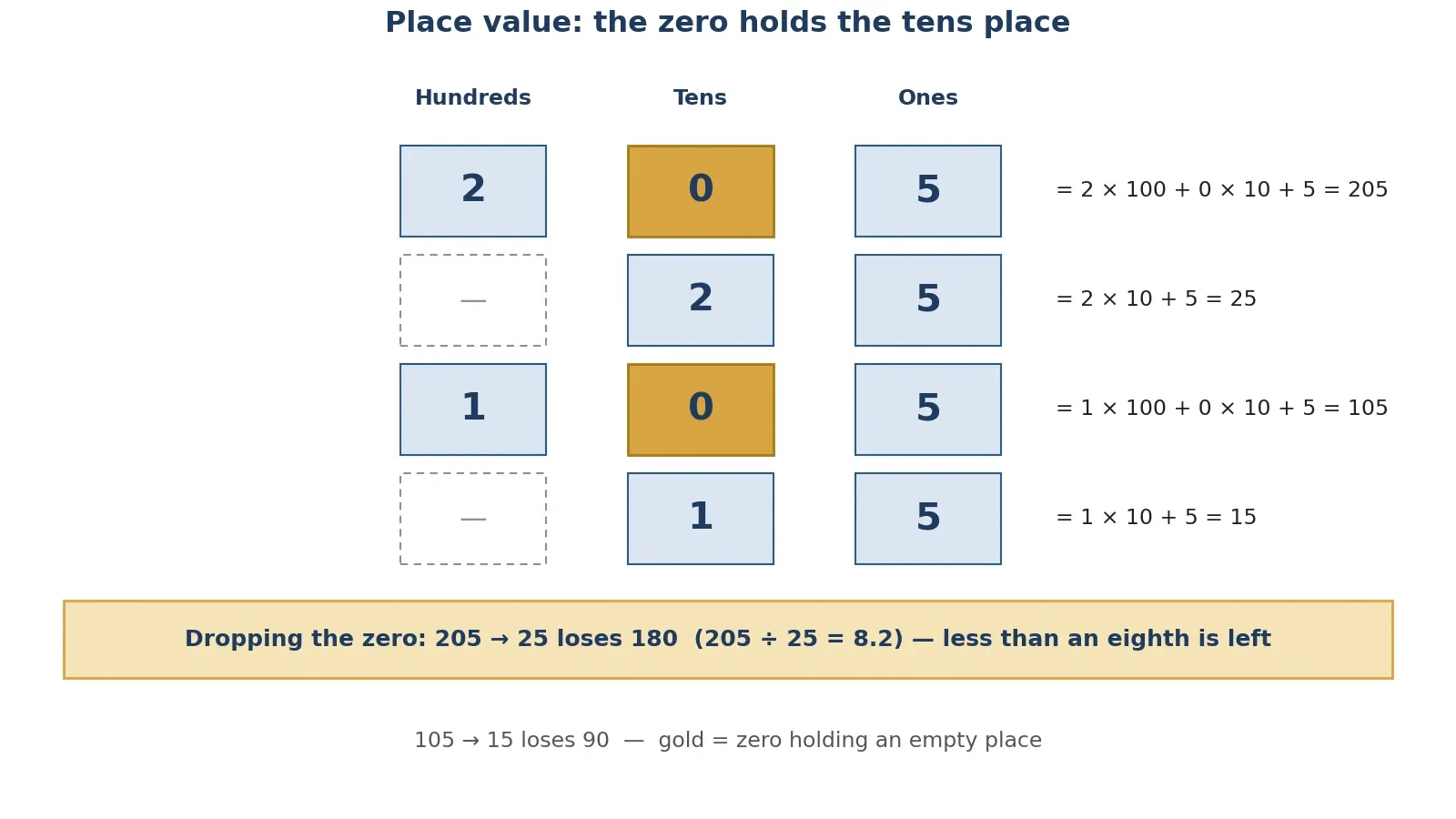
A placeholder says "this place is empty" so that the other digits keep their correct positions. Take the number 205. The zero in the middle tells you there are no tens, so the 2 means two hundreds and not two tens. Drop the zero and you get 25, a completely different number. The difference is 180, which is the value of the zero in that position: 205 minus 25 equals 180, and 205 divided by 25 equals 8.2, so dropping one little circle shrinks the number to less than an eighth of itself. The same thing happens with 105 and 15. The number 105 means one hundred, no tens, and five ones. The number 15 means one ten and five ones. The difference is 90. Without the zero, 105 cannot be written at all in a place-value system, because the 1 and the 5 would slide together and read as fifteen. The historians at St Andrews put it exactly this way: in a number like 2106 the zero is used so that the positions of the 2 and 1 are correct, and 216 means something quite different. You can read their full account in the MacTutor history of zero, which is the best single starting point for this subject.
Zero as a number is a different and bolder claim. It says the empty place is itself a quantity: the result of subtracting a number from itself, the centre of the number line, a value you can add to seven and get seven, multiply by seven and get zero, subtract from zero and get a negative number. A placeholder only holds a position. A number obeys rules. The step from one to the other is the step this article keeps returning to, because it is the step that took the longest and changed the most. The Babylonians had the placeholder. The Maya had the placeholder. Only in India did the placeholder become a number, and only then did arithmetic become what it is today.
The table below shows the distinction in the plainest possible form. The same digits, with and without the zero, mean different things, and the zero is doing all the work of keeping them apart.
Digits written | What it means | Value |
|---|---|---|
205 | 2 hundreds, 0 tens, 5 ones | 205 |
25 | 2 tens, 5 ones | 25 |
105 | 1 hundred, 0 tens, 5 ones | 105 |
15 | 1 ten, 5 ones | 15 |
102 | 1 hundred, 0 tens, 2 ones | 102 |
12 | 1 ten, 2 ones | 12 |
1,000 | 1 thousand, 0 hundreds, 0 tens, 0 ones | 1,000 |
100 | 1 hundred, 0 tens, 0 ones | 100 |
Each zero multiplies by ten. The number 1,000 is ten times 100, which is ten times 10, which is ten times 1, and every step is a zero holding a place. That is why the placeholder matters so much: it is not decoration. It is the mechanism that lets a handful of digits express numbers of any size. Without it, you need a new symbol for every power of ten, and arithmetic becomes a memory test instead of a calculation. With it, a child can write a million as a 1 followed by six zeros, and a computer can store any number as a string of zeros and ones. Everything else in this article grows out of that one mechanical fact.
3. The First Empty Spaces: Babylon and the Wedge That Meant Nothing
Long before anyone thought of zero as a number, the scribes of Babylon needed a way to stop their numbers from sliding into each other. Their system was positional, like ours, but it was base 60, not base 10. That means each place was worth sixty times the place to its right, instead of ten times. The Sumerians had developed the positional idea four to five thousand years ago, and the Babylonians inherited it. It was a powerful system, and it carried a built-in trap: when a place was empty, there was nothing to show for it, so a reader could not tell where one digit ended and the next began. The number we would write as 216 and the number we would write as 2,106 could look alike, and in a system used for astronomy, trade, and taxation, that kind of confusion was expensive.
Around 400 to 300 BCE, Babylonian scribes began using two slanted wedge marks to show an empty place. The wedges were pressed into wet clay with a reed stylus, and they sat between digits like a pair of tiny leaning marks. The date is given as a range because the sources differ slightly: MacTutor gives circa 400 BCE and Live Science gives circa 300 BCE, so the honest statement is circa 400 to 300 BCE. What matters is not the exact decade but the idea. For the first time in the recorded history of zero, an empty place had a visible mark. It was the first placeholder, and it was a genuine breakthrough, even though it was a limited one.
Its limits matter as much as its existence, because they show exactly how far a placeholder can go without becoming a number. The wedge had three things it could not do, and each one is worth stating plainly:
It was used only between digits, never at the end of a number. A scribe could write a wedge in the middle of a number to separate two digits, but could not put one at the end, so the system could not distinguish 216 from 2,160. The trailing empty place had no mark at all.
It was never used as a number. No Babylonian scribe added the wedge to another number, subtracted it, or multiplied by it. It had no arithmetic. It was punctuation, and punctuation does not do sums.
It carried no concept of zero as a quantity. There was no Babylonian idea of "nothing" as a value, no zero on a number line, no equation in which the wedge appeared as an answer. The mark said "nothing here" and stopped.
The worked example in base 60 shows the problem the wedge solved and the problem it left behind. In Babylonian notation, the number written 1;30 means 1 times 60 plus 30, which equals 90. The number written 1;0;30 means 1 times 3,600 plus 0 times 60 plus 30, which equals 3,630. The semicolons here separate the base-60 places, the way our decimal point separates whole numbers from fractions. Without the wedge in the middle place, the two numbers would look identical on a clay tablet, and a reader would have to guess from context whether the scribe meant 90 or 3,630. That is a forty-fold difference, and in astronomy it is the difference between a correct prediction and a wrong one. The wedge fixed the middle. It never fixed the end.
Centuries later, the Greek astronomer Ptolemy used a similar idea in the Almagest, written circa 130 CE. He used the symbol O, a small circle much like the Greek letter omicron, as an empty-place holder in the sexagesimal system of his astronomical tables. It was still punctuation, not a number. The Greeks, for all their mathematical genius, never adopted zero as a number. The standard explanation offered by popular sources is philosophical: Aristotle taught that nature abhors a vacuum, and that "nothing" cannot exist, so a Greek mathematician had a good philosophical reason to be suspicious of a symbol for nothing. That explanation should be treated as the standard explanation, not as a proven cause. Philosophers disagree about how much Aristotle shaped working mathematicians, and the article should not claim a simple cause where scholars see a tangle. What is certain is the outcome: the Greeks had the placeholder idea available and never turned it into arithmetic.
I think about the Babylonian wedge whenever I do mental arithmetic in a shop and catch myself saying "two hundred and five, no, two hundred and fifty" and having to start again. The confusion is the same one the scribes faced, and the solution is the same one they found: mark the empty place, or the digits slide. The difference is that I have a symbol I can also calculate with, and they did not. Their wedge could hold a place. It could not do anything else, and for another thousand years, nobody else's placeholder could either.
4. A Shell in the Jungle: How the Maya Invented Zero on Their Own
The most remarkable fact in the history of zero is that it was invented twice, independently, on opposite sides of the world, by peoples who had no contact with each other. The Maya of Central America developed their own zero, with their own symbol, in their own number system, for their own reasons. They did it centuries before the Indian zero reached Europe, and they did it without any knowledge of Babylon or India. If zero were a single idea that spread from one source, that would be impossible. The Maya prove it was not. The need for a placeholder arises wherever people count in a positional system, and different peoples can meet that need on their own.
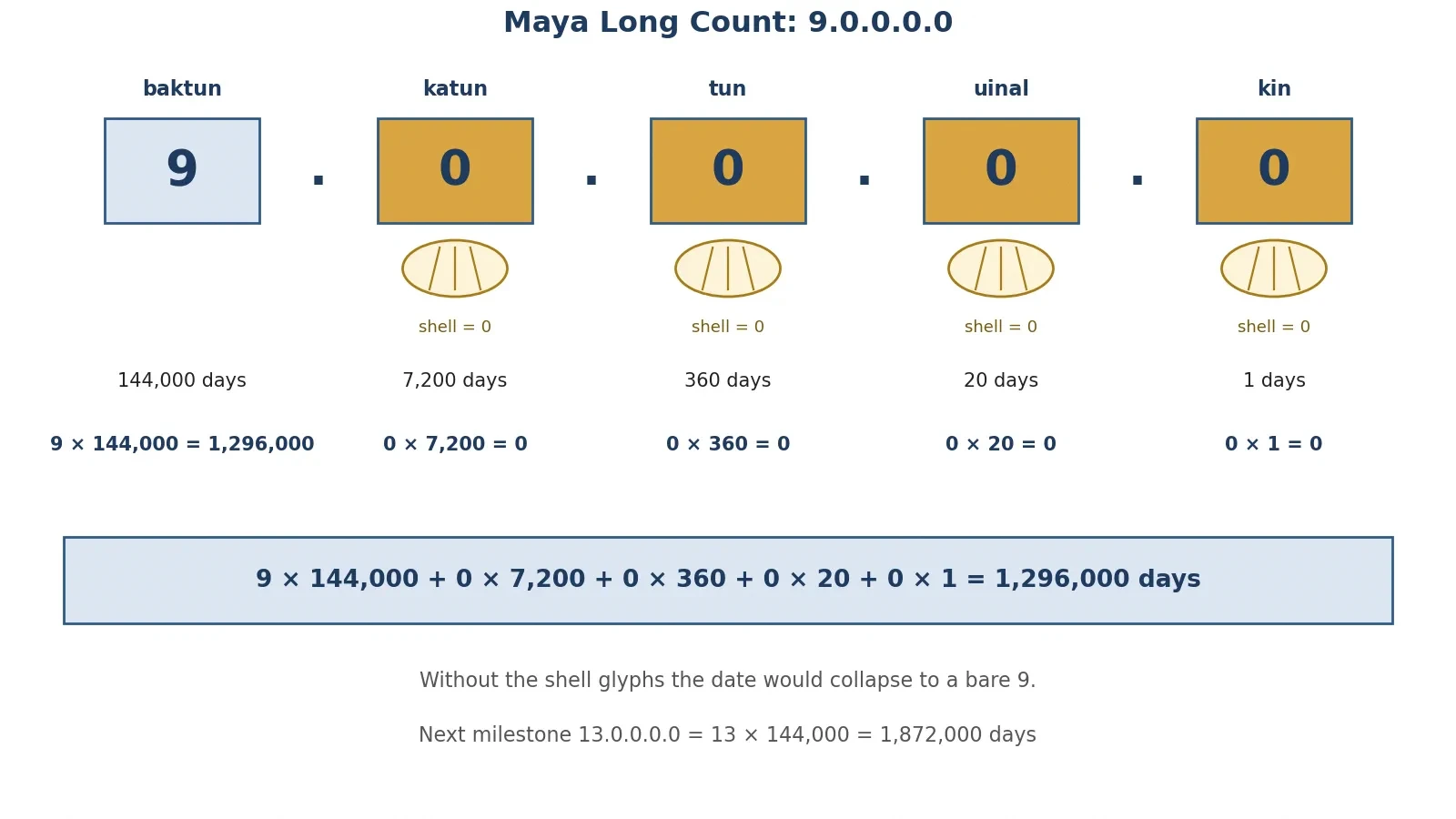
The Maya system was base 20, called vigesimal, probably because people count on fingers and toes. A dot meant 1, a bar meant 5, and zero was a shell-shaped glyph, with flower, hand, and head variants in different inscriptions. The shell is easy to picture: a rounded shape, sometimes drawn like a small flower or a closed fist, sitting in the place where a number should be. It said "nothing here", in a system where the places were worth 1, 20, 360, 7,200, and 144,000. Notice the third place: 360, not 400. In a strict base-20 system the third place would be 400, but the Maya adjusted it to 360 to approximate the solar year, because their numbers existed mainly to count days in a calendar. That adjustment is a clue to what the Maya zero was for. It was a calendrical tool before it was anything else.
The Long Count calendar counted days from a creation date correlated to 11 August 3114 BCE. A Long Count date is written as five numbers separated by dots, each number counting how many of each place value have passed. The most famous such date is 9.0.0.0.0, a major milestone in the calendar. Work it out place by place: 9 times 144,000 days, plus 0 times 7,200, plus 0 times 360, plus 0 times 20, plus 0 times 1. That equals 1,296,000 days, and it can only be written with zeros holding the four empty places. Without the shell glyph, the date would collapse into a bare 9, and the whole meaning of the count would vanish. The next great milestone, 13.0.0.0.0, is 13 times 144,000, which equals 1,872,000 days. Divide that by 365.25 days in a year and you get about 5,125.26 years, which matches the commonly cited length of a 13-baktun cycle, about 5,125 years. The arithmetic is simple, and it shows the Maya zero doing exactly the job a placeholder exists to do: holding empty places so that a large count keeps its shape.
The earliest evidence for the Maya zero is earlier than many popular accounts suggest. A reconstructed Long Count date of 36 BCE appears on a stela at Chiapa de Corzo, and a date of 32 BCE, 3 September 32 BCE, appears on Tres Zapotes Stela C. Popular sources often say the Maya developed zero "around AD 350", and Live Science repeats that figure, but the epigraphic evidence, the dates actually carved on stone, is earlier by nearly four centuries. The 350 CE figure is out of date, and this article uses the stela dates instead. A carved date is hard evidence in a way that a rounded popular estimate is not, and the difference matters: it puts the Maya zero in the first century BCE, roughly contemporary with the late Roman Republic, and more than six centuries before Brahmagupta wrote his rules in India.
There is an honest limit to state, and it is as important as the achievement. The Maya never used zero in equations the way Indian mathematicians did. Their zero was a placeholder in calendrical calculation, not a number with arithmetic. No Maya text adds zero to a number, multiplies by zero, or solves an equation in which zero appears as an answer. To say the Maya "had the same zero as India" would be wrong. They had the same first idea, the placeholder, developed independently and beautifully. They did not have the second idea, the number. That second idea belongs to India, and the next sections tell how it happened there.
5. India Before Brahmagupta: Words for Emptiness
Before zero had a symbol in India, it had a word. That word was sunya, meaning empty or void, and it appears in Indian writing long before any circle was drawn to stand for it. The distinction between a word and a symbol matters, because a word can describe an empty place without giving mathematicians anything to calculate with. Sunya did the describing. The symbol, and then the arithmetic, came later. India before Brahmagupta is the story of a culture that had the word, had the positional system, and was circling the idea of zero without yet having written its rules.
The earliest dated witness is a Jain cosmological text called the Lokavibhaga. The text states its own date as 458 CE, and it uses sunya for the empty place in place-value numbers. One of its numbers is 13,107,200,000, written out with six zeros. That is a large number for a religious cosmology, and it shows a positional system already working at scale: without a way to mark empty places, a number with six zeros in it cannot be written down at all. There is a flag to carry with this date, and the article carries it openly. The date is stated in the text itself, and the surviving copy is a later Sanskrit version, so it should be presented as "the text states its own date as 458 CE" rather than as a securely dated manuscript. A date inside a text is not the same as a date on a stone, and the quality of the evidence matters as much as the date itself. That lesson returns in the Bakhshali story, where the difference between a text and a manuscript changes everything.
A generation later, around 499 CE, the astronomer and mathematician Aryabhata wrote the Aryabhatiya, a work that describes a positional system but uses no written zero symbol. Aryabhata used word-numerals instead: words standing for digits, with sunya among them for the empty place. He did not invent the symbol, and he should not be credited with it. His work matters here for a different reason. It shows a positional system already in use, already needing a placeholder, and already using a word for it, half a century before Brahmagupta gave the placeholder its arithmetic. Aryabhata belongs to the same era of Indian mathematics that produced the value of pi to four decimal places, and readers who want that story can find it in our article on Pi Explained: The Number That Never Ends, which follows Aryabhata's calculation in full.
Behind the word sunya sits a philosophical background that is worth mentioning and worth not overstating. Indian thought had a developed concept of sunyata, emptiness, most famously in Buddhist philosophy, where emptiness is a central idea about the nature of things. It is tempting to draw a straight line from that philosophy to the mathematics and say that Indian culture could invent zero because it already valued emptiness. That line is too straight. Philosophical context is not a cause, and no evidence shows that a monk's meditation on emptiness produced a mathematician's rule for subtraction. The article presents sunyata as context, the intellectual air in which the mathematics grew, not as a proven cause. The mathematics had its own reasons: astronomy needed large numbers, trade needed reliable calculation, and a positional system needed a placeholder that could also be calculated with. Philosophy may have made the idea feel less strange. It did not do the arithmetic.
What India had, by the sixth century, was everything except the final step. It had a positional system. It had a word for the empty place. It had astronomers who needed to calculate with large numbers. It had a culture in which emptiness was a familiar idea rather than a frightening one. What it did not yet have was a set of written rules for treating zero as a number. That step, when it came, had a name and a date, and it is the anchor of this whole article.
6. 628 CE: Brahmagupta Writes the Rules of Nothing
In 628 CE, in the town of Bhillamala in what is now Bhinmal, Rajasthan, an Indian astronomer and mathematician named Brahmagupta wrote a work called the Brahmasphutasiddhanta, which means "Correctly Established Doctrine of Brahma". It had 25 chapters. Most of them were astronomy: planetary positions, eclipses, the movements of the heavens. But chapter 18, on algebra — with chapter 12 on arithmetic — contained something no one had written before: the first known rules for arithmetic with zero as a number. Brahmagupta was born in 598 and died circa 670 according to MacTutor, though Britannica gives circa 665, so the honest statement is that he died circa 665 to 670. He later headed the astronomical observatory at Ujjain, one of the great centres of Indian science. His life is not the story. His rules are.
Brahmagupta defined zero as the result of subtracting a number from itself. That definition is worth pausing over, because it is the first time anyone had said what zero is in arithmetic terms, rather than simply using a mark for an empty place. Zero is not just the absence of a digit. It is the answer to a subtraction: seven minus seven, a hundred minus a hundred, any number minus itself. From that definition, the rules follow, and Brahmagupta wrote them down in full. His own words, in the translation quoted by MacTutor, state the central rule plainly:
When zero is added to a number or subtracted from a number, the number remains unchanged; and a number multiplied by zero becomes zero. — Brahmagupta, Brahmasphutasiddhanta, 628 CE, as quoted by MacTutor
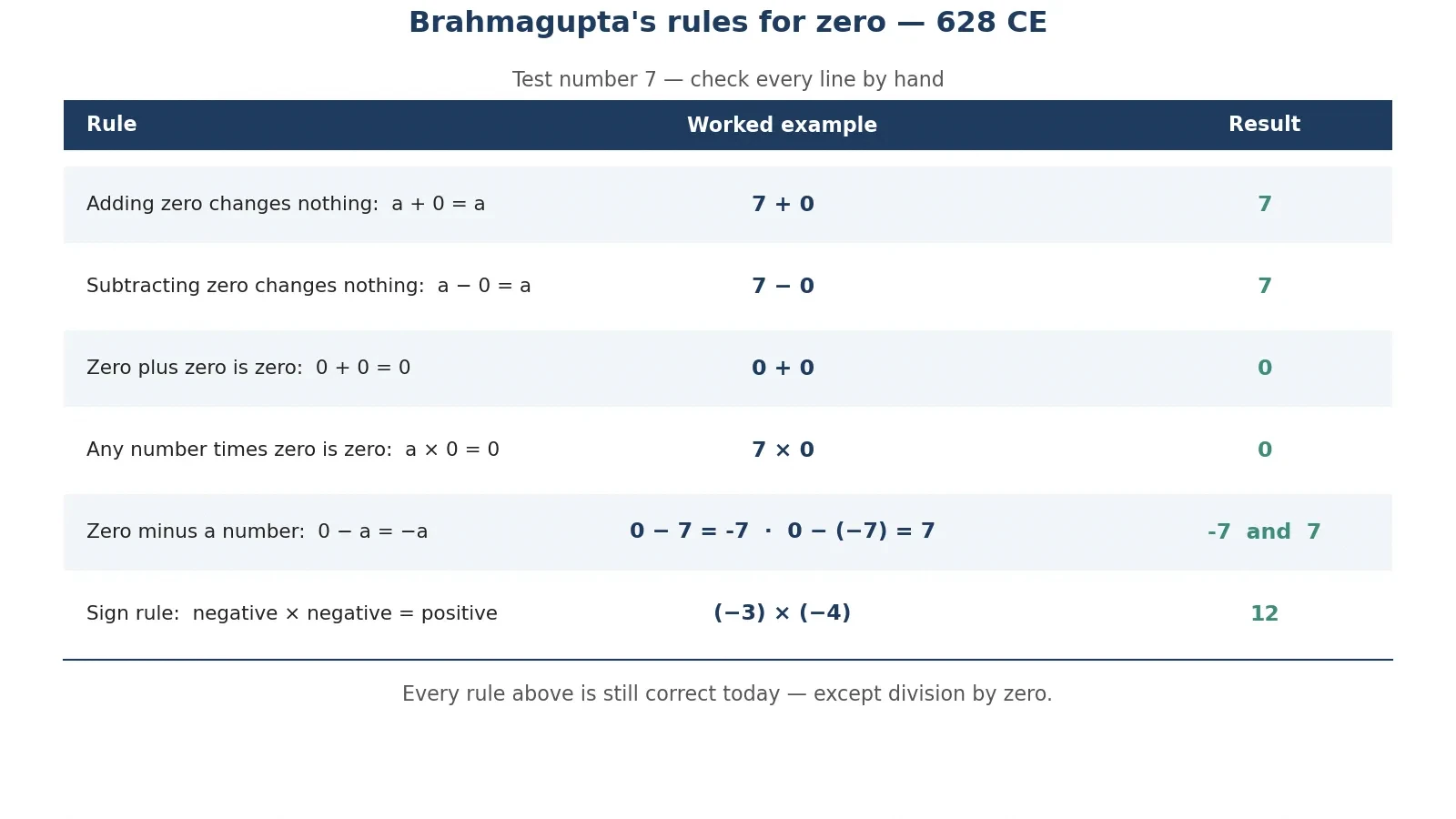
Every rule in his list is still correct today, which is a remarkable record for a first attempt at anything in mathematics. The full set, with a worked numeric example for each, is in the table below. The examples use 7 as the test number, because the arithmetic is easy to check by hand, and each one can be verified in seconds.
Brahmagupta's rule | Worked example | Result |
|---|---|---|
Adding zero leaves a number unchanged: a plus 0 equals a | 7 plus 0 | 7 |
Subtracting zero leaves a number unchanged: a minus 0 equals a | 7 minus 0 | 7 |
Zero plus zero is zero; zero minus zero is zero | 0 plus 0; 0 minus 0 | 0; 0 |
Any number multiplied by zero is zero: a times 0 equals 0 | 7 times 0 | 0 |
Zero minus a positive is negative; zero minus a negative is positive | 0 minus 7; 0 minus negative 7 | negative 7; 7 |
Negative times positive is negative; negative times negative is positive | negative 3 times negative 4 | 12 |
Brahmagupta phrased positives as fortunes, meaning property or wealth, and negatives as debts. That language is not decoration. It is a teaching device, and a good one: a fortune of seven with a debt of seven cancels to nothing, and a debt subtracted from nothing leaves a fortune. The language of money made abstract signs concrete for readers who had never seen a negative number before, and it is one reason his rules were usable rather than merely stated. You can read more about the man himself in the Britannica biography of Brahmagupta, which gives the same dates and the same account of his work at Ujjain.
The key sentence about Brahmagupta, the one the whole article must get right, is this: he did not invent zero. The placeholder already existed. The word sunya already existed. The positional system already existed. His achievement was different and, in the long run, larger. He was the first person known to treat zero as a number with rules, to write down what happens when you add it, subtract it, and multiply by it, and to get those rules right. That is why the year 628 CE is the anchor date of the history of zero, and why the question "who invented zero?" has no single name as its answer. If the question means "who first marked an empty place", the answer is Babylonian scribes, and then the Maya, independently. If it means "who first made zero a number", the answer is Brahmagupta. Both answers are true, and neither is the whole story on its own.
7. The Division That Broke the Rules: What Brahmagupta Got Wrong
Brahmagupta got the addition, subtraction, and multiplication of zero right. He got division by zero wrong, and the way he got it wrong is instructive, because it shows exactly where the difficulty lies. Division by zero is the one place where the rules of arithmetic break down, and Brahmagupta, for all his brilliance, did not see the break. He made two distinct errors, and they are different errors, so they need to be stated separately.
His first statement, in the Colebrooke translation quoted by MacTutor, was this:
Positive or negative numbers when divided by zero is a fraction the zero as denominator. — Brahmagupta, Brahmasphutasiddhanta, 628 CE, as quoted by MacTutor
In plain terms, he left a number divided by zero as the fraction n divided by 0, and stopped there. MacTutor's verdict is gentle and exact: Brahmagupta is saying very little when he suggests that n divided by zero is n divided by 0. A fraction that names no value is not an answer. It is a restatement of the question. Six divided by zero, left as six over zero, tells you nothing about what six divided by zero equals, because the expression has no value to give. It is a placeholder for an answer, not an answer.
His second statement was worse, because it was definite and wrong:
Zero divided by zero is zero. — Brahmagupta, Brahmasphutasiddhanta, 628 CE, as quoted by MacTutor
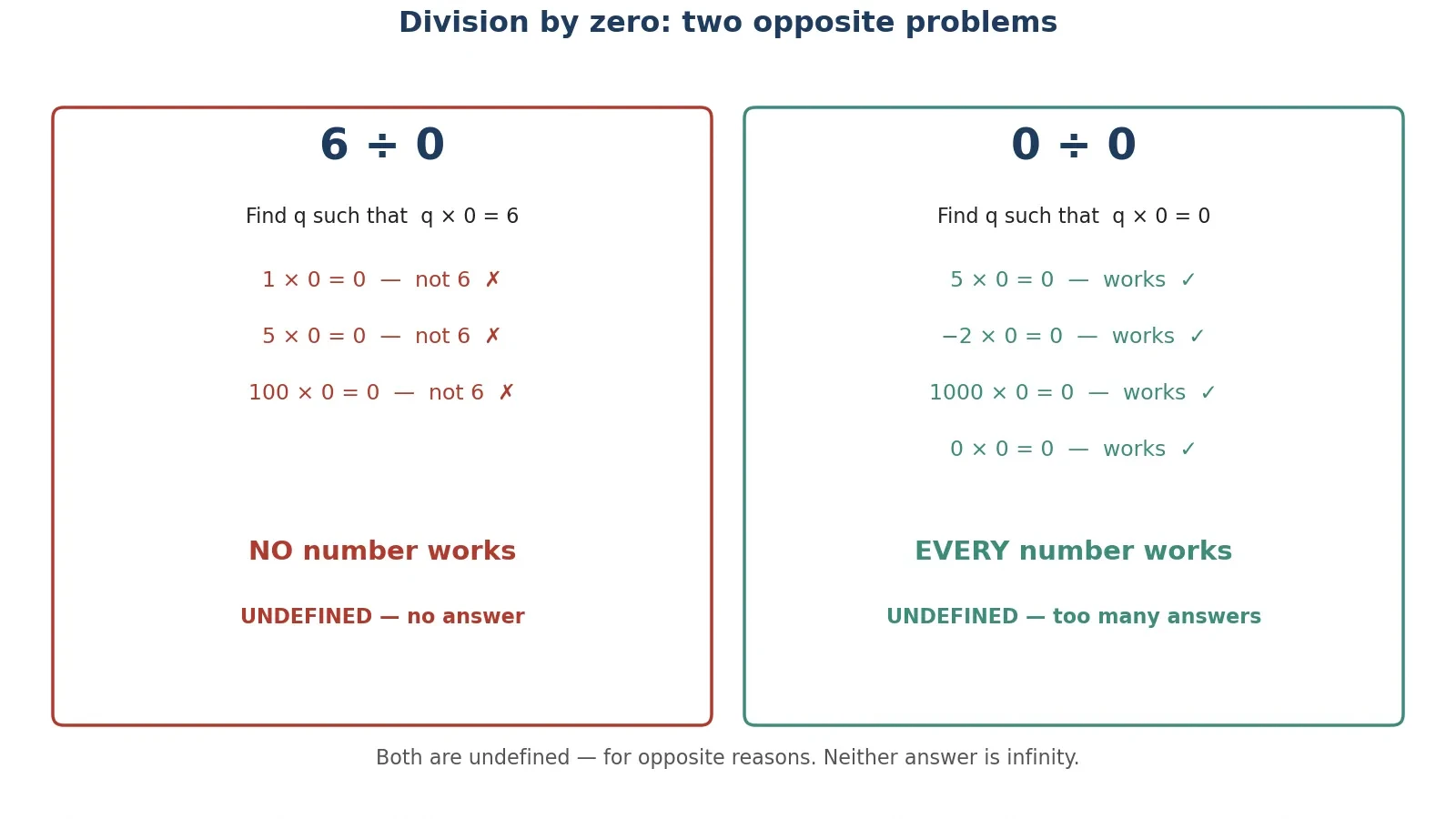
Zero divided by zero is not zero. It has no single answer at all, and the reason is the opposite of the reason six divided by zero has none. Division asks a question: what number, multiplied by the divisor, gives the dividend? For six divided by zero, the question is: what number q satisfies q times 0 equals 6? No such number exists, because q times 0 equals 0 for every q. For zero divided by zero, the question is: what number q satisfies q times 0 equals 0? Every number satisfies it. Five works, because five times zero is zero. Negative two works. One thousand works. Zero is one of infinitely many candidates, not the answer. To pick zero out of that crowd and call it the answer is simply wrong, and modern mathematics says so plainly.
Later Indian mathematicians tried again, and their attempts show the problem getting closer to its modern form without quite reaching it. Mahavira, writing circa 830 CE, said that a number divided by zero is unchanged, which is also wrong: it repeats Brahmagupta's first error in a different form, giving the dividend back as the answer. Bhaskara II, writing in 1150 CE in the Bijaganita, did better. He called a number divided by zero khahara, an infinite quantity, and said it is unchanged however much is added to it or taken from it. His words, in the Colebrooke translation, were:
This fraction, of which the denominator is cipher, is termed an infinite quantity. — Bhaskara II, Bijaganita, 1150 CE, as quoted in the Colebrooke translation
Bhaskara was closer to the modern limit idea: as a divisor shrinks toward zero, the quotient grows without bound, which feels like infinity. But "infinite quantity" is still not the modern answer, which is that division by zero is undefined. Infinity is not a number you can put in the answer box, and the two sides of zero disagree about which infinity you mean, as the worked limits in the later section show. Bhaskara's longer simile, comparing the infinite quantity to an ocean or to the god Vishnu, exists in Colebrooke's translation, but its exact wording was not verified against a clean scan, so this article paraphrases it rather than quoting it: Bhaskara likened the quantity to something that remains unchanged no matter how much is added or taken away, like an ocean that does not rise when rivers flow into it.
The pattern across these three attempts is worth naming. Brahmagupta left the answer blank. Mahavira gave the wrong answer. Bhaskara gave an answer that points in the right direction but is not the answer. It took centuries more, and the development of limits, before mathematics could say clearly why division by zero has no answer at all. The story of that answer, with the numbers worked out, is in the later section on the puzzles zero still leaves us, and it connects directly to the idea of infinity explored in our article on What Is Infinity? How Mathematicians Tamed the Endless.
8. The Bakhshali Manuscript: The Oldest Zero That Was Not
If there is one story in the history of zero that shows why dates need checking, it is the Bakhshali manuscript. It is a story in three acts, and the third act overturns the first. Anyone who repeats only the first act, as several major reference works still do, will get the history wrong. This section tells all three acts, because the correction is the news, and the correction is recent.
Act one is the manuscript itself. In 1881, near the village of Bakhshali, in what is now Pakistan, a farmer digging in a field found about 70 leaves of birch bark covered in Sanskrit arithmetic. The leaves are a practical handbook: problems about trade, measurement, and calculation, worked out step by step, with a dot used as a placeholder for zero hundreds of times. The manuscript is held at the Bodleian Library, Oxford, as MS. Sansk. d. 14. For more than a century after its discovery, scholars dated it by its handwriting and its contents to somewhere around the eighth to twelfth centuries, and nobody claimed it was the oldest zero in the world. It was an important early Indian mathematical text, and that was enough.
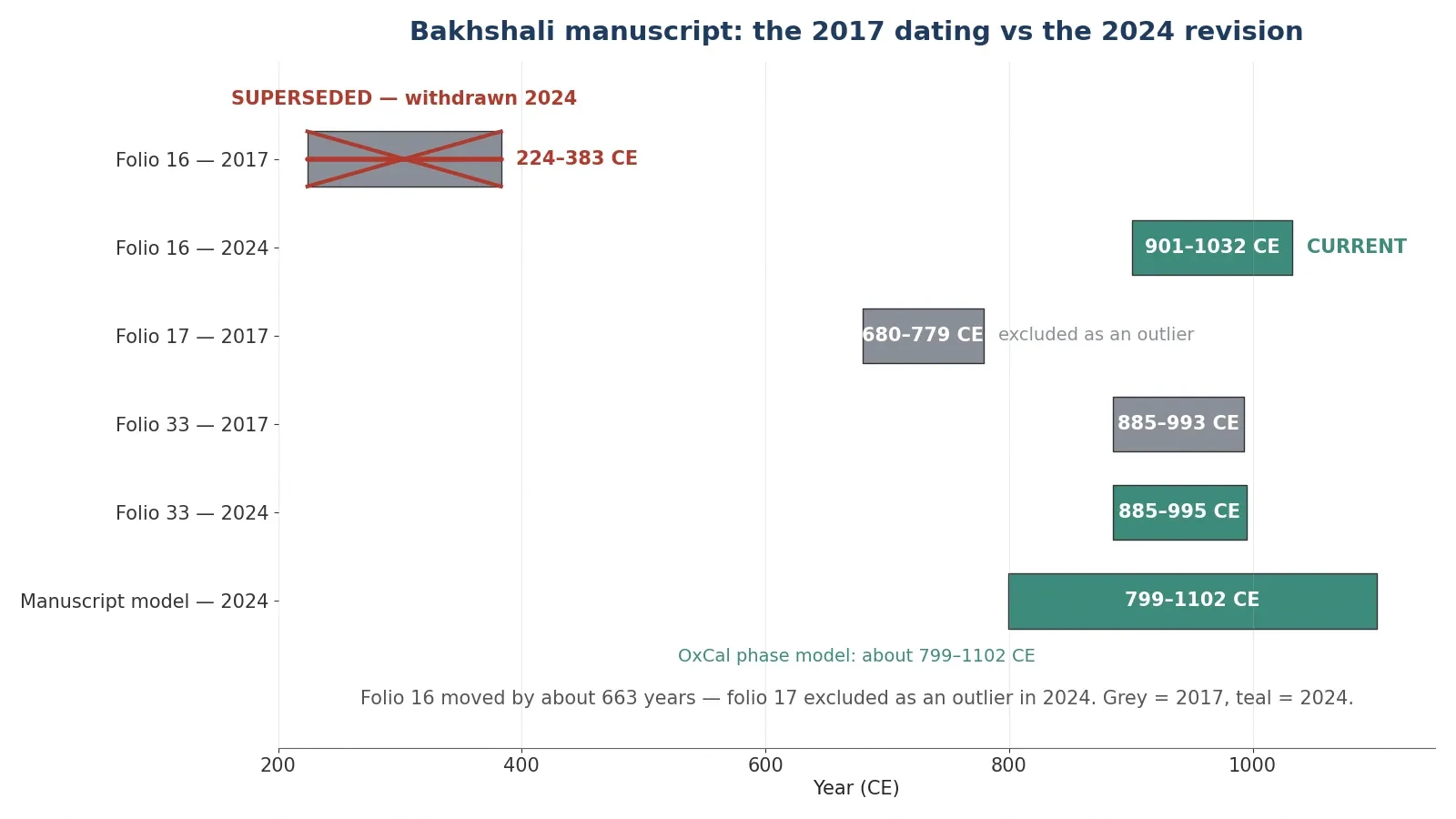
Act two is the announcement. In September 2017, the Bodleian and the Oxford Radiocarbon Accelerator Unit announced carbon dating of three folios. Folio 16 was dated to 224 to 383 CE, folio 17 to 680 to 779 CE, and folio 33 to 885 to 993 CE, all at 95.4 per cent confidence. Press coverage around the world called the dot on folio 16 the oldest recorded zero, and the story ran everywhere: the zero was three centuries older than anyone had thought, and it came from the third or fourth century. The announcement was a press release first and a scholarly publication second, and that order matters for what happened next.
Act three is the scholars' reply, and then the laboratory's own revision. Five historians of Indian mathematics, Kim Plofker, Agathe Keller, Takao Hayashi, Clemency Montelle, and Dominik Wujastyk, published a peer-reviewed response in History of Science in South Asia in 2017, arguing that the manuscript is a unified treatise that must be dated by its latest leaf, not its earliest, and criticising the press-release-first publication. Their paper carries the DOI 10.18732/H2XT07. Then, in October 2024, Oxford re-ran the dating on five folios: 15, 16, 23, 33, and 55. The second determination on folio 16 demonstrated that the initial determination was inaccurate. Folio 17 was excluded as an outlier. The revised ranges are 773 to 986 for folio 15, 901 to 1032 for folio 16, 890 to 1014 for folio 23, 885 to 995 for folio 33, and 774 to 991 for folio 55, all CE at 95.4 per cent confidence. The OxCal phase model puts the manuscript at about 799 to 1102 CE. In short, the third-to-fourth-century date for the Bakhshali zero has been withdrawn by the laboratory that produced it. You can read the revision in full in the Oxford 2024 radiocarbon report on the Bakhshali manuscript by Chivall, Lladó-Buisán, Howell, and Evison.
The table below puts the two datings side by side, so the size of the correction is visible at a glance. Folio 16 moved by more than six centuries.
Folio | 2017 dating (CE) | 2024 revised dating (CE) |
|---|---|---|
Folio 15 | Not dated in 2017 | 773 to 986 |
Folio 16 | 224 to 383 | 901 to 1032 |
Folio 17 | 680 to 779 | Excluded as an outlier |
Folio 23 | Not dated in 2017 | 890 to 1014 |
Folio 33 | 885 to 993 | 885 to 995 |
Folio 55 | Not dated in 2017 | 774 to 991 |
What does this mean for the article, and for the history of zero generally? The Bakhshali dot is still an early Indian placeholder zero, and the manuscript is still, in Oxford's words, almost certainly the oldest extant witness of a South Asian mathematical work. But it can no longer be presented as a third-century zero. The oldest securely dated zero evidence in the Indian decimal tradition is now the stone inscriptions described in the next section: the Cambodian dot of circa 683 CE and the Gwalior circle of 876 CE. There is one more honest point to add. The text the Bakhshali leaves copy may be older than the surviving bark, because a manuscript can copy an older work. Carbon dating dates the bark, not the ideas on it, and it cannot tell us how old the text is. The manuscript is a copy. Its date is the date of the copy.
There is also a warning here for anyone writing about zero, and this article takes it seriously. Britannica's zero article still says that Oxford radiocarbon dating places parts of the manuscript as early as the third or fourth century. That was true of the 2017 announcement, and it is superseded by the 2024 revision. A reference work can be authoritative on most things and stale on one, and the stale thing can be the very fact a reader came looking for. The 2024 Oxford report governs the dating in this article, and any source that still carries the 2017 date should be treated as out of date on this point, however good it is on everything else.
9. Stone Proof: Gwalior 876 and the Cambodian Dot
If manuscripts can be copies, stone cannot. An inscription is dated by its carving: the stone was cut at a known time, in a known place, for a known purpose, and the symbols on it were carved then. That is why the two stone inscriptions in this section matter more than any manuscript for dating the early zero. They are the oldest securely dated zero symbols of the Indian decimal tradition, and they are a century and a half apart, in two different countries, using two different shapes.
The later of the two is the more famous, because its symbol is the one we use today. At the Chaturbhuj temple in Gwalior, in central India, an inscription dated 876 CE records a garden 270 hastas by 187 hastas, and a daily gift of 50 flower garlands. The zeros in 270 and 50 are small circles, the earliest known stone inscription of the circular zero symbol used exactly as we use it today. A hasta is a traditional unit of length, about 1.5 feet, so the garden was about 405 feet long and about 280.5 feet wide: 270 times 1.5 equals 405, and 187 times 1.5 equals 280.5. The numbers are ordinary, a garden and a gift of flowers, and that ordinariness is the point. By 876 CE, zero was not a scholar's curiosity. It was a working digit, used to record the size of a garden and the number of garlands given every day. There is a flag to carry with the date. The temple was excavated in 875 CE, and the inscription is dated 876 CE, in the year Samvat 933. Do not conflate the two years. The excavation and the inscription are different events, a year apart.
The earlier of the two is older and less well known. In Cambodia, a sandstone inscription known as K-127, at Trapang Prei in Kratie province, uses a dot for zero in the date "Chaka era 605". It is the earliest known dated inscription with a zero symbol anywhere in the Old World, but it is a dot, not the circular O. The date is given here as circa 683 CE, because sources differ between 683 CE and 687 CE for the same inscription, and the honest statement is a circa date with the alternative noted. A dot and a circle may look like a small difference, but it is a real one: the Cambodian dot is a placeholder mark, descended from the same idea as the Bakhshali dot, while the Gwalior circle is the symbol as we know it, a small ring that would travel the world.
Why stone matters can be put in one sentence: a manuscript can be a copy of an older text, but a carved inscription was made when it says it was made. The Bakhshali manuscript shows the limit of manuscript dating. Gwalior and Cambodia show the strength of stone. Put the two earliest securely dated zero symbols in stone together and the picture is clear:
The Cambodian dot, circa 683 CE: the earliest known dated inscription with a zero symbol anywhere in the Old World, a dot in a date.
The Gwalior circle, 876 CE: the earliest known stone inscription of the circular zero symbol, in the numbers 270 and 50.
None of these should be called "the oldest zero in the world" without its qualifier, because each one is the oldest of a different thing: the oldest dated inscription with a zero symbol, the oldest circular symbol in stone. The qualifiers are not pedantry. They are the history, stated accurately, and they are what separate this article from the many popular accounts that crown one artefact and ignore the rest.
10. The Long Road West: al-Khwarizmi, Baghdad, and the Nine Signs
Zero reached the West slowly, carried by scholars and merchants rather than by conquest, and the journey took nearly six centuries. It began with a letter, passed through Baghdad, and arrived in Europe in a merchant's handbook. Each stage has a name and a date, and each one is worth following, because the journey explains why the numerals we call "Arabic" are really Indian, and why the word for the system that runs our computers comes from a Persian scholar's name.
The earliest mention of Indian numerals outside India comes from a Syrian bishop named Severus Sebokht, writing at the monastery of Qenneshre on the Euphrates circa 662 CE. He was writing about astronomy, and he paused to praise the Indians' methods of calculation. His words, in the translation given by Wikipedia and Islamicity, are worth quoting, because they are the first time a writer outside India describes the system, and because they contain a telling detail: he counts nine signs, not ten.
I will omit all discussion of the science of the Indians, …, of their subtle discoveries in astronomy, discoveries that are more ingenious than those of the Greeks and the Babylonians, and of their valuable methods of calculation which surpass description. I wish only to say that this computation is done by means of nine signs. — Severus Sebokht, circa 662 CE
Nine signs, not ten, because zero was then still thought of as an empty-place mark rather than a digit. The nine are the digits 1 to 9. Zero was the mark that made them work, but it was not yet counted among them. That single detail captures the whole state of the idea in the seventh century: the placeholder was in use, the arithmetic was not yet written, and a careful observer could describe the system accurately while still not counting zero as a number. There is one exception to that picture — Brahmagupta, writing in 628 CE, a generation before this letter, had already made zero the tenth member of the set in the full sense, and the idea was still travelling.
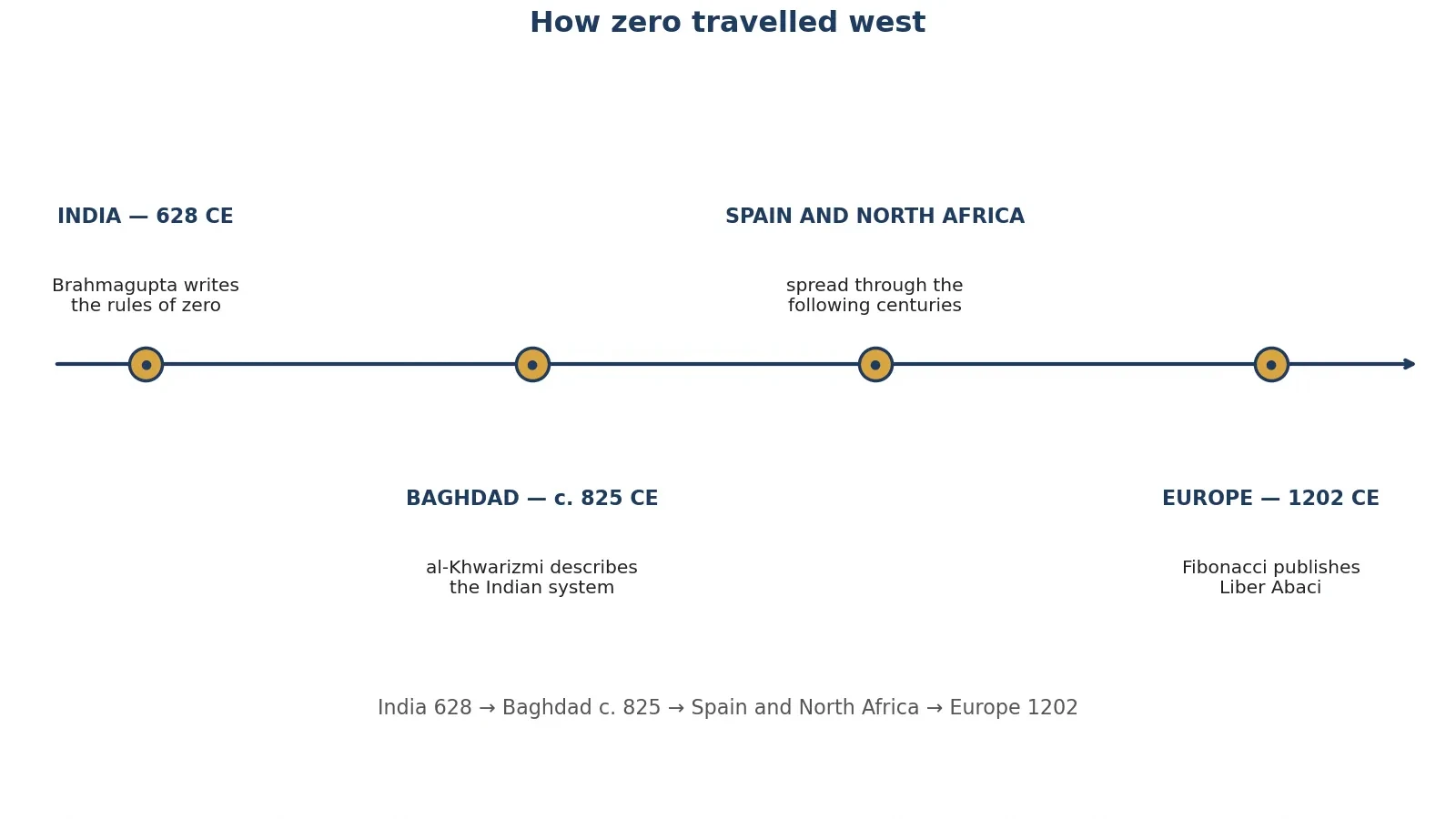
The next stage was Baghdad. Around 825 CE, the Persian scholar Muhammad ibn Musa al-Khwarizmi, working in the House of Wisdom, wrote On the Calculation with Hindu Numerals, describing the Indian positional system with zero and crediting its Indian origin. He did not claim to have invented it. He described it, explained it, and showed how to calculate with it, and that description carried the system into the Islamic world. His Latinised name gives us the word "algorithm", the word we now use for every step-by-step procedure a computer follows. His other great work, on al-jabr, the art of restoring and balancing equations, gives us the word "algebra", and readers who want the full story of that word can find it in our article on How Algebra Works: The Language of Unknowns. Around 830 CE, the philosopher al-Kindi wrote four volumes On the Use of the Indian Numerals, spreading the system further. By the ninth century, zero appeared in Arabic texts in a form derived from Indian notation, resembling the modern oval symbol. The dot had become a circle, and the circle had begun its journey west.
11. 1202: Fibonacci Brings Zero to Europe
The man who brought zero to Europe was not a university professor. He was the son of a customs official, raised partly in North Africa, who learned arithmetic from Arab merchants and came home convinced that Europe was calculating the hard way. His name was Leonardo of Pisa, known as Fibonacci, born circa 1170 and died circa 1250. In 1202 he published Liber Abaci, the "Book of Calculation", revised in 1228, and it changed European mathematics. It was a practical merchants' handbook, and that is why it spread: it did not argue about philosophy. It showed traders how much easier multiplication and division became with the new numerals, and traders adopted what worked.
The demonstration Fibonacci offered was a comparison, and it is worth doing in full, because it shows in one example why Roman numerals could not compete. Take the multiplication 25 times 12. In Hindu-Arabic numerals, it is short and mechanical: 25 times 12 equals 300. You multiply 25 by 2, which is 50, and by 10, which is 250, and add them to get 300. Or multiply 25 by 12 directly, digit by digit, and the same answer appears. In Roman numerals, the same multiplication is written XXV times XII equals CCC. There is no place value, no zero, and no mechanical procedure. To multiply XXV by XII, a Roman calculator had to use an abacus, or a table, or a long series of additions, because the symbols themselves carry no instruction for how to combine them. The symbols are labels, not a machine. The Hindu-Arabic symbols are a machine: the positions do the work, and the zero holds the positions open.
I remember trying this comparison myself as a school pupil, with a pencil and a page of Roman numerals, and giving up halfway through a multiplication that would have taken me thirty seconds in ordinary digits. The experience taught me something no textbook had: a number system is a tool, and tools can be good or bad at their job. Roman numerals are fine for labelling chapters and carving dates on buildings. They are terrible for multiplying. The Hindu-Arabic system is good at multiplying precisely because of the zero. Without it, the positions collapse, and with the collapse goes the whole mechanical advantage. Fibonacci understood this, and his book is, at heart, a long demonstration of it, problem after problem, for merchants who needed answers, not theory.
Fibonacci did not invent the numerals. The article says so explicitly, because popular accounts sometimes credit him with the invention, and the credit belongs to India. He imported them, explained them, and made them usable for European traders. He also used the term zephyrum for zero, a Latin form of the Arabic sifr, which is one step in the etymology chain the next-but-one section follows in full. The spread was slow even after his book. The printing press in the fifteenth century accelerated acceptance, because printed arithmetic books could show the new numerals to thousands of readers at once, and Hindu-Arabic numerals became common across much of Europe only by the middle of the fifteenth century, two and a half centuries after Liber Abaci. A good idea, even a visibly better one, can take generations to replace a familiar habit, and zero is the clearest example in the history of mathematics. Readers who want to see Fibonacci's other legacy, the sequence that bears his name, can find it in our article on The Golden Ratio and Fibonacci Sequence Explained, which follows the sequence from rabbit problems to sunflower heads.
12. Why Europe Resisted: Fraud, Fear, and a Myth Worth Correcting
Why would anyone resist a number system that makes multiplication easier? The question sounds strange today, when every child learns the Hindu-Arabic numerals before anything else. In the thirteenth and fourteenth centuries it was a live question, and the answer is more interesting, and more honest, than the story most people have heard. The real resistance was commercial. The mythical resistance was theological. This section separates the two, because the myth is still repeated in books and documentaries, and repeating it would be exactly the kind of error this article exists to correct.
The real resistance is documented and specific. In 1299, the city authorities of Florence banned the use of Hindu-Arabic numerals in bankers' bookkeeping. The documented reason was fraud. Unfamiliar digits were easy to alter: a zero could be added to the end of a number to turn 16 into 160, or a 1 could be turned into a 7, and a clerk checking a ledger would have no easy way to tell. Roman numerals, for all their clumsiness at multiplication, were hard to forge in that way, because each symbol was a distinct letter and the system had no place value to exploit. The ban was a commercial regulation, not a theological condemnation. It was the city protecting its merchants and its tax records from a new technology whose risks were not yet understood. Bankers and traders adopted the system anyway, quietly and gradually, because it worked, and because the advantage in calculation outweighed the risk of forgery once people learned to write the numerals carefully and to check their books. The ban tells us that zero was resisted. It does not tell us that zero was feared as evil.
The myth is a different story, and it goes like this: medieval Europeans feared zero as the Devil's work, the Church banned zero as heretical because "nothing" could not have been created by God, and the word "cipher" came to mean a secret code because zero itself was secret and dangerous. It is a good story. It is also, according to the historian who investigated it, false. C. Philipp E. Nothaft, of All Souls College, Oxford, examined the claim in a paper called "Medieval Europe's satanic ciphers: on the genesis of a modern myth", published in the British Journal for the History of Mathematics in 2020, with the DOI 10.1080/26375451.2020.1726050. Nothaft argues that the narrative is false or unsubstantiated at nearly every level of analysis, built on a 1905 misreading and on the imaginations of modern popular authors, including Georges Ifrah, Brian Rotman, and Charles Seife. No church council banned zero. No pope condemned it. No medieval theologian wrote a treatise against the Devil's number. The story was assembled later, from a misread passage and a taste for drama, and then repeated from book to book until it felt like history. You can read the paper's record in the Oxford record of Nothaft's paper on the satanic ciphers myth.
I disagree with the common telling of this story, and I disagree with it plainly: the idea that the Church waged a war on zero is not a colourful simplification of a real conflict. It is an invention, and it does a disservice to both sides. It makes medieval Europeans look like fools who feared a digit, when their actual objection was a sensible worry about fraud in commercial records. And it makes the Church look like an enemy of mathematics, when the real opponents of zero were accountants worried about forged ledgers. The true story is less dramatic and more human: a useful tool arrived, people worried about its risks, some cities regulated it, and the tool won anyway because it was better. That is how most good ideas spread, and zero is no exception.
There is a related piece of resistance that is real and worth stating. Negative numbers were considered absurd well into the nineteenth century, and even capable mathematicians avoided zero where they could. The same discomfort that made zero strange made negative numbers stranger: a number less than nothing offended common sense, and it took centuries of successful use in algebra and accounting before negatives were fully accepted. That is part of the same story of resistance, in a safer form, because it is documented in the mathematicians' own writings rather than invented afterwards. Zero and the negative numbers were accepted together, slowly, because they worked together. The number line, with zero at its centre, is the picture that finally made both of them feel natural, and it is the subject of the section after next.
13. The Word Itself: From Sunya to Sifr to Zero
The word "zero" has travelled as far as the number itself, and its journey is written into its spelling. Follow the chain from India to England and each step is a translation, a borrowing, and a small change in sound. The chain is short enough to hold in one table, and it explains three English words at once: zero, cipher, and algorithm.
Word | Language | Meaning |
|---|---|---|
sunya | Sanskrit | Empty, void |
sifr | Arabic | Empty |
zephirum, cephirum | Medieval Latin | Transliteration of sifr |
zefiro, zevero | Italian, Venetian | Adapted from zephirum |
zero | Italian | The modern form |
zéro | French | Borrowed from Italian |
zero | English | First known use in 1598 |
The chain begins with Sanskrit sunya, meaning empty or void, the same word the Lokavibhaga used for the empty place. Arab scholars translating Indian mathematics rendered it as sifr, meaning empty. Latin writers transliterated sifr as zephirum or cephirum, and Fibonacci used the term zephyrum. Italian speakers shortened and softened that into zefiro, and Venetian speakers into zevero, and from there the modern Italian zero emerged, passing through French zéro into English, where the first known use was in 1598. That is more than nine centuries after Brahmagupta and nearly four centuries after Fibonacci: the word arrived in English long after the number had arrived in European arithmetic, because English writers had Latin and French words for the idea before they borrowed the Italian one.
Two other English words come from the same history. The word "cipher" comes from the same Arabic root sifr, and it first meant zero, then came to mean any coded or secret writing, and then a person of no importance, a mere cipher. The drift in meaning is itself a small history of how zero was seen: from a mathematical term, to a secret, to a nothing. The word "algorithm" comes from the Latinised name of al-Khwarizmi, the scholar whose book carried the Indian system to Baghdad. Every time a computer follows an algorithm, it is using a word that is, in origin, a person's name, misheard across languages and centuries. The words are fossils. They carry the route the number travelled, from India through Arabia and Italy to England, in their spelling.
14. Zero Grows Up: The Number Line, Negative Numbers, and the Additive Identity
By the time zero had crossed Europe, it had grown from a punctuation mark into a full citizen of arithmetic, and the picture that shows that citizenship most clearly is the number line. Draw a line, mark a point in the middle, and call it zero. To the right sit the positive numbers, 1, 2, 3, and onward without end. To the left sit the negative numbers, negative 1, negative 2, negative 3, and onward without end. Zero is the origin, the place from which every other number is measured, and it is neither positive nor negative. It is the smallest non-negative integer and the largest non-positive integer, which is a precise way of saying it belongs to neither side and anchors both. In the complex plane, the two-dimensional version of the number line, zero is the origin again, the point where the real and imaginary axes cross.
That picture makes two ideas feel natural that once felt absurd. The first is negative numbers. A negative number is a position to the left of zero, a debt in Brahmagupta's language, a distance in the opposite direction. Once zero is fixed as the origin, negatives are not mysterious. They are simply the numbers on the other side. The second is the additive identity, the formal name for the rule Brahmagupta wrote in 628 CE: a plus 0 equals a, for all a. Zero is the number that leaves any number unchanged when added. It is the additive identity of the integers, of the rational numbers, of the real numbers, and of the complex numbers. The identity idea generalises: every system of numbers has a "do nothing" element, and for addition that element is always zero. That is why the rule feels so basic that it hardly seems worth stating, and why it took so long to state. The most basic facts are often the last to be written down, because they feel too obvious to need writing, until someone tries to build on them and finds the foundation missing.
Zero has a few more properties that belong in this section because they complete the portrait. Zero is even: it is divisible by two with no remainder, since zero divided by two is zero. Zero is the cardinality of the empty set, the number of members in a set with nothing in it, which is the set-theory version of the same idea. And zero is the number that makes the primes, the atoms of arithmetic, easier to talk about: the primes begin at 2, and zero sits below them, outside the definition, because it is divisible by every non-zero integer and so has no unique factorization. Readers who want the full story of those atoms can find it in our article on Prime Numbers Explained: The Atoms of Arithmetic, and readers who want to see how zero behaves at the far end of the number line, where numbers grow without bound, can find that in our article on What Is Infinity? How Mathematicians Tamed the Endless.
15. The Puzzles Zero Still Leaves Us: 0!, 0^0, and Why You Cannot Divide by Zero
Zero has been a number for nearly fourteen centuries, and it still leaves puzzles that catch out confident mathematicians. This section works through three of them, each with the numbers checked. They are the three questions readers ask most often about zero, and they are the reason the history of zero does not end with Brahmagupta. The puzzles are: why you cannot divide by zero, why zero factorial equals one, and what zero to the power of zero means. Two of them have definite answers; the third depends on context, which is itself part of the lesson.
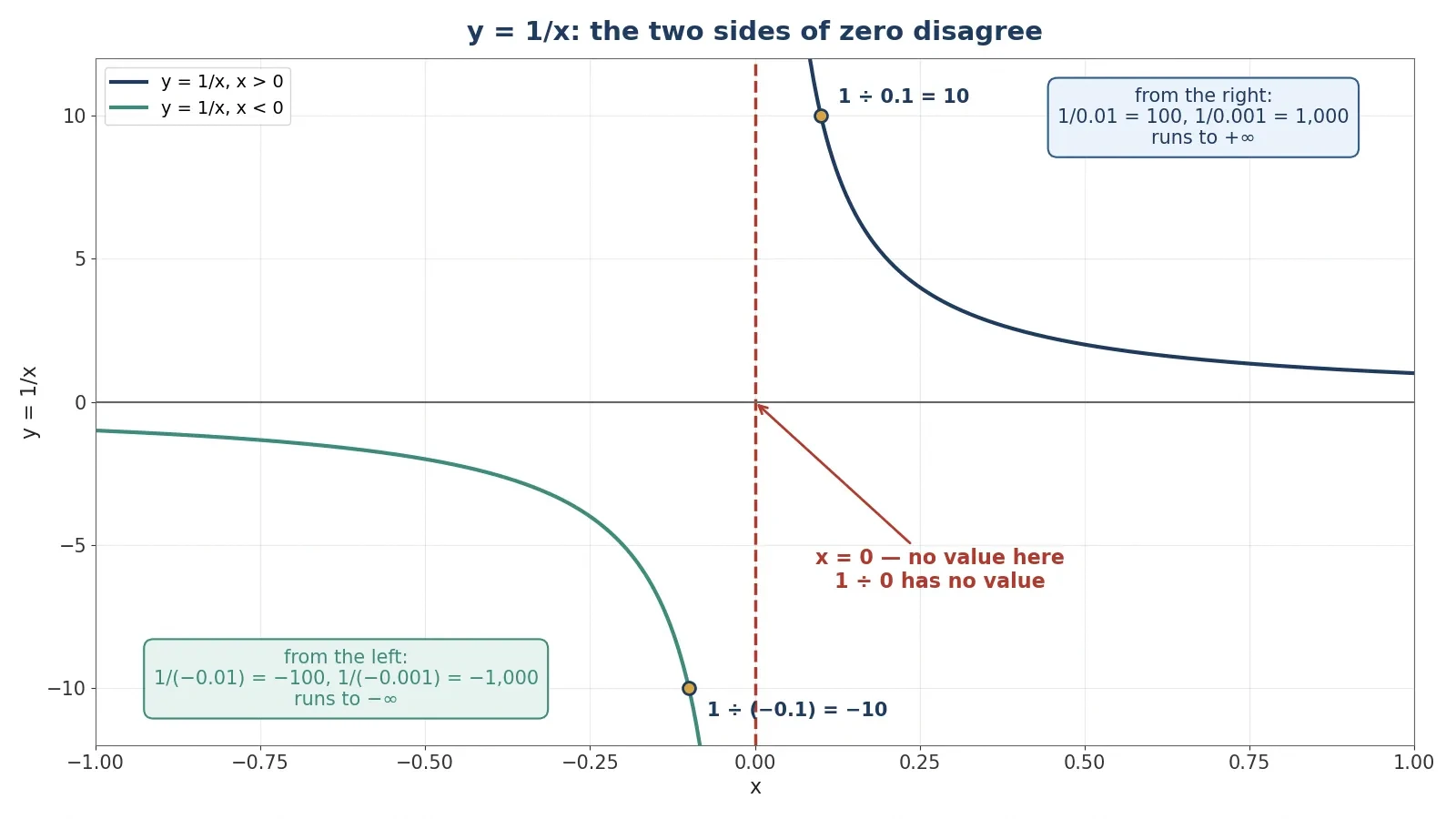
The first puzzle is the most asked question in the whole subject: why can you not divide by zero? Start with the approach, because it shows the problem before any algebra does. Divide 1 by numbers that get closer and closer to zero from above: 1 divided by 0.1 equals 10; 1 divided by 0.01 equals 100; 1 divided by 0.001 equals 1,000; 1 divided by 0.0001 equals 10,000. The values run away to positive infinity. Now divide 1 by numbers that get closer and closer to zero from below: 1 divided by negative 0.1 equals negative 10; 1 divided by negative 0.01 equals negative 100; 1 divided by negative 0.001 equals negative 1,000; 1 divided by negative 0.0001 equals negative 10,000. The values run away to negative infinity. The two sides disagree completely. From above, the quotient grows without bound in the positive direction. From below, it grows without bound in the negative direction. No single value can be assigned to 1 divided by 0, because the two approaches point to opposite infinities. It is undefined, not infinity. Infinity is not a value waiting at the end of the approach. It is the name for the fact that there is no end.
The algebra says the same thing in a different form. Division asks: what number, multiplied by the divisor, gives the dividend? For 6 divided by 0, the question is: what number q satisfies q times 0 equals 6? There is no such number, because q times 0 equals 0 for every q, and 0 is not 6. For 0 divided by 0, the question is: what number q satisfies q times 0 equals 0? Every number satisfies it. Five works, negative two works, one thousand works, and so does zero. There is no unique answer, so there is no answer. Division by zero is undefined for two opposite reasons: for a non-zero dividend, there are no answers; for a zero dividend, there are too many. The computer agrees: in Python, 5 divided by 0 raises ZeroDivisionError, with the message "division by zero", and refuses to give a value at all.
There is a trap hidden in this puzzle that catches students, and it is worth working through because it shows how easily a hidden division by zero can erase a correct answer. Solve the equation x squared equals 3x. Dividing both sides by x gives x equals 3, and that looks like the whole answer. It is not. Check x equals 3: 3 squared is 9, and 3 times 3 is 9, so it works. Check x equals 0: 0 squared is 0, and 3 times 0 is 0, so it also works. The full solution set is x equals 0 or x equals 3, and the step of dividing by x threw away the solution x equals 0, because dividing by x is dividing by zero when x is zero. Never divide by something that could be zero. If you do, you must check the zero case separately. The rule is short, and it saves real errors: the zero solution is a real solution, and it vanishes the moment you divide it away. The language of limits, which makes this argument precise, is explained in our article on How Calculus Works: Derivatives, Integrals, and the Mathematics of Change.
The second puzzle is zero factorial, and it surprises people because the answer feels wrong until the reason is seen. Zero factorial, written 0!, equals 1. The factorial of a number is the product of all the positive whole numbers up to it: 1! equals 1; 2! equals 2 times 1, which is 2; 3! equals 3 times 2 times 1, which is 6; 4! equals 24; 5! equals 120; 6! equals 720. The table below shows the pattern from 0! to 6!, and the pattern is what forces the answer.
n | n! worked out | n! |
|---|---|---|
0 | By convention, the empty product | 1 |
1 | 1 | 1 |
2 | 2 times 1 | 2 |
3 | 3 times 2 times 1 | 6 |
4 | 4 times 3 times 2 times 1 | 24 |
5 | 5 times 4 times 3 times 2 times 1 | 120 |
6 | 6 times 5 times 4 times 3 times 2 times 1 | 720 |
There are three reasons 0! equals 1, and each one is convincing on its own. The first is the pattern: n! equals n times the factorial of n minus 1, so 1! equals 1 times 0!, and since 1! equals 1, 0! must equal 1. Anything else would break the pattern at the first step. The second is the empty product: the factorial of zero is the product of no numbers at all, and the product of no numbers is defined as 1, the multiplicative identity, in the same way that the sum of no numbers is 0. The third is combinatorics: 5 choose 0 equals 1, because there is exactly one way to choose nothing from a set of five, and 5 choose 5 equals 1, and 0 choose 0 equals 1, and all three need 0! to equal 1 for the formula to work. You can read the full explanation, with the same three reasons, in the Math Doctors explanation of why zero factorial equals one. The combinatorics behind choosing nothing, and choosing everything, connects to the counting arguments in our article on What Is Probability? How We Measure Uncertainty.
The third puzzle is zero to the power of zero, written 0^0, and it is genuinely unsettled by context, not a trick with one answer. Two rules collide. The rule "anything to the power of zero is 1" says the answer is 1: 2 to the power of 0 is 1, 3 to the power of 0 is 1, 10 to the power of 0 is 1, because each step down in the exponent divides by the base, and the pattern lands on 1. The rule "zero to any power is 0" says the answer is 0: 0 to the power of 1 is 0, 0 to the power of 2 is 0, 0 to the power of 3 is 0. Both rules are true in their own territory, and they disagree at the single point where they meet.
The limit makes the disagreement precise. Take x to the power of x as x approaches zero from above: 0.1 to the power of 0.1 is about 0.794; 0.01 to the power of 0.01 is about 0.955; 0.001 to the power of 0.001 is about 0.993; 0.0001 to the power of 0.0001 is about 0.999. The values approach 1, which is why many contexts define 0^0 as 1. But 0 to the power of x stays 0 for every positive x, so approaching from the other direction gives 0. As a limit, 0^0 has no single value. It is indeterminate. In combinatorics and in most programming languages, 0^0 is defined as 1, because that keeps the binomial theorem working, and Python returns 1 for 0 to the power of 0. Donald Knuth argued for 1 in his 1992 paper "Two Notes on Notation". Cauchy, in 1821, listed 0^0 among undefined expressions. Both positions are defensible, and the honest answer is to say which context you are in. A 2025 paper even proposed redefining zero in addition and subtraction as "the absence of an operation" rather than a neutral element, but that is a proposal in a small journal, not a consensus change, and it does not settle 0^0 or anything else in this section. The puzzles stand as they are: two of them solved, one of them honestly open.
16. Zero Runs the Modern World: Binary, Computing, and the Digital Age
The number that was once banned now underlies every calculation a reader's phone performs, and the reason is binary. Modern computers store information in only two symbols, 0 and 1. That is the whole alphabet of computing, and zero is half of it. Every photograph, every message, every video, every bank balance is stored as a long string of zeros and ones, and the zero in that string is doing the same job it did in 205: holding a place so that the other digits keep their value. The placeholder has become the foundation of the digital age.
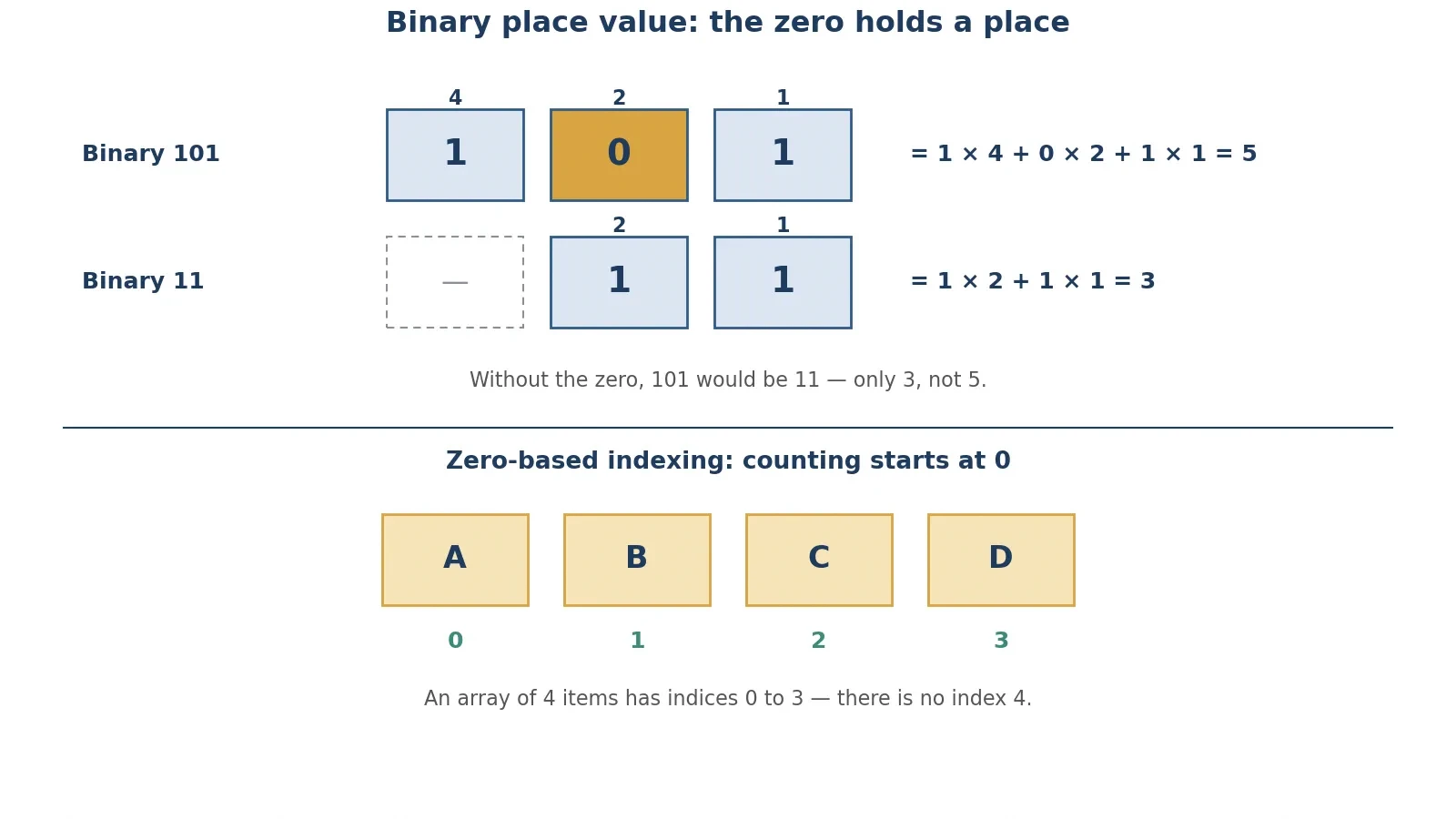
Binary place value works exactly like decimal place value, with 2 in place of 10. The places are worth 1, 2, 4, 8, 16, and so on, doubling each time. Binary 101 means 1 times 4, plus 0 times 2, plus 1 times 1, which equals 5. Binary 11 means 1 times 2 plus 1 times 1, which equals 3. The zero in 101 holds the twos place empty; without it, 11 is only 3, and the number has lost two of its five. Binary 1000 means 1 times 8, which equals 8, and 1 followed by eight zeros in binary equals 256. The arithmetic is the same as the decimal arithmetic of the second section, in a different base, and that is the point: the placeholder idea, invented for base 10 and base 60 and base 20, works in base 2 as well, because it is not about the base. It is about position.
Zero also runs the inside of programming. In most programming languages, array indices start at 0, a practice called zero-based indexing: an array of n items has indices 0 to n minus 1. The first item is item zero, the second is item one, and the last is item n minus 1. The practice began with LISP in the late 1950s, while early languages such as Fortran and COBOL counted from 1. It persists because it makes the arithmetic of memory addresses simple: the address of an item is the address of the start plus the index times the size of an item, and starting at zero makes that formula clean. I learned this the hard way, years ago, writing a small program that read a list of names and kept missing the last one. The list had ten names, numbered 0 to 9, and my program asked for name number 10, which did not exist. The error message was short and unhelpful. The lesson was permanent: in computing, counting starts at zero, and forgetting that is the most common beginner's error in the field. Zero is also the numerical representation of "false" in Boolean logic, the logic that underlies every decision a computer makes: true is 1, false is 0, and every condition in every program reduces, in the end, to a choice between those two values.
Time itself is counted from zero in computing. The Unix epoch, the system most computers use to record time, begins at timestamp zero, 00:00 UTC on 1 January 1970. Every moment since then is a count of seconds from that zero point, and every moment before it is a negative count. The calendar has no year zero: the Anno Domini calendar jumps from 1 BCE to 1 CE, so there was never a year numbered zero in that system, a gap that still causes confusion in historical dating. In computing, by contrast, zero is the starting point, and everything is measured from it. The contrast is a fitting summary of the whole history: the calendar, an older system, never found a place for zero, while computing, the newest system, is built on it.
That is the closing beat of the story. A mark that began as two wedges in Babylonian clay, that became a shell in a Maya calendar, that became a word for emptiness in India, that became a number with rules in 628 CE, that was banned as a fraud risk in Florence in 1299, and that was said, wrongly, to be the Devil's number, now sits inside every device a reader owns, holding places in binary, numbering arrays from zero, marking false in logic, and counting seconds from an epoch. The number that was once not a number runs the modern world. The connection between that binary foundation and the codes that protect it is explored in our article on How Encryption Works: Keys, Ciphers, and Keeping Secrets Safe Explained, where the same zeros and ones carry secrets, and the role of zero as an origin point, the place from which all measurement begins, is the same idea that lets satellites fix a position in our article on How GPS Works: Satellites, Atomic Clocks, and Trilateration Explained.
17. Frequently Asked Questions
Who invented zero?
No single person invented zero, because zero is two ideas, not one. The placeholder, a mark for an empty place, was invented independently by Babylonian scribes around 400 to 300 BCE and by the Maya, whose earliest carved zero dates to 36 BCE. Zero as a number, a quantity with arithmetic rules, was first set out by the Indian mathematician Brahmagupta in 628 CE, in his work the Brahmasphutasiddhanta. If the question means the placeholder, the answer is Babylon and the Maya. If it means the number, the answer is Brahmagupta. Both answers are true, and neither is the whole story alone.
Why can't you divide by zero?
Because division asks what number, multiplied by the divisor, gives the dividend, and no number times zero gives a non-zero dividend. For 6 divided by 0, you would need a number q with q times 0 equal to 6, and no such number exists, since q times 0 is always 0. The one-sided limits confirm it: 1 divided by 0.1 is 10, by 0.01 is 100, by 0.001 is 1,000, running to positive infinity from above, while from below the values run to negative infinity. The sides disagree, so no single value exists. Division by zero is undefined, not infinity.
Why was zero resisted?
Florence banned Hindu-Arabic numerals in commercial records in 1299, and the documented reason was fraud: a zero added to the end of a number could turn 16 into 160, and unfamiliar digits were easy to alter. It was a commercial rule, not a condemnation by the Church. The popular story that the Church banned zero as the Devil's number is a modern myth, debunked by the historian C. Philipp E. Nothaft in 2020, who found the narrative false or unsubstantiated at nearly every level. Negative numbers were also doubted well into the nineteenth century, for the same reason zero was doubted: a number that measured nothing, or less than nothing, offended common sense until long use proved it worked.
What is zero as a placeholder vs a number?
As a placeholder, zero is a mark that holds an empty place so other digits keep their positions: in 205, the zero says there are no tens, so the 2 means two hundreds. As a number, zero is a quantity with arithmetic rules: a plus 0 equals a, a times 0 equals 0, and zero minus a is negative a. The placeholder is older by many centuries and was invented independently in Babylon and among the Maya. The number is the Indian breakthrough, first written as rules by Brahmagupta in 628 CE. Confusing the two is the most common error in popular writing about zero.
When was zero invented?
There is no single date, and any article that gives one is simplifying. The placeholder appeared in Babylon around 400 to 300 BCE, and among the Maya by 36 BCE at the latest. Zero as a number took shape in India in the fifth to seventh centuries CE, with its rules written down by Brahmagupta in 628 CE. The oldest securely dated zero symbols in stone in the Indian tradition are the Cambodian dot of circa 683 CE and the circular zero in the Gwalior inscription of 876 CE. The Bakhshali manuscript, once dated to the third or fourth century, was redated by Oxford in October 2024 to about 799 to 1102 CE.
What is 0 divided by 0?
Zero divided by zero is undefined. Division asks what number, multiplied by the divisor, gives the dividend, and for 0 divided by 0 every number qualifies: 5 times 0 is 0, negative 2 times 0 is 0, one thousand times 0 is 0. With infinitely many candidates and no way to choose between them, there is no unique answer. Brahmagupta's answer, that zero divided by zero is zero, was wrong. It is undefined for the opposite reason to 6 divided by 0, which has no answer at all: 0 divided by 0 has too many.
What is zero factorial (0!)?
Zero factorial equals 1. There are three reasons. First, the pattern: n! equals n times the factorial of n minus 1, so 1! equals 1 times 0!, and since 1! equals 1, 0! must equal 1. Second, the empty product: the product of no numbers is defined as 1, the multiplicative identity, just as the sum of no numbers is 0. Third, combinatorics: 5 choose 0 equals 1, because there is exactly one way to choose nothing from a set of five, and the formula needs 0! to equal 1 to give that answer.
What is 0 to the power of 0 (0^0)?
It is debated, and the answer depends on context. The rule "anything to the power of zero is 1" gives 1, and the rule "zero to any power is 0" gives 0. As a limit it is indeterminate: x to the power of x approaches 1 as x approaches zero from above, with 0.001 to the power of 0.001 about 0.993, while 0 to the power of x stays 0. In combinatorics and most programming languages, including Python, 0^0 is defined as 1, because that keeps the binomial theorem working. Cauchy listed it among undefined expressions in 1821, and Knuth argued for 1 in 1992. Do not give a single flat answer: say which context you mean.
18. The Number That Changed Everything
The journey of zero runs in four beats, and each one is worth holding in mind together. First, the placeholder: a mark for an empty place, invented in Babylon around 400 to 300 BCE and independently among the Maya, so that digits could keep their positions and large numbers could be written at all. Second, the number: a quantity with rules, first written down by Brahmagupta in India in 628 CE, when zero became the result of subtracting a number from itself and gained an arithmetic of its own. Third, the banned traveller: a symbol carried from India to Baghdad around 825 CE, brought to Europe by Fibonacci in 1202, banned in Florence in 1299 over fraud, and wrongly accused, centuries later, of being the Devil's number. Fourth, the foundation of computing: the placeholder again, in binary, holding places in every number a computer stores, numbering arrays from zero, marking false in logic, and counting time from an epoch.
Zero is the only number that began as an admission of absence and ended as the thing everything else is built on. Every other number counts something that exists. Zero counts the empty place, the missing quantity, the starting point, and the answer to a subtraction that cancels itself out. It took more than a thousand years for the world to accept that nothing could be something, and the acceptance was never a single event. It was a slow accumulation of uses: a wedge in clay, a shell in a calendar, a word for emptiness, a set of rules, a merchant's handbook, a printed book, a line of code. Each use made the next one easier, until the number that once seemed impossible became the number no one can do without.
God made the integers; all else is the work of man. — Leopold Kronecker, as quoted by MacTutor
Kronecker was speaking about the integers generally, not about zero in particular, and the quote belongs here only in that wider sense. The integers, the whole numbers and their negatives, begin with zero as their centre, and everything else in mathematics, the fractions, the real numbers, the complex numbers, the calculus, the computing, is built on top of them. Zero made the integers usable as a system. It gave them an origin, an identity, and a way to write any size of number with ten small symbols. That is what changed everything: not a single invention, but a slow change in what counting could do, from marking empty places in clay to running the world.
19. Sources
O'Connor, J. J. and Robertson, E. F. "A History of Zero." MacTutor History of Mathematics, University of St Andrews. https://mathshistory.st-andrews.ac.uk/HistTopics/Zero/
O'Connor, J. J. and Robertson, E. F. "Brahmagupta." MacTutor History of Mathematics, University of St Andrews. https://mathshistory.st-andrews.ac.uk/Biographies/Brahmagupta/
"Zero." Encyclopaedia Britannica. https://www.britannica.com/science/zero-mathematics
"Brahmagupta." Encyclopaedia Britannica. https://www.britannica.com/biography/Brahmagupta
"Indian mathematics." Encyclopaedia Britannica. https://www.britannica.com/science/Indian-mathematics
Chivall, D., Lladó-Buisán, V., Howell, D. and Evison, G. (2024). "Radiocarbon dating of the Bakhshālī manuscript." University of Oxford. https://ora.ox.ac.uk/objects/uuid:5a6d1dd7-f20c-4209-adb6-33849f5b08f4
Bodleian Libraries (2017). "Carbon dating finds Bakhshali manuscript contains oldest recorded origins of the symbol 'zero'." https://www.glam.ox.ac.uk/article/carbon-dating-finds-bakhshali-manuscript-contains-oldest-recorded-origins-symbol-zero
Plofker, K., Keller, A., Hayashi, T., Montelle, C. and Wujastyk, D. (2017). "The Bakhshālī Manuscript: A Response to the Bodleian Library's Radiocarbon Dating." History of Science in South Asia 5.1, 134–150. https://journals.library.ualberta.ca/hssa/index.php/hssa/article/view/22
Devlin, H. / phys.org (2017). "The Bakhshali manuscript: The world's oldest zero?" https://phys.org/news/2017-10-bakhshali-manuscript-world-oldest.pdf
"Who Invented Zero?" Live Science. https://www.livescience.com/27853-who-invented-zero.html
Mackenzie, D. "Resisting a new concept: the discovery of zero." BBC Science Focus Magazine. https://www.sciencefocus.com/science/resisting-a-new-concept-the-discovery-of-zero
"0 (number)." Wikipedia. https://en.wikipedia.org/wiki/0_(number)
"Bakhshali manuscript." Wikipedia. https://en.wikipedia.org/wiki/Bakhshali_manuscript
"History of the Hindu–Arabic numeral system." Wikipedia. https://en.wikipedia.org/wiki/History_of_the_Hindu-Arabic_numeral_system
"Chaturbhuj Temple, Gwalior." Wikipedia. https://en.wikipedia.org/wiki/Chaturbhuj_Temple,_Gwalior
Nothaft, C. P. E. (2020). "Medieval Europe's satanic ciphers: on the genesis of a modern myth." British Journal for the History of Mathematics. https://ora.ox.ac.uk/objects/uuid:71f4c8ca-2b6a-4393-94dc-8d81096985bc
"The Decimal and Islamic Mathematics." Islamicity. https://www.islamicity.org/3506/the-decimal-and-islamic-mathematics/
"Zero Factorial: Why Does 0! = 1?" The Math Doctors. https://www.themathdoctors.org/zero-factorial-why-does-0-1/
"Zero Factorial: Why Is The Value Of Zero Factorial Equal To One?" ScienceABC. https://www.scienceabc.com/pure-sciences/why-is-the-factorial-of-zero-equal-to-one
Catepillán, C. and Méndez, S. (2017). "Zero in the pre-Columbian Americas." Maya Exploration Center. https://www.mayaexploration.org/pdf/ZeroInPreColumbianAmericas_CatepillanMendez_Sept2017.pdf?ref=antoinebuteau.com
"The trouble of zero." Short Wave, NPR. https://podscan.fm/podcasts/short-wave/episodes/the-trouble-of-zero
Franesi, P. (2026). "Śūnya: The Indian Discovery of Zero and the Mathematical Revolution that Changed the World." Zenodo preprint. https://zenodo.org/records/21377384
Zargelin, O. A. (2025). "Redefining Zero in Addition and Subtraction: From Neutral Element to Absence of Operation." Scientific Journal for Publishing in Health Research and Technology 1(2), 48–53. https://sjphrt.com.ly/index.php/sjphrt/en/article/download/15/15/24
Colebrooke, H. T. (1817). "Algebra, with Arithmetic and Mensuration, from the Sanscrit of Brahmegupta and Bháscara." https://archive.org/details/1817-henry-colebrooke-algebra-with-arithmetic-and-mensuration-from-the-sanskrit-of-br
"Rabbi Ben Ezra (1092–1167)." MacTutor History of Mathematics, University of St Andrews. https://mathshistory.st-andrews.ac.uk/Biographies/Ezra/