

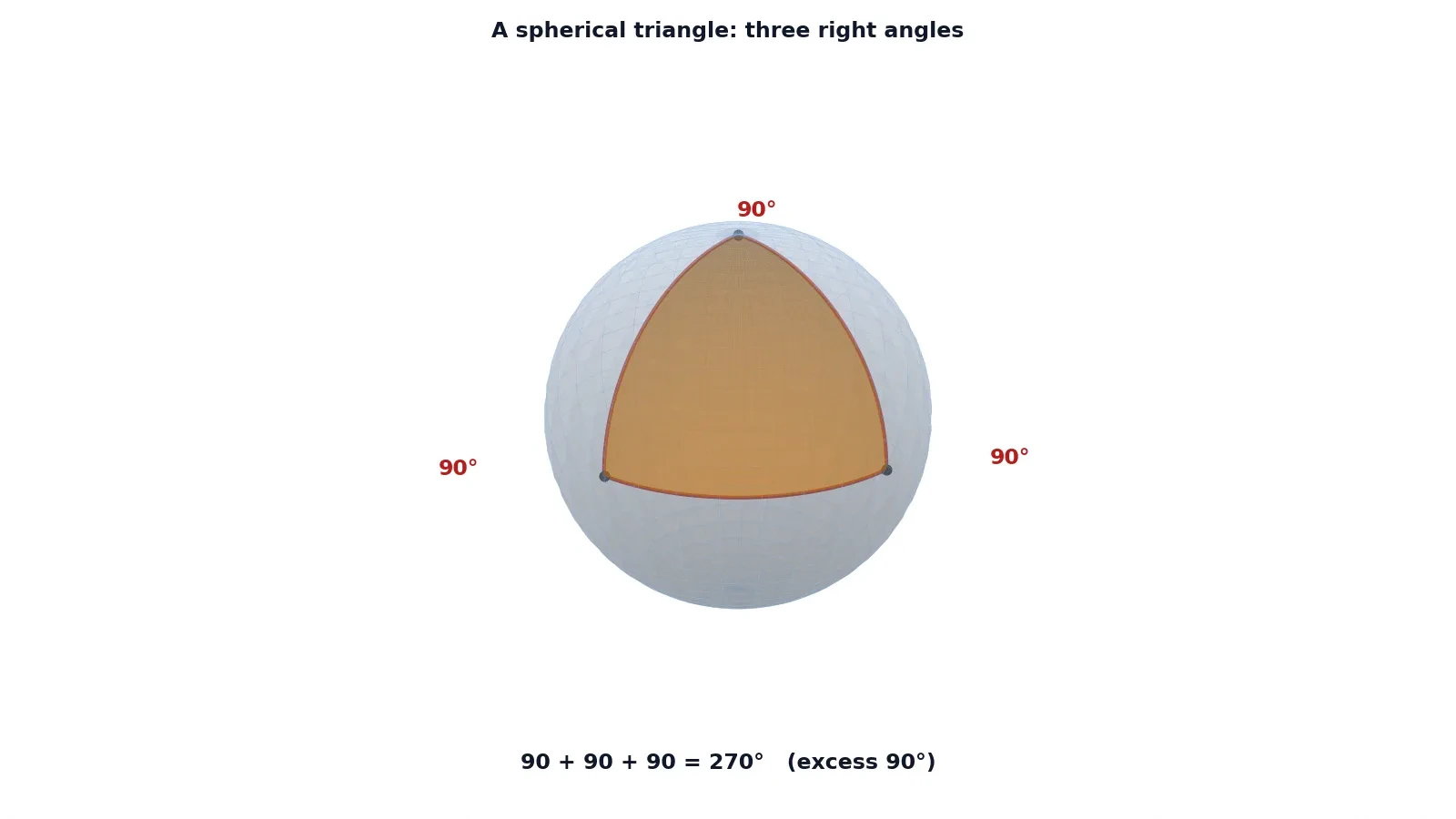
Take a globe — a real one, the kind that sits on a stand — and draw a triangle on it. Start at the North Pole. Draw a line down to the equator. Turn ninety degrees and walk along the equator for a quarter of the way round the world. Then draw a line back up to the pole. You have drawn a triangle with three sides and three corners. Now measure its angles. At the pole, the two lines meet at a right angle: ninety degrees. Where each line meets the equator, it also meets it at a right angle: ninety degrees, and ninety degrees again. Three right angles. Ninety plus ninety plus ninety is two hundred and seventy degrees.
Every schoolchild is told that the angles of a triangle add up to 180 degrees. So what went wrong? Nothing went wrong. The rule is true — on a flat surface. Your globe is not flat. The triangle you drew is a perfectly good triangle, and its angles really do add to 270 degrees, and the 180-degree rule really does fail, because the 180-degree rule is not a fact about triangles. It is a fact about flatness. It holds wherever the surface is flat, and it breaks wherever the surface curves.
That distinction — between the shape and the surface it sits on — is the whole story of euclidean geometry. It is the geometry of flat space, built from five rules so simple that a child could state them, and so powerful that they organised mathematics for more than two thousand years. One of those five rules refused to behave like the others. Generations of the best mathematicians who ever lived tried to prove it, failed, and failed again — until three of them realised the failure was the discovery: change that one rule, and you get a different geometry, just as consistent, just as true, describing a different kind of space. This article tells that story. It starts with the five rules, shows what they build, and ends with the rebellion they caused.
I still remember the afternoon I first drew the triangle on a globe. I was fifteen, in a classroom with a globe on the teacher's desk, and I had just been told — again — that the angles of a triangle add to 180 degrees, as if it were a law of nature. It felt wrong in the way that only a half-understood fact can feel wrong. So I took the globe, found the pole, found the equator, and counted. Ninety, ninety, ninety. I did the sum three times, certain I had made a mistake. I had not. The teacher smiled, took the globe back, and said that the rule was true on paper. That was the first time I understood that mathematics has fine print, and that the fine print is where the interesting things live.
1. The Triangle That Would Not Add Up
Hold the two triangles side by side in your mind. On paper: three corners, three angles, 180 degrees, every time, for every triangle, large or small. On the globe: three right angles, 270 degrees, and you can make the triangle as large as a quarter of the Earth. The paper triangle and the globe triangle are both triangles. They both have three straight sides — straight in the only sense that makes sense on each surface. On paper, straight means the shortest path between two points, and it looks straight. On a globe, straight also means the shortest path between two points, and it follows a great circle, the kind of line an aeroplane flies. The rules of the game are the same. The surface is different. And the answer changes.
That is a strange thing to discover about a subject that most people think of as settled. Geometry feels like the most finished part of mathematics: the angles, the areas, the proofs you did at school and then forgot. But the subject has a hinge in it, a single assumption on which the 180-degree rule hangs. Take the hinge away, and the whole building rearranges itself into something new. The hinge is the fifth of Euclid's five postulates, and this article is, in the end, an article about that hinge: what it says, why it looks suspicious, what two thousand years of trying to prove it taught us, and what happened when three mathematicians finally stopped trying.
Before we get there, we need the building itself. We need to meet the man who wrote the rules down, read the book that carried them, and watch the rules do their work — building triangles, proving Pythagoras, and drawing the world with two simple tools. The rebellion only makes sense once you have seen what was being rebelled against.
2. What Euclidean Geometry Is
Euclidean geometry is the geometry of flat space. It is the geometry of the paper on your desk, the floor of your kitchen, the field outside your window — any surface where the shortest path between two points is a straight line that never bends, and where parallel lines, once set running side by side, never meet and never drift apart. Two-dimensional euclidean geometry, the geometry of the plane, is called plane geometry. Three-dimensional euclidean geometry, the geometry of solid objects, is called solid geometry. Euclid's book covers both, but the plane is where the famous story lives, so that is where we will spend most of our time.
The word "Euclidean" is doing real work in that name. It does not mean "the geometry Euclid invented". It means "the geometry that obeys Euclid's rules". That distinction matters, because Euclid invented very little of the geometry in his book. The theorems were mostly discovered by earlier Greek mathematicians — Pythagoras and his school, Hippocrates of Chios, Theaetetus, Eudoxus. What Euclid did was something stranger and more powerful: he arranged their discoveries into a single logical chain, starting from five assumptions and building everything else, step by step, so that every theorem could be traced back to those five starting points. The result was not a collection of facts. It was a machine for producing facts, with the assumptions as its fuel.
A postulate is a starting assumption: something you agree to at the beginning so that the reasoning can get going. You do not prove a postulate. You grant it, the way players grant the rules before a game starts, and then you see what follows. Euclid's genius was to keep the list short. Five postulates. Five sentences. From those five sentences, 465 propositions — including the angle-sum theorem, Pythagoras, and the theory of similar figures — all derived by strict argument, each step resting on steps already proved. No other book in the history of mathematics has done so much with so little.
That is also why the book outlived its author by more than two thousand years. The Elements was the standard geometry textbook in the Western world from the time it was written until the late nineteenth or early twentieth century. Students learned proof from it the way students today learn it from textbooks that are, whether they know it or not, still teaching Euclid's order of ideas. When you prove something at school by starting from what you know and arguing step by step to what you want to show, you are doing what Euclid taught the world to do.
There is a second reason the name matters. "Euclidean" marks one choice among several. Change the fifth postulate, and you get a geometry that is not Euclidean — spherical geometry, where there are no parallel lines at all, or hyperbolic geometry, where there are infinitely many. Those geometries are not mistakes. They are consistent systems in their own right, and the physical world, on the largest scales, turns out to be non-Euclidean. But the flat world — the world of rooms and fields and building sites and paper — is Euclidean, and it is Euclidean because Euclid's five rules describe it exactly. The rest of this article is about those rules: what they say, what they build, and what happened when the fifth one broke open.
3. The Man We Barely Know: Euclid of Alexandria
Here is a humbling fact about the most influential mathematics teacher who ever lived: we know almost nothing about him. No portrait survives. No letter, no diary, no account written by anyone who met him. Every statue and engraving of Euclid you have ever seen is an invention — an artist's guess at what a Greek mathematician ought to look like. What we know comes almost entirely from one man, Proclus, a philosopher who wrote a commentary on the Elements around 450 CE, some seven hundred and fifty years after Euclid lived. Proclus tells us that Euclid lived in the time of Ptolemy I, the general who took Egypt after Alexander the Great died, and that he worked in Alexandria, the new city Alexander had founded on the Egyptian coast.
That is nearly the whole biography. We do not know where Euclid was born, or when he died. Estimates put his life at roughly 325 to 265 BCE, but those are guesses built on Proclus's single sentence and on the fact that Euclid's work comes after Plato's students and before Archimedes. The Arabic biographies written centuries later give elaborate details — a birthplace, a family, a career — but historians regard them as invented. Even his name caused confusion: for centuries, readers mixed him up with Euclid of Megara, a philosopher who lived a hundred years earlier, and that is why he is usually called Euclid of Alexandria, after the city where he worked.
I find that blank biography strangely moving. Most great scientists leave a trail — letters, rivalries, scandals, a house you can visit. Euclid left a book. The book is the evidence, and the book is enough: it tells us that its author was a patient, exact, and deeply original thinker, even if it tells us nothing about what he ate for breakfast. When I first learned how little we know about him, I felt cheated for about a minute, and then I felt something closer to admiration. A man can vanish entirely and still teach the world for two thousand years, if what he wrote is good enough.
Alexandria itself is part of the story. The city was barely a generation old when Euclid worked there — a planned city of wide streets and white stone, built on the orders of a dead conqueror, growing into the greatest centre of learning in the ancient world. Its Library collected books from everywhere; its scholars included the astronomers, geographers, and mathematicians who mapped the known world. Euclid's Elements was written in that atmosphere, and it shows: the book is not a local product but a gathering-in, a deliberate attempt to collect everything Greek mathematics knew about shape and number and set it down in order. He was not writing for Alexandria. He was writing for anyone, anywhere, who wanted to know what follows from five simple rules.
One story about Euclid has survived, and it is worth telling carefully, because it is almost certainly not a verbatim quotation — it is an anecdote, passed down through Proclus and the anthologist Stobaeus, and it should be read as a story, not a transcript. Ptolemy I, the king, was struggling with geometry and asked Euclid whether there was a shorter path to learning it than working through the Elements. Euclid's answer, as the story goes, was that there is no royal road to geometry. No shortcut, no privileged route for kings. The same steps, in the same order, for everyone. Whether he said those exact words or not, the story captures something true about the book: it does not hurry. It starts at the beginning, and it earns every result it claims. That is the spirit in which we will read it.
4. The Elements: The Book That Taught the World
The Elements is thirteen books long — "books" in the ancient sense of scrolls or chapters — and it contains 465 propositions. That number is worth pausing over, because it is exact, and it is checkable: Book I has 48 propositions, Book II has 14, Book III has 37, Book IV has 16, Book V has 25, Book VI has 33, Book VII has 39, Book VIII has 27, Book IX has 36, Book X has 115, Book XI has 39, Book XII has 18, and Book XIII has 18. Add them up — 48 plus 14 plus 37 plus 16 plus 25 plus 33 plus 39 plus 27 plus 36 plus 115 plus 39 plus 18 plus 18 — and you get 465. Book X alone, the long and difficult study of irrational magnitudes, holds 115 of them, nearly a quarter of the whole work. The book is not a miscellany. It is a building with a floor plan, and the floor plan is worth knowing before you walk through the rooms.
| Book | Contents | Propositions |
|---|---|---|
| I | Plane geometry: triangles, parallels, Pythagoras | 48 |
| II | Geometric algebra: areas and rectangles | 14 |
| III | Circles: chords, tangents, inscribed angles | 37 |
| IV | Regular polygons inscribed in and around circles | 16 |
| V | Theory of proportion (Eudoxus) | 25 |
| VI | Proportion applied to plane geometry; similar figures | 33 |
| VII | Elementary number theory; greatest common divisor | 39 |
| VIII | Geometric series | 27 |
| IX | Number theory; infinitely many primes | 36 |
| X | Incommensurable magnitudes; irrational numbers | 115 |
| XI | Solid geometry: planes, parallelepipeds | 39 |
| XII | Volumes of pyramids, cones, cylinders, spheres | 18 |
| XIII | The five Platonic solids | 18 |
| Total | 465 |
The first six books are plane geometry: triangles, circles, polygons, proportion, similarity. Books VII to IX are number theory, including the proof that there are infinitely many primes — a result so beautiful that it has its own article on this site, and one you should read if you have not: the proof is Euclid's, from Book IX, Proposition 20, and it is the same style of argument you will meet in this article, only applied to numbers instead of shapes. Book X, the longest and hardest, classifies irrational magnitudes. Books XI to XIII move into three dimensions and end with the five Platonic solids — the tetrahedron, cube, octahedron, dodecahedron, and icosahedron — and the proof that there are exactly five, no more and no fewer.
It is important to be clear about what Euclid did and did not do. He did not discover most of these theorems. The proof that the angles of a triangle add to two right angles goes back to the Pythagoreans. The theory of proportion in Book V is Eudoxus's. Much of Book X is Theaetetus's. What Euclid did was to arrange all of it into a single deductive chain — to show that hundreds of results, discovered over two centuries by many different people, all follow from five assumptions and twenty-three definitions. That is a different kind of achievement from discovering a theorem, and in some ways a greater one. A theorem is a fact. A system is a way of knowing which facts are true, and why.
The book's journey through history is almost as remarkable as its contents. The oldest surviving fragment of it is a piece of papyrus found at Oxyrhynchus in Egypt, dated to around AD 100, carrying the diagram for Book II, Proposition 5 — a scrap of rubbish that happens to be one of the oldest mathematical documents in existence. The Elements travelled in Greek, then in Arabic translation, then in Latin, and it was one of the first mathematical books ever printed: the first printed edition appeared in Venice in 1482, from the press of Erhard Ratdolt, with diagrams printed in the margins. Since then, more than a thousand editions have been published — more editions than any other book except the Bible. The first complete English translation was made by the merchant Henry Billingsley in 1570. The standard English translation today is the one by the scholar Thomas Heath, first published in 1908 and reprinted by Dover in 1956, and it is the translation this article quotes. If you want to read Euclid yourself — and you can, the whole text is freely available online in David Joyce's online edition at Clark University, with interactive diagrams — Heath is the version to start with.
My favourite edition, though, is not the standard one. It is Oliver Byrne's. In 1847, Byrne — a self-taught Irish mathematician and engineer — published The First Six Books of the Elements of Euclid in Which Coloured Diagrams and Symbols Are Used Instead of Letters for the Greater Ease of Learners. The title is a mouthful, and the book is a marvel. Byrne replaced the usual letters with colours: a red line, a blue angle, a yellow triangle, so that the proof could be followed by looking at the diagram instead of flipping back and forth between text and figure. He claimed, with the confidence of a man who had tested his method, that the Elements could be mastered in less than a third of the usual time. The book was one of the first multicolour printed books ever made, and it was ruinously expensive to produce — each colour had to be printed separately, in exact register, from woodblocks. Only a thousand copies were printed, priced at 25 shillings, and about three quarters of the print run — some 750 copies — never sold. It was a commercial failure and a work of art, and it has been rediscovered in our own time as one of the most beautiful mathematics books ever printed. I first saw it in a facsimile, and I remember the shock of it: a geometry book that looked like a painting. Euclid's arguments are usually printed in black and white, in letters and words. Byrne showed that they could be printed in colour, and that colour could do some of the thinking. The cover of this article is drawn in his spirit.
5. The Five Postulates
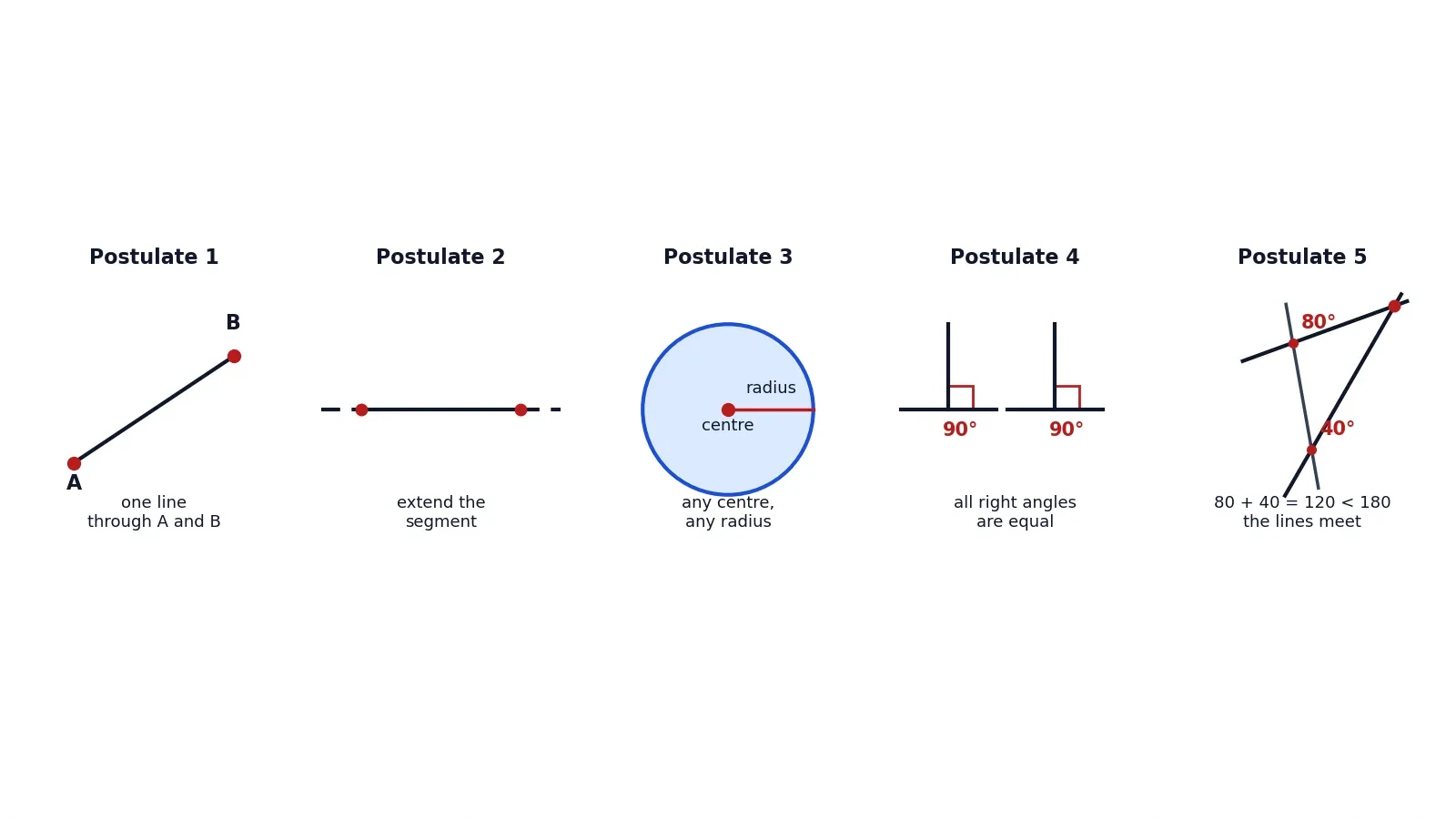
Everything in the Elements rests on five sentences. Euclid calls them postulates — from the Latin for a request — and the word is well chosen, because a postulate is something you are asked to grant. You do not prove it. You accept it, and then you watch what follows. Here they are, in the order Euclid gives them, in Heath's translation. The first three are permissions. The fourth is a statement of fact. The fifth is the one that caused two thousand years of trouble.
Postulate 1. To draw a straight line from any point to any point. Given two points, you may join them with a straight line. That is all it says, and it is hard to imagine anything more innocent.
Postulate 2. To produce a finite straight line continuously in a straight line. A line segment may be extended as far as you like, in either direction, without end. The plane has no edge; lines do not run out.
Postulate 3. To describe a circle with any centre and distance. Given a centre point and a radius, you may draw the circle. This is the compass, stated as a rule.
Postulate 4. That all right angles are equal to one another. A right angle in Alexandria is the same as a right angle in Athens, and the same as a right angle anywhere else. Space is the same everywhere — it has no favoured place, no direction in which right angles come out differently.
Postulate 5. The parallel postulate. Here it is, in full, because it deserves to be seen whole:
That, if a straight line falling on two straight lines make the interior angles on the same side less than two right angles, the two straight lines, if produced indefinitely, meet on that side on which are the angles less than the two right angles. — Euclid, Elements, Book I, Postulate 5 (Heath translation)
Read it twice. It is the only postulate that reads like a theorem — long, conditional, and oddly specific. It says: take two lines, and a third line crossing them both. If the two angles on one side of the crossing line add up to less than 180 degrees, then the two lines are not parallel: if you extend them far enough on that side, they will meet. The first four postulates are short enough to memorise in a minute. The fifth is a paragraph. That difference in shape is the first clue that something is different about it — and mathematicians spent two thousand years following that clue. You can read all five postulates in Heath's exact wording at Trinity College Dublin's online edition of Book I.
Before the postulates, Euclid gives twenty-three definitions. Most of them are scene-setting, but three are worth knowing by heart. Definition 1: "A point is that which has no part." Not a dot on paper — a dot has size — but the idea of a location with no size at all. Definition 2: "A line is breadthless length." Length with no width: another idea, not a physical object. And Definition 23, the definition of parallel lines: "Parallel straight lines are straight lines which, being in the same plane and being produced indefinitely in both directions, do not meet one another in either direction." Notice what the definition does not say. It does not say parallel lines stay the same distance apart. It says they never meet, however far you extend them. That negative definition — parallel means never meeting — is the source of all the trouble, because "never" is a very long time, and no diagram can show it.
After the postulates come five common notions — assumptions so general that they apply to everything, not just geometry. Things which equal the same thing also equal one another. If equals are added to equals, the wholes are equal. If equals are subtracted from equals, the remainders are equal. Things which coincide with one another equal one another. The whole is greater than the part. These read like common sense, and they are meant to: they are the rules of reasoning itself, stated once so that Euclid never has to argue them again. A modern logician would point out that the definitions are not really definitions at all — "a point is that which has no part" does not tell you what a point is, it tells you what to call one — and that Euclid's system has gaps. That is true, and we will come back to it when we reach Hilbert. But for now, notice the shape of what Euclid has built: twenty-three definitions, five postulates, five common notions, and then — nothing else. Everything after that is proof.
The postulates also deserve a second look for what they leave out. They say nothing about how long a line is, or how big an angle is, or what a number is. They say nothing about the physical world. They describe an ideal plane, perfectly flat, infinitely extended, in which lines have no thickness and points have no size. No such plane exists in nature. Your desk is not perfectly flat; no ruler is perfectly straight. Euclid's geometry is a geometry of ideas, and its power comes precisely from that: because the rules are ideal, the conclusions are exact. A real triangle drawn on real paper has angles that add to 180 degrees only approximately. An ideal triangle in Euclid's plane has angles that add to exactly two right angles, and the proof shows why it must be so. That gap between the ideal and the real is not a flaw in the system. It is the system. The question is never whether the physical world matches Euclid exactly. The question is how closely it matches, and where it stops matching — and that question leads, eventually, to the globe, the saddle, and the strange new world.
6. How a Proof Works: Building an Equilateral Triangle
The first proposition in the Elements is not a theorem. It is a construction — a recipe — and Euclid puts it first on purpose, because it shows you what the whole book is going to feel like. Proposition I.1: to construct an equilateral triangle on a given finite straight line. You are given a line segment, AB. Build a triangle on it with all three sides equal. Here is how.
Draw a circle with centre A and radius AB — the segment itself is the radius, so Postulate 3 allows it. Draw a second circle with centre B and the same radius AB. The two circles cross at a point above the segment. Call it C. Now join A to C and B to C — Postulate 1 allows that. The triangle ABC is equilateral, and the proof is three lines long. AC equals AB, because both are radii of the first circle. BC equals AB, because both are radii of the second circle. Things equal to the same thing are equal to one another — that is Common Notion 1 — so AC equals BC. All three sides equal AB, so all three sides are equal to each other. Done.
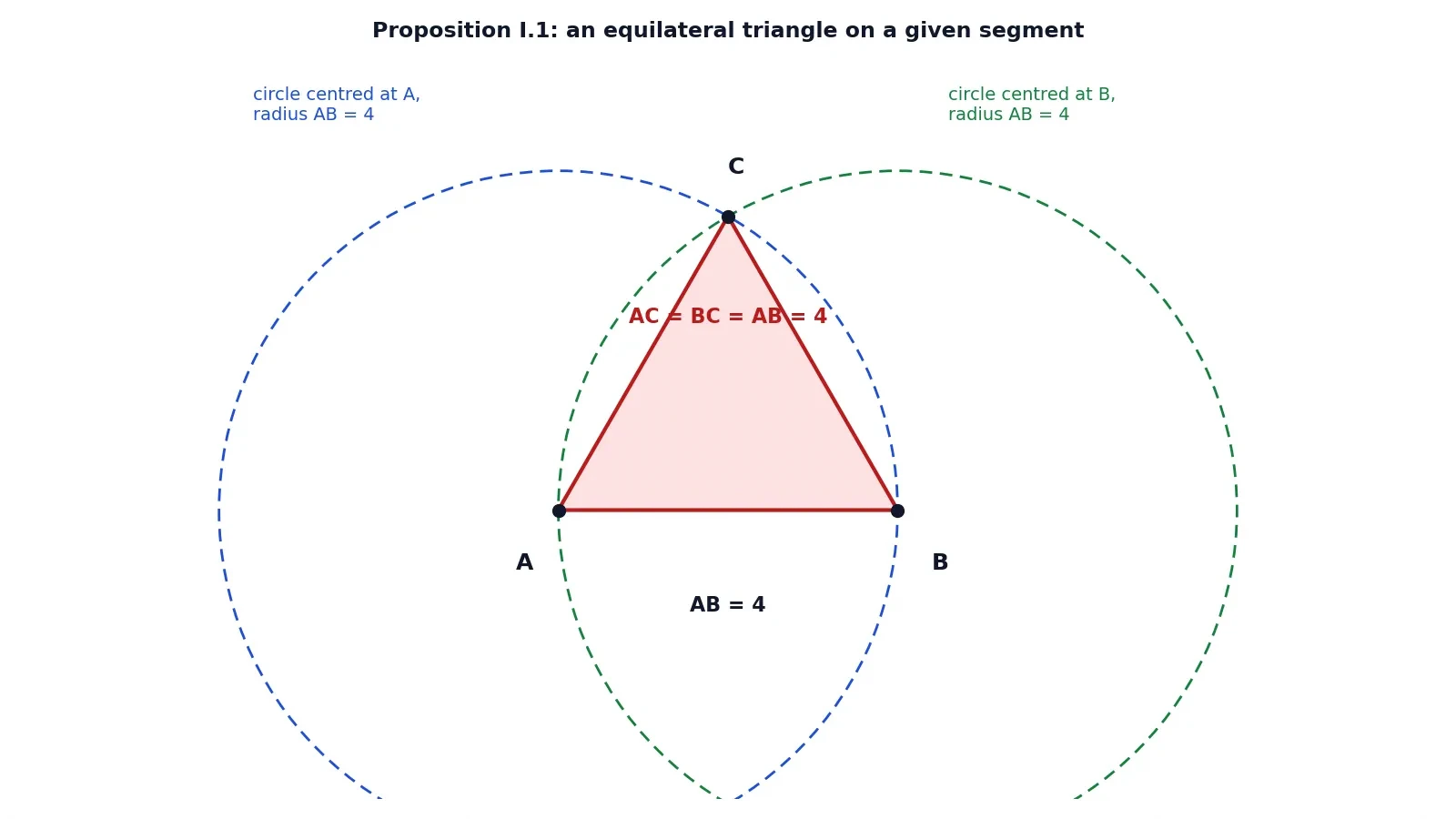
That is a proof, in miniature, and everything about Euclid's method is visible in it. Nothing is asserted without a reason. Every step cites either a postulate, a common notion, a definition, or a proposition already proved. The conclusion is not "probably true" or "true in every case we have tried". It is forced. If you grant the postulates, the triangle must be equilateral, because the equalities leave no room for anything else. That feeling — of being compelled by argument rather than persuaded by authority — is the whole point of the Elements, and it is why the book changed what it meant to know something. Before Euclid, geometry was a collection of useful facts: the Egyptians knew how to mark out right angles, the Babylonians knew triples of numbers that make right triangles. After Euclid, geometry was a system in which facts were proved, and a proved fact was a different kind of thing from a useful fact. It could not be wrong, because the argument left no gap for wrongness to enter through.
Or almost no gap. Look at the proof again, and you will spot the place where Euclid trusts the diagram. He says the two circles cross at a point C, and he takes it as obvious that they do. But nothing in the postulates says that two circles drawn this way must meet. You can see that they meet in the picture, but "you can see it in the picture" is not a postulate. It took more than two thousand years before anyone closed that gap properly — David Hilbert, in 1899, whose repair job we will meet at the end of this article. Euclid's system has small cracks like this one, and the cracks matter, but they do not diminish the achievement. The machine works. It works so well that we are still using it.
The rest of Book I follows the same pattern, proposition by proposition, each one resting on the ones before it. Proposition I.4 proves that two triangles with two sides and the included angle equal are congruent — Euclid proves it by superposition, by picking one triangle up and laying it on the other, a move that Hilbert later pointed out has no postulate behind it. Proposition I.5, the base angles of an isosceles triangle are equal, was known to generations of students as the pons asinorum, the bridge of asses, because it was the first proposition that separated the students who could follow a proof from those who could not. Propositions I.9 and I.10 show how to bisect an angle and a segment. Propositions I.11 and I.12 show how to draw perpendiculars. And through all of it, Euclid is careful about one thing: he does not use the fifth postulate. Not once, for twenty-eight propositions. He proves everything he can without it — the converses about parallel lines, the congruence theorems, the triangle inequality — and only when he reaches Proposition I.29 does he finally call on the fifth. That delay is deliberate, and it is the strongest evidence that Euclid himself felt the fifth postulate was different from the others. He used it as little as possible, and as late as possible, as if he hoped the book could get by without it. It could not.
7. Why Triangle Angles Add to 180 Degrees
Here is the theorem every schoolchild meets, and here is why it is true. Proposition I.32 of Book I: in any triangle, the three interior angles are equal to two right angles — 180 degrees. The proof is one of the most elegant in the Elements, and it takes five steps.
Take any triangle, ABC. Extend the base BC beyond C to a new point, D. Now draw a line through C parallel to AB — Proposition I.31, proved a few pages earlier, tells you how to construct it. The two parallel lines, AB and the new line through C, are cut by the side AC. The alternate angles are equal — that is Proposition I.29, the first proposition that uses the fifth postulate, and here is where the fifth postulate enters the argument. So the angle between the new line and AC equals the angle at A. Now look at the other side: the lines AB and the new line are cut by the extended base BD, and the exterior angle at C equals the angle at B, again by Proposition I.29. Add the angle at C itself, and you have three angles on a straight line at C — the angle equal to A, the angle C, and the angle equal to B — and three angles on a straight line add to two right angles. So A plus B plus C equals 180 degrees. The exterior angle, the one outside the triangle at C, equals the sum of the two opposite interior angles. That is the whole of Proposition I.32, and it is the proof your school textbook was summarising when it told you to draw a line through one vertex parallel to the opposite side.
Let us make it concrete with numbers, because a proof you cannot check is a proof you do not own. Take a triangle whose angles measure 52 degrees, 71 degrees, and 57 degrees. Add them: 52 plus 71 is 123, and 123 plus 57 is 180. The exterior angle at the third corner is 123 degrees — exactly the sum of the two opposite interior angles, 52 plus 71. The diagram below is drawn from those exact angles: the coordinates of the triangle were computed from 52, 71, and 57 degrees, so the labels on the figure are not typed in by hand. They are the angles of the triangle as drawn. Measure them yourself, in the picture, and you will find the same three numbers.
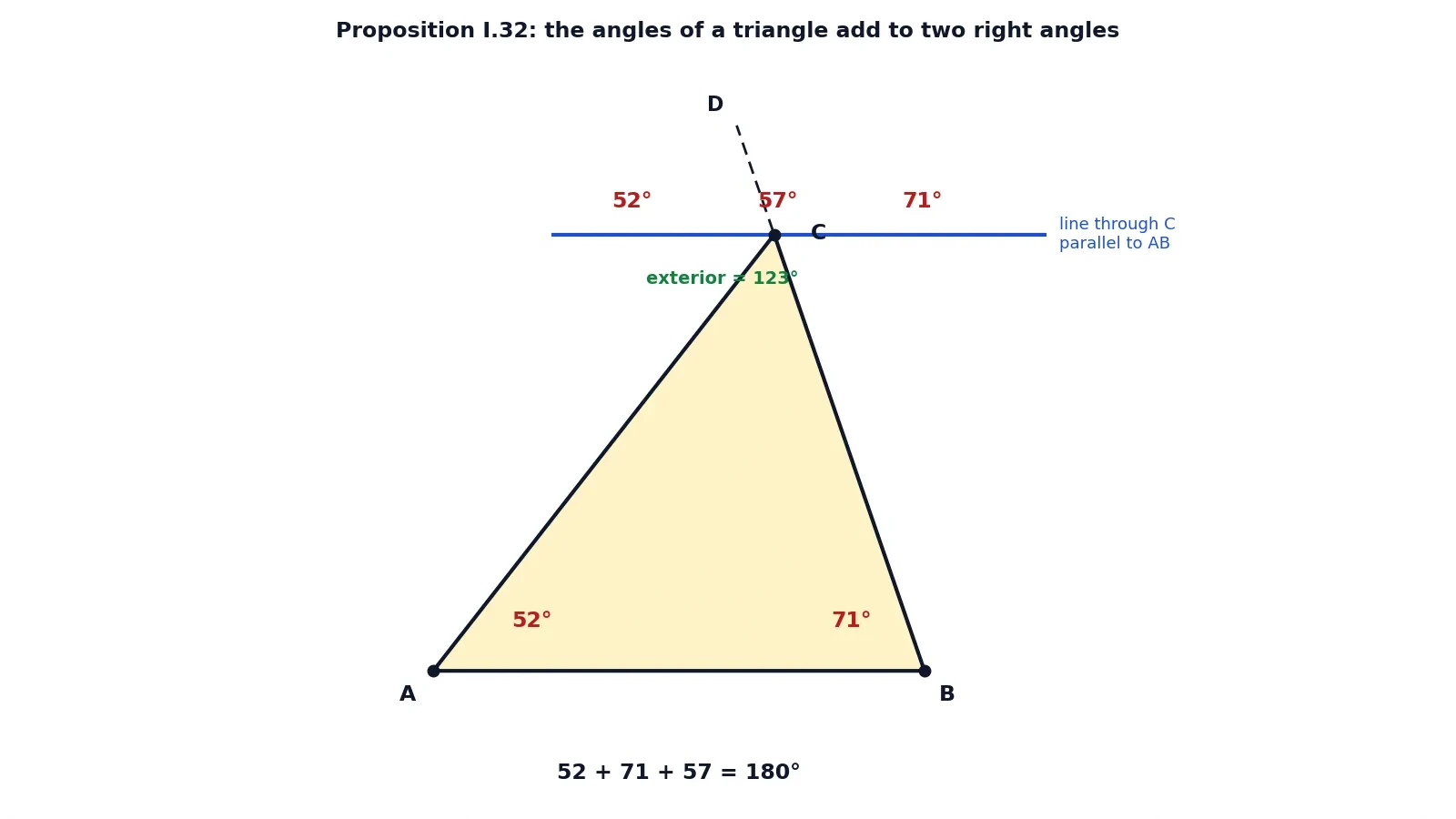
If you want to feel the proof in your hands instead of your head, there is a simpler version. Draw any triangle on paper. Tear off its three corners. Put the three torn corners together, points touching, on a straight edge. They fit together exactly, with no gap and no overlap, and their outer edges form a straight line. A straight line is 180 degrees. That is the whole theorem, demonstrated with scissors and paper, and it works for every triangle you will ever draw — because every triangle drawn on a flat surface obeys the same rule, for the same reason. The parallel line through the vertex is doing the same work as your torn corners: it gathers the three angles onto one straight line, where you can see that they add to 180.
Now notice what the proof depends on. It depends on Proposition I.29, which depends on the fifth postulate. Without the fifth postulate, you cannot draw the parallel line through the vertex and know that the alternate angles are equal. And that is why the 180-degree rule belongs to flat space, not to triangles as such. On the globe, where there are no parallel lines at all, the proof cannot even begin — there is no line through the pole parallel to the equator, because every great circle meets every other great circle. So the angles add to 270, and no contradiction follows, because the fifth postulate does not hold on a sphere. The Pythagoreans, who first proved the angle-sum theorem in general, were proving something about the flat plane, whether they knew it or not. Euclid's version makes the dependence visible: the theorem sits at Proposition I.32, three propositions after the fifth postulate is first used, and its proof carries the fifth postulate inside it like a load-bearing wall.
Most people assume that the 180-degree rule is simply true, in the way that two plus two is four. What the proof actually shows is subtler: the rule is true wherever Euclid's fifth postulate holds, and it fails wherever it does not. The rule is not a property of triangles. It is a property of the space the triangles live in. Once you see that, you can never unsee it — and you are ready for the question that occupied mathematicians for two thousand years: is the fifth postulate really necessary, or could it be proved from the other four?
8. Pythagoras: The Most Famous Theorem in the Book
Proposition I.47 is the most famous theorem in the Elements, and it comes at the very end of Book I, as if Euclid had been saving it. Here it is, in Euclid's own words:
In right-angled triangles the square on the side subtending the right angle is equal to the squares on the sides containing the right angle. — Euclid, Elements, Book I, Proposition 47
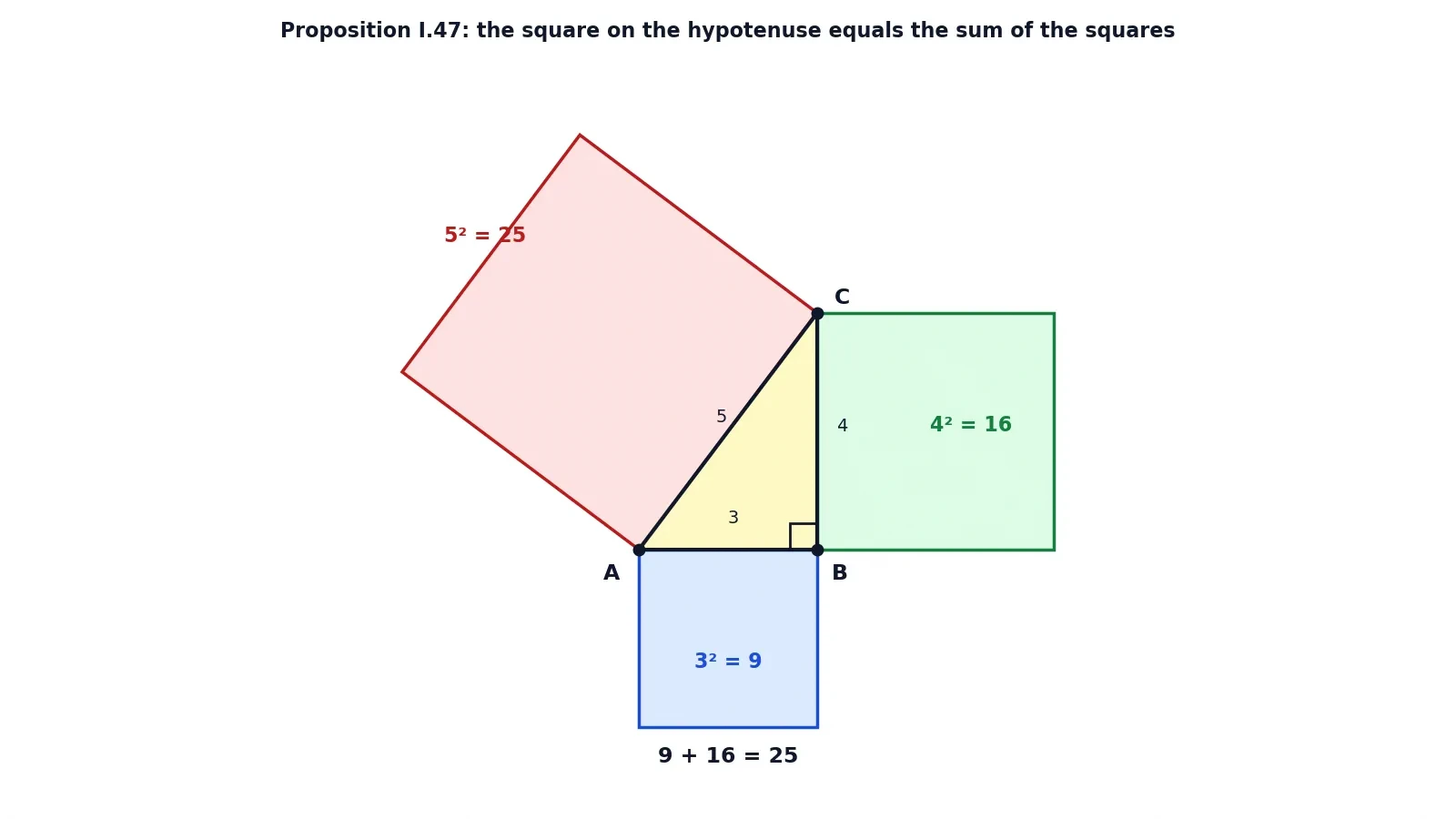
In modern words: in a right triangle, the square of the hypotenuse equals the sum of the squares of the other two sides. If the two shorter sides are 3 and 4 units, the hypotenuse is 5, because 9 plus 16 is 25. If they are 5 and 12, the hypotenuse is 13, because 25 plus 144 is 169. If they are 8 and 15, the hypotenuse is 17, because 64 plus 225 is 289. Three numbers, three checks, and each one is exact — you can verify all three with pencil and paper in a minute, and you should, because a theorem you have checked is a theorem you own.
The proof Euclid gives is not the algebraic one you learned at school. There is no algebra in the Elements at all — no equations, no symbols for unknown numbers. Euclid proves Pythagoras with areas. He builds a square on each side of the right triangle, then shows, by cutting and rearranging, that the two smaller squares together have exactly the area of the largest square. The diagram is famous enough to have a nickname: the "bride's chair", from the shape the squares make around the triangle. The argument is longer than the I.1 proof — it uses the congruence theorems and the theorems about parallelograms that fill the middle of Book I — but the idea is the same kind of idea: no step without a reason, no reason without a proposition already proved. And Proposition I.48, the last proposition of Book I, proves the converse: if the square on one side of a triangle equals the sum of the squares on the other two sides, then the angle between those two sides is a right angle. The theorem works in both directions.
It would be a mistake to think Pythagoras discovered this. He did not — or rather, the fact was known long before him. Babylonian tablets from around 1800 BCE list triples of numbers that satisfy the relation, and the Egyptians used the 3-4-5 triangle to mark out right angles in their fields. What Euclid proved was not the fact but the necessity of the fact: that in any right triangle, in the ideal plane, the relation must hold, and hold exactly, for reasons that follow from the postulates. That is the difference between knowing something works and knowing why it must work, and it is the difference the Elements exists to teach.
The converse is the part that still earns its keep in the real world. Builders mark out right angles with a rope or a tape measure using the 3-4-5 triangle: measure three units along one wall, four units along the other, and adjust until the diagonal between the two marks measures exactly five units. When it does, the angle is right — not approximately right, but right, because Proposition I.48 says so. I have done this myself on a garden project, with a piece of string and three pegs, and I remember the small shock of it: a theorem from a book written 2,300 years ago, deciding whether the corner of a shed is square. The rope does not know it is doing geometry. It does not need to. The geometry is in the numbers, and the numbers do not change.
There is one more thing worth saying about Pythagoras, because it connects this article to the rest of the mathematics on this site. The theorem is about squares and areas, but it is also the first place where Euclid's geometry touches the question of irrational numbers: the diagonal of a unit square has length the square root of two, and the square root of two cannot be written as a fraction. Book X, the longest book of the Elements, is devoted to sorting out exactly that problem. And the same theorem, run in reverse, is what makes squaring the circle impossible — a story that belongs to the chapter on constructions, and to the article on pi, where the proof that pi is transcendental finally closed a question the Greeks had left open for two thousand years.
9. Parallel Lines and Playfair's Simpler Version
Parallel lines are the quiet centre of the whole subject. Euclid defines them in Definition 23 as lines in the same plane that, produced indefinitely in both directions, never meet. That definition is strange in a useful way: it defines parallel lines by what they do not do. Two lines are parallel if they never meet, however far you extend them — and "however far" means forever. No diagram can show that. You can draw two lines that look parallel, and they might meet a mile off the page. The definition asks you to imagine infinity, and to be sure about it.
Euclid is careful with parallels in a way that tells you he knew how delicate they were. Propositions I.27 and I.28 prove the converses of the parallel theorems — if the alternate angles are equal, the lines are parallel; if the exterior angle equals the interior opposite angle, the lines are parallel — and neither proof uses the fifth postulate. Only at Proposition I.29 does Euclid finally invoke it, to prove the forward direction: a line falling on parallel lines makes the alternate angles equal, the exterior angle equal to the interior and opposite angle, and the interior angles on the same side equal to two right angles. Proposition I.30 proves that lines parallel to the same line are parallel to each other, and Proposition I.31 gives the construction: through a given point, draw a line parallel to a given line. Twenty-eight propositions without the fifth postulate, and then, at I.29, the book admits it needs the fifth after all. The delay is the message. Euclid used the fifth postulate as little as possible, and as late as possible, because he knew it was the weakest link in his chain.
In 1795, the Scottish mathematician John Playfair published a version of Euclid's geometry that restated the fifth postulate in a form every schoolchild now learns: given a line and a point not on the line, exactly one line can be drawn through the point parallel to the line. Playfair's axiom, as it is called, says the same thing as Euclid's fifth postulate — the two are logically equivalent, each can be proved from the other together with the first four postulates — but it says it in one clean sentence instead of a paragraph. The MacTutor History of Mathematics archive tells the full story of the parallel postulate, from Euclid to Playfair and beyond. The history of the parallel postulate is, in large part, the history of people trying to find a version of it that felt like a proper postulate: short, obvious, and impossible to doubt. Playfair's version is the best of them. It is also, as we will see, false on a sphere and false on a saddle — but on a flat plane it is exactly right, and its clarity is what made the eventual rebellion possible, because it made the choice visible. One parallel, or none, or infinitely many: pick one, and you pick a geometry.
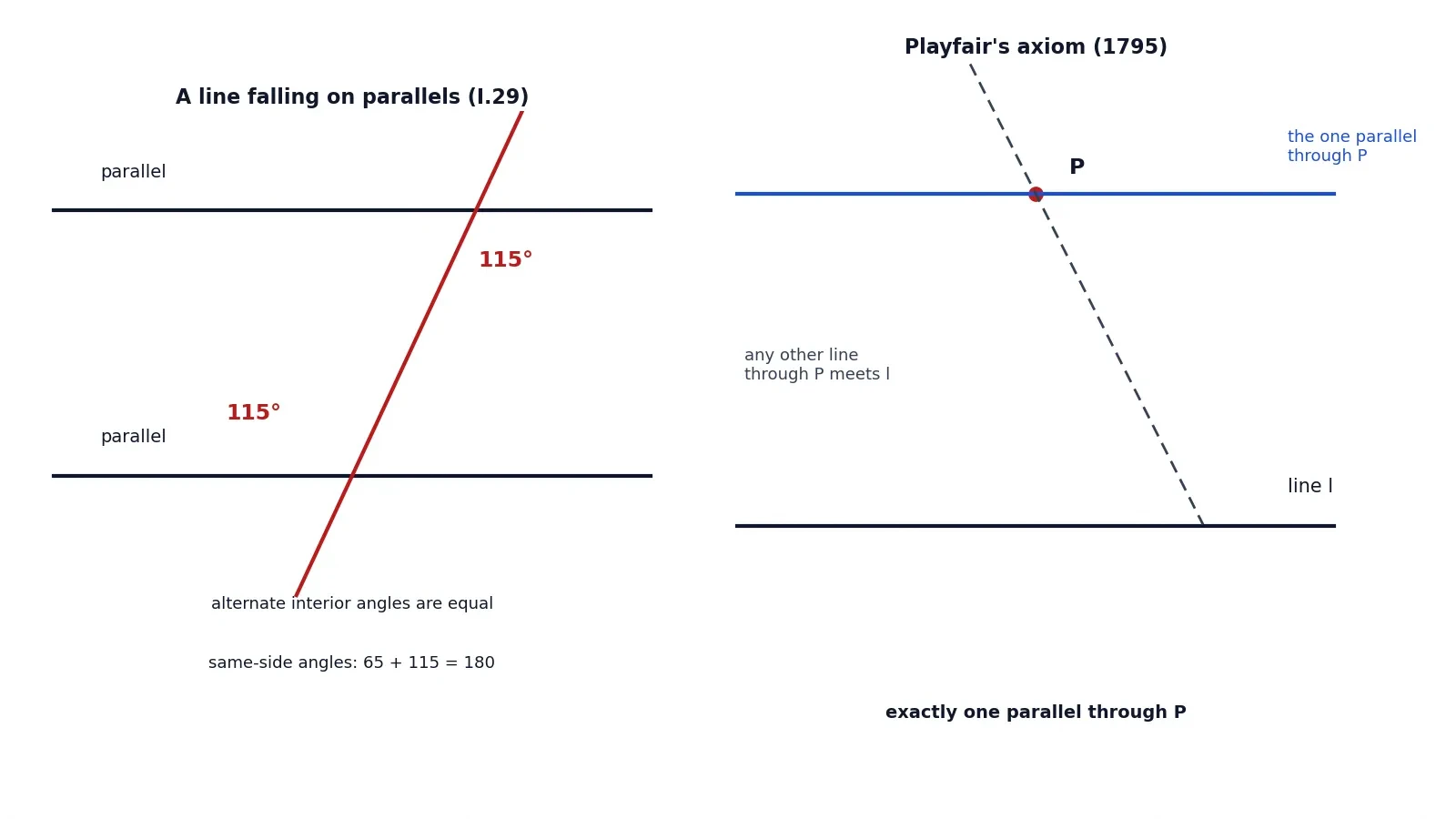
There is a way to feel the difference between Euclid's version and Playfair's. Euclid's fifth postulate is about lines meeting: it tells you when two lines must meet. Playfair's axiom is about lines not meeting: it tells you how many lines through a point never meet a given line. The two statements look at the same fact from opposite sides, and the fact they describe is the flatness of the plane. On a flat surface, the answer is one. On a sphere, the answer is none — every great circle meets every other. On a saddle-shaped surface, the answer is infinitely many. The number of parallels through a point is a measurement of the curvature of the surface, and Euclid's fifth postulate is the claim that the plane has zero curvature. He did not know it in those words. But that is what he was claiming.
10. The Postulate That Would Not Sit Still
For more than two thousand years, the fifth postulate was the most argued-over sentence in mathematics. The problem was not that anyone doubted it was true — on a flat plane it is plainly true, and every diagram confirms it. The problem was that it did not look like a postulate. The first four are short, simple, and impossible to imagine denying. The fifth is long, complicated, and sounds like something that ought to be proved rather than assumed. And Euclid's own behaviour suggested he agreed: he had postponed using it until Proposition I.29, as if he too thought it needed justifying. So generation after generation of mathematicians set out to do what Euclid had not done — to prove the fifth postulate from the other four, and so to remove the one suspicious link from the chain. Every one of them failed. The story of those failures is one of the great stories in mathematics, because the failures were not wasted. Each one taught the next generation something, and the last failure of all turned out to be a discovery.
The attempts began almost immediately. Proclus, our main source for Euclid's life, tried to prove the fifth postulate himself, in the fifth century CE, and his proof smuggled in an assumption equivalent to the one he was trying to prove — that parallel lines stay the same distance apart. That pattern — assuming, somewhere in the middle of the proof, exactly what needed proving — would repeat for two thousand years. In the seventeenth century, John Wallis derived the fifth postulate from the assumption that similar figures of different sizes exist: that you can draw a triangle of any size with the same angles. It sounds innocent. It is not: on a sphere, similar triangles of different sizes do not exist, because the angles of a spherical triangle determine its size. Wallis had assumed the fifth postulate in disguise.
The most important attempt came from an Italian Jesuit priest, Girolamo Saccheri. In 1733, the year he died, Saccheri published Euclides ab omni naevo vindicatus — "Euclid Freed of Every Flaw". His method was different from everyone else's. Instead of trying to prove the fifth postulate directly, he assumed it was false and tried to derive a contradiction. If the assumption led to nonsense, the postulate must be true — that is the method of proof by contradiction, and it is a perfectly good method. Saccheri's tool was a quadrilateral with two equal sides and right angles at the base, now called a Saccheri quadrilateral. The two summit angles at the top are equal to each other, and there are only three possibilities: they are right angles, in which case you get Euclid; they are obtuse angles, in which case you can derive the fifth postulate and reach a contradiction; or they are acute angles, in which case you get something new. Saccheri disposed of the obtuse case. Then he worked through the acute case, proposition after proposition, building a whole geometry on the assumption that the fifth postulate was false — and the geometry kept working. It produced strange theorems, but no contradiction. In the end, Saccheri gave up: he declared that the acute case was "repugnant to the nature of straight lines" and stopped. He had discovered non-Euclidean geometry and refused to believe it. His book was forgotten for more than a century, until Beltrami rediscovered it in 1889.
After Saccheri came Johann Lambert, who in 1766 followed the same road without falling into the same trap — he investigated the acute case honestly and found more of the new geometry, including the fact that in it the angles of a triangle add to less than 180 degrees. Then came Adrien-Marie Legendre, who spent forty years of his life on the parallel postulate, publishing attempted proofs in the appendices of his geometry textbook, each one with a hidden gap, each one corrected and replaced by the next. Legendre did prove one beautiful thing: the fifth postulate is equivalent to the statement that the angles of a triangle add to two right angles. Prove one, and you have proved the other. But the equivalence cut both ways, and it meant that the angle-sum theorem — the theorem every schoolchild knows — was itself standing on the unproved fifth postulate. By 1767 the situation had become embarrassing enough for the French mathematician d'Alembert to call the parallel problem the scandal of elementary geometry. He was right. The scandal was that the most certain science in the world rested on an assumption nobody could prove and nobody could do without.
I tried it myself once, as a student, because every student who meets the fifth postulate tries it. I spent an evening with a diagram and a feeling of certainty, and I produced a proof that looked airtight until I read it the next morning and found the step where I had assumed, without noticing, that two lines that looked parallel would stay the same distance apart. I had smuggled the postulate in through the back door, exactly as Proclus had done fifteen hundred years earlier. That is the thing about the fifth postulate: it hides. It hides in the phrase "the same distance apart". It hides in the assumption that similar triangles exist. It hides in the belief that a rectangle exists. Every proof of it turns out to contain it, somewhere, in disguise. The mathematicians who spent two thousand years hunting for it were not fools. They were hunting something that was not there to be found — because the fifth postulate is not a consequence of the other four. It is independent of them. And proving that independence required a completely different idea: not proving the postulate, but building a world without it.
11. The Strange New World
The breakthrough came not from proving the fifth postulate but from abandoning it — from taking seriously the possibility that a geometry could be consistent without it. The first person to really understand the problem was Carl Friedrich Gauss. He began working on the fifth postulate in 1792, when he was fifteen years old, at first trying to prove it like everyone else. By 1817 he had become convinced that it was independent of the other four, and he began working out the consequences of a geometry in which more than one line can be drawn through a given point parallel to a given line. He never published his results. He feared, as he put it in letters to friends, the ridicule of a mathematical world that was not ready — the "clamour of the Boeotians", in his phrase. In an 1824 letter to the mathematician Taurinus, he stated plainly that self-consistent non-Euclidean geometries were possible. But the letters stayed private, and the world heard nothing.
Gauss discussed the problem with his friend Farkas Bolyai, who had made several false proofs of the postulate himself and knew the trap from the inside. Farkas taught his son János mathematics, and in 1820 he wrote to the seventeen-year-old begging him not to waste his time on the parallel problem — it was, he said, a problem that had consumed the best minds for two thousand years and given nothing back. János did not listen. Three years later, in 1823, he wrote back to his father with news that has become one of the most famous letters in mathematics: he had created, as he put it, a strange new world out of nothing. He had built a consistent geometry on the denial of the fifth postulate, with infinitely many parallels through a point and triangles whose angles add to less than 180 degrees. His work was published in 1832 as an appendix to his father's textbook — a twenty-six-page appendix that founded a new science.
Meanwhile, in Kazan, a Russian mathematician named Nikolai Lobachevsky had found the same world by a different road. Lobachevsky was the first to publish an account of non-Euclidean geometry, in 1829, in the journal of Kazan University, and he developed the subject further than anyone before him, working out its trigonometry and its strange theorems in full. His geometry is now called Lobachevskian geometry, or hyperbolic geometry. He even tried to test it against the sky: he calculated the sum of the angles of a triangle formed by stars, to see whether the defect from 180 degrees could be measured at astronomical scale. The test was inconclusive — the defect, if it existed, was far too small for the instruments of the time — but the idea was exactly right. Whether space is Euclidean is not a question for pure reason. It is a question for measurement.
The third figure in the story is Bernhard Riemann, a student of Gauss. In 1854, Riemann delivered his habilitation lecture at Göttingen — the lecture a young scholar gave to qualify as a university teacher — on the hypotheses which lie at the bases of geometry. Gauss himself chose the topic from the three Riemann had proposed, passing over the two safer ones, and sat in the audience. The Stanford Encyclopedia of Philosophy's survey of nineteenth-century geometry tells this story in full, including Lobachevsky's attempt to test his geometry against the stars. Riemann did not merely deny the fifth postulate. He replaced the whole framework: space, he argued, could have any number of dimensions, and its geometry could vary from place to place, described by what we now call a Riemannian manifold. In Riemann's picture, Euclidean geometry is one possibility among infinitely many — the flat case, the zero-curvature case — and whether physical space is Euclidean is something to be settled by looking at the world, not by thinking about it. The lecture was delivered on 10 June 1854 and was not published until 1867, the year after Riemann's death, when his friend Dedekind brought it into print. Sixty years later, the framework Riemann had outlined in the twenty-page published lecture supplied the mathematics of Einstein's general theory of relativity — a story told in full in our article on Einstein's theory of relativity, which is where the curved-spacetime story belongs. This article stays with surfaces: the flat plane, the sphere, and the saddle.
The last piece of the puzzle was consistency. It is one thing to build a geometry on the denial of the fifth postulate and find no contradiction; it is another to prove that no contradiction could ever be found. In 1868, the Italian mathematician Eugenio Beltrami supplied the first model: he showed that hyperbolic geometry could be represented inside Euclidean geometry, so that any contradiction in the new geometry would produce a contradiction in Euclid's. Non-Euclidean geometry was therefore exactly as consistent as Euclidean geometry itself — if one fell, both fell. Beltrami also rescued Saccheri from oblivion: in a paper of 1889 he drew attention to the forgotten Jesuit's book, and the man who had declared his own discovery repugnant was recognised, a century and a half too late, as the first person to have seen the strange new world. From Euclid's five rules, written around 300 BCE, to Beltrami's proof in 1868: two thousand one hundred and sixty-seven years from the question to the answer. The fifth postulate had never been proved. It had been shown to be unprovable — and in the showing, geometry had doubled in size.
12. Three Geometries Side by Side
So there are three geometries, not one. The difference between them is a single choice: how many lines through a point are parallel to a given line. Everything else — the definitions, the first four postulates, the common notions — stays the same. Change that one number, and the world changes with it.
| Euclidean (flat) | Spherical | Hyperbolic | |
|---|---|---|---|
| Parallels through a point | Exactly one | None | Infinitely many |
| Triangle angle sum | Exactly 180 degrees | More than 180 degrees | Less than 180 degrees |
| "Lines" are | Straight lines | Great circles | Curves on a saddle-like surface |
| Rectangles exist? | Yes | No | No |
| Similar triangles of different sizes? | Yes | No — angles fix the size | No — similar means congruent |
| Curvature | Zero | Positive | Negative |
Start with the sphere, because you already know it. On a sphere, the "lines" are great circles — the largest circles you can draw, the ones whose centre is the centre of the sphere. The equator is a great circle. Every line of longitude is a great circle. And every pair of great circles meets: two lines of longitude meet at the poles, and any two great circles cross at two points on opposite sides of the sphere. There are no parallel lines on a sphere at all. That is why the triangle in the first section of this article has three right angles: the two lines of longitude meet the equator at right angles, and they meet each other at the pole at a right angle, because we chose them a quarter-turn apart. The angles add to 270 degrees.
The excess over 180 degrees is not a curiosity. It is the area. In 1629, the French mathematician Albert Girard published the theorem that still carries his name: the area of a spherical triangle equals the radius of the sphere squared, multiplied by the spherical excess — the amount by which the angles exceed 180 degrees, measured in radians. Take the octant triangle, with three right angles. Its excess is 90 degrees, which is pi divided by two radians. Its area is therefore pi times the radius squared, divided by two. For the Earth, with a radius of 6,371 kilometres, that is about 63.8 million square kilometres — and since the whole surface of the Earth is about 510 million square kilometres, the octant is exactly one eighth of the planet, as it should be: the triangle covers one eighth of the sphere. On a sphere, the angles of a triangle determine its area. On a flat plane, the angles determine only the shape: a triangle with angles 52, 71, and 57 degrees can be the size of a postage stamp or the size of a county, and nothing in the angles will tell you which. That difference is the fingerprint of curvature.
Hyperbolic geometry is harder to picture, because there is no surface in ordinary space that shows it whole — but a saddle gives the flavour. On a saddle-shaped surface, the curvature bends away in every direction, and lines drawn on it diverge. Through a point off a given line, you can draw infinitely many lines that never meet it. Triangles are thin and pinched: their angles add to less than 180 degrees, and the shortfall — the defect — is proportional to the area, just as the excess is on a sphere. Take a triangle with angles 50, 60, and 40 degrees. They add to 150, and the defect is 30 degrees. Make the triangle bigger, and the defect grows; make it small enough, and the defect shrinks towards nothing, and the triangle looks Euclidean. There are no rectangles in hyperbolic geometry: a quadrilateral with three right angles must have an acute fourth angle. And there are no similar triangles of different sizes: if two triangles have the same angles, they are the same size, because the angles determine the area. Saccheri discovered all of this in the acute case of his quadrilateral, and refused to believe it. Lobachevsky and Bolyai believed it, and built a geometry on it.
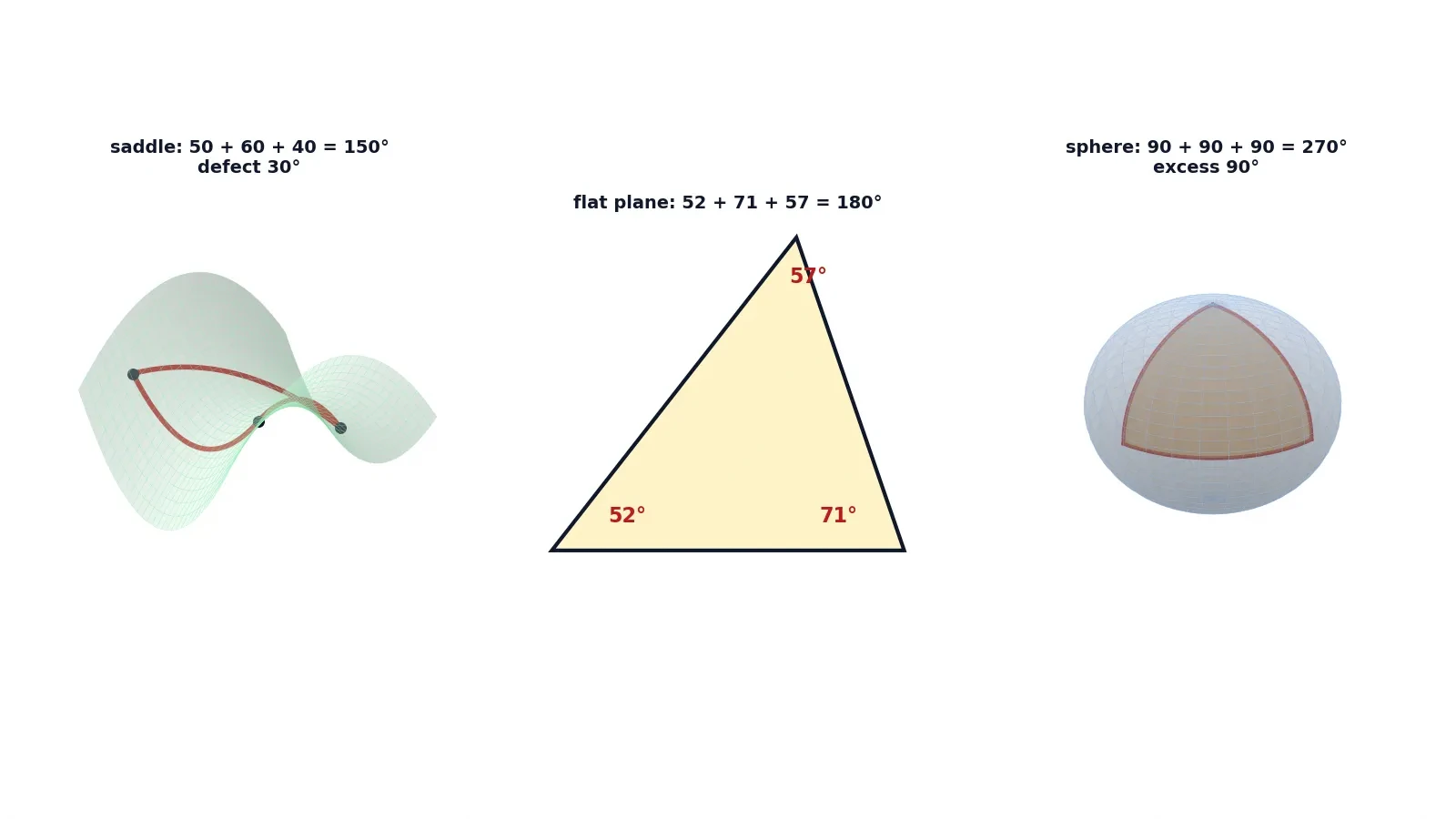
There is a way of seeing all three at once. Euclidean geometry is sometimes called parabolic geometry, and the three cases are the three kinds of curvature: zero, positive, and negative. Flat, round, and saddle-shaped. Cornell University's introduction to Euclidean and non-Euclidean geometry works through the same comparison, with the parallel postulate stated in Playfair's form. The plane is the middle case — the boundary between the sphere and the saddle — and that is why it feels so natural. We live on a sphere so large that, at the scale of a room or a field, it looks flat. Our intuition is Euclidean because our world, at human scale, is locally flat. But the flatness is an approximation, and the approximation has a size. An equilateral triangle with sides of one kilometre, drawn on the Earth, has angles that exceed 180 degrees by about two thousandths of an arcsecond — far below anything a surveyor's instrument can measure. An equilateral triangle with sides of ten kilometres exceeds 180 by about two tenths of an arcsecond. An equilateral triangle with sides of a hundred kilometres exceeds it by about six thousandths of a degree. For anything smaller than a county, flat geometry is exact to any instrument a builder owns. For a continent, it is not — and that is why mapmakers, navigators, and the engineers behind satellite navigation all work with curved geometry, while the rest of us live, quite happily, in Euclid's flat world. The connection to satellite navigation is worth a detour: our article on how GPS works explains trilateration on a curved Earth, and why a system that locates you to within a few metres cannot pretend the planet is flat.
13. Drawing With Two Tools
Euclid's geometry is not only a system of theorems. It is a system of constructions, and the constructions use just two tools: a straightedge and a compass. The straightedge is an unmarked ruler — it can draw a line through two points and extend a line, and nothing else. The compass draws a circle with any centre and any radius. Those are Postulates 1, 2, and 3, made physical. Everything Euclid constructs is built from those two operations, and the restriction is the point: the tools are the postulates, and the question "what can be built with these tools?" is the question "what follows from the postulates?"
The basic constructions are the working vocabulary of the book. Proposition I.1 builds an equilateral triangle. Proposition I.9 bisects an angle. Proposition I.10 bisects a segment. Propositions I.11 and I.12 draw perpendiculars. Proposition I.23 copies an angle. Proposition I.31 draws a parallel. Each one is a small machine, built from circles and lines, and each one is exact: a bisected angle is exactly half, not approximately half, because the proof shows it must be so. I tried the angle bisector myself once, with a real compass on real paper — two arcs from the vertex, two more arcs from where they cross the sides, a line from the vertex through the crossing of the second pair — and I remember the small shock of it working exactly. The compass does not know it is doing geometry. It only knows circles. But circles plus lines, applied in the right order, can bisect anything.
In modern language, the two tools can do arithmetic with lengths. Given segments of length one, you can add lengths, subtract them, multiply and divide them using similar triangles, and take square roots using the geometric mean in a semicircle. What you cannot do is take cube roots, or construct any length that is not built from square roots. That limitation is the whole story of the three classical problems — the three constructions the Greeks wanted and could never achieve, and which took two thousand years to prove impossible.
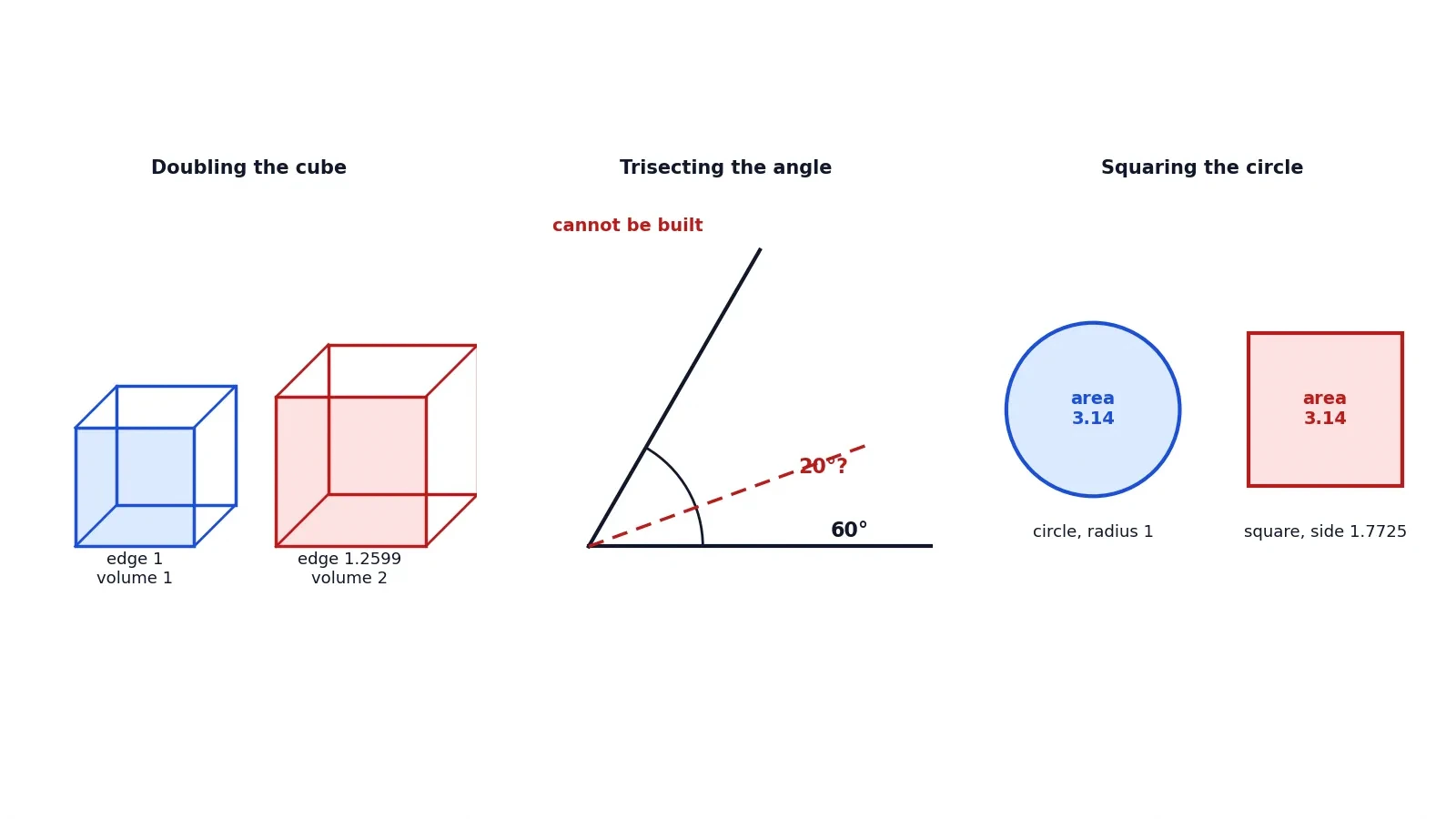
The first problem is doubling the cube: given a cube, build a cube with twice the volume. The legend says the Athenians, struck by plague, asked the oracle at Delos what to do, and were told to double the cubic altar of Apollo. They doubled the sides instead, and got a cube eight times the volume, and the plague continued. The mathematics is simple and unforgiving: a cube of edge one has volume one, and a cube of volume two needs an edge of the cube root of two, about 1.2599 — a number that cannot be built from square roots, and therefore cannot be built with straightedge and compass. The second problem is trisecting an angle: divide any angle into three equal parts. A sixty-degree angle cannot be trisected, because that would need a twenty-degree angle, and twenty degrees cannot be constructed. Some angles can be trisected — a right angle can, for instance — but not any angle, and "any" is what the problem asks for. Both impossibilities were proved in 1837 by Pierre Laurent Wantzel, a twenty-three-year-old student at the École Polytechnique in Paris, using the new algebra of fields. The third problem is the most famous: squaring the circle — building a square with exactly the area of a given circle. A circle of radius one has area pi, so the square needs a side of the square root of pi, about 1.7725. That requires pi itself to be constructible, and in 1882 Ferdinand von Lindemann proved that pi is transcendental: it is not the root of any polynomial equation with rational coefficients, and so it cannot be built by any sequence of square roots. With that, the circle could not be squared — not because nobody was clever enough, but because the number itself forbids it. The full story of pi, and of Lindemann's proof, is told in our article on pi explained.
There is a happier side to the construction story, and it belongs to Gauss. In the spring of 1796, just before his nineteenth birthday, Gauss proved that a regular seventeen-sided polygon — a heptadecagon — can be constructed with straightedge and compass. No new constructible polygon had been found in two thousand years: the Greeks knew how to build the triangle, square, pentagon, hexagon, and fifteen-sided polygon, and nothing else. Gauss's proof was revolutionary in its method, because he gave no geometric construction at all. He proved, using algebra alone, that the side of the seventeen-sided polygon could be expressed with square roots, and therefore could be constructed — the first proof of constructibility that did not show you how to do it. The central angle of the seventeen-sided polygon is 360 divided by 17, about 21.18 degrees. Gauss went on to give the general rule, completed by Wantzel in 1837: a regular polygon with n sides is constructible exactly when n is a power of two multiplied by distinct Fermat primes — the primes of the form two to the power of two to the power of k, plus one, of which only five are known: 3, 5, 17, 257, and 65537. A regular polygon with 257 sides was constructed by Richelot in 1832. The 65,537-sided polygon was claimed by Hermes in 1894, in a construction that took him ten years and some two hundred pages of manuscript — possible in principle, and absurd in practice. Some things are possible in principle and absurd in practice, and that is a distinction worth keeping.
14. Where Euclidean Geometry Still Runs the World
Euclid is not a museum piece. His geometry still runs the world — quietly, invisibly, in every building, every map, and every machine that draws a straight line.
Start with surveying. The whole art of mapping land is Euclid in the field. You measure one baseline accurately — a straight stretch of ground, measured with chains or lasers — and then you measure angles. From one baseline and two angles, you can fix the position of a third point exactly, by the congruence theorems of Book I: two angles and the included side determine a triangle completely. Chain those triangles together across a landscape, and you can map a country without ever measuring more than a handful of distances. That is triangulation, and it is how the Great Trigonometrical Survey of India, begun in 1802, mapped the subcontinent — a chain of triangles stretching from the south coast to the Himalayas, built one angle at a time, over decades. Every property boundary, every road, every map you have ever used begins, somewhere, with a triangle.
Then there is building. The 3-4-5 triangle is still the standard way to mark a right angle on a building site, because it needs nothing but a tape measure and it cannot go wrong: three units one way, four the other, five across the diagonal, and the corner is square. Carpenters, bricklayers, and gardeners use it daily, most of them without knowing that the rule they are using is Proposition I.48, the last proposition of the first book of a treatise written in Alexandria two thousand three hundred years ago. The theorem does not care that the person using it has never heard of Euclid. It works anyway.
Then there is the machinery of the modern world. Every CAD program — the software that designs cars, aeroplanes, and buildings — is built on Euclidean geometry: points, lines, planes, rotations, and translations, computed again and again. Every computer game renders its worlds with Euclidean transformations. Every robot arm calculates its reach with the same geometry Euclid wrote down. And the coordinate geometry that makes all of this possible — the marriage of Euclid's figures with Descartes's numbers — is the subject of our article on how algebra works, where the language of unknowns meets the language of shapes. Book XII's method of exhaustion — squeezing a curved area between polygons that get ever closer — is the ancestor of integration, told in full in our article on how calculus works.
And then there is the flat approximation, which is the deepest reason Euclid still matters. The Earth is curved, and the geometry of the Earth is spherical, not Euclidean. But the curvature is gentle, and at human scale it is invisible: an equilateral triangle a kilometre across, drawn on the Earth, has angles exceeding 180 degrees by about two thousandths of an arcsecond. An equilateral triangle ten kilometres across exceeds 180 by about two tenths of an arcsecond. Even an equilateral triangle a hundred kilometres across — wider than most counties — exceeds 180 by only about six thousandths of a degree. No builder's instrument can measure a discrepancy that small. So a paper map, a building plan, and the map on your phone all treat the ground as flat, and they are right to do so. Euclidean geometry is the local approximation to a curved world, and it is exact enough for everything smaller than a county. That is why school still teaches it first, and why it will go on teaching it: before you can understand curved space, you need to understand flat space, and flat space is Euclid's.
14.1 The repair job: Hilbert, 1899
Euclid's system was not perfect, and by the end of the nineteenth century the gaps were impossible to ignore. Euclid never defines what it means for a point to lie between two other points — he reads it off the diagram. His proof of congruence by superposition picks a triangle up and lays it on another, but no postulate allows a figure to be moved. His very first proof, the equilateral triangle of Proposition I.1, assumes the two circles meet, and no postulate says they must. For two thousand years, nobody minded, because the diagrams made it obvious. But "obvious from the diagram" is not a proof, and the nineteenth century — the century that had just discovered that the fifth postulate could be denied — was in no mood to let it pass.
In 1899, the German mathematician David Hilbert published Grundlagen der Geometrie, the Foundations of Geometry, and rebuilt Euclidean geometry from the ground up. Hilbert kept Euclid's theorems and replaced Euclid's foundations: points, lines, and planes became undefined terms — Hilbert joked that they could just as well be tables, chairs, and beer mugs, so long as the axioms relating them held — and the axioms were stated completely and explicitly. There were twenty-one of them in the first edition, in five groups: incidence (which points lie on which lines), order (which point lies between which others), congruence (when two segments or angles are equal), parallels (Euclid's axiom, in Playfair's form), and continuity (the Archimedean axiom, and the completeness axiom). One of the twenty-one — an axiom about the ordering of four points on a line — was later shown to be redundant — E. H. Moore published the proof in 1902, and R. L. Moore had independently found the same thing the same year — leaving twenty. Hilbert also proved something Euclid never could: that Euclidean geometry is consistent, by building a model of it inside arithmetic, so that any contradiction in geometry would produce a contradiction in the theory of real numbers. The Elements had been the textbook for two thousand years. Hilbert's book became the foundation for the next century — not by replacing Euclid's theorems, but by giving them the rigorous footing Euclid's genius had sketched and left unfinished.
15. Common Misconceptions
A subject as old as euclidean geometry accumulates misunderstandings, and most of them are worth naming plainly.
"Euclid invented all of it." He did not. Most of the theorems in the Elements were discovered by earlier mathematicians — the Pythagoreans, Hippocrates, Theaetetus, Eudoxus. What Euclid invented was the system: the arrangement of hundreds of results into a single chain of proof from five assumptions. The theorems are theirs. The architecture is his.
"The postulates are obviously true." Four of them are plausible enough to feel obvious. The fifth is not, and that is the whole story of this article. A postulate is not a fact you can see. It is a choice you make, and the fifth postulate is the choice that decides which geometry you get. Two thousand years of failed proofs are the evidence that it is anything but obvious.
"Non-Euclidean geometry means Euclid was wrong." It means nothing of the kind. Euclidean geometry is exactly right about flat space, and flat space is where we live most of our lives. Non-Euclidean geometries are right about curved spaces. The discovery was not that Euclid was wrong, but that he had described one case — the flat case — of something larger. A map of Paris is not wrong because it fails to describe Tokyo.
"The parallel postulate was eventually proved." It was not. It was shown to be independent: Beltrami's model of 1868 proved that hyperbolic geometry is consistent if Euclidean geometry is, which means the fifth postulate cannot be proved from the other four — if it could, the new geometry would contain a contradiction. The postulate is a choice, not a consequence.
"Geometry is just shapes." The shapes are the examples, not the subject. The subject is reasoning: starting from agreed assumptions and showing what must follow. Euclid's real invention was not the triangle. It was the proof — the idea that a claim can be settled by argument, without appeal to authority, and that the argument can be checked by anyone.
"Nobody uses Euclid any more." Every building, every map, every CAD file, and every satellite navigation fix that treats a small patch of the Earth as flat is using Euclid. The geometry is two thousand three hundred years old, and it is still the first geometry anyone learns, and the geometry that runs the world at human scale. The Elements is not a relic. It is infrastructure.
Frequently Asked Questions
What are Euclid's five postulates?
Euclid's five postulates are the starting assumptions of the Elements: (1) a straight line can be drawn from any point to any point; (2) a finite straight line can be extended continuously in a straight line; (3) a circle can be described with any centre and distance; (4) all right angles are equal to one another; and (5) if a line crossing two others makes the angles on one side add to less than two right angles, the two lines meet on that side. The first three are permissions to draw things; the fourth states that right angles are the same everywhere; the fifth is the parallel postulate, and it is the one that caused two thousand years of trouble, because it is long, complicated, and sounds like a theorem rather than an assumption.
What is the parallel postulate?
The parallel postulate is Euclid's fifth postulate. In its modern form, given by John Playfair in 1795, it says that through a point off a given line there passes exactly one line parallel to it. Euclid's own version is longer: if the angles on one side of a crossing line total under two right angles, the lines must meet on that side. The postulate is the claim that the plane is flat. It is independent of the other four postulates — it cannot be proved from them — and changing it produces non-Euclidean geometries: spherical geometry, with no parallels, and hyperbolic geometry, with infinitely many.
What is Euclidean vs non-Euclidean geometry?
Euclidean geometry is the geometry of flat space, built on Euclid's five postulates: exactly one parallel through a point, triangle angles adding to exactly 180 degrees, rectangles and similar triangles of any size. Non-Euclidean geometry is any geometry that changes the fifth postulate. Spherical geometry, the geometry of a globe, has no parallel lines and triangles whose angles add to more than 180 degrees — a triangle with three right angles adds to 270. In hyperbolic geometry, any number of parallels pass through a point, and a triangle's angles total under 180 degrees. Neither is wrong; each describes a different kind of space, and the flat case — Euclid's — is the geometry of rooms, fields, and building sites.
Why do triangle angles add to 180 degrees?
Because of the parallel postulate. Euclid's proof, Proposition I.32, draws a line through one vertex of the triangle parallel to the opposite side, then uses the alternate interior angles — which are equal only because the lines are parallel — to gather all three angles onto a single straight line, and a straight line is 180 degrees. Without the parallel postulate, the proof cannot begin, and the rule fails: on a sphere, where there are no parallel lines, the angles add to more than 180 degrees, and on a saddle-shaped surface they add to less. The 180-degree rule is a fact about flat space, not a fact about triangles.
Who was Euclid, and when did he live?
Almost nothing is known about Euclid the man. He worked in Alexandria, Egypt, around 300 BCE, in the time of Ptolemy I, and he wrote the Elements, the most influential mathematics textbook in history. Our main source is Proclus, a philosopher writing around 450 CE, some seven hundred and fifty years later. No record of his birthplace or the date of his death survives, and no portrait of him survives. He is called Euclid of Alexandria to distinguish him from Euclid of Megara, an earlier philosopher. What survives is the work, not the life — and the work was enough to teach the world geometry for more than two thousand years.
What is in Euclid's Elements?
The Elements is thirteen books containing 465 propositions. Books I to VI cover plane geometry — triangles, circles, polygons, proportion, and similar figures — and Book I ends with the Pythagorean theorem and its converse. Books VII to IX cover number theory, including the proof that there are infinitely many primes. Book X, the longest with 115 propositions, studies irrational magnitudes. Books XI to XIII cover solid geometry and end with the five Platonic solids and the proof that there are exactly five. The book begins with twenty-three definitions, five postulates, and five common notions, and derives everything else from those starting points by proof.
Can you really trisect an angle with a compass?
Not any angle, no — and that was proved in 1837. With a straightedge and compass you can bisect an angle, and you can trisect some angles, including a right angle. But you cannot trisect an arbitrary angle: a sixty-degree angle cannot be divided into three twenty-degree angles with those two tools. Pierre Laurent Wantzel proved it in 1837, at the age of twenty-three, by showing that the construction would require solving a cubic equation, and straightedge-and-compass constructions can only produce lengths built from square roots. The same year, Wantzel proved that doubling the cube is impossible too, and in 1882 Lindemann proved that squaring the circle is impossible because pi is transcendental. "Impossible" here means proved impossible — the most satisfying kind of answer.
Is Euclidean geometry still true?
Yes — about flat space. Euclidean geometry is exactly true of the ideal flat plane, and it is true to within any measurable error for anything at human scale: an equilateral triangle one kilometre across on the Earth overshoots 180 degrees by only around two thousandths of an arcsecond, far below what any instrument can measure. That is why buildings, maps, and CAD software all still run on Euclid. On larger scales, the Earth is curved and the geometry of the universe is non-Euclidean, which is why satellite navigation and general relativity use curved geometry. Euclid was not wrong. He described the flat case, and the flat case is the one we live in.
Sources
- Euclid, Elements, translated by Sir Thomas L. Heath (Dover, 1956) — the five postulates, verbatim — Euclid, Elements, Book I, Postulates, Heath translation, Perseus Digital Library
- Joyce, D. E., Euclid's Elements (Clark University) — introduction and guide to the thirteen books — David Joyce, Euclid's Elements, Clark University
- Joyce, D. E., Euclid's Elements, Book I (Clark University) — definitions, postulates, common notions, and all 48 propositions of Book I — David Joyce, Euclid's Elements, Book I, Clark University
- Fitzpatrick, R., Euclid's Elements of Geometry (2008) — the Greek text of Heiberg with a modern English translation — Richard Fitzpatrick, Euclid's Elements of Geometry
- MacTutor History of Mathematics, Euclid — biography, Proclus's account, and the publication history of the Elements — MacTutor, Euclid biography
- MacTutor History of Mathematics, Non-Euclidean geometry — the parallel postulate, Saccheri, Gauss, Bolyai, and Lobachevsky — MacTutor, Non-Euclidean geometry
- MacTutor History of Mathematics, Byrne Euclid — Oliver Byrne's coloured 1847 edition — MacTutor, Byrne Euclid
- Weisstein, E. W., Euclidean Geometry, Wolfram MathWorld — Wolfram MathWorld, Euclidean Geometry
- Weisstein, E. W., Elements, Wolfram MathWorld — the thirteen books and 465 propositions — Wolfram MathWorld, Elements
- Weisstein, E. W., Hilbert's Axioms, Wolfram MathWorld — the 21 axioms of the Foundations of Geometry — Wolfram MathWorld, Hilbert's Axioms
- Cornell University, Euclidean and non-Euclidean geometry — the postulates, Saccheri, and the birth of non-Euclidean geometry — Cornell, Euclidean and non-Euclidean geometry
- Bogomolny, A., Angles in Triangle Add to 180, Cut-the-Knot — Proposition I.32 and the history of the angle-sum proof — Cut-the-Knot, Angles in Triangle Add to 180
- Gray, J., Nineteenth Century Geometry, Stanford Encyclopedia of Philosophy — Lobachevskian geometry, Saccheri, Gauss, and Riemann — Stanford Encyclopedia of Philosophy, Nineteenth Century Geometry
- Elements of Euclid, Encyclopedia of Mathematics — the structure and history of the Elements — Encyclopedia of Mathematics, Elements of Euclid
- Geometry, Encyclopaedia Britannica — the three classical problems, Wantzel 1837, and Lindemann — Encyclopaedia Britannica, Geometry
- Euclid, World History Encyclopedia — the life, the Elements, and the thousand editions — World History Encyclopedia, Euclid
- Hawes, S. M., and Kolpas, S., Oliver Byrne: The Matisse of Mathematics, Mathematical Association of America — Byrne's 1847 coloured Euclid — Mathematical Association of America, Oliver Byrne: The Matisse of Mathematics
- Smithsonian Libraries, Fun with Euclid — Byrne's 1847 edition in the Dibner Library — Smithsonian Libraries, Fun with Euclid
- Ben-Ari, M., A Regular Heptadecagon is Constructible, Klein Project Blog — Gauss 1796 and the Gauss–Wantzel theorem — Klein Project, A Regular Heptadecagon is Constructible
- Doubling the cube and trisecting the angle: the impossible constructions, Euler's Eyes — Wantzel 1837 and Lindemann 1882 — Euler's Eyes, Doubling the cube and trisecting the angle
- The problem of parallels, Wikibooks, Mathematical Proof and the Principles of Mathematics — Saccheri, Lambert, and the birth of non-Euclidean geometry — Wikibooks, The problem of parallels
- Euclid, Famous Scientists — the life, the Elements, and the first printed edition of 1482 — Famous Scientists, Euclid
- Bernhard Riemann's original manuscript on the hypotheses underlying geometry, Mathematische Semesterberichte (Springer) — the 1854 habilitation lecture — Springer, Bernhard Riemann's original manuscript on the hypotheses underlying geometry
- Euclid, Book I, translated by Thomas L. Heath (Trinity College Dublin mirror) — the postulates and propositions in Heath's wording — Trinity College Dublin, Euclid Book I, Heath edition
- Todhunter, I., Spherical Trigonometry (Macmillan, 1886) — Girard's theorem of 1629 and the spherical excess — Internet Archive, Todhunter, Spherical Trigonometry