

This is game theory in its purest form: two people, two choices, and an outcome neither of them wanted.
1. Two Suspects, Two Rooms, One Impossible Choice
Picture two rooms. They are small, bare, and identical except for the people inside them. In the first room sits a suspect we will call A. In the second room sits a suspect we will call B. The two were arrested together, and the police believe they committed a crime together, but the evidence is thin. There is enough to hold them for a year each on a lesser charge. There is not enough to convict either of them of the serious crime unless one of them talks.
A detective walks into each room in turn and offers the same deal. Stay silent, and if the other one stays silent too, you will each serve one year. Testify against your partner, and if your partner stays silent, you walk free while your partner serves three years. But if you both testify, you will each serve two years. The detective leaves. The door closes. Each suspect is alone with the same question, and neither knows what the other will do.
Sit with that question for a moment before reaching for an answer, because the whole of game theory lives inside it. If you are suspect A, you have two moves. Stay silent, or testify. Your fate depends on what B does, and B's fate depends on what you do. You cannot coordinate. You cannot make a promise that binds. You cannot even send a message. All you can do is think, and think about B thinking, and think about B thinking about you thinking.
Suppose B stays silent. Then your choices are one year in prison if you stay silent too, or freedom if you testify. Testifying is better. Suppose B testifies. Then your choices are three years if you stay silent, or two years if you testify. Testifying is better again. Whatever B does, testifying leaves you better off. The logic is airtight, and it is the same logic in B's room. B runs the same calculation and reaches the same answer. So both testify, and both serve two years.
That is the trap. Both suspects did the smart thing. Both followed the logic all the way to its end. And both ended up worse off than they would have been if they had both stayed silent and served one year each. The individually sensible choice produced a collectively miserable result, and nobody made a mistake along the way. That contradiction is what this article is about.
I first ran this game in a classroom with a group of students who had never heard of game theory. I split the room in two, gave each half the same deal, and asked them to vote in secret. Nearly everyone voted to testify, and when I put the result on the board, the room went quiet in exactly the way a room goes quiet when a clever argument has just shown them something they do not want to believe. One student raised a hand and said the game must be rigged, because no sensible person would choose two years when one year was on the table. That is the natural reaction. It is also wrong, and the reason it is wrong is worth a whole article, because the same trap appears everywhere once you learn to see it: in price wars between rival firms, in arms races between countries, in traffic jams, in negotiations, and in the slow ruin of a shared resource that everyone uses and nobody protects.
Game theory is the study of that trap and of its escapes. It is the mathematics of strategic interaction: how rational players choose when the outcome depends on what everyone else does. It gives us names for the pieces — players, strategies, payoffs, dominant strategies, Nash equilibria — and tools for finding the stable outcomes of a game, the places where nobody has a reason to move. It also tells us when cooperation can survive, when it cannot, and what has to change for it to stand a chance. By the end of this article you will be able to read a payoff matrix the way a musician reads a score, solve a simple zero-sum game with a pencil, and see the prisoner's dilemma hiding inside an auction, a traffic jam, and a price war.
The promise of this article is a practical one. You will not need any mathematics beyond arithmetic and a little algebra. Every number in the worked examples has been recomputed by hand, and the arithmetic is shown so you can check it yourself. Where game theory reaches its limits, this article says so plainly, because a tool you trust too far is worse than a tool you do not trust at all.
2. What Is Game Theory?
Game theory is the study of strategic interaction: how players choose when each player's outcome depends on what the other players do. That one sentence carries the whole subject. Everything else — the matrices, the equilibria, the theorems — is machinery for working out what that sentence implies in particular cases. If you remember nothing else from this article, remember that definition, because every section that follows is an elaboration of it.
The word "game" misleads people at first. It sounds like board games and video games, and those are games in the technical sense, but they are a tiny corner of the subject. In game theory, a game is any situation in which two or more decision-makers interact, each one's outcome depends on the others' choices, and each one knows that the others are reasoning too. A negotiation is a game. An auction is a game. A price war is a game. Two animals contesting a territory are playing a game, even though neither of them has ever heard of mathematics. Game theory is not about play. It is about interdependence.
2.1 Players, strategies, and payoffs
Every game has three building blocks, and it helps to learn them with the two suspects in mind.
A player is a decision-maker in the game. In the prisoner's dilemma the players are the two suspects. In an auction the players are the bidders. In a price war the players are the firms. A player can also be a team, a company, a country, or an animal. What matters is that the player makes choices that affect the outcome.
A strategy is a complete plan of action for a player. For suspect A, the strategies are stay silent and testify. For a firm deciding whether to advertise, the strategies are advertise and do not advertise. For a tennis player serving, the strategies are serve wide, serve down the middle, and serve into the body. A strategy is not a single move in isolation. It is the whole plan, including what the player would do in every situation that might arise.
A payoff is a number that ranks the outcomes for a player. In the prisoner's dilemma the payoffs can be written as years in prison, or as points, and this article uses both versions. A payoff is not necessarily money. It can be years of freedom, units of profit, points in a tournament, or units of reproductive success for an animal. What matters is that a bigger payoff means a better outcome for that player, and that the numbers let us compare outcomes precisely instead of arguing about them in words.
One detail deserves attention early, because it shapes everything that follows. Payoffs are often expressed as expected values, which means they are averages over many possible outcomes, weighted by their probabilities. A gamble that pays 10 points half the time and nothing the other half has an expected value of 5 points. That idea comes from probability, and the companion article on what is probability works through the mathematics of expected value from the beginning. In game theory, a player who randomises between strategies is really choosing an expected payoff, and that fact is what makes mixed strategies work.
2.2 What makes a game a game
Three conditions turn an ordinary decision into a game, and checking for them is the fastest way to tell whether game theory applies to a situation you care about.
First, there must be more than one decision-maker. A single person choosing what to eat for lunch is not playing a game. Two firms setting prices for the same customers are.
Second, each player's outcome must depend on the others' choices. If your result is fixed whatever anyone else does, there is nothing strategic about the situation. The prisoner's dilemma is a game precisely because A's years in prison depend on B's choice as well as A's own.
Third, each player must know, or at least assume, that the others are reasoning too. This is the condition that gives game theory its distinctive flavour. It is not enough to predict what the other player will do. You must predict what the other player thinks you will do, and what the other player thinks you think they will do, and so on. That spiral of mutual anticipation is where the subject gets its depth, and where ordinary intuition starts to fail.
Contrast all of this with a decision against nature. Choosing whether to carry an umbrella is a decision against nature: the weather does not care what you think, and it is not trying to out-think you. Nobody is on the other side of that choice. Game theory has nothing to say about it, beyond the probability of rain. But the moment another mind enters the picture — a rival firm, a negotiating partner, a goalkeeper watching your run-up — the decision becomes strategic, and game theory becomes the right tool.
The Stanford Encyclopedia of Philosophy entry on game theory opens with the same idea in more formal language, describing the field as the study of how interacting choices produce outcomes that none of the agents may have intended. That phrase — outcomes intended by none of the agents — captures the prisoner's dilemma exactly. Neither suspect intended two years in prison. The outcome was produced by the interaction, not by anyone's wish.
2.3 The rationality assumption, honestly stated
Game theory assumes that players try to get the best outcome for themselves, given what they believe about the other players. A rational player in this sense is not a selfish robot. Rationality here means consistency: the player has preferences, ranks the outcomes, and chooses the strategy that best serves those preferences. The preferences themselves can include fairness, loyalty, revenge, or generosity. If a player values fairness, then a fair outcome gives that player a high payoff, and game theory handles it without complaint. The payoffs encode whatever the player values, not what an economist thinks they ought to value.
That said, the assumption is a simplification, and this article will not pretend otherwise. Real people are not perfectly rational. They miscalculate, they act on impulse, they trust too much or too little, and they sometimes cooperate when game theory says they should defect. Experiments show more cooperation in one-shot prisoner's dilemmas than game theory predicts, and that gap matters. It is a real limitation, and it returns in the final sections of this article, where game theory's blind spots get a fair hearing. For now, the point is that rationality is a modelling choice: assume it, see what follows, and then check the predictions against what people actually do. Where the predictions fail, the failure is informative, because it tells us which assumption to relax.
3. A Short History: From Parlour Games to the Nobel Prize
Game theory is a young field with old roots. The mathematics is barely a century old, but the ideas it formalises — thinking ahead, anticipating a rival, weighing a threat — are as old as politics and war. The history matters here because it explains why game theory looks the way it does: it was built by mathematicians thinking about parlour games, refined by economists thinking about markets, tested by psychologists running experiments, and extended by biologists watching animals fight. Each generation added a layer, and the layers are still visible in the finished subject.
3.1 1928: von Neumann proves the minimax theorem
The founding result belongs to John von Neumann, a Hungarian-American mathematician whose range was so wide that his colleagues sometimes joked he had invented half the twentieth century. Von Neumann presented a paper on the theory of parlour games in December 1926, and it was published in 1928 in the journal Mathematische Annalen under the title "Zur Theorie der Gesellschaftsspiele". In it he proved the minimax theorem: every finite two-player zero-sum game has a value, provided the players are allowed to randomise between their strategies.
A zero-sum game is one in which one player's gain is exactly the other player's loss, so the payoffs sum to zero. Chess is close to zero-sum. Poker, played for a fixed pot, is zero-sum. The minimax theorem says that in such a game, there is a number — the value of the game — that the first player can guarantee for themselves no matter what the second player does, and that the second player can hold the first player to no matter what the first player does. That number is the same from both sides. The theorem is the first great result of game theory, and the worked example in section 7 shows it in action with the arithmetic laid out step by step.
3.2 1944: the book that founded the field
Sixteen years later, von Neumann and the economist Oskar Morgenstern published Theory of Games and Economic Behavior with Princeton University Press. The book ran to 625 pages in its first edition, and its ambition matched its length: nothing less than a mathematical theory of economic behaviour, built from the ground up on the idea that economic life is strategic. The publisher's own description calls it the classic work upon which modern-day game theory is based, and that is not publisher's exaggeration. Before 1944, game theory was a handful of papers. After 1944, it was a field.
3.3 1950: Nash, RAND, and the prisoner's dilemma
The year 1950 is the most crowded year in the history of game theory, and three separate threads came together in it. The first thread was a young mathematician at Princeton named John Forbes Nash. Nash was twenty-one years old, a graduate student, and in a short paper published in the Proceedings of the National Academy of Sciences in January 1950, "Equilibrium Points in n-Person Games", he defined the concept that now bears his name. He then developed the idea in his doctoral thesis, Non-Cooperative Games, submitted at Princeton in May 1950, and in a longer paper published in the Annals of Mathematics in 1951. The thesis and the papers extended von Neumann's equilibrium idea far beyond zero-sum games, to games with any number of players and any payoff structure. Nash's work is the subject of section 6, where the definition is unpacked slowly.
The second thread ran through the RAND Corporation in California, where the mathematicians Merrill Flood and Melvin Dresher were working in 1950. Flood and Dresher tested a new game experimentally with colleagues at RAND, a game in which each player's best move was to defect whatever the other did, even though both would do better by cooperating. There is no single journal paper to cite for that 1950 framing; it survives as a historical reference to Flood and Dresher at RAND in 1950, and this article cites it that way rather than inventing a paper title that does not exist.
The third thread was Albert W. Tucker, Nash's thesis advisor. Tucker was preparing a talk on recent developments in game theory for the Stanford Psychology Department in 1950 when he saw the Dresher and Flood payoff numbers written on a blackboard at RAND. He devised the story of the two prisoners facing the prosecutor's deal, and he gave the game its name: the prisoner's dilemma. The story turned an abstract payoff table into a human situation anyone could feel, and that is why the game became famous while dozens of other games from the same period were forgotten. A good story is not a decoration in science. It is a vehicle, and Tucker's story carried the prisoner's dilemma into every textbook, every classroom, and eventually this article.
Nash's definition, in the form he published it, is worth quoting exactly, because the precision of the wording is the point. In his 1950 paper he wrote the definition as a single sentence, and it has not been improved on since:
"A self-countering n-tuple is called an equilibrium point." — John F. Nash, "Equilibrium Points in n-Person Games", Proceedings of the National Academy of Sciences, 1950, p. 49
That sentence is dense, and section 6 translates it into plain language. For now, notice what it does. It defines an equilibrium not as a good outcome, or a fair outcome, or an outcome anyone would choose if they could choose for everyone. It defines it as a point where each player's strategy counters the others' strategies — where nobody, acting alone, can do better by switching. The definition is deliberately narrow, and its narrowness is its strength. It tells you what stability means, and it leaves the question of whether stability is good to be answered separately.
3.4 The Nobel trail
Game theory's standing in economics is written in the Nobel record. Five prizes in economic sciences have been awarded primarily for game theory, and a table is the clearest way to see them together. The citation wording below is the Royal Swedish Academy of Sciences' own wording, and the summary pages are linked in the Sources section.
| Year | Laureates | Citation |
|---|---|---|
| 1994 | John F. Nash Jr., John C. Harsanyi, Reinhard Selten | for their pioneering analysis of equilibria in the theory of non-cooperative games |
| 2005 | Robert J. Aumann, Thomas C. Schelling | for having enhanced our understanding of conflict and cooperation through game-theory analysis |
| 2007 | Leonid Hurwicz, Eric S. Maskin, Roger B. Myerson | for having laid the foundations of mechanism design theory |
| 2012 | Alvin E. Roth, Lloyd S. Shapley | for the theory of stable allocations and the practice of market design |
| 2020 | Paul R. Milgrom, Robert B. Wilson | for improvements to auction theory and inventions of new auction formats |
The 1994 prize is the most famous, because Nash was cited for the equilibrium concept he had defined as a twenty-one-year-old, forty-four years earlier. The Nobel Prize summary for 1994 records the award, and the Myerson perspective on the Nash equilibrium is the best short account of how one short paper changed a science.
The later prizes show how the field grew outward from Nash's idea. Schelling and Aumann in 2005 took game theory into conflict and cooperation, including deterrence and bargaining. Hurwicz, Maskin and Myerson in 2007 founded mechanism design, which is game theory run in reverse: instead of asking what happens given the rules, ask which rules produce the outcome you want. Roth and Shapley in 2012 turned matching theory into practice, designing systems that match medical residents to hospitals and kidney donors to patients. Milgrom and Wilson in 2020 won for auction theory and for designing new auction formats, including the spectrum auction that is the subject of section 11. Each prize is a reminder that game theory is not a single theorem. It is a family of tools, and each generation has found a new use for them.
4. The Prisoner's Dilemma, Step by Step
This is the centrepiece of the article, so it is worth going slowly. The prisoner's dilemma is simple enough to fit on a napkin and deep enough to have filled thousands of papers. The way to understand it is to build the payoff matrix yourself, cell by cell, and then to walk through the reasoning of each prisoner as if you were sitting in the room with them.
4.1 Reading a payoff matrix
A payoff matrix is a table that shows what each player gets for every combination of choices. In a two-player game with two strategies each, the matrix has four cells. Read the rows as Player A's choice and the columns as Player B's choice. Each cell holds a pair of numbers, written as (A's payoff, B's payoff). The order matters: the first number always belongs to the row player, the second to the column player.
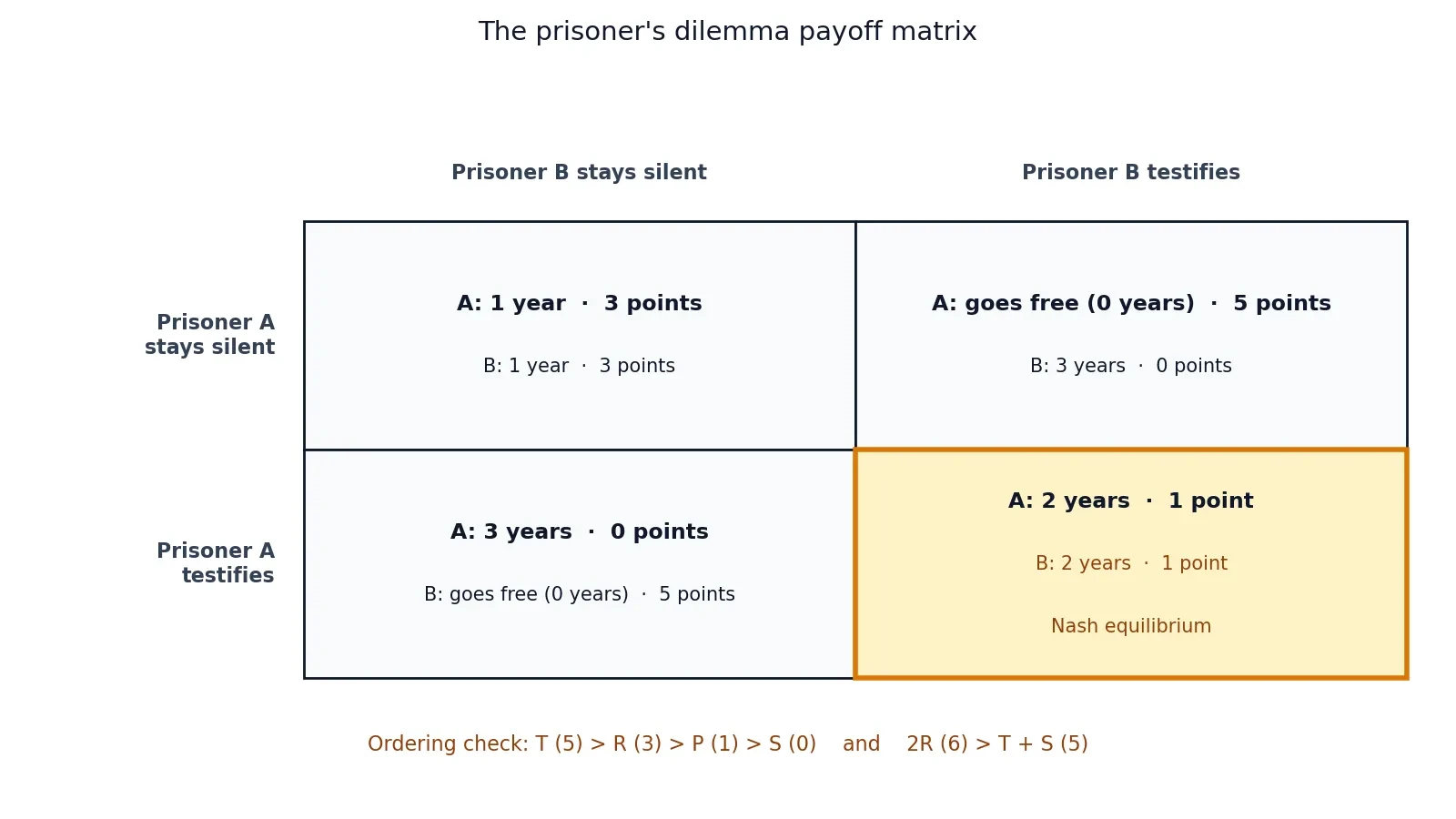
Here is the prisoner's dilemma twice over, because the game is usually told in two versions that say the same thing in different units. The first version uses years in prison, which is the version from the story. The second version uses reward points, which is the version theorists use because it makes the arithmetic cleaner. Both versions are given in the table below, and the numbers are the canonical ones used throughout this article.
| Prisoner B stays silent | Prisoner B testifies | |
|---|---|---|
| Prisoner A stays silent | 1 year each; 3 points each | A serves 3 years, 0 points; B goes free, 0 years, 5 points |
| Prisoner A testifies | A goes free, 0 years, 5 points; B serves 3 years, 0 points | 2 years each; 1 point each |
Take the time to read each cell. Top left: both stay silent, one year each, three points each. Top right: A stays silent and B testifies, so A serves three years and earns zero points while B walks free and earns five points. Bottom left: the mirror image, A free with five points, B serving three years with zero points. Bottom right: both testify, two years each, one point each.
The points version uses four named quantities that appear throughout game theory. R is the reward for mutual cooperation: 3 points. T is the temptation to defect: 5 points, the payoff for testifying while the other stays silent. P is the punishment for mutual defection: 1 point. S is the sucker's payoff: 0 points, the payoff for staying silent while the other testifies. Those four letters — R, T, P, S — are the whole game in miniature, and the next section checks that they satisfy the two conditions that make this a prisoner's dilemma rather than some other game.
4.2 Why both prisoners testify
Now sit in A's chair and reason it through, cell by cell, exactly as a rational player would.
Suppose B stays silent. Your options are to stay silent and serve one year, earning 3 points, or to testify and walk free, earning 5 points. Five points beats three points, and freedom beats one year. Testify.
Suppose B testifies. Your options are to stay silent and serve three years, earning 0 points, or to testify and serve two years, earning 1 point. One point beats zero points, and two years beats three years. Testify.
There is no case in which staying silent is better. Testifying beats staying silent whatever B does, and by the same reasoning in the other room, testifying beats staying silent whatever A does. When a strategy is better than every alternative no matter what the other player does, it is called a dominant strategy, and section 5 is devoted to it. For now, the point is that both prisoners reach the same conclusion independently, both testify, and both land in the bottom-right cell: two years each, one point each.
4.3 The paradox, stated plainly
The paradox is easy to state and hard to sit with. Individually rational, collectively terrible. Each prisoner did the best thing for themselves given the situation, and both ended up worse off than they would have been if they had both done the other thing. Mutual cooperation gives three points each. Mutual defection gives one point each. Both players prefer three points to one point, and both players know it, and both players still defect.
Two checks confirm that this really is a prisoner's dilemma and not a game that merely looks like one. The first check is the ordering of the four payoffs: T is greater than R is greater than P is greater than S. In numbers, 5 is greater than 3 is greater than 1 is greater than 0. The temptation to defect beats the reward for cooperating, the reward for cooperating beats the punishment for mutual defection, and the punishment beats the sucker's payoff. Every link in that chain matters. If T were smaller than R, there would be no temptation. If P were larger than R, mutual defection would be attractive in its own right.
The second check is that twice the reward for mutual cooperation is greater than the temptation plus the sucker's payoff: 2R is greater than T plus S. In numbers, 2 times 3 is 6, and 5 plus 0 is 5, and 6 is greater than 5. This condition matters when the game is played repeatedly, because it says that taking turns exploiting each other is worse than cooperating steadily. Without it, two players could do better by alternating defection than by cooperating, and the game would have a different character. Both conditions hold here, so this is a genuine prisoner's dilemma.
The pattern recurs far beyond the interrogation room. Two firms in a price war each cut prices to win customers, and both end up with thinner margins than if both had held prices steady. Two countries in an arms race each build weapons to stay safe, and both end up less safe and much poorer than if both had disarmed. Section 12 develops those everyday cases in full.
4.4 A note on the two versions
There are two ways to write the prisoner's dilemma down, and this article uses both. The years version is the story: how long each prisoner actually serves. The points version is the theorist's form: each outcome is scored, higher is better for the player, and the scores make the logic easier to compare across games. Both versions describe the same game, with the same ordering of outcomes — fewer years always means more points. From here on, the article uses points, except where a year is named.
5. Dominant Strategy: The Move That Always Wins
A dominant strategy is a strategy that gives a player the best payoff no matter what the other players do. If you have a dominant strategy, your decision is easy: play it, and stop worrying about what the other player might do. The other player's choice still affects your payoff, but it cannot change which move is best for you. That is why the prisoner's dilemma is so striking: both players have one, and following it leads them both astray.
In the prisoner's dilemma, testifying is a dominant strategy for both prisoners. We have already checked this cell by cell. For prisoner A, testifying beats staying silent when B stays silent, 5 points against 3, and it beats staying silent when B testifies, 1 point against 0. Because it wins in every case, it is dominant. The same check holds for B. There is no guesswork involved, no need to predict the other player's move, no need to weigh probabilities. The dominant strategy settles the question on its own.
5.1 Strictly vs weakly dominant
Game theory draws a distinction between two strengths of dominance, and it is worth one paragraph each, because the difference shows up in real games.
A strategy is strictly dominant if it gives a strictly better payoff than every alternative in every case. Testifying in the prisoner's dilemma is strictly dominant: 5 beats 3, and 1 beats 0, with no ties anywhere. Strict dominance is decisive. A rational player with a strictly dominant strategy has no reason to play anything else.
A strategy is weakly dominant if it gives at least as good a payoff as every alternative in every case, and a strictly better payoff in at least one case. The difference is the tie. Suppose a strategy ties with an alternative in one case and beats it in another. Then it is weakly dominant: never worse, sometimes better. Weak dominance is still a good reason to play a strategy, but it is a weaker reason, because the tie leaves room for a player to choose the alternative without losing anything in that case. In practice, most games that textbooks call prisoner's dilemmas use strict dominance, because the clean version is easier to reason about and the point is sharper.
The distinction matters because it affects what you can predict. With strict dominance, you can predict the outcome with confidence: every rational player plays the dominant strategy. With weak dominance, the prediction is softer, because a player might play the tied alternative for reasons the payoff numbers do not capture, such as habit or a preference the model left out.
5.2 When nobody has one
Most interesting games have no dominant strategy for anyone, and that is why the subject needs more than dominance to work with. In chess, there is no move that is best whatever the opponent does. In a negotiation, there is no offer that is best whatever the other side demands. In rock-paper-scissors, which appears in section 8, every move is beaten by one move and beats another, so dominance is impossible by design.
When nobody has a dominant strategy, the players must think about what the others will actually do, not just what they could do. That is where Nash equilibrium enters, and it is the subject of the next section. A dominant-strategy equilibrium, when one exists, is automatically a Nash equilibrium, because nobody can gain by switching away from a move that is best against everything. The reverse is not true. Most Nash equilibria are not dominant-strategy equilibria, and most games have no dominant strategy at all. Dominance is the easy case. Nash equilibrium is the general case.
One more point belongs here, because it connects the mathematics to human behaviour. Real people do not always play their dominant strategy, even when the payoffs are clear and the stakes are real. In classroom games like the one I described earlier, a minority of players stay silent, choosing cooperation over their own best payoff, sometimes because they hope the other will too, sometimes because they feel that testifying is simply wrong. The companion article on how we make decisions explores why fast, intuitive thinking often overrides the slow calculation that dominance requires. Game theory predicts what a rational player would do. It does not always predict what a human player will do, and the gap between those two predictions is itself a subject worth studying.
6. Nash Equilibrium: The Point Where Nobody Wants to Move
The Nash equilibrium is the most important definition in game theory, and it is also one of the most misunderstood. It is worth defining carefully, in plain language first and formal language second, because everything in the rest of this article either uses it or argues with it.
A Nash equilibrium is a set of strategies, one per player, where no player can do better by changing only their own strategy while the others stay put. Each player's strategy is a best response to the others' strategies. If everyone announced their strategies in advance, nobody would want to reconsider. If one player did reconsider and switch alone, that player would do worse, or at best no better. The outcome is stable, not because anyone is happy with it, but because nobody has a reason to move alone.
Notice what the definition does not say. It does not say the equilibrium is good for anyone. It does not say it is fair. It does not say it is the outcome the players would choose if they could coordinate. The prisoner's dilemma equilibrium — both testify, one point each — is a Nash equilibrium, and it is worse for both players than mutual cooperation. Stability and goodness are different properties, and confusing them is one of the most common errors people make about game theory. Section 13 takes that error apart in detail.
Nash proved something remarkable about his equilibrium: every finite game has at least one Nash equilibrium, provided players are allowed to use mixed strategies, which are probability distributions over pure strategies. That existence result, published in 1950 and developed in his thesis and his 1951 Annals of Mathematics paper, is why the concept could become the central solution idea of the field. Before Nash, an equilibrium was a hope. After Nash, it was a guarantee, at least in mixed strategies. The guarantee does not say the equilibrium is unique. A game can have several equilibria, or one, or an equilibrium only in mixed strategies. Finding them is the work, and the next section shows how to do it in a two-by-two game.
6.1 How to find a Nash equilibrium in a 2 by 2 game
The method is called the best-response method, and it is simple enough to do by hand. For each of the four cells in the matrix, ask whether either player would switch alone. If neither player would switch, the cell is a Nash equilibrium. If one player would switch, the cell is not an equilibrium, because that player has a reason to move. Check all four cells, and you have found every pure-strategy equilibrium in the game.
Work through the prisoner's dilemma with this method. In the both-silent cell, each prisoner gains by switching alone to testifying: 5 points instead of 3. So both-silent is not an equilibrium. In the cell where A testifies and B stays silent, B gains by switching to testifying: 1 point instead of 0. So that cell is not an equilibrium either. The mirror-image cell fails for the same reason with the players reversed. In the both-testify cell, A gains nothing by switching to silence: 0 points instead of 1. B gains nothing by switching either. Neither player wants to move alone. Both-testify is the unique Nash equilibrium. The method takes a minute, and it never fails for a two-by-two game.
6.2 Worked example: two firms deciding whether to advertise
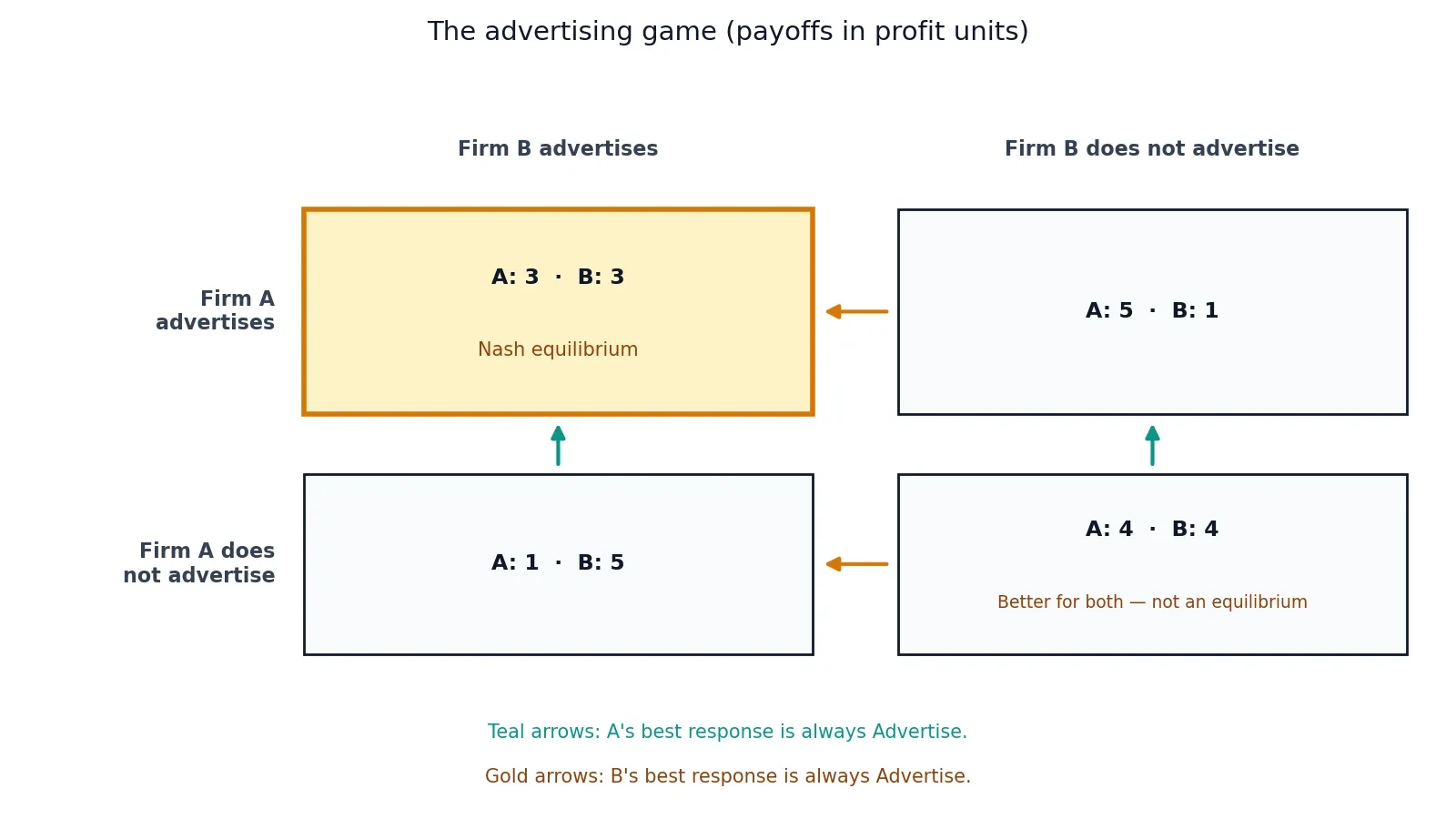
The advertising game is the prisoner's dilemma wearing a business suit, and it shows how the same structure governs decisions that have nothing to do with prisons. Two firms sell similar products. Each must decide whether to advertise or not. Advertising costs money, but it wins customers from a rival that does not advertise. The payoffs below are in profit units, and they follow the same pattern as the prisoner's dilemma.
| Firm B advertises | Firm B does not advertise | |
|---|---|---|
| Firm A advertises | 3 each | A gets 5, B gets 1 |
| Firm A does not advertise | A gets 1, B gets 5 | 4 each |
Work through Firm A's best responses. If B advertises, A earns 3 by advertising versus 1 by not advertising. Advertise. If B does not advertise, A earns 5 by advertising versus 4 by not advertising. Advertise. Advertising is dominant for A, and by symmetry it is dominant for B too. The Nash equilibrium is both advertise, with 3 profit units each.
Now look at the cell both firms would prefer: neither advertises, 4 profit units each. Both firms are better off there than at the equilibrium, 4 beats 3 for each of them. But neither-advertises is not an equilibrium, because either firm gains by deviating alone: 5 beats 4. The moment one firm advertises, the other must respond, and both end up back at 3 each. That is the logic of an advertising war, and it is the same logic as the prisoner's dilemma with suits instead of cells.
I watched a version of this game play out between two small shops on the same street, each matching the other's discounts week after week until neither was making much on the goods they were discounting. Neither owner wanted the price war. Both owners felt trapped in it. Each one told me, separately, that they would stop discounting if only the other would stop first. That is the prisoner's dilemma in plain speech: mutual cooperation is better, mutual defection is stable, and nobody can move first without losing.
6.3 Nash equilibria are not always fair or good
Three facts about Nash equilibria deserve emphasis, because each corrects a natural misunderstanding.
First, an equilibrium can be bad for everyone. The prisoner's dilemma and the advertising game both show this. Stability means nobody wants to move alone. It does not mean the outcome is good.
Second, a game can have more than one equilibrium. Coordination games are the classic case: two drivers deciding which side of the road to drive on have two equilibria, both drive on the left and both drive on the right, and either one works perfectly well as long as both drivers choose the same one. The problem in a coordination game is not stability but selection: which equilibrium will the players land on? That question has no answer inside the payoff matrix alone, and it is one of the subjects of section 12, where focal points help players coordinate without communicating.
Third, a game can have no equilibrium in pure strategies at all. Matching pennies, which appears in section 8, is the simplest example: whatever your opponent does, you want to do the opposite, and whatever you do, your opponent wants to do the opposite, so no pair of pure strategies is stable. The equilibrium exists only when the players randomise. Nash's existence result covers that case, because it allows mixed strategies. Without mixing, the guarantee fails.
One more caution belongs here. Equilibrium predictions are about averages over many plays, not about single anecdotes. A theory that predicts the average outcome of a repeated game can be right even when any single play looks different, and a single surprising play does not refute it. The companion article on how statistics can mislead explains why averages and anecdotes part company so easily, and why a handful of vivid examples can mislead you about a pattern that only shows up across many cases. Game theory makes the same demand: judge its predictions over many plays, not one.
7. Zero-Sum Games and Minimax: When One Player's Gain Is Another's Loss
Von Neumann's original territory was the zero-sum game, and it is still the cleanest part of game theory. A zero-sum game is one in which one player's gain is exactly another player's loss, so the payoffs sum to zero. Chess is close to zero-sum: one player's win is the other's loss. A poker pot is zero-sum: the money won by one player is money lost by the others. A penalty kick is zero-sum: the kicker's goal is the goalkeeper's failure. In a zero-sum game there is no cooperation to be had, no mutual gain to share, and no outcome that is good for both players at once. The only question is how much each player can secure for themselves.
The central idea is minimax, which is easier to understand in plain words than in symbols. The maximin strategy is the move that maximises a player's minimum payoff: look at the worst outcome each of your moves could produce, and choose the move whose worst outcome is least bad. The minimax strategy, from the other player's point of view, minimises the opponent's maximum payoff. The minimax theorem says that in a finite two-player zero-sum game, the maximin value equals the minimax value. That common number is called the value of the game. One player can guarantee at least that much, and the other can hold them to at most that much, and neither can do better.
7.1 Worked example: a solved 2 by 2 zero-sum game
The theorem is easiest to see in a worked example with the arithmetic shown in full. Consider a game in which the row player has two moves and the column player has two moves, and the row player's payoffs are as follows: row 1 gives 3 against column 1 and minus 1 against column 2; row 2 gives minus 2 against column 1 and 1 against column 2. The column player's payoff is the negative of the row player's, so the game is zero-sum.
Neither pure row is safe. Row 1 risks minus 1 if the column player chooses column 2. Row 2 risks minus 2 if the column player chooses column 1. A player who always plays the same row can be exploited. The solution is to mix.
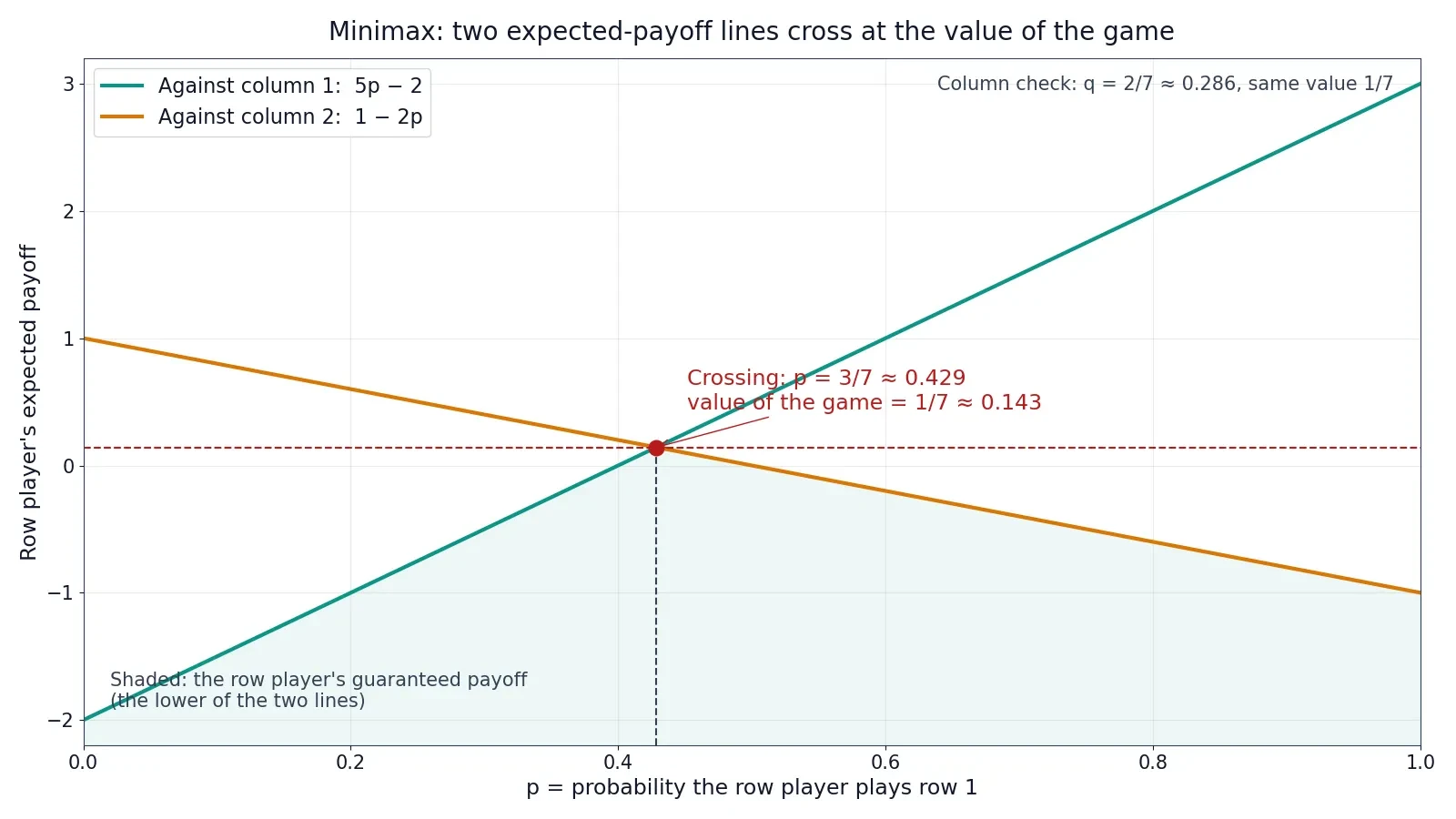
Suppose the row player plays row 1 with probability p, and row 2 with probability 1 minus p. Against column 1, the row player's expected payoff is 3 times p plus minus 2 times 1 minus p. That is 3p minus 2 plus 2p, which is 5p minus 2. Against column 2, the expected payoff is minus 1 times p plus 1 times 1 minus p. That is minus p plus 1 minus p, which is 1 minus 2p.
The row player wants to choose p so that the column player cannot exploit the mix, and that happens when the two expected payoffs are equal: the column player is indifferent between their two columns, so neither column gives them an advantage. Set 5p minus 2 equal to 1 minus 2p. Add 2p to both sides and add 2 to both sides, and the equation becomes 7p equals 3. So p equals 3 sevenths, which is about 0.429. The row player should play row 1 about 43 percent of the time and row 2 about 57 percent of the time.
The value of the game follows by substituting p back into either expected payoff. Using the first: 5 times 3 sevenths minus 2 equals 15 sevenths minus 14 sevenths, which is 1 seventh, about 0.143. Using the second as a check: 1 minus 2 times 3 sevenths equals 1 minus 6 sevenths, which is also 1 seventh. The two agree, as they must.
Now check the other side, because the theorem says both sides must agree on the same value. Suppose the column player plays column 1 with probability q, and column 2 with probability 1 minus q. Row 1 then gives the row player 3 times q plus minus 1 times 1 minus q, which is 3q minus 1 plus q, or 4q minus 1. Row 2 gives minus 2 times q plus 1 times 1 minus q, which is minus 2q plus 1 minus q, or 1 minus 3q. Setting them equal, 4q minus 1 equals 1 minus 3q, so 7q equals 2, and q equals 2 sevenths, about 0.286. The value is 4 times 2 sevenths minus 1, which is 8 sevenths minus 7 sevenths, or 1 seventh again. Both sides agree on 1 seventh. That agreement is the minimax theorem made visible in a single example.
The honest caveat belongs with the result. Neither pure row guarantees a positive payoff: row 1 risks minus 1, row 2 risks minus 2. Only the mix guarantees 1 seventh, and it guarantees it only on average, over many plays. In a single play, the row player might still lose. The guarantee is about the expected payoff, not about any one round. Solving for p also uses ordinary algebra — setting two linear expressions equal and solving for the unknown — and the companion article on how algebra works covers exactly that kind of step, if you want to practise the machinery on simpler examples first.
7.2 Penalty kicks as a real zero-sum game
Penalty kicks are the most famous real example of a zero-sum game, and they show why randomisation is not a theoretical curiosity. The kicker chooses a side, the goalkeeper chooses a side, and the kicker scores unless the goalkeeper guesses correctly. If the kicker always shot to the same side, the goalkeeper would wait there, and the kicker's success rate would collapse. If the goalkeeper always dived the same way, the kicker would shoot to the other side every time. Both sides must randomise, and the mix each side chooses makes the other side indifferent between their options, exactly as in the worked example above.
That is why game theory predicts that professional players randomise, and why the prediction is testable: look at the distribution of kicks and dives, and see whether each side is mixing in a way that makes the other indifferent. This article keeps the penalty-kick discussion qualitative, because no specific study figures were verified for this article, and quoting a percentage from a study that was not checked would be worse than saying nothing. The qualitative point stands on its own: in a zero-sum game with no pure equilibrium, predictability is punished, and the only defence is to be unpredictable in exactly the right proportions.
8. Mixed Strategies: Winning by Being Unpredictable
A mixed strategy is a probability distribution over a player's pure strategies. Instead of always playing the same move, the player randomises, choosing each pure strategy with a fixed probability. Rock with probability one third, paper with probability one third, scissors with probability one third: that is a mixed strategy. It sounds like giving up control, and in a sense it is. But in games with no pure-strategy equilibrium, giving up control in exactly the right proportions is the optimal thing to do, because it removes the information your opponent needs to exploit you.
The rule that governs mixed equilibria is simple to state and powerful to use. In a mixed-strategy equilibrium, each player randomises so as to make the opponent indifferent between the pure strategies the opponent randomises over. You do not mix to maximise your own payoff directly. You mix to remove your opponent's reason to favour one of their moves over another. When both players do that at the same time, neither can gain by changing their mix, and the result is an equilibrium. The minimax example in the previous section used exactly this rule: the row player's mix made the column player indifferent between their columns, and the column player's mix made the row player indifferent between their rows.
8.1 Rock-paper-scissors, solved
Rock-paper-scissors is the canonical example, and it is worth solving properly, because it shows the rule in its cleanest form. Each player chooses rock, paper, or scissors. Rock beats scissors, scissors beats paper, paper beats rock, and matching moves tie. There is no pure-strategy equilibrium: whatever you play, your opponent wants to play the move that beats it, and whatever they play, you want to play the move that beats that.
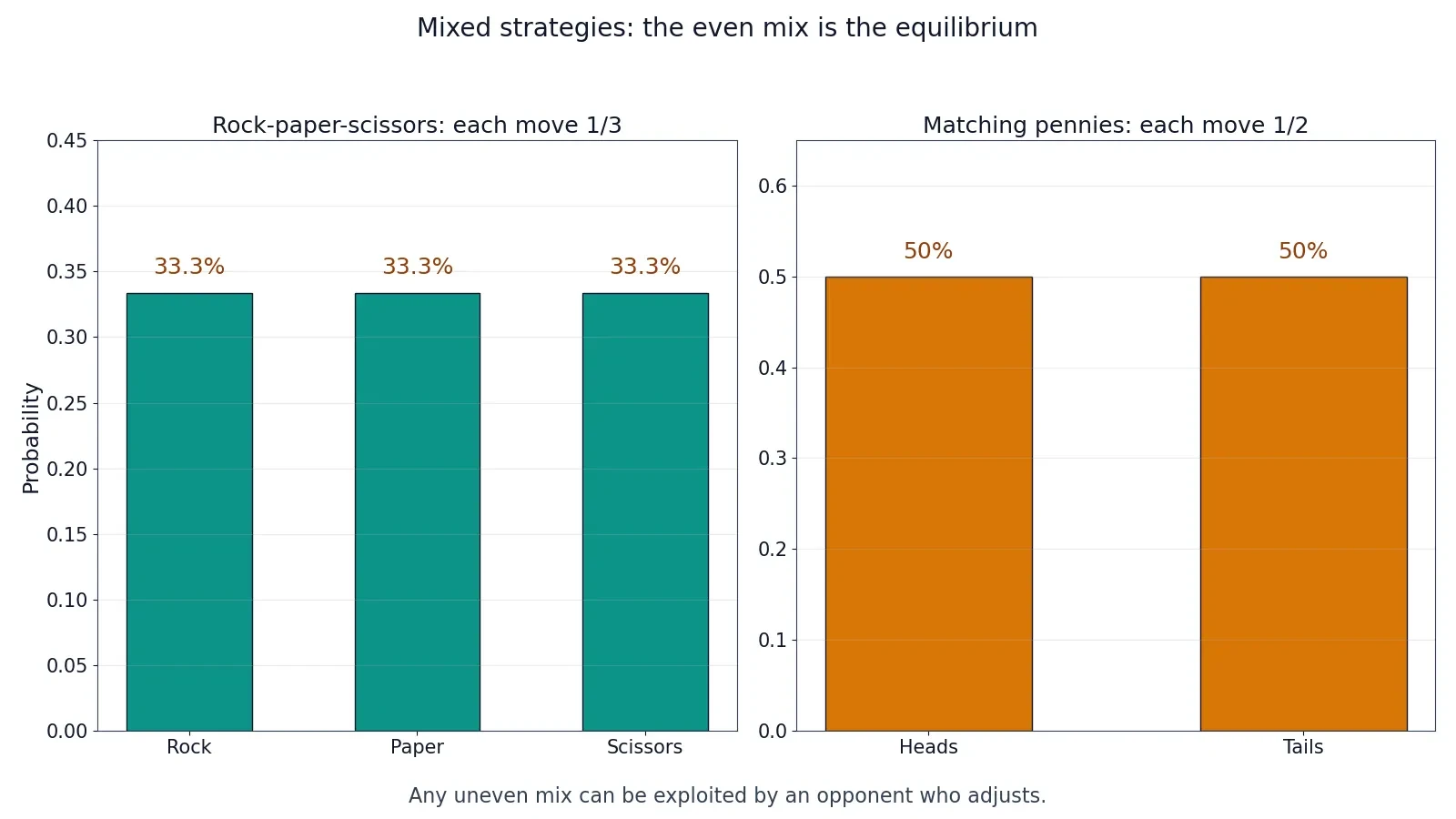
The mixed equilibrium is to play each move with probability one third. Against that mix, any strategy earns an expected payoff of zero: a player who always plays rock wins one third of the time against scissors, loses one third of the time against paper, and ties one third of the time against rock, for an expected score of zero. The same holds for always playing paper or always playing scissors, and for any other mix. No deviation gains anything.
Now watch what happens when a player deviates from the thirds. Suppose you start playing rock more often than one third of the time, because rock feels lucky today. Your opponent notices, or simply learns from experience, and starts playing paper more often, because paper beats rock. Your extra rocks lose more often, and your expected payoff turns negative. The arithmetic is unforgiving: any departure from the one-third mix can be exploited by an opponent who adjusts. The only mix that cannot be exploited is the even one. That is why the equilibrium is unique, and why the game is fair.
I learned this the hard way in a playground tournament years ago, when I kept throwing rock because it felt strong and a sharp-eyed opponent kept answering with paper. After five straight losses I finally mixed my throws, and the losing streak stopped at once. Nobody at that playground knew the mathematics, but the player who exploited my pattern understood the idea perfectly.
8.2 When mixing is a mistake
Mixing is a tool for a specific problem, and using it where it does not belong is a mistake. Do not randomise where a pure strategy dominates. In the prisoner's dilemma, testifying is strictly dominant, and no amount of randomisation improves on it. A prisoner who flipped a coin to decide whether to testify would sometimes stay silent, earning 3 points instead of 5 when the other stayed silent, or 0 instead of 1 when the other testified. Randomising in a game with a dominant strategy is simply throwing points away.
Mixing is for games with no pure equilibrium: matching pennies, rock-paper-scissors, penalty kicks, and the zero-sum game solved in the previous section. In those games, a pure strategy is exploitable by definition, because the opponent's best response to it is a different pure strategy. The mix exists to solve a problem that pure strategies cannot solve. Where pure strategies already solve the problem, leave the coin in your pocket.
8.3 Matching pennies
Matching pennies is the simplest game with no pure-strategy equilibrium, and it is worth a short paragraph because it shows the indifference rule in its purest form. Two players each show a coin, heads or tails. If the coins match, the first player wins a point. If they differ, the second player wins a point. Whatever the first player shows, the second player wants to show the opposite, and whatever the second player shows, the first player wants to match it. No pair of pure strategies is stable.
The mixed equilibrium is fifty-fifty for each player. Each player shows heads half the time and tails half the time, and each player's mix makes the opponent indifferent between heads and tails. The expected payoff is zero for both. Any deviation — showing heads sixty percent of the time, say — lets the opponent adjust and win more often.
9. Iterated Games: How Repetition Builds Cooperation
Everything so far has been about a game played once. That is the pessimistic case, because in a one-shot prisoner's dilemma, defection is free: you betray your partner, take your five points, and never see them again. But most real relationships are not one-shot. You negotiate with the same supplier every month. You share a road with the same commuters every morning. You play the same rival firm in the same market year after year. When a game repeats, the future casts a shadow over the present, and that shadow changes the logic completely.
The shadow of the future is the idea that today's defection can be punished tomorrow. In a repeated game, betraying your partner earns you five points today, but it teaches your partner not to trust you, and that lesson costs you in every round that follows. Cooperation becomes rational when the future matters enough: when there are enough rounds left, and when the players care enough about those rounds, for the long-run cost of betrayal to outweigh the short-run gain. That single insight turns the prisoner's dilemma from a counsel of despair into a theory of how cooperation can survive among self-interested players.
9.1 Why repetition changes everything
In a one-shot game, the last round is the only round, so there is nothing to lose by defecting. In a repeated game, every round except the last is followed by another round, and what you do now shapes what your partner does next. A player who defects today invites retaliation tomorrow. A player who cooperates today invites cooperation tomorrow. The game is no longer a single choice. It is a relationship, and relationships reward patience.
9.2 Axelrod's tournaments
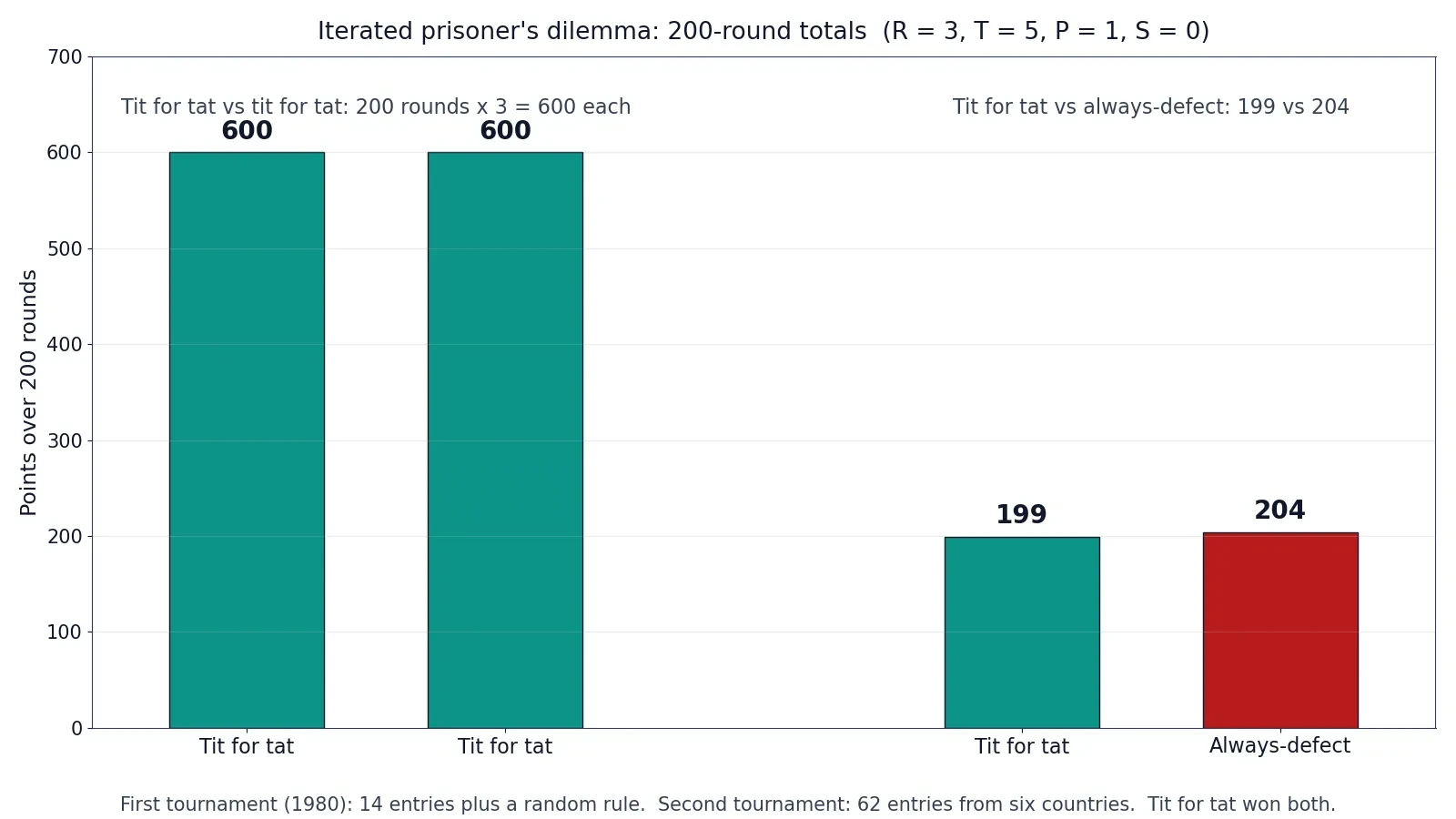
In 1980, the political scientist Robert Axelrod invited game theorists, economists, psychologists, and computer programmers to submit strategies for the iterated prisoner's dilemma, as computer programs, to play against each other in a round-robin tournament. The first tournament had 14 entries plus a random rule. Each match lasted 200 rounds, and each program played every other program. The winner was the simplest of all the programs submitted: tit for tat, submitted by Anatol Rapoport, a mathematical psychologist at the University of Toronto.
The second tournament was larger: 62 entries from six countries, and tit for tat won again. That second victory is the more impressive one, because the entrants in the second tournament knew what had won the first, and many of them designed their programs specifically to beat tit for tat. None of them did.
Tit for tat is almost embarrassingly simple. Cooperate on the first move, then copy whatever the opponent did on the previous move. If the opponent cooperated last round, cooperate. If the opponent defected last round, defect. That is the whole strategy, and Axelrod defined it in the preface of his 1984 book The Evolution of Cooperation in a single sentence:
"TIT FOR TAT is merely the strategy of starting with cooperation, and thereafter doing what the other player did on the previous move." — Robert Axelrod, The Evolution of Cooperation, Preface, 1984, p. vii
Axelrod identified four properties that explained why tit for tat did so well. It is nice: it never defects first, so it never starts a fight. It is retaliatory: it punishes defection immediately, so it cannot be exploited by a player who defects repeatedly. It is forgiving: after one punishment, it returns to cooperation, so a single defection does not destroy the relationship forever. And it is clear: its behaviour is easy to recognise, so other players can learn quickly that cooperation with it will be rewarded and defection punished. Nice, retaliatory, forgiving, clear. Four words, and they describe a strategy that beat sixty-one rivals designed by experts.
9.3 The 200-round totals
The tournament arithmetic is worth working through, because it shows how a strategy can lose a single match yet win a tournament. Use the points from section 4: R equals 3, T equals 5, P equals 1, S equals 0. In the first tournament's fixed format, each match lasts 200 rounds.
Tit for tat against tit for tat: both cooperate on the first move, and since each copies the other's cooperation, both cooperate in every round. Each scores 3 points in each of 200 rounds, which is 200 times 3, or 600 points each.
Tit for tat against always-defect: in the first round, tit for tat cooperates and always-defect defects, so tit for tat scores 0 and always-defect scores 5. From the second round on, tit for tat copies the defection, so both defect in each of the remaining 199 rounds, scoring 1 point each per round. Tit for tat finishes with 0 plus 199 times 1, which is 199 points. Always-defect finishes with 5 plus 199 times 1, which is 204 points.
Always-defect wins that pairing, 204 against 199. But always-defect scores only 1 point a round against itself, 200 points a match, while tit for tat collects 600 points a match against every cooperator it meets. Over a whole tournament, the strategy that cooperates well with cooperators beats the strategy that exploits everyone, because exploitation earns a small bonus once and then destroys the relationship, while cooperation earns a steady reward in every round. Tit for tat can lose a single match yet win a tournament, and that is the point: in a repeated game, the score that matters is the total across all your relationships, not the margin in any one of them.
9.4 Tit for tat's weaknesses, honestly
No honest account of tit for tat stops at the victory. The strategy has real weaknesses, and Axelrod himself discussed them. It does badly against always-defect in a single pairing, losing 199 to 204, so in a world of pure defectors it is not the best strategy. Worse, a single misread move can lock two tit-for-tat players into alternating retaliation: if one defects by mistake, the other retaliates, the first retaliates against the retaliation, and the two players trade defections for rounds on end, each one punishing the other's last move. The relationship that should have scored 600 points a match scores far less, and neither player can break the cycle without one of them absorbing an unpunished defection.
Later research found strategies that beat tit for tat in some tournament settings, by being more forgiving of occasional defections or by exploiting the structure of particular opponents. This article does not name those strategies or their years, because no specific successor was verified for this article, and naming one without a source would repeat the kind of error the mistakes log exists to prevent. The qualitative caveat stands: tit for tat is not unbeatable. It is a remarkably good strategy for a world in which most players are willing to cooperate and occasional mistakes happen, and a poor one for a world in which nobody cooperates at all. The tournaments prove that cooperation can win. They do not prove that it always will.
10. Evolutionary Game Theory: When the Players Are Animals
Game theory does not need rational players. That is one of its most surprising extensions, and it came from biology. In evolutionary game theory, the players are animals, the strategies are inherited behaviours, and the payoffs are units of reproductive success. There is no reasoning, no anticipation, no calculation. Natural selection does the optimising instead: strategies that earn higher payoffs leave more offspring, so they spread through the population, and strategies that earn lower payoffs shrink and disappear. The equilibrium is not a point where nobody wants to move. It is a point where no alternative strategy can invade.
The key concept is the evolutionarily stable strategy, or ESS. An ESS is a strategy that, if adopted by almost all members of a population, cannot be invaded by a rare alternative. A small group of mutants playing a different strategy earns a lower payoff than the residents, so the mutants do not spread. The idea was introduced by John Maynard Smith and George R. Price in their 1973 Nature paper "The Logic of Animal Conflict", and Maynard Smith developed it in his 1982 book Evolution and the Theory of Games. Credit for the idea itself goes to Price, by Maynard Smith's own acknowledgement. Game theory explains something that had puzzled biologists for years: why animals of the same species so rarely fight to the death over food, territory, or mates, even when the prize seems worth it.
10.1 The hawk-dove game
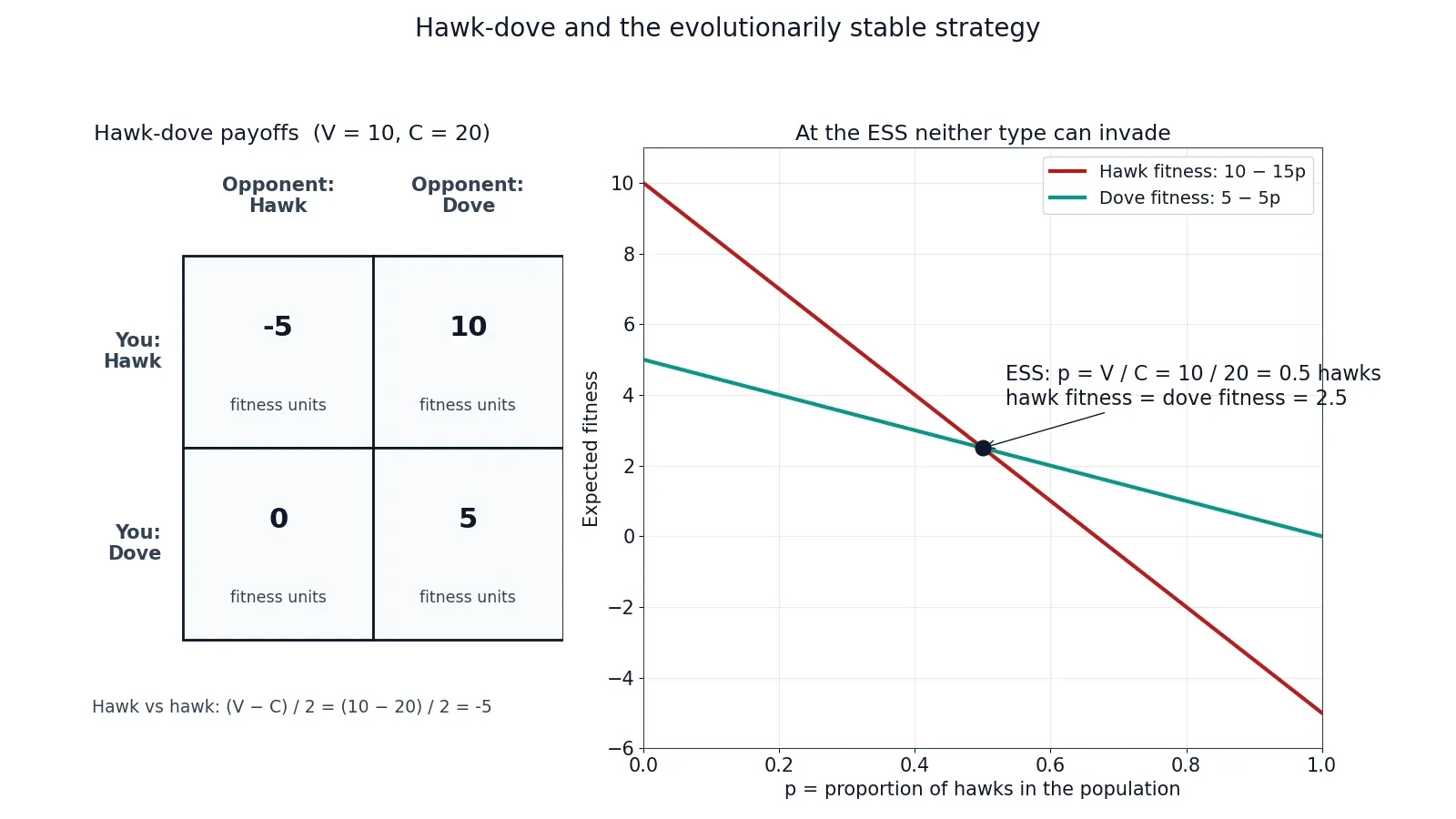
The hawk-dove game is the model that answers that puzzle. Two animals contest a resource worth V fitness units. Each can play hawk, escalating the fight until one side is injured or gives way, or dove, displaying but retreating if the opponent escalates. An escalated fight costs C fitness units in injury. The payoffs are as follows: hawk against hawk, each animal wins half the time and pays the cost of the fight, so the expected payoff is V minus C, divided by 2. Hawk against dove, the hawk takes the whole resource, V, and the dove gets 0. Dove against dove, the two share the resource, each getting V divided by 2.
Take the worked example with V equals 10 and C equals 20. Hawk against hawk gives 10 minus 20, divided by 2, which is minus 5. Hawk against dove gives 10. Dove against hawk gives 0. Dove against dove gives 10 divided by 2, which is 5. Put those numbers in a table and the game is fully specified.
| Opponent plays hawk | Opponent plays dove | |
|---|---|---|
| Play hawk | minus 5 | 10 |
| Play dove | 0 | 5 |
Neither pure strategy is stable on its own. In a population of doves, a hawk earns 10 against doves while doves earn 5, so hawks spread. In a population of hawks, a dove earns 0 against hawks while hawks earn minus 5, so doves spread. The population settles at a mix, and the mixed ESS is found by the same indifference rule used for mixed strategies in section 8: the proportion of hawks, p, must make a hawk's expected fitness equal to a dove's.
The formula is simple: p equals V divided by C. Here that is 10 divided by 20, which is 0.5, or one half. Check it. At a population that is half hawks and half doves, a hawk's expected fitness is 0.5 times minus 5 plus 0.5 times 10, which is minus 2.5 plus 5, or 2.5. A dove's expected fitness is 0.5 times 0 plus 0.5 times 5, which is 0 plus 2.5, or 2.5. The two are equal, so neither type can invade. The population sits at half hawks and half doves, and it stays there.
The general rule follows from the same arithmetic. When V is greater than C, the prize is worth more than the cost of fighting, and hawk is a pure ESS: escalate, because the fight is worth it. When V is less than C, as in the worked example, the mixed ESS applies, and the population contains both types in proportion V divided by C. The more dangerous the fight relative to the prize, the fewer hawks the population can support.
10.2 Why animals rarely fight to the death
The hawk-dove game explains a fact that anyone who has watched animals will have noticed: conflicts between members of the same species usually stop short of serious injury. Stags lock antlers and push, but they rarely gore each other. Dogs snarl and posture, but most fights end with one dog backing down. The Nature abstract of Maynard Smith and Price's 1973 paper states the observation plainly, and this article paraphrases it rather than quoting it: conflicts between animals of the same species usually take the form of limited war, not fighting to the death.
Natural selection is the optimiser here, and the companion article on natural selection explains how that optimisation works over generations. Fitness in a hawk-dove population is frequency-dependent, which is why the mix holds, and the companion article on genetic drift covers the other side of that story.
11. Auctions: Games Where You Pay for What You Bid
An auction is a game in which the rules are written down in advance, the players are the bidders, and the prize goes to whoever plays best under those rules. Change the rules and you change the game, which is why auction theory is one of the most practical branches of game theory: it tells a seller how to design an auction that earns more, and it tells a bidder how to bid without overpaying. The game theory of auctions began with William Vickrey's 1961 paper "Counterspeculation, Auctions, and Competitive Sealed Tenders", published in the Journal of Finance, and it reached its most famous application in the spectrum auction of 1994.
11.1 The four formats, compared
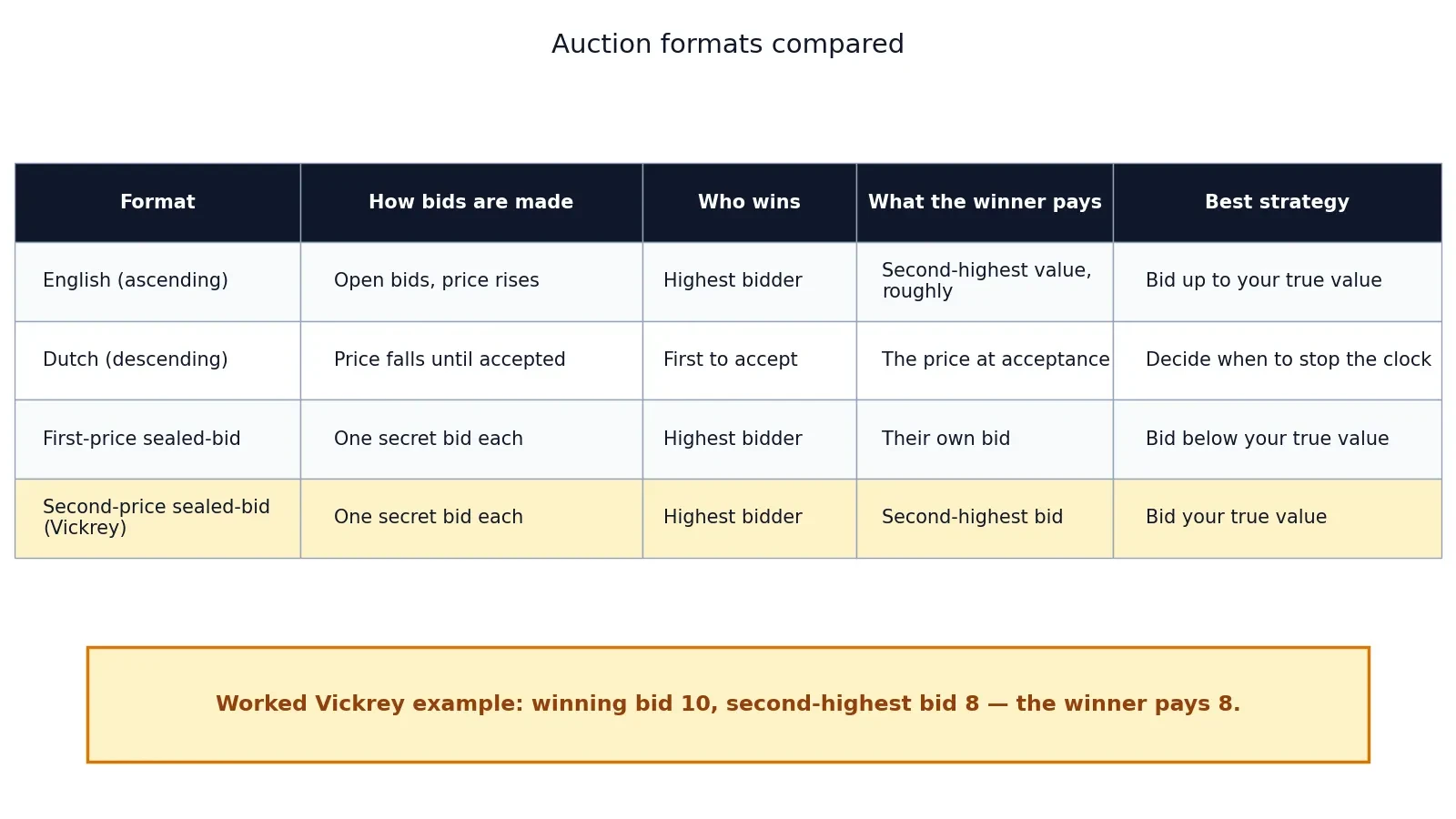
There are four standard auction formats, and the table below compares them. In an English auction, the price rises in public until one bidder remains. In a Dutch auction, the price starts high and falls until someone accepts it. In a first-price sealed-bid auction, each bidder submits one secret bid, and the highest bidder wins and pays their own bid. In a second-price sealed-bid auction, also called a Vickrey auction, each bidder submits one secret bid, the highest bidder wins, and the winner pays the second-highest bid.
| Format | How bids are made | Who wins | What the winner pays | What strategy it rewards |
|---|---|---|---|---|
| English, ascending | Open bids, price rises | Last bidder standing | Second-highest value, roughly | Staying in until the price passes your value |
| Dutch, descending | Price falls until accepted | First bidder to accept | The price at acceptance | Judging when to stop the fall |
| First-price sealed-bid | One secret bid each | Highest bidder | Their own bid | Shading the bid below your value |
| Second-price sealed-bid, Vickrey | One secret bid each | Highest bidder | Second-highest bid | Bidding your true value |
11.2 Why telling the truth can be the best bid
The Vickrey auction has the most surprising property in auction theory: for a single item with private values, bidding your true value is a dominant strategy. The logic is short. Your bid decides whether you win, not what you pay, because you pay the second-highest bid. If you bid below your true value, you might lose an auction you would have been glad to win at the second-highest price. If you bid above your true value, you might win and pay more than the item is worth to you. Bidding exactly your value avoids both errors, whatever anyone else bids. Vickrey put the rule this way, as quoted in Lucking-Reiley's survey of his work: "It is easily shown that the required procedure is to ask for bids on the understanding that the award will be made to the highest bidder, but on the basis of the price set by the second highest bidder."
The worked example makes it concrete. Suppose the winning bid is 10 and the second-highest bid is 8. The winner pays 8, not 10. The winner's surplus is the difference between their value and the price they pay, and the second-price rule protects that surplus while still giving the item to the bidder who values it most. That combination — efficient allocation plus honest bidding — is why the Vickrey auction is admired by theorists, even though it is rarely used in its pure form in practice.
11.3 The winner's curse
The winner's curse is the trap that awaits bidders when the item has a common value: it is worth the same to everyone, but its exact value is uncertain. Oil leases are the classic case. Every bidder is guessing how much oil lies underground, and the bidder who guesses highest wins the lease. Winning, in that setting, is bad news, because it means you overestimated the value more than anyone else did. The winner tends to be whoever overestimated the most, and so tends to overpay. The pattern was first noticed in United States oil-lease auctions in the early 1970s, in the work of Capen, Clapp and Campbell.
Milgrom's finding, reported by Stanford, is that English auctions mitigate the curse better than Dutch auctions, because bidders gain information as the bidding proceeds: watching others stay in the auction tells you that they also think the item is valuable, and watching them drop out tells you the opposite. The more information bidders have about the item's value, the higher the revenue, and the less severe the curse. The Stanford Graduate School of Business explainer on Milgrom and Wilson's auction work tells this story with the cattle auctions of Wilson's childhood as its opening image, and it is the clearest popular account of the winner's curse and the common-value model behind it.
The most famous application of auction design came in 1994, when the United States Federal Communications Commission needed a way to sell licences to use the broadcast spectrum for wireless communications. Milgrom and Wilson, with Preston McAfee, designed the first simultaneous multiple round auction, in which all licences were sold at once, in rounds, with bidders able to bid on any combination. The auction sold 10 licences over 47 rounds and raised six hundred and seventeen million in United States dollars. The format has since been copied worldwide, and later spectrum auctions raised more than two hundred billion in United States dollars in total. Auction theory, which began as a paper about sealed tenders, ended up deciding how the airwaves were sold.
12. Everyday Games: Traffic, Negotiations, Pricing, and Voting
Game theory leaves the textbook in four everyday settings, each with its game named.
12.1 Traffic
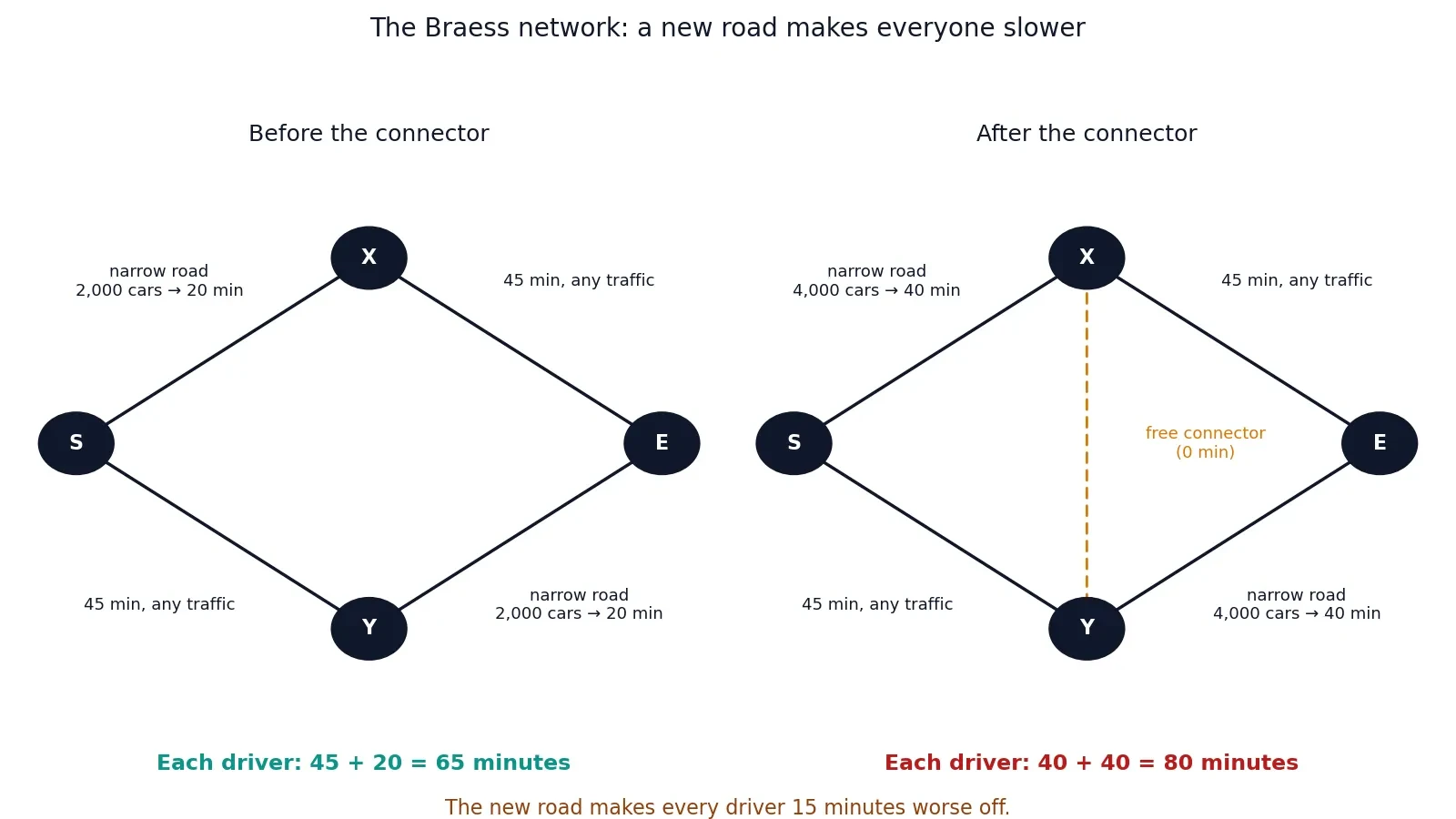
Braess's paradox is the strangest result in this article: adding a road to a network can slow everyone down. Dietrich Braess postulated it in 1968 and published it in 1969 (the effect had been noted by Arthur Pigou as early as 1920). The Nash equilibrium of selfish route choice need not be the best overall flow, and a new road can move the equilibrium to a worse place.
The worked example uses 4,000 drivers travelling from a start to an end by two routes. Each route has one road taking 45 minutes whatever the traffic, and one narrow road taking as many minutes as the number of cars on it divided by 100. Split evenly, 2,000 cars each way, each driver takes 45 plus 20, which is 65 minutes. Now add a free connector between the two middle points, letting drivers switch routes halfway. Every driver now takes both narrow roads, each carrying 4,000 cars, so each driver takes 40 plus 40, which is 80 minutes — 15 minutes worse for everyone. Check: 4,000 divided by 100 is 40, 40 plus 40 is 80, and 80 minus 65 is 15. The new road is free, everyone uses it, and everyone arrives later. There is a proven bound for this effect: if the delay functions are linear, adding a road can never make total travel time at equilibrium worse by a factor of more than 4 thirds. Here the ratio is 80 divided by 65, about 1.23, inside the bound.
Traffic and weather both resist prediction, but for different reasons, and the companion article on chaos theory explains the weather side of that comparison.
I drive the same route most mornings, and I have watched the Braess logic happen in miniature: on the days a shortcut opens, every driver takes it, the shortcut clogs, and the journey takes longer than on the days it was closed. Nobody chose the slower journey. The road network chose it for us.
12.2 Negotiations
Negotiations are coordination games with conflict mixed in, and Thomas Schelling's The Strategy of Conflict, published in 1960, is still the best guide to them. Schelling introduced focal points: salient outcomes that let strangers coordinate without communicating. Two strangers trying to meet in New York City without agreeing a place tend to choose the same landmark, because each guesses what the other will guess. He also analysed credible threats and commitment devices: a threat works only if the other side believes you will carry it out, and the way to make a threat credible is often to remove your own ability to back down. Burning your ships, in the old story, is a commitment device.
12.3 Pricing wars
Pricing wars are the advertising game of section 6 with prices instead of adverts. A price cut is defection: it wins customers today. Matching the cut is retaliation: it protects market share at the cost of margin. Both firms end up selling at lower prices than either wanted, and neither can raise prices alone without losing customers. The structure is the prisoner's dilemma, and the escape routes are the same ones game theory suggests everywhere: repeat the game, build a reputation for matching cuts, or change the payoffs with an agreement that both sides can trust.
12.4 Voting and public goods
Voting and public goods are multi-player prisoner's dilemmas. One person's vote rarely decides an election, and one person's contribution rarely saves a shared resource, so the individually rational move is to free-ride: let others pay, and enjoy the benefit. When everyone reasons that way, the public good is underfunded and the shared resource is overused. The tragedy of the commons is a prisoner's dilemma with many players, and its solutions are the same ones that work in the two-player game: repetition, reputation, enforcement, and changing the payoffs so that cooperation pays.
Two other classic games belong in this section. In chicken, two drivers head at each other, each choosing to swerve or drive on. Both swerve: 0 each. One swerves and the other drives on: the swerver gets minus 1, the driver gets 1. Both drive on: minus 5 each. There are two pure Nash equilibria, swerve and drive on in either combination, and the game is a model of brinkmanship. In the stag hunt, two hunters choose between hunting a stag together, which needs both, and hunting a hare alone, which is safe but small. Mutual stag-hunting pays best for both, but hunting hare is safe whatever the other does, so the outcome depends on trust. Chicken rewards nerve. The stag hunt rewards trust. The prisoner's dilemma rewards betrayal. Three games, three different lessons about the same human problem.
13. Common Misconceptions About Game Theory
Five misconceptions recur wherever game theory is discussed, and each one is worth correcting in plain language.
- "Game theory is about board games and video games." Games in game theory are models of strategic interaction. Chess is an example, not the subject. Auctions, negotiations, traffic, and animal conflicts are games too, and they are the point.
- "Game theory says everyone is selfish." It says players pursue their goals, and those goals can include fairness, loyalty, or revenge. The payoffs encode whatever the player values. A player who values fairness will pay to punish unfairness, and game theory handles that without complaint.
- "A Nash equilibrium is the best outcome." An equilibrium is stable, not good. The prisoner's dilemma equilibrium is worse for both players than cooperating. Stability means nobody wants to move alone. It says nothing about whether the outcome is worth having.
- "Rational players always cooperate when cooperation pays better." In a one-shot prisoner's dilemma, defection is rational for each player even though both would prefer mutual cooperation. Cooperation needs repetition, enforcement, or changed payoffs. Wanting a better outcome is not the same as being able to reach it alone.
- "Game theory predicts exactly what people will do." It predicts what rational players would do under stated assumptions. Real people deviate, and behavioural game theory studies how: through fairness, habit, miscalculation, and trust. The prediction is a benchmark, and the deviations are data.
Most people assume game theory is a theory of selfishness, but what the data actually shows is a theory of interdependence: it predicts cooperation exactly where cooperation can survive, and betrayal exactly where it cannot, and the difference between those two cases is the structure of the game.
14. What Game Theory Cannot Do
Game theory is a lens, not a crystal ball, and its limits deserve a fair hearing. First, the rationality assumption fails in predictable ways. Experiments show more cooperation in one-shot prisoner's dilemmas than game theory predicts, and people routinely reject unfair offers, trust strangers, and punish cheaters at a cost to themselves. Those behaviours are not noise. They are facts game theory must accommodate, and behavioural game theory exists to study them.
Second, the common-knowledge assumption is demanding. The theory often assumes that players know the payoffs, know that the others know the payoffs, and know that the others know that they know. Real negotiations rarely meet that standard, and when the payoffs are unclear, the predictions are unclear too.
Third, writing down real payoffs is hard. What is a reputation worth? What is a friendship worth? What is the value of not looking weak in front of a rival? Any number you assign is a guess, and the predictions inherit the guesswork. Both game theory and calculus optimise within a model, and the model is always a simplification, as the companion article on how calculus works shows for optimisation in mathematics.
Fourth, equilibrium selection is unsolved when a game has several equilibria. Game theory can list them. It cannot always say which one the players will reach, and focal points, history, and culture fill the gap that the mathematics leaves open.
None of this makes game theory useless. A lens that distorts at the edges is still a lens, and the centre of the picture — the prisoner's dilemma, the Nash equilibrium, the logic of mixing, the shadow of the future — is sharp. Use game theory to see the structure of a strategic situation clearly, to find the stable outcomes, and to ask what would have to change for a better outcome to become stable. Do not use it to predict a single person's next move with certainty.
Frequently Asked Questions
What is game theory?
Game theory is the study of strategic interaction: how people, firms, and animals choose when the outcome depends on everyone's choices. It models players, strategies, and payoffs, then finds the stable outcomes, called Nash equilibria, and asks when cooperation can survive.
What is the prisoner's dilemma?
The prisoner's dilemma is a game in which two prisoners are each better off betraying the other whatever the other does, so both betray and both do worse than if both had stayed silent. In the canonical numbers, mutual cooperation earns 3 points each and mutual defection earns 1 point each.
What is a Nash equilibrium?
A Nash equilibrium is a set of strategies, one per player, where no player can do better by changing only their own move while the others stay put. Each player's strategy is a best response to the others'. An equilibrium is stable, not necessarily good: the prisoner's dilemma equilibrium is bad for both players.
What is a dominant strategy?
A dominant strategy is a strategy that is best no matter what anyone else does. In the prisoner's dilemma, testifying is strictly dominant for both prisoners: it beats staying silent whether the other testifies or stays silent. A dominant-strategy equilibrium is always a Nash equilibrium, but most games have no dominant strategy.
What is the difference between a Nash equilibrium and a dominant strategy?
A dominant strategy is best against everything the others could do, while a Nash equilibrium is best against what the others are actually doing. Every dominant-strategy equilibrium is a Nash equilibrium, but the reverse is not true: most Nash equilibria involve no dominant strategy at all.
What is a mixed strategy?
A mixed strategy is randomising between moves with fixed probabilities, such as playing rock, paper, and scissors each one third of the time. In a mixed equilibrium, each player randomises so as to make the opponent indifferent between their pure strategies, which makes the player unpredictable and unexploitable.
Can game theory explain cooperation?
Yes, when games repeat. In the iterated prisoner's dilemma, tit for tat — cooperate first, then copy the opponent's last move — won Axelrod's tournaments in 1980 and again against 62 entries, because the shadow of the future makes defection costly. In evolution, cooperation is explained by the evolutionarily stable strategy.
How does game theory apply to everyday life?
Game theory applies anywhere your best move depends on what others do: auctions, traffic, negotiations, pricing, and voting. Auctions use it to design rules that reward honest bidding, traffic engineers meet it in Braess's paradox, and negotiators use it to understand focal points and credible threats.
Sources
- von Neumann, J. (1928), "Zur Theorie der Gesellschaftsspiele", Mathematische Annalen 100, 295–320 — DOI 10.1007/BF01448847 — von Neumann 1928 minimax paper
- von Neumann, J., and Morgenstern, O. (1944), Theory of Games and Economic Behavior, Princeton University Press — Princeton University Press, Theory of Games and Economic Behavior
- Nash, J. F. (1950), "Equilibrium Points in n-Person Games", Proceedings of the National Academy of Sciences 36(1), 48–49 — DOI 10.1073/pnas.36.1.48 — Nash 1950 PNAS paper
- Nash, J. F. (1951), "Non-Cooperative Games", Annals of Mathematics 54(2), 286–295 — DOI 10.2307/1969529 — Nash 1951 Annals of Mathematics paper
- Flood, M., and Dresher, M. (1950), RAND Corporation — historical reference for the prisoner's dilemma framing; no journal paper exists — Stanford Encyclopedia of Philosophy, game theory entry
- Tucker, A. W. (1950), talk prepared for the Stanford Psychology Department, cited via Myerson (2004) — Myerson 2004, The Nash equilibrium: A perspective
- Myerson, R. B. (2004), "The Nash equilibrium: A perspective", Proceedings of the National Academy of Sciences 101(12), 3999–4002 — DOI 10.1073/pnas.0308738101 — Myerson 2004 PNAS perspective
- Cournot, A. (1838), Recherches sur les principes mathématiques de la théorie des richesses — historical reference for the equilibrium idea — Stanford Encyclopedia of Philosophy, game theory entry
- Schelling, T. C. (1960), The Strategy of Conflict, Harvard University Press — Schelling, The Strategy of Conflict, Google Books
- Vickrey, W. (1961), "Counterspeculation, Auctions, and Competitive Sealed Tenders", Journal of Finance 16(1), 8–37 — DOI 10.1111/j.1540-6261.1961.tb02789.x — Vickrey 1961 auction paper
- Gale, D., and Shapley, L. S. (1962), "College Admissions and the Stability of Marriage", American Mathematical Monthly 69(1), 9–15 — DOI 10.2307/2312726 — Gale and Shapley 1962 stable matching paper
- Maynard Smith, J., and Price, G. R. (1973), "The Logic of Animal Conflict", Nature 246, 15–18 — DOI 10.1038/246015a0 — Maynard Smith and Price 1973 Nature paper
- Maynard Smith, J. (1982), Evolution and the Theory of Games, Cambridge University Press — Maynard Smith, Evolution and the Theory of Games, Google Books
- Axelrod, R. (1980), "Effective Choice in the Prisoner's Dilemma", Journal of Conflict Resolution 24(1), 3–25 — DOI 10.1177/002200278002400101 — Axelrod 1980 first tournament paper
- Axelrod, R. (1980), "More Effective Choice in the Prisoner's Dilemma", Journal of Conflict Resolution 24(3), 379–403 — DOI 10.1177/002200278002400301 — Axelrod 1980 second tournament paper
- Axelrod, R. (1981), "The Emergence of Cooperation among Egoists", American Political Science Review 75(2), 306–318 — DOI 10.2307/1961366 — Axelrod 1981 emergence of cooperation paper
- Axelrod, R., and Hamilton, W. D. (1981), "The Evolution of Cooperation", Science 211(4489), 1390–1396 — DOI 10.1126/science.7466396 — Axelrod and Hamilton 1981 Science paper
- Axelrod, R. (1984), The Evolution of Cooperation, Basic Books — Axelrod, The Evolution of Cooperation, Hachette Book Group
- Braess, D. (1969), "Über ein Paradoxon aus der Verkehrsplanung", Unternehmensforschung 12, 258–268 — DOI 10.1007/bf01918335 — Braess 1969 paradox paper
- Lucking-Reiley, D. (2000), "Vickrey Auctions in Practice", Journal of Economic Perspectives 14(3), 183–192 — DOI 10.1257/jep.14.3.183 — Lucking-Reiley 2000, Vickrey Auctions in Practice, American Economic Association
- NobelPrize.org, The Prize in Economic Sciences 1994 — Nobel Prize 1994 summary
- NobelPrize.org, The Prize in Economic Sciences 2005 — Nobel Prize 2005 summary
- NobelPrize.org, The Prize in Economic Sciences 2007 — Nobel Prize 2007 summary
- NobelPrize.org, The Prize in Economic Sciences 2012 — Nobel Prize 2012 summary
- NobelPrize.org, The Prize in Economic Sciences 2020 — Nobel Prize 2020 summary