

1. The Question That Stops Every Maths Class
"What is a logarithm?" The question came from a student I was tutoring on a rainy Tuesday afternoon, and it stopped the lesson dead. She had been working through exponents without any trouble. Ten squared was a hundred. Ten cubed was a thousand. She could do those in her sleep. Then the textbook flipped the question around, and everything went quiet.
The textbook asked how many times you multiply ten by itself to get a thousand. She stared at the page. She knew the answer was three. She could feel it. What she could not see was why anyone would ask the question that way round, or why the answer needed a strange new word.
I asked her to forget the word for a minute. I asked her to think about the question instead. How many tens, multiplied together, make a thousand? Three tens: ten times ten times ten. That count, three, is the logarithm. It is not a new kind of number. It is a name for a question we already know how to ask, and an answer we already know how to find.
That is the whole subject in one sentence, and it is worth holding on to while the rest of this article unfolds. A logarithm asks: what power do I need? Give it a base and a target, and it hands back the exponent. Ten to the power of three is a thousand, so the logarithm of a thousand, base ten, is three. Two to the power of three is eight, so the logarithm of eight, base two, is three. The operation runs backwards through exponentiation, the way subtraction runs backwards through addition.
Most maths ideas arrive as answers looking for a question. Logarithms arrived the other way round. They arrived as a question that working people desperately needed answered: how do you multiply enormous numbers without spending your life doing it? Astronomers in the 1600s faced that problem every night. They multiplied numbers with seven or eight digits by hand, by candlelight, and a single slip ruined a whole evening of work. A logarithm turned that multiplication into addition, and addition is fast, forgiving work.
I still remember the look on that student's face when the idea landed. It was not the look of someone who had memorised a definition. It was the look of someone who had been given a tool and could suddenly see what it was for. She went back to her exercise book and started answering questions she had been skipping for a week. The word had stopped being a wall and started being a door.
This article follows that same path. It starts with the definition, plain and simple, then works through the rules, the history, and the scales that still run on logarithms today. Earthquakes, sound, acidity, starlight, money growing in a bank account, and the first digits of ordinary numbers all turn out to be logarithmic. The idea that looked like a classroom curiosity turns out to be one of the most practical inventions in the history of mathematics.
You do not need to be good at algebra to follow it. You need to know what a power is: a short way of writing repeated multiplication. Ten to the power of three means ten multiplied by itself three times. Everything else in this article is built from that one idea, one careful step at a time. If you can count to three, you can understand a logarithm. The rest is detail, story, and practice.
One warning before we start. Logarithms have a reputation for being abstract, and that reputation is unfair. The notation looks forbidding at first glance, all small raised numbers and the letters "log" sitting in front of everything. Ignore the look of it for now. Underneath the notation sits a simple, friendly question: how many times? Every section of this article comes back to that question, and every worked example answers it with ordinary numbers you can check on a pocket calculator.
2. What Is a Logarithm? The Power of Undoing Exponents
What is a logarithm? It is the power you raise a number to. More precisely, the logarithm of a number is the exponent to which a chosen base must be raised to produce that number. If ten to the power of three equals a thousand, then the logarithm of a thousand to base ten equals three. The base is the number being multiplied. The logarithm is the count of multiplications.
Mathematicians write this as log base b of x equals y, exactly when b to the power of y equals x. The two statements say the same thing in opposite directions. One starts with the power and finds the result. The other starts with the result and finds the power. That is why a logarithm is called the inverse of exponentiation. It undoes what an exponent does. The Britannica entry on logarithms states the same definition in the same terms: the logarithm is the exponent to which a base must be raised.
Think of the pairs of operations you already know. Addition undoes subtraction. Multiplication undoes division. Squaring undoes taking a square root. Each pair has a forward step and a backward step, and the backward step is often the harder one to think about. Logarithms are the backward step for exponents. They answer the question that exponents leave open: you know where you ended up, but how many steps did it take to get there?
A few worked examples make the definition concrete. Ten squared is a hundred, so log base ten of a hundred is two. Ten cubed is a thousand, so log base ten of a thousand is three. Two cubed is eight, so log base two of eight is three. Two to the power of five is thirty-two, so log base two of thirty-two is five. Three to the power of four is eighty-one, so log base three of eighty-one is four. Each example is a single fact read in two directions, and reading it backwards is the logarithm.
Notice something about those examples. The logarithm is usually a small, friendly number even when the target is large. The logarithm of a million to base ten is six, because ten to the power of six is a million. The logarithm of a billion to base ten is nine. A logarithm compresses a huge range of numbers into a small range of counts. That compression is not a side effect. It is the reason logarithms were invented, and it is the reason they still matter.
Here is a second way to picture it. Imagine a staircase where each step multiplies the number by the base. Start at one. Step up once and you reach ten. Step up again and you reach a hundred. Again, a thousand. Again, ten thousand. The step number is the logarithm. On this staircase, the logarithm of ten is one, the logarithm of a hundred is two, the logarithm of a thousand is three, and the logarithm of ten thousand is four. The numbers grow explosively, but the step numbers grow by one each time. A logarithm counts steps, not size.
The same idea works for any base. Base two gives a staircase that doubles at every step: one, two, four, eight, sixteen, thirty-two. The logarithm of thirty-two to base two is five, because five doublings take you from one to thirty-two. Base three triples at every step: one, three, nine, twenty-seven, eighty-one. The logarithm of eighty-one to base three is four. Change the base and you change the size of the steps, but the counting idea stays exactly the same.
There is a common misunderstanding worth clearing up early, and I want to disagree with it plainly. People often say a logarithm is just a button on a calculator, a piece of notation with no meaning of its own. That sells the idea short. The button is the least interesting part. The idea behind the button — that you can measure a number by the power it takes to build it — is a way of thinking about size itself. It lets you compare a whisper with a rock concert, a tremor with a great earthquake, and a single cell dividing with a whole population growing. The button only does the arithmetic. The idea does the thinking.
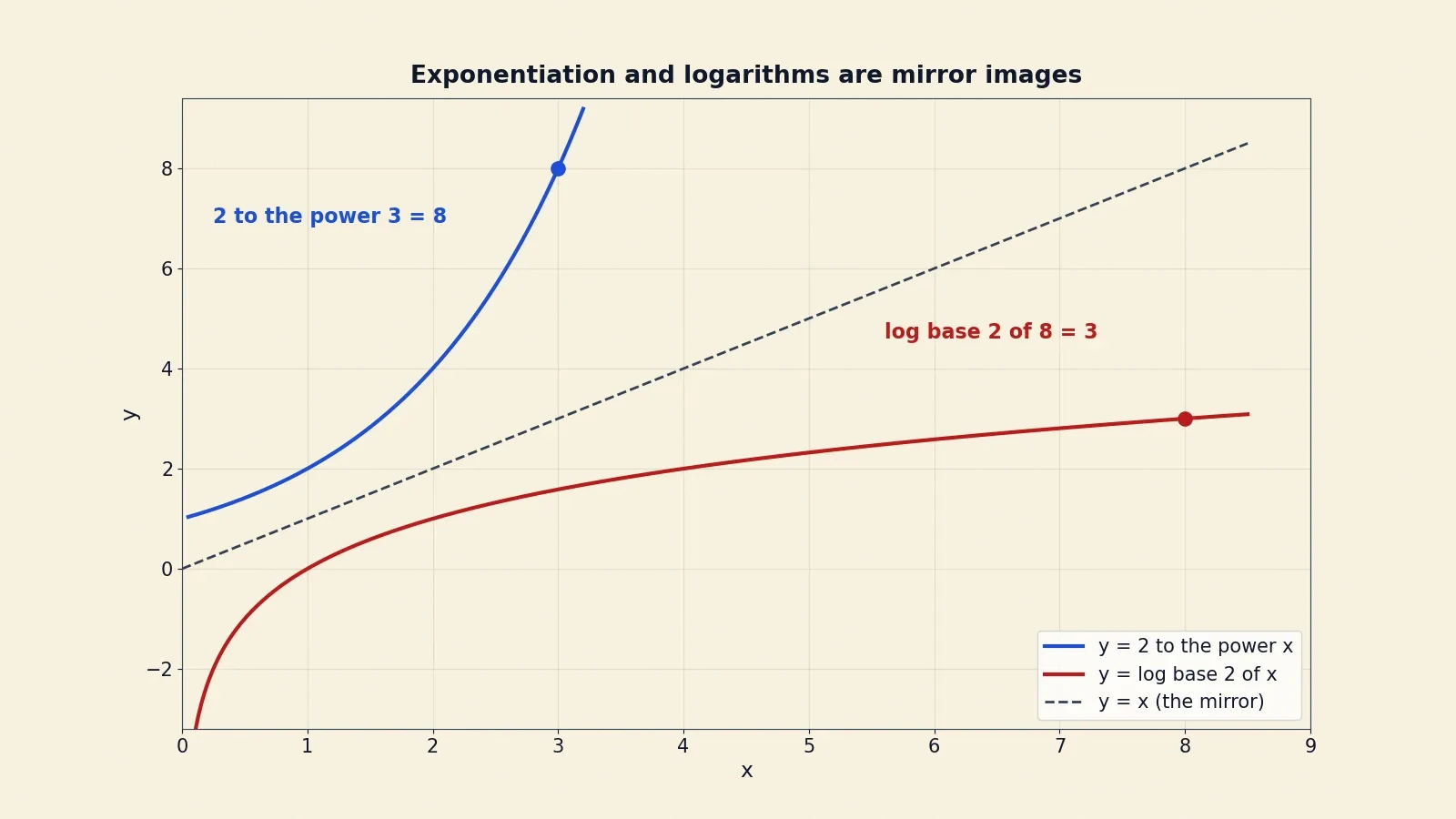
The picture in Figure 1 shows the relationship as geometry. The curve for two to the power of x rises steeply, doubling at every step. The curve for log base two of x rises slowly, flattening as it goes. Fold the picture along the diagonal line, the line where y equals x, and the two curves swap places. The point where two to the power of three equals eight lands exactly on the point where log base two of eight equals three. Reflection is the visual form of undoing. What one curve does, the other reverses.
That mirror picture also explains why logarithms grow so slowly. The exponential curve races upward because each step multiplies. Its mirror must therefore crawl, because each step on the mirror corresponds to a multiplication on the original. A logarithm of a million is only about twenty if the base is two, and only six if the base is ten. Slow growth is the price of compression, and compression is the point.
Before moving on, try the definition on a few numbers yourself, with a calculator if you like. What is log base ten of ten thousand? Four, because ten to the power of four is ten thousand. What is log base two of sixty-four? Six, because two to the power of six is sixty-four. What is log base ten of one? Zero, because any number to the power of zero is one — a fact the next section explores in full. If you can answer those three, you already understand the definition. Everything after this is rules, history, and uses.
3. Reading Logarithms Like a Sentence
Logarithm notation looks strange the first time you meet it, but it reads like a sentence once you know the grammar. The expression log base ten of a thousand has three parts: the word "log", which announces that a logarithm is coming; the base, written small and low, which tells you what number is being multiplied; and the argument, the number whose logarithm you want, which is the target of the multiplication. Read it aloud as "the power I raise ten to, to get a thousand". The answer is three.
The base is the most important part, because the same target has a different logarithm in every base. The logarithm of a hundred to base ten is two, because ten squared is a hundred. The logarithm of a hundred to base two is about six point six four, because two to the power of six point six four is a hundred. The logarithm of a hundred to base a hundred is one, because a hundred to the power of one is a hundred. Always ask which base is in play before you answer. A logarithm without a base is like a distance without a unit: the number means nothing until you know the scale.
Two special values anchor the whole system, and they hold for every base. The logarithm of one is always zero, because any base raised to the power of zero equals one. Ten to the power of zero is one. Two to the power of zero is one. The number e, which we meet in section 8, raised to the power of zero is one. Zero is the logarithm of one, in every base, without exception. The logarithm of the base itself is always one, because any number raised to the power of one is itself. Log base ten of ten is one. Log base two of two is one. The natural logarithm of e is one. These two facts are the fixed points of the subject, and they turn up again and again in worked problems.
The "how many digits" intuition gives a quick feel for base-ten logarithms. The logarithm of a number to base ten is roughly one less than the number of digits it has. A two-digit number like fifty has a base-ten logarithm between one and two. A three-digit number like five hundred has a base-ten logarithm between two and three. A six-digit number like four hundred thousand has a base-ten logarithm between five and six. The logarithm counts digits, roughly, and the fraction after the decimal point tells you where the number sits between one power of ten and the next. The logarithm of two to base ten is about zero point three zero one zero, which means two sits about a third of the way from one to ten on a logarithmic scale. That "about a third" fact returns in section 12, where it explains a strange pattern in the first digits of real numbers.
Logarithm tables were built on exactly this counting idea. Before electronic calculators, a book of logarithm tables let you look up the logarithm of any number to several decimal places, the way a dictionary lets you look up the spelling of a word. You found your number in the table, read off its logarithm, did your arithmetic with the small logarithm numbers, and then looked up the answer in reverse. The tables were long, dense books of tiny print, and using them took practice, but they were faster and more reliable than multiplying long numbers by hand. Whole professions — navigation, surveying, astronomy, engineering — ran on them for more than three centuries.
Reading a logarithm is also a matter of knowing what it cannot say. A logarithm never tells you the number itself. It tells you the power, and the power only makes sense once you know the base. Log base ten of a thousand is three, but three on its own is not a thousand. The three is a code, and the base is the key to the code. Keep base and logarithm together in your head, and the notation stops being mysterious. Split them apart, and it falls to pieces.
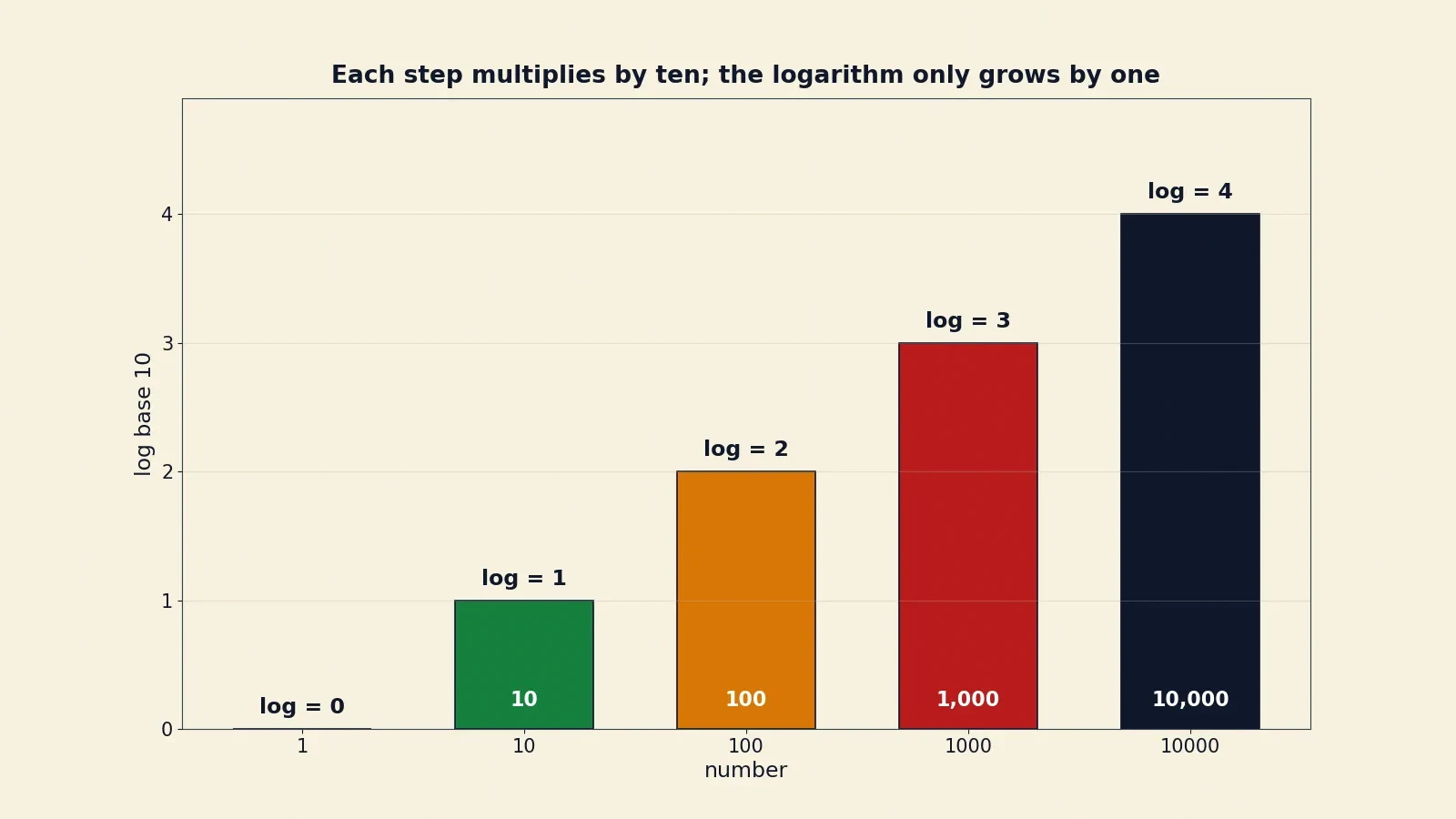
Figure 2 shows the staircase for base ten. Each step multiplies the number by ten, while the logarithm grows by just one. One, ten, a hundred, a thousand, ten thousand: the numbers explode, the logarithms stroll. That picture is worth memorising, because nearly everything else in this article is a variation on it. The Richter scale is that staircase applied to earthquakes. The decibel scale is that staircase applied to sound. The pH scale is that staircase applied to acidity. Different subjects, same staircase.
One last reading skill before the rules arrive. When you see "log" written without a base, the base depends on the context. In school mathematics, a bare "log" usually means base ten. In higher mathematics and science, a bare "log" often means the natural logarithm, base e, and "ln" is used to make that explicit. On a calculator, the "log" button is base ten and the "ln" button is base e. The ambiguity is annoying, and it has tripped up generations of students. When in doubt, ask which base is meant, or check which button your calculator is pressing. A logarithm is only as clear as its base.
4. The Three Rules That Run the Whole Subject
Logarithms have three rules, and the whole subject runs on them. Each rule is a translation: it takes a hard operation on ordinary numbers and turns it into an easy operation on logarithms. Multiplication becomes addition. Division becomes subtraction. Raising to a power becomes multiplication. That is the entire trick, and once you see why it works, the rules stop being things to memorise and start being things you could have invented yourself.
The product rule says the logarithm of a product is the sum of the logarithms. In symbols, log of M times N equals log of M plus log of N, in any base. The reason is simple. Suppose M is the base raised to one power and N is the base raised to another power. Multiplying them adds the powers, because that is how exponents work: ten squared times ten cubed is ten to the power of five. The logarithms are exactly those powers, so adding the logarithms is the same as multiplying the original numbers.
Here is the rule worked with ordinary numbers. Log base ten of a hundred is two, because ten squared is a hundred. Log base ten of a thousand is three, because ten cubed is a thousand. Multiply a hundred by a thousand and you get a hundred thousand. Add the logarithms, two plus three, and you get five. Log base ten of a hundred thousand is indeed five, because ten to the power of five is a hundred thousand. The multiplication of two large numbers became the addition of two small ones. That is the product rule in action, and it is the rule that made logarithms famous.
The quotient rule says the logarithm of a division is the difference of the logarithms. Log of M divided by N equals log of M minus log of N. The reason mirrors the product rule. Dividing powers of the same base subtracts the exponents: ten cubed divided by ten to the power of one is ten squared. The logarithms are the exponents, so subtracting them does the division.
Work it with numbers. Log base ten of a thousand is three. Log base ten of ten is one. A thousand divided by ten is a hundred. Subtract the logarithms, three minus one, and you get two. Log base ten of a hundred is two. Division became subtraction, and a calculation that needs care with zeros became a subtraction a child could do.
The power rule says the logarithm of a number raised to a power is the power times the logarithm of the number. Log of M to the power of n equals n times log of M. The reason is the same pattern once more. M to the power of n means M multiplied by itself n times, and each multiplication adds the logarithm once. Adding the same logarithm n times is the same as multiplying it by n.
Work it with numbers. Log base ten of a hundred is two. A hundred squared is ten thousand. The power rule says log base ten of ten thousand should be two times log base ten of a hundred, which is two times two, which is four. Log base ten of ten thousand is indeed four, because ten to the power of four is ten thousand. A squaring became a doubling. A cubing would become a tripling. Powers, the most explosive operation in arithmetic, become plain multiplication.
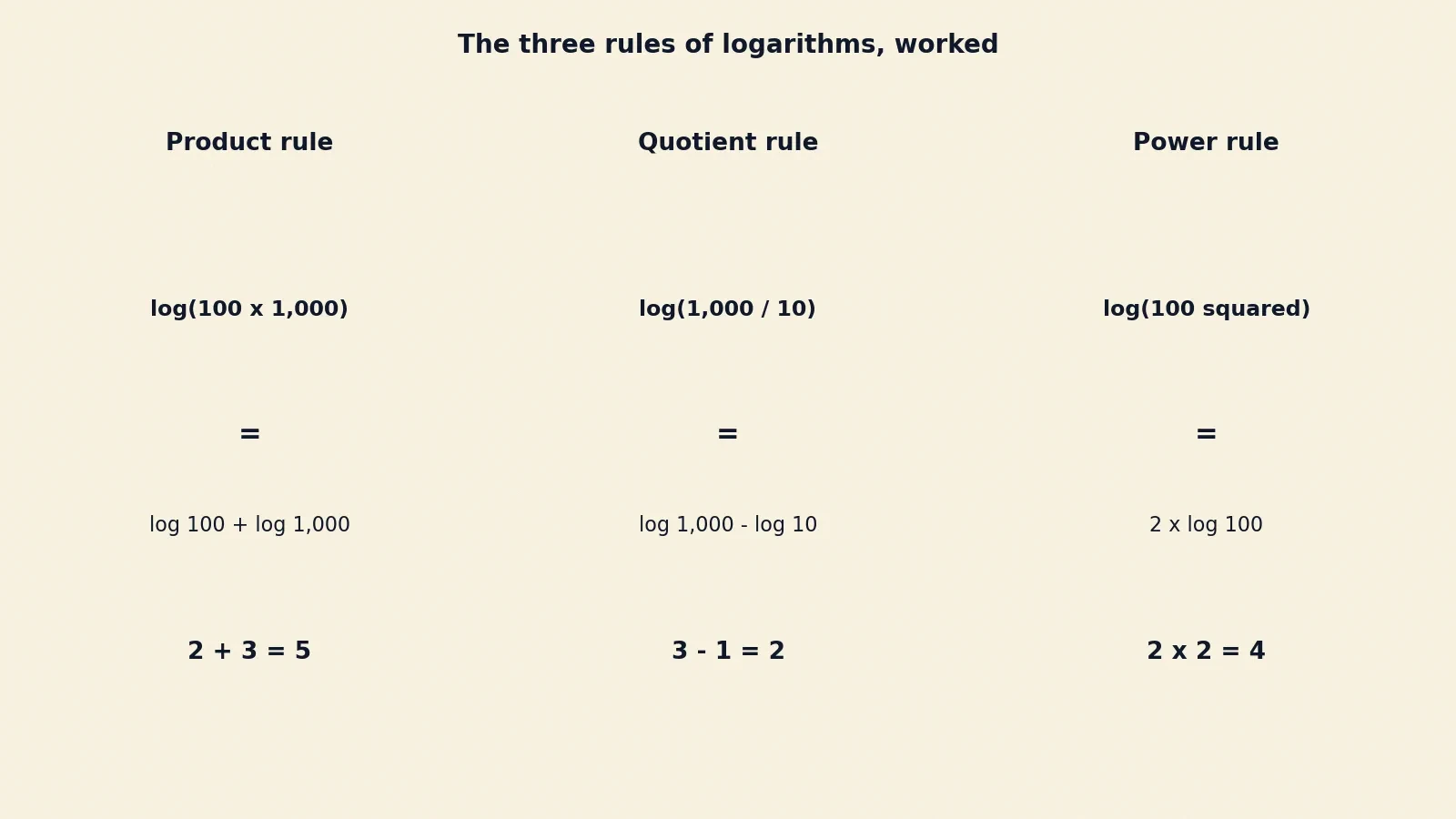
These three rules matter far beyond the classroom because they are the reason logarithms were invented at all. Before logarithms, multiplying two seven-digit numbers meant long multiplication: rows of partial products, careful carrying, and a high chance of a slip somewhere in the middle. With logarithms, you looked up two logarithms, added them, and looked up the answer. Addition replaced multiplication. Subtraction replaced division. The rules turned the hardest everyday arithmetic into the easiest.
The rules also explain why logarithms show up in so many formulas. Whenever a quantity grows by multiplication — populations, investments, radioactive atoms, sound intensity — taking its logarithm turns that growth into a straight line. Scientists love straight lines, because a straight line is easy to read, easy to fit, and easy to extrapolate. The logarithm is the tool that straightens a curve. Much of modern data analysis is, at heart, the three rules applied to real measurements.
A few cautions belong here, because the rules are easy to misremember. The logarithm of a sum is not the sum of the logarithms. Log of a plus b is not log of a plus log of b. There is no rule for that, and inventing one is the most common error in the subject. Section 13 returns to this mistake in detail. The rules work for products, quotients, and powers. They do not work for sums and differences inside the logarithm. Remember that boundary, and the rules will serve you well.
Practice the rules with one more example, this time in base two, to show they hold in every base. Log base two of eight is three. Log base two of four is two. Eight times four is thirty-two, and three plus two is five. Log base two of thirty-two is five. Eight divided by four is two, and three minus two is one. Log base two of two is one. Eight squared is sixty-four, and two times three is six. Log base two of sixty-four is six. Same rules, different base, same answers. The rules belong to logarithms themselves, not to base ten.
5. Changing Bases: The Translator's Trick
Calculators have two logarithm buttons, "log" for base ten and "ln" for base e, and that raises an obvious question. What if you need a logarithm in base two, or base three, or base seven? The answer is the change-of-base formula, and it is one of the most useful tricks in the subject. It says you can compute a logarithm in any base using logarithms in any other base, by dividing one by the other.
The formula is log base b of M equals log base c of M divided by log base c of b, where c is any base you like. Choose c to be ten or e, the two bases your calculator knows, and the formula does the rest. OpenStax explains the same change-of-base rule as the standard way to evaluate a logarithm in any base. The new base b appears only in the denominator, as the logarithm of b itself. That denominator is the conversion factor between the two bases, the way a currency exchange rate converts between two currencies.
Here is the formula worked in full. Suppose you want log base two of a hundred. Your calculator has no base-two button, but it has base ten. Log base ten of a hundred is two. Log base ten of two is about zero point three zero one zero. Divide the first by the second: two divided by zero point three zero one zero is about six point six four three nine. That is log base two of a hundred. Check it by raising two to that power: two to the power of six point six four three nine is indeed a hundred, near enough for any practical purpose.
The same calculation works with natural logarithms. The natural logarithm of a hundred is about four point six zero five two. The natural logarithm of two is about zero point six nine three one. Divide them: four point six zero five two divided by zero point six nine three one is about six point six four three nine, the same answer. The base you use for the conversion does not matter, because the formula divides out the choice. Two different routes, one destination.
A cleaner example shows the pattern without a calculator. Log base two of ten is a number worth knowing, because it tells you how many bits you need to count to ten. Use base ten: log base ten of ten is one, and log base ten of two is about zero point three zero one zero. One divided by zero point three zero one zero is about three point three two one nine. So log base two of ten is about three point three two one nine. Using natural logarithms gives the same result: the natural logarithm of ten is about two point three zero two six, the natural logarithm of two is about zero point six nine three one, and their ratio is three point three two one nine. The two routes agree to every decimal place, as they must.
Why does the formula work? Think back to the staircase. A logarithm in base two counts doublings. A logarithm in base ten counts ten-foldings. To convert between them, you need to know how many doublings fit into one ten-folding, and that number is log base two of ten, about three point three two. Every ten-folding is about three point three two doublings. The change-of-base formula is just that conversion, written as a division. It translates a count in one staircase into a count in another.
The formula has a practical consequence that shaped the history of computing. Early calculators and computers only needed to implement one logarithm function, because the change-of-base formula produces all the rest. A pocket calculator with a natural logarithm button can compute any logarithm at all, in any base, with one division. That is why the "log" and "ln" buttons are enough, and why no calculator bothers with a base-two button. One logarithm, properly understood, is all logarithms.
There is a special case worth remembering. When the number you are taking the logarithm of is the new base itself, the formula gives one, as it should. Log base two of two, computed through base ten, is log base ten of two divided by log base ten of two, which is one. When the number is one, the formula gives zero, because log of one is zero in any base. The formula respects the fixed points from section 3, and that is a good check that it is sound.
The change-of-base formula also explains a pattern you may have noticed. Logarithms in different bases are proportional to each other. Log base two of any number is always about three point three two times log base ten of the same number, because that ratio is log base two of ten. Log base e of any number is always about two point three zero three times log base ten of the same number, because that ratio is the natural logarithm of ten. Change the base and you stretch or squeeze the whole logarithmic scale by a fixed factor, the way changing from miles to kilometres stretches every distance by the same factor. The shape stays the same. Only the units change.
6. Napier and the Logarithms That Saved Astronomy
The story of logarithms begins with a Scottish landowner who spent twenty years on a calculation nobody had asked him to do. John Napier of Merchiston, near Edinburgh, lived from 1550 to 1617. He was a mathematician, an inventor, and a man with strong opinions about most things. In 1614 he published a book with a long Latin title, Mirifici Logarithmorum Canonis Descriptio, the Description of the Wonderful Canon of Logarithms. The book was printed in Edinburgh by Andrew Hart. It contained fifty-seven pages of explanation and about ninety pages of tables, and it changed astronomy.
Napier's tables were tables of logarithms of sines, built for spherical trigonometry, the mathematics of the sky. Astronomers and navigators lived by trigonometry. They multiplied sines and cosines of angles together, over and over, to work out where stars were and where ships were. The arithmetic was slow, and a single error could send a ship to the wrong coast. Napier's idea was to replace that multiplication with addition. Look up the logarithms, add them, look up the answer. Months of labour shrank to days.
Napier had worked on the tables for about twenty years before publishing them. Twenty years is a long time to spend on a book of numbers, and it tells you something about the man. He was not chasing a quick result. He was building a tool he believed the world needed, and he was willing to do the grinding arithmetic himself to make it real. The book did not explain how the tables were constructed. That explanation came after his death, in a work called the Constructio, published by his son Robert in 1619.
There is a correction to make here, and it matters. Napier's logarithms were not the natural logarithms we use today. His system set the logarithm of ten million to zero, and gave smaller numbers positive logarithms — the sign reversed from the modern system. His logarithms correspond to a base of about one over e, not to base e itself. To say Napier invented the natural logarithm is simply wrong. He invented logarithms. The natural logarithm, base e, came later, through other hands. Getting this right matters, because the history of logarithms is a relay race, not a single sprint, and Napier ran only the first leg.
The second leg belonged to Henry Briggs. Briggs was an English mathematician, Gresham Professor of Geometry in London and later Savilian Professor at Oxford, who lived from 1561 to 1630. He read Napier's book and saw at once how to improve it. Logarithms would be far more useful, he thought, if the logarithm of one were zero and the logarithm of ten were one — that is, if the base were ten. He wrote to Napier with the suggestion, then travelled to Edinburgh to discuss it in person, staying for a month in the summer of 1615 and returning in the summer of 1616. Napier agreed, and suggested in turn that logarithms of numbers greater than one should be positive.
Briggs then did the grinding work himself. His Logarithmorum Chilias Prima, published in 1617 shortly after Napier's death on 4 April of that year, gave base-ten logarithms of the numbers from one to a thousand, each to fourteen decimal places. His Arithmetica Logarithmica, published in 1624, gave thirty thousand logarithms — the numbers from one to twenty thousand, and from ninety thousand to a hundred thousand — each to fourteen decimal places, all computed by hand. The gap between twenty thousand and ninety thousand was filled by Adriaan Vlacq in 1628. Thirty thousand logarithms, each to fourteen places, worked out with pen and paper: it is hard to overstate the patience that took.
Napier was not the only inventor. The Swiss clockmaker and astronomer Jost Bürgi, who lived from 1552 to 1632, invented logarithms independently, probably as early as about 1588, while working for the court at Kassel. He published only in 1620, in a book called Arithmetische und Geometrische Progress-Tabulen, six years after Napier. Johannes Kepler persuaded him to publish at last. Napier has priority by publication, and history remembers him first, but Bürgi deserves his share of the credit. Two men, working apart, found the same idea because the need for it was in the air.
The effect of logarithms on astronomy was immediate and enormous. Pierre-Simon Laplace, the great French astronomer and mathematician who lived from 1749 to 1827, praised them in his Exposition du Système du Monde, first published in 1796. His words, verified against the MacTutor archive at the University of St Andrews, are worth quoting exactly, in the short form that survives word for word.
"...by shortening the labours doubled the life of the astronomer." — Pierre-Simon Laplace, on Napier's logarithms
The fragment needs its leading ellipsis, because it is a fragment, not a whole sentence. Its meaning is plain all the same. Logarithms gave astronomers back half their working lives. Work that had taken months took days. Errors that had crept into long multiplications vanished, because addition is so much harder to get wrong. Laplace was not exaggerating for effect. He was describing what logarithms had done for his own science.
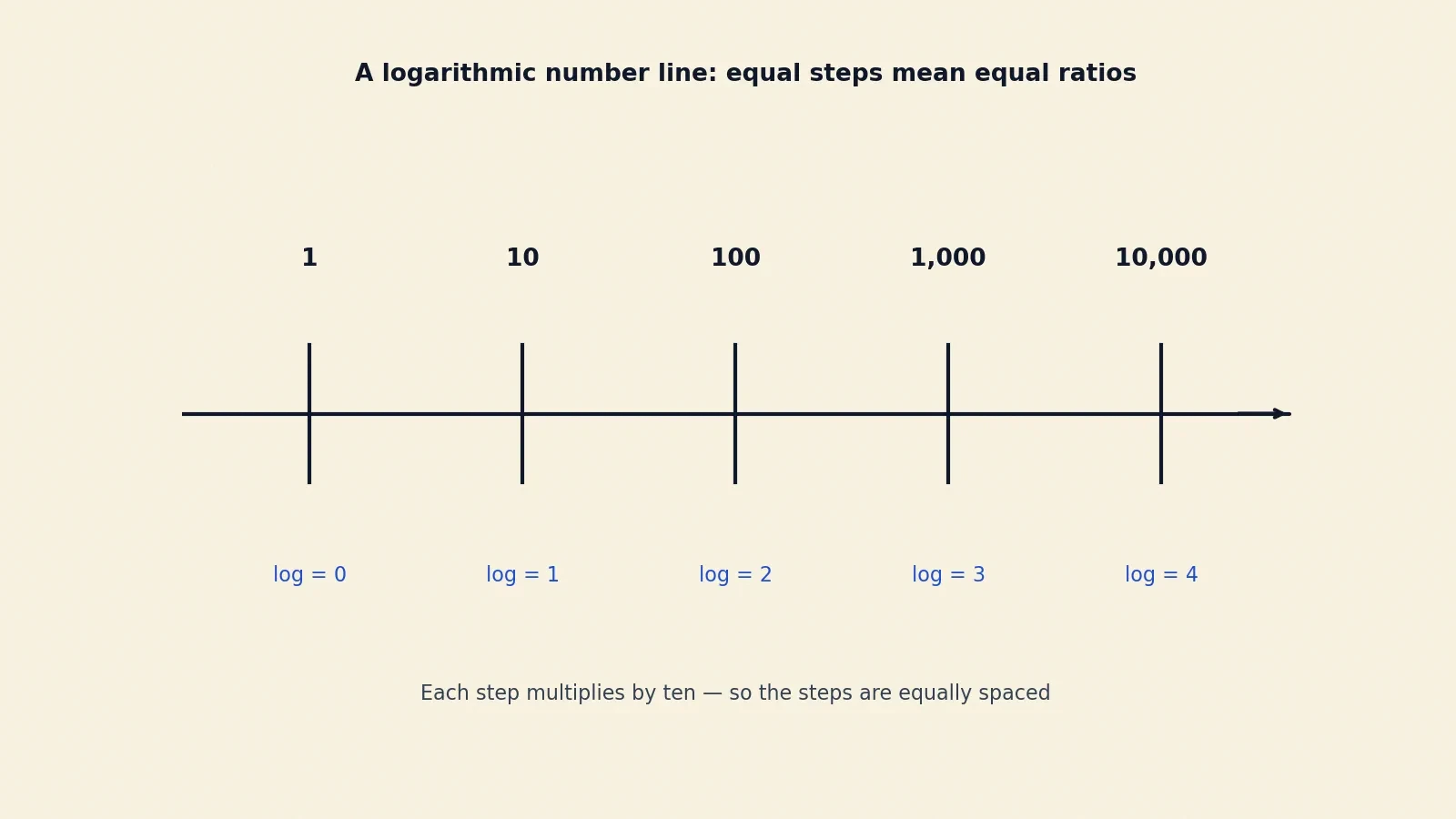
Figure 4 shows what Napier's idea looks like as a picture. On an ordinary number line, a thousand sits a thousand times further from zero than one does, and ten thousand is off the page entirely. On a logarithmic number line, one, ten, a hundred, a thousand, and ten thousand are spaced equally far apart, because each step multiplies by ten. Equal distances mean equal ratios, not equal differences. That single visual fact is the key to every logarithmic scale in this article. When a quantity spans a huge range — from a whisper to a jet engine, from a tremor to a great earthquake — an ordinary scale cannot hold it. A logarithmic scale can, because it measures ratios instead of differences.
The English translation of Napier's book, by Edward Wright, followed in 1616, only two years after the Latin original. Logarithms spread fast. Within a generation they were in every observatory, every navigation school, and every engineering office in Europe. They stayed there for more than three centuries, until electronic calculators took over the arithmetic in the 1970s. Three hundred and fifty years is a long life for a mathematical tool. Logarithms earned it by solving a problem that mattered, and solving it well.
7. Base 10: The People's Logarithm
Base ten is the logarithm most people meet first, and there is a good reason for that. We count in tens. We have ten fingers, ten digits in our number system, and a natural feel for what a hundred or a thousand means. A logarithm to base ten counts powers of ten, which means it counts the way we already count. That is why Briggs chose base ten, and why his choice stuck. Common logarithms, as base-ten logarithms are called, are the people's logarithm.
The common logarithm answers a question you can ask about any number: how many digits does it have, roughly, and where does it sit between powers of ten? Log base ten of fifty is about one point six nine nine zero. Log base ten of five hundred is about two point six nine nine zero. Log base ten of five thousand is about three point six nine nine zero. The fractional part stays the same, because fifty, five hundred, and five thousand are the same digits shifted by powers of ten. Only the whole-number part changes, counting the shifts. That pattern is the reason logarithm tables were organised the way they were: one entry per digit pattern, plus a count of shifts.
Log tables made base-ten logarithms a working tool. A navigator at sea, a surveyor in the field, an engineer at a drawing board — all of them carried a book of tables and knew how to use it. The procedure was always the same. Look up the logarithms of the numbers you need to multiply. Add the logarithms. Look up the number whose logarithm is the sum. The answer appears, accurate to as many decimal places as your table allows. Division worked the same way, with subtraction. Roots worked through the power rule: to find a square root, halve the logarithm; to find a cube root, divide it by three. One book, three rules, every calculation an office needed.
The slide rule turned the same idea into hardware. Around 1622, the English mathematician and clergyman William Oughtred combined two logarithmic scales so they could slide against each other, building on the logarithmic scale Edmund Gunter had published in 1620. To multiply two numbers on a slide rule, you lined up the scales so that the lengths added — and because the scales were logarithmic, adding lengths multiplied the numbers. Division subtracted lengths. A slide rule was a logarithm table you could hold in your hand, and it needed no batteries, no book, and no electricity.
I once held my grandfather's slide rule, a long flat piece of wood and plastic with scales printed along its edges, and tried to multiply two numbers on it the way he had been taught. It felt clumsy at first. The cursor wobbled. The scales seemed to slide the wrong way. Then, on the third try, the answer lined up, and I felt a small shock of recognition. The instrument was doing exactly what the logarithm rules describe, in wood instead of in symbols. My grandfather had done his engineering calculations on that rule for years, and he trusted it the way a carpenter trusts a level. It was not a toy. It was how the world was built.
Slide rules were the standard calculation tool in science and engineering for about three hundred and fifty years. Their use grew through the 1950s and 1960s, and Buzz Aldrin carried a Pickett N600-ES slide rule to the Moon on Apollo 11. Then, in 1972, Hewlett-Packard introduced the HP-35, the first handheld scientific pocket calculator, with trigonometric, logarithmic, and exponential functions built in. Slide rules became largely obsolete around 1974 and 1975, as cheaper calculators arrived, and by the 1980s they were essentially gone from working life. A tool that had served for three and a half centuries vanished in less than a decade.
The speed of that disappearance tells you something about logarithms themselves. The slide rule did not die because logarithms stopped mattering. It died because logarithms moved inside the machine. Every calculator still computes logarithms, and every computer still uses them, but the user no longer sees the scales sliding. The idea survived. Only the wooden embodiment went away. That is the fate of a good idea: it becomes invisible, because it becomes infrastructure.
Base-ten logarithms still turn up wherever people need a quick sense of size. Astronomers, chemists, and engineers all reach for them when a quantity spans many orders of magnitude. The Richter scale, the decibel scale, and the pH scale are all base-ten logarithms, and sections 10 to 12 take them in turn. Each one is the same staircase from Figure 2, applied to a different subject. Briggs chose well. Base ten was the right base for a world that counts in tens, and it still is.
There is a practical point worth making for students. If your calculator has a "log" button, that button is base ten. If a textbook writes "log" with no base shown, it usually means base ten in school mathematics. The common logarithm is the default logarithm in most classrooms, the way base ten is the default base for ordinary counting. Learn it first, learn it well, and the other bases will feel like variations on a theme you already know.
8. Base e: The Natural Logarithm
Base ten is the people's logarithm. Base e is nature's logarithm, and its story is stranger and more interesting. The number e is about two point seven one eight two eight, and it turns up wherever things grow or decay continuously: populations, investments, radioactive atoms, cooling cups of tea. The natural logarithm, written "ln", is the logarithm to base e. It is called natural not because it is obvious, but because nature keeps choosing it.
The number e was first met by Jacob Bernoulli in 1683, while he was studying compound interest. Bernoulli asked what happens to a sum of money when interest is added more and more often — yearly, monthly, daily, hourly, every second. The answer does not run away to infinity. It settles toward a limit, and that limit is e. Put one unit of money in a bank at one hundred percent interest, compounded continuously, and after a year you have e units, about two point seven one eight. Bernoulli found the constant. He did not name it, and he did not know how central it would become.
Leonhard Euler gave e its name, its symbol, and its central role. In his Introductio in analysin infinitorum, published in 1748 in Lausanne, Euler treated logarithms as the inverse of exponential functions in the modern way, and introduced e as the number whose natural logarithm is one. He proved e is irrational, and he showed that the logarithm to base e — the natural or hyperbolic logarithm, so called because it measures the area under the curve y equals one over x — was the logarithm that calculus itself prefers. Euler did not discover e. Bernoulli did that, sixty-five years earlier. Euler named it, standardised it, and put it at the heart of analysis. That distinction matters, and getting it wrong is one of the oldest errors in the history of the subject.
The value of e, computed to fifteen decimal places, is two point seven one eight two eight one eight two eight four five nine zero four five. It goes on forever without repeating, because e is irrational, and it cannot be written as a fraction or as the root of a polynomial with whole-number coefficients, because e is transcendental. Those are deep facts, proved by Euler for irrationality and by Charles Hermite in 1873 for transcendence, but you do not need the proofs to use the number. You need only its value and its meaning: e is the base of continuous growth.
Why is e natural? The answer lies in calculus. The derivative of the natural logarithm of x is one over x, the simplest derivative any logarithm has. The derivative of log base ten of x is one divided by x times the natural logarithm of ten, a messier expression with an extra constant hanging off it. Calculus prefers the natural logarithm because it strips away that extra constant and leaves the cleanest possible formula. Our Calculus article explores derivatives in full, and the natural logarithm is one of the places where calculus shows its taste most clearly. When a subject keeps choosing the same base, there is usually a reason, and here the reason is that e makes the calculus simple.
The natural logarithm also has a geometric meaning, worked out before Euler by Grégoire de Saint-Vincent and Alphonse Antonio de Sarasa, before 1649. The natural logarithm of a number is the area under the curve y equals one over x, from one to that number. That is why Euler called it the hyperbolic logarithm: the area under a hyperbola. It is a beautiful fact, and it connects logarithms to geometry in a way that base ten never quite manages. A logarithm is not only a count of powers. It is also an area, and the two descriptions agree exactly.
Natural logarithms run the mathematics of growth and decay. A population growing at a steady percentage rate grows exponentially, and the time it takes to double is the natural logarithm of two divided by the growth rate. At six percent compound growth, the doubling time is the natural logarithm of two, about zero point six nine three one, divided by the natural logarithm of one point zero six, about zero point zero five eight three — which works out to about eleven point nine years. That is a useful number to carry in your head. At six percent, money doubles in about twelve years. At seven percent, it doubles in about ten. The natural logarithm is doing the work behind those rules of thumb.
Radioactive decay runs the same way, in reverse. A radioactive substance loses a fixed fraction of its atoms in each interval of time, so the number of atoms falls exponentially, and the logarithm of the number falls in a straight line. Archaeologists use that straight line to date ancient wood and bone. Doctors use it to work out how a drug leaves the body. Engineers use it to work out how a hot object cools. Everywhere something changes by a fixed proportion in each step, the natural logarithm is waiting in the background, turning the curve into a line.
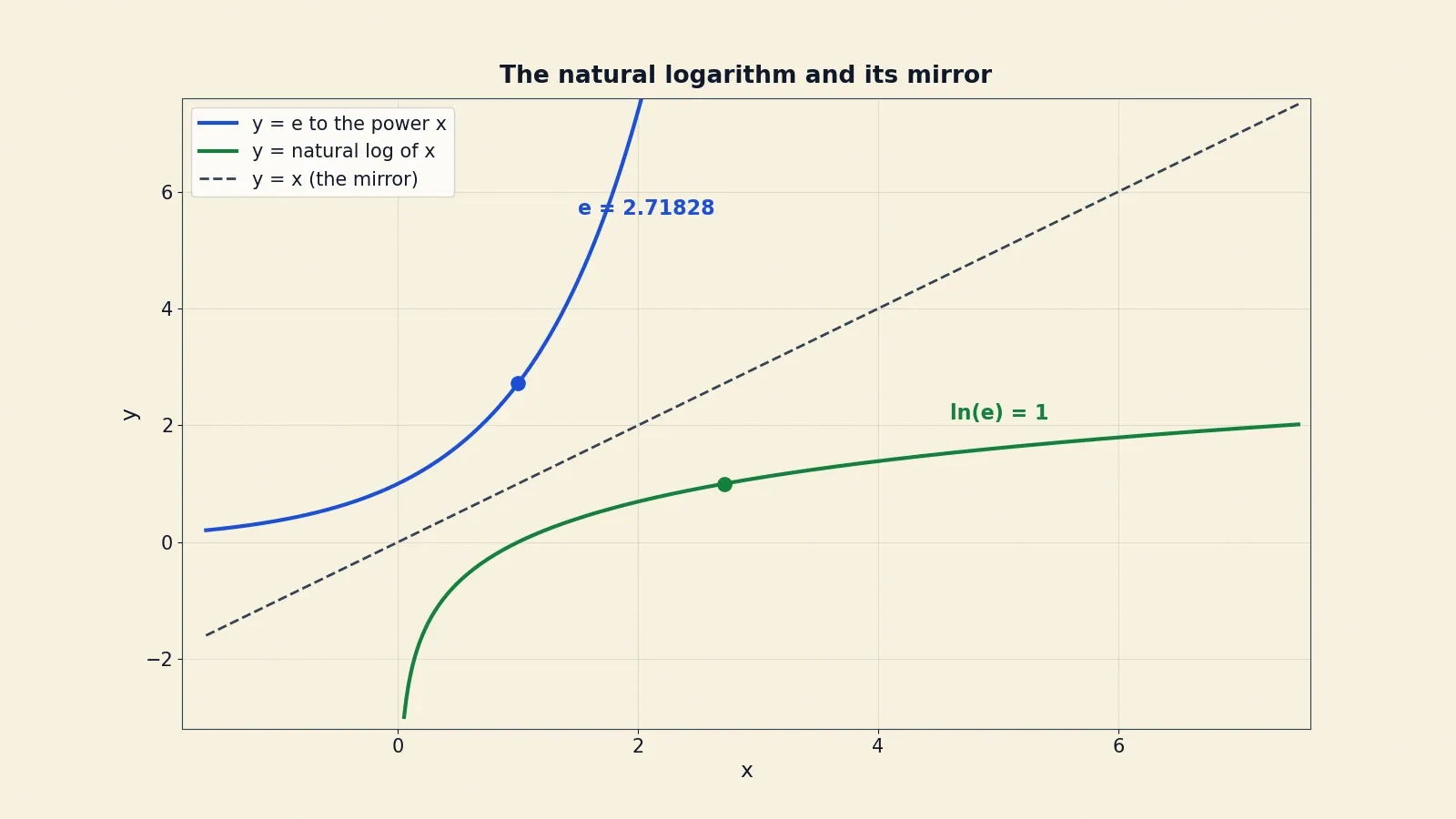
Figure 5 shows the natural logarithm and its mirror, e to the power of x. The two curves reflect across the diagonal line, exactly as the base-two curves did in Figure 1. The point where e to the power of one equals e lands on the point where the natural logarithm of e equals one. The shape is the same as before. Only the base has changed, and the base changes the steepness, not the idea. Every logarithm is a mirror of its exponential. The natural logarithm is the mirror that calculus finds most convenient.
A few values are worth memorising. The natural logarithm of one is zero, like every logarithm of one. The natural logarithm of e is one. The natural logarithm of two is about zero point six nine three one. The natural logarithm of ten is about two point three zero two six. That last number is the conversion factor between natural and common logarithms: any natural logarithm is about two point three zero three times the corresponding common logarithm. Keep those four numbers in your pocket, and you can estimate most natural logarithms in your head.
Students often ask whether they should use "log" or "ln" for a given problem. The answer is practical. In school, "log" usually means base ten, and "ln" means base e. In university mathematics and science, "log" often means base e, and the writer will say so or expect you to know. The change-of-base formula from section 5 means you can always convert, so the choice is a matter of convenience, not of correctness. Use the base that makes your problem simplest. For growth and decay, that base is usually e. For counting digits and orders of magnitude, it is usually ten.
9. Base 2: The Logarithm of the Digital World
Base two is the logarithm of the digital world, and it earns that title honestly. Every computer, every phone, every digital camera stores information as bits, and a bit is a choice between two things: zero or one, off or on, yes or no. The logarithm to base two counts those choices. Log base two of a number tells you how many bits you need to represent that number, how many yes-or-no questions you need to find it, and how many times you need to halve a problem to solve it.
Start with counting. One bit distinguishes two possibilities. Two bits distinguish four. Three bits distinguish eight. Four bits distinguish sixteen. Each extra bit doubles the number of possibilities, because each bit is an independent choice. Log base two of sixteen is four, because four bits are exactly enough to count to sixteen. Log base two of a thousand is about nine point nine seven, so you need ten bits to count to a thousand — nine bits give you only five hundred and twelve possibilities, and ten give you a thousand and twenty-four. That is why a ten-bit number runs from zero to a thousand and twenty-three. The logarithm is doing the counting.
The guessing game makes the same idea vivid. Suppose someone thinks of a number between one and a hundred, and you may ask only yes-or-no questions. How many questions do you need? If you guess one by one, you might need a hundred. If you halve the range each time — is it above fifty, is it above seventy-five — you need about seven questions, because log base two of a hundred is about six point six four. Seven halvings shrink a hundred possibilities to one. That halving strategy is called binary search, and it is one of the most important ideas in computer science. Its speed comes directly from the logarithm. A million possibilities need only about twenty questions, because log base two of a million is about nineteen point nine three. A billion need about thirty. The logarithm turns an impossible search into a short conversation.
Doubling works the same way in reverse. A single bacterium dividing every twenty minutes becomes two, then four, then eight, then sixteen. After ten divisions there are about a thousand bacteria. After twenty divisions there are about a million. The logarithm of the population, base two, is simply the number of divisions. Biologists, epidemiologists, and computer scientists all use that count, because it turns explosive growth into a steady tick of generations. Our Statistics article shows how easily exponential growth misleads the eye, and the base-two logarithm is the antidote: it counts the doublings instead of the crowd.
Information theory, the science of communication, is built on base-two logarithms. Claude Shannon, working in the 1940s, defined the information in a message by the logarithm of the number of possibilities it rules out. A message that picks one possibility out of eight carries three bits of information, because log base two of eight is three. A message that picks one out of a thousand carries about ten bits. The logarithm measures surprise: the less likely the outcome, the more bits it takes to describe it. Every file compression scheme, every error-correcting code, and every digital transmission standard rests on that definition.
Base two also governs the way computers search, sort, and store. A binary search tree with a million entries is only about twenty levels deep, because each level halves the search. A sorting algorithm that splits its input in half at every step runs in time proportional to n times log base two of n, the famous n log n bound. A hash table, a database index, a decision tree — all of them pay the logarithm's price, and the price is small. That is why computers can search the entire web in a fraction of a second. They are not checking every page. They are halving, and halving again, and the logarithm counts the halvings.
There is a pleasing symmetry here. Base ten counts digits, because we have ten fingers. Base two counts bits, because computers have two states. Base e counts continuous growth, because nature grows continuously. Three bases, three worlds, one idea. The logarithm does not care which world you live in. It counts the steps, whatever the step size is, and hands you a number you can work with.
For students meeting base two for the first time, the worked examples from section 2 are the place to start. Two to the power of three is eight, so log base two of eight is three. Two to the power of five is thirty-two, so log base two of thirty-two is five. Two to the power of ten is a thousand and twenty-four, so log base two of a thousand and twenty-four is ten. Those three facts — three, five, ten — are the skeleton of binary thinking. Hang everything else on them, and base two stops being strange.
10. The Richter Scale: When the Earth Speaks in Logarithms
Earthquakes span an impossible range. A tremor you barely feel and a quake that reshapes a coastline differ in energy by a factor of millions, and no ordinary scale can hold them both. The Richter scale solves that problem with a logarithm. It measures the size of an earthquake by the base-ten logarithm of the shaking, and in doing so it squeezes the whole range of earthquakes, from the faintest tremor to the greatest disaster in recorded history, onto a scale that runs from zero to about ten.
The scale was developed in 1935 by Charles F. Richter, working with Beno Gutenberg at the California Institute of Technology. It was built for Southern California earthquakes, measured on Wood–Anderson torsion seismographs placed a hundred kilometres from the epicentre. Magnitude zero meant a needle movement of one micrometre, a millionth of a metre, on that instrument. Every whole step up the scale multiplies the shaking amplitude by ten. A magnitude six earthquake shakes the ground ten times as hard as a magnitude five. A magnitude seven shakes it a hundred times as hard. The logarithm is the scale, and the ten-fold step is its heartbeat.
Amplitude is only half the story. The energy an earthquake releases grows even faster than its shaking, by a factor of about thirty-one point six for each whole step in magnitude. That number comes from the physics of seismic waves: energy grows as the amplitude to the power of one point five, and ten to the power of one point five is about thirty-one point six two. A magnitude six earthquake releases about thirty-two times the energy of a magnitude five. A magnitude seven releases about a thousand times the energy of a magnitude five. A magnitude eight releases about thirty-two thousand times. The numbers climb fast, because each step multiplies by thirty-two, and multiplication compounds.
The largest earthquake ever recorded makes the point brutally clear. On 22 May 1960, at 19:11 UTC, the ground off Valdivia in Chile tore loose in an earthquake of magnitude nine point five, the Great Chilean Earthquake. It killed one thousand six hundred and fifty-five people, according to the United States Geological Survey, and left two million homeless. The shaking lasted for minutes. The tsunami it raised crossed the Pacific and struck Hawaii, Japan, and the Philippines. A magnitude nine point five earthquake releases about five point six million times the energy of a magnitude five earthquake, and about thirty-one thousand six hundred times the shaking amplitude. Those numbers are hard to hold in the mind, and that is exactly why the logarithmic scale exists: it turns five point six million into the difference between nine point five and five, a gap of four and a half steps.
Modern seismology adds a caution to the story. The original Richter scale was a local magnitude scale, built for Southern California and for the instruments of 1935. It saturates for very large earthquakes, meaning it stops distinguishing between them accurately. Today, large earthquakes are reported on the moment magnitude scale, and the nine point five for Valdivia is a moment magnitude. Newspapers still say "Richter scale" out of habit, and the numbers are the same to a first approximation, but the instrument behind the modern number is different. The logarithm survived. The seismograph changed.
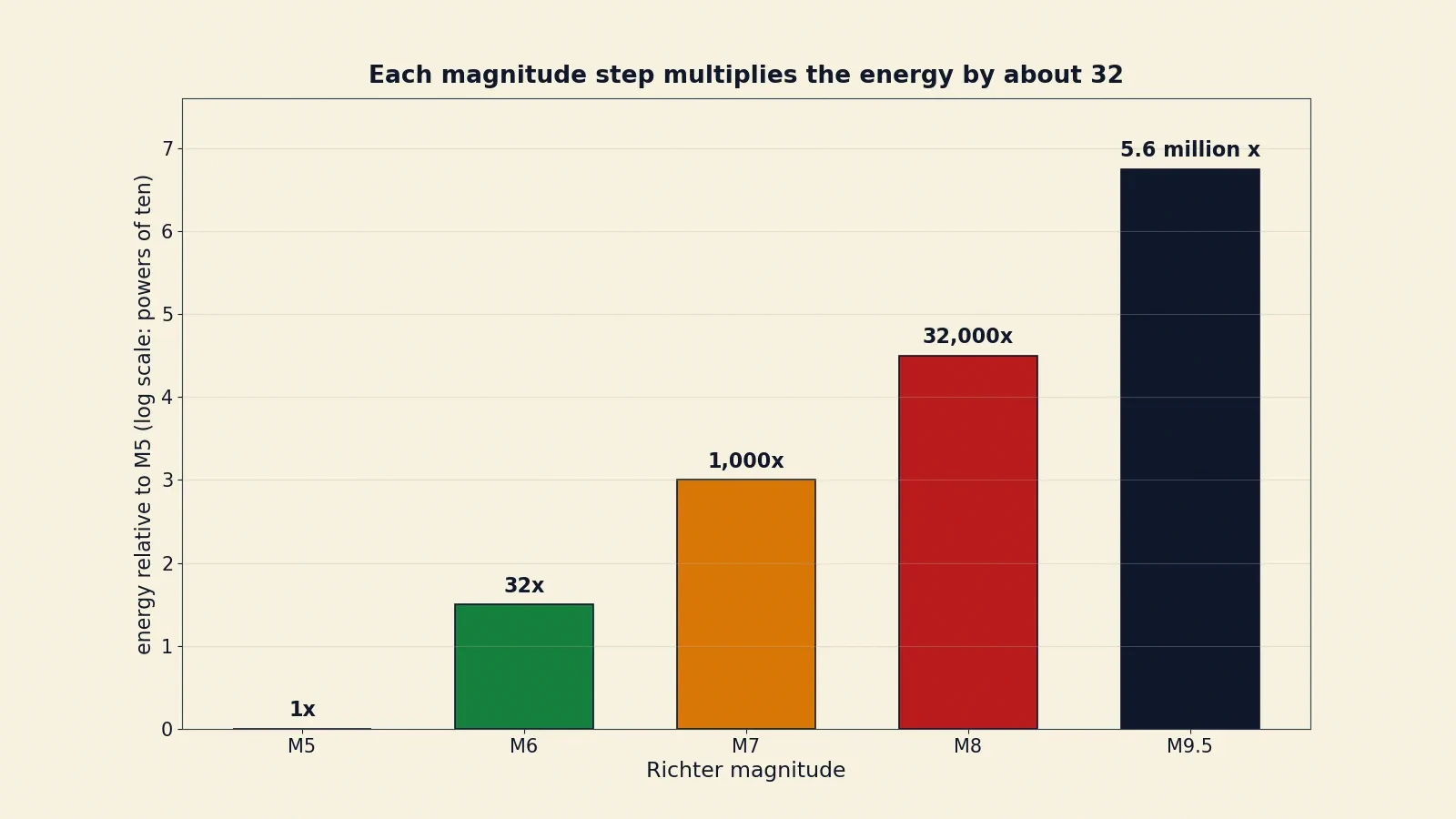
The table below puts the same numbers in order, so you can see the pattern at a glance. Read down the amplitude column and watch it multiply by ten at each step. Read down the energy column and watch it multiply by about thirty-two. Two columns, one logarithm, and a range of energies that spans more than six orders of magnitude.
| Magnitude | Shaking amplitude relative to magnitude 5 | Energy released relative to magnitude 5 |
|---|---|---|
| 5 | 1 | 1 |
| 6 | 10 | 32 |
| 7 | 100 | 1,000 |
| 8 | 1,000 | 32,000 |
| 9.5 | 31,623 | 5.6 million |
I remember watching the news of a magnitude seven earthquake as a teenager and thinking, wrongly, that it was "two worse" than a magnitude five. It is not two worse. It is a hundred times the shaking and a thousand times the energy. The scale is logarithmic, so a difference of two is a factor of a thousand, not a difference of two. That misunderstanding is common, and it is dangerous, because it makes great earthquakes sound only a little bigger than small ones. They are not a little bigger. They are a different world.
The United States Geological Survey lists the Valdivia earthquake as the largest ever recorded, magnitude nine point five, and its account gives the death toll as one thousand six hundred and fifty-five, with two million homeless. Other estimates run higher, up to about six thousand, but the Survey figure is the one to quote, and the range is worth stating honestly. A logarithm can measure the shaking precisely. Counting the dead is a different, harder business, and the numbers carry their own uncertainty.
The lesson of the Richter scale reaches beyond seismology. Whenever a quantity spans many orders of magnitude, a logarithmic scale is the honest way to show it. An ordinary scale would squash all the small earthquakes into invisibility and stretch the large ones off the page. A logarithmic scale gives every earthquake its fair share of room, because it measures ratios. A magnitude six is ten times a magnitude five, and a magnitude seven is ten times a magnitude six, and the scale shows those equal ratios as equal steps. That is the visual promise of Figure 4, kept in the real world.
11. Decibels: Why Loudness Is Logarithmic
Sound is the second great logarithmic scale in everyday life, and it works for a simple reason: your ears are logarithmic instruments. The faintest sound you can hear and the loudest sound you can bear differ in intensity by a factor of about a trillion, and your hearing has to cover that whole range. It does so by responding to ratios, not to differences. A sound that is twice as intense does not sound twice as loud. A sound that is ten times as intense sounds like one step louder. Your ears count in logarithms, whether you know it or not.
The decibel scale measures that response. A decibel, named for Alexander Graham Bell, is a tenth of a bel, and it is defined by a logarithm: the sound level in decibels is ten times the base-ten logarithm of the intensity ratio. Double the intensity and the level rises by about three decibels. Multiply the intensity by ten and the level rises by ten decibels. Multiply it by a hundred and the level rises by twenty. The scale runs from zero decibels, the threshold of hearing at a reference intensity of ten to the power of minus twelve watts per square metre, upward through the sounds of daily life.
The numbers need care, because sources disagree on the exact values for everyday sounds, and a single exact figure would be dishonest. A whisper measures about thirty decibels, a figure the Centers for Disease Control and Prevention confirms. Normal conversation measures about sixty decibels, though close-range talk can run to sixty or seventy, and the CDC's own pages give sixty-five to eighty for a talking voice at arm's length. A rock concert measures about a hundred and ten decibels as a typical figure, with the CDC giving a range of ninety-five to a hundred and fifteen for concerts and nightclubs, and textbooks giving up to about a hundred and twenty in the front row. The threshold of pain sits at about a hundred and twenty decibels, often quoted as a hundred and twenty to a hundred and thirty. Treat these as ranges with typical values, not as exact readings, and the scale stays honest.
The ratios behind those numbers are what matter. A whisper at thirty decibels and a conversation at sixty differ by thirty decibels, which is ten to the power of three, or a thousand times the intensity. A conversation at sixty and a lawnmower at ninety differ by thirty decibels again, another thousand times. A lawnmower at ninety and a rock concert at a hundred and ten differ by twenty decibels, a hundred times. A rock concert at a hundred and ten and the threshold of pain at a hundred and twenty differ by ten decibels, ten times. Add the steps together and the full range from a whisper to the threshold of pain is ninety decibels, which is ten to the power of nine — a billion times the intensity. Your ears cover a billion-fold range, and they do it by counting in tens.
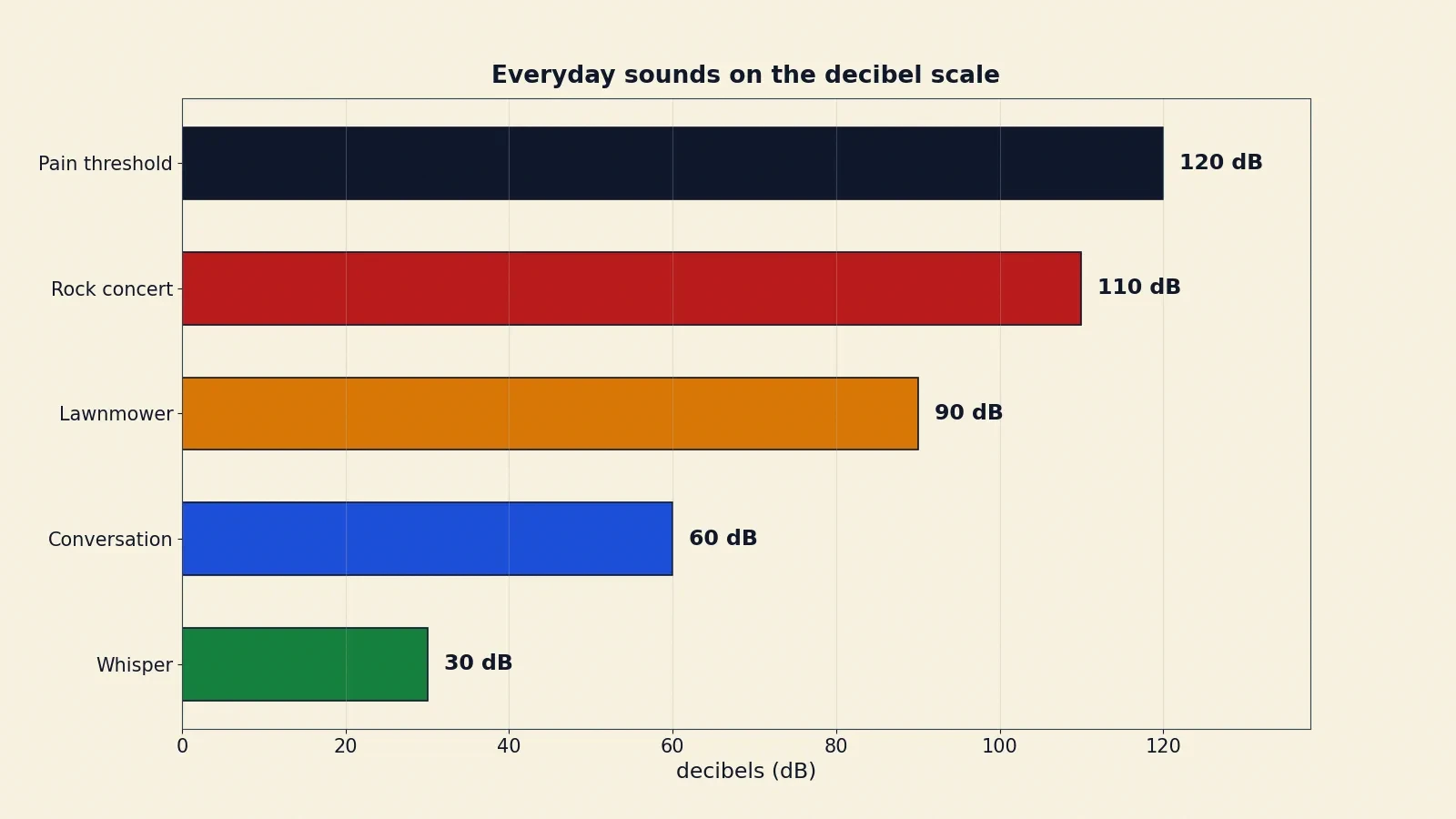
The table below makes the intensity ratios explicit. The decibel column climbs by ten at a time, in easy steps. The intensity column multiplies by ten at each step, and by a thousand across each thirty-decibel gap. The last row is the one to remember: the threshold of pain carries a billion times the intensity of a whisper, and the difference on the scale is only ninety decibels. Compression is the point of the scale. Without it, the numbers would be unusable.
| Sound | Level in decibels | Intensity relative to a whisper |
|---|---|---|
| Whisper | 30 | 1 |
| Normal conversation | 60 | 1,000 |
| Lawnmower | 90 | 1,000,000 |
| Rock concert | 110 | 100,000,000 |
| Threshold of pain | 120 | 1,000,000,000 |
The decibel scale also carries a safety message, and it is worth hearing. The National Institute for Occupational Safety and Health recommends an exposure limit of eighty-five decibels averaged over eight hours, and every extra three decibels halves the safe exposure time. Eighty-eight decibels is safe for four hours. Ninety-one decibels is safe for two. A hundred decibels is safe for about fifteen minutes. The three-decibel rule is a logarithm in disguise: three decibels is a doubling of intensity, and doubling the intensity halves the time your ears can take it. Sounds at or below seventy decibels are unlikely to cause hearing loss even after long exposure, according to the National Institute on Deafness and Other Communication Disorders. The scale is not only a way of measuring sound. It is a way of protecting the instrument that hears it.
I learned that lesson at a concert in my twenties, standing too close to the speakers for too long, and walking out with a ringing in my ears that lasted until morning. The ringing faded. The lesson stayed. A hundred and ten decibels is not "a bit louder" than a conversation at sixty. It is a hundred million times the intensity. The logarithm tells the truth that the ear, dulled by the moment, does not. The Centers for Disease Control and Prevention's hearing guidance gives the everyday levels — whisper thirty, concerts ninety-five to a hundred and fifteen — and it is worth reading before your next loud night out.
There is a subtlety worth noting for careful readers. The decibel formula uses ten times the logarithm for intensity and power, but twenty times the logarithm for amplitude and pressure, because intensity is proportional to amplitude squared. Ten times the logarithm of a squared quantity is twenty times the logarithm of the quantity itself, by the power rule from section 4. The two formulas agree. They are the same rule, applied to two ways of measuring the same sound. If you ever see "twenty log" in a textbook, it is not a different scale. It is the same scale, measured from the other side.
12. pH, Stars, and the Logarithmic World Around You
Logarithms do not stop at earthquakes and sound. They turn up everywhere a quantity spans a huge range, and the world is full of such quantities. This section takes three of them — acidity, starlight, and the first digits of ordinary numbers — and shows the same staircase at work in each. The pH part is deliberately short, because Sciory already has a full article on the subject, and this article will link to it rather than repeat it.
The pH scale measures acidity by the negative base-ten logarithm of the hydrogen-ion concentration. A solution with a hydrogen-ion concentration of ten to the power of minus three moles per litre has a pH of three. A concentration of ten to the power of minus seven has a pH of seven. Each step of one in pH means a ten-fold change in concentration. Lemon juice, at a pH of about two, is a hundred thousand times more acidic than pure water at pH seven, because the difference is five steps. The scale was introduced in 1909 by the Danish chemist Søren Peter Lauritz Sørensen, working at the Carlsberg Laboratory in Copenhagen. The full story, with the chemistry and the everyday examples, is in our article What Is pH? The pH Scale Explained, and readers who want the detail should go there. Here, the point is only the pattern: acidity, like earthquakes and sound, is measured in logarithms, because the underlying quantity spans too many orders of magnitude for an ordinary scale.
Starlight follows the same pattern, and its history is older than the pH scale by two thousand years. The Greek astronomer Hipparchus, working in the second century BCE, sorted the stars into six magnitudes, with the brightest stars as magnitude one and the faintest visible stars as magnitude six. Some two thousand years later, astronomers discovered that the scale was logarithmic all along. A difference of five magnitudes corresponds to a factor of a hundred in brightness, so each magnitude step is a factor of about two point five one two in brightness. A first-magnitude star is a hundred times brighter than a sixth-magnitude star. The ancient scale, built by eye, had been counting in logarithms without knowing it. Modern astronomy keeps the scale, with negative magnitudes for the brightest objects: the Sun is about magnitude minus twenty-six point seven, the full Moon about minus twelve point seven, and the faintest objects the largest telescopes can see are around magnitude thirty, with Hubble's deepest fields reaching about thirty-one. From minus twenty-seven to plus thirty, the whole visible universe fits on a logarithmic scale fifty-seven steps long.
Benford's law is the strangest logarithmic pattern of all, and it starts with a small observation about worn books. In 1881, the astronomer Simon Newcomb noticed that the early pages of logarithm tables — the pages for numbers beginning with one — were far more worn than the later pages. People were looking up numbers beginning with one far more often than numbers beginning with nine. He worked out why, and the reason is logarithms. The physicist Frank Benford rediscovered the pattern in 1938, in a paper called "The Law of Anomalous Numbers", published in the Proceedings of the American Philosophical Society, based on twenty thousand two hundred and twenty-nine observations drawn from twenty groups of numbers: river areas, city populations, physical constants, newspaper figures, and more.
The law says the first digit of a number in many real collections is not equally likely to be any digit from one to nine. The digit one appears about thirty point one percent of the time. Two appears about seventeen point six percent. Three appears about twelve point five percent. Four appears about nine point seven percent. Five appears about seven point nine percent. Six appears about six point seven percent. Seven appears about five point eight percent. Eight appears about five point one percent. Nine appears about four point six percent. If the digits were equally likely, each would appear about eleven point one percent of the time. Instead, one appears about six and a half times as often as nine.
The formula is simple: the probability that the first digit is d equals log base ten of one plus one over d. For d equals one, that is log base ten of two, which is about zero point three zero one zero — thirty point one percent. For d equals nine, it is log base ten of one point one one one, about zero point zero four five eight — four point six percent. The pattern follows from the logarithm itself. On a logarithmic scale, the numbers from one to two take up more room than the numbers from nine to ten, because the logarithm grows fastest at the start of each decade and slowest at the end. Count the room, and you count the digits.
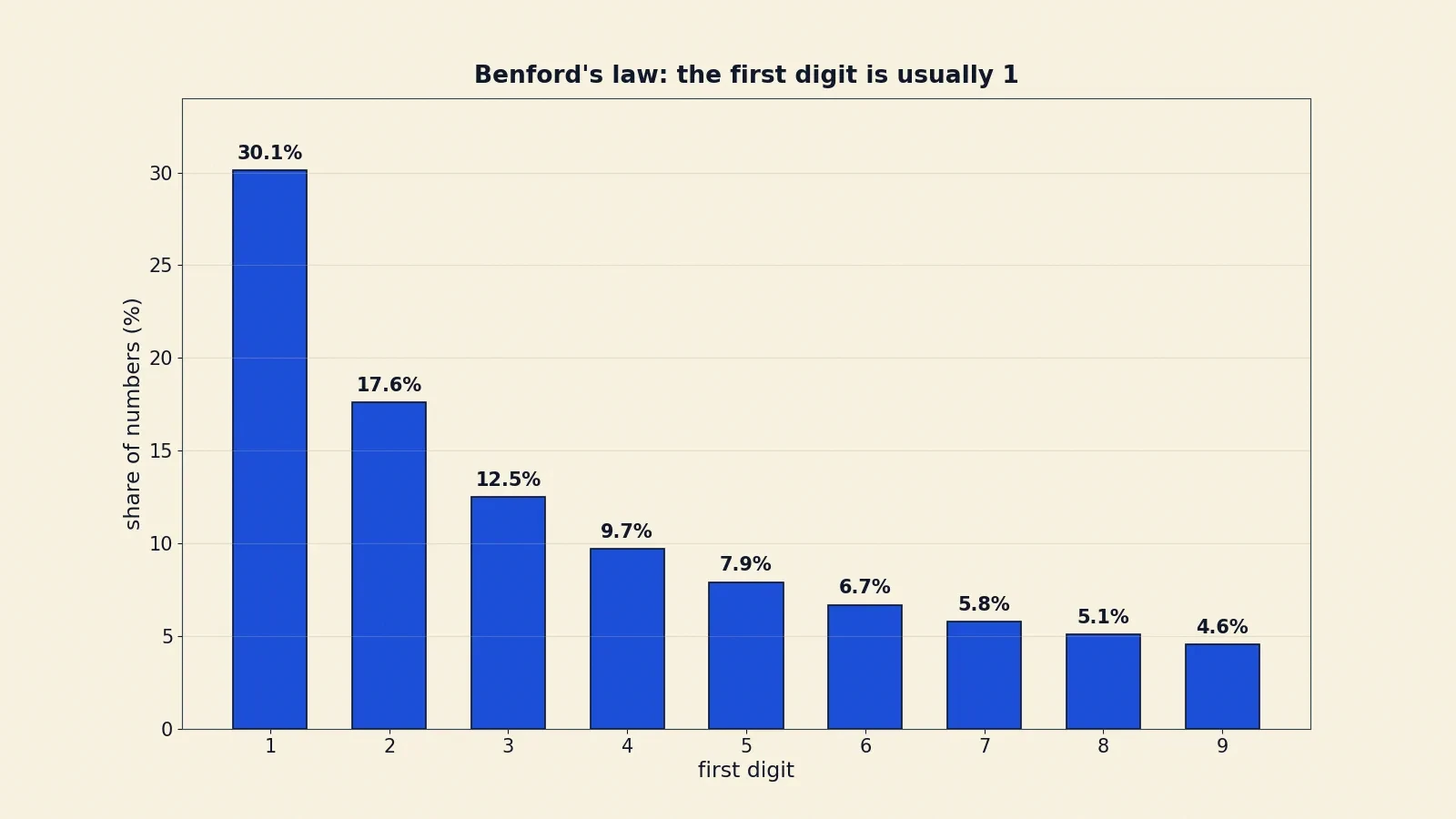
Benford's own data gave thirty point six percent for the digit one and four point seven percent for nine — close to the theoretical thirty point one and four point six, but not identical, because real data is messy and the law is a statistical pattern, not a rigid rule. Today, accountants and auditors use Benford's law to flag data that deserves a second look. If a set of accounts has too many numbers beginning with nine and too few beginning with one, something may be wrong — though the law can only flag an anomaly, never prove fabrication on its own. Fabricated numbers tend to look uniform, because people inventing numbers spread the first digits evenly. Real numbers do not. They follow the logarithm.
The same logarithmic shape appears in places you might not expect. The frequencies of musical notes are logarithmic: each octave doubles the frequency, so the notes of a piano are spaced equally on a logarithmic scale. The brightness of a screen, the strength of a perfume, the intensity of a taste — human senses respond to ratios, and ratios are logarithms. Even the way we think about numbers may be logarithmic: experiments suggest that young children, and adults in cultures without formal schooling, place numbers on a mental number line by ratio rather than by difference, putting three closer to six than six is to nine. We are logarithmic creatures living in a logarithmic world, and the formal mathematics only names what our senses already do.
13. The Mistakes Everyone Makes
Logarithms are easy to get wrong in a small number of predictable ways, and this section collects them in one place so you can recognise each one before it bites. Every mistake below is one I have seen students make, and most of them I have made myself at some point. The corrections are short. The habit of checking for them is worth building.
The first mistake is taking the logarithm of zero or of a negative number and expecting an answer. There is none, in real numbers. The logarithm of x asks what power of the base gives x. No power of a positive base gives zero, because a positive number raised to any power stays positive and never reaches zero. No power of a positive base gives a negative number, for the same reason. Log of zero is undefined, and log of a negative number is undefined, in the real numbers. As x approaches zero from above, log of x falls without limit toward negative infinity, but it never arrives. In complex numbers, logarithms of negative numbers exist, but they are multi-valued and belong to a later course. For this article, the rule is simple: the argument of a logarithm must be positive.
The second mistake is splitting a logarithm over a sum. Log of a plus b is not log of a plus log of b. There is no rule for a sum inside a logarithm, and the product rule does not apply, because a plus b is not a product. The numbers show it plainly. Log base ten of a hundred plus a thousand — log of eleven hundred — is about three point zero four one four. Log base ten of a hundred is two, and log base ten of a thousand is three, and two plus three is five. Five is not three point zero four one four. The sum rule you want does not exist. If you meet log of a sum, leave it alone, or expand it some other way. Do not split it.
The third mistake is the mirror image of the second: dividing logarithms instead of subtracting them. Log of a divided by log of b is not log of a divided by b. The quotient rule subtracts logarithms; it does not divide them. Log base ten of a thousand divided by log base ten of a hundred is three divided by two, which is one point five. Log base ten of a thousand divided by a hundred — log of ten — is one. One point five is not one. The error is easy to make when you are working fast, and the only cure is to write the rule down and check which operation it uses. Quotient means subtract the logs. Product means add them. Division of logs means nothing at all.
The fourth mistake is "cancelling" logarithms as if they were ordinary factors. From log of x equals log of y, you may conclude that x equals y, because the logarithm is a one-to-one function: different inputs give different logarithms. That step is legitimate. But from an equation like two times log of x equals log of y, you may not cancel the logs and conclude that two times x equals y. The correct step is the power rule: two times log of x is log of x squared, so x squared equals y. Cancelling the word "log" from both sides of an equation is like cancelling the word "square" from both sides of a squared equation. The operation matters. Respect it.
The fifth mistake is forgetting the base, or mixing bases in one calculation. Log base ten of a hundred is two, and log base two of a hundred is about six point six four, and those are different answers to different questions. Adding a base-ten logarithm to a base-two logarithm is meaningless until you convert one of them with the change-of-base formula. Students who write "log" without a base, then use a calculator button for a different base, get answers that are wrong by a fixed factor — two point three zero three, or three point three two two — and wonder why. The cure is to write the base down, every time, until it becomes a habit. A logarithm without a base is an unfinished sentence.
The sixth mistake is confusing log of x to a power with log of x, raised to a power. Log of x squared means the logarithm of the squared number, and the power rule turns it into two times log of x. The square of log of x — log of x, all squared — is a different thing entirely, and there is no rule that simplifies it. The notation is subtle, and textbooks do not always make the distinction clear. Read the parentheses, or the lack of them, with care. Where the power sits changes everything.
The seventh mistake is assuming that a logarithm must be a whole number. Most logarithms are not. Log base ten of two is about zero point three zero one zero, not one, not zero. Log base ten of fifty is about one point six nine nine zero. The whole-number logarithms — log of ten, log of a hundred, log of a thousand — are the easy landmarks, and they can fool you into thinking every logarithm lands on a landmark. It does not. The landmarks are the exception. The ordinary, fractional logarithms are the rule, and they are the ones the tables and calculators exist to find.
One more mistake deserves a mention, because it is about attitude rather than arithmetic. Students sometimes treat logarithms as a topic to survive and forget, a hurdle on the way to something else. That attitude wastes the subject. Logarithms are not a hurdle. They are a lens. Once you have the lens, you see logarithmic patterns in earthquakes, sound, acidity, starlight, money, and data, and you understand why those patterns look the way they do. The mistakes in this section are worth avoiding precisely because the subject behind them is worth keeping.
14. Why Logarithms Still Matter
It is fair to ask whether logarithms still matter, now that calculators do the arithmetic in an instant. The slide rule is gone. The tables are gone. The months of hand multiplication that Napier and Briggs were trying to save are gone too. What is left? The answer is that logarithms matter more than ever, because the arithmetic was never the whole point. The point was the idea, and the idea has moved into places Napier could never have imagined.
Start with algorithms, the recipes computers follow. The fastest search and sorting methods in computer science run in time proportional to the logarithm of the input size, because they halve the problem at every step. A database with a billion entries can be searched in about thirty steps, because log base two of a billion is about twenty-nine point nine. A sorting method that splits its input in half runs in n log n time, and that bound governs nearly every large-scale computation in the world. Without logarithms, there would be no honest way to describe how fast these methods are, and no way to compare one method with another. Our Chaos Theory article shows how small differences grow exponentially in chaotic systems, and logarithms are the tool that measures that growth.
Machine learning runs on logarithms too. The loss function that trains many classification models, called log loss, is built from logarithms, because logarithms turn products of probabilities into sums, and sums are easier to optimise than products. The same trick Napier used for multiplication, four hundred years ago, now trains the models that recognise speech, translate languages, and recommend films. The numbers have changed. The trick has not.
Finance uses logarithms to describe returns. An investment that grows by ten percent and then falls by ten percent does not return to where it started, because the percentages apply to different amounts. Logarithmic returns fix that problem: they add cleanly over time, so a gain followed by an equal loss cancels exactly. Traders, risk managers, and economists all work with log returns for that reason. The doubling-time calculation from section 8 — about eleven point nine years at six percent — is the simplest version of the same idea. Logarithms turn the compounding of money into addition, and addition is the operation finance understands best.
Science still leans on logarithms everywhere. The Prime Numbers article shows how the distribution of primes is governed by the logarithmic integral, and the Pi article shows how logarithms appear in the formulas for pi itself. Radioactive decay, population growth, chemical reaction rates, the cooling of the Earth, the brightness of stars — each of these is an exponential process, and each is understood through its logarithm. The Infinity article touches the same theme from the other end: logarithms grow so slowly that they are the natural counterweight to infinity itself. Algebra gives the tools for solving logarithmic equations, and the practice is worth doing, because the equations turn up in every science.
There is a deeper reason logarithms endure, and it is worth stating plainly. A logarithm is a way of thinking about size. Ordinary numbers measure size by difference: a thousand is nine hundred more than a hundred. Logarithms measure size by ratio: a thousand is ten times a hundred. For many of the quantities that matter — earthquakes, sounds, acidities, populations, prices, stars — ratio is the honest measure, and difference is misleading. A magnitude seven earthquake is not "two more" than a magnitude five. It is a thousand times the energy. A rock concert is not "fifty louder" than a conversation. It is a hundred thousand times the intensity. Logarithms say what the world actually does, and ordinary arithmetic does not.
That is why the subject survives the death of its original tools. The tables are gone, the slide rules are in museums, and the calculators do the arithmetic. The idea remains, because the world remains logarithmic. Napier spent twenty years building a tool for astronomers. He built something larger than he knew: a way of measuring a world that multiplies. Four hundred and twelve years after his book appeared, the question his student asked — how many times do I multiply? — is still the right question, and the logarithm is still the answer.
Frequently Asked Questions
What is a logarithm in simple terms?
What is a logarithm? It is the answer to the question "how many times do I multiply?" If ten to the power of three is a thousand, then the logarithm of a thousand, base ten, is three. A logarithm counts the multiplications needed to build a number from a chosen base. It is the inverse of exponentiation, the way subtraction is the inverse of addition. The number it returns is usually small even when the target is huge, because it counts steps rather than size.
What is a natural logarithm?
A natural logarithm, written "ln", is a logarithm to base e, where e is about 2.71828. The natural logarithm of e is 1, the natural logarithm of 1 is 0, the natural logarithm of 2 is about 0.6931, and the natural logarithm of 10 is about 2.3026. It is called natural because calculus prefers it: the derivative of the natural logarithm of x is one over x, the simplest form any logarithm gives. It is the logarithm of continuous growth and decay, from compound interest to radioactive dating.
What are logarithms used for?
Logarithms are used wherever quantities multiply rather than add. They turn multiplication into addition, which is how Napier and Briggs made astronomy and navigation practical in the 1600s. Today they measure earthquakes on the Richter scale, sound in decibels, and acidity in pH. They count bits in computing, describe the speed of search algorithms, train machine-learning models through log loss, and measure investment returns in finance. They also straighten exponential curves into lines, which makes growth and decay easy to read and compare.
Why are pH and decibels logarithmic?
pH and decibels are logarithmic because the quantities they measure span enormous ranges. Hydrogen-ion concentration runs from about one mole per litre in strong acid to ten to the power of minus fourteen in strong alkali, a range of fourteen orders of magnitude. Sound intensity runs from the threshold of hearing to the threshold of pain across about twelve orders of magnitude. An ordinary scale cannot hold such a range. A logarithmic scale can, because it measures ratios: each step of one in pH means ten times the concentration, and each ten decibels means ten times the intensity.
What is the difference between log and ln?
On a calculator, "log" means the common logarithm, base 10, and "ln" means the natural logarithm, base e. Log base 10 of 100 is 2, while the natural logarithm of 100 is about 4.6052. The two are proportional: any natural logarithm is about 2.3026 times the corresponding common logarithm, because the natural logarithm of 10 is about 2.3026. In school mathematics, "log" without a base usually means base 10. In university mathematics and science, "log" often means base e. When in doubt, check which base is meant, or convert with the change-of-base formula.
Can you take the logarithm of zero or a negative number?
No, not in real numbers. A logarithm asks what power of a positive base gives the target number, and no power of a positive base gives zero or a negative number. The logarithm of zero is undefined, and the logarithm of a negative number is undefined. As a positive number approaches zero, its logarithm falls without limit toward negative infinity, but it never reaches a value at zero itself. In complex numbers, logarithms of negative numbers exist, but they are multi-valued and belong to a later course.
Who invented logarithms?
John Napier published the first logarithms in 1614, in his Mirifici Logarithmorum Canonis Descriptio, after about twenty years of work. Henry Briggs then turned them into base-ten logarithms, publishing tables of 1 to 1,000 in 1617 and 30,000 logarithms in 1624. Jost Bürgi invented logarithms independently, probably as early as about 1588, but published only in 1620, so Napier has priority by publication. Leonhard Euler later gave the natural logarithm its modern form in 1748, and Jacob Bernoulli had first met the number e in 1683.
Do we still need logarithms now that calculators exist?
Yes, and more than ever. Calculators removed the need for printed logarithm tables and slide rules, but they did not remove the need for the idea. Logarithms describe how algorithms scale, how sound and earthquakes are measured, how money compounds, and how machine-learning models are trained. A calculator can compute a logarithm in an instant, but only a person who understands logarithms can decide when to take one, what base to use, and what the answer means. The arithmetic is automated. The thinking is not.
Sources
- Logarithm — Encyclopaedia Britannica
- Henry Briggs — Encyclopaedia Britannica
- Joost Bürgi — Encyclopaedia Britannica
- Difference Engine — Encyclopaedia Britannica
- Henry Briggs — MacTutor, University of St Andrews, Oxford Dictionary of National Biography article
- Jost Bürgi — MacTutor, University of St Andrews
- Pierre-Simon Laplace Quotations — MacTutor, University of St Andrews
- History of Logarithms — Wikipedia
- Mirifici Logarithmorum Canonis Descriptio — Wikipedia
- Introductio in analysin infinitorum — Wikipedia
- e (mathematical constant) — Wikipedia
- Benford's Law — Wikipedia
- 1960 Valdivia Earthquake — Wikipedia
- Slide Rule — Wikipedia
- pH — Wikipedia
- Natural Logarithm — Wikipedia
- 10 Largest Earthquakes Ever Recorded — United States Geological Survey
- Listen Up! Protect Your Hearing — Centers for Disease Control and Prevention
- Logarithm — Etymonline
- The pH Scale — LibreTexts Chemistry
- 6.3 Logarithmic Functions — OpenStax, College Algebra 2e
- 1.5 Exponential and Logarithmic Functions — OpenStax, Calculus Volume 1
- Intro to Logarithms — Khan Academy
- Logarithm — Wolfram MathWorld
- Natural Logarithm — Wolfram MathWorld