

1. The Craving That Arrives Uninvited — A Smell, a Street Corner, a Song
It starts with nothing. A smell drifting out of a doorway. A street corner you have walked past a hundred times. A song on the radio that you have not heard in years. And then it is there, whole and sudden, before you have had time to think: the urge. That is the science of addiction, arriving uninvited. Not a decision. Not a plan. A pull, physical and specific, as if your body remembered something your mind had filed away. If you have ever felt a craving arrive like that — for a cigarette, a drink, a drug, a slot machine, a phone screen at midnight — you have felt the central fact of the science of addiction. The craving did not come from nowhere. It came from a circuit in your brain that learned a lesson too well, and never forgot it.
I have spent years reading the research on this circuit, and the first thing that struck me was how ordinary the trigger can be. In one teaching session, I asked a room of students to name the last time a smell had carried them somewhere they did not intend to go. Hands went up at once: fresh bread and a childhood kitchen, rain on hot pavement and a summer years gone, a particular brand of soap and a person no longer in their life. Nobody in that room was talking about drugs. Everyone was describing the same machinery that addiction uses. A cue gets paired with a reward, the brain stamps in the association, and years later the cue alone can fire the wanting. The science of addiction is the study of what happens when that ordinary learning system meets a chemical that shouts instead of speaking.
Here is the puzzle the rest of this article works through. A person can know, clearly and honestly, that a drug is ruining their health, their work, and their relationships — and still use it. A person can stop for months, rebuild a life, and then walk past one familiar corner and feel the whole thing come roaring back. A person can take a larger and larger dose and feel less and less from it, while wanting it more and more. None of that makes sense if addiction is a failure of willpower, or a simple love of pleasure. All of it makes sense once you see the brain as a learning machine whose teacher has been hijacked. The science of addiction follows that hijacking step by step: the reward circuit that gets flooded, the tolerance that dulls it, the withdrawal that punishes its absence, the craving that outlives them both, and the slow, real possibility of recovery.
This article is organized around the framework that researchers in the science of addiction use most widely: the three-stage cycle described by George Koob and Nora Volkow — binge and intoxication, withdrawal and negative affect, preoccupation and anticipation. Each stage maps onto a different brain circuit, and each pass through the cycle leaves the brain a little more sensitized to cues and a little less responsive to ordinary pleasure. The cycle is a spiral, not a circle. It tightens. Along the way, this article takes up the question everyone asks first — what does dopamine actually do — and gives the answer that has replaced the old story: dopamine is not the pleasure chemical. It is a signal that says "that mattered, do it again," and drugs turn that signal up to a volume the brain was never built to hear.
A note on language before we begin. This article uses person-first language throughout: a person with a substance use disorder, not a label used as an identity. That is the standard in current clinical and public-health writing, and it reflects the science itself — addiction is a brain disorder involving circuits for reward, stress, and self-control, not a character flaw. The science of addiction has spent decades moving away from blame and toward mechanism.
2. What Addiction Is — And What It Is Not
How does addiction work, at the level of a definition? The National Institute on Drug Abuse, known as NIDA, defines addiction as "a chronic, relapsing disorder characterized by compulsive drug seeking and use despite adverse consequences." It is considered a brain disorder, NIDA explains, "because it involves functional changes to brain circuits involved in reward, stress, and self-control, and those changes may last a long time after a person has stopped taking drugs." Three words in that definition carry most of the weight: chronic, relapsing, and compulsive. Chronic means it is a long-term condition, managed rather than cured in a single episode. Relapsing means that returning to use is a known feature of the condition, not proof that the person is beyond help. Compulsive means the behavior persists even when the person can see the harm it causes — and that persistence is the clearest sign that something deeper than choice is at work.
The American Society of Addiction Medicine, in its 2019 definition, describes addiction as "a treatable, chronic medical disease involving complex interactions among brain circuits, genetics, the environment, and an individual's life experiences," marked by an inability to consistently abstain, impairment in behavioral control, craving, diminished recognition of significant problems, and a dysfunctional emotional response. The two definitions agree on the essentials, and the science of addiction starts from them: addiction is a medical condition, it involves the brain, it is shaped by genes and environment together, and it is treatable. The science of addiction is not a story that ends in damage. It is a story about a system that can change, in both directions.
I remember the first time I read Alan Leshner's 1997 editorial in the journal Science, titled "Addiction Is a Brain Disease, and It Matters." I was sitting in a reading room, working through a stack of papers on reward circuitry, and the argument landed with a force that surprised me. Leshner was not claiming that willpower is irrelevant or that people bear no responsibility for their actions. He was claiming something narrower and more radical: that the brain of a person with addiction has changed in measurable ways, and that any honest account of the condition has to start from those changes. Nearly three decades of brain imaging since then has filled in the picture he sketched — the reward circuit, the stress systems, the weakened prefrontal brake — and the brain-disease model remains the framework that organizes the field, even as researchers continue to debate its edges. Section 12 takes up that debate in full. For now, the definition is the starting point.
2.1 The NIDA definition, in plain language
Strip away the technical terms and the NIDA definition says this: addiction is a pattern of compulsive drug seeking and use that continues despite harm, driven by lasting changes in the brain's reward, stress, and self-control circuits. Each part of that sentence answers a different misunderstanding. "Compulsive" answers the idea that the person simply enjoys the drug and keeps choosing it freely. "Despite adverse consequences" answers the idea that the person does not know or does not care about the damage. "Lasting changes" answers the idea that stopping the drug returns the brain to normal overnight. It does not. The changes persist, sometimes for months, and that persistence is why recovery, in the science of addiction, is a process rather than an event. NIDA sets out the full definition in its booklet "Drugs, Brains, and Behavior: The Science of Addiction."
2.2 The DSM-5-TR checklist: 11 criteria and the mild-moderate-severe bands
Clinicians do not diagnose addiction by feel. They use the Diagnostic and Statistical Manual of Mental Disorders, fifth edition, text revision — the DSM-5-TR — which replaced the old separate diagnoses of "abuse" and "dependence" with a single diagnosis, substance use disorder, measured on a continuum from mild to severe. The manual lists 11 criteria in four groups, and a diagnosis requires two or more of them within a 12-month period. Severity follows the count: mild is 2 to 3 criteria, moderate is 4 to 5, and severe is 6 or more. The table below sets out all 11.
| Group | Criteria |
|---|---|
| Impaired control | Using more, or for longer, than intended; repeated failed efforts to cut down or stop; a great deal of time spent getting, using, or recovering from the substance; craving, or a strong urge to use |
| Social impairment | Failure to fulfill major obligations at work, school, or home; continued use despite persistent social or interpersonal problems; important social, work, or leisure activities given up or reduced |
| Risky use | Use in physically hazardous situations; continued use despite knowing it causes or worsens a physical or psychological problem |
| Pharmacological | Tolerance — needing markedly more for the same effect, or a markedly diminished effect from the same amount; withdrawal — the characteristic syndrome for the substance, or using the substance to avoid withdrawal |
Read the list slowly and something important becomes clear: only two of the 11 criteria are about the body's physical response to the drug. The other nine are about behavior — control, obligations, relationships, risk. That is why tolerance and withdrawal alone do not make an addiction, and why a person can be physically dependent on a prescribed medicine without having a substance use disorder at all. The manual says so explicitly: tolerance and withdrawal that occur only during appropriate medical treatment do not count toward a diagnosis. The science of addiction draws a firm line here, and section 8 returns to it in detail.
The DSM-5-TR chapter on substance-related and addictive disorders covers 10 classes of drugs: alcohol, caffeine, cannabis, hallucinogens, inhalants, opioids, sedatives, hypnotics and anxiolytics, stimulants, tobacco, and other or unknown substances.
2.3 Why the word "addiction" replaced "abuse" and "dependence" as diagnoses
The words changed because the categories did not work. Under the DSM-IV, published in 1994, a person could be diagnosed with substance "abuse" or substance "dependence" as two separate conditions. In practice the two overlapped heavily: many people met criteria for both, the line between them was unreliable, and the word "abuse" carried a moral judgment that the word "dependence" did not. When the DSM-5 arrived in 2013 — carried forward in the DSM-5-TR in 2022 — it replaced both labels with one diagnosis — substance use disorder — graded from mild to severe. The question was no longer which of two boxes a person belonged in, but how many of the 11 criteria they met.
The change was more than a tidy-up of terminology. It reflected a shift in how the field understands the condition: addiction is not a switch that is either on or off, but a spectrum, and two people with the same diagnosis can be in very different places on it. The word "addiction" itself remains in common use — in the title of this article, in clinic names, in everyday speech — but in the diagnostic manual it survives as a description of the severe end of the continuum rather than as a separate diagnosis. That is why this article uses "substance use disorder" when it is talking about the diagnosis, and "addiction" when it is talking about the condition as people live it.
3. How Common Is Addiction? The Numbers for 2025
The science of addiction is not a rare-disease story. It is a story about a condition that touches a large share of the population, and the latest national figures make the scale plain. The National Survey on Drug Use and Health, known as the NSDUH, is the United States government's annual household survey on substance use, run by the Substance Abuse and Mental Health Services Administration (SAMHSA). Its 2025 results, released on July 27, 2026 and based on more than 60,000 respondents, are the latest national figures available — and they are the numbers this article uses throughout. SAMHSA announced the 2025 results in its press release on the survey.
Among people aged 12 or older, 15.3 percent — 44.6 million people — had a substance use disorder in the past year. More than one person in seven. That figure is not an estimate from a clinic or a single study. It is a national survey, and it counts people across the whole country, in every age group from early adolescence onward. The breakdown inside that total is worth reading carefully, because it corrects a common picture of what addiction looks like in America.
| Measure (2025 NSDUH, ages 12+) | Figure | What it means |
|---|---|---|
| Any substance use disorder | 44.6 million (15.3%) | More than one person in seven |
| Alcohol use disorder | 25.7 million | The most common single substance use disorder |
| Drug use disorder | 26.0 million | Overlaps with alcohol use disorder; 7.1 million people had both |
| Marijuana use disorder | 19.3 million | The most common drug use disorder |
| Opioid use disorder | 4.0 million | Far smaller than alcohol or marijuana, but the deadliest |
| Stimulant use disorder | 4.5 million | Central nervous system stimulants, including methamphetamine and cocaine |
Two things in that table deserve attention. First, alcohol is the largest single piece of the problem — 25.7 million people — even though alcohol is legal, advertised, and woven into ordinary social life. The image of addiction as something that happens only with illegal drugs misses most of the people affected. Second, the categories overlap heavily: 7.1 million people had both an alcohol use disorder and a drug use disorder. Addiction rarely arrives as a single-substance story.
The overdose figures tell a different and more hopeful story — with a hard edge. The Centers for Disease Control and Prevention reported 79,384 drug overdose deaths in the United States in 2024, according to final mortality data released in January 2026. The age-adjusted overdose death rate fell 26.2 percent from 2023 to 2024, from 31.3 to 23.1 deaths per 100,000 people — the largest decline in the overdose death rate ever recorded. The number of deaths fell by about 24 percent from the 105,007 deaths recorded in 2023. The CDC, in a February 2025 statement on the decline, pointed to several contributing factors: wide distribution of the overdose-reversal drug naloxone, better access to evidence-based treatment, shifts in the illegal drug supply, services resuming after pandemic disruptions, and continued investment in prevention programs. The CDC announced the final figures in its January 2026 release.
That decline is real: tens of thousands fewer families lost someone in 2024 than in 2023. But 79,384 deaths is still an enormous number — more than 200 people a day — and the fall in deaths was steeper than the fall in the condition itself. The NSDUH figures show the number of people living with a substance use disorder fell — from 48.4 million (16.8%) in 2024 to 44.6 million (15.3%) in 2025. Fewer people died, and fewer people had the disorder — but the condition remains common, and the gap between the two trends is where the science of addiction does its most useful work: understanding why people develop the disorder, why they keep using, and what helps them stop.
4. The Reward Circuit — Dopamine as Teacher, Not Pleasure
What does dopamine do in addiction? Ask that question of almost anyone and you will get the same answer: dopamine is the pleasure chemical, the brain's reward juice, the thing that makes drugs feel good. That answer is wrong in a way that matters. It is wrong because it misplaces the mechanism, and once the mechanism is misplaced, everything downstream — tolerance, craving, relapse — stops making sense. The correction is the spine of the science of addiction, so this section takes it slowly.
The brain's reward circuit centers on dopamine neurons in the ventral tegmental area, a small cluster of cells deep in the midbrain, that project forward to the nucleus accumbens — the mesolimbic pathway — and to the prefrontal cortex — the mesocortical pathway. A third pathway runs from the substantia nigra to the dorsal striatum. The nucleus accumbens sits in the ventral striatum, and it is the hub where the signal lands. When researchers say that drugs "hijack the reward circuit," this is the circuit they mean: a pathway that evolved to teach the brain which behaviors are worth repeating, because they keep the organism alive.
I first grasped the shape of this circuit not from a textbook diagram but from a conversation in a lab corridor, years ago, when a colleague sketched it on the back of a printed agenda: a small dot in the midbrain, an arrow forward to a dot under the cortex, and then arrows fanning out. "That is the whole story," she said. "Everything else is commentary." She was exaggerating, as good teachers do, but only slightly. If you understand that one pathway — VTA to nucleus accumbens — and what the signal traveling along it actually encodes, you have the key to the science of addiction.
The hardware of this journey — neurons, action potentials, synapses, the brain regions involved — is covered in depth in our article on How the Nervous System Works. This article spends its words on what the circuit does, not on re-teaching neuroscience from the ground up.
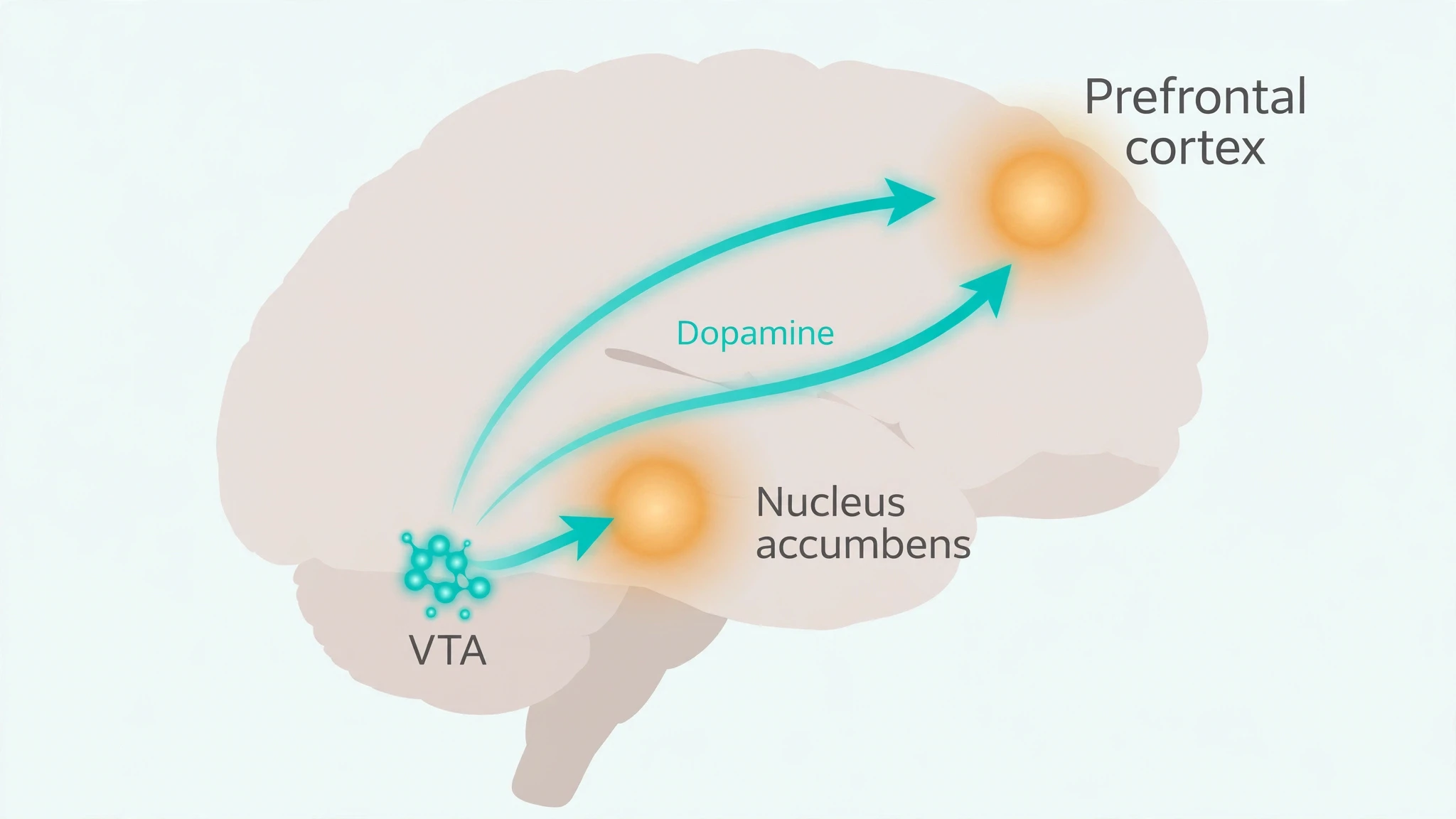
4.1 The circuit: VTA, nucleus accumbens, prefrontal cortex
The ventral tegmental area contains dopamine neurons that fire in two modes. Tonic firing is a slow, steady background drip that sets the baseline level of dopamine. Phasic firing is a brief burst, a sharp spike above baseline, and it is the phasic burst that carries the important message. Dopamine signals through five receptors, and the two best understood are D1 and D2. D1 receptors are low-affinity: they respond mainly to the large dopamine increases produced by phasic bursts, and they are implicated in drug reward and conditioning. D2 receptors are high-affinity: they respond to the low dopamine concentrations produced by tonic firing. That distinction — D1 for the burst, D2 for the background — will matter a great deal in the science of addiction when this article reaches tolerance and brain imaging, because chronic drug use changes D2 receptor availability in ways that show up on brain scans.
The nucleus accumbens is not a pleasure center. There is no single pleasure center in the brain. That sentence is worth reading twice, because the phrase "pleasure center" appears in almost every popular account of addiction, and it misleads in two directions at once. It suggests that pleasure lives in one place, and that dopamine is what produces it. Neither is true. Hedonic pleasure — the actual feeling of liking something — is mediated by small, fragile hedonic hotspots in the nucleus accumbens shell and the ventral pallidum, using endogenous opioids and endocannabinoids. Dopamine does something else entirely.
4.2 The Schultz experiment: dopamine fires for surprise, not reward
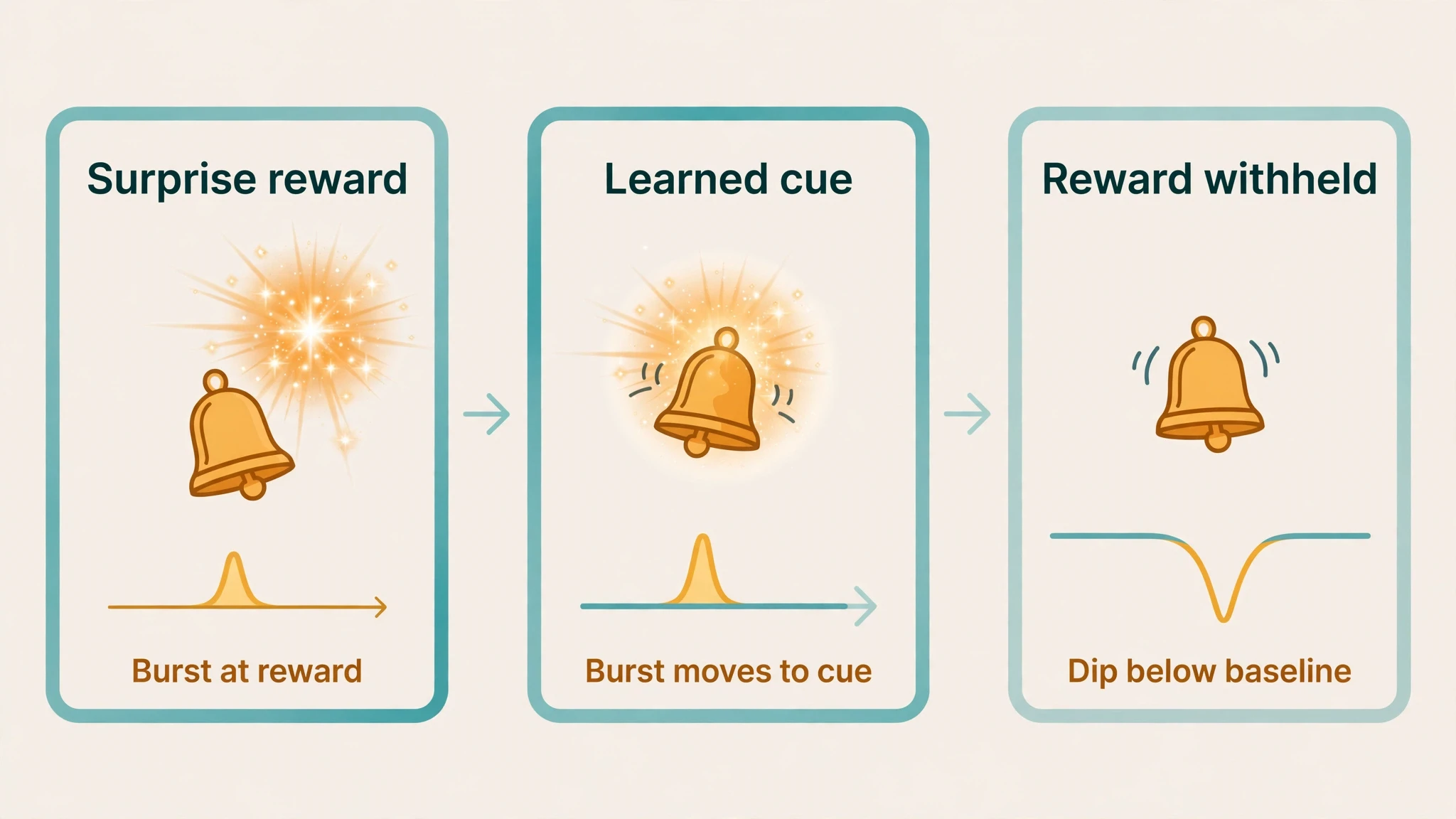
The decisive evidence came from Wolfram Schultz and his colleagues, who recorded from single dopamine neurons in monkeys as the animals learned that a cue predicted a reward. The pattern they found, published in Science in 1997, is one of the most elegant results in neuroscience. Before learning, dopamine neurons fire a brief burst when the animal receives an unexpected reward. As the animal learns that a cue — a light, a tone — predicts the reward, the burst migrates: it fires at the earliest predictive cue, and the neurons stay silent at the now-predicted reward itself. And if a predicted reward is then withheld, the neurons dip below baseline at the exact moment the reward was due. The signal is a reward prediction error — received minus expected — not a response to reward itself.
"Dopamine's role in reward does not seem to equate with hedonic pleasure, but instead dopamine appears to encode prediction of reward, imprinting incentive value to reinforcers and facilitating learning of reward associations." — Volkow and colleagues, "Addiction Circuitry in the Human Brain," Annual Review of Pharmacology and Toxicology, 2012
That single sentence, from a review by Nora Volkow and her colleagues, is the central correction of the science of addiction. Dopamine encodes prediction. It imprints incentive value. It facilitates learning. It does not produce pleasure. Once you accept that, the rest of the article falls into place: tolerance is the teaching signal getting quieter, craving is the teaching signal firing at a cue, and relapse is the lesson reasserting itself months later.
4.3 Liking is not wanting: hedonic hotspots vs the dopamine wanting system
Kent Berridge and Terry Robinson gave the field the language for the distinction: "liking" and "wanting" are separate systems. Liking is the hedonic impact of a reward — the actual pleasure of eating, of warmth, of a drug's effect — and it runs through small hedonic hotspots using opioids and endocannabinoids. Wanting is incentive motivation — the urge to seek, to approach, to obtain — and it runs through the large, robust dopamine system. The two usually travel together, which is why they are so easily confused. In addiction, they come apart. A person can want a drug intensely while liking it less and less. The high fades. The wanting grows. That split is the lived experience of addiction, and it has a name in the research literature: incentive sensitization. Section 9 takes it up in full.
The prefrontal cortex is the third piece of the circuit, and it is the brake. The orbitofrontal cortex assigns salience — what matters and how much. The anterior cingulate cortex handles inhibitory control. The dorsolateral prefrontal cortex handles executive function: planning, weighing consequences, holding a goal in mind while distractions pull at it. In addiction, the function of all three is disrupted, and brain imaging shows reduced activity in these regions alongside reduced D2 receptor availability in the striatum. The brake weakens at the same time the accelerator gets more sensitive. That combination — a sensitized wanting system and a weakened control system — is the neurobiological core of compulsive use. The same prefrontal circuits appear in other conditions too. Our article on ADHD Explained covers dopamine, the prefrontal cortex, and executive function in depth, and the parallels with addiction are real: the same brake, the same transmitter, different ways of failing.
5. The Science of Addiction in Three Stages — The Cycle That Tightens
If the reward circuit is the engine of the science of addiction, the three-stage cycle is the map of where the engine takes you. George Koob and Nora Volkow, in a framework first set out in detail in 2010, describe addiction as a composite cycle of three stages: binge and intoxication, withdrawal and negative affect, and preoccupation and anticipation — craving. Each stage maps onto a distinct brain circuit. Impulsivity dominates early, when use is driven by the pursuit of reward. Compulsivity dominates late, when use is driven by the need to escape distress. And the cycle is a spiral, not a circle: each pass through the three stages leaves the brain more sensitized to drug cues and less responsive to natural rewards, so the loop tightens with every turn.
The framework matters, in the science of addiction, because it replaces a single, static picture of addiction — a person who "likes drugs too much" — with a moving one. A person in stage 1 is in a different brain state from a person in stage 2, and a person in stage 3 is in a different state again. The same drug, the same person, three different mechanisms, three different reasons for using. Anyone who has watched a loved one move from weekend use to daily use to use that seems to happen almost automatically has watched this cycle tighten in real time. The science of addiction gives that observation a name and a circuit diagram.
Koob and Le Moal added a concept that explains why the spiral tightens: allostasis. In their 1997 model, chronic drug use shifts the hedonic set point — the brain's baseline for feeling okay — and produces a state of dysregulation characterized by enhanced sensitivity to drug-associated stimuli and drug-opposite adaptations in the brain's reward systems. Think of it as a thermostat that has been reset. The brain adapts to the drug's presence by turning down its own reward machinery and turning up its stress machinery, so that "normal" now requires the drug just to feel level. The set point has moved, and the person is chasing a baseline that keeps receding.
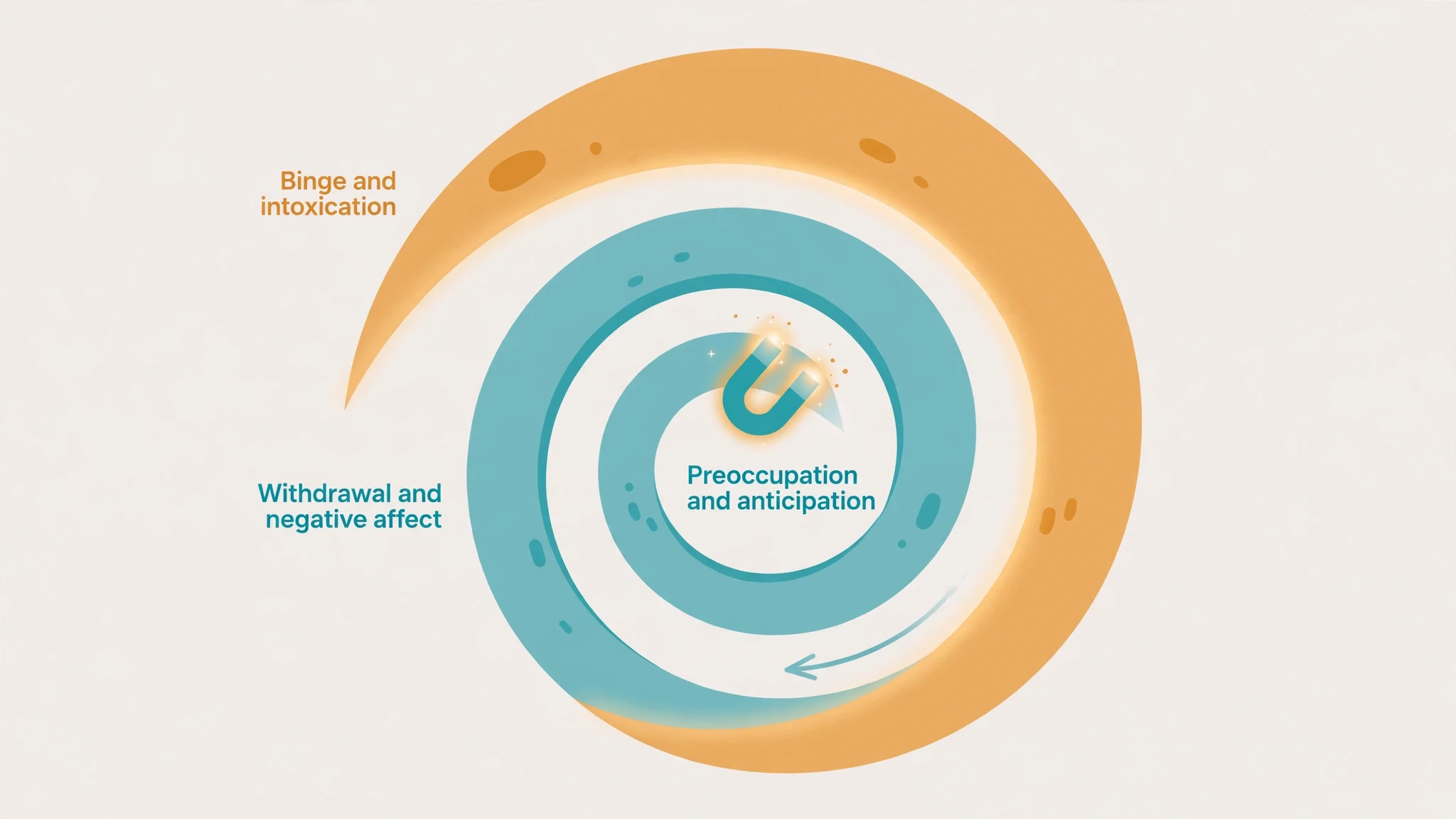
The three stages, in brief, before this article takes each one in turn:
- Stage 1 — Binge and intoxication. The drug floods the reward circuit. Dopamine surges in the nucleus accumbens, the drug and its cues are marked as important, and the behavior is stamped in. The driver is positive reinforcement: using to feel good.
- Stage 2 — Withdrawal and negative affect. The drug wears off and the bill arrives. Stress systems in the extended amygdala ramp up, producing dysphoria, anxiety, and irritability. The driver shifts to negative reinforcement: using to stop feeling bad.
- Stage 3 — Preoccupation and anticipation. Between episodes of use, craving dominates. Cues trigger wanting, the prefrontal brake weakens, and glutamate signaling from the cortex becomes dysregulated. The driver is anticipation: the brain rehearsing the drug before the drug arrives.
6. Stage 1 — Binge and Intoxication: The Hijacked Lesson
The first stage of the science of addiction is the one most people picture when they think of drugs: the rush, the high, the flood. The mechanism is straightforward to describe and startling in scale. Drugs of abuse can release 2 to 10 times the amount of dopamine that natural rewards such as eating and sex do, almost immediately when smoked or injected, and the effects can last much longer than those produced by natural rewards. That range — 2 to 10 times — comes from NIDA, and it is the only dopamine comparison this article uses, because the specific per-drug percentages that circulate on low-quality websites cannot be verified from an authoritative source. The honest number is a range, and the range is already large enough to explain the hijacking.
Natural rewards also raise dopamine in the nucleus accumbens — food, sex, social connection all do — but to a much smaller extent and for a much shorter time than drugs. The difference is not only size but speed. A meal raises dopamine gradually, over minutes, as you eat. A smoked or injected drug raises it in seconds. The brain's teaching system reads the size and the speed of the signal as a measure of importance, and a signal that large, that fast, gets stamped in as the most important lesson the brain has ever learned. The reward circuit evolved to teach survival behavior. Drugs deliver a chemically amplified version of the teaching signal, and the brain cannot tell the difference between a real lesson and a chemical forgery.
6.1 Many routes, one endpoint: how stimulants, opioids, alcohol, nicotine, and cannabis raise dopamine
Different drugs reach the same endpoint by different routes, and the variety is part of the story. Stimulants such as cocaine and amphetamine block the reuptake of dopamine and force its release, leaving more of it in the synapse for longer. Opioids and alcohol act indirectly: they disinhibit the dopamine neurons of the ventral tegmental area, largely by quieting the inhibitory GABA neurons that normally hold those cells in check — opioids through mu-opioid receptors on the GABA neurons. Nicotine stimulates nicotinic receptors directly on dopamine neurons. Cannabis acts through the endocannabinoid system. Five different pharmacologies, one common endpoint: a dopamine surge in the nucleus accumbens.
That convergence is why addiction researchers talk about a shared final pathway rather than a separate disease for each drug. The chemistry of the drug determines how it gets there. The circuit determines what happens once it arrives. It is also why the same three-stage cycle describes alcohol, opioids, stimulants, nicotine, and cannabis, despite their very different effects on the body. The drugs differ. The hijacked teaching signal is the same.
6.2 From choice to habit: the dorsal striatum takes over
As use repeats, something else shifts, and it is the shift that turns a chosen behavior into a compulsion. Early drug use is goal-directed: the person seeks the drug because they expect the reward, and the ventral striatum — the nucleus accumbens — is the center of that action. With repetition, control migrates to the dorsal striatum, the caudate and putamen, which handle habits: behaviors that run automatically in response to a cue, without the person weighing the outcome. The drug-seeking behavior becomes a habit in the strict neuroscience sense — triggered by context, executed without deliberation, and resistant to changes in the value of the outcome.
This migration explains one of the most confusing features of the science of addiction: a person can continue using a drug long after it has stopped being enjoyable, long after the consequences are obvious, and long after they sincerely intend to stop. The behavior is no longer being driven by the goal-directed system that weighs pros and cons. It is being driven by a habit system that responds to cues. The neurons, synapses, and striatal circuits behind that shift are covered in our article on How the Nervous System Works. That is also why the prefrontal cortex matters so much here. The orbitofrontal cortex, the anterior cingulate cortex, and the dorsolateral prefrontal cortex are the brain's planner and brake, and their function is disrupted in addiction — exactly the circuits that would be needed to interrupt a habit once it has formed. Our article on How the Human Brain Forms Memories covers how the hippocampus and related circuits stamp in associations between cues and outcomes, and the same machinery that lets you remember where you left your keys is what lets a street corner trigger a craving years later.
There is a parallel with Parkinson's disease, which involves the loss of dopamine neurons in the substantia nigra projecting to the same dorsal striatum — the loss of dopamine makes it hard to initiate movement, while in addiction the flooding of dopamine makes it hard to stop a learned behavior. Our article on Parkinson's Disease Explained covers that circuitry in depth.
7. What Is Tolerance? Why the Same Dose Stops Working
What is tolerance? NIDA's definition is plain: a need for markedly increased amounts of the substance to achieve intoxication or the desired effect, or a markedly diminished effect with continued use of the same amount. The same dose, less effect. More of the drug, the same effect as before. Tolerance is one of the 11 DSM-5-TR criteria, but on its own it is not addiction — a distinction this article has already made and will keep making, because it is one of the most commonly blurred lines in the whole subject.
Tolerance is the brain doing its job — a theme the science of addiction returns to often. The brain is a homeostatic organ: it defends its balance against disturbance, and a drug is a disturbance. Flood a synapse with dopamine day after day, and the brain adapts. It reduces the number of receptors on the surface of its neurons, or makes the ones it has less sensitive. It clears the drug faster. It learns to compensate in advance when the familiar setting signals that the drug is coming. Three adaptations, three kinds of tolerance.
| Kind of tolerance | How it works | Example |
|---|---|---|
| Metabolic (pharmacokinetic) | The body clears the drug faster, for instance by inducing liver enzymes | Chronic alcohol use increases the enzymes that break alcohol down |
| Cellular (pharmacodynamic) | Target cells become less responsive — receptors downregulate or desensitize | Dopamine D2 receptors become less available in the striatum with chronic use |
| Learned (behavioral, conditioned) | The body learns to compensate in familiar drug-taking environments | The same dose hits harder in a new setting, because the usual compensation does not fire — a factor in overdose |
7.1 Three kinds of tolerance: metabolic, cellular, learned
Metabolic tolerance is the body's plumbing adapting: chronic alcohol use induces the liver enzymes that break alcohol down, so the same amount is cleared faster and produces a smaller effect. Cellular tolerance is the brain's wiring adapting: receptors downregulate or desensitize, so the same amount of drug produces a smaller signal. Learned tolerance is the most unsettling of the three, because it shows that tolerance is not only chemistry but memory. The body learns the setting — the room, the people, the ritual — and begins compensating before the drug even arrives, blunting its effect in advance. In a new setting, where the learned compensation does not fire, the same dose hits harder. That is one reason overdose can happen at a dose a person has taken many times before: the dose was the same, but the context was different, and the body's preparation was absent.
7.2 Downregulation: the brain turns down its own receptors
Receptor downregulation is the centerpiece of cellular tolerance. With repeated drug exposure, neurons reduce the number of receptors on their surface, or make them less sensitive, to restore balance in a system that is being flooded. For dopamine, chronic use reduces D2 receptor availability in the striatum. Brain imaging with PET scans shows this clearly: people with addiction to alcohol, cocaine, methamphetamine, heroin, and nicotine have markedly decreased dopamine D2 receptor availability in the striatum and decreased dopamine release, and the decrease is associated with reduced activity in the orbitofrontal cortex, the cingulate gyrus, and the dorsolateral prefrontal cortex. The brake and the reward system decline together.
The D2 reduction is not a brief dip, and the science of addiction has measured its duration carefully. In cocaine users, decreased D2 availability persisted 3 to 4 months after detoxification, and it was associated with decreased frontal metabolism. That finding, from Volkow and colleagues in 1993, is one of the most cited in the science of addiction, because it put a number on how long the brain takes to recover — months, not days. But the same line of research also shows the other side: D2 availability partially recovers with prolonged abstinence. The loss is not permanent. The brain can heal, slowly, and section 11 takes up that recovery in detail.

7.3 When ordinary pleasure stops registering
The consequence of D2 loss reaches beyond the drug itself. Decreased dopamine function reduces sensitivity to natural reinforcers: ordinary pleasures produce too weak a signal to register in a brain with few D2 receptors, while drugs — which raise dopamine several-fold — still produce a signal. This is the neurobiological basis of anhedonia in addiction: the flatness, the grey quality of life without the drug, the sense that food tastes dull, music sounds thin, and friends seem distant. It is not ingratitude. It is not a character flaw. It is a brain in which the volume of everyday reward has been turned down while the volume of drug reward remains loud.
That is the cruel arithmetic of tolerance, and the science of addiction does not soften it. The drug becomes less enjoyable and more necessary at the same time. The high fades — cellular tolerance — while the ability to enjoy anything else fades with it — D2 loss. The person needs more of the drug to feel anything at all, and more of the drug drives the tolerance further. Two more facts complete the picture. Cross-tolerance means tolerance to one drug can extend to other drugs that act on the same system — alcohol and benzodiazepines, for example, both act on GABA-A receptors. And tolerance develops at different rates for different effects: for opioids, tolerance to euphoria and tolerance to respiratory depression develop at different rates, which is one reason dose escalation is so dangerous — the dose that restores the high can exceed the dose the body can survive.
8. Stage 2 — Withdrawal and Negative Affect: Using to Stop Feeling Bad
The second stage of the cycle is where the science of addiction changes its emotional color. In stage 1, the person uses to feel good. In stage 2, the person uses to stop feeling bad. The shift from positive reinforcement to negative reinforcement is the hinge of the whole cycle in the science of addiction, and it is driven by a brain that has adapted to the drug's presence and now punishes its absence.
Physical dependence is the starting point, and it needs a careful definition. It is a state in which the body functions normally only in the presence of a drug, and shows a physical disturbance — withdrawal — when the drug is removed. It can develop with prescribed medication taken exactly as directed. A person taking a prescribed opioid for pain, or a prescribed benzodiazepine for anxiety, can become physically dependent without having a substance use disorder. The body adapts. That is what bodies do.
"Physical dependence in and of itself does not constitute addiction, but it often accompanies addiction." — NIDA, "Drugs, Brains, and Behavior: The Science of Addiction"
The distinction matters, and the science of addiction is careful about it, for two groups of people who are often confused with each other. The first is patients on long-term prescribed medication who develop tolerance and withdrawal, and who are sometimes told — wrongly — that they are addicted. The second is people with a substance use disorder whose physical dependence is only one part of a much larger pattern of compulsive use, lost control, and continued use despite harm. The science of addiction keeps the two apart because the treatment and the moral judgment are different in each case, and because confusing them does real harm in both directions.
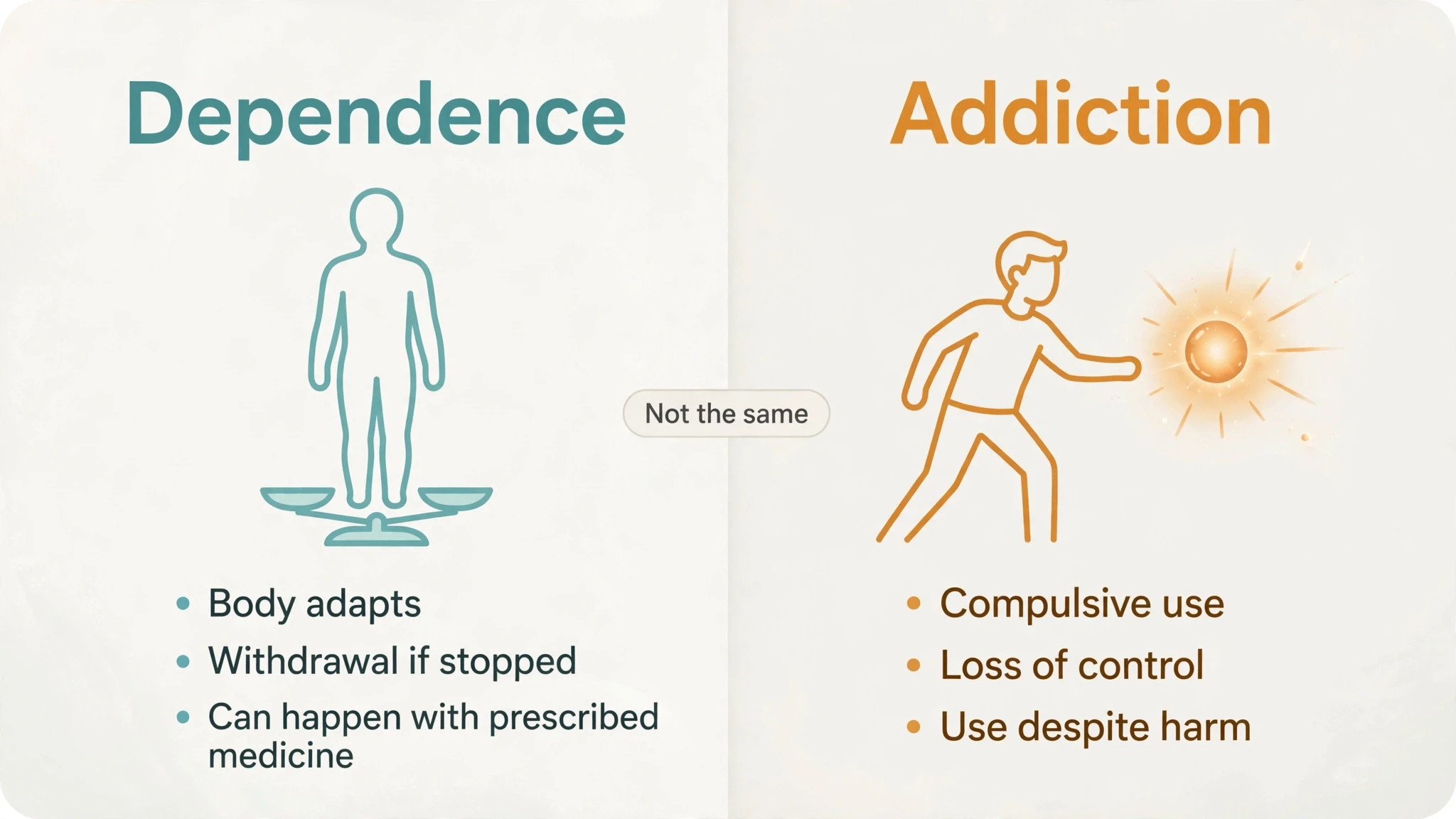
8.1 Dependence is not addiction
Withdrawal is substance-specific, and the differences between substances are clinically important. Alcohol withdrawal can include tremor, anxiety, seizures, and delirium tremens — a medical emergency. Opioid withdrawal includes flu-like symptoms, pain, diarrhea, and intense craving. Stimulant withdrawal is dominated by fatigue, depression, and sleep disturbance. This article describes these symptoms as information only, not as guidance for any reader. Alcohol withdrawal can be life-threatening and needs medical supervision — anyone facing it should speak to a clinician rather than attempting to manage it alone. That point is stated once, plainly, because it is a matter of safety, and it is not repeated as advice about any specific course of action.
Beyond the physical symptoms, stopping the drug produces a negative emotional state that can persist long after the physical symptoms fade: dysphoria, anxiety, irritability. Koob calls this the "dark side" of addiction, and it is the motivational core of stage 2. The person is not only sick. They are miserable in a way that has a specific neurobiological cause, and the fastest known relief is the drug itself. That is the trap of negative reinforcement: the drug stops the suffering it created, and the brain learns that lesson as thoroughly as it learned the first high.
8.2 The anti-reward system: the brain builds a new source of suffering
Chronic drug use does not merely deplete the pleasure circuits. It actively recruits opponent-process stress systems that generate a new, independent source of suffering. Koob and Volkow call this the anti-reward system, and it is centered in the extended amygdala — a cluster of structures including the central nucleus of the amygdala, the bed nucleus of the stria terminalis, and the shell of the nucleus accumbens. As drug use becomes chronic, these stress systems ramp up, using corticotropin-releasing factor (CRF), dynorphin, and norepinephrine. CRF is the brain's stress signal, the same molecule that drives the body's response to threat. Dynorphin is an opioid peptide that produces dysphoria — the opposite of the euphoria produced by the brain's other opioid peptides.
The result is a brain that is not merely missing its reward but actively generating distress — one of the central findings of the science of addiction. The person in withdrawal is not at zero. They are below zero, in a state the brain itself is producing, with the drug as the only fast exit they know.
8.3 Opponent process: the high shrinks while the crash grows
Solomon and Corbit's opponent-process theory, published in 1974, gives the logic of this shift a simple shape. Every strong pleasurable response — the a-process — triggers an opposing response — the b-process — that grows stronger and lasts longer with repetition. The first time, the a-process dominates: a strong high, a small comedown. With repetition, the b-process grows: the high shrinks, the comedown deepens and lengthens. The net experience shifts from pleasure toward dysphoria, not because the drug has changed, but because the brain's response to it has.
The stress connection runs deeper still. Stress is a potent trigger for craving and relapse, acting through CRF and the extended amygdala, and stress-induced reinstatement is one of the most robust findings in animal models of relapse. That is why the worst moments for a person in recovery are so often the most stressful ones — a bereavement, a job loss, a conflict — and why the advice to "just avoid stress" is so unhelpful, as the science of addiction keeps showing. Stress is not an optional extra in most people's lives. It is the background, and the addicted brain has wired it directly into the craving circuit. Our article on Anxiety and Depression Explained covers stress, cortisol, and the comorbidity between mental-health conditions and addiction, and the overlap is not a coincidence: the same stress systems are involved in both.
9. Stage 3 — Preoccupation and Anticipation: Why Cravings Happen
Why do cravings happen? That question is the title of this section and the lived center of the science of addiction, because craving is what brings people back to a drug they have every reason to leave behind. Craving is not a failure of willpower. It is a conditioned, cue-driven dopamine response in a sensitized system, amplified by stress and by the weakened prefrontal brake. Every part of that sentence is doing work, and this section unpacks each part.
The third stage of the cycle involves a widely distributed network: the orbitofrontal cortex and dorsal striatum, the prefrontal cortex, the basolateral amygdala, the hippocampus, and the insula — the region most closely tied to craving itself — with the cingulate gyrus, the dorsolateral prefrontal cortex, and the inferior frontal cortex in disrupted inhibitory control. Glutamate signaling from the prefrontal cortex becomes dysregulated. In plain terms: the memory systems remember where the drug was, the emotional systems tag those memories with urgency, the insula turns the body's internal state into a felt urge, and the brake that should interrupt the sequence is too weak to do the job.
9.1 Incentive sensitization: wanting grows while liking fades
The incentive-sensitization theory, proposed by Robinson and Berridge in 1993 and revisited by them three decades later, is the most influential account of craving in the science of addiction. Its two claims are simple. First, mesolimbic dopamine systems mediate incentive motivation — "wanting" — for rewards, but not their hedonic impact — "liking." Second, some individuals are vulnerable to drug-induced, long-lasting sensitization of those mesolimbic systems, which selectively amplifies their "wanting" for drugs without increasing their liking of the same drugs.
Sensitization is the opposite of tolerance, and the two run at the same time in different parts of the system. Tolerance dulls the response to the drug itself: the high fades. Sensitization amplifies the response to the cues that predict the drug: the wanting grows. The high fades while the wanting grows — that is the paradox at the heart of addiction, and incentive sensitization is the theory that explains it. Sensitization is also persistent, lasting long after drug use is discontinued. That persistence is why craving can return months or years after the last use, when tolerance has long since faded.
I remember reading the 1993 paper for the first time and feeling the pieces of the subject rearrange themselves. Before Robinson and Berridge, the standard story was that people kept using drugs because the drugs felt good. After them, the story was that people kept using because the wanting system had become hypersensitive to cues, even as the pleasure system had gone quiet. It was a cleaner explanation of what people with addiction actually report: "I don't even enjoy it anymore. I just need it." The science of addiction is full of moments like that, where a theory finally matches the lived report.
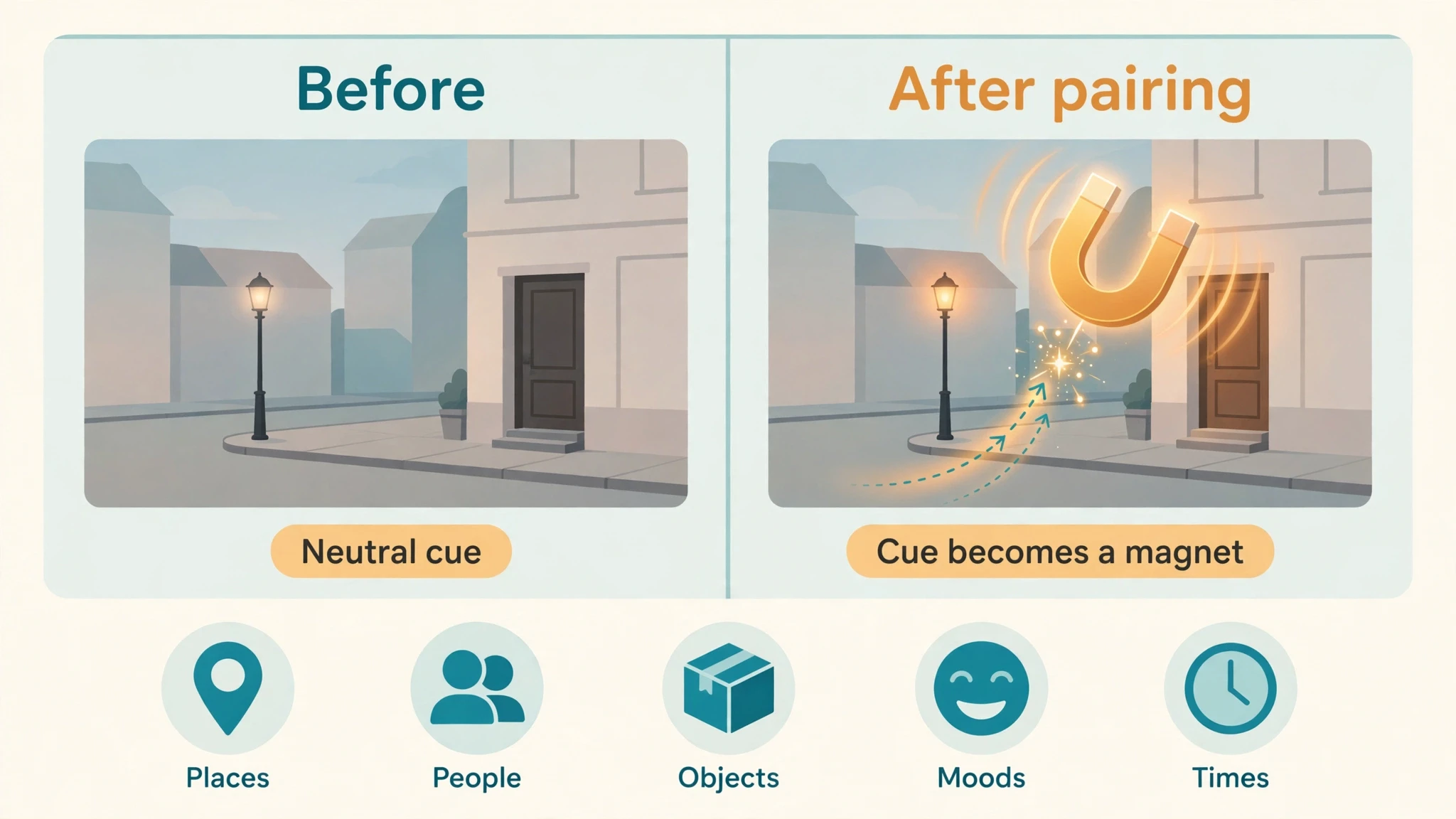
9.2 Cues become magnets: places, people, moods, times of day
"Wanting" is triggered by cues. Places, people, objects, moods, and times of day that were paired with drug use acquire incentive salience — they become motivational magnets that can trigger a dopamine surge and craving on their own, even after long abstinence. Remember the Schultz experiment from section 4: the dopamine burst migrates from the reward to the earliest cue that predicts it. That migration is the mechanism of cue-triggered craving. The street corner, the song, the smell from the doorway in section 1 — each of them was once paired with the drug, and the brain learned the pairing so well that the cue alone now fires the wanting.
The categories of cues are worth listing, because recognizing them is the first step toward understanding a craving:
- Places: the street corner, the bar, the room, the route home from work
- People: the friends, the dealer, the social circle tied to use
- Objects: the glass, the lighter, the paraphernalia, the phone screen
- Moods: stress, boredom, loneliness, celebration, anxiety
- Times of day: the hour after work, the late night, the weekend, the anniversary
Cue-triggered craving is measurable in brain imaging: drug cues activate the nucleus accumbens, the amygdala, the orbitofrontal cortex, and the insula, and the strength of that activation is associated with relapse risk. The phrasing is deliberately careful — associated with, not proven to cause — because the imaging evidence is correlational. But the association is consistent, and it points the same way as the animal research and the clinical reports. A brain that lights up strongly to a cue is a brain at higher risk of returning to use.
9.3 The insula and the body: craving as a physical state
The insula is the brain region that tracks internal bodily states — heartbeat, hunger, thirst, the tightness in the chest, the dryness in the mouth — and it is deeply involved in craving. The most striking evidence comes from a single study that is often cited precisely because it is so dramatic: Naqvi and colleagues reported in Science in 2007 that damage to the insula abruptly abolished the urge to smoke in some patients. The finding is presented here as a striking single-study result, not as a general rule — brain damage is not a treatment, and the study's sample was small. But it points to something real about craving: it is not only a thought. It is a bodily state, registered by a region that monitors the inside of the body and translates that monitoring into an urge.
9.4 Stress pours fuel on craving
Stress amplifies craving through the same CRF and extended-amygdala systems that drive stage 2. When a person in recovery is stressed, the stress systems that the drug trained are already primed, and the craving that follows is stronger than it would be in a calm moment. In animal models, stress reliably reinstates drug-seeking — the return of the behavior after stress — across drugs and across species. In human terms, the hardest days of recovery are often the days when life is hardest — which is why support that reduces stress, and coping responses that give the prefrontal cortex something to do other than fight the craving, are interventions aimed directly at the mechanism.
9.5 Incubation: why craving can grow stronger with time away
The last piece of the craving puzzle, in the science of addiction, is the strangest. In animal models, cue-induced drug seeking grows stronger over weeks of abstinence rather than fading — a phenomenon called incubation of craving, first described by Grimm and colleagues in Nature in 2001. The longer the animal is away from the drug, the stronger the cue-triggered seeking becomes, for a time, before it eventually declines. This is an animal-model finding, and it should not be quoted as a proven fact about human craving without that qualifier. But it matches a pattern that clinicians hear often: the craving does not simply decay with time. It can surge back, unexpectedly, weeks or months into recovery, at exactly the moment when the person and everyone around them assumed the worst was over.
Incubation, sensitization, cues, stress, and a weakened brake — together they explain why craving is the stage of the cycle that most often defeats recovery. Withdrawal ends. Craving can outlast it by months or years, and that is one reason the condition is described as chronic and relapsing rather than as an acute illness with a clean ending.
10. Who Becomes Addicted? Genes, Age, Adversity, and the Drug Itself
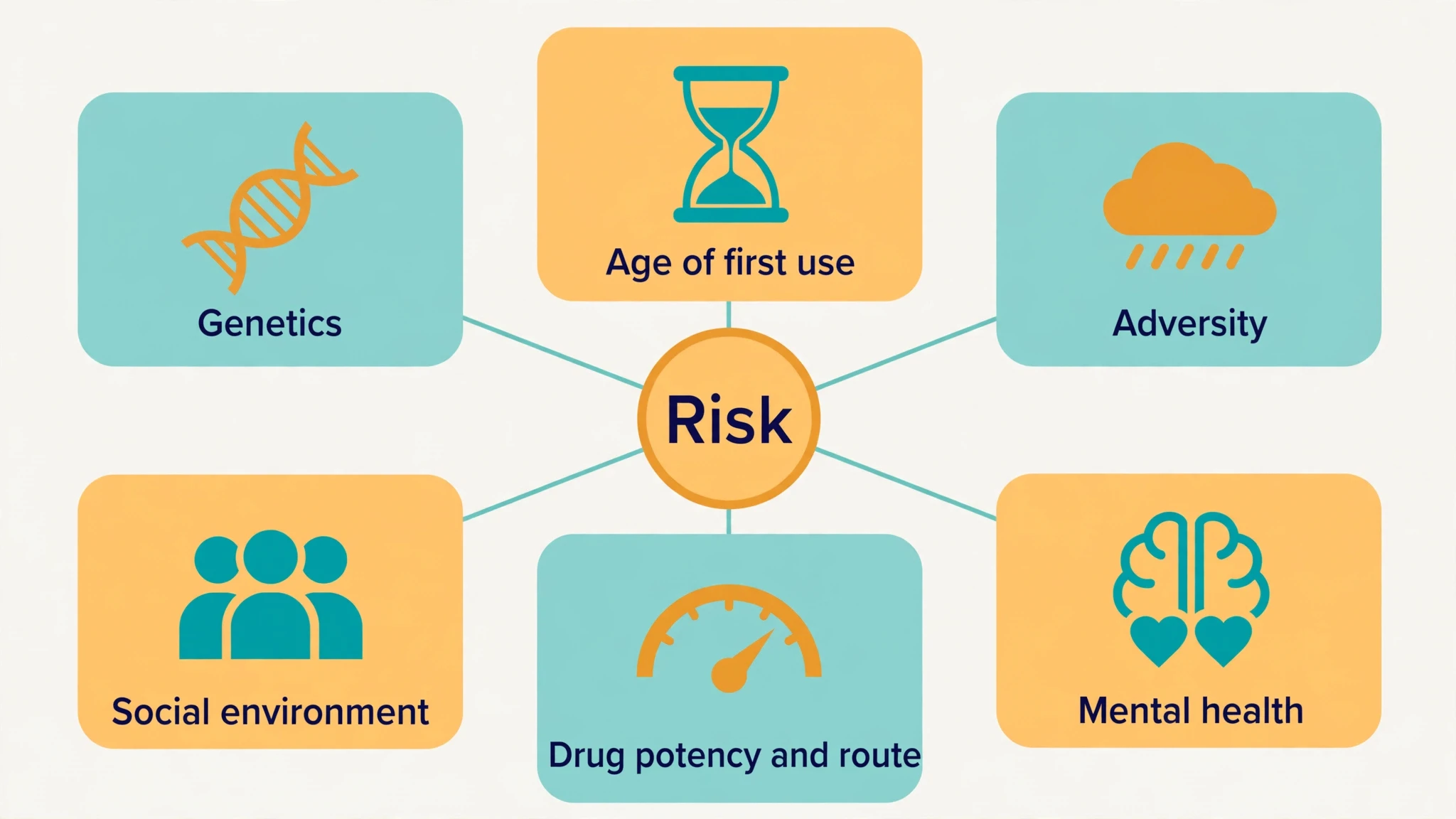
Not everyone who tries a drug becomes addicted. Most people who use a substance do not develop a disorder. That fact is often lost in discussions of the science of addiction, and it is important for two reasons. First, it means addiction is not an automatic consequence of exposure. Second, it means the question worth asking is not "why do drugs cause addiction?" but "why do some people develop addiction when most do not?" The answer, in the science of addiction, is a web of vulnerability: genetics, age of first use, adversity, mental health, the drug itself, and the social environment. No single factor decides the outcome. The factors interact, and the interaction is the story.
10.1 Genes load the dice: 40–60% of risk, no single addiction gene
NIDA's estimate is that genetic factors account for approximately 40 to 60 percent of a person's risk of addiction, with the rest coming from the environment — family, peers, stress, drug availability, trauma. The figure is often quoted, and it is often misunderstood in both directions. It does not mean that 40 to 60 percent of addiction is "genetic" in the sense of being fixed at birth. It means that, in the populations studied, about half of the variation in risk between people tracks with genetic variation. Genes load the dice. They do not decide the roll.
There is no single "addiction gene." The genetic contribution is spread across many variants, each with a small effect, and the variants involved overlap with the dopamine system itself. A 2023 genome-wide study of more than one million people found 19 genetic variants tied to a general addiction risk shared across substances, with one of the strongest signals, in a gene called PDE4B, pointing to dopamine regulation as a shared vulnerability. Our article on Genetic Disorders Explained covers how genes, inheritance, and family history shape disease risk, and the same logic applies here: a family history of addiction raises risk, but it is a probability, not a sentence.
10.2 The adolescent brain: a reactive reward system, an unfinished brake
The earlier a person starts using drugs, the more likely serious problems become — partly because drugs act on a developing brain, and partly because early use marks other risks that travel with it. Adolescence is a period of heightened vulnerability, in the science of addiction, for a structural reason: the prefrontal cortex is still maturing into the mid-20s, while the reward system is highly reactive. The accelerator is fully built before the brake is finished. A drug that floods the reward circuit in a teenage brain is flooding a system that is already tuned to seek novelty and reward, with a control system that is not yet fully online.
10.3 Adversity, mental health, and the environment
Childhood adversity is a strong risk factor for addiction. The research consistently shows that people who experienced multiple adverse childhood experiences — abuse, neglect, household dysfunction — carry a substantially higher risk of problematic drug and alcohol use in adulthood. The mechanisms run through the same stress systems already described: early adversity calibrates the CRF and extended-amygdala systems toward higher reactivity. Adversity does not only raise the risk of trying a drug. It raises the risk that the drug will become the coping response, because the stress system it relieves is the one that was shaped by the adversity itself.
Mental-health conditions and addiction commonly occur together. A person living with depression, anxiety, post-traumatic stress, or another mental-health condition carries a higher risk of developing a substance use disorder, and a person with a substance use disorder carries a higher risk of developing a mental-health condition. The relationship runs in both directions, and the shared circuitry — stress systems, reward systems, prefrontal control — is part of the reason. This is one more place where the language of blame fails: a person using a drug to quiet the symptoms of an untreated mental-health condition is self-medicating a real problem with a tool that makes the problem worse. The answer is care for both conditions together, not judgment of either one alone.
Social and environmental factors shape both risk and resilience: family, peers, school, neighborhood, drug availability, stress, and trauma. Protective factors include parental supervision, school engagement, and community support — ordinary things, and often the strongest protections the evidence supports.
10.4 The drug itself: speed, potency, and route
The drug matters too, and so does how it is taken. Drugs that reach the brain faster — smoked or injected — and produce larger, faster dopamine surges carry higher addiction liability. Speed is the key variable: the faster the rise, the stronger the teaching signal, and the tighter the pairing between the act of taking the drug and the reward that follows. A slow-release oral medication and an injected drug may contain similar chemistry, but they teach the brain different lessons. Potency matters in the same way: a stronger drug produces a larger surge, and a larger surge stamps in a stronger association. None of this means that a "slow" or "weak" drug is safe — a point the science of addiction stresses. It means that the risk of addiction is a property of the interaction between the drug, the route, and the brain — not of the drug alone.
11. Relapse and Recovery — Can the Brain Heal?
Why do people relapse after months of not using? That question is asked with love, with frustration, and with fear, and it deserves a straight answer from the science of addiction. People relapse because the brain changes of addiction persist long after drug use stops. The sensitized wanting system is still sensitized. The cues still fire. The D2 receptors have not yet recovered. Stress still pours fuel on craving. Relapse is not evidence that the person did not try hard enough, or that treatment does not work. It is evidence that a chronic condition behaves like a chronic condition.
NIDA estimates that 40 to 60 percent of people treated for a substance use disorder relapse — a rate similar to relapse rates for hypertension, at 50 to 70 percent, and asthma, at 50 to 70 percent. That comparison traces to McLellan and colleagues, writing in JAMA in 2000, who compiled treatment-outcome studies from the 1980s and 1990s. The figure must be labeled honestly: it is a decades-old benchmark, not a fresh annual number. Treatment research has changed since then, and the number should not be quoted as if it were measured last year. But the comparison it supports still stands, and it is the point that matters: relapse rates for addiction are in the same range as relapse rates for other chronic conditions that nobody describes as failures of willpower. Nobody tells a person with hypertension that their blood pressure rising means they are a bad person. The same logic applies here. Relapse signals that the treatment plan needs adjusting, not that treatment has failed.
11.1 Why relapse strikes months later
Relapse risk is highest in the first weeks and months after treatment, and it is driven by the mechanisms this article has already described: cues that trigger a sensitized wanting system, stress that activates the CRF and extended-amygdala circuits, and a prefrontal brake that is still recovering. A person can be months into recovery, doing well, and then encounter a cue — the old street corner, the old friend, the anniversary of a loss — and feel the craving arrive with a force that surprises them. Incubation of craving, described in section 9, can make that late surge stronger rather than weaker. The person has not failed. The brain has remembered.
That is also why the first months after treatment are the most fragile, and why support during that period matters so much. Recovery is not a single decision made once. It is a long series of decisions, made in the presence of cues and stress, by a brain that is still healing.
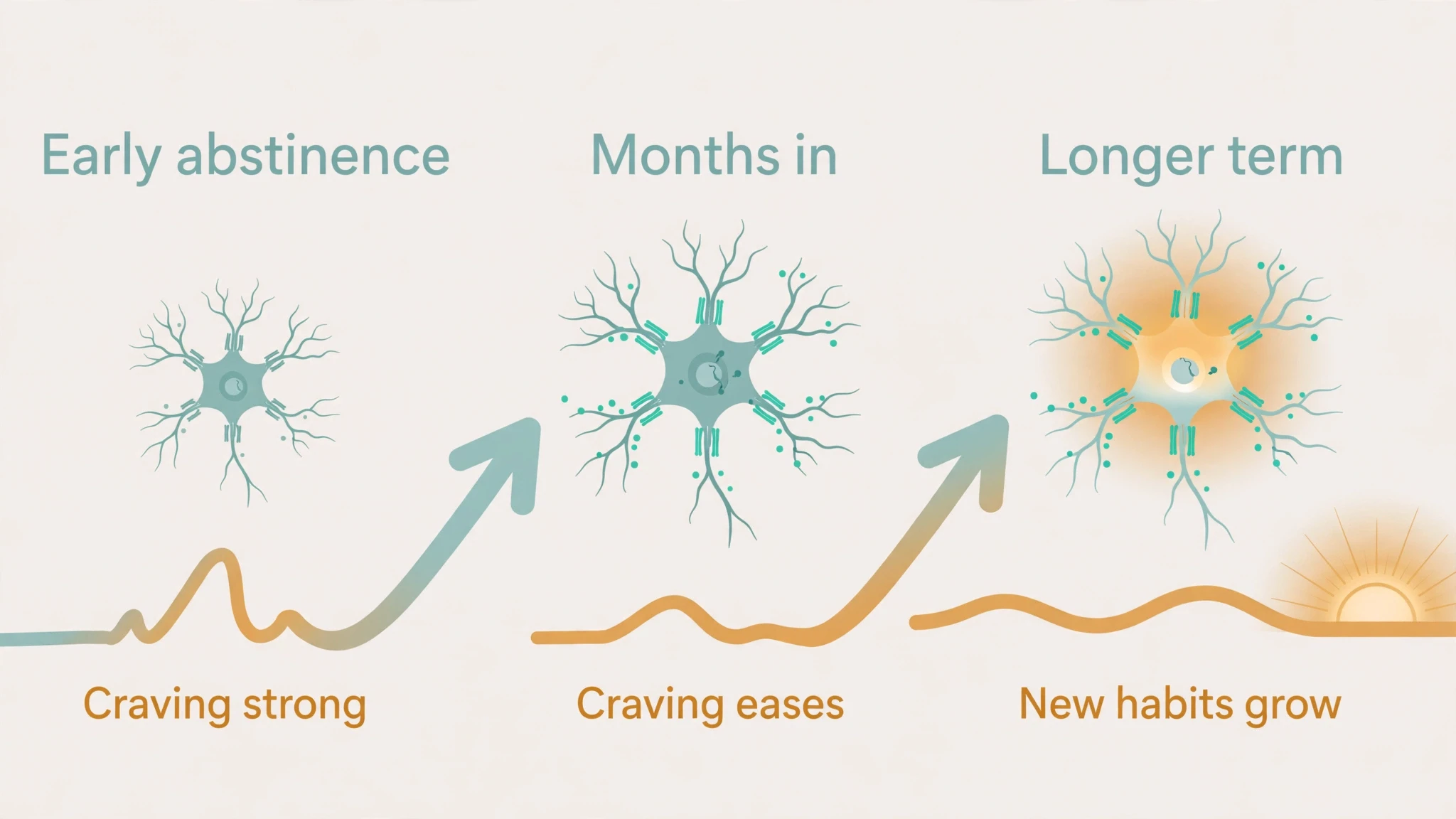
11.2 The brain heals, slowly: D2 recovery with prolonged abstinence
Can the brain recover from addiction? The evidence in the science of addiction says yes — slowly, partially, and measurably. D2 receptor availability partially recovers with prolonged abstinence, and that recovery is biological evidence that the brain can heal. The Volkow imaging studies that showed D2 loss also showed its partial reversal: with months of abstinence, receptor availability climbs back toward normal. The recovery is partial, and the timeline is measured in months, not days — but it is real and visible on brain scans.
Neuroplasticity works both ways. The same plasticity that lets drugs rewire the reward circuit also lets recovery rewire it back. New habits, new associations, and new coping responses are learned through the same dopamine-dependent mechanisms that learned the drug in the first place. Every time a person in recovery encounters a cue and does not use, the brain is learning something new about that cue. Every time stress arrives and is met with a coping response instead of a drug, the association weakens a little. The process is slow because the original learning was so strong, but the machinery of learning is still there, and it works in recovery exactly as it worked in addiction.
11.3 What recovery rewires: new habits through the same dopamine machinery
There is a quiet symmetry in this that I think is worth naming. The brain that learned addiction is the same brain that learns recovery. The dopamine system that stamped in the drug cue can stamp in the new routine: the morning walk, the meeting, the phone call to a friend instead of the old number. The hippocampus that stored the drug memories can store the recovery memories. The prefrontal cortex that was weakened can strengthen with practice, the way any practiced skill strengthens its circuits. Recovery is not the erasure of the old learning, and the science of addiction is clear on why. It is the building of new learning on top of it, until the new learning is strong enough to win more often than the old. The gut-brain axis is one more thread: our article on The Gut Microbiome Explained covers how gut microbes influence stress and mood.
11.4 What treatment looks like, in general terms
Effective addiction care, in general terms, combines behavioral therapies — such as cognitive behavioral therapy and contingency management — with, for opioid use disorder, medications that are part of evidence-based care, including methadone, buprenorphine, and naltrexone. This article describes those categories in general terms only. It makes no recommendation about any specific treatment, gives no dosage, and offers no individual advice. The choice of care belongs to the person and their clinician, and the details belong in that conversation, not in an explainer article.
What can be said generally is that recovery is common. Many people with substance use disorders recover, with or without formal treatment, and recovery is a process that can take years. No specific recovery percentage is quoted here, because no verified figure was available in the research for this article. The honest statement is qualitative: recovery happens, it happens often, and it happens through the same brain that learned the addiction.
12. Is Addiction a Disease or a Choice? The Science of Addiction and the Stigma Problem
It is the most argued question in the science of addiction, and the honest answer is that it is the wrong shape for the question. Addiction involves choice — a person chooses to take a drug the first time, and chooses again many times after — and it also involves a brain that has changed in ways that make later choices harder, narrower, and less free. The brain-disease model does not deny the first part. It insists on the second.
Leshner's 1997 editorial made the case that addiction is a brain disease because it involves functional changes to brain circuits, and that the disease framing matters — for research funding, for treatment, for insurance, for the way society responds to people with the condition. The decades of imaging research since then have supported the core claim: the reward circuit, the stress systems, and the prefrontal brake all change measurably in addiction. What the model does not claim is that choice disappears. A person with addiction still makes decisions, still bears responsibility for their actions, and still has agency in recovery. What changes is the terrain on which those decisions are made: a sensitized wanting system, a weakened brake, and a stress system that punishes abstinence.
12.1 What "brain disease" actually means
"Brain disease" in this context means a condition in which brain circuits have changed in ways that produce the symptoms — compulsive use, craving, loss of control — and in which those changes persist after the drug is gone. The brain-disease model asks for the same logic to be applied to addiction: the behavior is the symptom, the circuit change is the cause, and the treatment should target the cause.
12.2 What the model gets wrong, or leaves out
The model has real critics, and the science of addiction is better for taking them seriously. The first criticism is that the brain changes of addiction are, in an important sense, the brain doing what it is built to do — learning — and that calling normal learning a "disease" stretches the term. The second is that the model can underplay the social and environmental drivers: poverty, trauma, availability, and community all shape addiction, and a model that looks only at the brain can miss them. The third is that the model can sound, to people in recovery, as if it denies their agency — as if they are passive victims of their circuitry rather than people who fought their way back.
Each of these criticisms has force, and none of them erases the imaging evidence. The fair position, in the science of addiction, is that addiction is a brain disorder shaped by genes, environment, and experience together — a condition in which the brain changes, the person still chooses, and the social world still matters. The disease framing and the choice framing are not enemies. They describe different levels of the same condition, and the science of addiction needs both.
12.3 Misconceptions, corrected one by one
Stigma is itself a barrier to recovery. The moral-failing framing of addiction delayed scientific understanding for decades and still keeps people from seeking help. The misconceptions below are the ones the science of addiction hears most often, and each one has a correction grounded in the evidence already presented:
- "Addiction is a choice." Choice is involved at the start, and agency remains throughout — but the brain changes of addiction narrow and distort later choices. A sensitized wanting system and a weakened brake are mechanisms, not excuses.
- "Dopamine is the pleasure chemical." Dopamine encodes prediction and reinforcement, not pleasure — liking runs through separate opioid and endocannabinoid hotspots — and wanting can keep growing even as enjoyment fades.
- "Tolerance means addiction." Tolerance is one criterion among 11, and it can occur with prescribed medication taken exactly as directed. Physical dependence is not addiction.
- "Relapse means treatment failed." Relapse rates for addiction are in the same range as for hypertension and asthma. Relapse signals that the plan needs adjusting, not that the person is beyond help.
- "Once an addict, always an addict." D2 receptors partially recover with prolonged abstinence, and many people recover. The brain changes, and it can change back.
- "Addiction is purely genetic." Genes account for roughly 40 to 60 percent of risk. The rest is environment, experience, and the drug itself. Neither genes alone nor choice alone explains it.
The same mistaken ideas appear in the study of pain, where the brain's alarm can get stuck and keep firing long after healing — our article on The Science of Pain Explained covers how a nervous system can learn a response and then struggle to unlearn it. Addiction and chronic pain share that logic: a system built to protect you, changed by experience into a system that hurts you.
13. Can You Be Addicted to Something That Is Not a Drug?
The short answer is yes — with an important qualification about what counts as a formal diagnosis. The circuits the science of addiction describes are not drug-specific. They are learning circuits, and they respond to any reward that is intense, fast, and reliably paired with cues. Gambling, gaming, eating, shopping, and phone use can all engage the same reward, stress, and control systems. But the diagnostic status of these behaviors differs, and the science of addiction is careful about the difference.
13.1 Gambling disorder: the one behavioral addiction in the DSM-5
Gambling disorder is the only behavioral addiction formally included in the DSM-5's substance-related and addictive disorders category. Diagnosis requires 4 or more of 9 criteria within 12 months, with severity bands of mild (4 to 5), moderate (6 to 7), and severe (8 to 9). The criteria mirror the substance use disorder list: preoccupation, tolerance-like escalation, failed efforts to stop, restlessness when trying to cut down, chasing losses, lying about the extent of involvement, and jeopardizing relationships or work. The overlap is not an accident, and the science of addiction has mapped it in detail. Gambling activates the same dopamine prediction-error machinery — the near-miss, the uncertain reward, the cue of the machine or the table — and it produces the same cycle of binge, distress, and craving.
13.2 Gaming disorder: a condition for further study
Internet gaming disorder is listed in DSM-5-TR Section III as a condition for further study, not a formal diagnosis. That placement matters: the evidence is promising but not yet sufficient for a formal category, and researchers are still working out where heavy gaming ends and a disorder begins. The World Health Organization has included gaming disorder in the ICD-11, which adds a layer of complexity to the picture — but within the DSM-5-TR framework that this article uses, gaming remains a condition for further study. The science of addiction treats that distinction seriously, and so does this article, because a formal diagnosis carries consequences for treatment, insurance, and stigma, and it should not be granted on thin evidence.
13.3 What the overlap really shows
The circuits overlap, but the DSM-5 status differs — and this article does not claim that gambling, gaming, or any other behavior is "the same as" drug addiction. Drugs add a pharmacological flood and physical dependence that behaviors do not produce in the same way. What behaviors share with drugs is the learning machinery — prediction error, incentive sensitization, cue-triggered wanting, the weakened brake — and that shared machinery is why the same three-stage cycle can describe a gambling problem as well as a drug problem. The overlap is real. The equivalence is not.
14. What the Science of Addiction Changes
The science of addiction changes the question we ask about a person who cannot stop. It replaces "what is wrong with them?" with "what happened to their brain, and what can change it back?" That shift is not softness. It is accuracy. A brain in which dopamine encodes prediction, in which tolerance has dulled the receptors, in which stress systems punish abstinence, in which cues fire wanting without permission — that brain is not a brain that loves pleasure too much. It is a brain that learned too well, from a teacher that lied.
The hopeful part of the science of addiction is not a slogan. It is a measurement: D2 receptors partially recover with abstinence. New habits are learned through the same dopamine machinery that learned the old ones. Overdose deaths fell sharply in a single year — the age-adjusted death rate dropped 26.2 percent from 2023 to 2024 — as naloxone, treatment, and prevention reached more people. Recovery happens often, it unfolds over years, and it works through the same brain that learned the addiction. The cycle tightens, but it can also loosen — slowly, with support, one new association at a time.
15. Frequently Asked Questions (FAQ)
How does addiction work?
Addiction works through the brain's reward, stress, and self-control circuits — the three systems the science of addiction studies together. Drugs flood the reward circuit with dopamine, the brain adapts by dulling its receptors and ramping up stress systems, and use shifts from seeking pleasure to escaping distress. Cues then trigger craving through a sensitized wanting system, while the prefrontal brake weakens. The result is compulsive use despite harm, in a three-stage cycle that tightens with each pass.
What does dopamine do in addiction?
Dopamine encodes reward prediction error — the difference between the reward received and the reward expected — and stamps in the memory of what led to the reward so the behavior repeats. It does not produce pleasure itself; liking runs through separate opioid and endocannabinoid hotspots. Drugs raise dopamine 2 to 10 times above natural rewards, hijacking the teaching signal, and with repetition the dopamine burst migrates from the drug to the cues that predict it.
What is tolerance?
Tolerance means needing markedly more of a substance for the same effect, or getting markedly less effect from the same amount. Three kinds: metabolic, where the body clears the drug faster; cellular, where receptors downregulate or desensitize; and learned, where the body compensates in familiar settings. On its own, tolerance is only one of the 11 DSM-5-TR criteria — not addiction by itself — and it can occur with prescribed medication taken exactly as directed.
Why do cravings happen?
Cravings happen because the brain's wanting system has become sensitized to cues that were paired with drug use. Through incentive sensitization, places, people, objects, moods, and times of day acquire the power to trigger a dopamine surge and an urge on their own, even after long abstinence. Stress amplifies craving, the insula registers the urge as a bodily state, and the weakened prefrontal brake cannot reliably interrupt it. Craving is a conditioned brain response, not a failure of willpower.
Is addiction a disease or a choice?
Addiction is a chronic, relapsing brain disorder shaped by genes, environment, and experience — and it also involves choice. A person chooses to take a drug the first time, and agency remains throughout, but the brain changes of addiction — a sensitized wanting system, a weakened prefrontal brake, stress systems that punish abstinence — narrow and distort later choices. The brain-disease model does not deny choice. It insists that the terrain on which choices are made has changed, and that treatment should target the changed circuits.
What is the difference between physical dependence and addiction?
Physical dependence means the body has adapted to a drug's presence, so it functions normally only while the drug is there and shows withdrawal when the drug is removed. It can develop even when a prescribed medicine is taken exactly as directed. Addiction adds compulsive drug seeking and use despite harm, loss of control, and continued use despite known problems. As NIDA puts it, physical dependence in and of itself does not constitute addiction, though it often accompanies it. The DSM-5-TR formally recognizes the difference: tolerance and withdrawal during appropriate medical treatment do not count toward a diagnosis.
Why do people relapse after months of not using?
People relapse because addiction's brain changes outlast drug use itself. The wanting system stays sensitized, familiar cues still trigger urges, D2 receptors are still recovering, and stress still magnifies craving. NIDA's estimate is that 40 to 60 out of every 100 people treated for a substance use disorder return to use at some point — a decades-old benchmark in the same range as the figures for hypertension and asthma. Relapse means the plan needs adjusting — not that treatment has failed.
Can the brain recover from addiction?
Yes — slowly, partially, and measurably. D2 receptor availability partially recovers with prolonged abstinence. The same neuroplasticity that let drugs rewire the reward circuit lets recovery rewire it back: fresh habits, associations, and coping responses are built through the same dopamine-dependent learning machinery. Recovery is common and it is a process that can take years, not a single event.
Is addiction genetic?
According to NIDA, roughly half of a person's addiction risk — 40 to 60 percent — comes from genetic factors, and the rest from the environment. No one gene causes addiction. A family history raises risk, but it is a probability, not a sentence: many people with a strong family history never develop a substance use disorder.
Can you be addicted to something that is not a drug?
Yes, with a qualification about formal diagnosis. Gambling disorder is the sole behavioral addiction the DSM-5 places in its substance-related and addictive disorders category. Internet gaming disorder sits in DSM-5-TR Section III as a condition for further study — it is not yet a formal diagnosis. Behaviors like gambling engage the same prediction-error and craving machinery as drugs, but drugs add a chemical flood and physical dependence no behavior produces in quite the same way. The circuits overlap. The conditions are not identical.
16. Sources
- NIDA — Drugs, Brains, and Behavior: The Science of Addiction (2020 revision). https://nida.nih.gov/research-topics/addiction-science/drugs-brain-behavior-science-of-addiction
- SAMHSA — 2025 National Survey on Drug Use and Health, press release, July 27, 2026. https://www.samhsa.gov/newsroom/press-announcements/20260727/samhsa-releases-annual-national-survey-on-drug-use-and-health
- CDC/NCHS — Drug Overdose Deaths in the United States, 2023–2024, NCHS Data Brief No. 549, January 29, 2026. https://www.cdc.gov/nchs/pressroom/releases/20260129.html See also CDC — CDC Reports Nearly 24% Decline in U.S. Drug Overdose Deaths, February 25, 2025. https://www.cdc.gov/media/releases/2025/2025-cdc-reports-decline-in-us-drug-overdose-deaths.html
- Koob GF, Volkow ND (2010). Neurocircuitry of addiction. Neuropsychopharmacology 35:217–238. https://doi.org/10.1038/npp.2009.110
- Volkow ND et al. (2012). Addiction circuitry in the human brain. Annu Rev Pharmacol Toxicol 52:321–336. https://doi.org/10.1146/annurev-pharmtox-010611-134625
- Volkow ND (2009). Imaging dopamine's role in drug abuse and addiction. Neuropharmacology 56(Suppl 1):3–8. https://doi.org/10.1016/j.neuropharm.2008.05.022
- Volkow ND (2003). The addicted human brain: insights from imaging studies. J Clin Invest 111:1444–1451. https://doi.org/10.1172/JCI18533
- Berridge KC, Robinson TE (2016). Liking, wanting, and the incentive-sensitization theory of addiction. Am Psychol 71:670–679. https://doi.org/10.1037/amp0000059
- Robinson TE, Berridge KC (2025). The incentive-sensitization theory of addiction 30 years on. Annu Rev Psychol 76:29–58. https://doi.org/10.1146/annurev-psych-011624-024031
- Robinson TE, Berridge KC (1993). The neural basis of drug craving: an incentive-sensitization theory of addiction. Brain Res Rev 18:247–291. https://doi.org/10.1016/0165-0173(93)90013-P
- Schultz W, Dayan P, Montague PR (1997). A neural substrate of prediction and reward. Science 275:1593–1599. https://doi.org/10.1126/science.275.5306.1593
- Schultz W (2016). Dopamine reward prediction error coding. Dialogues Clin Neurosci 18:23–32. https://doi.org/10.31887/DCNS.2016.18.1/wschultz
- Koob GF, Volkow ND (2016). Neurobiology of addiction: a neurocircuitry analysis. Lancet Psychiatry 3:760–773. https://doi.org/10.1016/S2215-0366(16)00104-8
- Koob GF, Le Moal M (1997). Drug abuse: hedonic homeostatic dysregulation. Science 278:52–58. https://doi.org/10.1126/science.278.5335.52
- McLellan AT et al. (2000). Drug dependence, a chronic medical illness: implications for treatment, insurance, and outcomes evaluation. JAMA 284:1689–1695. https://doi.org/10.1001/jama.284.13.1689
- Leshner AI (1997). Addiction is a brain disease, and it matters. Science 278:45–47. https://doi.org/10.1126/science.278.5335.45
- Ikemoto S, Bonci A (2014). Neurocircuitry of drug reward. Neuropharmacology 76:329–341. https://doi.org/10.1016/j.neuropharm.2013.04.031
- Volkow ND, Fowler JS, Wang GJ et al. (1993). Decreased dopamine D2 receptor availability is associated with reduced frontal metabolism in cocaine abusers. Synapse 14:169–177. https://doi.org/10.1002/syn.890140210
- Naqvi NH et al. (2007). Damage to the insula disrupts addiction to cigarette smoking. Science 315:531–534. https://doi.org/10.1126/science.1135926
- Grimm JW et al. (2001). Incubation of cocaine craving after withdrawal. Nature 412:141–142. https://doi.org/10.1038/35084134
- Sinha R (2008). Chronic stress, drug use, and vulnerability to addiction. Ann N Y Acad Sci 1141:105–130. https://doi.org/10.1196/annals.1441.030
- Solomon RL, Corbit JD (1974). An opponent-process theory of motivation. Psychol Rev 81:119–145. https://doi.org/10.1037/h0036128
- Volkow ND, Koob GF, McLellan AT (2016). Neurobiologic advances from the brain disease model of drug addiction. N Engl J Med 374:363–371. https://doi.org/10.1056/NEJMra1511480
- Hatoum AS et al. (2023). Multivariate genome-wide association meta-analysis of over 1 million subjects identifies loci underlying multiple substance use disorders. Nat Ment Health 1:210–223. https://doi.org/10.1038/s44220-023-00034-y
- American Psychiatric Association (2022). Diagnostic and Statistical Manual of Mental Disorders, 5th ed., text rev. (DSM-5-TR). Washington, DC: American Psychiatric Association. https://www.psychiatry.org/psychiatrists/practice/dsm
- NIDA — Principles of Drug Addiction Treatment: A Research-Based Guide (3rd ed.).