
1. The Cup, the Donut, and the Question
There is an old joke in mathematics. A topologist is someone who cannot tell the difference between a coffee cup and a donut. The joke is told at conferences, printed on mugs, and repeated to first-year students, and every time it is told, somebody in the room laughs and somebody else asks the obvious question: is that actually true?
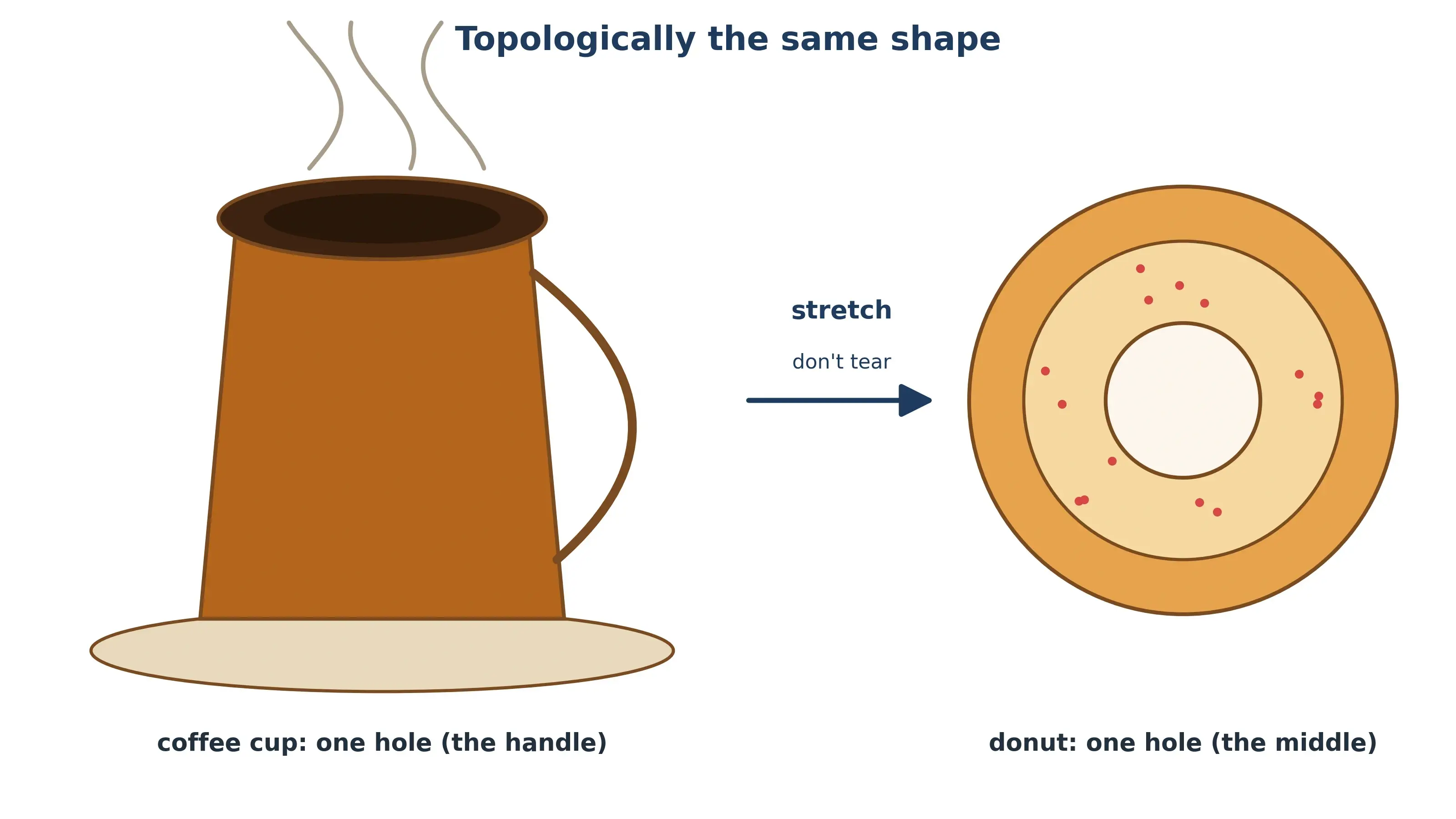
It is true, and it is not a joke at all, once you understand what "the same" means. Take a coffee cup — the ordinary kind, with a handle — and imagine it made of soft clay. Push the bowl down and out, flatten it, widen it, until the bowl has become a thick ring. The handle, which was a loop of clay attached to the side of the cup, is now the hole through the middle of the ring. Nothing has been torn. Nothing has been glued. No hole has been opened or closed. What you are holding is a donut, and the coffee cup has become it by stretching alone. That is the whole of topology in one picture: the study of what survives stretching, bending, squashing, and twisting, when tearing and gluing are forbidden.
Topology is the branch of mathematics that asks which properties of a shape stay the same when the shape is deformed continuously. It does not care how long something is, how big it is, or what angle it makes. A small circle and a huge circle are the same to a topologist. A sphere and a lumpy potato are the same. A coffee cup and a donut are the same. What topology cares about is the deeper structure: how many pieces a shape has, how many holes it has, whether it has one side or two, whether a loop drawn on it can be shrunk to a point. Those are the properties that stretching cannot change, and they turn out to be the properties that matter most.
A joke with a serious point
The joke works because it sounds absurd. A coffee cup holds coffee; a donut holds nothing but sugar. They look nothing alike, they do different jobs, and no sane person would confuse them at breakfast. But the joke is not about breakfast. It is about a precise mathematical claim: there is a continuous deformation, with no tearing and no gluing, that turns one into the other. The handle of the cup is a loop with a hole through it, and the donut is a ring with a hole through it, and that hole is the whole story. One hole, in both cases. Topology counts holes the way other branches of mathematics count numbers, and when the count matches, the shapes are the same — topologically.
Most people assume that geometry is the study of shapes, and that topology is some strange corner of it. What the data actually shows is almost the opposite: topology is the study of shape at its most basic, and geometry is topology with extra information added back in. Geometry asks how long, how far, how much angle. Topology asks a simpler question first: what is connected to what, and what holes does it have? The answers to the simple question constrain everything else. You cannot turn a sphere into a donut without tearing, no matter how cleverly you stretch, because the hole count is different, and no amount of stretching changes a hole count.
The shape that matters is not the shape you see
Consider a rubber band. Lay it on a table in a circle. Now stretch it into a square, then into a wobbly oval, then into a long thin loop. At every stage it is still a rubber band, still one loop, still with the same inside and outside. Now cut it once: it becomes a strip with two ends, and no amount of stretching will make it a loop again without gluing the ends back together. The cut changed something fundamental, and the stretching did not. Topology is the mathematics of that distinction. Stretching is allowed. Cutting is not. Gluing is not. Poking a new hole is not.
This is why topology feels so strange at first. Every other kind of geometry you have met measures things: lengths, areas, volumes, angles. Topology throws all of that away and asks what is left. What is left is surprisingly rich. There are surfaces with one side. There are loops that cannot be untied. There are shapes that cannot fit into three-dimensional space at all. There is a century-old question about the shape of the universe that took a hundred years and a mathematician who refused a million dollars to settle. And there is a modern field, built on topology, that finds the shape hidden inside data — the shape of a cloud of points, the shape of a brain scan, the shape of a molecule.
The question this article answers
I first met the coffee-cup claim in a lecture hall, twenty years ago, and I did not believe it. The lecturer drew a cup on the board, drew a donut next to it, and said they were the same, and the room laughed the way rooms do when a lecturer tells a joke. Then he spent the next ten minutes showing the deformation, step by step, and the laughter stopped, because the deformation was obviously possible and obviously did not tear anything. What stayed with me was not the cup. It was the feeling that mathematics had just changed its mind about what a shape is — that "the same shape" could mean something deeper than looking alike. That feeling is the reason this article exists.
This article answers three questions. First, what is topology, and what does it mean for two shapes to be the same? Second, what are the great invariants — the numbers and properties that stretching cannot change — and how do they classify the surfaces and knots of the world? Third, what is topology actually used for, in data, in DNA, in robots, and in the shape of the space we live in? Along the way we will count the vertices of the Platonic solids, cut a Möbius strip in half and get a surprise, untie a knot that cannot be untied, and meet the mathematician who solved the hardest shape question of the twentieth century and walked away from the prize. If you can stretch anything into anything, what is left to study? Quite a lot, as it turns out.
2. What Is Topology? The Geometry of Stretching Without Tearing
Topology is the study of the properties of shapes that do not change when the shape is stretched, bent, twisted, or squashed — so long as nothing is torn, cut, glued, or punctured. That is the whole definition, and it is worth reading twice, because it sounds too simple to support a whole branch of mathematics, and it supports one of the deepest branches there is. The properties topology studies are the ones that survive continuous deformation: how many pieces a shape has, how many holes it has, whether it has a boundary, whether it has one side or two, and whether a loop drawn on it can be shrunk to a point.
The name itself tells the story. Topology comes from the Greek words topos, meaning place, and logos, meaning study: the study of place, of how things are put together in space. The German mathematician Johann Benedict Listing coined the word in 1847, in a short book called Vorstudien zur Topologie, and the subject grew from there. But the first topological result is older than the name. In 1736, Leonhard Euler solved the problem of the seven bridges of Königsberg — whether a person could walk through the city crossing each of its seven bridges exactly once — by throwing away everything about the city except which land masses the bridges connected. That is a topological move: ignore the lengths, the angles, the distances, and keep only the pattern of connections. Euler showed the walk was impossible, and in doing so he invented the first theorem of topology and, arguably, the first theorem of graph theory. The two subjects share a birthday, and they still share ideas: a graph is a one-dimensional piece of topology, and the story of the bridges is told in full in our article on graph theory.
Geometry cares about size; topology does not
Geometry measures. It asks how long a line is, how large an angle is, how much area a surface covers, how sharply a curve bends. Those are good questions, and they have answers that change when you stretch a shape. Pull a circle into an ellipse and its curvature changes at every point; stretch a square into a rectangle and its sides change length. Geometry notices all of that. Topology notices none of it, on purpose. It asks a different question: what stays the same through all that stretching?
The answer is a short list, and it is a powerful one. The number of pieces stays the same: stretching cannot split one piece into two, and it cannot join two pieces into one. The number of holes stays the same: stretching cannot open a new hole, and it cannot close one that is there. Whether a shape has a boundary stays the same: a ball has a surface as its boundary, a hollow shell has an inside surface and an outside surface, and no amount of stretching changes which is which. Whether a loop can be shrunk to a point stays the same. These are the topological properties, and they are the skeleton of a shape — everything else is flesh that can be rearranged.
Think of a lump of clay. You can roll it into a ball, flatten it into a disc, pull it into a sausage, twist it into a pretzel shape. Through all of that, the clay stays one piece, with no holes and no edges except its outer surface. The ball, the disc, the sausage, and the pretzel-shape-without-a-hole are all the same topologically. Now poke a hole through the clay with your finger and join the ends: you have made a donut shape, and you cannot get back to the ball without filling the hole in — which is gluing, and gluing is forbidden. The hole is a topological fact. The shape of the lump is not.
The rubber-sheet rule
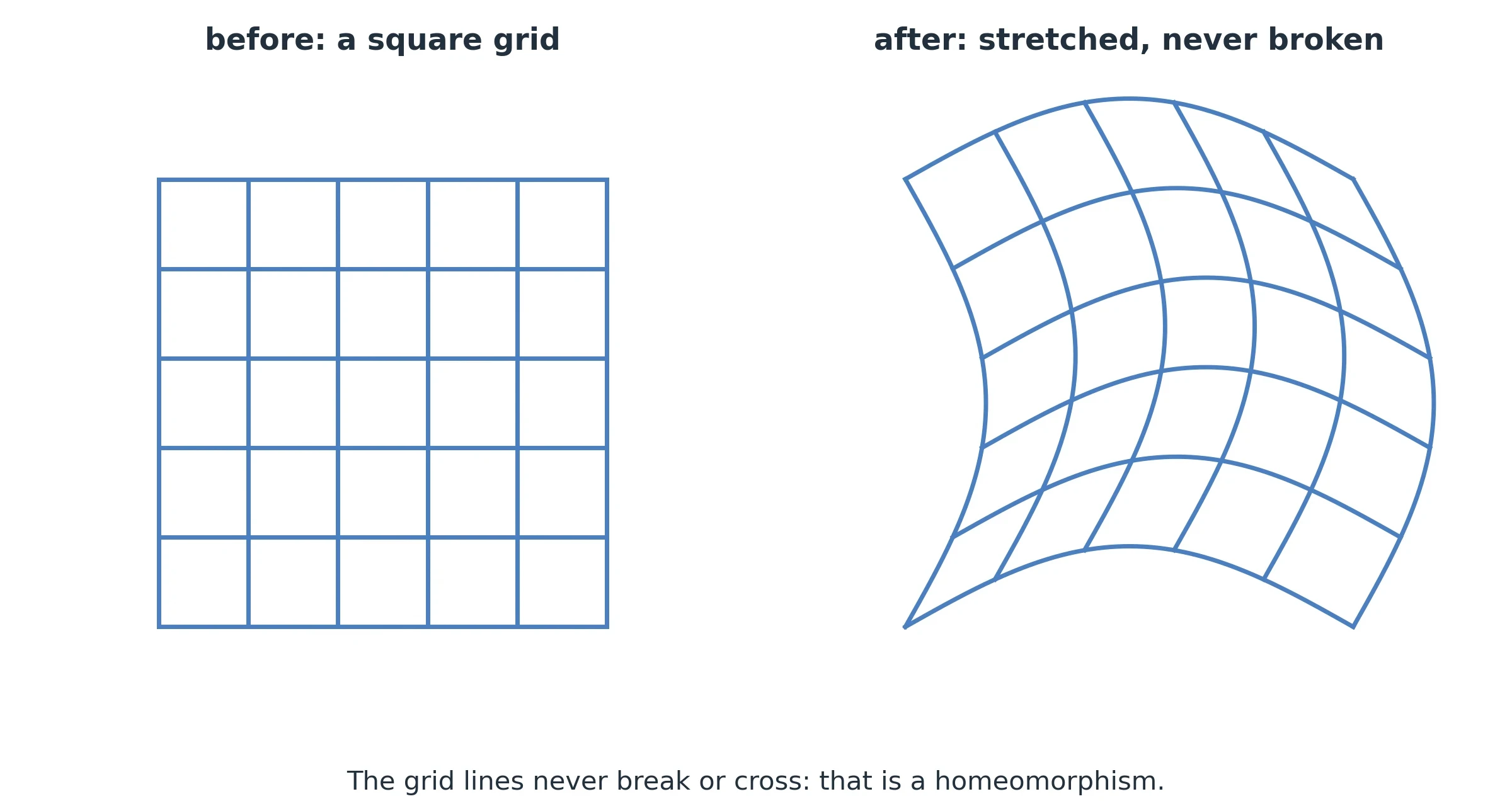
Mathematicians sometimes call topology "rubber-sheet geometry", and the nickname is helpful as long as you remember it is a nickname, not a definition. Imagine every shape drawn on a sheet of rubber. You may stretch the sheet, bend it, twist it, squash it flat. You may not cut the sheet, tear it, glue two parts together, or poke a hole in it. Two shapes are the same, topologically, if one can be turned into the other by stretching the sheet. That is the rubber-sheet rule, and it is a good intuition pump — but the real definition is sharper, and we will meet it in the next section, under the name homeomorphism.
The rubber-sheet rule also explains why topology and geometry part company. Geometry needs a ruler. It needs to say that this line is three centimetres long and that angle is ninety degrees, and those statements only make sense if the shape holds still. Topology needs no ruler. It needs only the idea of "near": which points are next to which, which paths connect to which, which loops can be shrunk. That is why topology can work in places where geometry cannot — in spaces with no sensible notion of distance, in infinite-dimensional spaces, in the space of all possible shapes of a protein. Wherever there is a notion of "nearby", topology can begin.
What topology actually studies
Strip away the measurements and four questions remain, and they organise the whole subject. First, connectedness: how many pieces does a shape have, and how are they joined? Second, holes: how many are there, and what kind — a hole through a donut is different from a hollow cavity inside a ball, and topology counts both. Third, boundaries and sides: does the shape have an edge, does it have one side or two, does it have an inside? Fourth, loops: which loops on the shape can be shrunk to a point, and which are caught around a hole?
A word with a history
Topology is a young subject with old roots. Euler in 1736 and again in 1750, with his polyhedron formula, gave it its first theorems. Listing named it in 1847. Möbius and Listing found the one-sided strip in 1858. Klein described his bottle in 1882. And then Poincaré, in 1895, gathered all of this into a single subject with his Analysis Situs, the first systematic treatment of topology, and in 1904 he asked the question that would dominate the subject for the next century. The history matters because it shows how the subject grew: not from a single idea, but from a series of surprises — a bridge problem with no solution, a strip with one side, a bottle with no inside — each of which forced mathematicians to rethink what a shape is.
One more distinction is worth making now, because it prevents a common confusion. Fractals have a dimension that is not a whole number — a coastline, for example, has a fractal dimension somewhere between one and two — but that is not the same as topological dimension. The topological dimension of a curve is one, of a surface is two, of a solid is three, and no amount of stretching changes those numbers. Fractal dimension measures roughness; topological dimension measures something more basic. The difference, and the strange world of self-similar shapes, is explored in our article on fractals. Here, dimension stays whole, and topology stays concerned with the properties that stretching cannot touch.
3. Homeomorphism: When Two Shapes Are Really the Same
Two shapes are topologically the same — mathematicians say homeomorphic — when one can be deformed into the other continuously, with a continuous reverse deformation, and without any tearing or gluing. The word comes from the Greek homoios, meaning similar, and morphe, meaning shape. A homeomorphism is not just any reshaping: it must be reversible, and both directions must be continuous, which is the precise way of saying "no tearing, no gluing". If you can stretch shape A into shape B, and stretch shape B back into shape A, and neither direction ever cuts or joins, then A and B are homeomorphic, and topology cannot tell them apart.
That definition is doing real work. Consider a circle and a square. They look different — one is round, one has corners — but they are homeomorphic: push the corners of the square out and round them, and you get a circle; squash the circle at four points and you get the square back. No tearing anywhere. Now consider a circle and a figure-eight, the shape of the number 8. They are not homeomorphic. The figure-eight has a point in the middle where four arms meet, and if you remove that one point, the figure-eight falls into two pieces — one for each loop; remove any single point from a circle and it stays in one piece. No stretching can change that, because stretching never changes what happens when you remove a point. The circle and the figure-eight are genuinely different shapes, topologically, and the difference is visible in the counting.
The alphabet test
The best way to feel homeomorphism in your hands is the alphabet test. Write the capital letters in a plain sans-serif font and ask which ones are the same shape, topologically. Counting holes is a start, but it is not the whole story: homeomorphism also cares about branch points — places where three or more strokes meet — because removing a branch point splits the letter into more pieces than removing an ordinary point. A circle, the letter O, and the letter D are the same: each is a single loop with no branch point and no tail. The letter B has two loops, so it is in a family of its own. The letters A, P, Q, and R each have one loop, but they are not the same as O: A is a loop with two legs, P is a loop with one tail, and Q and R form a family of their own. The letters with no loops split further by their branch points: C, G, I, J, L, M, N, S, U, V, W, and Z are plain arcs with no branch point, and they can all be stretched into each other and into a straight line; E, F, T, and Y each have exactly one branch point where three strokes meet; H has two such branch points; and X and K have a point where four strokes meet. In total the alphabet falls into nine homeomorphism classes: {D, O}, {P}, {A}, {Q, R}, {B}, {C, G, I, J, L, M, N, S, U, V, W, Z}, {E, F, T, Y}, {H}, {X, K}.
I once ran this test on a whiteboard in front of a room of students and got it wrong in public. I put the letter A in the no-loop family, forgetting that the crossbar of the A closes a triangle, and a student pointed it out before I had finished writing the next letter. It was a small embarrassment and a useful one: the alphabet test is easy to get wrong precisely because the eye reports geometry — the A looks like lines meeting — while topology reports structure, and the structure says there is a loop. The mistake is the lesson. Topology is not about what a shape looks like. It is about what a shape is connected to.
Why "same" needs a definition
Everyday language uses "the same shape" loosely. A coin and a button are "the same shape" because they are both round and flat, even though one is bigger. A square and a rectangle are "almost the same shape". Topology replaces that looseness with a definition that can be checked: a homeomorphism. The definition matters because without it, arguments about shapes dissolve into arguments about words. With it, you can prove things. You can prove that a sphere and a cube are homeomorphic — inflate the cube, round the corners, and you have a sphere — and you can prove that a sphere and a torus are not, because the torus has a hole and the sphere does not, and no homeomorphism can create or destroy a hole.
The definition also explains why size is irrelevant in topology. A tiny circle and a huge circle are homeomorphic: scaling is a continuous deformation with a continuous reverse, and it tears nothing. A knot tied in a long rope and the same knot tied in a short rope are the same knot, topologically, because the length of the rope is a measurement, and topology has thrown measurements away. What matters about a knot is the pattern of crossings, not the length of the string. We will come back to that in section 10, where the pattern of crossings becomes a whole subject of its own.
4. Open Sets and Continuity: Topology's Own Language
Underneath the rubber-sheet pictures, topology has a precise language, and its two key words are open set and continuity. An open set is a set that contains none of its boundary points. Take the numbers strictly between zero and one: every point in that set has a little neighbourhood around it that is still inside the set, because there is always room to move a tiny bit in either direction without leaving. Now take the numbers from zero to one inclusive: the endpoints zero and one are boundary points, and any neighbourhood of zero spills outside the set. The first set is open; the second is not. That is the whole idea, and it captures "nearness" without ever mentioning distance.
Continuity, in topology, is defined through open sets: a function is continuous if the pre-image of every open set is open. In plain language, that means the function never tears. If you take a set with no boundary in the output and look at all the points that map into it, you get a set with no boundary in the input. A tear would show up as a boundary appearing where there was none. The definition sounds abstract, and it is, but it is exactly the rubber-sheet rule written in a form that can be checked and proved with. No tearing means pre-images of open sets are open. That is all continuity is.
The same continuity you already know
If you have met continuity in calculus, this is the same idea wearing different clothes. In calculus, a function is continuous if you can make the output as close as you like to a given value by making the input close enough — the epsilon-delta definition. That definition needs a ruler: it needs to measure how close is close enough. The topological definition needs no ruler. It only needs the idea of open sets, of neighbourhoods, and it turns out that the two definitions agree wherever both apply. The calculus version is the topological version with a ruler attached. The ideas are explained from the ground up in our article on how calculus works, and this article uses them without re-teaching them.
The gain from dropping the ruler is generality. There are spaces where no single distance function captures the natural notion of nearness — the space of all functions from the real line to itself, with the topology of pointwise convergence, for example — and yet the idea of "nearby" still works, because open sets still work. Topology can study those spaces with the same tools it uses for circles and spheres. That is why the subject grew beyond shapes: once you have open sets, you have a language for nearness that works anywhere, and the same theorems start applying in analysis, in dynamics, and in data science.
Why bother with open sets
A fair question is why anyone should bother with open sets when the rubber-sheet picture is so much friendlier. The answer is that pictures can lie, and definitions cannot. The rubber sheet tells you that a sphere and a cube are the same, and it is right. But it cannot tell you whether two complicated shapes in four dimensions are the same, because you cannot picture four dimensions. Open sets can. They give topology a foundation that does not depend on visualisation, and that foundation is what lets the subject prove the theorems in the second half of this article — the classification of surfaces, the fixed-point theorems, the Poincaré conjecture. Every one of those results is proved in the language of open sets, not in the language of rubber sheets. The pictures are the doorway. The open sets are the house.
There is one more idea worth carrying forward: a topological space is simply a set together with a collection of open sets satisfying three rules — the empty set and the whole space are open, any union of open sets is open, and any finite intersection of open sets is open. That is the entire foundation of the subject, in one sentence. Everything else — homeomorphisms, connectedness, compactness, the fundamental group — is built on it. It is a strikingly small foundation for a strikingly large building, and that economy is part of what makes topology beautiful.
5. The Euler Characteristic: Counting Your Way to the Shape
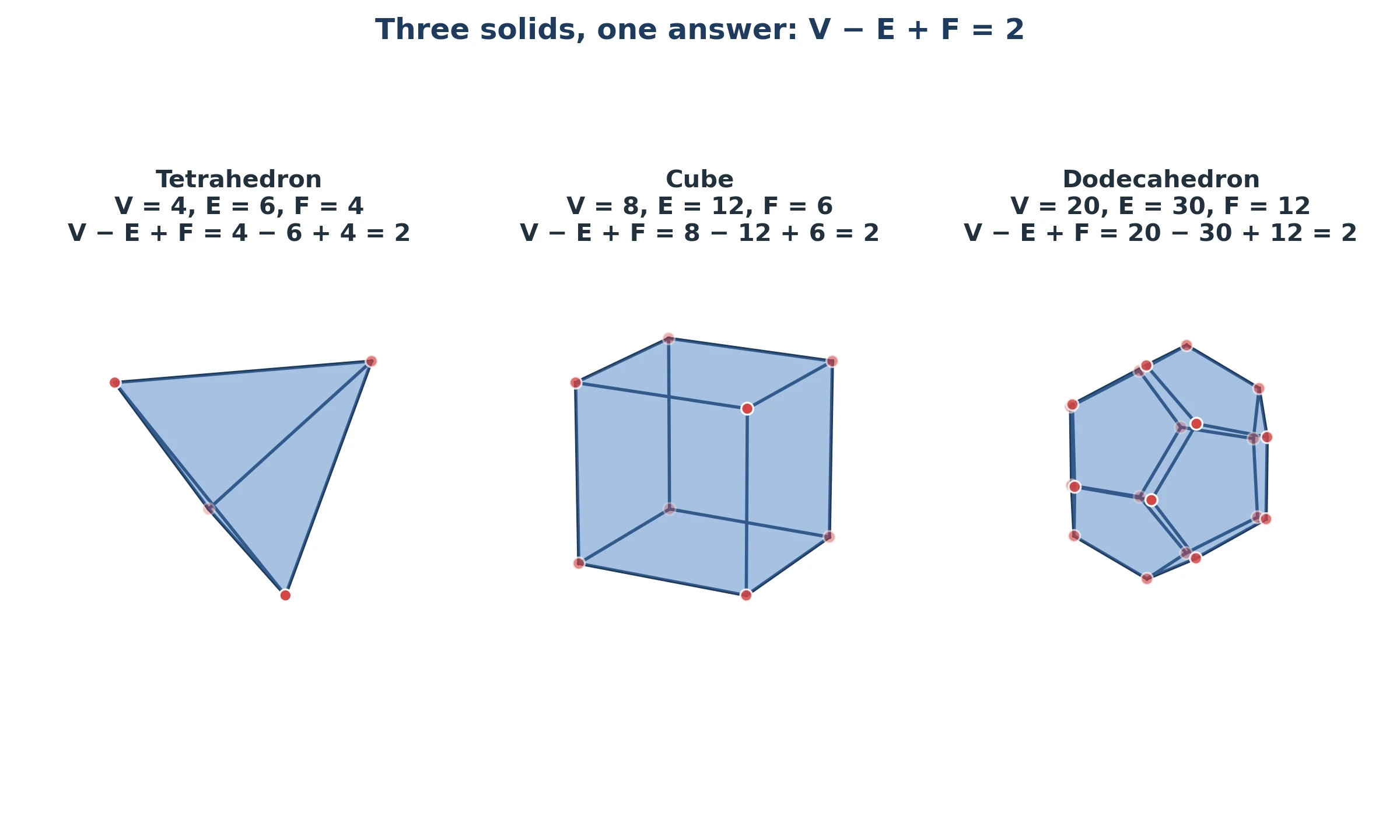
The first great invariant of topology is a number you can compute by counting. Take any polyhedron — any solid with flat faces — and count its vertices V, its edges E, and its faces F. Then compute V minus E plus F. The answer is always 2. Always. A tetrahedron has 4 vertices, 6 edges, and 4 faces: 4 minus 6 plus 4 equals 2. A cube has 8 vertices, 12 edges, and 6 faces: 8 minus 12 plus 6 equals 2. An octahedron has 6 vertices, 12 edges, and 8 faces: 6 minus 12 plus 8 equals 2. A dodecahedron has 20 vertices, 30 edges, and 12 faces: 20 minus 30 plus 12 equals 2. An icosahedron has 12 vertices, 30 edges, and 20 faces: 12 minus 30 plus 20 equals 2. Five solids, five different counts, one answer. That number, V minus E plus F, is called the Euler characteristic, written with the Greek letter chi, and it is the same for every shape that can be deformed into a sphere.
The formula is named for Leonhard Euler, who announced it in a letter to Christian Goldbach in 1750 and published it in papers written in 1750 and 1751, printed in 1758. Euler did not have a complete proof — the first fully rigorous proof came from Legendre in 1794, and Cauchy gave the proof strategy still taught today in the early 1800s — but the formula was his, and it was the first topological invariant ever found. Descartes had a closely related result around 1630, in an unpublished manuscript that survived only because Leibniz made a copy of it in 1676, and the copy was rediscovered around 1860. The history is a reminder that the best ideas often arrive before the language to express them does.
Why the count works
The reason the count always gives 2 for a sphere-like shape is easier to see than to prove, and the seeing is enough for this article. Imagine a hollow sphere made of rubber, with a triangulation drawn on it — a network of vertices, edges, and triangular faces covering the surface. Cut a small hole in one face and flatten the whole thing out on a table. Now count: every time you remove a triangle, or an edge, or a vertex, the number V minus E plus F stays the same, because each removal takes away matching amounts. Peel the network down, triangle by triangle, until one triangle is left, and that last triangle has 3 vertices, 3 edges, and 1 face: 3 minus 3 plus 1 equals 1. Add back the face you cut out at the start, and the total is 2. The count never changed during the peeling, so it was 2 all along.
The five Platonic solids, counted
The five Platonic solids — the tetrahedron, cube, octahedron, dodecahedron, and icosahedron — are the only convex solids whose faces are all identical regular polygons and whose vertices all look alike. They have been known since antiquity, and Euler's formula gives a short proof that there are exactly five of them: the counting constrains the possibilities so tightly that no sixth solid can exist. The table below lists them with their counts. Every row ends in 2, and that repeated 2 is the point. Five different solids, five different sets of numbers, one invariant.
| Solid | Vertices (V) | Edges (E) | Faces (F) | V − E + F |
|---|---|---|---|---|
| Tetrahedron | 4 | 6 | 4 | 2 |
| Cube | 8 | 12 | 6 | 2 |
| Octahedron | 6 | 12 | 8 | 2 |
| Dodecahedron | 20 | 30 | 12 | 2 |
| Icosahedron | 12 | 30 | 20 | 2 |
Table 1: The five Platonic solids and their Euler characteristic. Different solids, different counts, the same answer: 2.
The Euler characteristic also appears in a deeper theorem, the Gauss–Bonnet theorem, which connects it to curvature: the total curvature of a closed surface equals 2π times its Euler characteristic. For a sphere, the total curvature is 4π, and 2π times 2 is 4π. The number pi turns up here because curvature is measured in radians, and the full story of pi — including why it appears in places no one expects — is told in our article on pi. The Euler characteristic also has a cousin for graphs: for a connected planar graph, V minus E plus F equals 2 as well, where F now counts the regions the graph divides the plane into, and that version of the formula is part of the story in our article on graph theory. One formula, two subjects, the same counting idea.
6. Genus and the Classification of Surfaces
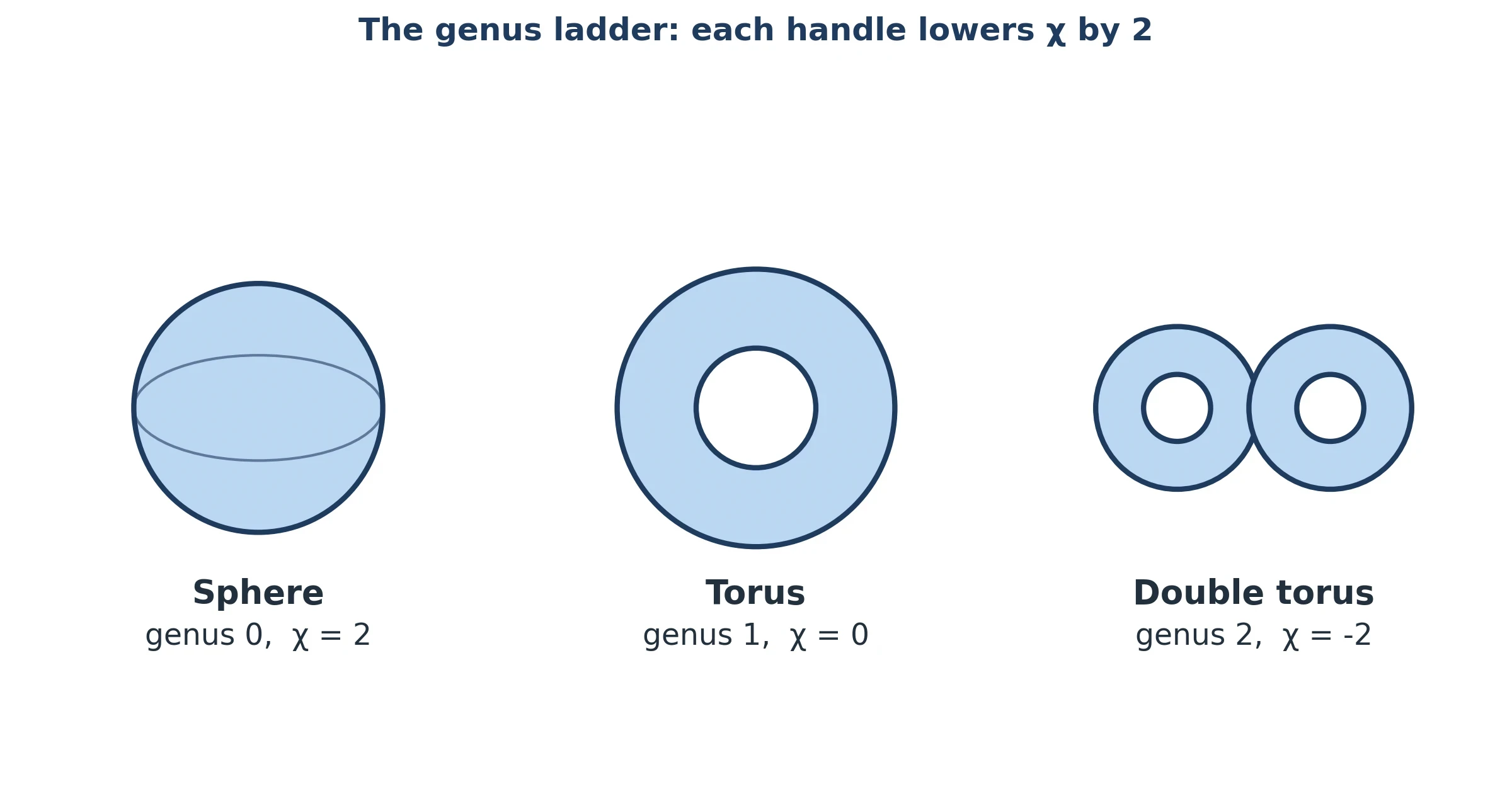
If the Euler characteristic is the first invariant, the genus is the second, and the two are tied together by a single formula. The genus of a surface is its number of holes — or, more precisely, its number of handles. A sphere has genus 0: no holes. A torus has genus 1: one hole. A double torus, the shape of a pretzel with two holes, has genus 2. A coffee cup has genus 1, because its handle is a hole. The formula is chi equals 2 minus 2g, where g is the genus. For a sphere, g is 0 and chi is 2. For a torus, g is 1 and chi is 0. For a double torus, g is 2 and chi is negative 2. For a triple torus, g is 3 and chi is negative 4. For a surface of genus 5, chi is negative 8. Each new handle lowers the Euler characteristic by 2, and the formula never fails.
The formula is the beginning of the classification of surfaces, one of the great theorems of topology. It says that every closed orientable surface — every surface with no boundary and two sides — is a sphere with some number of handles attached, and the number of handles is all you need to know. Two such surfaces are homeomorphic exactly when they have the same genus. There are no other possibilities. The classification was worked out in the nineteenth century: Möbius sorted the closed orientable surfaces by their number of handles in 1863, and Walther von Dyck added the non-orientable surfaces in 1888. The result is a complete list, and it is short enough to fit in a table.
Non-orientable surfaces count differently
For non-orientable surfaces — surfaces with only one side, which we will meet in sections 8 and 9 — the formula changes. Instead of handles, they are built from cross-caps, and the formula is chi equals 2 minus g, where g is now the number of cross-caps. The projective plane has g equal to 1 and chi equal to 1. The Klein bottle has g equal to 2 and chi equal to 0 — the same Euler characteristic as the torus, though the two surfaces are very different, because one is orientable and the other is not. A non-orientable surface of genus 3 has chi equal to negative 1, and one of genus 5 has chi equal to negative 3. The Euler characteristic alone does not classify surfaces: you also need to know whether the surface is orientable. Together, genus and orientability are a complete fingerprint.
| Surface | Genus (g) | Orientable? | Euler characteristic (χ) |
|---|---|---|---|
| Sphere | 0 | Yes | 2 |
| Torus (donut) | 1 | Yes | 0 |
| Double torus | 2 | Yes | −2 |
| Triple torus | 3 | Yes | −4 |
| Projective plane | 1 | No | 1 |
| Klein bottle | 2 | No | 0 |
| Möbius strip | — (has a boundary) | No | 0 |
Table 2: Closed surfaces classified by genus, orientability, and Euler characteristic. The Möbius strip has a boundary, so it is not a closed surface, but its Euler characteristic is 0.
Why classification matters
Classification theorems are the gold standard of mathematics: a complete list, with a proof that nothing is missing. The classification of surfaces says that the world of closed surfaces, which looks infinite and wild, is in fact orderly — a single list, indexed by one number and one yes-or-no question. It is the model for what topologists want everywhere else, and the reason the Poincaré conjecture mattered so much: it was the missing piece of the classification of three-dimensional spaces, the analogue of this table for the space we live in. We will come to it in section 14.
7. The Sphere, the Torus, and the Coffee Cup
The sphere is the simplest closed surface: genus 0, Euler characteristic 2, no holes, no boundary, two sides — an inside and an outside. Every convex polyhedron is a sphere, topologically. Every ball is a sphere. The surface of the Earth is, to a topologist, a sphere, and that is why the rubber-band test works the way it does: any loop drawn on a sphere can be shrunk to a point, because there is no hole for it to catch on. The sphere is the starting point of the classification, the shape with nothing added.
The torus is the next shape on the list: genus 1, Euler characteristic 0, one hole. A donut, an inner tube, a bagel, a lifebelt, a coffee cup — all genus 1, all homeomorphic to each other. The torus has two kinds of loops: loops that go around the tube, which can be shrunk to a point, and loops that go through the hole, which cannot. That second kind of loop is the fingerprint of the hole, and it is what makes the torus different from the sphere. No stretching can remove it, because removing it would mean closing the hole, and closing a hole is gluing.
The coffee cup, step by step
Here is the deformation, slowly. Start with the cup: a bowl, open at the top, with a handle attached at two points on the side. First, flatten the bowl. Push the bottom up and the sides out, until the bowl is a thick disc, with the handle still a loop on the side. Now let the handle's loop open out: the loop through the handle is the hole, and as the bowl flattens and widens around it, the disc becomes a ring whose hole is the old handle loop. The cup is now a donut: a ring with a hole through the middle, and the hole is the loop that used to be the handle. Nothing was torn. Nothing was glued. The hole count stayed at one throughout.
I once explained this to a friend over an actual cup of coffee, using the cup in my hand as a prop, and she watched me flatten imaginary clay in the air and said, "But the coffee would spill." She was right, of course — and that is the point. The coffee is not part of the topology. The cup as a solid object, full of coffee, is a ball with a handle; the cup as a surface, the thin ceramic shell, is a torus. Topology studies the surface, and the coffee is geometry's problem, not topology's. She laughed, and then she asked the right question: "So what can the cup not become?" The answer is everything with a different hole count. It cannot become a sphere, because that would need the hole filled in. It cannot become a double torus, because that would need a new hole poked through. It cannot become a ball, because a ball has a boundary and no hole. The hole count is an invariant, and invariants are the walls of the topological world.
What the cup cannot become
The coffee cup is a good test case for the whole subject, because it shows what topology can and cannot do. It can tell you that the cup and the donut are the same, and that the cup and the sphere are different, and it can prove both claims. It cannot tell you how big the cup is, how much coffee it holds, or whether the handle is comfortable to grip. Those are measurements, and topology has thrown measurements away. What it keeps — the hole, the connectedness, the boundary — is enough to sort every surface in the world into its proper family, and that sorting is the classification theorem of the last section, working in miniature on a breakfast table.
8. The Möbius Strip: A Surface With One Side
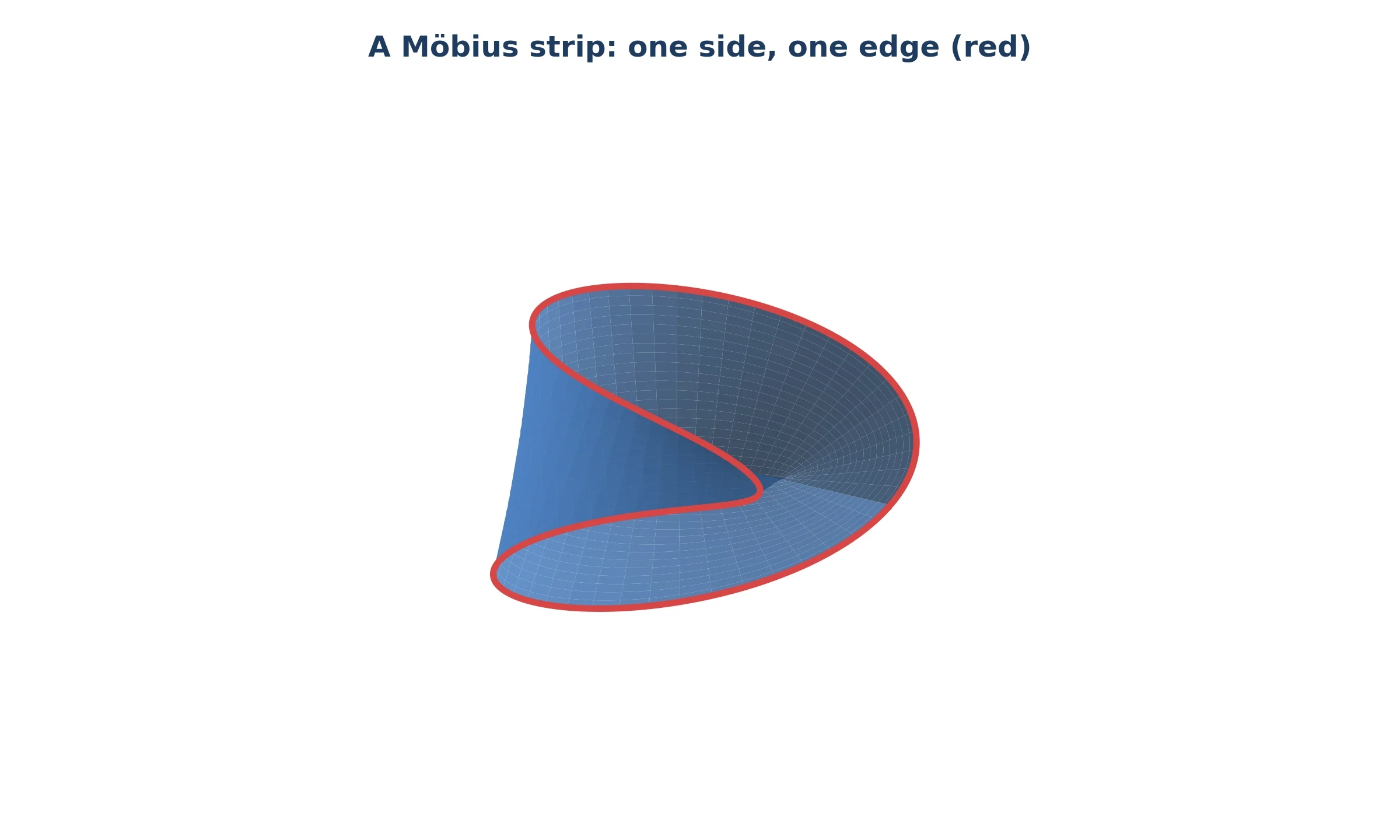
Take a strip of paper. Give one end a half-twist — just half a turn, 180 degrees — and join the two ends together. What you are holding is a Möbius strip, and it breaks a rule you have believed since childhood: that every surface has two sides. Trace your finger along the strip and you will come back to your starting point having covered both "sides" without ever lifting your finger or crossing an edge. The strip has one side, not two. It also has one edge, not two: follow the edge around and you return to the start having traversed the whole boundary in a single loop. One side, one edge, one half-twist — and a surface that cannot be turned into an ordinary band without cutting it.
The strip is named for August Ferdinand Möbius, who discovered it in 1858, but the history has a twist of its own: Johann Benedict Listing, the man who coined the word "topology", discovered the same strip independently in the same year, a few months earlier, and published it in 1861, while Möbius's paper appeared only in 1865. The strip kept Möbius's name anyway. Listing's priority is recorded in the history books, and Möbius's name is on the object, and both men deserve a share of the credit. The strip had even appeared before either of them, in Roman mosaics from the third century — the shape is older than the mathematics that explains it, though whether the mosaic-makers knew it was one-sided is unknown.
Cutting it does stranger things
The Möbius strip rewards cutting. Cut an ordinary paper band down the middle and you get two bands. Cut a Möbius strip down the middle and you get one loop, twice as long, with two full twists in it — a single band, not two, because the one side of the strip means the cut never separates anything. Cut it a third of the way across instead, and you get two loops linked together: one Möbius strip and one longer twisted band, interlocked like two rings of a chain. These are not parlour tricks. They are consequences of the topology: the number of sides, the number of edges, and the twist determine what cutting does, and the results are forced by the shape, not chosen by the cutter.
There is a practical footnote worth recording, carefully. MathWorld, citing Madachy's Mathematical Recreations (1979), reports that the B. F. Goodrich Company patented a conveyor belt in the form of a Möbius strip, on the grounds that it would last twice as long as an ordinary belt, because the single side means the whole surface gets used instead of only one side. No patent number is given in that account, and the patent itself has not been verified here, so treat this as a reported anecdote rather than an established fact — but the reasoning is sound topology: one side means twice the wearing surface.
Why one-sidedness matters
The Möbius strip is the simplest non-orientable surface, and it is the reason orientability is one of the three ingredients of the classification of surfaces, alongside genus and boundary. A surface is orientable if you can consistently choose a "front" and a "back" at every point; the Möbius strip defeats that choice, because carrying the choice around the strip brings it back reversed. The strip has Euler characteristic 0 — a triangulation with 6 vertices, 12 edges, and 6 faces gives 6 minus 12 plus 6 equals 0 — and it has a boundary, a single edge, so it is not a closed surface. But it is the building block for the closed non-orientable surfaces: glue two Möbius strips together along their edges and you get a Klein bottle, which is the subject of the next section. The one-sided strip is not a curiosity at the edge of topology. It is the hinge the whole classification turns on.
9. The Klein Bottle and the Projective Plane: Surfaces That Won't Fit
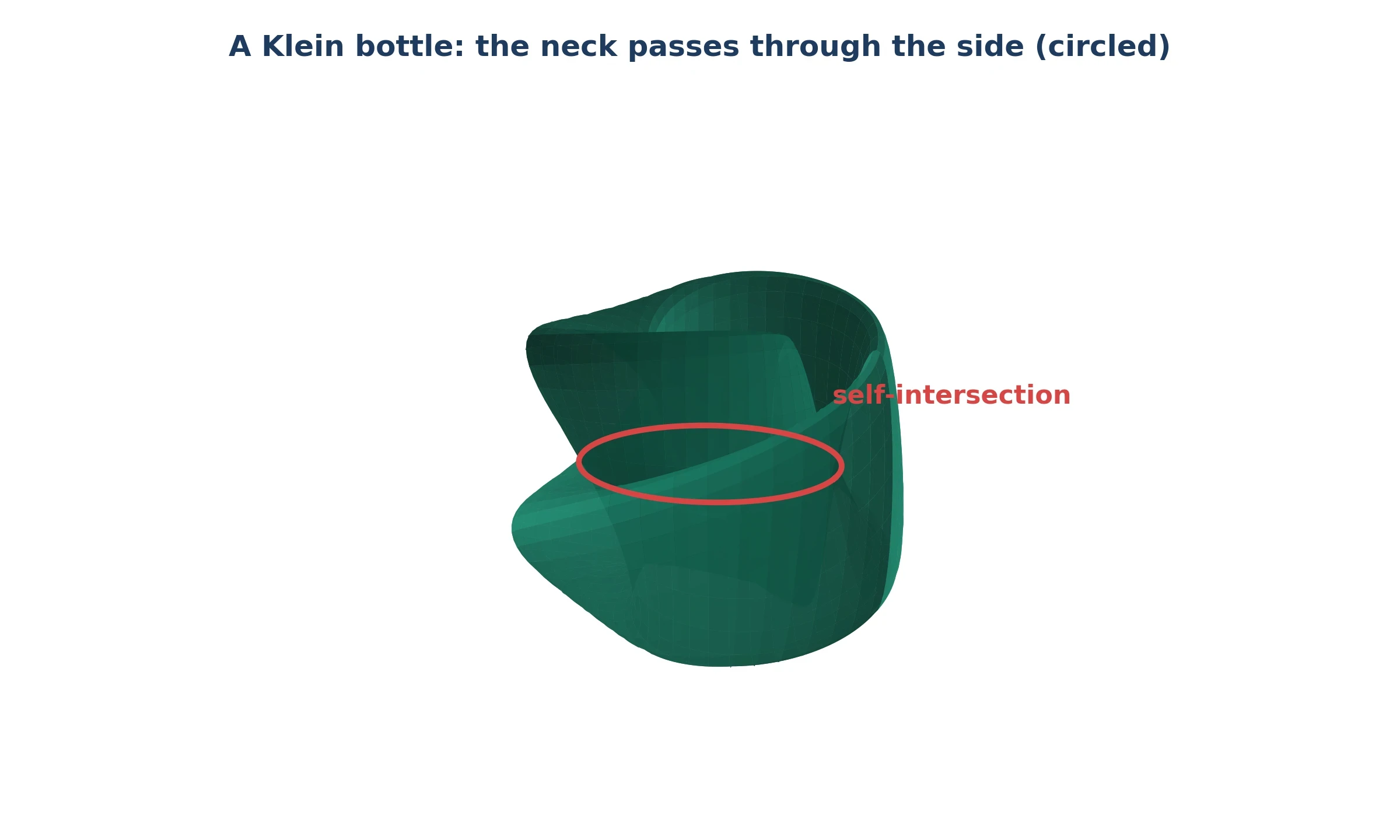
Glue two Möbius strips together along their edges and you get a Klein bottle: a closed surface with no boundary, no inside, and no outside, and only one side. It is named for Felix Klein, who described it in 1882, in his book on Riemann's theory of algebraic functions. The Klein bottle is the non-orientable companion of the torus in the same way the Möbius strip is the non-orientable companion of the cylinder: the torus is a cylinder with its ends glued straight, and the Klein bottle is a cylinder with its ends glued with a reflection. That one reflected gluing changes everything. The result has Euler characteristic 0, genus 2 in the non-orientable counting, and no way to sit in three-dimensional space without passing through itself.
That last fact is the point. A Klein bottle cannot be embedded in three-dimensional space — it can only be immersed, which is the technical word for a shape that is allowed to cross itself. Every glass Klein bottle you have seen in a shop is an immersion: the neck passes through the side of the bottle, and at the crossing the surface meets itself. The true Klein bottle has no such crossing; it needs a fourth dimension to pass through without touching. In four dimensions, the neck can go "around" the side the way a line on paper can go around a dot by leaving the page. Our space has no such direction, so the bottle must cheat.
The projective plane: the simplest closed non-orientable surface
The Klein bottle is not the simplest closed non-orientable surface. That honour belongs to the projective plane, which has Euler characteristic 1 and genus 1 in the non-orientable counting. One way to build it is to take a sphere and identify every pair of opposite points — glue each point to the one directly across from it. Another way is to take a Möbius strip and glue a disc onto its single edge, closing the boundary. Either way, the result is a surface with no boundary and one side, and it cannot be embedded in three-dimensional space either: every model of it in our space crosses itself. The projective plane is the surface of the geometry of perspective, the geometry of what a camera sees, and it is also the space of all lines through the origin in three dimensions. It is abstract, it is everywhere, and it will not fit in a display case.
Why surfaces that won't fit matter
It would be easy to dismiss the Klein bottle and the projective plane as pathologies, shapes that fail to fit in our space and therefore fail to matter. That would be a mistake, and the rest of this article is the evidence. Non-orientable surfaces appear in the space of image patches, where a Klein bottle turned up in a study of natural images in 2008. They appear in physics, where the space of states of a system can be non-orientable. And they appear in the classification itself: without them, the list of surfaces would be incomplete, and an incomplete classification is a standing invitation to be surprised.
10. Knots: Loops That Can't Be Untied
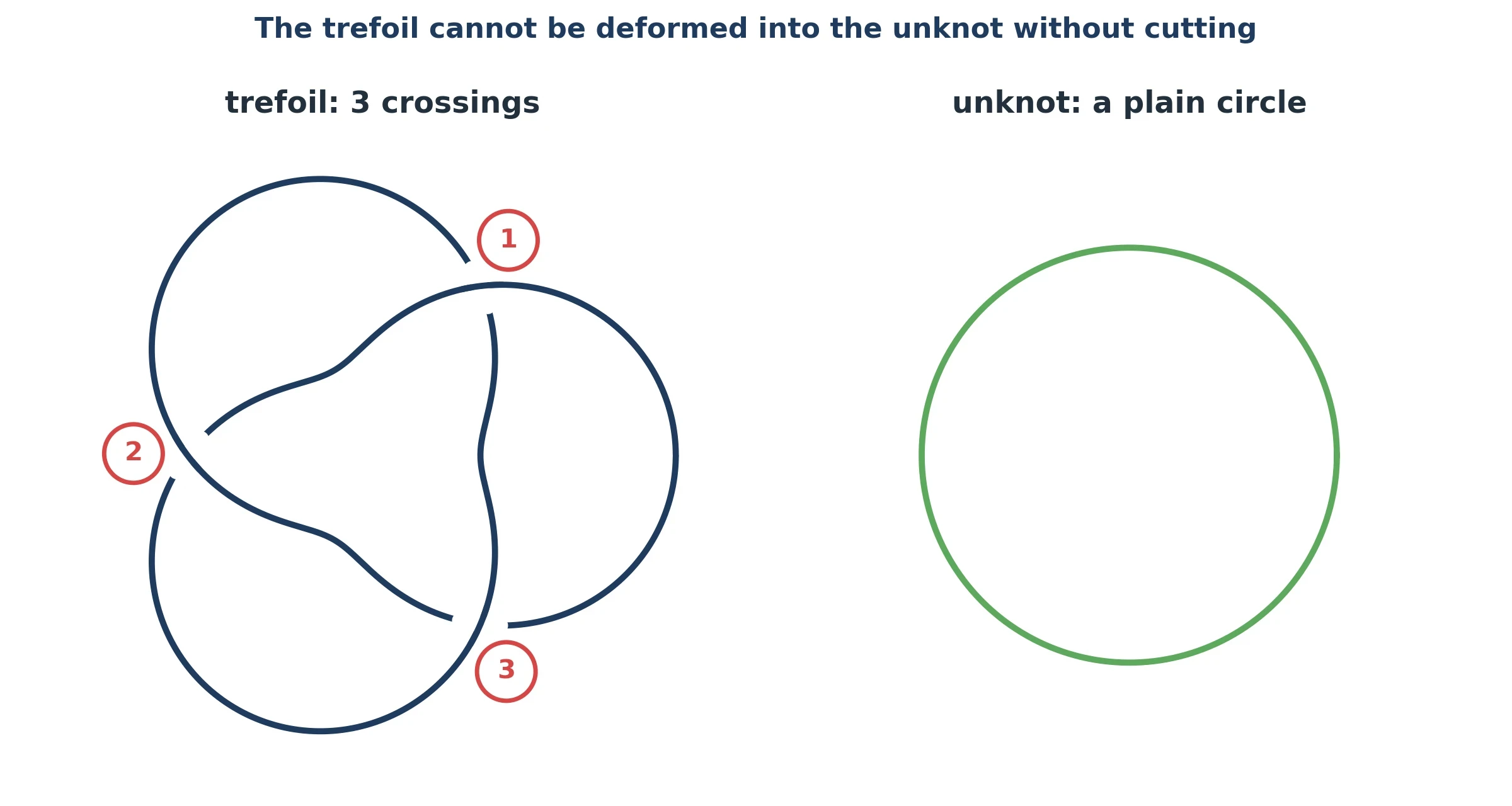
A mathematical knot is a closed loop in three-dimensional space — a loop of string with its ends joined, so that it cannot be untied without cutting. That closed condition matters. A shoelace knot is not a mathematical knot, because its ends are free and the knot can always be undone by pulling them. A mathematical knot has no ends, and the question is whether the loop can be deformed, without cutting, into a plain circle — the unknot — or whether it is genuinely knotted. Two knots are the same if one can be deformed into the other without cutting, and the subject of knot theory is the classification of those loops: how many kinds are there, and how do you tell them apart?
The simplest real knot is the trefoil, with three crossings: the overhand knot you tie in a piece of string, with its ends joined. It is the only prime knot with three crossings, and it comes in two versions, left-handed and right-handed, which are mirror images of each other — and, remarkably, the two versions are different knots. No deformation turns a left-handed trefoil into a right-handed one. Max Dehn proved that in 1914, with a hard argument about the symmetries of the knot, and it took seventy years before a simple polynomial could do the same job in a line. The figure-eight knot, with four crossings, is the only prime knot with four crossings, and it is different again: it is the same as its own mirror image, a property called amphichiral, and it is the simplest knot with that property.
Counting knots: the census
How many knots are there? The question sounds innocent and the answer is a census that has occupied mathematicians for a century and a half. Knots are counted by their crossing number — the smallest number of crossings in any diagram of the knot — and by whether they are prime, meaning they cannot be split into two simpler knots joined together. Prime knots are the atoms of knot theory, in the same way that prime numbers are the atoms of arithmetic: every knot is a combination of prime knots, and the combination is unique. The counting goes like this: there is 1 prime knot with 3 crossings, 1 with 4, 2 with 5, 3 with 6, 7 with 7, 21 with 8, 49 with 9, and 165 with 10 — a total of 249 prime knots with ten or fewer crossings. The numbers then explode: 1,388,705 prime knots have exactly 16 crossings, and 1,701,936 have sixteen or fewer, in the census completed by Hoste, Thistlethwaite, and Weeks in 1998. The census has since been extended to 19 crossings, where the total reaches 352,152,252 distinct prime knots. A small loop of string holds more variety than anyone in the nineteenth century imagined.
Tait's tables and a nineteenth-century mistake
The census began with Peter Guthrie Tait, who started tabulating knots in 1876, with Thomas Kirkman and Charles Little, because the physicist William Thomson — Lord Kelvin — had proposed that atoms were knots in the aether, and that the elements of the periodic table were the different knots. Kelvin's theory was wrong, and it died within a generation, but the tables it inspired became the foundation of knot theory. Tait's tables were careful and nearly complete, and they stood for almost a century — until 1974, when Kenneth Perko found that two entries in the Tait–Little tables of ten-crossing knots were the same knot listed twice. The duplicate pair, the Perko pair, is a reminder that telling knots apart by looking is unreliable, and that the subject needed invariants: numbers and polynomials that a knot carries with it no matter how it is drawn. That is the subject of the next section.
11. The Jones Polynomial and Telling Knots Apart
Looking at a knot diagram is not enough to tell whether two knots are the same. Diagrams can be complicated in ways that hide simplicity, and simple in ways that hide complexity — the Perko pair proved that. What knot theory needed was a fingerprint: a number, or a polynomial, computed from a diagram, that comes out the same no matter how the knot is drawn. If two knots have different fingerprints, they are certainly different knots. If they have the same fingerprint, they might be the same, or the fingerprint might not be sharp enough to tell. The search for fingerprints is the history of knot invariants, and its most famous chapter began in 1984.
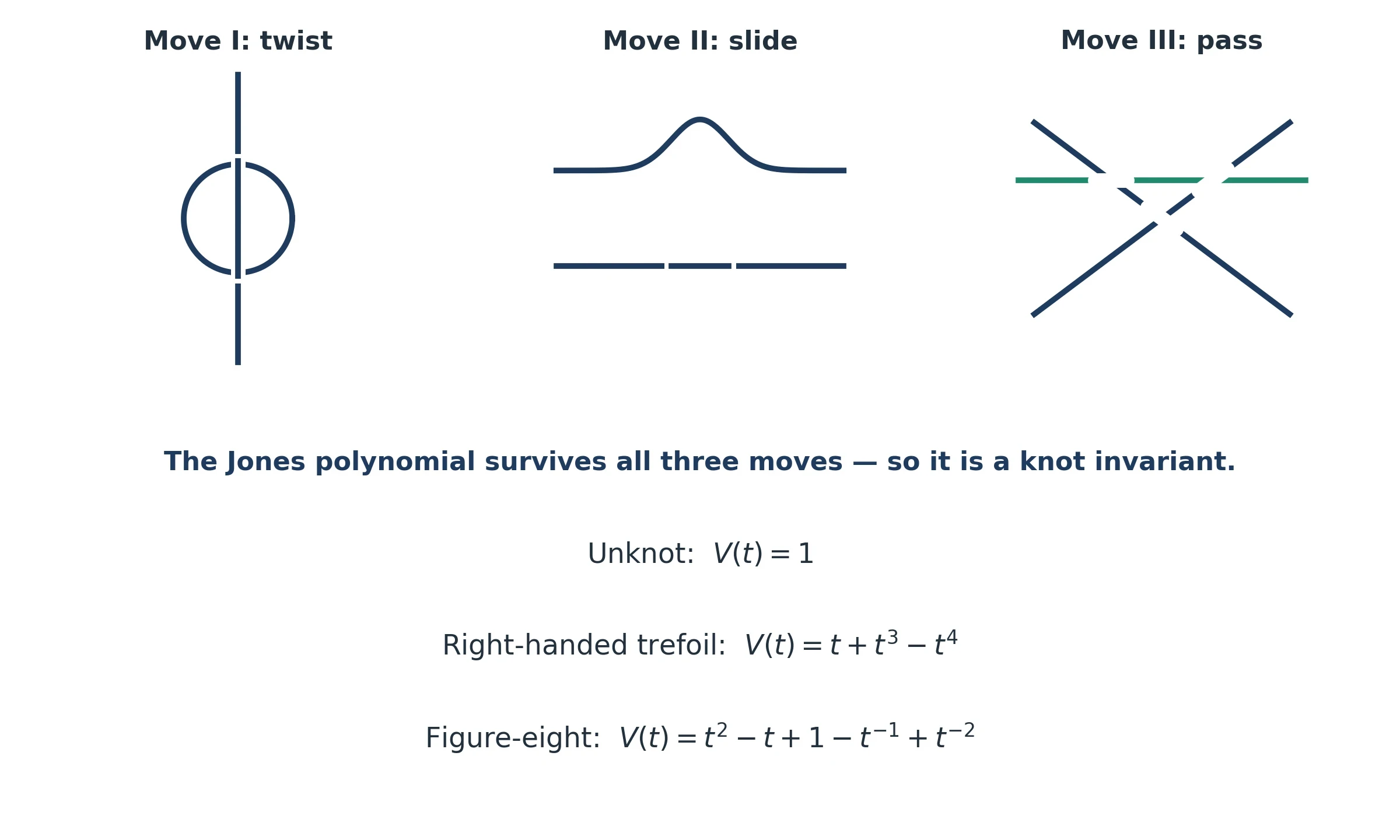
The first step is to know when two diagrams show the same knot. In 1927, Kurt Reidemeister proved that two diagrams show the same knot exactly when one can be turned into the other by a sequence of three local moves: twisting or untwisting a small kink, sliding one strand over another, and sliding a strand past a crossing. These Reidemeister moves are the complete rules of the game. Any invariant must survive all three moves — it must give the same answer before and after each one — and that requirement is a strong constraint on what an invariant can be.
The Jones polynomial, 1984
In the spring of 1984, Vaughan Jones, a mathematician working on operator algebras — a subject that seemed to have nothing to do with knots — realised that a construction from his work produced a polynomial for every knot. The Jones polynomial assigns to each oriented knot a Laurent polynomial in a variable t, and it is an invariant: Reidemeister moves do not change it. The unknot gets the polynomial 1. The right-handed trefoil gets t plus t cubed minus t to the fourth. Its mirror image, the left-handed trefoil, gets t to the minus one plus t to the minus three minus t to the minus four — the same polynomial with t replaced by its reciprocal — so the Jones polynomial tells left from right in a single line, where Dehn's 1914 proof had needed a hard argument. The figure-eight knot gets t squared minus t plus 1 minus t to the minus one plus t to the minus two, a polynomial that reads the same forwards and backwards, exactly as it should for a knot that is the same as its mirror image. Jones published the result in 1985, and Louis Kauffman showed in 1987 that the same polynomial could be computed by a simple rule: smooth every crossing in two ways, count the resulting circles, and add. A child with a pencil can compute it. A computer can compute it for knots with hundreds of crossings.
What the polynomial cannot do
The Jones polynomial is powerful, but it is not perfect, and honesty requires saying so. It does not distinguish every pair of knots: there are different knots with the same Jones polynomial, and the search for sharper invariants — Khovanov homology, Heegaard Floer homology — is an active field. And one question remains open, decades later: does the Jones polynomial detect the unknot? That is, if a knot has Jones polynomial 1, must it be the unknot? No one knows. A fingerprint that might have a blind spot is still a fingerprint, and the Jones polynomial's blind spot, if it exists, has resisted every attempt to find it. The polynomial also has a surprising second life: computing it is so hard, in a precise computational sense, that it is connected to quantum computing, where the braiding of exotic particles called anyons can in principle compute it efficiently. Knots, it turns out, are not just string. They are computation.
12. Fixed Points: The Coffee That Won't Stay Stirred
Stir a cup of coffee, let it settle, and at least one point of the liquid ends up exactly where it started. That is Brouwer's fixed-point theorem, and it is one of the most surprising facts in topology: for any continuous map from a closed ball to itself, there is a point that the map leaves fixed. Stir the coffee however you like — the map that sends each drop to its new position is continuous, the cup is a ball, and the theorem guarantees a point that does not move. The story goes that the theorem began with Brouwer watching a cup of coffee and noticing that stirring always seemed to leave a point unmoved. Whether the story is literally true, the coffee is the right image: continuity plus a ball forces a fixed point, and there is no way around it.
The history runs from 1910 to 1912. Jacques Hadamard and Luitzen Brouwer proved the general case in 1910; Brouwer's paper "Über Abbildungen von Mannigfaltigkeiten" appeared in 1911; and in 1912 Brouwer proved the hairy ball theorem, the close cousin of the fixed-point theorem, which says that a hairy ball cannot be combed flat — at every moment, some hair stands straight up, some point has no direction. The same theorem, applied to the Earth, says that at any moment there is a point on the planet's surface where the wind is not blowing. These are not curiosities. They are constraints that topology places on the world: a continuous wind field on a sphere must have a zero, and no amount of weather can change that.
The crumpled map
The fixed-point theorem has a homely demonstration. Take two identical maps of the same region. Lay one flat on a table. Crumple the other into a ball — fold and crease it as much as you like, as long as you do not tear it — and drop it so that it rests entirely within the borders of the flat map. Then some point of the crumpled map lies exactly above the same point on the flat map beneath it. The crumpling is a continuous map from the region to itself, and the theorem guarantees a fixed point. It is a party trick with a proof behind it, and the proof uses the same topological tools — the non-existence of a retraction from a ball onto its boundary — that prove the coffee result.
Where fixed points work
Fixed-point theorems do heavy work far from coffee cups. John Nash used a fixed-point theorem in 1950 to prove that every finite game has an equilibrium — a set of strategies where no player can do better by changing alone — and the argument is explained in our article on game theory. Kenneth Arrow and Gérard Debreu used fixed-point theorems in 1954 to prove that a general equilibrium exists in a market economy. And in the theory of differential equations, fixed-point theorems prove that solutions exist: the equations that describe how things change are shown to have solutions by finding a fixed point of a map built from the equation itself, a connection explored in our article on differential equations. A theorem about stirring coffee turns out to be a theorem about economies, games, and the existence of solutions to the equations of physics. That is the reach of topology: a fact about a ball applies wherever a ball appears.
I tried the coffee experiment once with a mug and a spoon, stirring hard and then watching the surface settle, and hunting for the point that had not moved. I could not see it, of course — the point is a mathematical guarantee, not a visible mark — but the failure to see it was itself the lesson. Topology's guarantees are not always visible. They are structural, and they hold whether or not you can point at them.
13. The Four Colour Theorem and Maps on a Donut
Four colours are always enough to colour any map drawn on a flat plane, or on a sphere, so that no two regions sharing a border have the same colour. The claim is simple enough for a child to test on a placemat, and it took 124 years to prove. Francis Guthrie noticed it in 1852, while colouring a map of England's counties. Alfred Kempe published a proof in 1879, and it was believed for eleven years, until Percy Heawood found a flaw in 1890 — and proved, in the same paper, that five colours always suffice. The gap between five and four resisted every attack until 1976, when Kenneth Appel and Wolfgang Haken, at the University of Illinois, closed it with a proof that used a computer for about 1,200 hours of calculation, checking an unavoidable set of 1,936 configurations. It was the first major computer-assisted proof in mathematics, and it started an argument about what counts as a proof that is still going.
The argument was not about whether the theorem was true. It was about whether a proof no human could read was a proof at all. Appel and Haken's strategy was human mathematics — suppose a smallest counterexample exists, show it must contain one of a fixed list of local patterns, and show each pattern cannot appear in a smallest counterexample — but the list was too long for any person to check by hand. The checking was done by machine, and no human has ever verified every case by hand. The response has been to make the trust smaller rather than to remove it: Robertson, Sanders, Seymour, and Thomas produced a cleaner version in 1997 with 633 configurations, and in 2005 Georges Gonthier produced a proof formally verified in the Coq proof assistant, so that what must now be trusted is the correctness of a proof checker, not the correctness of a program. The theorem is a statement about planar graphs, and the full graph story — including why the theorem is false without the word "planar" — is told in our article on graph theory.
Move to a donut and the answer changes
The four colour theorem lives on a flat plane or a sphere. Move to a donut and it fails outright: maps on a torus can need seven colours. The reason is the hole. On a torus, regions can wrap around the hole and touch each other in ways that are impossible on a sphere, and the extra connections demand extra colours. The general rule is the Heawood bound: a map on a surface of genus g needs at most floor((7 + √(1 + 48g)) / 2) colours. For a sphere, genus 0, the bound gives 4. For a torus, genus 1, it gives 7. For a double torus, genus 2, it gives 8; for genus 3, it gives 9; for genus 4, it gives 10. The bound turns out to be the exact answer for every orientable genus: Ringel and Youngs proved in 1968 that for genus 1 and above the bound is sharp — some map on the surface really needs that many colours — and for the sphere the bound gives 4, which is the four colour theorem itself. (The one exception in the wider family is the Klein bottle, a non-orientable surface: the formula would give 7, but six colours always suffice, as Philip Franklin proved.) Topology counts the holes, and the holes count the colours.
14. The Poincaré Conjecture: The Century's Hardest Shape Question
In 1904, Henri Poincaré asked a question about three-dimensional shapes that sounds simple and turned out to be the hardest problem in topology: is every simply connected closed three-dimensional manifold homeomorphic to the three-sphere? In plain language: if a three-dimensional space has no holes that a loop can catch on — if every loop in it can be shrunk to a point — must it be a sphere? For two-dimensional surfaces the answer is yes, and Poincaré knew it: a surface on which every loop shrinks is a sphere. He asked whether the same held in three dimensions, and for nearly a century nobody could answer. The question became one of the seven Millennium Prize Problems named by the Clay Mathematics Institute in 2000, each carrying a prize of one million dollars, and it remains the only one of the seven to have been solved.
The higher dimensions fell first, which is one of the strange facts of the story. Stephen Smale proved the conjecture for dimension five and above in 1961; Michael Freedman proved it for dimension four in 1982. Dimension three — the dimension of the space we live in — resisted. The difficulty was that three-dimensional spaces are too flexible for the high-dimensional tools and too complicated for the two-dimensional ones, and the proof needed a new idea. It came from Richard Hamilton's Ricci flow, a technique that evolves the geometry of a shape over time, smoothing out irregularities the way heat spreads through a metal bar. Hamilton's program stalled on singularities — places where the flow pinched the shape until it broke — and it stayed stalled until Grigori Perelman found a way through.
If we stretch a rubber band around the surface of an apple, then we can shrink it down to a point by moving it slowly, without tearing it and without allowing it to leave the surface. On the other hand, if we imagine that the same rubber band has somehow been stretched in the appropriate direction around a doughnut, then there is no way of shrinking it to a point without breaking either the rubber band or the doughnut. — The Clay Mathematics Institute, describing the Poincaré conjecture.
Perelman posted three preprints to the arXiv preprint server between 2002 and 2003 — the first on 11 November 2002, the second on 10 March 2003, the third on 17 July 2003 — sixty-eight pages in total, without submitting them to any journal. The papers completed Hamilton's program: run the Ricci flow, and when a singularity forms, cut it out with surgery and continue. By 2006 the mathematical community had accepted the proof as correct, and the journal Science named it the Breakthrough of the Year, the first time that honour went to a result in mathematics. Perelman was awarded the Fields Medal in 2006 and declined it. In 2010 the Clay Mathematics Institute awarded him the Millennium Prize, and he declined that too, saying his contribution was no greater than Hamilton's. The full story, including the Clay Institute's own account of the problem, is at the Clay Mathematics Institute, and Perelman's first preprint is on the arXiv. Perelman's proof also settled Thurston's geometrization conjecture, of which Poincaré's question was a special case: every three-dimensional space is built from standard pieces, each with one of eight well-understood geometries. The classification of three-dimensional spaces, the analogue of the surface classification in section 6, is now complete in outline. Higher dimensions and the question of what our own universe is shaped like remain open — the shape of space itself is a topological question, and the tools for answering it are still being built, a story that touches the ideas in our article on infinity.
15. Topology at Work: Data, DNA, and Robots
Topology is not only about shapes you can hold. In the last twenty years it has become a tool for understanding data, and the field is called topological data analysis. The idea is simple: a cloud of data points has a shape, and that shape can be studied with the same tools as a surface. Take a set of points sampled from a circle. At a small scale, the points are isolated dots. As the scale grows, the dots join into edges, the edges into a ring, and the ring into a filled disc. Persistent homology tracks the holes through that growth: a loop that is born early and dies late is a real feature of the data, and a loop that is born and dies quickly is noise. The record of births and deaths is called a barcode, and reading it is the skill of the field. The method was founded by Edelsbrunner, Letscher, and Zomorodian in 2002, and the computation of persistent homology by Zomorodian and Carlsson in 2005, and it is surveyed in Robert Ghrist's 2008 paper on barcodes, available through the American Mathematical Society.
The most famous early result came from the shape of natural images. Carlsson and his collaborators took small patches of photographs, treated each patch as a point in a high-dimensional space, and asked what shape the cloud of patches had. The answer was a Klein bottle: a large subset of the patches had the topology of the Klein bottle, the one-sided surface of section 9, hiding inside ordinary photographs. It was a striking early example of a non-orientable surface turning up in a dataset, and it showed that topology could find structure that statistics alone could not see. The same tools now appear in neuroscience, in materials science, in the study of proteins and porous materials, and in the analysis of sensor networks, where the question of whether a region is fully covered is a question about holes.
DNA is a topology problem
Inside every cell, about two metres of DNA are packed into a nucleus a few micrometres across — a packing ratio of about 333,333 to one — and the packing is a topology problem. A closed circle of DNA has a linking number, an integer that counts how many times its two strands wind around each other, and that number cannot change unless a strand is cut. The Călugăreanu–White–Fuller theorem splits the linking number into twist, the winding of the strands around each other, and writhe, the coiling of the axis of the helix itself. B-DNA makes about one turn every 10.5 base pairs, so a circle of 300 base pairs has a relaxed linking number of about 28.57; bacterial plasmids are kept negatively supercoiled, with a supercoiling density of about negative 0.06, which for that 300-base-pair circle means a linking difference of about negative 1.71 turns. The enzymes that manage this are topoisomerases: type I enzymes cut one strand and change the linking number in steps of 1, and type II enzymes cut both strands and change it in steps of 2. The first topoisomerase was found by James Wang in 1971, and topoisomerase inhibitors are front-line drugs — etoposide and doxorubicin target topoisomerase II in cancer treatment, and ciprofloxacin targets bacterial gyrase. The two metres of DNA, and the genome it carries, are described in our article on the human genome.
Robots, networks and the shape of a task
A robot arm's possible positions form a topological space — its configuration space — and the question of whether the arm can move from one position to another without hitting an obstacle is a question about whether two points in that space are connected by a path. Motion planning is topology, applied to engineering. Sensor networks raise the same questions in reverse: given a set of sensors, each covering a disc, is the whole region covered, or is there a hole? The answer is a computation in persistent homology.
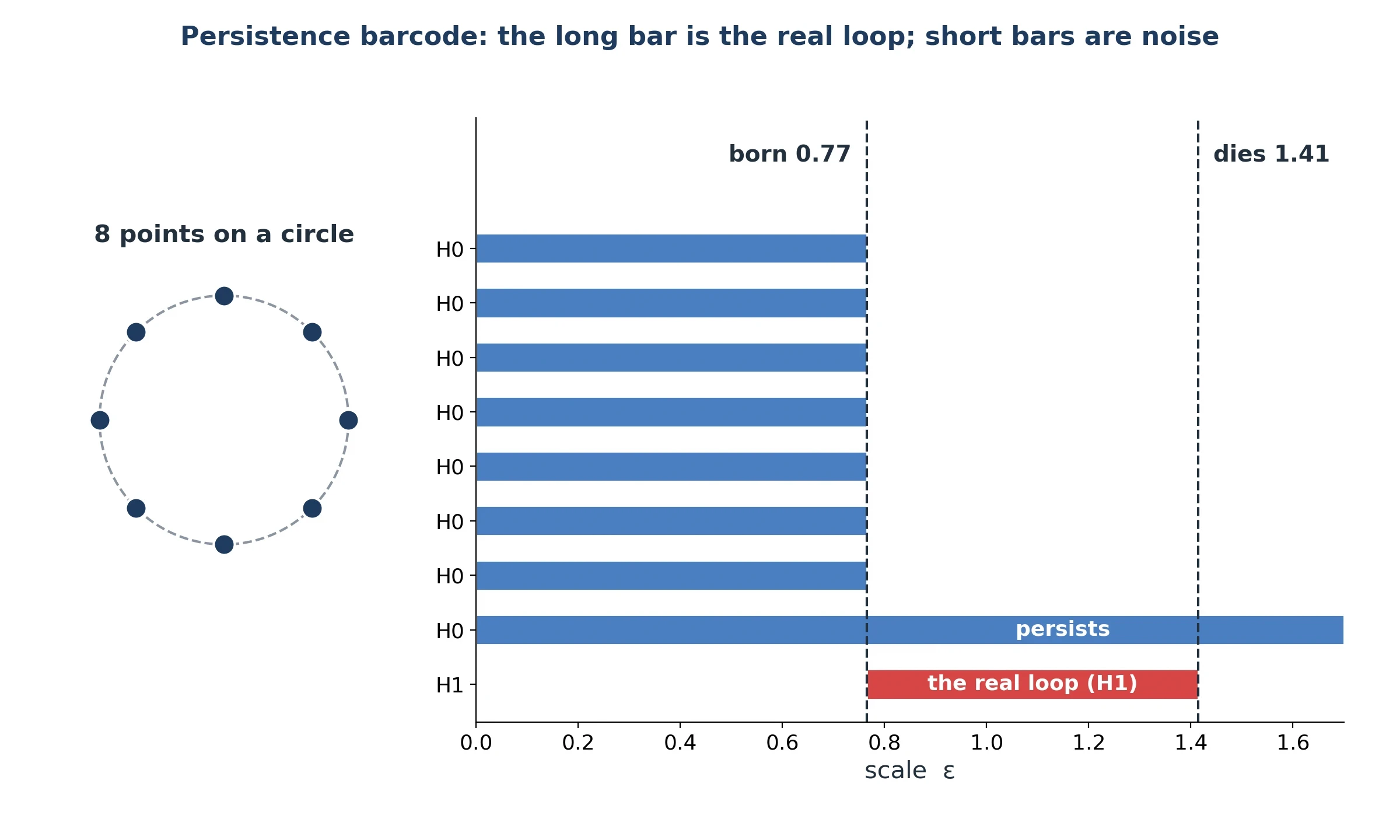
I first saw a barcode diagram at a talk, a set of horizontal lines of different lengths, and I did not understand it until the speaker said: the long lines are the truth and the short lines are the noise. That sentence has stayed with me, because it is topology's promise in one line: the shape that survives is the shape that matters, and the rest is sampling error. The data, the DNA, and the robot all obey the same rule, and it is the rule this article began with. Stretching does not change what matters.
16. What Topology Cannot Do, and Why It Matters
Topology cannot tell you how big something is, how far apart two points are, or how sharply a curve bends. It cannot tell a small circle from a large one, a sphere from a lumpy potato, or a short rope from a long one. It cannot say how far, how fast, or how much — those are the jobs of geometry and analysis, and topology has given them up on purpose. A subject that throws away measurement cannot answer questions about measurement, and anyone who asks topology for a distance will be disappointed.
What topology can do is say what survives. It can say that a coffee cup and a donut are the same, and prove it. It can count the holes in a surface, classify every closed surface there is, tell a trefoil from its mirror image with a polynomial, guarantee a fixed point in a stirred cup, and find a Klein bottle hiding in a pile of photographs. It can say that the space we live in is built from eight geometries, and that a loop on a sphere can always be shrunk to a point. These are not measurements. They are facts about structure, and structure is what remains when every measurement has been stripped away.
Topology matters because the skeleton matters. Geometry, physics, biology, and data science all build on shapes, and topology is the study of what those shapes have in common before any measurement is made. The hole count of a surface, the linking number of a DNA circle, the barcode of a dataset, the fixed point of a game — these are the same kind of fact, and they are the facts that do not change when the world is stretched, bent, or re-measured. Topology is the geometry of stretching without tearing, and what it teaches, in the end, is that the most important thing about a shape is not how it looks. It is how it holds together.
Frequently Asked Questions
What is topology?
Topology is the study of the properties of shapes that do not change when the shape is stretched, bent, twisted, or squashed, as long as nothing is torn, cut, glued, or punctured. It cares about how many pieces a shape has, how many holes it has, whether it has one side or two, and whether a loop drawn on it can be shrunk to a point. Lengths, angles, and areas are geometry's business; topology asks what survives when all of those change.
How is a coffee cup the same as a donut?
Topologically, a coffee cup and a donut are the same shape because both are surfaces with exactly one hole. Imagine the cup made of soft clay: flatten the bowl into a ring and the handle becomes the hole through the middle. Nothing is torn or glued. The two shapes are homeomorphic — one can be deformed into the other continuously — and topology cannot tell them apart. Geometrically they are completely different; topologically they are identical.
What is a homeomorphism?
A homeomorphism is a continuous deformation with a continuous reverse — a reshaping that never tears or glues. Two shapes are homeomorphic when one can be stretched into the other and back again. A circle and a square are homeomorphic. A sphere and a cube are homeomorphic. A sphere and a torus are not, because the torus has a hole and the sphere does not, and no homeomorphism can create or destroy a hole.
What is topology used for?
Topology is used to find the shape hidden in data, through topological data analysis and persistent homology; to understand DNA, where linking numbers and topoisomerases manage supercoiling; to plan robot motion, where a robot's possible positions form a topological space; to prove that equilibria exist in games and markets, through fixed-point theorems; and to classify the shapes of surfaces and of three-dimensional space itself, including the Poincaré conjecture.
What is the Euler characteristic?
The Euler characteristic, written chi, is a number computed from a triangulation of a surface: vertices minus edges plus faces. For any shape that can be deformed into a sphere, the answer is 2 — a tetrahedron gives 4 minus 6 plus 4 equals 2, and a cube gives 8 minus 12 plus 6 equals 2. For a closed orientable surface of genus g, the formula is chi equals 2 minus 2g, so a torus has Euler characteristic 0 and a double torus has negative 2.
What is a Möbius strip?
A Möbius strip is a surface with one side and one edge, made by giving a strip of paper a half-twist and joining the ends. Trace a finger along it and you cover both "sides" without lifting your finger. It was discovered independently by Listing and Möbius in 1858. Cutting it down the middle gives a single loop twice as long, not two loops. It is the simplest non-orientable surface, and two of them glued together make a Klein bottle.
What is a knot in mathematics?
A mathematical knot is a closed loop in three-dimensional space — a loop of string with its ends joined, so it cannot be untied without cutting. Two knots are the same if one can be deformed into the other without cutting. The simplest real knot is the trefoil, with three crossings. Knots are classified by invariants such as the Jones polynomial, and prime knots are counted in a census that reaches 1,701,936 knots with sixteen or fewer crossings.
What is the Poincaré conjecture?
The Poincaré conjecture, posed by Henri Poincaré in 1904, says that every simply connected closed three-dimensional manifold is homeomorphic to the three-sphere: if every loop in a three-dimensional space can be shrunk to a point, the space must be a sphere. It was proved by Grigori Perelman in 2002–2003 using Ricci flow, and it is the only one of the seven Millennium Prize Problems to have been solved. Perelman declined both the Fields Medal and the million-dollar prize.
Sources
- Euler, Leonhard. "Elementa doctrinae solidorum." Novi Commentarii Academiae Scientiarum Petropolitanae 4 (1758): 109–140. Euler announced the polyhedron formula in a letter to Goldbach in 1750; the papers were written in 1750–1751 and printed in 1758. https://scholarlycommons.pacific.edu/euler-works/230/
- Listing, Johann Benedict. "Der Census räumlicher Complexe." Abhandlungen der Königlichen Gesellschaft der Wissenschaften zu Göttingen 10 (1861): 97–182. Listing coined the word "topology" in 1847 and published the Möbius strip in 1861.
- Möbius, August Ferdinand. "Über die Bestimmung des Inhaltes eines Polyëders." Berichte über die Verhandlungen der Königlich Sächsischen Gesellschaft der Wissenschaften 17 (1865): 31–68. Möbius discovered the one-sided strip in 1858; his paper on it appeared in 1865.
- Klein, Felix. Über Riemanns Theorie der algebraischen Functionen und ihrer Integrale. Leipzig: Teubner, 1882. The Klein bottle is described in section 23.
- Poincaré, Henri. "Cinquième complément à l'Analysis Situs." Rendiconti del Circolo Matematico di Palermo 18 (1904): 45–110. The Poincaré conjecture. DOI: https://doi.org/10.1007/BF03014091
- Brouwer, L. E. J. "Über Abbildungen von Mannigfaltigkeiten." Mathematische Annalen 71, no. 1 (1911): 97–115. The fixed-point theorem. (The hairy ball theorem followed in 1912.) DOI: https://doi.org/10.1007/BF01456931
- Alexander, James W. "Topological invariants of knots and links." Transactions of the American Mathematical Society 30, no. 2 (1928): 275–306. DOI: https://doi.org/10.1090/S0002-9947-1928-1501429-1
- Reidemeister, Kurt. Knotentheorie. Berlin: Springer, 1932. The three Reidemeister moves, discovered in 1927.
- Jones, Vaughan F. R. "A polynomial invariant for knots via von Neumann algebras." Bulletin of the American Mathematical Society 12, no. 1 (1985): 103–111. The Jones polynomial, discovered in 1984. DOI: https://doi.org/10.1090/S0273-0979-1985-15304-2
- Kauffman, Louis H. "State models and the Jones polynomial." Topology 26, no. 3 (1987): 395–407. The bracket polynomial and the state-sum computation of the Jones polynomial. DOI: https://doi.org/10.1016/0040-9383(87)90009-7
- Appel, Kenneth, and Wolfgang Haken. "Every planar map is four colorable. Part I: Discharging." Illinois Journal of Mathematics 21, no. 3 (1977): 429–490. The four colour theorem, proved in July 1976 with about 1,200 hours of computer time. DOI: https://doi.org/10.1215/ijm/1256049011
- Gonthier, Georges. "Formal proof — the four-color theorem." Notices of the American Mathematical Society 55, no. 11 (2008): 1382–1393. The four colour theorem formally verified in Coq in 2005.
- Perelman, Grigori. "The entropy formula for the Ricci flow and its geometric applications." arXiv:math/0211159 (11 November 2002). The first of three preprints proving the Poincaré conjecture. https://arxiv.org/abs/math/0211159
- Perelman, Grigori. "Ricci flow with surgery on three-manifolds." arXiv:math/0303109 (10 March 2003). The second preprint; the third, on finite extinction time, followed on 17 July 2003. https://arxiv.org/abs/math/0303109
- Morgan, John, and Gang Tian. Ricci Flow and the Poincaré Conjecture. Clay Mathematics Monographs 3. American Mathematical Society, 2007. The full exposition of Perelman's proof.
- Edelsbrunner, Herbert, David Letscher, and Afra Zomorodian. "Topological persistence and simplification." Discrete & Computational Geometry 28 (2002): 511–533. The founding paper of persistent homology. DOI: https://doi.org/10.1007/s00454-002-2885-2
- Zomorodian, Afra, and Gunnar Carlsson. "Computing persistent homology." Discrete & Computational Geometry 33 (2005): 249–274. DOI: https://doi.org/10.1007/s00454-004-1146-y
- Carlsson, Gunnar, Tigran Ishkhanov, Vin de Silva, and Afra Zomorodian. "On the local behavior of spaces of natural images." International Journal of Computer Vision 76 (2008): 1–12. The Klein bottle found in the space of image patches. DOI: https://doi.org/10.1007/s11263-007-0056-x
- Ghrist, Robert. "Barcodes: the persistent topology of data." Bulletin of the American Mathematical Society 45, no. 1 (2008): 61–75. The survey of persistent homology and barcodes. DOI: https://doi.org/10.1090/S0273-0979-07-01191-3
- Fuller, F. Brock. "The writhing number of a space curve." Proceedings of the National Academy of Sciences 68, no. 4 (1971): 815–819. The Călugăreanu–White–Fuller theorem: linking number equals twist plus writhe. DOI: https://doi.org/10.1073/pnas.68.4.815
- Wang, James C. "Interaction between DNA and an Escherichia coli protein ω." Journal of Molecular Biology 55, no. 3 (1971): 523–533. The first DNA topoisomerase. DOI: https://doi.org/10.1016/0022-2836(71)90334-2
- Hoste, Jim, Morwen Thistlethwaite, and Jeff Weeks. "The first 1,701,936 knots." The Mathematical Intelligencer 20, no. 4 (1998): 33–48. The census of prime knots up to 16 crossings. DOI: https://doi.org/10.1007/BF03025227
- Adams, Colin C. The Knot Book: An Elementary Introduction to the Mathematical Theory of Knots. American Mathematical Society, 2004. The standard elementary introduction to knot theory.
- Hatcher, Allen. Algebraic Topology. Cambridge University Press, 2002. The standard graduate text; freely available from the author's website.
- Richeson, David S. Euler's Gem: The Polyhedron Formula and the Birth of Topology. Princeton University Press, 2008. The history of Euler's formula and the birth of topology.