
1. The Letter That Broke Mathematics
Jena, June 1902. A 54-year-old professor opens a letter, reads it twice, and understands that his life's work is ruined. Gottlob Frege had spent 23 years building a system meant to show that all of arithmetic follows from pure logic. The first volume of his masterwork had appeared in 1893. The second volume was at the printer, nearly finished. The letter came from a young Englishman named Bertrand Russell, and it contained a contradiction — a short, clean argument showing that Frege's system could prove both a statement and its opposite.
Frege was not a man given to drama, but the moment deserves some. He had spent more than two decades on a single idea, and a single page of reasoning undid it. He answered within six days. He added a hasty appendix to the volume at the printer, admitting the disaster in plain words. The third volume he had planned never appeared. And yet this is not a sad story. The letter that broke Frege's system also broke mathematics open. Out of the wreckage came new theories of sets, new ideas about truth, new limits on what proof can do, and a sharper picture of what mathematics actually is. That is the story of mathematical paradoxes: not a catalogue of tricks, but a series of moments when careful thinking found a crack in the floor, and the floor turned out to be the whole building.
This article follows five mathematical paradoxes, one crisis, and a new foundation for mathematics. We start with Zeno, who argued that motion itself cannot be described without contradiction, more than two thousand years before calculus gave an answer. Then comes the liar, a single sentence that breaks the idea of truth. Then the heap, which asks how many grains make a pile and finds no place to draw the line. Then Russell, whose paradox about sets destroyed Frege's project and forced a rebuild of the foundations. Then Godel, who turned the liar into arithmetic and proved that no single system can prove everything true about numbers. Along the way we meet a ball that doubles itself, a hanging that cannot be a surprise, and a time traveller who kills his own grandfather. Each of these mathematical paradoxes is a puzzle with a sharp edge, and each one changed what mathematicians believed was possible.
I first met Achilles and the tortoise on a rainy afternoon in a school library, in a book of puzzles I had borrowed to pass the time. The book said the fastest runner in the world could never catch a tortoise, and it gave the reason in a few short lines. I read it, laughed, and tried to find the cheat. There had to be one. Achilles obviously catches the tortoise — anyone who has watched a race knows that. But the argument would not let go. Every time I thought I had found the flaw, the next step of the argument was waiting, patient and exact. I remember the strange feeling of it: a piece of reasoning that was clearly wrong and clearly right at the same time, like a door that is open and shut at once. I put the book down and went home, and the argument followed me. That feeling — of a solid argument leading somewhere impossible — is what this article is about, and it is the feeling that has driven mathematics forward for twenty-five centuries.
2. What Is a Mathematical Paradox, Really?
The word paradox gets used loosely. People call anything surprising a paradox: a coincidence, a puzzle, a clever riddle. Mathematicians use it more narrowly, and the narrow use is the useful one. A paradox is an argument that starts from premises everyone accepts, follows rules everyone trusts, and arrives at a conclusion nobody can accept. Something has to give. Either a premise is wrong, or a rule of reasoning is weaker than it looked, or the conclusion is true after all and our instincts need retraining. Sorting out which of those three things has happened is the real work, and it is work that has repeatedly rebuilt mathematics from the inside.
Three kinds of paradox
It helps to sort mathematical paradoxes into three kinds, because the three kinds need three different responses. The first kind is a true statement that only looks impossible. It surprises us, but the reasoning is sound and the conclusion stands. The Achilles race belongs here once the infinite series is understood: Achilles really does catch the tortoise, and the paradox dissolves into a correct calculation. The second kind is a false conclusion dressed in reasoning that looks sound but is not. Something in the argument is broken — a hidden assumption, a step that does not follow — and finding the break is the whole game. The third kind is the serious one: a genuine contradiction drawn from premises that everyone had accepted. No step is wrong and no premise can be dropped without cost. This is the kind that breaks a theory, and Russell's paradox is the great example. The three kinds feel the same at first — a solid argument leading somewhere impossible — but they demand different cures, and confusing them is the most common mistake in thinking about mathematical paradoxes. The philosopher W. V. O. Quine gave these three kinds their names — veridical for the first, falsidical for the second, antinomy for the third — in a 1962 essay, and the names have stuck.
Why mathematicians take paradoxes seriously
A paradox is a bug report for a theory, not a parlour trick. When an argument from accepted premises ends in contradiction, it is telling us something precise: at least one of those premises is false, or at least one rule of reasoning is unsound in the setting where it was used. That is valuable information. It is how mathematics finds its own weak spots. Zeno's paradoxes forced mathematicians to think clearly about infinity and limits, and the rigorous theory of convergent series in the 1800s was part of the answer. Russell's paradox forced the invention of axiomatic set theory, which is still the standard foundation of mathematics today. Godel's theorems forced everyone to give up the dream of a single system that proves all mathematical truth. None of that progress would have happened without mathematical paradoxes. A subject that never meets a paradox is a subject that has never been tested hard enough.
How to read this article
The route is simple. We begin with motion: Zeno's four paradoxes and the calculus that answered them. Then truth: the liar and the heap, two puzzles about words that turn out to be puzzles about logic itself. Then sets: Russell's paradox, Frege's ruined system, and the long rebuild through type theory and ZFC set theory. Then proof: Godel's theorems and the end of Hilbert's programme. Then geometry and knowledge and time: a ball that doubles, a hanging that cannot be a surprise, a grandfather who cannot be killed. A final section gathers what mathematical paradoxes gave us — and what they did not. The worked numbers are all checked, the quotations are only quoted where the sources mark them verbatim, and the places where scholars still disagree are labelled as open. Mathematical paradoxes reward patience. Read slowly, check the arithmetic, and notice where the argument turns. The route also follows the way mathematics tests its own ideas, a theme our article on the scientific method explores for science in general.
3. Zeno and the Race That Cannot Start
Zeno of Elea lived around 490–425 BC, in a Greek city in southern Italy, and he was a pupil and friend of Parmenides, the founder of the Eleatic school. Parmenides taught that reality is one unchanging whole, and that motion and plurality are illusions. Zeno's paradoxes were written in defence of that view: if you take motion seriously, he argued, you run into contradictions, so motion cannot be real. His own book has not survived. Everything we know about him comes second-hand, principally through Aristotle and the commentator Simplicius in the 6th century AD, with Plato's dialogue Parmenides as a further source. According to Proclus, Zeno's book contained forty paradoxes about the continuum. Only a handful survive in detail, and four of them — the paradoxes of motion — have been argued over ever since, and they remain the most approachable of all mathematical paradoxes. The Stanford Encyclopedia of Philosophy gives the fullest modern account of them, and its entry on Zeno's paradoxes is the best place to start for readers who want the scholarly detail.
The Dichotomy
The first paradox is the Dichotomy, and it is the simplest to state. Aristotle gives the argument in his Physics, and his words are worth quoting exactly: "That which is in locomotion must arrive at the half-way stage before it arrives at the goal." To travel any distance, you must first travel half of it. Before that, you must travel half of that half — a quarter of the whole. Before that, an eighth. And so on without end. Motion seems to require completing infinitely many tasks before you can move at all, and an infinite list of tasks can never be finished. So how does anything ever start moving?
The modern answer is a piece of arithmetic that took more than two thousand years to make rigorous. The infinite series one half plus one quarter plus one eighth and so on sums to exactly 1. Each step adds half of what remains, and the total never overshoots the goal. The series converges: the partial sums 0.5, 0.75, 0.875, 0.9375 creep up on 1 and never pass it, and the limit is exactly 1. That is the standard mathematical answer, worked out with the rigorous theory of limits in the 1800s by Cauchy and Weierstrass. It settles the sum question completely. Whether it settles Zeno's deeper question — whether an infinite sequence of tasks can be completed at all — is a matter philosophers still debate, and we return to it below.
Achilles and the tortoise
The second paradox is the most famous of all mathematical paradoxes, and the most often retold. Aristotle's version runs: "In a race, the quickest runner can never overtake the slowest, since the pursuer must first reach the point whence the pursued started, so that the slower must always hold a lead." Achilles gives the tortoise a head start. By the time Achilles reaches the tortoise's starting point, the tortoise has moved ahead a little. By the time he covers that gap, it has moved ahead again — a little less, but still ahead. The gaps shrink, but they never vanish. Zeno concludes that Achilles never catches the tortoise.
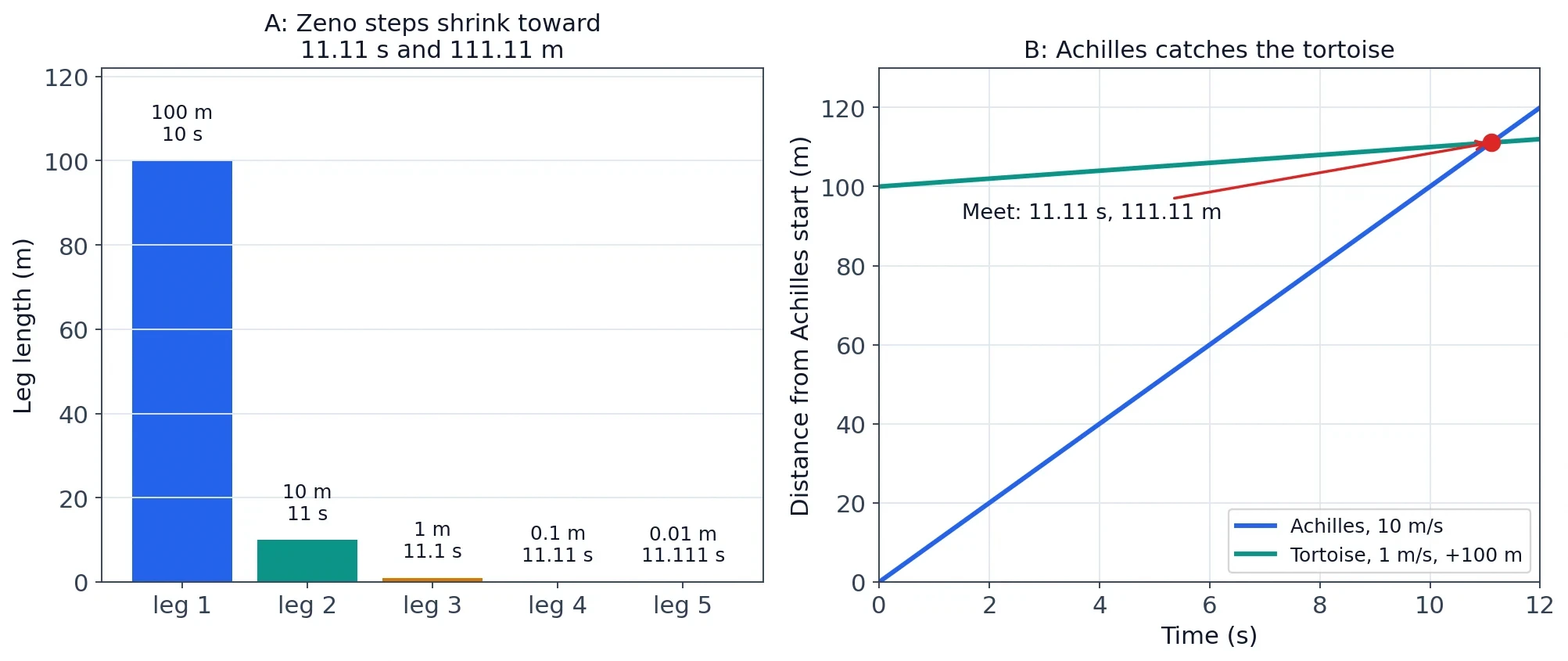
The numbers tell a different story, and they are worth working through in full, because the calculation is the answer. Take Scenario A: Achilles runs at 10 metres per second, the tortoise at 1 metre per second, and the tortoise starts 100 metres ahead. Achilles covers the first 100 metres in 10 seconds, and in those 10 seconds the tortoise has moved 10 metres. Achilles covers those 10 metres in 1 second, and the tortoise has moved 1 metre. Achilles covers that 1 metre in 0.1 seconds, and the tortoise has moved 0.1 metres. The pattern continues: legs of 100, 10, 1, 0.1, 0.01 metres, with cumulative times of 10, 11, 11.1, 11.11 seconds, converging on 11.111 seconds at 111.111 metres. The catch-up time is 100 divided by 9, which is 11.11 seconds, and the catch-up distance is 111.11 metres from Achilles' start. The gaps never vanish one by one, but their sum is finite, and Achilles passes the tortoise after 11.11 seconds. The same series appears in a simpler form in the Stanford Encyclopedia's example: in a 1-metre race with the tortoise moving at one-tenth of Achilles' speed, the catch-up distances are 0.9 metres, then 0.09 metres, then 0.009 metres, and so on, summing to 1 metre.
Leg | Distance Achilles covers (m) | Cumulative time (s) | Cumulative distance (m) |
|---|---|---|---|
1 | 100 | 10 | 100 |
2 | 10 | 11 | 110 |
3 | 1 | 11.1 | 111 |
4 | 0.1 | 11.11 | 111.1 |
5 | 0.01 | 11.111 | 111.11 |
Limit | approaches 0 | 11.111... | 111.111... |
Table 1: Zeno's step table for Scenario A — Achilles at 10 metres per second, the tortoise at 1 metre per second, head start 100 metres. The legs shrink by a factor of ten each time, and the totals converge on 11.111 seconds and 111.111 metres.
What calculus answers — and what it does not
Calculus answers the sum question, and it answers it cleanly. The infinite series has a finite sum, the two runners meet after a finite time, and the race is over. But a harder question sits underneath, and it is the one philosophers still argue about. Zeno's argument can be read as a challenge about completing an infinite sequence of tasks: even if the times add up to a finite total, how can anyone perform infinitely many separate acts? The usual reply is that the acts are not separate in the way Zeno needs them to be. Achilles does not pause, count, and restart at each gap. He runs continuously, and the gaps are a way of describing his run, not a list of chores he must tick off. The description divides the run into infinitely many pieces, but the run itself is one continuous motion. That reply satisfies most mathematicians. It leaves a philosophical question standing — what it means to complete an infinite sequence — and that question has a name, the supertask, which still has no agreed answer. For readers who want the limit idea in its own right, our article on how calculus works builds the derivative and the integral from the same kind of limiting process, and our article on pi shows infinite series converging on a familiar number. Zeno's paradoxes also influenced the development of infinitesimals, limits and convergent series in the 19th century, and no philosopher claims a single agreed solution to every aspect of them. The mathematical answer to the sum is settled. The philosophical questions about infinity and supertasks remain live, and that split — settled sum, open question — is the honest shape of the subject.
4. The Arrow That Never Moves
The third of Zeno's four paradoxes of motion is the strangest, because it does not depend on infinity at all. It depends on the idea of an instant. Picture an arrow in flight. At any single instant, the arrow occupies a space exactly equal to its own length, so at that instant it is at rest — it is not moving anywhere, because it is exactly where it is. Time is made of instants. At every instant the arrow is at rest. So the arrow never moves. The argument is short, and it is hard to see where it goes wrong, because each step looks true on its own.
The Arrow paradox
The modern answer turns on what motion is. Motion is not something that happens inside a single instant. It is change of position across instants. Velocity at an instant is defined as a limit — the derivative — which describes how position changes around that instant, not what happens within it. A worked example makes the point concrete. Take an arrow flying at a constant 20 metres per second. At time 0 seconds it is at 0 metres, at 0.25 seconds it is at 5 metres, at 0.5 seconds it is at 10 metres, at 0.75 seconds it is at 15 metres, and at 1.0 second it is at 20 metres. At each instant the arrow is at one place, and the sequence of places is the motion. Zeno's mistake, on this reading, is to demand that motion be visible inside an instant, when motion is a property of a stretch of time. Russell made a similar point about the arrow in his own writing, though his exact words on the subject were not verified in the research for this article, so they are paraphrased here rather than quoted: the paradox rests on a plain confusion between being at a place and moving, and once the two are separated the puzzle loses its force. The calculus of limits gives the confusion a precise form: the derivative at a point is the limit of average velocities over shorter and shorter intervals around that point, and that limit is a real number even though no single instant contains any movement.
The Stadium paradox
The fourth paradox, the Stadium, is the least discussed of the four, and the hardest to state clearly. Consider three rows of bodies of equal size. One row stands still. The other two move past it in opposite directions at equal speed. In the same time, a moving row passes twice as many bodies of the other moving row as of the stationary row — so half a time equals the whole time. The modern reading is that the paradox trades on relative speed and on an ambiguity about what counts as passing a body. A body in one moving row passes bodies in the other moving row twice as fast as it passes bodies in the stationary row, because the two rows are moving towards each other. There is no single count of "bodies passed" that means the same thing in both cases, and once the two counts are kept apart, the contradiction evaporates. Scholars treat this one as turning on that ambiguity, and it has no clean, famous resolution of the kind the Dichotomy has.
Zeno's plurality paradoxes
Zeno also argued about plurality — about the idea that there are many things rather than one. His plurality paradoxes survive only in fragmentary form through Simplicius, and they are harder to reconstruct than the paradoxes of motion. The argument from denseness says that between any two things there is always another, so any collection must be infinite. The argument from finite size says that if things have size, they must be infinitely large or infinitely small. The argument from complete divisibility says that anything can be divided without end, so nothing has a definite size. These fragments are worth one paragraph and no more. Their wording is reconstructed, not quoted, and they should never be presented as Zeno's own words. What matters is their direction: Zeno was pressing on the same crack as the paradoxes of motion, the idea that space and time can be divided without limit, and asking what that does to the idea of a thing with a definite size and place. That question outlived him by two millennia, and it is still alive in the philosophy of mathematics.
5. The Liar: The Sentence That Eats Itself
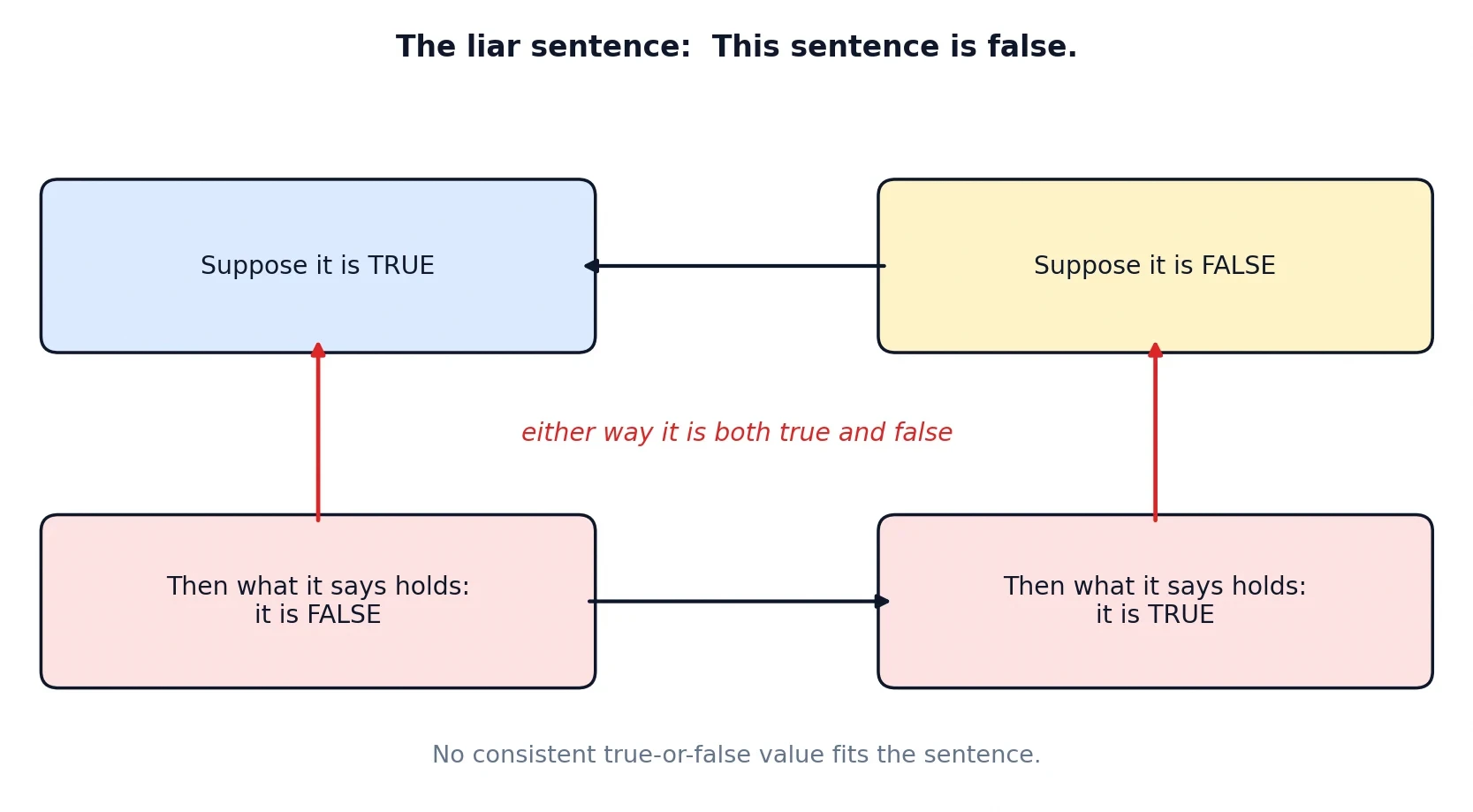
Consider this sentence: "This sentence is false." It is short, it is grammatical, and it breaks the idea of truth. If the sentence is true, then what it says holds — and what it says is that it is false. So it is false. If the sentence is false, then what it says holds — and what it says is that it is false, which is true. So it is true. Either way it is both true and false, and that cannot be. There is no third option inside the classical picture of truth, where every sentence is either true or false and not both. The liar is the oldest of the semantic mathematical paradoxes, and it is still unsolved after more than two thousand years. The Stanford Encyclopedia's entry on the liar paradox traces the argument in full, and its companion entry on self-reference shows how the same pattern turns up across logic.
"This sentence is false."
The argument deserves to be walked through slowly, because its force is in its simplicity. Step one: assume the sentence is true. A true sentence says something that holds. This sentence says it is false. So it is false. Step two: assume the sentence is false. A false sentence says something that does not hold — but this sentence says it is false, and if it is false, then what it says is correct, which makes it true. Step three: notice that both steps used only the ordinary rules for the word "true". Nothing exotic was smuggled in. The sentence talks about itself, and that self-reference is enough to break the system. The liar is a semantic paradox: it turns on the notion of truth, rather than on sets or motion. Related puzzles in the same family include Grelling's paradox, Berry's paradox and Richard's paradox, and we meet them in the paradox family section. The liar matters for mathematics because Godel's incompleteness proof is, in effect, the liar paradox translated into arithmetic — a connection we take up in the Godel section.
Eubulides and the ancient history
The liar is credited to Eubulides of Miletus, a Megarian logician of the 4th century BC. The credit needs care: Diogenes Laertius, in his Lives of the Philosophers, says only that Eubulides discussed the paradox, not that he discovered it, so the honest form is "attributed to" or "credited to", never "invented by" as a flat fact. Eubulides is also credited with the sorites, the heap paradox, which has its own section below, and the Stanford Encyclopedia's history of ancient logic records him as the inventor of both. In the Middle Ages the liar was known as one of the insolubles, and logicians debated it intensely, especially in the 14th century. One story from antiquity has stuck to the paradox ever since. According to an old story told by Athenaeus, the poet and grammarian Philetas of Cos, who lived around 330–270 BC, worried so much over the liar that he wasted away and died of insomnia. That is a story, not an established fact, and it should only ever be told as one. It is probably not true. But it captures something real about the paradox: it is the kind of puzzle that gets under the skin, because it attacks the very words we use to say what is true.
Tarski's answer
The standard mathematical response to the liar comes from Alfred Tarski, working in the 1930s. Tarski's idea was to separate levels of language. A language cannot safely contain its own truth predicate. Truth about sentences in one language — the object language — must be stated in a higher language, the metalanguage. The liar sentence tries to talk about its own truth from inside the language it belongs to, and Tarski's hierarchy forbids exactly that move. His undefinability theorem makes the point precise: no sufficiently rich language can define its own truth predicate. Other responses exist. Saul Kripke's theory of truth, from 1975, allows sentences to be neither true nor false, and lets truth build up in stages. Paraconsistent and dialetheist approaches, associated with Graham Priest, accept that some contradictions are true and learn to live with them. Each of these is a serious position with defenders. None of them commands consensus. The Internet Encyclopedia of Philosophy puts the situation plainly: experts in philosophical logic have never agreed on the way out of the trouble despite 2,300 years of attention. That is the honest position, and this article keeps it. Tarski's hierarchy is the standard mathematical response, not a consensus solution.
Yablo's paradox (1985)
In 1985 Stephen Yablo found a liar-like paradox that needs no direct self-reference at all, and it is worth a short paragraph because it changes what the liar shows. Imagine an infinite sequence of sentences, each one saying that all the later sentences are false. The first says all the rest are false. The second says all after it are false. And so on, without end. The same contradiction appears, but no sentence ever talks about itself. The lesson is that self-reference is not the whole story: the trouble lives in the combination of truth, reference and infinity, which Godel exploited in arithmetic, as the Godel section will show.
6. The Heap: How Many Grains Make a Pile?
One grain of wheat is not a heap. Adding one grain cannot turn a non-heap into a heap — a single grain is far too small to make that difference. So two grains are not a heap either. And three are not, and four are not. Repeat the reasoning 9,999 times and 10,000 grains is still not a heap. Yet plainly a large pile of wheat is a heap. Something has gone wrong, and the argument that went wrong used only steps that look innocent. This is the sorites paradox, from the Greek word soros, meaning heap, and it is one of the most stubborn mathematical paradoxes ever stated. It is also one of the most useful, because vagueness turns up everywhere mathematics meets the real world.
The sorites argument
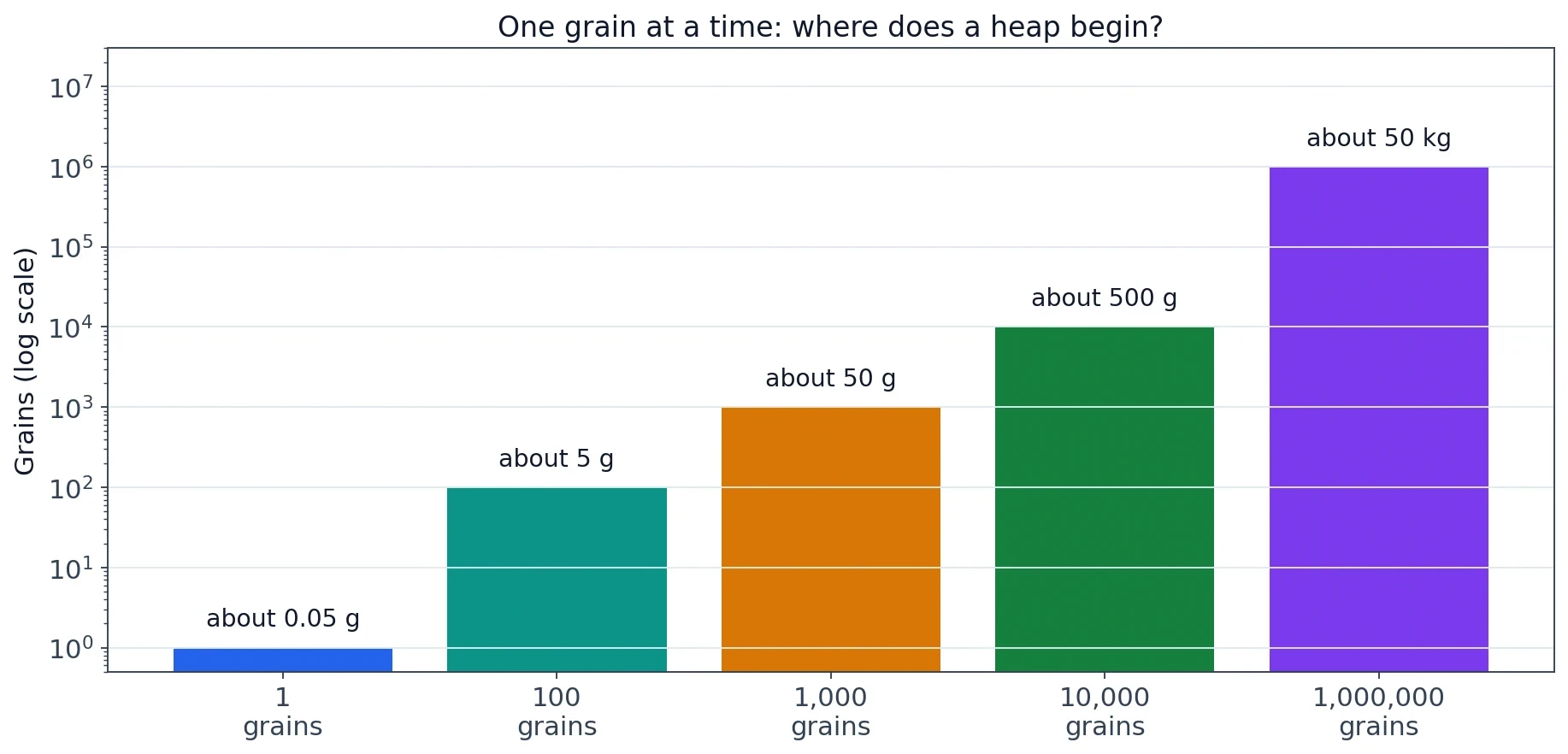
The argument has three parts, and each part looks solid on its own. First, one grain is not a heap. Second, adding one grain to a non-heap cannot make a heap — this is the tolerance step, the claim that a tiny change cannot flip the verdict. Third, repeat the second step as many times as you like. The conclusion follows by simple repetition: no number of grains makes a heap. But the conclusion is absurd, because a pile of ten thousand grains is obviously a heap. The Stanford Encyclopedia's entry on the sorites paradox gives the argument its full form, and the numbers make the absurdity concrete. One wheat grain weighs about 0.05 grams — the weight varies by variety, so the figure is approximate. A hundred grains weigh about 5 grams. A thousand grains weigh about 50 grams. Ten thousand grains weigh about 500 grams, half a kilogram. A million grains weigh about 50 kilograms, the weight of a sack a person would struggle to lift. The chain from 1 grain to 10,000 grains needs 9,999 single-grain steps, and no one of those steps looks like the moment a pile becomes a heap. That is the force of the paradox: every step is innocent, and the total is impossible.
The Bald Man
The heap has a twin, the Bald Man, and the twin shows that the problem is not about wheat. A man with one hair is bald. Adding one hair cannot make a bald man non-bald. Repeat, and a man with 10,000 hairs is bald — which is absurd. The structure is identical: a vague word, a tiny step that cannot change the verdict, and repetition that turns a truth into a falsehood. The two puzzles together show that the trouble is vagueness itself, not any particular heap or head. Vague words are tolerant of small changes — that is Crispin Wright's term, tolerance, from 1975 — and classical logic plus tolerance yields contradiction. The paradox is attributed to Eubulides of Miletus, the same logician credited with the liar, and again it is not known whether he actually invented it.
Vagueness and tolerance
Four modern responses to the sorites are worth knowing, and none of them has won. The epistemic theory, associated with Timothy Williamson, says there is a sharp boundary — some exact number of grains where the heap begins — and we simply cannot know where it is. The boundary exists but is unknowable, hidden by the limits of our language and our knowledge. Supervaluationism says a sentence with a vague word is true only when it comes out true on every reasonable way of drawing the line, false only when it comes out false on every way, and otherwise neither. Fuzzy logic gives up the idea that truth is all or nothing and lets sentences be true to a degree — a pile can be a heap to degree 0.7. Contextualism says the boundary shifts with context: what counts as a heap depends on the conversation, the purposes at hand, and the comparisons available. Each of these has defenders and each has costs. The honest statement is that the paradox is unresolved.
I once spent an afternoon in a kitchen trying to settle the heap for myself, with a bag of rice and a small bowl. I poured the rice a pinch at a time, watching the pile grow, waiting for the moment it became a heap. One grain, ten grains, a hundred — a scatter, not a heap. A thousand — a small mound, but was it a heap? I kept going, and at some point I stopped asking, because the pile was obviously a heap and I could not say when it had become one. The exercise taught me more than the argument had. The words we use every day — heap, bald, tall, rich, old — have no sharp edges, and we use them perfectly well anyway. The paradox is not that language fails. It is that logic, built for sharp edges, meets a world of soft ones.
The heap matters for mathematics because vague words appear wherever mathematics meets the real world. When does a collection become large? When is a number small? Where is the threshold in a statistical test, or in a computer program that must decide yes or no? The forced march sorites makes the point vivid: a competent speaker is walked step by step through the series and asked at each step whether the thing is a heap, and she cannot say where she stops. The paradox is a reminder that precision is a tool, not a property of the world, and that the boundary between mathematics and ordinary language is a place where real puzzles live.
7. Russell's Paradox and the Barber
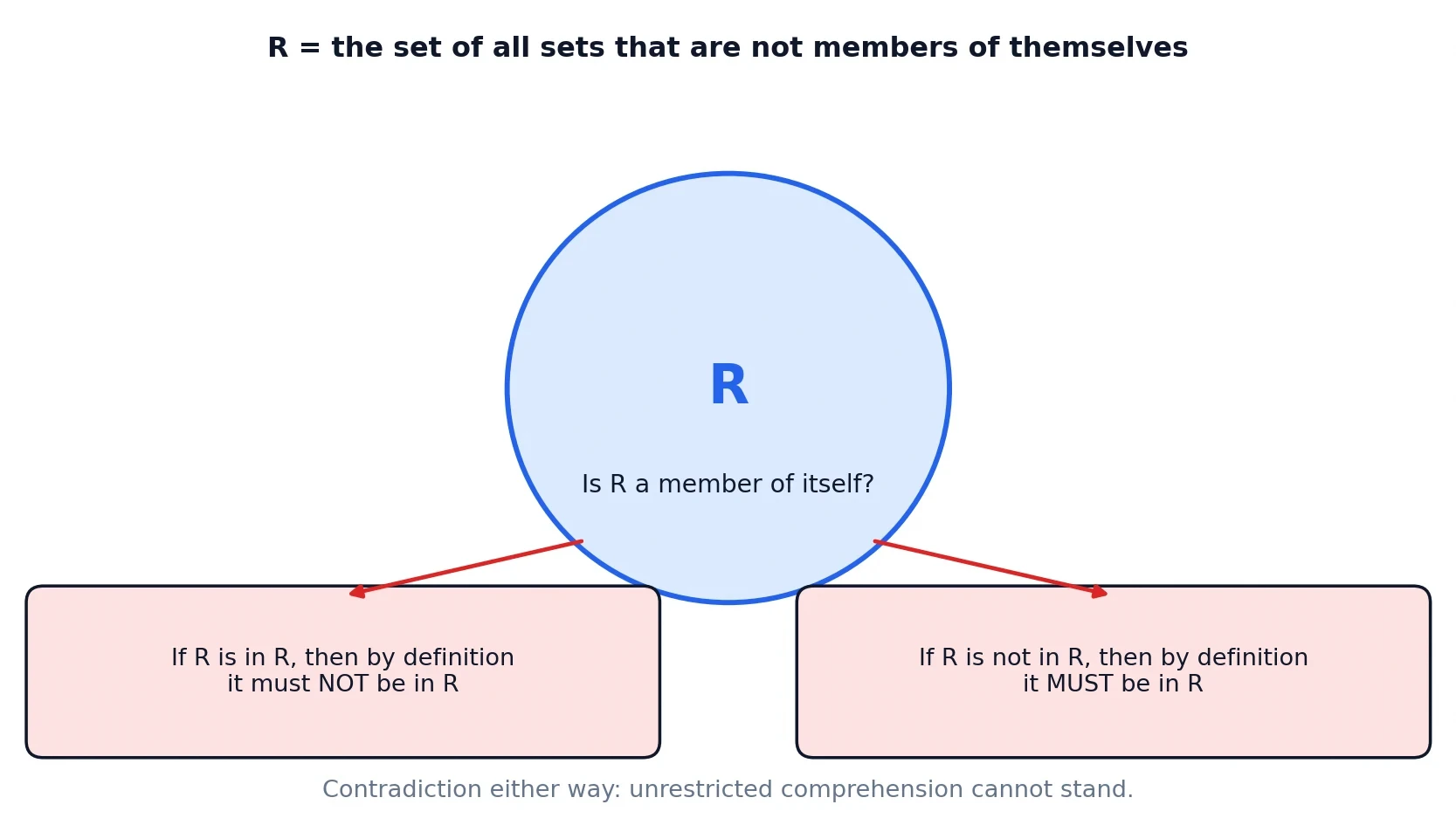
In the spring of 1901, Bertrand Russell was working on The Principles of Mathematics, and he found a contradiction at the heart of the theory of sets. The paradox is short enough to state in a sentence, and it destroyed a century of confidence. Let R be the set of all sets that are not members of themselves. Is R a member of itself? If it is, then by its definition it must not be. If it is not, then by its definition it must be. Contradiction either way. The Stanford Encyclopedia's entry on Russell's paradox sets out the argument and its history in full.
The set of all sets that are not members of themselves
The argument works because it follows from a principle that seemed obvious: unrestricted comprehension. For any property, there exists the set of all things with that property. Want the set of all red things? It exists. The set of all prime numbers? It exists. The set of all sets that are not members of themselves? By the same rule, it must exist — and it cannot. Most sets are not members of themselves. The set of all teacups is not a teacup, so it is not a member of itself. A few sets might be members of themselves — the set of all things that are not teacups is not a teacup, so it is a member of itself — but those are the exceptions. The rule for R is simple: a set belongs to R exactly when it is not a member of itself. Now ask about R itself. If R is a member of R, then it satisfies the rule for membership, which says it is not a member of itself — contradiction. If R is not a member of R, then it satisfies the rule too, because the rule admits exactly the sets that are not members of themselves — contradiction again. There is no way out inside the system. The principle that made the set must be wrong.
Spring 1901
Russell discovered the paradox in late spring 1901, while working on The Principles of Mathematics, which appeared in 1903. The safe form of the date is spring 1901: one edition of the Stanford Encyclopedia says May 1901, and Russell himself later wrote June 1901. He wrote to Frege with the news on 16 June 1902, and that letter is the subject of the Frege section. Ernst Zermelo had discovered the same paradox independently by 1902, possibly as early as 1899, and did not publish it because it could not be produced in his own axiomatic system — a detail that shows how close the mathematical world was to the same discovery from two directions at once. An earlier set-theoretic paradox already existed: Burali-Forti's paradox of the largest ordinal, discovered by Cesare Burali-Forti, assistant to Giuseppe Peano, in 1897. Russell's paradox was the one that could not be ignored, because it struck at the most basic rule of set formation rather than at an exotic corner of the theory.
The barber
The barber version is the way most people first meet Russell's paradox, and it is also the way most people misunderstand it. A village barber shaves all and only those villagers who do not shave themselves. Does the barber shave himself? If he does, then by the rule he must not. If he does not, then by the rule he must. Contradiction either way — so no such barber can exist. That is the whole content of the barber version, and it is not the same paradox in force. The barber only proves that no such barber exists, and nobody ever thought such a barber must exist. Russell's paradox is different, because mathematicians had assumed that the set R must exist. The rule that produces it — unrestricted comprehension — was the foundation of set theory as it was then understood, and giving it up meant rebuilding the foundations. The distinction was put sharply by Quine, who asked why Russell's paradox counts as a genuine antinomy while the barber does not, and answered that there had been an overwhelming presumption in our habits of thought that such a class exists, but no presumption at all that such a barber exists. That is the single most commonly missed point about Russell's paradox, and it is worth holding on to: a contradiction only breaks a theory when the theory was committed to the thing that produces it. In modern ZFC set theory, the collection of all non-self-membered sets is a proper class, not a set — and that is the resolution, which the Frege section explains in full.
8. What Everyone Gets Wrong About Paradoxes
Mathematical paradoxes are widely retold, and widely misretold. This section clears away the five misunderstandings that turn up most often, because each of them hides the real lesson of the paradox it distorts.
"Zeno proved motion is impossible"
No, he did not. Zeno argued that, on Parmenides' view of reality, motion cannot be coherently described. His paradoxes are arguments from premises — the Parmenidean picture of a single unchanging reality — and the conclusions follow only if those premises hold. The calculus answer to the Dichotomy shows that motion can be described coherently once infinite series are understood. Zeno's achievement was to show what a theory of motion would have to explain, not to prove that motion is an illusion. Treating him as a man who proved the impossible is a compliment he would not have wanted and a claim the evidence does not support.
"The barber IS Russell's paradox"
No, as the Russell section showed. The barber proves that no such barber exists, and nobody thought one must exist. Russell's paradox threatens a whole theory of sets because mathematicians had assumed that the set R must exist. The difference is the presumption behind the contradiction, and without it the barber is a parlour puzzle and Russell's paradox is a crisis. Anyone who says the two are the same has missed the point that Quine identified: a contradiction breaks a theory only when the theory is committed to what produces it.
"Godel proved nothing can be known"
No. Godel proved something precise and limited: for any single consistent formal system strong enough for arithmetic, some true arithmetical statements cannot be proved inside that system. Most true statements of arithmetic are provable. Ordinary mathematics goes on exactly as before. What Godel ruled out was a particular dream — a single system that proves every truth about numbers and certifies its own consistency. The Godel section gives the full scope of what he did and did not prove, and the limits matter more than the headline.
"Banach–Tarski means you can double an orange"
No, and this one matters because it is the most spectacular of the misunderstandings. Banach–Tarski doubles a mathematical ball — an infinite set of points — using pieces no knife could cut. You cannot double a real orange. The pieces are non-measurable sets of points with no edges, no surfaces and no thickness in any physical sense. A real orange is made of atoms, not of mathematical points, and its pieces always have volumes that add up. The Banach–Tarski section makes this prominent, not a footnote, because the orange version is the version that spreads fastest and misleads most.
"Paradoxes mean mathematics is broken"
No. Mathematical paradoxes are how mathematics repairs itself. Each of the great mathematical paradoxes exposed a hidden assumption, and each exposure led to a stronger theory: limits from Zeno, axiomatic set theory from Russell, incompleteness from Godel. A mathematics that had never met a paradox would be a mathematics that had never been pushed to its limits. The right response to a paradox is not despair and not dismissal. It is the patient work of finding which premise or rule has to go, and building the replacement.
I once held one of these misunderstandings myself, and it took a patient teacher to remove it. I had read a popular account of Godel that made him sound like a man who had proved that truth itself was out of reach, and I repeated that version to anyone who would listen. A lecturer listened to me do it once, waited until I had finished, and then asked a single question: which true statement of arithmetic, exactly, do you think is unprovable? I had no answer, because I had never looked at the theorem itself — only at the headline. He handed me the statement of the first incompleteness theorem and told me to read it until I could say what it claimed and what it did not. The lesson stayed with me longer than the theorem did. Headlines about mathematical paradoxes are almost always wrong in the interesting direction: they claim too much, and the truth is more precise and more surprising than the headline.
9. Frege and the Foundations Crisis
The foundations crisis is the centre of this article, because it is the moment when a mathematical paradox stopped being a puzzle and became an emergency. Frege's system was not a minor theory. It was an attempt to show that arithmetic — the whole of number theory — follows from pure logic. If it had worked, mathematics would have had a foundation of unmatched security. Russell's letter showed that it did not work, and the rebuild that followed took thirty years and produced the foundations mathematics still uses today.
Frege's project
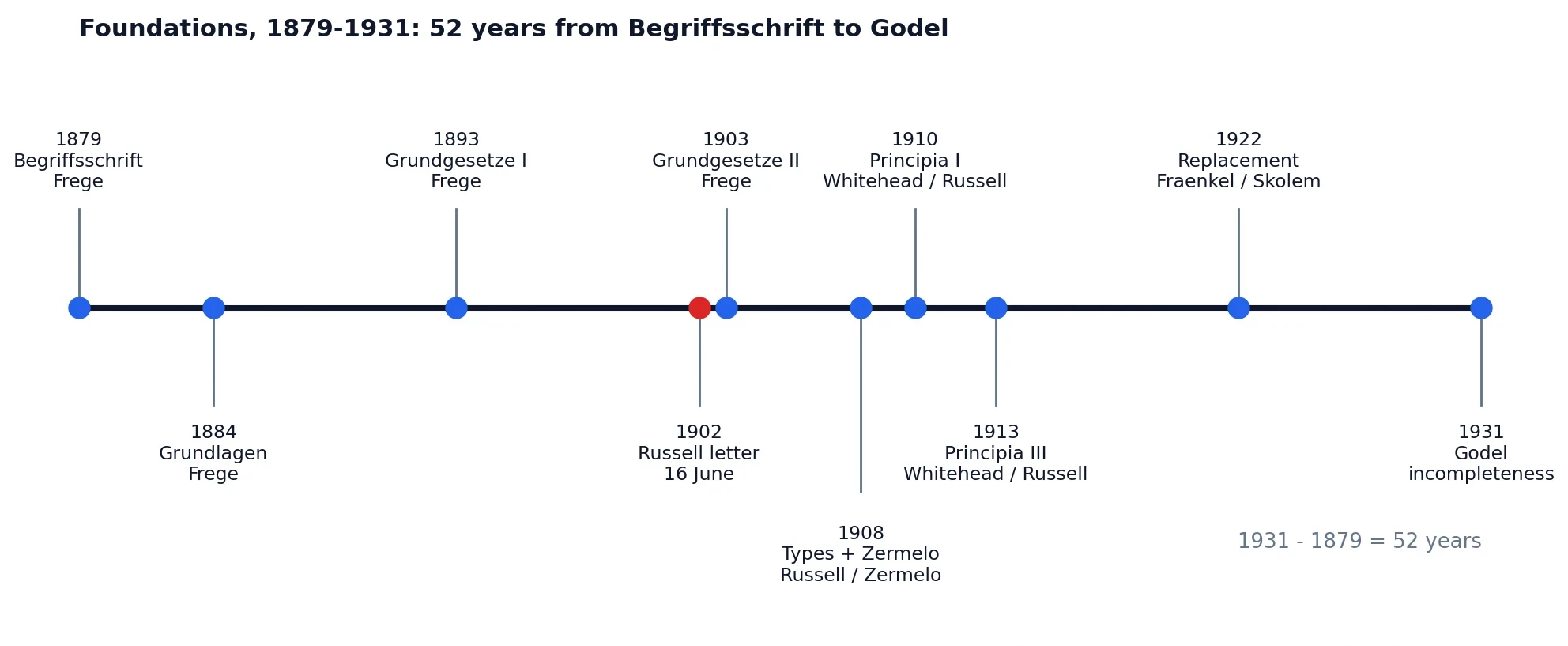
Gottlob Frege, 1848–1925, a German mathematician and logician at the University of Jena, set out to show that arithmetic is reducible to pure logic — the programme later called logicism. The Stanford Encyclopedia's entry on Frege traces the project from its first book to its collapse. His first book, Begriffsschrift, meaning Concept Notation, appeared in 1879. It presented, in full form, the propositional calculus and quantification theory — effectively the first predicate calculus, the logical language that all later work would use. Die Grundlagen der Arithmetik, The Foundations of Arithmetic, followed in 1884, giving the philosophical justification for deriving number theory from logic. The technical execution was Grundgesetze der Arithmetik, Basic Laws of Arithmetic, in two volumes: Volume 1 in 1893, Volume 2 in 1903 — ten years between volumes, and 23 years from Begriffsschrift to Russell's letter. The flaw sat in Basic Law V, which governed identity for value-ranges, the extensions of concepts. In effect it allowed a concept's extension to be treated as an object that could fall under the concept itself — the unrestricted-comprehension machinery from which Russell's paradox follows. Frege's work had little international attention until Russell drew attention to it, though Peano and others had engaged with it earlier, so it is wrong to say he was simply ignored.
The letter of 16 June 1902
Russell wrote to Frege on 16 June 1902, while Volume 2 of the Grundgesetze was at the printer, showing that a contradiction could be derived in Frege's system. Frege replied on 22 June 1902, six days later. The exact English wording of Frege's reply letter was not verified against a primary source in the research for this article, so it is paraphrased here and never quoted: Frege said he was surprised beyond words and left thunderstruck, yet hoped the discovery might lead to a great advance in logic. He added a hasty Appendix to Volume 2, deriving the contradiction himself and proposing a modification of Basic Law V. His own words in that Appendix are verified, and they are the one blockquote of this article:
"Hardly anything more unfortunate can befall a scientific writer than to have one of the foundations of his edifice shaken after the work is finished. This was the position I was placed in by a letter of Mr. Bertrand Russell, just when the printing of this volume was nearing its completion." — Gottlob Frege, Appendix to Grundgesetze der Arithmetik, Volume 2, 1903.
Frege was 54 years old in June 1902, and he had published the second volume at his own expense. His proposed repair failed: it was later shown by the Polish logician Stanislaw Lesniewski that the modified axiom still leads to contradiction, and Frege probably never learned this. The projected third volume of the Grundgesetze, on real numbers, never appeared. The dignity of Frege's response is worth noting. He did not hide the contradiction, dispute it, or blame Russell. He printed it in his own book, in an appendix, and admitted the failure in plain language. That is how a scientist behaves when a paradox breaks a theory.
The theory of types
Russell's first response was the theory of types, first set out in his 1908 paper "Mathematical Logic as Based on the Theory of Types". The idea is simple to state and hard to carry out: mathematical objects are organised into a hierarchy of types. Individuals are type 0. A set of individuals is type 1. A set of sets of individuals is type 2. A set of a given type can contain as members only entities of a lower type. A set can therefore never contain itself, so the Russell set cannot even be formed. Behind the hierarchy sits the vicious circle principle: no object may be defined by means of quantifiers whose scope includes the object itself. Definitions that violate this are impredicative. The full system in Principia Mathematica used the ramified theory of types — types further divided into orders — plus the axiom of reducibility, a special assumption that partially collapses the ramified hierarchy so that ordinary mathematics can be derived. Many logicians regarded the axiom of reducibility as an ad hoc concession that undermined the purity of the logicist programme, and that judgement has largely stood.
Principia Mathematica 1910–1913
Principia Mathematica, by Alfred North Whitehead, 1861–1947, and Bertrand Russell, 1872–1970, was published in three volumes by Cambridge University Press: Volume 1 in 1910, Volume 2 in 1912, Volume 3 in 1913 — three years across the three volumes, and nine years from Russell's discovery of the paradox to Volume 1. Its aim was to derive all of mathematics from a small number of logical axioms and inference rules, showing that the basic concepts and modes of reasoning used in mathematics are definable in logical terms. The work is famous for proving that 1 plus 1 equals 2 only after hundreds of pages of dense symbolism, in proposition 54.43 of Volume 1. No exact page total is given here, because popular accounts disagree — some say about two thousand pages, others about two thousand five hundred — and the safe form is that the three volumes run to well over a thousand pages. Principia Mathematica did not permanently solve Russell's paradox. It blocked the paradox inside its own type-theoretic system, at the price of great complexity and the contested axiom of reducibility. In mathematical practice it was largely superseded by Zermelo–Fraenkel set theory, which handles the same problems differently. A second edition appeared in 1925–1927, but the system itself never became the working foundation of mathematics.
ZFC
Ernst Zermelo proposed the first axiomatic set theory in 1908, six years after Russell's letter, in "Untersuchungen ueber die Grundlagen der Mengenlehre I". Its key move was the axiom of separation: instead of forming a set from any property whatsoever, you may only separate out, from an already existing set, those members that satisfy a property. Unrestricted comprehension is replaced by restricted comprehension, and the Russell set cannot be formed. Abraham Fraenkel pointed out in a 1921 letter to Zermelo that Zermelo's system could not prove the existence of certain sets taken for granted by set theorists, notably the cardinal number aleph-omega. In 1922, Fraenkel and Thoralf Skolem independently proposed the axiom schema of replacement — 14 years after Zermelo's axioms. The axiom of regularity, also called the axiom of foundation, was first proposed by Dimitry Mirimanoff in 1917, and in the form used in ZF by John von Neumann in 1925. It states that every non-empty set contains a member disjoint from it, which implies that no set is a member of itself and that every set has an ordinal rank. Adding replacement and regularity to Zermelo's system yields ZF, and adding the axiom of choice yields ZFC, which is today the standard form of axiomatic set theory and the most common foundation of mathematics. In ZFC there is no set of all sets, and no set of all non-self-membered sets. The collection of all sets that are not members of themselves is a proper class — a collection too big to be a set, treated only indirectly — so the paradox's contradiction never arises, because the object it needs does not exist in the system. The honest limit should be stated plainly: ZFC avoids the paradox by restriction, not by explaining it away. It replaces naive comprehension with a safer rule and gets on with mathematics.
Year | Event | What it fixed | What it did not fix |
|---|---|---|---|
1879 | Begriffsschrift | First full predicate calculus | Arithmetic still not derived from logic |
1893 / 1903 | Grundgesetze, Volumes 1 and 2 | Technical execution of logicism | Basic Law V allows Russell's paradox |
1902 | Russell's letter to Frege | Exposed the contradiction in Frege's system | Offered no replacement foundation |
1908 | Type theory and Zermelo's axioms | Blocked self-membership; restricted set formation | Axiom of reducibility contested; Zermelo's system incomplete |
1910–1913 | Principia Mathematica | Derived mathematics inside type theory | Great complexity; largely superseded by ZFC |
1922 | Replacement (Fraenkel and Skolem) | Proved existence of sets Zermelo's system missed | Did not settle consistency |
1931 | Godel's incompleteness theorems | Showed the limits of any single formal system | Did not end foundational work; ZFC remains the working foundation |
Table 2: Foundations timeline, 1879–1931 — from Frege's first book to Godel's paper, each step fixed one problem and left another standing.
10. Godel: The Sentence That Proved Its Own Unprovability
Kurt Godel, 1906–1978, an Austrian logician, published the incompleteness theorems in 1931, aged 25. The paper, "Ueber formal unentscheidbare Saetze der Principia Mathematica und verwandter Systeme I", appeared in Monatshefte fuer Mathematik und Physik, volume 38, pages 173–198. Its DOI is 10.1007/BF01700692. It is one of the most important papers in the history of mathematics, and it is also one of the most misunderstood. The Stanford Encyclopedia's entry on Godel's incompleteness theorems gives the theorems their precise form, and this section follows it closely.
Hilbert's programme
To understand what Godel did, it helps to know what he was answering. David Hilbert, 1862–1943, presented 23 problems to the International Congress of Mathematicians in Paris in 1900. The second problem asked for a proof that the axioms of arithmetic are consistent — that they can never lead to a contradiction. In the 1920s Hilbert developed this into a programme: formalise all of mathematics, then prove the formal system's consistency using only finitistic methods a sceptic must accept. If the programme had succeeded, mathematics would have had a certificate of its own reliability, written in terms no critic could reject. Godel's paper appeared 31 years after Hilbert's Paris address, and it showed that the programme, in its original form, cannot succeed. The Stanford Encyclopedia's entry on Hilbert's program traces the rise and fall of the project in detail.
The first theorem
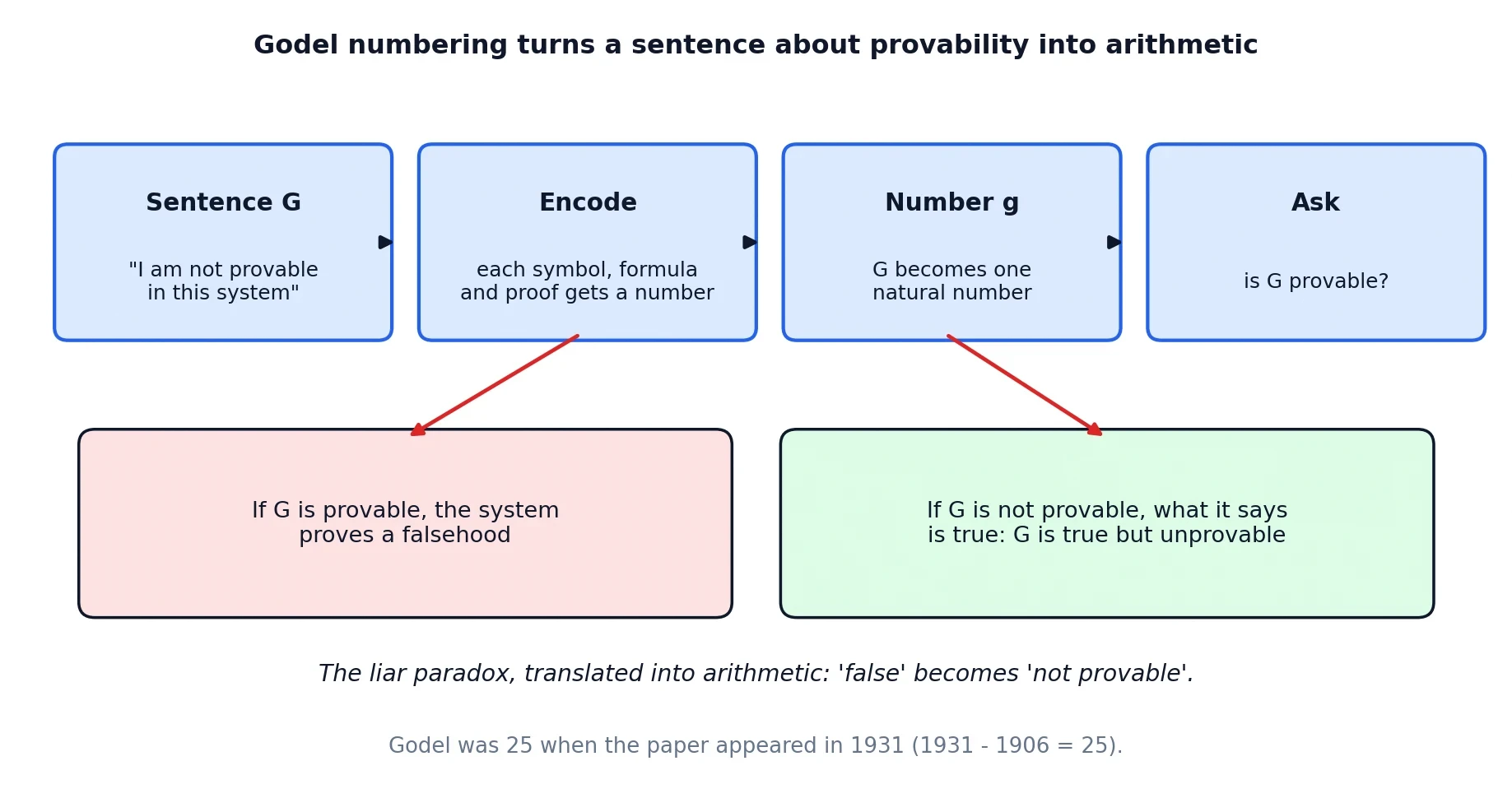
The first incompleteness theorem says that any consistent formal system strong enough to express basic arithmetic, whose theorems can be listed by an effective procedure, contains statements that are true but unprovable within the system. In short, no such system can be both complete and consistent. The proof is a masterpiece of translation. Our article on prime numbers covers the number theory behind the arithmetic Godel encoded. Godel numbering assigns a unique natural number to every symbol, formula and proof, so that statements about provability become statements about numbers. The proof then builds a sentence G that, when decoded, says in effect "I am not provable in this system." It is the liar paradox translated into arithmetic, with "not provable" in place of "false". If G were provable, the system would prove a falsehood. If it is not provable, then what it says is true — so G is true but unprovable. The parallel with the liar is exact in structure and different in outcome: where the liar gives a contradiction, Godel's sentence gives a true statement that the system cannot reach. For readers who want to see how far the idea of infinity reaches beyond arithmetic, our article on infinity takes up Cantor's work and Hilbert's Hotel, which this article does not re-explain.
The second theorem
The second incompleteness theorem says that no such consistent system can prove its own consistency. A consistency proof would have to come from a stronger system, whose own consistency would then be in question — an infinite regress, not a final certificate. This is what ended Hilbert's programme in its original form. The programme needed a consistency proof that used only methods weaker than the system itself, and Godel showed that no system strong enough for arithmetic can certify its own consistency by its own means alone. The result is often stated as if it proved that consistency can never be established at all. It did not. Consistency can be proved in a stronger system. What is impossible is self-certification.
What Godel did not prove
The scope of the theorems needs stating plainly, because the popular version of Godel claims far more than the theorems do. He did not prove that mathematics is broken, unreliable, or that nothing can be known. Ordinary mathematics goes on exactly as before, and the theorems are about formal systems, not about everyday mathematical practice. He did not prove that all truth is unprovable. Most true statements of arithmetic are provable; incompleteness says some true statements escape any given fixed system. He did not prove that consistency can never be established at all, as the second theorem shows. And he did not end the foundations project. Work continued — Gerhard Gentzen proved the consistency of arithmetic in 1936 using methods beyond Hilbert's finitistic limits — and ZFC remains the working foundation of mathematics. One more distinction matters: Godel's completeness theorem for first-order logic, from 1930, is a different result and must not be confused with the incompleteness theorems. Completeness says every logically valid first-order formula is provable. Incompleteness says some true arithmetical statements are not. The two results live side by side, and together they draw the exact shape of what formal systems can and cannot do.
I once watched a proof fall apart in front of me, in a seminar where a speaker had written a long argument on the board and was plainly proud of it. Halfway through, someone in the front row asked about a single step — a quiet question about a case the speaker had assumed away. The speaker stared at the board, tried to patch the step, and then stopped. The assumption was load-bearing, and without it the whole argument collapsed. The room was silent for a moment, and then the speaker laughed, thanked the questioner, and started again from the beginning. I think about that afternoon whenever I read Godel. A proof is only as strong as its hidden assumptions, and the most important step in mathematics is often the one nobody thought to question.
11. Banach–Tarski: Doubling a Ball
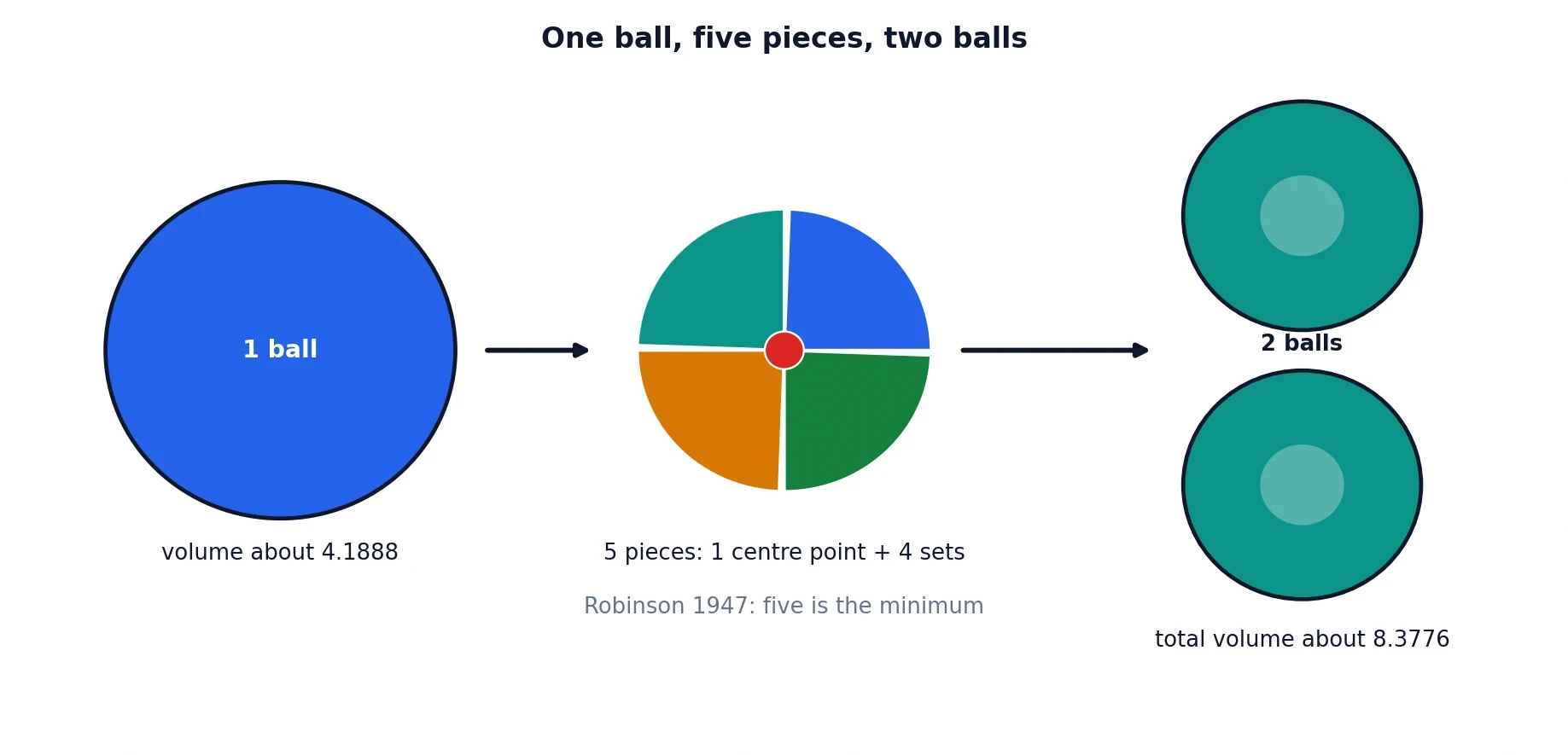
A solid ball in three-dimensional space can be split into finitely many pieces and reassembled, using only rigid motions — rotations and translations — into two solid balls, each identical to the original. That is the Banach–Tarski paradox, and it is a theorem of set-theoretic geometry, not a trick or a mistake. The paper, by Stefan Banach and Alfred Tarski, "Sur la decomposition des ensembles de points en parties respectivement congruentes", appeared in Fundamenta Mathematicae, volume 6, 1924, pages 244–277, DOI 10.4064/fm-6-1-244-277. It is the most counterintuitive result in this article, and the one that most needs its explanation stated before its punchline.
The statement
The theorem says one ball becomes two, with nothing added and nothing lost. The pieces are moved by rigid motions only — no stretching, no squashing, no cutting into smaller pieces along the way. The strong form is even more startling: any two bounded subsets of three-dimensional space with non-empty interiors are equidecomposable, so a pea could, in this mathematical sense, be reassembled into the Sun. That last sentence must be labelled every time it appears: it is a statement about point sets, not about physical objects. A pea is not a set of points. The Sun is not a set of points. The theorem is about the mathematics of infinite point sets, and the physical reading of it is simply false.
Five pieces
Raphael M. Robinson proved in 1947 that doubling the ball can be done with five pieces, and that fewer than five will not suffice. The five are one single point — the centre — plus four other sets. Robinson's 1947 result came 23 years after the 1924 paper, and it answered a question John von Neumann had posed in 1929. Five is the sharp minimum, and that sharpness is part of what makes the result a theorem rather than a curiosity: the number is not arbitrary, and it was proved, not guessed.
Hausdorff 1914
Banach and Tarski did not work from nothing. Felix Hausdorff showed in his Grundzuege der Mengenlehre, in 1914, that the surface of a unit sphere can be split into three sets B, C and D plus a countable set E, such that B, C and D are pairwise congruent and B is congruent to the union of C and D. Banach and Tarski explicitly acknowledged Hausdorff's paradox, Vitali's 1905 construction, and Banach's own 1923 paper as precursors. Ten years separate Hausdorff from Banach–Tarski, and the line from one to the other is direct: Hausdorff showed that a sphere's surface could be rearranged against itself, and Banach and Tarski extended the trick to the solid ball.
Why you cannot double a real orange
This is the point the whole section exists to make. You cannot double a real orange. The proof depends critically on the axiom of choice, which allows the construction of non-measurable sets — collections of points that have no volume in the ordinary sense. The pieces are infinitely intricate scatterings of points, not solid chunks with smooth surfaces. Without the axiom of choice the paradox cannot be proved; it is not a theorem of ZF alone. The volume arithmetic shows where the trick lives. A unit ball, radius 1, has volume 4 divided by 3 times pi, about 4.1888. Two unit balls have total volume about 8.3776 — exactly twice the original. The arithmetic is trivial, and the paradox is that the pieces, being non-measurable, have no volumes that add up in the ordinary way. The doubling does not violate arithmetic. It violates the assumption that every set of points has a volume. No knife can cut the pieces, because they have no edges, no surfaces, and no thickness in any physical sense, and constructing them would require infinitely many arbitrary choices. A real orange is made of atoms, and any pieces cut from it always have volumes that add up.
The strong form and its limits
The strong form — a pea into the Sun — is a statement about bounded point sets with non-empty interiors, and it must be labelled as such every time it appears. The paradox is also false in one and two dimensions: the strong form fails for the line and the plane, so readers should not generalise it to all geometry. Three dimensions are special here, because the group of rotations in three dimensions has the algebraic property the proof needs, and the groups in one and two dimensions do not. Robert Solovay showed in 1970 that the axiom of choice, or a weaker variant of it, is necessary for the construction of non-measurable sets, by building a model of ZF without choice in which every set of reals is measurable. The Banach–Tarski paradox is therefore a theorem about a particular foundation — ZFC — and not a fact about the physical world. It shows what the axiom of choice buys and what it costs, and that is why mathematicians still argue about it a century later.
12. The Hanging That Could Not Be a Surprise
A judge tells a prisoner that he will be hanged at noon on one day next week, Monday to Friday, but that the day will be a surprise — the prisoner will not know it is the day until the hangman arrives. The prisoner reasons backwards and concludes that he cannot be hanged at all. Then the hangman arrives, and the prisoner is genuinely surprised. This is the unexpected hanging paradox, also called the surprise examination paradox, and it has resisted a consensus solution for more than eighty years. Timothy Y. Chow's 1998 paper, "The Surprise Examination or Unexpected Hanging Paradox", American Mathematical Monthly, volume 105, pages 41–51, DOI 10.2307/2589525, is the standard survey of the problem and its history.
The judge's announcement
The story is simple. Five weekdays, one hanging, at noon, on a day the prisoner cannot predict. The judge's announcement has two parts: the hanging will happen on one of the five days, and the prisoner will not know which day until it arrives. The prisoner takes the announcement as a premise and reasons from it. The paradox circulated by word of mouth in the early 1940s, according to Quine. Michael Scriven published on it in Mind in July 1951. D. J. O'Connor published a version in 1948, featuring a surprise military blackout. Martin Gardner popularised it in Scientific American, volume 208, March 1963, pages 144–154, and as chapter 1 of The Unexpected Hanging and Other Mathematical Diversions in 1969 — 15 years after O'Connor's version, and 35 years before Chow's paper.
The backward induction
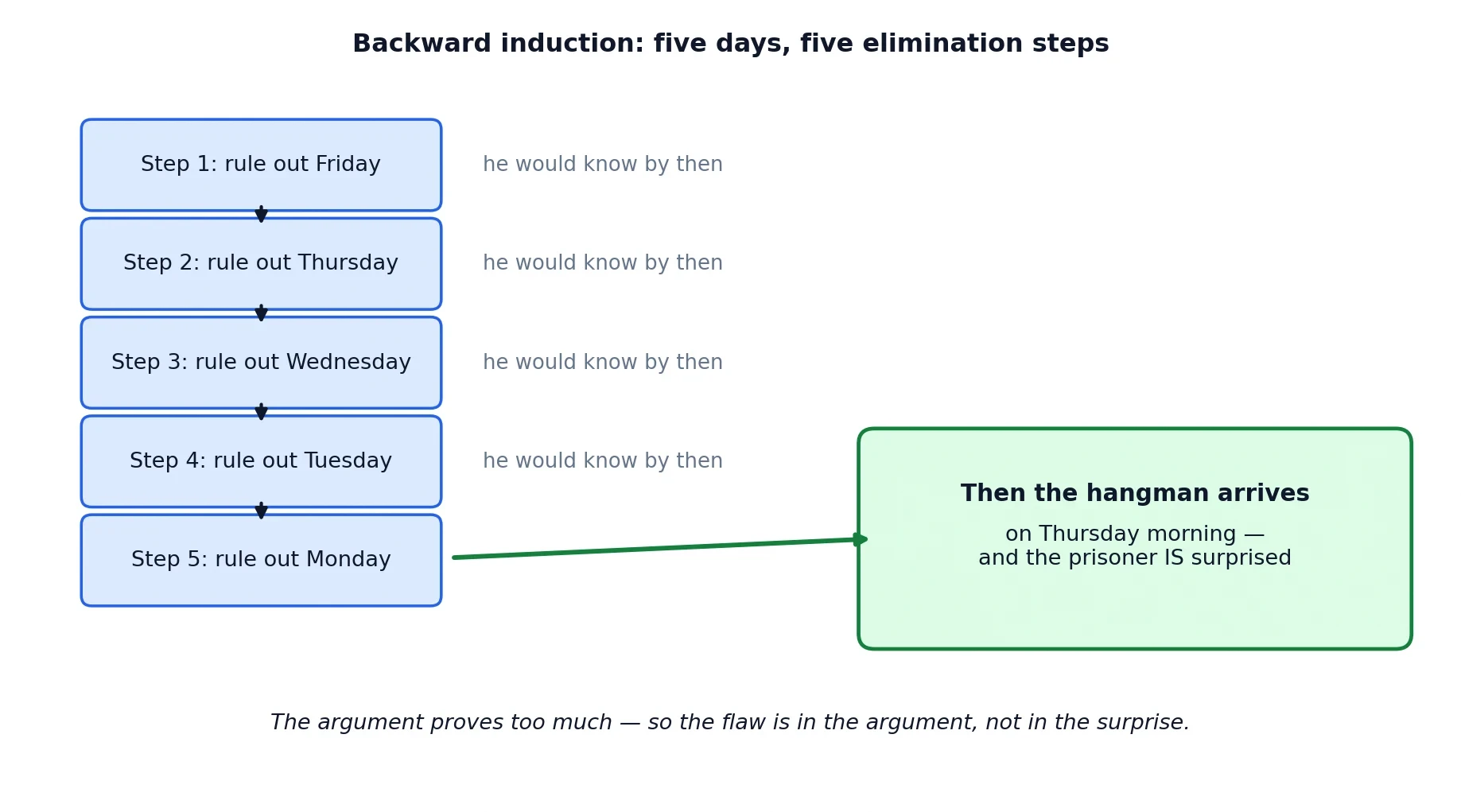
The prisoner's argument runs backwards from Friday. Step 1: it cannot be Friday, because if he survives to Thursday evening he would know Friday is the day, so it would not be a surprise. Step 2: with Friday eliminated, it cannot be Thursday either, because if he survives to Wednesday evening, Thursday is the last remaining day and he would know. Step 3: the same argument eliminates Wednesday. Step 4 eliminates Tuesday. Step 5 eliminates Monday. Five elimination steps for five days, and the conclusion is that the hanging cannot happen at all. The argument's power comes from iterating the same move, and its flaw is in the move itself.
Why the argument fails
The judge's announcement is self-referential: it makes a claim about the prisoner's future knowledge, and the prisoner's reasoning uses the announcement as a premise while also reasoning about what he will know. The standard diagnosis, following Chow, is that "surprise" is left vague. If surprise means "not deducible in advance from the assumption that the hanging will occur some time during the week", then the Friday step still works but the iteration breaks down, because the later steps need a stronger assumption than the announcement supplies. The prisoner assumes he will still believe the announcement on Thursday evening, and still believe it on Wednesday evening, and so on — but the announcement's truth depends on his beliefs, and his beliefs change as the days pass. There is no consensus resolution. Chow noted in 1998 that nearly a hundred papers had been published on the paradox and still no consensus had been reached, and that remains the honest position. The paradox is unresolved, and any article that presents one solution as the answer is overstating the case.
The surprise-exam version
The same paradox works with a teacher announcing a surprise exam next week, and it is the less macabre form and the one Chow analyses. A teacher tells a class there will be an exam on one day next week, Monday to Friday, and it will be a surprise. The students reason backwards, eliminate Friday, then Thursday, then Wednesday, Tuesday and Monday, and conclude there can be no exam. Then the teacher gives the exam on Wednesday, and the students are surprised. The structure is identical, and so is the diagnosis: the announcement talks about the students' knowledge of the announcement itself, and the backward induction quietly assumes more than the announcement gives. For the mathematics of chance behind such predictions, see our article on probability. The hanging version and the exam version are the same puzzle in different clothes, and the kinship with the liar is this: the judge's announcement is self-referential in the same family as the liar sentence, though the hanging paradox is not the liar paradox.
13. The Grandfather Paradox and the Rules of Time
A time traveller goes back in time and kills his own grandfather before his grandfather has children. Then the traveller's parent is never born, so the traveller is never born, so he never builds the time machine, so he never goes back, so his grandfather lives, so the traveller is born after all. Each answer leads to its opposite. The Stanford Encyclopedia's entry on time travel gives the story and the responses in full. This section is short and hedged, because the subject demands it: there is no experimental evidence that anyone can travel into the past. The paradox is a thought experiment about what the laws of physics would have to do if backward time travel were possible. No resolution presented here is established physics.
Novikov self-consistency
The Novikov self-consistency principle, associated with the Russian physicist Igor Novikov and developed in the mid-1980s in the context of closed timelike curves — paths through spacetime that loop back into their own past, allowed by some solutions of Einstein's general relativity — says that events in a spacetime containing a time loop must be globally self-consistent. Paradox-producing events simply cannot occur. In plain terms, you can visit the past, but only do things that are consistent with what already happened. A gun would misfire, or you would mistake someone else for your grandfather. The principle does not explain why the gun misfires. It says the universe will not permit a contradiction, and the details will work themselves out.
Multiple histories
A second response is the multiple-history model: travelling into the past could take the traveller into a different branch of history. The grandfather killed belongs to another timeline, and the traveller's own timeline, in which he was born, continues untouched. The contradiction disappears because the survival and the death happen in two different histories. This borrows language from the many-worlds interpretation of quantum mechanics, associated with Hugh Everett in 1957, but many-worlds does not by itself establish that time travel would create or carry someone into a parallel timeline. The correct form is "a multiple-history model", not a claim that Everett's theory proves time travel works this way. Stephen Hawking's chronology protection conjecture, from 1992, offers a third response: the laws of physics conspire to prevent time travel altogether, so closed timelike curves cannot form. It is a conjecture, not a finding. David Lewis's 1976 paper "The Paradoxes of Time Travel" is the standard philosophical treatment of the subject.
14. The Paradox Family: Berry, Grelling and Curry
The liar has relatives, and each one isolates a different ingredient of the trouble. Three of them deserve a paragraph each, because together they show that the problem is not one trick but a family of related failures.
Berry's paradox
Berry's paradox is about naming. Consider "the first number not nameable in under ten words". The phrase appears to name that number in nine words. The sting is that the phrase uses the language's own naming relation inside the language: it talks about what can be named, in the language that does the naming. George Berry, an Oxford librarian, gave the puzzle to Bertrand Russell in 1906, according to secondary reports — the year is reported, not independently verified from Russell's papers. Like the liar, Berry's paradox shows that a language cannot safely talk about its own naming power.
Grelling's paradox
Grelling's paradox, published by Kurt Grelling and Leonard Nelson in 1908, does the same work with single words. Call a word heterological if it does not describe itself. The word "long" is heterological, because the word "long" is not long. The word "short" is not heterological, because the word "short" is short. Now ask: is the word "heterological" heterological? Either answer contradicts itself. If it is heterological, then it does not describe itself, so it is not. If it is not, then it does describe itself, so it is. Grelling's paradox is a close relative of Russell's paradox, with words instead of sets, and it shows that the trouble does not need sets or numbers at all. It needs only a language that can talk about its own words.
Curry's paradox
Curry's paradox is the most unsettling of the three, because it needs no negation at all. Consider the sentence "If this sentence is true, then Germany borders China." Without using negation or falsity, the sentence seems to prove an arbitrary claim true. Its modern ancestry traces to Haskell Curry in 1942 and Martin Loeb in 1955, and the Stanford Encyclopedia's entry on Curry's paradox gives the full argument. It matters because it shows the trouble is not negation or falsity — it is self-reference plus conditional reasoning. The full derivation is not attempted here, because it needs more machinery than this article can carry, but the lesson is plain: remove the word "false" and the paradox survives. Richard's paradox, from Jules Richard in 1905, belongs in the same paragraph: phrases of English that define real numbers, and the real number defined by a phrase like "the least real number not definable in under a hundred words", run into the same wall as Berry's puzzle.
I once tried to define a word using only itself, in the way Grelling's paradox invites you to, and I hit the same wall in about thirty seconds. The word was "short", and I wanted a definition that used no other descriptive words — only the word itself and the grammar around it. Every attempt either smuggled in another word or went in a circle. The exercise felt silly until I realised it was the same exercise Grelling had formalised: a language trying to stand outside itself while standing inside it. The wall is real, and it is the same wall the liar, Berry and Curry all run into.
15. What Paradoxes Gave Us
Mathematical paradoxes did not break mathematics. They showed where its edges are, and each edge became a new field. The gifts are specific, and they are worth listing plainly, because they are the reason mathematical paradoxes are still taught.
Limits and convergent series
Zeno's gift to analysis was the problem of the infinite series. The Dichotomy and Achilles forced mathematicians to ask what it means for infinitely many numbers to add up to a finite total, and the answer became the rigorous theory of limits and convergent series in the 1800s. Every student who learns that one half plus one quarter plus one eighth sums to exactly 1 is using the machinery Zeno forced into existence. The supertask question remains open, but the mathematics of convergence is settled, and it underpins calculus, analysis, and much of modern physics.
Set theory and type theory
Russell's gift to the foundations was axiomatic set theory. The paradox destroyed naive comprehension and forced Zermelo, Fraenkel, Skolem, von Neumann and others to write down exactly which sets may be formed and how. ZFC is the result, and it is still the standard foundation of mathematics. Type theory, Russell's own answer, survives too, in a different form: modern proof assistants and programming languages use typed systems that descend directly from the hierarchy Russell built to block self-membership. The crisis produced the tools that working mathematicians use every day.
Computability
Godel's gift runs from the liar sentence to the limits of formal systems and on to Turing. Godel numbering — the trick of turning statements about provability into statements about numbers — showed that a formal system can talk about itself, and that self-reference has limits. Turing's work on computability grew directly from that insight, and the modern theory of what computers can and cannot do descends from it. The liar, a puzzle about a single sentence, turned out to be the seed of computer science.
What they did not give us
The honest close matters as much as the gifts. Mathematical paradoxes gave us no final certificate of consistency — Godel showed that no system can certify itself. They gave us no sharp line for vague words — the sorites is still unresolved. They gave us no time machine — the grandfather paradox is still a thought experiment. What they gave us is better than any of those: a map of the edges.
16. Frequently Asked Questions
What is Zeno's paradox?
Zeno's paradoxes are four arguments about motion, from around 490–425 BC, of which the Dichotomy and Achilles and the tortoise are the most famous. The Dichotomy says you must cross half the distance before the whole, and half of that half before that, without end. Achilles says the fastest runner can never overtake the slowest, because he must always reach the point the tortoise has just left. The modern answer is that the infinite series of steps sums to a finite total: Achilles catches the tortoise after 11.11 seconds at 111.11 metres in our worked example.
Can Achilles catch the tortoise?
Yes. The gaps shrink by a factor of ten each time — 100 metres, 10 metres, 1 metre, 0.1 metres — and the times add up to a finite total of 11.111 seconds. The infinite series 1/2 + 1/4 + 1/8 and so on sums to exactly 1, so the infinite list of steps takes a finite time. Zeno's argument describes the run in infinitely many pieces, but the run itself is one continuous motion.
What is Russell's paradox?
Russell's paradox asks whether the set R, the set of all sets that are not members of themselves, is a member of itself. If it is, it must not be. If it is not, it must be. The contradiction follows from unrestricted comprehension, the rule that any property defines a set. Modern ZFC set theory resolves it by restricting set formation: the collection of all non-self-membered sets is a proper class, not a set, so the paradoxical object does not exist in the system.
How did paradoxes change mathematics?
They rebuilt it. Zeno's paradoxes led to the rigorous theory of limits and convergent series. Russell's paradox led to axiomatic set theory, ZFC, and type theory. Godel's theorems ended Hilbert's programme of a single self-certifying system and led on to computability theory and Turing's work. Each paradox exposed a hidden assumption, and each exposure produced a stronger theory.
What is the unexpected hanging paradox?
A judge tells a prisoner he will be hanged at noon on one day next week, Monday to Friday, and the day will be a surprise. The prisoner reasons backwards: it cannot be Friday, then not Thursday, Wednesday, Tuesday or Monday — so he cannot be hanged at all. Then, in Gardner's version, the hangman arrives on Thursday morning, and the prisoner is surprised. (Other tellings give Wednesday.) The announcement is self-referential, the word "surprise" is vague, and after nearly a hundred papers there is still no consensus on the resolution.
What is Godel's incompleteness theorem in simple terms?
Any consistent formal system strong enough for arithmetic contains true statements it cannot prove. Godel built a sentence that says "I am not provable in this system". If it were provable, the system would prove a falsehood, so it is not provable — and what it says is true. A second theorem says no such system can prove its own consistency. Godel did not prove that nothing can be known: most true statements are provable, and ordinary mathematics goes on as before.
Can Banach–Tarski double a real object?
No. Banach–Tarski doubles a mathematical ball, an infinite set of points, using five pieces that are non-measurable sets with no volume in the ordinary sense. A unit ball has volume about 4.1888 and two have about 8.3776, but the pieces have no volumes that must add up. No knife can cut them. A real orange is made of atoms, and its pieces always have volumes that add up.
Is time travel possible?
There is no experimental evidence that anyone can travel into the past. The grandfather paradox is a thought experiment about what the laws of physics would have to do if backward time travel were possible. The main proposals are Novikov self-consistency, under which paradox-producing events simply cannot occur, and multiple-history models, under which the traveller enters a different branch of history. Hawking's chronology protection conjecture suggests the laws of physics prevent time travel altogether. All three are proposals, not findings.
Frege's Appendix line is the place to end. A letter arrived, a foundation shook, and mathematics did not collapse. It rebuilt itself, piece by piece, into something stronger and more honest than what came before. The mathematical paradoxes in this article are still open where the research says they are open — the liar, the heap, the hanging — and settled where the research says they are settled — the sum of Zeno's series, the proper-class answer to Russell, the limits Godel proved. That split is not a failure. It is the shape of a subject that tests itself, finds its own weak spots, and keeps going. The next paradox is probably already waiting, in a premise nobody has thought to question yet, and when it arrives, mathematics will do what it has always done: take the contradiction seriously, find the hidden assumption, and build again.
Sources
Nick Huggett, "Zeno's Paradoxes", Stanford Encyclopedia of Philosophy (archived Fall 2006 entry — the 0.9 m series example is from this archived version; the current entry at the same topic is titled "Zeno of Elea"). https://plato.stanford.edu/archives/fall2006/entries/paradox-zeno/
MacTutor History of Mathematics, University of St Andrews, "Zeno of Elea". https://mathshistory.st-andrews.ac.uk/Biographies/Zeno_of_Elea/
"Russell's Paradox", Stanford Encyclopedia of Philosophy. https://plato.stanford.edu/entries/russell-paradox/
"Russell's paradox", Encyclopaedia Britannica. https://www.britannica.com/topic/Russells-paradox
"Self-Reference", Stanford Encyclopedia of Philosophy. https://plato.stanford.edu/entries/self-reference/
"Liar Paradox", Stanford Encyclopedia of Philosophy. https://plato.stanford.edu/entries/liar-paradox/
"Liar Paradox", Internet Encyclopedia of Philosophy. https://iep.utm.edu/liar-paradox/
"Sorites Paradox", Stanford Encyclopedia of Philosophy. https://plato.stanford.edu/entries/sorites-paradox/
"Gottlob Frege", Stanford Encyclopedia of Philosophy. https://plato.stanford.edu/entries/frege/
"Gottlob Frege", Encyclopaedia Britannica. https://www.britannica.com/biography/Gottlob-Frege
"Principia Mathematica", Encyclopaedia Britannica. https://www.britannica.com/topic/Principia-Mathematica
"Godel's Incompleteness Theorems", Stanford Encyclopedia of Philosophy. https://plato.stanford.edu/entries/goedel-incompleteness/
Kurt Godel, "Ueber formal unentscheidbare Saetze der Principia Mathematica und verwandter Systeme I", Monatshefte fuer Mathematik und Physik 38 (1931), pages 173–198. DOI: 10.1007/BF01700692
"Hilbert's Program", Stanford Encyclopedia of Philosophy. https://plato.stanford.edu/entries/hilbert-program/
Martin Bays, "Introduction to 3TP3: Hilbert's Programme and Godel's Incompleteness Theorems", McMaster University lecture notes. https://math.mcmaster.ca/~mbays/teaching/3tp3/intro/intro.pdf
"Set Theory", Stanford Encyclopedia of Philosophy (ZF entry). https://plato.stanford.edu/entries/set-theory/ZF.html
Stefan Banach and Alfred Tarski, "Sur la decomposition des ensembles de points en parties respectivement congruentes", Fundamenta Mathematicae 6 (1924), pages 244–277. DOI: 10.4064/fm-6-1-244-277
"Banach–Tarski paradox", Wikipedia. https://en.wikipedia.org/wiki/Banach%E2%80%93Tarski_paradox
"Curry's Paradox", Stanford Encyclopedia of Philosophy. https://plato.stanford.edu/entries/curry-paradox/
"Time Travel", Stanford Encyclopedia of Philosophy. https://plato.stanford.edu/entries/time-travel/
Timothy Y. Chow, "The Surprise Examination or Unexpected Hanging Paradox", American Mathematical Monthly 105 (1998), pages 41–51. DOI: 10.2307/2589525
Timothy Y. Chow, "The Surprise Examination or Unexpected Hanging Paradox", American Mathematical Monthly 105 (1998), pages 41–51 — Taylor and Francis record for the same paper (publisher's DOI). DOI: 10.1080/00029890.1998.12004847
Martin Gardner, The Unexpected Hanging and Other Mathematical Diversions (1969; University of Chicago Press edition 1991), chapter 1. https://bobson.ludost.net/copycrime/mgardner/gardner04.pdf
"What Is the Unexpected Hanging Paradox?", DoingMaths. https://www.doingmaths.co.uk/theunexpectedhangingparadox.html
"Grelling–Nelson paradox", Wikipedia. https://en.wikipedia.org/wiki/Grelling%E2%80%93Nelson_paradox