
1. The Quietest Lesson Your Body Ever Learns
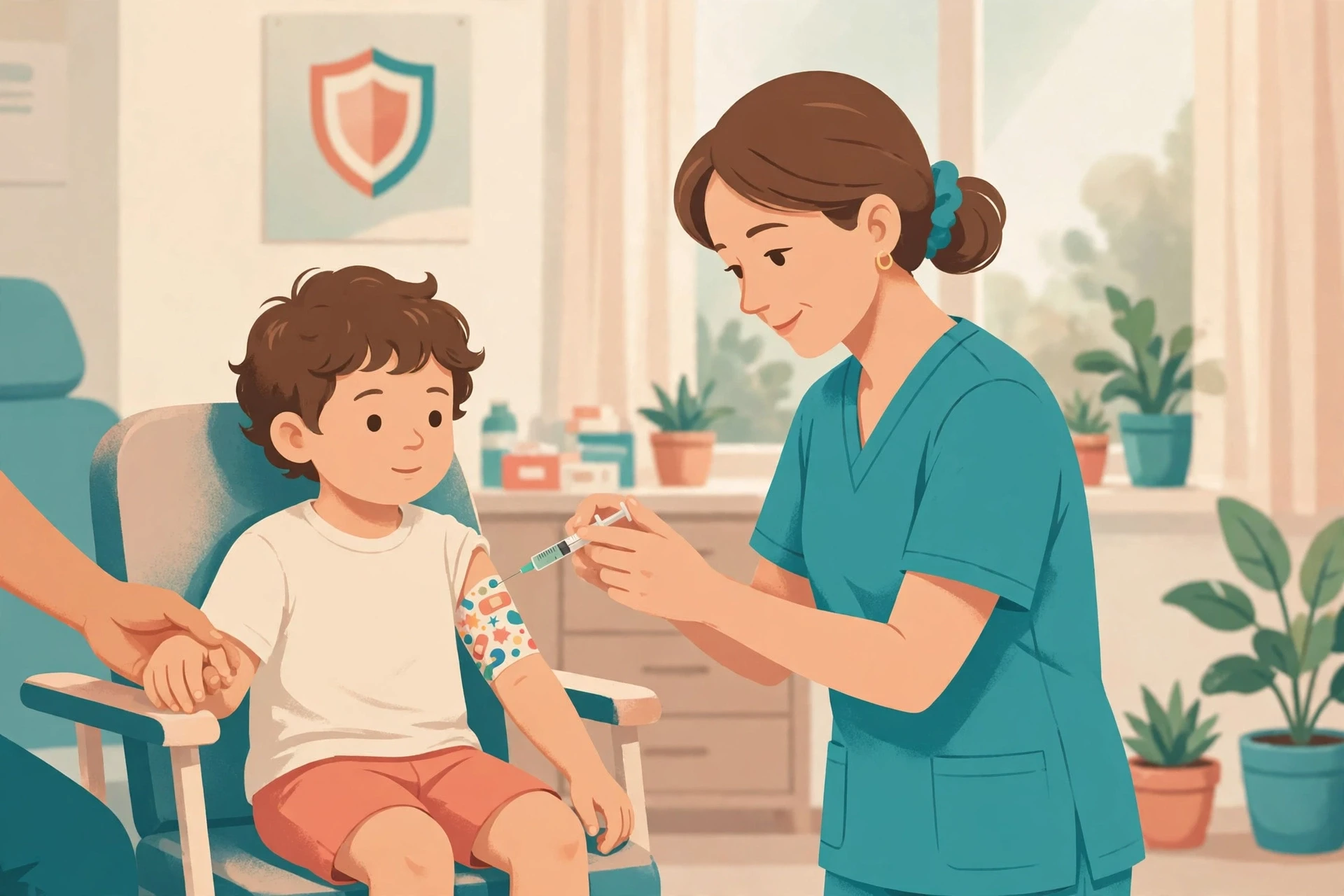
The room smells faintly of antiseptic. A child sits in a clinic chair, legs swinging, one sleeve rolled up, a parent's hand wrapped around theirs. The nurse smiles, the needle is quick, and it is over before the child has time to decide whether to cry. A small coloured plaster goes on the arm. On the drive home, nothing looks different. No fever, no drama, no sign that anything important has happened.
And yet something extraordinary has just begun — and this is how vaccines work at their quietest: under the skin, immune cells are already gathering around a handful of harmless fragments and starting a training programme that may last for years. I have sat in rooms like that one, watching a routine jab turn into a small act of trust between a parent and a science they cannot see, and I have never stopped being struck by the mismatch: the tiniest of interventions, and one of the most sophisticated things the human body can do.
That mismatch is the question at the heart of this article: how vaccines work — how a small injection can teach the body to defeat a disease it has never met.
Think of it this way: a vaccine hands your immune system the enemy's photograph without ever introducing the enemy. Your immune system studies it, builds defences against it, and files the lesson away, so that if the real germ arrives months or years later, the defence is already rehearsed.
This article answers four questions that sit behind nearly every conversation about vaccination — and together, they explain how vaccines work from the first injection to the last memory cell. How do vaccines work, in plain language and in full detail? Why do you need multiple doses of a vaccine — and what is a booster dose actually doing? What is herd immunity, and why does your vaccination protect people you have never met? And how do mRNA vaccines work, the newest members of a family of technologies that stretches back more than two centuries?
To follow the answers — to really see how vaccines work — you need only one piece of background: a working picture of the immune system itself. If you want the full tour first, our companion piece on how the human immune system works walks through its cells and organs in detail. Here, we will build just enough of that picture to see where a vaccine fits into it — and then go deeper than most explanations ever do, into the lymph nodes where immunity is really built, the training camps where antibodies are sharpened, and the safety systems that watch over every dose: the full story of how vaccines work, from the needle to the memory cell.
2. How Vaccines Work: The Short Version
Here is the whole mechanism in one paragraph. A vaccine introduces a harmless stand-in for a disease-causing germ — a weakened germ, a killed germ, a single protein from it, or the genetic instructions for making one of its proteins. The immune system recognises that stand-in as foreign, mounts a response against it, and produces antibodies and specialised killer cells. When the response winds down, it leaves behind memory cells: B cells and T cells that remember the invader's shape for years. If the real germ ever arrives, those memory cells mobilise in hours instead of days, and the infection is stopped before it can take hold.
That is how vaccines work at the level that matters most. Everything else in this article is the detail of that paragraph, unpacked.
The best analogy I know for how vaccines work is a fire drill. A fire drill is not a real fire. Nobody wants one. But the alarm sounds, people learn the exits, the wardens practise their roles, and when a real fire comes, nobody has to work out what to do for the first time. A vaccine is a fire drill for the immune system: a controlled rehearsal with a harmless imitation of the threat, so the real event is met by a system that already knows the route.
Four words carry most of the meaning, so let us define them now, in plain language.
An antigen is any fragment of a germ that the immune system can recognise — usually a protein or a sugar on the germ's surface. It is the photograph, the identifying feature.
An antibody is a Y-shaped protein made by B cells that locks onto one specific antigen, like a key fitting one lock, tagging germs for destruction and blocking them from entering cells.
A B cell is a white blood cell that makes antibodies, each one built to recognise one antigen shape; the body keeps an enormous library of them, waiting for their match to appear.
A T cell is a white blood cell that coordinates the response or kills infected cells directly: helper T cells act as commanders, telling B cells when to produce antibodies, and killer T cells destroy cells that a virus has already invaded.
The process runs in four steps, from injection to memory — and once you see them, you understand how vaccines work in outline, even before the detail:
The antigen arrives. The vaccine delivers its harmless stand-in into muscle tissue, where local immune cells pick it up.
Immune cells respond. Antigen-presenting cells carry the fragment to a nearby lymph node and show it to T cells and B cells.
Antibodies are made. The matching B cells multiply, refine their antibodies, and release them into the blood.
Memory cells are kept. When the response fades, memory B cells and memory T cells remain on guard, ready to respond far faster the second time.
That is the short version of how vaccines work. The rest of this article is about what happens inside steps two, three and four — where the real elegance lives.
3. First, the Machine Vaccines Exploit: Your Immune System
A vaccine does not fight disease by itself — and that is the first surprise in how vaccines work. It has no weapons of its own. What it does is far cleverer: it borrows a defence system that evolution spent hundreds of millions of years building, and it gives that system a practice run. To understand how vaccines work, you first have to understand the machine they exploit — and that machine has two halves that could hardly be more different.
3.1 The innate system: fast, general, and first on the scene
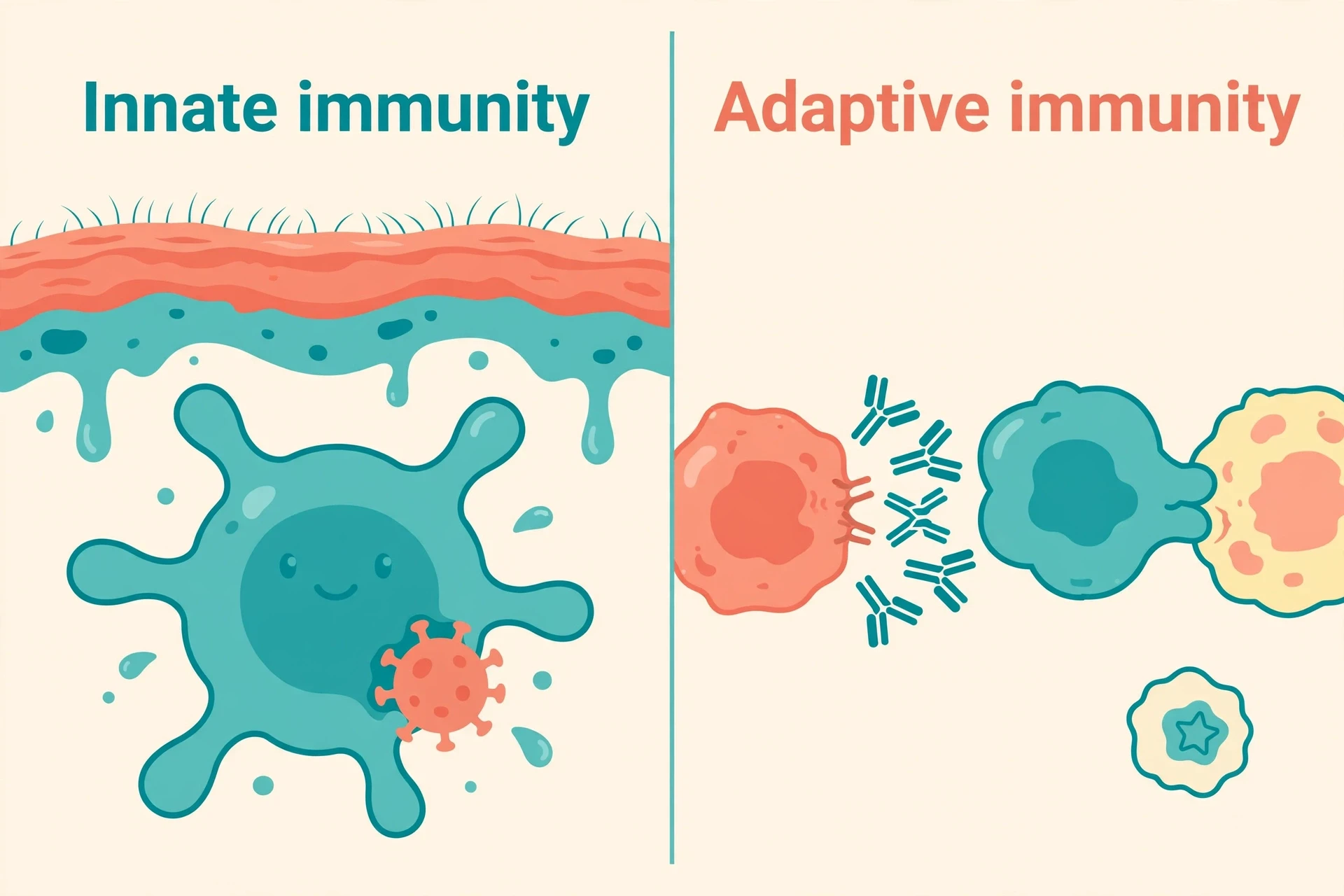
The innate immune system is the part you are born with, fully assembled. It does not learn, and it does not remember. What it does is react — instantly, and to almost anything that looks wrong.
Its first layer is physical, not cellular: skin, mucus and the tiny hair-like cilia that sweep your airways act as barriers that prevent pathogens from entering the body in the first place. Those that do meet fast, general first responders such as macrophages and neutrophils, white blood cells that swallow invaders whole and digest them. A macrophage is a hungry cell that patrols the tissues, engulfing anything that carries the chemical signs of foreignness.
Its speed is its strength and its limit: it can hold the line for hours or days, but it cannot recognise a specific germ, and it cannot remember one. For memory — the whole point of a vaccine — the body needs the other half of the system.
3.2 The adaptive system: slow, specific, and able to remember
The adaptive immune system is the opposite in every way: slow to start, taking days to mount a full response, but exquisitely specific — each of its B cells and T cells recognises one particular antigen shape, and only that shape. And it remembers: once it has met a germ, it keeps memory cells that can recognise the same germ years later and respond within hours.
That is why vaccines target the adaptive system: only it has memory, and memory is the whole idea behind how vaccines work. A vaccine introduces the adaptive system to a germ under safe conditions, so the slow first response happens in peacetime and the fast remembered response is ready for wartime.
The two halves work as a relay: the innate system holds the intruder and raises the alarm, and the adaptive system arrives and builds a tailored defence. The antibody a B cell makes against measles will not protect against mumps, unless the two germs happen to be very similar. That specificity is also why a vaccine against one disease does not protect against another — a point that matters for how vaccines work in practice, since each vaccine teaches the system one germ's shape. The World Health Organization's explainer on how vaccines work states the same rule: antibodies to one pathogen generally do not protect against another, except when two pathogens are very similar.
3.3 Macrophages and antigen presentation: the wanted poster
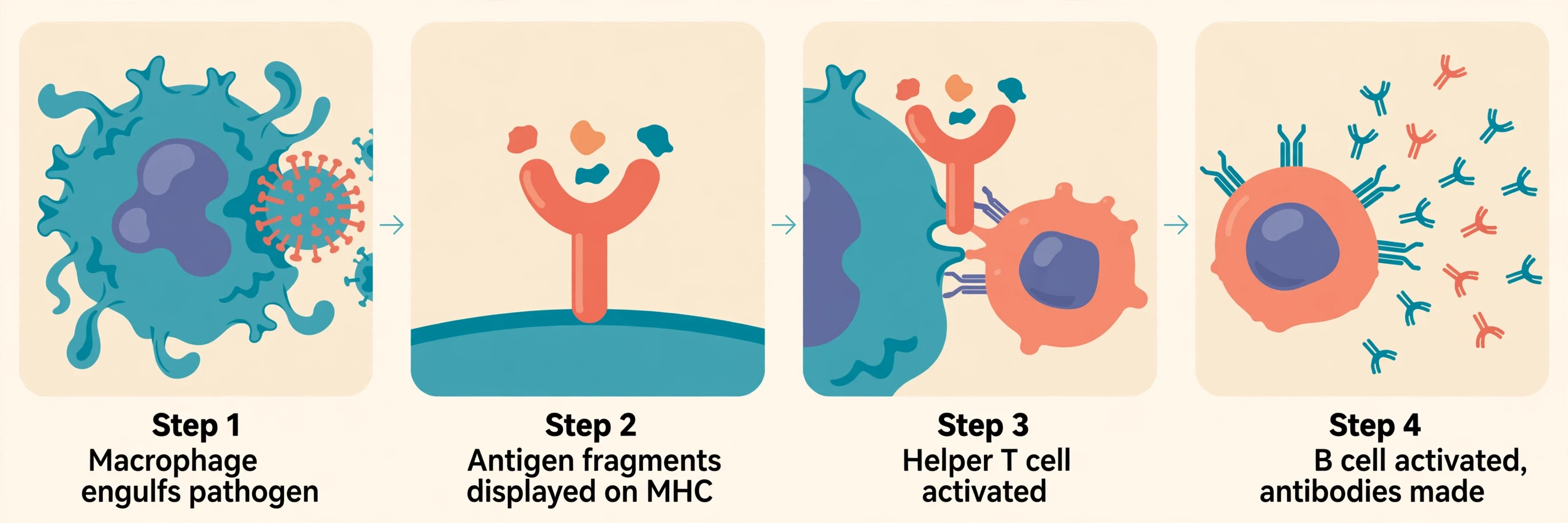
Here is the step that makes everything else possible, and it is the step most explanations rush past. A macrophage does not simply eat a germ and disappear. After digesting it, the macrophage keeps some of the germ's fragments — its antigens — and displays them on its own surface, held in a molecular frame called an MHC molecule. Think of it as a wanted poster pinned to the cell's front door: this is what the intruder looks like; if you recognise this shape, come and help.
These antigen-presenting cells then travel to the nearest lymph node, where B cells and T cells wait. There, the macrophage holds up its fragment, and the waiting lymphocytes inspect it. Most pass by — but somewhere in that crowd is a T cell whose receptor fits the fragment exactly, and a B cell built for the same shape. When they find their match, they activate, and the adaptive response begins.
That display step is the hinge of the whole story. This is the first place where how vaccines work becomes visible — a vaccine feeds this display system a safe antigen, a fragment that teaches the same lesson without the danger of the live germ. The macrophage cannot tell whether the fragment came from a real infection or a vaccine, and it does not need to: it shows the shape, and the system learns it either way.
3.4 Why the adaptive system is the target
Put the two halves together and the logic of how vaccines work becomes plain. The innate system is fast but forgetful. The adaptive system is slow but remembers. A vaccine accepts the adaptive system's slowness and removes its cost: the slow learning phase happens when there is no real disease to fight, in the safety of a clinic visit, instead of during an infection that is already spreading through the body.
It typically takes a few weeks after vaccination for the body to produce its new T-lymphocytes and B-lymphocytes in full. That delay is not a flaw: it is the time the adaptive system needs to find the matching cells, multiply them, refine them, and store the memory. The next section follows that process into the lymph node, where it happens. If you want the fuller anatomy first — the organs, the cell types, the signalling — our companion article on how the human immune system works covers it in depth, and the germs themselves are introduced in our microbiology guide.
4. Inside the Lymph Node: Where Immunity Is Really Built
If you could shrink down and stand inside a lymph node in the days after a vaccination, you would find one of the busiest construction sites in the body. The node swells — that tender lump under the jaw during an infection is a lymph node at full work. Inside it, in a structure called the germinal centre, B cells are dividing, mutating, competing and dying in large numbers, all to produce a small number of superb antibodies and a guard force of memory cells. This is the deep mechanism behind how vaccines work, and it deserves a whole section.
4.1 The journey to the lymph node
The story of how vaccines work at the cellular level starts at the injection site. Antigen-presenting cells — macrophages and their cousins, the dendritic cells — pick up the vaccine's antigen and carry it through the lymphatic vessels to the nearest lymph node, the meeting hall where B cells and T cells circulate, each waiting for the single antigen shape it was built to recognise.
When the presenting cell arrives and displays its fragment, the matching helper T cell docks onto it and activates, then finds the matching B cell, and the two together switch the B cell on. This three-way meeting is the spark. Without the helper T cell's permission, most B cells will not commit to a full response — a safety check, and one reason vaccines contain adjuvants, substances that make the innate alarm louder so the meeting happens reliably.
4.2 The germinal centre: a training camp inside the lymph node
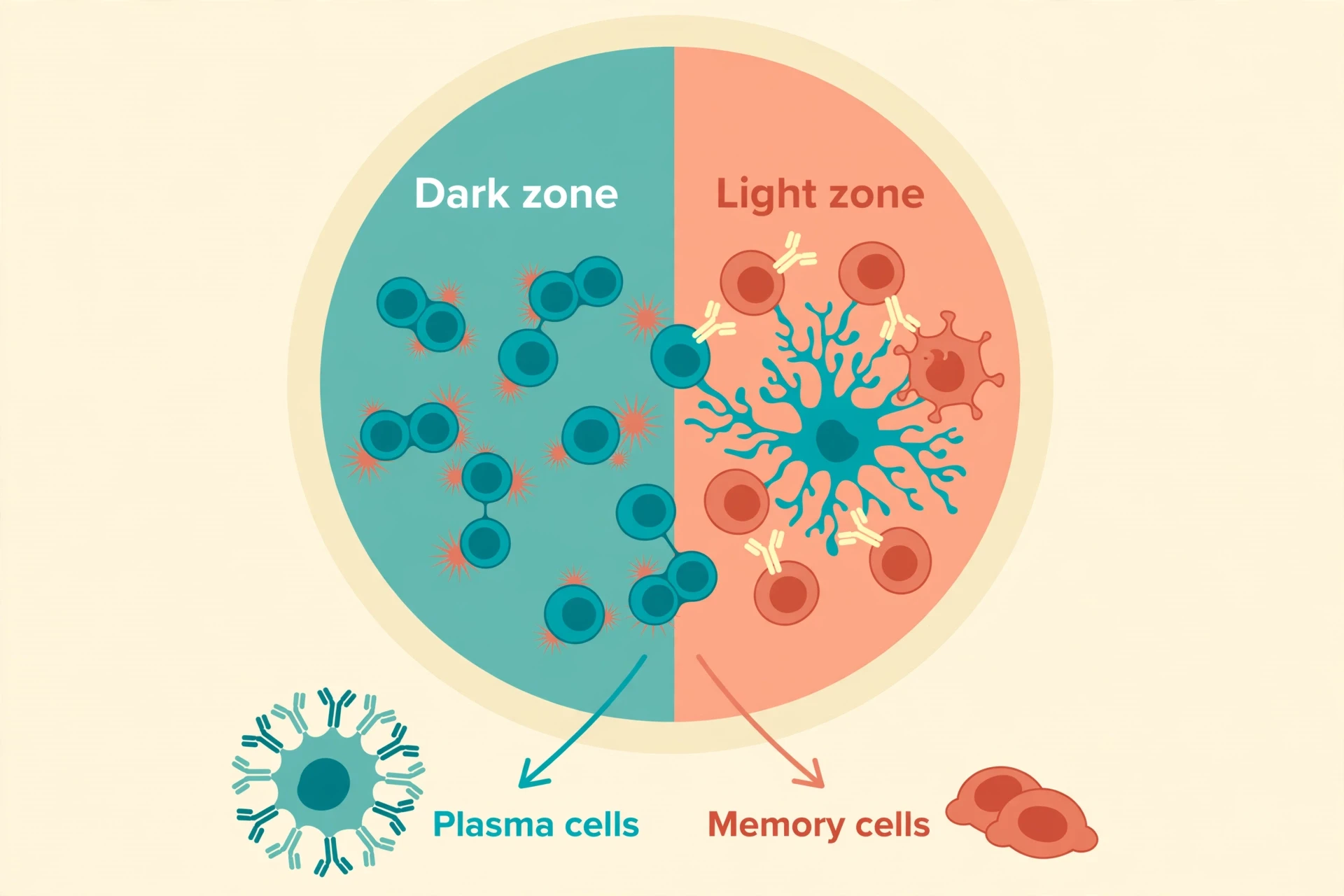
Once activated, some B cells move into a specialised zone of the lymph node called the germinal centre, where the antibody response is generated, refined and finished. It takes about a week for the germinal centre to develop after immunisation, maturing in the second week into its classic form, with a dark zone and a light zone, each with a different job.
The germinal centre is the delayed but sustained phase of the antibody response. Early antibodies, made in the first days, are serviceable but rough. The germinal centre's job — the heart of how vaccines work at the cellular level — is to make them better, through a process that looks like evolution in fast-forward.
4.3 Affinity maturation: antibodies get better over weeks
In the dark zone, B cells divide rapidly, and each time they copy their antibody genes they introduce small random changes — somatic hypermutation — producing a crowd of B cells whose antibodies differ slightly, some gripping the antigen a little tighter, some a little looser.
Then the cells move to the light zone, where they are tested: follicular dendritic cells hold the antigen out, and the B cells compete to grab it. The ones whose mutated antibodies bind most tightly win help from helper T cells and survive; the ones that bind weakly, or not at all, die. The survivors return to the dark zone for another round. Cycle after cycle, week after week, the average grip strength — the affinity — climbs. This is affinity maturation: Darwinian selection, running inside your lymph nodes over a few weeks, and it is the hidden engine of how vaccines work.
The output is not just better antibodies, but antibodies that keep improving for weeks to months while the germinal centre persists. That is why the timing of doses matters, and why a vaccine's protection is not fully formed on the day of the jab: the germinal centre needs time to finish its work, and the second dose is timed to meet a system that has had that time.
4.4 Plasma cells vs memory B cells vs memory T cells
When a B cell leaves the germinal centre, it takes one of two paths: some become plasma cells, antibody factories that pour large amounts of antibody into the blood right now — the front line of the current response — while others become memory B cells, quiet, long-lived cells that produce little antibody while at rest but carry the refined antibody design in their genes, ready to reactivate.
Memory T cells follow a parallel logic: helper memory T cells remember how to coordinate the response, and killer memory T cells remember which infected cells to destroy. Together, the three populations — plasma cells, memory B cells, memory T cells — are the three outputs of vaccination, and the three answers to the question of how vaccines work in the long term: the plasma cells fight now, and the memory cells stand guard for years.
This division of labour explains a puzzle that confuses many people: antibody levels in the blood fall over time, yet protection often lasts. The falling antibody is the plasma-cell output fading; the protection that remains is the memory — cells that can rebuild the antibody response within hours. A blood test that measures only circulating antibody measures the factory's current output, not the guard force waiting in reserve.
4.5 Long-lived plasma cells in the bone marrow
Some plasma cells migrate to the bone marrow, where survival niches let them live for years, quietly secreting antibody all the while. These long-lived plasma cells are responsible for more than half of the IgG — the main antibody class — in the blood, and they provide continual protection against re-infection.
Much of the success of vaccination can be traced to this chain: the germinal centre reaction, and its output of long-lived plasma cells, memory B cells and memory helper T cells. When a vaccine gives lifelong protection, it is usually because this chain ran well — the clearest proof of how vaccines work at their best — and the bone-marrow plasma cells settled in for the long term. When protection fades, it is usually because the chain was shorter, or the germ itself keeps changing its appearance, as Section 5 explains.
5. Why You Need More Than One Dose: How Vaccines Work Over Time
"Why do I need a second dose?" It is one of the most common questions in any clinic, and it has a precise immunological answer. The short version is that the first dose starts the training and the later doses finish it. The longer version — how vaccines work over time — is a story about two very different immune responses, and about what germinal centres need in order to complete their work.
5.1 Primary vs secondary response: slow and modest, then fast and powerful
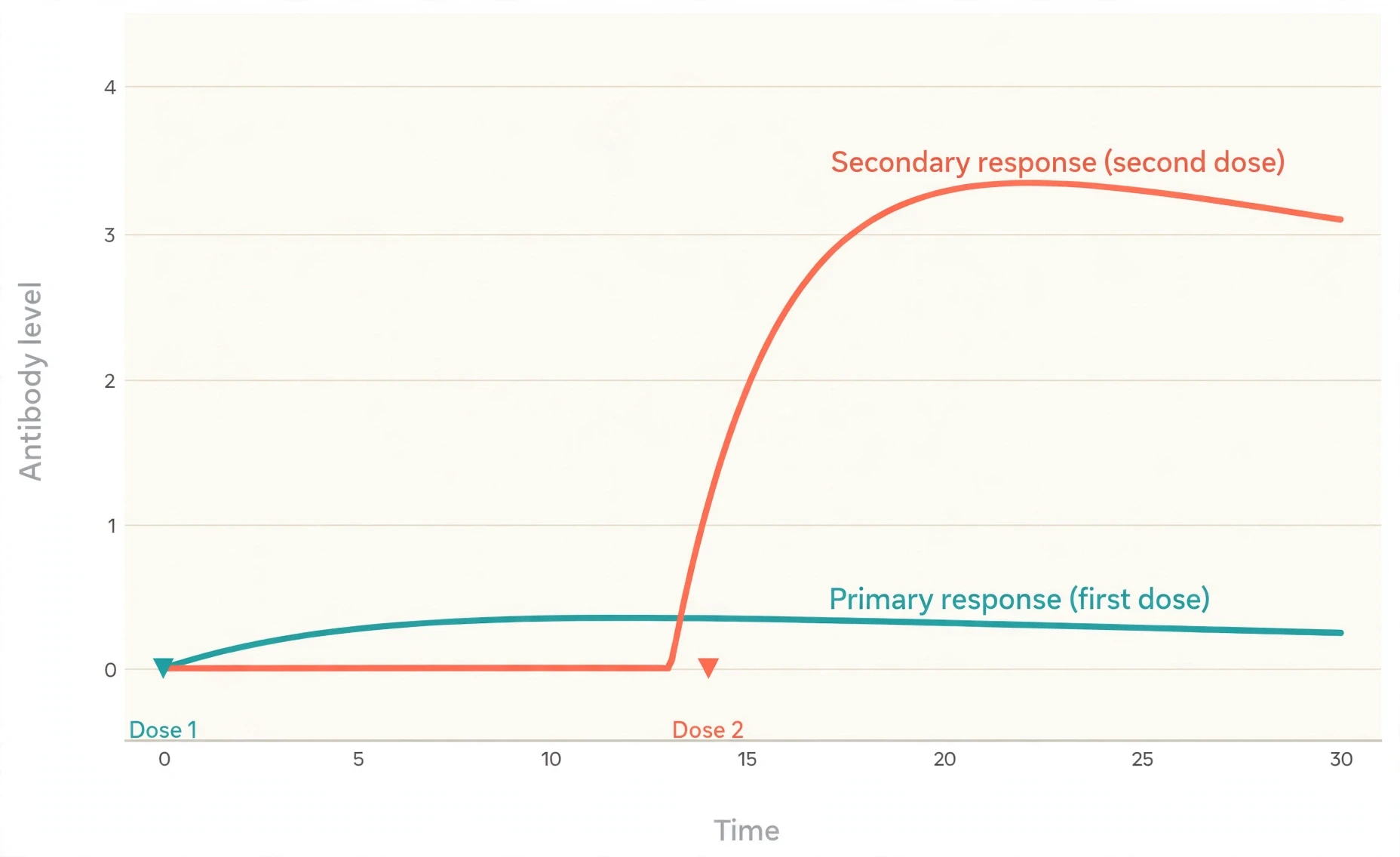
The first time the immune system meets an antigen, the response is called the primary immune response. It is slow: days pass before antibody levels begin to rise, the peak is modest, and the antibodies are relatively low in affinity, because the germinal centre is still being built and the system is still learning.
The second time the same antigen appears — whether as a booster dose or as the real germ — the response is called the secondary, or anamnestic, response, and it is a different creature altogether: the reason a second dose is not a repeat but an upgrade. Memory B cells, already refined by affinity maturation, rapidly proliferate and differentiate into plasma cells, generating high levels of serum antibody in a short period. The rise is steep, the peak far higher, the antibodies tighter-gripping, and the response longer-lasting.
Because most responding memory B cells have already undergone affinity maturation during the primary response, booster antibody has both higher affinity and broader cross-variant reach than primary antibody. The second encounter does not merely repeat the first. It improves on it — the clearest demonstration of how vaccines work over time.
5.2 Why the first dose is only the beginning
Some vaccines require multiple doses, given weeks or months apart, to allow the production of long-lived antibodies and the development of memory cells. That spacing is not arbitrary: the germinal centre takes about a week to form and matures in the second week, and affinity maturation continues for weeks after that. A second dose given too soon would arrive before the first round of training had finished; given at the right interval, it meets memory cells that have already been sharpened, and expands and refines them further.
The schedule is part of the vaccine, not an afterthought: the spacing was worked out in trials that measured how the immune response developed over time, and the doses are chapters, not repetitions.
5.3 Boosters: re-exposing memory cells so they expand, sharpen and multiply
A booster dose is a planned re-exposure. It wakes the memory B cells, which multiply and turn into plasma cells, flooding the blood with high-affinity antibody. It also sends a fresh wave of B cells back into germinal centres for another round of mutation and selection, so the antibody repertoire gets better still.
A booster dose serves two purposes at once: it raises antibody levels that have fallen since the last dose, and it deepens the memory itself. That is why a booster given years after the first doses can still produce a stronger response than the original series did. The memory was there all along; the booster simply calls it back to work — the everyday reality of how vaccines work over a lifetime.
5.4 The second MMR dose is not a booster
There is an important exception, and it is worth knowing because it shows how carefully schedules are designed. The second dose of the MMR vaccine — measles, mumps and rubella — is not a booster in the usual sense: it is intended to induce immunity in the 2 to 5 per cent of people who do not respond to the first dose at all, a situation called primary vaccine failure. One dose of MMR is approximately 93 per cent effective against measles; two doses are approximately 97 per cent effective. The second dose catches the people the first dose missed, rather than topping up the people it reached — a detail that matters for anyone trying to understand how vaccines work dose by dose.
5.5 Why antibody levels fall but protection often lasts
Antibody levels wane over time for many vaccines — one reason boosters exist — but memory B and T cells persist, and can respond rapidly even after circulating antibody has fallen. The distinction matters whenever a headline reports that antibody levels have dropped: a fall in antibody is expected. It is the fading of the plasma cells' output, not the disappearance of immunity.
Measles offers a telling example. In a 2025 Chinese cohort study, measles vaccine-induced antibody was estimated to fall below the protective threshold of 200 milli-international units per millilitre by about age 15.8 years, while naturally acquired measles antibody persisted lifelong — yet two-dose MMR protection against measles disease does not wane over time in practice, according to the CDC's Pink Book. The antibody fades; the memory holds. A blood test and a real-world outcome measure two different things.
5.6 Why some vaccines last a lifetime and others need regular boosters
Some vaccines protect for life, or close to it; others need regular boosters, for different reasons. Tetanus boosters are needed because the protection is against a toxin, and antibody against that toxin fades over years. Flu vaccines are needed annually in large part because the influenza virus itself changes — it drifts, season by season, so last year's memory is only a partial match for this year's virus. COVID-19 boosters have chased a similar moving target, as our companion article on virus evolution explains.
There is a second reason, quieter than the first: some vaccines simply produce a shorter-lived germinal centre reaction, and with it fewer long-lived plasma cells in the bone marrow. Duration of protection is still an active area of research, and schedules change as longer follow-up data arrive — an honest uncertainty, and the reason the monitoring described in Section 10 matters for how vaccines work in the real world.
6. Seven Ways to Build a Vaccine: The Platforms Compared
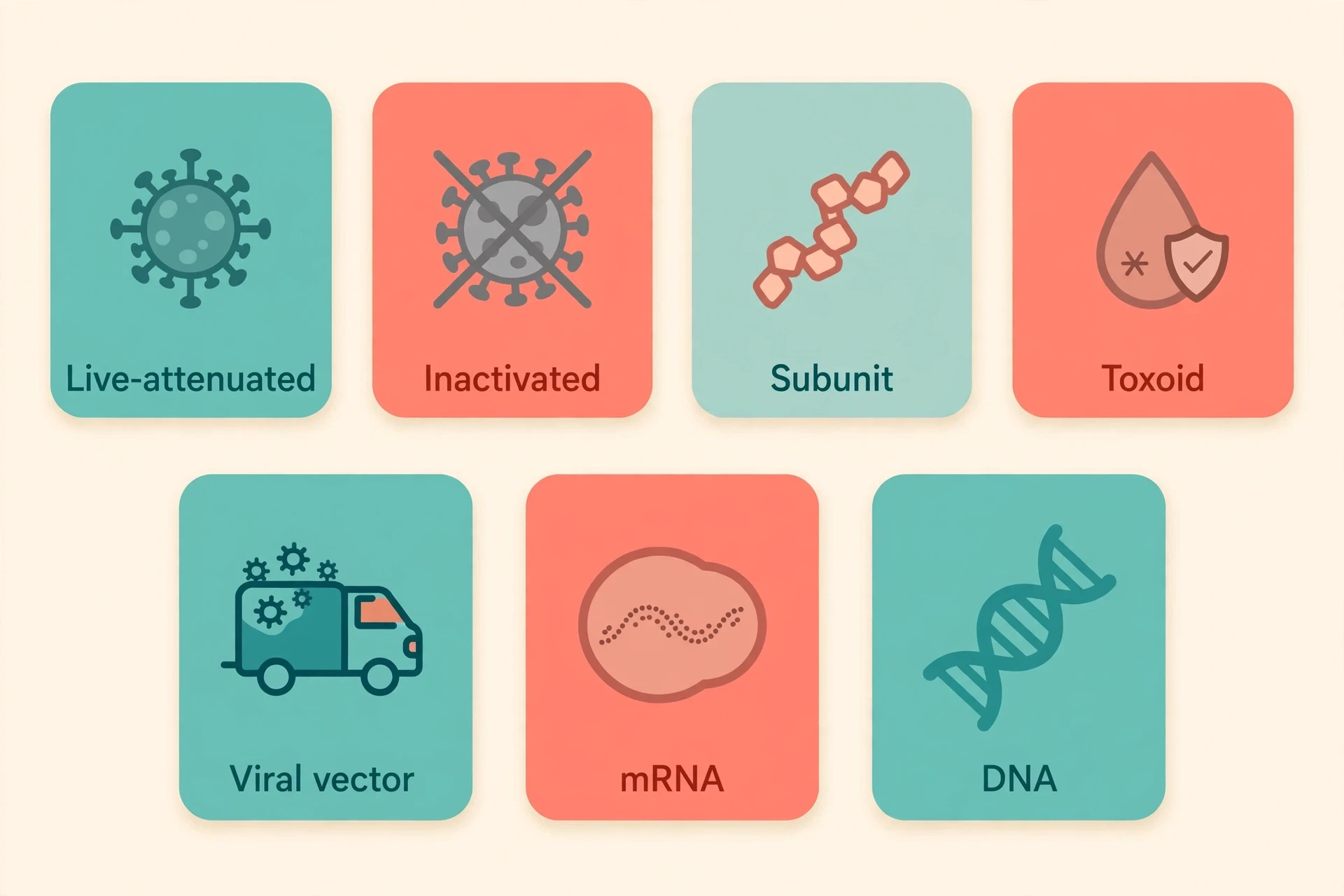
There is no single way to build a vaccine. Over two centuries, scientists have invented at least seven distinct approaches, each a different answer to the same question: how do you show the immune system the germ's identifying features without causing the disease? The platforms differ in what the immune system actually sees, how strong the response is, and how many doses are needed. Together they form the reference core of this article — and of how vaccines work as a technology.
6.1 Live-attenuated: a weakened germ that still replicates
A live-attenuated vaccine contains a weakened version of the living virus, weakened so it can replicate slowly without causing disease in healthy people. Because it closely mimics a natural infection, it stimulates both antibody production and cellular immunity, often with one or two doses — the MMR vaccine, yellow fever vaccine, and the oral polio vaccine are examples.
6.2 Inactivated (killed): a dead germ that cannot replicate
An inactivated vaccine contains pathogens killed with heat, chemicals such as formaldehyde, or radiation. It cannot replicate or cause disease, so it is safer for vulnerable people — but the immune response it provokes is weaker, and booster doses are usually needed. The Salk inactivated polio vaccine and the inactivated flu shot are examples. The trade is clear: safety bought with a quieter immune response — one of the basic trade-offs in how vaccines work.
6.3 Subunit and recombinant protein: just the key piece
Subunit and recombinant vaccines use only selected, purified pieces of a pathogen — a protein or a sugar — rather than the whole organism, made with recombinant DNA technology. They contain no live pathogen and cannot cause the disease: the hepatitis B vaccine, a recombinant surface protein produced in yeast and introduced in 1986; the HPV vaccine, built from virus-like particles; and the acellular pertussis vaccine, which uses 2 to 5 proteins, versus about 3,000 in the old whole-cell pertussis vaccine. Their strength is precision and safety; their limit is that a single piece sometimes needs an adjuvant's help — a trade-off that shapes how vaccines work on this platform.
6.4 Conjugate: teaching the immune system to see a disguised sugar coat
Some bacteria hide behind a coat of sugar — a polysaccharide capsule — that the immune system struggles to recognise, especially in young children. Conjugate vaccines solve this by connecting that bacterial polysaccharide to a protein carrier, so the immune system can finally see it and respond. This is how vaccines work against Haemophilus influenzae type b, known as Hib, and against pneumococcal bacteria. The conjugate approach turned Hib from the leading cause of bacterial meningitis in young children into a rarity — invasive Hib disease in American children under five has fallen by more than 99 per cent since these vaccines arrived.
6.5 Toxoid: disarming the poison instead of the germ
Some bacteria do their damage not by invading, but by releasing a toxin. Toxoid vaccines target the toxin rather than the bacterium itself: the toxin is treated, commonly with formaldehyde, to remove its toxicity while keeping its ability to provoke an immune response, inducing neutralising antibodies against the active toxin. The diphtheria and tetanus vaccines are both toxoids: the immune system learns to neutralise the poison, so even if the bacterium arrives, its weapon is already blunted — a neat illustration of how vaccines work by disarming the threat rather than chasing the germ.
6.6 Viral vector: a harmless virus as a delivery truck
A viral vector vaccine uses a modified, harmless virus — often an adenovirus — as a delivery vehicle carrying the gene for the target pathogen's protein. The vector cannot cause infection; the body's cells produce the antigen, stimulating innate immunity and potent T-cell responses. The AstraZeneca/Oxford and Johnson and Johnson COVID-19 vaccines are examples. The delivery truck is familiar to the immune system, and the vector itself helps sound the alarm.
6.7 mRNA and DNA: delivering the blueprint, not the antigen
The newest platforms do not deliver the antigen at all. They deliver the blueprint for producing it: an mRNA vaccine carries synthetic messenger RNA encoding a disease-specific protein, enclosed in lipid nanoparticles, and the cell reads the instructions and makes the antigen itself. DNA vaccines work a step earlier, delivering DNA encoding the antigen, which the cell transcribes into mRNA and then into protein. The mRNA platform is covered in full in Section 7; the DNA platform is described here by its mechanism only; its use in people is still at an early stage.
The comparison table below gathers all the platforms — including conjugate vaccines, which the figure does not picture — so the reader can see at a glance how vaccines work across the whole family of technologies.
Platform | What the immune system sees | Examples | Strengths | Limits |
|---|---|---|---|---|
Live-attenuated | A weakened, replicating germ | MMR, yellow fever, oral polio | Strong antibody and cellular response, often 1–2 doses | Not suitable for everyone; needs careful storage |
Inactivated (killed) | A dead germ that cannot replicate | Salk polio vaccine, inactivated flu shot | Safer for vulnerable people | Weaker response; boosters usually needed |
Subunit / recombinant protein | Selected purified pieces of the germ | Hepatitis B, HPV, acellular pertussis | Very safe; no live pathogen | Sometimes needs an adjuvant to boost the response |
Conjugate | A sugar coat linked to a protein carrier | Hib, pneumococcal | Works against disguised sugar-coated bacteria, including in young children | Protects only against the linked strains |
Toxoid | A detoxified bacterial toxin | Diphtheria, tetanus | Neutralises the poison itself | Boosters needed as antitoxin levels fade |
Viral vector | A harmless virus carrying the antigen gene | AstraZeneca, Johnson and Johnson COVID-19 vaccines | Strong T-cell response; single-dose options exist | Prior immunity to the vector can blunt the response |
mRNA | Instructions for making the antigen, in a lipid nanoparticle | Pfizer-BioNTech, Moderna COVID-19 vaccines | Fast to design and update; strong antibody and T-cell response | Fragile; needs cold storage |
DNA | DNA encoding the antigen | Early-stage platform in people | Stable; fast to design | Still early in human use compared with other platforms |
A note on language, because it matters: mRNA vaccines are sometimes confused with gene editing, and the two are different things entirely. Gene editing changes DNA; an mRNA vaccine delivers temporary instructions that never enter the nucleus and are degraded within days. Our article on CRISPR gene editing explains what real gene editing does, and the distinction between DNA, RNA and protein is covered in our genetics guide.
7. How Do mRNA Vaccines Work?
No vaccine technology has been asked more questions, more quickly, than the mRNA vaccine. It arrived in public consciousness in a single year, and the speed of its arrival bred a fair question: how do mRNA vaccines work, and what exactly is happening inside the body after the injection? The answer is a story in three acts — a fragile message, a fatty parcel, and a cell that reads instructions it did not write.
7.1 The problem mRNA had to solve
Messenger RNA is the cell's own working copy of a gene: a short-lived instruction that tells a ribosome which protein to build. As the basis of a vaccine, it has two problems — and solving them is the story of how vaccines work in their newest form. First, it is fragile: the body is full of enzymes that destroy free RNA on sight, because stray RNA is often a sign of a virus. Second, it provokes inflammation: unmodified mRNA trips the innate immune system's alarms, which is useful in small measure but destructive in large.
The mRNA breakthrough rested on two earlier discoveries. In 2005, researchers at the University of Pennsylvania, Katalin Kariko and Drew Weissman, showed that nucleoside modifications stop mRNA from triggering a strong inflammatory reaction. And biochemists at the University of British Columbia showed that mRNA must be encased in a protective fatty coating — lipid nanoparticles — to survive the journey into a cell. Neither discovery was made for COVID-19; both had been in development for years, waiting for a use.
7.2 The lipid nanoparticle: a fatty parcel
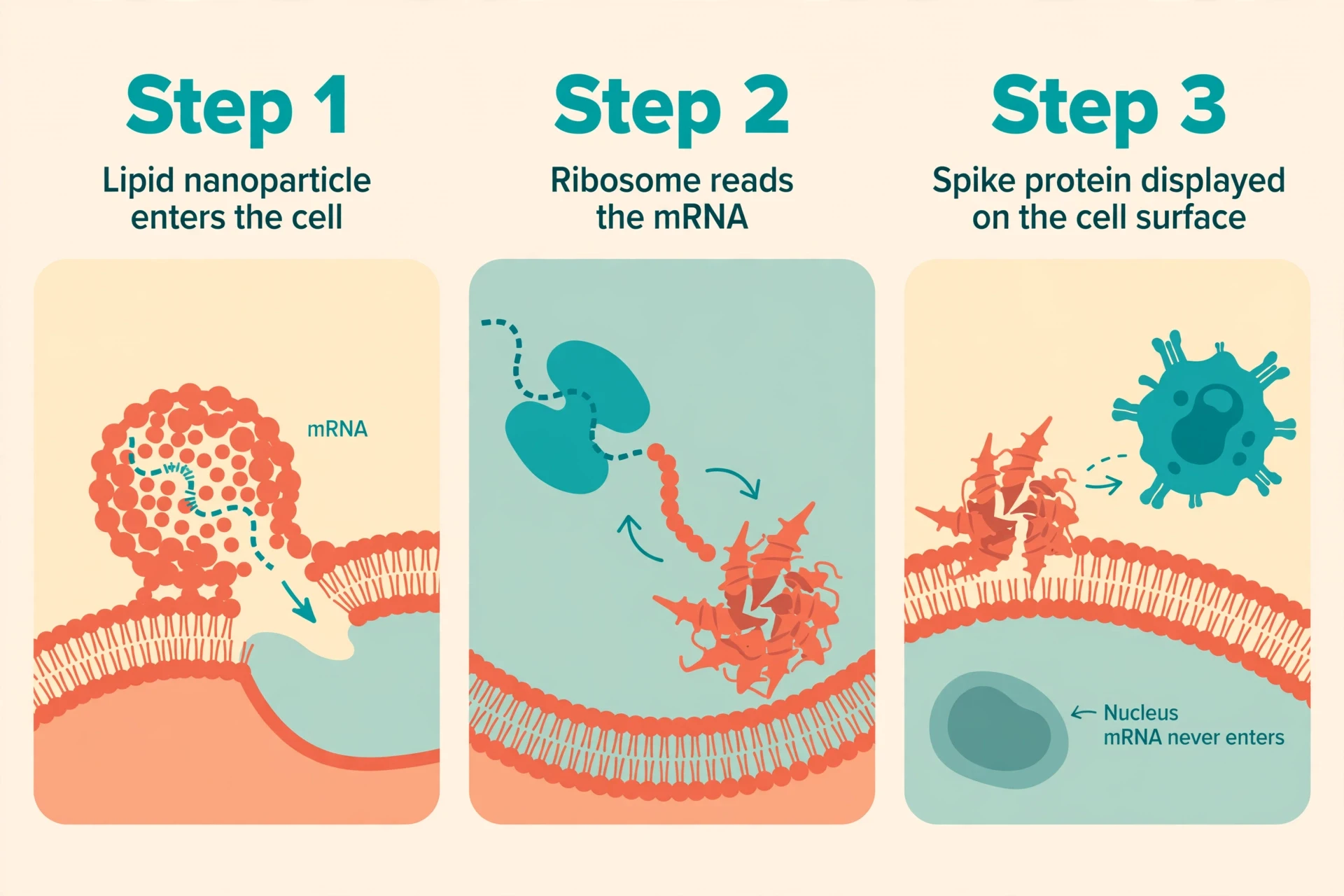
An mRNA vaccine contains synthetic messenger RNA encoding a disease-specific protein — the antigen — enclosed in lipid nanoparticles that protect the mRNA from degradation and help it enter cells. The nanoparticle is a tiny bubble of fat, and fat is a language the cell membrane understands: it fuses with the membrane of a cell near the injection site, and the mRNA slips inside.
This delivery system is the unsung half of how vaccines work on the mRNA platform: without it, the mRNA would be destroyed before it ever reached a ribosome; with it, the instructions arrive intact, in the right compartment of the cell, ready to be read.
7.3 Inside the cell: ribosomes read the mRNA, the spike protein is built and displayed
Once inside, the mRNA is read by ribosomes in the cytoplasm, and the cell produces the antigen — in the COVID-19 vaccines, the spike protein of SARS-CoV-2. That single step, a cell reading instructions it did not write, is the heart of how vaccines work on the mRNA platform. The protein is then displayed on the cell's surface, where the immune system can see it. In the Pfizer-BioNTech and Moderna vaccines, two proline substitutions — K986P and V987P — stabilise the spike protein in its pre-fusion shape, the shape it wears before it attaches to a cell, teaching the immune system to recognise the virus as it actually approaches.
The cell that makes the spike is a temporary factory: it reads the instructions, displays the product, and then the instructions are gone.
7.4 The immune response: MHC class I and II presentation, antibodies plus killer T cells
Once the spike protein is displayed, the immune system responds on two fronts. Fragments of the spike are presented on MHC class I molecules, activating CD8-positive cytotoxic T cells — the killers that destroy infected cells — and, after uptake by antigen-presenting cells, on MHC class II molecules, activating helper T cells and B cells. The result is both arms of the adaptive response: antibodies that can block the virus, and killer T cells that can destroy cells it has already entered. That breadth is one reason mRNA vaccines proved so effective, and it is central to how vaccines work when the antigen is made inside the body's own cells.
7.5 Does it change your DNA? No
This is the question I have heard most often about how vaccines work, and the answer is grounded in cell biology. The mRNA never enters the cell nucleus, cannot be integrated into DNA, is non-replicating, and is degraded within hours to days. DNA lives in the nucleus; the mRNA stays in the cytoplasm, where ribosomes read it. There is no machinery in the vaccine that could carry it into the nucleus or write it into the genome. The instructions are read, the protein is made, and the message is destroyed — the same way the cell destroys its own messenger RNA thousands of times a day.
7.6 From genome to jab in 11 months
The timeline of the COVID-19 mRNA vaccines still startles people who hear it for the first time, and it is worth setting out plainly. The SARS-CoV-2 genetic sequence was shared on 10 to 11 January 2020; Moderna's candidate went from that published genome to the first injection in a human arm on 16 March 2020 — 66 days. The US Food and Drug Administration granted Emergency Use Authorization to Pfizer-BioNTech on 11 December 2020 and to Moderna on 18 December 2020 — about 11 months from sequence to authorisation, versus a typical 10 to 15 years for a new vaccine.
I followed that year the way many scientists did: watching a sequence posted online in January become a vaccine in arms by December. The speed was possible because mRNA technology, lipid nanoparticle delivery and coronavirus spike-protein research had been in development for decades, including work at the US National Institute of Allergy and Infectious Diseases on the earlier SARS coronavirus. The pandemic gave decades of quiet research a sudden, urgent use.
That same technology is now being studied for other frontiers, including cancer vaccines and immunotherapy — a subject our article on how cancer works touches on. The idea is the same one this whole article describes, aimed at a different enemy: a reminder that how vaccines work is a principle, not a single product. The genetics behind the platform is explained in our genetics guide.
8. Herd Immunity: When Your Vaccination Protects Someone Else
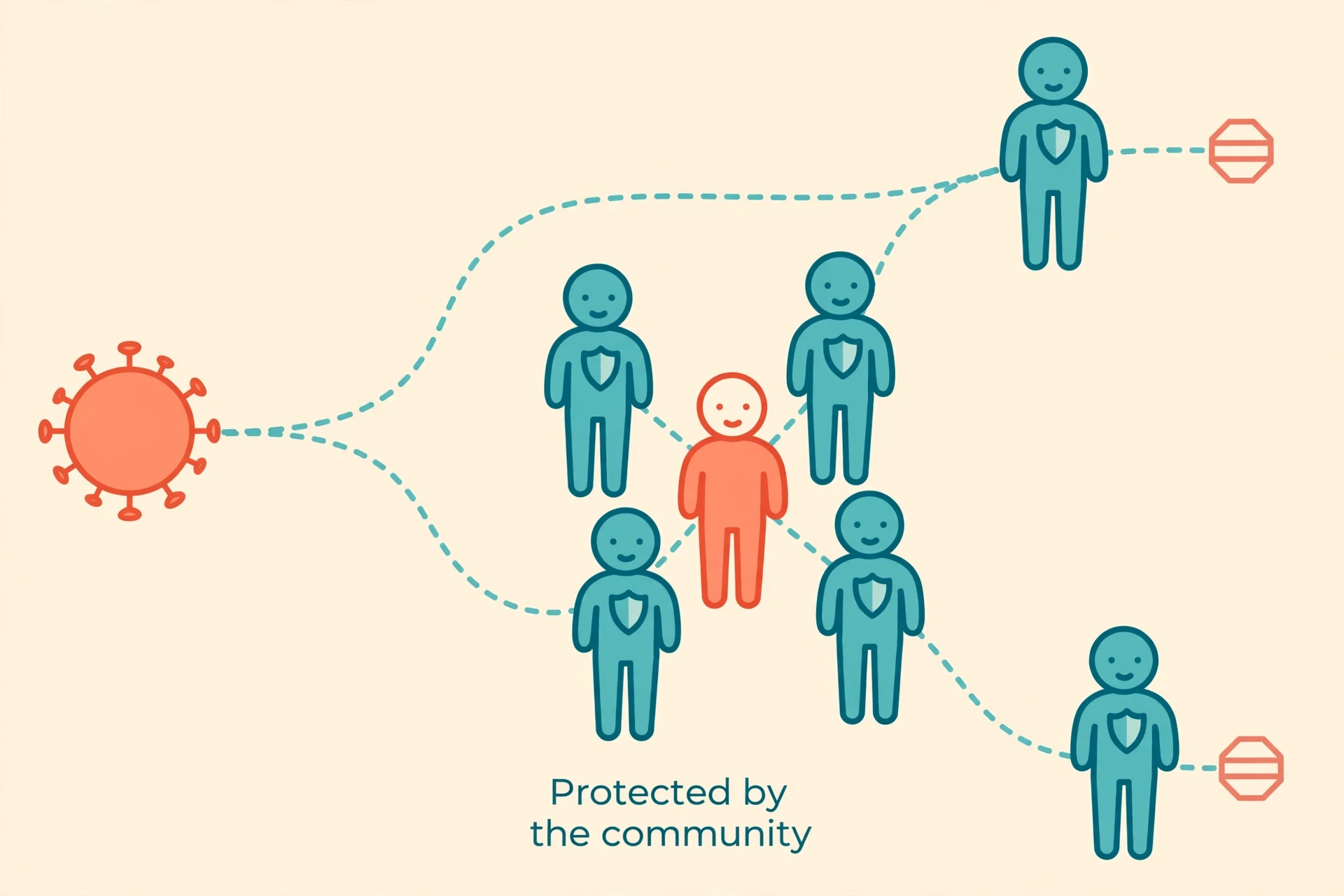
There is a second, quieter effect of vaccination, and it has nothing to do with your own immune system. When enough people in a community are vaccinated, the pathogen has a hard time circulating, because most of the people it encounters are immune, and the chain of transmission keeps hitting dead ends. This is herd immunity — also called community immunity — and it is the reason vaccination is not only a personal matter: your immunity can protect someone you have never met. It is the part of how vaccines work that happens between people, not inside one body.
8.1 The idea in one image
Picture a virus moving through a crowd. Each infected person passes it to the people around them; if most of those people are immune, the virus reaches them and stops, and the chain breaks. In the middle of that protected crowd sits someone who cannot be vaccinated — a baby too young for the vaccine, a person whose immune system is weakened by cancer treatment or HIV, someone with a severe allergy to a vaccine component. They have no shield of their own, but they are surrounded by people who do, and the virus cannot reach them through the wall of immune neighbours.
8.2 The maths: R0 and the threshold formula
How many immune people are enough? The answer depends on how contagious the disease is, and epidemiologists calculate it from R0 — the basic reproduction number, the average number of secondary infections one case causes in a fully susceptible population. Work it through for two diseases, and the arithmetic of how vaccines work at population scale becomes concrete. The herd immunity threshold follows a simple formula: threshold equals 1 minus 1 divided by R0.
Measles has an R0 of 12 to 18 — one person with measles, in a fully susceptible population, infects on average 12 to 18 others — giving a threshold of about 92 to 95 per cent. Polio has an R0 of 5 to 7, giving a threshold of about 80 to 86 per cent. The more contagious the disease, the higher the bar.
8.3 Why thresholds differ: measles about 95 per cent, polio about 80 per cent
That difference is the maths of contagiousness: a disease that spreads slowly needs only four in five people immune before its chains start breaking, while measles — one of the most contagious viruses known — needs nineteen in twenty. The World Health Organization cites 95 per cent coverage with two doses of measles vaccine in every community as the level needed to prevent outbreaks, a demanding target that explains why measles is the disease that returns first whenever coverage slips.
8.4 Who herd immunity protects
Herd immunity — the community-level half of how vaccines work — especially protects people who cannot be vaccinated: a newborn too young for the MMR vaccine, a person receiving chemotherapy, someone with a weakened immune system from cancer or HIV, someone with a severe allergy to a vaccine component. None of them can build their own protection, so the community's protection is the only shield they have. No single vaccine provides 100 per cent protection, and herd immunity does not give these people full protection — but it gives them substantial protection, often the difference between safety and an outbreak reaching their door.
8.5 What happens below the threshold: the 2023–2024 measles resurgence
The threshold is not theoretical, and the recent numbers show how vaccines work — or fail to work — at the level of whole populations. In 2023 there were an estimated 10.3 million measles cases worldwide, a 20 per cent increase from 2022, and an estimated 107,500 deaths, mostly children under five; in 2024, 60 countries experienced large or disruptive measles outbreaks, nearly double the 33 in 2022. Global first-dose measles coverage in 2024 was 84 per cent and second-dose coverage 76 per cent — far below the 95 per cent needed. Between 2000 and 2023, measles vaccination prevented an estimated 60 million deaths. The disease had been pushed back, and where coverage fell, it returned.
8.6 The honest limits
Herd immunity has limits, and they deserve a plain statement. Because no vaccine is 100 per cent effective, the share of people who need to be vaccinated is higher than the calculated immunity threshold, and the threshold is a population average, not a magic shield: local pockets of unvaccinated people can still sustain outbreaks even when national coverage looks adequate. A country can average 95 per cent and still have a town at 70 per cent where measles burns through a school. Averages protect populations; only even coverage protects every neighbourhood — a point worth remembering whenever anyone asks how vaccines work for a community rather than for one person. How R0 and transmission shape outbreaks is explored further in our article on virus evolution.
9. A Short History of the Idea
Vaccination feels modern. It is not. The idea — give the body a small, survivable taste of a disease so it can defeat the real thing — is more than five hundred years old, and its history is the history of how vaccines work being discovered piece by piece. What changed over the centuries was not the idea, but the science behind it: from folk practice, to careful observation, to the laboratory, to the molecular platforms of today. Knowing that history matters, because it answers a question people ask in good faith: is this new? The technology is new. The idea is older than the germ theory of disease itself.
9.1 Variolation in China and India, and Lady Mary Wortley Montagu
The earliest form of the idea was variolation: deliberately infecting a healthy person with smallpox matter to provoke a mild case and lasting immunity. It was practised in China from at least the 1500s — dried scabs powdered and blown up the nose — and in India, and it reached the Ottoman Empire. It was dangerous by modern standards: the death rate from variolation was roughly 1 to 2 per cent, against about 30 per cent for naturally contracted smallpox. A terrible risk — and still at least fifteen times safer than the disease itself.
In 1717, Lady Mary Wortley Montagu observed variolation in Constantinople and had her son inoculated there; in 1721, during a London smallpox epidemic, she had her daughter inoculated in London and publicised the practice, and trials on Newgate prisoners preceded inoculation of members of the royal family. In Boston in 1721, Cotton Mather — who learned the technique from an enslaved African man named Onesimus — and the physician Zabdiel Boylston promoted it: of 287 people variolated during that epidemic, only 6 died, against 844 deaths among more than 5,000 naturally infected. The numbers were the argument, and they were persuasive.
9.2 Jenner and the cowpox experiment, 1796
On 14 May 1796, Edward Jenner inoculated 8-year-old James Phipps with matter from a cowpox sore on the hand of the milkmaid Sarah Nelmes; in July 1796 he challenged Phipps with smallpox matter, and no disease developed. Jenner published his findings privately in 1798 as "An Inquiry into the Causes and Effects of the Variolae Vaccinae", and the word vaccine itself comes from vacca, Latin for cow.
Jenner was not the first to try the idea — Benjamin Jesty had tested the same cowpox idea in 1774 — but Jenner was the one who tested it systematically, published it, and argued for it, and the practice spread across the world within a few years. What Jenner could not know was why it worked: he had no germ theory, no knowledge of antibodies or memory cells. He had an observation, a careful test, and a result. The mechanism would take another century to explain — the explanation of how vaccines work that fills the earlier sections of this article.
9.3 Pasteur: attenuation in the laboratory
Louis Pasteur turned vaccination from an observed trick into a laboratory science. He created the first laboratory-produced vaccine — fowl cholera in chickens — after discovering in 1879 that an aged, weakened culture of the cholera bacterium protected birds instead of killing them: the germ had been attenuated, weakened by time and conditions in the laboratory. He developed an anthrax vaccine in 1880 and 1881, and on 6 July 1885 he administered an attenuated rabies vaccine to 9-year-old Joseph Meister, bitten fourteen times by a rabid dog. The boy survived.
Pasteur's insight — a germ can be weakened in the laboratory until it can train the immune system without causing the disease — stands behind every live-attenuated vaccine still used today. He was working before the immune system's cells had been described, in a world where the germ theory of disease itself was still contested; the context is in our microbiology guide. He proved the principle with his hands, and the explanation caught up later.
9.4 The twentieth-century wave
The twentieth century industrialised what Jenner and Pasteur had started, and in doing so it turned how vaccines work from a craft into an industry. Jonas Salk's inactivated polio vaccine was licensed in 1955, after mass trials in 1954 involving more than 1.3 million children, and cases of polio in the United States fell from about 58,000 in the worst epidemic year, 1952, to about 5,600 by 1957. Albert Sabin's live oral polio vaccine followed in the early 1960s; the measles vaccine was licensed in 1963, mumps in 1967, and rubella in 1969. Before the measles vaccine arrived in 1963, major epidemics occurred every few years, causing an estimated 2.6 million deaths annually, mostly among young children.
The World Health Organization launched its Expanded Programme on Immunization in 1974; the first Hib vaccine was licensed in 1985 and the first Hib conjugate vaccine in 1987, and the first hepatitis B vaccine using recombinant DNA technology was introduced in 1986.
9.5 Smallpox eradicated, 1980 — and the polio endgame
In 1967 the World Health Organization announced the Intensified Smallpox Eradication Programme. In 1980 the World Health Assembly declared smallpox eradicated — the only human disease ever eradicated, and still the only one. A disease that had killed for millennia was removed from the world by a vaccine, a needle, and a global campaign: the most complete demonstration imaginable of how vaccines work when the science, the logistics and the will align.
Polio is the unfinished sequel. In 1988 the World Health Organization launched the Global Polio Eradication Initiative, when polio was endemic in 125 countries; it was eradicated from the Americas in 1994 and from Europe in 2002, and the African continent was certified free of wild poliovirus in August 2020. Wild poliovirus now circulates only in Afghanistan and Pakistan, and global cases have fallen by more than 99.9 per cent since 1988, when an estimated 350,000 cases occurred each year. Wild poliovirus types 2 and 3 were declared eradicated in 2015 and 2019; only type 1 remains, and the final count for 2025 was 52 cases — 21 in Afghanistan and 31 in Pakistan — down from 99 in 2024. The endgame is measured in dozens of cases now, not hundreds of thousands.
9.6 The scoreboard
The numbers are why the idea survived five centuries of scepticism: global immunisation saved an estimated 154 million lives over the past 50 years, from 1974 to 2024 — about six lives every minute — of which 101 million were infants under one year old. Measles vaccination accounted for 60 per cent of the lives saved, about 94 million deaths averted, and vaccination against 14 diseases directly contributed to reducing infant deaths by 40 per cent globally, and by more than 50 per cent in the African Region. The estimate is conservative: it covers only 14 diseases and excludes the COVID-19 and HPV vaccines.
Every year, vaccination prevents an estimated 3.5 to 5 million deaths worldwide from diseases like diphtheria, tetanus, measles, whooping cough and influenza, and in the United States, vaccinating children born from 1994 through 2023 will prevent approximately 508 million illnesses, 32 million hospitalisations and 1.13 million deaths.
The HPV vaccine adds a different kind of victory: a vaccine that prevents cancer. In England, cervical cancer incidence was 87 per cent lower among women offered the HPV vaccine at age 12 to 13 compared with the unvaccinated reference cohort, and grade-3 cervical precancer fell by 97 per cent in that cohort. Sweden reported an 88 per cent reduction in invasive cervical cancer among women vaccinated before age 17, and Denmark 86 per cent; in Scotland, no cases of invasive cervical cancer were recorded among women vaccinated at ages 12 to 13 after 8 to 12 years of follow-up (see our article on how cancer works).
What renders the Cow-pox virus so extremely singular, is, that the person who has been thus affected is for ever after secure from the infection of the Small Pox; neither exposure to the variolous effluvia, nor the insertion of the matter into the skin, producing this distemper. — Edward Jenner, An Inquiry into the Causes and Effects of the Variolae Vaccinae (1798)
10. How We Know Vaccines Are Safe: The Safety Net
A vaccine is given to healthy people, including healthy children, which sets a higher bar than almost any other medicine: a drug for a sick person is judged against the illness it treats, while a vaccine is judged against the health of someone who was fine before the injection. That is why the safety system around vaccines is layered the way it is — and why understanding it is part of understanding how vaccines work in the real world, not just in the laboratory.
10.1 Before a vaccine reaches anyone: clinical trials
Before a vaccine reaches the public, it is tested in clinical trials: first in small groups, for safety and for the immune response it produces, then in larger groups, and finally in large trials involving thousands or tens of thousands of people. These trials show whether a vaccine produces antibodies, whether it prevents disease, and whether common side effects occur. What they cannot do is catch very rare events — a side effect that occurs once in a hundred thousand doses may not appear in a trial of thirty thousand people. That gap is what the monitoring systems below exist to fill.
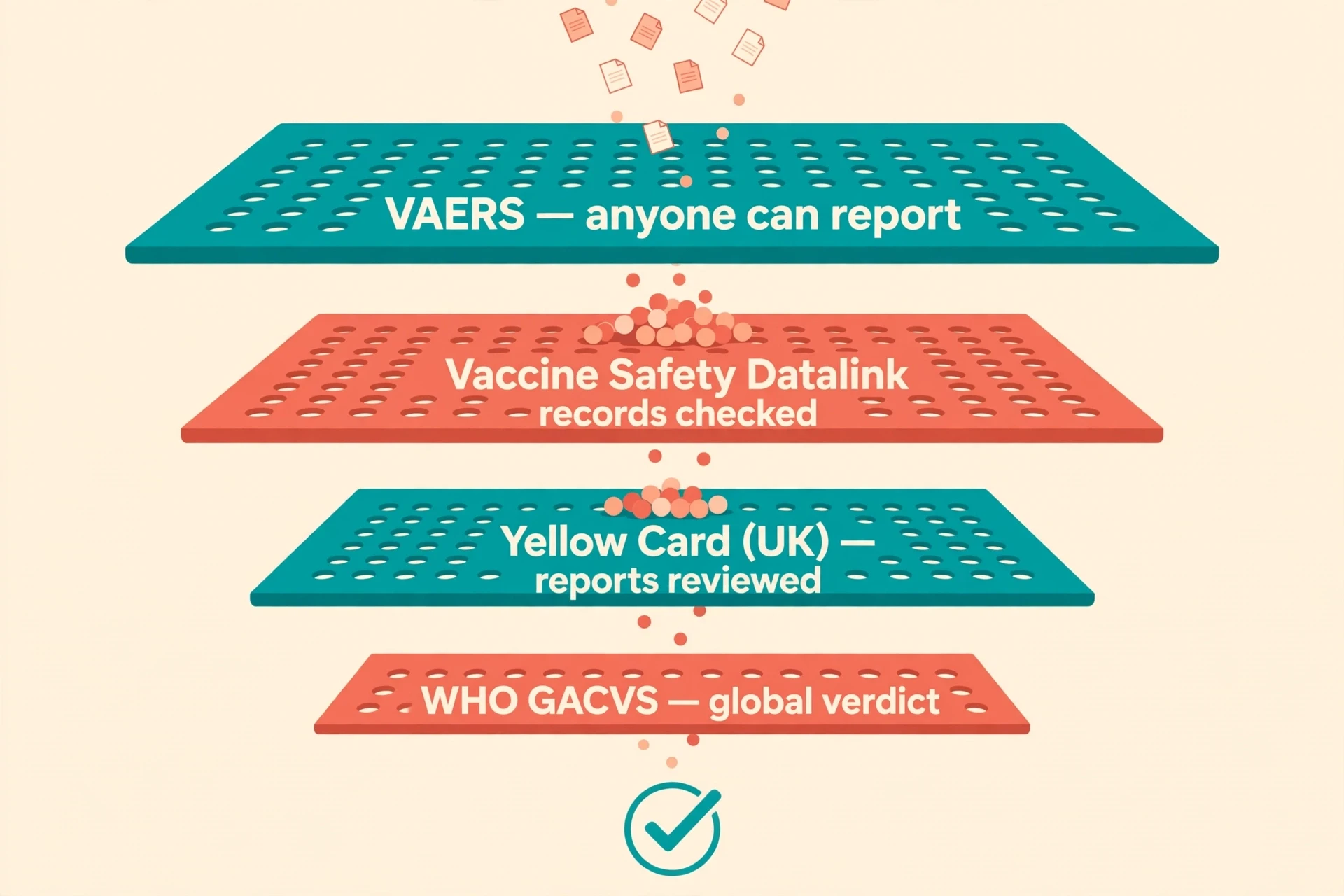
10.2 VAERS: the early-warning net that accepts any report
In the United States, the first layer of that surveillance is VAERS — the Vaccine Adverse Event Reporting System, co-managed by the CDC and the Food and Drug Administration, established in 1990. It is a passive early-warning system: anyone can report any health event after vaccination.
That openness is its strength and its limit: a report to VAERS does not mean the vaccine caused the event — the CDC's guide to interpreting VAERS data says so plainly — because reports are unverified, and may be incomplete, inaccurate, coincidental or unverifiable. The system has no denominator — it does not know how many doses were given — and no comparison group, so it cannot calculate how often an adverse event occurs. Its purpose is narrower: to detect possible safety signals, patterns of reports that look unusual and deserve investigation by more rigorous systems. A signal is a question, not a verdict.
10.3 Vaccine Safety Datalink and CISA: the controlled systems that test whether a signal is real
When VAERS raises a signal, the investigation moves to systems built to answer the question properly. The Vaccine Safety Datalink is the CDC's active surveillance system, using linked electronic health records from partner healthcare organisations, covering millions of people across 9 healthcare organisations. Because it holds records for whole populations, it can compare health outcomes in vaccinated and unvaccinated people and calculate actual risk — the things VAERS cannot do. Signals are also investigated through the Clinical Immunization Safety Assessment Project, which studies individual cases in clinical depth, and the Food and Drug Administration's BEST system. The open net catches anything unusual; the controlled systems decide whether it is real.
10.4 Yellow Card and the WHO's GACVS: the same job in other countries and globally
Other countries run parallel systems of their own: the United Kingdom's Yellow Card scheme, run by the Medicines and Healthcare products Regulatory Agency, is a voluntary reporting system for suspected adverse drug reactions including vaccines, founded in 1964 after the thalidomide disaster. Anyone — doctors, pharmacists, nurses, patients, caregivers — can report, and a Yellow Card report is a suspicion, not proof of a side effect. Reports are entered on the agency's database, reviewed regularly, and investigated if a possible problem is identified; the Commission on Human Medicines and the Joint Committee on Vaccination and Immunisation advise the UK government on safety and policy.
Globally, the World Health Organization's Global Advisory Committee on Vaccine Safety is the independent expert body that reviews vaccine safety evidence worldwide. In November 2025 it assessed two new systematic reviews covering 31 primary studies from January 2010 to August 2025, and reaffirmed its previous conclusions from 2002, 2004 and 2012 that there is no evidence of a causal relationship between vaccines and autism spectrum disorders.
10.5 Efficacy vs effectiveness: trial numbers vs real-world performance
Two words cause more confusion than any others in vaccine reporting, and they matter for anyone trying to judge how vaccines work from a headline number. Efficacy is the percentage reduction in disease in a clinical trial — the vaccine group compared with the placebo group under controlled conditions. Effectiveness is how well the vaccine works in the real world, once given to the general population.
The distinction matters when reading a number like 95 per cent: Pfizer-BioNTech reported 95 per cent efficacy and Moderna about 94.5 per cent in their phase 3 COVID-19 trials, meaning a 95 per cent lower risk than the placebo group — not that 5 per cent of vaccinated people got COVID-19. In fact, about 0.04 per cent of vaccinated trial participants got COVID-19. The seasonal flu vaccine, for comparison, is typically 40 to 60 per cent effective — and a vaccine that halves the risk of flu, across millions of people, prevents an enormous amount of illness.
10.6 Breakthrough infections: why they happen and why they are usually milder
No vaccine is 100 per cent effective, so some vaccinated people can still get the disease. These are called breakthrough infections, and they are expected, not a sign that the vaccine failed. Two doses of MMR are about 97 per cent effective against measles; about 2 to 5 per cent of people do not respond to the first dose, which is why a second dose is given. COVID-19 vaccines are considerably more effective at preventing hospitalisation and death than at preventing infection, especially since the Omicron variant. A vaccinated person who catches the disease usually experiences a milder illness, because the immune system — even if it does not block the infection entirely — responds faster and harder than a naive one would. The fire drill does not guarantee the building never catches fire; it guarantees the evacuation is fast, and that is how vaccines work even when they do not prevent infection outright.
10.7 The cold chain: why most vaccines live at 2 to 8 degrees
Most vaccines must be stored at 2 to 8 degrees Celsius from factory to arm. Heat degrades vaccine components, and freezing can permanently destroy potency: freeze-sensitive vaccines containing aluminium adjuvants lose potency irreversibly below 0 degrees Celsius because the adjuvant precipitates, and the damage leaves no visible signs — a frozen vaccine looks exactly like a good one. Some vaccines need frozen storage, such as varicella and MMRV (the combined measles-mumps-rubella-varicella vaccine) at minus 50 to minus 15 degrees, and the original Pfizer-BioNTech COVID-19 vaccine needed ultra-cold storage at minus 80 to minus 60 degrees. The cold chain is unglamorous, and it is part of how vaccines work in practice.
11. Myths, Answered With Evidence
Every widely used medical technology collects myths, and vaccines have collected more than most — partly because they are given to healthy children, partly because the science is genuinely complicated, and partly because a frightening claim travels faster than a careful answer. This section states each common claim fairly, then answers it with the verified evidence. No mockery is needed: most of these worries start from a reasonable question, and a reasonable question deserves a real answer.
11.1 "Too many vaccines overwhelm a baby's immune system"
This worry sounds plausible: a baby's immune system is new, and the schedule gives many vaccines early in life. The numbers tell the opposite story. In the late 1980s and early 1990s, children received vaccines against 8 diseases containing a little more than 3,000 immunological components, mostly from the old whole-cell pertussis vaccine; today they receive vaccines against 14 diseases containing only about 150 components, thanks to protein purification. The schedule protects against more diseases with far fewer ingredients than it used to.
And the scale of what a baby's immune system handles daily puts those numbers in perspective: infants are colonised with trillions of bacteria, each containing 2,000 to 6,000 immunological components, and encounter thousands of antigens daily. Offit and colleagues calculated that a baby could theoretically respond to about 10,000 vaccines at once before using even 1 per cent of circulating B cells. The immune system is not a small cup that fills up; it is an ocean, and the vaccine schedule is a thimbleful — a useful image to keep in mind whenever anyone wonders how vaccines work without overwhelming a small child.
11.2 "The MMR vaccine causes autism"
This claim traces to a single paper: Andrew Wakefield's 1998 Lancet paper, a 12-child uncontrolled case series, which itself stated, "We did not prove an association between measles, mumps, and rubella vaccine and the syndrome described." Ten of the twelve co-authors formally retracted the interpretation in 2004; the Lancet fully retracted the paper on 2 February 2010, after the UK General Medical Council found Wakefield guilty of serious professional misconduct, including dishonesty. He was struck from the medical register in May 2010, and BMJ investigations in 2011 concluded the paper was an elaborate fraud.
The large studies that followed found no link — and that, in the end, is how vaccines work as a science: a claim is tested, and the data decide. Madsen and colleagues studied a Danish cohort of 537,303 children born between 1991 and 1998, publishing in the New England Journal of Medicine in 2002; Hviid and colleagues studied a Danish cohort of 657,461 children followed for a decade, including subgroups with autistic siblings, publishing in the Annals of Internal Medicine in 2019. And in a statement published in December 2025, the World Health Organization's Global Advisory Committee on Vaccine Safety — after assessing two new systematic reviews of the evidence — reaffirmed its conclusions from 2002, 2004 and 2012: the evidence does not support a causal link between vaccines and autism spectrum disorders.
11.3 "Thiomersal (mercury) in vaccines causes autism"
Thiomersal — also spelled thimerosal — is a mercury-based preservative used in some multi-dose vials since the 1930s. It contains ethylmercury, which is cleared from the body more quickly than methylmercury, the form that accumulates in fish and causes mercury poisoning.
In July 1999, US public health agencies, the American Academy of Pediatrics and manufacturers agreed as a precautionary measure to reduce or eliminate thiomersal, and by 2001 it was removed from or reduced in all vaccines routinely recommended for American children aged 6 and under, except some flu vaccines. The MMR, varicella, inactivated polio and pneumococcal conjugate vaccines never contained thiomersal. Many well-conducted studies found no link between thiomersal and autism, and autism rates continued to rise after its removal — the opposite of what would be expected if it caused autism. The Institute of Medicine's 2004 review of more than 200 studies concluded there is no causal relationship between thiomersal-containing vaccines and autism: the preservative was removed as a precaution, and the condition it was accused of causing did not fall.
11.4 "Natural immunity is always better"
Sometimes infection produces strong, long-lasting protection; sometimes it does not — and the price of finding out is the disease itself. Surviving tetanus does not give reliable immunity against getting it again; patients who recover from tetanus still need vaccination. Natural HPV infection often produces a weak immune response, and some people never develop detectable antibodies, while vaccination reliably produces an antibody response — which is why the HPV vaccine's cancer-preventing effect, described in Section 9.6, is so striking. See our article on how cancer works for the full story.
Measles shows the other side of the bargain: infection generally gives lifelong immunity to measles itself, but measles also causes immune amnesia, damaging the immune system's memory of other infections. The disease protects you against itself while erasing some of the protection you had built against everything else. Vaccine-induced measles antibody wanes faster than naturally acquired antibody, yet two-dose MMR protection against measles disease does not wane in practice. Natural immunity is not a single thing, better or worse in every case; it is a trade, and the disease sets the terms.
11.5 "mRNA vaccines change your DNA"
This one has a clean answer, given in full in Section 7.5: no. The vaccine's message never reaches the genome, because it never enters the nucleus — it is read by ribosomes in the cytoplasm and broken down within hours to days, with no way to cross into the nucleus or be written into the genome. That is how vaccines work on this platform: the message is read, the protein is made, and the message is destroyed. The 2005 discovery by Kariko and Weissman that made the technology possible was precisely about stopping mRNA from triggering a strong inflammatory reaction — taming the message, not rewriting the genome.
11.6 "Vaccines were rushed for COVID-19, so they skipped safety steps"
The COVID-19 vaccines arrived fast — about 11 months from the shared genetic sequence to authorisation, against a typical 10 to 15 years for a new vaccine. The speed is real, and it deserves an explanation rather than a dismissal: the components were not new. The messenger-RNA platform, the fatty parcels that carry it, and the spike-protein science behind it had all been under development for decades — including research on the earlier SARS coronavirus — and the pandemic compressed the timeline by giving decades of prior research an urgent use, with far more resources than a normal programme receives.
The safety monitoring did not stop at authorisation, either: the same systems described in Section 10 — VAERS, the Vaccine Safety Datalink, Yellow Card, the WHO's GACVS — watched the COVID-19 vaccines in hundreds of millions of people, and continue to do so. A trial can miss a rare event; a monitoring system covering whole populations cannot miss it for long. That is how vaccines work under real-world scrutiny, not just in the laboratory.
11.7 "If vaccines work, why do vaccinated people still get sick?"
Because no vaccine is 100 per cent effective, and because preventing infection and preventing severe disease are two different jobs — a distinction at the heart of how vaccines work in practice. Measles vaccination prevents about 97 in 100 exposed cases, and the few vaccinated people who do catch measles usually get it mildly, while the COVID-19 vaccines protect far better against hospitalisation and death than against infection itself. A vaccine that does not block every infection can still transform the outcome of the infections it does not block: a mild illness instead of a hospital stay, a hospital stay instead of an intensive-care bed. That is not a failure of the fire drill. It is what the fire drill was for.
The available high-quality scientific evidence indicates that vaccines, including those with thiomersal or aluminium or both, do not cause autism. — World Health Organization, Global Advisory Committee on Vaccine Safety statement, 11 December 2025
12. What Vaccination Has Already Done — and What Remains
The story so far has been about a mechanism: antigens, germinal centres, memory cells, platforms, safety nets. It is worth ending on the scale of what that mechanism has done, and what it has not yet finished.
12.1 The 2024 picture: coverage held steady, but 14.3 million children got nothing
Global coverage in 2024, reported by the World Health Organization and UNICEF in July 2025, held steady but left deep gaps. DTP3 coverage — three doses of diphtheria, tetanus and pertussis vaccine — was 85 per cent, reaching about 109 million infants, and first-dose coverage was 89 per cent, about 115 million. But 14.3 million children received no vaccine at all, the so-called zero-dose children, and nearly 20 million missed at least one DTP dose. First-dose measles coverage was 84 per cent and second-dose coverage 76 per cent, up from 83 and 74 per cent in 2023, but 20.6 million children missed their first measles dose. Steady is not the same as sufficient, and the measles resurgence described in Section 8.5 is the price of the gap — a reminder that how vaccines work for a population depends on reaching everyone, not just most people.
12.2 The unfinished diseases
Polio's last two countries, Afghanistan and Pakistan, are the sharpest reminder that eradication is a project measured in decades, not years, and measles' return is a reminder that a conquered disease is only as conquered as the coverage that holds it down. Beyond them, the same training principle — a safe antigen, a germinal centre, a memory — is the tool researchers reach for whenever a new disease needs a defence, and the same lesson in how vaccines work applies to each new target. The frontier moves, but the mechanism stays the same, because the immune system it trains stays the same — and because how vaccines work does not change when the disease does.
12.3 The closing thought: a trained immune system is a quiet inheritance
Return to the clinic room from Section 1. The child is home now, the plaster coming loose, the afternoon ordinary again — but inside, a training programme is running: germinal centres forming, B cells mutating and competing, memory cells taking up their posts, long-lived plasma cells settling into the bone marrow. No drama, no fever, no sign — just a quiet inheritance, carried for years, that the child will never have to think about unless the day comes when it is needed. That is how vaccines work: not as a wall, and not as a weapon, but as a lesson, taught once, remembered for a lifetime.
13. FAQ — Your Questions, Answered
These are the questions readers ask most often about how vaccines work — answered briefly, with a pointer to the section that explains each one in full.
How do vaccines work?
A vaccine gives your immune system a harmless stand-in for a germ — an antigen, or the instructions for making one. That is how vaccines work in one sentence: immune cells recognise the stand-in, produce antibodies and killer T cells against it, and keep memory B and T cells that remember its shape. If the real germ arrives later, those memory cells respond within hours, stopping the infection before it takes hold. See Section 2 for the short version and Sections 3 to 5 for the full mechanism.
How do mRNA vaccines work inside the body?
An mRNA vaccine delivers synthetic messenger RNA encoding a disease protein, such as the SARS-CoV-2 spike protein, inside a lipid nanoparticle that protects it and carries it into a cell. Ribosomes in the cytoplasm read the mRNA and build the protein, which is displayed on the cell surface; the immune system then makes antibodies and activates killer T cells against it. The mRNA never enters the nucleus and is degraded within hours to days. See Section 7.
Why do you need multiple doses of a vaccine?
The first dose starts the training: germinal centres form, B cells mutate and improve their antibodies, and memory cells develop over weeks. Later doses re-expose those memory cells, which respond faster, produce higher-affinity antibody in larger amounts, and deepen the memory — that is how vaccines work over time. Some second doses, such as the second MMR dose, instead catch the 2 to 5 per cent of people who did not respond to the first. See Section 5.
What is herd immunity?
Herd immunity, or community immunity, is the protection that arises when enough people in a community are vaccinated that a pathogen cannot circulate — its chains of transmission keep hitting immune dead ends. It especially protects people who cannot be vaccinated, such as babies too young for a vaccine and people with weakened immune systems, and it is the community-level half of how vaccines work. The share needed depends on contagiousness: about 95 per cent for measles, about 80 per cent for polio. See Section 8.
Do vaccines overwhelm the immune system?
No. That is one of the most persistent misunderstandings about how vaccines work: children today receive vaccines against 14 diseases containing only about 150 immunological components, down from more than 3,000 components for 8 diseases in the late 1980s and early 1990s. A baby encounters thousands of antigens daily and is colonised with trillions of bacteria, and researchers calculated that a baby's immune system could in theory handle about 10,000 vaccines at once while using under 1 per cent of its circulating B cells. See Section 11.1.
Can vaccines cause autism?
No causal link has been found. The 1998 Lancet paper that started the claim was a 12-child uncontrolled case series, retracted in full in 2010 after its lead author was found guilty of serious professional misconduct. Large Danish cohorts of 537,303 and 657,461 children found no link, and in a statement published in December 2025 the WHO's Global Advisory Committee on Vaccine Safety reaffirmed — after reviewing 31 primary studies — that vaccines do not cause autism. See Section 11.2.
Is natural immunity better than vaccine immunity?
Sometimes infection gives strong protection, but not always, and the price is the disease itself. Tetanus is the classic counterexample: recovering from it does not leave reliable protection against a second bout, so survivors still need the vaccine; natural HPV infection often produces a weak response, while vaccination reliably produces antibodies. Measles infection gives lifelong immunity to measles but also causes immune amnesia, damaging the immune memory of other infections. There is no universal winner. See Section 11.4.
14. Sources
History of Vaccines, College of Physicians of Philadelphia — Different Types of Vaccines (2025)
World Economic Forum — How vaccines have developed through history
Jenner — An Inquiry into the Causes and Effects of the Variolae Vaccinae (1798), Project Gutenberg
Parveen and Elkordy — mRNA vaccines, Pathogens 2024;13(6):500
American Museum of Natural History / NIAID — Putting COVID-19 Vaccines to the Test
MDPI Encyclopedia — Nanotechnology-Enabled COVID-19 mRNA Vaccines
Medscape — Understanding Messenger RNA and Other SARS-CoV-2 Vaccines (Cennimo, 2020)
NIAID — Decades in the Making: mRNA COVID-19 Vaccines (2024)
Healio — Past research and unlimited resources spur fast development of COVID-19 vaccines (2021)
DeFranco — The germinal center antibody response in health and disease, F1000Research 2016;5:999
Rockefeller University — Trial NCT05272735, secondary germinal centre biology
Clinical Immunology: Principles and Practice, Chapter 7 — germinal centre development
Vermont Department of Health — Measles Information for Providers (CDC Pink Book, Chapter 13)
Comparative Analysis of Long-Term Measles Immune Response, Vaccines 2025;13(6):555
Vaccination Facts — Herd immunity, compiling Fine, Eames and Heymann (2011)
WHO/EMRO — Polio Bulletin Issue 1465, week 43, 2026 (final 2025 total: 52 WPV1 cases)
Health Policy Watch — Wild poliovirus transmission persists in Afghanistan and Pakistan (2026)
CDC Pink Book, Chapter 8 — Haemophilus influenzae (May 2024)
CDC WONDER — Advisory Guide to the Interpretation of VAERS Data
Johns Hopkins Bloomberg School of Public Health — What VAERS Is (And Isn't) (2025)
UK Health Security Agency — Green Book, Chapter 9: Surveillance and monitoring
UK Parliament — Written answer HL2282 on Yellow Card reporting (2017)
STAT News — How we know kids don't get too many vaccines too soon (2025)
Nurse.org — Is Natural Immunity Better Than Vaccines? An ER Physician Explains
SenseAnywhere — WHO guidelines for vaccine cold chain temperature monitoring
Hartford HealthCare — The COVID-19 Vaccine's 'Efficacy' Doesn't Mean What You Think (2021)
Gavi — The HPV vaccine is erasing cancer: here's the proof (2025)