

1. The Grease That Would Not Budge
Soap works because each soap molecule has two ends with opposite preferences: a water-loving head and a grease-loving tail. The rest of this article is the story of how that split personality cleans your hands.
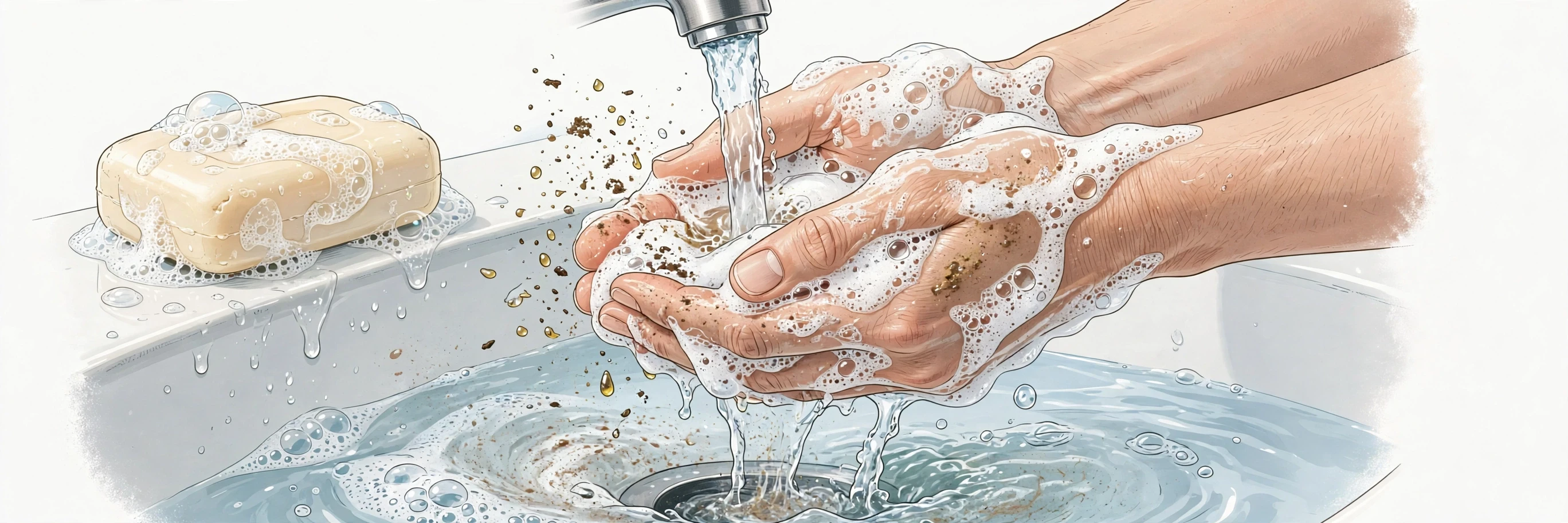
I was nine years old, helping my father fix a bicycle chain, when I first asked how does soap work. My hands were black with grease up to the wrists. I held them under the tap and scrubbed hard, and the water ran off in clean, useless sheets while the grease stayed exactly where it was, laughing at me. Then my father handed me a yellow bar of soap, and within a minute the black film was gone, swirling down the drain in grey ribbons. Water alone had failed completely. Water plus a humble bar of soap had won in seconds. I have been chasing the reason ever since.
That small mystery sits at the heart of one of the oldest chemical technologies humans ever invented. Soap is ancient — people were boiling fat with ash nearly 5,000 years ago, long before anyone knew what a molecule was — and it still does a job no modern gadget has replaced. It cleans our skin, our clothes, our dishes, and our hospitals. During disease outbreaks, public-health agencies reach for it before they reach for anything fancier. And yet most of us use it every day without ever asking what it actually does at the molecular level.
The short answer is that soap is a go-between. It is a molecule with a split personality: one end loves water, the other end hates it and loves grease instead. That split personality lets it grab dirt that water cannot touch, wrap it up in tiny parcels, and carry it away down the drain. The longer answer is a story that runs through fat and lye, ancient Roman laundry, the physics of surfaces, the chemistry of hard water, and the fragile skin of a virus. This article tells that whole story.
2. Why Water Alone Cannot Clean Grease
Plain water cannot clean grease because water is polar and grease is not. Water molecules cling to each other and squeeze grease out, so grease never dissolves — it needs a bridge, and that bridge is soap.
To understand soap, you first have to understand why plain water is such a poor cleaner on its own. Water is a remarkable solvent. It dissolves salt, sugar, and hundreds of other substances with ease. But put a drop of cooking oil in a glass of water and the two refuse to mix. The oil floats on top in a separate layer, and no amount of shaking changes the arrangement for long. Shake the glass, and the oil breaks into droplets — then the droplets find each other again and merge back into a layer within seconds.
The reason is polarity. A water molecule is bent, with its two hydrogen atoms on one side and its oxygen atom on the other, and that lopsided shape gives the molecule a positive end and a negative end. Water molecules cling to each other through hydrogen bonds, and they happily pull apart other polar substances — things with charged or partly charged regions — because those fit into the same electrical game. Grease and oil are different. Their molecules are long chains of carbon and hydrogen with no charged ends and no handle for water to grab. Water molecules would rather stick to each other than make room for a greasy intruder, so the grease gets squeezed out. Chemists sum this up in the old rule "like dissolves like": polar things dissolve in polar solvents, and nonpolar things dissolve in nonpolar solvents. Water is polar. Grease is not. They do not mix, and they never will on their own.
That is why rinsing greasy hands under the tap achieves so little. The water slides over the grease layer and never gets a grip. Scrubbing helps a bit, because friction can tear loose flakes of dirt, but the grease itself stays stuck to the skin. If you have ever tried to wash a frying pan with cold water alone, you know the result: the pan comes out still filmed with oil, and your hands smell faintly of whatever you cooked. Something has to bridge the gap between water and grease. That bridge is soap.
Water's strange personality — its polarity, its hydrogen bonds, its refusal to mix with oil — is worth knowing in its own right. If you want the full story of the molecule that makes all of this possible, read Why Water Is the Weirdest Molecule on Sciory. Everything soap does starts with the fact that water is choosy about its company.
3. The Soap Molecule: Two Ends, Two Loyalties
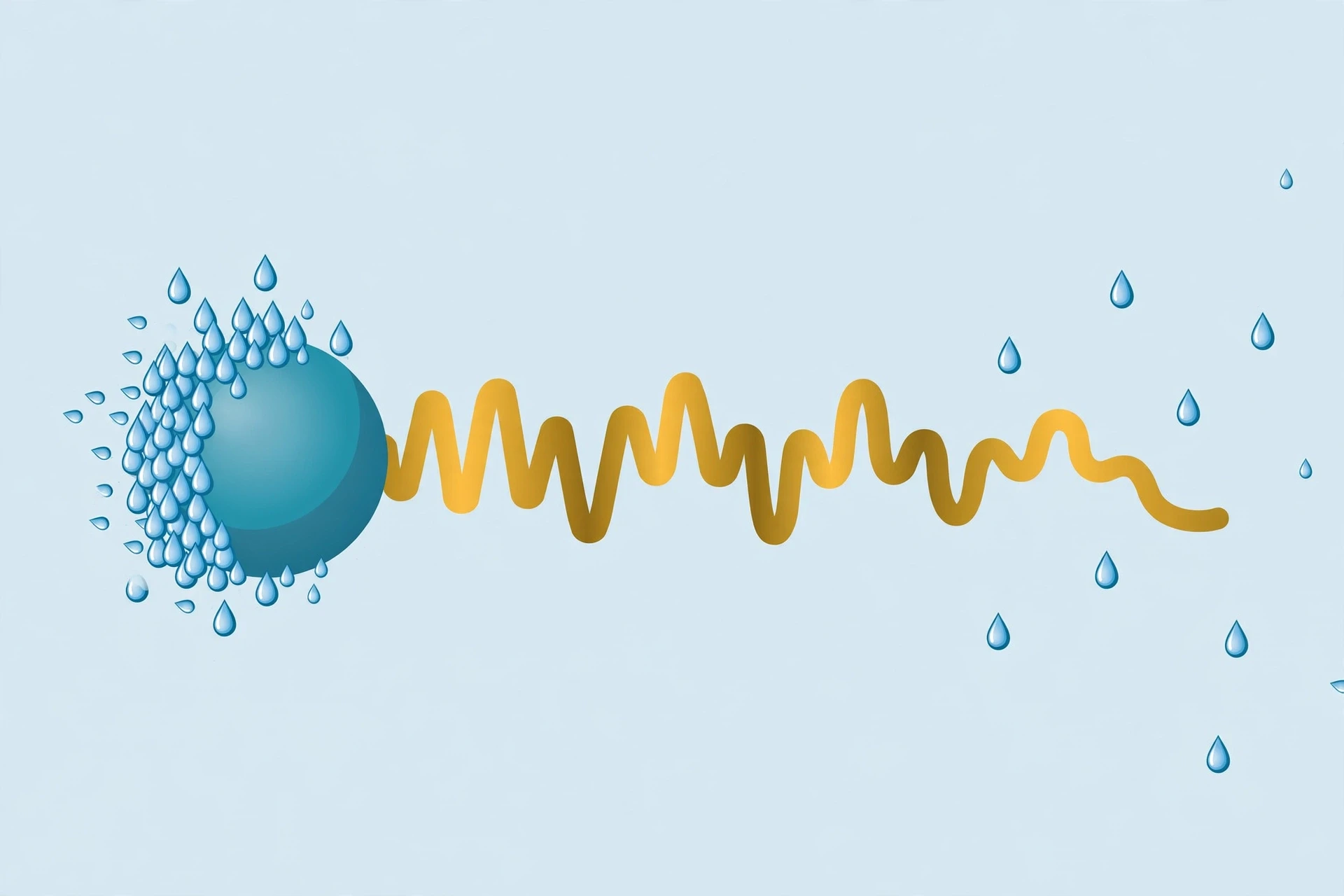
A soap molecule is a diplomat with divided loyalties. Picture it as a long, thin tadpole. The tail is a hydrocarbon chain, typically 12 to 18 carbon atoms long, and it is completely nonpolar.
It hates water and loves oil and grease, because grease is made of the same kind of nonpolar carbon-hydrogen material. The head is a charged carboxylate group — a carbon atom bonded to two oxygen atoms, carrying a negative charge — and it loves water. It dissolves in water the way salt dissolves in water, because its charge fits right into water's electrical world.
A molecule built like this has a name: amphiphilic, from Greek words meaning "loving both." OpenStax Chemistry defines it the same way: "Molecules such as this are termed amphiphilic since they have both a hydrophobic ('water-fearing') part and a hydrophilic ('water-loving') part." One end is hydrophilic, water-loving. The other end is hydrophobic, water-fearing, or lipophilic, fat-loving. No single molecule can be more two-faced. And that two-faced design is the whole trick. A soap molecule can sit at the border between water and grease with its tail buried in the grease and its head sticking out into the water, holding the two worlds together.
I still remember the first time a teacher drew this on a blackboard for me, a lollipop shape with a wiggly tail, and the room went quiet in that particular way a classroom goes quiet when something finally clicks. It looked too simple to explain anything. A lollipop with a tail could not possibly be the reason hospitals run on soap, or the reason a greasy pan comes clean. But it is. The shape is the mechanism. Everything else — the lather, the micelles, the cleaning — follows from that one bent little molecule.
Where does such a molecule come from? The tail comes from fat. Animal fats and vegetable oils are made of triglycerides: three fatty-acid chains attached to a glycerol backbone. Those fatty-acid chains are exactly the long hydrocarbon tails a soap molecule needs. The head comes from an alkali — traditionally lye, sodium hydroxide or potassium hydroxide — which reacts with the fat and snaps the chains off the glycerol, leaving each chain with a charged carboxylate head. The result is a sodium or potassium salt of a fatty acid. That salt is soap. We will walk through that reaction properly in section 6, because it is one of the oldest chemical reactions humans ever learned to control.
Soap molecules are not the only amphiphilic molecules in the world. Your own cell membranes are built from similar two-faced molecules called phospholipids, which arrange themselves into sheets with their water-loving heads out and their water-fearing tails in. Nature invented the trick billions of years before humans did. Soap is, in a sense, a borrowed design — a human-made version of a molecular shape that life already uses everywhere.
4. How Does Soap Work? The Micelle Trick
So how does soap work, step by step, when you wash your hands? The process has four stages, and each one follows directly from the molecule's two-faced shape.
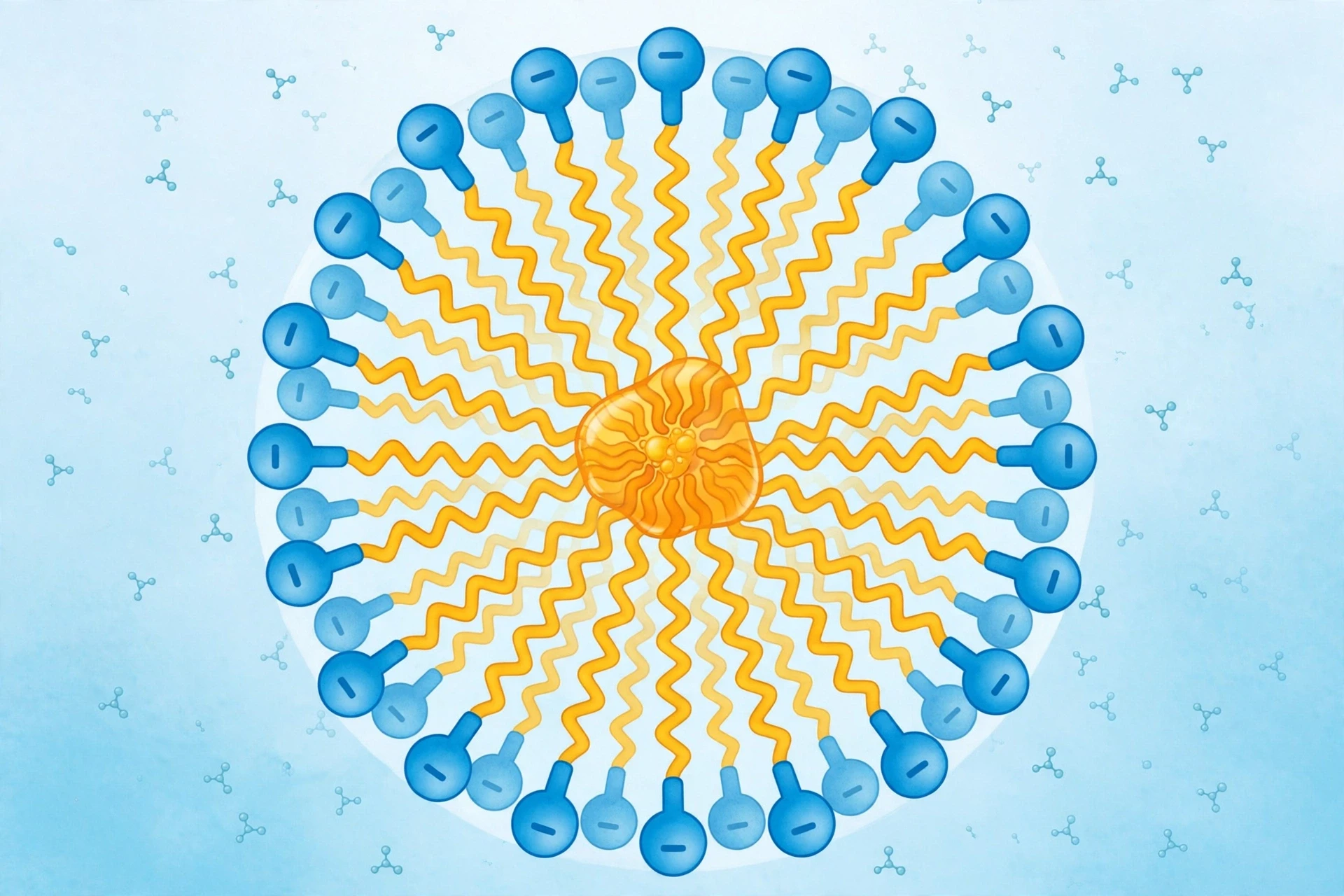
First, the soap dissolves and spreads. When you wet your hands and rub the bar, soap molecules leave the bar and spread through the thin film of water on your skin. Because they are amphiphilic, they rush to every boundary they can find — the surface of the water, the surface of your skin, and, most importantly, the boundary between the water and the grease on your skin. Their tails plunge into the grease. Their heads stay in the water. Within moments, the grease layer is studded with soap molecules, tails in, heads out.
Second, the soap loosens the grease. A layer of grease clings to skin because it has nothing better to do — there is no force pulling it away. Once soap molecules coat it, the situation changes. The heads of the soap molecules, all carrying the same negative charge, repel each other, and the grease begins to break into smaller droplets. Your scrubbing helps here: friction tears the loosened grease into droplets, and each droplet gets coated with soap molecules, tails pointing inward into the grease, heads pointing outward into the water.
Third, the micelles form. This is the centrepiece of the whole process. When enough soap molecules gather around a droplet of grease, they form a tiny sphere called a micelle. LibreTexts notes that "these micelles are often spherical in shape, but may also assume cylindrical and branched forms." The tails point inward, cradling the grease in a nonpolar pocket. The heads point outward, forming a charged shell that faces the water. The grease is now trapped inside a water-soluble parcel. The micelle is so small — only a few nanometres across — that thousands of them can form in a single drop of wash water, each one carrying away its own little load of dirt. LibreTexts describes micelles as spherical aggregates with the hydrophobic chains gathered in the centre and the polar heads extending into the water — which is how grease ends up trapped inside a water-friendly shell. That encapsulation is the cleaning step itself: grease that water could never dissolve is now riding inside a water-friendly shell.
Fourth, the rinse carries it all away. The outside of a micelle is charged and water-loving, so micelles stay suspended in the rinse water instead of settling back onto your skin. When you hold your hands under the tap, the water sweeps the micelles — grease, dirt, and microbes included — down the drain. That is why the rinse matters as much as the lather. Soap does the grabbing; water does the carrying. Without the rinse, the micelles would simply sit on your skin, dirt and all.
A micelle is a parcel service for dirt. The grease is the package, the soap tails are the wrapping, the soap heads are the address label written in a language water can read — and the rinse water is the delivery van.
One detail deserves attention: there is a threshold. At very low soap concentrations, soap molecules float around singly or gather at surfaces. Only above a certain concentration, called the critical micelle concentration, do they start assembling into micelles in bulk. That is one reason a thin, half-hearted smear of soap cleans worse than a proper lather. You need enough soap molecules in the water to build the parcels. A good lather is a visible sign that you have crossed that threshold and the micelle factories are running.
5. Surface Tension: Why Soapy Water Wets Better
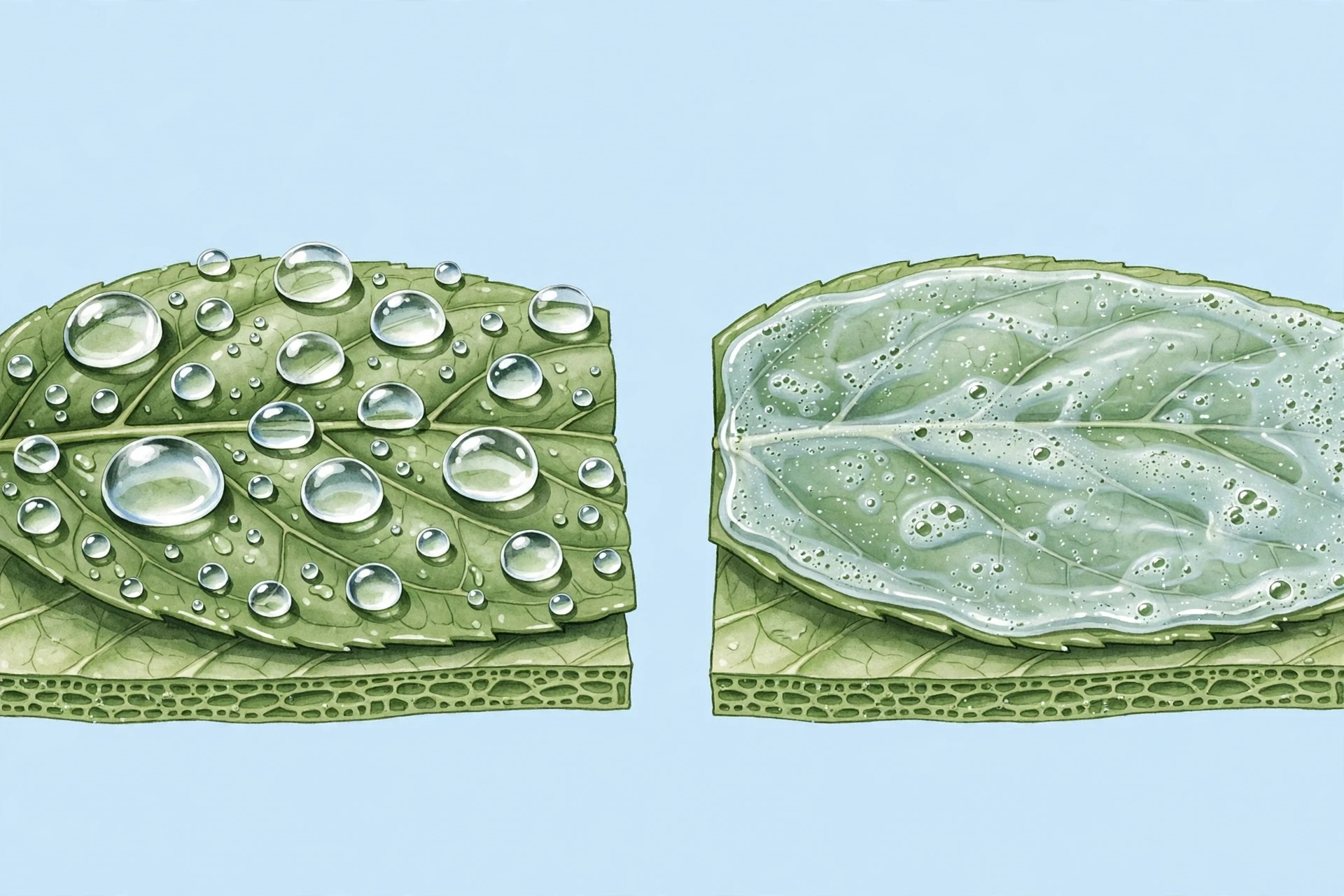
There is a second job soap does, quieter than the micelle trick but just as important: it lowers the surface tension of water. Surface tension is the reason water beads up on a freshly waxed car and forms round droplets on a leaf.
Water molecules at the surface are pulled inward by the molecules below them, with no water above to balance the pull, so the surface behaves like a stretched elastic skin. That skin makes water reluctant to spread into cracks, pores, and fibres. It would rather stay in a bead than wet a rough surface.
Soap molecules attack that skin. Because they are amphiphilic, they crowd to the water's surface, heads in the water, tails sticking out into the air. They wedge themselves between the water molecules at the surface and break up the inward pull. The surface tension drops, and the water spreads. A drop of soapy water flattens out and soaks into fabric, skin creases, and the tiny grooves around a fingernail — places plain water would simply roll over.
I learned this the hard way on a camping trip years ago, trying to wash a soot-blackened pot in a stream with nothing but cold water and a rag. The water beaded and ran off the soot as if the pot were oiled. A single drop of liquid soap changed everything: the water suddenly sheeted across the metal and carried the black film with it. It felt like a magic trick. It was surface chemistry, doing exactly what textbooks say it does.
This wetting action is why soap is useful far beyond the bathroom. Farmers add surfactants to sprays so the liquid spreads over waxy leaves instead of rolling off. Firefighters add wetting agents to water so it soaks into burning material instead of beading on the surface. Printers, painters, and textile workers all depend on the same principle: make the water wetter, and it can reach the dirt.
Surface tension also explains bubbles, which we will come back to in section 12. For now, the point is simple: soap does not just grab grease. It changes the water itself, turning a liquid that beads and rolls off into a liquid that spreads, soaks, and reaches.
6. How Soap Is Made: Saponification
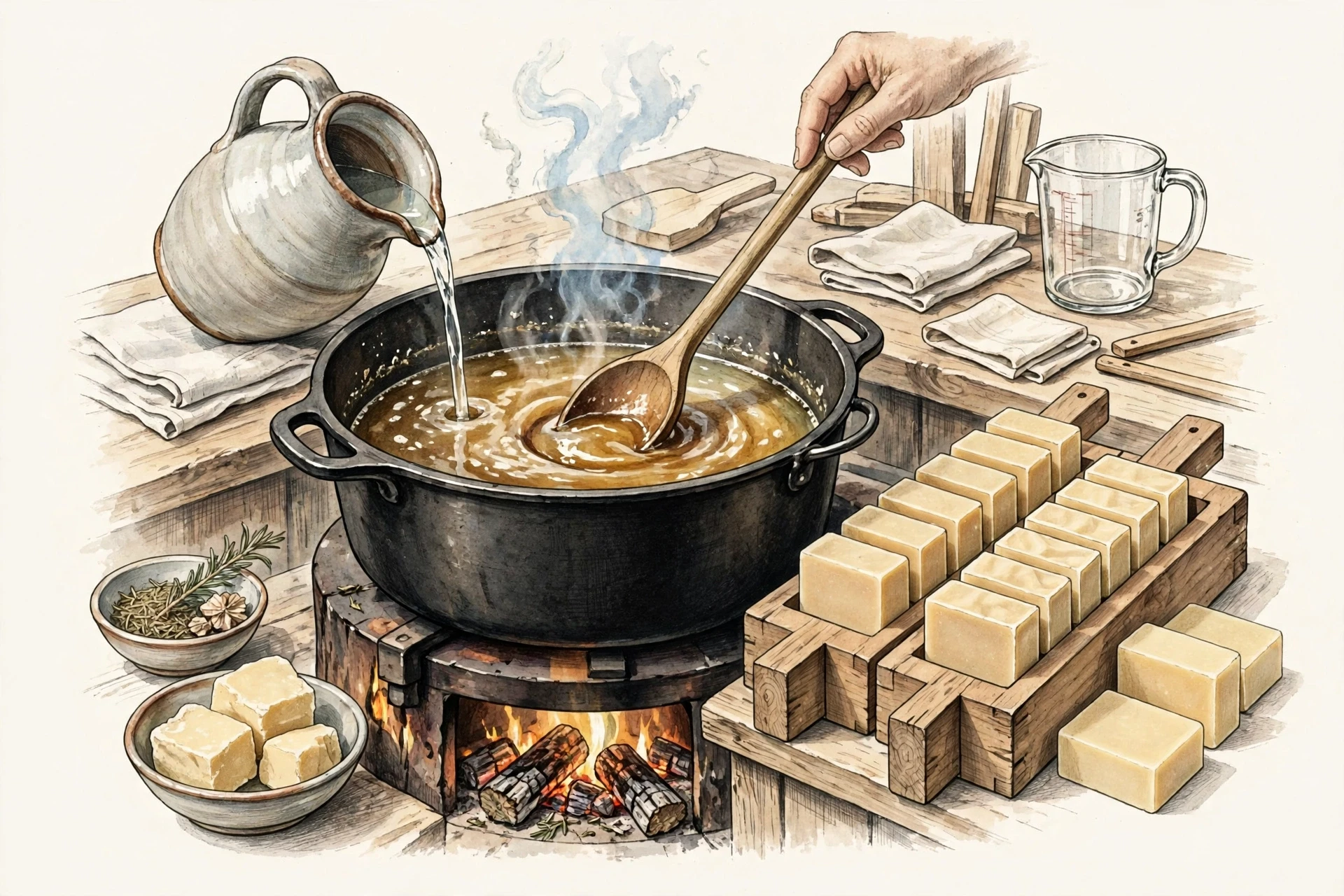
Soap making is one of humanity's oldest chemical industries, and its central reaction has not changed in thousands of years. The reaction is called saponification, from the Latin word for soap, and it is a clean, elegant piece of chemistry: a fat plus a strong alkali gives soap plus glycerol. LibreTexts defines it in one sentence: "Soap is manufactured by the base-catalyzed hydrolysis (saponification) of animal fat."
The earliest evidence of soap-like material comes from ancient Babylon, where clay tablets describe mixing fats with wood ash, and from ancient Egypt, where animal and vegetable oils were combined with alkaline salts for washing. The Romans knew soap too, though they used it more for laundry and medicine than for bathing, and legend credits the soap-making tradition to Mount Sapo, where animal fats from sacrifices supposedly mixed with wood ash and rainwater. The legend is almost certainly a story rather than history, but the chemistry in it is real: fat plus alkali is the recipe, and it has been the recipe ever since.
The modern version of the reaction is easy to write. A triglyceride — three fatty-acid chains attached to a glycerol backbone — reacts with three molecules of sodium hydroxide. Each fatty-acid chain is cut loose from the glycerol and gains a sodium ion, becoming a soap molecule: the sodium salt of a fatty acid. The glycerol is released as a by-product. In symbols, the reaction is a hydrolysis of an ester in the presence of a base, and it belongs to the same family of reactions as the ones that break down fats in your digestive system. If you want the broader picture of how reactions like this are classified and how fast they run, Sciory's Chemical Reactions Explained: Types, Kinetics, and Everyday Examples covers the ground.
The alkali matters. Sodium hydroxide makes hard bar soap. Potassium hydroxide makes soft soap or liquid soap, because potassium salts of fatty acids are more soluble. The fat matters too. Olive oil gives a gentle, mild soap. Coconut oil gives a soap that lathers richly even in hard water. Tallow, rendered beef fat, gives a hard, long-lasting bar. Modern soap makers blend oils the way cooks blend spices, choosing each fat for the hardness, lather, and mildness it brings.
Traditional soap making was slow and dangerous work. Fat had to be rendered, lye leached from wood ash, and the mixture stirred and heated for hours until the fat and water stopped separating. Too little lye left greasy, half-made soap. Too much lye left a caustic bar that could burn skin. The soap was salted out — common salt was added to separate the soap from the excess water — then skimmed off, moulded, and left to cure for weeks while the last of the lye finished reacting. The traditional process called for mixing rain water, potash, and animal tallow, stirring and heating the mixture until saponification took place, then adding salt to separate the soap, which was skimmed off and placed in wooden moulds to cure.
I once watched a small-batch soap maker work through this process at a market stall, and the thing that struck me was how much of it was still done by feel: the temperature judged by hand, the "trace" — the moment the mixture thickens like custard — judged by eye. She told me she had once mis-measured the lye in her first batch and ended up with bars that stung the skin. She threw the whole batch away. It was a small reminder that saponification is real chemistry with real consequences, and that the numbers matter. Lye is caustic, and soap making is not a project to improvise.
Modern factories do the same reaction at industrial scale, continuously, with precise measurements and recovered glycerol sold on for cosmetics and pharmaceuticals. But the molecule that comes out is the same one the Babylonians made: a fatty-acid salt with a water-loving head and a grease-loving tail.
7. Soap vs Detergent: Cousins, Not Twins
Most people use the words "soap" and "detergent" as if they meant the same thing. They are related, but they are not the same, and the difference matters — especially if you have ever wondered why laundry detergent works in hard water while a bar of soap leaves scum.
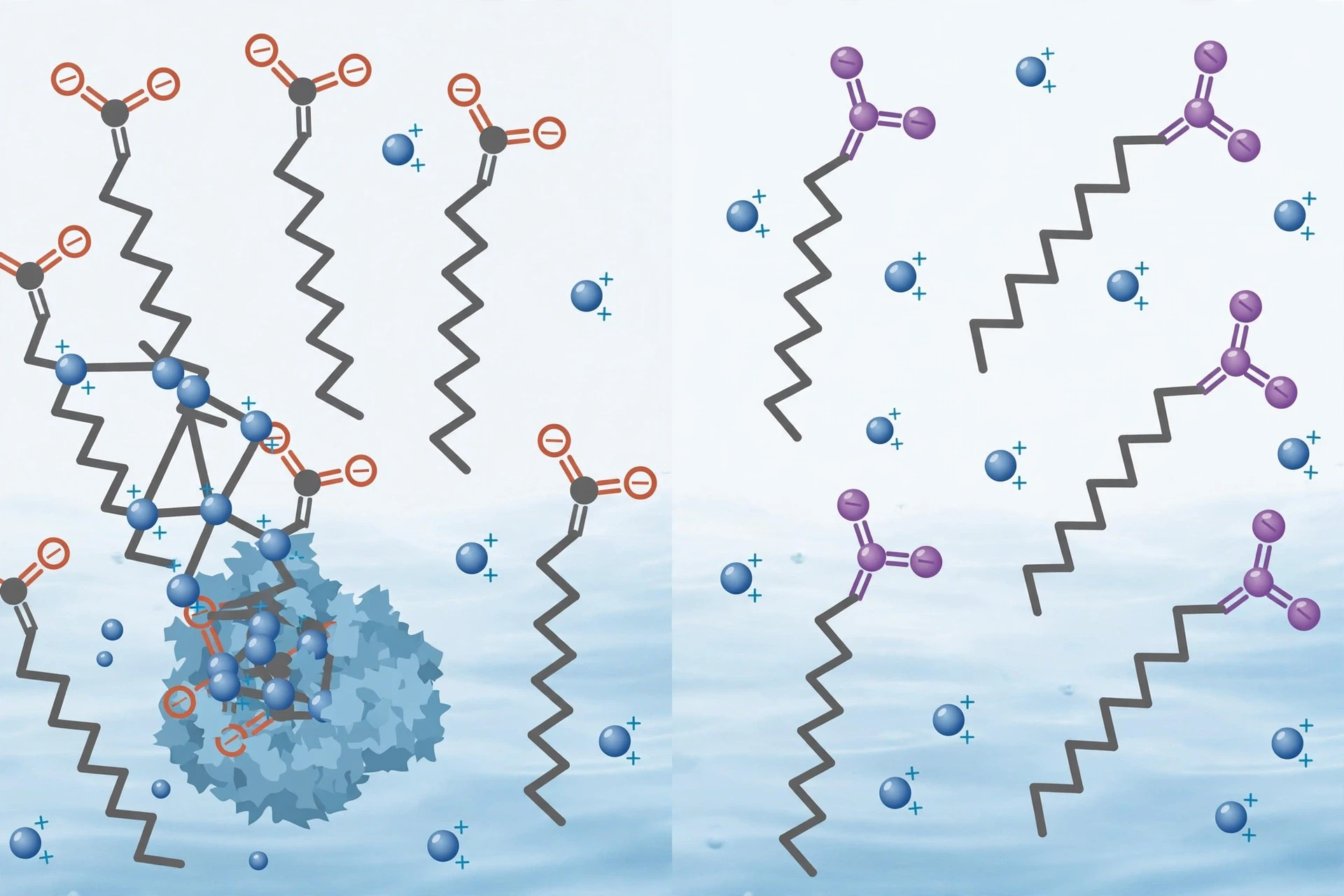
True soap is a carboxylate salt of a fatty acid, made by saponification from natural fats or oils. A detergent is usually a synthetic surfactant, most often a sulfonate or sulfate salt with a long hydrocarbon tail, made from petroleum or plant-derived chemicals in a factory. Both are amphiphilic. Both form micelles. Both lower surface tension. The difference is in the head group, and that small difference changes how each behaves in hard water.
The carboxylate head of soap reacts with the calcium and magnesium ions in hard water to form an insoluble salt — soap scum. The sulfonate head of a typical detergent does not. Its calcium salt stays soluble, so detergents keep working where soap gives up. That single chemical fact is why the world switched to detergents for laundry in the twentieth century, and why your washing machine uses detergent rather than grated bar soap.
Detergents have other advantages. Their formulas can be tuned: builders to soften water, enzymes to break down protein stains, brighteners to make whites look whiter, and fragrances to make the result smell clean. Soap is simpler and, for skin, often gentler. It is also biodegradable by a straightforward route — bacteria break fatty-acid salts down readily — while some early synthetic detergents were not, and caused foaming rivers in the 1950s and 1960s before regulations forced manufacturers to switch to biodegradable versions.
There is a trade-off, though. Detergent molecules are designed, not grown, and some of them irritate skin more readily than plain soap. That is why people with sensitive skin often do better with a simple, fragrance-free bar, and why hospitals still rely on plain soap and water for hand hygiene. The right choice depends on the job: detergent for the washing machine, soap for the hands.
Feature | True soap | Synthetic detergent |
|---|---|---|
Made from | Natural fats or oils plus an alkali | Petroleum or plant chemicals, synthesised in a factory |
Head group | Carboxylate (COO minus) | Usually sulfonate or sulfate (SO3 minus or SO4 minus) |
Main reaction | Saponification of triglycerides | Sulfonation and neutralisation of synthetic chemicals |
In hard water | Forms insoluble soap scum, cleans poorly | Stays soluble, keeps working |
Typical uses | Hand washing, bathing, shaving | Laundry, dishwashers, household cleaners |
Skin mildness | Often gentle, especially unscented bars | Varies; some formulas irritate sensitive skin |
Biodegradability | Readily broken down by microbes | Modern formulas are biodegradable; early ones were not |
8. Hard Water and the Scum Problem
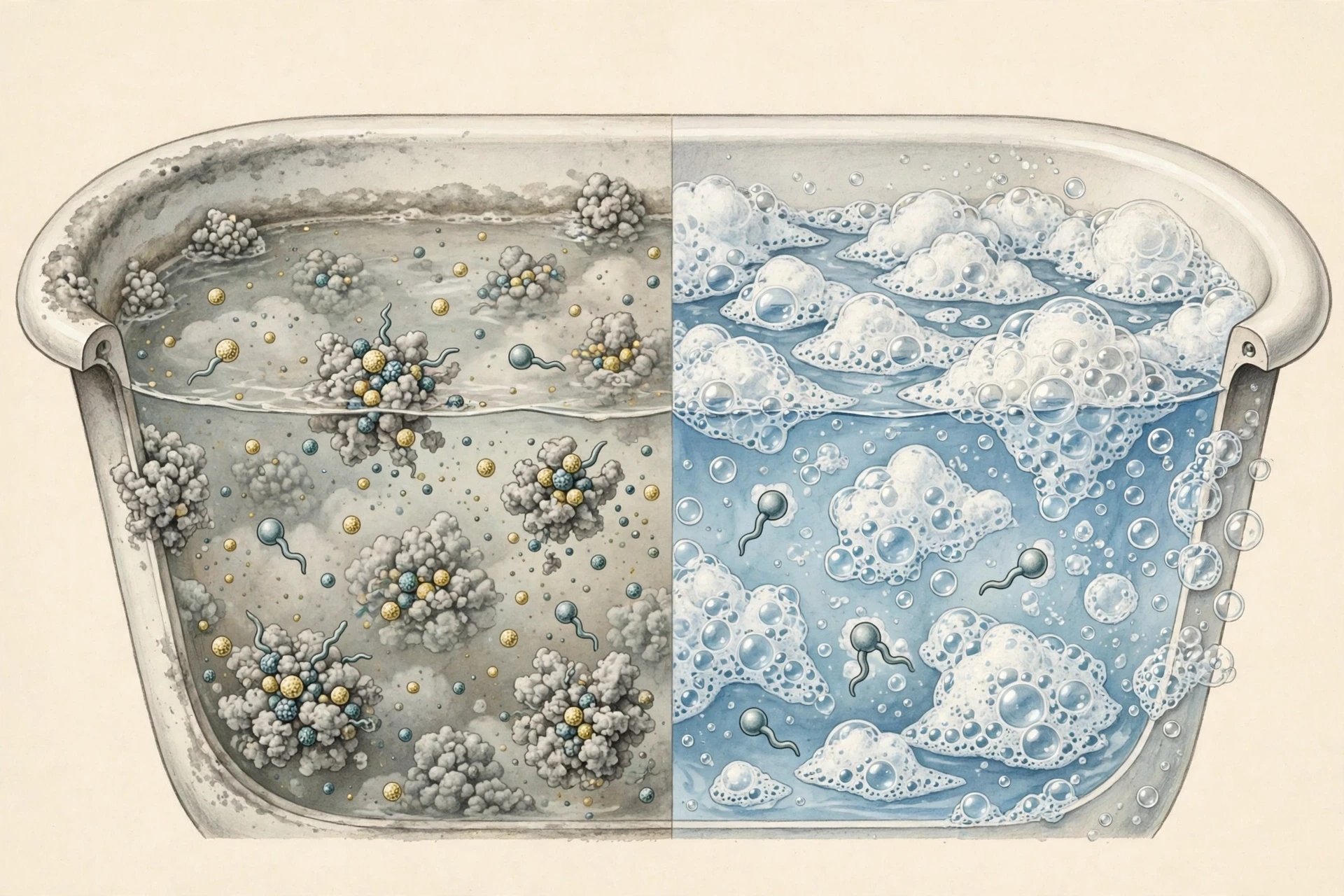
If you live in a hard-water area, you already know the symptoms: a grey ring around the bath, a filmy feel on your skin after a shower, and a bar of soap that seems to vanish without ever producing much lather.
The culprit is dissolved calcium and magnesium, picked up by rainwater as it passes through limestone and chalk. Those ions are harmless to drink, but they are soap's natural enemy.
The chemistry is a simple swap. A soap molecule's charged head normally pairs with a sodium or potassium ion, and that salt dissolves in water. In hard water, calcium ions muscle in. Each calcium ion grabs two soap molecules, forming calcium soap — a sticky, insoluble curd. That curd is soap scum. It does not dissolve, it does not form micelles, and it does not clean. It settles on skin, hair, and bath surfaces as a grey film, and every molecule of soap that becomes scum is a molecule that is no longer available to wash anything.
The practical result is that you need more soap in hard water, and you get less cleaning for it. The scum also explains the "squeaky" feeling some people notice: it is not cleanliness, it is a layer of insoluble calcium soap left on the skin. Rinsing with soft water, or with water that has been through a softener, removes it — which is why hair often feels different after washing in a soft-water town.
Detergents escape this trap because their calcium salts stay soluble, as section 7 explained. Water softeners take another route: they swap the calcium and magnesium ions for sodium ions before the water ever reaches your tap, so the soap never meets its enemy. And if you have ever wondered why a kettle furs up with limescale, it is the same minerals at work, depositing calcium carbonate as the water is heated. The water itself is not dirty; it is simply carrying a load of dissolved rock. Sciory's guide to hard water covers the whole story — what hardness is, how it is measured, and how softening works.
9. Why Does Soap Kill Germs?
Here is the question that made soap famous in the age of pandemics: why does soap kill germs? The honest answer is more interesting than the question suggests, because soap does two different things, and only one of them is killing.
First, soap removes germs. That is the main effect, and it works through the same micelle mechanism as grease removal. Bacteria and many viruses sit on your skin in a thin film of oil and sweat. Soap molecules surround them, lift them off, and trap them in micelles that rinse away down the drain. The germs are not necessarily dead. They are gone. From the point of view of your health, gone is just as good as dead — a germ in the drain cannot infect you.
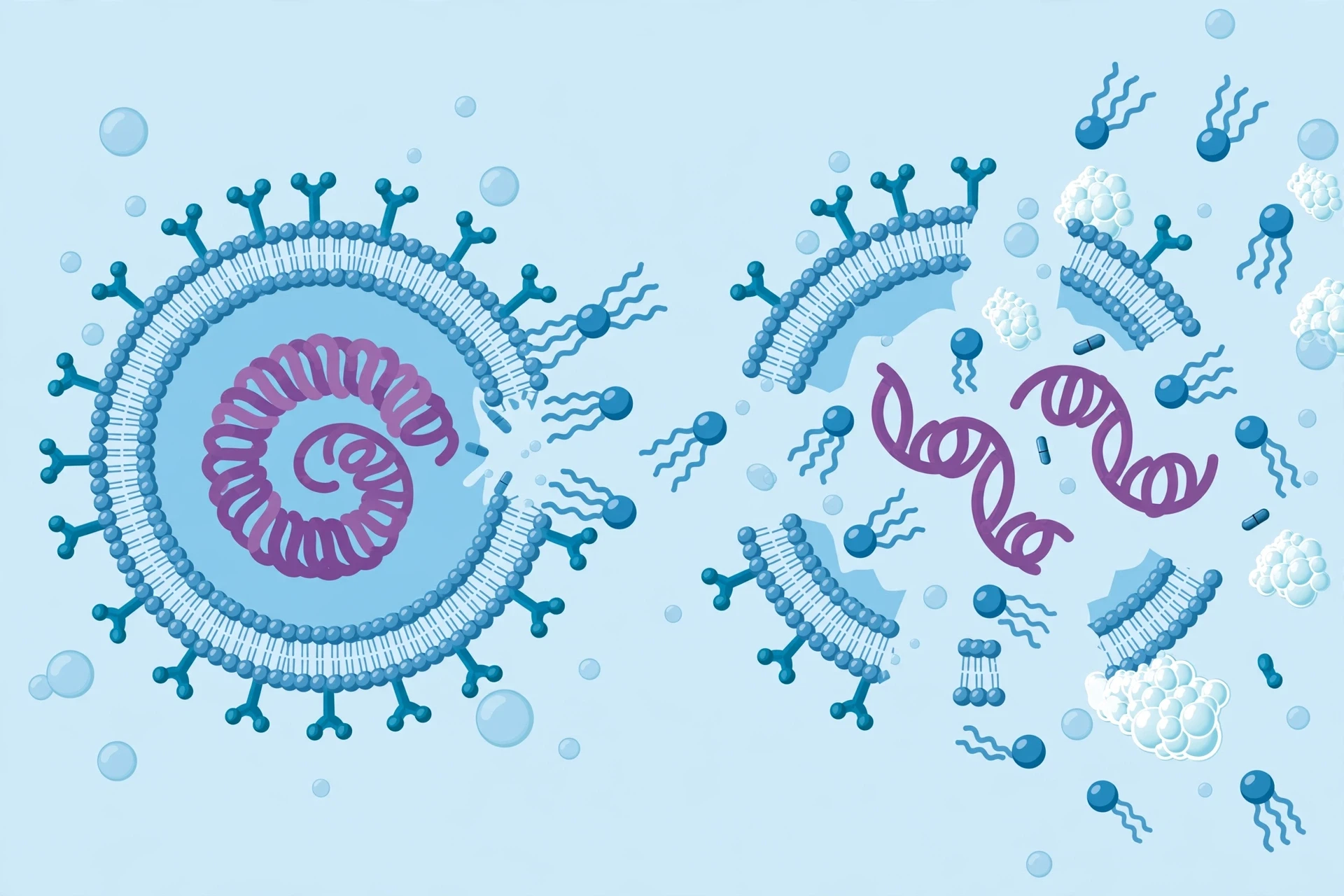
Second, soap damages some germs directly. Many viruses, including the coronaviruses and influenza viruses, are wrapped in a lipid envelope — a fragile skin of fat stolen from the host cell. Soap molecules wedge their tails into that fatty envelope and pull it apart, the way they pull apart a grease layer. Once the envelope breaks, the virus falls apart and cannot infect anyone. Professor Pall Thordarson of the University of New South Wales, quoted by Yale Medicine, puts it vividly: soap molecules "act like crowbars and destabilize the whole system." Some bacteria have similar fatty membranes that soap can disrupt. This is a genuine killing effect, and it is one reason soap and water outperform hand sanitiser on visibly dirty hands: sanitiser cannot cut through grease, but soap can, and it takes the germs with it.
The distinction matters, and the CDC says it plainly: soap and friction help lift dirt, grease, and microbes from skin so they can be rinsed off, and the surfactants in soap lift soil and microbes from the skin in a way water alone cannot. The agency also notes that people tend to scrub more thoroughly when using soap, which removes still more germs. The scrubbing is part of the mechanism, not a ritual around it.
If you want the full cast of characters — what bacteria and viruses actually are, how they differ, and how they spread — Sciory's Microbiology Explained: Bacteria, Viruses, and How Microbes Shape Life covers them in depth. The short version is that bacteria are single-celled organisms with their own machinery, while viruses are simpler packages of genetic material wrapped in protein and, often, a lipid envelope — and it is that fatty wrapping that makes so many viruses vulnerable to soap.
Soap does not need to kill every germ it meets. It needs to get them off your hands and down the drain — and for the viruses wrapped in fat, it tears their coats apart on the way out.
One common worry deserves a straight answer: does soap also kill the harmless microbes that live on your skin? Washing does remove some of them, along with the skin's natural oils. But the skin's microbial community recovers quickly after washing, and the oils are replenished by your sebaceous glands within hours. That is why the advice is to wash when your hands are dirty or after the situations health agencies list — after using the toilet, before eating, after coughing or sneezing — rather than scrubbing constantly. Soap is a tool, and like any tool, it works best when used at the right moments.
10. The Antibacterial Soap Myth
Walk down any supermarket aisle and you will find soaps promising to "kill 99.9 percent of germs" or to offer "antibacterial protection." The label sounds reassuring. The evidence behind it is thin, and regulators have said so in plain language.
In 2016, the US Food and Drug Administration issued a final rule covering over-the-counter consumer antiseptic wash products — the liquid, foam, and gel hand soaps, bar soaps, and body washes sold for home use. Nineteen active ingredients, including the well-known triclosan and triclocarban, could no longer be marketed in those products. The reason was not that the ingredients were proven dangerous at the doses used. It was that manufacturers could not show they were safe for long-term daily use, and could not show they prevented illness any better than plain soap and water. The FDA's own consumer guidance puts it bluntly: there is currently not enough evidence to show that antibacterial soaps are better at preventing illness than washing with plain soap and water.
Most people assume the opposite. They assume that a soap with an added germ-killing chemical must be stronger than a plain one. What the data actually show is that the chemical adds little, because plain soap already removes germs so effectively through lifting and rinsing. A rushed five-second wash with an "antibacterial" soap is a far worse wash than a full twenty seconds with a plain bar. The active ingredient is not the point. The scrubbing and the rinsing are the point.
There is also a cost to the extra chemicals. Triclosan in particular raised concerns about contributing to antimicrobial resistance — the worry that constant low-level exposure to germ-killing chemicals could help bacteria develop defences — and about effects on hormone systems seen in animal studies. Those concerns were part of the background to the 2016 rule, and they are a reminder that adding a chemical to a product is not free. Every ingredient should have to earn its place by proving a benefit, and the antibacterial additives in consumer soap could not.
Three ingredients — benzalkonium chloride, benzethonium chloride, and chloroxylenol — were left on the market while manufacturers gathered more data, and the rule never covered hand sanitisers, hand wipes, or antibacterial products used in hospitals and other healthcare settings, which are regulated separately. But for the ordinary soap in an ordinary bathroom, the verdict stands: plain soap and water is the standard, and the label that promises more is mostly selling a feeling.
11. Washing Well: The 20-Second Rule
If soap is the tool, technique is the skill, and the technique is simpler than most people think. Health agencies around the world recommend the same five steps: wet, lather, scrub, rinse, dry.
Wet your hands with clean running water, warm or cold. Apply soap. Lather by rubbing your hands together, covering the backs of your hands, between your fingers, and under your nails. Scrub for at least twenty seconds. Rinse well under clean running water. Dry with a clean towel or air dryer.
The twenty seconds is the part people skip, and it is the part that matters most. Scrubbing for at least twenty seconds removes more germs than washing for shorter periods, because the scrubbing is what creates the friction that lifts dirt and microbes, and it gives the soap time to form micelles and surround everything that needs removing. A quick splash under the tap with a dab of soap is barely a wash at all. The CDC's handwashing guidance makes the same point: lathering and scrubbing create friction, which helps lift dirt, grease, and microbes from skin, and microbes are present on all surfaces of the hand, often in particularly high concentration under the nails, so the entire hand should be scrubbed.
Temperature is a surprise for many people. Hot water does not clean hands better than cold water. Water hot enough to kill germs would scald your skin, so the temperature of the tap is beside the point. What matters is the soap, the scrubbing, and the time. Use whatever temperature feels comfortable, and spend your effort on the twenty seconds.
I used to think I washed my hands well. Then, years ago, I watched a nurse demonstrate proper handwashing with a fluorescent lotion that glows under ultraviolet light: you rub it in, wash as usual, and the light shows what you missed. The backs of my hands glowed. The skin between my fingers glowed. Under my nails glowed brightest of all. I had been washing the palms and calling it done. It was a humbling little experiment, and it changed the way I wash my hands permanently. If you ever get the chance to try it — some science museums and health fairs run the demonstration — take it. Seeing the missed spots is worth a hundred lectures.
Hand sanitiser has its place, but it is a back-up, not a replacement. The CDC states it plainly: "Washing hands with soap and water is the best way to get rid of germs in most situations." And if soap and water are not readily available, the agency says an alcohol-based hand sanitiser with at least 60 percent alcohol is the substitute. Sanitiser kills many germs, but it does not remove dirt, grease, or chemicals, and it works poorly on visibly dirty or greasy hands. The rule is simple: a sink beats a bottle whenever you have the choice.
Step | What to do | Why it matters |
|---|---|---|
| Wet hands with clean running water | Water carries the soap and helps it spread |
| Apply soap and rub hands together | Builds the lather and starts micelle formation |
| Scrub all surfaces for at least 20 seconds | Friction lifts dirt and germs; time lets soap work |
| Rinse well under clean running water | Carries micelles, dirt, and germs down the drain |
| Dry with a clean towel or air dryer | Wet hands spread germs more easily than dry ones |
12. Bubbles, Foam, and What They Really Mean
Children love bubbles, and adults are not far behind. A sink full of foam feels like proof that the soap is working hard. It is a satisfying sight, and it is mostly a side effect.
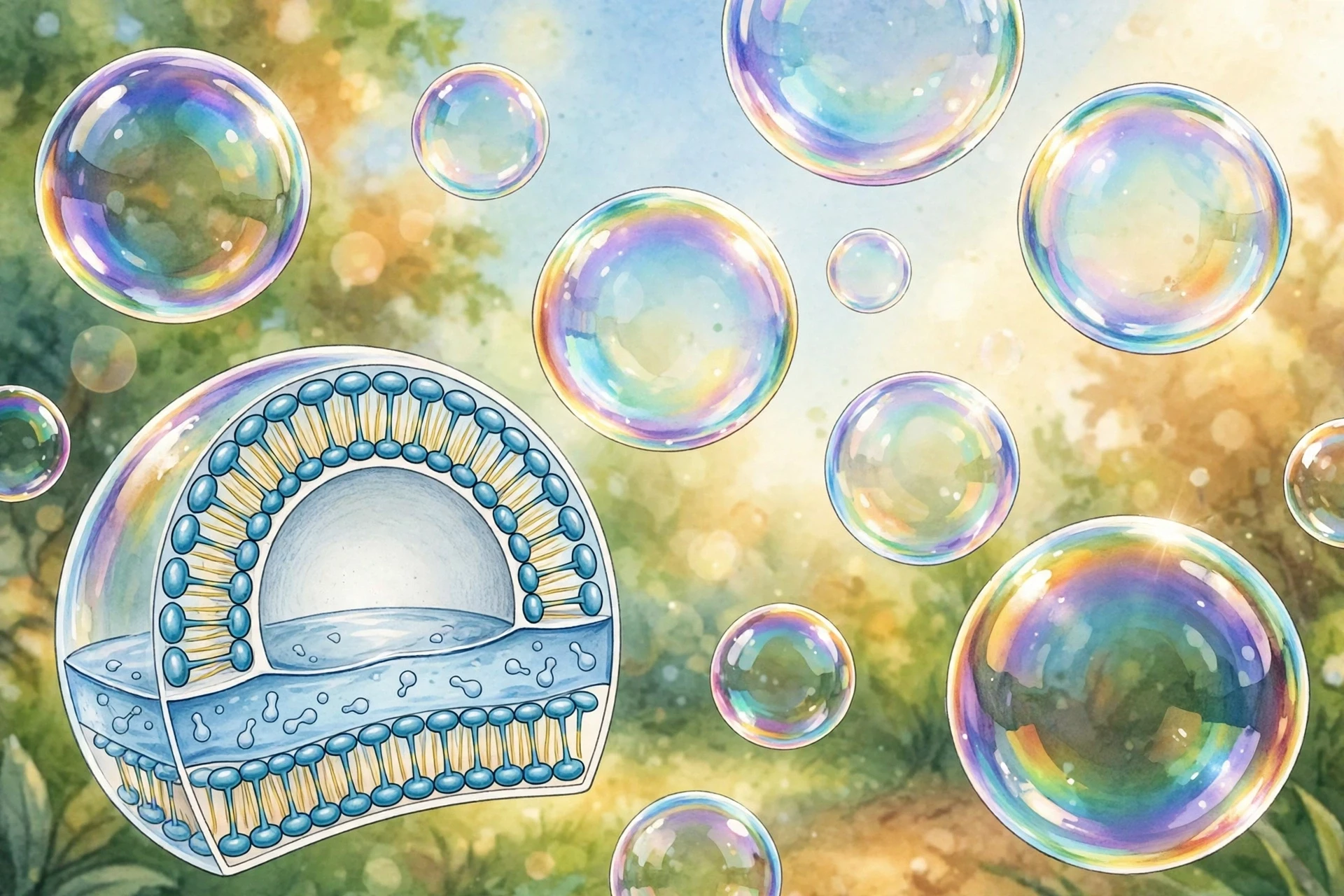
A bubble is a thin film of water sandwiched between two layers of soap molecules, with their tails pointing outward into the air and their heads pointing inward into the water. The soap lowers the surface tension of the water film, which stops it from collapsing instantly, and the film can stretch into a sphere that catches the light and throws back rainbow colours. Those colours come from light reflecting off the two surfaces of the film and interfering — the same interference that colours an oil slick on a wet road.
Here is the part most people get wrong: foam does not clean. The cleaning is done by micelles in the water, not by bubbles in the air. A soap that makes mountains of foam and a soap that makes almost none can clean equally well, because foam is about the soap's behaviour at the air-water surface, while cleaning is about its behaviour at the grease-water boundary. Some of the best industrial cleaners barely foam at all — in fact, factories often add anti-foaming agents to keep the foam down, because foam gets in the way of machines. Dishwasher detergent is deliberately low-foam for exactly that reason.
So why do manufacturers add foaming agents to hand soap and shampoo? Because we like foam, and we have learned to read it as a sign of cleaning power. It is a piece of psychology riding on top of the chemistry. The lather tells you that the soap is present and spread out, which is genuinely useful feedback. But the foam itself is not doing the washing. The invisible micelles are.
I learned this distinction from a chemistry teacher who blew a single perfect bubble, watched it drift across the room, and asked the class what it was made of. "Soap," we said. "Mostly water," she replied, "held together by a skin of soap one molecule thick." She was right, and the image has stayed with me: a bubble is water, wearing a soap coat, and the coat is the thinnest thing you can imagine.
13. Soap and the Environment
Soap is one of the gentler chemicals we send down the drain, but it is not without an environmental footprint, and the story of how the industry learned that lesson is worth telling.
True soap biodegrades readily. Bacteria in soil and wastewater break fatty-acid salts down into carbon dioxide and water, and the process is fast compared with many synthetic chemicals. That is one of soap's real advantages over early detergents. In the 1950s and 1960s, the first synthetic laundry detergents used branched-chain surfactants that bacteria could not break down, and rivers foamed with suds that drifted across roads and piled up at weirs. The problem was visible, embarrassing, and eventually impossible to ignore. Regulations in many countries forced a switch to straight-chain surfactants that microbes can digest, and the foaming rivers receded. It was an early lesson in a principle that now runs through all of green chemistry: a product should be designed so that nature can take it apart again when its job is done.
Modern detergents carry other environmental questions. Phosphates, once added to laundry detergent to soften water and boost cleaning, fed algal blooms in lakes and rivers when they arrived in wastewater. Many countries have since restricted or banned phosphates in detergents, and manufacturers have replaced them with other builders. Microplastics are a newer concern: some exfoliating soaps and scrubs once contained tiny plastic beads that passed straight through wastewater treatment into rivers and seas. Several countries have now banned microbeads in rinse-off cosmetics. The pattern is the same each time: a useful ingredient turns out to have a cost downstream, and the fix is to design it out.
What can an ordinary user do? Choose simple products when you can: a plain bar with a short ingredient list, a detergent without phosphates, a scrub without plastic beads. Use the recommended dose rather than doubling it — more soap does not mean cleaner, and the excess goes straight down the drain. And remember that the most environmentally friendly wash is often the shortest effective one: enough soap, enough scrubbing, and no more.
14. What Most People Get Wrong
A few stubborn misconceptions about soap deserve to be named plainly, because they change how people wash.
The first is that soap kills germs by poisoning them, the way a disinfectant does. Plain soap's main job is removal, not poisoning. It lifts germs off and rinses them away. The killing it does — tearing apart the fatty envelopes of some viruses — is real, but it is a bonus, not the main event. Thinking of soap as a poison leads people to chase "antibacterial" labels that add nothing, instead of scrubbing for the full twenty seconds that actually matters.
The second is that more lather means more cleaning. It does not. Lather is soap at the air-water surface; cleaning happens at the grease-water boundary. A low-foam soap can clean perfectly well, and a mountain of bubbles can sit on top of hands that are still dirty underneath.
The third is that hot water cleans better. It does not, at least not at any temperature your skin can tolerate. Warm water feels nicer, and it can help dissolve grease slightly faster, but the CDC's guidance is clear that the temperature of the water is not what removes the germs. The soap and the scrubbing do that.
The fourth is that a bar of soap is itself dirty or full of germs. Studies of used bars have found bacteria on their surfaces, but the bacteria are mostly the harmless residents of the user's own skin, and they rinse off with the lather. Bar soap remains a safe and effective way to wash hands, and the CDC recommends plain soap in either bar or liquid form. If a bar looks slimy or sits in a puddle of water, let it dry between uses on a draining dish, and it will stay in good shape.
The fifth is that soap is a modern invention, a product of laboratories and factories. It is not. People have been making soap from fat and ash for thousands of years, long before anyone knew what a molecule was. The science came later and explained what the craft already knew. That is one of the pleasures of this topic: the chemistry is modern, but the practice is ancient, and the two fit together without a seam.
The oldest cleaning technology we own is also one of the best. Soap asks for nothing more than water, twenty seconds, and a willingness to scrub — and it repays that small effort with a kind of cleaning no disinfectant can match, because it removes the dirt instead of trying to poison it.
15. Choosing the Right Soap: Reading a Label
Stand in front of a supermarket shelf and you will see a wall of promises: moisturising, antibacterial, natural, sensitive, exfoliating, triple-milled, cold-pressed. Most of it is marketing, but the ingredient list underneath tells the real story, and it is worth learning to read.
The first ingredients on a true soap label are usually the oils: sodium olivate (olive oil), sodium cocoate (coconut oil), sodium palmate (palm oil), or sodium tallowate (tallow). Those names are the saponified forms of the fats, and they tell you what the bar is made from. Glycerin appears when it has been left in rather than removed — a good sign for dry skin, since glycerin attracts moisture. Fragrance, or parfum, is the ingredient most likely to irritate sensitive skin, and "unscented" is not the same as "fragrance-free": an unscented product can still contain masking fragrances. If your skin reacts to soap, fragrance is the first suspect.
Liquid hand soaps and body washes are a different world. Many are not soap at all in the chemical sense: they are detergent-based, built on surfactants such as sodium laureth sulfate or cocamidopropyl betaine, with thickeners, preservatives, and moisturisers added. They clean perfectly well, and their pH is often closer to the skin's natural slightly acidic pH than a true soap bar, which is alkaline. That is a genuine advantage for people with dry or sensitive skin. The trade-off is a longer ingredient list and, usually, a plastic bottle.
So how should you choose between all these options? The honest answer is that the molecule matters less than the habit. A plain bar, used properly for twenty seconds, will beat the most expensive wash used badly. Choose the product your skin tolerates, that you will actually use, and that fits the job: a mild bar for hands and body, a detergent for laundry, a low-foam product for the dishwasher. And when a label promises something extraordinary, ask what it would take to prove it. If the claim is "kills 99.9 percent of germs," remember section 10: plain soap already removes the germs, and the extra claim is doing more work on the shelf than on your skin.
16. From Grease to Clean: What Soap Really Does
That greasy-handed child at the bicycle chain eventually learned the answer to his question, and the answer turned out to be bigger than the question. How does soap work? It works by being two things at once: a molecule that loves water and a molecule that loves grease, joined into a single shape that can hold both worlds together. It lowers the surface tension of water so the water can reach the dirt. It wraps grease in micelles so the water can carry it away. It tears apart the fatty coats of some viruses on the way. And it does all of this with a recipe — fat plus alkali — that humans discovered thousands of years ago and have barely changed since.
The next time you pick up a bar of soap, take a second to notice what is happening in your hands. The lather is not just foam. It is millions of tiny parcels being built, loaded, and shipped down the drain. The twenty seconds you spend scrubbing are not a ritual. They are the time the chemistry needs. And the clean feeling when you rinse is not an illusion: the grease, the dirt, and the germs really are gone, carried away in water that could never have moved them on its own.
Soap is a reminder that the most powerful technologies are not always the newest ones. Sometimes they are the oldest — a simple molecule, a simple reaction, and a simple habit, working together so well that we forget to ask how. Now you know.
Frequently Asked Questions
How does soap work?
Soap works because each soap molecule has two ends with opposite preferences: a water-loving charged head and a grease-loving hydrocarbon tail. The tails bury themselves in grease and dirt while the heads stay in the water. With enough soap present, the molecules gather into tiny spheres called micelles that trap grease and microbes inside, and the rinse water carries the micelles away down the drain. Soap also lowers the surface tension of water, so the water spreads and wets surfaces it would otherwise bead off.
Why does soap kill germs?
Soap mainly removes germs rather than killing them: it lifts bacteria and viruses off the skin and traps them in micelles that rinse away. It also damages some germs directly, because many viruses — including coronaviruses and influenza viruses — are wrapped in a fatty envelope that soap molecules pull apart, breaking the virus open. The CDC explains that soap and friction lift dirt, grease, and microbes from skin so they can be rinsed off, and that scrubbing for at least 20 seconds removes more germs than shorter washing.
What is the difference between soap and detergent?
True soap is a carboxylate salt of a fatty acid, made by saponification from natural fats or oils plus an alkali. A detergent is usually a synthetic surfactant, most often a sulfonate or sulfate salt, made in a factory from petroleum or plant chemicals. Both are amphiphilic and both form micelles, but soap's carboxylate head reacts with calcium and magnesium in hard water to form insoluble scum, while detergent's sulfonate head stays soluble. That is why detergents keep working in hard water and are used for laundry, while soap is preferred for skin.
How is soap made?
Soap is made by saponification: a fat or oil (a triglyceride) is heated with a strong alkali, usually sodium hydroxide for bar soap or potassium hydroxide for liquid soap. The alkali cuts the fatty-acid chains off the glycerol backbone, and each chain becomes a soap molecule — the sodium or potassium salt of a fatty acid — with glycerol released as a by-product. Traditional soap makers salted the soap out of the mixture, skimmed it off, and left it to cure in moulds for weeks. Modern factories run the same reaction continuously at industrial scale.
Does soap work in cold water?
Yes. Cold water with soap cleans hands just as well as hot water, because the cleaning is done by the soap and the scrubbing, not by the temperature. Water hot enough to kill germs would scald skin, so tap temperature makes no practical difference to germ removal. Use whatever temperature feels comfortable, and spend your effort on lathering and scrubbing for at least 20 seconds.
Is antibacterial soap better than plain soap?
No. The US Food and Drug Administration has stated there is not enough evidence that over-the-counter antibacterial soaps prevent illness better than plain soap and water, and in 2016 the FDA issued a final rule removing 19 active ingredients, including triclosan and triclocarban, from consumer antiseptic wash products (effective September 2017) because manufacturers could not show they were safe for long-term daily use or more effective than plain soap. A full 20-second wash with plain soap beats a quick wash with an antibacterial soap every time.
Can I use soap to wash my face or hair?
You can, but it depends on the soap and your skin. Plain soap is alkaline, and it can strip the skin's natural oils, leaving it dry or tight — which is why many people prefer cleansers formulated for the face, or follow soap with a moisturiser. For hair, soap leaves a residue in hard water and can make hair feel dull, which is why shampoo — a detergent-based product — replaced soap for hair washing in most of the world. If you have sensitive or dry skin, choose a mild, fragrance-free bar and rinse well.
Sources
Saponification of Fats and Oils; Soaps and Detergents — Chemistry LibreTexts
Microbiology Explained: Bacteria, Viruses, and How Microbes Shape Life — Sciory
Chemical Reactions Explained: Types, Kinetics, and Everyday Examples — Sciory
Hard Water Explained: The Chemistry of Water Hardness and Softening — Sciory